Article

Early Detection of Spatiotemporal Stabilization in Open-Pit Mine Waste Dumps via Time-Series InSAR Coherence

College of Geoscience and Surveying Engineering, China University of Mining & Technology, D11 Xueyuan Road, Beijing 100083, China
*
Author to whom correspondence should be addressed.
Remote Sens. 2026, 18(9), 1310; https://doi.org/10.3390/rs18091310
Submission received: 11 March 2026 / Revised: 10 April 2026 / Accepted: 21 April 2026 / Published: 24 April 2026

Highlights

What are the main findings?
  • A critical InSAR coherence threshold of 0.15 was identified, revealing that 87.6% of open-pit waste dumps achieve physical stabilization within three years post-mining.
  • The proposed sliding-window detection framework accurately mapped spatiotemporal stabilization, achieving an overall accuracy of 87.57% for half-yearly monitoring.
What is the implication of the main finding?
  • The framework successfully decouples abiotic physical consolidation from biological vegetation greening, overcoming the multi-year ‘biological response lag’ inherent in traditional optical monitoring.
  • This timely abiotic precursor indicator provides quantitative decision support for precision ecological zoning, significantly accelerating land turnover approvals in arid mining regions.

Abstract

Accurately monitoring the surface stabilization of waste dumps in open-pit coal mines is critical for hazard prevention and ecological reclamation. In arid and semi-arid regions, traditional optical remote sensing vegetation indices suffer from a systematic “response lag” in assessing physical stability due to the slow establishment of pioneer vegetation. To overcome this biological limitation, this study proposes a quantitative spatiotemporal monitoring framework based on time-series Interferometric Synthetic Aperture Radar (InSAR) coherence to detect early-stage geotechnical stabilization. Using Sentinel-1 imagery of the Balongtu coal mine, a sliding-window detection algorithm was developed to capture the physical transition of surface electromagnetic scattering mechanisms from active disturbance to stable consolidation. The main findings are as follows: (1) Statistical analysis identified a critical geophysical coherence threshold of 0.15, which effectively and objectively distinguishes active dumping disturbance zones from structurally stable areas. (2) The spatiotemporal evolution dynamics of the completed dump areas from 2017 to 2023 were successfully characterized, revealing that 87.6% of the open-pit areas achieved physical stabilization within three years post-mining, with a spatial distribution highly consistent with the objective operational rule of “mining first, dumping later”. (3) Accuracy assessment using 700 spatiotemporally balanced validation points—derived through strict visual interpretation of high-resolution optical imagery—demonstrated high algorithm reliability, achieving overall accuracies (OA) of 87.57% and 90.43% at half-yearly and annual monitoring intervals, respectively. By decoupling physical surface stabilization from optical greenness, this study provides a timely abiotic precursor indicator, offering scientific, quantitative decision support for precision ecological zoning and accelerated land turnover approval in mining areas.

1. Introduction

Mining activities in arid and semi-arid regions often induce profound and long-lasting surface disturbances, among which waste dumps represent one of the most extensive and structurally unstable anthropogenic landforms [1,2,3]. These features are typically composed of loosely compacted materials with heterogeneous grain-size distributions and limited cohesion, making them highly susceptible to surface deformation, slope adjustment, and secondary geomorphic hazards [4,5,6]. In water-limited environments, where natural recovery processes are slow and highly sensitive to climatic variability, the post-disturbance evolution of waste dumps plays a critical role in determining long-term environmental risk and landscape stability [7,8,9]. Accurately identifying when such disturbed surfaces transition toward stable conditions is, therefore, essential for hazard mitigation, land reclamation planning, and sustainable management in arid mining areas [10,11,12].
Surface stability in mining landscapes is commonly evaluated through vegetation recovery, which is often treated as a visible indicator of successful ecological restoration [13,14,15]. Optical remote sensing indices, such as the Normalized Difference Vegetation Index (NDVI), have been widely applied to characterize vegetation dynamics and assess post-mining recovery trajectories [16,17,18]. However, in arid and semi-arid environments, vegetation establishment is strongly constrained by precipitation availability, soil moisture retention, and substrate properties [19,20,21]. Consequently, observable vegetation recovery frequently occurs well after the surface materials have undergone mechanical consolidation and structural stabilization. This temporal discrepancy introduces a systematic “response lag” into stability assessment, whereby physically stable surfaces may still be classified as unstable due to sparse or delayed vegetation cover [22,23,24]. From a hazard science perspective, this lag is non-trivial. The transition from an actively disturbed surface to a stable condition marks a critical reduction in the likelihood of slope failure, surface erosion, and other secondary hazards. Vegetation-based indicators, while valuable for evaluating long-term ecological outcomes, primarily reflect the consequences of stabilization rather than the stabilization process itself. Consequently, relying solely on vegetation dynamics limits the ability to identify early-stage stability transitions that are most relevant for risk assessment and management decision-making in dryland mining regions [25,26,27].
Surface stabilization should therefore be understood as a dynamic process rather than a static end state. This process involves the gradual attenuation of material rearrangement, reduction in micro-scale surface changes, and consolidation of surface scattering structures. These physical changes precede biological colonization and can provide early signals of hazard attenuation. Monitoring approaches capable of directly capturing surface physical responses are required to overcome the temporal bias inherent in vegetation-based assessments.
Interferometric Synthetic Aperture Radar (InSAR) offers unique advantages for monitoring surface processes in mining environments due to its sensitivity to surface change and its independence from illumination and weather conditions. While InSAR has traditionally been employed to measure surface displacement, interferometric coherence provides complementary information on the stability of radar scattering mechanisms. Coherence reflects the similarity of backscattered signals between repeated observations and is influenced by changes in surface roughness, material composition, moisture conditions, and scattering geometry. In disturbed mining landscapes, low coherence is typically associated with active surface reworking and unstable scattering structures, whereas coherence recovery indicates increasing consistency in surface properties [28,29,30].
Despite this strong physical linkage, coherence has most commonly been used in existing studies as a qualitative indicator of disturbance or surface change. Many investigations focus on coherence loss to delineate affected areas or identify zones of active deformation, while coherence recovery is often treated descriptively or averaged over extended periods. Such approaches obscure the transitional dynamics associated with surface stabilization and limit the ability to identify when disturbed surfaces have entered a relatively stable regime. As a result, the potential of InSAR coherence to support quantitative, process-oriented stability assessment remains underutilized. Several factors contribute to this limitation. First, coherence time series are inherently noisy due to atmospheric effects, acquisition geometry, and environmental variability, particularly in arid regions where moisture conditions can fluctuate episodically. Short-term coherence increases may reflect transient environmental effects rather than genuine stabilization [31,32,33]. Second, many studies lack an explicit criterion for distinguishing sustained coherence recovery from background variability. Without a clearly defined threshold concept grounded in surface process understanding, coherence-based analyses often rely on subjective interpretation, reducing their reproducibility and applicability in hazard assessment frameworks [34,35,36].
It is necessary to reconceptualize coherence analysis from a descriptive tool to a mechanism-constrained indicator of surface stabilization. Rather than focusing on instantaneous coherence values, temporal continuity must be explicitly incorporated to capture the cumulative nature of stabilization processes. Sliding-window analysis provides a means to evaluate coherence persistence over defined temporal scales, allowing transient fluctuations to be separated from sustained recovery signals. When combined with a physically interpretable coherence threshold concept, such an approach can support objective identification of the transition from disturbance to stability. In this context, the present study proposes a quantitative evaluation framework that integrates InSAR coherence mechanisms with sliding-window analysis to characterize stabilization processes at waste dumps in arid mining areas. The framework is built on the premise that surface stabilization is associated with the emergence of a persistent coherence recovery signal, reflecting a qualitative shift in surface scattering behavior from highly unstable to relatively consistent conditions. Instead of relying on arbitrary or empirically tuned values, the framework introduces a geophysical constrained coherence threshold concept to distinguish transient coherence variations from meaningful stabilization signals [37,38].
The primary objective of this study is to overcome the temporal limitations of vegetation-based monitoring by providing an earlier, physically grounded indicator of surface stabilization. Specifically, the study aims to (1) characterize the temporal behavior of InSAR coherence over disturbed waste dumps in arid environments, (2) develop a sliding-window-based analytical approach to suppress short-term noise and enhance process signals, and (3) identify the disturbance-to-stability transition using a coherence recovery criterion grounded in surface scattering mechanisms. By framing stability assessment as a transition problem rather than a static classification task, the proposed approach advances coherence analysis toward a process-oriented hazard assessment tool. The significance of this work lies in both its conceptual and practical contributions. Conceptually, it shifts the focus of InSAR coherence analysis from disturbance detection to stabilization characterization, emphasizing temporal continuity and physical interpretation. Methodologically, it provides a structured framework for integrating coherence mechanisms with time-series analysis. Practically, the proposed approach supports earlier identification of stable conditions in arid mining landscapes, thereby informing hazard risk assessment, reclamation planning, and long-term monitoring strategies. By capturing stabilization signals before vegetation recovery becomes evident, the framework offers a valuable complement to existing ecological indicators and contributes to more timely and informed decision-making in environmentally sensitive mining regions [39,40].

2. Study Area and Data

2.1. Overview of the Study Area

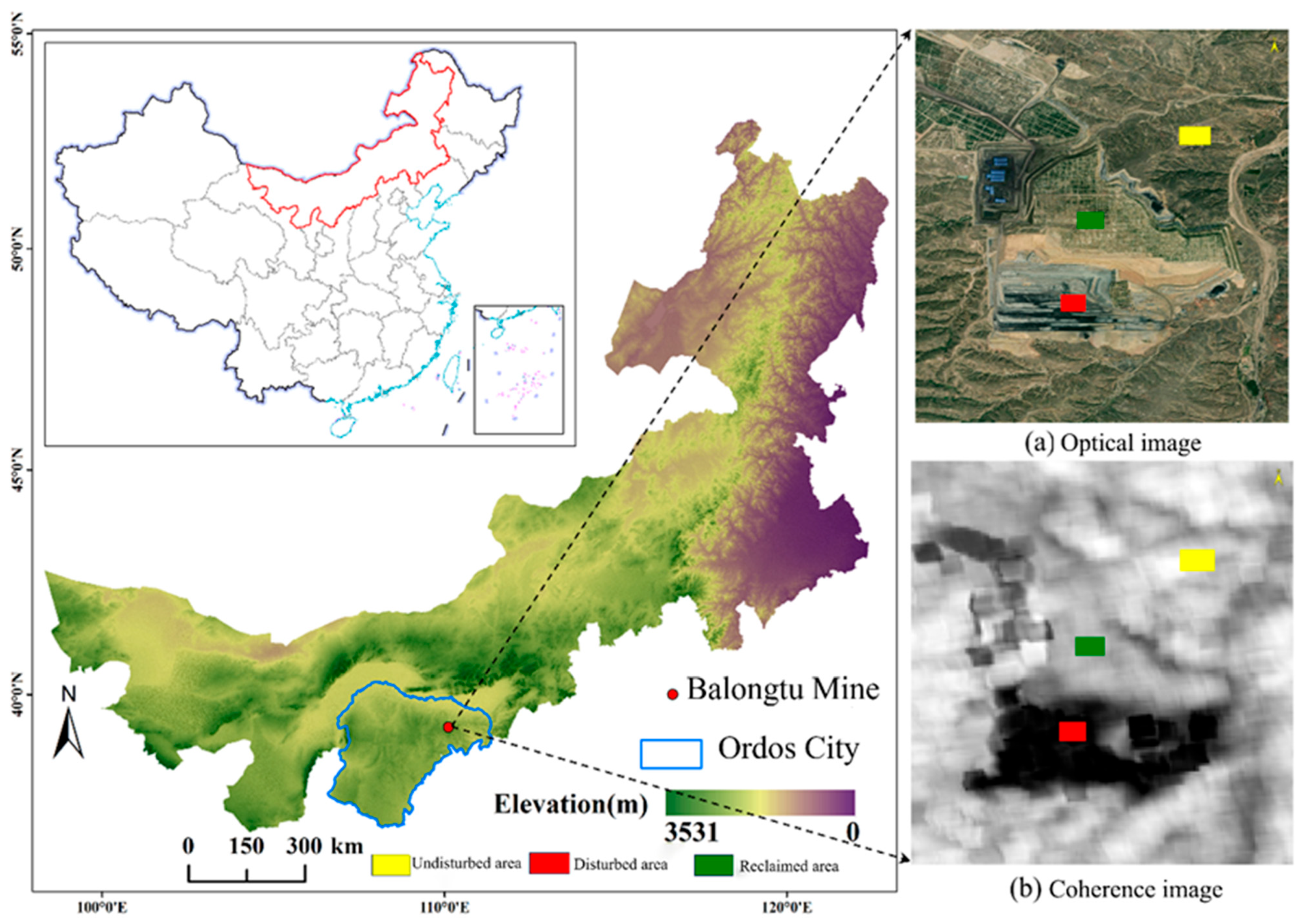
The Balongtu Coal Mine, selected as the primary experimental site, is located within the Dongsheng Coalfield in Ordos City, Inner Mongolia Autonomous Region, China (108°40′–110°50′ E, 39°20′–40°15′ N) (Figure 1). Situated in the northeastern part of the Ordos Plateau, the terrain is predominantly hilly with elevations ranging from 1120 to 1584 m. The region experiences a typical arid to semi-arid continental plateau climate, characterized by a stark hydrological imbalance: the average annual precipitation is merely 368.2 mm, whereas the annual evaporation reaches up to 2163.8 mm. Consequently, the natural ecological background is highly fragile, with sparse vegetation cover ranging from only 10% to 30%, leaving extensive bare-soil surfaces exposed.
Intensive open-pit mining activities at the Balongtu Mine have resulted in the continuous reconfiguration of these vulnerable land resources, generating extensive anthropogenic waste dumps. Driven by the extreme water limitations and high evaporation rates, these waste dumps often remain unvegetated for extended periods. This severe biological constraint drastically limits the applicability of optical vegetation indices (e.g., NDVI) for evaluating early-stage surface stabilization. However, these exact conditions make the site an ideal testbed for our InSAR-coherence-based framework. Owing to the sparse vegetation and the dominance of bare-soil scattering mechanisms, volume scattering decorrelation is negligible. Therefore, coherence variations here are primarily controlled by surface geometric changes, enabling the precise identification of spatiotemporal transition points from actively disturbed surfaces to geotechnically stabilized zones [41,42].

2.2. Data Sources

This study integrates multi-source remote sensing datasets to support the quantitative analysis of mining-induced surface dynamics. Time-series Sentinel-1 C-band Synthetic Aperture Radar (SAR) imagery was employed to generate interferometric coherence products, which serve as the primary indicator for characterizing surface disturbance and stabilization processes. Owing to its sensitivity to changes in surface scattering geometry, Sentinel-1 SAR data are well suited for capturing dumping, leveling, and consolidation activities in open-pit mining areas. Optical imagery from Sentinel-2 and high-resolution Google Earth data was used for visual interpretation and independent validation of surface states throughout the study period. To quantitatively assess algorithm performance, a total of 700 validation sample points were randomly distributed between 2017 and 2023. These samples were allocated across undisturbed areas, actively disturbed zones, and potential restoration regions following the principle of spatiotemporal balance, ensuring representativeness across different surface conditions and mining stages [43].

2.3. Data Preprocessing

A multi-stage error suppression strategy was applied during Sentinel-1 data preprocessing to ensure that the derived coherence coefficients reliably represent surface disturbance evolution. The temporal baselines of interferometric image pairs were constrained to within 24 days to reduce the influence of thermal noise and temporal decorrelation. Precise Orbit Determination (POD) data were used to achieve sub-pixel co-registration accuracy, thereby minimizing processing-related decorrelation caused by orbital and topographic effects. To further suppress Doppler centroid decorrelation, a joint azimuth–range adaptive filtering approach was implemented by retaining only the overlapping Doppler spectrum components between interferometric pairs. Additionally, interferometric pairs exceeding critical spatial baseline thresholds were excluded to avoid geometric decorrelation effects. Given the arid environmental conditions of the study area, where vegetation cover is sparse and surface scattering is dominated by bare soil, volume scattering decorrelation was considered negligible. As a result, the remaining coherence variations can be primarily attributed to surface geometric changes induced by mining and dumping activities, providing a robust basis for subsequent spatiotemporal analysis.
To ensure the rigorous elimination of baseline and geometric decorrelation inherent in the Sentinel-1 Terrain Observation by Progressive Scans (TOPS) mode, a joint azimuth–range adaptive filtering approach was implemented. Specifically, the Enhanced Spectral Diversity (ESD) method was applied iteratively to achieve a stringent 0.001-pixel azimuth coregistration accuracy, effectively compensating for the high Doppler centroid frequency rate across bursts. This was followed by an adaptive Goldstein phase filter, which estimates the local spectral displacement and selectively retains only the overlapping Doppler spectrum components between the interferometric pairs, thereby maximizing phase quality. Furthermore, the topographic phase contribution was simulated and subtracted utilizing the Copernicus GLO-30 Digital Elevation Model (DEM). This DEM provides a 30 m spatial resolution and exceptional global vertical accuracy, which is critical for mitigating topographic artifacts in the highly undulating terrain of the open-pit mine. All Sentinel-1 datasets were acquired in the Interferometric Wide (IW) swath mode utilizing Vertical Transmit-Vertical Receive (VV) polarization. The VV polarization scheme was exclusively selected because it is demonstrably more sensitive to the surface roughness variations in bare soils in arid environments, effectively minimizing volume scattering decorrelation compared to cross-polarization (VH) channels.

3. Methodology and Evaluation Framework

3.1. Overview of the Methodological Framework

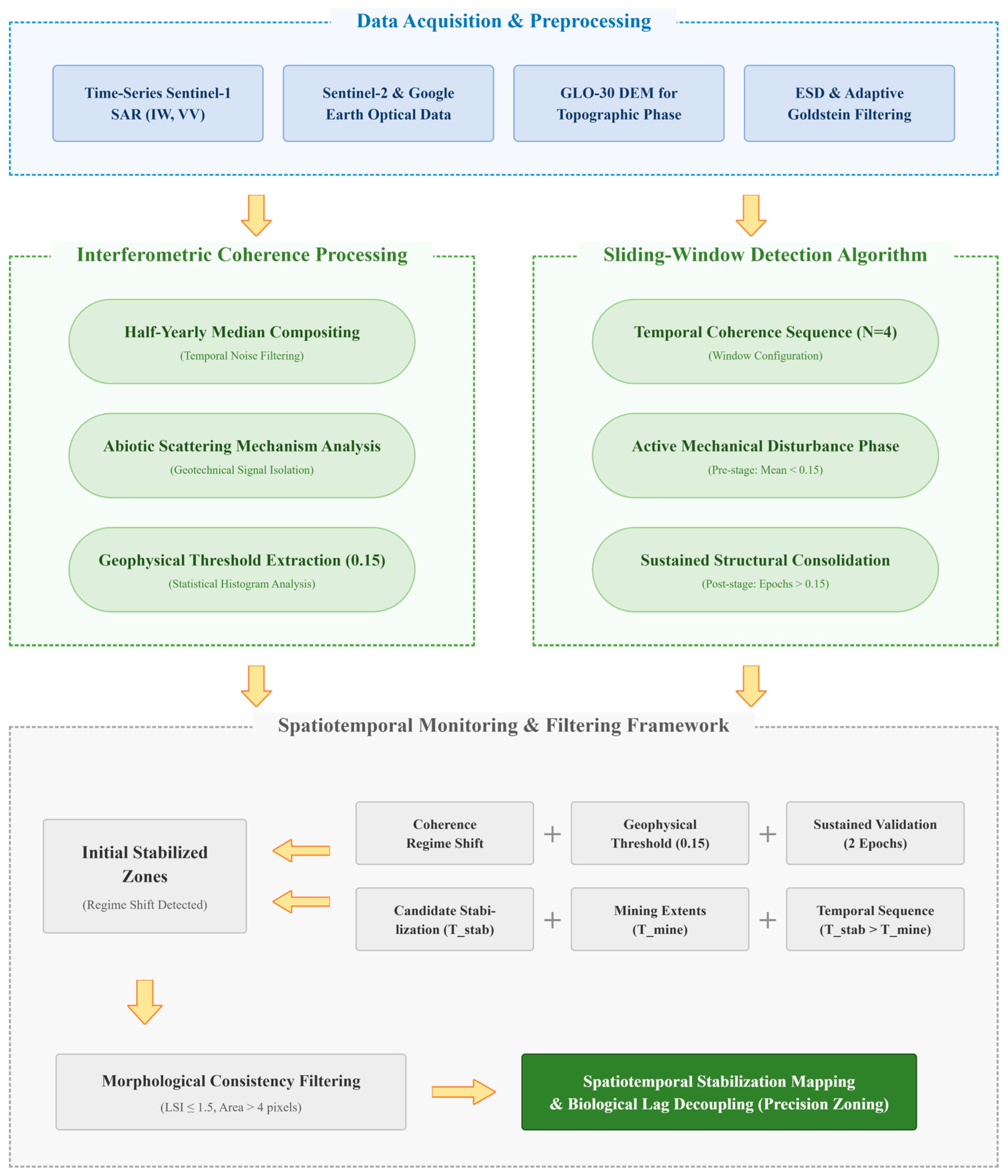
This study proposes a robust, quantitative spatiotemporal monitoring framework to detect the early-stage geotechnical stabilization of open-pit mine waste dumps, explicitly designed to overcome the “biological response lag” inherent in traditional optical assessments. The proposed methodology is structured into four interconnected phases to reliably capture the regime shift from active mechanical disturbance to sustained structural consolidation (Figure 2): (1) Data Processing and Coherence Generation: Time-series Sentinel-1 SAR imagery was interferometrically processed to extract coherence, which serves as the primary abiotic precursor indicator of surface stability. (2) Temporal Denoising and Aggregation: A half-yearly compositing scheme was applied to the coherence time series to filter out transient environmental anomalies (e.g., precipitation, seasonal snow) and isolate the underlying geotechnical signal. (3) Spatiotemporal Detection Algorithm: A sliding-window detection mechanism, constrained by an empirically derived geophysical coherence threshold, was developed to sequentially identify the stabilization turning point. (4) Validation and Decoupling Analysis: The framework’s reliability was rigorously assessed using spatiotemporally balanced reference points. Subsequently, a decoupling analysis was conducted to quantify the temporal lag of biological greening and establish precision ecological zoning for land resource turnover.

3.2. Mechanistic Basis of InSAR Coherence in Waste Dumps

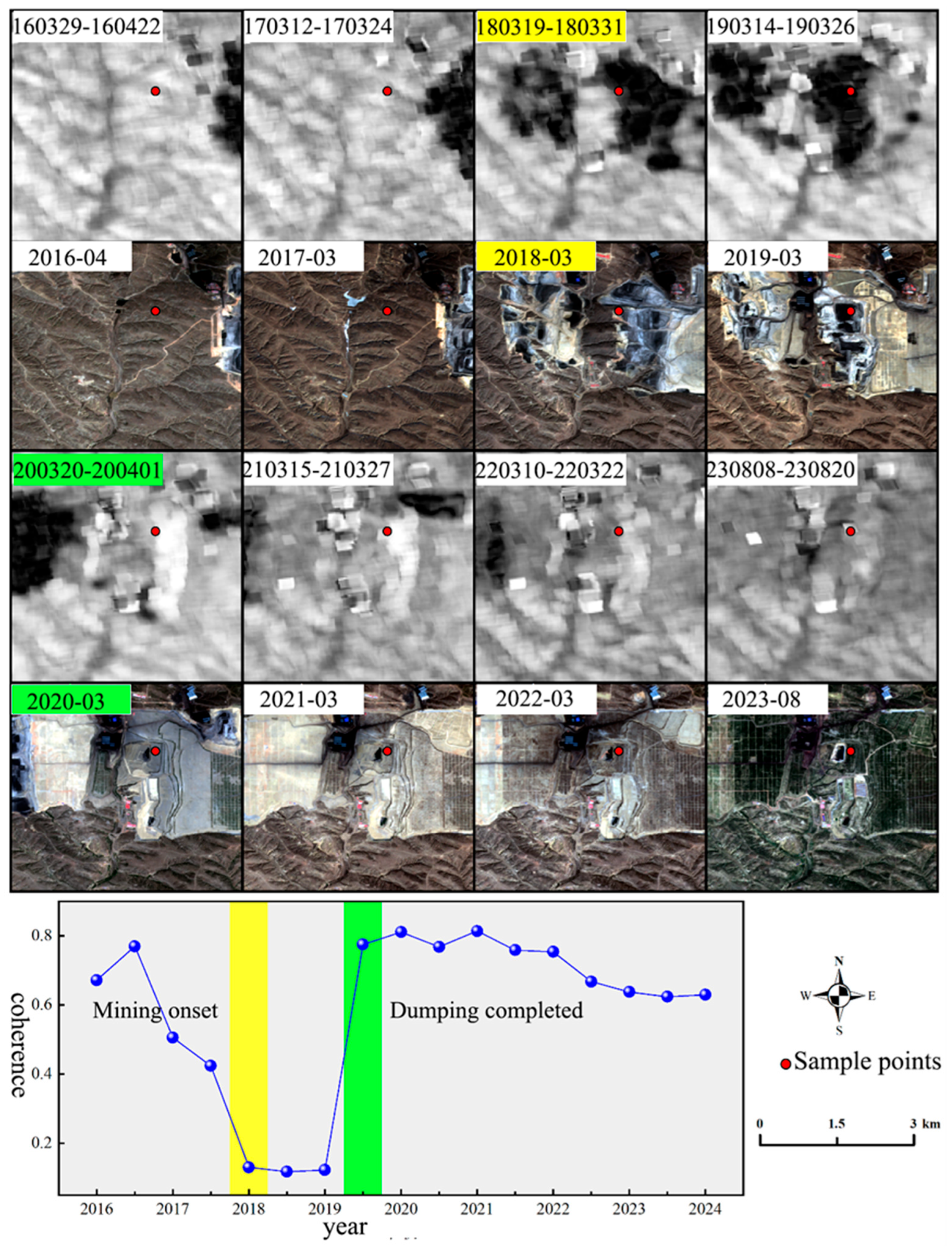
The evolution of mining-induced surface conditions can be broadly divided into three stages: active deformation, transitional compaction, and final stabilization. These stages correspond to distinct surface structural states and produce characteristic temporal responses in SAR coherence (Figure 3).
During the active deformation stage, continuous dumping and ground disturbance generate strong surface heterogeneity. This condition disrupts phase stability between SAR acquisitions, resulting in persistently low and highly fluctuating coherence values. This behavior is consistent with the well-documented sensitivity of coherence to geometric decorrelation and surface disturbance intensity [25,44]. As deformation slows, the surface gradually enters a transitional compaction stage. Material redistribution and consolidation reduce surface roughness variability, leading to a progressive increase in coherence. However, residual micro-scale disturbances still induce moderate temporal fluctuations, reflecting partial decorrelation effects.
In the final stabilization stage, surface structure becomes relatively uniform and stable. Temporal decorrelation is minimized, and coherence values remain consistently high with low variability, indicating a quasi-static scattering regime. These stage-dependent coherence characteristics provide the physical basis for stabilization detection. Specifically, the transition from active deformation to stabilization is reflected by a simultaneous increase in mean coherence and a reduction in temporal variability. This behavior supports the use of statistical criteria to identify the stabilization turning point in coherence time series (Figure 3).

3.3. Sliding-Window Coherence Algorithm

A quantitative sliding-window framework was established to capture the transition from active dumping to geotechnical stabilization. By assessing the temporal persistence of surface scattering, this methodology effectively mitigates environmental noise that typically confounds single-point coherence observations.

3.3.1. Time-Series Construction and Window Configuration

We applied a half-yearly median compositing scheme to temporally aggregate the Sentinel-1 coherence products. This step enhances computational efficiency while mitigating short-term environmental noise, such as transient soil moisture from precipitation or seasonal snow cover [45]. Effectively acting as a low-pass filter, this temporal aggregation suppresses high-frequency anomalies caused by brief operational pauses or localized weather events, yielding a smoothed coherence sequence
C = { C 1 , C 2 , , C M }
where each C i represents the representative surface scattering condition for a specific half-year period.
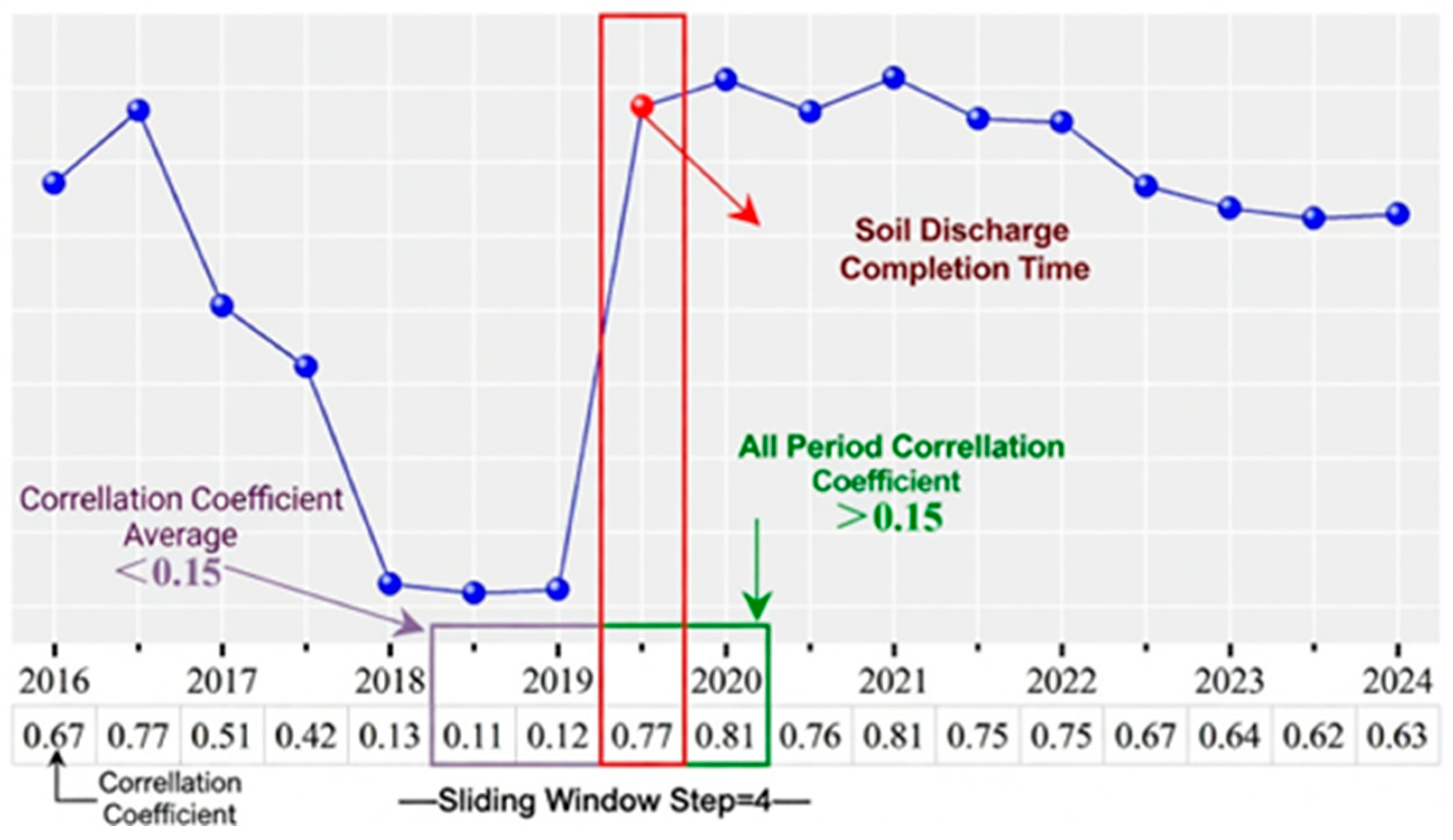
A sliding window W i with length N was then applied to traverse this coherence sequence. Considering the typical evolution patterns of waste dumps in the study region, the window size was empirically defined as N = 4 epochs, corresponding to an observation duration of two years, and the window advances with a step of one epoch. This configuration provides a compromise between responsiveness and reliability: shorter windows could incorrectly interpret temporary operational interruptions as stabilization, while longer windows would introduce excessive delays in detection (Figure 3).
For any step i , the subset of coherence values included in the window is defined as:
W i = { C i , C i + 1 , C i + 2 , C i + 3 }

3.3.2. Stability Identification and Threshold Selection

The stabilization turning point is identified by detecting a regime shift in coherence behavior within the sliding window W i . To characterize this transition quantitatively, the algorithm introduces a critical geophysical coherence threshold ( C t h ) , which distinguishes active mechanical disturbance from consolidated surface conditions. The value of C t h is empirically determined through statistical histogram analysis of reference samples representing known surface states within the study area (as described in Section 4: Results).
Based on this threshold, a pixel is considered to have reached geotechnical stabilization only when its coherence trajectory within the sliding window W i = { C i , C i + 1 , C i + 2 , C i + 3 } satisfies two sequential conditions simultaneously.
(1)
Active Disturbance Condition (Pre-stage).
The mean coherence of the first two epochs must remain lower than C t h , indicating that dumping or leveling operations are still occurring:
1 2 ( C i + C i + 1 ) < C t h
(2)
Sustained Stabilization Condition (Post-stage).
The coherence values of the following two epochs must both exceed C t h , confirming continuous structural consolidation rather than temporary environmental noise:
C i + 2 > C t h , C i + 3 > C t h
when both criteria are satisfied within a given window W i , the algorithm identifies a definitive state transition. The time corresponding to the first stabilized epoch, namely the time of C i + 2 and denoted as t i + 2 , is then recorded as the geotechnical stabilization time ( T s t a b ) .

3.4. Spatiotemporal Monitoring Framework and Noise Suppression

To convert pixel-level stabilization detections into reliable regional maps, a complete spatiotemporal monitoring workflow was implemented. A key difficulty lies in distinguishing genuine dump stabilization from other phenomena that may produce similar coherence recovery patterns, such as temporary suspension of mining operations or short-term coal storage areas. Two logical constraints were therefore incorporated into the analysis.
(1)
Mining–Dumping Temporal Sequence
In actual mining practice, material dumping always occurs after coal extraction. Therefore, the identified stabilization time T s t a b was compared with the previously derived mining disturbance time T m i n e . Pixels violating the chronological relationship were discarded using the following condition:
T s t a b T m i n e > 0
This rule effectively removes false stabilization signals generated by inactive pits where operations were temporarily halted.
(2)
Morphological and Temporal Consistency Filtering
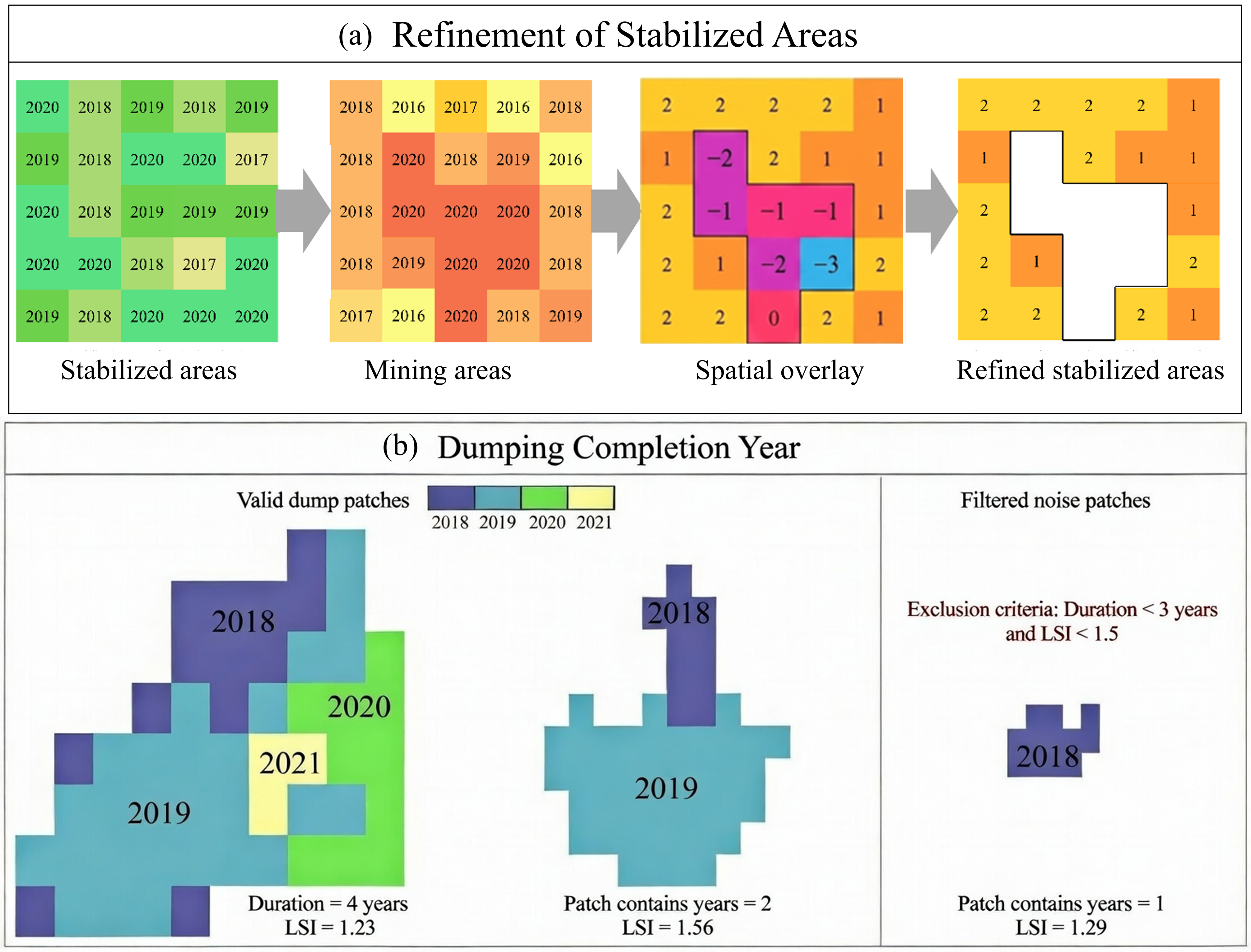
Short-term facilities such as coal stockpiles or washing plants may produce localized coherence anomalies similar to those associated with dumping activity. However, unlike waste dumps that gradually expand across the landscape, these temporary sites usually appear as isolated patches with relatively regular shapes [46].
To suppress such spatial noise, a minimum mapping unit of four pixels was applied. Additionally, for patches with disturbance durations shorter than or equal to two years, a Landscape Shape Index (LSI) was calculated to quantify patch geometry:
L S I = 0.25 P A
where P represents patch perimeter and A denotes patch area. Patches with L S I 1.5 typically exhibit compact and regular geometries approaching square shapes, which are characteristic of engineered facilities rather than the irregular expansion patterns of waste dumps. These patches were therefore identified as temporary anthropogenic disturbances and removed from the final results. The complete spatial morphological filtering and noise exclusion process is conceptually illustrated in Figure 4.
We acknowledge the inherent vulnerability of relying on rigid, pixel-level binary thresholds, which can frequently generate classification ambiguity across transitional boundaries due to localized noise or marginal value oscillations. To robustly insulate the experimental results against such inaccuracies, the monitoring framework is fortified by a comprehensive ‘dual spatiotemporal constraint mechanism’. In the temporal dimension, the rigorous prerequisite of the n = 4 sliding window demands sustained threshold compliance across consecutive epochs, effectively neutralizing temporal ambiguity. Concurrently, in the spatial dimension, the raw classification output is subjected to rigorous post-processing encompassing a minimum mapping unit filter coupled with LSI morphological constraints. This spatial filtering actively functions to subsume isolated ambiguous pixels, dissolve highly fragmented transitional noise, and enforce macroscopic boundary smoothing.”

4. Results

4.1. Statistical Determination of the Coherence Threshold

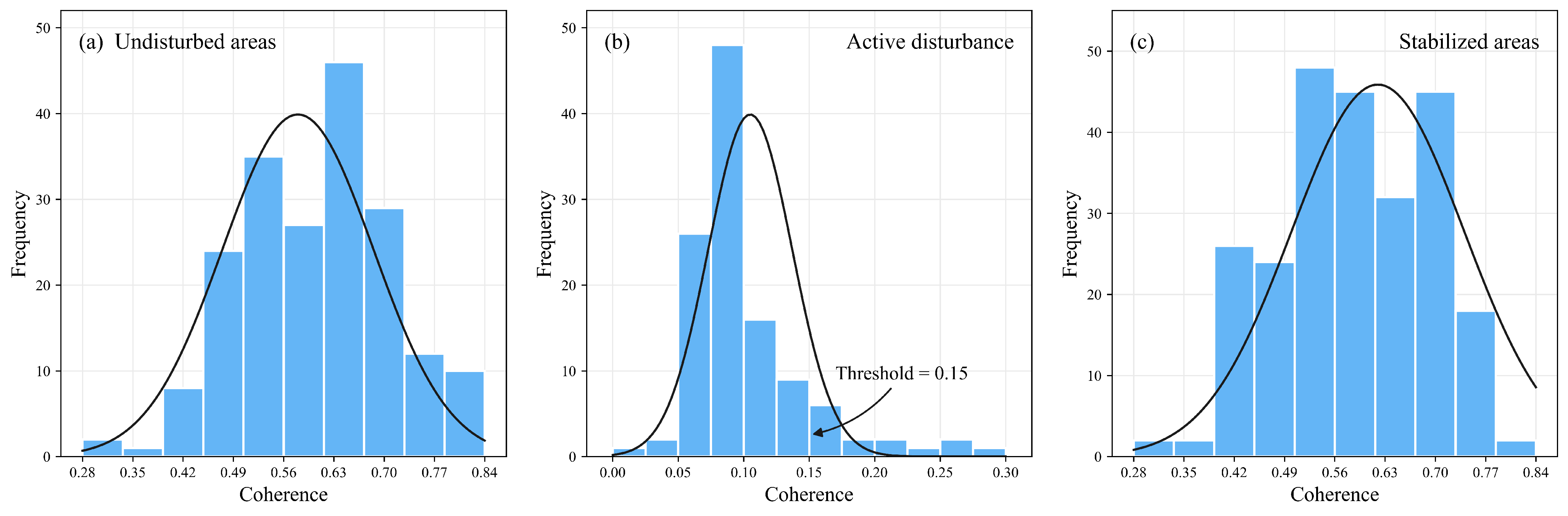
The statistical distribution of coherence coefficients across different land cover types was rigorously analyzed to establish a quantitative and physically grounded basis for identifying surface stability. We extracted 166 sample polygons for each of the three distinct surface states within the study area: undisturbed virgin land, actively disturbed (mining/dumping) areas, and reclaimed (completed dumping) areas. As illustrated in the frequency histograms (Figure 5), these three states exhibit highly distinct coherence signatures.
For undisturbed areas, coherence coefficients are heavily concentrated in the high-value range of 0.49 to 0.77, peaking at approximately 0.63. This distribution reflects a stable surface geometry with consistent electromagnetic scattering properties, resulting in a robust correlation of scattering centers between temporal SAR images. In sharp contrast, areas subjected to active open-pit mining show a heavily skewed distribution toward the lower range, with a pronounced frequency peak below 0.15. This drastic loss of phase consistency is a direct physical response to intense anthropogenic activities—such as continuous excavation, material stacking, and mechanical displacement—which fundamentally destroy surface scattering geometry.
The completed dumping (reclaimed) areas represent a transitional-to-stable state, with coherence values concentrated between 0.42 and 0.77. While the post-leveling surface is significantly more stable than the active mining face, minor residual settlement and gradual soil consolidation result in overall coherence levels slightly lower than those of undisturbed land.
Based on these distinct statistical separability characteristics, this study quantitatively defines 0.15 as the critical geophysical threshold for stability classification. Coherence values falling below 0.15 indicate the severe decorrelation characteristic of active mechanical disturbance, whereas values persistently exceeding 0.15 signify the cessation of earth-moving activities and the restoration of geotechnical stability (Figure 6). To resolve any ambiguity regarding the algorithmic treatment of transitional pixels, it is imperative to explicitly clarify the functional behavior of coherence values residing within the intermediate spectrum of 0.15 to 0.42. Based on geomorphological scattering principles, this specific numerical interval physically corresponds to the post-dumping transitional phase: an era characterized by minor residual gravity settlement, micro-scale soil surface crusting, and initial structural consolidation following the total cessation of large-scale earth-moving operations. The proposed sliding-window framework does not attempt to enforce supplementary classification thresholds within this transitional gradient. Instead, the 0.15 value operates strictly as an absolute ‘lower-bound critical trigger’. The core algorithmic logic dictates that once the temporal coherence trajectory breaches and consistently sustains itself above this 0.15 baseline for consecutive temporal epochs, the surface is definitively confirmed to have permanently exited the regime of severe, active mechanical destruction.

4.2. Spatiotemporal Evolution of Waste Dump Stabilization

By embedding the statistically derived 0.15 threshold into the sliding-window monitoring framework, the spatiotemporal dynamics of waste dump completion in the Balongtu mining area were evaluated.
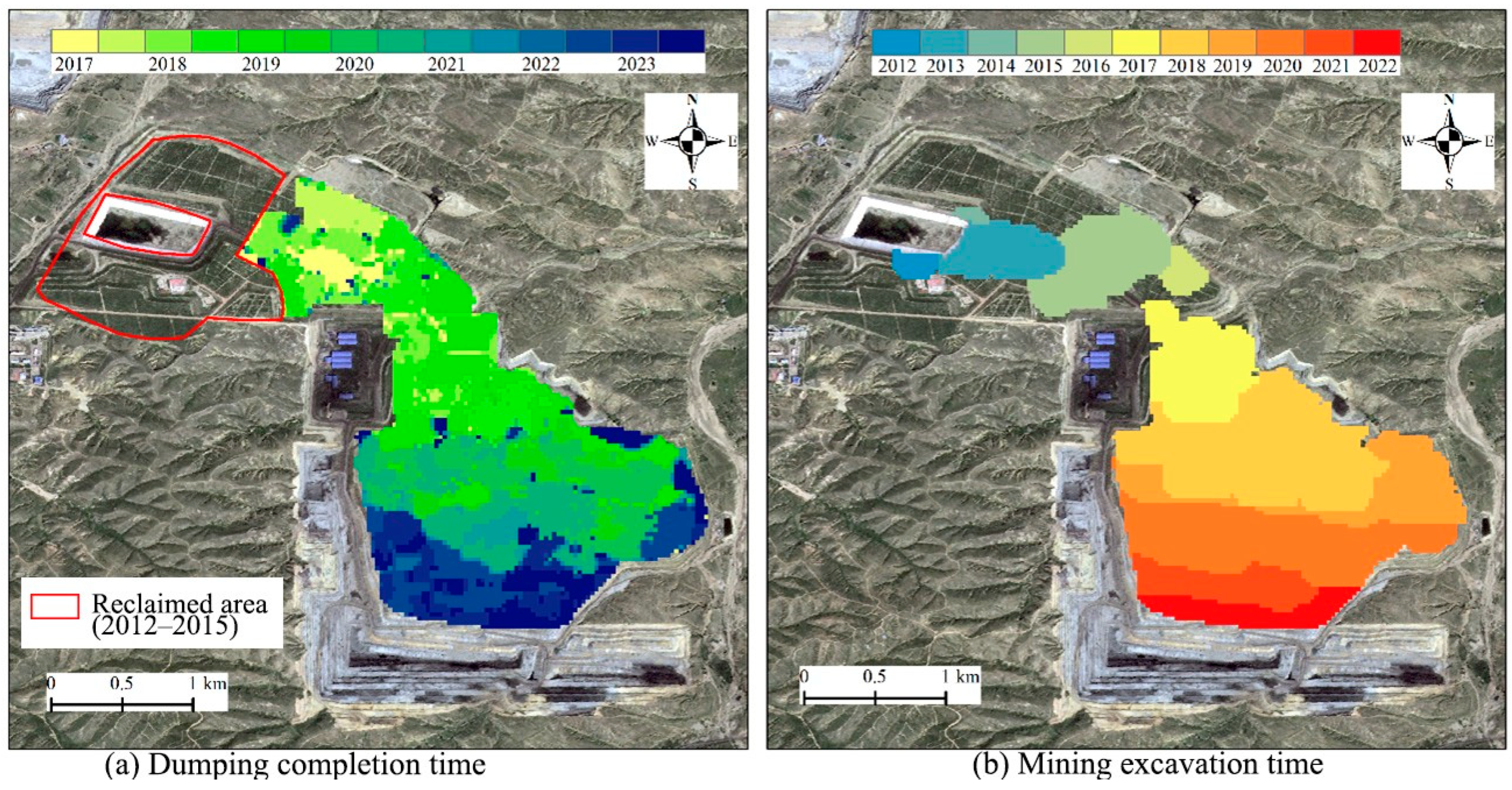
Due to the boundary constraints of the temporal sliding window (N = 4), the precise completion timing for the initial (2016) and final (early 2024) epochs could not be resolved. However, for the operational period from 2017 to 2023, the identified dumping completion zones exhibit high spatiotemporal consistency with the previously extracted active mining extents. This spatial alignment strongly corroborates the objective operational sequence of “extraction prior to dumping,” validating the reliability of the proposed algorithm in capturing the temporal progression of mining activities.
The statistical evolution of these areas reveals distinct operational phases. The active mining area exhibited a fluctuating upward trend starting in 2012, peaking at 86.25 ha in 2018, followed by a gradual annual decline. Correspondingly, dumping operations accelerated significantly in the second half of 2017, reaching a maximum stabilization area of 58.11 ha in early 2019. Notably, the cumulative stabilized dumping area (353.06 ha) exceeds the total mined area (346.08 ha). This spatial discrepancy provides valuable engineering insights: it effectively differentiates internal dumps (which overlap with mined-out voids) from external dumps (which occupy unmined land adjacent to the extraction zone). For instance, stabilized areas identified between 2012 and 2015 extend beyond the extraction boundaries, clearly classifying them as external waste dumps. This capability to spatially decouple distinct dumping strategies provides refined data support for integrated mine lifecycle management (Figure 7).
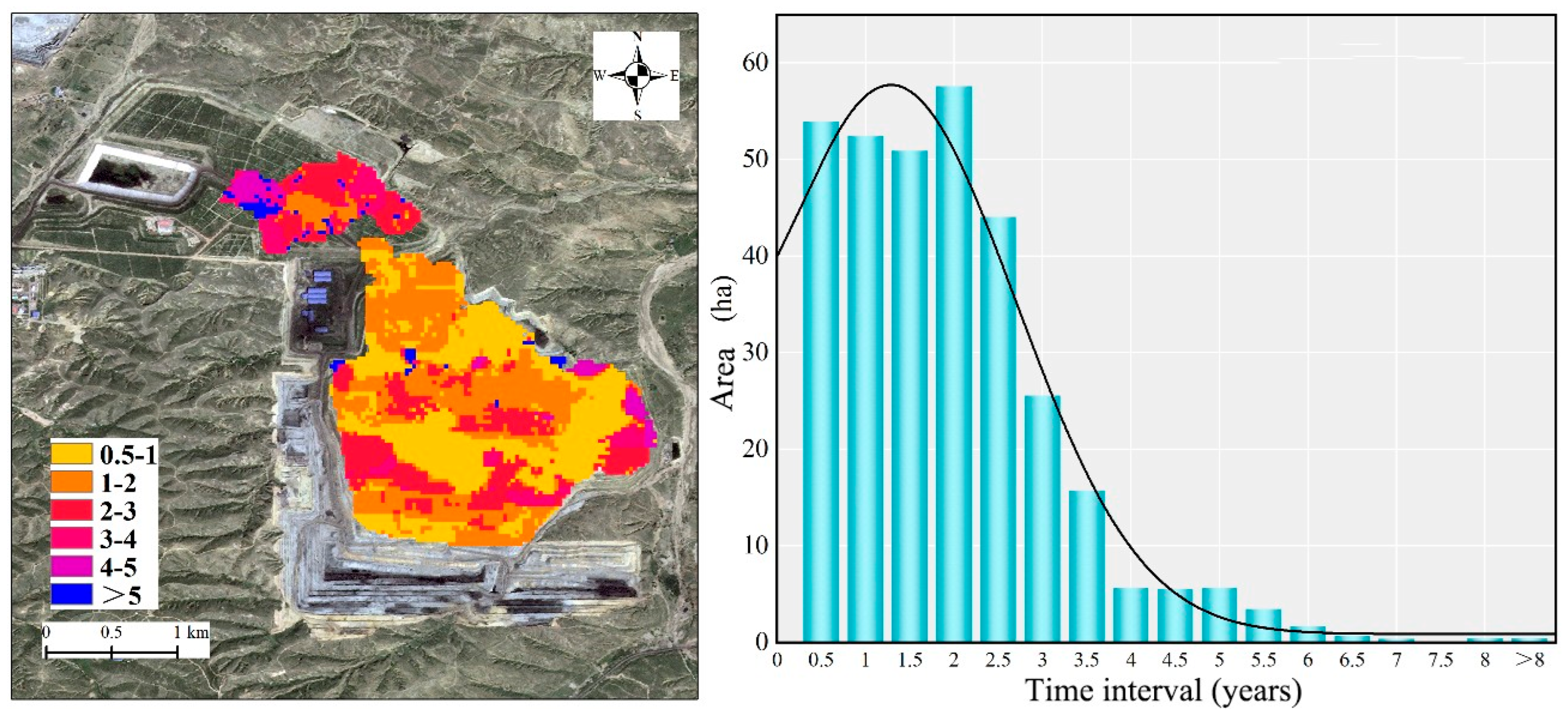
Furthermore, analyzing the time interval between coal extraction and dumping completion serves as a robust metric for evaluating reclamation efficiency. The results reveal a highly concentrated temporal distribution: 87.6% of the mined areas completed dumping operations within three years of initial extraction. The highest frequency of stabilization occurred in the second year (17.7%), indicating that the majority of the mine strictly adheres to a concurrent “dump-as-you-mine” operational protocol. Conversely, areas exhibiting a dumping lag exceeding five years account for a mere 2.2% and are sparsely distributed, likely representing localized operational delays, temporary stockpile zones, or boundary artifacts (Figure 8).

4.3. Accuracy Assessment and Temporal Sensitivity Analysis

While the proposed framework demonstrates robust general applicability, it is imperative to quantitatively define its operational boundaries, particularly concerning the inherent geometric distortions associated with side-looking Synthetic Aperture Radar physics. Open-pit mining environments are characterized by complex, rapidly evolving topographies featuring extreme vertical gradients. To explicitly quantify this limitation within the Balongtu study area, a spatial distortion mask was computed by intersecting the local high-resolution DEM with the specific viewing geometry of the Sentinel-1 sensor (operating at a nominal incidence angle of approximately 39°). The spatial analysis reveals that severe geometric distortions—specifically layover and radar shadow phenomena—critically compromise the backscattered signal in approximately 4.8% of the total monitored mining footprint. These invalid data zones are highly clustered along the localized steep highwalls of deep extraction pits and the precipitous leading edges of external waste dumps, where the local terrain slope exceeds the radar incidence angle, resulting in systematically uninterpretable, pseudo-low coherence signatures.
To mitigate this localized spatial vulnerability and prevent the misclassification of geometric blind spots as persistent active disturbance, a targeted preliminary solution involves the implementation of multi-track data fusion. Future operational frameworks must integrate phase and coherence observables from both Ascending and Descending satellite orbital passes. By leveraging these diametrically opposing viewing geometries, the structural shadows cast by one orbital trajectory can be effectively illuminated by the other, drastically reducing the volumetric extent of geometric blind spots and yielding a truly uninterrupted, omnidirectional assessment of slope stability.
An independent accuracy assessment was conducted following the principle of spatiotemporal equilibrium to rigorously validate the reliability of the proposed spatiotemporal monitoring framework. Within the 2017–2023 study period, 50 validation sample points were randomly stratified every half-year, yielding a total of 700 validation points. The actual waste dump completion timing for these points was determined through retrospective visual interpretation of dense optical time-series imagery (Sentinel-2 and high-resolution Google Earth). This independent optical dataset served as the ground truth to verify whether and exactly when geotechnical stabilization occurred.
To ensure the statistical robustness and spatial representativeness of the accuracy assessment, a rigorous stratified random sampling scheme was operationalized. Recognizing the profound spatial heterogeneity of the evolving mining landscape, the 700 validation points were not distributed entirely at random, but rather allocated proportionally based on the areal extent of distinct geomorphological strata across the study period. Specifically, the sampling architecture distributed the reference points as follows: 20% (n = 140) within the undisturbed virgin land periphery, 30% (n = 210) within the actively expanding extraction and active dumping operational zones, and 50% (n = 350) within the completed, transitional, and stabilized waste dump terrains.
Furthermore, to maintain logical consistency and prevent cyclical reasoning associated with the aforementioned ‘biological response lag’, the visual interpretation criteria applied to the dense time-series of high-resolution Google Earth and Sentinel-2 optical imagery explicitly excluded vegetation coverage as a stabilization metric. Instead, the ground-truth classification strictly relied on multi-temporal geomorphological interpretation markers. A validation pixel was definitively categorized as ‘geotechnically stabilized’ only upon the concurrent visual confirmation of three spatial phenomena: (1) the permanent spatial fixation of engineered macroscopic geometric boundaries, such as dumped berms and slope profiles; (2) the temporal homogenization and smoothing of the initially chaotic, coarse waste material textures; and (3) the permanent cessation and eventual weathering of observable heavy engineering machinery tracks, confirming the definitive termination of active anthropogenic
To robustly justify the empirical selection of the sliding window size (N = 4 epochs), a comprehensive comparative sensitivity analysis was integrated into the methodological evaluation. The detection accuracy and temporal responsiveness were systematically evaluated across three distinct temporal window configurations: N = 3 (1.5 years), N = 4 (2 years), and N = 5 (2.5 years). The comparative metrics, delineated in Table 1, elucidate the inherent statistical trade-offs. A narrower window (N = 3) demonstrates hypersensitivity to transient environmental anomalies, such as singular extreme precipitation events that temporarily alter soil dielectric properties, thereby inflating the false-positive identification rate and suppressing the Overall Accuracy (OA) to 81.24%. Conversely, expanding the window to N = 5 introduces excessive temporal smoothing. While this effectively eliminates environmental noise, it imposes a systemic detection delay that fundamentally contradicts the ‘early detection’ objective of this study, yielding an OA of 85.41%. The N = 4 configuration represents the optimal algorithmic equilibrium, consistently filtering out short-cycle seasonal meteorological noise while promptly capturing the sustained coherence recovery signature indicative of true geotechnical consolidation, thereby achieving the peak OA of 87.57%.
Performance was quantified by constructing error confusion matrices between the algorithm’s output and the ground truth. Standard accuracy metrics, including Overall Accuracy (OA), Producer’s Accuracy (PA), User’s Accuracy (UA), and the Kappa coeffi-cient, were calculated. Additionally, the F1 score was utilized as the harmonic mean of precision and recall to evaluate the robustness of the identification.
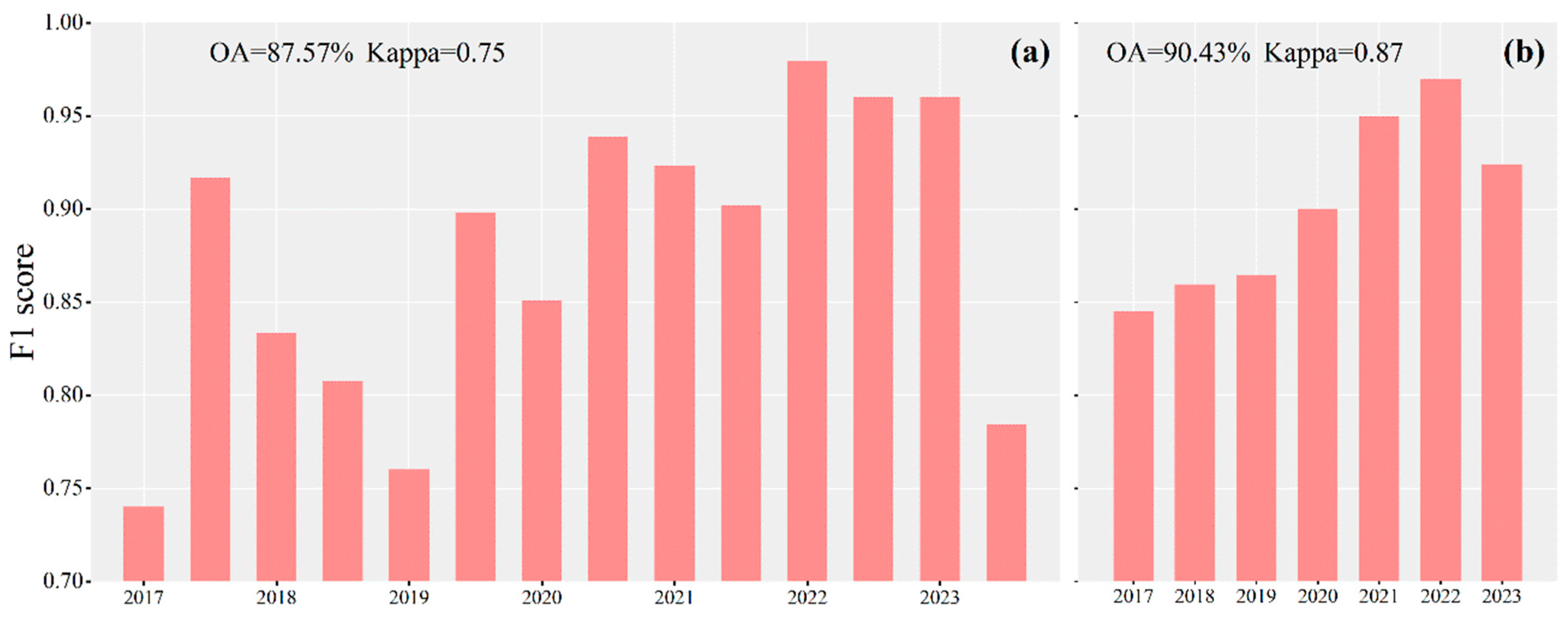
Furthermore, a temporal sensitivity analysis was conducted to evaluate how the temporal aggregation interval influences the algorithmic performance. As illustrated in the accuracy assessment charts, the identification capability is inherently sensitive to the length of the monitoring window. Under the half-yearly monitoring mode, the framework achieved an OA of 87.57% and a Kappa coefficient of 0.75 (Figure 9). This higher temporal resolution provides the distinct advantage of capturing high-frequency dumping activities and rapid surface transitions; however, it is slightly more susceptible to short-cycle environmental noise, leading to minor fluctuations in monitoring precision.
In contrast, the yearly monitoring mode demonstrated enhanced statistical performance, with the OA and Kappa coefficient rising to 90.43% and 0.87, respectively. This improvement is primarily attributed to the temporal low-pass filtering effect of longer data cycles, which effectively attenuates high-frequency noise and transient anomalies, making this mode exceptionally reliable for the retrospective analysis of long-term reclamation macro-trends.
Overall, both monitoring modes achieved robust and satisfactory accuracy, highlighting the adaptability of the sliding-window coherence algorithm. The selection of the optimal interval ultimately depends on specific operational objectives. For high-frequency regulatory scenarios—such as real-time ecological restoration assessment—the half-yearly interval is optimal. Conversely, for strategic decision support, such as decadal land reclamation planning, the yearly interval is advisable to maximize result robustness. To align with the primary objective of this study—capturing the most detailed spatiotemporal evolution processes of the “mining-to-dumping” transition—the half-yearly time interval was strategically selected for the primary analysis.

5. Discussion

To explicitly contextualize the scientific breakthroughs and operational advantages of the proposed framework, a targeted horizontal comparison against the current state-of-the-art mining environment monitoring paradigms is synthesized. Contemporary strategies predominately diverge into two methodological avenues: Optical Vegetation Index tracking (e.g., NDVI series) and Phase-based InSAR deformation modeling (e.g., SBAS-InSAR or PS-InSAR).
Mechanistically, while advanced MT-InSAR (Multi-Temporal InSAR) techniques provide unparalleled millimeter-level precision for monitoring post-closure residual subsidence, they are fundamentally hindered by aggressive spatial decorrelation and phase unwrapping failures over rapidly expanding, actively dumped waste slopes. Conversely, optical paradigms, while adept at long-term ecological assessment, are biologically chained to climatic precipitation factors, inevitably inducing a multi-year observation latency. The proposed time-series coherence integration deliberately occupies the critical analytical void between these two extremes. By exploiting the geometric scattering transition (the shift from active decorrelation to static recorrelation) rather than awaiting the accumulation of terrestrial biomass or struggling to unwrap discontinuous phase gradients, this methodological design extends continuous monitoring capabilities directly into the chaotic, intermediate phase of surface reconstruction. This paradigm shift—from quantifying post-facto deformation or ecological outcomes to detecting the structural consolidation process itself—secures a decisive operational lead time, fundamentally augmenting precision ecological zoning protocols.

5.1. Decoupling Physical Stability from Biological Lag

The core divergence between the proposed InSAR-based monitoring framework and traditional vegetation indices (e.g., NDVI) lies in their fundamental physical sensitivities to land surface processes. Our analysis reveals a critical “response lag” inherent to optical remote sensing in arid reclamation scenarios, which can be mechanically explained through the spatiotemporal evolution of surface scatterers. To clarify the contribution of the proposed framework, a targeted comparison with commonly used monitoring approaches is presented, including optical vegetation index–based methods (e.g., NDVI) and phase-based InSAR deformation techniques (e.g., SBAS-InSAR). From a mechanistic perspective, NDVI-based approaches rely on vegetation recovery as an indicator of stabilization. This introduces an inherent time lag, as vegetation establishment typically occurs several years after physical consolidation. Phase-based InSAR methods, on the other hand, quantify surface deformation with high precision but are often limited in actively disturbed areas due to severe decorrelation and phase unwrapping difficulties. The proposed coherence-based framework differs in that it directly captures the transition in surface scattering behavior associated with material compaction. Instead of relying on biological signals or phase continuity, it tracks the shift from unstable to stable scattering conditions, allowing stabilization processes to be identified at an earlier stage. In terms of methodological limitations, NDVI-based methods are strongly influenced by climatic variability, while phase-based approaches are sensitive to decorrelation in rapidly changing surfaces. The proposed method reduces these constraints by focusing on coherence evolution and incorporating temporal aggregation, which improves robustness under dynamic surface conditions. Regarding detection capability, the proposed approach provides earlier identification of stabilization compared to vegetation-based indicators, while maintaining applicability in areas where phase-based deformation monitoring is unreliable. This enables more timely and reliable early-stage stabilization detection for precision ecological zoning.”
To empirically substantiate the mechanism of the “biological response lag” and transition beyond qualitative literature citations, a pixel-by-pixel spatiotemporal decoupling analysis was executed utilizing actual multi-source remote sensing data from the Balongtu mining area. This analytical procedure overlayed the abiotic stabilization timing—derived from the InSAR coherence framework capturing the geometric fixation of surface scatterers—against the biotic greening timing, delineated by the persistent breach of the 0.3 NDVI threshold indicative of successful pioneer vegetation colonization and continuous chlorophyll production. The localized statistical distribution reveals a severe temporal discrepancy dictated by the region’s intense hydrological deficit. The quantitative evaluation establishes a mean biological response lag of 2.1 years across the reclaimed dump areas, accompanied by a standard deviation of 0.8 years. Remarkably, less than 5% of the spatial footprint exhibited concurrent physical and biological stabilization within the same half-year monitoring epoch, while areas enduring extreme biological suppression (lags exceeding 5 years) accounted for 2.2% of the territory. This rigorous local empirical evidence uncovers the systemic diagnostic failure of deploying optical vegetation indices as primary proxy indicators for early-stage surface stability. It explicitly demonstrates that an exclusive reliance on NDVI for administrative land turnover approvals results in a multi-year false-negative classification, severely delaying the redistribution of safe, geotechnically consolidated land resources.
As evidenced by the time-series trajectories, the recovery of InSAR coherence represents an immediate physical response to the cessation of mechanical dumping. In the initial post-dumping phase (typically 0–12 months), the surface undergoes rapid geotechnical consolidation. The cessation of random volumetric scattering—caused by the active movement of rock and soil—leads to the stabilization of the surface geometry. This physical stabilization drives the coherence coefficient above the 0.15 geophysical threshold almost synchronously with the completion of earthworks.
In sharp contrast, NDVI is inherently a “delayed” biological indicator. In arid mining areas, the natural colonization of pioneer vegetation is severely constrained by precipitation availability and the slow accumulation of soil nutrients. The “biological crusting” and subsequent chlorophyll production required to trigger a detectable NDVI response typically lag behind geotechnical stabilization by 1 to 3 years [19,47]. Therefore, relying solely on NDVI results in a systematic false-negative assessment: the land unit may be geotechnically stable and ready for reclamation, but it is optically classified as “disturbed” or “barren” [20]. By prioritizing dielectric and roughness consistency over biomass, the InSAR framework successfully decouples abiotic “stability” from biological “greenness,” providing a scientifically rigorous definition of the true Restoration Start Time.

5.2. Mechanistic Advantages over Mainstream Paradigms

To clarify the theoretical innovations of the proposed coherence-based spatiotemporal framework, a fundamental mechanistic comparison with mainstream methods—namely optical vegetation indices (e.g., NDVI) and phase-based InSAR (e.g., SBAS-InSAR)—is established across four core dimensions:
(1)
Physical Mechanism: NDVI relies on the spectral reflectance of chlorophyll, which biologically requires years to accumulate. SBAS-InSAR depends on sub-centimeter phase continuity, which is easily destroyed by large-gradient deformations. In contrast, our method directly captures the electromagnetic scattering geometry; it tracks the macroscopic physical transition from chaotic volumetric scattering to stable surface scattering, offering an abiotic precursor signal.
(2)
Applicable Scenarios: While NDVI is optimal for long-term ecological restoration evaluation and SBAS-InSAR excels in monitoring post-closure residual micro-subsidence, the proposed coherence framework is uniquely suited for the highly chaotic “active-to-stable” intermediate transition phase of waste dumps.
(3)
Capability to Address Core Technical Pain Points: The proposed framework fundamentally overcomes the “biological response lag” inherent in optical remote sensing. Simultaneously, it effectively bypasses the severe temporal decorrelation and phase unwrapping failures that paralyze traditional phase-based InSAR techniques in actively dumped, rapidly expanding zones.
(4)
Anti-interference Robustness: Unlike NDVI, which is highly susceptible to cloud cover and seasonal phenology, and phase-based methods that are vulnerable to atmospheric phase screens, the proposed method integrates a temporal median compositing scheme and an N = 4 sliding-window constraint. This algorithmic design acts as a robust low-pass filter, effectively isolating continuous geotechnical consolidation signals from transient hydrometeorological noise.

5.3. Precision Zoning and Accelerating Land Turnover

The quantitative identification of this “Stability-Vegetation Gap” offers profound practical implications for optimizing land turnover and allocating reclamation resources throughout the mining lifecycle.
Current regulatory frameworks often mandate specific vegetation coverage rates as the sole criterion for “reclamation readiness,” forcing mine operators into a passive and costly waiting period. Our statistical data demonstrates that 87.6% of dumping operations are completed within a 3-year window post-extraction. If monitored exclusively via NDVI, these exact areas might be incorrectly flagged as “active” or “unstable” for an additional 2 to 5 years simply due to slow vegetation growth. By adopting the 0.15 coherence threshold as an early-stage “Certificate of Geotechnical Stability,” mine managers can legally and operationally reclassify these zones as ready for active reclamation years earlier. This significantly compresses the administrative lifecycle of mining land, directly reducing liability periods and bond-holding costs [1,2].
Furthermore, this method facilitates a paradigm shift from conventional “broadcast restoration” to “Precision Zoning.” By overlaying the InSAR-derived Coherence Stability Maps with optical NDVI Vegetation Maps, managers can spatially stratify the dump site into three actionable categories:
  • Zone A (High Coherence/Low NDVI—The “Intervention Window”): The land is geotechnically stable (safe for heavy machinery) but biologically inhibited. Action: Immediate deployment of artificial seeding, soil amendment, or irrigation is required here to bridge the biological lag.
  • Zone B (Low Coherence/Low NDVI—Active Disturbance): This indicates ongoing dumping, active disturbance, or severe subsidence. Action: Prohibit entry. Any ecological investment here would be wasted, as the surface is still physically shifting.
  • Zone C (High Coherence/High NDVI—Self-Sustaining Recovery): The area has achieved both physical and ecological stability. Action: Minimal intervention; ongoing monitoring only.
This data-driven stratification prevents the misallocation of ecological resources (e.g., seeding on unstable slopes) and focuses capital precisely on areas (Zone A) where human intervention yields the highest marginal return on ecosystem recovery [3].

5.4. Uncertainties, Limitations, and Future Prospects

Despite the robust performance of the coherence-based stabilization framework, several uncertainties and limitations remain.
Environmental perturbations may introduce transient instability signals. In particular, heavy precipitation can increase soil moisture and alter dielectric properties, temporarily reducing coherence even over physically stable surfaces. However, this effect is largely mitigated by the temporal compositing strategy and the multi-epoch sliding-window scheme, which effectively suppress short-term fluctuations and preserve long-term stabilization trends.
The use of a fixed geophysical threshold (0.15) introduces methodological limitations. Although this threshold performs well under the arid conditions and lithological context of the study area, spatial heterogeneity in material composition (e.g., variations in particle size and surface roughness) may lead to differential scattering behavior. Due to the absence of historical in situ measurements during active dumping, a lithology-specific adaptive threshold could not be established. As a result, the threshold should be interpreted as a regionally calibrated parameter rather than a universally transferable constant.
Data availability and validation constraints introduce additional uncertainty. The method relies on Sentinel-1 time series, limiting retrospective analysis prior to 2014. Validation was conducted using high-resolution optical imagery based on geomorphological surface texture rather than vegetation indicators, ensuring independence from ecological lag effects. However, the gradual transition between active dumping and final leveling introduces inherent subjectivity in defining the exact stabilization timing.
In addition, residual errors may arise from geometric distortions in SAR data (e.g., layover and shadow), as well as from decorrelation under extreme environmental conditions. Interpretation uncertainty in optical imagery may also affect validation results at local scales.
The occurrence of secondary disturbances after apparent stabilization introduces an additional challenge. Localized reworking or minor slope adjustments may cause coherence to decrease again after exceeding the threshold, complicating the identification of a single stabilization point. Since the current framework targets the initial transition from unstable to stable conditions, such cases are not explicitly resolved and may lead to an underrepresentation of post-stabilization dynamics. A more complete description could be achieved by tracking repeated disturbance–recovery patterns within extended temporal windows. The combination of temporal segmentation with surface morphology indicators may help distinguish genuine reactivation from short-term fluctuations, although this lies beyond the scope of the present analysis [16,17].
To explicitly quantify the limitation of SAR geometric distortions within the Balongtu study area, a spatial distortion mask was calculated by intersecting the local high-resolution DEM with the Sentinel-1 sensor’s specific viewing geometry. This spatial analysis revealed that severe layover and radar shadow phenomena irreversibly compromise the backscattered signal in approximately 4.8% of the monitored mining footprint, primarily clustered along steep highwalls and the precipitous edges of external dumps. To mitigate this localized spatial vulnerability, a targeted preliminary solution for future operational frameworks is the implementation of multi-track data fusion. Integrating phase and coherence observables from both ascending and descending orbital passes will effectively illuminate structural shadows and drastically reduce geometric blind spots [39,40]. Further improvements can be expected through the integration of multi-source observations. Combining InSAR coherence with high-resolution optical data or terrain-derived metrics may enhance the discrimination of surface states. Extending the framework to capture multi-phase evolution processes would also improve its applicability in complex mining environments.

6. Conclusions

This study develops a time-series coherence-based framework for spatiotemporal monitoring of open-pit coal mine waste dump areas and clarifies the underlying InSAR decorrelation mechanism associated with mining activities.
(1)
The results demonstrate that mining and dumping processes are the dominant drivers of InSAR decorrelation, with a coherence threshold of 0.15 effectively distinguishing disturbed areas from undisturbed and reclaimed surfaces. Building on this mechanism, a sliding-window–based monitoring method was established to detect dump completion dynamics.
(2)
Application to the Balongtu coal mine reveals that the spatial distribution of completed dump areas closely follows mined zones, consistent with the operational sequence of “mining first, dumping later.” Temporally, 87.57% of mined areas complete dumping within three years, with the highest proportion (17.7%) occurring in the second year.
(3)
Accuracy assessment confirms the robustness of the proposed method. The half-year monitoring scheme achieves an overall accuracy of 87.75% (Kappa = 0.77), while the annual scheme improves performance to 90.43% (Kappa = 0.87), demonstrating flexibility for different monitoring requirements.

Author Contributions

Y.S. data curation, formal analysis, methodology, writing—original draft, writing—review and editing Y.Z. methodology, conceptualization. Z.L. investigation, writing—review and editing. Y.T. investigation, software. All authors have read and agreed to the published version of the manuscript.

Funding

This research was funded by the National Natural Science Foundation of China (No. 52474198).

Data Availability Statement

Data is available on request to the authors.

Acknowledgments

We are immensely grateful to the editor and anonymous reviewers for their comments on the manuscript.

Conflicts of Interest

The authors declare no conflicts of interest.

References

  1. Ross, M.R.V.; McGlynn, B.L.; Bernhardt, E.S. Deep Impact: Effects of Mountaintop Mining on Surface Topography, Bedrock Structure, and Downstream Waters. Environ. Sci. Technol. 2016, 50, 2064–2074. [Google Scholar] [CrossRef]
  2. Xie, Y.; Bagan, H.; Tan, L.; Te, T.; Damdinsuren, A.; Wang, Q. Time-Series Analysis of Mining-Induced Subsidence in the Arid Region of Mongolia Based on SBAS-InSAR. Remote Sens. 2024, 16, 2166. [Google Scholar] [CrossRef]
  3. Souza, R.G.; Vormwald, I.; Leite, I.; Morais, M. Review of the current knowledge and identified gaps in assessing the social and environmental impacts of mining processes in the Lithium Triangle. Sustain. Prod. Consum. 2025, 53, 40–63. [Google Scholar] [CrossRef]
  4. Dai, C.; Li, W.; Lu, H.; Zhang, K. Active Landslide Detection Based on Sentinel-1 Data and InSAR Technology in Zhouqu County, Gansu Province, Northwest China. J. Earth Sci. 2021, 32, 1092–1103. [Google Scholar] [CrossRef]
  5. Kim, J.W.; Lu, Z. Association between localized geohazards in West Texas and human activities, recognized by Sentinel-1A/B satellite radar imagery. Sci. Rep. 2018, 8, 4727. [Google Scholar] [CrossRef]
  6. Welivitiya, W.D.D.P.; Hancock, G.R. Quantifying mine waste rock physical weathering rate and processes for improved geomorphic post-mining landforms. Geomorphology 2024, 463, 109357. [Google Scholar] [CrossRef]
  7. Aljammaz, A.; Sultan, M.; Izadi, A.; Abotalib, Z.A.; Elhebiry, M.S.; Emil, M.K.; Abdelmohsen, K.; Saleh, M.; Becker, R. Land Subsidence Induced by Rapid Urbanization in Arid Environments: A Remote Sensing-Based Investigation. Remote Sens. 2021, 13, 1109. [Google Scholar] [CrossRef]
  8. Zheng, M.; Deng, K.; Fan, H.; Zhang, H.; Qin, X. Retrieving surface secondary subsidence in closed mines with time-series SAR interferometry combining persistent and distributed scatterers. Environ. Earth Sci. 2023, 82, 212. [Google Scholar] [CrossRef]
  9. Cabré, A.; Remy, D.; Marc, O.; Burrows, K.; Carretier, S. Flash floods triggered by the 15–17th March 2022 tropical storm in the Atacama Desert, Chile. Nat. Hazards 2023, 116, 1345–1353. [Google Scholar] [CrossRef]
  10. Craw, D.; Rufaut, C. Environmental evolution of cover deposits on chemically distinctive bare ground, New Zealand: Review and temporal contexts. N. Z. J. Geol. Geophys. 2025, 68, 1120–1152. [Google Scholar] [CrossRef]
  11. Raspini, F.; Caleca, F.; Del Soldato, M.; Festa, D.; Confuorto, P.; Bianchini, S. Review of satellite radar interferometry for subsidence analysis. Earth-Sci. Rev. 2022, 235, 104239. [Google Scholar] [CrossRef]
  12. Raju, A.; Mehdi, K. SBAS-InSAR analysis of regional ground deformation in the Jharia coalfield, India. Geocarto Int. 2023, 38, 2167004. [Google Scholar] [CrossRef]
  13. Reinders, K.J.; Giardina, G.; Zurfluh, F.; Ryser, J.; Hanseen, R.F. Proving compliance of satellite InSAR technology with geotechnical design codes. Transp. Geotech. 2022, 33, 100722. [Google Scholar] [CrossRef]
  14. Fernández-Guisuraga, J.M.; Suarez-Seoane, S.; Calvo, L. Radar and multispectral remote sensing data accurately estimate vegetation vertical structure diversity as a fire resilience indicator. Remote Sens. Ecol. Conserv. 2023, 9, 117–132. [Google Scholar] [CrossRef]
  15. Braun, A. Retrieval of digital elevation models from Sentinel-1 radar data—Open applications, techniques and limitations. Open Geosci. 2021, 13, 532–569. [Google Scholar] [CrossRef]
  16. Hu, L.; Tang, X.; Tomas, R.; Li, T.; Zhang, X.; Li, Z.; Yao, J.; Lu, J. Monitoring surface deformation dynamics in the mining subsidence area using LT-1 InSAR interferometry: A case study of Datong, China. Int. J. Appl. Earth Obs. Geoinf. 2024, 13, 103936. [Google Scholar] [CrossRef]
  17. Hwang, K.; Harpold, A.A.; Tague, C.L.; Lowman, L.; Boisrame, F.S.; Lininger, K.B.; Sullivan, P.L.; Manninh, A.; Graup, L.; Litvak, M.; et al. Seeing the Disturbed Forest for the Trees: Remote Sensing Is Underutilized to Quantify Critical Zone Response to Unprecedented Disturbance. Earth’s Future 2023, 11, e2022EF003314. [Google Scholar] [CrossRef]
  18. Song, W.; Song, W.; Gu, H.; Li, F. Progress in the Remote Sensing Monitoring of the Ecological Environment in Mining Areas. Int. J. Environ. Res. Public Health 2020, 17, 1846. [Google Scholar] [CrossRef]
  19. Zhang, Y.; Zhao, Y.; Ren, H.; Xiao, W.; Li, Z. Vegetation Resilience Evaluation of Coal Waste Dumps After Reclamation in Arid and Semi-Arid Mining Areas Based on Temporal Satellite Imagery. Land Degrad. Dev. 2025, 36, 1724–1735. [Google Scholar]
  20. Han, Y.; Zhao, H.; Li, Z.; Wang, J. Tracking vegetation degradation and recovery in multiple mining areas in Beijing, China based on time-series Landsat imagery. GIScience Remote Sens. 2021, 58, 1–20. [Google Scholar] [CrossRef]
  21. Chen, Y.; Huang, X.; Huang, J.; Liu, S.; Lu, D.; Zhao, S. Fractional monitoring of desert vegetation degradation, recovery, and greening using optimized multi-endmembers spectral mixture analysis in a dryland basin of Northwest China. GIScience Remote Sens. 2021, 58, 300–321. [Google Scholar] [CrossRef]
  22. Wang, S.; Zhang, S.; Zhou, Y.; Zhao, X.; Li, R.; Lin, X.; Luo, M.; Yang, L.; Zhang, Q.; Lv, S.; et al. Vegetation disturbance and recovery assessment through the synergistic effects of albedo and vegetation index: Evidence from China’s arid regions. Ecol. Indic. 2025, 178, 113856. [Google Scholar] [CrossRef]
  23. Fan, J.; Liu, S.; Wang, W.; Li, Y.; Zhao, Y.; Wu, G. Quantifying the ecological network dynamics associated with ecological restoration projects: A case study in Southwest China. Glob. Ecol. Conserv. 2025, 62, e03744. [Google Scholar] [CrossRef]
  24. Worsa-Kozak, M.; Gorniak-Zimroz, J.; Szrek, A.; Chudy, K. Remote detection and monitoring of post-mining heat island. Front. Environ. Sci. 2024, 12, 1305149. [Google Scholar] [CrossRef]
  25. Closson, D.; Milisavljevic, N. InSAR Coherence and Intensity Changes Detection; InTechOpen: London, UK, 2017; Volume 31, pp. 31–52. [Google Scholar]
  26. Yu, X.; Hyyppä, J.; Karjalainen, M.; Nurminen, K.; Vastaranta, M.; Vauhkonen, J.; Kankare, V.; Kaartinen, H.; Holopainen, M.; Honkavaara, E. Machine-Learning Estimation of Snow Depth in 2021 Texas Statewide Winter Storm Using SAR Imagery. Geophys. Res. Lett. 2022, 49, e2022GL09911. [Google Scholar] [CrossRef]
  27. Gül, Y.; Hastaoğlu, K.O.; Pyraz, F. A new methodology for determining the long-term behavior of earth surface deformations from InSAR results. Adv. Space Res. 2025, 75, 35. [Google Scholar] [CrossRef]
  28. Vukosavić, S.N. Minerals for the green agenda, implications, stalemates, and alternatives. Open Geosci. 2025, 17, 20250813. [Google Scholar] [CrossRef]
  29. Yang, J.; Badreldin, N.; Gao, Y.; Yan, C.; Zhao, Y.; Dyck, M.; He, H. Innovative methods for monitoring soil erosion. Catena 2025, 261, 109547. [Google Scholar] [CrossRef]
  30. Elhag, M.; Chaabani, A.; Zhang, L. Assessment of surface deformation patterns using InSAR data: Implications for human impacts in Makkah City, Saudi Arabia. Kuwait J. Sci. 2025, 52, 100419. [Google Scholar] [CrossRef]
  31. Uusitalo, J.F.; Linderholm, H.S.; Gunnarson, B.E. Historical copper mining contamination assessed using dendrochemical analysis in Southeastern Sweden. Environ. Sci. Pollut. Res. 2025, 32, 18174–18192. [Google Scholar] [CrossRef]
  32. Wang, L.; Yang, L.; Wang, W.; Chen, B.; Sun, X. Monitoring Mining Activities Using Sentinel-1A InSAR Coherence in Open-Pit Coal Mines. Remote Sens. 2021, 13, 4485. [Google Scholar] [CrossRef]
  33. Adamo, N.; Al-Ansari, N.; Ali, H.; Laue, J.; Knutsson, S. Review of Satellite Remote Sensing Applications to Dams and Reservoirs. J. Earth Sci. Geotech. Eng. 2020, 11, 347–438. [Google Scholar]
  34. Zhang, Y.; Zhao, C.; Chen, H.; Feng, X.; Lu, Z.; Khan, B.A. Detection and monitoring of mining-induced subsidence with Gaofen-3 and Sentinel-1A SAR datasets. Remote Sens. Lett. 2024, 15, 537–547. [Google Scholar] [CrossRef]
  35. Sun, Y.; Zhao, Y.; Li, Z.; Tang, Y. Water Body Characterization and Classification in Coal Mining Subsidence Areas: Insights from the Huainan. Coalf. Nat. Resour. Res. 2025, 34, 2841–2862. [Google Scholar] [CrossRef]
  36. Mann, R.K.; Naftz, D.L.; Hinckley, E.S. Annotated Bibliography of Scientific Research Relevant to Oil and Gas Reclamation Best Management Practices on Federal and Tribal Lands in Arid and Semi-Arid Western U.S; USGS Open-File Report; USGS: New York, NY, USA, 2024; p. 6.
  37. Dong, J.; Jiao, H.; Xu, M.; Gao, K. A novel InSAR-based workflow for DEM-driven slope modeling and risk prediction. Geomat. Nat. Hazards Risk 2025, 16, 2598439. [Google Scholar] [CrossRef]
  38. Arif, A.; Zhang, C.; Feng, M.; Sajib, M.H.; Habibullah, M.; Hasan, S.; Rana, M.S.; Mohammadamini, K.; Alip, M.; Zhang, Y. Mining-Induced Subsidence Predicting and Monitoring: A Comprehensive Review of Methods and Technologies. Geotech. Geol. Eng. 2025, 43, 314. [Google Scholar] [CrossRef]
  39. Cheng, Z.; Zheng, M.; Guo, Q.; Wang, Y.; Li, J.; Zhang, Y. Monitoring and Analysis of Surface Deformation in Mining Area Based on LuTan-1 and Sentinel-1A Data. Remote Sens. 2026, 18, 713. [Google Scholar] [CrossRef]
  40. Liu, Y.; Zhang, J. Integrating SBAS-InSAR and AT-LSTM for Time-Series Analysis and Prediction Method of Ground Subsidence in Mining Areas. Remote Sens. 2023, 15, 3409. [Google Scholar] [CrossRef]
  41. Huang, J.; Yu, H.; Guan, X.; Wang, G.; Guo, R. Accelerated dryland expansion under climate change. Nat. Clim. Change 2016, 6, 166–171. [Google Scholar] [CrossRef]
  42. Wang, X.-M.; Zhang, C.; Hasi, E.; Dong, Z.B. Has the Three-North Shelterbelt Program solved the desertification and dust storm problems in arid and semi-arid China? J. Arid Environ. 2010, 74, 13–22. [Google Scholar] [CrossRef]
  43. Tang, F.; Yang, Q. Progress and prospects of multi-source remote sensing monitoring technology for coal mining subsidence in mining areas of the western Loess Plateau. Coal Sci. Technol. 2023, 51, 9–26. [Google Scholar]
  44. Telli, C.; Lavalle, M.; Pierdicca, N. Vegetation height from L-band SAR backscatter and interferometric temporal coherence measurements. Remote Sens. Environ. 2025, 328, 114879. [Google Scholar] [CrossRef]
  45. Liu, G.; Jia, Z.; Nie, J. A time-series InSAR approach for monitoring ground deformation in the Coal Mining Area. Remote Sens. Lett. 2021, 12, 28–37. [Google Scholar]
  46. McGarigal, K. Landscape Configuration Metrics. In Encyclopedia of Ecology; Elsevier: Oxford, UK, 2015; pp. 112–117. [Google Scholar]
  47. Prach, K.; Walker, L.R. Four decades of vegetation succession on coal mine spoils: A meta-analysis. J. Appl. Ecol. 2019, 56, 1245–1253. [Google Scholar]
Figure 1. Location of the study area and sample selection. The left panel shows the geographical location and terrain of the Dongsheng Coalfield in Ordos City, Inner Mongolia. The right panels display the (a) high-resolution optical imagery and (b) corresponding Sentinel-1 InSAR coherence image of the Balongtu Mine. Yellow, red, and green polygons indicate undisturbed, disturbed, and reclaimed areas, respectively.
Remotesensing 18 01310 g001
Figure 2. Methodology flowchart in this study.
Remotesensing 18 01310 g002
Figure 3. Mechanistic relationship between InSAR coherence evolution and mining activities. Time-series Sentinel-1 coherence, Sentinel-2 optical patches, and the corresponding coherence trajectory of a sample point (2016–2024). The yellow and green shaded areas denote the active disturbance phase (mining onset) and the subsequent geotechnical stabilization phase (dumping completed), respectively.
Remotesensing 18 01310 g003
Figure 4. Schematic diagram of the spatial morphological filtering and noise suppression workflow. (a) Refinement of stabilized areas through spatial overlay. (b) Exclusion of temporary anthropogenic noise patches based on duration and LSI criteria.
Remotesensing 18 01310 g004
Figure 5. Statistical distribution of InSAR coherence values across distinct land cover types: (a) undisturbed areas, (b) actively disturbed areas, and (c) stabilized areas. The distinct bimodal distribution empirically establishes the critical geophysical threshold at 0.15.
Remotesensing 18 01310 g005
Figure 6. Statistical distribution of InSAR coherence values for determining the critical geophysical threshold.
Remotesensing 18 01310 g006
Figure 7. Spatiotemporal distribution maps of the Balongtu mining area.
Remotesensing 18 01310 g007
Figure 8. Spatiotemporal lag analysis between coal extraction and dumping completion: (Left) Spatial distribution mapping of operational time lag zones across the Balongtu mine; (Right) Statistical frequency histogram delineating the proportion of reclaimed areas corresponding to specific dumping lag durations (in years).
Remotesensing 18 01310 g008
Figure 9. Accuracy assessment of the spatiotemporal monitoring framework across different temporal aggregation intervals. (a) Validation F1 scores under the half-yearly monitoring mode (Overall Accuracy = 87.57%). (b) Validation F1 scores under the annual monitoring mode (Overall Accuracy = 90.43%).
Remotesensing 18 01310 g009
Table 1. Performance metrics of the stabilization detection framework under varying sliding window sizes, demonstrating the optimality of N = 4.
Sliding Window SizeTemporal Span (Years)Overall Accuracy (OA)
n = 31.581.24%
n = 4 (Selected)2.087.57%
n = 52.585.41%
Disclaimer/Publisher’s Note: The statements, opinions and data contained in all publications are solely those of the individual author(s) and contributor(s) and not of MDPI and/or the editor(s). MDPI and/or the editor(s) disclaim responsibility for any injury to people or property resulting from any ideas, methods, instructions or products referred to in the content.