Article

On the Concurrence of the Atmospheric and Marine Heatwaves in the Red Sea

1
Center of Excellence for Climate Change Research, King Abdulaziz University, Jeddah 21589, Saudi Arabia
2
Oceanography Department, Faculty of Science, Alexandria University, Alexandria 21500, Egypt
3
Marine Institute, Rinville, Co. Galway H91 R673, Ireland
4
Department of Meteorology, Faculty of Environmental Sciences, King Abdulaziz University, Jeddah 21589, Saudi Arabia
5
Department of Geography and Geographical Information Systems, Faculty of Arts, Tanta University, Tanta 31527, Egypt
*
Author to whom correspondence should be addressed.
Remote Sens. 2026, 18(9), 1302; https://doi.org/10.3390/rs18091302
Submission received: 11 February 2026 / Revised: 21 April 2026 / Accepted: 22 April 2026 / Published: 24 April 2026

Abstract

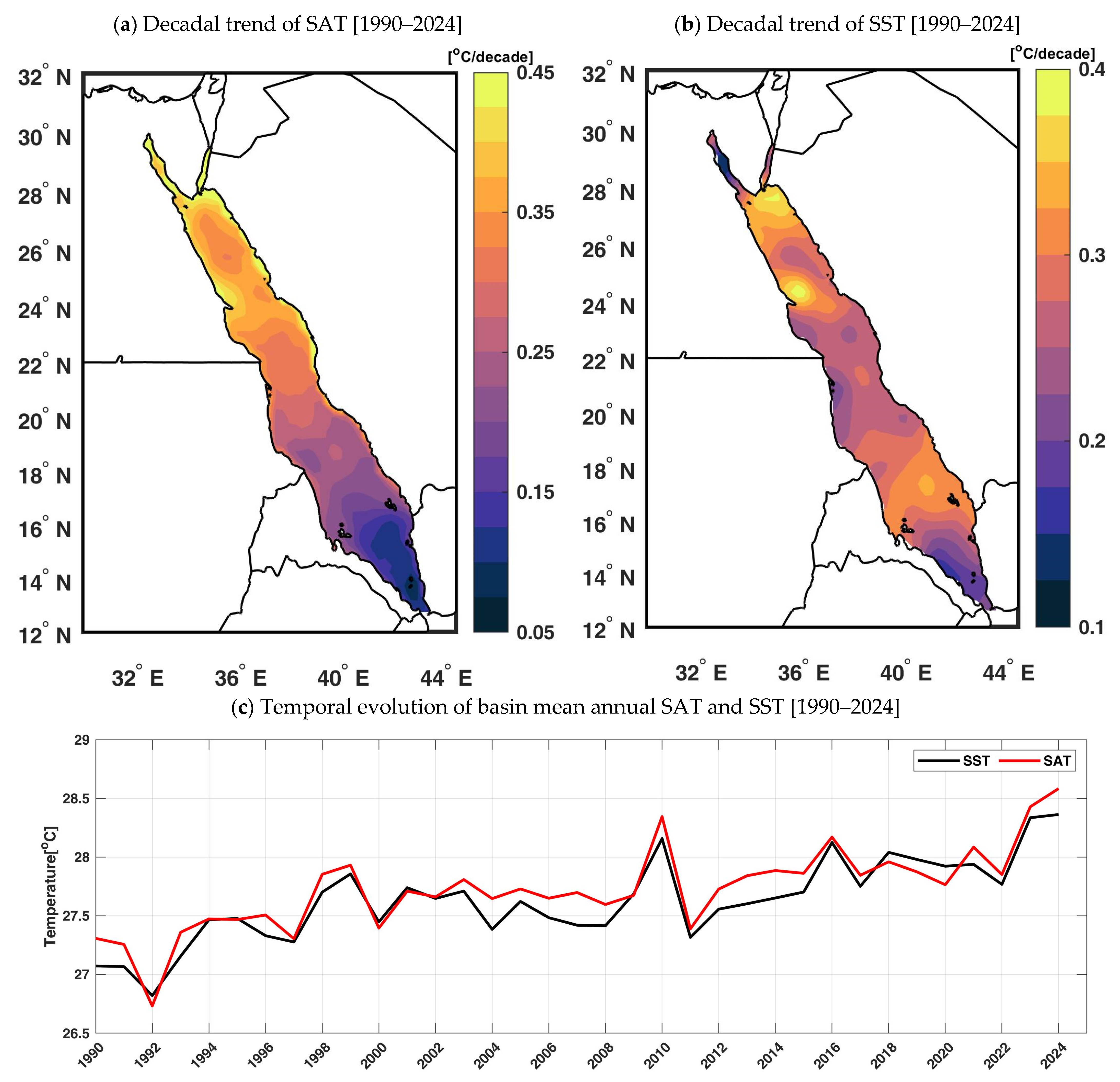
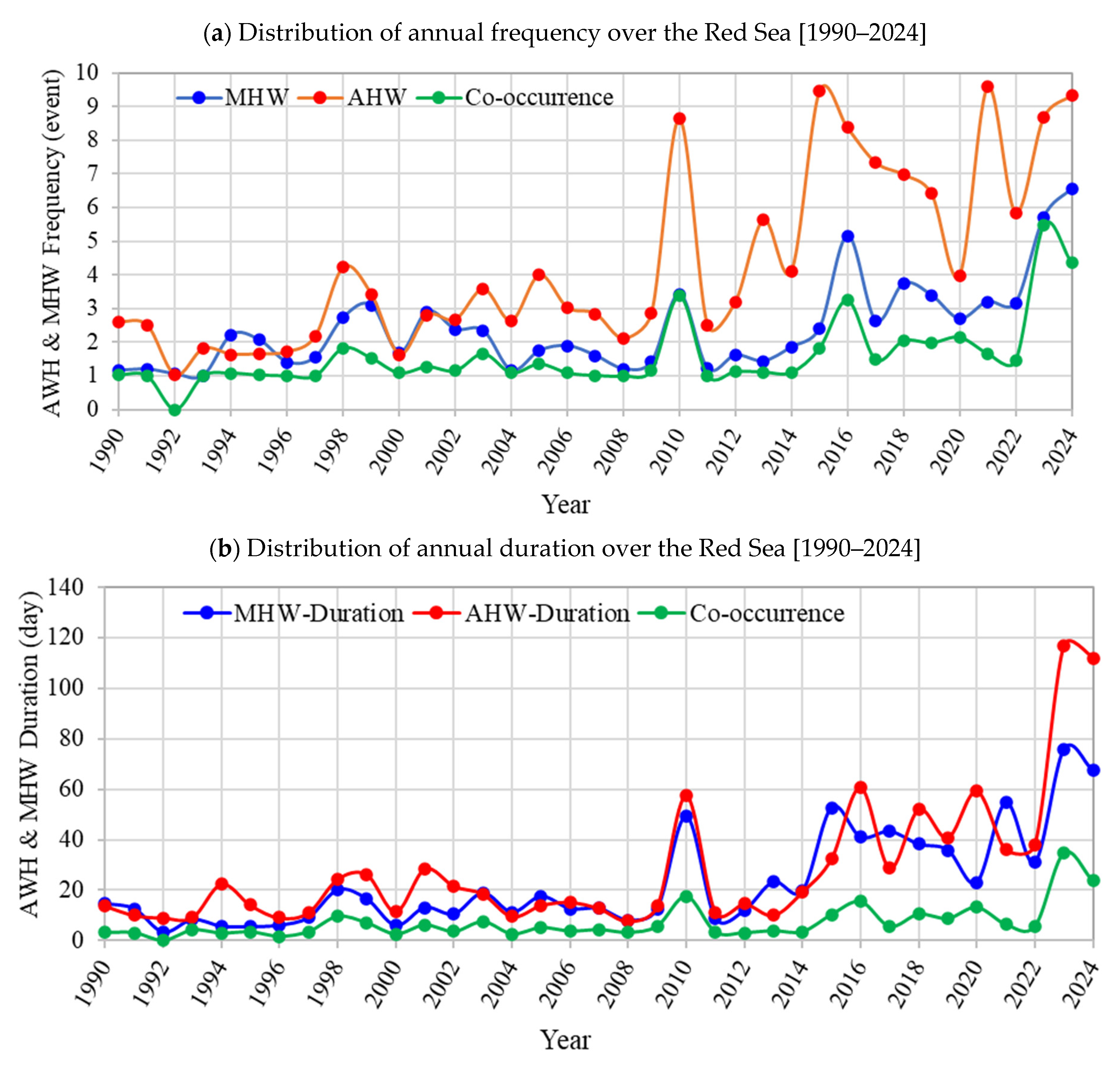
Atmospheric heatwaves (AHWs) and marine heatwaves (MHWs) are intensifying under climate change, yet their coupled behavior in the Red Sea remains insufficiently quantified. This study investigates the spatial and temporal characteristics of AHWs, MHWs, and their concurrent occurrence across the Red Sea from 1990 to 2024 using ERA5 surface air temperature (SAT) and NOAA OISST v2.1 satellite-derived sea surface temperature (SST). Remote-sensing daily satellite-derived Level-4 (L4) OISST products were used in this study to enable spatially complete and temporally consistent detection of MHWs in this narrow, semi-enclosed basin despite contamination and coastal sampling constraints. Both SAT and SST exhibit statistically significant warming trends (p < 0.05), with basin mean increases of 0.40 ± 0.07 °C/decade and 0.31 ± 0.05 °C/decade, respectively. The strongest warming was observed in the central and northern Red Sea. This warming is accompanied by significant increases in the frequency and duration of AHWs, MHWs, and their concurrent AHW-MHW events, particularly after 2010, indicating a shift toward more frequent heatwave conditions. AHWs occur more frequently than MHWs across the Red Sea, whereas MHWs exhibit long duration, particularly in the northern Red Sea, where annual durations exceed 45–50 days/year. Concurrent AHW-MHW events account for about 66% of MHWs in the Red Sea, and their characteristics show a significant increasing trend across the entire basin. These findings identify the Red Sea as a regional hotspot of increasing concurrent heatwave events and highlight the importance of satellite-based monitoring for assessing evolving climate risks in semi-enclosed basins.
Keywords: atmospheric heatwaves; marine heatwaves; concurrent heatwaves; Red Sea; climate extremes; long-term trends atmospheric heatwaves; marine heatwaves; concurrent heatwaves; Red Sea; climate extremes; long-term trends