Article

Altimeter Wet Path Delay Computation from Third-Party Water Vapor Data
1
Departamento de Geociências, Ambiente e Ordenamento do Território, Faculdade de Ciências, Universidade do Porto, Rua do Campo Alegre s/n, 4169-007 Porto, Portugal
2
Centro Interdisciplinar de Investigação Marinha e Ambiental (CIIMAR), Terminal de Cruzeiros de Leixões, Av. General Norton de Matos s/n, 4450-208 Matosinhos, Portugal
*
Author to whom correspondence should be addressed.
Remote Sens. 2026, 18(8), 1232; https://doi.org/10.3390/rs18081232
Submission received: 9 February 2026 / Revised: 13 April 2026 / Accepted: 14 April 2026 / Published: 18 April 2026
(This article belongs to the Special Issue Applications of Satellite Geodesy for Sea-Level Change Observation)

Highlights

What are the main findings?
  • Current state-of-the-art TCWV-to-WPD conversions underestimate WPD by more than 3 cm.
  • The best conversions available in the literature are revisited, and an updated methodology that eliminates significant systematic errors is proposed.
What is the implication of the main finding?
  • The TCWV-to-WPD conversion proposed in this study improves WPD estimates relative to existing conversion methods.
  • More precise WPD estimates lead to more reliable sea-level measurements from satellite altimetry, with direct societal impact.

Abstract

Wet path delay (WPD), required to correct sea-level measurements from satellite altimetry, is routinely estimated using observations from onboard microwave radiometers (MWR). However, when MWR retrievals are invalid or absent, WPD is generally obtained from atmospheric models, unless observations from external sources, such as scanning imaging radiometers, are available in spatial and temporal proximity to the altimeter measurements. These external observations, however, provide total column water vapor (TCWV) rather than WPD, and a reliable TCWV-to-WPD conversion is necessary. Current state-of-the-art conversions use TCWV only or TCWV and near-surface air temperature. The first approach is particularly relevant when external sources provide TCWV only. In this context, this paper presents, first, a comprehensive intercomparison of the methods available in the literature and, second, an improved TCWV-to-WPD conversion. The results show that one of the existing functions underestimates WPD by up to 1.6 cm in regions of high water vapor content, while another provides accurate WPD values only under specific atmospheric conditions. This study proposes an updated methodology that yields accurate WPD across the entire TCWV range, highlighting the importance of a reliable TCWV-to-WPD conversion for accurate sea-level estimation when valid MWR observations are unavailable.

1. Introduction

In the context of satellite radar altimetry, for a remote sensing technique for which its primary goal is to measure sea level globally, external data sources are often required to achieve the best performance [1]. In its state of the art, wet tropospheric correction (WTC), accounting for the altimeter signal delay caused by the wet troposphere (water vapor and cloud liquid water), is best determined by dedicated microwave radiometers (MWRs) onboard altimetry satellites [2,3]. For a variety of reasons, such as invalid WTC retrievals from MWR over coastal [4] and polar regions, limitations of these measurements under rainy conditions, or even the absence of an onboard MWR, this critical correction needs to be determined from third-party data sources [5,6].
For this purpose, the most commonly used sources are scanning imaging MWR (SIMWR) onboard external and independent remote sensing missions and atmospheric models, such as those from the European Centre for Medium-Range Weather Forecasts (ECMWF).
Regarding the first, the most common product useful for altimetry corrections is the total column water vapor (TCWV), available for the spatial and temporal coverage of each SIMWR mission [7]. A large set of TCWV products is available from various imaging sensors and from different data providers: for example, remote sensing systems (RSSs) [7,8,9] or European Organisation for the Exploitation of Meteorological Satellites (EUMETSAT) [10]. Among these, TCWV products from a Special Sensor Microwave Imager (SSM/I) and Special Sensor Microwave Imager Sounder (SSM/IS) are of particular relevance, since these sensors are a stable radiometric source, and the corresponding products are considered climate data records [9]. Concerning atmospheric models, TCWV and air temperature variables are also provided at regular spatial and temporal sampling intervals [11].
While the WTC is the variable of interest in satellite altimetry, it is always negative. For simplicity, the wet path delay (WPD), defined as the absolute value of the WTC, is used hereafter.
The current literature provides different approaches to compute the WPD from the aforementioned atmospheric variables, available either from Earth observation satellite measurements or from atmospheric models. Among these approaches, some of them propose computation solely from TCWV [12,13,14,15], while others propose computation using a combination of TCWV and near-surface air temperature [16,17], both provided as single-level (2D) variables. Additionally, WPD is commonly derived from 3D variables of atmospheric temperature and humidity provided by atmospheric models [2,18]. This 3D formulation considers the vertical atmospheric variations, and the resulting WPD is considered a reference [15]; however, this computation requires high computational effort and the usage of large datasets, making the 2D computation from single-level variables easier to perform and the most adequate for a variety of applications [19].
Considering the need for data from different types of sources, there are some methodologies that provide homogeneous and continuous wet path delays [20,21,22]. These methods include several steps, of which the main ones are the intercalibration of different input sources to provide a harmonized WPD solution and the conversion of all TCWV inputs into WPD, the variable of interest in satellite radar altimetry. These methodologies and the corresponding previously mentioned internal steps are crucial to ensure the best WPD solution and, consequently, the best performance of satellite altimetry in measuring and monitoring global sea levels, with impacts on society.
Given the availability of many satellite products that only provide TCWV, the direct conversion of TCWV into WPD is of great interest in the context of satellite altimetry. The focus of this study is the direct parametric transformation between TCWV and WPD with two main objectives. The first is to revisit and evaluate state-of-the-art methods to derive WPD from atmospheric variables, particularly those solely from TCWV. The second is to derive an improved TCWV-to-WPD transformation across all TCWV conditions, aiming at deriving the best wet path delays for use in sea-level products.
Regarding the structure of this article, Section 2 presents the materials and methods of this study and describes the data and the three methodologies used to compute the WPD from atmospheric variables, particularly the WPD computation, exclusively from TCWV. The results of the comparison between these methodologies and the identification of the best approach to derive WPD solely from TCWV are given in Section 3. Section 4 discusses and interprets the results, and finally, Section 5 summarizes the main achievements of this study.

2. Materials and Methods

In this study, the latest reanalysis model from ECMWF, ERA5, is considered. ERA5 is available at a spatial resolution of 0.25° × 0.25° and a temporal resolution of 1 h, and in this research, it is used at 0.5° × 0.5° and 6 h, respectively. Two different time spans have been selected, the full year of 2025 (1460 global grids) and the 10-year period of 2011–2020 (14,612 global grids), for comparisons and modelling, respectively. Regarding the ERA5 model, two datasets were used, both available from 1940 to the present: ERA5 hourly data on single levels [23], from which near-surface air temperatures (2 m temperature) and TCWV are provided; and ERA5 hourly data on pressure levels [24], from which the temperature and specific humidity are provided. The second dataset is used in the computation described in Section 2.1, while the first dataset is used in the computations described in Section 2.2 and Section 2.3. The first dataset is provided as a global regular grid for each variable and instant, while the second is provided as global regular grids at 37 pressure levels (at 1, 2, 3, 5, 7, 10, 20, 30, 50, 70, 100, 125, 150, 175, 200, 225, 250, 300, 350, 400, 450, 500, 550, 600, 650, 700, 750, 775, 800, 825, 850, 875, 900, 925, 950, 975, and 1000 hPa), ranging from the top level at 1 hPa (at an altitude around 45–50 km) down to the lowest level at 1000 hPa, for each variable and time instant.
In satellite altimetry, the ocean surface is the target region of application of these methodologies. To consider only the global ocean, the land–sea mask provided by ERA5 is used at a spatial resolution of 0.5° × 0.5°. This land–sea mask has a value ranging from 0 (sea) to 1 (land). In all analyses presented here, only ERA5 nodes with a sea–land mask value of 0 are considered.
In this study, the altimeter WPD is estimated using three distinct methodologies, each based on different atmospheric variables: (1) computed from 3D variables of temperature and atmospheric humidity; (2) computed from 2D surface variables of near-surface air temperature and TCWV; and (3) computed exclusively from TCWV. These three approaches are described in the next sub-sections.

2.1. WPD Computation from Vertical Profiles of Temperature and Humidity

In most altimetric products, the available model WPD is computed from 3D atmospheric variables of temperature and humidity. The WPD computation from these 3D fields is performed as an integration, from the top level of the atmosphere (TOA) down to the surface level of interest, using temperature (T) and specific humidity (q). Here, the TOA is the highest level, above which there is no water vapour. This 3D computation is performed according to Equation (1) [2,18]:
W P D = 1.116454 × 10 3 P T O A P s u r f q d p + 17.665439 P T O A P s u r f q T d p × 1 + 0.0026 cos 2 φ
In Equation (1), P is in hPa, T is in Kelvin, q is in kg/kg, and the resulting WPD is in meters. Equation (1) enables the accurate computation of WPD by taking into account three-dimensional atmospheric patterns. This approach requires high computational effort and the use of large datasets (3D instead of a single level). In this study, the estimation of the 3D integrated WPD from ERA5 pressure levels using Equation (1) is used as an accurate reference for comparisons. Within these 3D datasets, ECMWF also provides temperature and specific humidity at model levels, consisting of 137 vertical levels and offering higher vertical resolutions than pressure levels. However, previous studies [19] have shown that WPD computed at the sea level using both 3D ERA5 datasets are in agreement, with a global mean difference of 0 mm and a global standard deviation of 1 mm.
Considering that the WPD computed from ERA5 pressure levels accounts for the vertical variability of the WPD field, this approach has been adopted as a reference in this study. Moreover, when compared with the WPD from MWR onboard altimeter missions, the global RMS of the WPD differences is on the order of 1 cm [21,25]. Within the scope of this study, a comparison has been carried out between the WPD used here as a reference and the default WPD provided by the latest reference altimetry mission, Sentinel-6 Michael Freilich (S6MF), over a one-year period (2021, S6MF cycles 7–41). The RMS of the WPD differences between S6MF and ERA5 3D was computed for each analysed cycle, considering only open-ocean data and valid WPD S6MF retrievals. Over this nearly full-year period, the RMS values range from 0.95 to 1.09 cm, with a mean value of 1.02 cm. Therefore, when compared with the current reference altimetry mission, these results provide an indication of the accuracy of the WPD used as a reference. Additionally, ERA5-derived WPD is available globally with regular temporal sampling.

2.2. WPD Computation from Near-Surface Air Temperature and TCWV

Regarding the second method for computing the WPD from atmospheric variables, such as those commonly provided by an atmospheric model, the computation from single-level 2D parameters can be performed using near-surface air temperature and TCWV, which is an integrated value of the entire atmospheric column. The WPD can be calculated as a function of the two aforementioned parameters from Equation (2) [16,17]:
W P D = 0.101995 + 1725.55 T m T C W V 1000
In Equation (2), TCWV and Tm are expressed, respectively, in mm and K, and the WPD results are in meters. The value Tm in Equation (2) is the mean atmospheric temperature and can be modelled from the near-surface air temperature (T0), the same as the 2 m temperature provided by ERA5 (T2m), according to Equation (3) [26]:
T m = 50.4 + 0.789 × T 0
In Equation (3), both parameters are expressed in K.

2.3. WPD Computation Exclusively from TCWV

In order to assess the performance of an onboard MWR by means of comparisons against a TCWV source, Ref. [12] derived an inversion function from TCWV to WPD. This proposed computation of WPD, exclusively from TCWV, enabled us to carry out a WPD comparison between different data products. This conversion was derived in a way that accounts for the dependence of the water vapor on temperature, and in this way, a variable of temperature is not required. From a very limited radiosonde dataset (three island sites), the following conversion function was derived (Equation (4)):
W P D = 6.759 × T C W V 0.0291 × T C W V 2 + 0.00031 × T C W V 3
Equation (4) was derived from a fit of the ratio WPD/TCWV against TCWV, both computed from the radiosonde data, with TCWV and WPD expressed in mm.
Stum et al. (2011) [13] revisited this expression, exclusively based on TCWV, and proposed the following function (Equation (5)):
W P D = 6.8544 × T C W V 0.4377 × T C W V 2 + 0.0714 × T C W V 3 0.0038 × T C W V 4
Stum’s formulation is based on the same principle of the WPD/TCWV ratio function of TCWV, which, as mentioned above, accounts for the WPD dependence on temperature, and it was derived using one single grid of temperature and humidity profiles from the ECMWF model. According to Stum et al. (2011) [13], this updated function gives WPD values about 1% lower than those derived from Keihm et al. (2000) [12]. In Equation (5), both TCWV and WPD are expressed in cm.
Stum et al. (2014) [14] revisited the parametric function in Equation (5), proposed three years before (Stum, 2011) [13]. Instead of one single ECMWF analysis of temperature and humidity profiles, a 4-month period of profiles was used. The new version of the function results in an increased WPD/TCWV ratio compared to Stum et al. (2011) [13] by a factor of about 0.1. In practical terms, for a TCWV value of 60 mm, the WPD estimated by Equation (5), proposed in 2011, is underestimated by about 6 mm. Stum et al. (2014) [14] reported this revised function as intrinsically more accurate than the previous one proposed in 2011; however, the new expressions are not provided in the manuscript. It is also reported that the uncertainty associated with a WPD value when computed from TCWV from this function has a maximum of about 3 mm for a WPD of 20 cm. For higher WPD values, the uncertainty associated with this conversion is smaller due to the narrower range of atmospheric temperatures in a wet atmosphere [14].
In a more recent study, using ERA5 grid data at 00:00 over a 10-year period, Barnoud et al. (2023) [15] revisited the polynomial conversion model from Keihm et al. (2000) [12], Equation (4), and Stum et al. (2011) [13], Equation (5), and proposed updated coefficients for the latter, as shown in Equation (6):
W P D = 7.1066 × 10 3 × T C W V 6.815 × 10 5 × T C W V 2 + 1.597 × 10 6 × T C W V 3 1.204 × 10 8 × T C W V 4
In Equation (6), TCWV is given in mm, and the WPD results are in meters. The three functions for computing WPD exclusively from TCWV (Equations (4)–(6)) will be further analysed and intercompared in Section 3.1.

3. Results

This section provides the results from the WPD intercomparisons and an evaluation of the various functions or sets of coefficients used to convert TCWV into WPD, including an updated transformation and the corresponding achievements.

3.1. Intercomparison Between the Different WPD Computations

Considering the five computations and the ERA5 data for the full year of 2025, as described in Section 2, five WPD can be estimated. These WPD are estimated as global grids at a spatial resolution of 0.5° × 0.5° every 6 h, from which WPD differences at the same spatial and temporal samplings are computed. The WPD estimated from the four computations using TCWV and T2m (Equations (2) and (3), hereafter designated as Bevis computation) or solely TCWV (Equations (4)–(6), hereafter designated as Keihm, Stum, and Barnoud computations, respectively) are compared against the reference WPD from the 3D calculation, which accounts for three-dimensional atmospheric variations (Equation (1)). Four WPD differences are calculated: 3D-Bevis, 3D-Keihm, 3D-Stum, and 3D-Barnoud. For proper intercomparisons between the different methods of calculation, one must analyze how different methods perform for different atmospheric water vapor contents and different regions of the globe. Both analyses are addressed in the following subsections.

3.1.1. WPD Differences Function of TCWV

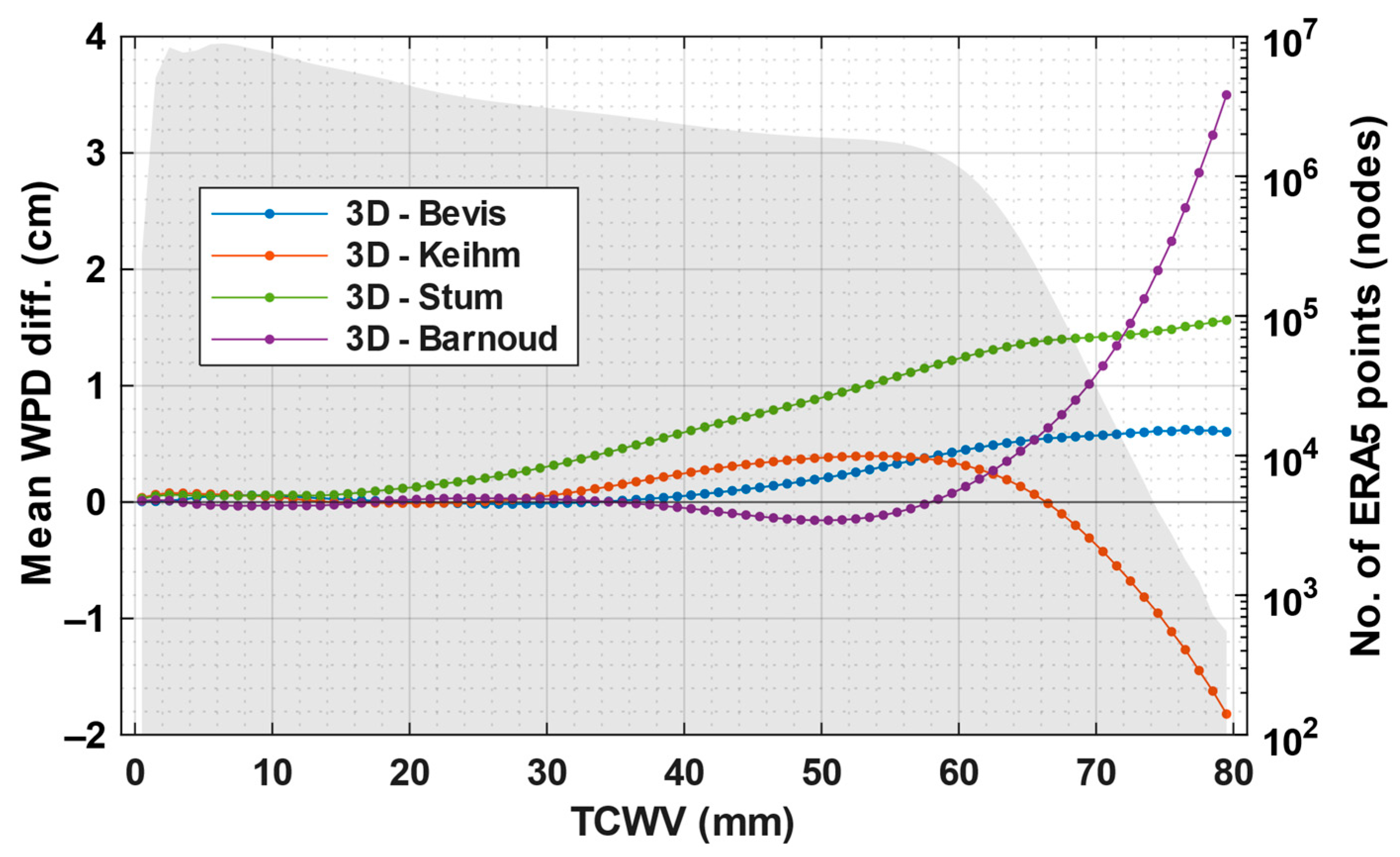
The WPD differences, computed on a 0.5° × 0.5° global grid every 6 h, are binned into 1 mm TCWV intervals. Figure 1 shows the mean WPD differences as a function of TCWV for 3D-Bevis, 3D-Keihm, 3D-Stum, and 3D-Barnoud, represented in blue, orange, green, and purple, respectively, on the left vertical axis. The number of points in each bin is represented by the grey shaded area on the right vertical axis, shown on a logarithmic scale.
Considering the TCWV range of 0–60 mm, the WPD differences represented in Figure 1 show the largest differences for Stum (mean of 4.3 mm), similar differences for Keihm and Bevis (mean of 1.5 and 0.8 mm, respectively), and mean differences around zero for Barnoud (mean of −0.3 mm). For the most common TCWV conditions (0–60 mm), this analysis shows that the Stum coefficients proposed in 2011 lead to an underestimation of the WPD, which is more pronounced under the wettest conditions, reaching nearly 1.2 cm for a TCWV value of 60 mm. Regarding the Bevis and Keihm formulations, the underestimation can reach around 4 mm for both. The Barnoud function slightly overestimates the WPD under certain atmospheric conditions, although the corresponding differences are in the range of [−1.6 0.8] mm.
Considering the TCWV interval of 60–80 mm, the performance of the different computations can differ significantly from that under drier conditions. Bevis and Stum underestimate the WPD by up to 0.6 and 1.6 cm, respectively. Regarding Barnoud, this underestimation can reach 3.5 cm for the wettest conditions. On the contrary, for the same extreme TCWV conditions, the approach proposed by Keihm overestimates the WPD by up to 1.8 cm.
It is important to note that the wettest conditions are less frequent. The number of points in each bin falls below 10,000 for TCWV values above 73 mm, and bins with 1000 or fewer points occur for TCWV values above 78 mm. However, the large differences reported above for this TCWV interval (up to 3.5 cm) are systematic and very significant.

3.1.2. Spatial WPD Differences

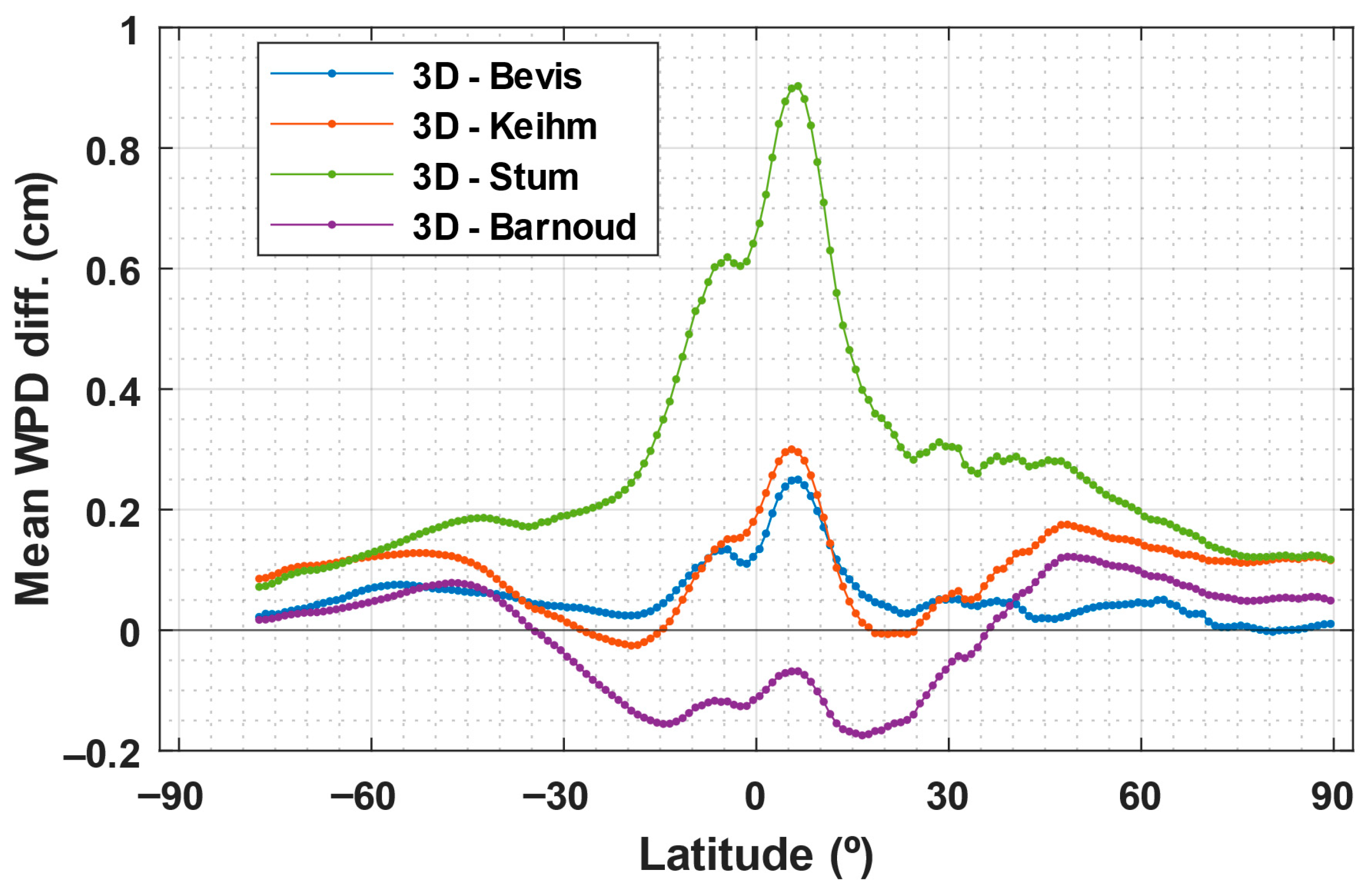
Figure 2 represents the same WPD differences, now as a function of latitude. This illustrates similar results, with the largest differences observed for the Stum computation, up to almost 1 cm for the wettest conditions. For these conditions, using Bevis or Keihm results in differences below 0.3 cm. Regarding the Barnoud function, for the same wet conditions at low latitudes, it slightly overestimates the WPD, with corresponding absolute differences smaller than 0.2 cm. Considering these differences computed as a mean value for each 1° parallel, the mean differences are 0.7, 1.0, 3.3, and −0.4 mm, respectively, for Bevis, Keihm, Stum, and Barnoud. These values indicate the global performance of each WPD computation for the mean conditions; i.e., globally, Stum underestimates WPD by 3 mm, while Bevis produces results above 40° N, and Barnoud produces those that perform better.
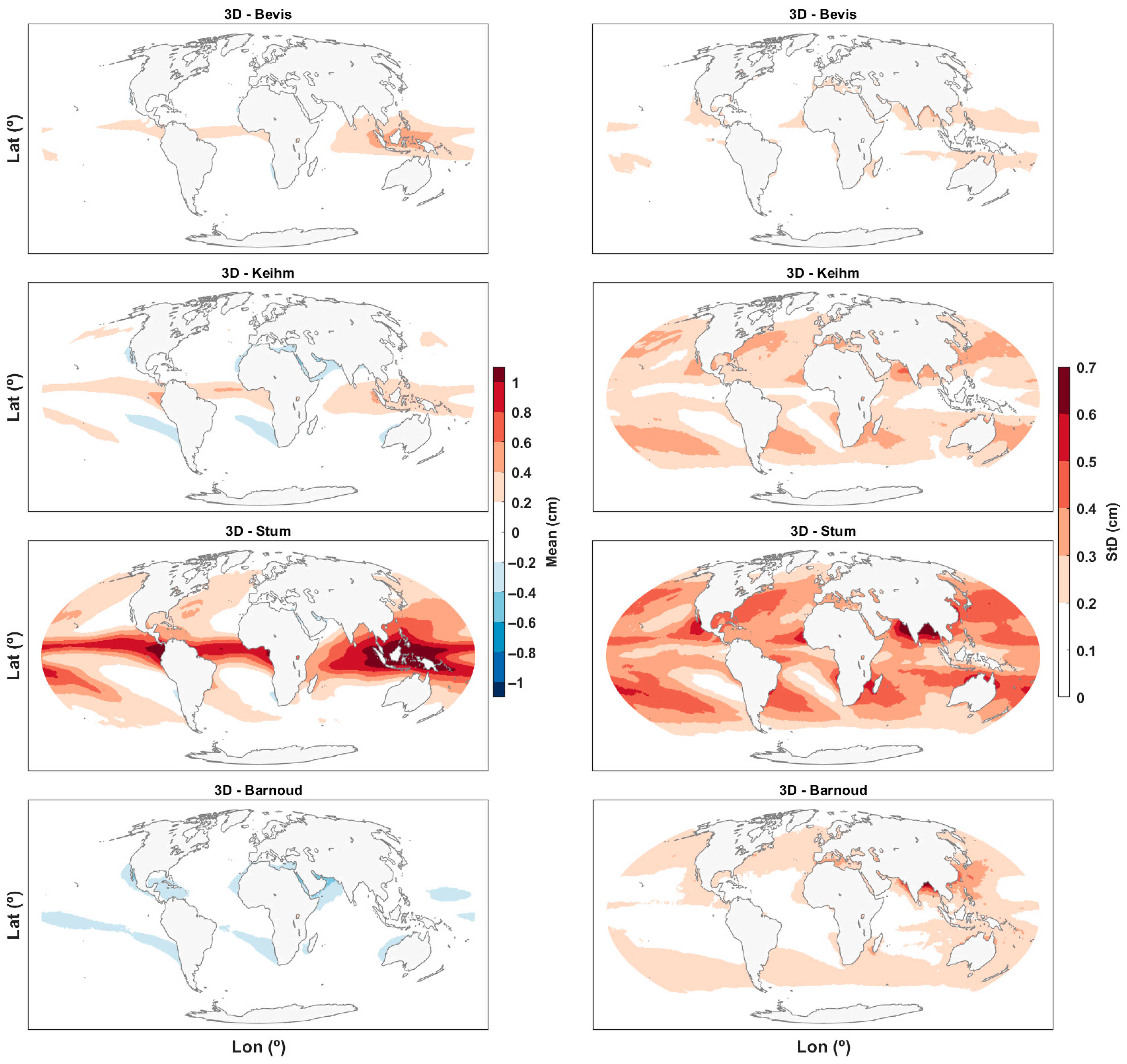
Figure 3 depicts the regional patterns of the WPD differences, with the mean difference and the standard deviation of each difference represented in the left and right panels, respectively. The color bars of the mean values (left panels) are saturated in the interval [−1.1 1.1] cm, and differences in the interval [−0.2 0.2] cm are represented in white. As in the previous analyses, the global maps of the mean WPD differences (left panels) reveal similar patterns for Bevis (top) and Keihm (middle top), large positive WPD differences for Stum (middle bottom), mainly over the wet equatorial region, and small negative differences for Barnoud (bottom). Regarding the standard deviations of the differences (right panels), values are overall small, below 0.9 cm, for all comparisons, although larger values occur in the comparison between 3D and Stum. When the standard deviation is computed as a function of TCWV (as the mean in Figure 1) or latitude (as the mean in Figure 2), the values are again overall small, below 0.5 cm, for all comparisons. The standard deviation for Bevis is particularly small and always below 0.2 cm, as previously reported in [19].
Considering an entire year of ERA5 data, the intercomparison of all computations shows that the WPD calculation using the coefficients proposed in 2011 by Stum provides WPD values substantially different from the others, with a very significant underestimation over the wettest regions that is latitude-dependent, and as a consequence, the WPD differences have the same regional pattern as the WPD itself. Regarding the standard deviations of the differences, the analyses show the largest values for Stum and the lowest values for Bevis, which uses temperature as input rather than modelling its dependence on the WPD/TCWV ratio as a function of TCWV. However, these standard deviation values are small, consistently below 1 cm, and in most cases, they are below 0.5 cm. These results show that, when the near-surface temperature is available, the formulation from Bevis provides WPD values very close to those from 3D integration.

3.2. Modelling the Coefficients of the Computation of WPD Solely from TCWV

This section examines how the above approaches, solely based on TCWV, can be improved. For this purpose, ERA5 data for a 10-year time span (2011–2020) have been used.

3.2.1. WPD/TCWV Ratio Versus TCWV

As explained previously, in order to account for the WPD temperature dependence, the computation of WPD solely from TCWV was carried out by various authors by modeling the ratio WPD/TCWV as a polynomial function of TCWV.
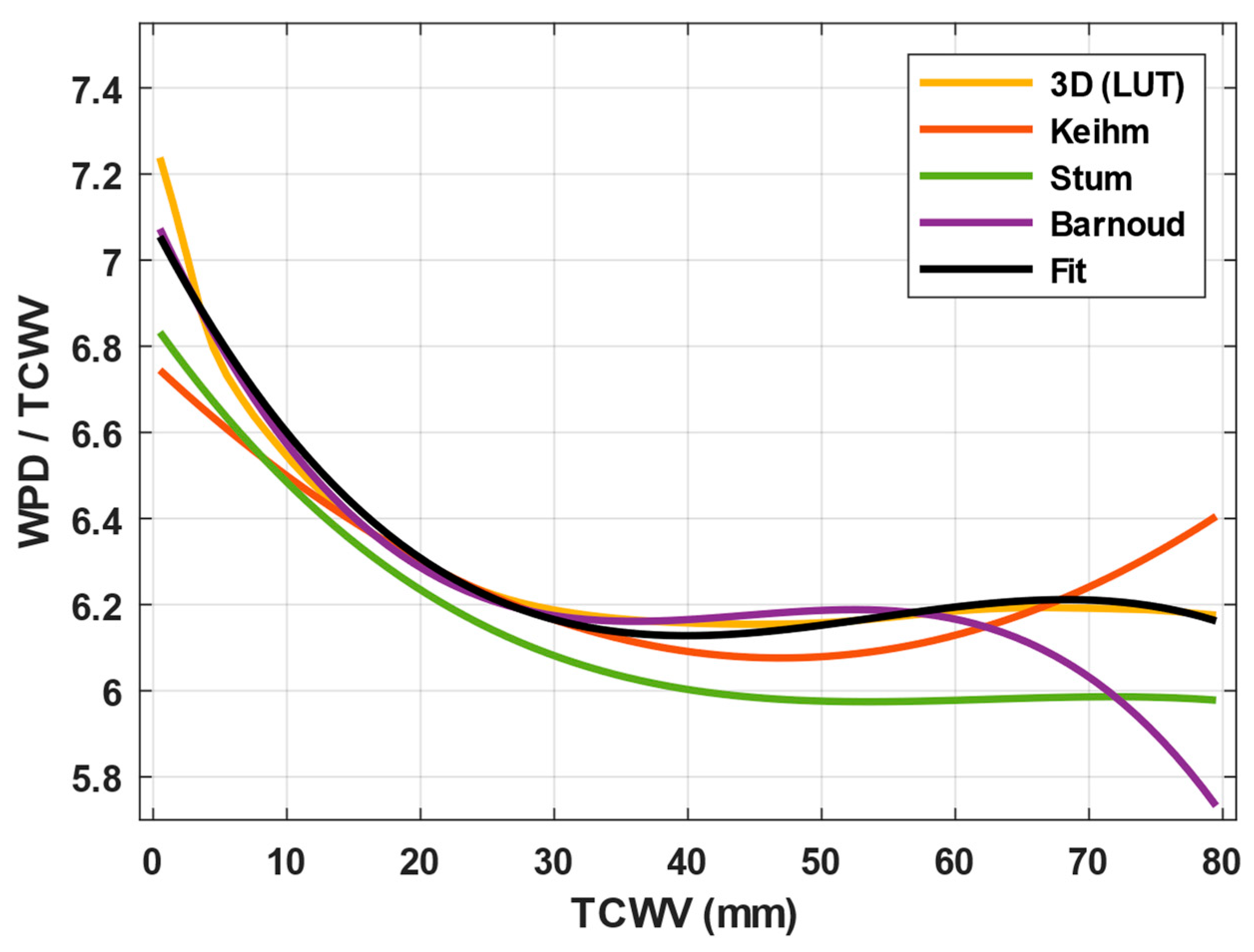
Figure 4 shows the modelling curves corresponding to the three different functions assessed in this study: Keihm, Stum, and Barnoud. For a TCWV range of 0–80 mm, the corresponding WPD values are computed using each set of coefficients. Additionally, the WPD estimated from the reference 3D approach is also shown. In all cases, the mean WPD/TCWV ratio values in bins of 1 mm TCWV have been computed.
When compared with the 3D computation (yellow curve), the use of the Keihm coefficients underestimates the WPD for conditions of TCWV between 30 and around 65 mm, the Stum coefficients underestimate the WPD for the entire range of TCWV, while the Barnoud coefficients slightly overestimate the WPD for TCWV in the range between 40 and 60 mm. Since the variable represented in the y-axis is a multiplicative factor, the larger the TCWV, the larger the underestimation of the Stum approach. Another striking result from Figure 4 is observed for the very extreme wet conditions, where both Keihm and Barnoud curves are very distant from the 3D ratio. This means an underestimation of the Barnoud approach of more than 3 cm and an overestimation of the Keihm approach of almost 2 cm for the wettest conditions. These analyses of the modelling functions and the corresponding impact on the estimated WPD for different ranges of TCWV are in agreement with the results presented before. Moreover, equivalent results are achieved when different time spans are used, e.g., any year in the interval (2011–2020) instead of 2025. When compared with the 3D approach, there is an underestimation of the three functions for the driest conditions, which is close to 0 mm. However, this is negligible, since the impact is almost null for TCWV values between 0 and 5 mm.

3.2.2. Modelling a Set of New Coefficients

Given the results of the comparisons between the different functions, which reveal significant differences relative to the reference 3D approach, new coefficients are calculated using a third-degree polynomial, as adopted by Stum and Barnoud. For this, the yellow curve in Figure 4, corresponding to the reference mean WPD/TCWV ratio for 1 mm in TCWV classes over a 10-year time span (2011–2020), is used. Two modelling approaches are considered: (i) a least squares fit of the four coefficients of the third-degree polynomial (Fit) and (ii) the use of the reference curve as a look-up table (LUT) with 80 values: one for each 1 mm TCWV interval from 0 to 80 mm. The following function results from the first approach:
W P D = 7.0842 × T C W V 0.5959 × T C W V 2 + 0.1184 × T C W V 3 0.0073 × T C W V 4
In Equation (7), both TCWV and WPD are in cm. In parallel with the estimation of the coefficients, the corresponding uncertainties are determined: 0.01639, 0.01670, 0.00457, and 0.00035. The coefficients proposed in Equation (7) generate the black curve in Figure 4. The LUT curve coincides with the reference curve (yellow). The updated coefficients generate a curve closer to the LUT (or reference) than the Barnoud curve in the TCWV range from 60 to 80 mm. The atmospheric conditions for this range of TCWV are rare, and for this reason, the differences may not be observed in global analyses. However, the impact is systematic and highly significant, and it is more than 3 cm, as shown above.
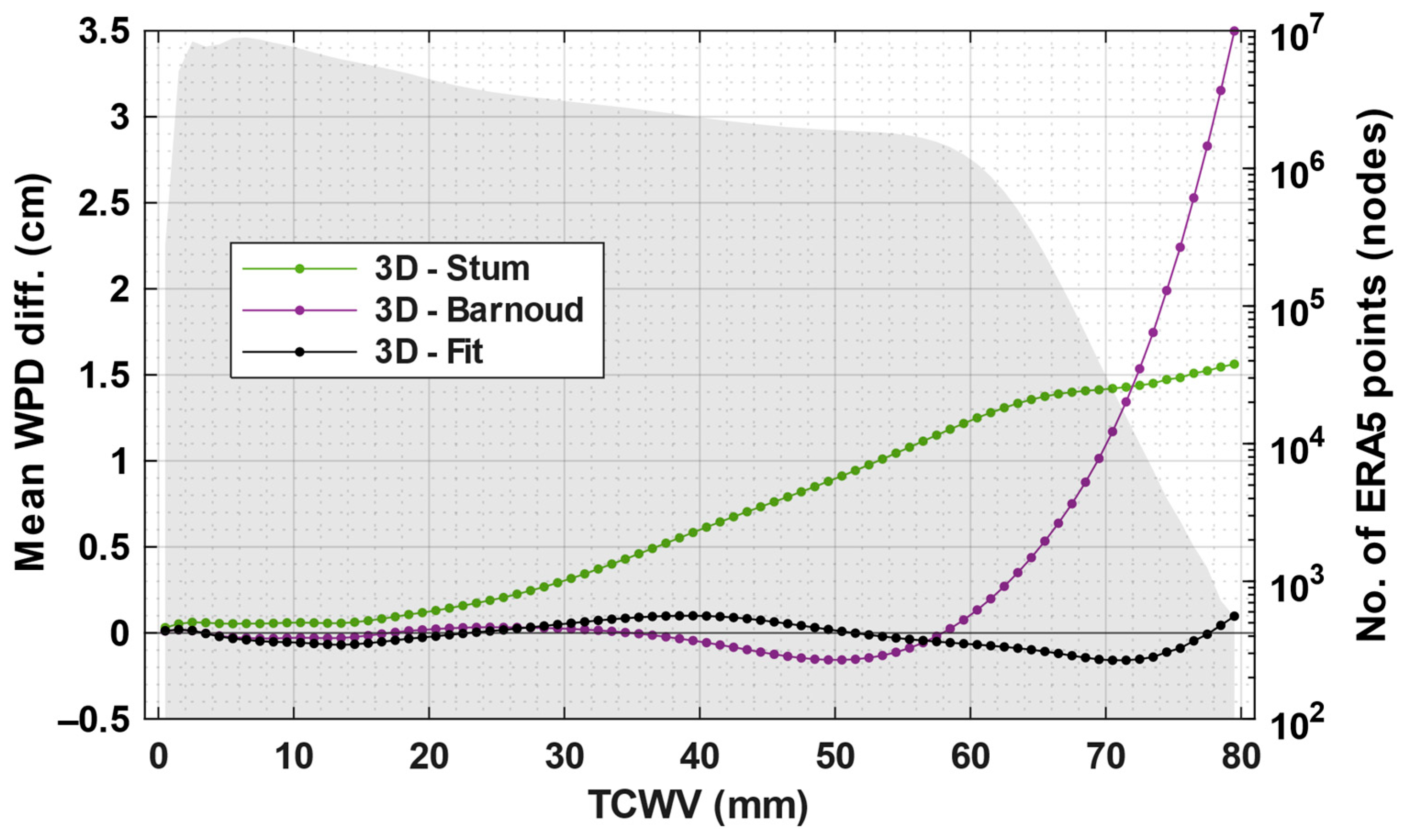
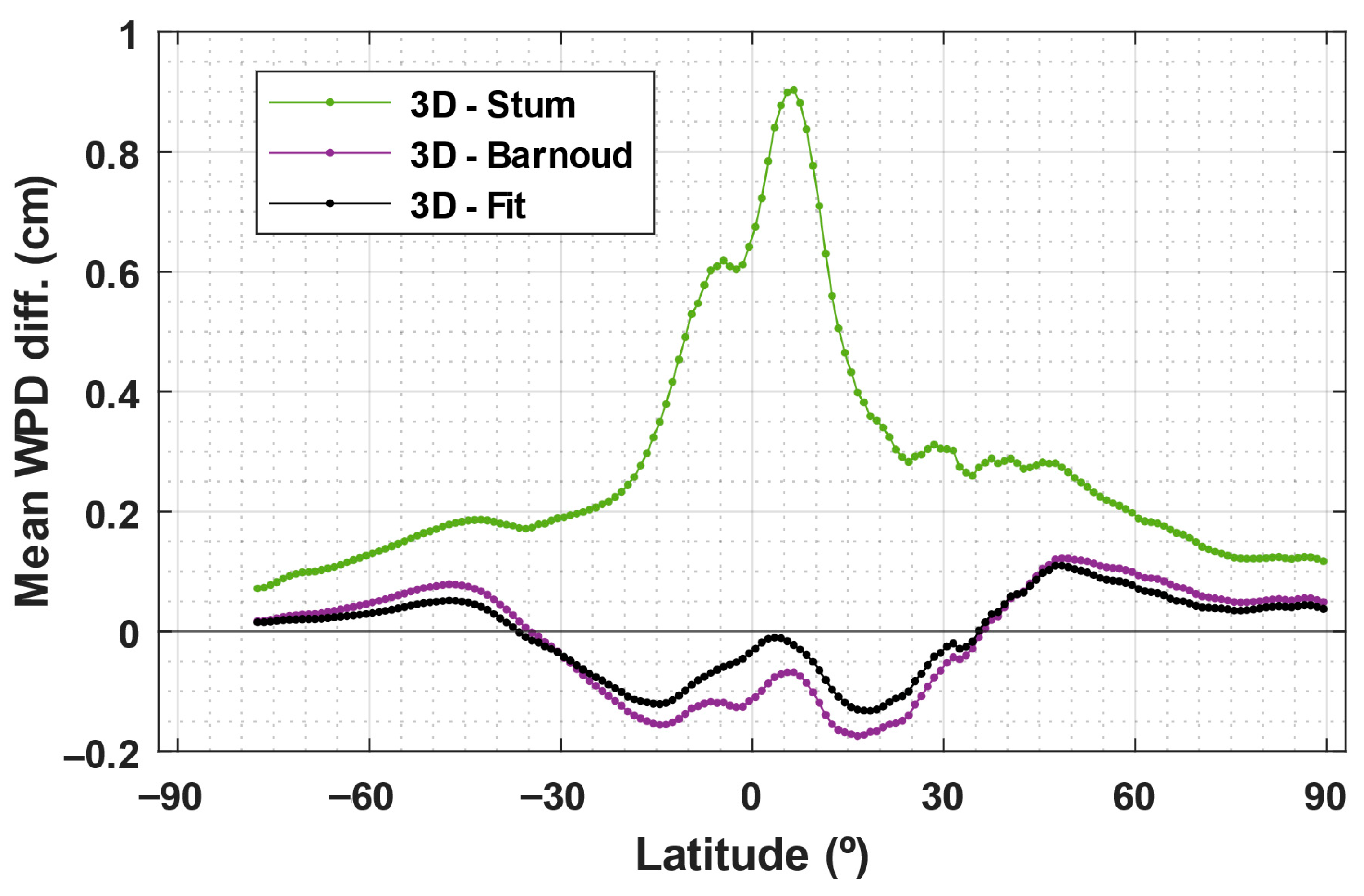
Figure 5 shows the same analysis as Figure 1 but considering only the curves resulting from third-degree polynomial fits for Stum (green), Barnoud (purple), and Fit (black, derived in this study). Since the focus is on comparisons of the latest approaches, the oldest approach proposed by Keihm, based on a second-degree polynomial, is not shown here and in subsequent analyses. Considering TCWV values of only up to 60 mm, Barnoud and Fit curves are very similar, both with an absolute mean difference below 1.6 mm. For this TCWV range, both sets of coefficients generate WPD with no significant differences. When the entire range of TCWV is considered, the Fit curve remains below an absolute difference of 1.6 mm, while the Barnoud curve reaches a difference of 3.5 cm. Figure 5 shows that, when compared with the reference WPD, the Fit curve proposed in this study performs well for the entire range of atmospheric conditions, with absolute differences always below 1.6 mm.
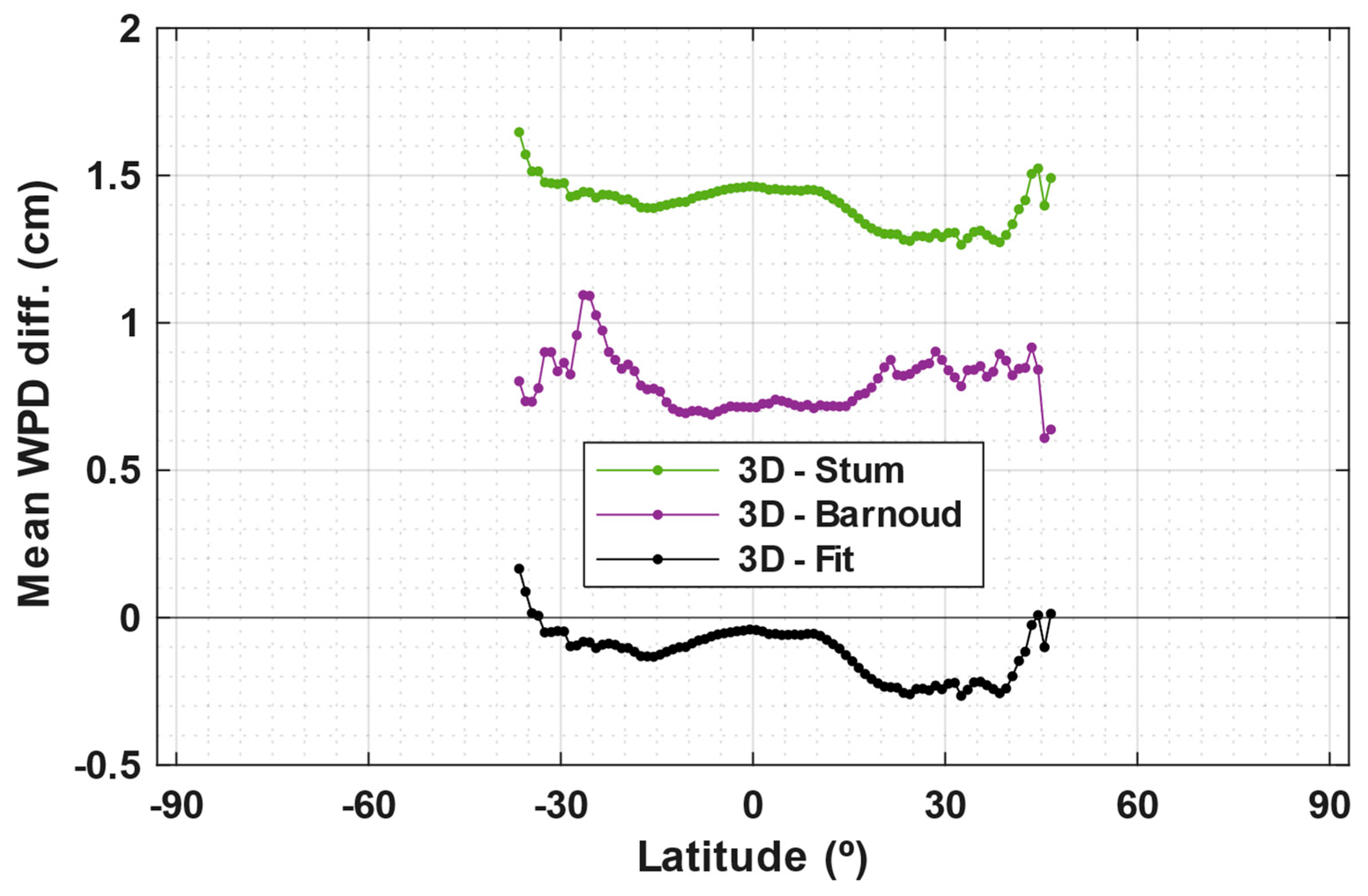
Figure 6 shows the same analysis as Figure 2, considering only the Stum (green), Barnoud (purple), and Fit (black) curves. Considering the differences computed as a mean value for each 1° parallel, the mean differences are 3.3, −0.4, and −0.2 mm, respectively, for Stum, Barnoud, and Fit. Figure 6 shows the Fit curve closer to zero than the Barnoud one over the entire latitude range. The difference between these curves is very small. However, these values are based on global results, considering all atmospheric conditions. The wettest atmospheric conditions are rare, and for this reason, the global impact of using the two sets of coefficients is masked in these global values. To better assess the impact of the Fit curve over the Barnoud one, the analysis in Figure 6 is repeated in Figure 7 for the particular case of TCWV values in the 65–80 mm range, where the difference between the two approaches is most significant, as shown in Figure 4 and Figure 5. These TCWV conditions occur only in the latitude range of 37° S–47° N.
The mean values of the differences represented in Figure 7 are 1.4, 0.8, and −0.1 cm, while the corresponding maximum absolute differences are 1.6, 1.1, and 0.3 cm, respectively, for Stum, Barnoud, and Fit. Figure 7 shows that using Fit instead of Barnoud removes large biases in the WPD, particularly for the TCWV interval of 65–80 mm. This impact is larger for larger TCWV values. On the contrary, the occurrence of certain atmospheric conditions decreases with increasing TCWV. For this reason, the underestimation of the Barnoud coefficients shown in Figure 5 up to 3.5 cm is less pronounced when computed in Figure 7.
For the second approach used in this modelling, i.e., the look-up table with 80 values to be multiplied by TCWV to obtain the WPD, the same comparison against the 3D approach is performed using data for 2025, independent of the data used in the computation of the LUT (2011–2020). The same analysis function of TCWV and latitude is performed for LUT. However, they are not shown since the differences between Fit and LUT are not significant, with absolute mean WPD differences with respect to the 3D reference WPD below 0.2 cm for both approaches.
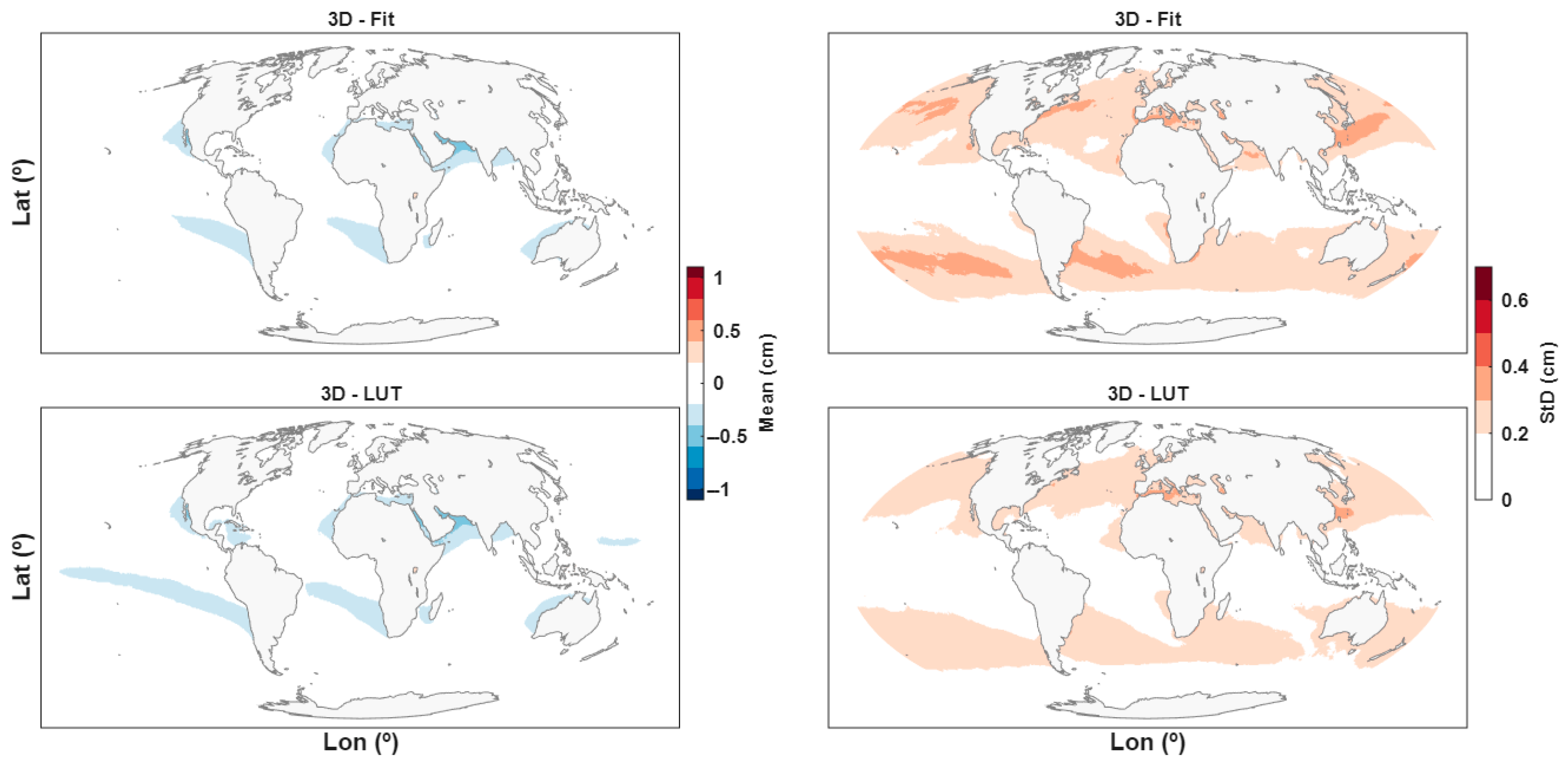
Panels of Figure 8 show the global maps of the mean (left) and standard deviation (right) of the differences between 3D and Fit (top) and 3D and LUT (bottom). No significant difference is observed between the two approaches (Fit and LUT) in terms of mean values. The standard deviation of the 3D-LUT differences is slightly lower than that of the 3D-Fit differences at mid-latitudes, with an impact of less than 1 mm.
In the analyses of regional patterns shown in Figure 3 and Figure 8, there is no significant difference between Barnoud (bottom panels of Figure 3) and Fit (top panels of Figure 8). This is due to the same reason as described above: the wettest atmospheric conditions are rare, and the global impact of using the two sets of coefficients is masked in these annual pointwise values.
This type of approach depends on TCWV, i.e., the conversion from TCWV to WPD is based on mean conditions for each TCWV range. In addition, a temporal dependence was also considered by computing look-up tables for different quarters and times of day (0, 6, 12, and 18 h). No significant differences were found when accounting for temporal dependence.

4. Discussion

In satellite altimetry, the estimation of wet path delay is a critical step, since the collocated estimates from the onboard microwave radiometers can be invalid or even nonexistent, particularly in regions of utmost importance, such as coastal regions. To overcome this, several approaches have been proposed by various authors to estimate the WPD from external data acquired within close spatial and temporal proximity to satellite altimetry acquisitions. In particular, approaches for estimating the WPD based solely on TCWV are especially relevant, as some sources do not provide temperature variables and therefore require an additional source, such as an atmospheric model. Regarding these approaches, three main functions are available in the literature within the context of satellite radar altimetry. Keihm proposed the first one in 2000 [12], Stum introduced a new formulation in 2011 [13], and Barnoud provided an updated set of coefficients for the latter in 2023 [15]. Building on this sequence reported in the literature, this study first performs an intercomparison of the different approaches and then evaluates the modelling to derive an improved WPD retrieval.
To this end, two additional approaches are considered: a 3D formulation that accounts for three-dimensional atmospheric variations [18], with the resulting WPD used as reference, and a WPD computation based on the combination of temperature and TCWV [16,17]. From the intercomparison of all five WPDs, the Stum formula shows the largest differences relative to the reference WPD, underestimating by more than 1.5 cm under the wettest conditions. Part of this underestimation is already reported in [14]. Keihm and Bevis formulations have similar mean values for a TCWV range up to 60 mm, with underestimations smaller than 0.4 cm; however, for the wettest conditions, Keihm overestimates the WPD by up to 1.8 cm, while Bevis maintains its underestimation below 0.6 cm. The Barnoud coefficients yield absolute mean WPD differences of less than 0.2 cm for TCWV values up to 60 mm. However, for the wettest conditions, they underestimate the WPD by up to 3.5 cm. The Bevis computation, which uses temperature as input, produces the lowest standard deviation relative to the 3D computation. These intercomparisons (conducted for 2025), when represented as global maps, only show mean conditions at each ERA5 node, characterized by TCWV values up to 60 mm. Between Stum and Barnoud, these analyses show that the coefficients proposed by [15] produce the best WPD solution. However, under the wettest conditions (TCWV values larger than 60 mm), despite being rare, the coefficients proposed by [15] underestimate the WPD by more than 3 cm. For this reason, this study proposes a new set of coefficients that produce similar WPD values while being better aligned with the 3D computation under the wettest conditions. The comparison with the reference 3D approach for 2025, which was not used in the modelling of the coefficients, shows that the differences with respect to the reference WPD have a mean value around zero and a standard deviation of a few millimetres across the entire range of TCWV (up to 80 mm).
The modelling developed in this study aims at providing an updated and improved set of coefficients for the polynomial function used by Stum and Barnoud, having a reliable solution to compute the WPD for satellite altimetry that is only dependent on TCWV products. It was carried out over a 10-year period (2011–2020) using ERA5 data. To quantify the temporal sensitivity of the results, different time spans were tested both in the modelling and validation periods. The use of different periods of ERA5 data in the modelling leads to WPDs with differences in the range of [−2 2] mm for the entire range of TCWV values. This is an indicator of the inherent error of this kind of modelling, revealing that the proposed approach leads to WPD values with absolute bias up to 1.6 mm for some TCWV conditions.
The WPD computation based exclusively on TCWV, as presented by [13,15] and in this paper, accounts for the dependence of water vapor on temperature, avoiding the need for temperature data from an external source. In the same sense, this computation depends on the TCWV value, which in turn possesses a natural temporal variation. For this reason, different modelling approaches considering different time spans were performed (e.g., different quarters or instants of the day—0, 6, 12, and 18 h), but no significant differences were found.
The accuracy of the WPD computed from a TCWV dataset depends not only on the conversion method between the two variables but also on the quality of the TCWV input data. This study focuses on the conversion step, i.e., on the impact of using different conversion functions when the same TCWV input is used, by assessing the accuracy of existing methods and proposing an improved transformation. When different TCWV datasets are considered, such as those from a model or radiometer, additional differences are expected, and the intercalibration of these datasets may be required, either at the TCWV or WPD level [27]. To enable the merging of WPD datasets from different sources, e.g., from models or from onboard and external radiometers with different temporal and spatial samplings, the intercalibration of WPD datasets in the context of satellite altimetry remains a challenge and will be the subject of future research.

5. Conclusions

Wet path delay for satellite radar altimetry is widely estimated from atmospheric fields, either from numerical models or remote sensing observations. This estimation gains particular relevance when the default WPD retrieval from the dedicated microwave radiometers fails, and an alternative source is required. This study assesses the state-of-the-art methodologies for computing this altimeter path delay with atmospheric fields and proposes an improved WPD computation exclusively from total column water vapor.
The results show that some current methodologies underestimate the WPD, particularly for the wettest conditions, resulting in systematic errors larger than 1 cm. Other current methods available in the literature provide accurate WPD values for the majority of the conditions; however, these generate WPD with systematic errors up to more than 3 cm for extreme wet conditions. This work proposes an updated methodology for providing WPD values derived solely from TCWV. When compared with the reference WPD, the differences have a mean around zero and a standard deviation of a few millimetres for the entire range of TCWV (up to 80 mm). This ensures that the step of converting TCWV into WPD does not introduce significant additional errors in the WPD retrieval.
Since sea-level measurements depend directly on the WPD, the proposed improved methodology will affect sea-level estimates, particularly in regions with high water vapor content. This is especially relevant when MWR retrievals are unavailable and external TCWV data are required, which often occurs over coastal and polar regions, or for satellites without an onboard MWR, such as CryoSat-2.
This work has particular relevance for methodologies in which the estimation of WPD depends on multiple data sources, such as the GNSS-derived Path Delay Plus (GPD+), currently provided in CryoSat-2 and Sentinel-3 [21] altimeter products. Amongst other WPD sources, our method makes use of data from external imaging MWR, such as the Special Sensor Microwave Imager Sounder, usually provided in the form of TCWV products. In this context, the conversion from TCWV to WPD presented in this study is a crucial step in the GPD+ data combination procedure, which aims to replace invalid WPD values from the onboard MWR with new estimates and provides a continuous correction valid over all surface types.

Author Contributions

Conceptualization, methodology, formal analysis, and writing—original draft preparation: T.V.; writing—review and editing: P.A., C.L. and M.J.F. All authors have read and agreed to the published version of this manuscript.

Funding

This research was funded by the Copernicus Program of the European Union in the ambit of the S3 Altimetry GPD Wet Tropospheric Correction activity (GPD4S3) from European Organization for the Exploitation of Meteorological Satellites (EUMETSAT).

Data Availability Statement

No new data were created or analyzed in this study. Data sharing is not applicable to this article.

Conflicts of Interest

The authors declare no conflicts of interest.

Abbreviations

The following abbreviations are used in this manuscript:
ECMWFEuropean Centre for Medium-Range Weather Forecasts;
ERA5ECMWF ReAnalysis 5;
EUMETSATEuropean Organisation for the Exploitation of Meteorological Satellites;
GNSSGlobal Navigation Satellite System;
GPD+GNSS-derived Path Delay Plus;
LUTLook-Up Table;
MWRMicrowave Radiometer;
RSSRemote Sensing System;
S6MFSentinel-6 Michael Freilich;
SIMWRScanning Imaging MWR;
SSM/ISpecial Sensor Microwave Imager;
SSM/ISSpecial Sensor Microwave Imager Sounder;
T2m2m Temperature;
TCWVTotal Column Water Vapour;
TOATop of Atmosphere;
WPDWet Path Delay;
WTCWet Tropospheric Correction.

References

  1. Abdalla, S.; Kolahchi, A.A.; Ablain, M.; Adusumilli, S.; Bhowmick, S.A.; Alou-Font, E.; Amarouche, L.; Andersen, O.B.; Antich, H.; Aouf, L.; et al. Altimetry for the future: Building on 25 years of progress. Adv. Space Res. 2021, 68, 319–363. [Google Scholar] [CrossRef]
  2. Fernandes, M.J.; Lázaro, C.; Vieira, T. On the Role of the Troposphere in Satellite Altimetry. Remote Sens. Environ. 2021, 252, 112149. [Google Scholar] [CrossRef]
  3. Maiwald, F.; Brown, S.T.; Koch, T.; Milligan, L.; Kangaslahti, P.; Schlecht, E.; Skalare, A.; Bloom, M.; Torossian, V.; Kanis, J.; et al. Completion of the AMR-C Instrument for Sentinel-6. IEEE J. Sel. Top. Appl. Earth Obs. Remote Sens. 2020, 13, 1811–1818. [Google Scholar] [CrossRef]
  4. Vieira, T.; Fernandes, M.J.; Lazaro, C. Independent Assessment of On-Board Microwave Radiometer Measurements in Coastal Zones Using Tropospheric Delays from GNSS. IEEE Trans. Geosci. Remote Sens. 2019, 57, 1804–1816. [Google Scholar] [CrossRef]
  5. Fernandes, M.J.; Lázaro, C.; Nunes, A.L.; Scharroo, R. Atmospheric corrections for altimetry studies over inland water. Remote Sens. 2014, 6, 4952–4997. [Google Scholar] [CrossRef]
  6. Legeais, J.-F.; Ablain, M.; Thao, S. Evaluation of wet troposphere path delays from atmospheric reanalyses and radiometers and their impact on the altimeter sea level. Ocean Sci. 2014, 10, 893–905. [Google Scholar] [CrossRef]
  7. Mears, C.A.; Smith, D.K.; Ricciardulli, L.; Wang, J.; Huelsing, H.; Wentz, F.J. Construction and Uncertainty Estimation of a Satellite-Derived Total Precipitable Water Data Record Over the World’s Oceans. Earth Space Sci. 2018, 5, 197–210. [Google Scholar] [CrossRef]
  8. Wentz, F.J. SSM/I Version-7 Calibration Report; Remote Sensing Systems: Santa Rosa, CA, USA, 2013. [Google Scholar]
  9. Wentz, F.J. A well-calibrated ocean algorithm for special sensor microwave/imager. J. Geophys. Res. Ocean. 1997, 102, 8703–8718. [Google Scholar] [CrossRef]
  10. EUMETSAT. IASI Level 2: Product Guide, EUM/OPS-EPS/MAN/04/0033, v3E e-Signed. Jul. 2017. Available online: https://user.eumetsat.int/s3/eup-strapi-media/IASI_Level_2_Product_Guide_8f61a2369f.pdf (accessed on 31 October 2025).
  11. Hersbach, H.; Bell, B.; Berrisford, P.; Hirahara, S.; Horányi, A.; Muñoz-Sabater, J.; Nicolas, J.; Peubey, C.; Radu, R.; Schepers, D.; et al. The ERA5 global reanalysis. Q. J. R. Meteorol. Soc. 2020, 146, 1999–2049. [Google Scholar] [CrossRef]
  12. Keihm, S.J.; Zlotnicki, V. TOPEX microwave radiometer performance evaluation, 1992–1998. IEEE Trans. Geosci. Remote Sens. 2000, 38, 1379–1386. [Google Scholar] [CrossRef]
  13. Stum, J.; Sicard, P.; Carrere, L.; Lambin, J. Using objective analysis of scanning radiometer measurements to compute the water vapor path delay for altimetry. IEEE Trans. Geosci. Remote Sens. 2011, 49, 3211–3224. [Google Scholar] [CrossRef]
  14. Stum, J.; Delepoulle, A.; Sicard, P.; Guillot, A.; Guinle, T. An improved, near real time water vapor path delay correction of Cryosat-2 sea surface height measurements. Adv. Space Res. 2014, 54, 1035–1043. [Google Scholar] [CrossRef]
  15. Barnoud, A.; Picard, B.; Meyssignac, B.; Marti, F.; Ablain, M.; Roca, R. Reducing the Uncertainty in the Satellite Altimetry Estimates of Global Mean Sea Level Trends Using Highly Stable Water Vapor Climate Data Records. J. Geophys. Res. Oceans 2023, 128, e2022JC019378. [Google Scholar] [CrossRef]
  16. Bevis, M.; Businger, S.; Herring, T.A.; Rocken, C.; Anthes, R.A.; Ware, R.H. GPS meteorology: Remote sensing of atmospheric water vapor using the global positioning system. J. Geophys. Res. Atmos. 1992, 97, 15787–15801. [Google Scholar] [CrossRef]
  17. Bevis, M.; Businger, S.; Chiswell, S.; Herring, T.A.; Anthes, R.A.; Rocken, C.; Ware, R.H. GPS Meteorology: Mapping Zenith Wet Delays onto Precipitable Water. J. Appl. Meteorol. 1994, 33, 379–386. [Google Scholar] [CrossRef]
  18. STM ESLs. “Sentinel-3 Level 2 SRAL MWR Algorithm Theoretical Baseline Definition, 01/07/2019, Ref.: S3MPC.CLS.PBD.005,” No. 2.0, 2019. Available online: https://sentinels.copernicus.eu/documents/247904/351187/ALT_Level-2_ADAS.pdf/9df1c53c-8059-4ca2-b6d7-2e1661403eca?t=1562153078000 (accessed on 10 January 2025).
  19. Vieira, T.; Fernandes, M.J.; Lázaro, C. Modelling the altitude dependence of the wet path delay for coastal altimetry using 3-D fields from ERA5. Remote Sens. 2019, 11, 2973. [Google Scholar] [CrossRef]
  20. Lázaro, C.; Fernandes, M.J.; Vieira, T.; Vieira, E. A coastally improved global dataset of wet tropospheric corrections for satellite altimetry. Earth Syst. Sci. Data 2020, 12, 3205–3228. [Google Scholar] [CrossRef]
  21. Fernandes, M.J.; Vieira, T.; Lázaro, C.; Vasconcellos, B.; Aguiar, P. Improving Sentinel-3 Altimetry Data with GPD+ Wet Tropospheric Corrections. Earth Space Sci. 2024, 11, e2024EA003536. [Google Scholar] [CrossRef]
  22. Fernandes, M.J.; Lázaro, C. GPD+ Wet tropospheric corrections for CryoSat-2 and GFO altimetry missions. Remote Sens. 2016, 8, 851. [Google Scholar] [CrossRef]
  23. C3S. ERA5 Hourly Data on Single Levels from 1979 to Present. Available online: https://cds.climate.copernicus.eu/cdsapp#!/dataset/reanalysis-era5-single-levels?tab=overview (accessed on 6 January 2026).
  24. Hersbach, H.; Bell, B.; Berrisford, P.; Biavati, G.; Horányi, A.; Muñoz Sabater, J.; Nicolas, J.; Peubey, C.; Radu, R.; Rozum, I.; et al. ERA5 Hourly Data on Pressure Levels from 1979 to Present. Copernicus Climate Change Service (C3S) Climate Data Store (CDS). Available online: https://cds.climate.copernicus.eu/cdsapp#!/dataset/reanalysis-era5-pressure-levels (accessed on 1 March 2023).
  25. Vieira, T.; Aguiar, P.; Lázaro, C.; Fernandes, M.J. Coastal Performance of Sentinel-6MF New High-Resolution Wet Tropospheric Correction. IEEE Geosci. Remote Sens. Lett. 2025, 22, 4501105. [Google Scholar] [CrossRef]
  26. Mendes, V.B.; Prates, G.; Santos, L.; Langley, R.B. An evaluation of the accuracy of models of the determination of the weighted mean temperature of the atmosphere. In ION 2000 National Technical Meeting; Institute of Navigation: Anaheim, CA, USA, 2000; pp. 433–439. [Google Scholar]
  27. Bennartz, R.; Höschen, H.; Picard, B.; Schröder, M.; Stengel, M.; Sus, O.; Bojkov, B.; Casadio, S.; Diedrich, H.; Eliasson, S.; et al. An intercalibrated dataset of total column water vapour and wet tropospheric correction based on MWR on board ERS-1, ERS-2, and Envisat. Atmos. Meas. Tech. 2017, 10, 1387–1402. [Google Scholar] [CrossRef]
Figure 1. Mean WPD differences (left axis, in cm) between 3D and the other four approaches (Bevis in blue, Keihm in orange, Stum in green, and Barnoud in purple) and number of points (right axis) vs. TCWV (mm).
Remotesensing 18 01232 g001
Figure 2. Mean WPD differences (cm) between 3D and the other four computations (Bevis in blue, Keihm in orange, Stum in green, and Barnoud in purple) vs. latitude.
Remotesensing 18 01232 g002
Figure 3. Global maps of WPD differences (mean in the left panels and standard deviation in the right panels) in cm between 3D and the other four computations (Bevis, Keihm, Stum, and Barnoud, respectively, from top to bottom).
Remotesensing 18 01232 g003
Figure 4. WPD/TCWV ratios for 3D/LUT (yellow), Keihm (orange), Stum (green), Barnoud (purple), and Fit (black) as a function of TCWV (mm).
Remotesensing 18 01232 g004
Figure 5. Mean WPD differences (left axis, in cm), function of TCWV (mm), between the 3D approach and the polynomial functions: Stum in green, Barnoud in purple, Fit in black, and number of points (right axis).
Remotesensing 18 01232 g005
Figure 6. Mean WPD differences (cm) between the 3D approach and the polynomial functions (Stum in green, Barnoud in purple, and Fit in black) as a function of latitude.
Remotesensing 18 01232 g006
Figure 7. Mean WPD differences (cm) between the 3D approach and the polynomial functions (Stum in green, Barnoud in purple, and Fit in black) as a function of latitude, considering only the TCWV range of 65–80 mm.
Remotesensing 18 01232 g007
Figure 8. Global maps of WPD differences (mean on the left panels and standard deviation on the right panels) in cm between 3D and the two approaches derived in this study (Fit on top and LUT on bottom).
Remotesensing 18 01232 g008
Disclaimer/Publisher’s Note: The statements, opinions and data contained in all publications are solely those of the individual author(s) and contributor(s) and not of MDPI and/or the editor(s). MDPI and/or the editor(s) disclaim responsibility for any injury to people or property resulting from any ideas, methods, instructions or products referred to in the content.