


Highlights
What are the main findings?
- The atmospheric temperature profiles from 80 km to 105 km in the mesopause region measured by a self-developed Na Doppler lidar are compared with SABER satellite data for the first time in Qingdao (36.1°N, 120.1°E), China. Temperature profiles measured by lidar exhibited good agreement with the satellite data.
- A correlation analysis was conducted between the lidar temperature data and satellite data from 80 km to 105 km. The results show that the closer the satellite passed over Qingdao, the better the correlation demonstrated by the data. The correlation coefficient of the comparison data can reach 0.86.
What are the implications of the main findings?
- The comparison results demonstrate the potential feasibility of the self-developed Na Doppler lidar system to contribute to atmospheric science and climate change research significantly.
- The joint use of lidar and satellite retrievals provides a more comprehensive depiction of the mesopause region temperature from the thermodynamic perspectives.
Abstract
Accurate measurement of atmospheric temperature profiles in the mesopause region is crucial for understanding the atmospheric dynamics and climate processes. To address this challenge, a sodium Doppler lidar based on the resonance fluorescence scattering mechanism was recently developed to precisely detect atmospheric temperatures in the mesopause region in Qingdao (36.1°N, 120.1°E), China. For the first time, high-resolution observations of atmospheric temperature in the mesopause region (80–105 km) were achieved by the self-developed Na Doppler lidar in Qingdao under the complex atmospheric conditions of the mid-latitude coastal zone. A systematic cross-validation between the self-developed lidar and SABER satellite observations was conducted, and the temperature bias between the two detection methods in the mesopause region and its altitude-dependent characteristics were quantitatively assessed. The temperature profiles measured by lidar exhibited good agreement when compared with the satellite data yielding estimations of RMSE and mean absolute deviation of 9.2 K and 7.3 K, respectively, from 80 km to 100 km altitudes. A correlation analysis conducted between the lidar temperature data and satellite data showed that the closer the satellite passed over Qingdao, the better the correlation demonstrated by the data. The correlation coefficient of the closer comparison data can reach 0.86, which means that the self-developed lidar system in Qingdao has a good ability to detect temperature profiles in the middle and upper atmosphere. The nocturnal evolution details and short-period fluctuations of the temperature field in the mesopause region over Qingdao were observed, revealing the local temperature structural characteristics under the complex atmospheric conditions at the land–sea interface in the Qingdao area.
1. Introduction
The accurate measurement of atmospheric temperature profiles is crucial for understanding atmospheric dynamics and climate processes [1]. The detection of temperatures in the middle and upper atmosphere serves as a bridge connecting lower atmospheric systems with the space environment [2,3]. The mesopause region is the coldest region in Earth’s atmosphere [4], serving as the transition zone from the neutral atmosphere to the thermosphere. Atmospheric waves propagating upward from the troposphere reach this region and break, serving as the primary driving force for global atmospheric circulation [5,6,7]. The temperature structures in the mesopause region directly reflect the intensity and distribution of these wave activities.
Currently, temperature detection in the mesopause region primarily employs technologies such as direct rocket sounding, satellite remote sensing, and lidar detection. Direct rocket sounding involves the use of sounding rockets to carry instruments for in situ measurements [8]. This method provides the most direct physical measurement data and offers extremely high vertical spatial resolution [9]. However, rocket sounding involves tremendous cost and does not support continuous or long-term observations. Satellite remote sensing technology, such as the SABER instrument, measures infrared or ultraviolet spectrums at different heights to retrieve vertical temperature profiles [10,11]. Satellite atmospheric temperature measurements enable the acquisition of worldwide data in a short period to reveal large scale spatial structures and circulation patterns [12]. It also allows for the simultaneous acquisition of continuous profiles of atmospheric parameters [13,14]. However, satellite remote sensing is limited in spatiotemporal resolution. In addition, satellite data often requires verification and calibration from ground-based observation data, such as lidar-satellite validation [15,16].
Light Detection and Ranging (lidar) technology can indirectly measure atmospheric temperature based on the principle of laser–atmosphere interaction [17,18,19,20]. In the mesopause region, metal layer detection lidars have been established at multiple locations worldwide [21,22,23]. Sodium lidar has become the most widely used system for detecting metal layers in the upper atmosphere, serving as an effective tool for studying related atmospheric dynamics, thermodynamics, and chemical processes [24,25]. Atmospheric temperature is derived by analyzing the Doppler broadening of the resonance fluorescence spectrum of sodium atoms [25]. Sodium lidar can provide continuous temperature profile measurements with high vertical spatial resolution in the order of hundreds of meters and temporal resolution in the order of minutes [26]. In the future, by integrating multi-platform data, combining the high-resolution detection of ground-based lidar, and utilizing advanced data assimilation techniques and artificial intelligence methods, more accurate and comprehensive temperature fields of the mesopause region can be generated.
Recently, a narrowband sodium fluorescence Doppler lidar system has been successfully developed in Qingdao. The design and retrieval methods of the self-developed Na lidar temperature measurements from 80 km to 105 km in the mesopause region are introduced and investigated. In this paper, for the first time, the self-developed Na Doppler lidar was used to achieve high-resolution observations of atmospheric temperature in the mesopause region (approximately 80–105 km) over Qingdao, a mid-latitude coastal area. The temperature profiles obtained from the lidar were strictly matched in time and space with the overpassing SABER satellite observations. And for the first time, the temperature bias characteristics between the lidar and satellite data over Qingdao in the mesopause region were quantitatively characterized, providing a ground-based reference benchmark for the subsequent validation of satellite data authenticity. The comparison results demonstrate the potential feasibility of the self-developed lidar system to contribute significantly to atmospheric science and climate change research.
2. Materials and Methods
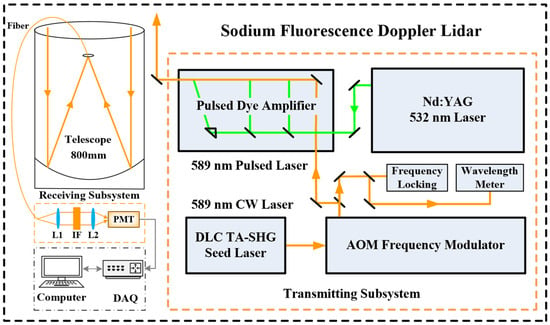
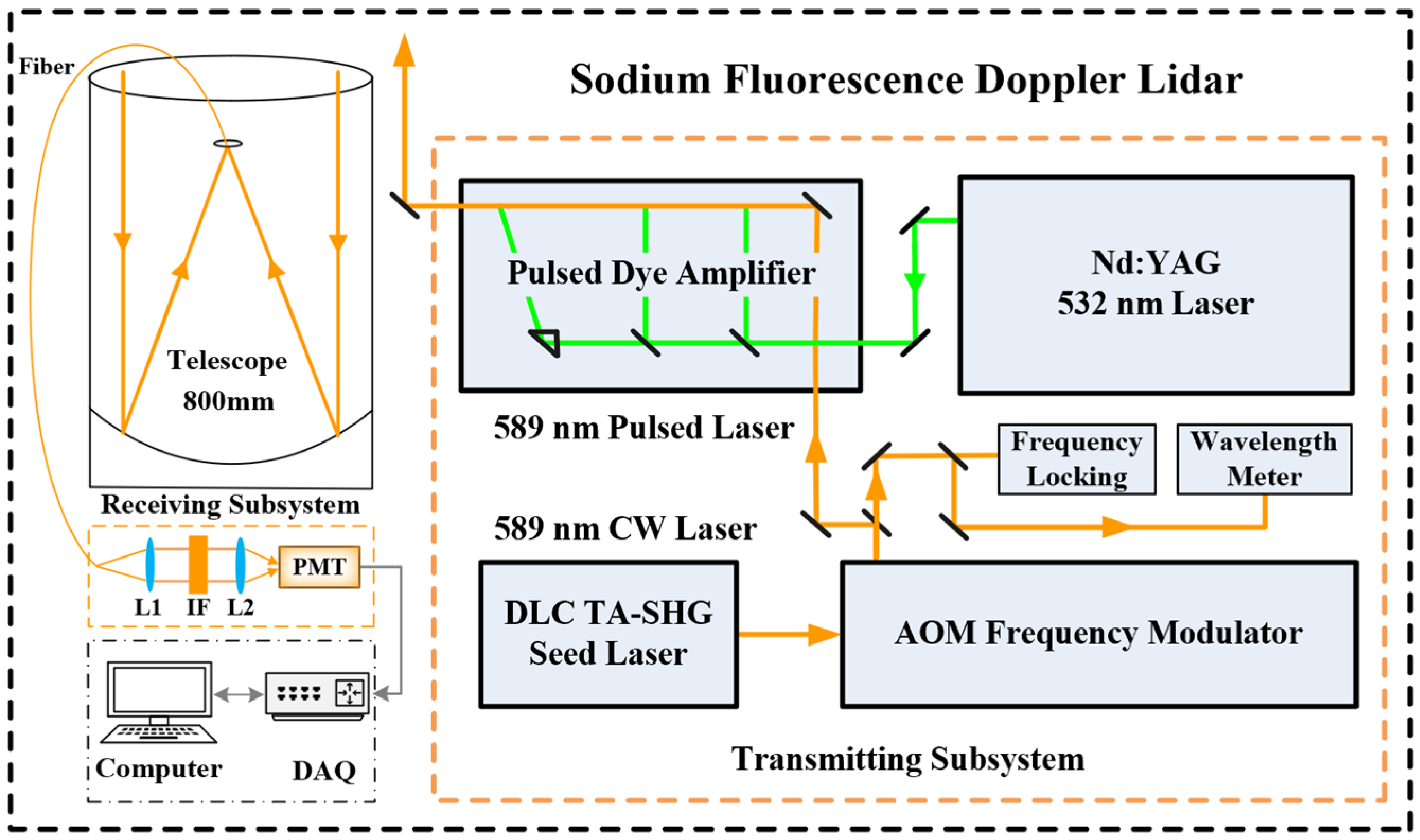
As shown in Figure 1, the self-developed Na Doppler lidar system is mainly composed by three subsystems: the transmitting subsystem, receiving subsystem, and data acquisition subsystem (DAQ). The transmitting subsystem consists of several parts, such as 589 nm CW (continuous wave) laser (TOPTICA, Munich, Germany), frequency locking module, wavelength monitoring module, three-frequency shift modulator set up by ourselves, high power Nd:YAG laser (Spectra-Physics, CA, USA) and PDA (pulsed dye amplifier) developed by ourselves. The frequency locking module developed by ourselves is mainly based on the Doppler-free saturation absorption spectrum to lock the laser frequency to f0 which is the Na atomic spectrum D2a peak. The wavelength monitoring module consists of a high precision wavelength meter (Highfinesse, Tübingen, Germany) for the wavelength monitoring of the seeder laser frequency. The three-frequency shift modulator is based on the principle of acoustic optical modulation to provide cyclical laser frequency from locked seed laser frequency f0 to up-shift frequency f+ and down-shift frequency f−. The 589 nm CW seed laser is pumped by the Nd:YAG pulsed laser and then converted into a high-energy 589 nm narrowband pulsed laser through the three-stage power amplification system in the PDA.
Figure 1.
The schematic diagram of the self-developed Sodium Fluorescence Doppler lidar.
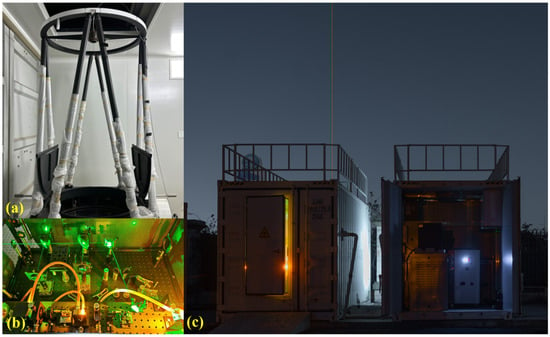
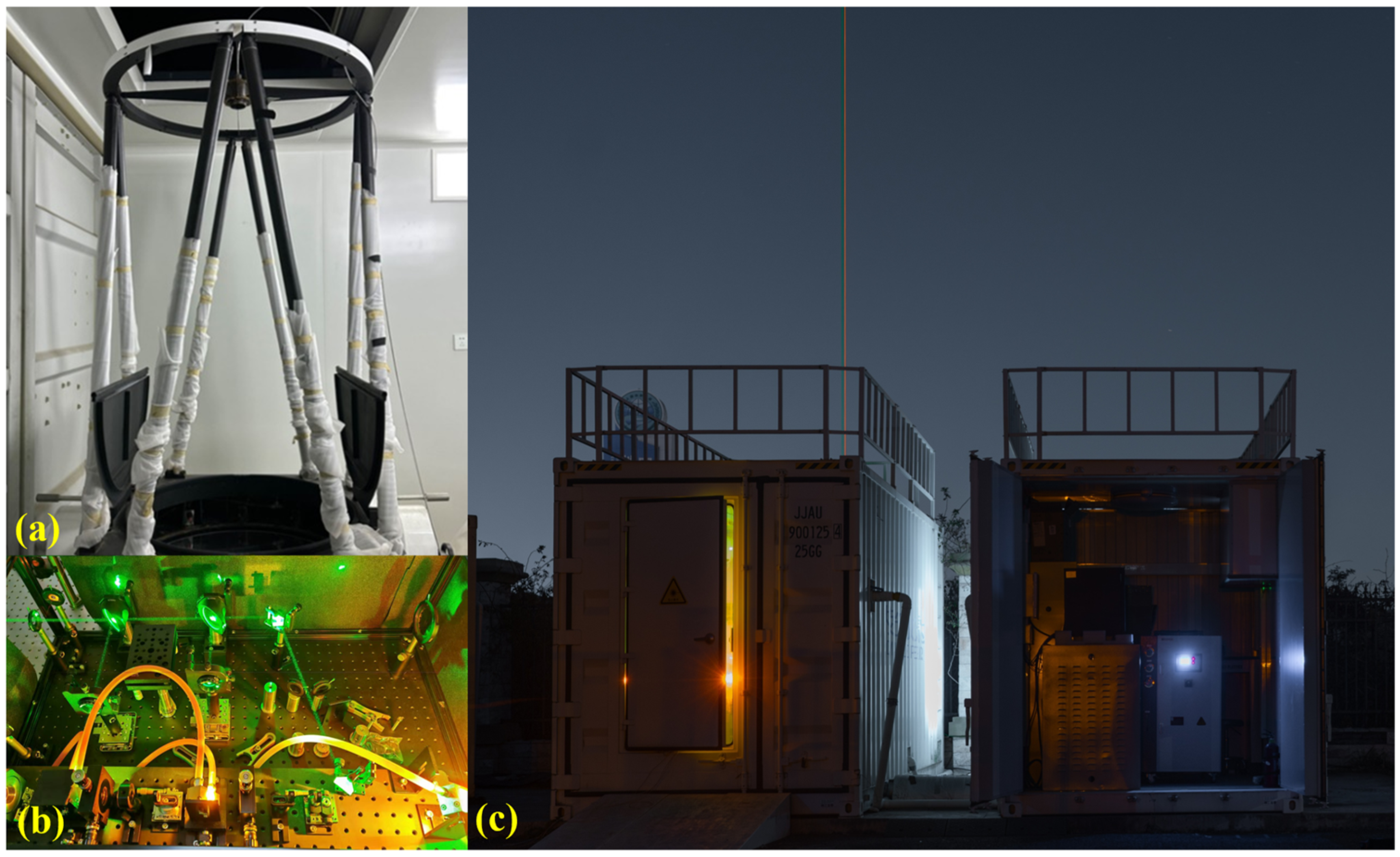
The receiving subsystem uses an 800 mm telescope (NAIRC, Nanjing, China) to collect the middle and upper atmospheric backscattered signals. The light signals coupled by the optical fiber are extracted into the specific wavelength signals required for data retrieval in the optical receiving channel. The receiving channel is designed to be composed of four parts: collimating lens (L1), interference filter (IF), focusing lens (L2) and PMT. The optical signals are converted into electrical signals by photomultiplier tubes (PMT) in the receiving channel. The data acquisition and control system manages the data collection and overall operation of the lidar system. The technical specifications of the lidar system, including the main technical specifications, are summarized in Table 1, while the experimental system is shown in Figure 2. The 800 mm telescope used for atmospheric backscattered signals collection is shown in Figure 2a. The self-developed three-stage pulsed dye amplifier system is shown in Figure 2b. And Figure 2c shows the night observation scene of the self-developed sodium fluorescence Doppler lidar in Qingdao.
Table 1.
Main technical specifications of the self-developed Na lidar.
Figure 2.
Experimental system of the self-developed Sodium Fluorescence Doppler lidar. (a) The 800 mm telescope used for atmospheric backscattered signals collection; (b) The self-developed three-stage pulsed dye amplifier system; (c) Night observation scene of the self-developed sodium fluorescence Doppler lidar in Qingdao.
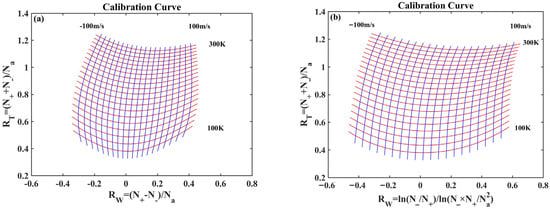
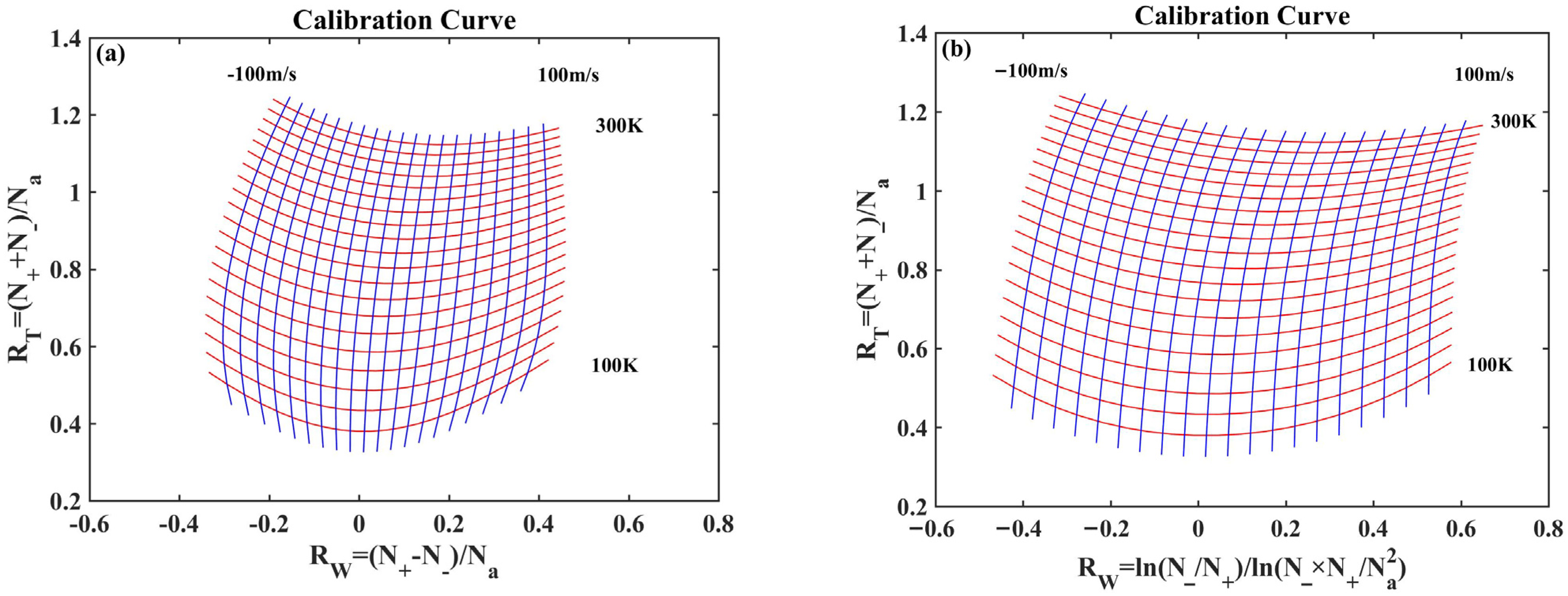
As is well known, the temperature in the mesopause region can be determined by measuring the Doppler broadening width of the Na atomic absorption cross section from the backscattered photon counts at three different frequencies within the resonance fluorescence absorption spectrum of Na atoms [24]. In this paper, we employ the three-frequency ratio technique to retrieve the temperature profiles in the mesopause region from the lidar raw data [24,25]. The Na lidar measurement uncertainties mainly include systematic error which may be caused by the laser condition and random uncertainty which may be caused by the photon counting noise. In this paper, the Gaussian assumption of laser line shape was used to do the data retrieval, which will cause the temperature error to be less than 0.5 K [25]. Figure 3 shows the theoretical two-dimensional calibration curves which can be calculated by the Na atomic effective cross sections at three frequencies according to the expression forms of RT and RW, where RT is the temperature ratio and RW is the wind ratio [25]. Calibration curves can be used to look up atmospheric temperature in the mesopause region from the lidar photon counts intensity ratios [26]. Figure 3a,b shows the different shapes of the calibration curves under the different RT and RW expressions, where Na is the lidar signal at laser frequency f0, N+ is the signal at to up-shift frequency f+, and N− is the signal at down-shift frequency f−. It can be clearly concluded from Figure 3 that the calibration curves in Figure 3b present a better form than that of Figure 3a. In this paper, the RT and RW expression forms in Figure 3b are selected for the inversion calculation of the temperature results in the mesopause region.
Figure 3.
Comparison of calibration curves computed from different RT and RW expressions. (a) The traditional calibration curve; (b) The improved calibration curve.
SABER satellite data were used in this paper for comparison with the Na lidar atmospheric temperature measurements in the mesopause region. The TIMED (Thermosphere Ionosphere Mesosphere Energetics and Dynamics) satellite is an atmospheric observation satellite operating in a quasi-sun-synchronous orbit at an altitude of approximately 625 km which was launched in September 2001 and the SABER (Sounding of the Atmosphere using Broadband Emission Radiometry) payload is one of the four payloads onboard the TIMED satellite [12]. SABER utilizes a 10 channels infrared spectrometer to retrieve atmospheric temperature from the altitude range of ~20 km to 120 km by measuring CO2 limb radiance from the Earth’s atmosphere [27]. SABER version 2.0 Level 2A data was employed in this study. As the experimental observation site was Qingdao, the SABER data used in this paper was mainly focused on the Qingdao region with the specific coordinates of 36.1°N, 120.1°E. The SABER temperature data used in this paper covered the mesopause region from approximately 80 km to 105 km in altitude.
3. Results
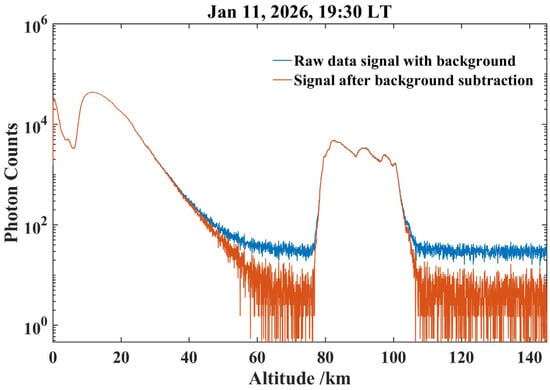
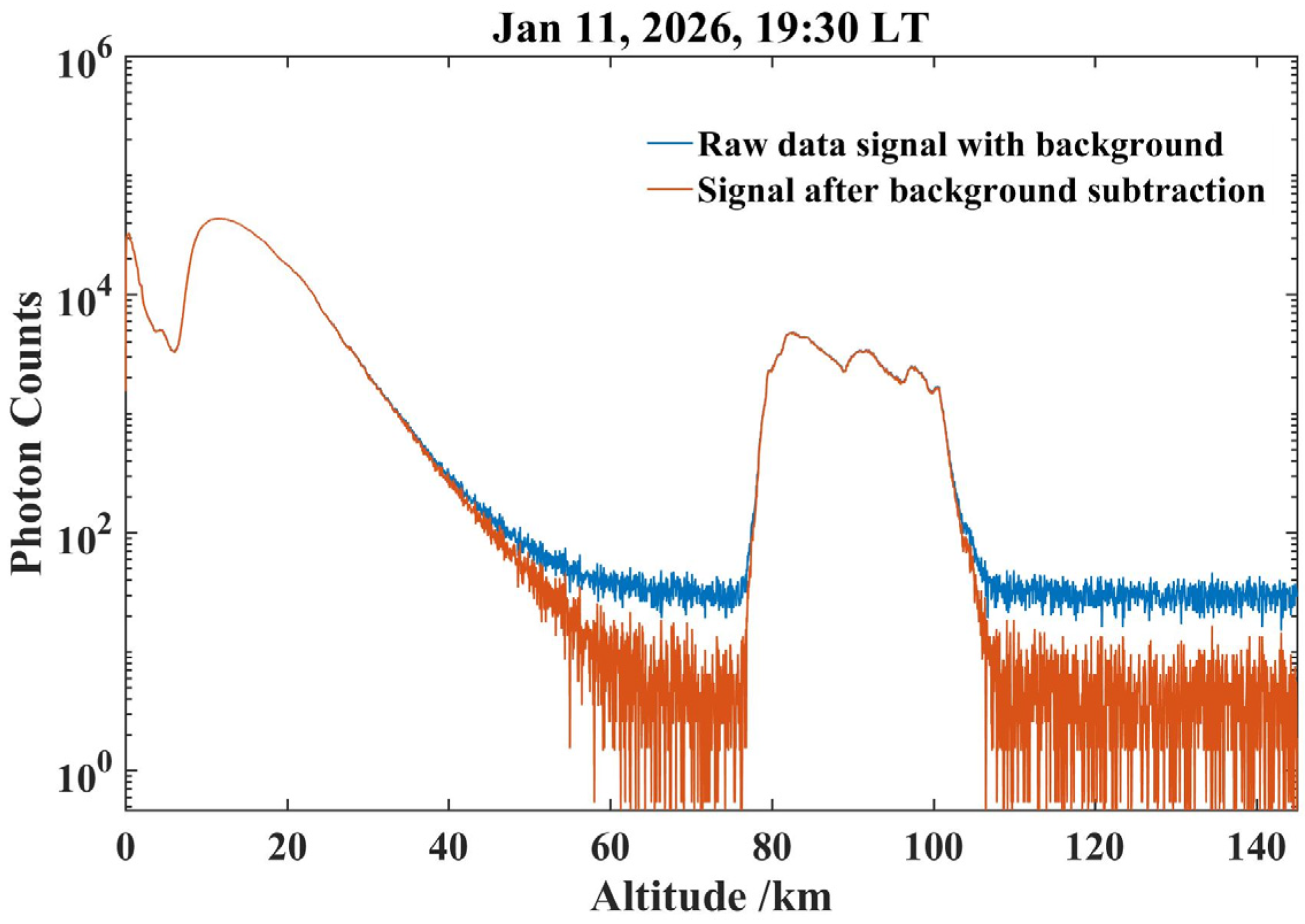
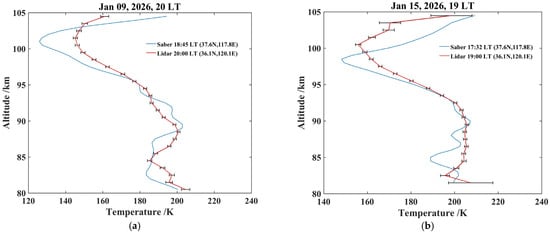
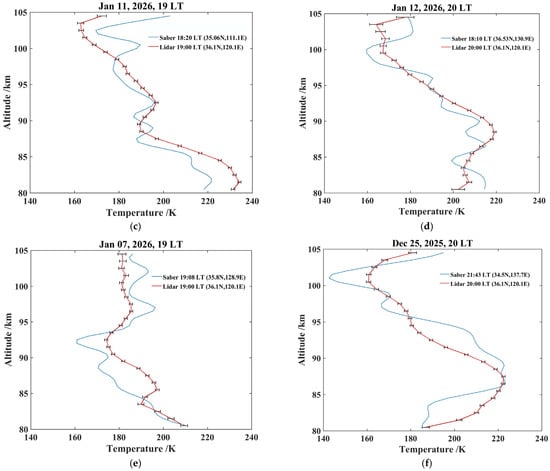
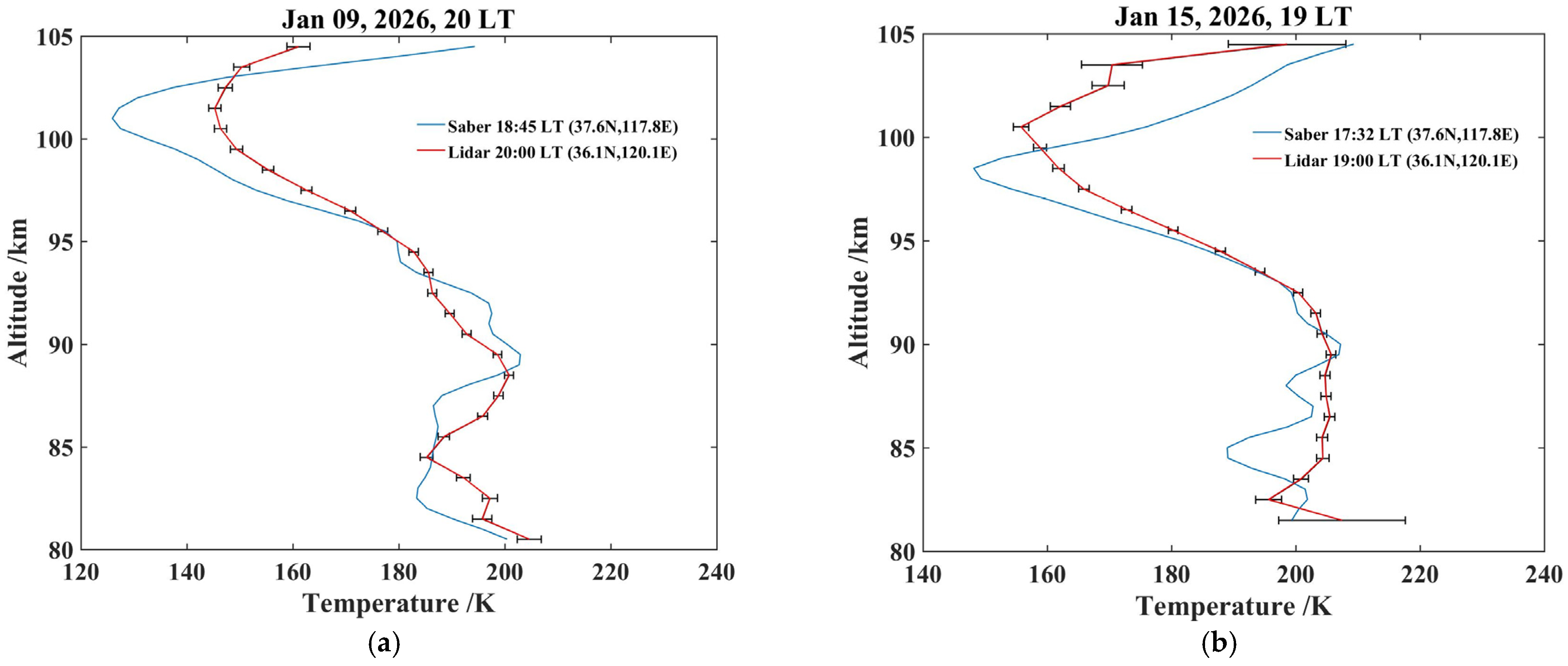
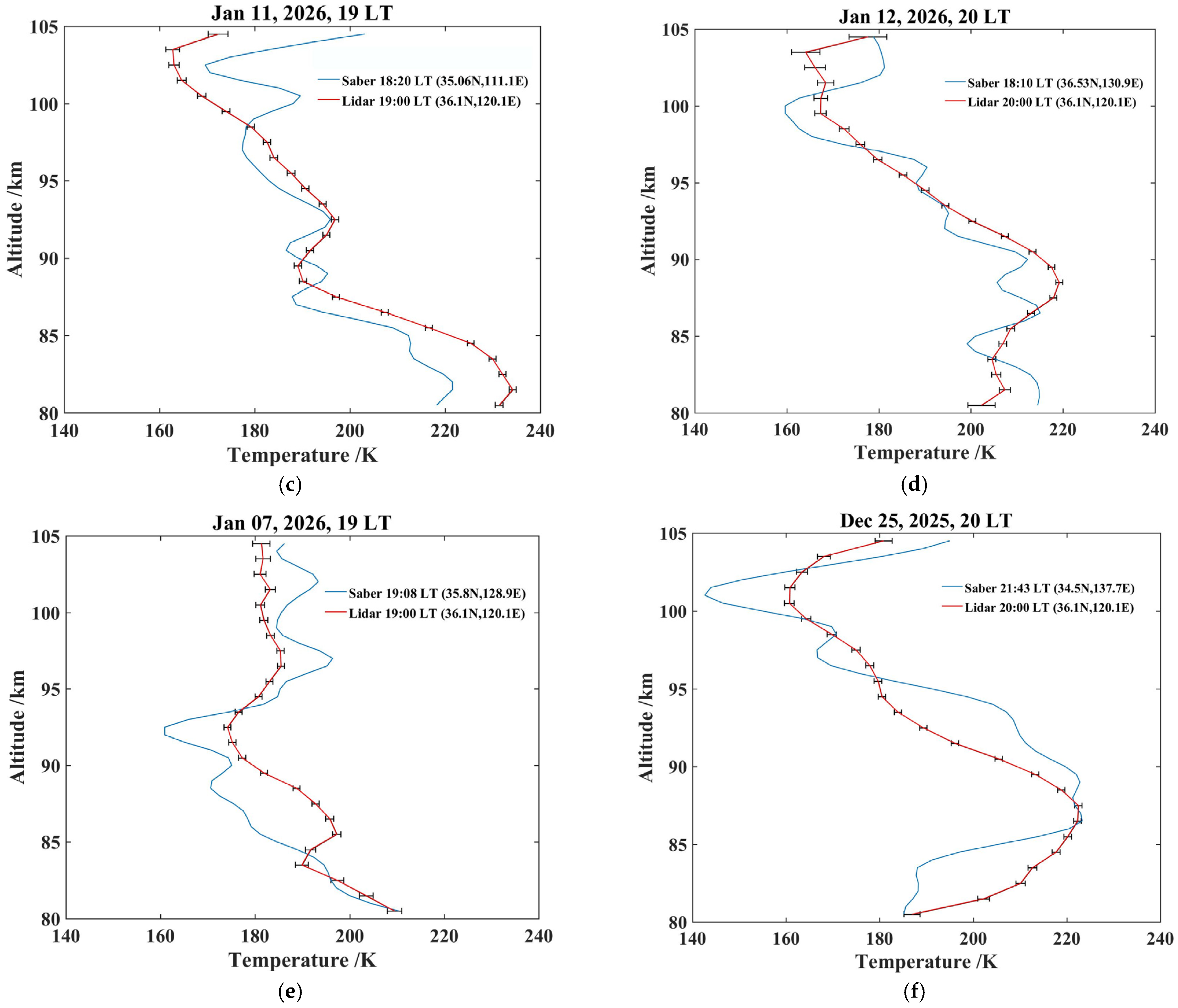
The observation and comparison results of temperature measurements between the Na lidar and the SABER satellite data were carried out in the mesopause region by the self-developed Na lidar system. The Na lidar raw data had a time resolution of 9 s, and a spatial resolution of 45 m. As shown in Figure 4, the background noise, determined by the photon counts from altitudes above the sodium layer, should be subtracted from the raw data signal. In this paper, average photon counts from 140 km to 180 km altitude were calculated as the signal background. In the data processing stage, the temporal and spatial resolutions were set to ~6 min and ~2 km, respectively, to match the SABER satellite data resolution. This allowed for the retrieval of the atmospheric temperature profiles from 80 km to 105 km in the mesopause region, which was then compared with the SABER satellite data in Figure 5. Six cases of the temperature profiles measured by the Na lidar (the red solid lines with black error bars) and SABER satellite (the blue solid lines) were compared in Figure 5. The error bars denoted by black short horizontal lines include the measurement uncertainty of the developed Na lidar caused by the photon counting noise and laser line shape assumption uncertainty mentioned in Section 2. The temperature profiles obtained from the lidar were strictly matched in time and space with the overpassing SABER satellite observations for each case. The observation date, the lidar and SABER measurement times, and the SABER overpass coordinates have been demonstrated in each panel of Figure 5.
Figure 4.
Na lidar raw data signal before and after background subtraction on 11 January 2026.
Figure 5.
Observation results of temperature profiles in the mesopause region between the Na Doppler lidar and SABER satellite data. (a) Comparison between the Na Doppler lidar and SABER on 9 January 2026; (b) Comparison between the Na Doppler lidar and SABER on 15 January 2026; (c) Comparison between the Na Doppler lidar and SABER on 11 January 2026; (d) Comparison between the Na Doppler lidar and SABER on 12 January 2026. (e) Comparison between the Na Doppler lidar and SABER on 7 January 2026. (f) Comparison between the Na Doppler lidar and SABER on 25 December 2025.
As shown in Figure 5, the temperature changing trends of the lidar measurement results agree well with the satellite results from 80 to 105 km altitude. The temperature measurement difference between them is within a reasonable range, considering different observation modes and the temporal and spatial differences in measurement between lidar and SABER samplings. Figure 5a shows the comparison of temperature profiles between the results measured by the self-developed Na lidar at 20:00 LT on 9 January 2026, with a spatial resolution of 2 km, a temporal resolution of 6 min, and the SABER satellite data measured at 18:45 LT on 9 January 2026. The temperature ranged between 120 and 220 K in the altitude range from 80 km to 105 km. The Na lidar average temperature measurement error across the altitude range was 1.1 K on 9 January 2026. Compared with the SABER satellite data, the temperature shows a relatively consistent downward trend as the altitude increases yielding estimations of the root mean square error (RMSE) and mean absolute deviation (MAE) of 7.1 K and 5.9 K, respectively, from 80 km to 100 km altitude. Figure 5b shows the comparison of temperature profiles between the results measured by the self-developed Na lidar at 19:00 LT on 15 January 2026 with a spatial resolution of 2 km and a temporal resolution of 6 min and the SABER satellite data measured at 17:32 LT on 15 January 2026. The temperature ranged between 140 and 220 K in the altitude range from 80 km to 105 km. The Na lidar average temperature measurement error across the altitude range was 1.7 K on 15 January 2026. Compared with the SABER satellite data, the temperature shows a relatively consistent downward and then upward trend as the altitude increases yielding estimations of RMSE and MAE of 7.1 K and 5.4 K, respectively, from 80 km to 100 km altitudes.
Figure 5c shows the comparison of temperature profiles between the results measured by the self-developed Na lidar at 19:00 LT on 11 January 2026 with a spatial resolution of 2 km and temporal resolution of 6 min, and the SABER satellite data measured at 18:20 LT on 11 January 2026. The temperature ranged between 160 and 240 K in an altitude range of 80 km to 105 km. The Na lidar average temperature measurement error across the altitude range was 0.8 K on 11 January 2026. Compared with the SABER satellite data, the temperature shows a relatively consistent downward trend as the altitude increases, yielding estimations of RMSE and MAE of 8.6 K and 7.3 K, respectively, from 80 km to 100 km altitudes. Figure 5d shows the comparison of temperature profiles between the results measured by the self-developed Na lidar at 20:00 LT on 12 January 2026 with a spatial resolution of 2 km and temporal resolution of 6 min and the SABER satellite data measured at 18:10 LT on 12 January 2026. The temperature ranged between 140 and 220 K in an altitude range of 80 km to 105 km. The Na lidar average temperature measurement error across the altitude range was 1.2 K on 12 January 2026. Compared with the SABER satellite data, the temperature shows a relatively consistent upward and then downward trend as the altitude increases yielding estimations of RMSE and MAE of 7.2 K and 6.1 K, respectively, from 80 km to 100 km altitudes.
Figure 5e shows the comparison of temperature profiles between the results measured by the self-developed Na lidar at 19:00 LT on 7 January 2026 with a spatial resolution of 2 km and a temporal resolution of 6 min, and the SABER satellite data measured at 19:08 LT on 7 January 2026. The temperature ranged between 160 and 220 K in an altitude range of 80 km to 105 km. The Na lidar average temperature measurement error across the altitude range was 1 K on 7 January 2026. Compared with the SABER satellite data, the temperature shows a relatively consistent downward trend as the altitude increases the yielding estimations of RMSE and MAE of 9.7 K and 7.8 K, respectively, from 80 km to 100 km altitudes. Figure 5f shows the comparison of temperature profiles between the results measured by the self-developed Na lidar at 20:00 LT on 25 December 2025 with a spatial resolution of 2 km and a temporal resolution of 6 min, and the SABER satellite data measured at 21:43 LT on 25 December 2025. The temperature ranged between 140 and 240 K in an altitude range of 80 km to 105 km. The Na lidar average temperature measurement error across the altitude range was 0.9 K on 25 December 2025. Compared with the SABER satellite data, the temperature shows a relatively consistent upward and then downward trend as the altitude increases yielding estimations of RMSE and MAE of 13.6 K and 10.9 K, respectively, from 80 km to 100 km altitudes. After the above comparative analysis, it is found that the first two days, Figure 5a,b, exhibit better statistical data characteristics. Considering closer satellite overpass distances in these two cases, the following data correlation analysis will discuss this factor.
4. Discussion
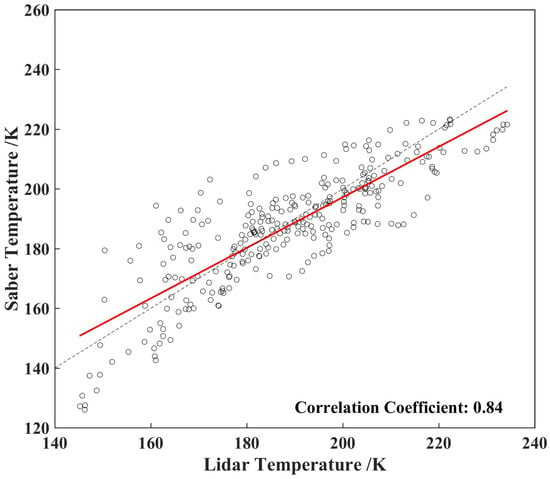
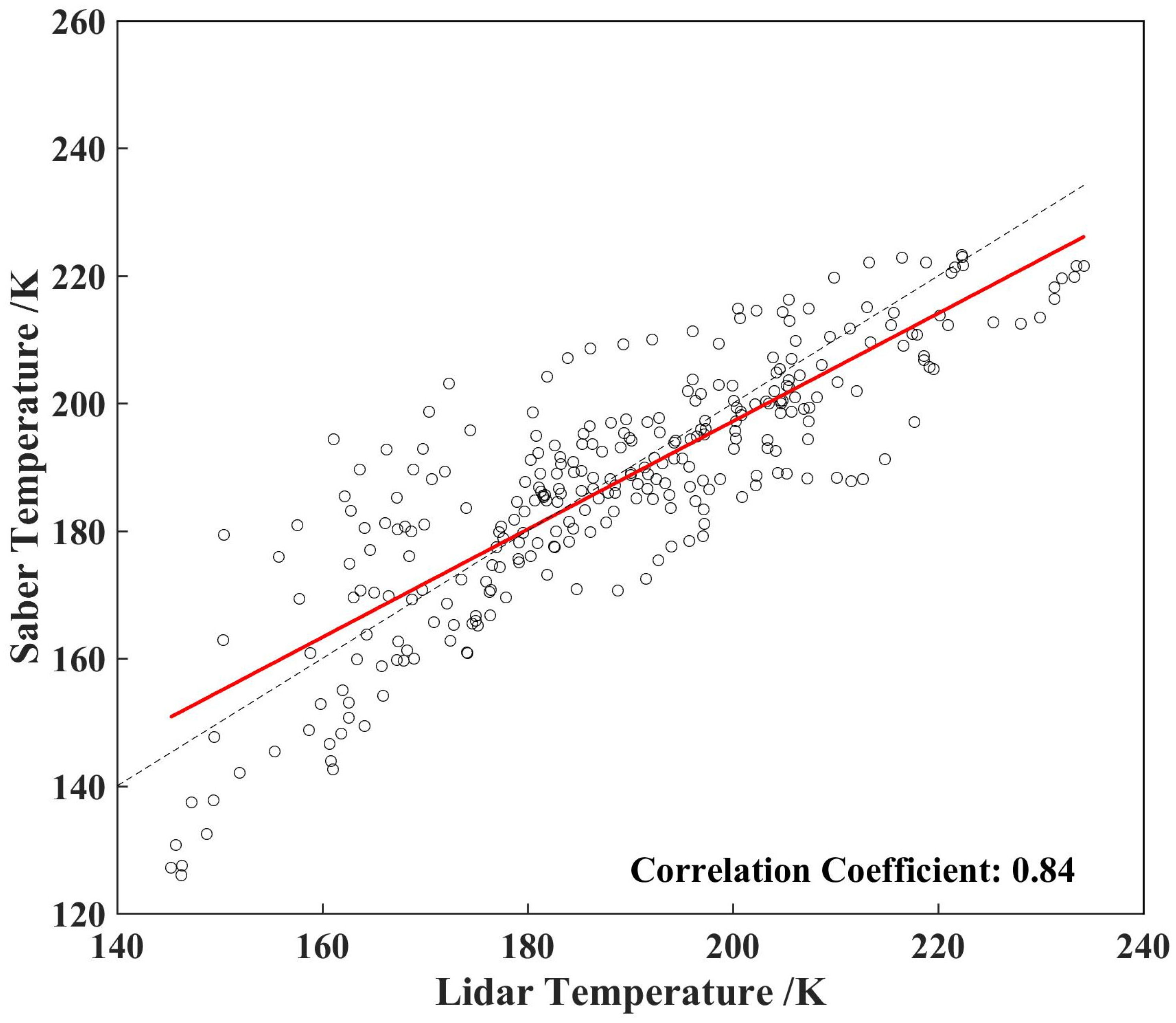
As shown in Figure 6, the correlation analysis of temperature measurement results between the Na lidar and the SABER satellite data were carried out to analyze the interrelationship between the two from different perspectives. The correlation coefficient of the temperature measurements between them is within a reasonable range, considering different observation mode and the temporal and spatial differences in measurement between lidar and SABER measurements. Figure 6 shows the correlation analysis of temperature measurement results in the mesopause region from 80 to 105 km between the Na lidar and the SABER satellite on all data of the six days in Figure 4. The RMSE and MAE between Na lidar and the satellite temperature measurement data are estimated to be 9.2 K and 7.3 K, respectively, from 80 km to 100 km altitudes. The correlation coefficient of the temperature measurements between them can reach 0.84, indicating that a good correlation exists in the temperature measurement results between lidar and satellite data in the mesopause region from 80 to 105 km.
Figure 6.
Correlation analysis of temperature measurement results between lidar and SABER on all data of the six cases.
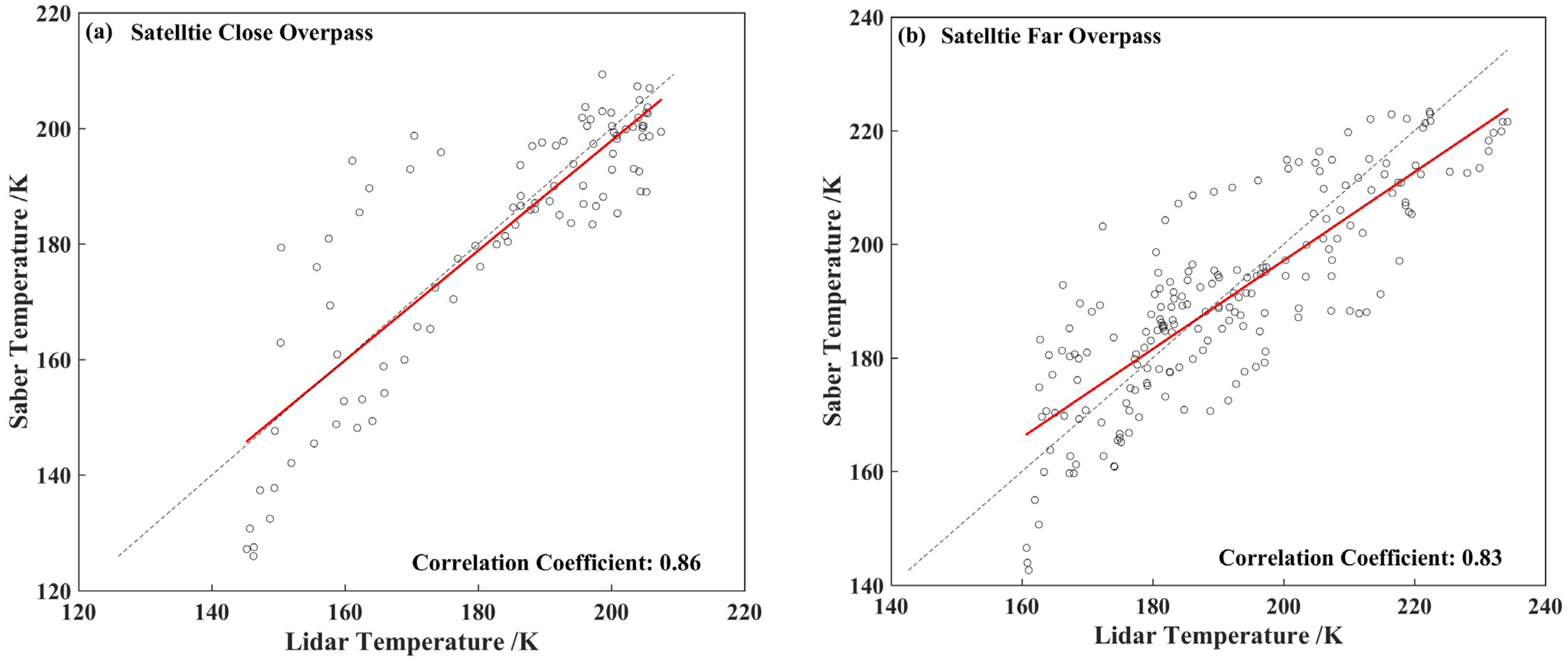
Considering the overpassed positions of the SABER satellite vary with time, it is necessary to conduct different correlation analyses on the near and far positions of the satellite overpassing points in six cases. As shown in Figure 7, the correlation analysis of temperature measurements between the Na lidar and the SABER satellite data were carried out to analyze the interrelationship between the two from satellite overpassing distance perspectives for different days. Figure 7a shows the correlation analysis of temperature measurement results in the mesopause region from 80 to 105 km between the Na lidar and the SABER satellite on 9 January 2026 and 15 January 2026 when the satellite overpassed closely. The RMSE and MAE between Na lidar and the satellite temperature measurement data are estimated to be 7.1 K and 5.7 K, respectively, from 80 km to 100 km altitude. The correlation coefficient of the temperature measurements between them can reach 0.86, indicating that a good correlation exists in the temperature measurement results between lidar and satellite data in the mesopause region from 80 to 105 km. Figure 7b shows the correlation analysis of temperature measurement results in the mesopause region from 80 to 105 km between the Na lidar and SABER satellite on another four days in Figure 4 when satellite overpassed farther away. The RMSE and MAE between Na lidar and the satellite temperature measurement data are estimated to be 10 K and 8 K, respectively, from 80 km to 100 km altitudes. The correlation coefficient of the temperature measurements in the far dataset can reach 0.83, which has dropped a little bit compared to the near dataset, indicating a relatively weaker correlation exists on another four days in Figure 4 when satellite overpassed farther away.
Figure 7.
Correlation analysis of temperature measurement results between lidar and SABER on different days in Figure 4. (a) Correlation analysis of temperature measurement results between lidar and SABER on 9 January 2026 and 15 January 2026 when satellite overpassed closely; (b) Correlation analysis of temperature measurement results between lidar and SABER on another four days in Figure 4 when satellite overpassed farther away.
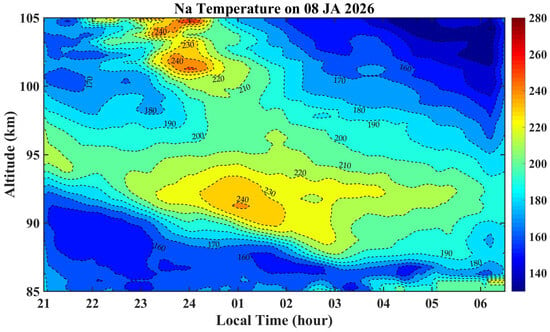
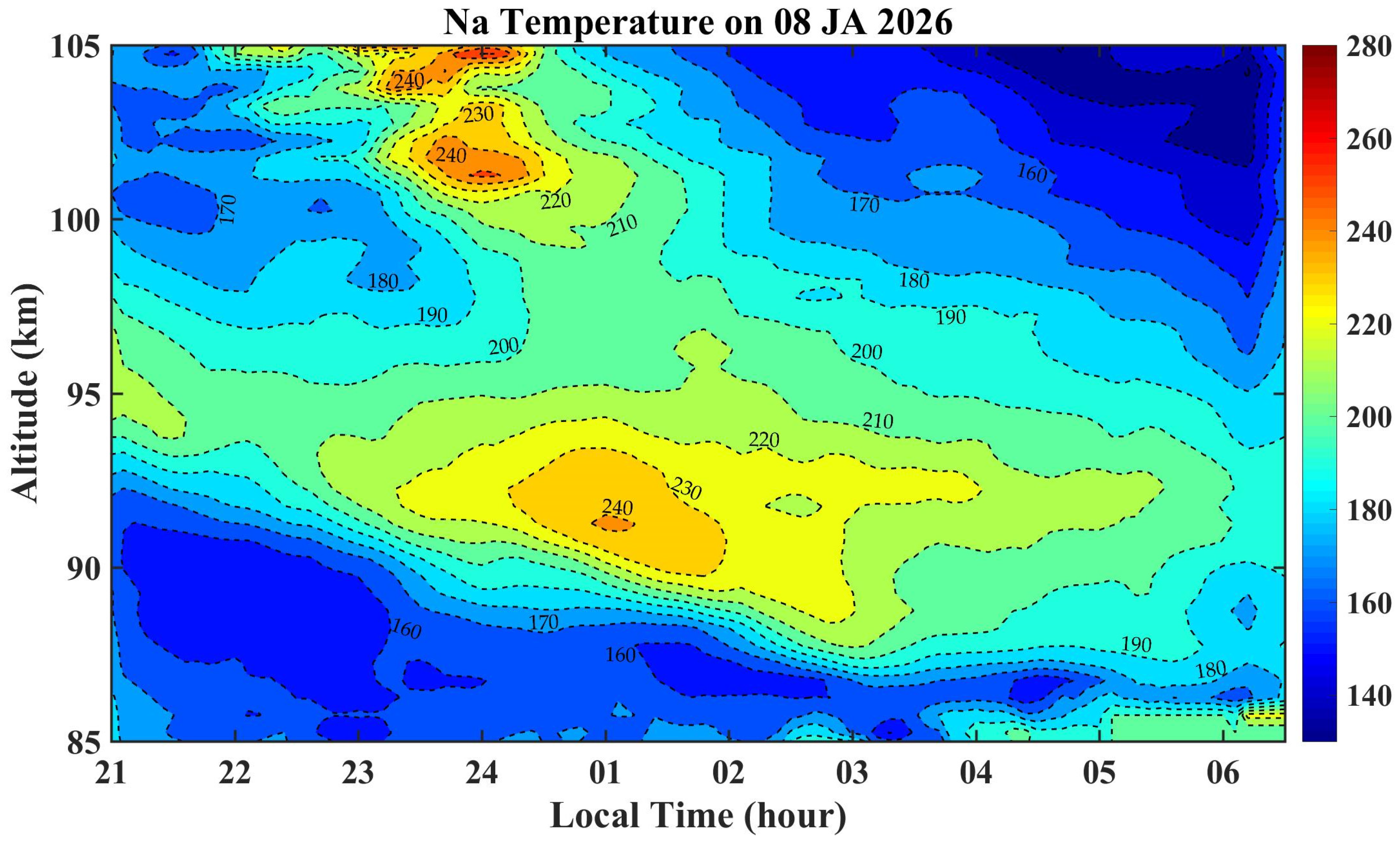
A whole night lidar observation campaign of mesopause region temperature measurement was carried out in Qingdao by the self-developed Na lidar on 8 January 2026. Figure 8 shows the ~10 h continuous temperature profiles measurement results with a temporal resolution of ~6 min and spatial resolution of ~0.5 km measured by the self-developed Na lidar on 8 January 2026. The temperature changed between 160 K and 260 K in the altitude range from 85 km to 105 km. Below 95 km, a clear downward progression of a high-temperature phase is observed, descending from 95 km at 21 LT to 91 km at 01 LT. This corresponds to a downward phase speed of about 1 km/h, which agrees well with the typical phase speed of the diurnal tides in the mesopause region [28]. Above 95 km, another downward progression of the high-temperature phase is observed, but with a faster phase speed. Around 102 km, the maximum temperature appears at 24 LT, while the minimum temperature appears at 06 LT, suggesting that the temperature variation above 95 km may by influenced by semidiurnal tides. These tidal structures indicate the presence of vertically propagating tidal waves that modulate the thermal structure in the mesopause region. The observation results also demonstrate the reliability and effectiveness of the developed lidar system for the atmospheric tides observations of temperatures in the mesopause region.
Figure 8.
Temperature measurement results obtained by Na lidar on 8 January 2026.
5. Conclusions
This study introduces the design of a newly developed Na Doppler lidar system in Qingdao to detect atmospheric temperature profiles from 80 km to 105 km in the mesopause region. The retrieval methods of temperature profiles from the developed Na Doppler lidar return signals are also investigated. For the first time, the self-developed Na Doppler lidar was used to achieve high-resolution observations of atmospheric temperature in the mesopause region (approximately 80–105 km) over Qingdao, a mid-latitude coastal area. The temperature measurement accuracy and the uncertainty of the self-developed Na Doppler lidar were analyzed in detail, verifying its reliability and stability under the complex atmospheric conditions of the mid-latitude coastal zone. A systematic cross-validation between the self-developed lidar and the SABER satellite observations was conducted, and the temperature bias between the two detection methods in the mesopause region was quantitatively assessed. Correlation analysis shows that the closer the satellite passed through Qingdao, the better the correlation demonstrated by the data. Due to the high-resolution advantage of the lidar data, the nocturnal evolution and short-period fluctuations of temperature in the mesopause region were captured, compensating for the limitation of sparse temporal sampling of satellite data. Unique characteristics of the temperature distribution in the mesopause region over Qingdao were discovered, revealing the influence of local tidal wave activity on the temperature profiles.
In the future, multi-scale comparison methodologies will be developed to conduct complementary analyses between the high temporal resolution advantage of the lidar and the low temporal sampling characteristic of satellite data. Approaches will be explored to compensate for the limited sampling of satellite overpasses using the continuous observations from the lidar. From diurnal variations and day-to-day changes to seasonal scales, further studies will be carried out to characterize the temperature variations in the mesopause region using the two observation techniques. Currently, an Fe Boltzmann temperature lidar is under development at the lidar site which can measure the Fe temperature in the mesopause region. In the future, by combining satellite data, joint observations can be conducted based on the Fe Boltzmann lidar and Na Doppler lidar to achieve a more accurate characterization of the atmospheric temperature in the mesopause region of Qingdao.
Lidar data will be used to supplement the short-term temperature perturbations that may be missed by the satellite data. Further investigations will be conducted into the unique characteristics of the temperature distribution in the mesopause region over the Qingdao coastal area, revealing the influence of local gravity wave or tidal wave activity on the temperature profiles.
Author Contributions
Conceptualization, X.L., L.W., F.G. and D.H.; methodology, X.L., Z.W. and C.B.; software, Z.W.; validation, C.B., C.C. and Q.Z.; formal analysis, X.L. and H.L.; investigation, X.L., Z.W., C.C. and X.P.; resources, Z.W., X.W. and D.H.; data curation, X.L., R.H. and Z.Q.; writing—original draft preparation, X.L.; writing—review and editing, L.W., Z.W. and C.B.; project administration, X.L. and Z.W.; funding acquisition, Z.W. All authors have read and agreed to the published version of the manuscript.
Funding
This research was funded by the National Key Research and Development Program of China (2022YFC2807202, 2025YFE0212500), the Natural Science Foundation of Qingdao (24-4-4-zrjj-124-jch), the Key Program of National Natural Science Foundation of China (42530112), National Natural Science Foundation of China (42275148, 62401306), the Key Research and Development Program of Shandong Province (2022CXPT020, 2024TSGC0164), the Shandong Provincial Natural Science Foundation (ZR2022MD068), the Joint Fund of Shandong Provincial Natural Science Foundation (ZR2023LLZ002), and the Fund Project of Qilu University of Technology (Shandong Academy of Sciences) (2025ZDZX05, 2025ZDGZ01).
Data Availability Statement
The Na lidar data used in this work are available from the corresponding author upon reasonable request. The SABER data used in this study were downloaded from https://data.gats-inc.com/saber/Version2_0/Level2A/2025/ accessed on 22 January 2026.
Acknowledgments
Many thanks to the lidar group students for their help during the lidar data collection process in Qingdao.
Conflicts of Interest
The authors declare no conflicts of interest.
References
- Wang, Z.; Guo, T.; Li, X.; Chen, C.; Liu, D.; Qu, L.; Li, H.; Wang, X. Research on atmospheric temperature fine measurements from the near surface to 60 km altitude based on an integrated lidar system. Atmos. Meas. Tech. 2025, 18, 1405–1414. [Google Scholar] [CrossRef] [Scilit]
- Chu, X.; Gardner, C.S.; Franke, S.J. Nocturnal thermal structure of the mesosphere and lower thermosphere region at Maui, Hawaii (20.7N), and Starfire Optical Range, New Mexico (35N). J. Geophys. Res. 2005, 110, D09S03. [Google Scholar] [CrossRef] [Scilit]
- Lubken, F.J. Thermal structure of the arctic summer mesosphere. J. Geophys. Res. 1999, 104, 9135–9149. [Google Scholar]
- Xu, J.; Liu, H.L.; Yuan, W.; Smith, A.K.; Roble, R.G.; Mertens, C.J.; Russell, J.M.; Mlynczak, M.G. Mesopause structure from Thermosphere, Ionosphere, Mesosphere, Energetics, and Dynamics (TIMED)/Sounding of the Atmosphere Using Broadband Emission Radiometry (SABER) observations. J. Geophys. Res. 2007, 112, D09102. [Google Scholar] [CrossRef] [Scilit]
- Lastovicka, J. Forcing of the ionosphere by waves from below. J. Atmos. Sol.-Terr. Phys. 2006, 68, 479–497. [Google Scholar] [CrossRef] [Scilit]
- Gardner, L.; Scherliess, L.; Thompson, D.C.; Sojka, J.J.; Schunk, R.W. Effect of Lower Atmospheric Waves on the Ionosphere and Thermosphere. In Proceedings of the Ionospheric Effects Symposium; JMG Associates: Springfield, VA, USA, 2008. [Google Scholar]
- Holton, J.R. The influence of gravity wave breaking on the general circulation of the middle atmosphere. J. Atmos. Sci. 1983, 40, 2497–2507. [Google Scholar] [CrossRef] [Scilit]
- Fritts, D.C.; Williams, B.P.; She, C.Y.; Vance, J.D.; Rapp, M.; Lübken, F.-J.; Müllemann, A.; Schmidlin, F.J.; Goldberg, R.A. Observations of extreme temperature and wind gradients near the summer mesopause during the MaCWAVE/MIDAS rocket campaign. Geophys. Res. Lett. 2004, 31, L24S06. [Google Scholar] [CrossRef] [Scilit]
- Lübken, F.J.; Müllemann, A. First in situ temperature measurements in the summer mesosphere at very high latitudes (78N). J. Geophys. Res. 2003, 108, 8448. [Google Scholar] [CrossRef] [Scilit]
- Cheng, X.; Xiao, C.Y.; Hu, X.; Yang, J.F. Evaluation of atmospheric empirical model based on TIMED/SABER satellite temperature data. Sci. Sin. Phys. Mech. Astron. 2018, 48, 104701. [Google Scholar] [CrossRef] [Scilit]
- Xiao, C.; Hu, X.; Tian, J. Global temperature stationary planetary waves extending from 20 to 120 km observed by TIMED/SABER. J. Geophys. Res. 2009, 114, D17101. [Google Scholar] [CrossRef] [Scilit]
- Wang, Z.; Xiao, C.; Hu, X.; Yang, J.; Cheng, X.; Li, K.; Xiao, L.; Wu, X.; Yu, Y.; Li, H. A New Method for Determining the Wave Turbopause Based on SABER/TIMED Data. Remote Sens. 2025, 17, 623. [Google Scholar] [CrossRef] [Scilit]
- Cheng, X.; Yang, J.; Xiao, C.; Hu, X. Density Correction of NRLMSISE-00 in the Middle Atmosphere (20–100 km) Based on TIMED/SABER Density Data. Atmosphere 2020, 11, 341. [Google Scholar] [CrossRef] [Scilit]
- Luo, W.; Ma, J.; Li, M.; Xu, H.; Wan, C.; Li, Z. Spatial and Temporal Characterization of Near Space Temperature and Humidity and Their Driving Influences. Remote Sens. 2024, 16, 4307. [Google Scholar] [CrossRef] [Scilit]
- Falconieri, A.; Papagiannopoulos, N.; Marchese, F.; Filizzola, C.; Trippetta, S.; Pergola, N.; Pappalardo, G.; Tramutoli, V.; Mona, L. Validation of Ash/Dust Detections from SEVIRI Data Using ACTRIS/EARLINET Ground-Based LIDAR Measurements. Remote Sens. 2020, 12, 1172. [Google Scholar] [CrossRef] [Scilit]
- Zhao, Y.; Tang, Q.; Hu, Z.; Yu, Q.; Liang, T. Comparison and Analysis of CALIPSO Aerosol Optical Depth and AERONET Aerosol Optical Depth Products in Asia from 2006 to 2023. Remote Sens. 2024, 16, 4359. [Google Scholar] [CrossRef] [Scilit]
- Yi, F.; Zhang, S.; Yu, C.; Zhang, Y.; He, Y.; Liu, F.; Huang, K.; Huang, C.; Tan, Y. Simultaneous and common-volume three-lidar observations of sporadic metal layers in the mesopause region. J. Atmos. Sol. Terr. Phys. 2013, 102, 172–184. [Google Scholar] [CrossRef] [Scilit]
- Gardner, J.A.; Viereck, R.A.; Murad, E.; Knecht, D.J.; Pike, C.P.; Broadfoot, A.L.; Anderson, E.R. Simultaneous observations of neutral and ionic magnesium in the thermosphere. Geophys. Res. Lett. 1995, 22, 2119–2122. [Google Scholar] [CrossRef] [Scilit]
- She, C.Y.; von Zahn, U. Concept of a two-level mesopause: Support through new lidar observations. J. Geophys. Res. 1998, 103, 5855–5864. [Google Scholar] [CrossRef] [Scilit]
- Alpers, M.; Hoffner, J.; von Zahn, U. Iron atom densities in the polar mesosphere from lidar observations. Geophys. Res. Lett. 1990, 17, 2345–2348. [Google Scholar] [CrossRef] [Scilit]
- Gardner, C.S.; Kane, T.J.; Senft, D.C.; Qian, J.; Papen, G.C. Simultaneous observations of sporadic E, Na, Fe, and Caþ layers at Urbana, Illinois: Three case studies. J. Geophys. Res. 1993, 98, 16865–16873. [Google Scholar] [CrossRef] [Scilit]
- Collins, R.L.; Li, J.; Martus, C.M. First lidar observation of the mesospheric Ni layer. Geophys. Res. Lett. 2015, 42, 665–671. [Google Scholar] [CrossRef] [Scilit]
- Alpers, M.; Höfffner, J.; von Zahn, U. Upper Atmosphere Ca and Ca+ at Mid-Latitudes: First Simultaneous and Common-Volume Lidar Observations. Geophys. Res. Lett. 1996, 23, 567–570. [Google Scholar] [CrossRef] [Scilit]
- She, C.Y.; Yu, J.R. Simultaneous three-frequency Na lidar measurements of radial wind and temperature in the mesopause region. Geophys. Res. Lett. 1994, 21, 1771–1774. [Google Scholar] [CrossRef] [Scilit]
- Chu, X.Z.; Papen, G. Laser Remote Sensing: Resonance fluorescence lidar for measurements of the middle and upper atmosphere. In Book Laser Remote Sensing; Fujii, T., Fukuchi, T., Eds.; CRC Press: London, UK, 2005. [Google Scholar]
- Xia, Y.; Cheng, X.; Wang, Z.; Liu, L.; Yang, Y.; Du, L.; Jiao, J.; Wang, J.; Zheng, H.; Li, Y.; et al. Design of a Data Acquisition, Correction and Retrieval of Na Doppler Lidar for Diurnal Measurement of Temperature and Wind in the Mesosphere and Lower Thermosphere Region. Remote Sens. 2023, 15, 5140. [Google Scholar] [CrossRef] [Scilit]
- Mertens, C.J.; Mlynczak, M.G.; López-Puertas, M.; Wintersteiner, P.P.; Picard, R.H.; Winick, J.R.; Gordley, L.L.; Russell, J.M. Retrieval of mesospheric and lower thermospheric kinetic temperature from measurements of CO2 15 µm Earth Limb Emission under non-LTE conditions. Geophys. Res. Lett. 2001, 28, 1391–1394. [Google Scholar] [CrossRef] [Scilit]
- Li, T.; Ban, C.; Fang, X.; Li, J.; Wu, Z.; Feng, W.; Plane, J.M.C.; Xiong, J.; Marsh, D.R.; Mills, M.J.; et al. Clima-tology of mesopause region nocturnal temperature, zonal wind and sodium density observed by sodium lidar over Hefei, China (32° N, 117° E). Atmos. Chem. Phys. 2018, 18, 11683–11695. [Google Scholar] [CrossRef] [Scilit]

Disclaimer/Publisher’s Note: The statements, opinions and data contained in all publications are solely those of the individual author(s) and contributor(s) and not of MDPI and/or the editor(s). MDPI and/or the editor(s) disclaim responsibility for any injury to people or property resulting from any ideas, methods, instructions or products referred to in the content. |
© 2026 by the authors. Licensee MDPI, Basel, Switzerland. This article is an open access article distributed under the terms and conditions of the Creative Commons Attribution (CC BY) license.