Article

Spatiotemporal Analysis and Multi-Scenario Projection of Soil Erosion in the Loess Plateau Using the PLUS-CSLE Model

1
State Key Laboratory of Soil and Water Conservation and Desertification Control, The Research Center of Soil and Water Conservation and Ecological Environment, Chinese Academy of Sciences and Ministry of Education, Yangling 712100, China
2
Institute of Soil and Water Conservation, Chinese Academy of Sciences and Ministry of Water Resources, Yangling 712100, China
3
University of Chinese Academy of Sciences, Beijing 100049, China
4
College of Soil and Water Conservation Science and Engineering, Northwest Agriculture and Forestry University, Yangling 712100, China
5
College of Grassland Agriculture, Northwest Agriculture and Forestry University, Yangling 712100, China
6
School of Life Sciences, University of Technology Sydney, Broadway, NSW 2007, Australia
7
New South Wales Department of Climate Change, Energy, The Environment and Water, Parramatta, NSW 2150, Australia
*
Author to whom correspondence should be addressed.
Remote Sens. 2026, 18(8), 1202; https://doi.org/10.3390/rs18081202
Submission received: 28 February 2026 / Revised: 30 March 2026 / Accepted: 10 April 2026 / Published: 16 April 2026

Highlights

What are the main findings?
  • From 2000 to 2020, soil erosion intensity on the Loess Plateau showed an overall declining trend, with a clear shift toward lower-intensity patterns.
  • By 2060, the Ecological Protection scenario produced the strongest erosion mitigation effect, while the Planning Guidance scenario achieved a better balance between ecological protection and development needs.
What is the implication of the main finding?
  • Future soil erosion on the Loess Plateau is strongly affected by scenario-dependent land-use change and differences in ecological land protection. Incorporating projected erosion risk into territorial spatial planning can improve the long-term effectiveness of soil and water conservation under climate and development uncertainties.

Abstract

Soil erosion remains a critical ecological challenge on China’s Loess Plateau (LP), where fragile geomorphology and intensive human activities jointly amplify land degradation risks. As land-use and land-cover change (LUCC) is a primary determinant of erosion processes, clarifying the nexus between land patterns and erosion intensity is essential for formulating effective conservation strategies. This study integrates the Chinese Soil Loss Equation (CSLE) with the Patch-generating Land Use Simulation (PLUS) model to analyze the spatiotemporal dynamics of soil erosion from 2000 to 2020 and project future patterns for 2060 under five scenarios: Natural Development (ND), Ecological Protection (EP), Economic Development (ED), Cropland Protection (CP), and Planning Guidance (PG). Results indicate a fluctuating decline in LP soil erosion during 2000–2020, marked by a transition toward predominantly slight erosion (~70% of the total area), while high-intensity erosion remained concentrated in central and western cropland and grassland. Scenario projections reveal pronounced divergence in erosion outcomes. The EP scenario, characterized by sustained vegetation expansion, demonstrated the highest efficacy in erosion mitigation. Conversely, the ED scenario exhibited the most severe erosion risk due to urban expansion into ecological areas. The PG scenario effectively reconciled the trade-offs between ecological conservation and socioeconomic demands, maintaining a balanced erosion control performance. In the context of global climate change, the complexity of soil and water conservation governance is expected to intensify. This study suggests that future efforts should focus on scientifically guiding the evolution of land-use patterns through sustainable spatial planning. Furthermore, targeted engineering and biological conservation measures must bae implemented for high-risk land categories to ensure the long-term stability of the regional ecological security barrier.

1. Introduction

Soil erosion is a serious environmental problem worldwide and poses a major challenge to ecological sustainability. The Loess Plateau (LP) in China is widely recognized as one of the regions most severely affected by soil erosion [1]. The loessial soils in this region are characterized by loose texture, high porosity, and high permeability, making them highly vulnerable to detachment and transport under rainfall conditions [2]. In addition, the deeply incised gully landscape and frequent summer rainstorms further intensify soil and water loss [3]. In addition to natural factors, rapid population growth, intensive cultivation on steep slopes, and inappropriate land-use practices have further exacerbated soil erosion, leading to the progressive deterioration of the regional ecosystem [4]. Consequently, soil erosion has become a primary bottleneck restricting the sustainable development on the LP.
To mitigate these issues, the Chinese government has implemented a series of soil and water conservation measures. Since the launch of the “Grain for Green” program in 1999, large areas of cropland have been converted into forest and grassland, leading to a significant increase in vegetation cover across the LP [5,6]. However, recent studies indicate that excessive or water-intensive afforestation in semi-arid zones may induce soil desiccation, alter hydrological regimes, and potentially generate secondary erosion risks [7]. Therefore, while past restoration has yielded measurable ecological benefits, uncertainties remain regarding the long-term trajectory of soil erosion under evolving land-use and climate conditions. Anticipating future erosion dynamics under alternative development pathways has become essential for adaptive landscape governance.
Land use reflects the combined influence of natural conditions and human activities on soil erosion. By altering land surface characteristics, land use affects runoff generation, flow pathways and sediment transportation [4]. Different land use types modify vegetation cover, soil structure, and surface roughness, thereby influencing the detachment, transport, and deposition of sediment [8]. Thus, land use not only reflects the integrated outcome of natural and socioeconomic processes but also plays an important role in shaping the spatial pattern of soil erosion risk [9].
With the development of remote sensing and geographic information technologies, soil erosion assessment has increasingly been conducted at regional scales [10]. The Chinese Soil Loss Equation (CSLE), developed by Liu et al. [11] through localization of the Universal Soil Loss Equation (USLE), provides a framework tailored to China’s geomorphological and conservation contexts. To better represent Chinese soil and water conservation practices, the CSLE subdivides the USLE cover and management factor (C) and support practice factor (P) into three distinct components: biological measures (B), engineering measures (E), and tillage measures (T). This differentiation is critical for the LP, where engineering measures such as terraces and check dams coexist with large-scale vegetation restoration under the “Grain for Green” program. However, as an empirical model, CSLE is essentially a “static” assessment tool and cannot directly simulate future erosion trajectories under changing policy and climate conditions.
Given that land-use change is the core driver of erosion dynamics, integrating land-use simulation models with erosion assessment frameworks has become an emerging research frontier. Commonly used land-use simulation models include CA-Markov, CLUE-S, and Future Land Use Simulation (FLUS) [12]. Among them, the Patch-generating Land Use Simulation (PLUS) model is a CA-based framework that combines the Land Expansion Analysis Strategy (LEAS) with a multi-type random patch seed (CARS) mechanism and has shown strong performance in patch-level land-use simulation [13]. Although the PLUS model has been increasingly coupled with ecological assessment tools such as RUSLE and InVEST to evaluate ecosystem services and landscape risks [14,15,16,17], its application in erosion prediction remains relatively limited. Recent studies have successfully applied land use scenario prediction models to the LP for various ecological assessments such as net primary productivity, ecosystem services, and soil conservation [18,19,20]. However, studies explicitly coupling PLUS with CSLE to project future erosion under multiple policy-driven scenarios on the LP remain scarce [21]. To address these gaps, this study integrates the PLUS model and the CSLE framework to investigate how alternative land-use transition pathways influence future erosion risk on the LP. Specifically, this study aims to: (1) quantify the spatiotemporal evolution of land use and soil erosion from 2000 to 2020; (2) simulate land-use configurations for 2060 under five policy-driven scenarios; and (3) analyze the spatiotemporal evolutionary characteristics of future soil erosion under multiple policy-driven scenarios. We hypothesize that different policy-oriented land-use scenarios will lead to distinct future soil erosion outcomes on the LP. By integrating scenario-based land use simulation with erosion assessment, this study provides support for long-term territorial planning and soil and water conservation management in ecologically fragile regions.

2. Materials and Methods

2.1. Study Area

The LP is situated between 100°52′–114°33′E and 33°41′–41°16′N [22], covering a total area of approximately 64.87 × 10⁴ km2 (Figure 1). It extends from the Taihang Mountains in the east to the Riyue Mountain in the west and from the Qinling Mountains in the south to the Ordos Plateau in the north. The region encompasses seven provinces and autonomous regions in northern China with 341 counties. The topography exhibits a descending gradient from the northwest to the southeast and is partitioned into western, central, and eastern sectors by the Liupan and Lüliang Mountains. The landscape is characterized by distinctive loess landforms—namely tablelands (yuan), ridges (liang), and mounds (mao)—forming a highly fragmented terrain dissected by dense gully networks. The loessial soils in the study area are dominated by silty loam, characterized by high porosity, low bulk density, and poor anti-erosion capacity due to the lack of clay and organic matter. These soil properties make the region highly susceptible to water erosion under rainfall conditions. The regional climate is governed by a typical temperate continental monsoon, with cold, sandy winters and hot, humid summers. Annual precipitation ranges from 200 to 750 mm, following a spatial gradient from the humid southeast to the arid northwest, with rainfall predominantly concentrated between June and September [23].

2.2. Data Source

The primary datasets utilized in this study are summarized in Table 1. To ensure spatial consistency for model coupling, all datasets were projected to a unified coordinate reference system. We adopted a 150 m spatial resolution to ensure spatial consistency in calculating the transition probabilities of the PLUS model and the annual soil loss modulus of the CSLE model, balancing computational efficiency with the preservation of regional spatial heterogeneity. All datasets were projected to a unified coordinate reference system and resampled to a spatial resolution of 150 m × 150 m.

2.3. Model Implementation

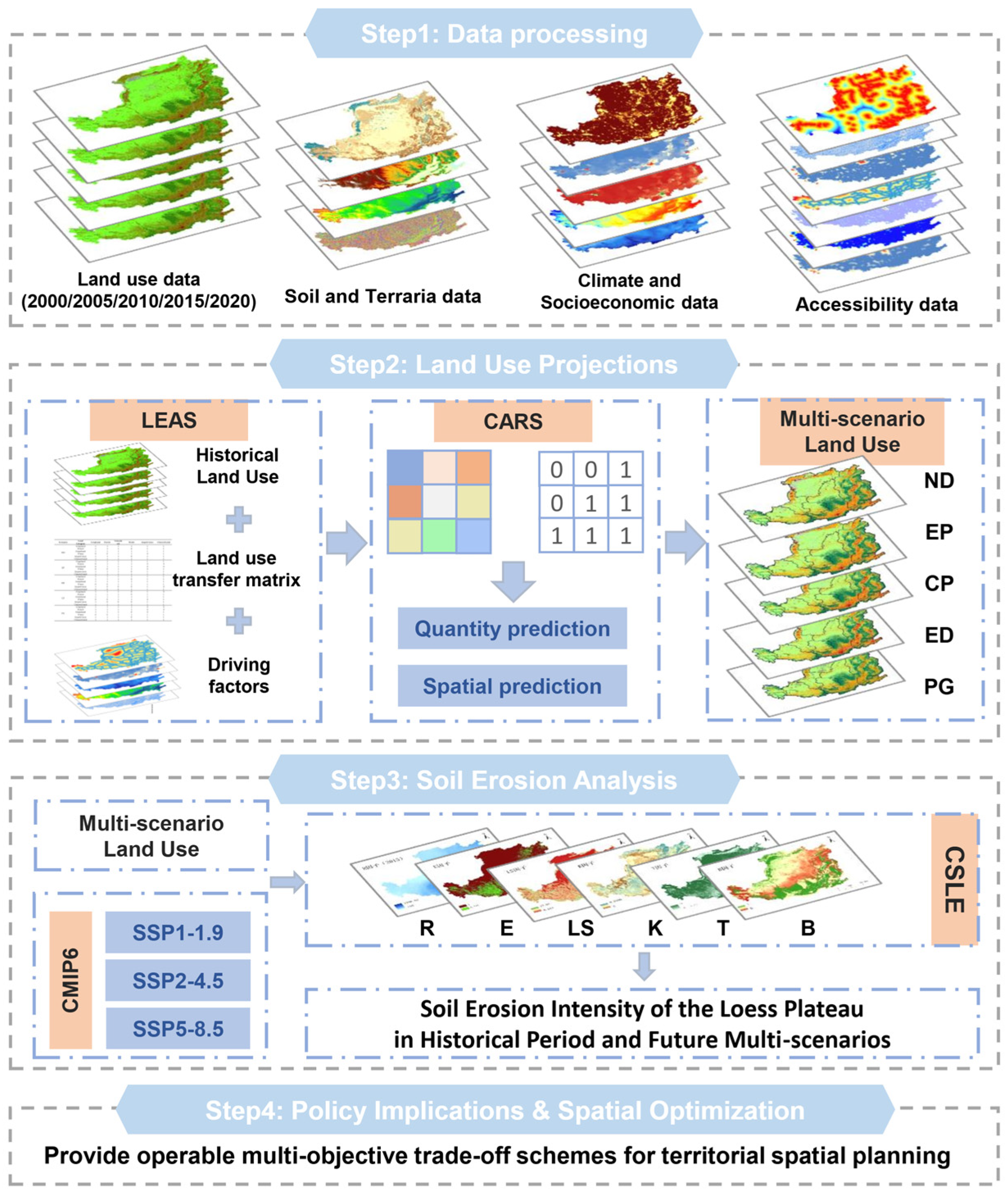
Figure 2 presents the overall workflow of this study, and the main procedures are described below:
(1) Data collection and standardization, where multi-source datasets were resampled to a 150 m resolution; (2) Future land-use simulation, utilizing the PLUS model to project land-cover patterns under five policy-driven scenarios for 2060 based on historical trends (2000–2020); (3) Soil erosion assessment, where the CSLE model was integrated with both dynamic factors (land use and rainfall erosivity) and static factors to calculate the annual soil loss modulus and analyze spatiotemporal variations.

2.3.1. Land Use Transition Matrix

To quantify the spatio-temporal dynamics and internal conversions between various land-use categories from 2000 to 2020, a land use transition matrix was employed [25]. The mathematical expression of the matrix is as follows:
S i j = S 11 S 12 S 21 S 22 S 1 n S 2 n S n 1 S n 2 S n n
where S represents the area of the land-use type (km2). n denotes the total number of land-use categories. i and j represent the land-use types at the beginning and the end of the study period, respectively. Sij specifically indicates the area of land-use type i that transitioned into type j during the specified timeframe.

2.3.2. The Patch-Generating Land-Use Simulation

This study employs the PLUS model to project the land-use distribution of the LP for the year 2060 under various scenarios. The simulation process primarily encompasses three stages: (1) quantifying the contribution of driving factors using the LEAS module; (2) conducting a model accuracy assessment; and (3) establishing transition rules for future land-use change projections across multiple scenarios.
  • Land Expansion Analysis Strategy (LEAS)
The LEAS module identifies the relative importance of different driving factors for the expansion of specific land-use types by using the random forest algorithm [13]. By combining land-use expansion data from 2000 to 2020 with explanatory variables, this study considered five groups of driving factors:
(1)
Meteorological factors: spatial distribution of mean annual precipitation.
(2)
Topographic factors: elevation, aspect, slope, and slope length (LS).
(3)
Accessibility factors: proximity to transportation infrastructure (distances to railways, national highways, provincial roads, and county roads).
(4)
Edaphic factors: soil type.
(5)
Socio-economic factors: population density, GDP, and nighttime light index.
To investigate the determinants of land-use transitions, this study derived from both biophysical and socioeconomic dimensions of the LP, selecting 16 driving factors from the aforementioned five categories. Through model training, the contribution rates of these drivers to land-use transitions are derived for distinct temporal intervals. These driving factors were based on the baseline period; the dynamic impacts of future shifts—such as the transition in demographic policies and socioeconomic trends [26,27]—were explicitly integrated into the model through scenario-specific land demand projections.
2.
Land-Use Simulation Accuracy Assessment
Utilizing historical land-use classification data from 2000 to 2020, the PLUS model was applied to simulate the land-use pattern of the LP for the year 2020. To validate the model’s reliability, the simulated results were compared against the observed 2020 land-use data using the Kappa coefficient [28]:
K a p p a = P 0 P C 1 P C
where P0 represents the proportion of correctly simulated raster cells; PC denotes the expected proportion of correctly simulated cells under random chance; a Kappa coefficient value approaching 1 indicates a higher degree of simulation accuracy and model robustness.
3.
Multi-scenario Projections of Future Land-Use Distributions
Following previous scenario-based simulation studies and considering the regional characteristics of the LP [29,30,31,32], transition cost matrices were constructed for different development scenarios (Table 2). Each scenario modifies the baseline transition rules derived from historical land-use dynamics (2000–2020) to reflect different policy priorities and development objectives. Drawing on relevant studies [27,33,34], the percentage thresholds of 20%, 30%, and 40% were introduced to represent different intensities of policy intervention in land-use conversion. Specifically, they correspond to relatively low, moderate, and high levels of conversion constraint, respectively. These values were used to construct contrasting scenario settings for comparative analysis, rather than to represent fixed real-world policy thresholds. The specific scenario configurations are as follows:
(1)
Natural Development Scenario (ND): This scenario represents a business-as-usual trajectory, extending the historical land-use transition trends observed from 2000 to 2020. It assumes that the underlying rules governing land-use dynamics remain constant without additional policy intervention.
(2)
Ecological Protection Scenario (EP): This scenario is based on ecological restoration policies such as the Grain for Green program. Relative to the ND scenario, the transition probabilities from forest and grassland to impervious surface or water were reduced by 30%, while the probability of cropland being converted to forest or grassland was increased by 20%.
(3)
Economic Development Scenario (ED): Designed to prioritize rapid urbanization and economic growth without stringent conservation constraints. In this scenario, transitions from construction land to any other land-use type (except cropland) are restricted by a 30% reduction in probability. Conversely, the transition probabilities from cropland, forest, and grassland to construction land are increased by 20%.
(4)
Cropland Protection Scenario (CP): Focused on ensuring national food security while considering regional environmental carrying capacity. Based on the ND matrix, this scenario strictly limits the conversion of agricultural land to non-agricultural uses. The transition probability from cropland to forest, grassland, or construction land is reduced to 30% of its original value. To further bolster grain production potential, the probabilities of construction and unutilized land converting to cropland are increased to 20% and 40% of their original levels, respectively.
(5)
Planning Guidance Scenario (PG): This scenario aligns with regional ecological protection and restoration planning for the LP, centered on stabilizing critical carbon pools (cropland, forest, and grassland). Under this framework, transitions from these carbon-sink land types to construction land are reduced by 40%, while the transition probabilities from construction land back to cropland, grassland, or forest are increased by 20%.
To maintain consistency with future climate-development pathways, each land-use scenario was aligned with a corresponding Shared Socioeconomic Pathway (SSP). The ND, CP, and PG scenarios were linked to SSP2-4.5, while the EP and ED scenarios were associated with SSP1-1.9 and SSP5-8.5, respectively. In the CSLE model, future precipitation derived from the corresponding SSP was used to update the rainfall erosivity factor (R). Thus, future soil erosion assessment reflects both scenario-specific land-use change and climate-related variation in rainfall erosivity.

2.3.3. Soil Erosion Modeling

This study employs the Chinese Soil Loss Equation (CSLE) to estimate mean annual soil loss across the LP [11].
The mathematical expression for the CSLE is as follows:
A = R × K × L S × B × E × T
where A is the mean annual soil loss (t ha−1 yr−1); R represents the rainfall erosivity factor (MJ mm ha−1 h−1 yr−1), which quantifies the potential of precipitation to induce erosion; K denotes the soil erodibility factor (t h MJ−1 mm−1), reflecting the inherent sensitivity of soil to detachment and transport; LS is the topographic factor, integrating both slope length (L) and slope steepness (S); B is the vegetation cover and biological measures factor; E represents the engineering measures factor; and T is the tillage measures factor. Note: The parameters LS, B, E, and T are all dimensionless.
(1)
Rainfall Erosivity Factor (R)
The rainfall erosivity factor (R) characterizes the potential capacity of precipitation to induce soil erosion. In this study, the R factor was estimated using the daily rainfall-based algorithm proposed by Zhang et al. [35]. The mathematical expressions for this model are as follows:
R = α P β
α = 21.586 β 7.1891
β = 0.8363 + 18.144 P d 12 + 24.455 P y 12
where R represents the daily rainfall erosivity; α and β are the empirical parameters of the model; Pd12 denotes the average daily precipitation on days with rainfall ≥ 12 mm (mm); and Py12 represents the average annual precipitation contributed by days with rainfall ≥ 12 mm (mm).
(2)
Soil Erodibility Factor (K)
The soil erodibility factor (K) represents the inherent susceptibility of soil particles to detachment and transport, which is fundamentally determined by the soil’s physical and chemical properties [36]. In this study, the K-factor dataset for the LP, at a spatial resolution of 30 m, was obtained from the National Earth System Science Data Center.
(3)
Topographic Factors (LS)
Topographic factors, consisting of slope length (L) and slope steepness (S), characterize the influence of terrain morphology on soil erosion processes. This study utilized the algorithms developed by McCool et al. [37] to calculate these factors. The mathematical expressions are as follows:
S = 10.80 sin θ + 0.03         θ < 5 ° 16.80 sin θ 0.50         5 ° θ < 10 ° 21.91 sin θ 0.96         θ 10 °
m = 0.2         θ < 0.5 ° 0.3         0.5 ° θ < 1.5 ° 0.4         1.5 ° θ < 3 ° 0.5         θ 3 °
L = λ 22.13 m
where θ is the slope gradient (°); S is the dimensionless slope steepness factor; m is the dimensionless slope length exponent; λ represents the slope length (m) derived from the Digital Elevation Model (DEM) of the LP; and L is the dimensionless slope length factor.
(4)
Vegetation Cover and Biological Measures Factor (B)
The B factor characterizes the mitigating effect of vegetation on erosion. Following the methodology of Borrelli et al. [38], and accounting for the weighted influence of monthly precipitation, the B value was calculated as follows:
B = 1 P C M A X C M I N C + M I N C
where PC is the fractional vegetation cover (FVC) derived from Landsat imagery via the Google Earth Engine (GEE) platform. MAXC and MINC are threshold constants assigned based on land-use type:
Forest: MINC = 0.0001, MAXC = 0.003.
Non-forest: MINC = 0.01, MAXC = 0.15.
Bare soil: MINC = 0.1, MAXC = 0.5.
(5)
Engineering Measures Factor (E)
The E factor refers to structural interventions (e.g., check dams, fish-scale pits, and terraces) implemented to reduce soil and water loss. Based on terrace distribution data 32 and the Technical Regulations for Soil and Water Loss Census (Table 3), the average E value for terraced areas was set to 0.242, while non-terraced areas were assigned a value of 1.
(6)
Tillage Measures Factor (T)
The T factor was assigned based on agricultural regionalization and rotation codes specific to the study area (see Supplementary Table S1). For non-cropland categories, the T value was assigned as 1.
(7)
Classification of Soil Erosion Intensity
To facilitate a quantitative assessment of erosion levels, classification indices were established in accordance with the “Standards for Classification and Gradation of Soil Erosion (SL190-2007) [39]” promulgated by the Ministry of Water Resources of the People’s Republic of China. Consequently, the soil erosion intensity across the LP was categorized into six hierarchical levels (Table 4).

2.4. Methodological Assumptions

To improve the transparency of the modeling framework, several assumptions were made in this study.
(1)
Topographic and Soil Stability: The slope steepness (S), slope length (L), and soil erodibility (K) factors were assumed to remain unchanged during 2000–2060, as terrain and soil forming processes generally change much more slowly than land use at the study timescale.
(2)
Consistency in Management Factors: The biological (B), engineering (E) and tillage (T) factors for specific land-use types were kept constant based on baseline observations. This facilitates a “controlled variable” approach to isolate the impact of spatial configuration restructuring on soil erosion.
(3)
Stationarity of Drivers: We assumed that the relationship between the driving factors and land-use expansion probabilities remains stable over time, allowing the Random Forest model trained on historical data to be applied to future projections.

3. Results

3.1. Spatiotemporal Dynamics of Land-Use Change

3.1.1. Structural Evolution of Land-Use Patterns (2000–2020)

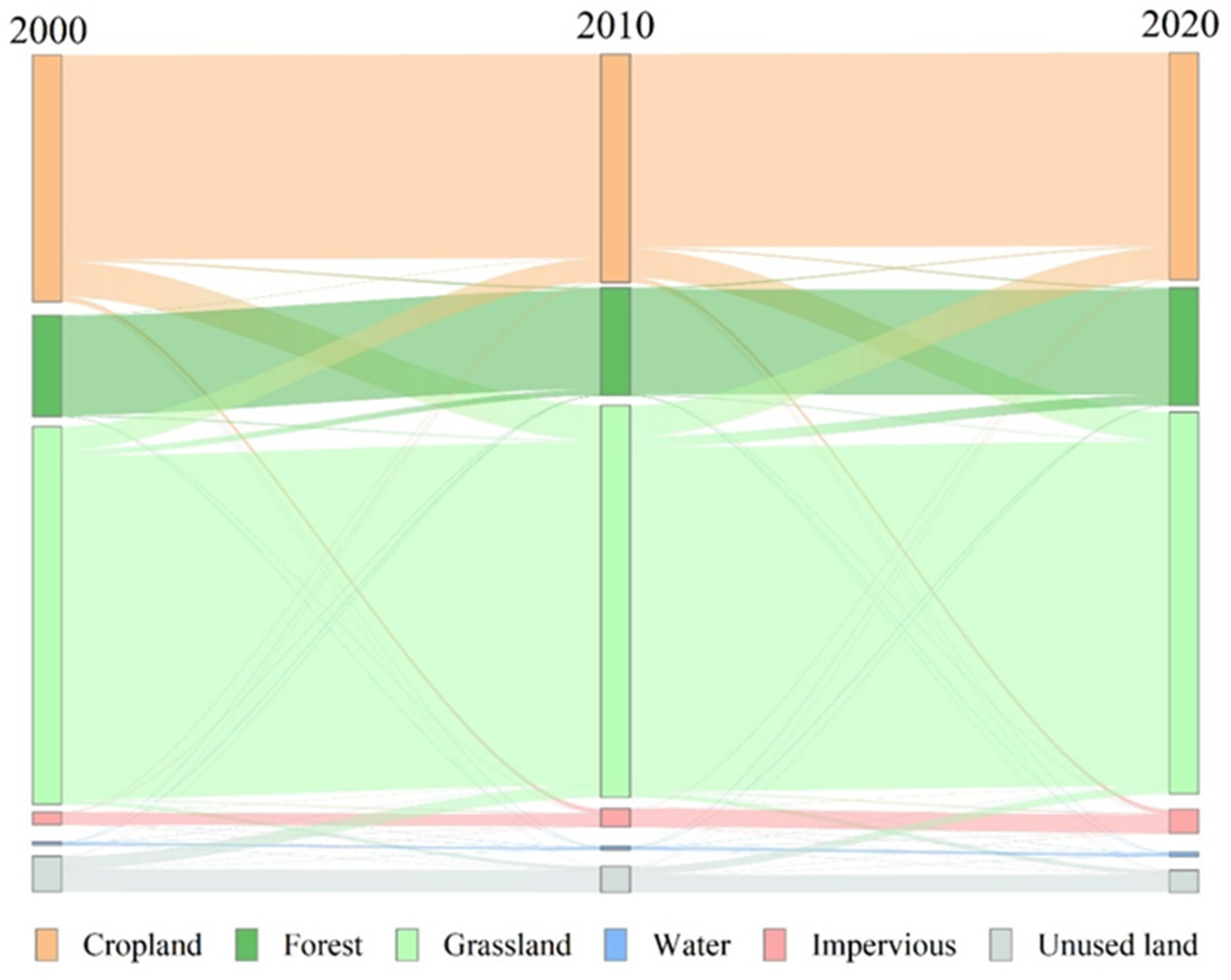
The land-use compositions of the LP between 2000 and 2020 are summarized in Table 5, and the transition dynamics are illustrated via a Sankey diagram (Figure 3). Grassland and cropland were the predominant land-use types within the region, accounting for approximately 50% and 30% of the total area, respectively. Spatially, cropland and forest were concentrated in the southeastern portion of the LP, while grassland was primarily distributed across the central and western regions. Impervious surface was predominantly located along river systems and adjacent to water.
Over the two decades, the LP underwent significant land-use transformations, characterized by continuous expansion of forest and impervious surface, accompanied by a notable reduction in cropland and unutilized land. Impervious surface expanded by 91.07% and forest increased by 16.03%. Conversely, unutilized land and cropland decreased by 37.35% and 7.85%, respectively.
From 2000 to 2010, cropland experienced an inflow of 19,564 km2 and an outflow of 34,221 km2. Most transitions involved exchanges with grassland, though 10.43% and 5.5% of the cropland outflow were converted into impervious surface and forest, respectively. Forest showed an inflow of 7159 km2 against an outflow of 1560 km2, primarily through exchanges with cropland and grassland. Grassland received 39,440 km2, mainly from cropland and impervious surface areas, while 27,703 km2 was transferred out, predominantly back into cropland. Impervious surface increased by 4815.2 km2, primarily sourced from converted cropland.
In the subsequent decade (2010–2020), cropland transitions involved an inflow of 27,364 km2 and an outflow of 28,334 km2. Outgoing cropland was primarily converted into grassland, impervious surface, and forest, representing 80.6%, 12.07%, and 5.5% of the total outflow, respectively. Notably, 92.28% of the cropland inflow during this period was derived from grassland. Forest increased by 10,078 km2, mainly through conversions from grassland and cropland. Grassland transitions were characterized by an inflow of 30,085 km2 and an outflow of 38,574 km2, dominated by mutual conversions with cropland. Impervious surface continued its expansion with an inflow of 4697 km2, largely at the expense of cropland.
The sustained increase in the proportion of forest and grassland underscores the substantial success of the “Grain for Green” policy on the LP. The land-use trajectory indicates a shift toward greater vegetation cover and improved ecological structure across the LP.

3.1.2. Driving Mechanisms of Land Expansion

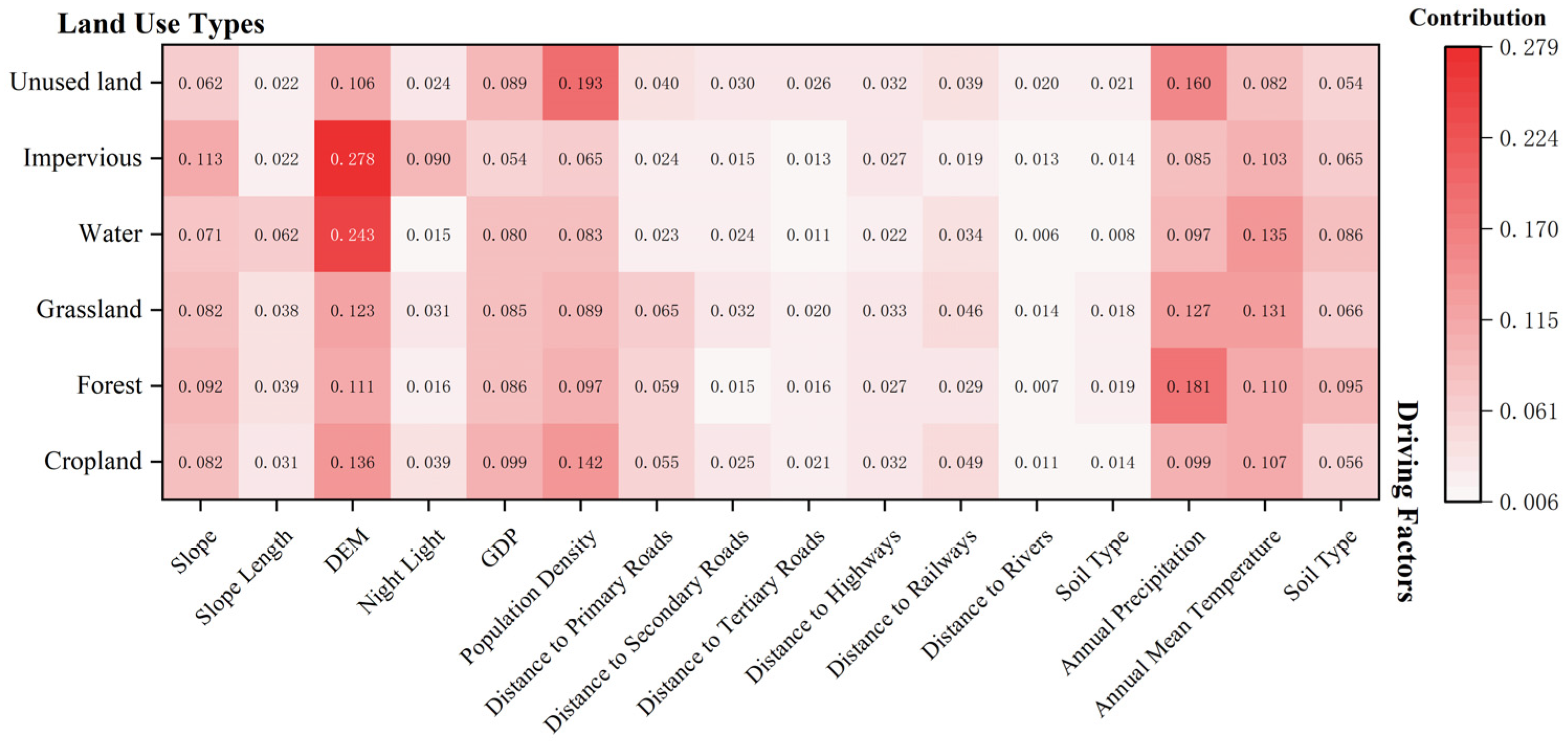
The LEAS module within the PLUS model identified key drivers of land-use transitions based on 16 biophysical and socioeconomic factors (Figure 4). Cropland and unutilized land expansion were primarily driven by population density, a trend that reflects growing land resource demand amid demographic growth, alongside adjustments to land-use strategies influenced by policy interventions and economic incentives. Notably, population density contributed 14.2% to cropland expansion, while elevation—another key driver for cropland—accounted for 13.6%. This finding indicates that cropland expansion is tightly constrained by both demographic pressure and the topographical gradients of the LP. For unutilized land, population density played an even more dominant role, with a contribution rate of 19.3%, further underscoring the profound impact of demographic changes on the transition of these two land-use types. In contrast, vegetation-related land categories, including forest and grassland, were largely regulated by climatic conditions; precipitation and temperature, as the primary environmental controls, directly affect vegetation establishment, growth, and spatial expansion. For forest specifically, the main contributing factors were annual precipitation (18.1%), elevation (11.1%), and annual average temperature (11.0%). In comparison, grassland was dominated by annual average temperature (13.1%), annual precipitation (12.7%), and elevation (12.3%); these data together underscore the critical role of hydrothermal conditions and topographical factors in the distribution and expansion of vegetation-covered land. For water and impervious surface, elevation emerged as the primary determinant; it contributed 24.3% to water variations and 27.8% to impervious surface changes. This can be attributed to altitude’s role in shaping topographic features, hydrological conditions, and human development decisions. Low-altitude areas are generally more conducive to urban expansion and surface water accumulation, facilitating the formation of rivers and lakes. In contrast, high-altitude or ecologically sensitive zones act as natural constraints, effectively limiting the scope of human-induced development.

3.1.3. Multi-Scenario Land-Use Projections for 2060

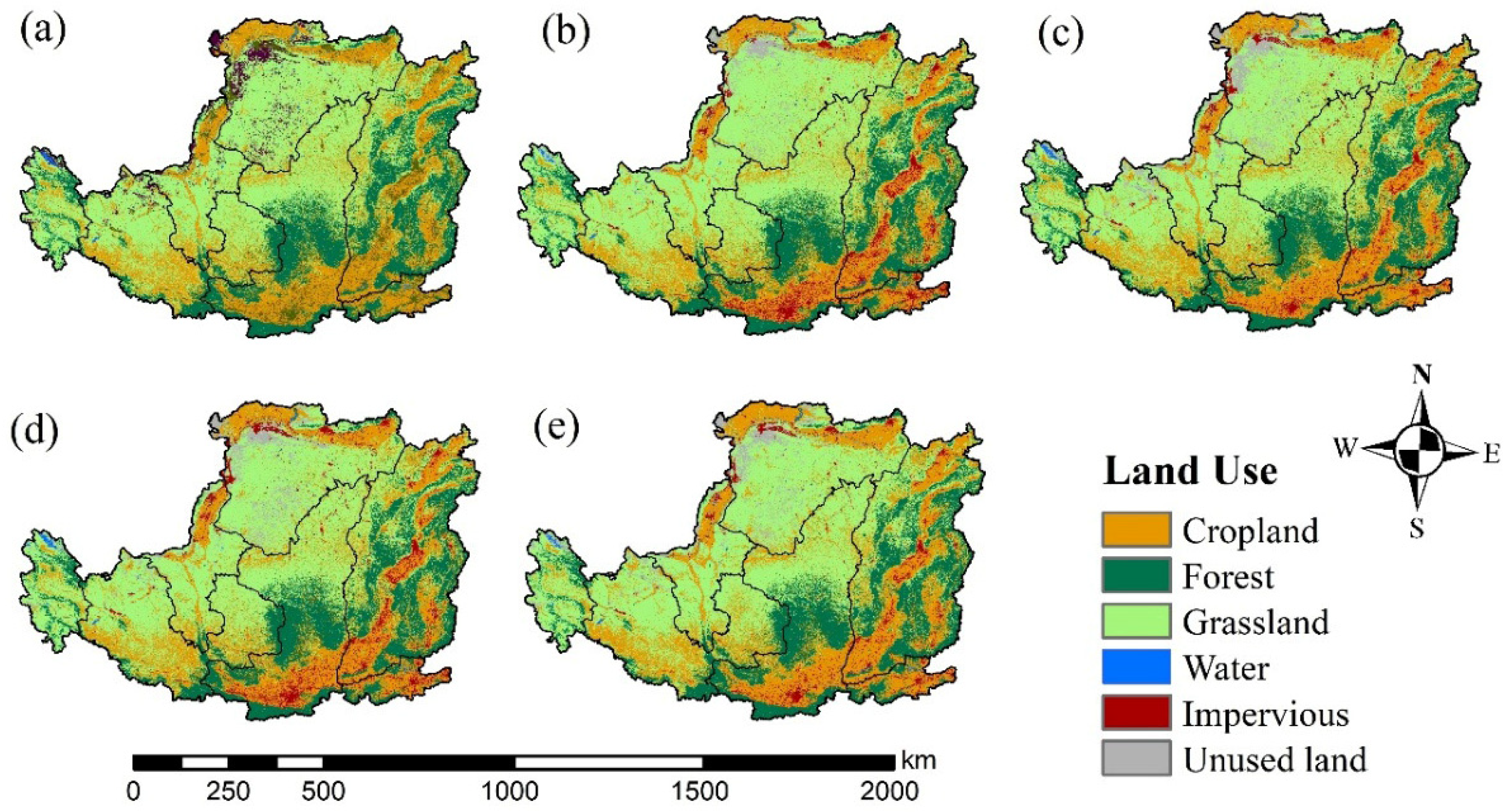
Land-use patterns of the LP in 2060 were simulated under five scenarios, and the projected spatial distributions and area statistics are presented in Figure 5 and Table 6 below.
Model performance was evaluated by simulating land use in 2020 (based on land-use datasets from 2000, 2010, and 2015) and comparing the results with observed remote sensing data. The validation produced a Kappa coefficient of 0.792 and an Overall Accuracy (OA) of 0.866, indicating satisfactory agreement and supporting the reliability of the model for scenario analysis in this study.
Under the ND, EP, and ED scenarios, cropland areas were projected to decrease by 7431 km2, 12,005 km2, and 8016 km2, respectively. Notably, a substantial expansion of forest was observed across all simulated scenarios. In the EP scenario, which prioritizes “Grain for Green” policies, the reduction in cropland was most pronounced, posing a potential threat to regional food security.
In the CP scenario, cropland was maintained at a stable level. However, this stability was accompanied by a substantial reduction in grassland (a reduction of 38,395 km2) and a significantly lower rate of forest expansion compared to other scenarios. Conversely, the PG scenario facilitated a slight increase in cropland, offering a more balanced approach between ecological conservation and food security. Given the structural constraints of the LP, the expansion of impervious surface land remains necessary to accommodate urbanization and economic development. Although the magnitude of transitions varied, impervious surface exhibited growth across all scenarios, and the overarching trend of vegetation restoration remains consistent across the projected models.

3.2. Soil Erosion Dynamics and Scenario Projections

3.2.1. Spatiotemporal Dynamics of Rainfall Erosivity

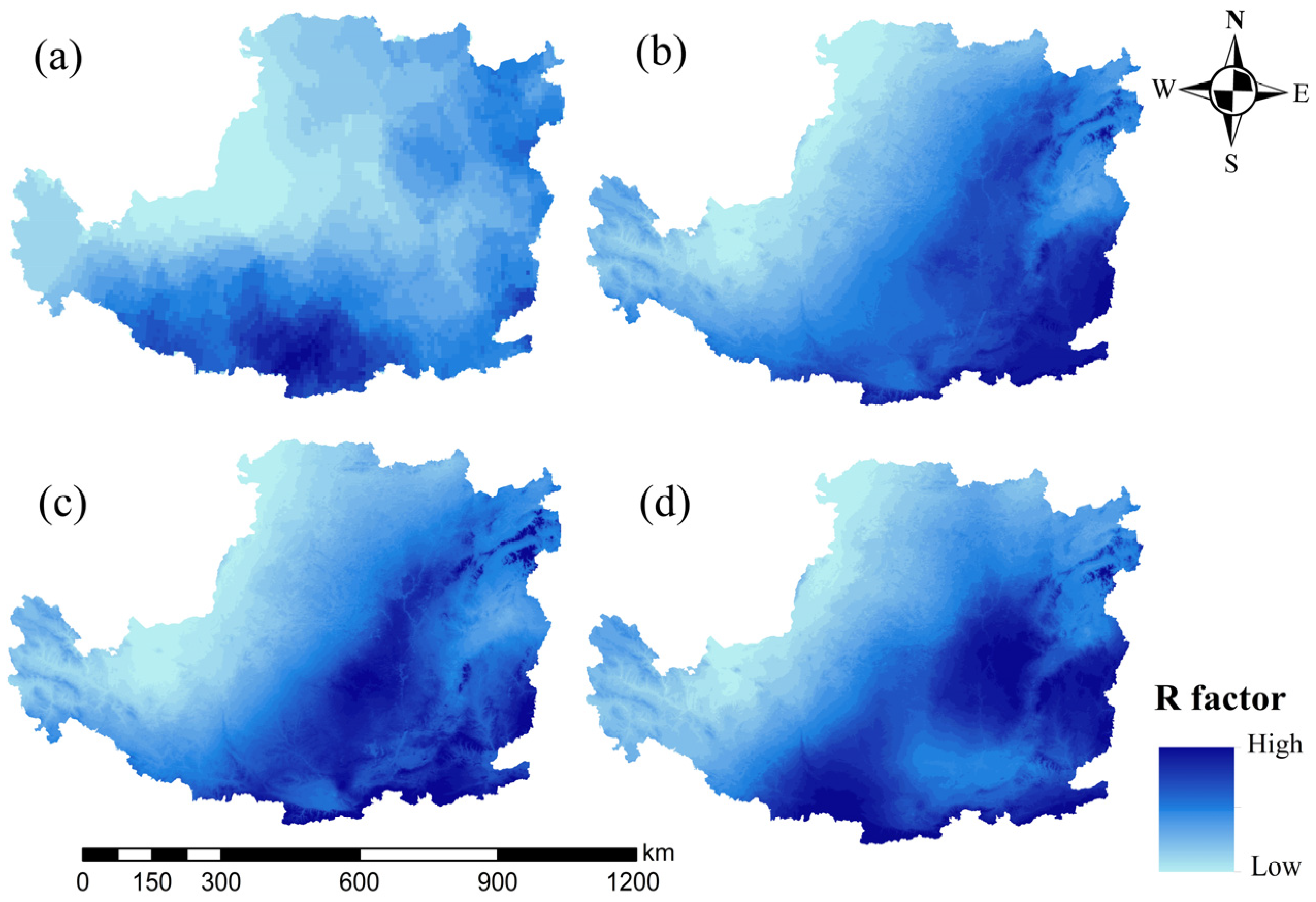
The spatial distributions of the rainfall erosivity (R factor) in the baseline year (2020) and under the three projected scenarios for 2060 are illustrated in Figure 6. In 2020, the R factor across the LP exhibited a distinct spatial gradient; high-value clusters were primarily concentrated in the southeastern and southern regions, aligning with the climatic features of concentrated precipitation and frequent rainstorms. Conversely, the low-value areas were distributed in the arid northwestern and western regions where precipitation is scarce and intensity is low. The mean R factor in 2020 was 1016 MJ mm ha−1 h−1 yr−1.
Compared with the baseline, the mean R factor in 2060 increased substantially under all three scenarios, reflecting the exacerbating effect of future climatic forcing on erosivity. Specifically, the mean R factor was 1921 MJ mm ha−1 h−1 yr−1 under the SSP119 scenario, 2420 MJ mm ha−1 h−1 yr−1 under SSP245, and surged to 2865 MJ mm ha−1 h−1 yr−1 under the high-emission SSP585 scenario. Although the overall spatial patterns in 2060 remained consistent with the baseline, the magnitude and extent of change differed markedly among scenarios. Under SSP119, the high-value areas expanded only marginally along the southeastern fringes, demonstrating the effective suppression of erosivity growth by stringent climate policies. Under SSP245 the high-value clusters further encroached into the northwestern and western regions, accompanied by an enhanced spatial disparity. Under SSP585, the high-emission trajectory led to a drastic escalation in rainfall erosivity, with the high-risk zones in the southeast and south experiencing substantial spatial expansion.
Overall, changes in the R factor were positively correlated with the intensity of greenhouse gas emissions and exhibited pronounced spatial heterogeneity. The humid and semi-humid zones in the southeast were more sensitive to climate change, showing more prominent increases, whereas the arid zones in the northwest displayed a relatively muted response. These findings suggest that deep emission mitigation (SSP119) is not only essential for curbing the overall rise in the R factor but also crucial for maintaining the relative stability of the regional annual soil loss modulus patterns.

3.2.2. Historical Evolution of Erosion Intensity (2000–2020)

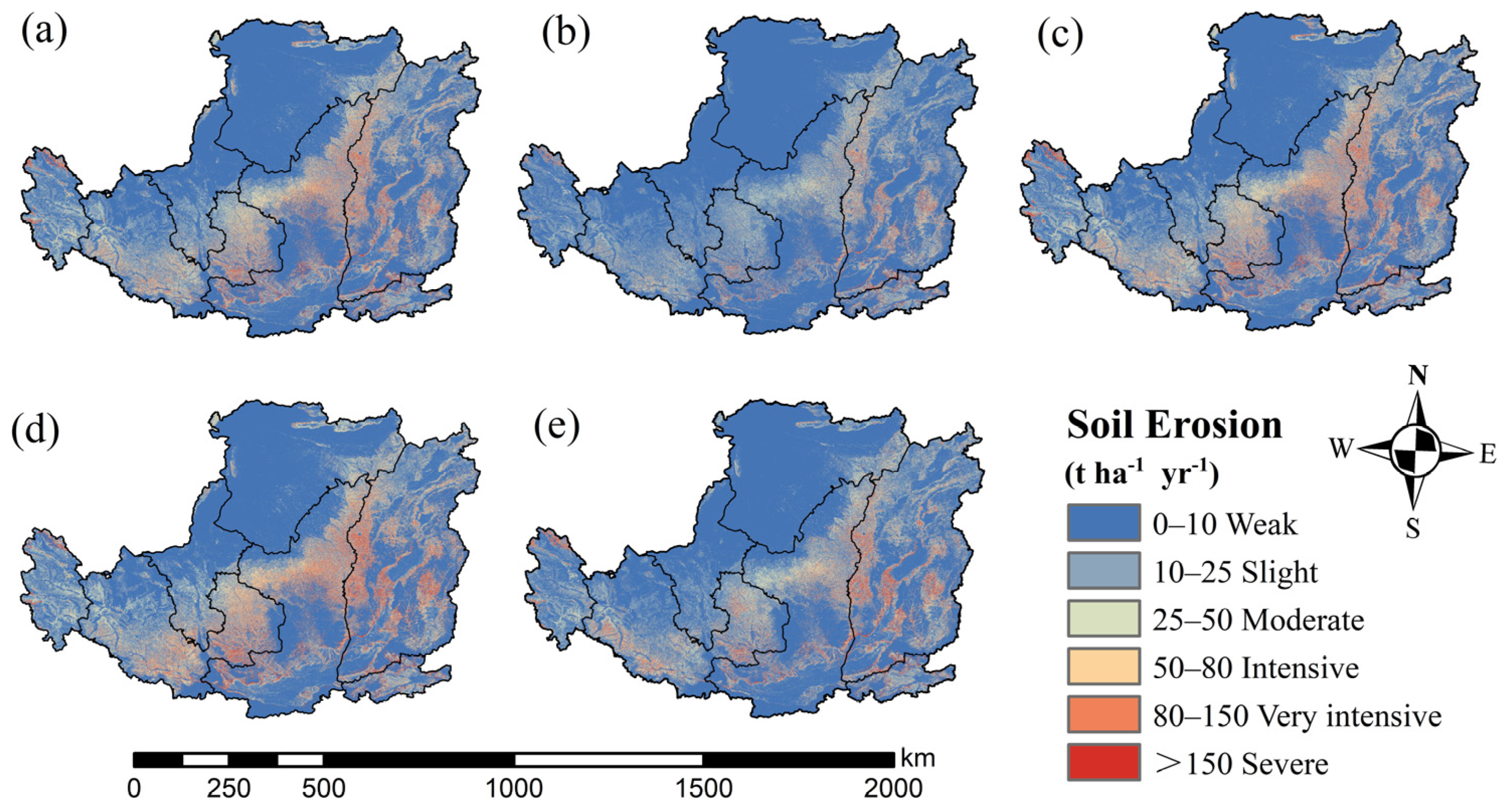
The mean annual soil loss (A) for 2000, 2005, 2010, 2015, and 2020 was 19.08, 19.97, 17.44, 10.04, and 12.53 t·ha−1·yr−1, respectively. During this period, soil erosion across the LP was dominated by slight erosion, and the overall spatial pattern remained relatively stable. Areas with relatively high erosion intensity (moderate and above) were concentrated mainly in the central, southwestern, and parts of the eastern Loess Plateau. In contrast, the northwestern and southeastern regions were dominated by weak and slight erosion (Figure 7).
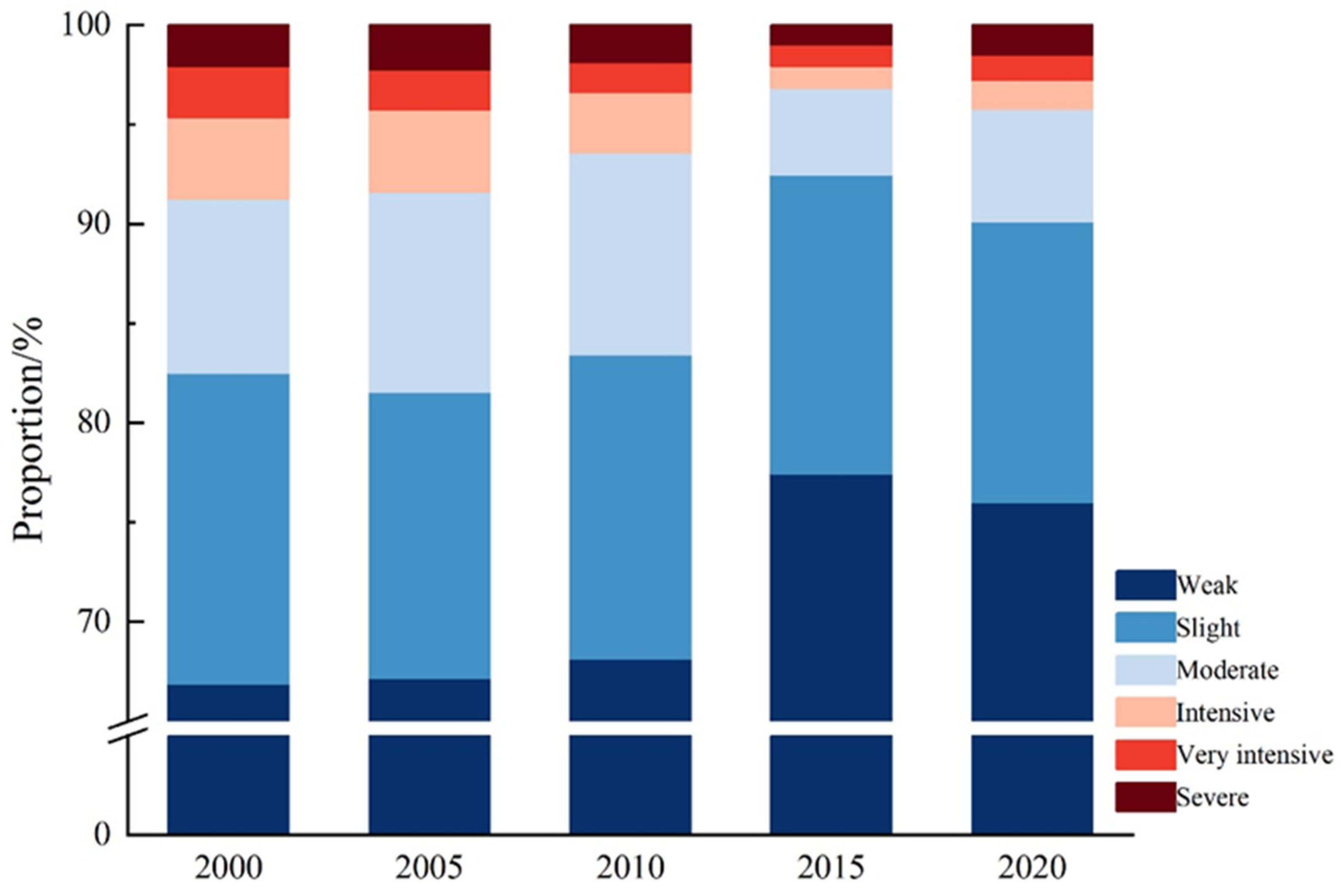
The proportion of erosion intensity levels is illustrated in Figure 8. Between 2000 and 2010, the area of slight erosion accounted for approximately 70% of the total area, subsequently increased to 77.45% in 2015 and 76.03% in 2020. Throughout the 2000–2020 period, the areas affected by strong, extremely strong, and severe erosion decreased by 16,178 km2, 8425 km2, and 3528 km2, respectively. These changes indicate a clear shift from high-intensity to low-intensity erosion across the LP, reflecting the substantial success of regional ecological restoration and soil conservation efforts.

3.2.3. Differential Erosion Responses Across Land-Use Types

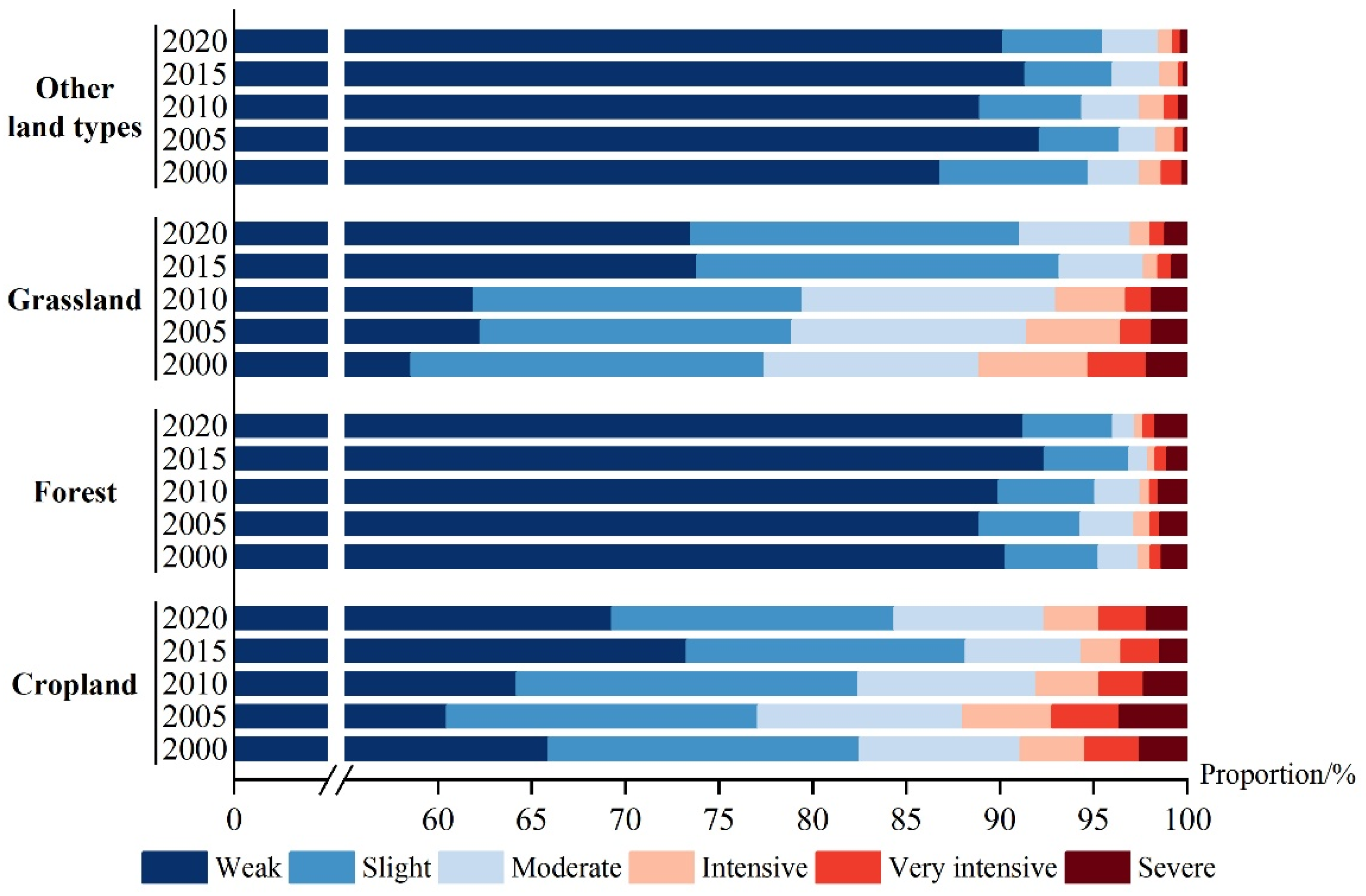
The distribution of soil erosion intensity across various land-use types from 2000 to 2020 is illustrated in Figure 9. Other land use types, including impervious surface and water, were dominated by weak erosion, which accounted for 86.8–92.1% of the total area across all periods, accompanied by slight erosion comprising 4.3–7.9%. High-intensity erosion (defined as the cumulative proportion of intensive, very intensive, and severe grades) remained negligible throughout, fluctuating between 1.5% and 2.6%, reflecting the high surface resistance of these non-vegetated land types.
Within vegetated landscapes, the proportion of high-intensity erosion in grasslands was initially comparable to that of cropland. In 2000, high-intensity erosion in grassland reached 11.1%, while that in cropland was 8.9%. However, under the implementation of the “Grain for Green” program, the continuous increase in FVC significantly enhanced soil and water conservation capacities. Consequently, high-intensity erosion in grassland declined sharply to 3.0% by 2020, representing a ~73% relative reduction, whereas the corresponding decrease in cropland was limited to only 1.3 percentage points (from 8.9% in 2000 to 7.6% in 2020), highlighting the more pronounced erosion mitigation effect in grasslands during the study period. Forest consistently maintained the lowest proportion of high-intensity erosion throughout the entire study period, with weak erosion occupying 89.0–92.4% of the area and slight erosion comprising 4.5–5.4%. High-intensity erosion in forest remained stable at 2.6–2.8% across all years, underscoring the robust erosion resistance of forest ecosystems.
In contrast, although cropland showed a transient increase (peaking at 18.2% in 2010 from 16.6% in 2000) in the proportion of slight erosion owing to the implementation of agricultural conservation measures, the reduction in high-intensity erosion remained limited. Specifically, high-intensity erosion in cropland decreased only from 8.9% (2000) to 7.6% (2020), with minor fluctuations observed in intermediate years (e.g., rising to 9.6% in 2005). This constraint may be attributed to persistent anthropogenic disturbances associated with intensive tillage practices and periodic soil exposure. Overall, land-use type fundamentally determines the baseline spatial heterogeneity of erosion intensity. The restoration and enhancement of forest and grassland ecosystems therefore constitute the principal drivers of the observed regional decline in soil erosion intensity across the LP.

3.2.4. Scenario-Based Erosion Projections for 2060

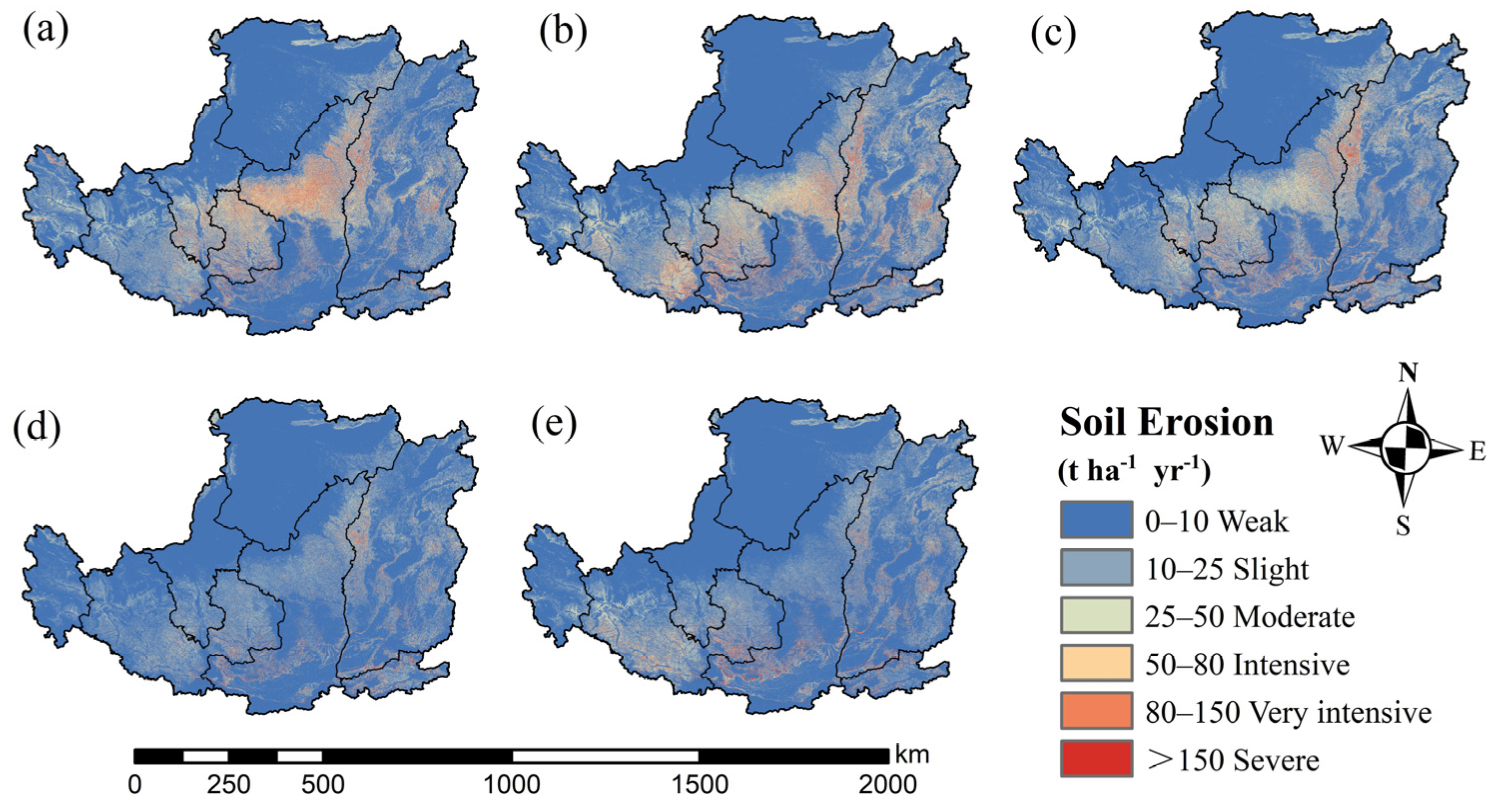
Utilizing the land-use simulation outputs generated by the PLUS model for 2060, the spatial distribution and area of soil erosion intensity under five distinct scenarios were calculated (as shown in Figure 10 and Table 7).
The spatial patterns of soil erosion under the five scenarios largely mirror historical trajectories, characterized by lower intensity in the northern and southeastern regions and significantly higher intensity in the central and western parts of the plateau. The projected mean annual soil loss for the ND, EP, CP, ED, and PG scenarios were 25.52, 15.19, 26.86, 30.79, and 22.76 t·ha−1·yr−1, respectively.
Comparative analysis revealed distinct ecological outcomes among scenarios:
(1)
The EP scenario: This scenario produced the lowest erosion intensity, with the largest area of slight erosion (457,128 km2) and smallest area of high-intensity erosion. By prioritizing the “Grain for Green” policy, the expansion of forest and grassland enhanced biological soil and water conservation capacity, thereby substantially mitigating erosion risk.
(2)
The ND scenario: Representing a continuation of historical trends without additional policy interventions, this scenario extended the trends observed between 2000 and 2020. However, due to the legacy effects of historical ecological restoration and the maintenance of existing measures, its erosion performance ranked second only to the EP scenario.
(3)
The CP scenario: Designed to safeguard food security, this scenario restricted the conversion of cropland, which consequently encroached upon potential forest and grassland expansion. This reduction in vegetation cover weakened the landscape’s ability to mitigate erosion, resulting in intensity levels slightly higher than those of the ND scenario.
(4)
The ED scenario: This scenario prioritized impervious surface expansion at the expense of ecological land. The subsequent reduction in vegetation cover led to the highest proportion of high-intensity erosion among all five scenarios, with the area of severe erosion totaling 22,423 km2.
(5)
The PG scenario: This scenario represented a sophisticated land-use adjustment that reconciles ecological conservation with developmental demands. By protecting vegetation while accommodating production and construction needs, it achieved superior erosion control compared to the ND scenario.
In summary, although the EP scenario was the most effective for improving soil stability, the PG scenario offered a more sustainable equilibrium by harmonizing economic vitality with the imperative of ecological preservation.

4. Discussion

4.1. Land-Use Change Dynamics and Their Implications for Soil Erosion

From 2000 to 2020, land-use change on the LP was characterized by a decline in cropland and unutilized land and a continuous increase in forest and impervious surface. These changes were shaped jointly by ecological restoration policy, urbanization, topographic constraints, and climatic conditions. The results suggest that future soil erosion is influenced not only by the area change of land-use types but also by where these changes occur and how ecological land and cropland are redistributed under different scenarios.
Policy intervention was a major driver of land-use change during the study period. In particular, the “Grain for Green” program facilitated the large-scale transition of marginal cropland to ecological land. Concurrently, the dual constraints of rapid urbanization and strict cropland protection policies concentrated impervious surface expansion within specific areas. This strategic approach effectively balanced urban development needs while mitigating excessive loss of high-quality primary cropland.
Climate was the fundamental determinant of spatial differentiation in land use across the LP. The temperate continental monsoon climate creates regional variations in hydrothermal conditions, which in turn dictate the distribution of dominant land-cover types, a finding consistent with the conclusions of [40]. Topographically, elevation and slope impose significant physical constraints on land-use distribution. Low-elevation areas with gentle slopes are characterized by concentrated impervious surface and intensive agriculture, whereas high-altitude, steep-slope regions are predominantly occupied by grassland and unutilized land, much of which has gradually undergone ecological restoration. Furthermore, specific soil textural properties have indirectly promoted the conversion of steep-slope cropland to forest and grassland, serving as a critical ecological boundary for land-use transitions.
Socioeconomic demands continue to drive dynamic adjustments in land-use patterns. Population growth and economic development have fueled impervious surface expansion, exhibiting distinct spatial clustering. Meanwhile, structural adjustments in the agricultural sector have fostered a dynamic equilibrium in conversions between cropland and grassland, with the intensity of human activity significantly shaping the overall landscape configuration [41]. Ultimately, the LP’s unique geomorphology results in pronounced spatial heterogeneity, where different topographic units are assigned distinct ecological and developmental functions.
LUCC is a decisive driver of the spatial heterogeneity observed in soil erosion intensity. Our findings demonstrate that forest exhibits superior erosive resistance due to its dense canopy and litter layers. Grassland erosion intensity shows a significant negative correlation with FVC, reflecting substantial erosion control effectiveness. Conversely, cropland remains a primary contributor to high-intensity erosion, largely due to persistent anthropogenic disturbances from tillage practices (represented by the T factor). These observations highlight the need to mitigate regional erosion risks through the strategic optimization of land-use patterns.

4.2. Implications for Future Land-Use Optimization

Integrating 2060 multi-scenario projections with the LP’s sustainability requirements, future optimization should adopt the PG scenario as the primary blueprint. First, a dynamic regulation mechanism for Production-Living-Ecological Space (PLES) must be established. By demarcating ecological redlines, the expansion of impervious surface into ecologically sensitive areas can be strictly constrained. Using the spatial allocation logic of the PLUS model, the urbanization should transition from “incremental expansion” to “stock optimization,” thereby achieving a dynamic equilibrium among urban development, cropland preservation, and ecological base maintenance.
Differentiated management strategies should be implemented based on erosion risk zones. For high-risk erosion zones (moderate intensity and above), the second phase of the “Grain for Green” program should be rigorously implemented, systematically converting steep slopes (exceeding 15° and 25°) to mixed forests and high-quality grasslands with robust soil-binding capacities (optimizing the B factor) and, concurrently, slope-based soil and water conservation (SWC) engineering measures such as horizontal benches, fish-scale pits, and high-standard terraces should be deployed to dissipate surface runoff kinetic energy (optimizing the E factor). For low-risk erosion zones (slight and light intensity), the focus should remain on maintaining the stability of the existing ecological matrix by promoting conservation tillage technologies (optimizing the T factor) to enhance agricultural productivity while preventing ecological fragmentation caused by excessive urban sprawl. As for arid and semi-arid sensitive areas, land optimization must be governed by water resource carrying capacity, and indigenous drought-resistant vegetation should be prioritized to avoid the formation of “dried soil layers” and secondary erosion risks associated with unsustainable high-density afforestation. Although conservation strategies (e.g., converting cropland to forest or grassland) can effectively mitigate soil erosion, the projected increase in rainfall erosivity (R factor) under high-emission scenarios (SSP5-8.5) may partially offset these ecological gains. This suggests that future soil and water conservation strategies should account for not only land use optimization but also for the increasing erosive potential associated with climate change.
Furthermore, a “Dynamic Monitoring-Feedback Regulation” platform, integrating remote sensing and big-data analytics, is essential. By conducting rolling evaluations of the 2060 projected patterns, the trends in the mean annual soil loss (A) under various scenarios can be monitored in real time. This approach will facilitate coupling of land-use structural optimization with long-term erosion control at the policy level, ensuring the enduring stability of the LP’s function as a national ecological barrier.

4.3. Limitations

Several constraints in this study warrant acknowledgment.
First, multi-source data resampling constitutes an additional source of uncertainty. To satisfy the modeling demands of the PLUS model and maintain computational efficiency over the 640,000 km2 LP, all spatial datasets were unified to 150 m resolution, which inevitably incurs resampling artifacts. Upsampling high-resolution data (30 m DEM, LULC, and soil type) to 150 m causes a smoothing effect, blurring micro-topography and slightly underestimating the LS factor in fragmented gully zones. Downscaling coarse 1 km socio-economic and climate grids to 150 m ensures pixel consistency for CA simulation but introduces no genuine spatial information, resulting in artificial local precision. As 150 m is an optimal compromise for regional modeling, the scale-related bias deserves further sensitivity analysis in future work.
Furthermore, by assuming constant management levels (B and E factors), our projections may provide a conservative estimation of soil erosion mitigation. If future conservation technologies (e.g., high-standard terracing or smart water conservation) significantly improve, the actual erosion risk might be lower than our simulated values. Additionally, while the use of SSP-derived R factors captures long-term climate trends, it may overlook the impact of increased frequency in extreme weather events, which could trigger transient spikes in erosion intensity. Despite these limitations, the multi-scenario approach provides a robust framework for assessing the relative effectiveness of different spatial transition pathways under diverse policy orientations. Due to the absence of projected future FVC data, the future B (vegetation and biological measures) factor was estimated by assigning values according to historical empirical relationships between land-use types and their corresponding B values. This approximation may affect the precision of the simulation results. Despite these limitations, this research provides a valuable scientific foundation for land-use optimization and soil conservation strategy formulation on the LP.
Moreover, while the five development scenarios offer a diverse range of pathways, they inherently possess limitations. These scenarios, constructed on current socio-economic and policy frameworks, may not fully account for abrupt shifts in global climate governance or regional strategies. Furthermore, the linear parameterization of the PLUS model might simplify the complex, non-linear feedbacks between human activities and ecological responses. Additionally, the focus on land-use transitions potentially overlooks the fine-scale mitigation effects of specific engineering measures, such as terracing and check-dams, which are critical to soil conservation in the LP.

5. Conclusions

This study coupled the PLUS land-use simulation model with CSLE model to coupled historical soil erosion dynamics (2000–2020) and to project future erosion trajectories on the LP under five policy-driven scenarios. The key conclusions are summarized as follows:
(1)
Historical erosion mitigation was structurally driven by ecological land expansion. Between 2000 and 2020, soil erosion intensity exhibited an overall declining trend, with slight erosion remaining dominant across the region. The substantial reduction in high-intensity erosion categories was closely associated with the spatial conversion of steep cropland to forest and grassland under large-scale ecological restoration policies. These transitions weakened the spatial connectivity of surface runoff.
(2)
Land-use type determines baseline erosion susceptibility, while scenario-based transitions reshape spatial variations in erosion intensity. Forest consistently maintained the lowest erosion intensity, whereas cropland remained a major contributor to moderate and intensive erosion due to persistent anthropogenic disturbance. More importantly, future erosion outcomes were shown to depend not merely on proportional land-cover composition but on spatial arrangement of land types. Contiguous ecological restoration reduced landscape fragmentation and runoff concentration, whereas urban expansion amplified erosion hotspots through surface sealing and ecological patch disruption.
(3)
Scenario divergence highlights structural trade-offs in land governance. Among the projected scenarios, the EP pathway achieved the strongest erosion mitigation but involved substantial cropland reduction, implying potential long-term trade-offs with food and water security. The ED scenario intensified erosion through rapid impervious expansion. In contrast, the PG scenario provided a structurally balanced pathway by stabilizing ecological land while accommodating socioeconomic demands, resulting in moderate and spatially stable spatial variations in erosion intensity.
(4)
A Coupled Framework for Integrating Scenario-based Land-Use Transition with Process-Based Erosion Modeling. By coupling PLUS with CSLE, this study demonstrates a transferable analytical framework that integrates policy-driven land-use simulation with erosion process quantification. The results emphasize that erosion governance in ecologically fragile regions should shift from static land-cover evaluation toward dynamic assessment of spatial reconfiguration and transition mechanisms.
Overall, soil erosion control on the LP under future climate and development uncertainty depends on coordinated spatial planning that preserves ecological connectivity, regulates urban expansion, and optimizes land-use transitions. Incorporating spatial variations in erosion intensity into long-term territorial governance frameworks is essential for enhancing erosion control effectiveness and sustaining the ecological security function of the LP.

Supplementary Materials

The following supporting information can be downloaded at: https://www.mdpi.com/article/10.3390/rs18081202/s1, Table S1: The T factor assignment of Different Agricultural Cropping Systems.

Author Contributions

X.S.: Writing—original draft, Methodology, Validation, Software, Data curation, Formal analysis, Visualization. H.S.: Writing—review and editing, Supervision, Resources, Project administration, Investigation, Funding acquisition, Formal analysis, Data curation, Conceptualization. X.Y.: Writing—review and editing, Project administration, Methodology, Formal analysis, Conceptualization. Y.W.: Writing—review and editing, Conceptualization. G.Y.: Writing—review and editing, Conceptualization. Y.Z.: Data curation, Conceptualization. Y.L.: Writing—review and editing, Validation. Z.W.: Resources, Methodology, review and editing. All authors have read and agreed to the published version of the manuscript.

Funding

This research was funded by the National Natural Science Foundation of China (41501055), and the High-end Foreign Experts Recruitment Plan of China (G2022172016L).

Data Availability Statement

The datasets used in this study are all publicly available authoritative datasets for land use change and soil erosion research on the Loess Plateau. The 2000–2020 China Land Cover Dataset (CLCD) is available from Zenodo: https://zenodo.org/records/4417810 (accessed on 28 April 2025). Annual precipitation, annual mean temperature, GDP, and population density datasets are available from the Resource and Environment Science and Data Center (RESDC), Chinese Academy of Sciences (CAS): https://www.resdc.cn/ (accessed on 28 April 2025). The Copernicus Digital Elevation Model (COP-DEM) dataset (used to derive slope and aspect) is available from the Copernicus Earth Observation Service: https://scihub.copernicus.eu/datasets/COP-DEM-GLO-30/ (accessed on 12 May 2025). The meteorological station rainfall dataset is available from the National Meteorological Information Center: https://data.cma.cn/ (accessed on 23 May 2025). The soil erodibility factor (K) dataset is available from the National Earth System Science Data Center: http://loess.geodata.cn (accessed on 24 May 2025). The Landsat 5–8 satellite series imagery (used to calculate Fractional Vegetation Cover, FVC) is available from the U.S. Geological Survey (USGS): https://www.usgs.gov/ (accessed on 4 June 2025). The 1 km multi-scenario and multi-model monthly precipitation dataset for China (2021–2100) is derived from the publicly available dataset published in Hu et al. (2025) [24], which is fully cited in the reference list. The Harmonized World Soil Database (HWSD, v1.2) (soil type dataset) is available from the Food and Agriculture Organization of the United Nations (FAO): https://www.fao.org/soils-portal/soil-survey/soil-maps-and-databases/harmonized-world-soil-database-v12/en/ (accessed on 24 May 2025). The NPP-VIIRS Nighttime Light Index dataset is available from the U.S. National Oceanic and Atmospheric Administration (NOAA): https://www.ngdc.noaa.gov/eog/viirs/ (accessed on 20 June 2025). The vector datasets of distance to railways, roads, rivers, and residential areas are available from the National Catalogue Service for Geographic Information (Tianditu): https://www.tianditu.gov.cn/ (accessed on 23 June 2025). All processed datasets generated during this study, including simulated soil erosion results, land use transfer matrices, and future scenario-based soil erosion projections, are available upon reasonable request from the corresponding author. This statement fully complies with the MDPI Research Data Policies.

Acknowledgments

We appreciate the assistance of the Google Earth Engine platform and its creators. We acknowledge the journal editor and the anonymous reviewers for their in-sightful criticisms and outstanding work on this research. We also acknowledge data support from “Loess plateau science data center, National Earth System Science Data Sharing Infrastructure, National Science & Technology Infrastructure of China (http://loess.geodata.cn) (accessed on 24 May 2025)”.

Conflicts of Interest

The authors declare no conflicts of interest.

References

  1. Zhang, P.; Qin, C.; Hong, X.; Kang, G.; Qin, M.; Yang, D.; Pang, B.; Li, Y.; He, J.; Dick, R.P. Risk assessment and source analysis of soil heavy metal pollution from lower reaches of Yellow River irrigation in China. Sci. Total Environ. 2018, 633, 1136–1147. [Google Scholar] [CrossRef]
  2. Wang, Y.; Zhao, J.; Fu, J.; Wei, W. Effects of the Grain for Green Program on the water ecosystem services in an arid area of China—Using the Shiyang River Basin as an example. Ecol. Indic. 2019, 104, 659–668. [Google Scholar] [CrossRef]
  3. Qiu, C.; Liu, X.; Li, D.; Zhang, J.; Li, P. Application of airborne LiDAR with fuzzy inference system in soil erosion monitoring on the Loess Plateau. Arid Zone Res. 2024, 41, 1331–1342. (In Chinese) [Google Scholar]
  4. Liu, P.; Guo, B.; Zhang, R.; Wang, L. Spatial–Temporal Evolution Pattern of Soil Erosion and Its Dominant Factors on the Loess Plateau from 2000 to 2020. Land 2024, 13, 1944. [Google Scholar] [CrossRef]
  5. Liu, G.; Shangguan, Z.; Yao, W.; Yang, Q.; Zhao, M.; Dang, X.; Guo, M.; Wang, G.; Wang, B. Ecological Effects of Soil Conservation in Loess Plateau. Bull. Chin. Acad. Sci. 2017, 32, 11–19. (In Chinese) [Google Scholar]
  6. Zhao, Y.; Zhang, Y.e.; Wang, Z.; Zhang, G.; Xin, Y.; Liu, B.; Wei, X. Response of water and sediment to ecological construction of soil andwater conservation in the typical watersheds of the Loess Plateau. Sci. Soil Water Conserv. 2024, 22, 21–26. (In Chinese) [Google Scholar]
  7. Li, P.; Li, D.; Hu, J.; Yao, W.; Zang, Y. Assessing the ability of airborne LiDAR to monitor soil erosion on the Chinese Loess Plateau. Acta Geod. Cartogr. Sin. 2023, 52, 1342–1354. (In Chinese) [Google Scholar]
  8. Zhao, X.; Shi, X.; Li, Y.; Li, Y.; Huang, P. Spatio-temporal pattern and functional zoning of ecosystem services in the karst mountainous areas of southeastern Yunnan. Acta Geogr. Sin. 2022, 77, 736–756. (In Chinese) [Google Scholar]
  9. Zhang, B.; Chen, Z.; Shi, X.; Wu, S.; Feng, H.; Gao, X.; Siddique, K.H. Temporal and spatial changes of soil erosion under land use and land cover change based on Chinese soil loss equation in the typical watershed on the Loess Plateau. Soil Use Manag. 2022, 39, 557–570. [Google Scholar] [CrossRef]
  10. Islam, K. Grid-based soil erosion assessment and vulnerability mapping using integrated GIS, remote sensing, and RUSLE Model: A case study in Rarh region of West Bengal, India. Appl. Geomat. 2025, 17, 567–587. [Google Scholar] [CrossRef]
  11. Liu, B.; Zhang, K.; Yun, X. An Empirical Soil Loss Equation. In Proceedings of the 12th International Soil Conservation Organization Conference (ISCO); Tsinghua University Press: Beijing, China, 2002. [Google Scholar]
  12. Li, S.; Liu, X.; Li, X.; Chen, Y. Simulation model of land use dynamics and application: Progress andprospects. J. Remote Sens. 2017, 21, 329–340. (In Chinese) [Google Scholar]
  13. Liang, X.; Guan, Q.; Clarke, K.C.; Liu, S.; Wang, B.; Yao, Y. Understanding the drivers of sustainable land expansion using a patch-generating land use simulation (PLUS) model: A case study in Wuhan, China. Comput. Environ. Urban Syst. 2021, 85, 101569. [Google Scholar] [CrossRef]
  14. Luo, X.; Luo, X.; Yang, X.; Wang, J.; Liao, J.; He, Y.; Du, Y.; Yang, Y. Optimization of the Loess Plateau of the China Ecological Network Pattern Based on a PLUS Model. Land 2025, 14, 1488. [Google Scholar] [CrossRef]
  15. Yanyan, L.; Jinbing, Z.; Hui, Z.; Zhimin, Z.; Shan, J.; Shuangyan, H.; Ying, Z.; Yicheng, H.; Mengfan, L.; Guangrui, X.; et al. Soil Erosion Characteristics and Scenario Analysis in the Yellow River Basin Based on PLUS and RUSLE Models. Int. J. Environ. Res. Public Health 2023, 20, 1222. [Google Scholar]
  16. Li, W.; Yang, J.; Fu, B.; Zhao, Q.; Tan, Z.; Guan, X. Spatial-temporal changes and prediction of carbon storage in Greater Khingan Mountains based on PLUS-InVEST model. J. Environ. Eng. Technol. 2024, 14, 1892–1904. (In Chinese) [Google Scholar]
  17. Zhang, T.; Hu, Y.; Hu, H.; Lei, T. Prediction of Land Use and Habitat Quality in Harbin City Based on the PLUS- InVEST Model. Environ. Sci. 2024, 45, 4709–4721. (In Chinese) [Google Scholar]
  18. Jiang, X.; Bai, J. Predicting and assessing changes in NPP based on multi-scenario land use and cover simulations on the Loess Plateau. J. Geogr. Sci. 2021, 31, 977–996. [Google Scholar] [CrossRef]
  19. Lu, C.; Qi, X.; Zheng, Z.; Jia, K. PLUS-Model Based Multi-Scenario Land Space Simulation of the Lower Yellow River Region and Its Ecological Effects. Sustainability 2022, 14, 6942. [Google Scholar] [CrossRef]
  20. Jian, Z.; Sun, Y.; Wang, F.; Zhou, C.; Pan, F.; Meng, W.; Sui, M. Soil conservation ecosystem service supply-demand and multi scenario simulation in the Loess Plateau, China. Glob. Ecol. Conserv. 2024, 49, e02796. [Google Scholar] [CrossRef]
  21. Guo, W.; Xu, L.; Jia, J.; Gao, C.; Xia, X. Predicting Multi-Scenario Land Use Changes and Soil Erosion in the Huaihe River Basin Based on Coupled PLUS-CSLE Model. J. Soil Water Conserv. 2024, 38, 234–243+252. (In Chinese) [Google Scholar]
  22. Kan, G.; Xiao, J.; Liu, B.; Wang, B.; He, C.; Yang, H. Remote Sensing Extraction and Spatiotemporal Change Analysis of Time-Series Terraces in Complex Terrain on the Loess Plateau Based on a New Swin Transformer Dual-Branch Deformable Boundary Network (STDBNet). Remote Sens. 2026, 18, 85. [Google Scholar] [CrossRef]
  23. Liu, Y.; Zhang, Y.; Wang, D.; Zhang, D. Spatio-temporal patterns of precipitation from 1960 to 2020 over the Loess Plateau. J. Water Resour. Water Eng. 2025, 36, 121–127. (In Chinese) [Google Scholar]
  24. Hu, X.; Shi, S.; Zhou, B.; Ni, J. A 1 km monthly dataset of historical and future climate changes over China. Sci. Data 2025, 12, 436. [Google Scholar] [CrossRef]
  25. Lin, F.; Chen, X.; Yao, H.; Lin, F. SWAT model-based quantification of the impact of land-use change on forest-regulated water flow. Catena 2022, 211, 105975. [Google Scholar] [CrossRef]
  26. Han, S.; Kang, Y.; Jo, H.; Ahn, M.; Kim, T.; Son, S. Future Land Use and Cover Modeling in South Korea: Linking SSP-RCP with FLUS Model. Land 2025, 14, 2380. [Google Scholar] [CrossRef]
  27. Li, X.; Liu, Z.; Li, S.; Li, Y.; Wang, W. Urban Land Carbon Emission and Carbon Emission Intensity Prediction Based on Patch-Generating Land Use Simulation Model and Grid with Multiple Scenarios in Tianjin. Land 2023, 12, 2160. [Google Scholar] [CrossRef]
  28. Zhu, H.; Li, X. Discussion on the Index Method of Regional Land Use Change. Acta Geogr. Sin. 2003, 58, 643–650. (In Chinese) [Google Scholar]
  29. Wang, Z.; Guo, M.; Zhang, D.; Chen, R.; Xi, C.; Yang, H. Coupling the Calibrated GlobalLand30 Data and Modified PLUS Model for Multi-Scenario Land Use Simulation and Landscape Ecological Risk Assessment. Remote Sens. 2023, 15, 5186. [Google Scholar] [CrossRef]
  30. Li, S.; Zhang, C.; Chen, C.; Yang, C.; Zhao, L.; Bai, X. Optimization Simulation and Comprehensive Evaluation Coupled with CNN-LSTM and PLUS for Multi-Scenario Land Use in Cultivated Land Reserve Resource Area. Remote Sens. 2025, 17, 1619. [Google Scholar] [CrossRef]
  31. Wang, Z.; Wu, F.; Wan, D.; Zhang, K.; Li, L.; Huang, C. Muti-scenario simulation of the impact of regional land use change on carbon reserve. China Environ. Sci. 2023, 43, 6063–6078. (In Chinese) [Google Scholar]
  32. Chen, L.; Cai, H.; Zhang, T.; Zhang, X.; Zeng, H. Land use multi-scenario simulation analysis of Rao River Basin based on Markov-FLUS model. Acta Ecol. Sin. 2022, 42, 3947–3958. (In Chinese) [Google Scholar]
  33. Lou, Y.; Yang, D.; Zhang, P.; Zhang, Y.; Song, M.; Huang, Y.; Jing, W. Multi-Scenario Simulation of Land Use Changes with Ecosystem Service Value in the Yellow River Basin. Land 2022, 11, 992. [Google Scholar] [CrossRef]
  34. Ding, M.; Yin, X.; Pan, S.; Liu, P. Multi-Objective Spatial Optimization of Protective Forests Based on the Non-Dominated Sorting Genetic Algorithm-II Algorithm and Future Land Use Simulation Model: A Case Study of Alaer City, China. Forests 2025, 16, 452. [Google Scholar] [CrossRef]
  35. Zhang, W.; Fu, J. Rainfall Erosivity Estimation Under different Rainfall Amount. Resour. Sci. 2003, 25, 35–41. (In Chinese) [Google Scholar]
  36. Chen, Z.; Wang, W.; Guo, M.; Wang, T.; Guo, W.; Kang, H.; Yang, B.; Zhao, M. Effects of vegetation restoration on soil erodibility on different geomorphological locations in the loess-tableland and gully region of the Loess Plateau. J. Nat. Resour. 2020, 35, 387–398. (In Chinese) [Google Scholar] [CrossRef]
  37. McCool, D.K.; Brown, L.C.; Foster, G.R.; Mutchler, C.K.; Meyer, L.D. Revised slope steepness factor for the universal soil loss equation. Trans. ASAE 1987, 30, 1387–1396. [Google Scholar] [CrossRef]
  38. Borrelli, P.; Robinson, D.A.; Fleischer, L.R.; Lugato, E.; Ballabio, C.; Alewell, C.; Meusburger, K.; Modugno, S.; Schütt, B.; Ferro, V.; et al. An assessment of the global impact of 21st century land use change on soil erosion. Nat. Commun. 2017, 8, 2013. [Google Scholar] [CrossRef]
  39. SL190-2007; Standards for Classification and Gradation of Soil Erosion. Ministry of Water Resources the People’s Republic of China: Beijing, China, 2008.
  40. Khan, S.; Wang, H.; Boota, M.W.; Nauman, U.; Muhammad, A.; Wu, Z. Spatiotemporal dynamics of evapotranspiration in the Yellow River Basin: Implications of climate variability and land use change. Geomat. Nat. Hazards Risk 2025, 16, 2471021. [Google Scholar] [CrossRef]
  41. Jiang, Z.; Li, Y.; Wu, H.; Mohamed Shariff, A.R.B.; Zhou, H.; Fan, K. Unveiling the impacts of climate change and human activities on land-use evolution in ecologically fragile urbanizing areas: A case study of China’s Central Plains urban agglomeration. Ecol. Indic. 2024, 169, 112936. [Google Scholar] [CrossRef]
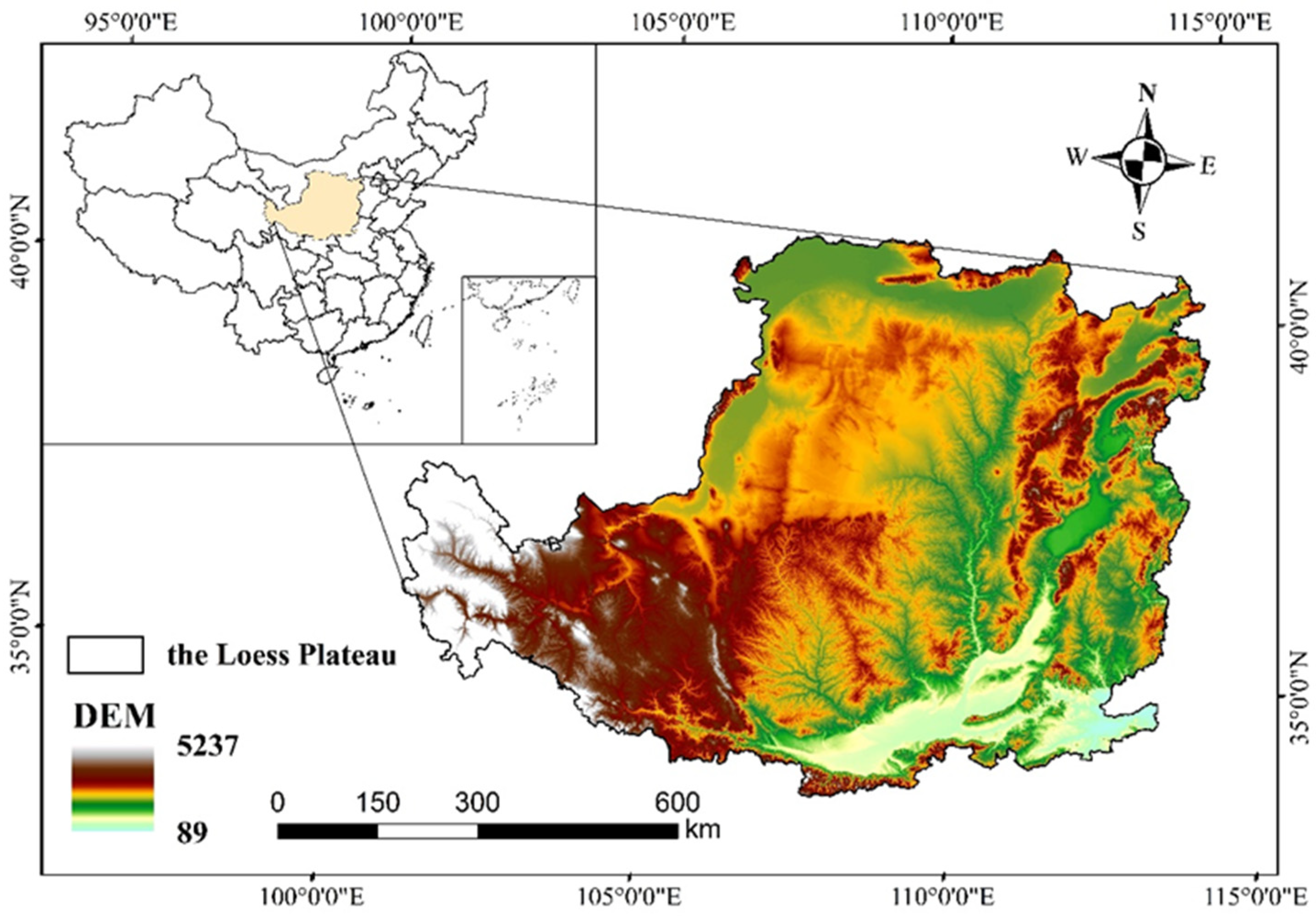
Figure 1. Geographical location of the Loess Plateau.
Remotesensing 18 01202 g001
Figure 2. The workflow diagram.
Remotesensing 18 01202 g002
Figure 3. Sankey diagram of land transfer from 2000 to 2020.
Remotesensing 18 01202 g003
Figure 4. Contribution of each driving factor of land expansion from 2000 to 2020.
Remotesensing 18 01202 g004
Figure 5. Spatial distribution of land use types under 5 scenarios in 2060: ND (a), EP (b), CP (c), ED (d), and PG (e).
Remotesensing 18 01202 g005
Figure 6. Spatial distribution of rainfall erosivity (R factor): (a) 2020; (b) SSP119 scenario (2060); (c) SSP245 scenario (2060); (d) SSP585 scenario (2060).
Remotesensing 18 01202 g006
Figure 7. Spatial distribution of soil erosion intensity on LP in 2000 (a), 2005 (b), 2010 (c), 2015 (d), 2020 (e).
Remotesensing 18 01202 g007
Figure 8. Proportion of different soil erosion levels from 2000 to 2020.
Remotesensing 18 01202 g008
Figure 9. Proportion of soil erosion intensity by different land-use types from 2000 to 2020.
Remotesensing 18 01202 g009
Figure 10. Distribution of soil erosion intensity under 5 scenarios in 2060: ND (a), EP (b), CP (c), ED (d), and PG (e).
Remotesensing 18 01202 g010
Table 1. List of datasets and their original sources.
Data CategoryDataset DescriptionSpatial ResolutionData Source
Land Use Data2000–2020 Land Cover Data30 mChina Land Cover Dataset (CLCD)
Natural FactorsDigital Elevation Model (DEM), Slope, and Aspect30 mCopernicus Digital Elevation Model (COP-DEM)
Meteorological Station Rainfall Data\National Meteorological Information Center
Annual Precipitation and Annual Mean Temperature1 kmResource and Environment Science and Data Center (RESDC), CAS
Soil erodibility factor (K)30 mNational Earth System Science Data Center
Fractional Vegetation Cover (FVC)30 mLandsat 5–8 satellite
series
Future Climate Data1 km1 km multi-scenario and multi-model monthly precipitation data for China in 2021–2100 [24]
Soil Type1 kmHarmonized World Soil Database (HWSD) (v1.2)
Socio-economic DataGDP and Population Density1 kmResource and Environment Science and Data Center (RESDC), CAS
Nighttime Light Index1 kmNPP-VIIRS Dataset
Distance to Railways, Roads, Rivers, and Residential Areas1:1,000,000National Catalogue Service for Geographic Information
Table 2. Multiple scenario-based transfer matrices.
ScenarioLand CategoryCroplandForestGrasslandWaterImperviousUnused Land
NDCropland111111
Forest111011
Grassland111111
Water001101
Impervious111011
Unused land111111
EPCropland111111
Forest011100
Grassland011100
Water001101
Impervious111011
Unused land111111
EDCropland111111
Forest111011
Grassland111111
Water001111
Impervious100010
Unused land000111
CPCropland111010
Forest111011
Grassland111111
Water001101
Impervious100011
Unused land111111
PGCropland111100
Forest111100
Grassland111001
Water001111
Impervious111011
Unused land111111
Table 3. The E factor for different terrace types.
MeasureClassificationE ValueMean Value
TerraceEarth-banked Level Terrace0.0840.242
Stone-banked Level Terrace0.121
Slope Terrace0.414
Broad-based Terrace0.347
Table 4. Classification of soil erosion intensity.
Soil Erosion ClassA/(t·ha−1·yr−1)
Weak<10
Slight10–25
Moderate25–50
Intensive50–80
Very intensive80–150
Severe>150
Table 5. Areas of land use types in the Loess Plateau from 2000 to 2020 (km2).
Year20002005201020152020
Land Use
Cropland198,939189,699184,282180,189183,313
Forest81,64383,70886,86890,11694,733
Grassland304,408312,651316,145315,938307,656
Water24022849304131213221
Impervious10,04811,99814,67817,25019,199
Unused land28,60125,13521,02619,42717,919
Table 6. Area of land use types in the Loess Plateau in 2060 (km2).
Land Category2020 (km2)Land Use Change Rate
NDEPCPEDPG
Cropland183,313−4.05%−6.55%0.39%−4.37%1.25%
Forest94,73328.72%29.06%28.24%28.70%28.76%
Grassland307,656−10.32%−6.69%−12.48%−10.40%−10.16%
Water322118.50%16.06%19.23%−4.23%18.61%
Impervious19,19953.20%52.86%28.63%62.59%8.55%
Unused land17,9196.45%−31.39%26.86%5.19%−2.90%
Table 7. Area of soil erosion intensity under 5 scenarios in 2060 (km2).
SE LevelWeakSlightModerateIntensiveVery IntensiveSevere
Land Use
ND410,75581,51959,48133,83721,82618,623
EP457,12882,85049,26516,323926911,206
CP407,30982,51159,52334,03622,47820,183
ED398,72580,09959,63734,82630,33022,423
PG429,39481,29856,37326,30014,45418,222
Disclaimer/Publisher’s Note: The statements, opinions and data contained in all publications are solely those of the individual author(s) and contributor(s) and not of MDPI and/or the editor(s). MDPI and/or the editor(s) disclaim responsibility for any injury to people or property resulting from any ideas, methods, instructions or products referred to in the content.