Article

CGHD: Dual-Temporal Dataset of Composite Geological Hazards via Multi-Source Optical Remote Sensing Images


1
Software Engineering Technology Research Center, School of Computer Science and Engineering, University of Emergency Management, Langfang 065201, China
2
Hebei Province University Smart Emergency Application Technology Research and Development Center, Langfang 065201, China
*
Author to whom correspondence should be addressed.
Remote Sens. 2026, 18(8), 1198; https://doi.org/10.3390/rs18081198
Submission received: 26 February 2026 / Revised: 11 April 2026 / Accepted: 14 April 2026 / Published: 16 April 2026

Highlights

What are the main findings?
  • We constructed the Composite Geological Hazards Dataset (CGHD), a large-scale, multi-scale and multi-resolution dual-temporal dataset integrating both landslides and debris flows from diverse optical satellite sources.
  • Experimental results demonstrate that the proposed use of dual-temporal and multi-source optical remote sensing data in CGHD significantly improves detection accuracy and enhances generalization across diverse geographic environments.
What are the implications of the main findings?
  • CGHD establishes a solid data foundation for landslide and debris flows hazard research, enabling models to effectively learn temporal dynamics and adapt to varying spatial resolutions and sensor characteristics in complex terrains.
  • This resource is pivotal for advancing intelligent disaster monitoring and prevention, facilitating the development of reliable automated systems for rapid landslides and debris flows mapping and emergency response.

Abstract

Geological hazards are characterized by their sudden occurrence, high destructiveness, and wide spatial impact. In particular, landslides and debris flows triggered by earthquakes and intense rainfall often lead to severe casualties and substantial property losses. Therefore, the rapid delineation of affected areas is crucial for disaster assessment and post-disaster reconstruction. To this end, several geohazard datasets have been developed from remote sensing imagery, focusing on specific regions, disaster types, and data sources, providing valuable support for geohazard detection and risk assessment. Our study addresses the diversity of real-world geological disasters in terms of their types, causes, and spatial distribution and constructs the Composite Geological Hazards Dataset (CGHD), a dual-temporal geohazard dataset that enhances generalisation and practical applicability. CGHD incorporates pre- and post-disaster remote sensing images of 14 landslide and debris flow events that occurred worldwide between 2017 and 2024, collected using four remote sensing platforms and encompassing multiple spatial scales and land-cover categories. The affected areas varied significantly in size and shape, with land-cover types including roads, buildings, vegetation, farmland, and water bodies. This resulted in 3963 pairs of pre- and post-disaster images, each with a size of 1024 × 1024 pixels. We validated the reliability of the CGHD through experiments with nine change-detection models and further evaluated its generalisation capability using an unseen dataset. The experimental results demonstrate that CGHD achieves high recognition accuracy and strong generalisation across diverse geographic environments, providing comprehensive data support for intelligent geohazard recognition and disaster assessment.

1. Introduction

Geological hazards such as debris flows and landslides may be triggered by earthquakes and intense rainfall [1]. These secondary geohazards typically emerge suddenly, cause considerable destruction, and have spatial complexity, potentially posing severe threats to human life and property, critical infrastructure, and the ecological environment [2,3]. The accurate localisation of geohazard-affected areas is a critical foundation for disaster situation analysis, risk assessment, and post-disaster reconstruction [4]. Researchers relied on field investigations to identify geohazard-affected areas, which offered high accuracy, and were the primary method given the limited technical means in the early days [5]. However, geological hazards occur predominantly in mountainous regions, and field surveys are often time-consuming, logistically demanding, and inherently dangerous [6].
With the continuous advancement of remote sensing imaging and digital image processing technologies, remote sensing imagery has been widely applied to identify geohazard-affected areas owing to its high resolution and wide coverage. Recently, synthetic aperture radar (SAR) and optical images have been increasingly used for geohazard detection. Cigna et al. [7] employed SAR images and applied the persistent scatterer interferometry technique, together with a time-series post-processing approach, to detect ground deformation patterns associated with the 2005 geohazard event in the Naro area of Italy. However, the interpretation of SAR imagery is often challenging in interpreting cities or areas with complex features, and its revisit cycle limits its effectiveness for rapid disaster assessment. By contrast, optical imagery is more straightforward for visual interpretation and is particularly suitable for large-scale disaster detection. Sato and Harp [8] identified 257 large-scale landslides triggered by the Wenchuan earthquake on 12 May 2008 in Beichuan County, using FORMOSAT-2 images, SPOT-5 images, and digital elevation model (DEM) data. Similarly, Martha et al. [9] mapped 1196 landslides induced by the 2011 Sikkim earthquake in India based on 123 high-resolution optical remote sensing images. Numerous similar datasets have been constructed in earlier studies and successfully applied to their respective research domains. However, the geographic locations, geological conditions, and disaster types of these datasets have limited their application and expansion. The construction of high-quality and representative datasets has become a key approach to improving the accuracy and robustness of disaster scene analysis. Consequently, researchers have devoted substantial efforts to dataset construction and refinement, particularly focusing on debris flows and landslide hazards, for which numerous effective datasets have already been established.
In debris-flow research, Pham and Kim [10] extracted images from videos of debris-flow events and obtained 5950 valid debris-flow-containing samples that were then used to construct the Debrisflow21 dataset. Yuan et al. [11] combined Gaofen-1 imagery with DEM data from Nujiang, Yunnan, and designed a dual-channel convolutional neural network to evaluate debris-flow susceptibility. Ma et al. [12] created a Google remote sensing image dataset of debris flows in the Xinjiang Uygur Autonomous Region, China. This dataset comprises 4585 JPG images, each with a resolution of 512 × 512 pixels. Although these studies have made valuable contributions to debris-flow detection and susceptibility assessments, the field lacks an open and comprehensive remote sensing image dataset.
In landslide research, Ji et al. [13] developed a public landslide detection dataset using TripleSat satellite imagery, which included 770 annotated landslide instances in Bijie City, Guizhou Province, China. The Landslide4Sense dataset was constructed from Sentinel-2 multispectral imagery covering four landslide events and served as a valuable source of spectral information [14]. The High-Resolution Global landslide Detector Database (HR-GLDD) was compiled from PlanetScope imagery of landslide instances across 10 different regions worldwide [15]. Although these datasets vary in geographic coverage, temporal depth, and spectral characteristics, most rely on data from a single sensor, thereby limiting the generalisation and robustness of models when applied to multi-source optical remote sensing data and multi-resolution scenarios. The Chinese Academy of Sciences (CAS) landslide dataset integrated satellite and unmanned aerial vehicles (UAV) imagery from nine regions and comprised 20,865 remote sensing images [16]. The Globally Distributed Coseismic Landslide Dataset (GDCLD) incorporates multisource remote sensing imagery, including PlanetScope, Gaofen-6, Tianditu, and UAV data, and covers nine disaster events across diverse geographic and geological contexts [17]. The Large-scale Multi-source High-resolution Landslide Dataset (LMHLD) further increases data diversity by collecting images from five different satellite sensors across seven global study areas [18]. Most of the aforementioned datasets achieved a relatively high accuracy within their respective tasks, thereby demonstrating their effectiveness for specific disaster scenarios. However, their reliance on single-temporal, post-disaster imagery limits their applicability to other regions and hinders accurate localisation of affected areas in complex real-world scenarios. In contrast, dual-temporal remote sensing imagery not only reveals the evolutionary differences in surface features before and after disasters but also delineates affected regions more clearly. Moreover, it effectively reduces the interference caused by inherent geomorphic features such as exposed rocks that resemble disaster characteristics in single-temporal data. A dual-temporal Global Very-high-resolution Landslide Mapping (GVLM) dataset was constructed using high-resolution pre- and post-disaster images from 17 disaster events worldwide via Google Earth, providing a valuable reference for change-detection research across diverse disaster scenarios [19]. The experimental results indicate that dual-temporal data enable a more accurate extraction of affected areas. Therefore, the development of multi-source dual-temporal optical remote sensing disaster datasets is essential for accurately locating affected areas and analysing complex disaster scenarios.
Landslides and debris flows exhibit highly similar visual characteristics in optical remote sensing imagery, such as a significant reduction in vegetation cover, exposure of surface soil or rock, and typical elongated or tongue-shaped patterns. In addition, these two types of hazards often show strong cascading behavior within disaster chains [20]. However, most existing datasets focus on a single type of hazard (e.g., landslides or debris flows) and a fixed region, which limits their applicability to joint analysis and scenario modelling of landslides and debris flows. Focusing on the concurrency of geological disasters and the complex characteristics of geohazard-affected areas, including diverse surface features, irregular spatial distributions, and two disaster types, we constructed the Composite Geological Hazards Dataset (CGHD). CGHD integrates pre- and post-event imagery from 14 landslide and debris-flow events triggered by earthquakes or intense rainfall and covers multiple remote sensing platforms, including Google Earth, Jilin-1 Satellites, the European Space Agency (Sentinel-2), and Maxar (WorldView series). The spatial resolution varies from 0.3 m to 10 m, which ensures high spatial detail and broad variation in affected area scales. After data collection, standardized preprocessing and cropping were performed, resulting in a total of 3963 dual-temporal remote sensing image pairs with a spatial size of 1024 × 1024 pixels. To establish a systematic benchmark, nine mainstream change detection models were evaluated on the CGHD. The experimental results demonstrate that CGHD is highly challenging and possesses strong discriminative capability, enabling effective differentiation of model performance. Furthermore, generalization experiments conducted on an unseen dataset further validate the cross-regional adaptability and robustness of the dataset. Compared with existing public datasets, CGHD exhibits significant advantages in terms of land-cover complexity, scale diversity, spatial coverage, and multi-resolution characteristics. It effectively captures the pre- and post-event changes of landslides and debris flows under diverse environmental conditions, thereby providing a solid data foundation for automated geological hazard identification and change detection in complex disaster scenarios.
The remainder of this paper is structured as follows: Section 2 describes the data collection and preparation process of CGHD, focusing on data acquisition channels, dual-temporal image registration, and label generation. Section 3 details the dataset validation methods using typical change-detection algorithms, including model architectures, loss functions, and training parameter settings. Section 4 presents the experimental results, evaluates the reliability and accuracy of CGHD, and examines the generalisability of the models trained on this dataset for cross-regional disaster identification.

2. Composite Geological Hazards Dataset (CGHD)

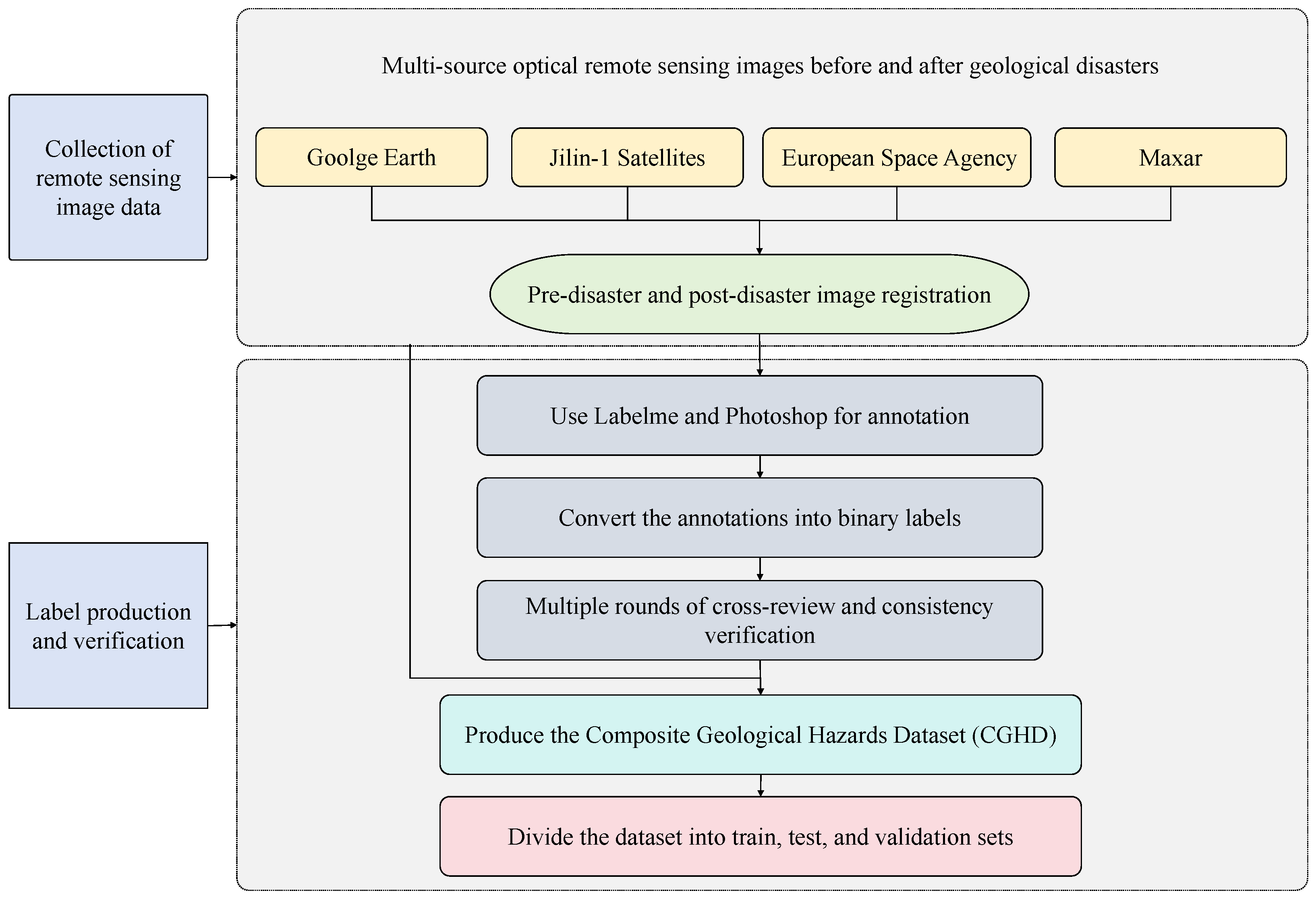
The construction of CGHD in our study involved two main stages: the collection of remote sensing imagery and the creation and verification of labels. In the first stage, we collected pre- and post-disaster remote sensing images of landslide and debris-flow events triggered by earthquakes or intense rainfall over the past eight years from four data platforms. In the second stage, we generated pixel-level label maps based on historical disaster records and expert interpretations and conducted multiple rounds of cross-checking to ensure consistency and accuracy. Figure 1 illustrates the complete workflow, from raw data acquisition to final label production.

2.1. Study Areas

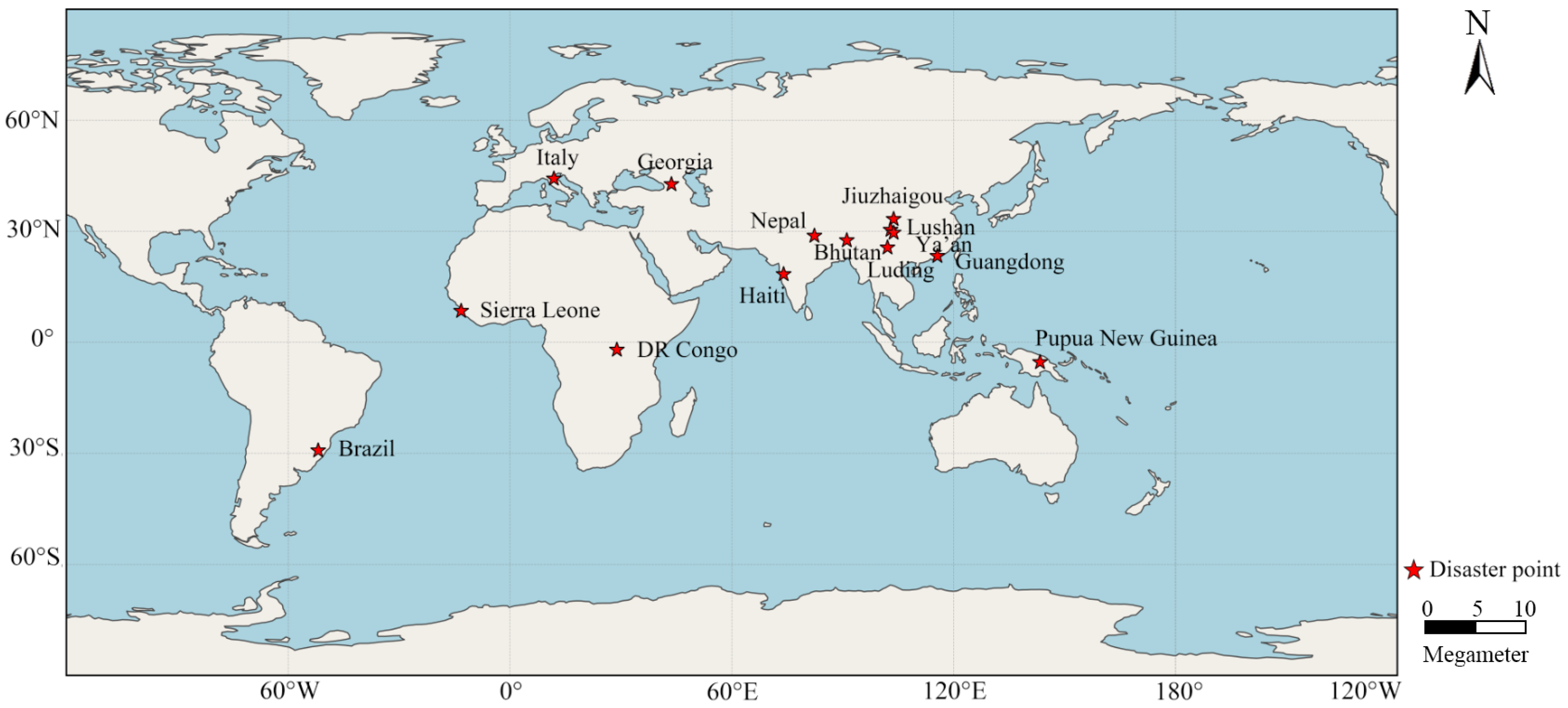
Based on a comprehensive survey and analysis, we selected 14 representative geological hazard events triggered by earthquakes or intense rainfall, covering six continents worldwide, including Asia, Europe, Africa, North America, South America, and Oceania, as shown in Figure 2. These disasters affect diverse landforms, including plateaus, mountains, hills, plains, and basins. Our work focuses on several representative regions, including the Qinghai-Tibet Plateau, Lianhua Mountains, Massif de la Hotte, Longmenshan Fault Zone, East African Rift Valley, Himalayas, and the Caucasus Mountains. The lithological conditions vary, ranging from dolomite, gabbro, and limestone to granite and shale. The climatic conditions are diverse and include tropical rainforests, tropical monsoons, subtropical humid, temperate continental, and alpine climates. Overall, the dataset exhibits high diversity in spatial distribution, geomorphic features, lithology, and climatic conditions, providing extensive data for geological hazard analyses. Detailed information on the geological hazard events in our dataset is provided in Table 1.
  • Jiuzhaigou
    On 8 August 2017, an Mw 6.5 earthquake struck Jiuzhaigou County, Sichuan Province, China, with an epicentre at 103.76°E and 33.28°N. The region exhibits an average elevation above 4 km, with predominant slope gradients of over 30° [21]. The earthquake triggered at least 4834 landslides, mainly small- to medium-scale rockfalls and debris avalanches, primarily occurring in regions underlain by Carboniferous limestone and dolomite. The total landslide-affected area was 9.64 km2, of which 189 individual landslides exceeded 0.01 km2 in area [22].
  • Sierra Leone
    On 14 August 2017, the capital city of Freetown, Sierra Leone, experienced large-scale flooding and debris flows following three consecutive days of heavy rainfall, with a total precipitation of 1040 mm. The disaster resulted in over 500 deaths, approximately 600 missing persons, and the destruction of hundreds of houses [23]. This mixed disaster primarily involved landslides, debris flows, and floods, resulting in widespread and severe damage. The local geology is dominated by weathered gabbro with low resistance to weathering, whereas the terrain is characterised by steep slopes and strong relief, which reduce slope stability and exacerbate the risk of slope failure [24].
  • Guangdong
    From 27 to 31 August 2018, the eastern region of Guangdong Province experienced continuous heavy rainfall that triggered widespread geological hazards, including landslides and debris flows. The affected areas are situated within the Lianhua Mountain Range, characterised predominantly by mountainous, hilly, and plain topography with pronounced elevation variations. During this heavy rainfall event, 1844 rainfall-induced landslides were recorded in Jiexi County, with a total affected area of approximately 3.39 km2. The largest single landslide measured 0.0223 km2, while the smallest measured 0.000417 km2 [25]. In Luhe County, 2241 landslide events were identified, with affected areas ranging from 0.000126 to 0.019761 km2, reflecting their widespread distribution and notable variations in scale [26].
  • Haiti
    On 14 August 2021, a magnitude 7.2 earthquake struck the Nippes region of Haiti with its epicentre at 18.36°N and 74.00°W. The earthquake, combined with Hurricane Grace two days later, triggered numerous geological hazards. The calamity claimed over 2500 lives, injured more than 10,000 people, and caused at least 8444 landslides with a total affected area of 45.6 km2 [27]. The landslides were mainly distributed near Pico Macaya National Park in Massif de la Hotte, and approximately 89.4% of them occurred at elevations above 1 km. Limestone outcrops constitute the primary landslide development zones [28,29].
  • Lushan
    On 1 June 2022, an Mw 5.8 earthquake struck Lushan County, Sichuan Province, China. The epicentre was located at 30.37°N, 102.94°E, with a focal depth of approximately 12.0 km. The earthquake occurred along the southern segment of the Longmenshan Fault Zone and caused at least 2352 landslides across an affected area of approximately 1470 km2. The total landslide area was 5.51 km2, with an average individual landslide size of approximately 0.0023 km2. The landslides were predominantly concentrated in areas with slopes ranging from 40° to 50° and elevations between 1.3 and 2.5 km [30]. The geology of the region is primarily composed of intrusive rocks, including granite, gabbro, and amphibolite [31].
  • Luding
    On 5 September 2022, an Mw 6.6 earthquake struck Luding County, Sichuan Province, China. The epicentre was located at 29.59°N, 102.08°E, with a focal depth of approximately 16.0 km [32]. The epicentral area lies within the Hengduan Mountains in the southeastern Qinghai-Tibet Plateau and features typical mountainous gorge topography [33]. The earthquake triggered 9142 landslides, covering an aggregate area of 49.51 km2 [34]. Landslides were mainly concentrated at elevations between 1 and 2.3 km and slopes ranging from 20° to 50°, with areas underlain by granite formations and dense forest cover being particularly susceptible to slope failure [35].
  • DR Congo
    From 2 to 5 May 2023, the Great Lakes region of Africa experienced intense rainfall, which triggered severe floods, landslides, and debris flows in the eastern Democratic Republic of Congo and western Rwanda [36]. The affected areas are located within the East African Rift Valley. This region is characterised by a predominantly mountainous terrain and frequent tectonic activity, which makes it highly susceptible to landslides and erosion [37,38]. In the Kalehe region of the DR Congo, 452 people were killed, 6206 went missing, and 200 were injured, with extensive destruction of infrastructure, including homes, schools, and medical facilities [39]. In Rwanda, 136 people died, 112 were injured, and 2713 houses were destroyed [40].
  • Italy
    From 1 to 17 May 2023, the Emilia-Romagna region of Italy experienced two successive episodes of heavy rainfall that triggered floods and 80,997 landslides. The disaster resulted in economic losses exceeding €9 billion and 17 fatalities [41]. The northeastern part consists of low plains where river levels are higher than the surrounding terrain, which makes it highly prone to flooding, while the southwestern part comprises the Apennine Hills with slopes ranging from 0° to 70°, where the complex topography significantly increases the likelihood of landslides [42]. The disaster affected a total landslide area of 83.33 km2, with the largest single landslide covering 0.5 km2 and an average landslide area of approximately 0.001039 km2 [43].
  • Bhutan
    On 20 July 2023, heavy rainfall struck Wangkar in Bhutan, triggering flash floods and mudslides that partially destroyed a small hydropower station. The disaster resulted in at least seven fatalities and 16 missing people [44]. Situated in the Himalayan region, Bhutan is one of the world’s most geologically fragile and meteorologically active zones, making it highly susceptible to diverse natural hazards [45]. The disaster occurred within an area characterised by exceptionally steep topography and pronounced erosion. In this area, two minor tributaries converge in the main river channel, forming a typical geological setting in which small-scale landslides accumulate and evolve into channel-type debris flows [46].
  • Georgia
    On 3 August 2023, a catastrophic debris flow occurred in the Shovi region of Georgia owing to the combined effects of heavy rainfall and glacial melt. This disaster resulted in 32 fatalities and the deposition of approximately 1 million m3 of sediment. Situated within the Caucasus Mountains, the geological structure of the region primarily comprises Jurassic–Lower Cretaceous shales, clay shales, sandstones, and limestone. In some areas, prolonged erosion has carved depths exceeding 1 km, with slopes generally ranging between 40° and 60° [47]. The high-altitude zones fall within the glacial belt, whereas the lower elevations exhibit alpine-subalpine landscapes. This region has historically experienced recurrent landslides and debris-flow disasters [48].
  • Brazil
    Between 23 April and 6 May 2024, the state of Rio Grande do Sul in Brazil experienced extremely heavy rainfall, with cumulative precipitation reaching 850 mm. This triggered 15,057 geological hazards, predominantly translational landslides and debris flows. The affected area spanned approximately 92 km2, with individual landslides averaging 0.0066 km2. The smallest recorded landslide covered 0.000075 km2, whereas the largest exceeded 0.1 km2. The disaster resulted in 183 fatalities, 27 missing persons, and the displacement of approximately 500,000 people. Landslides predominantly occur in mountainous terrain at elevations between 200 and 400 m, with slopes ranging from 30° to 35° facing north, northeast, or east. The geological substrate primarily consists of basalt and andesite formations [49].
  • Papua New Guinea
    On 24 May 2024, a village in Enga Province, Papua New Guinea, was affected by a large-scale landslide. Rainfall in the region during the first five months of 2024 reached its highest level within a decade, with landslides triggered by a combination of tectonic activity, heavy rainfall, and steep topography. The landslide deposit covers approximately 0.072 km2, with a total volume of approximately 500,000 m3. Papua New Guinea lies along the active boundary between the Australian and Pacific tectonic plates, with an average elevation exceeding 2 km. The landslide source area features a slope gradient of approximately 60°, a vertical drop of nearly 100 m, and geological formations dominated by low-strength, heavily weathered quartz sandstone and limestone. Since the beginning of the 21st century, nearly 50 landslide events have occurred in this region, approximately 90% of which were triggered by rainfall [50].
  • Ya’an
    On 20 July 2024, sudden flash floods and debris flows triggered by heavy rainfall in Hanyuan County, Ya’an City, Sichuan Province, disrupted local communications and infrastructure and caused 41 fatalities or missing persons [51]. Hanyuan County lies on the eastern margin of the northern section of the Hengduan Mountains and is characterised by a landscape dominated by low-to-medium mountains and river valleys [52]. The topography exhibits extreme elevation variation within the watershed, with the highest peak reaching 2.8 km above sea level and the lowest elevation at 1.6 m. Approximately 79% of the watershed’s slopes range between 30° and 50° [53]. Furthermore, the region exhibits fractured bedrock and active neotectonic movement. Geologically, the exposed strata include Permian basalts and limestones, with intense rock weathering alongside widespread Quaternary loose deposits, which further exacerbate disaster risks [54].
  • Nepal
    From 26 to 28 September 2024, central Nepal experienced prolonged heavy rainfall that triggered extensive landslides and debris flows. The disaster caused 250 fatalities, 18 missing persons, and economic losses exceeding US $341 million. The affected area lies within a mountainous basin at elevations ranging from 1.2 to 2.7 km, situated within the Lesser Himalayas. The region exhibits complex geological conditions, characterised predominantly by weathered rock masses and weak strata such as phyllite and slate, with a steep topography featuring slopes predominantly between 35° and 45° [55,56].
Among the 14 events, 10 were triggered by rainfall and 4 by earthquakes. This imbalance reflects the natural occurrence patterns of these hazards. In the study regions, rainfall-induced shallow landslides and debris flows occur more frequently than coseismic landslides. Although efforts were made to collect additional earthquake-triggered events, the observed imbalance is consistent with the inherent distribution of hazard occurrences in nature.

2.2. Data Collection

In our study, we integrated pre- and post-disaster images from the above-mentioned 14 study areas, obtained from Google Earth, Jilin-1 Satellites, European Space Agency, and Maxar. Multiple rounds of internal cross-validation were conducted to rigorously control data consistency, usability, and annotation accuracy, which ensures the reliability and suitability of the dataset for high-resolution geohazard analysis. Detailed image information, including locations, data sources, spatial resolutions, acquisition dates, and research areas, is provided in Table 2. The collected image data comprised 260 pairs of dual-temporal images, with individual image dimensions ranging from 2112 × 1406 to 37,691 × 37,010 pixels, an average pixel size of 12,858 × 11,724. The spatial resolutions varying between 0.3 m and 10 m. The image acquisition spanned multiple pre- and post-disaster time points and covers a total area of approximately 15,092.79 km2, with the affected area accounting for about 73.51 km2. The collected images exhibited both rich spatiotemporal diversity and extensive geographic coverage, which allowed fine-scale feature extraction at local scales while supporting comprehensive analyses over large-scale regions, thus fulfilling the demands of scientific research work.
As shown in Table 2, in some cases (e.g., Jiuzhaigou), the temporal interval between pre- and post-event images reaches 1–2 years. Such relatively long intervals may introduce uncertainties in change detection. This limitation is primarily due to the difficulty of acquiring high-quality, cloud-free optical imagery, as natural disasters are often accompanied by extreme weather conditions (e.g., heavy rainfall and persistent cloud cover). In addition, platforms such as Google Earth integrate imagery from multiple satellite sources and provide selectively processed observations, which may further constrain the temporal proximity between available images and the actual event time. Despite these constraints, we have made every effort to select imagery as close as possible to the event occurrence. From another perspective, the presence of such temporal gaps reflects the practical challenges commonly encountered in real-world applications, and highlights the necessity for developing change detection models that are robust to temporal inconsistencies.

2.3. Datase Preprocessing

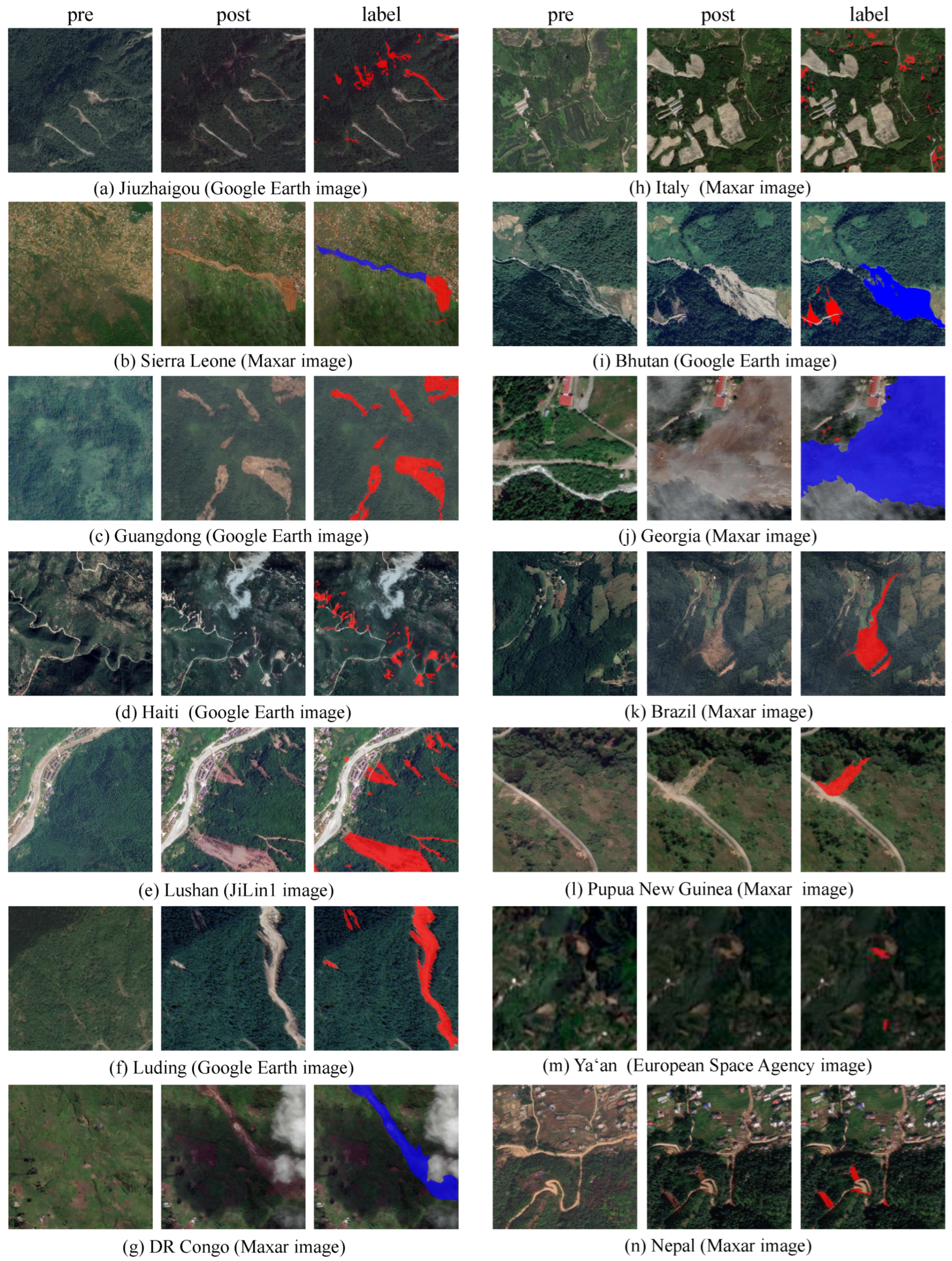
In this study, we first performed a dual-temporal registration of pre- and post-disaster remote sensing images using ENVI 5.6 software and the OpenCV 4.10.0 library to ensure spatial consistency. For pre- and post-event images with different spatial resolutions within the same hazard event, the images are resampled to a unified resolution during the co-registration process to achieve pixel-level spatial alignment. Subsequently, the affected areas were annotated with polygons using the LabelMe 5.6 tool and Adobe Photoshop 25.0.0. The labelling process relied on a comparison of morphological changes between co-registered pre- and post-disaster images, with a focus on identifying variations in surface texture, color, and geomorphological characteristics associated with landslides and debris flows before and after the events. The labeling process follows established practices in landslide and debris flow mapping [57,58]. Figure 3 presents representative examples of polygon annotations and illustrates that the use of dual-temporal imagery effectively distinguishes inherent landforms from actual hazard zones, thereby improving the accuracy of geological hazard identification and interpretation, particularly enabling a more precise annotation of bare land (Figure 3a,f,i) or cultivated fields (Figure 3h,k) that are difficult to differentiate in single-temporal images.
After completing the polygon annotations, all results were converted into semantic-level label maps. Specifically, polygons were drawn onto binary masks using NumPy and OpenCV in Python and saved as PNG images using the Pillow library, where a pixel value of 255 indicated the foreground (disaster-affected areas) and that of 0 indicated the background (non-affected areas). In particular, our project team had an expert team dedicated to ensuring the scientific and accurate nature of the labels. The expert team comprised five domain experts: two professors with more than 12 years of experience in disaster monitoring and assessment, two senior researchers with more than 10 years of research experience, and one technical expert with extensive experience in dataset construction and evaluation.
We conducted a year-long collaborative effort to interpret and semantically annotate pre- and post-disaster remote sensing images with careful attention to content, quality, and research relevance. Pixel-level reviews and successive rounds of refinement removed obvious sources of interference and produced the high-precision CGHD, which contains 3963 non-overlapping subsamples of 1024 × 1024 pixels. Among these subsamples, 1800 pairs contained disaster-stricken areas of varying sizes. The smallest affected area contains only 5 pixels at a spatial resolution of 10 m, while the largest affected area contains 1,039,461 pixels at a spatial resolution of 0.3 m. In total, approximately 1.31 × 108 pixels are annotated as affected regions.
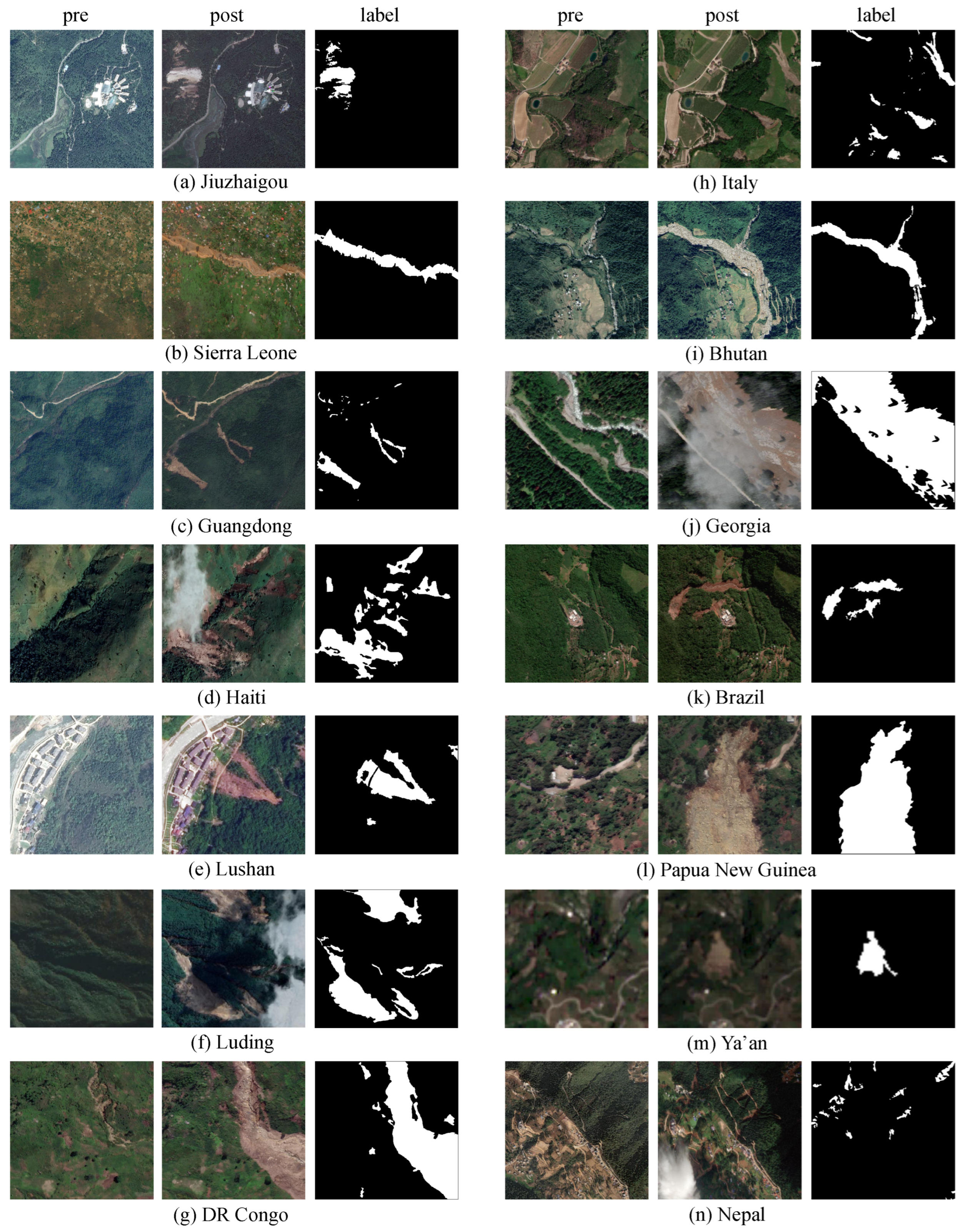
CGHD enhances the robustness and generalisation of geological hazard recognition tasks by incorporating a set of representative negative samples, including clouds, roads, rivers, buildings, cultivated land, and shadows, which can easily be confused with geological hazards in remote sensing analyses. Figure 4 presents the respective image sample of each event in CGHD and shows that the dataset effectively mitigates interference from clouds (Figure 4d,f,j,n), various types of roads (Figure 4a,c,e,h,j,m,n), rivers (Figure 4e), buildings (Figure 4a,b,e,i,k,l,n), cultivated land (Figure 4h,i), and shadows (Figure 4d,f), thereby improving recognition accuracy in complex scenarios.

2.4. Dataset Sample Richness

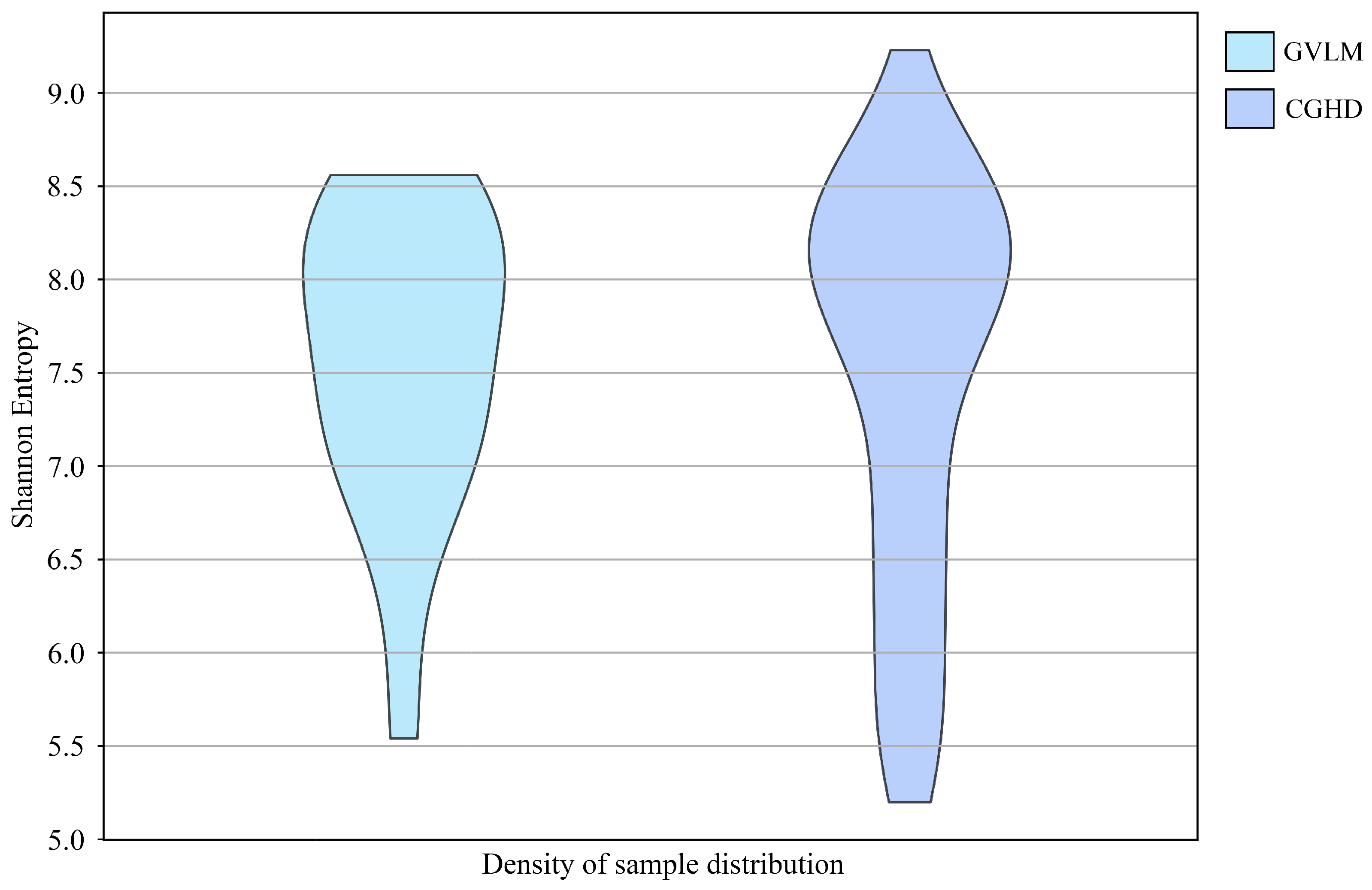
We quantitatively assessed the information richness and complexity of CGHD by employing the Shannon entropy [59] as a metric and compared it with the representative GVLM dataset, which is widely regarded as a high-quality dataset in the field of landslide identification [60]. Shannon entropy captures the uncertainty in pixel intensity or colour distribution, effectively reflecting image complexity and diversity. In our study, the Shannon entropy was calculated jointly across the RGB channels to fully capture the information distribution of the colour images. The computation was defined as follows:
H ( R , G , B ) = r , g , b p ( r , g , b ) log 2 p ( r , g , b )
Here, p(r,g,b) denotes the joint probability distribution of the pixels with values (r,g,b). Higher entropy indicates that the image contains more information and exhibits greater texture complexity, whereas lower entropy corresponds to simpler textures and less information. Therefore, a wider entropy range indicates that the dataset covers a broader spectrum of scene complexities and reflects higher diversity and representativeness. As shown in Figure 5, CGHD outperformed the GVLM dataset in both the Shannon entropy range (vertical) and the density of the sample distribution (horizontal) dimensions. Specifically, CGHD exhibited a wider range of Shannon entropy values, implying that it included both low- and high-complexity samples with diverse textures. Moreover, most samples in CGHD were concentrated in regions with higher entropy, indicating that a larger portion of the data originated from areas with complex surface features, which better reflects the characteristics of real-world geological disaster scenarios. Generally, CGHD exhibits a more balanced distribution in terms of information richness and complexity. This feature corresponds more accurately to the authentic characteristics of image information in real-world scenarios, consequently delivering enhanced comprehensiveness and representativeness in the data support for model training.

3. Dataset Validation Methods

To verify the accuracy and scientific validity of the CGHD annotations, we employed change-detection methods. Change detection is a technique that identifies changes in land features by comparing remote sensing images of the same area at different times. The accuracy and labelling quality of the dataset are objectively verified through the overlap analysis between the detection results of advanced methods and the annotated ground truth. When the overlap degree between the detection results and the labelled area is relatively high, it indicates that the annotations effectively reflect the actual surface changes caused by geological hazards, thereby confirming their accuracy and scientific reliability. Therefore, we selected nine representative dual-temporal remote sensing image data change-detection algorithms to evaluate the precision and reliability of the CGHD annotations.
We further assessed the cross-scenario generalisation capability of CGHD by employing a high-quality publicly available GVLM dataset as an independent test dataset. Samples corresponding to the same geohazard events with spatiotemporal overlap between the CGHD and GVLM were removed to ensure complete independence between training and testing. The performance of the models trained on CGHD was then evaluated using GVLM to validate the generalisation capacity of CGHD.

3.1. Change-Detection Algorithms

We selected nine representative change-detection algorithms for remote sensing images that encompass different structural paradigms, including classical convolution-based models, attention-enhanced convolutional models, and transformer architectures. Specifically, FC-Siam-conc represents a typical convolutional neural network approach; DTCDSCN, SNUNet-CD, DMINet, LRBNet, and SEIFNet incorporate attention mechanisms to enhance convolutional feature extraction; BIT and ChangeFormer are purely transformer architectures; and MDA-CD integrates the advantages of both convolution and transformers, forming a hybrid structure.
  • FC-Siam-conc [61]. FC-Siam-conc introduced a fully convolutional Siamese architecture for change-detection tasks. During the decoding phase, the skip connection mechanism from UNet is incorporated, directly concatenating features from the corresponding layers of the two encoding streams to fuse spatial details with abstract representations from dual-temporal images. Compared with earlier methods, FC-Siam-conc exhibits superior performance in change detection, which has led to its widespread adoption and subsequent refinement. Consequently, it has become a widely recognised baseline model in the field of change detection.
  • DTCDSCN [62]. DTCDSCN aims to address the problems of incomplete change extraction and blurred boundaries in building change detection from remote sensing imagery caused by insufficient feature discriminability. Based on a Siamese convolutional network architecture, the DTCDSCN adopts dual-task joint optimisation, where building change detection serves as the main task and dual-temporal semantic segmentation serves as the auxiliary task, a dual attention module (DAM), and an improved change detection loss (CDL). These designs enable precise change-region extraction and object segmentation in high-resolution building change-detection tasks.
  • SNUNet-CD [63]. SNUNet-CD addresses the problems of spatial localisation loss in deep networks, boundary pixel uncertainty, and the omission of small objects in very high-resolution (VHR) remote sensing change detection. This method employs a densely connected Siamese network that constructs dense skip connections within encoder–decoder modules and integrates an ensemble channel attention module (ECAM) to solve these problems. SNUNet-CD effectively improves metrics such as the F1 score, balances accuracy and computational efficiency, and enhances small-object detection accuracy in multiclass remote sensing change-detection tasks.
  • BIT [64]. The BIT was proposed to overcome the limitations of convolution-based methods in long-range spatiotemporal dependencies and the inefficiency of nonlocal self-attention mechanisms in high-resolution optical change detection. This method converts dual-temporal image features into a compact set of semantic tokens using a semantic tokenizer, models the token-level spatiotemporal context using a transformer encoder, and refines pixel-level representations using a transformer decoder. The experimental results demonstrate that BIT significantly outperforms convolutional baselines on multiclass high-resolution remote sensing datasets, achieving comparable or superior accuracy with a three-fold lower computational cost and parameter count.
  • ChangeFormer [65]. ChangeFormer was designed to address the inability of convolution-based remote sensing change-detection methods to effectively capture long-range spatiotemporal dependencies. It builds on a Siamese architecture and incorporates a hierarchical transformer encoder, four multiscale feature-difference modules, and a lightweight MLP decoder. The experimental results show that it captures finer details of changes across diverse land-cover types in remote sensing imagery.
  • DMINet [66]. DMINet aims to mitigate the challenges of class imbalance between the foreground and background, limited training samples, and seasonal variations in remote sensing change detection. The network integrates a cross-temporal joint-attention (JointAtt) module that integrates self-attention (SelfAtt) and cross-attention (CrossAtt), a dual-branch difference acquisition structure that combines pixel-level subtraction and channel-level concatenation, and utilises a multilevel difference aggregation mechanism based on the Hadamard product. DMINet achieved superior performance in limited-sample scenarios and maintained a low computational overhead.
  • LRBNet [67]. The LRBNet was proposed to reduce the parameter count and computational complexity of post-disaster building change detection. Based on the Siamese UNet++ architecture, a lightweight residual block (LRB) integrates a lightweight compression module (LCM) and efficient channel attention (ECA) and introduces a multilevel damage feature aggregation attention module (MDAAM). In dual-temporal high-resolution remote sensing imagery before and after disasters, LRBNet achieves high detection accuracy while substantially reducing the computational cost.
  • SEIFNet [68]. SEIFNet addresses the issues of false changes and scale variations in remote sensing change detection. It employs a Siamese ResNet18 backbone and integrates a spatiotemporal difference enhancement module (ST-DEM), an adaptive context fusion module (ACFM), and refinement modules. SEIFNet effectively reduces false changes and accurately identifies scale-varying targets in change-detection tasks involving diverse land-cover types in remote sensing imagery.
  • MDA-CD [69]. MDA-CD aims to address the challenge of fine-grained feature extraction in building damage assessments under multihazard scenarios. It adopts an encoder-bridge-decoder architecture and integrates global feature aggregation (GFA), dual-temporal image transformer compression (BITC), and subtle feature attention (SFA) modules. MDA-CD improves the accuracy of building damage level classification, particularly for the identification of slightly damaged structures.
The aforementioned methods demonstrate outstanding performance in the field of remote sensing image change detection, with diverse network structures and feature extraction mechanisms that are capable of effectively capturing complex multiscale, local, and global change patterns in geohazard detection tasks. Hence, these methods are suitable for systematic validation and performance evaluation of novel datasets.

3.2. Loss Functions and Accuracy Evaluation

We selected a combination of Binary Cross-Entropy (BCE) loss and Dice loss to evaluate the accuracy of the dataset in addressing the class imbalance problem in disaster-affected area localisation. The BCE loss measures the difference between the predicted probabilities and true labels to ensure overall classification accuracy, whereas the Dice loss calculates the overlap between the predicted regions and ground truth to mitigate class imbalance and enhance the focus of the model on positive samples, such as disaster-affected areas. This combined loss maintains the global classification stability to improve the sensitivity of the model for small target regions and accurately reflects the authenticity and reliability of the dataset annotations. The composite loss formulation based on the BCE and Dice losses is as follows:
L ( y , y ^ ) = λ L BCE ( y , y ^ ) + ( 1 λ ) L Dice ( y , y ^ )
L BCE ( y , y ^ ) = y log ( y ^ ) + ( 1 y ) log ( 1 y ^ )
L Dice ( y , y ^ ) = 1 2 y y ^ + 1 y + y ^ + 1
here, L denotes the overall loss function, y represents the true label of the sample, y ^ signifies the predicted probability for the sample, and λ is a parameter used to balance the weights of L BCE and L Dice . Following the optimal parameter configuration validated by Huang et al. [68] across multiple public datasets, this study set λ = 0.75 to effectively combine the advantages of both loss functions. In this study, we employed four representative evaluation metrics, namely precision, recall, F 1 score, and mean intersection over union (mIoU), to evaluate the performance of the dataset. The respective formulae are as follows:
Precision = T P T P + F P
Recall = T P T P + F N
F 1 = 2 × Precision × Recall Precision + Recall
mIoU = 1 N i = 1 N T P i T P i + F P i + F N i
where T P denotes true positives, F P denotes false positives, T N denotes true negatives, F N denotes false negatives, i indicates the class index, and N represents the total number of classes used for the evaluation.

3.3. Equipment and Parameters

The experiments were conducted on a workstation equipped with an Intel® Xeon® Gold 6230R CPU @ 2.10 GHz and 500 GB of system memory. The GPU acceleration was provided by an NVIDIA GeForce RTX 3090 with 24 GB of VRAM. The operating system was Ubuntu 20.04.6 LTS. The deep-learning framework employed was PyTorch 1.11.0, running on Python 3.7.0, CUDA 11.3, and cuDNN 8.2.0. For model optimisation, the AdamW optimiser [70] was used with an initial learning rate of 0.0001, momentum of 0.9, weight decay of 0.01, and batch size of 8. Subsequently, the models were trained for 100 epochs.

4. Dataset Validation Results

The CGHD was evaluated through two groups of comparative experiments designed to assess its accuracy and generalizability. The first set of comparative experiments was conducted to verify the accuracy of the dataset. In this experiment, the dataset was split into 52,203 pairs of 256 × 256 pixel images. These pairs were then split into training, validation, and test sets at a ratio of 8:1:1, resulting in 41,762 training pairs, 5220 validation pairs, and 5221 test pairs. Nine state-of-the-art change-detection algorithms were employed to evaluate CGHD, and the experimental results are listed in Table 3.
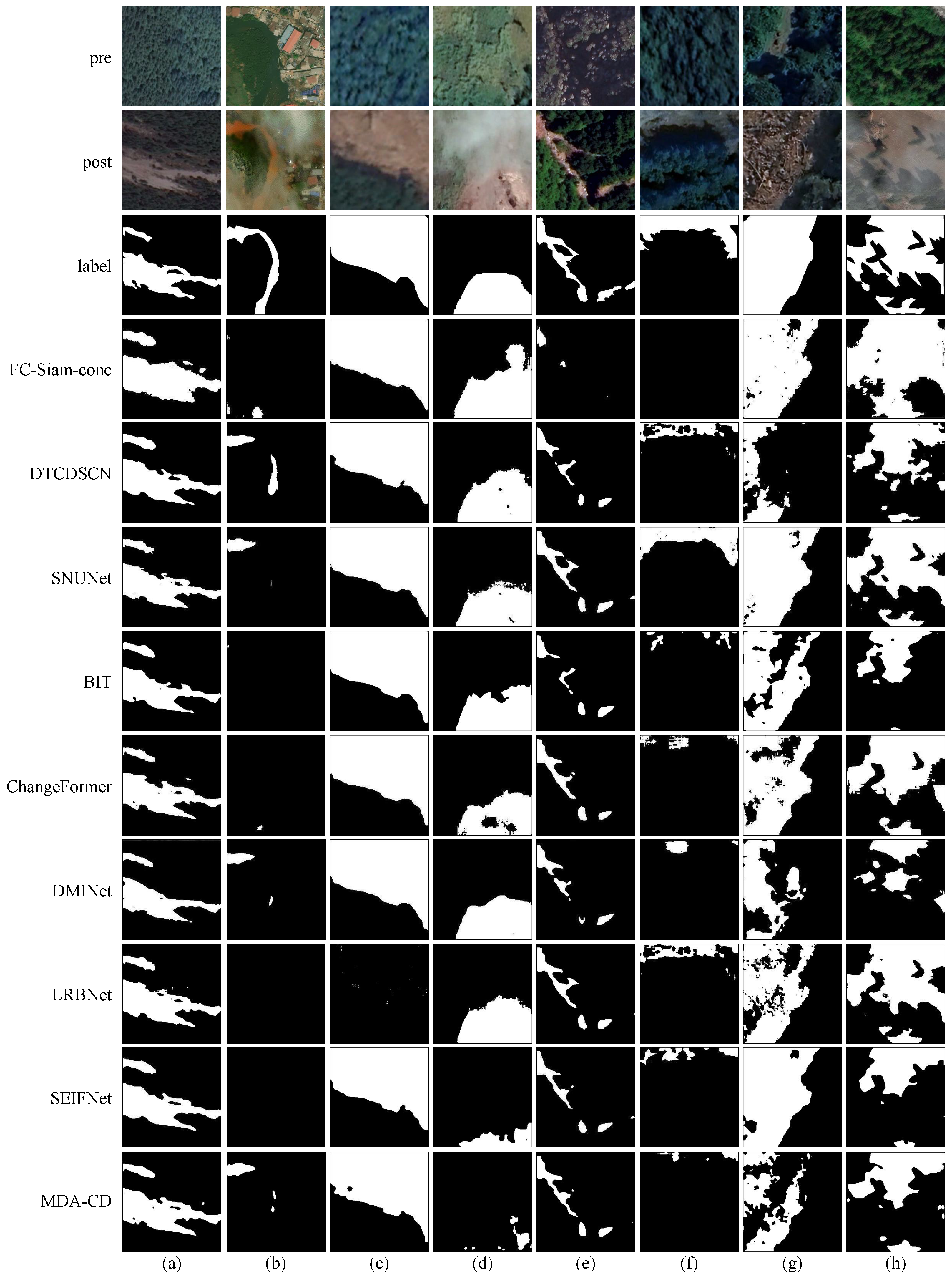
As shown in Table 3, the mIoU values ranged from 75.195% to 85.097%, and the F 1 scores on CGHD ranged from 68.781% to 83.393%, and for most models, precision is higher than recall. This indicates that the models tend to focus on regions with significant feature changes while avoiding false positives. This phenomenon indirectly reflects the high quality and fine granularity of the CGHD annotations: due to the presence of numerous small-scale, finely labeled change regions, models aiming for high precision inevitably suffer from relatively higher omission rates. Taking BIT in Table 3 as an example, its recall is relatively low, while its visual results are clean and well-structured, confirming that BIT prioritizes precision and produces almost no false positives, despite missing some subtle changes. Specifically, MDA-CD obtained the best results with a precision of 86.632%, recall of 80.360%, F 1 score of 83.393%, and mIoU of 84.818%, whereas FC-Siam-conc achieved the lowest performance with an F 1 score of 68.781% and an mIoU of 75.195%. Figure 6 provides a visualisation of the model performance for CGHD. The results indicate that in most scenarios (Figure 6a,c,e), the models produced relatively accurate predictions, whereas in complex cases with cloud cover or shadow interference (Figure 6b,d,f–h), the prediction consistency decreased. Overall, these findings confirm that CGHD demonstrates high reliability and annotation quality across diverse terrains and interference conditions, establishing it as a robust benchmark for evaluating change-detection algorithms.
The second group of comparative experiments was conducted to evaluate the generalisation capability of CGHD. The publicly available GVLM dataset was used as an independent test set to validate the models trained in the first experiment. Potential interference from overlapping data was minimised by excluding the Jiuzhaigou earthquake-induced landslide event, which shared the same source and acquisition time in both the GVLM and CGHD datasets. The remaining GVLM scenes were tiled into 6978 non-overlapping 256 × 256 image pairs and directly processed by nine models previously trained on CGHD. This evaluation protocol effectively separated the influence of model selection from the intrinsic generalisation capability of CGHD. The experimental results of the assessment of the unseen dataset are presented in Table 4.
As shown in Table 4, the models trained on CGHD achieved satisfactory detection performance on the unseen dataset. Specifically, the mIoU values ranged from 69.291% to 80.365%, and the F 1 scores ranged from 61.444% to 77.975%. Among the tested models, MDA-CD exhibited the strongest performance on the unseen dataset, achieving a precision of 81.187%, a recall of 74.989%, and F 1 and mIoU scores of 77.975% and 80.365%, respectively. Compared to the results obtained on the CGHD test set, the performance degradation was minimal, indicating that the models trained on CGHD maintained high recognition accuracy on unseen data. These results verify the effectiveness of CGHD in enhancing model generalisation and evaluating cross-regional adaptability.
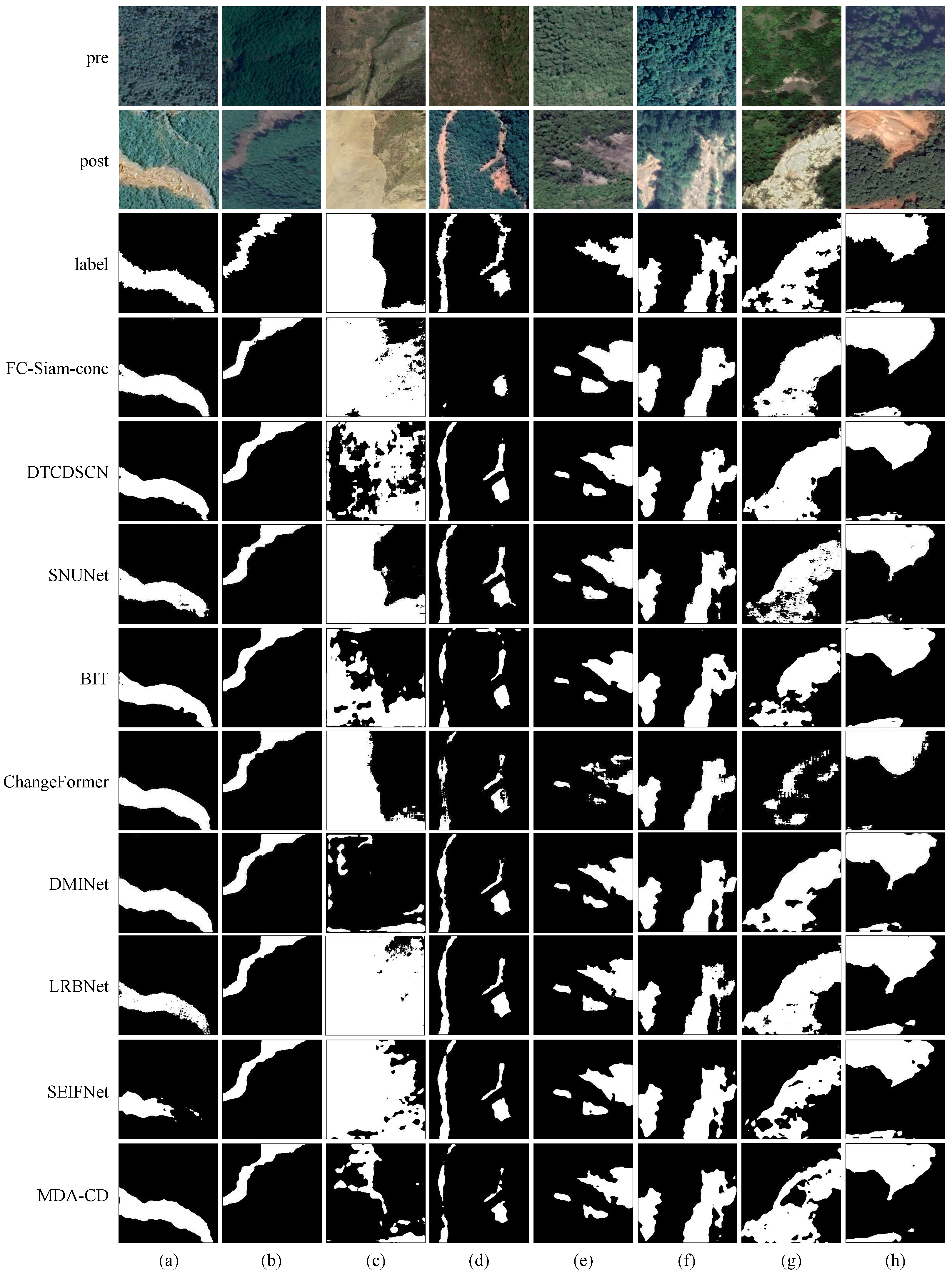
As illustrated in Figure 7, most models accurately identified disaster-affected areas in most scenes (Figure 7a,b,d–h). However, when the affected and unaffected regions shared similar colour and texture characteristics (Figure 7c), the detection performance decreased.
These results indicate that models trained on CGHD exhibited strong generalisation to unseen datasets, further confirming the utility of CGHD for evaluating model adaptability. As shown in Table 4, most models achieve higher recall than precision, indicating a tendency to favor detecting all potential hazard areas at the expense of increased false positives, which aligns with practical requirements where missing any suspicious hazard is undesirable. For example, the LRBNet model achieves relatively high recall on unseen datasets, but its visual results (as shown in Figure 7) contain more false alarms, further illustrating this trade-off. In addition, as illustrated in Figure 7e, all nine models successfully detect small-scale landslide regions that are not annotated in the ground truth, which indirectly suggests the high completeness and reliability of the dataset annotations.
A comparative analysis of Table 3 and Table 4 and Figure 6 and Figure 7 reveals that while CNN-based methods (e.g., SNUNet) excel in-domain, they suffer from fragmented detections on unseen data. Conversely, transformer-based methods (e.g., BIT) and hybrid models (e.g., MDA-CD) provide better generalization and cleaner outputs. These findings provide valuable references for the research of universal change detection models, especially in addressing the complex scenarios of mixed landslide and debris flow disasters, helping researchers to make informed method choices. Meanwhile, the large-scale, multi-scale, multi-resolution geological hazard dataset constructed in this paper provides strong support for improving the model’s generalization ability across different disaster types and change scales, thus advancing further development in the field of change detection.

5. Future Research Directions

Considering the differences in disaster characteristics across various surface types, future work will focus on collecting additional samples that exhibit subtle pre- and post-disaster changes in remote sensing imagery (e.g., landslides in the Loess Plateau region). Moreover, we aim to further enhance the capability of the model to identify weak-change scenarios and improve the diversity and applicability of the dataset. Future studies should consider the long duration and complex evolutionary stages of rainfall-induced landslides and construct multitemporal pre-, during-, and post-disaster image data to explore change-detection methods suitable for different temporal scales.
It should be noted that the dataset constructed in this paper is based solely on optical sensors, which makes it difficult to capture surface deformation processes and movement rates. To further enhance the application range of the model, we will continuously monitor disaster events and expand the dataset, especially by collecting more samples under different surface types and disaster characteristics, in order to improve the model’s ability to identify subtle changes and complex disaster scenarios.
In addition, to enable the precise identification and assessment of geological hazard-affected areas, a specialised disaster-zone detection model is under development. The research and application of this model aim to establish a practical framework for integrating artificial intelligence into geological hazard detection, thereby promoting technological innovation and facilitating industrial applications in this domain.

6. Conclusions

A generalised and practically oriented dual-temporal dataset plays a crucial role in applications such as disaster situation analyses. Landslides and debris flows frequently occur in a coupled manner within disaster chains and exhibit similar visual characteristics in optical imagery. Hence, we constructed the Composite Geological Hazards Dataset (CGHD), which primarily covered landslides and debris flows triggered by earthquakes and heavy rainfall. The dataset spans 14 disaster events across six continents, integrates imagery from four remote sensing platforms, and includes diverse landforms and lithological structures, with a total study area of approximately 15,092.79 km2. It provides 3963 pairs of multiresolution pre- and post-disaster images with a spatial size of 1024 × 1024 pixels, effectively addressing the scarcity of high-resolution paired satellite images. Furthermore, we conducted a systematic evaluation of the reliability and accuracy of the dataset using nine change-detection algorithms and further tested nine models trained on CGHD against an unseen dataset to validate their generalisation capability and robustness across diverse geographic environments. The experimental results demonstrate that CGHD exhibits a high recognition accuracy and good generalisation ability. Therefore, CGHD not only provides a solid data foundation for geological hazard research but also offers important support for advancing intelligent disaster monitoring and prevention.

Author Contributions

Conceptualization, Y.W. and G.Y.; data curation, Y.W., W.L., R.L., M.H. and S.L.; formal analysis, G.Y.; funding acquisition, Y.W., G.Y. and X.G.; investigation, Y.W. and G.Y.; methodology, Y.W. and G.Y.; project administration, G.Y.; resources, G.Y.; software, Y.W. and G.Y.; supervision, G.Y.; validation, Y.W., W.L., R.L., M.H. and S.L.; visualization, Y.W.; writing—original draft preparation, Y.W. and G.Y.; writing—review and editing, Y.W., G.Y., X.G., W.L., R.L., M.H. and S.L. All authors have read and agreed to the published version of the manuscript.

Funding

The research is supported by the Spark Program of Earthquake Sciences (grant no. XH25058YA), the Science and Technology Innovation Program for Postgraduate students in IDP subsidized by Fundamental Research Funds for the Central Universities (grant no. ZY20260327), the Hebei Natural Science Foundation (grant no. D2024512010), and the Science and Technology Innovation Program for Postgraduate students in IDP subsidized by Fundamental Research Funds for the Central Universities (grant no. ZY20260322).

Data Availability Statement

The CGHD data are freely available at https://doi.org/10.6084/m9.figshare.30343573 [71] (last accessed on 12 November 2025). The repository contains three compressed packages corresponding to the pre-event images, post-event images, and the corresponding binary label maps, all with a size of 1024 × 1024 pixels. The main sources of imagery in the CGHD dataset and their access methods are as follows: 1. European Space Agency Imagery. https://browser.dataspace.copernicus.eu/, last accessed: 20 October 2025. 2. Google Earth Imagery. Obtained using Google Earth Pro, https://www.google.com/, last accessed: 20 October 2025. 3. Jilin-1 Satellite Imagery. https://www.jl1mall.com/, last accessed: 20 October 2025. 4. Maxar Satellite Imagery. https://www.maxar.com/open-data, last accessed: 20 October 2025.

Acknowledgments

The authors would like to thank the organisations that provided the remote sensing data used in this study, including Google Earth, Jilin-1, the European Space Agency, and Maxar, which made it possible to construct the Composite Geological Hazards Dataset. We also acknowledge the authors of the referenced algorithms for making their methods publicly available, which greatly facilitated the implementation and comparison of the change-detection experiments.

Conflicts of Interest

The authors declare no conflicts of interest.

References

  1. Liu, C. Research on regional landslide and debris flow disaster early warning theories and methods. Hydrogeol. Eng. Geol. 2004, 3, 1–6. [Google Scholar]
  2. Li, Z. Study on the Initiation Mechanisms and Hazard Assessment of Debris Flows in Earthquake-Affected Areas. Master’s Thesis, Chengdu University of Technology, Chengdu, China, 2011. [Google Scholar]
  3. Yan, G. Hazards and prevention of rockfalls, landslides, and debris flows in Jiangxi Province. Bull. Soil Water Conserv. 1985, 4, 38–42. [Google Scholar]
  4. Chi, K.-H.; Park, N.-W.; Lee, K. Identification of landslide area using remote sensing data and quantitative assessment of landslide hazard. In Proceedings of the IEEE International Geoscience and Remote Sensing Symposium (IGARSS 2002), Toronto, ON, Canada, 24–28 June 2002; Volume 5, pp. 2856–2858. [Google Scholar]
  5. Brardinoni, F.; Slaymaker, O.; Hassan, M.A. Landslide inventory in a rugged forested watershed: A comparison between air-photo and field survey data. Geomorphology 2003, 54, 179–196. [Google Scholar] [CrossRef]
  6. Zhong, C.; Liu, Y.; Gao, P.; Chen, W.; Li, H.; Hou, Y.; Nuremanguli, T.; Ma, H. Landslide mapping with remote sensing: Challenges and opportunities. Int. J. Remote Sens. 2020, 41, 1555–1581. [Google Scholar] [CrossRef]
  7. Cigna, F.; Del Ventisette, C.; Liguori, V.; Casagli, N. Advanced radar-interpretation of InSAR time series for mapping and characterization of geological processes. Nat. Hazards Earth Syst. Sci. 2011, 11, 865–881. [Google Scholar] [CrossRef]
  8. Sato, H.P.; Harp, E.L. Interpretation of earthquake-induced landslides triggered by the 12 May 2008, M7.9 Wenchuan earthquake in the Beichuan area, Sichuan Province, China using satellite imagery and Google Earth. Landslides 2009, 6, 153–159. [Google Scholar] [CrossRef]
  9. Martha, T.R.; Govindharaj, K.B.; Kumar, K.V. Damage and geological assessment of the 18 September 2011 Mw 6.9 earthquake in Sikkim, India using very high resolution satellite data. Geosci. Front. 2015, 6, 793–805. [Google Scholar] [CrossRef]
  10. Pham, M.V.; Kim, Y.T. Debris flow detection and velocity estimation using deep convolutional neural network and image processing. Landslides 2022, 19, 2473–2488. [Google Scholar] [CrossRef]
  11. Yuan, R.; Luo, Y.; Xu, F.; Wang, X.; Liu, C.; Wang, B. Mudslide susceptibility assessment based on a two-channel residual network. Geomat. Nat. Hazards Risk 2024, 15, 2300804. [Google Scholar] [CrossRef]
  12. Ma, S.; Wu, J.; Zhang, Z.; Tong, Y. Application of enhanced YOLOX for debris flow detection in remote sensing images. Appl. Sci. 2024, 14, 2158. [Google Scholar] [CrossRef]
  13. Ji, S.; Yu, Y.; Ma, Y.; Xu, Q. Landslide detection from an open satellite imagery and digital elevation model dataset using attention boosted convolutional neural networks. Landslides 2020, 17, 1337–1352. [Google Scholar] [CrossRef]
  14. Ghorbanzadeh, O.; Xu, Y.; Zhao, H.; Wang, J.; Zhong, Y.; Zhao, D.; Ghamisi, P. The outcome of the 2022 landslide4sense competition: Advanced landslide detection from multisource satellite imagery. IEEE J. Sel. Top. Appl. Earth Obs. Remote Sens. 2022, 15, 9927–9942. [Google Scholar] [CrossRef]
  15. Meena, S.R.; Nava, L.; Bhuyan, K.; Puliero, S.; Soares, L.P.; Dias, H.C.; Floris, M.; Catani, F. HR-GLDD: A globally distributed dataset using generalized deep learning (DL) for rapid landslide mapping on high-resolution (HR) satellite imagery. Earth Syst. Sci. Data 2023, 15, 3283–3298. [Google Scholar] [CrossRef]
  16. Xu, Y.; Xu, Y.; Ouyang, C.; Xu, Q.; Wang, D.; Zhao, B.; Luo, Y. Cas landslide dataset: A large-scale and multisensor dataset for deep learning-based landslide detection. Sci. Data 2024, 11, 12. [Google Scholar] [CrossRef]
  17. Fang, C.; Fan, X.; Wang, X.; Nava, L.; Zhong, H.; Dong, X.; Qi, J.; Catani, F. A globally distributed dataset of coseismic landslide mapping via multi-source high-resolution remote sensing images. Earth Syst. Sci. Data 2024, 16, 4817–4842. [Google Scholar] [CrossRef]
  18. Liu, G.; Wang, Y.; Chen, X.; Du, B.; Li, P.; Wu, Y.; Fang, Z. LMHLD: A large-scale multi-source high-resolution landslide dataset for landslide detection based on deep learning. arXiv 2025, arXiv:2502.19866. [Google Scholar]
  19. Zhang, X.; Yu, W.; Pun, M.O.; Shi, W. Cross-domain landslide mapping from large-scale remote sensing images using prototype-guided domain-aware progressive representation learning. ISPRS J. Photogramm. Remote Sens. 2023, 197, 1–17. [Google Scholar] [CrossRef]
  20. Hungr, O.; Leroueil, S.; Picarelli, L. The Varnes classification of landslide types, an update. Landslides 2014, 11, 167–194. [Google Scholar] [CrossRef]
  21. Fan, X.; Scaringi, G.; Xu, Q.; Zhan, W.; Dai, L.; Li, Y.; Pei, X.; Yang, Q.; Huang, R. Coseismic landslides triggered by the 8 August 2017 Ms 7.0 Jiuzhaigou earthquake (Sichuan, China): Factors controlling their spatial distribution and implications for the seismogenic blind fault identification. Landslides 2018, 15, 967–983. [Google Scholar] [CrossRef]
  22. Tian, Y.; Xu, C.; Ma, S.; Xu, X.; Wang, S.; Zhang, H. Inventory and spatial distribution of landslides triggered by the 8th August 2017 Mw 6.5 Jiuzhaigou earthquake, China. J. Earth Sci. 2019, 30, 206–217. [Google Scholar] [CrossRef]
  23. Cui, Y.; Cheng, D.; Choi, C.E.; Jin, W.; Lei, Y.; Kargel, J.S. The cost of rapid and haphazard urbanization: Lessons learned from the Freetown landslide disaster. Landslides 2019, 16, 1167–1176. [Google Scholar] [CrossRef]
  24. Usamah, M. Analysis of Causal and Trigger Factors of the August 2017 Landslide in Freetown, Sierra Leone: Towards a Sustainable Landslide Risk Management in Sierra Leone; Technical Publication; UNDP Sierra Leone and Environmental Protection Agency: Freetown, Sierra Leone, 2017. Available online: https://epa.gov.sl/wp-content/uploads/2021/12/UNDP-landslide-risk-assessment-report.pdf (accessed on 21 October 2025).
  25. Xie, C.; Huang, Y.; Li, L.; Li, T.; Xu, C. Detailed inventory and spatial distribution analysis of rainfall-induced landslides in Jiexi County, Guangdong Province, China in August 2018. Sustainability 2023, 15, 13930. [Google Scholar] [CrossRef]
  26. Li, T.; Xie, C.C.; Xu, C.; Qi, W.W.; Huang, Y.D.; Li, L. Automated machine learning for rainfall-induced landslide hazard mapping in Luhe County of Guangdong Province. China Geol. 2024, 7, 315–329. [Google Scholar] [CrossRef]
  27. Calais, E.; Symithe, S.; Monfret, T.; Delouis, B.; Lomax, A.; Courboulex, F.; Ampuero, J.P.; Lara, P.E.; Bletery, Q.; Chèze, J.; et al. Citizen seismology helps decipher the 2021 Haiti earthquake. Science 2022, 376, 283–287. [Google Scholar] [CrossRef] [PubMed]
  28. Martinez, S.N.; Allstadt, K.E.; Slaughter, S.L.; Schmitt, R.G.; Collins, E.; Schaefer, L.N.; Ellison, S. Landslides Triggered by the 14 August 2021, Magnitude 7.2 Nippes, Haiti, Earthquake; US Geological Survey Open-File Report 2021-1112; USGS: Reston, VA, USA, 2021.
  29. Zhao, B.; Wang, Y.; Li, W.; Lu, H.; Li, Z. Evaluation of factors controlling the spatial and size distributions of landslides, 2021 Nippes earthquake, Haiti. Geomorphology 2022, 415, 108419. [Google Scholar] [CrossRef]
  30. Shao, X.; Xu, C.; Ma, S. Preliminary analysis of coseismic landslides induced by the 1 June 2022 Ms 6.1 Lushan Earthquake, China. Sustainability 2022, 14, 16554. [Google Scholar] [CrossRef]
  31. Zhao, B.; Li, W.; Su, L.; Wang, Y.; Wu, H. Insights into the landslides triggered by the 2022 Lushan Ms 6.1 earthquake: Spatial distribution and controls. Remote Sens. 2022, 14, 4365. [Google Scholar] [CrossRef]
  32. An, Y.; Wang, D.; Ma, Q.; Xu, Y.; Li, Y.; Zhang, Y.; Liu, Z.; Huang, C.; Su, J.; Li, J.; et al. Preliminary report of the September 5, 2022 MS 6.8 Luding earthquake, Sichuan, China. Earthq. Res. Adv. 2023, 3, 100184. [Google Scholar] [CrossRef]
  33. Xiao, Z.; Xu, C.; Huang, Y.; He, X.; Shao, X.; Chen, Z.; Xie, C.; Li, T.; Xu, X. Analysis of spatial distribution of landslides triggered by the Ms 6.8 Luding earthquake in China on 5 September 2022. Geoenviron. Disasters 2023, 10, 3. [Google Scholar] [CrossRef]
  34. Xiong, J.; Chen, H.Y.; Zeng, L.; Su, F.H.; Gong, L.F.; Tang, C.X. Coseismic landslide sediment increased by the “9.5” Luding earthquake, Sichuan, China. J. Mt. Sci. 2023, 20, 624–636. [Google Scholar] [CrossRef]
  35. Yang, Z.; Pang, B.; Dong, W.; Li, D. Spatial pattern and intensity mapping of coseismic landslides triggered by the 2022 Luding earthquake in China. Remote Sens. 2023, 15, 1323. [Google Scholar] [CrossRef]
  36. United Nations Office for Disaster Risk Reduction (UNDRR). 2023 Global Natural Disaster Assessment Report; PreventionWeb, 2023. Available online: https://www.preventionweb.net/publication/2023-global-natural-disaster-assessment-report (accessed on 7 October 2025).
  37. Hishamunda, S.; Fashaho, A.; Uwihirwe, J.; Bugenimana, E.D.; Musinga, C.M.; Munyandamutsa, P. Controlling soil erosion and landslides through ecosystem-based adaptation interventions in the hilly landscape of western Rwanda. Soil Adv. 2024, 2, 100020. [Google Scholar] [CrossRef]
  38. Nacishali Nteranya, J.; Kiplagat, A.; Ucakuwun, E.K.; Kabonyi Nzabandora, C. Land degradation vulnerability modelling for landscape restoration planning in Eastern DR Congo using the analytical hierarchy process (AHP) and geospatial techniques. Geomat. Nat. Hazards Risk 2024, 15, 2426682. [Google Scholar] [CrossRef]
  39. Akilimali, J.B. Le drame de Kalehe, RDC. Étude des interactions entre changement climatique, prévention publique et sécurité humaine dans le Kivu. Rev. Congol. Sci. Hum. Soc. 2024, 3, 1–18. [Google Scholar]
  40. Idukunda, C.; Henry, S.; Twarabamenye, E.; De Longueville, F.; Michellier, C. Evaluating disaster risk management system: A case study of Rwanda’s response to the 2–3 May 2023 disaster event. EGUsphere 2025. [Google Scholar] [CrossRef]
  41. Berti, M.; Pizziolo, M.; Scaroni, M.; Generali, M.; Critelli, V.; Mulas, M.; Tondo, M.; Lelli, F.; Fabbiani, C.; Ronchetti, F.; et al. RER2023: The landslide inventory dataset of the May 2023 Emilia-Romagna meteorological event. Earth Syst. Sci. Data Discuss. 2025, 17, 1055–1074. [Google Scholar] [CrossRef]
  42. Ferrario, M.F.; Livio, F. Rapid mapping of landslides induced by heavy rainfall in the Emilia-Romagna (Italy) region in May 2023. Remote Sens. 2023, 16, 122. [Google Scholar] [CrossRef]
  43. Filipponi, F.; Iadanza, C.; Vivaldi, V.; Zucca, F.; Meisina, C.; Ferrario, M.F.; Trigila, A. Hybrid pixel-based and object-based image analysis approach for landslides rapid mapping: The extreme rainfall in Emilia-Romagna (Italy) May 2023 case study. Nat. Hazards 2025, 121, 22549–22580. [Google Scholar] [CrossRef]
  44. South Asia Network on Dams, Rivers and People (SANDRP). July 2023 Bhutan Hydro Project Disaster: 23 Dead and Missing; SANDRP, 2023. Available online: https://sandrp.in/2023/07/23/july-2023-bhutan-hydro-project-disaster-23-dead-and-missing/ (accessed on 7 October 2025).
  45. Molnar-Tanaka, K.; Sammonds, P. Disaster Risk and Response in the Himalayan Region: The Cases of Nepal and Bhutan; OECD Publishing Papers No. 353; OECD: Paris, France, 2025. [Google Scholar]
  46. Petley, D. The location of the 20 July 2023 debris flow at Ungar in Lhuentse, Bhutan. The Landslide Blog (AGU Blogs), 2023. Available online: https://blogs.agu.org/landslideblog/2023/07/25/ungar-1/ (accessed on 7 October 2025).
  47. Gongadze, M.; Lominadze, G.; Khomeriki, G.; Kavlashvili, G. Analysis of spontaneous exodynamic processes in the Dghviora River Basin taking into consideration the perspectives of the Shovi-Glola (Georgia) tourist agglomeration. Georgian Geogr. J. 2024, 4, 26–34. [Google Scholar] [CrossRef]
  48. Tsereteli, E.; Gaprindashvili, G.; Gaprindashvili, M. Natural disasters (mudflow, landslide, etc.). In The Physical Geography of Georgia of the Physical Environment; Bolashvili, N., Neidze, V., Eds.; Springer: Cham, Switzerland, 2022. [Google Scholar]
  49. Egas, H.M.; Stabile, R.A.; de Andrade, M.R.M.; Michel, G.P.; de Araújo, J.P.C.; Michel, R.D.L.; Mendes, T.S.G.; Nery, T.D.; de Paula, D.S.; Reckziegel, E.W. Comprehensive inventory and initial assessment of landslides triggered by autumn 2024 rainfall in Rio Grande do Sul, Brazil. Landslides 2025, 22, 579–589. [Google Scholar] [CrossRef]
  50. Li, Z.; Li, W.; Xu, Q.; Pu, F.; Yu, W.; Shan, Y.; Guo, P.; Yu, C.; Zhou, S.; Pu, C.; et al. Brief report on the catastrophic landslide in Papua New Guinea on 24 May 2024. Landslides 2025, 22, 1877–1889. [Google Scholar] [CrossRef]
  51. Ministry of Emergency Management (MEM). The Top 10 Natural Disasters in China in 2024; MEM: Beijing, China, 2025. Available online: https://www.mem.gov.cn:10443/xw/yjglbgzdt/202502/t20250212_516042.shtml (accessed on 7 October 2025).
  52. Xie, Y.C.; Luo, X.L.; Niu, Z.P.; Li, X.L.; Zhang, B.; He, W.; Peng, Q.Q.; Meng, X.R.; Di, B.F. Analysis of Disaster Damage Characteristics and Causes of Mountain Flood and Debris Flow in Hanyuan, Sichuan Province on July 20th. J. Catastrophol. 2025, 40, 157–164. [Google Scholar]
  53. Yin, D.; Chang, M.; Chen, M.; Zhou, K.; Zhang, N.; Ma, Y.; Li, H. Analysis of Erosion and Sedimentation Characteristics and Dynamic Evolution Process of Xiaogou Mountain Flood and Debris Flow in Hanyuan, Sichuan Province. Geomat. Inf. Sci. Wuhan Univ. (Inf. Sci. Ed.) 2025. [Google Scholar] [CrossRef]
  54. Ma, Q.; Li, Q.; Hao, S.; Cai, X.; Zhang, L.; Wang, X.; Wang, Y.Z.; Gourbesville, P. Review and analysis of “7·20” flash flood and debris flow disaster in Hanyuan, Sichuan. Water Resour. Hydropower Eng. 2025, 56, 204–215. [Google Scholar]
  55. Lamichhane, K.; Biswakarma, K.; Acharya, B.; Karki, S.; KC, R.; Subedi, M.; Sharma, K. Preliminary assessment of September 2024 extreme rainfall–induced landslides in Central Nepal. Landslides 2025, 22, 3281–3295. [Google Scholar] [CrossRef]
  56. Lamichhane, K.; Karki, S.; Sharma, K.; Khadka, B.; Acharya, B.; Biswakarma, K.; Adhikari, S.; Kc, R.; Danegulu, A.; Bhattarai, S.; et al. Unraveling the causes and impacts of increasing flood disasters in the Kathmandu Valley: Lessons from the unprecedented September 2024 floods. Nat. Hazards Res. 2025, 5, 875–897. [Google Scholar] [CrossRef]
  57. Guzzetti, F.; Mondini, A.C.; Cardinali, M.; Fiorucci, F.; Santangelo, M.; Chang, K.T. Landslide inventory maps: New tools for an old problem. Earth-Sci. Rev. 2012, 112, 42–66. [Google Scholar] [CrossRef]
  58. Xu, C.; Xu, X.; Yao, X.; Dai, F. Three (nearly) complete inventories of landslides triggered by the 12 May 2008 Wenchuan Mw 7.9 earthquake of China and their spatial distribution statistical analysis. Landslides 2014, 11, 441–461. [Google Scholar] [CrossRef]
  59. Mowshowitz, A. Entropy and the complexity of graphs: I. An index of the relative complexity of a graph. Bull. Math. Biophys. 1968, 30, 175–204. [Google Scholar] [CrossRef]
  60. Xi, L.; Yu, J.; Ge, D.; Pang, Y.; Zhou, P.; Hou, C.; Li, Y.; Chen, Y.; Dong, Y. SAM-CFFNet: SAM-based cross-feature fusion network for intelligent identification of landslides. Remote Sens. 2024, 16, 2334. [Google Scholar] [CrossRef]
  61. Daudt, R.C.; Le Saux, B.; Boulch, A. Fully convolutional siamese networks for change detection. In Proceedings of the 2018 25th IEEE International Conference on Image Processing (ICIP), Athens, Greece, 23–26 October 2018; pp. 4063–4067. [Google Scholar]
  62. Liu, Y.; Pang, C.; Zhan, Z.; Zhang, X.; Yang, X. Building change detection for remote sensing images using a dual-task constrained deep siamese convolutional network model. IEEE Geosci. Remote Sens. Lett. 2020, 18, 811–815. [Google Scholar] [CrossRef]
  63. Fang, S.; Li, K.; Shao, J.; Li, Z. SNUNet-CD: A densely connected Siamese network for change detection of VHR images. IEEE Geosci. Remote Sens. Lett. 2021, 19, 8007805. [Google Scholar] [CrossRef]
  64. Chen, H.; Qi, Z.; Shi, Z. Remote sensing image change detection with transformers. IEEE Trans. Geosci. Remote Sens. 2021, 60, 5607514. [Google Scholar] [CrossRef]
  65. Bandara, W.G.C.; Patel, V.M. A transformer-based Siamese network for change detection. In Proceedings of the IEEE International Geoscience and Remote Sensing Symposium (IGARSS 2022), Kuala Lumpur, Malaysia, 17–22 July 2022; pp. 207–210. [Google Scholar]
  66. Feng, Y.; Jiang, J.; Xu, H.; Zheng, J. Change detection on remote sensing images using dual-branch multilevel intertemporal network. IEEE Trans. Geosci. Remote Sens. 2023, 61, 4401015. [Google Scholar] [CrossRef]
  67. Zhang, Y.; Yang, G.; Gao, A.; Lv, W.; Xie, R.; Huang, M.; Liu, S. An efficient change detection method for disaster-affected buildings based on a lightweight residual block in high-resolution remote sensing images. Int. J. Remote Sens. 2023, 44, 2959–2981. [Google Scholar] [CrossRef]
  68. Huang, Y.; Li, X.; Du, Z.; Shen, H. Spatiotemporal enhancement and interlevel fusion network for remote sensing images change detection. IEEE Trans. Geosci. Remote Sens. 2024, 62, 5609414. [Google Scholar] [CrossRef]
  69. Han, D.; Yang, G.; Lu, W.; Huang, M.; Liu, S. A multi-level damage assessment model based on change detection technology in remote sensing images. Nat. Hazards 2025, 121, 7367–7388. [Google Scholar] [CrossRef]
  70. Loshchilov, I.; Hutter, F. Decoupled weight decay regularization. arXiv 2017, arXiv:1711.05101. [Google Scholar]
  71. Wang, Y.; Yang, G.; Guo, X.; Lu, W.; Liu, R.; Huang, M.; Liu, S. CGHD: Dual-Temporal Dataset of Composite Geological Hazards via Multisource Remote Sensing Images. Figshare 2025. Available online: https://figshare.com/articles/dataset/CGHD/30343573 (accessed on 7 October 2025).
Figure 1. Workflow for the construction of our CGHD.
Remotesensing 18 01198 g001
Figure 2. Spatial distribution of geological hazard events covered by our study. Map data: © OpenStreetMap contributors (distributed under ODbL).
Remotesensing 18 01198 g002
Figure 3. Examples of pre- and post-disaster remote sensing images and the corresponding interpreted affected areas. In the label maps, red denotes landslides and blue indicates debris flows. Panels (an) correspond to Jiuzhaigou (Google Earth), Sierra Leone (Maxar), Guangdong (Google Earth), Haiti (Google Earth), Lushan (Jilin-1), Luding (Google Earth), DR Congo (Maxar), Italy (Maxar), Bhutan (Google Earth), Georgia (Maxar), Brazil (Maxar), Pupua New Guinea (Maxar), Ya‘an (European Space Agency), and Nepal (Maxar), respectively. Background imagery © Google Earth, Image © 2024 Maxar Technologies, European Space Agency (ESA), and Chang Guang Satellite Technology Co., Ltd. (Jilin-1).
Remotesensing 18 01198 g003
Figure 4. Sample image of geohazard-affected regions from different study areas. In the label maps, white indicates the foreground (disaster-affected areas), while black represents the background (non-affected areas). Panels (an) correspond to Jiuzhaigou (Google Earth), Sierra Leone (Maxar), Guangdong (Google Earth), Haiti (Google Earth), Lushan (Jilin-1), Luding (Google Earth), DR Congo (Maxar), Italy (Maxar), Bhutan (Google Earth), Georgia (Maxar), Brazil (Maxar), Pupua New Guinea (Maxar), Ya‘an (European Space Agency), and Nepal (Maxar), respectively. Background imagery © Google Earth, Image © 2024 Maxar Technologies, European Space Agency (ESA), and Chang Guang Satellite Technology Co., Ltd. (Jilin-1).
Remotesensing 18 01198 g004
Figure 5. Comparison of Shannon entropy.
Remotesensing 18 01198 g005
Figure 6. Detection results of different models on the CGHD. In the label maps, white indicates the foreground (disaster-affected areas), while black represents the background (non-affected areas). Panels (ah) show disaster-affected areas corresponding to Jiuzhaigou (Google Earth), Sierra Leone (Maxar), Guangdong (Google Earth), Haiti (Google Earth), Lushan (Jilin-1), Luding (Google Earth), Brazil (Maxar), and Georgia (Maxar), respectively. Background imagery © Google Earth, Image © Maxar Technologies, and Chang Guang Satellite Technology Co., Ltd. (Jilin-1).
Remotesensing 18 01198 g006
Figure 7. Visualisation of model detection performance on the GVLM dataset. In the label maps, white indicates the foreground (disaster-affected areas), while black represents the background (non-affected areas). Panels (ah) show disaster-affected regions corresponding to Vietnam, Japan, the United States, New Zealand, India, Indonesia, and Turkey, respectively. Adapted with permission from Ref. [19].
Remotesensing 18 01198 g007
Table 1. Overview of geological hazard events contained in the CGHD.
LocationsGeographic CoordinatesOccurrence DateTriggersDisaster Type
Jiuzhaigou33.28°N, 103.76°E2017.08.08EarthquakeLandslides
Sierra Leone08.43°N, 13.23°W2017.08.14RainfallLandslides, debris flows
Guangdong23.27°N, 115.57°E2018.08.27–31RainfallLandslides, debris flows
Haiti18.36°N, 74.00°W2021.08.14EarthquakeLandslides
Lushan30.37°N, 102.94°E2022.06.01EarthquakeLandslides
Luding29.59°N, 102.08°E2022.09.05EarthquakeLandslides
DR Congo02.01°S, 28.90°E2023.05.02–05RainfallLandslides, debris flows
Italy44.18°N, 11.85°E2023.05.16–17RainfallLandslides, debris flows
Bhutan27.57°N, 91.07°E2023.07.20RainfallLandslides, debris flows
Georgia42.70°N, 43.64°E2023.08.03RainfallLandslides, debris flows
Brazil29.25°S, 51.89°W2024.04.23–05.06RainfallLandslides, debris flows
Papua New Guinea05.37°S, 143.36°E2024.05.24RainfallLandslides
Ya’an29.57°N, 103.75°E2024.07.20RainfallLandslides, debris flows
Nepal27.62°N, 85.38°E2024.09.26–28RainfallLandslides, debris flows
Table 2. Detailed information on the remote sensing data sources used in each case study.
LocationsData SourcesResolutionPre-Image Capture TimePost-Image Capture TimeResearch Area [km2]
JiuzhaigouGoogle Earth0.59 m2015.12.072017.08.14140.27
Sierra LeoneMAXAR0.33 m2017.03.0336.20
0.72 m2017.08.15
GuangdongGoogle Earth0.59 m2017.12.07, 2018.03.102018.09.1547.79
HaitiGoogle Earth0.59 m2020.01.10, 2021.02.27, 2021.05.182021.08.23, 2022.12.08, 2021.08.2898.42
LushanJilin-1 Satellites0.75 m2021.08.03, 2021.11.102022.07.06476.35
0.5 m2022.06.17
LudingGoogle Earth0.59 m2019.12.25, 2021.02.032022.09.10120.58
DR CongoMAXAR0.3 m2023.04.102023.05.1236.17
ItalyMAXAR0.3 m2021.05.20, 2023.04.062023.05.23918.59
BhutanGoogle Earth0.59 m2020.11.092023.10.254.59
GeorgiaMAXAR0.3 m2017.06.272023.08.0844.30
BrazilMAXAR0.3 m2024.03.022024.05.07482.09
Papua New GuineaMAXAR0.3 m2023.06.272024.05.27216.33
Ya’anEuropean Space Agency10 m2024.06.122024.08.0112,056.04
NepalMAXAR0.3 m2024.01.13, 2024.04.252024.10.06415.07
Sum15,092.79
Table 3. Comparison results on the test set of the CGHD (best scores are highlighted in bold).
MethodPrecision [%]Recall [%] F 1 [%]mIoU [%]
FC-Siam-conc72.63365.31668.78175.195
DTCDSCN83.44580.67682.03784.166
SNUNet84.24882.30783.26685.097
BIT81.64570.74875.80779.747
ChangeFormer83.14378.06280.52283.050
DMINet86.55978.84782.35584.421
LRBNet85.27780.17682.64884.297
SEIFNet83.51180.45681.95584.105
MDA-CD86.63280.36083.39384.818
Table 4. Comparison of experimental results on the GVLM test set (highest scores in bold).
MethodPrecision [%]Recall [%] F 1 [%]mIoU [%]
FC-Siam-conc59.54280.75468.54473.408
DTCDSCN69.55776.58472.90176.639
SNUNet68.32670.52069.40674.355
BIT78.85573.85676.27479.181
ChangeFormer58.54564.64561.44469.291
DMINet72.81965.40568.91374.188
LRBNet72.30083.37577.44479.682
SEIFNet72.69768.78570.68775.299
MDA-CD81.18774.98977.97580.365
Disclaimer/Publisher’s Note: The statements, opinions and data contained in all publications are solely those of the individual author(s) and contributor(s) and not of MDPI and/or the editor(s). MDPI and/or the editor(s) disclaim responsibility for any injury to people or property resulting from any ideas, methods, instructions or products referred to in the content.