


Highlights
What are the main findings?
- Flash floods exhibit exponential growth, especially in the headwaters of the five major rivers.
- The seasonal movement trajectory of the center of gravity of flash floods is directional.
- Soil moisture content and human activities are the predominant drivers of flash flood occurrence.
What are the implications of the main findings?
- This study provides a practical and reproducible blueprint for investigating flood dynamics from both natural and anthropogenic perspectives by integrating interpretable machine learning with Random Forest analyses.
- The results provide a scientific underpinning for understanding the mechanisms of flash flood generation in High Mountain Asia, advancing monitoring and early-warning research, and informing the implementation of disaster prevention and mitigation strategies.
Abstract
Frequent flash floods threaten human well-being, hydropower infrastructure, and ecosystems. However, the long-term evolution of flash flood patterns over recent decades remains insufficiently understood, particularly in data-scarce high-altitude regions. Using multi-source remote sensing data integrated with historical disaster records and field investigations, this study examined the spatiotemporal evolution and driving factors of flash floods across the Qinghai–Tibet Plateau (QTP). The results indicate that flash floods have increased exponentially, which may be influenced by disaster management policies, with peaks in July–August and frequent occurrences from April to September. The seasonal trajectory of the center of gravity of flash floods from April to September exhibited a clear directional pattern. Regions with the highest disaster density were concentrated in the headwaters of five major rivers, including the Yarlung Zangbo, Jinsha, Nu, Lancang, and Yellow Rivers. Shapley Additive Explanation (SHAP) and Random Forest analyses reveal that soil moisture, anthropogenic intensity, and seasonal runoff variability are the dominant driving factors. With ongoing socioeconomic development, intensified human activities have become a key contributor to the increasing frequency of flash floods. These findings highlight the value of remote sensing-based assessments for flash flood monitoring and early warning and provide scientific support for risk mitigation, loss reduction, and the advancement of water-related targets under the United Nations’ Sustainable Development Goals.
1. Introduction
Flash floods are among the most frequent and destructive mountain disasters, posing severe threats to human well-being, infrastructure safety, and ecosystem stability. They threaten the lives of tens of thousands of people and result in substantial property losses each year. Recent assessments indicate that the proportion of populations affected by flash floods has increased to nearly ten times that of earlier estimates [1], making flash floods one of the leading natural disasters causing casualties. The combination of pronounced topographic relief [2], extensive mountainous terrain, high climate sensitivity, and accelerating urbanization has rendered flash floods one of the most prevalent natural hazards on the Qinghai–Tibet Plateau (QTP). Although existing studies report varying impacts of climate change on flash floods, increasing hydroclimatic variability—especially seasonal variation in streamflow and precipitation and changes in soil moisture—has been widely recognized as a key contributor to the sustained increase in flash flood occurrence in high mountain regions [3]. Without effective mitigation measures, this trend will pose severe threats to human living environments [4]. Meanwhile, accelerating socioeconomic development and rapid urban expansion [5] have intensified human disturbances to natural systems, making the negative impacts of anthropogenic activities increasingly evident [6,7]. A scientific understanding of the spatiotemporal evolution and driving mechanisms of flash floods is therefore essential for advancing disaster risk management and mitigation in climate-sensitive Asian high mountain regions. In this study, we focus on pluvial flash floods governed by rainfall runoff processes and antecedent soil moisture. Cryosphere-related hazards such as glacier lake outburst floods (GLOFs) and processes directly driven by glacier mass loss or permafrost degradation are outside the scope of our analysis.
We analyze flash flood events that are rapidly triggered by short-duration precipitation and hillslope/channel runoff at sub-daily to daily timescales, rather than cryosphere-dominated events. Existing research on the spatiotemporal distribution and driving mechanisms of flash floods has primarily focused on several key aspects. First, numerous studies have examined the spatiotemporal characteristics of flash floods using historical disaster records to identify regional occurrence patterns, typically at provincial, catchment, or basin scales [8,9,10]. These studies have provided important insights into the spatial heterogeneity and temporal variability of flash flood hazards. Second, from the perspective of climate change adaptation, the increasing frequency and intensity of extreme weather events under global warming have motivated extensive investigations into long-term adaptation strategies and the adjustment of existing flood management and early warning systems [11,12,13]. Such efforts have enhanced understandings of how climatic variability influences flash flood risks and management practices across different regions. Despite these advances, important knowledge gaps remain. In particular, due to limitations in spatial coverage, data availability, and analytical scale, few studies have systematically examined how the spatiotemporal distribution patterns of flash floods evolve across the Qinghai–Tibet Plateau (QTP), a region characterized by complex terrain, strong climatic gradients, and pronounced environmental sensitivity. Consequently, the large-scale spatial organization, temporal evolution, and integrated driving mechanisms of flash floods across the QTP remain insufficiently understood, highlighting the need for a comprehensive, region-wide assessment.
In terms of disaster-driving mechanisms, previous research has primarily focused on two main directions. First, the occurrence, development, and impacts of flash floods have been investigated through detailed case studies of typical events, usually conducted at the scale of individual catchments or river basins [14]. These studies have provided valuable insights into localized hydrological responses and flood processes under specific conditions. Second, a range of influencing factors—such as topography, population distribution, and rainfall characteristics—have been incorporated into machine learning frameworks to assess flash flood risk and identify high-risk areas, predominantly at national or provincial scales [15,16,17,18]. Such approaches have enhanced large-scale hazard mapping and susceptibility assessment. Despite these advances, important limitations remain in the current analyses of flash flood driving mechanisms, particularly for the Qinghai–Tibet Plateau (QTP). Owing to the region’s complex topographic conditions and strong climatic gradients, few studies have systematically examined the spatial variability of key hydrological processes, including runoff generation and flow convergence, together with their interactions with terrain controls. Moreover, the seasonal characteristics of precipitation and runoff—critical factors governing flash flood occurrence in high mountain environments—have often been treated in a simplified manner or overlooked in regional-scale analyses. In addition, although human activities are increasingly recognized as an important modifier of flood processes, the spatial heterogeneity and intensity of anthropogenic disturbances have rarely been explicitly incorporated into integrated mechanism-based studies. Consequently, the combined roles of precipitation and runoff seasonality, human activity intensity, and topographic controls as coupled driving factors of flash floods across the QTP remain insufficiently understood.
To address these issues, this study integrates multi-source data and methods to investigate the spatiotemporal patterns and driving mechanisms of flash floods in the QTP. Based on historical flash flood records from 1950 to 2015, standard deviation ellipse analysis and spatial autocorrelation models are employed to characterize the spatiotemporal distribution and clustering characteristics of flash flood events. Furthermore, Random Forest and SHAP models are applied to quantify the relative importance of key influencing factors and identify the dominant drivers shaping flash flood occurrence. The results provide a scientific basis for flash flood monitoring and early warning, as well as for the development of targeted disaster prevention and mitigation strategies on the QTP.
2. Study Area
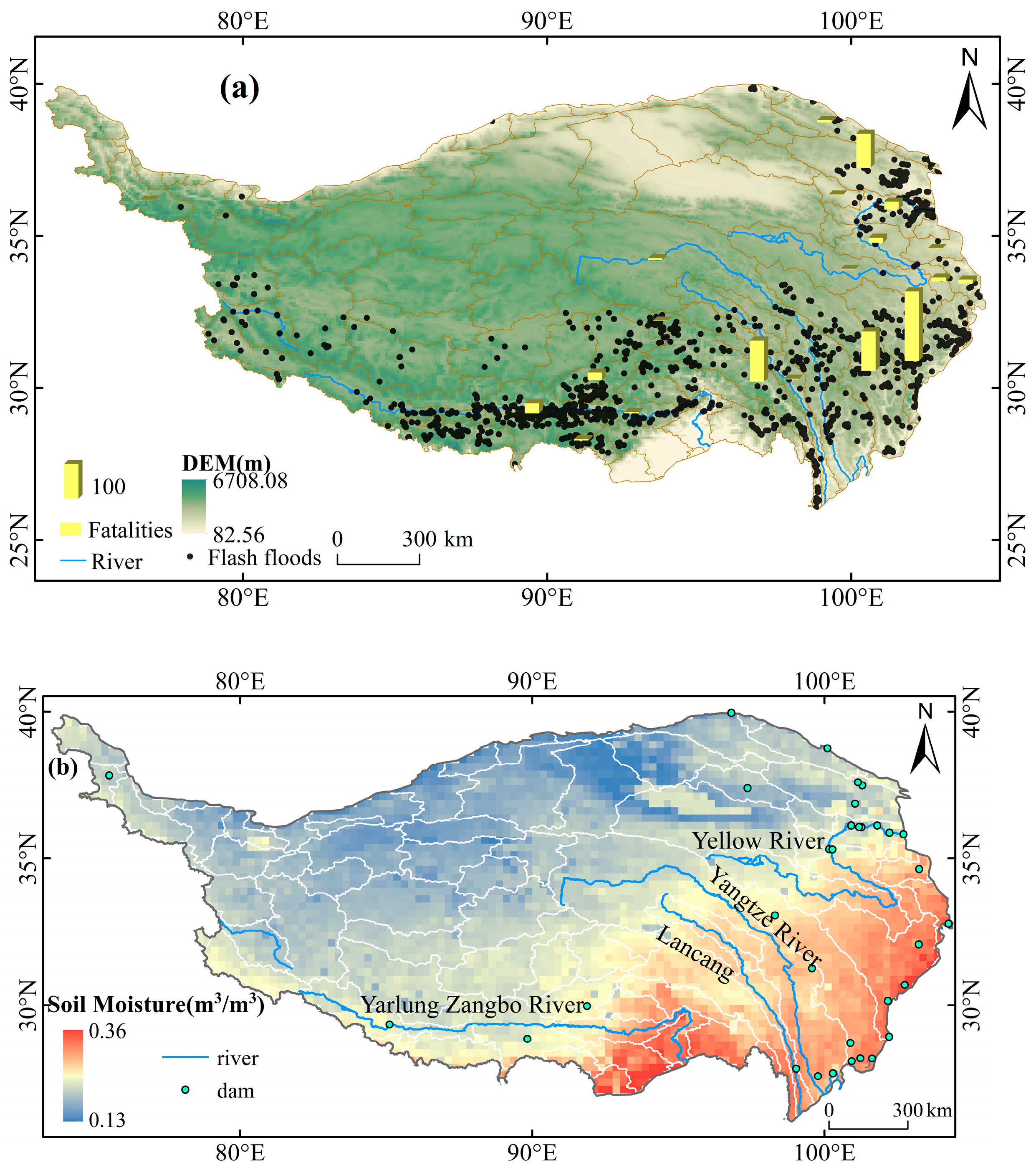
The Qinghai–Tibet Plateau (QTP) is the world’s youngest and highest plateau, extending from the Kunlun Mountains in the north to the Himalayas in the south, and from the Pamir Plateau in the west to the Hengduan Mountains in the east. Covering an area of approximately 2.5 × 10⁶ km2 and with a mean elevation exceeding 4000 m (Figure 1a), it is widely referred to as the “roof of the world” [19]. As the source region for major Asian rivers, including the Yangtze, Yellow, Yarlung Tsangpo, Indus, and Ganges rivers, the QTP is known as the “Asian Water Tower” [20] and represents a major concentration of lakes, glaciers, seasonal snow, and permafrost. Owing to its highly heterogeneous land surface conditions, the Plateau exhibits pronounced spatial variability in soil moisture and plays a critical role in the generation, storage, and transfer of water resources in China and across Asia (Figure 1b). Influenced by the plateau amplification effect, the QTP has experienced a warming rate exceeding the global average, accompanied by a persistent trend toward warmer and wetter climatic conditions, and an overall increase in precipitation. Under the combined effects of unique geological settings, complex topography, and multi-scale precipitation processes, mountain flash floods on the Plateau exhibit strong regionality and high occurrence frequency.
Figure 1.
Distribution of historical flash flood disasters (a) and soil moisture (b) in the QTP.
3. Material and Methods
3.1. Datasets
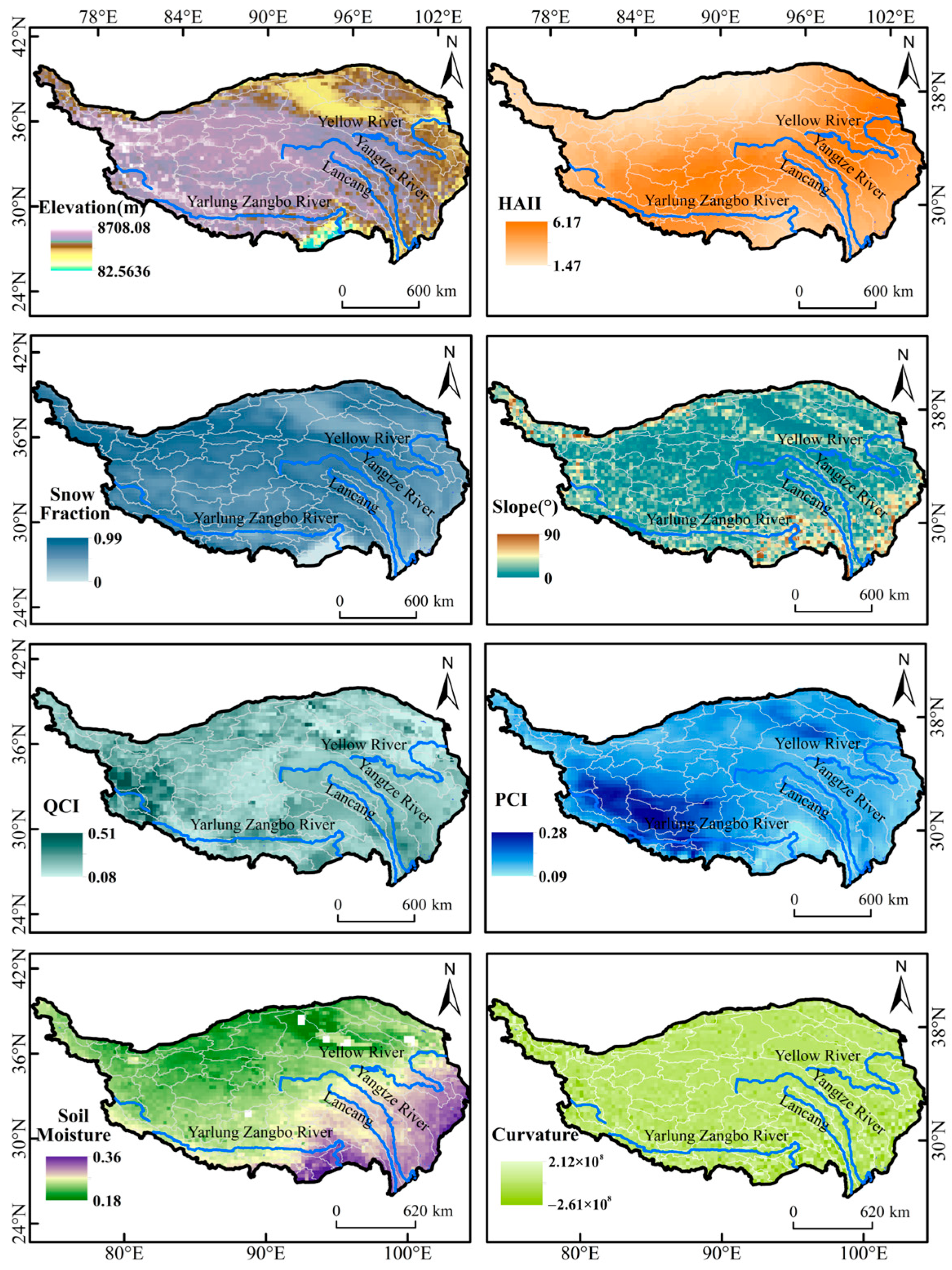
Flash flood event data were obtained from the National Flash Flood Investigation and Evaluation Project database, which was launched to investigate Chinese historical flash flood events [21]. The Runoff Concentration Index (QCI) and Precipitation Concentration Index (PCI) are used to quantify the seasonal variation in streamflow and precipitation, respectively [22]. The calculation processes of QCI and PCI are described in the Supplementary Materials. The snowfall fraction is used to indicate the snow impact [22]. The runoff data are derived from the China Natural Runoff Grid Dataset CNRD v1.0 (1961–2018), available at https://www.tpdc.ac.cn/ (accessed on 8 July 2024) [23,24,25,26]. The soil moisture data was obtained from monthly gap-filled CCI soil moisture over region of China, available at https://cstr.cn/31253.11.sciencedb.07849 (accessed on 8 June 2024) [27]. The elevation data was downloaded from Geospatial Data Cloud with regard to SRTM DEM, with a ~30 m spatial resolution at https://www.gscloud.cn/ (accessed on 1 March 2024). Slope data and curvature data were calculated based on the DEM data using the ArcGIS platform 10.8 (Figure 2). The land cover data from 1985 to 2015 was downloaded from Huang [28] from https://zenodo.org/records/12779975 (accessed on 10 June 2024). The dataset relating to the historical water intake in China was obtained from National Tibetan Plateau/Third Pole Environment Data Center [29]. We resampled all the data of PCI, HAII, DEM, slope, snow fraction, QCI, and soil moisture to unify the spatial resolution to 0.25°, and supplemented the specific information of the used data in the Supplementary Materials (Table S1).
Figure 2.
Eight flash flood drivers considered in this study (0.25° resolution).
3.2. Gravity Model
The spatial distribution of geographic phenomena is commonly categorized into three fundamental types: random, regular, and clustered. Barycenter migration analysis provides an effective approach for characterizing the evolution of large-scale spatiotemporal data. This study employs a gravity model to analyze the barycenter variation in flash floods on the QTP.
The X and Y coordinates of the barycenter of the flash flood disaster on the QTP are defined as
where is the longitude of the barycenter of the flash flood disaster on the QTP; is the latitude of the barycenter of the flash flood disaster on the QTP; n represents the number of river basins within the scope of the study; i is the sequence of river basins; Xi and Yi are the longitude and latitude of the geometric center of the i-th river basins, respectively; Si is the area of the i-th river basin; and Wi is the flash flood disaster density value of the i-th river basin.
The gravity model is employed to analyze the trajectory and distance of the flash floods’ barycenter in the QTP from April to September. The standard deviation ellipse is used to analyze the direction and distribution of the flash flood disasters from April to September.
3.3. Standard Deviation Ellipse
The standard deviation ellipse (SDE) method can be used to comprehensively characterize the central tendency, spatial dispersion, and directional trend of geographic features. In this study, ArcGIS 10.8 is used to obtain the parameters of the standard deviation ellipse. The mean center represents the barycenter of disaster distribution, and the rotation represents the main trend of the flash floods’ distribution. The greater the ratio of the long half axis to the short half axis, the more directional the flash flood disaster is; a smaller ratio shows that the distribution of flash flood disasters is relatively scattered [30].
3.4. Spatial Autocorrelation
Digitizing the autocorrelation of spatial data can help to understand the distribution structure of spatial data. Global spatial autocorrelation and local spatial autocorrelation can be used to analyze the overall and local relationships of spatial data, respectively [31]. The global Moran’s I is calculated as follows:
where I is the global Moran index; Xi and Xj are the number of flash floods disasters in the five-level river basin, i and j, respectively; is the average number of flash flood disasters; and is a measure of the spatial relationship between each river basin i and j (adjacency is one, nonadjacency is zero). The global spatial autocorrelation cannot accurately represent the specific spatial location of agglomeration or abnormality. To analyze the spatial correlation and difference between a river basin with the flash floods and another adjacent river basins, the local spatial autocorrelation method needs to be used for further analysis. The expression is:
The significance of spatial autocorrelation is judged by the standardized statistic Z, and the calculation formula is:
where E(I) is the expected value of I; VAR(I) is the variance of I. At the significance level of 0. 05, |Z| = 1.96, indicating that the spatial autocorrelation is significant. According to the results of I and Z, the correlation between the i-th element and adjacent elements can be divided into five categories: “High–high” aggregation, “high–low” aggregation, “low–low” aggregation, “low–high” aggregation, and “not significant”.
To elucidate the relationships among flood disasters across the basins adjacent to the QTP, we quantified the number of flash floods in each basin of the QTP from 1950 to 2015 and assessed their spatial dependence. Spatial autocorrelation analysis was conducted using ArcGIS and the GeoDa platform. Moran’s I values range from −1 to 1, where values approaching 1 indicate strong positive spatial correlation, values approaching −1 reflect strong negative spatial correlation, and values near 0 denote the absence of spatial clustering.
3.5. SHAP
Shapley Additive Explanation (SHAP) is a method for interpreting machine learning model predictions, grounded in Shapley values from cooperative game theory [32]. The core principle of SHAP is to quality the contribution of each feature to the model predictions. SHAP enables model interpretation at both the global and local scales by calculating the marginal contribution of each feature to the model output. The SHAP framework attributes the prediction outcome to the contribution of each feature. For each prediction instance, the model generates an output value, and a SHAP value is assigned to each feature to represent its contribution. SHAP values allow for the identification of the features that exert the greatest influence on model predictions and clarify their effects. These values can be positive or negative, indicating whether a feature increases or decreases the predicted outcome. SHAP values are calculated as follows:
where represents the SHAP value of feature , f denotes the predictive function of the model, and N and S are the sets encompassing all features and the set excluding Xi respectively. XS signifies the input under the given feature set S, and |N| and |S| correspond to the sample count of sets N and S, respectively [33].
3.6. Random Forest
Random forest is an ensemble-based machine learning algorithm that is widely used for regression analysis. The theoretical framework and regression formulation of this model are described in detail by Breiman (2001) [34]. In this study, a Random Forest regression model is employed to analyze the influence of flash flood driving factors. The calculation procedure is summarized as follows [35]:
- A bootstrap sample is drawn from the training dataset, where samples are randomly selected with a replacement, allowing duplicates.
- During the training of each decision tree, a subset of features is randomly selected from the full feature set. The size of this subset is typically smaller than the total number of features, which ensures diversity among the individual decision trees.
- Each decision tree is trained using the bootstrap sample and feature subset selected in Steps 1 and 2. For node splitting, criteria such as the Gini index or information gain are commonly used until a stopping condition is met.
- Steps 2 and 3 are repeated multiple times to generate an ensemble of decision trees, resulting in structural diversity among trees.
- For regression tasks, the Random Forest produces the final prediction by averaging the outputs of all individual trees.
- The key hyperparameters of the model are optimized through grid search combined with five-fold cross-validation, aiming to minimize the mean squared error. The final parameter settings are as follows: the number of trees was set to 300, the node splitting criterion is the mean squared error, the maximum number of features is set to the square root of the total number of features, the maximum depth of the trees is 20, the minimum number of samples required to split an internal node is five, and the minimum number of samples required at a leaf node is two. Additionally, a random seed is set to 42 to ensure the reproducibility of the experimental results.
- To comprehensively evaluate the model performance, we used the Root Mean Squared Error (RMSE), Mean Absolute Error (MAE), and Coefficient of Determination (R2) as evaluation metrics, and adopted 5-fold cross-validation to assess the model’s robustness. The model showed good predictive ability on the test set, with an RMSE of 15.3, an MAE of 11.2, and an R2 of 0.72. This means that the model can explain 72% of the variance in the target variable. Compared with the simple mean prediction benchmark (RMSE = 25.0), the Random Forest model reduced the prediction error by 38.8%. The cross-validation results (average RMSE = 16.1 ± 1.2) were close to the test set error, and the standard deviation was small, indicating that the model has good generalization ability and stability.
Random forest regression models are advantageous in handling high-dimensional data and large-scale datasets. They are also robust to missing values and outliers and are less sensitive to noise. As an ensemble of multiple decision trees, Random Forests generally achieve high predictive accuracy [36,37,38].
4. Results
4.1. Temporal Distribution Characteristics of Flash Floods
4.1.1. Seasonal Variation
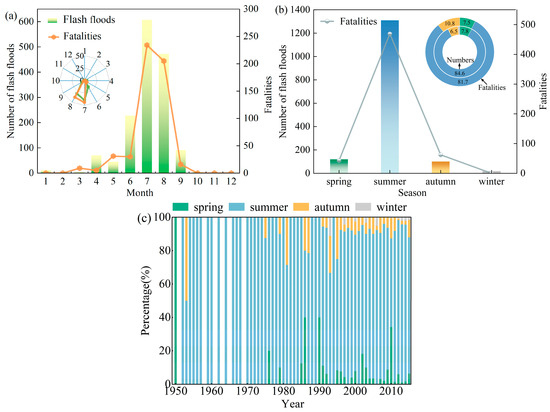
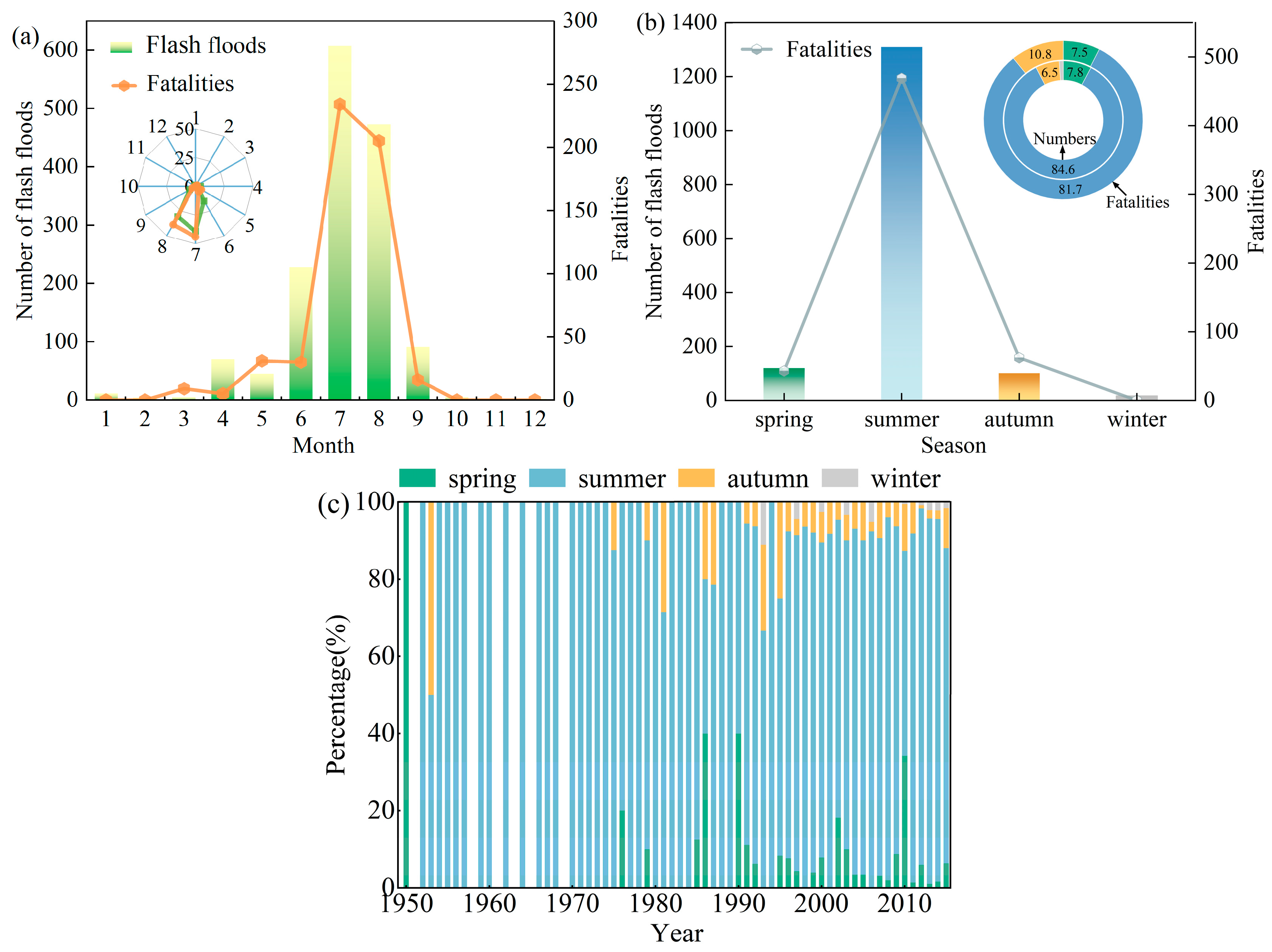
The monthly distribution of flood occurrences and associated fatalities across the QTP reveals a pronounced seasonal hazard regime (Figure 3a). Flood events are concentrated between April and September, with a dominant peak during June–August. Historical records from 1950 to 2015 document 1308 floods events during this three-month period, accounting for 86.4% of the annual total, with July alone contributing for 607 events (40.1%). Outside of this core season, only April, May, and September exhibit appreciable flood activity, with 70, 45, and 91 events, respectively, whereas occurrences in the remaining months are negligible. Fatality patterns closely mirror this seasonal concentration. Fatalities during June–August total 469 represent 88.5% of all recorded deaths, with July again dominating (234 fatalities; 44.2%). In contrast, fatalities in April, May, and September remain comparatively low, at 5, 31, and 16, respectively, and almost no fatalities occur during the late autumn to winter, consistent with the near absence of flood events.
Figure 3.
Monthly and seasonal variability in the number and the fatality of flash floods. (a) and (b) represent the number of flash flood events in the QTP each month and each season from 1950 to 2015 respectively, (c) represents the proportion of the number of flash flood events in each season of the QTP each year.
From a seasonal perspective (Figure 3b,c), flash flood disasters on the QTP are overwhelmingly a summer-dominated phenomenon, with substantially reduced activity in spring (120 events; 43 fatalities) and autumn (101 events; 62 fatalities). Winter floods are virtually absent, reflecting weak hydrometeorological forcing and correspondingly negligible associated risk. Collectively, these patterns underscore the pronounced monsoonal control on flood generation and its cascading impacts on exposed populations.
4.1.2. Interannual Variation
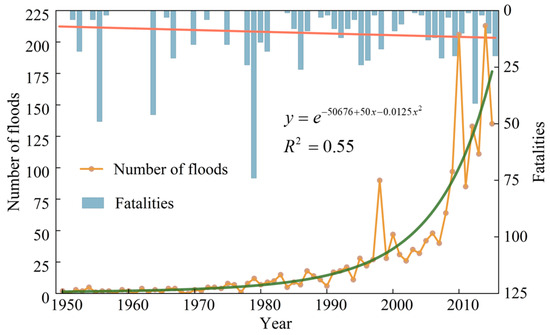
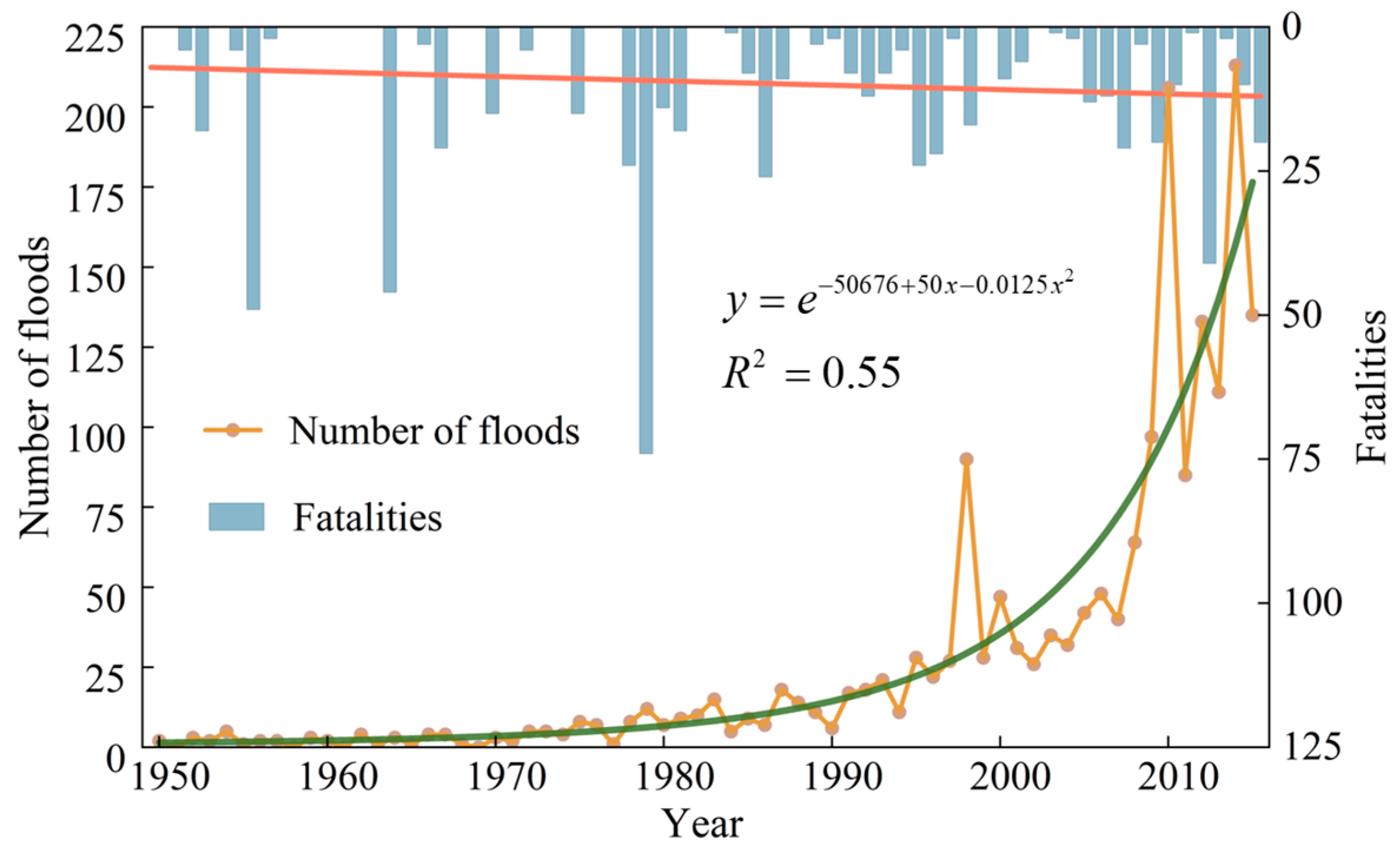
Based on the historical records of flash flood disasters on the QTP, this study examines the interannual variability and long-term trends in flash flood occurrence from 1950 to 2015 (Figure 4). Overall, the flood frequency on the QTP exhibits pronounced interannual fluctuations accompanied by a clear increasing trend that approximates exponential growth. Flood occurrence remained relatively stable during 1950–1979, increased gradually with moderate variability from 1980 to 2007, and rose sharply with strong interannual fluctuations during 2008–2015. Notably, flood-related fatalities do not increase proportionally with the rising number of flood events in the same years. This divergence likely reflects improvements in socioeconomic conditions, together with enhanced capacities for disaster preparedness, emergency response, and post-disaster relief and reconstruction.
Figure 4.
Annual variability in the number and the fatality of flash floods in the Third Pole. The red line and the green line represent the fitted lines of the number of fatalities and the number of floods respectively.
4.2. Spatial Distribution Characteristics of Flash Floods
4.2.1. Distribution Characteristics of Flash Flood Density
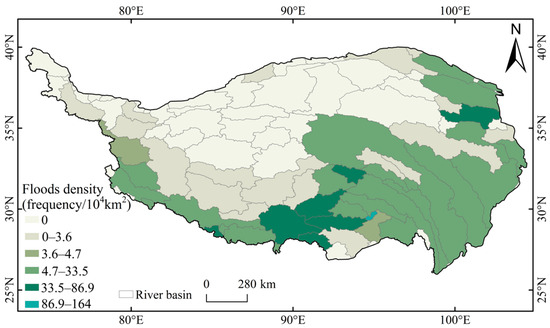
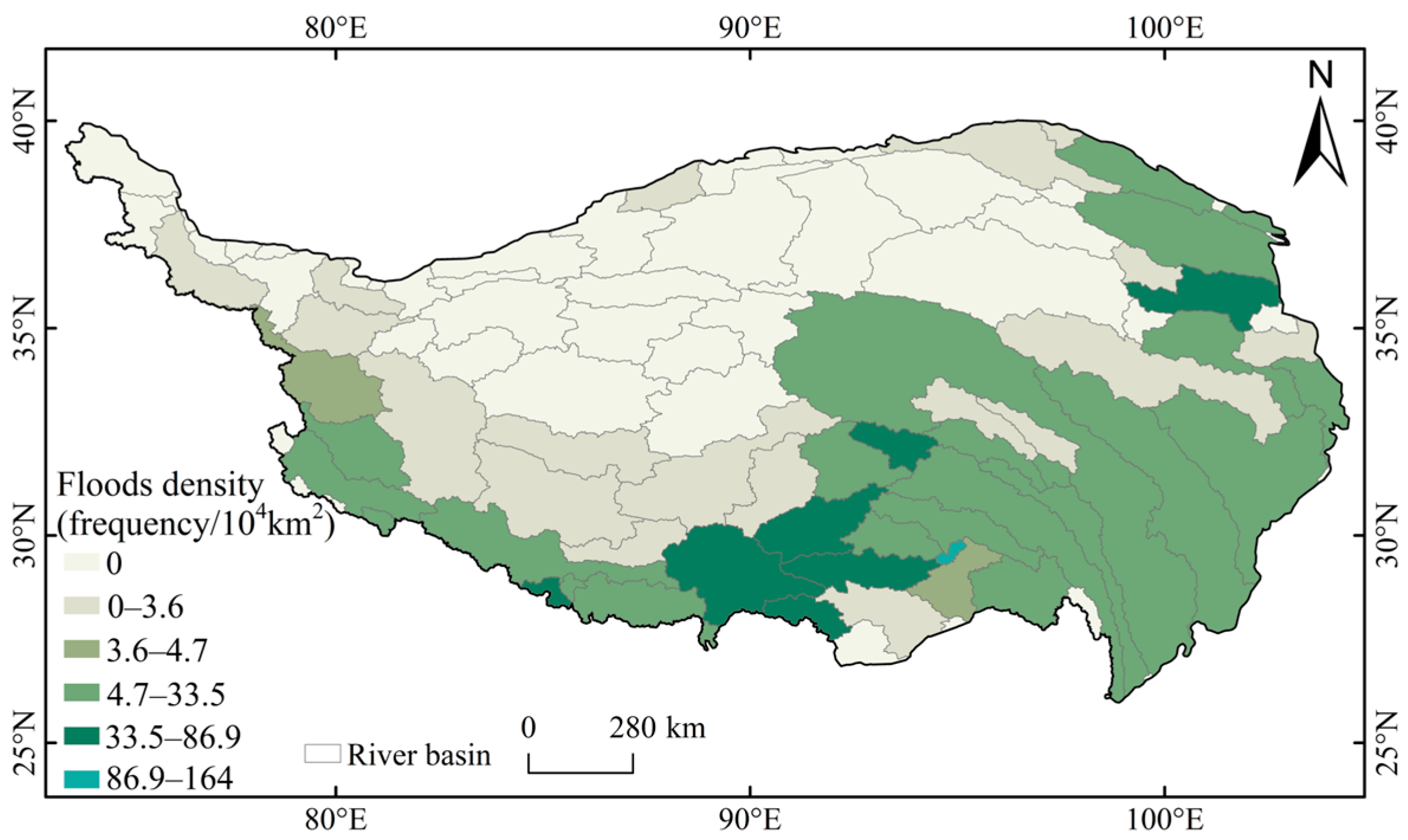
The spatial distribution of historical flood frequency across the QTP exhibits pronounced heterogeneity, with high-density clusters concentrated in the headwater regions of the Yarlung Zangbo, Jinsha, Lancang, Nu, and Yellow rivers (Figure 5). During the period 1950–2015, floods were recorded in 53 fifth-order basins, accounting for 52.5% of all basins of this order across the region. Among these, nine basins show exceptionally high hazard densities (>33.5 events per 104 km2), representing approximately 9% of fifth-order basins. These flood hotspots are mainly distributed in the headwaters of the Yellow and Lancang rivers in Qinghai Province, as well as in the source regions of the Yarlung Zangbo, Nu, and Yangtze rivers on the QTP.
Figure 5.
Spatial distribution of flash floods’ density.
4.2.2. Center of Gravity and Trajectory of Flash Floods
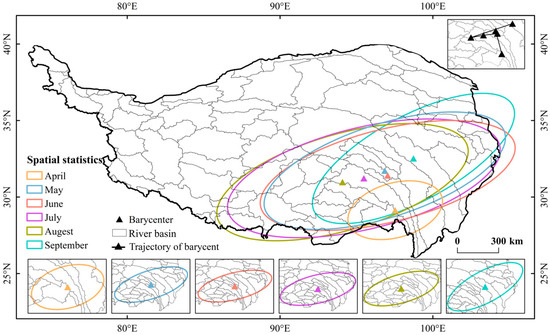
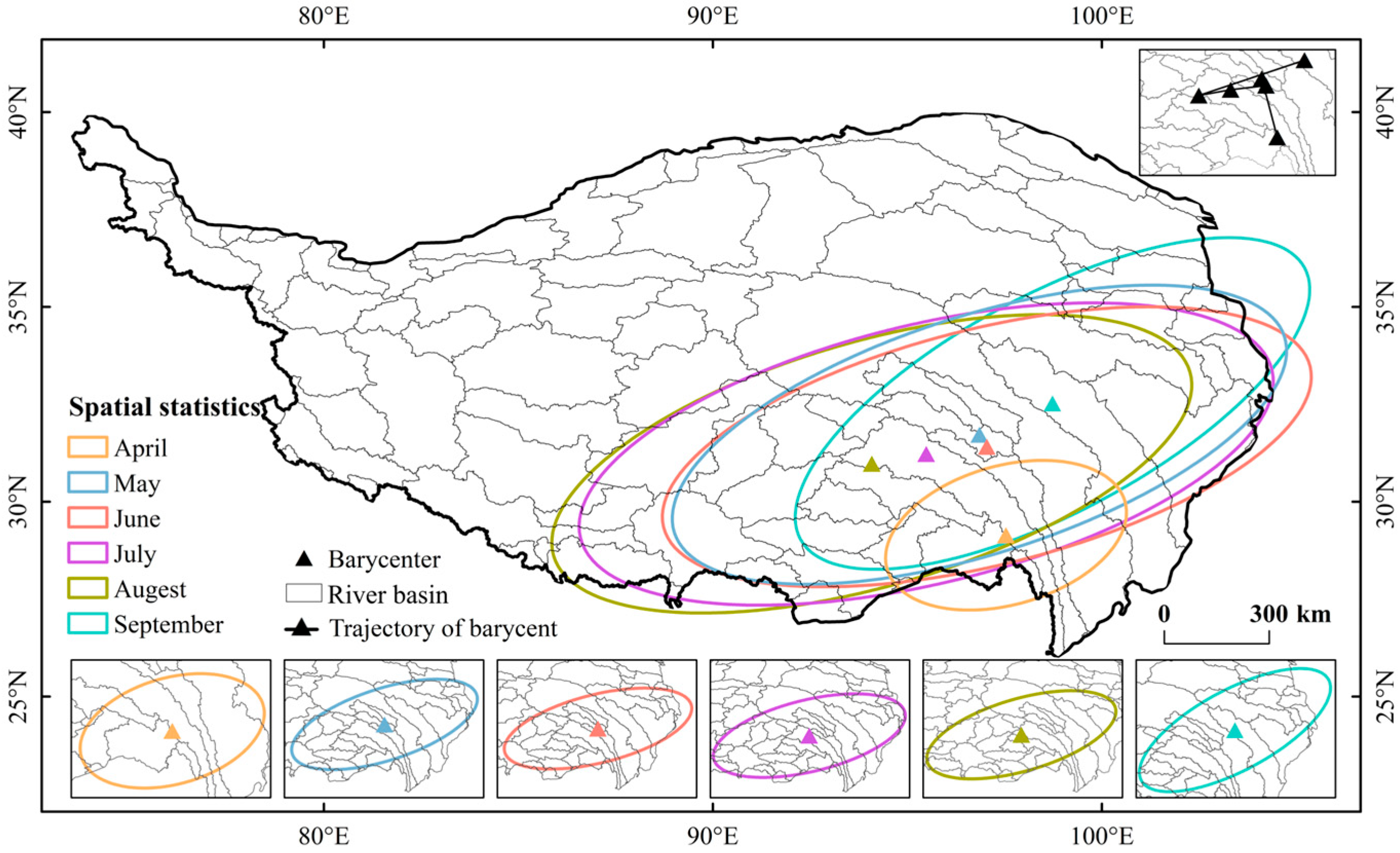
The barycenters of historical flood occurrences on the QTP from April to September are primarily distributed within 94°05′E~98°44′E and 29°08′N~32°31′N, located between the Nu Chiang basin and the Yalong River basin (only the part located on the QTP). Seasonally, the flood barycenters migrate from the southern Nu Chiang Basin toward the northwestern Zhaqu Basin between April and June, shift southwestward to the westernmost part of the Nu Chiang Basin from July to August, and subsequently move northeastward to the upper reaches of the Yalong River Basin in September. Overall, the barycenter exhibits a cumulative migration distance of approximately 1003.33 km from April to September (Figure 6).
Figure 6.
Trajectory of the barycenter and standard deviation ellipse of historical flood disasters from April to September.
The standard deviation ellipses directions ranged from 56° to 74° from April to September (Table 1), indicating a predominant southwest–northeast alignment of flood distribution across the QTP. Specifically, the rotation angle weakened from 70° to 68° between April (97°32′E, 29°08′N) and May (96°51′E, 31°43′N), and from 74° to 56° between July (95°29′E, 31°13′N) to September (98°44′E, 32°31′N), while strengthening from 68° to 74° between May and July. These variations suggest that the southwest–northeast directional pattern initially weakened, subsequently strengthened, and then weakened again. Over the same period, the standard deviation ellipse’s major axis first rose from 280.96 km in April to 801.82 km in July, and then decreased to 662.60 km in September, indicating an initial polarization of flood distribution followed by gradual weakening. The overall performance showed that the spatial distribution of disasters first strengthens and then weakens. In addition, the ratio of the major to minor semi-axis was 1.49 in April, corresponding to the highest degree of dispersion, whereas this ratio peaked at 2.41 in June, indicating the strongest concentration of flood events. Taking together, these results reveal an annual spatial evolution characterized by a transition from dispersion to aggregation and subsequently back to dispersion.
Table 1.
Variation in SDE parameters of historic flash floods from April to September.
4.2.3. Spatial Correlation of Flash Floods
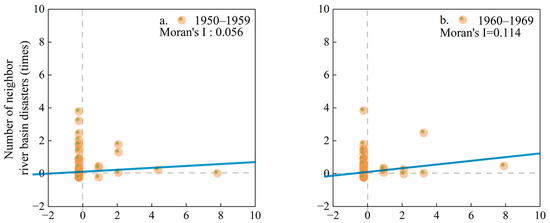
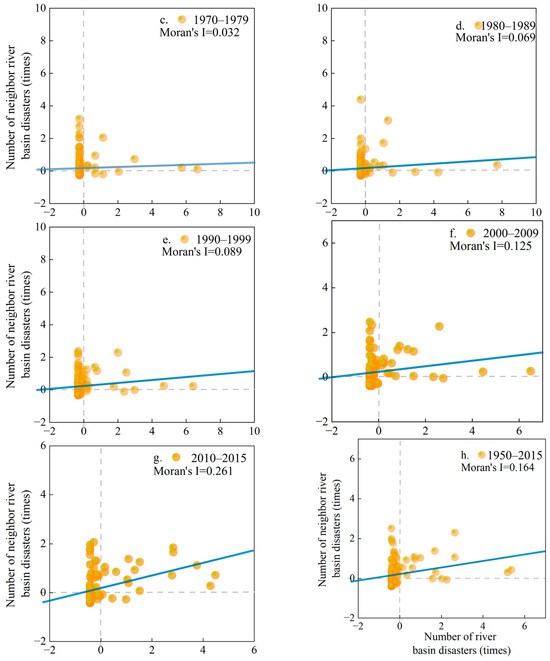
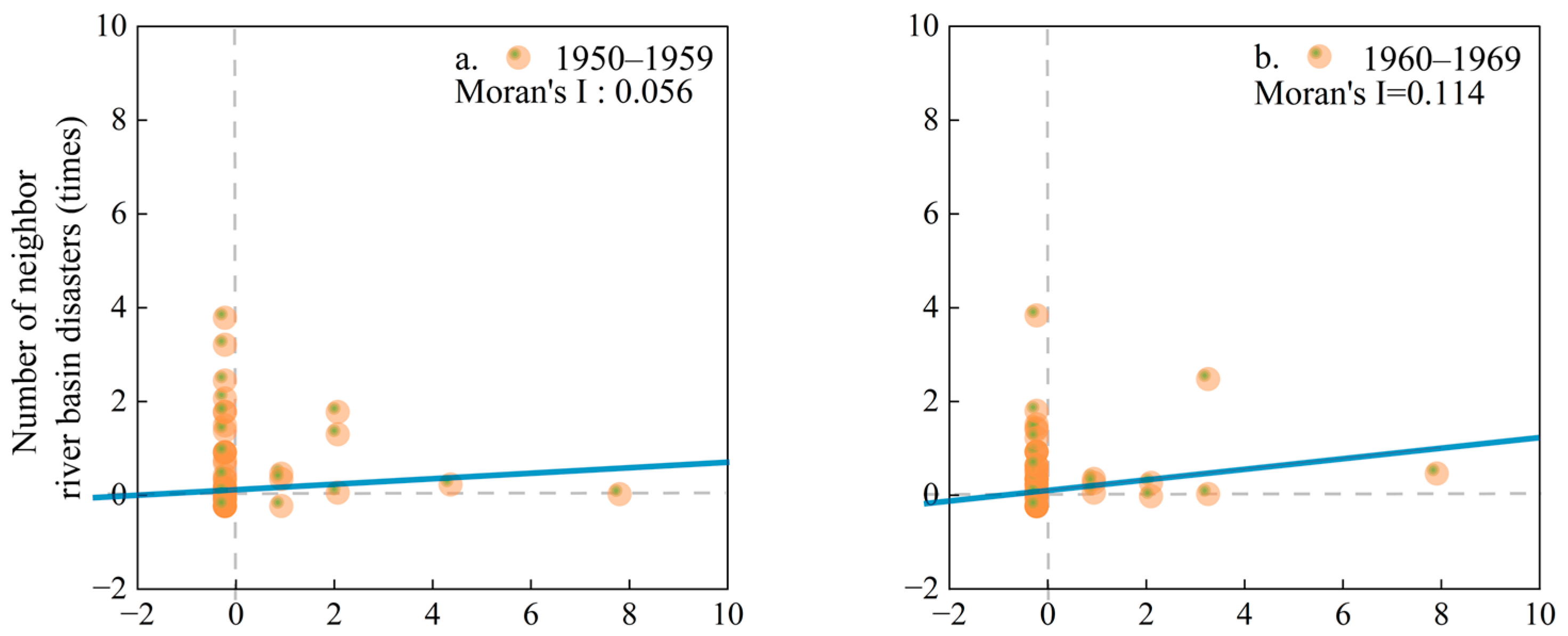
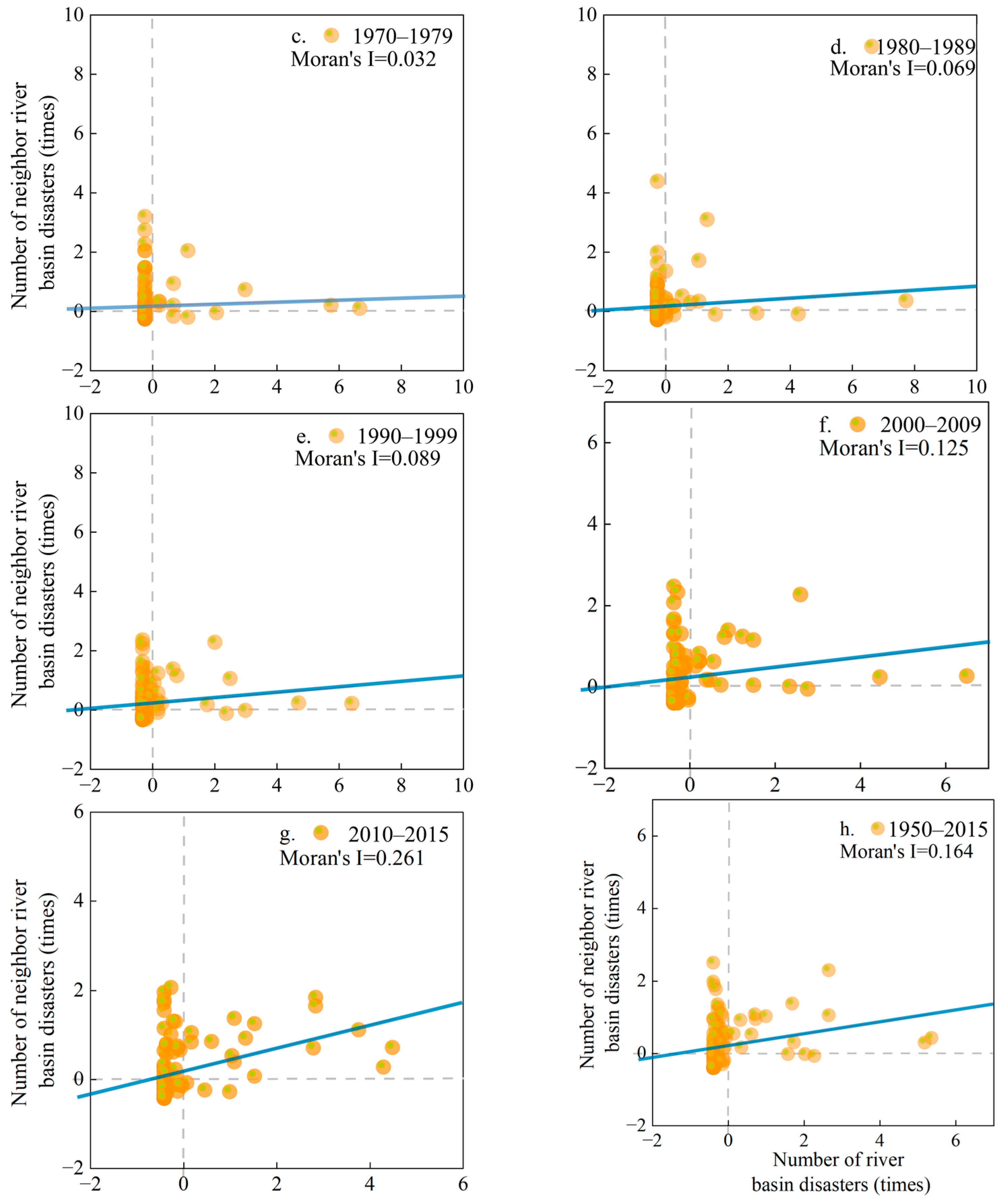
The spatial association characteristics of flash floods on the QTP were examined using the spatial autocorrelation model (Figure 7 and Figure 8). Over the period 1950–2015, Moran’s I for flood frequency was 0. 164, with a Z-score of 3. 203, and a significance level of p = 0.01, indicating a statistically significant positive spatial autocorrelation. Moran’s I remained greater than zero throughout the study period, indicating persistent positive spatial dependence in flash flood occurrence across the QTP (Figure 7). From the 1950s to the 2010s, the positive correlation of agglomeration characteristics unduly strengthened, with Moran’s I index fluctuating from 0. 06 to 0. 26, implying that flash floods tend to occur in spatial clusters at the river basin scale. More than 50% of the flood events were clustered in the first and third quadrants, indicating that high-density flood basins on the QTP predominantly characterized by “high–high” and “low–low” aggregation patterns. This spatial aggregation occurs between high-frequency flood basins and their adjacent high-density areas, as well as between low-frequency basins and surrounding low-density regions. In contrast, relatively few points fall within the second and fourth quadrants, indicating that only a limited number of river basins exhibit significant dissimilarities from their surrounding areas.
Figure 7.
Moran’s I scatter diagram of historic floods in the Third Pole during 65 years. (a) 1950–1959; (b) 1960–1969; (c) 1970–1979; (d) 1980–1989; (e) 1990–1999; (f) 2000–2009; (g) 2010–2015; (h) 1950–2015. The blue line represents the fitting situation.
Figure 8.
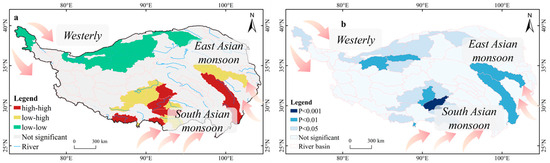
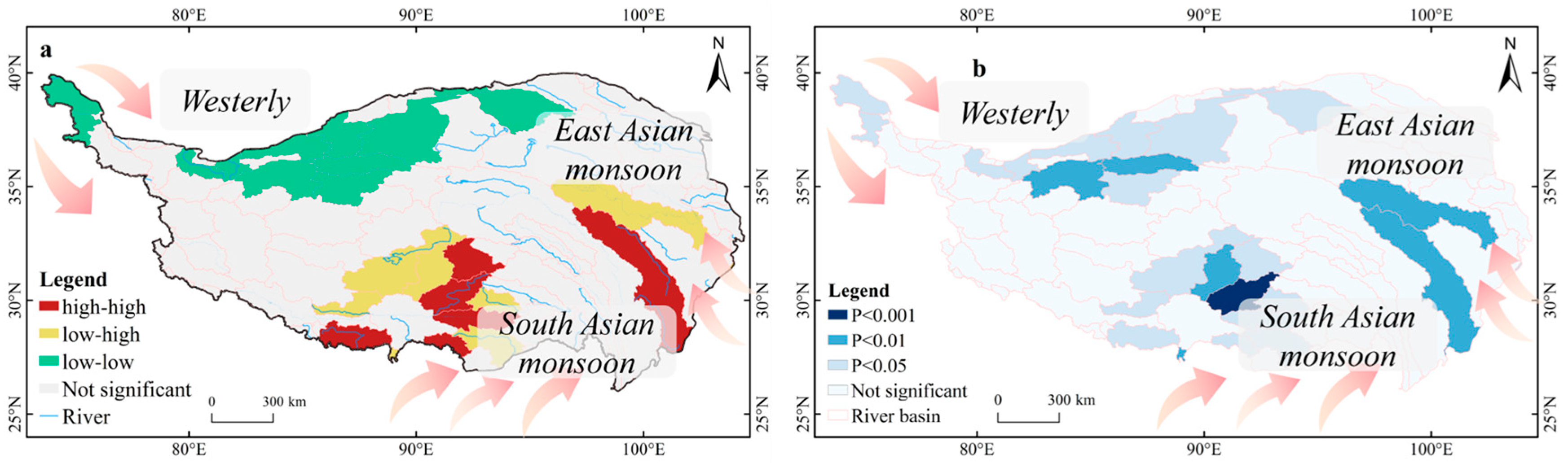
The spatial autocorrelation and significance analysis of historic floods in the Third Pole. The arrows represent the sources of water vapor. (a) LISA clustering map; (b) LISA saliency map.
The local spatial autocorrelation of flash floods across river basins on the QTP was classified into four categories—“high–high”, “low–high”, “low–low”, and “insignificant” zones–based on local spatial association (Figure 8). Among them, the “high–high” clusters were primarily concentrated in the middle reaches of the Yarlung Zangbo River, ZangBuqu River, Nagqu River, and Yalong River. In contrast, the “low–low” clusters were mainly located in the upper reaches of the Yellow River, Zhagazangbo River, and Niyang River. The “low–high” agglomeration zones were observed in the northern QTP, including the Qarqan River and Tashkurgan River, as well as other zones consisting of sporadic inland river basins, all of which were surrounded by high-frequency flood regions. The remaining basins exhibited insignificant local spatial autocorrelation.
4.2.4. Spatial Variability of Flash Floods
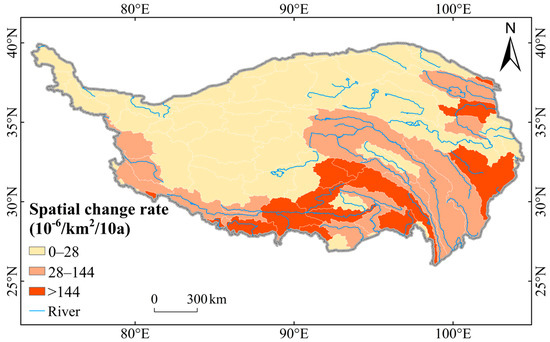
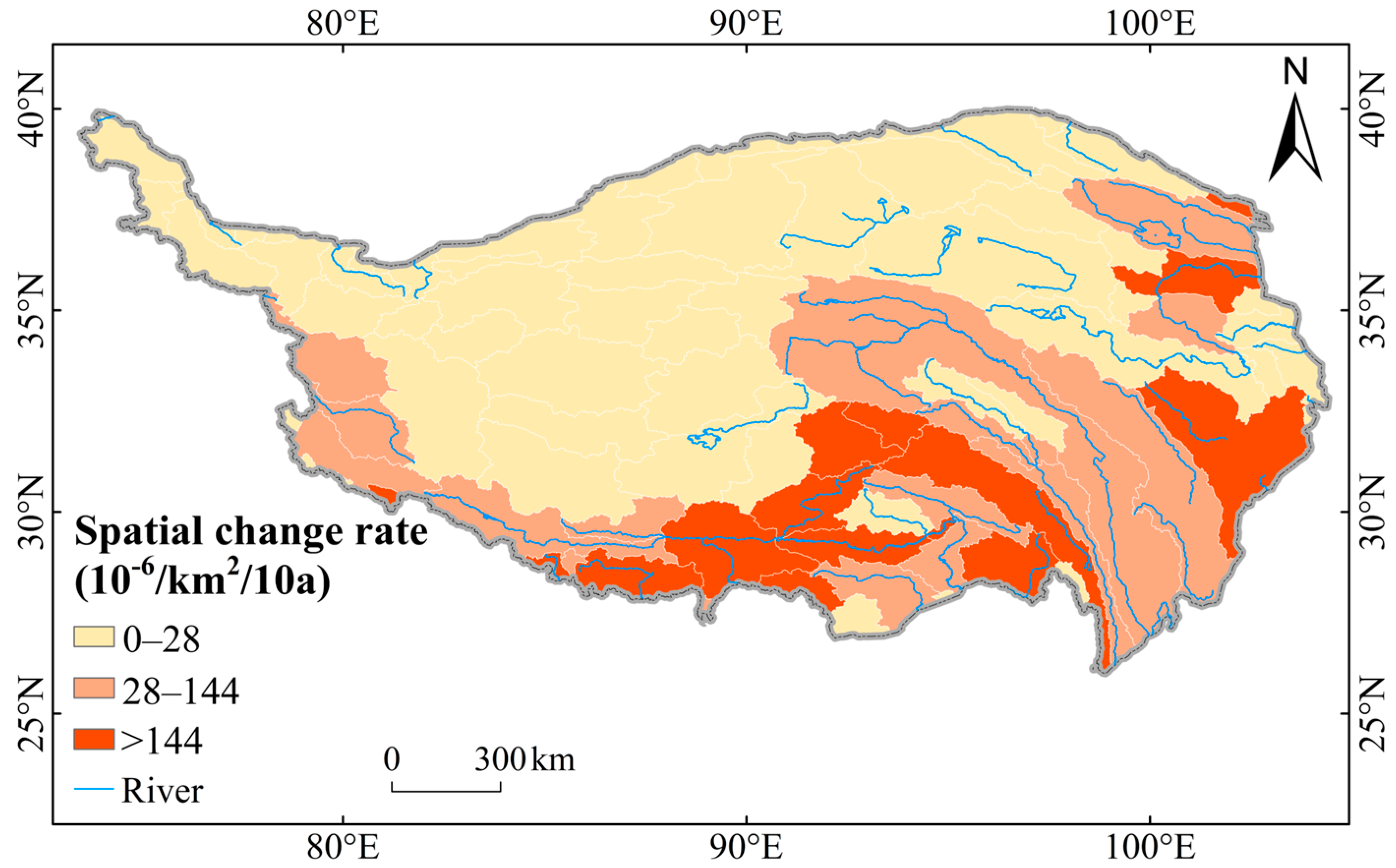
From 1950 to 2015, noticeable spatial distribution heterogeneity was observed in the rate of change in flash flood density across the QTP (Figure 9). According to the change rate of flash flood density α, three distinct trends were identified: I, a slight increase in flash floods, where 0 < α < 0.28 × 10⁻⁵; II, a moderate increase in flash floods, where 0.28 × 10⁻⁴ ≤ α ≤ 1.44 × 10⁻⁴; and III, a rapid increase in flash floods, where α > 1.44 × 10⁻⁴. Overall, flash flood occurrences across the QTP exhibited an increasing tendency during the study period. Among these, the few increase trends cover the largest area, primarily concentrated in the Northern Tibet Plateau and the Qaidam Basin, accounting for 55.26% of the total area of the QTP. The moderate increase trend is primarily observed in the Yarlung Zangbo River Basin and the Sanjiangyuan River Basin, together covering an area of 7.37 × 10⁵ km2, which represents 28.26% of the QTP. In contrast, the rapid increase trend is predominantly located in the South Tibet Valley and the Sichuan–Tibet Alpine Valley in the eastern QTP, comprising 16.48% of the total area. Notably, the most pronounced increases in flash flood activity were observed in the source regions of the Yellow River and the Dadu River, the Nu River Basin, and the middle reaches of the Yarlung Zangbo River, where the trend is particularly evident.
Figure 9.
Spatial change rate of historic flash floods in the QTP from 1950 to 2015.
5. Discussion
5.1. Effects on Seasonal and Interannual Distributions for Flash Flood Disasters
Influenced by the Asian monsoon system, the QTP exhibits a pronounced synchrony between precipitation and temperature, characterized by cold, dry winters and warm, wet summers. Previous studies have shown that the peak river runoff on the QTP is broadly synchronized with maxima in precipitation and temperature [39]. In late spring, increasing precipitation, together with the enhanced melting of glaciers and permafrost, leads to a sharp rise in river runoff [40]. Consistent with these hydrometeorological changes, the frequency of historical flash floods on the QTP begins to increase from April. During June–September, when rainfall amounts [41,42] and glacier–permafrost melt reach relatively high levels [40], flash floods occur most frequently. From the perspective of atmospheric moisture transport, variations in flash flood frequency on the QTP reflect the progressive import of water vapor associated with the Indian monsoon [43,44].
In the process of investigating historical flash floods, two primary sources of information are commonly used: a literature inquiry and an investigation inquiry. Historical flash floods that occurred in earlier periods cannot be verified due to the scarcity of archival materials and the absence of surviving disaster-affected populations. Research on the prevention and control of flash floods in China started relatively late, and the studies conducted prior to 1949 were basically in a blank state [45]. Consequently, relatively few flash flood events were documented in historical records before 1977 [46]. During the 1960s and 1970s, a nationwide surge in water conservancy construction increased the attention paid to flash flood management in many regions [47], leading to a steady rise in the number of recorded flash flood events between 1978 and 2006. After 2007, however, the frequency of documented historical flash floods increased markedly. Other studies (e.g., Yang and Chen) also indicate that the frequency of flash flood disasters in mountainous areas has shown a significant increasing trend [48,49]. This increase may be attributed to several factors. ① In 2006, the State Council approved the “National Flash Flood Disaster Prevention and Control Plan” and the “Request for Instructions on Approving the National Flash Flood Disaster Prevention and Control Plan” [50], which substantially enhanced societal and academic awareness of flash flood hazards and improved disaster reporting. ② The intensifying impacts of global warming on the QTP have increased the likelihood of extreme hydrometeorological conditions conducive to flash flood occurrence [51]. ③ The progressive intensification of human activities and the associated environmental changes may further exacerbate the development and evolution of flash floods [52].
5.2. Controls on Spatial Variability for Flash Flood Disasters
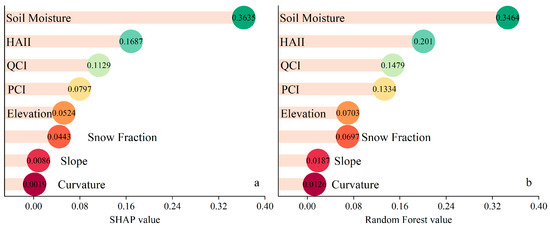
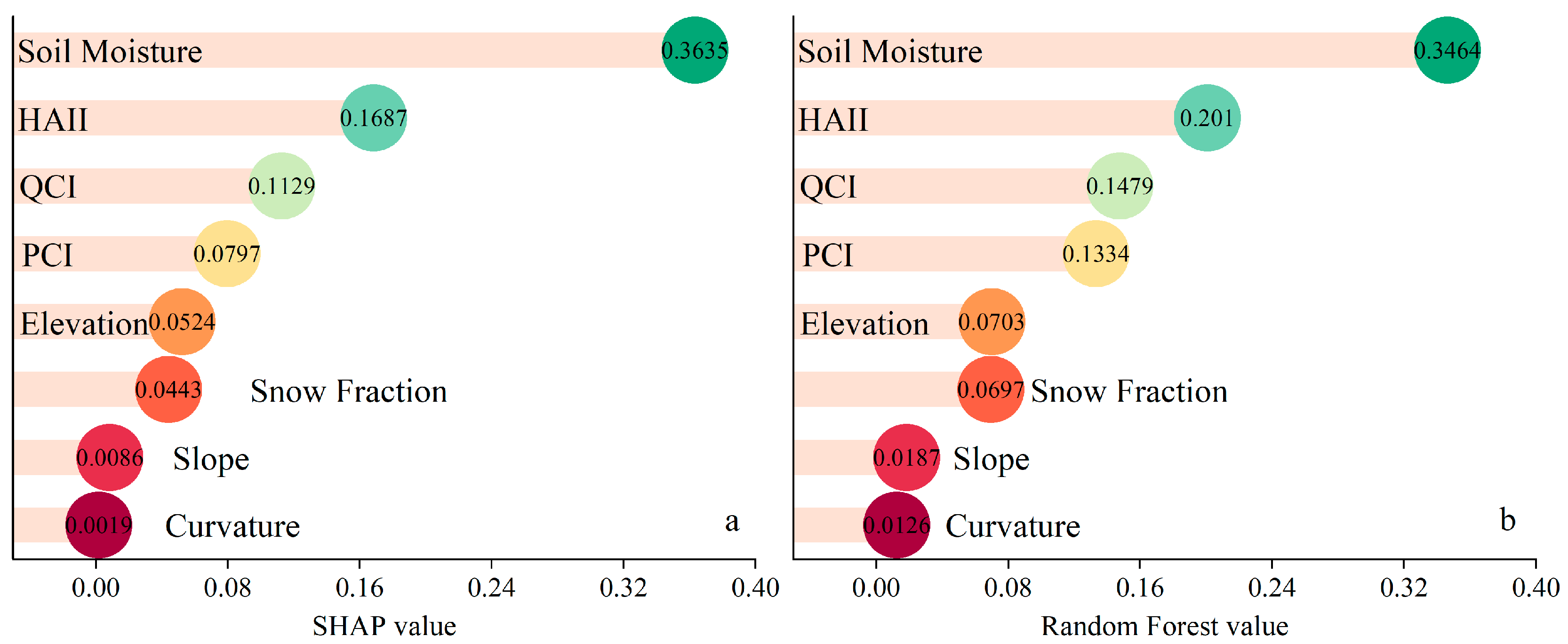
Using the Random Forest model in combination with SHAP analysis to quantify the effects of eight flash flood drivers considered in this study (Figure 2 and Figure 10), we determined that soil moisture and human activity intensity (HAII) have the greatest impact on the flood frequency on the QTP, followed by QCI, PCI, elevation, snow fraction, slope, and curvature. Soil water content plays a critical role in flash flood simulation and generation [53,54] and has been widely emphasized in studies of flash flood early warning mechanisms [55,56].
Figure 10.
Importance from SHAP (a) and Random Forest (b).
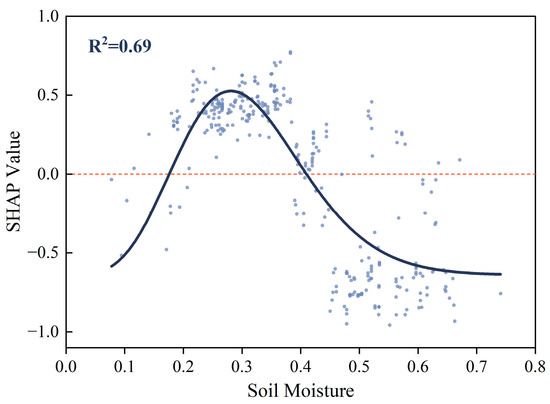
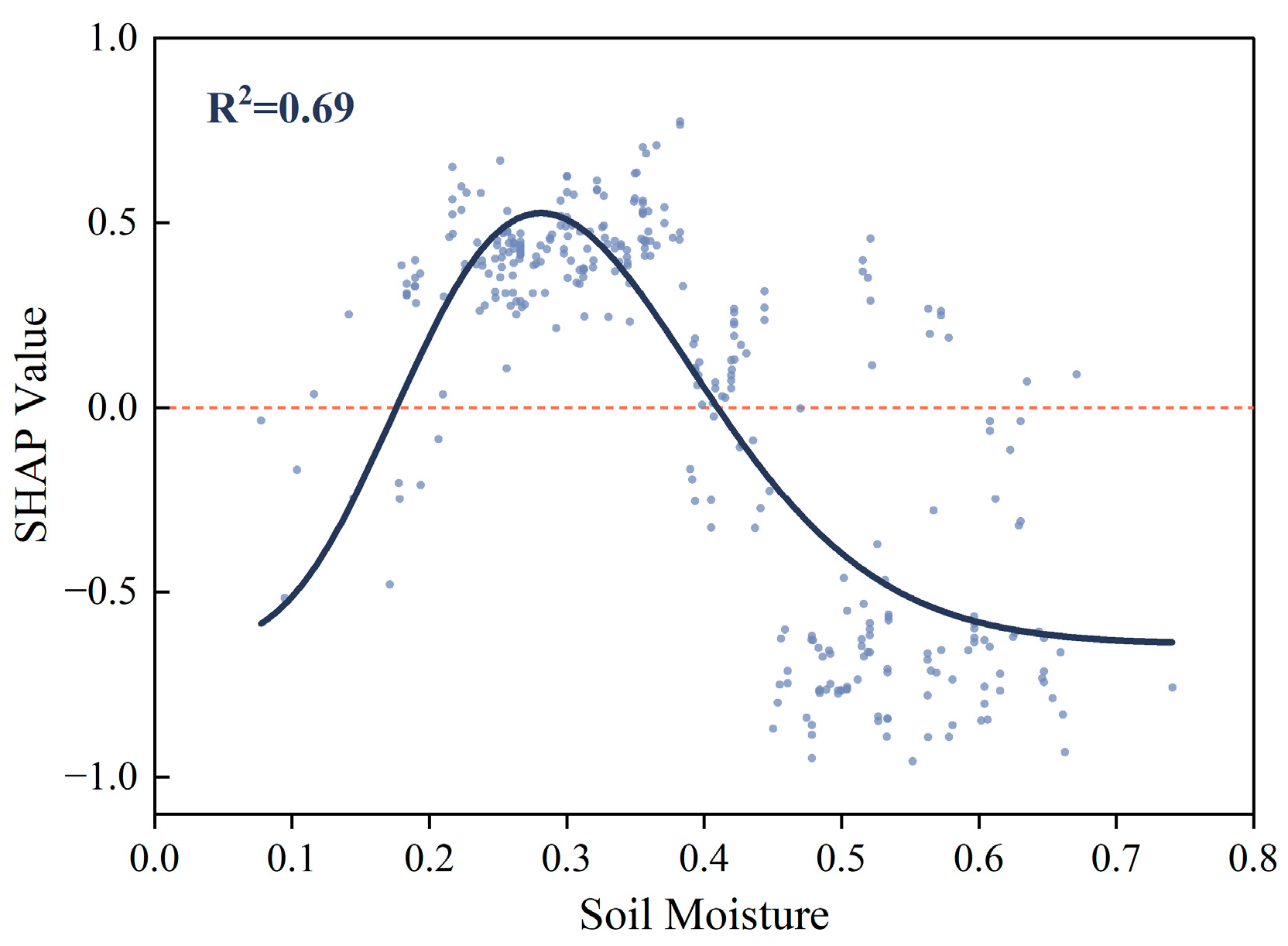
In the model, a higher soil moisture substantially increases the likelihood of flash flood occurrence across the QTP. To further elucidate how soil moisture modulates flash flood development, we performed SHAP analysis, which reveals a nonlinear and dependent relationship between soil moisture and flash flood density (Figure 11). Specifically, as soil moisture increases from 0 to about 30%, its positive contribution to the predicted flash flood density grows progressively. Within the lower range of 0–0.2, relatively dry soil conditions tend to inhibit flash flood initiation. The influence peaks when soil moisture lies between 0.2 and 0.4, indicating that moderate moisture levels markedly promote flash flood generation. Beyond this optimal interval, however, the enhancing effect diminishes and may even turn negative. From a physical mechanism perspective, soil moisture within a suitable range facilitates flash floods by enhancing surface runoff and reducing infiltration capacity. In contrast, excessively high soil moisture often coincides with greater vegetation cover, as abundant soil water supports plant growth and development. Increased vegetation can in turn mitigate flash flood risk through root reinforcement, improved surface roughness, and enhanced water retention [57,58], thereby partly offsetting the direct promoting effect of high soil moisture and explaining the declining contribution at elevated moisture levels. Multiple empirical studies [59,60,61] consistently indicate that a moderate increase in antecedent soil moisture lowers the triggering threshold, thereby promoting the occurrence of flash floods.
Figure 11.
Dependence plot between flash flood and soil moisture. The solid line represents the fitted curve of the changing trend of SHAP values with the change of soil moisture.
Human activity intensity also promotes flash flood occurrence in the QTP. HAII uniformly quantifies the scattered and difficult-to-compare human disturbance information, enabling the impact of human activities to be directly incorporated into the quantitative analysis of the mountain flood-driving mechanism. This effect is likely associated with population growth, the expansion of built-up areas [62], increasing agricultural intensification, and the prominent role of animal husbandry—a major industry on the Tibetan Plateau characterized by high grazing intensity that substantially contributes to human activity pressure. Meanwhile, urbanization has further intensified human activities through the expansion of construction land and rising industrial and domestic water use, whose contribution to overall human activity intensity now exceeds that of agricultural water consumption and agricultural land use (Table S1). These findings are consistent with previous studies highlighting the role of human activities in exacerbating flash flood hazards [63,64].
QCI [65] and PCI are used to quantify seasonal changes in runoff and rainfall, respectively. Higher values of these indices indicate stronger seasonal contrasts and more frequent extreme hydrometeorological conditions, thereby increasing flash flood frequency. Snow fraction represents the proportion of precipitation falling as snowfall relative to total precipitation; lower snow fractions correspond to a greater likelihood of flash flood occurrence. Among the topographic variables—elevation, slope, and curvature—elevation exerts the strongest influence on flash flood frequency.
5.3. Limitation
The data on flash flood disasters in this study were primarily sourced from the National Flash Flood Disaster Survey and Assessment Project (2013–2016) [66]. This project employed a combined approach of extensive and detailed surveys, systematically collecting information on prevention zone boundaries, population distribution, underlying surface conditions, historical disasters, and other relevant data. The work was based on multi-source geographic information data—including DLG and DEM data at scales from 1:50,000 to 1:1,000,000, remote sensing imagery with 2.5 m resolution, and 30 m resolution land use and vegetation data—along with field surveys covering 2138 counties across China. However, due to limitations in government funding and technical capabilities at the time, the available remote sensing imagery was constrained in terms of temporal coverage, spatial resolution, and update frequency. This may have resulted in insufficiently detailed identification of micro-watershed topography, changes in surface coverage, and traces of historical disasters, thereby affecting to some extent the spatiotemporal resolution and accuracy of the analytical results.
Despite these data limitations, this survey’s outcomes [66] represent the most comprehensive and systematically compiled historical flash flood dataset currently available in China, providing critical support for long-term trend analysis. Regarding the concern over whether incomplete early records affect the robustness of long-term trends, Guo [66] provided key evidence: although the total number of recorded events increased from an annual average of 135 in the 1950s to 1813 in the 2010s—showing a pronounced exponential growth—the number of events involving fatalities did not exhibit a comparable increase. While fatal events rose between the 1980s and 1990s, they stabilized and subsequently declined after 2000. If the observed exponential growth were solely an artifact of underreporting in the early period, a similar exponential increase in fatal events would be expected. The empirical data do not support this hypothesis. This contrast suggests that the exponential increase in total recorded events reflects not only improvements in disaster documentation, but also real changes driven by intensified human activity and climatic shifts, rather than being purely attributable to recording biases. Therefore, although early-period records are incomplete, the overall direction of the long-term increasing trend remains robust.
Furthermore, although long-term glacier mass loss and permafrost thaw can modify basin storage, flow seasonality, and landscape stability in parts of the QTP, their localized and multi-decadal dynamics are not resolved by our event catalog (1950–2015) and gridded predictors. Consequently, their potential indirect effects are treated as part of the broader hydroclimatic background and are not explicitly linked to the soil moisture driver in this study. Future work integrating QTP-wide cryosphere datasets and event types could further quantify these pathways.
6. Conclusions
In the main research process of this paper, multi-source data and methods were adopted to systematically analyze the spatiotemporal patterns of flash floods across the entire Qinghai–Tibet Plateau. The potential mechanisms of flash flood occurrence were revealed from both natural and social perspectives. The main findings are as follows:
- (1)
- Between 1950 and 2015, the frequency of mountain flood events in the Third Pole region exhibited an exponential increase, indicating a significant intensification of disaster risk. However, the low number of disasters in the early stage may be due to insufficient investment in disaster surveys. In future research, the focus will be on integrating multi-source data (such as remote sensing images, historical documents, and on-site survey records) to fill the spatiotemporal gaps in the early disaster records and construct a more complete database of flash flood events on the Qinghai—Tibet Plateau.
- (2)
- Temporally, mountain floods are highly concentrated from April to September, peaking between July and August, closely aligning with the summer monsoon season. Spatially, disaster hotspots shift seasonally along the moisture corridor of the Yarlung Zangbo River. High-density disaster areas are predominantly distributed across the source regions of the Yarlung Zangbo, Jinsha, Nu, Lancang, and Yellow rivers.
- (3)
- The spatiotemporal patterns of mountain floods are shaped by both climatic systems and human activities. Key natural drivers include soil moisture and seasonal runoff variations, primarily influenced by monsoon precipitation and alpine meltwater. Human activity intensity has emerged as a primary driver and amplifying factor in the accelerated development of disasters in recent decades, with its influence becoming increasingly prominent.
The research findings demonstrate that effective disaster prevention and control require a profound understanding of the aforementioned spatiotemporal patterns and driving mechanisms. Consequently, future monitoring, early warning, and risk management practices should undergo the following systematic transformations: a shift from solely focusing on meteorological–hydrological conditions to the comprehensive monitoring of synergistic changes in natural and anthropogenic driving factors; they must evolve from generic early warning systems to differentiated warnings tailored to basin-specific dominant drivers; and they must elevate the regulation of human activity intensity and spatial planning to become core strategies in risk management, thereby achieving a fundamental transformation from passive response to proactive adaptation.
Supplementary Materials
The following supporting information can be downloaded at: https://www.mdpi.com/article/10.3390/rs18070996/s1, Table S1: Detailed information on eight driving factors; Table S2: General dominance statistics. References [22,65,67,68,69,70] are cited in the Supplementary Materials.
Author Contributions
Conceptualization, C.L. (Chaoyue Li), X.F. and G.Z.; formal analysis, C.L. (Chaoyue Li) and X.F.; funding acquisition, C.L. (Chaoyue Li) and G.Z.; methodology, C.L. (Chaoyue Li), X.F. and G.Z.; resources, C.L. (Chaoyue Li), X.F., G.Z., Z.W. and W.J.; software, C.L. (Chaoyue Li) and X.F.; supervision, G.Z., Z.W. and W.J.; visualization, C.L. (Chaoyue Li), X.F., G.Z. and C.L. (Chengjie Li); validation, C.L. (Chaoyue Li), X.F. and G.Z.; writing—original draft, C.L. (Chaoyue Li), X.F., G.Z., Z.W., W.J. and C.L. (Chengjie Li); and writing—review and editing, C.L. (Chaoyue Li), X.F., G.Z., Z.W., W.J. and C.L. (Chengjie Li). All authors have read and agreed to the published version of the manuscript.
Funding
This study was supported by the Deep Earth Probe and Mineral Resources Explora-tion-National Science and Technology Major Project (2024ZD1000500), the China Postdoctoral Science Foundation (GZC20241687; 2024M763228), the Xinjiang Key Laboratory of Water Cycle and Utilization in Arid Zone (XJYS0907-2024-zd-07), and the Integrated Research on Disaster Risk (IRDR) program.
Data Availability Statement
The data that support the findings of this study are available from the corresponding author upon reasonable request.
Acknowledgments
We thank Wang Zhonggen for providing valuable flash flood data for this study. We also appreciate the anonymous reviewers for their insightful comments that improved the quality of this paper.
Conflicts of Interest
The authors declare no conflicts of interest.
References
- Tellman, B.; Sullivan, J.A.; Kuhn, C.; Kettner, A.J.; Doyle, C.S.; Brakenridge, G.R.; Erickson, T.A.; Slayback, D.A. Satellite imaging reveals increased proportion of population exposed to floods. Nature 2021, 596, 80–86. [Google Scholar] [CrossRef] [Scilit]
- Feng, Z.; Li, W.; Li, P.; Xiao, C. Relief degree of land surface and its geographical meanings in the Qinghai-Tibet Plateau, China. Acta Geogr. Sin. 2020, 75, 1359–1372. [Google Scholar]
- Blöschl, G.; Hall, J.; Viglione, A.; Perdigão, R.A.P.; Parajka, J.; Merz, B.; Lun, D.; Arheimer, B.; Aronica, G.T.; Bilibashi, A.; et al. Changing climate both increases and decreases European river floods. Nature 2019, 573, 108–111. [Google Scholar] [CrossRef] [Scilit] [PubMed]
- Zhao, Q.; Gao, L.; Meng, Q.; Zhu, M. Climate warming will exacerbate unequal exposure to compound flood-heatwave extremes. Earth’s Future 2024, 12, e2024EF005179. [Google Scholar] [CrossRef] [Scilit]
- Hou, J. The role of human activities in the Earth System—Tibetan Plateau as an example. Sci. Soc. 2024, 14, 20–29. [Google Scholar]
- Cui, P. Progress and prospects in research on mountain hazards in China. Prog. Geogr. 2014, 33, 145–152. [Google Scholar]
- Cui, P.; Su, F.; Zou, Q.; Chen, N.; Zhang, Y. Risk assessment and disaster reduction strategies for mountainous and meteorological hazards in Tibetan Plateau. Sci. Bull. 2015, 60, 3067–3077. [Google Scholar]
- Adnan, M.; Dewan, A.; Zannat, K.; Abdullah, A. The use of watershed geomorphic data in flash flood susceptibility zoning: A case study of the Karnaphuli and Sangu River basins of Bangladesh. Nat. Hazards 2019, 99, 425–448. [Google Scholar] [CrossRef] [Scilit]
- Xiong, J.; Pang, Q.; Fan, C.; Cheng, W.; Ye, C.; Zhao, Y.; He, Y.; Cao, Y. Spatiotemporal Characteristics and Driving Force Analysis of Flash Floods in Fujian Province. ISPRS Int. J. Geo-Inf. 2020, 9, 133. [Google Scholar] [CrossRef] [Scilit]
- He, F.; Zheng, C.; Mo, X.; Wang, Z.; Liu, S. Study on the Spatial Distribution Patterns and Driving Forces of Rainstorm-Induced Flash Flood in the Yarlung Tsangpo River Basin. Remote Sens. 2025, 17, 1393. [Google Scholar] [CrossRef] [Scilit]
- Borga, M.; Anagnostou, E.N.; Blöschl, G.; Creutin, J. Flash flood forecasting, warning and risk management: The HYDRATE project. Environ. Sci. Policy 2011, 14, 834–844. [Google Scholar] [CrossRef] [Scilit]
- Liu, C.; Guo, L.; Ye, L.; Zhang, S.; Zhao, Y.; Song, T. A review of advances in China’s flash flood early-warning system. Nat. Hazards 2018, 92, 619–634. [Google Scholar] [CrossRef] [Scilit]
- Terti, G.; Ruin, I.; Gourley, J.J.; Kirstrtter, P.; Flaming, Z.; Blanchet, J.; Arthur, A.; Anquetin, S. Toward Probabilistic Prediction of Flash Flood Human Impacts. Risk Anal. 2019, 39, 140–161. [Google Scholar] [CrossRef] [Scilit] [PubMed]
- Bonacci, O.; Ljubenkov, I.; Roje-Bonacci, T. Karst flash floods: An example from the Dinaric karst (Croatia). Nat. Hazards Earth Syst. Sci. 2006, 6, 195–203. [Google Scholar] [CrossRef] [Scilit]
- Ahmadalipour, A.; Moradkhani, H. A data-driven analysis of flash flood hazard, fatalities, and damages over the CONUS during 1996–2017. J. Hydrol. 2019, 578, 124106. [Google Scholar] [CrossRef] [Scilit]
- Ma, M.; He, B.; Wan, J.; Jia, P.; Guo, X.; Gao, L.; Maguire, L.W.; Hong, Y. Characterizing the Flash Flooding Risks from 2011 to 2016 over China. Water 2018, 10, 704. [Google Scholar] [CrossRef] [Scilit]
- Pham, B.T.; Avand, M.; Janizadeh, S.; Van Phong, T.; Al-Ansari, N.; Ho, L.S.; Das, S.; Van Le, H.; Amini, A.; Bozchaloei, S.K.; et al. GIS Based Hybrid Computational Approaches for Flash Flood Susceptibility Assessment. Water 2020, 12, 683. [Google Scholar] [CrossRef] [Scilit]
- Zhang, R.; Chen, Y.; Zhang, X.; Ma, Q.; Ren, L. Mapping homogeneous regions for flash floods using machine learning: A case study in Jiangxi province, China. Int. J. Appl. Earth Obs. Geoinf. 2022, 108, 102717. [Google Scholar] [CrossRef] [Scilit]
- Immerzeel, W.; Lutz, A.; Andrade, M.; Bahl, A.; Biemans, H.; Bolch, T.; Hyde, S.; Brumby, S.; Davies, B.; Elmore, A.; et al. Importance and vulnerability of the world’s water towers. Nature 2020, 577, 364–369. [Google Scholar] [CrossRef] [Scilit]
- Yao, T.; Bolch, T.; Chen, D.; Gao, J.; Immerzeel, W.; Piao, S.; Su, F.; Thompson, L.; Wada, Y.; Wang, L.; et al. The imbalance of the Asian water tower. Nat. Rev. Earth Environ. 2022, 3, 618–632. [Google Scholar] [CrossRef] [Scilit]
- Zhang, B.; Zhang, G.; Fang, H.; Wu, S.; Li, C. Risk assessment of flash flood under climate and land use and land cover change in Tianshan Mountains, China. Int. J. Disaster Risk Reduct. 2024, 115, 105019. [Google Scholar] [CrossRef] [Scilit]
- Han, J.; Liu, Z.; Woods, R.; McVicar, T.R.; Yang, D.; Wang, T.; Hou, Y.; Guo, Y.; Li, C.; Yang, Y. Streamflow seasonality in a snow-dwindling world. Nature 2024, 629, 1075–1081. [Google Scholar] [CrossRef] [Scilit] [PubMed]
- Miao, C.; Gou, J. CNRDv1.0: The China Natural Runoff Dataset Version 1.0 (1961–2018). National Tibetan Plateau/Third Pole Environment Data Center. Available online: https://data.tpdc.ac.cn/en/data/8b6a12c7-c8f9-465a-b449-852fbff51853/ (accessed on 8 August 2024). [CrossRef]
- Gou, J.; Miao, C.; Duan, Q.; Tang, Q.; Di, Z.; Liao, W.; Wu, J.; Zhou, R. Sensitivity analysis-based automatic parameter calibration of the VIC model for streamflow simulations over China. Water Res. 2020, 56, e2019WR025968. [Google Scholar] [CrossRef] [Scilit]
- Gou, J.; Miao, C.; Samaniego, L.; Xiao, M.; Wu, J.; Guo, X. CNRD v1.0: A high-quality natural runoff dataset for hydrological and climate studies in China. Bull. Am. Meteorol. Soc. 2021, 102, E929–E947. [Google Scholar] [CrossRef] [Scilit]
- Miao, C.; Gou, J.; Fu, B.; Tang, Q.; Duan, Q.; Chen, Z.; Lei, H.; Chen, J.; Guo, J.; Borthwick, A.; et al. High-quality reconstruction of China’s natural streamflow. Sci. Bull. 2022, 67, 547–556. [Google Scholar] [CrossRef] [Scilit]
- Sun, H.; Xu, Q. Evaluating Machine Learning and Geostatistical Methods for Spatial Gap-Filling of Monthly ESA CCI Soil Moisture in China. Remote Sens. 2021, 13, 2848. [Google Scholar] [CrossRef] [Scilit]
- Jie, Y.; Xin, H. The 30m Annual Land Cover Datasets and Its Dynamics in China from 1985 to 2023 [Data Set]. In Earth System Science Data. 2024. Version 1.0.3; Volume 13; Number 1. Available online: https://zenodo.org/records/12779975 (accessed on 7 August 2024). [CrossRef]
- Wang, C.; Wang, J. Data Set of Historical Water Intake in China (1990–2015) [Data Set]. C. National Tibetan Plateau/Third Pole Environment Data Center. Available online: https://zenodo.org/records/1209296 (accessed on 10 July 2024). [CrossRef]
- Liu, Y.; Wang, K.; Xing, X.; Guo, H.; Zhang, W.; Luo, Q.; Gao, S.; Huang, Z.; Li, H.; Li, X.; et al. On spatial effects in geographical analysis. Acta Geogr. Sin. 2023, 78, 517–531. [Google Scholar]
- Qi, G.; Wei, W.; Wang, Z.; Wang, Z.; Wei, L. The spatial-temporal evolution mechanism of PM2.5 concentration based on China’s climate zoning. J. Environ. Manag. 2023, 325, 116671. [Google Scholar] [CrossRef] [Scilit]
- Strumbelj, E.; Kononenko, I. Explaining prediction models and individual predictions with feature contributions. Knowl. Inf. Syst. 2014, 41, 647–665. [Google Scholar] [CrossRef] [Scilit]
- Xu, Y.; Lin, K.; Hu, C.; Chen, X.; Zhang, J.; Xiao, M.; Xu, C. Uncovering the Dynamic Drivers of Floods Through Interpretable Deep Learning. Earth’s Future 2024, 12, e2024EF004751. [Google Scholar] [CrossRef] [Scilit]
- Breiman, L. Random Forests. Mach. Learn. 2001, 45, 5–32. [Google Scholar] [CrossRef] [Scilit]
- Reichstein, M.; Camps-Valls, G.; Stevens, B.; Jung, M.; Denzler, J.; Carvalhais, N.; Prabhat, F. Deep learning and process understanding for data-driven Earth system science. Nature 2019, 566, 195–204. [Google Scholar] [CrossRef] [Scilit] [PubMed]
- Hutengs, C.; Vohland, M. Downscaling land surface temperatures at regional scales with random forest regression. Remote Sens. Environ. 2016, 178, 127–141. [Google Scholar] [CrossRef] [Scilit]
- Karabadji, N.E.I.; Korba, A.A.; Assi, A.; Seridi, H.; Aridhi, S.; Dhifli, W. Accuracy and diversity-aware multi-objective approach for random forest construction. Expert Syst. Appl. 2023, 225, 120138. [Google Scholar] [CrossRef] [Scilit]
- Merghadi, A.; Yunus, A.P.; Dou, J.; Whiteley, J.; ThaiPham, B.; Bui, D.T.; Avtar, R.; Abderrahmane, B. Machine learning methods for landslide susceptibility studies: A comparative overview of algorithm performance. Earth Sci. Rev. 2020, 207, 103225. [Google Scholar] [CrossRef] [Scilit]
- Su, F.; Zhang, Y.; Tang, Q.; Ding, J.; He, L.; Tang, Y.; Lan, C. Streamflow change on the Qinghai-Tibet Plateau and its impacts. Sci. Bull. 2019, 64, 2807–2821. [Google Scholar] [CrossRef] [Scilit]
- Zhao, Q.; Ding, Y.; Wang, J.; Gao, H.; Zhang, S.; Zhao, C.; Xu, J.; Han, H.; Shangguan, D. Projecting climate change impacts on hydrological processes on the Tibetan Plateau with model calibration against the glacier inventory data and observed streamflow. J. Hydrol. 2019, 573, 60–81. [Google Scholar] [CrossRef] [Scilit]
- Gong, C.; Dong, X.; Wei, C.; Ouyang, X.; Wu, H. Precipitation division of the Qinghai-Tibet Plateau from 1978 to 2018 and spatiotemporal evolution characteristics of each zone. J. Water Resour. Water Eng. 2022, 33, 96–108. [Google Scholar]
- Li, X.; Yao, Z.; Xiao, J.; Wang, H. Analysis of the spatial-temporal variation characteristics of precipitation over the Tibetan Plateau from 1961 through 2010. J. Glaciol. Geocryol. 2016, 38, 1233–1240. [Google Scholar]
- Li, Y.; Su, F.; Chen, D.; Tang, Q. Atmospheric Water Transport to the Endorheic Tibetan Plateau and Its Effect on the Hydrological Status in the Region. J. Geophys. Res. Atmos. 2019, 124, 12864–12881. [Google Scholar] [CrossRef] [Scilit]
- Xu, K.; Zhong, L.; Ma, Y.; Zou, M.; Huang, Z. A study on the water vapor transport trend and water vapor source of the Tibetan Plateau. Theor. Appl. Climatol. 2020, 140, 1031–1042. [Google Scholar] [CrossRef] [Scilit]
- Bettess, P. More on infinite elements. Int. J. Numer. Methods Eng. 1980, 15, 1613–1626. [Google Scholar] [CrossRef] [Scilit]
- Bettess, P.; Zienkiewicz, O.C. Diffraction and refraction of surface waves using finite and infinite elements. Int. J. Numer. Methods Eng. 1977, 11, 1271–1290. [Google Scholar] [CrossRef] [Scilit]
- Zienkiewicz, O.C.; Bando, K.; Bettess, P.; Emson, C.; Chiam, T.C. Mapped infinite elements for exterior wave problems. Int. J. Numer. Methods Eng. 1985, 21, 1229–1251. [Google Scholar] [CrossRef] [Scilit]
- Fu, X.; Wang, Z.; Sun, H.; Wang, D.; Tian, J.; Sun, P.; Su, X.; Liang, L. Spatio-Temporal Variation in Pluvial Flash Flood Risk in the Lhasa River Basin, 1991–2020. ISPRS Int. J. Geo-Inf. 2024, 13, 387. [Google Scholar] [CrossRef] [Scilit]
- Chen, X.; Zhang, G.; Qian, X.; Zhang, J.; Ma, C.; Li, C.; Jin, W.; Wang, Z. Spatiotemporal Evolution Characteristics and Driving Forces of Flash Flood Disasters in Upper Minjiang River Basin. J. Soil Water Conserv. 2026, 40, 297–309. [Google Scholar]
- Liu, Q.; Yao, X.; Ma, J.; Li, R. Research progress and prospects on summer extreme precipitation over the Qinghai-Xizang Plateau. Trans. Atmos. Sci. 2024, 47, 737–754. [Google Scholar]
- Cai, Z.; You, Q.; Wu, F.; Jiang, Z.; Zhai, P. China’s climate and extreme climate changes under the global carbon neutrality scenario. Sci. Technol. Rev. 2024, 42, 73–84. [Google Scholar]
- Xu, R.; Shi, P.; Gao, M.; Wang, Y.; Wang, G.; Su, B.; Huang, J.; Lin, Q.; Jiang, T. Projected land use changes in the Qinghai-Tibet Plateau at the carbon peak and carbon neutrality targets. Sci. China Earth Sci. 2023, 66, 1383–1398. [Google Scholar] [CrossRef] [Scilit]
- De Michele, C.; Salvadori, G. On the derived flood frequency distribution: Analytical formulation and the influence of antecedent soil moisture condition. J. Hydrol. 2002, 262, 245–258. [Google Scholar] [CrossRef] [Scilit]
- Teillet, P.M.; Gauthier, R.P.; Pultz, T.J.; Deschamps, A.; Fedosejevs, G.; Maloley, M.; Ainsley, G.; Chichagov, A. A soil moisture sensorweb for use in flood forecasting applications. In Remote Sensing for Agriculture, Ecosystems, and Hydrology V; SPIE: Bellingham, WA, USA, 2003; Volume 5232, pp. 467–478. [Google Scholar]
- Bronstert, A.; Creutzfeldt, B.; Graeff, T.; Hajnsek, I.; Heistermann, M.; Itzerott, S.; Jagdhuber, T.; Kneis, D.; Lück, E.; Reusser, D.; et al. Potentials and constraints of different types of soil moisture observations for flood simulations in headwater catchments. Nat. Hazards 2012, 60, 879–914. [Google Scholar] [CrossRef] [Scilit]
- Javelle, P.; Fouchier, C.; Arnaud, P.; Lavabre, J. Flash flood warning at ungauged locations using radar rainfall and antecedent soil moisture estimations. J. Hydrol. 2010, 394, 267–274. [Google Scholar] [CrossRef] [Scilit]
- Zhang, S.; Tong, S.; Ren, J.; Bao, G.; Huang, X.; Bao, Y.; Altantuya, D. Bilateral coupling relationships between vegetation NDVI and multi-depth soil moisture in the Mongolian Plateau. Int. J. Digit. Earth 2025, 18, 2532774. [Google Scholar] [CrossRef] [Scilit]
- Wang, C.; Fu, B.; Zhang, L.; Xu, Z. Soil moisture-plant interactions: An ecohydrological review. J. Soils Sediments 2019, 19, 1–9. [Google Scholar] [CrossRef] [Scilit]
- Blöschl, G.; Hall, J.; Parajka, J.; Perdigão, R.A.P.; Merz, B.; Arheimer, B.; Aronica, G.T.; Bilibashi, A.; Bonacci, O.; Borga, M.; et al. Changing climate shifts timing of European floods. Science 2017, 357, 588–590. [Google Scholar] [CrossRef] [Scilit]
- Berghuijs, W.R.; Woods, R.A.; Hutton, C.J.; Sivapalan, M. Dominant flood generating mechanisms across the United States. Geophys. Res. Lett. 2016, 43, 4382–4390. [Google Scholar] [CrossRef] [Scilit]
- Nanditha, J.S.; Kushwaha, A.P.; Singh, R.; Malik, I.; Solanki, H.; Chuphal, D.S.; Dangar, S.; Mahto, S.S.; Vegad, U.; Mishra, V. The Pakistan Flood of August 2022: Causes and Implications. Earth’s Future 2023, 11, e2022EF003230. [Google Scholar] [CrossRef] [Scilit]
- Hoang, D.V.; Liou, Y.A. Assessing the influence of human activities on flash flood susceptibility in mountainous regions of Vietnam. Ecol. Indic. 2024, 158, 111417. [Google Scholar] [CrossRef] [Scilit]
- Gan, B.R.; Liu, X.N.; Yang, X.G.; Wang, X.K.; Zhou, J.W. The impact of human activities on the occurrence of mountain flood hazards: Lessons from the 17 August 2015 flash flood/debris flow event in Xuyong County, south-western China. Geomat. Nat. Hazards Risk 2018, 9, 816–840. [Google Scholar] [CrossRef] [Scilit]
- Zekouda, N.; Meddi, M.; LaVanchy, G.T.; Remaoun, M. The Impact of Human Activities on Flood Trends in the Semi-Arid Climate of Cheliff Basin, Algeria. Water Resour. 2020, 47, 409–420. [Google Scholar] [CrossRef] [Scilit]
- Oliver, J.E. Monthly precipitation distribution: A comparative index. Prof. Geogr. 1980, 32, 300–309. [Google Scholar] [CrossRef] [Scilit]
- Guo, L.; Zhang, X.; Liu, R.; Liu, Y.; Liu, Q. Achievements and Preliminary Analysis on China National Flash Flood Disasters Investigation and Evaluation. J. Geo-Inf. Sci. 2017, 19, 1548–1669. [Google Scholar]
- Xu, Y.; Sun, X.; Tang, Q. Human activity intensity of land surface: Concept, method and application in China. Acta Geogr. Sin. 2016, 26, 1349–1361. [Google Scholar] [CrossRef] [Scilit]
- Sloat, L.L.; Gerber, J.S.; Samberg, L.H.; Smith, W.K.; Herrero, M.; Ferreira, L.G.; Godde, C.M.; West, P.C. Increasing importance of precipitation variability on global livestock grazing lands. Nat. Clim. Change 2018, 8, 214–218. [Google Scholar] [CrossRef] [Scilit]
- Stewart, I.T.; Cayan, D.R.; Dettinger, M.D. Changes toward earlier streamflow timing across western North America. J. Clim. 2005, 18, 1136–1155. [Google Scholar] [CrossRef] [Scilit]
- Luchman, J.N. Determining relative importance in Stata using dominance analysis: Domin and domme. Stata J. 2021, 21, 510–538. [Google Scholar] [CrossRef] [Scilit]

Disclaimer/Publisher’s Note: The statements, opinions and data contained in all publications are solely those of the individual author(s) and contributor(s) and not of MDPI and/or the editor(s). MDPI and/or the editor(s) disclaim responsibility for any injury to people or property resulting from any ideas, methods, instructions or products referred to in the content. |
© 2026 by the authors. Licensee MDPI, Basel, Switzerland. This article is an open access article distributed under the terms and conditions of the Creative Commons Attribution (CC BY) license.