Article

Estimating the Coherency Matrices of Polarised and Depolarised Components of PolSAR Data

1
Institute for Computer Research (IUII), University of Alacant, E-03080 Alacant, Spain
2
School of Geography and Information Engineering, China University of Geosciences, Wuhan 430078, China
3
School of Environment and Spatial Informatics, China University of Mining and Technology, Xuzhou 221116, China
*
Author to whom correspondence should be addressed.
Remote Sens. 2026, 18(7), 1043; https://doi.org/10.3390/rs18071043
Submission received: 9 February 2026 / Revised: 26 March 2026 / Accepted: 28 March 2026 / Published: 30 March 2026

Highlights

What are the main findings?
  • The proposed decomposition estimates the coherency matrices of the polarised and depolarised components of PolSAR data on the basis of the 3-D Barakat degree of polarisation.
  • The method performs consistently across multiple frequencies (P-, L-, C-band) and diverse vegetated targets (indoor measurements on short vegetation and airborne data on boreal forest), with decomposed scattering mechanisms aligning with established physical theory.
What is the implication of the main finding?
  • The method provides a framework that bridges model-free (i.e., the MF3C decomposition) and model-based approaches, conditioning the integration of diverse physical scattering models into the decomposition process according to the previous separation of polarised/depolarised components.

Abstract

Model-based polarimetric SAR (PolSAR) algorithms for bio- and geophysical parameter estimation rely on the effective separation of the combined scattering response of vegetation canopies and the soil surface through physically based models. However, the interpretation of polarimetric features derived from physical models is still subject to some ambiguity. Another strategy for complementing the model-based approaches for scattering mechanisms characterisation deals with the separation of the polarised and depolarised contributions of the PolSAR data according to their degree of polarisation. In this paper, we propose a two-component decomposition for estimating the depolarised and polarised components within the target and their corresponding coherency matrices. The method requires the previous calculation of the backscattering powers given by the model-free three-component (MF3C) decomposition, which in turn relies on the 3-D Barakat degree of polarisation. This quantitative information allows us to construct an inversion algorithm to retrieve the proportion of the polarised and depolarised contributions for all the elements of the observed coherency matrix under the reflection symmetry assumption. In essence, the proposed decomposition can be regarded as an extension of the MF3C method and, as a consequence, it enables the exploitation of both model-free and model-based approaches by using a physical rationale driven by the capability of the 3-D Barakat degree of polarisation. Therefore, practical applications can benefit from this approach as the retrieval of target parameters could presumably be done in a more accurate way by directly applying existing scattering models to both components. Indoor multi-frequency datasets acquired over three vegetation samples from the European Microwave Signature Laboratory (EMSL) and P-, L-, and C-band AIRSAR images over a boreal forest in Germany have been employed for testing the proposed decomposition. Performance analysis was performed using different polarimetric tools applied to the outcomes of the two-component decomposition, namely, the eigendecomposition and the copolar cross-correlation analysis of polarised and depolarised components, as well as histograms and a correlation analysis among backscattering powers. Overall, it has been observed that the method outputs are consistent with the theoretical expectations for the depolarised and polarised scattering components for a wide range of scenarios and sensor frequencies.

1. Introduction

In polarimetric SAR (PolSAR) studies, finding a realistic balance among different scattering mechanisms [1,2] is still an open issue [3,4]. Certainly, significant progress has been made in this field through extensive research and a wide variety of decompositions have emerged since Freeman and Durden’s pioneering work [5,6] and subsequent improvements by Yamaguchi and co-workers [7,8]. The progress in the field has been mainly (although not only) driven by the well-known overestimation of the volume scattering component [9]. Hence, successive contributions have claimed improvements in the accuracy of radar scattering characterisation of targets ranging from generalised models which allow more flexibility in the retrieval of the three or four canonical scattering mechanisms as in refs. [10,11] to more complex proposals based on a higher amount of scattering components. For example, in ref. [12] a six-component decomposition method was devised by integrating oriented dipoles and compound scattering components aimed at improving the PolSAR-based target discrimination in urban scenarios. Then, a further step was taken in ref. [13] by proposing a seven-component decomposition where authors showed that volume scattering wrongly associated in previous approaches to oriented urban areas was further reduced. Going even a step beyond, a nine-component PolSAR decomposition was proposed in ref. [14] where all nine parameters of the coherency matrix are used, being the key point the modelling of the real and imaginary parts of the ( 1 , 2 ) element of the coherency matrix. Authors in ref. [14] reported a total reduction of the volume component in oriented urban areas at L-band and very low values at C-band. Another recent approach worth noting was presented [15]. This approach builds an adaptive polarimetric target decomposition algorithm based on the simulation of the anisotropy degree of a cloud layer made up of randomly oriented ellipsoid scatterers. The method operates by adjusting the anisotropy value to simulate grassland and forest scenarios showing, in our opinion, promising results. More recently, in ref. [16] a new five-component decomposition has been proposed. Results shown seem to indicate a slight improvement especially in oriented buildings with respect to previous four- and five-component decomposition versions.
However, given the vast number of works on the topic, total agreement has not been reached so far. It may happen that different approaches are validated by using different datasets or exhibit contradictory results. This makes it difficult to differentiate the real impact of different existing decomposition approaches and, consequently, to perform an overall and accurate assessment of the progress in the field. The improvement of scattering models, either by incorporating a different amount of components (as in most of previous work) or by accounting for particular features allegedly able to describe the effective scattering behaviour (such as in [15]) is a straightforward option for improving the physical interpretation and stability of estimation of radar backscattering features. However, another research line, which does not necessarily contradict the first option but can complement it, regards the analysis of the coupling between polarised and depolarised contributions. The key point of this approach would be the potential separation of polarised and depolarised effects in radar scattering. If possible, at least in a reasonably approximate way, this would allow to test different physically-based radar models described in terms of the coherency matrix at a later step.
Bearing in mind this concept, some noteworthy works have made significant contributions by means of approaches which merge both model-free and model-based schemes [17] or by model-free decompositions [18,19]. However, there is still a need for analysing the ranges of applicability of the proposed models [20] as well as the particular strategy which optimizes the retrieval of polarimetric information and, hence, the physical properties of targets [21]. Some recent approaches have dealt with this issue, such as the one proposed in ref. [22], where an eigendecomposition-based methodology was developed for the extraction of the dominant scattering mechanism inside a resolution cell. The method performs accurately for areas dominated by double-bounce and Bragg surface scattering mechanisms; however, its performance worsens in densely vegetated areas.
Another strategy aimed at enhancing the characterisation of scattering mechanisms is based on the “concept of multidimensional space joint-observation SAR” [23], which proposes to move from single-domain to multi-domain SAR-based techniques. This strategy has been successfully exploited for target contrast enhancement mainly with application to ship detection [24,25]. In the same line, this approach has been recently exploited to develop an integral method that simultaneously employs the polarimetric, time, frequency, and spatial domains by using a formalism to expand the polarimetric scattering matrix into a polarimetric scattering tensor [26]. By doing so, a set of polarimetric features is extracted and used to analyse the differences in scattering diversity between ship targets and sea clutter. It is noted, however, that the application of this approach to more challenging scenarios such as distributed natural targets should still be investigated.
Consequently, the review of the state-of-the-art reveals that retrieval of quantitative information from natural targets still suffers from ambiguities, especially in the separation of the effects of polarising and depolarising structures. This topic is not fully understood, despite the understanding gained since the early works in the radar polarimetry field initiated by Huynen [1] and Cloude [2] (see [27,28] for a detailed discussion on this fundamental idea). This is an important issue as the discrimination between polarised and depolarised components is the key factor that drives the subsequent exploitation of physical models for parameter inversion. Therefore, further quantitative analysis should still be carried out on it.
In this paper, a two-component PolSAR decomposition method is proposed, being the coherency matrix decomposed in terms of polarised and depolarised components. To this aim, we employ the model-free three-component decomposition (MF3C) [18] whose key element for separating both components is the 3-D Barakat degree of polarisation [29,30]. This model-free decomposition method has been proven to outperform other state-of-the-art PolSAR decompositions (and also other more recent approaches such as [31]) in terms of backscattering characterisation in different scenarios and also avoiding the negative power issue. The use of MF3C allows us to retrieve estimates of backscattering powers for both polarised and depolarised components. The former is ideally made up of the direct and double-bounce scattering contributions, whereas the latter represents the so-called diffuse or volume scattering. In [32], a first attempt to use the 3-D Barakat degree of polarisation and the backscattering powers from MF3C as starting steps for polarimetric decomposition was proposed. However, such a method was flawed as the resulting volume and ground coherency matrices (i.e., the depolarised and polarised components) shared the same eigenvalues as the observed coherency matrix, which do not make sense from the physical perspective. Instead, in the present paper, we postulate a relationship between the observed coherency matrix and both the polarised and depolarised coherency matrices, this relationship being physically constrained by the 3-D Barakat degree of polarisation. It is noted that for a practical application of this two-component decomposition, the polarised and depolarised components will be associated with ground and volume coherency matrices, respectively, as with backscattering powers in [18].
The present work has been organised in the following way. Section 2 describes the methodology and the theoretical background employed in the present analysis and the datasets employed for the assessment. Section 3 presents the analysis of the experimental results. A discussion on the reliability of the present approach by using additional polarimetric analyses is given in Section 4 together with implications for further research (Section 4.3) and limitations (Section 4.4). Finally, the main conclusions are drawn in Section 5.

2. Materials and Methods

2.1. Study Site and Datasets

2.1.1. EMSL Multi-Frequency Indoor Data

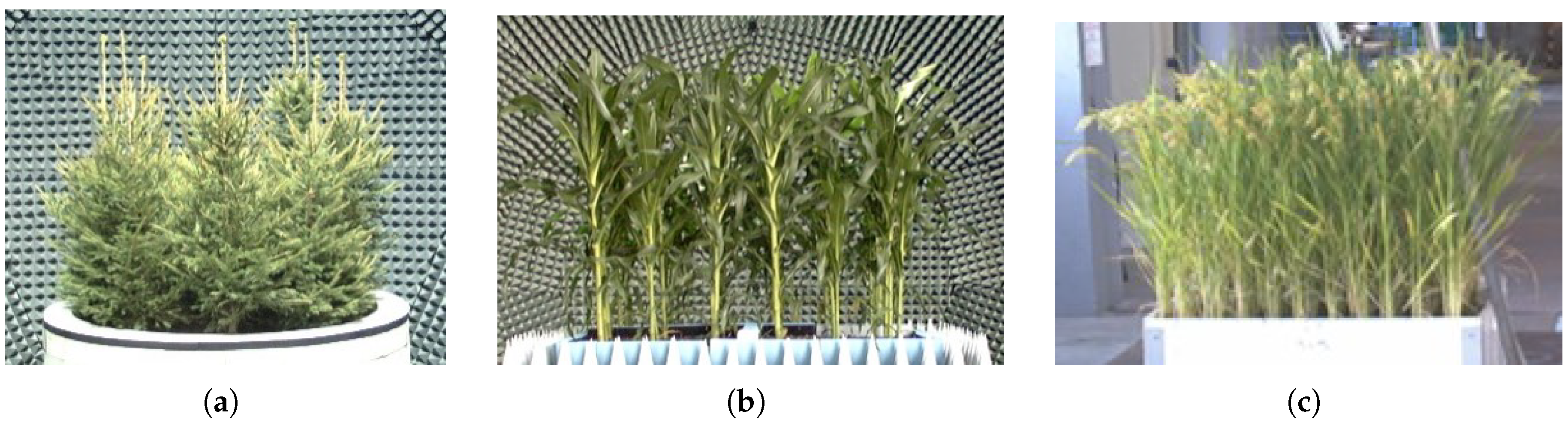
First, we have employed indoor polarimetric data from test vegetation samples, namely, small fir trees, maize and rice plants clusters. Figure 1 shows photographs of them. Datasets were acquired under controlled conditions at the European Microwave Signature Laboratory (EMSL) [33]. These are very well-known datasets and their use has enabled progress in polarimetric and interferometric SAR techniques focused on vegetation [34,35,36,37]. The antenna beamwidth uniformly illuminates the vegetation sample and the system is operated in a stepped-frequency mode in 10 MHz steps ranging from 1.6 to 9.4 GHz for the fir trees sample, from 2 to 9 GHz for the maize, and from 4 to 9 GHz for the rice sample. The incidence angle is 44°. Data acquisitions cover the whole azimuth interval at 5° steps making available 72 measurements through the azimuth look angle.

2.1.2. P-, L-Band and C-Band Data from AIRSAR Campaign

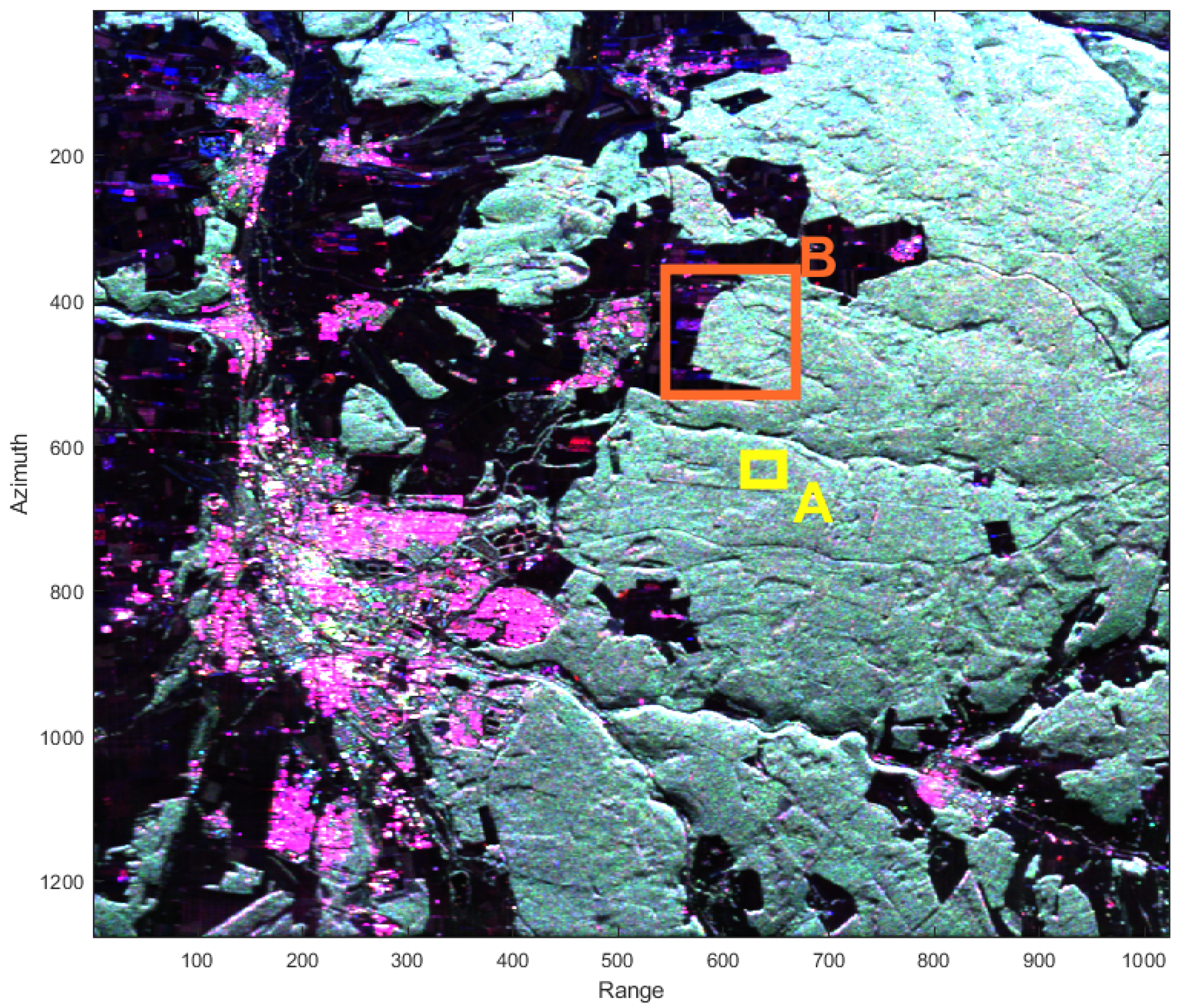
The proposed decomposition has been also tested by using the multi-frequency fully polarimetric dataset acquired by AIRSAR system over the Black Forest in Germany, in a campaign conducted on 16 June 1991, (scene name cm3207). The azimuth and slant range pixel spacing are approximately 12.1 and 6.66 m, respectively, and the incidence angle ranges from 31° to 65°. The forest area at the right side is a mixed forest consisting of spruce (Picea abies), pine (Pinus sylvestris), and fir (Abies alba) trees and the dry weight biomass ranges up to 50 kg/m2, according to [38]. This dataset can be downloaded from the Alaska SAR Facility Vertex data portal from NASA ESDIS. Figure 2 displays an L-band RGB image of the experimental test site which consists of a wide range of scenarios simultaneously observed at P-, L- and C-band. As our interest in the present study is in natural distributed targets, the analysis has been focused in the areas indicated with yellow and orange rectangles and letters A and B, respectively. The former covers a homogeneous forest area whereas the latter consists of forest area together with bare and low vegetated surfaces. A 5 × 5 boxcar filter has been applied to reduce the impact of speckle noise as well as the deorientation procedure [27,28].

2.2. Decomposition Approach

The 3-D Barakat degree of polarisation [29,30] is defined as a function of the fully polarimetric coherency matrix T as given by [18]:
m F P = 1 27 | T | t r 3 ( T )
where | T | is the determinant and t r ( T ) represents the trace of T . A partially polarised wave is characterised by m F P between 0 and 1. The extreme behaviours correspond to a fully polarised wave represented by m F P = 1 whereas a totally depolarised wave is described by m F P = 0 .
In ref. [18] it is proposed to retrieve the volume scattering mechanism intensity P v (or equivalently the power of the depolarised component) as a fraction of the total power (i.e., the S p a n ) measured by a fully polarimetric SAR sensor in the following way:
P v = ( 1 m F P ) · S p a n
On the other hand, the overall polarised power is estimated as the remaining fraction:
P g = m F P · S p a n
In ref. [18] a geometrical factor is proposed as a new scattering-type parameter which allows the further decomposition of the P g power into the backscattering intensities corresponding to both direct and double-bounce components. In the present work, however, we focus on the overall depolarised P v and polarised P g powers (regardless of the composition of the latter).
It must be noted, however, that the use of m F P for estimating the proportions of the S p a n assigned to P v and P g [18,19] deserves further justification, despite this assignment leads to physically consistent interpretations. Certainly, it has not been thoroughly investigated how m F P is able to capture the proportions of depolarised and polarised components. For example, the set of thin dipoles randomly oriented is represented by a normalised diagonal coherency matrix d i a g ( t 11 = 1 , t 22 = 0.5 , t 33 = 0.5 ) , whose degree of polarisation is m F P = 0.395 , not zero. Indeed, achieving m F P = 0 requires the assumption that the volume behaves as the highest entropy model proposed by An et al. [39] described by a normalised coherency matrix equal to the identity matrix, which can be also problematic due to the isotropic nature of the model. However, values of m F P below 0.395 at L-band have been reported in refs. [18,19], thus confirming empirically that m F P can cover a wide range of scattering scenarios from vegetated areas.
The experimental findings in ref. [18] regarding the capability of 3-D Barakat degree of polarisation have motivated the design of a method for estimating the polarised and depolarised coherency matrices, which will be associated with ground and volume coherency matrices, respectively, as mentioned above.
For this aim, let us assume a 3 × 3 matrix D made up of real positive values k i where i = 1 , 2 , 3 , 4 :
D = k 1 k 4 0 k 4 k 2 0 0 0 k 3
By using the D matrix we postulate a relationship between the coherency matrix T (under the reflection symmetry assumption) and the polarised coherency matrix T g through the following Hadamard product:
T g = D T = k 1 k 4 0 k 4 k 2 0 0 0 k 3 t 11 t 12 0 t 12 * t 22 0 0 0 t 33
where the k i factors represent the weights to be assigned to the corresponding elements of the observed coherency matrix. This assumption constrains the k i parameters to the interval [ 0 , 1 ] , where 0 corresponds to a totally depolarised component whereas 1 represents a totally polarised element. Therefore, the depolarised coherency matrix is defined as:
T v = 1 k 1 1 k 4 0 1 k 4 1 k 2 0 0 0 1 k 3 t 11 t 12 0 t 12 * t 22 0 0 0 t 33
For the estimation of k i parameters, at least four equations are needed. Next, several constraints and assumptions on the proposed problem are discussed and they lead to the mathematical relationships employed for estimating k i parameters:
  • The backscattering power for the ground components P g (i.e., the trace of T g ) is already known according to the MF3C decomposition:
    m F P · S p a n = k 1 · t 11 + k 2 · t 22 + k 3 · t 33
    where S p a n is the total power contained in the T matrix.
  • The matrix for the depolarised component may exhibit different structures depending on the randomness of this contribution. In this approach it is assumed that this component accounts for a strongly depolarising volume. Among many options, the Neumann volume model [40] for high orientation randomness (i.e., τ > 1 / 2 ) is considered. Then, the ( 2 , 2 ) and ( 3 , 3 ) elements of the volume coherency matrix are equal and, in addition, the ( 1 , 1 ) element is higher than them. Therefore:
    ( 1 k 2 ) · t 22 = ( 1 k 3 ) · t 33
  • The degree of polarisation of the unknown ground coherency matrix T g must be higher than the (known) degree of polarisation m F P of the observed coherency matrix, i.e.,
    1 27 | T g | t r 3 ( T g ) > m F P
    This equation can be expanded by using the expression of the determinant | T g | and the equality t r ( T g ) = m F P · S p a n (from [18]). After substituting into Equation (9), the following constraint is obtained:
    t 11 · t 22 · t 33 · k 1 · k 2 · k 3 t 33 · | t 12 | 2 · k 3 · k 4 2 < A
    where A is a constant expressed as:
    A = ( m F P · S p a n ) 3 ( 1 m F P 2 ) 27
  • Similarly to the previous condition, it is expected that the degree of polarisation of the unknown volume coherency matrix T v will be lower than m F P , as it would correspond to a pure volume contribution. Hence, the following relationship is defined:
    1 27 | T v | t r 3 ( T v ) < m F P
    where t r ( T v ) = ( 1 m F P ) · S p a n [18] and the expression of | T v | is parameterised according to Equation (6). After substituting into (12) and some operations:
    t 11 · t 22 · t 33 · ( 1 k 1 ) · ( 1 k 2 ) · ( 1 k 3 ) t 33 · | t 12 | 2 · ( 1 k 3 ) · ( 1 k 4 ) 2 > B
    where B is a constant equal to:
    B = ( 1 m F P ) · S p a n 3 ( 1 m F P 2 ) 27
  • Finally, the T g matrix must be positive-semidefinite to be physically feasible. This property holds whenever the leading principal minors of T g are non-negative. Therefore, according to expression (5), the following conditions must be observed:
    • The first leading principal minor is k 1 · t 11 , which is non-negative as 0 < k 1 < 1 and t 11 0 .
    • The second leading principal minor is the determinant of the top-left 2 × 2 matrix. Then:
      t 11 · t 22 · k 1 · k 2 | t 12 | 2 · k 4 2 0
    • The third leading principal minor is the determinant of T g , expressed as follows:
      t 11 · t 22 · t 33 · k 1 · k 2 · k 3 t 33 · | t 12 | 2 · k 3 · k 4 2 0
      Expression (16) can be expressed as:
      t 33 · k 3 · ( t 11 · t 22 · k 1 · k 2 | t 12 | 2 · k 4 2 ) 0
      where it is fulfilled that 0 < k 3 < 1 and t 33 0 .
    Therefore, the condition that must be met is the one expressed in (15).
    It is also noted that the T v matrix is ensured to be positive-semidefinite as can be deduced from Equation (13).
Equations (7) and (8) are subject to conditions given by (10), (13) and (15) and, hence, k i parameters can be estimated.
It is noted that the coherency matrix T g is assumed to be made up of both direct and double-bounce scattering mechanisms. The backscattering contribution of each of these components is determined by the MF3C methodology, as mentioned above. Later, the T g matrix can be further decomposed into direct and double-bounce coherency matrices according to any specific model.

Practical Implementation

The optimisation problem described above must be solved to retrieve the solution set for k i parameters. The following two equations must be solved:
k 1 · t 11 + k 2 · t 22 + k 3 · t 33 m F P · S p a n = 0 ( 1 k 2 ) · t 22 ( 1 k 3 ) · t 33 = 0
which correspond to Equations (7) and (8) above, being subject to expressions (10), (13) and (15).
In order to avoid incurring an excessively high computational cost, the system of equations and inequations given above has been conveniently treated. As a consequence, the original 4-dimensional optimisation problem (i.e., k 1 , k 2 , k 3 and k 4 ) has been transformed into a 2-dimensional problem (i.e., k 2 and k 4 ), which is efficiently solved by sampling the feasible region of solutions. First, the following two considerations are accounted for:
  • From Equations (7) and (8), it is possible expressing k 1 and k 3 as a function of k 2 as follows:
    k 1 = m F P · S p a n t 33 + t 22 t 11 2 t 22 t 11 k 2
    k 3 = t 22 t 33 k 2 + t 33 t 22 t 33
    where k i [ 0 , 1 ] , as noted above.
  • From expression (15), an upper bound of k 4 is determined as
    k 4 t 11 t 22 k 1 k 2 | t 12 | 2 = k 4 m a x
Then, an efficient 2-dimensional (i.e., k 2 and k 4 ) optimisation approach can be designed following the next steps:
  • Uniformly sample k 2 in [ 0 , 1 ] . Take 5000 samples (i.e., potential solutions).
  • Calculate k 1 = γ δ · k 2 and k 3 = α · k 2 + β by using (19) and (20), where
    α = t 22 t 33
    β = t 33 t 22 t 33
    γ = m F P · S p a n t 33 + t 22 t 11
    δ = 2 t 22 t 11
  • Verify k 1 , k 3 [ 0 , 1 ]
  • Calculate k 4 m a x = t 11 t 22 k 1 k 2 | t 12 | 2 . If k 4 m a x > 1 , then set k 4 m a x = 1 .
  • Uniformly sample k 4 in [ 0 , k 4 m a x ] .
  • Verify inequalities given by (10) and (13):
    t 11 · t 22 · t 33 · k 1 · k 2 · k 3 t 33 · | t 12 | 2 · k 3 · k 4 2 < A t 11 · t 22 · t 33 · ( 1 k 1 ) · ( 1 k 2 ) · ( 1 k 3 ) t 33 · | t 12 | 2 · ( 1 k 3 ) · ( 1 k 4 ) 2 > B
  • If the conditions are fulfilled, save the solution [ k 1 , k 2 , k 3 , k 4 ] .
  • Compute the average and standard deviation of the set of solutions for each k i .
One final remark should be made regarding the solution set. In our experiments, it has been observed that the above inequalities do not hold (see expressions in (10) and (13)) for a very small amount of pixels (namely, 0.2%, 1.3%, and 0.1% at P-, L-, and C-band, respectively), which mostly are within non-vegetated areas. After analysing these cases, it has been observed that the cause is a very low value of the t 33 element (i.e., the crosspolar channel) of the observed coherency matrix. Therefore, in such a case the solutions for all k i have been set to 1, i.e., the depolarised component is assumed to be null.

3. Results and Analysis

Next, the performance of the decomposition algorithm is analysed by using the EMSL indoor multi-frequency data from samples of three different vegetation types and P-, L-, and C-band data acquired by AIRSAR airborne sensor over the Black Forest in Germany. Throughout the text, the polarised and depolarised components of t i j will be noted as t i j p and t i j u , respectively.

3.1. EMSL Dataset

3.1.1. Cluster of Fir Trees

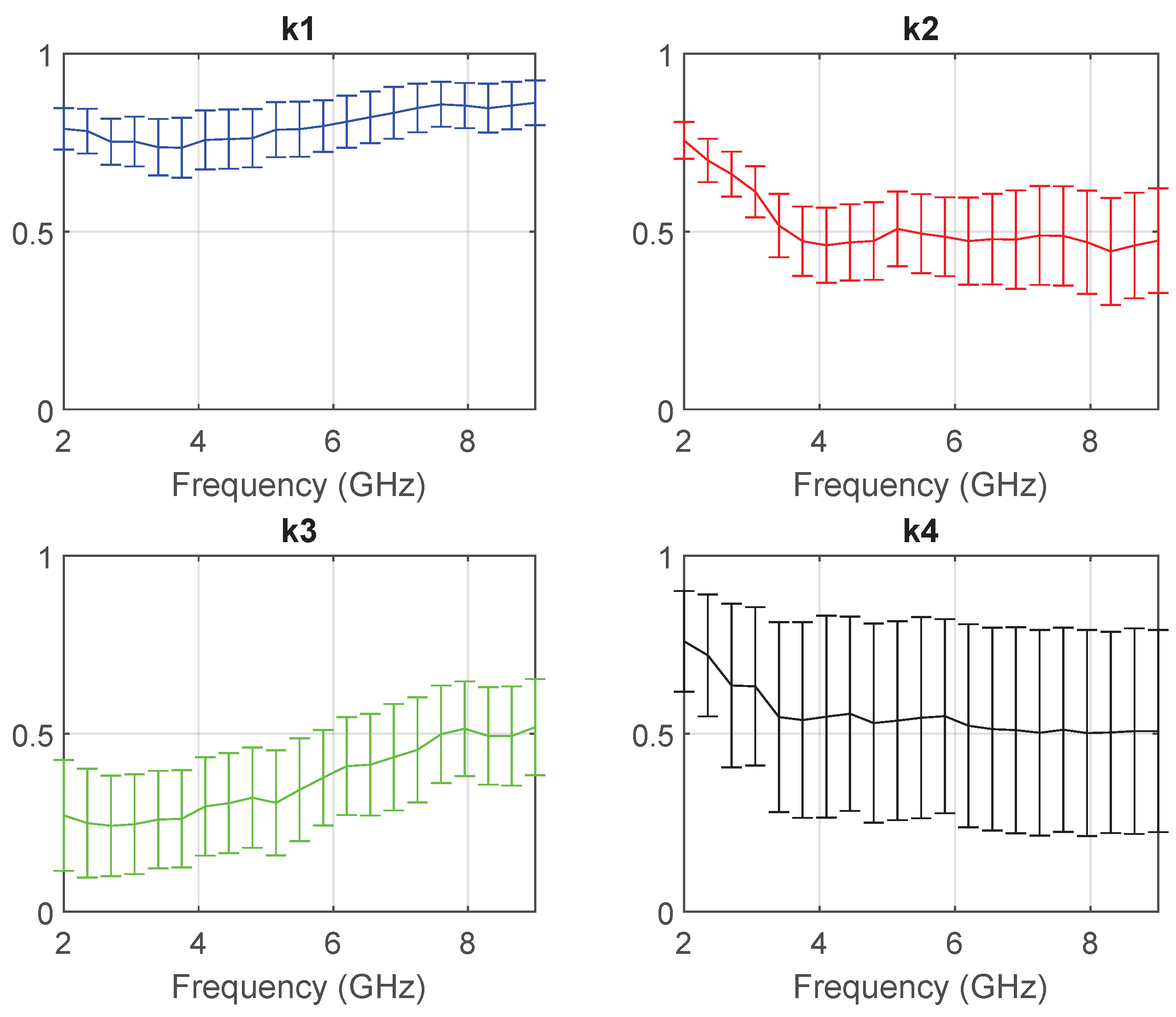
Figure 3 shows the k i estimates as a function of frequency. Both average values and their corresponding standard deviation for 200 iterations are shown. There appears a variation as frequency increases for k 1 , k 2 and k 3 parameters, i.e., the ones controlling the ( 1 ,   1 ) , ( 2 ,   2 ) and ( 3 ,   3 ) coherency matrix elements, respectively. According to Pauli basis interpretation, the polarised components of direct and double-bounce scattering (i.e., ( 1 ,   1 ) and ( 2 ,   2 ) elements) get reduced as frequency increases. In contrast, the polarised component of ( 3 ,   3 ) element tends to increase up to 5 GHz and shows variations between 5 and 9 GHz, but always below 0.5. This indicates that the depolarised component dominates the ( 3 ,   3 ) element (i.e., the HV channel). It is noted that the monotonically increasing trend up to 5 GHz is not reproduced neither in the observed backscattering coefficients (see Figure 4) nor in the P s , P d , P v powers from the original MF3C (see Figure 5), but no clear explanation can be provided for this effect at this moment.
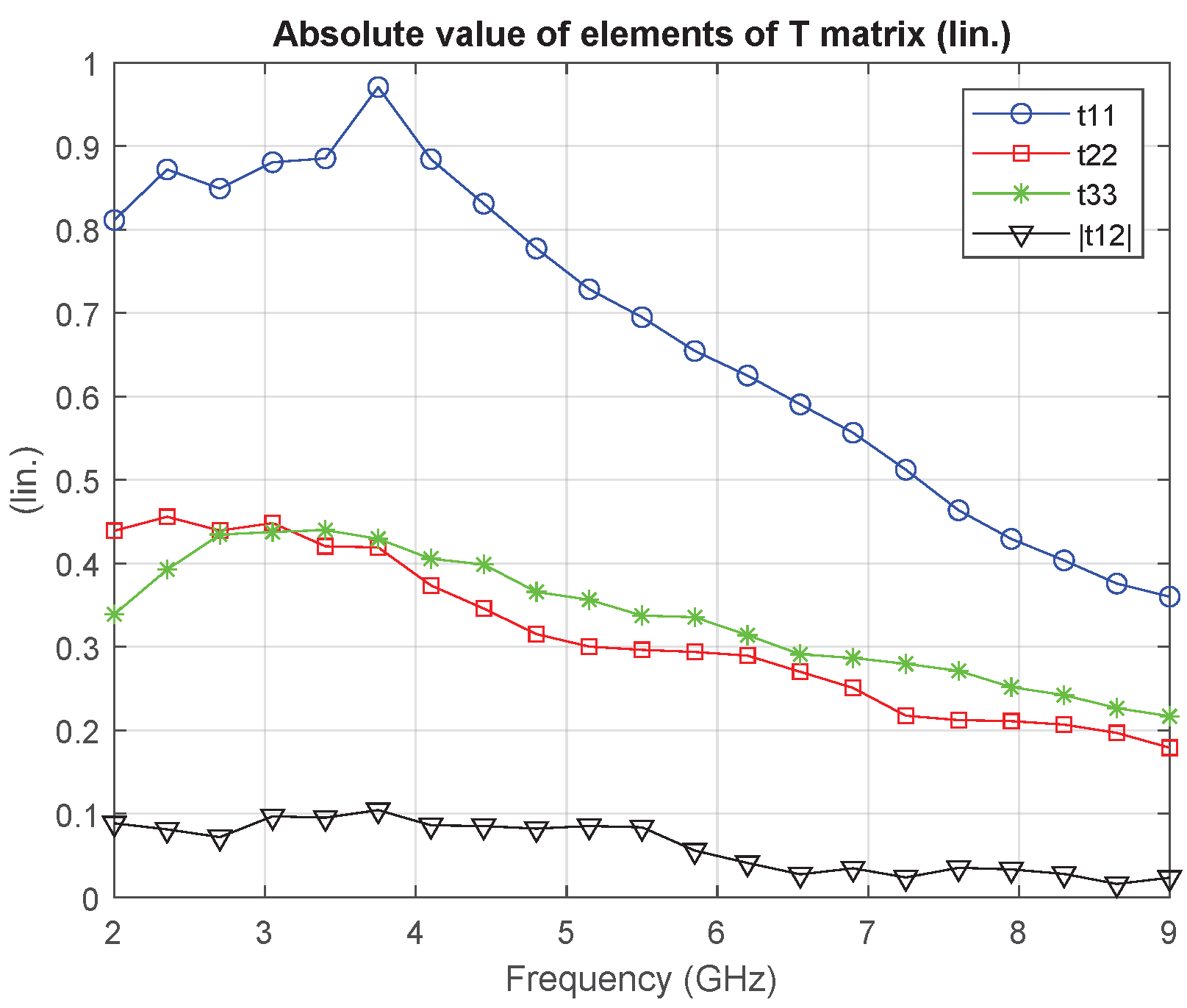
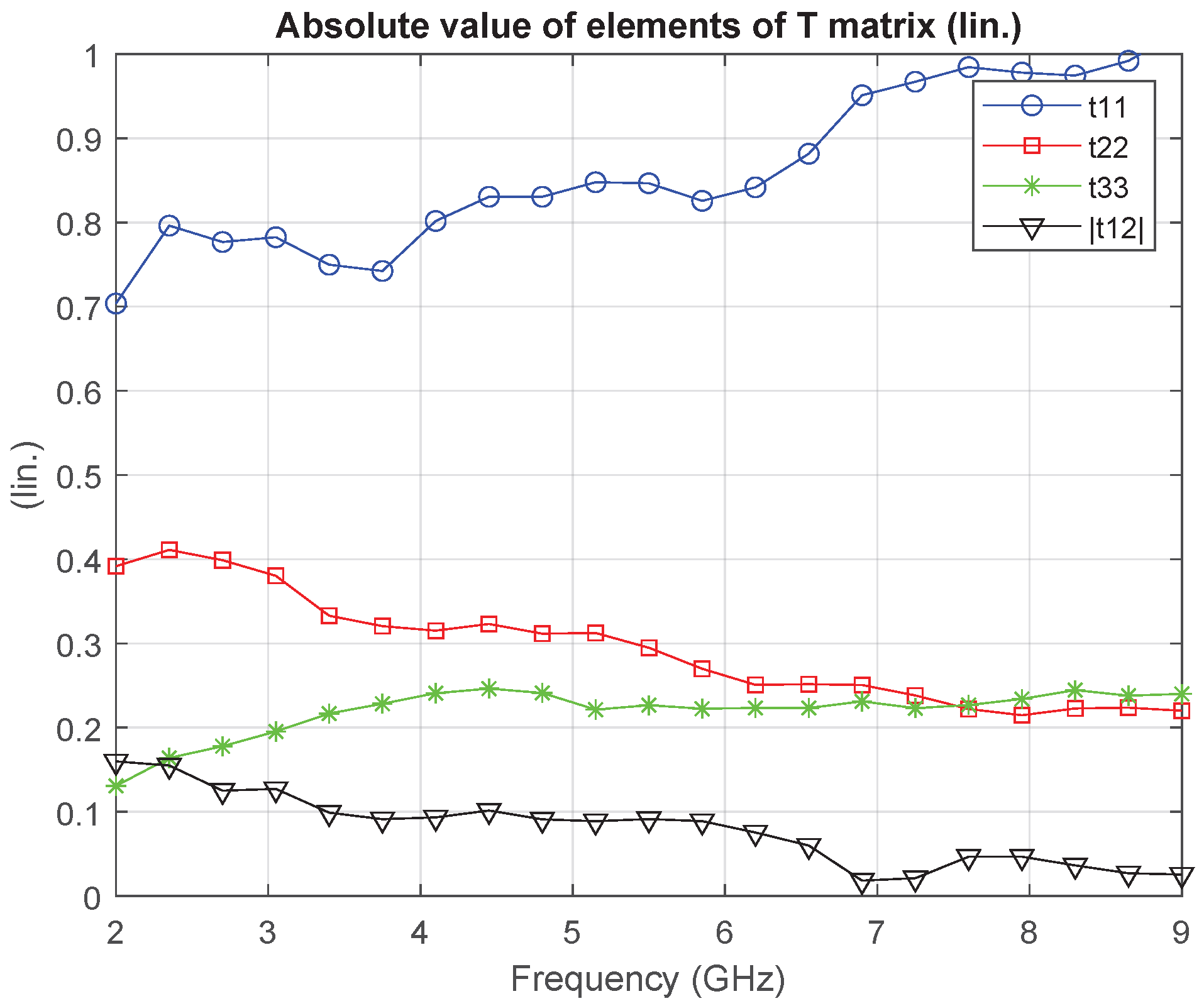
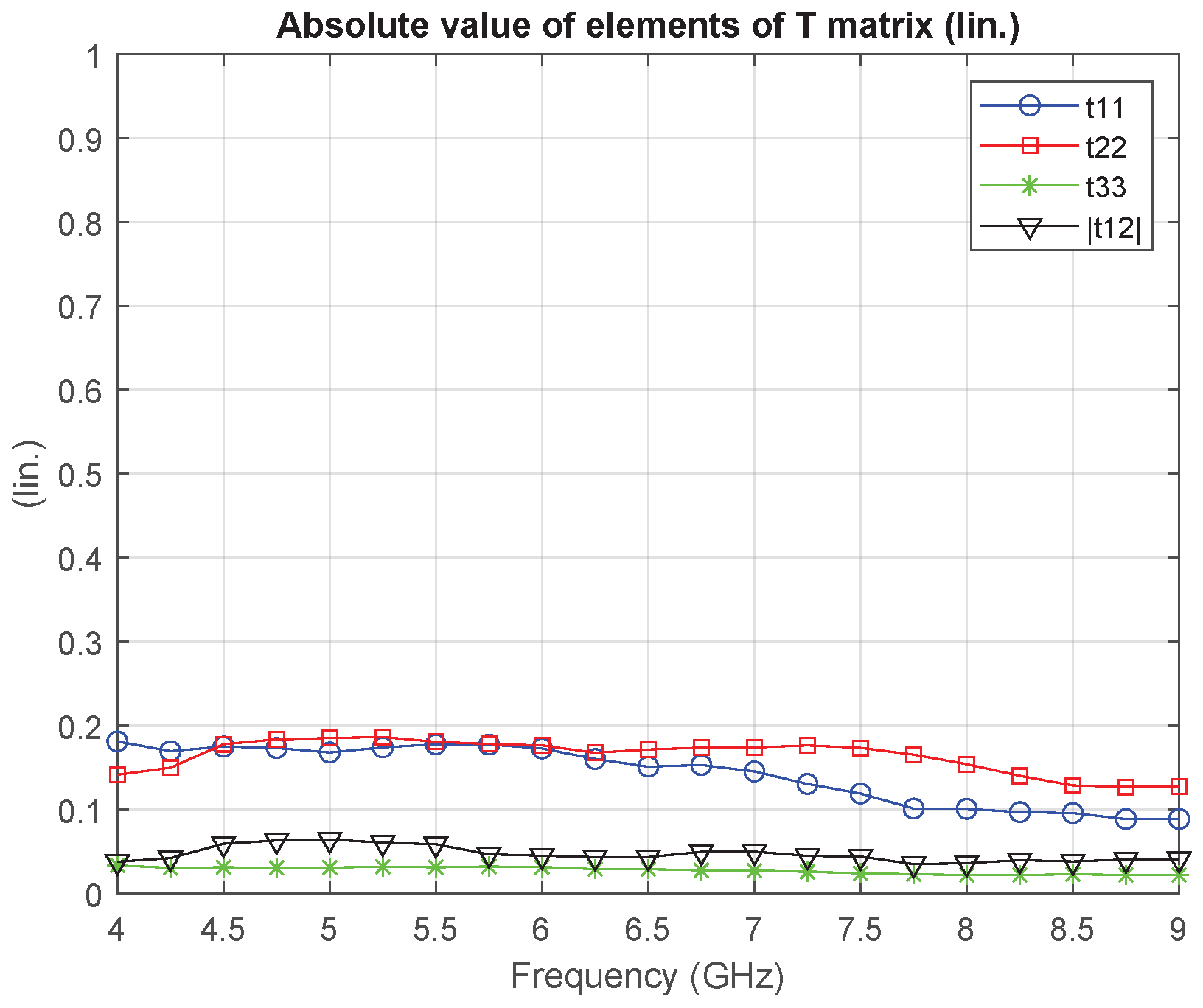
The standard deviation for k 1 , k 2 and k 3 parameters remains in low levels. However, a higher instability is observed for the k 4 estimates, where a standard deviation of 0.25 is mostly retrieved, being its mean value around 0.5 for the whole frequency range. A plausible explanation for the high standard deviation of the k 4 parameter relies on the low value of the t 12 element of the observed coherency matrix, i.e., the correlation between H H + V V and H H V V channels. Figure 4 displays the variation of t 11 , t 22 , t 33 and | t 12 | . As seen, | t 12 | is well below any of the diagonal elements, being at most around 28% of their value. Indeed, at 9 GHz the elements of the observed coherency matrix are t 11 = 0.360 , t 22 = 0.179 , t 33 = 0.217 , | t 12 | = 0.023 , which approximately corresponds to an ideal random volume represented by the normalised elements given by t 11 = 1 , t 22 = 0.5 , t 33 = 0.5 , | t 12 | = 0 .
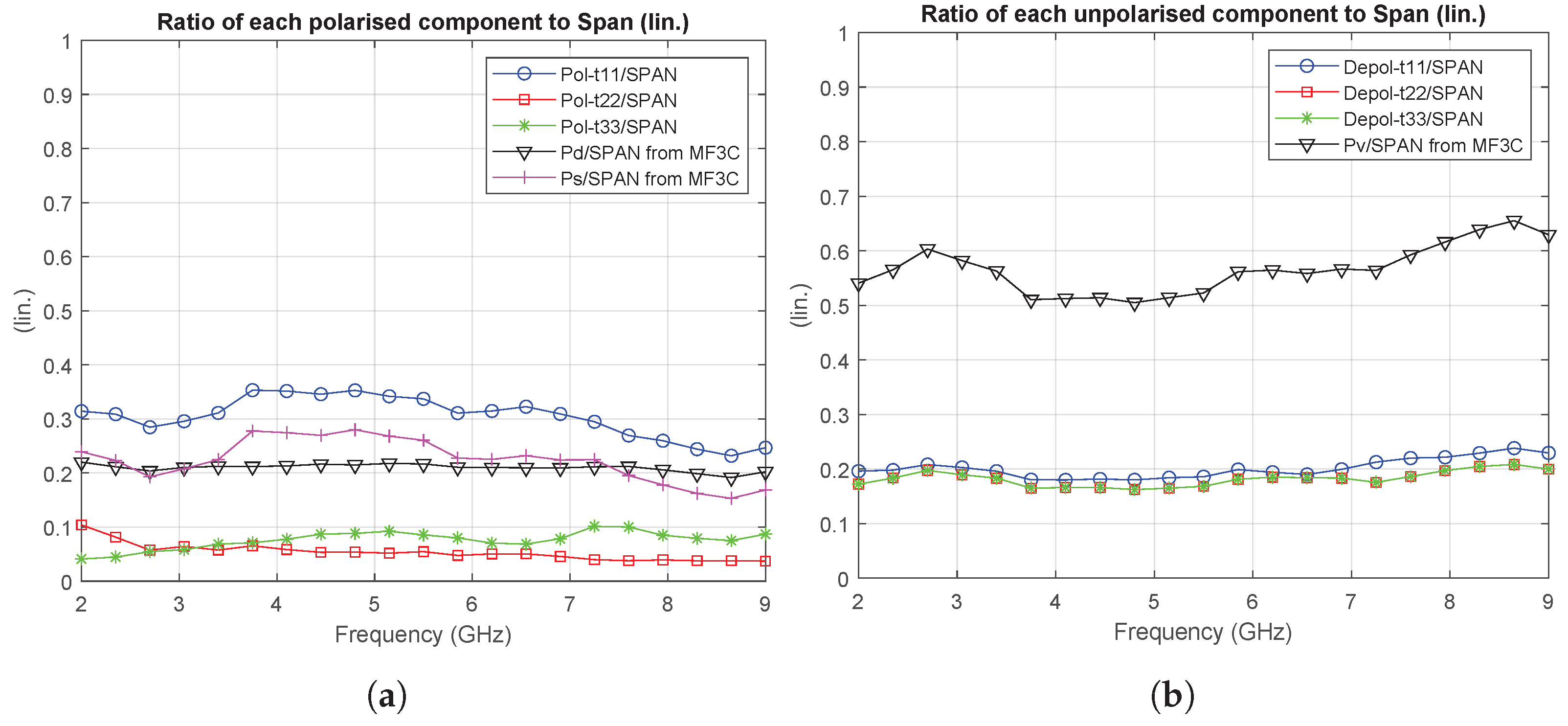
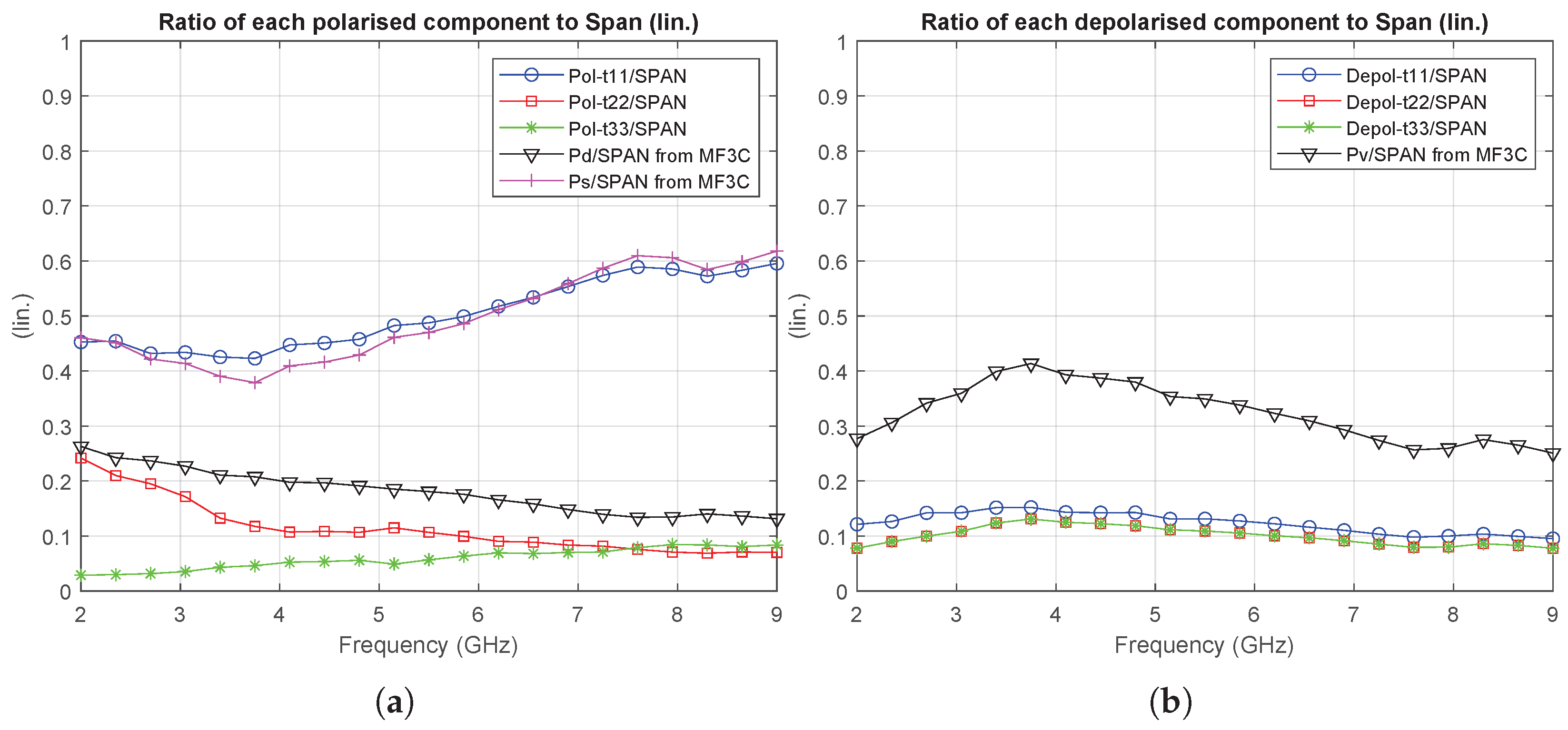
We have also considered the diagonal elements of the retrieved matrices normalised by the span of the observed coherency matrix for the polarised and depolarised components, i.e., T g and T v , to examine their variation as a function of frequency. In addition, a comparison of these retrievals with the ratios P s / S p a n , P d / S p a n and P v / S p a n from the MF3C decomposition is performed. These plots are shown in Figure 5. For the polarised components, the highest variation is accounted for by the t 11 element (representing direct scattering according to Pauli basis interpretation) which follows almost exactly the same trend as the direct backscattering P s / S p a n from MF3C but with a constant difference. On the contrary, the visible variation in t 22 and t 33 elements remains in a very narrow interval. It is also worth noting that the double-bounce mechanism from MF3C (i.e., P d / S p a n ) remains highly constant for all frequencies and, more importantly, its level is close to that of direct scattering P s / S p a n . However, the decomposition of the polarised contribution yields a different outcome, since the t 11 polarised component appears as a clearly dominant contribution over the t 22 and t 33 ones (see Figure 5a). Notwithstanding this general behaviour, the differences between the polarised parts tend to be lower as frequency approaches X-band.
The depolarised components of the diagonal elements (see Figure 5b) account for the total depolarised power P v from MF3C. As shown, they follow the same trend as for P v / S p a n but with a much lower dynamic range. It is also noticeable that the depolarised t 22 and t 33 elements are equal, according to the design of the inversion algorithm (see Equation (8)).

3.1.2. Maize Sample

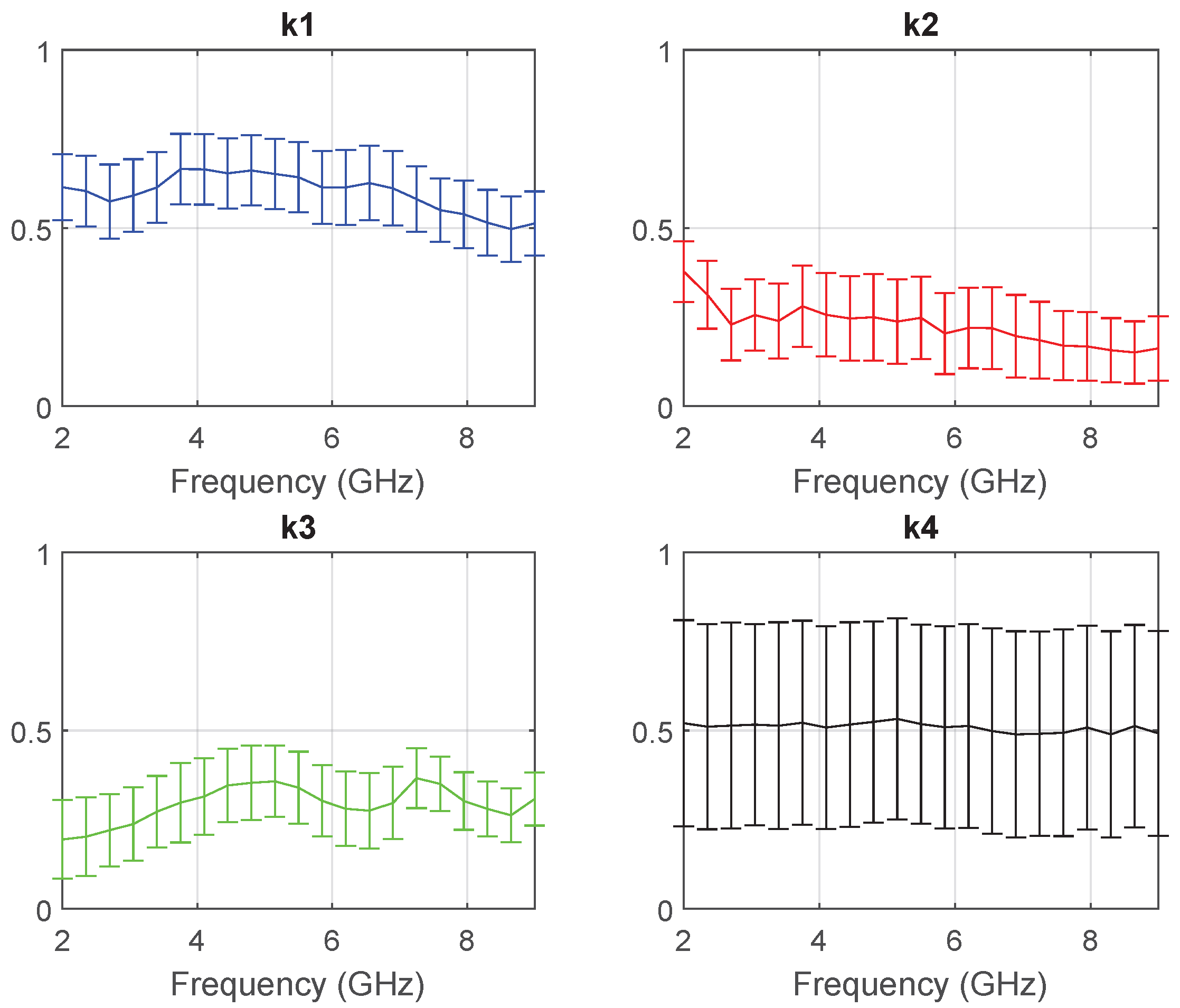
The k i parameters for the maize sample exhibit a different and more complex behaviour than for the fir trees. On the one hand, the H H + V V signature is dominated by the polarised component, as shown in Figure 6 by the high k 1 estimates which tend to be even higher at frequencies reaching X-band. This would suggest that strongly polarised signatures are generated by the combination of the broad leaves of maize and shorter wavelengths. On the other hand, k 2 starts with high values at low frequencies but it declines down to below from the S- to C-band transition. This behaviour shown by k 1 and k 2 agrees qualitatively well with the increasing and decreasing trends as frequency increases in direct and double-bounce scattering, respectively, shown by means of Polarisation Coherence Tomography (PCT) by using the same dataset [37]. The k 3 parameter exhibits a constant increasing slope from around 0.25 up to 0.5, which means that the polarised component reaches around half the power allocated in the HV channel at the highest frequency. Again, as in the case for the fir trees, the k 4 parameter exhibits a high standard deviation probably resulting from the low intensity of the t 12 element of the observed coherency matrix, as shown in Figure 7.
Regarding the polarised components of the diagonal elements of the coherency matrix, it is shown in Figure 8a that the ( 1 , 1 ) element is almost equal to the P s component of the MF3C and that the ( 2 , 2 ) element contribution follows the same descending trend as the P d from MF3C (i.e., the double-bounce component). On the contrary, the polarised part of ( 3 , 3 ) elements exhibits a slight increase, despite it remains at very low values for the whole frequency span. On the other hand, the depolarised contributions of all three diagonal elements (see Figure 8b) show an apparent correlation with the P v from MF3C, representing the depolarised scattering.

3.1.3. Rice Sample

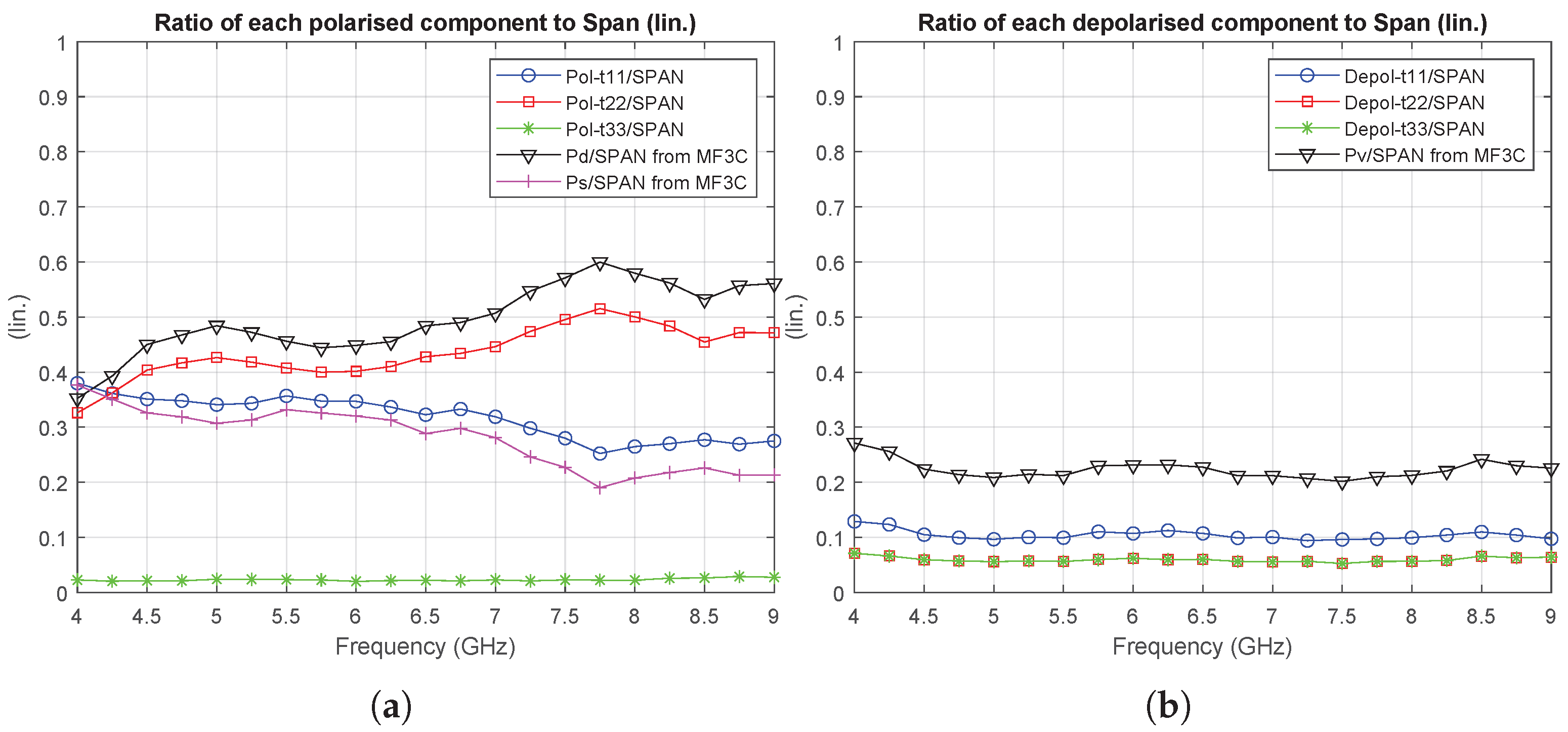
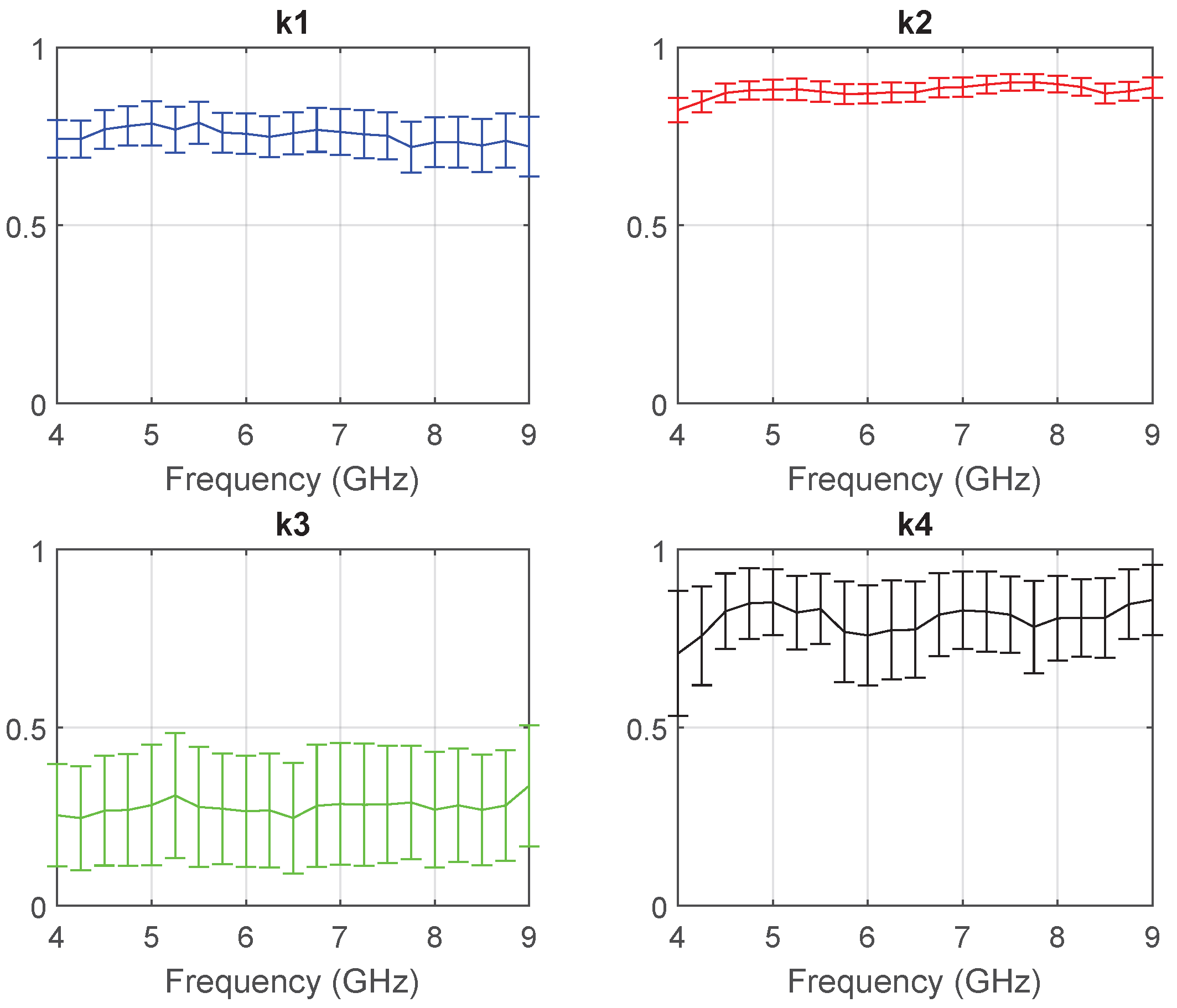
The rice sample results have been computed from 4 to 9 GHz. The particular morphology of this crop together with the flooded soil lead to a qualitatively different radar signature in comparison to fir trees and maize samples. A strong polarised behaviour can be identified by looking at the high values of k 1 and k 2 in Figure 9, which represents a highly polarised component in H H + V V and H H V V channels, respectively. This is interpreted as a non-negligible direct backscattering from the upper layers mixed with a dominant stem-ground and canopy-ground mechanisms. In addition, the remarkably high values for k 4 indicate a certain degree of correlation between the polarised components of those polarimetric channels. This is also observed in the absolute value of the measured t 12 element displayed in Figure 10 which exhibits levels not too much different than the ones of t 11 and t 22 , contrary to what happened in case of fir trees and maize (see Figure 4 and Figure 7). Interestingly, it is noted that the standard deviation of k 4 estimates gets reduced with respect to the fir trees and maize samples. This strongly polarised signature was also observed by analysing the complex interferometric coherences by means of a PolInSAR-based study on the same vegetation sample [36] and also by means of 3-D high-resolution SAR imaging and PCT [41] acquired over a different rice sample at EMSL. On the other hand, the k 3 parameter remains below 0.5 indicating that the depolarised component is dominant in the t 33 element (i.e., the H V channel). Note, however, that the power of t 33 displays very low values for the whole frequency range.
The normalised powers of the polarised and depolarised components of t 11 , t 22 and t 33 are shown and compared to the normalised P s , P d and P v from MF3C in Figure 11. The polarised contributions to t 11 and t 22 dominate the radar response and seem to be strongly correlated with P s and P d values, respectively. The backscattering power from the depolarised components show quite stable values for the whole range. Hence, on the basis of the proposed decomposition, the expected increase of the random volume effect at higher frequencies is not reported for this dataset. This is in agreement with the 1-D high-resolution microwave profiles reported at C- and X-band in ref. [41] where the scattering from the upper layers were dominated by the copolar channels rather than the crosspolar one.

3.2. P-, L-Band and C-Band AIRSAR Dataset—Black Forest

3.2.1. Area A

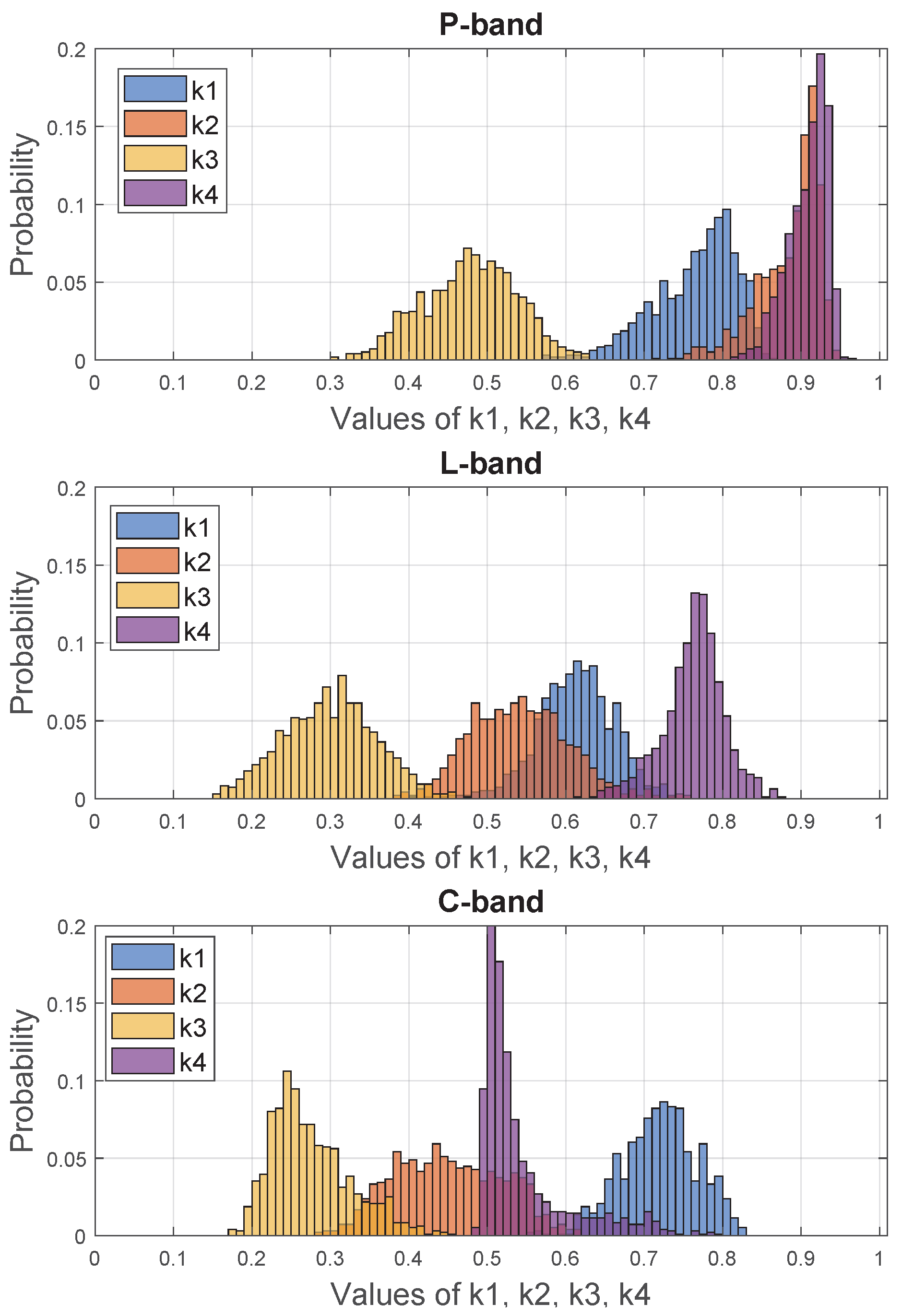
This area (see its location within the whole image in Figure 2) contains 31 × 31 pixels consisting of a homogeneous forest area chosen to assess the qualitative performance of the decomposition method for distributed targets. The histograms of k i for the whole crop are shown in Figure 12 for all three frequency bands, namely P-, L-, and C-band.
On average, the k 1 parameter gets reduced from P- to L-band, which is interpreted as an increasing depolarised component when moving from 68 to 24 cm wavelength. It is noted that at P-band, k 1 exhibits a relatively high dispersion in its values which may be indicative of the wide range of polarimetric features sensed by this long wavelength reaching and interacting with scatterers at ground level. On the contrary, the histogram becomes more compact at L-band as a consequence of an enhanced homogeneous radar signature partly due to the lower penetration capability at this frequency. A further increase of the frequency up to C-band leads to an even lower wave penetration into the canopy and, hence, this is revealed as an increase of the polarised component for the direct backscattering represented by the overall shifting of the k 1 histogram back towards higher values. This behaviour is also in agreement with our previous results regarding the fir trees sample in the S- to C-band transition (see Figure 3). The variation of the k 2 parameter, which controls the balance of polarised/depolarised components of H H V V channel also agrees well with theoretical expectations. At P-band, it exhibits values mostly around 0.9, which is evidence of a strongly polarised signature dominating the t 22 element of the coherency matrix. However, at L-band k 2 becomes much lower (average of 0.55) and it is again slightly reduced at C-band (average of 0.45), which is indicative of an increasing power of depolarised returns. Regarding k 3 , which controls the contributions to H V channel, it accounts for nearly 50% of each component at P-band and decreases down to about an average of 0.32 at L-band. Interestingly, its distribution covers almost the same interval as for C-band but in this case the histogram is more concentrated than at L-band, which can be explained by the highest wave attenuation at the shortest wavelength. Finally, the k 4 parameter accounting for the correlation between H H + V V and H H V V channels exhibits a systematic decrease as frequency increases, which is consistent with a dominant diffuse scattering at the expense of the polarised components. Overall, k i parameters vary from P- to C-band according to the expected polarimetric behaviour in forest areas, ranging from dominant polarised returns to a more compact volume layer and less transparent to radar signals.
In order to gain a deeper insight into the suitability of the proposed decomposition, the different polarised and depolarised components (i.e., t i j p and t i j u above) have been compared to the backscattering powers from the Yamaguchi four-component decomposition with rotation (Y4R) [8] and the MF3C. Based on general theoretical predictions, both direct and double-bounce backscattering intensities (i.e., P s and P d ) are expected to originate from coherent signals scattered by localised scatterers within the resolution cell. The contributions of these signals are mostly contained in t 11 and t 22 elements of the coherency matrix. On the other hand, the volume or diffuse scattering (i.e., P v ) consists of scattered signals whose polarisation state is not well defined and it is accounted for by the t 33 element in a large proportion. However, as noted in Section 1, the MF3C decomposition outperforms the Y4R and other state-of-the-art PolSAR decomposition techniques in terms of separation between polarised and depolarised contributions due to the use of the 3-D Barakat degree of polarisation, m F P . Consequently, as the decomposition proposed in the present paper is also driven by m F P , then a higher correlation is expected between its outputs and the powers from MF3C than with the values corresponding to Y4R.
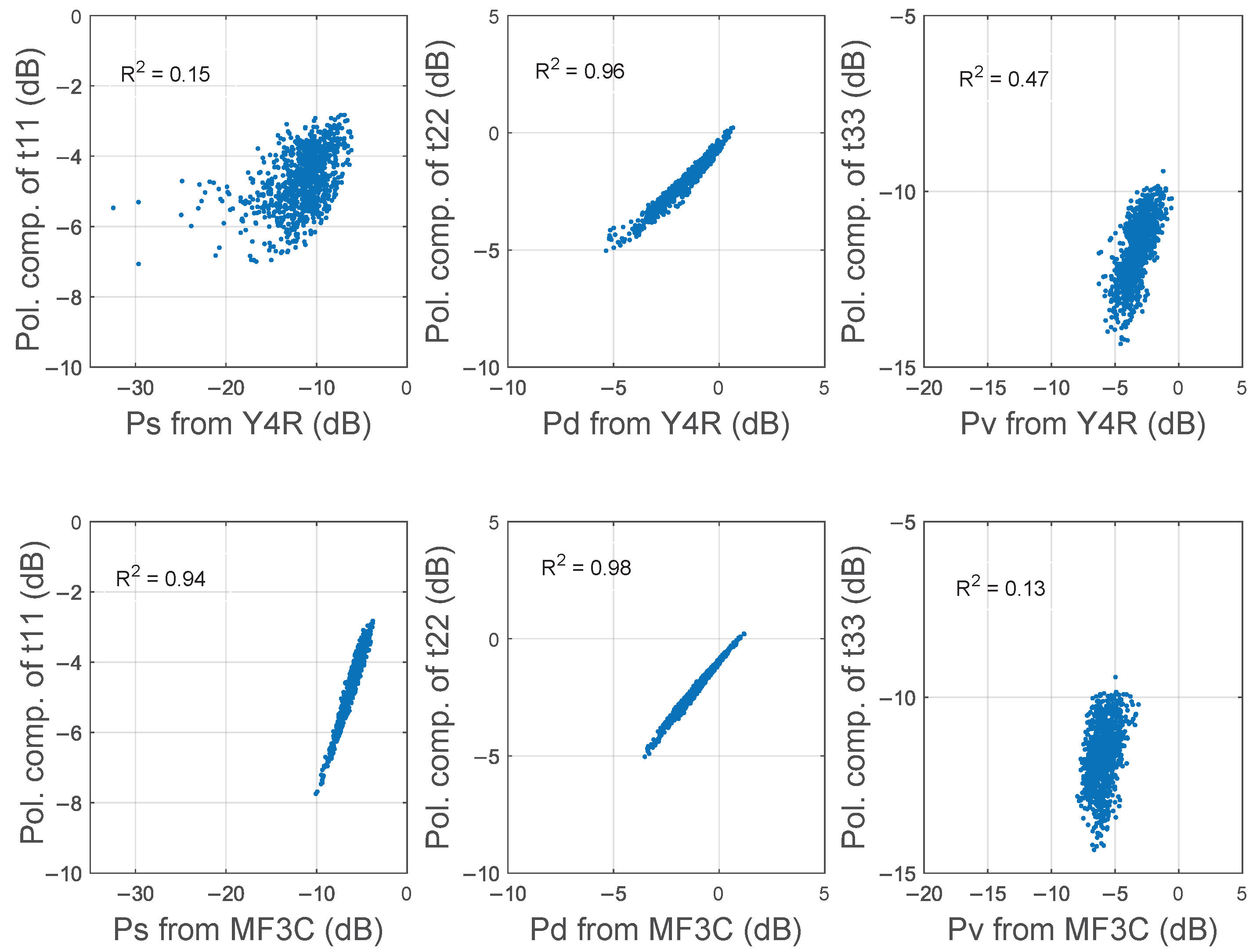
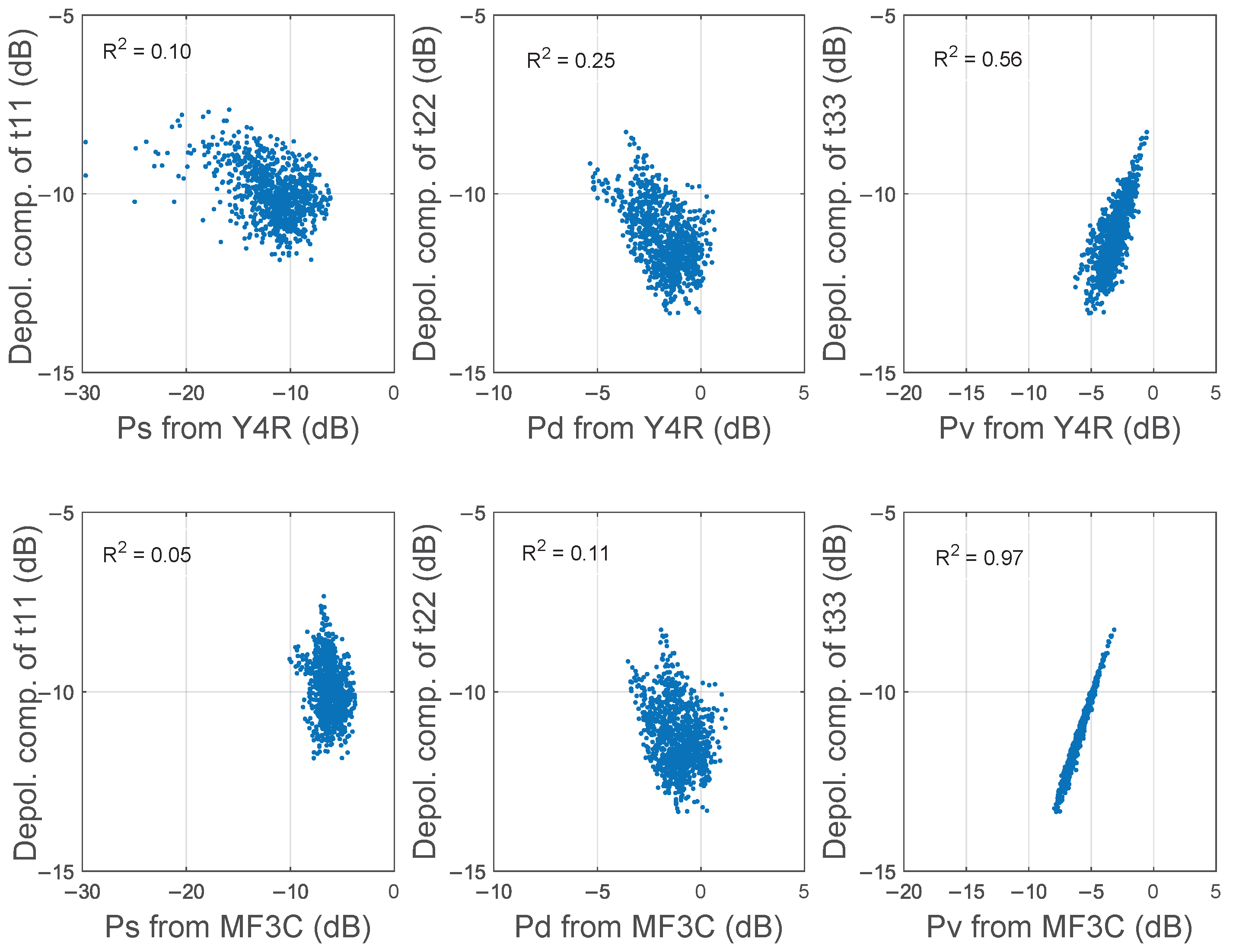
For illustration purposes, Figure 13 and Figure 14 depict the scatter plots for comparing the pairs t 11 p P s , t 22 p P d , t 33 p P v , and t 11 u P s , t 22 u P d , t 33 u P v , respectively, with both the Y4R and MF3C decompositions at P-band. The coefficient of determination ( R 2 ) has also been calculated and included for each case. In both figures, left panels show the scatter plots with respect to the Y4R outputs, whereas right panels refer to the comparison with MF3C ones. The polarised components of t 11 p and t 22 p exhibit an almost perfect correlation with direct and double-bounce from MF3C. However, the polarised contribution of t 33 is weakly correlated ( R 2 = 0.13 ) with the diffuse scattering intensity accounted for by P v from MF3C. From a qualitative perspective, these results suggest that the separation between polarised and depolarised components in terms of overall backscattering power accomplished by the MF3C can also be effectively achieved for the elements of the coherency matrix. On the contrary, when compared to the Y4R outputs the correlation patterns show a different behaviour. First, the t 11 p element is very weakly correlated with P s from Y4R. Secondly, t 33 p could be an approximate predictor ( R 2 = 0.47 ) of volume scattering P v from Y4R. Both results contradict the theoretical assumptions regarding the fact that the polarised contribution must be partly contained in P s (and, hence, they should be correlated) and that the volume backscattering P v only contains depolarised components (which is not supported by this relatively high R 2 value between t 33 p and P v from Y4R). On the contrary, t 22 p does exhibit a very high correlation with the double-bounce from Y4R, as was the case for MF3C. This is likely a consequence of the use of P-band which enhances this scattering mechanism, thus becoming the dominant one and, hence, it is more easily separated by any decomposition method.
The scatter plots for the depolarised contributions at P-band (see Figure 14) lead to different (and expected) conclusions. Only the t 33 u component is very well correlated with P v from MF3C whereas it exhibits some correlation for Y4R with R 2 = 0.56 . The R 2 values for this case also points to the enhanced capability of the MF3C decomposition to separate polarised and depolarised effects when compared to Y4R (see the discussion below regarding also the R 2 values at L- and C-band).
The R 2 values computed at L- and C-band are also displayed in Table 1 (together with those at P-band) for all pairs of correlations, where values are equal to or higher than 0.75 are indicated in bold type. There appears an almost perfect correlation between t 11 p and P s from MF3C, which is not the case for Y4R at L-band (with R 2 = 0.21 ). This fact again highlights the overall qualitative agreement between the proposed decomposition and the MF3C and also the divergences with respect to the Y4R method. At C-band, it is worth noting that R 2 reaches high and very high values for both Y4R and MF3C (0.68 and 0.95, respectively). This is compatible with the lower canopy penetration at this wavelength due to a stronger wave attenuation which enhances the direct backscattering from the upper layers of the forest canopy.
There is an almost perfect correlation for the t 22 p element (the second row in Table 1) with P d for both Y4R and MF3C at P-band. However, at L-band, it gets much lower for Y4R ( R 2 = 0.11 ) than the correlation with P d from MF3C ( R 2 = 0.76 ), as expected. In case of C-band, a weak correlation is observed for both Y4R and MF3C ( R 2 = 0.14 and R 2 = 0.22 , respectively) which can possibly be attributed to the low and different backscattering intensity of double-bounce mechanism at C-band contained in t 22 p and P d from both Y4R and MF3C. As the retrieved power of this mechanism gets lower, a more evident divergence results when comparing the performance of the proposed decomposition with respect to both the Y4R and MF3C methods. Interestingly, the R 2 values between t 33 p (i.e., the polarised component of H V channel) and P v from MF3C are either negligible or very weak for all three frequencies, being at most 0.13 at P-band. This result is in agreement with the expected outcome as the volume scattering is regarded as a depolarised contribution. Contrarily, this behaviour is not seen in the correlation of t 33 p with the volume scattering retrieved from Y4R, as a non-negligible R 2 value of 0.47 at P-band is found for this forest area (note also that some weak correlation with R 2 = 0.23 still appears at L- and C-band). This result may be likely attributable to the known shortcomings of Y4R regarding the overestimation of volume component and its inability to effectively separate polarised and diffuse scattering components.
Results on the correlations involving the depolarised components (last three rows in Table 1) are also discussed next. First, the depolarised components of H H + V V and H H V V channels (i.e., t 11 u and t 22 u , respectively) exhibit an extremely low correlation with P s and P d components from both Y4R and MF3C, in agreement with scattering physics, except for the pair t 22 u P d for MF3C at C-band. In such a case, the R 2 value unexpectedly reaches 0.51. Even though this is not a high correlation, it is certainly not negligible. However, we lack a conclusive interpretation of this result. Secondly, the t 33 u P v correlation (last row) exhibits values consistent with theoretical expectations, as they range from 0.97 to 0.99 for all three frequency bands for MF3C. In case of Y4R, despite R 2 is still significant as it varies from 0.56 to 0.77, it is consistently lower than for MF3C, which is indicative of a lower capability of Y4R decomposition to effectively identify depolarising effects.
Overall, the correlation analysis provided in this section has shown that there exists a general agreement in the polarimetric behaviour in terms of backscattering power between the outcomes of the proposed decomposition and the MF3C. This is observed at P-, L-, and C-band, and is indicative that the k i parameter inversion procedure achieves physically feasible results in terms of separation of depolarised and polarised components for this forest area. Therefore, this decomposition can be regarded as an extension of the MF3C technique, as in the present method not only are the backscattering powers retrieved but the whole depolarised and polarised coherency matrices.

3.2.2. Area B

In this section a different image crop is employed, as illustrated in Figure 2. It contains 176 × 161 pixels consisting of forest area occupying most of the image crop together with bare and low vegetated surfaces located along the left part of the image. This allows a further comparison of different polarimetric signatures retrieved by the proposed decomposition in a more heterogeneous scenario.
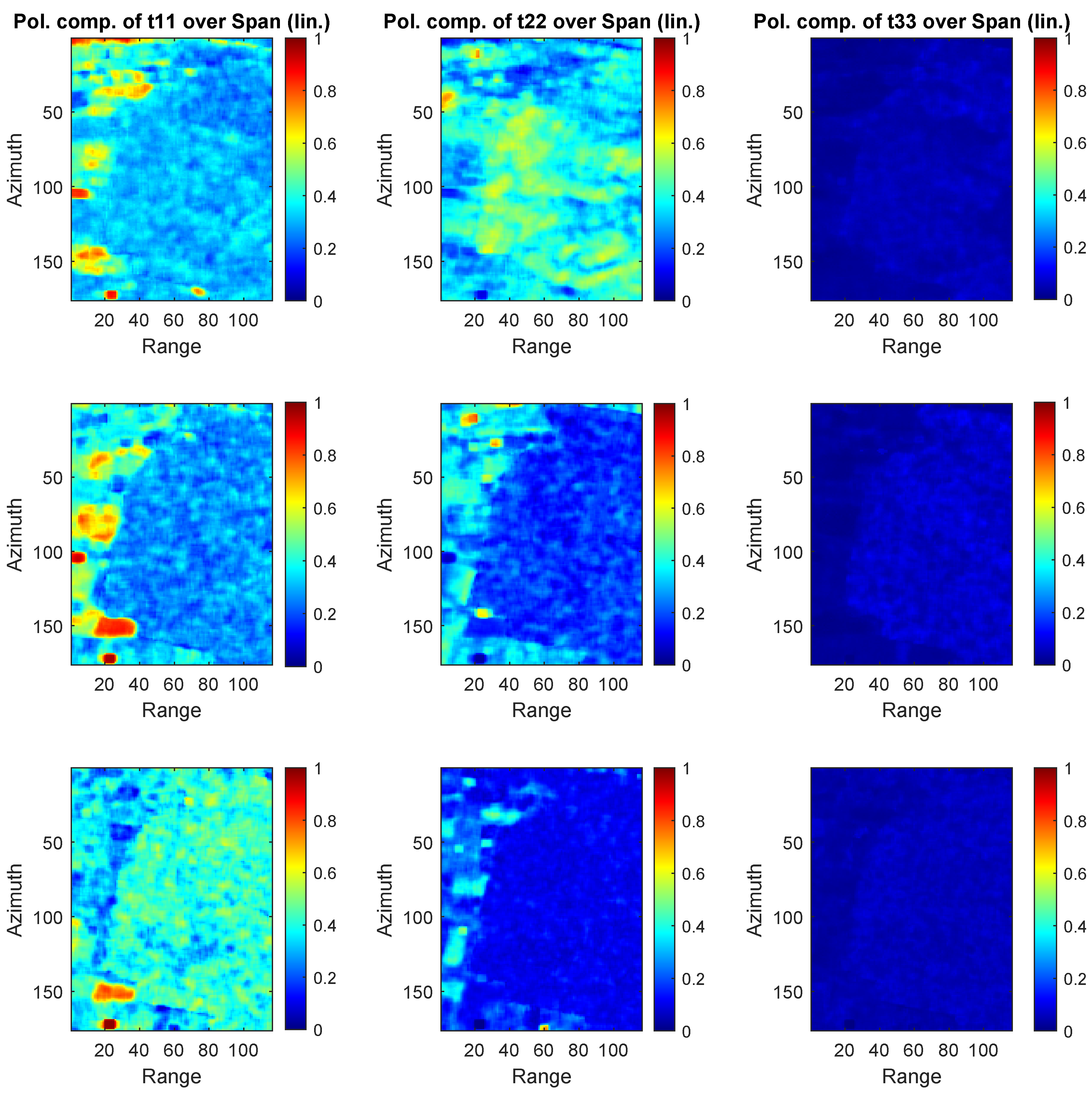
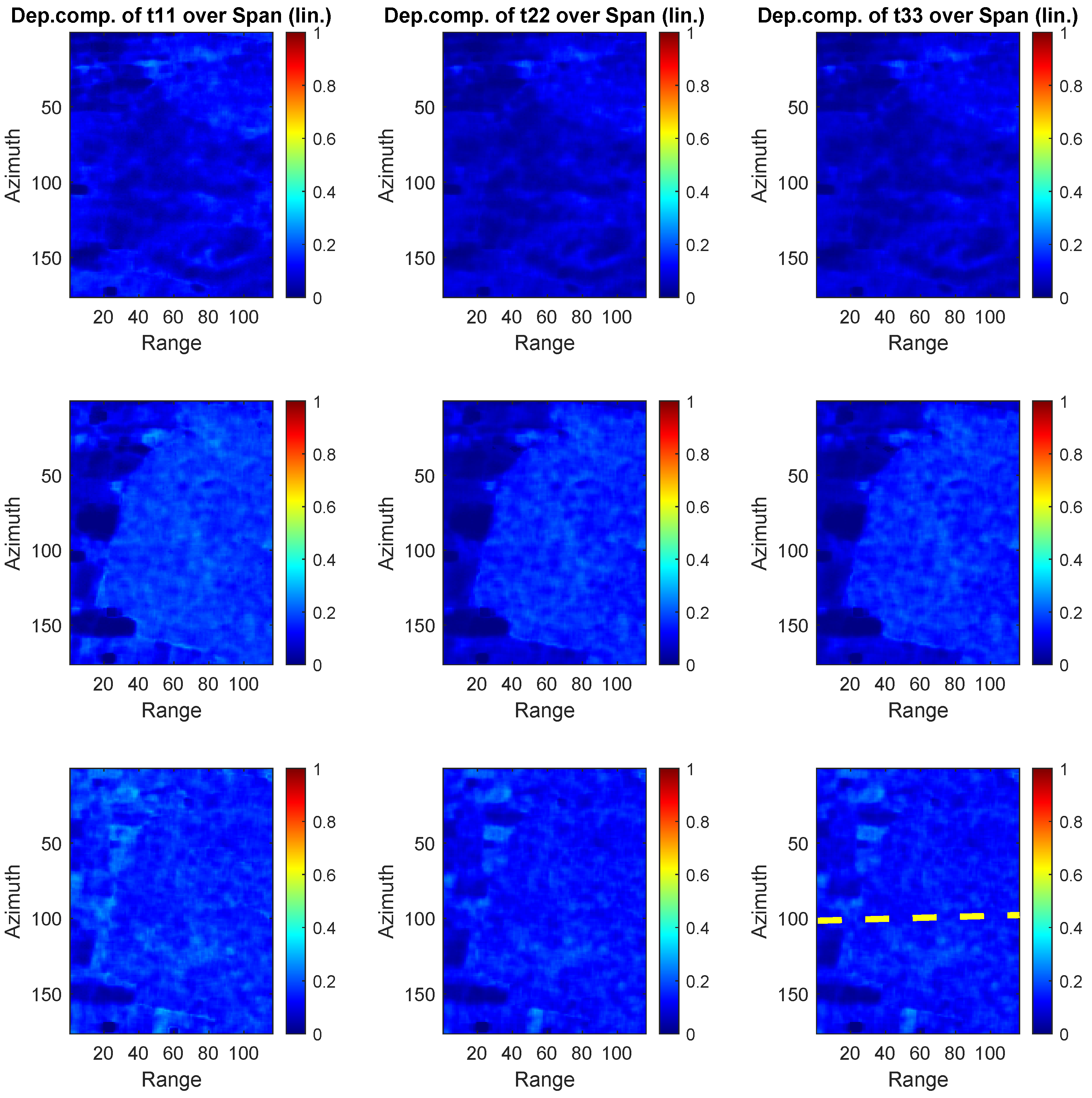
Figure 15 displays the polarised components t i i p normalised by the total power for all three frequency bands (each band is represented at each row within the figure). At P-band the highest contribution within the forest area appears in the t 22 p component due to the dominant double-bounce mechanism at this long wavelength. On the other hand, the bare surface and low vegetation area exhibits the highest radar returns for the t 11 p element (i.e., the H H + V V channel) despite some other locations where a medium to high t 22 p value is also retrieved. Likewise, there is a variable proportion of polarised direct scattering within the forest area reaching remarkable values about 0.4. The polarised component (i.e., t 33 p ) retrieved from the H V channel is very low, being about 10% of the total span at most for this dataset at P-band. The interpretation of these observations can be supported by the tomographic analyses in refs. [42,43] on boreal forests, where the main backscattering at P-band was found to be due to ground and is present in all three polarimetric channels in the lexicographic basis and, in addition, the H V channel exhibited only a very moderate return from the canopy. Therefore, the reported polarised backscattering components at P-band can be explained by a dominant double-bounce due to ground-trunk interaction, present in t 22 p , and complemented by a secondary mechanism, present in both t 11 p and t 33 p , from ground backscattering disturbed by understory or volume-ground interactions, as suggested in [43].
At L-band (second row in Figure 15) the dominant scattering is generated by the direct mechanism in the t 11 p element for both scenarios within the area, although it is lower and variable within forest with normalised values up to 0.4. Considering that they allegedly correspond to polarised returns and according to [43], this component can be assumed to be generated as a combination of direct scattering from both upper layers of the canopy and understory. The t 22 p element undergoes a sharp decline in the forest area with respect to its average intensity at P-band, although there still appear some spots where the ground-trunk interaction (and possibly the volume-ground) is not negligible. This can be explained by a higher wave attenuation rate at L-band and, indeed, it is an effect that has also been observed in previous works in boreal forest at this frequency [42,43]. In addition, the polarised crosspolar component t 33 p increases its contribution to the total span in comparison to P-band, although this increment is just about 5–6%.
The last row in Figure 15 shows the corresponding maps at C-band. The most noticeable change with respect to P- and L-band is the remarkable increase in the direct scattering from the canopy as seen in t 11 p for the forest area. The retrieved values display some spatial variations due to different (and higher than those at P- and L-band [44]) extinction rates as a consequence of spatial patterns in the canopy cover whose radar response is enhanced by this shorter wavelength. Regarding t 22 p , very low and spatially homogeneous values not exceeding 15% of the total span are retrieved. In addition, the t 33 p element gets reduced in comparison to L-band but it is still higher than in the case of P-band. Overall, these observations are consistent with the low wave penetration capability at C-band and the dominant direct backscattering from the upper layers of the forest canopy, as widely reported in the literature.
All the observations made so far regarding the polarised components t i i p are complemented with the retrieved values for the depolarised contributions, which are shown in Figure 16. It must be noted that the k i parameter inversion has been constrained by the use of the Neumann volume model for high orientation randomness scenarios. Therefore, it is assumed that the depolarised coherency matrix fulfils that t 22 u = t 33 u , as expressed in Equation (8). Consequently, second and third columns in Figure 16 display almost identical maps (despite some isolated inversion errors).
The P-band depolarised components are retrieved at very low intensities, as expected for such a long wavelength and its capability for inducing coherent scattering when interacting with forest structures. There appear some small and isolated parts (especially at the top and at the bottom of the image) where t 11 u reaches 20–25% of the span. However, the P-band depolarised backscattering still gets the lowest values among all three frequency bands. On the contrary, at L-band the depolarised returns are more evenly distributed among t i i u elements, being moderately higher for t 11 u . Increasing the frequency to C-band leads to remarkably higher values of the t 11 u element with respect to t 22 u and t 33 u , meaning that the depolarised returns are accounted for mostly by the H H + V V channel. Contrary to this behaviour, it would be expected that some higher depolarised backscattering was also induced in the H V channel (i.e., t 33 u together with t 22 u as they must be equal, according to the assumed model). However, this is not the case and the physical interpretation of this phenomenon must be further investigated at this frequency band as we do not have enough elements to rule out some limitation either due to the model chosen for the depolarised component (i.e., the t 22 u = t 33 u constraint) or to the numerical inversion. It is also noteworthy to point out the significant difference between the t 11 u spatial patterns within the forest area at L- and C-band. The former shows a more homogeneous distribution whereas a clearly wider dynamic range is retrieved at C-band. In case of L-band, the spatially homogeneous retrievals are consistent with the more uniformly distributed backscattering along the vertical axis, as shown by the tomographic analysis for a different boreal forest in [43]. On the other hand, as mentioned above, the structure (both vertical and horizontal) of a boreal forest together with the shorter wavelength at C-band are factors that may explain the spatial patterns observed in both t 11 p (see Figure 15) and t 11 u elements.
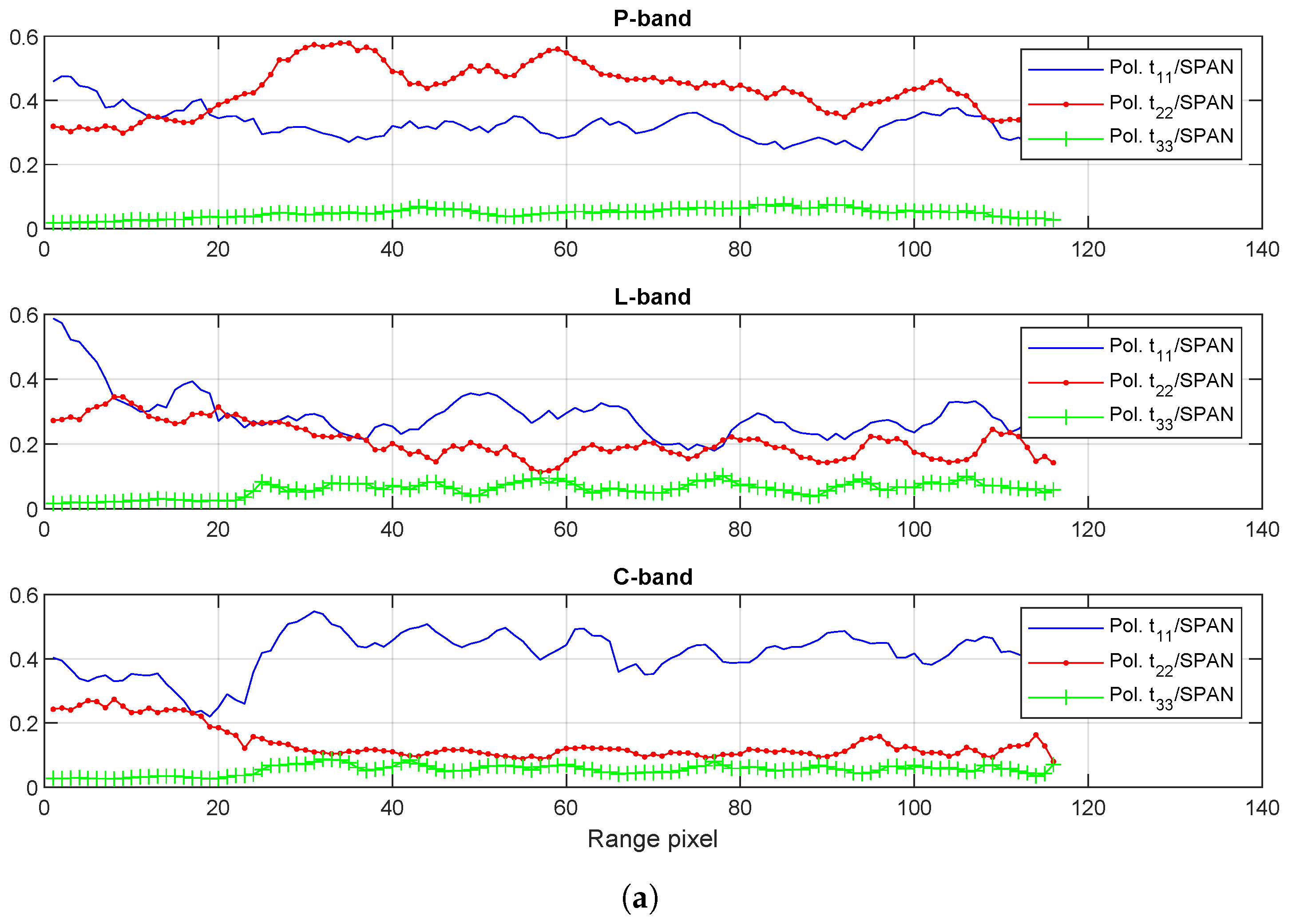
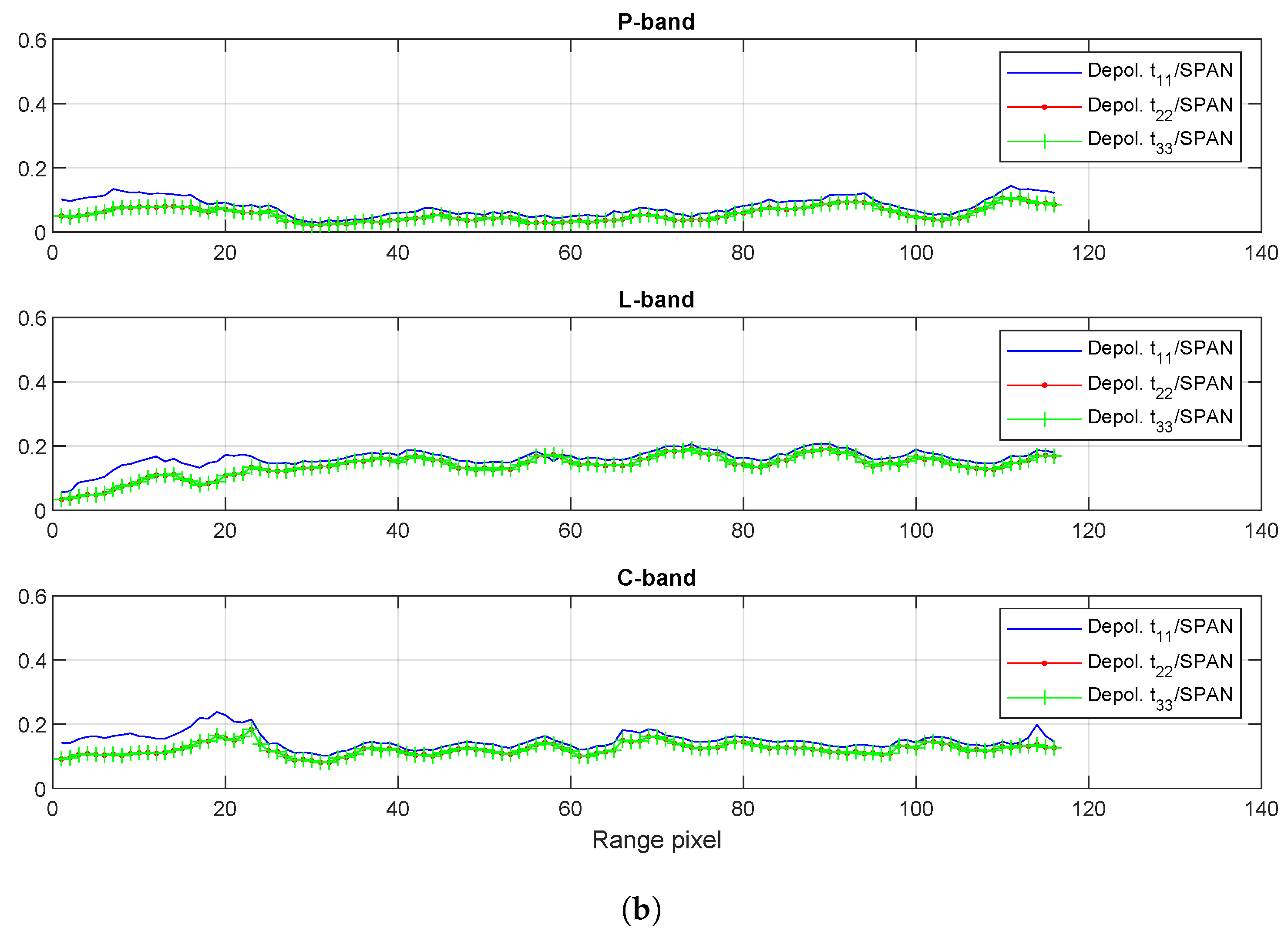
To deepen the present analysis, a transect from area B has been chosen to plot t i i p and t i i u estimates. This transect is indicated by a dashed yellow line on the bottom-right map of Figure 16. Figure 17 shows the variation for both polarised and depolarised components at all three frequencies. It is noted that the forest area spreads from around pixel 20 onwards.
Overall, all the qualitative observations and analysis made on the basis of maps in Figure 15 and Figure 16 for the forest area are confirmed in these transects. Focusing on Figure 17a, the following comments are in order. Firstly, for t 11 p (blue solid line), the aforementioned decrease from P- to L-band and later increase from L- to C-band is clearly shown. Secondly, the decreasing trend from P- to C-band in the t 22 p parameter (mostly associated with the double-bounce mechanism) is clearly noticeable. Third, the polarised component from the crosspolar channel exhibits the lowest contribution (values hardly reach 10% of the span) but it is in general slightly higher at L- and C-band than at P-band.
In case of the depolarised components shown in Figure 17b, it is observed that nearly residual values are retrieved at P-band for t i i u parameters, except for t 11 u along the low vegetation portion up to pixel 20 and some parts at the end of the transect, even though they are still well below 20% of total span. In addition, the three depolarised components become higher at L- and C-band and fulfil the constraint t 11 u > t 22 u = t 33 u (note the overlap of t 22 u and t 33 u components. In addition, as discussed above for the maps, intensities for different backscattering channels become more similar among them at L-band rather than at C-band, which exhibits a higher spatial variability for the t 11 u channel.

4. Discussion

First, focusing on the EMSL experiments carried out under controlled conditions, some objetive facts are revealed. In general, the three vegetation samples exhibit different polarimetric signatures, which cannot be unambiguously determined only according to the observed coherency matrix. Both the fir trees and maize exhibit a dominant backscattering in t 11 channel but with different trends, whereas a more similar behaviour regarding the t 22 and t 33 intensities is observed (see Figure 4 and Figure 7). However, the analysis of both backscattering powers from MF3C and polarised and depolarised components of the coherency matrix allows us to characterise the fir trees more closely as a dominant random volume with a secondary direct backscattering whereas the maize sample exhibits a dominant polarised direct backscattering and a secondary double-bounce mechanism attenuating as frequency increases. This analysis has been confirmed by observing the copolar correlation (see discussion in Section 4.2.1).
In case of rice, the observed intensities of all four matrix elements in Pauli basis are confined to a much lower dynamic range than for fir trees and maize samples, being t 11 and t 22 levels relatively higher than | t 12 | and, especially, than the crosspolar t 33 . However, after separating the polarised and depolarised contributions, a dominant double-bounce mechanism and a secondary direct surface mechanism are revealed. In all cases there appears an apparent correlation between t 11 and t 22 polarised components (i.e., ( 1 , 1 ) and ( 2 , 2 ) elements from the T g matrix) and the P s and P d , respectively, from MF3C, as well as between the diagonal elements of T v matrix and P v from MF3C.
Next, the analysis shown above on the decomposition results is complemented by using other polarimetric tools, such as the eigendecomposition of both the polarised and depolarised output coherency matrices and also the corresponding copolar correlation < H H · V V * > which is retrieved after applying a special unitary transformation to T g and T v to compute the corresponding covariance matrices. These outcomes will be used to further deepen the discussion.

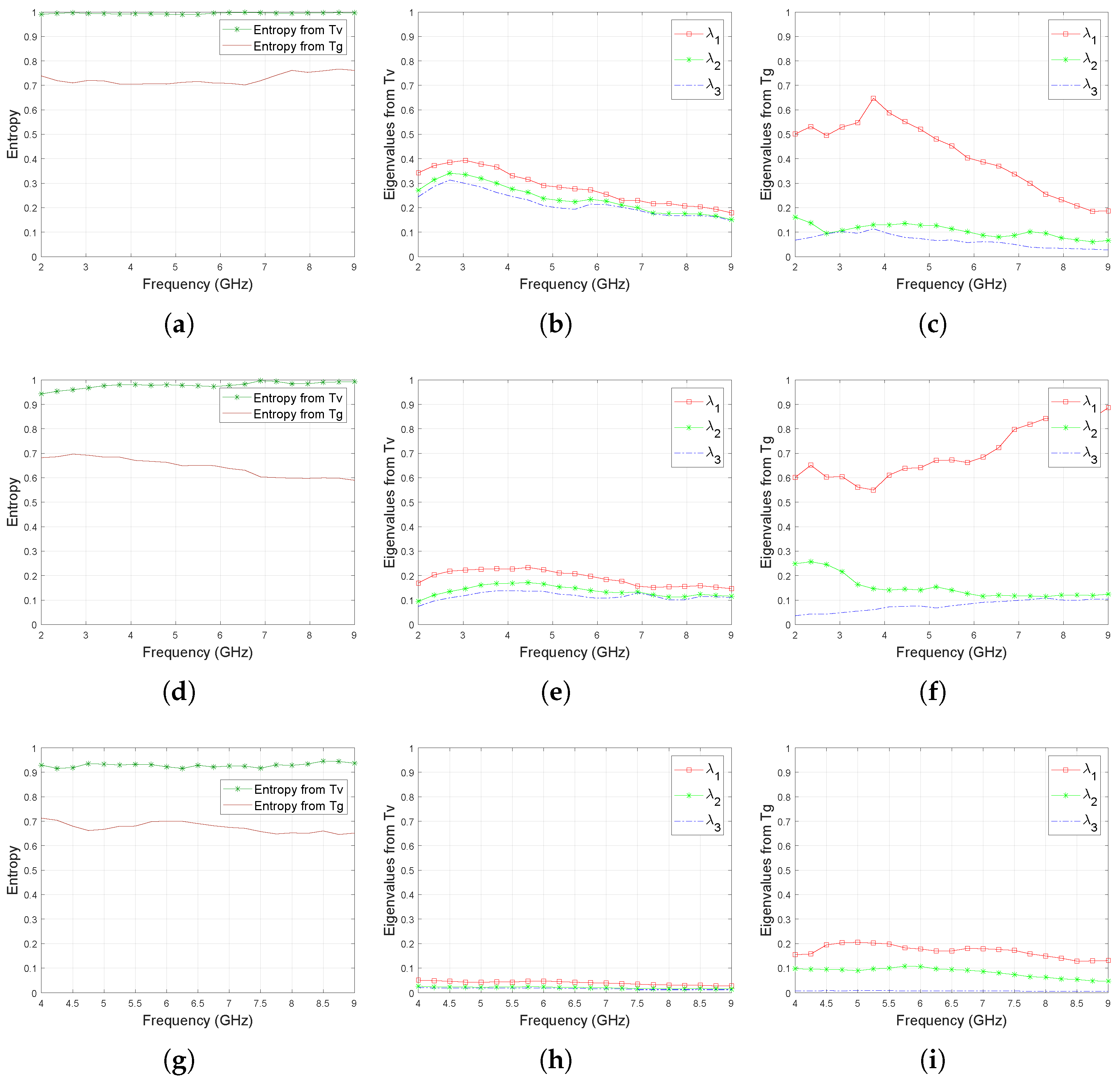
4.1. Eigendecomposition of T g and T v from EMSL Datasets

The eigendecomposition approach [45] has also been applied to both T v and T g decomposed matrices. Figure 18 displays the results. The entropy [46] and the eigenvalues have been obtained for each vegetation sample as a function of frequency for both matrices. For all three cases the entropy for T v remains clearly above the entropy for T g . The difference is more evident for the maize sample especially at high frequency, which is in agreement with the strong polarised direct backscattering dominating the radar signature. In the fir trees sample the entropy for the polarised component remains high at about 0.7 or higher. This is likely due to the fact that this vegetation sample acts as a random volume which tends to dominate more clearly as frequency increases (as we argued above), as suggested by the closer values among all three eigenvalues. At S- and C-band it behaves as a combination of a random volume with a polarised component generated from the direct scattering, which is more noticeable at lower frequencies. This is confirmed by the set of eigenvalues of T g in Figure 18c. On the contrary, for the maize and rice samples, the corresponding T g matrices exhibit one and two dominant eigenvalues, respectively, which in practice evidences that T g effectively represents a polarised component (although it is numerically still a rank-3 matrix). It is interesting to highlight the opposite polarimetric behaviour in the case of maize with respect to the fir trees, as the former tends to behave as a stronger polarised target as frequency increases. Note also that for the rice case, the third eigenvalue is practically zero.

4.2. Analysis of < HH · VV * >

As widely discussed in the literature, the general behaviour of the normalised copolar correlation in radar scattering is as follows [6,47,48]. On the one hand, it exhibits a relatively high magnitude for coherent scattering scenarios which translates into a meaningful copolar phase difference (CPD, also referred to in [47] as PPD), ideally ranging from 0 for a surface or a strongly polarised direct scattering up to ± 180 degree for a canonical dihedral scattering. On the other hand, the copolar correlation will be reduced more or less for a distributed target according to the balance between polarised and depolarised backscattering components. For a dominant volume scattering, the average value of CPD will be close to zero but with a variable standard deviation depending on the particular vegetation morphology [47]. However, it is also possible to get a non-zero mean CPD as long as the vegetation is characterised as an anisotropic target and, hence, some propagation delay appears between the horizontal and vertical polarisations as they propagate through the medium [47].

4.2.1. EMSL Datasets

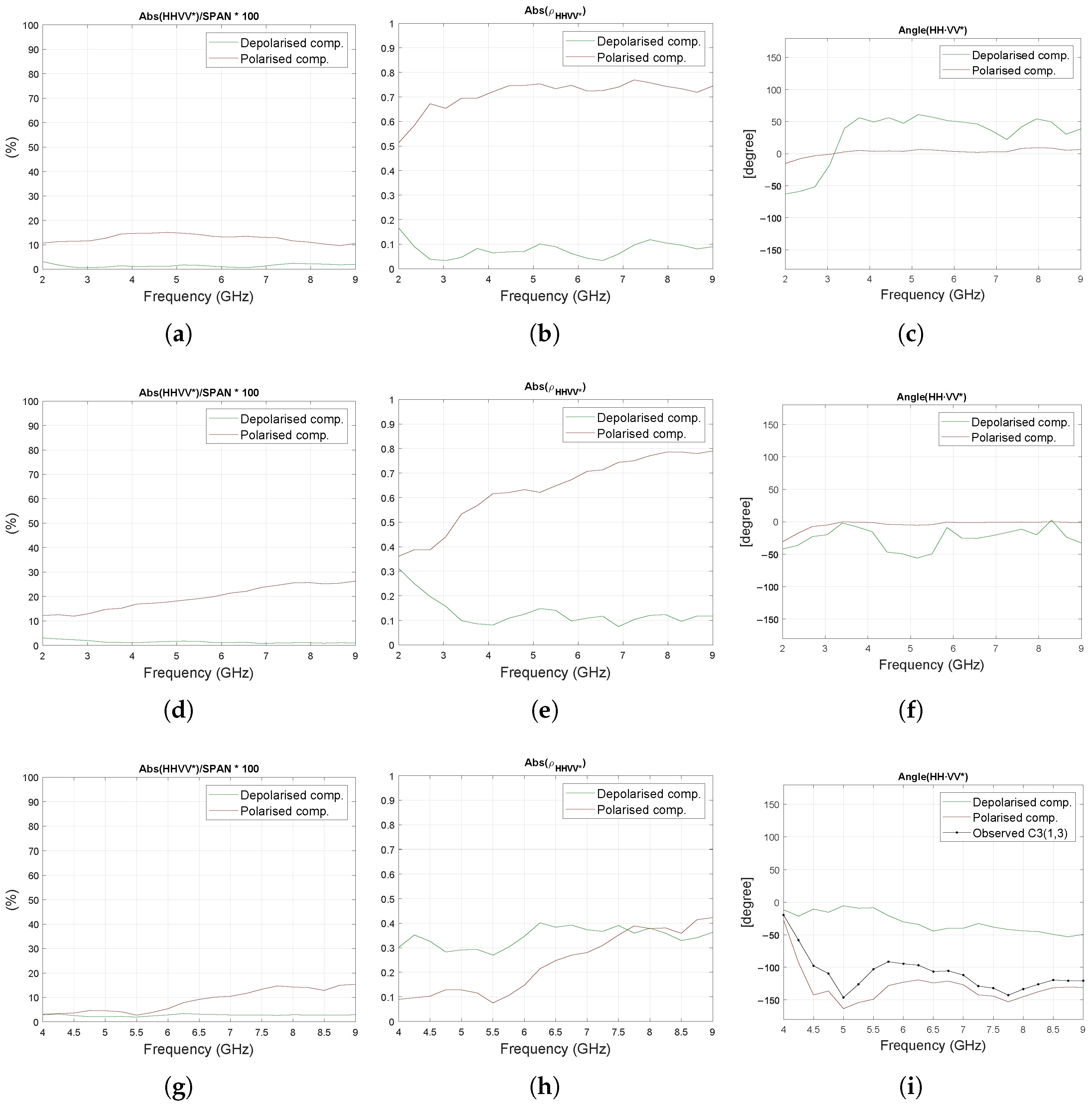
Figure 19 illustrates the plots obtained for the analysis of the copolar correlation for the EMSL data. The left column shows the magnitude of the < H H · V V * > channel normalised by the total span of the observed matrix, whereas the middle and right-hand side columns show the magnitude and CPD of < H H · V V * > correlation, respectively. Note that in Figure 19i, the CPD for the observed copolar correlation (i.e., before decomposition–see Equation (26)) has also been included for convenience for the discussion on the rice case (shown in a black line with dots), as will be discussed later.
For the fir trees and maize samples, the decomposition leads to | ρ | values higher than 0.5, and up to 0.8 in case of maize at X-band for the polarised component. On the other side, for the depolarised contribution, | ρ | is below 0.2 for fir trees and shows a decreasing trend from 0.3 to 0.1 for maize, which render almost meaningless the corresponding CPD values. The CPD values for the polarised components exhibit a very stable behaviour around zero. These signatures complement our previous analysis where it was suggested that the fir trees and maize samples can be characterised by the combination of two scattering mechanisms. For the former, a dominant volume scattering combined with a secondary direct scattering, and for the latter, a dominant contribution of the direct scattering for the whole frequency span with a frequency-dependent alternating secondary mechanism, changing from double-bounce at S-band to volume scattering at X-band.
In case of the rice sample, the | ρ | value of the polarised contribution follows an almost linear increasing trend from 0.1 at 4 GHz up to 0.42 at X-band (also note the increasing trend in the absolute magnitude of the copolar correlation in Figure 19g). This is in agreement with our previous discussion as the double-bounce mechanism is enhanced as frequency increases and becomes clearly dominant. Indeed, the corresponding CPD is close to π radians as shown in Figure 19i. It is pointed out here that the CPD for the observed < H H · V V * > correlation (i.e., from the observed covariance matrix) shown by the line with dots exhibits a higher variability. In addition, the measured normalised correlation coefficient is below 0.25 from 4 to 7 GHz, so the corresponding phase displayed in Figure 19i is not meaningful for that frequency range. Overall, the CPD for the observed copolar channels is not so close to the ideal value of ± π radians as that for the CPD value retrieved by the method for the polarised component, as expected by the theory.
The level of | ρ | for the depolarised component of the rice sample, however, displays an unexpected behaviour, as it takes values higher (within the 0.3–0.4 range) than those for the polarised contribution up to 7.5 GHz, approximately. On the contrary, one would expect to see a lower copolar correlation coefficient for an alleged depolarised microwave signal than the one from a polarised component.
In order to explain this rather contradictory result, we have considered the general expression of the normalised copolar correlation:
ρ = < H H · V V * > < | H H | 2 > · < | V V | 2 >
By considering the special unitary transformation, the elements of the covariance matrix can be expressed in terms of those of the coherency matrix. Hence, the following equivalences are obtained:
| H H | 2 = t 11 + t 22 + 2 t 12
| V V | 2 = t 11 + t 22 2 t 12
H H · V V * = t 11 t 22 j 2 t 12
After combining the previous expressions and some basic algebraic manipulation, the squared of the absolute value of the copolar correlation is expressed as follows by particularizing for the depolarised components:
| ρ | 2 = ( t 11 u t 22 u ) 2 + 4 t 12 u 2 ( t 11 u + t 22 u ) 2 4 t 12 u 2
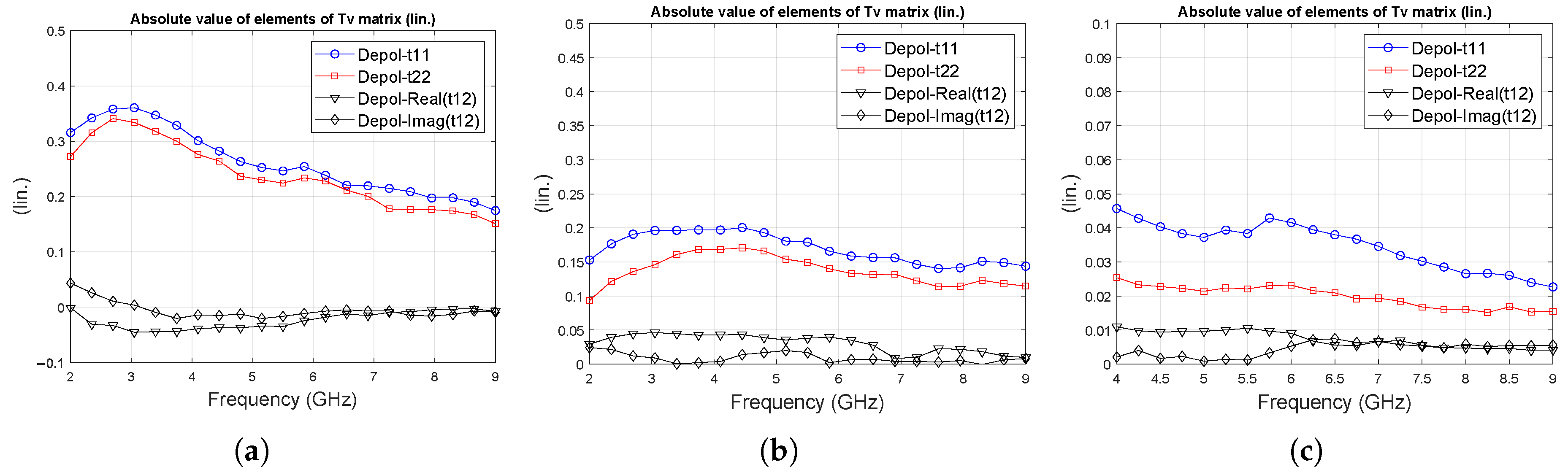
Figure 20 displays the frequency variation of the absolute values (i.e., without normalisation by the span) of t 11 u , t 22 u and the real and imaginary parts of t 12 u for the indoor experiments.
According to these experimental data and the theoretical expression in Equation (30), some observations will be made with regard to the dependence of | ρ | on the t i j u elements:
  • Fir trees: Both the t 11 u t 22 u and t 11 u + t 22 u terms decrease from below 3 GHz up to X-band. In addition, the contribution of the real part of t 12 u becomes more negative whereas the imaginary part gets reduced up to about 4 GHz, showing also slightly negative values. From that frequency onwards both tend to increase a little bit and become similar and vary very closely to zero. It is important to point out that t 12 u and t 12 u show low enough values with respect the terms t 11 u t 22 u and t 11 u + t 22 u so as to not amplify too much the ratio in Equation (30). Overall, the corresponding correlation remains in a low value within a [ 0.05 , 0.2 ] interval approximately, as expected for such a random volume mechanism.
  • Maize: Up to 4 GHz, the t 11 u t 22 u term shows values around 0.05 with a decreasing trend. Otherwise, the t 11 u + t 22 u term (which is at the denominator in expression (30)) tends to increase up to 4 GHz. In addition, the behaviour of real and imaginary parts of t 12 u qualitatively resembles that of fir trees, but adopting in this case only positive values which are below 0.025 from 7 GHz onwards. As a consequence, the correlation decreases monotonically from S- to X-band. As with the fir trees, this explains the low (and decreasing) values for the correlation coefficient.
  • Rice: Plots of t 11 u and t 22 u show changing patterns as a function of frequency. Up to 6 GHz the behaviour for all parameters is fairly constant. In addition, the t 11 u t 22 u difference is about 0.02 and the real part of t 12 u is about 0.01. Hence the squared value of t 12 u , which lowers the denominator of Equation (30), amplifies the correlation to values equal to or higher than 0.3. On the contrary, from 6 GHz onwards, despite the decrease of t 11 u and t 22 u and also their difference, the imaginary part of t 12 u (the squared value of which makes higher the numerator in Equation (30)) gets higher and become similar to the real part. So, for example, at 9 GHz, the t 11 u t 22 u difference is 0.00714 (i.e., 0.02266–0.01552) whereas the t 11 u + t 22 u term is around 0.03818. In addition, the real and imaginary parts of t 12 u are 0.004123 and 0.0055747, respectively. Therefore, these values lead to a slight increase of the copolar correlation for the depolarised component which is 0.37. A similar conclusion can be drawn for any value within the considered frequency span.
As shown before, t 12 , i.e., the correlation between H H + V V and H H V V channels, can become a key parameter driving the final value of | ρ | whenever its real or imaginary part (or both) increases. Therefore, the calculation of the correlation coefficient (and its physical meaning) of both the depolarised and polarised components will be affected by the performance of the decomposition algorithm employed. For the present experimental data, the proposed decomposition correctly accounts for the polarimetric behaviour of the fir trees and maize samples. In case of the rice sample, an overall consistency in terms of scattering mechanisms with respect the analysis by using high-resolution microwave profiles [41] is confirmed. However, the radar signature also shows a relatively high value for the depolarised component t 12 u , despite the k 4 parameter estimates were quite high as shown in Figure 9. This is probably a consequence of an inherent limitation of the decomposition strategy which partly fails for this target and overestimates t 12 u . Indeed, the decomposition procedure assumes k 4 as an scalar parameter and, hence, it decomposes both the real and imaginary parts of t 12 by using the same numerical relationship. Contrarily, simple volume models [7] (i.e., horizontal and vertical dipoles with some orientation) or other more refined ones [49] predict a real-valued t 12 element, which are actually particular cases also accounted for by a more general description such as Neumann model. Therefore, it would be more realistic to design the decomposition so as to fulfil this condition in the depolarised (i.e., volume) component. This can be accomplished by assuming a complex-valued k 4 parameter. More details and implications of such an option will be discussed in Section 4.4.

4.2.2. AIRSAR Datasets—Black Forest

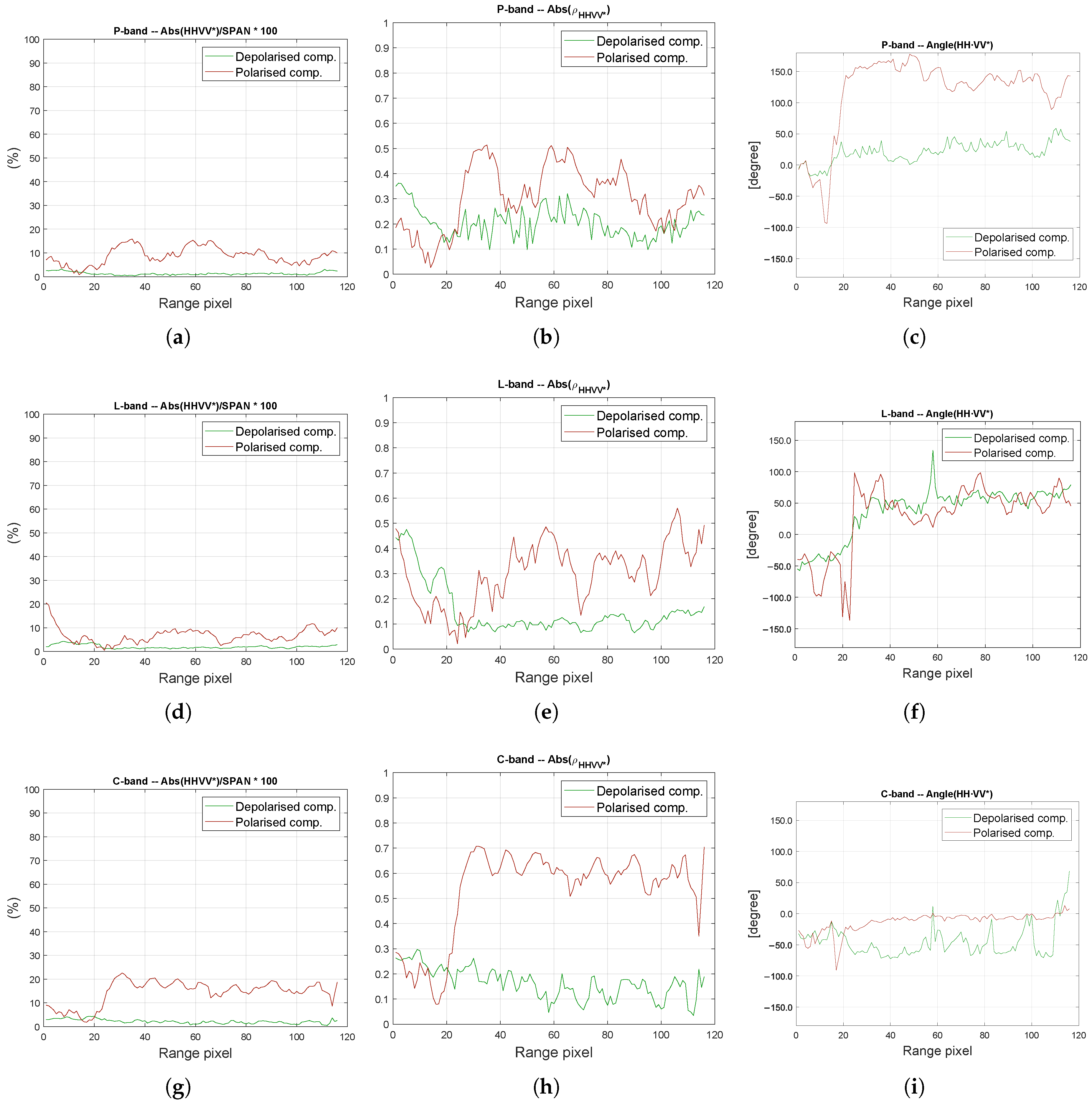
Figure 21 illustrates the plots obtained for the analysis of the copolar correlation for the AIRSAR datasets along the transect from area B indicated by a dashed yellow line on the bottom-right map of Figure 16.
First, we will focus on the forest area (i.e., from pixel 20 onwards). The two expected and opposite behaviours described above can be confirmed when comparing P- and C-band (plots b–c and h–i). The polarised component at P-band shows non-negligible values of the correlation magnitude mostly above 0.3 being the corresponding CPD values higher than 100°, which is consistent with the double-bounce mechanism possibly disturbed by propagation effects, local-scale terrain slopes and understory [6,47]. On the other hand, the polarised component at C-band exhibits even higher correlation values (mostly above 0.5) and a very stable CPD around zero, which is consistent with the surface-like dominant direct backscattering from the upper layers of the canopy at C-band, as we discussed above. Regarding the depolarised component of the copolar correlation, at P-band it remains generally lower than the polarised one and the CPD values greatly vary from levels close to zero up to about 50°. Note also the very low values of the absolute magnitude of the H H · V V * correlation as shown in Figure 21a. At C-band, the normalised correlation magnitude of the depolarised component mostly remains between 0.05 and 0.3 and the corresponding CPD ranges between 70 and 50° but with an average value along the transect of about 50 . The magnitude of the H H · V V * channel (see Figure 21g) is clearly dominated by the polarised component, therefore, the contribution of the normalised correlation of the depolarised component is rendered less important. In case of L-band (see Figure 21d–f), the magnitudes of the normalised correlation do not exceed 0.4 in general for most of the transect, for either the polarised or the depolarised components, which means that the distributed target dominates the radar response and no strong polarised component has been found after decomposition. Also note that the CPD values clearly depart from zero. This is possibly connected with the aforementioned distribution uniformity of the backscattering along the vertical axis [43] but, however, we cannot offer yet a more precise explanation on it.
The short portion of the transect along the first 20 pixels is regarded to be covered by low vegetation belonging to agricultural areas according to [49]. This is in agreement with the values of the degree of polarisation computed for the observed coherency matrix providing values in the ranges 0.7–0.8, 0.6–0.86, and 0.43–0.63 at P-, L-, and C-band, respectively, which are high enough to assume a dominant/high polarised scattering. Note that, despite the magnitude of the correlation coefficient of the polarised component at P- and L-band being mostly lower than 0.4, their corresponding CPD values can reach 100 , or even lower and showing some spatial variation, which suggests that some kind of polarised signature is present. In case of C-band, | ρ | values are below 0.3 but, however, the corresponding CPD for both components mostly vary between 20 and 50 , which may be indicative of multilayer scattering within the canopy.

4.3. Implications for Future Research Directions

The present work leads to other practical positive implications. One of them is that any volume and ground models can be tested by considering the retrieved T v and T g matrices as inputs, i.e., once the depolarised and polarised effects had been separated. For example, the compound scattering models proposed in [49] showed promising results. However, the inversion procedure is based on the maximisation of the ground scattering power (while keeping nonnegative eigenvalues of the remainder). In our opinion, this methodology is questionable as it explicitly constrains the ground component without any solid basis to support it. On the contrary, the models and the inversion procedure in [49] could be employed in a justified way by taking as inputs the polarised and depolarised components according to the approach proposed in the present paper. This is indeed the key feature that can contribute to improving potential applications in bio- and geophysical parameter retrieval [50].
Secondly, the proposed decomposition strategy can be easily extrapolated to dual- and compact-polarimetric SAR data by first computing the 2-D Barakat degree of polarisation and the corresponding polarised and depolarised backscattering powers [18]. Then, 2 × 2 covariance matrices for both components (i.e., C g and C v ) can be estimated by defining the following Hadamard products and replicating the process described in Section 2.2:
C g = k 1 k 3 k 3 k 2 c 11 c 12 c 12 * c 22
C v = 1 k 1 1 k 3 1 k 3 1 k 2 c 11 c 12 c 12 * c 22
where the k i elements are defined as in Section 2.2. These dual- and compact-polarimetric versions are beyond the present paper and will be addressed in a future work.

4.4. Limitations of the Present Approach

The present methodology presents several limitations which are left open for further research:
  • On the interpretation of Tg and Tv : Throughout the paper we have considered these two components either as the ground and volume mechanisms or as the polarised and depolarised components indistinctly. Whenever the target is characterised as a pure random volume jointly with direct soil returns and a double-bounce mechanism, the former interpretation is correct. However, it may happen that a diffuse scattering (i.e., depolarised term which assumes the Neumann volume model [40] for high orientation randomness) attributable to the volume appears in combination with a direct scattering (i.e., polarised term) from the canopy, as shown for the maize sample or the boreal forest at C-band. In such a case, subsequent modelling for parameter retrieval must consider this behaviour. This could indeed be a positive feature of the method rather than a limitation as it enables this scattering identification; however, this also means that this identification step must be taken before addressing any model-based decomposition aimed at bio- and geophysical parameter retrieval. In any case, it must be pointed out that the physical meaning of the retrieved components from the decomposition remain unclear as their interpretation requires further analysis through physical model fitting.
    It is also pointed out that the estimated Tg component is not a rank-2 matrix, as theoretically expected. This inconsistency arises because the decomposition method does not constrain the polarised component to any particular physical model. Then, the non-zero λ 3 eigenvalue results from residual errors which can be more or less noticeable depending on the target (see Figure 18c,f,i). It is noted that even for the rice sample, which is the case more closely related to an ideal dihedral scattering (due to the flooded conditions), a non-zero λ 3 eigenvalue is still retrieved. In addition, the ratio between the third eigenvalue for the polarised coherency matrix Tg and the span of this matrix was also calculated for the EMSL data and shown to be equal to or well below 10% (except for some scarce cases for the fir trees). This allows us to state that, despite the violation of the rank-2 constraint, the present PolSAR dichotomy framework leads to outcomes which describe reasonably well the polarimetric behaviour of vegetation.
  • Non-uniqueness of the solution: The proposed decomposition framework relies on two equations (i.e., (7) and (8)) which are subject to three constraints (i.e., the three inequalities given by (10), (13) and (15)). However, the inversion methodology does not rely on a numerical optimisation and, consequently, this avoids local minima as potential solutions. Instead, the inversion strategy samples the feasible region of solutions and calculates the average of all of them. Despite the analysis shown here demonstrates the physical consistency of the decomposition outcomes, the undetermined equation system does not guarantee unique solutions. Therefore, further tests must be carried out to generalize the conclusions drawn from this study.
  • Polarised/depolarised components of  t 12 : In the proposed procedure k 4 takes a real value which necessarily means that the depolarised and polarised components of t 12 are proportional to each other. For some scenarios, this may lead to an overestimation of the t 12 u component, as shown in Section 4.2.1. One possible strategy worth exploring is to modify the inversion algorithm to constrain the t 12 u element to be real-valued. This would be in agreement with the volume models proposed by Yamaguchi [7], despite it is well known that more general models can better match the volume scattering [51]. To this aim, k 4 must be a complex scalar. Therefore, the inversion must consider an additional unknown and, hence, an additional equation. The new condition would be expressed as
    ( 1 k 4 ) · t 12 = t 12 u   ,     k 4 C   and   t 12 u R
    After manipulating the left-hand side of Equation (33):
    1 k 4 · t 12 + k 4 · t 12 + j 1 k 4 · t 12 k 4 · t 12 = t 12 u
    where the real and imaginary parts of k 4 , i.e., k 4 and k 4 , respectively, are the new unknowns.
    Then, the following condition must be fulfilled:
    1 k 4 · t 12 k 4 · t 12 = 0
    Equation (35) leads to the following constraint:
    1 k 4 k 4 = t 12 t 12
    The new condition given by (36) will also modify the numerical inversion as k 4 2 and ( 1 k 4 ) 2 terms appearing in expressions (10), (13) and (15) must be now expressed as (note that the ( 2 , 1 ) element of the D matrix is now k 4 * ):
    k 4 2 k 4 · k 4 * = | k 4 | 2 = k 4 2 + k 4 2
    ( 1 k 4 ) 2 ( 1 k 4 ) · ( 1 k 4 * ) = 1 k 4 2 + k 4 2
    Despite the aforementioned modification leads to a mathematically tractable model, the inversion performance has not been addressed in the present study and must be object of further investigation.
  • Reflection symmetry assumption: The proposed method assumes that the target fulfils the reflection symmetry property. The asymmetric effects caused by sloped terrain can be mitigated (up to some extent) by means of deorientation procedures. However, the inversion procedure must be modified in case of considering more complex scenarios (e.g., heterogeneous vegetation canopies) where the polarimetric information is present in all the elements of the observed coherency matrix [11].

5. Conclusions

The present paper develops a polarimetric dichotomy framework for PolSAR data. It decomposes the observed coherency matrix into polarised and depolarised coherency matrices under the reflection symmetry assumption. The method relies on the previous calculation of the 3-D Barakat degree of polarisation and the backscattering powers retrieved from the MF3C, which outperforms existing polarimetric decompositions as supported by quantitative evidence [18,19]. This information allows us to construct an inversion algorithm to retrieve four scalar parameters (i.e., k i ), which represent the proportion of the polarised component for the diagonal elements t i i of the observed coherency matrix as well as for t 12 element, i.e., the cross-correlation between H H + V V and H H V V channels. Therefore, the proposed decomposition can be regarded as an extension of the MF3C method, allowing us to generalise its applicability by retrieving estimates of both the depolarised and polarised coherency matrices. As a result, it makes it possible to exploit both model-free and model-based approaches by using a physical rationale driven by the capability of the 3-D Barakat degree of polarisation. In a practical application, once the polarised and depolarised components are separated, the retrieval of target parameters could presumably be done in a more accurate way by directly applying existing scattering models to both components.
An in-depth polarimetric and multi-frequency analysis over three short vegetation samples (i.e., small fir trees, maize and rice measured at the EMSL) and over a boreal forest (AIRSAR) has been performed by employing several polarimetric tools: (1) The comparison of the eigenvalues of both T v and T g for the three samples of the EMSL datasets (Figure 18); (2) Histogram and correlation analyses at P-, L- and C-band for the Black Forest dataset, using the Y4R decomposition for benchmarking (Figure 12, Figure 13 and Figure 14 and Table 1); (3) Analysis of the copolar cross-correlation < H H · V V * > for all datasets to check consistency with respect to the theory predictions for different scattering types (Figure 19 and Figure 21). Overall, the analysis suggests that the proposed two-component decomposition strategy performs according to the theoretical expectation regarding the separation of depolarised and polarised scattering components for a wide range of scenarios and sensor frequencies, also being in agreement with previous polarimetric studies in case of the indoor datasets employed (maize and rice samples from EMSL [36,37,41]), and also in comparison with tomographic studies for boreal forests [42,43]. Interestingly, the copolar cross-correlation < H H · V V * > from the estimated polarised and depolarised components at P-band in the analysed boreal forest (see Figure 21b,c) showed values consistent with the dominant double-bounce mechanism at that frequency [6,47]. This provides additional evidence that the decomposed T g matrix can be exploited for forest parameters characterisation at P-band, such as the estimation of the trunk dielectric constant as suggested in [50] or to estimate above-ground biomass [52,53]. However, this work lacks a physical characterisation of the polarised and depolarised scattering components retrieved by the proposed decomposition and, hence, the accuracy in parameter retrieval must still be addressed. To this aim, radar scattering models must be chosen to relate T v and T g matrices to bio- and geophysical parameters of interest. The analysis of the fitting of existing volume, and direct surface and double-bounce models to T v and T g , respectively, will provide a higher level of evidence on the suitability of the proposed polarimetric decomposition.
Additionally, it must also be acknowledged that the present methodology should be further validated by employing datasets from advanced satellite sensors currently operational. Also, it is important to emphasise that the effectiveness of the 3-D Barakat degree of polarisation for accurately estimating the proportions of both depolarised and polarised components has not been thoroughly examined, even though this allocation offers physically consistent interpretations. Likewise, the performance of the method should be compared with that of other decomposition approaches, such as the one recently proposed in [15] whose rationale is driven by adjusting the anisotropy of the volume layer and showed promising results which should be further confirmed. Finally, it is noted that both the data and the MATLAB (R2022b version) code are publicly available to enable interested readers to test and analyse the performance of the proposed decomposition (see Data Availability section).

Author Contributions

Conceptualization, J.D.B.-B.; methodology, J.D.B.-B.; software, J.D.B.-B.; validation, J.D.B.-B.; formal analysis, J.D.B.-B.; investigation, J.D.B.-B., Q.X. and H.S.; resources, J.D.B.-B., Q.X. and H.S.; data curation, J.D.B.-B., Q.X. and H.S.; writing—original draft preparation, J.D.B.-B.; writing—review and editing, J.D.B.-B., Q.X. and H.S.; visualization, J.D.B.-B., Q.X. and H.S.; supervision, J.D.B.-B.; project administration, J.D.B.-B.; funding acquisition, J.D.B.-B., Q.X. and H.S. All authors have read and agreed to the published version of the manuscript.

Funding

This research was funded in part by the National Natural Science Foundation of China (Grant No. 42171387).

Data Availability Statement

AIRSAR datasets can be downloaded from the Alaska SAR Facility Vertex data portal from NASA ESDIS. The MATLAB codes of the decomposition and the subset of EMSL acquisitions employed in the present study are available at this link: https://s.ua.es/en/5JTL, accessed on 1 March 2026.

Acknowledgments

We thank the EMSL of the Joint Research Centre and the Alaska SAR Facility Vertex data portal from NASA ESDIS for providing the datasets employed in this work. Also, we would like to express our sincere gratitude to the anonymous reviewers for their thorough review of our manuscript. Their insightful and invaluable comments and suggestions have significantly improved every aspect of the manuscript, from the methodology to the interpretation of the results.

Conflicts of Interest

The authors declare no conflicts of interest.

References

  1. Huynen, J.R. Phenomenological Theory of Radar Targets. Ph.D. Thesis, Technical University, Delft, The Netherlands, 1970. [Google Scholar]
  2. Cloude, S.R. Radar target decomposition theorems. IEEE Electron. Lett. 1985, 21, 22–24. [Google Scholar] [CrossRef]
  3. Ainsworth, T.; Lee, J.S.; Wang, Y. Model-Based PolSAR Decompositions: Virtues and Vices. In Proceedings of the 12th European Conference on Synthetic Aperture Radar (EUSAR2018), Aachen, Germany, 4–7 June 2018; pp. 8676–8679. [Google Scholar]
  4. Ballester-Berman, J.D.; Ainsworth, T.L.; Lopez-Sanchez, J.M. On The Physical Quantitative Assessment of Model-Based PolSAR Decompositions. arXiv 2020, arXiv:2001.05872. [Google Scholar]
  5. Freeman, A.; Durden, S.L. A Three Component Scattering Model to Describe Polarimetric SAR Data. In Proceedings of the SPIE, Radar Polarimetry, San Diego, CA, USA, 22 July 1992; Volume 1748, pp. 213–224. [Google Scholar]
  6. Freeman, A.; Durden, S.L. A Three-Component Scattering Model for Polarimetric SAR Data. IEEE Trans. Geosci. Remote Sens. 1998, 36, 963–973. [Google Scholar] [CrossRef]
  7. Yamaguchi, Y.; Moriyama, T.; Ishido, M.; Yamada, H. Four-Component scattering model for polarimetric SAR image decomposition. IEEE Trans. Geosci. Remote Sens. 2005, 43, 1699–1706. [Google Scholar] [CrossRef]
  8. Yamaguchi, Y.; Sato, A.; Boerner, W.M.; Sato, R.; Yamada, H. Four-component scattering power decomposition with rotation of coherency matrix. IEEE Trans. Geosci. Remote Sens. 2011, 49, 2251–2258. [Google Scholar] [CrossRef]
  9. van Zyl, J.J.; Arii, M.; Kim, Y. Model-Based Decomposition of Polarimetric SAR Covariance Matrices Constrained for Nonnegative Eigenvalues. IEEE Trans. Geosci. Remote Sens. 2011, 49, 3452–3459. [Google Scholar] [CrossRef]
  10. Lee, J.S.; Ainsworth, T.L.; Wang, Y. Generalized Polarimetric Model-Based Decompositions Using Incoherent Scattering Models. IEEE Trans. Geosci. Remote Sens. 2014, 52, 2474–2491. [Google Scholar] [CrossRef]
  11. Chen, S.W.; Wang, X.S.; Xiao, S.P.; Sato, M. General polarimetric model-based decomposition for coherency matrix. IEEE Trans. Geosci. Remote Sens. 2014, 52, 1843–1855. [Google Scholar] [CrossRef]
  12. Singh, G.; Yamaguchi, Y. Model-Based Six-Component Scattering Matrix Power Decomposition. IEEE Trans. Geosci. Remote Sens. 2018, 56, 5687–5704. [Google Scholar] [CrossRef]
  13. Singh, G.; Malik, R.; Mohanty, S.; Rathore, V.S.; Yamada, K.; Umemura, M.; Yamaguchi, Y. Seven-Component Scattering Power Decomposition of POLSAR Coherency Matrix. IEEE Trans. Geosci. Remote Sens. 2019, 57, 8371–8382. [Google Scholar] [CrossRef]
  14. Malik, R.; Singh, G.; Dikshit, O.; Yamaguchi, Y. Model-Based Nine-Component Scattering Matrix Power Decomposition. IEEE Geosci. Remote Sens. Lett. 2024, 21, 4008105. [Google Scholar] [CrossRef]
  15. Huang, P.; Li, B.; Li, X.; Tan, W.; Xu, W.; Chen, Y. An Adaptive Polarimetric Target Decomposition Algorithm Based on the Anisotropic Degree. Remote Sens. 2024, 16, 1015. [Google Scholar] [CrossRef]
  16. Wang, Y.; Ge, D.; Liu, B.; Yu, W.; Wang, C. An Improved General Five-Component Scattering Power Decomposition Method. Remote Sens. 2025, 17, 2583. [Google Scholar] [CrossRef]
  17. Jagdhuber, T.; Hajnsek, I.; Papathanassiou, K.P. An Iterative Generalized Hybrid Decomposition for Soil Moisture Retrieval Under Vegetation Cover Using Fully Polarimetric SAR. IEEE J. Sel. Top. Appl. Earth Obs. Remote Sens. 2015, 8, 3911–3922. [Google Scholar] [CrossRef]
  18. Dey, S.; Bhattacharya, A.; Ratha, D.; Mandal, D.; Frery, A.C. Target Characterization and Scattering Power Decomposition for Full and Compact Polarimetric SAR Data. IEEE Trans. Geosci. Remote Sens. 2021, 59, 3981–3998. [Google Scholar] [CrossRef]
  19. Dey, S.; Bhattacharya, A.; Frery, A.; López-Martínez, C.; Rao, Y. A Model-Free Four Component Scattering Power Decomposition for Polarimetric SAR Data. IEEE J. Sel. Top. Appl. Earth Obs. Remote Sens. 2021, 14, 3887–3902. [Google Scholar] [CrossRef]
  20. Han, W.; Fu, H.; Zhu, J.; Xie, Q. A type of polarimetric parameter for evaluating the reliability of model-based decomposition result and its application. Int. J. Digit. Earth 2023, 16, 2111–2128. [Google Scholar] [CrossRef]
  21. Han, W.; Fu, H.; Zhu, J.; Zhang, S.; Xie, Q.; Hu, J. A polarimetric projection-based scattering characteristics extraction tool and its application to PolSAR image classification. ISPRS J. Photogramm. Remote Sens. 2023, 202, 314–333. [Google Scholar] [CrossRef]
  22. Hanis, D.; Hadj-Rabah, K.; Belhadj-Aissa, A.; Pallotta, L. Dominant Scattering Mechanism Identification From Quad-Pol-SAR Data Analysis. IEEE J. Sel. Top. Appl. Earth Obs. Remote Sens. 2024, 17, 14408–14420. [Google Scholar] [CrossRef]
  23. Wu, Y.R. Concept of multidimensional space joint-observation SAR. J. Radars 2013, 2, 135–142. [Google Scholar] [CrossRef]
  24. Zhang, T.; Quan, S.; Wang, W.; Guo, W.; Zhang, Z.; Yu, W. Information reconstruction-based polarimetric covariance matrix for PolSAR ship detection. IEEE Trans. Geosci. Remote Sens. 2023, 61, 5202815. [Google Scholar] [CrossRef]
  25. Zhang, X.; Gao, G.; Chen, S.W. Polarimetric autocorrelation matrix: A new tool for joint characterizing of target polarization and Doppler scattering mechanism. IEEE Trans. Geosci. Remote Sens. 2024, 62, 5213522. [Google Scholar] [CrossRef]
  26. Li, H.L.; Chen, S.W. General Polarimetric Correlation Pattern: A Visualization and Characterization Tool for Target Joint-Domain Scattering Mechanisms Investigation. IEEE Trans. Geosci. Remote Sens. 2026, 64, 5200417. [Google Scholar] [CrossRef]
  27. Cloude, S. Polarisation: Applications in Remote Sensing; Oxford University Press: Oxford, UK, 2009. [Google Scholar]
  28. Lee, J.S.; Pottier, E. Polarimetric Radar Imaging: From Basics to Applications; CRC: Boca Raton, FL, USA; Taylor and Francis: Abingdon, UK, 2009. [Google Scholar]
  29. Barakat, R. Degree of polarization and the principal idempotents of the coherency matrix. Opt. Commun. 1977, 23, 147–150. [Google Scholar] [CrossRef]
  30. Barakat, R. N-fold polarization measures and associated thermodynamic entropy of N partially coherent pencils of radiation. Opt. Acta Int. J. Opt. 1983, 30, 1171–1182. [Google Scholar] [CrossRef]
  31. Han, W.; Fu, H.; Zhu, J.; Li, N. Decoupling Between Different Polarization Channels of PolSAR Data. IEEE Geosci. Remote Sens. Lett. 2023, 20, 4008105. [Google Scholar] [CrossRef]
  32. Ballester-Berman, J.D. Estimation of the Copolar Phase Difference of Scattering Mechanisms in PolSAR Data. Working Paper. 2023. Available online: https://www.researchgate.net/profile/J-David-Ballester-Berman (accessed on 1 March 2026).
  33. EMSL Website. Available online: https://visitors-centre.jrc.ec.europa.eu/en/media/virtualtours/take-virtual-tour-european-microwave-signature-laboratory (accessed on 31 October 2025).
  34. Lopez-Sanchez, J.M. Analysis and Estimation of Biophysical Parameters of Vegetation by Radar Polarimetry. Ph.D. Thesis, Polytechnic University of Valencia (UPV), Valencia, Spain, 2000. [Google Scholar]
  35. Sagues, L. Surface and Volumetric Scattering Analysis of Terrains for Polarimetric and Interferometric SAR Applications. Ph.D. Thesis, Universitat Politècnica de Catalunya (UPC), Barcelona, Spain, 2000. [Google Scholar]
  36. Ballester-Berman, J.D.; Lopez-Sanchez, J.M.; Fortuny-Guasch, J. Retrieval of Biophysical Parameters of Agricultural Crops Using Polarimetric SAR Interferometry. IEEE Trans. Geosci. Remote Sens. 2005, 43, 683–694. [Google Scholar] [CrossRef]
  37. Cloude, S.R. Dual Baseline Coherence Tomography. IEEE Geosci. Remote Sens. Lett. 2007, 4, 127–131. [Google Scholar] [CrossRef]
  38. Arii, M.; van Zyl, J.J.; Kim, Y. A general characterization for polarimetric scattering from vegetation canopies. IEEE Trans. Geosci. Remote Sens. 2010, 48, 3349–3357. [Google Scholar] [CrossRef]
  39. An, W.; Cui, Y.; Yang, J. Three-Component Model-Based Decomposition for Polarimetric SAR Data. IEEE Trans. Geosci. Remote Sens. 2010, 48, 2732–2739. [Google Scholar]
  40. Neumann, M.; Ferro-Famil, L.; Reigber, A. Estimation of Forest Structure, Ground, and Canopy Layer Characteristics From Multibaseline Polarimetric Interferometric SAR Data. IEEE Trans. Geosci. Remote Sens. 2010, 48, 1086–1104. [Google Scholar] [CrossRef]
  41. Ballester-Berman, J.D.; Lopez-Sanchez, J.M.; Sanjuan, M.J. Determination of scattering mechanisms inside rice plants by means of PCT and high resolution radar imaging. In Proceedings of the 2009 IEEE International Geoscience and Remote Sensing Symposium, Cape Town, South Africa, 12–17 July 2009; Volume 5, pp. V–138–V–141. [Google Scholar]
  42. Frey, O.; Meier, E. Analyzing Tomographic SAR Data of a Forest with Respect to Frequency, Polarization, and Focusing Technique. IEEE Trans. Geosci. Remote Sens. 2011, 49, 3648–3659. [Google Scholar] [CrossRef]
  43. Tebaldini, S.; Rocca, F. Multibaseline polarimetric SAR tomography of a boreal forest at P-and L-bands. IEEE Trans. Geosci. Remote Sens. 2012, 50, 232–246. [Google Scholar] [CrossRef]
  44. Ballester-Berman, J.D. Reviewing the Role of the Extinction Coefficient in Radar Remote Sensing. arXiv 2020, arXiv:2012.02609. [Google Scholar] [CrossRef]
  45. Cloude, S.R.; Pottier, E. An Entropy Based Classification Scheme for Land Applications of Polarimetric SAR. IEEE Trans. Geosci. Remote Sens. 1997, 35, 68–78. [Google Scholar] [CrossRef]
  46. Cloude, S.R.; Pottier, E. Concept of Polarization Entropy in Optical Scattering. Opt. Eng. 1995, 34, 1599–1610. [Google Scholar] [CrossRef]
  47. Ulaby, F.T.; Held, D.N.; Dobson, M.C.; McDonald, K.C.; Senior, T.B.A. Relating Polarization Phase Difference of SAR Signals to Scene Properties. IEEE Trans. Geosci. Remote Sens. 1987, 25, 83–92. [Google Scholar] [CrossRef]
  48. D’Alessandro, M.M.; Tebaldini, S.; Rocca, F. Phenomenology of Ground Scattering in a Tropical Forest Through Polarimetric Synthetic Aperture Radar Tomography. IEEE Trans. Geosci. Remote Sens. 2013, 51, 4430–4437. [Google Scholar] [CrossRef]
  49. Han, W.; Fu, H.; Zhu, J.; Wang, C.; Xie, Q.; Hu, J.; Xie, Y. A Compound Volume Scattering Model With Emphasis on the Morphological Diversity of Vegetation Canopy Scatterers. IEEE J. Sel. Top. Appl. Earth Obs. Remote Sens. 2021, 14, 12104–12113. [Google Scholar] [CrossRef]
  50. Fluhrer, A.; Alemohammad, H.; Jagdhuber, T. Analyzing the dihedral scattering component of P-band SAR signals for trunk permittivity estimation—A concept study. Sci. Remote Sens. 2025, 11, 100236. [Google Scholar] [CrossRef]
  51. Xie, Q.; Ballester-Berman, J.D.; Lopez-Sanchez, J.M.; Zhu, J.; Wang, C. On the Use of Generalized Volume Scattering Models for the Improvement of General Polarimetric Model-Based Decomposition. Remote Sens. 2017, 9, 117. [Google Scholar] [CrossRef]
  52. Eini-Zinab, S.; Maghsoudi, Y.; Sayedain, S.A. Assessing the performance of indicators resulting from three-component Freeman—Durden polarimetric SAR interferometry decomposition at P-and L-band in estimating tropical forest aboveground biomass. Int. J. Remote Sens. 2020, 41, 433–454. [Google Scholar] [CrossRef]
  53. Fu, W.; Guo, H.; Li, X. Relating Forest Biomass to the Polarization Phase Difference of the Double-Bounce Scattering Component. IEEE Geosci. Remote Sens. Lett. 2021, 18, 2048–2051. [Google Scholar] [CrossRef]
Figure 1. Photographs of the vegetation samples measured at the EMSL. (a) Nine fir trees (1.8 m high) planted in a 2.4 m diameter round container; (b) 6 × 6 young maize plants (1.8 m high) uniformly planted in a square container of side length 2 m; (c) 10 × 10 plants (0.75 m high) uniformly distributed in a square container with side length 1 m and soil permanently flooded.
Remotesensing 18 01043 g001
Figure 2. L-band PolSAR image from the 1991 AIRSAR campaign. R = HH − VV; G = 2HV; B = HH + VV.
Remotesensing 18 01043 g002
Figure 3. Average and standard deviation (bars) of k i estimates for the cluster of fir trees as a function of frequency.
Remotesensing 18 01043 g003
Figure 4. Variation of t 11 , t 22 , t 33 and | t 12 | from the observed coherency matrix for the cluster of fir trees as a function of frequency.
Remotesensing 18 01043 g004
Figure 5. Variation of polarised and depolarised components of the diagonal elements of the retrieved matrices normalised by the span of the observed coherency matrix for the fir trees. The ratios P s / S p a n , P d / S p a n and P v / S p a n from the MF3C decomposition are also shown: (a) Polarised components; (b) Depolarised components.
Remotesensing 18 01043 g005
Figure 6. Average and standard deviation (bars) of k i estimates for the maize sample as a function of frequency.
Remotesensing 18 01043 g006
Figure 7. Variation of t 11 , t 22 , t 33 and | t 12 | from the observed coherency matrix for the maize sample as a function of frequency.
Remotesensing 18 01043 g007
Figure 8. Variation of polarised and depolarised components of the diagonal elements of the retrieved matrices normalised by the span of the observed coherency matrix for the maize sample. The ratios P s / S p a n , P d / S p a n and P v / S p a n from the MF3C decomposition are also shown: (a) Polarised components; (b) Depolarised components.
Remotesensing 18 01043 g008
Figure 9. Average and standard deviation (bars) of k i estimates for the rice sample as a function of frequency.
Remotesensing 18 01043 g009
Figure 10. Variation of t 11 , t 22 , t 33 and | t 12 | from the observed coherency matrix for the rice sample as a function of frequency.
Remotesensing 18 01043 g010
Figure 11. Variation of polarised and depolarised components of the diagonal elements of the retrieved matrices normalised by the span of the observed coherency matrix for the rice sample. The ratios P s / S p a n , P d / S p a n and P v / S p a n from the MF3C decomposition are also shown: (a) Polarised components; (b) Depolarised components.
Remotesensing 18 01043 g011
Figure 12. Histograms of k i estimates for area A (see Figure 2) at P-, L-, and C-band.
Remotesensing 18 01043 g012
Figure 13. Scatter plots of polarised contributions (i.e., the diagonal elements of T g ) with respect to backscattering powers from Y4R (top row) and MF3C (bottom row) decompositions at P-band for area A (see Figure 2).
Remotesensing 18 01043 g013
Figure 14. Scatter plots of depolarised contributions (i.e., the diagonal elements of T v matrix) with respect to backscattering powers from Y4R (top row) and MF3C (bottom row) decompositions at P-band for area A (see Figure 2).
Remotesensing 18 01043 g014
Figure 15. t 11 p , t 22 p and t 33 p (left, center and right columns, respectively) normalised with respect to the total span for area B (see Figure 2) at P-, L- and C-band (top, center and bottom rows, respectively).
Remotesensing 18 01043 g015
Figure 16. t 11 u , t 22 u and t 33 u (left, center and right columns, respectively) normalised with respect to the total span for area B (see Figure 2) at P-, L- and C-band (top, center and bottom rows, respectively). The dashed yellow line indicates the transect chosen for generating Figure 17.
Remotesensing 18 01043 g016
Figure 17. (a) t 11 p , t 22 p and t 33 p and (b) t 11 u , t 22 u and t 33 u normalised with respect to the total span for transect in area B (see dashed yellow line in Figure 16) at P-, L- and C-band.
Remotesensing 18 01043 g017aRemotesensing 18 01043 g017b
Figure 18. Eigendecomposition of T v and T g matrices for all three vegetation samples (EMSL experiments). Plots correspond to entropy for (a) fir trees, (d) maize and (g) rice; eigenvalues of T v for (b) fir trees, (e) maize and (h) rice; eigenvalues of T g for (c) for fir trees, (f) maize and (i) rice.
Remotesensing 18 01043 g018
Figure 19. (Left column) Magnitude (normalised to the total span) of H H · V V * , (center column) correlation coefficient and (right column) copolar phase difference for the EMSL data: (ac) fir trees; (df) maize; (gi) rice.
Remotesensing 18 01043 g019
Figure 20. Variation of t 11 u , t 22 u , t 12 u and t 12 u as a function of frequency for EMSL data: (a) fir trees; (b) maize; (c) rice. Note that the limits on the vertical axis are different for each sample.
Remotesensing 18 01043 g020
Figure 21. Analysis of the copolar correlation for transect from area B: (Left column) Magnitude (normalised to the total span) of < H H · V V * > , (center column) correlation coefficient and (right column) copolar phase difference for the transect analysed in the previous section at (ac) P-, (df) L- and (gi) C-band.
Remotesensing 18 01043 g021
Table 1. R 2 values expressing the correlation between t i i p and t i i u and backscattering powers from Y4R and MF3C decomposition. Values equal to or higher than 0.75 are in bold type.
R 2 P-BandL-BandC-Band
t 11 p vs. P s (Y4R/MF3C)0.15/0.940.21/0.970.68/0.95
t 22 p vs. P d (Y4R/MF3C)0.96/0.980.11/0.760.14/0.22
t 33 p vs. P v (Y4R/MF3C)0.47/0.130.23/0.0020.23/0.02
t 11 u vs. P s (Y4R/MF3C)0.10/0.050.06/0.0080.15/0.07
t 22 u vs. P d (Y4R/MF3C)0.25/0.110.01/0.00.006/0.51
t 33 u vs. P v (Y4R/MF3C)0.56/0.970.60/0.990.77/0.98
Disclaimer/Publisher’s Note: The statements, opinions and data contained in all publications are solely those of the individual author(s) and contributor(s) and not of MDPI and/or the editor(s). MDPI and/or the editor(s) disclaim responsibility for any injury to people or property resulting from any ideas, methods, instructions or products referred to in the content.