Article

Robust Multi-Target ISAR Imaging at Low SNR Based on Particle Swarm Optimization and Sequential Variational Mode Decomposition


College of Electronic Science and Technology, National University of Defense Technology, Changsha 410073, China
*
Author to whom correspondence should be addressed.
Remote Sens. 2026, 18(5), 830; https://doi.org/10.3390/rs18050830
Submission received: 26 January 2026 / Revised: 27 February 2026 / Accepted: 5 March 2026 / Published: 7 March 2026

Highlights

What are the main findings?
  • By integrating block-wise compensation with Particle Swarm Optimization (PSO), we jointly estimate the motion parameters of multiple targets. The proposed method is stable and can achieve high-quality Inverse Synthetic Aperture Radar (ISAR) images even at low signal-to-noise ratio (SNR), where existing multi-target imaging methods may fail.
  • We have fully considered the interference caused by overlapping echoes among targets, which has been overlooked in previous studies, and achieved high-resolution multi-target ISAR images through signal reconstruction.
What are the implications of the main findings?
  • A novel ISAR multi-target imaging framework is proposed, which avoids the cumulative errors inherent in CLEAN-based approaches and achieves a higher imaging success rate at low SNR.
  • The method significantly outperforms existing approaches, offering a robust solution for radar surveillance in complex multi-target scenarios.

Abstract

The proliferation of Unmanned Aerial Vehicles (UAVs) poses a significant challenge for ISAR imaging. Conventional multi-target imaging methods, such as sequential CLEAN-based techniques, are often hindered by error propagation and sensitivity to noise, leading to degraded performance or even imaging failure, especially at low SNR. To address these issues, this paper proposes a novel robust imaging framework. The framework is built upon two key innovations: a partitioned block-wise compensation mechanism integrated with PSO for simultaneous and precise motion parameters estimation of multiple targets, which avoids local optima and error accumulation; and the application of Sequential Variational Mode Decomposition (SVMD) to adaptively separate and reconstruct signals, thereby suppressing inter-target aliasing and noise interference overlooked in prior studies. Simulations and measured-data experiments confirm that the proposed method maintains clear focusing and superior image quality even at low SNR, outperforming existing techniques in terms of image entropy, contrast, and resolution. This paper provides a robust and effective solution for high-resolution radar surveillance in complex multi-target scenarios.

1. Introduction

As the number of targets in observation scenarios increases and the demand for their fine identification grows, the inherent limitations of narrowband radar are becoming increasingly apparent. Restricted by signal bandwidth, narrowband radar has low range resolution, making it difficult to effectively distinguish multiple spatially close targets from range profiles. When the distance between targets is smaller than the radar’s range resolution cell, their echoes fall into the same range bin, which significantly constrains the capability of multi-target detection, tracking and feature extraction. To overcome this bottleneck, wideband radar imaging technology has emerged. By transmitting large bandwidth signal, we can achieve higher range resolution, thereby distinguishing closer scatterers in the radial direction [1,2,3]. Further, by leveraging the relative rotation between the target and the radar, the Doppler information contained in the echoes can be exploited to achieve azimuth focusing, ultimately forming a two-dimensional high-resolution image of the target, which is known as SAR (Synthetic Aperture Radar) and ISAR image [4,5,6,7,8]. Wideband ISAR imaging can reveal the two-dimensional structural characteristics of targets, providing more precise information for target recognition. In cutting-edge fields such as low-altitude security and battlefield surveillance, radar systems now face the challenge of observing highly dynamic and dense aerial targets, such as UAV swarms [9] or stealth aircraft. Consequently, the accurate acquisition of multi-target structural information has become a key objective and urgent requirement.
However, radar echoes from dense multi-target scenarios suffer from severe aliasing [10,11,12,13]. This is largely because the distinct motion parameters of different targets collectively manifest as time-varying scattering behavior and fluctuating radar cross section (RCS), resembling a single target with rapidly changing scattering characteristics or rotating components. Such targets invalidate the rigid-body and constant-RCS assumptions underlying traditional single target imaging approaches, as the inter-pulse coherence is disrupted, ultimately causing conventional ISAR methods to fail. Therefore, we focus on the multi-target ISAR imaging problem and aim to address key challenges including multi-target echo coupling and motion compensation under low SNR conditions through advanced signal processing and imaging techniques. By doing so, we seek to lay a reliable technical foundation for multi-target ISAR imaging in complex environments.
Based on typical aerial combat mission profiles, the motion of dense aircraft formations can be categorized into two states: coordinated formation flight and independent maneuvering. Accordingly, the motion states of multiple targets can thus be classified into those with similar and those with disparate trajectory profiles.
For the first category, where multiple targets exhibit similar motion states, inter-pulse echo coherence is preserved, allowing the multiple targets to be treated as a single composite target [14,15,16]. Overall coarse imaging can be achieved using methods such as range alignment [17] and phase autofocus [18,19,20,21], followed by segmentation in the image domain for fine imaging of individual targets. Such targets have a higher success rate in imaging and are relatively easier to process.
For the second type of moving targets, which exhibit significantly different motion states, the range profile demonstrates intersections and overlaps during the coherent processing interval, leading to regions of echo aliasing. These types of targets have accordingly drawn considerable research attention. Some studies [22,23,24,25] have applied image-domain detection methods, such as image binarization combined with mask-based Hough transform or Radon transform, to extract motion trajectories for target separation and subsequent independent imaging. Time-frequency separation techniques [26,27] have also been employed in multi-target ISAR imaging. Refs. [28,29] introduced several novel approaches that have demonstrated promising results under specific conditions. Nevertheless, these methods lack robustness and are prone to model mismatch in complex scenarios. Another work in ref. [30] achieved motion parameter estimation and echo separation for multiple targets through echo partitioning and Kalman filtering, utilizing synthesized and estimated High-Resolution Range Profile (HRRP) signals updated iteratively via the Kalman filter. While it enables simultaneous estimation of multi-target parameters, the accumulation of inter-pulse phase will degrade the parameter estimation accuracy of the Kalman filter when the target’s equivalent rotation relative to the radar line of sight is large. Additionally, the issue of inter-target signal interference after separation was not addressed.
The methods mentioned above usually require echo to have a high SNR and tend to degrade noticeably when targets undergo accelerated or higher-order motion.
In recent years, researchers have combined optimization algorithms with the CLEAN technique [31,32] for ISAR imaging. When it comes to multi-target, the core idea is to use an optimization algorithm to estimate the motion parameters of a single target and perform motion compensation, after which the focused image of that target is subtracted from the signal via CLEAN processing. Ref. [33] employed parameterized motion modeling for multiple targets and applied a PSO-CLEAN scheme to image targets sequentially, obtaining high-quality ISAR images. Nevertheless, this method suffers from accumulation and propagation errors: the accuracy of motion parameter estimation and the precision of CLEAN subtraction will affect the imaging of subsequent targets. Moreover, existing studies did not account for the interference caused by aliasing signals between targets.
In summary, when multiple targets exhibit significantly different motions, radar echoes are highly coupled, making ISAR imaging challenging. Existing research methods still face issues such as parameter estimation easily falling into local optima, leading to propagation and accumulation errors, and failure to consider the impact of cross-envelope interference on imaging quality. Therefore, addressing scenarios where multi-target motions differ significantly and the shortcomings of existing methods, this paper proposes a PSO-SVMD-based ISAR multi-target imaging framework. First, a parametric model of the multi-target signal is established. Through PSO and partitioned compensation of echo support regions, motion parameters of multiple targets are simultaneously estimated and jointly optimized. Then, SVMD is applied to extract the modes of the main target’s scatterers, suppressing noise and residual energy interference from other targets. The innovations of our work are as follows:
  • We integrate block-wise compensation with PSO to achieve simultaneous estimation of multi-target motion parameters using image contrast as the optimization criterion. It avoids local optima in parameter estimation and the accumulated errors inherent in CLEAN-based methods, thereby achieving a higher imaging success rate and superior image quality at low SNR.
  • Existing methods do not consider the impact of envelope overlap regions between sub-targets on imaging quality. This paper employs SVMD to perform modal decomposition on the compensated and separated signals, effectively suppressing interference from residual energy signals of other targets and noise, thereby improving imaging quality, with more significant advantages at low SNR.
This paper verifies the correctness and effectiveness of the proposed algorithm through simulation experiments and measured data. Comparative experiments using evaluation metrics such as image entropy, contrast, and azimuth spectral slices demonstrate the advantages of the proposed method.

2. Signal Model for Multi-Target ISAR

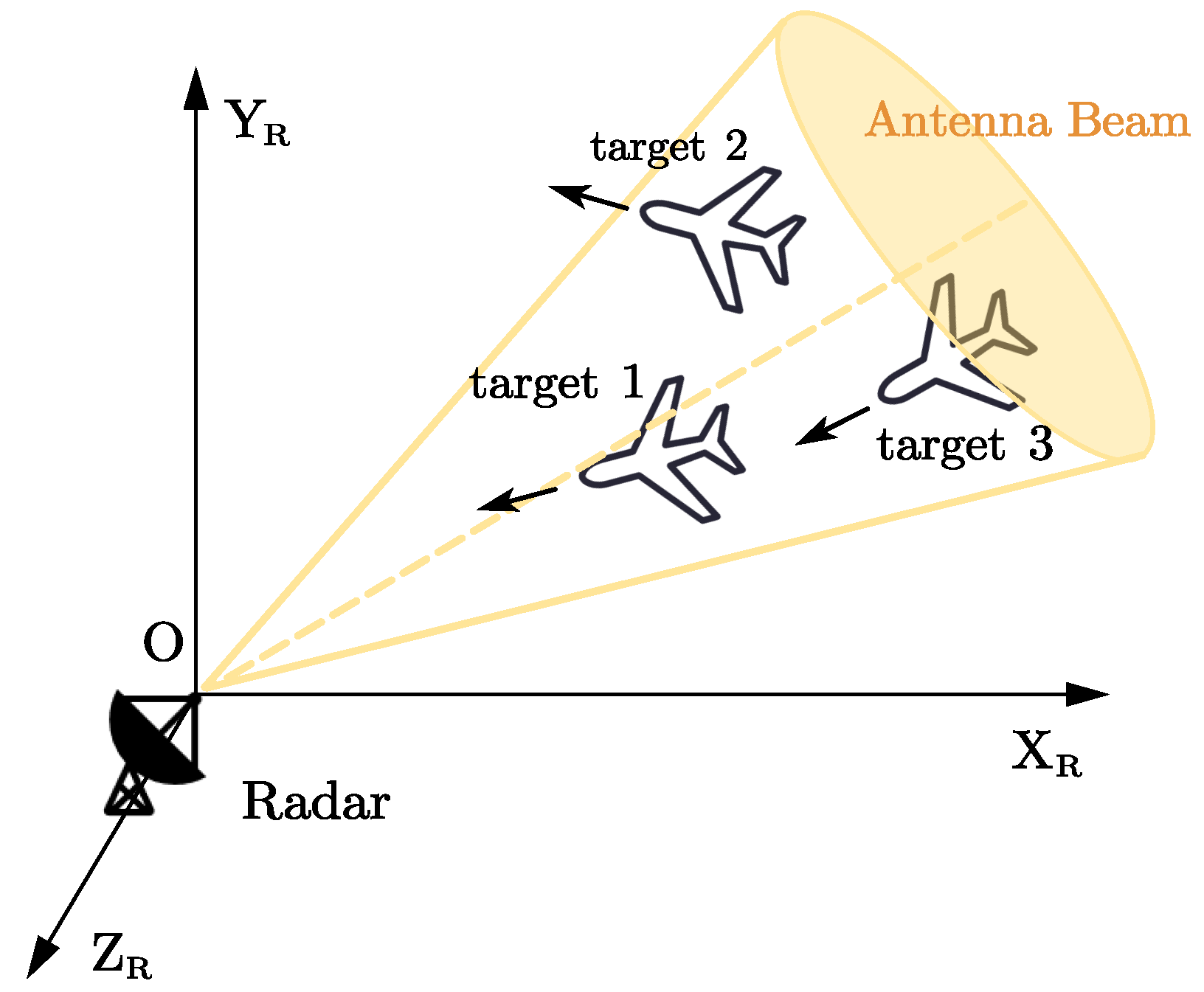
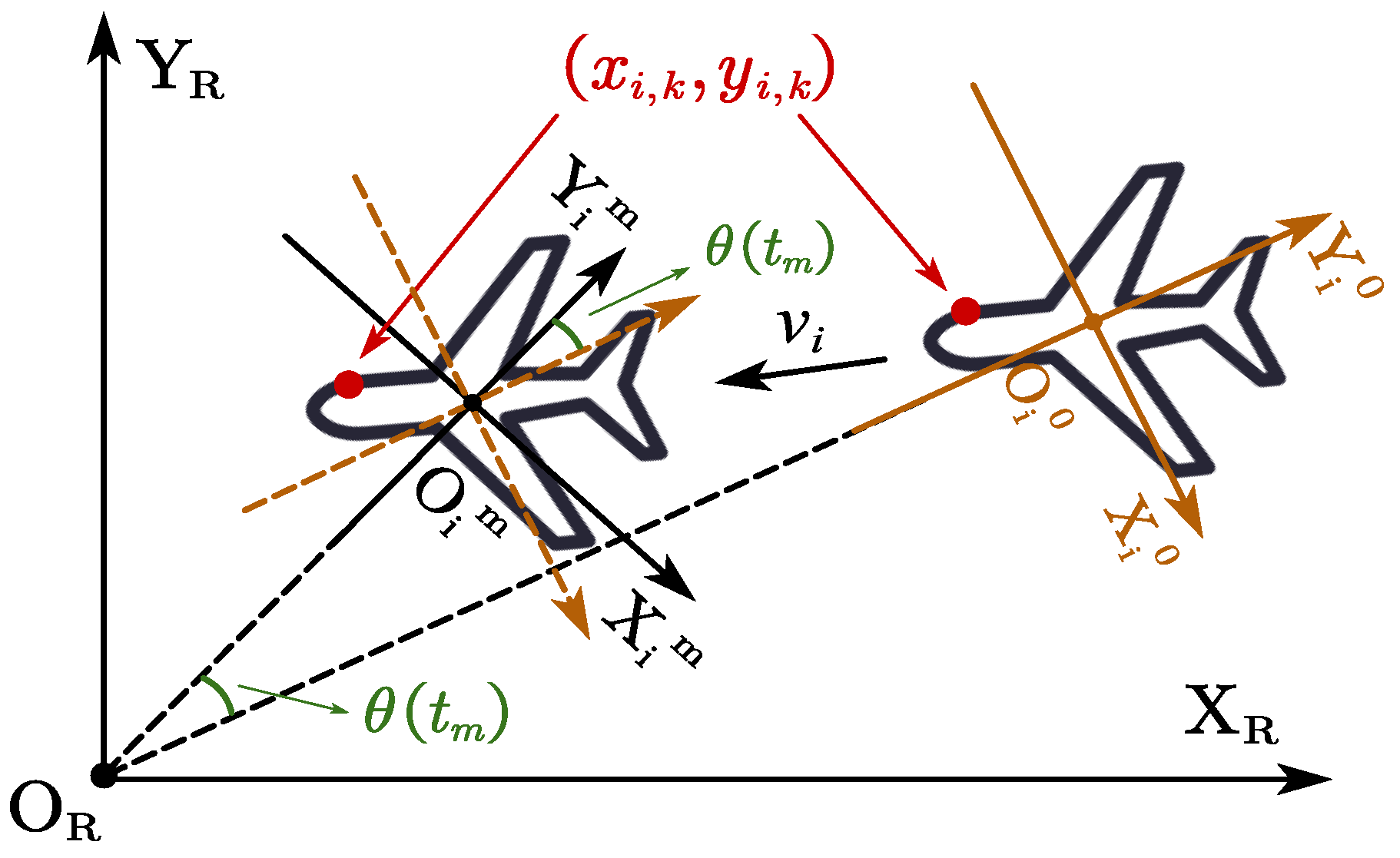
Assume that there is a total of I targets within the same wideband radar beam, as the observation geometry shown in Figure 1. Taking target i as an example, a two-dimensional imaging model is constructed as illustrated in Figure 2, where O R X R Y R represents the radar coordinate system with the radar as the origin, and O i m X i m Y i m denotes the body coordinate system of the i th target at time t m . As the target moves, the orientation of its body coordinate system continuously changes. The Y -axis always points along the radar line-of-sight (LOS) direction, and the relative position of the scattering point ( x i , k , y i , k ) within the body coordinate system remains unchanged.
Assuming the radar transmits a Linear Frequency Modulated (LFM) signal, which can be expressed as
s t t ^ , t m = rect t ^ T p exp j 2 π f c t + 1 2 γ t ^ 2 .
Then, the received echo can be expressed as
S r t ^ , t m = i = 1 I k = 1 K σ i , k rect t ^ τ i , k t m T p · exp j 2 π f c t ^ τ i , k t m · exp j π γ t ^ τ i , k t m 2 + n t ^ , t m .
In the formula, σ i , k denotes the backscattering coefficient of the k th scattering point on the i th target. t ^ represents the fast time. t m is the slow time. T p is the pulse width of the transmitted signal. f c denotes the carrier frequency. γ is the chirp rate. τ i , k represents the two-way delay time. And n t ^ , t m is the additive white Gaussian noise. θ ( t m ) denotes the equivalent rotation angle of the target relative to the LOS direction. Assuming θ ( t m ) is small, the following approximation holds
sin θ ( t m ) θ ( t m ) cos θ ( t m ) 1 .
For non-cooperative targets, the motion along the radar LOS direction is unknown. It can be approximated by fitting a polynomial to the range from the radar to the target center, as expressed below.
R i ( t m ) = R i 0 + q = 1 Q α i , q t m q .
where R i 0 denotes the distance from target i to the radar at the initial time.
In modern wideband radar systems, X-band and Ku-band carrier frequencies are commonly employed. Given that translational motion compensation is properly performed, a relatively small rotation angle is sufficient to achieve high azimuth resolution, which indicates that the required observation time is generally short. Therefore, we can assume Q = 2 without loss of generality [30]. Consequently, the slant range history from a scatterer to the radar can be expressed as
R i , k ( t m ) = R i + v i t m + 1 2 a i t m 2 + x i , k sin θ i ( t m ) + y i , k cos θ i ( t m ) = R i + v i t m + 1 2 a i t m 2 + x i , k ω i t m + y i , k ,
where v i and a i denote the velocity and acceleration of the i th target, respectively, and ω i represents the effective rotation vector in the imaging plane, which can be approximated as a constant. After down-conversion and pulse compression of the received signal, a two-dimensional expression in the range-frequency and slow-time domain can be obtained.
S c f r , t m = | S t ( f r , t m ) | 2 i = 1 I k = 1 K σ i , k rect f r B · exp j 4 π c f r + f c R k t m + N ^ f r , t m ,
where f r represents the range frequency. N ^ f r , t m is the Fourier transform of n t ^ , t m along the fast time dimension.
In fact, the distinct equivalent rotation states of different targets primarily affect only the imaging resolution, which can be improved through methods such as migration through resolution cell correction and does not fundamentally impact the estimation of translational motion parameters. To simplify the model, a low-order Taylor expansion is applied here to facilitate subsequent analysis. Under this parametric model, to compensate for range profile shifts and phase errors caused by translational motion, a frequency-domain compensation factor can be constructed as
H c f r , t m = exp j 4 π c f r + f c ( v ˜ t m + 1 2 a ˜ t m 2 ) ,
where v ˜ and a ˜ are the estimated velocity and acceleration of a single target. The compensated signal can then be expressed as
S c p f r , t m = S c f r , t m H c ( f r , t m ) = i = 1 I k = 1 K σ i , k rect f r B · exp j 4 π c f r + f c ( Δ v i t m + 1 2 Δ a i t m 2 ) + N ^ f r , t m H c ( f r , t m ) ,
where represents the Hadamard product. Δ denotes the error between the estimated value and the true value. When the velocity estimation error does not exceed the maximum azimuthal Doppler ambiguity velocity:
| Δ v i | λ · R P F 2 .
The residual linear migration error can be corrected by the Keystone transform [34], which requires no prior information and simultaneously resolves the issue of migration through range cells.

3. Methods

The proposed imaging framework comprises three key components. Firstly, we construct block-wise compensation matrix through echo support region partitioning, which forms the basis for echo separation. After that, PSO is integrated with block-wise compensation, enabling simultaneous estimation of multi-target motion parameters, which is the core of multi-target motion compensation. Finally, we employ SVMD to reconstruct the signal, which is critical for obtaining high-resolution multi-target ISAR images.

3.1. Joint Block-Wise Compensation via Echo Support Region Partitioning

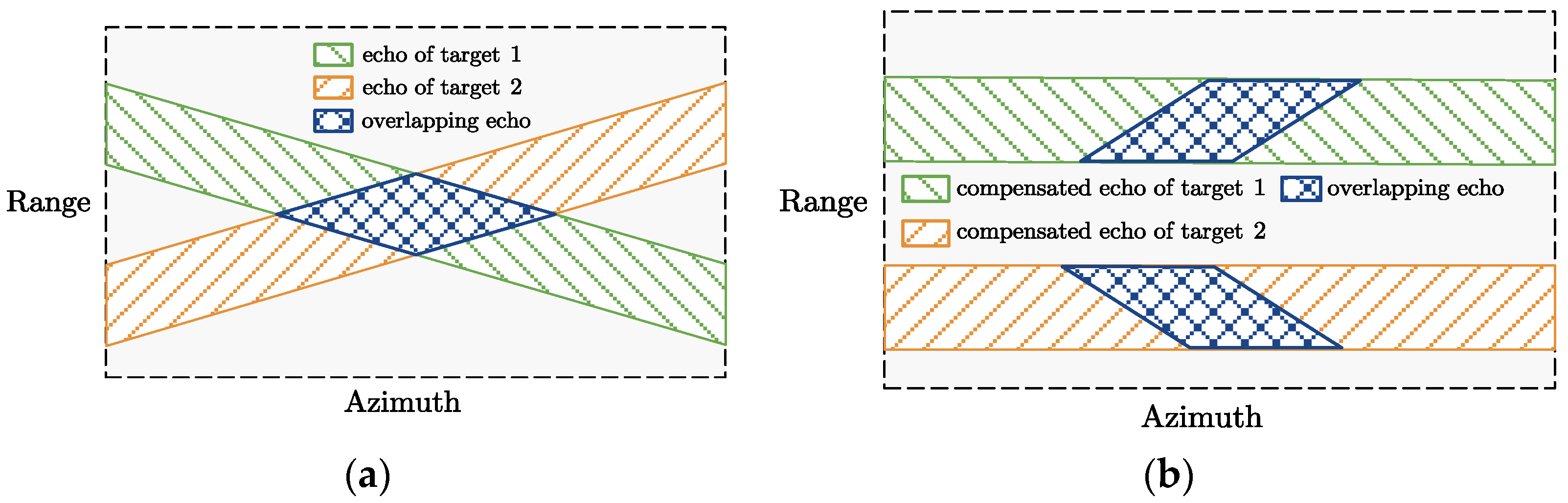
When the translational motion parameters of multiple targets differ significantly, their envelopes often partially intersect and overlap. After proper translational motion compensation, each target is correctly compensated for its respective echo support region [30], as shown in Figure 3.
Let the number of range sampling points be M and the number of pulses be N. Then the compensated HRRP in the time domain can be written as
Y c = F 1 · ( H Y )
where Y is the pulse-compressed signal in the range-frequency and slow-time domain; H is a frequency-domain motion compensation matrix; and F 1 is a M × M inverse discrete Fourier transform (IDFT) matrix satisfying
F m , k = 1 M exp ( j 2 π m k M )
H ( m , n ) = exp [ j 4 π c ( f c + m Δ f ) ( v ˜ n Δ t + 1 2 a ˜ ( n Δ t ) 2 ) ] .
In the formula, Δ f = f s M ; Δ t denotes the pulse repetition interval. Since the target occupies only a small number of range cells, within the discrete inverse Fourier transform (IDFT) matrix, only a small subset of the IDFT basis vectors contributes effectively to transforming the target’s signal domain, while the remaining basis vectors tend to introduce additional noise and interference. Therefore, the IDFT basis can be partitioned to construct a block-wise compensation matrix:
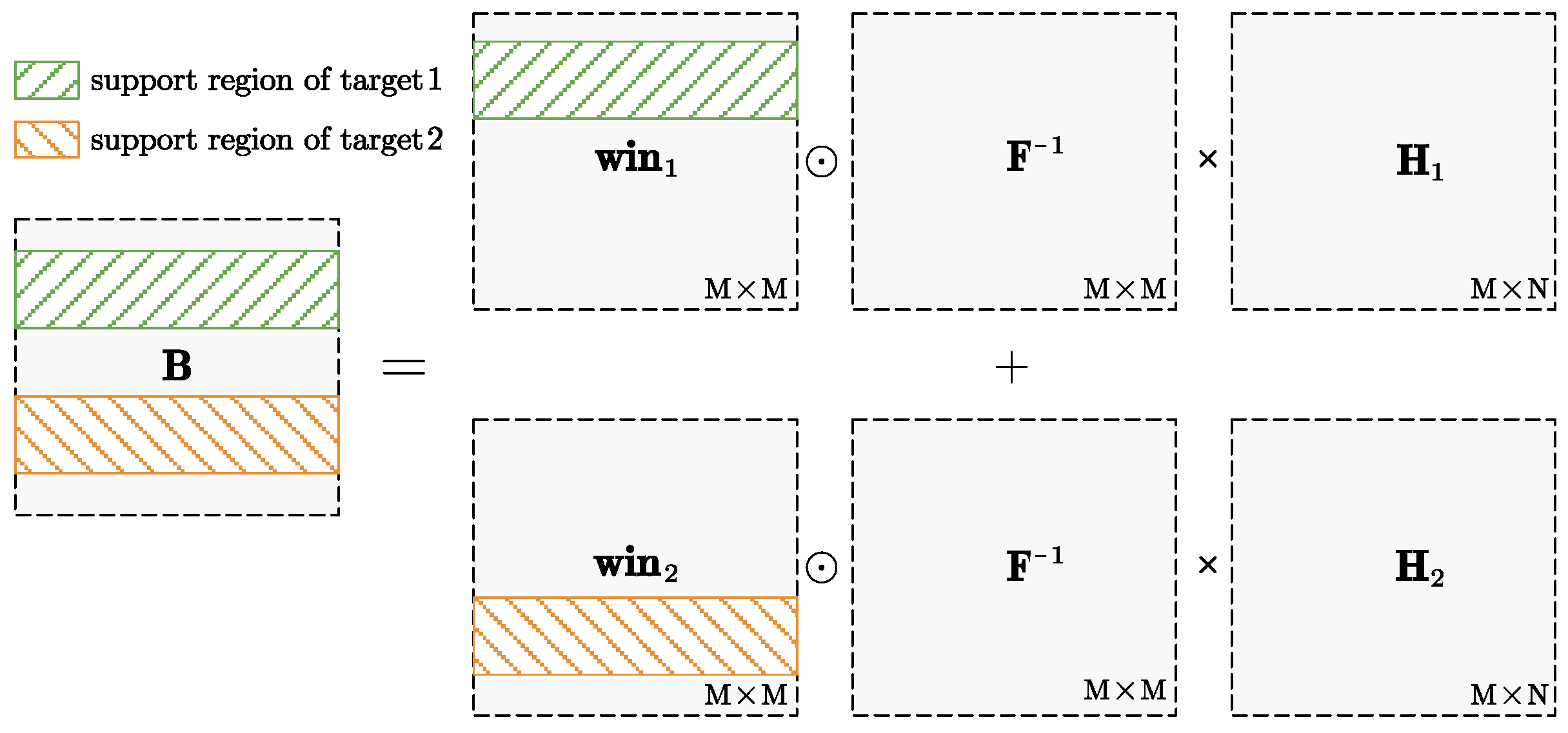
B = i = 1 I w i n i F 1 · H i ,
where H i is the frequency-domain compensation matrix of target i ; w i n i is a M × M range window matrix. If the i th target occupies range cells from m i start to m i end , then
w i n i = 1 ,   m i start m m i end 0 ,   others .
By exploiting the properties of matrix operations, the compensated time-domain signal can be expressed as
Y c = F 1 · ( H Y ) = ( i = 1 I w i n i F 1 · H i ) Y = B Y .
Based on the echo support region of each target, the inverse Fourier transform matrix is partitioned into blocks. By combining the inverse Fourier transform basis corresponding to each target’s support region with the frequency-domain motion compensation matrix, a block-wise compensation matrix is constructed, which is capable of simultaneously compensating the echo of multiple moving targets. A schematic diagram of the block-wise compensation matrix construction is shown in Figure 4.
By utilizing block-wise compensation, one-time compensation of multi-target echoes can be achieved, thereby enabling the PSO algorithm to perform simultaneous estimation of the motion parameters of multiple targets, which addresses the issue of the optimization algorithm being prone to falling into local optima.

3.2. Simultaneous Estimation of Multi-Target Motion Parameters Based on PSO

As a swarm-intelligence-based global search method, PSO offers the advantages of simple structure and high computational efficiency. It has been widely adopted for motion parameter estimation in single-target ISAR imaging. The standard PSO algorithm mimics the cooperative and competitive behaviors observed in bird flock foraging, iteratively searching the solution space to locate the optimum. However, in the context of ISAR motion parameter estimation, especially with multiple targets, the cost function surface often contains multiple local extremum points, making the search prone to becoming trapped in local optima. To address this issue, this chapter integrates PSO with the block-wise compensation method described in the previous section, using maximum image contrast as the optimization criterion to achieve simultaneous estimation of the motion parameters for multiple targets. In the algorithm, the velocity and position of each particle are updated iteratively according to the following equations:
V q e + 1 = ω V q e + c 1 r 1 p q , p b e s t e x q e + c 2 r 2 p g b e s t e x q e x q e + 1 = x q e + V q e + 1 ,
where e denotes the iteration index, V q and x q represent the velocity and position of the q th particle, respectively, p q , p b e s t denotes the personal best position, p g b e s t denotes the global best position, ω is the inertia weight, c 1 and c 2 are the individual and social learning factors, whose typical values [33] are 2.0, r 1 , r 2 are random numbers uniformly distributed within the interval [0, 1].
A larger value of ω provides stronger global search ability, and a smaller ω improves the precision of local search [35]. Based on this property, the PSO algorithm in this paper employs an adaptively decreasing inertia weight factor during the parameter optimization process. Assuming that ω max = 0.9 and ω min = 0.4 , E denotes the maximum number of iterations, then the expression for w in the e th iteration is given by
ω ( e ) = min ω max ω max ω min · e E , ω max
On the cost function surface, the motion parameters of multiple targets form multiple peaks. In such cases, the sole application of PSO tends to be trapped in local optima, usually converging to targets with stronger signal energy while neglecting other targets. This is because traditional image optimization criteria and multi-target ISAR methods cannot directly achieve synchronous estimation and compensation of the motion for all targets. In our work, we integrate block-wise compensation with PSO estimation to achieve simultaneous estimation of the motion parameters for multiple targets. We employ contrast as an evaluation metric for ISAR image quality, which is defined as
Con ( img ) = E P 2 E P 2 2 E P 2 ,
where P equals the sum of the squared magnitudes of the complex-valued image, representing the image intensity. E ( · ) denotes mathematical expectation. We initialize I groups of particles in the particle swarm, construct the block-wise compensation matrix, and perform iterative updates using the maximum image contrast. In this model, the optimization metric is the sum of the contrasts of the multiple target images, which can be expressed as
max i = 1 I   Con   img i ( p i , g b e s t ) ,
where img i represents the complex-valued image of the i th target after compensation and separation. img i can be obtained by the following formula
img i = F M × M 1 Y c F N × N .
Only when the motion parameters of each target are correctly estimated will the aliased echoes be properly compensated for their respective echo support regions, thereby achieving the maximum image contrast. The innovation of the method proposed in this section lies in its ability to simultaneously complete the estimation and compensation of motion parameters by integrating block-wise compensation and PSO, which avoids the issue of being trapped in local optima and reduces the propagation error inherent in CLEAN-based approaches. Furthermore, even without prior knowledge of the initial input ranges, this method can still converge to the correct multi-target optimization parameters for the reason that the optimization objective is formulated as a joint optimization of multiple targets, which considerably enhances imaging stability. To accelerate convergence, we utilize the frequency-domain compensation function to perform a linear search over the target velocities, thereby determining the velocity interval for each target.

3.3. High-Resolution ISAR Imaging via Sequential Variational Mode Decomposition

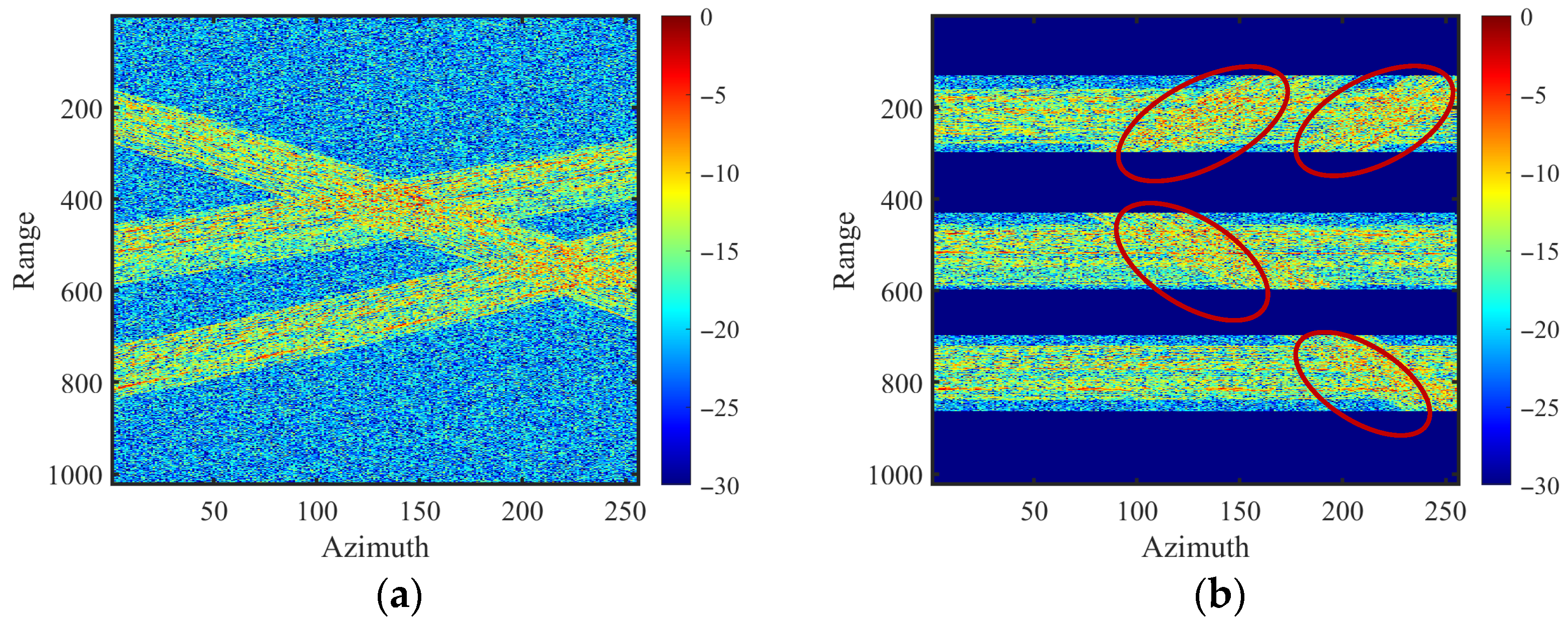
After completing the motion parameter estimation and echo compensation for multiple targets, the range profiles can be preliminarily separated. Two-dimensional imaging can then be achieved by performing a Fourier transform along the azimuth dimension. However, the envelope of each target remains affected by noise and residual interference from the envelopes of other targets, for the reason that overlap regions are still unavoidable, resulting in unexpected energy in the images. Therefore, further separation of the signal is required to enhance the imaging quality of each target. As shown in Figure 5, after motion compensation, the signals of each target still contain overlapping echoes, as indicated by the red ellipse in Figure 5b. The higher the reflection intensity and the degree of overlap of the interfering target signals, the greater the interference energy scattered in the imaging background.
In traditional multi-target imaging approaches, interference from other targets is often not explicitly considered. Instead, methods such as CLEAN are used to extract the main target body directly from the image domain. This may lead to issues of incomplete extraction or over-extraction [36]. The former degrades the image quality of subsequent targets, while the latter causes loss of useful signal from the remaining targets. To address these limitations, this paper introduces SVMD to suppress noise and residual interference from other targets’ envelopes, thereby avoiding the accumulation and propagation of errors associated with CLEAN-based processing. The fundamental principle of SVMD is to decompose the signal into multiple mode functions through variational mode decomposition. By iteratively extracting these modes while minimizing the discrepancy between the signal and the mode functions, SVMD progressively updates each mode. The resulting mode functions can then be used to reconstruct the original target signal, effectively suppressing interference from other targets and noise.
Given a one-dimensional sequence signal from a range cell, the signal f ( t ) is decomposed into three components: the L th modal signal u L ( t ) ; the residual signal f r ( t ) and the unprocessed signal f u n ( t ) , satisfying
f ( t ) = u L ( t ) + f r ( t ) f r ( t ) = l = 1 L 1 u l ( t ) + f u n ( t ) .
To decompose the signal into modal functions with narrowband frequency spectra, the following variational optimization model is constructed when extracting the L th mode:
min u L · ω L · f r α J 1 + J 2 + J 3 s . t .   : u L ( t ) + f r ( t ) = f ( t ) .
The minimization of J 1 in the equation constrains the bandwidth of the modal frequency, ensuring that the spectral energy of the target scattering points is concentrated. Its mathematical expression is given below:
J 1 = α t δ ( t ) + j π t u L ( t ) e j ω L t 2 2 ,
where α controls the bandwidth of the filter, δ ( t ) is the Dirac delta function, t represents the time derivative, ω L represents the center frequency, and represents the linear convolution operation. A large α yields a narrow mode, while a small α results in a wide bandwidth. When iterating on a single mode, the value of α can be gradually increased from a very small value to a relatively large one to ensure the stable convergence of the central frequency.
The minimization of J 2 in the expression suppresses frequency energy in the residual signal that overlaps with the extracted mode, thereby reducing spectral overlap. J 2 satisfies the following expression
J 2 = β L ( t ) f r ( t ) 2 2 β ^ L ( ω ) = 1 α ω ω L 2 ,
where β ^ L ( ω ) is the bandpass filter. The symbol · ^ denotes the frequency-domain representation of the signal and · 2 2 represents the l 2 -norm of the signal.
The minimization of J 3 is an augmented penalty term designed to constrain the modal overlap between the first L 1 modes and the L th mode, thereby ensuring the spectral independence of each mode. The expression is as follows.
J 3 = l = 1 L 1 β l ( t ) f r ( t ) 2 2 β ^ l ( ω ) = 1 α ω ω l 2 .
To solve the above optimization problem, we construct the augmented Lagrangian function:
L u L , ω L , λ = α J 1 + J 2 + J 3 + μ f ( t ) u L ( t ) + f u n ( t ) + l = 1 L 1 u l ( t ) 2 2 + λ ( t ) , f ( t ) u L ( t ) + f u n ( t ) + l = 1 L 1 u l ( t ) ,
where μ is the scaling factor and its typical value is 1. The < . > represents the inner product operator.
The Alternating Direction Method of Multipliers (ADMM) [37] is employed to solve the above extremum problem in the frequency domain, iteratively updating the parameters. In the ( n + 1 ) th iteration, the parameters of the L th modal signal are updated according to the following formulas:
ω L ( n + 1 ) = ω 0 ω u ^ L ( n + 1 ) ( ω ) 2 ω 0 u ^ L ( n + 1 ) ( ω ) 2 u ^ L ( n + 1 ) ( ω ) = f ^ ( ω ) + α 2 ω ω L ( n ) 4 u ^ L ( n ) ( ω ) + λ ^ ( ω ) 2 1 + α 2 ω ω L ( n ) 4 1 + 2 α ω ω L ( n ) 2 + l = 1 L 1 β l 2 ω λ ( n + 1 ) ( ω ) = λ ( n ) ( ω ) + τ f ^ ( ω ) u ^ L ( n + 1 ) ( ω ) l = 1 L 1 u ^ l ( ω ) ,
where u ^ L ( n ) ( ω ) represents the value of the Fourier transform of u L ( t ) after the n th iteration; ω L ( n ) is the central angular frequency. τ is the update step that controls the rate of change in the multipliers.
In the ( n + 1 ) th iteration, the center frequency ω L ( n + 1 ) is updated as the centroid of the current mode’s power spectrum, which shifts the center frequency towards the region of concentrated spectral energy, thereby more accurately localizing the mode’s frequency band. The update rule for the current mode’s spectrum, u ^ L ( n + 1 ) ( ω ) , is derived from the augmented Lagrangian of the constrained optimization problem that seeks a mode with minimal bandwidth while closely approximating the signal component. Therefore, the denominator is represented by multiple filters β l ω to avoid modal overlap in the spectrum.
The convergence of the L th mode is determined when the relative change in its spectrum between successive iterations drops below a given tolerance ξ 1 , which means that the mode function can represent one or a group of dense and spectrally compact scattering points of the target. The center frequency of this mode is the center frequency of the scattering points, while the residual energy corresponds to other spectrally isolated modes or noise. The convergence criterion for the inner iterations of the L th mode is as follows:
ω u ^ L n + 1 ( ω ) u ^ L n ( ω ) 2 ω u ^ L n ( ω ) 2 = u ^ L n + 1 u ^ L n 2 2 u ^ L n 2 2 < ξ 1
Finally, the convergence condition for outer iterations is that the reconstruction error of k modal signals is less than the tolerance ξ 2 , which means all the extracted mode functions retain the spectral energy of the scattering points to the maximum extent, while components below the threshold are identified as interference and noise. The convergence criterion for the outer iterations is as follows:
f ^ ( ω ) l = 1 k u ^ l ( ω ) 2 2 ξ 2 .
Since each range cell in ISAR contains a complex signal, and SVMD relies on the bilateral spectrum symmetry of real signals for modal decomposition, the complex signal must first be decomposed into real signals [38] by splitting it based on its positive and negative frequency spectra, thereby preserving the complete spectral information without introducing phase distortion or information loss.
s ( t ) = s + ( t ) = F 1 ε ( ω ) s ^ ( ω ) , ω 0 s ( t ) = F 1 ε ( ω ) s ^ ( ω ) , ω < 0 ,
where ε ( ω ) is the step function, represents taking the real part of the signal, and F 1 represents the inverse Fourier transform. This process decomposes the complex signal into two real signals, each containing the complete spectral information of the original signal, and the decomposition is then performed separately on each. Subsequently, the complex signal of a single ISAR range cell can be reconstructed by combining its real and imaginary parts via the Hilbert transform to form the analytic signal.
s r e c o n ( t ) = l = 1 L a l ( t ) + j a l ( t ) + l = 1 L b i ( t ) j b l ( t ) .
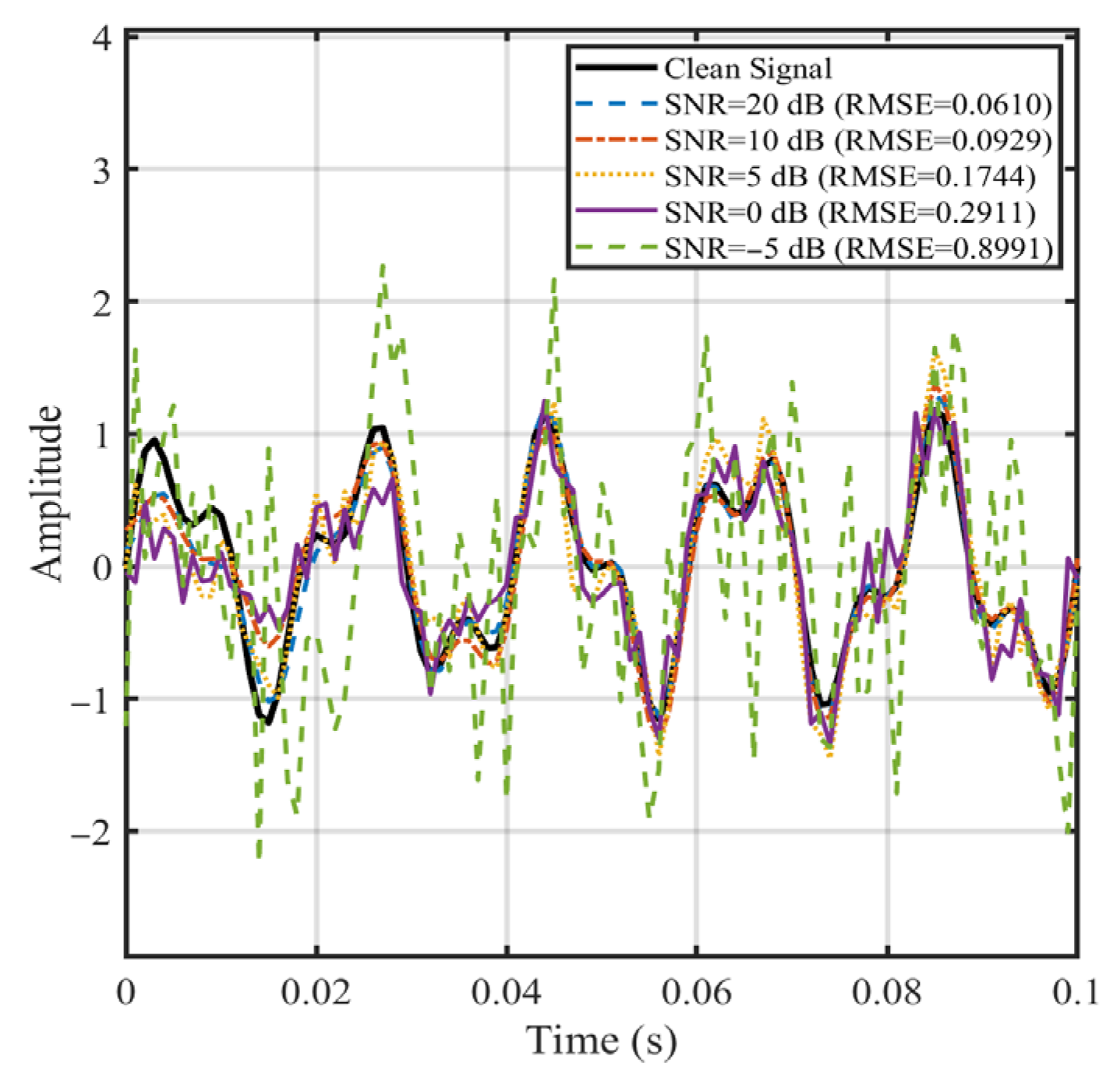
To evaluate the performance of SVMD, we construct a multi-component sinusoidal signal with frequencies of 50 Hz and 120 Hz. We test the signal reconstruction performance of SVMD under different SNRs, and plot both the reconstructed signals and the reconstruction Root Mean Square Error (RMSE) at different SNRs as shown in Figure 6. SVMD achieves satisfactory reconstruction performance when SNR is above 0 dB, and its performance degrades gradually as the SNR decreases.

3.4. Overall Framework

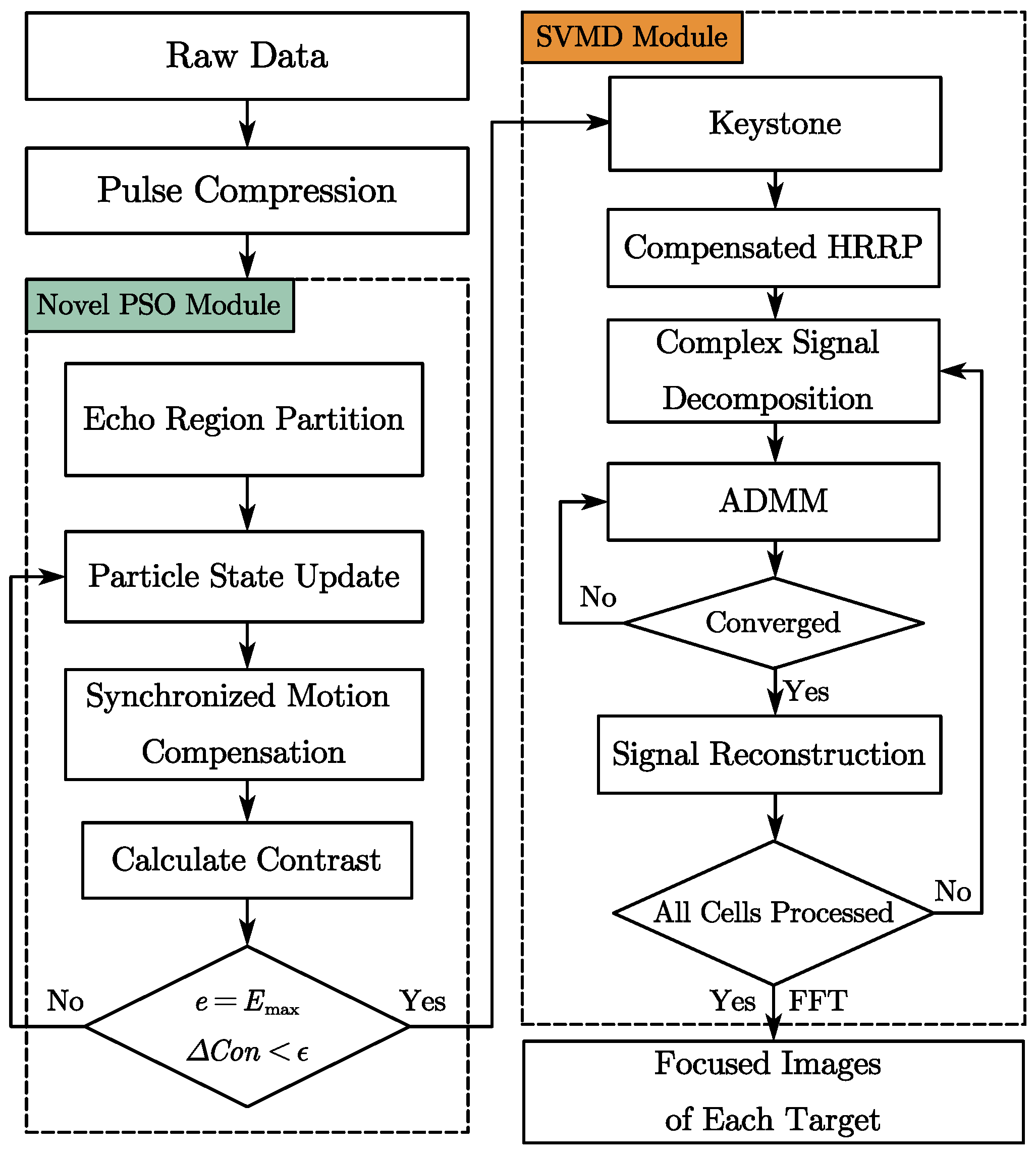
In summary, this paper proposes a PSO-SVMD-based method for multi-target separation and imaging. The core of the approach is a joint optimization framework that integrates block-wise compensation with PSO. Within this framework, the motion parameters of all targets are simultaneously estimated and compensated by partitioning the echo support region and optimizing under a maximum-contrast criterion. Subsequently, SVMD is applied to suppress noise and residual aliased echoes from other targets, thereby enhancing the final image quality. The performance of the proposed method degrades gradually with the decrease in observation time, iteration number, and SNR. The proposed method achieves favorable imaging results when the SNR of HRRP is greater than −2 dB. The overall workflow is illustrated in Figure 7.

4. Experiments

We validate and compare the algorithm through simulation experiments and measured data from the Yak-42 aircraft.

4.1. Simulation Experiments

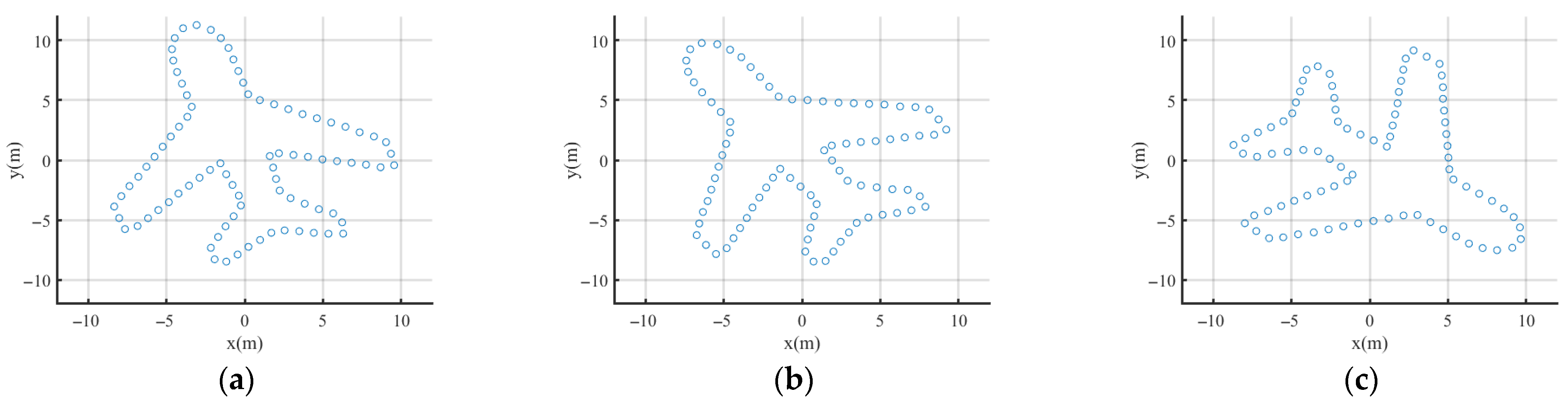
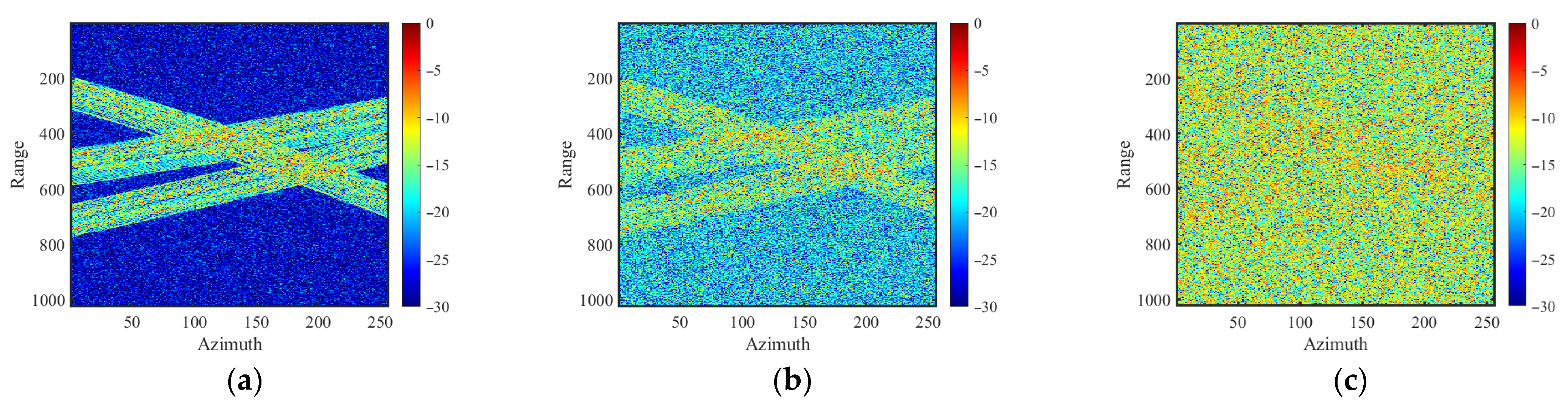
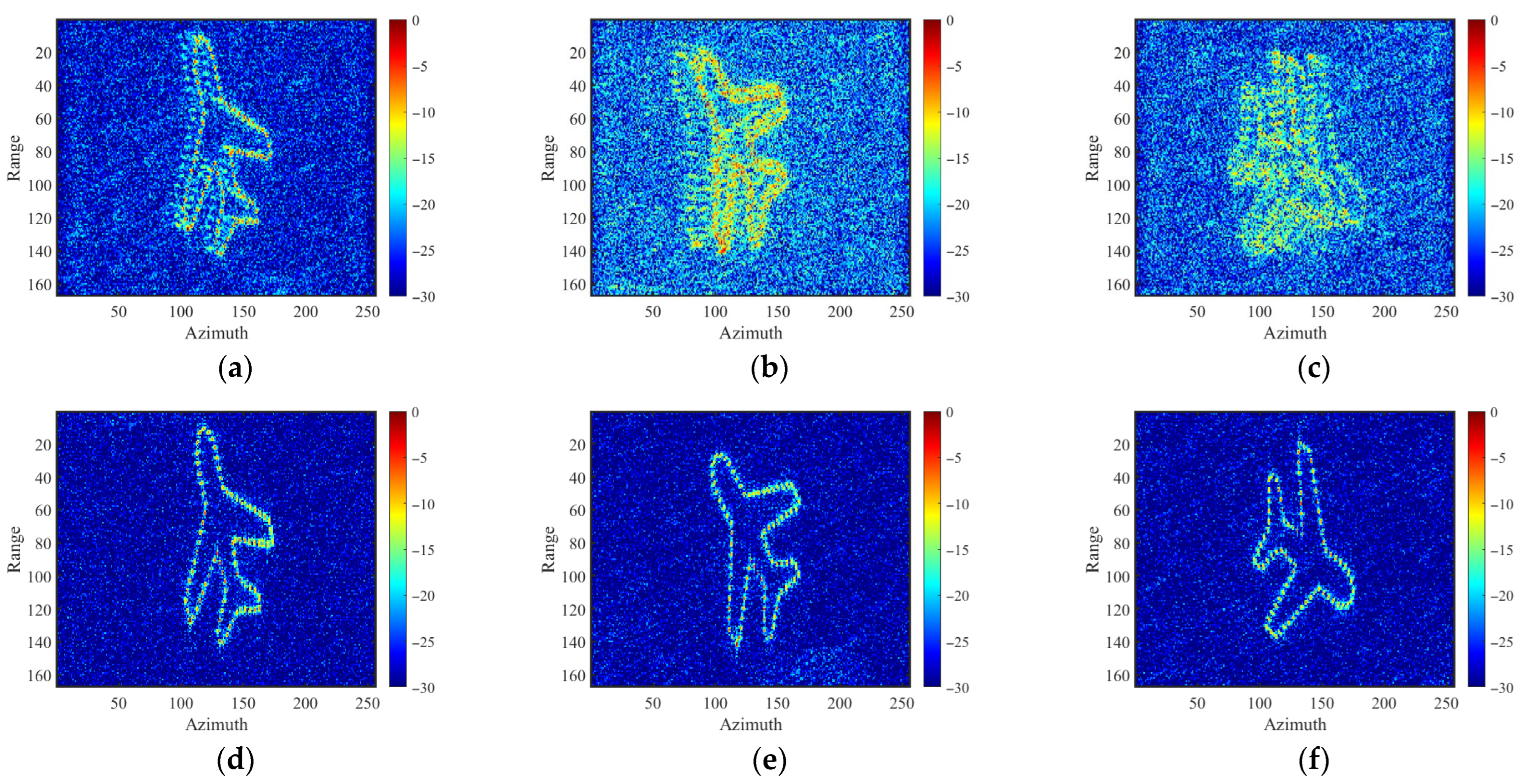
In the simulation experiments, we employ typical wideband radar system parameters as listed in Table 1. A fixed-wing UAV, scaled to its actual size, is selected as the target. Three targets are placed within the radar beam, as shown in Figure 8, each with an equivalent rotation angle of 3° relative to the LOS direction. Each target exhibits distinct velocity and acceleration relative to the LOS direction, with specific parameters listed in Table 2. The multi-target echoes were generated with SNR of 20 dB, 10 dB, and 0 dB. The range profiles at different SNRs are shown in Figure 9.
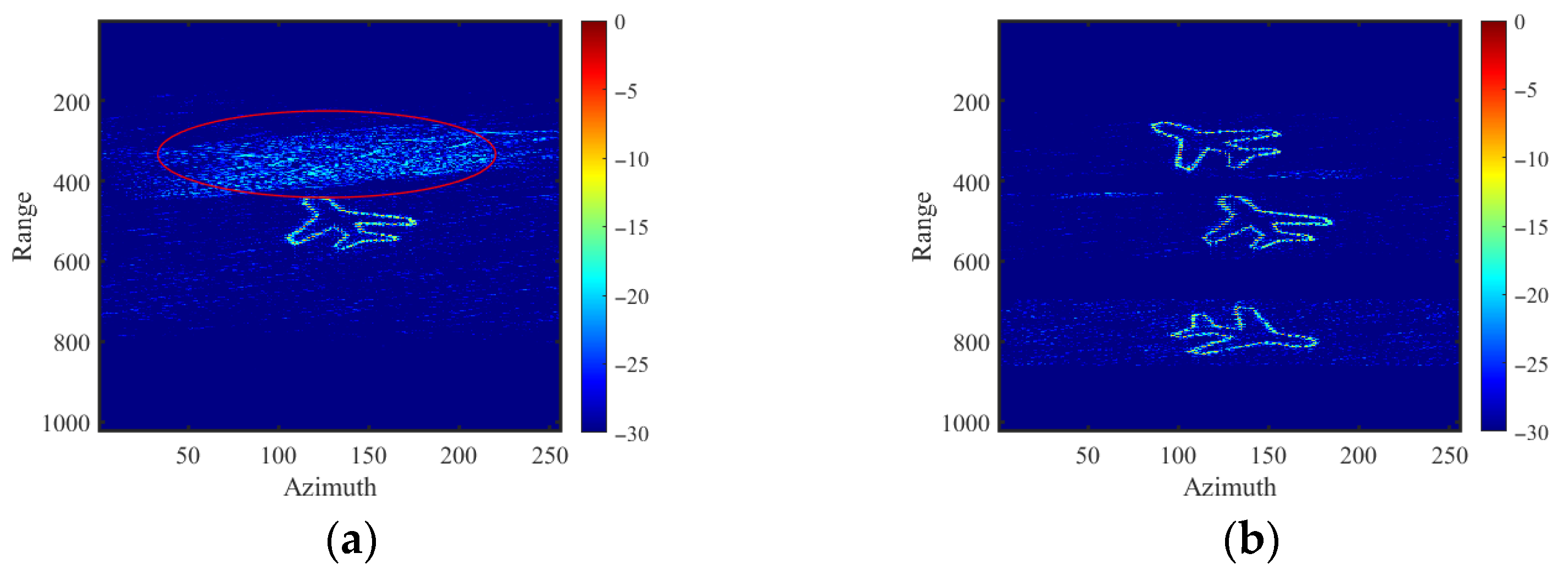
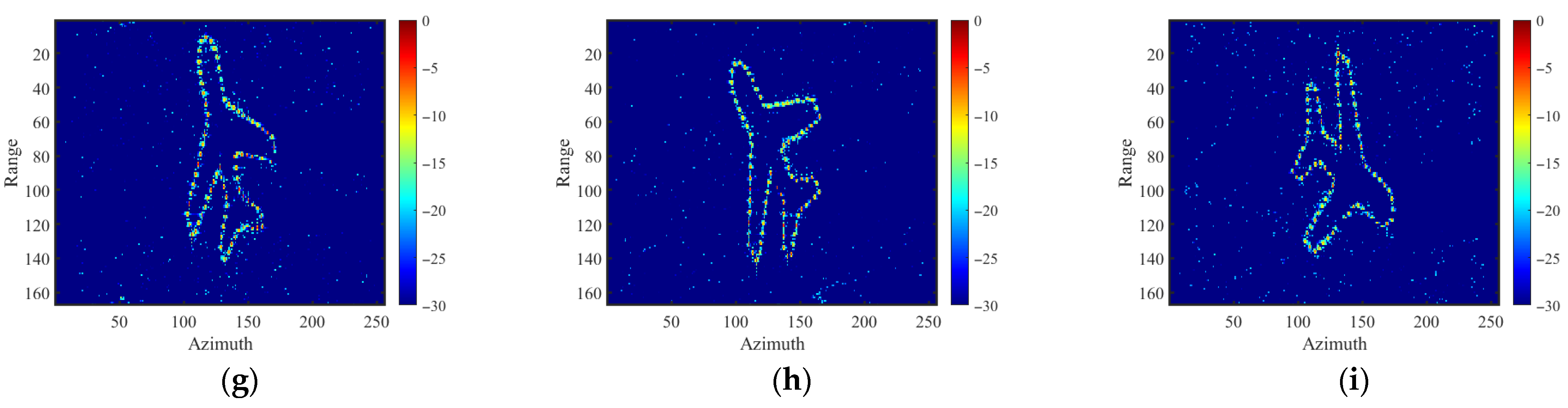
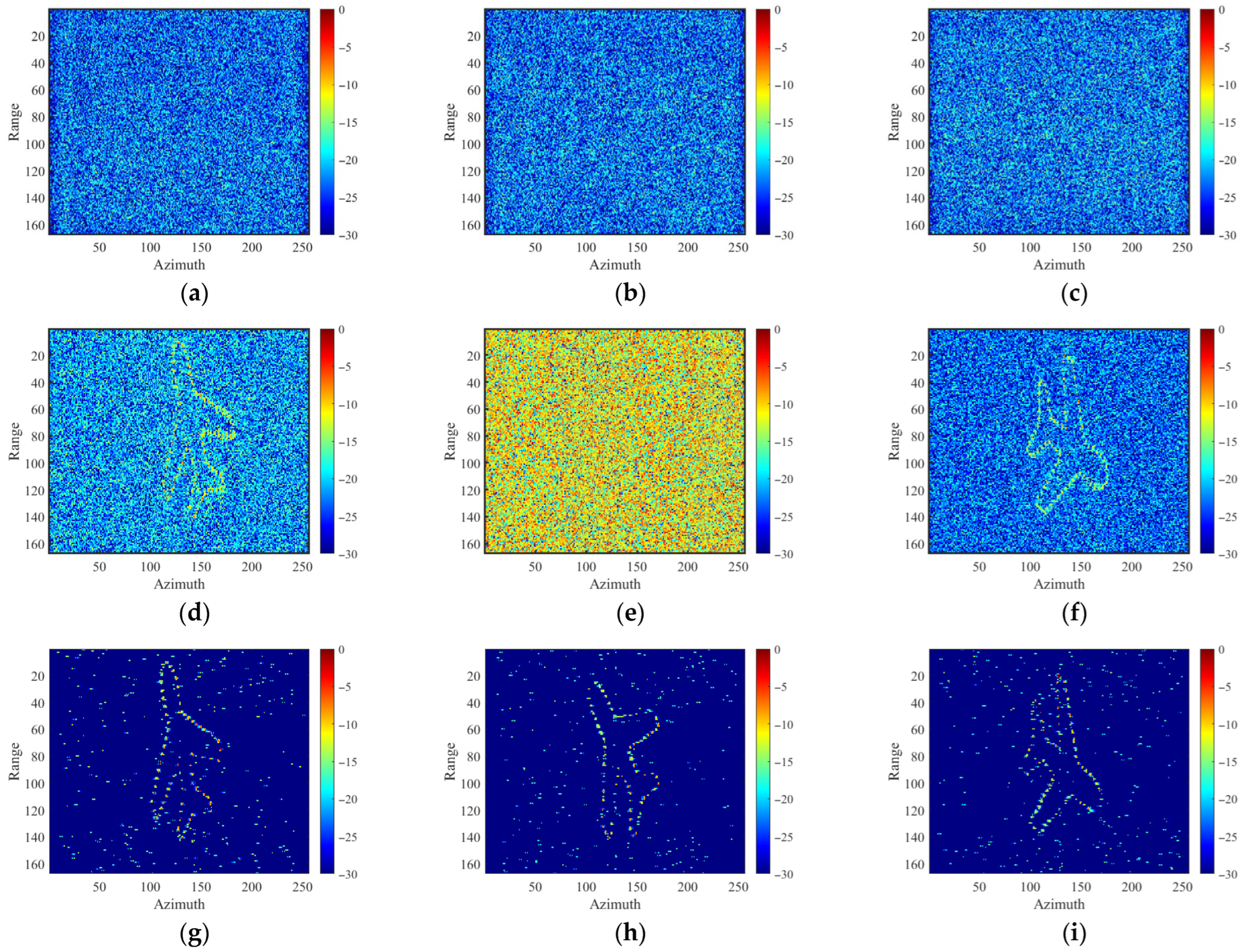
The CLEAN technique requires sequential target imaging. The result in Figure 10a reveals that the single image contains strong residual signals from other targets, making the CLEAN process prone to erroneously removing useful signal components of non-primary targets. In contrast, the proposed PSO-based block-wise compensation enables simultaneous optimization of motion parameters for all targets, which achieves higher quality images. Figure 11, Figure 12 and Figure 13 show locally magnified views of each target, allowing for a more refined quantitative comparison under the same conditions.
The imaging results of ZS-RT method [24], PSO-CLEAN method [33] and proposed method are compared at different SNRs. ZS-RT is a representative method in the field of multi-target ISAR imaging based on Radon transform. By enhancing the envelope of the target range profiles, it possesses a certain level of robustness against low SNR. PSO-CLEAN is an algorithm based on the CLEAN technique that performs sequential estimation of motion parameters, and it exhibits favorable noise robustness.
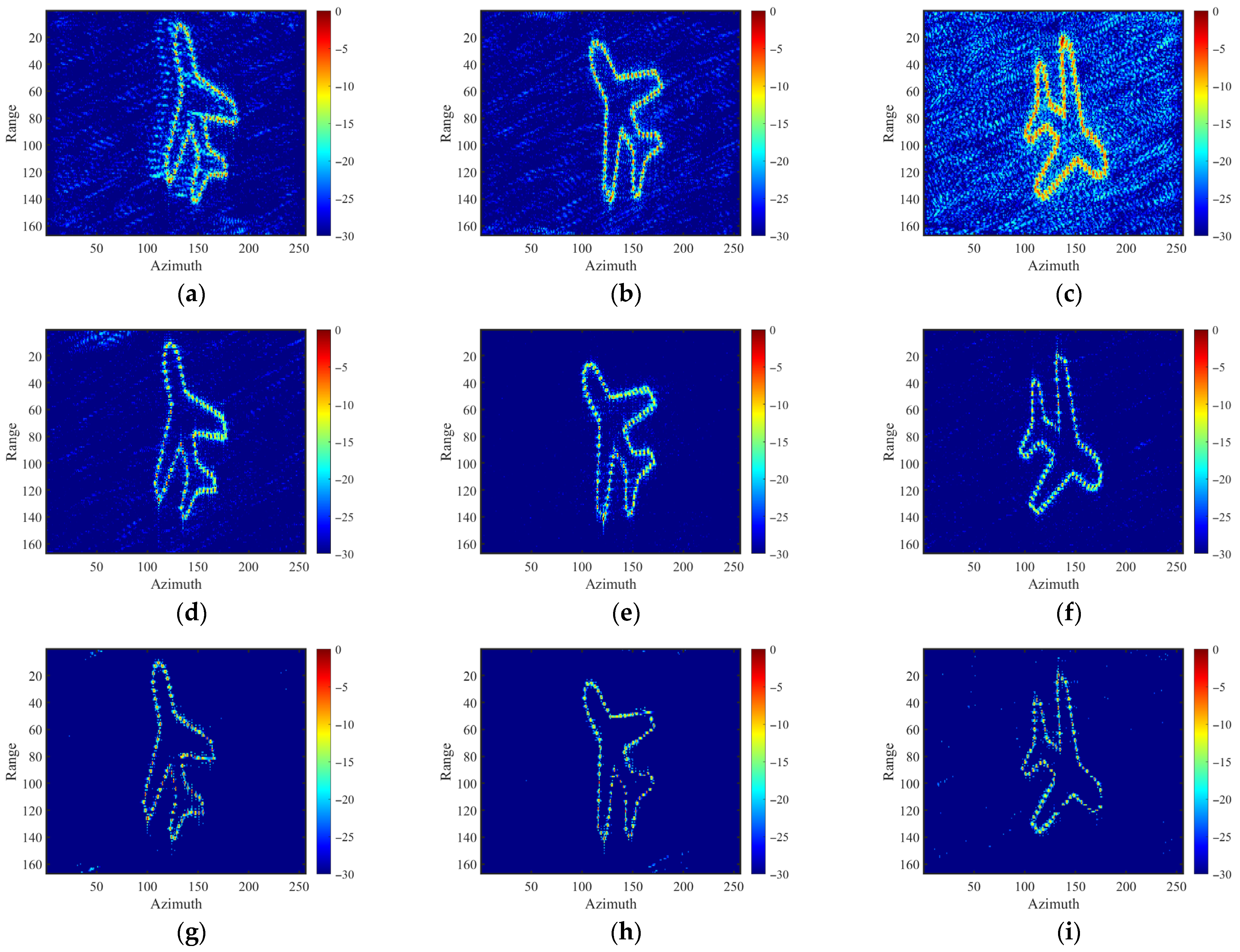
As can be observed from the results in Figure 11 to Figure 13, when the SNR is high, the background energy in each ISAR image mainly originates from the cross-envelope interference between targets, i.e., the echo interference in the aliasing region. At lower SNR, the background is jointly affected by both noise and the aliasing components. The result obtained by the ZS-RT method exhibits significant defocusing and even failure. It relies on echo correlation to conduct further compensation, whereas aliased signals and noise corrupt the echo correlation, thereby leading to performance degradation. The results from the PSO-CLEAN method exhibit significant background noise, and at low SNR, the target becomes difficult to distinguish. In contrast, the proposed method effectively suppresses interference from other targets’ envelopes as well as noise, yielding clear target outlines and achieving a higher imaging SNR.
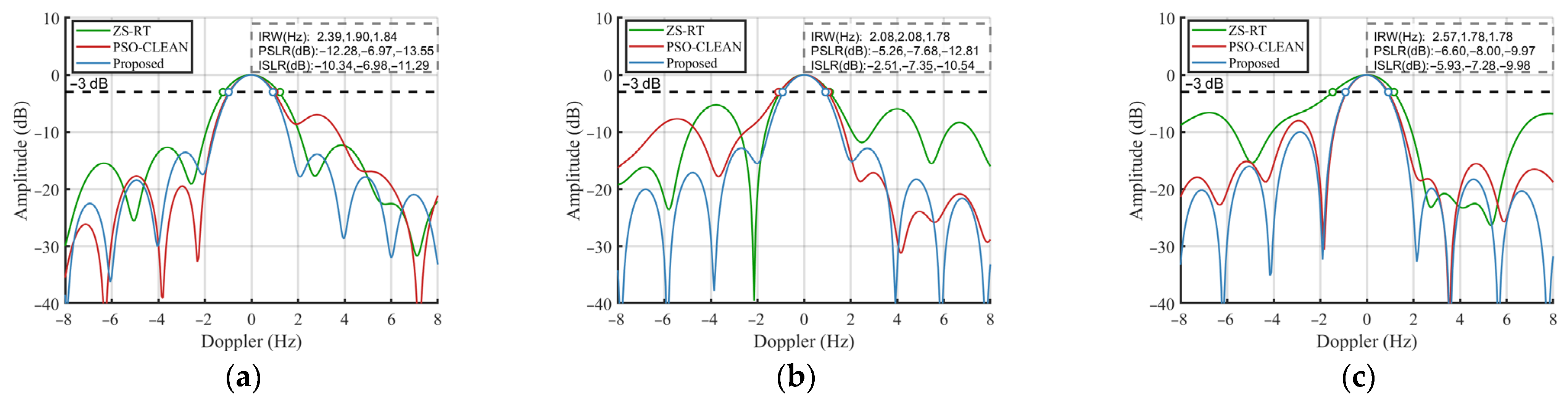
We evaluate and analyze the ISAR images quantitatively from two aspects: individual scattering points and the overall image. Individual scattering points are assessed using three metrics: Inter Range Width (IRW), Peak Side Lobe Ratio (PSLR), and Integration Side Lobe Ratio (ISLR). The overall image quality is analyzed via two metrics: image entropy and contrast, as listed in Table 3, Table 4 and Table 5.
It is worth noting that Figure 13a–c,e show targets that failed to be imaged. Due to the low SNR, the performance of the Radon transform in the ZS-RT method degrades drastically, failing to accurately estimate the target motion parameters. PSO-CLEAN encounters difficulties in extracting the target image. During the CLEAN processing of Target 1 and Target 3, the main energy of Target 2 was erroneously extracted as well, leaving a residual signal insufficient to support imaging. Therefore, the evaluation metrics for targets at SNR = 0 dB obtained by the ZS-KT method are meaningless, as no discernible target is present in the image, and the same applies to Target 2 obtained by the PSO-CLEAN method.
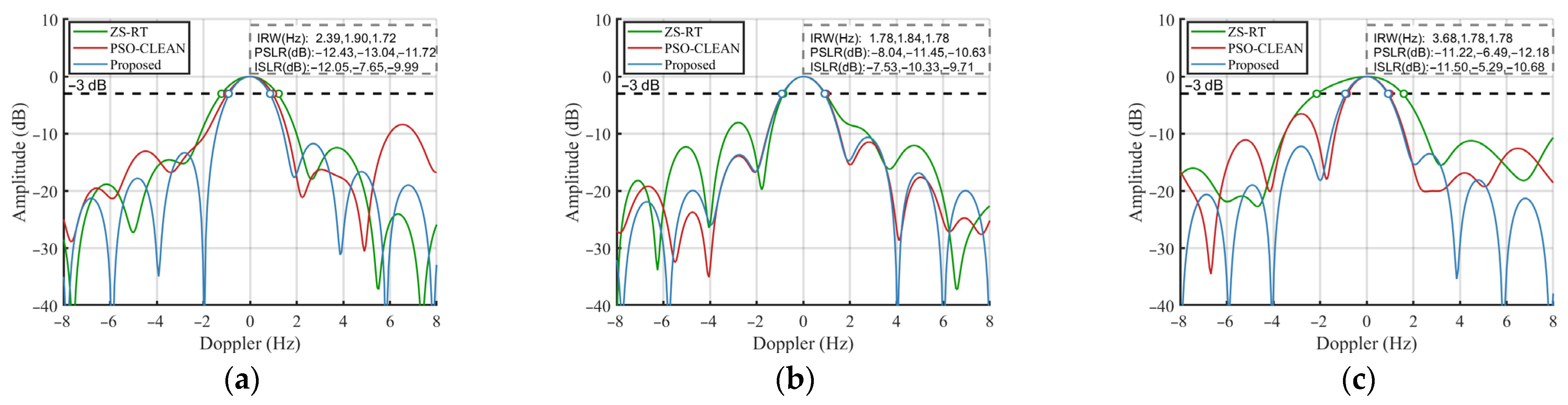
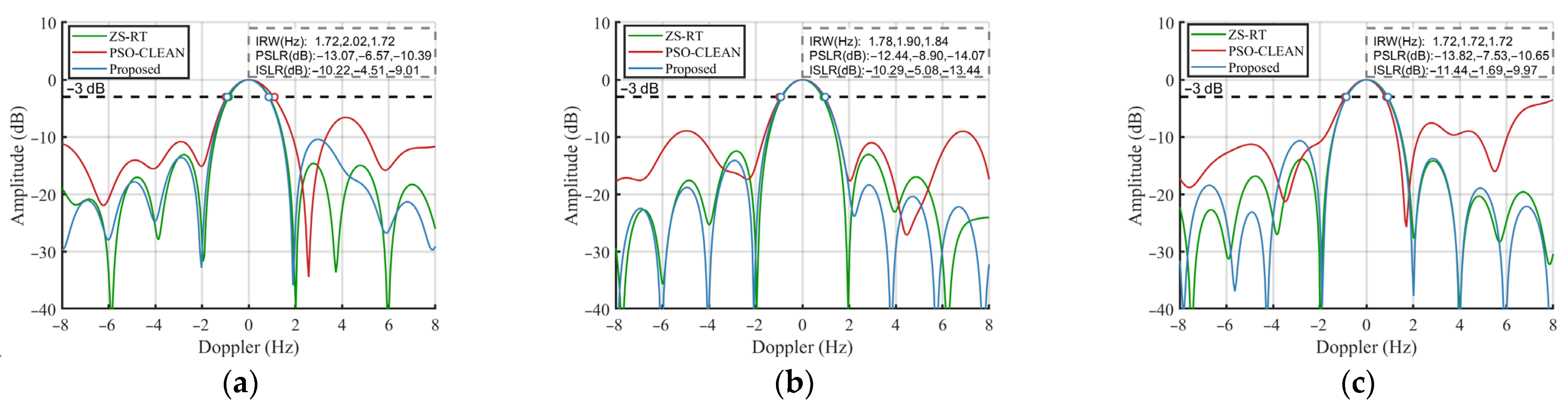
In terms of image entropy and contrast metrics, the proposed method outperforms the ZS-RT method and the CLEAN-based approach. After block-wise PSO compensation, the method employs the Keystone transform to correct the residual first-order velocity estimation error while simultaneously compensating for the azimuth spectrum broadening caused by migration through range cells. Coupled with the constraint on modal bandwidth in SVMD, the framework achieves higher azimuth resolution, as well as lower peak sidelobe ratio and integrated sidelobe ratio. In the experiment, azimuth frequency profiles of the same scattering point extracted from each sub-target image are compared, as shown in Figure 14, Figure 15 and Figure 16. The values of IRW, PSLR and ISLR are labeled in the figures, which correspond to ZS-RT, PSO-CLEAN and the proposed method from left to right, respectively.

4.2. Measured Results

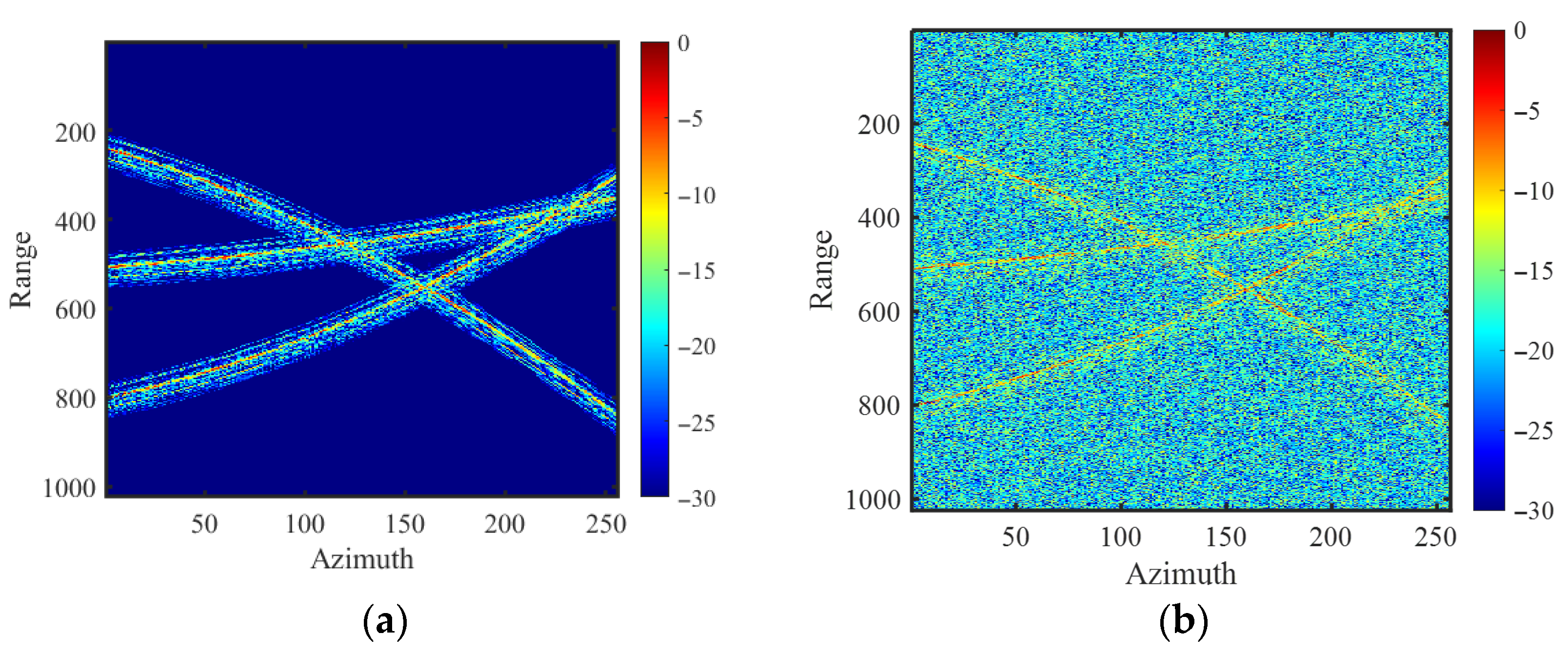
Multi-target echoes are generated from public Yak-42 data by adding radial motion parameters and noise, as shown in Figure 17.
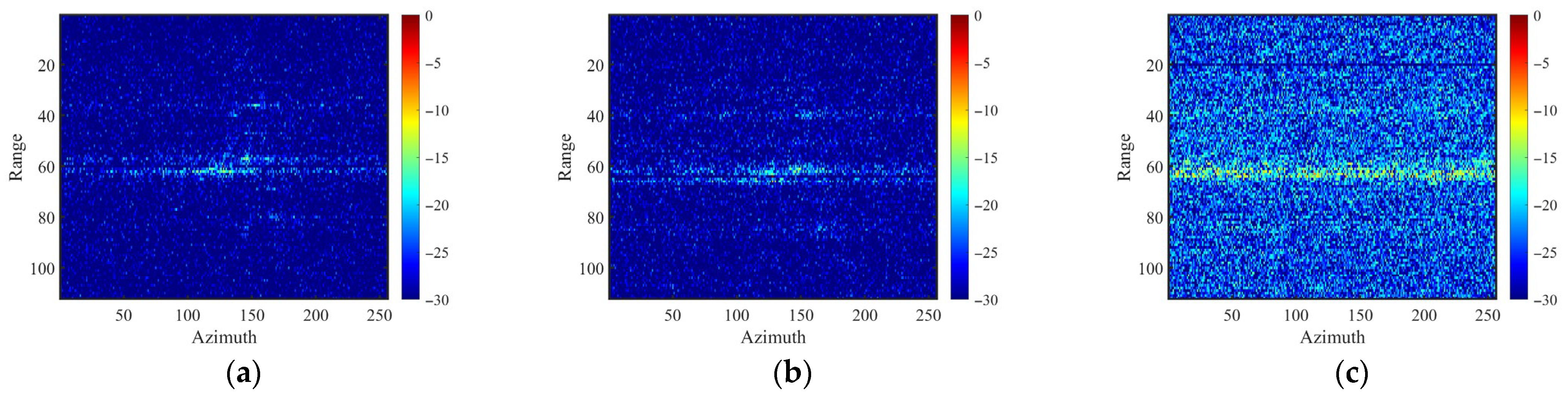
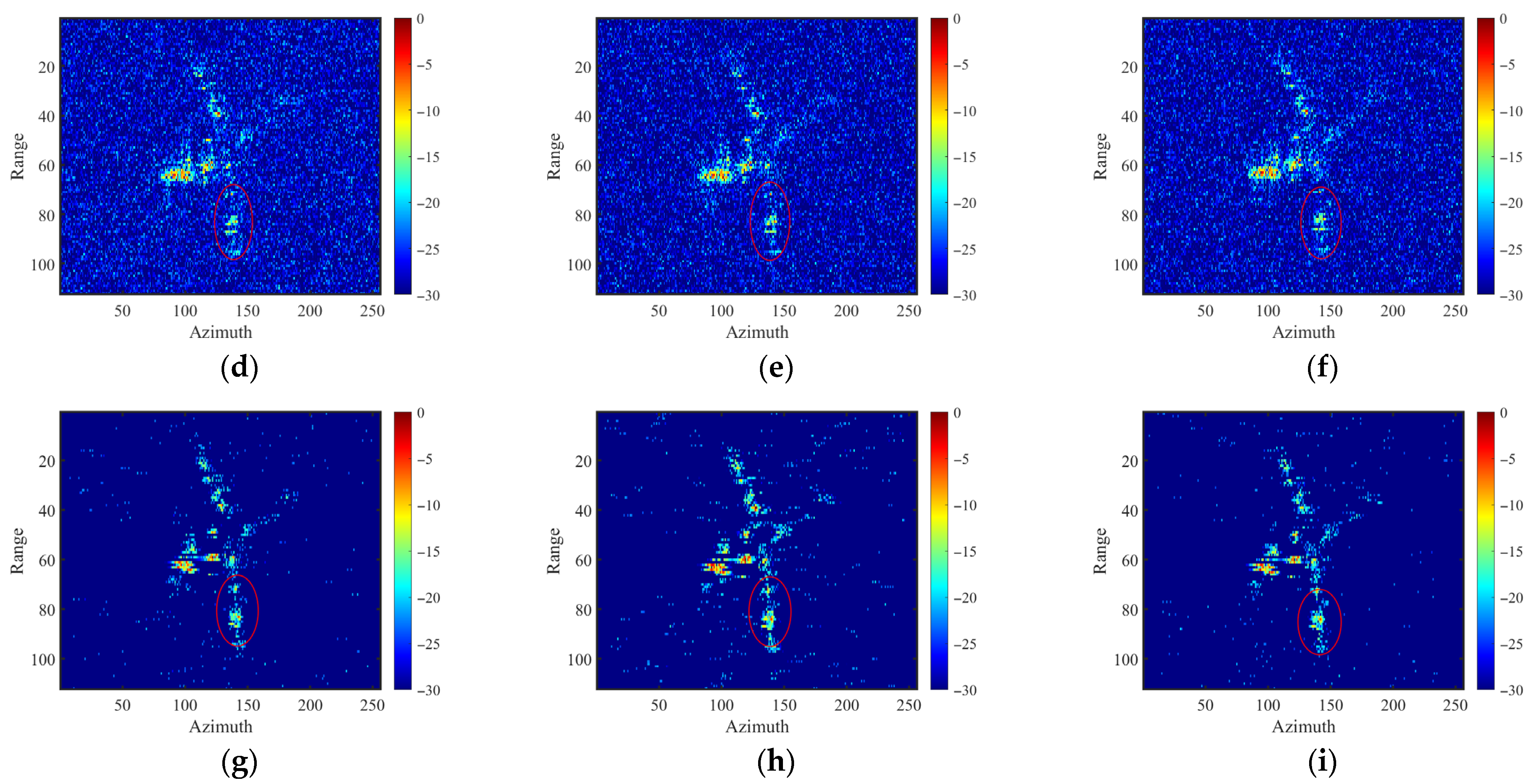
As shown in Figure 18, the ZS-RT method fails to extract the target contour and is nearly ineffective. The PSO-CLEAN results exhibit stronger background noise and weaker signal intensity in structures such as the wings and nose, whereas the proposed method yields clearer structural outlines with more continuous and defined scattering points.
In the measured data, the target contains densely distributed scatterers. The main lobes of adjacent scatterers fall within the sidelobe range of the analyzed point, which distorts the calculation of ISLR and PSLR, resulting in computed metrics that fail to faithfully reflect the real imaging performance. Therefore, we have eliminated this metric for the measured data. The quantitative superiority of the proposed method is further confirmed by the entropy and contrast presented in Table 6.

5. Discussion

The proposed algorithm maintains good performance with linearly increasing complexity as the number of targets grows, as it is not affected by image extraction errors. In the future, we aim to refine the SVMD process by first determining whether each range bin contains valid target signals to improve computational efficiency. This adaptive approach will ensure that signal decomposition is applied only where necessary, paving the way for high-quality multi-target ISAR images in an efficient manner. We plan to extend this framework to address the emerging challenge of targets with time-varying scattering characteristics as well. This includes scenarios where different targets exhibit distinct, non-stationary scattering properties and varying RCS levels. Such targets, for instance those with rotating components or dynamically reconfigurable surfaces, introduce non-stationary phase modulations that disrupt conventional imaging assumptions. Our future work will, therefore, focus on enhancing the framework to jointly estimate not only the targets’ bulk motion but also their time-varying scattering behavior. This will enable stable and coherent imaging even when a target’s signature evolves significantly within the coherent processing interval. The goal is to transform the challenges posed by time-varying scatterers into new opportunities for advanced radar-based perception and information extraction.

6. Conclusions

This paper addresses the scenario of multiple moving targets existing within the beam of a wideband radar and proposes a multi-target ISAR imaging framework based on PSO-SVMD. The main contributions are twofold. First, by integrating block-wise compensation with PSO, we achieve joint optimization and simultaneous estimation of motion parameters for multiple targets. The proposed method effectively mitigates the problem of local optima that plagues conventional optimization methods. Consequently, it avoids the cumulative and propagated errors inherent in the sequential iteration of CLEAN-based methods, which may lead to imaging failure, particularly at low SNR. Second, we take into account the impact of inter-target echo aliasing and noise on imaging, an aspect often overlooked in previous studies. By applying SVMD, we successfully suppress the interference of overlapping signals and noise on the imaging of individual targets. The proposed imaging method has been validated through both simulation experiments and tests using measured data.

Author Contributions

Methodology and Writing, X.T.; Validation, Y.L. (Yulin Le).; Writing—review and editing, C.F. and X.H.; Investigation, Y.L. (Yinghong Liu).; All authors have read and agreed to the published version of the manuscript.

Funding

This research received no external funding.

Data Availability Statement

All data related to this study are included in the article. If there are any further requirements, please contact the author via email.

Conflicts of Interest

The authors declare no conflicts of interest.

References

  1. Long, T.; Li, Y.; Zhang, W.; Liu, Q.; Chen, X.; Tian, W.; Yang, X. Wideband Radar; National Defense Industry Press: Beijing, China, 2022; pp. 1–197. [Google Scholar]
  2. Bao, Z.; Xing, M.; Wang, T. Radar Imaging Technology; Publishing House of Electronics Industry: Beijing, China, 2005; pp. 25–29. [Google Scholar]
  3. Song, S.; Dai, Y.; Sun, S.; Jin, T. Efficient Image Reconstruction Methods Based on Structured Sparsity for Short-Range Radar. IEEE Trans. Geosci. Remote Sens. 2024, 62, 5212615. [Google Scholar] [CrossRef]
  4. Gopireddy, P.K.R.; Gande, A.K.; Ram, G.; Mohammad, F.H. Convolution Technique for Focusing of ISAR Images. Imaging Sci. J. 2025, 73, 170–175. [Google Scholar] [CrossRef]
  5. Song, Y.; Yue, S.; Du, H.; Li, Y.; Huang, X. Noise-Robust ISAR Imaging for GEO Targets Based on GAPSO-GRFT. IEEE Trans. Instrum. Meas. 2026, 1. [Google Scholar] [CrossRef]
  6. Zhang, J.; Zhao, Z.; Tian, X. ISAR Image Quality Assessment Based on Visual Attention Model. Appl. Sci. 2025, 15, 1996. [Google Scholar] [CrossRef]
  7. Liu, Y.-X.; Zhang, Q.; Xiong, S.-C.; Ni, J.-C.; Wang, D.; Wang, H.-B. An ISAR Shape Deception Jamming Method Based on Template Multiplication and Time Delay. Remote Sens. 2023, 15, 2762. [Google Scholar] [CrossRef]
  8. Wu, B.; Liu, C.; Chen, J. A Review of Spaceborne High-Resolution Spotlight/Sliding Spotlight Mode SAR Imaging. Remote Sens. 2025, 17, 38. [Google Scholar] [CrossRef]
  9. He, Y.; Pang, Y.; Ou, G.; Xiao, R.; Tang, Y. Improved UAV Target Detection Model for RT-DETR. IEEE Access 2025, 13, 96589–96599. [Google Scholar] [CrossRef]
  10. Li, Y.; Su, T.; Zheng, J.; He, X. ISAR Imaging of Targets with Complex Motions Based on Modified Lv′s Distribution for Cubic Phase Signal. IEEE J. Sel. Top. Appl. Earth Obs. Remote Sens. 2015, 8, 4775–4784. [Google Scholar] [CrossRef]
  11. Yao, H.; Lou, H.; Wang, D.; Chen, Y.; Luo, Y. Adaptive Resource Scheduling Algorithm for Multi-Target ISAR Imaging in Radar Systems. Remote Sens. 2024, 16, 1496. [Google Scholar] [CrossRef]
  12. Liu, F.; Huang, D.; Guo, X.; Feng, C. Unambiguous ISAR Imaging Method for Complex Maneuvering Group Targets. Remote Sens. 2022, 14, 2554. [Google Scholar] [CrossRef]
  13. Li, H.; Li, X.; Xu, Z.; Lin, X.; Gao, J.; Su, F. An End-to-End Multidomain Interaction Deep Unrolling Network Based on Block-Aware Optimization Model for ISAR Multitarget Separation. IEEE Trans. Geosci. Remote Sens. 2025, 63, 5104813. [Google Scholar] [CrossRef]
  14. Chen, W. An Implementation Method of ISAR Imaging for Multiple Targets in Formation. Acta Electron. Sin. 2006, 34, 1119–1123. [Google Scholar]
  15. Bai, X.; Zhou, F.; Xing, M.; Bao, Z. A Novel Method for Imaging of Group Targets Moving in a Formation. IEEE Trans. Geosci. Remote Sens. 2012, 50, 221–231. [Google Scholar] [CrossRef]
  16. Chen, J.; Xiao, H.; Song, Z.; Fan, H. Simultaneous ISAR Imaging of Group Targets Flying in Formation. Chin. J. Aeronaut. 2014, 27, 1554–1561. [Google Scholar] [CrossRef]
  17. Pi, Y.; Huang, S. Analysis of Range Alignment in Inverse Synthetic Aperture Radar Imaging. J. Electron. 1993, 10, 365–370. [Google Scholar]
  18. Wang, B.; Cha, H.; Zhou, Z.; Tang, H.; Sun, L.; Du, B.; Zuo, L. An Iterative Phase Autofocus Approach for ISAR Imaging of Maneuvering Targets. Electronics 2021, 10, 2100. [Google Scholar] [CrossRef]
  19. Kang, M.-S.; Baek, J.-M. Robust ISAR Autofocus for Nonuniformly Rotating Target. IEEE Trans. Aerosp. Electron. Syst. 2025, 61, 8972–8983. [Google Scholar] [CrossRef]
  20. Wei, J.; Shao, S.; Ma, H.; Wang, P.; Zhang, L.; Liu, H. High-Resolution ISAR Imaging with Modified Joint Range Spatial-Variant Autofocus and Azimuth Scaling. Sensors 2020, 20, 5047. [Google Scholar] [CrossRef]
  21. Shao, S. Study on High Resolution ISAR Imaging and Fine Motion Compensation Techniques. Ph.D. Thesis, Xidian University, Xi’an, China, 2020. [Google Scholar]
  22. Park, S.H.; Park, K.K.; Jung, J.H.; Kim, H.T.; Kim, K.T. ISAR Imaging of Multiple Targets Using Edge Detection and Hough Transform. J. Electromagn. Waves Appl. 2008, 22, 365–373. [Google Scholar] [CrossRef]
  23. Sauer, T.; Schroth, A. Robust Range Alignment Algorithm via Hough Transform in an ISAR Imaging System. IEEE Trans. Aerosp. Electron. Syst. 1995, 31, 1173–1177. [Google Scholar] [CrossRef]
  24. Li, H.; Su, F. A Multi-Target ISAR Imaging Method Based on Zhang-Suen Thinning and Radon Transform. In Proceedings of the 2022 15th International Congress on Image and Signal Processing, BioMedical Engineering and Informatics (CISP-BMEI), Beijing, China, 5–6 November 2022; pp. 1–5. [Google Scholar]
  25. Zhang, Y.; Xu, N.; Li, N.; Guo, Z. A Multi-Domain Joint Novel Method for ISAR Imaging of Multi-Ship Targets. Remote Sens. 2023, 15, 4878. [Google Scholar] [CrossRef]
  26. Liu, Y.; Xing, M.; Guo, R.; Zhang, L.; Bai, X.; Bao, Z. Sandglass Transformation for Synthetic Aperture Radar Detection and Imaging of Ship at Low Signal-to-clutter-plus-noise Ratio. IET Radar Sonar Navig. 2011, 5, 361–373. [Google Scholar] [CrossRef]
  27. Zhang, X.; Huang, W.; Zhang, H. Resolution of Radar Multi-Targets with Time-Frequency Analysis Method. Mod. Radar 2006, 28, 45–47. [Google Scholar]
  28. Li, H.; Su, F.; Xu, X. A Two-Step Method for Multitarget ISAR Imaging Based on Dual-Precision Optimization. IEEE Trans. Geosci. Remote Sens. 2022, 60, 5118016. [Google Scholar] [CrossRef]
  29. Gui, S.; Yang, Y.; Hu, R.; Yan, F.; Tian, Z.; Pi, Y. Dynamic ISAR Imaging Method for Multiple Moving Vehicles Based on OMP-CADMM. IEEE Trans. Veh. Technol. 2022, 71, 10948–10959. [Google Scholar] [CrossRef]
  30. Li, Y.; Wang, J.; Liu, R.; Ding, J.; Zhang, P.; Xing, M. Joint Translational Motion Compensation for Multitarget ISAR Imaging Based on Integrated Kalman Filter. IEEE Trans. Geosci. Remote Sens. 2023, 61, 5108716. [Google Scholar] [CrossRef]
  31. Fan, Y.; Fan, L.; Zhang, Z. Contour Extraction Method of ISAR Image Object Based on Improved CLEAN Algorithm. Mod. Def. Technol. 2025, 53, 156–166. [Google Scholar]
  32. Zhao, J.; Liang, Z. CLEAN and FrFT Based Cross-Range Scaling Method for ISAR Image. In Proceedings of the 2024 International Applied Computational Electromagnetics Society Symposium (ACES-China), Xi’an, China, 16–19 August 2024; pp. 1–3. [Google Scholar]
  33. Liu, L.; Zhou, F.; Tao, M.; Zhang, Z. A Novel Method for Multitargets ISAR Imaging Based on Particle Swarm Optimization and Modified CLEAN Technique. IEEE Sens. J. 2016, 16, 97–108. [Google Scholar] [CrossRef]
  34. Wan, J.; Tan, X.; Chen, Z.; Li, D.; Liu, Q.; Zhou, Y.; Zhang, L. Refocusing of Ground Moving Targets with Doppler Ambiguity Using Keystone Transform and Modified Second-Order Keystone Transform for Synthetic Aperture Radar. Remote Sens. 2021, 13, 177. [Google Scholar] [CrossRef]
  35. Mo, J.X.; Zhang, Y.; Chen, J.F.; Xie, H.F.; Zheng, Z.X. ISAR Imaging Algorithm Based on PSO Joint Motion Compensation. Mod. Radar 2024, 46, 52–61. [Google Scholar]
  36. Liu, R. Research on Multi-Target ISAR Imaging Algorithm. Ph.D. Thesis, Xidian University, Xi’an, China, 2023. [Google Scholar]
  37. Song, S.; Dai, Y.; Song, Y.; Jin, T. Efficient Near-Field Radar Microwave Imaging Based on Joint Constraints of Low-Rank and Structured Sparsity at Low SNR. IEEE Trans. Microw. Theory Tech. 2025, 73, 2962–2977. [Google Scholar] [CrossRef]
  38. Li, Z.; Gui, L.; Hai, Y.; Wu, J.; Wang, D.; Wang, A.; Yang, J. Ultrahigh-Resolution ISAR Micro-Doppler Suppression Methodology Based on Variational Mode Decomposition and Mode Optimization. J. Radars 2024, 13, 852–865. [Google Scholar] [CrossRef]
Figure 1. Schematic of multi-target observation geometry.
Remotesensing 18 00830 g001
Figure 2. Two-dimensional mathematical model.
Remotesensing 18 00830 g002
Figure 3. Motion compensation of multi-target echo. (a) Aliased range profile of multi-target; (b) Support region of each compensated target.
Remotesensing 18 00830 g003
Figure 4. Construction of block-wise compensation matrix.
Remotesensing 18 00830 g004
Figure 5. Schematic diagram of aliased echo. (a) HRRP of multi-targets before compensation; (b) HRRP after compensation.
Remotesensing 18 00830 g005
Figure 6. Reconstructed signals at different SNRs.
Remotesensing 18 00830 g006
Figure 7. System flowchart.
Remotesensing 18 00830 g007
Figure 8. Postures and shape of simulated targets. (a) Target 1; (b) Target 2; (c) Target 3.
Remotesensing 18 00830 g008
Figure 9. Range profiles of multi-target under different SNR. (a) SNR = 20 dB; (b) SNR = 10 dB; (c) SNR = 0 dB.
Remotesensing 18 00830 g009
Figure 10. Preliminary imaging results at SNR = 20 dB. (a) Result of PSO-CLEAN. (b) Preliminary result of proposed method.
Remotesensing 18 00830 g010
Figure 11. Comparison of imaging results at SNR = 20 dB. (ac) Images of Target 1–3 under ZS-RT method; (df) Images of Target 1–3 under PSO-CLEAN method; (gi) Images of Target 1–3 under proposed method.
Remotesensing 18 00830 g011
Figure 12. Comparison of imaging results at SNR = 10 dB. (ac) Images of Target 1–3 under ZS-RT method; (df) Images of Target 1–3 under PSO-CLEAN method; (gi) Images of Target 1–3 under proposed method.
Remotesensing 18 00830 g012aRemotesensing 18 00830 g012b
Figure 13. Comparison of imaging results at SNR = 0 dB. (ac) Images of Target 1–3 under ZS-RT method; (df) Images of Target 1–3 under PSO-CLEAN method; (gi) Images of Target 1–3 under proposed method.
Remotesensing 18 00830 g013
Figure 14. Comparison of azimuth signal slices at SNR = 20 dB. (a) Azimuth slice of Target 1; (b) Azimuth slice of Target 2; (c) Azimuth slice of Target 3.
Remotesensing 18 00830 g014
Figure 15. Comparison of azimuth signal slices at SNR = 10 dB. (a) Azimuth slice of Target 1; (b) Azimuth slice of Target 2; (c) Azimuth slice of Target 3.
Remotesensing 18 00830 g015
Figure 16. Comparison of azimuth signal slices at SNR = 0 dB. (a) Azimuth slice of Target 1; (b) Azimuth slice of Target 2; (c) Azimuth slice of Target 3.
Remotesensing 18 00830 g016
Figure 17. Multi-target echo of Yak-42. (a) HRRP without additional noise; (b) HRRP at SNR = 0 dB.
Remotesensing 18 00830 g017
Figure 18. Imaging results of measured data at SNR = 0 dB. (ac) Images of Target 1–3 under ZS-RT method; (df) Images of Target 1–3 under PSO-CLEAN method; (gi) Images of Target 1–3 under proposed method.
Remotesensing 18 00830 g018aRemotesensing 18 00830 g018b
Table 1. Radar parameters in simulation experiments.
ParameterValue
Center Frequency (GHz)10
Bandwidth (MHz)500
Pulse Width (µs)5
PRF (Hz)500
Number of Pulses256
Table 2. Radial motion parameters of multiple targets.
Radial Velocity (m/s)Radial Acceleration (m/s2)
Target 1−50−20
Target 2−70−30
Target 310060
Table 3. Image entropy and contrast of simulation results under different methods at SNR = 20 dB.
MethodsTargetEntropyContrast
ZS-RT13.70825.8072
23.67985.6981
33.96853.4556
PSO-CLEAN13.63606.8132
23.59467.3149
33.41928.1779
Proposed12.753311.6673
22.719212.5596
32.772012.0110
Table 4. Image entropy and contrast of simulation results under different methods at SNR = 10 dB.
MethodsTargetEntropyContrast
ZS-RT14.05593.8971
24.24502.0994
34.30361.8138
PSO-CLEAN13.98184.8892
24.00234.7125
33.90395.2033
Proposed12.740311.7435
22.781311.8383
32.815011.5436
Table 5. Image entropy and contrast of simulation results under different methods at SNR = 0 dB.
MethodsTargetEntropyContrast
ZS-RT14.43781.2520
24.43581.2404
34.43671.2206
PSO-CLEAN14.40011.5086
24.44880.9940
34.40391.4105
Proposed12.851810.5761
22.781211.9420
32.830711.4215
Table 6. Image entropy and contrast of measured data under different methods at SNR = 0 dB.
MethodsTargetEntropyContrast
ZS-RT14.10796.3708
24.13025.3676
34.18901.7757
PSO-CLEAN13.97815.0021
23.97085.0856
33.95825.2082
Proposed12.492816.5265
22.567815.0180
32.528215.5788
Disclaimer/Publisher’s Note: The statements, opinions and data contained in all publications are solely those of the individual author(s) and contributor(s) and not of MDPI and/or the editor(s). MDPI and/or the editor(s) disclaim responsibility for any injury to people or property resulting from any ideas, methods, instructions or products referred to in the content.