Article

Shifts in the Decoupling and Driving Mechanisms of Grassland Greening and Water Availability in the Northern Hemisphere


1
College of Grassland Science, Xinjiang Agricultural University, Urumqi 830052, China
2
Key Laboratory of Grassland Resources and Ecology of Western Arid Desert Area, Ministry of Education, Urumqi 830052, China
3
College of Geography and Remote Sensing Sciences, Xinjiang University, Urumqi 830046, China
4
School of Geography, Nanjing Normal University, Nanjing 210023, China
*
Author to whom correspondence should be addressed.
Remote Sens. 2026, 18(5), 829; https://doi.org/10.3390/rs18050829
Submission received: 12 January 2026 / Revised: 5 March 2026 / Accepted: 6 March 2026 / Published: 7 March 2026

Highlights

What are the main findings?
  • Northern Hemisphere grasslands are experiencing a transition from historical greening-driven drying (GDD) to future greening-driven wetting (GDW).
  • Water availability is transitioning from precipitation-dominated to coupled precipitation–evapotranspiration control, while grassland greening is shifting from a vapor-pressure deficit to temperature regulation.
What are the implications of the main findings?
  • Aridity gradient differentiation in driving factors provides a scientific basis for implementing spatially differentiated ecological management strategies.
  • This study quantifies the historical inflection point in grassland greening–water decoupling and reveals systematic transformations in underlying driving mechanisms.

Abstract

Grasslands, covering over 40% of terrestrial land surfaces, play a critical role in regional water cycling through their greening processes. However, the decoupling mechanisms between grassland greening and water availability (WA) changes across the Northern Hemisphere, along with their future trajectories, remain poorly understood. Here, we integrated multi-source satellite observations with CMIP6 model ensembles to systematically assess the spatiotemporal evolution and trend divergence of leaf area index (LAI) and WA across Northern Hemisphere grasslands from 2000 to 2100. Our results showed that grassland LAI exhibited sustained growth during 2000–2020, with 55.28% of regions showing significant increasing trends. However, 73.67% of grassland regions experienced declining WA during the historical period, revealing widespread decoupling between grassland greening and water deficit. Future scenario projections indicated a reversal to increasing WA trends, with 57.51% of regions showing significant increases under SSP5–8.5. Furthermore, 61.87% of grasslands exhibited greening-driven drying (GDD) characteristics during the historical period, while greening-driven wetting (GDW) regions were projected to expand to 72.44% in the future. Analysis along aridity gradients revealed that humid zones contributed most prominently to LAI and WA changes. Mechanistic decomposition demonstrated that grassland WA changes shifted from precipitation-dominated control (53.60%) in the historical period toward a regime jointly governed by precipitation dominance and coupled precipitation–evapotranspiration drivers in the future. Concurrently, the dominant factor controlling grassland greening transitioned from vapor-pressure deficit (VPD) to temperature (TEM) control. Additionally, driving factors exhibited pronounced differentiation patterns along aridity gradients during the historical phase: arid zones were dominated by soil moisture (SM) and semi-arid zones displayed dual control by SM and VPD, while humid zones were governed by coupled TEM-VPD regulation. This study reveals the divergent trends between grassland greening and WA and unravels their driving mechanisms, offering important scientific evidence for formulating regionally differentiated ecological water resource management strategies.

1. Introduction

Terrestrial vegetation constitutes the core component of energy and material transfer, with its photosynthetic carbon fixation and transpiration-driven water consumption functions maintaining the coupling relationship between these two major cycles [1,2,3]. Grasslands are a vital component of terrestrial ecosystems, providing critical ecosystem services including water regulation, carbon storage, and climate stabilization and sustaining both biodiversity and food security globally [4,5].
Grassland greening typically refers to the sustained increase in vegetation indices across spatiotemporal scales [6]. Satellite observations revealed significant greening of global grasslands over the past four decades [6,7,8]. Since the 1980s, driven synergistically by multiple factors including CO2 fertilization, nitrogen deposition, climate warming, and changes in precipitation patterns, global grassland greening has exhibited an overall upward trend, with greening projected to persist through the end of this century [9,10]. While elevated CO2 has been recognized as a major driver of global vegetation greening, accounting for nearly 70% of observed trends [6], recent evidence suggests its dominant role may be declining. Studies indicate that CO2 fertilization effects have weakened since 1982 [11], and in arid regions, climate-induced LAI changes affect three times the area influenced by CO2 alone [12]. Nutrient limitations, land management, and climate interactions constrain the greening effect of CO2 [12,13]. Given the high spatial heterogeneity of grassland greening modulated by regional climate factors, grassland LAI is influenced by multiple environmental drivers beyond CO2. Therefore, region-specific quantitative studies are essential. Comprehensive understanding of the spatiotemporal patterns and physical processes of LAI variation across different regions is crucial for fully characterizing grassland greening dynamics.
Despite widespread grassland greening, spatial patterns and dominant drivers vary significantly across different climate zones. For instance, precipitation increases triggered greening in African savannas [14], whereas temperature rises governed greening dynamics in humid Central African tropics [15]. Grassland greening in the high latitudes of the Northern Hemisphere was closely associated with rising temperatures [16], while dryland vegetation dynamics were more strongly linked to soil moisture [8]. This regional heterogeneity in driving mechanisms highlights a significant gap in current research, namely the lack of a systematic framework to resolve the spatiotemporal heterogeneity and underlying driving mechanisms. Although vegetation greening enhances carbon sequestration, its pressure on water resources via increased evapotranspiration demands equal consideration [17,18].
WA, defined as the difference between precipitation and evapotranspiration, directly reflects regional water resource supply capacity [19,20], with its variations jointly regulated by climate change and vegetation dynamics [17,21]. Under global warming, global temperature has increased rapidly over the last three decades, exceeding 0.2 °C per decade [22]. This change has reshaped the global hydrological cycle, thereby affecting the spatiotemporal distribution patterns of precipitation [23,24]. Furthermore, global terrestrial water availability has exhibited a widespread declining trend, with future conditions expected to undergo more substantial restructuring [20,25]. The impacts of vegetation greening on the water cycle exhibit significant spatial heterogeneity across different climate zones. Studies have shown that in arid regions, the conflict between plant greening and water availability is particularly pronounced, with greening potentially reducing water resources available for runoff and recharge through enhanced evapotranspiration [26]. Over 70% of permanent net water loss globally is concentrated in the Middle East and Central Asia, primarily driven by increased evapotranspiration [27]. This increasing trend is most prominent in the Northern Hemisphere and is modulated by vegetation greening [28]. However, greening can also yield positive effects, as vegetation greening may increase global water availability by approximately 45% through enhanced water cycling [21]. In humid regions, vegetation restoration strengthened regional precipitation recycling capacity and enhanced water availability [29]. Synchronous increases in grassland LAI and WA were observed in northern China under increased precipitation and climate warming [30]. These regional differences indicate that the hydrological consequences of vegetation greening are strongly conditioned by local climatic and hydrological settings. Therefore, systematically elucidating its multi-scale impact mechanisms is critical for assessing water resource sustainability under global change.
Recent studies have substantially advanced understanding of the eco-hydrological consequences of greening [22,31,32]. Grassland vegetation greening has significantly enhanced evapotranspiration intensity through increased leaf area and canopy coverage, resulting in decreased water availability and intensified regional water resource stress [33,34]. However, this unidirectional negative effect is not a universal pattern, as grassland greening and water availability exhibit significant bidirectional regulatory characteristics and spatial heterogeneity. In the arid regions of northwest China, grassland greening-induced sustained increases in evapotranspiration and decreases in water yield are particularly evident in water-limited areas, presenting characteristics of greening-driven aridification [35]. Moreover, enhanced precipitation recycling under climate warming may reverse this negative effect. Grassland vegetation transports more water vapor to the atmosphere through transpiration, promoting local precipitation formation and achieving synergistic growth of grassland restoration and water availability [30,35]. These studies demonstrate that grassland greening can reduce water supply through evapotranspiration consumption, while also potentially enhancing water availability through water vapor recycling and precipitation promotion.
Although existing studies have provided an important foundation for understanding vegetation–water relationships [21,26], critical gaps remain in understanding the decoupling mechanisms between Northern Hemisphere grassland greening and water availability. Current research has primarily focused on single climate zones or specific time periods, lacking systematic assessment frameworks across aridity gradients, resulting in unclear spatial differentiation characteristics and evolutionary patterns of greening–water availability decoupling under different hydrothermal conditions. Additionally, the transitional patterns in the contributions of driving factors to grassland LAI and WA along aridity gradients lack systematic quantitative assessment. More critically, the transformation trajectories and driving mechanisms of grassland greening–water availability relationships from historical periods to the future remain insufficiently revealed.
This study integrated multi-source remote sensing observations, CMIP6 multi-model ensemble simulations, and key climate factor data, comprehensively employing trend analysis, contribution decomposition, and ridge regression methods to address the following aims: (1) to reveal the spatiotemporal evolution patterns of Northern Hemisphere grassland greening and water availability along aridity gradients during historical periods and future scenarios; (2) to quantify the spatial patterns of the transition from GDD to GDW across Northern Hemisphere grassland ecosystems; (3) to elucidate the dominant driving factors of Northern Hemisphere grassland LAI and their transitional characteristics across aridity gradients. This study advances our understanding of the coupled evolutionary patterns of grassland vegetation and water, providing critical scientific evidence to enhance the prediction of vegetation dynamics and the assessment of water resource risks under global change.

2. Materials and Methods

2.1. Datasets and Processing

2.1.1. Leaf Area Index Data

To analyze the spatiotemporal dynamics of Northern Hemisphere grassland greenness, this study integrated multiple independent LAI products. GIMMS LAI4g provided globally consistent LAI data at a bi-weekly temporal resolution (1/12° and 1982–2020) [36]. GLOBMAP LAI was constructed through quantitative fusion of AVHRR (1981–2000) and MODIS (2001–2020) remote sensing observations, covering 1981–2020, with semi-monthly resolution for 1981–2000 and 8-day resolution from 2001 onward [37]. The AVHRR, manufactured by USA, is a cross-track scanning system with five spectral bands onboard the NOAA polar-orbiting satellite series. The MODIS LAI series was derived based on the GLOBCARBON LAI algorithm using the MODIS land surface reflectance product (MOD09A1 C6). By utilizing the overlapping period of the two datasets from 2000 to 2006, a pixel-level relationship was established between AVHRR observations and MODIS LAI; this relationship was subsequently applied to back-project the original AVHRR observations to estimate the LAI for the period starting from 1981. The MODIS LAI (2000–2020) dataset was reprocessed and corrected based on MODIS Collection 6.1 LAI products, with a spatial resolution of 0.5° and monthly temporal resolution. The correction process utilized MODIS LAI products MCD15A2H (4 July 2002–2020) and MOD15A2H (18 February 2000–26 June 2002) [38]. Additionally, this study employed the GLASS LAI V50 dataset, with a spatial resolution of 0.05°, temporal resolution of 8 days, and temporal coverage of 1982–2018. This dataset was retrieved from preprocessed AVHRR surface reflectance time series using a generalized regression neural network approach [39]. Spatially, we resampled all LAI datasets to a unified spatial resolution of 0.5° using bilinear interpolation. For temporal consistency, we applied the maximum value composite method to process the original data into monthly datasets. Based on this, we further generated annual datasets by calculating the arithmetic mean of monthly data, ensuring that data from different sources had consistent temporal representativeness at the interannual scale. This study integrated three LAI datasets (GIMMS, GLOBMAP, and MODIS) for the period 2000–2020, employing an ensemble averaging method to reduce uncertainties from individual data sources and enhance the robustness of long-term change signals. Considering the temporal coverage limitations and significant data discrepancies of GLASS LAI, we did not integrate this dataset (Figure S1). Through this integration approach, we constructed a continuous long-term LAI dataset covering 2000–2020 at a 0.5° × 0.5° spatial resolution. We conducted rigorous cross-validation among GIMMS LAI, GLOBMAP LAI, MODIS LAI, and the final multi-model ensemble mean (MME) LAI, which demonstrated high consistency between each original dataset and the MME, with R2 values all exceeding 0.80 (Figure S2), confirming the robustness of our data integration approach. This provides a reliable data foundation for systematic analysis of spatiotemporal evolution of Northern Hemisphere grassland greenness over the past two decades. Detailed information for each LAI dataset is presented in Table 1.

2.1.2. Precipitation and Actual Evapotranspiration Data

To analyze the spatiotemporal evolution characteristics of Northern Hemisphere grassland WA, this study employed three precipitation products and two actual evapotranspiration datasets. For precipitation, CRU TS v4.08 generated spatially continuous monthly precipitation gridded data using angular-distance-weighted interpolation based on meteorological station observations distributed globally. Its spatial resolution is 0.5° × 0.5° for the period 2000–2020 [40]. This study adopted the MSWEP global merged precipitation data. This data integrated multiple sources including reanalysis data, satellite remote sensing, and global rain gauge observations, with systematic correction and integrated optimization significantly improving the spatiotemporal accuracy of precipitation estimation [41]. To ensure accuracy of the long time series, the study utilized the rain gauge-corrected past version (2000–2020) and supplemented missing December 2020 data with MSWEP-NRT to construct a complete 2000–2020 precipitation series. This dataset has a spatial resolution of 0.1° and temporal resolution of 3 h. Additionally, the GPCP v2.3 precipitation dataset constructed a global gridded precipitation product by merging multiple satellite remote sensing data sources with global surface rain gauge observations. Its monthly data has a spatial resolution of 2.5° × 2.5° [42].
For evapotranspiration, the GLEAM v4.2a dataset was an evapotranspiration estimation product based on remote sensing and reanalysis data. GLEAM provided monthly actual evapotranspiration estimates at a 0.1° resolution [43]. The GLASS ET product employed a Bayesian model averaging ensemble approach. This ultimately generated a global actual evapotranspiration dataset with a spatial resolution of 0.05° and temporal resolution of 8 days [44]. This study calculated a total of seven Northern Hemisphere water availability datasets (Table 2). To ensure analytical consistency, all datasets were resampled to a uniform spatial resolution of 0.5° × 0.5°. MME WA was calculated as the average of the remaining six datasets and was used to represent an integrated estimate of overall WA.

2.1.3. CMIP6 Data

This study was based on monthly output data from 10 CMIP6 models (Table 3), utilizing simulation results from 2021 to 2100 under SSP2–4.5 and SSP5–8.5 scenarios. The model selection criterion was the simultaneous inclusion of three core variables: LAI, precipitation (PRE), and evapotranspiration (ET). Based on monthly PRE and ET, we calculated WA. Concurrently, we extracted and integrated other key climate and surface variables including downward surface shortwave radiation (SR), SM, TEM, and dewpoint temperature (DPT), with DPT used to calculate VPD. In subsequent analyses, TEM, PRE, VPD, SM, and SR were collectively treated as core environmental drivers. To maintain spatial consistency, all variable data were uniformly interpolated to 0.5° × 0.5° spatial resolution using bilinear interpolation.

2.1.4. Driver Data

To investigate the climatic drivers of the historical evolution of Northern Hemisphere grassland LAI and WA, this study selected five key environmental variables including TEM, PRE, VPD, SM, and SR. TEM and PRE were derived from the CRU TS v4.08 gridded dataset (0.5° spatial resolution; 2000–2020). VPD and SR data were extracted from the TerraClimate database (4 km resolution; 2000–2020), which employs climatically aided interpolation techniques, combining meteorological station observations and topographic correction [45]. Additionally, SM (0–5 cm depth) was obtained from the GLEAM v4.2a global dataset (0.1° spatial resolution; 2000–2020), which is constructed based on satellite observations and reanalysis data [43]. We resampled all datasets to a uniform spatial resolution of 0.5° using bilinear interpolation. For temporal consistency, we applied the maximum value composite method to generate monthly datasets, then calculated annual values as the arithmetic mean of monthly data. All meteorological factors (TEM, PRE, SR, VPD, and SM) underwent identical aggregation procedures to ensure cross-variable comparability.

2.1.5. Aridity Index Data

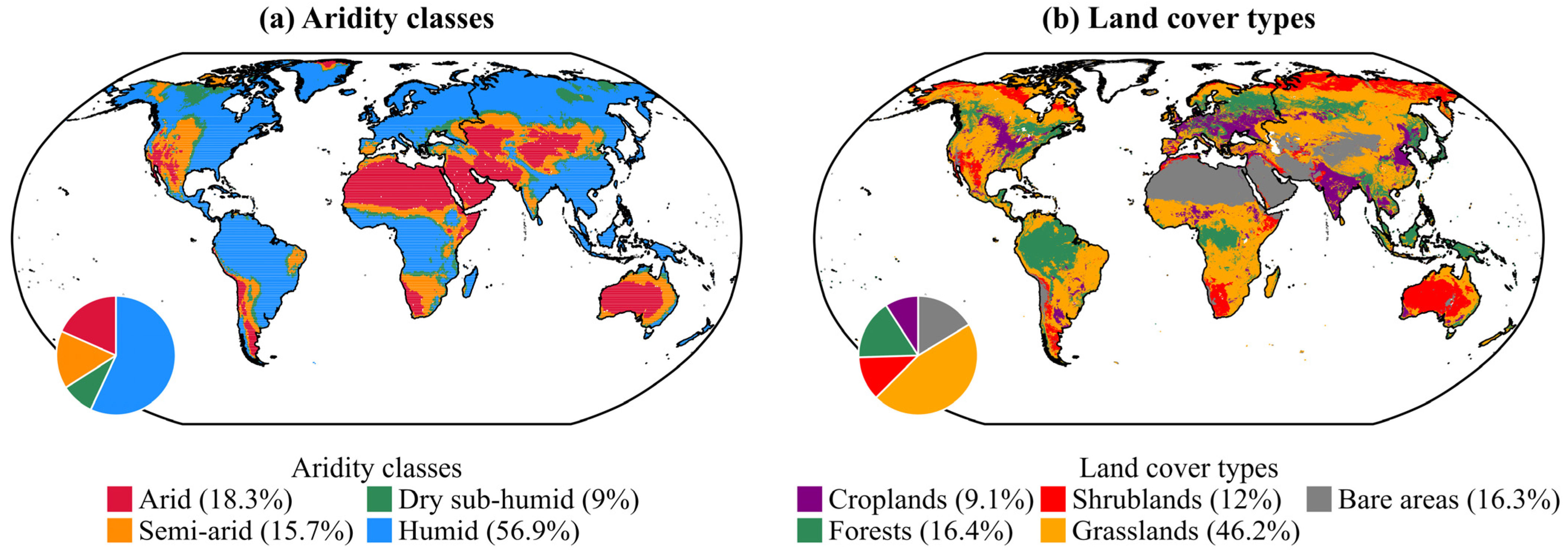
To systematically assess response differences of grassland under varying moisture conditions, this study introduced the global Aridity Index (AI) database as the foundation for climate zoning. This dataset has a spatial resolution of 30 arc-seconds and characterizes regional aridity using the ratio of mean annual precipitation to mean annual potential evapotranspiration for the 30-year climate baseline period of 1970–2000 [46]. Following the international aridity classification criteria established by the United Nations Environment Programme, we categorized the study area along the aridity gradient into four classes: when AI values are less than 0.20 (AI < 0.20), regions are identified as arid (AR); regions with AI values between 0.20 and 0.50 (0.20 ≤ AI < 0.50) are classified as semi-arid (SAR); regions with AI values between 0.50 and 0.65 (0.50 ≤ AI < 0.65) are defined as dry sub-humid (DSH); and regions with AI values equal to or exceeding 0.65 (AI ≥ 0.65) are classified as humid (HU). This four-level classification system constitutes the basic framework for spatial analysis in this study (Figure 1a), with all subsequent analyses of grassland greenness, water availability, and their driving mechanisms conducted independently within this zoning framework.

2.1.6. Land-Use Data

The definition of “grassland” adopted in this study follows a broad concept, referring to ecosystems dominated by herbaceous vegetation, rather than being restricted to pure grasslands entirely devoid of woody plants [8,47]. Grassland ecosystems were identified based on the NASA MODIS land cover product (MCD12C1 v6.1; 0.05°; 2001–2020), whose LC_Type1 classification layer adopts the International Geosphere-Biosphere Programme scheme [48]. The study reorganized the original 17 types into five major functional types. The grassland functional type integrated three subcategories: Woody Savannas, Savannas, and Grasslands. The forest functional type merged five types: Evergreen Needleleaf Forests, Evergreen Broadleaf Forests, Deciduous Needleleaf Forests, Deciduous Broadleaf Forests, and Mixed Forests. The shrubland functional type comprised Closed Shrublands and Open Shrublands. The bare areas functional type directly adopted the original Barren category. The cropland functional type corresponded to the original Croplands category. Four non-vegetated surface types (Permanent Wetlands, Urban and Built-up Lands, Permanent Snow and Ice, and Water Bodies) were systematically excluded. Although all functional types were delineated, this study focused exclusively on grassland ecosystems for analysis. To ensure temporal consistency, only pixels that consistently maintained grassland attributes from 2001 to 2020 were retained as persistent grassland areas. The final study subjects were globally temporally stable grassland ecosystems (Figure 1b).

2.2. Methods

2.2.1. Research Framework

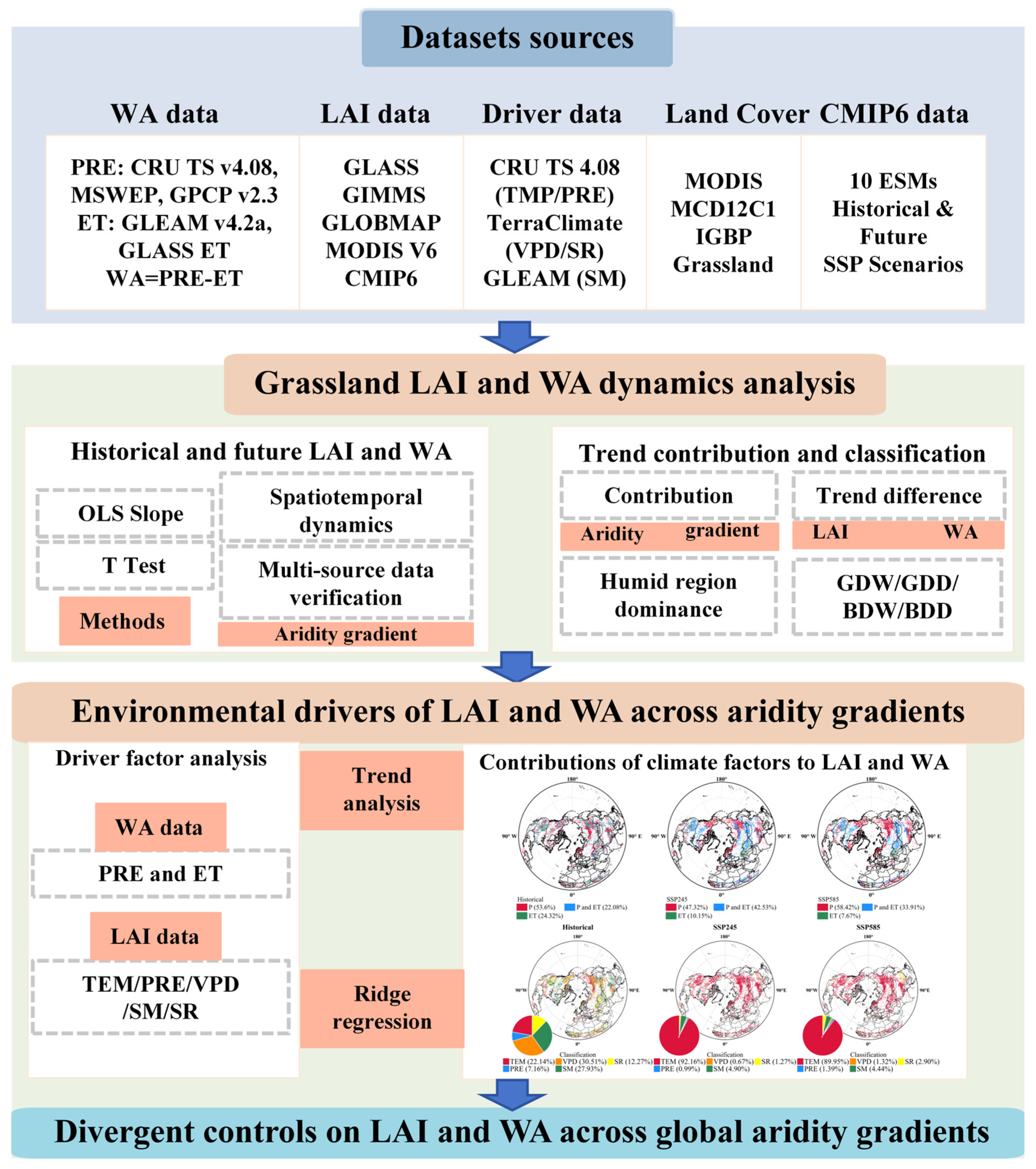
The research framework comprised three core components (Figure 2): (1) the first phase involved data preparation, encompassing quality control and spatiotemporal standardization of multi-source remote sensing LAI, water availability, climate observation datasets, and CMIP6 Earth System Model outputs; (2) the second phase focused on spatiotemporal pattern analysis, systematically evaluating long-term trends in grassland greening and water availability across different aridity zones and quantitatively decomposing regional contributions; (3) the third phase conducted mechanistic attribution analysis, employing ridge regression statistical methods to identify the dominant roles and differential characteristics of climatic drivers along aridity gradients.

2.2.2. Trend Analysis and Significance

To analyze the temporal trend of the variables, this study used the ordinary least squares (OLS) method to calculate the slope. The calculation formula is as follows:
θ = n × i = 1 n i × x i i = 1 n x i i = 1 n i n × i = 1 n i 2 i = 1 n i 2
where n represents the number of years; i refers to the i-th year within the study period; and xi represents the variable value in the i-th year. The statistical significance of trends was evaluated using a t-test. Significant increasing and decreasing trends were defined as a slope greater than 0 with a p-value less than 0.05 and a slope less than 0 with a p-value less than 0.05, respectively.

2.2.3. Calculations of VPD

The VPD is calculated as the difference between the saturation vapor pressure (SVP) and actual vapor pressure (AVP) [49]:
V P D = S V P A V P
S V P = 0.611 × e 17.27 T T + 237.29
A V P = 0.611 × e 17.27 T d T d + 237.29
Here, T represents near-surface air temperature, measured in degrees Celsius. The calculated SVP is expressed in kilopascals (kPa). The AVP is determined by the 2 m dewpoint temperature (Td).

2.2.4. Calculation of Water Availability

In this study, WA is defined as the difference between annual precipitation and annual evapotranspiration. This indicator reflects the net balance between atmospheric water input and ecosystem water output, characterizing the relative adequacy of water accessible to vegetation. Positive WA values indicate a water surplus condition, which is conducive to soil moisture replenishment and vegetation growth, whereas negative WA values indicate a water deficit, suggesting potential water stress. It should be noted that WA is an annual-scale indicator based on the climatic water balance, primarily reflecting the water exchange processes within the atmosphere–vegetation system, and does not incorporate hydrological processes such as groundwater recharge and runoff. This study employed WA as a key indicator for measuring regional water resource potential. The calculation was performed annually using 0.5° × 0.5° spatial grid cells [20]:
W A i , t = P i , t E T i , t
where WA represents the water availability (mm) for grid cell i in year t; P denotes the precipitation for that grid cell in the same year, and ET represents the annual actual evapotranspiration. This study utilized three precipitation products and two evapotranspiration products to estimate water availability, yielding a total of six estimates (Table 2). Subsequently, we applied the MME method to calculate WA. To validate the consistency between MME results and individual estimates, we calculated multiple statistical metrics including mean, Standard Deviation (SD), Root Mean Square Error (RMSE), Coefficient of Determination (R2), and Relative Bias (detailed in Table S1 and Figure S3). The results showed similarity between the MME and the six individual estimates (Figure S3). Therefore, we used the MME-based results in subsequent analyses.

2.2.5. Regional Contributions

To quantify the regional contributions of each aridity zone to the trends in the Northern Hemisphere grassland leaf area index and water availability, this study employed a spatial weighted analysis method based on zonal trends [50], evaluating contribution levels by calculating the product of each zone’s trend value and area weight. The specific calculation formula is as follows:
C R k = a k i = 1 N k W k i A g i = 1 N g W i
where C R k represents the fractional contribution of regional grassland LAI (or WA) trend from region k. a k denotes averaged LAI (or WA) trend within region k. N k indicates grid count for this region. A g represents the globally averaged LAI (or WA) trend; and N g specifies total grid count across grassland areas. Grid weighting factors W k i and W i are calculated as W k i = cos θ k i π / 180.0 and W i = cos θ i π / 180.0 , where θ k i and θ i represent latitudes of grid i in region k and globally, respectively.

2.2.6. Contribution of P and ET to WA Trend

To quantify the relative contributions of P and ET to changes in WA, first, the OLS method was applied to calculate the linear regression slopes of P and ET separately, characterizing the interannual variation trends of each variable [20]. Subsequently, the sum of the absolute values of the trend slopes of P and ET was computed pixel by pixel as the denominator, and the ratio of the absolute value of each variable’s trend slope to this denominator was taken as the trend contribution percentage of that variable. This approach quantitatively evaluates the relative influence of the long-term trend changes in P and ET on the WA trend. The calculation formula is as follows:
C R T = P P + E T
C R T = E T P + E T
where CRT represents the contribution rate and P represents the trend of the averaged precipitation from CRU, MSWEP, and GPCP during 2000–2020, while ET represents the trend of the averaged evapotranspiration from GLEAM and GLASS during the same period. Based on the CRT results, the dominant factors controlling the trend of WA were classified into three categories: (1) P-dominated, where the contribution of precipitation exceeded 60%; (2) ET-dominated, where the contribution of evapotranspiration exceeded 60%; and (3) P-ET co-dominated, where both precipitation and evapotranspiration contributions ranged between 40% and 60%. We compared the absolute values of the relative contributions of the three categories pixel by pixel. The factor with the largest absolute contribution was identified as the dominant factor for that pixel, and a spatial distribution map of the dominant factors was generated accordingly.

2.2.7. Ridge Regression Analysis

Prior to conducting ridge regression analysis, we calculated the Variance Inflation Factor (VIF) for all predictor variables. Variables with a VIF > 5 were flagged as having potential collinearity issues. Results showed that VIF values for all variables remained within acceptable limits, indicating that multicollinearity did not substantially compromise the regression analysis (Table S2). To systematically quantify the relative contributions of climatic drivers to grassland LAI annual mean values, this study employed ridge regression modeling. This method effectively mitigates multicollinearity issues among predictor variables (including TEM, PRE, VPD, SM, and SR) by introducing a regularization term [51]. Ridge regression stabilizes regression coefficient estimates and reduces overfitting risk, thereby improving the reliability of model results. Based on this analytical framework, this study further resolved the relative contributions of different climatic factors to grassland LAI dynamics under varying aridity gradients and utilized regression coefficients to characterize differential sensitivities of grassland LAI to environmental factors. The ridge regression formula is
β ridge = ( X T X + λ I ) 1 X T y
where β ridge represents the regression coefficients, X is the matrix of independent variables, y is the matrix of dependent variables, X T is the transpose of matrix X, λ is the regularization parameter, and I is the identity matrix.
In this study, to eliminate the influence of dimensional differences among independent variables on regression results, all independent variables were normalized. The normalization formula is as follows [51]:
X m = x m i n ( x ) m a x ( x ) m i n ( x )
where X m is the normalized variable and x is the original data.
Through ridge regression coefficients and normalized trends of climatic and biological factors, the relative contribution rate of each factor to LAI can be calculated. The model expression is
Y m = i = 1 n a i X i m + b
where Y m represents the normalized grassland LAI value, X represents the normalized drivers, and a i represents the regression coefficients.
To elucidate the dominant climatic drivers of grassland LAI under different aridity gradients, this study quantified the relative contribution of each factor:
η c i = a i X i t r e n d
η r c i = η c i i = 1 m η c i × 100 %
where η c i represents the contribution of the i-th driver to grassland LAI, X i t r e n d represents the standardized trend of the i-th independent variable, η r c i represents the relative contribution of the i-th driver to grassland LAI, η c i represents the absolute value of the contribution of the i-th driving factor, and m represents the number of driving factors being 5.

3. Results

3.1. Spatiotemporal Dynamics of Northern Hemisphere Greening and Water Availability

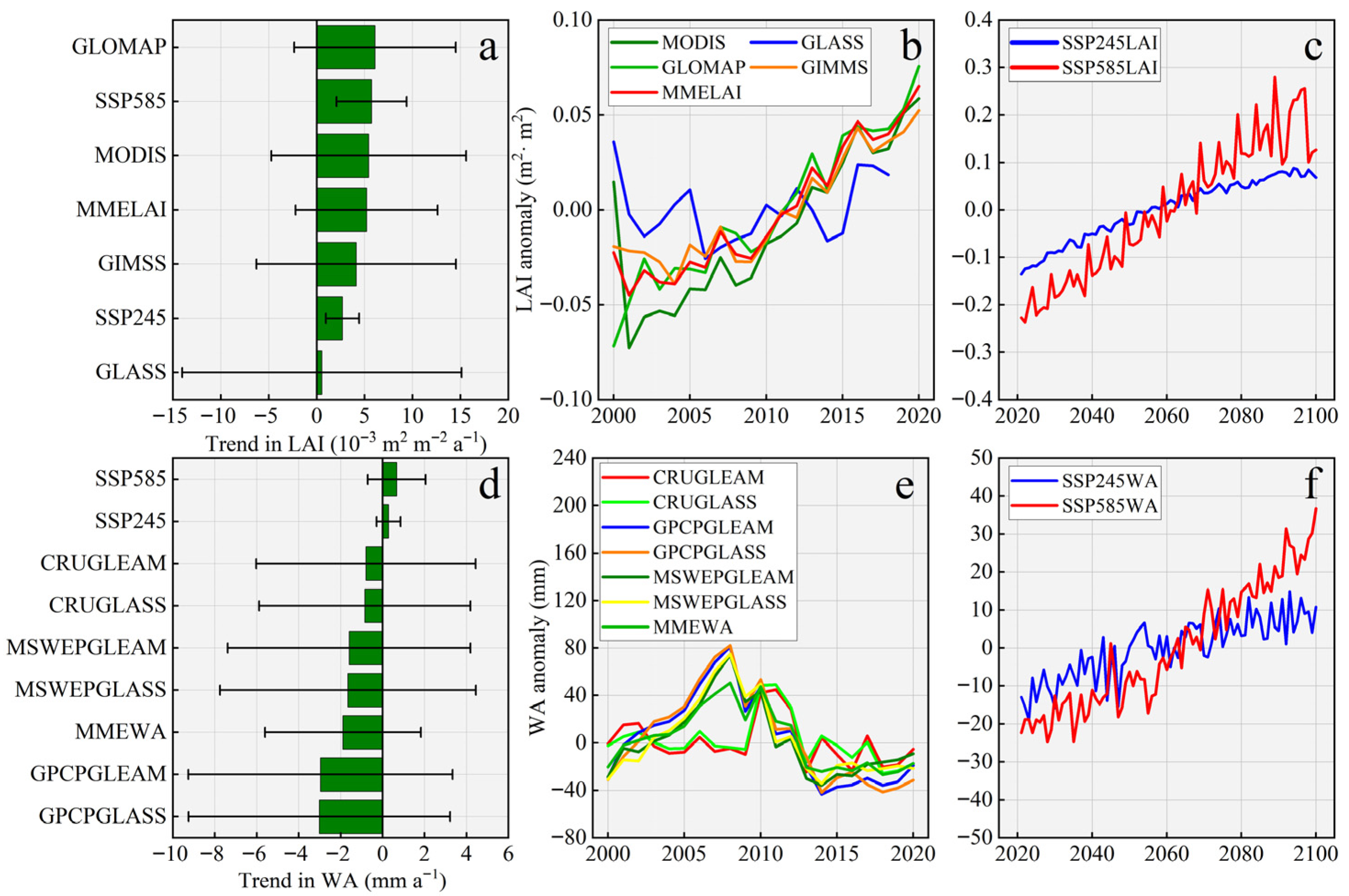
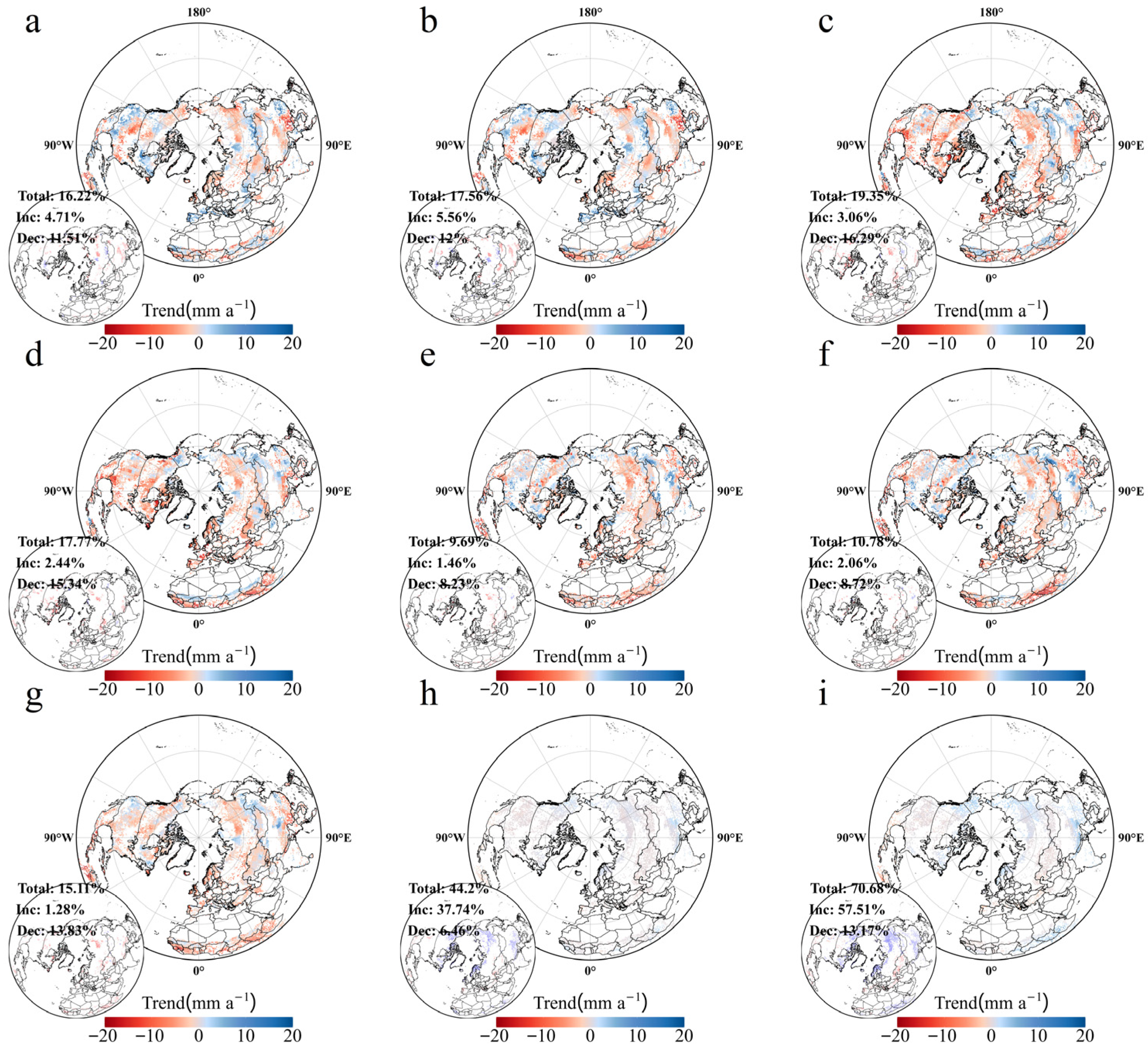
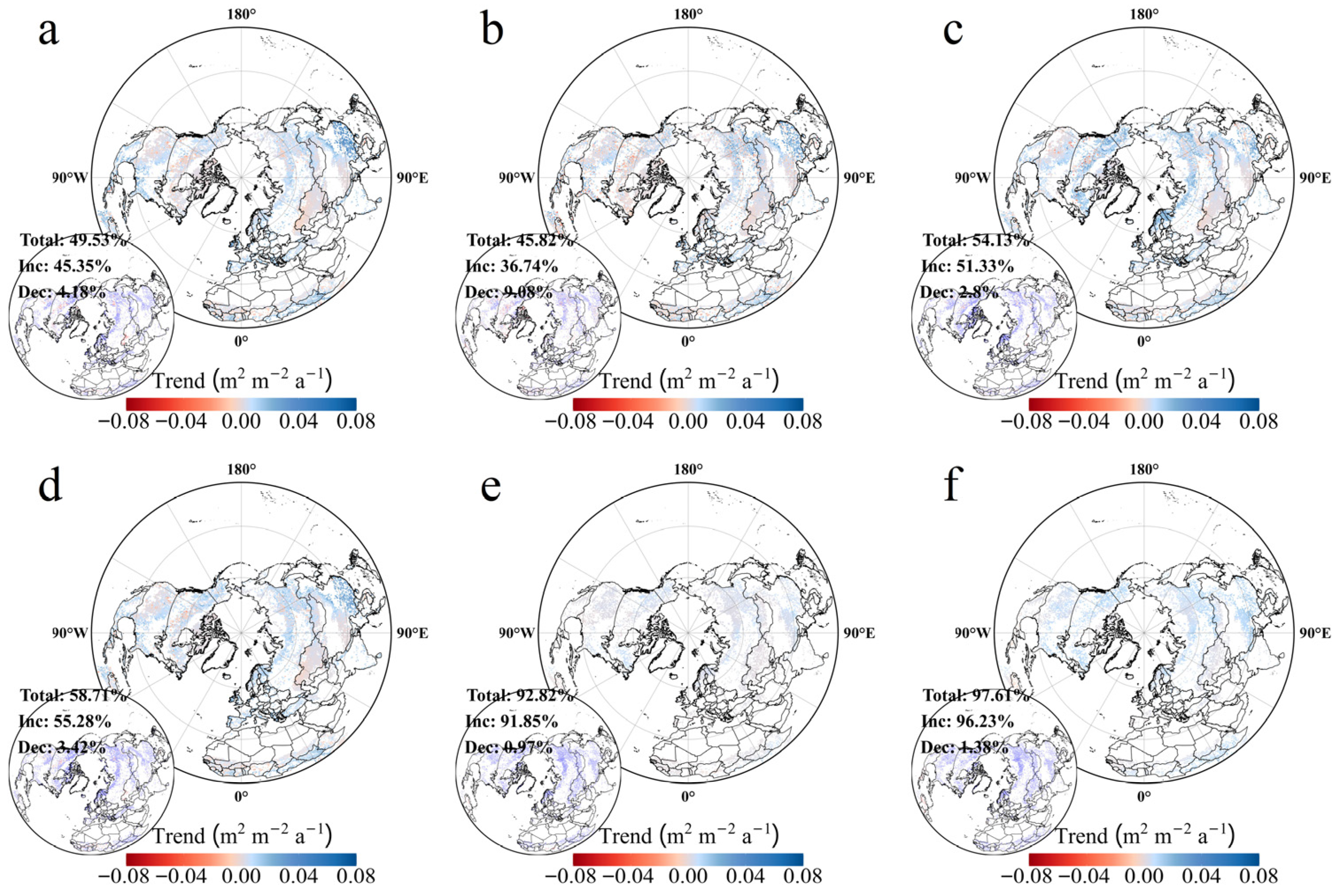
This study integrated multi-source satellite observations and CMIP6 multi-model ensembles to systematically characterize the spatiotemporal evolution patterns of Northern Hemisphere grassland LAI and WA during a historical period (2000–2020) and future scenarios (2021–2100) (Figure 3 and Figure 4). Satellite observation evidence demonstrated that four independent LAI products (GIMMS, GLOBMAP, GLASS, and MODIS) all detected sustained growth signals since 2000, confirming the persistence of grassland greening (Figure 3a,b). MME LAI results further validated this increasing trend. Future scenario simulations indicated that Northern Hemisphere grassland LAI would exhibit a sustained growth trend that would persist through the end of the 21st century (Figure 3c). Spatial pattern analysis revealed that despite differences among data sources, the distribution of significantly increasing regions showed high consistency. Specifically, the proportions of significant increasing trends for MODIS LAI, GIMMS LAI, GLOMAP LAI, and MME LAI were 45.35%, 36.74%, 51.33%, and 55.28%, respectively, further confirming rapid greening of Northern Hemisphere grasslands (Figure 4a–d). These significantly increasing regions were concentrated in southern China, northern Canada, the northern United States, eastern Russia, and the Sahel–Sudan–Guinea zone, constituting the core regions of rapid Northern Hemisphere grassland greening. Future scenarios indicated that the greening extent would further expand, with 91.85% of regions showing significant growth under the SSP2–4.5 pathway, while this proportion increased to 96.23% under the SSP5–8.5 high-emission scenario, with spatial distribution patterns largely consistent with historical observations (Figure 4e,f). In summary, consistent results from multi-source observations and model simulations indicated that grassland LAI growth has become a dominant feature of terrestrial ecosystem change. However, this trend exhibited pronounced spatial heterogeneity, and its potential impact mechanisms on regional WA require in-depth assessment.
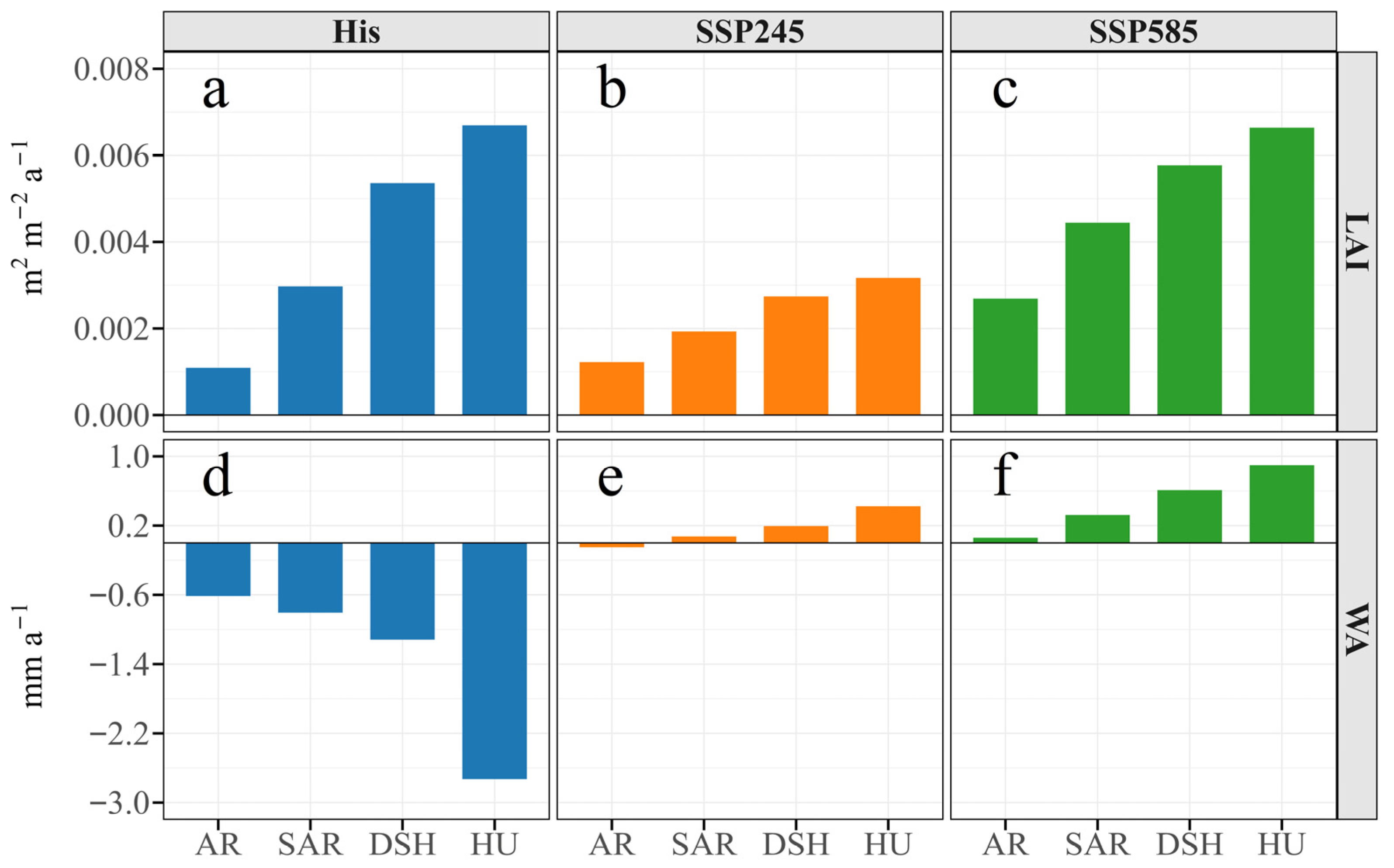
Contrary to the vegetation greening trend, Northern Hemisphere grassland water availability showed a declining trend during the historical period, with seven independent WA datasets validating this change characteristic (Figure 5). However, future scenario simulations indicated that WA would transition to a growth trend and persist through the end of the 21st century (Figure 3f), forming a sharp contrast with the historical period. Spatial pattern analysis revealed that 73.67% of grassland regions exhibited declining MME WA trends during 2000–2020, with 13.38% reaching significance (Figure 5g). Different datasets showed high consistency in spatial identification of WA-decline regions (Figure 5a–g), which were primarily distributed in eastern Russia, northern Western Europe, the Sahel–Sudan–Guinea transition zone, and southern China. Notably, future scenario projections indicated a trend reversal, with grassland WA generally transitioning to growth, where the proportion of significantly increasing regions rose from 37.74% under the SSP2–4.5 scenario to 57.51% under the SSP5–8.5 scenario (Figure 5h,i). Analysis along the aridity gradient revealed regional differentiation characteristics of the greening process, with humid regions exhibiting the most significant growth rates (Figure 6a–c). Analysis along the aridity gradient showed that all aridity types exhibited WA decline during the historical period, with humid regions showing the largest decline rate (−2.73 mm a–1, Figure 6d). Under future scenarios, grassland WA generally transitioned to growth trends, with humid regions likewise showing the highest growth rates (Figure 6e,f). Northern Hemisphere grassland water availability underwent a transition from widespread decline over the past two decades to significant growth under future scenarios.

3.2. Regional Contributions and Decoupling Characteristics of Greening and Water Availability

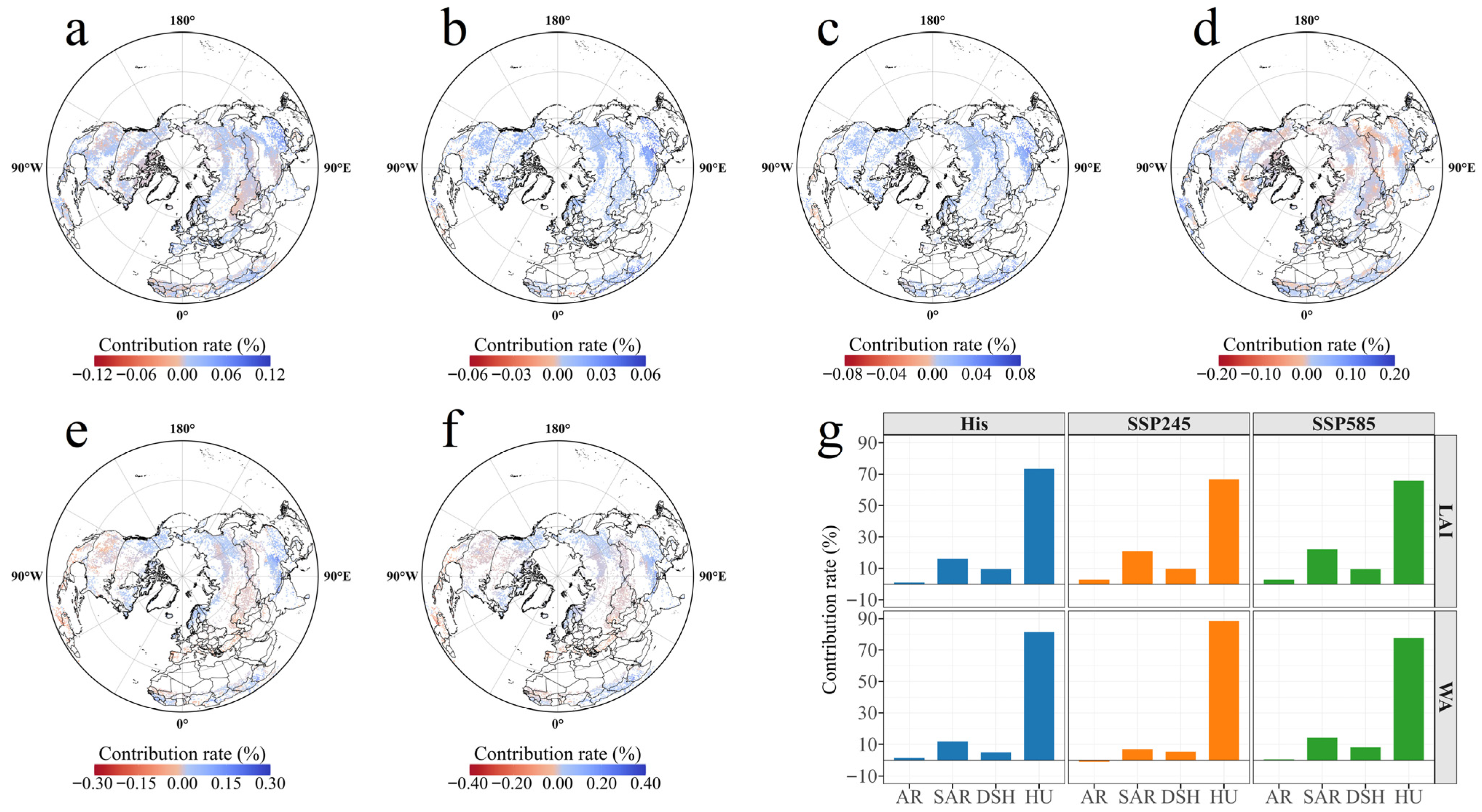
To quantitatively assess the regional contributions of each aridity zone to Northern Hemisphere grassland LAI and WA trends, the study employed a pixel-based trend spatial weighting method, quantifying relative contributions by integrating the trend values and area weights of each zone. For grassland LAI, spatial contribution patterns differed significantly between the historical period and future scenarios. During the historical phase, although negative contribution regions emerged in mid-to-high latitudes of the Northern Hemisphere (accounting for 26.20%), mainly located in Central Asia, the Tibetan Plateau, and northern Canada (Figure 7a), positive contribution regions still dominated (73.80%). Under future scenarios, the proportion of positive contribution regions further expanded (Figure 7b,c). Analysis along the aridity gradient revealed that humid regions contributed most prominently to grassland greening (Figure 7g). For grassland WA, negative contribution regions during the historical period were concentrated in northern Russia, Xinjiang and Inner Mongolia of China, the western United States, and northern Canada (Figure 7d). Under future scenarios, the spatial distribution of negative contribution zones shifted, primarily distributed in Central Asia, the western United States, and Mexico (Figure 7e,f). Notably, the proportion of negative contribution regions increased from 29.64% during the historical phase to 33.54% under the SSP2–4.5 scenario and further rose to 33.87% under the SSP5–8.5 scenario. Although both LAI and WA exhibited negative contribution regions, in the regional-scale calculation, positive contributions offset negative contribution effects, resulting in net contributions showing positive values (Figure 7g). Humid regions remained the primary contribution areas for WA changes, mainly attributed to two factors: first, humid regions occupied the largest area proportion in Northern Hemisphere grasslands (Figure 1); second, precipitation in humid regions dominated WA changes.
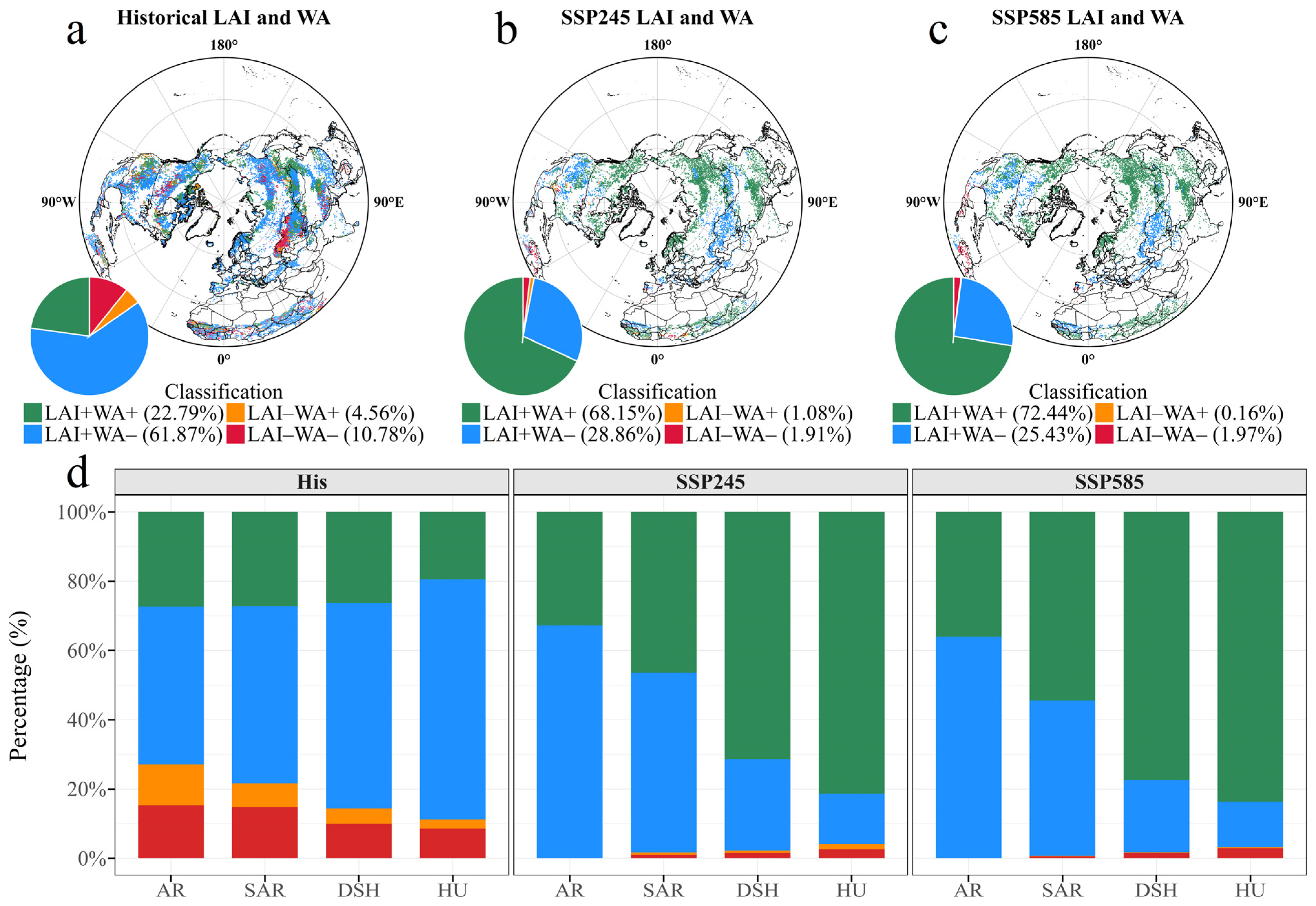
Based on the co-variation patterns between LAI and WA trends, we classified grassland areas into four categories (Figure 8). GDW (LAI+WA+) represents areas with increasing LAI and WA trends; Browning-Driven Wetting (BDW; LAI−WA+) represents areas with a decreasing LAI trend but increasing WA trend; GDD (LAI+WA−) represents areas with an increasing LAI trend but decreasing WA trend; and Browning-Driven Drying (BDD; LAI−WA−) represents areas with decreasing LAI and WA trends. These four categories can be further grouped into two types based on vegetation–water coupling characteristics: coupled patterns and decoupled patterns. GDW (LAI+WA+) and BDD (LAI−WA−) belong to coupled patterns, characterized by consistent directional changes between LAI and WA—the former representing synchronized growth and the latter representing synchronized decline. In contrast, GDD (LAI+WA−) and BDW (LAI−WA+) belong to decoupled patterns, characterized by opposite trends between LAI change and WA. GDD reveals water resource stress beneath surface vegetation greening, while BDW indicates areas where vegetation continues to degrade despite improved water conditions. Spatial pattern analysis for the historical period showed that GDD occupied a dominant position (61.87%), where grassland growth in these regions accompanied increased water consumption, triggering regional water deficits. GDW accounted for 22.79% of the area, primarily distributed in Inner Mongolia and Xinjiang of China, the western United States, and northern Canada, where grassland LAI and WA exhibited synergistic growth. BDW accounted for only 4.56%, while BDD comprised 10.87%, most prominently in Central Asia, exhibiting synchronous decline characteristics of grassland LAI and water (Figure 8a). Future scenarios presented pattern reorganization characteristics. The GDW area proportion expanded significantly, increasing more than threefold under SSP2–4.5 (68.15%) and SSP5–8.5 (72.44%) scenarios compared to the historical period. Correspondingly, the spatial extent of GDD substantially contracted, decreasing more than twofold under both future scenarios (28.86% and 25.43%) compared to the historical period (Figure 8b,c) The distribution ranges of BDW and BDD continued to shrink, reflecting the gradual expansion of grassland greening regions. Analysis along the aridity gradient revealed significant differentiation characteristics (Figure 8d). During the historical phase, the GDW area proportion decreased with decreasing aridity, while the GDD proportion increased with increasing humidity. The proportions of BDW and BDD likewise decreased along the gradient. Under future scenarios, the GDW proportion strengthened with increasing humidity, indicating that humid regions would exhibit more significant vegetation–water synergistic growth processes. Conversely, the GDD proportion declined along the aridity gradient, suggesting that vegetation expansion in water-limited environments more readily induced water deficits.

3.3. Transformation of Dominant Mechanisms Driving Changes in Water Availability and Greening

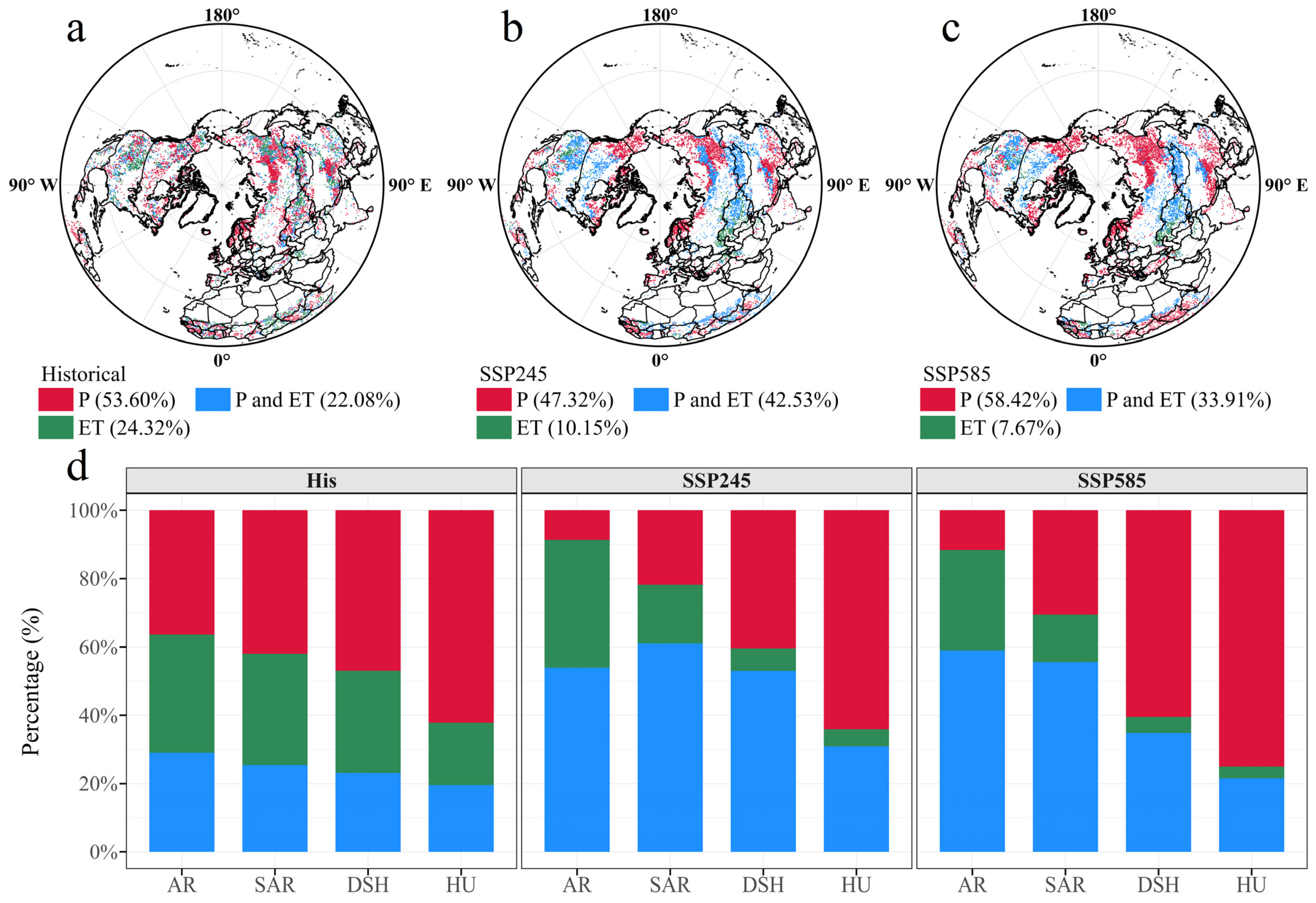
Driving factor decomposition analysis revealed the dominant mechanisms of water availability changes and their spatial evolution characteristics (Figure 9). During the historical phase, precipitation dominated grassland WA changes in 53.60% of Northern Hemisphere regions, evapotranspiration dominated WA changes in 24.32% of regions, and their interaction influenced 22.08% of regions (Figure 9a). However, this driving mechanism shifted under future scenarios. Specifically, the area under independent control of precipitation increased from 53.60% in the historical period to 58.42% under the SSP5–8.5 scenario, mainly occurring in western Canada, northern Europe, eastern Russia, and southern and southwestern China. The independent contribution of evapotranspiration declined markedly from 24.32% to 7.67%, whereas the area controlled by precipitation–evapotranspiration coupling expanded from 22.08% to 42.53% under the SSP2–4.5 scenario, before decreasing to 33.91% under SSP5–8.5 (Figure 9b,c). Notably, the SSP2–4.5 scenario showed a balanced state, with comparable contributions from precipitation independence (47.32%) and coupling processes (42.53%), whereas under the SSP5–8.5 scenario, the dominance of precipitation became more pronounced (58.42%). This trajectory indicated that future WA would shift from a historical mode dominated by a single hydrological element to a compound mechanism of precipitation enhancement and precipitation–evapotranspiration coupling, with precipitation control strengthening and coupling processes producing stronger synergistic effects under medium-emission scenarios.
Furthermore, to reveal differences in driving mechanisms of grassland WA changes under different moisture conditions, the study quantitatively decomposed the relative contributions of precipitation and evapotranspiration along the aridity gradient (Figure 9d). Analysis showed that driving mechanisms exhibited significant gradient differentiation and temporal evolution characteristics. During the historical period, precipitation’s control increased with increasing humidity, while the influences of evapotranspiration and precipitation–evapotranspiration coupling processes decreased, indicating that WA changes in humid regions were more dominated by precipitation. Under future scenarios, this gradient differentiation pattern generally continued, but driving mechanisms underwent critical transformations. Under the SSP5–8.5 high-emission scenario, the contribution rate of precipitation–evapotranspiration coupling processes in arid and semi-arid regions significantly strengthened, even surpassing that in dry sub-humid and humid regions, revealing the enhancement of precipitation–evapotranspiration coupling effects in water-limited environments. Comprehensively, the driving mechanisms of grassland WA exhibited pronounced moisture gradient dependency. During the historical period, precipitation was the primary driver in all zone types, but its dominance strengthened with increasing humidity; under future high-emission scenarios, water-limited regions would transition to precipitation–evapotranspiration coupling-dominated modes, while water-abundant regions would maintain precipitation-only dominated modes.
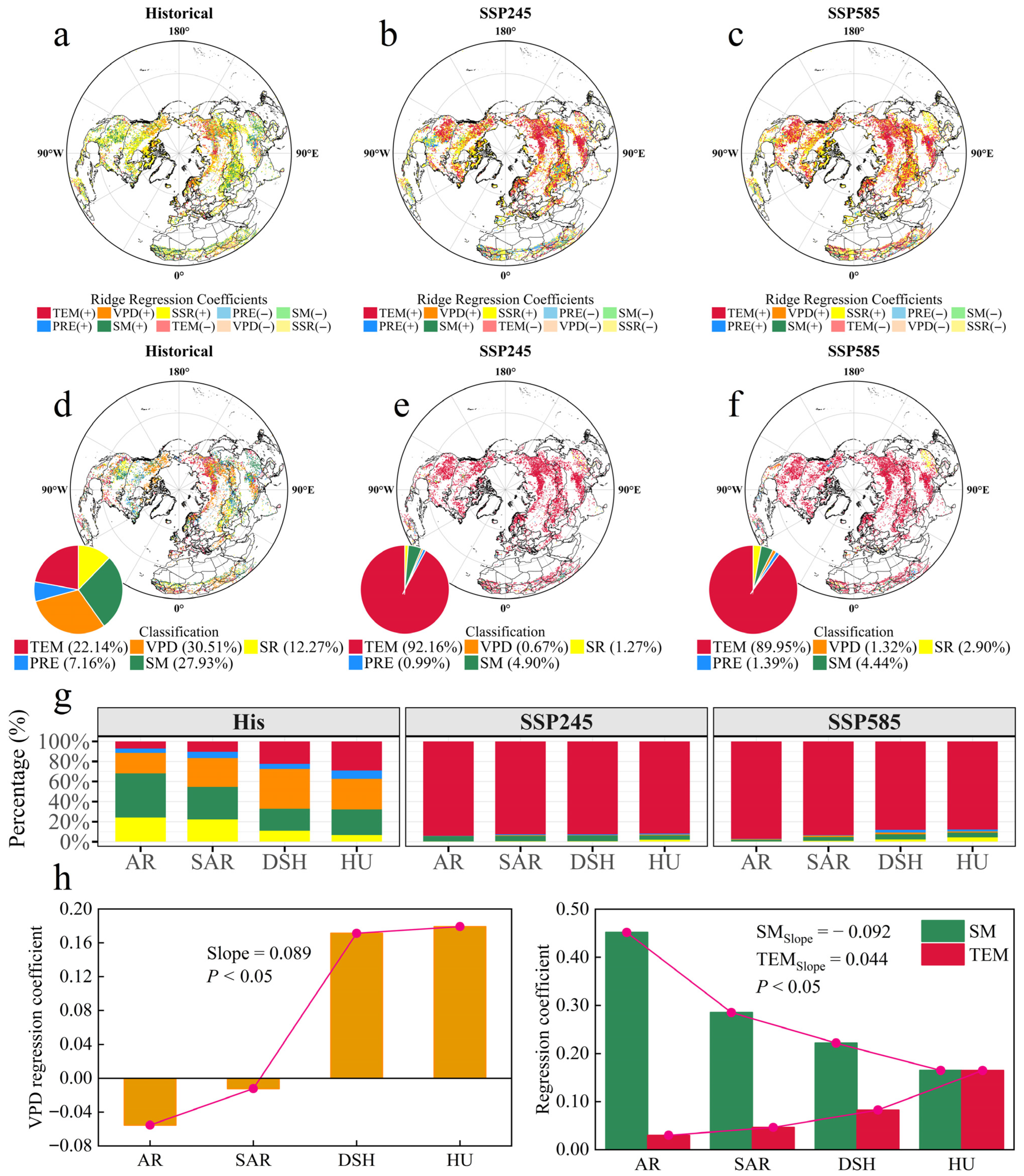
To elucidate the climatic driving mechanisms of Northern Hemisphere grassland greening and their spatiotemporal evolution characteristics, the study employed ridge regression methods to quantitatively decompose the regression coefficients and relative contributions of TEM, PRE, SR, VPD, and SM to LAI trends. In terms of regression coefficients, during the historical period, high-latitude regions were dominated by SSR, indicating that increased radiation had a positive effect on grassland greening by extending the growing season and promoting photosynthesis. Central Asia and southern China were dominated by SM, reflecting the facilitating role of soil moisture in grassland greening. Northern Europe, eastern Russia, and western Canada were dominated by VPD, where increases in VPD had positive effects on these regions (Figure 10a). Under future scenarios, TEM exhibited the strongest positive effect on high-latitude regions of the Northern Hemisphere (Figure 10b,c). In terms of relative contributions, our analysis revealed a significant shift in dominant driving factors between the historical and future periods. Historically, VPD was the primary driver of LAI changes, with its dominant influence concentrated in the high latitudes of the Northern Hemisphere. The influence of TEM was also strongest in high-latitude zones, while regions dominated by SM were limited to southern China. SR primarily affected the western United States and Central Asia, whereas the contribution of PRE exhibited a relatively dispersed spatial pattern (Figure 10d). Under future scenarios, TEM would supersede VPD as the primary driver (Figure 10e,f). Furthermore, a quantitative assessment along an aridity gradient revealed systematic spatial differentiation in these driving mechanisms (Figure 10g). Historically, SM was the dominant factor for LAI changes in arid regions, indicating that WA was the key limiting factor for grassland growth. In semi-arid regions, SM and VPD contributed comparably, reflecting a transitional zone under dual control by soil water supply and atmospheric water demand. In dry sub-humid regions, VPD emerged as the dominant factor, while in humid regions, grassland LAI was governed by a combination of TEM and VPD.
Notably, the influence of VPD on grassland LAI exhibited transformations along the aridity gradient. In arid regions, VPD shifted from negative effects during the historical period to positive effects in the future, while in humid regions, VPD consistently showed positive effects. In contrast to the enhancement of VPD effects, the control intensity of SM over grassland LAI continuously decreased along the aridity gradient. Furthermore, the role of TEM gradually strengthened from arid to humid regions (Figure 10h). These results indicated that the response mode of Northern Hemisphere grassland ecosystems to climate change was undergoing a systematic transition from the historically water limitation-dominated type toward the future temperature limitation-dominated type.

4. Discussion

4.1. Grassland Greening and Its Response to Environmental Factors

Since the 1980s, global grassland greening has continued to intensify [6,47]. This study integrated four independent LAI products (GIMMS, GLOBMAP, GLASS, and MODIS) and confirmed the significant greening trend of Northern Hemisphere grasslands during 2000–2020 (Figure 3a,b) and validated the persistence of future grassland greening (Figure 3c and Figure 4e,f). Although differences existed among different data sources, the spatial distribution of significantly increasing grassland greening regions exhibited high consistency (Figure 4a–d). Notably, Northern Hemisphere grassland greening exhibited significant differentiation characteristics along the aridity gradient. The slope of grassland LAI gradually increased from arid to humid regions (Figure 6a–c). Furthermore, humid regions contributed the highest rates to overall greening trends (Figure 7g), emphasizing their critical role in shaping Northern Hemisphere grassland dynamics [22].
Grassland greening exhibited pronounced spatial heterogeneity, primarily structured by regional hydrothermal gradients [52,53]. VPD was the primary driver of Northern Hemisphere grassland LAI dynamics, explaining 30.51% of greening (Figure 10d), with this effect being particularly significant in high-latitude regions. Furthermore, regarding the positive effect of VPD in high-latitude humid regions, we attributed this to the synergistic interaction between temperature and water supply. Recent studies have revealed contrasting relationships between grassland LAI and VPD across different latitudinal zones and climatic regions. Grasslands exhibit significant positive and negative differences in sensitivity to VPD across different climatic regions [54]. In environments with sufficient soil moisture, adequate soil moisture supply maintained high transpiration efficiency, effectively mitigating the stomatal closure and photosynthetic inhibition that could otherwise be induced by elevated VPD [55,56]. Under such conditions, moderate increases in VPD were typically accompanied by rising temperatures, and this effect enhanced the physiological activity of vegetation in temperature-limited ecosystems by improving water–carbon exchange [56,57]. High VPD often coincides with elevated temperatures, which can further promote the growth of grassland vegetation in colder regions [58,59], further highlighting that in semi-humid to humid regions, the interaction between VPD and temperature served as the dominant driving force promoting grassland greening. Coupled Earth System Model studies demonstrated that temperature increases significantly promoted grassland greening [60], with grassland greening in Northern Hemisphere high-latitude regions closely associated with temperature increases [61].
Along the aridity gradient, the dominant drivers of grassland greening exhibited systematic transitions. In arid and semi-arid regions, SM was identified as the primary driver of grassland greening (Figure 10g). However, accelerated grassland greening often intensified soil moisture consumption, thereby exacerbating regional drought risks [62]. VPD increases were confirmed to have significant inhibitory effects on vegetation stomatal conductance and photosynthetic rates [63,64]. In arid regions, VPD increases directly limited grassland greening. In regions transitioning from semi-arid to humid climates, the influence of VPD shifted from negative to positive, becoming a dominant factor driving grassland greening (Figure 10h). Notably, in humid high-latitude regions of the Northern Hemisphere, ample water availability sustained efficient transpiration, offsetting VPD constraints on stomatal function and photosynthesis, thereby explaining the positive VPD effects observed in northern Eurasia. Simultaneously, VPD increases typically accompanied temperature increases, promoting grassland growth through their synergistic effects [56]. These findings revealed the transition mechanisms of grassland ecosystems from water limitation-type to temperature limitation-type, providing critical scientific evidence for formulating differentiated grassland management strategies and assessing grassland carbon sink potential under climate change scenarios.

4.2. Dynamics of Water Availability

Over recent decades, global warming has intensified the hydrological cycle, elevating evapotranspiration rates and contributing to widespread declines in water availability [20,28]. The seven WA datasets constructed in this study confirmed the declining trend of Northern Hemisphere grassland water availability (Figure 3 and Figure 5), a phenomenon primarily attributed to substantial evapotranspiration increases driven by rapid grassland greening in Northern Hemisphere high-latitude regions [64,65]. Notably, future scenario projections indicated that grassland WA would transition to an upward trend [26], with this reversal potentially closely related to enhanced positive feedback mechanisms of precipitation internal cycling. Studies have demonstrated that vegetation greening could enhance approximately 45% of global water availability through enhanced water cycling processes [21]. Vegetation restoration enhanced regional water availability by increasing precipitation, improving terrestrial water storage, and influencing atmospheric moisture transport and recycling [29].
This study found that future precipitation became the key factor dominating WA changes (Figure 9), consistent with predictions of enhanced precipitation under intensified global water cycling [66]. However, uncertainties remained in the rising trend of water availability. Previous studies pointed out that Earth System Models might underestimate the magnitude of future vegetation greening, with LAI underestimation directly leading to systematic underestimation of terrestrial-to-atmospheric water loss, potentially overestimating the growth potential of future water availability [9]. This model bias suggested that Earth System Models might not fully capture enhanced evapotranspiration effects under accelerated greening, with actual water losses potentially more significant, thereby exacerbating future water scarcity risks. Therefore, the evolutionary trajectory of future grassland water availability exhibited complexity, both benefiting from positive precipitation increase effects while facing potential threats of intensified greening-driven evapotranspiration consumption, with the relative strength of this bidirectional regulatory mechanism determining the evolutionary direction of regional hydrological balance and water resource sustainability.

4.3. Impacts of Greening on Water Availability

Over recent decades, global vegetation greening has significantly altered terrestrial hydrological patterns. Vegetation regulated water exchange between land and atmosphere through root water uptake and transpiration, thereby affecting regional and even global water cycle processes [9]. However, the impact of greening on water availability was not a simple unidirectional negative effect, but rather exhibited significant bidirectional regulatory characteristics and spatial heterogeneity. This study identified four typical scenarios (Figure 8) to characterize these complex interactive relationships. During the historical period, the GDD phenomenon occupied the largest area proportion (Figure 8a), revealing the decoupling phenomenon between greening and water availability. This decoupling phenomenon was particularly evident in arid regions (Figure 8b). In these regions, grassland greening significantly enhanced evapotranspiration, but precipitation replenishment was insufficient to offset water consumption, leading to reduced regional water availability and runoff [31,35]. Notably, enhanced precipitation internal cycling under climate warming might reverse this negative effect. The GDW proportion during the historical period reached 22.71%. Under future scenarios, GDW replaced GDD as the dominant mode (Figure 8b). Previous studies have suggested that grassland greening may enhance water vapor transport to the atmosphere through increased transpiration, potentially promoting local precipitation formation, with abundant precipitation in turn supporting vegetation growth and maintaining water balance [30,67]. This proposed mechanism could contribute to the synergistic pattern of grassland greening and water availability observed in GDW regions. GDW regions are primarily distributed in semi-humid to humid areas (Figure 8d), where adequate soil moisture supply provides necessary conditions for vegetation–atmosphere moisture feedbacks. Most importantly, the trend analysis method employed in this study primarily identifies the association patterns between LAI and WA changes, revealing the spatial differentiation characteristics of different coupling types, rather than directly verifying causal mechanisms. Although the observed phenomena in GDW regions are consistent with the theoretical framework of vegetation–atmosphere moisture feedbacks, confirming this mechanism requires in-depth analysis combining water vapor flux diagnostics, regional climate model sensitivity experiments, and stable isotope tracing methods. This will be a key focus of our future research.
This bidirectional regulatory mechanism deepened understanding of eco-hydrological coupling processes under climate change. Vegetation greening could both reduce water supply through evapotranspiration consumption and enhance water availability through water vapor recycling and precipitation promotion, with the dominant direction depending on regional climate conditions and vegetation–atmosphere feedback intensity. This study provided scientific evidence for differentiated ecological restoration strategies. Arid regions need to prudently assess the hydrological costs of vegetation restoration, optimizing vegetation configuration to balance ecological benefits and water resource security. In regions with active water vapor cycling, the vegetation–precipitation positive feedback mechanism could be fully utilized, synergistically enhancing vegetation coverage and water resource carrying capacity through ecological construction, achieving coordinated enhancement of ecological protection and water security.

4.4. Limitations and Future Directions

This study has several limitations. First, although combining satellite observations with CMIP6 ensembles strengthened the robustness of the conclusions, variations in spatial resolution and retrieval algorithms across datasets may introduce uncertainties. CMIP6 models exhibit inherent limitations in simulating regional precipitation and evapotranspiration patterns and vegetation–climate feedback, though we employed multi-model ensemble averaging to reduce individual model biases. Emission scenario uncertainties exist, yet our analysis shows spatial patterns of dominant drivers remained consistent across SSP2–4.5 and SSP5–8.5 scenarios, with only magnitude differences, demonstrating robustness. The transition from observation-based historical data to model-projected future data may introduce systematic differences. Therefore, we focused on relative trends and driver importance shifts rather than absolute predictions. Our findings of systematic driver transitions have clear mechanistic support and provide a scientific basis for adaptive management despite these uncertainties. Second, this study primarily focused on climatic drivers and did not fully account for the roles of anthropogenic activities, such as grazing intensity, grassland management, and land-use change, which may dominate vegetation dynamics in certain regions. Finally, while this study identified macroscopic patterns using statistical approaches, the mechanisms of vegetation and water interactions remain poorly understood. Addressing these limitations will require future research to improve data consistency, refine the attribution of driving mechanisms, and deepen process-based understanding to more comprehensively assess grassland ecosystem responses to global change.
While the WA indicator offers notable advantages in characterizing grassland ecosystem water conditions, its limitations should be acknowledged. WA directly reflects the net water input available to vegetation, more effectively capturing the ecosystem water supply–demand balance than precipitation alone. It also integrates both precipitation supply and evapotranspiration consumption, enabling a comprehensive characterization of climate change impacts on the water cycle. However, as an annual-scale balance metric, WA cannot capture the seasonal distribution of precipitation or the impacts of extreme events such as droughts and floods. Additionally, it does not account for groundwater recharge or snowmelt runoff, potentially underestimating actual water availability in groundwater-dependent grassland systems. Therefore, WA is more appropriate for characterizing climate-driven water supply–demand balance changes than for absolute water resource assessment.
Furthermore, to optimize eco-hydrological management at global and regional scales, future research should focus on several key directions. First, satellite remote sensing, ground observations, and model simulation data should be further integrated to construct grassland ecosystem parameter datasets with high spatial and temporal resolution. Second, quantitative assessment frameworks are needed to evaluate the combined impacts of climate change and anthropogenic activities, enabling the separation of the relative contributions of natural climate variability and human disturbances through scenario simulations and attribution analyses. Third, by integrating multi-dimensional indicators, including vegetation greenness, water availability, and climatic drivers, together with future scenario projections, dynamic eco-hydrological risk assessment and early warning platforms could be developed to enable early identification of high-risk regions. The aridity gradient-dependent driving mechanisms revealed in this study provide a scientific basis for optimizing regional ecological management and water resource allocation, thereby supporting the synergistic achievement of sustainable grassland management, carbon sink enhancement, and water resource security.

5. Conclusions

This study reveals the spatiotemporal dynamics, trend variations, and driving mechanisms of grassland greening and water availability across the Northern Hemisphere during historical (2000–2020) and future (2021–2100) periods, with three principal findings.
First, Northern Hemisphere grasslands experienced sustained greening during both periods. In contrast, WA declined across the majority of grassland regions during the historical period but is projected to transition to an increasing trend under future scenarios, representing a fundamental reversal in the historical trajectory.
Second, historical grassland greening was predominantly accompanied by water consumption, with greening-driven drying dominating across most regions, posing potential risks to regional water resource security. Future projections indicate that this contradictory relationship will be substantially alleviated, with greening-driven wetting becoming the dominant pattern—suggesting an easing of the tension between vegetation growth and water availability under future climate conditions.
Finally, driving mechanism analysis revealed systematic transformations in grassland ecosystem responses to climate change. For water availability, its change mechanism shifted from historical precipitation-only dominance toward future coupled precipitation–evapotranspiration co-driving, with this transformation exhibiting significant aridity gradient dependency. For grassland greening, the dominant driver shifts from VPD to TEM, indicating that Northern Hemisphere grasslands have transitioned from being primarily constrained by water availability to being primarily constrained by temperature. Furthermore, during the historical phase, this transformation exhibited pronounced spatial differentiation along the aridity gradient: arid regions shifted from SM dominance to TEM control, semi-arid regions exhibited dual control by SM and VPD, and humid regions formed patterns of combined TEM and VPD dominance.
These findings reveal a nonlinear and evolving relationship between vegetation greening and water availability and identify a critical ecological regime shift in grassland ecosystems under climate change. However, uncertainties remain in CMIP6 model projections and the representation of vegetation–climate feedback, which warrant attention in future studies. Nevertheless, the results provide a scientific basis for assessing ecosystem vulnerability to climate extremes and can inform adaptive management strategies and evidence-based policy development in grassland regions.

Supplementary Materials

The following supporting information can be downloaded at: https://www.mdpi.com/article/10.3390/rs18050829/s1, Figure S1: LAI mean (a) and trend (b) from multiple data sources; Figure S2: (a–c) Cross-validation among GIMMS, GLOBMAP, and MODIS. (d–f) Cross-validation between each of the three products and the MME LAI; Figure S3: Cross-validation between WA from different data sources and the MME WA. (a) CRU–GLEAM, (b) CRU–GLASS, (c) GPCP–GLEAM, (d) GPCP–GLASS, (e) MSWEP–GLEAM, (f) MSWEP–GLASS; Table S1: Accuracy validation between MME WA and individual models; Table S2: Variance inflation factor for all predictor variables.

Author Contributions

G.W.: Formal analysis, Data curation, and Writing—original draft; C.J.: Supervision, Project administration, Writing—review and editing, and Funding acquisition; H.Z.: Software, Visualization, and Writing—review and editing; Y.S.: Methodology and Writing—review and editing. All authors have read and agreed to the published version of the manuscript.

Funding

This work was supported by the National Natural Science Foundation of China (Grant No. 42161024), Xinjiang Agricultural University Graduate Research Innovation Project (Grant No. XJAUGRI2025001), and the Doctoral Student Special Program of the China Association for Science and Technology Youth Science and Technology Talent Cultivation Project.

Data Availability Statement

GIMMS and GLOBMAP LAI datasets are available at Zenodo https://zenodo.org/records/8281930 (accessed on 24 July 2025); https://zenodo.org/records/4700264 (accessed on 12 July 2025). The MODIS V6 LAI product can be obtained from http://globalchange.bnu.edu.cn/research/laiv6#download (accessed on 15 October 2025), and the GLASS LAI dataset is accessible via https://glass.hku.hk/ (accessed on 17 October 2025) MSWEP precipitation data is available from https://www.gloh2o.org/ (accessed on 5 September 2025), and GPCP v2.3 precipitation data is available from https://www.ncei.noaa.gov/access/metadata/landing-page/bin/iso?id=gov.noaa.ncdc:C00979 (accessed on 11 September 2025). CRU TS v4.08 can be download from https://crudata.uea.ac.uk/cru/data/hrg/cru_ts_4.08/ (accessed on 15 September 2025). GLEAM v4.2a can be download from https://www.gleam.eu/ (accessed on 20 September 2025). TerraClimate data was downloaded from https://www.climatologylab.org/terraclimate.html (accessed on 22 September 2025). CMIP6 model outputs were accessed through https://esgf-node.llnl.gov/search/cmip6/ (accessed on 25 September 2025). The MCD12C1 land-use product was downloaded from https://www.earthdata.nasa.gov/data/catalog/lpcloud-mcd12c1-061 (accessed on 11 October 2025). Aridity Index dataset is available from https://csidotinfo.wordpress.com/2019/01/24/global-aridity-index-and-potential-evapotranspiration-climate-database-v3/ (accessed on 15 October 2025).

Conflicts of Interest

The authors declare no conflicts of interest.

References

  1. Liu, K.; Wang, X.; Wang, H. Quantifying the Contributions of Vegetation Dynamics and Climate Factors to the Enhancement of Vegetation Productivity in Northern China (2001–2020). Remote Sens. 2024, 16, 3813. [Google Scholar] [CrossRef]
  2. Ge, J.; Lin, B. Convergence or divergence? Unraveling the global development pattern of forest carbon sink. Environ. Impact Assess. Rev. 2024, 105, 107442. [Google Scholar] [CrossRef]
  3. Liu, Y.; Xiao, J.; Ju, W.; Zhu, G.; Wu, X.; Fan, W.; Li, D.; Zhou, Y. Satellite-derived LAI products exhibit large discrepancies and can lead to substantial uncertainty in simulated carbon and water fluxes. Remote Sens. Environ. 2018, 206, 174–188. [Google Scholar] [CrossRef]
  4. Stevens, N.; Bond, W.; Feurdean, A.; Lehmann, C.E. Grassy ecosystems in the Anthropocene. Annu. Rev. Environ. Resour. 2022, 47, 261–289. [Google Scholar] [CrossRef]
  5. Yan, Y.; Liu, Z.; Chen, L.; Chen, X.; Lin, K.; Zeng, Z.; Lan, X.; Huang, L.; Wang, Y.; Yao, L.; et al. Earth greening and climate change reshaping the patterns of terrestrial water sinks and sources. Proc. Natl. Acad. Sci. USA 2025, 122, e2410881122. [Google Scholar] [CrossRef]
  6. Piao, S.; Wang, X.; Park, T.; Chen, C.; Lian, X.; He, Y.; Bjerke, J.W.; Chen, A.; Ciais, P.; Tømmervik, H.; et al. Characteristics, drivers and feedbacks of global greening. Nat. Rev. Earth Environ. 2020, 1, 14–27. [Google Scholar] [CrossRef]
  7. Jeong, S.; Ryu, Y.; Gentine, P.; Lian, X.; Fang, J.; Li, X.; Dechant, B.; Kong, J.; Choi, W.; Jiang, C.; et al. Persistent global greening over the last four decades using novel long-term vegetation index data with enhanced temporal consistency. Remote Sens. Environ. 2024, 311, 114282. [Google Scholar] [CrossRef]
  8. Wang, G.; Jing, C.; Yuan, X.; Van de Voorde, T.; Shao, Y.; Dong, T.; Dong, P. Temperature and water limitation exhibit divergent controls on grassland greening across global aridity gradients. Int. J. Appl. Earth Obs. Geoinf. 2025, 143, 104806. [Google Scholar] [CrossRef]
  9. Chai, Y.; Miao, C.; Slater, L.; Ciais, P.; Berghuijs, W.R.; Chen, T.; Huntingford, C. Underestimating global land greening: Future vegetation changes and their impacts on terrestrial water loss. One Earth 2025, 8, 101176. [Google Scholar] [CrossRef]
  10. Gui, Y.; Wang, K.; Huntingford, C.; Wei, S.; Li, X.; Myneni, R.B.; Piao, S. Vegetation greenness in 2024. Nat. Rev. Earth Environ. 2025, 6, 255–257. [Google Scholar] [CrossRef]
  11. Wang, S.; Zhang, Y.; Ju, W.; Chen, J.M.; Ciais, P.; Cescatti, A.; Sardans, J.; Janssens, I.A.; Wu, M.; Berry, J.A.; et al. Recent global decline of CO2 fertilization effects on vegetation photosynthesis. Science 2020, 370, 1295–1300. [Google Scholar] [CrossRef] [PubMed]
  12. Jian, D.; Niu, G.; Ma, Z.; Liu, H.; Guan, D.; Zhou, X.; Zhou, J. Limited driving of elevated CO2 on vegetation greening over global drylands. Environ. Res. Lett. 2023, 18, 104024. [Google Scholar] [CrossRef]
  13. Peñuelas, J.; Ciais, P.; Canadell, J.G.; Janssens, I.A.; Fernández-Martínez, M.; Carnicer, J.; Obersteiner, M.; Piao, S.; Vautard, R.; Sardans, J. Shifting from a fertilization-dominated to a warming-dominated period. Nat. Ecol. Evol. 2017, 1, 1438–1445. [Google Scholar] [CrossRef] [PubMed]
  14. Wu, S.; Gao, X.; Lei, J.; Zhou, N.; Wang, Y. Spatial and temporal changes in the normalized difference vegetation index and their driving factors in the desert/grassland biome transition zone of the Sahel region of Africa. Remote Sens. 2020, 12, 4119. [Google Scholar] [CrossRef]
  15. Zeng, Y.; Jia, L.; Menenti, M.; Jiang, M.; Barnieh, B.A.; Bennour, A.; Lv, Y. Changes in vegetation greenness related to climatic and non-climatic factors in the Sudano-Sahelian region. Reg. Environ. Chang. 2023, 23, 92. [Google Scholar] [CrossRef]
  16. Berner, L.T.; Massey, R.; Jantz, P.; Forbes, B.C.; Macias-Fauria, M.; Myers-Smith, I.; Kumpula, T.; Gauthier, G.; Andreu-Hayles, L.; Gaglioti, B.V.; et al. Summer warming explains widespread but not uniform greening in the Arctic tundra biome. Nat. Commun. 2020, 11, 4621. [Google Scholar] [CrossRef]
  17. Chen, Z.; Wang, W.; Cescatti, A.; Forzieri, G. Climate-driven vegetation greening further reduces water availability in drylands. Glob. Change Biol. 2023, 29, 1628–1647. [Google Scholar] [CrossRef]
  18. Chen, J.M.; Ju, W.; Ciais, P.; Viovy, N.; Liu, R.; Liu, Y.; Lu, X. Vegetation structural change since 1981 significantly enhanced the terrestrial carbon sink. Nat. Commun. 2019, 10, 4259. [Google Scholar] [CrossRef]
  19. Seddon, A.W.; Macias-Fauria, M.; Long, P.R.; Benz, D.; Willis, K.J. Sensitivity of global terrestrial ecosystems to climate variability. Nature 2016, 531, 229–232. [Google Scholar] [CrossRef]
  20. Zhang, Y.; Li, C.; Chiew, F.H.; Post, D.A.; Zhang, X.; Ma, N.; Tian, J.; Kong, D.; Leung, L.R.; Yu, Q.; et al. Southern Hemisphere dominates recent decline in global water availability. Science 2023, 382, 579–584. [Google Scholar] [CrossRef]
  21. Cui, J.; Lian, X.; Huntingford, C.; Gimeno, L.; Wang, T.; Ding, J.; He, M.; Xu, H.; Chen, A.; Gentine, P.; et al. Global water availability boosted by vegetation-driven changes in atmospheric moisture transport. Nat. Geosci. 2022, 15, 982–988. [Google Scholar] [CrossRef]
  22. Wang, G.; Yuan, X.; Jing, C.; Hamdi, R.; Ochege, F.U.; Dong, P.; Shao, Y.; Qin, X. The decreased cloud cover dominated the rapid spring temperature rise in arid Central Asia over the period 1980–2014. Geophys. Res. Lett. 2024, 51, e2023GL107523. [Google Scholar] [CrossRef]
  23. Shu, Z.; Jin, J.; Zhang, J.; Wang, G.; Lian, Y.; Liu, Y.; Bao, Z.; Guan, T.; He, R.; Liu, C.; et al. 1.5 °C and 2.0 °C of global warming intensifies the hydrological extremes in China. J. Hydrol. 2024, 635, 131229. [Google Scholar] [CrossRef]
  24. Hansen, J.; Ruedy, R.; Sato, M.; Lo, K. Global surface temperature change. Rev. Geophys. 2010, 48, RG4004. [Google Scholar] [CrossRef]
  25. Ravinandrasana, V.P.; Franzke, C.L. The first emergence of unprecedented global water scarcity in the Anthropocene. Nat. Commun. 2025, 16, 8281. [Google Scholar] [CrossRef] [PubMed]
  26. Sun, W.; Zhou, S.; Yu, B.; Zhang, Y.; Keenan, T.; Fu, B. Soil moisture-atmosphere interactions drive terrestrial carbon-water trade-offs. Commun. Earth Environ. 2025, 6, 169. [Google Scholar] [CrossRef]
  27. Pekel, J.-F.; Cottam, A.; Gorelick, N.; Belward, A.S. High-resolution mapping of global surface water and its long-term changes. Nature 2016, 540, 418–422. [Google Scholar] [CrossRef] [PubMed]
  28. Yang, Y.; Roderick, M.L.; Guo, H.; Miralles, D.G.; Zhang, L.; Fatichi, S.; Luo, X.; Zhang, Y.; McVicar, T.R.; Tu, Z.; et al. Evapotranspiration on a greening Earth. Nat. Rev. Earth Environ. 2023, 4, 626–641. [Google Scholar] [CrossRef]
  29. Zhang, X.; Yin, Y. Regional greening intensifies transpiration water consumption but enhances the positive feedback process between vegetation and precipitation. J. Hydrol. 2025, 664, 134483. [Google Scholar] [CrossRef]
  30. Zhang, C.; Long, D.; Liu, T.; Slater, L.J.; Wang, G.; Zuo, D.; Duan, L.; Cui, Y.; Cui, Y. Grassland greening and water resource availability may coexist in a warming climate in Northern China and the Tibetan Plateau. Earth’s Future 2023, 11, e2023EF004037. [Google Scholar] [CrossRef]
  31. Cao, C.; Zhu, X.; Liu, K.; Liang, Y.; Ma, X. Satellite-Observed Arid Vegetation Greening and Terrestrial Water Storage Decline in the Hexi Corridor, Northwest China. Remote Sens. 2025, 17, 1361. [Google Scholar] [CrossRef]
  32. Lu, T.; Han, Y.; Deng, X.; Wu, Y. Vegetation influence level on the water resources effectiveness over China. Environ. Res. Lett. 2025, 20, 034058. [Google Scholar] [CrossRef]
  33. Wu, J.; Yang, Y.; Yin, G.; Zhao, J.; Ding, T.; Zhao, W. Greening Nonlinearly Intensifies Drought Impacts on Grasslands of the Qinghai–Tibet Plateau. Glob. Change Biol. 2025, 31, e70532. [Google Scholar] [CrossRef] [PubMed]
  34. Gou, F.; Liang, W.; Fu, B.; Chen, N.; Zhang, W.; Jin, Z.; Yan, J.; Lv, Y.; Mo, X.; Gao, N. Regional variations in vegetation greening and climate change impacts on gross primary productivity and evapotranspiration in the Loess Plateau. Agric. For. Meteorol. 2025, 373, 110757. [Google Scholar] [CrossRef]
  35. An, Q.; Liu, L.; Staal, A.; Yang, K.; Cheng, Y.; Liu, J.; Huang, G. Land cover changes redistribute China’s water resources through atmospheric moisture recycling. Earth’s Future 2025, 13, e2024EF005565. [Google Scholar] [CrossRef]
  36. Cao, S.; Li, M.; Zhu, Z.; Wang, Z.; Zha, J.; Zhao, W.; Duanmu, Z.; Chen, J.; Zheng, Y.; Chen, Y.; et al. Spatiotemporally consistent global dataset of the GIMMS leaf area index (GIMMS LAI4g) from 1982 to 2020. Earth Syst. Sci. Data 2023, 15, 4877–4899. [Google Scholar] [CrossRef]
  37. Liu, Y.; Liu, R.; Chen, J.M. Retrospective retrieval of long-term consistent global leaf area index (1981–2011) from combined AVHRR and MODIS data. J. Geophys. Res. Biogeosciences 2012, 117, 1304–1312. [Google Scholar] [CrossRef]
  38. Yuan, H.; Dai, Y.; Xiao, Z.; Ji, D.; Shangguan, W. Reprocessing the MODIS Leaf Area Index products for land surface and climate modelling. Remote Sens. Environ. 2011, 115, 1171–1187. [Google Scholar] [CrossRef]
  39. Ma, H.; Liang, S. Development of the GLASS 250-m leaf area index product (version 6) from MODIS data using the bidirectional LSTM deep learning model. Remote Sens. Environ. 2022, 273, 112985. [Google Scholar] [CrossRef]
  40. Harris, I.; Osborn, T.J.; Jones, P.; Lister, D. Version 4 of the CRU TS monthly high-resolution gridded multivariate climate dataset. Sci. Data 2020, 7, 109. [Google Scholar] [CrossRef]
  41. Beck, H.E.; Wood, E.F.; Pan, M.; Fisher, C.K.; Miralles, D.G.; Van Dijk, A.I.; McVicar, T.R.; Adler, R.F. MSWEP V2 global 3-hourly 0.1 precipitation: Methodology and quantitative assessment. Bull. Am. Meteorol. Soc. 2019, 100, 473–500. [Google Scholar] [CrossRef]
  42. Adler, R.F.; Sapiano, M.R.; Huffman, G.J.; Wang, J.; Gu, G.; Bolvin, D.; Chiu, L.; Schneider, U.; Becker, A.; Nelkin, E.; et al. The Global Precipitation Climatology Project (GPCP) monthly analysis (new version 2.3) and a review of 2017 global precipitation. Atmosphere 2018, 9, 138. [Google Scholar] [CrossRef] [PubMed]
  43. Miralles, D.G.; Bonte, O.; Koppa, A.; Baez-Villanueva, O.M.; Tronquo, E.; Zhong, F.; Beck, H.E.; Hulsman, P.; Dorigo, W.; Verhoest, N.E.; et al. GLEAM4: Global land evaporation and soil moisture dataset at 0.1 resolution from 1980 to near present. Sci. Data 2025, 12, 416. [Google Scholar] [CrossRef] [PubMed]
  44. Liang, S.; Chen, X.; Chen, Y.; Cheng, J.; Jia, K.; Jiang, B.; Li, B.; Liu, Q.; Ma, H.; Song, L.; et al. Updates on global Land surface satellite (GLASS) products suite. J. Remote Sens. 2023, 27, 831–856. [Google Scholar] [CrossRef]
  45. Abatzoglou, J.T.; Dobrowski, S.Z.; Parks, S.A.; Hegewisch, K.C. TerraClimate, a high-resolution global dataset of monthly climate and climatic water balance from 1958–2015. Sci. Data 2018, 5, 170191. [Google Scholar] [CrossRef]
  46. Zomer, R.J.; Xu, J.; Trabucco, A. Version 3 of the global aridity index and potential evapotranspiration database. Sci. Data 2022, 9, 409. [Google Scholar] [CrossRef]
  47. Shen, X.; Liu, Y.; Wu, L.; Ma, R.; Wang, Y.; Zhang, J.; Wang, L.; Liu, B.; Lu, X.; Jiang, M. Grassland greening impacts on global land surface temperature. Sci. Total Environ. 2022, 838, 155851. [Google Scholar] [CrossRef]
  48. Friedl, M.; Sulla-Menashe, D. MODIS/Terra+Aqua Land Cover Type Yearly L3 Global 0.05Deg CMG V061; NASA EOSDIS Land Processes Distributed Active Archive Center (DAAC) Data Set; LP DAAC: Sioux Falls, SD, USA, 2022. [CrossRef]
  49. Wang, Z.; Chen, W.; Piao, J.; Cai, Q.; Chen, S.; Xue, X.; Ma, T. Synergistic effects of high atmospheric and soil dryness on record-breaking decreases in vegetation productivity over Southwest China in 2023. npj Clim. Atmos. Sci. 2025, 8, 6. [Google Scholar] [CrossRef]
  50. Huang, J.; Guan, X.; Ji, F. Enhanced cold-season warming in semi-arid regions. Atmos. Chem. Phys. 2012, 12, 5391–5398. [Google Scholar] [CrossRef]
  51. Zhao, Y.; Chen, Y.; Wu, C.; Li, G.; Ma, M.; Fan, L.; Zheng, H.; Song, L.; Tang, X. Exploring the contribution of environmental factors to evapotranspiration dynamics in the Three-River-Source region, China. J. Hydrol. 2023, 626, 130222. [Google Scholar] [CrossRef]
  52. Han, X.; Chen, Y.; Fang, G.; Li, Z.; Li, Y.; Di, Y. Spatiotemporal variations and driving factors of water availability in the arid and semiarid regions of Northern China. Remote Sens. 2024, 16, 4318. [Google Scholar] [CrossRef]
  53. Li, X.; Hao, X.; Zhang, S.; Hou, G.; Zhang, J.; Fan, X.; Zhao, Z. Vegetation Greening Promoted the Precipitation Recycling Process in Xinjiang. Remote Sens. 2024, 16, 4156. [Google Scholar] [CrossRef]
  54. Liu, M.; Yang, G.; Yuan, W.; Li, Z.; Gao, M.; Yang, Y.; Long, H.; Meng, Y.; Li, C.; Hu, H.; et al. Overridingly increasing vegetation sensitivity to vapor pressure deficit over the recent two decades in China. Ecol. Indic. 2024, 161, 111977. [Google Scholar] [CrossRef]
  55. Cheng, Y.; Liu, L.; Cheng, L.; Fa, K.; Liu, X.; Huo, Z.; Huang, G. A shift in the dominant role of atmospheric vapor pressure deficit and soil moisture on vegetation greening in China. J. Hydrol. 2022, 615, 128680. [Google Scholar] [CrossRef]
  56. Zhong, Z.; He, B.; Wang, Y.; Chen, H.W.; Chen, D.; Fu, Y.H.; Chen, Y.; Guo, L.; Deng, Y.; Huang, L.; et al. Disentangling the effects of vapor pressure deficit on northern terrestrial vegetation productivity. Sci. Adv. 2023, 9, eadf3166. [Google Scholar] [CrossRef]
  57. Green, J.; Berry, J.; Ciais, P.; Zhang, Y.; Gentine, P. Amazon rainforest photosynthesis increases in response to atmospheric dryness. Sci. Adv. 2020, 6, eabb7232. [Google Scholar] [CrossRef]
  58. Piao, S.; Liu, Q.; Chen, A.; Janssens, I.A.; Fu, Y.; Dai, J.; Liu, L.; Lian, X.; Shen, M.; Zhu, X. Plant phenology and global climate change: Current progresses and challenges. Glob. Change Biol. 2019, 25, 1922–1940. [Google Scholar] [CrossRef]
  59. Liu, X.; Pei, F.; Wen, Y.; Li, X.; Wang, S.; Wu, C.; Cai, Y.; Wu, J.; Chen, J.; Feng, K.; et al. Global urban expansion offsets climate-driven increases in terrestrial net primary productivity. Nat. Commun. 2019, 10, 5558. [Google Scholar] [CrossRef]
  60. Gao, X.; Zhu, J.; Zeng, X.; Zhang, M.; Dai, Y.; Ji, D.; Zhang, H. Changes in global vegetation distribution and carbon fluxes in response to global warming: Simulated results from IAP-DGVM in CAS-ESM2. Adv. Atmos. Sci. 2022, 39, 1285–1298. [Google Scholar] [CrossRef]
  61. Lv, J.; Yang, W.; Shen, M.; Liang, E.; Jiang, Y.; Chen, J.; Chen, X.; Jiang, N.; Liu, L.; Zhao, W.; et al. Winter greening on the Tibetan Plateau induced by climate warming over 2000–2021. For. Ecol. Manag. 2024, 558, 121796. [Google Scholar] [CrossRef]
  62. Liu, Y.; Li, Z.; Chen, Y.; Jin, L.; Li, F.; Wang, X.; Long, Y.; Liu, C.; Kayumba, P.M. Global greening drives significant soil moisture loss. Commun. Earth Environ. 2025, 6, 600. [Google Scholar] [CrossRef]
  63. Poulter, B.; Frank, D.; Ciais, P.; Myneni, R.B.; Andela, N.; Bi, J.; Broquet, G.; Canadell, J.G.; Chevallier, F.; Liu, Y.Y.; et al. Contribution of semi-arid ecosystems to interannual variability of the global carbon cycle. Nature 2014, 509, 600–603. [Google Scholar] [CrossRef] [PubMed]
  64. Yuan, W.; Zheng, Y.; Piao, S.; Ciais, P.; Lombardozzi, D.; Wang, Y.; Ryu, Y.; Chen, G.; Dong, W.; Hu, Z.; et al. Increased atmospheric vapor pressure deficit reduces global vegetation growth. Sci. Adv. 2019, 5, eaax1396. [Google Scholar] [CrossRef]
  65. Bai, P.; Liu, X.; Zhang, Y.; Liu, C. Assessing the impacts of vegetation greenness change on evapotranspiration and water yield in China. Water Resour. Res. 2020, 56, e2019WR027019. [Google Scholar] [CrossRef]
  66. Zhang, W.; Furtado, K.; Wu, P.; Zhou, T.; Chadwick, R.; Marzin, C.; Rostron, J.; Sexton, D. Increasing precipitation variability on daily-to-multiyear time scales in a warmer world. Sci. Adv. 2021, 7, eabf8021. [Google Scholar] [CrossRef]
  67. Gao, S.; Lü, Y.; Jiang, X. Increased precipitation and vegetation cover synergistically enhanced the availability and effectiveness of water resources in a dryland region. J. Hydrol. 2025, 654, 132812. [Google Scholar] [CrossRef]
Figure 1. Global distribution of (a) aridity classes and (b) land cover types.
Remotesensing 18 00829 g001
Figure 2. Technical methodology flowchart. The arrow indicates the workflow direction from data acquisition to data analysis.
Remotesensing 18 00829 g002
Figure 3. Characteristics of annual changes in grassland LAI and WA. (a) LAI trends derived from multiple datasets; (b) LAI trends in the historical period; (c) LAI trends in the future; (d) WA trends derived from multiple datasets; (e) WA trends in the historical period; (f) WA trends in the future. Error bars show 1 standard error.
Remotesensing 18 00829 g003
Figure 4. Spatial patterns of grassland LAI trends during historical and future periods. (a) MODIS LAI, (b) GIMMS LAI, (c) GLOMAP LAI, (d) MME LAI, (e) SSP2–4.5 LAI, and (f) SSP5–8.5 LAI. The significance of trends was assessed using the t-test. The lower left corner indicates the proportions: Total (overall significance), Inc (significant increase: slope > 0 and p < 0.05), and Dec (significant decrease: slope < 0 and p < 0.05). The lower left corner shows the proportions of significant trends: Total (overall significance), Inc (significant increase), and Dec (significant decrease).
Remotesensing 18 00829 g004
Figure 5. Spatial trends of grassland water availability during historical and future periods. (a) CRU–GLEAM WA, (b) CRU–GLASS WA, (c) GPCP–GLEAM WA, (d) GPCP–GLASS WA, (e) MSWEP–GLEAM WA, (f) MSWEP–GLASS WA, (g) MME WA, (h) SSP2–4.5 WA, and (i) SSP5–8.5 WA. The lower left corner shows the proportions of significant trends: Total (overall significance), Inc (significant increase), and Dec (significant decrease).
Remotesensing 18 00829 g005
Figure 6. Trends in grassland LAI and water availability across different aridity gradients. (a) Historical LAI, (b) SSP2–4.5 LAI, (c) SSP5–8.5 LAI, (d) historical WA, (e) SSP2–4.5 WA, and (f) SSP5–8.5 WA.
Remotesensing 18 00829 g006
Figure 7. Regional contributions to trends in grassland LAI and WA across the Northern Hemisphere. (a) MME LAI, (b) SSP2–4.5 LAI, (c) SSP5–8.5 LAI, (d) MME WA, (e) SSP2–4.5 WA, (f) SSP5–8.5 WA, and (g) percentage contributions of grassland LAI and WA across aridity gradients.
Remotesensing 18 00829 g007
Figure 8. Spatial distribution of trend differences in LAI and WA under historical and future periods. (a) Historical, (b) SSP2–4.5, (c) SSP5–8.5 and (d) proportional differences in LAI and WA trend agreement across aridity gradients. LAI+WA+: Greening-Driven Wetting (GDW). LAI−WA+: Browning-Driven Wetting (BDW). LAI+WA−: Greening-Driven Drying (GDD). LAI−WA−: Browning-Driven Drying (BDD). Greening/Browning refer to increasing/decreasing LAI trends, and Wetting/Drying refer to increasing/decreasing WA trends.
Remotesensing 18 00829 g008
Figure 9. Contributions of P and ET to WA trends under historical and future scenarios. (a) Historical period, (b) SSP2–4.5, (c) SSP5–8.5, and (d) percentage contributions of dominant factors across different aridity gradients. Red indicates that P dominates (with a contribution larger than 60%), green indicates that actual ET dominates (with a contribution larger than 60%), and blue means that both P and ET play an important role (both with a contribution of 40 to 60%).
Remotesensing 18 00829 g009
Figure 10. Contributions of controlling factors to grassland leaf area index. (ac) Ridge regression coefficients for historical period, SSP2–4.5, and SSP5–8.5; (df) Relative contributions for historical period, SSP2–4.5, and SSP5–8.5. (g) Percentage contributions of driving factors across different aridity gradients and (h) sensitivities of grassland LAI to VPD, SM, and TEM across aridity gradients.
Remotesensing 18 00829 g010
Table 1. Leaf area index dataset sources.
NameYearTemporal ResolutionSpatial ResolutionData SourceDownload Time
GIMMS2000–202015 d1/12°https://zenodo.org/records/828193024 July 2025
GLOBMAP2000–20201981–2000 (15 d); 2001–2020 (8 d)8 kmhttps://zenodo.org/records/470026412 July 2025
MODIS V62000–2020Monthly0.5°http://globalchange.bnu.edu.cn/research/laiv6#download15 October 2025
GLASS2000–20208 d0.05°https://glass.hku.hk/17 October 2025
Table 2. Water availability dataset.
NumberWater AvailabilityYearSpatial Resolution
1CRU–GLEAM2000–20200.5°
2CRU–GLASS2000–20200.5°
3GPCP–GLEAM2000–20200.5°
4GPCP–GLASS2000–20200.5°
5MSWEP–GLEAM2000–20200.5°
6MSWEP–GLASS2000–20200.5°
7MME2000–20200.5°
Table 3. Basic information of the CMIP6 models.
NumberModelInstitute/NationResolution
1ACCESS-ESM1-5CSIRO/Australia1.3° × 1.9°
2BCC-CSM2-MRBCC/China1.1° × 1.1°
3CanESM5CCCma/Canada2.7° × 2.8°
4CAS-ESM2-0CAS/China1.4° × 1.4°
5CMCC-ESM2CMCC/Italy0.9° × 1.3°
6INM-CM4-8INM/Russia1.5° × 2.0°
7INM-CM5-0INM/Russia1.5° × 2.0°
8IPSL-CM6A-LRIPSL/France1.3° × 2.5°
9MPI-ESM1-2-LRMPI-M/Germany1.9° × 1.9°
10TaiESM1AS-RCEC/China0.9° × 1.3°
Disclaimer/Publisher’s Note: The statements, opinions and data contained in all publications are solely those of the individual author(s) and contributor(s) and not of MDPI and/or the editor(s). MDPI and/or the editor(s) disclaim responsibility for any injury to people or property resulting from any ideas, methods, instructions or products referred to in the content.