Article

Spatiotemporal Evolution and Driving Mechanisms of Nighttime Lights and Population Coupling Coordination in China


College of Geo-Exploration Science and Technology, Jilin University, Changchun 130026, China
*
Author to whom correspondence should be addressed.
Remote Sens. 2026, 18(5), 813; https://doi.org/10.3390/rs18050813
Submission received: 14 December 2025 / Revised: 24 February 2026 / Accepted: 27 February 2026 / Published: 6 March 2026

Highlights

What are the main findings?
  • From 2012–2022, the Nighttime Lights and Population Coupling Coordination Degree (NPCCD) increased in 49.07% of grid cells nationwide, with the strongest gains in Southeast and Central China and the weakest in Northeast China.
  • Persistent coupled areas show substantially higher coordination than newly coupled areas.
  • An explainable gradient boosting model shows that population density, human capital, industrial upgrading and fiscal decentralization are dominant drivers with nonlinear thresholds and strong interactions.
What is the implication of the main finding?
  • The findings suggest that policies should shift from pursuing growth in lights or population alone to improving the quality and stability of their coupling.
  • Coordinated action on population distribution, industrial structure, education, public services and fiscal systems can be tailored to different city types to reduce regional gaps in coupling quality and support high-quality urbanization.

Abstract

Accurately characterizing the relationship between nighttime human activity intensity and population distribution is essential for understanding urban development. This study proposes an integrated analytical framework that combines multilevel coupling quantification, regional trend detection, and interpretable machine learning to examine the Nighttime Lights and Population Coupling Coordination Degree (NPCCD) across China from 2012 to 2022. Based on this framework, NPCCD is evaluated from grid to regional level, and the characteristics of effective, persistent, and newly added coupled regions are identified. Twelve socioeconomic indicators are further constructed as explanatory variables to model NPCCD using machine learning algorithms, and Shapley Additive Explanations (SHAP) is applied to interpret the outputs. The results show that 49.07% of China’s overall NPCCD experienced steady improvement during the study period. Significant regional disparities were observed: in the eastern and central regions, more than 60% of grids fell into the improving category, whereas nearly half of the grids in the western and northeastern regions remained unchanged. Newly emerging coupling areas exhibited an average NPCCD of 0.03, markedly lower than the 0.07 observed in persistent effective areas, reflecting a mismatch between infrastructure development and population growth. Population density, human capital, industrial upgrading, and fiscal decentralization jointly explained 58.4% of the model’s variance and were identified as the major driving forces, each showing pronounced nonlinear and interaction effects. This study provides a quantitative framework for evaluating the coordination between nighttime lights and population distribution and offers insights for sustainable and balanced regional development.

1. Introduction

Rapid global urbanization has made cities the most concentrated spaces of human activity [1,2,3]. According to the United Nations, the global urbanization rate is expected to reach 68% by 2050, and the intensification of population (POP) agglomeration, spatial expansion, energy consumption, and economic activity within urban systems is profoundly reshaping the Earth’s surface and socioeconomic structures [4,5,6]. Theories such as New Economic Geography highlight that urban population size and the level of economic activity have become fundamental indicators of urban development [7]. Their interaction, commonly assessed through the Coupling Coordination Degree (CCD), influences both the quality of urban development and the effectiveness of regional governance and sustainability [8,9]. In China, where urbanization is progressing rapidly, CCD varies substantially across regions at different development stages [10,11]. Therefore, systematically identifying the spatial interaction mechanisms between economic activity and population distribution is crucial for evaluating urban development quality and for promoting more coordinated and sustainable regional development.
Traditional studies on human activity intensity and population change have long relied on census data, statistical yearbooks, and socioeconomic indicators aggregated at administrative units. Although these datasets offer comprehensive classifications, their spatial resolution is constrained by administrative boundaries, limiting the ability to reveal intra-urban variations. Their temporal updates are also infrequent, and many indicators are costly to obtain, making it difficult to capture potential nonlinear relationships between population distribution and economic activity [12,13,14,15]. In contrast, remote sensing data with advantages in large-scale coverage, temporal continuity, and spatial detail provide a new pathway for monitoring urban structure and socioeconomic dynamics [16]. Among them, Nighttime Lights (NTL) data have been widely used because they directly record the intensity of human nighttime activity, enabling characterization of urbanization, economic activity, energy consumption, infrastructure distribution, and social vitality [17,18,19,20]. Numerous studies have demonstrated strong correlations between NTL and GDP, land development intensity, electricity use, and industrial distribution, thereby establishing a solid theoretical foundation for using NTL as a proxy for human activity [21,22,23]. Recent research has increasingly focused on the spatiotemporal comparability of different products and the stability of time series data. By improving NTL time series modeling and cross-sensor standardization, the usability and reliability of long-term NTL data in urban change detection and socioeconomic estimation have been significantly enhanced [20,24,25]. These studies have progressively established the theoretical foundation for using NTL as a proxy for human activity [26].
Building on this foundation, research attention has increasingly shifted toward examining the matching relationship between population patterns and NTL brightness. Some studies directly quantify statistical associations between NTL and POP indicators through correlation or regression analyses. For example, estimating the NTL and POP relationship using Spearman correlation at the urban scale, or modeling NTL and POP coupling through linear regression at the provincial scale [27,28,29]. Another line of work develops joint distribution-based concentration or inequality metrics. These include the Night Light Development Index (NLDI), derived from Lorenz curves and Gini coefficients to characterize regional development imbalance, and geographic concentration measures applied in the Yangtze River Delta to assess the spatial mismatch between population and economic factors [30,31,32]. Although these approaches have advanced the identification of overall correlations and spatial inequalities, they mainly emphasize regional imbalance and geographic concentration. They still fall short in capturing the nonlinear structure of NTL-POP coupling across multiscale spatial units and in revealing multidimensional driving mechanisms. Moreover, most studies remain at regional or citywide scales, lacking pixel-level analyses and integrated perspectives that connect micro-spatial structures with macro-urban systems.
At the same time, the relationship between population and NTL is shaped by multiple socioeconomic factors. Yet complex nonlinear relationships and interaction effects among these variables often limit the explanatory power of traditional statistical and spatial econometric models, making it difficult to identify how factors influence different cities at different development stages [33]. In recent years, machine learning methods have shown strong potential for modeling complex socioeconomic systems, owing to their ability to handle high-dimensional features, extract nonlinear patterns, and quantify variable importance [34,35,36,37,38]. Meanwhile, Shapley Additive Explanations (SHAP) has become a widely used tool for evaluating feature contributions and enhancing model interpretability. By computing the marginal contribution of each feature, SHAP provides a unified framework for assessing variable influence [39,40,41]. Integrating CCD modeling with machine learning and SHAP analysis therefore offers a promising approach for uncovering the spatial patterns and driving mechanisms of Nighttime Lights and Population Coupling Coordination (NPCCD). Existing studies have introduced machine learning in the analysis of regional disparities or socioeconomic imbalances depicted by NTL, incorporating SHAP for model interpretation. This approach not only maintains predictive performance but also unveils the marginal contributions of key drivers and their nonlinear response characteristics [42,43]. Additionally, the integration of NTL with multi-source remote sensing covariates through machine learning for fine-scale socioeconomic spatial disparity estimation is on the rise, further highlighting the value of this paradigm in analyzing complex human-environment systems [44,45].
To address these gaps, this study proposes a comprehensive analytical framework integrating pixel-level CCD construction, multiscale NPCCD evolution assessment, and machine learning-based driver identification with SHAP interpretation. First, we construct pixel-level CCD using population grids and NTL data and apply trend analysis to capture fine-scale CCD dynamics. We then examine CCD evolution at national, regional, and municipal level, identifying effectively coupled areas, stable coupled areas, and newly developed coupled areas to reveal detailed internal variations. Finally, machine learning and explainable models are introduced to simulate CCD changes and identify key driving forces and interaction mechanisms. The goal of this study is to uncover the spatiotemporal evolution of NPCCD across multiple scales, develop a systematic socioeconomic driving mechanism framework for urban systems, and provide operational data and methodological support for urban development assessment, resource allocation, and spatial governance.

2. Materials and Methods

2.1. Study Area

China is located in East Asia (73°29′–135°20′E, 3°31′–53°33′N), covering approximately 9.6 million km2 with a population of about 1.4 billion. It consists of 34 provincial-level administrative units, and the levels of socioeconomic development vary considerably across regions. Based on geographical location, this study divides China into six regions: Northwest China (NW), Northeast China (NE), North China (NC), Southwest China (SW), Central China Inland Area (CC), and Southeast China Coastal Area (SE) (Figure 1). Due to differences in administrative boundary definitions, Taiwan, Hong Kong, and Macao are excluded from the analysis. The administrative divisions used in the study are further categorized at the municipal level, which consists of several urban districts along with counties and county-level cities. Therefore, it does not correspond to the urban core. Based on this distinction, this study adopts a 500 m grid scale to capture the fine-scale spatial heterogeneity within cities. At the prefecture-level city scale, cross-city comparisons and driving mechanism modeling are conducted to balance both the identification of internal structures and cross-regional comparability.

2.2. Data Sources and Preprocessing

NTL data were obtained from the NPP-VIIRS monthly products provided by the Earth Observation Group. The VIIRS Cloud Mask (VCM) version from April 2012 to December 2022 was selected as the primary data source [17]. Annual NTL composites were generated by aggregating all monthly images within each year. Since the raw observations are affected by transient light sources, such as atmospheric flashes, auroras, gas flares, and fires, and may contain data gaps in mid and high latitude regions during summer, a cumulative count mean compositing method was applied to minimize the influence of missing observations on the annual composites. Specifically, for each pixel, only radiance values from valid months were included, and the annual mean radiance was calculated as the sum of valid monthly radiance values divided by the number of valid months. This avoids underestimation that would occur if missing months were treated as zero values. In addition, annual bright source masks were applied to further remove background noise and abnormal values. The annual NTL composites were resampled to 500 m using the nearest-neighbor method and projected to the China Lambert Conformal Conic coordinate system.
Population data (POP) were obtained from the LandScan dataset developed by Oak Ridge National Laboratory (ORNL) [46]. To match the spatial resolution of the NTL data, the original 1 km population grids from 2012 to 2022 were converted to population density and resampled to 500 m using the nearest-neighbor method, in order to preserve the original spatial pattern of the LandScan data as much as possible. To correct potential resampling bias, annual city population totals from statistical yearbooks were used as reference values. A city-specific calibration factor was calculated as the ratio between the statistical population total and the sum of gridded population within the corresponding city boundary, and this factor was uniformly applied to all 500 m pixels within each city to obtain the calibrated population dataset. Through this procedure, a 500 m resolution LandScan-based population dataset was produced.
Administrative boundary data were sourced from the National Geomatics Center of China, and socioeconomic data were extracted from the 2012 to 2022 China City Statistical Yearbooks.

2.3. Methods

2.3.1. Coupling Coordination Degree Model

To quantify the overall development level and interaction intensity between NTL and POP, the Coupling Coordination Degree Model was introduced. This model enables a comprehensive assessment of the synchronous development and interactive relationship between the two subsystems, thereby revealing the matching and coordination between human activity intensity and population aggregation patterns [47,48]. Since NTL and POP differ in units, magnitude, and numerical distribution, a range standardization procedure was first applied to ensure comparability and remove dimensional effects. The standardized variables are denoted as U N T L and U P O P , and are calculated as follows.
U N T L = U N T L min U N T L max U N T L min U N T L
U P O P = U P O P min U P O P max U P O P min U P O P
The standardized values are constrained within the range of 0 to 1. The coupling degree is used to describe the strength of interaction and the closeness of association between the two subsystems. Following the concept of coupling in physics, a binary coupling degree model is applied.
C = 2 × U N T L × U P O P   U N T L + U P O P 2
In this model, the coupling degree C ranges from 0 to 1. A value approaching 1 indicates strong spatial or temporal synchrony between NTL and POP, suggesting a tight relationship, whereas a value approaching 0 implies weak interaction or a clear decoupling phenomenon. It is important to note that the coupling degree reflects only the interaction intensity and cannot distinguish between high level and low level synchronous development. Therefore, an additional indicator representing the overall development level is required.
The comprehensive coordination index T represents the overall development level of the NTL and POP subsystems and is calculated through a weighted linear combination of the standardized values.
T = α U N T L + β U P O P
The parameters α and β denote the contribution weights of the NTL and POP subsystems. Since this study considers NTL and POP equally important and both have comparable roles in the research objectives, the weights α and β are set as 0.5. Under this setting, T reflects the average development level of the two subsystems, with larger values indicating a higher overall development level within each evaluation unit [49,50,51].
Based on the coupling degree C and the comprehensive coordination index T , the Nighttime Lights and Population Coupling Coordination Degree (NPCCD) is further calculated.
N P C C D = C × T
The NPCCD value also ranges from 0 to 1, with larger values indicating a stronger and more coordinated relationship between NTL and POP.

2.3.2. Theil–Sen Trend Analysis

The Theil–Sen median trend method was applied to evaluate the temporal changes in NPCCD from 2012 to 2022. This nonparametric estimator is robust to measurement errors and outliers and is widely used for long-term trend detection [52,53]. The trend for each raster cell was computed using the following expression.
S i N P C C D = m e d i a n N P C C D j N P C C D k j k ,   2012 k < j 2022
where S i N P C C D represents the median slope for raster cell i , and j and k denote different time points. A positive value indicates an overall increasing trend, a negative value indicates a decreasing trend, and a value of zero reflects no significant change.
To characterize the spatial evolution of NPCCD, grid cells were classified into three categories based on NPCCD values in the baseline year (2012) and the end year (2022). Effective coupled regions were defined as cells with NPCCD > 0 in a given year. Persistent coupled regions were defined as cells with NPCCD > 0 in both 2012 and 2022. Newly added coupled regions were defined as cells with NPCCD = 0 in 2012 but NPCCD > 0 in 2022. This classification was used to identify decade-scale expansion and internal structural changes in coupling from 2012 to 2022.

2.3.3. Moran’s I for Spatial Autocorrelation

To further reveal the local clustering patterns and the presence of potential outliers, the Local Moran’s I statistic (Local Indicators of Spatial Association, LISA) was applied. Local Moran’s I identifies the local spatial association of each unit, allowing the detection of high value and low value clusters as well as anomalous locations [54]. The statistic is calculated as follows:
I i = x i x ¯ j = 1 n ω i j x j x ¯
where I i is the local spatial autocorrelation index for unit i , x i and x j are the attribute values of spatial units i and j , x ¯ is the global mean, ω i j denotes the spatial weight matrix element that defines the spatial adjacency relationship among units.

2.3.4. Machine Learning Models

To identify the key driving factors of NPCCD, an analytical framework integrating predictability and interpretability was constructed. The first step involved fitting and predicting NPCCD using machine learning models to assess the collective explanatory power of socioeconomic variables. To ensure consistency between the spatial units used in the driving mechanism analysis and the scope of available socioeconomic statistics, the modeling in this study is conducted at the prefecture-level city scale. NPCCD values for 281 prefecture level cities in China from 2012 to 2022 were selected as the primary research objects. Due to statistical inconsistencies and data availability constraints, Hong Kong, Macao, Taiwan, Xinjiang, Tibet, Qinghai, Hainan, and all autonomous prefectures and leagues were excluded. Socioeconomic indicators for each city were used as input features, and three Gradient Boosting Decision Tree (GBDT) models, including Light Gradient Boosting Machine (LightGBM), Extreme Gradient Boosting (XGBoost), and Categorical Boosting (CatBoost), were constructed to model and predict NPCCD. Model suitability was evaluated using Python 3.11 by comparing predictive accuracy across the three algorithms. GBDT is capable of capturing nonlinear relationships and high order interactions, making it suitable for complex socioeconomic systems with multiple features and strong nonlinearities.
LightGBM employs histogram-based feature binning and a leaf wise growth strategy. It additionally incorporates Gradient-based One Side Sampling (GOSS) and Exclusive Feature Bundling (EFB) to significantly reduce memory usage and training time while maintaining high predictive accuracy. These characteristics enable LightGBM to effectively model complex nonlinear patterns in large sample, high dimensional datasets [55,56].
XGBoost optimizes its objective function using second-order gradient information during tree construction and introduces regularization and sampling strategies to control model complexity. Its stable convergence, strong generalization ability, and reliable predictive performance make it a widely used benchmark model [57,58].
CatBoost encodes categorical features through ordered target statistics and applies ordered boosting to reduce prediction bias. Its symmetric tree structure enhances model stability and mitigates overfitting. CatBoost leverages categorical information more effectively, which is particularly advantageous for modeling medium-sized panel samples with noisy response variables and pronounced nonlinear and interaction structures [59,60].
Based on this framework, NPCCD was treated as the response variable, and the three GBDT models were independently trained and evaluated using cross validation. After determining the optimal model and hyperparameter configuration, feature importance metrics and SHAP based interpretability analyses were applied to quantify the contribution of each explanatory variable to NPCCD predictions, thereby identifying the key factors underlying regional development imbalance.

2.3.5. Shapley Additive Explanations (SHAP)

In this study, SHAP was applied to decompose the predictive effects of each variable in the machine learning models. SHAP separates the overall prediction into independent and joint contributions of all features, allowing clear identification of the sign, magnitude, and interaction of variable effects [48,61]. Defining N as the set containing all features, the SHAP value of feature n is defined as:
ϕ n = M N \ { n } M ! N M 1 ! N ! f M n f M
where M is any subset of features excluding n , M and N denote the cardinalities of the subset and full feature set, f M is the model prediction using only features in M , and f M n represents the prediction after adding feature n . Based on the additivity assumption, the final prediction for any observation can be expressed as the sum of the baseline value and the SHAP values of all features.
f x = ϕ 0 + n = 1 T ϕ n
where ϕ 0 is the baseline prediction and T is the total number of features.
SHAP analysis enables the quantification of each variable’s contribution to NPCCD prediction, clarifies its positive or negative influence, and reveals interaction effects among explanatory factors. This approach enhances model interpretability while maintaining high predictive performance, and provides a clearer analytical perspective for understanding the mechanisms driving NPCCD formation and regional variation.

2.3.6. Calculation of Key Indicators

To construct a feature system that captures regional development disparities, socioeconomic variables were compiled from multiple dimensions, including economic growth, population characteristics, industrial structure, social development, and the policy environment. To assess multicollinearity among candidate indicators, the Variance Inflation Factor (VIF) was calculated for all socioeconomic variables. VIF quantifies the extent to which linear dependence between a given explanatory variable and the remaining explanatory variables inflates the variance of its estimated regression coefficient, and is defined as:
V I F i = 1 1 R i 2
where R2 is the coefficient of determination obtained by regressing the i-th indicator on all other indicators. Following prior studies, a VIF value below 10 indicates that severe multicollinearity is unlikely to be present, thereby supporting the stability of subsequent model analyses [62]. Based on this criterion, a stepwise screening procedure was applied, and 12 key indicators with relatively low collinearity were retained as the final input variables (Table 1).
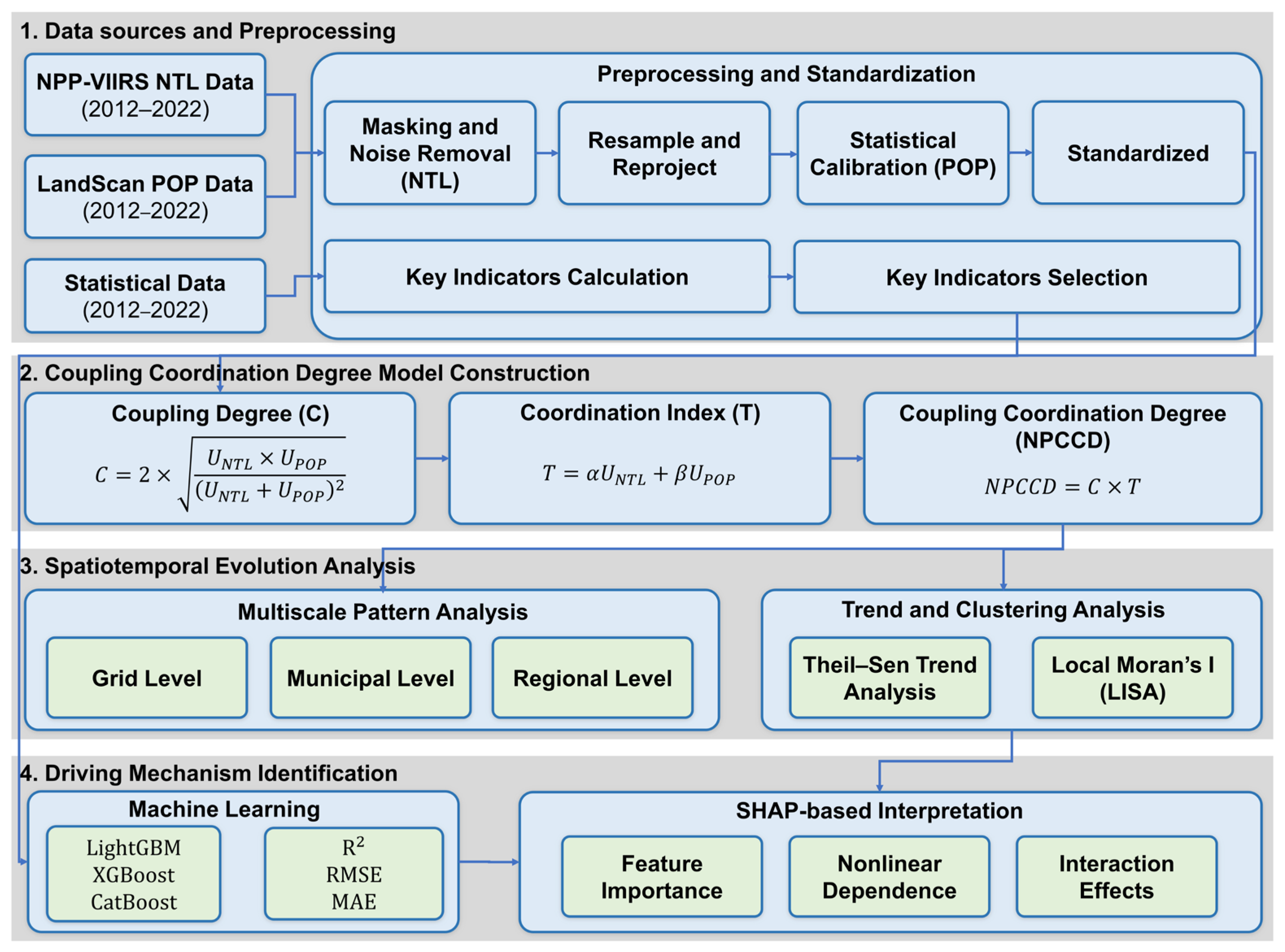
The overall flowchart of the article is shown in Figure 2.

3. Results

3.1. Spatiotemporal Evolution of Nighttime Lights and Population Couple Coordination Degree (NPCCD)

3.1.1. Spatiotemporal Evolution of NPCCD at Grid Level

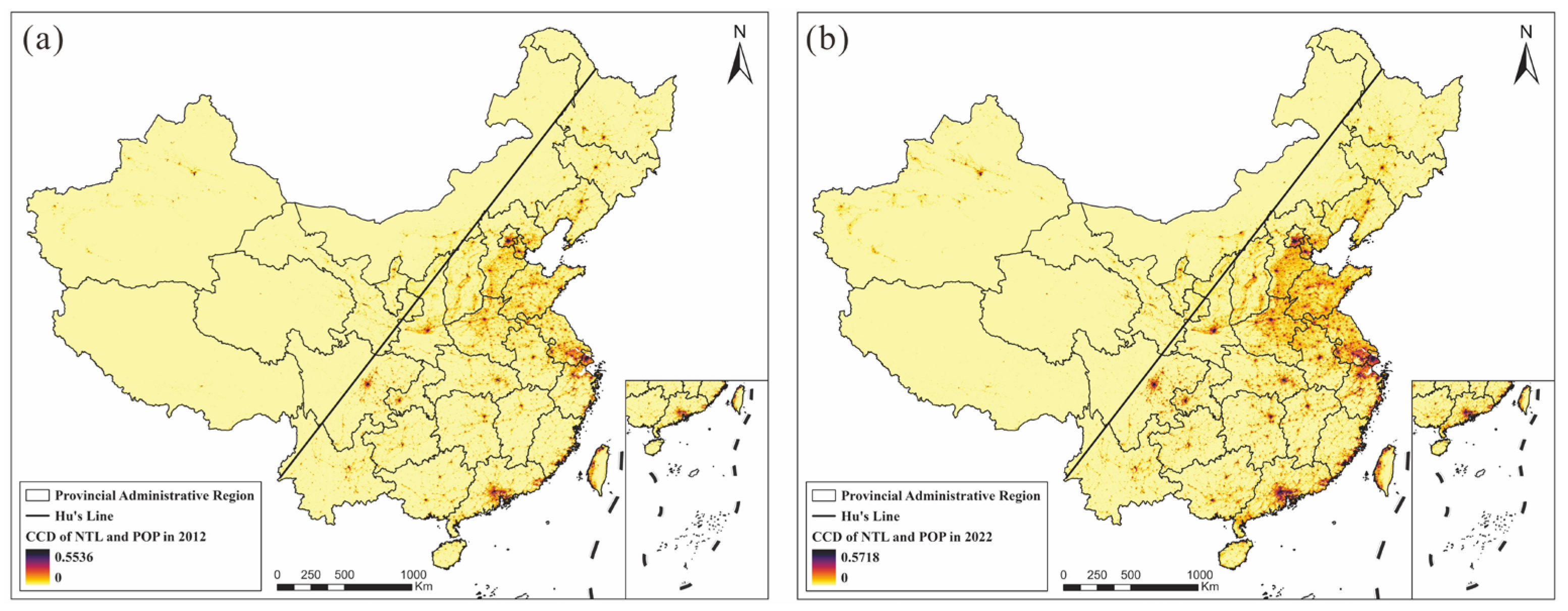
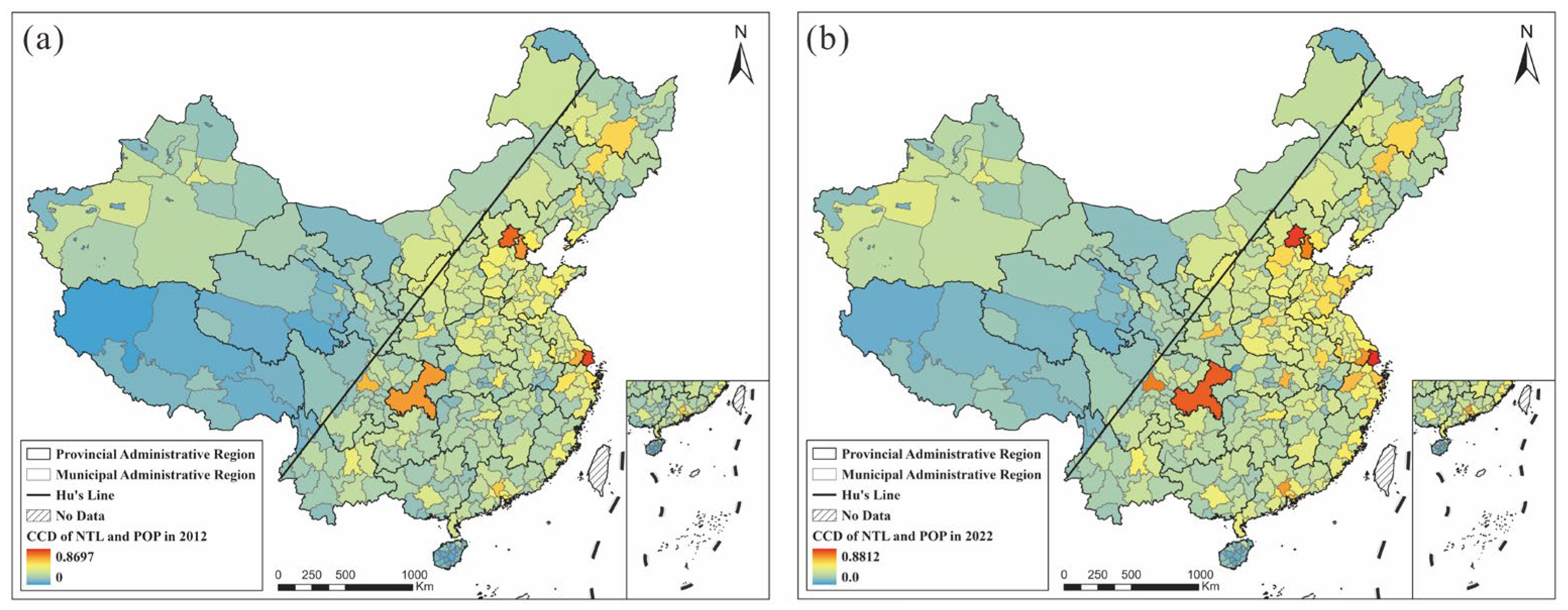
As shown in Figure 3, the NPCCD in both 2012 and 2022 exhibits pronounced spatial heterogeneity and a clear regional gradient. At the grid level, high NPCCD values in 2012 were primarily concentrated in major urban agglomerations such as Beijing–Tianjin–Hebei, the Yangtze River Delta, and the Pearl River Delta, as well as in provincial capitals and regional centers, exhibiting a distinct spatial clustering pattern. A fine-scale gradient from core urban areas to suburban and peripheral zones can be clearly identified, together with linear high-value structures aligned with major transportation corridors. In contrast, most central and western regions displayed predominantly low NPCCD values, widely and continuously distributed, with only scattered medium-value to high-value pixels around a few isolated urban centers, indicating the limited degree of NTL–POP coordination in these areas.
By 2022, this fine-grained spatial structure had undergone substantial changes. A more continuous high-NPCCD belt had emerged along the SE coastal region and gradually expanded into inland areas, reflecting a broader and stronger degree of spatial coordination. High-value pixels increased significantly across NC, CC, and parts of SW, transitioning from isolated points to more aggregated high-value patches. In NC, areas such as Hebei, Shandong, Henan, and Jiangsu formed large contiguous areas of medium to high NPCCD values. Core cities such as Chengdu, Chongqing, Wuhan, and Xi’an developed clearer clusters of high NPCCD values. Although NW remained dominated by low values, the expansion of medium-value to high-value pixels around regional centers suggested the outward diffusion of regional growth poles. Overall, the grid-level results demonstrate that NPCCD expanded from a pattern dominated by coastal and core metropolitan areas in 2012 to a more widespread national pattern by 2022. Despite the enhanced spatial coordination, a clear east–west gradient and core–periphery differentiation remain evident.

3.1.2. Spatiotemporal Evolution of NPCCD at Municipal Level

At the municipal level, NPCCD patterns highlight overall urban coordination levels and regional differences more clearly (Figure 4). The city-level unit corresponds to the administrative territory of each prefecture-level city and reflects the degree of coordination in an aggregated, city-region sense. In 2012, NPCCD levels across cities exhibited a distinct spatial gradient. Cities in SE and NC had the highest levels; CC and NE formed a middle tier; and cities in SW and NW remained at lower levels. Coastal cities and those in adjacent inland areas formed clusters of relatively high coordination with smaller internal variation, indicating stronger overall synchrony in these regions. In inland areas, most cities were at medium levels, with only provincial capitals and a few regional centers exhibiting slightly higher NPCCD. This created a hierarchical pattern characterized by a small number of high-value cities and widespread medium to low values. NW, particularly west of the Hu’s Line, presented a continuous low-value block, indicating generally low development levels and weak NTL–POP coordination.
By 2022, NPCCD had increased widely across municipal units, but the magnitude of improvement varied considerably across regions and city tiers. Cities in SE urban clusters experienced notable improvement, with a growing number of cities entering higher coordination levels and reduced internal disparities, forming a pattern of stable high coordination. CC exhibited the most substantial changes: many cities rose from medium or low NPCCD to medium–high levels, and several urban agglomerations transitioned from single-core structures to multinode configurations, reflecting improved regional coordination. In contrast, improvements in SW and NW were mostly concentrated around leading cities such as Chengdu–Chongqing and the Guanzhong region, while most ordinary prefecture-level cities remained at medium or low coordination levels. NE showed limited improvement, with several cities experiencing stagnation or decline, highlighting persistent structural constraints on coordinated development. Overall, the municipal-level results emphasize the relative positioning, hierarchical differentiation, and uneven convergence trajectories of cities across China.

3.2. Spatiotemporal Changes and Spatial Clustering of NPCCD

3.2.1. Trend Analysis of NPCCD

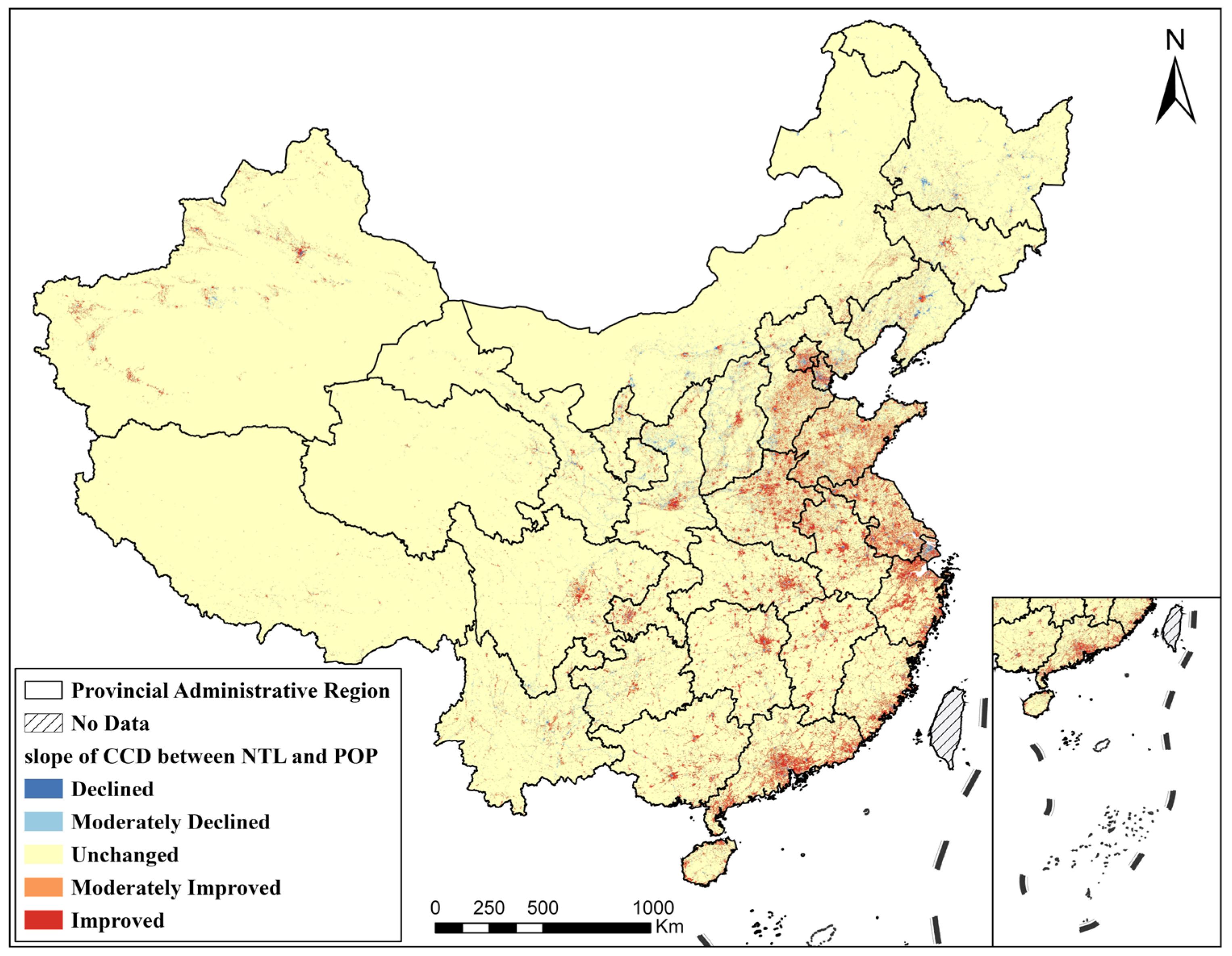
Theil–Sen trend analysis was applied to measure NPCCD changes at the grid level nationwide from 2012 to 2022. To clearly illustrate decadal change patterns, NPCCD trend values were classified into five groups using the Jenks natural breaks method: Declined, Moderately Declined, Unchanged, Moderately Improved, and Improved, based on thresholds of −0.003, −0.001, 0.001, and 0.003 (Figure 5). Because many grid cells show no valid NPCCD values in certain years, directly analyzing entire administrative units may introduce large amounts of invalid pixels and underestimate actual changes in areas with human activity. To address this issue, only effective regions (NPCCD > 0) were included when calculating regional trend statistics.
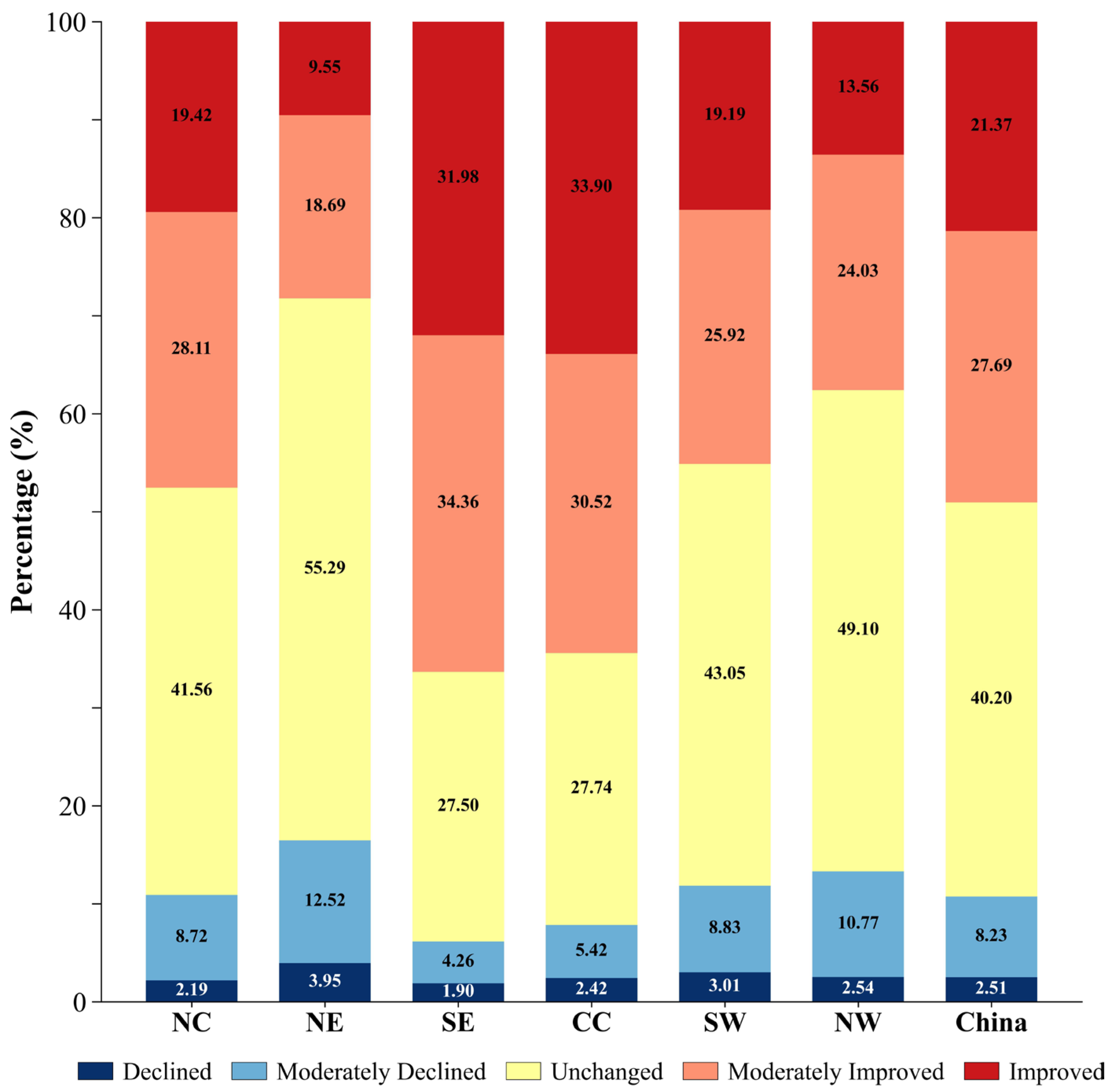
Figure 6 displays the proportional distribution of NPCCD trend categories for China, as well as for NC, NE, SE, CC, SW, and NW. Nationally, NPCCD trends were dominated by improvement categories, accounting for 49.07% of effective regions. Unchanged regions represented 40.20%, and decline categories accounted for 10.74%, indicating an overall positive evolutionary trajectory. However, substantial regional variation exists. SE and CC showed the most pronounced improvement, with more than 60% of pixels classified as Improved or Moderately Improved and relatively low proportions of Unchanged and Declined pixels, demonstrating widespread and sustained enhancement. NC and SW exhibited similar structures, with improvement slightly above the national average, Unchanged regions accounting for around 40%, and decline categories around 10%, indicating balanced and steady progress.
In NW, nearly half of effective regions were categorized as Unchanged, and the proportion of Improved regions was relatively low, suggesting overall stability but limited upward momentum. NE displayed the least favorable structure, with more than half of effective regions showing no change and the combined share of Declined and Moderately Declined regions reaching 16.48%. The proportion of Improved and Moderately Improved regions was only 28.24%, significantly lower than other regions and the national average, reflecting constrained improvement across NE.
Table 2 provides a comprehensive summary of the multidimensional evolution of NPCCD across China and the six regions from 2012 to 2022. To distinguish NPCCD levels under different spatial conditions, the mean NPCCD was calculated for each region in the following categories: the mean NPCCD in effective regions in 2012 and 2022 (NPCCD > 0 in the respective year), the mean NPCCD in persistent regions (NPCCD > 0 in both 2012 and 2022), and the mean NPCCD in newly added regions in 2022 (NPCCD = 0 in 2012 but NPCCD > 0 in 2022). In addition, based on the trend values of grid cells within effective regions in 2022, the mean NPCCD trend was computed to reflect the overall direction and intensity of change.
For effective regions, the national mean NPCCD decreased slightly from 0.0535 in 2012 to 0.0525 in 2022, reflecting spatial expansion accompanied by a modest decline in average coordination. SE consistently maintained the highest NPCCD levels. NC and CC showed mild increases, SW and NW remained mostly stable, and NE experienced a substantial decline from 0.0502 to 0.0368, suggesting a misalignment between spatial expansion and coordination quality in NE.
For persistent regions, NPCCD increased across nearly all regions. The national mean rose from 0.0583 to 0.0703. SE and CC showed the strongest improvements, with mean NPCCD increasing from 0.0719 to 0.0941 and from 0.0569 to 0.0758, respectively, indicating significant internal enhancement within already coordinated areas. NC, SW, and NW exhibited moderate increases. NE stagnated, with mean NPCCD declining slightly from 0.0547 to 0.0542.
For newly added regions, the national mean NPCCD in 2022 was 0.0308, far below the 0.0703 observed in persistent regions, indicating that newly added regions were concentrated in low-coordination peripheral areas. CC and SE had relatively higher NPCCD levels in newly added regions (0.0366 and 0.0348), suggesting higher-quality expansion, whereas NE and NW had the lowest values (0.0223 and 0.0237), reflecting weak coordination in marginal growth areas.
Average NPCCD trends in effective regions further reinforce these differences. SE and CC exhibited the strongest positive trends, followed by NC, SW, and NW. NE had the lowest positive trend value, indicating minimal improvement. Overall, NPCCD evolution in China follows a clear spatial pattern characterized by substantial quality and scale enhancement in SE and CC, moderate progress in NC, slower advancement in SW and NW, and relative stagnation in NE.
Overall, the grid-level trend analysis indicates that China’s NTL–POP coupling coordination exhibited a complex evolutionary pattern from 2012 to 2022, characterized by an overall upward trajectory alongside localized declines. On the one hand, most regions across China experienced positive NPCCD trends, with sustained strengthening of coordination particularly evident in major coastal and central urban agglomerations. On the other hand, a notable proportion of grid cells showed significant declines or remained at persistently low levels, reflecting a potential weakening in the alignment between NTL activity and POP distribution in certain areas.

3.2.2. Local Spatial Clustering of NPCCD

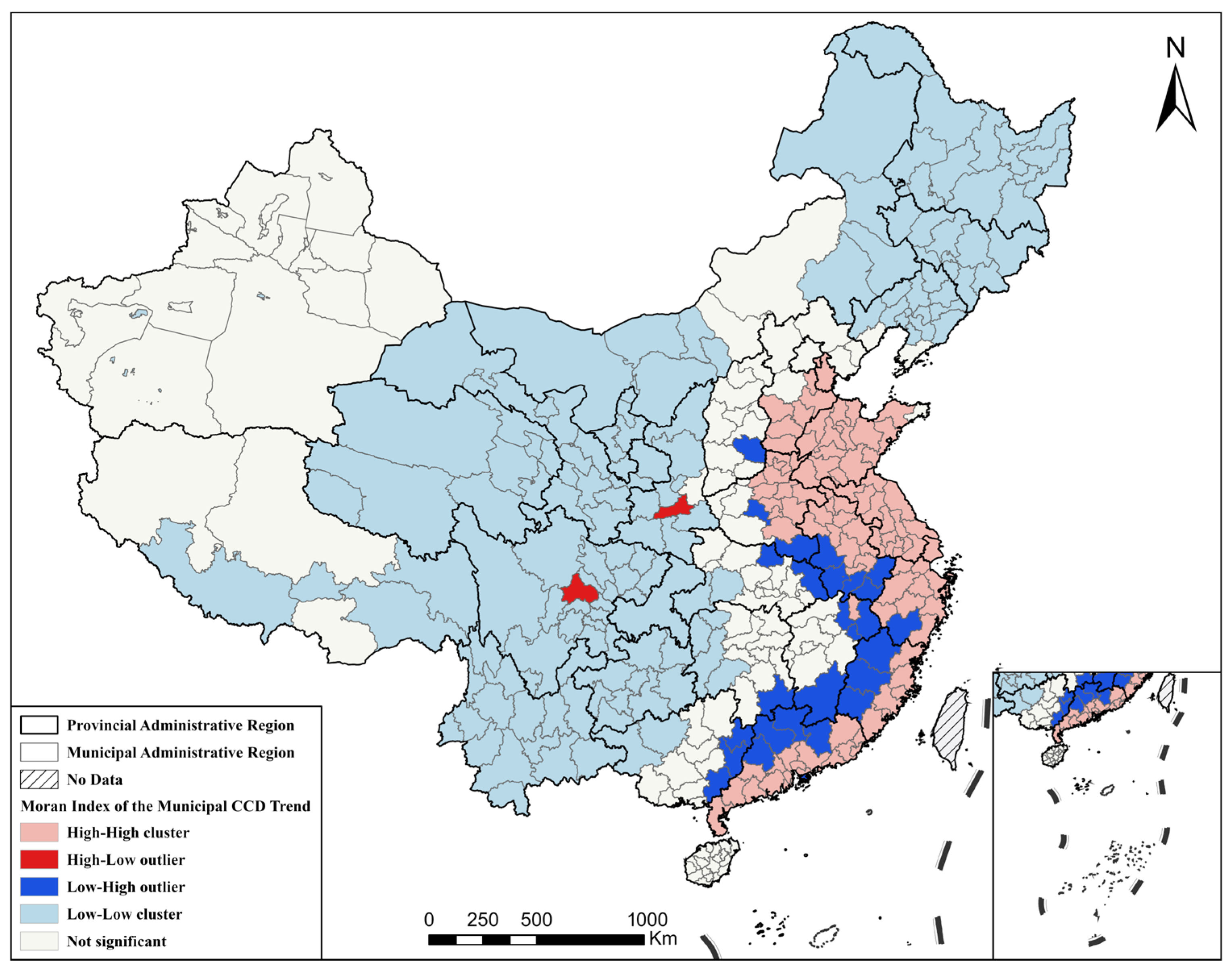
To identify the local spatial clustering characteristics of NPCCD trends, Local Moran’s I (LISA) was applied to analyze the temporal trend patterns of NTL–POP coupling coordination (Figure 7). Overall, the results reveal pronounced spatial heterogeneity in NPCCD trends across China, with distinct spatial patterns in both clustered areas and outlier regions. High–High clusters were primarily concentrated in SE, where cities exhibited strong positive NPCCD trends and were surrounded by neighboring cities with similarly high growth trends. This pattern indicates a persistent advantage in NTL–POP interaction and coordinated development in SE, as well as strong internal synergistic effects within the region. Low–Low clusters were observed across NE, NW, SW, and parts of NC. These areas generally displayed weak NPCCD growth trends and formed contiguous low-value agglomerations with surrounding cities, suggesting limited synergy in population concentration, economic vitality, and NTL performance. This pattern highlights the persistent regional disparities and the insufficient coordinated development in these areas. Regarding outlier patterns, High–Low outliers were sparsely distributed in several CC cities such as Chengdu and Xi’an. These cities showed strong NPCCD growth trends, but their surrounding cities exhibited weak improvements, indicating that their development momentum is driven largely by internal factors rather than regional spillover effects. In contrast, Low–High outliers were mostly located in inland cities within CC and SE provinces. These cities showed relatively weak NPCCD trends but were surrounded by high-growth areas, suggesting constraints related to limited development foundations, smaller urban scale, or insufficient population dynamism. Non-significant areas were widely distributed across NC and parts of CC, indicating that spatial associations in NPCCD trends were not strong in these regions. The large inter-city variation suggests an absence of stable spatial clustering patterns in NPCCD evolution.

3.3. Performance of Machine Learning Model and SHAP-Based Interpretation

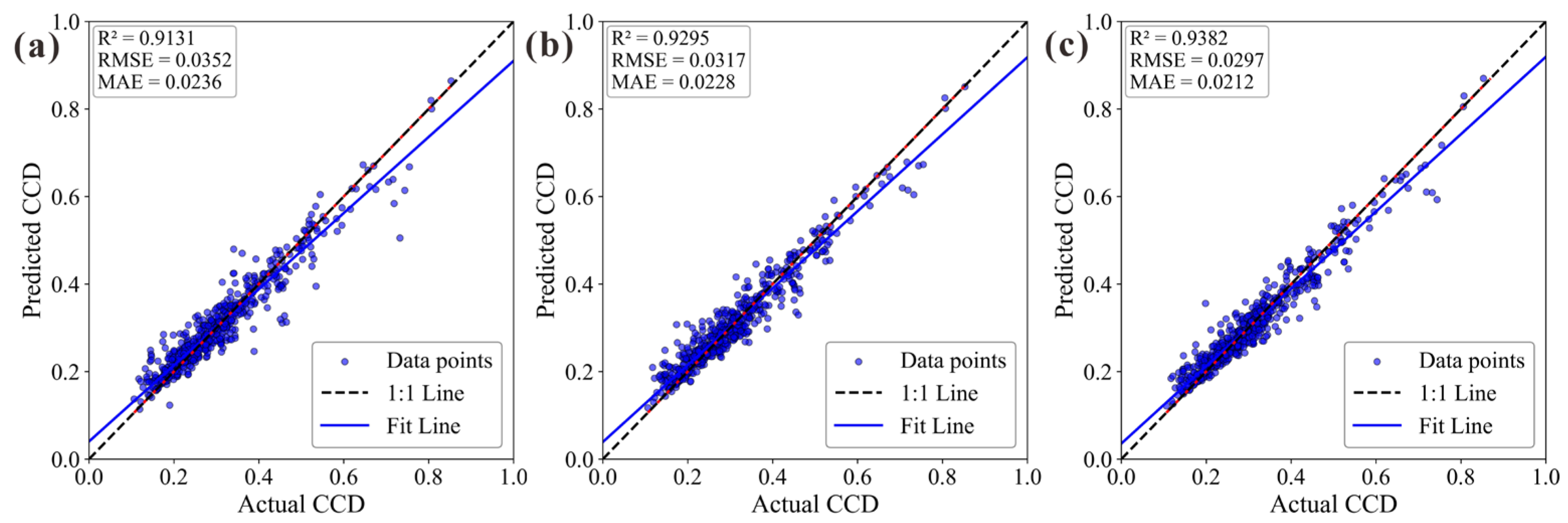
To explain NPCCD using socioeconomic indicators, three machine learning algorithms including LightGBM, XGBoost, and CatBoost, were applied and evaluated using three performance metrics including R2, Root Mean Square Error (RMSE), and Mean Absolute Error (MAE). As shown in Figure 8, the CatBoost-based model exhibited the best overall performance in estimating NPCCD. The model achieved an R2 of 0.94, an RMSE of 0.0297, and an MAE of 0.0212, indicating higher predictive accuracy and robustness compared with the other models.
In this study, NPCCD serves as the dependent variable and is derived by integrating nighttime lights (NTL) with gridded population data across a long time span and a large spatial extent. Therefore, some degree of measurement uncertainty is unavoidable. In this setting, LightGBM adopts a leaf-wise tree growth strategy and may produce overly fine local partitions and amplify noise if model complexity is not sufficiently constrained, whereas XGBoost provides a relatively stable baseline under the standard gradient boosting framework through regularization and related mechanisms. By contrast, CatBoost incorporates ordered boosting and uses symmetric (oblivious) trees, which strengthens regularization and improves training stability. This design helps capture nonlinear and interaction effects while reducing sensitivity to noise, thereby leading to higher overall prediction accuracy in our model comparison.
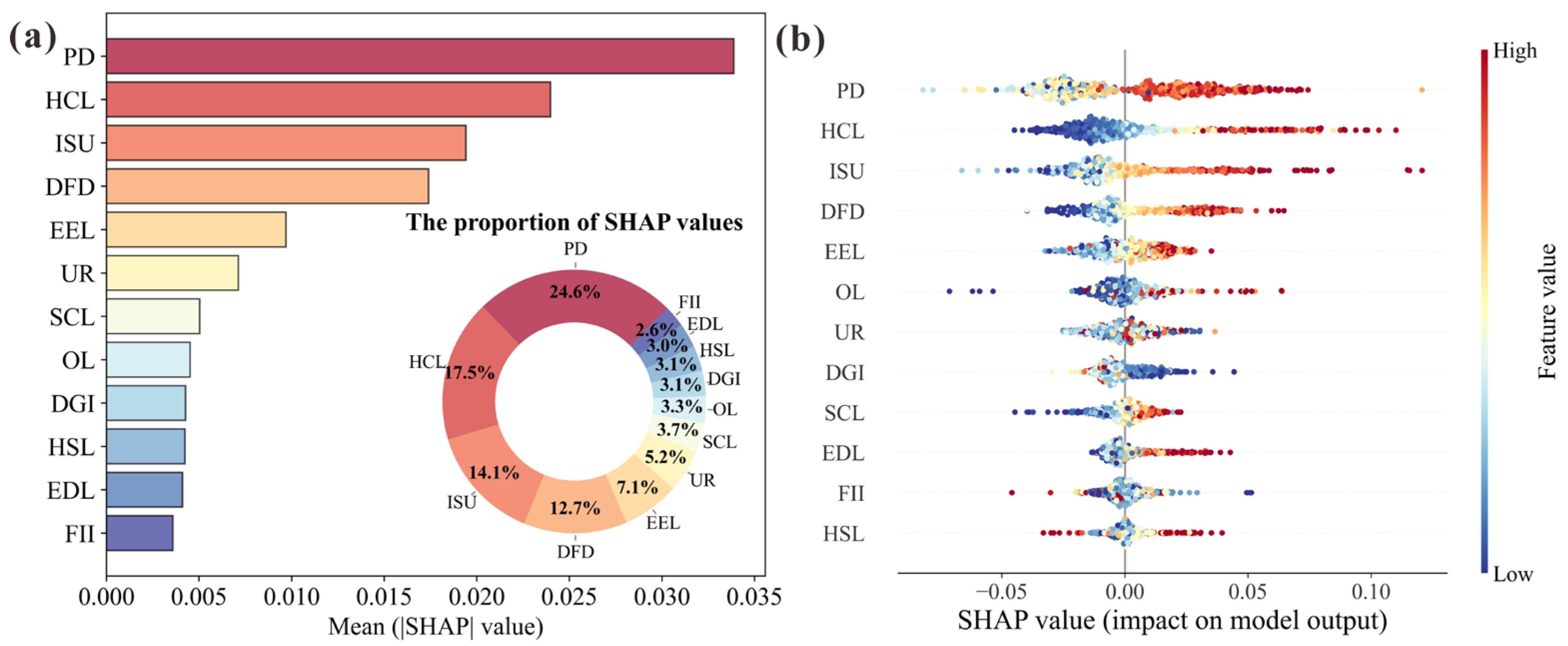
To interpret the model results, the SHAP method was applied to decompose the contributions of the 12 explanatory variables, thereby revealing their marginal effects and interaction mechanisms. As shown in Figure 9a, the SHAP contribution of each variable ranged from 3.5% to 19.6%, collectively explaining the majority of variations in the model output. PD, HCL, ISU, and DFD were identified as the four dominant factors influencing NPCCD, accounting for 58.4% of the total model variability and forming the core driving mechanism. The remaining variables served as auxiliary factors, reflecting the combined effects of structural adjustment, public sector investment, and sustainable development considerations.
The global contribution and directional influence of each feature are further illustrated in the SHAP summary plot (Figure 9b). The SHAP distributions exhibit alternating positive and negative effects as NTL, POP, and NPCCD evolve, reflecting the complex mechanisms of NPCCD across regions and development stages. PD shows a consistent positive relationship with SHAP values, indicating that higher population density is associated with higher NPCCD, meaning that population concentration contributes to improved coordination between nighttime activity and population distribution. HCL also demonstrates a positive association, suggesting that higher human capital levels promote more coordinated development by supporting the allocation of social resources. In addition, higher ISU and DFD values are associated with positive SHAP contributions, indicating that improvements in industrial structure upgrading and fiscal decentralization exert a facilitating effect on NPCCD. In contrast, the SHAP values of DGI are predominantly negative, implying that increased government intervention tends to hinder coordinated development to some extent.
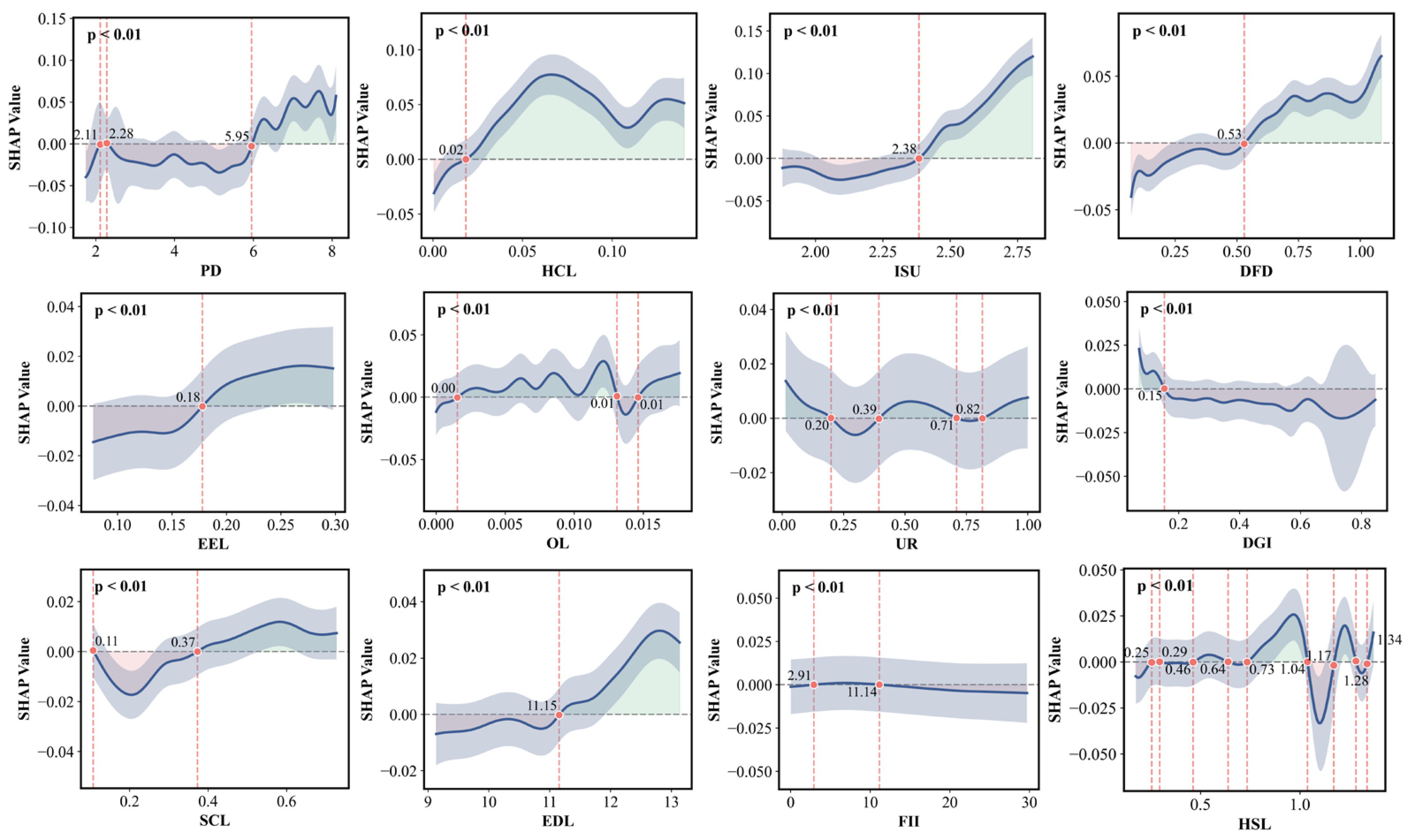
The single-feature dependence analysis based on SHAP values further reveals the nonlinear characteristics and threshold effects of each indicator across different value ranges (Figure 10). PD shows a negative and fluctuating influence on NPCCD at low values, but once PD increases to the critical level of 5.95, the SHAP values shift to positive and rise with fluctuations. This indicates that higher levels of population concentration represent a key condition for improving NPCCD. HCL contributes little to NPCCD when below 0.02, but beyond this threshold its SHAP values increase rapidly and remain strongly positive, demonstrating the sustained marginal contribution of human capital accumulation to coordinated development.
ISU remains near zero and slightly negative when below 2.38, suggesting that a low-end industrial structure contributes minimally to NPCCD. Once ISU exceeds 2.38, its SHAP values turn positive and rise monotonically, indicating that industrial upgrading and the expansion of the service sector significantly enhance the consistency and coordination between NTL and POP distributions. DFD exhibits increasing SHAP values as fiscal autonomy improves; SHAP becomes positive after DFD surpasses 0.53, showing that moderate fiscal decentralization can effectively improve resource allocation and promote NTL–POP coordination.
Similarly, EEL, SCL, and EDL display transitions from negative to positive SHAP influence, with overall increases at higher values. In contrast, OL, UR, and HSL show highly variable SHAP curves with unstable directional effects, indicating more complex influence patterns that may reflect regional heterogeneity and multifactor interactions, resulting in relatively limited overall contributions. FII remains consistently close to zero and shifts from positive to negative, suggesting that beyond a certain level, fiscal investment may have diminishing returns for NPCCD improvement. DGI shows a predominantly negative effect; its SHAP values shift from positive to negative at around 0.15 and continue declining, implying that excessive governmental intervention may weaken the positive role of market mechanisms in optimizing the spatial alignment between NTL and POP distribution.

3.4. Interaction Analysis of Multiple Features

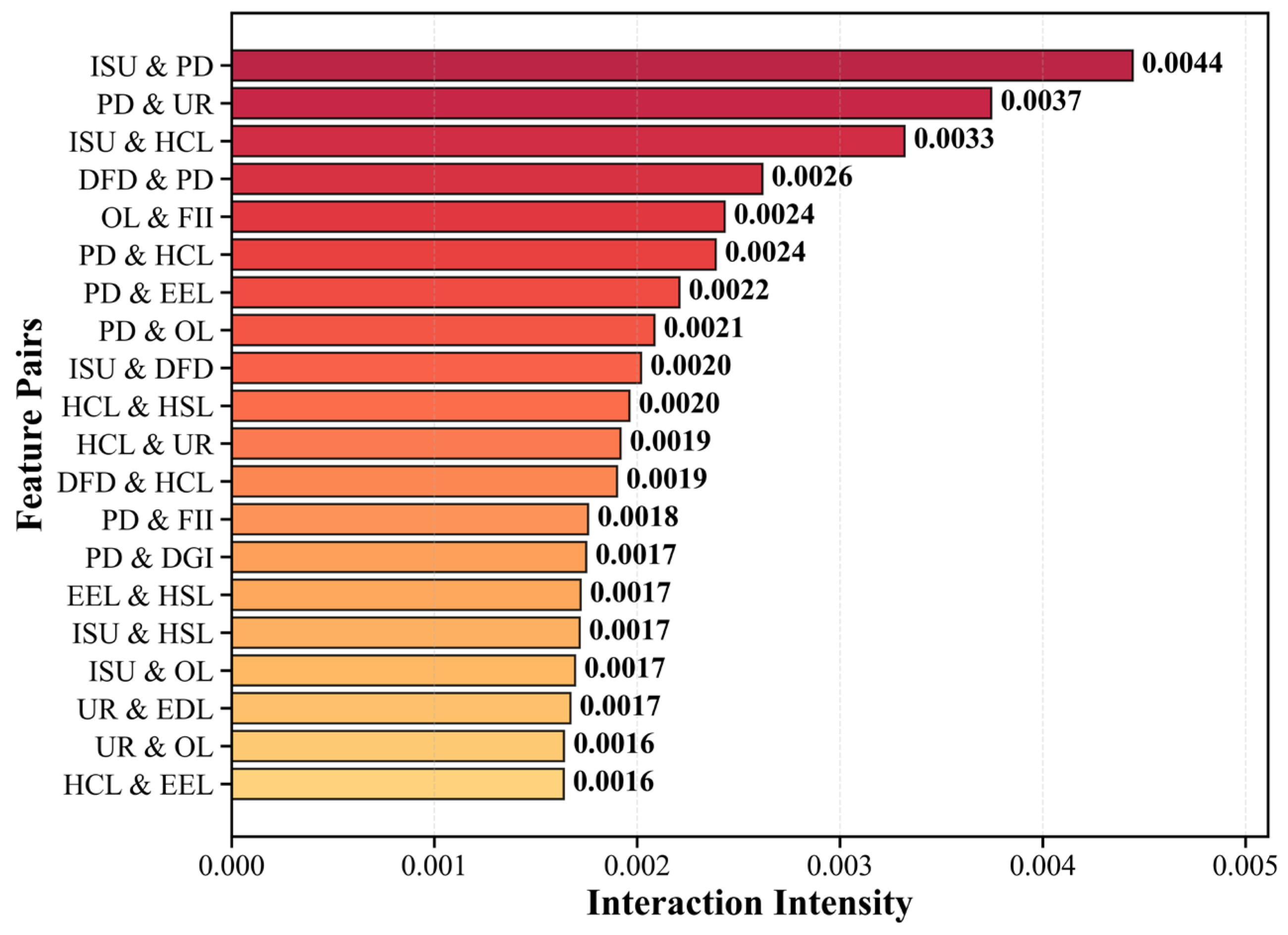
To examine how different feature combinations interact to influence NPCCD, the interaction strength among pairs of features was further analyzed. Figure 11 presents the top 20 feature pairs with the strongest interaction effects. Overall, the interaction between ISU and PD is the strongest, followed by PD with UR, ISU with HCL, and DFD with PD. These interactions form the primary group of influential feature combinations that play a central role in shaping NPCCD.
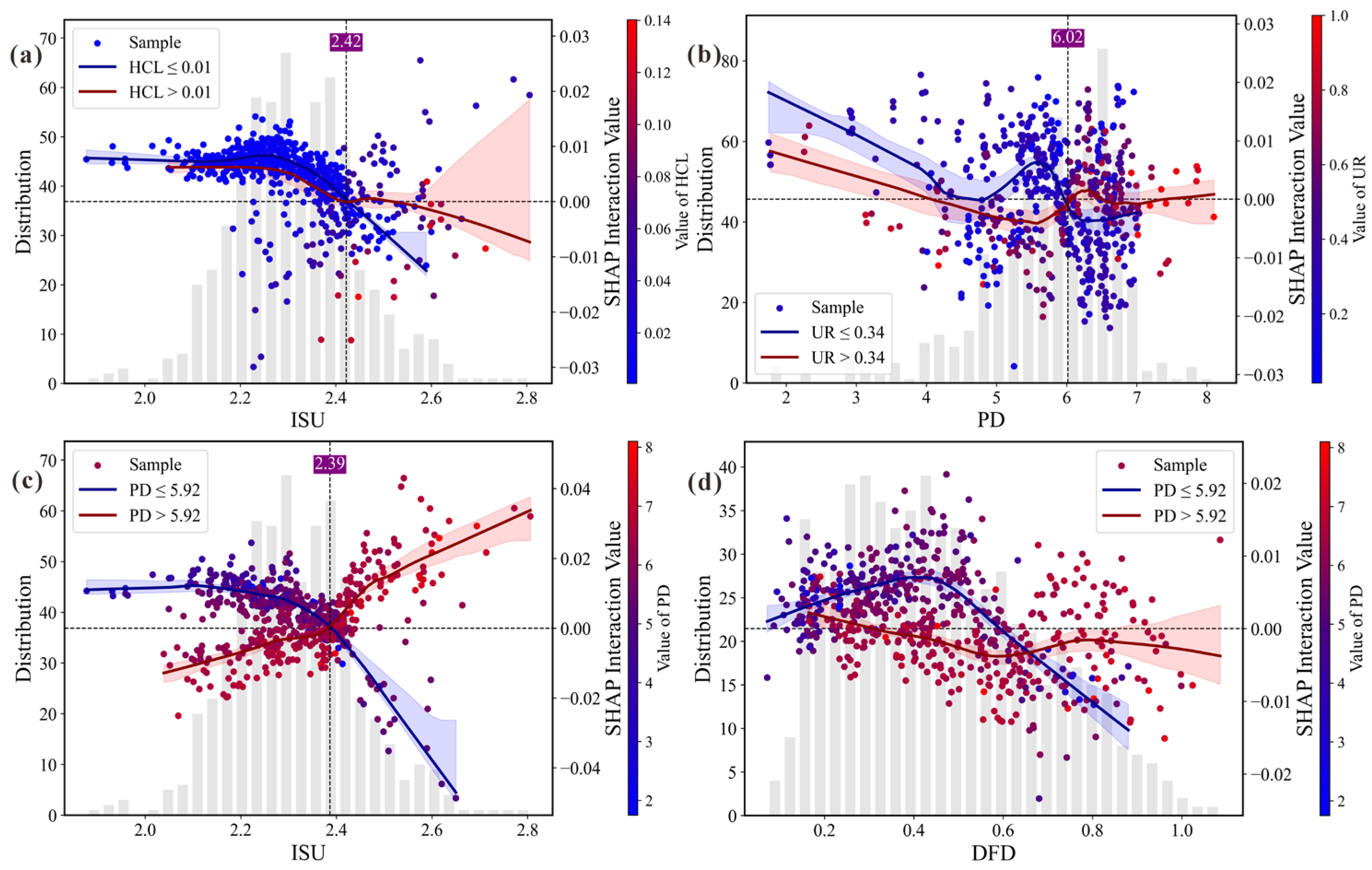
To further analyze the interaction effects among features, the four most influential feature pairs were selected based on their interaction strengths (Figure 12). Taking the strongest interaction between ISU and PD as an example, the horizontal axis represents the values of ISU, the left vertical axis indicates the sample distribution (Distribution), and the right vertical axis shows the SHAP interaction value between ISU and PD, with positive and negative values indicating promoting or inhibiting effects on NPCCD, respectively. The color of the scatter points distinguishes high and low values of PD. To reveal nonlinear interaction characteristics, two locally weighted scatterplot smoothing (LOWESS) curves were generated separately for low-PD and high-PD groups, with blue representing low PD and red representing high PD.
The interaction effect between ISU and PD is the most prominent and displays a clear threshold structure. When ISU is below 2.39, the interaction value for the low-PD group remains around 0.01, whereas the high-PD group shows consistently negative interaction values. This indicates that low-level industrial structure combined with low population density results in weak coordination effects. Once ISU exceeds approximately 2.38, the interaction value for the high-PD group increases rapidly, while that for the low-PD group turns negative and continues to decline. This suggests that industrial upgrading significantly enhances NPCCD only when population density is sufficiently high, highlighting the amplifying role of population concentration in the relationship between industrial upgrading and coordinated development.
The interaction between PD and UR exhibits a complex multiphase nonlinear pattern. At low PD levels, the synergy between UR and PD is strongest, but the interaction weakens as PD increases and turns negative around PD = 4. Thereafter, the high-UR group remains negative overall, whereas the low-UR group experiences a brief positive phase before turning negative, leading to a clear divergence between the two groups. When PD reaches approximately 6.02, the high-UR group shows a recovery from negative to positive contributions, whereas the low-UR group continues to exhibit negative effects. This pattern indicates that urbanization contributes positively to NPCCD under high population density, whereas low-urbanization areas are unable to effectively absorb the pressures induced by growing population concentration.
The interaction between ISU and HCL demonstrates a characteristic pattern of initial consistency followed by divergence. At low ISU levels, ISU and HCL jointly maintain stable positive effects before the interaction begins to decline. Once ISU surpasses the critical threshold of 2.42, low HCL values result in a negative and further declining effect, while high HCL values remain positive for a short period before also declining. This indicates that, beyond a certain stage of industrial upgrading, regions with higher human capital are better able to absorb the transitional costs of industrial restructuring and gradually mitigate the shift toward negative effects.
For PD values below 5.92, the interaction with DFD increases as DFD rises, reaching a peak around 0.40, then declining steadily and turning negative beyond 0.60. This pattern suggests that moderate fiscal decentralization enhances local resource allocation capacity and forms positive synergy with population concentration, whereas excessive decentralization reverses this effect. In high-PD areas, the interaction value becomes negative at approximately 0.30 and remains negative thereafter, indicating that fiscal decentralization is more likely to generate structural imbalances in highly dense urban environments. Population density therefore plays a key moderating role in determining whether fiscal decentralization yields positive or negative effects on NPCCD.
Overall, these results demonstrate that improvements in NPCCD depend on the interactive development of multiple urban factors. Rather than exerting independent effects, the indicators influence NPCCD through significant interaction mechanisms that collectively shape the spatial differentiation of NTL–POP coordination across regions.

4. Discussion

4.1. Spatiotemporal Patterns and Regional Disparities of NPCCD

As shown in Figure 5, from 2012 to 2022, NPCCD in China exhibited an overall improving trend in most regions, yet pronounced spatial heterogeneity persisted. Regions of improvement, stagnation, and decline coexisted, forming a clear gradient pattern characterized by higher NPCCD in the east and lower values in the west, with coastal regions outperforming inland areas. Both temporal evolution and spatial clustering analyses indicate that the spatial structure of NPCCD has shifted from a “point–axis” agglomeration pattern toward a more networked, multinode structure [43,63]. In 2012, high NPCCD values in inland areas were mainly concentrated around a small number of core metropolitan cities and transportation corridors, displaying compact point–axis clustering with an evident gradient from urban cores to suburbs and rural areas. By 2022, a continuous high-coupling belt had formed along the SE region, while medium–high NPCCD grids increased substantially around urban agglomerations in CC and SW, such as Chengdu–Chongqing, the Middle Yangtze River, and the Guanzhong Plain (Figure 3). These changes indicate that the spatial matching between NTL and POP has gradually expanded from traditional coastal cores toward multiple inland nodes [31,64].
Figure 6 displays the proportional distribution of NPCCD trend categories. The SE region contains the country’s most mature urban system, with high population density, vibrant nighttime and service economies, and well-developed urban infrastructure, enabling strong synchrony between economic activity and population distribution [43,64]. The CC region, benefiting from industrial relocation from SE, improved infrastructure, and advantageous geographical conditions, has also shown rapid increases in NPCCD. NC maintains relatively high NPCCD due to its large population base, although its industrial structure—traditionally dominated by heavy industry—faces transformation pressures, limiting overall improvement. In SW, cities such as those in the Chengdu–Chongqing cluster continue to absorb population, stimulating growth in services and innovation sectors and raising NPCCD. However, substantial internal disparities remain, with clear differences between core and non-core areas constraining regional development. NW records generally low NPCCD because of sparse population distribution, dispersed urban centers, and weaker spatial connectivity, along with insufficient infrastructure. Nonetheless, national transfer payments and initiatives such as the Western Development Strategy have supported moderate improvement in NPCCD across NW [43,63]. In contrast, many cities in NE have experienced stagnation or decline in NPCCD, consistent with the widely documented pattern of shrinking cities. Persistent population outflow, weakened industrial foundations, and aging infrastructure are the primary drivers of declining NTL–POP coordination in NE and in some resource-dependent cities [65,66,67].
Grid-level classification results in Table 2 reveal that persistent regions exhibit significantly higher NPCCD than newly added regions. This suggests that in earlier-developed urban areas, population, industry, and infrastructure tend to be more maturely aligned, whereas newly expanded areas often experience a mismatch between spatial expansion and functional provision. Related studies likewise report that built-up areas in many cities have expanded faster than population growth, resulting in declining land-use efficiency and increased risks of spatial hollowing [68,69]. Within the framework of this study, such land-first and people-lagging expansion manifests as rapid increases in NTL brightness in newly added grids, but only limited growth in population density, thus producing NPCCD levels lower than those in older urban areas. These findings highlight the need to interpret high NPCCD cautiously, as apparent brightness–population matching may mask underlying functional mismatches and structural risks. For newly developed low-NPCCD areas, further evaluation should incorporate land-use patterns, transport networks, and public service provision to assess the efficiency and sustainability of urban spatial expansion.
Overall, the east–west gradient and coastal–inland disparities observed in NPCCD are consistent with the broader spatial pattern of urban development in China identified in grid-level NTL-based studies [20,22,43,70]. Moreover, in contexts where conventional statistical data are incomplete, NTL have been widely used as a proxy for economic activity, supporting the interpretation of NTL as an indicator of human activity intensity [21,71]. Building on this foundation, our study moves beyond examining absolute NTL levels and instead focuses on the coupling coordination between NTL and POP. We explicitly characterize the structural evolution of coupling patterns at both pixel and city scales, documenting a transition from corridor-based agglomeration to multi-nodal network configurations. Brightness patterns in high-population areas are shaped by multiple interacting factors, with substantial variation across cities. This evidence suggests that the relationship between NTL and population is heterogeneous and scale-dependent, particularly during phases of rapid spatial expansion [72]. Consistent with this perspective, our nationwide decomposition into “persistent coupling zones” and “newly coupled zones” provides a direct diagnostic of coupling quality. Newly coupled areas tend to exhibit lower NPCCD values, indicating structural characteristics in which nighttime light intensity expands more rapidly than population agglomeration in peripheral growth areas. This comparison strengthens the interpretation of NPCCD: it captures not only spatial co-location, but also the degree of synchronicity between nighttime activity intensity and population distribution.

4.2. Driving Mechanisms and Interaction Effects

The driving analysis in Figure 9 and Figure 10 shows that PD, as the most fundamental condition, has a direct and strong influence on NPCCD. Only after PD exceeds a certain threshold does its contribution shift from negative to positive and increase rapidly, indicating that sufficient population concentration is a prerequisite for achieving high NPCCD. A dense population facilitates the efficient provision of public services and infrastructure, enhances land-use intensity, and strengthens nighttime activity, thereby improving the spatial consistency between NTL brightness and population distribution [73,74]. Existing studies likewise suggest that high-density cities exhibit stronger industrial synergy and recovery capacity when facing external shocks, a pattern that is also evident in CC and SE cities in this study [75].
Both HCL and ISU show clear monotonic positive effects accompanied by pronounced nonlinearities. At low levels of human capital, it is difficult to support the concentration of advanced manufacturing or modern service industries, resulting in limited contributions to NPCCD. Once human capital accumulation surpasses a critical threshold, highly skilled labor enhances innovation, improves public service quality, and raises employment conditions, which strengthens the alignment between nighttime human activity intensity and population concentration [75,76]. A similar pattern is observed for ISU. When industrial structure shifts from resource-intensive and extensive manufacturing toward higher-value-added manufacturing and productive and consumptive services, NTL become more concentrated in business, consumption, and residential areas, leading to higher NPCCD [77,78].
The nonlinear effect of fiscal decentralization (DFD) suggests that moderate fiscal autonomy enables local governments to optimize infrastructure and public service provision based on population and industrial distribution, thereby enhancing the spatial matching between NTL intensity and population distribution. As a result, NPCCD improves as fiscal decentralization increases. However, excessive decentralization may induce disorderly competition and inefficient urban expansion, weakening NTL–POP alignment [79].
The interaction mechanisms in Figure 11 and Figure 12 further indicate that NPCCD is shaped by the synergy of multiple factors. High population density amplifies the positive effect of industrial upgrading on NPCCD. In large cities and densely populated areas, industrial upgrading toward high-technology and modern service sectors is more likely to translate into intense and sustained nighttime activity, thereby significantly enhancing NPCCD. Similarly, the positive effect of human capital on NPCCD is mainly released in cities with high population density and advanced development levels. Prior research on urban economic resilience also finds strong synergy between human capital and industrial structure upgrading, with effects particularly pronounced in large cities and regions with high human capital [80].
Furthermore, the influence of fiscal capacity and fiscal decentralization strongly depends on population density and development stage. In high-density cities, fiscal resources can be efficiently translated into improvements in NTL–POP matching through investments in public transportation, integrated utility networks, and education and healthcare infrastructure. In sparsely populated regions, however, similar levels of fiscal decentralization may fail to generate economies of scale and may even lead to inefficient investment. Overall, these interaction mechanisms reveal that NPCCD improvements are not driven by single variables alone, but rather by the combined effects of population agglomeration, human capital, industrial upgrading, and fiscal institutions. It is the coupling among these factors that fundamentally shapes the spatial pattern and evolution of NTL–POP coordination.

4.3. Limitations and Future Prospects

Existing studies have primarily examined the coupling relationship between NTL and population through two main approaches. First, many analyses rely on correlation or regression models conducted at the level of administrative units. Second, some studies construct indices of regional inequality or spatial inconsistency to characterize mismatches. While these approaches provide important evidence regarding association and spatial disparity, they often lack an integrated framework that quantifies coupling at the pixel level across the national scale while simultaneously enabling multi-scale diagnostics. Moreover, relatively few studies explicitly uncover nonlinear thresholds and interaction mechanisms among socioeconomic driving factors.
In comparison, this study advances the literature in three respects. Methodologically, we develop a unified framework that links pixel-level NPCCD measurement with trend detection and local spatial clustering analysis, and further connects micro-scale spatial patterns to city-level interpretable machine learning for mechanism identification. In terms of scale and coverage, we conduct a nationwide assessment at 500 m resolution over a long time series (2012–2022), aggregating results to the prefecture-level city scale to enable cross-regional and cross-hierarchy comparability. Regarding explanatory mechanisms, the analysis moves beyond reporting feature importance rankings by employing SHAP dependence and interaction analyses to identify stage-specific thresholds and synergistic effects. This approach allows us to formulate testable mechanism hypotheses and to derive policy implications aimed at improving the quality of NPCCD.
Although this study advances the understanding of multiscale changes in NTL–POP coupling coordination and its driving mechanisms, several limitations remain. The estimation of NPCCD relies on NPP–VIIRS composite products and LandScan population grids. Even after stray-light removal and statistical calibration, NTL observations are unavoidably influenced by lunar illumination, cloud cover, aerosols, and residual stray light, while the resampling and correction of LandScan data are constrained by its 1 km resolution. These uncertainties may be amplified in low-brightness areas, sparsely populated regions, or rapidly expanding urban–rural transition zones [20,81]. Future research would benefit from integrating multisensor data to further improve data quality, and from combining long-term LandScan time series with high-resolution single-year products such as WorldPop to generate long-term, high-resolution NTL and POP datasets that better meet analytic requirements [82].
In addition, the socioeconomic indicators used to construct the driving mechanism analysis are primarily derived from prefecture-level statistical yearbooks, which limits the ability to capture finer-scale spatial information and local heterogeneity. Future work could incorporate multisource datasets, including land-use data, POI distributions, and road network information, to develop a grid-level driving analysis framework for more accurately evaluating how different combinations of factors influence NPCCD [83,84]. Moreover, NPCCD primarily reflects the spatial alignment between nighttime human activity intensity and population distribution. It does not directly represent social equity, ecological sustainability, or subjective well-being. Even areas with high NPCCD may experience social pressures, inequality, and environmental pollution [27,85,86,87]. Therefore, future studies should integrate CCD with indicators such as green space accessibility, carbon emission efficiency, and quality-of-life measures to establish a more comprehensive evaluation system for high-quality and coordinated development. At the same time, regions with smaller but more highly educated populations may exhibit high nighttime activity intensity without proportional population growth. Future work may incorporate per capita NTL or population-adjusted NTL intensity to disentangle scale-driven alignment from efficiency mechanisms.

5. Conclusions

This study developed an integrated framework combining multilevel coupling quantification, multiregional trend detection, and multifactor interpretive analysis to examine the spatiotemporal evolution and driving mechanisms of the NPCCD in China from 2012 to 2022. Using NPP–VIIRS and LandScan population grids, NPCCD was analyzed systematically from the grid level to administrative units. The results indicate that NPCCD in China has improved overall, with 49.07% of grid cells exhibiting sustained upward trends. However, substantial regional disparities persist. Urban agglomerations in eastern and central China form high-coordination clusters, where more than 60% of grid cells fall into the improving category, whereas nearly half of the grid cells in parts of western and northeastern China remain unchanged, and overall coordination levels in these regions remain relatively low. At the national level, newly coupled areas exhibit a markedly lower average NPCCD in 2022 (0.03) compared to persistently coupled areas (0.07). These newly coupled zones often display a structural pattern in which infrastructure expansion precedes population agglomeration, suggesting potential risks of spatial mismatch. Among the machine learning models tested, CatBoost achieves the best predictive performance. SHAP-based interpretation shows that population density (PD), human capital level (HCL), industrial structure upgrading (ISU), and fiscal decentralization degree (DFD) jointly explain 58.4% of the model variance and constitute the key drivers of NPCCD variation. These factors exhibit clear threshold effects and interaction mechanisms. Overall, the combination of multi-level coupling analysis and interpretable machine learning provides an effective approach for identifying the spatial alignment between population agglomeration and economic activity within urban systems and for uncovering its underlying mechanisms. The findings offer quantitative support for context-sensitive strategies to enhance regional coupling coordination and optimize urban spatial governance.

Author Contributions

Conceptualization, Z.W.; methodology, Z.W.; software, Z.W.; validation, Y.X.; formal analysis, Z.W. and Y.X.; data curation, Z.W. and Y.X.; writing—original draft preparation, Z.W.; writing—review and editing, Z.W. and S.C.; visualization, Z.W.; supervision, S.C.; project administration, S.C.; funding acquisition, S.C. All authors have read and agreed to the published version of the manuscript.

Funding

This research was funded by the National Key Research and Development Program of China (No. 2020YFA0714103).

Data Availability Statement

NPP-VIIRS data were openly available at https://eogdata.mines.edu/products/vnl/ (accessed on 1 March 2025). LandScan data can be accessed at https://landscan.ornl.gov (accessed on 30 March 2025). National and subnational administrative boundary data were obtained from https://www.ngcc.cn (accessed on 3 March 2025). Statistical data were collected from https://www.stats.gov.cn. Dataset available on request from the authors.

Conflicts of Interest

The authors declare no conflicts of interest.

References

  1. Grimm, N.B.; Faeth, S.H.; Golubiewski, N.E.; Redman, C.L.; Wu, J.; Bai, X.; Briggs, J.M. Global change and the ecology of cities. Science 2008, 319, 756–760. [Google Scholar] [CrossRef] [PubMed]
  2. Seto, K.C.; Güneralp, B.; Hutyra, L.R. Global forecasts of urban expansion to 2030 and direct impacts on biodiversity and carbon pools. Proc. Natl. Acad. Sci. USA 2012, 109, 16083–16088. [Google Scholar] [CrossRef]
  3. Cohen, B. Urbanization in developing countries: Current trends, future projections, and key challenges for sustainability. Technol. Soc. 2006, 28, 63–80. [Google Scholar] [CrossRef]
  4. Bren d’Amour, C.; Reitsma, F.; Baiocchi, G.; Barthel, S.; Güneralp, B.; Erb, K.-H.; Haberl, H.; Creutzig, F.; Seto, K.C. Future urban land expansion and implications for global croplands. Proc. Natl. Acad. Sci. USA 2017, 114, 8939–8944. [Google Scholar] [CrossRef]
  5. Zhang, Q.; Guan, Y.; Wu, X.; Zhang, J.; Li, R.; Lin, K.; Wang, Y. Revealing the dynamic effects of land cover change on land surface temperature in global major bay areas. Build. Environ. 2025, 267, 112266. [Google Scholar] [CrossRef]
  6. Güneralp, B.; Ahasan, R. Urban land-change futures: Current understanding, challenges, and implications. npj Urban Sustain. 2025, 6, 7. [Google Scholar] [CrossRef]
  7. He, X.; Zhou, Y.; Yuan, X.; Zhu, M. The coordination relationship between urban development and urban life satisfaction in Chinese cities—An empirical analysis based on multi-source data. Cities 2024, 150, 105016. [Google Scholar] [CrossRef]
  8. Xiang, X.; Xiao, Y.; Chen, Y.; Huang, H. Assessment of coupling coordinated degree and driving mechanism of population-resource-environment-economy (PREE) system in Yellow River Basin, China. Sci. Rep. 2024, 14, 31135. [Google Scholar] [CrossRef]
  9. Zhao, J.; Xiao, Y.; Sun, S.; Sang, W.; Axmacher, J.C. Does China’s increasing coupling of ‘urban population’and ‘urban area’growth indicators reflect a growing social and economic sustainability? J. Environ. Manag. 2022, 301, 113932. [Google Scholar] [CrossRef] [PubMed]
  10. Guan, X.; Wei, H.; Lu, S.; Su, H. Mismatch distribution of population and industry in China: Pattern, problems and driving factors. Appl. Geogr. 2018, 97, 61–74. [Google Scholar] [CrossRef]
  11. Yin, C.; Meng, F.; Yang, X.; Yang, F.; Fu, P.; Yao, G.; Chen, R. Spatio-temporal evolution of urban built-up areas and analysis of driving factors—A comparison of typical cities in north and south China. Land Use Policy 2022, 117, 106114. [Google Scholar] [CrossRef]
  12. Yang, X.; Ye, T.; Zhao, N.; Chen, Q.; Yue, W.; Qi, J.; Zeng, B.; Jia, P. Population mapping with multisensor remote sensing images and point-of-interest data. Remote Sens. 2019, 11, 574. [Google Scholar] [CrossRef]
  13. Yu, T.; Ye, Y.; Fan, Z. Estimating GDP growth using VIIRS night-time light data. Int. J. Remote Sens. 2024, 45, 7939–7958. [Google Scholar] [CrossRef]
  14. Feng, P.; Ma, Z.; Yan, J.; Sun, L.; Wu, N.; Cheng, L.; Yan, D. High-resolution population mapping by fusing remote sensing and social sensing data considering the spatial scale mismatch issue. Int. J. Digit. Earth 2025, 18, 2479863. [Google Scholar] [CrossRef]
  15. Bai, Y.; Zhang, B.; Zhang, Z.; Zeng, S.; Liu, Z.; Mao, X. Weakly supervised deep learning for fine-grained socioeconomic development index inference based on satellite imagery. GeoInformatica 2025, 29, 927–950. [Google Scholar] [CrossRef]
  16. Dritsas, E.; Trigka, M. Remote sensing and geospatial analysis in the big data era: A survey. Remote Sens. 2025, 17, 550. [Google Scholar] [CrossRef]
  17. Elvidge, C.D.; Baugh, K.; Zhizhin, M.; Hsu, F.C.; Ghosh, T. VIIRS night-time lights. In Remote Sensing of Night-Time Light; Routledge: Abingdon, UK, 2021; pp. 6–25. [Google Scholar]
  18. Shi, K.; Ma, J.; Chen, Z.; Cui, Y.; Yu, B. Nighttime light remote sensing in characterizing urban spatial structure. Innov. Geosci. 2023, 1, 100043. [Google Scholar] [CrossRef]
  19. Wu, B.; Yu, B.; Yao, S.; Wu, Q.; Chen, Z.; Wu, J. A surface network based method for studying urban hierarchies by night time light remote sensing data. Int. J. Geogr. Inf. Sci. 2019, 33, 1377–1398. [Google Scholar] [CrossRef]
  20. Zheng, Q.; Seto, K.C.; Zhou, Y.; You, S.; Weng, Q. Nighttime light remote sensing for urban applications: Progress, challenges, and prospects. ISPRS J. Photogramm. Remote Sens. 2023, 202, 125–141. [Google Scholar] [CrossRef]
  21. Chen, X.; Nordhaus, W.D. Using luminosity data as a proxy for economic statistics. Proc. Natl. Acad. Sci. USA 2011, 108, 8589–8594. [Google Scholar] [CrossRef] [PubMed]
  22. Chen, X.; Nordhaus, W.D. VIIRS nighttime lights in the estimation of cross-sectional and time-series GDP. Remote Sens. 2019, 11, 1057. [Google Scholar] [CrossRef]
  23. Chen, Y.; Ursavaş, U.; Mendez, C. Can higher-quality nighttime lights predict sectoral GDP across subnational regions? Urban and rural luminosity across provinces in Türkiye. Lett. Spat. Resour. Sci. 2024, 17, 12. [Google Scholar] [CrossRef]
  24. Chakraborty, S.; Stokes, E.C. Adaptive modeling of satellite-derived nighttime lights time-series for tracking urban change processes using machine learning. Remote Sens. Environ. 2023, 298, 113818. [Google Scholar] [CrossRef]
  25. Chen, X.; Wang, Z.; Zhang, F.; Shen, G.; Chen, Q. A global annual simulated VIIRS nighttime light dataset from 1992 to 2023. Sci. Data 2024, 11, 1380. [Google Scholar] [CrossRef] [PubMed]
  26. Jhamb, P.; Ferreira, S.; Stephens, P.; Sundaram, M.; Wilson, J. Shedding light on development: Leveraging the new nightlights data to measure economic progress. PLoS ONE 2025, 20, e0318482. [Google Scholar] [CrossRef]
  27. Zhou, Y.; Ma, T.; Zhou, C.; Xu, T. Nighttime light derived assessment of regional inequality of socioeconomic development in China. Remote Sens. 2015, 7, 1242–1262. [Google Scholar] [CrossRef]
  28. Liu, C.; Wang, C.; Xu, Y.; Liu, C.; Li, M.; Zhang, D.; Liu, G.; Li, W.; Zhang, Q.; Li, Q. Correlation analysis between nighttime light data and socioeconomic factors on fine scales. IEEE Geosci. Remote Sens. Lett. 2022, 19, 3511805. [Google Scholar] [CrossRef]
  29. McAvoy, G.; Vadrevu, K.P. Nighttime lights and population variations in cities of South/Southeast Asia: Distance-decay effect and implications. Remote Sens. 2024, 16, 4458. [Google Scholar] [CrossRef]
  30. Elvidge, C.D.; Baugh, K.E.; Anderson, S.J.; Sutton, P.C.; Ghosh, T. The Night Light Development Index (NLDI): A spatially explicit measure of human development from satellite data. Soc. Geogr. 2012, 7, 23–35. [Google Scholar] [CrossRef]
  31. Xu, Y.; Chen, S.; Wang, Z.; Liu, B.; Wang, L. Multi-Scale Dynamics and Spatial Consistency of Economy and Population Based on NPP/VIIRS Nighttime Light Data and Population Imagery: A Case Study of the Yangtze River Delta. Remote Sens. 2024, 16, 2806. [Google Scholar] [CrossRef]
  32. Zhang, Q.; Liu, L.; Yang, X.; Sun, Z.; Ban, Y. Nighttime light development index: A new evaluation method for China’s construction land utilization level. Humanit. Soc. Sci. Commun. 2025, 12, 369. [Google Scholar] [CrossRef]
  33. Proville, J.; Zavala-Araiza, D.; Wagner, G. Night-time lights: A global, long term look at links to socio-economic trends. PLoS ONE 2017, 12, e0174610. [Google Scholar]
  34. Jean, N.; Burke, M.; Xie, M.; Alampay Davis, W.M.; Lobell, D.B.; Ermon, S. Combining satellite imagery and machine learning to predict poverty. Science 2016, 353, 790–794. [Google Scholar] [CrossRef]
  35. Yeh, C.; Perez, A.; Driscoll, A.; Azzari, G.; Tang, Z.; Lobell, D.; Ermon, S.; Burke, M. Using publicly available satellite imagery and deep learning to understand economic well-being in Africa. Nat. Commun. 2020, 11, 2583. [Google Scholar] [CrossRef]
  36. Lamichhane, B.R.; Isnan, M.; Horanont, T. Exploring machine learning trends in poverty mapping: A review and meta-analysis. Sci. Remote Sens. 2025, 11, 100200. [Google Scholar] [CrossRef]
  37. Zheng, X.; Zhang, W.; Deng, H.; Zhang, H. County-Level Poverty Evaluation Using Machine Learning, Nighttime Light, and Geospatial Data. Remote Sens. 2024, 16, 962. [Google Scholar]
  38. Liu, S.; Liu, W.; Zhou, Y.; Wang, S.; Wang, F.; Wang, Z. Mapping Gridded GDP Distribution of China Based on Remote Sensing Data and Machine Learning Methods. Remote Sens. 2025, 17, 1709. [Google Scholar] [CrossRef]
  39. Du, W.; Tong, S.; Zhang, M.; Xin, Y.; Zhang, D.; Xing, X.; An, Y.; Cui, G.; Liu, G. Revealing the spatiotemporal dynamics and nonlinear interaction-driven mechanisms of wetland ecosystem health in Northeast China using interpretable machine learning. Ecol. Indic. 2025, 178, 113878. [Google Scholar] [CrossRef]
  40. Xie, M.; Feng, Z.; Wang, S.; Wang, S.; Chang, X. Spatiotemporal Patterns and Nonlinear Drivers of Carbon Emission Intensity under Urban Shrinkage and Growth: A Machine Learning Approach with Interpretability. Sustain. Cities Soc. 2025, 130, 106593. [Google Scholar] [CrossRef]
  41. Shapley, L.S. A value for n-person games. In Contributions to the Theory of Games II; Princeton University Press: Princeton, NJ, USA, 1953. [Google Scholar]
  42. Tan, X.; Zhang, J.; Chen, J.; Wei, T.; Zhu, X. Beyond static brightness: Daily nighttime light fluctuations enrich nighttime vitality evaluation for urban zones. Sustain. Cities Soc. 2025, 136, 107043. [Google Scholar] [CrossRef]
  43. Xing, Z.; He, C.; Lin, J. Evolution and influencing factors of regional economic inequality in China based on data from nighttime lights. Sci. China Earth Sci. 2025, 68, 2003–2024. [Google Scholar] [CrossRef]
  44. Shao, Z.; Li, X. Multi-scale estimation of poverty rate using night-time light imagery. Int. J. Appl. Earth Obs. Geoinf. 2023, 121, 103375. [Google Scholar] [CrossRef]
  45. Pradhan, N.; Agrawal, A. Mapping fine-scale socioeconomic inequality using machine learning and remotely sensed data. PNAS Nexus 2025, 4, pgaf040. [Google Scholar] [CrossRef] [PubMed]
  46. Dobson, J.E.; Bright, E.A.; Coleman, P.R.; Durfee, R.C.; Worley, B.A. LandScan: A global population database for estimating populations at risk. Photogramm. Eng. Remote Sens. 2000, 66, 849–857. [Google Scholar]
  47. Li, W.; Yi, P. Assessment of city sustainability—Coupling coordinated development among economy, society and environment. J. Clean. Prod. 2020, 256, 120453. [Google Scholar] [CrossRef]
  48. Li, Z. Extracting spatial effects from machine learning model using local interpretation method: An example of SHAP and XGBoost. Comput. Environ. Urban Syst. 2022, 96, 101845. [Google Scholar] [CrossRef]
  49. Wang, Z.; Yu, Y.; Zhou, R. A longitudinal exploration of the spatiotemporal coupling relationship and driving factors between regional urban development and ecological quality of green space. Ecol. Indic. 2024, 164, 112134. [Google Scholar] [CrossRef]
  50. Li, Y.; Li, X.; Lu, T. Coupled coordination analysis between urbanization and eco-environment in ecologically fragile areas: A case study of Northwestern Sichuan, Southwest China. Remote Sens. 2023, 15, 1661. [Google Scholar] [CrossRef]
  51. Ji, J.; Tang, Z.; Zhang, W.; Liu, W.; Jin, B.; Xi, X.; Wang, F.; Zhang, R.; Guo, B.; Xu, Z. Spatiotemporal and multiscale analysis of the coupling coordination degree between economic development equality and eco-environmental quality in China from 2001 to 2020. Remote Sens. 2022, 14, 737. [Google Scholar] [CrossRef]
  52. Neeti, N.; Eastman, J.R. A contextual mann-kendall approach for the assessment of trend significance in image time series. Trans. GIS 2011, 15, 599–611. [Google Scholar] [CrossRef]
  53. Ma, S.; Kumakoshi, Y.; Koizumi, H.; Yoshimura, Y. Determining the association of the built environment and socioeconomic attributes with urban shrinking in Yokohama City. Cities 2022, 120, 103474. [Google Scholar] [CrossRef]
  54. Anselin, L. Spatial Econometrics: Methods and Models; Springer Science & Business Media: Berlin/Heidelberg, Germany, 1988; Volume 4. [Google Scholar]
  55. Ke, G.; Meng, Q.; Finley, T.; Wang, T.; Chen, W.; Ma, W.; Ye, Q.; Liu, T.-Y. LightGBM: A highly efficient gradient boosting decision tree. In Proceedings of the 31st International Conference on Neural Information Processing Systems, Long Beach, CA, USA, 4–9 December 2017; Curran Associates Inc.: Red Hook, NY, USA, 2017; pp. 3149–3157. [Google Scholar]
  56. Zhang, Q.; Gao, X.; Khan, S.U.; He, Z. SHAP-ing urban sustainability: Integrating NDDF and lightGBM to uncover coordinated pollution and carbon abatement costs in Chinese cities. Sustain. Cities Soc. 2025, 130, 106542. [Google Scholar] [CrossRef]
  57. Chen, T.Q.; Guestrin, C.; Assoc Comp, M. XGBoost: A Scalable Tree Boosting System. In Proceedings of the 22nd Acm Sigkdd International Conference on Knowledge Discovery and Data Mining, San Francisco, CA, USA, 13–17 August 2016; pp. 785–794. [Google Scholar]
  58. Zhao, Z.; Ding, Y.; Wang, M.; Qu, Y. A radiative transfer model-driven machine learning approach to estimate the snow surface albedo over the Greenland Ice Sheet. IEEE Trans. Geosci. Remote Sens. 2025, 63, 4301018. [Google Scholar] [CrossRef]
  59. Prokhorenkova, L.; Gusev, G.; Vorobev, A.; Dorogush, A.V.; Gulin, A. CatBoost: Unbiased Boosting with Categorical Features. In Proceedings of the 32nd International Conference on Neural Information Processing Systems, Red Hook, NY, USA, 3–8 December 2018; pp. 6639–6649. [Google Scholar]
  60. Wang, W.; Li, D.; Zhan, B.; Li, Z.; Su, J.; Lin, M. People-centered low-carbon transition: Revealing the synergy between urban low-carbon development and resident’s welfare improvement in China. Sustain. Cities Soc. 2025, 135, 107013. [Google Scholar] [CrossRef]
  61. Štrumbelj, E.; Kononenko, I. Explaining prediction models and individual predictions with feature contributions. Knowl. Inf. Syst. 2014, 41, 647–665. [Google Scholar] [CrossRef]
  62. Chatterjee, S.; Hadi, A.S. Regression Analysis by Example; John Wiley & Sons: Hoboken, NJ, USA, 2015. [Google Scholar]
  63. Wu, R.; Yang, D.; Dong, J.; Zhang, L.; Xia, F. Regional inequality in China based on NPP-VIIRS night-time light imagery. Remote Sens. 2018, 10, 240. [Google Scholar] [CrossRef]
  64. Yan, G.; Zou, L.; Liu, Y. The spatial pattern and influencing factors of China’s nighttime economy utilizing POI and remote sensing data. Appl. Sci. 2024, 14, 400. [Google Scholar] [CrossRef]
  65. Zhou, Y.; Li, C.; Zheng, W.; Rong, Y.; Liu, W. Identification of urban shrinkage using NPP-VIIRS nighttime light data at the county level in China. Cities 2021, 118, 103373. [Google Scholar] [CrossRef]
  66. Ma, X.; Yan, Q.; Pan, Q.; Chen, X.; Li, G. Identification and classification of urban shrinkage in Northeast China. Land 2023, 12, 1245. [Google Scholar] [CrossRef]
  67. Jiang, Y.; Sun, P. Does shrinkage have an impact on urban livability? An empirical analysis from Northeast China. Sustain. Cities Soc. 2024, 113, 105725. [Google Scholar] [CrossRef]
  68. Schiavina, M.; Melchiorri, M.; Corbane, C.; Freire, S.; Batista e Silva, F. Built-up areas are expanding faster than population growth: Regional patterns and trajectories in Europe. J. Land Use Sci. 2022, 17, 591–608. [Google Scholar] [CrossRef]
  69. Lou, S.; Huang, Y.; Zou, Y.; Xia, D. Mapping the mismatch between building and population growth: A global study of 1,700 cities. iScience 2025, 28, 113289. [Google Scholar] [CrossRef]
  70. Jiang, W.; He, G.; Long, T.; Wang, C.; Ni, Y.; Ma, R. Assessing light pollution in China based on nighttime light imagery. Remote Sens. 2017, 9, 135. [Google Scholar] [CrossRef]
  71. Henderson, J.V.; Storeygard, A.; Weil, D.N. Measuring economic growth from outer space. Am. Econ. Rev. 2012, 102, 994–1028. [Google Scholar] [CrossRef]
  72. Levin, N.; Zhang, Q. A global analysis of factors controlling VIIRS nighttime light levels from densely populated areas. Remote Sens. Environ. 2017, 190, 366–382. [Google Scholar]
  73. Cao, Y.; Zhang, R.; Zhang, D.; Zhou, C. Urban agglomerations in China: Characteristics and influencing factors of population agglomeration. Chin. Geogr. Sci. 2023, 33, 719–735. [Google Scholar] [CrossRef]
  74. Teng, F.; Wang, Y.; Wang, M.; Wang, L. Monitoring and analysis of population distribution in China from 2000 to 2020 based on remote sensing data. Remote Sens. 2022, 14, 6019. [Google Scholar] [CrossRef]
  75. Jiang, J.; Zhang, X.; Huang, C. Influence of population agglomeration on urban economic resilience in China. Sustainability 2022, 14, 10407. [Google Scholar] [CrossRef]
  76. Xia, H.; Qingchun, L.; Baptista, E.A. Spatial heterogeneity of internal migration in China: The role of economic, social and environmental characteristics. PLoS ONE 2022, 17, e0276992. [Google Scholar] [CrossRef]
  77. Li, Y.; Ye, H.; Gao, X.; Sun, D.; Li, Z.; Zhang, N.; Leng, X.; Meng, D.; Zheng, J. Spatiotemporal patterns of urbanization in the three most developed urban agglomerations in China based on continuous nighttime light data (2000–2018). Remote Sens. 2021, 13, 2245. [Google Scholar] [CrossRef]
  78. Wu, T.; Shao, W. How does digital economy drive industrial structure upgrading: An empirical study based on 249 prefecture-level cities in China. PLoS ONE 2022, 17, e0277787. [Google Scholar] [CrossRef]
  79. Kuai, P.; Yang, S.; Tao, A.; Zhang, S.; Khan, Z.D. Environmental effects of Chinese-style fiscal decentralization and the sustainability implications. J. Clean. Prod. 2019, 239, 118089. [Google Scholar] [CrossRef]
  80. Zhou, Q.; Qi, Z. Urban economic resilience and human capital: An exploration of heterogeneity and mechanism in the context of spatial population mobility. Sustain. Cities Soc. 2023, 99, 104983. [Google Scholar] [CrossRef]
  81. Bennett, M.M.; Smith, L.C. Advances in using multitemporal night-time lights satellite imagery to detect, estimate, and monitor socioeconomic dynamics. Remote Sens. Environ. 2017, 192, 176–197. [Google Scholar] [CrossRef]
  82. Luo, P.; Zhang, X.; Cheng, J.; Sun, Q. Modeling population density using a new index derived from multi-sensor image data. Remote Sens. 2019, 11, 2620. [Google Scholar] [CrossRef]
  83. Zong, L.; He, S.; Lian, J.; Bie, Q.; Wang, X.; Dong, J.; Xie, Y. Detailed mapping of urban land use based on multi-source data: A case study of Lanzhou. Remote Sens. 2020, 12, 1987. [Google Scholar] [CrossRef]
  84. Chen, H.; Ge, J.; He, W. Quantifying Urban Vitality in Guangzhou Through Multi-Source Data: A Comprehensive Analysis of Land Use Change, Streetscape Elements, POI Distribution, and Smartphone-GPS Data. Land 2025, 14, 1309. [Google Scholar] [CrossRef]
  85. Liang, H.; Yan, Q.; Yan, Y. A novel spatiotemporal framework for accessing green space accessibility change in adequacy and equity: Evidence from a rapidly urbanizing Chinese City in 2012–2021. Cities 2024, 151, 105112. [Google Scholar] [CrossRef]
  86. Xu, G.; Su, J.; Xia, C.; Li, X.; Xiao, R. Spatial mismatches between nighttime light intensity and building morphology in Shanghai, China. Sustain. Cities Soc. 2022, 81, 103851. [Google Scholar] [CrossRef]
  87. Zheng, Q.; Zhu, H.; Xia, Q.; Guo, Z.; Zhu, L. Spatial coupling coordination evaluation between land use efficiency and urbanization in the Chang-Zhu-Tan urban agglomeration, China. Adv. Space Res. 2025, 75, 8642–8656. [Google Scholar] [CrossRef]
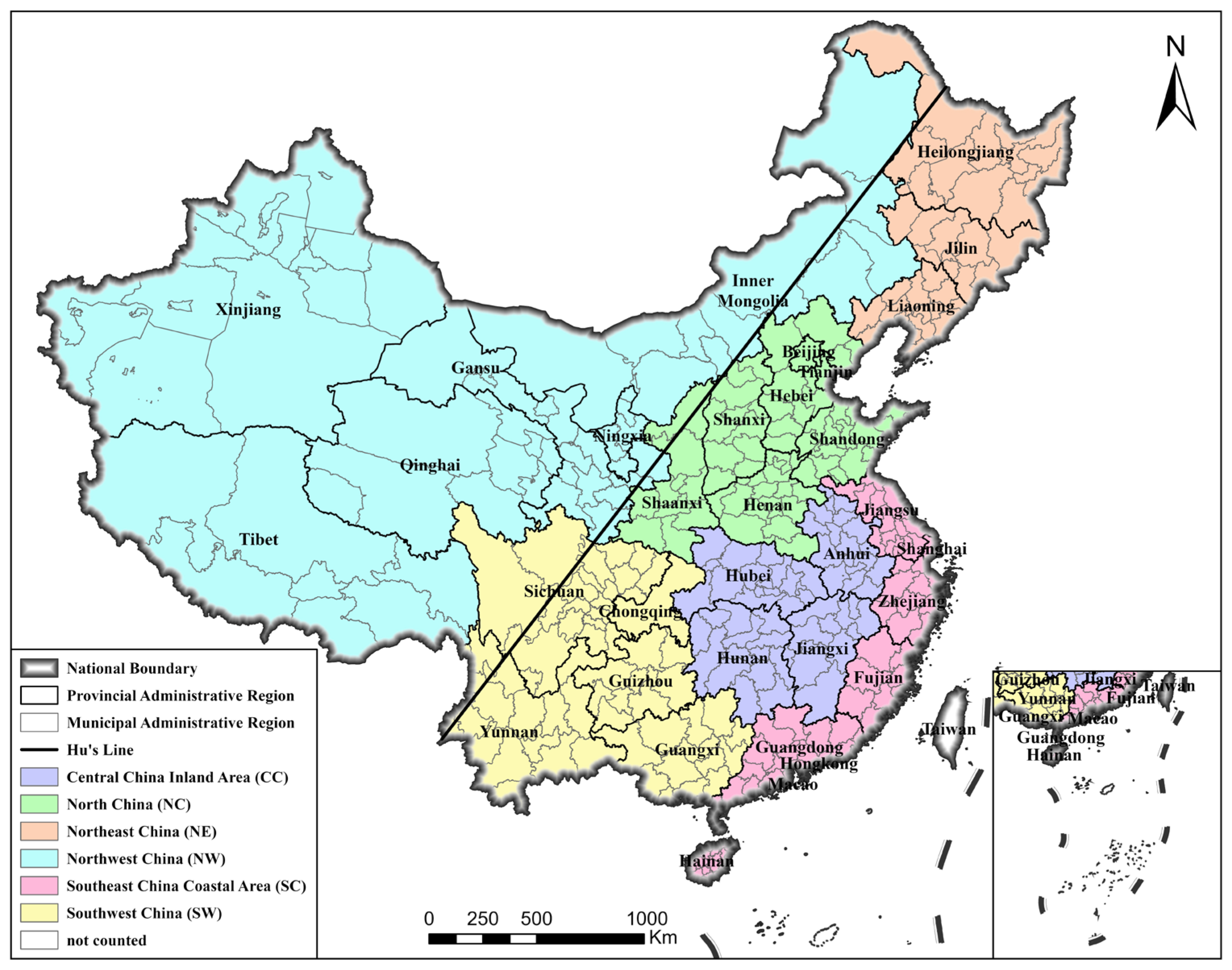
Figure 1. The regional location and scope of China, including six regions: Northwest China (NW), Northeast China (NE), North China (NC), Southwest China (SW), Central China Inland Area (CC), and Southeast China Coastal Area (SE).
Remotesensing 18 00813 g001
Figure 2. Workflow of the integrated framework for quantifying the Nighttime Lights and Population Coupling Coordination Degree (NPCCD) and identifying its driving mechanisms across China (2012–2022).
Remotesensing 18 00813 g002
Figure 3. Grid-level spatial distribution of Nighttime Light and Population Couple Coordination Degree (NPCCD) across China in (a) 2012 and (b) 2022. The color ramp shows NPCCD from low to high. Higher values indicate stronger coupling coordination. Provincial boundaries are provided for reference, and Hu’s Line is overlaid to indicate the classic northwest–southeast demographic divide.
Remotesensing 18 00813 g003
Figure 4. Municipal-level Nighttime Light and Population Couple Coordination Degree (NPCCD) across China in (a) 2012 and (b) 2022. The color ramp shows NPCCD from low to high. Higher values indicate stronger coupling coordination. Provincial boundaries are provided for reference, and Hu’s Line is overlaid to indicate the classic northwest–southeast demographic divide.
Remotesensing 18 00813 g004
Figure 5. Spatial trends of Nighttime Light and Population Couple Coordination Degree (NPCCD) in China from 2012 to 2022. The slope is categorized into five classes, including declined, moderately declined, unchanged, moderately improved, and improved, to indicate areas with decreasing, stable, or increasing coordination over time. Provincial administrative boundaries are provided for geographic reference.
Remotesensing 18 00813 g005
Figure 6. Classification of Nighttime Light and Population Couple Coordination Degree (NPCCD) trends and their regional proportions in China. The figure presents the classification of NPCCD trends into five categories: declined, moderately declined, unchanged, moderately improved, and improved. The stacked bar chart represents the percentage of each category for six regional divisions, including Northwest China (NW), Northeast China (NE), North China (NC), Southwest China (SW), Central China Inland Area (CC), and Southeast China Coastal Area (SE), as well as the overall national trend (China). The values displayed within each bar show the percentage of each trend class within that region.
Remotesensing 18 00813 g006
Figure 7. Local spatial clustering (LISA) of Nighttime Light and Population Couple Coordination Degree (NPCCD) trends in China. The map highlights areas with significant clustering of NPCCD trends, identified as High-High clusters, Low-Low clusters, and outliers such as High-Low outliers and Low-High outliers. Administrative boundaries for Provincial and Municipal divisions are provided for spatial reference.
Remotesensing 18 00813 g007
Figure 8. Performance of (a) Light Gradient Boosting Machine (LightGBM), (b) Extreme Gradient Boosting (XGBoost), and (c) Categorical Boosting (CatBoost) in estimating NPCCD. Panels (ac) present scatter plots comparing the predicted versus actual NPCCD values for LightGBM, XGBoost, and CatBoost, respectively. The dashed black line represents the ideal 1:1 line, while the blue line indicates the best-fit line through the data points. The goodness of fit for each model is evaluated by the R2, Root Mean Square Error (RMSE), and Mean Absolute Error (MAE) values shown in the upper left corner of each panel.
Remotesensing 18 00813 g008
Figure 9. Feature importance and Shapley Additive Explanations (SHAP) summary plot for Nighttime Light and Population Couple Coordination Degree (NPCCD). (a) The importance of the features. The bar plot shows the mean SHAP values for each explanatory feature used in predicting NPCCD, indicating the importance of each feature. The inset pie chart illustrates the proportion of SHAP values attributed to each feature. (b) SHAP summary plot that explains the contribution of each feature to NPCCD. The SHAP summary plot shows the distribution of SHAP values for each feature, highlighting their impact on the model’s output. Each point represents a SHAP value for a feature in the dataset, with red representing high values and blue representing low values. The plot reveals the direction and magnitude of the influence each feature has on the predicted NPCCD values.
Remotesensing 18 00813 g009
Figure 10. Shapley Additive Explanations (SHAP)-based dependence plots of Nighttime Light and Population Couple Coordination Degree (NPCCD) on key features. Each panel depicts the marginal relationship between one feature and the model output in terms of SHAP value (y-axis), where positive (negative) SHAP values indicate that the feature increases (decreases) the predicted NPCCD. The x-axis shows the feature value for Population Density (PD), Human Capital Level (HCL), Industrial Structure Upgrading (ISU), Degree of Fiscal Decentralization (DFD), Educational Expenditure Level (EEL), Opening-up Level (OL), Urbanization Rate (UR), Degree of Government Intervention (DGI), Social Consumption Level (SCL), Economic Development Level (EDL), Fiscal Investment Intensity (FII), and Health Service Level (HSL). The solid curve represents the smoothed SHAP dependence, and the shaded band indicates the uncertainty range around the fitted relationship. Vertical red dashed lines mark statistically identified threshold points in the feature effect, and the horizontal dashed line at SHAP = 0 indicates the baseline with no net contribution to NPCCD.
Remotesensing 18 00813 g010
Figure 11. Top 20 interaction strengths between features based on Shapley Additive Explanations (SHAP) values. The x-axis indicates interaction intensity, quantified as the mean absolute SHAP interaction value for each feature pair, while the y-axis lists the corresponding pairs. Larger values denote stronger non-additive effects, meaning that the combined influence of two features on NPCCD cannot be explained by summing their individual contributions. Numeric labels at the end of each bar report the interaction intensity for that pair.
Remotesensing 18 00813 g011
Figure 12. Shapley Additive Explanations (SHAP) interaction effects of Nighttime Light and Population Couple Coordination Degree (NPCCD) for four key feature pairs. (a) Industrial Structure Upgrading (ISU) and Population Density (PD), (b) Population Density (PD) and Urbanization Rate (UR), (c) Industrial Structure Upgrading (ISU) and Human Capital Level (HCL), (d) Degree of Fiscal Decentralization (DFD) and Population Density (PD). In each panel, the x-axis shows the value of the primary feature. Scatter points represent samples, and point color indicates the value of the interacting feature. The right y-axis reports the SHAP interaction value, where positive values indicate that the joint effect of the two features increases the predicted NPCCD beyond their additive main effects. Gray bars show the sample distribution along the x-axis (left y-axis). To illustrate nonlinear interaction patterns, samples are split into low- and high-value groups of the interacting feature, and separate smoothed curves are fitted for each group with shaded uncertainty bands. Vertical dashed lines mark key turning points where interaction effects change notably.
Remotesensing 18 00813 g012
Table 1. Definitions, calculation methods and Variance Inflation Factor (VIF) of the 12 key indicators.
VariablesDefinitionCalculation MethodVIF
PDPopulation Densityln (Registered Population/Land Area) *2.02
EDLEconomic Development Levelln (Gross Domestic Product/Population) *4.11
OLOpening-up LevelForeign Direct Investment/Gross Domestic Product1.37
URUrbanization RateUrban Population/Registered Population1.69
DGIDegree of Government InterventionLocal Fiscal Expenditure/Gross Domestic Product 3.00
FIIFiscal Investment IntensityFixed Asset Investment/Government Expenditure 1.32
DFDDegree of Fiscal DecentralizationFiscal Revenue/Fiscal Expenditure3.91
ISUIndustrial Structure Upgrading1·S1 + 2·S2 + 3·S3
(S1, S2, S3 = shares of primary/secondary/tertiary industries)
2.89
EELEducational Expenditure LevelEducation Expenditure/Government Expenditure1.69
HCLHuman Capital LevelHigher Education Students/Total Population2.01
HSLHealth Service LevelNumber of Hospital Beds per 100 persons2.78
SCLSocial Consumption LevelTotal Retail Sales/Gross Domestic Product 1.48
* PD and EDL are log-transformed to reduce scale differences and improve comparability.
Table 2. Mean NPCCD levels and trend characteristics in effective, persistent and newly added coupling regions across China and its six major regions.
RegionMean NPCCD in Effective Regions in 2012Mean NPCCD in Effective Regions in 2022Mean NPCCD in Persistent Regions in 2012Mean NPCCD in Persistent Regions in 2022Mean NPCCD in Newly Added Regions in 2022Mean NPCCD Trend in Effective Regions
NC0.0541 0.0551 0.0571 0.0673 0.0344 0.0010
NE0.0502 0.0368 0.0547 0.0542 0.0223 0.0002
SE0.0700 0.0723 0.0719 0.0941 0.0348 0.0016
CC0.0529 0.0557 0.0569 0.0758 0.0366 0.0014
SW0.0503 0.0495 0.0575 0.0677 0.0323 0.0009
NW0.0358 0.0350 0.0426 0.0487 0.0237 0.0006
China0.05350.05250.0583 0.0703 0.0308 0.0010
Disclaimer/Publisher’s Note: The statements, opinions and data contained in all publications are solely those of the individual author(s) and contributor(s) and not of MDPI and/or the editor(s). MDPI and/or the editor(s) disclaim responsibility for any injury to people or property resulting from any ideas, methods, instructions or products referred to in the content.