


Highlights
What are the main findings?
- We propose a deep learning-based pixel-wise interferogram quality assessment method that generates spatially continuous quality probability maps from unwrapped InSAR interferograms.
- The proposed ConvNeXt-InSAR model effectively captures local phase noise and decorrelation patterns, outperforming traditional coherence-based quality indicators.
What are the implications of the main findings?
- The pixel-level quality probability maps can be directly integrated as weighting matrices in time-series InSAR inversion, improving the robustness of deformation estimation.
- This method enables automated and transferable interferogram quality control, facilitating reliable large-scale tectonic deformation monitoring using InSAR time-series data.
Abstract
Time-series interferometric synthetic aperture radar (TS-InSAR) has become a widely used technique for monitoring surface deformation with high spatial and temporal resolution. The recent rise in cloud-based InSAR platforms has significantly accelerated the production of interferograms. However, the accuracy of deformation inversion remains limited by fundamental issues affecting interferogram quality, including temporal and spatial decorrelation and phase unwrapping errors. These degrading effects are most pronounced in vegetated, desert, and snow-covered terrains, which are common in active tectonic zones and thereby exert a major impact on the quality of the unwrapped phase. Traditional quality control methods are inefficient or inadequate for large-scale analysis, and discarding low-quality data reduces the inversion accuracy. To address these limitations, we developed a deep learning-based approach to automatically assess interferogram quality and integrate it into the time-series InSAR inversion workflow. We utilized Sentinel-1 interferograms generated by the COMET-LiCSAR system as the primary data source. Based on this dataset, we developed a multi-stage selection strategy for interferogram quality control, integrating loop phase closure analysis, statistical indicators (including coherence and phase standard deviation), and manual verification. As a result, we constructed a high-quality labeled dataset comprising approximately 20,000 samples. An improved ConvNeXt-InSAR model was designed and trained to automatically quantify the quality of each pixel in individual interferograms. The model generates pixel-wise quality maps, which are then incorporated as weight constraints in the time-series InSAR network inversion. The proposed method was applied to the interseismic deformation reconstruction in the central-southern Tibetan Plateau region. This study highlights the potential of deep learning-based interferogram quality assessment in facilitating large-scale, automated time-series InSAR processing.
1. Introduction
Accurate monitoring of crustal deformation is fundamental to determining the present-day deformation of active faults [1]. It provides a critical dataset for analyzing crustal stress that can further assist the seismic hazard assessment and early detection of potential geological hazards. Detecting subtle and long-term crustal deformation over regional to plate-boundary scales requires observations with wide spatial coverage [2], high temporal sampling, and millimeter-level accuracy [3]. Time-series interferometric synthetic aperture radar (TS-InSAR) is well-suited for this purpose, offering large-area coverage, high spatial resolution, all-weather operation, and near-real-time capabilities [4,5,6,7]. It has therefore become an essential technique for monitoring ground deformation across active tectonic zones [7]. To initiate such InSAR studies, multi-orbit SAR datasets acquired over several years need to be processed and analyzed [8,9]. For example, Weiss et al. [10] applied 14 tracks of the first ~5 years of Sentinel-1 SAR imagery to reconstruct the tectonic deformation over the Anatolia region (approximately 800,000 km2).
With the development of interferometric satellite SAR, such as Sentinel-1 and NISAR, along with the development of cloud computing platforms including Google Earth Engine [11], ASF HyP3 [12], and COMET-LiCS [13], the standardized interferograms can now be generated, which benefit the exploration of large-scale ground deformation. Recent studies have demonstrated the capability of massive satellite InSAR datasets and multi-temporal analysis techniques to reveal deformation patterns across multiple tectonic plates. For example, Elliott et al. [14] integrated more than 220,000 Sentinel-1 images to produce continuous surface velocities and strain rates across the entire Alpine–Himalayan Belt—spanning over 11,000 km and more than 20 million square kilometers at ~1 km resolution. It further highlights the necessity of high-quality interferogram inputs in time-series analysis.
Nevertheless, various factors [15], such as SAR geometric distortions, temporal–geometric decorrelations, and processing errors (e.g., unwrapping errors), jointly deteriorate the quality of the interferometric phase, further limiting the reliability of the deformation results [16]. To be more specific, temporal and spatial decorrelation [17] are particularly severe in naturally covered areas (e.g., vegetation, desert, snow/ice), significantly reducing the phase signal-to-noise ratio (SNR). Phase unwrapping errors are prone to occur in high-noise areas and regions with large deformation gradients, leading to phase jumps of integer multiples of 2π [18]. The phase jump can accumulate and propagate in space and time, obscuring the true deformation characteristics. To balance automation and efficiency, most current InSAR cloud platforms adopt standardized processing workflows [19]; therefore, it is necessary to initiate automated quality control (QC) of massive interferograms and to quantitatively integrate the QC results into the time-series InSAR analysis workflow [20].
In recent years, deep learning has been applied to multiple stages of InSAR data processing [21,22,23]. Mukherjee et al. [24] introduced convolutional neural networks (CNNs) for phase filtering and coherence estimation. Wu et al. [25] proposed PUNet, which learns a direct mapping from the wrapped to unwrapped phase to achieve phase unwrapping of InSAR interferograms. Chen et al. [26] employed an ARU-Net for atmospheric delay correction, further validating the feasibility of deep learning techniques in InSAR data processing. Rouet-Leduc et al. [27] proposed a deep learning-based InSAR time-series method for the identification of interseismic deformation as small as 2 mm. Among these approaches, CNNs employ a data-driven approach to learn feature representations. They are capable of extracting complex spatial texture patterns within interferograms [28]. Furthermore, they demonstrate strong robustness against noise and phase discontinuities, offering a new solution for InSAR data quality assessment. Nevertheless, the application of deep learning to InSAR quality assessment still faces several challenges [29]. On the one hand, the lack of large-scale, high-quality labeled datasets of interferogram quality limits the training effectiveness of models [30]. On the other hand, how to effectively integrate the quality evaluation results from deep learning into automated time-series InSAR processing workflows remains challenging.
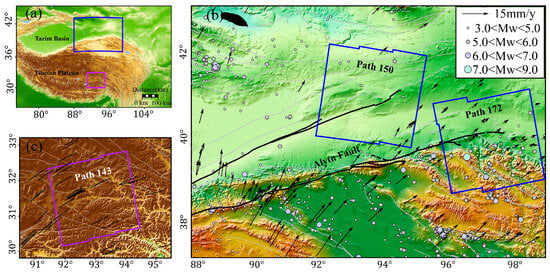
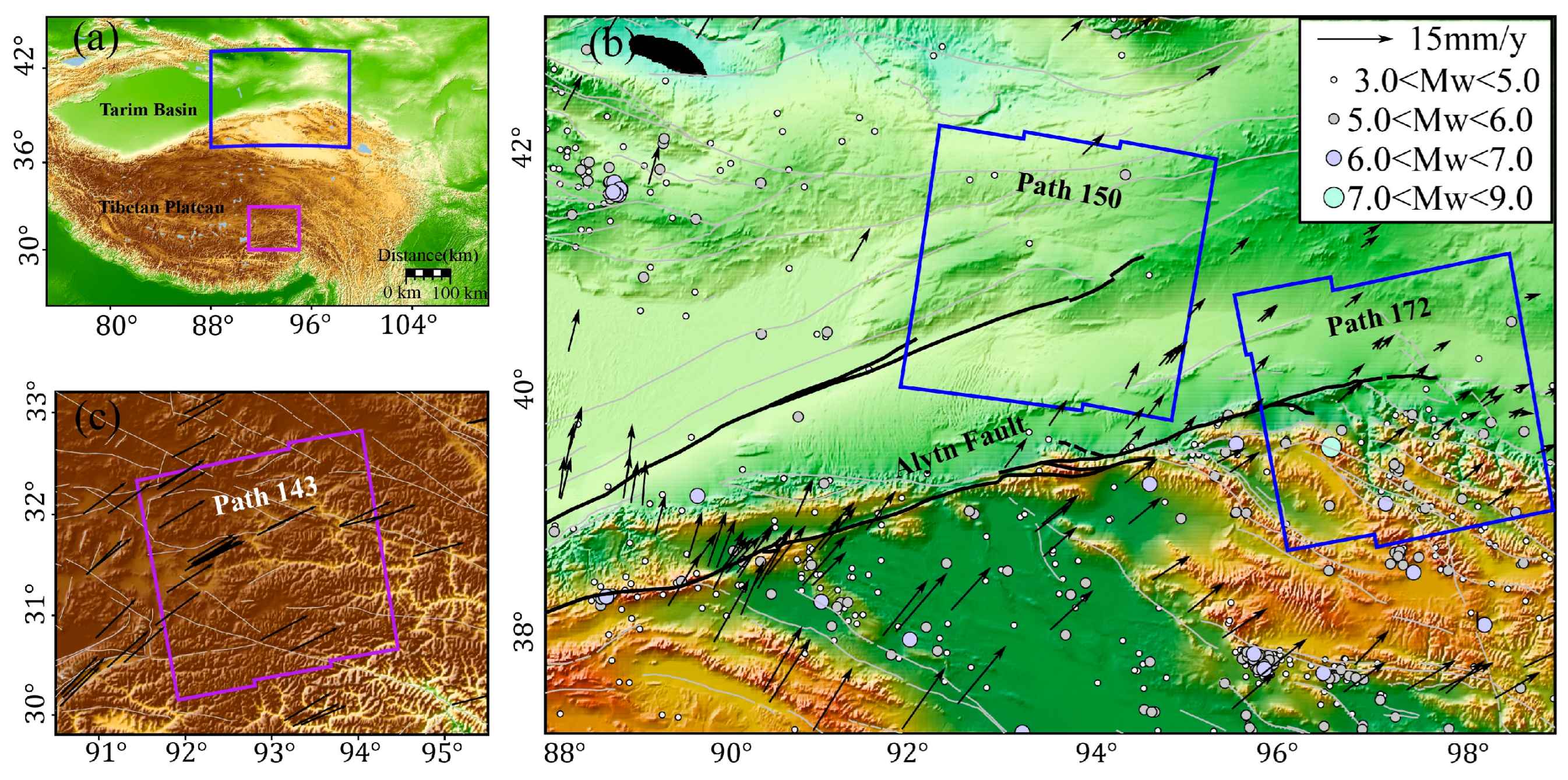
Therefore, focusing on the application of monitoring interseismic deformation along active faults, this study proposes an automated, deep learning-based quality assessment method that can further quantitatively assist the InSAR time series analysis. In Section 2, we describe the approach of the high-quality labeled dataset generation and architecture of the employed convolutional neural network. The strategy for the deep learning-assisted InSAR time series analysis is also presented in the same section. In Section 3, we demonstrate the ability of the proposed strategy to measure the present-day interseismic deformation of the central-southern Tibetan Plateau region (Figure 1). We further discuss the testing results of the proposed strategy in Section 4 and summarize the study in Section 5.
Figure 1.
Overview of the test area and dataset. (a) Location of the study area on the Tibetan Platea. (b) Enlarged view of the blue rectangle in (a), representing the training sample collection region from Sentinel-1 data. (c) Enlarged view of the purple solid rectangle in (a), indicating the test region.
2. Methods and Materials
2.1. Methodology
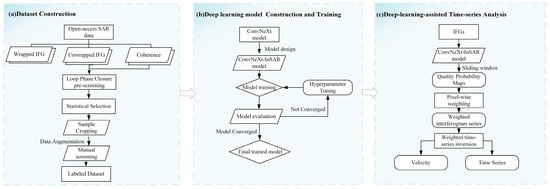
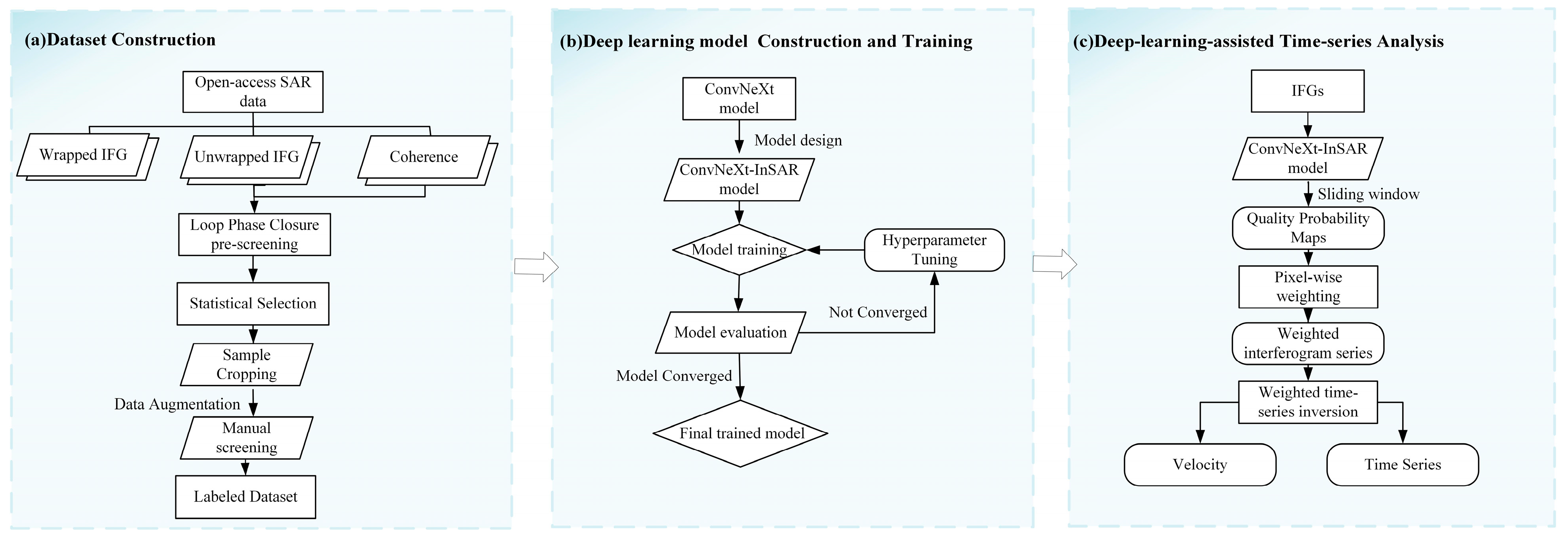
The overall methodology workflow is illustrated in Figure 2. In the development of the deep learning-based interferogram quality assessment approach, we first constructed a high-quality labeled real-world dataset comprising approximately 20,000 samples, using open-access unwrapped interferograms as the data source. An improved ConvNeXt-InSAR model was then constructed and trained for interferogram quality assessment, building upon the convolutional neural network architecture of ConvNeXt. The output from the deep learning model is a pixel-wise quality probability, which is further used as a weight factor in the time-series inversion to derive interseismic deformation rates.
Figure 2.
Overall technical workflow.
2.1.1. Generation of Training Dataset from Real InSAR Data
A high-quality, large-scale training dataset is a decisive factor in the performance of deep learning models. A sufficient number of training samples can effectively prevent overfitting and enhance the model’s generalization and recognition accuracy under complex surface deformation scenarios. In this study, a high-quality dataset containing 19,614 original samples was constructed from unwrapped interferograms. Data augmentation was subsequently applied to further enhance the suitability of the dataset for deep learning applications. All the samples are sized 224 × 224 pixels [31] to balance computational efficiency with spatial contextual information acquisition.
Data Selection
Given the large number of datasets, we developed a two-stage process consisting of an automated pre-selection and a manual inspection.
(1) Pre-identification based on loop phase closure and interferometric phase statistics.
The loop phase closure principle was proposed to perform an internal phase consistency check in a redundant interferometric network [32]. In InSAR time-series analysis, any three SAR acquisitions and (satisfying ) can form a differential interferometric triplet composed of interferograms (, , ). The theoretical closure phase, , should be zero [33]:
The loop phase closure check is theoretically effective for isolating phase unwrapping errors. However, its practical application is often challenging in low-coherence areas, due to the high data redundancy and the fully connected network required for reliable loop formation [34], which is difficult to achieve in such environments. Additionally, variations in surface scattering properties can also introduce a systematic closure phase to deviate from zero [35]. Nevertheless, such deviation should not exceed 2π [36]. Therefore, a root-mean-square (RMS) threshold of 1.5 rad was adopted in this study [37]. Interferograms with RMS values above the threshold were preliminarily classified as negative sample candidates, while those below the threshold were classified as positive sample candidates.
To further improve the quality of the training samples, a secondary refinement step was performed based on phase coherence and standard deviation [38,39]. The coherence coefficient is a key indicator of the signal-to-noise ratio (SNR) in InSAR data processing [40]; higher coherence values indicate better phase consistency and higher data quality, which is particularly critical for detecting subtle interseismic deformation. The coherence threshold was set to 0.3 [38,41] in order to avoid decorrelated and unreliable pixels. The phase standard deviation (STD) [42] quantifies the localized noise condition of interferometric phase values and was incorporated as a supplementary metric [43]. We focused on the interseismic-related deformation and did not expect a large spatial deformation gradient; therefore, the phase standard deviation threshold has been set to approximately 1.2 rad [44] to reject noise pixels. Testing showed that this threshold configuration can effectively balance sample quality and sample quantity while maintaining a high SNR and strong spatial phase continuity, and was therefore adopted. This combined approach ensures that positive samples maintain both a high signal-to-noise ratio and strong spatial phase continuity.
(2) Manual inspection.
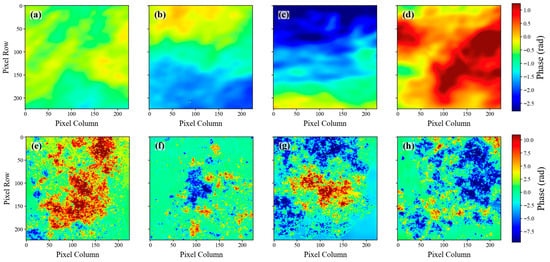
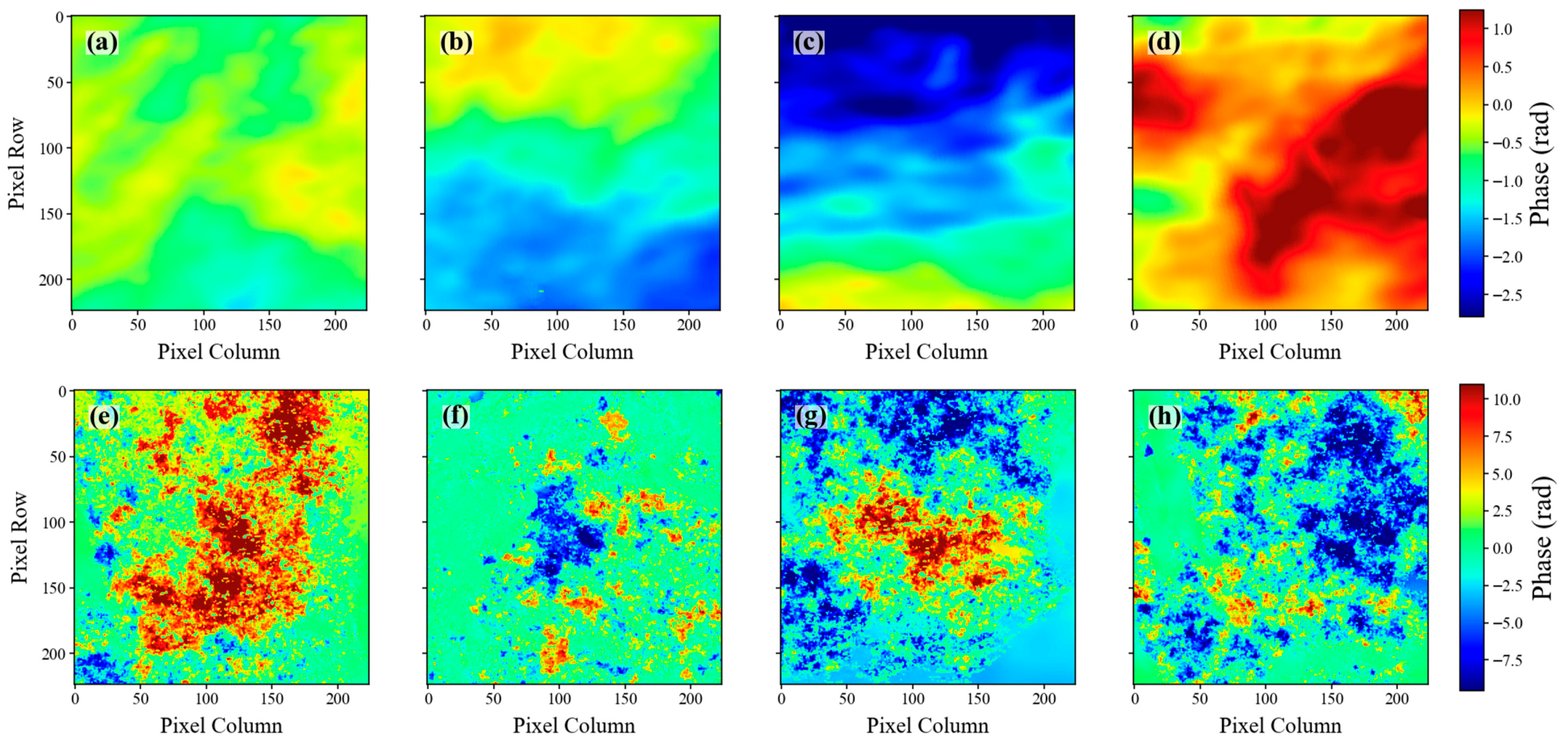
The manual visual inspection was conducted to remove samples that were incorrectly classified during the automated processing stage. In this step, particular attention was given to samples containing boundary pixels, given that the data samples were generated from geocode unwrapped interferograms. Due to the resampling issues, such boundary pixels often contain distortions; therefore, their labeling reliability was carefully assessed and, if necessary, they were excluded from the dataset. Examples of positive and negative samples in the dataset are shown in Figure 3.
Figure 3.
Examples of training samples (a–d). Positive samples with spatially continuous phase fringes. (e–h) Negative samples exhibiting common quality issues, including severe decorrelation noise and localized phase discontinuities.
The positive samples demonstrate phase with spatial continuity, visually presenting as smooth tonal transitions without abrupt discontinuities [45]. In contrast, negative samples, e.g., those affected by phase unwrapping errors or geometric decorrelation, display visual anomalies that can be represented as abrupt color shifts.
Data Augmentation and Transfer Learning
Data augmentation is a technique employed in machine learning to expand datasets [46]. Its essence lies in generating new data to enhance the sufficiency and diversity of training data, thereby reducing the risk of model overfitting. Through operations such as cropping, flipping, and color space transformation, image samples can be expanded by a factor of several times for training [47]. We therefore employ a data augmentation technique to increase data diversity by applying transformations to the original data, including random rotation, flipping, translation, and their combinations.
In addition to standard data augmentation, a simple transfer learning strategy was adopted to improve the applicability of the model to the final test area. The training region and the test region are geographically far apart and exhibit notable differences in surface cover, coherence conditions, and deformation characteristics. Training the model only on the original dataset may therefore reduce its performance when applied to the target area.
Considering these regional differences, the model was first trained using the large dataset constructed from the main training region. This dataset contains diverse interferogram quality patterns and provides a stable basis for learning the general features related to phase continuity and noise characteristics. Subsequently, a small number of samples (approximately 1000–2000 samples) from the test region were used for further training. During this stage, the parameters of the early layers were kept unchanged, while the deeper layers were updated to better adapt to the local conditions of the target area. This strategy allows the model to retain the general knowledge learned from the large training dataset while gradually adjusting to regional differences with only a limited number of additional samples.
In the end, we generated a set of ~20,000 samples, providing a solid data foundation for training the subsequent deep learning models.
2.1.2. Architecture of the ConvNeXt-InSAR Model
From a machine learning perspective, InSAR interferogram quality assessment can be naturally formulated as a pixel-wise binary classification task [24] whose objective is to determine the quality class of each pixel. Convolutional neural networks (CNNs) have emerged as the dominant approach for image classification tasks, due to their exceptional capability in image feature extraction. Early-stage AlexNet [48] first enabled the training of deep CNNs on GPUs and achieved groundbreaking accuracy on the ImageNet dataset. Subsequent architectural advancements, such as VGG-Net [49] and GoogLeNet [50], were followed by ResNet [51], which reduced the top 5 error rate to 4.5% via residual connections—marking substantial advancements in CNN performance.
Meanwhile, the vision transformer (ViT) [52] architecture based on self-attention mechanisms has demonstrated remarkable performance in image classification tasks. However, its quadratic computational complexity limits its applicability to large-scale data processing. To achieve an optimal balance between performance and efficiency, this study adopts ConvNeXt as the backbone model.
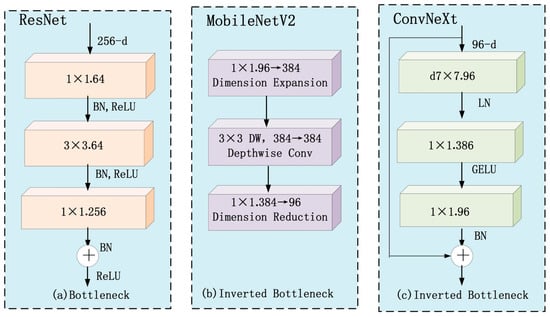
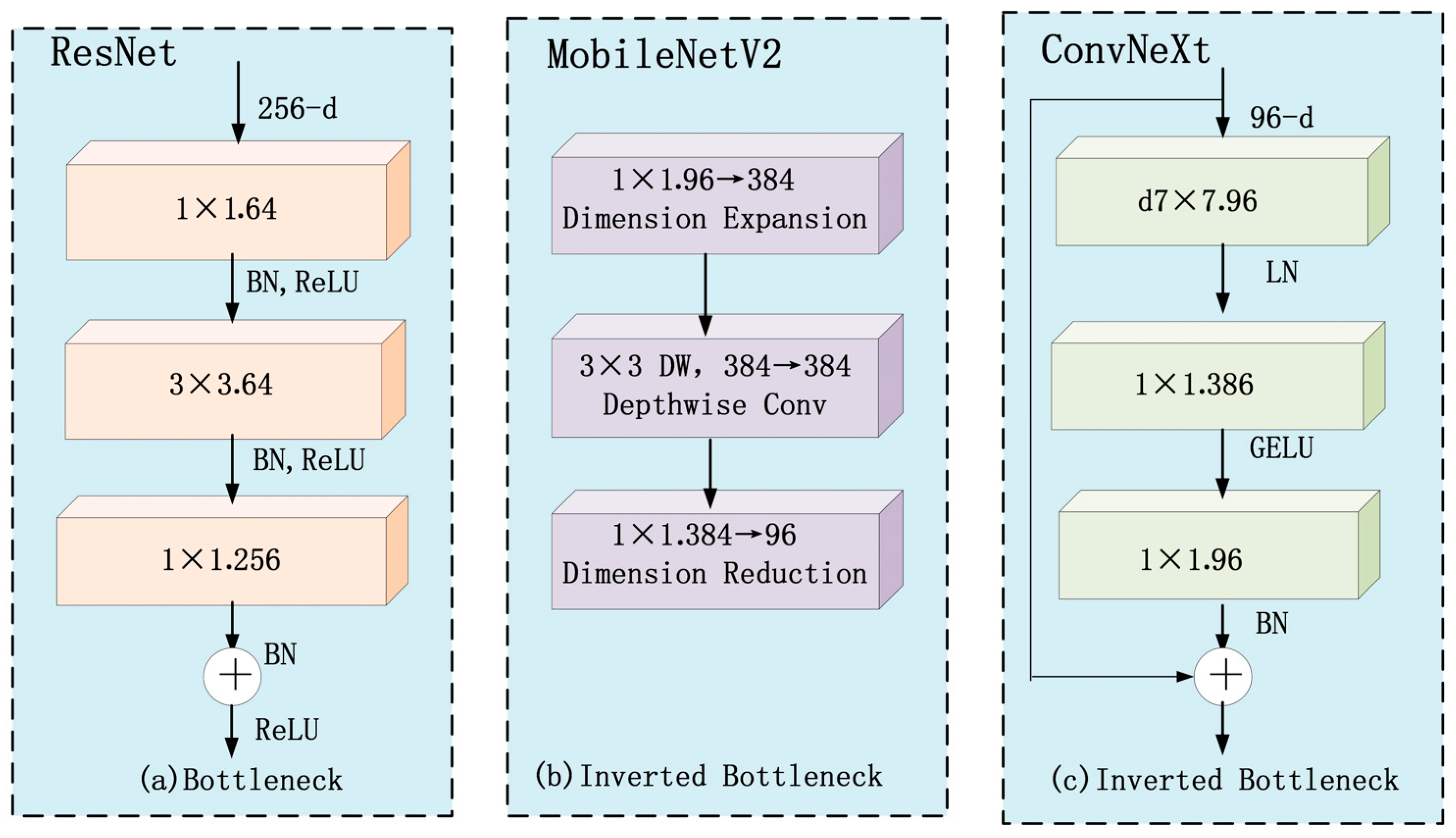
Proposed by Facebook AI Research in 2022, ConvNeXt [53] represents a modernized convolutional neural network that systematically incorporates design principles from Transformer architectures while maintaining the structural efficiency of traditional CNNs. Built upon the ResNet-50 foundation, ConvNeXt introduces a series of improvements across five key dimensions: macro design [51] optimization, depthwise separable convolutions [54], inverted bottleneck blocks [55], large kernel sizes [56], and micro design refinements. The relationships among ResNet, Transformer, and ConvNeXt can be summarized as follows [57]: ResNet established the foundation of deep residual learning, while the Transformer introduced global information aggregation through self-attention mechanisms and ConvNeXt integrates the superior design principles of the Transformer into convolutional networks. It retains the inherent computational efficiency of convolutional architectures, making it better suited for large-scale InSAR data processing. To more clearly illustrate the architectural differences that motivate the adoption of ConvNeXt as the backbone network in this study, Figure 4 provides a structural comparison of representative CNN blocks.
Figure 4.
Structural comparison of representative CNN blocks. The figure illustrates (a) the ResNet bottleneck, (b) the MobileNetV2 inverted bottleneck with depthwise separable convolution, and (c) the ConvNeXt block with large-kernel depthwise convolution and modernized design.
The choice of using ConvNeXt in InSAR interferogram quality assessment is mainly because of:
(1) Efficient pixel-wise probability generation. Unlike global classification models that produce a single prediction per image, ConvNeXt’s fully convolutional architecture naturally enables dense, pixel-wise quality probability outputs through its hierarchical feature extraction [58]. This capability is essential for generating spatially continuous quality maps that can be directly integrated as weight matrices in time-series InSAR inversion, allowing each pixel to be independently weighted based on its local quality characteristics.
(2) Large receptive fields for spatial context modeling. ConvNeXt [53,59] employs large kernel convolutions (7 × 7), which effectively capture the spatial continuity and gradual phase variations that are characteristic of high-quality interferograms [60], as well as the abrupt discontinuities that are indicative of phase unwrapping errors or decorrelation. This large receptive field enables the model to assess quality, based on both local texture and broader spatial context—a critical requirement for distinguishing subtle quality degradation patterns in InSAR data.
(3) Computational efficiency for large-scale processing. Compared to vision Transformers with quadratic complexity, ConvNeXt retains the linear computational cost of traditional CNNs while achieving comparable accuracy. This efficiency is particularly advantageous for processing continental-scale InSAR datasets comprising thousands of interferograms, making automated quality assessment practically feasible for operational monitoring systems.
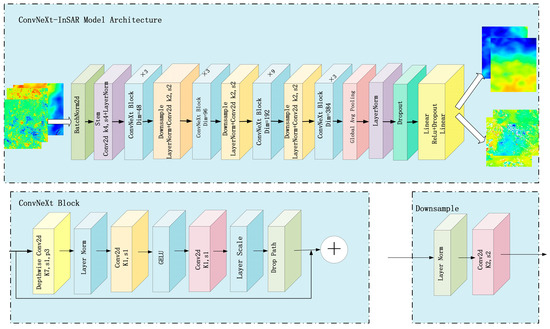
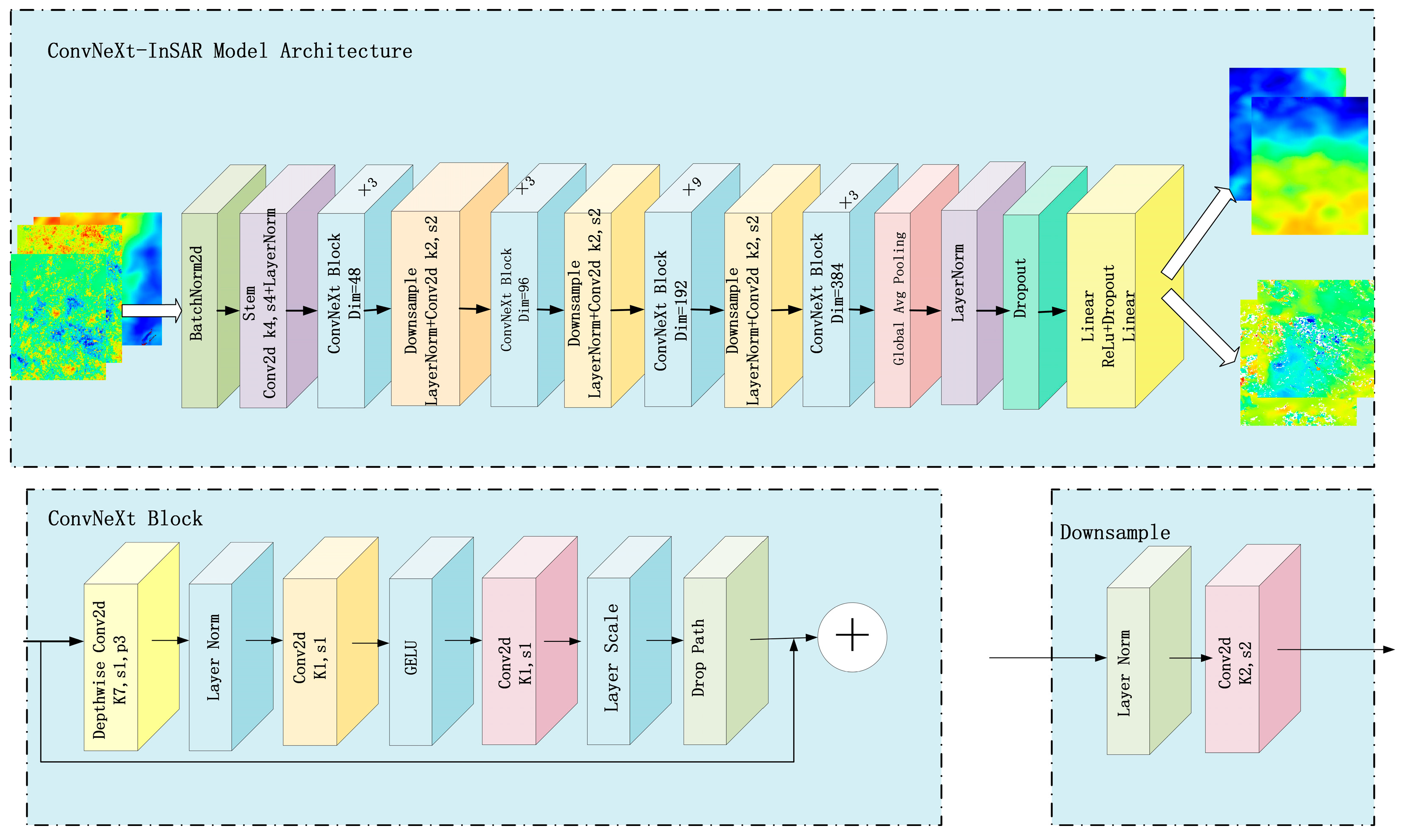
In terms of model architecture, the ConvNeXt network employed in this study was adapted for interferogram classification with the following modifications. First, the input layer was optimized by adding a BatchNorm2d layer [61] to normalize each batch of input data. This helps to prevent large variations in data magnitude and avoids the amplification of small perturbations as they propagate through multiple network layers. This normalization stabilizes the internal distribution of feature maps, ensuring numerical stability and accelerating convergence during training. Second, to make better use of computational resources, the model size was adjusted by reducing the number of channels [62] in each stage by half compared with the standard ConvNeXt configuration [63]. This maintains sufficient feature representation while improving computational efficiency, making the model more suitable for large-scale InSAR datasets. In addition, a DropPath mechanism [64,65] was added within the depthwise separable convolution blocks to improve regularization and prevent overfitting, which is essential for maintaining robustness against the decorrelation artifacts and phase noise that are typical of InSAR data. The original single-layer linear classifier of ConvNeXt was replaced with a two-layer MLP [66] head that includes a ReLU activation function and an additional Dropout layer. These changes enhance the model’s nonlinear feature learning and robustness to noise and decorrelation artifacts that are commonly found in interferograms [67]. The overall structure of the proposed ConvNeXt-InSAR model, including the above modifications, is shown in Figure 5.
Figure 5.
Architecture of the ConvNeXt-InSAR model.
2.1.3. Deep Learning-Assisted Time Series Analysis
The output of the ConvNeXt-InSAR Model is pixel-wise QC maps per each input interferogram. Here, we use these QC maps as weights in the time-series network inversion. More specifically, we applied the QC products in the NSBAS framework as a spatially varying weight matrix [68,69,70].
In this study, we employed the small baseline inversion implemented in the LiCSBAS package to derive the deformation time series [37]. Assuming we have a set of unwrapped interferograms , which are generated from images acquired at times , the incremental displacement vector can be expressed as:
where G is an M × (N − 1) design matrix describing the relationship between the network of the interferograms and incremental displacements [71], considering that the unwrapped interferogram is the sum of corresponding successive incremental displacements. In order to deal with the different coherence coverage in each interferogram, Equation (2) can be solved with singular value decomposition (SVD) [69]. It applied a temporal constraint, following the new small baseline subset (NSBAS) [70] to handle a disconnected network at each pixel and to obtain a more realistic time series. As such, a scaling factor of the temporal constrain and the assumption of linear deformation has been applied. This constraint helps to smooth the displacement time series, particularly when there are gaps in the interferogram network of each pixel.
To further improve the inversion accuracy, particularly when the interferometric data quality varies across pixels and interferograms, we integrated a deep learning output, as a pixel-wise weighting scheme, into a multi-temporal time series inversion process. The weighted least squares solution is then obtained as:
where .
In our proposed framework, the weighting matrix W is refined into a compound matrix that integrates pixel-level reliability with global interferogram quality. Specifically, for each interferogram, the final weighting matrix W is formulated as the product of a spatial probability map, , and a global scaling factor, :
To maintain sufficient network connectivity and redundancy, a down-weighting approach was adopted for low-quality interferograms instead of direct exclusion. Substandard pairs were assigned a reduced global scaling factor of 0.1. This factor effectively suppresses the impact of the noise-contaminated phase while preserving the geometric integrity of the interferometric stack. The specific threshold was determined through comparative tests, using scaling factors ranging from 0.1 to 0.0001. The results demonstrated that a scaling factor of 0.1 minimizes the influence of localized noise and phase jumps while maintaining sufficient geometric constraints within the time-series network. This scheme constrained error propagation through the network inversion. Through this weighting approach, the DL-WLS method mitigates systematic bias introduced by localized, low-quality pixels (e.g., unwrapping errors, low coherence).
2.2. Test Area and Dataset
This study employed unwrapped multi-looked interferogram Looking into Continents from Space with Synthetic Aperture Radar (LiCSAR) InSAR products [13] that can be accessed online (https://comet.nerc.ac.uk/comet-lics-portal, accessed on 1 February 2026). This interferogram has a resolution of 0.001°, which covers a time span from 2017 to 2024.
The east segment of Altyn Tagh Fault (ATF) [72], located along the northern margin of the Tibetan Plateau, was selected as the study area for dataset construction. As illustrated in Figure 1, Sentinel-1 interferograms from track 172 and track 150 were used to generate the training sample set (blue rectangles in Figure 1). The central-southern Tibetan Plateau region, specifically the area covered by Sentinel-1 ascending track 143 (purple rectangles in Figure 1c), was selected as the test area. This region is characterized by complex tectonic activities and significant topographic relief, providing a robust environment for testing the proposed deep learning-assisted time-series analysis, ensuring spatial independence between the training and validation datasets.
A total of 1316 unwrapped interferograms were selected to construct the training dataset. These interferograms span multiple years and cover all seasons, ensuring that the model is exposed to a wide range of atmospheric and surface conditions. These interferograms were used exclusively for model training and were not involved in the subsequent time-series deformation analysis. For the deformation analysis on track 143, a total of 595 unwrapped interferograms were incorporated to generate the time-series products. This dense interferometric network provides high redundancy, which is essential for mitigating phase unwrapping errors and improving the precision of the estimated displacement velocity. The ATF zone is an important tectonic boundary between the Tibetan Plateau and the Tarim Basin [72] and served as the primary region for dataset construction. Geodetic studies have shown a significant present-day slip rate of ATF [73,74,75,76]: approximately 8–10 mm/yr in the western segment, which drops sharply to about 2 mm/yr eastward near 95°E. This active deformation environment provides a rich variety of displacement features for model training. In addition, a limited number of samples from the southern Tibetan Plateau were also included in the training dataset to improve the diversity of surface and deformation conditions. For time-series validation, we focused on ascending track 143 located in the south-central Tibetan Plateau. This region lies within the hinterland of the plateau and the eastern segment of the Himalayan seismic belt. It is characterized by intense neotectonic movements, frequent seismic activity, and complex topographic relief. The surface cover includes many different types, such as grasslands, lakes, and glaciers. These diverse conditions, combined with the active tectonic motion, make phase unwrapping and atmospheric noise correction difficult. Therefore, this region provides an ideal foundation for testing the performance of our deep learning-assisted method in extracting accurate deformation signals from large-scale InSAR datasets.
3. Results
3.1. Model Performance Evaluation
To quantitatively evaluate the performance of the ConvNeXt-InSAR model in automated interferogram quality assessment, this section details the training procedure and key parameter configurations. To reduce the risk of overfitting, several regularization strategies were incorporated into the convolutional neural network to enhance the generalization capability. During training, extensive experiments and parameter tuning were conducted on critical hyperparameters—including the number of network layers, convolutional filters, learning rate, and batch size—to determine the optimal configuration.
The model was trained using a mini-batch gradient descent with a mini-batch size of 64, optimized by the AdamW [77] (Adam with Weight Decay) optimizer. We employed the standard Cross-Entropy Loss function for training. To mitigate potential bias arising from class imbalance between high- and low-quality pixels, we implemented a balanced sampling strategy during the dataset construction phase (as described in Section 2.1). The initial learning rate was set to 0.0001, and training was conducted for 80 epochs. The initial learning rate was set to 0.0001, and training was conducted for 80 epochs. The training experiments were carried out on a workstation equipped with an Intel Core i7-13700K CPU and a GeForce RTX 3090 Ti GPU, while testing and validation were performed on another workstation configured with an Intel Core i7-13700H CPU and an NVIDIA GeForce RTX 3090 Ti GPU. All experiments were implemented using the PyTorch 1.12 deep learning framework. The detailed hyperparameter settings are listed in Table 1.
Table 1.
Model hyperparameter configuration.
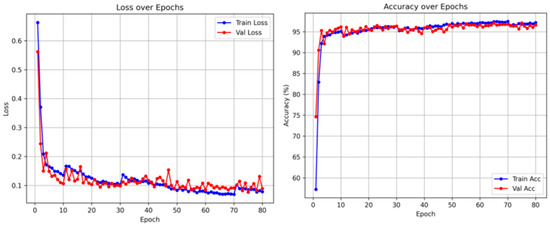
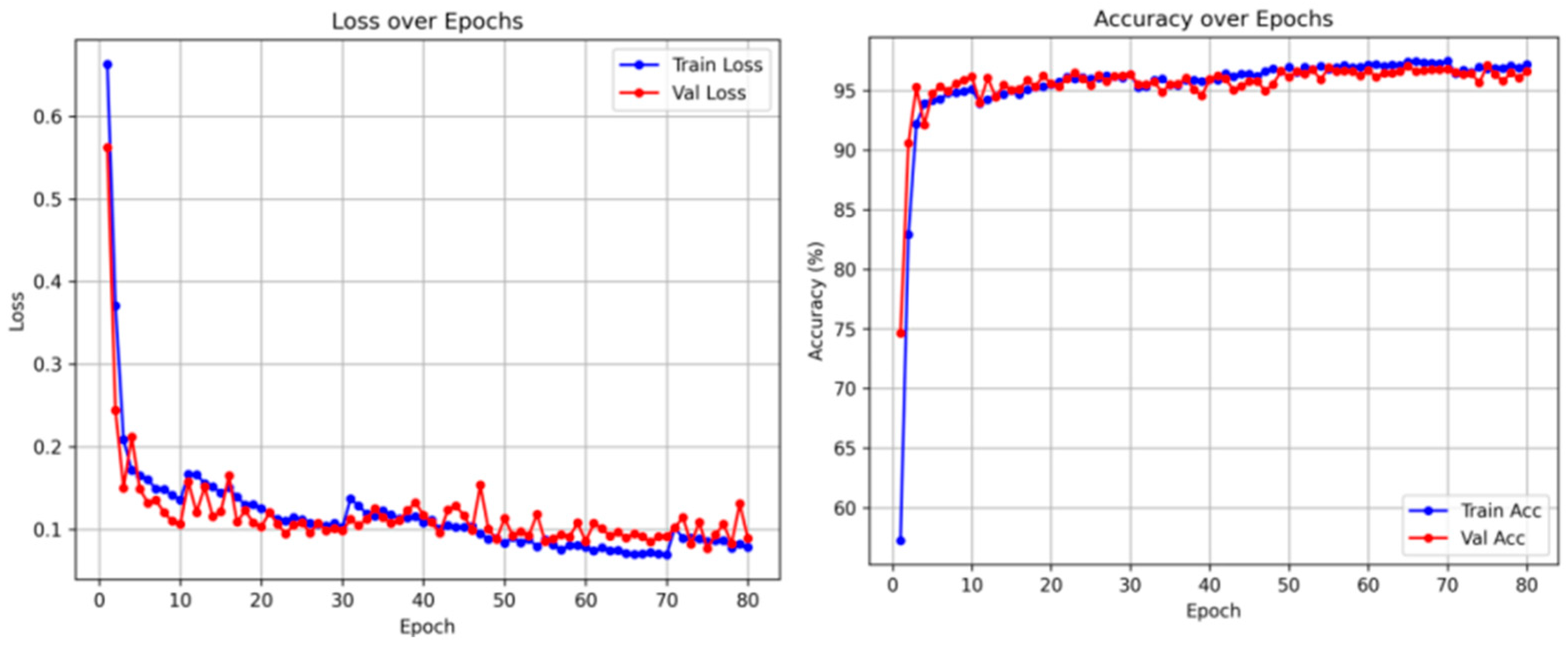
As seen in Figure 6, both the training and validation losses dropped rapidly at the beginning, indicating that the learning rate and optimizer configuration were appropriate and that the model was efficiently learning from the data. As training continues, the loss gradually stabilized around 0.1, suggesting that the network had learned the key discriminative features of the interferograms and reached a stable convergence stage [78]. The training and validation loss curves remained close throughout training, with only slight fluctuations caused by random batch differences or validation data variations. This consistency showed that the model does not suffer from overfitting and maintains good generalization performance. The accuracy curves also demonstrated fast improvement in the early epochs and stabilized at around 96% after approximately 10 epochs. The close match between training and validation accuracy indicated that the ConvNeXt-InSAR model effectively learned meaningful spatial features from interferograms and achieved reliable classification of high- and low-quality interferograms.
Figure 6.
Training loss and accuracy curves for the ConvNeXt-InSAR model.
3.2. Quality Assessment of True InSAR Interferograms
To validate the effectiveness of the proposed interferogram quality assessment method in practical applications, this section selects the central-southern Tibetan Plateau region as a representative study area for case analysis, with a spatial extent spanning 91°E–95°E and 30°N–33°N. This area exhibits complex surface cover types (bare rock, grassland, and snow cover) with significant spatial and temporal variations in coherence. Such complexity often leads to local decorrelation and phase unwrapping errors, making it an ideal testing ground for method validation.
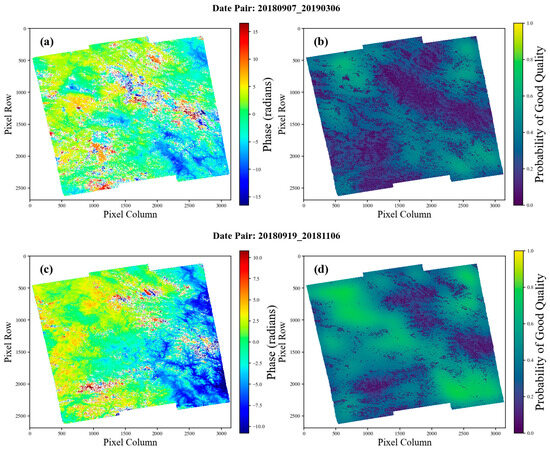
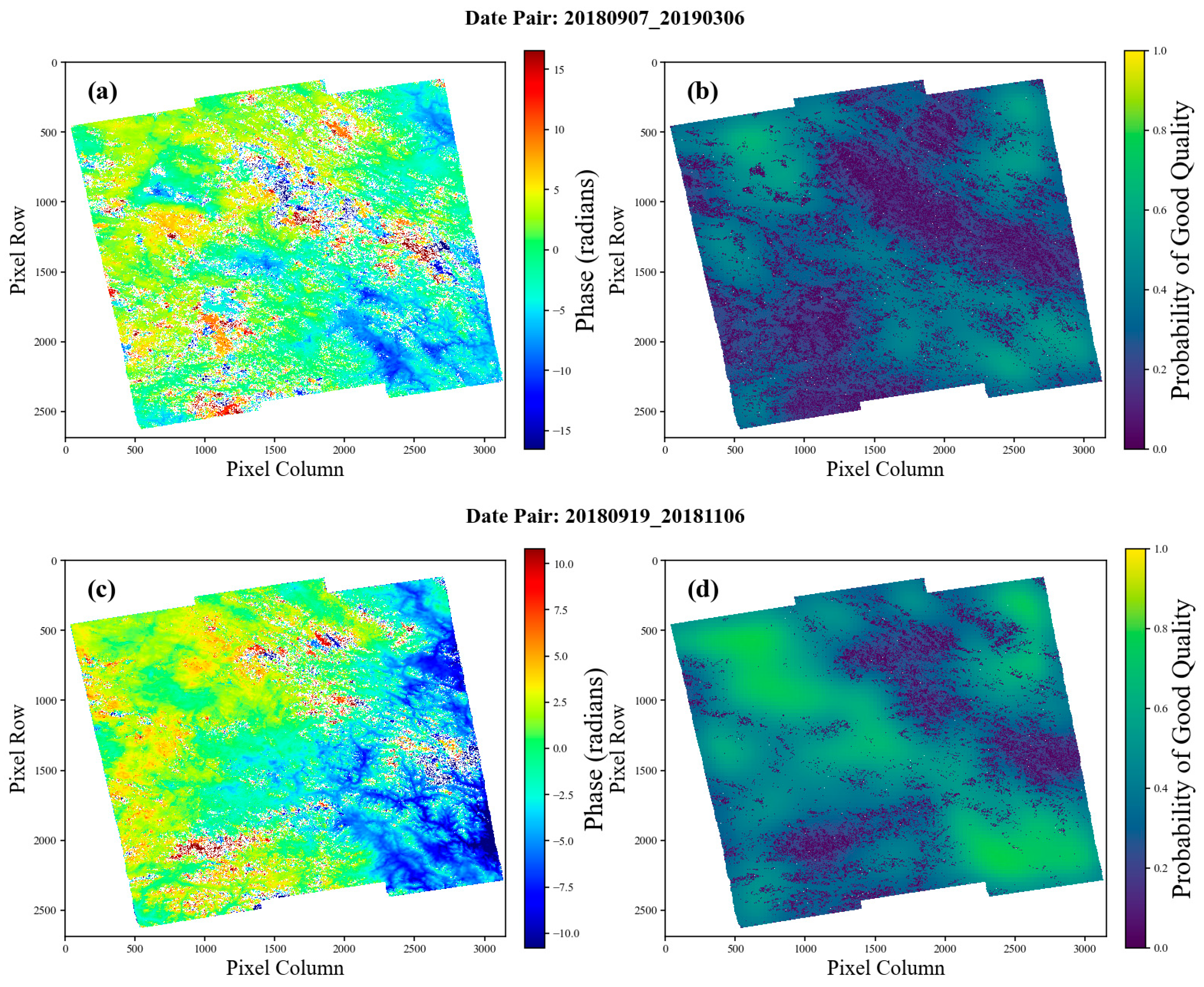
Given that the spatial scale of the actual interferogram is much larger than the input size of the deep learning model, a sliding window strategy with overlapping patches [79], commonly used in remote sensing image analysis, was adopted [80]. After completing the sliding process, all patch-level predictions are aggregated to obtain the final quality probability map. The specific steps are as follows: the pretrained ConvNeXt-InSAR model is applied to the interferogram using a sliding window with a fixed stride. For each window, the model outputs a quality prediction corresponding to that patch. After completing the sliding process, all patch-level predictions are aggregated to obtain the final quality probability map. As shown in Figure 7, the probability values directly represent the model’s assessment of interferograms for each pixel, ranging from zero to one, with values closer to one indicating a higher quality. In the probability maps, high-quality areas are represented by warmer yellow and green tones, while low-quality areas are indicated by darker purple and blue colors. This probability map serves as an essential spatial weighting matrix in the subsequent time-series InSAR inversion.
Figure 7.
Model prediction results: (a,c) interferogram and (b,d) probability map.
After completing the quality assessment of the entire interferogram dataset, the resulting quality probability maps were incorporated as spatially variable weighting matrices into the weighted least squares (WLS) inversion of the multi-temporal time-series inversion to reconstruct the ground deformation history.
To quantitatively evaluate the accuracy of the deformation fields obtained by this method, we utilized GNSS observations within the study area as reference data. The validation employed the updated GNSS velocity field developed by Li et al. [81], which integrates observations from 4458 GNSS stations across mainland China and the surrounding regions. The dataset has been carefully processed to remove coseismic and postseismic effects, ensuring it represents long-term stable crustal motion patterns.
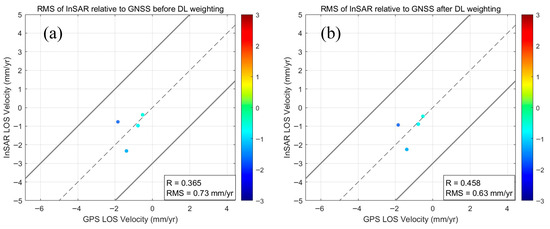
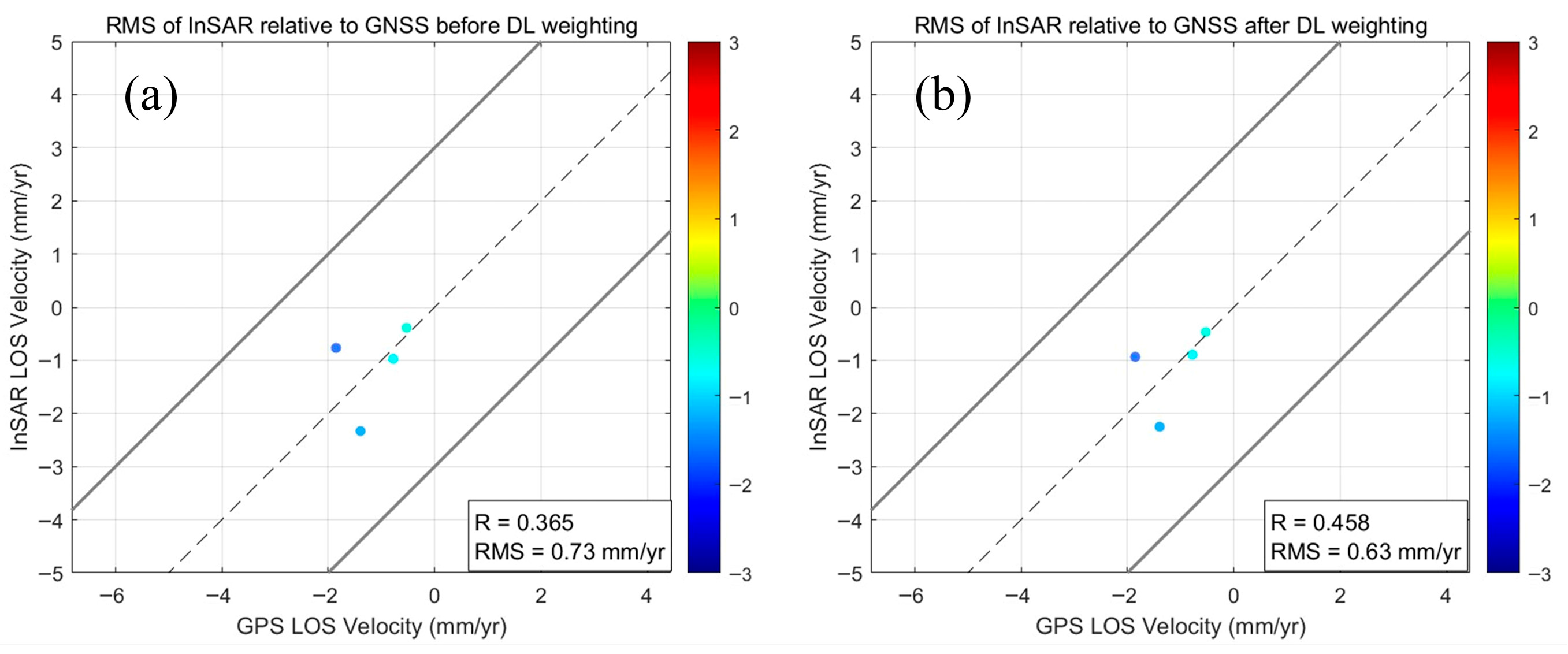
The GNSS horizontal velocity field was projected to the InSAR line-of-sight (LOS) direction for comparison 1. Figure 8 presents the scatter plots comparing InSAR and GNSS LOS velocities for both methods. The non-weighted NSBAS approach yielded an RMS difference of 0.73 mm/yr with a correlation coefficient of 0.365. Meanwhile, the DL-weighted NSBAS method achieved a lower RMS of 0.63 mm/yr and an improved correlation coefficient of 0.459. The 14% reduction in RMS and the improvement in correlation demonstrate that the quality-based weighting effectively suppresses noise and enhances agreement with independent geodetic observations.
Figure 8.
Comparison between GNSS and InSAR LOS velocities: (a) non-weighted NSBAS and (b) DL-weighted NSBAS. The solid lines indicate the error bounds.
4. Discussion
To quantitatively assess the practical effectiveness of our proposed deep learning quality control (QC) method in time-series InSAR analysis, we compared the results from the non-weighted time series inversion workflow and the deep learning–weighted workflow. Both experiments were conducted using the same interferogram network and preprocessing parameters.
The performance of the deep learning–weighted inversion is evaluated by comparing the InSAR-derived LOS deformation rates with independent GNSS measurements in the central-southern Tibetan Plateau region. The DL-weighted approach reduces the root mean square error (RMS) from 0.73 mm/yr to 0.63 mm/yr, while the correlation coefficient increases from 0.365 to 0.459. These improvements indicate that the ConvNeXt-InSAR model effectively identifies low-coherence areas and regions affected by phase unwrapping errors. Pixel-level quality probability maps are incorporated as spatial weights, and an overall quality score is used as a scaling factor, allowing low-quality pixels to be down-weighted in the velocity estimation.
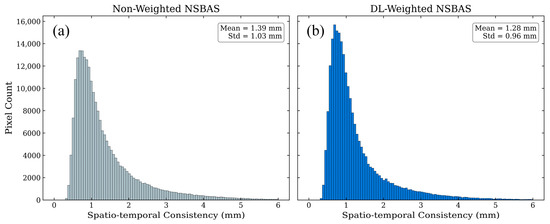
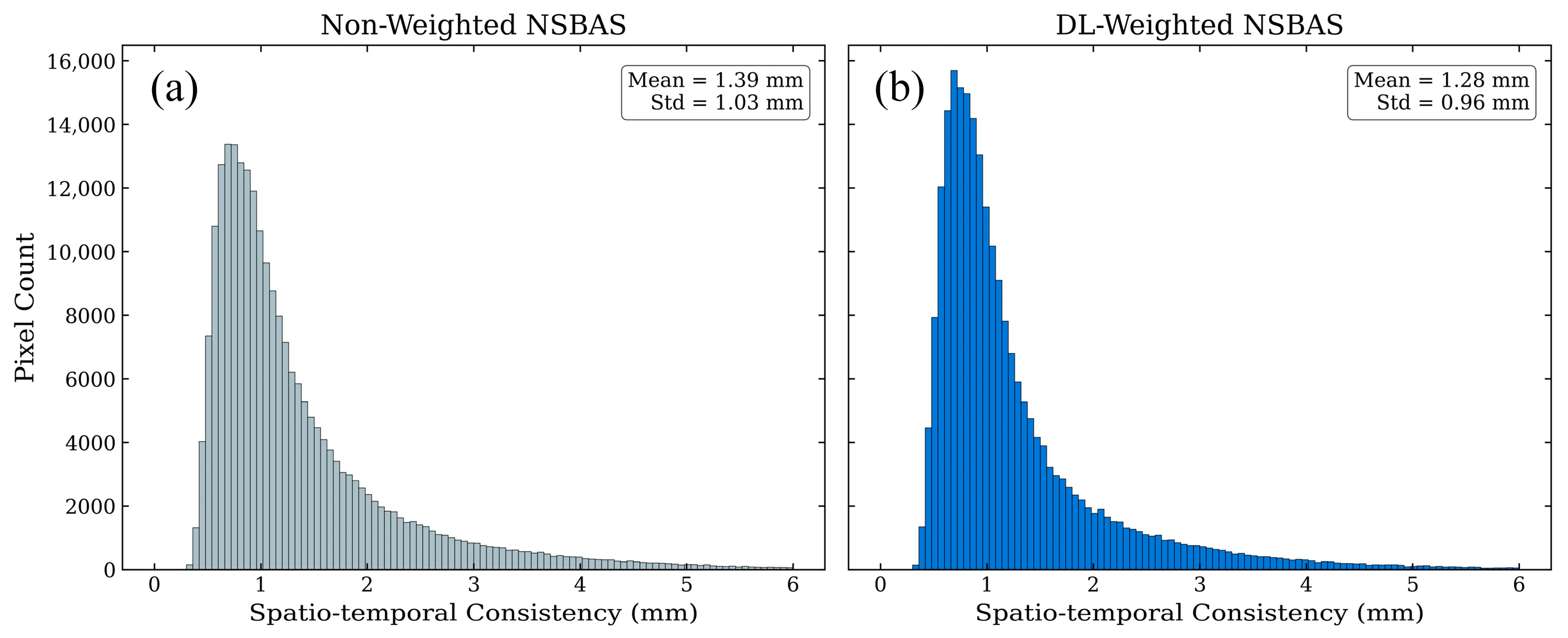
To further assess the internal reliability of the inversion results, the spatio-temporal consistency (STC) metric is employed to quantify the agreement between the reconstructed deformation time series and the original interferometric observations. As shown in Figure 9, the mean STC over the study area decreases from 1.39 mm to 1.28 mm after applying the weighted inversion, corresponding to an improvement of approximately 7.74%. The standard deviation of STC is also reduced, from 1.03 to 0.96. These improvements indicate that the weighting method effectively suppresses non-physical noise in the observations, leading to a more self-consistent displacement time series.
Figure 9.
Statistical comparison of STC: (a) non-weighted NSBAS and (b) DL-weighted NSBAS.
In the inversion workflow, the joint use of pixel-level quality probability maps and a global scaling factor mitigates error propagation caused by local phase jumps without explicitly discarding interferograms, while preserving sufficient network redundancy and geometric constraints. Through training on a large dataset of approximately 20,000 real interferogram samples, the deep learning model has learned the complex spatial morphological features of low-quality regions, including decorrelation noise and phase unwrapping errors. The ConvNeXt-InSAR model used in this study, leveraging its large convolution kernels and modern network design, maintains good stability, even in areas of complex terrain or under noisy conditions. Ultimately, the integration of deep learning quality assessment not only provides weighting constraints for InSAR inversion but also provides a new way for subsequent, automated interferogram quality assessment.
5. Conclusions
This study proposes a deep learning-based approach for improving quality control in InSAR time-series analysis. The method integrates automated interferogram quality assessment with a weighted inversion framework to enhance the reliability and stability of deformation estimation while maintaining automation and computational efficiency. The main conclusions are summarized as follows: (1) A high-quality labeled InSAR interferogram dataset containing approximately 20,000 samples was constructed using a multi-level labeling strategy that combines loop phase closure pre-identification, statistical feature discrimination, and manual inspection, providing a solid data foundation for model training. (2) The ConvNeXt-InSAR model was designed and trained, achieving a classification accuracy of over 96% in interferogram assessment. (3) A deep learning-based weighted method was proposed and its result was validated. By incorporating pixel-wise quality probability maps as spatial weights and utilizing global quality scores as scaling factors, the inversion process effectively balances noise suppression and network connectivity. The proposed method was applied to retrieve the deformation field in the central-southern Tibetan Plateau region. For large-scale tectonic applications involving a single SAR frame with thousands of interferograms, the traditional manual quality control method may require several days of processing. However, the proposed deep learning-based approach can complete the quality assessment and weighted inversion within several hours, significantly improving computational efficiency. The results demonstrate that the deep learning-assisted weighting strategy improves the consistency between the InSAR and GNSS observations. Specifically, the RMS error decreased from 0.73 mm/yr to 0.63 mm/yr, and the correlation coefficient increased from 0.365 to 0.459, confirming its effectiveness in practical tectonic deformation monitoring in complex environments. The proposed methodology—involving the construction of high-quality datasets, deep learning model identification, and pixel-by-pixel weighted inversion—provided an alternative way to initiate an automatic quality check of multi-temporal interferograms and improved the quality of time-series retrieval. However, this study also has certain limitations, particularly in handling rapidly deforming areas (e.g., glacier movement, landslides). Future work will focus on systematically expanding and labeling interferograms containing various typical high-gradient deformations, to further enhance the model’s generalization and applicability in complex deformation environments. Additionally, relying only on single-channel phase inputs may limit the model’s ability to identify multi-source noise. We also plan to incorporate multi-channel inputs, such as coherence data, to enhance feature extraction.
Author Contributions
Conceptualization, Z.L., Z.W. and W.G.; methodology, Z.L., J.H., Z.W. and W.G.; software, Z.L.; validation, Z.L., Z.W. and W.G.; formal analysis, J.H.; investigation, Z.L., Z.W. and W.G.; resources, Z.L., Z.W. and W.G.; data curation, Z.L., J.H. and W.G.; writing—original draft preparation, Z.L., J.H., Z.W., X.L. and W.G.; writing—review and editing, Z.L., J.H., Z.W., X.L. and W.G.; visualization, Z.L., Z.W. and W.G.; supervision, Z.W. and W.G.; project administration, Z.W. and W.G.; funding acquisition, W.G. All authors have read and agreed to the published version of the manuscript.
Funding
This research was funded by the National Natural Science Foundation of China (Grant No. 42174015) and the National Natural Science Foundation of China (Grant No. 42574035).
Data Availability Statement
The data that support the findings of this study are available from the corresponding author upon reasonable request.
Acknowledgments
The Sentinel-1 SAR data were freely provided by COMET LiCSAR [13]. LiCSAR contains modified Copernicus Sentinel data 2015–2024 analyzed by the Centre for the Observation and Modelling of Earthquakes, Volcanoes and Tectonics (COMET). LiCSAR uses JASMIN, the UK’s collaborative data analysis environment (https://comet.nerc.ac.uk/COMET-LiCS-portal/, accessed on 1 February 2026). InSAR time series analysis was conducted using LiCSBAS (https://github.com/yumorishita/LiCSBAS, accessed on 1 February 2026), an open-source package developed by Morishita et al. [37]. Some maps were generated using the General Map Tool (GMT) version 6 [82].
Conflicts of Interest
The authors declare no conflicts of interest.
References
- Elliott, J.; Walters, R.; Wright, T. The role of space-based observation in understanding and responding to active tectonics and earthquakes. Nat. Commun. 2016, 7, 13844. [Google Scholar] [CrossRef] [Scilit]
- Watson, A.R.; Elliott, J.R.; Walters, R.J. Interseismic Strain Accumulation across the Main Recent Fault, SW Iran, from Sentinel-1 InSAR Observations. J. Geophys. Res. Solid Earth 2022, 127, e2021JB022674. [Google Scholar] [CrossRef] [Scilit]
- Avouac, J.-P. From geodetic imaging of seismic and aseismic fault slip to dynamic modeling of the seismic cycle. Annu. Rev. Earth Planet. Sci. 2015, 43, 233–271. [Google Scholar] [CrossRef] [Scilit]
- Zebker, H.A.; Goldstein, R.M. Topographic mapping from interferometric synthetic aperture radar observations. J. Geophys. Res. Solid Earth 1986, 91, 4993–4999. [Google Scholar] [CrossRef] [Scilit]
- Biggs, J.; Wright, T.; Lu, Z.; Parsons, B. Multi-interferogram method for measuring interseismic deformation: Denali Fault, Alaska. Geophys. J. Int. 2007, 170, 1165–1179. [Google Scholar] [CrossRef] [Scilit]
- Li, Z.; Cao, Y.; Wei, J.; Duan, M.; Wu, L.; Hou, J.; Zhu, J. Time-series InSAR ground deformation monitoring: Atmospheric delay modeling and estimating. Earth-Sci. Rev. 2019, 192, 258–284. [Google Scholar]
- Xu, X.; Sandwell, D.T.; Ward, L.A.; Milliner, C.W.; Smith-Konter, B.R.; Fang, P.; Bock, Y. Surface deformation associated with fractures near the 2019 Ridgecrest earthquake sequence. Science 2020, 370, 605–608. [Google Scholar] [CrossRef] [Scilit]
- Pagli, C.; Wang, H.; Wright, T.J.; Calais, E.; Lewi, E. Current plate boundary deformation of the Afar rift from a 3-D velocity field inversion of InSAR and GPS. J. Geophys. Res. Solid Earth 2014, 119, 8562–8575. [Google Scholar] [CrossRef] [Scilit]
- Fattahi, H.; Amelung, F. InSAR observations of strain accumulation and fault creep along the Chaman Fault system, Pakistan and Afghanistan. Geophys. Res. Lett. 2016, 43, 8399–8406. [Google Scholar] [CrossRef] [Scilit]
- Weiss, J.R.; Walters, R.J.; Morishita, Y.; Wright, T.J.; Lazecky, M.; Wang, H.; Hussain, E.; Hooper, A.J.; Elliott, J.R.; Rollins, C. High-resolution surface velocities and strain for Anatolia from Sentinel-1 InSAR and GNSS data. Geophys. Res. Lett. 2020, 47, e2020GL087376. [Google Scholar]
- Mutanga, O.; Kumar, L. Google earth engine applications. Remote Sens. 2019, 11, 591. [Google Scholar]
- Hogenson, K.; Arko, S.A.; Buechler, B.; Hogenson, R.; Herrmann, J.; Geiger, A. Hybrid Pluggable Processing Pipeline (HyP3): A cloud-based infrastructure for generic processing of SAR data. In Proceedings of the AGU Fall Meeting Abstracts, San Francisco, CA, USA, 12–16 December 2016; p. IN21B-1740. [Google Scholar]
- Lazecký, M.; Spaans, K.; González, P.J.; Maghsoudi, Y.; Morishita, Y.; Albino, F.; Elliott, J.; Greenall, N.; Hatton, E.; Hooper, A. LiCSAR: An automatic InSAR tool for measuring and monitoring tectonic and volcanic activity. Remote Sens. 2020, 12, 2430. [Google Scholar]
- Elliott, J.; Fang, J.; Lazecky, M.; Maghsoudi, Y.; Ou, Q.; Payne, J.; Rollins, C.; Wang, D.; Hooper, A.; Wright, T. Deformation, strains and velocities for the alpine himalayan belt from trans-continental sentinel-1 insar & gnss. EarthArXiv Eprints 2025, X5GX6B. [Google Scholar]
- Wu, Y.-Y.; Madson, A. Error sources of interferometric synthetic aperture radar satellites. Remote Sens. 2024, 16, 354. [Google Scholar]
- Zebker, H.; Villasenor, J. Decorrelation in interferometric radar echoes. IEEE Trans. Geosci. Remote Sens. 1992, 30, 950–959. [Google Scholar] [CrossRef] [Scilit]
- Gonzalez, P.J.; Fernandez, J. Error estimation in multitemporal InSAR deformation time series, with application to Lanzarote, Canary Islands. J. Geophys. Res. Solid Earth 2011, 116. [Google Scholar] [CrossRef] [Scilit]
- Yu, H.; Xing, M.; Bao, Z. A fast phase unwrapping method for large-scale interferograms. IEEE Trans. Geosci. Remote Sens. 2013, 51, 4240–4248. [Google Scholar]
- Piter, A.; Vassileva, M.; Haghshenas Haghighi, M.; Motagh, M. Exploring cloud-based platforms for rapid insar time series analysis. Int. Arch. Photogramm. Remote Sens. Spat. Inf. Sci. 2021, XLIII-B3-2, 171–176. [Google Scholar] [CrossRef] [Scilit]
- Hu, Z.; Li, B.; Liu, Y.; Niu, X. Research on quality improvement method of deformation monitoring data based on InSAR. J. Vis. Commun. Image Represent. 2019, 64, 102652. [Google Scholar] [CrossRef] [Scilit]
- Tiwari, A.; Shirzaei, M. A novel machine learning and deep learning semi-supervised approach for automatic detection of InSAR-based deformation hotspots. Int. J. Appl. Earth Obs. Geoinf. 2024, 126, 103611. [Google Scholar] [CrossRef] [Scilit]
- Zhou, L.; Yu, H.; Lan, Y.; Xing, M. Deep learning-based branch-cut method for InSAR two-dimensional phase unwrapping. IEEE Trans. Geosci. Remote Sens. 2021, 60, 5209615. [Google Scholar] [CrossRef] [Scilit]
- Zhu, C.; Li, X.; Wang, C.; Zhang, B.; Li, B. Deep learning-based coseismic deformation estimation from InSAR interferograms. IEEE Trans. Geosci. Remote Sens. 2024, 62, 5203610. [Google Scholar] [CrossRef] [Scilit]
- Mukherjee, S.; Zimmer, A.; Sun, X.; Ghuman, P.; Cheng, I. CNN-based InSAR coherence classification. In Proceedings of the 2018 IEEE SENSORS, New Delhi, India, 28–31 October 2018; pp. 1–4. [Google Scholar]
- Wu, Z.; Wang, T.; Wang, Y.; Wang, R.; Ge, D. Deep learning for the detection and phase unwrapping of mining-induced deformation in large-scale interferograms. IEEE Trans. Geosci. Remote Sens. 2021, 60, 5216318. [Google Scholar] [CrossRef] [Scilit]
- Chen, Y.; Bruzzone, L.; Jiang, L.; Sun, Q. ARU-net: Reduction of atmospheric phase screen in SAR interferometry using attention-based deep residual U-net. IEEE Trans. Geosci. Remote Sens. 2020, 59, 5780–5793. [Google Scholar] [CrossRef] [Scilit]
- Rouet-Leduc, B.; Jolivet, R.; Dalaison, M.; Johnson, P.A.; Hulbert, C. Autonomous extraction of millimeter-scale deformation in InSAR time series using deep learning. Nat. Commun. 2021, 12, 6480. [Google Scholar] [CrossRef] [Scilit] [PubMed]
- Adegun, A.A.; Viriri, S.; Tapamo, J.-R. Review of deep learning methods for remote sensing satellite images classification: Experimental survey and comparative analysis. J. Big Data 2023, 10, 93. [Google Scholar] [CrossRef] [Scilit]
- Fontes, M.; Bakoň, M.; Cunha, A.; Sousa, J.J. Deep Learning Meets InSAR for Infrastructure Monitoring: A Systematic Review of Models, Applications, and Challenges. Sensors 2025, 25, 7169. [Google Scholar] [CrossRef] [Scilit]
- Liu, X.; Wang, Z.; Zhang, Y.; Shan, X.; Liu, Z. A Global Coseismic InSAR Dataset for Deep Learning: Automated Construction from Sentinel-1 Observations (2015–2024). Remote Sens. 2025, 17, 1832. [Google Scholar] [CrossRef] [Scilit]
- Kaplan, J.; McCandlish, S.; Henighan, T.; Brown, T.B.; Chess, B.; Child, R.; Gray, S.; Radford, A.; Wu, J.; Amodei, D. Scaling laws for neural language models. arXiv 2020, arXiv:2001.08361. [Google Scholar] [CrossRef] [Scilit]
- Michaelides, R.J.; Zebker, H.A.; Zheng, Y. An algorithm for estimating and correcting decorrelation phase from InSAR data using closure phase triplets. IEEE Trans. Geosci. Remote Sens. 2019, 57, 10390–10397. [Google Scholar] [CrossRef]
- Fan, C.; Liu, L.; Zhao, Z.; Mu, C. Pronounced underestimation of surface deformation due to unwrapping errors over Tibetan Plateau permafrost by Sentinel-1 InSAR: Identification and correction. J. Geophys. Res. Earth Surf. 2025, 130, e2024JF007854. [Google Scholar] [CrossRef] [Scilit]
- Lu, S.; Zeng, Q. InSAR closure: A simple and novel approach for identifying phase unwrapping errors using an interferogram and its reversal. Remote Sens. Lett. 2025, 16, 1012–1019. [Google Scholar] [CrossRef] [Scilit]
- Zheng, Y.; Fattahi, H.; Agram, P.; Simons, M.; Rosen, P. On closure phase and systematic bias in multilooked SAR interferometry. IEEE Trans. Geosci. Remote Sens. 2022, 60, 5226611. [Google Scholar]
- De Zan, F.; Zonno, M.; Lopez-Dekker, P. Phase inconsistencies and multiple scattering in SAR interferometry. IEEE Trans. Geosci. Remote Sens. 2015, 53, 6608–6616. [Google Scholar]
- Morishita, Y.; Lazecky, M.; Wright, T.J.; Weiss, J.R.; Elliott, J.R.; Hooper, A. LiCSBAS: An open-source InSAR time series analysis package integrated with the LiCSAR automated Sentinel-1 InSAR processor. Remote Sens. 2020, 12, 424. [Google Scholar]
- Hrysiewicz, A.; Williamson, J.; Evans, C.D.; Jovani-Sancho, A.J.; Callaghan, N.; Lyons, J.; White, J.; Kowalska, J.; Menichino, N.; Holohan, E.P. Estimation and validation of InSAR-derived surface displacements at temperate raised peatlands. Remote Sens. Environ. 2024, 311, 114232. [Google Scholar]
- Dong, L.; Wang, C.; Tang, Y.; Zhang, H.; Xu, L. Improving CPT-InSAR algorithm with adaptive coherent distributed pixels selection. Remote Sens. 2021, 13, 4784. [Google Scholar] [CrossRef] [Scilit]
- Kim, J.-R.; Lin, C.-W.; Lin, S.-Y. The use of InSAR phase coherence analyses for the monitoring of aeolian erosion. Remote Sens. 2021, 13, 2240. [Google Scholar]
- Zhang, Z.; Li, J.; Duan, P.; Chang, J. Creep identification by the baseline optimized TS-InSAR technique considering the monthly variation in coherence. Geocarto Int. 2022, 2159071. [Google Scholar] [CrossRef] [Scilit]
- Liang, H.; Zhang, L.; Lu, Z.; Li, X. Correction of spatially varying stratified atmospheric delays in multitemporal InSAR. Remote Sens. Environ. 2023, 285, 113382. [Google Scholar] [CrossRef] [Scilit]
- Liu, H.; Xie, L.; Zhao, G.; Ali, E.; Xu, W. A joint InSAR-GNSS workflow for correction and selection of interferograms to estimate high-resolution interseismic deformations. Satell. Navig. 2023, 4, 14. [Google Scholar] [CrossRef] [Scilit]
- Wegmüller, U.; Magnard, C.; Werner, C.; Strozzi, T.; Caduff, R.; Manconi, A. Methods to avoid being affected by non-zero closure phase in InSAR time series analysis in a multi-reference stack. Procedia Comput. Sci. 2021, 181, 511–518. [Google Scholar] [CrossRef] [Scilit]
- He, Y.; Zhang, G.; Kaufmann, H.; Xu, G. Automatic interferogram selection for SBAS-InSAR based on deep convolutional neural networks. Remote Sens. 2021, 13, 4468. [Google Scholar] [CrossRef] [Scilit]
- Rebuffi, S.-A.; Gowal, S.; Calian, D.A.; Stimberg, F.; Wiles, O.; Mann, T.A. Data augmentation can improve robustness. Adv. Neural Inf. Process. Syst. 2021, 34, 29935–29948. [Google Scholar]
- Wang, J.; Perez, L. The effectiveness of data augmentation in image classification using deep learning. Convolutional Neural Netw. Vis. Recognit 2017, 11, 1–8. [Google Scholar]
- Krizhevsky, A.; Sutskever, I.; Hinton, G.E. Imagenet classification with deep convolutional neural networks. In Advances in Neural Information Processing Systems; Curran Associates, Inc.: Dutchess County, NY, USA, 2012; Volume 25. [Google Scholar]
- Simonyan, K.; Zisserman, A. Very deep convolutional networks for large-scale image recognition. arXiv 2014, arXiv:1409.1556. [Google Scholar]
- Szegedy, C.; Liu, W.; Jia, Y.; Sermanet, P.; Reed, S.; Anguelov, D.; Erhan, D.; Vanhoucke, V.; Rabinovich, A. Going deeper with convolutions. In Proceedings of the IEEE Conference on Computer Vision and Pattern Recognition, Boston, MA, USA, 7–12 June 2015; pp. 1–9. [Google Scholar]
- He, K.; Zhang, X.; Ren, S.; Sun, J. Deep residual learning for image recognition. In Proceedings of the IEEE Conference on Computer Vision and Pattern Recognition, Las Vegas, NV, USA, 27–30 June 2016; pp. 770–778. [Google Scholar]
- Dosovitskiy, A.; Beyer, L.; Kolesnikov, A.; Weissenborn, D.; Zhai, X.; Unterthiner, T.; Dehghani, M.; Minderer, M.; Heigold, G.; Gelly, S. An image is worth 16x16 words: Transformers for image recognition at scale. arXiv 2020, arXiv:2010.11929. [Google Scholar]
- Liu, Z.; Mao, H.; Wu, C.-Y.; Feichtenhofer, C.; Darrell, T.; Xie, S. A convnet for the 2020s. In Proceedings of the IEEE/CVF Conference on Computer Vision and Pattern Recognition, New Orleans, LA, USA, 18–24 June 2022; pp. 11976–11986. [Google Scholar]
- Kaiser, L.; Gomez, A.N.; Chollet, F. Depthwise separable convolutions for neural machine translation. arXiv 2017, arXiv:1706.03059. [Google Scholar] [CrossRef] [Scilit]
- Sandler, M.; Howard, A.; Zhu, M.; Zhmoginov, A.; Chen, L.-C. Mobilenetv2: Inverted residuals and linear bottlenecks. In Proceedings of the IEEE Conference on Computer Vision and Pattern Recognition, Salt Lake City, UT, USA, 18–23 June 2018; pp. 4510–4520. [Google Scholar]
- Ding, X.; Zhang, X.; Ma, N.; Han, J.; Ding, G.; Sun, J. Repvgg: Making vgg-style convnets great again. In Proceedings of the Proceedings of the IEEE/CVF Conference On Computer Vision And Pattern Recognition, Nashville, TN, USA, 20–25 June 2021; pp. 13733–13742. [Google Scholar]
- Wang, Y.; Deng, Y.; Zheng, Y.; Chattopadhyay, P.; Wang, L. Vision transformers for image classification: A comparative survey. Technologies 2025, 13, 32. [Google Scholar] [CrossRef] [Scilit]
- Long, J.; Shelhamer, E.; Darrell, T. Fully convolutional networks for semantic segmentation. In Proceedings of the IEEE Conference on Computer Vision and Pattern Recognition, Boston, MA, USA, 7–12 June 2015; pp. 3431–3440. [Google Scholar]
- Woo, S.; Debnath, S.; Hu, R.; Chen, X.; Liu, Z.; Kweon, I.S.; Xie, S. Convnext v2: Co-designing and scaling convnets with masked autoencoders. In Proceedings of the IEEE/CVF Conference on Computer Vision and Pattern Recognition, Vancouver, BC, Canada, 17–24 June 2023; pp. 16133–16142. [Google Scholar]
- Ding, X.; Zhang, X.; Han, J.; Ding, G. Scaling up your kernels to 31 × 31: Revisiting large kernel design in cnns. In Proceedings of the IEEE/CVF Conference on Computer Vision and Pattern Recognition, New Orleans, LA, USA, 18–24 June 2022; pp. 11963–11975. [Google Scholar]
- Ioffe, S.; Szegedy, C. Batch normalization: Accelerating deep network training by reducing internal covariate shift. In Proceedings of the International Conference on Machine Learning, Lille, France, 7–9 July 2015; pp. 448–456. [Google Scholar]
- Tan, M.; Le, Q. Efficientnet: Rethinking model scaling for convolutional neural networks. In Proceedings of the International Conference on Machine Learning, Long Beach, CA, USA, 9–15 June 2019; pp. 6105–6114. [Google Scholar]
- Howard, A.G.; Zhu, M.; Chen, B.; Kalenichenko, D.; Wang, W.; Weyand, T.; Andreetto, M.; Adam, H. Mobilenets: Efficient convolutional neural networks for mobile vision applications. arXiv 2017, arXiv:1704.04861. [Google Scholar] [CrossRef] [Scilit]
- Larsson, G.; Maire, M.; Shakhnarovich, G. Fractalnet: Ultra-deep neural networks without residuals. arXiv 2016, arXiv:1605.07648. [Google Scholar]
- Huang, G.; Sun, Y.; Liu, Z.; Sedra, D.; Weinberger, K.Q. Deep networks with stochastic depth. In Proceedings of the European Conference on Computer Vision, Amsterdam, The Netherlands, 11–14 October 2016; pp. 646–661. [Google Scholar]
- Goodfellow, I.; Bengio, Y.; Courville, A.; Bengio, Y. Deep Learning; MIT Press Cambridge: Cambridge, MA, USA, 2016; Volume 1. [Google Scholar]
- Srivastava, N.; Hinton, G.; Krizhevsky, A.; Sutskever, I.; Salakhutdinov, R. Dropout: A simple way to prevent neural networks from overfitting. J. Mach. Learn. Res. 2014, 15, 1929–1958. [Google Scholar]
- Agram, P.; Jolivet, R.; Simons, M. Generic InSAR Analysis Toolbox (GIAnT)—User Guide; American Geophysical Union: Washington, DC, USA, 2012. [Google Scholar]
- López-Quiroz, P.; Doin, M.-P.; Tupin, F.; Briole, P.; Nicolas, J.-M. Time series analysis of Mexico City subsidence constrained by radar interferometry. J. Appl. Geophys. 2009, 69, 1–15. [Google Scholar] [CrossRef] [Scilit]
- Doin, M.-P.; Lodge, F.; Guillaso, S.; Jolivet, R.; Lasserre, C.; Ducret, G.; Grandin, R.; Pathier, E.; Pinel, V. Presentation of the small baselin NSBAS processing chain on a case example: The Etan deformation monitoring from 2003 to 2010 using Envisat data. In Proceedings of the Fringe Symposium, Frascati, Italy, 19–23 September 2011. [Google Scholar]
- Schmidt, D.A.; Bürgmann, R. Time-dependent land uplift and subsidence in the Santa Clara valley, California, from a large interferometric synthetic aperture radar data set. J. Geophys. Res. Solid Earth 2003, 108. [Google Scholar] [CrossRef] [Scilit]
- Yin, A.; Rumelhart, P.; Butler, R.; Cowgill, E.; Harrison, T.; Foster, D.; Ingersoll, R.; Qing, Z.; Xian-Qiang, Z.; Xiao-Feng, W.; et al. Tectonic history of the Altyn Tagh fault system in northern Tibet inferred from Cenozoic sedimentation. Geol. Soc. Am. Bull. 2002, 114, 1257–1295. [Google Scholar] [CrossRef] [Scilit]
- Liu, C.; Ji, L.; Zhu, L.; Xu, C.; Qiu, J. Interseismic strain rate distribution model of the Altyn Tagh Fault constrained by InSAR and GPS. Earth Planet. Sci. Lett. 2024, 642, 118884. [Google Scholar] [CrossRef] [Scilit]
- Cowgill, E. Impact of riser reconstructions on estimation of secular variation in rates of strike–slip faulting: Revisiting the Cherchen River site along the Altyn Tagh Fault, NW China. Earth Planet. Sci. Lett. 2007, 254, 239–255. [Google Scholar] [CrossRef] [Scilit]
- Cowgill, E.; Gold, R.D.; Xuanhua, C.; Xiao-Feng, W.; Arrowsmith, J.R.; Southon, J. Low Quaternary slip rate reconciles geodetic and geologic rates along the Altyn Tagh fault, northwestern Tibet. Geology 2009, 37, 647–650. [Google Scholar] [CrossRef] [Scilit]
- Zhang, P.Z.; Molnar, P.; Xu, X. Late Quaternary and present-day rates of slip along the Altyn Tagh Fault, northern margin of the Tibetan Plateau. Tectonics 2007, 26. [Google Scholar] [CrossRef] [Scilit]
- Llugsi, R.; El Yacoubi, S.; Fontaine, A.; Lupera, P. Comparison between Adam, AdaMax and Adam W optimizers to implement a Weather Forecast based on Neural Networks for the Andean city of Quito. In Proceedings of the 2021 IEEE Fifth Ecuador Technical Chapters Meeting (ETCM), Cuenca, Ecuador, 12–15 October 2021; pp. 1–6. [Google Scholar]
- Anantrasirichai, N.; Biggs, J.; Kelevitz, K.; Sadeghi, Z.; Wright, T.; Thompson, J.; Achim, A.M.; Bull, D. Detecting ground deformation in the built environment using sparse satellite InSAR data with a convolutional neural network. IEEE Trans. Geosci. Remote Sens. 2020, 59, 2940–2950. [Google Scholar] [CrossRef] [Scilit]
- Dehghani, A.; Sarbishei, O.; Glatard, T.; Shihab, E. A quantitative comparison of overlapping and non-overlapping sliding windows for human activity recognition using inertial sensors. Sensors 2019, 19, 5026. [Google Scholar] [CrossRef] [Scilit] [PubMed]
- Yu, Y.; Zhu, Y.; Li, S.; Wan, D. Time series outlier detection based on sliding window prediction. Math. Probl. Eng. 2014, 2014, 879736. [Google Scholar] [CrossRef] [Scilit]
- Li, Y.; Shan, X.; Qu, C.; Zhang, G.; Wang, X.; Xiong, H. Slip deficit rate and seismic potential on crustal faults in Tibet. Geophys. Res. Lett. 2025, 52, e2024GL112122. [Google Scholar] [CrossRef] [Scilit]
- Wessel, P.; Luis, J.F.; Uieda, L.a.; Scharroo, R.; Wobbe, F.; Smith, W.H.; Tian, D. The generic mapping tools version 6. Geochem. Geophys. Geosystems 2019, 20, 5556–5564. [Google Scholar] [CrossRef] [Scilit]

Disclaimer/Publisher’s Note: The statements, opinions and data contained in all publications are solely those of the individual author(s) and contributor(s) and not of MDPI and/or the editor(s). MDPI and/or the editor(s) disclaim responsibility for any injury to people or property resulting from any ideas, methods, instructions or products referred to in the content. |
© 2026 by the authors. Licensee MDPI, Basel, Switzerland. This article is an open access article distributed under the terms and conditions of the Creative Commons Attribution (CC BY) license.