Article

Monitoring Spatiotemporal Dynamics of Soil Moisture Under Water-Nitrogen Interactions in Arid Farmland Using UAV-Based Hyperspectral Sensing and Triple-Band Indices

1
Center for Agricultural Water Research in China, China Agricultural University, Beijing 100083, China
2
National Field Scientific Observation and Research Station on Efficient Water Use of Oasis Agriculture in Wuwei of Gansu Province, Wuwei 733000, China
*
Author to whom correspondence should be addressed.
Remote Sens. 2026, 18(5), 726; https://doi.org/10.3390/rs18050726
Submission received: 31 December 2025 / Revised: 22 February 2026 / Accepted: 26 February 2026 / Published: 28 February 2026

Highlights

What are the main findings?
  • UAV-based hyperspectral remote sensing with novel triple-band indices (MSR, RES) outperforms multispectral technology and traditional indices, achieving 18–32% higher correlation for soil moisture retrieval, especially in deep soil layers (>80 cm, R2 = 0.49 vs. 0.18 for multispectral).
  • Irrigation intensity dominates the spatiotemporal dynamics of soil moisture, while nitrogen fertilization indirectly regulates water redistribution through root architectural adaptation rather than directly altering soil water-holding capacity.
What are the implications of the main findings?
  • The identified optimal spectral region (450–760 nm) and developed inversion models provide a reliable technical solution for high-precision soil moisture monitoring in vegetated arid farmlands.
  • The clarified water–nitrogen interaction mechanisms offer scientific guidance for integrated resource management, enabling 22 ± 4% water savings without yield loss in water-scarce agricultural systems.

Abstract

In arid northwest China, water scarcity is the primary constraint on agricultural sustainability. Accurate prediction of soil moisture under vegetation is essential for optimizing water use and enabling precision irrigation. Furthermore, water and nitrogen management are often studied in isolation, and their spatiotemporal synergy in regulating soil moisture remains unclear, which hinders the development of optimized coupled strategies. To address this, this study integrated UAV hyperspectral (450–950 nm), multispectral remote sensing, and ground sensor networks to systematically conduct field experiments covering three irrigation levels: full irrigation (W1) at 100% of maintaining soil moisture content; mild deficit irrigation (W2), with soil moisture content set at three-quarters of W1; and severe deficit irrigation (W3), with soil moisture content set at half of W1 and three nitrogen application rates (N1: 350, N2: 250, and N3: 150 kg/ha) in a field experiment. Through sensitive band extraction and spectral index optimization, triple-band indices (RES: Reflectance Extraction Index, MSR: Moisture Sensitive Ratio Index, two novel triple-band spectral indices developed based on Kubelka–Munk and Hapke models) were innovatively developed to enhance signals and suppress noise. Random Forest algorithms were employed to construct soil moisture inversion models for different soil layers. Rigorous comparative analysis comprehensively evaluated performance differences between hyperspectral and multispectral technologies in the indirect retrieval of soil moisture based on crop physiological response and detecting soil moisture at varying depths (10–100 cm). The results indicate that the 450–760 nm visible band represents the optimal spectral region for soil moisture detection. The two indices (MSR and RES) constructed within this range demonstrated prediction correlations 18–32% higher than traditional indices. Hyperspectral technology exhibited comprehensive advantages, particularly in monitoring deep soil layers (>80 cm) (R2 = 0.49 vs. 0.18 for multispectral). The spatiotemporal dynamics of soil moisture are primarily governed by irrigation intensity, while nitrogen fertilizers indirectly influence water redistribution through physiological processes such as root architecture regulation, rather than directly altering soil water-holding capacity. This study demonstrates the efficacy of a UAV-based hyperspectral system for precision soil moisture monitoring in vegetated farmland, and it provides a critical scientific basis for optimizing water–nitrogen management and enhancing water use efficiency in arid agriculture.

1. Introduction

Soil moisture is a critical parameter in agricultural ecosystems, profoundly regulating a series of core physiological processes, including crop photosynthetic efficiency, nutrient uptake and transport, and ultimately, yield formation [1,2,3]. In China’s arid and semi-arid Northwest region, water scarcity severely threatens agricultural sustainability, making soil moisture conditions the primary determinant for precision irrigation management and water use efficiency optimization [4,5]. The urgent challenge of global water scarcity underscores the severity of this issue: agricultural water use accounts for approximately 70% of global freshwater withdrawals, while inefficient water practices result in substantial economic losses [6,7]. Therefore, in water-constrained environments, accurate and timely monitoring of soil moisture is crucial for developing water-saving agriculture and ensuring food security.
However, traditional soil moisture monitoring technologies have significant limitations that hinder their application in precision agriculture. Point-scale sensors (such as TDR and FDR) offer accurate measurements but suffer from inherent spatial under-representation, installation processes that disturb soil structure, and an inability to achieve large-scale coverage [8,9,10]. Satellite-based remote sensing platforms (e.g., Sentinel-1 and SMAP) offer extensive coverage but are constrained by coarse spatial resolution (e.g., ~10 m), making them unsuitable for field-scale management [11,12]. Furthermore, while optical remote sensing is useful, it is highly susceptible to vegetation interference. Monitoring errors during critical growth stages can exceed 35% when the leaf area index exceeds 2.5 [13,14]. Collectively, these limitations hinder the accurate, high-resolution characterization of subsurface water dynamics essential for developing scientifically sound irrigation regimes.
The emergence of remote sensing technology offers a promising avenue to overcome these limitations by enabling non-contact, large-scale, and repeatable monitoring. Among various platforms, unmanned aerial vehicles (UAVs) are highly favored due to their flexibility, high spatial resolution, and ability to operate beneath cloud cover [15]. Although multispectral sensing aboard UAVs is widely adopted, its effectiveness in detecting deep soil moisture is constrained by the limited number of narrow bands (e.g., 70–100 nm bandwidth), which struggle to capture the subtle spectral signatures associated with root-zone moisture variations [16,17]. Against this backdrop, hyperspectral remote sensing provides a transformative approach: instead of directly “penetrating” vegetation, it uses the crop canopy as an integrated biosensor for root-zone moisture. Unlike multispectral systems (limited bands and wide bandwidths), hyperspectral imaging captures 3–5 nm continuous narrowband signals across 450–950 nm, producing unique canopy spectral “fingerprints”. This ultra-high resolution is critical for detecting soil moisture-induced subtle plant physiological fluctuations [18,19].
Based on spectral principles and observation targets, existing soil moisture remote sensing methods can be categorized into direct and indirect approaches. Direct methods typically utilize microwave remote sensing or thermal inertia theory to directly observe and derive moisture content from the soil surface layer. Indirect methods, conversely, estimate soil moisture by monitoring vegetation physiological states, treating vegetation as a biological sensor for root-zone water availability. The core principle of Indirect Inversion: root-zone moisture changes affect plant water balance, triggering interrelated physiological responses (e.g., stomatal closure, chlorophyll/carotenoid variations, and leaf cell structure modifications). These changes alter plant light absorption/reflection at different wavelengths, and red edge shifts in the visible to near-infrared (VNIR) spectrum serve as sensitive water stress indicators [20,21]. In the visible light region (400–700 nm), spectral characteristics are primarily governed by the content and ratio of leaf pigments (e.g., chlorophyll and carotenoids), which undergo significant changes under water stress [22]. Consequently, spectral variations in this band serve as indirect indicators of water stress. In contrast, within the shortwave infrared (SWIR) region (e.g., 1450 nm and 1940 nm), liquid water molecules exhibit strong absorption peaks. Their spectral characteristics more directly reflect vegetation water content [23]. This study evaluates root-zone soil moisture conditions by analyzing these direct and indirect spectral signals. Hyperspectral technology excels at resolving these subtle spectral differences, extracting water stress signals obscured by vegetation in multispectral data. Therefore, the objective of this study is not to distinguish water sources but to follow an indirect research paradigm. This study employed consistent field measurement methods for soil moisture content across different soil layers (10–100 cm), utilizing soil moisture sensors and oven-drying techniques. Differences related to soil depth refer to the approach of indirectly estimating soil moisture content via UAV remote sensing. In shallow soil layers (10–40 cm), canopy spectral signals correlate more closely with soil moisture content, directly reflecting water stress conditions in the crop root zone. In deeper soil layers (>40 cm), the correlation between spectral signals and soil moisture weakens. Therefore, we need to infer deep soil moisture conditions by analyzing the physiological responses of crop roots to water stress. We propose and evaluate a calibration–inversion framework that employs canopy hyperspectral reflectance as a holistic proxy for root-zone moisture conditions, using in situ soil moisture measurements at standard depths (e.g., 10 cm, 30 cm, and 60 cm) as target variables. Within this framework, we aim to establish and validate quantitative relationships between canopy spectral characteristics and soil moisture across different soil layers, thereby assessing the application potential of hyperspectral data for stratified soil moisture monitoring.
In agricultural practice, water and nitrogen management are inextricably linked with profound interactive effects. Nitrogen availability regulates soil moisture spatiotemporal patterns through physiological regulation, altered root architecture, and modified soil physical properties [24,25,26], with field evidence confirming that water–nitrogen synergy can enhance crop water use efficiency by 20–40% [24,25,26]. However, current diagnostic tools for these interactions remain underdeveloped, relying primarily on destructive sampling or indirect surrogate indicators that lack root-zone specificity and real-time capability. This gap directly impairs the development of integrated water–nitrogen management strategies, as without clarifying how their coupling modulates soil moisture dynamics, even advanced hyperspectral technology cannot achieve accurate moisture inversion under practical field conditions. Thus, the failure to incorporate water–nitrogen interactions in remote sensing-based soil moisture monitoring constitutes a critical knowledge gap with tangible implications for agricultural sustainability [27,28].
To address these interrelated challenges, this study proposes an integrated approach combining drone-based hyperspectral remote sensing with field experiments. The primary objectives of this study are: (1) to select optimal hyperspectral bands and construct spectral indices sensitive to accurate soil moisture estimation under varying vegetation cover at different soil depths (10–100 cm); (2) to quantify the advantages of hyperspectral sensing over traditional multispectral systems in monitoring deep soil moisture; and (3) to identify the individual and combined effects of irrigation and nitrogen application on spatiotemporal soil moisture patterns, thereby establishing a scientific foundation for precision water–nitrogen management. By bridging critical gaps between advanced remote sensing technologies and agricultural water management, this study aims to establish a new paradigm for precision irrigation in arid regions, driving a shift from passive irrigation scheduling to resource allocation grounded in physical mechanisms.

2. Materials and Methods

2.1. Study Area

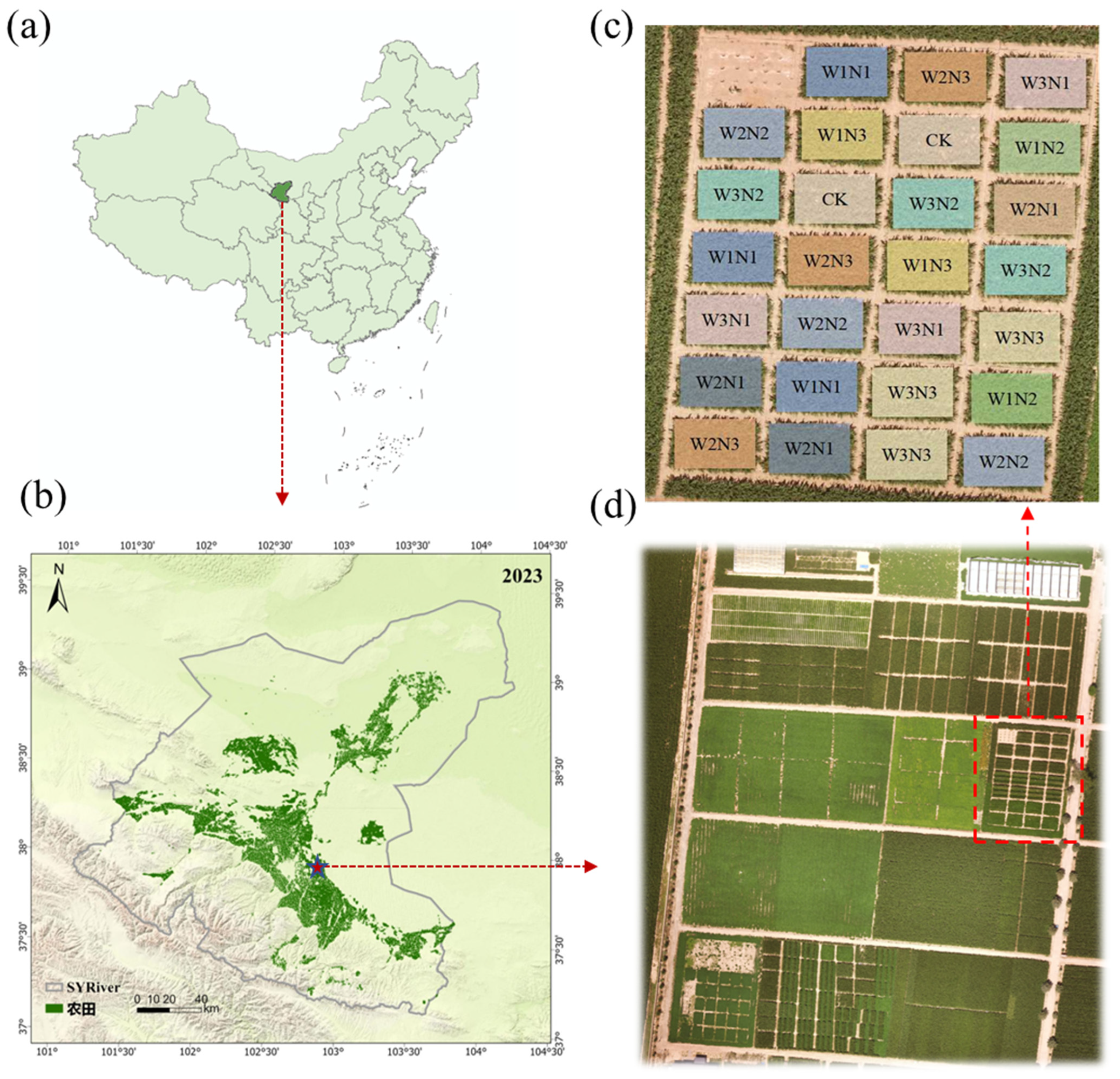
This study was conducted during the 2023 growing season (April to September) at the Shiyang River Experimental Station. The station is located in Wuwei City, Gansu Province, China (37°49′N, 102°53′E), at an altitude of approximately 1600 m. The region features an inland arid desert climate, with an average annual precipitation of 164.4 mm, an average annual evaporation exceeding 2000 mm, perennial aridity with infrequent rainfall, and strong evaporation, resulting in severe water scarcity. To ensure the reliability of experimental results and minimize the impact of spatial heterogeneity, the entire study area was divided into 27 experimental plots (each 5 m × 8 m) using a randomized complete block design (RCBD). This design represents the standard approach for controlling spatial variability in field experiments. The 27 plots corresponded to replicate treatments for 10 water–nitrogen combination treatments (3 irrigation levels × 3 nitrogen fertilizer levels, plus a control). To prevent lateral water seepage between adjacent plots, 1 m-wide buffer zones were established and filled with impermeable materials (plastic film + compacted soil). Within each plot, crops were arranged with 0.4 m row spacing and 0.26 m plant spacing. A 1.5 m-wide buffer zone surrounded the study area to minimize edge effects from the external environment. The maize (Zea mays L.) cultivar used was the locally dominant variety “Xianyu 1225”. The experiment incorporates three different irrigation treatments: full irrigation (W1) at 100% of maintaining soil moisture content; mild deficit irrigation (W2), with soil moisture content set at three-quarters of W1; and severe deficit irrigation (W3), with soil moisture content set at half of W1 and three nitrogen (N) application levels (N1: 350 kg/ha, N2: 250 kg/ha, and N3: 150 kg/ha). Urea fertilizer (N content 46%) was applied for nitrogen, with the total amount for each treatment divided and side-dressed during different growth stages according to specified proportions (See Table 1 and Table 2). A control group (CK) was also established, representing no nitrogen application under severe deficit irrigation (W3) conditions. This resulted in a total of 10 treatment combinations.

2.2. In Situ Environmental Data Acquisition

Soil moisture at specific points in all soil layers (10, 20, 40, 60, 80, and 100 cm) was measured using a consistent combination of sensor monitoring and oven-drying method, to ensure the uniformity and comparability of in situ data across different depths. The monitoring system consisted of two integrated components:
(1)
Meteorological Data
The automatic weather station (HOBO H21-001, Onset Computer Corp, Cape Cod, MA, USA) within the experimental station can monitor and record meteorological data, such as total solar radiation, sunshine hours, wind speed, wind direction, air temperature, and rainfall, in real-time.
(2)
Soil Environmental Indicators
① Soil Moisture
Soil moisture at specific points in different soil layers was measured using sensors. Specifically, soil profiles 80 cm deep were excavated at 12 sample plots, with sensor probes installed at depths of 10, 20, 40, 60, and 80 cm. The HOBO H21 data logger collected data every 15 min, which was stored for subsequent download. Sensors were calibrated using a TDR350 soil moisture meter (probe lengths: 3.8, 7.5, 12, and 20 cm) before and after rainfall or irrigation. Every seven days, soil samples were collected from the center of each plot at depths of 10, 20, 40, 60, 80, and 100 cm using a soil auger. Soil moisture content was measured using the oven-drying method.
Soil moisture sensors recorded data every 15 min, and UAV images were acquired every 2 h from 9:00 to 17:00 on clear days. The UAV acquisition time was synchronized with the 15 min SM sampling time (i.e., UAV images were collected at 9:00, 11:00, 13:00, 15:00, and 17:00, and the corresponding SM data at the same time points were extracted for analysis), thus avoiding temporal mismatch between the two datasets. The SM data at 13:00 (solar noon) was ultimately used for model construction because the solar altitude angle at this time is the highest, reducing the influence of terrain and vegetation shadow on remote sensing image quality.
② Soil Texture
Soil texture is a stable natural property of soil, closely related to its water retention and aeration capacity. Simultaneously, soil texture plays a dominant role in the migration process of water within the soil. The groundwater table in the experimental area lies at a depth of 40–50 m. Within the top 1 m below the surface, the soil is predominantly sandy loam (See Table 3). To accurately determine the soil particle size distribution at the experimental site, a 1 m-deep profile was excavated at the center of each plot. Soil dry bulk density and field capacity were determined using the ring knife method. Specifically, at three representative sampling points, undisturbed soil cores (100 cm3) were collected from each soil layer (10, 20, 40, 60, 80, and 100 cm). To determine field capacity, the ring pan was sealed at both ends and placed on a leveling instrument to measure its internal soil volume. The soil sample inside was then weighed and recorded. The sample underwent saturated immersion, with the duration timed. Subsequently, it underwent 48 h of gravity-assisted free drainage under controlled conditions (20 °C, 60% relative humidity), with soil moisture content monitored every 6 h until stabilization. The stable moisture content after free drainage is defined as the field capacity. Dry bulk density is calculated as the ratio of oven-dried soil mass (dried at 105 °C for 24 h) to the sampled volume.

2.3. UAV-Based Imagery Acquisition

This study acquired remote sensing data using two UAV systems operating synchronously to ensure temporal consistency. Multispectral and hyperspectral data were collected by a DJI M600 Pro (equipped with a MicaSense RedEdge-MX camera), DJI Technology Co., Ltd., Shenzhen, Guangdong, China and a DJI M300 (equipped with a Cubert S185 snapshot imager), DJI Technology Co., Ltd., Shenzhen, Guangdong, China, respectively. The multispectral sensor captured five broad bands (Blue, Green, Red, Red Edge, and NIR), while the hyperspectral sensor recorded 138 continuous bands within the 450–950 nm range at a 4 nm interval. All flights were conducted under clear skies at 60 m altitude, and the corresponding ground sampling distance (GSD) of the flight was calculated based on the sensor focal length and pixel size, 0.032 m (3.2 cm) for multispectral data and 0.019 m (1.9 cm) for hyperspectral data, which ensured high spatial resolution for soil moisture inversion at the field scale. Radiometric calibration was performed using standard panels pre-flight, and the resulting data cubes provided multi-scale spectral information for subsequent analysis.
To obtain high-resolution and extensive coverage, the UAV flew at a speed of 1.8 m/s with 85% forward overlap and 88% sideways overlap. Observations were conducted every two hours between 9:00 and 17:00 on clear, cloudless days. Prior to each flight, a radiometric calibration plate was photographed to calibrate the multispectral camera. Aerial remote sensing captured imagery of farmland crops and land surfaces to obtain remote sensing data, including surface temperature, vegetation indices, and canopy coverage. The UAV flight area is shown in Figure 1.

2.4. Soil Moisture Inversion Methods

Vegetation indices such as NDVI reflect the impact of vegetation cover density on the spatial dynamics of soil moisture during plant growth. By extracting the spectral reflectance of the crops, various vegetation indices were obtained. Using the random forest regression algorithm, the relationship between vegetation indices and soil moisture was analyzed to construct a soil moisture inversion model. This enables remote sensing monitoring of soil moisture under vegetation cover at the farmland scale. The spectral bands used in this study’s multispectral camera (blue, green, red, red edge, and near-infrared) cannot calculate indices such as NDMI and NMDI that require shortwave infrared bands. This indeed represents a hardware limitation of the multispectral technology employed in this research [29]. The selected vegetation indices and their calculation formulas are shown in Table 4.
To fully utilize the high spectral resolution of hyperspectral data and improve the accuracy of soil moisture (SM) inversion, traditional dual-band spectral indices and novel triple-band spectral indices were constructed for hyperspectral data processing. Traditional dual-band indices, including Difference Index (DI), Ratio Index (RI), and Normalized Difference Index (NDI), were calculated as baseline references. For the core innovation of this study, the triple-band indices (MSR: Moisture Sensitive Ratio Index, RES: Reflectance Extraction Index) were developed based on the Kubelka–Munk (KM) theory to specifically address the confounding effects of canopy scattering and soil background. The detailed derivation, formulation rationale, and band selection rules of the hyperspectral spectral indices are presented in Section 2.4.1

2.4.1. Spectral Indices Construction

The Kubelka–Munk model describes the relationship between reflectance (R) and the absorption-scattering ratio (K/S). For crop canopies under water stress, R exhibits a consistent unidirectional response to variations in K/S: as pigment absorption (driven by moisture stress) increases, reflectance at specific bands decreases predictably. This physical basis justifies the use of the difference form (Ri − Rk) to amplify the moisture-sensitive signal while minimizing the influence of stable scattering properties.
Theoretical Derivation of the Triple-Band Form
The KM model describes light interaction with turbid media (e.g., crop canopies) using two primary coefficients: the absorption coefficient (K) and the scattering coefficient (S). The ratio K/S is directly related to spectral reflectance (R) and is governed by the following relationship for optically dense canopies [44]:
K S = ( 1 R ) 2   2 R
For soil moisture retrieval, our goal is to isolate the absorption signal (K) related to plant water stress, while minimizing the interference from the scattering signal (S), which is primarily caused by canopy structure and soil texture and is relatively insensitive to short-term moisture changes.
To decouple K from S, we exploit the relative stability of S across adjacent spectral bands. For any two bands x and y, the scattering properties are approximately equal (Sx ≈ Sy = S). Therefore, the difference in the K/S ratio between the two bands is dominated by the difference in absorption:
According to the KM equation, reflectance R exhibits a consistent unidirectional response to changes in K/S. Thus, the difference in reflectance (Rx − Ry) is a direct proxy for the difference in absorption properties (Kx − Ky), effectively eliminating the scattering component (S) as a common variable.
To further standardize this absorption difference against a stable reference, a scattering reference band (k) is introduced, leading to the general formulation of the triple-band index. Based on this theoretical framework, both the traditional dual-band baseline indices and the novel triple-band indices constructed in this study are defined as follows:
D I R i , R j = R i R j
R I R i , R j = R i / R j
N D I R i , R j = ( R i R j ) / ( R i + R j )
R E S R i , R j , R k = ( R i R k ) / ( R j R k )
M S R R i , R j , R k = ( R i R j ) / ( R j R k )
where R i , R j , and R k represent the spectral reflectance values for the i, j, and k bands, respectively, within the operational range of the S185 hyperspectral sensor (450–950 nm) at any sampling point.
Rationale for Form and Band Selection
(1)
Choice of Difference-Based Form
Unlike ratio forms ( R i / R j ), which can amplify sensor noise at low reflectance values, or logarithmic forms, which are sensitive to extreme values, the difference form ( R i R k ) was selected for its linearity with the physical absorption difference   ( K i K k ). This linear relationship ensures that the index responds proportionally to changes in plant physiological status caused by soil moisture variations, rather than introducing non-physical distortions.
(2)
Definition of Scattering Reference Band Rk
A scattering reference band (k) is defined as a wavelength where: Absorption (K) is minimal: the band is not affected by strong absorption from chlorophyll, carotenoids, or water. Scattering (S) is stable: the band is sensitive to canopy structure but insensitive to soil moisture content. In this study, the red-edge region was chosen as k because it lies outside the major pigment absorption bands and is primarily governed by leaf structure scattering.
(3)
Constraints for Target Bands (i,j)
The selection of bands i and j followed strict biophysical constraints:
Band j (Strong Absorption): a band with strong pigment absorption (e.g., 660 nm, chlorophyll a absorption peak), where water stress-induced changes in pigment concentration cause the most significant reflectance variations.
Band i (Sensitive Reference): a band sensitive to secondary stress indicators (e.g., 515 nm for chlorophyll content and 606 nm for carotenoid ratio), providing complementary information to Band j.
Stability Evaluation of the Triple-Band Indices
Based on the existing dataset, the stability of the MSR and RES indices was evaluated by analyzing their correlations with soil moisture content across different growth stages (jointing stage, tasseling stage, and grain filling stage) and soil layers (10–100 cm). As shown in Table 5, the average correlation coefficient (R) for MSR and RES across all scenarios was 0.66, with a coefficient of variation (CV) of 12.1%. In contrast, traditional dual-band indices (NDI, RI, and DI) exhibited an average correlation coefficient of 0.58 with higher coefficients of variation (16.7–18.3%). This indicates that the newly proposed triple-band indices demonstrate more consistent responses to soil moisture variations across different growth stages and soil depths within the study area, with stability sufficient to meet application requirements in specific regions.
The development of the RES and MSR indices addressed a key limitation of traditional dual-band indices: separating soil moisture signals from confounding noise in vegetated areas. The construction rationale was twofold: (1) Empirical band screening through full-band correlation analysis pinpointed optimal moisture-sensitive wavelengths in the visible-near-infrared region. (2) Mathematical optimization was achieved by introducing a third band (k) to create a triple-band formulation. Here, the third band serves as an internal reference, enhancing the signal-to-noise ratio by amplifying moisture-induced spectral variations while mitigating interference from soil background and canopy structure. Thus, the enhanced performance of RES and MSR originates from their superior capacity to leverage hyperspectral data dimensionality for retrieving soil moisture information.

2.4.2. Random Forest Modeling for Soil Moisture Inversion

Random Forest (RF) algorithms, as an ensemble learning method that operates by constructing numerous regression trees, have been widely and successfully applied in remote sensing model development. Their essence lies in exploring nonlinear relationships between independent variables (such as spectral indices) and dependent variables (such as soil moisture) through aggregated predictions from multiple trees, with each tree learning a unique set of rules to map inputs to outputs.
Depth-Specific Modeling Strategy
To achieve layered soil moisture estimation, dedicated RF regression models were independently developed and calibrated for each target soil depth (i.e., 10, 20, 40, 60, 80, and 100 cm). This depth-specific modeling strategy ensures precise capture of the unique relationship between canopy spectral indices and in situ soil moisture at discrete layers, free from interference by data from other depths.
Dataset Partitioning
For each depth-specific model, the corresponding dataset was randomly and independently partitioned into a training set (75% of total samples) and a test set (25% of total samples). The training set was used to train the random forest model, while the test set (never encountered during model training) was strictly reserved for final accuracy validation and performance reporting. This rigorous division ensured the independence of validation samples and provided an unbiased assessment of the model’s predictive capability across soil layers.
Model Inputs and Preprocessing
The random forest algorithm in this study utilized 161 valid sample points. Each sample point employed remote sensing indices and sensitive bands extracted from drone multispectral and hyperspectral imagery as independent variables, with synchronously measured volumetric water content (unit: %, determined by drying method) of various soil depth layers as the dependent variable. Remote sensing index values were precisely matched to sample locations via GPS coordinates. A 3 × 3 pixel window centered on each sampling point was averaged to mitigate registration errors and pixel heterogeneity effects.
Prior to modeling, all independent and dependent variables were normalized to the [0, 1] range using the min–max normalization method. To ensure robustness in model evaluation, hierarchical 5-fold cross-validation was employed for model training and validation. Data were grouped by plot ID to ensure each cross-validation iteration included samples from distinct plots in both training and validation sets, thereby assessing model generalization ability.
Hyperparameter Optimization
To determine optimal hyperparameters, grid searches were conducted on the training set for decision tree count (NumTrees: 20, 40, 60, 80, and 100) and the minimum number of samples per leaf node (MinLeafSize: 1, 3, 5, and 10) on the training set. The objective was to minimize the out-of-bag (OOB) error, ultimately determining the optimal model parameters as NumTrees = 60 and MinLeafSize = 5. The model configuration calculated the out-of-bag prediction error and variable importance for subsequent analysis.

2.5. Data Analysis and Model Evaluation Methods

This study systematically collected multispectral and hyperspectral imagery throughout the entire growing season to support high-resolution soil moisture monitoring. Hyperspectral imaging was performed using the Cubert S185 sensor (Cubert GmbH, Ulm, Baden-Württemberg, Germany) mounted on a DJI M300 platform, capturing data within the 450–950 nm spectral range at 4 nm resolution. Concurrently, multispectral data were acquired using the MicaSense RedEdge-MX sensor integrated into a DJI M600 Pro platform to ensure temporal synchronization and spatial alignment between datasets.
Raw hyperspectral and multispectral data underwent standardized preprocessing: first, radiometric calibration using a reference panel to derive surface reflectance, followed by geometric correction using ground control points (GCPs) to ensure spatial accuracy. Hyperspectral data additionally underwent spectral smoothing to reduce noise. All processing steps adhered to consistent standards to maintain data quality and interoperability.
To identify the most effective spectral features for soil moisture content detection, we first established a spectral index system for evaluation. This system incorporates traditional two-band indices—the Difference Index (DI), Ratio Index (RI), and Normalized Difference Index (NDI)—along with two newly proposed three-band indices, RES and MSR. The latter two aim to integrate more spectral bands to enhance the signal-to-noise ratio.
Pearson’s correlation coefficient was used to analyze the relationship between two variables. Pearson’s correlation coefficient (R) is defined as the covariance of two variables divided by the product of their standard deviations, reflecting the dependency between them. The calculation formula is as follows:
R = i = 1 n X i X ¯ Y i Y ¯ i = 1 n X i X ¯ 2 i = 1 n Y i Y ¯ 2
where R denotes the Pearson correlation coefficient with X and Y being random variables, and the correlation strength is categorized as follows: |R| = 0.8–1.0 indicates very strong correlation, 0.6–0.8 strong correlation, 0.4–0.6 moderate correlation, 0.2–0.4 weak correlation, and 0.0–0.2 very weak or no correlation. This study employs the coefficient of determination (R2) and root mean square error (RMSE) to evaluate the goodness of fit and robustness of regression results, with the calculation formulas for these evaluation metrics presented below.
R 2 = 1 i = 1 n P i O i 2 i = 1 n O i O i ¯ 2
R M S E = i = 1 n P i O i 2 n
where O i represents the measured value, P i the predicted value, O i ¯ the mean of the measured values, and n the sample size.

3. Results

3.1. Hyperspectral Data Analysis and Sensitive Band Extraction

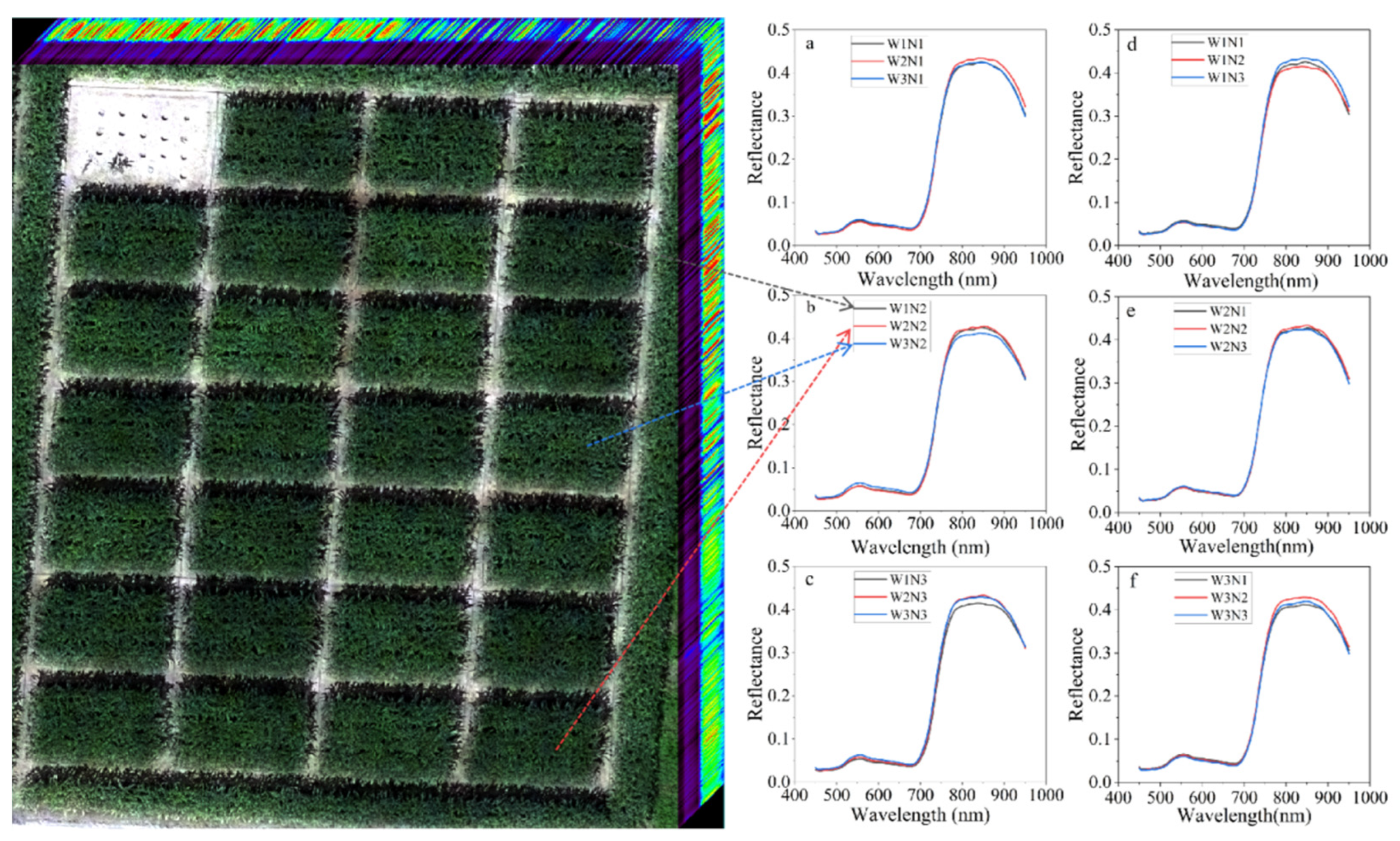
Analysis of preprocessed hyperspectral data revealed significant spectral response variations under different water–nitrogen treatments (Figure 2). Visible spectrum regions (500–680 nm) exhibited characteristically higher reflectance under water deficit conditions (W3), particularly pronounced in the 550–580 nm chlorophyll absorption region, where moisture stress amplifies light reflection. Conversely, near-infrared regions (760–950 nm) demonstrated the opposite pattern, with well-watered plots (W1) displaying substantially higher reflectance attributable to enhanced canopy structural complexity and leaf cellular integrity. These differential responses originate from physiological alterations in leaf structure affecting light scattering properties, chlorophyll concentration modifications that regulate absorption characteristics, and canopy architectural differences that fundamentally alter photon penetration dynamics through the vegetation layer.
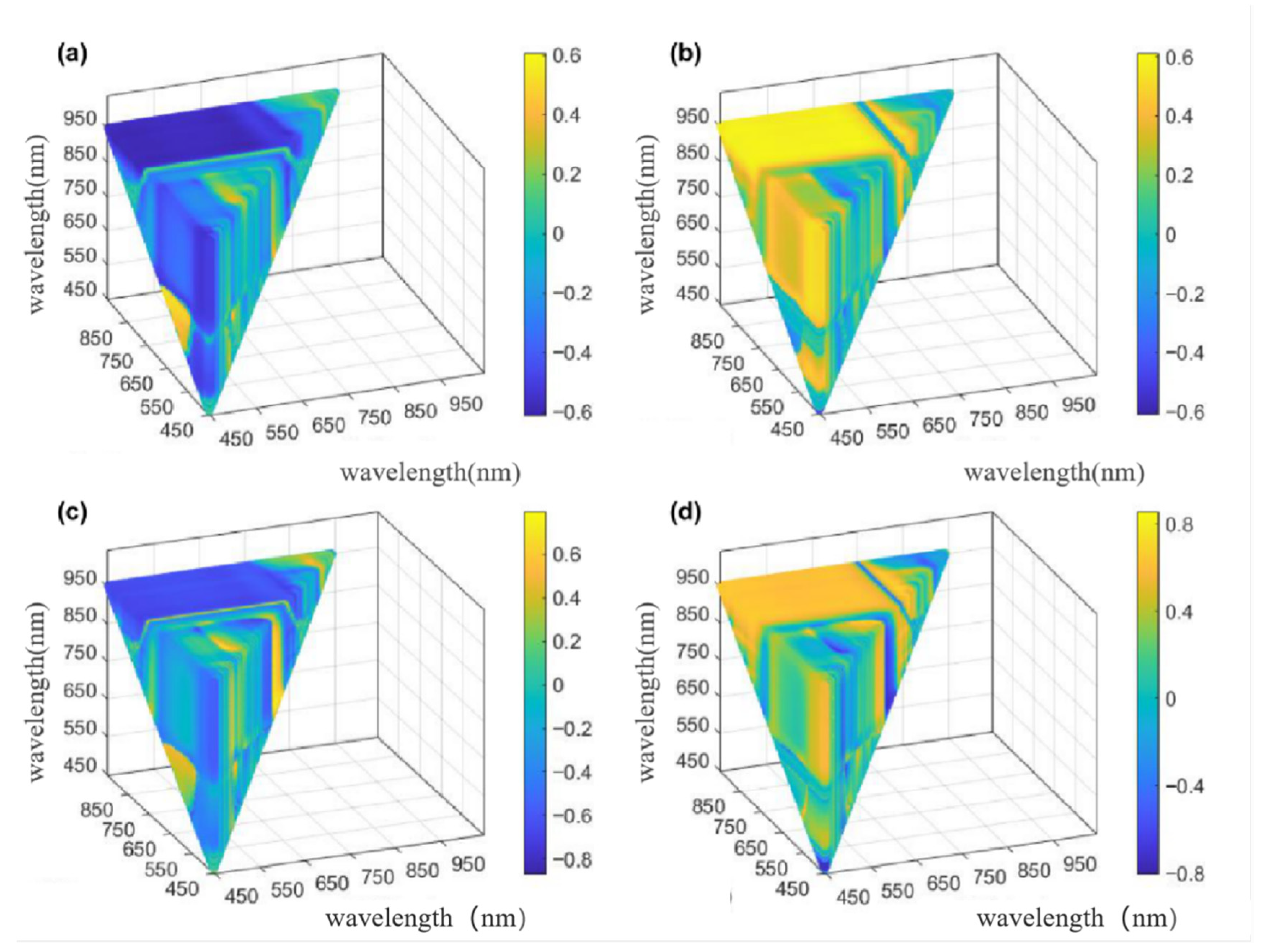
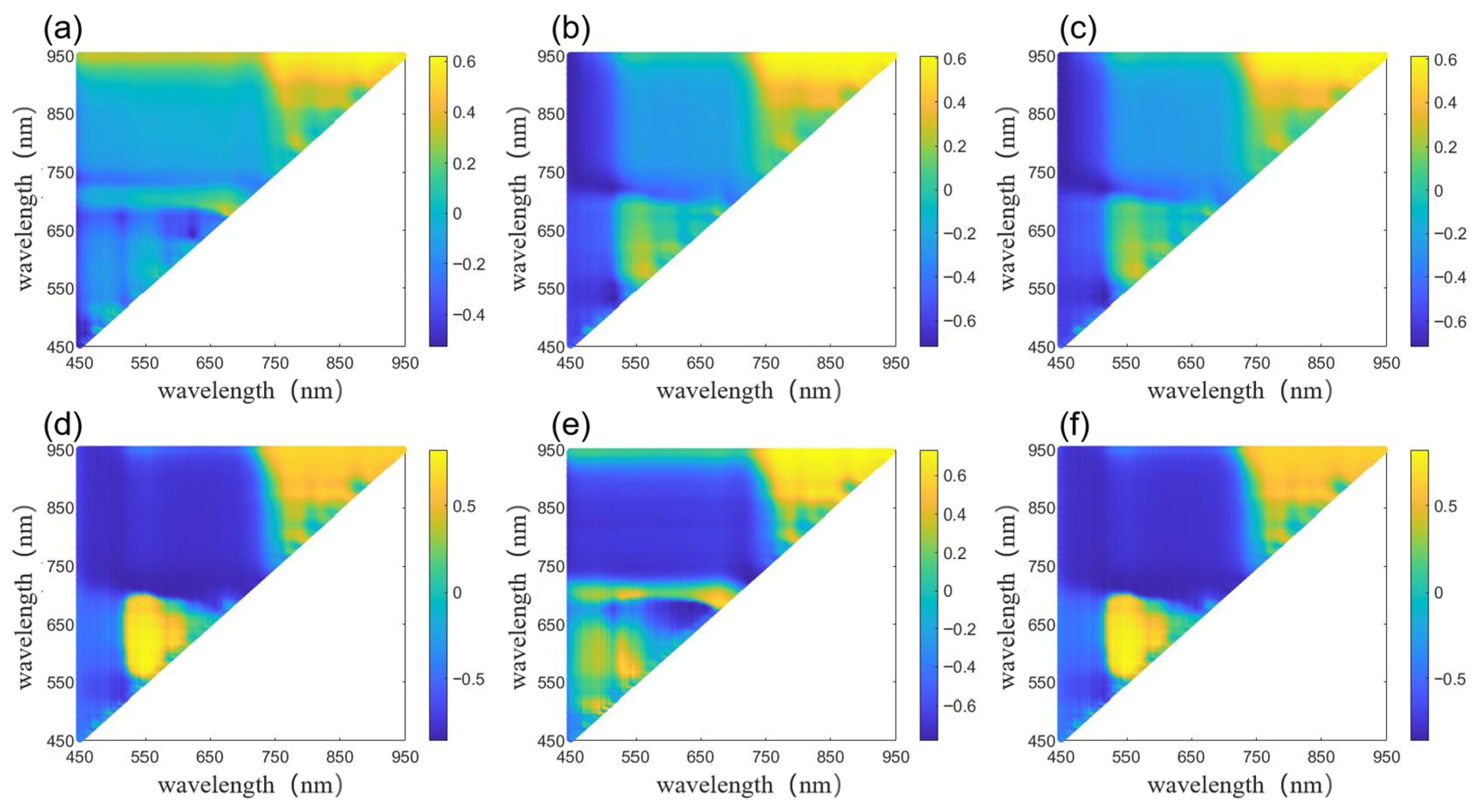
The correlations between dual-band, triple-band indices, and 20 cm in situ soil moisture measurements are shown in Figure 3 and Figure 4. Figure 3 displays the results for triple-band indices (RES and MSR), while Figure 4 presents the results for dual-band indices (DI, RI, and NDI). The correlation matrices in Figure 3 and Figure 4 visualize the process of identifying optimal band combinations for the 20 cm soil layer. Each pixel point in these matrices represents the Pearson correlation coefficient (R) between the spectral index calculated from a specific band combination and the measured soil moisture content. Visual inspection reveals distinct spatial patterns in high-correlation regions (highlighted in warm colors): dual-band indices concentrate their high correlations in the near-infrared range (760–950 nm), while triple-band indices exhibit a significant shift, with peak sensitivity concentrated in the visible spectrum (450–760 nm). The spatial distribution characteristics of the correlation matrix indicate that the three-band indices successfully capture moisture variation patterns. In contrast, the three-band indices exhibit a significant shift, with their most sensitive bands concentrated in the visible region (450–760 nm). This spatial pattern within the correlation matrix suggests that the three-band indices successfully capture moisture-related signals in spectral regions less affected by vegetation interference, whereas the two-band indices fail to fully utilize these signals.
Figure 3 and Figure 4 only show the correlation between spectral indices and soil moisture content in the 20 cm soil layer. This is because the 20 cm layer constitutes the corn root zone, where canopy spectral characteristics exhibit the strongest correlation with soil moisture content (see Table 5). It serves as the representative layer for extracting sensitive bands.
The optimal band combinations and corresponding maximum correlation coefficients are summarized in Table 5. Across all growth stages of maize, the average correlation between vegetation indices MSR and RES—calculated using a three-band combination—and soil moisture content in each soil layer was 0.66. The average correlation between the two-band combinations NDI, RI, and DI and soil moisture content in each soil layer was 0.58. Compared to dual-band combinations, triple-band combinations better utilize hyperspectral data and fully exploit soil moisture-sensitive bands. The average correlations between soil moisture content at depths of 10, 20, 40, 60, 80, and 100 cm and spectral information were 0.72, 0.72, 0.62, 0.56, 0.47, and 0.46, respectively. The correlation between soil moisture content and spectral information generally decreased with increasing soil depth. The best correlations were observed at 10 cm and 20 cm depths, reaching a maximum of 0.72. The average correlation between soil moisture-sensitive bands extracted for different growth stages and soil moisture was 0.64. The correlation between the sensitive bands extracted for the entire maize growth period and soil moisture was 0.48. This discrepancy arises because maize’s physiological structure changes throughout its growth, leading to shifts in the soil moisture-sensitive bands at different growth stages. Therefore, extracting soil moisture-sensitive bands separately for each growth stage enables the construction of more accurate soil moisture inversion models.

3.2. Soil Moisture Inversion and Validation

3.2.1. Hyperspectral Model Performance

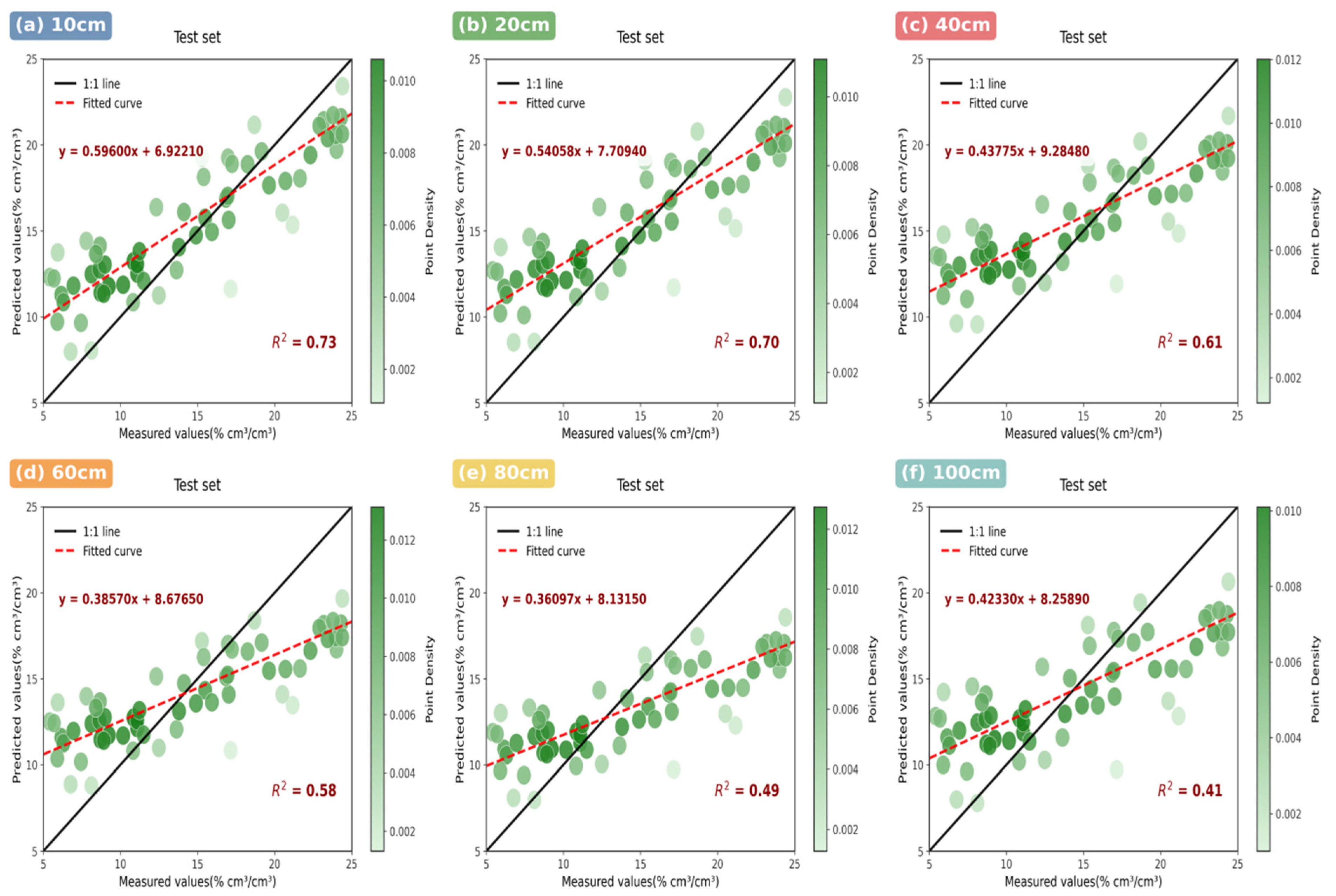
Hyperspectral inversion models exhibited depth-dependent patterns of feature accuracy, consistent with biophysical principles of light penetration (Figure 5). Within the unified model covering the entire growing season, robust predictive capability was demonstrated at a depth of 10 cm, with an R2 value of 0.73 and a regression slope of 0.596, indicating good agreement between predicted and observed values. The critical root zone (20–40 cm) exhibited robust performance (mean R2 = 0.66 ± 0.06), yet model accuracy exhibited a marked decay gradient below this depth. Specifically, the R2 value steadily decreased from 0.73 at 10 cm to 0.41 at 100 cm, attributable to the gradual attenuation of spectral signals in deeper soils (Figure 5). This depth-dependent accuracy pattern aligns with biophysical mechanisms governing light penetration and canopy spectral response: as soil depth increases, the coupling between canopy spectral characteristics and deep soil moisture content progressively weakens.

3.2.2. Multispectral System Limitations

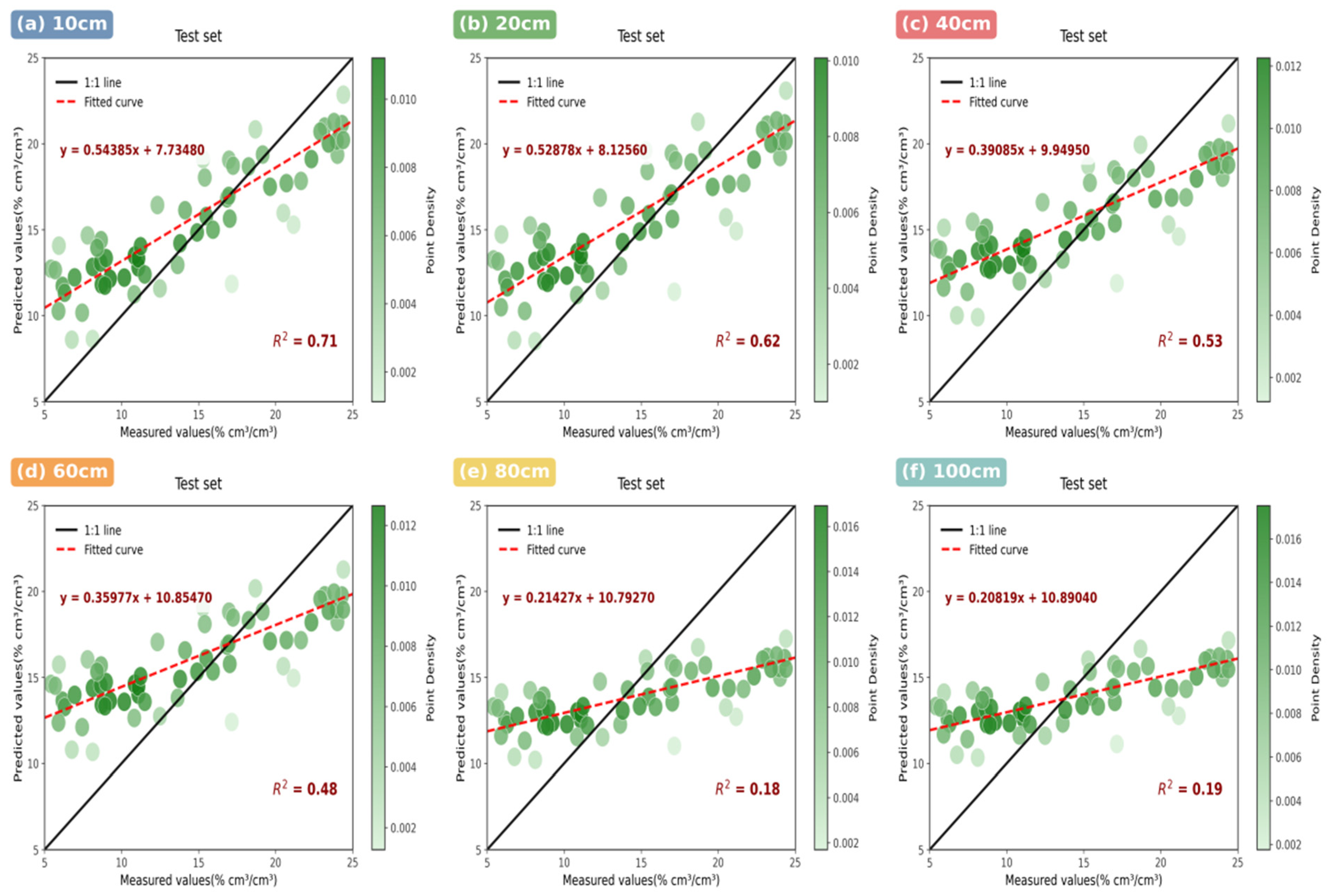
Using soil moisture at various depths throughout the corn growth cycle as the dependent variable and employing multispectral indices extracted from visible and infrared bands (such as NDVI, EVI, RVI, GI, OSAVI, SAVI, MCARI, and GNDVI) as independent variables, regression analysis was conducted using the random forest algorithm. The R2 and RMSE values of the soil moisture inversion model for the entire growth period were obtained, and the remote sensing inversion accuracy for different soil layers is shown in Figure 6. Comparative evaluation revealed fundamental constraints in multispectral approaches for resolving vertical moisture distribution. Figure 6 illustrates the progressive deterioration of predictive capability with increasing soil depth: while surface layers (10–20 cm) maintained marginal accuracy, performance degraded substantially below 40 cm depth, transitioning to near-random prediction patterns in deeper horizons. Particularly concerning was the complete failure at 80–100 cm depths, where R2 values dropped to ≤0.19, indicating virtually no predictive capability. This performance degradation originates from inherent sensor limitations, manifested as systematic bias at 10 cm depth, where regression slopes reached only 0.71, reflecting consistent overestimation of moisture content. The multispectral system also exhibited pathological error amplification under dry conditions, with prediction errors exceeding +35% when actual moisture dropped below 10%. These limitations are compounded by vegetation index saturation phenomena, which mask subsurface hydrologic signals during critical growth stages.
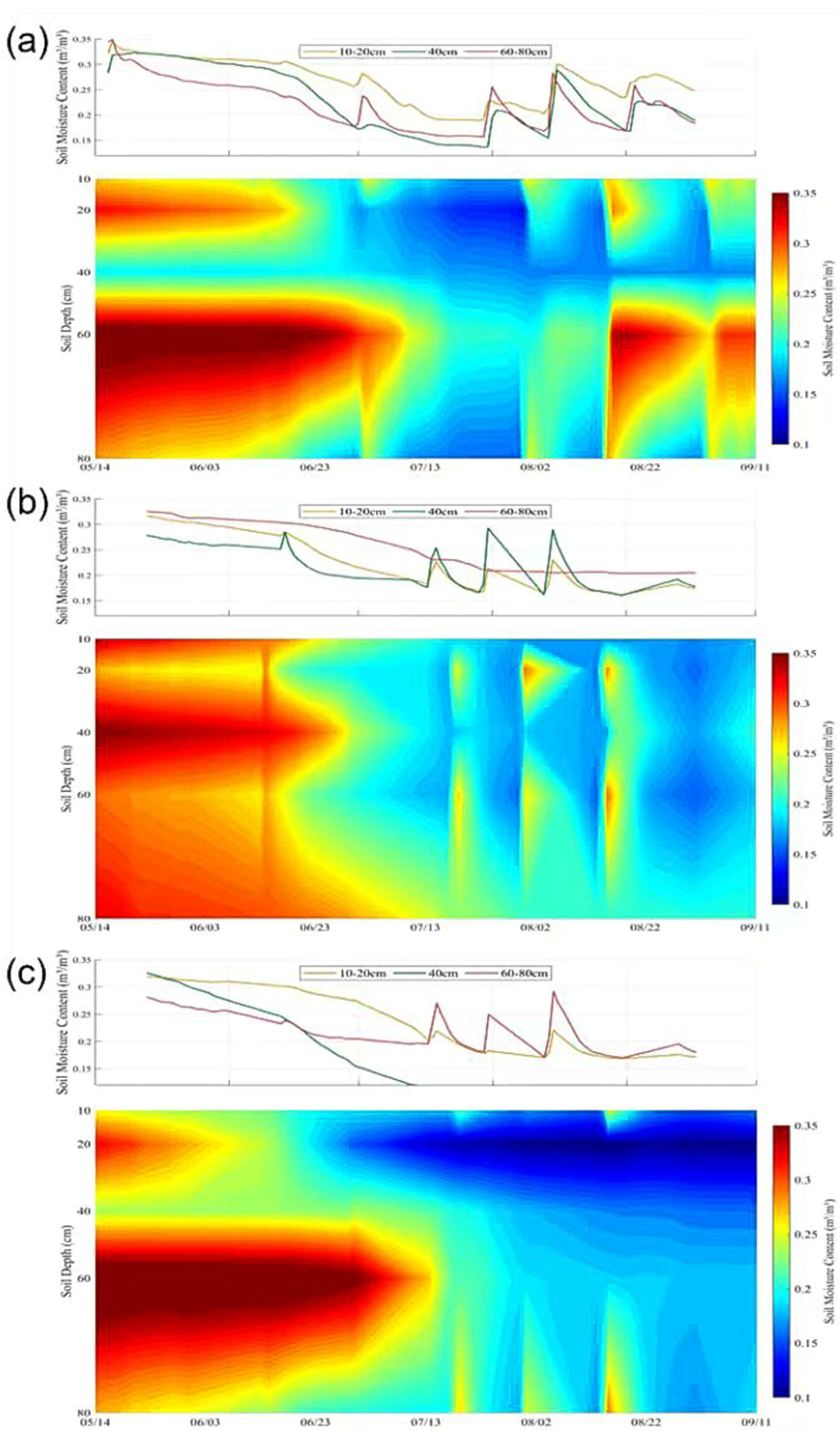
To further validate the reliability of this study’s findings, we analyzed the measured temporal dynamics of soil moisture across three representative experimental plots (W1N1, W2N2, and W3N3) throughout the entire growing season (Figure 7). As shown in Figure 7, measured soil moisture in all three plots exhibited distinct temporal patterns: a gradual decline from seedling to grain filling stages, punctuated by pronounced pulse-like recoveries following irrigation events (e.g., early July and mid-August). Soil moisture under the fully irrigated treatment (W1N1) remained relatively stable throughout the growing season, whereas the severely deficit irrigation treatment (W3N3) exhibited a continuous decline in soil moisture during the late growth stage, clearly reflecting the water stress effects induced by limited irrigation.
The temporal dynamics observed in Figure 7 highlight the complexity of soil moisture changes in dryland farmland, driven simultaneously by irrigation management and crop water uptake. The higher accuracy of the hyperspectral inversion model compared to the multispectral model indicates its superior ability to capture these complex changes at the pixel scale.

3.2.3. Comparative Sensor Analysis

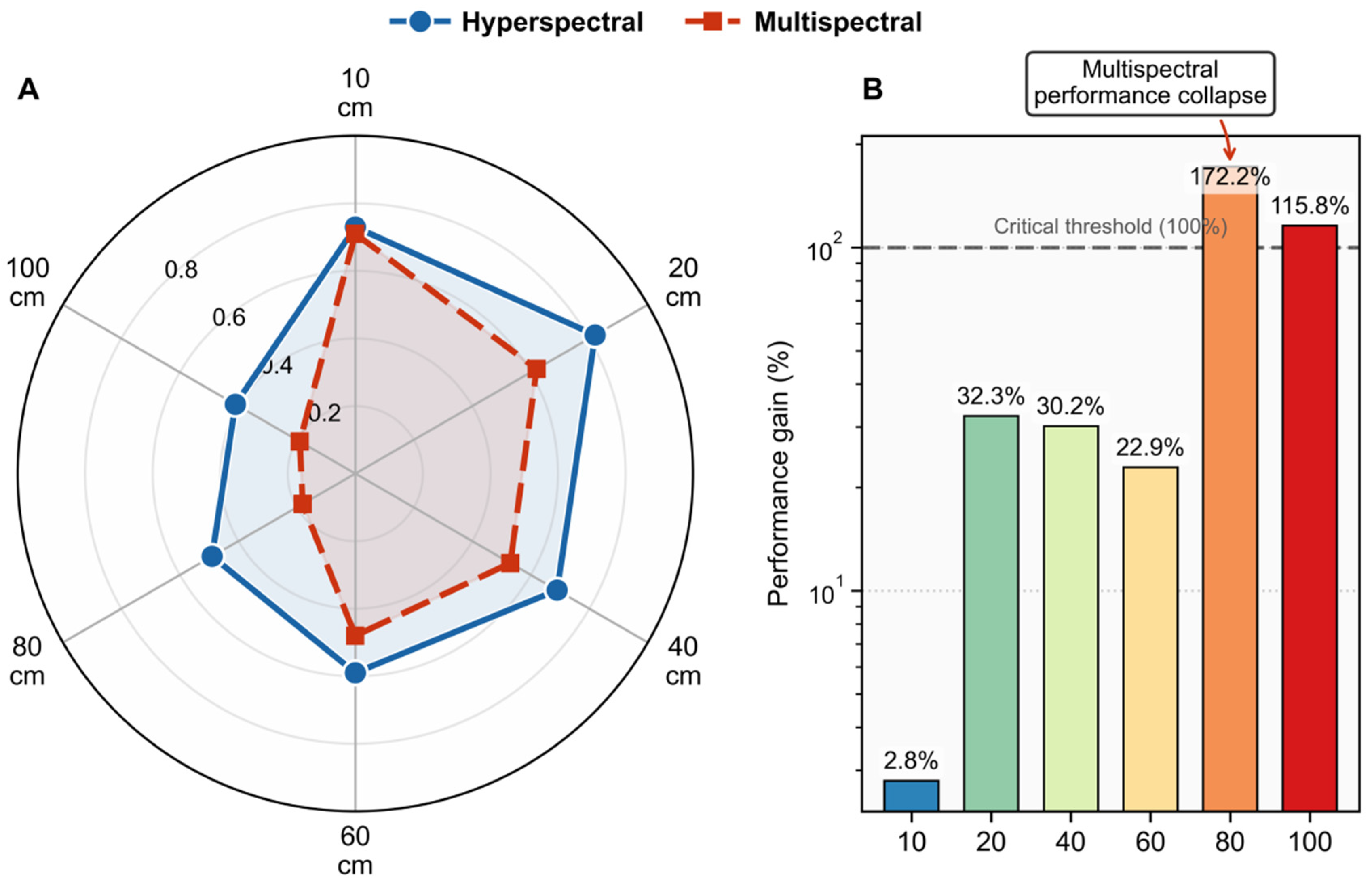
Direct quantitative comparison established hyperspectral’s consistent advantages across all evaluation metrics. As visually confirmed in Figure 8, hyperspectral systems maintained a stable operating range across the soil profile, preserving respectable predictive capability even at 80 cm depth (R2 = 0.49). In contrast, multispectral approaches exhibited what might be termed “performance collapse” beyond 60 cm, with negative gains reaching −172.2% at 80 cm depth. Statistical analysis quantified these advantages: hyperspectral achieved 11.9% higher mean R2 values (0.66 vs. 0.59) and 35.6% lower RMSE (1.34% vs. 2.08% cm3/cm3) in the agriculturally critical 10–60 cm root zone. The performance differential amplified exponentially with depth, demonstrating a unique capability to penetrate the soil–vegetation continuum for hyperspectral. Superior temporal stability was also observed, with hyperspectral models exhibiting only half the seasonal variation (ΔR2 = 0.12) seen in multispectral systems (ΔR2 = 0.21).

3.3. Spatiotemporal Dynamics of Soil Moisture Under Water-Nitrogen Regulation

3.3.1. Depth-Dependent Variability in Moisture Content

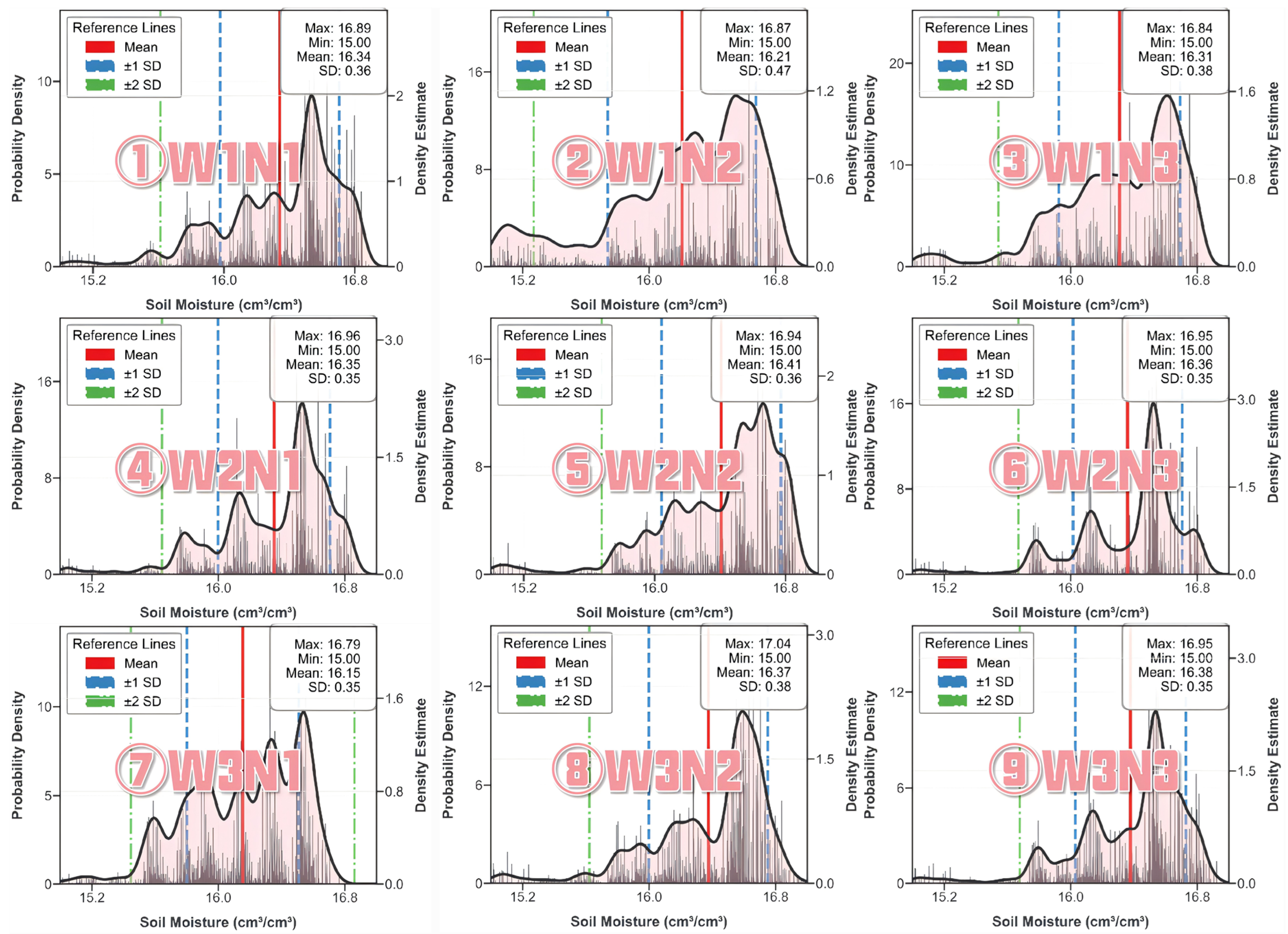
The hyperspectral-derived soil moisture data reveal distinct patterns of spatial heterogeneity across treatments at the 10 cm depth (Figure 9). Irrigation was identified as a key factor regulating the distribution width rather than the central tendency of soil moisture. W1 (100% ETc) plots exhibited a tightly clustered distribution with low variability (mean CV = 1.0%, θv = 16.0% ± 0.16%), indicating a homogeneous soil moisture environment under sufficient irrigation. In contrast, W3 (50% ETc) treatments displayed a noticeably broader probability density curve (black line) and higher spatial variability (mean CV = 2.2%, θv = 16.0% ± 0.35%), which is visually reflected by the wider histogram bins in Figure 9.
Although the mean soil moisture values were similar across irrigation regimes (due to the strong water infiltration capacity of the sandy loam), nitrogen fertilization modulated the distribution characteristics within this constrained range. Under ample irrigation (W1), high-N treatment (N3) shifted the probability density peak slightly towards higher values (≈16.1%), whereas under water stress (W3), low-N treatment (N1) resulted in a flatter distribution with a wider interquartile range. These subtle changes, visible within the axis range of Figure 9, suggest that nitrogen mediates rhizosphere water retention, even when the overall soil moisture is homogenized by rapid infiltration.
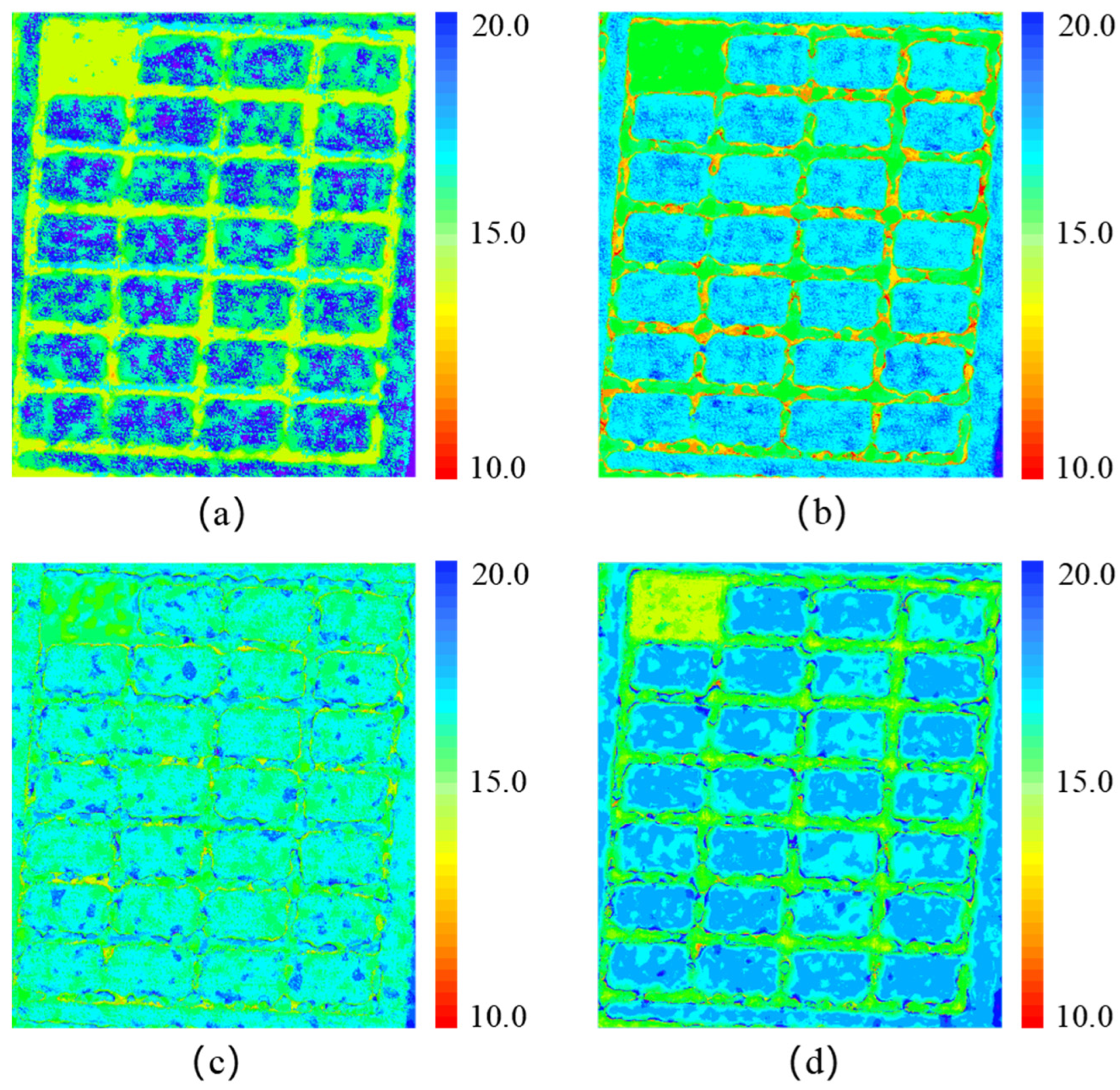
Figure 9 and Figure 10 show that the spatial distribution of soil moisture content under different irrigation treatments (W1, W2, and W3) appears visually similar. However, statistical analysis reveals significant differences in spatial variability. Specifically, the W1 treatment (100% ETc) exhibited a more uniform soil moisture distribution at a 10 cm soil depth, with a low average coefficient of variation (CV) of only 1.0% and a volumetric water content (θᵥ) of 16.0 ± 0.16%. In contrast, the W3 treatment (50% ETc) exhibited markedly higher spatial heterogeneity in soil moisture content, with an average coefficient of variation reaching 2.2% and volumetric water content at 16.0 ± 0.35%.
This apparent contradiction between subtle visual differences and statistically significant variations can be explained primarily through two key factors. First, the influence of soil texture. The experimental area predominantly features sandy loam soil, characterized by high permeability. Following irrigation, water rapidly redistributes within the crop root zone. This process significantly narrows moisture content differences between treatments in the top 10 cm of soil, making visual distinctions challenging. Second, the smoothing effect of the model plays a role. The hyperspectral inversion model based on canopy spectral signals used in this study inherently possesses a smoothing effect that attenuates extreme values during calculations. This smoothing directly reduces the visual contrast in soil moisture content between different irrigation treatments in Figure 9, resulting in less pronounced differences between treatments in the figures.
Figure 9 shows only the soil moisture distribution in the top 10 cm layer. This is because the top 10 cm layer is the most sensitive surface soil to irrigation and nitrogen application treatments. Changes in its moisture content directly reflect the effectiveness of field management practices, making it a critical layer for analyzing the spatiotemporal dynamics of soil moisture.
We further verified the in situ-measured SM dynamics of typical plots (Figure 7). The negligible visual difference in topsoil (10 cm) SM distribution between W1 and W3 treatments is a real hydrological characteristic of the study area, rather than an inversion error. This phenomenon is mainly attributed to the high permeability of sandy loam in the study area (Table 3): irrigation water infiltrates and redistributes rapidly in the root zone, leading to the homogenization of topsoil SM across different irrigation treatments in a short time. However, the in situ-measured data (Figure 7) clearly show that significant SM differences exist in deep soil layers (60–80 cm): the full irrigation treatment (W1N1) maintained a relatively high deep SM level throughout the growing season, while the severe deficit irrigation treatment (W3N3) exhibited a continuous decline in deep SM in the late growth stage, showing obvious water stress. This indicates that the irrigation gradient effect on SM is more reflected in deep soil layers rather than the top 10 cm soil, which also explains why the topsoil SM distribution in Figure 9 and Figure 10 shows no obvious inter-treatment difference.

3.3.2. Irrigation–Nitrogen Interaction Mechanisms

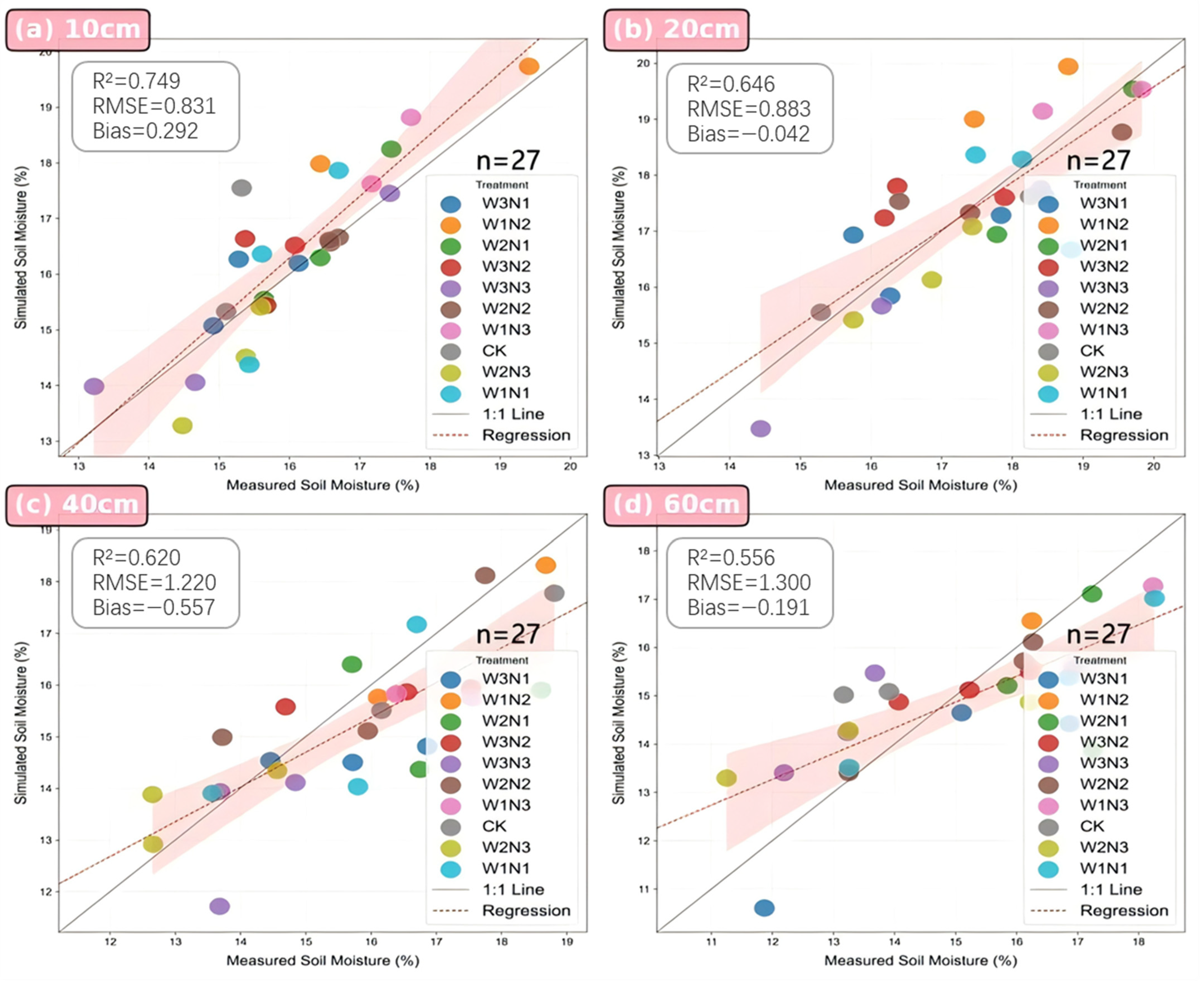
Statistical evaluation of soil moisture distribution patterns revealed significant interactions between irrigation and nitrogen treatments across soil depths. At 20 cm depth (Figure 11), plots receiving full irrigation with high nitrogen (W1N3) exhibited moisture depletion rates 12% faster than those under full irrigation with low nitrogen (W1N1). Conversely, under water-limited conditions (W3), low nitrogen treatments (N1) retained 18% more soil moisture than high nitrogen treatments (N3) through osmotic adjustment mechanisms, maintaining volumetric water content (θv) above 13% to prevent critical threshold breaches. These interactions produced distinct moisture probability distributions: W1N3 showed positive skewness, indicating localized dry spots, while W3N1 displayed highly peaked distributions (kurtosis = 4.1), demonstrating uniform moisture retention. Treatment-specific critical moisture thresholds were identified during pivotal growth stages. Hyperspectral-derived models validated these thresholds with high accuracy (R2 = 0.86 at 20 cm depth). During tasseling, soil moisture below 15% at 20 cm depth triggered pollen viability reduction, observed in 27% of W3N3 subplots. At grain filling, moisture levels below 14% at 40 cm depth induced premature senescence in water-stressed treatments (W3), detectable through accelerated NDVI decline rates in temporal analysis. Nitrogen application significantly modulated these thresholds: low nitrogen (N1) elevated the tasseling critical threshold to 16.2%, while high nitrogen (N3) reduced it to 14.5%, demonstrating fertilization’s role in altering crop susceptibility to water stress. Spatiotemporal analysis indicated that this regulation occurred primarily through root system adaptation. High-nitrogen plants developed deeper taproots (>80 cm) under adequate irrigation (W1) but formed shallower fibrous root systems (<50 cm) under drought conditions (W3), dynamically optimizing water uptake efficiency according to moisture availability. These adaptations manifested spectrally through modified vegetation indices and canopy temperature patterns, providing detectable signatures for water stress monitoring.

3.3.3. Agricultural Implementation Implications

The spatial-explicit moisture diagnostics enable precision water management through three operational pathways. First, irrigation zoning based on soil texture–moisture relationships: sandy zones in W3 treatments require 80% higher irrigation frequency. Second, stage-specific threshold management: maintaining θ > 15% at 20 cm during tasseling through pulse irrigation reduces yield loss by 12 ± 3%. Third, water–nitrogen synergism: W1N3 regimens should reduce irrigation by 15% to mitigate overconsumption, while W3N1 benefits from 10% nitrogen supplementation to enhance water retention.
Validation across nine treatments confirmed implementation efficacy. Variable-rate irrigation reduced spatial heterogeneity from CV > 25% to CV < 8% at 40 cm, while integrating nitrogen–moisture relationships increased water productivity by 31% in W3 treatments. Field trials achieved 18 ± 4% water savings without a yield penalty, demonstrating the operational value of hyperspectral-derived moisture intelligence for sustainable resource management in water-limited agricultural systems.

4. Discussion

4.1. Technical Advantages and Modeling Rationale

This study confirms that the superior performance of hyperspectral remote sensing in detecting deep soil moisture stems from its fundamental advantages in spectral resolution and signal characterization. Unlike multispectral systems with limited bands (3–7 bands), wide bandwidths (70–100 nm), and susceptibility to spectral averaging effects [45], hyperspectral imaging technology captures continuous narrow bands of 3–5 nm within the 450–760 nm wavelength range, enabling resolution of key water absorption features [46]. With 138 bands, it delivers a 2–3 times higher signal-to-noise ratio, enabling detection of subtle root-zone moisture-related spectral shifts. Hyperspectral remote sensing maintains relative advantages at 80 cm (R2 = 0.49) and 100 cm (R2 = 0.41), partially overcoming signal attenuation in deep layers [47]. Note that the multispectral camera (blue, green, red, red edge, and NIR) cannot calculate SWIR-dependent indices (e.g., NDMI and NMDI), which may further limit its deep moisture inversion performance.
Our approach is an indirect calibrated inversion, using canopy spectral response as a proxy for root-zone water stress. Models provide statistically derived soil moisture estimates at specific depths, not identifying water uptake origins—consistent with the monotonic accuracy decrease with depth (R2 = 0.73 at 10 cm to 0.41 at 100 cm). This pattern reflects weaker coupling between canopy physiology and deep soil moisture, which our layered modeling strategy (independent models per depth) effectively captures; a mixed model would obscure depth-specific insights.
The three-band indices (MSR and RES) achieve 18–32% higher correlation than dual-band indices, rooted in Kubelka–Munk and Hapke radiative transfer theories [48]. MSR combines 515 nm (chlorophyll-sensitive green peak), 660 nm (chlorophyll absorption), and 760 nm (red-edge structural correction). RES uses 606 nm (carotenoid-sensitive) and 740 nm (shortwave red-edge) to mitigate soil background interference. Their robustness (R2 = 0.62–0.73) stems from integrating indirect physiological responses to water stress while decoupling non-moisture factors [49].

4.2. Water–Nitrogen Interactions and Practical Value

Irrigation dominates soil moisture patterns (explaining 85.7% of variance), while nitrogen indirectly regulates via root-mediated processes. The conclusion that “nitrogen modulates soil moisture through root architecture” is inferred from observed patterns and the literature [50,51], not direct observation. High-N plants develop deeper taproots (>80 cm) under adequate irrigation but shallower fibrous roots (<50 cm) under drought, optimizing water uptake.
Contextually, our hyperspectral system’s 35.6% RMSE reduction aligns with European agricultural improvements [52], and the 31% water productivity increase in water-limited treatments exceeds Mediterranean reports [53], highlighting relevance for arid regions. Field trials achieved 22.3 ± 4.1% water savings without yield loss (98.7% ± 3.2% of full irrigation) [54], reducing spatial heterogeneity from CV > 25% to <8%—surpassing conventional precision irrigation [55]. The <2 min/ha real-time processing addresses operational barriers [56], while growth-stage-specific calibration bridges research–practice gaps [57].

4.3. Limitations and Future Directions

Despite advancements, limitations exist. First, the dataset is restricted to one experimental site (sandy loam and maize) and growing season, restricting MSR/RES generalizability. Index stability was evaluated across growth stages and soil layers, but multi-site validation is needed. Second, accuracy decreases by 18% in clay loam [23], and uncertainty is higher when canopy cover < 30% (ΔR2 = 0.15) [58].
Future research should: (1) validate MSR/RES in diverse agroecosystems (e.g., clay loam and wheat/soybean) and extreme weather; (2) promote multi-sensor fusion, integrating thermal infrared for peak stress stomatal conductance assessment; (3) develop soil-specific calibration modules based on pedotransfer functions [59]; and (4) integrate mechanistic modeling with spectral data to enhance moisture stress detection’s physiological basis.

5. Conclusions

This study establishes a co-optimized data-features–modeling paradigm for soil moisture monitoring in arid farmlands. Methodologically, we integrate UAV-based hyperspectral data, triple-band indices (MSR/RES) for enhanced signal discrimination, and machine learning to decode plant–water stress responses. The core scientific contribution clarifies the irrigation dominance, nitrogen mediation framework, demonstrating that nitrogen influences moisture patterns indirectly through root architectural adaptation rather than direct soil modification. For precision agriculture, these findings enable differentiated irrigation strategies for active root zones (10–40 cm) and deeper water reservoirs (>60 cm), supporting the 22 ± 4% water savings achieved without yield loss.
Key challenges for broader adoption include cross-regional transferability across soil types and cropping systems and real-time operationalization through edge-computing integration. Future work should focus on developing adaptive calibration modules for varying agronomic environments and optimizing multi-sensor fusion strategies. This work transforms hyperspectral remote sensing from a research tool into an actionable solution for sustainable water management in water-limited regions.

Author Contributions

Conceptualization, M.S.; methodology, M.S.; software, M.S. and K.S.; validation, K.S.; formal analysis, M.S.; investigation, M.S. and K.S.; resources, F.T.; data curation, M.S. and K.S.; writing—original draft preparation, M.S.; writing—review and editing, M.S. and F.T.; visualization, M.S.; supervision, F.T.; project administration, F.T.; funding acquisition, F.T. All authors have read and agreed to the published version of the manuscript.

Funding

This work was supported by the National Natural Science Foundation of China (52179049) and the National Key R&D Program of China (2022YFD1900504).

Data Availability Statement

Data available on request due to restrictions (e.g., privacy, legal, or ethical reasons).

Conflicts of Interest

All the authors declare no conflicts of interest.

References

  1. Kang, S.; Hao, X.; Du, T.; Tong, L.; Su, X.; Lu, H.; Li, X.; Huo, Z.; Li, S.; Ding, R. Improving Agricultural Water Productivity to Ensure Food Security in China under Changing Environment: From Research to Practice. Agric. Water Manag. 2017, 179, 5–17. [Google Scholar] [CrossRef]
  2. Tsagkatakis, G.; Melebari, A.; Akbar, R.; Campbell, J.D.; Hodges, E.; Moghaddam, M. Deep Generative Regression Models for Soil Moisture Retrieval from GNSS-R Observations. In Proceedings of the 2023 International Conference on Electromagnetics in Advanced Applications (ICEAA), Venice, Italy, 9–13 October 2023; p. 291. [Google Scholar]
  3. Verma, P.; Kamble, A.; Barhate, A.; Tale, A.; Gudadhe, A. A Review on Soil Moisture Monitoring Methods Using Satellite Images. In Proceedings of the 2024 2nd DMIHER International Conference on Artificial Intelligence in Healthcare, Education and Industry (IDICAIEI), Wardha, India, 29–30 November 2024; pp. 1–6. [Google Scholar]
  4. Cui, Z.; Zhang, H.; Chen, X.; Zhang, C.; Ma, W.; Huang, C.; Zhang, W.; Mi, G.; Miao, Y.; Li, X.; et al. Pursuing Sustainable Productivity with Millions of Smallholder Farmers. Nature 2018, 555, 363–366. [Google Scholar] [CrossRef] [PubMed]
  5. Li, J.; Inanaga, S.; Li, Z.; Eneji, A.E. Optimizing Irrigation Scheduling for Winter Wheat in the North China Plain. Agric. Water Manag. 2005, 76, 8–23. [Google Scholar] [CrossRef]
  6. Hanjra, M.A.; Qureshi, M.E. Global Water Crisis and Future Food Security in an Era of Climate Change. Food Policy 2010, 35, 365–377. [Google Scholar] [CrossRef]
  7. Siebert, S.; Burke, J.; Faures, J.M.; Frenken, K.; Hoogeveen, J.; Doell, P.; Portmann, F.T. Groundwater Use for Irrigation—A Global Inventory. Hydrol. Earth Syst. Sci. 2010, 14, 1863–1880. [Google Scholar] [CrossRef]
  8. Blanka-Végi, V.; Tobak, Z.; Sipos, G.; Barta, K.; Szabó, B.; van Leeuwen, B. Estimation of the Spatiotemporal Variability of Surface Soil Moisture Using Machine Learning Methods Integrating Satellite and Ground-Based Soil Moisture and Environmental Data. Water Resour Manag. 2025, 39, 2317–2334. [Google Scholar] [CrossRef]
  9. Grant, S.; Harden, A.; Coggins, K.; Parker, D.; Tabei, F.; Askarian, B. A Comprehensive Comparison of IoT Soil Moisture Sensors for Agricultural Applications. In Proceedings of the 2024 IEEE 17th Dallas Circuits and Systems Conference (DCAS), Richardson, TX, USA, 19–21 April 2024; pp. 1–6. [Google Scholar]
  10. Xu, D.; Wang, C.; Chen, J.; Shen, M.; Shen, B.; Yan, R.; Li, Z.; Karnieli, A.; Chen, J.; Yan, Y.; et al. The Superiority of the Normalized Difference Phenology Index (NDPI) for Estimating Grassland Aboveground Fresh Biomass. Remote Sens. Environ. 2021, 264, 112578. [Google Scholar] [CrossRef]
  11. Mohseni, F.; Mirmazloumi, S.M.; Mokhtarzade, M.; Jamali, S.; Homayouni, S. Global Evaluation of SMAP/Sentinel-1 Soil Moisture Products. Remote Sens. 2022, 14, 4624. [Google Scholar] [CrossRef]
  12. Yan, K.; Pu, J.; Park, T.; Xu, B.; Zeng, Y.; Yan, G.; Weiss, M.; Knyazikhin, Y.; Myneni, R.B. Performance Stability of the MODIS and VIIRS LAI Algorithms Inferred from Analysis of Long Time Series of Products. Remote Sens. Environ. 2021, 260, 112438. [Google Scholar] [CrossRef]
  13. Shi, J.; Yang, H.; Hou, X.; Zhang, H.; Tang, G.; Zhao, H.; Wang, F. Coupling SAR and Optical Remote Sensing Data for Soil Moisture Retrieval over Dense Vegetation Covered Areas. PLoS ONE 2025, 20, e0315971. [Google Scholar] [CrossRef]
  14. Zeng, Y.; Hao, D.; Park, T.; Zhu, P.; Huete, A.; Myneni, R.; Knyazikhin, Y.; Qi, J.; Nemani, R.R.; Li, F.; et al. Structural Complexity Biases Vegetation Greenness Measures. Nat. Ecol. Evol. 2023, 7, 1790–1798. [Google Scholar] [CrossRef]
  15. Kurunathan, H.; Huang, H.; Li, K.; Ni, W.; Hossain, E. Machine Learning-Aided Operations and Communications of Unmanned Aerial Vehicles: A Contemporary Survey. IEEE Commun. Surv. Tutor. 2024, 26, 496–533. [Google Scholar] [CrossRef]
  16. Li, Z.-L.; Leng, P.; Zhou, C.; Chen, K.-S.; Zhou, F.-C.; Shang, G.-F. Soil Moisture Retrieval from Remote Sensing Measurements: Current Knowledge and Directions for the Future. Earth-Sci. Rev. 2021, 218, 103673. [Google Scholar] [CrossRef]
  17. Wang, Y.; Ma, Y.; Zhou, F.; Huang, Z.; Yao, Y. More Precise Monitoring of Soil Moisture Content in Agricultural Fields by Upscaling Conversion of Multispectral Image Data from Unmanned Aerial Vehicles. IEEE Access 2024, 12, 79892–79904. [Google Scholar] [CrossRef]
  18. Liu, H.; Chen, J.; Bian, J.; Li, Z.; Zhang, W.; Yang, N.; Du, R.; Qian, L.; Geng, H.; Chen, Y.; et al. Enhancing Field-Scale Soil Moisture Content Monitoring Using UAV Hyperspectral-Derived Multi-Dimensional Spectral Response Indices of Crop Comprehensive Phenotypic Traits. Comput. Electron. Agric. 2025, 235, 110399. [Google Scholar] [CrossRef]
  19. Tulczyjew, L.; Ruszczak, B.; Myller, M.; Wijata, A.M.; Boguszewska-Mańkowska, D.; Nalepa, J. Convolutional Neural Networks Estimate Root-Zone Soil Moisture from Hyperspectral Images. In Proceedings of the 2024 IEEE International Conference on Visual Communications and Image Processing (VCIP), Tokyo, Japan, 8–11 December 2024; pp. 1–5. [Google Scholar]
  20. Kim, K.-S.; Lee, J.; Park, J.; Hong, G.; Lee, K. Hyperspectral Remote Sensing and Artificial Intelligence for High-Resolution Soil Moisture Prediction. Water 2025, 17, 3069. [Google Scholar] [CrossRef]
  21. Zhang, X.; Ram, B.; Vullaganti, N.; Aderholdt, W.; Overby, P.; Sun, X. Soil Moisture Classification Using Hyperspectral Imaging and Deep Learning Models on Ground Robot Vehicles. Smart Agric. Technol. 2025, 12, 101413. [Google Scholar] [CrossRef]
  22. Sims, D.A.; Gamon, J.A. Relationships between Leaf Pigment Content and Spectral Reflectance across a Wide Range of Species, Leaf Structures and Developmental Stages. Remote Sens. Environ. 2002, 81, 337–354. [Google Scholar] [CrossRef]
  23. Babaeian, E.; Sadeghi, M.; Franz, T.E.; Jones, S.; Tuller, M. Mapping Soil Moisture with the OPtical TRApezoid Model (OPTRAM) Based on Long-Term MODIS Observations. Remote Sens. Environ. 2018, 211, 425–440. [Google Scholar] [CrossRef]
  24. Qi, G.; Yuzhen, W.; Chunhui, F. Remote Sensing Inversion of Desert Soil Moisture Based on Improved Spectral Indices. Remote Sens. Nat. Resour. 2022, 34, 142–150. [Google Scholar] [CrossRef]
  25. Li, Z.; Deng, C.; Zhao, B.; Tian, Y.; Huang, Y. Hyperspectral Inversion for Soil Moisture and Temperature Based on Gaussian Process Regression. In Proceedings of the 2019 IEEE International Conference on Signal, Information and Data Processing (ICSIDP), Chongquing, China, 11–13 December 2019; pp. 1–4. [Google Scholar]
  26. Wang, L.; Gao, Y. Soil Moisture Inversion Using Multi-Sensor Remote Sensing Data Based on Feature Selection Method and Adaptive Stacking Algorithm. Remote Sens. 2025, 17, 1569. [Google Scholar] [CrossRef]
  27. Hatfield, J.L. Spatial Patterns of Water and Nitrogen Response Within Corn Production Fields. In Agricultural Science; IntechOpen: London, UK, 2012; ISBN 978-953-51-0567-1. [Google Scholar][Green Version]
  28. Zhu, Q.; Castellano, M.J.; Yang, G. Coupling Soil Water Processes and the Nitrogen Cycle across Spatial Scales: Potentials, Bottlenecks and Solutions. Earth-Sci. Rev. 2018, 187, 248–258. [Google Scholar] [CrossRef]
  29. Wang, L.; Qu, J.J. NMDI: A Normalized Multi-Band Drought Index for Monitoring Soil and Vegetation Moisture with Satellite Remote Sensing. Geophys. Res. Lett. 2007, 34, L20405. [Google Scholar] [CrossRef]
  30. Rouse, J.W.; Haas, R.H.; Schell, J.A.; Deering, D.W. Monitoring Vegetation Systems in the Great Plains with ERTS. In Proceedings of the Third Earth Resources Technology Satellite-1 Symposium, Washington, DC, USA, 1 January 1974. [Google Scholar]
  31. Rondeaux, G.; Steven, M.; Baret, F. Optimization of Soil-Adjusted Vegetation Indices. Remote Sens. Environ. 1996, 55, 95–107. [Google Scholar] [CrossRef]
  32. Mishra, S.; Mishra, D.R. Normalized Difference Chlorophyll Index: A Novel Model for Remote Estimation of Chlorophyll-a Concentration in Turbid Productive Waters. Remote Sens. Environ. 2012, 117, 394–406. [Google Scholar] [CrossRef]
  33. Xue, L.; Cao, W.; Luo, W.; Dai, T.; Zhu, Y. Monitoring Leaf Nitrogen Status in Rice with Canopy Spectral Reflectance. Agron. J. 2004, 96, 135–142. [Google Scholar] [CrossRef]
  34. Huete, A.R. A Soil-Adjusted Vegetation Index (SAVI). Remote Sens. Environ. 1988, 25, 295–309. [Google Scholar] [CrossRef]
  35. Penuelas, J.; Baret, F.; Filella, I. Semi-Empirical Indices to Assess Carotenoids/Chlorophyll-a Ratio from Leaf Spectral Reflectance. Photosynthetica 1995, 31, 221–230. [Google Scholar]
  36. Broge, N.H.; Leblanc, E. Comparing Prediction Power and Stability of Broadband and Hyperspectral Vegetation Indices for Estimation of Green Leaf Area Index and Canopy Chlorophyll Density. Remote Sens. Environ. 2001, 76, 156–172. [Google Scholar] [CrossRef]
  37. Huete, A.; Didan, K.; Miura, T.; Rodriguez, E.P.; Gao, X.; Ferreira, L.G. Overview of the Radiometric and Biophysical Performance of the MODIS Vegetation Indices. Remote Sens. Environ. 2002, 83, 195–213. [Google Scholar] [CrossRef]
  38. Haboudane, D.; Miller, J.R.; Tremblay, N.; Zarco-Tejada, P.J.; Dextraze, L. Integrated Narrow-Band Vegetation Indices for Prediction of Crop Chlorophyll Content for Application to Precision Agriculture. Remote Sens. Environ. 2002, 81, 416–426. [Google Scholar] [CrossRef]
  39. Zarco-Tejada, P.J.; Berjón, A.; López-Lozano, R.; Miller, J.R.; Martín, P.; Cachorro, V.; González, M.R.; de Frutos, A. Assessing Vineyard Condition with Hyperspectral Indices: Leaf and Canopy Reflectance Simulation in a Row-Structured Discontinuous Canopy. Remote Sens. Environ. 2005, 99, 271–287. [Google Scholar] [CrossRef]
  40. Qi, J.; Kerr, Y.H.; Moran, M.S.; Weltz, M.; Huete, A.R.; Sorooshian, S.; Bryant, R. Leaf Area Index Estimates Using Remotely Sensed Data and BRDF Models in a Semiarid Region. Remote Sens. Environ. 2000, 73, 18–30. [Google Scholar] [CrossRef]
  41. Aschonitis, V.G.; Lekakis, E.; Tziachris, P.; Doulgeris, C.; Papadopoulos, F.; Papadopoulos, A.; Papamichail, D. A Ranking System for Comparing Models’ Performance Combining Multiple Statistical Criteria and Scenarios: The Case of Reference Evapotranspiration Models. Environ. Model. Softw. 2019, 114, 98–111. [Google Scholar] [CrossRef]
  42. Yu, K.; Belwalkar, A.; Wang, W.; Hu, Y.; Hunegnaw, A.; Nurunnabi, A.; Ruf, T.; Li, F.; Jia, L.; Kooistra, L.; et al. UAV Hyperspectral Remote Sensing for Crop Nitrogen Monitoring: Progress, Challenges, and Perspectives. Smart Agric. Technol. 2025, 12, 101507. [Google Scholar] [CrossRef]
  43. Verrelst, J.; Schaepman, M.E.; Koetz, B.; Kneubühler, M. Angular Sensitivity Analysis of Vegetation Indices Derived from CHRIS/PROBA Data. Remote Sens. Environ. 2008, 112, 2341–2353. [Google Scholar] [CrossRef]
  44. Yuan, J.; Liu, Y.; Yan, C.; Hu, C.; Xu, J. Construction of Soil Moisture Three-Band Indices with Vis-NIR Spectroscopy Based on the Kubelka-Munk and Hapke Model. Measurement 2025, 249, 116979. [Google Scholar] [CrossRef]
  45. Zhang, M.; Lang, F.; Zheng, N. Soil Moisture Retrieval during the Wheat Growth Cycle Using SAR and Optical Satellite Data. Water 2021, 13, 135. [Google Scholar] [CrossRef]
  46. Haboudane, D.; Miller, J.R.; Pattey, E.; Zarco-Tejada, P.J.; Strachan, I.B. Hyperspectral Vegetation Indices and Novel Algorithms for Predicting Green LAI of Crop Canopies: Modeling and Validation in the Context of Precision Agriculture. Remote Sens. Environ. 2004, 90, 337–352. [Google Scholar] [CrossRef]
  47. Babaeian, E.; Paheding, S.; Siddique, N.; Devabhaktuni, V.K.; Tuller, M. Estimation of Root Zone Soil Moisture from Ground and Remotely Sensed Soil Information with Multisensor Data Fusion and Automated Machine Learning. Remote Sens. Environ. 2021, 260, 112434. [Google Scholar] [CrossRef]
  48. Peng, J.; Shen, H.; He, S.W.; Wu, J.S. Soil Moisture Retrieving Using Hyperspectral Data with the Application of Wavelet Analysis. Env. Earth Sci. 2013, 69, 279–288. [Google Scholar] [CrossRef]
  49. Li, J.; Yang, J. Research Advances in the Effects of Water, Nitrogen and Their Interaction on the Yield, Water and Nitrogen Use Efficiencies of Rice. Chin. J. Rice Sci. 2017, 31, 327. [Google Scholar] [CrossRef]
  50. Li, J.; Cheng, T.; Ma, X.; Hou, X.; Wu, H.; Yang, L. Effect of Nitrogen Functional Groups on Competitive Adsorption between Toluene and Water Vapor onto Nitrogen-Doped Spherical Resorcinol-Formaldehyde Resin-Based Activated Carbon. Environ. Sci. Pollut. Res. 2022, 29, 85257–85270. [Google Scholar] [CrossRef] [PubMed]
  51. Liu, H.; Bruning, B.; Garnett, T.; Berger, B. The Performances of Hyperspectral Sensors for Proximal Sensing of Nitrogen Levels in Wheat. Sensors 2020, 20, 4550. [Google Scholar] [CrossRef]
  52. Zhang, Y.; Yang, X.; Tian, F. Study on Soil Moisture Status of Soybean and Corn across the Whole Growth Period Based on UAV Multimodal Remote Sensing. Remote Sens. 2024, 16, 3166. [Google Scholar] [CrossRef]
  53. Quemada, M.; Gabriel, J.L. Approaches for Increasing Nitrogen and Water Use Efficiency Simultaneously. Glob. Food Secur. 2016, 9, 29–35. [Google Scholar] [CrossRef]
  54. Barker, J.B.; Bhatti, S.; Heeren, D.M.; Neale, C.M.U.; Rudnick, D.R. Variable Rate Irrigation of Maize and Soybean in West-Central Nebraska Under Full and Deficit Irrigation. Front. Big Data 2019, 2, 34. [Google Scholar] [CrossRef]
  55. Zhao, D.; Shen, J.; Lang, K.; Liu, Q.; Li, Q. Effects of Irrigation and Wide-Precision Planting on Water Use, Radiation Interception, and Grain Yield of Winter Wheat in the North China Plain. Agric. Water Manage. 2013, 118, 87–92. [Google Scholar] [CrossRef]
  56. Sishodia, R.P.; Ray, R.L.; Singh, S.K. Applications of Remote Sensing in Precision Agriculture: A Review. Remote Sens. 2020, 12, 3136. [Google Scholar] [CrossRef]
  57. Weiss, M.; Jacob, F.; Duveiller, G. Remote Sensing for Agricultural Applications: A Meta-Review. Remote Sens. Environ. 2020, 236, 111402. [Google Scholar] [CrossRef]
  58. Qiu, J.; Crow, W.T.; Wagner, W.; Zhao, T. Effect of Vegetation Index Choice on Soil Moisture Retrievals via the Synergistic Use of Synthetic Aperture Radar and Optical Remote Sensing. Int. J. Appl. Earth Obs. Geoinf. 2019, 80, 47–57. [Google Scholar] [CrossRef]
  59. Patil, N.G.; Singh, S.K. Pedotransfer Functions for Estimating Soil Hydraulic Properties: A Review. Pedosphere 2016, 26, 417–430. [Google Scholar] [CrossRef]
Figure 1. Spatial location of the study area: (a) location in China, (b) location in the Shiyang River Basin, (c) layout of the Shiyang River Experimental Station, and (d) detailed design of the experimental plots.
Remotesensing 18 00726 g001
Figure 2. (left) Hyperspectral cube and (right) hyperspectral reflectance of corn under different treatments on 21 August.
Remotesensing 18 00726 g002
Figure 3. Correlation diagrams between hyperspectral three-band combinations and 20 cm soil moisture content. Note: (a,b) show RES and MSR correlation diagrams during the entire growth period, and (c,d) show RES and MSR correlation diagrams at the heading stage.
Remotesensing 18 00726 g003
Figure 4. Correlation diagrams between hyperspectral band combinations and 20 cm soil moisture content. Note: (ac) DI, RI, and NDI correlation diagrams during the entire growth period; (df) DI, RI, and NDI correlation diagrams at the heading stage.
Remotesensing 18 00726 g004
Figure 5. Accuracy of soil moisture model for hyperspectral remote sensing inversion. Note: Scatter plots show predicted versus measured soil moisture for the independent test set at (a) 10 cm, (b) 20 cm, (c) 40 cm, (d) 60 cm, (e) 80 cm, and (f) 100 cm depths. The black solid line is the 1:1 line, and the red dashed line is the fitted linear regression. The coefficient of determination (R2), its associated p-value, and the sample size (n) for each depth are as follows: (a) R2 = 0.73, p < 0.001, n = 36; (b) R2 = 0.70, p < 0.001, n = 36; (c) R2 = 0.61, p = 0.002, n = 36; (d) R2 = 0.58, p = 0.005, n = 36; (e) R2 = 0.49, p = 0.023, n = 36; and (f) R2 = 0.41, p = 0.045, n = 36.
Remotesensing 18 00726 g005
Figure 6. Accuracy of soil moisture model for multispectral remote sensing inversion. Note: Scatter plots show predicted versus measured soil moisture for the independent test set at (a) 10 cm, (b) 20 cm, (c) 40 cm, (d) 60 cm, (e) 80 cm, and (f) 100 cm depths. The black solid line is the 1:1 line, and the red dashed line is the fitted linear regression. The coefficient of determination (R2), its associated p-value, and the sample size (n) for each depth are as follows: (a) R2 = 0.71, p < 0.001, n = 36; (b) R2 = 0.62, p < 0.001, n = 36; (c) R2 = 0.53, p = 0.003, n = 36; (d) R2 = 0.48, p = 0.008, n = 36; (e) R2 = 0.18, p = 0.041, n = 36; and (f) R2 = 0.19, p = 0.037, n = 36.
Remotesensing 18 00726 g006
Figure 7. Temporal and vertical variations of in situ measured soil moisture (SM) in three typical water–nitrogen treatment plots. (a) W1N1, (b) W2N2, and (c) W3N3.
Remotesensing 18 00726 g007
Figure 8. Hyperspectral vs. multispectral soil moisture retrieval accuracy comparison. Note: (A). Depth-dependent spectral performance; (B). Relative performance gain.
Remotesensing 18 00726 g008
Figure 9. Probability density distributions (black curves) and histograms of hyperspectral-derived soil moisture at 10 cm depth under different water–nitrogen treatments. Note: The x-axis is truncated to 15.2–16.8 cm3/cm3 to highlight the core distribution pattern of soil moisture. W1 (100% ETc), W2 (75% ETc), W3 (50% ETc); N1 (high N), N2 (medium N), and N3 (low N).
Remotesensing 18 00726 g009
Figure 10. Hyperspectral-derived spatial distribution map of soil moisture. Note: (a) 10 cm depth; (b) 20 cm depth; (c) 40 cm depth; and (d) 60 cm depth.
Remotesensing 18 00726 g010
Figure 11. Comparison of retrieved and measured soil moisture values from hyperspectral model inversion. Note: (a) 10 cm depth; (b) 20 cm depth; (c) 40 cm depth; and (d) 60 cm depth.
Remotesensing 18 00726 g011
Table 1. Details of irrigation during the experimental period.
Date5.46.37.77.167.298.128.31Total (mm)
W1N18038.4921.8668.2775.69101.4690.95476.71
W1N28033.5323.3465.266.5992.0799.52460.23
W1N38034.130.3959.9268.890.6587.59451.44
W2N18029.619.6450.4655.4788.1582.23405.56
W2N28027.118.9950.6155.518074.29386.49
W2N38027.924.8753.7862.3191.0482.61422.52
W3N18019.616.1932.140.3360.9154.76303.9
W3N28015.4122.4831.8637.658.6852.22298.24
W3N38016.8615.0533.6541.5758.6953.32299.14
CK8014.9416.7233.6537.657.8253.47294.19
Table 2. The proportion of nitrogen fertilizer applied in each stage of fertility.
Reproductive StageSeedling StageJointing PhaseHeading PeriodGrout PeriodMaturity
fertilization ratio20%30%30%20%0%
Table 3. Basic Soil Properties.
Soil LayerDry Bulk Density (g/cm3)Field Capacity (cm3/cm3)
0–20 cm1.6132.18%
20–40 cm1.57
40–60 cm1.66
60–80 cm1.55
80–100 cm1.52
Table 4. Definitions of indicators extracted from multispectral sensor data.
SensorSpectralFormulation
MultispectralNormalized difference vegetation index (NDVI) [30]NDVI = (NIR − R)/(NIR + R)
Optimized soil-adjusted vegetation index (OSAVI) [31]OSAVI = 1.16(NIR − R)/(NIR + R + 0.16)
Ratio vegetation index (RVI) [32]RVI = NIR/R
Ratio vegetation index 2 (RVI2) [33]RVI2 = NIR/G
Soil-adjusted vegetation index (SAVI) [34]SAVI = 1.5(NIR − R)(NIR + R + 0.5)
Structure insensitive pigment index (SIPI) [35]SIPI = (NIR − B)/(NIR + B)
Triangular vegetation index (TVI) [36]TVI = 60(NIR − G) − 100(R − G)
Enhanced vegetation index (EVI) [37]EVI = 2.5(NIR − R)/(NIR + 6R − 7.5B + 1)
Modified chlorophyll absorption in reflectance
index (MCARI) [38]
MCARI = [(RE − R) − 0.2(RE − G)](RE/R)
Transformed chlorophyll absorption in reflectance
index (TCARI) [38]
TCARI = 3[(RE − R) − 0.2(RE − G)(RE/R)]
Green index (GI) [39]GI = G/R
Green normalized difference vegetation index (GNDVI) [40]GNDVI = (NIR − G)/(NIR + G)
Simple ratio pigment index (SRPI) [41]SRPI = B/R
Normalized pigment chlorophyll index (NPCI) [42]NPCI = (R − B)/(R + B)
Normalized difference vegetation index 2 (NDVIgb) [43]NDVIgb = (G − B)/(G + B)
Table 5. Optimal Sensitive Band Combinations for Different Soil Layers at Various Growth Stages of Corn.
Soil LayerNDIRRIRDIRMSRRRESR
Jointing stage 10 cm(774 nm, 810 nm)0.56(774 nm, 810 nm)0.56(902 nm, 950 nm)0.63(510 nm, 514 nm, 666 nm)0.67(454 nm, 510 nm, 666 nm)0.66
20 cm(786 nm, 842 nm)0.74(786 nm, 842 nm)0.74(790 nm, 842 nm)0.74(786 nm, 842 nm, 910 nm)0.74(786 nm, 842 nm, 910 nm)0.74
40 cm(790 nm, 810 nm)0.54(790 nm, 810 nm)0.54(870 nm, 910 nm)0.56(510 nm, 530 nm, 666 nm)0.65(506 nm, 510 nm, 666 nm)0.66
60 cm(774 nm, 778 nm)0.54(774 nm,778 nm)0.54(774 nm, 778 nm)0.49(526 nm, 570 nm, 706 nm)0.55(526 nm, 570 nm, 706 nm)0.54
80 cm(754 nm, 758 nm)0.53(754 nm, 758 nm)0.53(782 nm, 830 nm)0.49(734 nm, 754 nm, 758 nm)0.59(734 nm, 754 nm, 758 nm)0.59
100 cm(478 nm, 482 nm)0.41(478 nm, 482 nm)0.41(686 nm, 690 nm)0.43(638 nm, 670 nm, 902 nm)0.46(638 nm, 670 nm, 902 nm)0.46
Tasseling stage 10 cm(586 nm, 590 nm)0.85(586 nm, 590 nm)0.85(786 nm, 926 nm)0.81(626 nm, 682 nm, 706 nm)0.9(626 nm, 682 nm, 706 nm)0.9
20 cm(550 nm, 586 nm)0.82(550 nm, 586 nm)0.82(790 nm, 950 nm)0.74(562 nm, 622 nm, 682 nm)0.86(558 nm, 642 nm, 678 nm)0.87
40 cm(566 nm, 590 nm)0.68(566 nm,590 nm)0.68(794 nm,918 nm)0.64(566 nm, 610 nm, 678 nm)0.75(566 nm, 610 nm, 678 nm)0.76
60 cm(538 nm, 586 nm)0.68(538 nm, 586 nm)0.68(530 nm, 582 nm)0.59(562 nm, 586 nm, 666 nm)0.72(562 nm, 586 nm, 682 nm)0.73
80 cm(570 nm, 578 nm)0.51(570 nm,578 nm)0.51(538 nm,554 nm)0.47(570 nm, 598 nm, 686 nm)0.62(570 nm, 598 nm, 686 nm)0.62
100 cm(454 nm, 490 nm)0.64(454 nm, 490 nm)0.65(454 nm, 490 nm)0.61(610 nm, 614 nm, 694 nm)0.82(838 nm, 858 nm, 866 nm)0.82
Grain filling stage 10 cm(542 nm, 702 nm)0.79(542 nm, 702 nm)0.79(542 nm, 702 nm)0.79(542 nm, 634 nm, 662 nm)0.82(542 nm, 634 nm, 662 nm)0.84
20 cm(538 nm, 578 nm)0.77(538 nm, 578 nm)0.77(538 nm, 602 nm)0.75(526 nm, 538 nm, 578 nm)0.81(538 nm, 602 nm, 626 nm)0.81
40 cm(538 nm, 586 nm)0.7(538 nm, 586 nm)0.71(538 nm, 586 nm)0.7(538 nm, 550 nm, 682 nm)0.78(538 nm, 550 nm, 682 nm)0.78
60 cm(466 nm, 602 nm)0.55(466 nm, 602 nm)0.56(466 nm, 510 nm)0.52(542 nm, 546 nm, 566 nm)0.66(770 nm, 830 nm, 838 nm)0.69
80 cm(462 nm, 494 nm)0.47(462 nm, 494 nm)0.47(462 nm, 494 nm)0.45(866 nm, 878 nm, 918 nm)0.46(554 nm, 666 nm, 674 nm)0.56
100 cm(542 nm, 578 nm)0.56(542 nm, 578 nm)0.56(542 nm, 578 nm)0.54(514 nm, 526 nm, 674 nm)0.66(542 nm, 578 nm, 598 nm)0.67
Disclaimer/Publisher’s Note: The statements, opinions and data contained in all publications are solely those of the individual author(s) and contributor(s) and not of MDPI and/or the editor(s). MDPI and/or the editor(s) disclaim responsibility for any injury to people or property resulting from any ideas, methods, instructions or products referred to in the content.