Unveiling the “Sparse Carbon Pool”: High-Resolution Mapping and Storage Estimation of Topsoil Organic Carbon in Arid Xinjiang, China

 , ,
, ,
Highlights
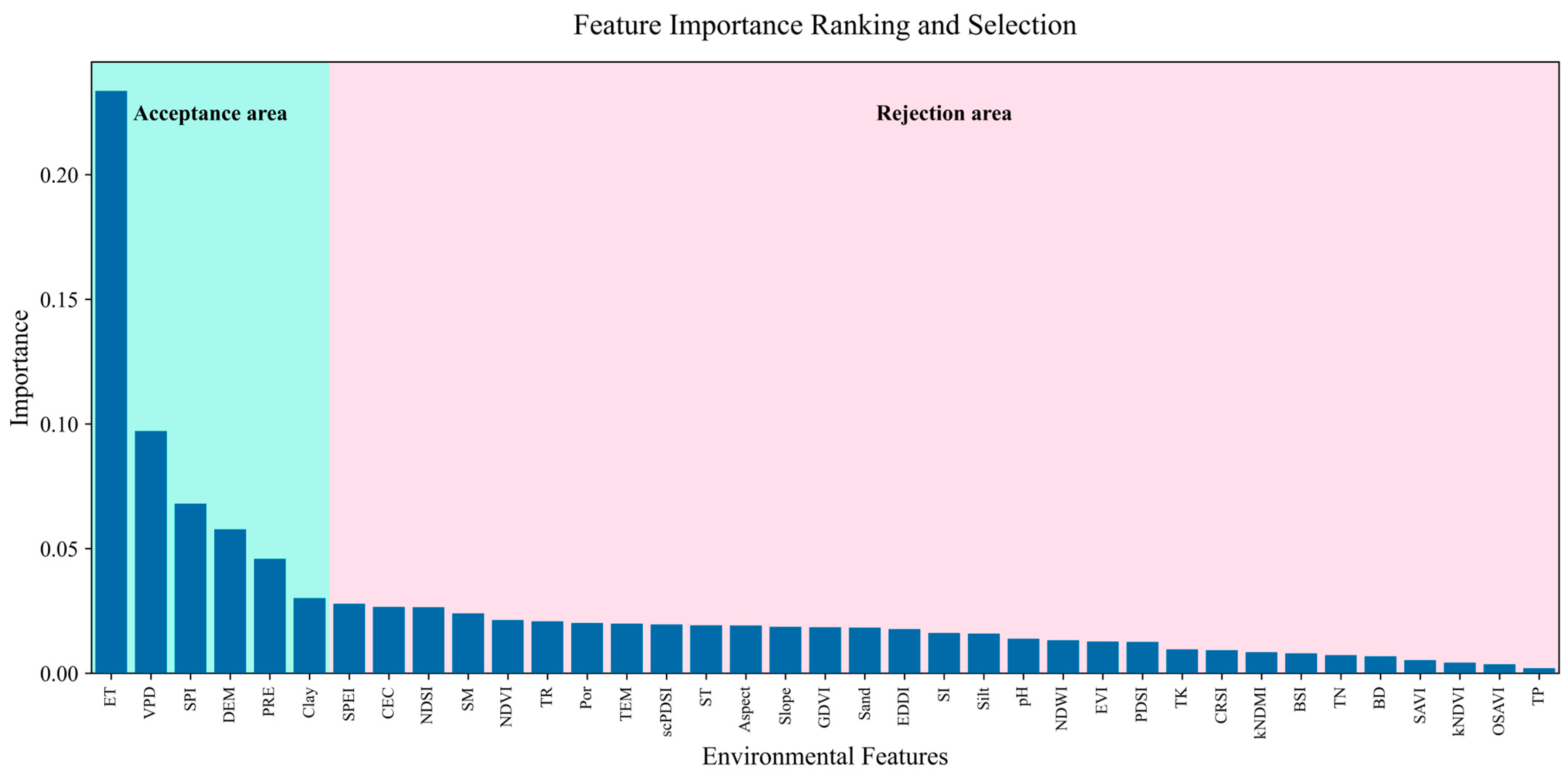
- Factors characterizing hydrothermal exchange processes exhibited significant superiority in explaining the spatial variability of SOC, outperforming traditional vegetation indices.
- The desert ecosystem was confirmed to be a massive “Sparse Carbon Pool” contributing 44.33% of the total regional carbon storage despite its low carbon density.
- Physical parameters reflecting hydrothermal exchange (e.g., ET and VPD) are more effective than traditional vegetation indices in elucidating the mechanisms driving SOC variation in arid regions.
- Carbon sink management strategies in arid zones should not solely focus on high-density grasslands but must also account for the cumulative carbon sequestration effects of vast desert ecosystems.
Abstract
1. Introduction
2. Materials and Methods
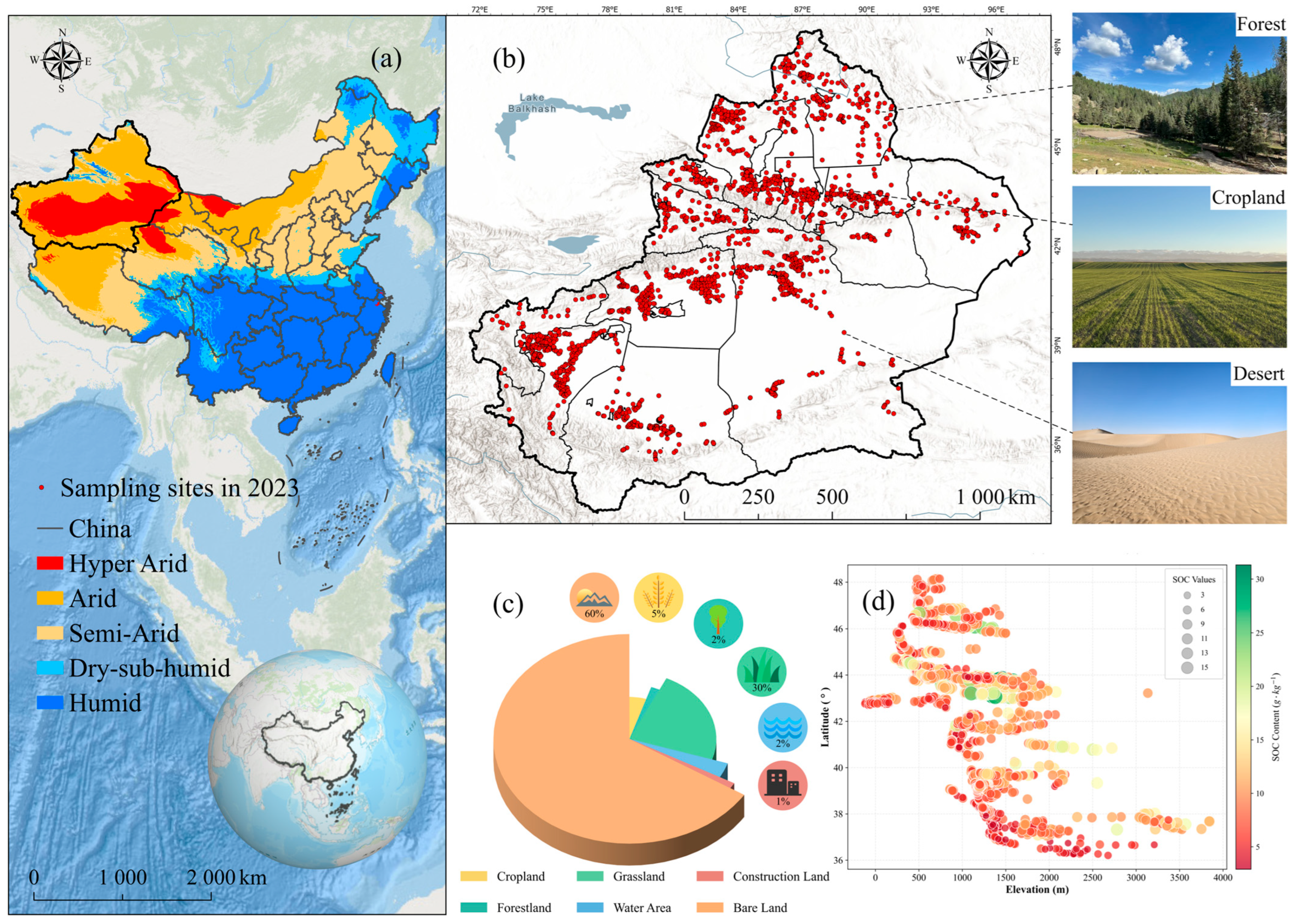
2.1. Overview of the Study Area
2.2. SOC Sampling and Laboratory Analysis
2.3. Acquisition and Preprocessing of Environmental Variables
2.3.1. Remote Sensing Spectral Indices
2.3.2. Climate and Aridity Characteristics
2.3.3. Topography and Soil Properties

2.4. Feature Selection Strategy
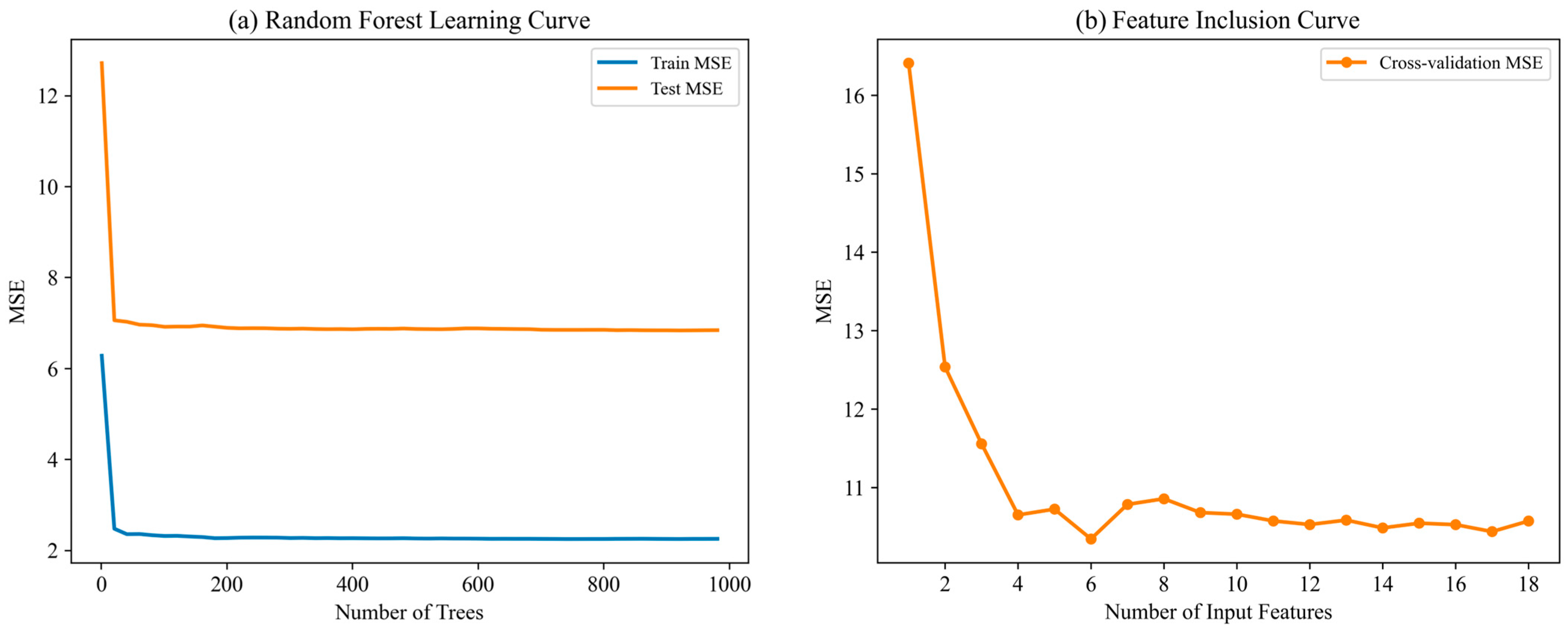
2.5. Machine Learning Modeling
2.6. Model Evaluation and Trend Analysis
2.7. Carbon Storage Estimation
3. Results
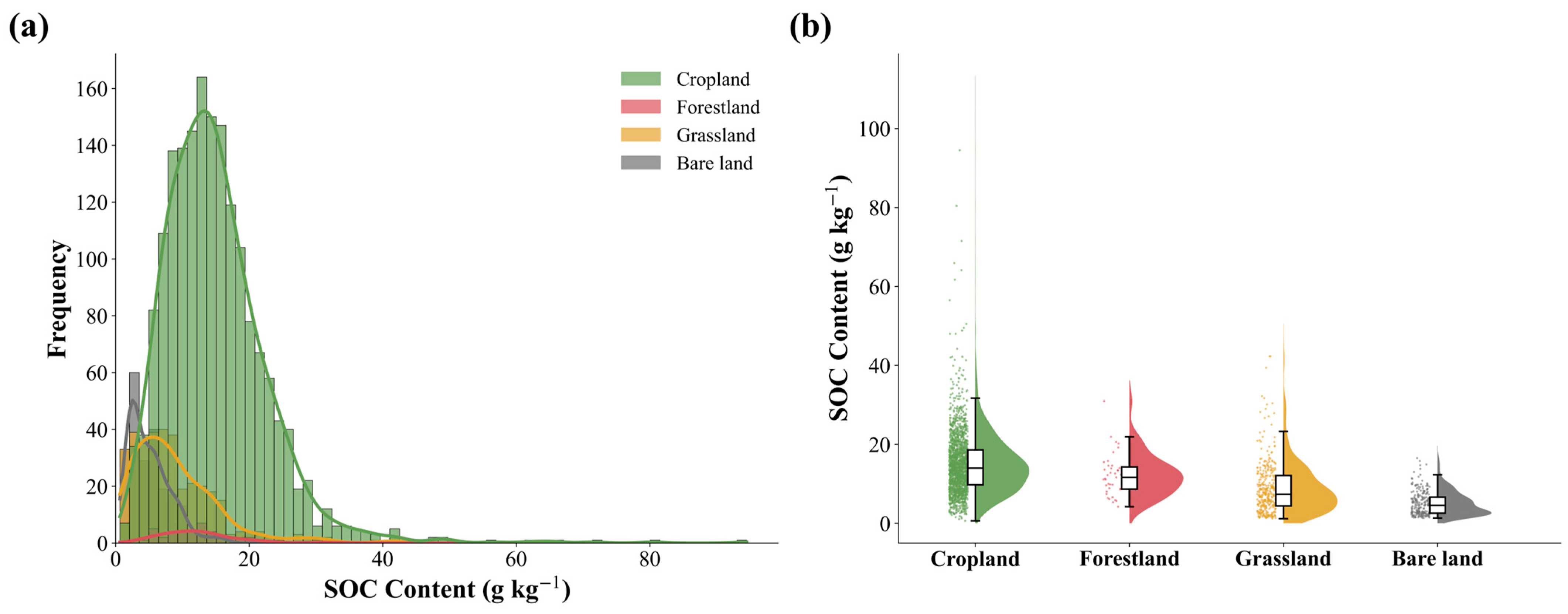
3.1. Descriptive Statistics of SOC
3.2. SOC Spatial Pattern Simulation and Storage Assessment
3.2.1. Variable Importance Selection
3.2.2. Model Parameter Optimization and Feature Dimensionality Determination
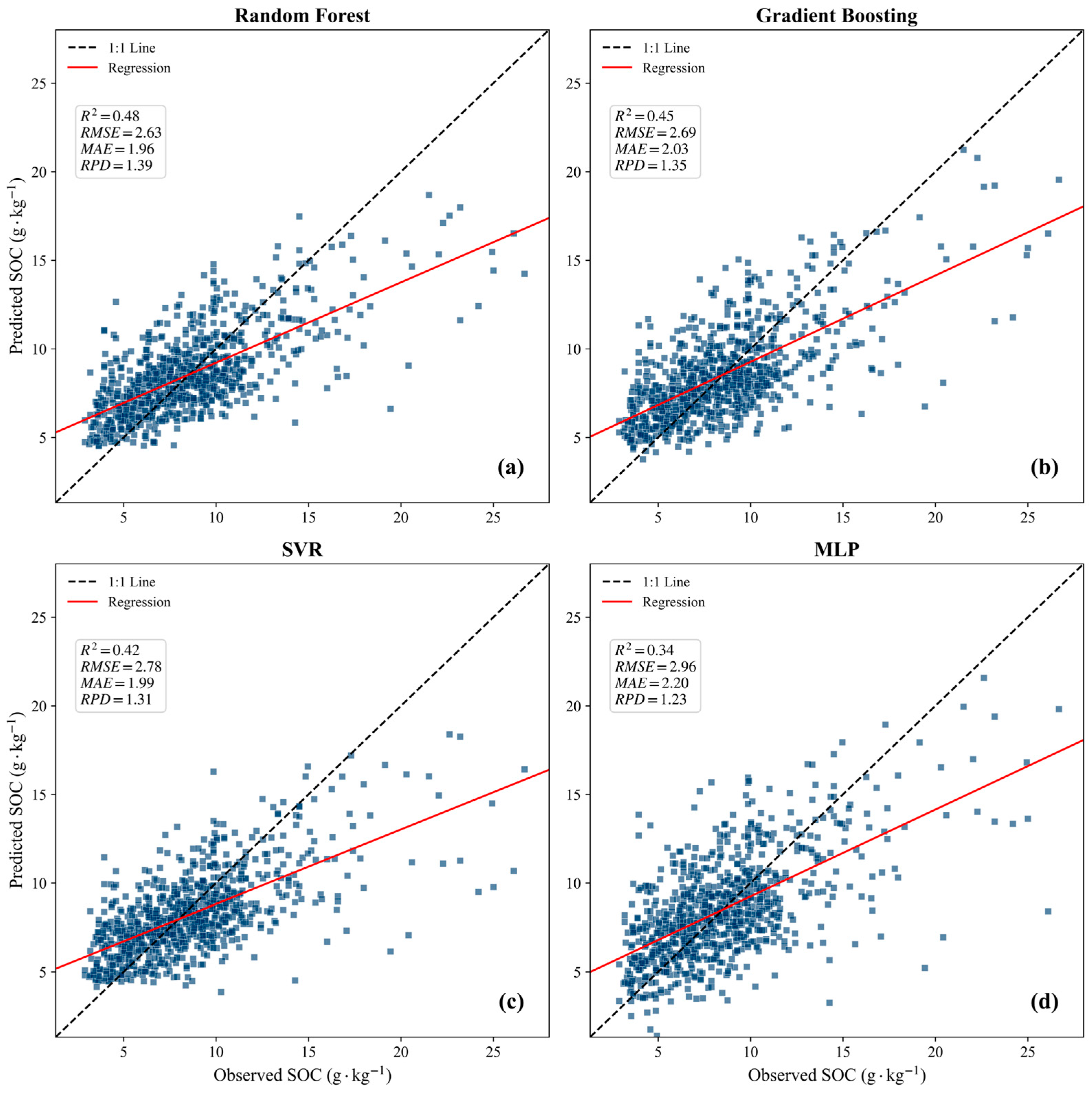
3.2.3. Model Simulation and Accuracy Validation Based on Selected Features
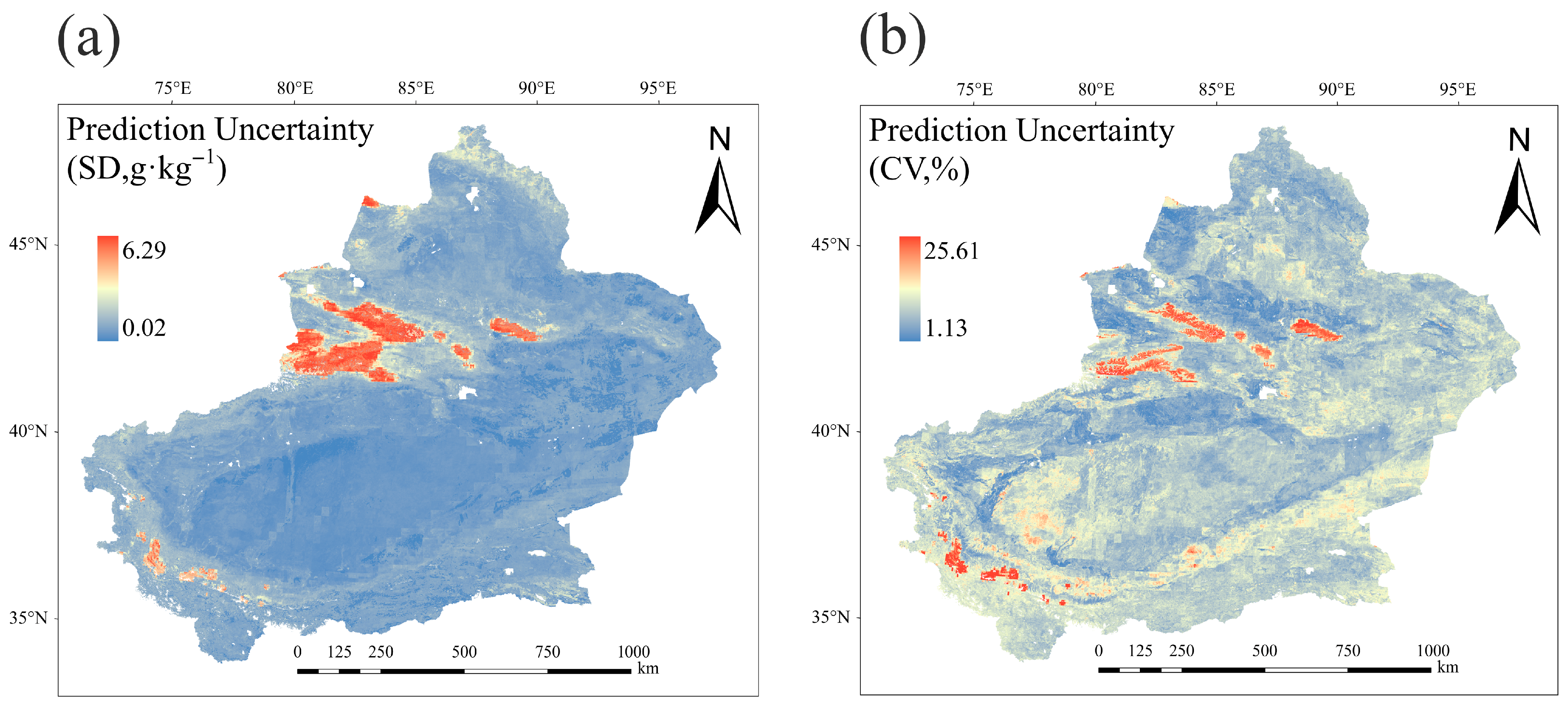
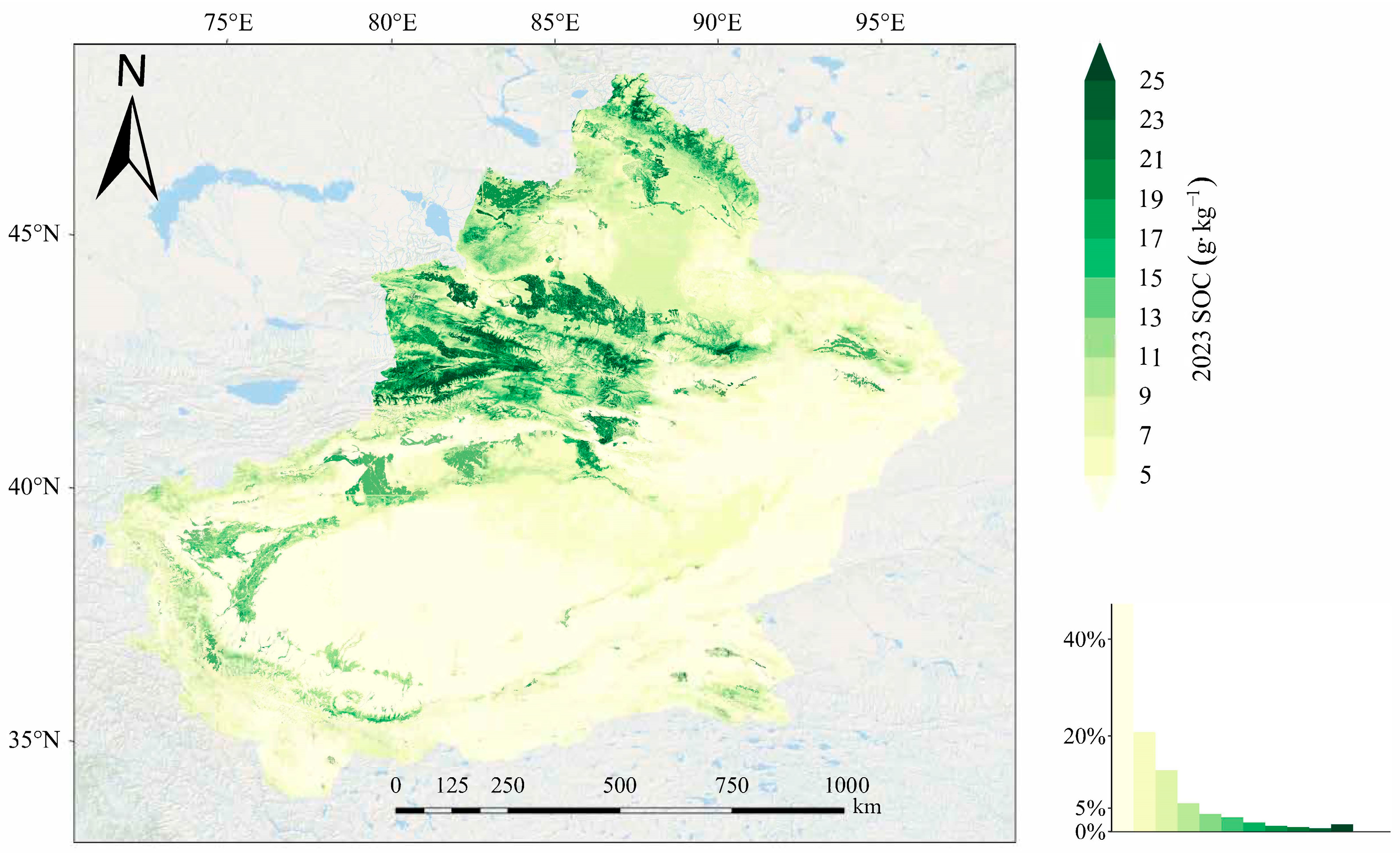
3.2.4. SOC Spatial Distribution Patterns and Uncertainty
3.2.5. Estimation of SOC Storage
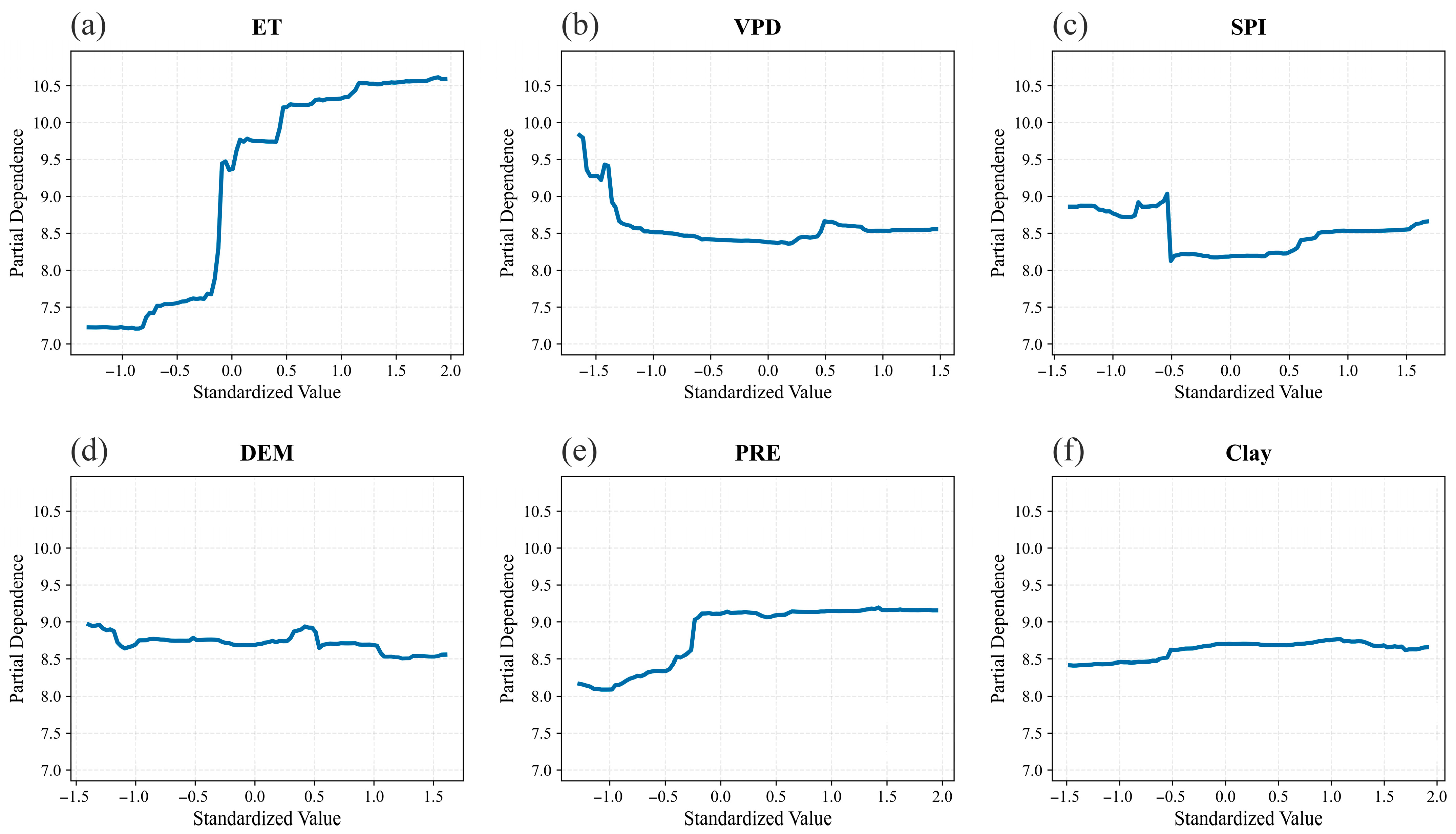
3.3. Non-Linear Response of SOC to Environmental Covariates
4. Discussion
4.1. Factors Influencing Model Prediction Accuracy
4.2. Spatial Differentiation of SOC Storage and Carbon Pool Composition
4.3. Response Patterns and Driving Mechanisms of SOC to Environmental Factors in Arid Regions
4.4. Limitations and Future Perspectives
5. Conclusions
Author Contributions
Funding
Data Availability Statement
Acknowledgments
Conflicts of Interest
References
- Poulter, B.; Frank, D.; Ciais, P.; Myneni, R.B.; Andela, N.; Bi, J.; Broquet, G.; Canadell, J.G.; Chevallier, F.; Liu, Y.Y. Contribution of semi-arid ecosystems to interannual variability of the global carbon cycle. Nature 2014, 509, 600–603. [Google Scholar] [CrossRef] [Scilit] [PubMed]
- Ahlström, A.; Raupach, M.R.; Schurgers, G.; Smith, B.; Arneth, A.; Jung, M.; Reichstein, M.; Canadell, J.G.; Friedlingstein, P.; Jain, A.K. The dominant role of semi-arid ecosystems in the trend and variability of the land CO2 sink. Science 2015, 348, 895–899. [Google Scholar] [CrossRef] [Scilit] [PubMed]
- Friedlingstein, P.; O’sullivan, M.; Jones, M.W.; Andrew, R.M.; Hauck, J.; Landschützer, P.; Le Quéré, C.; Li, H.; Luijkx, I.T.; Olsen, A. Global carbon budget 2024. Earth Syst. Sci. Data Discuss. 2024, 2024, 1–133. [Google Scholar] [CrossRef] [Scilit]
- Piao, S.; Wang, X.; Park, T.; Chen, C.; Lian, X.; He, Y.; Bjerke, J.W.; Chen, A.; Ciais, P.; Tømmervik, H. Characteristics, drivers and feedbacks of global greening. Nat. Rev. Earth Environ. 2020, 1, 14–27. [Google Scholar] [CrossRef] [Scilit]
- Li, X.; Ding, J.; Liu, J.; Ge, X.; Zhang, J. Digital mapping of soil organic carbon using sentinel series data: A case study of the Ebinur lake watershed in Xinjiang. Remote Sens. 2021, 13, 769. [Google Scholar] [CrossRef] [Scilit]
- Plaza, C.; Zaccone, C.; Sawicka, K.; Méndez, A.M.; Tarquis, A.; Gascó, G.; Heuvelink, G.B.; Schuur, E.A.; Maestre, F.T. Soil resources and element stocks in drylands to face global issues. Sci. Rep. 2018, 8, 13788. [Google Scholar] [CrossRef] [Scilit]
- Wadoux, A.M.-C.; Minasny, B.; McBratney, A.B. Machine learning for digital soil mapping: Applications, challenges and suggested solutions. Earth-Sci. Rev. 2020, 210, 103359. [Google Scholar] [CrossRef] [Scilit]
- Arrouays, D.; Poggio, L.; Guerrero, O.A.S.; Mulder, V.L. Digital soil mapping and GlobalSoilMap. Main advances and ways forward. Geoderma Reg. 2020, 21, e00265. [Google Scholar] [CrossRef] [Scilit]
- Fathololoumi, S.; Vaezi, A.R.; Alavipanah, S.K.; Ghorbani, A.; Saurette, D.; Biswas, A. Improved digital soil mapping with multitemporal remotely sensed satellite data fusion: A case study in Iran. Sci. Total Environ. 2020, 721, 137703. [Google Scholar] [CrossRef] [Scilit]
- Lamichhane, S.; Kumar, L.; Wilson, B. Digital soil mapping algorithms and covariates for soil organic carbon mapping and their implications: A review. Geoderma 2019, 352, 395–413. [Google Scholar] [CrossRef] [Scilit]
- Green, J.K.; Seneviratne, S.I.; Berg, A.M.; Findell, K.L.; Hagemann, S.; Lawrence, D.M.; Gentine, P. Large influence of soil moisture on long-term terrestrial carbon uptake. Nature 2019, 565, 476–479. [Google Scholar] [CrossRef] [Scilit]
- Yuan, W.; Zheng, Y.; Piao, S.; Ciais, P.; Lombardozzi, D.; Wang, Y.; Ryu, Y.; Chen, G.; Dong, W.; Hu, Z. Increased atmospheric vapor pressure deficit reduces global vegetation growth. Sci. Adv. 2019, 5, eaax1396. [Google Scholar] [CrossRef] [Scilit]
- Khaledian, Y.; Miller, B.A. Selecting appropriate machine learning methods for digital soil mapping. Appl. Math. Model. 2020, 81, 401–418. [Google Scholar] [CrossRef] [Scilit]
- Zeng, P.; Song, X.; Yang, H.; Wei, N.; Du, L. Digital soil mapping of soil organic matter with deep learning algorithms. ISPRS Int. J. Geo-Inf. 2022, 11, 299. [Google Scholar] [CrossRef] [Scilit]
- Padarian, J.; Minasny, B.; McBratney, A.B. Using deep learning for digital soil mapping. Soil 2019, 5, 79–89. [Google Scholar] [CrossRef] [Scilit]
- Hong, D.; Gao, L.; Yokoya, N.; Yao, J.; Chanussot, J.; Du, Q.; Zhang, B. More diverse means better: Multimodal deep learning meets remote-sensing imagery classification. IEEE Trans. Geosci. Remote Sens. 2020, 59, 4340–4354. [Google Scholar]
- Canero, F.M.; Rodriguez-Galiano, V.; Aragones, D. Machine Learning and Feature Selection for soil spectroscopy. An evaluation of Random Forest wrappers to predict soil organic matter, clay, and carbonates. Heliyon 2024, 10, e30228. [Google Scholar] [CrossRef] [Scilit]
- Keskin, H.; Grunwald, S.; Harris, W.G. Digital mapping of soil carbon fractions with machine learning. Geoderma 2019, 339, 40–58. [Google Scholar] [CrossRef] [Scilit]
- van der Westhuizen, S.; Heuvelink, G.B.; Gardner-Lubbe, S.; Clarke, C.E. Biplots for understanding machine learning predictions in digital soil mapping. Ecol. Inform. 2024, 84, 102892. [Google Scholar]
- Padarian, J.; McBratney, A.B.; Minasny, B. Game theory interpretation of digital soil mapping convolutional neural networks. Soil Discuss. 2020, 2020, 389–397. [Google Scholar]
- Gouda, M.; Abu-hashim, M.; Nassrallah, A.; Khalil, M.N.; Hendawy, E.; Benhasher, F.F.; Shokr, M.S.; Elshewy, M.A.; Mohamed, E.s. Integration of remote sensing and artificial neural networks for prediction of soil organic carbon in arid zones. Front. Environ. Sci. 2024, 12, 1448601. [Google Scholar] [CrossRef] [Scilit]
- Wang, S.; Shi, M.; Fan, Y.; Jiang, P.; Chen, S.; Li, Y.; Huang, L.; Zhao, J. Assessing the impacts of climate changes and human activities on cotton distribution in Xinjiang. Front. Sustain. Food Syst. 2025, 9, 1534544. [Google Scholar] [CrossRef] [Scilit]
- Zhang, C.; Chen, X.; Shao, H.; Chen, S.; Liu, T.; Chen, C.; Ding, Q.; Du, H. Evaluation and intercomparison of high-resolution satellite precipitation estimates—GPM, TRMM, and CMORPH in the Tianshan Mountain Area. Remote Sens. 2018, 10, 1543. [Google Scholar]
- Du, H.; Li, M.; Xu, Y.; Zhou, C. An ensemble learning approach for land use/land cover classification of arid regions for climate simulation: A case study of Xinjiang, northwest China. IEEE J. Sel. Top. Appl. Earth Obs. Remote Sens. 2023, 16, 2413–2426. [Google Scholar] [CrossRef] [Scilit]
- Guo, J.; Fan, Y.; Li, Y.; Bi, Y.; Wang, S.; Hu, Y.; Zhang, L.; Song, W. Topography dominates the spatial and temporal variability of soil bulk density in typical arid zones. Sustainability 2024, 16, 9670. [Google Scholar] [CrossRef] [Scilit]
- Wang, X.; Wang, J.; Zhang, J. Comparisons of three methods for organic and inorganic carbon in calcareous soils of northwestern China. PLoS ONE 2012, 7, e44334. [Google Scholar] [CrossRef] [Scilit]
- Hengl, T. Finding the right pixel size. Comput. Geosci. 2006, 32, 1283–1298. [Google Scholar] [CrossRef] [Scilit]
- Tucker, C.J. Red and photographic infrared linear combinations for monitoring vegetation. Remote Sens. Environ. 1979, 8, 127–150. [Google Scholar]
- Camps-Valls, G.; Campos-Taberner, M.; Moreno-Martínez, Á.; Walther, S.; Duveiller, G.; Cescatti, A.; Mahecha, M.D.; Muñoz-Marí, J.; García-Haro, F.J.; Guanter, L. A unified vegetation index for quantifying the terrestrial biosphere. Sci. Adv. 2021, 7, eabc7447. [Google Scholar] [CrossRef] [Scilit]
- Huete, A.; Didan, K.; Miura, T.; Rodriguez, E.P.; Gao, X.; Ferreira, L.G. Overview of the radiometric and biophysical performance of the MODIS vegetation indices. Remote Sens. Environ. 2002, 83, 195–213. [Google Scholar]
- Wu, W.; Al-Shafie, W.M.; Mhaimeed, A.S.; Ziadat, F.; Nangia, V.; Payne, W.B. Soil salinity mapping by multiscale remote sensing in Mesopotamia, Iraq. IEEE J. Sel. Top. Appl. Earth Obs. Remote Sens. 2014, 7, 4442–4452. [Google Scholar] [CrossRef] [Scilit]
- Fern, R.R.; Foxley, E.A.; Bruno, A.; Morrison, M.L. Suitability of NDVI and OSAVI as estimators of green biomass and coverage in a semi-arid rangeland. Ecol. Indic. 2018, 94, 16–21. [Google Scholar] [CrossRef] [Scilit]
- Li, S.; Li, X.; Ge, X. Prediction and mapping of soil organic carbon in the Bosten Lake oasis based on Sentinel-2 data and environmental variables. Int. Soil Water Conserv. Res. 2025, 13, 436–446. [Google Scholar] [CrossRef] [Scilit]
- Nicolas, H.; Walter, C. Detecting salinity hazards within a semiarid context by means of combining soil and remote-sensing data. Geoderma 2006, 134, 217–230. [Google Scholar] [CrossRef] [Scilit]
- Xu, H.; Sun, H.; Xu, Z.; Wang, Y.; Zhang, T.; Wu, D.; Gao, J. kNDMI: A kernel normalized difference moisture index for remote sensing of soil and vegetation moisture. Remote Sens. Environ. 2025, 319, 114621. [Google Scholar] [CrossRef] [Scilit]
- Sajjad, H.; Kumar, P.; Srivastava, P.K.; Pathak, S.O.; Ahmed, M.; Kumar, V.; Dobriyal, M.; Kumari, P.; Pandey, P.C. Assessing soil organic carbon and its relation with biophysical and ecological parameters in tropical forest ecosystem India. Geocarto Int. 2025, 40, 2441388. [Google Scholar] [CrossRef] [Scilit]
- Li, J.; Zhang, T.; Shao, Y.; Ju, Z. Comparing machine learning algorithms for soil salinity mapping using topographic factors and sentinel-1/2 data: A case study in the yellow river delta of China. Remote Sens. 2023, 15, 2332. [Google Scholar] [CrossRef] [Scilit]
- Rakhymberdina, M.; Daumova, G.; Apshikur, B.; Shults, R.; Toguzova, M.; Assylkhanova, Z.; Kolpakova, V.; Kapasov, A. Integrated Chemical-Geoecological Monitoring and Engineering Approaches for Pollution Reduction in the Yertis River. Eng. Sci. 2024, 32, 1328. [Google Scholar] [CrossRef] [Scilit]
- Belenok, V.; Hebryn-Baidy, L.; Bielousova, N.; Zavarika, H.; Kryachok, S.; Liashenko, D.; Malik, T. Application of remote sensing methods for statistical estimation of organic matter in soils. Earth Sci. Res. J. 2023, 27, 299–313. [Google Scholar] [CrossRef] [Scilit]
- Kursa, M.B.; Rudnicki, W.R. Feature selection with the Boruta package. J. Stat. Softw. 2010, 36, 1–13. [Google Scholar] [CrossRef] [Scilit]
- Gomes, L.C.; Faria, R.M.; de Souza, E.; Veloso, G.V.; Schaefer, C.E.G.; Fernandes Filho, E.I. Modelling and mapping soil organic carbon stocks in Brazil. Geoderma 2019, 340, 337–350. [Google Scholar] [CrossRef] [Scilit]
- Wang, Q.; Bian, J.; Ma, E.; Zhang, J. Predicting sorption of organic pollutants on soils with interpretable machine learning. Environ. Pollut. 2025, 382, 126665. [Google Scholar] [CrossRef] [Scilit] [PubMed]
- Song, J.; Gao, J.; Zhang, Y.; Li, F.; Man, W.; Liu, M.; Wang, J.; Li, M.; Zheng, H.; Yang, X. Estimation of soil organic carbon content in coastal wetlands with measured VIS-NIR spectroscopy using optimized support vector machines and random forests. Remote Sens. 2022, 14, 4372. [Google Scholar]
- Emadi, M.; Taghizadeh-Mehrjardi, R.; Cherati, A.; Danesh, M.; Mosavi, A.; Scholten, T. Predicting and mapping of soil organic carbon using machine learning algorithms in Northern Iran. Remote Sens. 2020, 12, 2234. [Google Scholar]
- Viscarra Rossel, R.A.; Webster, R.; Bui, E.N.; Baldock, J.A. Baseline map of organic carbon in Australian soil to support national carbon accounting and monitoring under climate change. Glob. Change Biol. 2014, 20, 2953–2970. [Google Scholar] [CrossRef] [Scilit]
- Li, Y.; Wang, X.; Niu, Y.; Lian, J.; Luo, Y.; Chen, Y.; Gong, X.; Yang, H.; Yu, P. Spatial distribution of soil organic carbon in the ecologically fragile Horqin Grassland of northeastern China. Geoderma 2018, 325, 102–109. [Google Scholar] [CrossRef] [Scilit]
- Kumar, A.; Moharana, P.C.; Jena, R.K.; Malyan, S.K.; Sharma, G.K.; Fagodiya, R.K.; Shabnam, A.A.; Jigyasu, D.K.; Kumari, K.M.V.; Doss, S.G. Digital mapping of soil organic carbon using machine learning algorithms in the upper Brahmaputra valley of northeastern India. Land 2023, 12, 1841. [Google Scholar] [CrossRef] [Scilit]
- Odebiri, O.; Mutanga, O.; Odindi, J.; Slotow, R.; Mafongoya, P.; Lottering, R.; Naicker, R.; Matongera, T.N.; Mngadi, M. Remote sensing of depth-induced variations in soil organic carbon stocks distribution within different vegetated landscapes. Catena 2024, 243, 108216. [Google Scholar] [CrossRef] [Scilit]
- Shafizadeh-Moghadam, H.; Minaei, F.; Talebi-khiavi, H.; Xu, T.; Homaee, M. Synergetic use of multi-temporal Sentinel-1, Sentinel-2, NDVI, and topographic factors for estimating soil organic carbon. Catena 2022, 212, 106077. [Google Scholar] [CrossRef] [Scilit]
- Chen, C.; Yuan, X.; Gan, S.; Kang, X.; Luo, W.; Li, R.; Bi, R.; Gao, S. A new strategy based on multi-source remote sensing data for improving the accuracy of land use/cover change classification. Sci. Rep. 2024, 14, 26855. [Google Scholar]
- Angelopoulou, T.; Tziolas, N.; Balafoutis, A.; Zalidis, G.; Bochtis, D. Remote sensing techniques for soil organic carbon estimation: A review. Remote Sens. 2019, 11, 676. [Google Scholar] [CrossRef] [Scilit]
- He, M.; Tang, L.; Li, C.; Ren, J.; Zhang, L.; Li, X. Dynamics of soil organic carbon and nitrogen and their relations to hydrothermal variability in dryland. J. Environ. Manag. 2022, 319, 115751. [Google Scholar] [CrossRef] [Scilit] [PubMed]
- Tang, X.; Zhao, X.; Bai, Y.; Tang, Z.; Wang, W.; Zhao, Y.; Wan, H.; Xie, Z.; Shi, X.; Wu, B. Carbon pools in China’s terrestrial ecosystems: New estimates based on an intensive field survey. Proc. Natl. Acad. Sci. USA 2018, 115, 4021–4026. [Google Scholar] [CrossRef] [Scilit] [PubMed]
- Wang, G.; Mao, J.; Fan, L.; Ma, X.; Li, Y. Effects of climate and grazing on the soil organic carbon dynamics of the grasslands in Northern Xinjiang during the past twenty years. Glob. Ecol. Conserv. 2022, 34, e02039. [Google Scholar] [CrossRef] [Scilit]
- Zhou, G.; Zhou, X.; He, Y.; Shao, J.; Hu, Z.; Liu, R.; Zhou, H.; Hosseinibai, S. Grazing intensity significantly affects belowground carbon and nitrogen cycling in grassland ecosystems: A meta-analysis. Glob. Change Biol. 2017, 23, 1167–1179. [Google Scholar] [CrossRef] [Scilit]
- Xie, B.; Ding, J.; Ge, X.; Li, X.; Han, L.; Wang, Z. Estimation of soil organic carbon content in the Ebinur Lake wetland, Xinjiang, China, based on multisource remote sensing data and ensemble learning algorithms. Sensors 2022, 22, 2685. [Google Scholar] [CrossRef] [Scilit]
- Yan, X.; Zhang, Q.; Ren, X.; Wang, X.; Yan, X.; Li, X.; Wang, L.; Bao, L. Climatic change characteristics towards the “Warming–Wetting” trend in the Pan-Central-Asia arid region. Atmosphere 2022, 13, 467. [Google Scholar] [CrossRef] [Scilit]
- Hengl, T.; Mendes de Jesus, J.; Heuvelink, G.B.; Ruiperez Gonzalez, M.; Kilibarda, M.; Blagotić, A.; Shangguan, W.; Wright, M.N.; Geng, X.; Bauer-Marschallinger, B. SoilGrids250m: Global gridded soil information based on machine learning. PLoS ONE 2017, 12, e0169748. [Google Scholar] [CrossRef] [Scilit]
- Yi, S.; Wang, H.; Wang, C.; Huang, X. Threshold effects and synergistic trade-offs in ecosystem services: A spatio-temporal study of Kashgar’s arid region. Agriculture 2025, 15, 1742. [Google Scholar] [CrossRef] [Scilit]
- Grossiord, C.; Buckley, T.N.; Cernusak, L.A.; Novick, K.A.; Poulter, B.; Siegwolf, R.T.; Sperry, J.S.; McDowell, N.G. Plant responses to rising vapor pressure deficit. New Phytol. 2020, 226, 1550–1566. [Google Scholar] [CrossRef] [Scilit]
- Sun, W.; Zhu, H.; Guo, S. Soil organic carbon as a function of land use and topography on the Loess Plateau of China. Ecol. Eng. 2015, 83, 249–257. [Google Scholar] [CrossRef] [Scilit]
- De la Cruz-Amo, L.; Bañares-de-Dios, G.; Cala, V.; Granzow-de la Cerda, Í.; Espinosa, C.I.; Ledo, A.; Salinas, N.; Macía, M.J.; Cayuela, L. Trade-offs among aboveground, belowground, and soil organic carbon stocks along altitudinal gradients in Andean tropical montane forests. Front. Plant Sci. 2020, 11, 106. [Google Scholar] [CrossRef] [Scilit]
- Georgiou, K.; Jackson, R.B.; Vindušková, O.; Abramoff, R.Z.; Ahlström, A.; Feng, W.; Harden, J.W.; Pellegrini, A.F.; Polley, H.W.; Soong, J.L. Global stocks and capacity of mineral-associated soil organic carbon. Nat. Commun. 2022, 13, 3797. [Google Scholar] [CrossRef] [Scilit]




| Factor Types | Variable Name | Data Sources | Spatial Resolution |
|---|---|---|---|
| Vegetation Indices | NDVI, kNDVI, EVI, GDVI, OSAVI, SAVI | Landsat8 | 30 m |
| Topographic Factors | DEM, Slope, Aspect, TR | SRTM | 30 m |
| Soil Properties | TN, TP, TK, BD, pH, CEC, Clay, Silt, Sand, Por | TPDC | 1000 m |
| ST, SM | NASA GLDAS | 0.25° | |
| Meteorological Factors | TEM | ECMWF ERA5–Land | 0.1° |
| PRE | UCSB CHIRPS | 0.05° | |
| ET | MOD16A2GF | 500 m | |
| Drought Indices | EDDI, SC_PDSI, PDSI, SPEI, SPI, VPD | CHM_Drought | 0.1° |
| Environmental Indices | SI, kNDMI, BSI, CRSI, NDWI, NDSI | Landsat8 | 30 m |
| Land Use Type | N | Mean ± SD (g kg−1) | An Typege (Min–Max) | CV (%) | Skewness | Kurtosis |
|---|---|---|---|---|---|---|
| Cropland | 1764 | 14.96 ± 7.94 | 0.65–94.50 | 53.11 | 2.23 | 12.80 |
| Forestland | 39 | 12.20 ± 5.40 | 4.21–30.90 | 44.23 | 1.22 | 2.52 |
| Grassland | 347 | 8.91 ± 6.70 | 1.19–42.30 | 75.18 | 1.86 | 5.10 |
| Bare land | 222 | 5.07 ± 3.09 | 1.34–16.50 | 60.86 | 1.14 | 1.18 |
| Overall | 2372 | 13.10 ± 8.13 | 0.65–94.50 | 62.01 | 1.90 | 9.93 |
| LULC Type | SOC Storage (Pg) | SOC Storage (Tg) | Percentage (%) |
|---|---|---|---|
| Cropland | 0.45 | 454.33 | 14.19% |
| Forestland | 0.20 | 200.57 | 6.26% |
| Grassland | 1.13 | 1127.64 | 35.22% |
| Bare land | 1.42 | 1419.36 | 44.33% |
| Overall | 3.20 | 3201.90 | 100.00% |
Disclaimer/Publisher’s Note: The statements, opinions and data contained in all publications are solely those of the individual author(s) and contributor(s) and not of MDPI and/or the editor(s). MDPI and/or the editor(s) disclaim responsibility for any injury to people or property resulting from any ideas, methods, instructions or products referred to in the content. |
© 2026 by the authors. Licensee MDPI, Basel, Switzerland. This article is an open access article distributed under the terms and conditions of the Creative Commons Attribution (CC BY) license.
Share and Cite
Li, Y.; Shi, M.; Wang, S.; Liu, W.; Wang, P.; Wang, X.; Guo, J.; Wu, H. Unveiling the “Sparse Carbon Pool”: High-Resolution Mapping and Storage Estimation of Topsoil Organic Carbon in Arid Xinjiang, China. Remote Sens. 2026, 18, 728. https://doi.org/10.3390/rs18050728
Li Y, Shi M, Wang S, Liu W, Wang P, Wang X, Guo J, Wu H. Unveiling the “Sparse Carbon Pool”: High-Resolution Mapping and Storage Estimation of Topsoil Organic Carbon in Arid Xinjiang, China. Remote Sensing. 2026; 18(5):728. https://doi.org/10.3390/rs18050728
Chicago/Turabian StyleLi, Yunhao, Mingjie Shi, Shanshan Wang, Wenhui Liu, Pengfei Wang, Xiangge Wang, Jia Guo, and Hongqi Wu. 2026. "Unveiling the “Sparse Carbon Pool”: High-Resolution Mapping and Storage Estimation of Topsoil Organic Carbon in Arid Xinjiang, China" Remote Sensing 18, no. 5: 728. https://doi.org/10.3390/rs18050728
APA StyleLi, Y., Shi, M., Wang, S., Liu, W., Wang, P., Wang, X., Guo, J., & Wu, H. (2026). Unveiling the “Sparse Carbon Pool”: High-Resolution Mapping and Storage Estimation of Topsoil Organic Carbon in Arid Xinjiang, China. Remote Sensing, 18(5), 728. https://doi.org/10.3390/rs18050728