1. Introduction
Surface heat-flux refers to the exchange rate of heat per unit area between the ocean and the atmosphere. It comprises turbulent and radiative components, with turbulent flux over the ocean as a critical parameter influencing air–sea interactions [
1,
2]. These fluxes affect ocean heat storage and circulation and contribute to the global water budget by approximately balancing incoming solar radiation at the air–sea interface [
3]. Additionally, turbulent heat-fluxes can indirectly impact surface winds by modifying the horizontal sea surface temperature and air temperature gradients and influencing which process or processes dominate SST–wind coupling [
4,
5,
6,
7]. Therefore, accurately estimating turbulent heat flux variations is essential for advancing research on air–sea interactions.
Despite their importance, direct observations (e.g., ship- and buoy-based) of turbulent heat-fluxes over open oceans are limited [
8]. Global estimates, thus, rely on indirect methods that use bulk turbulent-flux parameterization, incorporate satellite or model observations, or estimate small-scale space-time means of water vapor, air temperature, sea surface temperature, and wind speed [
9,
10]. Satellite-derived wind data, however, require careful handling because they are associated with ocean surface stress rather than actual wind speeds [
11,
12]. These winds are essentially pseudo-winds that can be used with a neutral drag coefficient to obtain the correct stress. Note that equivalent neutral-winds depend on stability (i.e., equivalent neutral winds change as wind speed is held constant and stability modifies the surface stress). This dependency is different from the usual log-profile-based parameterization commonly used in boundary-layer work. Equivalent neutral winds are the same as traditional winds, only under a neutrally stratified atmosphere. Deviations from these neutral conditions can introduce biases into flux calculations, stressing the need for careful consideration when using satellite winds in such calculations. For instance, ref. [
13] examined the impact of stability on derived heat-fluxes by applying three different air–sea flux algorithms. Their research demonstrated that ignoring the distinctions between stability-dependent and stability-independent winds can lead to significant biases in air–sea flux measurements, especially in highly unstable atmospheric stratification regimes such as the Kuroshio- and Gulf Stream current regions. Given the significance of atmospheric stratification, efforts have been made to refine flux estimations using satellite wind data, including proposed adjustments to bulk formulas that account for the influence of equivalent neutral winds [
12,
14]. However, these adjustments have yet to be widely adopted due to challenges in implementation within contemporary aerodynamic bulk formulas (e.g., as used in the Coupled Ocean–Atmosphere Response Experiment (COARE) algorithm [
15]) and limited demonstrated impact on flux calculations relative to other air–sea parameters. Consequently, satellite-derived equivalent neutral wind speeds are often used as wind speeds in bulk formulas to calculate sensible and latent heat-fluxes, despite these formulas being designed for wind speeds.
In this study, we adopt the proven methodologies recommended for calculating satellite-derived turbulent heat-fluxes using bulk-aerodynamic formulas based on the Monin–Obukhov similarity theory [
12,
14]. This approach aims to enhance the accuracy of existing turbulent heat flux products [
16] when utilized with wind data from NASA’s CYGNSS satellite [
17]. The CYGNSS constellation, consisting of eight micro-satellites, provides nearly continuous Earth coverage of the tropical and subtropical oceans with an orbital inclination of 35°, resulting in an average revisit time of seven hours and a median revisit time of three hours. This orbital configuration allows CYGNSS to measure ocean surface winds between approximately ±38° latitude. Notably, the measurements taken by the CYGNSS spacecraft are sensitive to a wide range of ocean surface-roughness, including capillary waves and longer swells, owing to its use of L-band technology [
18]. The lack of sensitivity to raindrop impacts on the water surface, in combination with a wavelength that is larger relative to the size of rain drops, means it is less susceptible to rainfall intensity when compared to C- or Ku-band scatterometers [
19,
20]. A detailed description of the CYGNSS mission and spacecraft engineering characteristics is given in the CYGNSS handbook [
17,
21].
2. Materials and Methods
A. Satellite Ocean Surface Wind
This study employs the CYGNSS Science Data Record (SDR) v3.2 L2 Fully Developed Seas (FDS) wind product [
22], an improved version succeeding SDR v3.1 for the flux calculations. Recent assessments by [
19,
20] have highlighted that SDR versions 3.0 and 3.1 significantly reduce errors compared to SDR v2.1. Rather than directly utilizing the SDR flux v3.2, now available [
16] on PO.DAAC, we independently computed the fluxes using the same methodology applied in the official release. This approach enables a performance comparison between experiments, which forms the core focus of this paper, as detailed in
Section 2.
This dataset provides time-tagged, geolocated average wind speed (m s−1) and mean square slope (MSS) at a 25 × 25 km grid-spacing from the Delay Doppler Mapping Instrument on the CYGNSS satellite constellation. The Level 2 Geophysical Model Function (GMF), which maps Level 1 observables to ocean surface wind speed, and the second-order correction for Significant Wave Height (SWH) have been revised to align with the v3.2 Level 1 calibration. The GMF and SWH correction methods remain consistent with version 3.1, though a new swell-wave correction has been introduced to improve accuracy in the long-wave dependence at low wind speeds.
B. Global Reanalysis Wind
We utilized air–sea parameters, including skin temperature, 2 m air temperature, and 2 m dew point temperature (to calculate specific humidity) sourced from the ECMWF Reanalysis, Version 5 (ERA5) [
23]. Relative to previous ECMWF reanalysis datasets, ERA5 has higher spatial and temporal resolution and has been upgraded with various advancements from the ECMWF integrated forecasting system, such as enhanced model physics, a new humidity analysis approach, a 4D-VAR assimilation scheme, variational bias correction techniques, and the direct assimilation of early satellite radiance data. ERA5 estimates a wide range of atmospheric, land, and oceanic climate variables at hourly intervals, covering the globe with a horizontal resolution of 0.25° × 0.25° and 137 vertical levels from the surface up to 80 km height.
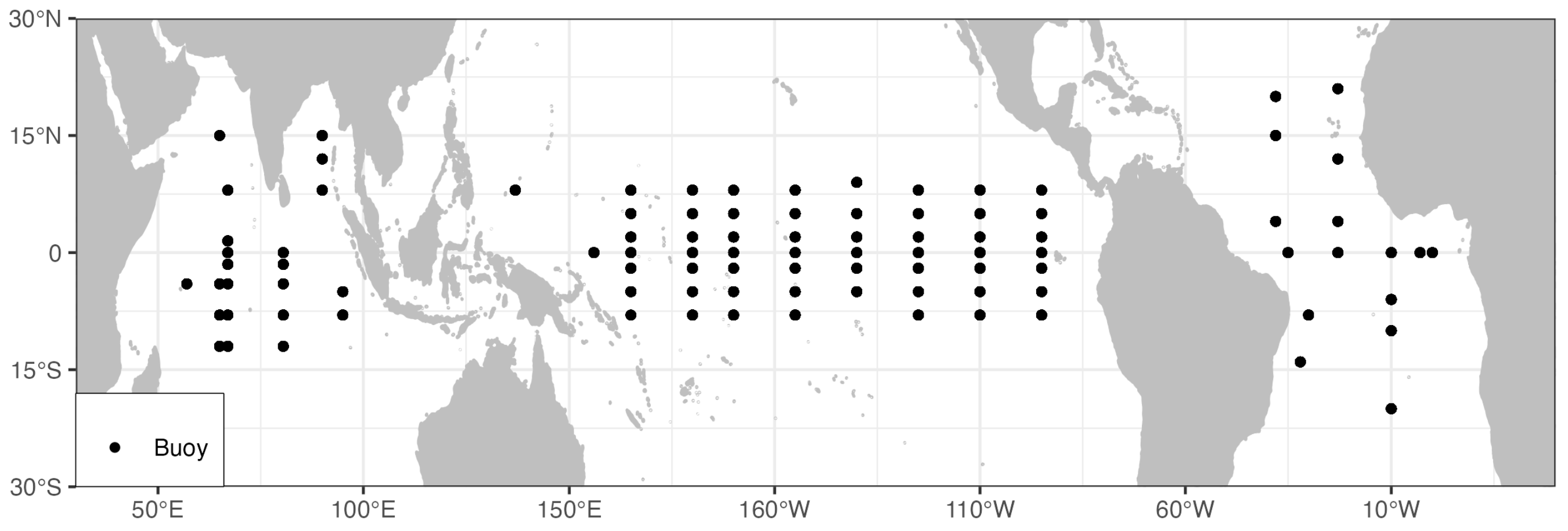
C. Reference Buoy Data
Following the previous works [
19,
20], hourly averaged surface wind observations from the tropical moored buoy arrays PIRATA (Prediction and Research Moored Array in the Tropical Atlantic; [
24]), RAMA (Research Moored Array for African-Asian- Australian Monsoon Analysis and Prediction; [
25]), and TAO (Tropical Atmosphere Ocean; [
26])/TRITON (Triangle Trans-Ocean Buoy Network) were processed and employed as reference data for the CYGNSS flux validation (
Figure 1).
The CYGNSS winds are valid at a height of 10 m. To ensure a reliable comparison, the wind data collected by the buoys were adjusted to the same 10 m height using the COARE algorithm [
15,
27], which is based on the Monin–Obukhov similarity theory.
D. Method
We begin by considering the surface turbulent stress (τ). It is directly related to the friction velocity, , the velocity scale that governs near-surface turbulence and, in turn, the exchange coefficients used to compute sensible and latent heat-fluxes.
Within the bulk-aerodynamic framework, calculating τ from wind speed requires knowledge of atmospheric stratification. In terms of a drag coefficient (here at 10 m as named
), surface stress is defined as
where
ρ denotes air density. The transfer coefficient
is parameterized as follows:
Here,
L is the Obukhov length and
is the surface roughness.
k is the von Kármán’s constant (0.4), and
represents the stability function. An exceptional attribute of equivalent neutral winds is their independence from atmospheric stability considerations when determining surface stress. All that is necessary is knowledge of air density and an equivalent neutral (hereafter neutral) drag coefficient [
13]. Equation (1) thus can be written as
where
is
As stated earlier, stress can also be characterized in terms of the friction velocity (
), which is a dimensional scaling factor that is often used to non-dimensionalize wind speed:
Hence,
=
, analogous to
. The parameter
plays a crucial role in the computation of sensible heat (SHF) and latent heat (LHF) fluxes, represented as follows
Here, is the specific heat of air, represents the latent heat of vaporization, while and are scaling parameters akin to . Improving the accuracy of modeled values are essential for enhancing the precision of modeled surface turbulent fluxes. Note that the negative (positive) fluxes from Equations (5) and (6), indicate energy going from (to) the ocean into (out of) the atmosphere.
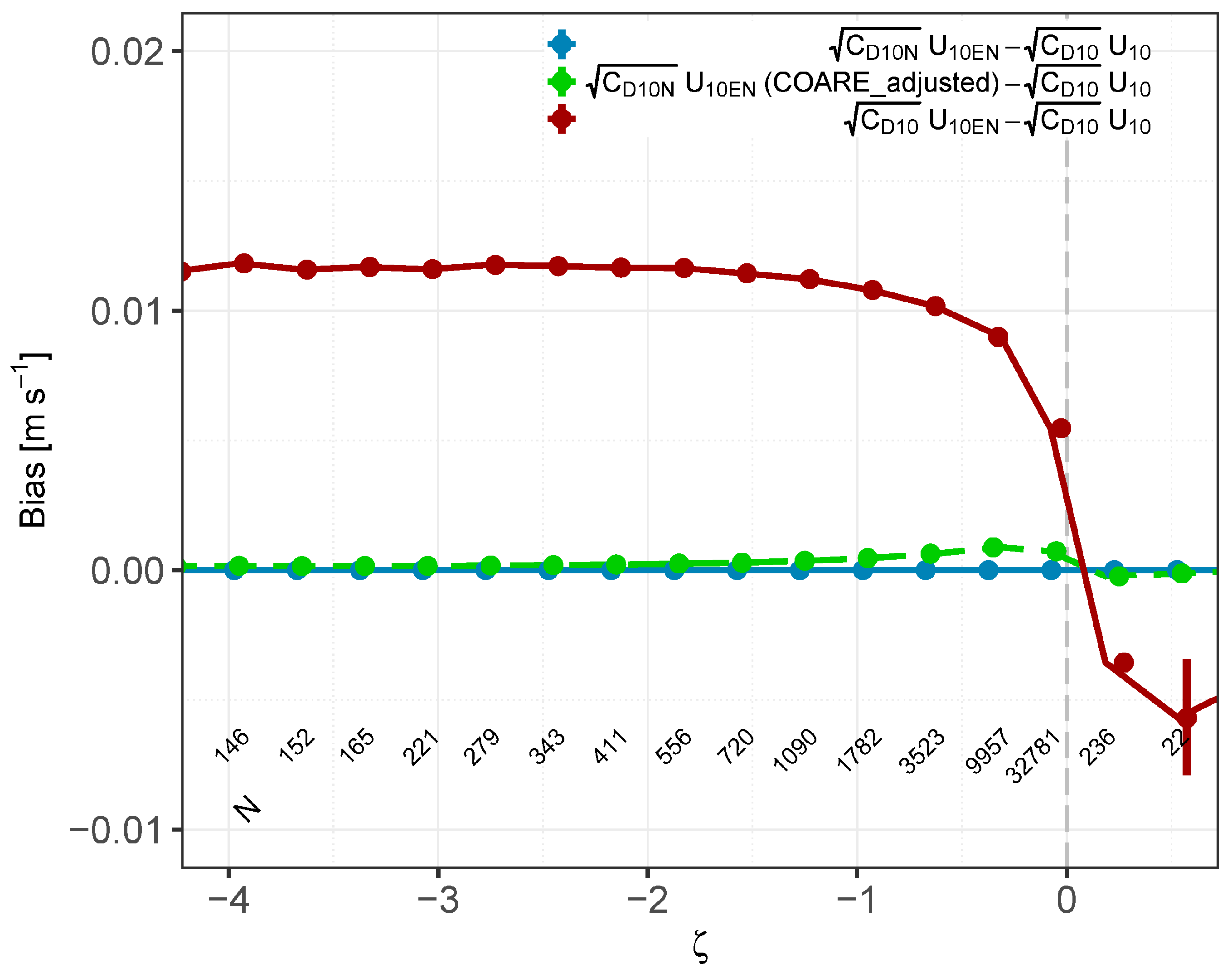
Because CYGNSS provides equivalent neutral 10 m winds (), τ and must be evaluated with the neutral drag coefficient () rather than the stability-dependent . Using tropical buoy observations, we first demonstrate within the COARE framework that the neutral-wind expression is consistent with the conventional COARE estimate based on the observed wind over both stable and unstable conditions. We evaluate this formulation (Equation (3)) by treating buoy-derived COARE estimates as the reference baseline.
Figure 2 presents the stability dependence by plotting the bias (
against the non-dimensional stability parameter
. For context,
Figure 2 also reports the
bias derived from a physically inconsistent formulation,
), designed to mimic the common practice of inserting
into COARE without modifying the drag-related term. This experiment exhibits a pronounced stability-dependent departure, i.e., positive differences from unstable to near-neutral conditions that become negative under stable stratification, indicating a systematic bias when EN winds are used without a consistent formulation. On the other hand, the adjusted formulation (the blue curve) remains centered about zero across the full stability range.
After verifying consistency between the formulations, we incorporated the EN-wind-compatible, physically consistent pathway into COARE (hereafter COARE_adjusted) and input buoy-derived
directly to this modified COARE. This allowed us to evaluate whether the COARE implementation using
yields results consistent with both the standard stability-dependent estimate,
, and the neutral-wind-based estimate,
. The green long-dashed curve, shown in
Figure 2, shows that COARE_adjusted closely tracks these reference estimates across both stable and unstable regimes, with only modest residual discrepancies. These small differences are expected. As illustrated by the blue curve,
and
are algebraically equivalent under idealized assumptions, but exact numerical equivalence is not necessarily preserved in the implemented COARE workflow (the green curve). This can be explained by the fact that in COARE, stability functions, the roughness length (including its Charnock-type dependence), and gustiness enter nonlinearly, and
is obtained through an iterative solution that also feeds back into the stability parameter and roughness. Introducing the alternate pathway (i.e., the
with
), changes the internal sequencing of these coupled calculations, so small iteration-driven discrepancies can arise even if the two formulations algebraically coincide in the continuous limit. Nonetheless, these differences are much smaller than the bias associated with the physically inconsistent formulation, supporting the use of COARE_adjusted when satellite winds are provided as
.
Note that the COARE algorithm is not primarily calibrated for extreme wind conditions. Although it has been extensively tuned and validated for moderate winds (typically up to ~20–25 m s−1), flux estimates at wind speeds exceeding ~25 m s−1 are therefore more uncertain.
3. Results
This study uses equivalent neutral (EN) wind measurements from the CYGNSS satellite to derive surface turbulent heat-fluxes. Since CYGNSS does not directly measure other essential input variables required by the COARE algorithm, such as near-surface temperature, specific humidity, and surface pressure, we obtain these values from the ERA5 reanalysis dataset. This integration ensures continuity across datasets and provides a more comprehensive temporal representation of the flux-driving parameters. We apply tri-linear interpolation to align the ERA5 data with CYGNSS winds at each specular point. The matched data from each CYGNSS specular point and ERA5 are then fed into the COARE 3.5 algorithm to estimate LHF and SHF. Note that the bulk algorithm is validated for wind speeds up to 25 m s−1; therefore, LHF and SHF estimates are flagged if wind speeds exceed this threshold.
The standard COARE formulation computes friction velocity, and therefore surface fluxes using real (stability-dependent) winds in conjunction with a stability-dependent drag coefficient. Accordingly, two sets of flux products were generated to evaluate the performance of the adjusted bulk algorithm optimized for EN-wind inputs compared to the default bulk algorithm. The first set, ‘CYGNSS_COARE_unadjusted’, utilizes the default COARE algorithm (i.e., no changes made in the algorithm), while the second set, ‘CYGNSS_COARE_adjusted’, applies a modified COARE algorithm. The modified version incorporates the physically consistent EN-wind-based friction velocity formulation, where
is calculated using
and
, as described before in
Section 2.
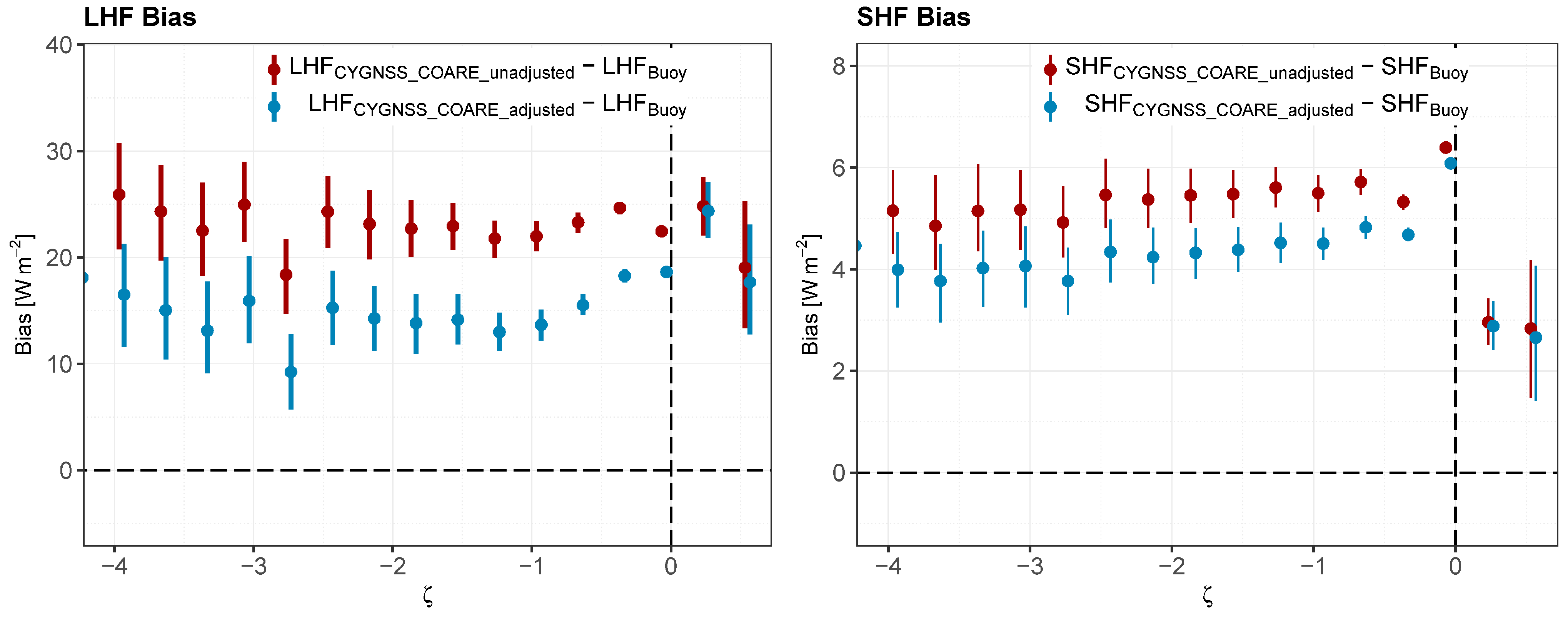
Figure 3 compares fluxes computed from CYGNSS equivalent neutral winds using the COARE_adjusted and COARE_unadjusted formulations against buoy-derived flux estimates. Both experiments exhibit positive biases relative to the reference buoy fluxes, but the adjusted CYGNSS fluxes show significantly reduced biases compared to the unadjusted fluxes. The differences between adjusted and unadjusted fluxes are minimal when the stability parameter ζ is close to zero, which is expected since a near-zero ζ indicates a neutrally stratified atmosphere where stability effects are negligible. However, as ζ deviates from zero, particularly under unstable stratification, the bias differences between the unadjusted and adjusted CYGNSS fluxes grow more pronounced, reaching 10–20 W m
−2 for latent heat-flux (LHF) and 1–2 W m
−2 for sensible heat-flux (SHF). Across both stable and unstable conditions, the adjusted CYGNSS fluxes consistently align more closely with buoy-derived LHF and SHF, although high sampling uncertainties introduce some variability in the comparisons.
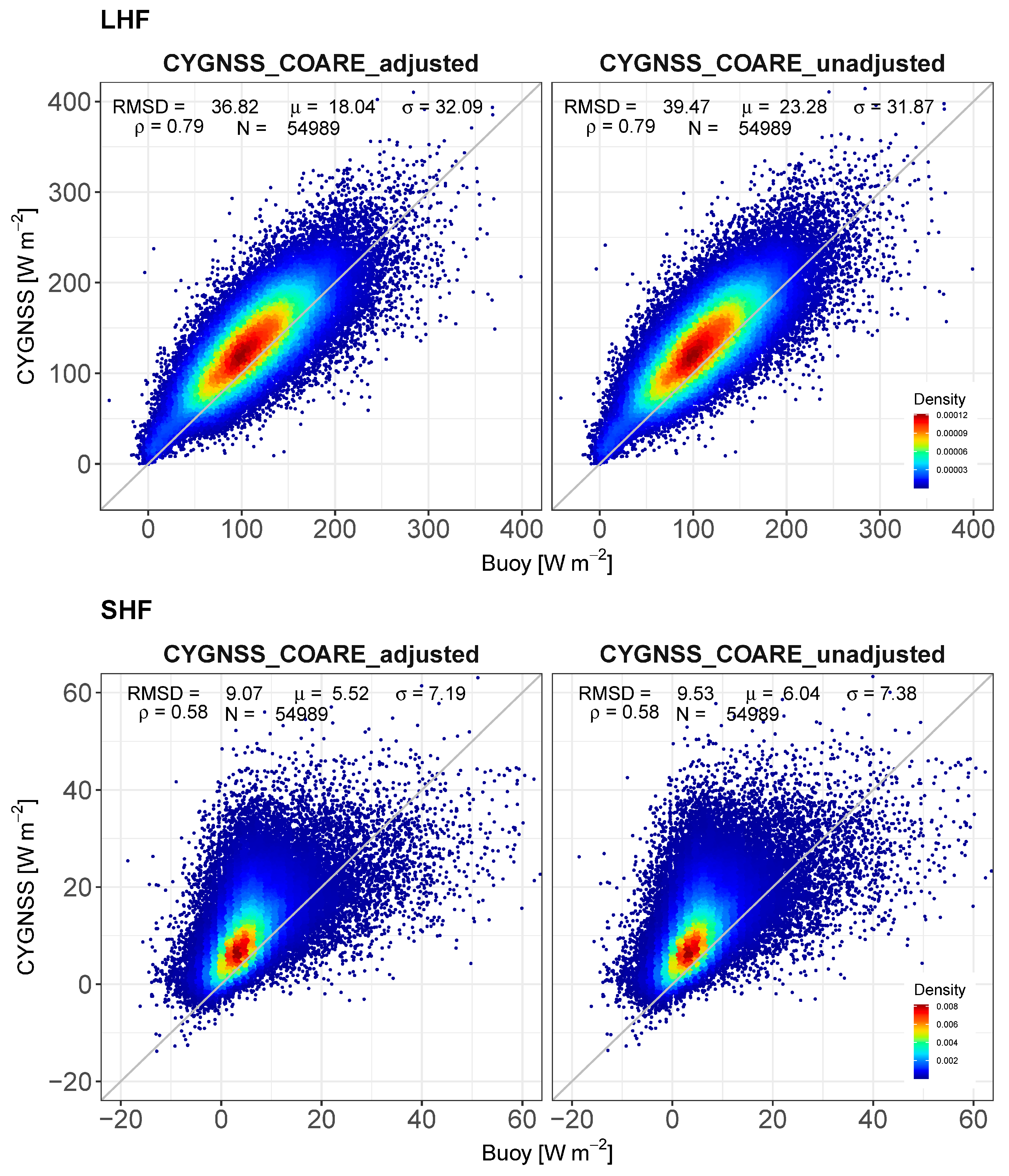
Figure 4 compares aggregated CYGNSS-retrieved surface fluxes under all-weather conditions in the tropics at the buoy locations depicted in
Figure 1. Overall, the retrieved fluxes align closely with in situ derived fluxes, exhibiting correlation coefficients of 0.8 for the LHF. However, for SHF, the collocated CYGNSS samples from both experiments exhibit increased dispersion and variability, yielding a correlation coefficient of approximately 0.6. The RMSD and mean bias values significantly improved the adjusted CYGNSS experiment. Specifically, for LHF, the mean bias and RMSD are 18.04 W m
−2 and 36.82 W m
−2, respectively, compared to 23.38 W m
−2 and 39.47 W m
−2 in the unadjusted CYGNSS experiment. For SHF, the mean bias and RMSD are 5.52 W m
−2 and 9.07 W m
−2, respectively, while they were 6.04 W m
−2 and 9.53 W m
−2 with the unadjusted results.
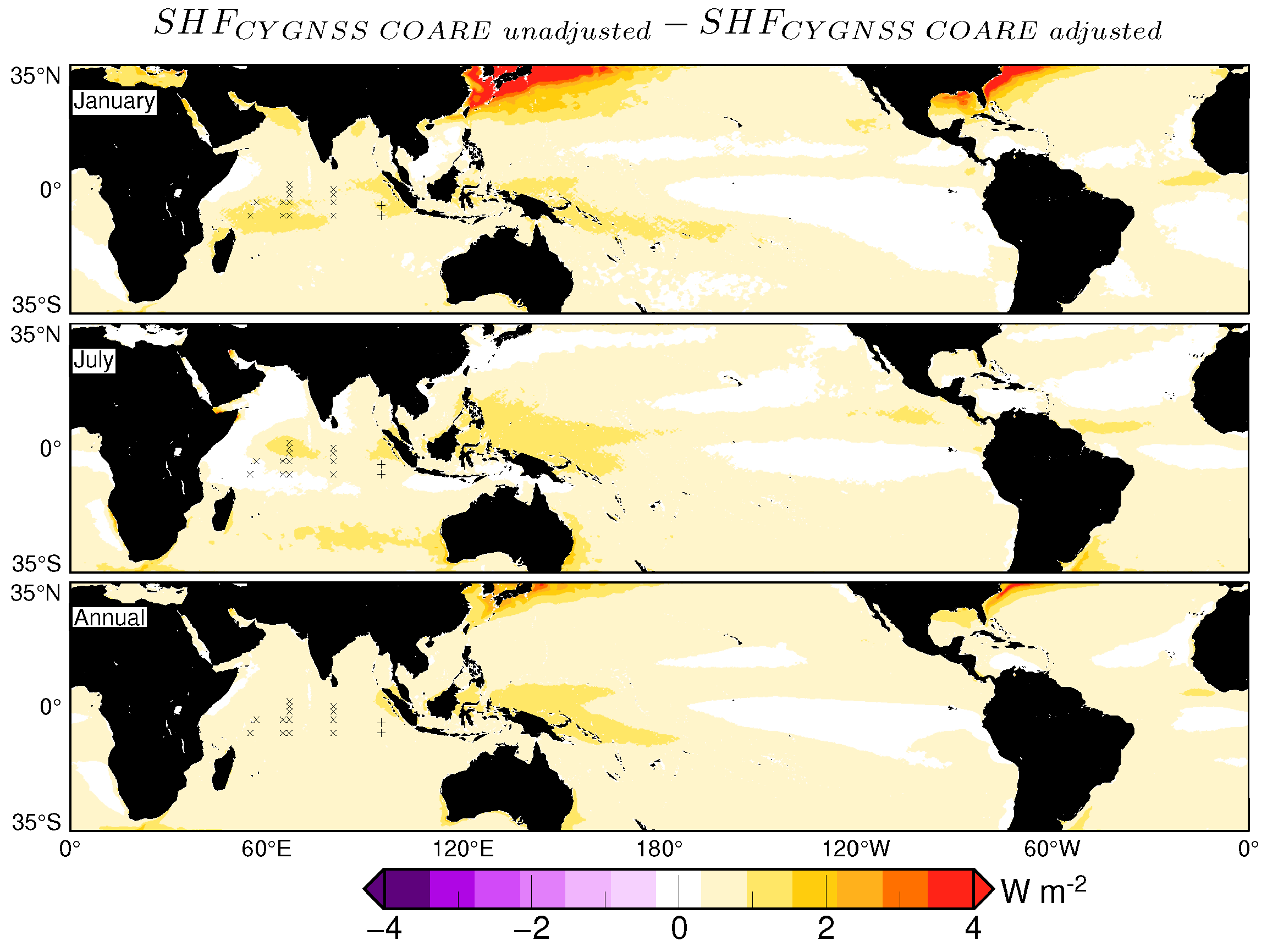
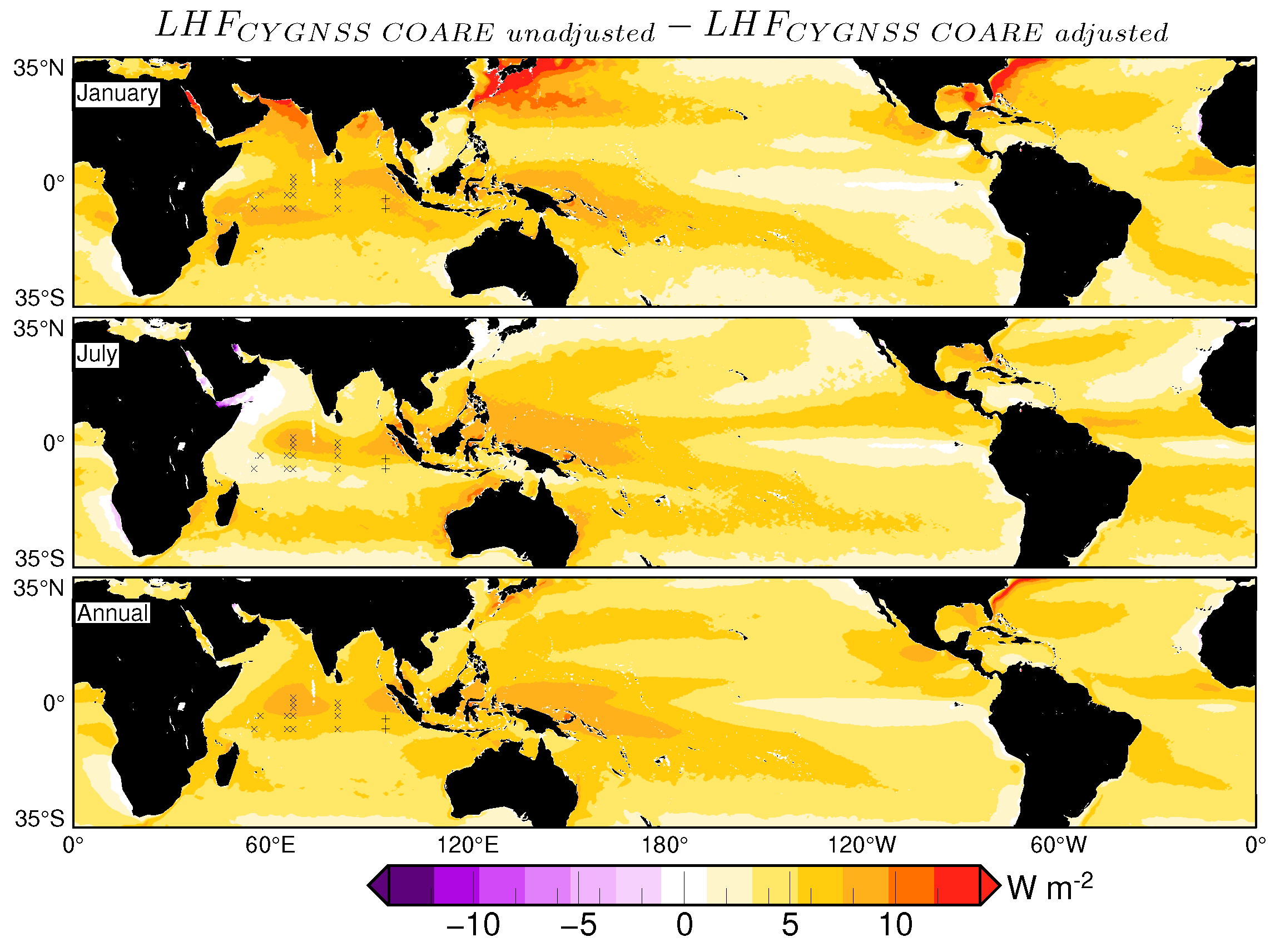
A spatial analysis of mean maps was conducted for January (Northern Hemisphere winter), July (Northern Hemisphere summer), and the annual average over the four years from 2019 to 2023.
Figure 5 illustrates the differences between the unadjusted CYGNSS LHF and the adjusted LHF for this period. Generally, the adjusted CYGNSS LHF shows reduced magnitudes. In winter, significant differences are observed primarily in near-coastal regions, including the Arabian Sea near the western coast of India and the southern coast of Pakistan, the Red Sea, and, to a lesser extent, the Bay of Bengal. Additionally, substantial LHF differences, up to 15–20 W m
−2 are observed in the Kuroshio and Western Boundary Current regions, though these differences are minimal in summer. These significant observed regional differences and their seasonal patterns (i.e., more minor differences in summer and larger ones in winter) align with the findings of [
28]. During summer, the most notable differences occur near the equator, particularly in the maritime continent, where differences reach 7–10 W m
−2. The annual mean map reveals pronounced differences at locations with greater differences in winter and summer. A similar difference pattern, but with less magnitudes (e.g., 5–10 W m
−2 in the Kuroshio and Western Boundary Current regions in the winter time) is also observed in the SHF (
Figure 6). In general, these regions exhibit higher mean LHF and SHF values during the winter season compared to the summer season (see
Supplementary Figures S1 and S2).
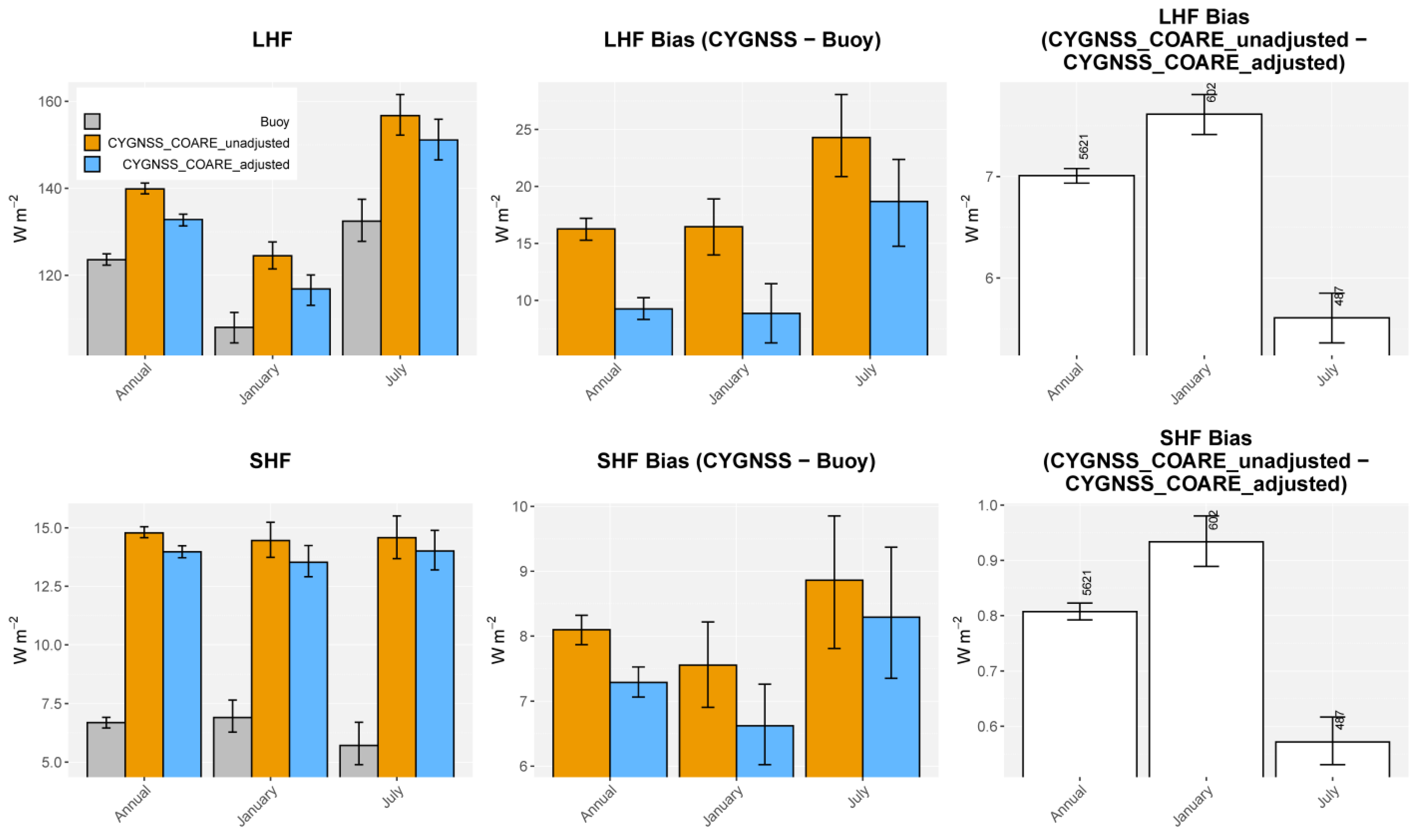
We extended our analysis by selecting buoy locations in regions where the differences are significant and buoy data are available. We calculated the statistical mean bias for the CYGNSS-derived SHF and LHF products using this buoy data in the Indian Ocean region (see
Figure 7). Additionally, we included regional mean values for LHF and SHF to directly compare observations with CYGNSS-derived fluxes. The findings reveal that CYGNSS LHF and SHF generally exhibit positive mean biases ranging from ~6 to 25 W m
−2 for LHF and 6.5 to 8.8 W m
−2 for SHF. The differences are more pronounced during July. Over the annual mean, the absolute differences between adjusted and unadjusted CYGNSS-derived LHF and SHF are significant (~7 W m
−2, with 0.8 W m
−2 for LHF and SHF, respectively). They are found to be more consistent with buoy data in the adjusted CYGNSS-derived fluxes. Notably, these differences align with the increasing instability indicated by the buoy-measured temperature difference (
ta-
ts; see
Supplementary Figure S3).
4. Discussion
While the EN-wind-drag-consistency adjustment reduces an important source of stability-dependent systematic errors, both the adjusted and unadjusted CYGNSS flux products still show positive (CYGNSS − buoy) heat-flux biases (
Figure 3 and
Figure 4) because the flux magnitude is not controlled by wind alone. In the current heat-flux estimation, CYGNSS SDR v3.2 winds are used with the ERA5 thermodynamic air–sea variables (e.g.,
,
,
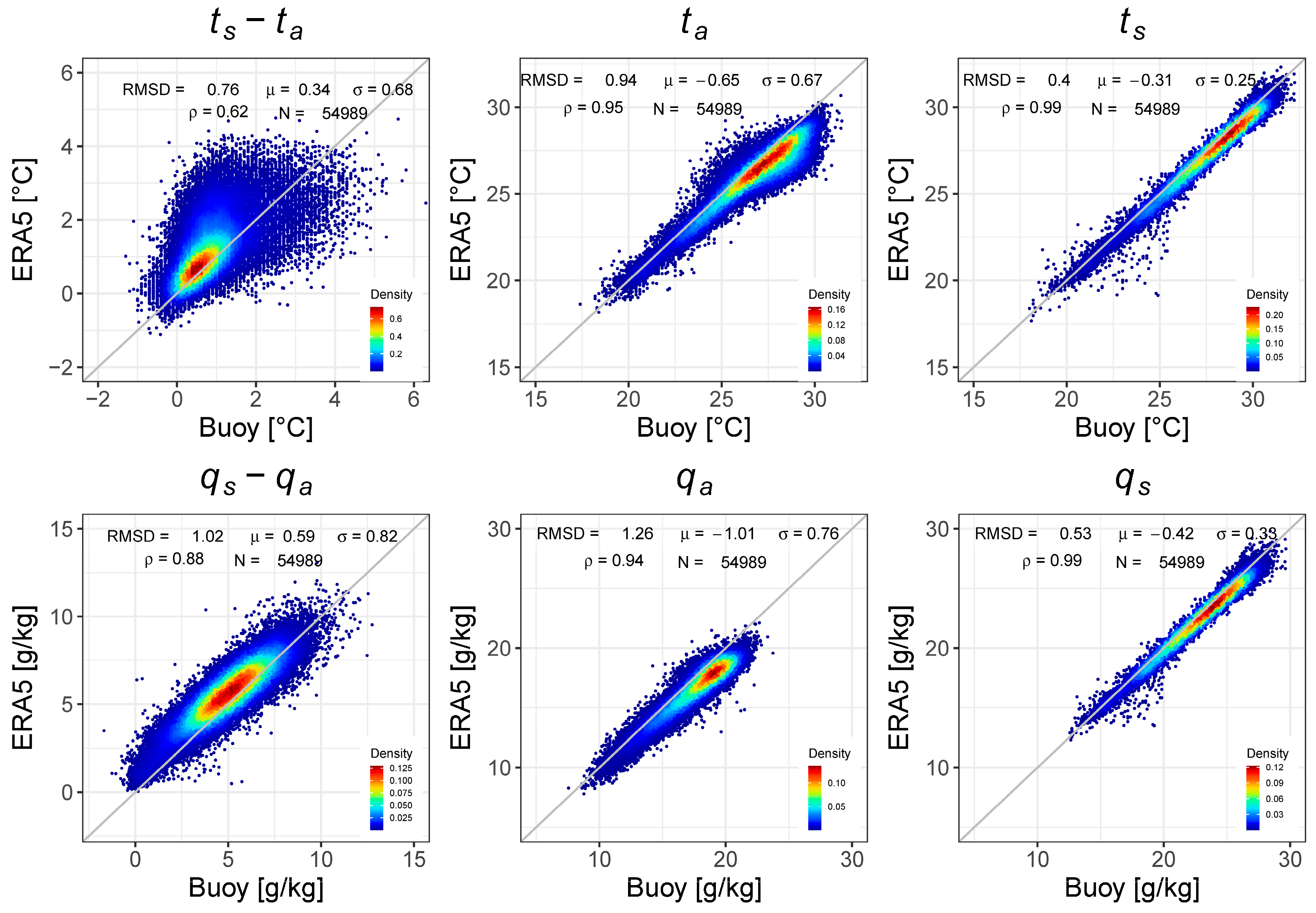
); thus, any systematic ERA5–buoy offsets that increase the air–sea gradients will directly translate into turbulent heat-fluxes via the bulk flux relations. This is in line agreement with the ERA5–buoy air–sea comparison scatter plots as shown in
Figure 8 where ERA5 tends to exhibit a coherent bias structure in near-surface thermodynamics (e.g., in
and
), which increases
and
relative to the buoy, thereby predisposing both SHF and LHF toward positive (CYGNSS − buoy) differences when those ERA5 inputs are used in COARE. This mechanism is consistent with the component-wise error attribution emphasized by [
10], showing
is much more strongly linked to temperature differences than to wind differences, while
depends on wind but also exhibits non-negligible sensitivity to humidity differences. Their uncertainty propagation further indicates that uncertainties in near-surface temperature and humidity can be comparable to wind-driven uncertainty, implying that reanalysis thermodynamic errors can impose a persistent bias even when the wind-side formulation is improved. Moreover, CYGNSS winds are retrieved from ocean-surface forward scattering using a geophysical model function (GMF) that maps the normalized bistatic radar cross section (NBRCS) to 10 m wind speed. The operational Level-2 GMF was trained using winds from numerical weather prediction data-assimilation products (e.g., [
29,
30]), so the resulting SDR v3.2 winds can inherit sensitivities to environmental state, calibration residuals, and GMF specification. As a result, retrieval uncertainty, including engineering and geophysical calibration residuals, can imprint surface-roughness and stress-related variability onto the retrieved wind field, appearing as mean wind biases and/or enhanced sub-footprint variability. In tropical convective regimes, where footprint heterogeneity is pronounced, these variations can be amplified into larger turbulent-flux errors through the nonlinear wind dependence of bulk flux formulations and transfer-coefficient feedbacks, sustaining a positive mean LHF and SHF bias in both algorithm variants. Accordingly, the observed positive biases likely reflect the combined influence of (i) ERA5-driven enhancement of
and/or
([
10];
Figure 8) and (ii) CYGNSS wind-retrieval uncertainty [
29], while the EN-consistency adjustment primarily modifies the stability sensitivity rather than removing the mean offset.
With that in mind and focusing on the drivers of the adjusted–unadjusted differences in the COARE-derived fluxes,
Figure 5 and
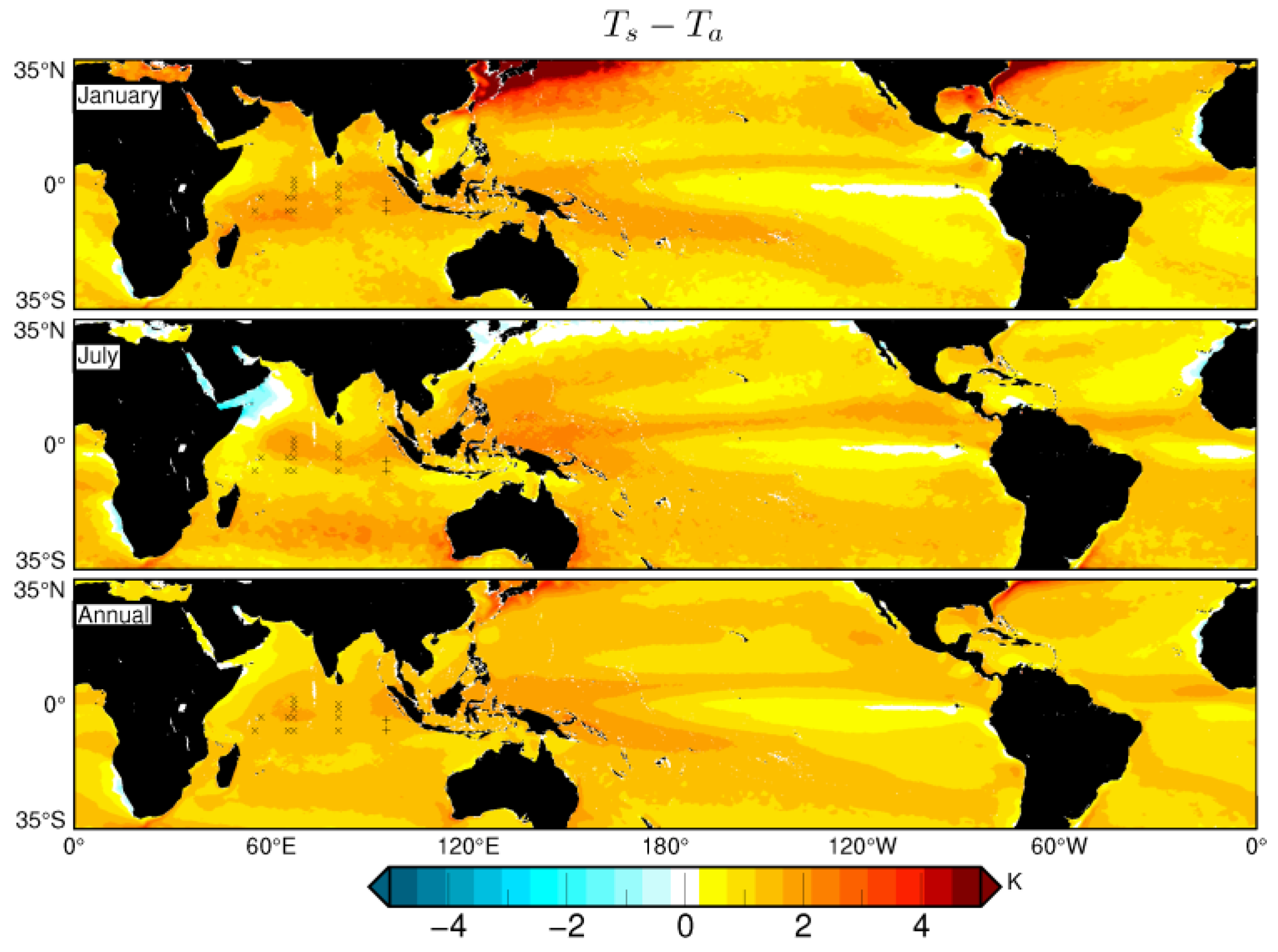
Figure 6 indicate that the largest contrasts occur primarily in regions with strongly unstable atmospheric conditions (see
Figure 9).
The analysis indicates that in most regions where the differences are more prominent, sea surface temperatures are typically higher than air temperatures, reflecting an unstable atmosphere over the tropical ocean. Conversely, the differences are minimal under stable atmospheric conditions, such as those observed in the summer in the Red Sea and in some near-coastal areas, where air temperatures are warmer than sea surface temperatures. The reduced difference between these two experiments under stable atmospheric conditions can be attributed to the [
31] study, which indicates that a stable atmosphere diminishes air–sea heat and moisture exchange, thereby reducing turbulent heat-fluxes. They further concluded that no single variable could explain variations in heat fluxes related to stability. Instead, the interplay of stability, wind speed, and the vapor pressure gradient (or temperature gradient) primarily drove the observed differences in LHF (SHF) across various stability conditions.
Since tropical atmospheric conditions are typically near neutral, the collocated samples predominantly fall within this regime, leading to less pronounced improvements in the statistical parameters for the adjusted CYGNSS experiment than under highly unstable conditions. Despite these improvements, systematic errors remain, particularly for SHF, where statistical validation consistently yields less accurate results than for LHF. These differences can be attributed to SHF’s sensitivity to temperature gradients, which depend largely on the accuracy of ERA5 input variables such as air temperature, sea surface temperature (SST), and specific humidity. As shown in
Figure 8, the RMSD for air temperature and specific humidity is higher than for surface temperature and surface humidity. These errors propagate into estimates of temperature and humidity gradients, leading to greater uncertainties in SHF than in LHF. Consistent with this, while
and
individually agree well with the buoy observations (
, RMSD = 0.94 °C for
;
, RMSD = 0.40 °C for
), the air–sea temperature difference
is substantially noisier (
, RMSD = 0.76 °C), because
has a much smaller intrinsic tropical dynamic range and therefore amplifies modest, only weakly correlated errors in the ocean-surface versus the 2 m air temperature. On the other hand,
remains comparatively structured (
, RMSD
g kg
−1) because
is diagnostically tied to
via saturation humidity, and
typically exhibits larger intrinsic variability than
, making it less sensitive in relative terms to similar absolute errors. These characteristics help explain why uncertainties in the temperature gradient translate into larger uncertainty in SHF than in LHF in our evaluation, even if the underlying (air and sea) temperatures appear relatively accurate. Moreover, the bias in SST serves a dual role in shaping air–sea fluxes by directly influencing the ocean–atmosphere temperature gradient and indirectly affecting specific humidity through its nonlinear temperature dependence. According to the Clausius–Clapeyron equation, the saturation vapor pressure of water increases exponentially with temperature. Consequently, even minor biases in SST can lead to disproportionately large deviations in specific humidity, especially in warm and humid environments. This exponential sensitivity is likely to be pronounced in tropical regions, such as the Intertropical Convergence Zone (ITCZ), where high SSTs and elevated moisture levels amplify uncertainties in flux calculations. Furthermore, these errors are not spatially or temporally uniform, varying across regions and seasons, complicating efforts to validate and improve the flux estimates.
5. Conclusions
This study uses a modified COARE bulk algorithm to compute turbulent heat-fluxes from CYGNSS satellite-retrieved stability-independent winds, following [
12]. This adjustment is crucial because CYGNSS winds are treated as equivalent neutral winds rather than actual winds. Ignoring this distinction can lead to stability-dependent biases between equivalent neutral winds and actual winds, resulting in biased estimates of sensible and latent heat-fluxes. Experiments using tropical buoy data have confirmed this issue across a range of atmospheric stability conditions. Our analysis indicated that the adjusted COARE algorithm provided CYGNSS-derived flux estimates that are more consistent with buoy-derived fluxes than the unadjusted COARE for CYGNSS, particularly under unstable atmospheric conditions. The bias improvement exhibits up to 10–20 W m
−2 for LHF and 1–2 W m
−2 for SHF. Moreover, in all weather conditions in the tropics, CYGNSS-derived fluxes generally correlated well with the aggregated buoy-derived fluxes, with LHF showing a correlation coefficient of 0.8 and SHF approximately 0.6. The adjusted COARE algorithm improved the root-mean-square deviation (RMSD) and mean bias for CYGNSS LHF and SHF relative to the unadjusted CYGNSS-derived fluxes. However, SHF was less accurate than LHF, as SHF is more dependent on air and sea surface temperatures than wind speed. The errors in the estimated fluxes (compared to buoy fluxes) are indeed related to the COARE air–sea (except winds) input variables. The same bulk parameterization is used for both calculations; therefore, the differences must be due to the input data. Since the air–sea parameters, such as skin or air temperature, are derived from ERA5 in our flux estimates, the uncertainties in SHF are likely model-dependent and may vary by convective region. While differences across all variables contribute, it appears the leading problem is the differences between the buoy and ERA5 skin SSTs.
It is worth mentioning that applying a simple mean bias correction (e.g., ~
W m
−2 for LHF and ~
W m
−2 for SHF) may reduce the domain–mean offset for conditions similar to those represented in the buoy matchup set (
Figure 3), but it is unlikely to be universally applicable across the tropical oceans. This is consistent with the spatial difference maps (
Figure 5 and
Figure 6; CYGNSS_COARE_unadjusted − CYGNSS_COARE_adjusted), which reveal coherent regional and seasonal patterns in the magnitude of the adjustment. For instance, the spatial analysis indicated that the adjusted CYGNSS-derived LHF generally exhibited reduced magnitudes, with more significant differences observed in specific regions, such as the Arabian Sea and the Bay of Bengal, Kuroshio and Western boundary current regions in winter, and near the equator in July; similar differences are also found in the SHF case. Most biases were found in highly unstable conditions, where sea surface temperatures typically exceeded air temperatures, reflecting atmospheric instability. In stable conditions, fluxes and biases were minimized, supporting [
28,
31] findings that a stable atmosphere reduces turbulent heat-flux.
However, it is crucial to consider a key aspect of the current validation approach using the buoy reference data. For instance, in the present study, buoy SSTs, representing bulk temperatures measured at approximately 1 m depth, were adjusted using a constant 0.2 °C cool-layer correction [
19,
32] to improve comparability with ERA5 skin SSTs. Despite this adjustment, notable differences persist, reflecting the inherent challenges of achieving an entirely consistent comparison between these datasets. Furthermore, when comparing the CYGNSS satellite-derived fluxes with the reference buoy data, it is crucial to note that satellite-derived fluxes are based on winds relative to ocean currents, while buoy-derived fluxes are not. While the present study uses tropical buoys, and in most regions, ocean currents are weak compared to surface winds, discrepancies can arise in areas where the difference between ocean currents and surface winds is more significant. Aside from this, CYGNSS winds show biases, with positive biases at low wind speeds and negative biases at high wind speeds [
17,
19,
20]. These biases in satellite wind data stem from several factors, including the Geophysical Model Function and environmental conditions that affect how signals are received by altering sea surface roughness.
Nevertheless, despite the errors in CYGNSS-derived fluxes and some limitations in the reference buoy data as described before, the adjusted CYGNSS approach produced estimates that align more closely with the buoy-derived fluxes compared to the unadjusted CYGNSS-derived fluxes. More broadly, because stability modulates transfer coefficients and hence air–sea fluxes, independently constraining surface-layer parameters from remote sensing could further reduce uncertainty in satellite-derived flux products. Recent work has demonstrated the feasibility of estimating surface-layer stability parameters (e.g., Obukhov length) from spaceborne radar observations, offering a potential pathway to incorporate stability information into satellite-based flux retrievals [
33]. This development represents a significant step toward improving the accuracy of the forthcoming surface heat-flux product release [
10].