Article

Impacts of Line-of-Sight Kinematic and Dynamic Empirical Parameters on GRACE-FO Orbit Determination and Gravity Field Recovery

1
School of Information Science and Engineering, Harbin Institute of Technology (Weihai), Weihai 264209, China
2
School of Geodesy and Geomatics, Wuhan University, Wuhan 430079, China
3
School of Surveying and Geoinformation Engineering, East China University of Technology, Nanchang 330013, China
4
Institute of Seismology, China Earthquake Administration, Wuhan 430071, China
*
Author to whom correspondence should be addressed.
These authors contributed equally to this work.
Remote Sens. 2026, 18(5), 695; https://doi.org/10.3390/rs18050695
Submission received: 27 December 2025 / Revised: 12 February 2026 / Accepted: 18 February 2026 / Published: 26 February 2026
(This article belongs to the Section Atmospheric Remote Sensing)

Highlights

What are the main findings?
  • Dynamic and kinematic empirical parameterizations reduce low-frequency KBR residuals by ~20%, acting as effective temporal filters.
  • The combined DYN+KIN scheme increases oceanic EWH noise by ~16% and amplifies striping.
What are the implications of the main findings?
  • All dynamic and kinematic parameterization strategies consistently improve GNSS-based GRACE-FO orbit accuracy.
  • Over-parameterization in DYN+KIN damps the 160-day C2,0 signal, revealing a trade-off between noise suppression and geophysical signal fidelity.

Abstract

The dynamic approach integrates Global Positioning System and K-band range-rate (KRR) observations to enable precise orbit determination (POD) and gravity field recovery. However, background model uncertainties and temporal aliasing introduce frequency-dependent noise into the post-fit KRR residuals, thereby degrading overall solution accuracy. To mitigate these effects, empirical signals are typically modeled using either dynamic (DYN) or kinematic (KIN) parameterization strategies. Nevertheless, the combined use of DYN and KIN parameterizations remains largely unassessed, and their potential synergistic impact on POD and gravity field recovery merits systematic evaluation. This study evaluates the individual and joint impacts of DYN and KIN (DYN+KIN) on The Gravity Recovery and Climate Experiment (GRACE) Follow-On orbit accuracy and monthly gravity field recovery using nearly one year of 2019 data (excluding February due to severe data gaps). The refined solutions act as empirical temporal filters, effectively suppressing low-frequency components in KRR residuals, particularly below 1-cycle-per-revolution. Relative to nominal ambiguity-fixed reduced-dynamic orbits, the refined solutions mainly enhance the cross-track component, with DYN+KIN showing the largest improvement, while along-track precision experiences only minor (sub-millimeter) degradation. Overall three-dimensional orbit accuracy improves from 3.8 cm to 3.0 cm (DYN), 2.8 cm (KIN), and 2.8 cm (DYN+KIN). In terms of gravity field recovery, the DYN+KIN solution begins to exhibit more pronounced deviations from the other solutions beyond degree and order 30. Over oceanic regions, residual mass anomaly analysis shows that the DYN+KIN solution is associated with an approximately 16% higher noise level compared to the individual DYN and KIN strategies, which exhibit modest noise reductions relative to the nominal solution. The DYN+KIN also exhibits a dampened ~160-day periodicity in the temporal evolution of low-degree coefficients (e.g., C2,0), likely due to spectral overlap between empirical parameter frequencies and low-degree gravity signal components. These results indicate that over-parameterization introduces spectral redundancy and absorbs geophysical signals, underscoring the need to balance parameter flexibility and signal fidelity in gravity recovery strategies.

1. Introduction

The Gravity Recovery and Climate Experiment (GRACE) Follow-On (GFO) mission, a collaboration between NASA and the German Research Centre for Geosciences (GFZ), was launched in May 2018 to continue monitoring Earth static and temporal gravity fields [1,2]. The twin satellites GFO-C and GFO-D operate in near-polar orbits and are each equipped with two inter-satellite ranging instruments: the legacy K-band microwave ranging system (KBR) and the newly developed laser ranging interferometer (LRI). Although the LRI offers promising accuracy [3], gravity field recovery currently relies primarily on KBR range-rate (KRR) observations, combined with onboard Global Positioning System (GPS), SuperSTAR-FO accelerometer, and attitude data to estimate inter-satellite range variations induced by Earth gravity [4].
The GFO Science Data System (SDS), comprising the Jet Propulsion Laboratory (JPL), the Center for Space Research (CSR) at the University of Texas at Austin, and the German Research Centre for Geosciences (GFZ), produces the most widely used solutions [5,6,7]. Since the initial release, the RL06 series has undergone three incremental updates—RL06.1, RL06.2, and RL06.3—mainly addressing issues in GFO accelerometer data. In parallel, institutions such as the Astronomical Institute of the University of Bern (AIUB) [8] and Huazhong University of Science and Technology (HUST) [9] have released independent models using alternative processing strategies. These products are publicly available via the International Centre for Global Earth Models (ICGEM) and have been extensively applied in hydrology, cryosphere studies, oceanography, and solid Earth deformation [10,11,12,13,14].
Despite their broad utility, the temporal gravity field models are still subject to systematic errors. Recovering the gravity field from GFO data without prior constraints necessitates a globally homogeneous distribution of observations [15]. Signals with periods shorter than a month are therefore not resolved, and their energy aliases into the monthly spherical-harmonic solution and degrades its accuracy [16]. This aliasing is further exacerbated by uncertainties in background models (e.g., non-tidal atmospheric and oceanic mass variations) which collectively amplify temporal aliasing errors that manifest in terms of north-south striping effects [12,17,18]. These unmodeled signals and background model uncertainties introduce systematic errors into the monthly least-squares adjustment, which are directly reflected in the post-fit residuals of observations. Colombo [19] explains how inaccuracies in dynamic force models at specific frequencies, such as orbital resonances, can induce satellite orbit perturbations that adversely affect gravity recovery. In the case of KRR data, low-frequency components dominate the residuals, accounting for at least 90% of the total noise power [20], and low-frequency artefacts in GRACE/GFO KRR post-fit residuals exhibit a quasi-periodic signature that originates chiefly from orbit-integration errors and mis-estimated radial inter-satellite velocities [21].
To reduce the influence of dynamic modeling errors on gravity field recovery, two complementary empirical parameterization strategies are commonly employed in the GFO processing chain: (1) Dynamic empirical accelerations (DYN): Following the reduced-dynamic paradigm [22,23], small stochastic accelerations are incorporated into the equations of motion as additional state parameters to compensate for unmodeled or mismodeled forces. Given that the KRR line-of-sight is nearly aligned with the along-track direction, empirical accelerations are consistently estimated in this component. These terms are typically modeled as piecewise constant, linear, or sinusoidal functions at integer cycle-per-revolution (CPR) frequencies. (2) Kinematic empirical parameters (KIN): An observation-level remedy introduces auxiliary parameters directly into the KRR functional model [24,25,26,27,28]. Typical terms comprise constant biases, linear drifts, and 1-CPR sine and cosine coefficients, which absorb quasi-periodic residual structure without recourse to variational equations. This kinematic formulation is computationally economical and is now routinely employed in gravity field inversions by numerous groups (e.g., GFO SDS, AIUB, HUST) [5,6,7,8,9].
Despite their distinct formulations, the dynamic (DYN) and kinematic (KIN) approaches are fundamentally linked. Both can be interpreted within the framework of linearized perturbation theory, such as Hill’s equations [19]. In theory, low-frequency empirical terms introduced in one model can approximate those in the other through spectral transformation (e.g., differentiation or integration of range or range-rate residuals) [29]. In practice, the effectiveness of each approach depends on factors such as parameterization schemes and arc lengths. These methodological choices can either yield complementary benefits or cause undesirable overlap when compensating for model imperfections. Yet, the extent to which dynamic and kinematic empirical models reinforce or interfere with one another remains insufficiently explored. Accordingly, the primary objective of this study is to systematically assess the individual and joint use of these two strategies, with a focus on identifying redundancies and reducing the risk of overfitting. A secondary objective is to evaluate how empirical parameterization affects orbit determination, given that orbit accuracy serves as both an internal consistency metric and a proxy for gravity field recovery quality. Comparisons with official GFO SDS orbit and gravity models are conducted to validate the results and support the broader conclusions.
The remainder of this paper is organized as follows. Section 2 introduces the theoretical basis of the two empirical modeling strategies. Section 3 describes the background models and processing setup. Section 4 evaluates the individual and combined effects of each approach on post-fit residuals, orbit accuracy, and gravity field recovery. Section 5 discusses their potential spectral impacts on specific spherical harmonic degrees. Section 6 summarizes the key findings.

2. Method

The complete least-square equation for the dynamic gravity field recovery [18] is:
L = A x + B y + e L ,
where L represents the observation vector, A and B are design matrices containing partial derivatives of the observations w.r.t. the parameter vectors x and y , respectively, and e L denotes observation noise. x represents the estimated parameters, typically categorized into: (1) kinematic parameters (e.g., GPS clock offsets and ambiguities) that do not require additional variational equations; (2) dynamic parameters (e.g., accelerometer calibration parameters and spherical harmonic (SH) coefficients of the gravity field), which necessitate solving variational equations [30]. The vector y represents empirical parameters compensating for force deficiencies, such as background uncertainties and aliasing terms. In principle, optimal estimation would involve solving for all elements of y across the full frequency spectrum. However, this is computationally infeasible. A practical compromise is to estimate only the parameters of interest:
L B y = A x + e L B y
This situation not only distorts parameter estimation but also transforms the noise term e L B y into colored noise [18]. Although it is not feasible to estimate all parameters in y, we can estimate specific parameters to minimize this loss as much as possible. This study introduces two categories of parameter estimation, which are presented below.

2.1. Dynamic Empirical Parameters

The dynamic empirical parameter approach estimates empirical accelerations within the orbital reference frame (Radial, Along-track, and Cross-track directions, RAC). This approach compensates for unmodeled forces, which often manifest as per-revolution perturbations in satellite orbits. The satellite motion equation [31] is:
r ¨ = f g + f n g + f e m p = f t , r , r ˙ , a e m p , S , b , C n m , S n m ,
where r , r ˙ and r ¨ are the position, velocity, and acceleration vectors, respectively. f g represents gravitational forces (e.g., earth gravity filed, tides, relativity); f n g accounts for non-gravitational forces (e.g., atmospheric drag, solar radiation pressure); and f e m p represents the empirical forces. The parameter S represents the calibration scale factor, and b denotes the bias factor. The SH coefficients of Earth gravity field are denoted by C n m and S n m . To focus on along-track perturbations, a group of empirical parameters a e m p is introduced exclusively in the along-track direction in the RAC Frame:
f e m p _ E C I = R R A C E C I a e m p 0 0 ,
where f e m p _ E C I is the empirical forces in the Earth-Centered Inertial (ECI) frame and R R A C E C I is the transformation matrix from the RAC to the ECI frame. The term a e m p can be modeled as constants, linear terms, or user-defined ω-CPR sinusoidal terms.

2.2. Kinematic Empirical Parameters

The kinematic parameter approach models orbital perturbations caused by unmodeled forces directly in the observation equations. For any disturbing acceleration with frequency ω, along-track orbit perturbations are stimulated as follows [25]:
Δ T t = a 0 + a 1 t + a 2 t 2 + a 3 c o s n t + a 4 s i n n t + a 5 c o s ω t + a 6 s i n ω t ,
where n = 2 π / T represents the satellite’s mean motion—its average angular velocity per second as it orbits the Earth, and T is the satellite’s orbital period. The coefficients a 0 to a 6 are constants derived from the complete solution, which includes homogeneous, non-resonant, and resonant special solutions. According to Equation (5), a dynamic force error at any frequency ω induces orbit perturbations at both zero frequency (constant and linear terms) and 1-CPR frequency, in addition to perturbations at its original frequency. Given practical limitations in parameter estimation, most implementations retain only the zero- and 1-CPR terms, which contribute the majority of perturbation energy. The omission of ω-CPR harmonics thus simplifies the estimation while preserving the dominant signal content.
Taking the first derivative of Equation (5) w.r.t. time yields the KRR perturbation:
p ˙ e r r = a 0 + a 1 t + a 2 c o s n t + a 3 s i n n t .
Although these kinematic empirical parameters are not derived from the variational equations, they effectively capture perturbation dynamics. In this sense, they act analogously to dynamic parameters: their time derivatives yield force-equivalent terms.
Theoretically, a functional link exists between the dynamic parameters and the kinematic parameter approach [29]. Accelerations at critical frequencies ω = 0 and ω = n result in resonance effects that yield equivalent impacts to those modeled by kinematic parameters. This theoretical linkage highlights the interconnected nature of these two methods, underscoring their potential for complementary application in gravity field recovery.

3. Data Processing Strategy

This study employs a dynamic gravity field recovery method that models the physical forces acting on satellites and estimates the SH coefficients of the gravity field up to 96 degrees and orders (d/o) using GPS and KRR data [32,33]. No a priori constraints or regularization techniques are applied during the recovery of the Earth gravity field. The estimation process minimizes the weighted sum of squared differences between computed and observed values through a conventional least squares adjustment. During data processing, we classify the parameters according to their estimation arc lengths into local and global parameters. Local parameters include satellite position and velocity, GPS epoch-wise receiver clock offsets, pass-wise ambiguity parameters, KRR kinematic empirical parameters, dynamic empirical parameters, and accelerometer bias parameters. To reduce the dimensionality of the normal equations, these local parameters are pre-eliminated before solving for the global parameters. Global parameters consist of accelerometer scale parameters and spherical harmonic coefficients, which are obtained by solving the combined normal equations and back-substituting to restore the pre-eliminated parameters.
All test solutions are processed using the same software suite, ROCKET (Recovery of the satellite Orbit, ClocK, and Earth gravity field Tools), developed by Wuhan University. This ensures that any differences among gravity solutions are solely attributable to the choice of empirical parameterization strategy. The specific force models, reference systems, and datasets (e.g., GPS, KRR, and auxiliary products) used in the experiments are summarized in Table 1.
In this study, the GFO gravity field recovery is based on three types of observations: GPS pseudorange, carrier-phase, and KRR data. Due to their distinct stochastic characteristics and variability across daily orbital arcs, a variance component estimation (VCE) procedure is applied independently to each data type on a daily basis [33]. This enables adaptive determination of observation-specific variance factors and ensures that the least-squares weighting matrix reflects the empirical noise characteristics. Initial standard deviations are set to 30 cm (pseudorange), 3 mm (carrier-phase), and 0.3 μm/s (KRR), and the iteration count is capped at five.
The GFO satellites are equipped with accelerometers which require calibration to account for various factors that degrade raw measurements, such as unknown scale factors, time-varying biases, and instrument-induced noise [41,42]. The calibrated accelerations a c a l , expressed in the inertial reference frame, are computed as:
a c a l = R R A C E C I · S · a o b s + b b i a s ,
where a o b s is the raw acceleration measured in the onboard RAC frame, and the 3 × 3 matrix S contains the scale factors in the along-track, radial and cross-track direction as diagonal elements and their respective correlations as off-diagonal elements [43]. The bias vector b b i a s is modeled as a quadratic polynomial w.r.t. time in along-track, cross-track, and radial directions:
b i = b i , 0 + b i , 1 t t 0 + b i , 2 t t 0 2 ,   i = R , A , C
where b i , 0 , b i , 1 and b i , 2 are the constant, linear, and quadratic bias terms, respectively. t is the current time, and t 0 marks the start of the estimation arc.
In practice, the number of estimated bias parameters is adapted to the directional sensitivity of the instrument axes. As the along-track axis is the most sensitive, 3 bias parameters (i.e., b A , 0 , b A , 1 , b A , 2 ) are estimated over a one-day arc. The radial axis exhibits moderate sensitivity, and 6 biases (two sets of polynomials) are estimated. The cross-track axis, being the least sensitive, is modeled using 12 biases (four polynomial segments) per day.

4. Experimental Results

The numerical experiments are based on GRACE-FO (GFO) data spanning an 11-month period in 2019, with February excluded due to severe data gaps. Four processing schemes were designed, as summarized in Table 2. NOM-SOL (nominal solution) serves as the baseline, with no additional empirical parameters included. DYN-SOL introduces dynamic empirical parameters modeled as quadratic polynomials, estimated once per revolution, to mitigate mismodeling of non-conservative forces. KIN-SOL applies kinematic empirical parameters, including KRR (K-band range-rate) biases and linear drifts estimated every 45 min, along with 1-cycle-per-revolution (1-CPR) sinusoidal terms estimated every 90 min, following the strategy proposed by Kim [25]. DYN+KIN-SOL combines both dynamic and kinematic parameterization strategies. All four schemes share the same force models and processing settings as described in Table 2.

4.1. Post-Fit KRR Residuals

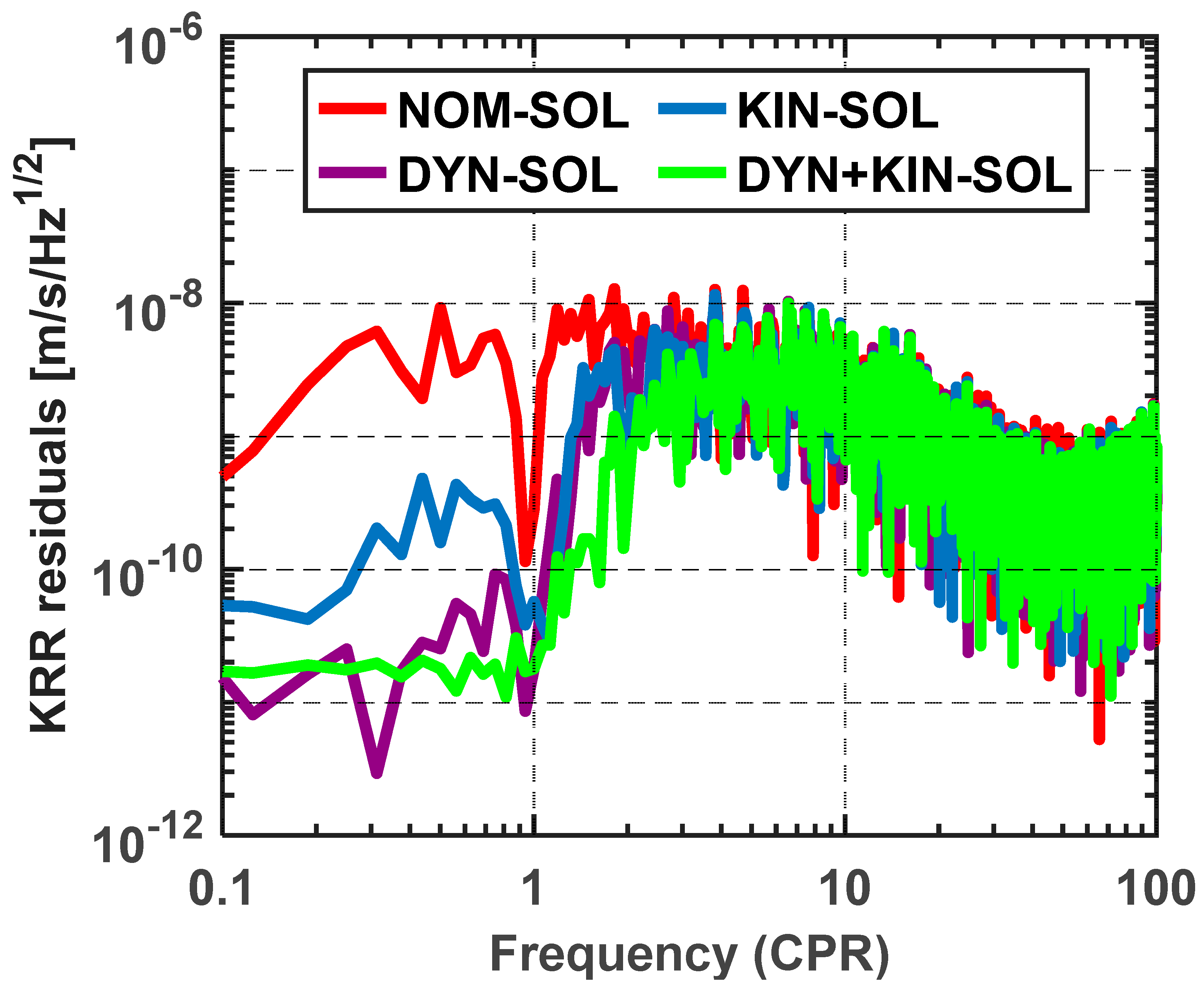
The post-fit KRR residuals, obtained after temporal gravity field recovery, provide a spectral diagnostic of how different empirical parameterizations suppress systematic errors in the range-rate observations. Given the GFO orbital period of approximately 5400 s (~1.5 h), the frequency corresponding to 1/5400 Hz is normalized to 1 CPR. Figure 1 presents the amplitude spectral density (ASD) of residuals as a function of frequency in CPR. All four solutions exhibit significant power reduction near 1 CPR, primarily attributed to comprehensive accelerometer calibration—including full scale-factor matrix corrections and quadratic bias modeling. The use of short arc lengths for cross-track bias estimation further improves sensitivity to resonant perturbations. At higher frequencies beyond ~60 CPR (∼0.01 Hz), the ASD rises sharply, reflecting high-frequency instrument noise. In the low-frequency band (0.1–2 CPR), the solutions diverge noticeably. Compared to the NOM-SOL, all refined solutions (DYN-SOL, KIN-SOL, and DYN+KIN-SOL) exhibit substantial attenuation, demonstrating the high-pass filtering effect of empirical parameterization. The DYN-SOL achieves stronger suppression than KIN-SOL, indicating that dynamic accelerations are more effective at capturing quasi-periodic errors in this range. Notably, the DYN+KIN-SOL achieves the most comprehensive suppression: the spectrum between 0.1 and 1 CPR is nearly flattened to ~10−11 m/s/Hz1/2, suggesting near-total removal of residual power at these frequencies.
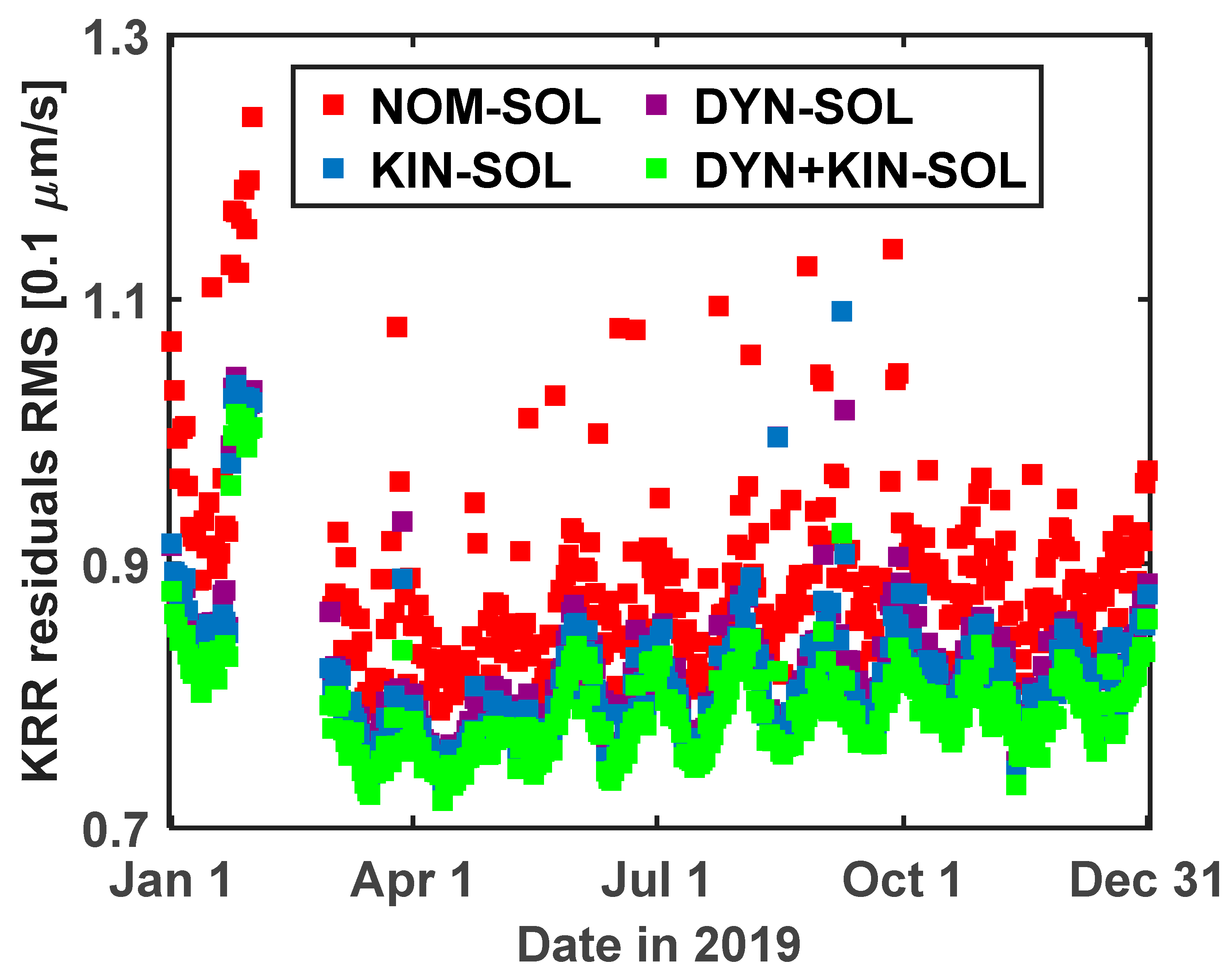
Figure 2 presents the daily Root Mean Square (RMS) of post-fit KRR residuals for the year 2019. Compared to the NOM-SOL, the refined solutions yield consistently lower RMS values, confirming the efficacy of empirical parameterization in mitigating residual noise. A recurring intra-month pattern is observed, with minima near mid-month and increases toward the beginning and end—likely due to the temporal centering of monthly gravity field models. This behavior highlights the advantage of applying daily VCE, which enables adaptive noise modeling based on day-to-day data quality. As summarized in Table 3, the refined solutions reduce the annual mean RMS by 16% (KIN-SOL), 19% (DYN-SOL), and 20% (DYN+KIN-SOL), respectively. However, the limited improvement from combining DYN and KIN suggests partial redundancy, indicating that both schemes may have reached the effective limit of low-frequency error suppression.

4.2. Performance Assessment of Dynamic Orbits

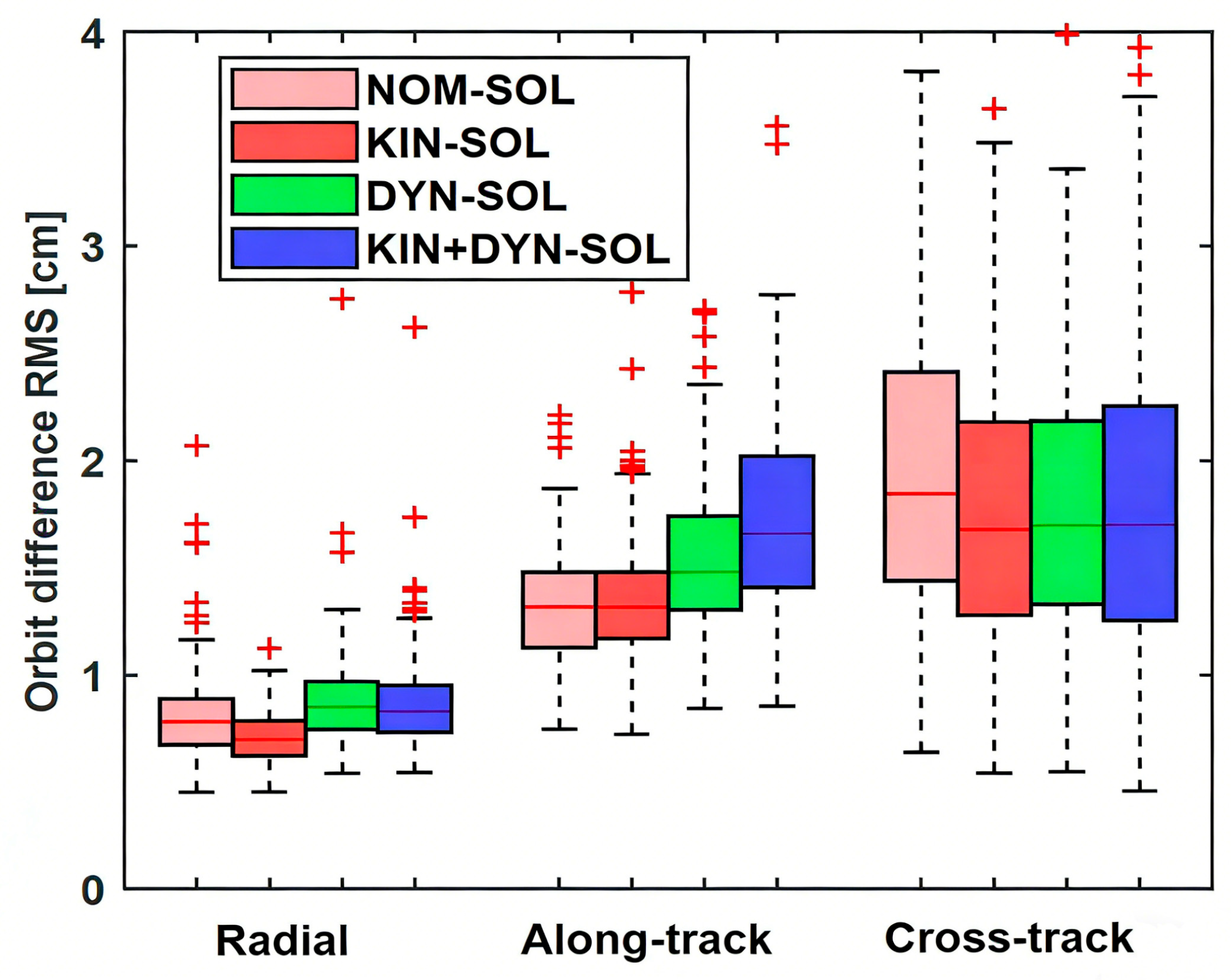
Orbit accuracy serves as a key metric for evaluating the efficacy of different empirical parameterization strategies. Improvements in the force model, especially those achieved through enhanced noise mitigation and empirical compensation, are expected to result in more accurate satellite orbits. This section evaluates the dynamic orbits produced under the four schemes outlined in Figure 3. For each scheme, dynamic orbits are computed by updating the initial state vector and relevant force model parameters, followed by numerical integration of the equations of motion. The resulting orbits are then compared against the JPL Precise Science Orbit (PSO), a reduced-dynamic post-fit solution generated using ambiguity-fixed GPS observations [44]. The JPL PSO has been rigorously validated: KBR residuals confirm along-track accuracy at the 2 mm level or better, while SLR residuals verify radial accuracy within 1.0 cm. Given the high fidelity of the PSO, it is adopted as the reference orbit in this study. Accordingly, we forgo further validation and focus on a direct comparison between our dynamically computed orbits and the PSO benchmark to quantify the relative improvements offered by each empirical modeling approach.
Figure 3 illustrates the RMS distributions of orbit differences between the dynamic solutions and the JPL PSO for the GFO-C satellite in 2019. Residuals are shown separately for the radial, along-track, and cross-track components. The corresponding statistical results for both GFO-C and GFO-D are summarized in Table 4. In the radial direction, all four solutions yield similar performance, with KIN-SOL showing a slight improvement of approximately 1 mm RMS over NOM-SOL. In the along-track direction, however, the DYN+KIN-SOL solution shows a slight degradation, with a marginal precision loss at the sub-millimeter level. In contrast, significant improvements are observed in the cross-track direction. The RMS values exhibit a consistent descending trend: from 3.1 cm in NOM-SOL to 2.3 cm in DYN-SOL, 2.1 cm in KIN-SOL, and 1.8 cm in DYN+KIN-SOL. This clearly demonstrates the cumulative benefit of integrating both dynamic and kinematic empirical modeling strategies. A similar pattern is observed for the GFO-D satellite, confirming the robustness and consistency of the results across both spacecraft. Overall, the incorporation of dynamic, kinematic, and combined empirical parameters leads to the most substantial improvements in the cross-track direction. This outcome is consistent with the known limitations of the onboard accelerometer, which exhibits reduced sensitivity along this axis.

4.3. Evaluation of GFO Gravity Field Recovery

In the dynamic approach, the SH coefficients of the temporal gravity field are estimated simultaneously with satellite orbits. This section evaluates the internal consistency and signal fidelity of the monthly gravity field models obtained from the four experimental solutions—NOM-, DYN-, KIN-, and DYN+KIN-SOL. A widely adopted method to assess the spectral properties of gravity field solutions is the degree-wise geoid height difference analysis with respect to a high-precision reference model. Ideally, when geophysical signals dominate and the solution is minimally affected by noise, the degree amplitudes of the geoid height should exhibit a monotonic decay with increasing spherical harmonic degree. However, in the presence of observation noise or imperfections in the background force models, this decay pattern typically flattens or reverses, particularly at higher degrees, indicating contamination by errors. Therefore, the spectral domain must be interpreted by distinguishing between signal-dominated and noise-dominated regions.
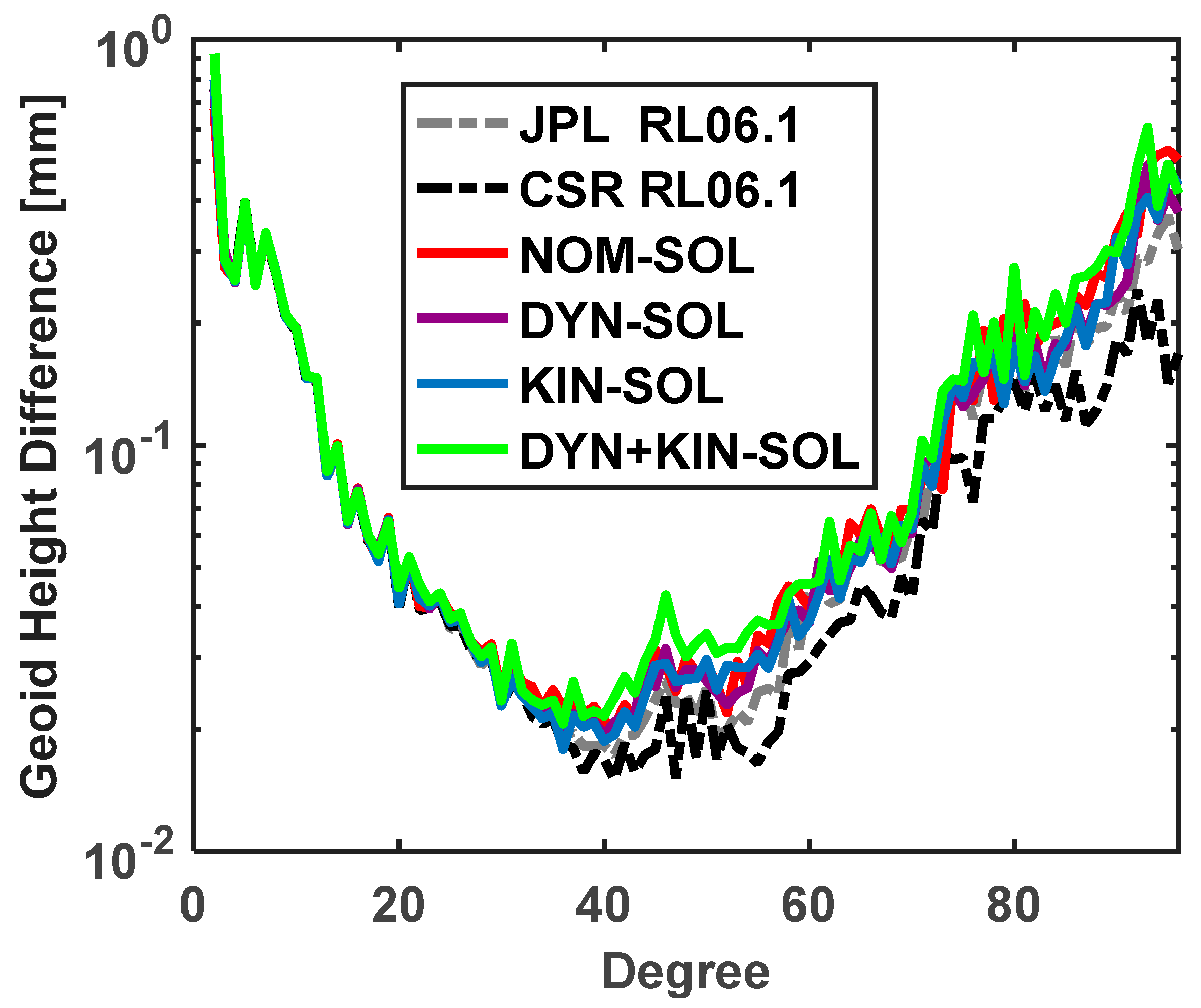
Figure 4 presents the degree-wise geoid height differences between the monthly gravity field models derived from the four tested schemes and the official SDS products (JPL and CSR RL06.1), with all models referenced to the static background field GGM05C. July 2019 is selected as a representative month to illustrate the typical spectral behavior. The differences are calculated under the spherical approximation [45]. Across most degrees, the four gravity field solutions show strong spectral consistency with the SDS reference models. In particular, NOM-SOL and KIN-SOL maintain close agreement with RL06.1 across the full degree range from 2 to 96. Below degree 30, all solutions exhibit minimal deviations, indicating a robust recovery of large-scale mass redistribution signals. Between degrees 30 and 60, a notable divergence is observed: the DYN+KIN-SOL shows elevated geoid height differences relative to the SDS products, suggesting that the combined use of dynamic and kinematic empirical parameters may introduce over-filtering or signal attenuation in this intermediate spectral band. Beyond degree 60, however, the spectral alignment improves again across all solutions, indicating that high-degree signals are preserved effectively.
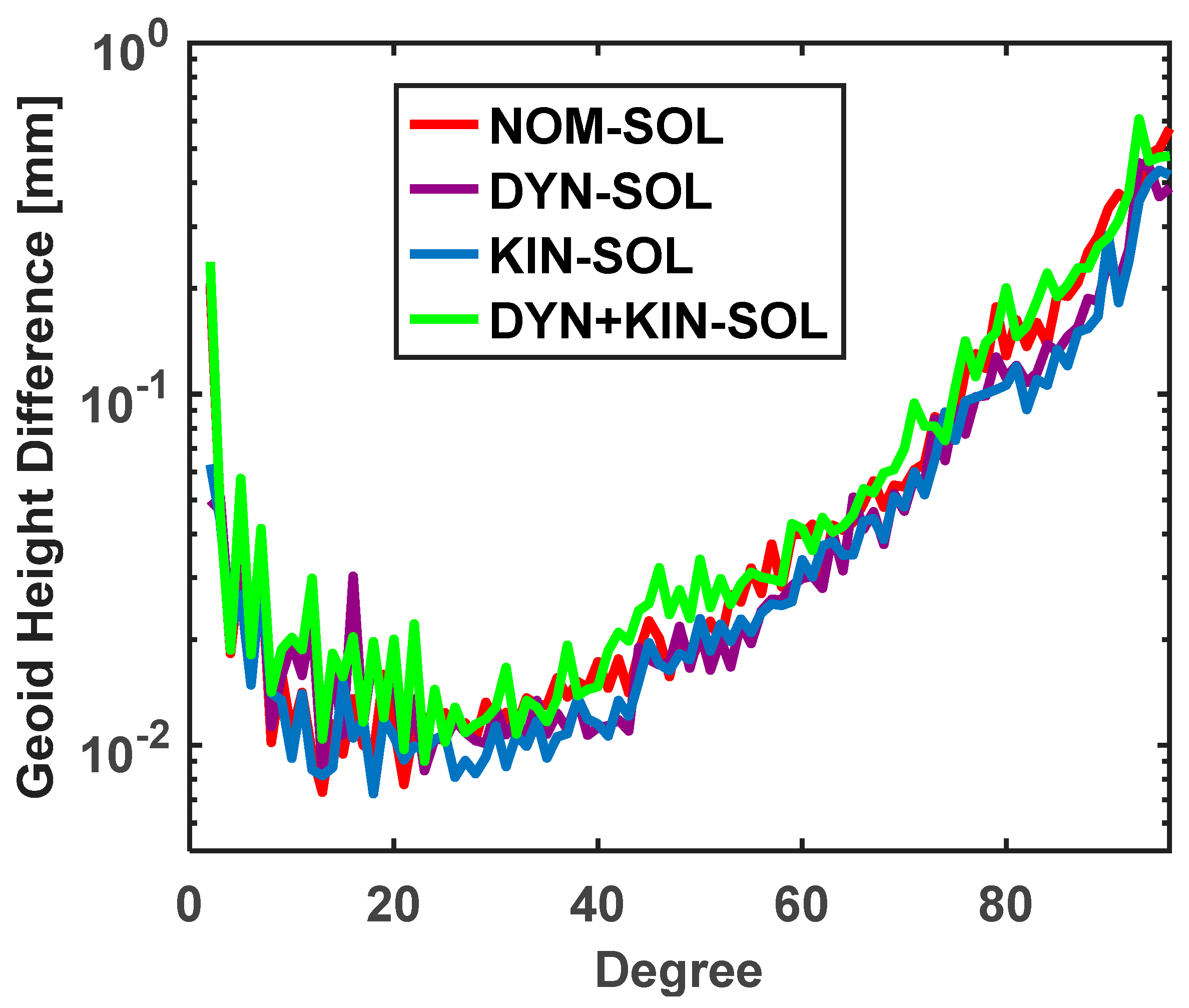
To better isolate the behavior of each solution, Figure 5 presents the degree-wise geoid height differences between the monthly GFO gravity field models and the JPL RL06.1 product for July 2019. Compared to NOM-SOL, both DYN-SOL and KIN-SOL exhibit smaller deviations, indicating better agreement. The differences between the two solutions are marginal, suggesting a comparable level of accuracy. In contrast, DYN+KIN-SOL shows the pronounced discrepancy, particularly beyond degree 30, where its spectral amplitudes begin to deviate more noticeably from the reference, implying that the combined use of dynamic and kinematic empirical parameters have excessively suppressed genuine gravity signals, resulting in noticeable signal attenuation.
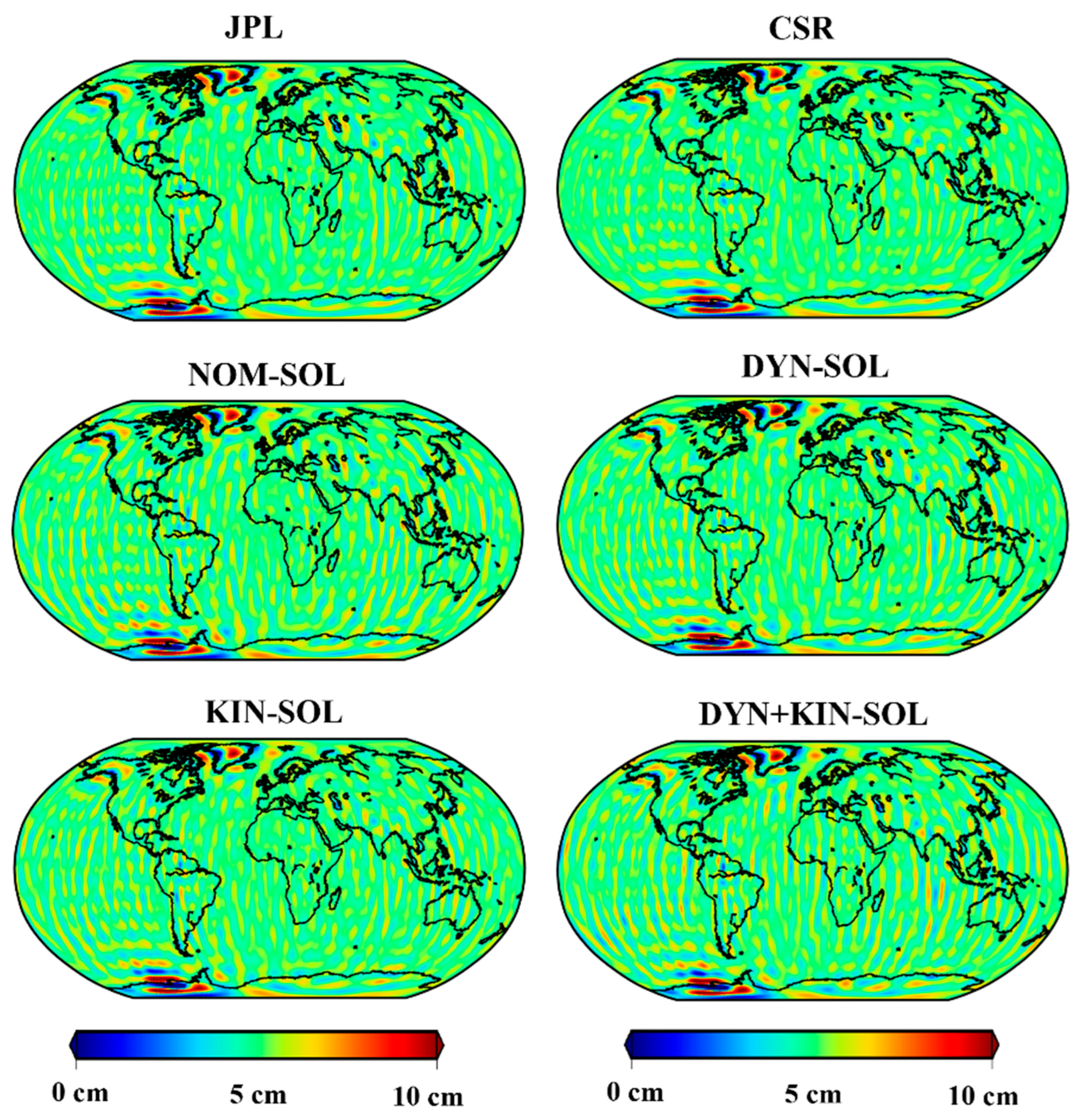
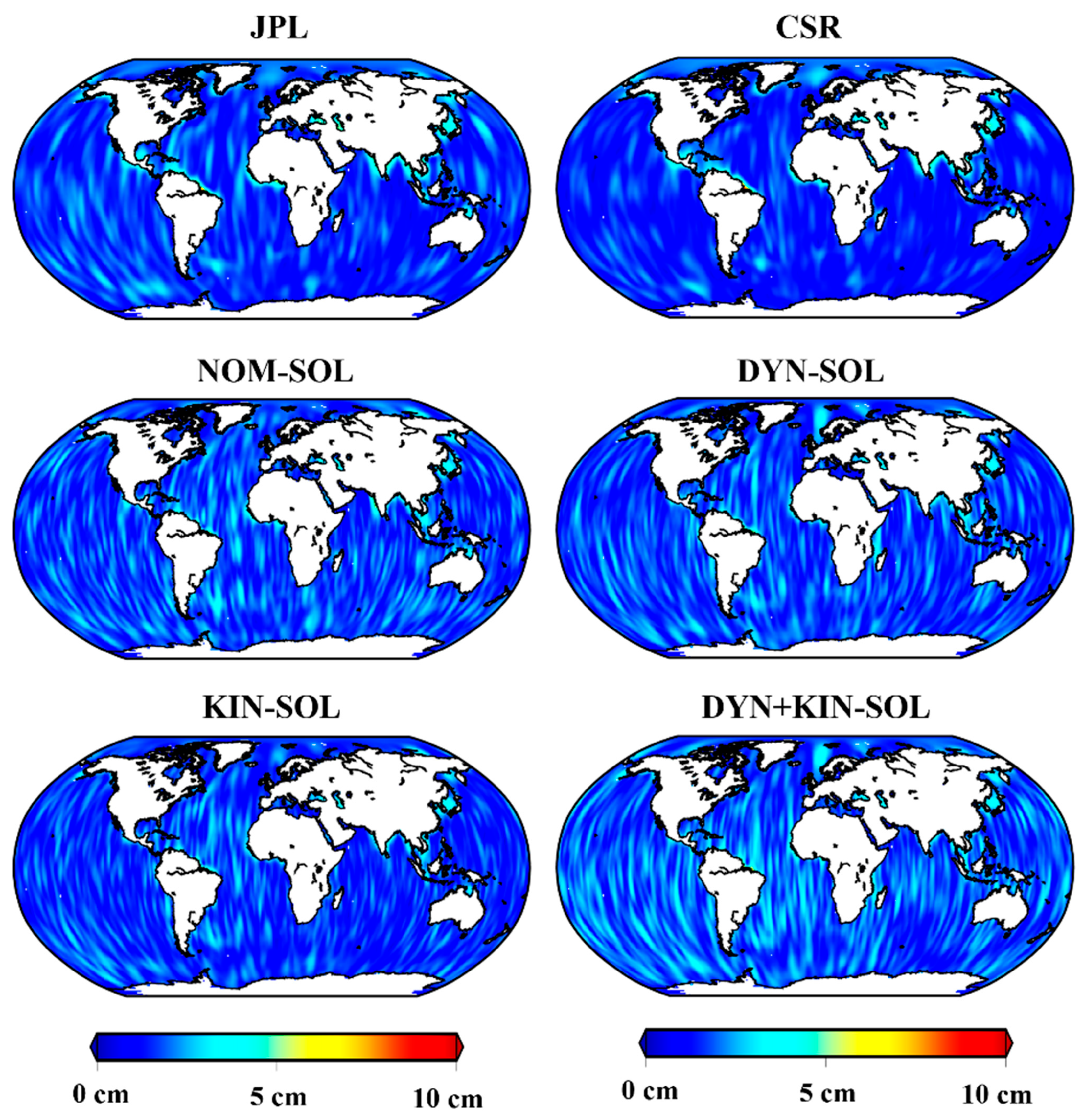
As a complementary analysis, equivalent water height (EWH) anomalies were derived to evaluate the impact of different empirical parameterization strategies on gravity field recovery beyond degree 30. A consistent post-processing procedure was applied to all monthly gravity field solutions, including the following steps: (1) Removal of the static background model GGM05C, followed by computation of surface mass variation using spherical harmonic coefficients from degrees 30 to 96; (2) Application of a Gaussian smoothing filter with a 350 km radius to suppress high-degree noise [46]; (3) The resulting data were transformed into 1 ° × 1 ° global gridded maps of surface mass variation, expressed in EWH anomalies, following the approach outlined by Wahr et al. (1998) [45]. These maps are used to assess the consistency of the various solutions in capturing mass redistribution at spatial scales finer than approximately 1300 km. The filtered EWH anomalies derived from the aforementioned gravity field models for July 2019 are shown in Figure 6.
Two main features characterize the spatial distribution of filtered EWH anomalies. In high-mass-change regions such as Greenland and parts of the Southern Ocean, the solutions derived from different empirical parameterizations show strong consistency with the SDS models, indicating that sub-1300 km scale signals (i.e., beyond degree 30) are well preserved across solutions. A second notable feature is the presence of north–south striping patterns, a known artifact resulting from the polar orbit geometry of the GFO constellation. These stripes are visible in all solutions but are slightly more pronounced over the Atlantic and Pacific Oceans in our solutions. This may be attributed to the lack of dedicated corrections for accelerometer anomalies onboard GFO-D, which are incorporated in the RL06.1 processing chain [7]. Among the four solutions, the DYN+KIN-SOL displays the most visible stripe contrast in oceanic regions, suggesting a modest amplification of noise introduced by the combined empirical parameterization strategy in these regions.
To more accurately characterize the empirical errors inherent in the recovered gravity field solutions, residual EWH fields were computed by removing a deterministic model consisting of a constant bias, linear trend, and semiannual variation from each monthly solution. Due to the limited observation period (11 months in 2019 with February excluded), annual signals could not be reliably estimated and were therefore excluded from the regression model. This simplified model does not account for nonlinear or interannual variability, which is typically more pronounced over land than over ocean [28]. To avoid misinterpreting long-period climate signals as noise, the analysis was confined to the global ocean domain. The regression parameters were estimated using a least-squares method, applied independently to each monthly EWH anomaly field. For consistency, the same procedure was applied to the JPL and CSR RL06.1 solutions over the same period.
Figure 7 presents the RMS distributions of residual EWH over the global oceans from January to December 2019 (excluding February), based on the JPL RL06.1, CSR RL06.1, and four tested solutions (NOM-, DYN-, KIN-, and DYN+KIN-SOL). The JPL and CSR models clearly produce smoother residual fields with lower overall RMS values, which reflects the effectiveness of their more sophisticated and well-tuned processing strategies. In contrast, our solutions display more pronounced north–south striping artifacts, which are typical indicators of high-frequency modeling errors. Among them, DYN+KIN-SOL shows the most prominent striping features. Statistically, the mean RMS values are 1.6 cm for JPL, 1.4 cm for CSR, 1.9 cm for NOM, 1.8 cm for DYN (a 5% reduction), 1.7 cm for KIN (a 10% reduction), and 2.2 cm for DYN+KIN (a ~16% increase). These results suggest that while dynamic and kinematic empirical models are each effective at suppressing high-frequency errors when applied independently, their combined use amplifies residual noise and striping. This behavior aligns with the increased discrepancies observed in Figure 4 and Figure 5 beyond degree 30, where the combined strategy enhances spectral correlations and induces stronger signal aliasing in the high-degree gravity field recovery [47].
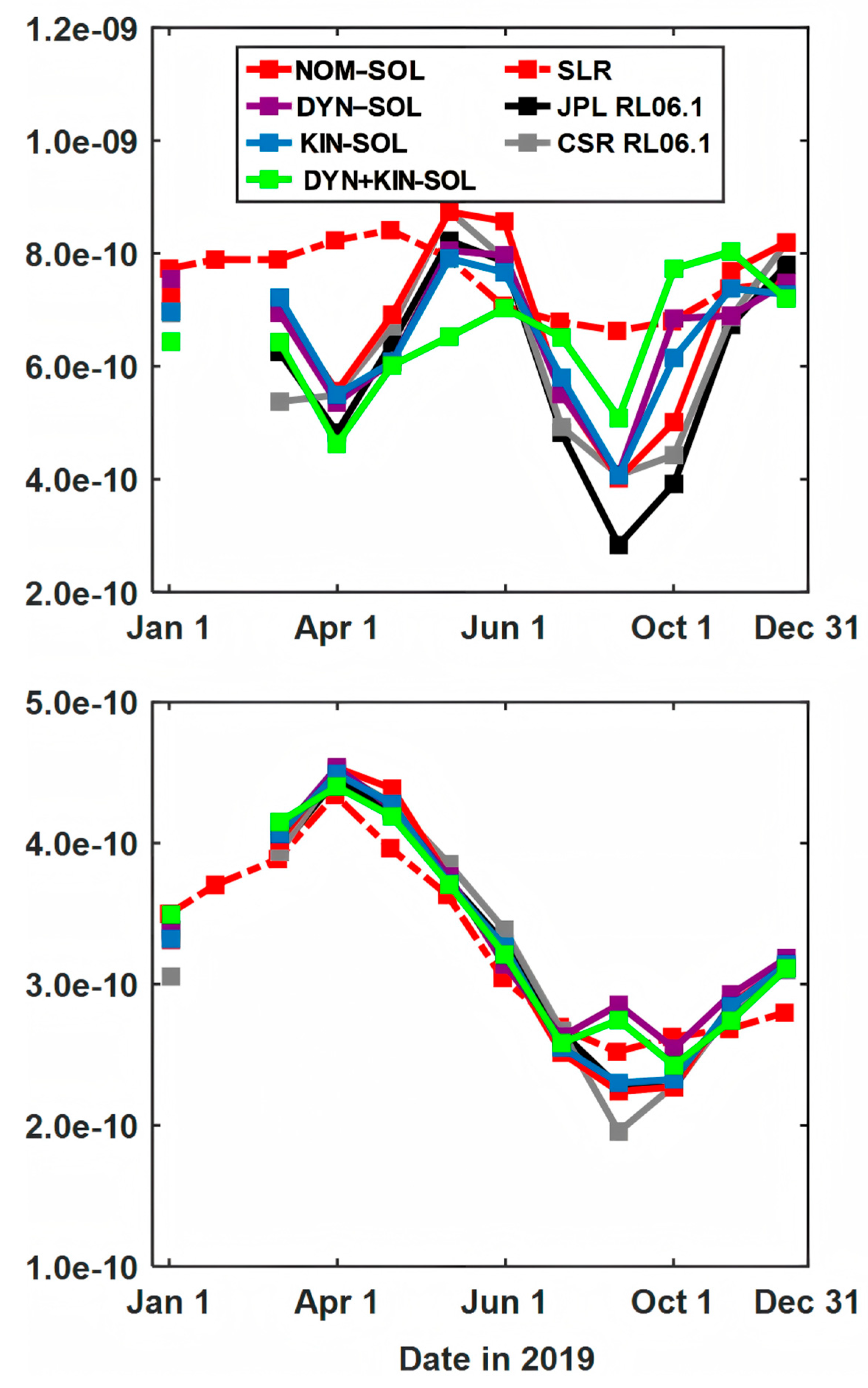
In addition to frequency-domain analyses, time series evaluations of low-degree spherical harmonic coefficients were conducted to further examine subtle differences among the solutions. The top panel of Figure 8 presents the time series of the degree-2 zonal coefficient (C2,0) from our four GFO-derived solutions, as well as from the official JPL and CSR RL06.1 product and the SLR solution provided by Cheng et al. [48]. The bottom panel of Figure 8 shows the corresponding time series for the degree-3 zonal coefficient (C3,0). A spurious oscillation with an approximate 160-day period is evident in all GFO-derived C2,0 series, aligning with previous observations reported by Cheng and Ries [49]. The origin of this artificial periodicity remains unclear, but its persistent presence across all six solutions reinforces the common practice of replacing GFO-derived C2,0 values with those from independent SLR-derived estimates during postprocessing. Notably, the DYN+KIN-SOL solution exhibits a significantly smaller amplitude of this periodic oscillation compared to the other solutions, including the official GFO SDS products, which display consistent periodic fluctuations. This could be a manifestation of overfitting due to the excessive number of parameters in the DYN+KIN strategy. The potential causes and implications of this behavior will be discussed in detail in the Section 5 (Discussion section). Unlike C2,0, the C3,0 time series derived from all solutions exhibit minimal variation and closely match the SLR-derived estimates, indicating consistent recovery across parameterization strategies. This suggests that while C2,0 remains a problematic parameter for GFO missions due to its sensitivity to non-gravitational errors, C3,0 is more robustly and reliably recovered across different parameterization strategies.

5. Discussion

The comparative analysis of the degree-2 zonal coefficient (C2,0) reveals that the DYN+KIN-SOL solution exhibits a significantly smaller amplitude of this periodic oscillation compared to the other solutions. Interestingly, the recovery of the degree-3 zonal term (C3,0) remains largely unaffected, suggesting that the degradation observed in C2,0 is unlikely to stem from general modeling deficiencies, but rather from frequency-domain interference or parameter interactions specific to that spectral region.
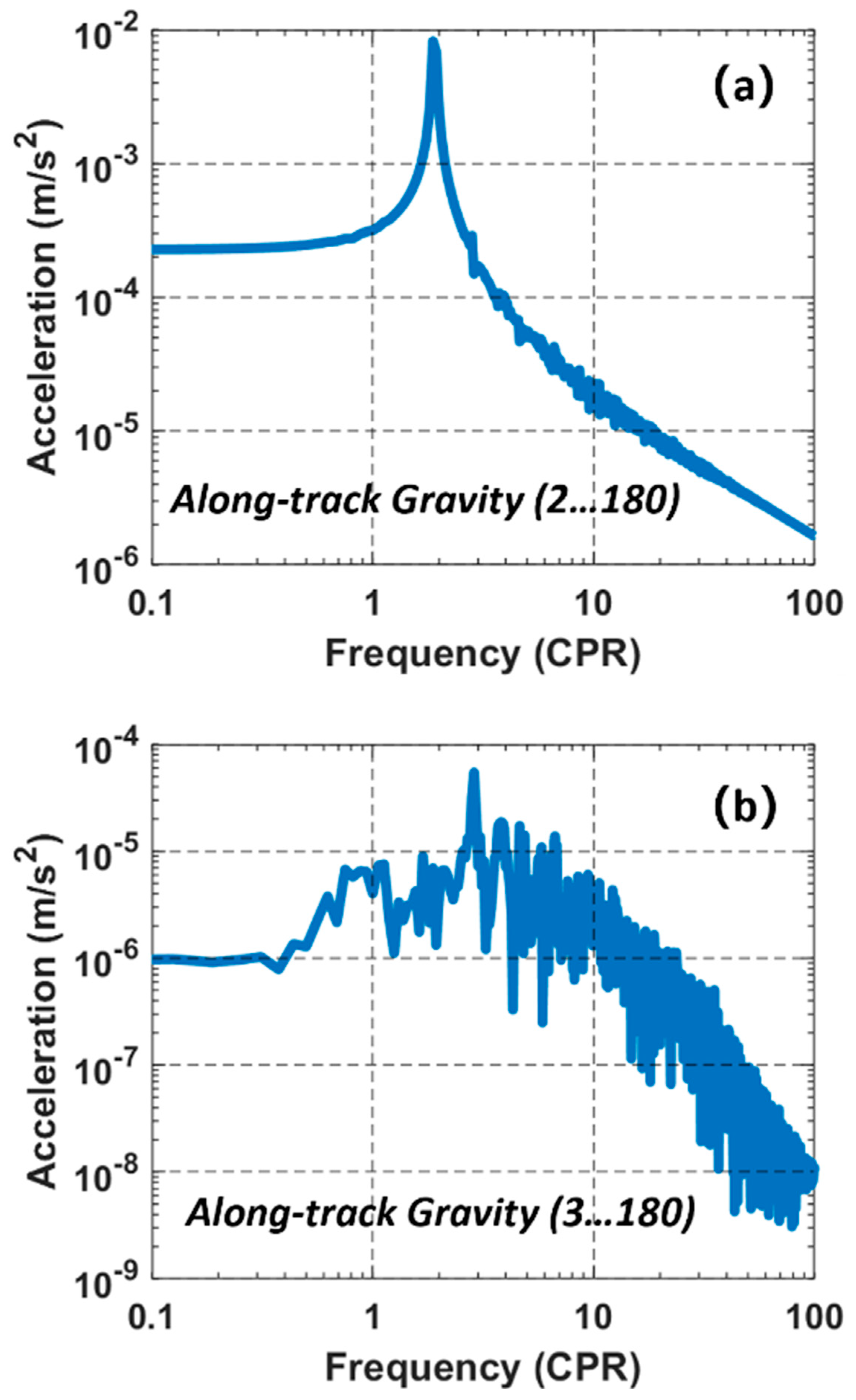
To investigate this hypothesis, we analyze the spectral characteristics of Earth gravity in the along-track direction of the RAC frame. Figure 9 presents the amplitude spectra of the static gravity field (GGM05C), decomposed in the along-track direction over degrees 2–180 and 3–180, respectively. The along-track component of the non-spherical gravity field exhibits a prominent peak at the 2-CPR frequency, which is primarily associated with Earth’s oblateness, i.e., the J2 term [25]. This frequency components directly overlap with those targeted in parameter estimation. It should be emphasized that both dynamic and kinematic empirical parameters are mathematical constructs introduced to absorb mismodeled signals and residuals, rather than physically driven forces governing satellite motion. As a result, these parameterizations inevitably introduce additional mathematical degrees of freedom that are not strictly tied to the underlying satellite dynamics. When their temporal or spectral characteristics overlap with those of the true gravity signal, parts of the geophysical information may be unintentionally absorbed by the empirical models, rather than being attributed to the gravity field parameters.
In the dynamic empirical model, the quadratic polynomials are estimated over 90-min arcs, inherently absorbing signals near 1-CPR. In the kinematic model, biases and linear drifts are estimated over 45-min arcs (~2-CPR), while sinusoidal terms are specifically tuned to 1-CPR over 90-min arcs. The overlap between the dominant gravity signal frequencies (1-CPR, 2-CPR) and the empirical parameterization frequencies introduces spectral coupling. This interaction may distort the estimation of low-degree gravity coefficients, particularly C2,0, by causing a portion of the geophysical signal to be absorbed into the empirical model. Although the use of either dynamic or kinematic parameters individually can introduce some degree of spectral coupling, the extent of such interference is evidently limited, as the 2-CPR signals are well preserved in the individually processed solutions.

6. Conclusions

This study systematically evaluated the impact of three empirical parameterization strategies: dynamic, kinematic, and their combination, on GFO orbit determination and temporal gravity field recovery. The analyses were based on nearly a full year of GFO onboard data from 2019, with February excluded due to severe data gaps. Three refined solutions, DYN-SOL, KIN-SOL, and DYN+KIN-SOL, were derived and compared against the nominal solution (NOM-SOL), allowing for a detailed investigation of their respective contributions to orbit precision and gravity field consistency. These refined solutions act as empirical temporal filters, with most parameter estimation frequencies concentrated around the 1-CPR band. As a result, low-frequency components below 1-CPR in the KRR post-fit residuals are strongly suppressed, while higher-frequency signals are largely preserved. The DYN+KIN-SOL, in particular, results in an almost flattened spectrum below 1-CPR, indicating excessive filtering and a risk of overfitting.
In terms of orbit precision, all refined solutions exhibit significant improvements in the cross-track direction, with error reductions of approximately 30%. Among them, the DYN+KIN-SOL solution achieves the most pronounced enhancement, reflecting effective compensation for the limited sensitivity of the onboard accelerometer in this direction. This enhancement, however, comes at the cost of a marginal loss in along-track precision, which nonetheless remains within the sub-millimeter range.
Regarding gravity field recovery, all refined models show overall consistency with official SDS products (e.g., JPL RL06.1, CSR RL06.1). While DYN-SOL and KIN-SOL perform comparably to the NOM-SOL, DYN+KIN-SOL exhibits noticeable deviations beyond degree 30, as indicated by degree-wise SH coefficient differences. Residual EWH analysis over global oceans confirms that DYN+KIN-SOL increases noise by approximately 16% related to the NOM-SOL, with more prominent north–south striping. These effects suggest that the joint estimation of dynamic and kinematic empirical parameters increases their correlation with gravity field coefficients, particularly at high degrees, thereby compromising the spatial separability of geophysical signals. Analysis of low-degree zonal terms, such as C2,0, suggests that the reduced signal amplitude in DYN+KIN-SOL results from spectral overlap between empirical parameter frequencies and the dominant 1–2 CPR gravity signals. Collectively, these findings highlight the importance of aligning empirical parameterization strategies with the spectral characteristics of gravity signals. Future efforts should focus on optimizing the temporal and spectral structure of parameter estimation to suppress noise effectively while preserving meaningful geophysical information, especially in the high-degree domain.

Author Contributions

G.G.: Conceptualization, Methodology, and Writing; S.Z.: Validation and Investigation; Y.Z. and H.L.: Software, Validation, and Writing; L.Z.: Methodology and Validation. All authors have read and agreed to the published version of the manuscript.

Funding

This research was funded by the National Natural Science Foundation of China, [Grant No. 42374016, 42404005], Major Program (JD)of Hubei Province [Grant No. 2023BAA025], the Natural Science Foundation of Shandong Province [Grant No. ZR2025QC994], and Scientific Research Fund from Institute of Seismology, CEA and National Institute of Natural Hazards, Ministry of Emergency Management of China [Grant No. IS202336343].

Data Availability Statement

All original data in this article are publicly available. The WHU precise orbit and clock products can be found on the website of the IGS data center of Wuhan University via http://www.igs.gnsswhu.cn/index.php (accessed on 7 October 2025). The GRACE-FO data can be provided by GFZ via https://isdc.gfz.de/grace-fo-isdc/ (accessed on 20 September 2025). The GRACE-FO Level-2 product (Release 06) from JPL, CSR, and GFZ can be obtained through the International Centre for Global Earth Models (ICGEM) at https://icgem.gfz.de/sl/temporal (accessed on 1 December 2025).

Acknowledgments

The authors would like to thank the IGS Data Center at Wuhan University and the Jet Propulsion Laboratory (JPL) for providing the GPS precise ephemeris and clock offset products, as well as the twin GRACE-FO observation data and auxiliary products used in this study. The authors also acknowledge the International Centre for Global Earth Models (ICGEM) for providing the temporal Earth gravity field models and the developers of the GROOPS software (https://github.com/groops-devs/groops, accessed on 10 February 2026) for the visualization tools used in this paper. The numerical calculations in this paper have been done on the supercomputing system in the Supercomputing Center of Wuhan University.

Conflicts of Interest

Authors declare that there are no known conflicts of interest associated with this publication and there has been no significant financial support for this work that could have influenced its outcome.

Abbreviations

The following abbreviations are used in this manuscript:
GPSGlobal Positioning System
KRRK-band Range-Rate
PODPrecise Orbit Determination
GRACEGravity Recovery and Climate Experiment
GFOGravity Recovery and Climate Experiment Follow-On
LRILaser Ranging Interferometer
GFZGerman Research Centre for Geosciences
CSRCenter for Space Research
JPLJet Propulsion Laboratory
SDSScience Data System
AIUBAstronomical Institute of the University of Bern
HUSTHuazhong University of Science and Technology
ICGEMInternational Centre for Global Earth Models
CPRCycle-Per-Revolution
SHSpherical Harmonic
RACRadial, Along-track, and Cross-track directions
ECIEarth-Centered Inertial
ROCKETRecovery of the satellite Orbit, ClocK, and Earth gravity field Tools
PSOPrecise Science Orbit
EWHEquivalent Water Height

References

  1. Wen, H.Y.; Kruizinga, G.; Paik, M.; Landerer, F.; Bertiger, W.; Sakumura, C.; Bandikova, T.; Mccullough, C. GRACE FO Level 1 data Product User Handbook; Jet Propulsion Laboratory: La Cañada Flintridge, CA, USA, 2019.
  2. Landerer, F.W.; Flechtner, F.M.; Save, H.; Webb, F.H.; Bandikova, T.; Bertiger, W.I.; Bettadpur, S.V.; Byun, S.H.; Dahle, C.; Dobslaw, H.; et al. Extending the Global Mass Change Data Record: GRACE Follow-On Instrument and Science Data Performance. Geophys. Res. Lett. 2020, 47, e2020GL088306. [Google Scholar] [CrossRef]
  3. Pie, N.; Bettadpur, S.V.; Tamisiea, M.; Krichman, B.; Save, H.; Poole, S.; Nagel, P.; Kang, Z.; Jacob, G.; Ellmer, M.; et al. Time Variable Earth Gravity Field Models From the First Spaceborne Laser Ranging Interferometer. J. Geophys. Res. Solid Earth 2021, 126, e2021JB022392. [Google Scholar] [CrossRef]
  4. Kornfeld, R.P.; Arnold, B.W.; Gross, M.A.; Dahya, N.T.; Klipstein, W.M.; Gath, P.F.; Bettadpur, S. GRACE-FO: The Gravity Recovery and Climate Experiment Follow-On Mission. J. Spacecr. Rocket. 2019, 56, 931–951. [Google Scholar] [CrossRef]
  5. Bettadpur, S. Release Notes for GRACE-FO L-2 Products—Version UTCSR RL-06.1; Center for Space Research, The University of Texas at Austin: Austin, TX, USA, 2023. [Google Scholar]
  6. Dahle, C. Release Notes for GFZ GRACE-FO Level-2 Products—Version RL06; GFZ German Research Centre for Geosciences: Potsdam, Germany, 2023. [Google Scholar]
  7. McCullough, C.M.; Fahnestock, E.G.; Wiese, D.N.; Yuan, D.N. JPL Level-2 GRACE-FO Products—Release Notes Version 6.1; Jet Propulsion Laboratory, California Institute of Technology: La Cañada Flintridge, CA, USA, 2023.
  8. Lasser, M.; Meyer, U.; Arnold, D.; Jäggi, A. AIUB-GRACE-FO-Operational-Operational GRACE Follow-On Monthly Gravity Field Solutions-RELEASE 02; GFZ Data Services: Potsdam, Germany, 2023. [Google Scholar] [CrossRef]
  9. Zhou, H.; Zheng, L.; Li, Y.; Guo, X.; Zhou, Z.; Luo, Z. HUST-Grace2024: A new GRACE-only gravity field time series based on more than 20 years of satellite geodesy data and a hybrid processing chain. Earth Syst. Sci. Data 2024, 16, 3261–3281. [Google Scholar] [CrossRef]
  10. Velicogna, I.; Sutterley, T.C.; Van Den Broeke, M.R. Regional acceleration in ice mass loss from Greenland and Antarctica using GRACE time-variable gravity data. Geophys. Res. Lett. 2014, 41, 8130–8137. [Google Scholar] [CrossRef]
  11. Dobslaw, H.; Dill, R.; Bagge, M.; Klemann, V.; Boergens, E.; Thomas, M.; Dahle, C.; Flechtner, F. Gravitationally Consistent Mean Barystatic Sea Level Rise From Leakage-Corrected Monthly GRACE Data. J. Geophys. Res. Solid Earth 2020, 125, e2020JB020923. [Google Scholar] [CrossRef]
  12. Chen, J.; Tapley, B.; Tamisiea, M.E.; Save, H.; Wilson, C.; Bettadpur, S.; Seo, K. Error Assessment of GRACE and GRACE Follow-On Mass Change. J. Geophys. Res. Solid Earth 2021, 126, e2021JB022124. [Google Scholar] [CrossRef]
  13. Chao, N.; Wan, X.; Zhong, Y.; Yin, W.; Yue, L.; Li, F.; Hu, Y.; Wang, J.; Chen, G.; Wang, Z.; et al. Reconstructing a new terrestrial water storage deficit index to detect and quantify drought in the Yangtze River Basin. J. Hydrol. 2023, 625, 129972. [Google Scholar] [CrossRef]
  14. Yi, S.; Saemian, P.; Sneeuw, N.; Tourian, M.J. Estimating runoff from pan-Arctic drainage basins for 2002–2019 using an improved runoff-storage relationship. Remote Sens. Environ. 2023, 298, 113816. [Google Scholar] [CrossRef]
  15. Weigelt, M.; Van Dam, T.; Jäggi, A.; Prange, L.; Tourian, M.J.; Keller, W.; Sneeuw, N. Time-variable gravity signal in Greenland revealed by high-low satellite-to-satellite tracking. J. Geophys. Res. Solid Earth 2013, 118, 3848–3859. [Google Scholar] [CrossRef]
  16. Han, S.; Jekeli, C.; Shum, C.K. Time-variable aliasing effects of ocean tides, atmosphere, and continental water mass on monthly mean GRACE gravity field. J. Geophys. Res. Solid Earth 2004, 109, 2003JB002501. [Google Scholar] [CrossRef]
  17. Zenner, L.; Fagiolini, E.; Daras, I.; Flechtner, F.; Gruber, T.; Schmidt, T.; Schwarz, G. Non-tidal atmospheric and oceanic mass variations and their impact on GRACE data analysis. J. Geodyn. 2012, 59–60, 9–15. [Google Scholar] [CrossRef]
  18. Kvas, A.; Mayer-Gürr, T. GRACE gravity field recovery with background model uncertainties. J. Geod. 2019, 93, 2543–2552. [Google Scholar] [CrossRef]
  19. Colombo, O. Notes on the Mapping of the Gravity Field Using Satellite Data; Springer: Berlin/Heidelberg, Germany, 1986. [Google Scholar]
  20. Goswami, S.; Devaraju, B.; Weigelt, M.; Mayer-Gürr, T. Analysis of GRACE range-rate residuals with focus on KBR instrument system noise. Adv. Space Res. 2018, 62, 304–316. [Google Scholar] [CrossRef]
  21. Ditmar, P.; Teixeira Da Encarnação, J.; Hashemi Farahani, H. Understanding data noise in gravity field recovery on the basis of inter-satellite ranging measurements acquired by the satellite gravimetry mission GRACE. J. Geod. 2012, 86, 441–465. [Google Scholar] [CrossRef]
  22. Jäggi, A.; Beutler, G.; Hugentobler, U. Efficient Stochastic Orbit Modeling Techniques using Least Squares Estimators. In A Window on the Future of Geodes; Sansò, F., Ed.; Springer: Berlin/Heidelberg, Germany, 2005; Available online: http://link.springer.com/10.1007/3-540-27432-4_31 (accessed on 10 December 2025).
  23. Jäggi, A.; Hugentobler, U.; Beutler, G. Pseudo-stochastic orbit modeling techniques for low-Earth orbiters. J. Geod. 2006, 80, 47–60. [Google Scholar] [CrossRef]
  24. Dahle, C.; Flechtner, F.; Murböck, M.; Michalak, G.; Neumayer, H.; Abrykosov, O.; Reinhold, A.; König, R. Gravity Recovery and Climate Experiment Follow-On; GFZ German Research Centre for Geosciences: Potsdam, Germany, 2019. [Google Scholar]
  25. Kim, J. Simulation Study of A Low-Low Satellite-to-Satellite Tracking Mission. Doctoral Dissertation, The University of Texas at Austin, Austin, TX, USA, 2000. [Google Scholar]
  26. Tapley, B.; Ries, J.; Bettadpur, S.; Chambers, D.; Cheng, M.; Condi, F.; Gunter, B.; Kang, Z.; Nagel, P.; Pastor, R.; et al. GGM02—An improved Earth gravity field model from GRACE. J. Geod. 2005, 79, 467–478. [Google Scholar] [CrossRef]
  27. Visser, P.N.A.M. Low-low satellite-to-satellite tracking: A comparison between analytical linear orbit perturbation theory and numerical integration. J. Geod. 2005, 79, 160–166. [Google Scholar] [CrossRef]
  28. Koch, I.; Duwe, M.; Flury, J.; Shabanloui, A. Earth’s Time-Variable Gravity from GRACE Follow-On K-Band Range-Rates and Pseudo-Observed Orbits. Remote Sens. 2021, 13, 1766. [Google Scholar] [CrossRef]
  29. Nie, Y.; Shen, Y.; Pail, R.; Chen, Q.; Xiao, Y. Revisiting Force Model Error Modeling in GRACE Gravity Field Recovery. Surv. Geophys. 2022, 43, 1169–1199. [Google Scholar] [CrossRef]
  30. Kroes, R. Precise Relative Positioning of Formation Flying Spacecraft Using GPS; Nederlandse Commissie voor Geodesie: Delft, The Netherlands, 2006. [Google Scholar] [CrossRef]
  31. Montenbruck, O.; Gill, E. Satellite Orbit Models, Methods and Applications; Springer: Berlin, Germany, 2000. [Google Scholar]
  32. Kang, Z.; Tapley, B.; Bettadpur, S.; Ries, J.; Nagel, P.; Pastor, R. Precise orbit determination for the GRACE mission using only GPS data. J. Geod. 2006, 80, 322–331. [Google Scholar] [CrossRef]
  33. Kang, Z.; Bettadpur, S.; Nagel, P.; Save, H.; Poole, S.; Pie, N. GRACE-FO precise orbit determination and gravity recovery. J. Geod. 2020, 94, 85. [Google Scholar] [CrossRef]
  34. Geng, J.; Chen, X.; Pan, Y.; Zhao, Q. A modified phase clock/bias model to improve PPP ambiguity resolution at Wuhan University. J. Geod. 2019, 93, 2053–2067. [Google Scholar] [CrossRef]
  35. Banville, S.; Geng, J.; Loyer, S.; Schaer, S.; Springer, T.; Strasser, S. On the interoperability of IGS products for precise point positioning with ambiguity resolution. J. Geod. 2020, 94, 10. [Google Scholar] [CrossRef]
  36. Petit, G.; Luzum, B. IERS Conventions; IERS Conventions Centre: Paris, France, 2010. [Google Scholar]
  37. Ries, J.; Bettadpur, S.; Eanes, R.; Kang, Z.; Ko Udai McCullough, C.; Nagel, P.; Pie, N.; Poole, S.; Richter, T.; Save, H.; et al. The Combined Gravity Model GGM05C; GFZ Data Services: Potsdam, Germany, 2016. [Google Scholar] [CrossRef]
  38. Standish, E.M. JPL Planetary and Lunar Ephemerides DE405/LE405; JPL: Pasadena, CA, USA, 1998.
  39. Lyard, F.H.; Allain, D.J.; Cancet, M.; Carrère, L.; Picot, N. FES2014 Global Ocean Tides Atlas: Design and Performances. All Depths/Data Assimilation/All Geographic Regions/Tides. 2020. Available online: https://os.copernicus.org/preprints/os-2020-96 (accessed on 20 December 2025).
  40. Dobslaw, H.; Bergmann-Wolf, I.; Dill, R.; Poropat, L.; Thomas, M.; Dahle, C.; Esselborn, S.; König, R.; Flechtner, F. A new high-resolution model of non-tidal atmosphere and ocean mass variability for de-aliasing of satellite gravity observations: AOD1B RL06. Geophys. J. Int. 2017, 211, 263–269. [Google Scholar] [CrossRef]
  41. Helleputte, T.V.; Doornbos, E.; Visser, P. CHAMP and GRACE accelerometer calibration by GPS-based orbit determination. Adv. Space Res. 2009, 43, 1890–1896. [Google Scholar] [CrossRef]
  42. Behzadpour, S.; Mayer-Gürr, T.; Krauss, S. GRACE Follow-On Accelerometer Data Recovery. J. Geophys. Res. Solid Earth 2021, 126, e2020JB021297. [Google Scholar] [CrossRef]
  43. Klinger, B.; Mayer-Gürr, T. The role of accelerometer data calibration within GRACE gravity field recovery: Results from ITSG-Grace2016. Adv. Space Res. 2016, 58, 1597–1609. [Google Scholar] [CrossRef]
  44. Bertiger, W.; Desai, S.D.; Haines, B.; Harvey, N.; Moore, A.W.; Owen, S.; Weiss, J.P. Single receiver phase ambiguity resolution with GPS data. J. Geod. 2010, 84, 327–337. [Google Scholar] [CrossRef]
  45. Wahr, J.; Molenaar, M.; Bryan, F. Time variability of the Earth’s gravity field: Hydrological and oceanic effects and their possible detection using GRACE. J. Geophys. Res. Solid Earth 1998, 103, 30205–30229. [Google Scholar] [CrossRef]
  46. Jekeli, C. Alternative Methods to Smooth the Earth’s Gravity Field; The Ohio State University: Columbus, OH, USA, 1981. [Google Scholar]
  47. Swenson, S.; Wahr, J. Post-processing removal of correlated errors in GRACE data. Geophys. Res. Lett. 2006, 33, 8. Available online: https://agupubs.onlinelibrary.wiley.com/doi/10.1029/2005GL025285 (accessed on 20 December 2025). [CrossRef]
  48. Cheng, M.; Tapley, B.D.; Ries, J.C. Deceleration in the Earth’s oblateness. J. Geophys. Res. Solid Earth 2013, 118, 740–747. [Google Scholar] [CrossRef]
  49. Cheng, M.; Ries, J. The unexpected signal in GRACE estimates of C20. J. Geod. 2017, 91, 897–914. [Google Scholar] [CrossRef]
Figure 1. Amplitude Spectral Density (ASD) of post-fit KRR residuals [m/s] after determining the temporary gravity field model via NOM, DYN-, KIN-, and DYN+KIN-SOL for GFO satellites on 25 July 2019.
Remotesensing 18 00695 g001
Figure 2. Daily Root Mean Square (RMS) values of post-fit KRR residuals for GFO satellites from January to December 2019 (excluding February), derived from the NOM-, DYN-, KIN-, and DYN+KIN-SOL.
Remotesensing 18 00695 g002
Figure 3. RMS distributions of orbit differences [cm] between the JPL PSO and the dynamic orbits derived from NOM-, DYN-, KIN-, and DYN+KIN-SOL for the GFO-C satellites from January to December 2019 (excluding February). Results are shown for the radial (R), along-track (A), and cross-track (C) components.
Remotesensing 18 00695 g003
Figure 4. Degree-wise geoid height differences between monthly GFO gravity field solutions and the static model GGM05C for July 2019. Comparisons include the four in-house solutions (NOM-, DYN-, KIN-, and DYN+KIN-SOL) and the SDS-provided JPL RL06.1 and CSR RL06.1 products. Differences are expressed in terms of degree amplitudes under the spherical approximation.
Remotesensing 18 00695 g004
Figure 5. Degree-wise geoid height differences between monthly GFO gravity field solutions and the JPL RL06.1 model for July 2019. Differences are expressed in terms of degree amplitudes under the spherical approximation.
Remotesensing 18 00695 g005
Figure 6. Filtered equivalent water height (EWH) anomalies [cm] for July 2019, derived from degree 30–96 gravity field solutions relative to GGM05C. Results include JPL RL06.1, CSR RL06.1, and the NOM-, DYN-, KIN-, and DYN+DYN-SOL. All fields are smoothed with a 350 km Gaussian filter.
Remotesensing 18 00695 g006
Figure 7. Root mean square (RMS) of residual EWH over the global oceans for January-December 2019 (excluding February), derived from JPL RL06.1, CSR RL06.1, and the NOM-, DYN-, KIN-, and DYN+DYN-SOL. Residuals were obtained after removing bias, linear trend, and semiannual variation from each monthly solution. All fields are smoothed with a 350 km Gaussian filter.
Remotesensing 18 00695 g007
Figure 8. Time series of the degree-2 zonal (C2,0, top) and degree-3 zonal (C3,0, bottom) SH coefficients from January to December 2019 (excluding February), derived from our four GFO solutions (NOM-, DYN-, KIN-, and DYN+KIN-SOL), the official SDS models (JPL and CSR RL06.1), and independent SLR estimates. A constant offset of 4.841704 × 10⁻⁴ was added to all C2,0 values and 9.568 × 10⁻⁷ was subtracted from all C3,0 values for clarity.
Remotesensing 18 00695 g008
Figure 9. Amplitude spectrum of the gravitational and non-gravitational accelerations: (a) for degrees 2–180 while (b) for degrees 3–180.
Remotesensing 18 00695 g009
Table 1. Dynamic gravity field recovery models and strategies.
ModelDescriptions
GPS
Observation typeL1/L2 pseudo-range and carrier-phase undifferenced (UD) ionosphere-free (IF) observations; Sampling: 30 s; Cut-off elevation: 5°
GPS orbit, clock and bias productsWHU final orbits, clocks, and Observable-Specific Bias (OSB) products [34,35]
GPS PCO/PCVigsR3_2135.atx [36]
GFO-C/D PCOJPL Level-1B product [1]
Relativistic effectSpace–time curvature correction [36]
Stochastic ModelsElevation-dependent weighting: 1/sin2 (elevation)
KBR
Observation typeKRR observations; Sampling: 5 s
Weighting approachVariance Component Estimation (VCE) to GPS pseudorange, carrier-phase and KBR range-rate observations
Force models
Gravity field modelGGM05C (2…180 d/o) [37]
Third-body perturbationsAll planets with JPL DE405 [38]
Solid earth and earth pole tide, ocean pole tides, and relativistic effectsIERS Convention 2010 [36]
Ocean tidesFES2014b (34 main tides, 327 minor tides, 2…180 d/o) [39]
Atmosphere tidesAOD1B RL06 (12 tides, 2…180 d/o) [40]
Atmosphere and Ocean tides De-aliasingAOD1B RL06 (2…180 d/o) [40]
Estimated parameters
GPS Receiver clock offsetEpoch-wise
GPS AmbiguityConstant, per pass
Initial statePosition and velocity at the reference epoch
Accelerometer scaleFull-scale, per month
Accelerometer X-axis biasQuadratic polynomial, per 24 h
Accelerometer Y-axis biasQuadratic polynomial, per 6 h
Accelerometer Z-axis biasQuadratic polynomial, per 12 h
Spheric harmonic coefficients96 d/o
Table 2. Experimental schemes with dynamic and kinematic parameter estimations.
SchemesDescriptions
NOM-SOLNo additional parameters included.
DYN-SOLDynamic empirical parameters:
Along-track bias modeled as a quadratic polynomial per 90 min.
KIN-SOLKinematic empirical parameters:
KRR bias and drift estimated per 45 min;
1-CPR sinusoidal terms estimated per 90 min.
DYN+KIN-SOLCombined kinematic and dynamic empirical parameters.
Table 3. Mean and RMS statistics of post-fit KRR residuals (0.01 μm/s) for GFO satellites from January to December 2019 (excluding February) and their percentage reduction for DYN-, KIN-, and DYN+KIN-SOL against the NOM-SOL.
NOMDYNKINDYN+KIN
KRR
(0.01 μm/s)
Mean0.00.00.00.
RMS10.08.48.18.0
Ratio of RMS-- N O M D Y N N O M = 16 % 19%20%
Table 4. Mean RMS of orbit differences [cm] between the JPL PSO and the dynamic orbits derived from NOM-, DYN-, KIN-, and DYN+KIN-SOL for the GFO-C and D satellites from January to December 2019 (excluding February). Results are shown for the radial (R), along-track (A), cross-track (C), and three-dimensional (3D) components.
SolutionsGFO-C (cm)GFO-D (cm)
RAC3DRAC3D
NOM1.01.43.13.61.01.43.33.8
DYN1.01.52.32.91.01.52.33.0
KIN0.91.42.12.70.91.42.22.8
DYN+KIN1.01.61.82.71.01.72.02.8
Disclaimer/Publisher’s Note: The statements, opinions and data contained in all publications are solely those of the individual author(s) and contributor(s) and not of MDPI and/or the editor(s). MDPI and/or the editor(s) disclaim responsibility for any injury to people or property resulting from any ideas, methods, instructions or products referred to in the content.