Tracking Quarter-Century Spatio-Temporal Soil Salinization Dynamics in Semi-Arid Landscapes Using Earth Observation and Machine Learning

 , , , ,
  ,
,  and
and
Highlights
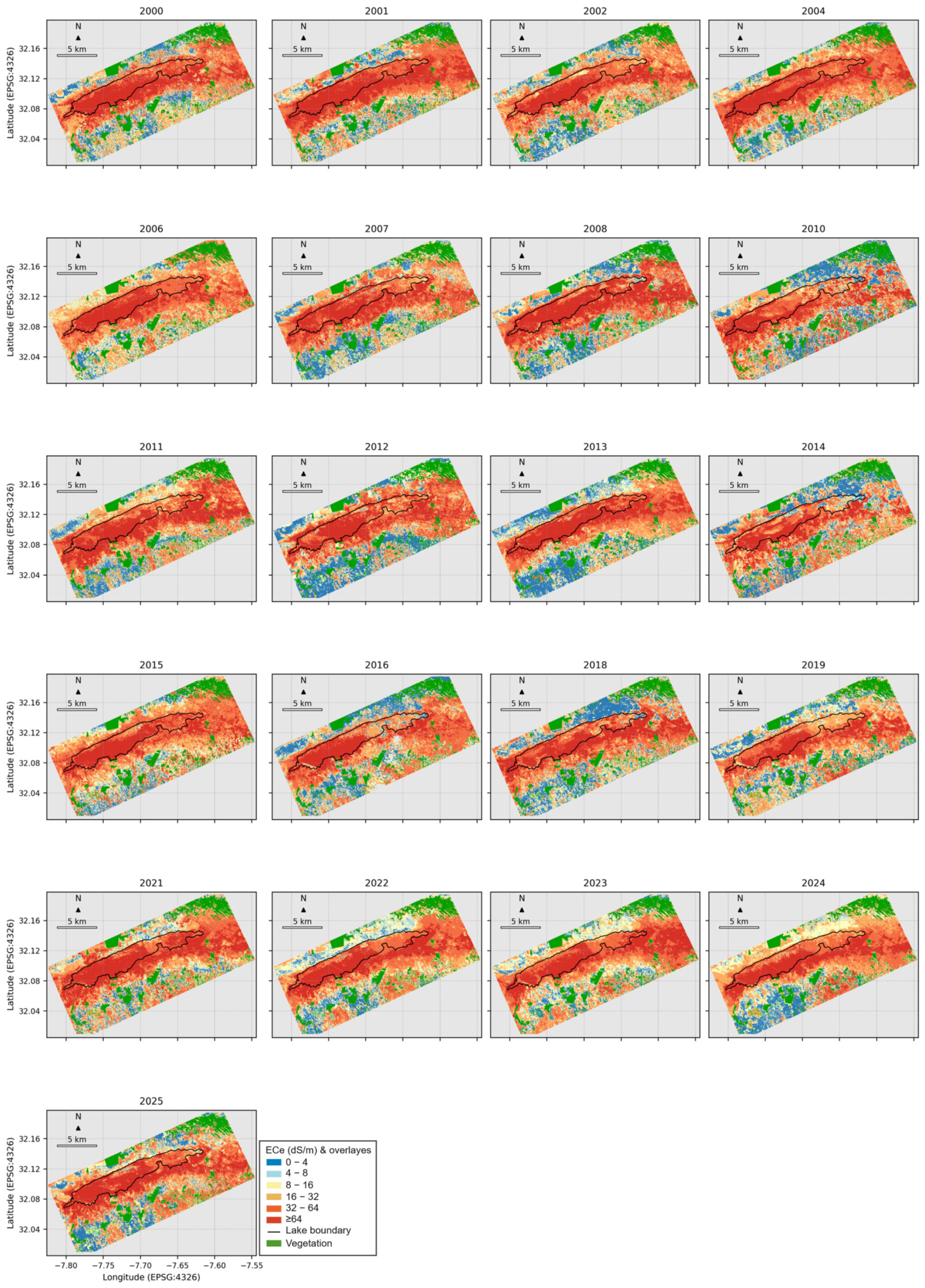
- A 25-year Remote Sensing–Machine Learning (RS–ML) analysis reveals long-term persistent hotspots (≥32 dS/m) and a general shift from low to moderate soil salinity.
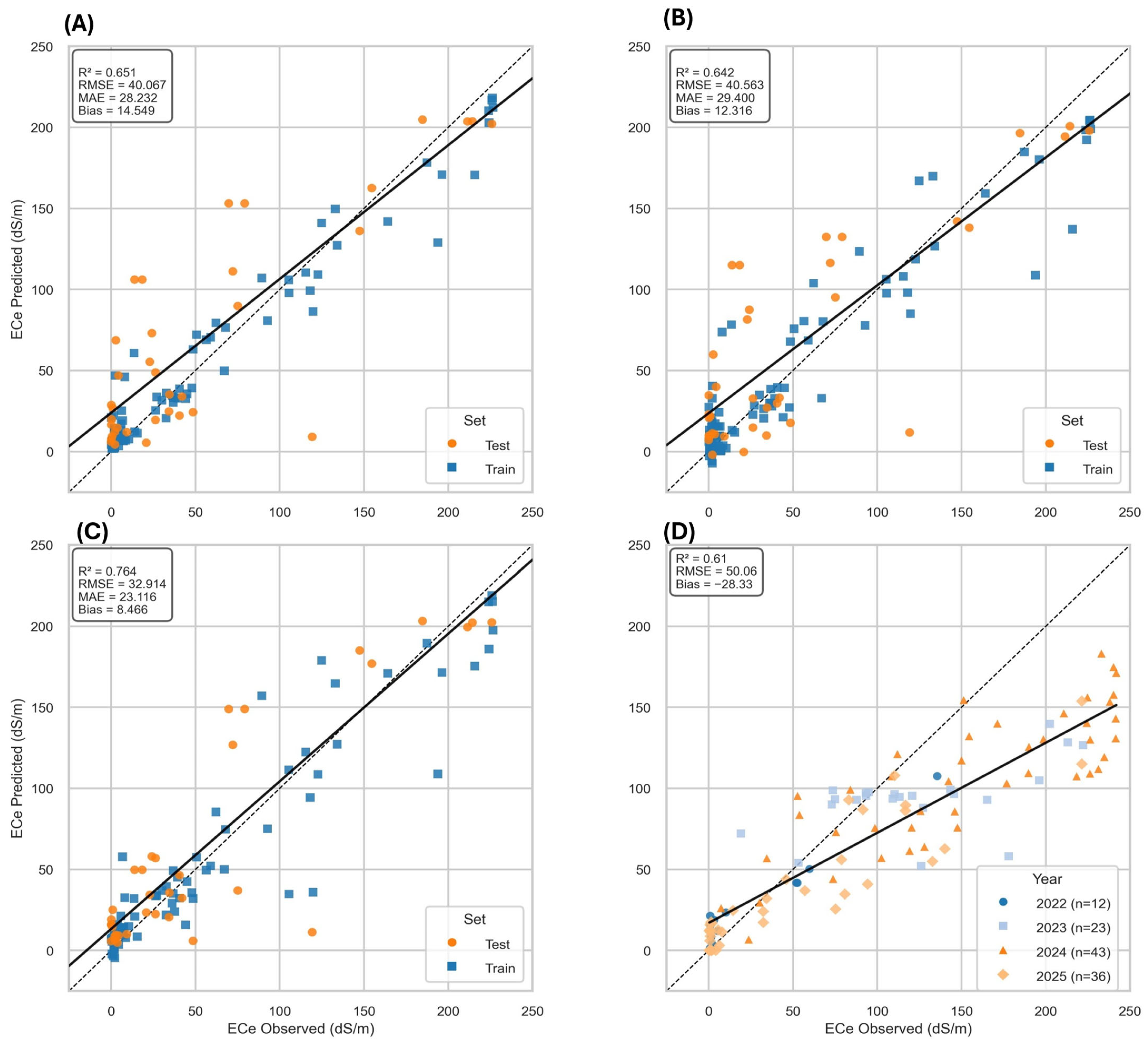
- SVR outperformed GBT and RF models, achieving the highest predictive accuracy and thus was selected for the spatiotemporal soil-salinity modeling. Given the inherent noise and complexity of archival RS datasets, performances remain within acceptable ranges, reflecting stable generalization.
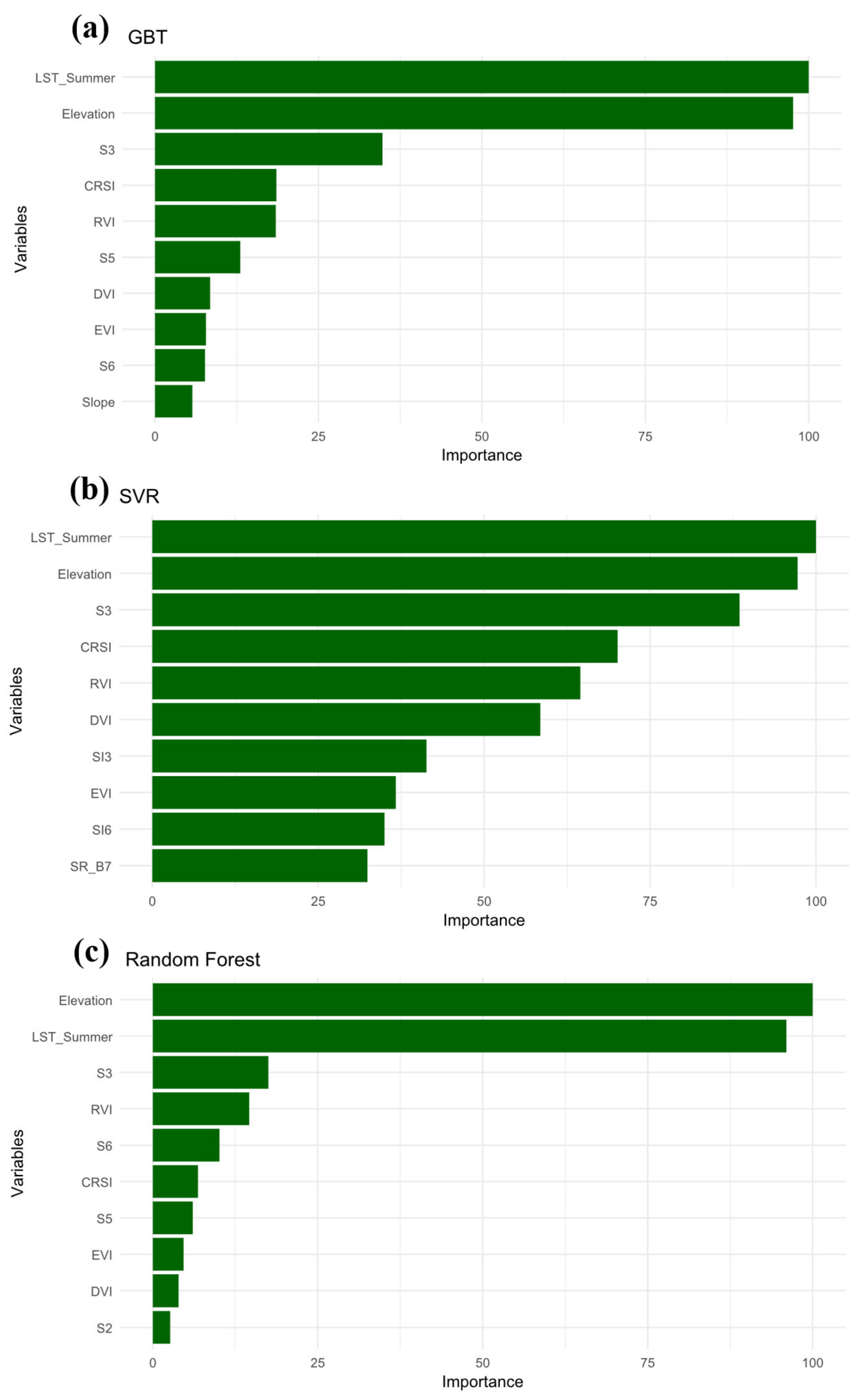
- Climatic and topographic factors significantly improved model performance and proved essential for understanding salinity dynamics controlled by episodic inundation, shallow saline groundwater, and hydro-climatic variability.
- Over time, moderately to highly saline areas (≥16 dS/m) expanded by approximately 10%, driven by recurrent droughts, intense evaporation, and inefficient drainage.
Abstract
1. Introduction
2. Materials and Methods
2.1. Study Area
2.2. Soil Sampling and Analysis
2.3. Remote Sensing Data and Image Processing
2.3.1. Multitemporal Landsat Datasets
2.3.2. Digital Elevation Model Data
2.4. Methods
2.4.1. Image Pre-Processing
2.4.2. Indices Calculation
2.4.3. Machine Learning Algorithms
2.4.4. Performance Evaluation
2.4.5. Spatial Uncertainty Quantification of SVR-Based Soil Salinity Predictions Using Standard Deviation (SD) Across Ensemble Iterations
2.4.6. Transition Estimation from Class Shares and Hydrologic Conditioning
2.4.7. Pixel-Wise Probabilistic Projection and Spatial Mapping
3. Results
3.1. Soil Salinity Predictors
3.2. Model Accuracy Validation and Interpretation
3.3. Feature Importance Analysis
3.4. Spatial and Temporal Variability (2000–2025)
3.5. Spatial Distribution of Predicted Soil Salinity Classes and Associated Uncertainty Derived from SVR-Derived Modeling
3.6. Temporal Assessment of Salinization as a Function of Drought
3.7. Spatial Probability of Salinization Risk
4. Discussion
4.1. Models Potentially and Contextualization
4.2. Evident Climate Impact on Salinity Dynamics in the Studied Semi-Arid Landscape
4.3. Further Validation of Used Model and Its Scalability Using Multi-Temporal Datasets
4.4. Implications for the Spatial and Temporal Salinization Dynamics Analysis
4.5. Challenges and Future Perspectives
5. Conclusions
Author Contributions
Funding
Data Availability Statement
Acknowledgments
Conflicts of Interest
References
- Allbed, A.; Kumar, L. Soil Salinity Mapping and Monitoring in Arid and Semi-Arid Regions Using Remote Sensing Technology: A Review. Adv. Remote Sens. 2013, 2, 373–385. [Google Scholar] [CrossRef]
- Ozdemir, E.; Kulak, M.; Sekertekin, A. Bibliometric Analysis of Monitoring and Mapping of Soil Salinity Using Remote Sensing Approaches: Reports from the Past Three Decades. Eurasian Soil Sci. 2025, 58, 141. [Google Scholar] [CrossRef]
- Zhang, Y.; Wu, H.; Kang, Y.; Fan, Y.; Wang, S.; Liu, Z.; He, F. Mapping the Soil Salinity Distribution and Analyzing Its Spatial and Temporal Changes in Bachu County, Xinjiang, Based on Google Earth Engine and Machine Learning. Agriculture 2024, 14, 630. [Google Scholar] [CrossRef]
- Hagage, M.; Abdulaziz, A.M.; Elbeih, S.F.; Hewaidy, A.G.A. Monitoring Soil Salinization and Waterlogging in the Northeastern Nile Delta Linked to Shallow Saline Groundwater and Irrigation Water Quality. Sci. Rep. 2024, 14, 27838. [Google Scholar] [CrossRef] [PubMed]
- El Hasini, S.; Halima, O.I.; Azzouzi, M.E.; Douaik, A.; Azim, K.; Zouahri, A. Organic and Inorganic Remediation of Soils Affected by Salinity in the Sebkha of Sed El Mesjoune—Marrakech (Morocco). Soil Tillage Res. 2019, 193, 153–160. [Google Scholar] [CrossRef]
- El-Azhari, A.; Ait Brahim, Y.; Barbecot, F.; Hssaisoune, M.; Berrouch, H.; Laamrani, A.; Hadri, A.; Brouziyne, Y.; Bouchaou, L. Evaluating Groundwater Salinity Patterns and Spatiotemporal Dynamics in Complex Endorheic Aquifer Systems. Sci. Total Environ. 2025, 994, 180055. [Google Scholar] [CrossRef]
- Houmma, I.H.; Hadri, A.; Boudhar, A.; El Khalki, E.M.; Karaoui, I.; Oussaoui, S.; Samih, M.; Kinnard, C. Development of a Hydrometeorological Drought Severity Composite Index Based on the Integration of Multisource Characteristics and an Explainable Artificial Intelligence Model. J. Hydrol. Reg. Stud. 2025, 61, 102623. [Google Scholar] [CrossRef]
- Oussaoui, S.; Boudhar, A.; Hadri, A.; Lebrini, Y.; Houmma, I.H.; Karaoui, I.; Khalki, E.M.E.; Ouzemou, J.; Kinnard, C. Mapping Drought Severity Impact on Arboriculture Systems over Tadla and Lower Tassaout Plains in Morocco Using Sentinel-2 Data and Machine Learning Approaches. Geocarto Int. 2025, 40, 2471104. [Google Scholar] [CrossRef]
- Somarathna, P.D.S.N.; Minasny, B.; Malone, B.P. More Data or a Better Model? Figuring Out What Matters Most for the Spatial Prediction of Soil Carbon. Soil Sci. Soc. Am. J. 2017, 81, 1413–1426. [Google Scholar] [CrossRef]
- Metternicht, G.I.; Zinck, J.A. Remote Sensing of Soil Salinity: Potentials and Constraints. Remote Sens. Environ. 2003, 85, 1–20. [Google Scholar] [CrossRef]
- Chen, H.; Wu, J.; Xu, C. Optimization of Multi-Source Remote Sensing Soil Salinity Estimation Based on Different Salinization Degrees. Remote Sens. 2025, 17, 1315. [Google Scholar] [CrossRef]
- Dehni, A.; Lounis, M. Remote Sensing Techniques for Salt Affected Soil Mapping: Application to the Oran Region of Algeria. Procedia Eng. 2012, 33, 188–198. [Google Scholar] [CrossRef]
- Gojiya, K.M.; Rank, H.D.; Chauhan, P.M.; Patel, D.V.; Satasiya, R.M.; Prajapati, G.V. Remote Sensing and GIS Applications in Soil Salinity Analysis: A Comprehensive Review. IJECC 2023, 13, 2149–2161. [Google Scholar] [CrossRef]
- El Harti, A.; Lhissou, R.; Chokmani, K.; Ouzemou, J.; Hassouna, M.; Bachaoui, E.M.; El Ghmari, A. Spatiotemporal Monitoring of Soil Salinization in Irrigated Tadla Plain (Morocco) Using Satellite Spectral Indices. Int. J. Appl. Earth Obs. Geoinf. 2016, 50, 64–73. [Google Scholar] [CrossRef]
- Aboelsoud, H.M.; AbdelRahman, M.A.E.; Kheir, A.M.S.; Eid, M.S.M.; Ammar, K.A.; Khalifa, T.H.; Scopa, A. Quantitative Estimation of Saline-Soil Amelioration Using Remote-Sensing Indices in Arid Land for Better Management. Land 2022, 11, 1041. [Google Scholar] [CrossRef]
- Habibi, V.; Ahmadi, H.; Jafari, M.; Moeini, A. Mapping Soil Salinity Using a Combined Spectral and Topographical Indices with Artificial Neural Network. PLoS ONE 2021, 16, e0228494. [Google Scholar] [CrossRef]
- Sahbeni, G.; Ngabire, M.; Musyimi, P.K.; Székely, B. Challenges and Opportunities in Remote Sensing for Soil Salinization Mapping and Monitoring: A Review. Remote Sens. 2023, 15, 2540. [Google Scholar] [CrossRef]
- Tashpolat, N.; Reheman, A. Monitoring of Soil Salinity in the Weiku Oasis Based on Feature Space Models with Typical Parameters Derived from Sentinel-2 MSI Images. Land 2025, 14, 251. [Google Scholar] [CrossRef]
- Wang, Z.; Zhang, F.; Zhang, X.; Chan, N.W.; Kung, H.; Zhou, X.; Wang, Y. Quantitative Evaluation of Spatial and Temporal Variation of Soil Salinization Risk Using GIS-Based Geostatistical Method. Remote Sens. 2020, 12, 2405. [Google Scholar] [CrossRef]
- Alexandre, C.; Borralho, T.; Durão, A. Evaluation of Salinization and Sodification in Irrigated Areas with Limited Soil Data: Case Study in Southern Portugal. Span. J. Soil Sci. 2018, 8, 2594. [Google Scholar] [CrossRef]
- Zhao, J.; Fan, Y.; Xuan, J.; Shi, M.; Wang, D.; Wu, H.; Bi, Y.; Li, Y. Monitoring of Soil Salinization and Analysis of Driving Factors in the Oasis Zone of South Xinjiang. Land 2025, 14, 803. [Google Scholar] [CrossRef]
- Zhang, M.; Fan, X.; Gao, P.; Guo, L.; Huang, X.; Gao, X.; Pang, J.; Tan, F. Monitoring Soil Salinity in Arid Areas of Northern Xinjiang Using Multi-Source Satellite Data: A Trusted Deep Learning Framework. Land 2025, 14, 110. [Google Scholar] [CrossRef]
- Bandak, S.; Movahedi-Naeini, S.A.; Mehri, S.; Lotfata, A. A Longitudinal Analysis of Soil Salinity Changes Using Remotely Sensed Imageries. Sci. Rep. 2024, 14, 10383. [Google Scholar] [CrossRef]
- Zhang, H.; Fu, X.; Zhang, Y.; Qi, Z.; Zhang, H.; Xu, Z. Mapping Multi-Depth Soil Salinity Using Remote Sensing-Enabled Machine Learning in the Yellow River Delta, China. Remote Sens. 2023, 15, 5640. [Google Scholar] [CrossRef]
- Gao, Z.; Peña-Arancibia, J.L.; Ahmad, M.-D.; Siyal, A.A. Three-Dimensional Soil Salinity Mapping with Uncertainty Using Bayesian Hierarchical Modelling, Random Forest Regression and Remote Sensing Data. Agric. Water Manag. 2025, 309, 109318. [Google Scholar] [CrossRef]
- Yang, Y.; Zhao, Y.; Yao, R.; Tong, X. Data-Driven Soil Salinization Mapping: Risk Prediction and Uncertainty Quantification Based on Bayesian Inference. Geoderma 2025, 459, 117344. [Google Scholar] [CrossRef]
- Smith, E.M.; Vargas, R.; Guevara, M.; Tarin, T.; Pouyat, R.V. Spatial Variability and Uncertainty of Soil Nitrogen Across the Conterminous United States at Different Depths. Ecosphere 2022, 13, e4170. [Google Scholar] [CrossRef]
- Alfio, M.R.; Balacco, G.; Parisi, A.; Totaro, V.; Fidelibus, M.D. Drought Index as Indicator of Salinization of the Salento Aquifer (Southern Italy). Water 2020, 12, 1927. [Google Scholar] [CrossRef]
- Afsharinia, M.; Panahi, F. Effect of climatic drought on surface soil salinity in Kashan Plain. Model. Manag. Soil Water 2021, 1, 36–46. [Google Scholar] [CrossRef]
- Chamberlain, S.D.; Hemes, K.S.; Eichelmann, E.; Szutu, D.J.; Verfaillie, J.G.; Baldocchi, D.D. Effect of Drought-Induced Salinization on Wetland Methane Emissions, Gross Ecosystem Productivity, and Their Interactions. Ecosystems 2020, 23, 675–688. [Google Scholar] [CrossRef]
- Ipek, A.F.; Altas, A.; Serencam, U.; Dabanli, I. Spatio-Temporal Drought Assessment by Using the Innovative Probability of Drought Severity (PDS) Method. Water Resour. Manag. 2025, 39, 5135–5150. [Google Scholar] [CrossRef]
- Ouzemou, J.-E.; Laamrani, A.; El Battay, A.; Whalen, J.K. Predicting Soil Salinity Based on Soil/Water Extracts in a Semi-Arid Region of Morocco. Soil Syst. 2025, 9, 3. [Google Scholar] [CrossRef]
- Chindong, J.M.; Ouzemou, J.-E.; Laamrani, A.; El Battay, A.; Hajaj, S.; Rhinane, H.; Chehbouni, A. A Multi-Sensor Machine Learning Framework for Field-Scale Soil Salinity Mapping Under Data-Scarce Conditions. Remote Sens. 2025, 17, 3778. [Google Scholar] [CrossRef]
- Outbakat, M.B.; El Gharous, M.; El Omari, K.; El Mejahed, K. Effect of Phosphogypsum on Faba Bean Yield and Heavy Metals Content Under Saline Conditions. In Proceedings of the 2nd International Laayoune Forum on Biosaline Agriculture, Laayoune, Morocco, 16 June 2022; p. 16. [Google Scholar]
- Allison, L.E.; Bernstein, L.; Bower, C.A.; Brown, J.W.; Fireman, M.; Hatcher, J.T.; Hayward, H.E.; Pearson, G.A.; Reeve, R.C.; Richards, A. United States Salinity Laboratory Staff. Available online: https://www.ars.usda.gov/ARSUserFiles/20360500/hb60_pdf/hb60complete.pdf (accessed on 5 January 2026).
- Liu, G.; Tian, C.; Mai, W.; Azeem, A.; Yang, J. Spatial and Temporal Variation in Soil Salinity and Correlation with Groundwater Depth in the Karamay Irrigation District of China. Sustainability 2023, 15, 15680. [Google Scholar] [CrossRef]
- Demelash, W.; Mekonen, A.; Amare, H. Spatiotemporal Variation of Irrigation Water Quality at Bochessa Watershed in Central Rift Valley of Ethiopia. Afr. J. Environ. Sci. Technol. 2020, 14, 70–82. [Google Scholar] [CrossRef][Green Version]
- Ma, Y.; Tashpolat, N. Remote Sensing Monitoring of Soil Salinity in Weigan River–Kuqa River Delta Oasis Based on Two-Dimensional Feature Space. Water 2023, 15, 1694. [Google Scholar] [CrossRef]
- Ni, G.; Guan, Y.; Zhang, X.; Yang, Y.; Li, Y.; Liu, X.; Rong, Z.; Ju, M. Selection of Landsat 8 OLI Levels, Monthly Phases, and Spectral Variables on Identifying Soil Salinity: A Study in the Yellow River Delta. Appl. Sci. 2025, 15, 2747. [Google Scholar] [CrossRef]
- Saad, K.; Kallel, A.; Castaldi, F.; Sahli Chahed, T. Soil Salinity Detection and Mapping by Multi-Temporal Landsat Data: Zaghouan Case Study (Tunisia). Remote Sens. 2024, 16, 4761. [Google Scholar] [CrossRef]
- Wang, N.; Chen, S.; Huang, J.; Frappart, F.; Taghizadeh, R.; Zhang, X.; Wigneron, J.-P.; Xue, J.; Xiao, Y.; Peng, J.; et al. Global Soil Salinity Estimation at 10 m Using Multi-Source Remote Sensing. J. Remote Sens. 2024, 4, 0130. [Google Scholar] [CrossRef]
- Sui, Y.; Jiang, R.; Liu, Y.; Zhang, X.; Lin, N.; Zheng, X.; Li, B.; Yu, H. Predicting the Spatial Distribution of Soil Salinity Based on Multi-Temporal Multispectral Images and Environmental Covariates. Comput. Electron. Agric. 2025, 231, 109970. [Google Scholar] [CrossRef]
- Rouse, J.W.; Haas, R.H.; Schell, J.A.; Deering, D.W. Monitoring Vegetation Systems in the Great Plains with Erts; NASA: Washington, DC, USA, 1974. [Google Scholar]
- Tucker, C.J. Red and Photographic Infrared linear Combinations for Monitoring Vegetation. Remote Sens. Environ. 1979, 8, 127–150. [Google Scholar] [CrossRef]
- Gao, B. NDWI—A Normalized Difference Water Index for Remote Sensing of Vegetation Liquid Water from Space. Remote Sens. Environ. 1996, 58, 257–266. [Google Scholar] [CrossRef]
- Daughtry, C. Estimating Corn Leaf Chlorophyll Concentration from Leaf and Canopy Reflectance. Remote Sens. Environ. 2000, 74, 229–239. [Google Scholar] [CrossRef]
- Huete, A.R. A Soil-Adjusted Vegetation Index (SAVI). Remote Sens. Environ. 1988, 25, 295–309. [Google Scholar] [CrossRef]
- Huete, A.; Didan, K.; Miura, T.; Rodriguez, E.P.; Gao, X.; Ferreira, L.G. Overview of the Radiometric and Biophysical Performance of the MODIS Vegetation Indices. Remote Sens. Environ. 2002, 83, 195–213. [Google Scholar] [CrossRef]
- Jordan, C.F. Derivation of Leaf-Area Index from Quality of Light on the Forest Floor. Ecology 1969, 50, 663–666. [Google Scholar] [CrossRef]
- Liang, S. Narrowband to Broadband Conversions of Land Surface Albedo I Algorithms. Remote Sens. Environ. 2001, 76, 213–238. [Google Scholar] [CrossRef]
- Kauth, R.J.; Thomas, G.S. The Tasselled Cap—A Graphic Description of the Spectral-Temporal Development of Agricultural Crops as Seen by LANDSAT. LARS Symp. 1976, 159. [Google Scholar]
- Gitelson, A.A.; Kaufman, Y.J.; Merzlyak, M.N. Use of a Green Channel in Remote Sensing of Global Vegetation from EOS-MODIS. Remote Sens. Environ. 1996, 58, 289–298. [Google Scholar] [CrossRef]
- Richardson, A.J.; Everitt, J.H. Using Spectral Vegetation Indices to Estimate Rangeland Productivity. Geocarto Int. 1992, 7, 63–69. [Google Scholar] [CrossRef]
- Huntjr, E.; Rock, B. Detection of Changes in Leaf Water Content Using Near- and Middle-Infrared Reflectances. Remote Sens. Environ. 1989, 30, 43–54. [Google Scholar] [CrossRef]
- Ceccato, P.; Flasse, S.; Tarantola, S.; Jacquemoud, S.; Grégoire, J.-M. Detecting Vegetation Leaf Water Content Using Reflectance in the Optical Domain. Remote Sens. Environ. 2001, 77, 22–33. [Google Scholar] [CrossRef]
- Zarco-Tejada, P.J.; Ustin, S.L.; Whiting, M.L. Temporal and Spatial Relationships Between Within-Field Yield Variability in Cotton and High-Spatial Hyperspectral Remote Sensing Imagery. Agron. J. 2005, 97, 641–653. [Google Scholar] [CrossRef]
- Breiman, L. Random Forests. Mach. Learn. 2001, 45, 532. [Google Scholar] [CrossRef]
- Archer, K.J.; Kimes, R.V. Empirical Characterization of Random Forest Variable Importance Measures. Comput. Stat. Data Anal. 2008, 52, 2249–2260. [Google Scholar] [CrossRef]
- Mirzaee, S.; Nafchi, A.M.; Ostovari, Y.; Seifi, M.; Ghorbani-Dashtaki, S.; Khodaverdiloo, H.; Chakherlou, S.; Taghizadeh-Mehrjardi, R.; Raei, B. Monitoring and Assessment of Spatiotemporal Soil Salinization in the Lake Urmia Region. Environ. Monit. Assess. 2024, 196, 958. [Google Scholar] [CrossRef]
- Friedman, J.H. Greedy Function Approximation: A Gradient Boosting Machine. Ann. Stat. 2001, 29, 1189–1232. [Google Scholar] [CrossRef]
- Vapnik, V. The Support Vector Method of Function Estimation. In Nonlinear Modeling; Suykens, J.A.K., Vandewalle, J., Eds.; Springer: Boston, MA, USA, 1998; pp. 55–85. ISBN 978-1-4613-7611-8. [Google Scholar]
- Chen, T.; Guestrin, C. XGBoost: A Scalable Tree Boosting System. In Proceedings of the 22nd ACM SIGKDD International Conference on Knowledge Discovery and Data Mining, San Francisco, CA, USA, 13 August 2016; pp. 785–794. [Google Scholar]
- Legates, D.R.; McCabe, G.J. Evaluating the Use of “Goodness-of-fit” Measures in Hydrologic and Hydroclimatic Model Validation. Water Resour. Res. 1999, 35, 233–241. [Google Scholar] [CrossRef]
- Willmott, C.; Matsuura, K. Advantages of the Mean Absolute Error (MAE) over the Root Mean Square Error (RMSE) in Assessing Average Model Performance. Clim. Res. 2005, 30, 79–82. [Google Scholar] [CrossRef]
- Chai, T.; Draxler, R.R. Root Mean Square Error (RMSE) or Mean Absolute Error (MAE)?—Arguments Against Avoiding RMSE in the Literature. Geosci. Model Dev. 2014, 7, 1247–1250. [Google Scholar] [CrossRef]
- Hyndman, R.J.; Koehler, A.B. Another Look at Measures of Forecast Accuracy. Int. J. Forecast. 2006, 22, 679–688. [Google Scholar] [CrossRef]
- Mello, D.C.D.; Veloso, G.V.; Mello, M.F.D.; Lana, M.G.D.; Oliveira, I.D.A.; Mello, F.A.D.O.; Siqueira, R.G.; Gomes, L.C.; Fernandes-Filho, E.I.; Schaefer, C.E.G.R.; et al. Integrating Proximal Geophysical Sensing and Machine Learning for Digital Soil Mapping: Spatial Prediction and Model Evaluation Using a Small Dataset. Soil Adv. 2025, 3, 100024. [Google Scholar] [CrossRef]
- Helfenstein, A.; Mulder, V.L.; Hack-ten Broeke, M.J.D.; Van Doorn, M.; Teuling, K.; Walvoort, D.J.J.; Heuvelink, G.B.M. BIS-4D: Mapping Soil Properties and Their Uncertainties at 25 m Resolution in the Netherlands. Earth Syst. Sci. Data 2024, 16, 2941–2970. [Google Scholar] [CrossRef]
- Sinkhorn, R. Diagonal Equivalence to Matrices with Prescribed Row and Column Sums II. Proc. Am. Math. Soc. 1974, 45, 195–198. [Google Scholar] [CrossRef]
- Franklin, J.; Lorenz, J. On the Scaling of Multidimensional Matrices. Linear Algebra Its Appl. 1989, 114–115, 717–735. [Google Scholar] [CrossRef]
- Osaragi, T.; Aoki, Y. A Method for Estimating Land Use Transition Probability Using Raster Data. In Innovations in Design & Decision Support Systems in Architecture and Urban Planning; Van Leeuwen, J.P., Timmermans, H.J.P., Eds.; Springer: Dordrecht, The Netherlands, 2006; pp. 69–84. ISBN 978-1-4020-5059-6. [Google Scholar]
- Abuelgasim, A.; Ammad, R. Mapping Soil Salinity in Arid and Semi-Arid Regions Using Landsat 8 OLI Satellite Data. Remote Sens. Appl. Soc. Environ. 2019, 13, 415–425. [Google Scholar] [CrossRef]
- Chen, H.; Wu, J.; Xu, C. Monitoring Soil Salinity Classes through Remote Sensing-Based Ensemble Learning Concept: Considering Scale Effects. Remote Sens. 2024, 16, 642. [Google Scholar] [CrossRef]
- Wu, Z.; Che, M.; Zhang, S.; Duo, L.; Lei, S.; Lu, Q.; Yan, Q. Remote Sensing Monitoring and Driving Force Analysis of Salinized Soil in Grassland Mining Area. Sustainability 2022, 14, 741. [Google Scholar] [CrossRef]
- Guo, B.; Lu, M.; Fan, Y.; Wu, H.; Yang, Y.; Wang, C. A Novel Remote Sensing Monitoring Index of Salinization Based on Three-Dimensional Feature Space Model and Its Application in the Yellow River Delta of China. Geomat. Nat. Hazards Risk 2023, 14, 95–116. [Google Scholar] [CrossRef]
- Bandak, S.; Naeini, S.A.R.M.; Komaki, C.B.; Verrelst, J.; Kakooei, M.; Mahmoodi, M.A. Satellite-Based Estimation of Soil Moisture Content in Croplands: A Case Study in Golestan Province, North of Iran. Remote Sens. 2023, 15, 2155. [Google Scholar] [CrossRef]
- Rengasamy, P. Soil Processes Affecting Crop Production in Salt-Affected Soils. Funct. Plant Biol. 2010, 37, 613–620. [Google Scholar] [CrossRef]
- Wang, D.; Zhao, C.; Zheng, J.; Zhu, J.; Gui, Z.; Yu, Z. Evolution of Soil Salinity and the Critical Ratio of Drainage to Irrigation (CRDI) in the Weigan Oasis in the Tarim Basin. CATENA 2021, 201, 105210. [Google Scholar] [CrossRef]
- Daliakopoulos, I.N.; Tsanis, I.K.; Koutroulis, A.; Kourgialas, N.N.; Varouchakis, A.E.; Karatzas, G.P.; Ritsema, C.J. The Threat of Soil Salinity: A European Scale Review. Sci. Total Environ. 2016, 573, 727–739. [Google Scholar] [CrossRef] [PubMed]
- Jorenush, M.H.; Sepaskhah, A.R. Modelling Capillary Rise and Soil Salinity for Shallow Saline Water Table under Irrigated and Non-Irrigated Conditions. Agric. Water Manag. 2003, 61, 125–141. [Google Scholar] [CrossRef]
- Narjary, B.; Kumar, S.; Meena, M.D.; Kamra, S.K.; Sharma, D.K. Effects of Shallow Saline Groundwater Table Depth and Evaporative Flux on Soil Salinity Dynamics Using Hydrus-1D. Agric. Res. 2021, 10, 105–115. [Google Scholar] [CrossRef]
- Gao, X.; Qu, Z.; Huo, Z.; Tang, P.; Qiao, S. Understanding the Role of Shallow Groundwater in Improving Field Water Productivity in Arid Areas. Water 2020, 12, 3519. [Google Scholar] [CrossRef]
- Sun, Y.; Wang, L.; Yang, S.; Qu, Z.; Zhang, D. Optimizing Irrigation and Drainage Practices to Control Soil Salinity in Arid Agroecosystems: A Scenario-Based Modeling Approach Using SaltMod. Agronomy 2025, 15, 2239. [Google Scholar] [CrossRef]
- Qadir, M.; Quillérou, E.; Nangia, V.; Murtaza, G.; Singh, M.; Thomas, R.J.; Drechsel, P.; Noble, A.D. Economics of Salt-induced Land Degradation and Restoration. Nat. Resour. Forum 2014, 38, 282–295. [Google Scholar] [CrossRef]
- Elair, C.; Rkha Chaham, K.; Hadri, A. Assessment of Drought Variability in the Marrakech-Safi Region (Morocco) at Different Time Scales Using GIS and Remote Sensing. Water Supply 2023, 23, 4592–4624. [Google Scholar] [CrossRef]
- Alshenawy, A.O.; Hamid, W.M.; Alnuaim, A.M. A Review on the Characteristics of Sabkha Soils in the Arabian Gulf Region. Arab. J. Geosci. 2021, 14, 2018. [Google Scholar] [CrossRef]
- Li, Z.; Meng, Q.; Li, L.; Bai, Z.; Li, Y.; Liu, H.; Li, P.; Wang, T. Integrated Deep Vertical Rotary Tillage and Subsurface Pipe Drainage Techniques for Sustainable Soil Salinization Management and Cotton Production in Arid Regions. Agric. Water Manag. 2025, 312, 109429. [Google Scholar] [CrossRef]
- Daba, A.W. Rehabilitation of Soil Salinity and Sodicity Using Diverse Amendments and Plants: A Critical Review. Discov. Environ. 2025, 3, 53. [Google Scholar] [CrossRef]








| Period | Satellite | Sensor | Spatial Resolution | Scene IDs |
|---|---|---|---|---|
| 2000 | Landsat 5 | TM | 30 m | LANDSAT/LT05/C02/T1_L2/LT05_202038_20000704 |
| 2001 | LANDSAT/LT05/C02/T1_L2/LT05_202038_20010723 | |||
| 2002 | LANDSAT/LT05/C02/T1_L2/LT05_202038_20020608 | |||
| 2003 | LANDSAT/LT05/C02/T1_L2/LT05_202038_20030713 | |||
| 2004 | LANDSAT/LT05/C02/T1_L2/LT05_202038_20040715 | |||
| 2005 | LANDSAT/LT05/C02/T1_L2/LT05_202038_20050718 | |||
| 2006 | LANDSAT/LT05/C02/T1_L2/LT05_202038_20060721 | |||
| 2007 | LANDSAT/LT05/C02/T1_L2/LT05_202038_20070708 | |||
| 2008 | LANDSAT/LT05/C02/T1_L2/LT05_202038_20080624 | |||
| 2009 | LANDSAT/LT05/C02/T1_L2/LT05_202038_20090713 | |||
| 2010 | LANDSAT/LT05/C02/T1_L2/LT05_202038_20100716 | |||
| 2011 | LANDSAT/LT05/C02/T1_L2/LT05_202038_20110804 | |||
| 2012 | Landsat 7 | ETM+ | 30 m | LANDSAT/LE07/C02/T1_L2/LE07_202038_20120611 |
| 2013 | Landsat 8 | OLI/TIRS | 30 m (with TIRS resampled to 30) | LANDSAT/LC08/C02/T1_L2/LC08_202038_20130724 |
| 2014 | LANDSAT/LC08/C02/T1_L2/LC08_202038_20140727 | |||
| 2015 | LANDSAT/LC08/C02/T1_L2/LC08_202038_20150714 | |||
| 2016 | LANDSAT/LC08/C02/T1_L2/LC08_202038_20160716 | |||
| 2017 | LANDSAT/LC08/C02/T1_L2/LC08_202038_20170703 | |||
| 2018 | LANDSAT/LC08/C02/T1_L2/LC08_202038_20180722 | |||
| 2019 | LANDSAT/LC08/C02/T1_L2/LC08_202038_20190709 | |||
| 2020 | LANDSAT/LC08/C02/T1_L2/LC08_202038_20200711 | |||
| 2021 | LANDSAT/LC08/C02/T1_L2/LC08_202038_20210714 | |||
| 2022 | LANDSAT/LC08/C02/T1_L2/LC08_202038_20220701 | |||
| 2023 | LANDSAT/LC08/C02/T1_L2/LC08_202038_20230720 | |||
| 2024 | LANDSAT/LC08/C02/T1_L2/LC08_202038_20240706 | |||
| 2025 | LANDSAT/LC08/C02/T1_L2/LC08_202038_20250725 |
| Index | Full Name | Formula | Reference |
|---|---|---|---|
| NDVI | Normalized Difference Vegetation Index | (NIR − Red)/(NIR + Red) | [43] |
| DVI | Difference Vegetation Index | NIR − Red | [44] |
| ERVI | Enhanced Ratio Vegetation Index | (NIR + SWIR2)/2 | [45] |
| ENDVI | Enhanced Normalized Difference Vegetation Index | (NIR + Green – 2 × Blue)/(NIR + Green + 2 × Blue) | [34] |
| CRSI | Chlorophyll Ratio Stress Index | sqrt((NIR × Red – Green × Blue)/(NIR × Red + Green × Blue)) | [46] |
| MSAVI | Modified Soil Adjusted Vegetation Index | (2 × NIR + 1 − sqrt((2 × NIR + 1)2− 8 × (NIR − Red)))/2 | [3] |
| SAVI | Soil Adjusted Vegetation Index | 1.5 × (NIR − Red)/(NIR + Red + 0.5) | [47] |
| EVI | Enhanced Vegetation Index | 2.5 × (NIR − Red)/(NIR + 6 × Red − 7.5 × Blue + 1) | [48] |
| RVI | Ratio Vegetation Index (Simple Ratio) | NIR/Red | [49] |
| NDSI | Normalized Difference Soil Index | (Red − NIR)/(Red + NIR) | [3] |
| SI-T | Soil Index (Temperature-like) | (Red/NIR) × 100 | [3] |
| Albedo | Surface Broadband Albedo | 0.356 × Blue + 0.13 × Red + 0.373 × NIR + 0.085 × SWIR1 + 0.072 × SWIR2 − 0.0018 | [50] |
| Albedo_MSAVI | Albedo and MSAVI Composite | sqrt((1 − Albedo)2 + MSAVI2) | [3] |
| SDI | Salinity Detection Index | sqrt(SI2 + (NDVI − 1)2) | [3] |
| BI | Brightness Index | sqrt(Red2+ NIR2) | [51] |
| SI1 | Spectral Index 1 | sqrt(Blue × Red) | [3] |
| SI2 | Spectral Index 2 | (Blue × Red)/Green | |
| SI3 | Spectral Index 3 | sqrt(Green2 + Red2) | |
| SI4 | Spectral Index 4 | Blue/Red | |
| SI5 | Spectral Index 5 | sqrt(Green × Red) | |
| SI6 | Spectral Index 6 | sqrt(Green2 + Red2 + NIR2) | |
| SI7 | Soil/Water Moisture Index | (SWIR1 − NIR)/(SWIR1 − SWIR2) | |
| SI8 | SWIR Difference Index | SWIR1 − SWIR2 | |
| SI9 | SWIR Combination Index | (SWIR1*SWIR2 − SWIR22)/SWIR1 | |
| S1 | Spectral Ratio 1 | Red/Green | [52] |
| S2 | Spectral Ratio 2 | Red/Blue | [53] |
| S3 | Spectral Ratio 3 | NIR/Green | [44] |
| S4 | Spectral Ratio 4 | SWIR1/Green | [45] |
| S5 | Spectral Ratio 5 | SWIR1/Red | [54] |
| S6 | Spectral Ratio 6 | SWIR1/NIR | [55] |
| S7 | Spectral Ratio 7 | SWIR1/Blue | [56] |
| Model | Train | Test | ||||||
|---|---|---|---|---|---|---|---|---|
| R2 | RMSE (dS/m) | MAE (dS/m) | BIAS | R2 | RMSE (dS/m) | MAE (dS/m) | BIAS | |
| GBT | 0.89 | 22.66 | 14.93 | 0.43 | 0.65 | 40.07 | 28.23 | 14.55 |
| RF | 0.95 | 15.95 | 10.78 | 0.74 | 0.64 | 40.56 | 29.40 | 12.32 |
| SVR | 0.90 | 22.27 | 13.93 | −0.58 | 0.76 | 32.91 | 23.12 | 8.47 |
Disclaimer/Publisher’s Note: The statements, opinions and data contained in all publications are solely those of the individual author(s) and contributor(s) and not of MDPI and/or the editor(s). MDPI and/or the editor(s) disclaim responsibility for any injury to people or property resulting from any ideas, methods, instructions or products referred to in the content. |
© 2026 by the authors. Licensee MDPI, Basel, Switzerland. This article is an open access article distributed under the terms and conditions of the Creative Commons Attribution (CC BY) license.
Share and Cite
Achemrk, A.; Ouzemou, J.-E.; Laamrani, A.; El Battay, A.; Hajaj, S.; Oussaoui, S.; Chehbouni, A. Tracking Quarter-Century Spatio-Temporal Soil Salinization Dynamics in Semi-Arid Landscapes Using Earth Observation and Machine Learning. Remote Sens. 2026, 18, 687. https://doi.org/10.3390/rs18050687
Achemrk A, Ouzemou J-E, Laamrani A, El Battay A, Hajaj S, Oussaoui S, Chehbouni A. Tracking Quarter-Century Spatio-Temporal Soil Salinization Dynamics in Semi-Arid Landscapes Using Earth Observation and Machine Learning. Remote Sensing. 2026; 18(5):687. https://doi.org/10.3390/rs18050687
Chicago/Turabian StyleAchemrk, Aiman, Jamal-Eddine Ouzemou, Ahmed Laamrani, Ali El Battay, Soufiane Hajaj, Sabir Oussaoui, and Abdelghani Chehbouni. 2026. "Tracking Quarter-Century Spatio-Temporal Soil Salinization Dynamics in Semi-Arid Landscapes Using Earth Observation and Machine Learning" Remote Sensing 18, no. 5: 687. https://doi.org/10.3390/rs18050687
APA StyleAchemrk, A., Ouzemou, J.-E., Laamrani, A., El Battay, A., Hajaj, S., Oussaoui, S., & Chehbouni, A. (2026). Tracking Quarter-Century Spatio-Temporal Soil Salinization Dynamics in Semi-Arid Landscapes Using Earth Observation and Machine Learning. Remote Sensing, 18(5), 687. https://doi.org/10.3390/rs18050687