Soil Salinity Assessment and Cross-Regional Validation Based on Multiple Feature Optimization Methods and SHAP

Highlights
- Feature number impacts soil salinity evaluation accuracy.
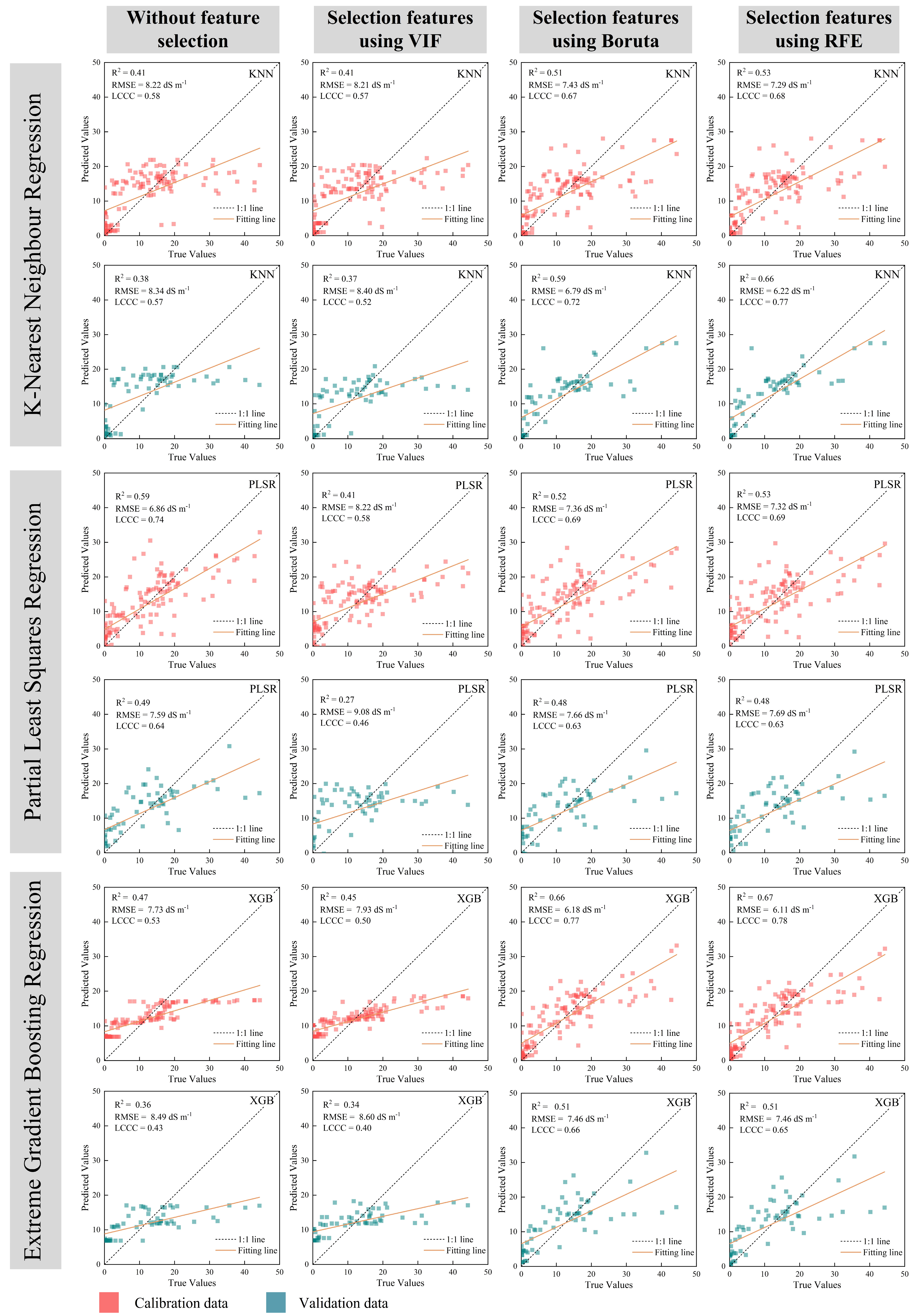
- Feature selection enhances salinity evaluation accuracy at a regional scale.
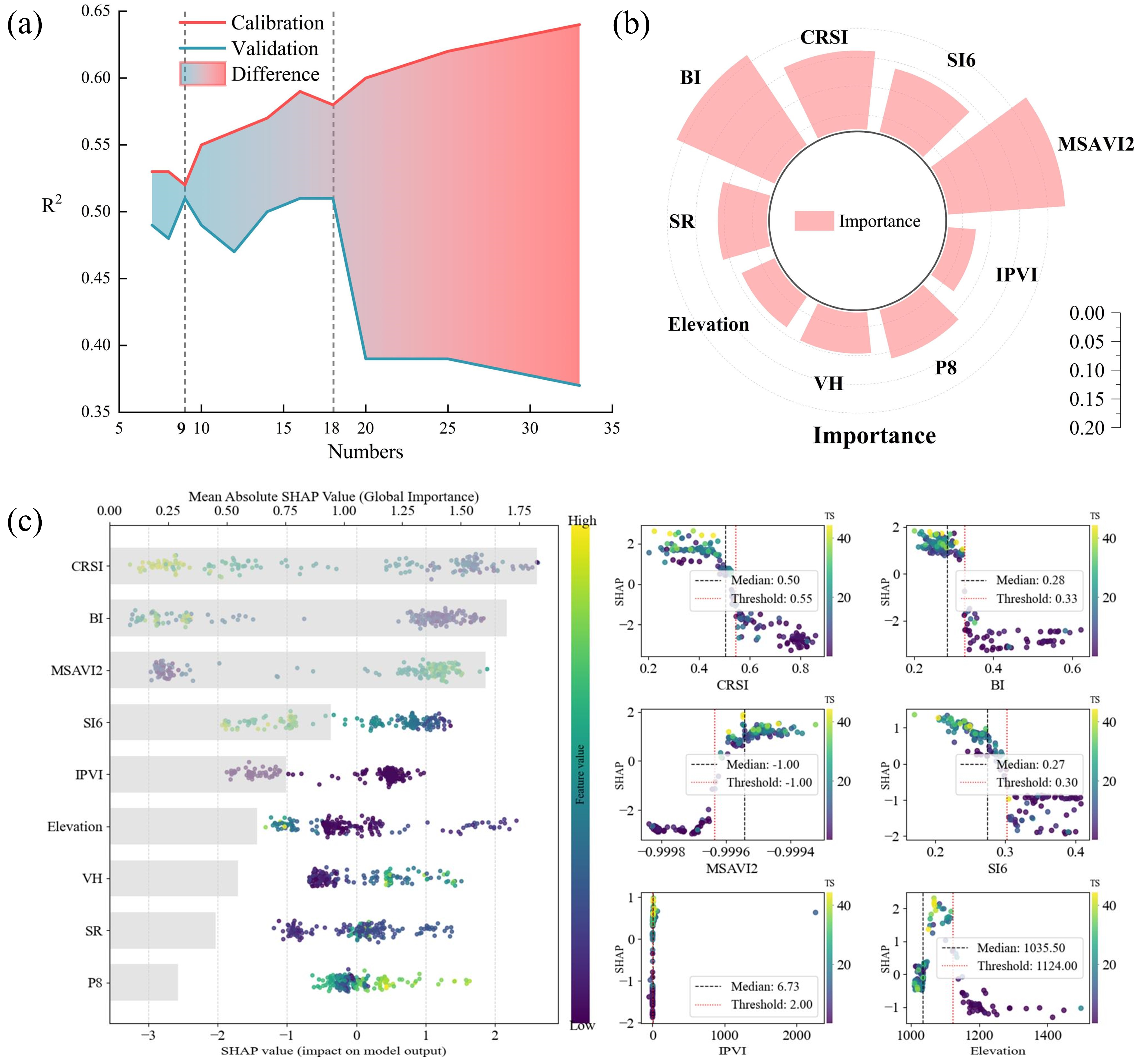
- SHAP analysis identifies CRSI, BI, and MSAVI2 as the most influential predictors for soil salinity in the study area.
- A set of salinity data for southern Xinjiang is presented for the first time.
- This study confirms that optimization improves the accuracy and transferability of multi-source remote sensing-based soil salinity inversion models.
- SHAP values explain feature selection and identify key features for regional salinity estimation.
- Integrating multi-source remote sensing data, feature selection, SHAP and RF models enables high-precision and rapid online salinity mapping, facilitating subsequent applications.
Abstract
1. Introduction
2. Materials and Methods
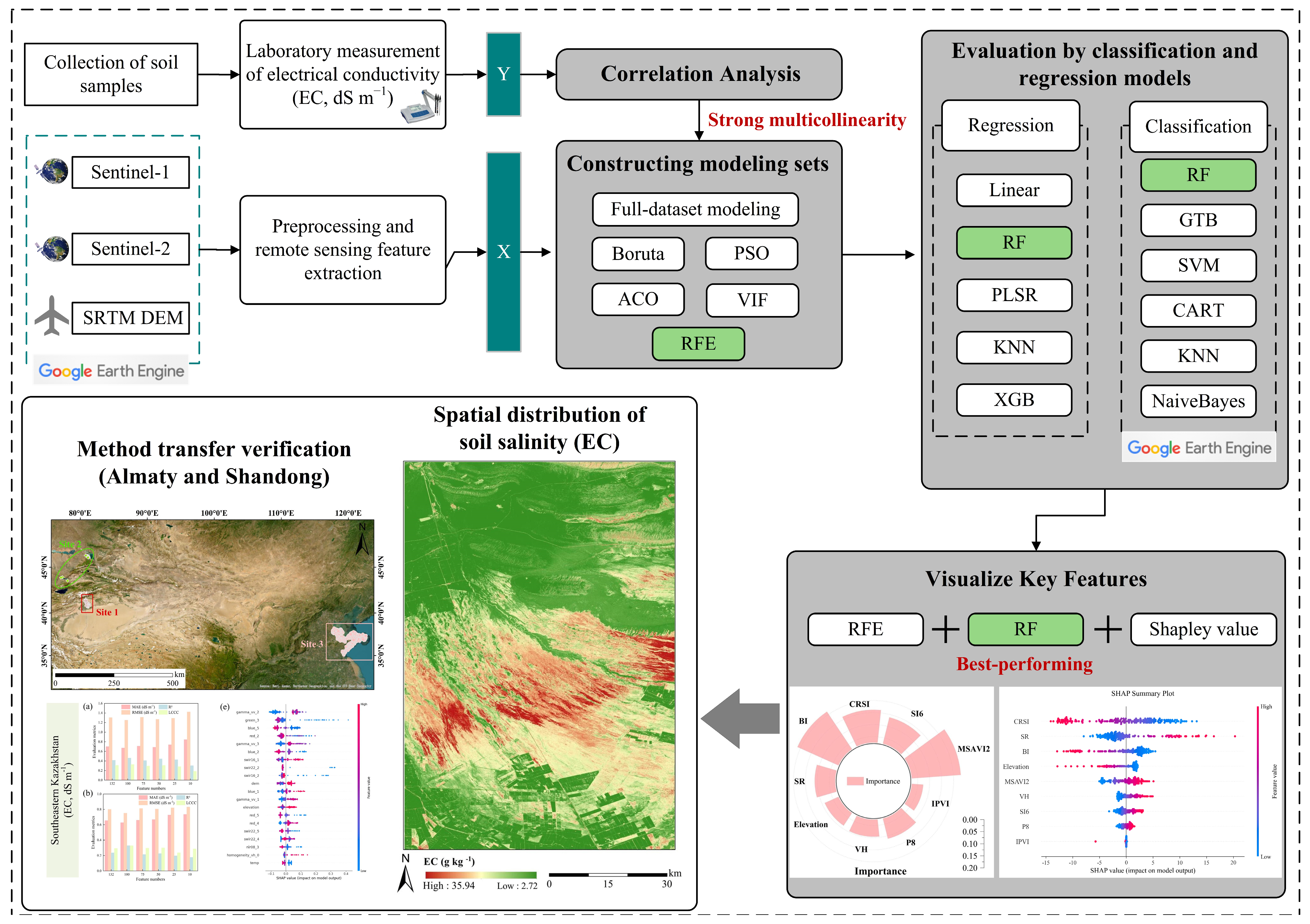
- (1)
- Preprocess and extract features from RS imagery on GEE platform.
- (2)
- Conduct correlation analysis and construct modeling sets using different approaches, including (i) all features, (ii) features selected through covariance analysis, and (iii) features selected by feature selection algorithms.
- (3)
- Apply various regression models to observe the validation sets’ accuracy for determining the optimal approach.
- (4)
- Observe the impact of feature numbers on model accuracy using RFE and identify key features with SHAP values.
- (5)
- Validate the stability of the results using multiple models and regional datasets.
- (6)
- Perform soil salinity mapping using the optimal feature set on the GEE platform.
2.1. Data Preprocessing
2.1.1. Soil Samples and Preprocessing
2.1.2. Image Processing and Feature Extraction
2.2. Feature Optimization Methods
2.2.1. Based on VIF Method
2.2.2. Boruta
2.2.3. RFE
2.2.4. PSO
2.2.5. ACO
2.3. Model and Model Assessments
2.3.1. Regression
2.3.2. Classification
2.3.3. Accuracy Assessment
2.4. Shapley Additive Explanation
3. Results
3.1. Descriptive Statistics of Soil Samples
3.2. Correlation Analysis and Feature Selection
3.3. Effect of Feature Selection on Model Accuracy
3.4. Qualitative and Quantitative Assessment of Soil Salinity
3.5. Validation of Methodology
4. Discussion
4.1. The Significance of Multi-Source Integration and Feature Optimization
4.2. Limitations of the Study and Future Directions
5. Conclusions
- (1)
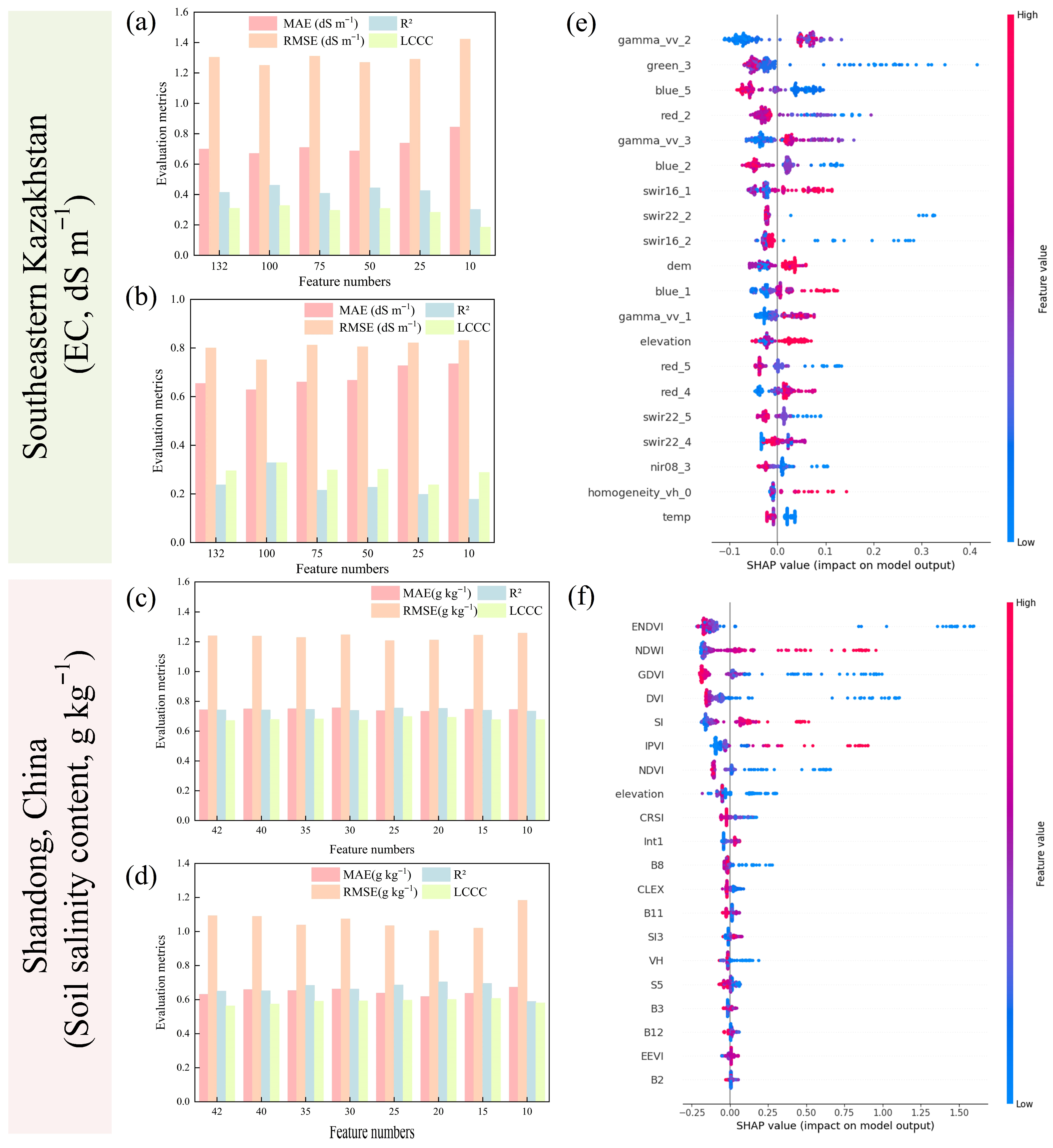
- Feature selection is critical for improving regional-scale soil salinity inversion: recursive feature elimination (RFE) significantly enhances model accuracy, while the variance inflation factor (VIF) approach, despite mitigating multicollinearity, reduces accuracy notably. Cross-site validation between Almaty (Kazakhstan) and Shandong (China) confirms the framework’s robustness and cross-regional transferability.
- (2)
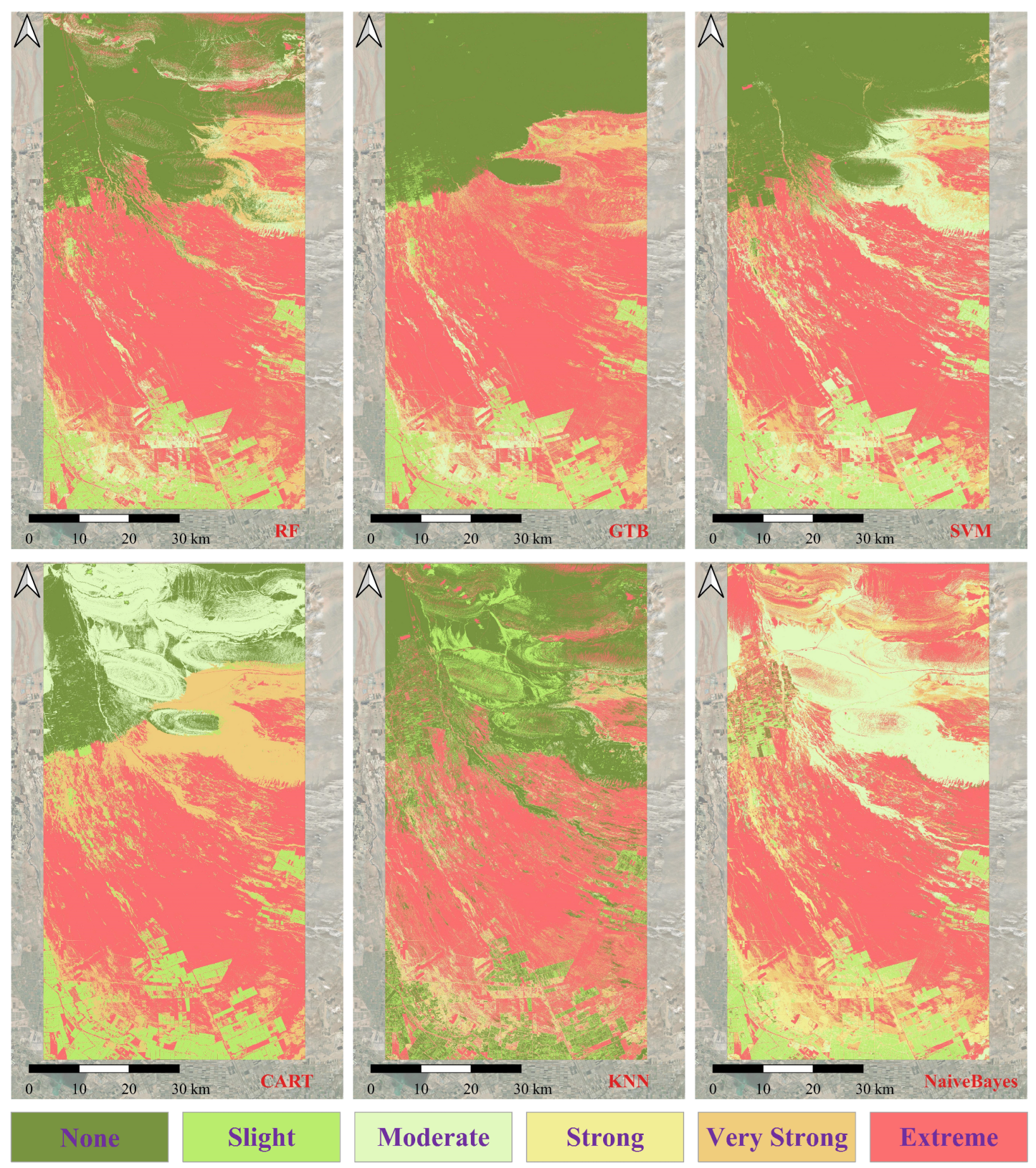
- Random forest (RF) outperforms other algorithms in salinity mapping, providing reliable accuracy and high-resolution spatial details. RFE- and SHAP-based analysis identifies CRSI, BI, MSAVI2, and elevation as core predictors, revealing the associations between salinization mechanisms, human cultivation improvement, and topography.
Author Contributions
Funding
Data Availability Statement
Acknowledgments
Conflicts of Interest
References
- Hassani, A.; Azapagic, A.; Shokri, N. Global Predictions of Primary Soil Salinization under Changing Climate in the 21st Century. Nat. Commun. 2021, 12, 6663. [Google Scholar] [CrossRef]
- Harper, R.J.; Dell, B.; Ruprecht, J.K.; Sochacki, S.J.; Smettem, K.R.J. Salinity and the Reclamation of Salinized Lands. In Soils and Landscape Restoration; Academic Press: Cambridge, MA, USA, 2021; pp. 193–208. [Google Scholar] [CrossRef]
- Wuyun, D.; Bao, J.; Crusiol, L.G.T.; Wulan, T.; Sun, L.; Wu, S.; Xin, Q.; Sun, Z.; Chen, R.; Peng, J.; et al. Generating Salt-Affected Irrigated Cropland Map in an Arid and Semi-Arid Region Using Multi-Sensor Remote Sensing Data. Remote Sens. 2022, 14, 6010. [Google Scholar] [CrossRef]
- Peng, J.; Ji, W.; Ma, Z.; Li, S.; Chen, S.; Zhou, L.; Shi, Z. Predicting Total Dissolved Salts and Soluble Ion Concentrations in Agricultural Soils Using Portable Visible Near-Infrared and Mid-Infrared Spectrometers. Biosyst. Eng. 2016, 152, 94–103. [Google Scholar] [CrossRef]
- Garcia, C.; Hernandez, T. Influence of Salinity on the Biological and Biochemical Activity of a Calciorthird Soil. Plant Soil 1996, 178, 255–263. [Google Scholar] [CrossRef]
- Rhoades, J.; Kandish, A.; Mashali, A. The Use of Saline Waters for Crop Production; FAO: Roma, Italy, 1992. [Google Scholar]
- Keesstra, S.D.; Geissen, V.; Mosse, K.; Piiranen, S.; Scudiero, E.; Leistra, M.; van Schaik, L. Soil as a Filter for Groundwater Quality. Curr. Opin. Environ. Sustain. 2012, 4, 507–516. [Google Scholar] [CrossRef]
- Decock, C.; Lee, J.; Necpalova, M.; Pereira, E.I.P.; Tendall, D.M.; Six, J. Mitigating N2O Emissions from Soil: From Patching Leaks to Transformative Action. Soil 2015, 1, 687–694. [Google Scholar] [CrossRef]
- Allbed, A.; Kumar, L. Soil Salinity Mapping and Monitoring in Arid and Semi-Arid Regions Using Remote Sensing Technology: A Review. Adv. Remote Sens. 2013, 2, 373–385. [Google Scholar] [CrossRef]
- Aquastat FAO. FAO’s Global Information System on Water and Agriculture; FAO, Food and Agriculture Organization of the United Nations: Roma, Italy, 2011. [Google Scholar]
- Ghassemi, F.; Jakeman, A.; Nix, H. Salinisation of Land and Water Resources: Human Causes, Extent, Management and Case Studies; CAB International: Wallingford, UK, 1995. [Google Scholar]
- FAO. Global Status of Salt-Affected Soils—Main Report; FAO: Roma, Italy, 2024. [Google Scholar] [CrossRef]
- Shao, H.; Chu, L.; Lu, H.; Qi, W.; Chen, X.; Liu, J.; Kuang, S.; Tang, B.; Wong, V. Towards Sustainable Agriculture for the Salt-Affected Soil. Land Degrad. Dev. 2019, 30, 574–579. [Google Scholar] [CrossRef]
- Wang, J.; Ding, J.; Yu, D.; Teng, D.; He, B.; Chen, X.; Ge, X.; Zhang, Z.; Wang, Y.; Yang, X.; et al. Machine Learning-Based Detection of Soil Salinity in an Arid Desert Region, Northwest China: A Comparison between Landsat-8 OLI and Sentinel-2 MSI. Sci. Total Environ. 2020, 707, 136092. [Google Scholar] [CrossRef]
- Jiang, X.; Ma, Y.; Li, G.; Huang, W.; Zhao, H.; Cao, G.; Wang, A. Spatial Distribution Characteristics of Soil Salt Ions in Tumushuke City, Xinjiang. Sustainability 2022, 14, 16486. [Google Scholar] [CrossRef]
- Wang, F.; Yang, S.; Wei, Y.; Shi, Q.; Ding, J. Characterizing Soil Salinity at Multiple Depth Using Electromagnetic Induction and Remote Sensing Data with Random Forests: A Case Study in Tarim River Basin of Southern Xinjiang, China. Sci. Total Environ. 2021, 754, 142030. [Google Scholar] [CrossRef]
- Bai, J.; Wang, N.; Hu, B.; Feng, C.; Wang, Y.; Peng, J.; Shi, Z. Integrating Multisource Information to Delineate Oasis Farmland Salinity Management Zones in Southern Xinjiang, China. Agric. Water Manag. 2023, 289, 108559. [Google Scholar] [CrossRef]
- Sahbeni, G.; Ngabire, M.; Musyimi, P.K.; Székely, B. Challenges and Opportunities in Remote Sensing for Soil Salinization Mapping and Monitoring: A Review. Remote Sens. 2023, 15, 2540. [Google Scholar] [CrossRef]
- Mukhamediev, R.I.; Merembayev, T.; Kuchin, Y.; Malakhov, D.; Zaitseva, E.; Levashenko, V.; Popova, Y.; Symagulov, A.; Sagatdinova, G.; Amirgaliyev, Y. Soil Salinity Estimation for South Kazakhstan Based on SAR Sentinel-1 and Landsat-8,9 OLI Data with Machine Learning Models. Remote Sens. 2023, 15, 4269. [Google Scholar] [CrossRef]
- Allbed, A.; Kumar, L.; Sinha, P. Mapping and Modelling Spatial Variation in Soil Salinity in the Al Hassa Oasis Based on Remote Sensing Indicators and Regression Techniques. Remote Sens. 2014, 6, 1137–1157. [Google Scholar] [CrossRef]
- Hoa, P.V.; Giang, N.V.; Binh, N.A.; Hai, L.V.H.; Pham, T.D.; Hasanlou, M.; Bui, D.T. Soil Salinity Mapping Using SAR Sentinel-1 Data and Advanced Machine Learning Algorithms: A Case Study at Ben Tre Province of the Mekong River Delta. Remote Sens. 2019, 11, 128. [Google Scholar] [CrossRef]
- Tan, W.; Wang, X.; Yan, L.; Yi, J.; Xia, T.; Zeng, Z.; Yu, G.; Chai, M.; Velpuri, N.M.; Thaneerat, A. Mapping Rice-Crayfish Co-Culture (RCC) Fields with Sentinel-1 and -2 Time Series in China’s Primary Crayfish Production Region Jianghan Plain. Sci. Remote Sens. 2024, 10, 100151. [Google Scholar] [CrossRef]
- Avdan, U.; Kaplan, G.; Küçük Matcı, D.; Yiğit Avdan, Z.; Erdem, F.; Tuğba Mızık, E.; Demirtaş, İ. Soil Salinity Prediction Models Constructed by Different Remote Sensors. Phys. Chem. Earth Parts A/B/C 2022, 128, 103230. [Google Scholar] [CrossRef]
- Orynbaikyzy, A.; Plank, S.; Vetrita, Y.; Martinis, S.; Santoso, I.; Dwi Ismanto, R.; Chusnayah, F.; Tjahjaningsih, A.; Suwarsono; Genzano, N.; et al. Joint Use of Sentinel-2 and Sentinel-1 Data for Rapid Mapping of Volcanic Eruption Deposits in Southeast Asia. Int. J. Appl. Earth Obs. Geoinf. 2023, 116, 103166. [Google Scholar] [CrossRef]
- Ma, G.; Ding, J.; Han, L.; Zhang, Z.; Ran, S. Digital Mapping of Soil Salinization Based on Sentinel-1 and Sentinel-2 Data Combined with Machine Learning Algorithms. Reg. Sustain. 2021, 2, 177–188. [Google Scholar] [CrossRef]
- Li, J.; Zhang, T.; Shao, Y.; Ju, Z. Comparing Machine Learning Algorithms for Soil Salinity Mapping Using Topographic Factors and Sentinel-1/2 Data: A Case Study in the Yellow River Delta of China. Remote Sens. 2023, 15, 2332. [Google Scholar] [CrossRef]
- He, Y.; Zhang, Z.; Xiang, R.; Ding, B.; Du, R.; Yin, H.; Chen, Y.; Ba, Y. Monitoring Salinity in Bare Soil Based on Sentinel-1/2 Image Fusion and Machine Learning. Infrared Phys. Technol. 2023, 131, 104656. [Google Scholar] [CrossRef]
- Taghadosi, M.M.; Hasanlou, M.; Eftekhari, K. Soil Salinity Mapping Using Dual-Polarized SAR Sentinel-1 Imagery. Int. J. Remote Sens. 2019, 40, 237–252. [Google Scholar] [CrossRef]
- Pratama, B.A.S.; Danoedoro, P.; Arjasakusuma, S. Exploring Optimal Integration Schemes for Sentinel-1 SAR and Sentinel-2 Multispectral Data in Land Cover Mapping across Different Atmospheric Conditions. Remote Sens. Appl. Soc. Environ. 2024, 34, 101185. [Google Scholar] [CrossRef]
- Das, K.; Twarakavi, N.; Khiripet, N.; Chattanrassamee, P.; Kijkullert, C. A Machine Learning Framework for Mapping Soil Nutrients with Multi-Source Data Fusion. In Proceedings of the 2021 IEEE International Geoscience and Remote Sensing Symposium IGARSS 2021, Brussels, Belgium, 11–16 July 2021; pp. 3705–3708. [Google Scholar] [CrossRef]
- Zhang, X.; Xue, J.; Chen, S.; Zhuo, Z.; Wang, Z.; Chen, X.; Xiao, Y.; Shi, Z. Improving Model Performance in Mapping Cropland Soil Organic Matter Using Time-Series Remote Sensing Data. J. Integr. Agric. 2024, 23, 2820–2841. [Google Scholar] [CrossRef]
- Yuzugullu, O.; Fajraoui, N.; Liebisch, F. Soil Texture and PH Mapping Using Remote Sensing and Support Sampling. IEEE J. Sel. Top. Appl. Earth Obs. Remote Sens. 2024, 17, 12685–12705. [Google Scholar] [CrossRef]
- Maynard, J.J.; Levi, M.R. Hyper-Temporal Remote Sensing for Digital Soil Mapping: Characterizing Soil-egetation Response to Climatic Variability. Geoderma 2017, 285, 94–109. [Google Scholar] [CrossRef]
- Pelletier, N.; Millard, K.; Darling, S. Wildfire Likelihood in Canadian Treed Peatlands Based on Remote-Sensing Time-Series of Surface Conditions. Remote Sens. Environ. 2023, 296, 113747. [Google Scholar] [CrossRef]
- Guo, B.; Yang, X.; Yang, M.; Sun, D.; Zhu, W.; Zhu, D.; Wang, J. Mapping Soil Salinity Using a Combination of Vegetation Index Time Series and Single-Temporal Remote Sensing Images in the Yellow River Delta, China. CATENA 2023, 231, 107313. [Google Scholar] [CrossRef]
- Yuzugullu, O.; Fajraoui, N.; Don, A.; Liebisch, F. Satellite-Based Soil Organic Carbon Mapping on European Soils Using Available Datasets and Support Sampling. Sci. Remote Sens. 2024, 9, 100118. [Google Scholar] [CrossRef]
- Wang, N.; Chen, S.; Huang, J.; Frappart, F.; Taghizadeh, R.; Zhang, X.; Wigneron, J.P.; Xue, J.; Xiao, Y.; Peng, J.; et al. Global Soil Salinity Estimation at 10 m Using Multi-Source Remote Sensing. J. Remote Sens. 2024, 4, 0130. [Google Scholar] [CrossRef]
- Jia, P.; He, W.; Hu, Y.; Liang, Y.; Liang, Y.; Xue, L.; Zamanian, K.; Zhao, X. Inversion of Coastal Cultivated Soil Salt Content Based on Multi-Source Spectra and Environmental Variables. Soil Tillage Res. 2024, 241, 106124. [Google Scholar] [CrossRef]
- Bouasria, A.; Bouslihim, Y.; Gupta, S.; Taghizadeh-Mehrjardi, R.; Hengl, T. Predictive Performance of Machine Learning Model with Varying Sampling Designs, Sample Sizes, and Spatial Extents. Ecol. Inform. 2023, 78, 102294. [Google Scholar] [CrossRef]
- Khaire, U.M.; Dhanalakshmi, R. Stability of Feature Selection Algorithm: A Review. J. King Saud Univ.—Comput. Inf. Sci. 2022, 34, 1060–1073. [Google Scholar] [CrossRef]
- Zhang, Z.; He, Y.; Yin, H.; Xiang, R.; Chen, J.; Du, R. Synergistic Estimation of Soil Salinity Based on Sentinel-1/2 Improved Polarization Combination Index and Texture Features. Trans. Chin. Soc. Agric. Mach. 2023, 55, 175–185. [Google Scholar] [CrossRef]
- Aihaiti, A.; Nurmemet, I.; Yu, X.; Aili, Y.; Li, S.; Lv, X.; Qin, Y. An Enhanced Soil Salinity Estimation Method for Arid Regions Using Multisource Remote Sensing Data and Advanced Feature Selection. CATENA 2025, 256, 109116. [Google Scholar] [CrossRef]
- Wang, J.; Zhen, J.; Hu, W.; Chen, S.; Lizaga, I.; Zeraatpisheh, M.; Yang, X. Remote Sensing of Soil Degradation: Progress and Perspective. Int. Soil Water Conserv. Res. 2023, 11, 429–454. [Google Scholar] [CrossRef]
- Shi, S.; Wang, N.; Chen, S.; Hu, B.; Peng, J.; Shi, Z. Digital Mapping of Soil Salinity with Time-Windows Features Optimization and Ensemble Learning Model. Ecol. Inform. 2025, 85, 102982. [Google Scholar] [CrossRef]
- Wang, J.; Feng, C.; Hu, B.; Chen, S.; Hong, Y.; Arrouays, D.; Peng, J.; Shi, Z. A Novel Framework for Improving Soil Organic Matter Prediction Accuracy in Cropland by Integrating Soil, Vegetation and Human Activity Information. Sci. Total Environ. 2023, 903, 166112. [Google Scholar] [CrossRef]
- Chi, Y.; Fan, M.; Zhang, Z.; Qu, Y. Zoning the Soil Salinization Levels in the Northern China’s Coastal Areas Based on High-Resolution Soil Mapping. Ecol. Indic. 2025, 172, 113303. [Google Scholar] [CrossRef]
- Kennedy, J.; Eberhart, R. Particle Swarm Optimization. In Proceedings of the ICNN’95—International Conference on Neural Networks, Perth, WA, Australia, 27 November–1 December 1995; Volume 4, pp. 1942–1948. [Google Scholar] [CrossRef]
- Han, Y.; Shi, P. An Improved Ant Colony Algorithm for Fuzzy Clustering in Image Segmentation. Neurocomputing 2007, 70, 665–671. [Google Scholar] [CrossRef]
- Omuto, C.T.; Vargas, R.R.; El Mobarak, A.M.; Mohamed, N.; Viatkin, K.; Yigini, Y. Mapping of Salt-Affected Soils—Technical Manual; FAO: Roma, Italy, 2020. [Google Scholar] [CrossRef]
- Zhang, Y.; Liu, T.; Shamseldin, A.Y.; Tong, X.; Duan, L.; Jia, T.; Lun, S.; Zhang, S. A Synergistic UAV-Landsat Novel Strategy for Enhanced Estimation of above-Ground Biomass and Shrub Dominance in Sandy Land. Ecol. Inform. 2025, 90, 103282. [Google Scholar] [CrossRef]
- Wang, S.; Li, Y.; Li, T.; Lu, W.; Qi, X.; Xie, X.; Sa, R.; Guo, T.; Pulatov, A.; Javlonbek, I.; et al. Regional Maize Suitability Based on Soil Water and Salt Content Inversion by Integrating Machine and Transfer Learnings in Xinjiang. Soil Tillage Res. 2025, 254, 106740. [Google Scholar] [CrossRef]
- Romeo Jiménez, V.M.; Notario del Pino, J.S.; Fernández-Guisuraga, J.M.; Mejías Vera, M.Á. Prediction of Some Soil Properties in Volcanic Soils Using Random Forest Modeling: A Case Study at Chinyero Special Nature Reserve (Tenerife, Canary Islands). Ecol. Inform. 2025, 86, 103054. [Google Scholar] [CrossRef]
- Chi, M.; Plaza, A.; Benediktsson, J.A.; Sun, Z.; Shen, J.; Zhu, Y. Big Data for Remote Sensing: Challenges and Opportunities. Proc. IEEE 2016, 104, 2207–2219. [Google Scholar] [CrossRef]
- Zhang, X.; Shu, C.; Wu, Y.; Ye, P.; Du, D. Advances of Coupled Water-Heat-Salt Theory and Test Techniques for Soils in Cold and Arid Regions: A Review. Geoderma 2023, 432, 116378. [Google Scholar] [CrossRef]



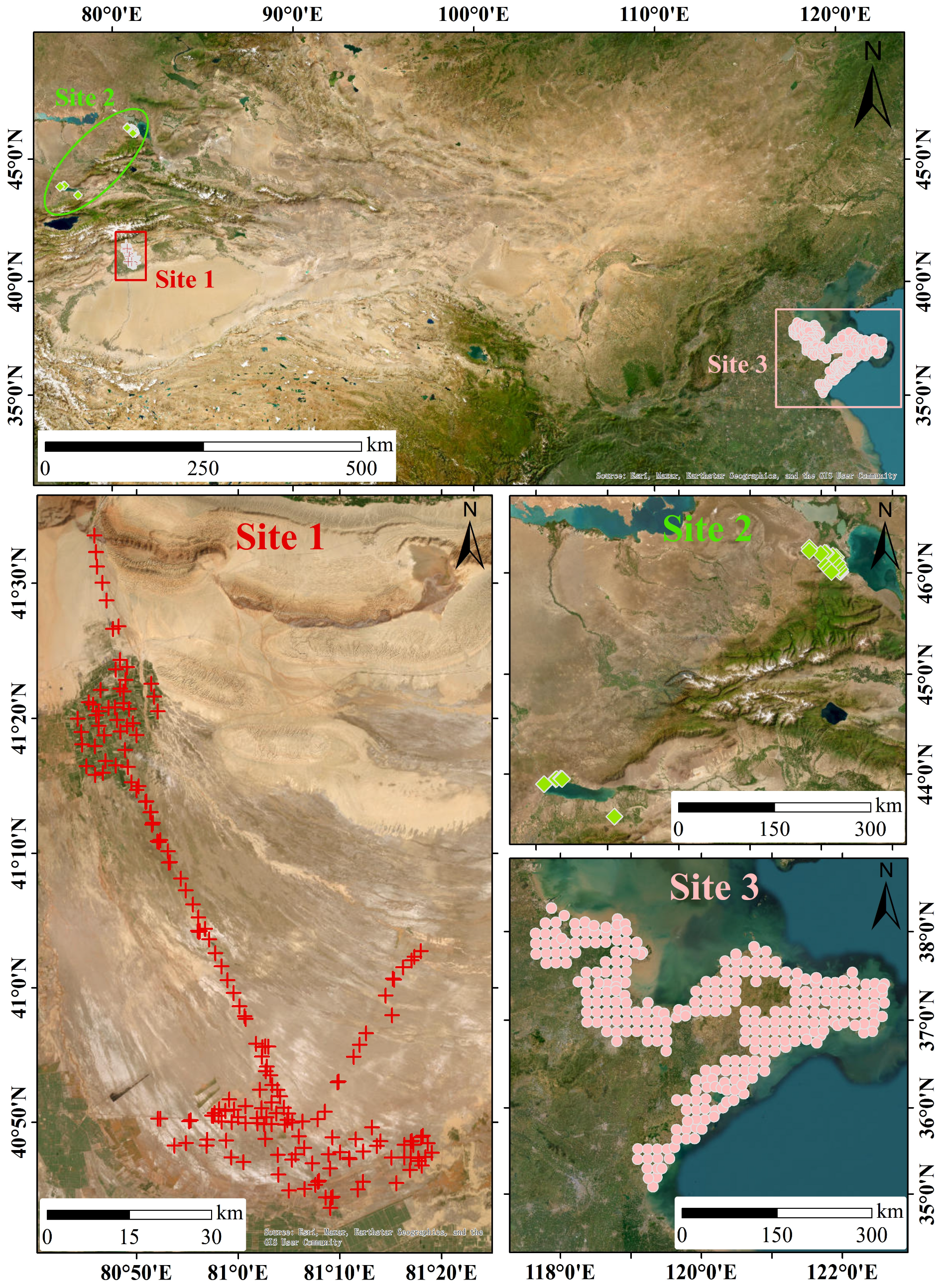
| Site | Location | Date | Number | Sampling Depth |
|---|---|---|---|---|
| Site 1 | Xinjiang, China | 14 August 2021–17 August 2021 | 186 | 0–20 cm |
| Site 2 | Almaty, Kazakhstan | 23 May 2022–18 July 2022 | 207 | 0–20 cm |
| Site 3 | Shandong, China | 2018–2020 | 457 | 0–20 cm |
| Categories | Acronym | Formula |
|---|---|---|
| SAR features | VV | VV |
| VH | VH | |
| P1 | VV + VH | |
| P2 | VV2 + VH | |
| P3 | VV2 + VH2 | |
| P4 | VH2 − VV | |
| P5 | (VH2 + VV2)/VH | |
| P6 | 10 log(VV) | |
| P7 | 10 log(VH) | |
| P8 | 10 log(VV) + 10 log(VH) | |
| Multispectral features | NDVI | (B8 − B4)/(B8 + B4) |
| GNDVI | (B7 − B3)/(B7 + B3) | |
| WDVI | B8 − 0.5 × B4 | |
| TNDVI | (0.5 + (B8 − B4/B8 + B4))0.5 | |
| SAVI | ((B8 − B4)/(B8 + B4 + 0.5)) × 1.5 | |
| IPVI | B8/(B8 + B4) | |
| MCARI | B5 − B4 − 0.2 × (B5 − B3) × B5/B4 | |
| REIP | (700 + 40((B4 + B7) × 0.5 − B5))/(B6 − B5) | |
| MSAVI2 | 0.5 × (2 × B8 + 1 − ((2 × B8 + 1)2 − 8 × (B8 − B4))0.5) | |
| DVI | B8 − B4 | |
| NSI | (B11 − B12)/(B11 − B8) | |
| VSSI | 2 × B3 − 5 × (B4 + B8) | |
| NDSI | (B4 − B8)/(B4 + B8) | |
| SR | (B3 − B4)/(B2 + B4) | |
| CRSI | (B8 × B4 − B3 × B2)/(B8 × B4 + B3 × B2) | |
| BI | (B42 + B82)0.5 | |
| SI1 | (B3 × B4)0.5 | |
| SI2 | (B4 × B2)0.5 | |
| SI3 | (B32 + B42)0.5 | |
| SI4 | (B8 × B11 − B112)/B8 | |
| SI5 | B2/B4 | |
| SI6 | B4 × B8/B3 | |
| Topographic features | DEM | SRTM DEM |
| Models | Parameters |
|---|---|
| LR | fit_intercept = True, copy_X = True, n_jobs = 1 |
| XGB | n_estimators = 200 (100–200), max_depth = 4 (1–4), learning_rate = 0.03 (0.001–0.03), reg_alpha = 1, reg_lambda = 10 |
| PLSR | n_components = 3 (3–9) |
| KNN | Regression: n_neighbors = 10 (3–10), Classification = Default |
| RF | Regression: n_estimators = 20, max_depth = 2, min_samples_leaf = 1, min_samples_split = 2; Classification: numberOfTrees = 50, minLeafPopulation = 2 |
| GTB | NumberOfTrees = 20 |
| CART | MaxNodes = 1000, minLeafPopulation = 2 |
| Naive Bayes | Default |
| SVM | Default |
| Intensity | Levels | Numbers |
|---|---|---|
| None | <0.75 | 32 |
| Slight | 0.75–2 | 16 |
| Moderate | 2–4 | 16 |
| Strong | 4–8 | 14 |
| Very Strong | 8–15 | 38 |
| Extreme | >15 | 70 |
| Regions | Methods | Calibration | Validation | ||||
|---|---|---|---|---|---|---|---|
| R2 | RMSE | LCCC | R2 | RMSE | LCCC | ||
| Site 2 | Full data | 0.414 | 1.303 dS m−1 | 0.309 | 0.237 | 0.800 dS m−1 | 0.295 |
| RFE | 0.461 | 1.250 dS m−1 | 0.327 | 0.328 | 0.751 dS m−1 | 0.328 | |
| VIF | 0.388 | 1.331 dS m−1 | 0.244 | 0.148 | 0.846 dS m−1 | 0.273 | |
| Site 3 | Full data | 0.742 | 1.240 g kg−1 | 0.671 | 0.650 | 1.093 g kg−1 | 0.563 |
| RFE | 0.753 | 1.212 g kg−1 | 0.693 | 0.704 | 1.005 g kg−1 | 0.601 | |
| VIF | 0.654 | 1.436 g kg−1 | 0.526 | 0.507 | 1.297 g kg−1 | 0.407 | |
Disclaimer/Publisher’s Note: The statements, opinions and data contained in all publications are solely those of the individual author(s) and contributor(s) and not of MDPI and/or the editor(s). MDPI and/or the editor(s) disclaim responsibility for any injury to people or property resulting from any ideas, methods, instructions or products referred to in the content. |
© 2026 by the authors. Licensee MDPI, Basel, Switzerland. This article is an open access article distributed under the terms and conditions of the Creative Commons Attribution (CC BY) license.
Share and Cite
Shi, S.; Wang, Y.; Wang, J.; Yang, J.; Bai, Z.; Peng, J. Soil Salinity Assessment and Cross-Regional Validation Based on Multiple Feature Optimization Methods and SHAP. Remote Sens. 2026, 18, 955. https://doi.org/10.3390/rs18060955
Shi S, Wang Y, Wang J, Yang J, Bai Z, Peng J. Soil Salinity Assessment and Cross-Regional Validation Based on Multiple Feature Optimization Methods and SHAP. Remote Sensing. 2026; 18(6):955. https://doi.org/10.3390/rs18060955
Chicago/Turabian StyleShi, Shuaishuai, Yu Wang, Jiawen Wang, Jibang Yang, Zijin Bai, and Jie Peng. 2026. "Soil Salinity Assessment and Cross-Regional Validation Based on Multiple Feature Optimization Methods and SHAP" Remote Sensing 18, no. 6: 955. https://doi.org/10.3390/rs18060955
APA StyleShi, S., Wang, Y., Wang, J., Yang, J., Bai, Z., & Peng, J. (2026). Soil Salinity Assessment and Cross-Regional Validation Based on Multiple Feature Optimization Methods and SHAP. Remote Sensing, 18(6), 955. https://doi.org/10.3390/rs18060955