Article

Calculation of Excavation Volume in Open-Pit Mines Under Complex Conditions Based on Multi-Source Stereo Remote Sensing

1
School of Engineering and Technology, China University of Geosciences (Beijing), Beijing 100083, China
2
Institute of Geomechanics, Chinese Academy of Geological Sciences, Beijing 100081, China
3
CCTEG Ecological Environment Technology Co., Ltd., Beijing 100013, China
4
Zhenxiong County Energy Bureau, Zhaotong 657200, China
*
Author to whom correspondence should be addressed.
Remote Sens. 2026, 18(4), 654; https://doi.org/10.3390/rs18040654
Submission received: 30 November 2025 / Revised: 29 January 2026 / Accepted: 17 February 2026 / Published: 20 February 2026
(This article belongs to the Special Issue Application of Advanced Remote Sensing Techniques in Mining Areas)

Highlights

What are the main findings?
  • A high-precision time-series DSM dataset was constructed using multi-source stereo remote sensing to analyze terrain evolution in an open-pit coal mine and identify the characteristics of different mining patterns.
  • CM can capture the dynamic excavation and backfilling process; FLSM can mitigate cumulative digital surface model errors during continuous mining operations; whereas when phased mining characteristics are present, a combined calculation leveraging the strengths of both methods can yield optimal computational results.
What are the implications of the main findings?
  • This study demonstrates that seasonal errors in DSM derived from satellite stereophotogrammetry compromise the accuracy of excavation volume calculations. Consequently, identifying and filtering out seasonally affected data constitutes a critical prerequisite for ensuring valid monitoring and computational results.
  • The proposed CM and FLSM enhance the estimation accuracy of excavation volume in complex mining environments. This establishes a robust technical pathway for reconstructing historical coal excavation volumes, which holds significant implications for mine management and environmental oversight.

Abstract

The accurate calculation of excavation volume is critical for open-pit mine planning and management. Traditional methods are often inefficient and constrained by operational conditions. In contrast, digital surface model (DSM) differential analysis using stereophotogrammetry enables rapid acquisition of excavation volume, which holds significant value for retrospective excavation process. However, the actual mining process is not a simple matter of “excavation” or “backfilling”, but rather a complex mining pattern involving repeated excavation as new coal seams are exposed. This study utilized multi-source stereo remote sensing data (ZY-3, GF-7 satellite and UAV data) to construct a high-precision DSM time series spanning 2013 to 2025, focusing on analyzing the topographical evolution patterns of three representative mining pits. Research indicates that constructing DSMs during summer and autumn yields higher conformity with actual terrain, RMSE = 1.67 m and ME = −0.07 m. To address diverse mining patterns, we propose two calculation methods: the Cumulative Method (CM), which captures iterative excavation-backfilling cycles, and the First-Last Subtraction Method (FLSM), which mitigates cumulative DSM errors during continuous excavation. For phased mining operations, a hybrid method combining both approaches yields optimal results. Validation in three typical pits showed relative calculation errors of 1.36%, −0.49%, and 1.68%, respectively. The study indicates that the surface morphology changes in open-pit mines exhibit distinct non-linear characteristics. The method proposed herein not only enhances computational accuracy but also provides technical support for tracing historical coal excavation volumes.

1. Introduction

Since the mid-20th century, open-pit mining has become the dominant extraction method worldwide, owing to its low cost, high efficiency and superior resource-recovery rates [1,2]. As the scale of open-pit operations has expanded, the rapid and accurate acquisition of mine-site data has emerged as a mission-critical component of mining engineering. Precise volumetric estimates of both extracted ore and associated waste not only furnish a scientific basis for mineral exploration but also enable dynamic refinement of extraction plans and provide a defensible benchmark for financial settlement [3,4].
In the coal mining industry, the Overburden Volume refers to the volume of the material (including topsoil, rock, etc.) that must be removed during surface mining operations. The Stripping Ratio is defined as the ratio of the volume of waste rock and soil to be excavated to the amount of coal produced [5,6]. A direct correlation exists between these two parameters: a higher Stripping Ratio indicates that a greater volume of overburden must be moved to mine each unit of coal. Total excavation volume is expressed as the overall volume of all substances extracted from the pit within a given period, which includes coal, topsoil, rock, and other impurities [7]. In the engineering acceptance and output verification of open-cast coal mines, it is necessary to accurately measure the volume of natural surface topography changes caused by mining activities. This volume is collectively referred to in this study as the total material mined (in this study, this concept is synonymous with ‘excavation volume’) [8]. This excavation volume serves as the direct basis for project settlement and cost-benefit assessment [9].
Early calculations of excavation volumes were typically achieved by measuring elevations using surveying instruments such as levelling instruments and total stations, followed by manually or computer-aided drafting of topographic contour lines on maps [10]. This method is known as the contour line approach. It proved time-consuming, labor-intensive, and difficult to update data. Furthermore, the requirement for contour lines to close in calculations posed challenges due to the irregular shapes of open-pit mines, making it difficult to obtain accurate elevation values. Subsequent research introduced the cross-section method and grid method, both based on the principle of multiplying unit area by elevation difference. However, the results from both approaches rely excessively on the resolution of specified intervals, making them more suitable for mines with regular shapes [11]. With advances in surveying technology, the DSM-differential method has progressively become the mainstream approach. This involves performing differential calculations on the three-dimensional coordinates of the surveyed terrain and the temporal variations in its elevation values through a series of time-series DSMs. Kim, Y.H. et al. [12] employed UAV technology to conduct earthwork volume calculations at construction sites, finding that the excavation volume calculation method based on DSM-differential analysis demonstrated greater practical advantages. The DSM-differential method, leveraging modern surveying techniques, surpasses traditional calculation methods in both precision and efficiency.
With the widespread application of Light Detection and Ranging (LiDAR) [13] and the Global Navigation Satellite System (GNSS) [14], these technologies began to be used for DSM construction. Although they achieve high accuracy in horizontal positioning, their vertical accuracy is typically lower. In an era of accelerating open-pit mining development, satellite stereophotogrammetry, characterized by its wide coverage, high accuracy, strong timeliness, and low dependency on ground control points [15], provides more robust support for the calculation of the excavation volume. Studies by Tang [16] and Dong [17] collectively demonstrate that, when constructing DSMs using ZY-3 satellite imagery, both the stereo mapping approach without ground control points and the orthorectification method incorporating a limited number of well-distributed control points yield DSM and DOM products that meet the accuracy standards for 1:50,000 scale mapping. Furthermore, UAV-based stereo mapping technology not only offers greater flexibility in capturing detailed terrain and feature characteristics but also enables the acquisition of high-resolution data in complex environments [18,19,20,21]. Xiang et al. [22] utilized multi-temporal high-resolution imagery captured by UAVs to generate DSMs through UAV photogrammetry. By integrating elevation differential analysis, they achieved quantitative assessments of excavation areas, volume changes, and extraction tonnages within open-pit mining zones. The synergistic application of satellite and UAV stereophotogrammetry enables the rapid acquisition of high-resolution topographic data across extensive areas, thereby providing robust technical support for research into open-pit mining excavation volume calculation methodologies.
At present, China has a large number of open-pit mines, and the historical extraction volumes remain unclear in many cases. Due to the frequent dynamic changes in mining activities, complex surface processes (such as repeated excavation and backfilling, geological hazards, etc.), and the lack of ground survey data from historical periods, manual accounting and traditional calculation methods are often inefficient and inaccurate, making it difficult to effectively reconstruct the actual extraction processes. In this context, the use of multi-source stereo historical remote sensing data for retrospective analysis has become the most effective technical means to achieve rapid and accurate tracing and accounting of large-scale, long-term mining activities.
This study analyses and investigates methods for calculating excavation volumes in complex open-pit mining areas through two sections. On the one hand, traditional excavation volume calculation methods employ singular geometric and mathematical models, which not only involve complex operations, low accuracy, high costs, and poor real-time performance, but also prove difficult for retrospective calculation of historical excavation volumes [23]. This study employs satellite and UAV stereophotogrammetry techniques to extract a high-precision DSM for a mining area in Wuhai. The constructed DSM undergoes applicability analysis and image screening based on photo-grammetric principles, with DSM accuracy validated using laser elevation points. Long-term sequence DSM data enables terrain evolution analysis of the open-pit mining process over a 12-year period.
On the other hand, the mining process in open-pit mines is not a simple matter of excavation or backfilling; it involves phenomena such as in-pit dumping, backfilling, and slope trimming. These factors render the mining process complex and iterative. Even when high-precision DSM data is obtained, employing a single DSM method to calculate excavation volumes struggles to accurately reflect actual mining conditions, leading to calculation errors [24]. Current research predominantly focuses on selecting excavation volume methods and enhancing measurement accuracy, without delving into the practical application of excavation volume calculation methods across time-series analysis.
This study aims to establish a remote-sensing-based accounting scheme for stripping volume in complex open-pit mines. By integrating satellite and UAV stereo photogrammetry to generate a 12-year time-series DSM, we propose and validate two excavation-volume calculation models—the Cumulative Method (CM), which subtracts each pair of successive DSMs to obtain the cumulative cut volume, and the First–Last Subtraction Method (FLSM), which subtracts only the first and last DSMs to estimate the total cut volume. We systematically evaluate DSM applicability, error sources, and comprehensive use cases under complex mining scenarios such as back-stacking, backfilling, and slope cleaning, thereby providing a reliable technical basis for retroactive estimation of historical extraction and for engineering settlement.

2. Study Area and Data

2.1. Study Area

The open-pit mine is situated in the Inner Mongolia Autonomous Region of northern China. The topography is dominated by rolling hills that rise toward the southeast and descend to the northwest. The land surface is largely blanketed by Quaternary aeolian sands, presenting the classic physiognomy of a high-plateau desert: deflation hollows, residual loess-capped knolls, and an almost complete absence of perennial surface drainage. Climatically, the area falls within the semi-desert, arid, high-plateau continental zone—winters are bitterly cold, summers fiercely hot, and spring and autumn are desiccating; diurnal temperature swings are extreme. Mean annual precipitation is 247.7 mm, with more than 80% concentrated between July and September. The prevailing wind is from the northwest, and the region is both windy and chronically dry. Data acquisition began in 2013 and continued through 2025, yielding a continuous 12-year observational record.
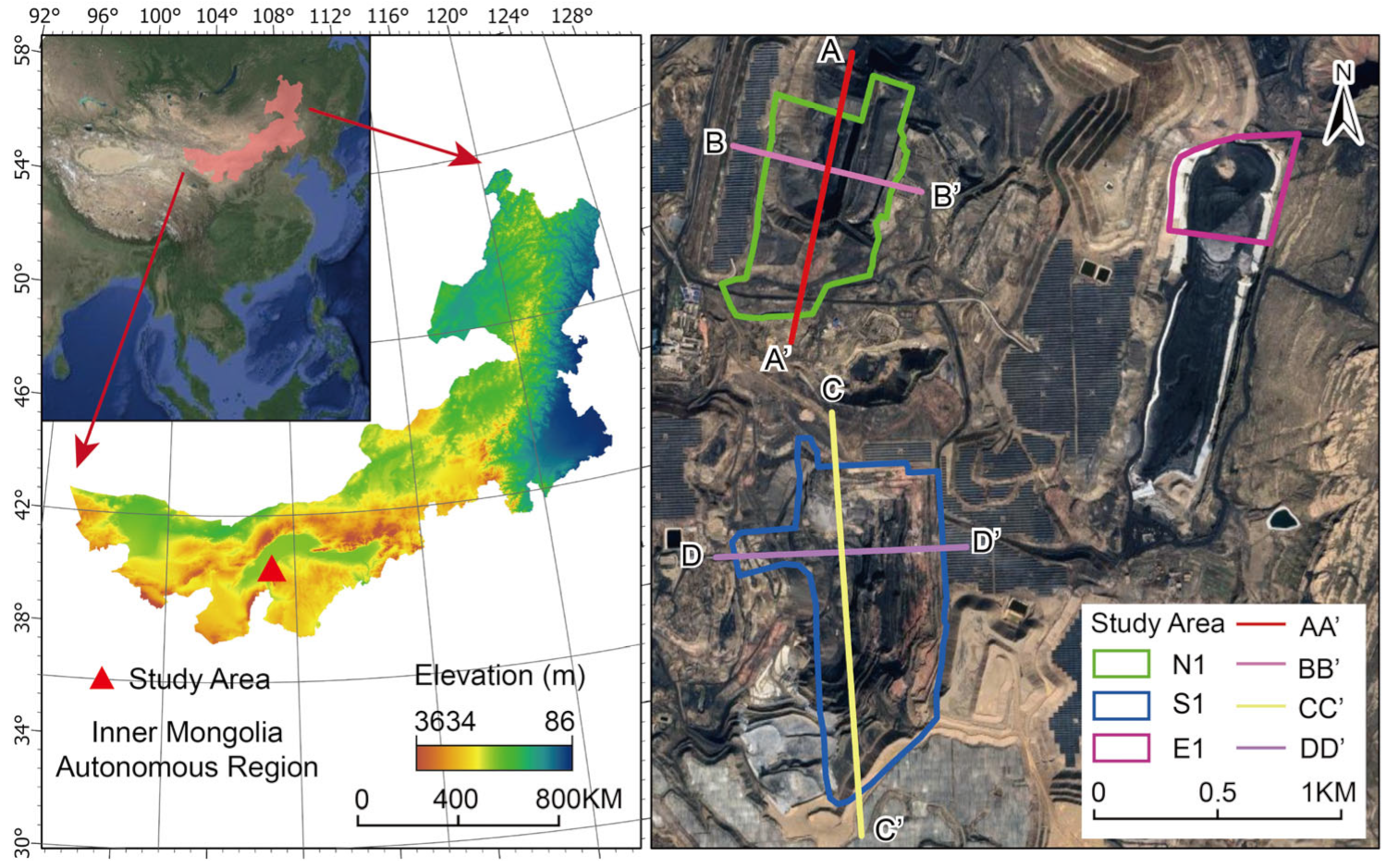
For this study, the northern (N1), southern (S1), and eastern (E1) pits of the open-cast mine were selected as representative areas based on their geographical locations. To precisely map the evolution of the mine pit topography, two profile lines (AA′ and BB′) were established in Area N1 and two profiles (CC′ and DD′) in Area S1 for temporal analysis of terrain changes. During the process of drawing cross-section lines, two main principles are followed. First, the direction of the main cross-section lines is determined based on the coal seam orientation, making them perpendicular to the coal seam strike to intuitively reflect the thickness variations and distribution characteristics of the coal seam. Second, in areas where the strata dip changes significantly or the geological structure is complex, secondary cross-section lines are drawn perpendicular to the main cross-section lines to further clarify the coal seam structure and surface changes, thereby providing more comprehensive and accurate geological information for the analysis of terrain evolution. The geographical location and general overview of the study area are illustrated in Figure 1.
Among them, the N1 area is roughly an irregular rectangle, with a length of approximately 840 m, a width of approximately 530 m, and a total area of about 437,500 m2. The S1 area has many protrusions along its edges, with the longest diameter within its polygon being about 1500 m and a total area of approximately 628,822 m2. The E1 area is nearly square-shaped, with a side length of about 400 m and a total area of approximately 112,332 m2.

2.2. Data Collection

This study draws primarily on ZY-3 and GF-7 satellite imagery, UAV orthophotos, and field survey data acquired over the research area. The stereoscopic remote sensing imagery data utilized in this study, including data from the ZY-3 and GF-7 satellites, must be obtained through official channels. After geometric correction and cloud-cover screening, eight ZY-3 three-line-array (TLA) stereopairs (comprising Forward, Nadir, and Backward) spanning 2013–2019 and eleven GF-7 dual-line array (DLA) panchromatic stereopairs (Forward and Backward) from 2020–2025 were selected. The aforementioned remote sensing imagery data possess high resolution and clear imaging characteristics, with cloud cover consistently below 5%. This dataset incorporates a wealth of homonymous reference points, and all datasets exhibit a perspective overlap rate of no less than 96%, ensuring high data reliability. The specific parameters of the satellite remote sensing image data are shown in Table 1.
UAV data acquisition was conducted between 2023 and 2025, with the flight mode configured for terrain-following flight. The UAV equipment and flight parameter settings are detailed in Table 2. Following image data processing, a digital surface model (DSM), orthophoto (DOM), and three-dimensional visualization model [25] were generated, comprising four scenes in total. The ground resolution achieved was 0.2 m.
Elevation control points for the study area were derived from the ATLAS/ICESat-2 L3A Land and Vegetation Height product (ATL08, Version 6) generated by the National Aeronautics and Space Administration (NASA). This paper primarily selects laser point elevation data acquired between November 2018 and February 2025. Following the methodology proposed by Osama et al. [26], laser points exhibiting relatively high elevation accuracy were selected for experimental data validation.

3. Methods

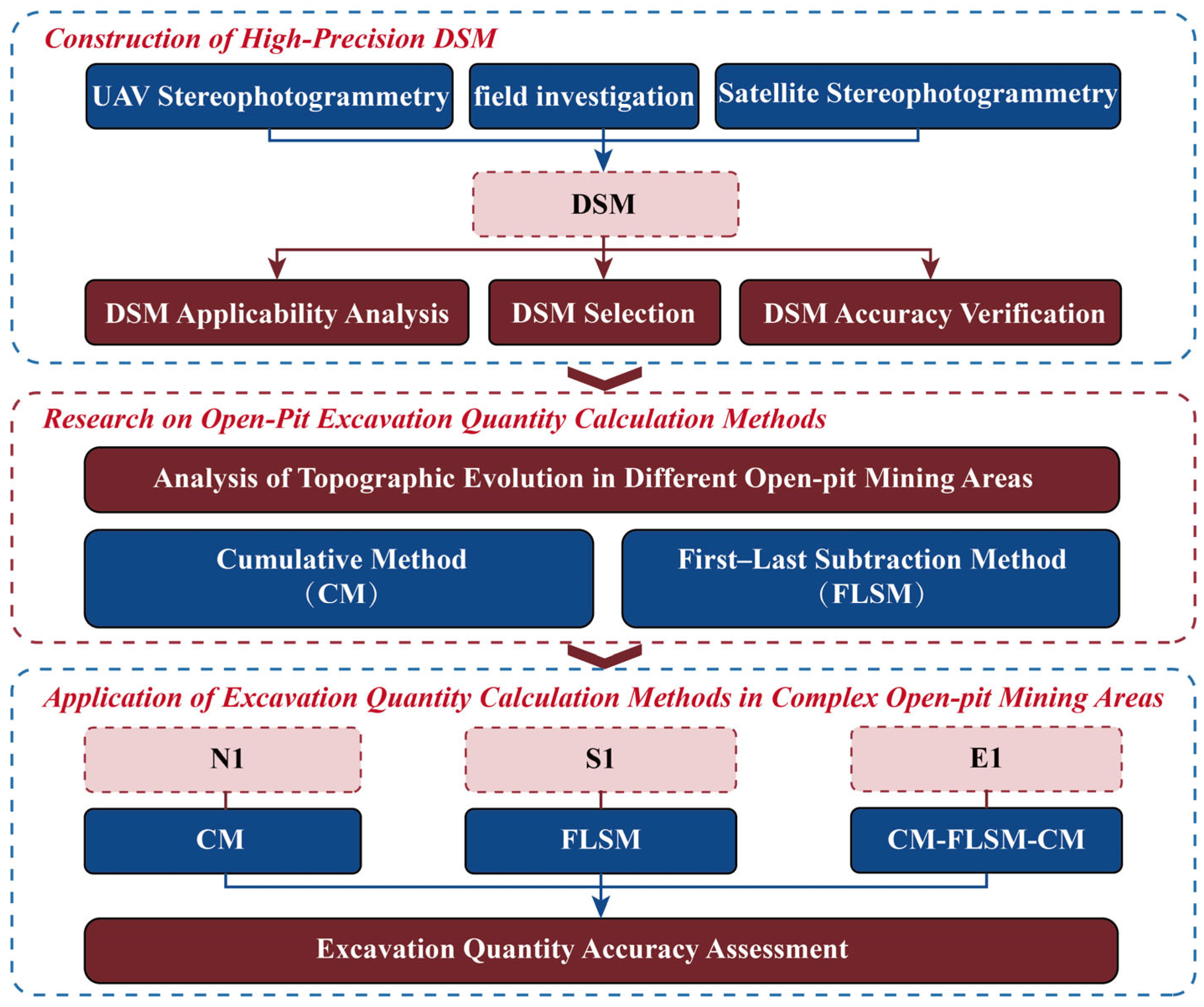
Figure 2 illustrates the technical methodology employed in this study, comprising three distinct phases. The first phase utilized satellite and UAV Stereophotogrammetry, integrated with field survey data, to construct high-precision DSMs. Building upon this foundation, we conducted an analysis of DSM applicability, DSM image selection, and DSM accuracy validation. In Section 2, terrain evolution analysis is conducted over a 12-year period for various open-pit mining processes using acquired long-term DSM data, alongside the proposal of two methods for calculating excavation volume. Section 3 investigates these calculation methods for the N1, S1, and E1 pits respectively, and assesses the accuracy of their computational results. Based on the analysis findings, this study provides an in-depth examination of the impacts generated by different overburden removal volume calculation methods in complex mining areas.

3.1. Methodology for Extracting DSMs Based on Satellite Stereophotogrammetry

The core principle of extracting DSMs from satellite stereo imagery pairs lies in capturing the same target point using two sensors positioned at distinct locations [27]. Satellite stereo images acquired through this method provide geometric information about the target point from different viewing angles. Based on these images, an observation equation for the target point can be constructed, enabling the precise calculation of its three-dimensional coordinates. The observation equation for the image point can be expressed as:
x i = P 1 ( X , Y , Z ) P 2 ( X , Y , Z ) y i = P 3 ( X , Y , Z ) P 4 ( X , Y , Z )
where P j is a cubic polynomial whose coefficients are extracted from the Rational Polynomial Coefficients (RPC) delivered with the satellite imagery—i.e., a set of rational-function coefficients computed in real time by the attitude and orbit system at the moment of imaging and subsequently normalized.
Then, employing an enhanced technique for bundle adjustment, the three-line array or dual-line array imagery is processed to precisely estimate the exterior orientation parameters (EOPs) and self-calibration parameters. Building upon the traditional coplanarity condition equation (2), the adjustment model incorporates laser elevation constraints (3) to construct a joint adjustment objective function (4):
B R l p l × R r p r = 0
h d s m h l a s e r 2
Ω = V T P V + λ k h d s m , k h l a s e r , k 2
where B denotes the photographic baseline, R l and R r represent the external rotation matrices for the left and right images respectively, p l and p r denote the homogeneous coordinates of corresponding image points in the left and right images respectively, V is the residual vector of image point observations, P is the weighting matrix for image point observations, and λ is the weighting coefficient for laser elevation constraints [28].
Following the completion of the adjustment process, the kernel line image is generated and the parallax search range is determined. Based on the refined RPC, the curve kernel line is generated using the projected trajectory method; double cubic convolution is employed for kernel line resampling, with resampling error better than 0.02 pixels. The parallax search range is dynamically calculated using the following equation:
d = ( h m a x h m i n ) f G S D · H
GSD for ZY-3 is 2.1 m, and for GF-7 it is 0.65 m. The prior elevation difference was obtained from the Shuttle Radar Topography Mission (SRTM), ensuring the interval is neither redundant nor incomplete [29].
Dense matching employs the Semi-Global Matching (SGM) algorithm: three-line arrays perform a ‘front–center–rear’ tri-view joint matching, while dual-line arrays execute a ‘front-rear’ bi-view matching. The overall expression for the SGM global energy function is:
E D = p [ C p , D P + q P 1 T D p D q = 1 + P 2 T D p D q > 1 ]
In stereo matching, the global energy function E D optimizes the disparity map by balancing matching accuracy and smoothness. Here, D p and D q represent the horizontal displacements of pixels and in the target image relative to the reference image, indicating their disparities. The data cost C p , D P measures the matching cost for pixel p , while the discontinuity costs with weights P 1 and P 2 handle small and large disparity differences between neighboring pixels, respectively. The truth function T [   ] evaluates conditions to apply these costs. This approach ensures smooth disparity maps while allowing necessary discontinuities, resulting in high-quality disparity estimation [30].
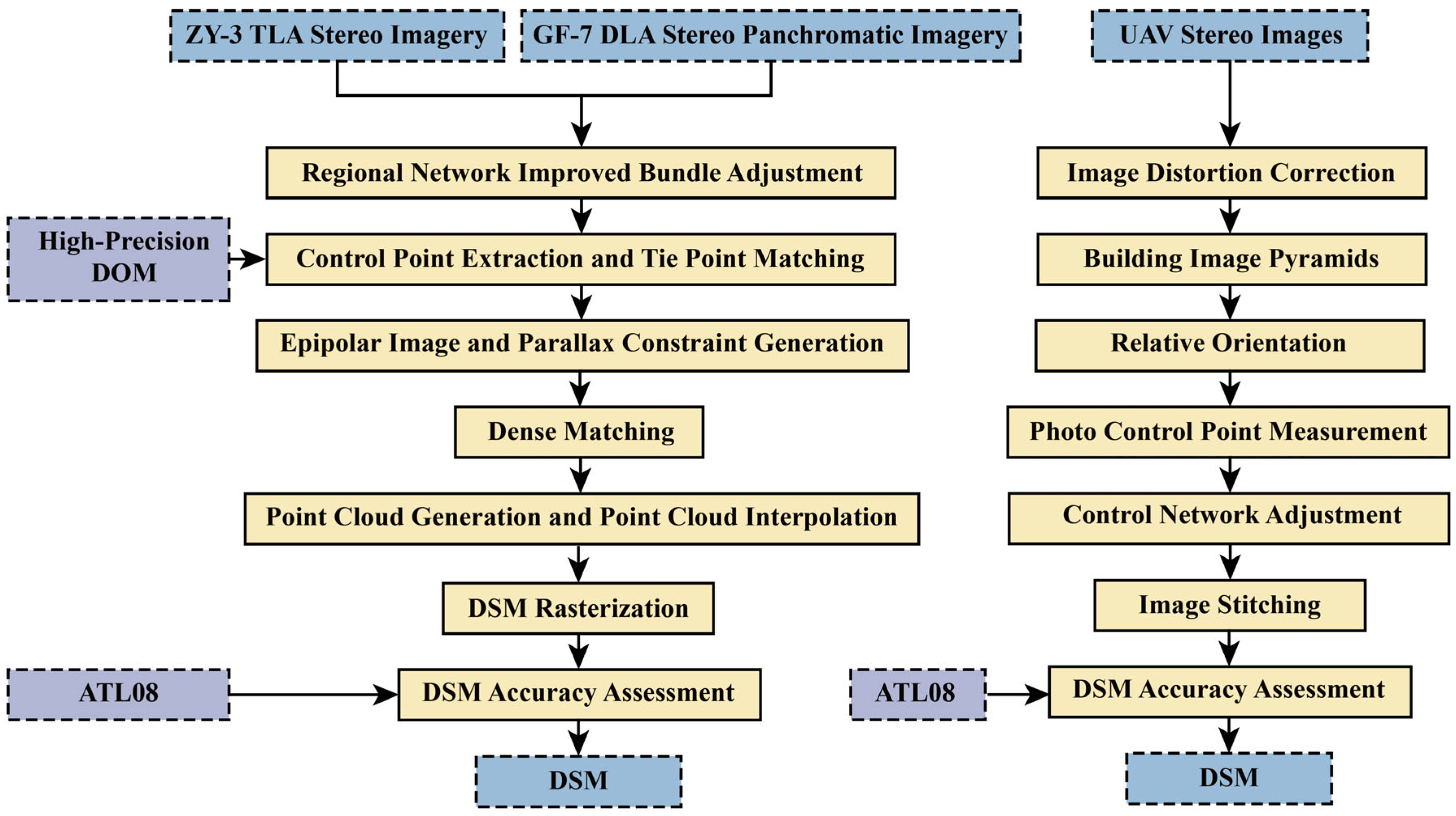
After left–right consistency checking and median filtering of the disparity map, 3-D point clouds were generated by forward intersection. The points were then interpolated into a Delaunay TIN and linearly resampled to produce a DSM whose pixel spacing matches that of the original imagery; any voids were infilled using inverse-distance-weighted (IDW) interpolation. Finally, a rigorous accuracy assessment was performed on the derived DSM to quantify its precision and reliability. The satellite stereo surveying data processing workflow is illustrated in Figure 3.

3.2. Methodology for Extracting DSMs Based on UAV Stereophotogrammetry

This study employed DJI Terra V4.0.1 software to process UAV photogrammetric data for constructing DSMs and generating a high-precision three-dimensional model [31]. The detailed computational workflow is as follows:
Owing to lens distortion and possible focal-length variation of the UAV-mounted camera, the images were first subjected to distortion correction, focusing on radial distortion (7) and tangential distortion (8):
x d i s t o r t e d = x u n d i s t o r t e d + x u n d i s t o r t e d × k 1 r 2 + k 2 r 4 + k 3 r 6 y d i s t o r t e d = y u n d i s t o r t e d + y u n d i s t o r t e d × k 1 r 2 + k 2 r 4 + k 3 r 6
where r = x u n d i s t o r t e d 2 + y u n d i s t o r t e d 2 , and k 1 , k 2 , k 3 are the radial distortion coefficients.
x d i s t o r t e d = x u n d i s t o r t e d + 2 p 1 x u n d i s t o r t e d y u n d i s t o r t e d + p 2 r 2 + 2 x u n d i s t o r t e d 2 y d i s t o r t e d = y u n d i s t o r t e d + p 1 r 2 + 2 y u n d i s t o r t e d 2 + 2 p 2 x u n d i s t o r t e d y u n d i s t o r t e d
where p 1 and p 2 denote the tangential distortion coefficients. The objective of distortion correction is to transform distorted pixel coordinates into undistorted pixel coordinates, expressed by the formula:
x u n d i s t o r t e d = f x X X 0 y u n d i s t o r t e d = f y Y Y 0
Here, f x and f y denote the focal length parameters of the camera, while X 0 and Y 0 represent the coordinates of the principal points.
To expedite processing, an image pyramid hierarchy was constructed. Each pyramid level stores the same scene at successively coarser spatial resolution, with every layer generated by down-sampling its immediate predecessor.
On image pairs that share sufficient overlap, candidate conjugate points are first detected by locating similar features; subsequently, a grey-scale-based least-squares matching algorithm refines their positions, thereby establishing the relative orientation and position between the two images.
R X 1 + T = X 2
where R denotes the rotation matrix, T the translation vector, and X 1 and X 2 the homogeneous coordinates of the corresponding points in the two images.
On this basis, the ground-surveyed control points were introduced into the aerotriangulation to transform the relatively oriented coordinates into the same reference frame as the field control. A least-squares adjustment of the control network was then performed to optimize overall accuracy. After mosaic generation, a DSM and 3-D model were produced by interpolating the discrete points. The UAV stereo surveying data processing workflow is illustrated in Figure 3.

3.3. Integrated Processing of Multi-Source DSM Data

In the analysis of long-term early-stage open-pit mine terrain data, there is often a lack of historical remote sensing data sources with high consistency, making it difficult to meet practical application requirements. Therefore, multi-source data integrated processing has become a key technical approach to obtain comprehensive and accurate terrain information. This study employs a multi-source DSM data integrated processing method, integrating ZY-3 and GF-7 satellite imagery as well as UAV imagery data. Specifically, the ZY-3 and GF-7 satellite imagery data were first preprocessed to eliminate weak-energy laser beam data and photons with abnormal elevations, thereby reducing data noise and errors. Simultaneously, noise filtering was applied to the UAV imagery data, and outliers were removed to enhance data quality. Subsequently, spatial coordinate transformation and resampling techniques were utilized to ensure consistency in spatial location and resolution across the multi-source data. Then, a weighted averaging calculation based on terrain features was performed on the multi-source imagery with temporal overlap. Finally, the remaining imagery was georeferenced and elevation-corrected using the weighted-averaged DSM of the same type as the reference. During the registration process, stable control points in the imagery (such as rocky ridges, scattered bedrock outcrops, and hard, flat, stable ground surfaces) were used for accuracy validation.

4. Results

In the calculation of open-pit mining stripping volumes, this study employs Digital Surface Model (DSM) data to obtain three-dimensional topographical information for the open-pit mine, primarily for two reasons. First, the study area predominantly features gobi, desert, and hilly terrain, with bare soil and bedrock dominating the surface. Prolonged, repeated excavation has left the pit virtually devoid of vegetation cover. Consequently, the elevation difference between DSM and Digital Terrain Model (DTM) data is negligible. Second, due to the repeated dumping and backfilling inherent in open-pit mining operations, the coal, ore, and earth temporarily stored within the pit constitute the very objects of calculation. These loose materials are fully preserved within the DSM. Conversely, employing a DTM—which necessitates filtering out non-fixed objects—would result in underestimation of volumes. Consequently, the DSM provides a more authentic and accurate representation of the actual mining process, serving as an indispensable data foundation for stripping and mining volume calculations.
This study generated a 12-year (2013–2025) time-series dataset comprising 23 DSMs derived from satellite and UAV stereophotogrammetry: eight ZY-3 epochs (5 m resolution), eleven GF-7 epochs (2 m resolution), and four UAV epochs (0.2 m resolution). To ensure data resolution consistency, this study standardises all DSM resolutions to 2 m. Horizontal coordinates were referenced to WGS-84 and projected to UTM zone 48N; elevations are expressed as WGS-84 ellipsoidal heights. Simultaneously, using the multi-source DSM data that have undergone integrated processing from ZY-3 (acquisition date: August 17, 2019), GF-7 (acquisition date: March 11, 2024), and UAV imagery (acquisition date: June 1, 2025) as reference images, georeferencing and elevation correction were performed on the other DSM data.

4.1. DSM Suitability and Accuracy Evaluation

4.1.1. Satellite Image Suitability Analysis

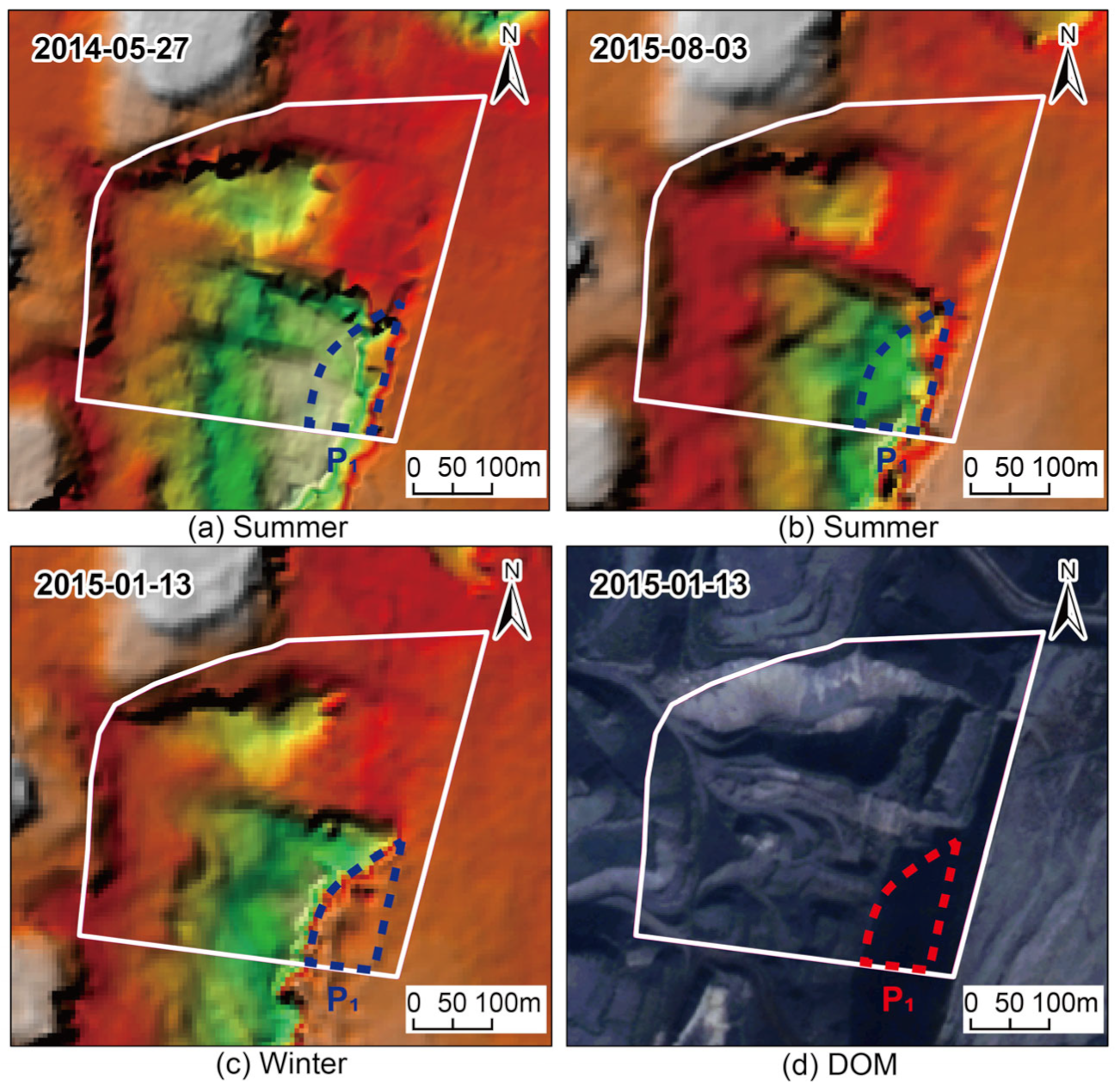
In topographic maps derived from satellite Stereophotogrammetry, one may observe discrepancies in the DSM at the same geographical location across different seasons, which defies the expected mining patterns. Taking E1 as an example, as shown in Figure 4, it can be observed that within the steep-edged mining pit area (i.e., the dashed-line region P1), the topographical features exhibit marked seasonal variations. Specifically, during May 2014 and August 2015 (i.e., the summer period), the terrain in this area exhibited a pronounced crater-like morphology. Conversely, in January 2015 (i.e., the winter period), the same region appeared level with the surrounding terrain, showing no discernible depression. This phenomenon contradicts actual mining patterns, indicating significant errors within the DSM.
This error is closely related to variations in solar elevation angle and the steepness of the terrain. Changes in solar elevation angle affect the angle at which sunlight strikes the surface, thereby influencing the reflective and scattering characteristics of the incident light. In winter, the relatively low solar elevation angle causes sunlight to reach the surface at a large incidence angle, producing elongated shadows along steep terrain edges. These shadows form because oblique rays are more easily obstructed by topographic features, resulting in more pronounced shadow effects in optical imagery. This phenomenon is particularly evident in areas with significant topographic relief or marked elevation differences. In contrast, during summer, the higher solar elevation angle brings sunlight nearly perpendicular to the surface, reducing the degree to which rays are blocked by terrain and thus shortening both the length and intensity of cast shadows. Consequently, shadow effects are less conspicuous in optical images, and terrain features become more clearly visible.
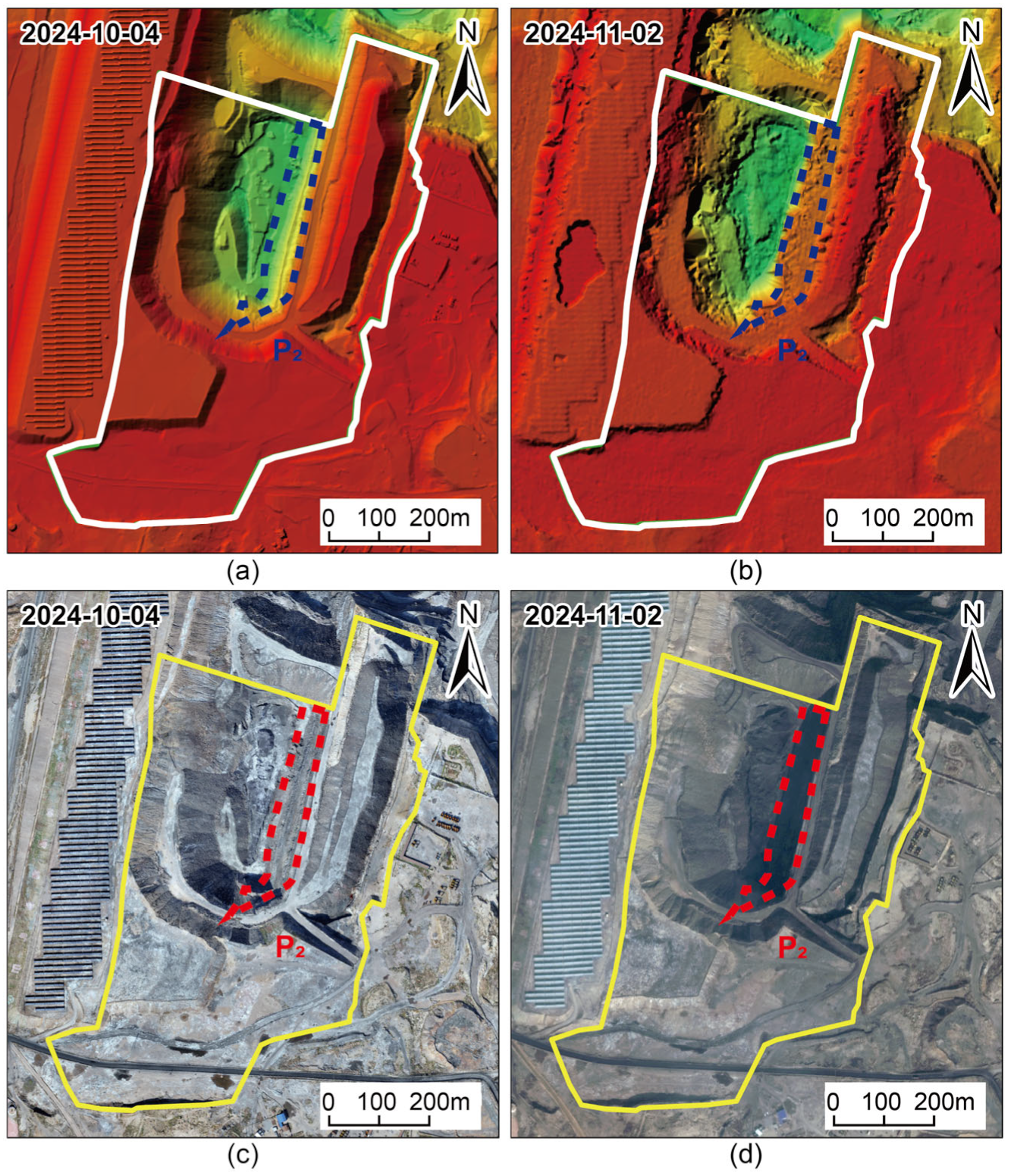
To further analyze the potential error impacts arising from photogrammetric surveying in steep terrain, this study selected N1 as its subject. A comparative analysis was conducted between DSM and DOM data from different sources, both pertaining to the steep mine pit edges within the same region during the same period (winter). Given that a one-month time span is relatively brief and insufficient to cause significant changes in the terrain of the mining area, we have treated the data from October 2024 and November 2024 as belonging to the same period. The experimental results are presented in Figure 5, where Figure 5a,c, respectively, depict the DSM and DOM generated by UAV stereophotogrammetry, while Figure 5b,d, respectively, show the DSM and DOM generated by satellite (GF-7) stereophotogrammetry. Results indicate that within the steep pit edge of N1 during the same period (i.e., the dashed-line area of P2), the DSM acquired by the UAV exhibits a distinct concave pit feature. Conversely, the DSM generated from GF-7 satellite data shows the same location as being flush with the surrounding terrain, lacking the concave pit morphology.
The fundamental reason for this phenomenon lies in the inherent differences between unmanned aerial vehicles and satellite remote sensing technology in their data acquisition methods. Aerial photography from drones, operating at lower altitudes, provides a perspective close to the Earth’s surface. This facilitates the minimization of shadow effects caused by variations in the solar elevation angle during image acquisition. Moreover, orthophotography technology further eliminates shadows caused by terrain undulations through geometric correction, enabling drone-acquired imagery to more accurately reflect surface features. Satellite remote sensing data, constrained by flight trajectories and photographic angles, coupled with their relatively greater distance from the Earth’s surface, is more susceptible to variations in solar elevation angle. The effect manifests visually as shadow phenomena, particularly pronounced in areas with significant topographical variation. In such regions, the intensity and angle of light received by satellite sensors may undergo considerable alteration after traversing the atmosphere and reflecting off the Earth’s surface, thereby giving rise to shadow formation.
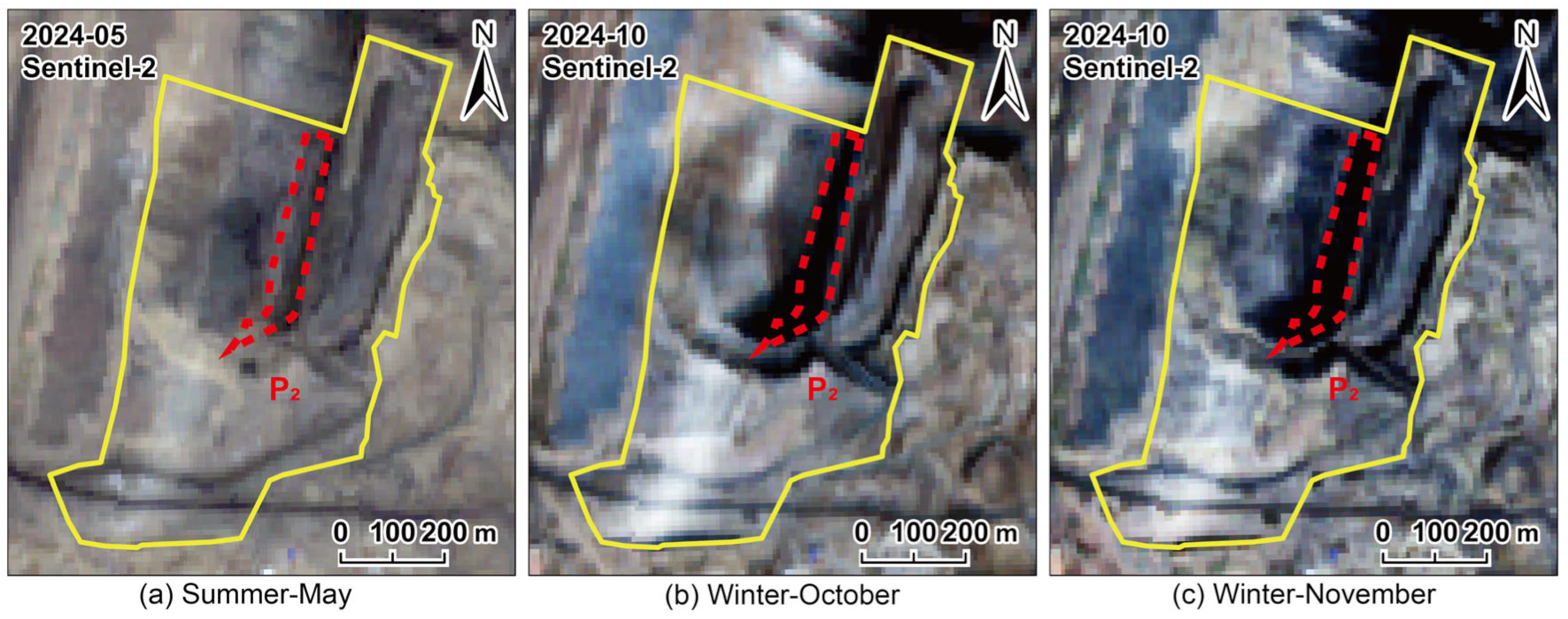
To validate the accuracy of the aforementioned analysis, this study incorporated optical imagery from the Sentinel-2 satellite (with a resolution of 10 m) for comparative analysis, as illustrated in Figure 6. By comparing imagery from summer (May) and winter (October), it was observed that, within the area marked by the dashed line at P2, winter shadows were significantly more pronounced than in summer. This observation also effectively demonstrates that in steep terrain, as the solar elevation angle decreases in satellite imagery, sunlight strikes the surface at a greater angle of incidence. This results in increased shadow length and intensity within the imagery. This seasonal variation is particularly pronounced in Sentinel-2 imagery, further confirming the significant influence of solar elevation angle on shadow formation in optical imagery.
When comparing the two Sentinel-2 satellite images acquired during winter (October and November) in Figure 6 with the two DOMs generated by the UAV and GF-7 satellite in Figure 5, a distinct difference was observed: the satellite imagery exhibited significantly more shadowing than the UAV imagery. This phenomenon further validates that satellite remote sensing data is more susceptible to limitations imposed by factors such as flight altitude, orbital parameters, and photographic angles compared to UAV imagery, consequently resulting in a greater incidence of shadowing effects within the imagery.
The errors arising from this phenomenon not only fail to correspond with the actual mining progress within the mining area but also lead to the accumulation and amplification of errors in subsequent topographical analysis and calculations, thereby compromising the accuracy of research findings. Consequently, when employing satellite remote sensing data for terrain analysis, it is imperative to fully account for the impact of solar elevation angle on the DSM generated by satellite stereophotogrammetry. Appropriate corrective measures or data screening analyses must be implemented. Furthermore, during the process of multi-source data fusion, it is essential to comprehensively consider the orbital and angle information of different satellites, alongside the characteristics and limitations of each data source. This approach enables more effective utilization of finite data resources to achieve higher-quality computational results. Therefore, during the screening of usable data, this paper follows the procedure of first correcting the imagery [32], then eliminating portions of the DSM exhibiting extremely severe shadowing during winter (October to March of the following year) based on specific imagery quality assessments. Additionally, multi-source data, such as DSMs generated from UAV stereophotogrammetry, are incorporated to enhance data accuracy. This provides a reliable data foundation for subsequent topographic analysis and computational tasks.

4.1.2. DSM Accuracy Verification

To verify the elevation accuracy of the DSM constructed using multi-source stereo remote sensing technology, this study selects the laser point elevation data from the ATLAS/ICESat-2 L3A Land and Vegetation Height product (ATL08, Version 6) for elevation accuracy validation (hereinafter referred to as ICESat-2/ATL08 laser points). As verified by Wang [33] et al., the ICESat-2/ATL08 data exhibit a horizontal positioning accuracy better than 2.1 m, a vertical bias of less than 3 cm, and an RMSE of less than 15 cm. These accuracy levels meet the computational precision requirements for open-pit mining applications in this study.
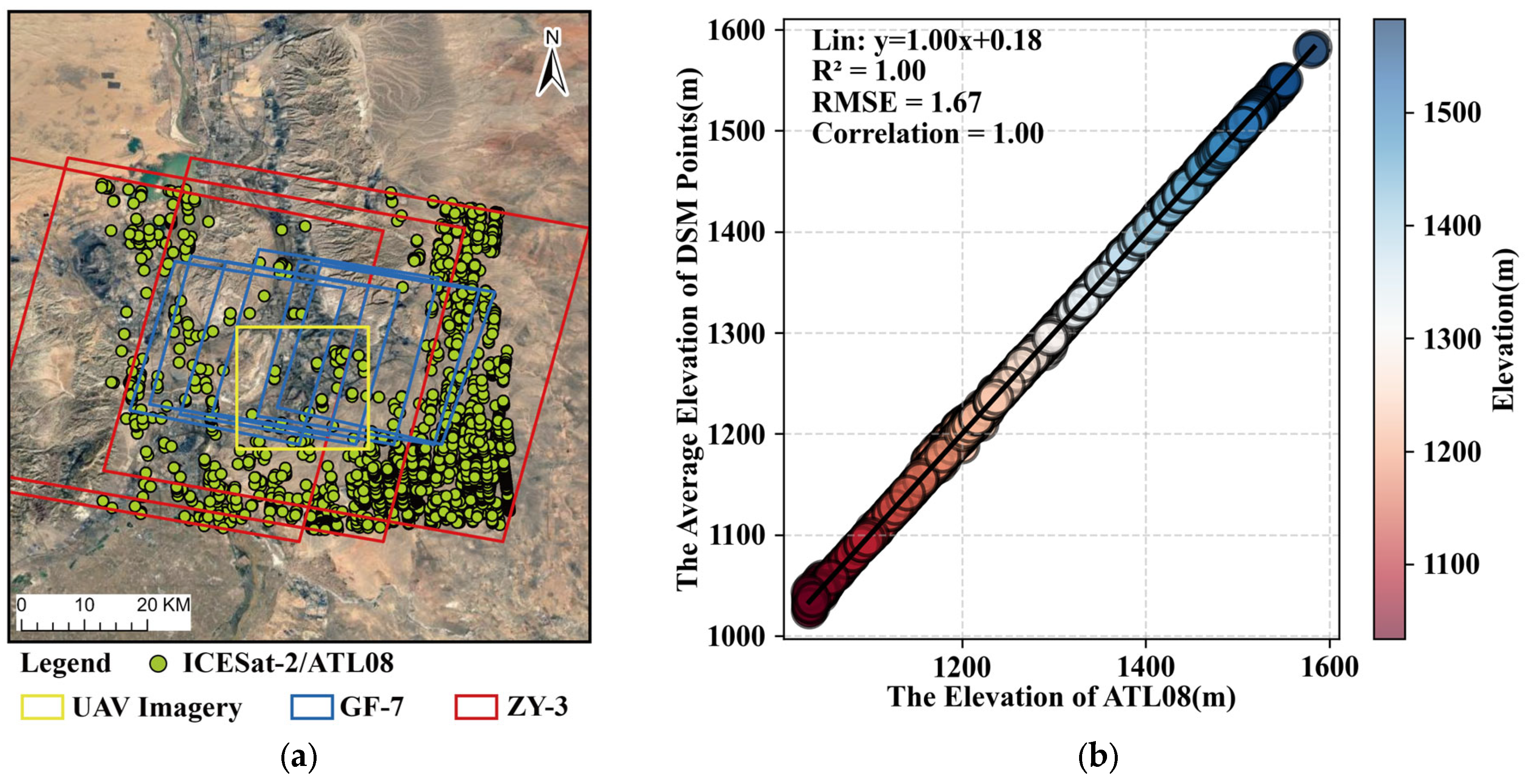
High-quality elevation control points were extracted from the ATL08 footprints acquired between November 2018 and February 2025 through a multi-stage filtering scheme. First, gross-height outliers were eliminated by comparison with the built-in reference DSM. Subsequently, footprint candidates were refined using thresholds for cloud-cover fraction, local slope, and topographic change rate to ensure that only cloud-free, gently sloping, and temporally stable surfaces were retained. This procedure yielded 2039 reliable laser footprints that serve as independent check points for elevation accuracy assessment (Figure 7a).
After filtering, the elevation values of the laser footprints were compared with those of the DSM points generated by stereo-mapping. The scatter plot of elevation accuracy is shown in Figure 7b. DSM error analysis was conducted using the maximum absolute error, maximum relative error, root-mean-square error (RMSE), and mean error (ME) [34]. The accuracy metrics are summarized in Table 3, where the RMSE is 1.67 m. Thus, the systematic elevation error of the DSM derived from stereo pairs meets the specified requirements and exhibits high accuracy, making it suitable for subsequent research on calculation methods of open-pit mining stripping volumes.

4.2. Analysis of Topographical Evolution Characteristics of Mine Pits under Different Mining Conditions

4.2.1. Analysis of the Evolution of the Topography of the N1 Mine Pit

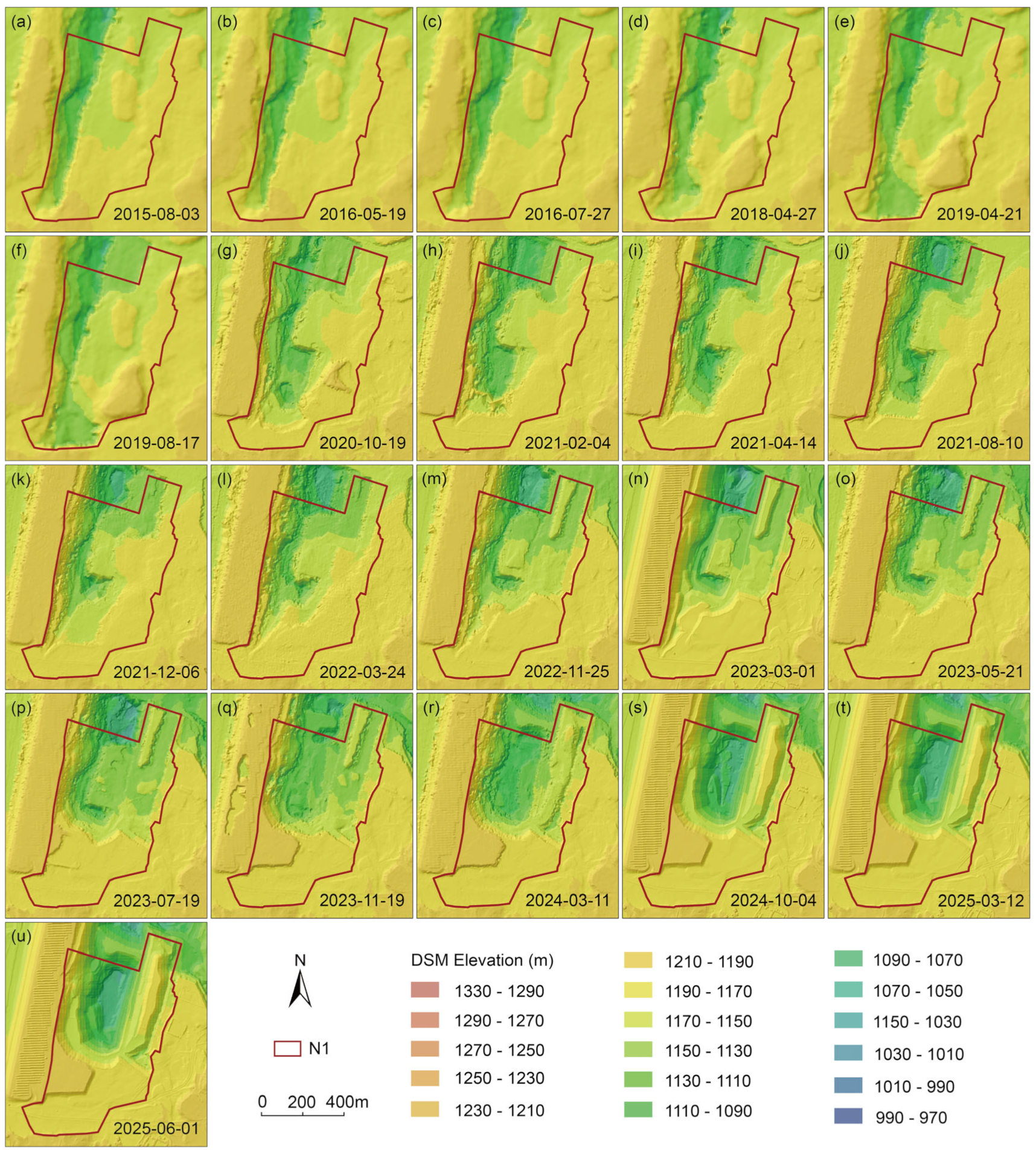
Figure 8 illustrates the topographical evolution of Pit N1 from August 2015 to June 2025. In the initial phase, the terrain was generally flat, though a naturally formed gully approximately 40 m deep existed along the left boundary of the pit. Between 2015 and 2016, the topography of the N1 pit showed minimal change, with its boundaries and depth remaining largely stable. This indicates the mining activities were in their early stages, characterized by low intensity. From 2016 to 2019, the pit boundary began gradually expanding outward as mining activities accelerated and intensity increased. By August 2021, the rate of pit deepening accelerated further, while minor backfilling occurred in the southern section of Pit N1. By the end of 2022, the pit boundary had become markedly more irregular. Between 2023 and 2025, the right-hand edge of the pit continued to be built up while excavation persisted in the central section, marking the late stage of mining operations. By June 2025, mining activities were largely completed, with the pit’s form and scale stabilizing, signifying the conclusion of extraction work.
In summary, the mining process at the N1 pit exhibits complex and variable characteristics, persisting from the initial to the later stages. This is manifested in the expansion of the pit boundaries, increased mining depth, and the progressively intricate evolution of the pit’s shape. Furthermore, the mining activities were not a singular excavation process but involved a degree of repeated excavation and backfilling.
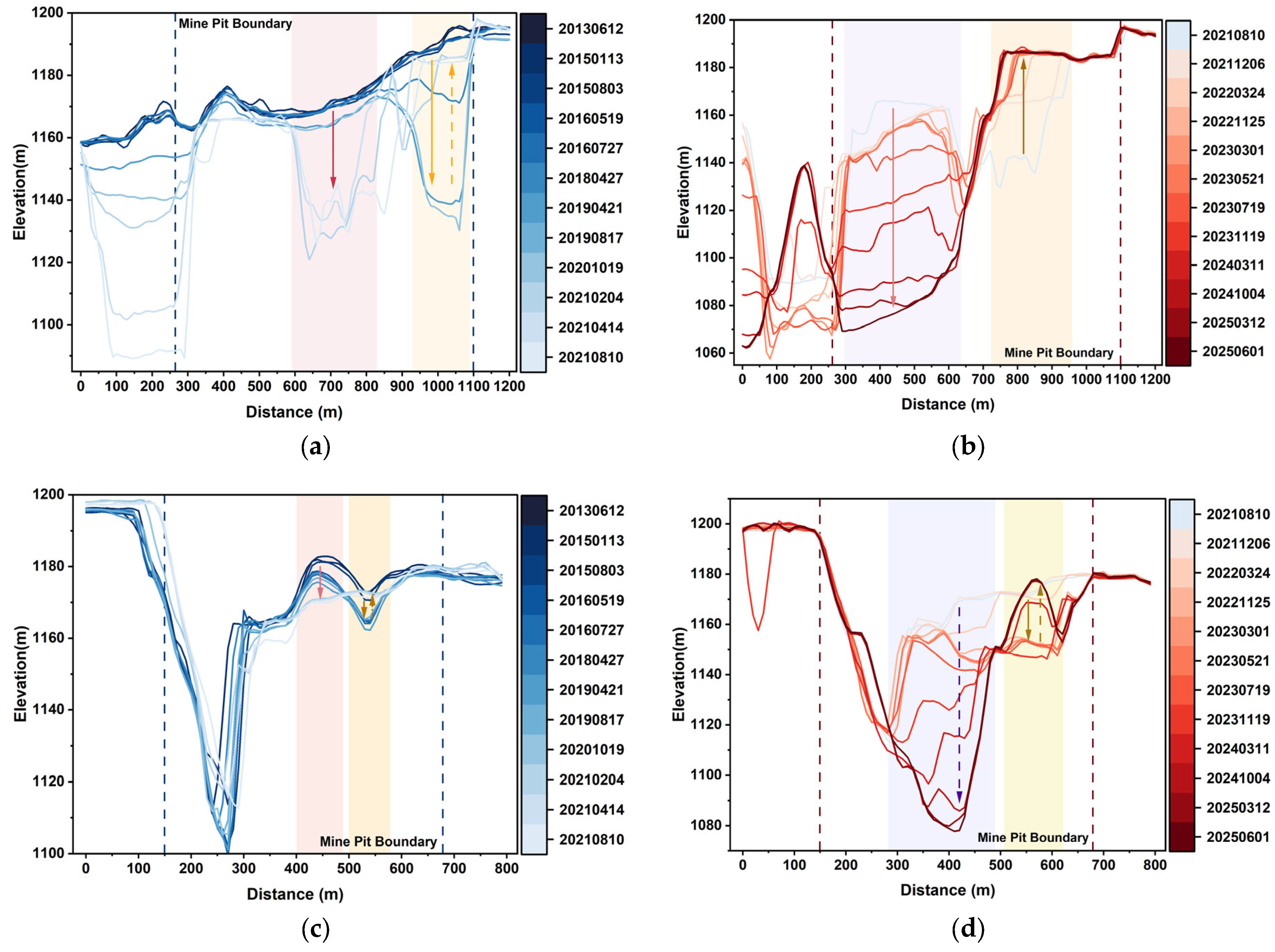
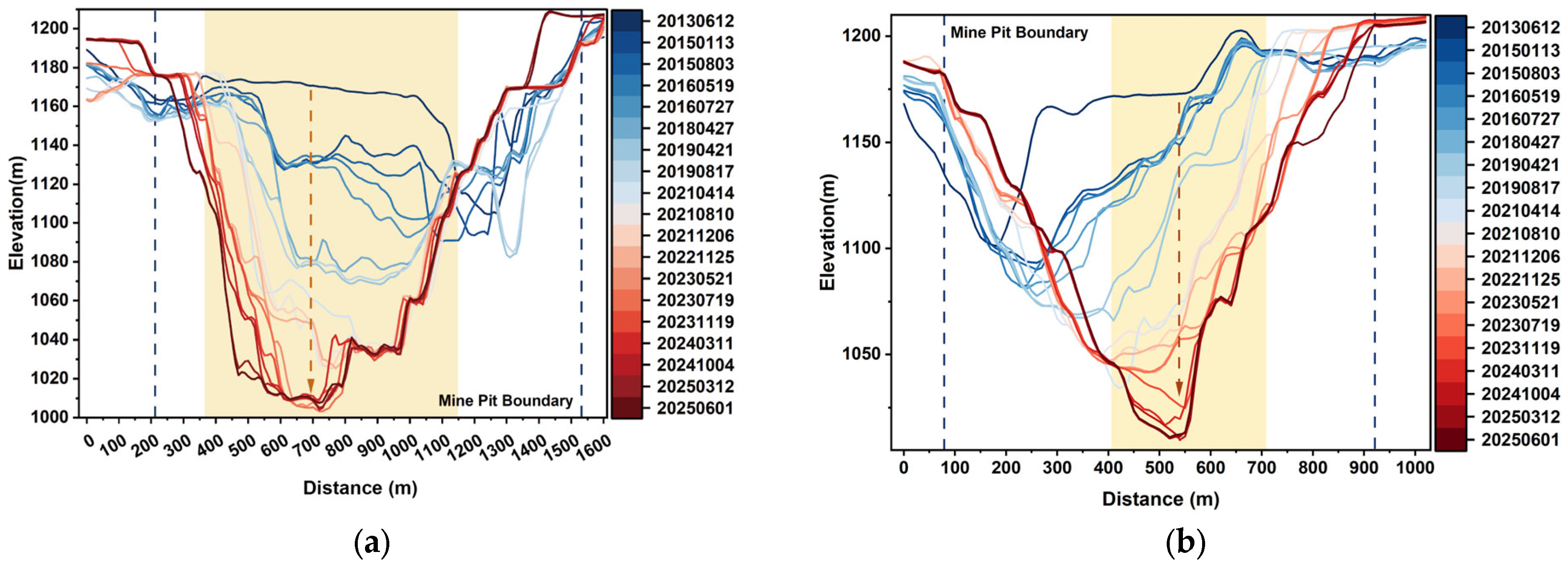
To conduct an in-depth analysis of the mining process at Pit N1, this study employs two cross-section lines, AA’ and BB’, for topographical examination. To more clearly observe the evolutionary characteristics of the pit across different mining phases, the analysis timeframe is divided into two periods: August 2015 to August 2021, and August 2021 to June 2025, as illustrated in Figure 9. This segmentation facilitates the capture of critical processes such as backfilling and overburden removal, enabling a more comprehensive assessment of the pit’s topographical evolution across distinct time intervals.
Figure 9a shows that the topographical changes along the AA’ profile line for Pit N1 were relatively gradual between 2015 and 2016, indicating a period of relatively stable mining activity. From 2016 onwards, topographical changes intensified significantly, with the pit depth rapidly increasing to approximately 40 m and mining scale expanding. By 2021, minor backfilling phenomena began to appear in the southern section of Pit N1. Figure 9b depicts changes along the AA’ profile line from 2021 to 2025. During this period, large-scale mining commenced in the northern section, with the pit depth further increasing to approximately 80 m as extraction activities continued to expand. Concurrently, backfilling in the southern area reached a depth of approximately 40 m, indicating that backfilling or internal stockpiling operations commenced in certain zones alongside ongoing extraction.
Figure 9c and 9d, respectively, illustrate the topographical changes along the BB’ profile line during two distinct periods. Between 2015 and 2021, the overall topography along the BB’ profile line exhibited relatively minor alterations, though a mining depth variation of approximately 10 m was observed in the central section of Pit N1. From 2021 to 2025, topographical changes along the BB’ profile line intensified markedly. In the western section of the N1 pit, the mining depth markedly increased to approximately 90 m. Concurrently, backfilling of around 40 m was observed in the eastern section of the N1 pit.

4.2.2. Analysis of the Evolution of the Topography of the S1 Mine Pit

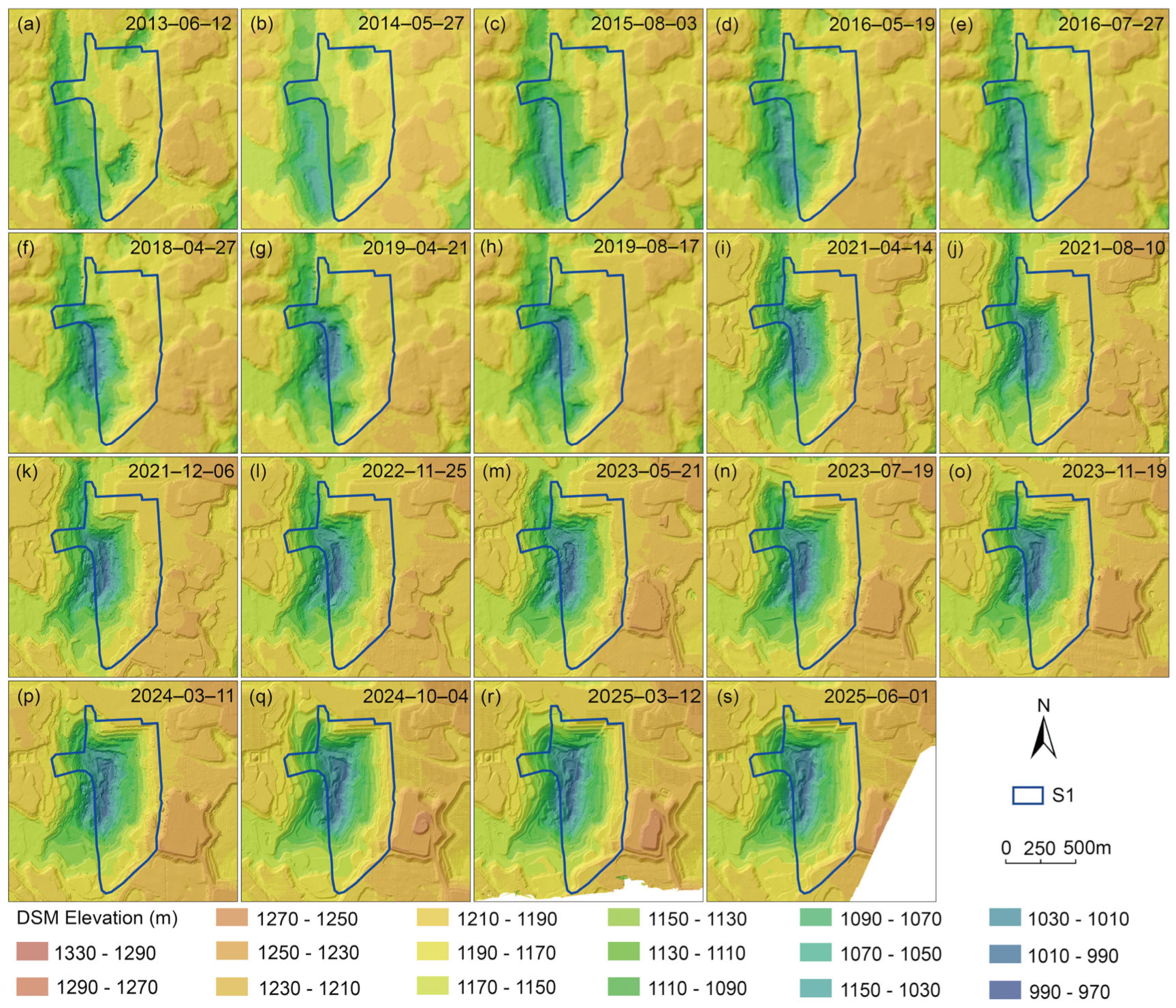
Analysis of the DSM time series for Area S1 reveals the topographical evolution of this region between 2013 and 2025. Figure 10 details the terrain changes during this mining period. In its initial state, Area S1 exhibited elevations ranging from 1010 to 1290 m, presenting a relatively flat topography with no discernible mining zones or significant excavation traces. However, over time, the terrain commenced a gradual subsidence towards the central zone, a trend persisting until March 2025, during which the central depression became particularly pronounced. By June 2025, the topographical changes in Area S1 stabilized, indicating that the mining process was largely complete.
Specifically, the topographical alterations in Area S1 primarily manifested as the progressive enlargement and deepening of the excavation pit. As mining operations advanced, the boundaries of the excavation area continuously expanded outward, while the elevation of the central zone markedly decreased, forming a distinct concave topography. In summary, mining activities in the S1 area exhibited regularity and continuity, characterized primarily by sustained excavation. No other significant signs of terrain modification were observed, such as large-scale levelling, waste rock stockpiling, or repeated filling and excavation.
From the two cross-section lines CC’ and DD’ shown in Figure 11, which traverse the lowest central point of the S1 mine pit, the excavation process becomes more clearly and intuitively discernible. By comparing the cross-section lines at different time points, the continuous expansion and deepening of the pit can be distinctly observed. This phenomenon also demonstrates that the excavation process of this mine pit exhibits a high degree of regularity. The diagram reveals that mining commenced on a modest scale at the pit’s center before gradually expanding outward. This expansion occurred in tandem with increasing depth, suggesting an almost continuous excavation process throughout. Furthermore, the absence of discernible signs of backfilling, levelling, or repeated filling and excavation further confirms that mining activities were primarily focused on digging operations, with minimal terrain modification.

4.2.3. Analysis of the Evolution of the Topography of the E1 Mine Pit

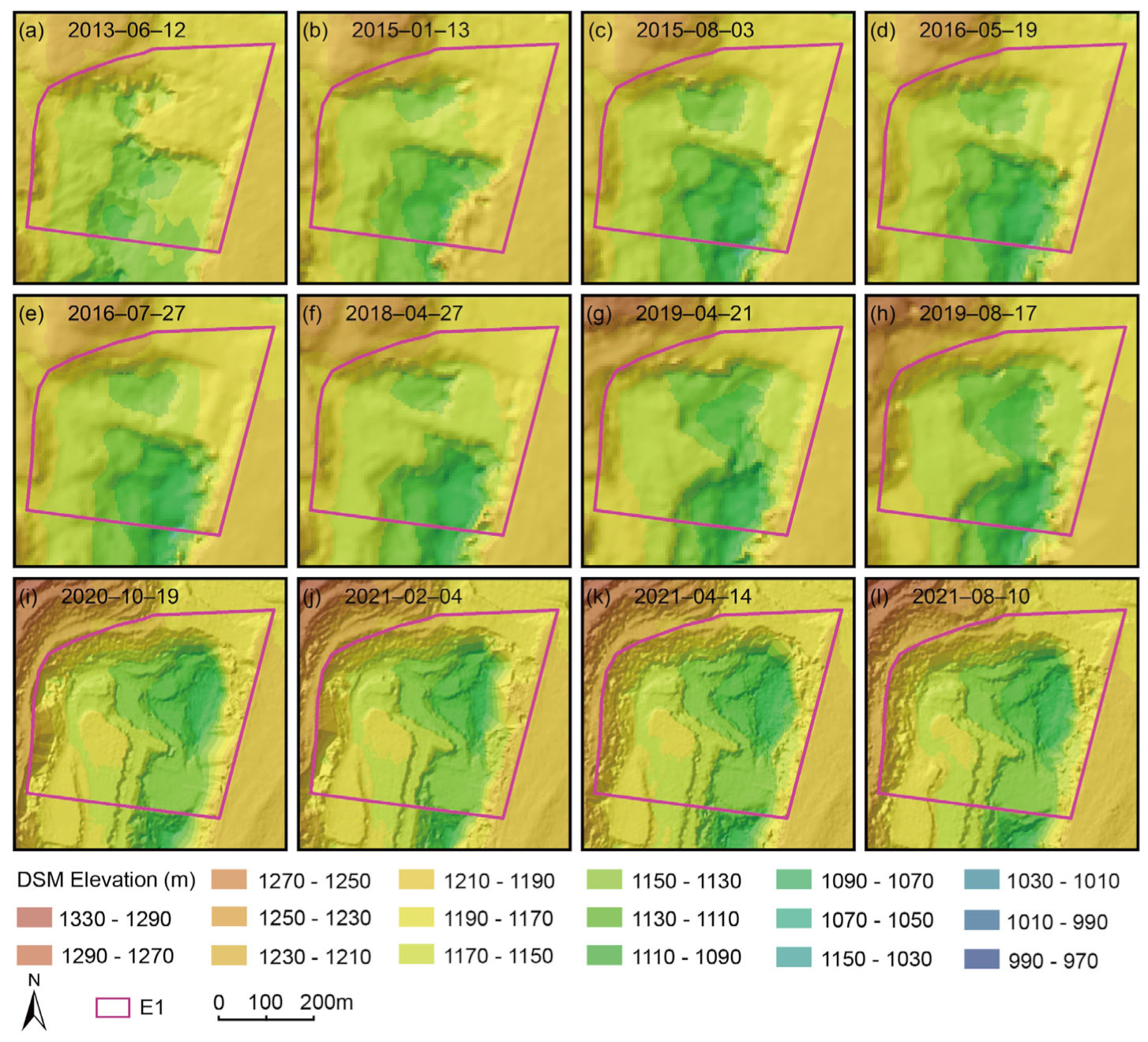
Mining activities in Area E1 spanned from June 2013 to August 2021, with the topographical evolution depicted in Figure 12. Analysis indicates that the mining pattern in this area differs both from the repeated fill-and-dig cycles observed in Area N1 and the continuous extraction seen in Area S1. Overall, it can be divided into three distinct phases. The first phase (June 2013–July 2016) was characterized by sustained mining in the southern sector, resulting in pronounced topographic depressions and elevation decline. During the second phase (April 2019–October 2020), the mining pattern shifted: backfilling commenced in the south while northern mining continued, leading to increasingly complex terrain alterations. The third phase (October 2020–August 2021) concentrated extraction activities in the northern sector, further deepening and expanding the scope of mining operations in this area.

4.3. Calculation Results for Mine Excavation Volume

4.3.1. Calculation Results for Excavation Volume of N1 Mine Pit

In the course of open-cast coal mining operations, the calculation of excavation volumes constitutes a critical step in ensuring the smooth progression of the mining phase, as well as a vital means of assessing mining efficiency and cost control. During the computation of these volumes, we first employed Stereophotogrammetry to obtain a high-precision DSM of the open-cast mine. On this basis, we employed two distinct methods for calculating excavation volumes to achieve precise measurements. (1) The Cumulative Method (CM) sequentially subtracts each pair of consecutive DSMs, accumulating the calculated excavation volume throughout the entire time series. (2) First–Last Subtraction Method (FLSM) calculates the excavation volume in a single step by subtracting the initial DSM from the final DSM.
The results of calculating the earthwork volumes for N1 using these two methods are shown in Table 4 and Table 5 respectively. The excavation volume calculated by CM is 18,652,336 m3, while that calculated by FLSM is 6,506,293 m3. The net change volume was calculated by subtracting the excavation volume from the fill volume. The cumulative net change volume calculated by CM was −1,560,219 m3, while FLSM calculated a net change volume of −1,570,635 m3. The absolute error between the two was 10,415 m3, with a relative error of 0.6631%. This outcome demonstrates that both methods exhibit a high degree of consistency in calculating the net change in excavation volume, with the error falling within an acceptable range [35]. This further validates the reliability of both calculation approaches.

4.3.2. Calculation Results for Excavation Volume of S1 Mine Pit

During the calculation of earthwork volumes for the S1 pit, two methods were employed, yielding results as shown in Table 6 and Table 7. CM calculated the total excavation volume as 50,285,337 m3 by accumulating terrain changes between consecutive time -points, whereas FLSM determined the excavation volume as 32,196,732 m3 by considering only terrain changes between the start and end points of the time series. Further calculations of net change volume yielded values of −26,174,571 m3 for CM and −26,188,061 m3 for FLSM. The absolute error between these figures was 13,590 m3, representing a relative error of 0.0518%. Both results fall within acceptable tolerance limits and meet the standard requirements for excavation volume verification.


5. Discussion

5.1. Calculation Analysis and Accuracy Verification of Mine Pit Excavation Volume

5.1.1. Analysis and Accuracy Verification of Excavation Volume Calculations Based on Repeated Excavation and Backfilling Conditions

Analysis of the experimental results derived from the preceding discussion reveals that the N1 mine pit exhibits three key characteristics during its extraction phase: initial stable mining, subsequent large-scale extraction, and localized repeated filling and excavation. Consequently, the topographical changes of the N1 mine pit demonstrate cyclical and recurrent patterns. Furthermore, when calculating excavation volumes, the traditional FLSM is more prone to overlooking multiple excavation and filling stages within the mining process, leading to computational results that underestimate actual values. Given the specific characteristics of the N1 pit, the CM proves more suitable, as it accurately captures the complex variations inherent in the mining progression.
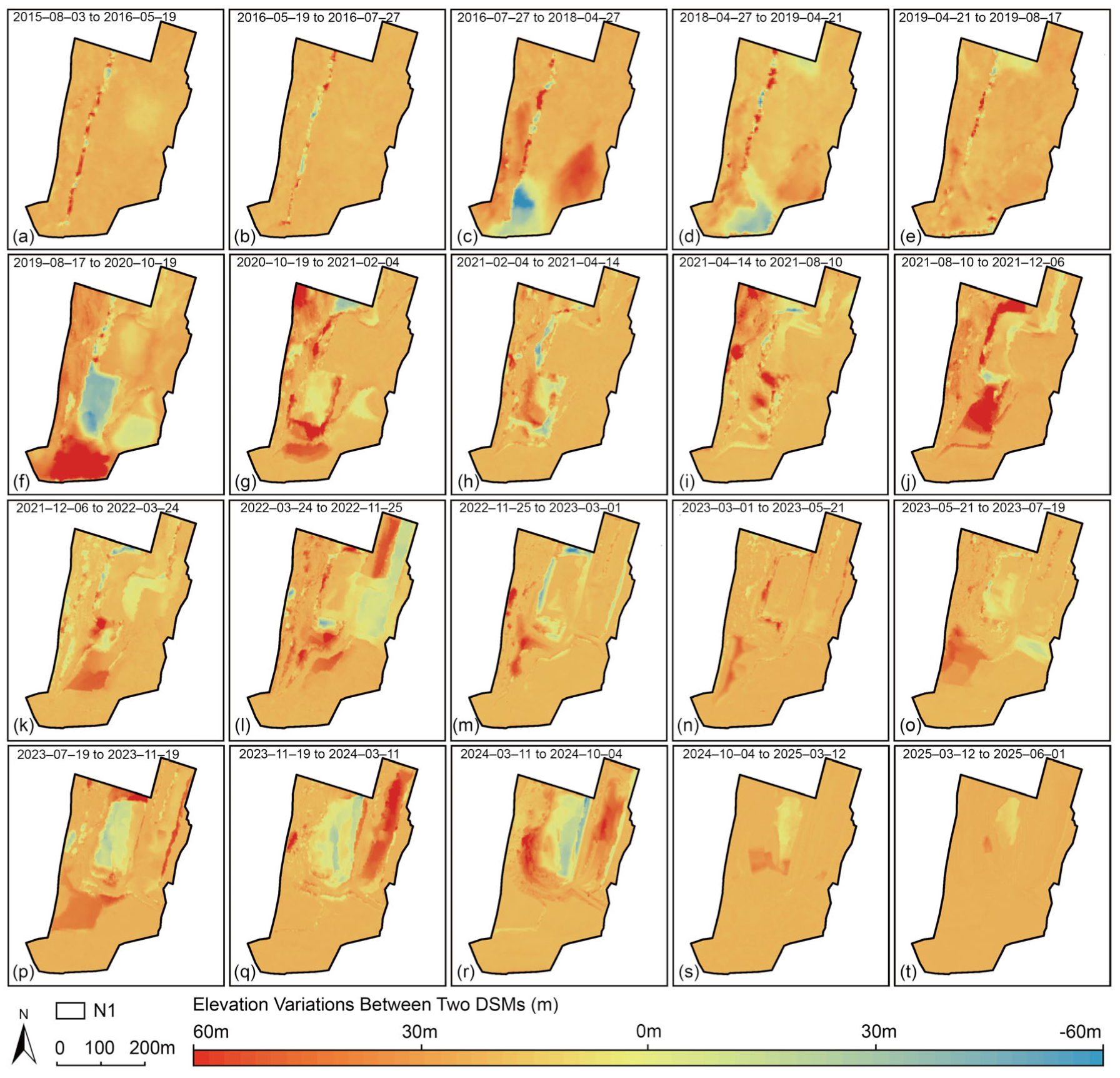
This paper utilizes elevation differences between adjacent DSM phases obtained through CM calculations to produce Figure 13, which visually illustrates the excavation and backfilling dynamics of Pit N1 across different periods. During the initial phase of pit development, operations primarily focused on site levelling; by the middle and later stages, activities progressively shifted towards large-scale mining. The mining activities exhibited a consistent spatio-temporal progression from southwest to northeast. Specifically, the first phase concentrated on the southwest area, sequentially implementing extraction, earthwork transfer, and backfilling operations. Subsequently, the focus shifted to the central region, entering the second phase. This phase continued site levelling alongside ongoing excavation and backfilling. As operations expanded into the northeast, the final phase commenced, still encompassing key processes such as excavation and backfilling.
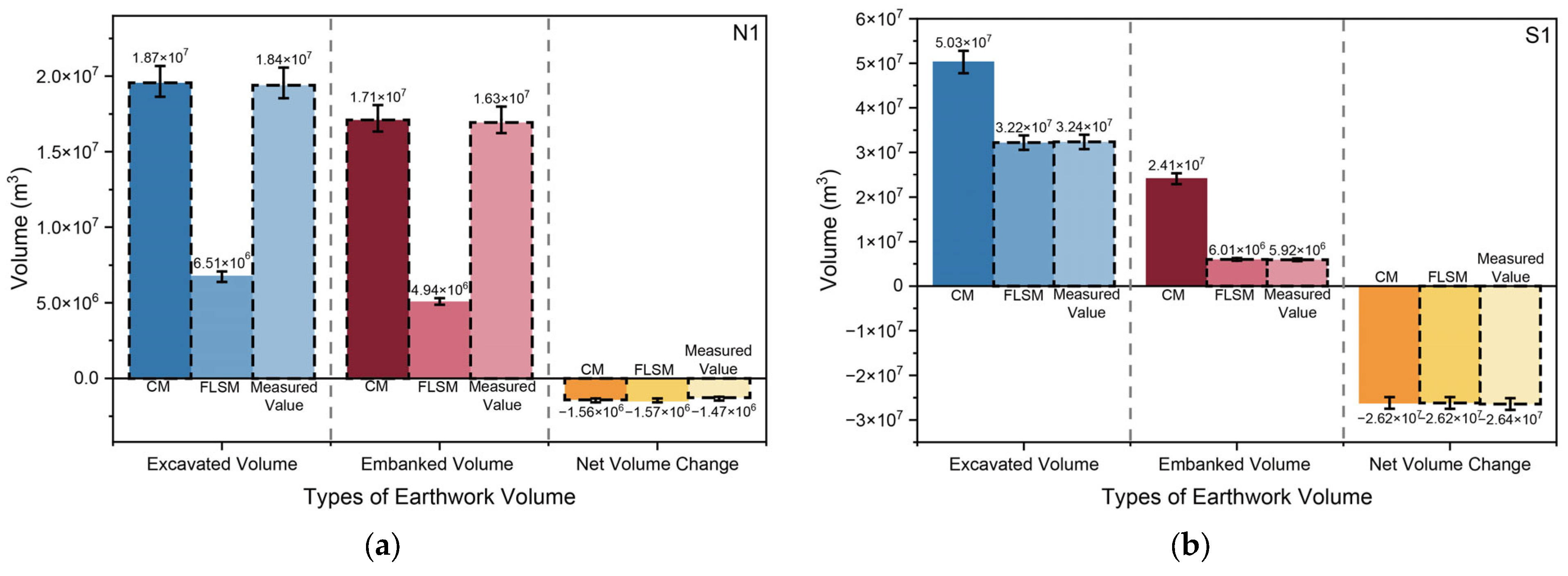
Regarding the specific excavation conditions of N1, the computational results obtained using the CM align more closely with actual circumstances. Through error analysis, the absolute error between the excavated volume calculated by CM and the measured value was 250,406 m3, with a relative error of merely 1.36%. Furthermore, the earthwork volumes calculation results and other relevant error parameters are presented in Table 8 and Figure 14a.
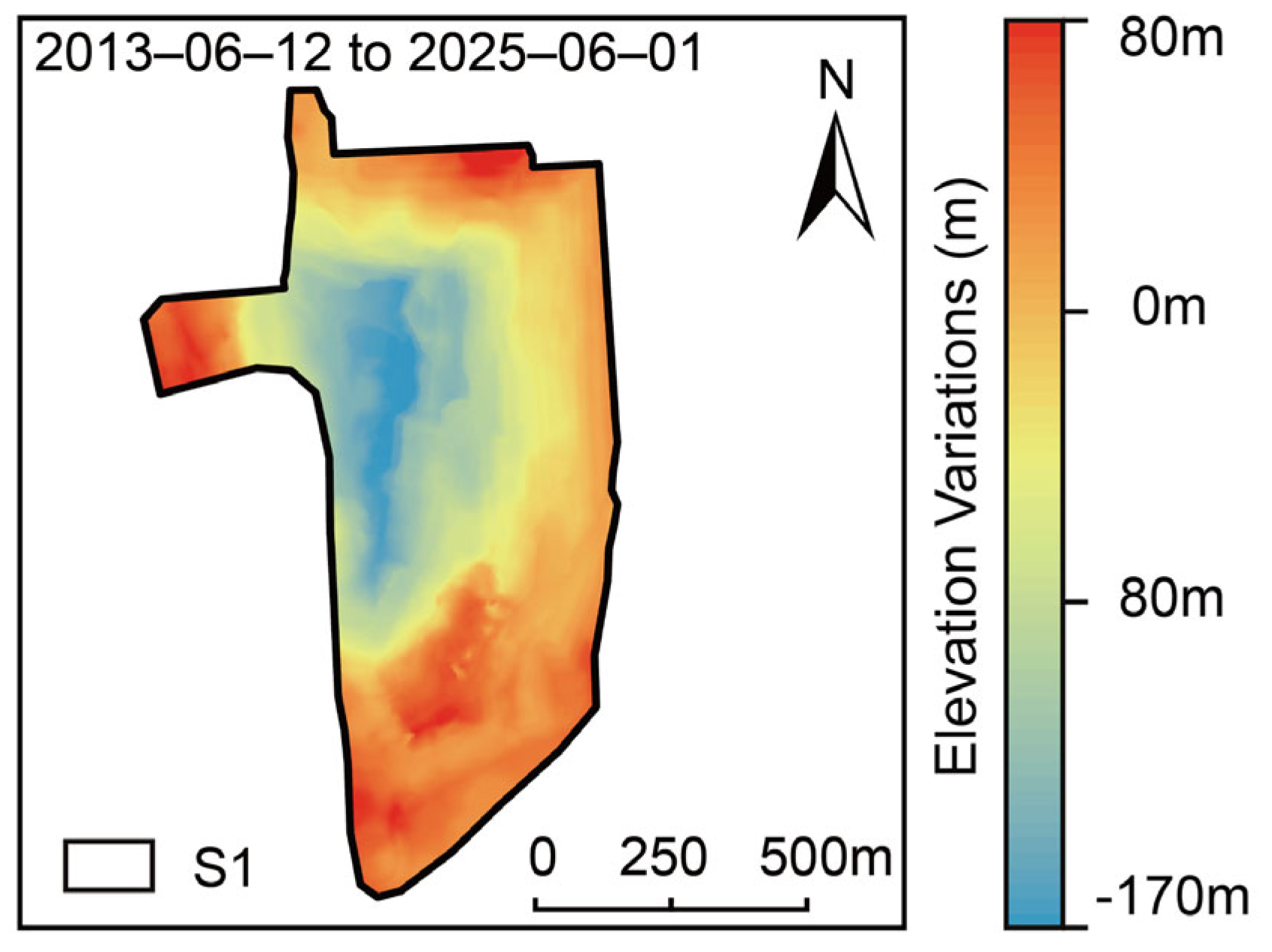
The mining characteristics of S1 are diametrically opposed to those of N1, exhibiting systematic and continuous extraction with virtually no backfilling. The initial small-scale pits progressively expanded outward, transforming the terrain from a relatively flat state into a centrally depressed area. This resulted in a distinct mining pit with a continuously declining central elevation. The final topographical changes of the S1 pit are illustrated in Figure 15. The entire deformation process was primarily concentrated in the central area, with deformation values ranging from −170 m to 80 m.
Therefore, when calculating the overburden removal volume for Area S1, employing the CM method may amplify the inherent error in the DSM data. As errors accumulate layer by layer during the calculation process, this leads to results that exceed actual values. Given the mining characteristics of Area S1, utilizing the FLSM method enables a more accurate estimation of the overburden removal volume. This approach effectively mitigates the impact of DSM data errors on the calculation results, thereby enhancing the accuracy of the estimation.
Table 9 and Figure 14b present the results of earthwork volumes calculations for Area S1 alongside their error parameters. The outcomes derived using the FLSM exhibit greater consistency with actual conditions. In the error analysis, the absolute error between the excavation and overburden removal volumes calculated via FLSM and the measured values stands at −157,257 m3, with a relative error of merely −0.49%. This error falls within the anticipated range.

5.1.2. Planning and Verification of Excavation Volume Calculation Methods Based on Phased Mining Conditions

When calculating the excavation volume for the E1 area, the complexity and phased nature of mining activities in this zone necessitate that a single calculation method alone cannot accurately reflect the actual mining conditions, thereby yielding insufficiently precise results. In contrast, employing a comprehensive calculation method that integrates both the CM and FLSM approaches will provide a more reasonable representation of the actual situation. CM can capture continuous changes during the excavation process, while FLSM reduces the cumulative impact of inherent errors in DSM data during phases without repeated excavation and backfilling activities. The calculated results are presented in Table 10. Concurrently, the precision evaluation against measured data is shown in Table 11. Comparison reveals an absolute error of 67,424 m3 between the calculated excavation volume and measured values, corresponding to a relative error of 1.68%. This demonstrates that this integrated approach is more suitable for scenarios such as Area E1, where mining activities are phased and diverse. It not only mitigates errors potentially introduced by single methods but also provides a more comprehensive reflection of the stripping and mining volume changes throughout the entire mining cycle in Area E1.
In the calculation of open-pit mine excavation volumes, selecting an appropriate method is crucial. For pits with repeated filling and excavation (e.g., N1), the CM can more accurately capture complex changes in the mining process, effectively reducing errors caused by ignoring fill-and-dig steps.
For pits with systematic continuous mining and minimal backfilling (e.g., S1), the FLSM can effectively avoid the accumulation of DSM data errors, thereby improving calculation accuracy.
For complex areas with phased and diverse mining activities (e.g., E1), the stages of mining should be carefully analyzed based on specific topographical changes. Applying both CM and FLSM in different stages yields more rational and comprehensive results. Therefore, in practical applications, the calculation method should be flexibly chosen according to the specific mining characteristics and topographical changes of the mine pit to ensure accuracy and reliability.

5.2. Application Value and Future Prospects

5.2.1. Application Value of the Research Findings

Currently, the calculation of open-pit mine excavation volumes holds extremely significant practical application value within the mining industry, which is precisely why relevant research continues to delve deeper. However, the majority of studies on coal mine excavation volumes typically employ only a single remote sensing method (such as satellite remote sensing or drone remote sensing) or ground-based survey data (such as terrestrial surveying or GNSS and other means) to construct stereo imagery datasets. These approaches have certain limitations when applied in practice [36,37].
This paper conducts research by integrating multi-source remote sensing imagery (including both satellite and drone remote sensing) with a substantial amount of ground-based survey data. It thoroughly analyzes the strengths and weaknesses of satellite remote sensing data, drone imagery data, and ground survey data, and explores in detail how to integrated utilize these datasets to achieve the best practical application outcomes. Specifically, through data integration and analysis, this study is capable of effectively monitoring terrain changes, estimating coal excavation volumes, monitoring the mining environment, and accurately determining the mining patterns of open-pit mines.
In addition, to address the issue of obtaining accurate coal excavation volumes, previous research has primarily focused on improving the accuracy of Digital Surface Model (DSM) construction and relied on traditional DSM differencing techniques for volume estimation [38]. However, most of these studies have largely overlooked the fact that choosing suitable differencing methods based on specific mining patterns during the calculation process can significantly improve the accuracy of excavation volume estimation.

5.2.2. Limitations and Prospects

This paper focuses on discussing a research methodology for calculating coal excavation volumes using multi-source stereo remote sensing techniques in the context of complex terrain variations within open-pit mines. The computational accuracy of this method is heavily dependent on the quality of the imagery data. The accuracy of DSMs generated through satellite stereophotogrammetry is constrained by multiple factors, including solar elevation angle, observed terrain, and sensor geometry. This necessitates the exclusion of certain temporal data points, thereby compromising the continuity of the time series and potentially leading to the omission of portions of the mining process during calculations. Furthermore, although the two methods proposed and their combined application demonstrate commendable accuracy, they remain reliant on manual interpretation and empirical analysis and have yet to achieve automation.
Despite the aforementioned limitations, the computational methodology and thinking proposed herein retain broad application value, holding practical significance for verifying historical open-pit mining stripping volumes and enabling real-time tracking of long-term mining stripping volumes. Future research may build upon the methodology presented herein by integrating more diverse data sources (such as Synthetic Aperture Radar (SAR) imagery). This would enable further exploration of deep learning algorithms for the automated identification of mining patterns, alongside the development of robust calculation schemes for mining and overburden removal volumes. Such approaches could facilitate high-precision, long-term, and large-scale automated monitoring and production tracking within mining areas.

6. Conclusions

This study, based on multi-source stereo remote sensing data from an open-pit mine in northern China, proposes an effective method for calculating mining volumes under complex conditions. Utilizing high-resolution Digital Surface Models (DSMs) generated through satellite and UAV stereo photogrammetry, the method captures temporal changes in the mine’s topography. On this basis, this study proposes two methods for calculating excavation volume: the “Cumulative Method” (CM) and the “First–Last Subtraction Method” (FLSM). Additionally, the study explores computational schemes tailored to specific extraction patterns across different regional zones. Furthermore, using an actual mining site as a case study, the proposed excavation volume calculation methods are validated for accuracy and rationality. Key findings are as follows:
(1)
By integrated multi-source remote sensing data with field survey data, a high-precision Digital Surface Model (DSM) was constructed for the study area. Analysis of the DSM and its corresponding optical imagery revealed significant discrepancies in satellite-derived DSMs acquired across different seasons. This disparity primarily stems from multiple factors including solar elevation angle, topography of the observed terrain, and sensor geometry, resulting in pronounced shadowing in winter imagery. Consequently, when employing the DSM for excavation volume calculations, it is necessary to appropriately exclude data segments affected by seasonal errors. Furthermore, this study validated the DSM using altimetry data, yielding an elevation RMSE of 2.39 m and a ME of −0.07 m, meeting the accuracy verification standards for open-pit mine accounting.
(2)
Based on the temporal variations in the mining area’s topography, different pits exhibit distinct differences in their mining progression and operational patterns. Among these, Area N1 exhibits characteristics of cyclical, repeated excavation and backfilling; Area S1 demonstrates a persistent unidirectional mining pattern, while Area E1 displays a distinct phased mining pattern.
(3)
Therefore, in response to the distinct mining characteristics exhibited by different pits, corresponding stripping and mining volume calculation methods are matched, and two calculation models, CM and FLSM, are proposed. For the N1 area, CM can effectively capture the dynamic excavation and backfilling processes during mining operations, with a relative error in excavation volume calculation of only 1.36%. For the S1 area, FLSM can avoid the cumulative errors inherent in DSMs, achieving a relative error of −0.49%. Given the phased mining characteristics of the E1 area, the optimal calculation results are obtained by integrating both methods. Specifically, for its three mining phases, the calculation sequence is CM-FLSM-CM, yielding a relative error of 1.68%.

Author Contributions

Conceptualization, X.Y. and Y.W.; methodology, X.Y.; software, Y.W., Z.Z.; validation X.Y., C.L. and S.S.; formal analysis, X.Y.; investigation, X.Y.; resources, S.S.; data curation, X.Y., Z.Z.; writing—original draft preparation, Y.W.; writing—review and editing, Y.W.; visualization, Y.W.; supervision, X.Y.; project administration, X.Y.; funding acquisition, C.L. and S.S. All authors have read and agreed to the published version of the manuscript.

Funding

This research was funded by CCTEG Ecological Environment Technology Co., Ltd. project 2022-2-ZD004, National Institute of Clean-and-Low-Carbon Energy project NICE_RD_2021_220, Inner Mongolia Autonomous Region Science and Technology Program project 2023YFSW0022 and China Geology Survey Project DD20230600105.

Data Availability Statement

The data used to support this study are available upon request from the author.

Acknowledgments

During the preparation of this manuscript/study, the author(s) used GeoScene 3.5 for the images. The authors have reviewed and edited the output and take full responsibility for the content of this publication.
Conflicts of Interest

Author Xin Yao was employed by the company CCTEG Ecological Environment Technology Co., Ltd. The remaining authors declare that the research was conducted in the absence of any commercial or financial relationships that could be construed as a potential conflict of interest.

Abbreviations

The following abbreviations are used in this manuscript:
DSMDigital Surface Model
UAVUnmanned Aerial Vehicle
CMCumulative Method
FLSMFirst–Last Subtraction Method

References

  1. Liu, S.Q.; Liu, L.; Kozan, E.; Corry, P.; Masoud, M.; Chung, S.; Li, X. Machine Learning for Open-Pit Mining: A Systematic Review. Int. J. Min. Reclam. Environ. 2025, 39, 1–39. [Google Scholar] [CrossRef]
  2. Li, X.; Liu, Z.; Zhang, Y.; Xue, J.; Zhang, S.; Zhang, N. Research status and development trend of mining technology and equipment in open-pit coal mine in China. Opencast Min. Technol. 2023, 38, 6–9, 13. [Google Scholar] [CrossRef]
  3. Ribeiro, J.; Taffarel, S.R.; Sampaio, C.H.; Flores, D.; Silva, L.F.O. Mineral Speciation and Fate of Some Hazardous Contaminants in Coal Waste Pile from Anthracite Mining in Portugal. Int. J. Coal Geol. 2013, 109–110, 15–23. [Google Scholar] [CrossRef]
  4. Bian, Z.; Dong, J.; Lei, S.; Leng, H.; Mu, S.; Wang, H. The Impact of Disposal and Treatment of Coal Mining Wastes on Environment and Farmland. Environ. Geol. 2009, 58, 625–634. [Google Scholar] [CrossRef]
  5. Li, H.; She, C.; Zhou, Y.; Huang, Y. Summary and prospect of open-pit coal mining technology in China. Coal Sci. Technol. 2019, 47, 24–35. [Google Scholar] [CrossRef]
  6. Li, Q. Theory and technical system of coal ecological open-pit mining and its application. J. China Coal Soc. 2024, 49, 2426–2444. [Google Scholar] [CrossRef]
  7. Meng, X.; Wang, T.; Cheng, D.; Su, W.; Yao, P.; Ma, X.; He, M. Enhanced Point Cloud Slicing Method for Volume Calculation of Large Irregular Bodies: Validation in Open-Pit Mining. Remote Sens. 2023, 15, 5006. [Google Scholar] [CrossRef]
  8. Du, B.; Wang, H. Research on methods for calculating open-pit mining volumes provides robust technical support Study on four earthwork volume calculation methods based on the CASS system. Sci. Technol. Innov. Her. 2014, 11, 93. [Google Scholar] [CrossRef]
  9. Lee, K.; Lee, W.H. Earthwork Volume Calculation, 3D Model Generation, and Comparative Evaluation Using Vertical and High-Oblique Images Acquired by Unmanned Aerial Vehicles. Aerospace 2022, 9, 606. [Google Scholar] [CrossRef]
  10. Keim, R.F.; Skaugset, A.E.; Bateman, D.S. Digital Terrain Modeling of Small Stream Channels with a Total-Station Theodolite. Adv. Water Resour. 1999, 23, 41–48. [Google Scholar] [CrossRef]
  11. Urbančič, T.; Grahor, V.; Koler, B. Impact of the grid cell size and interpolation methods on earthwork volume calculation. Geod. Vestn. 2015, 59, 231–245. [Google Scholar] [CrossRef]
  12. Kim, Y.H.; Shin, S.S.; Lee, H.K.; Park, E.S. Field Applicability of Earthwork Volume Calculations Using Unmanned Aerial Vehicle. Sustainability 2022, 14, 9331. [Google Scholar] [CrossRef]
  13. Jaselskis, E.J.; Gao, Z.; Walters, R.C. Improving Transportation Projects Using Laser Scanning. J. Constr. Eng. Manag. 2005, 131, 377–384. [Google Scholar] [CrossRef]
  14. Gül, Y.; Hastaoğlu, K.Ö.; Poyraz, F. Using the GNSS Method Assisted with UAV Photogrammetry to Monitor and Determine Deformations of a Dump Site of Three Open-Pit Marble Mines in Eliktekke Region, Amasya Province, Turkey. Environ. Earth Sci. 2020, 79, 248. [Google Scholar] [CrossRef]
  15. Ye, J.; Qiang, Y.; Zhang, R.; Liu, X.; Deng, Y.; Zhang, J. High-Precision Digital Surface Model Extraction from Satellite Stereo Images Fused with ICESat-2 Data. Remote Sens. 2021, 14, 142. [Google Scholar] [CrossRef]
  16. Tang, X.; Zhou, P.; Zhang, G.; Wang, X.; Jiang, Y.; Guo, L.; Liu, S. Verification of ZY-3 Satellite Imagery Geometric Accuracy Without Ground Control Points. IEEE Geosci. Remote Sens. Lett. 2015, 12, 2100–2104. [Google Scholar] [CrossRef]
  17. Dong, Y.; Chen, W.; Chang, H.; Zhang, Y.; Feng, R.; Meng, L. Assessment of Orthoimage and DEM Derived from ZY-3 Stereo Image in Northeastern China. Surv. Rev. 2016, 48, 247–257. [Google Scholar] [CrossRef]
  18. Lee, S.B.; Han, D.; Song, M. Calculation and Comparison of Earthwork Volume Using Unmanned Aerial Vehicle Photogrammetry and Traditional Surveying Method. Sens. Mater. 2022, 34, 4737. [Google Scholar] [CrossRef]
  19. Baillard, C. Production of DSM/DTM in Urban Areas: Role and Influence of 3D Vectors. Int. Arch. Photogramm. Remote Sens. Spat. Inf. Sci. 2004, 35, 112–117. [Google Scholar]
  20. Hugenholtz, C.H.; Walker, J.; Brown, O.; Myshak, S. Earthwork Volumetrics with an Unmanned Aerial Vehicle and Softcopy Photogrammetry. J. Surv. Eng. 2015, 141, 06014003. [Google Scholar] [CrossRef]
  21. Akgul, M.; Yurtseven, H.; Gulci, S.; Akay, A.E. Evaluation of UAV- and GNSS-Based DEMs for Earthwork Volume. Arab. J. Sci. Eng. 2018, 43, 1893–1909. [Google Scholar] [CrossRef]
  22. Xiang, J.; Chen, J.; Sofia, G.; Tian, Y.; Tarolli, P. Open-Pit Mine Geomorphic Changes Analysis Using Multi-Temporal UAV Survey. Environ. Earth Sci. 2018, 77, 220. [Google Scholar] [CrossRef]
  23. He, Y. Measurement method of earthwork quantity in open-pit mining. J. Qinghai Univ. 2017, 35, 89–93. [Google Scholar] [CrossRef]
  24. Tabish, R. Estimating Mined-Out Volume and Predicting the Settlement of Mine Waste Dumps of Weijiamao Open-Pit Mine Using Multi-Source Remote Sensing Techniques. Master’s Thesis, Central South University, Changsha, China, 2022. [Google Scholar]
  25. Wang, J.; Wang, L.; Jia, M.; He, Z.; Bi, L. Construction and Optimization Method of the Open-Pit Mine DEM Based on the Oblique Photogrammetry Generated DSM. Measurement 2020, 152, 107322. [Google Scholar] [CrossRef]
  26. Osama, N.; Shao, Z.; Ma, Y.; Yan, J.; Fan, Y.; Magdy Habib, S.; Freeshah, M. The ATL08 as a Height Reference for the Global Digital Elevation Models. Geo-Spat. Inf. Sci. 2024, 27, 327–346. [Google Scholar] [CrossRef]
  27. Kim, T.; Moratto, Z.; Nefian, A.V. Robust Mosaicking of Stereo Digital Elevation Models from the Ames Stereo Pipeline. In Advances in Visual Computing; Bebis, G., Boyle, R., Parvin, B., Koracin, D., Chung, R., Hammound, R., Hussain, M., Kar-Han, T., Crawfis, R., Thalmann, D., et al., Eds.; Lecture Notes in Computer Science; Springer: Berlin/Heidelberg, Germany, 2010; Volume 6454, pp. 283–291. ISBN 978-3-642-17273-1. [Google Scholar]
  28. Zhang, X.; Xie, B.; Liu, S.; Tong, X.; Ding, R.; Xie, H.; Hong, Z. A Two-Step Block Adjustment Method for DSM Accuracy Improvement with Elevation Control of ICESat-2 Data. Remote Sens. 2022, 14, 4455. [Google Scholar] [CrossRef]
  29. Zhang, S.; Wei, Z.; Xu, W.; Zhang, L.; Wang, Y.; Zhang, J.; Liu, J. TS-SatMVSNet: Slope Aware Height Estimation for Large-Scale Earth Terrain Multiview Stereo. IEEE Trans. Geosci. Remote Sens. 2025, 63, 5655315. [Google Scholar] [CrossRef]
  30. Patil, S.; Prakash, T.; Comandur, B.; Kak, A. A Comparative Evaluation of SGM Variants (Including a New Variant, tMGM) for Dense Stereo Matching. IEEE Trans. Pattern Anal. Mach. Intell. 2019, 41, 2487–2501. [Google Scholar] [CrossRef]
  31. Wen, Y.; Liang, D.; Wu, Y. Study on the Key Technology and Application of UAV Surveying and Mapping Data Processing. J. Phys. Conf. Ser. 2021, 1744, 022089. [Google Scholar] [CrossRef]
  32. Hu, Z.; Zhang, K.; Liu, Y. Edge Constrained DSM Refinement Based on Shading from High-Resolution Multiview Satellite Images. IEEE J. Sel. Top. Appl. Earth Obs. Remote Sens. 2025, 18, 5244–5254. [Google Scholar] [CrossRef]
  33. Wang, X.; Liang, X.; Gong, W.; Häkli, P.; Wang, Y. Accuracy Fluctuations of ICESat-2 Height Measurements in Time Series. Int. J. Appl. Earth Obs. Geoinf. 2024, 135, 104234. [Google Scholar] [CrossRef]
  34. Brasington, J.; Langham, J.; Rumsby, B. Methodological Sensitivity of Morphometric Estimates of Coarse Fluvial Sediment Transport. Geomorphology 2003, 53, 299–316. [Google Scholar] [CrossRef]
  35. Liu, W.K. Discussion on the Necessary Accuracy of Coal Reserve Calculation. Coal Geol. Explor. 1993, 21, 30–33. [Google Scholar]
  36. Liu, Y.; Ma, C.X.; Zhan, L.; Fan, Z.W.; Song, S.M.; Zeng, Y. Monitoring and Assessment Method of Overstepping Mining in Open-pit Mines Based on UAV Technology. China Min. Mag. 2024, 33, 105–113. [Google Scholar]
  37. Liang, S.; Li, Y.; Zhang, N.; Xiao, C.; Wei, H. Researach on Monitoring and Application of Ecological Restoration Engineering in Open Pit Backfilling Mines Based on Satellite Remote Sensing Data. Int. Arch. Photogramm. Remote Sens. Spat. Inf. Sci. 2024, XLVIII-1–2024, 365–370. [Google Scholar] [CrossRef]
  38. Dong, D.; Ming, D.; Li, M.; Xu, H.; Wei, Y.; Huang, M. A Novel Knowledge-Based Multi-Modal Semi-Supervised Framework for 3D Change Detection and Mining Volume Estimation in Open-Pit Mines Using GF7 Satellite Images. ISPRS J. Photogramm. Remote Sens. 2025, 228, 519–536. [Google Scholar] [CrossRef]
Figure 1. Geographical Location and Overview Map of the Study Area.
Remotesensing 18 00654 g001
Figure 2. The technical approach in this study.
Remotesensing 18 00654 g002
Figure 3. Schematic Diagram of the Process for Extracting DSMs through Satellite and UAV Stereophotogrammetry.
Remotesensing 18 00654 g003
Figure 4. ZY-3 DSM and DOM affected by solar elevation angle and terrain steepness across different seasons. (ac) DSM of E1 at Different Time Periods Based on ZY-3 Stereophotogrammetry; (d) E1 DOM Based on ZY-3 Stereophotogrammetry.
Remotesensing 18 00654 g004
Figure 5. DSMs and DOMs generated from UAV and satellite Stereophotogrammetry during the same period. (a) N1 DSM Based on UAV Stereophotogrammetry; (b) N1 DOM Based on GF-7 Stereophotogrammetry; (c) N1 DOM Based on UAV Stereophotogrammetry; (d) N1 DOM Based on GF-7 Stereophotogrammetry.
Remotesensing 18 00654 g005
Figure 6. Optical imagery of the N1 mine pit captured by Sentinel-2 satellite across different seasons.
Remotesensing 18 00654 g006
Figure 7. Schematic diagram accuracy verification results for DSMs generated by ZY-3, GF-7 and UAV. (a) Schematic diagram of ICESat-2/ATL08 laser points and satellite/UAV imaging coverage; (b) Scatter Plot for Elevation Accuracy Verification of DSM.
Remotesensing 18 00654 g007
Figure 8. DSM Time Series Variation Process for N1 from August 2015 to June 2025. (a) 3 August 2015 DEM; (b) 19 May 2016 DEM; (c) 27 July 2016 DEM; (d) 27 April 2018 DEM; (e) 21 April 2019 DEM; (f) 17 August 2019 DEM; (g) 19 October 2020 DEM; (h) 4 February 2021 DEM; (i) 14 April 2021 DEM; (j) 10 August 2021 DEM; (k) 6 December 2021 DEM; (l) 24 March 2022 DEM; (m) 25 November 2022 DEM; (n) 1 March 2023 DEM; (o) 21 May 2023 DEM; (p) 19 July 2023 DEM; (q) 19 November 2023 DEM; (r) 11 March 2024 DEM; (s) 4 October 2024 DEM; (t) 12 March 2025 DEM; (u) 1 June 2025 DEM.
Remotesensing 18 00654 g008
Figure 9. Cross-section of Mine Pit N1 at AA’ and BB’. (a) Cross-section AA’ of Mine Pit N1 (August 2015 to August 2021); (b) Cross-section AA’ of Mine Pit N1 (August 2021 to June 2025); (c) Cross-section BB’ of Mine Pit N1 (August 2015 to August 2021); (d) Cross-section BB’ of Mine Pit N1 (August 2021 to June 2025).
Remotesensing 18 00654 g009
Figure 10. DSM Time Series Variation Process for S1 from June 2013 to June 2025. (a) 12 June 2013 DEM; (b) 27 May 2014 DEM; (c) 3 August 2015 DEM; (d) 19 May 2016 DEM; (e) 27 July 2016 DEM; (f) 27 April 2018 DEM; (g) 21 April 2019 DEM; (h) 17 August 2019 DEM; (i) 14 April 2021 DEM; (j) 10 August 2021 DEM; (k) 6 December 2021 DEM; (l) 25 November 2022 DEM; (m) 21 May 2023 DEM; (n) 19 July 2023 DEM; (o) 19 November 2023 DEM; (p) 11 March 2024 DEM; (q) 4 October 2024 DEM; (r) 12 March 2025 DEM; (s) 1 June 2025 DEM.
Remotesensing 18 00654 g010
Figure 11. Cross-section of Mine Pit N1 at CC’ and DD’. (a) Cross-section CC’ of Mine Pit S1 (June 2013 to June 2025); (b) Cross-section DD’ of Mine Pit S1 (June 2013 to June 2025).
Remotesensing 18 00654 g011
Figure 12. DSM Time Series Variation Process for E1 from June 2013 to August 2021. (a) 12 June 2013 DEM; (b) 13 January 2015 DEM; (c) 3 August 2015 DEM; (d) 19 May 2016 DEM; (e) 27 July 2016 DEM; (f) 27 April 2018 DEM; (g) 21 April 2019 DEM; (h) 17 August 2019 DEM; (i) 19 October 2020 DEM; (j) 4 February 2021 DEM; (k) 14 April 2021 DEM; (l) 10 August 2021 DEM.
Remotesensing 18 00654 g012
Figure 13. N1 Pit Elevation difference between two DSMs. (a) 3 August 2015 to 19 May 2016; (b) 19 May 2016 to 27 July 2016; (c) 27 July 2016 to 27 April 2018; (d) 27 April 2018 to 21 April 2019; (e) 21 April 2019 to 17 August 2019; (f) 17 August 2019 to 19 October 2020; (g) 19 October 2020 to 4 February 2021; (h) 4 February 2021 to 14 April 2021; (i) 14 April 2021 to 10 August 2021; (j) 10 August 2021 to 6 December 2021; (k) 6 December 2021 to 24 March 2022; (l) 24 March 2022 to 25 November 2022; (m) 25 November 2022 to 1 March 2023; (n) 1 March 2023 to 21 May 2023; (o) 21 May 2023 to 19 July 2023; (p) 19 July 2023 to 19 November 2023; (q) 19 November 2023 to 11 March 2024; (r) 11 March 2024 to 4 October 2024; (s) 4 October 2024 to 12 March 2025; (t) 12 March 2025 to 1 June 2025.
Remotesensing 18 00654 g013
Figure 14. Statistical Chart of Earthwork Volumes for N1 and S1 Pits. (a) Statistical Chart for N1 Mine Pit; (b) Statistical Chart for S1 Mine Pit.5.1.2. Analysis and Accuracy Verification of Excavation Volume Calculations Based on Continuous Mining.
Remotesensing 18 00654 g014
Figure 15. Elevation Variations between the initial and final DSMs (12 June 2013 to 1 June 2025) for S1.
Remotesensing 18 00654 g015
Table 1. Satellite imagery data parameters.
ParameterZY-3GF-7
Spectral range (panchromatic)0.50–0.80 µm0.45–0.90 µm
Camera modeTLA 5 stereo cameraDLA 6 stereo camera
FWD 1 look angle+22°+26°
NAD 2 look angle
BWD 3 look angle−22°−5°
Swath width52 km≥20 km
Panchromatic GSD 4 (m)FWD: 3.5; NAD: 2.1; BWD: 3.5FWD: 0.8; BWD: 0.65
1 FWD stands for Forward. 2 NAD stands for Nadir. 3 BWD stands for Backward. 4 GSD stands for Ground Sample Distance. 5 TLA stands for Three-Line-Arra. 6 DLA stands for Dual-Line Array.
Table 2. UAV imagery data parameters.
UAV Platform and Flight-Imaging Parameters
UAV platformDJI Matrice 300 RTK
Image-processing suiteDJI Terra v4.0.1
Stabilized gimbal cameraZenmuse P1
Camera typeFull-frame metric mapping camera
Sensor45 MP CMOS, 35.9 mm × 24 mm
Spectral band (Panchromatic)400–700 nm
Image dimensions8192 × 5460 pixels (45 MP)
Focal length24 mm
FOV 184° × 61°
Flight altitude above take-off200 m
Cruise speed10 m s−1
Forward overlap80%
Side overlap70%
1 FOV stands for Field of view.
Table 3. DSM Elevation Accuracy Verification Results.
Maximum Absolute Error (m)Maximum Relative ErrorRMSE (m)ME (m)
−11.87−0.99%1.67−0.0714
Table 4. Earthwork Volumes results for Pit N1 using the Cumulative Method (CM).
Time PeriodExcavation Volume 1Fill Volume 2Net Change Volume 3
20150803–20160519303,610479,176175,566
20160519–20160727331,883181,610−150,272
20160727–201804271,331,5121,440,873109,360
20180427–201904211,819,284.13525,830−1,293,453
20190421–20190817433,321647,149213,828
20190817–202010192,266,9722,517,515250,542
20201019–20210204836,3211,393,817557,495
20210204–20210414903,232449,453−453,779
20210414–20210810950,205822,949−127,256
20210810–20211206456,6421,969,5821,512,939
20211206–202203241,238,987564,191−674,795
20220324–202211251,630,8731,173,389−457,484
20221125–20230301981,700384,642−597,058
20230301–20230521250,318458,595208,277
20230521–20230719845,677529,468−316,208
20230719–202311191,028,2831,058,03829,754
20231119–202403111,234,7861,039,864−194,921
20240311–202410041,472,8171,005,658−467,159
20241004–20250312233,806164,384−69,421
20250312–20250601102,098285,924183,826
Total18,652,33617,092,117−1,560,219
1 The unit for Excavation Volume is expressed in cubic meters (m³). 2 The unit for Fill Volume is expressed in cubic meters (m³). 3 The unit for Net Change Volume is expressed in cubic meters (m³).
Table 5. Earthwork Volumes results for Pit N1 using the First–Last Subtraction Method (FLSM).
Time PeriodExcavation Volume 1Fill Volume 2Net Change Volume 3
20150803–20250601650,6934,935,658−1,570,635
1 The unit for Excavation Volume is expressed in cubic meters (m³). 2 The unit for Fill Volume is expressed in cubic meters (m³). 3 The unit for Net Change Volume is expressed in cubic meters (m³).
Table 6. Earthwork Volumes results for Pit S1 using the Cumulative Method (CM).
Time PeriodExcavation Volume 1Fill Volume 2Net Change Volume 3
20130612–201405274,658,5441359,089−3,299,455
20140527–201508034,772,6881894,366−2,878,321
20150803–201605191,384,2082100,800716,592
20160519–201607271,563,056952,331−610,725
20160727–201804275,081,4852121,084−2,960,400
20180427–201904214,172,178859,182−3,312,995
20190421–201908171,384,907738,283−646,624
20190817–202104146,238,9854346,136−1,892,849
20210414–202108101,604,8011843,654238,853
20210810–202112062,394,1511650,475−743,676
20211206–202211253,234,435588,606−2,645,829
20221125–202305212,928,902428,793−2,500,109
20230521–202307192,262,876316,069−1,946,806
20230719–202311191,960,1831244,927−715,256
20231119–202403111,951,018718,603−1,232,415
20240311–202410041,753,109653,996−1,099,113
20241004–202503121,338,0771617,993279,916
20250312–202506011,601,729676,373−925,356
Total50,285,33724,110,766−26,174,571
1 The unit for Excavation Volume is expressed in cubic meters (m³). 2 The unit for Fill Volume is expressed in cubic meters (m³). 3 The unit for Net Change Volume is expressed in cubic meters (m³).
Table 7. Earthwork Volumes results for Pit S1 using the First–Last Subtraction Method (FLSM).
Time PeriodExcavation Volume 1Fill Volume 2Net Change Volume 3
20130612–2025060132,196,7326,008,670−26,188,061
1 The unit for Excavation Volume is expressed in cubic meters (m³). 2 The unit for Fill Volume is expressed in cubic meters (m³). 3 The unit for Net Change Volume is expressed in cubic meters (m³).
Table 8. Statistical Information and Accuracy Assessment of Earthwork Volumes for N1.
N1Excavation Volume 1Fill Volume 2Net Change Volume 3
CM18,652,33717,092,117−1,560,220
FLSM6,506,2944,935,659−1,570,635
Measured Value18,401,93116,929,219−1,472,712
CM Absolute Error250,406162,898−87,508
CM Relative Error1.36%0.96%5.94%
1 The unit for Excavation Volume is expressed in cubic meters (m³). 2 The unit for Fill Volume is expressed in cubic meters (m³). 3 The unit for Net Change Volume is expressed in cubic meters (m³).
Table 9. Statistical Information and Accuracy Assessment of Earthwork Volumes for S1.
S1Excavation Volume 1Fill Volume 2Net Change Volume 3
CM50,285,33824,110,767−26,174,571
FLSM32,196,7326,008,671−26,188,062
Measured Value32,353,9895,917,320−26,436,669
FLSM Absolute Error−157,25791,351248,607
FLSM Relative Error−0.49%1.54%−0.94%
1 The unit for Excavation Volume is expressed in cubic meters (m³). 2 The unit for Fill Volume is expressed in cubic meters (m³). 3 The unit for Net Change Volume is expressed in cubic meters (m³).
Table 10. Earthwork Volumes results for Pit E1 using the CM-FLSM-CM.
Time PeriodExcavation Volume 1Fill Volume 2Net Change Volume 3
CM2013-06-12–2016-07-271,430,171196,076−1,234,094
FLSM2016-07-27–2018-04-27229,646468,718239,072
2018-04-27–2019-04-211,022,587336,007−686,579
2019-04-21–2019-08-17224,800378,183153,382
2019-08-17–2020-10-19785,4251,194,187408,761
CM2020-10-19–2021-08-10399,986422,85722,870
Total4,092,6182,996,031−1,096,586
1 The unit for Excavation Volume is expressed in cubic meters (m³). 2 The unit for Fill Volume is expressed in cubic meters (m³). 3 The unit for Net Change Volume is expressed in cubic meters (m³).
Table 11. Statistical Information and Accuracy Assessment of Earthwork Volumes for E1.
E1Excavation Volume 1Fill Volume 2Net Change Volume 3
CM-FLSM-CM4,092,6182,996,031−1,096,587
Measured Value4,025,1943,011,897−1,013,297
Absolute Error67,424−15,866−83,290
Relative Error1.68%−0.53%8.22%
1 The unit for Excavation Volume is expressed in cubic meters (m³). 2 The unit for Fill Volume is expressed in cubic meters (m³). 3 The unit for Net Change Volume is expressed in cubic meters (m³).
Disclaimer/Publisher’s Note: The statements, opinions and data contained in all publications are solely those of the individual author(s) and contributor(s) and not of MDPI and/or the editor(s). MDPI and/or the editor(s) disclaim responsibility for any injury to people or property resulting from any ideas, methods, instructions or products referred to in the content.