Article

Estimation of Topsoil Moisture on Bare Agricultural Soils at the Intra-Plot Spatial Scale Using a Statistical Algorithm and X- and C-Bands SAR Satellite Data

Centre d’Etudes Spatiales de la Biosphère, University of Toulouse, CNES/CNRS/IRD/INRAE, 31400 Toulouse, France
*
Author to whom correspondence should be addressed.
Remote Sens. 2026, 18(4), 639; https://doi.org/10.3390/rs18040639
Submission received: 9 January 2026 / Revised: 10 February 2026 / Accepted: 16 February 2026 / Published: 19 February 2026

Highlights

What are the main findings?
  • High-resolution SAR data (TerraSAR-X and Radarsat-2) enable accurate topsoil moisture retrieval over bare agricultural soils, with best performance at the 30 m intra-plot scale (R2 > 0.80, RMSE < 4 m3·m−3).
  • Random forest regression demonstrates robust performance across sensor configurations, including multi-incidence X-band and multi-polarization C-band data.
What are the implications of the main findings?
  • The improvement in performance with the increase in buffer zone size (up to 30 m) highlights the importance of the trade-off between spatial resolution and radiometric quality.
  • The high-resolution approach now makes it possible to detect subtle moisture gradients, which are essential for applications such as irrigation optimization, early detection of water stress, and modulation of water supply.

Abstract

Accurate estimation of topsoil moisture (TSM) is essential for optimizing agricultural practices, particularly in the context of precision farming. This study evaluates the use of high-resolution synthetic aperture radar (SAR) imagery from TerraSAR-X (X-band) and Radarsat-2 (C-band) for estimating TSM over bare agricultural soils, at both plot and intra-plot spatial scales. The experiment was conducted over a 420 km2 area in southwest France, comprising 29 agricultural plots with varying topography, soil texture, and land management practices. Extensive in situ measurements of TSM, soil texture, and surface roughness were collected over multiple dates. A random forest regression model was developed to estimate soil moisture, using radar backscatter coefficients, incidence angles, soil texture components (clay, silt, sand), and roughness parameters (Hrms, correlation length) as input features. The modeling approach was applied at multiple spatial scales by extracting satellite signals within circular buffers of varying radius (5 to 30 m), as well as at the plot scale. Results indicate that estimation performance improves with increasing buffer size, with the best results achieved at the 30 m intra-plot scale (R2 > 0.8, RMSE < 4 m3·m−3), outperforming plot-scale estimates. Both C-band and X-band data provided reliable results, with a slight advantage when combining data from multiple incidence angles. The inclusion of surface roughness and soil texture significantly improved model accuracy, underlining the importance of accounting for local soil properties in radar-based moisture retrieval. The intra-plot variability of TSM was found to be substantial, often exceeding inter-plot differences, highlighting the necessity for high spatial resolution in moisture monitoring. This study demonstrates the value of combining ground observations with multi-frequency SAR data and machine learning for high-resolution soil moisture mapping. The approach supports more precise water management strategies and contributes to sustainable agricultural development through informed decision-making.

1. Introduction

Soil moisture is a key variable controlling the partitioning of water and energy fluxes at the land surface, and it strongly influences hydrological response, plant water stress, microbial activity, and surface thermal dynamics. In agroecosystems, topsoil moisture (TSM) determines germination conditions, soil workability, crop emergence, and can serve as a proxy for defining irrigation strategies when root zone measurements are not available. Consequently, TSM monitoring is central to applications ranging from flood and drought forecasting to precision agriculture and surface–atmosphere modeling [1,2]. In particular, the spatial and temporal variability of soil moisture at fine scales (plot or intra-plot) is critical for precision agriculture, which requires detailed and timely information to optimize resource use and improve yield [3,4,5].
Over the past decade, passive microwave missions such as SMOS, SMAP, and AMSR-2 have provided unprecedented global SM products, but their coarse spatial resolution (~10–50 km) limits their relevance for field-scale applications [6,7,8,9,10]. At these scales, SM spatial patterns are strongly influenced by fine-scale variations in soil texture, roughness, topography, and tillage practices. As highlighted in recent high-resolution field studies, intra-plot variability can exceed inter-plot variability, generating strong sub-field gradients that cannot be captured by coarse-resolution sensors [11,12]. Consequently, such coarse-resolution data are generally not suitable for applications requiring fine-scale (plot or intra-plot level) soil moisture information. Although they can be coupled with field measurements, low-resolution satellite data remain inadequate for applications requiring the high spatial detail needed in precision agriculture for decision-making.
In contrast, synthetic aperture radar (SAR) systems operating at X-, C-, or L-band offer high spatial resolutions (1–20 m) and all-weather acquisition capabilities, making them particularly suitable for TSM estimation over bare or sparsely vegetated soils [13,14,15,16,17,18]. From a radar scattering perspective, the radar backscatter σ° depends on the soil complex dielectric constant, which increases sharply with volumetric water content, and on geometric parameters such as surface roughness (Hrms, correlation length) and soil tillage orientation. The interactions between these parameters are inherently nonlinear and frequency-dependent, leading to different scattering regimes depending on the radar wavelength, polarization, and local incidence angle [19,20]. At X-band, the small wavelength enhances sensitivity to micro-roughness and small-scale aggregates, while often reducing penetration depth [11,21]. C-band, conversely, tends to integrate larger roughness elements, with increased angular dependence of surface scattering [22,23]. The incidence angle governs the relative contribution of specular versus diffuse scattering and modulates the sensitivity of σ° to moisture changes [24]. Polarization effects (both in co and cross-polarization) further reflect changes in roughness anisotropy and surface structural heterogeneity [20]. In this context, retrieving soil moisture remains challenging because SAR backscatter is influenced by moisture, surface roughness, soil texture, and acquisition geometry, while the signal is affected by speckle noise and radiometric uncertainties related to the sensor characteristics [25].
In recent years, the remote sensing community has developed data-driven approaches, using machine learning to model the nonlinear relationships between SAR observables and TSM. Random forest (RF) regression has shown strong potential in agricultural environments thanks to its robustness, ability to handle multi-sensor inputs, insensitivity to noise, and capacity to integrate ancillary variables such as soil texture and roughness [26,27,28,29]. RF models have been successfully applied to Sentinel-1, Radarsat-2, TerraSAR-X, and even multi-sensor fusion scenarios, where they outperform classical empirical or semi-empirical models [30], especially under heterogeneous surface conditions [22]. Despite these advances, the characterization of SAR-based soil moisture retrieval at fine scale (intra-plot scales) remains insufficiently addressed in the literature [4,31].
The present study aims to address these gaps through the analysis of a dense multi-sensor, multi-temporal dataset collected over a 420 km2 agricultural region in southwest France. The notable contribution of this work is the explicit multi-scale evaluation of soil moisture retrieval performance using concentric circular buffers (radius 5–30 m) around in situ measurement points. In this study, we aim to evaluate the potential of high-resolution SAR data for estimating topsoil moisture at both intra-plot and plot scales, to understand how radiometric averaging, surface heterogeneity, and acquisition geometry interact, within agricultural plots.
The paper is structured as follows: Section 2 describes the study area, the in situ measurements of soil moisture, texture, and surface roughness, as well as the satellite datasets used. Section 3 details the methodology employed for soil moisture estimation, including the statistical approach and the processing of SAR backscatter data. Section 4 presents the results obtained for different SAR configurations, spatial scales, and buffer sizes. In Section 5, we discuss the consistency of temporal soil moisture dynamics, the impact of sensor parameters, and the contribution of input variables to the estimation accuracy. Finally, Section 6 provides the main conclusions and perspectives for the application of high-resolution SAR in precision agriculture.

2. Materials

2.1. Study Area

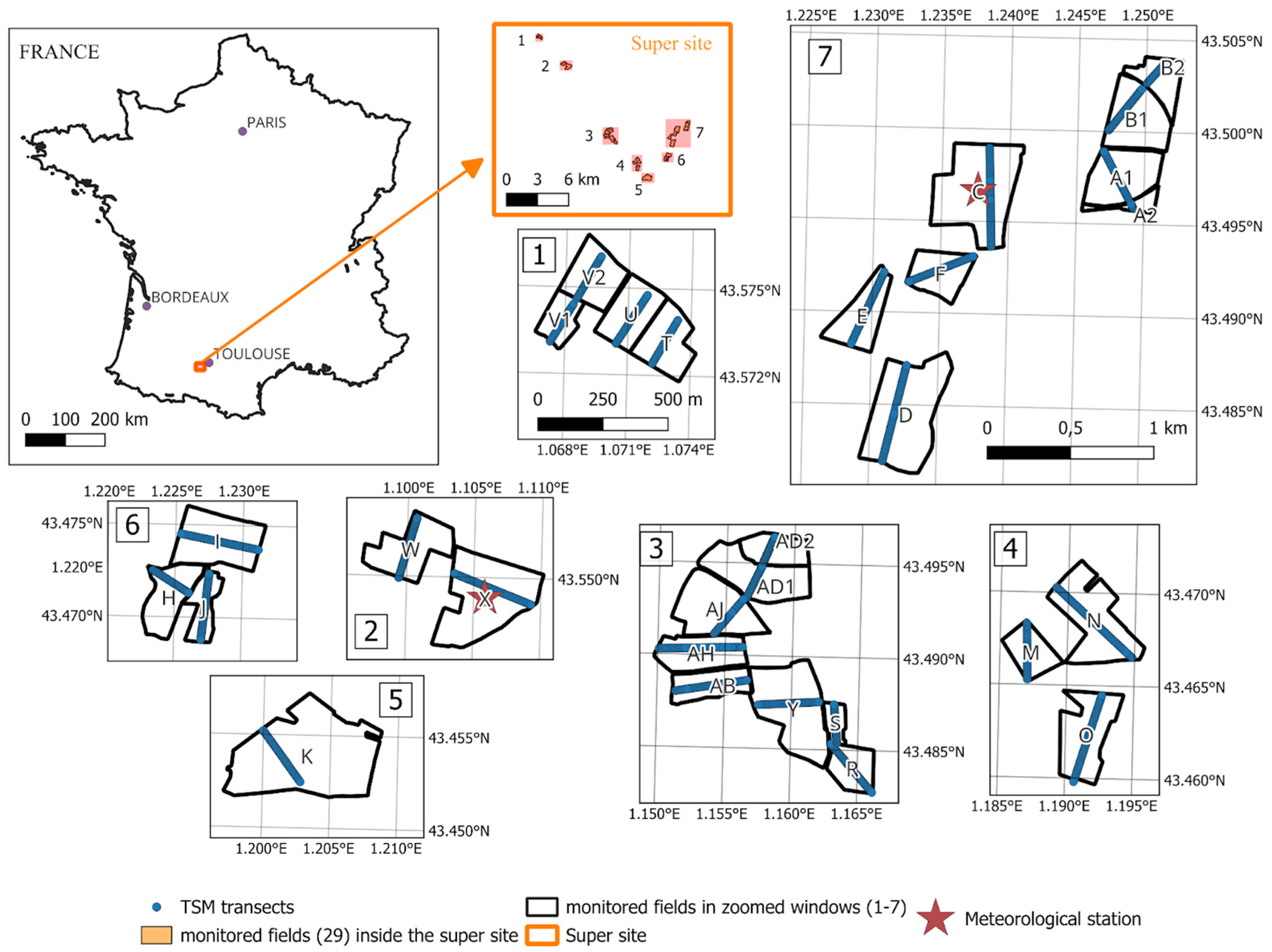
The study area, defined as super site (Figure 1), is in the southwest of France, in the Midi-Pyrénées region. Centered on the coordinates: 43°29′36′′N, 01°14′14′′E, the super site covers a surface close to 420 km2. The landscape is characteristic of the “Garonne′s terraces”, with the presence of hills and alluvial plains. The relief is slightly marked inside the super site, with an east–west contrast. Within this super site, 37 plots were specifically monitored. The plots are flat on the east, with slopes mostly less than 1°. The relief is more marked in the west, with slopes neighboring on average 4.5°. The plots have different shapes and sizes, with areas between 1.5 and 38.2 hectares (11 hectares on average for all the plots). Meteorological conditions are measured thanks to two climatic stations installed in the plots “C” and “X” near the villages of Lamasquère and Auradé. They consist of collecting aboveground and underground data with a regular time step of 30 min. Aerial measurements mainly concern air temperature, humidity, rainfall, wind speed and direction, atmospheric pressure, solar and atmospheric incoming radiation, brightness temperature.
The study site is part of a French observatory called Regional Spatial Observatory South-West (RSO SW, https://osr.cesbio.cnrs.fr/, accessed on 30 December 2025) and part of the Integrated Carbon Observation System (ICOS) international networks [32]. The research activities mainly focused on the monitoring and the assessment of natural and anthropogenic determinants of ecosystem functioning at a regional watershed scale and its landscape. The observatory is also part of the Pyrenees Garonne Regional Workshop Area (ZA PYGAR) and the national Research Infrastructure Critical Zone Observatories: Research and Applications (OZCAR) [33,34]. Moreover, the two experimental sites of Auradé and Lamasquère are part of the JECAM project (Joint Experiment for Crop Assessment and Monitoring, https://jecam.org/, accessed on 18 February 2026).

2.2. In Situ Data

2.2.1. Sampling Protocols

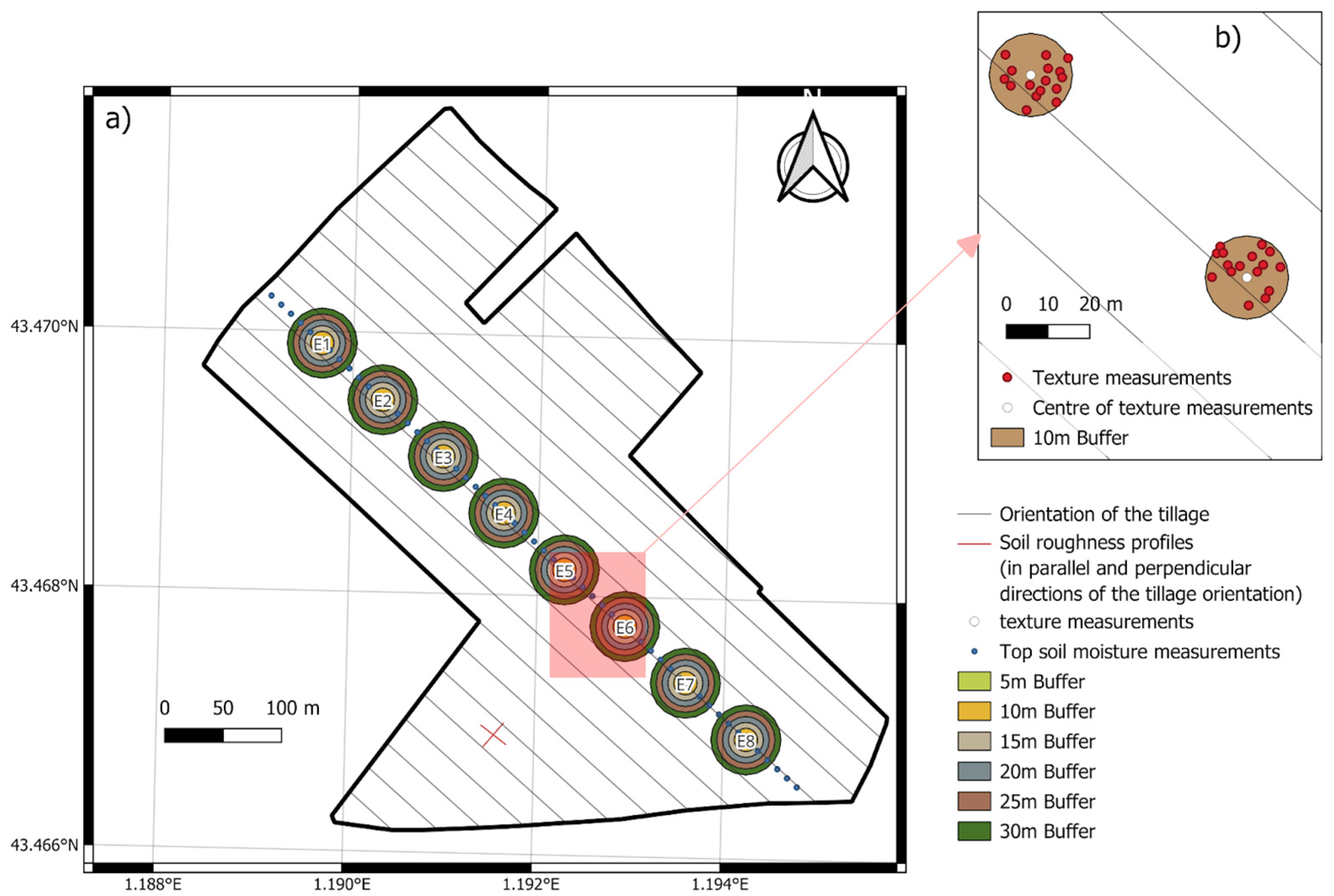
Figure 2 shows an overview map of the protocols used to measure the geophysical variables used in the modeling approach: topsoil moisture (TSM), surface texture, and surface soil roughness. Also shown are the buffer zones used to extract satellite signals over different areas (from 5 to 30 m radius around the measurement of surface soil texture).
The topsoil moisture measurements (0–5 cm) are collected using a calibrated ML2X Thetaprobe every several meters, along transects shown in Figure 1 and Figure 2. The calibration function proposed by [35] and characterized by the following statistical performances: a R2 of 0.75 and a RMSE of 4.1 m3·m−3, was used to convert the probe′s signal (delivered in mV) to volumetric moisture expressed in cubic meters of water per cubic meter of soil (m3·m−3). With lengths ranging from 30 to 616 m (depending on the plot), the total distance of transects reaches 12 km. This protocol is applied for 28 sampling dates (Appendix A).
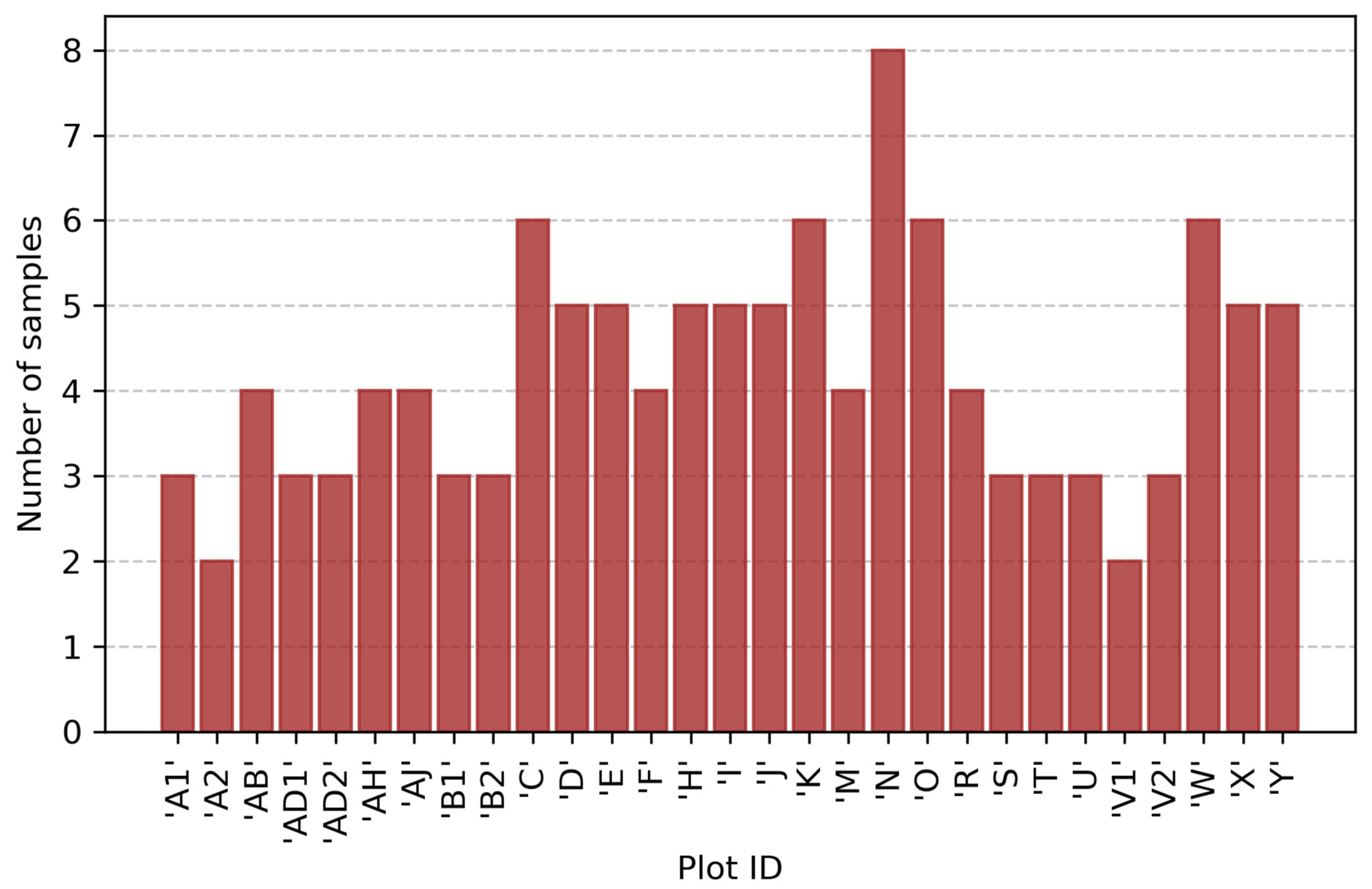
Each soil texture measurement consists of 16 core samples within a circle of 10 m of diameter around a central coordinate (Figure 2b) positioned along the TSM transect. Each sample was taken from the surface horizon, i.e., a depth ranging from 0 to 25 cm. The 16 samples are mixed before proceeding with the particle size analysis. Exactly 122 measurements are carried out on the 29 plots, being between 2 and 8 points per transect, depending on the length of the plot (Appendix B).
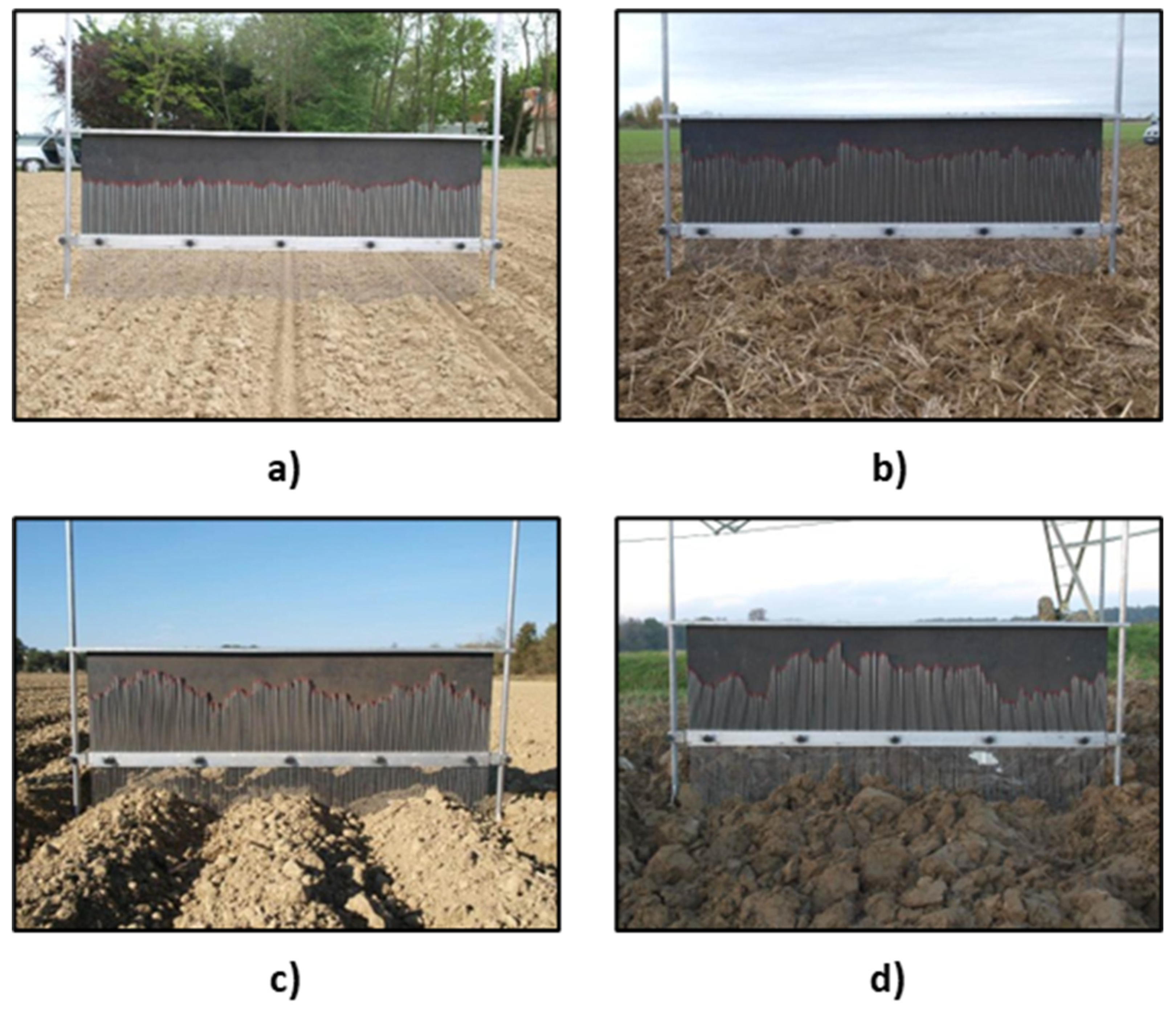
Two protocols are used to regularly characterize the surface roughness over time. The first consists of describing the roughness qualitatively. In this case, the soil roughness is visually classified into four categories: prepared, harrowed, worked, and plowed (see Appendix C for photographs illustrating roughness levels). The second protocol consists of estimating the roughness quantitatively, using a needle profilometer after each tillage event. With a length of 2 m, the profilometer is composed of 201 needles spaced by one centimeter. These needles replicate the micro-relief of the ground, by landing on the surface. The profile described by the top of the needles is photographed. The Hrms (root mean square height) and lc (length of correlation) values are then derived from each profile. At each change in surface state (e.g., transition from a prepared soil to a harrowed or plowed soil) two profiles are collected in parallel and perpendicular direction compared to the tillage orientation. In total, 140 soil roughness measurements have been performed in each direction.
In the following sections, only plots with bare soil are considered (Appendix A).

2.2.2. Topsoil Moisture

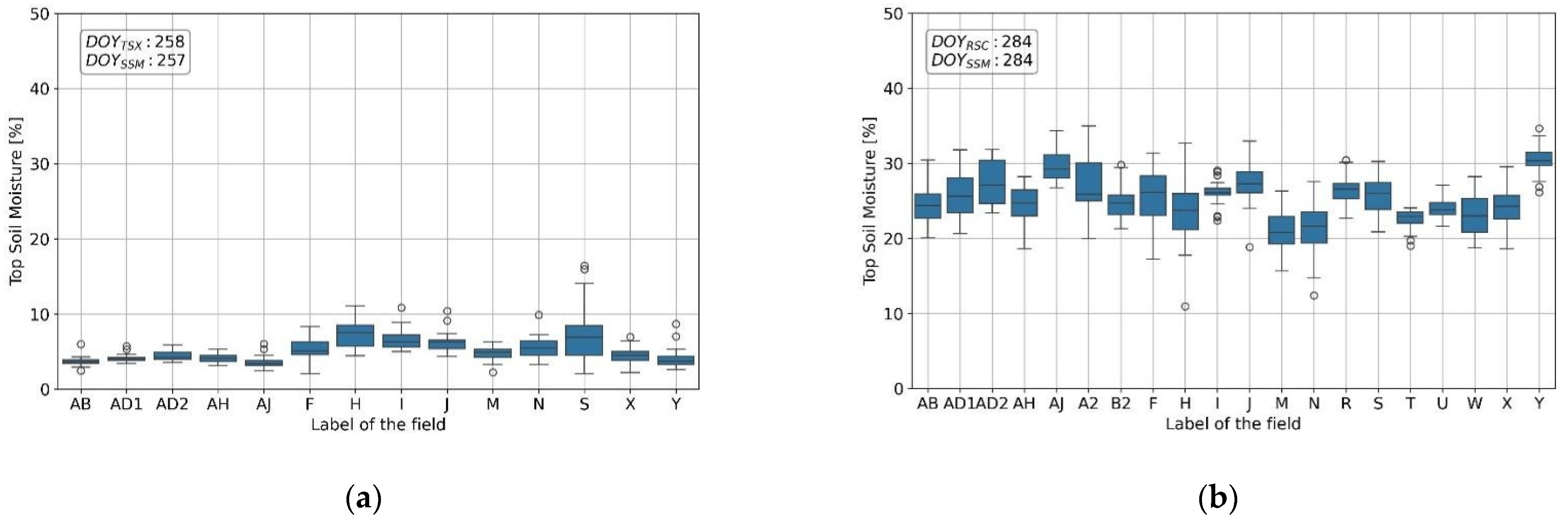
Figure 3 shows box plots of overall TSM values for all bare soil plots for 2 acquisition dates (DOY 257 and 284). These dates were chosen because they differ in terms of soil moisture values, and because many plots are bare. For both dates, the closest satellite acquisition is mentioned. For the DOY 257, one TerraSAR-X acquisition has been performed the day after (DOY 258, Figure 4a), whereas one Radarsat-2 acquisition has been taken the same day as DOY 284 (Figure 4b). The example of day 257 reflects the characteristic values of a dry day (about 6% of TSM on average), unlike day 284, which is representative of a very wet day (about 25% of TSM on average). Whatever the date, soil moisture varies significantly between plots (impact of slope, texture, pebble content, ability to drain water, etc.). A TSM variability of around 4% can be observed between plots during dry periods. It can reach 10% in very wet periods.
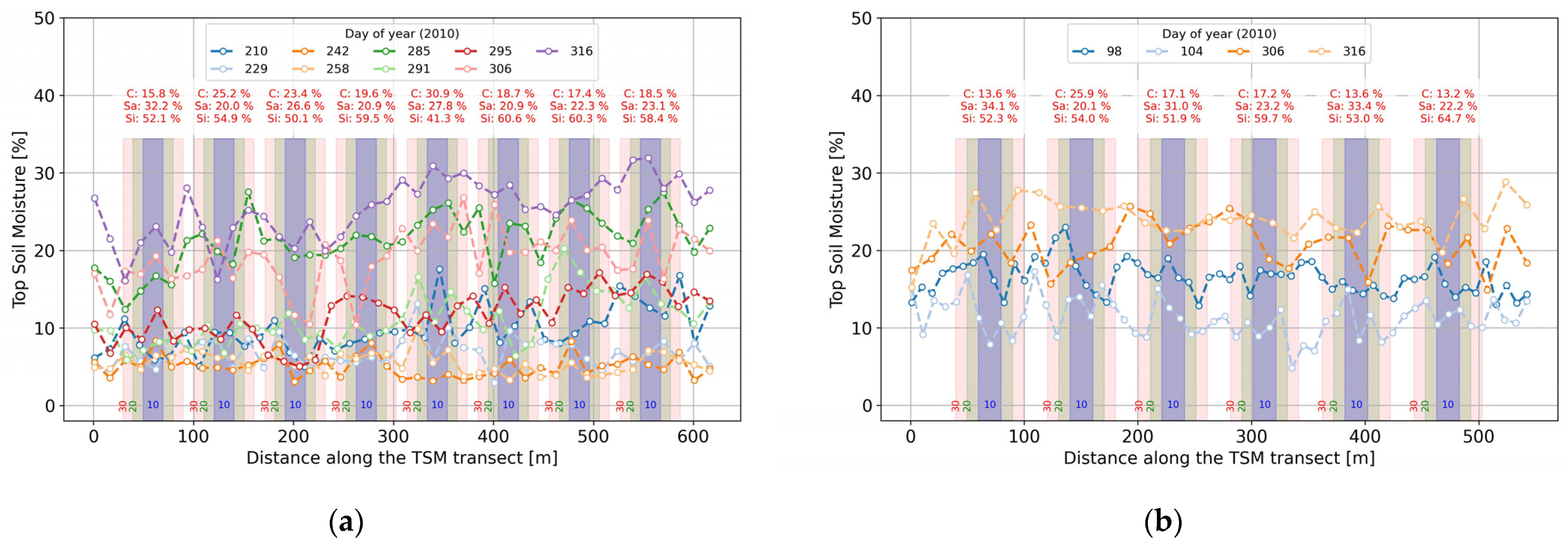
At plot scale, the intra-plot heterogeneity of surface moisture is also visible. Figure 4 shows the evolution of TSM along the transects of plots ′N′ and ′O′ for all the bare soil dates considered. In this figure, the texture values are positioned on the transect as well as the buffer zones used to extract the satellite signals. The spatio-temporal evolution of TSM shows significant variations along the transects. Some areas are drier or wetter depending on their position on the plot. Intra-plot variations can be as important as inter-plot differences (>10%, Figure 4).

2.2.3. Soil Texture

Soil texture (clay, silt (fine and coarse) and sand (fine and coarse)) has been measured on the 29 plots (146 samples have been taken). With fractions between 9 and 58% for clay, between 22 and 77% for silt and between 4 and 53% for sand, the fields cover a wide range of soil textures. The average value of each component is equal to 52% for silt, 24% for clay and sand, illustrating the dominance of silt fraction within the study area. Moreover, the histograms show that 95% of samples have a sand content of less than 40%, and more than half of the points have a clay content which does not exceed 20%. In addition, the soil particles that exceed 2000 μm (stoniness) are observed in 43% of samples (63 of the 146), and their fraction reaches 29% at maximum.

2.2.4. Surface Roughness

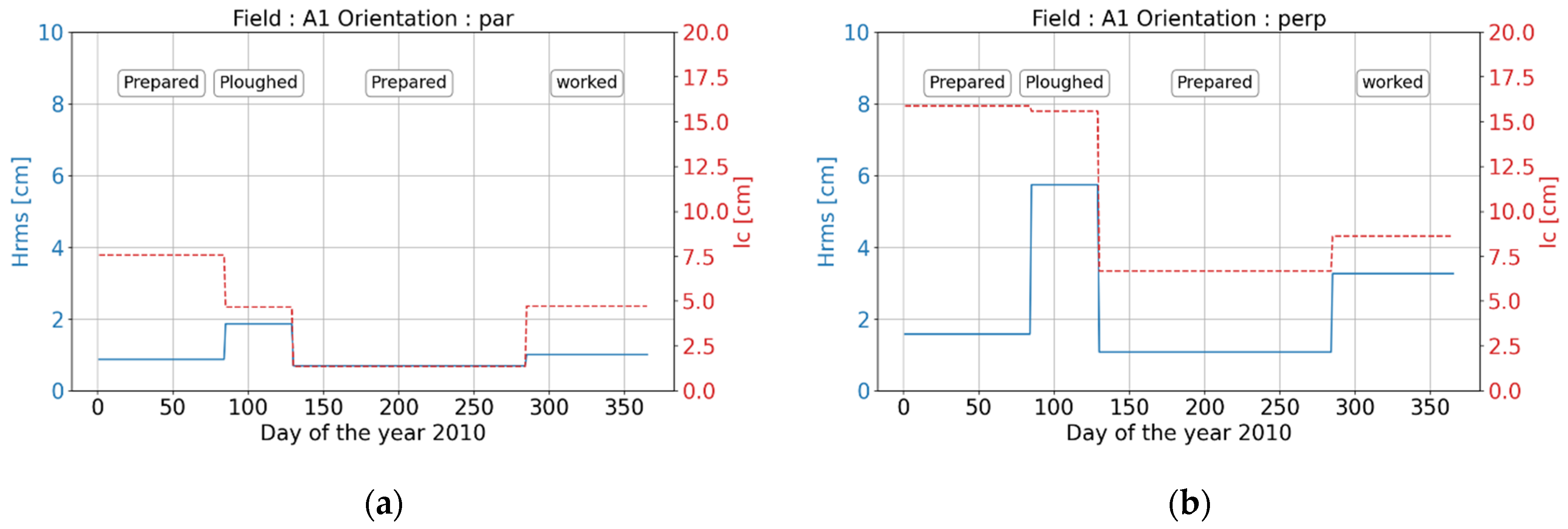
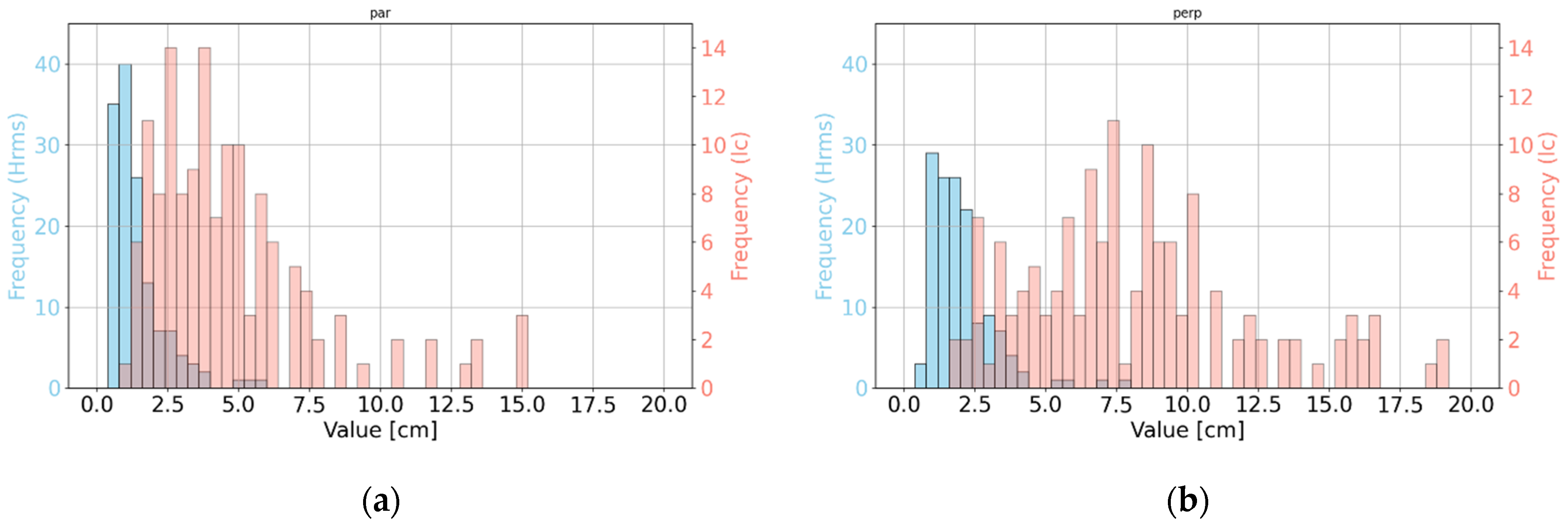
Figure 5 shows the temporal evolution of soil roughness of the field “A1” in the parallel and perpendicular directions to tillage. Three types of tillage are observed for this field: prepared, plowed and worked. Overall, the impact of tillage is well reflected in the roughness values. These values are lower in the parallel direction than in the perpendicular direction, as expected. In the perpendicular direction, they range between 0.6 and 7.8 cm, and 1.9 and 19.0 cm for Hrms and lc, respectively, considering all the monitored fields (Figure 6). In the parallel direction, they are lower and range from 0.4 to 5.6 cm, and 1.0 to 14.9 cm for Hrms and lc, respectively. The number of changes in soil roughness per plot varies between 1 and 6 depending on the farmers′ agricultural practices.
Table 1 summarizes the average roughness according to the four qualitative soil conditions. With average Hrms ranging from 0.93 to 4.04 cm (all directions combined), the heights are lowest for prepared soils, followed by worked and harrowed soils. Plowing produces the greatest roughness. The correlation lengths range between 3.88 and 10.69 cm. They are greater for measurements taken perpendicular to the tillage, because the soil is more regular in this direction.

2.3. Satellite Data

The acquisition dates for the images provided by TerraSAR-X (in SpotLight (TSX_SL) and StripMap (TSX_SM) modes) and Radarsat-2 (RSC) satellites are available in Appendix A. With a total of 50 images, the year 2010 is well documented. The acquisitions are regularly distributed over the year, with many acquisitions during periods of bare soil on many plots.
TerraSAR-X images are provided by the German aerospace center. They are acquired in StripMap (n = 14) and SpotLight (n = 15) modes, with pixel spacing respectively equal to 6.5 m, and 3.5 m. Incidence angles range between 27° and 53°. All images are acquired at HH polarization. Backscattering coefficients are calculated by using Equation (1), based on a procedure described by [36]:
σ ° pq = 20 × log 10 ( DN pq ) + 10 × log 10 ( CF ) + 10 × log 10 ( sin ( θ ) ) ,
where DN is the digital number, CF represents the calibration factor and θ indicates the average incidence angle within the plot. “p” and “q” represent the polarization states: horizontal or vertical.
Radarsat-2 images (n = 21) are provided by the Canadian space agency through the SOAR (science and operational application research) program. This sensor operates at C-band, like Envisat or Sentinel-1, following a repeat cycle equal to 24 days [37]. All images are acquired in the fine quad polarization mode (HH, VV, VH and HV) with incidence angle range from 23° (FQ5) to 41° (FQ21). Pixel spacing is equal to 5 m. Images are radiometrically and geometrically calibrated by using the NEST software, version EC (Equation (2)).
σ ° pq = 20 × log 10 ( DN pq / A 2 ) + 10 × log 10 ( sin ( θ ) )
where the gain (A2i,j) comes from Radarsat-2 product metadata.
The final geo-coding of all high spatial resolution RADAR images is assessed by superimposing all images onto IGN (Institut Géographique National) ortho-photos.

3. Methods

The estimation of TSM is based on the statistical algorithm proposed by [38]. Random forest has been widely used in various fields, particularly with satellite observations, providing a suitable response both for land cover classification purposes [39,40] and for monitoring dynamic variables such as topsoil moisture [41,42], providing accurate estimates of both qualitative (through classification) and quantitative (through regression) variables. This non-parametric approach consists of combining an ensemble of independent decision trees trained on different sets of samples, through a procedure called bagging (abbreviation of bootstrap aggregating). Each decision tree is first trained on a subset of randomized samples derived from the initial dataset using bootstrap procedure and used to provide estimates for the remaining independent samples. The decision trees are finally aggregated through the weighted mean of the ensemble of estimations, providing an estimate of the targeted variable. Unlike other statistical methods that may have limitations related to problems of over-adjustment, noise influence on data, or stability of results, random forests are particularly appropriate in multi-factorial contexts to model non-linear relationships.
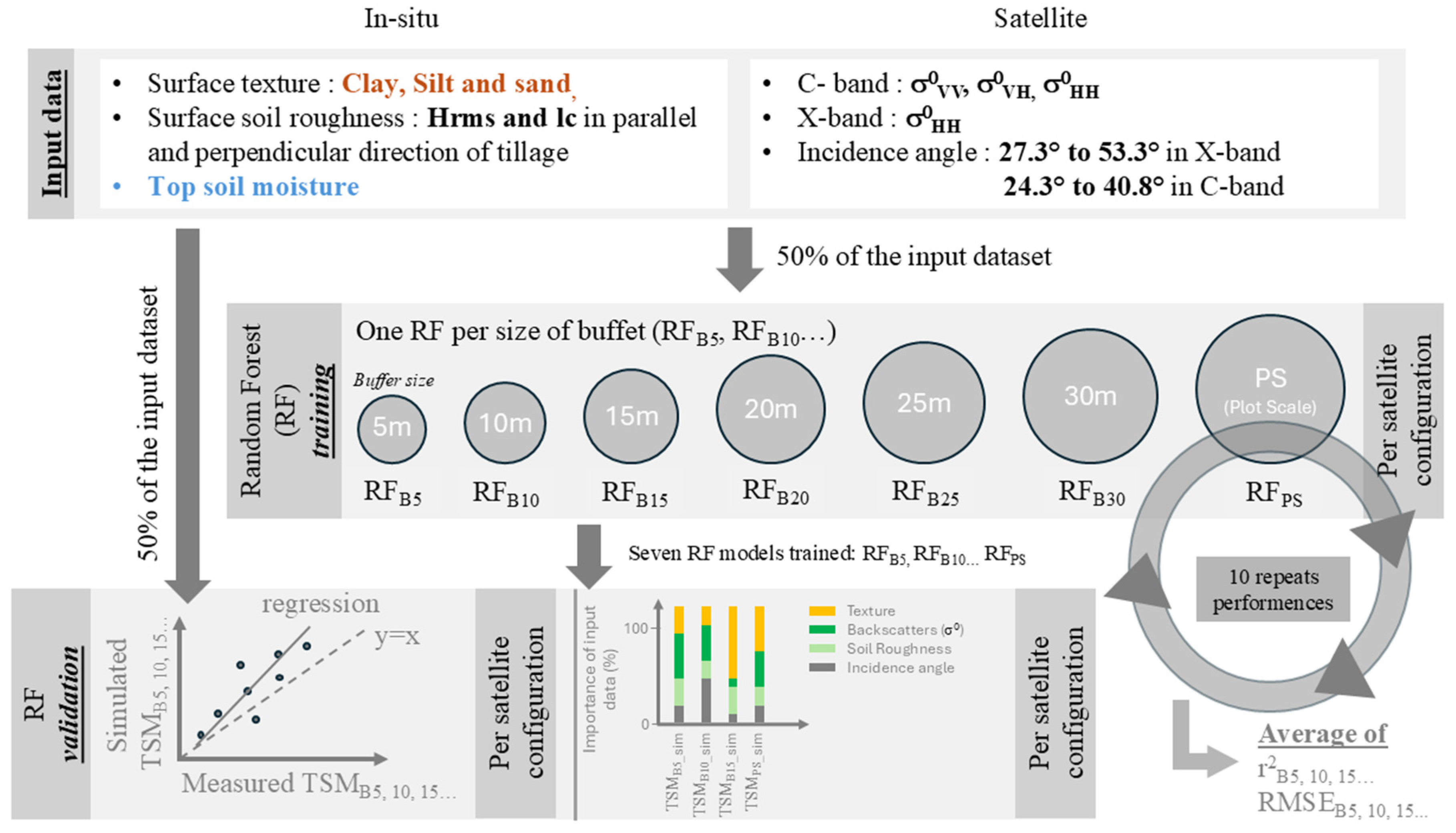
The following variables constitute the input of the statistical algorithm: the backscattering coefficients and their corresponding incidence angle regarding the SAR images; the fractions of clay, silt, and sand regarding the texture; and the standard deviation of roughness heights and the autocorrelation length collected in the directions parallel and perpendicular to the tillage orientation regarding the surface roughness (Figure 7).
The dataset was randomly partitioned into a training set and a testing set (half of the data). The statistical algorithm was calibrated on the training set and validated on the independent testing set, repeating the procedure ten times. The coefficients of determination and root mean square error are finally derived from the comparison between the observed and estimated values of topsoil moisture. These training/calibration steps are repeated as many times as there are spatial scales to consider (for the 6 buffers from 5 to 30 m, and for the plot scale: PS). Finally, seven RF models are created, one for each spatial coverage. They are labeled RFB5, RFB10 and so on.

4. Results

4.1. Estimation of TSM from Radarsat-2 Data

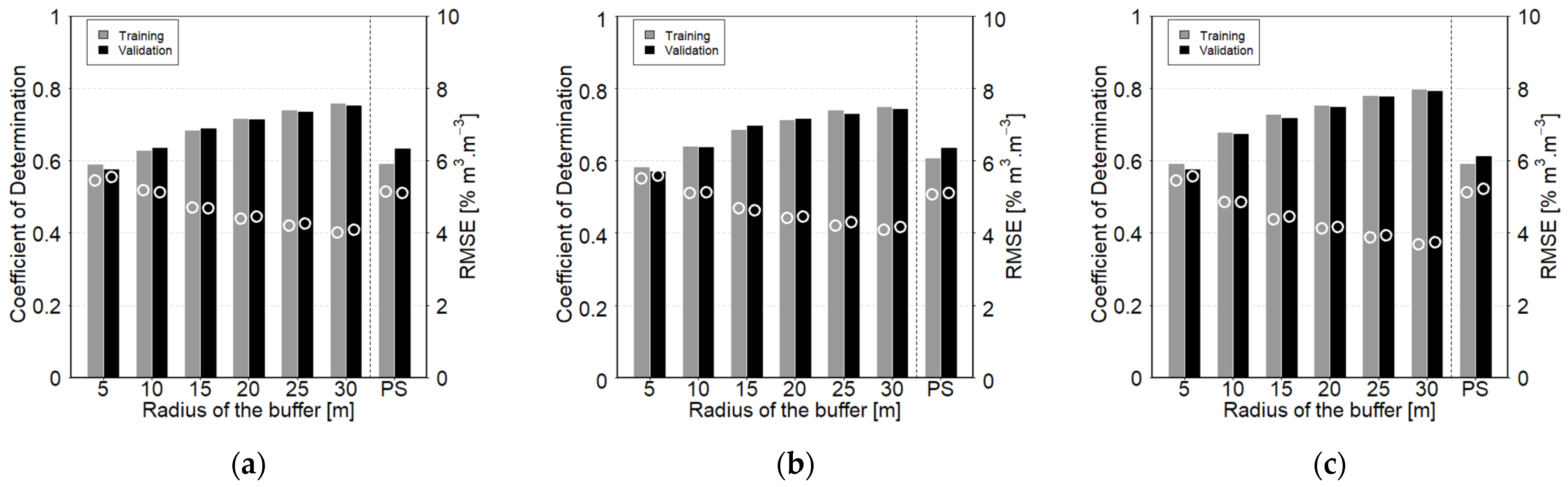
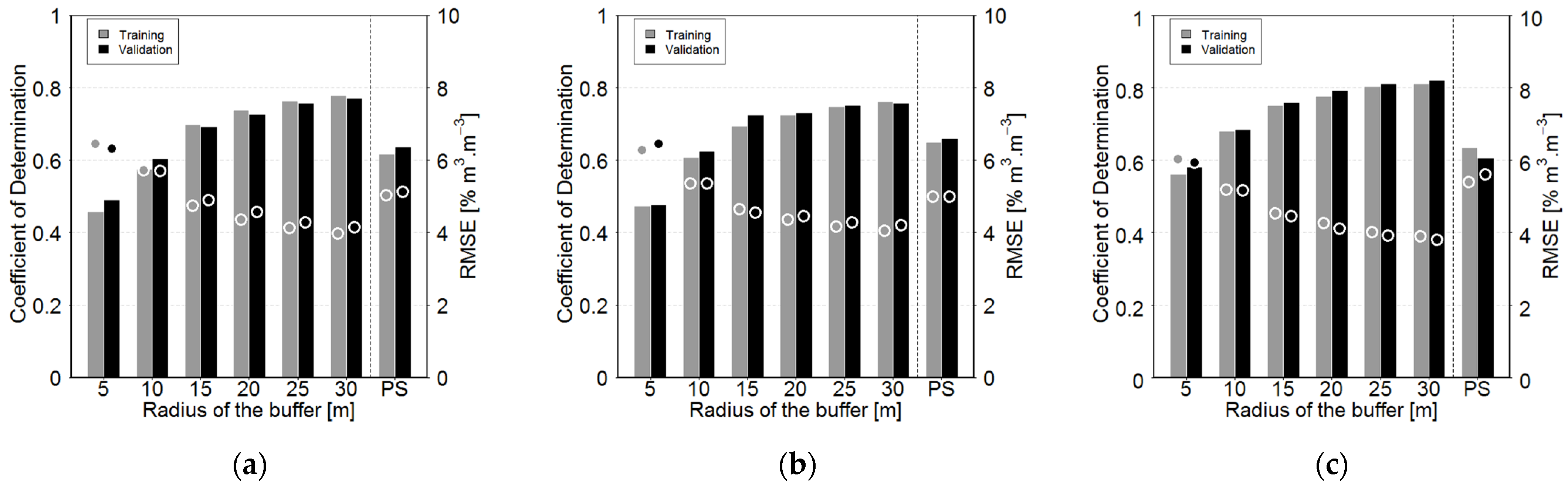
Figure 8 shows the statistical performances (R2 and RMSE, and other criteria such as rRMSE, bias, offset and slope between observed and estimated TSM values in Appendix D) obtained by comparing the topsoil moisture values estimated using the statistical approach with ground measurements, at the intra-plot scale, i.e., for circular buffers ranging from 5 to 30 m, as well as the results obtained at the plot scale (PS). Statistics are presented for signals acquired in the C-band with polarization states HH, VV and VH, distinguishing the subsets of samples used for the training and validation. Whatever the considered polarization states, performances increase quasi-linearly with the size of the buffer zone when the approach is applied at the intra-plot scale. The accuracy levels at the intra-plot scale exceed those obtained at the plot scale, apart from the results obtained when considering a 5 m radius zone. For co-polarized signals (i.e., HH and (VV)), R2 values increase from 0.58 to 0.75 (0.57 to 0.75), with SSM errors decreasing from 5.54 to 4.08 m3·m−3 (5.58 to 4.16 m3·m−3), when considering the 5 and 30 m buffers. At plot scale, performances are equal to 0.63 and 5.10 m3·m−3 (0.64 and 5.10 m3·m−3), for the validation subset of samples in HH and VV, respectively. For cross-polarized signals (only those derived from VH signals are presented here for the sake of brevity), the performances obtained at the intra-plot scale are slightly better, with R2 ranging from 0.58 to 0.79 and errors from 5.56 to 3.74 m3·m−3, while the results at the plot scale are comparable to those associated with co-polarized signals (R2 of 0.61 and RMSE of 5.22 m3·m−3). Regardless of the configuration considered, the results show a certain dispersion, which is comparable between independent data sets used for training or validation.

4.2. Estimation of TSM from TerraSAR-X Data

Figure 9 shows the statistical performance (other criteria are presented in Appendix E) associated with estimating topsoil moisture based on X-band signals acquired with incidence angles of 27.3° (a), 53.3° (b), or considering all data with merged incidence angles (c). As observed for the C-band, statistical performances increase according to the size of the buffer (i.e., from 5 to 30 m). The gain in performance being more moderate from the 20 m radius onwards. On the validation subset of samples, the values of the coefficient of determination increase from 0.49 to 0.77 and from 0.48 to 0.76, with errors decreasing from 6.32 to 4.15 m3·m−3 and from 6.44 to 4.19 m3·m−3, for estimates based on images acquired at 27.3° and 53.3° respectively, when considering the 5 and 30 m buffers. When the statistical approach is implemented on images acquired at various angles of incidence (i.e., 27.3°, 28.7°, 31.8°, 32.3°, 41.7°, 45.5°, and 53.3°, representing 39, 2, 6, 3, 5, 9 and 36% of the dataset respectively), performance is slightly better, as the algorithm takes advantage of the larger number of observations. The values of the statistical indicators obtained on the validation subset of samples then range from 0.58 to 0.82 for the R2, and from 5.93 to 3.79 m3·m−3 for the RMSE. Whatever the considered modality (i.e., single, or multi-incidence angle approach), the performance levels obtained at plot spatial scale are lower than those obtained at intra-plot scale for buffer zones greater than 10 m, as shown by the R2 and RMSE values, ranging from 0.61 to 0.66 and from 5.60 to 4.98 m3·m−3, respectively.
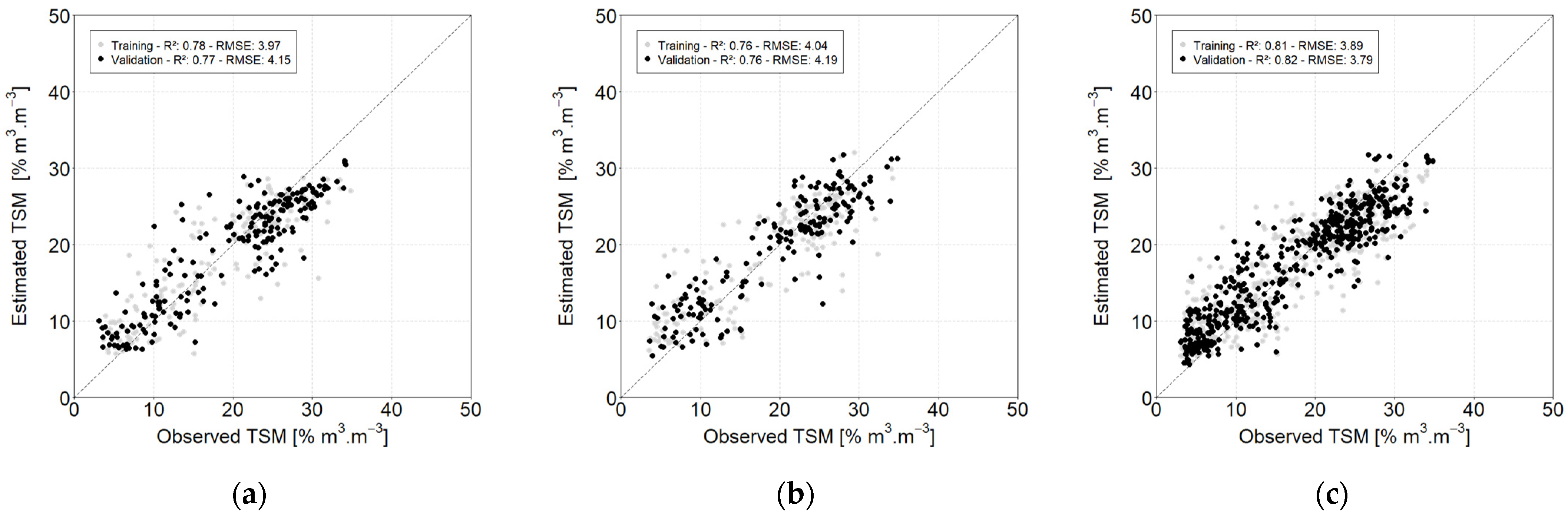
The comparative analysis of TSM estimations for the three incidence angle configurations (Figure 10) highlights the influence of acquisition geometry on soil moisture estimation accuracy. At an incidence angle of 27.3° (Figure 10a), the model achieves a high correlation (R2 = 0.78 for training and 0.77 for validation) with moderate error (RMSE ≈ 4% m3·m−3), although some bias persists at extreme values (overestimates and underestimates for low and high TSM values, respectively). At 53.3° (Figure 10b), performance remains stable and high (R2 = 0.76; RMSE ≈ 4.1). Merging both angles (Figure 10c) significantly improves estimation quality, with R2 exceeding 0.81 and RMSE below 3.9 m3·m−3 for both datasets. This improvement confirms the value of multi-incidence approaches in reducing bias and enhancing model robustness by adding complementary angular information.

4.3. Relative Importance of the Explanatory Input Variables

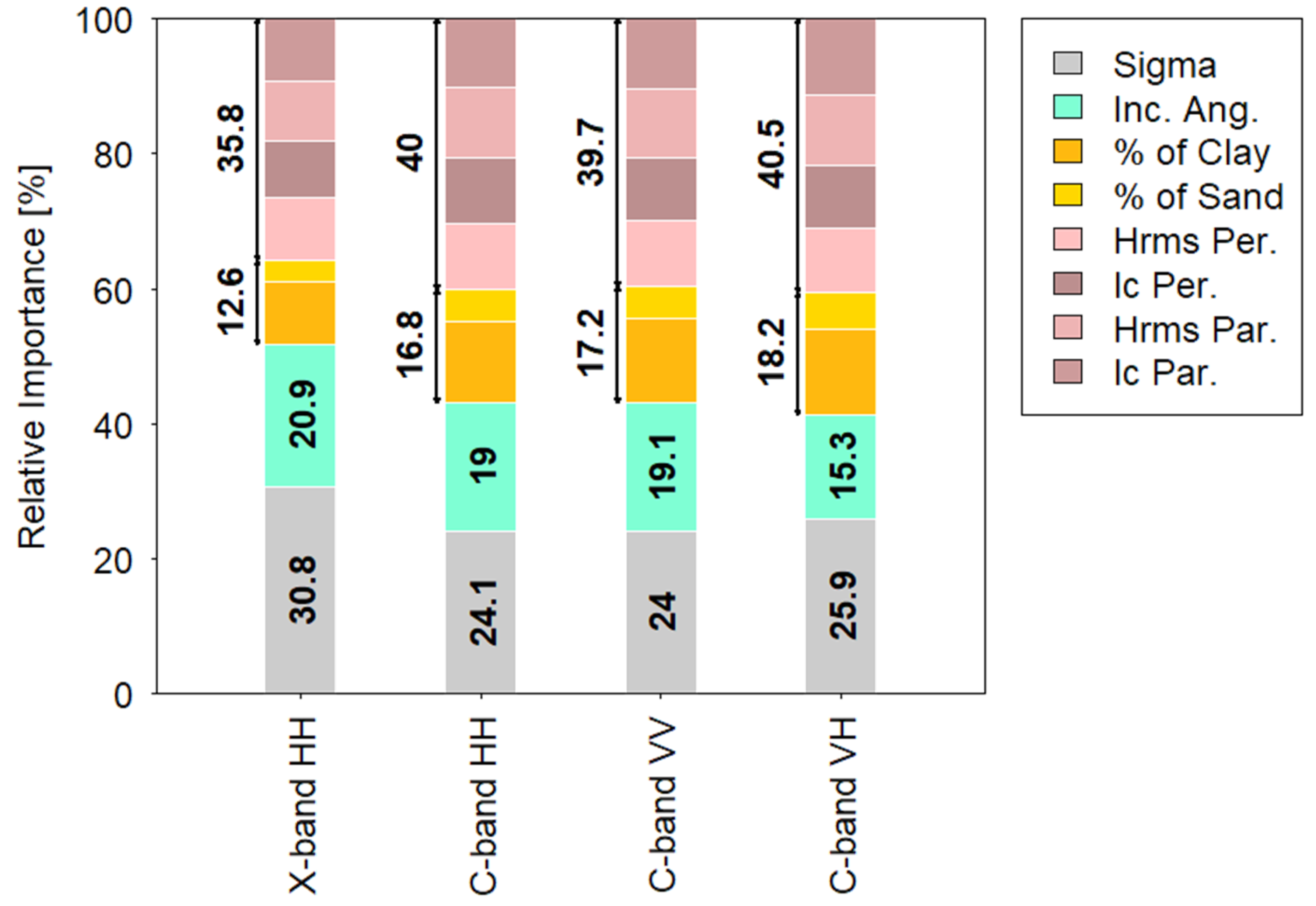
The relative importance of the input variables of the RF modeling approach is presented in Figure 11, focusing on the results obtained for the 30 m radius buffer. The four components of roughness (i.e., Hrms and lc measured in the perpendicular and parallel direction) have a more pronounced relative importance than other explanatory input variables, whatever the considered satellite configuration (with a relative importance of 35.8% in X-band, and a level close to 40.0% in C-band). Regarding texture variables, the relative influence of clay content is always greater than that of sand content. The cumulative relative importance of these two texture components is slightly higher in C-band than in X-band.
Finally, the influence of the backscattering coefficients ranges from 24.0% to 30.8% depending on the considered satellite configuration. The relative importance associated with SAR images rises to first place when the influence of the angle of incidence and that of backscattering coefficients are combined. The relative importance levels are then between 41.2% and 51.7% for signals acquired in the C-band with VH polarization state and X-band with HH polarization state, respectively.

5. Discussion

5.1. Evaluation of the Statistical Algorithms Compared to Approaches Developed in the Literature

The performance obtained for estimating soil moisture based on X-band and C-band SAR data varies depending on the diversity of image configurations (particularly the angle of incidence and polarization states), the approaches and models used, and the spatial scale considered. However, performance levels generally fall within a fairly similar range of accuracy, with RMSEs averaging between 2% and 7% in volume for the X band [11,13,14,21,31,43,44,45,46,47,48,49,50], and between 2% and 6% for the C band [15,28,51,52,53,54,55,56,57,58,59,60,61,62], for studies conducted under bare soil (or lightly vegetated) conditions.
Two main types of approaches are used, or combined, to estimate surface moisture: physical and semi-empirical models, and artificial intelligence. The IEM model is the physical reference for bare soil [63]. The semi-empirical models of Dubois and Oh, based on experimental observations, are favored for their simplicity of analytical inversion [24,64,65]. However, these original models have contrasting performances and limited areas of validity, particularly with regard to the roughness conditions observed in agricultural contexts [30]. These limitations persist even in modified or calibrated versions of these models [30,66]. At a crossroads, hybrid approaches combine modeling and artificial intelligence, with neural networks being adopted to invert complex physical models [52,54,58]. This raises the question of the representativeness of the synthetic data used to train neural networks. Other techniques such as support vector machine or random forest effectively capture non-linear relationships directly from training data [31,50,55]. These different algorithms offer the most robust and operational performance, particularly when they integrate auxiliary data (topography, texture, weather) [53].
In the C band, most research uses Sentinel-1 (A and B) data because it is freely available and has high spatial resolution [51,53,54,55,58,59]. Canadian missions are also predominant, notably Radarsat-1 for multi-angle approaches [15,60,61,62], Radarsat-2 for full polarimetry exploitation [50,54,55], and the recent Radarsat constellation mission for compact polarimetry [28]. Work in the X band relies mainly on images delivered by TerraSAR-X [11,13,14,21,31,44,45,47], sometimes combined with COSMO-Skymed images [43,46,49], or the SIR-C/X mission [48]. With a total of 50 images regularly acquired throughout an entire cultural year, the database compiled in this study is highly diverse, both in terms of satellite image configurations, and surface conditions. This specificity reinforces the robustness of the proposed approach, but as in the studies listed, the results are limited to a single study site, often with specific conditions and a restricted domain of validity, limiting transposition to other agrosystems.
A future research perspective would be to pool different databases, provided that the measurement protocols are comparable. This would allow the various approaches used, whether empirical, based on machine learning algorithms, semi-empirical models, or physical models, to be compared on the same reference basis.
Ultimately, regardless of the images used and the approaches implemented, satellite estimates of TSM rely on radar backscatter coefficients, whose accuracy is strongly influenced by the SAR acquisition mode [25]. In this study, performance improves as the buffer zone increases. It can largely be explained by radiometric resolution, which determines how effectively the SAR signal can distinguish between surfaces with different moisture conditions. The poorer performance associated with 5 m buffers can be explained by the poor radiometric resolution of SAR signals, with a strong impact from speckle effects and a low number of pixels used to calculate the median value of backscatter coefficients [12]. Conversely, signals extracted with better radiometric resolutions (i.e., using larger buffers) provide higher-quality simulations. However, at the scale of the entire plot, accuracy decreases even when radiometric resolution levels are more favorable [25,67], because heterogeneous surface conditions cannot be reliably represented by a single average backscatter value.

5.2. Analysis of the Effects of Incidence Angle, Polarization States, and Frequency on Topsoil Moisture Estimations

This section aims to evaluate how different SAR acquisition modes and signal characteristics influence estimates of TSM. Indeed, one of the specific features of the database is the acquisition of SAR satellite images with a variety of modalities, in terms of incidence angles, polarization states and frequencies. These sensor parameters determine the intensity of the backscattering signals, as shown by various preliminary studies carried out prior to mission launch [20,68,69,70], and the sensitivity to surface variables, particularly in the context of the proposed study, sensitivity to TSM, roughness, and texture.
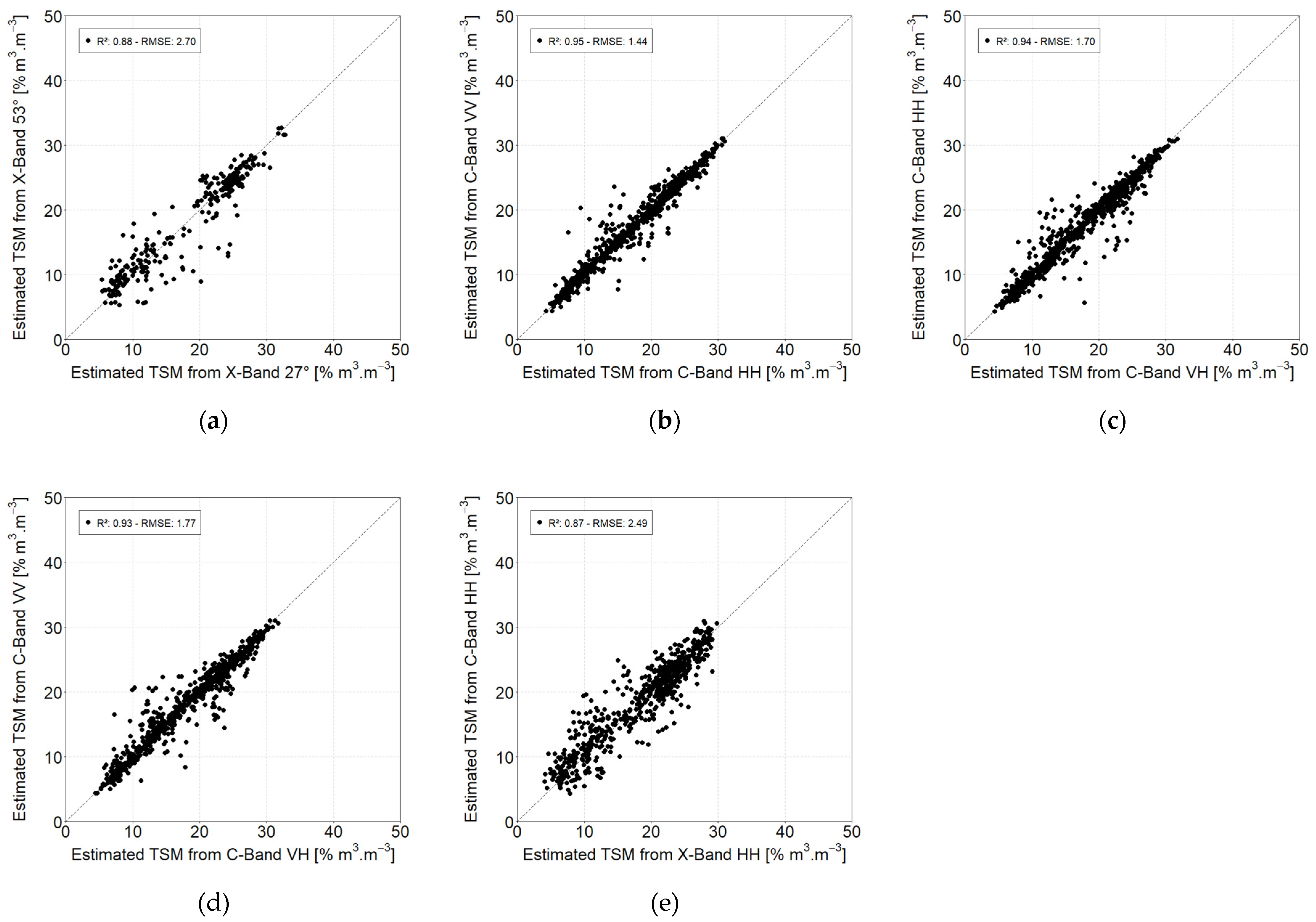
The comparative analyses illustrated in Figure 12 demonstrate that the proposed TSM retrieval methodology maintains consistent performance across all tested SAR acquisition configurations. Based on the RFB30 models, the following estimates are compared, derived from:
-
TSX images acquired at one-day intervals, at low and high incidence angles (Figure 12a);
-
the different polarization states provided by the RSC images (Figure 12b–d);
-
TSX and RSC images acquired at ± one day intervals, with different incidence angles, and the same polarization state (i.e., HH, Figure 12e).
Although the images differ in terms of incidence angle, polarization state, and operating frequency, the resulting estimates present similar temporal dynamics and comparable absolute values. This is reflected by stable performance metrics across configurations, with R2 values consistently above 0.87 and RMSE values below 2.70% m3·m−3, indicating a limited sensitivity of the approach to variations in acquisition mode. The C-band comparisons (Figure 12b–d) further confirm this stability. The different polarization states lead to nearly overlapping series of estimates, particularly for co-polarized channels, where the temporal evolution is strongly correlated. This similarity can be attributed to the simultaneous acquisition of the images, ensuring identical observation conditions and, therefore, limiting the influence of surface changes between acquisitions. These results suggest that, for the conditions encountered, surface roughness and soil texture do not induce detectable polarization-dependent variations in the TSM retrieval.
In contrast, greater dispersion is observed when comparing X-band images acquired at low and high incidence angles (Figure 12a) and when comparing X- and C-band data (Figure 12e). In both cases, the differences are primarily associated with temporal offsets of ±1 day between acquisitions and, occasionally, with changes in chronological ordering (X-band preceding or following C-band). These offsets generate inherent variability due to natural surface evolution rather than differences related to the SAR system itself. Consequently, the dispersion observed in these cases should be interpreted as a manifestation of environmental variability between acquisition dates rather than a methodological limitation.
Overall, the results confirm that the retrieval approach is robust regarding SAR configuration, even when the sensor characteristics differ markedly. The limited dependence on incidence angle, polarization, and frequency suggests that the method can be applied to heterogeneous SAR archives without specific tailoring to each configuration, provided that acquisition timing and surface evolution are considered when interpreting cross-sensor comparisons. This conclusion supports the operational potential of the approach for multi-mission or long-term monitoring frameworks.

5.3. Capability of Intra-Plot Soil Moisture Monitoring for Precision Agriculture

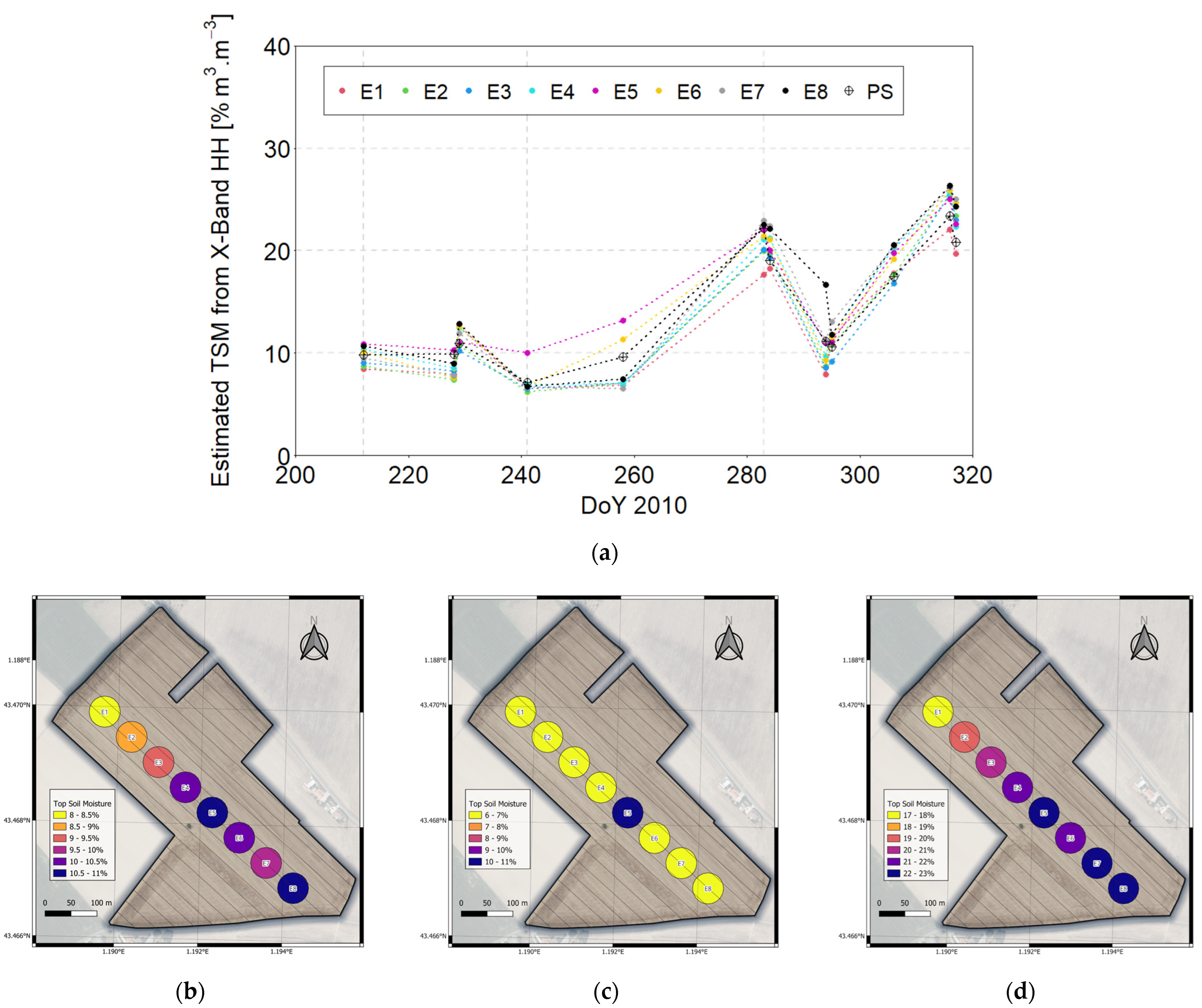
This section examines the consistency of the topsoil moisture estimates, focuses on the plot with the highest number of bare-soil days. Consistency analyses on TSM estimates focus on the plot with the most observations (field “N”) and on the best-performing SAR configuration. The TerraSAR-X RFB30 model (30 m buffer, all angles) delivers the highest accuracy, with R2 > 0.81 and RMSE < 3.90% m3·m−3.
On this plot (Figure 13a), the bare soil period is observed following the harvest of the straw cereal (30 June 2010, DOY 181), and until the sowing of the following crop (6 November 2010, DOY 310). During this period, surface conditions change, with TSM values varying between 6.20 and 26.37% m3·m−3, and tillage (6 November 2010, DOY 310) changing the roughness from a “stubble disked” to a “prepared” state (with mean Hrms values of 1.59 and 0.89 cm, respectively). Estimates of TSM at the 96 collection points per dates at the intra-plot scale show higher statistical levels compared to RFB30 overall performances, with an R2 of 0.89 and an RMSE of 2.83% m3·m−3. Following the straw cereal harvest, the general trends observed are as follows (Figure 13a): dry conditions with estimated values below 13.50% m3·m−3, followed by higher values at the end of the year, exceeding 16.50% m3·m−3, interspersed with a period of surface drying.
The temporal dynamics obtained at points along the measurement transect show strong consistency, as evidenced by the correlation levels between the different temporal TSM profiles, with values ranging between 0.92 and 0.99.
The simulation carried out at the plot spatial scale, based on the RFPS model, shows temporal dynamics comparable to those obtained at the different points. Furthermore, the values estimated at the plot scale are systematically contained within the range of variation in the values estimated at the different points (Figure 13a). Beyond the consistency between estimates obtained at different spatial scales, the implementation of the RFB30 model makes it possible to quantify the spatial variability of topsoil moisture at each satellite acquisition. Along the transect, notable differences in TSM levels are observed, with intervals between extreme values ranging from 2.46 to 8.72% m3·m−3, depending on the considered date. These estimated levels of variability along the transect are greater than the error associated with the model on the plot of interest (i.e., RMSE of 2.83% m3·m−3) for 10 of the 12 considered dates. This spatial variability in simulated TSM values is not random along the transect; a notable trend with increasing values is observed on several dates in dry conditions (Figure 13b, DOY 212) or wet conditions (Figure 13d, DOY 283). Under very dry conditions (Figure 13c, DOY 241), this trend disappears, and only the estimated TSM at point E5 provides contrast.
The anomaly observed at point E5 in Figure 13c, systematically showing higher values than the rest of the transect, also appears on most simulated dates, with the contrast becoming more pronounced under dry acquisition conditions. This behavior is partly attributable to soil texture, since E5 has a higher clay content (30.9%) than the other points (ranged between 15.8 and 25.2%). However, texture alone cannot account for the elevated estimates, particularly during summer acquisitions (DOY 242 and 258). A plausible explanation is that point E5 is in a local area of water accumulation, with close access to irrigation supply for the adjacent corn field and a specific topography configuration. Field inspection confirmed that this point is located on a relatively flat surface, immediately downstream of a runoff direction and close to an accumulation zone, a topographical configuration that promotes water convergence and results in soil moisture values that are consistently higher than those of surrounding points.

6. Conclusions

This study assessed the potential of high-resolution SAR measurements acquired at X- and C-band for estimating TSM over bare agricultural soils, based on an extensive multi-temporal dataset collected across 29 fields in southwest France. Across all SAR configurations tested, the intra-plot extraction strategy consistently yielded more accurate results than plot-scale aggregation, with optimal performance obtained for a 30 m buffer radius (R2 > 0.80; RMSE < 4 m3·m−3). The improvement with increasing buffer size also highlights the importance of the adequation between the scale of ground measurements, radiometric resolution, and speckle reduction (by applying the mean filter here) in high-resolution SAR-based soil moisture retrieval. The integration of ancillary variables had a major influence on model performance. Soil texture and roughness significantly improved TSM estimates, confirming their essential role in capturing the nonlinear and frequency-dependent contributions of surface scattering. This underscores the importance of combining SAR observables with ground or modeled soil properties when targeting fine-resolution soil moisture mapping. The random forest algorithm is particularly well suited for handling the complexity of radar backscatter, offering high accuracy and stability across spatial scales and acquisition geometries. The study also demonstrates that intra-plot variations in TSM can be substantial, often greater than inter-plot differences, highlighting the interest of using high-resolution images for getting moisture information in the domain of precision agriculture. The ability of the proposed approach to detect these fine-scale gradients offers valuable potential for applications such as irrigation optimization, delineation of hydrological functional zones, early detection of water stress, and support for variable-rate management practices.
Future work should extend the present approach beyond bare soils to vegetated conditions, where the interaction between canopy structure and soil scattering requires additional ground and satellite observables such as polarimetric indicators, vegetation indices, and measurements (leaf area index, biomass, or plant water content). The demonstrated complementarity between X- and C-band suggests that multi-frequency and multi-incidence fusion strategies could further improve retrieval robustness, particularly under heterogeneous surface conditions. Finally, applying the proposed approach to other study sites with contrasting soil conditions and agricultural practices would make it possible to test the robustness and limitations of the method and quantify its potential for generalization.

Author Contributions

Conceptualization, R.F. and F.B.; methodology, R.F. and F.B.; formal analysis, R.F. and F.B.; writing—original draft preparation, review and editing, R.F. and F.B. All authors have read and agreed to the published version of the manuscript.

Funding

This research received no external funding.

Institutional Review Board Statement

Not applicable.

Informed Consent Statement

Not applicable.

Data Availability Statement

The data presented in this study are available on request from the corresponding author.

Acknowledgments

The authors wish to thank the DLR (German Space Agency), SOAR Project and CNES (Centre National des Etudes Spatiales) for their support, funding, and satellite images (proposal HYD0611 and SOAR-EU and Categorie-1 ESA project no. 6843). In addition, the authors wish to thank the farmers (Blanquet, Bollati, Brardo, Pavan, and Peres) for their time and precious discussion and the people who helped to collect the ground data.

Conflicts of Interest

The authors declare no conflicts of interest.

Appendix A

Table A1. Summary of topsoil moisture, TerraSAR-X (SpotLight and StripMap modes) and Radasat-2 measurements. For each satellite acquisition the plots in bare soil condition are notified. The number of acquisitions is noted in the first line of the array (n = …).
TSM
Measurements
(n = 28)
TSX_SM (n = 14)TSX_SL (n = 15)RSC (n = 21)
DOYDOYParcel IDDOYParcel IDDOYParcel ID
5151′C′,′D′,′E′,′T′,′W′64′C′,′D′,′E′51′C′,′D′,′E′,′T′,′W′
5858′C′,′D′,′E′,′T′,′W′75′C′,′D′,′E′58′C′,′D′,′E′,′T′,′W′
6485′A1′,′C′,′D′,′E′,′K′,′L1′,′T′,′U′,′W′98′A1′,′B1′,′C′,′D′,′E′,′K′,′L1′,′O′64′C′,′D′,′E′,′T′,′W′
75130′D′,′K′,′L1′104′A1′,′B1′,′C′,′D′,′E′,′K′,′L1′,′O′75 *′C′,′D′,′E′,′T′,′W′
85140′K′,′L1′120′D′,′K′,′L1′,′R′85′A1′,′C′,′D′,′E′,′K′,′L1′,′T′,′U′,′W′
98196′AB′,′AD1′,′AD2′,′AH′,′AJ′140′K′,′L1′98′A1′,′B1′,′C′,′D′,′E′,′K′,′L1′,′O′,′W′
104210′AB′,′AD1′,′AD2′,′AH′,′AJ′,′F′,′G′,′H′,′N′196′AB′,′AD1′,′AD2′,′AH′,′AJ′104′A1′,′B1′,′C′,′D′,′E′,′K′,′L1′,′O′,′W′
120229′AB′,′AD1′,′AD2′,′AH′,′AJ′,′F′,′G′,′H′,′M′,′N′,′S′,′X′,′Y′229′AB′,′AD1′,′AD2′,′AH′,′AJ′,′F′,′G′,′H′,′M′,′N′,′S′121′D′,′K′,′L1′,′R′
121258′AB′,′AD1′,′AD2′,′AH′,′AJ′,′F′,′G′,′H′,′I′,′J′,′M′,′N′,′S′,′T′,′U′,′X′,′Y′242′AB′,′AD1′,′AD2′,′AH′,′AJ′,′F′,′G′,′H′,′M′,′N′,′S′130′D′,′K′,′L1′
130277′A2′,′AB′,′AD1′,′AD2′,′AH′,′AJ′,′B2′,′F′,′G′,′H′,′I′,′J′,′M′,′N′,′R′,′S′,′T′,′U′,′W′,′X′,′Y′277′A2′,′AB′,′AD1′,′AD2′,′AH′,′AJ′,′B2′,′F′,′G′,′H′,′I′,′J′,′M′,′N′,′R′,′S′140′K′,′L1′
140285′A2′,′AB′,′AD1′,′AD2′,′AH′,′AJ′,′B2′,′F′,′G′,′H′,′I′,′J′,′M′,′N′,′R′,′S′,′T′,′U′,′W′,′X′,′Y′285′A2′,′AB′,′AD1′,′AD2′,′AH′,′AJ′,′B2′,′F′,′G′,′H′,′I′,′J′,′M′,′N′,′R′,′S′196′AB′,′AD1′,′AD2′,′AH′,′AJ′
151295′A2′,′AB′,′AD1′,′AD2′,′AH′,′B2′,′D′,′E′,′F′,′G′,′H′,′I′,′J′,′M′,′N′,′R′,′S′,′T′,′U′,′V1′,′V2′,′W′295′A2′,′AB′,′AD1′,′AD2′,′AH′,′B2′,′D′,′E′,′F′,′G′,′H′,′I′,′J′,′M′,′N′,′R′,′S′210′AB′,′AD1′,′AD2′,′AH′,′AJ′,′F′,′G′,′H′,′N′
162316′A2′,′B2′,′E′,′F′,′G′,′H′,′J′,′M′,′N′,′O′,′S′,′T′,′U′,′V1′,′V2′,′Y′306 *′A2′,′AB′,′AD1′,′AD2′,′AH′,′B2′,′C′,′D′,′E′,′F′,′G′,′H′,′I′,′J′,′M′,′N′,′O′,′R′,′S′229′AB′,′AD1′,′AD2′,′AH′,′AJ′,′F′,′G′,′H′,′M′,′N′,′S′,′X′,′Y′
168328′A2′,′B2′,′F′,′G′,′H′,′M′,′S′,′V1′,′V2′316 *′A2′,′B2′,′E′,′F′,′G′,′H′,′J′,′M′,′N′,′O′,′S′,′Y′242′AB′,′AD1′,′AD2′,′AH′,′AJ′,′F′,′G′,′H′,′M′,′N′,′S′,′X′,′Y′
174328 *′A2′,′B2′,′F′,′G′,′H′,′M′,′S′277′A2′,′AB′,′AD1′,′AD2′,′AH′,′AJ′,′B2′,′F′,′G′,′H′,′I′,′J′,′M′,′N′,′R′,′S′,′T′,′U′,′W′,′X′,′Y′
183285′A2′,′AB′,′AD1′,′AD2′,′AH′,′AJ′,′B2′,′F′,′G′,′H′,′I′,′J′,′M′,′N′,′R′,′S′,′T′,′U′,′W′,′X′,′Y′
196291′A2′,′AB′,′AD1′,′AD2′,′AH′,′AJ′,′B2′,′F′,′G′,′H′,′I′,′J′,′M′,′N′,′R′,′S′,′T′,′U′,′V1′,′V2′,′W′
210295′A2′,′AB′,′AD1′,′AD2′,′AH′,′B2′,′D′,′E′,′F′,′G′,′H′,′I′,′J′,′M′,′N′,′R′,′S′,′T′,′U′,′V1′,′V2′,′W′
229306′A2′,′AB′,′AD1′,′AD2′,′AH′,′B2′,′C′,′D′,′E′,′F′,′G′,′H′,′I′,′J′,′M′,′N′,′O′,′R′,′S′,′T′,′U′,′V1′,′V2′,′W′,′Y′
242316′A2′,′B2′,′E′,′F′,′G′,′H′,′J′,′M′,′N′,′O′,′S′,′T′,′U′,′V1′,′V2′,′Y′
258, 277, 285, 291, 295, 306, 316, 328328′A2′,′B2′,′F′,′G′,′H′,′M′,′S′,′V1′,′V2′
* two satellite acquisitions are performed the same day.

Appendix B

Figure A1. Number of texture points in each of the monitored plots.
Remotesensing 18 00639 g0a1

Appendix C

Figure A2. Photographs illustrating the four categories of roughness observed on the monitored plots: (a) prepared, (b) harrowed, (c) worked, and (d) plowed.
Remotesensing 18 00639 g0a2

Appendix D

Summary of statistical performance (RMSE: root mean square error, rRMSE: relative root mean square error, R2: coefficient of determination, Bias: mean bias, offset and slope of the scatter plot between observed and estimated TSM values) for models based on C-band data, obtained during the training and validation stages, for the studied spatial scales.
Table A2. Summary of statistical performance for RF models based on Radarsat-2 images with HH polarization state.
ScaleStepnbRMSErRMSER2BiasOffsetSlope
---m3·m−3%-m3·m−3m3·m−3-
B5Training2975.4431.30.59−0.058.160.53
B5Validation2965.5431.70.58−0.128.220.52
B10Training3985.1729.20.630.007.670.57
B10Validation3985.1329.20.64−0.047.550.57
B15Training3994.7026.80.69−0.026.780.61
B15Validation3984.6726.50.69−0.176.640.61
B20Training3994.3825.10.72−0.026.240.64
B20Validation3994.4525.30.72−0.246.070.64
B25Training3994.2024.00.74−0.035.860.66
B25Validation3994.2624.20.74−0.205.730.66
B30Training3994.0123.00.76−0.025.560.67
B30Validation3994.0823.20.75−0.165.450.68
PSTraining1115.1529.60.59−0.148.060.53
PSValidation1115.1029.50.64−0.217.520.55
Table A3. Summary of statistical performance for RF models based on Radarsat-2 images with VV polarization state.
ScaleStepnbRMSErRMSER2BiasOffsetSlope
---m3·m−3%-m3·m−3m3·m−3-
B5Training2975.5131.70.58−0.088.320.52
B5Validation2965.5832.00.57−0.138.390.51
B10Training3985.1128.80.64−0.037.580.60
B10Validation3985.1129.10.64−0.067.600.56
B15Training3994.6926.80.69−0.066.700.61
B15Validation3984.6326.30.70−0.236.520.62
B20Training3994.4125.20.71−0.026.280.64
B20Validation3994.4425.30.72−0.246.110.64
B25Training3994.1924.00.74−0.025.880.66
B25Validation3994.3024.50.73−0.235.770.66
B30Training3994.0823.40.75−0.015.730.67
B30Validation3994.1623.70.74−0.195.630.67
PSTraining1115.0729.10.61−0.008.060.53
PSValidation1115.0929.50.64−0.007.550.55
Table A4. Summary of statistical performance for RF models based on Radarsat-2 images with VH polarization state.
ScaleStepnbRMSErRMSER2BiasOffsetSlope
---m3·m−3%-m3·m−3m3·m−3-
B5Training2975.4431.30.59−0.038.260.52
B5Validation2965.5631.80.58−0.088.360.52
B10Training3984.8527.30.68−0.037.070.60
B10Validation3984.8627.70.68−0.087.050.59
B15Training3994.3425.00.73−0.016.180.65
B15Validation3984.4525.30.72−0.116.160.64
B20Training3994.1123.50.75−0.025.740.67
B20Validation3994.1723.70.75−0.185.580.67
B25Training3993.8722.10.78−0.005.320.70
B25Validation3993.9322.40.78−0.135.220.70
B30Training3993.6821.10.800.024.970.72
B30Validation3993.7421.30.80−0.104.870.72
PSTraining1115.1329.40.59−0.007.690.55
PSValidation1115.2230.20.61−0.007.310.56

Appendix E

Summary of statistical performance (RMSE: root mean square error, rRMSE: relative root mean square error, R2: coefficient of determination, Bias: mean bias, Offset and Slope of the scatter plot between observed and estimated TSM values) for models based on X-band data, obtained during the training and validation stages, for the studied spatial scales.
Table A5. Summary of statistical performance for RF models based on TerraSAR-X images, considering all incidence angles.
ScaleStepnbRMSErRMSER2BiasOffsetSlope
---m3·m−3%-m3·m−3m3·m−3-
B5Training3636.0335.30.560.058.450.51
B5Validation3625.9334.60.580.058.290.52
B10Training5075.1830.00.680.076.770.61
B10Validation5075.1529.80.690.076.580.62
B15Training5074.5226.20.750.095.680.68
B15Validation5074.4425.80.760.075.420.69
B20Training5074.2524.70.780.105.290.70
B20Validation5074.1123.90.790.024.880.72
B25Training5074.0023.20.800.134.990.72
B25Validation5073.9122.80.810.054.650.73
B30Training5073.8922.60.810.114.820.73
B30Validation5073.7922.10.820.034.470.74
PSTraining1425.3932.10.640.037.740.54
PSValidation1425.6034.10.610.237.950.53
Table A6. Summary of statistical performance for RF models based on TerraSAR-X images, considering signals with incidence angles of 27.3°.
ScaleStepnbRMSErRMSER2BiasOffsetSlope
---m3·m−3%-m3·m−3m3·m−3-
B5Training1446.4534.60.460.0610.080.46
B5Validation1436.3232.40.49−0.609.500.48
B10Training1995.7129.90.570.058.180.57
B10Validation1985.6929.80.600.298.300.58
B15Training1994.7324.80.700.076.270.67
B15Validation1984.8925.80.690.346.660.67
B20Training1994.3522.90.740.105.660.71
B20Validation1984.5624.10.730.296.040.70
B25Training1994.1221.70.760.115.340.72
B25Validation1984.2822.60.760.285.630.72
B30Training1993.9720.90.780.115.170.73
B30Validation1984.1521.90.770.245.510.72
PSTraining605.0227.60.62−0.137.400.59
PSValidation595.1228.10.64−0.117.360.59
Table A7. Summary of statistical performance for RF models based on TerraSAR-X images, considering signals with incidence angles of 53.3°.
ScaleStepnbRMSErRMSER2BiasOffsetSlope
---m3·m−3%-m3·m−3m3·m−3-
B5Training1176.2732.30.47−0.039.990.48
B5Validation1166.4433.30.480.0910.170.48
B10Training1805.3627.50.610.068.020.59
B10Validation1805.3627.20.630.137.760.61
B15Training1804.6423.90.700.036.620.66
B15Validation1804.5523.20.730.136.350.68
B20Training1804.3622.50.730.016.120.69
B20Validation1804.4422.70.730.065.930.70
B25Training1804.1721.50.750.045.850.70
B25Validation1804.2721.80.750.055.730.71
B30Training1804.0420.90.760.045.660.71
B30Validation1804.1921.40.76−0.025.590.71
PSTraining514.9827.00.65−0.227.080.61
PSValidation514.9826.30.66−0.447.000.61

References

  1. Vereecken, H.; Huisman, J.A.; Pachepsky, Y.; Montzka, C.; Van Der Kruk, J.; Bogena, H.; Weihermüller, L.; Herbst, M.; Martinez, G.; Vanderborght, J. On the Spatio-Temporal Dynamics of Soil Moisture at the Field Scale. J. Hydrol. 2014, 516, 76–96. [Google Scholar] [CrossRef]
  2. Mohanty, B.P.; Cosh, M.H.; Lakshmi, V.; Montzka, C. Soil Moisture Remote Sensing: State-of-the-Science. Vadose Zone J. 2017, 16, 1–9. [Google Scholar] [CrossRef]
  3. Jones, H.G. Monitoring Plant and Soil Water Status: Established and Novel Methods Revisited and Their Relevance to Studies of Drought Tolerance. J. Exp. Bot. 2006, 58, 119–130. [Google Scholar] [CrossRef]
  4. Tola, D.; Bustillos, L.; Arragan, F.; Chipana, R.; Hostache, R.; Resongles, E.; Espinoza-Villar, R.; Zolá, R.P.; Uscamayta, E.; Perez-Flores, M.; et al. High Spatial Resolution Soil Moisture Mapping over Agricultural Field Integrating SMAP, IMERG, and Sentinel-1 Data in Machine Learning Models. Remote Sens. 2025, 17, 2129. [Google Scholar] [CrossRef]
  5. Vergopolan, N.; Xiong, S.; Estes, L.; Wanders, N.; Chaney, N.W.; Wood, E.F.; Konar, M.; Caylor, K.; Beck, H.E.; Gatti, N.; et al. Field-Scale Soil Moisture Bridges the Spatial-Scale Gap between Drought Monitoring and Agricultural Yields. Hydrol. Earth Syst. Sci. 2021, 25, 1827–1847. [Google Scholar] [CrossRef]
  6. Jackson, T.J. Multiple Resolution Analysis of L-Band Brightness Temperature for Soil Moisture. IEEE Trans. Geosci. Remote Sens. 2001, 39, 151–164. [Google Scholar] [CrossRef]
  7. Albergel, C.; De Rosnay, P.; Gruhier, C.; Muñoz-Sabater, J.; Hasenauer, S.; Isaksen, L.; Kerr, Y.; Wagner, W. Evaluation of Remotely Sensed and Modelled Soil Moisture Products Using Global Ground-Based in Situ Observations. Remote Sens. Environ. 2012, 118, 215–226. [Google Scholar] [CrossRef]
  8. Kerr, Y.H.; Waldteufel, P.; Wigneron, J.-P.; Delwart, S.; Cabot, F.; Boutin, J.; Escorihuela, M.-J.; Font, J.; Reul, N.; Gruhier, C.; et al. The SMOS Mission: New Tool for Monitoring Key Elements Ofthe Global Water Cycle. Proc. IEEE 2010, 98, 666–687. [Google Scholar] [CrossRef]
  9. Njoku, E.G.; Jackson, T.J.; Lakshmi, V.; Chan, T.K.; Nghiem, S.V. Soil Moisture Retrieval from AMSR-E. IEEE Trans. Geosci. Remote Sens. 2003, 41, 215–229. [Google Scholar] [CrossRef]
  10. Entekhabi, D.; Njoku, E.G.; O′Neill, P.E.; Kellogg, K.H.; Crow, W.T.; Edelstein, W.N.; Entin, J.K.; Goodman, S.D.; Jackson, T.J.; Johnson, J.; et al. The Soil Moisture Active Passive (SMAP) Mission. Proc. IEEE 2010, 98, 704–716. [Google Scholar] [CrossRef]
  11. Aubert, M.; Baghdadi, N.; Zribi, M.; Douaoui, A.; Loumagne, C.; Baup, F.; El Hajj, M.; Garrigues, S. Analysis of TerraSAR-X Data Sensitivity to Bare Soil Moisture, Roughness, Composition and Soil Crust. Remote Sens. Environ. 2011, 115, 1801–1810. [Google Scholar] [CrossRef]
  12. Fieuzal, R.; Baup, F. Evaluation of the Potential for Estimating Backscattering Coefficients over Bare Agricultural Soils at the Intra-Plot Scale. Appl. Sci. 2025, 15, 1827. [Google Scholar] [CrossRef]
  13. Aubert, M.; Baghdadi, N.N.; Zribi, M.; Ose, K.; El Hajj, M.; Vaudour, E.; Gonzalez-Sosa, E. Toward an Operational Bare Soil Moisture Mapping Using TerraSAR-X Data Acquired Over Agricultural Areas. IEEE J. Sel. Top. Appl. Earth Obs. Remote Sens. 2013, 6, 900–916. [Google Scholar] [CrossRef]
  14. Kseneman, M.; Gleich, D.; Cucej, Ž. Soil Moisture Estimation Using High-Resolution Spotlight TerraSAR-X Data. IEEE Geosci. Remote Sens. Lett. 2011, 8, 686–690. [Google Scholar] [CrossRef]
  15. Sahebi, M.R.; Angles, J. An Inversion Method Based on Multi-Angular Approaches for Estimating Bare Soil Surface Parameters from RADARSAT-1. Hydrol. Earth Syst. Sci. 2010, 14, 2355–2366. [Google Scholar] [CrossRef]
  16. Bauer-Marschallinger, B.; Freeman, V.; Cao, S.; Paulik, C.; Schaufler, S.; Stachl, T.; Modanesi, S.; Massari, C.; Ciabatta, L.; Brocca, L.; et al. Toward Global Soil Moisture Monitoring With Sentinel-1: Harnessing Assets and Overcoming Obstacles. IEEE Trans. Geosci. Remote Sens. 2019, 57, 520–539. [Google Scholar] [CrossRef]
  17. Shi, J.; Wang, J.; Hsu, A.Y.; O′Neill, P.E.; Engman, E.T. Estimation of Bare Surface Soil Moisture and Surface Roughness Parameter Using L-Band SAR Image Data. IEEE Trans. Geosci. Remote Sens. 1997, 35, 1254–1266. [Google Scholar] [CrossRef]
  18. Sekertekin, A.; Marangoz, A.M.; Abdikan, S. ALOS-2 and Sentinel-1 SAR Data Sensitivity Analysis to Surface Soil Moisture over Bare and Vegetated Agricultural Fields. Comput. Electron. Agric. 2020, 171, 105303. [Google Scholar] [CrossRef]
  19. Brisco, B.; Brown, R.J.; Snider, B.; Sofko, G.J.; Koehler, J.A.; Wacker, A.G. Tillage Effects on the Radar Backscattering Coefficient of Grain Stubble Fields. Int. J. Remote Sens. 1991, 12, 2283–2298. [Google Scholar] [CrossRef]
  20. Ulaby, F.T.; Batlivala, P.P.; Dobson, M.C. Microwave Backscatter Dependence on Surface Roughness, Soil Moisture, and Soil Texture: Part I-Bare Soil. IEEE Trans. Geosci. Electron. 1978, 16, 286–295. [Google Scholar] [CrossRef]
  21. Anguela, T.P.; Zribi, M.; Baghdadi, N.; Loumagne, C. Analysis of Local Variation of Soil Surface Parameters With TerraSAR-X Radar Data Over Bare Agricultural Fields. IEEE Trans. Geosci. Remote Sens. 2010, 48, 874–881. [Google Scholar] [CrossRef]
  22. Fieuzal, R.; Baup, F. Estimation of Multi-Frequency, Multi-Incidence and Multi-Polarization Backscattering Coefficients over Bare Agricultural Soil Using Statistical Algorithms. Appl. Sci. 2023, 13, 4893. [Google Scholar] [CrossRef]
  23. Baghdadi, N.; Zribi, M. Evaluation of Radar Backscatter Models IEM, OH and Dubois Using Experimental Observations. Int. J. Remote Sens. 2006, 27, 3831–3852. [Google Scholar] [CrossRef]
  24. Oh, Y.; Sarabandi, K.; Ulaby, F.T. An Empirical Model and an Inversion Technique for Radar Scattering from Bare Soil Surfaces. IEEE Trans. Geosci. Remote Sens. 1992, 30, 370–381. [Google Scholar] [CrossRef]
  25. Fieuzal, R.; Baup, F. Estimation of Leaf Area Index and Crop Height of Sunflowers Using Multi-Temporal Optical and SAR Satellite Data. Int. J. Remote Sens. 2016, 37, 2780–2809. [Google Scholar] [CrossRef]
  26. Chaudhary, S.K.; Srivastava, P.K.; Gupta, D.K.; Kumar, P.; Prasad, R.; Pandey, D.K.; Das, A.K.; Gupta, M. Machine Learning Algorithms for Soil Moisture Estimation Using Sentinel-1: Model Development and Implementation. Adv. Space Res. 2022, 69, 1799–1812. [Google Scholar] [CrossRef]
  27. Greifeneder, F.; Notarnicola, C.; Wagner, W. A Machine Learning-Based Approach for Surface Soil Moisture Estimations with Google Earth Engine. Remote Sens. 2021, 13, 2099. [Google Scholar] [CrossRef]
  28. Dabboor, M.; Xu, O.J.; Vakalopoulou, M.; Bélair, S.; Powers, J.; Carrera, M.; Sun, L. The RADARSAT Constellation Mission for Soil Moisture Retrieval of Bare Soil by Compact Polarimetry and Random Forest Regression: La Mission de La Constellation RADARSAT Pour l′estimation de La Teneur En Eau de Sols Nus Par Polarimétrie Compacte et de La Régression Random Forest. Can. J. Remote Sens. 2024, 50, 2356688. [Google Scholar] [CrossRef]
  29. Shahriari, M.A.; Aghighi, H.; Azadbakht, M.; Ashourloo, D.; Matkan, A.A.; Brakhasi, F.; Walker, J.P. Soil Moisture Estimation Using Combined SAR and Optical Imagery: Application of Seasonal Machine Learning Algorithms. Adv. Space Res. 2025, 75, 6207–6221. [Google Scholar] [CrossRef]
  30. Fieuzal, R.; Baup, F. Improvement of Bare Soil Semi-Empirical Radar Backscattering Models (Oh and Dubois) with SAR Multi-Spectral Satellite Data (X-, C- and L-Bands). Adv. Remote Sens. 2016, 05, 296–314. [Google Scholar] [CrossRef]
  31. Fieuzal, R.; Baup, F. Estimation of Surface Soil Moisture at the Intra-Plot Spatial Scale by Using Low and High Incidence Angles TerraSAR-X Images. Environ. Sci. Proc. 2021, 5, 6. [Google Scholar]
  32. Franz, D.; Acosta, M.; Altimir, N.; Arriga, N.; Arrouays, D.; Aubinet, M.; Aurela, M.; Ayres, E.; López-Ballesteros, A.; Barbaste, M.; et al. Towards Long-Term Standardised Carbon and Greenhouse Gas Observations for Monitoring Europe′s Terrestrial Ecosystems: A Review. Int. Agrophysics 2018, 32, 439–455. [Google Scholar] [CrossRef]
  33. Ouin, A.; Andrieu, E.; Vialatte, A.; Balent, G.; Barbaro, L.; Blanco, J.; Ceschia, E.; Clement, F.; Fauvel, M.; Gallai, N.; et al. Chapter Two—Building a Shared Vision of the Future for Multifunctional Agricultural Landscapes. Lessons from a Long Term Socio-Ecological Research Site in South-Western France. In Advances in Ecological Research; Bohan, D.A., Dumbrell, A.J., Vanbergen, A.J., Eds.; The Future of Agricultural Landscapes, Part III; Academic Press: Cambridge, MA, USA, 2021; Volume 65, pp. 57–106. [Google Scholar]
  34. Gaillardet, J.; Braud, I.; Hankard, F.; Anquetin, S.; Bour, O.; Dorfliger, N.; De Dreuzy, J.R.; Galle, S.; Galy, C.; Gogo, S.; et al. OZCAR: The French Network of Critical Zone Observatories. Vadose Zone J. 2018, 17, 1–24. [Google Scholar] [CrossRef]
  35. Baup, F.; Fieuzal, R.; Marais-Sicre, C.; Dejoux, J.-F.; Le Dantec, V.; Mordelet, P.; Claverie, M.; Hagolle, O.; Lopes, A.; Keravec, P.; et al. MCM’10: An Experiment for Satellite Multi-Sensors Crop Monitoring from High to Low Resolution Observations. In Proceedings of the 2012 IEEE International Geoscience and Remote Sensing Symposium, Munich, Germany, 22–27 July 2012; pp. 4849–4852. [Google Scholar]
  36. Breit, H.; Fritz, T.; Balss, U.; Lachaise, M.; Niedermeier, A.; Vonavka, M. TerraSAR-X SAR Processing and Products. IEEE Trans. Geosci. Remote Sens. 2010, 48, 727–740. [Google Scholar] [CrossRef]
  37. Morena, L.C.; James, K.V.; Beck, J. An Introduction to the RADARSAT-2 Mission. Can. J. Remote Sens. 2004, 30, 221–234. [Google Scholar] [CrossRef]
  38. Breiman, L. Random Forests. Mach. Learn. 2001, 45, 5–32. [Google Scholar] [CrossRef]
  39. Talukdar, S.; Singha, P.; Mahato, S.; Shahfahad; Pal, S.; Liou, Y.-A.; Rahman, A. Land-Use Land-Cover Classification by Machine Learning Classifiers for Satellite Observations—A Review. Remote Sens. 2020, 12, 1135. [Google Scholar] [CrossRef]
  40. Sheykhmousa, M.; Mahdianpari, M.; Ghanbari, H.; Mohammadimanesh, F.; Ghamisi, P.; Homayouni, S. Support Vector Machine Versus Random Forest for Remote Sensing Image Classification: A Meta-Analysis and Systematic Review. IEEE J. Sel. Top. Appl. Earth Obs. Remote Sens. 2020, 13, 6308–6325. [Google Scholar] [CrossRef]
  41. Ali, I.; Greifeneder, F.; Stamenkovic, J.; Neumann, M.; Notarnicola, C. Review of Machine Learning Approaches for Biomass and Soil Moisture Retrievals from Remote Sensing Data. Remote Sens. 2015, 7, 16398–16421. [Google Scholar] [CrossRef]
  42. Lamichhane, M.; Mehan, S.; Mankin, K.R. Soil Moisture Prediction Using Remote Sensing and Machine Learning Algorithms: A Review on Progress, Challenges, and Opportunities. Remote Sens. 2025, 17, 2397. [Google Scholar] [CrossRef]
  43. Balenzano, A.; Satalino, G.; Lovergine, F.; Rinaldi, M.; Iacobellis, V.; Mastronardi, N.; Mattia, F. On the Use of Temporal Series of L-and X-Band SAR Data for Soil Moisture Retrieval. Capitanata Plain Case Study. Eur. J. Remote Sens. 2013, 46, 721–737. [Google Scholar] [CrossRef]
  44. Baghdadi, N.; Zribi, M.; Loumagne, C.; Ansart, P.; Anguela, T. Analysis of TerraSAR-X Data and Their Sensitivity to Soil Surface Parameters over Bare Agricultural Fields. Remote Sens. Environ. 2008, 112, 4370–4379. [Google Scholar] [CrossRef]
  45. Baghdadi, N.; Aubert, M.; Zribi, M. Use of TerraSAR-X Data to Retrieve Soil Moisture Over Bare Soil Agricultural Fields. IEEE Geosci. Remote Sens. Lett. 2012, 9, 512–516. [Google Scholar] [CrossRef]
  46. Gorrab, A.; Zribi, M.; Baghdadi, N.; Mougenot, B.; Chabaane, Z. Potential of X-Band TerraSAR-X and COSMO-SkyMed SAR Data for the Assessment of Physical Soil Parameters. Remote Sens. 2015, 7, 747–766. [Google Scholar] [CrossRef]
  47. Gorrab, A.; Zribi, M.; Baghdadi, N.; Mougenot, B.; Fanise, P.; Chabaane, Z. Retrieval of Both Soil Moisture and Texture Using TerraSAR-X Images. Remote Sens. 2015, 7, 10098–10116. [Google Scholar] [CrossRef]
  48. Macelloni, G.; Paloscia, S.; Pampaloni, P.; Sigismondi, S.; De Matthaeis, P.; Ferrazzoli, P.; Schiavon, G.; Solimini, D. The SIR-C/X-SAR Experiment on Montespertoli: Sensitivity to Hydrological Parameters. Int. J. Remote Sens. 1999, 20, 2597–2612. [Google Scholar] [CrossRef]
  49. Pettinato, S.; Santi, E.; Paloscia, S.; Pampaloni, P.; Fontanelli, G. The Intercomparison of X-Band SAR Images from COSMO-SkyMed and TerraSAR-X Satellites: Case Studies. Remote Sens. 2013, 5, 2928–2942. [Google Scholar] [CrossRef]
  50. Zhang, X.; Chen, B.; Fan, H.; Huang, J.; Zhao, H. The Potential Use of Multi-Band SAR Data for Soil Moisture Retrieval over Bare Agricultural Areas: Hebei, China. Remote Sens. 2015, 8, 7. [Google Scholar] [CrossRef]
  51. Murugesan, A.; Dave, R.; Kushwaha, A.; Pandey, D.K.; Saha, K. Surface Soil Moisture Estimation in Bare Agricultural Soil Using Modified Dubois Model for Sentinel-1 C-Band SAR Data. J. Agrometeorol. 2023, 25, 517–524. [Google Scholar] [CrossRef]
  52. Baghdadi, N.; Cresson, R.; El Hajj, M.; Ludwig, R.; La Jeunesse, I. Estimation of Soil Parameters over Bare Agriculture Areas from C-Band Polarimetric SAR Data Using Neural Networks. Hydrol. Earth Syst. Sci. 2012, 16, 1607–1621. [Google Scholar] [CrossRef]
  53. Chung, J.; Lee, Y.; Kim, J.; Jung, C.; Kim, S. Soil Moisture Content Estimation Based on Sentinel-1 SAR Imagery Using an Artificial Neural Network and Hydrological Components. Remote Sens. 2022, 14, 465. [Google Scholar] [CrossRef]
  54. Ettalbi, M.; Baghdadi, N.; Garambois, P.-A.; Bazzi, H.; Ferreira, E.; Zribi, M. Soil Moisture Retrieval in Bare Agricultural Areas Using Sentinel-1 Images. Remote Sens. 2023, 15, 3502. [Google Scholar] [CrossRef]
  55. Ezzahar, J.; Ouaadi, N.; Zribi, M.; Elfarkh, J.; Aouade, G.; Khabba, S.; Er-Raki, S.; Chehbouni, A.; Jarlan, L. Evaluation of Backscattering Models and Support Vector Machine for the Retrieval of Bare Soil Moisture from Sentinel-1 Data. Remote Sens. 2019, 12, 72. [Google Scholar] [CrossRef]
  56. Gherboudj, I.; Magagi, R.; Berg, A.A.; Toth, B. Soil Moisture Retrieval over Agricultural Fields from Multi-Polarized and Multi-Angular RADARSAT-2 SAR Data. Remote Sens. Environ. 2011, 115, 33–43. [Google Scholar] [CrossRef]
  57. Lievens, H.; Verhoest, N.E.C. Spatial and Temporal Soil Moisture Estimation from RADARSAT-2 Imagery over Flevoland, The Netherlands. J. Hydrol. 2012, 456–457, 44–56. [Google Scholar] [CrossRef]
  58. Mirsoleimani, H.R.; Sahebi, M.R.; Baghdadi, N.; El Hajj, M. Bare Soil Surface Moisture Retrieval from Sentinel-1 SAR Data Based on the Calibrated IEM and Dubois Models Using Neural Networks. Sensors 2019, 19, 3209. [Google Scholar] [CrossRef]
  59. Rahmati, M.; Balenzano, A.; Bechtold, M.; Brocca, L.; Fluhrer, A.; Jagdhuber, T.; Karamvasis, K.; Mengen, D.; Reichle, R.H.; Kim, S.; et al. Soil Moisture Retrieval from Sentinel-1: Lessons Learned after More than a Decade in Orbit. Remote Sens. Environ. 2026, 333, 115146. [Google Scholar] [CrossRef]
  60. Srivastava, H.S.; Patel, P.; Navalgund, R.R. Incorporating Soil Texture in Soil Moisture Estimation from Extended Low-1 Beam Mode RADARSAT-1 SAR Data. Int. J. Remote Sens. 2006, 27, 2587–2598. [Google Scholar] [CrossRef]
  61. Srivastava, H.S.; Patel, P.; Sharma, Y.; Navalgund, R.R. Large-Area Soil Moisture Estimation Using Multi-Incidence-Angle RADARSAT-1 SAR Data. IEEE Trans. Geosci. Remote Sens. 2009, 47, 2528–2535. [Google Scholar] [CrossRef]
  62. Alvarez-Mozos, J.; Casali, J.; Gonzalez-Audicana, M.; Verhoest, N.E.C. Assessment of the Operational Applicability of RADARSAT-1 Data for Surface Soil Moisture Estimation. IEEE Trans. Geosci. Remote Sens. 2006, 44, 913–924. [Google Scholar] [CrossRef]
  63. Fung, A.K.; Li, Z.; Chen, K.S. Backscattering from a Randomly Rough Dielectric Surface. IEEE Trans. Geosci. Remote Sens. 1992, 30, 356–369. [Google Scholar] [CrossRef]
  64. Dubois, P.C.; Van Zyl, J.; Engman, T. Measuring Soil Moisture with Imaging Radars. IEEE Trans. Geosci. Remote Sens. 1995, 33, 915–926. [Google Scholar] [CrossRef]
  65. Oh, Y. Quantitative Retrieval of Soil Moisture Content and Surface Roughness From Multipolarized Radar Observations of Bare Soil Surfaces. IEEE Trans. Geosci. Remote Sens. 2004, 42, 596–601. [Google Scholar] [CrossRef]
  66. Baghdadi, N.; Choker, M.; Zribi, M.; Hajj, M.; Paloscia, S.; Verhoest, N.; Lievens, H.; Baup, F.; Mattia, F. A New Empirical Model for Radar Scattering from Bare Soil Surfaces. Remote Sens. 2016, 8, 920. [Google Scholar] [CrossRef]
  67. Fieuzal, R.; Marais Sicre, C.; Baup, F. Estimation of Corn Yield Using Multi-Temporal Optical and Radar Satellite Data and Artificial Neural Networks. Int. J. Appl. Earth Obs. Geoinf. 2017, 57, 14–23. [Google Scholar] [CrossRef]
  68. Ulaby, F. Radar Measurement of Soil Moisture Content. IEEE Trans. Antennas Propagat. 1974, 22, 257–265. [Google Scholar] [CrossRef]
  69. Ulaby, F.T.; Batlivala, P.P. Optimum Radar Parameters for Mapping Soil Moisture. IEEE Trans. Geosci. Electron. 1976, 14, 81–93. [Google Scholar] [CrossRef]
  70. Dobson, M.C.; Ulaby, F. Microwave Backscatter Dependence on Surface Roughness, Soil Moisture, And Soil Texture: Part III-Soil Tension. IEEE Trans. Geosci. Remote Sens. 1981, GE-19, 51–61. [Google Scholar] [CrossRef]
Figure 1. Location of the agricultural fields studied in southwest France, within the super site (orange rectangle). To give a better view of the fields, they are displayed in zoomed windows (numbered 1 to 8) within which the topsoil moisture measurement (TSM) transects are shown in blue. The zoom scales for windows 2 to 7 are identical to the one of window 8.
Remotesensing 18 00639 g001
Figure 2. Examples of sampling protocol of topsoil moisture (a), surface roughness (a) and soil texture (b) measurements over the plot “N”. The buffer zones used to extract satellite data (from 5 to 30 m) are also indicated on subfigure.
Remotesensing 18 00639 g002
Figure 3. Examples of spatial evolution of TSM for bare soil fields for two days of TSMs: (a) DOY 257 and (b) DOY 284. For the first date of TSM, one TSX image was acquired one day after measurements (DOY 258). For the second date of TSM, one RSC image was acquired the same day.
Remotesensing 18 00639 g003
Figure 4. Two examples of spatio-temporal evolution of TSMs performed along the transect for fields “N” (a) and “O” (b). Soil texture measurements (clay (C), sand (Sa) and silt (Si) percentage) are superimposed to TSMs. Three sizes of buffer used for extraction of satellite data (10, 20 and 30 m) are also displayed. The buffer zones of 5, 15 and 25 m are not displayed to not overload the figure.
Remotesensing 18 00639 g004
Figure 5. Changes in soil roughness (Hrms and lc, in blue and red respectively) for field “A1” in parallel (a) and perpendicular (b) directions to tillage. For each roughness measurement, the state of the soil roughness is given: worked, prepared, or plowed in this example.
Remotesensing 18 00639 g005
Figure 6. Distributions of Hrms (in blue) and lc (in red) values in the orientation parallel (a) and perpendicular (b) to the direction of tillage for all the measurements carried out on all the fields.
Remotesensing 18 00639 g006
Figure 7. Synopsis of the methodology.
Remotesensing 18 00639 g007
Figure 8. Summary of the statistical performance (coefficients of determination and root mean square errors, bars, and circles, respectively) associated with topsoil moisture estimations, based on RS-C images acquired in three polarization states: (a) HH, (b) VV, and (c) VH. Results are shown for the training (gray) or validation (black) data set, considering the intra-plot (with radius buffer′s size ranging from 5 to 30 m) and the plot spatial scale (PS).
Remotesensing 18 00639 g008
Figure 9. Summary of the statistical performances of topsoil moisture estimations (coefficients of determination and root mean square errors are represented by bars and circles, respectively), based on TS-X images acquired at single incidence angles: (a) low (27.3°) and (b) high (53.3°), or considering all incidence angles (c). Results are shown for the training (gray) or validation (black) subsets of samples, considering the intra-plot (with radius buffer′s size ranging from 5 to 30 m) and the plot spatial scale (PS).
Remotesensing 18 00639 g009
Figure 10. Comparison between observed and estimated values of topsoil moisture based on X-band signals for a buffer with a radius of 30 m at incidence angle of: (a) 27.3°, (b) 53.3°, and (c) all merged incidence angles. The gray and black dots represent the estimations performed considering the training or validation subsets of samples, respectively.
Remotesensing 18 00639 g010
Figure 11. Comparison of the relative importance (expressed in percent) of the input parameters (backscattering coefficients, incidence angle, and soil descriptors) considering the RF algorithms in the X-band and C-band in the three polarizations states (HH, VV and VH), for buffer with a radius of 30 m.
Remotesensing 18 00639 g011
Figure 12. Comparison of estimated topsoil moisture values, for a buffer zone with a radius of 30 m, based on SAR signals acquired with different configurations, i.e., a wide range of incidence angles (for X-band images at incidence angle of 27.3°, and 53.3° (a)), co- or cross-polarization states (for C-band images (bd)), or different frequencies and incidence angles (e).
Remotesensing 18 00639 g012
Figure 13. The temporal evolution of TSM estimated at field scale, using TS-X images in SM or SL modes and RFPS model (a), together with estimates derived from backscattering signals observed at the intra-plot spatial scale considering the buffer radius of 30 m, using the RFB30 model (points numbered E1 to E8). Spatio-temporal variation in estimated TSM from TerraSAR-X backscatters along the transect of the parcel “N” for both SM and SL modes and for three days of the year 2010: 212 (SM—b), 241 (SL—c) and 283 (SM—d).
Remotesensing 18 00639 g013
Table 1. Mean characteristics of soil roughness (Hrms and lc) per roughness class (harrowed, plowed, prepared, and worked).
Orientation to
Tillage Direction
ParallelPerpendicular
Hrms [cm]lc [cm]Hrms [cm]lc [cm]
Harrowed1.704.782.287.66
Plowed3.359.824.0610.69
Prepared0.933.881.498.06
Worked1.463.662.376.98
Disclaimer/Publisher’s Note: The statements, opinions and data contained in all publications are solely those of the individual author(s) and contributor(s) and not of MDPI and/or the editor(s). MDPI and/or the editor(s) disclaim responsibility for any injury to people or property resulting from any ideas, methods, instructions or products referred to in the content.