Skip to Content
Remote SensingRemote Sensing
  • Article
  • Open Access

15 February 2026

Assessment of Ecological Environment Quality in the Yellow River Basin Based on the Improved Remote Sensing Ecological Index

,
,
,
and
College of Forestry, Henan Agricultural University, Zhengzhou 450046, China
*
Author to whom correspondence should be addressed.

Highlights

What are the main findings?
  • Applicability of the ARSEI model was enhanced by incorporating the soil erosion factor.
  • The interaction between annual precipitation and land use type had the strongest effect and represented the key factor influencing changes in ARSEI.
What are the implications of the main findings?
  • This study provides a new approach for assessing the ecological environment quality in regions severely affected by soil erosion.
  • Synergistic driving of natural and anthropogenic factors on the ecological environment quality changes in the Yellow River Basin.

Abstract

The Yellow River Basin is among the regions in China most severely affected by soil erosion. Elucidating the evolution trend of its ecological environment quality and identifying the key driving factors can provide a theoretical basis for the management and protection of the ecological environment in the Yellow River Basin. In this study, an improved remote sensing ecological index (ARSEI) was constructed by incorporating the soil erosion factor (A) into the original remote sensing ecological index (RSEI). Subsequently, the Theil–Sen slope estimator, Mann–Kendall trend test, coefficient of variation, Hurst index and Geodetector were employed to analyze the spatiotemporal evolution trend and driving factors of the ecological environment quality in the basin from 2002 to 2022. The results were as follows: (1) During the study period, the mean ARSEI of the basin increased from 0.518 to 0.568, representing an increase of 9.65%, with a spatial pattern of “poor in the north and excellent in the south.” (2) 62.12% of the basin exhibited improved ecological quality, 75.74% of the area showed medium or lower fluctuation levels, and 35.12% of the region is projected to be at risk of degradation in the future. (3) Annual precipitation was identified as the dominant factor influencing the spatial variation in ARSEI (q = 0.428), followed by land use type (q = 0.299). All interactions between factors exhibited either nonlinear enhancement or bi-factor enhancement. Specifically, the interaction between annual precipitation and land use type was the strongest, with a maximum q-value of 0.693. This study provides a novel approach for assessing the ecological environment quality in regions severely affected by soil erosion.

1. Introduction

The ecological environment constitutes the material foundation for human survival and development, and is a crucial barrier for advancing social and economic sustainable development [1,2]. However, with China’s rapid economic development, advancing modern industrialization, and accelerated urbanization, certain regions encounter ecological environmental challenges such as soil erosion [3], water and soil loss [4], land desertification [5], and forest degradation [6]. Timely and effective monitoring of ecological environment quality status and trends, along with quantitative analysis of its influencing factors, is crucial for regional ecological protection and sustainable development.
Remote sensing technology, valued for its speed, efficiency, and wide coverage, has been extensively used in ecological environment studies, particularly focusing on forests [7], grasslands [8], wetlands [9], watersheds [10], and urban areas [11]. However, most studies typically used a single indicator to assess regional ecological quality. For example, Coutts et al. [12] evaluated the urban heat island effect using land surface temperature (LST). Liu et al. [13] examined vegetation responses to climate change using the normalized difference vegetation index (NDVI). Kim et al. [14] monitored the condition of the Mongolian grasslands using fractional vegetation cover (FVC). However, as the ecological environment is a complex system influenced by various factors, relying on a single indicator is insufficient to fully capture its overall condition. In 2006, the State Environmental Protection Administration issued the “Technical Specifications for Ecological Environment Status Evaluation,” which introduced the Ecological Environment Status Index (EI). This index assesses regional ecological quality by assigning weights to numerous indicators. However, the required data are challenging to obtain, and the evaluation results are presented as numerical values, which do not support spatial visualization [15]. Therefore, in 2013, Xu Hanqiu [16] applied principal component analysis (PCA) to integrate greenness (NDVI), wetness (WET), dryness (NDBSI), and heat (LST) to develop the Remote Sensing Ecological Index (RSEI). The four indicators used in RSEI are easily accessible and no manual weighting is required; therefore, the resulting calculations are highly objective and stable. Consequently, the index has been widely used in ecological environment quality assessments across various scales [17,18,19]. However, the applicability of the RSEI model in specific regions still has certain limitations. It can be appropriately improved based on the geographical and environmental characteristics of different study areas. For example, Zhang et al. [20], aiming to better capture the ecological impacts of air pollution while avoiding the introduction of additional variables, replaced LST in the RSEI with the Difference Index (DI) to represent PM2.5 concentration, thereby developing an improved Remote Sensing Ecological Index (DRSEI). Compared with the RSEI model, the DRSEI enhanced the accuracy of ecological environment quality assessments in urbanized areas. Chai et al. [21] focused on a specific region in the Shanxi section of the Yellow River Basin, particularly addressing the complex ecological challenges posed by coal mining. They incorporated Net Primary Productivity (NPP) into the RSEI to construct an improved Remote Sensing Ecological Index (NRSEI), which more accurately represents the ecological health of coal mining areas. These improvements primarily target specific pollutants or ecological processes but fail to adequately reflect ecological environmental constraints at the watershed scale—constraints predominantly governed by natural geographical conditions, particularly the impact of soil erosion on ecosystem stability. Soil erosion is a key process driving land degradation and the decline of ecosystem service functions, exerting systematic and cumulative effects across watersheds [3]. Quantification techniques for soil erosion factors have become well-established, with the Revised Universal Soil Loss Equation (RUSLE) being the most widely applied. It has been validated in areas severely affected by soil and water loss, such as the Yellow River Basin [22] and the Loess Plateau [23]. Relevant studies have demonstrated that integrating RUSLE with remote sensing and geographic information system technologies enables effective capture of the spatiotemporal dynamics of soil erosion in large-scale watersheds [24,25], thereby providing critical parameter support for ecological quality assessment.
However, when the study area covers an extensive spatial scale, the calculation of RSEI may be impeded by challenges such as large data volumes, complex data processing, and repetitive procedures. Google Earth Engine (GEE) facilitates efficient access to and batch processing of geospatial datasets, providing an effective method of addressing the aforementioned challenges [26]. Yang et al. [27] examined the spatiotemporal variations and driving factors of ecological environment quality in the Yangtze River Basin using the GEE platform and MODIS data, demonstrating positive results.
The Yellow River Basin is an important foundation for the development of the Chinese nation and civilization, considerably contributing to China’s socioeconomic development and ecological security [28]. In recent decades, elevated temperatures have resulted in severe glacier retreat at the river’s source, increased permafrost thawing, and challenges related to water resource shortage. The arid climate, concentrated rainfall, and complex topography have contributed to intense soil erosion in the middle reaches of the Yellow River Basin. Additionally, population growth and rapid urbanization have exerted considerable pressure on the ecological environment in the lower reaches of the basin [29]. Owing to the prolonged exposure to climate change, human activities, and urbanization, the Yellow River Basin has emerged as one of the most ecologically fragile regions in China, experiencing the most severe soil erosion [30,31]. Soil erosion has become a critical bottleneck restricting watershed ecological security and high-quality development. Therefore, conducting ecological environment quality monitoring and systematic research in the Yellow River Basin is imperative. Recently, several studies have assessed the ecological environment quality of the Yellow River Basin from various research perspectives. For example, Liu et al. [32] performed a spatiotemporal analysis of vegetation coverage in the Yellow River Basin using MYD13Q1 NDVI data. Zhou et al. [33] evaluated the ecological environment quality at regional and provincial scales using the RSEI model. Dong et al. [34] incorporated the Landscape Diversity Index (LDI) into the RSEI model to develop an improved Remote Sensing Ecological Index model (MRSEI), which was subsequently used to conduct a comprehensive evaluation of the ecological environment quality of artificial oases in Ningxia, within the Yellow River Basin. Currently, most studies on the ecological environment quality of the Yellow River Basin focus on single indicators, the RSEI model, or typical sub-regions within the basin. However, given the severe soil and water loss in the Yellow River Basin, few quantitative studies have integrated soil erosion factors with ecological environment quality assessment models within the basin. Incorporating soil erosion into the basin’s ecological environment quality assessment framework not only addresses the limitations of the existing RSEI model in regions with severe soil and water loss, but also enables more accurate identification of the key constraints on the basin’s ecological environment quality.
Therefore, in this study, we used the GEE cloud platform and incorporated the soil erosion factor (A) based on of the RSEI model to develop the improved remote sensing ecological index (ARSEI). The geographical detector was applied to explore the driving factors, followed by a comprehensive evaluation of the ecological environment quality in the Yellow River Basin. The following research questions were addressed: (1) What are the spatiotemporal distribution characteristics of ecological environment quality in the Yellow River Basin? (2) What is the evolution trend of ecological environment quality in the Yellow River Basin? (3) What are the main driving factors affecting the ecological environment quality in the Yellow River Basin? This study provides a theoretical basis and technical support for ecological environmental conservation and high-quality development in the Yellow River Basin.

2. Materials and Methods

2.1. Study Area

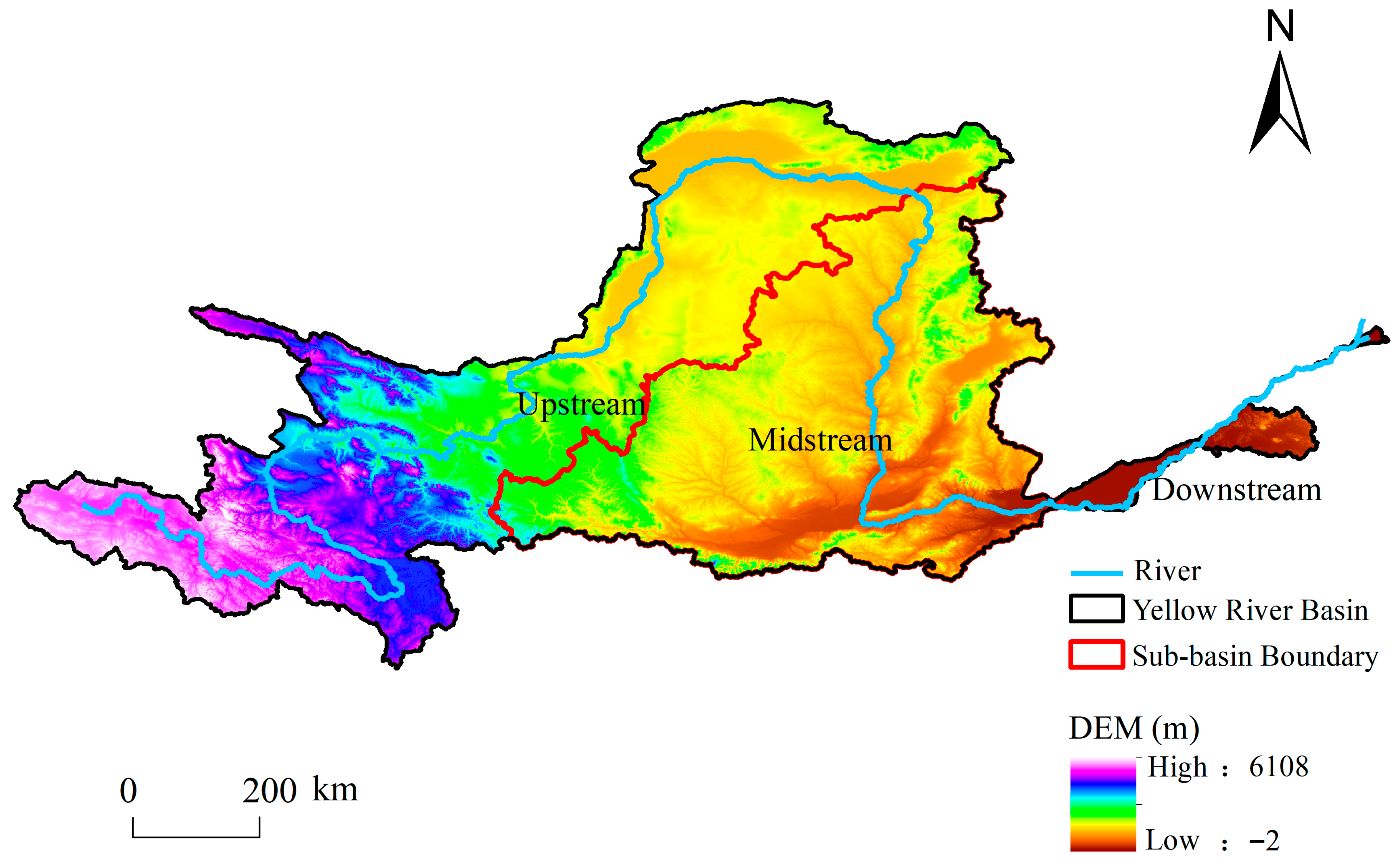
The Yellow River Basin is located between 32°10′–41°50′N and 95°53′–119°05′E (Figure 1). It stretches westward from the Bayan Har Mountains in Qinghai Province, eastward to the Bohai Sea, northward to the Yin Mountains, and southward to the Qinling Mountains. Extending approximately 1900 km from east to west and 1100 km from north to south, it covers a total area of approximately 795,000 km2 [35]. The basin is divided into the upper, middle, and lower reaches, separated by Hekou Town in Togtoh County, Inner Mongolia Autonomous Region, and Taohuagu in Zhengzhou City, respectively. The terrain slopes from west to east. In the west, there is a series of high mountains with an average altitude exceeding 4000 m. The central part features loess landforms with relatively severe soil erosion, at an altitude ranging from 1000 to 2000 m. The eastern part is an alluvial plain with an altitude of ≤100 m [36]. The basin features a continental monsoon climate, with an arid climate in the northwest, a semi-arid climate in the central part, and a semi-humid climate in the southeast. Precipitation mainly occurs from June to September. Most areas receive an annual precipitation ranging from 200 to 650 mm, and the average annual temperature is between −4 and 14 °C [22,35]. The Yellow River Basin has recently encountered challenges, including land desertification, severe soil erosion, vegetation degradation, aggravated water pollution, and runoff reduction. These factors present substantial constraints to the sustainable development of the basin’s ecological environment [10,31].
Figure 1. Overview Map of the Yellow River Basin.

2.2. Data Sources and Preprocessing

2.2.1. Remote Sensing Image Data

This study used MODIS data products from 2002, 2007, 2012, 2017, and 2022. MOD11A2 was used to obtain LST data (8 d and 1000 m resolution), MOD13A1 was used to obtain NDVI data (16 d and 500 m resolution), and MOD09A1 was used to calculate WET and NDBSI data (8 d and 500 m resolution). Images from June to September during the vegetation growing season were selected to minimize seasonal variations. All preprocessing of MODIS image data and the calculation of the four aforementioned indicators were conducted using the Google Earth Engine platform (https://earthengine.google.org).

2.2.2. Soil Erosion Factor Data

The DEM data, with a spatial resolution of 90 m, were sourced from the Geospatial Data Cloud (https://www.gscloud.cn/). The precipitation data comprising annual precipitation data from 1982 to 2022 were obtained from the National Earth System Science Data Center (https://www.geodata.cn/), with a spatial resolution of 1000 m. The soil data, including soil texture, sand, clay, silt, and organic carbon content, were obtained from the Institute-level Data Center of the Nanjing Institute of Soil Science, Chinese Academy of Sciences (https://soildata.issas.ac.cn/), with a spatial resolution of 1000 m. The vegetation coverage data were sourced from the National Tibetan Plateau Data Center (https://data.tpdc.ac.cn/). It was synthesized using the monthly maximum value synthesis method, covering the period from 2000 to 2023, with a spatial resolution of 250 m. The land use data were sourced from the land classification products from 1990 to 2022 released by the Huang Xin team of Wuhan University (http://irsip.whu.edu.cn/resv2/resources_v2.php, accessed on 3 February 2026), with an overall classification accuracy of approximately 80% and a spatial resolution of 30 m.

2.2.3. Driver Factor Data

The driving factors data included topographic (DEM, slope, aspect), climatic (annual precipitation, annual mean temperature), and anthropogenic factors (land use type, nighttime light intensity, population density, GDP). Among them, the nighttime light intensity data comprised the global NPP-VIIRS-like data of the “DMSP-OLS-like” dataset in China from 1992 to 2022. The temperature data represented the mean temperature from 1901 to 2023. All the aforementioned data were sourced from the National Earth System Science Data Center (https://www.geodata.cn/). The population density data were obtained from the LandScan dataset (https://landscan.ornl.gov/), covering the period from 2000 to 2022. The LandScan population dataset was developed by the Oak Ridge National Laboratory (ORNL) of the US Department of Energy and provided by East View Cartographic. The GDP data were obtained from the Resource and Environmental Science Data Center of the Chinese Academy of Sciences (https://www.resdc.cn/). All the above data had a spatial resolution of 1000 m. The slope and aspect data were extracted from the DEM data. Owing to the differences in the spatial accuracy of the datasets in this study, all the data were resampled to a resolution of 1000 m, using the WGS 1984 coordinate system and UTM projection.

2.3. Research Methods

2.3.1. RUSLE Model

The revised universal soil loss equation (RUSLE) is used to estimate the soil erosion rate in a given area. In this study, we used it to estimate the soil erosion modulus of the study area. The RUSLE is expressed as follows:
A = R · K · L S · C · P
where A represents the soil loss per unit area of land, which is the soil erosion modulus (t/(hm2∙a)); R represents the rainfall erosivity factor (MJ∙mm/(hm2∙h∙a)); K represents the soil erodibility factor (t∙h/(MJ∙mm)); L S represents the slope length and steepness factor, which is dimensionless; C represents the surface vegetation cover and management factor, which is dimensionless; and P represents the soil and water conservation measure factor, which is dimensionless.
(1)
Rainfall Erosivity Factor (R)
The rainfall erosivity factor (R) mainly describes the potential of rainfall to cause soil erosion within a specific area. In this study, the algorithm proposed by Zhang et al. [37] for annual precipitation was employed to estimate the rainfall erosivity factor, and its calculation formula is expressed as follows:
R n = α P n β
where Rn represents the rainfall erosivity in year n (MJ∙mm/(hm2∙h∙a)); Pn represents the rainfall in year n (mm). The parameters α and β of the model are α = 0.0534 , β = 1.655 .
(2)
Soil Erodibility Factor (K)
The soil erodibility factor (K) indicates the susceptibility of different soil textures to soil erosion. In this study, the EPIC model was used to estimate the K value, with the percentage content of soil texture gravel, clay, silt, and organic matter required as input. The calculation formula is expressed as follows:
K = { 0.2 + 0.3 e x p [ 0.0256 S a n ( 1 S i l 100 ) ] } × ( S i l C l a + S i l ) 0.3 × [ 1.0 0.25 C C + e x p ( 3.72 2.95 C ) ] × [ 1.0 0.7 S n S n + e x p ( 5.51 + 22.9 S n ) ]
where S a n , S i l and C l a represent the percentages of sand (0.05–2 mm), silt (0.002–0.05 mm), and clay (<0.002 mm), respectively; and C represents the percentage of organic matter; S n = 1 S a n 100 .
(3)
Slope Length and Steepness Factor (LS)
The slope length and slope steepness factor (LS) were used to quantify the effects of terrain slope and slope length on soil erosion. For large-scale areas, the LS factor was typically derived from DEM data. In this study, L and S were estimated using the calculation method proposed by Chi et al. [38], with the formulas expressed as follows:
L = ( ω 22.13 ) m
S = { 10.8 s i n θ + 0.03 ,     θ < 9 % 16.8 s i n θ 0.5 ,     9 % θ 18 % 21.91 s i n θ 0.96 ,     θ > 18 %
where ω represents the slope length (m), and m is the slope length exponent, which varies according to the slope angle θ (°). When θ < 1 % , m = 0.2 ; when 1 % θ < 3 % , m = 0.3 ; when 3 % θ < 9 % ; m = 0.4 ; and when θ 9 % , m = 0.5 .
(4)
Vegetation Cover Management Factor (C)
The vegetation cover and management factor (C) was used to evaluate the effectiveness of vegetation cover and crop management in reducing soil erosion. The C value ranges from 0 to 1; values closer to 0 indicate better vegetation cover and less soil erosion, while values closer to 1 indicate poorer vegetation cover and higher susceptibility to erosion. In this study, the method proposed by Cai Chongfa [39] was used to estimate the C factor. The calculation formula is expressed as follows:
C = { 1 ,     f v c = 0 0.3436 l g f v c + 0.6508 ,     0 < f v c < 78.3 % 0 ,     f v c > 78.3 %
f v c = N D V I N D V I s N D V I v N D V I s
where f v c represents vegetation coverage; N D V I v represents the N D V I value in pure vegetation areas; and N D V I s represents the N D V I v value in bare soil or non-vegetated areas.
(5)
Soil and Water Conservation Practice Factor (P)
The soil and water conservation practice factor (P) indicates the influence of different land use patterns on soil erosion. P values range from 0 to 1, where P = 0 indicates that no erosion occurs following the implementation of soil and water conservation measures, and P = 1 indicates that no such measures have been applied [40]. In this study, P factor values for various land use types were assigned based on the findings of relevant studies [25,40,41,42], as presented in Table 1.
Table 1. P-value of factors for soil and water conservation measures in the Yellow River Basin.

2.3.2. Construction of the ARSEI Model

The improved remote sensing ecological index (ARSEI) incorporated the soil erosion factor (A) into the set of ecological indicators used initially in the RSEI model proposed by Xu Hanqiu [43]. Based on relevant studies [17,21,44,45,46], the calculation formulas for ecological indicators other than the soil erosion factor (A) are presented in Table 2. The ARSEI is expressed as follows:
A R E S I = f ( N D V I , W E T , N D B S I , L S T , A )
Table 2. Calculation formulas of each ecological index.
As the five ecological indicators calculated using the above formulas have different units, they must be normalized to bring their values within the range of [0, 1]. The normalization formulas for each indicator are as follows:
N I n = ( I n I m i n ) / ( I m a x I m i n )
where N I n represents the normalized indicator value; I n represents the indicator value before normalization; and I m a x and I m i n represents the maximum and minimum values of the indicator, respectively.
After normalizing the five ecological indicators for each year, principal component analysis (PCA) was performed independently for each period (2002, 2007, 2012, 2017, and 2022). The first principal component, PC1, was extracted as the initial remote sensing ecological index, ARSEI0. When the loadings of the NDVI and WET indicators on PC1 are negative, and those of the NDBSI, LST, and A indicators are positive, applying “1–PC1” for correction is necessary [47]. Subsequently, ARSEI0 was normalized to obtain the final ARSEI, with values ranging from 0 to 1. A value of ARSEI closer to 1 indicates better ecological environmental quality, while a lower value indicates poorer conditions. The calculation formula is expressed as follows:
A R S E I = ( A R S E I 0 A R S E I 0 m i n ) / ( A R S E I 0 m a x A R S E I 0 m i n )

2.3.3. Change Trend Analysis

(1)
Theil–Sen Slope Estimator and Mann–Kendall Trend Test
The Theil–Sen slope estimator is a non-parametric method that does not depend on assumptions related to data distribution and is resistant to the influence of outliers. It is widely used for analyzing trends in long time series [46,48]. The formula for its calculation is expressed as follows:
β = M e d i a n ( M R S E I j M R S E I i ( j i ) ) , j > i
where β represents the trend of change in ARSEI, Median refers to the median value, and M R S E I i and M R S E I j represent the ARSEI values in the ith and jth years, respectively. When β > 0, ARSEI exhibits an improvement trend; when β < 0, ARSEI exhibits a degradation trend.
The Mann–Kendall trend test is a nonparametric method used to assess the significance of time series data and serves as a complement to the Theil–Sen slope estimator [49]. The calculation formula is expressed as follows:
S = i = 1 n 1 j = i + 1 n s g n ( A R S E I j A R S E I i )
s g n ( A R S E I j A R S E I i ) { 1 , A R S E I j A R S E I i > 0 0 , A R S E I j A R S E I i = 0 1 , A R S E I j A R S E I i < 0
v a r ( S ) = n ( n 1 ) ( 2 n + 5 ) 18
When n ≥ 10, the standardized test statistic Z for S is calculated using the following formula:
Z = { S 1 v a r ( S ) , S > 0 0 , S = 0 S + 1 v a r ( S ) , S < 0
When |Z| exceeds 1.65, 1.96, and 2.58, the trend is considered significant at confidence levels of 90%, 95%, and 99%, respectively. This study used the 95% confidence level for significance testing. Based on the results of the Theil–Sen slope estimation and Mann–Kendall test, the classification of the ARSEI change trend is provided in [21], as represented in Table 3.
Table 3. Classification of ARSEI change trend.
(2)
Coefficient of Variation
The coefficient of variation (CV) primarily indicates the degree of data volatility. A higher CV value indicates greater volatility and less stability of ARSEI; conversely, a more concentrated distribution of the time series data corresponds to greater stability of ARSEI [32]. The formula for its calculation is expressed as follows:
C V = A R S E I s t d A R S E I m e a n = 1 n i = 1 n ( A R S E I i 1 n i = 1 n A R S E I i ) 1 n i = 1 n A R S E I i
where n represents the number of years, A R S E I s t d indicates the standard deviation of ARSEI, and A R S E I m e a n refers to the average value of ARSEI. To more intuitively represent the stability of ARSEI, the CV values were classified into five levels: low (CV ≤ 0.05), relatively low (0.05 < CV ≤ 0.1), medium (0.1 < CV ≤ 0.15), relatively high (0.15 < CV ≤ 0.2), and high (CV > 0.2) [50].
(3)
Hurst Index
The Hurst index is an effective measure for quantitatively describing the long-term dependence in extended time series data. Based on previous studies [17], the Rescaled Range Analysis (R/S) method was employed in this study to calculate the Hurst index, thereby assessing the future variation trend of ARSEI. The calculation formula is expressed as follows:
E [ R ( n ) s ( n ) ] = A n H   a s   n
where n represents the number of observation points in the time series, indicating the length of the time span. R ( n ) represents the range of the n observation points, and s ( n ) represents the standard deviation of these points. A is a constant, and H is the Hurst index. When 0 < H < 0.5, the ARSEI sequence exhibits anti-sustainability, with stronger anti-sustainability as the H value approaches 0. When H is approximately 0.5, the ARSEI behaves as a random sequence with no autocorrelation. When 0.5 < H < 1, the ARSEI sequence exhibits sustainability, which becomes stronger as the H value approaches 1. The sustainability of ARSEI changes was analyzed based on the results of the Theil–Sen slope estimation and the Hurst index [35], as presented in Table 4.
Table 4. Classification of ARSEI change sustainability.

2.3.4. Geodetector

Geodetector is a statistical method used to detect the spatial differentiation of variables and to identify the underlying driving factors [51]. It can assess the explanatory power of factors on the dependent variable as well as the interaction effects among multiple factors. This method has been widely applied in various fields, including ecology, meteorology, and soil science [52,53,54]. In this study, the factor and interaction detectors were employed to evaluate the explanatory power of driving factors on ARSEI.
Factor detection. The factor detector was used to assess the independent contribution of each driving factor to ARSEI and its explanatory power regarding the spatial heterogeneity of ARSEI. The calculation formula is expressed as follows:
q = 1 1 N σ 2 h = 1 L N h σ h 2
where q represents the explanatory power of each driving factor on ARSEI, with the value range of q ranging from [0, 1]. A higher q value indicates a stronger explanatory power of the driving factor on ARSEI. h = 1, 2,…, L represents the stratification levels of the variables. N h and N refer to the number of samples within each stratified region and the entire region, respectively. σ h 2 and σ 2 represents the variance of ARSEI within each stratified region and the entire region, respectively.
Interaction detection. Interaction detection was used to examine whether the interaction between driving factors affects their explanatory power on ARSEI. Assuming q ( M ) and q ( N ) represent the explanatory power intensity of driving factors M and N on the spatial differentiation characteristics of ARSEI, then q ( M N ) indicates the explanatory power intensity resulting from the interaction between the two driving factors. Table 5 presents five types of detection results.
Table 5. Types of the interaction between two covariates.
To investigate the combined influence of natural and anthropogenic factors on ARSEI, this study selected nine driving factors as independent variables based on the current conditions of the Yellow River Basin and previous research findings [35,55,56]. These included topographic factors (DEM, slope, and aspect), climatic factors (annual precipitation, annual mean temperature), and anthropogenic factors (land use type, nighttime light intensity, population density, and GDP), with ARSEI as the dependent variable. To integrate the spatial characteristics of the different independent variables, ArcGIS 10.5 software was used to create a 5 km × 5 km fishnet across the study area. The quantile and natural breaks methods were then applied to optimally discretize continuous variables, aiming to minimize intra-class variance and maximize inter-class variance, for more accurate identification of the influence of each driving factor. Finally, the values of ARSEI and driving factors at each sampling point were extracted. After removing outliers, Geodetector analysis was performed to obtain the q-values of each factor and the results of their interaction effects.

3. Results and Analysis

3.1. Rationalization Analysis of the ARSEI Model

3.1.1. Principal Component Analysis of the ARSEI Model

Table 6 presents the PCA results for each ecological indicator from 2002 to 2022. During the five-year period, the eigenvalue contribution rate of PC1 exceeded 70%, indicating that PC1 integrated most characteristics of the five ecological indicators. In PC1, NDVI and WET had positive loads, whereas NDBSI, LST, and A had negative loads. This indicates that NDVI and WET contributed positively to ecological environment quality, whereas NDBSI, LST, and A exerted a negative effect, which is consistent with the actual conditions. Therefore, in this study, the use of PC1 was reasonable to construct the ARSEI model for evaluating the ecological environment quality of the Yellow River Basin.
Table 6. Results of Principal Component Analysis.

3.1.2. Average Relevance Test

To further test the applicability of the ARSEI model, the average correlation model was employed to analyze the correlation between ARSEI and the five ecological indicators. The average correlation coefficient ranges from 0 to 1. A value closer to 1 indicates a higher comprehensive representation degree and better applicability [57]. The ARSEI exhibited the highest average correlation, reaching 0.894, followed by NDBSI (0.733), NDVI (0.724), WET (0.668), LST (0.623), and A (0.618) (Table 7). This value was 21.96% higher than that of the dryness index, which had the highest correlation among single indicators, and 44.66% higher than that of the soil erosion index, which had the lowest correlation. Specifically, compared to using single ecological indicators, ARSEI had a higher correlation with each ecological indicator, indicating that ARSEI integrates information from each ecological indicator and is more representative than any single ecological indicator.
Table 7. Correlation between ARSEI and indicators.

3.1.3. Comparative Analysis of ARSEI and RSEI Regions

Using 2022 as a reference, according to the RUSLE model and the “Standards for classification and gradation of soil erosion” (SL190—2007) [58], issued by the Ministry of Water Resources, the soil erosion intensity is classified into six levels: tolerant, slight, moderate, intensive, strong, and severe. To quantitatively compare the differences between ARSEI and RSEI, this study calculated their mean values under different soil erosion intensity levels (Table 8). The results show that with increasing soil erosion intensity (A), the mean RSEI decreases by 44.03%, while the mean ARSEI decreases by 55.61%, indicating that ARSEI is more sensitive to soil erosion. In areas with severe erosion, the mean ARSEI value (0.269) was 25.48% lower than the mean RSEI value (0.361), suggesting that ARSEI can effectively identify ecological degradation characteristics in highly eroded regions and compensate for the overly optimistic assessments bias of RSEI in regions with severe soil erosion.
Table 8. Comparison of the mean values of RSEI and ARSEI under different soil erosion intensity levels in 2022.
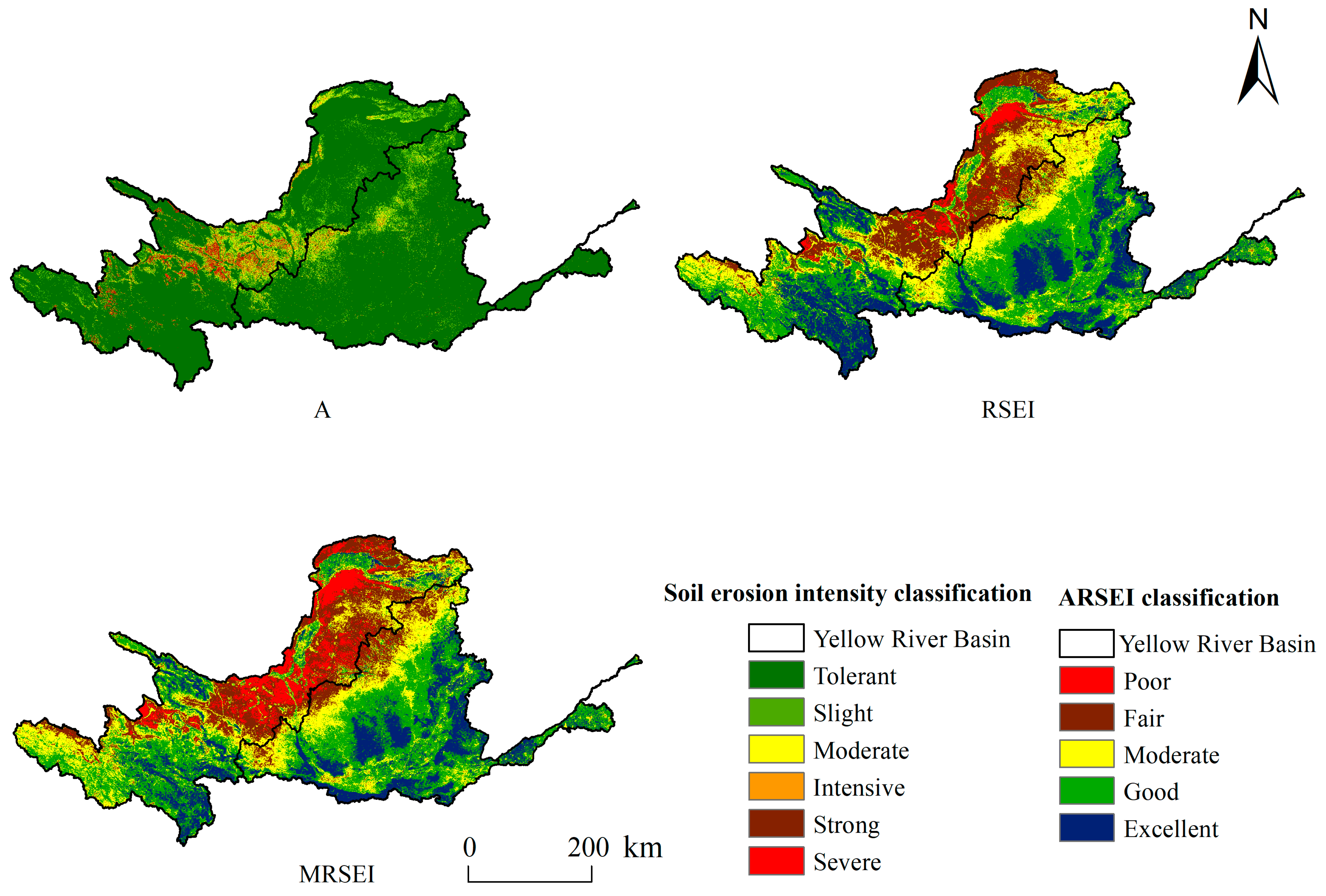
From the perspective of spatial distribution comparison (Figure 2), the high-value areas of soil loss were mainly concentrated in the Loess Plateau region, exhibiting a northeast-southwest linear distribution pattern. The spatial distributions of RSEI and ARSEI were largely consistent. The southern region had an excellent ecological environment, whereas the northern region was vulnerable. However, notable differences remained between the RSEI and ARSEI in local areas. For example, in the northern Loess Plateau, the areas with poor ARSEI values were significantly more prevalent than those with poor RSEI values. This is primarily attributable to the relatively high soil erosion intensity in this area. Additionally, this shows that ARSEI comprehensively represents environmental factors such as vegetation, soil, and temperature in the study area, as well as addresses the limitations of RSEI in areas with severe soil erosion, effectively representing the study area’s extensive ecological conditions.
Figure 2. Spatial distribution map of soil loss, RSEI, and ARSEI in the Yellow River Basin in 2022.
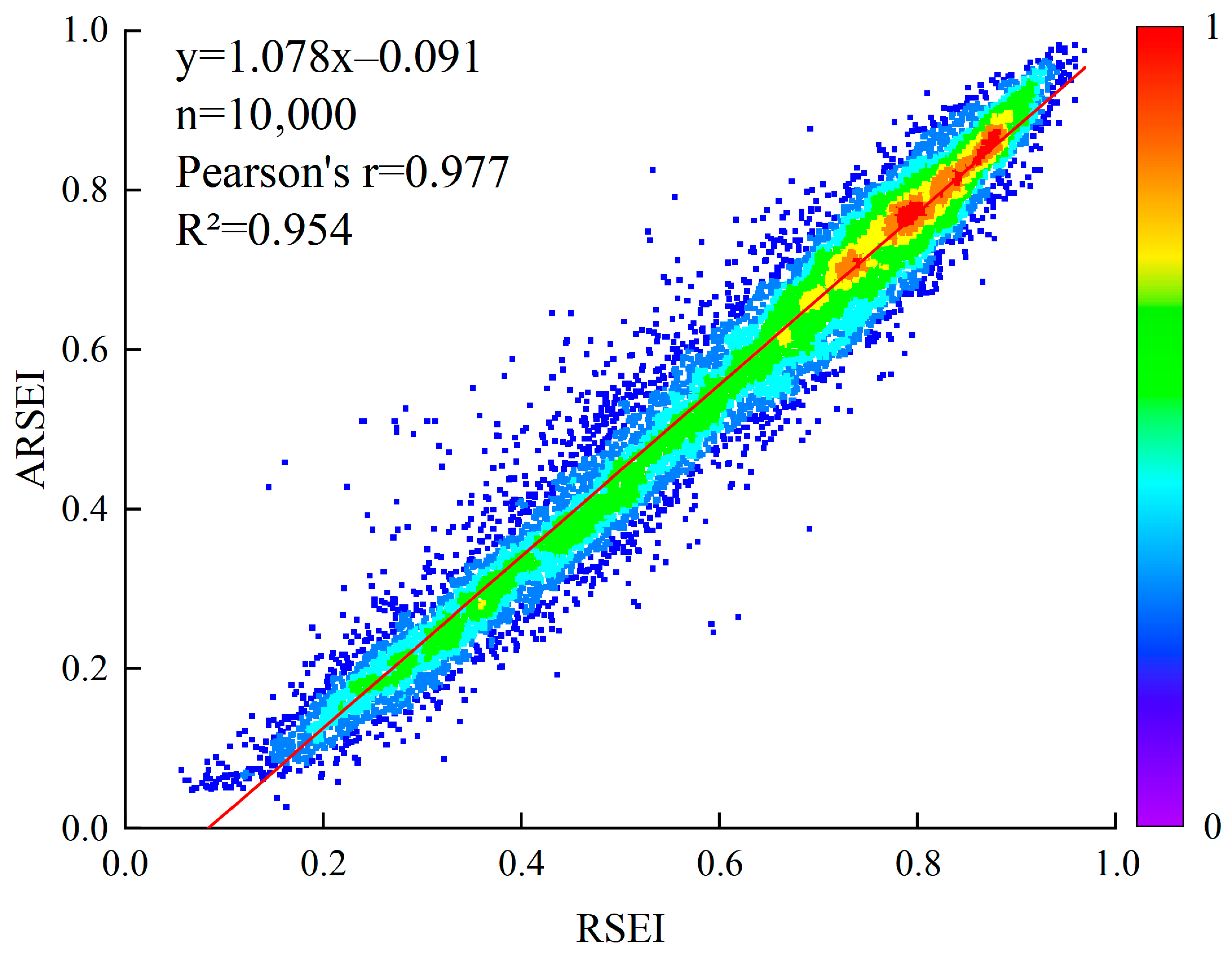
To further validate the reliability of the ARSEI model, this study randomly selected 10,000 sampling points within the watershed to conduct a correlation analysis between ARSEI and the RSEI (Figure 3). The results showed a significant correlation between ARSEI and RSEI (Pearson’s r = 0.977, R2 = 0.954, P < 0.01). The scatter points were densely clustered around the fitted line (y = 1.078x − 0.091), indicating that ARSEI consistently reflects the ecological information represented by RSEI. The slope greater than 1 suggests that ARSEI is more sensitive in responding to ecological conditions. This enhanced sensitivity is primarily attributed to the incorporation of the soil erosion factor in the ARSEI model, which enables it to achieve a more accurate assessment of ecological quality in areas affected by soil and water loss. Consequently, ARSEI compensates for the limitations of the RSEI model in capturing key ecological constraints at the watershed scale.
Figure 3. Correlation between ARSEI and RSEI in 2022.

3.2. Spatiotemporal Variation Characteristics of ARSEI

3.2.1. Spatiotemporal Distribution of ARSEI in the Yellow River Basin

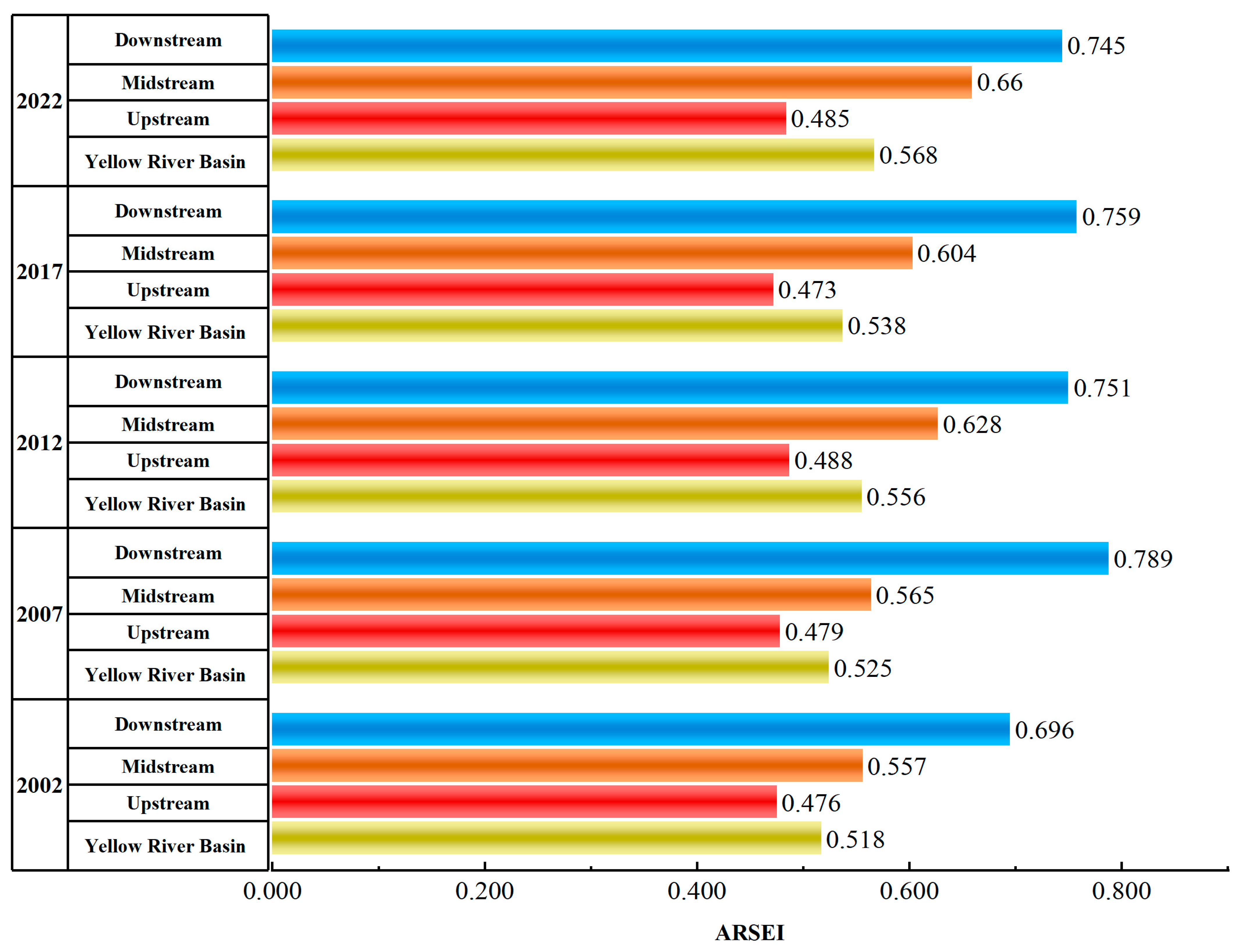
Figure 4 shows the mean fluctuations of ARSEI in the Yellow River Basin and its sub-regions during 2002–2022. The basin-wide ARSEI demonstrated a “rise-decline-rise” trajectory, culminating in an overall upward trend with fluctuations. The lowest recorded value was 0.518 in 2002, contrasting with the peak of 0.568 in 2022, representing a 9.65% improvement. Regionally, the upper reaches exhibited minimal variation in mean ARSEI, showing only a 1.89% increment. The middle reaches followed the basin’s “rise-decline-rise” pattern but exhibited more pronounced growth, increasing from 0.557 in 2002 to 0.660 in 2022 (18.49% increase). The lower reaches manifested a modest 7.04% upward tendency, consistently maintaining higher values throughout the period. The regional maximum (0.789) occurred in 2007, whereas the minimum (0.696) was observed in 2002. These findings demonstrated varying degrees of improvement in ecological environment quality across the Yellow River Basin and its upper, middle, and lower reaches, with the most pronounced enhancement being recorded in the basin’s middle reaches.
Figure 4. Mean changes in ARSEI in the Yellow River Basin and its sub-regions from 2002 to 2022.
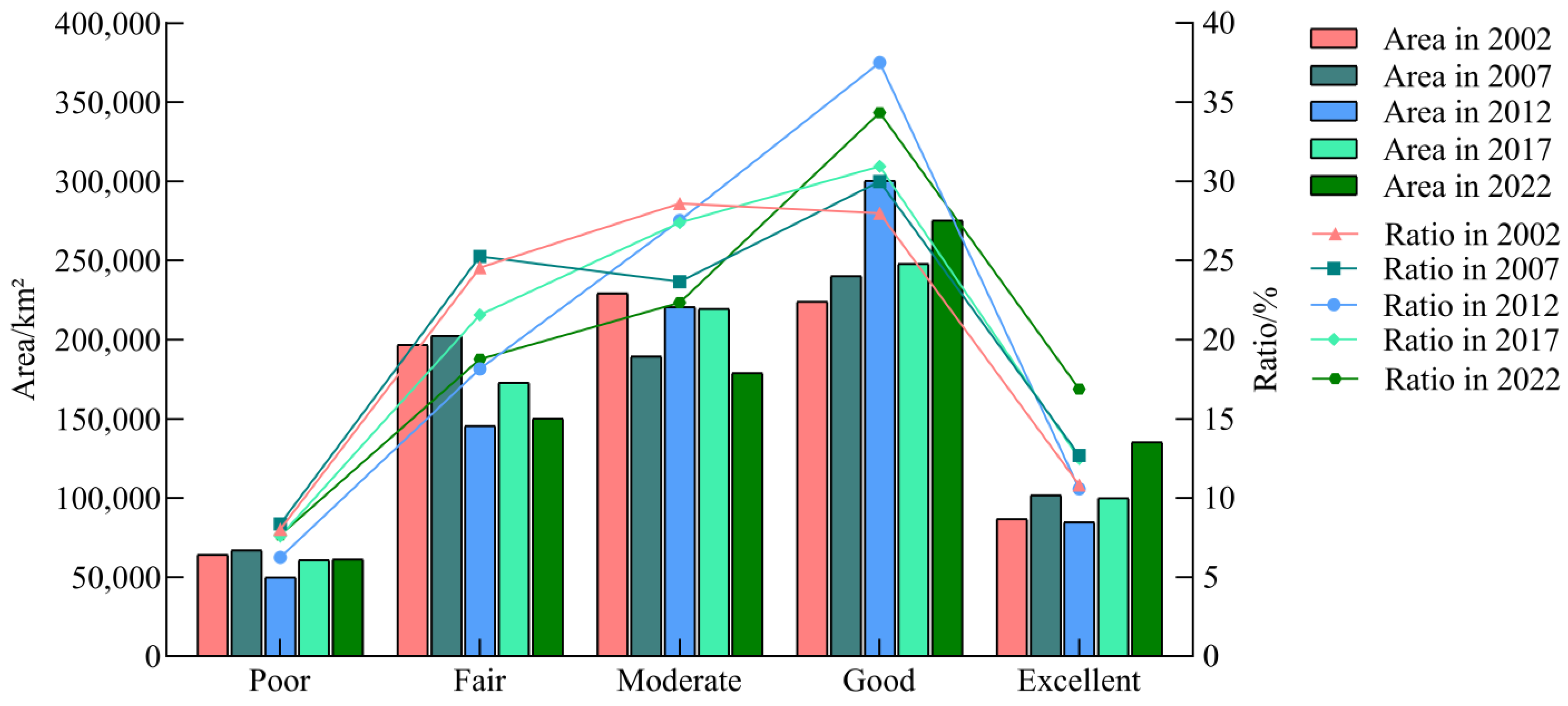
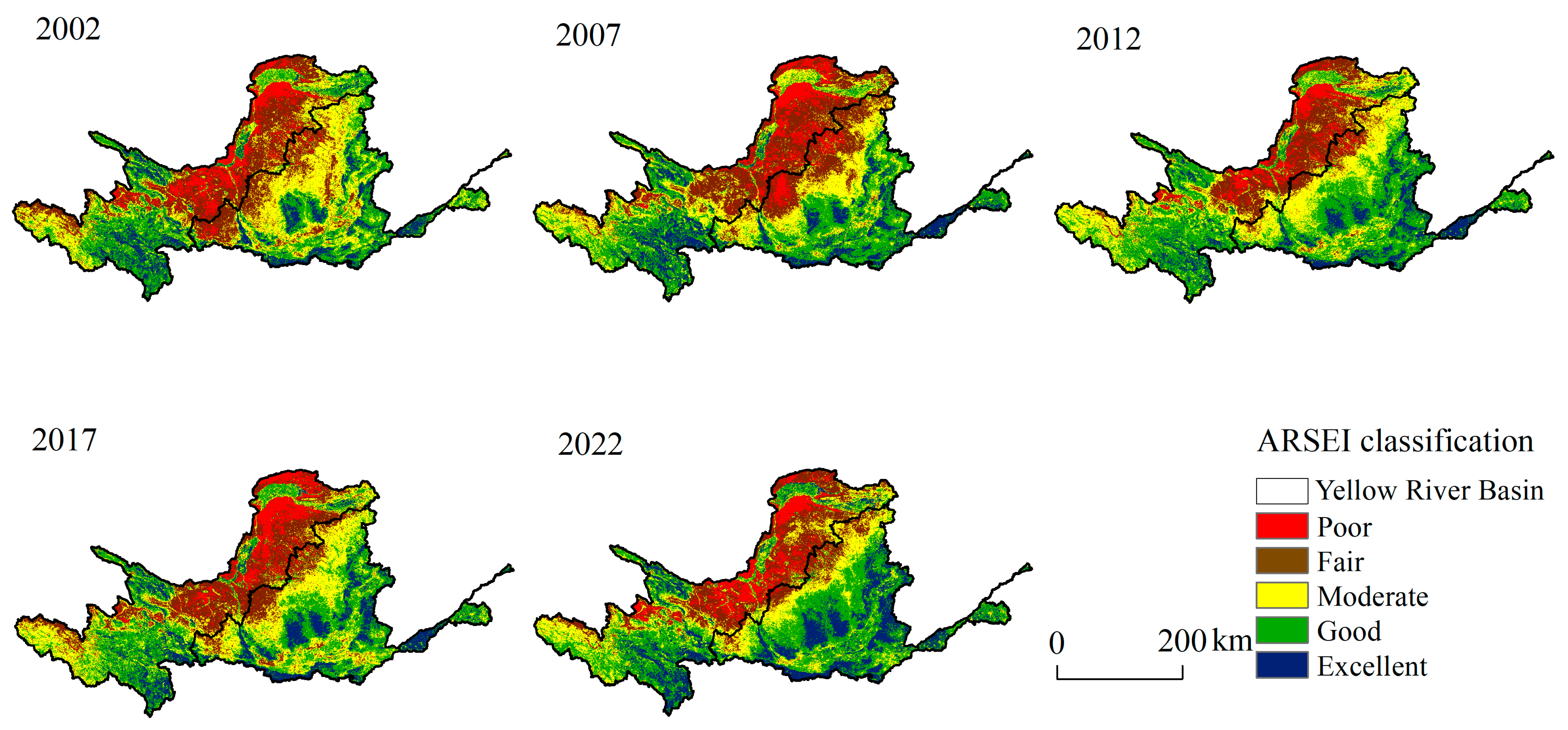
To characterize the spatiotemporal variations in ecological environment quality across the Yellow River Basin, the ARSEI was classified into five grades at 0.2 intervals: poor (0, 0.2], fair (0.2, 0.4], moderate (0.4, 0.6], good (0.6, 0.8], and excellent (0.8, 1] [43]. Figure 5 presents the areal extent and proportional distribution of ARSEI for each temporal phase in the study region. Figure 6 shows the spatial patterns of ARSEI across different periods.
Figure 5. Statistical map of ecological environment quality classification in the Yellow River Basin from 2002 to 2022.
Figure 6. Spatial distribution map of ARSEI levels in the Yellow River Basin from 2002 to 2022.
According to the temporal distribution analysis (Figure 5), the areas classified as poor and fair ecological grades exhibited fluctuating declines over the two-decade period, collectively decreasing by 49,375.64 km2 in area and 6.16% in proportion. The moderate grade demonstrated an initial decline, subsequent increase, and final decrease, with a net reduction of 50,188.11 km2 in area and 6.26% in proportion. Conversely, both the good and excellent grades exhibited fluctuating upward trends, collectively expanding by 99,563.75 km2 in area and increasing by 12.42% in proportion. By 2022, these two higher-quality grades collectively accounted for over 50% of the total study area. A significant improvement was observed in the ecological environment quality of the Yellow River Basin.
From a spatial distribution perspective (Figure 6), the ecological environment quality of the Yellow River Basin predominantly followed a “north–south gradient” characterized by poorer conditions in northern areas and superior quality in southern regions. The middle and upper reaches contained most areas classified as having poor or fair ecological grades, including the Gonghe Basin, the central arid zone of Ningxia, the Ordos Plateau, and the southern slopes of the Yin Mountains. Moderate ecological conditions were primarily observed in the river’s headwaters and middle reaches, covering the Bayan Har Mountains, Liupan Mountains, Guanzhong Plain, and northern Shaanxi. Areas with good to excellent ecological ratings were concentrated in western, southern, and lower reach regions. The good-grade zones predominantly comprised the Qinghai–Tibet Plateau and Qilian Mountains in the west, Hetao Plain in the north, along with the Yuncheng, Linfen, and Luoyang Basins in the south, as well as sections of Shandong’s downstream area. The highest-quality ecological zones were predominantly located in the western Sichuan Plateau, eastern Lüliang Mountain Range, southern Qinling Mountains, Ziwuling and Huanglong Mountain areas, as well as selected portions of the North China Plain in the downstream region.

3.2.2. Evolution of ARSEI Grades in the Yellow River Basin

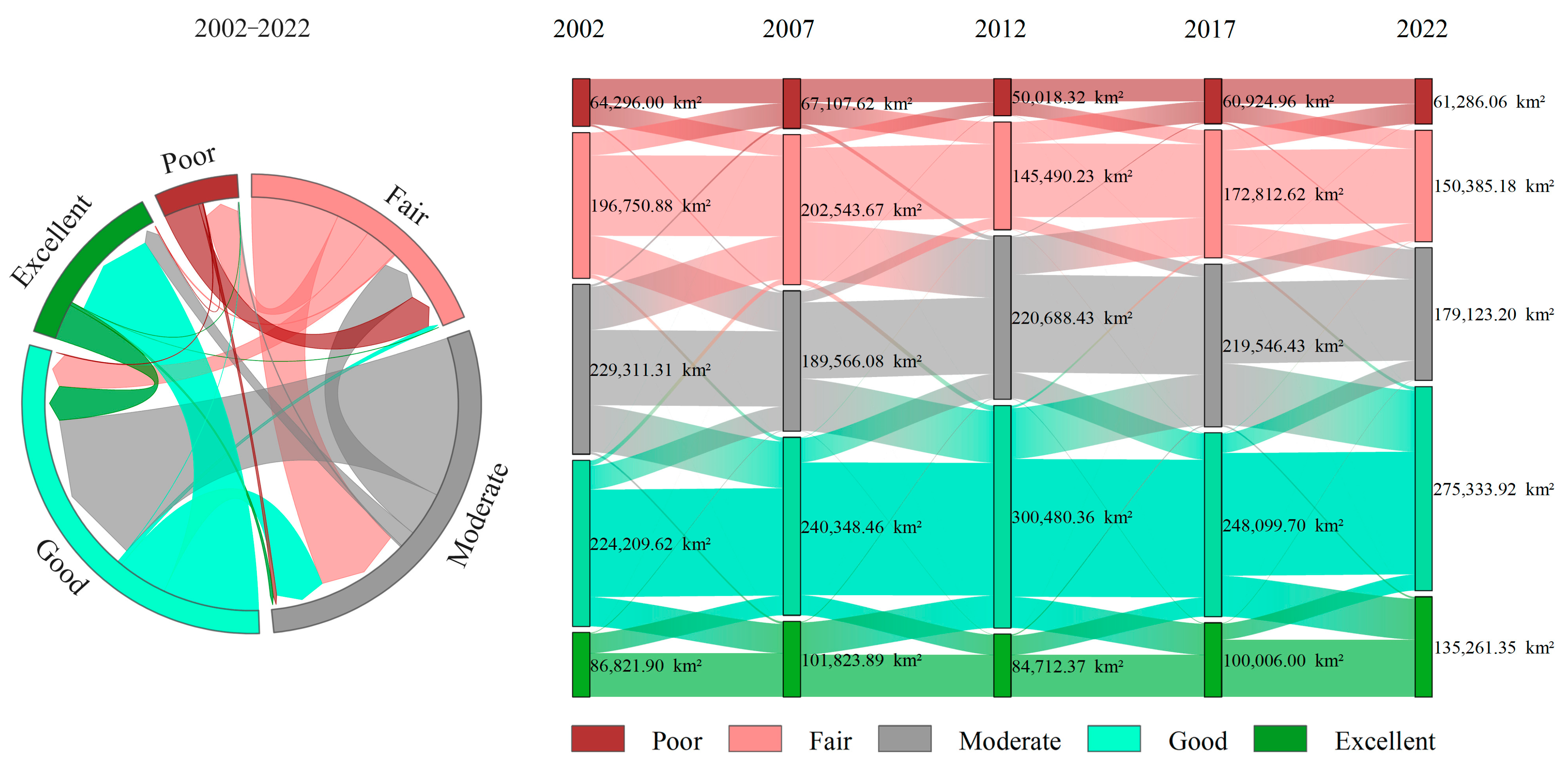
Based on the preceding analysis, the evolutionary trends of ARSEI grades in the Yellow River Basin were investigated across five distinct periods (2002–2022, 2002–2007, 2007–2012, 2012–2017, and 2017–2022). The transition patterns of ARSEI grades during these periods were systematically analyzed using transition matrix chord and Sankey diagrams (Figure 7). Figure 7 shows a notable improvement in ecological environment quality between 2002 and 2022. The predominant upgrading pathways involved transitions from “fair” to “moderate,” “moderate” to “good,” and “good” to “excellent,” covering respective areas of 56,804.13, 102,907.19, and 62,002.88 km2. In contrast, the principal downgrading transitions occurred from “moderate” to “fair” and from “good” to “moderate,” comprising areas of 28,640.03 and 32,071.17 km2, respectively. For periods between 2002 and 2007, a slight improvement in ecological environment quality was observed, with the most common grade transition occurring from “moderate” to “good,” covering an area of 63,215.74 km2. During 2007–2012, a significant enhancement in ecological environment quality was recorded, in which the predominant transition shifted from “fair” to “moderate,” affecting 77,850.55 km2. The period 2012–2017 experienced ecological degradation, characterized by the most common transition from “good” to “moderate,” covering 68,832.43 km2. Between 2017 and 2022, a notable improvement reoccurred, characterized primarily by the transition from “moderate” to “good,” covering an area of 82,967.22 km2. During these 20 years, adjacent-grade transitions predominated over cross-grade shifts, and ecological upgrades surpassed deteriorations, demonstrating an overall positive trajectory in the Yellow River Basin’s environmental quality along with relatively stable ecological grade dynamics.
Figure 7. Chord diagram and Sankey diagram of ARSEI grade transition matrix in the Yellow River Basin from 2002 to 2022.

3.3. Analysis of ARSEI Evolution Trend in the Yellow River Basin

3.3.1. Analysis of ARSEI Change Trends in the Yellow River Basin

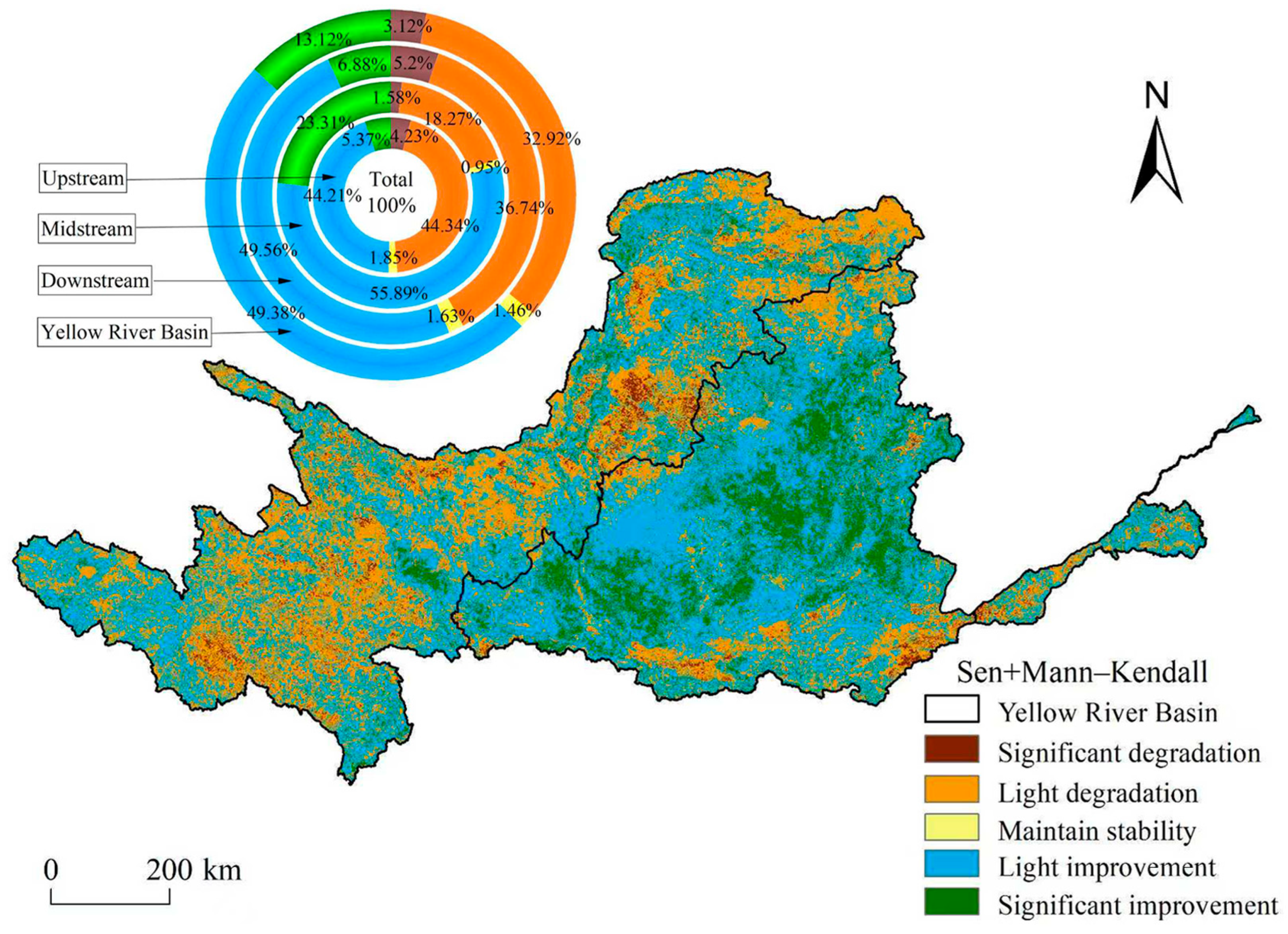
The changing trends of ecological environment quality in the Yellow River Basin were analyzed using a combined approach of Theil–Sen slope estimation and Mann–Kendall significance test (Figure 8). The analysis revealed the coexistence of improvement and degradation in ecological quality across the basin during 2002–2022, with improved areas covering a greater spatial extent than degraded ones. Specifically, areas exhibiting improvement trends accounted for 62.50% of the total, with slightly improved areas comprising 49.38% and being primarily located in the western source of the Yellow River and Western Sichuan Plateau, northern sections of the Ordos Plateau and Hetao Plain, most parts of the central Loess Plateau, and localized sections of the downstream North China Plain. The significantly improved areas, accounting for 13.12%, were predominantly distributed across the middle reaches of the basin, with notable concentrations in central Shaanxi and Shanxi Provinces. Degraded areas accounted for 36.04% of the total, with slightly degraded areas comprising 32.92% and being predominantly located in the upper reaches of the basin, southern Guanzhong Plain, Yuncheng Basin, and Luoyang Basin, as well as in Zhengzhou, Xinxiang (Henan Province), and Tai’an (Shandong Province) downstream. The severely degraded areas (3.12%) were concentrated in the Mu Us Desert and major urban zones of the Guanzhong Plain and Luoyang Basin.
Figure 8. Trends of ARSEI changes in the Yellow River basin from 2002 to 2022.
Regional analysis revealed improvement rates of 5.37%, 23.31%, and 6.88% in the upper, middle, and lower reaches, respectively, demonstrating the most significant recovery in the mid-basin. Conversely, severe degradation affected 4.23%, 1.85%, and 5.2% of these regions, indicating comparatively weaker restoration progress in both the upstream and downstream sections.

3.3.2. Stability Analysis of ARSEI Changes in the Yellow River Basin

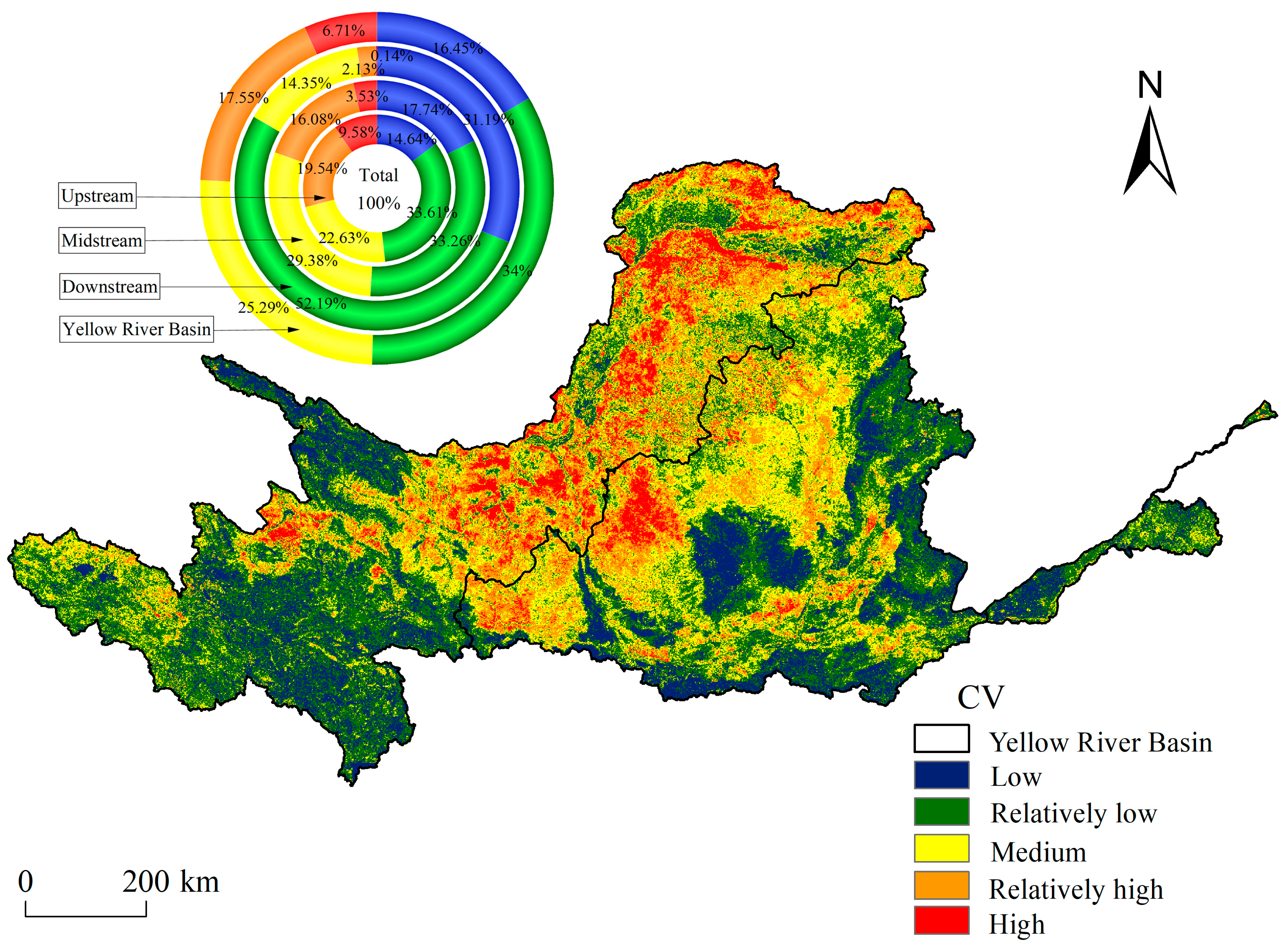
The stability of ecological environment quality changes in the Yellow River Basin was analyzed using the coefficient of variation (CV) method (Figure 9). Areas exhibiting medium or lower volatility accounted for 75.74% of the basin, demonstrating relatively low overall volatility and favorable stability. Specifically, medium-volatility areas (25.29%) were predominantly located in the source of the Yellow River, most of the Loess Plateau, and scattered sections of the North China Plain. Low (16.45%) and relatively low (34.00%) volatility regions were concentrated in Qinghai Province and the Western Sichuan Plateau in the upper basin, along with the Ziwuling, Huanglong, Qinling, and Lvliang Mountains in the middle reaches, and most downstream areas. High (6.71%) and relatively high (17.55%) volatility zones were mainly distributed across the Gonghe Basin, western/northern Loess Plateau, and southern regions including the Guanzhong Plain, Yuncheng Basin, and Linfen Basin.
Figure 9. Stability of ARSEI changes in the Yellow River basin from 2002 to 2022.
From a regional perspective, the lowest fluctuation intensity was observed in downstream areas, where zones with low and relatively low variability collectively accounted for 83.38% of the total coverage. Conversely, the most pronounced fluctuations were recorded in upstream regions, with areas exhibiting high and relatively high variability representing 29.12% of the territory.

3.3.3. Analysis of Future Change Trends of ARSEI in the Yellow River Basin

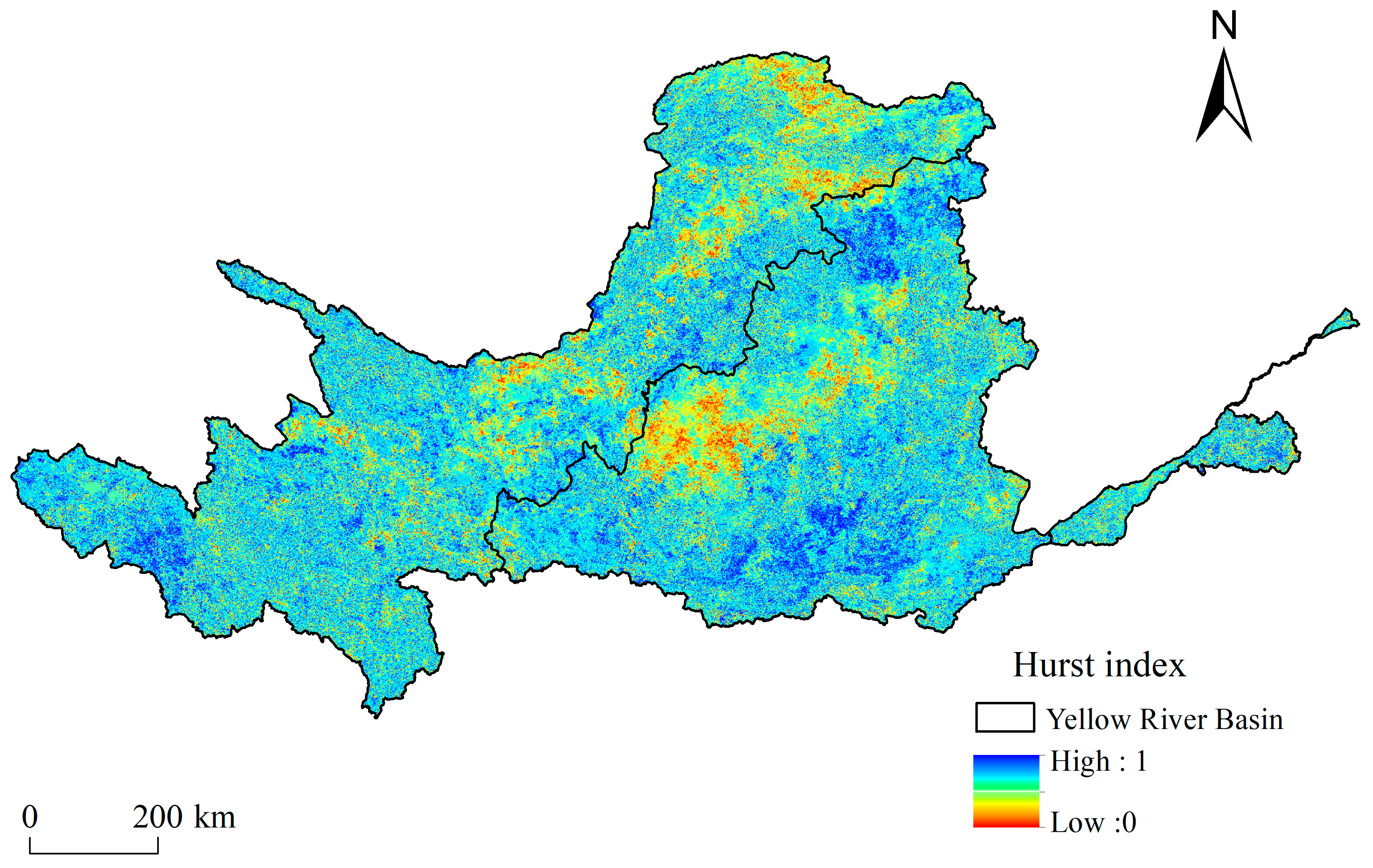
As shown in Figure 10, the Yellow River Basin exhibited an average Hurst index of 0.680, suggesting that ARSEI variations in this region are primarily characterized by sustainability. Areas with Hurst values ≤ 0.45, covering 10.21% of the basin, demonstrated anti-sustainability, in which future trends are projected to reverse past evolutionary patterns. These zones were predominantly found in the upstream Longzhong Loess Plateau, Ordos Plateau, Yinshan Mountains, and scattered sections of the central Loess Plateau. Conversely, regions with Hurst values ≥ 0.55, comprising 79.38% of the basin, indicated sustained patterns, suggesting future trends will continue past evolutionary trajectories. These areas were concentrated in the western and mid-lower reaches. The basin’s spatial distribution revealed alternating high and low Hurst values, underscoring significant spatial heterogeneity in the sustainability of ecological quality changes across the Yellow River Basin.
Figure 10. Hurst index of ARSEI changes in the Yellow River basin from 2002 to 2022.
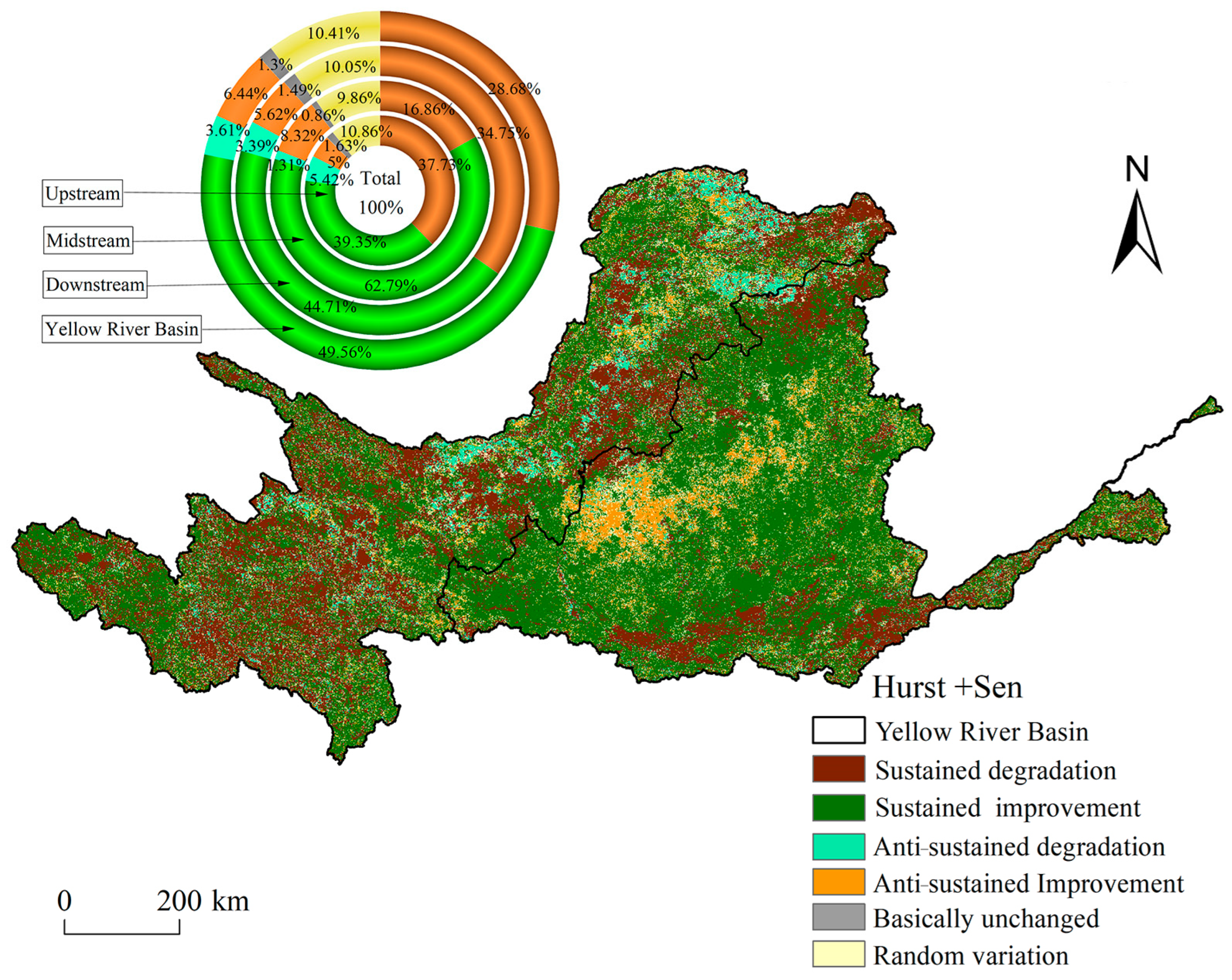
The Hurst index combined with the Theil–Sen slope was used to further analyze the sustainability characteristics of future changes in ecological environment quality in the Yellow River Basin (Figure 11). The results indicated that ecological conditions in the basin are expected to predominantly improve, covering 53.17% of the area (with 49.56% showing sustained improvement and 3.61% exhibiting anti-sustained degradation), mainly distributed across the Hetao Plain, the Loess Plateau, and most parts of the lower reaches. However, it is noteworthy that 35.12% of the area remains at risk of future degradation. In particular, regions characterized by anti-sustainability improvement account for 6.44% of the area. Although these areas have shown improvement in the past, they may experience a trend reversal and face degradation in the future. These regions are mainly concentrated in certain parts of the central Loess Plateau. These areas, where the improvement trend may be relatively vulnerable, should be prioritized for ecological risk prevention and the implementation of consolidation-oriented protection measures. Regions characterized by sustained degradation account for 28.68% of the total area. These areas have experienced degradation in the past and are likely to continue on a degradation trend in the future. They are mainly distributed in parts of the upper reaches of the basin, the Guanzhong Plain in the southern middle reaches, the Yuncheng Basin, the Luoyang Basin, and scattered areas in the downstream plains. These regions are either ecologically fragile or subject to intensive anthropogenic disturbance and should be designated as priority zones for ecological restoration and integrated management, with urgent strict protection and targeted anthropogenic interventions required.
Figure 11. Sustainability of future changes in ARSEI in the Yellow River Basin from 2002 to 2022.
From a regional perspective, the proportions of areas experiencing sustained degradation in the upper, middle, and lower reaches of the Yellow River Basin were 37.73%, 16.86%, and 34.75%, respectively. This indicates that the upper reaches face a more pronounced future degradation trend and should be prioritized for restoration and management. The proportions of areas in the upper, middle, and lower reaches showing sustained improvement were 39.35%, 62.79%, and 44.71%, respectively, demonstrating that the middle reaches are projected to have the most notable trend of ecological improvement in the future.
From the perspective of watershed ecological management, the integration of the Hurst index and the Theil–Sen slope provides critical support for the development of an ecological early warning system. The analytical results can be converted into targeted management strategies. Specifically, for areas characterized by sustained improvement, existing protection policies should be maintained. For areas exhibiting anti-sustainability improvement, early warning and monitoring systems should be implemented to closely track changes and prevent trend reversals. For areas undergoing sustained degradation, priority intervention mechanisms should be activated, with increased investment in ecological restoration. Therefore, this approach offers a scientific basis for advancing precise, zoned, categorized, and tiered ecological management in the Yellow River Basin, and for implementing strategies of ecological protection and high-quality development.

3.4. Analysis of Driving Forces of ARSEI Changes in the Yellow River Basin

3.4.1. Single-Factor Detection Analysis

The results of single factor detection are shown in Table 9. All driving factors during the different periods were statistically significant (P < 0.01). The comprehensive ranking of q-value was as follows: Annual precipitation > land use type > annual mean temperature > DEM > slope > GDP > population density > nighttime light intensity > aspect. This indicates that the dominant factor influencing the spatial differentiation of ARSEI in the Yellow River Basin was annual precipitation (q = 0.428), followed by land use type (q = 0.299), annual mean temperature (q = 0.276), and DEM (q = 0.213). The dominant role of annual precipitation stems from the fact that most areas of the Yellow River Basin are located in arid and semi-arid regions, where water is a key limiting resource for ecosystems. Precipitation directly controls vegetation productivity and coverage, and indirectly affects surface temperature by regulating soil wetness, thus being the fundamental cause of the basin’s spatial pattern of “poor in the north, excellent in the south”. Land use type is the second most significant driving factor, which directly reflects the impacts of anthropogenic activities. Natural ecosystems such as forests and grasslands contribute to soil and water conservation and climate regulation, whereas the expansion of cropland and construction land tends to lead to the destruction of natural vegetation and the degradation of ecological functions.
Table 9. Single-factor detection results.

3.4.2. Multi-Factor Detection Analysis

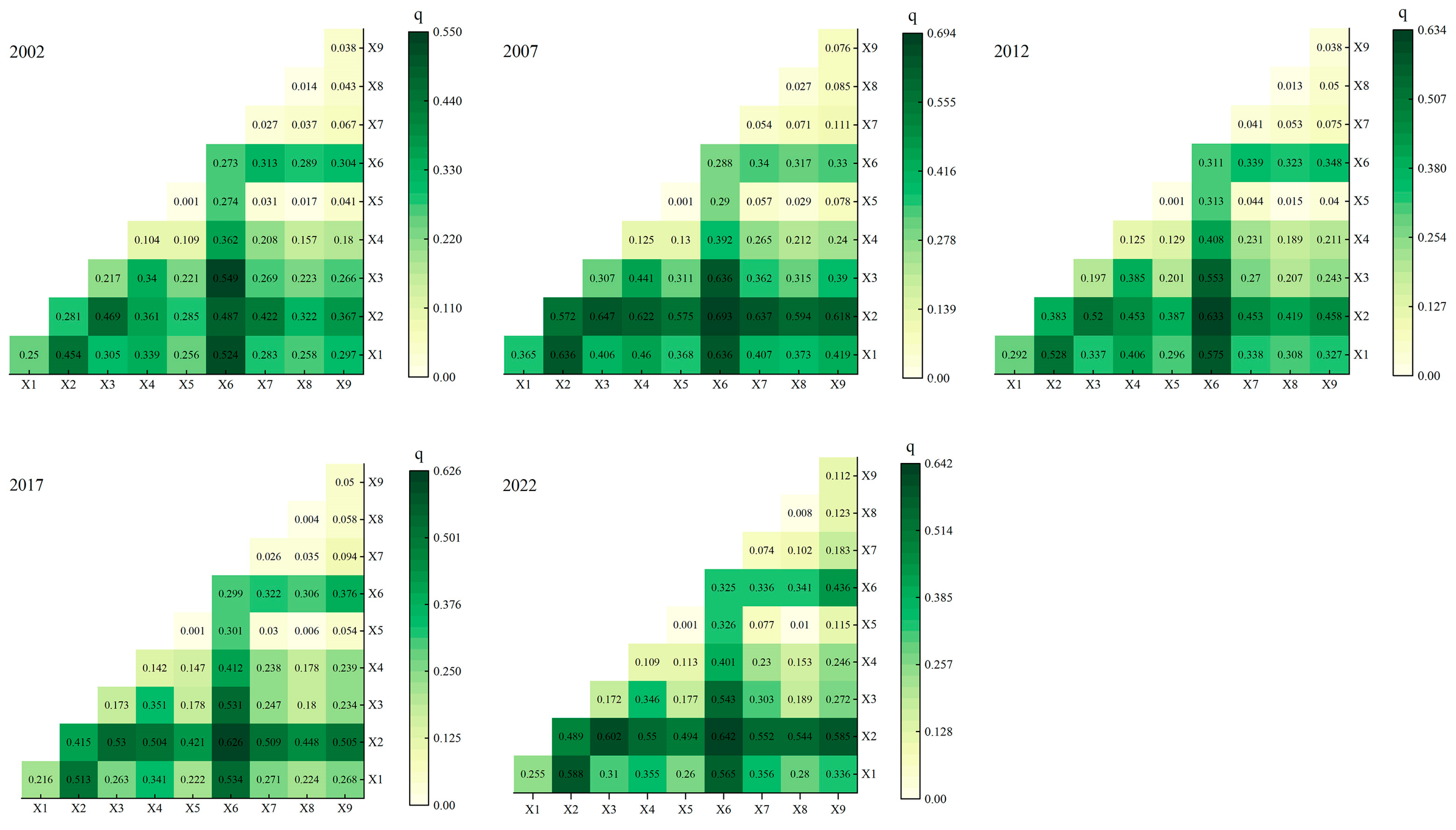
The interaction detection results are shown in Figure 12. All observed interaction detection results among the factors were classified as nonlinear and bi-factor enhancements, this indicates that the ecological environment quality in the Yellow River Basin is shaped by the combined effects of natural and anthropogenic factors. Among these, the interaction effect between annual precipitation and land use type was the strongest, with a maximum q value of 0.693, highlighting the intensive interplay between climate and human activities. Specifically, land use practices can modulate the ecological effects of precipitation. In areas with effective ecological protection, vegetation can efficiently conserve water resources, turning precipitation into a positive driver of ecological restoration. In contrast, in ecologically vulnerable regions, precipitation tends to trigger soil erosion, thereby accelerating ecological degradation. This also indicates that rational land use is essential for enhancing regional climate resilience.
Figure 12. Interaction detection results. Note: X1 represents annual mean temperature; X2 represents annual precipitation; X3 represents DEM; X4 represents slope; X5 represents aspect; X6 represents land use type; X7 represents population density; X8 represents nighttime light intensity; X9 represents GDP.

4. Discussion

4.1. Advantages of the ARSEI Model

The ARSEI model is an improved adaptation of the RSEI model, developed to represent the unique regional characteristics of the Yellow River Basin. Among the selected ecological indicators, NDVI and WET were positively correlated with PC1, whereas NDBSI, LST, and A were negatively correlated with PC1. These relationships are consistent with actual conditions and align with previous study findings [57,59]. The contribution rate of PC1 exceeded 70% in all cases, and the average correlation coefficient of ARSEI reached a maximum value of 0.894. This indicates that ARSEI effectively integrates information from numerous ecological indicators and is more representative than any single indicator.
The inclusion of the soil erosion factor (A) is the core improvement of the ARSEI model, which significantly enhances its responsiveness to key ecological constraints within the basin. This enhancement is particularly evident in the accurate identification of areas characterized by high vegetation cover but severe soil erosion. The traditional RSEI model may produce overly optimistic assessments in such regions due to high vegetation greenness, overlooking the ecological risks associated with soil loss. The spatial distribution comparison in Figure 2 provided intuitive evidence. In areas with high soil erosion intensity, such as the northern Loess Plateau, the RSEI evaluation resulted are mostly rated as “moderate” and “poor,” whereas the ARSEI resulted assign lower ecological grades in these regions, such as “Fair” and “poor.” This indicates that ARSEI, by incorporating the impact of soil erosion, appropriately reduces the ecological environment quality scores in areas characterized by “high greenness and severe erosion.” This “reduction” is not a model bias but rather a more accurate reflection of the actual state of the ecosystem, highlighting ARSEI’s sensitivity in identifying potential ecological degradation risks. The Pearson correlation coefficient between ARSEI and RSEI reached as high as 0.977 (P < 0.01), with the scatter points closely distributed along both sides of the fitted line and the slope of the fitted line exceeding 1 (Figure 3). This demonstrates the effectiveness and consistency of the improvement. In summary, ARSEI can comprehensively, accurately, and effectively assess the ecological environment quality of the Yellow River Basin, providing a more reliable basis for precise evaluation and risk management of ecological environment quality in the Yellow River Basin and other similar regions.

4.2. Spatiotemporal Evolution of ARSEI

The study determined that the mean ARSEI in the Yellow River Basin from 2002 to 2022 followed a pattern of “initial increase, slight decline, and subsequent increase,” indicating an overall upward trend with fluctuations. This shows that the ecological environment quality in the Yellow River Basin has generally improved over the past two decades. These findings are consistent with those of Dong et al. [60], primarily owing to the government’s intensified efforts since the late 20th century to manage the Yellow River Basin. Key ecological restoration projects such as the Three-North Shelterbelt Program, Grain for Green Program, and soil and water conservation have been actively implemented in the region. However, from 2012 to 2017, the ecological environment quality in the Yellow River Basin showed a declining trend, which is consistent with the findings of Yin Chuanxin [55]. This decline may have resulted from factors such as climate change, water resource shortage, intensified soil erosion and sediment deposition, as well as increased industrialization, urban expansion, and excessive exploitation of water resources during this period. in 2019, General Secretary Xi Jinping convened the ecological protection and high-quality development of the Yellow River Basin symposium and elevated the ecological protection and high-quality development of the Yellow River Basin as part of a national strategy [61]. The Yellow River Basin underwent systematic restoration efforts, resulting in an improvement in the basin’s ecological environment by 2022.
On a spatial scale, the ecological environment quality of the Yellow River Basin exhibits a spatial distribution pattern characterized by “poor in the north and good in the south,” which is consistent with the findings of Yin Chuanxin [55], Zhou et al. [33], and Bai et al. [62]. Areas with good or excellent ecological conditions are mainly concentrated in the western and southern regions, as well as in certain parts of the middle and lower reaches of the basin, particularly in the southern areas such as the Qinling, Ziwuling, and Huanglong Mountain, as well as parts of the North China Plain in the lower reaches. Areas with poor and fair ecological grades are primarily found in the middle and upper reaches, particularly in regions such as the Mu Us and Kubuqi Deserts on the Ordos Plateau. This spatial pattern is mainly due to the semi-humid climate in the southeastern part of the Yellow River Basin, which is favorable for vegetation growth and supports various plant types. In contrast, the northwestern region experiences an arid and semi-arid climate, characterized by harsh natural conditions, low precipitation, and widespread desert coverage, making it unsuitable for vegetation growth. Therefore, vegetation restoration and ecosystem protection should be further intensified in the upper and middle reaches of the Yellow River Basin.
The variation trend of the ARSEI in the Yellow River Basin indicated a coexistence of both improvement and degradation, with the area showing an improvement trend exceeding that of the degradation trend. The most notable improvement trend was observed in the middle reaches of the basin. The ARSEI coefficient of variation analysis revealed that 75.74% of the basin area experiences moderate or lower levels of fluctuation, indicating relatively low overall variability and strong stability. These results are consistent with previous studies [55,63], highlighting the significant contributions made by the government to ecological restoration in the Yellow River Basin. The Hurst index and Theil–Sen slope revealed that the future trend of ecological environment quality in the basin is expected to be predominantly positive, consistent with the findings of Chen et al. [30]. However, 35.12% of the area remains at risk of future degradation, particularly in regions such as Qinghai, Gansu, and Inner Mongolia. Therefore, efforts toward ecological protection and high-quality development in the Yellow River Basin remain a long-term and demanding endeavor.

4.3. Analysis of Driving Factors

The factor detection results indicated that annual precipitation was the dominant factor influencing changes in ecological environment quality in the Yellow River Basin. Land use type, annual mean temperature, and DEM also exhibited certain levels of influence. However, natural factors significantly affected the ecological environment quality of the Yellow River Basin than human factors, which is consistent with previous studies [55,62,64]. Precipitation is closely associated with natural phenomena such as soil and water conservation, vegetation growth, and biodiversity richness [65], thereby exerting a more pronounced influence on the basin’s ARSEI. The interaction detection results revealed that the combined effect of any two driving factors on ARSEI exceeded that of each factor, indicating that the ecological environment quality of the Yellow River Basin results from a multi-factor synergistic effect [66]. Specifically, the interaction between annual precipitation and land use type had the strongest effect and represented the key factor influencing changes in ARSEI. Although other socioeconomic factors, such as population density, nighttime light intensity, and GDP, had relatively limited explanatory power on ARSEI changes in the basin, their influence substantially increased when combined with natural factors, including annual precipitation, annual mean temperature, DEM, and slope. This further demonstrates that socioeconomic factors are also important driving forces that influence changes in the ARSEI, as confirmed by Tian et al. [67]. Therefore, in future ecological protection and planning efforts in the Yellow River Basin, adhering to the principles of adapting to local conditions and following the natural trend, while focusing on the coordinated development of ecological protection and economic development is essential. Particular focus should be placed on the effects of precipitation and land use types on the ecological environment to ensure its continued positive development.

4.4. Limitations and Uncertainty Analysis of the ARSEI Model

Although this study constructed the ARSEI model by incorporating the soil erosion factor (A) to achieve a comprehensive assessment of the ecological environment quality in the Yellow River Basin, several limitations and uncertainties remain and need to be addressed in future research.
First, the estimation of the soil erosion factor (A) relies on the RUSLE model, which, when applied at large scales, is subject to significant uncertainty due to parameter sensitivity and data accuracy constraints. The rainfall erosivity factor (R) is calculated using an annual precipitation formula that does not account for rainfall intensity or spatiotemporal heterogeneity, potentially leading to underestimation of R values in arid regions and overestimation in semi-humid areas. In alpine regions, glaciers, and permafrost zones, the accuracy of vegetation cover inversion is limited, resulting in underestimation of the cover management factor (C). The soil and water conservation practice factor (P) is assigned fixed values without adapting to different geomorphological types, which may cause estimation bias in certain areas. Additionally, in arid regions, only hydraulic erosion is considered, while wind erosion excluded. These parameter uncertainties directly affect the accuracy of the soil erosion factor (A) value, thereby influencing the ARSEI calculation and potentially distorting the analysis of ecological quality trends and stability. In addition, the ARSEI model does not incorporate key indicators such as atmospheric conditions, hydrological processes, and sediment deposition, limiting its ability to fully capture ecosystem complexity. The driving factors considered are restricted to meteorological, topographic, and certain anthropogenic factors, while important variables such as soil properties and solar radiation are not included. Therefore, future research should aim to improve the indicator system by integrating multi-source data, refining parameter estimation in the RUSLE model, and expanding the range of driving factor analysis, thereby enhancing the scientific rigor and applicability of the evaluation model.

5. Conclusions

(1) The ARSEI model exhibited improved applicability in the Yellow River Basin. The model integrated five indicators: greenness, wetness, dryness, heat, and soil erosion, with an average correlation coefficient of 0.894. The contribution rate of the first principal component exceeded 70%. Moreover, the model was more sensitive in capturing changes in ecological environment quality in areas with severe soil erosion, thus overcoming the limitations of the traditional RSEI model in characterizing ecological conditions in soil and water loss-prone areas.
(2) Over the past two decades, the ecological quality in the Yellow River Basin showed an overall improvement trend, with the mean ARSEI increasing by 9.65%. Spatially, the region exhibited a pattern of “poor in the north, excellent in the south.” Areas with improved ecological quality accounted for 62.50% of the total basin area; regions with medium or lower fluctuations made up 75.74%, indicating relatively high stability. The basin will be dominated by sustained improvement in the future, but 35.12% of the area is still at risk of degradation, warranting focused attention on the upper reaches of the basin and the central Loess Plateau.
(3) Changes in ecological environment quality within the basin result from the combined effects of natural and anthropogenic factors. Annual precipitation was the dominant driving factor (q = 0.428), while land use type, annual mean temperature, and DEM also exerted significant influence. All interaction effects among these factors exhibited either nonlinear enhancement or bi-factor enhancement. The interaction between annual precipitation and land use type was the strongest, with a maximum q-value of 0.693, indicating that ecological management in this basin must account for the synergistic effects of climate and land use.
(4) Potential applications and practical recommendations of the ARSEI model: In ecological monitoring, ARSEI can act as an effective tool for ecological assessment in the Yellow River Basin, particularly suitable for dynamic monitoring in soil erosion-sensitive areas such as the Loess Plateau. In land management, the spatial pattern of ARSEI can guide the prioritization of reforestation and terracing initiatives in the Loess Plateau, and optimize the allocation of drought-tolerant vegetation in arid northern regions. In policy-making, emphasis should be placed on the coordinated regulation of annual precipitation and land use. ARSEI should be integrated into the basin-wide ecological assessment framework to support the development of targeted restoration plans for the 37.73% of areas projected to undergo degradation in the future.


Author Contributions

Conceptualization, S.H. and K.Y.; methodology, H.Y. and K.Y.; software, H.Y. and S.H.; validation, H.Y. and D.W.; formal analysis, H.Y. and J.Q.; investigation, H.Y. and K.Y.; resources, H.Y. and D.W.; data curation, H.Y. and S.H.; writing—original draft preparation, H.Y.; writing—review and editing, H.Y., D.W., S.H., K.Y. and J.Q.; visualization, H.Y. and J.Q.; supervision, D.W.; project administration, D.W.; funding acquisition, D.W. All authors have read and agreed to the published version of the manuscript.

Funding

This research was supported by the National Natural Science Foundation of China (grant no. 42171058).

Data Availability Statement

The data used to support the findings of this study are available from the corresponding author upon request.

Conflicts of Interest

The authors declare no conflicts of interest.

References

  1. Qin, G.; Wang, N.; Wu, Y.; Zhang, Z.; Meng, Z.; Zhang, Y. Spatiotemporal Variations in Eco-Environmental Quality and Responses to Drought and Human Activities in the Middle Reaches of the Yellow River Basin, China from 1990 to 2022. Ecol. Inform. 2024, 81, 102641. [Google Scholar] [CrossRef]
  2. Feng, P.; Yang, N.; Li, J. Improvement of Remote Sensing Ecological Index and Evaluation of Ecological Environment Quality in Luanhe River Basin, China. Chin. J. Appl. Ecol. 2023, 34, 3195–3202. [Google Scholar]
  3. Chen, G.; Zhang, Z.; Guo, Q.; Wang, X.; Wen, Q. Quantitative Assessment of Soil Erosion Based on CSLE and the 2010 National Soil Erosion Survey at Regional Scale in Yunnan Province of China. Sustainability 2019, 11, 3252. [Google Scholar] [CrossRef]
  4. Borrelli, P.; Robinson, D.A.; Panagos, P.; Lugato, E.; Yang, J.E.; Alewell, C.; Wuepper, D.; Montanarella, L.; Ballabio, C. Land Use and Climate Change Impacts on Global Soil Erosion by Water (2015–2070). Proc. Natl. Acad. Sci. USA 2020, 117, 21994–22001. [Google Scholar] [CrossRef]
  5. Ren, Y.; Zhang, B.; Chen, X.; Liu, X. Analysis of Spatial-Temporal Patterns and Driving Mechanisms of Land Desertification in China. Sci. Total Environ. 2024, 909, 168429. [Google Scholar] [CrossRef] [PubMed]
  6. Wang, Z.; Lyu, L.; Liu, W.; Liang, H.; Huang, J.; Zhang, Q.-B. Topographic Patterns of Forest Decline as Detected from Tree Rings and NDVI. Catena 2021, 198, 105011. [Google Scholar] [CrossRef]
  7. Blickensdoerfer, L.; Oehmichen, K.; Pflugmacher, D.; Kleinschmit, B.; Hostert, P. National Tree Species Mapping Using Sentinel-1/2 Time Series and German National Forest Inventory Data. Remote Sens. Environ. 2024, 304, 114069. [Google Scholar] [CrossRef]
  8. Han, W.; Lu, H.; Liu, G.; Wang, J.; Su, X. Quantifying Degradation Classifications on Alpine Grassland in the Lhasa River Basin, Qinghai-Tibetan Plateau. Sustainability 2019, 11, 7067. [Google Scholar] [CrossRef]
  9. Meng, L.; Dong, J. LUCC and Ecosystem Service Value Assessment for Wetlands: A Case Study in Nansi Lake, China. Water 2019, 11, 1597. [Google Scholar] [CrossRef]
  10. Zhang, X.; Wang, S.; Liu, K.; Huang, X.; Shi, J.; Li, X. Projecting Response of Ecological Vulnerability to Future Climate Change and Human Policies in the Yellow River Basin, China. Remote Sens. 2024, 16, 3410. [Google Scholar] [CrossRef]
  11. Yue, H.; Liu, Y.; Li, Y.; Lu, Y. Eco-Environmental Quality Assessment in China’s 35 Major Cities Based On Remote Sensing Ecological Index. IEEE Access 2019, 7, 51295–51311. [Google Scholar] [CrossRef]
  12. Coutts, A.; Harris, R.; Thu, P.; Livesley, S.; Williams, N.; Tapper, N. Thermal Infrared Remote Sensing of Urban Heat: Hotspots, Vegetation, and an Assessment of Techniques for Use in Urban Planning. Remote Sens. Environ. 2016, 186, 637–651. [Google Scholar] [CrossRef]
  13. Liu, Q.; Yang, Z.; Han, F.; Wang, Z.; Wang, C. NDVI-Based Vegetation Dynamics and Their Response to Recent Climate Change: A Case Study in the Tianshan Mountains, China. Environ. Earth Sci. 2016, 75, 1189. [Google Scholar] [CrossRef]
  14. Kim, J.; Kang, S.; Seo, B.; Narantsetseg, A.; Han, Y. Estimating Fractional Green Vegetation Cover of Mongolian Grasslands Using Digital Camera Images and MODIS Satellite Vegetation Indices. GISci. Remote Sens. 2020, 57, 49–59. [Google Scholar] [CrossRef]
  15. Ministry of Ecology and Environment of the People’s Republic of China. Technical Specifications for Ecological Environment Assessment. Available online: https://www.mee.gov.cn/ywgz/fgbz/bz/bzwb/stzl/201503/t20150324_298011.shtml (accessed on 13 March 2025).
  16. Xu, H. A Remote Sensing Urban Ecological Index and Its Application. Acta Ecol. Sin. 2013, 33, 7853–7862. [Google Scholar]
  17. Zhang, J.; Zhang, P.; Deng, X.; Ren, C.; Deng, M.; Wang, S.; Lai, X.; Long, A. Study on the Spatial and Temporal Trends of Ecological Environment Quality and Influencing Factors in Xinjiang Oasis. Remote Sens. 2024, 16, 1980. [Google Scholar] [CrossRef]
  18. Wen, X.; Ming, Y.; Gao, Y.; Hu, X. Dynamic Monitoring and Analysis of Ecological Quality of Pingtan Comprehensive Experimental Zone, a New Type of Sea Island City, Based on RSEI. Sustainability 2020, 12, 21. [Google Scholar] [CrossRef]
  19. Kang, S.; Jia, X.; Zhao, Y.; Han, L.; Ma, C.; Bai, Y. Spatiotemporal Variation and Driving Factors of Ecological Environment Quality on the Loess Plateau in China from 2000 to 2020. Remote Sens. 2024, 16, 4778. [Google Scholar] [CrossRef]
  20. Zhang, G.; Kuang, H. Urban Ecosystem Quality Assessment Based on the Improved Remote Sensing Ecological Index. PeerJ 2025, 13, e19297. [Google Scholar] [CrossRef]
  21. Chai, H.; Zhao, Y.; Xu, H.; Xu, M.; Li, W.; Chen, L.; Wang, Z. Analysis of Ecological Environment in the Shanxi Section of the Yellow River Basin and Coal Mining Area Based on Improved Remote Sensing Ecological Index. Sensors 2024, 24, 6560. [Google Scholar] [CrossRef]
  22. Gao, Y.; Zhang, D.; Zhao, B.; Yin, B.; Zhang, J.; Li, J.; Cao, X. Dynamic Changes of Soil and Water Loss in the Yellow River Basin from 1990 to 2019. Soil Water Conserv. China 2020, 10, 64–67+7. [Google Scholar]
  23. Yuan, S.; Xu, Q.; Zhao, K.; Zhou, Q.; Wang, X.; Zhang, X.; Chen, W.; Ji, X. Dynamic Analyses of Soil Erosion and Improved Potential Combining Topography and Socio-Economic Factors on the Loess Plateau. Ecol. Indic. 2024, 160, 111814. [Google Scholar] [CrossRef]
  24. Fahd, S.; Waqas, M.; Zafar, Z.; Soufan, W.; Almutairi, K.F.; Tariq, A. Integration of RUSLE Model with Remotely Sensed Data over Google Earth Engine to Evaluate Soil Erosion in Central Indus Basin. Earth Surf. Process. Landf. 2025, 50, e70019. [Google Scholar] [CrossRef]
  25. Chuenchum, P.; Xu, M.; Tang, W. Predicted Trends of Soil Erosion and Sediment Yield from Future Land Use and Climate Change Scenarios in the Lancang–Mekong River by Using the Modified RUSLE Model. Int. Soil Water Conserv. Res. 2020, 8, 213–227. [Google Scholar] [CrossRef]
  26. Gorelick, N.; Hancher, M.; Dixon, M.; Ilyushchenko, S.; Thau, D.; Moore, R. Google Earth Engine: Planetary-Scale Geospatial Analysis for Everyone. Remote Sens. Environ. 2017, 202, 18–27. [Google Scholar] [CrossRef]
  27. Yang, X.; Meng, F.; Fu, P.; Zhang, Y.; Liu, Y. Spatiotemporal Change and Driving Factors of the Eco-Environment Quality in the Yangtze River Basin from 2001 to 2019. Ecol. Indic. 2021, 131, 108214. [Google Scholar] [CrossRef]
  28. Du, G.; Li, Z.; Zhao, Y.; Yang, K. RSEI-Based Analysis on Eco-Environment Quality Monitoring and Driving Factors of Yellow River Basin. Water Resour. Hydropower Eng. 2022, 53, 81–93. [Google Scholar]
  29. Zhang, G.; Huang, J.; Liu, X.; Guan, X.; Wei, Y.; Ding, L.; Han, D. The Evolution of Ecological Security and Its Drivers in the Yellow River Basin. Environ. Sci. Pollut. Res. 2023, 30, 47501–47515. [Google Scholar] [CrossRef]
  30. Chen, F.; Huang, H.; Yang, G.; Li, X. Research on the Dynamic Change of the Ecological Environment and Its Influencing Factors in the Yellow River Basin Based on Remote Sensing Ecological Index. J. Desert Res. 2023, 43, 252–262. [Google Scholar]
  31. Yang, Z.; Tian, J.; Li, W.; Su, W.; Guo, R.; Liu, W. Spatio-Temporal Pattern and Evolution Trend of Ecological Environment Quality in the Yellow River Basin. Acta Ecol. Sin. 2021, 41, 7627–7636. [Google Scholar] [CrossRef]
  32. Liu, C.; Zhang, X.; Wang, T.; Chen, G.; Zhu, K.; Wang, Q.; Wang, J. Detection of Vegetation Coverage Changes in the Yellow River Basin from 2003 to 2020. Ecol. Indic. 2022, 138, 108818. [Google Scholar] [CrossRef]
  33. Zhou, M.; Li, Z.; Gao, M.; Zhu, W.; Zhang, S.; Ma, J.; Ta, L.; Yang, G. Revealing the Eco-Environmental Quality of the Yellow River Basin: Trends and Drivers. Remote Sens. 2024, 16, 2018. [Google Scholar] [CrossRef]
  34. Dong, C.; Qiao, R.; Yang, Z.; Luo, L.; Chang, X. Eco-Environmental Quality Assessment of the Artificial Oasis of Ningxia Section of the Yellow River with the MRSEI Approach. Front. Environ. Sci. 2023, 10, 1071631. [Google Scholar] [CrossRef]
  35. Zhang, J.; Gu, Y.; Shen, J.; Zhang, M.; Cong, M.; Sun, Y.; He, J.; Yang, L. Analysis of Spatiotemporal Changes and Driving Factors of Ecological Environment Quality in the Yellow River Basin. Environ. Sci. 2025, 46, 956–971. [Google Scholar]
  36. Qin, G.; Meng, Z.; Fu, Y. Drought and Water-Use Efficiency Are Dominant Environmental Factors Affecting Greenness in the Yellow River Basin, China. Sci. Total Environ. 2022, 834, 155479. [Google Scholar] [CrossRef]
  37. Zhang, W.; Fu, J. Rainfall erosivity estimation under different rainfall amount. Resour. Sci. 2003, 25, 35–41. [Google Scholar]
  38. Chi, W.; Wang, Y.; Dang, X.; Wu, X.; Luo, Q. Temporal Variation and Spatial Pattern of Soil Erosion in the Yellow River Basin. J. Desert Res. 2023, 43, 305–317. [Google Scholar]
  39. Cai, C.; Ding, S.; Shi, Z.; Huang, L.; Zhang, G. Study of applying USLE and geographical information system IDRISI to predict soil erosion in small watershed. J. Soil Water Conserv. 2000, 02, 19–24. [Google Scholar]
  40. Zhu, Q.; Guo, J.; Guo, X.; Han, Y.; Liu, S.; Chen, L.; Luo, H. Research on Influencing Factors of Soil Erosion Based on Random Forest Algorithm—A Case Study in Upper Reaches of Ganjiang River Basin. Bull. Soil Water Conserv. 2020, 40, 59–68. [Google Scholar]
  41. Yang, D.; Kanae, S.; Oki, T.; Koike, T.; Musiake, K. Global Potential Soil Erosion with Reference to Land Use and Climate Changes. Hydrol. Process. 2003, 17, 2913–2928. [Google Scholar] [CrossRef]
  42. Chen, C.; Wu, Q.; Zhang, Z.; Dong, W.; Cheng, Y.; Wang, J. Spatiotemporal Change of Soil Erosion in the Middle and Lower Reaches of Lancangjiang River. Res. Soil Water Conserv. 2022, 29, 11–17+30. [Google Scholar]
  43. Xu, H. A Remote Sensing Index for Assessment of Regional Ecological Changes. China Environ. Sci. 2013, 33, 889–897. [Google Scholar]
  44. Yuan, B.; Fu, L.; Zou, Y.; Zhang, S.; Chen, X.; Li, F.; Deng, Z.; Xie, Y. Spatiotemporal Change Detection of Ecological Quality and the Associated Affecting Factors in Dongting Lake Basin, Based on RSEI. J. Clean. Prod. 2021, 302, 126995. [Google Scholar] [CrossRef]
  45. Wang, H.; Liu, C.; Zang, F.; Liu, Y.; Chang, Y.; Huang, G.; Fu, G.; Zhao, C.; Liu, X. Remote Sensing-Based Approach for the Assessing of Ecological Environmental Quality Variations Using Google Earth Engine: A Case Study in the Qilian Mountains, Northwest China. Remote Sens. 2023, 15, 960. [Google Scholar] [CrossRef]
  46. Zhang, J.; Yang, G.; Yang, L.; Li, Z.; Gao, M.; Yu, C.; Gong, E.; Long, H.; Hu, H. Dynamic Monitoring of Environmental Quality in the Loess Plateau from 2000 to 2020 Using the Google Earth Engine Platform and the Remote Sensing Ecological Index. Remote Sens. 2022, 14, 5094. [Google Scholar] [CrossRef]
  47. Xu, H.; Deng, W. Rationality analysis of MRSEI and its difference with RSEI. Remote Sens. Technol. Appl. 2022, 37, 1–7. [Google Scholar]
  48. Ruiz-Alvarez, O.; Singh, V.P.; Enciso-Medina, J.; Ontiveros-Capurata, R.E.; Corrales-Suastegui, A. Spatio-Temporal Trends of Monthly and Annual Precipitation in Aguascalientes, Mexico. Atmosphere 2020, 11, 437. [Google Scholar] [CrossRef]
  49. Tian, Z.; Ren, Z.; Wei, H. Driving Mechanism of the Spatiotemporal Evolution of Vegetation in the Yellow River Basin from 2000 to 2020. Environ. Sci. 2022, 43, 743–751. [Google Scholar]
  50. He, Z.; He, J. Remote Sensing on Spatio-Temporal Evolution of Vegetation Cover in the Yellow River Basin during 1982—2013. Trans. Chin. Soc. Agric. Mach. 2017, 48, 179–185. [Google Scholar]
  51. Wang, J.; Xu, C. Geodetector: Principle and prospective. Acta Geogr. Sin. 2017, 72, 116–134. [Google Scholar]
  52. Cai, Z.; Zhang, Z.; Zhao, F.; Guo, X.; Zhao, J.; Xu, Y.; Liu, X. Assessment of Eco-Environmental Quality Changes and Spatial Heterogeneity in the Yellow River Delta Based on the Remote Sensing Ecological Index and Geo-Detector Model. Ecol. Inform. 2023, 77, 102203. [Google Scholar] [CrossRef]
  53. Wang, Z.; Sun, D.; Hu, C.; Wang, Y.; Zhang, J. Seasonal Contrast and Interactive Effects of Potential Drivers on Land Surface Temperature in the Sichuan Basin, China. Remote Sens. 2022, 14, 1292. [Google Scholar] [CrossRef]
  54. Sun, J.; Zhao, M.; Cai, B.; Song, X.; Tang, R.; Huang, X.; Huang, H.; Huang, J.; Fan, Z. Risk Assessment and Driving Factors of Trace Metal (Loid)s in Soils of China. Environ. Pollut. 2022, 309, 119772. [Google Scholar] [CrossRef] [PubMed]
  55. Yin, C. Evolution and Driving Force Analysis of Ecological Environment Quality Based on MODIS Data in the Yellow River Basin. Master’s Thesis, Zhengzhou University, Zhengzhou, China, 2022. [Google Scholar]
  56. Li, N.; Sun, P.; Zhang, J.; Mo, J.; Wang, K. Spatiotemporal Evolution and Driving Factors of Ecosystem Services’ Transformation in the Yellow River Basin, China. Environ. Monit. Assess. 2024, 196, 252. [Google Scholar] [CrossRef] [PubMed]
  57. Li, J.; Li, S.; Guo, W.; Yan, X.; Zhang, R. Ecological Environment Analysis of Shanxi Province and Coal Mining Areas Based on Modified Remote Sensing Ecological Index. Metal Mine 2023, 1, 30–39. [Google Scholar]
  58. SL190—2007; Ministry of Water Resources of the People’s Republic of China Soil Erosion Classification Standard. China Water & Power Press: Beijing, China, 2008.
  59. Sun, Y. Research on Ecological Environment Quality Based on Improved Remote Sensing Ecological Index for the Eastern Part of Yuxi City. Master’s Thesis, Yunnan Agricultural University, Kunming, China, 2023. [Google Scholar]
  60. Dong, J.; Wu, R.; Zhao, Y. Spatial-Temporal Evolution and Driving Force Analysis of Eco-Environmental Quality in the Yellow River Basin. J. Hydroecol. 2024, 45, 60–69. [Google Scholar]
  61. Huang, F. Yellow River Commission Conveys and Studies the Spirit of General Secretary Xi Jinping’s Important Instructions during His Inspection of the Yellow River and His Key Remarks at the Symposium on Ecological Protection and High-Quality Development in the Yellow River Basin. Yellow River 2019, 41, 160. [Google Scholar]
  62. Bai, X.; Zhang, Z.; Li, Z.; Zhang, J. Spatial Heterogeneity and Formation Mechanism of Eco-Environmental Quality in the Yellow River Basin. Sustainability 2023, 15, 10878. [Google Scholar] [CrossRef]
  63. Li, G.; Gao, X.; Xiao, N. Spatial and Temporal Changes of Ecosystem Quality Based on Key Indicators in Yellow River Basin from 2000 to 2018. Res. Environ. Sci. 2021, 34, 2945–2953. [Google Scholar]
  64. Wang, F.; Li, W.; Lin, Y.; Nan, X.; Hu, Z. Spatiotemporal Pattern and Driving Force Analysis of Ecological Environmental Quality in Typical Ecological Areas of the Yellow River Basin from 1990 to 2020. Environ. Sci. 2023, 44, 2518–2527. [Google Scholar]
  65. Fu, K.; Jia, G.; Yu, X.; Chen, L. Evaluation of Ecological Environment Quality and Analysis of Driving Mechanism in Tulufan-Hami Region Based on Improved Remote Sensing Ecological Indices. Acta Ecol. Sin. 2024, 44, 3911–3923. [Google Scholar]
  66. Yang, H.; Zhang, Y.; Wang, D. Evaluation and Analysis of Ecological Environment Quality in Jiaozuo City Based on Remote Sensing Ecological Index. J. Henan Agric. Univ. 2025, 59, 686–697. [Google Scholar]
  67. Tian, F.; Liu, L.; Yang, J.; Wu, J. Vegetation Greening in More than 94% of the Yellow River Basin (YRB) Region in China during the 21st Century Caused Jointly by Warming and Anthropogenic Activities. Ecol. Indic. 2021, 125, 107479. [Google Scholar] [CrossRef]
Disclaimer/Publisher’s Note: The statements, opinions and data contained in all publications are solely those of the individual author(s) and contributor(s) and not of MDPI and/or the editor(s). MDPI and/or the editor(s) disclaim responsibility for any injury to people or property resulting from any ideas, methods, instructions or products referred to in the content.

Article Metrics

Citations

Article Access Statistics

Multiple requests from the same IP address are counted as one view.