A Model and Learning-Aided Target Decomposition Method for Dual Polarimetric SAR Data



Highlights
- Proposes a model and learning-aided dual-pol SAR target decomposition method that fuses the physical interpretability of generalized polarimetric target decomposition and the nonlinear fitting capability of deep learning.
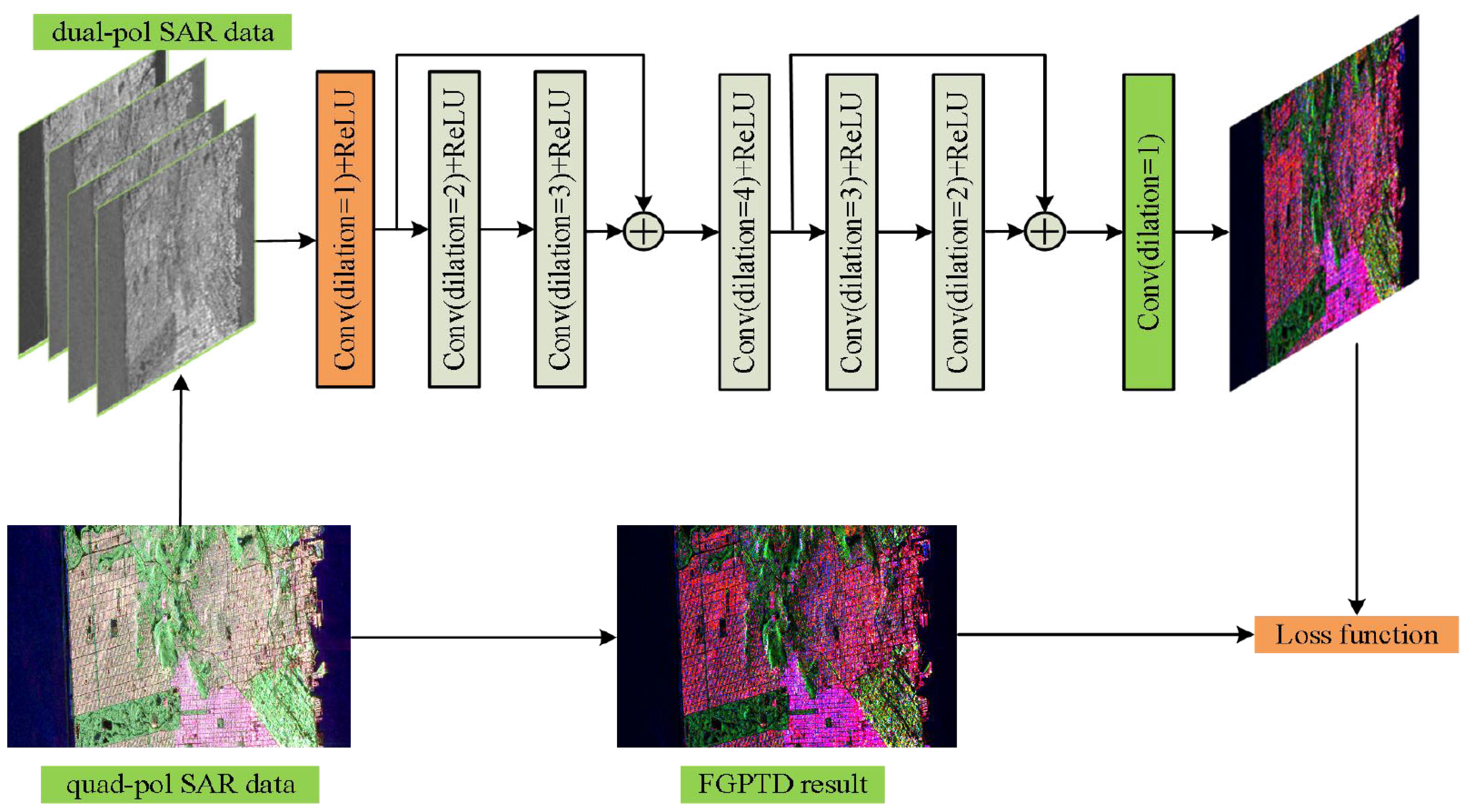
- Designs a convolutional neural network with residual connections and dilated convolutions to efficiently learn the mapping between dual-pol SAR data and scattering components.
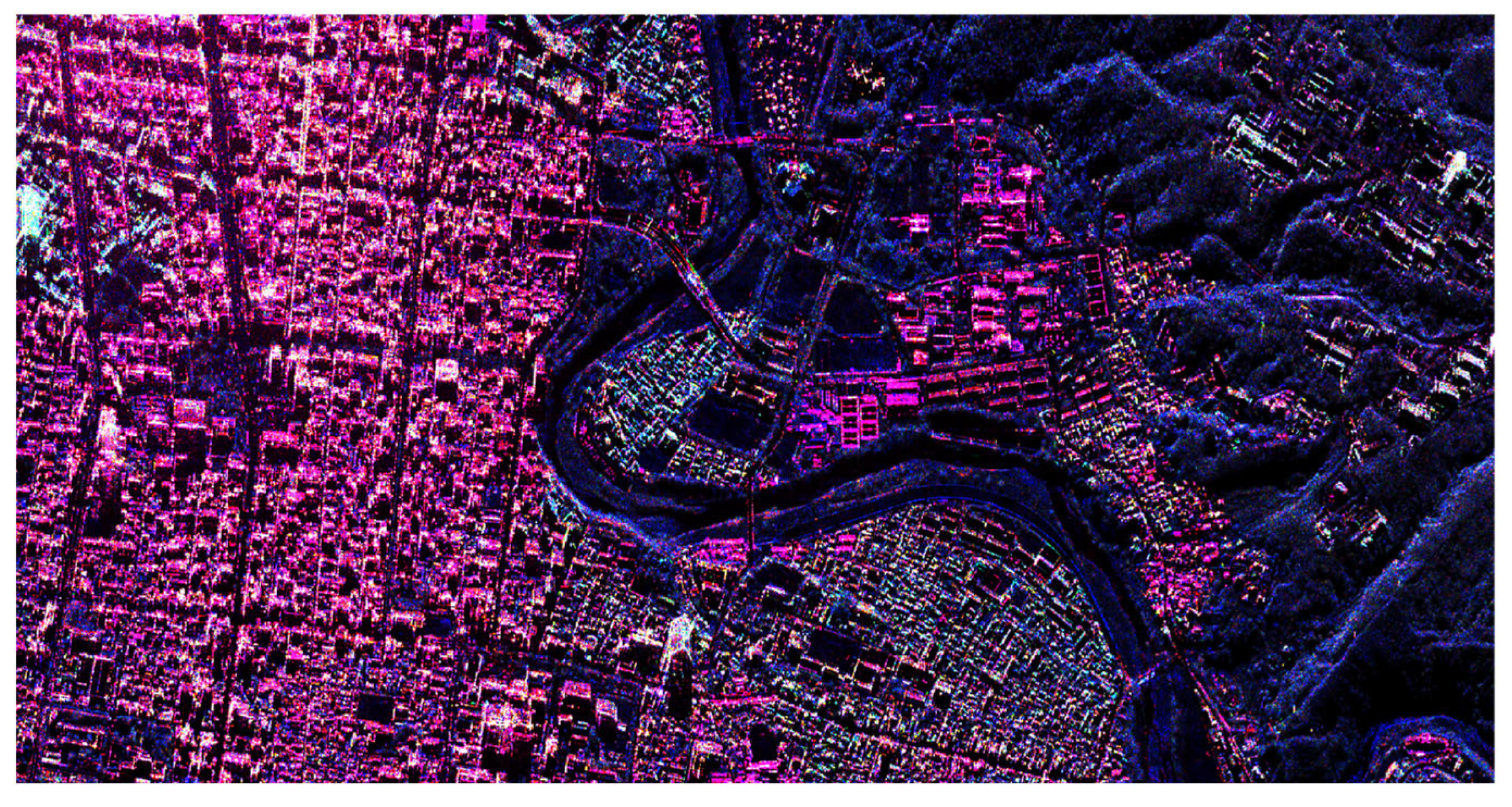
- Demonstrates strong generality; validated on multi-sensor (ALOS-2, AIRSAR, PiSAR) and multi-band (L band/X band) datasets.
Abstract
1. Introduction
2. FGPTD Method Review
3. Proposed Dual-Pol SAR Target Decomposition Method
3.1. Dual-Pol SAR Model
3.2. Proposed Dual-Pol SAR Target Decomposition Model
4. Experimental Results
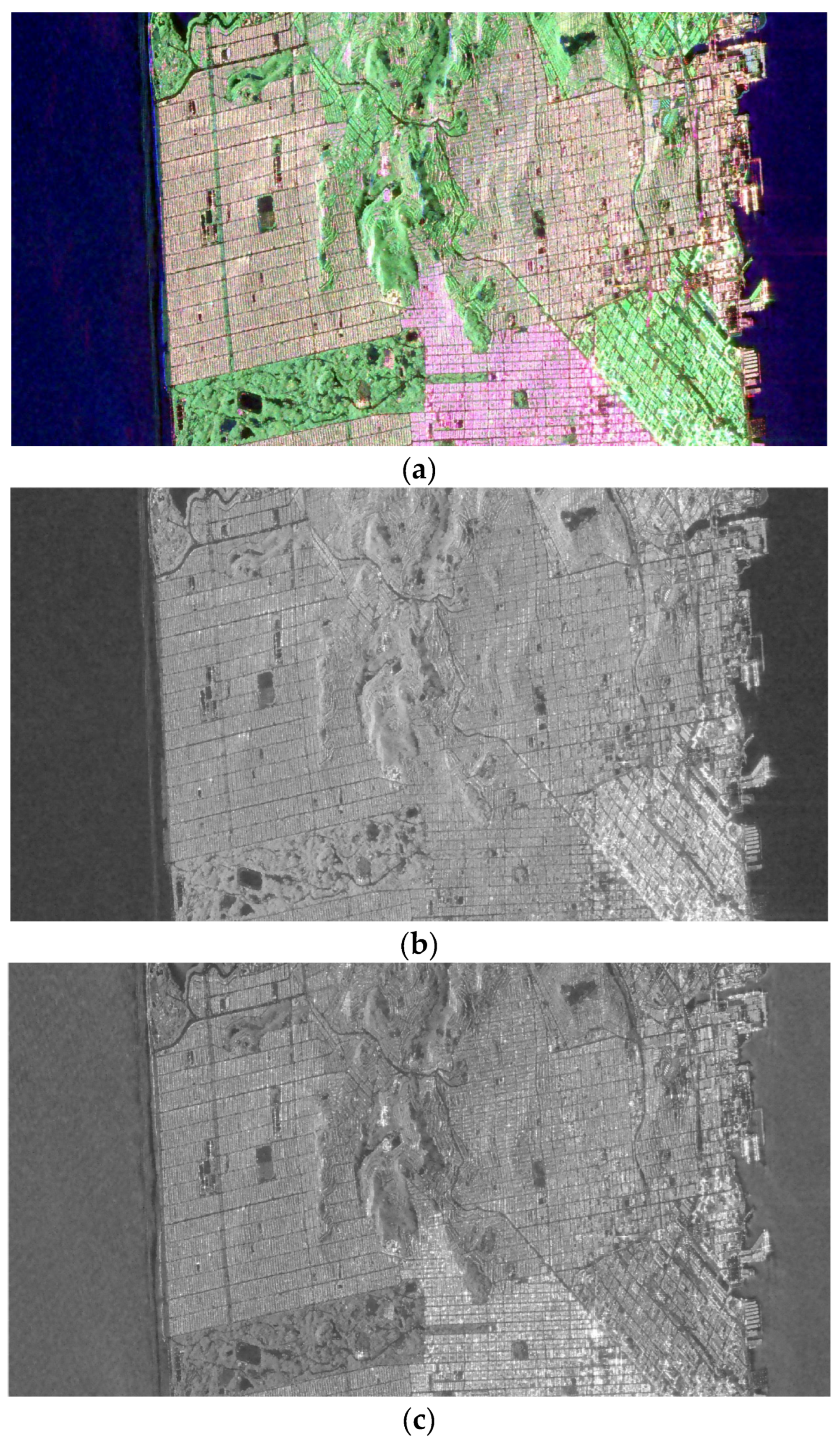
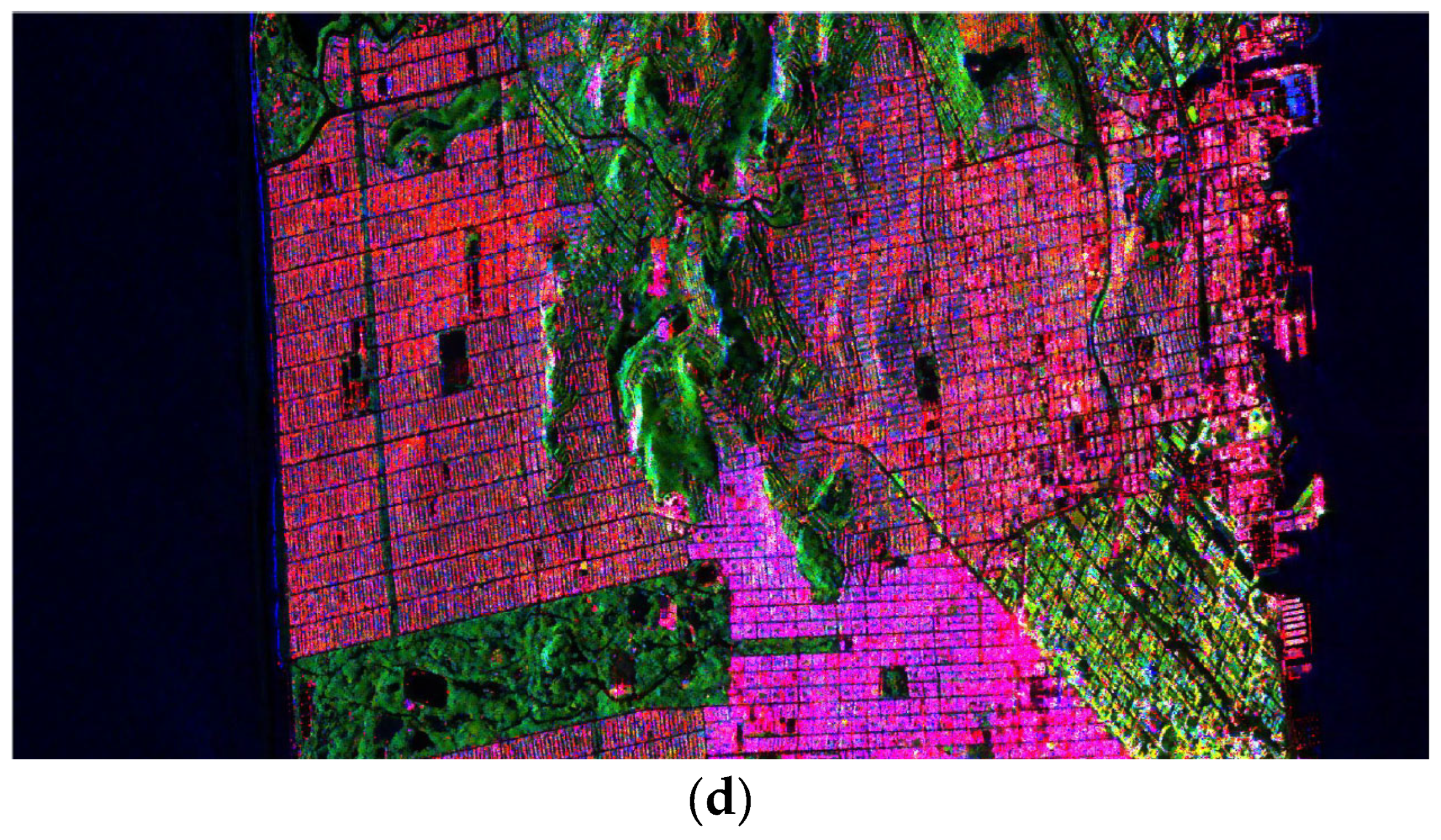
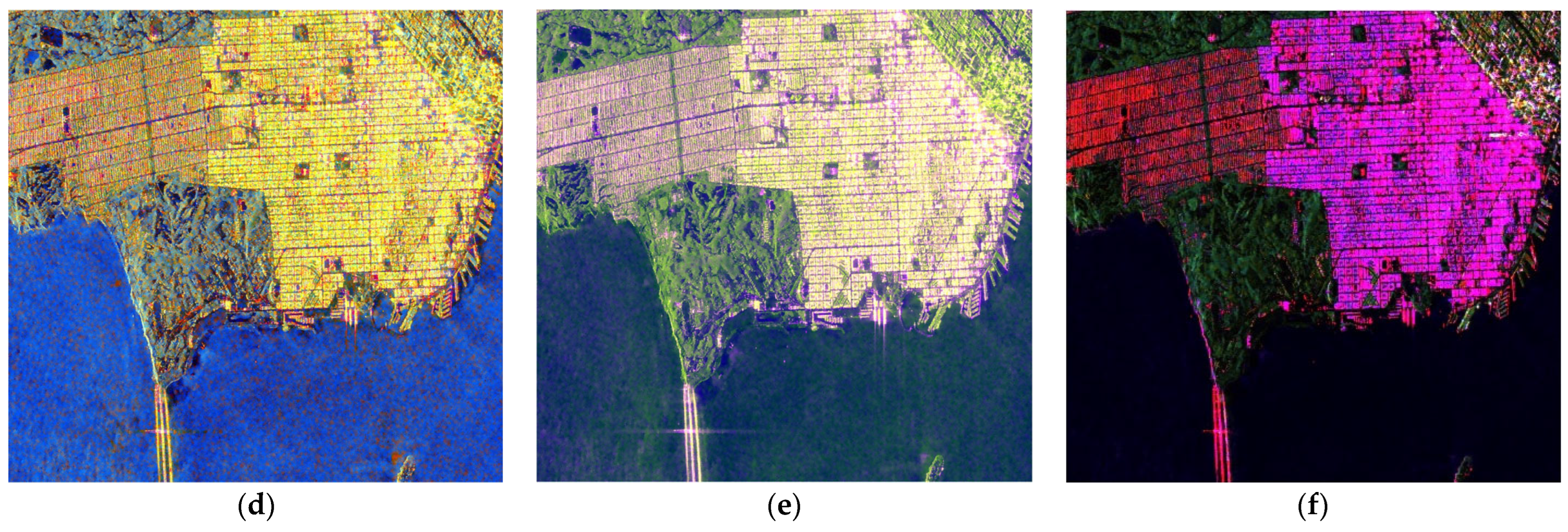
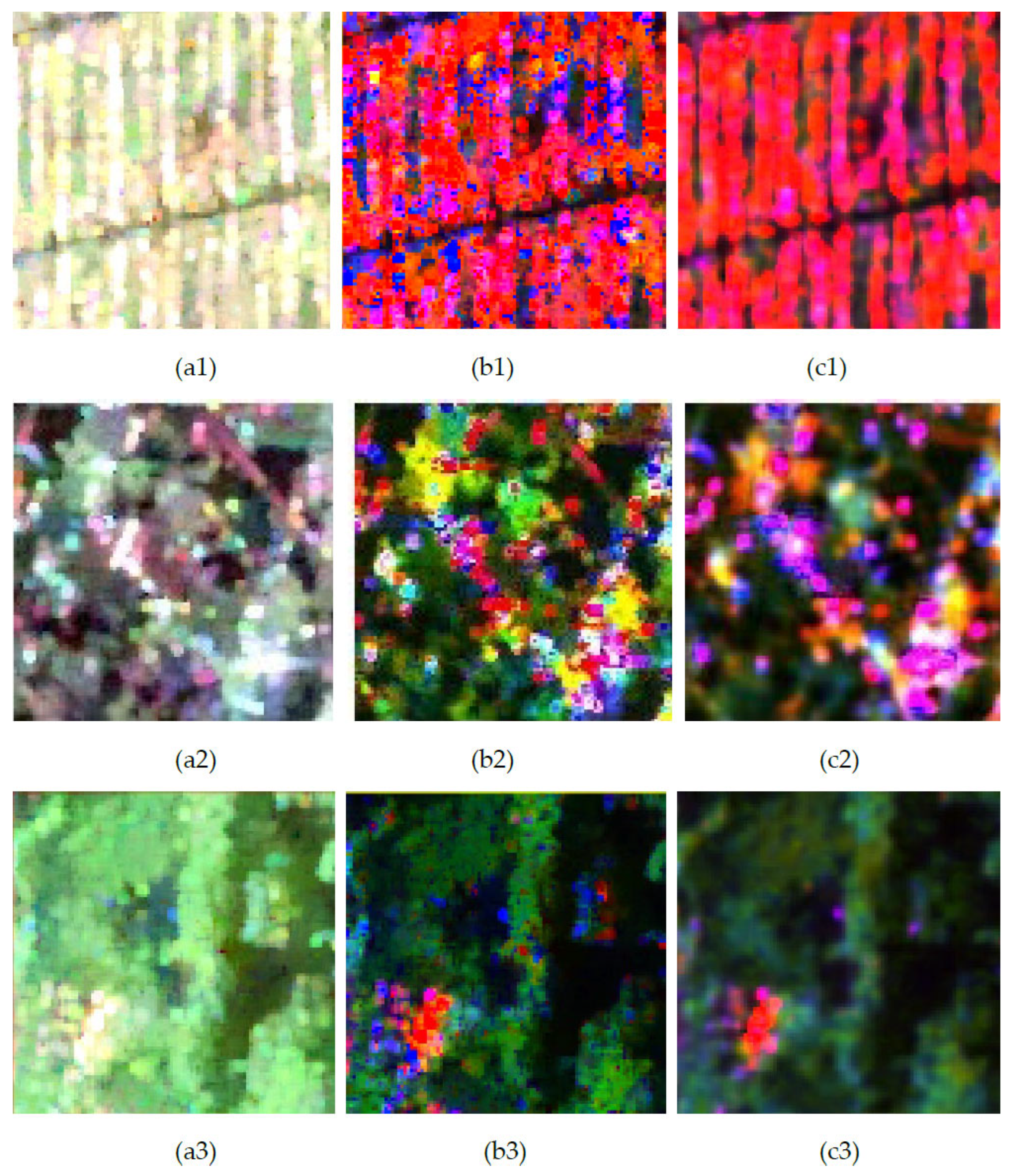
4.1. ALOS-2 Dataset
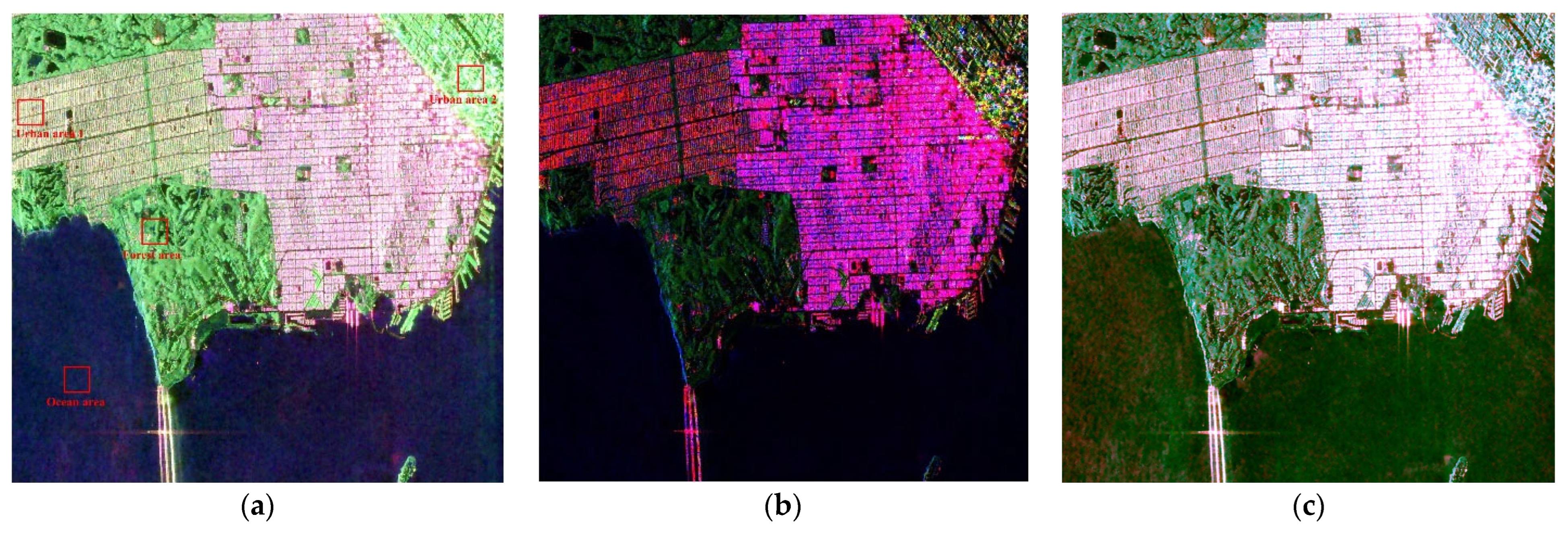
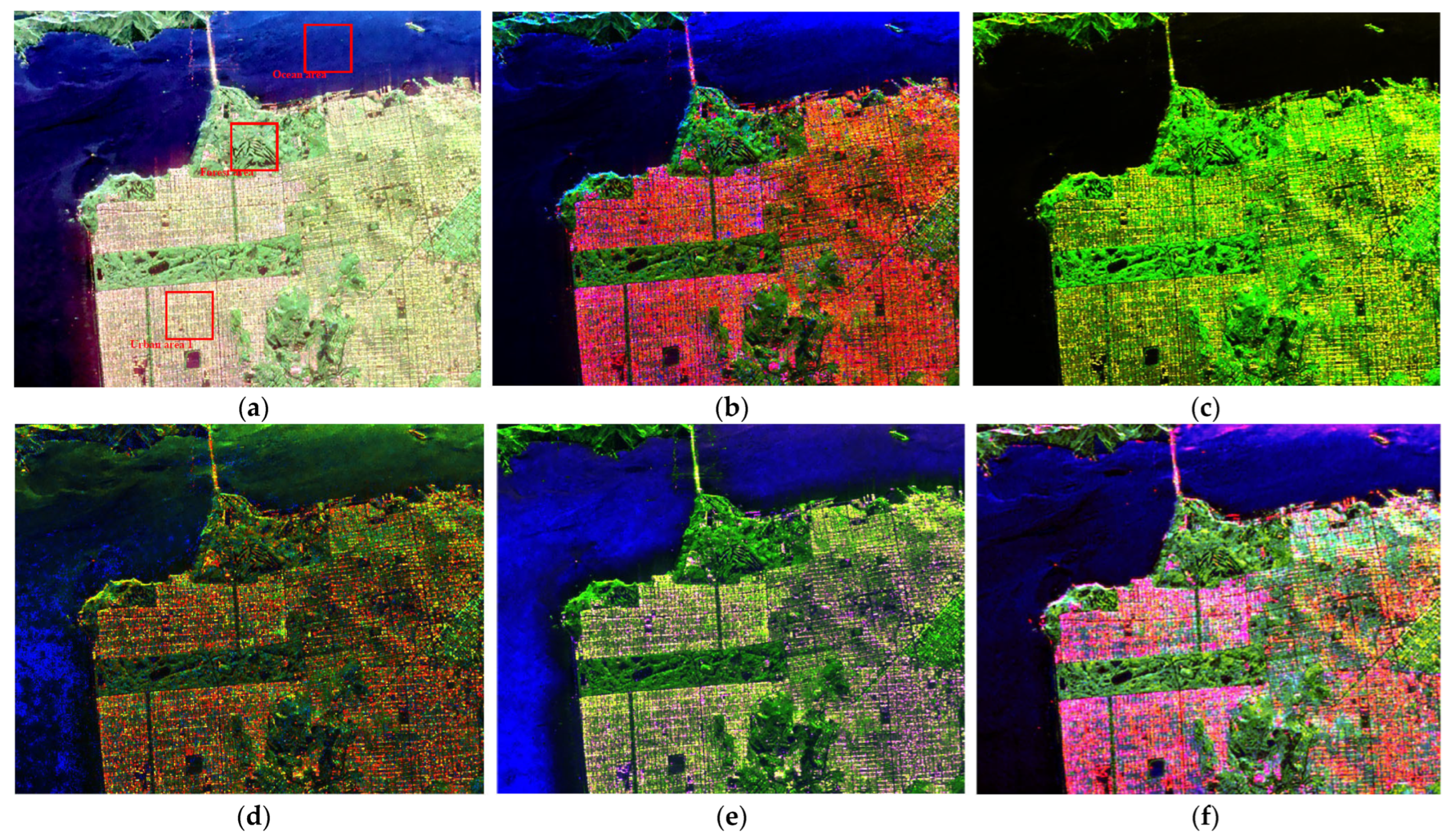
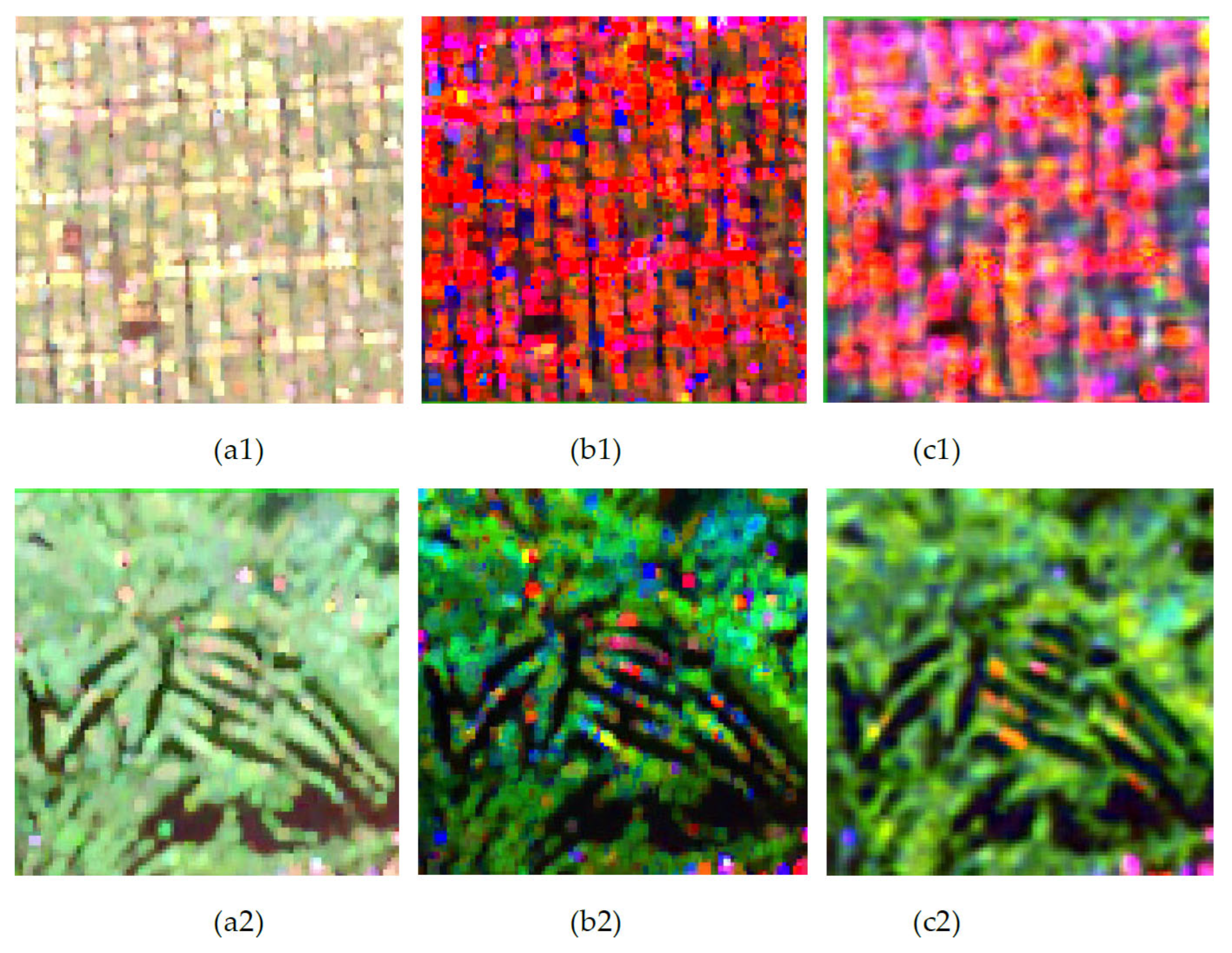
4.2. AIRSAR Dataset
4.3. PiSAR Dataset
5. Discussion
5.1. The Real-Time Performance of the Proposed Method
5.2. The Generalization and Effectiveness of the Proposed Method
6. Conclusions
Author Contributions
Funding
Institutional Review Board Statement
Informed Consent Statement
Data Availability Statement
Acknowledgments
Conflicts of Interest
References
- Cumming, G.; Wong, H. Digital Processing of Synthetic Aperture Radar Data; Artech House: Boston, MA, USA, 2005; pp. 108–110. [Google Scholar]
- Lee, S.; Pottier, E. Polarimetric Radar Imaging: From Basics to Applications; CRC Press: Boca Raton, FL, USA, 2009. [Google Scholar]
- Chen, S.-W.; Li, M.-D.; Cui, X.-C.; Li, H.-L. Polarimetric Roll-Invariant Features and Applications for Polarimetric Synthetic Aperture Radar Ship Detection: A comprehensive summary and investigation. IEEE Geosci. Remote Sens. Mag. 2024, 12, 36–66. [Google Scholar] [CrossRef]
- Krogager, E. New decomposition of the radar target scattering matrix. Electron. Lett. 1990, 18, 1525–1527. [Google Scholar] [CrossRef]
- Cameron, W.; Youssef, N.; Leung, L. Simulated polarimetric signatures of primitive geometrical shapes. IEEE Trans. Geosci. Remote Sens. 1996, 34, 793–803. [Google Scholar] [CrossRef]
- Touzi, R. Target scattering decomposition in terms of roll-invariant target parameters. IEEE Trans. Geosci. Remote Sens. 2007, 45, 73–84. [Google Scholar] [CrossRef]
- Freeman, A.; Durden, S.L. Three-component scattering model to describe polarimetric SAR data. IEEE Trans. Geosci. Remote Sens. 1998, 36, 963–973. [Google Scholar] [CrossRef]
- Yamaguchi, Y.; Moriyama, T.; Ishido, M.; Yamada, H. Four-component scattering model for polarimetric SAR image decomposition. IEEE Trans. Geosci. Remote Sens. 2005, 43, 1699–1706. [Google Scholar] [CrossRef]
- Yamaguchi, Y.; Sato, A.; Boerner, W.; Sato, R.; Yamada, H. Four-Component Scattering Power Decomposition with Rotation of Coherency Matrix. IEEE Trans. Geosci. Remote Sens. 2011, 49, 2251–2258. [Google Scholar]
- Van Zyl, J.J.; Arii, M.; Kim, Y. Model-Based Decomposition of Polarimetric SAR Covariance Matrices Constrained for Nonnegative Eigenvalues. IEEE Trans. Geosci. Remote Sens. 2011, 49, 3452–3459. [Google Scholar]
- Singh, G.; Yamaguchi, Y.; Park, S.-E. General Four-Component Scattering Power Decomposition with Unitary Transformation of Coherency Matrix. IEEE Trans. Geosci. Remote Sens. 2013, 51, 3014–3022. [Google Scholar]
- Chen, S.-W.; Wang, X.-S.; Xiao, S.-P.; Sato, M. General Polarimetric Model-Based Decomposition for Coherency Matrix. IEEE Trans. Geosci. Remote Sens. 2014, 52, 1843–1855. [Google Scholar]
- Wu, G.; Li, Y.; Chen, S. Polarimetric Model-Based Decomposition with Refined Double-Bounce Orientation Angle and Scattering Model. Remote Sens. 2021, 13, 3070. [Google Scholar]
- Singh, G.; Malik, R.; Mohanty, S.; Rathore, V.S.; Yamada, K.; Umemura, M.; Yamaguchi, Y. Seven-Component Scattering Power Decomposition of POLSAR Coherency Matrix. IEEE Trans. Geosci. Remote Sens. 2019, 57, 8371–8382. [Google Scholar]
- An, W.; Lin, M. An Incoherent Decomposition Algorithm Based on Polarimetric Symmetry for Multilook Polarimetric SAR Data. IEEE Trans. Geosci. Remote Sens. 2019, 58, 2383–2397. [Google Scholar] [CrossRef]
- Cloude, S.; Pottier, E. A Review of Target Decomposition Theorems In Radar Polarimetry. IEEE Trans. Geosci. Remote Sens. 1996, 34, 498–518. [Google Scholar]
- Cloude, S. The Dual Polarization Entropy/Alpha Decomposition: A PALSAR Case Study. Sci. Appl. SAR Polarim. Polarim. Interferom. 2007, 644, 2. [Google Scholar]
- Cloude, S.R.; Goodenough, D.G.; Chen, H. Compact decomposition theory. IEEE Geosci. Remote Sens. Lett. 2012, 9, 28–32. [Google Scholar] [CrossRef]
- Raney, R.K.; Cahill, J.T.S.; Patterson, G.W.; Bussey, D.B.J. The M-Chi Decomposition of Hybrid Dual-Polarimetric Radar Data with Application to Lunar Craters. J. Geophys. Res. 2012, 117, E00H21. [Google Scholar] [CrossRef]
- Charbonneau, F.J.; Brisco, B.; Raney, R.K.; McNairn, H.; Liu, C.; Vachon, P.W.; Shang, J.; DeAbreu, R.; Champagne, C.; Merzouki, A.; et al. Compact Polarimetry Overview and Applications Assessment. Can. J. Remote Sens. 2010, 36, S298–S315. [Google Scholar]
- Shirvany, R.; Chabert, M.; Tourneret, J. Ship and Oil-Spill Detection Using the Degree of Polarization in Linear and Hybrid/Compact Dual-Pol SAR. IEEE J. Sel. Top. Appl. Earth Obs. Remote Sens. 2012, 5, 885–892. [Google Scholar] [CrossRef]
- Dabboor, M.; Geldsetzer, T. Towards sea ice classification using simulated RADARSAT Constellation Mission compact polarimetric SAR imagery. Remote Sens. Environ. 2014, 140, 189–195. [Google Scholar]
- My-Linh, T.; Freeman, A.; Dubois-Fernandez, P.C.; Pottier, E. Estimation of Soil Moisture and Faraday Rotation from Bare Surfaces Using Compact Polarimetry. IEEE Trans. Geosci. Remote Sens. 2009, 47, 3608–3615. [Google Scholar] [CrossRef]
- Mohsen, G.; David, A.C.; Linlin, X.; Mingzhe, J. Contextual Classification of Sea-Ice Types Using Compact Polarimetric SAR Data. IEEE Trans. Geosci. Remote Sens. 2019, 57, 7476–7491. [Google Scholar]
- Liang, L.; Zhang, Y.; Li, D.; Dong, X. A New Entropy Estimation Method for Dual-Polarimetric SAR Data: Comparative Analysis with Quad- and Other Dual-Polarization Approaches. IEEE J. Sel. Top. Appl. Earth Obs. Remote Sens. 2018, 11, 2657–2667. [Google Scholar] [CrossRef]
- Sugimoto, R.; Nakamura, R.; Tsutsumi, C.; Yamaguchi, Y. Extension of Scattering Power Decomposition to Dual-Polarization Data for Tropical Forest Monitoring. Remote Sens. 2023, 15, 839. [Google Scholar] [CrossRef]
- Mascolo, L.; Cloude, S.R.; Lopez-Sanchez, J.M. Model-Based Decomposition of Dual-Pol SAR Data: Application to Sentinel-1. IEEE Trans. Geosci. Remote Sens. 2022, 60, 1–19. [Google Scholar]
- Verma, A.; Avik, B.; Subhadip, D.; Carlos, L.; Paolo, G. Scattering Power Components from Dual-Pol Sentinel-1 SLC and GRD SAR Data. ISPRS J. Photogramm. Remote Sens. 2024, 212, 289–305. [Google Scholar] [CrossRef]
- Blix, K.; Espeseth, M.; Eltoft, T. Machine Learning simulations of quad-polarimetric features from dualpolarimetric measurements over sea ice. In Proceedings of the European Conference on Synthetic Aperture Radar, Aachen, Germany, 4–7 June 2018; pp. 1–5. [Google Scholar]
- Souyris, J.; Imbo, P.; Fjortoft, R. Compact polarimetry based on symmetry properties of geophysical media: The pi/4 mode. IEEE Trans. Geosci. Remote Sens. 2005, 43, 634–646. [Google Scholar] [CrossRef]
- Stacy, N.; Preiss, M. Compact polarimetric analysis of X-band SAR data. In Proceedings of the European Conference on Synthetic Aperture Radar, Dresden, Germany, 16–18 May 2006. [Google Scholar]
- Nord, M.; Ainsworth, T.; Lee, J.; Stacy, N.J. Comparison of Compact Polarimetric Synthetic Aperture Radar Modes. IEEE Trans. Geosci. Remote Sens. 2009, 47, 174–188. [Google Scholar] [CrossRef]
- Raney, R.K. Hybrid-Polarity SAR Architecture. IEEE Trans. Geosci. Remote Sens. 2007, 45, 3397–3404. [Google Scholar] [CrossRef]
- Song, Q.; Xu, F.; Jin, Y. Radar image colorization: Converting single polarization to fully polarimetric using deep neural networks. IEEE Access 2017, 6, 1647–1661. [Google Scholar] [CrossRef]
- Gu, F.; Zhang, H.; Wang, C. Quad-pol Reconstruction from Compsact Polarimetry Using a Fully Convolutional Network. Remote Sens. Lett. 2020, 11, 397–406. [Google Scholar] [CrossRef]
- Zhang, F.; Cao, Z.; Xiang, D.; Hu, C.; Ma, F.; Yin, Q.; Zhou, Y. Pseudo Quad-Pol Simulation from Compact Polarimetric SAR Data via a Complex-Valued Dual-Branch Convolutional Neural Network. IEEE J. Sel. Top. Appl. Earth Obs. Remote Sens. 2021, 15, 901–918. [Google Scholar] [CrossRef]
- Deng, J.; Zhou, P.; Li, M.; Li, H.; Chen, S. Quad-Pol SAR Data Reconstruction from Dual-Pol SAR Mode Based on a Multiscale Feature Aggregation Network. Remote Sens. 2023, 15, 4182. [Google Scholar] [CrossRef]
- Deng, J.-W.; Li, M.-D.; Chen, S.-W. Urban Damage Level Mapping with Reconstructed Quad-Pol SAR Data from Dual-Pol SAR Mode. IEEE Geosci. Remote Sens. Lett. 2024, 21, 1–5. [Google Scholar]
- Simonyan, K.; Zisserman, A. Very deep convolutional networks for large-scale image recognition. In Proceedings of the International Conference on Learning Representations, San Diego, CA, USA, 7–9 May 2015; pp. 1–14. [Google Scholar]
- He, K.; Zhang, X.; Ren, S.; Sun, J. Deep residual learning for image recognition. In Proceedings of the IEEE Conference on Computer Vision and Pattern Recognition, Las Vegas, NV, USA, 27–30 June 2016; pp. 770–778. [Google Scholar]
- Mishra, B.; Susaki, J. Generation of pseudo-fully polarimetric data from dual polarimetric data for land cover classification. In Proceedings of the International Conference on Computer Vision in Remote Sensing, Xiamen, China, 16–18 December 2012; pp. 262–267. [Google Scholar]
- Chen, S.; Wang, X.; Sato, M. PolInSAR complex coherence estimation based on covariance matrix similarity test. IEEE Trans. Geosci. Remote Sens. 2012, 50, 4699–4710. [Google Scholar] [CrossRef]






| Sensors | Imaging Area | Frequency Bands | Resolution (Range × Azimuth) | Size (Range × Azimuth) | Train/Test |
|---|---|---|---|---|---|
| Space-borne ALOS2 | San Francisco | L band | 2.86 m × 3.21 m | 1600 pixels × 3000 pixels | Train |
| San Francisco | L band | 2.86 m × 3.21 m | 1960 pixels × 1870 pixels | Test | |
| Airborne AIRSAR | San Francisco | L band | 6.6 m × 12.1 m | 900 pixels × 1024 pixels | Test |
| Airborne PiSAR | Sendai | X band | 1.5 m × 2 m | 1240 pixels × 1780 pixels | Test |
| Region | Method | Dbl | Vol | Odd |
|---|---|---|---|---|
| Urban area 1 | FGPTD method | 76.17 | 0.42 | 23.41 |
| Proposed method | 98.09 | 0.35 | 1.56 | |
| Urban area 2 | FGPTD method | 27.03 | 52.66 | 20.31 |
| Proposed method | 46.49 | 33.34 | 20.17 | |
| Forest area | FGPTD method | 8.12 | 67.45 | 24.43 |
| Proposed method | 8.63 | 74.05 | 17.32 | |
| Ocean area | FGPTD method | 1 | 0 | 99 |
| Proposed method | 0 | 0 | 100 |
| Region | Method | Dbl | Vol | Odd |
|---|---|---|---|---|
| Urban area 1 | FGPTD method | 89.78 | 0.98 | 9.24 |
| Proposed method | 80.32 | 4.46 | 15.22 | |
| Forest area | FGPTD method | 13.94 | 70.25 | 15.81 |
| Proposed method | 9.52 | 88.34 | 2.14 | |
| Ocean area | FGPTD method | 0 | 0 | 100 |
| Proposed method | 0 | 0 | 100 |
| Region | Method | Dbl | Vol | Odd |
|---|---|---|---|---|
| Urban area 1 | FGPTD method | 59.72 | 2.87 | 37.41 |
| Proposed method | 84.90 | 9.67 | 5.43 | |
| Urban area 2 | FGPTD method | 38.26 | 10.81 | 50.93 |
| Proposed method | 52.51 | 39.92 | 7.57 | |
| Forest area | FGPTD method | 7.83 | 18.18 | 73.99 |
| Proposed method | 9.97 | 78.12 | 11.91 |
| Method | FGPTD Method | Verma’s Method | DualSD | Mascolo’s Method | Proposed Method |
|---|---|---|---|---|---|
| Processing time | 426.10 | 321.03 | 3.08 | 3.17 | 8.82 |
Disclaimer/Publisher’s Note: The statements, opinions and data contained in all publications are solely those of the individual author(s) and contributor(s) and not of MDPI and/or the editor(s). MDPI and/or the editor(s) disclaim responsibility for any injury to people or property resulting from any ideas, methods, instructions or products referred to in the content. |
© 2026 by the authors. Licensee MDPI, Basel, Switzerland. This article is an open access article distributed under the terms and conditions of the Creative Commons Attribution (CC BY) license.
Share and Cite
Deng, J.; Xu, J.; Yu, C.; Chen, S. A Model and Learning-Aided Target Decomposition Method for Dual Polarimetric SAR Data. Remote Sens. 2026, 18, 595. https://doi.org/10.3390/rs18040595
Deng J, Xu J, Yu C, Chen S. A Model and Learning-Aided Target Decomposition Method for Dual Polarimetric SAR Data. Remote Sensing. 2026; 18(4):595. https://doi.org/10.3390/rs18040595
Chicago/Turabian StyleDeng, Junwu, Jing Xu, Chunhui Yu, and Siwei Chen. 2026. "A Model and Learning-Aided Target Decomposition Method for Dual Polarimetric SAR Data" Remote Sensing 18, no. 4: 595. https://doi.org/10.3390/rs18040595
APA StyleDeng, J., Xu, J., Yu, C., & Chen, S. (2026). A Model and Learning-Aided Target Decomposition Method for Dual Polarimetric SAR Data. Remote Sensing, 18(4), 595. https://doi.org/10.3390/rs18040595