


Highlights
What are the main findings?
- Proposes a model and learning-aided dual-pol SAR target decomposition method that fuses the physical interpretability of generalized polarimetric target decomposition and the nonlinear fitting capability of deep learning.
- Designs a convolutional neural network with residual connections and dilated convolutions to efficiently learn the mapping between dual-pol SAR data and scattering components.
What are the implications of the main findings?
- Demonstrates strong generality; validated on multi-sensor (ALOS-2, AIRSAR, PiSAR) and multi-band (L band/X band) datasets.
Abstract
Target decomposition is an essential method for the interpretation of polarimetric Synthetic Aperture Radar (SAR). Most current polarimetric target decomposition methods are designed for quad-pol SAR data, while there is a scarcity of methods tailored for dual-pol SAR data, and these methods often struggle to accurately capture the complete scattering components of targets. Compared to quad-pol SAR, space-borne SAR systems more frequently acquire dual-pol SAR data, which offers a wider observation swath and higher resolution. The fast generalized polarimetric target decomposition (FGPTD) method has exhibited excellent target decomposition performance for quad-pol SAR data by searching for the optimal scattering models through nonlinear optimization. To address the core problem of inaccurate scattering component extraction in dual-pol SAR, deep learning is adopted to simulate the nonlinear optimization process of the FGPTD method. Its powerful nonlinear mapping capability enables the model to learn the intrinsic correlation between dual-pol SAR data and the complete scattering components obtained by FGPTD. Therefore, this paper proposes a model and learning-aided target decomposition method for dual-pol SAR. Firstly, FGPTD is performed on existing quad-pol SAR data. Subsequently, a mapping set between dual-pol SAR data and scattering components is constructed. Then, a neural network that integrates residual connections and dilated convolutional kernels is trained using the constructed mapping set. Finally, the well-trained neural network is tested on dual-pol SAR data from other regions and other sensors. Experimental results demonstrate that the proposed method’s target decomposition results are close to those of quad-pol target decomposition and superior to current state-of-the-art dual-pol target decomposition methods.
1. Introduction
Synthetic Aperture Radar (SAR) is widely used for applications such as Earth observation and maritime surveillance [1]. Polarimetric SAR can acquire electromagnetic scattering information of targets under different polarization states, enabling high-precision land cover classification and disaster assessment [2].
Polarimetric target decomposition can identify the scattering mechanisms of different land covers through fine interpretation of target scattering mechanisms, which is an important method for the interpretation of polarimetric SAR. Existing quad-pol SAR target decomposition methods mainly include two major categories: coherent and incoherent target decomposition [3]. Coherent target decomposition methods utilize the scattering matrix for deterministic target decomposition. Typical coherent target decomposition methods include Pauli decomposition, Krogager decomposition [4], Cameron decomposition [5], and Touzi decomposition [6]. Incoherent target decomposition methods based on polarimetric coherent/covariance matrices have been proposed for distributed targets, which include model-based target decomposition methods [7,8,9,10,11,12,13,14,15] and eigenvalue-based target decomposition methods [16]. Freeman–Durden decomposition is a representative method for model-based target decomposition [7]. However, due to issues such as negative power, overestimation of volume scattering, and ambiguity in scattering mechanisms that arise during the decomposition process, Yamaguchi decomposition [8,9], VanZyl decomposition [10], G4U decomposition [11], generalized polarimetric target decomposition (GPTD) [12], fast GPTD (FGPTD) [13], the 7SD method [14], and the PSD method [15] have been subsequently proposed. Apart from the methods mentioned above, a series of classical polarimetric features is derived from the scattering matrix or the coherent matrix [3,16]. These polarimetric features are proven to be sensitive to different land covers and man-made targets, which play a significant role in ship detection [3].
However, the aforementioned target decomposition methods are based on quad-pol SAR data and cannot be directly applied to dual-pol SAR data. Compared to quad-pol SAR, dual-pol SAR maintains partial polarization information while offering the advantage of twice the observation swath, being widely used in recent SAR systems. The dual-pol SAR modes consist of three special compact polarimetry SAR modes and the conventional HH-VH/VV-HV dual-pol SAR modes. In comparison with the conventional dual-pol SAR modes, compact polarimetry (CP) SAR contains abundant polarization information. Accordingly, numerous scholars have proposed a lot of target decomposition methods for compact polarimetry SAR, yielding a series of decomposition features, including H-α decomposition [17,18], Stokes decomposition [19], m-χ decomposition [19], and m-δ decomposition [20]. These target decomposition features have subsequently been applied to oil spill detection [21], sea ice classification [22,23], and soil moisture estimation [24]. Nevertheless, the above target decomposition methods are specifically designed for compact polarimetry modes, and further research is still required for the target decomposition of conventional HH-VH and VV-HV dual-pol SAR data. Currently, there are two target decomposition approaches for HH-VH and VV-HV dual-pol SAR mode. The first approach is to perform target decomposition directly based on dual-pol SAR data. Cloude et al. extend H/alpha decomposition to dual-pol SAR data [17]. Liang et al. propose a new entropy estimation method for dual-pol SAR data based on the reciprocity assumption [25]. Sugimoto et al. introduce a novel scattering power decomposition method tailored to dual-pol SAR data to enhance the accuracy of tropical forest monitoring [26]. Mascolo et al. advance a new family of model-based decomposition method specifically adapted for Sentinel-1 dual-pol SAR data by separating an arbitrary Stokes vector into partially polarized and polarized wave components [27]. Verma et al. introduce two new indices, DpRBI and DpRSI, to identify the scattering types of “dihedral-like” (e.g., buildings, bridges) and “surface-like” (e.g., water bodies, bare land) targets, where these indices are combined with the scattering power decomposition framework (SPFF) to derive surface scattering components, double-bounce scattering components, and residual scattering components [28]. However, compared to quad-pol SAR target decomposition methods, these methods do not obtain complete scattering components, leading to ambiguity in scattering mechanism interpretation. The second approach is to reconstruct dual-pol SAR data into quad-pol SAR data and then apply existing target decomposition methods to the reconstructed pseudo quad-pol SAR data. Blix et al. predict two quad-pol parameters based on the six-dimensional dual-pol input vector using the Gaussian process regression algorithm and apply the results to sea ice monitoring [29]. However, the quad-pol scattering components derived from this method are incomplete. Mishra et al. reconstruct the VV polarization component from HH and HV data to obtain pseudo quad-pol SAR data and then perform Freeman–Durden decomposition on the pseudo quad-pol data to achieve land cover classification [30]. Subsequently, several scholars have conducted quad-pol information reconstruction for compact polarimetry SAR data based on the reflection symmetry assumption and further applied the reconstructed quad-pol SAR data to target classification and recognition [30,31,32,33]. Nevertheless, such methods exhibit poor performance in reconstructing quad-pol SAR data for man-made targets, thus yielding inaccurate scattering components after target decomposition of the reconstructed quad-pol SAR data. Therefore, in recent years, several researchers have proposed deep-learning-based methods for quad-pol SAR data reconstruction from CP SAR data, which overcome the constraints of the reflection symmetry assumption and improve the performance of quad-pol SAR data reconstruction [34,35,36,37,38]. However, such methods mostly require the design of complex network architectures [39,40], which involve a two-step process to complete target decomposition, resulting in high computational complexity. Furthermore, the scattering components obtained from pseudo quad-pol SAR data deviate significantly from the true scattering components when reconstruction accuracy is low.
Specifically, to tackle the issues of incomplete scattering components and large decomposition errors for man-made targets in existing dual-pol SAR target decomposition methods, this paper adopts the scattering components decomposed from quad-pol SAR data as the ground truth to guide the convolutional neural network (CNN) in designing the mapping relationship between dual-pol SAR data and scattering components. The GPTD method solves the single and double-bounce scattering component models with orientation angles through nonlinear optimization by minimizing the total target decomposition error. To overcome the intensive computation load caused by nonlinear optimization, the FGPTD method accelerates the decomposition speed and improves the decomposition performance of the GPTD method by piecewise linearizing the double-bounce orientation angle. Benefiting from the excellent decomposition accuracy of the FGPTD method, this paper utilizes the scattering components decomposed by the FGPTD method as the ground truth and leverages the powerful nonlinear mapping capability of the CNN to simulate the nonlinear optimization process of the FGPTD method. Thus, this paper proposes a model and learning-aided target decomposition method for dual-pol SAR data. Firstly, the FGPTD method is applied to available quad-pol SAR data. On this basis, a mapping dataset between dual-pol SAR data and scattering components is established. Afterwards, a CNN incorporating residual connections and dilated convolutional kernels is trained using the established mapping dataset. Finally, the well-trained neural network is validated on dual-pol SAR data from different regions and sensors. The proposed method combines the interpretability of the FGPTD method with the powerful nonlinear fitting capability of CNN, which provides a new paradigm for dual-pol SAR target decomposition. Experimental results show that compared to existing dual-pol SAR target decomposition methods, the target decomposition results of the proposed method are highly consistent with the target decomposition results of real quad-pol SAR data and have strong generalization to data from different frequency bands and sensors.
The remaining sections of this paper are organized as follows: Section 2 briefly introduces the fast generalized polarimetric target decomposition method. Section 3 describes the dual-pol SAR model and the proposed dual-pol SAR target decomposition method. Section 4 quantitatively analyzes the target decomposition results with different measured datasets and demonstrates the advantages of the proposed method. Section 5 discusses the time complexity and effectiveness of different target decomposition methods. Finally, conclusions are given in Section 6.
2. FGPTD Method Review
The generalized polarimetric target decomposition method, by introducing physical parameters that represent the scattering structure and attitude information of the target, have established a refined scattering model, significantly improving interpretation performance for man-made targets. However, the GPTD method employs nonlinear optimization, which is computationally complex. The fast generalized polarimetric target decomposition method, by establishing a relationship between the polarization orientation angle (POA) and the double-bounce orientation angle (DBOA), transforms nonlinear optimization into linear optimization, thereby achieving fast inversion of model parameters.
By incorporating the double-bounce orientation angle, the traditional double-bounce scattering model is transformed into a generalized double-bounce scattering model as
where is the double-bounce scattering power coefficient, is the DBOA of the scattering model, and is the core complex parameter that characterizes the polarization characteristics of generalized double-bounce scattering, where its definition stems from the electromagnetic propagation and reflection mechanism of double-bounce scattering.
The FGPTD method utilizes piecewise linear functions to fit the relationship between the polarization orientation angle and the derived double-bounce orientation angle .
By substituting the derived double-bounce orientation angle into the generalized double-bounce scattering model , the refined double-bounce scattering model can be obtained.
The FGPTD method decomposes the polarimetric coherence matrix into the volume scattering model , the refined double-bounce scattering model , the generalized odd-bounce scattering model , and the helix scattering model .
where represent the volume scattering power coefficient, the double-bounce scattering power coefficient, the odd-bounce scattering power coefficient, and the helix scattering power coefficient and is the residual matrix. Detailed descriptions of the volume scattering model, the generalized odd-bounce scattering model, and the helix scattering model can be found in references [12,13].
In order to obtain the volume scattering model that most closely approximates the actual terrain, the FGPTD method establishes four different scattering models as a look-up table. The optimal volume scattering model is searched by minimizing the two-norm of the residual matrix.
3. Proposed Dual-Pol SAR Target Decomposition Method
3.1. Dual-Pol SAR Model
In this paper, the VV/HV dual-pol mode is selected as the research object because it is widely used in practical SAR missions (e.g., ALOS-2, Sentinel-1) due to its balanced data acquisition efficiency and scattering information retention. Additionally, the proposed method is adaptable to other common dual-pol modes (e.g., HH/HV) by adjusting the input covariance matrix structure without modifying the core network architecture. The dual-pol SAR covariance matrix under the VV and HV mode is defined as follows
where means the back-scattering coefficient of vertical polarization transmitting and horizontal polarization receiving and other terms are defined in a similar manner.
For the purpose of dual-pol SAR target decomposition based on deep learning, the logarithmic transformation is applied to the diagonal elements of the dual-pol covariance matrix to reduce the high dynamic range of scattering intensity data, which can mitigate the impact of extreme values on network training and improve the convergence stability of the model. Meanwhile, the logarithmic transformation maintains the monotonicity of the original data, ensuring that the relative relationship between different scattering components is not distorted. The amplitude logarithms and phases of the off-diagonal elements are extracted. Subsequently, these extracted amplitude logarithms and phases are vectorized as
where is the vectorized dual-pol SAR data, denotes the amplitude of a complex number, represents the logarithm operation, and stands for the phase of a complex number.
3.2. Proposed Dual-Pol SAR Target Decomposition Model
Because the DBOA is a piecewise function of POA, the FGPTD method can be considered a piecewise linear optimization problem. Therefore, the convolutional neural network can be utilized to solve this optimization problem.
The double-bounce scattering power coefficient, odd-bounce scattering power coefficient, volume scattering power coefficient, and helix scattering power coefficient are obtained by conducting FGPTD on quad-pol SAR data and merged as a set as follows
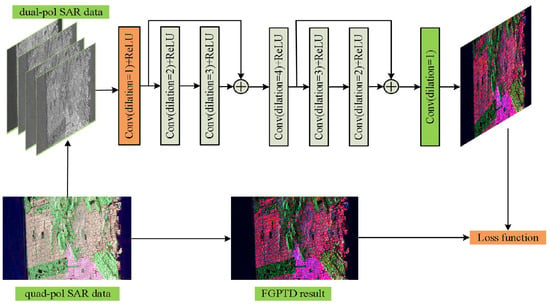
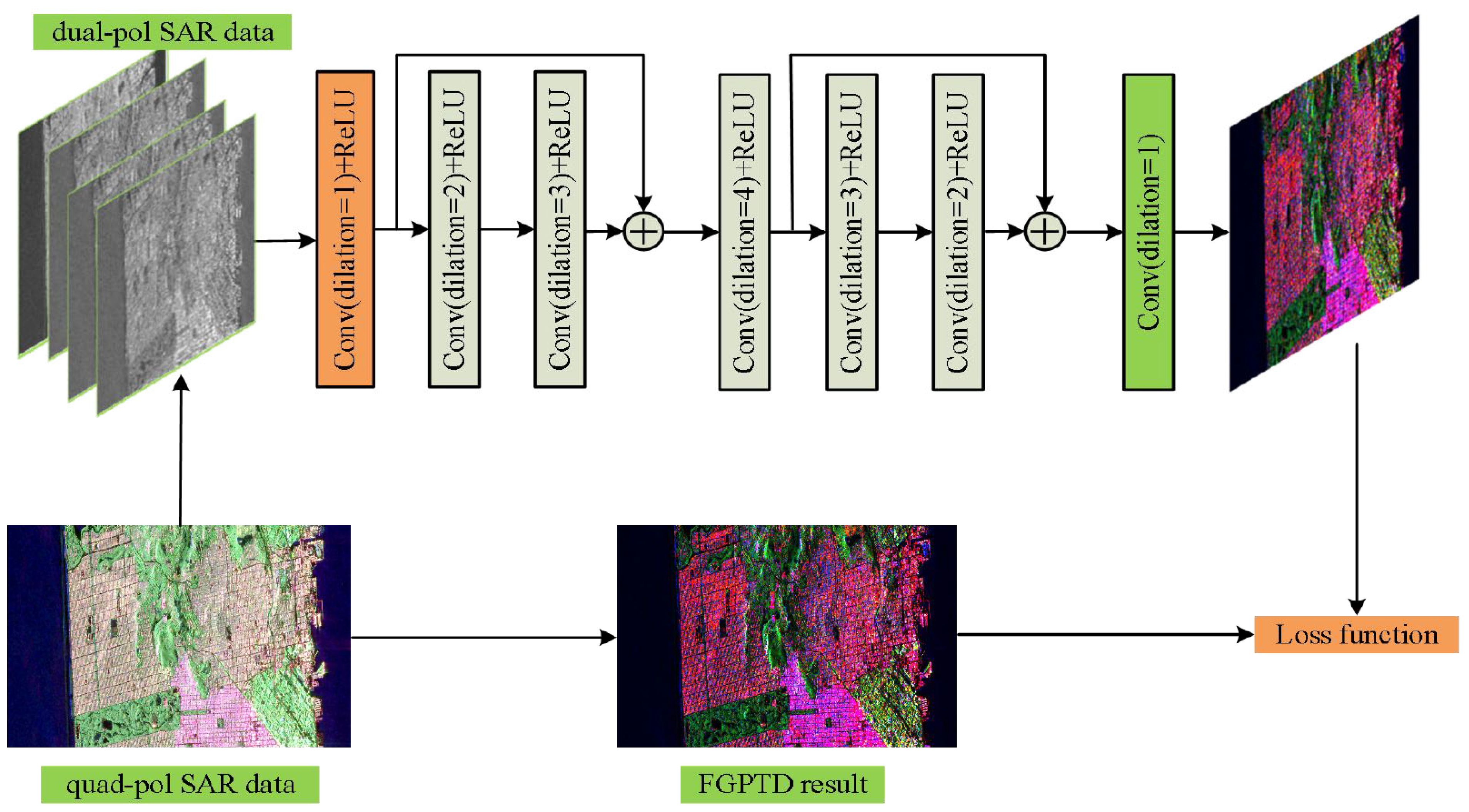
A convolutional neural network incorporating residual connections and dilated convolutions is designed for feature extraction from dual-pol SAR data, where represents the hyperparameters of . As shown in Figure 1, the network comprises seven convolutional layers, each layer with a kernel size of 3 × 3. The input and output channel number of intermediate layers is 64. The input and output channel number of the first convolutional layer with one dilation rate is 4 and 64, respectively. The dual-pol SAR data, after passing through the first convolutional layer and a ReLU activation function, sequentially undergoes processing through the second and third convolutional layers, which employ convolution kernels with dilation rates of 2 and 3, respectively, where the output of the first layer is residually connected to the output of the third layer. The residual output is then fed into the fourth convolutional layer, which uses a convolution kernel with a dilation rate of 4. Subsequently, the output of the fourth layer is processed through the fifth and sixth convolutional layers with dilation rates of 3 and 2, respectively, and the output of the fourth layer is residually connected to the output of the sixth layer. The residual output is then passed through the final convolutional layer, which solely includes a convolution operation with a dilation rate of 1, an input channel count of 64, and an output channel count of 4.
Figure 1.
The schematic diagram of the proposed network model.
The loss function of the proposed method is defined as
where denotes the L1 norm of a matrix.
The loss function minimizes the L1 norm between the output of the network and the decomposition results of the FGPTD method. Therefore, the FGPTD optimization process can be replaced by the network parameters optimized by the loss function.
The random gradient descent method (Adam optimizer) is utilized to train the network, and its parameters are set as follows: , , and . The learning rate is set as 0.0001. The dual-pol SAR image and target decomposition results are cut into the size of 40 × 40 sub-images for decreasing the computational burden, where the overlapping rate of the sub-images is 25%. Finally, dual-pol SAR data from other regions and other sensors are input into the well-trained proposed network model to obtain the results of dual-pol SAR target decomposition.
4. Experimental Results
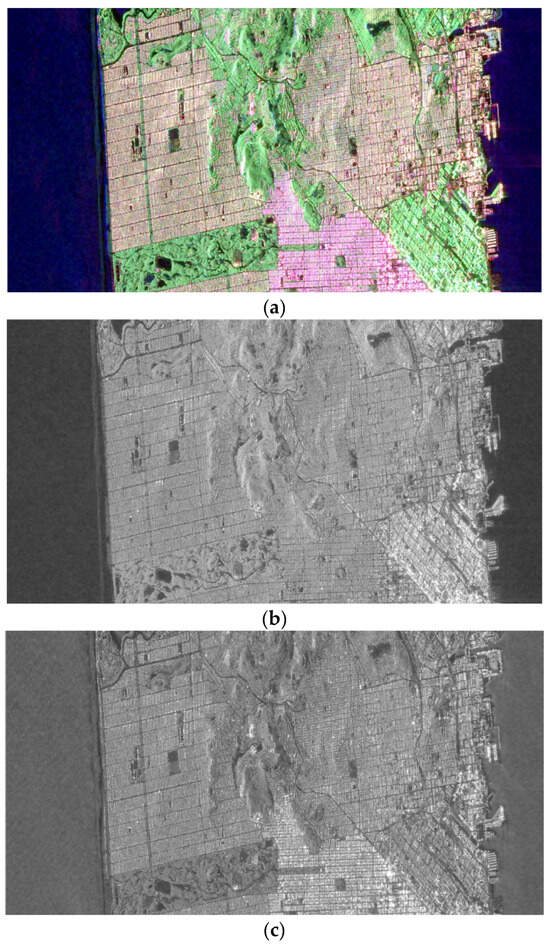
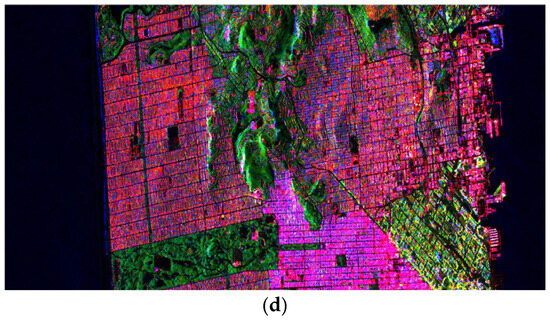
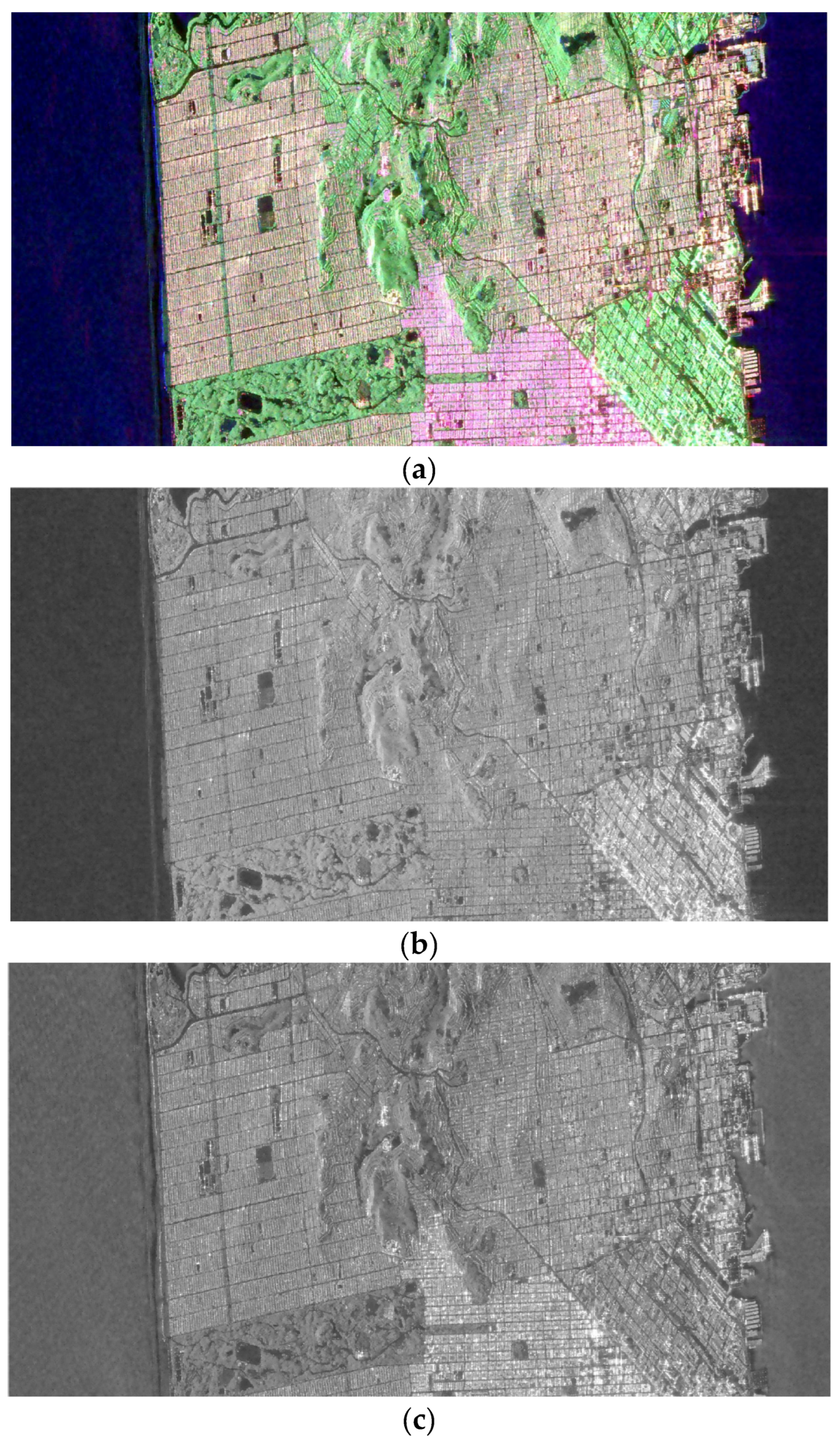
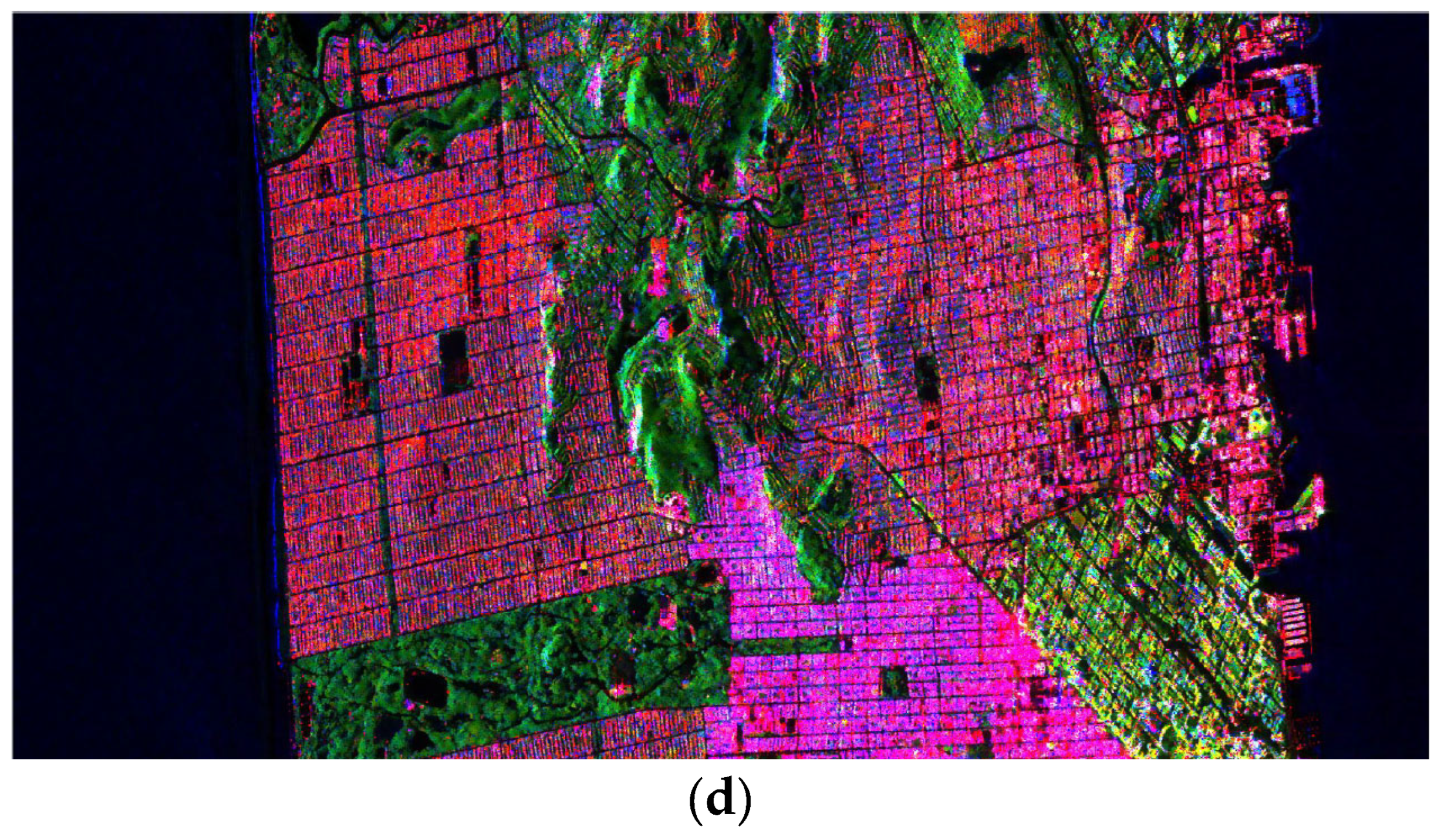
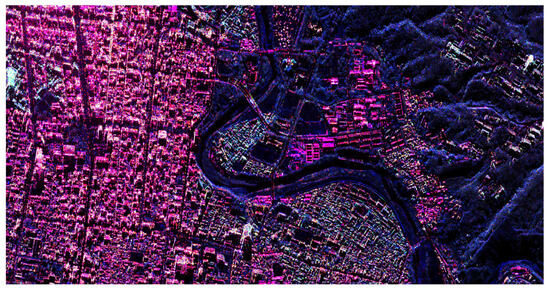
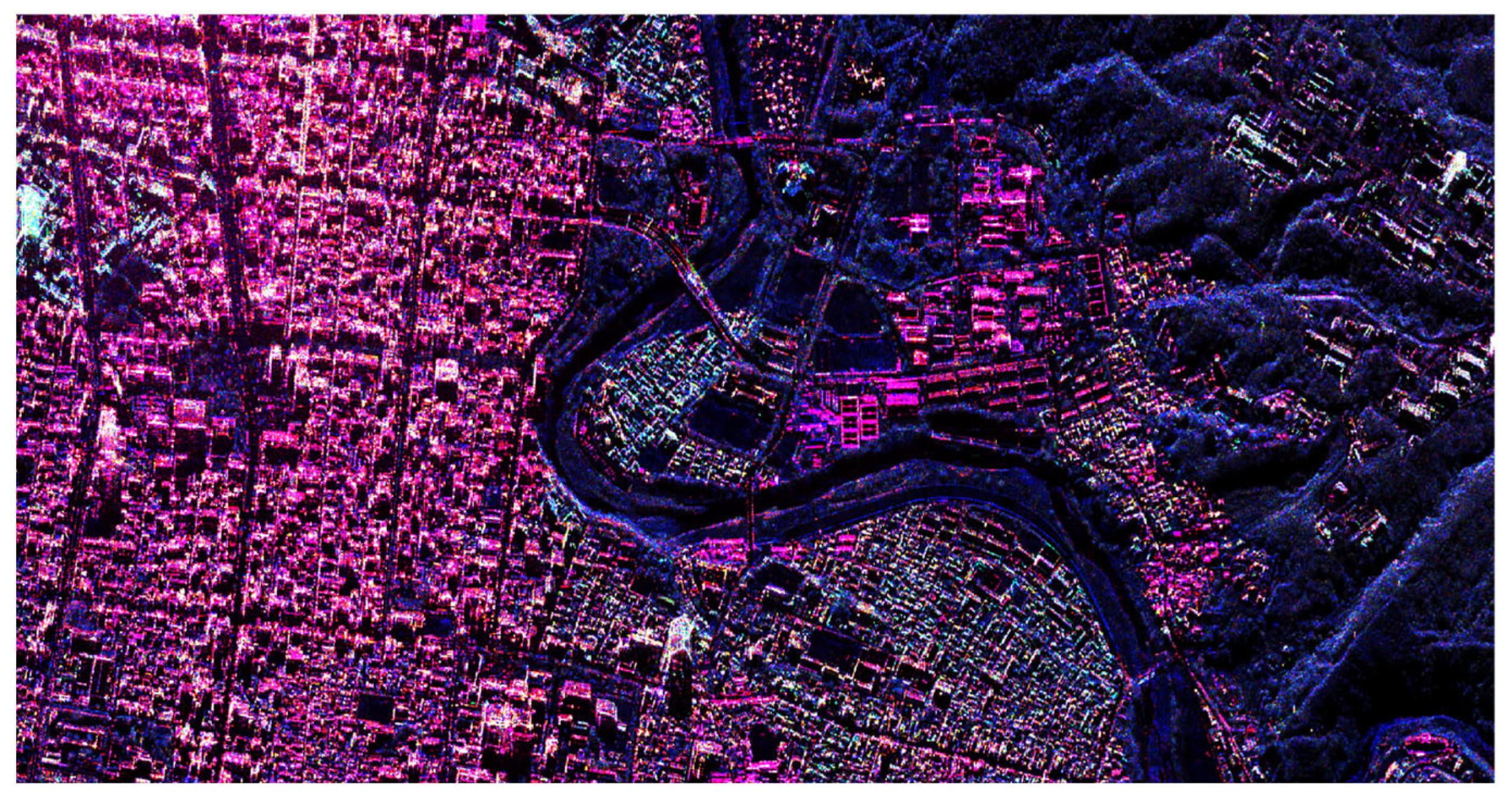
In this section, further experiments are conducted using space-borne ALOS-2 data in the L band, airborne AIRSAR data in the L band, and airborne PiSAR data in the X band. Detailed information regarding the three datasets, including sensors, imaging area, frequency bands, resolution, and dataset size, is provided in Table 1. L-band ALOS-2 data are chosen as the training data, as shown in Figure 2a–c, for the Pauli image, VV channel amplitude image, and HV channel amplitude image of the training data, respectively. Figure 2d illustrates the FGPTD results of the training data. The detailed experimental results of three testing datasets are introduced in the following sections. Meanwhile, Verma’s method [29], the DualSD method [28], and Mascolo’s method [41] are adopted as comparison methods. The SimiTest approach with a 15 × 15 window size is utilized for speckle filtering [42].
Table 1.
Selected polarimetric SAR datasets description.
Figure 2.
ALOS-2 training datasets in L band over San Francisco area. (a) is the Pauli image, (b) is the VV channel amplitude image, (c) is the HV channel amplitude image, (d) is the decomposition result of FGPTD method. The images are colored by Pd (red), Pv (green), and Ps (blue).
4.1. ALOS-2 Dataset
In order to examine target decomposition performance, the ALOS-2 data are used for conducting comparison experiments. The resolution is about 6.6 m × 12.1 m for range and azimuth directions. The full-scene SAR image contains 1600 pixels × 1400 pixels, which includes urban areas, oriented urban areas, forest areas, ocean areas, and so on.
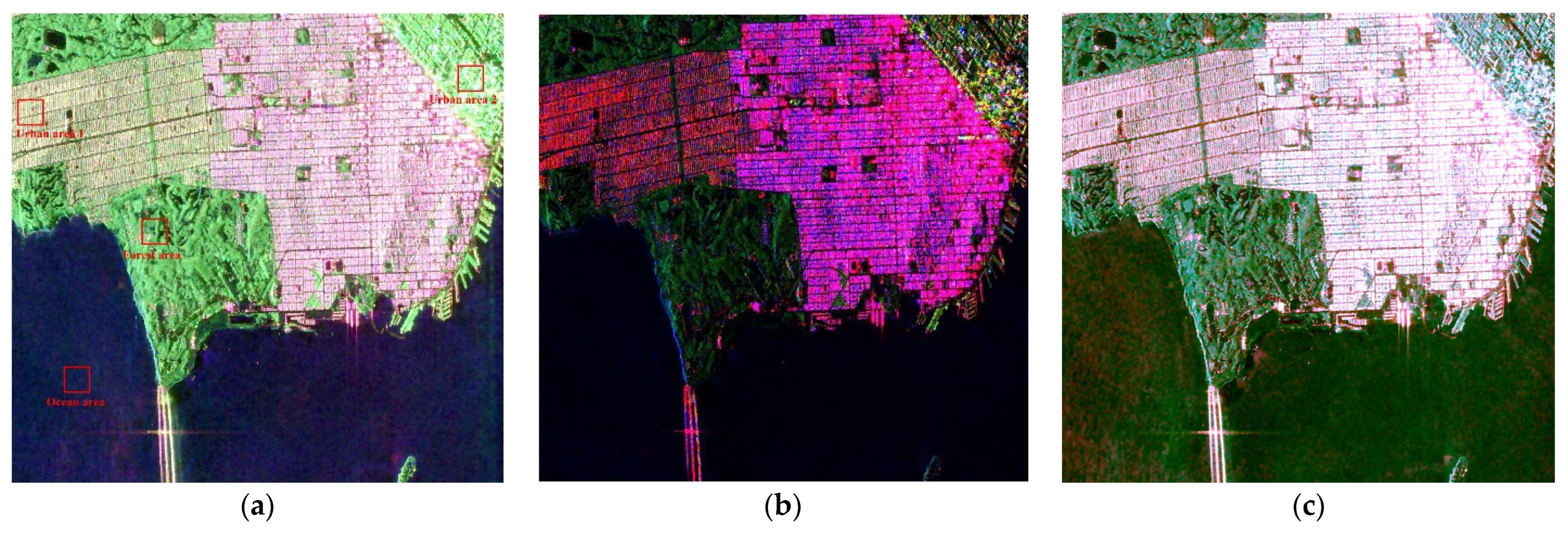
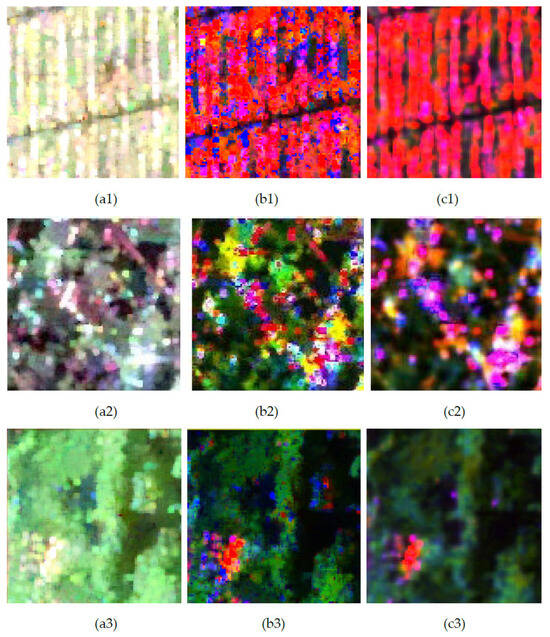
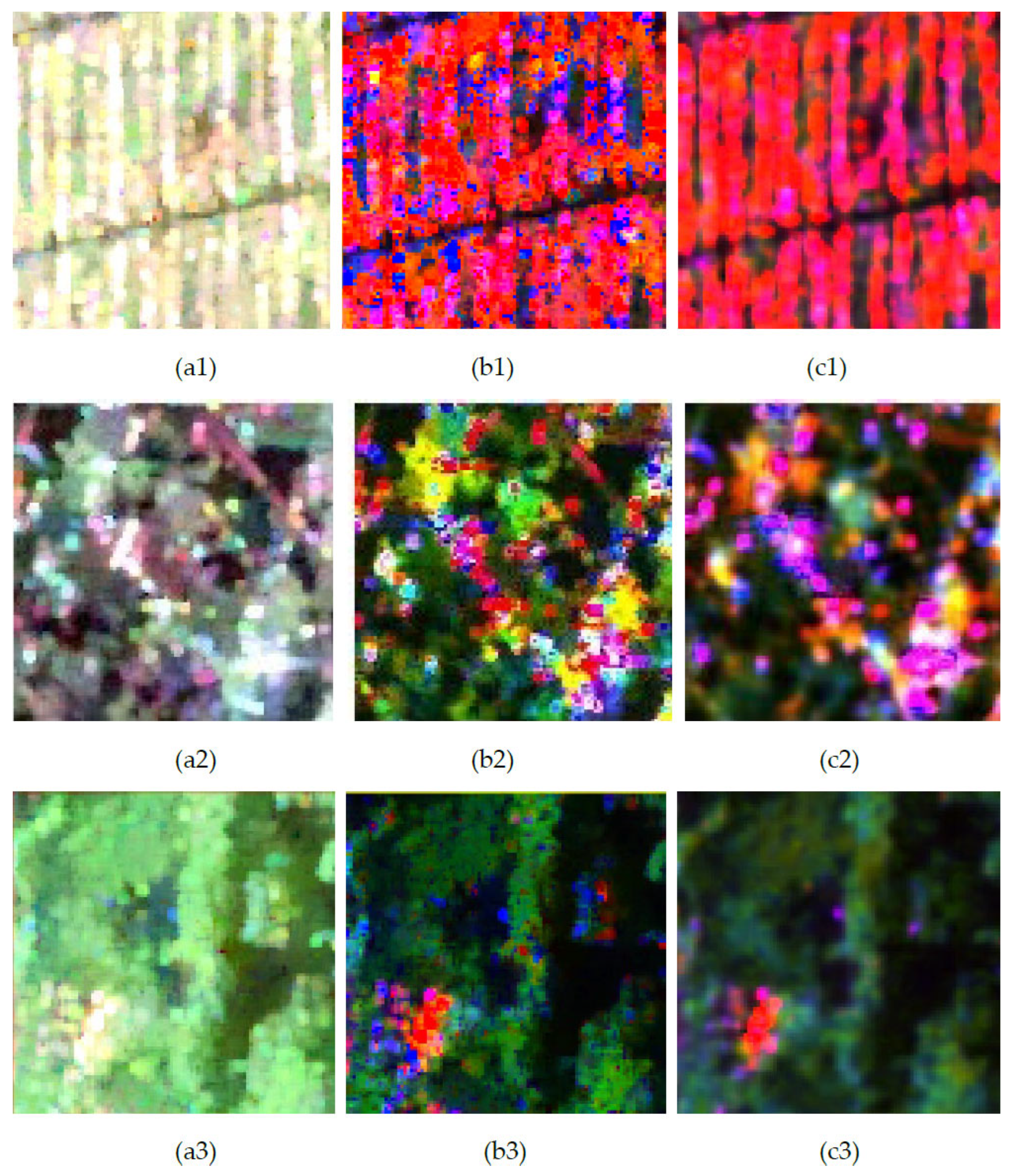
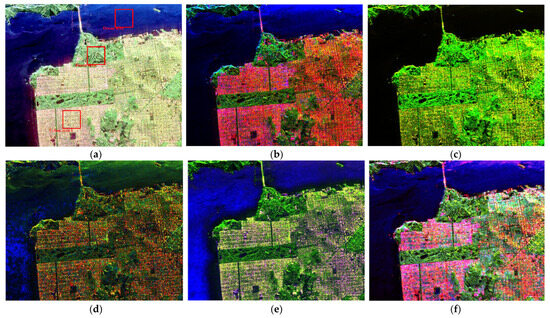
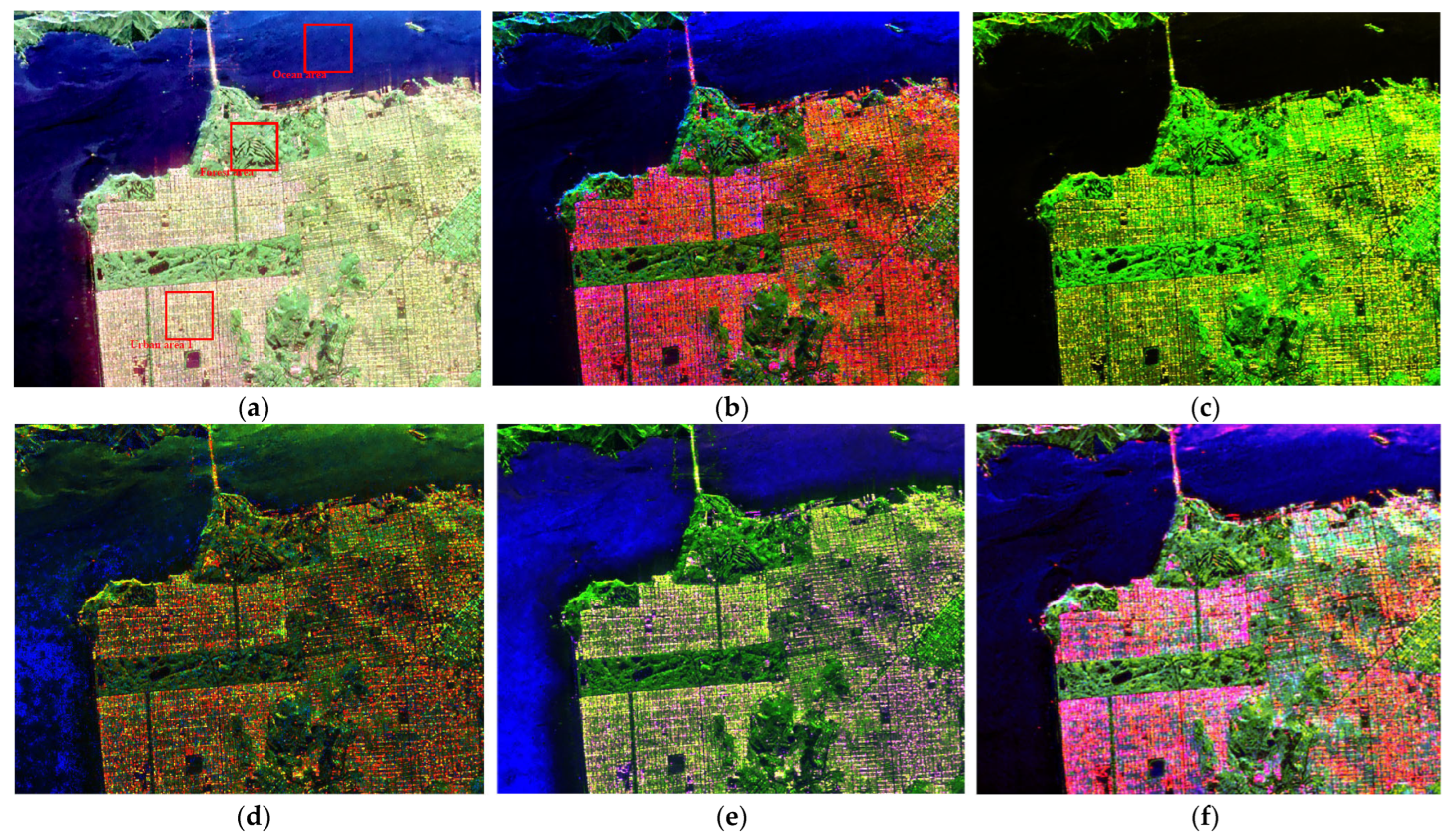
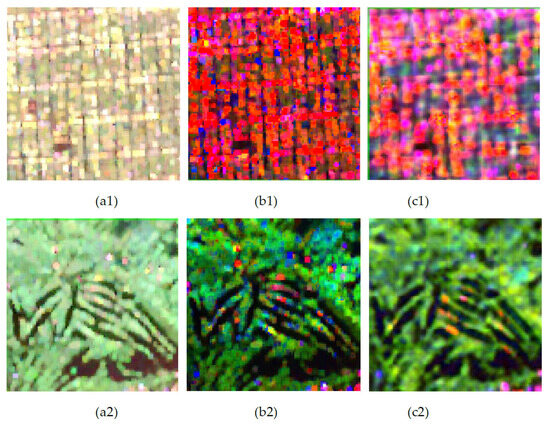
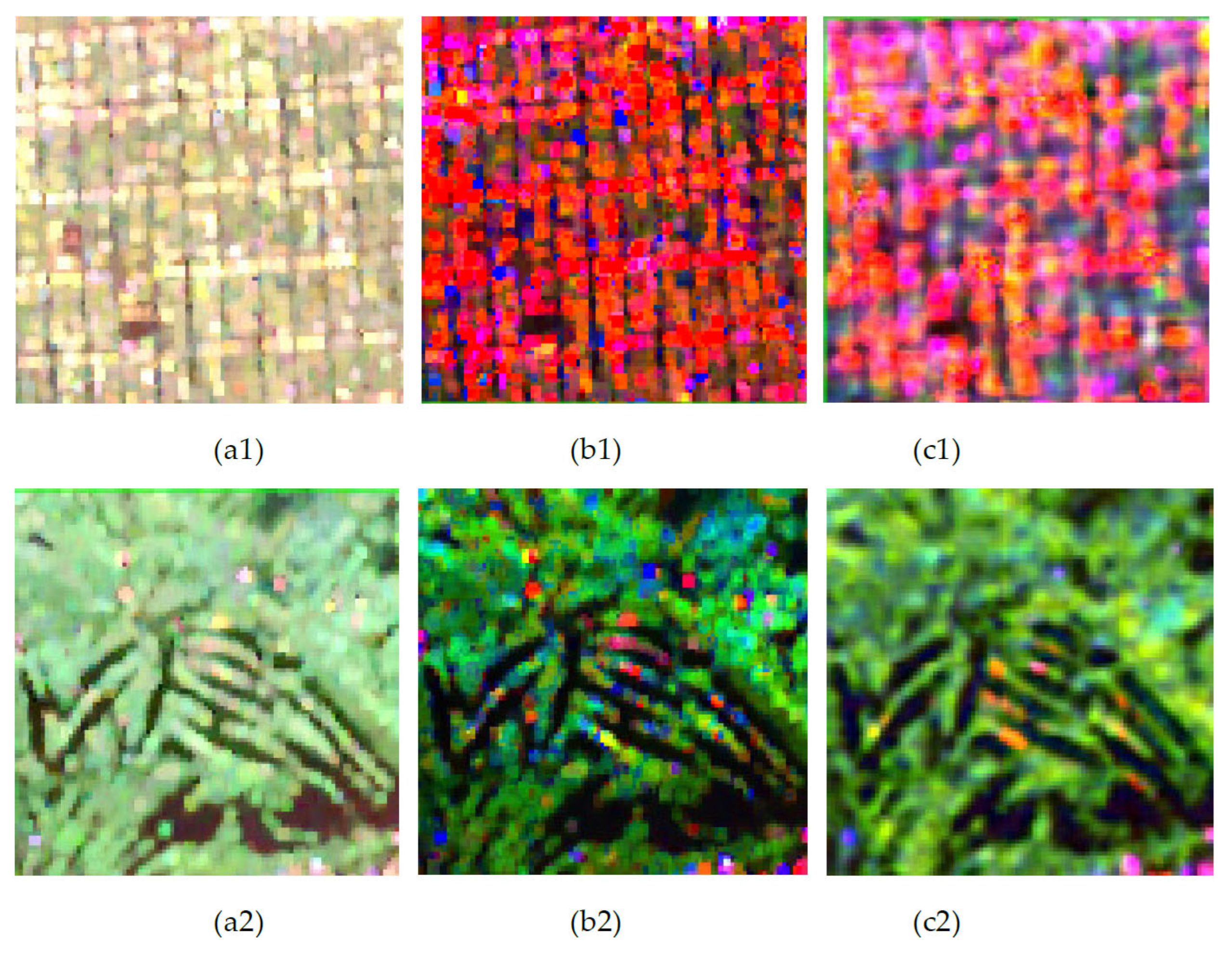
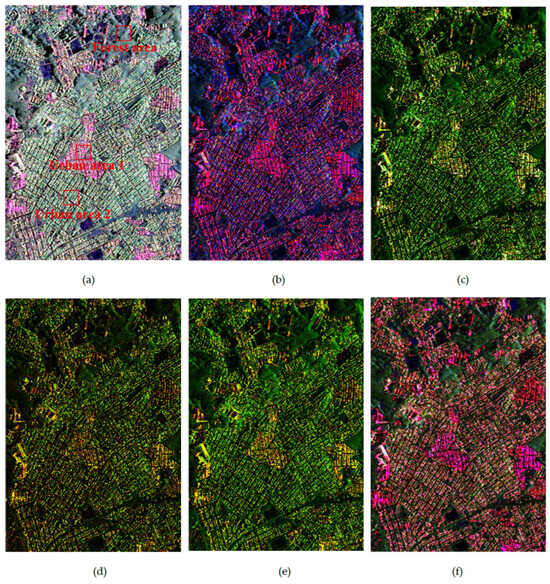
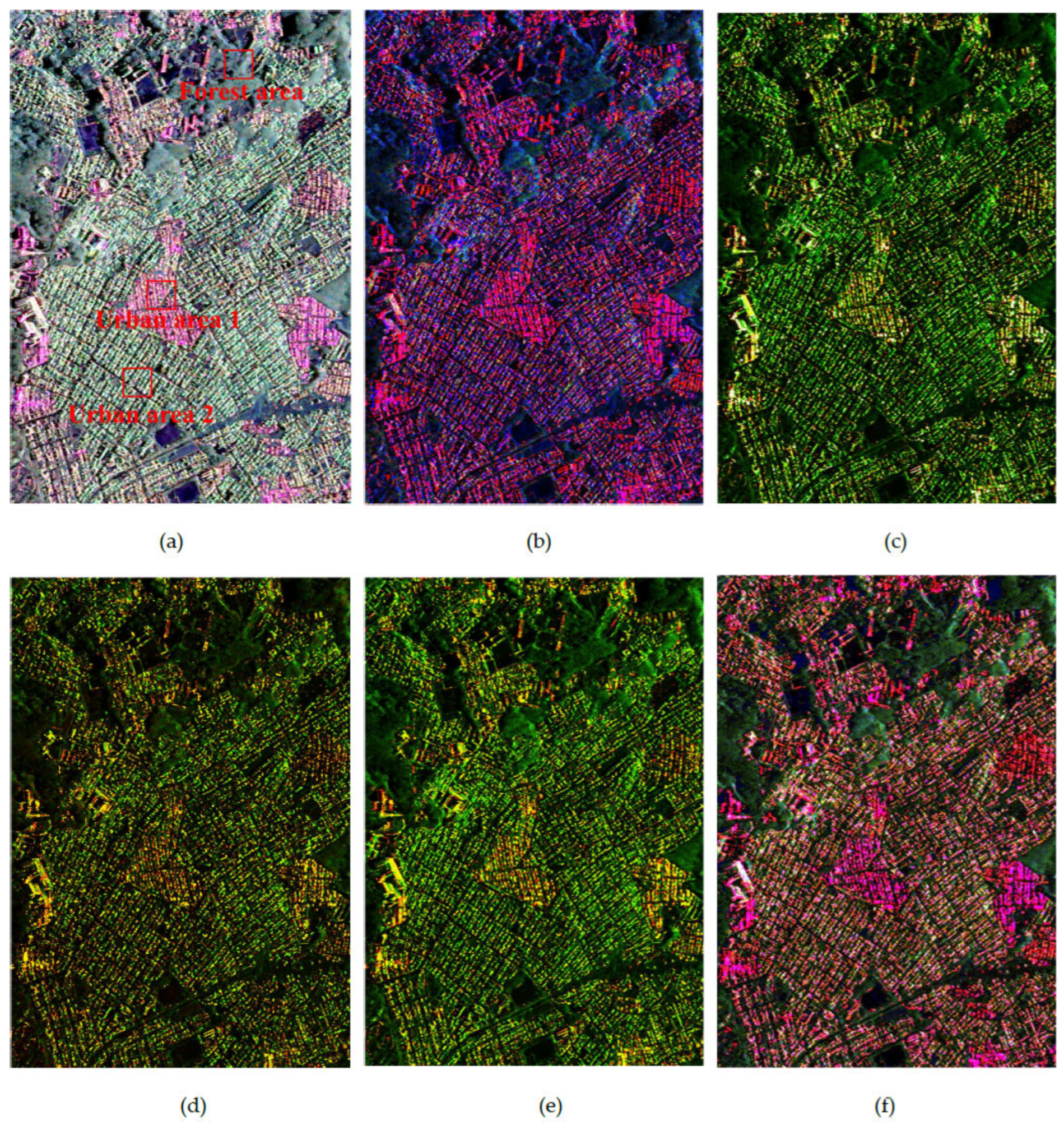
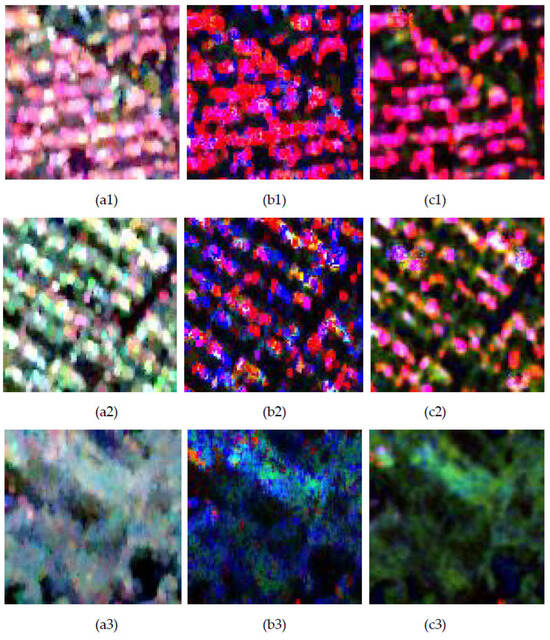
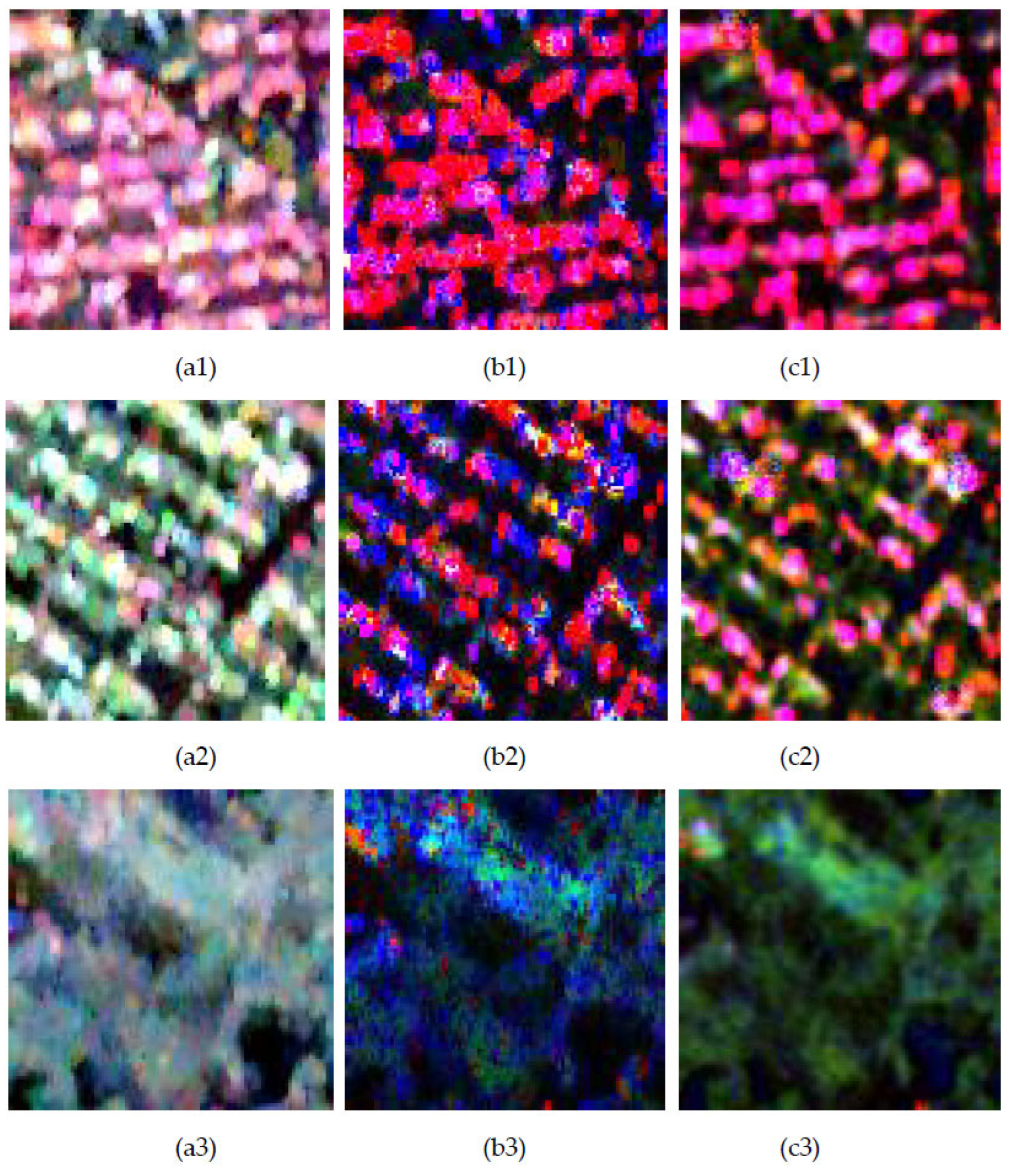
The target decomposition results of different methods for the L-band ALOS-2 data are shown in Figure 3. As depicted in Figure 3a, four representative areas with sizes of 100 pixels × 100 pixels are selected for further quantitative comparison, along with the corresponding enlarged images of these areas, as shown in Figure 4. The quantitative comparison results of the dominant scattering components for different regions are provided in Table 2, where Pd(Dbl) denotes the double-bounce scattering component, Pv(Vol) represents the volume scattering component, and Ps(Odd) stands for the odd-bounce scattering component.
Figure 3.
Decomposition results of ALOS-2 data. (a) is the Pauli image of the whole scene. (b–f) are the results of the FGPTD method, Verma’s method, DualSD, Mascolo’s method, and the proposed method. The images are colored by Pd (red), Pv (green), and Ps (blue).
Figure 4.
Decomposition results of the FGPTD method and the proposed method over three different patches selected from ALOS-2 data. (a1–a3) are the Pauli images of three different patches. (b1,c1) are the decomposition results of urban area 1. (b2,c2) are the results of urban area 2. (b3,c3) are the results of forests area. The images are colored by Pd (red), Pv (green), and Ps (blue).
Table 2.
The percentage of dominant scattering mechanisms from the decomposition results of ALOS-2 data (%).
For urban areas, double-bounce scattering should be the dominant scattering component. Therefore, in urban area 1, all methods can correctly interpret the scattering components of urban area 1 as double-bounce scattering, while the FGPTD method and the proposed method can achieve more accurate interpretation. However, for oriented urban area 2, all comparative methods interpret the double-bounce scattering as other mixing scattering types, leading to an underestimation of double-bounce scattering. The proposed method correctly interprets urban area 2 as a region dominated by double-bounce scattering, yielding a proportion of double-bounce scattering components (46.49%) compared to the FGPTD method (27.03%), thus reducing the overestimation of volume scattering components. It should be further noted that in both urban area 1 and urban area 2, the proposed method results in a lower proportion of volume and odd-bounce scattering components than the FGPTD method. For the forest area, the FGPTD method, Mascolo’s method, and the proposed method can correctly interpret the forest area as being dominated by volume scattering, with the proposed method yielding a higher proportion of volume scattering components than the FGPTD method. Verma’s method and the DualSD method underestimate the volume scattering component. For the ocean area, Verma’s method and the Mascolo’s method incorrectly interpret odd-bounce scattering as volume scattering, while the FGPTD method, the DualSD method, and the proposed method achieve correct interpretation of the ocean area.
In brief, the proposed method achieves equivalent performance with the FGPTD method over the forest area, ocean area, and urban area with small orientation angles. Furthermore, the interpretation performance of the proposed method is superior to the state-of-the-art dual-pol target decomposition methods in all of the selected areas.
4.2. AIRSAR Dataset
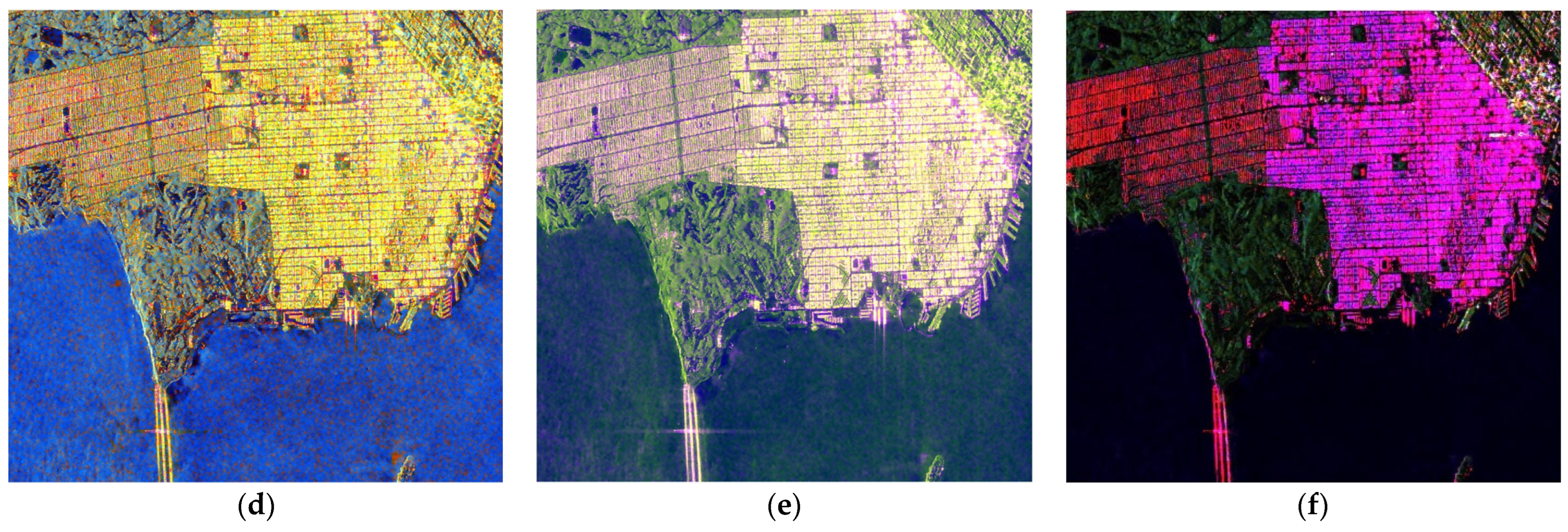
The AIRSAR data are adopted for comparing target decomposition performance, where the resolution is about 2.86 m × 3.21 m in range and azimuth dimensions. The full-scene SAR image contains 900 pixels × 1024 pixels and the imaging area is San Francisco, as with ALOS2.
The target decomposition results of the FGPTD method, the three dual-pol target decomposition methods, and the proposed method for the airborne AIRSAR data are shown in Figure 5. Urban area 1, oriented urban area 2, the forest area, and the ocean area with sizes of 100 pixels × 100 pixels are selected in Figure 5a for further quantitative analysis, where their corresponding enlarged images are shown in Figure 6. The dominant scattering components of the FGPTD method and the proposed method for these areas are given in Table 3, where Dbl denotes the double-bounce scattering component, Vol represents the volume scattering component, and Odd stands for the odd-bounce scattering component.
Figure 5.
Decomposition results of AIRSAR data. (a) is the Pauli image of the whole scene. (b–f) are the results of the FGPTD method, Verma’s method, DualSD, Mascolo’s method, and the proposed method. The images are colored by Pd (red), Pv (green), and Ps (blue).
Figure 6.
Decomposition results of FGPTD method and the proposed method over three different patches selected from AIRSAR data. (a1,a2) are the Pauli images of three different patches. (b1,c1) are the decomposition results of urban area 1. (b2,c2) are the results of the forest area. The images are colored by Pd (red), Pv (green), and Ps (blue).
Table 3.
The percentage of dominant scattering mechanisms from the decomposition results of AIRSAR data (%).
As shown in Figure 5 and Figure 6, the proposed method can interpret urban area 1 as an area dominated by double-bounce scattering, and the interpretation results of the proposed method are superior to the other three comparative methods. Among these, the DualSD method performs best, interpreting part of the urban areas as the dark red color in Figure 5d. Mascolo’s method interprets most of the urban areas as the light red color in Figure 5e, while it is difficult for Verma’s method to distinguish between urban and forest areas. For the forest area, all methods can correctly interpret the forest area as being dominated by volume scattering, with the proposed method yielding a higher proportion of volume scattering components (88.34%) than the FGPTD method (70.25%). Regarding the ocean area, the DualSD method incorrectly interprets odd-bounce scattering as volume scattering in part of the ocean areas, whereas the FGPTD method, Mascolo’s method, and the proposed method achieve correct interpretation of the ocean area.
As a result, the interpretation performance of the proposed method is the best across all dual-pol target decomposition methods regardless of natural areas and urban areas with orientation angles.
4.3. PiSAR Dataset
The airborne X-band PiSAR data are utilized for further target decomposition experiments. The resolution of PiSAR data is about 1.5 m × 2 m in range and azimuth dimensions. The size of full-scene SAR image is 1240 pixels × 1780 pixels, and the imaging area mainly contains large urban areas, urban areas with orientation angles, and forest areas.
The target decomposition results for the PiSAR data are shown in Figure 7. Three representative areas with sizes of 100 pixels × 100 pixels are selected in Figure 7a for further quantitative comparison, and their corresponding enlarged images are shown in Figure 8. The dominant scattering components of the FGPTD method and the proposed method for these areas are presented in Table 4, where Dbl denotes the double-bounce scattering component, Vol represents the volume scattering component, and Odd stands for the odd-bounce scattering component.
Figure 7.
Decomposition results of PiSAR data. (a) is the Pauli image of the whole scene. (b–f) are the results of the FGPTD method, Verma’s method, DualSD, Mascolo’s method, and the proposed method. The images are colored by Pd (red), Pv (green), and Ps (blue).
Figure 8.
Decomposition results of the FGPTD method and the proposed method over three different patches selected from PiSAR data. (a1–a3) are the Pauli images of three different patches. (b1,c1) are the decomposition results of urban area 1. (b2,c2) are the results of urban area 2. (b3,c3) are the results of forest areas. The images are colored by Pd (red), Pv (green), and Ps (blue).
Table 4.
The percentage of dominant scattering mechanisms from the decomposition results of PiSAR data (%).
For urban area 1, the FGPTD method and the proposed method correctly interpret it as a region dominated by double-bounce scattering, with the proposed method yielding a higher proportion of double-bounce scattering components (84.90%) compared to the results from the FGPTD method (59.72%). Verma’s method incorrectly interprets urban area1 as the yellow-dominated area, while the DualSD method and Mascolo’s method interpret the urban area1 closer to the double-bounce dominated area.
For urban area 2, all comparative methods interpret the oriented urban area 2 as areas dominated by volume scattering, leading to confusion with forest areas. Both the FGPTD method and the proposed method correctly interpret the oriented urban area 2 as a region dominated by double-bounce scattering, with the proposed method yielding a higher proportion of double-bounce scattering components (52.51%) than the FGPTD method (38.26%). It is noteworthy that the FGPTD method has a higher proportion of odd-bounce scattering components (50.93%) than double-bounce scattering components (38.26%), resulting in a greater presence of blue areas in Figure 8(b2). Urban area 2 predominantly consists of low-rise residential buildings with exterior walls featuring numerous protruding structures (e.g., balconies, air conditioner units, and railings) and rough surface materials (e.g., tiled or textured concrete surfaces). These small-scale structural features primarily generate odd-bounce scattering because X-band electromagnetic waves cannot penetrate such details and are directly reflected back to the sensor. In contrast, double-bounce scattering requires ideal perpendicular pathways between building facades and the ground. However, these protruding structures disrupt the continuity of such pathways, weakening double-bounce signals. Additionally, urban area 2 exhibits significant mixed scattering characteristics: sparse low vegetation (shrubs, lawns) and unpaved ground interspersed among buildings contribute to volume scattering from vegetation and single-bounce ground scattering. Some of this mixed scattering is classified as odd-bounce scattering, further increasing its dominance. As shown in Figure 8(c2), a noticeable amount of volume scattering is wrongly generated by the proposed method in the urban area 2. This misclassification of volume scattering in urban areas stems from the domain mismatch between training and testing data. The CNN model was trained exclusively on L-band ALOS-2 data, which are sensitive to large-scale urban structures but less responsive to small-scale details due to their longer wavelength and penetration capability. In this context, urban areas in the training data are dominated by double-bounce scattering. In contrast, the X-band PiSAR sensor is extremely sensitive to small-scale structures in urban area 2. These features generate polarimetric responses resembling volume scattering. Because the training data lack X-band-specific small-scale scattering patterns, the network cannot distinguish between true volume scattering (e.g., from vegetation) and pseudo-volume scattering caused by urban microstructures, leading to erroneous volume scattering attribution in Figure 8(c2). To solve this limitation, extra X band SAR data may be included into the training data to improve the generalization of the proposed method.
For the forest area, X-band electromagnetic waves experience strong attenuation in vegetation, making it difficult to penetrate the canopy. Consequently, forest areas at the X-band are expected to exhibit dominant odd-bounce scattering from the canopy surface and the ground. However, Verma’s method, the DualSD method, Mascolo’s method, and the proposed method interpret the forest area as being dominated by volume scattering, while the FGPTD method interprets the forest area as being dominated by odd-bounce scattering. The proposed method was trained exclusively on L-band ALOS-2 data, where L-band waves penetrate vegetation more effectively, revealing volume scattering from tree trunks and branches. This led the network to associate forest areas with high volume scattering in its predictions. Similar to the issue in urban area 2, the generalization of the proposed method can be solved by introducing X-band SAR data as the training data.
In summary, the proposed decomposition method exhibits equivalent performance with the FGPTD method over urban areas with small orientation angles. Furthermore, the proposed method achieves improved performance over urban areas with large orientation angles, as the percentage of dominant double-bounce scattering increases, and the dominant volume scattering is the lowest. For forest areas, the proposed method achieves further improved performance compared with the FGPTD method.
5. Discussion
5.1. The Real-Time Performance of the Proposed Method
To validate the real-time performance of the proposed target decomposition method, the target decomposition processing times of the FGPTD method for quad-pol SAR data, Verma’s method, DualSD, Mascolo’s method, and the proposed method for dual-pol SAR data on the PiSAR dataset are provided in Table 5. It can be observed that the FGPTD method takes 426.10 s to process quad-pol SAR data, whereas Verma’s method, DualSD, Mascolo’s method, and the proposed method take 321.03, 3.08, 3.17 and 8.82 s, respectively, for dual-pol SAR data target decomposition. Compared with other dual-pol SAR target decomposition methods, the proposed method achieves a balance between target decomposition performance and real-time performance. While the interpretation performance of the proposed method is comparable to that of the FGPTD method, it significantly reduces the time required for target decomposition.
Table 5.
Processing time comparison of FGPTD method and the proposed method(s).
5.2. The Generalization and Effectiveness of the Proposed Method
Based on the piecewise linear fitting and linear optimization of the double-bounce scattering angle in the FGPTD method, the proposed method utilizes a deep convolutional neural network to effectively emulate the process of FGPTD. Because the proposed method employs ALOS-2 data as training data, it is capable of accurately interpreting oriented urban area 2 in ALOS-2 test data as areas dominated by double-bounce scattering. Although its interpretation performance for oriented urban area 2 in AIRSAR data is somewhat diminished, it still outperforms some current comparative methods. In future work, a larger volume of quad-pol SAR data from different bands and sensors can be used as training data to enhance the generalized ability of the proposed target decomposition method.
Existing model-based dual-pol target decomposition methods yield incomplete scattering components and suffer from severe ambiguity in their interpretation. The consistent outperformance of our CNN-based method over existing model-based dual-pol decomposition techniques is theoretically anticipated. Dual-pol SAR inherently presents an underdetermined problem—three independent observables must estimate multiple scattering components—forcing model-based methods to rely on restrictive assumptions that may not hold universally. In contrast, our framework leverages data-driven learning to extract latent patterns from complete scattering components from the FGPTD method, effectively mitigating polarimetric information deficiency without explicit modeling constraints.
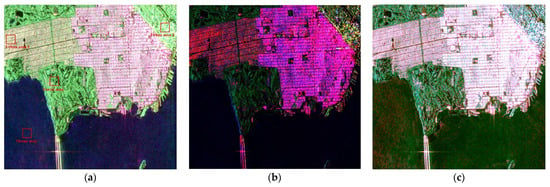
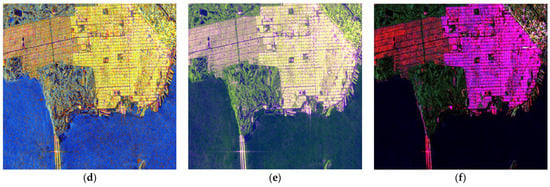
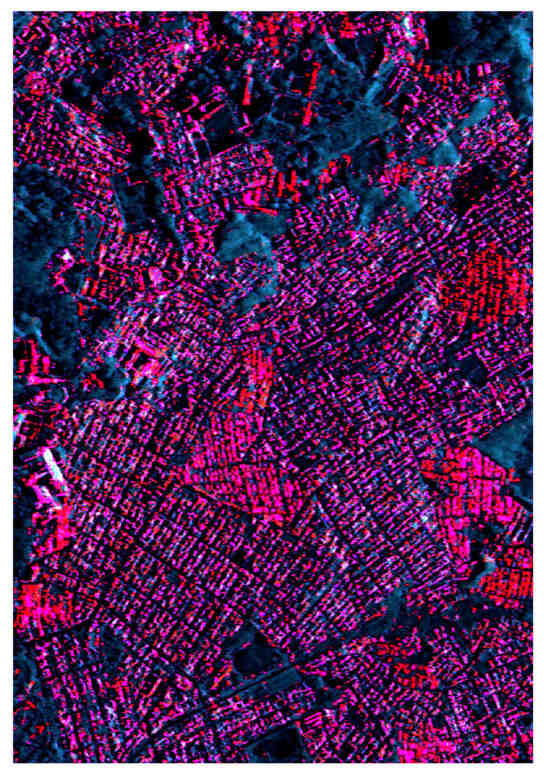
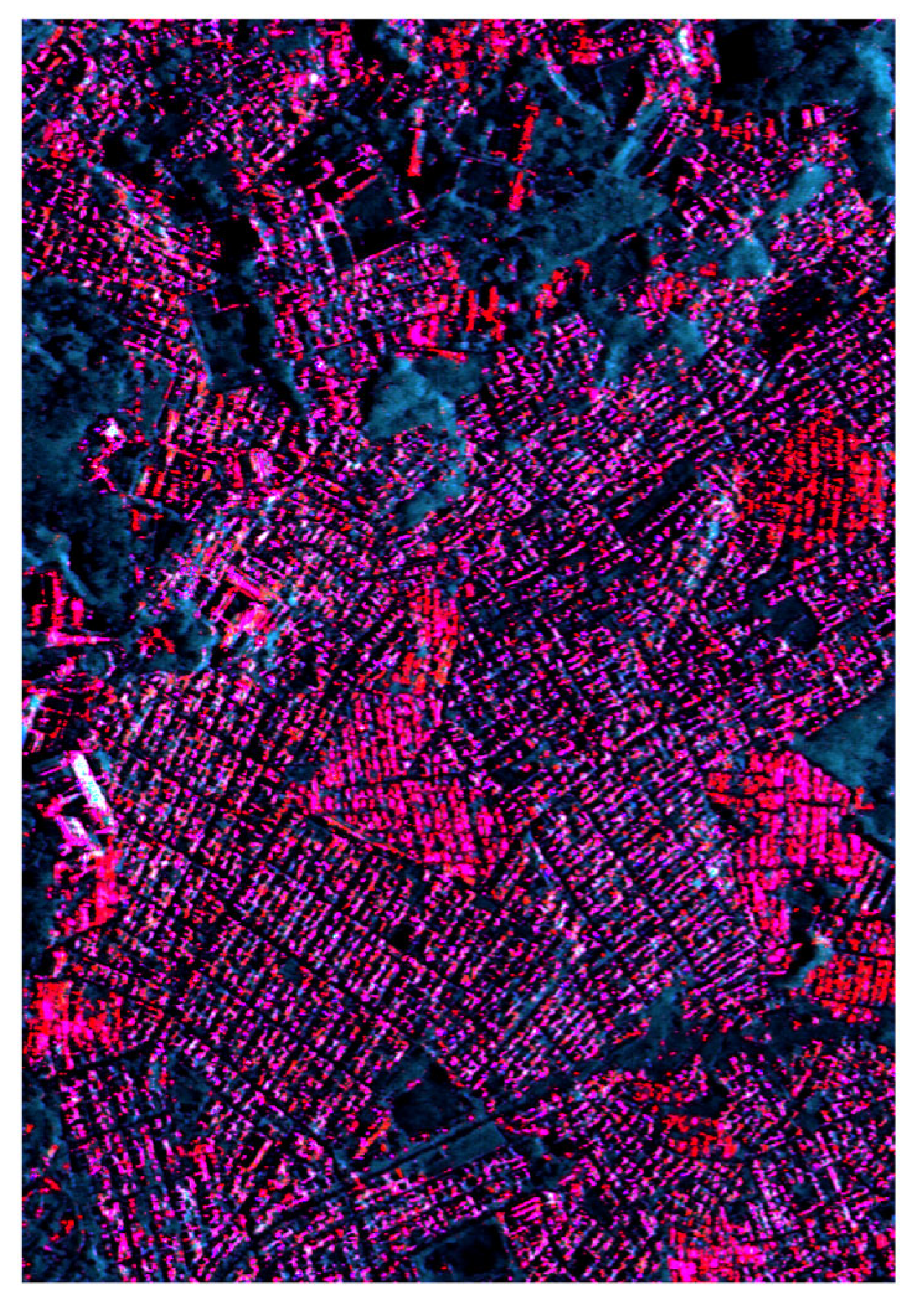
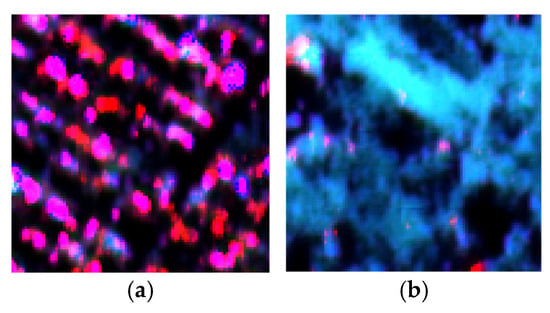
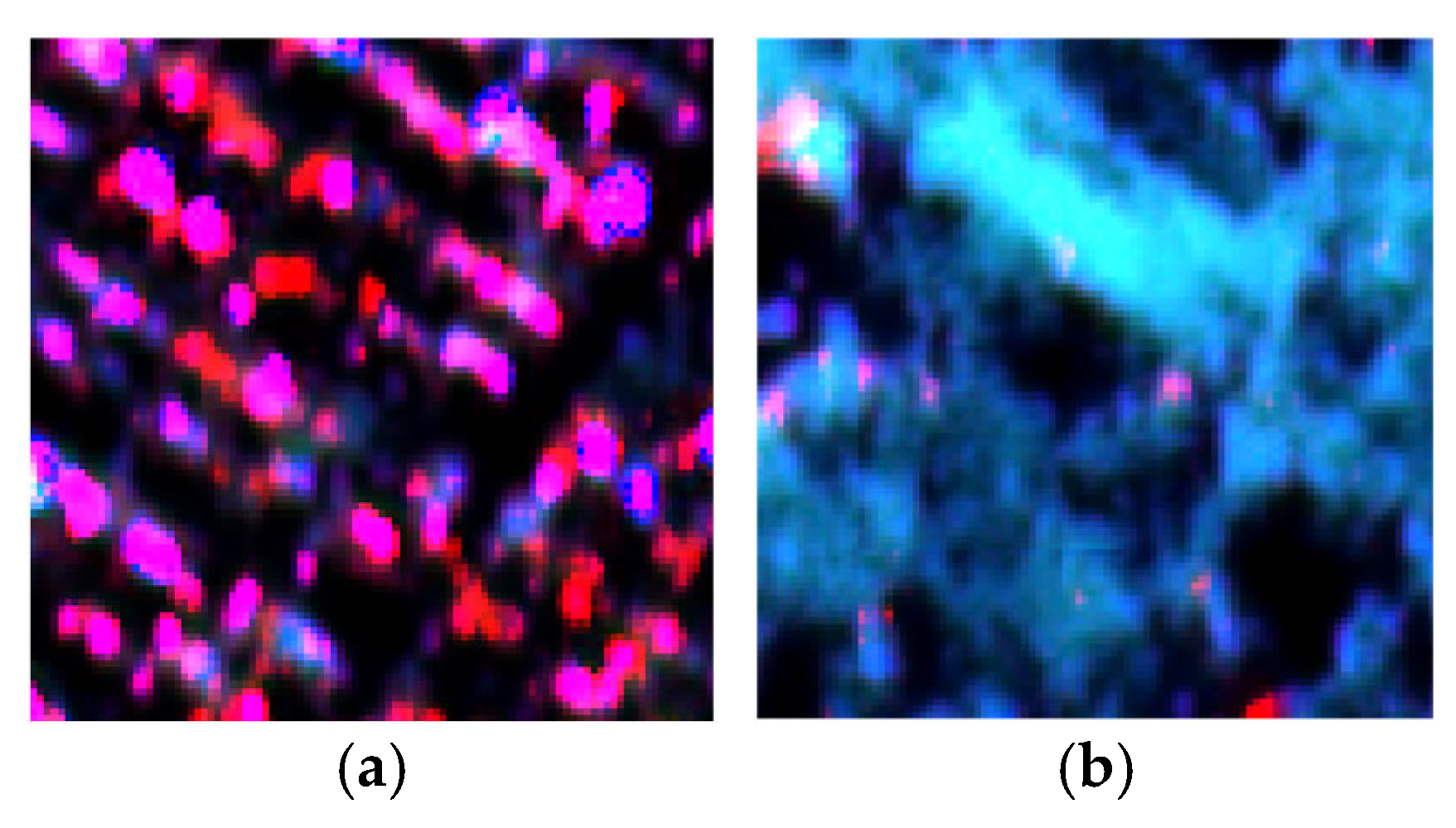
The band discrepancy between training and testing data is a key factor affecting the target decomposition performance of the proposed method. Because the CNN model was trained only using ALOS-2 data, there were certain scattering component interpretation problems in the oriented urban and forest areas of the PiSAR data by the CNN model. To address the generalization limitation of the proposed method, as shown in Figure 9, an experiment using a retrained CNN model with additional PiSAR X-band data was conducted. The updated target decomposition results of PiSAR data are shown in Figure 10 and Figure 11. The retrained CNN model significantly reduced spurious volume scattering in urban area 2 (Figure 11a) and accurately identified single-bounce scattering as the dominant component in forested areas (Figure 11b), aligning with physical expectations for X-band observations and the results of the FGPTD method. Therefore, expanding domain-specific training data can remarkably improve the accuracy of interpretation. To further enhance the generalization ability of the CNN model, improvements can be made in the following three aspects.
Figure 9.
Pauli image of additional PiSAR training data.
Figure 10.
Target decomposition results of the proposed method in PiSAR data.
Figure 11.
Target decomposition results of the proposed method in PiSAR data. (a) is the result of urban area 2. (b) is the result of the forest area.
(1) Expand the training dataset: Incorporate multi-frequency (e.g., C-band, X-band) and multi-sensor quad-pol SAR data to enable the CNN to learn cross-band scattering patterns.
(2) Refine loss functions: Introduce physics-informed regularization, e.g., penalizing volume scattering predictions in urban areas and enforcing odd-bounce dominance in X-band forest areas.
(3) Enhance network architecture: Add a scattering mechanism identification branch that integrates polarimetric features with spatial structural cues (e.g., texture, orientation) to distinguish pseudo-volume scattering (from urban microstructures) from true volume scattering (from vegetation).
Due to the narrow bandwidth and low resolution of full polarimetric observations, space-borne SAR platforms with full polarimetric measurement capabilities, such as Radarsat-2, ALOS-2, COSMO-SkyMed, and GF-3, can make use of the limited quad-pol SAR data. The proposed method can be applied to decompose a substantial amount of stored dual-pol SAR data. Moreover, the scattering component features obtained from the proposed target decomposition method hold significant applications in large-scale land cover classification. However, the proposed method prioritizes the interpretation accuracy of scattering components as the primary design objective at the cost of spatial resolution. This limitation prevents the full exploitation of dual-pol SAR’s high-resolution potential. While this trade-off is acceptable for large-scale applications, further optimization is required for scenarios demanding fine spatial details (e.g., infrastructure monitoring, disaster mapping). Future improvements will focus on incorporating detail enhancement modules, optimizing data processing pipelines and loss functions, and integrating physics-guided constraints to achieve dual goals of accurate scattering interpretation and preservation of spatial fidelity. These enhancements aim to broaden the method’s applicability to high-resolution-sensitive tasks.
6. Conclusions
In response to the issue of incorrect interpretation and incomplete scattering component decomposition of oriented man-made targets by the dual-pol target decomposition method, this paper proposes a model and learning-assisted dual-pol SAR target decomposition method based on the interpretation results of the fast generalized polarimetric target decomposition method. The proposed method leverages the advantages of the scattering mechanism interpretation of the fast generalized polarimetric target decomposition method while combining the powerful nonlinear fitting capabilities of deep learning to establish a mapping relationship from dual-pol SAR data to scattering mechanisms. Experimental studies are conducted on various real SAR data from different frequency bands and sensors. Qualitative and quantitative results demonstrate that the proposed method can accurately interpret forest areas dominated by volume scattering and ocean areas dominated by odd-bounce scattering in L band SAR data, outperforming current advanced dual-polar target decomposition methods. Compared to the fast generalized polarization target decomposition method, the proposed method accelerates the speed of target decomposition. Future research will focus on expanding the training dataset, optimizing loss functions, and enhancing network architecture to achieve more accurate scattering interpretation and preservation of spatial fidelity.
Author Contributions
J.D., S.C., and J.X. provided ideas; J.D. validated the idea and established the algorithm; J.D., J.X., and C.Y. designed the experiment; S.C., J.X., and C.Y. analyzed the results of the experiment; J.D. and J.X. wrote the paper. All authors have read and agreed to the published version of the manuscript.
Funding
This research was funded in part by the National Natural Science Foundation of China 62122091 and 61771490, the JL-1 SAR01A satellite project, and the Natural Science Foundation of Hunan Province under Grant 2020JJ2034.
Institutional Review Board Statement
Not applicable.
Informed Consent Statement
Not applicable.
Data Availability Statement
The datasets used and/or analyzed in the current study are available from the corresponding author upon reasonable request.
Acknowledgments
The authors would also like to thank the editors and anonymous reviewers for their constructive suggestions, which greatly contributed to improving this paper.
Conflicts of Interest
Author Junwu Deng, Jing Xu and Chunhui Yu were employed by the company Changguang Satellite Technology Co., Ltd. The remaining authors declare that the research was conducted in the absence of any commercial or financial relationships that could be construed as a potential conflict of interest.
References
- Cumming, G.; Wong, H. Digital Processing of Synthetic Aperture Radar Data; Artech House: Boston, MA, USA, 2005; pp. 108–110. [Google Scholar]
- Lee, S.; Pottier, E. Polarimetric Radar Imaging: From Basics to Applications; CRC Press: Boca Raton, FL, USA, 2009. [Google Scholar]
- Chen, S.-W.; Li, M.-D.; Cui, X.-C.; Li, H.-L. Polarimetric Roll-Invariant Features and Applications for Polarimetric Synthetic Aperture Radar Ship Detection: A comprehensive summary and investigation. IEEE Geosci. Remote Sens. Mag. 2024, 12, 36–66. [Google Scholar] [CrossRef] [Scilit]
- Krogager, E. New decomposition of the radar target scattering matrix. Electron. Lett. 1990, 18, 1525–1527. [Google Scholar] [CrossRef] [Scilit]
- Cameron, W.; Youssef, N.; Leung, L. Simulated polarimetric signatures of primitive geometrical shapes. IEEE Trans. Geosci. Remote Sens. 1996, 34, 793–803. [Google Scholar] [CrossRef] [Scilit]
- Touzi, R. Target scattering decomposition in terms of roll-invariant target parameters. IEEE Trans. Geosci. Remote Sens. 2007, 45, 73–84. [Google Scholar] [CrossRef] [Scilit]
- Freeman, A.; Durden, S.L. Three-component scattering model to describe polarimetric SAR data. IEEE Trans. Geosci. Remote Sens. 1998, 36, 963–973. [Google Scholar] [CrossRef] [Scilit]
- Yamaguchi, Y.; Moriyama, T.; Ishido, M.; Yamada, H. Four-component scattering model for polarimetric SAR image decomposition. IEEE Trans. Geosci. Remote Sens. 2005, 43, 1699–1706. [Google Scholar] [CrossRef] [Scilit]
- Yamaguchi, Y.; Sato, A.; Boerner, W.; Sato, R.; Yamada, H. Four-Component Scattering Power Decomposition with Rotation of Coherency Matrix. IEEE Trans. Geosci. Remote Sens. 2011, 49, 2251–2258. [Google Scholar]
- Van Zyl, J.J.; Arii, M.; Kim, Y. Model-Based Decomposition of Polarimetric SAR Covariance Matrices Constrained for Nonnegative Eigenvalues. IEEE Trans. Geosci. Remote Sens. 2011, 49, 3452–3459. [Google Scholar]
- Singh, G.; Yamaguchi, Y.; Park, S.-E. General Four-Component Scattering Power Decomposition with Unitary Transformation of Coherency Matrix. IEEE Trans. Geosci. Remote Sens. 2013, 51, 3014–3022. [Google Scholar]
- Chen, S.-W.; Wang, X.-S.; Xiao, S.-P.; Sato, M. General Polarimetric Model-Based Decomposition for Coherency Matrix. IEEE Trans. Geosci. Remote Sens. 2014, 52, 1843–1855. [Google Scholar]
- Wu, G.; Li, Y.; Chen, S. Polarimetric Model-Based Decomposition with Refined Double-Bounce Orientation Angle and Scattering Model. Remote Sens. 2021, 13, 3070. [Google Scholar]
- Singh, G.; Malik, R.; Mohanty, S.; Rathore, V.S.; Yamada, K.; Umemura, M.; Yamaguchi, Y. Seven-Component Scattering Power Decomposition of POLSAR Coherency Matrix. IEEE Trans. Geosci. Remote Sens. 2019, 57, 8371–8382. [Google Scholar]
- An, W.; Lin, M. An Incoherent Decomposition Algorithm Based on Polarimetric Symmetry for Multilook Polarimetric SAR Data. IEEE Trans. Geosci. Remote Sens. 2019, 58, 2383–2397. [Google Scholar] [CrossRef] [Scilit]
- Cloude, S.; Pottier, E. A Review of Target Decomposition Theorems In Radar Polarimetry. IEEE Trans. Geosci. Remote Sens. 1996, 34, 498–518. [Google Scholar]
- Cloude, S. The Dual Polarization Entropy/Alpha Decomposition: A PALSAR Case Study. Sci. Appl. SAR Polarim. Polarim. Interferom. 2007, 644, 2. [Google Scholar]
- Cloude, S.R.; Goodenough, D.G.; Chen, H. Compact decomposition theory. IEEE Geosci. Remote Sens. Lett. 2012, 9, 28–32. [Google Scholar] [CrossRef] [Scilit]
- Raney, R.K.; Cahill, J.T.S.; Patterson, G.W.; Bussey, D.B.J. The M-Chi Decomposition of Hybrid Dual-Polarimetric Radar Data with Application to Lunar Craters. J. Geophys. Res. 2012, 117, E00H21. [Google Scholar] [CrossRef] [Scilit]
- Charbonneau, F.J.; Brisco, B.; Raney, R.K.; McNairn, H.; Liu, C.; Vachon, P.W.; Shang, J.; DeAbreu, R.; Champagne, C.; Merzouki, A.; et al. Compact Polarimetry Overview and Applications Assessment. Can. J. Remote Sens. 2010, 36, S298–S315. [Google Scholar]
- Shirvany, R.; Chabert, M.; Tourneret, J. Ship and Oil-Spill Detection Using the Degree of Polarization in Linear and Hybrid/Compact Dual-Pol SAR. IEEE J. Sel. Top. Appl. Earth Obs. Remote Sens. 2012, 5, 885–892. [Google Scholar] [CrossRef] [Scilit]
- Dabboor, M.; Geldsetzer, T. Towards sea ice classification using simulated RADARSAT Constellation Mission compact polarimetric SAR imagery. Remote Sens. Environ. 2014, 140, 189–195. [Google Scholar]
- My-Linh, T.; Freeman, A.; Dubois-Fernandez, P.C.; Pottier, E. Estimation of Soil Moisture and Faraday Rotation from Bare Surfaces Using Compact Polarimetry. IEEE Trans. Geosci. Remote Sens. 2009, 47, 3608–3615. [Google Scholar] [CrossRef] [Scilit]
- Mohsen, G.; David, A.C.; Linlin, X.; Mingzhe, J. Contextual Classification of Sea-Ice Types Using Compact Polarimetric SAR Data. IEEE Trans. Geosci. Remote Sens. 2019, 57, 7476–7491. [Google Scholar]
- Liang, L.; Zhang, Y.; Li, D.; Dong, X. A New Entropy Estimation Method for Dual-Polarimetric SAR Data: Comparative Analysis with Quad- and Other Dual-Polarization Approaches. IEEE J. Sel. Top. Appl. Earth Obs. Remote Sens. 2018, 11, 2657–2667. [Google Scholar] [CrossRef] [Scilit]
- Sugimoto, R.; Nakamura, R.; Tsutsumi, C.; Yamaguchi, Y. Extension of Scattering Power Decomposition to Dual-Polarization Data for Tropical Forest Monitoring. Remote Sens. 2023, 15, 839. [Google Scholar] [CrossRef] [Scilit]
- Mascolo, L.; Cloude, S.R.; Lopez-Sanchez, J.M. Model-Based Decomposition of Dual-Pol SAR Data: Application to Sentinel-1. IEEE Trans. Geosci. Remote Sens. 2022, 60, 1–19. [Google Scholar]
- Verma, A.; Avik, B.; Subhadip, D.; Carlos, L.; Paolo, G. Scattering Power Components from Dual-Pol Sentinel-1 SLC and GRD SAR Data. ISPRS J. Photogramm. Remote Sens. 2024, 212, 289–305. [Google Scholar] [CrossRef] [Scilit]
- Blix, K.; Espeseth, M.; Eltoft, T. Machine Learning simulations of quad-polarimetric features from dualpolarimetric measurements over sea ice. In Proceedings of the European Conference on Synthetic Aperture Radar, Aachen, Germany, 4–7 June 2018; pp. 1–5. [Google Scholar]
- Souyris, J.; Imbo, P.; Fjortoft, R. Compact polarimetry based on symmetry properties of geophysical media: The pi/4 mode. IEEE Trans. Geosci. Remote Sens. 2005, 43, 634–646. [Google Scholar] [CrossRef] [Scilit]
- Stacy, N.; Preiss, M. Compact polarimetric analysis of X-band SAR data. In Proceedings of the European Conference on Synthetic Aperture Radar, Dresden, Germany, 16–18 May 2006. [Google Scholar]
- Nord, M.; Ainsworth, T.; Lee, J.; Stacy, N.J. Comparison of Compact Polarimetric Synthetic Aperture Radar Modes. IEEE Trans. Geosci. Remote Sens. 2009, 47, 174–188. [Google Scholar] [CrossRef] [Scilit]
- Raney, R.K. Hybrid-Polarity SAR Architecture. IEEE Trans. Geosci. Remote Sens. 2007, 45, 3397–3404. [Google Scholar] [CrossRef] [Scilit]
- Song, Q.; Xu, F.; Jin, Y. Radar image colorization: Converting single polarization to fully polarimetric using deep neural networks. IEEE Access 2017, 6, 1647–1661. [Google Scholar] [CrossRef] [Scilit]
- Gu, F.; Zhang, H.; Wang, C. Quad-pol Reconstruction from Compsact Polarimetry Using a Fully Convolutional Network. Remote Sens. Lett. 2020, 11, 397–406. [Google Scholar] [CrossRef] [Scilit]
- Zhang, F.; Cao, Z.; Xiang, D.; Hu, C.; Ma, F.; Yin, Q.; Zhou, Y. Pseudo Quad-Pol Simulation from Compact Polarimetric SAR Data via a Complex-Valued Dual-Branch Convolutional Neural Network. IEEE J. Sel. Top. Appl. Earth Obs. Remote Sens. 2021, 15, 901–918. [Google Scholar] [CrossRef] [Scilit]
- Deng, J.; Zhou, P.; Li, M.; Li, H.; Chen, S. Quad-Pol SAR Data Reconstruction from Dual-Pol SAR Mode Based on a Multiscale Feature Aggregation Network. Remote Sens. 2023, 15, 4182. [Google Scholar] [CrossRef] [Scilit]
- Deng, J.-W.; Li, M.-D.; Chen, S.-W. Urban Damage Level Mapping with Reconstructed Quad-Pol SAR Data from Dual-Pol SAR Mode. IEEE Geosci. Remote Sens. Lett. 2024, 21, 1–5. [Google Scholar]
- Simonyan, K.; Zisserman, A. Very deep convolutional networks for large-scale image recognition. In Proceedings of the International Conference on Learning Representations, San Diego, CA, USA, 7–9 May 2015; pp. 1–14. [Google Scholar]
- He, K.; Zhang, X.; Ren, S.; Sun, J. Deep residual learning for image recognition. In Proceedings of the IEEE Conference on Computer Vision and Pattern Recognition, Las Vegas, NV, USA, 27–30 June 2016; pp. 770–778. [Google Scholar]
- Mishra, B.; Susaki, J. Generation of pseudo-fully polarimetric data from dual polarimetric data for land cover classification. In Proceedings of the International Conference on Computer Vision in Remote Sensing, Xiamen, China, 16–18 December 2012; pp. 262–267. [Google Scholar]
- Chen, S.; Wang, X.; Sato, M. PolInSAR complex coherence estimation based on covariance matrix similarity test. IEEE Trans. Geosci. Remote Sens. 2012, 50, 4699–4710. [Google Scholar] [CrossRef] [Scilit]

Disclaimer/Publisher’s Note: The statements, opinions and data contained in all publications are solely those of the individual author(s) and contributor(s) and not of MDPI and/or the editor(s). MDPI and/or the editor(s) disclaim responsibility for any injury to people or property resulting from any ideas, methods, instructions or products referred to in the content. |
© 2026 by the authors. Licensee MDPI, Basel, Switzerland. This article is an open access article distributed under the terms and conditions of the Creative Commons Attribution (CC BY) license.