Combining ALS and Satellite Data to Develop High-Resolution Forest Growth Potential Maps for Plantation Stands in Western Canada


Highlights
- Integrating ALS-terrain metrics with Sentinel-2 spectral indices enables accurate high-resolution, age-independent mapping of forest growth potential in plantation stands in Western Canada.
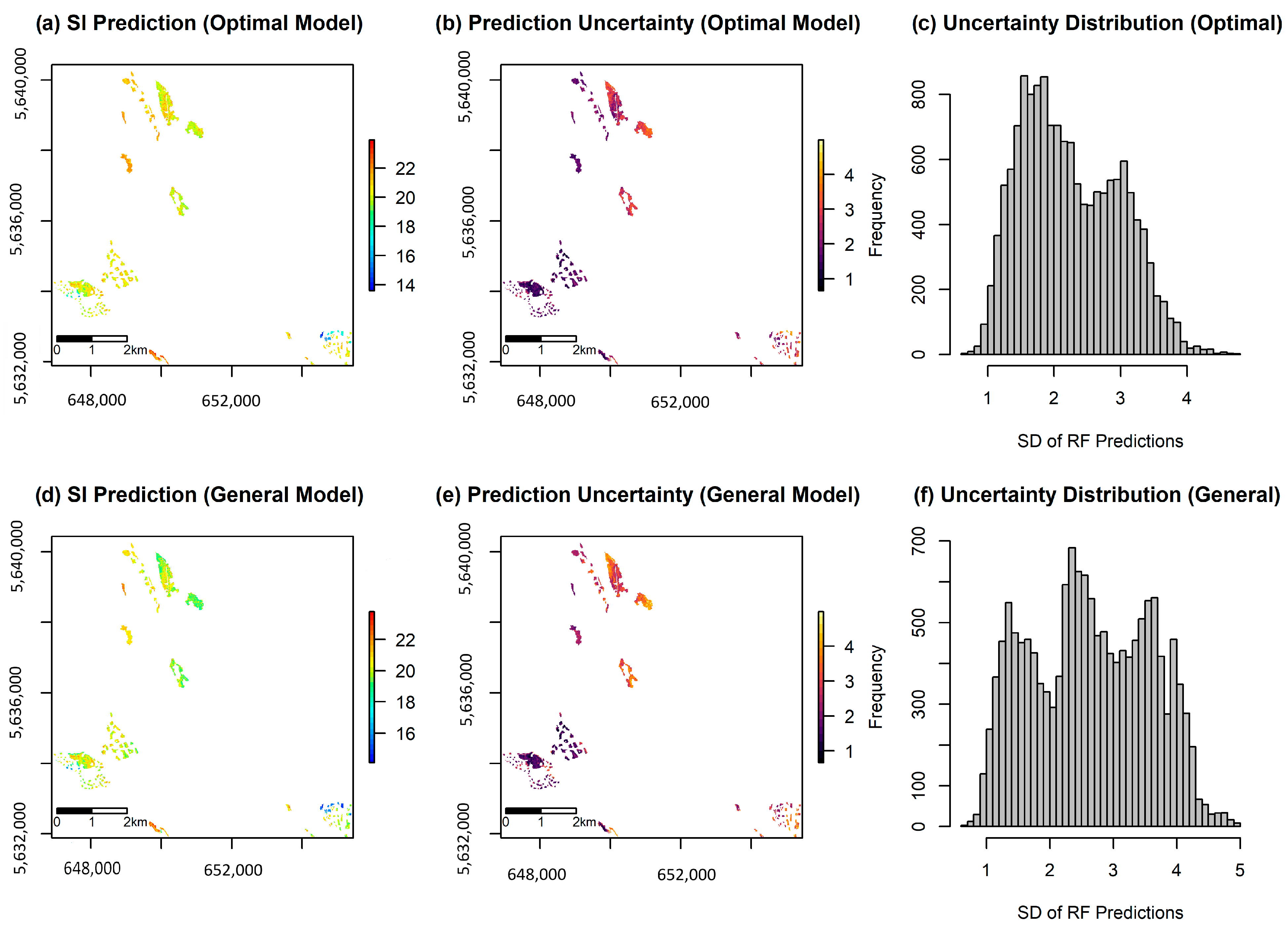
- Developing a single generalized model provided Site Index predictions comparable to site-specific models, demonstrating strong transferability and enabling reliable productivity mapping across diverse regions without building separate models for each site.
- This approach enables more precise and efficient forest management, allowing managers to identify high- and low-productivity zones and plan silviculture and harvesting more effectively.
- The model can be applied across different regions with minimal loss in accuracy, supporting large-scale forest productivity assessment and climate-adaptive planning without requiring separate models for each area.
Abstract
1. Introduction
- Does the joint inclusion of ALS terrain-derived and satellite-based attributes (The local optimized model) improve the accuracy of SI models compared to using ALS terrain-derived data alone in plantation stands?
- Are the developed SI models transferable and applicable across three ecologically distinct case study areas with varying growth-limiting factors?
- Can a generalized model provide reliable SI estimates at broad landscape scales?
- What environmental and spectral variables are most influential in estimating SI, and do they differ across ecological contexts?
2. Materials and Methods
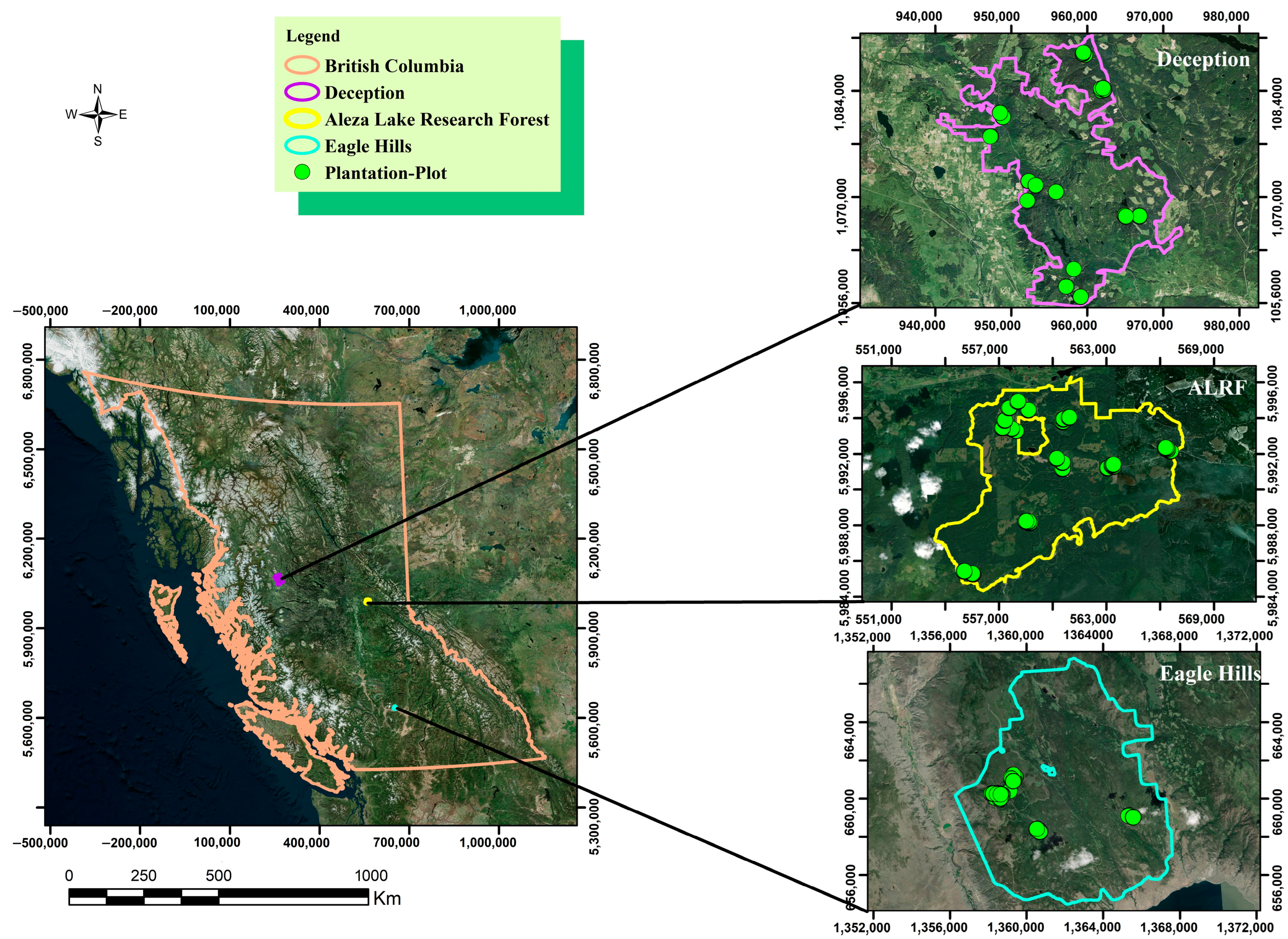
2.1. Study Sites
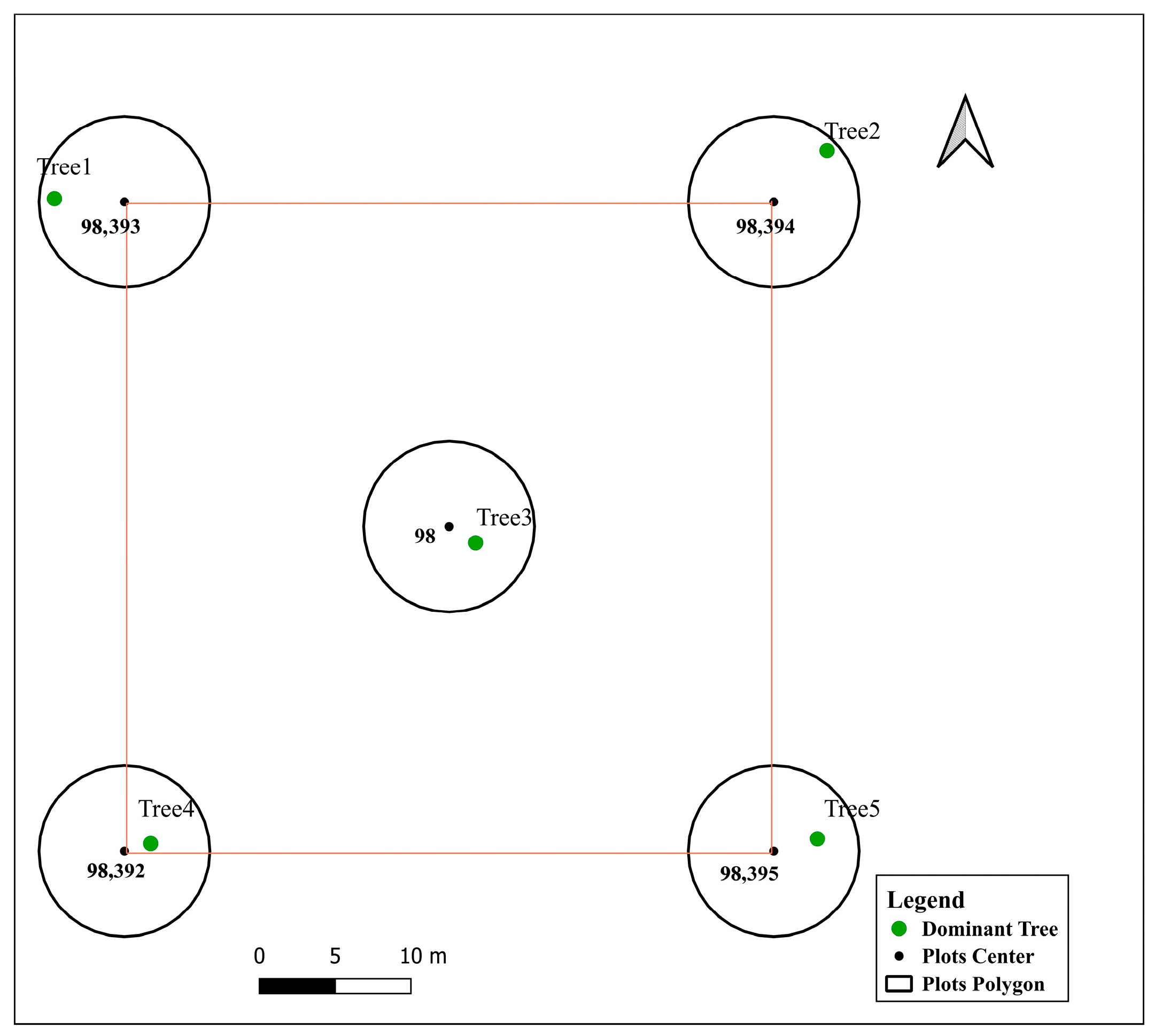
2.2. Empirical Field Data
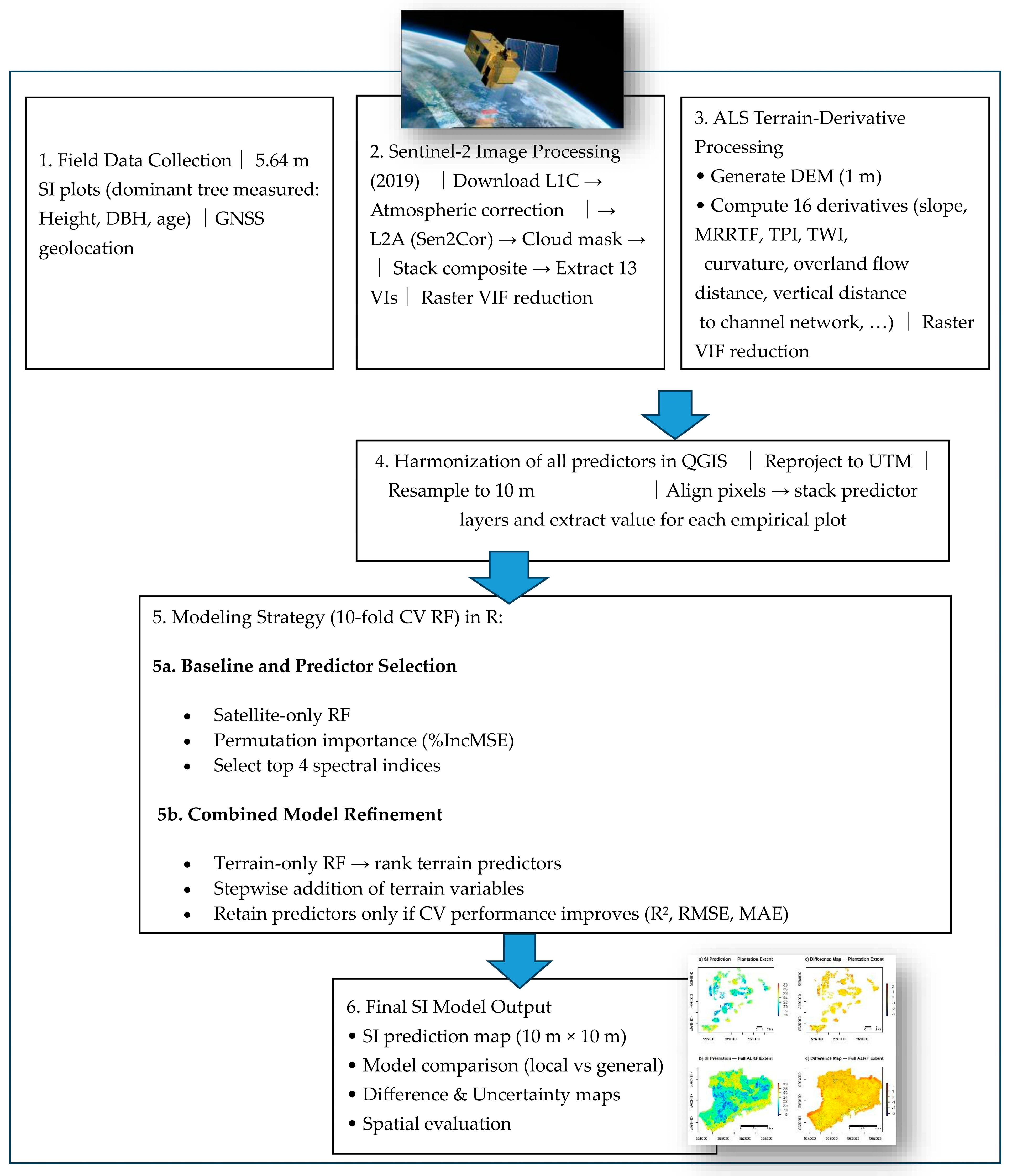
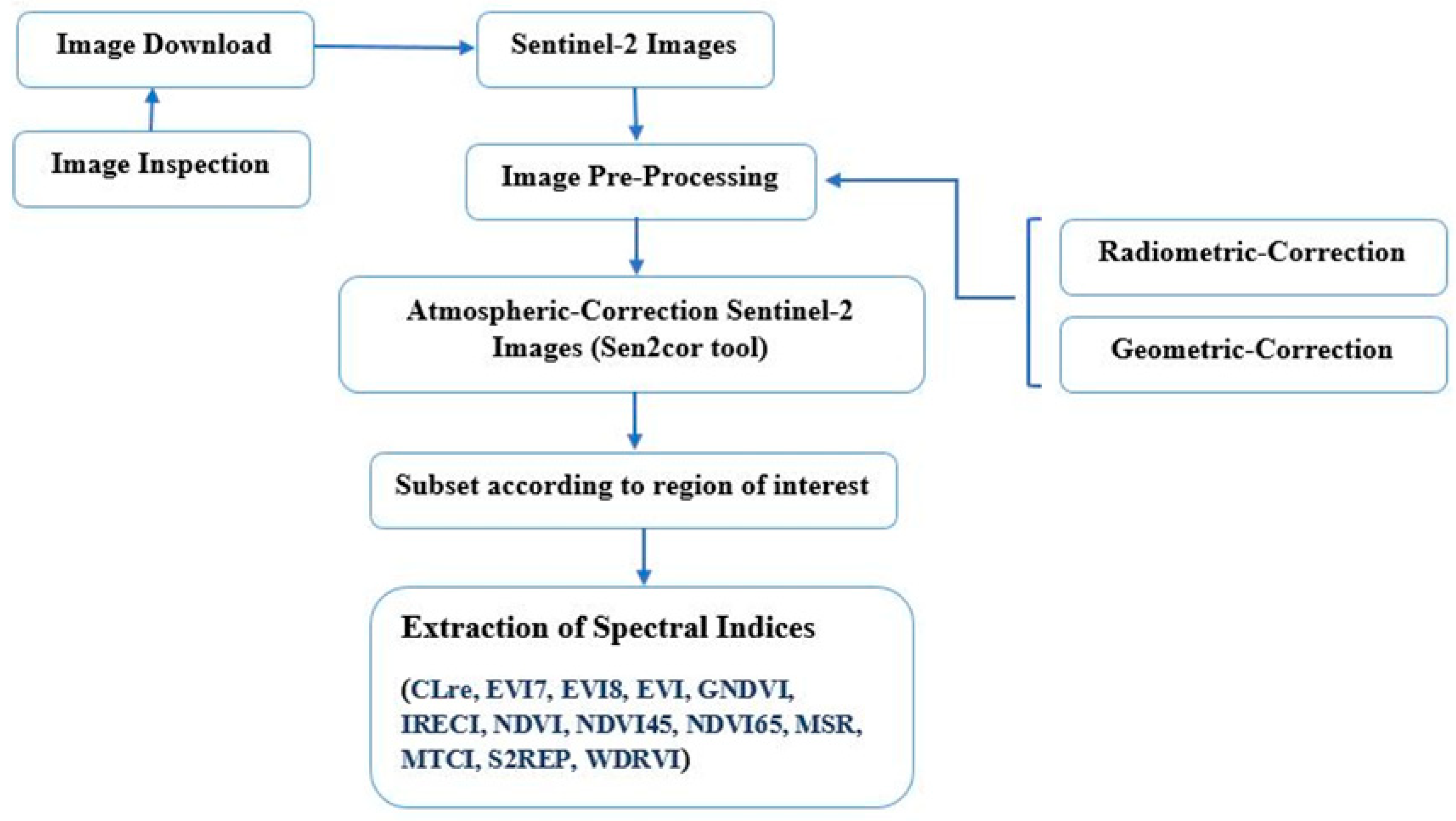
2.3. Remote Sensing Data and Processing
2.4. Development of the Local Optimal SI Models
2.4.1. Satellite-Only Baseline Modelling and Selection of the Most Important Key Spectral Predictors
- All major spectral regions were represented.
- predictors contributed non-redundant ecological information, and
- Each index demonstrated consistently high importance across RF resampling iterate.
2.4.2. Terrain-Only Modelling and Importance Ranking of LiDAR-Derived Predictors
2.4.3. Stepwise Integration of Terrain Predictors and Refinement of the Combined Model
2.4.4. Variable Importance, Model Comparison, and Spatial Performance Mapping
3. Results
3.1. Empirical Data
3.2. Predictive Map Generation
3.3. Random Forest Models
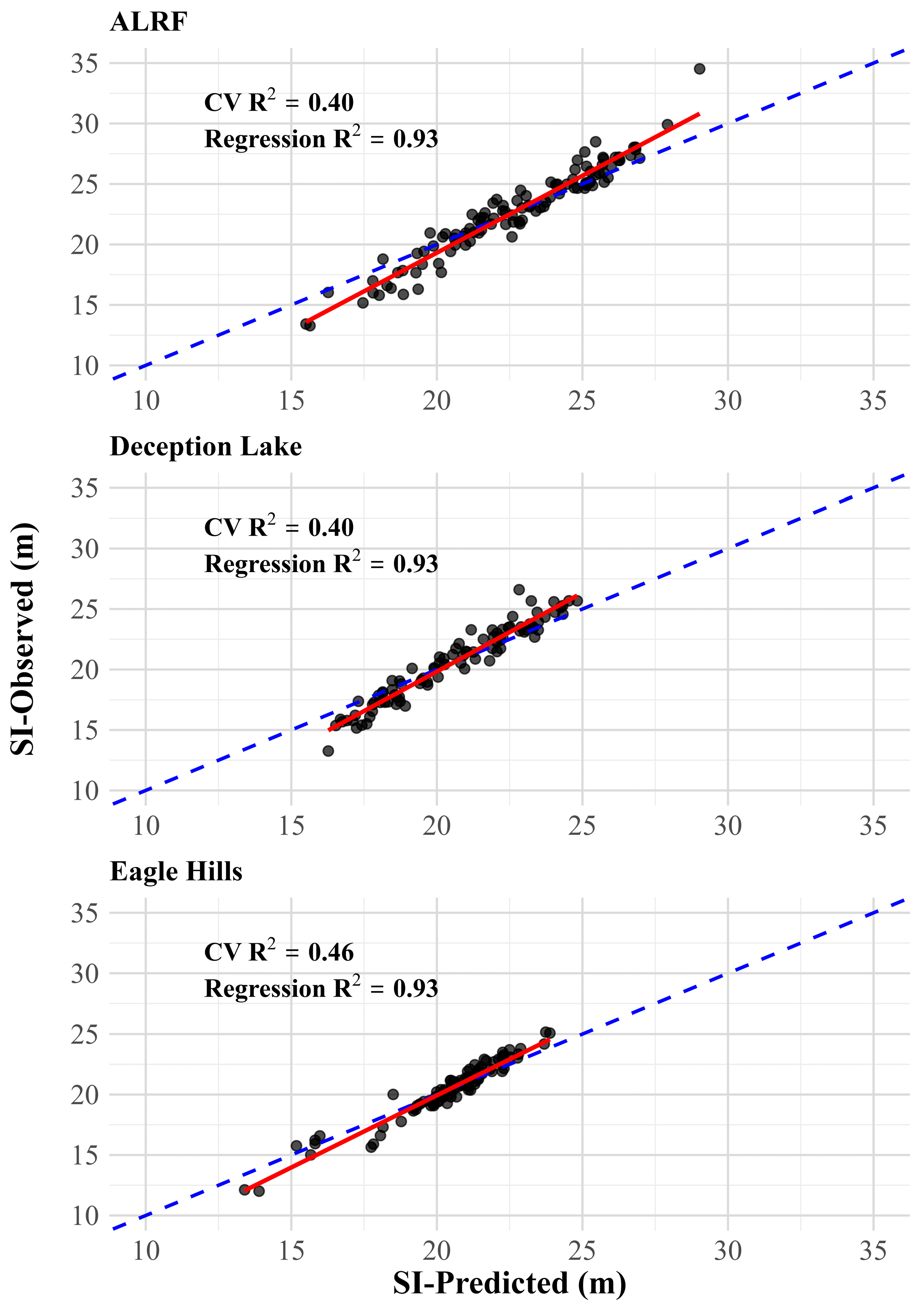
3.3.1. ALS-Derived Terrain Data
3.3.2. ALS-Derived Terrain and Satellite Data (The Local Optimized Model)
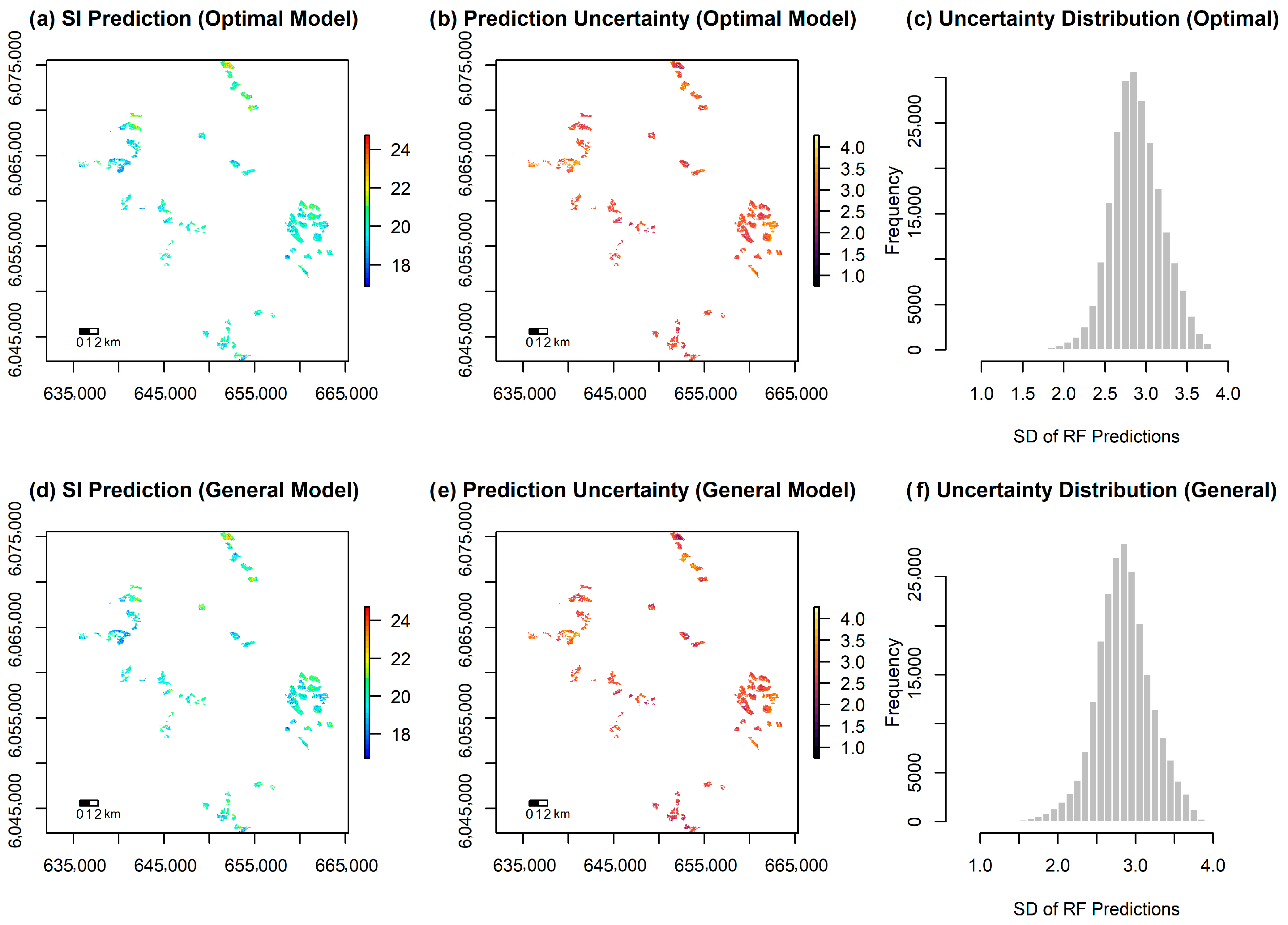
3.4. SI Estimate Comparisons of the Local Optimal Model and General Models for Three Case Study Areas
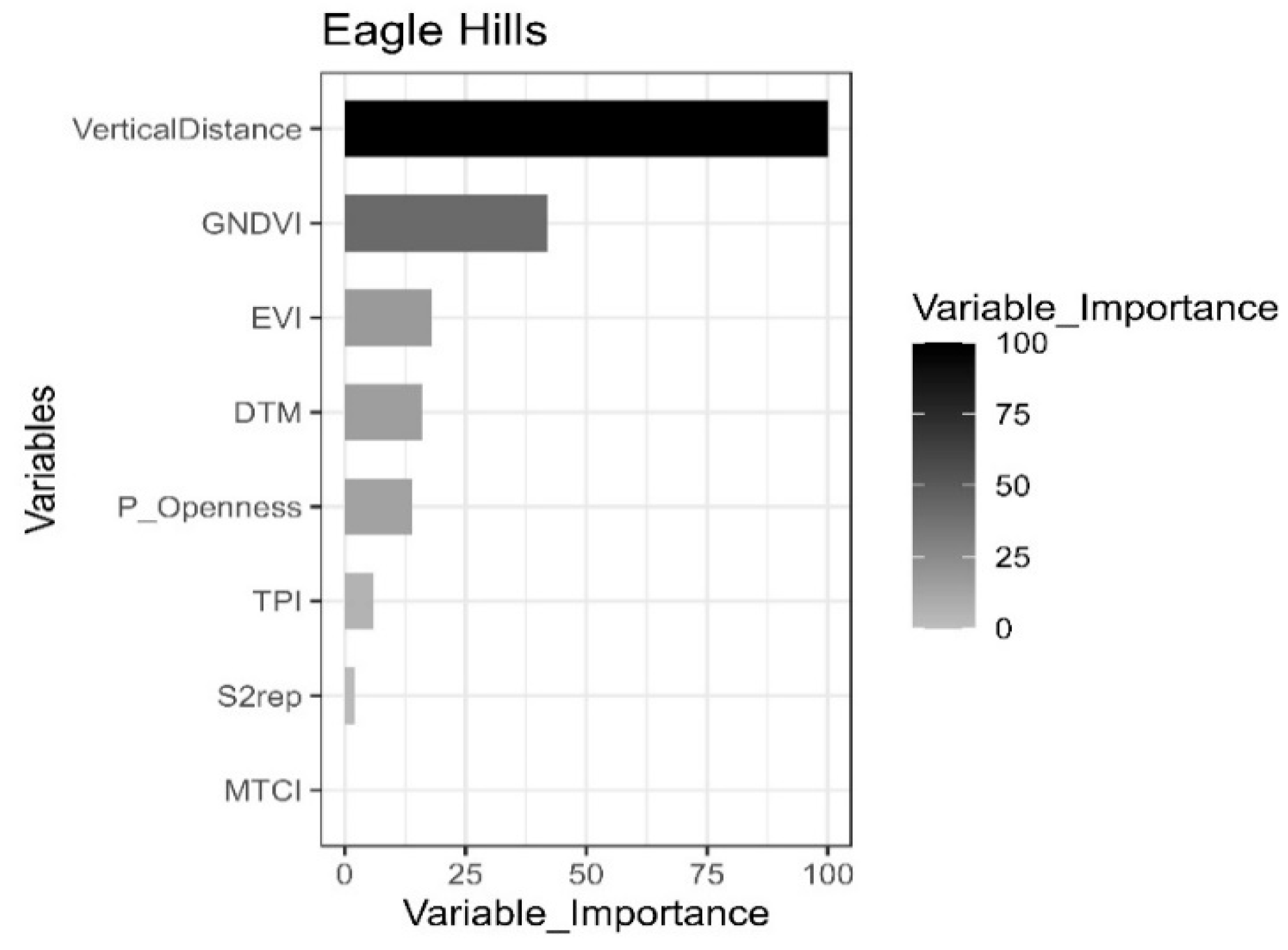
3.5. Variable Importance
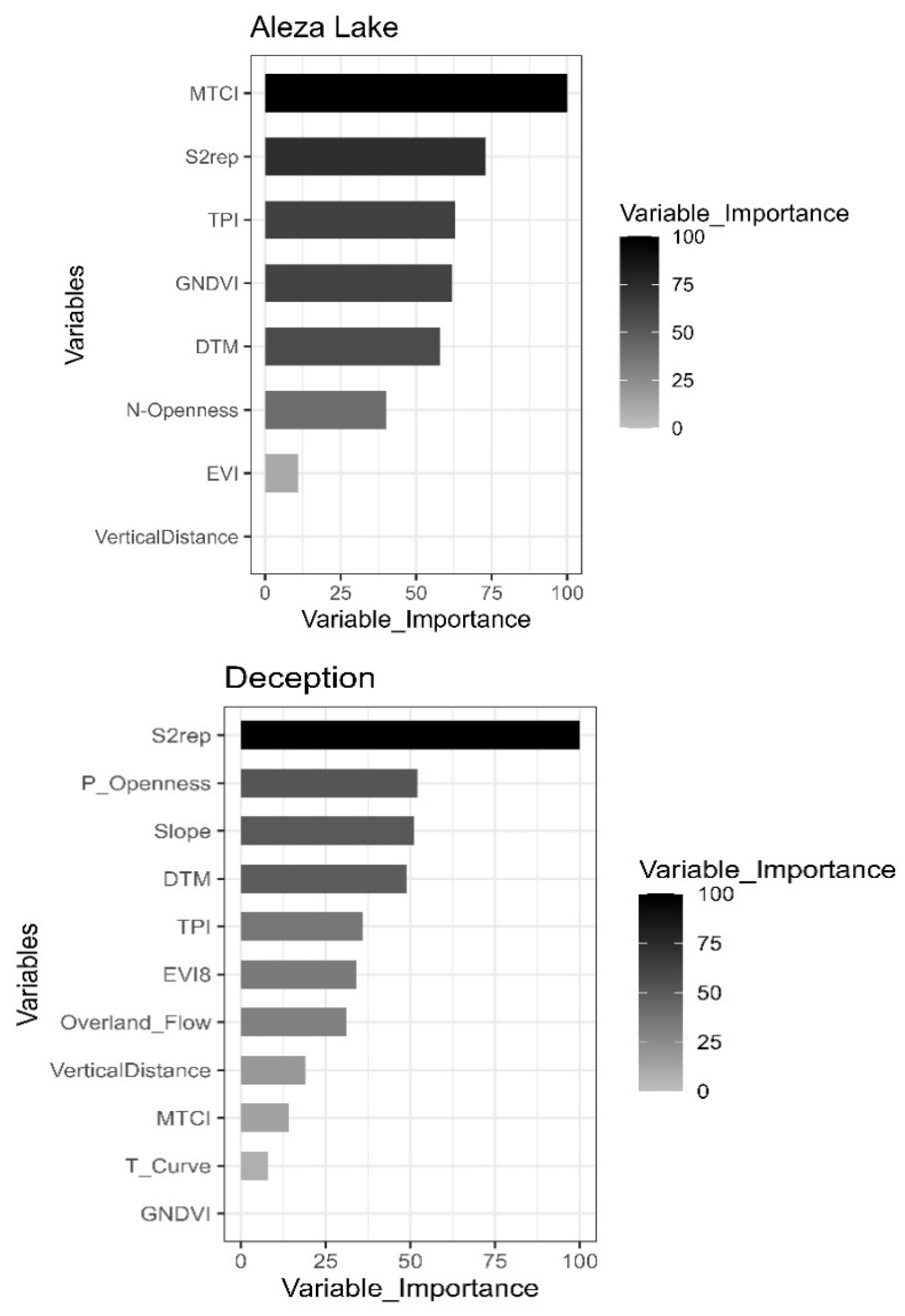
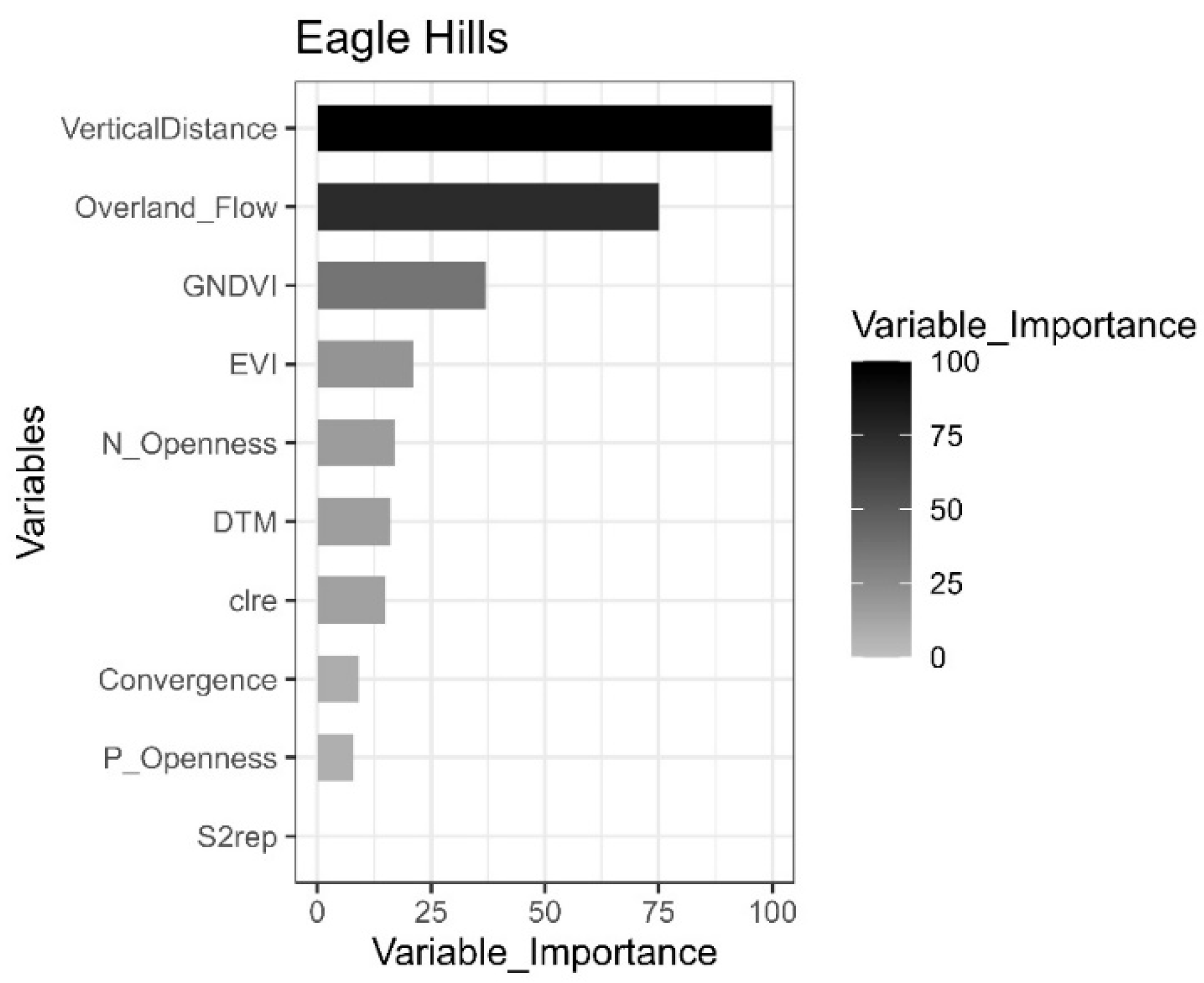
3.5.1. ALS + Satellite (The Local Optimized) Model
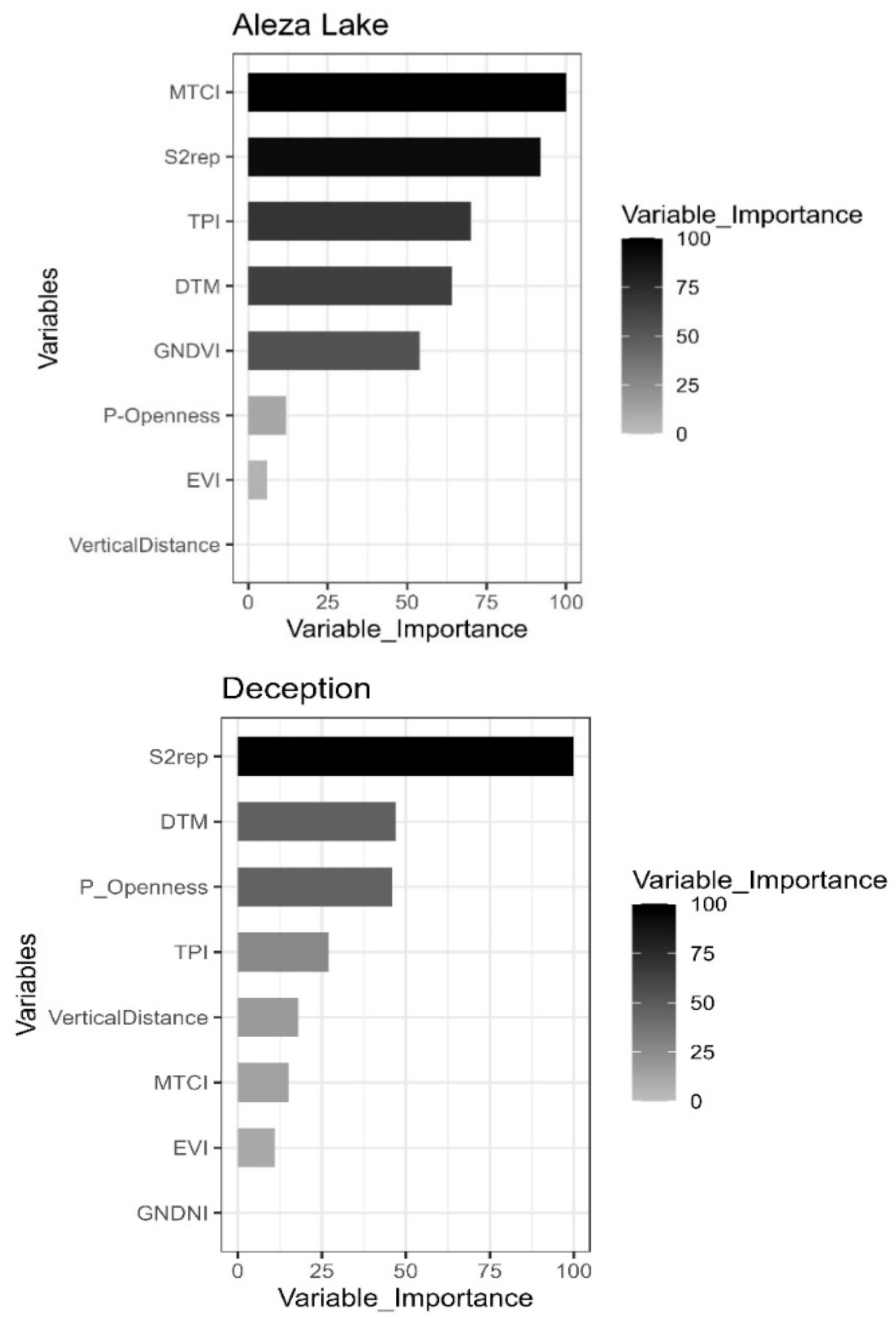
3.5.2. General Model
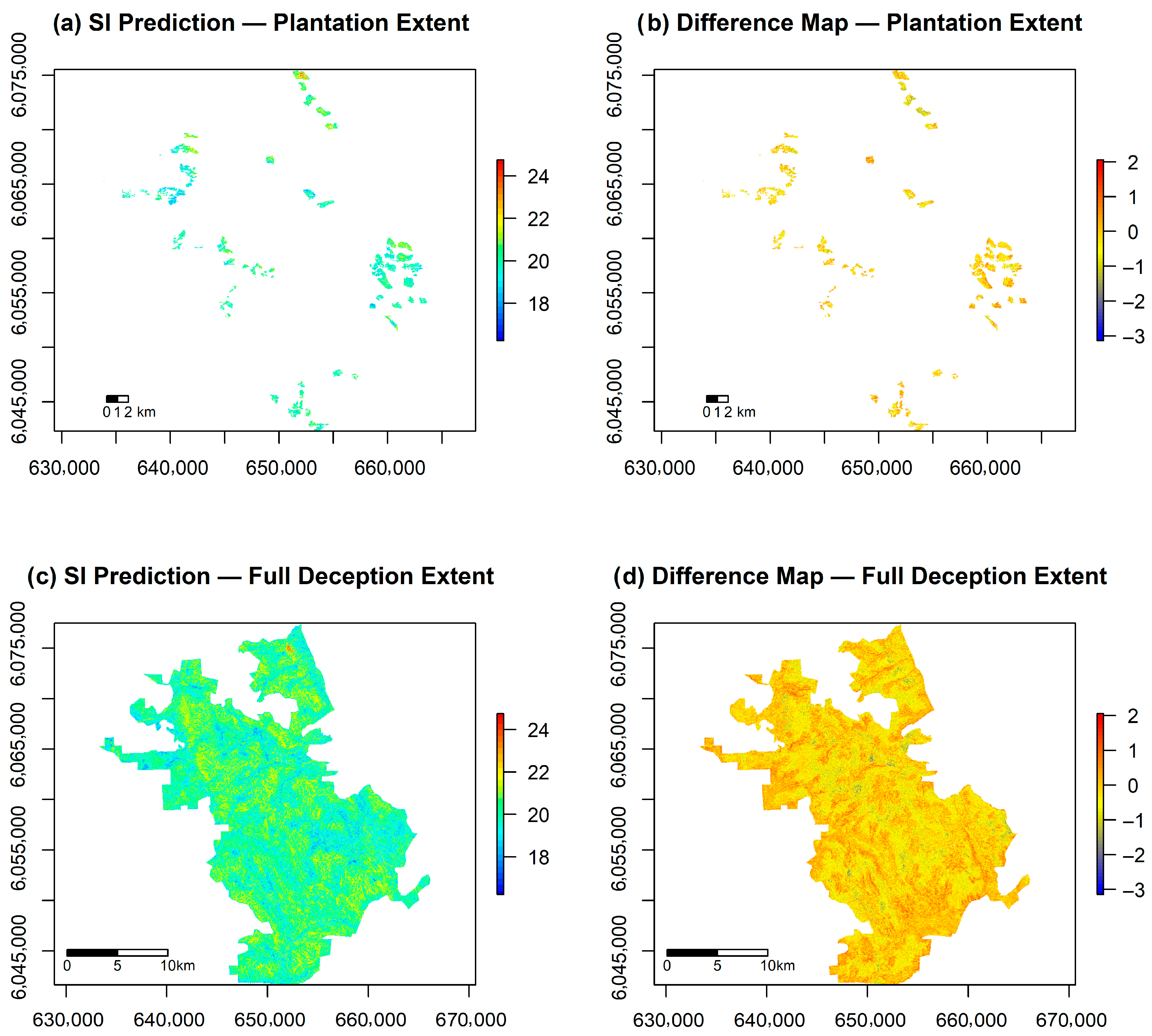
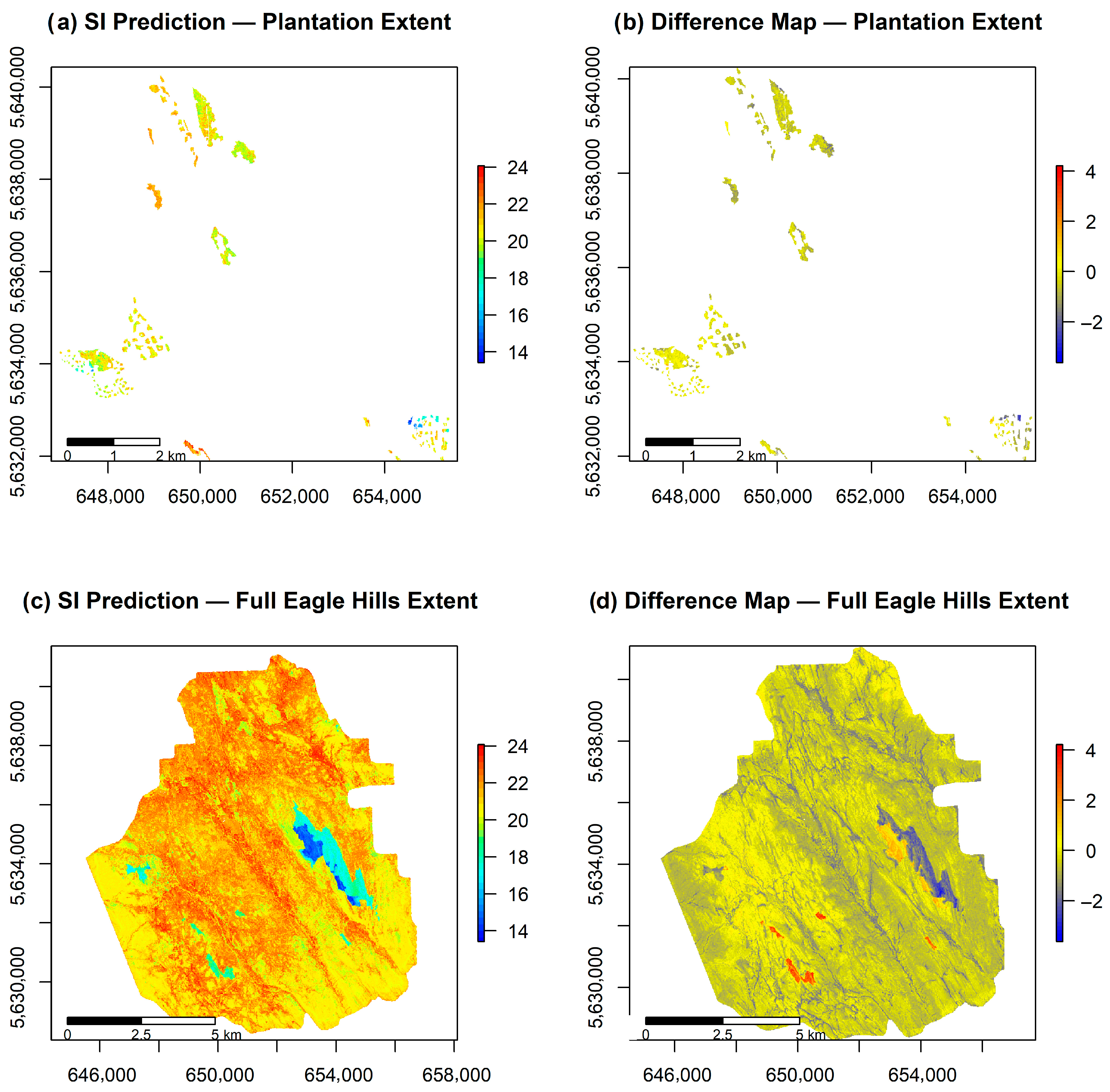
3.6. Spatial Comparison of General vs. Site-Specific SI Predictions
4. Discussion
4.1. Integration of Multi-Source Data
4.2. Site-Level Drivers of Forest Growth Potential and Model Performance
4.3. Limitations and Complementarity of Sensor Types
4.4. Model Transferability and Management Implications
4.5. Future Research
5. Conclusions
Author Contributions
Funding
Data Availability Statement
Acknowledgments
Conflicts of Interest
Abbreviations
| SI | Site Index |
| BEC | Biogeoclimatic Ecosystem Classification |
| ALS | Airborne Laser Scanning |
| ALRF | Aleza Lake Research Forest |
Appendix A

| No. | Variable | Derived Layer Name |
|---|---|---|
| 1 | Digital Terrain Model | DTM |
| 2 | Aspect | Aspect |
| 3 | Convergence Index | Convergence |
| 4 | Diurnal Anisotropic Heating | Diurnal_a_Heating |
| 5 | Filled DEM | Filled_Sinks |
| 6 | General Curvature | gCurvature |
| 7 | Multiresolution Index of the Ridge Top Flatness | MRRTF |
| 8 | Multiresolution Index of Valley Bottom Flatness | MRVBF |
| 9 | Topographic-Openness-Dominance | P_Openness |
| 10 | Topographic Openness Enclosure | N_Openness |
| 11 | Overland Flow Horizontal Distance | Overland_Flow |
| 12 | overland flow vertical distance | Vertical Distance |
| 13 | Slope | Slope |
| 14 | Total Curvature | T_Curve |
| 15 | Terrain Ruggedness Index | TRI |
| 16 | Topographic Position Index | TIP |
| 17 | Topographic Wetness Index | TWI |
| No. | Band/Index | Band Info/Formulation | Group Index Category |
|---|---|---|---|
| 1 | CLre: (Red-edge Chlorophyll Index) | (b7/b5) − 1 | 3 |
| 2 | EVI7: (Enhanced Vegetation Index using b5) | 2.5 × (b7 − b4)/(b7 + 6 × b4 − 7.5 × b2 + 1) | 1 |
| 3 | EVI8a: (Enhanced Vegetation Index using b8a) | 2.5× (b8a − b4)/(b8a + 6 × b4 − 7.5 × b2 + 1) | 1 |
| 4 | EVI: (Enhanced Vegetation Index) | 2.5× (b8 − b4)/(b8 + 2.4 × (b4 + 1)) | 1 |
| 5 | GNDVI: (Greenness Normalized Difference Vegetation Index) | (b7 − b3)/(b7 + b3) | 2 |
| 6 | NDVI: (Normalized Difference Vegetation Index using b4 and b8a) | (b8a − b4)/(b8a + b4) | 2 |
| 7 | NDVI45: (NDVI using b4 and b5) | (b5 − b4)/(b5 + b4) | 2 |
| 8 | NDVI65: (NDVI using b6 and b5) | (b6 − b5)/(b6 + b5) | 2 |
| 9 | WDRVI: (Wide Dynamic Range Vegetation Index) | (0.01 × b7 − b5)/z(0.01 × b7 + b5) +(1 − 0.01)/(1 + 0.01) | 2 |
| 10 | S2REP: (Sentinel-2 red-edge position) | 705 + 35 × ((b4 + b7)/2 − b5)/(b6 − b5) | 3 |
| 11 | MTCI: (MERIS terrestrial chlorophyll) | (b6 − b5)/(b5− b4) | 3 |
| 12 | MSR: (Modified Simple Ratio) | ((b7/b4) − 1)/(b7/b4) + 1) 0.5 | 3 |
| 13 | IRECI: (Inverted red-edge chlorophyll index) | (b7 − b4)/(b5/b6) | 3 |


References
- Powers, R.F. Assessing Potential Sustainable Wood Yield. In The Forests Handbook: Applying Forest Science for Sustainable Management; Blackwell Science, Ltd.: Oxford, UK, 2001; Volume 2, pp. 105–128. [Google Scholar]
- Hartmann, H.; Bastos, A.; Das, A.J.; Esquivel-Muelbert, A.; Hammond, W.M.; Martínez-Vilalta, J.; McDowell, N.G.; Powers, J.S.; Pugh, T.A.M.; Ruthrof, K.X.; et al. Climate Change Risks to Global Forest Health: Emergence of Unexpected Events of Elevated Tree Mortality Worldwide. Annu. Rev. Plant Biol. 2022, 73, 673–702. [Google Scholar] [CrossRef]
- Hernández-Blanco, M.; Costanza, R.; Chen, H.; DeGroot, D.; Jarvis, D.; Kubiszewski, I.; Montoya, J.; Sangha, K.; Stoeckl, N.; Turner, K. Ecosystem Health, Ecosystem Services, and the Well-being of Humans and the Rest of Nature. Glob. Change Biol. 2022, 28, 5027–5040. [Google Scholar] [CrossRef]
- Bunn, A.G.; Goetz, S.J.; Fiske, G.J. Observed and Predicted Responses of Plant Growth to Climate across Canada. Geophys. Res. Lett. 2005, 32, L16710. [Google Scholar] [CrossRef]
- Coops, N.C.; Gaulton, R.; Waring, R.H. Mapping Site Indices for Five Pacific Northwest Conifers Using a Physiologically Based Model. Appl. Veg. Sci. 2011, 14, 268–276. [Google Scholar] [CrossRef]
- Coops, N.C.; Hember, R.A. Physiologically Derived Predictions of Douglas-Fir Site Index in British Columbia. For. Chron. 2009, 85, 733–744. [Google Scholar] [CrossRef]
- Mitchell, A.K.; Burgess, D.; Maynard, D.; Groot, A.; Lussier, J.M.; Ottens, H.; Titus, B. Developing Silvicultural Systems for Sustainable Forestry in Canada. In Proceedings of the XII World Forestry Congress, Quebec City, QC, Canada, 21–28 September 2003; Available online: https://www.fao.org/4/XII/0596-B1.htm (accessed on 5 November 2025).
- Bettinger, P.; Boston, K. Forest Planning Heuristics—Current Recommendations and Research Opportunities for s-Metaheuristics. Forests 2017, 8, 476. [Google Scholar] [CrossRef]
- Pretzsch, H. The Course of Tree Growth. Theory and Reality. For. Ecol. Manag. 2020, 478, 118508. [Google Scholar]
- Tompalski, P.; Coops, N.C.; White, J.C.; Wulder, M.A. Enhancing Forest Growth and Yield Predictions with Airborne Laser Scanning Data: Increasing Spatial Detail and Optimizing Yield Curve Selection through Template Matching. Forests 2016, 7, 255. [Google Scholar] [CrossRef]
- Pretzsch, H.; Grote, R.; Reineking, B.; Rötzer, T.H.; Seifert, S.T. Models for Forest Ecosystem Management: A European Perspective. Ann. Bot. 2008, 101, 1065–1087. [Google Scholar] [CrossRef]
- Shirley, M. SIBEC Site Index Estimates in Support of Forest Management in British Columbia; Technical Report No. 004; Nigh, G.D., Ed.; British Columbia, Forest Science Program: Victoria, BC, Canada, 2003. [Google Scholar]
- Nakajima, T.; Shiraishi, N.; Kanomata, H.; Matsumoto, M. A Method to Maximise Forest Profitability through Optimal Rotation Period Selection under Various Economic, Site and Silvicultural Conditions. N. Z. J. For. Sci. 2017, 47, 4. [Google Scholar] [CrossRef]
- Watt, M.S.; Kimberley, M.O.; Dash, J.P.; Harrison, D. Spatial Prediction of Optimal Final Stand Density for Even-Aged Plantation Forests Using Productivity Indices. Can. J. For. Res. 2017, 47, 527–535. [Google Scholar] [CrossRef]
- Dash, J.; Mathur, A.; Foody, G.M.; Curran, P.J.; Chipman, J.W.; Lillesand, T.M. Land Cover Classification Using Multi-temporal MERIS Vegetation Indices. Int. J. Remote Sens. 2007, 28, 1137–1159. [Google Scholar] [CrossRef]
- Foody, G.M.; Dash, J. Discriminating and Mapping the C3 and C4 Composition of Grasslands in the Northern Great Plains, USA. Ecol. Inform. 2007, 2, 89–93. [Google Scholar] [CrossRef]
- Gitelson, A.A.; Viña, A.; Verma, S.B.; Rundquist, D.C.; Arkebauer, T.J.; Keydan, G.; Leavitt, B.; Ciganda, V.; Burba, G.G.; Suyker, A.E. Relationship between Gross Primary Production and Chlorophyll Content in Crops: Implications for the Synoptic Monitoring of Vegetation Productivity. J. Geophys. Res. Atmos. 2006, 111. [Google Scholar] [CrossRef]
- Gonzalez-Benecke, C.A.; Teskey, R.O.; Martin, T.A.; Jokela, E.J.; Fox, T.R.; Kane, M.B.; Noormets, A. Regional Validation and Improved Parameterization of the 3-PG Model for Pinus Taeda Stands. For. Ecol. Manag. 2016, 361, 237–256. [Google Scholar] [CrossRef]
- Subedi, S.; Fox, T.R.; Wynne, R.H. Determination of Fertility Rating (FR) in the 3-PG Model for Loblolly Pine Plantations in the Southeastern United States Based on Site Index. Forests 2015, 6, 3002–3027. [Google Scholar] [CrossRef]
- Burkhart, H.E.; Tomé, M. Modeling Forest Trees and Stands; Springer Science & Business Media: Berlin/Heidelberg, Germany, 2012; ISBN 90-481-3170-7. [Google Scholar]
- Le Moguédec, G.; Dhôte, J.-F. Fagacées: A Tree-Centered Growth and Yield Model for Sessile Oak (Quercus petraea L.) and Common Beech (Fagus sylvatica L.). Ann. For. Sci. 2012, 69, 257–269. [Google Scholar] [CrossRef]
- Skovsgaard, J.P.; Vanclay, J.K. Forest Site Productivity: A Review of the Evolution of Dendrometric Concepts for Even-Aged Stands. Forestry 2008, 81, 13–31. [Google Scholar] [CrossRef]
- Aertsen, W.; Kint, V.; Muys, B.; Van Orshoven, J. Effects of Scale and Scaling in Predictive Modelling of Forest Site Productivity. Environ. Model. Softw. 2012, 31, 19–27. [Google Scholar] [CrossRef]
- Nothdurft, A.; Wolf, T.; Ringeler, A.; Böhner, J.; Saborowski, J. Spatio-Temporal Prediction of Site Index Based on Forest Inventories and Climate Change Scenarios. For. Ecol. Manag. 2012, 279, 97–111. [Google Scholar] [CrossRef]
- Curt, T.; Bouchaud, M.; Agrech, G. Predicting Site Index of Douglas-Fir Plantations from Ecological Variables in the Massif Central Area of France. For. Ecol. Manag. 2001, 149, 61–74. [Google Scholar] [CrossRef]
- Monserud, R.A.; Huang, S.M. Mapping Lodgepole Pine Site Index in Alberta; CABI Publishing: Wallingford, UK, 2003; pp. 11–25. [Google Scholar]
- Swenson, J.J.; Waring, R.H.; Fan, W.; Coops, N. Predicting Site Index with a Physiologically Based Growth Model across Oregon, USA. Can. J. For. Res. 2005, 35, 1697–1707. [Google Scholar] [CrossRef]
- Pinno, B.D.; Paré, D.; Guindon, L.; Bélanger, N. Predicting Productivity of Trembling Aspen in the Boreal Shield Ecozone of Quebec Using Different Sources of Soil and Site Information. For. Ecol. Manag. 2009, 257, 782–789. [Google Scholar] [CrossRef]
- Seynave, I.; Gégout, J.-C.; Hervé, J.-C.; Dhôte, J.-F.; Drapier, J.; Bruno, É.; Dumé, G. Picea Abies Site Index Prediction by Environmental Factors and Understorey Vegetation: A Two-Scale Approach Based on Survey Databases. Can. J. For. Res. 2005, 35, 1669–1678. [Google Scholar] [CrossRef]
- Socha, J. Effect of Topography and Geology on the Site Index of Picea Abies in the West Carpathian, Poland. Scand. J. For. Res. 2008, 23, 203–213. [Google Scholar] [CrossRef]
- Bravo-Oviedo, A.; Tome, M.; Bravo, F.; Montero, G.; Del Rio, M. Dominant Height Growth Equations Including Site Attributes in the Generalized Algebraic Difference Approach. Can. J. For. Res. 2008, 38, 2348–2358. [Google Scholar] [CrossRef]
- Chen, H.Y.H.; Krestov, P.V.; Klinka, K. Trembling Aspen Site Index in Relation to Environmental Measures of Site Quality at Two Spatial Scales. Can. J. For. Res. 2002, 32, 112–119. [Google Scholar] [CrossRef]
- Holmgren, P. Topographic and Geochemical Influence on the Forest Site Quality, with Respect to Pinus Sylvestris and Picea Abies in Sweden. Scand. J. For. Res. 1994, 9, 75–82. [Google Scholar] [CrossRef]
- Corona, P.; Scotti, R.; Tarchiani, N. Relationship between Environmental Factors and Site Index in Douglas-Fir Plantations in Central Italy. For. Ecol. Manag. 1998, 110, 195–207. [Google Scholar] [CrossRef]
- Marques, C.P. Evaluating Site Quality of Even-Aged Maritime Pine Stands in Northern Portugal Using Direct and Indirect Methods. For. Ecol. Manag. 1991, 41, 193–204. [Google Scholar] [CrossRef]
- Carmean, W.H. Forest Site Quality Evaluation in the United States. Adv. Agron. 1975, 27, 209–269. [Google Scholar]
- Skovsgaard, J.P.; Vanclay, J.K. Forest Site Productivity: A Review of Spatial and Temporal Variability in Natural Site Conditions. Forestry 2013, 86, 305–315. [Google Scholar] [CrossRef]
- Næsset, E. Predicting Forest Stand Characteristics with Airborne Scanning Laser Using a Practical Two-Stage Procedure and Field Data. Remote Sens. Environ. 2002, 80, 88–99. [Google Scholar] [CrossRef]
- Stearns-Smith, S. Making Sense of Site Index Estimates in British Columbia: A Quick Look at the Big Picture. J. Ecosyst. Manag. 2002, 1, 2. [Google Scholar] [CrossRef]
- Tahiru, A.-W.; Cobbina, S.; Asare, W.; Takal, S.U. Advancing Environmental Sustainability Through Remote Sensing: A Review of Applications, Limitations, and Emerging Solutions. 2025. Available online: https://www.preprints.org/manuscript/202503.1896 (accessed on 5 November 2025).
- Hall, R.J.; Skakun, R.S.; Arsenault, E.J.; Case, B.S. Modeling Forest Stand Structure Attributes Using Landsat ETM+ Data: Application to Mapping of Aboveground Biomass and Stand Volume. For. Ecol. Manag. 2006, 225, 378–390. [Google Scholar] [CrossRef]
- Zhao, M.; Running, S.W. Remote Sensing of Terrestrial Primary Production and Carbon Cycle. In Advances in Land Remote Sensing: System, Modeling, Inversion and Application; Springer: Dordrecht, The Netherlands, 2008; pp. 423–444. [Google Scholar]
- Tompalski, P.; Coops, N.C.; White, J.C.; Wulder, M.A. Augmenting Site Index Estimation with Airborne Laser Scanning Data. For. Sci. 2015, 61, 861–873. [Google Scholar] [CrossRef]
- Guerra-Hernández, J.; Arellano-Pérez, S.; González-Ferreiro, E.; Pascual, A.; Altelarrea, V.S.; Ruiz-González, A.D.; Álvarez-González, J.G. Developing a Site Index Model for P. Pinaster Stands in NW Spain by Combining Bi-Temporal ALS Data and Environmental Data. For. Ecol. Manag. 2021, 481, 118690. [Google Scholar] [CrossRef]
- Socha, J.; Pierzchalski, M.; Bałazy, R.; Ciesielski, M. Modelling Top Height Growth and Site Index Using Repeated Laser Scanning Data. For. Ecol. Manag. 2017, 406, 307–317. [Google Scholar] [CrossRef]
- Pettorelli, N.; Vik, J.O.; Mysterud, A.; Gaillard, J.-M.; Tucker, C.J.; Stenseth, N.C. Using the Satellite-Derived NDVI to Assess Ecological Responses to Environmental Change. Trends Ecol. Evol. 2005, 20, 503–510. [Google Scholar] [CrossRef]
- Waring, R.H.; Milner, K.S.; Jolly, W.M.; Phillips, L.; McWethy, D. Assessment of Site Index and Forest Growth Capacity across the Pacific and Inland Northwest USA with a MODIS Satellite-Derived Vegetation Index. For. Ecol. Manag. 2006, 228, 285–291. [Google Scholar] [CrossRef]
- Beven, K.J.; Kirkby, M.J. A Physically Based, Variable Contributing Area Model of Basin Hydrology/Un Modèle à Base Physique de Zone d’appel Variable de l’hydrologie Du Bassin Versant. Hydrol. Sci. J. 1979, 24, 43–69. [Google Scholar] [CrossRef]
- Guisan, A.; Weiss, S.B.; Weiss, A.D. GLM versus CCA Spatial Modeling of Plant Species Distribution. Plant Ecol. 1999, 143, 107–122. [Google Scholar] [CrossRef]
- Yu, J.; Wang, J.; Leblon, B. Evaluation of Soil Properties, Topographic Metrics, Plant Height, and Unmanned Aerial Vehicle Multispectral Imagery Using Machine Learning Methods to Estimate Canopy Nitrogen Weight in Corn. Remote Sens. 2021, 13, 3105. [Google Scholar] [CrossRef]
- Yu, J.; Wang, J.; Leblon, B.; Song, Y. Nitrogen Estimation for Wheat Using UAV-Based and Satellite Multispectral Imagery, Topographic Metrics, Leaf Area Index, Plant Height, Soil Moisture, and Machine Learning Methods. Nitrogen 2021, 3, 1–25. [Google Scholar] [CrossRef]
- Meidinger, D.; Pojar, J. Ecosystems of British Columbia; Special Report Series; Ministry of Forests, British Columbia: Victoria, BC, Canada, 1991. [Google Scholar]
- British Columbia Ministry of Forests, Silviculture Branch. Growth Intercept Method for Silviculture Surveys; British Columbia Ministry of Forests: Victoria, BC, Canada, 1995. [Google Scholar]
- The Ministry of Forests, Lands, Natural Resource Operations and Rural Development. Site Index Tools (SiteTools)—Province of British Columbia. Available online: https://www2.gov.bc.ca/gov/content/industry/forestry/managing-our-forest-resources/forest-inventory/growth-and-yield-modelling/site-index-tools-sitetools (accessed on 5 November 2025).
- Dietrich, J.P.; Leoncio, W. Citation: Software Citation Tools; R package; The R Foundation for Statistical Computing: Vienna, Austria, 2020; Available online: https://CRAN.R-project.org/package=citation (accessed on 5 November 2025).
- Brenning, A.; Bangs, D.; Becker, B.; Schratz, P.; Polakowski, F. RSAGA: SAGA Geoprocessing and Terrain Analysis; R Package Version 1.4.2; The R Foundation for Statistical Computing: Vienna, Austria, 2008; Available online: https://cran.r-project.org/package=RSAGA (accessed on 5 November 2025).
- Korhonen, L.; Packalen, P.; Rautiainen, M. Comparison of Sentinel-2 and Landsat 8 in the Estimation of Boreal Forest Canopy Cover and Leaf Area Index. Remote Sens. Environ. 2017, 195, 259–274. [Google Scholar] [CrossRef]
- Majasalmi, T.; Rautiainen, M. The Potential of Sentinel-2 Data for Estimating Biophysical Variables in a Boreal Forest: A Simulation Study. Remote Sens. Lett. 2016, 7, 427–436. [Google Scholar] [CrossRef]
- Rahimzadeh-Bajgiran, P.; Munehiro, M.; Omasa, K. Relationships between the Photochemical Reflectance Index (PRI) and Chlorophyll Fluorescence Parameters and Plant Pigment Indices at Different Leaf Growth Stages. Photosynth. Res. 2012, 113, 261–271. [Google Scholar] [CrossRef] [PubMed]
- Verrelst, J.; Camps-Valls, G.; Muñoz-Marí, J.; Rivera, J.P.; Veroustraete, F.; Clevers, J.G.P.W.; Moreno, J. Optical Remote Sensing and the Retrieval of Terrestrial Vegetation Bio-Geophysical Properties—A Review. ISPRS J. Photogramm. Remote Sens. 2015, 108, 273–290. [Google Scholar]
- Amin, M.E.S.; Nabil, M.; Abdelfattah, M.A.; Mohamed, E.S.; Mahmoud, A.G. Exploitation of Sentinel-2 Spectral Bands and Vegetation Indices in Potato Yield Estimation. J. Indian Soc. Remote Sens. 2025. [Google Scholar] [CrossRef]
- Breiman, L. Random Forests. Mach. Learn. 2001, 45, 5–32. [Google Scholar] [CrossRef]
- Liaw, A.; Wiener, M. Classification and Regression by randomForest. R News 2002, 2, 18–22. [Google Scholar]
- Kuhn, M. Building Predictive Models in R Using the Caret Package. J. Stat. Softw. 2008, 28, 1–26. [Google Scholar] [CrossRef]
- Adams, B.T.; Matthews, S.N. Enhancing Forest and Shrubland Mapping in a Managed Forest Landscape with Landsat–LiDAR Data Fusion. Nat. Areas J. 2018, 38, 402–418. [Google Scholar] [CrossRef]
- Terezan, L.H. Evaluating Site Index Models Derived from Topography and Predictive Ecosystem Models. Doctoral Dissertation, University of Northern British Columbia, Prince George, BC, Canada, 2022. [Google Scholar]
- Lefsky, M.A.; Cohen, W.B.; Parker, G.G.; Harding, D.J. Lidar Remote Sensing for Ecosystem Studies. BioScience 2002, 52, 19–30. [Google Scholar] [CrossRef]
- Jiang, F.; Deng, M.; Tang, J.; Fu, L.; Sun, H. Integrating Spaceborne LiDAR and Sentinel-2 Images to Estimate Forest Aboveground Biomass in Northern China. Carbon Balance Manag. 2022, 17, 12. [Google Scholar] [CrossRef]
- Sharma, M.; Amateis, R.L.; Burkhart, H.E. Top Height Definition and Its Effect on Site Index Determination in Thinned and Unthinned Loblolly Pine Plantations. For. Ecol. Manag. 2002, 168, 163–175. [Google Scholar] [CrossRef]
- Fan, W.; Tian, J.; Knoke, T.; Yang, B.; Liang, F.; Dong, Z. Investigating Dual-Source Satellite Image Data and ALS Data for Estimating Aboveground Biomass. Remote Sens. 2024, 16, 1804. [Google Scholar] [CrossRef]
- Zhang, L.; Shao, Z.; Liu, J.; Cheng, Q. Deep Learning Based Retrieval of Forest Aboveground Biomass from Combined LiDAR and Landsat 8 Data. Remote Sens. 2019, 11, 1459. [Google Scholar] [CrossRef]
- Rizzo-Martín, I.; Hirigoyen-Domínguez, A.; Arthus-Bacovich, R.; Varo-Martínez, M.Á.; Navarro-Cerrillo, R. Site Index Estimation Using Airborne Laser Scanner Data in Eucalyptus Dunnii Maide Stands in Uruguay. Forests 2023, 14, 933. [Google Scholar] [CrossRef]
- Liu, J.; Quan, Y.; Wang, B.; Shi, J.; Ming, L.; Li, M. Estimation of Forest Stock Volume Combining Airborne LiDAR Sampling Approaches with Multi-Sensor Imagery. Forests 2023, 14, 2453. [Google Scholar] [CrossRef]
- Watt, M.S.; Dash, J.P.; Watt, P.; Bhandari, S. Multi-Sensor Modelling of a Forest Productivity Index for Radiata Pine Plantations. N. Z. J. For. Sci. 2016, 46, 9. [Google Scholar] [CrossRef]
- Dubayah, R.O.; Drake, J.B. Lidar Remote Sensing for Forestry. J. For. 2000, 98, 44–46. [Google Scholar] [CrossRef]
- Leclère, L.; Latte, N.; Candaele, R.; Ligot, G.; Lejeune, P. Estimation of Within-Gap Regeneration Height Growth in Managed Temperate Deciduous Forests Using Bi-Temporal Airborne Laser Scanning Data. Ann. For. Sci. 2024, 81, 36. [Google Scholar] [CrossRef]
- Peng, Y.; Gitelson, A.A. Remote Estimation of Gross Primary Productivity in Soybean and Maize Based on Total Crop Chlorophyll Content. Remote Sens. Environ. 2012, 117, 440–448. [Google Scholar] [CrossRef]
- Rahimzadeh-Bajgiran, P.; Hennigar, C.; Weiskittel, A.; Lamb, S. Forest Potential Productivity Mapping by Linking Remote-Sensing-Derived Metrics to Site Variables. Remote Sens. 2020, 12, 2056. [Google Scholar] [CrossRef]
- Ministry of Forests-Forest Practices Branch. How to Determine Site Index in Silviculture. In Participant’s Workbook; British Columbia: Victoria, BC, Canada, 1999. [Google Scholar]
- Anderegg, L.D.L.; HilleRisLambers, J. Local Range Boundaries vs. Large-scale Trade-offs: Climatic and Competitive Constraints on Tree Growth. Ecol. Lett. 2019, 22, 787–796. [Google Scholar] [CrossRef]


| Site | Variables | Median | Mean | Std. Dev | Maximum | Minimum |
|---|---|---|---|---|---|---|
| Aleza Lake | DBH | 15.10 | 15.50 | 5.21 | 27.50 | 2.20 |
| Height | 10.35 | 10.75 | 3.74 | 17.85 | 2.33 | |
| Age | 28.00 | 27.17 | 3.92 | 30.00 | 9.00 | |
| Site Index | 23.09 | 22.84 | 3.69 | 34.52 | 13.28 | |
| Eagle Hills | DBH | 12.60 | 13.22 | 3.49 | 23.00 | 7.10 |
| Height | 8.50 | 8.69 | 1.95 | 12.80 | 4.45 | |
| Age | 21.00 | 20.88 | 3.09 | 25.00 | 18.00 | |
| Site Index | 20.40 | 20.39 | 2.37 | 25.16 | 12.01 | |
| Deception | DBH | 13.30 | 12.87 | 4.40 | 21.60 | 2.00 |
| Height | 8.60 | 8.22 | 2.34 | 13.65 | 2.10 | |
| Age | 26.00 | 22.85 | 5.66 | 31.00 | 9.00 | |
| Site Index | 20.87 | 20.50 | 3.16 | 26.60 | 13.26 |
| No | Variable | Aleza Lake | Deception | Eagle Hills |
|---|---|---|---|---|
| Sentienel-2 | ||||
| 1 | EVI8a (Enhanced vegetation index using b8a) | Yes | ||
| 2 | EVI (Enhanced vegetation Index) | Yes | Yes | |
| 3 | GNDVI (Greenness normalized difference vegetation index) | Yes | Yes | Yes |
| 4 | MTCI (MERIS terrestrial Chlorophyll) | Yes | Yes | Yes |
| 5 | S2REP (Sentinel-2 red edge position) | Yes | Yes | Yes |
| ALS-terrain | ||||
| 6 | DTM (Digital terrain model) | Yes | Yes | Yes |
| 7 | Aspect | Yes | Yes | Yes |
| 8 | Convergence Index | Yes | Yes | Yes |
| 9 | Dah (Diurnal Anisotropic Heating) | Yes | Yes | Yes |
| 10 | G-Curvature (General Curvature) | Yes | Yes | Yes |
| 11 | MRRTF (Multiresolution Index of the ridge top flatness) | Yes | Yes | Yes |
| 12 | MRVBF (Multiresolution Index of valley bottom flatness) | Yes | Yes | Yes |
| 13 | P-Openness (Topographic Openness dominance) | Yes | Yes | |
| 14 | N-Openness (Topographic Openness enclosure) | Yes | Yes | Yes |
| 15 | Overland Flow horizontal distance | Yes | Yes | Yes |
| 16 | Slope | Yes | Yes | Yes |
| 17 | T-Curvature (Total Curvature) | Yes | Yes | Yes |
| 18 | TRI (Terrain Ruggedness Index) | Yes | Yes | |
| 19 | TPI (Topographic Position Index) | Yes | Yes | Yes |
| 20 | TWI (Topographic Wetness Index) | Yes | Yes | Yes |
| 21 | Vertical Distance | Yes |
| Random Forrest Model | 10-Fold Cross-Validation (R2) | Mean Squared Error (MSE) | Root Mean Squared Error (RMSE) | Mean Absolute Error (MAE) | ||||
|---|---|---|---|---|---|---|---|---|
| ALS | ALS+ Satellite (The Local Optimal Model) | ALS | ALS+ Satellite (The Local Optimal Model) | ALS | ALS + Satellite (The Local Optimal Model) | ALS | ALS + Satellite (The Local Optimal Model) | |
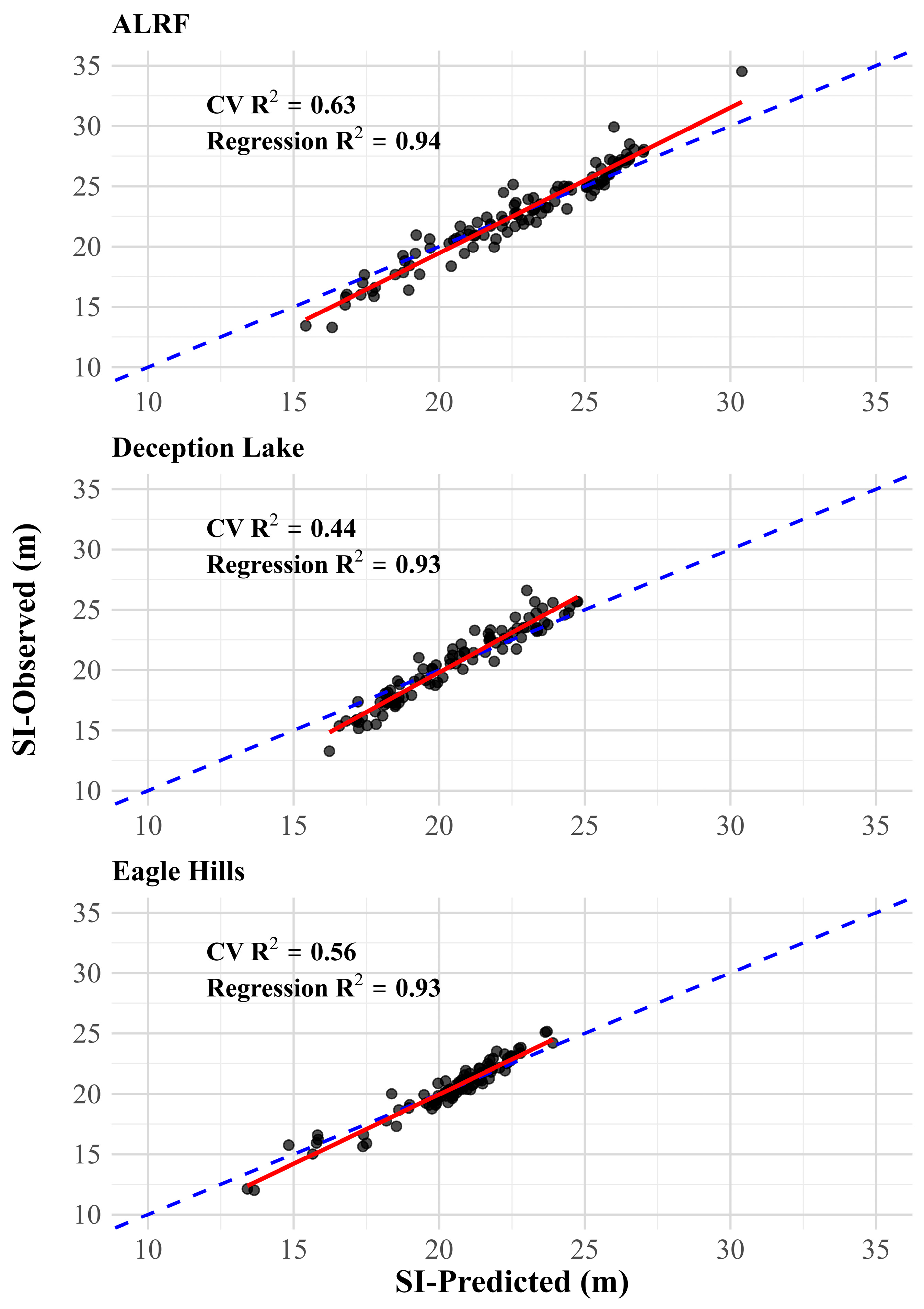
| ALRF | 0.40 | 0.63 | 8.88 | 5.76 | 2.98 | 2.40 | 2.28 | 1.85 |
| Deception | 0.40 | 0.44 | 6.25 | 6.10 | 2.50 | 2.47 | 2.06 | 2.02 |
| Eagle Hills | 0.46 | 0.56 | 2.62 | 2.25 | 1.62 | 1.50 | 1.30 | 1.23 |
| Random Forrest Model | 10-Fold Cross-Validation (Repeated CV) (R2) | Mean Squared Error (MSE) | Root Mean Squared Error (RMSE) | Mean Absolute Error (MAE) | ||||
|---|---|---|---|---|---|---|---|---|
| Local Optimal | General | Local Optimal | General | Local Optimal | General | Local Optimal | General | |
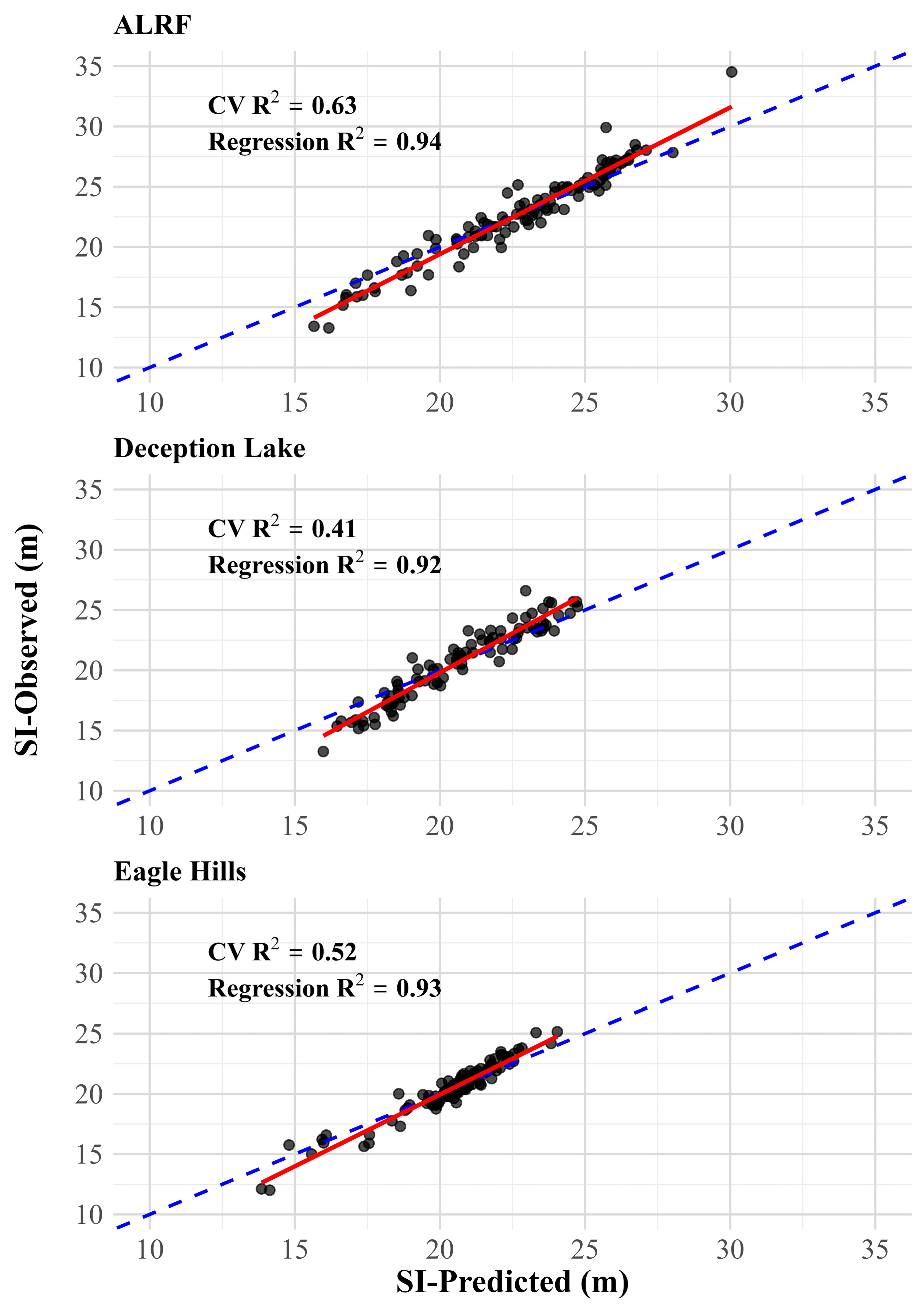
| ALRF | 0.63 | 0.63 | 5.76 | 5.76 | 2.40 | 2.40 | 1.85 | 1.87 |
| Deception | 0.44 | 0.41 | 6.10 | 6.40 | 2.47 | 2.53 | 2.02 | 2.06 |
| Eagle Hills | 0.56 | 0.52 | 2.25 | 2.49 | 1.50 | 1.58 | 1.23 | 1.28 |
Disclaimer/Publisher’s Note: The statements, opinions and data contained in all publications are solely those of the individual author(s) and contributor(s) and not of MDPI and/or the editor(s). MDPI and/or the editor(s) disclaim responsibility for any injury to people or property resulting from any ideas, methods, instructions or products referred to in the content. |
© 2026 by the authors. Licensee MDPI, Basel, Switzerland. This article is an open access article distributed under the terms and conditions of the Creative Commons Attribution (CC BY) license.
Share and Cite
Khalifeh Soltanian, F.; Henrique Terezan, L.; Chisholm, C.E.; Dykstra, P.; MacKenzie, W.H.; Elkin, C. Combining ALS and Satellite Data to Develop High-Resolution Forest Growth Potential Maps for Plantation Stands in Western Canada. Remote Sens. 2026, 18, 406. https://doi.org/10.3390/rs18030406
Khalifeh Soltanian F, Henrique Terezan L, Chisholm CE, Dykstra P, MacKenzie WH, Elkin C. Combining ALS and Satellite Data to Develop High-Resolution Forest Growth Potential Maps for Plantation Stands in Western Canada. Remote Sensing. 2026; 18(3):406. https://doi.org/10.3390/rs18030406
Chicago/Turabian StyleKhalifeh Soltanian, Faezeh, Luiz Henrique Terezan, Colin E. Chisholm, Pamela Dykstra, William H. MacKenzie, and Che Elkin. 2026. "Combining ALS and Satellite Data to Develop High-Resolution Forest Growth Potential Maps for Plantation Stands in Western Canada" Remote Sensing 18, no. 3: 406. https://doi.org/10.3390/rs18030406
APA StyleKhalifeh Soltanian, F., Henrique Terezan, L., Chisholm, C. E., Dykstra, P., MacKenzie, W. H., & Elkin, C. (2026). Combining ALS and Satellite Data to Develop High-Resolution Forest Growth Potential Maps for Plantation Stands in Western Canada. Remote Sensing, 18(3), 406. https://doi.org/10.3390/rs18030406