Airborne SAR Imaging Algorithm for Ocean Waves Oriented to Sea Spike Suppression



Highlights
- An airborne SAR imaging algorithm for ocean waves oriented to sea spike suppression is proposed, designed to suppress sea spikes from the signal domain.
- Validated with airborne SAR data, including SAR data with completely invisible waves and other data with weakly visible waves under sea spike influence, the proposed algorithm can significantly suppress sea spikes and improve the texture features of ocean waves in SAR images.
- The proposed algorithm addresses the issue of sea spike interference in SAR images.
- The proposed algorithm can provide data with clear wave texture for the retrieval of SAR wave parameters.
Abstract
1. Introduction
2. Airborne SAR Imaging Algorithm for Ocean Waves Oriented to Sea Spike Suppression
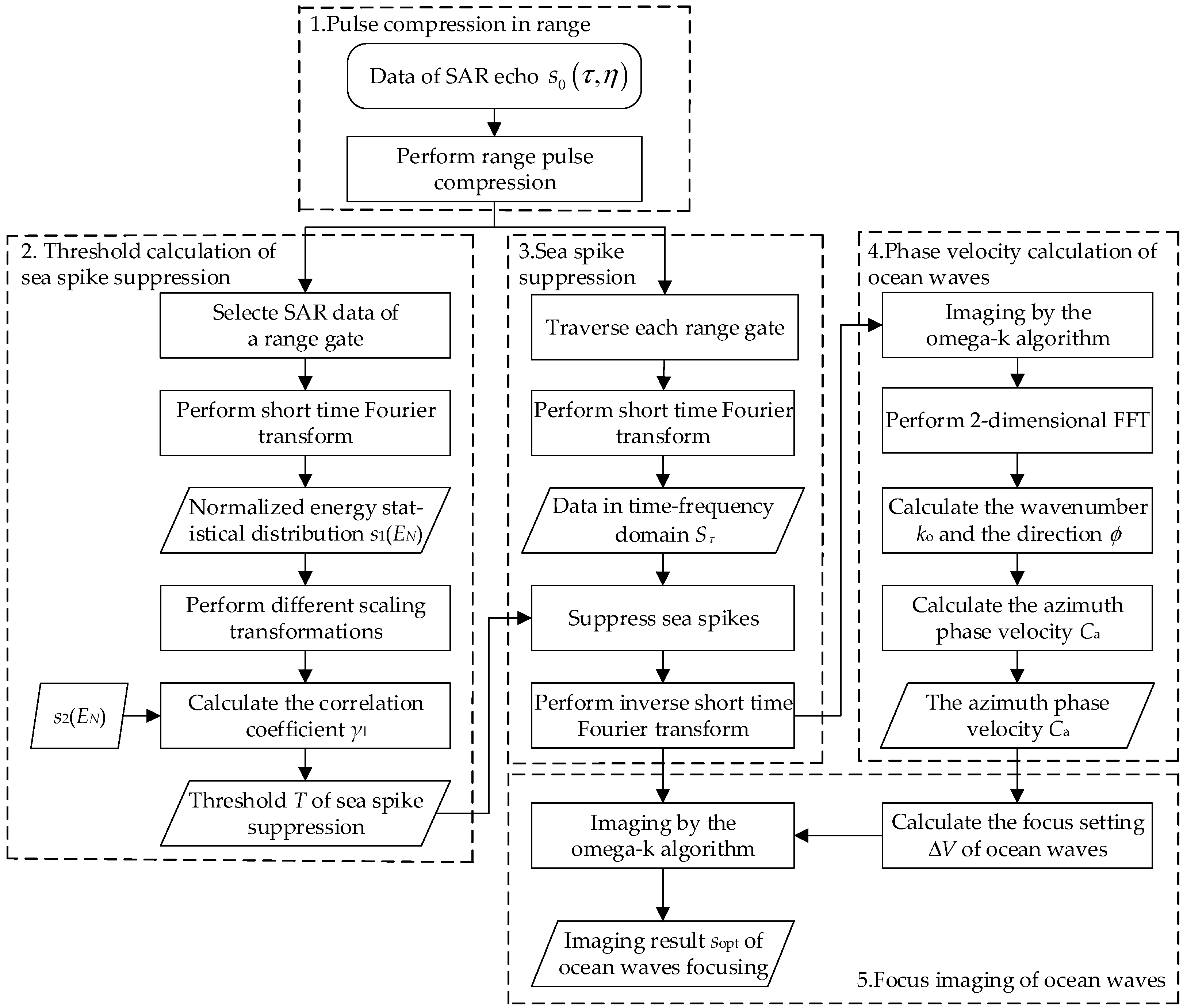
2.1. Pulse Compression in Range
2.2. Threshold Calculation of Sea Spike Suppression
2.3. Processing of Sea Spike Suppression
2.4. Phase Velocity Calculation of Ocean Waves
2.5. Focus Imaging of Ocean Waves
3. Validation of the Proposed Algorithm with Field Data
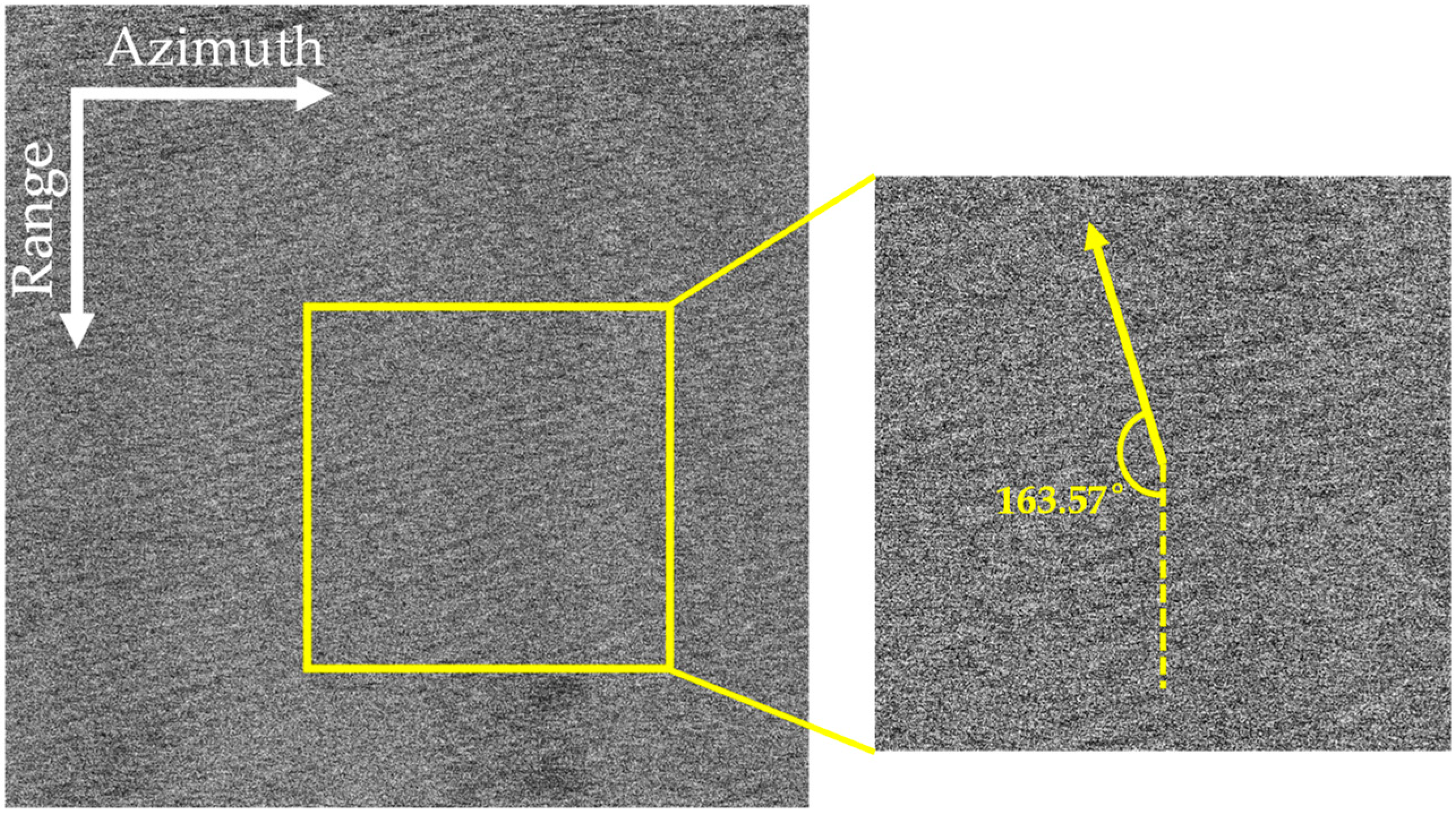
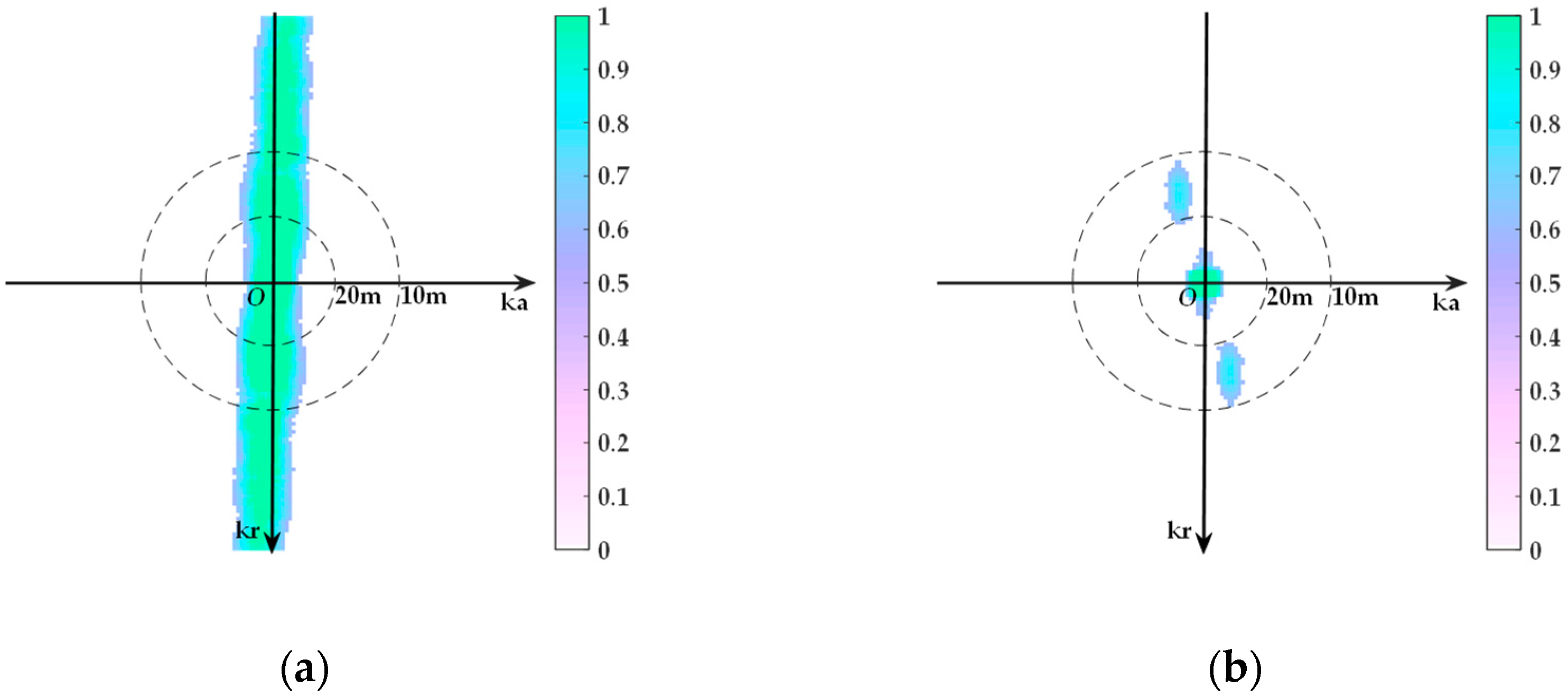
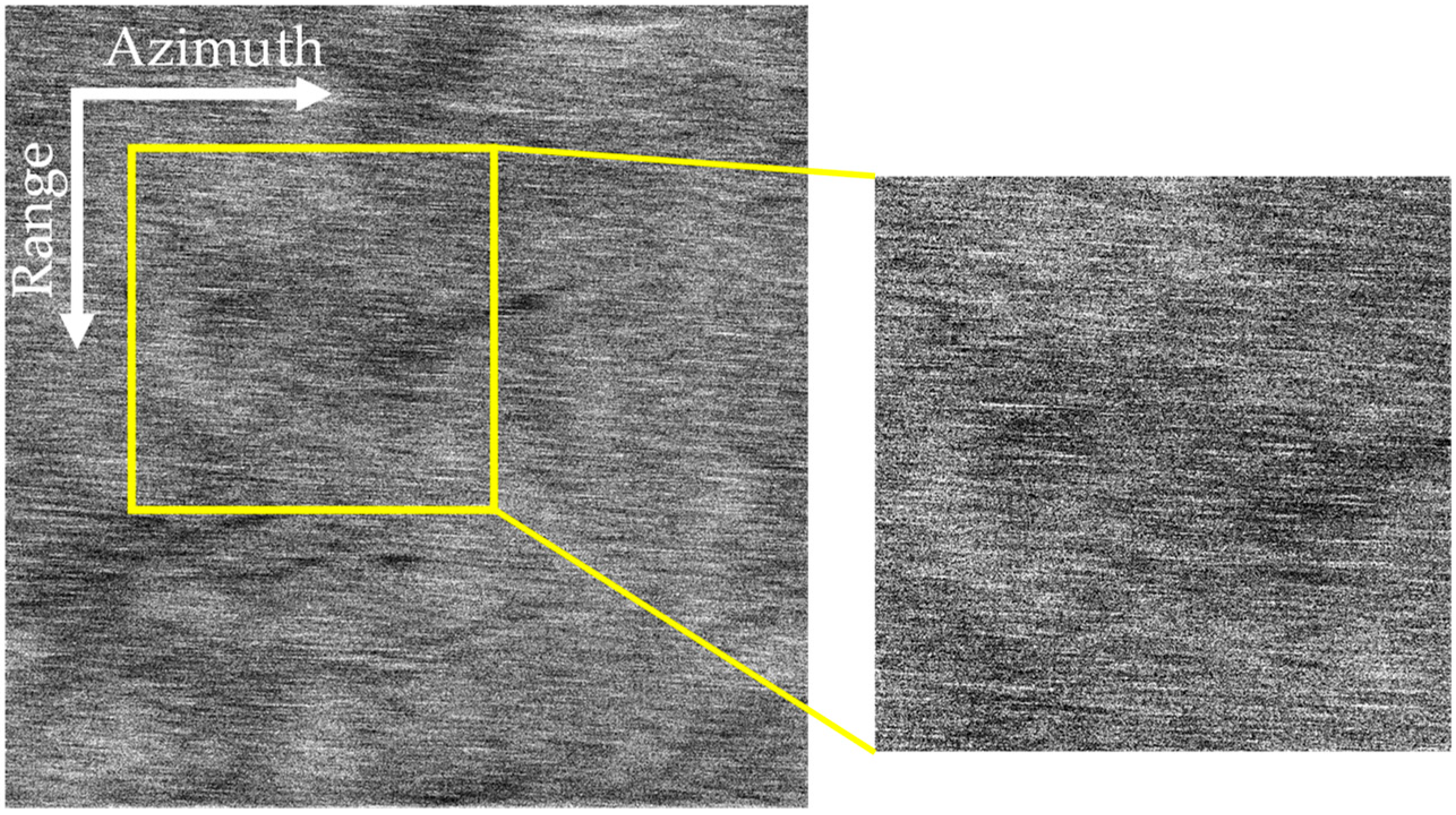
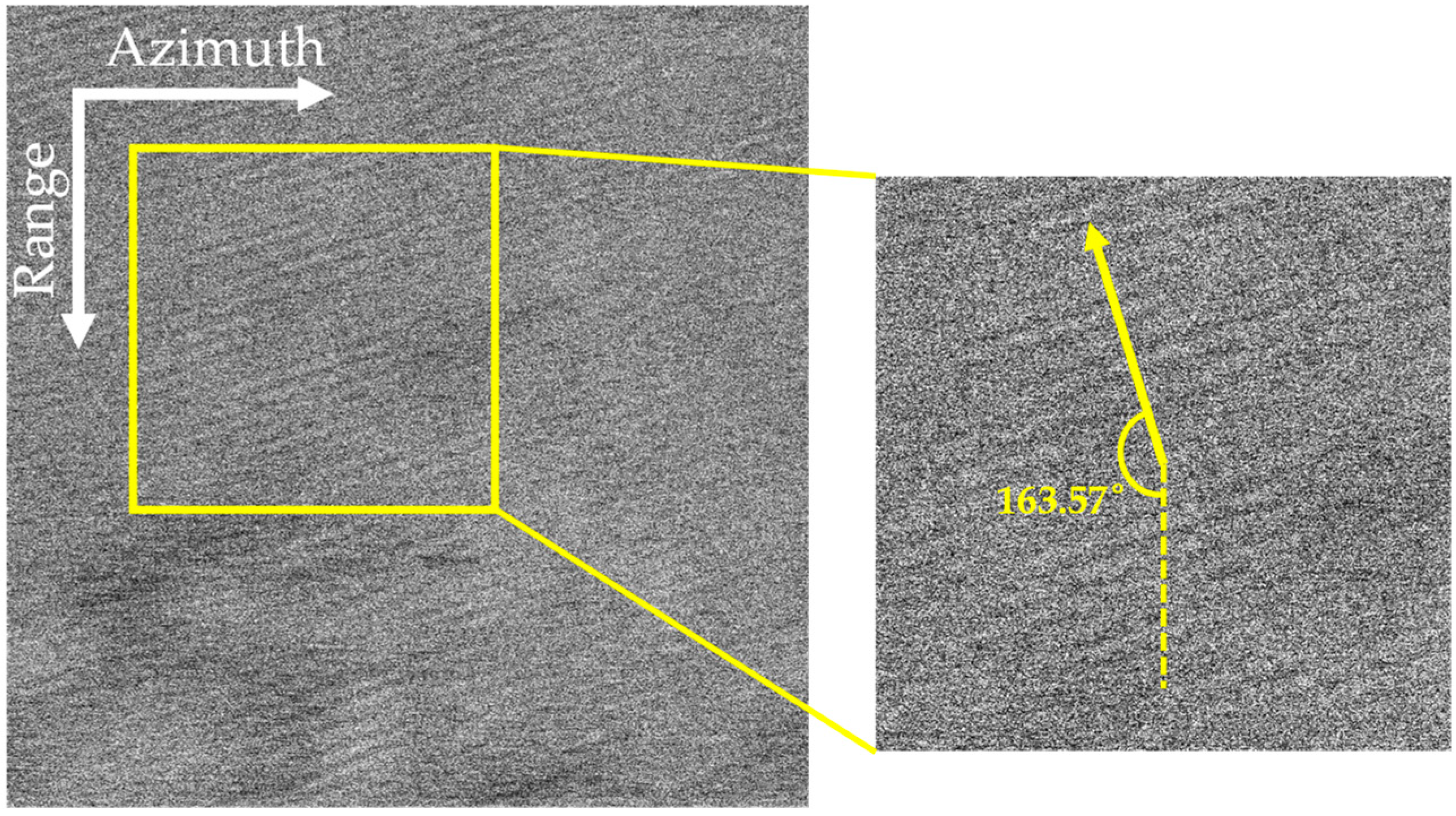
3.1. Case 1: Completely Invisible Waves Under Sea Spike Influence (HH Polarization)
3.2. Case 2: Completely Invisible Waves Under Sea Spike Influence (VV Polarization)
3.3. Case 3: Weakly Visible Waves Under Sea Spike Influence
3.4. Quantitative Analysis of Imaging Quality
4. Conclusions
Author Contributions
Funding
Data Availability Statement
Acknowledgments
Conflicts of Interest
References
- Li, K.; Li, H. Global SAR spectral analysis of intermediate ocean waves: Statistics and derived real aperture radar modulation. Remote Sens. 2025, 17, 1416. [Google Scholar] [CrossRef] [Scilit]
- Fan, S.; Zhang, B.; Kudryavtsev, V. Comprehensive assessment of ocean surface current retrievals using SAR doppler shift and drifting buoy observations. Remote Sens. 2025, 17, 2007. [Google Scholar] [CrossRef] [Scilit]
- Hu, F.; Xu, F.; Wang, R.; Qiu, X.; Ding, C.; Jin, Y. Conceptual study and performance analysis of Tandem multi-antenna spaceborne SAR interferometry. J. Remote Sens. 2024, 4, 0137. [Google Scholar] [CrossRef] [Scilit]
- Skolnick, M. Radar Handbook; Mc-Graw-Hill: New York, NY, USA, 2008. [Google Scholar]
- Li, J.; Zhang, M.; Fan, W.; Nie, D. Facet-based investigation on microwave backscattering from sea surface with breaking waves: Sea spikes and SAR imaging. IEEE Trans. Geosci. Remote Sens. 2017, 55, 2313–2325. [Google Scholar] [CrossRef] [Scilit]
- Barber, B.C. Remote sensing the sea surface using a multichannel ATI SAR: Imaging sea spikes. In Proceedings of the 2005 IEEE International Geoscience and Remote Sensing Symposium, Seoul, Republic of Korea, 25–29 July 2005; IEEE: Piscataway, NJ, USA, 2005; pp. 2676–2679. [Google Scholar]
- Melief, H.W.; Greidanus, H.; Van Genderen, P.; Hoogeboom, P. Analysis of sea spikes in radar sea clutter data. IEEE Trans. Geoence Remote Sens. 2006, 44, 985–993. [Google Scholar] [CrossRef]
- Greco, M.; Stinco, P.; Gini, F. Identification and analysis of sea radar clutter spikes. IET Radar Sonar Navig. 2010, 4, 239–250. [Google Scholar] [CrossRef] [Scilit]
- Sun, H.; Wan, X. Research on the sea spike suppression based on range domain characteristics of relatively high resolution radar. J. Phys. Conf. Ser. 2020, 1607, 012077. [Google Scholar] [CrossRef] [Scilit]
- Shi, Y.-L.; Shui, P.-L. Target detection in high-resolution sea clutter via block-adaptive clutter suppression. IET Radar Sonar Navig. 2011, 5, 48–57. [Google Scholar] [CrossRef] [Scilit]
- Shao, Z.; He, J.; Feng, S. Extraction of a target in sea clutter via signal decomposition. Sci. China Inf. Sci. 2020, 63, 129301. [Google Scholar] [CrossRef] [Scilit]
- Gu, T. Detection of small floating targets on the sea surface based on multi-features and principal component analysis. IEEE Geosci. Remote Sens. Lett. 2019, 17, 809–813. [Google Scholar] [CrossRef] [Scilit]
- Li, G.; Zhang, H.; Gao, Y.; Ma, B. Sea clutter suppression using smoothed Pseudo-Wigner–Ville distribution–singular value decomposition during sea spikes. Remote Sens. 2023, 15, 5360. [Google Scholar] [CrossRef] [Scilit]
- Zhao, Y.; Chong, J.; Li, Y.; Sun, K.; Yang, X. Sea spike suppression method based on optimum polarization ratio in airborne SAR images. Sensors 2021, 21, 3269. [Google Scholar] [CrossRef] [Scilit]
- Cumming, I.; Wong, F. Digital Processing of Synthetic Aperture Radar Data: Algorithms and Implementation; Artech House: Boston, MA, USA, 2005. [Google Scholar]
- Vachon, P.W.; Krogstad, H.E.; Paterson, J.S. Airborne and spaceborne synthetic aperture radar observations of ocean waves. Atmos.-Ocean 1994, 32, 83–112. [Google Scholar] [CrossRef] [Scilit]
- Hwang, P.A.; Toporkov, J.V.; Sletten, M.A.; Menk, S.P. Mapping surface currents and waves with interferometric synthetic aperture radar in coastal waters: Observations of wave breaking in swell-dominant conditions. J. Phys. Oceanogr. 2012, 43, 563–582. [Google Scholar] [CrossRef] [Scilit]
- Du, Y.; Yang, X.; Chen, K.-S.; Ma, W.; Li, Z. An improved spectrum model for sea surface radar backscattering at L-band. Remote Sens. 2017, 9, 776. [Google Scholar] [CrossRef] [Scilit]
- Lyzenga, D.R. Numerical simulation of synthetic aperture radar image spectra for ocean waves. IEEE Trans. Geosci. Remote Sens. 1986, GE-24, 863–872. [Google Scholar] [CrossRef] [Scilit]
- Lyden, J.D.; Hammond, R.R.; Lyzenga, D.R.; Shuchman, R.A. Synthetic aperture radar imaging of surface ship wakes. J. Geophys. Res. 1988, 93, 12293. [Google Scholar] [CrossRef] [Scilit]
- Kasilingam, D.P.; Shemdin, O.H. Theory for synthetic aperture radar imaging of the ocean surface: With application to the Tower Ocean Wave and Radar Dependence Experiment on focus, resolution, and wave height spectra. J. Geophys. Res. 1988, 93, 13837–13848. [Google Scholar] [CrossRef] [Scilit]
- Raney, R.K.; Vachon, P.W. Synthetic aperture radar imaging of ocean waves from an airborne platform: Focus and tracking issues. J. Geophys. Res. Oceans 1988, 93, 12475–12486. [Google Scholar] [CrossRef] [Scilit]
- Vachon, P.W.; Raney, R.K.; Emergy, W.J. A simulation for spaceborne SAR imagery of a distributed, moving scene. IEEE Trans. Geosci. Remote Sens. 1989, 27, 67–78. [Google Scholar] [CrossRef] [Scilit]
- Hayt, D.W.; Alpers, W.; Burning, C.; Dewitt, R.; Henyey, F.; Kasilingam, D.P.; Keller, W.C.; Lyzenga, D.R.; Plant, W.J.; Schult, R.L. Focusing simulations of synthetic aperture radar ocean images. J. Geophys. Res. Oceans 1990, 95, 16245–16261. [Google Scholar] [CrossRef] [Scilit]
- Kasilingam, D.P.; Hayt, D.W.; Shemdin, O.H. Focusing of synthetic aperture radar ocean images with long integration times. J. Geophys. Res. 1991, 96, 16935–16942. [Google Scholar] [CrossRef] [Scilit]
- Jain, A.; Shemdin, O. L band SAR ocean wave observations during MARSEN. J. Geophys. Res. Oceans 1983, 88, 9792–9808. [Google Scholar] [CrossRef] [Scilit]
- Shen, P.; Wang, C.; Fu, H.; Zhu, J.; Hu, J. Estimation of equivalent number of looks in time-series Pol(In)SAR data. Remote Sens. 2020, 12, 2715. [Google Scholar] [CrossRef] [Scilit]
- Gómez, L.; Cardona-Mesa, A.A.; Vásquez-Salazar, R.D.; Travieso-González, C.M. Analysis of despeckling filters using ratio images and divergence measurement. Remote Sens. 2024, 16, 2893. [Google Scholar] [CrossRef] [Scilit]



| Parametric Name | Parametric Symbol | Parametric Value |
|---|---|---|
| Radar wavelength (m) | 0.0313 | |
| Pulse length (us) | 6 | |
| Radar bandwidth (MHz) | 606 | |
| Platform speed (m/s) | 74.65 | |
| PRF (Hz) | 2000 | |
| Near range (m) | 4300 | |
| Polarization | Pol | HH |
| Parametric Name | Parametric Symbol | Parametric Value |
|---|---|---|
| Radar wavelength (m) | 0.0556 | |
| Pulse length (us) | 40 | |
| Radar bandwidth (MHz) | 450 | |
| Platform speed (m/s) | 75 | |
| PRF (Hz) | 2500 | |
| Near range (m) | 5000 | |
| Polarization | Pol | HH |
| Case Name | Omega-k Imaging Algorithm | Proposed Algorithm | |
|---|---|---|---|
| PBR | Case 1 | 4.42 | 4.90 |
| Case 2 | 4.22 | 4.79 | |
| Case 3 | 4.33 | 4.64 | |
| STD | Case 1 | 0.45 | 0.31 |
| Case 2 | 0.39 | 0.31 | |
| Case 3 | 0.33 | 0.32 | |
| ENL | Case 1 | 0.35 | 0.47 |
| Case 2 | 0.42 | 0.49 | |
| Case 3 | 0.34 | 0.38 |
Disclaimer/Publisher’s Note: The statements, opinions and data contained in all publications are solely those of the individual author(s) and contributor(s) and not of MDPI and/or the editor(s). MDPI and/or the editor(s) disclaim responsibility for any injury to people or property resulting from any ideas, methods, instructions or products referred to in the content. |
© 2026 by the authors. Licensee MDPI, Basel, Switzerland. This article is an open access article distributed under the terms and conditions of the Creative Commons Attribution (CC BY) license.
Share and Cite
Zhao, Y.; Xu, Y.; Du, Y.; Chong, J. Airborne SAR Imaging Algorithm for Ocean Waves Oriented to Sea Spike Suppression. Remote Sens. 2026, 18, 397. https://doi.org/10.3390/rs18030397
Zhao Y, Xu Y, Du Y, Chong J. Airborne SAR Imaging Algorithm for Ocean Waves Oriented to Sea Spike Suppression. Remote Sensing. 2026; 18(3):397. https://doi.org/10.3390/rs18030397
Chicago/Turabian StyleZhao, Yawei, Yongsheng Xu, Yanlei Du, and Jinsong Chong. 2026. "Airborne SAR Imaging Algorithm for Ocean Waves Oriented to Sea Spike Suppression" Remote Sensing 18, no. 3: 397. https://doi.org/10.3390/rs18030397
APA StyleZhao, Y., Xu, Y., Du, Y., & Chong, J. (2026). Airborne SAR Imaging Algorithm for Ocean Waves Oriented to Sea Spike Suppression. Remote Sensing, 18(3), 397. https://doi.org/10.3390/rs18030397