Article

SWOT Observations of Bimodal Seasonal Submesoscale Processes in the Kuroshio Large Meander

1
Department of Atmospheric and Oceanic Sciences & Institute of Atmospheric Sciences, Fudan University, Shanghai 200438, China
2
CMA-FDU Joint Laboratory of Marine Meteorology, Fudan University, Shanghai 200438, China
3
Shanghai Key Laboratory of Ocean-Land-Atmosphere Boundary Dynamics and Climate Change, Fudan University, Shanghai 200438, China
*
Author to whom correspondence should be addressed.
Remote Sens. 2026, 18(3), 384; https://doi.org/10.3390/rs18030384
Submission received: 11 December 2025 / Revised: 14 January 2026 / Accepted: 19 January 2026 / Published: 23 January 2026

Highlights

What are the main findings?
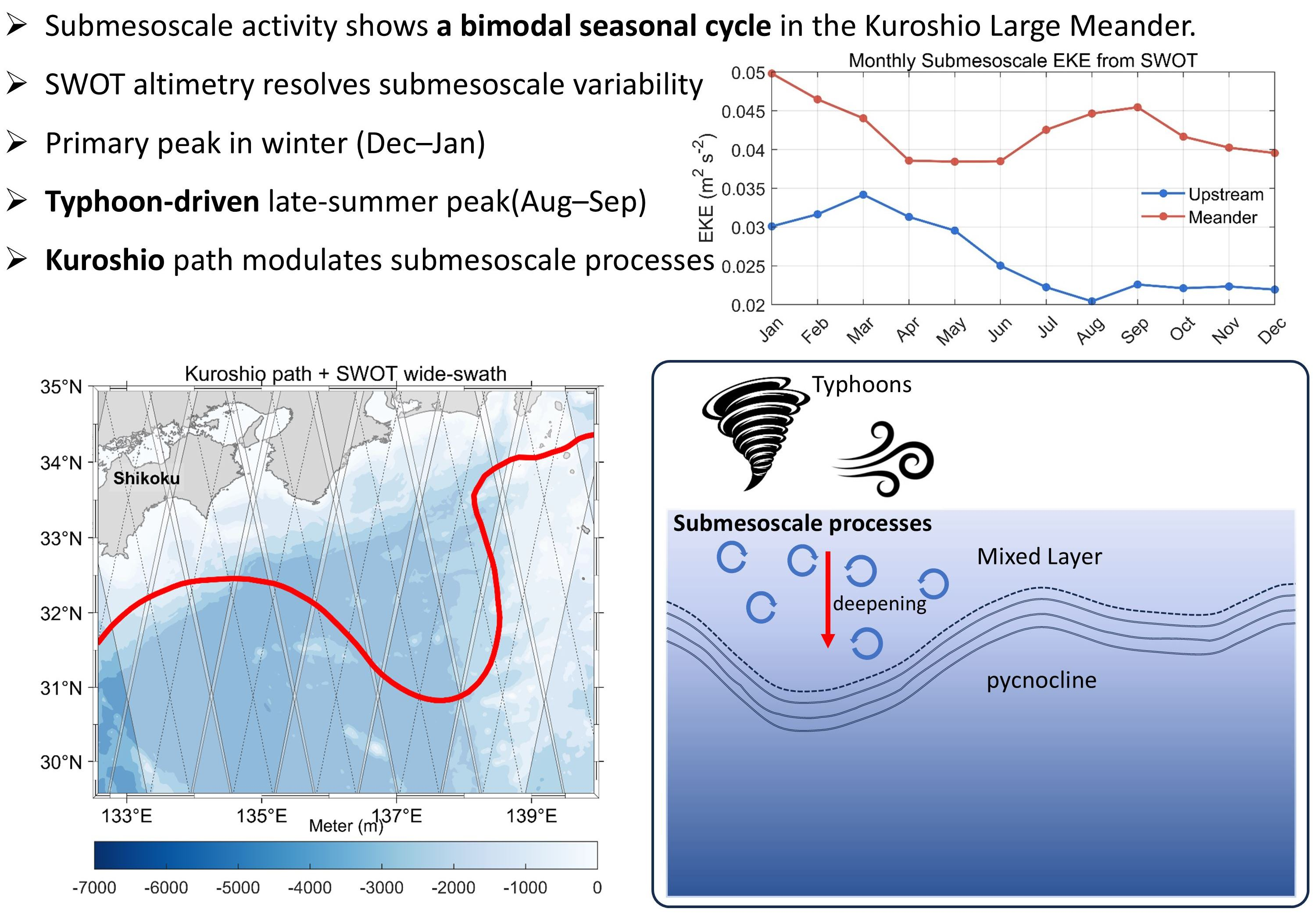
  • SWOT observations reveal an atypical bimodal seasonal cycle of submesoscale eddy kinetic energy in the Kuroshio Large Meander region.
  • The late-summer submesoscale enhancement is linked to typhoon forcing and modulated by Kuroshio path variability.
What are the implications of the main findings?
  • These findings modify the traditionally winter-dominated submesoscale regime, enriching our understanding of air–sea interaction.
  • SWOT demonstrates a unique capability to resolve storm-driven submesoscale processes in energetic western boundary currents during extreme weather events.

Abstract
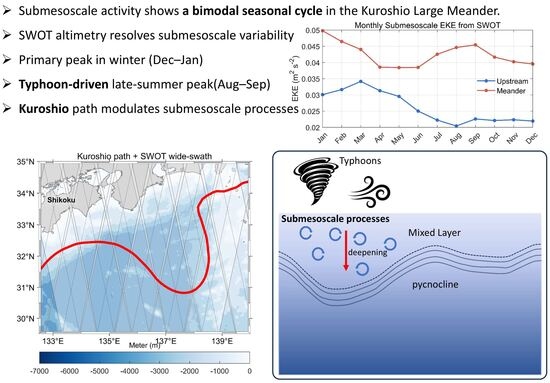
Wide-swath satellite altimetry from the Surface Water and Ocean Topography (SWOT) mission provides an unprecedented opportunity to directly observe kilometer-scale ocean dynamics in two dimensions. In this study, we identify an atypical bimodal seasonal cycle of submesoscale processes in the Kuroshio Large Meander (KLM) region south of Japan using SWOT observations during 2023–2025. Submesoscale eddy kinetic energy (EKE) displays a pronounced winter maximum (December–January) as expected for midlatitude oceans, but also a distinct secondary maximum in late summer (August–September) that coincides with the Northwest Pacific typhoon season. SWOT-based eddy statistics reveal that cyclonic and anticyclonic eddies exhibit enhanced occurrence and intensity in winter and late summer. MITgcm LLC4320 outputs demonstrate that the late-summer EKE peak is primarily driven by typhoons, which rapidly deepen the mixed layer and intensify frontal gradients, leading to an intensification of submesoscale eddies. The Kuroshio path further modulates this response. During the KLM state, buoyancy gradients and mixed-layer available potential energy are amplified, allowing storm forcing to generate strong submesoscale activity. Together, typhoon forcing and current-path variability modify the traditionally winter-dominated submesoscale regime. These findings highlight the unique capability of SWOT to resolve submesoscale processes in western boundary currents during extreme weather events.

1. Introduction

Submesoscale dynamics play a fundamental role in regulating vertical exchanges of buoyancy, heat, and nutrients within the upper ocean [1]. Despite their relatively small spatial scales, these processes exert a significant influence on air–sea interaction and primary productivity by mediating the coupling between surface forcing and the thermocline [2,3]. Globally, submesoscale activity exhibits a pronounced seasonal cycle: winter conditions favor intensified turbulence through mixed-layer deepening, enhanced baroclinicity, and active frontogenesis, whereas strong stratification during summer suppresses available potential energy and substantially weakens vertical motions [4,5,6,7,8].
Although winter is typically regarded as the season of maximum submesoscale turbulence owing to intensified surface buoyancy loss and vigorous frontogenesis, growing evidence indicates that additional mechanisms can energize submesoscale motions outside the winter months [9,10]. In the northwest Pacific, tropical cyclones frequently cross the Kuroshio during late summer, injecting episodic bursts of energy into the submesoscale field [11,12,13]. Typhoon-induced mixing erodes stratification, lowers potential vorticity, and sharpens horizontal frontal gradients, thereby creating conditions conducive to the reactivation of submesoscale instabilities within an otherwise stably stratified upper ocean [14,15,16]. Moreover, case studies suggest that typhoons may interact with the Kuroshio path itself, occasionally amplifying or even initiating large-meander events [17,18]. Collectively, these processes imply a dynamic linkage between tropical cyclone forcing, Kuroshio path variability, and enhanced submesoscale activity outside the canonical winter peak.
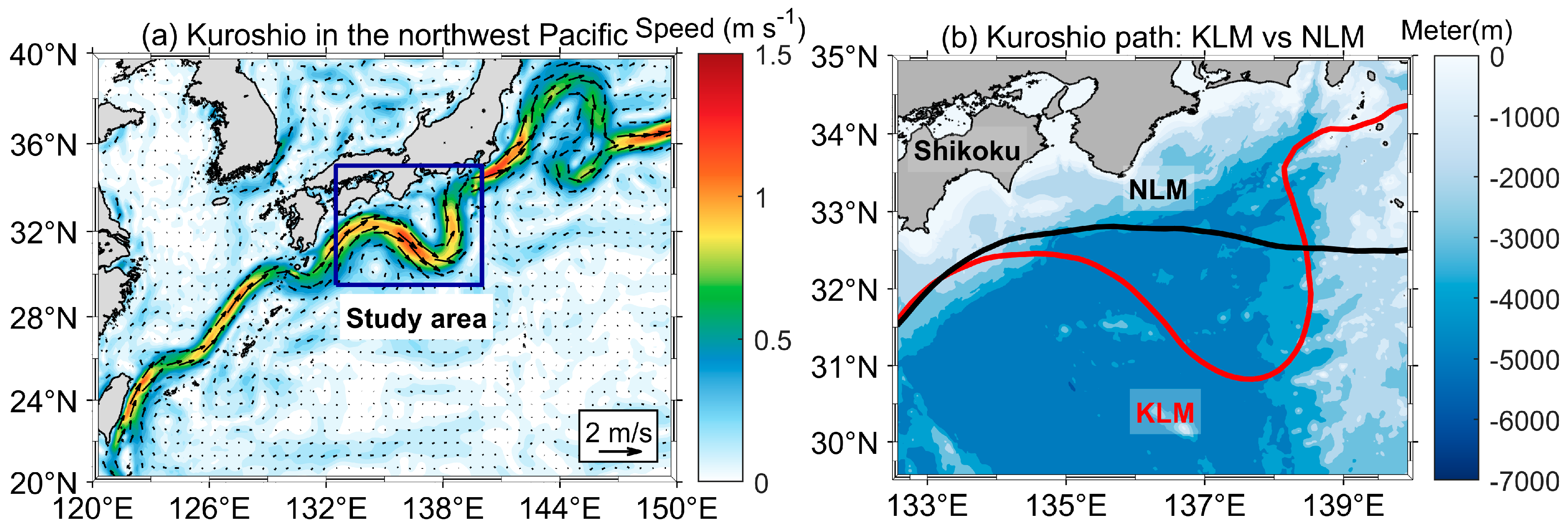
Western boundary currents are recognized as hotspots of submesoscale activity because their strong background vorticity, sharp frontal gradients, and interactions with complex topography favor vigorous fine-scale instabilities [19,20,21]. Among these systems, the Kuroshio is one of the most energetic, and its path south of Japan exhibits pronounced variability (Figure 1). The most striking expression of this variability is the Kuroshio Large Meander (KLM), an anomalous southward deflection of the current that can persist for multiple years [22,23]. As shown in Figure 1, the red and black curves represent the Kuroshio paths during the KLM (2023–2024) and Non–Large Meander (NLM, 2025) states, respectively. The ongoing KLM, initiated in 2017 and lasting into 2025, is among the longest in recent history [24,25]. This prolonged meander not only reorganizes regional circulation and water-mass distributions, but also exerts substantial impacts on the atmosphere and marine ecosystems [26,27,28,29]. The KLM enhances both mesoscale and submesoscale variability by intensifying frontal gradients and promoting recurrent eddy shedding. This creates a unique dynamical environment favorable for the generation of energetic submesoscale turbulence [30,31].
Despite substantial progress in understanding submesoscale variability in the open ocean and in western boundary current systems, direct observational evidence within the KLM region has remained limited. This limitation stems from the coarse spatial resolution of traditional nadir altimeters and the sparse in situ coverage, both of which are insufficient to resolve submesoscale motions. The Surface Water and Ocean Topography (SWOT) mission now provides an unprecedented opportunity to overcome these constraints: its wide-swath interferometric altimetry enables two-dimensional, kilometer-scale characterization of submesoscale eddy kinetic energy (EKE) and its seasonal evolution [32,33,34]. Leveraging this new capability, the present study addresses two central questions. (1) What are the spatiotemporal patterns of submesoscale EKE in the KLM region? (2) What mechanisms govern this variability, particularly the respective roles of the KLM and tropical cyclone forcing? By integrating SWOT observations with high-resolution numerical simulations and reanalysis diagnostics, this study aims to advance understanding of the seasonal dynamics and drivers of submesoscale turbulence in this dynamically complex region.

2. Materials and Methods

2.1. SWOT Altimetry Data

The primary observational dataset used in this study is the sea surface height (SSH) measured by the SWOT mission. SWOT employs the Ka-band Radar Interferometer (KaRIn) to obtain two-dimensional, wide-swath SSH observations across two ~50 km swaths, providing an effective horizontal resolution of approximately 2 km and a total swath width of ~120 km. We utilize the AVISO Level-3 SWOT_L3_SSH_Expert product in this analysis. During the fast-sampling phase (March–July 2023), SWOT operated on a 1-day repeat orbit, transitioning in July 2023 to its 21-day science orbit. The high-resolution KaRIn SSH measurements offer unprecedented opportunities for global ocean dynamics research, achieving noise levels of roughly 0.40 cm on a 2 km grid [35].
As part of the official Level-3 processing workflow, an additional denoising procedure is applied using a neural-network-based algorithm employing a U-Net architecture trained on realistic simulated SWOT data over the North Atlantic [36]. This method effectively suppresses random instrumental noise while retaining physically meaningful kilometer-scale oceanic structures. The denoised AVISO Level-3 SSH product is used in this study, with only measurements quality flagged as valid according to the official Level-3 quality-control criteria retained. To reduce shallow-water contamination, we apply a bathymetry-based mask by excluding measurements over depths shallower than −200 m. We analyze SWOT SSH observations collected from 2023 to 2025 over the Kuroshio south of Japan. During this interval, the Kuroshio remained in a persistent KLM state from early 2023 until August 2025, after which it transitioned to a NLM state. Monthly composite maps of submesoscale EKE are generated from all available SWOT swaths to characterize the seasonal evolution of fine-scale surface kinetic energy. Specifically, submesoscale motions are isolated by applying a two-dimensional band-pass filter (5–30 km) to the swath geostrophic velocity fields, from which EKE is computed. The resulting EKE fields are then gridded onto a regular longitude–latitude grid using spatial bin averaging to form monthly composites. The 5–30 km band is chosen to capture submesoscale variability that SWOT can robustly resolve, while filtering out mesoscale background signals and minimizing residual high-frequency noise. These SWOT observations provide the primary basis for quantifying the spatial distribution and seasonal variability of submesoscale EKE. In addition, high-resolution sea surface temperature (SST) data with 2 km resolution from the Himawari-9 geostationary satellite are used to qualitatively visualize surface thermal fronts and post-typhoon cold wakes and to facilitate comparison with concurrent SWOT observations.

2.2. Numerical Model Data

To investigate the physical mechanisms underlying typhoon-induced submesoscale enhancement, we employ outputs from the global MITgcm LLC4320 simulation. The model is configured at a horizontal resolution of 1/48° (∼2 km in the Kuroshio region) with 90 vertical levels, including near-surface spacing of approximately 1 m, enabling explicit representation of mixed-layer and submesoscale dynamics. The simulation is initialized from the ECCO2 state estimate and forced with 6-hourly ERA-Interim atmospheric fields, along with hourly tidal forcing that includes 16 principal tidal constituents. The model was integrated from September 2011 to November 2012. Daily three-dimensional velocity, temperature, and salinity fields extracted over the Kuroshio region are used to diagnose mixed-layer deepening, frontogenesis, and submesoscale energy growth during typhoon forcing.
The GLORYS12V1 global ocean reanalysis, produced by the Copernicus Marine Environment Monitoring Service (CMEMS), is used to characterize the background oceanic conditions associated with different Kuroshio path states. GLORYS12V1 has a horizontal resolution of 1/12° (∼8 km) with 50 vertical levels and assimilates satellite altimetry, sea surface temperature, sea ice concentration, and in situ temperature and salinity profiles. Although this resolution does not explicitly resolve individual submesoscale eddies, it realistically represents the large-scale and mesoscale oceanic stratification, as well as the seasonal evolution of mixed-layer depth and density fronts. In this study, we use data from 2010–2016 and 2017–2025 to represent the NLM and KLM background states of the Kuroshio, respectively, and to quantify the seasonal evolution of mixed-layer depth, horizontal buoyancy gradients, and the large-scale modulation of submesoscale generation.

2.3. Submesoscale EKE and Eddy Diagnostics

To extract submesoscale variability from SWOT observations, the SSH fields are band-pass filtered with an upper cutoff of 30 km, a scale selected to be slightly below the first baroclinic Rossby radius of deformation in the region [37]. Geostrophic velocities are then computed from the filtered SSH using standard geostrophic relationships. Submesoscale EKE is defined as
EKE ( x , y ) = ( u f 2 + v f 2 ) / 2 ,
where u f and v f denote the band-pass-filtered geostrophic velocity components that retain wavelengths of approximately 5–30 km. Monthly mean EKE fields derived from SWOT are used to quantify the seasonal evolution of submesoscale activity in both the upstream Kuroshio and the large-meander region.
Individual submesoscale eddies are detected from SWOT SSH fields using a closed-contour approach analogous to extremum-based methods commonly applied to mesoscale eddy identification [38]. Local SSH extrema are first identified, with cyclones (anticyclones) defined by SSH minima (maxima) relative to surrounding grid cells. Starting from each extremum, SSH contours are progressively expanded by relaxing the threshold until the contour opens. The outermost closed contour enclosing a single extremum is retained as the eddy boundary. Eddy amplitude is defined as the SSH difference between the extremum at the eddy center and the SSH value along the eddy boundary. Eddy size is characterized by an effective radius, defined as the radius of a circle with the same area as that enclosed by the outermost closed contour. Eddies are retained only when their SSH amplitude exceeds 0.005 m and their effective radius is greater than 3 km. The total number of submesoscale eddies is then quantified from the monthly aggregation of all detected eddies within the study domain. Because the SWOT swath may capture only a portion of an eddy, potentially underestimating its size and amplitude, we use the contour-averaged Rossby number to quantify eddy intensity. For each eddy, the Rossby number is computed as Ro = ζ/f, where ζ = ∂v/∂x − ∂u/∂y is the relative vorticity derived from geostrophic velocities, and f is the local Coriolis parameter. Monthly eddy detection rates and the seasonal evolution of extreme Rossby numbers are used to characterize the seasonal variability of submesoscale eddy intensity.

2.4. Energy Conversion and Frontogenesis Diagnostics

To quantify the seasonal variability of submesoscale processes, we apply a suite of energy conversion and frontal diagnostics to the numerical model output. Our analysis focuses on two metrics: the mixed-layer available potential energy (APE) conversion, denoted as PK, and the frontogenesis function, F s . The mixed layer depth (MLD) is diagnosed using a density-threshold criterion of 0.03 kg m−3 relative to surface density [39]. To assess the mixed-layer baroclinic instability and the associated submesoscale energy generation, we employ PK as a proxy for the conversion of mixed-layer available potential energy (APE) into kinetic energy.
Specifically, PK is defined as the mixed-layer-integrated vertical buoyancy flux,
P K = w b x y b x y z 2 M L D x y 2 ,
where w′ and b′ denote vertical velocity and buoyancy anomalies, respectively, |∇b| is the magnitude of the horizontal buoyancy gradient and x y denotes horizontal averaging over the study region. This formulation explicitly links frontal strength and mixed-layer depth to the available potential energy reservoir that fuels submesoscale eddy growth [40].
To further characterize frontal intensification associated with typhoon forcing, the F s is computed following:
F s = Q h ρ ,
where Q = ( Q 1 , Q 2 ) = ( u x h ρ , u y h ρ ) and h ρ is the horizontal density gradient. In practice, F s is calculated from the Q-vector together with the horizontal density gradient field, thereby quantifying frontal strengthening along the front under typhoon forcing [41].
Although the GLORYS12V1 reanalysis does not explicitly resolve submesoscale eddies, it realistically captures the seasonal evolution of mixed-layer depth and mesoscale buoyancy gradients that shape the background distribution of P K . Accordingly, GLORYS12V1 is used to diagnose the large-scale and seasonal modulation of submesoscale generation potential under both the KLM and NLM states of the Kuroshio.

3. Results

3.1. Bimodal Seasonal Pattern of Submesoscale Processes in the KLM Region

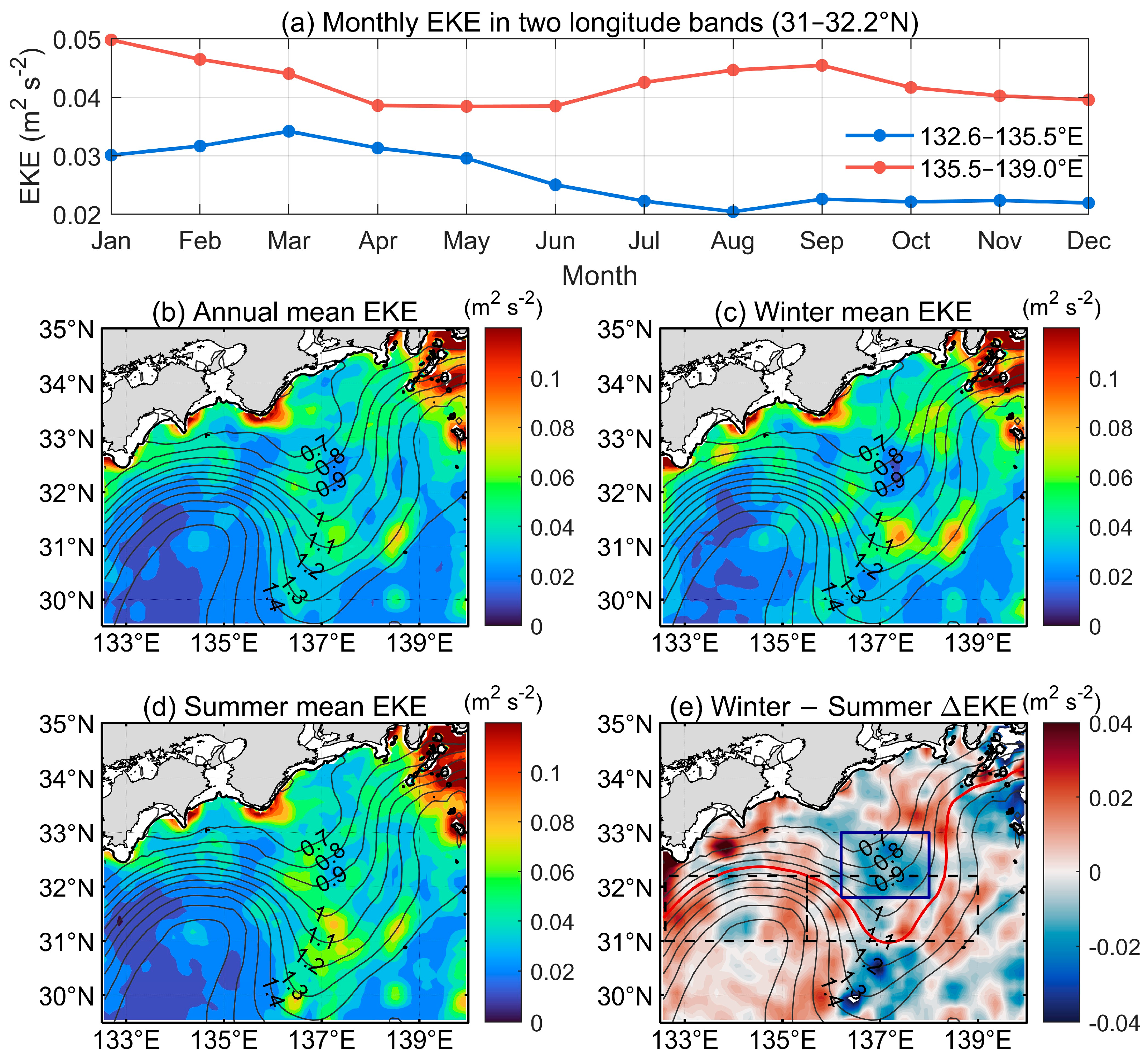
SWOT observations reveal clear seasonal variations in submesoscale EKE across the KLM region (Figure 2). Figure 2a shows monthly mean EKE averaged over two longitudinal bands at 31.0–32.2°N: an upstream Kuroshio sector (132.5–135.5°E) and a downstream meander sector (135.5–139.0°E). The annual mean map (Figure 2b) indicates EKE of order 0.05 m2 s−2 along the Kuroshio path, with maxima downstream of ~137°E where the large meander develops. In winter, EKE intensifies along the Kuroshio front and locally exceeds 0.08 m2 s−2 (Figure 2c). In summer, EKE weakens over most of the domain as stratification strengthens, yet elevated values persist within the meander core (Figure 2d). Notably, localized EKE maxima appear near coastal regions in both winter and summer, particularly downstream of several capes. These enhancements are associated with intensified shear and strain arising from interactions between the Kuroshio and coastal topography, which promote topographically induced frontal eddy activity [42].
The winter–summer difference map (Figure 2e), together with the band-averaged time series (Figure 2a), reveals distinct seasonal regimes upstream and downstream of the Kuroshio. Upstream, EKE follows a conventional mid-latitude pattern with a single winter maximum. In contrast, the meander sector exhibits a bimodal seasonal cycle, with a primary winter peak and a secondary late-summer enhancement. The late summer peak is associated with negative EKE anomalies in the large-meander core (blue box in Figure 2e), while positive anomalies align with the Kuroshio path delineated by the red SSH contour. This atypical bimodal structure, coincident with the western North Pacific typhoon season, suggests additional late-summer energization. The signal remains spatially noisy, and its quantification will improve as additional SWOT observations become available.
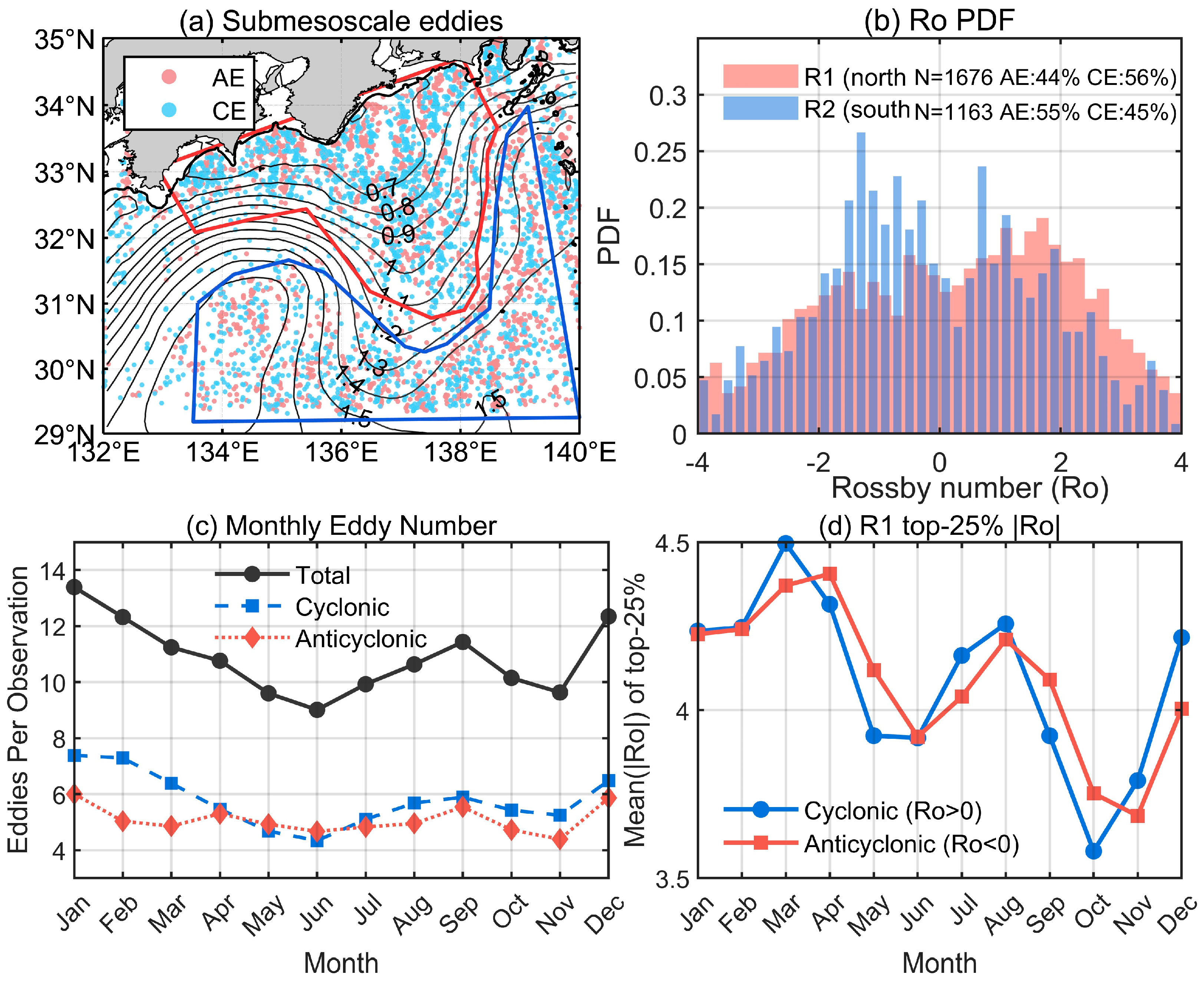
Independent eddy detection from SWOT provides an additional view of the bimodal seasonality of submesoscale activity in the KLM. Over two years of observations, about 2800 submesoscale eddies are identified in the study domain (Figure 3a). Eddies cluster along the flanks of the Kuroshio, with cyclones more frequent north of the jet and anticyclones more frequent to the south, consistent with the opposing background vorticity on either side of the current (Figure 3b). Most eddies are strongly nonlinear, with |Ro| typically between 1 and 3. The total eddy occurrence rate exhibits a clear dual peak (Figure 3c): counts rise sharply from late summer into autumn and show a secondary, weaker maximum in winter, consistent with the two peaks seen in the SWOT-derived submesoscale EKE. The seasonal modulation is stronger for cyclones than for anticyclones, although both polarities contribute to the bimodal pattern.
Seasonality also appears in eddy intensity (Figure 3d). On the northern side of the Kuroshio (R1), the most energetic eddies reach mean top-quartile |Ro| of about 4.5 in winter, with February anticyclones particularly strong. A second period of elevated intensity occurs in late summer, when both cyclonic and anticyclonic eddies attain mean |Ro| values near 4, close to the winter level. Thus, late summer in the KLM region is characterized not only by an increased number of submesoscale eddies, but also by events whose intensity approaches that of wintertime extremes. Together, these SWOT-based statistics independently confirm that submesoscale activity in the KLM exhibits two active seasons—winter and late summer—rather than the single winter-dominated cycle typical of most midlatitude oceans.
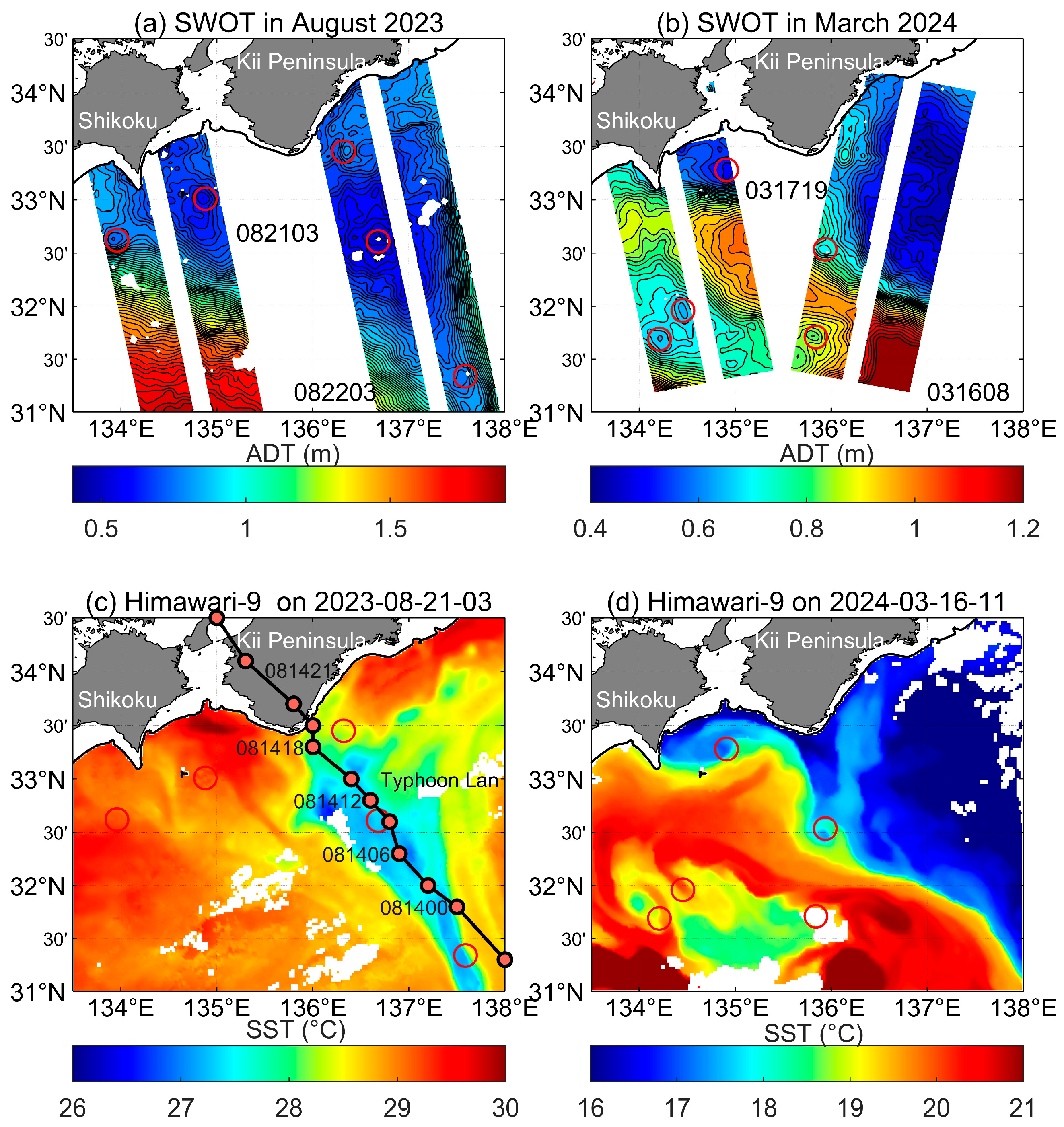
Figure 4 shows paired SWOT SSH and Himawari-9 SST snapshots of the KLM under post-typhoon summer and typical winter conditions. In August 2023, shortly after Typhoon Lan, the SWOT swath reveals multiple submesoscale eddies embedded along the meander path (Figure 4a). The 6-day lag between the typhoon passage and the SWOT observation falls within the typical persistence timescale of post-storm cooling and frontogenetic adjustment, suggesting that the observed submesoscale features remain dynamically active during this recovery phase. The concurrent SST field exhibits a pronounced cold filament aligned with the Kuroshio front (Figure 4c), indicating strong storm-induced upper-ocean mixing and frontal sharpening. In contrast, the March 2024 winter case shows a well-defined thermal front in SST (Figure 4d), accompanied by a chain of small cyclonic and anticyclonic eddies resolved by SWOT along the frontal zone (Figure 4b). These examples demonstrate that vigorous submesoscale activity in the KLM region occurs not only in winter under deep mixed layers, but also in late summer following typhoon forcing. This motivates a mechanistic investigation of how typhoons energize late-summer submesoscale dynamics in the KLM region.

3.2. Typhoon-Induced Enhancement of Late-Summer Submesoscale Processes

The summertime enhancement pattern within the meander core and the timing of the late-summer peak point to typhoons as potential drivers of intensified submesoscale variability in the KLM. To elucidate these processes, we employ the submesoscale-resolving LLC4320 model to examine the evolution of the KLM region during typhoon passages. Previous studies have noted that typhoons can trigger submesoscale turbulence by stirring the upper ocean and sharpening density fronts. A sequence of typhoons during the summer of 2004 triggered an abrupt large meander of the Kuroshio, implying that typhoon forcing injects energy across a broad range of scales [16]. More recently, high-resolution simulations and observations have shown the generation of energetic submesoscale eddies and filaments in the wake of intense typhoons, accompanied by bursts of upward heat flux from the ocean [17].
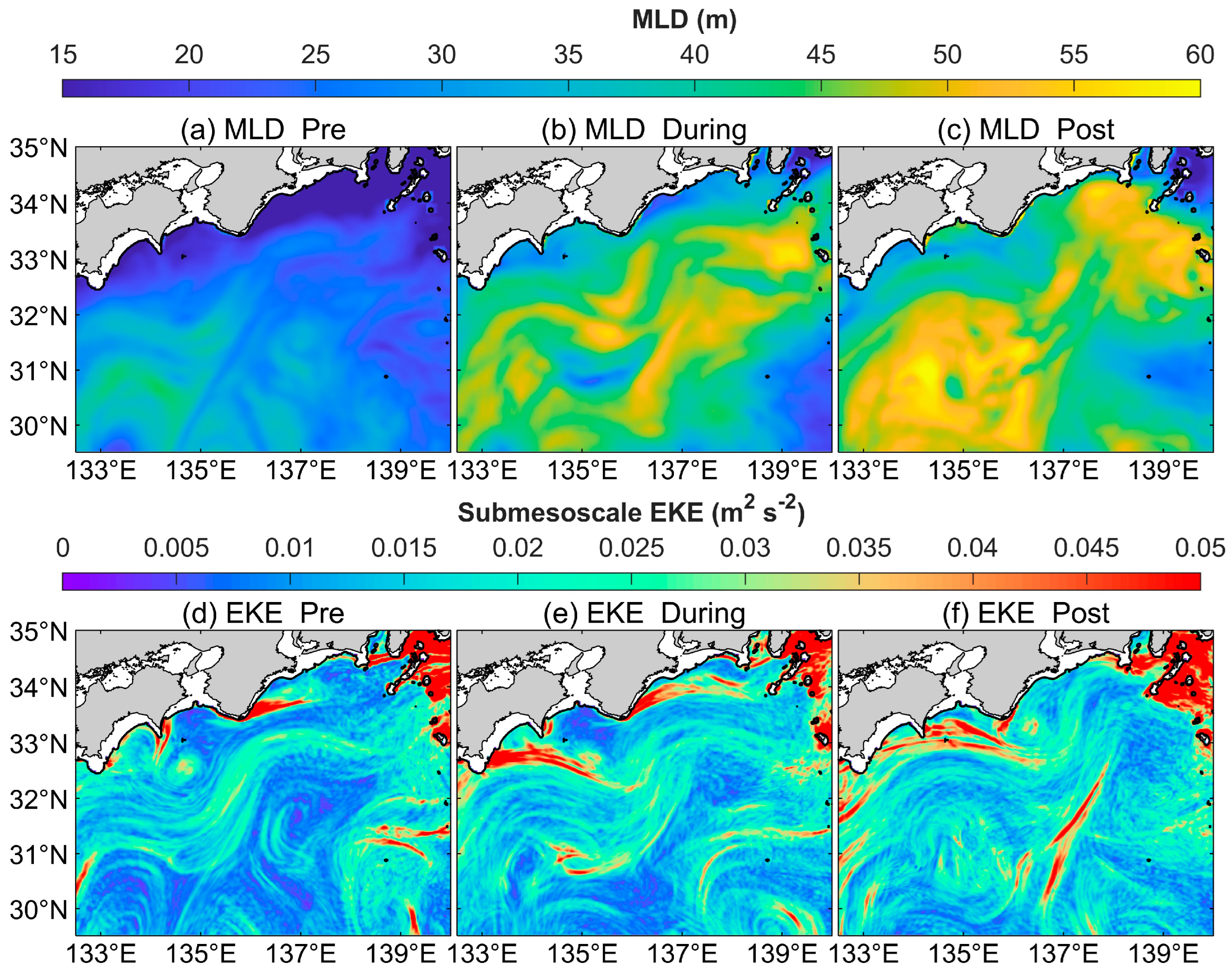
Figure 5 illustrates the simulated upper-ocean response in the KLM region immediately before, during, and post the passage of Typhoon Roke. Before the typhoon’s arrival (Figure 5a), late-summer conditions feature a shallow mixed layer throughout the region, which limits the reservoir of available potential energy for instabilities. The mean mixed-layer depth is the domain-averaged depth of the mixed layer, computed from the instantaneous mixed-layer depth field. Accordingly, the pre-typhoon submesoscale EKE is relatively low, with only weak patches of submesoscale energy visible along the Kuroshio front. When the typhoon strikes (Figure 5b), MLD reach ~50–100 m over a broad area, compared to shallower than 30 m before. Such typhoon-driven mixing has been well documented by observations [43], which show that typhoons can deepen the mixed layer by tens of meters. In LLC4320 simulation, this abrupt mixing event injected a large amount of potential energy into the upper ocean, strengthening the submesoscale eddy field.
Figure 5d reveals a pronounced increase in submesoscale EKE concurrent with mixed-layer deepening, consistent with the emergence of numerous submesoscale processes. In the post-typhoon snapshot (Figure 5c), the mixed layer remains deep, indicating that full restratification has not yet occurred. Submesoscale EKE remains elevated for weeks following the typhoon (Figure 5f), concurrent with a persistently deep mixed layer and sustained submesoscale activity. Stratification is gradually reestablished over approximately 1–2 weeks as surface heating resumes and winds weaken. Overall, the model snapshots demonstrate that a typhoon’s passage can rapidly convert a quiescent, stratified summer mixed layer into a much thicker, more baroclinically unstable layer, thereby sparking a burst of submesoscale eddy activity in late summer.
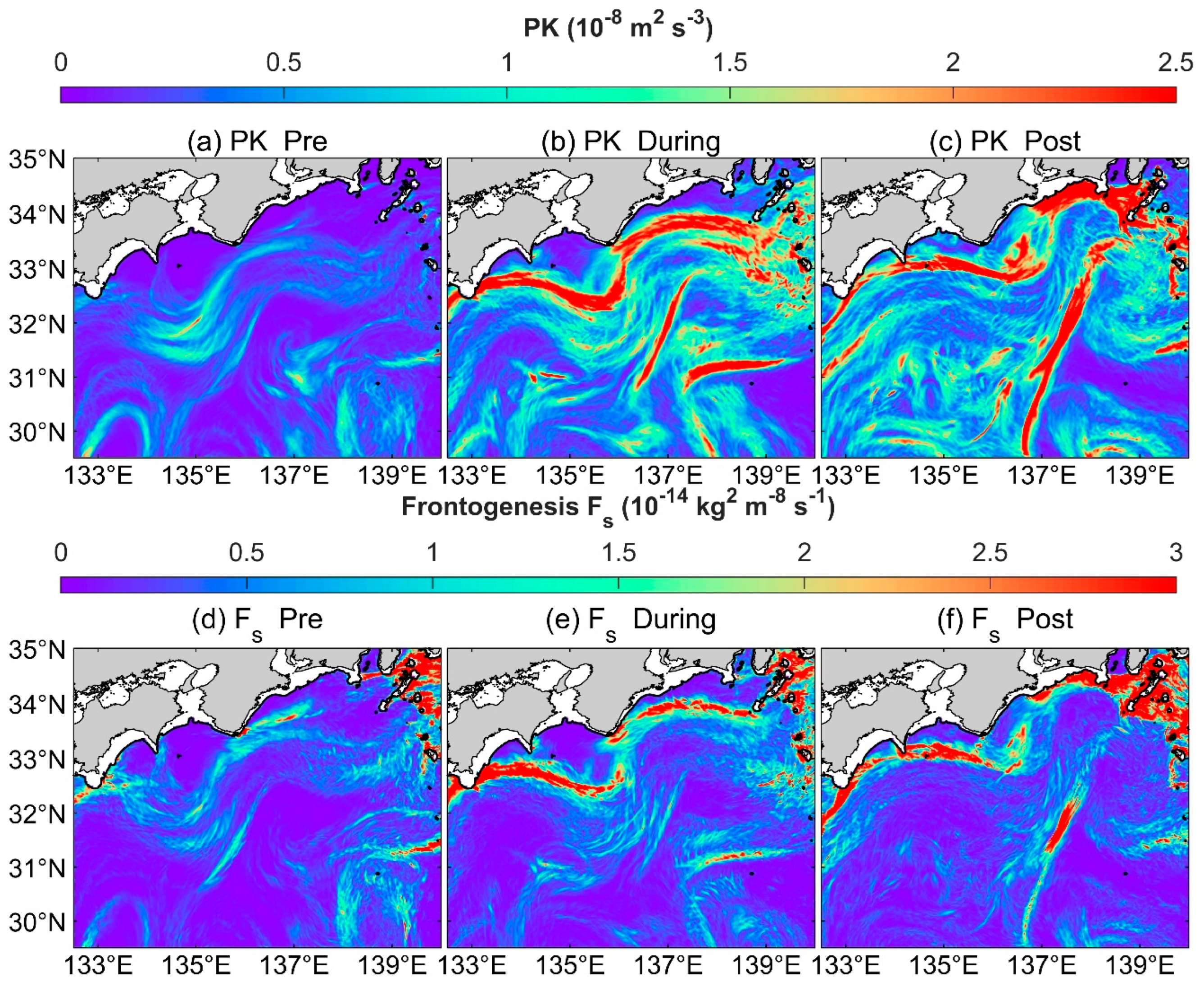
Before the typhoon (Figure 6a,d), the ocean exhibits relatively weak frontal activity and energy conversion. PK displays only scattered patches of modest magnitude, particularly along the Kuroshio jet and filamentary submesoscale features. During the typhoon (Figure 6b,e), both diagnostics show a pronounced intensification. PK increases markedly along the Kuroshio and surrounding frontal filaments, reflecting enhanced APE to KE conversion driven by typhoon-induced mixed-layer deepening and frontal reactivation. Concurrently, the F s reaches its highest values of the three stages, especially along the Kuroshio front and peripheral density gradients.
After the typhoon (Figure 6c,f), elevated values of both PK and F s persist, though slightly diminished compared to the peak typhoon phase. This persistence suggests that the frontal and submesoscale energization triggered by the typhoon continues beyond its immediate forcing, sustaining elevated submesoscale activity for several days. Their concurrent evolution before, during, and after the typhoon confirms that summer submesoscale intensification in the KLM region is highly sensitive to typhoon passage, which temporarily overcomes stratification constraints and triggers a frontogenesis-mediated release of submesoscale energy.
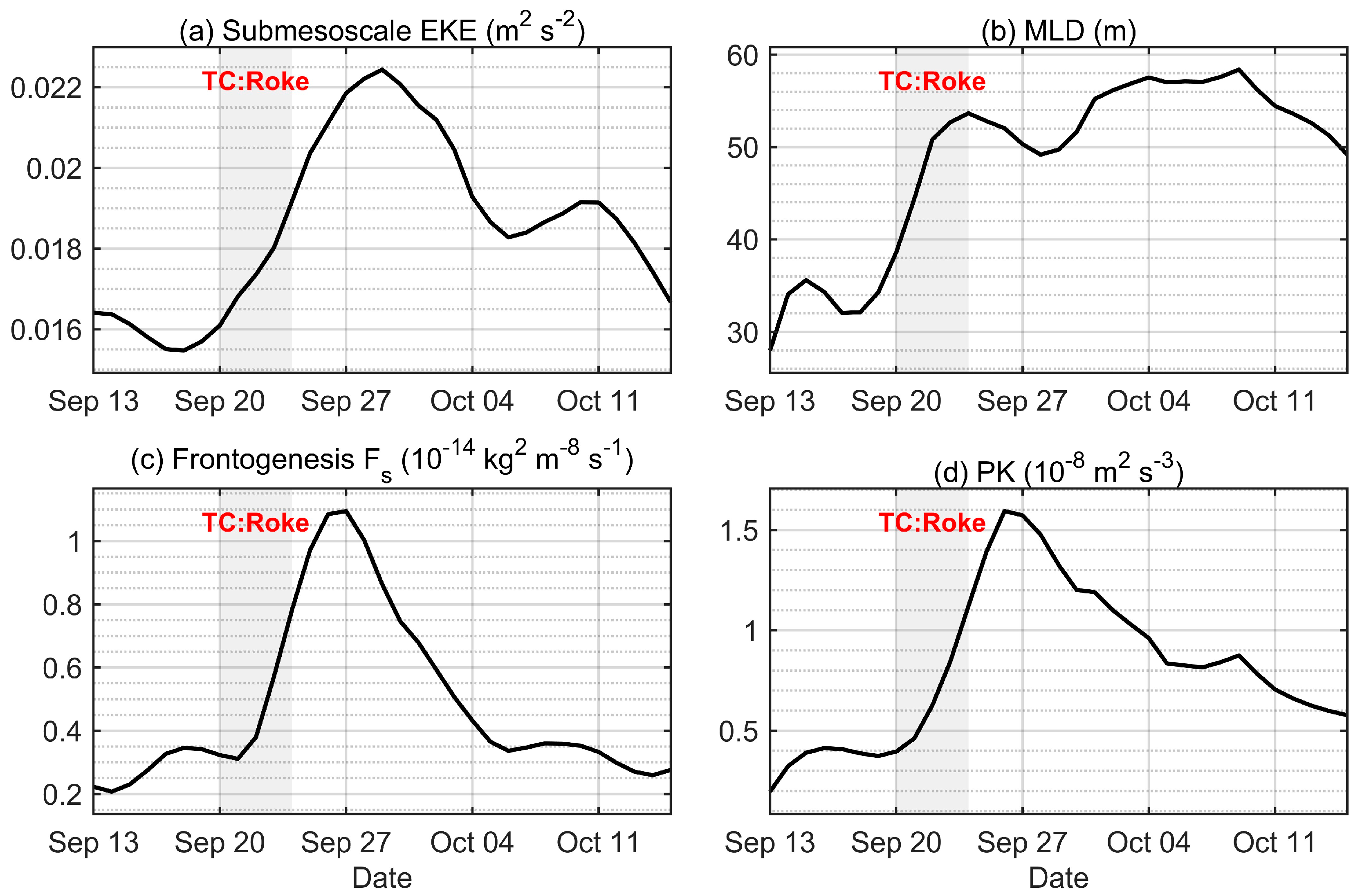
We examine the time-evolving response of key submesoscale diagnostics during the passage of Typhoon Roke to investigate the mechanisms underlying this submesoscale burst. The evolution of the MLD, F s , PK, and submesoscale EKE is used to interpret the late-summer submesoscale intensification described above. Prior to the arrival of the typhoon, the upper ocean remains strongly stratified, with a shallow MLD about 30 m, weak frontogenesis, low PK, and correspondingly weak submesoscale EKE. As the typhoon approaches the region, strong wind forcing rapidly deepens the mixed layer from roughly 30 m to more than 50–60 m within a few days (Figure 7b). Nearly simultaneously, the F s increases sharply, and PK exhibits a pronounced surge, indicating enhanced conversion of mixed-layer available potential energy into EKE through mixed-layer baroclinic instability (Figure 7c,d).
EKE begins to rise shortly before the typhoon’s closest approach and reaches its maximum shortly after the peaks in MLD, F s , and PK. This lagged EKE response indicates that the submesoscale burst is not a purely instantaneous wind-driven signal, but rather the outcome of a dynamically evolving adjustment of the mixed layer and frontal structure. Following the typhoon’s passage, all diagnostics gradually decay toward their pre-storm levels. Submesoscale EKE decreases over a timescale of roughly 10–15 days, while the mixed layer remains anomalously deep for more than a week, providing a sustained reservoir of potential energy for residual submesoscale activity during the recovery phase. Both PK and F s remain elevated for several days after the storm before weakening, consistent with previous observational and modeling studies of typhoon-induced upper-ocean adjustment [44]. Together, these results provide a mechanistic explanation for the late-summer peak in submesoscale activity documented by the SWOT observations.

4. Discussion

4.1. Influence of KLM on Seasonal Submesoscale Variability

The submesoscale EKE patterns observed by SWOT suggest that the background state of the Kuroshio may modulate submesoscale development south of Japan, particularly during the secondary summer peak. Although enhanced activity within the large-meander loop hints at a dynamical influence of the current’s path, the mechanisms responsible for this modulation remain unclear. To investigate how the meander state reshapes the seasonal conditions that favor submesoscale growth, we integrate SWOT observations with GLORYS12V1 reanalysis to assess the Kuroshio’s role in shaping seasonal submesoscale variability.
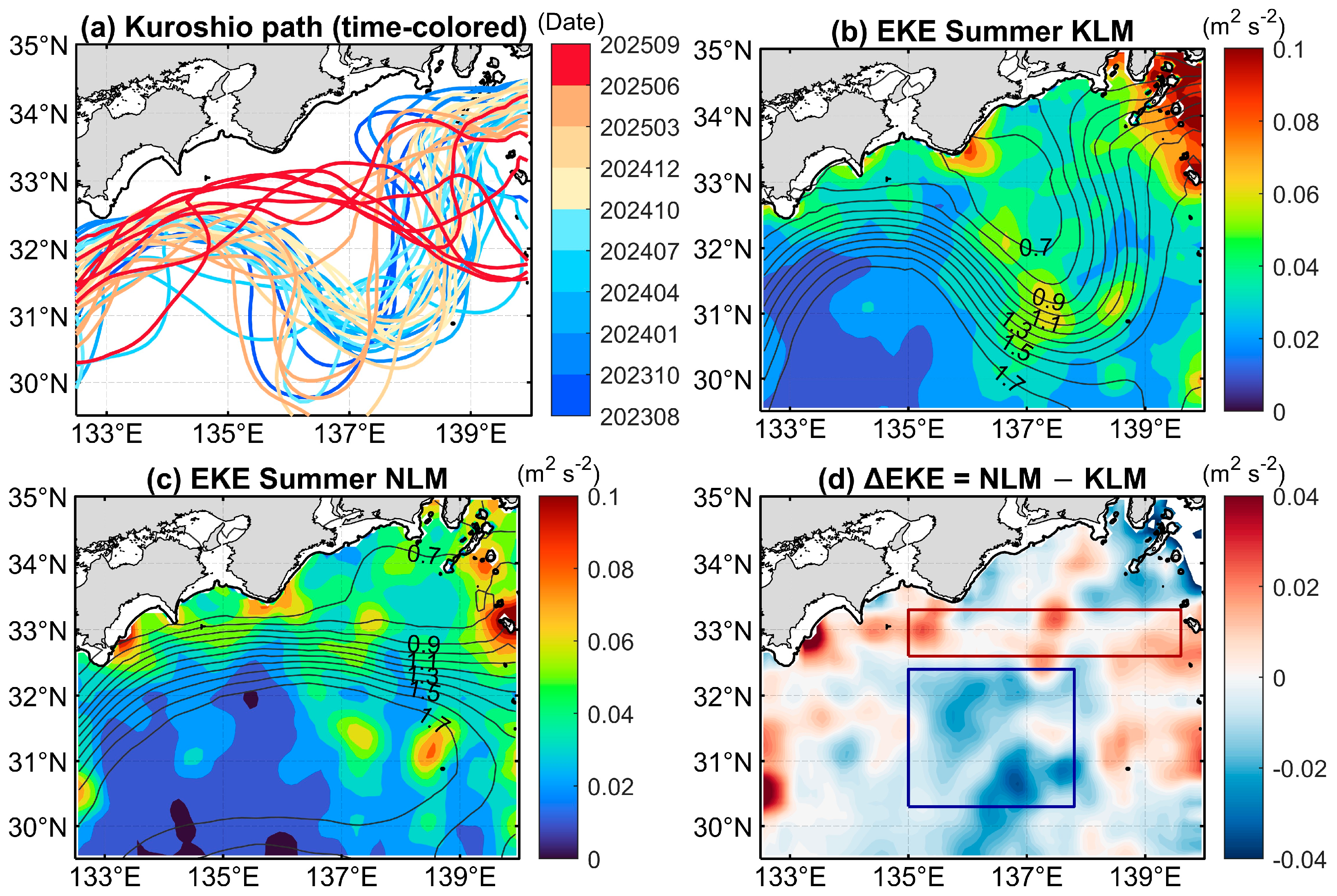
During the SWOT observation period the Kuroshio transitioned from a KLM state to a NLM state, providing a unique opportunity to use SWOT data to directly compare submesoscale EKE fields between two distinctly different path configurations. The current maintained a stable large meander from mid-2023 until mid-2025, then in August 2025 it transitioned to a nearshore path, ending the meander. The corresponding SWOT-derived submesoscale EKE fields reveal differences between these two path states. During the KLM summer of 2023–2024, elevated submesoscale EKE is distributed primarily along the offshore flank of the Kuroshio and around the curved meander pathway, forming a coherent band of energetic submesoscale motions wrapping around the meander loop (Figure 8b). In contrast, during summer 2025 after the meander had disappeared, the strongest submesoscale EKE is shifted toward the nearshore region, while offshore EKE levels are substantially reduced (Figure 8c). Figure 8d further highlights this redistribution of energy, with weakened offshore EKE and slightly enhanced nearshore EKE in the absence of the large meander.
These patterns indicate that the large-meander configuration preferentially energizes submesoscale eddies offshore, whereas a straight, nearshore Kuroshio path favors submesoscale activity closer to the coast. Dynamically, the meander of the current intensifies horizontal shear and convergence at the bends, facilitating the development of submesoscale eddies along the offshore flank. By contrast, when the Kuroshio follows a nearshore path, interactions with coastal topography and boundary currents become more important, favoring the development of smaller scale eddies near the capes. Consistent behavior has been reported for other western boundary current systems, such as the Gulf Stream, where meander curvature and strain intensify frontal instabilities and promote eddy shedding [45].
To quantify the influence of Kuroshio path curvature on submesoscale EKE intensity, we compute the curvature of the monthly mean Kuroshio axis and relate it to SWOT submesoscale EKE. Considering the axis locally as a planar curve y = y ( x ) , the curvature is evaluated as
κ   =   d 2 y d x 2 1 d y d x 2 3 / 2 ,
So that curvature magnitude κ has units of km−1. The monthly mean Kuroshio axis is discretized using a series of transects perpendicular to the flow at 30 km intervals. For each transect, the local path curvature and the mean SWOT-derived submesoscale EKE are calculated within a ±30 km cross-jet band, a scale chosen to represent the horizontal extent of submesoscale processes.
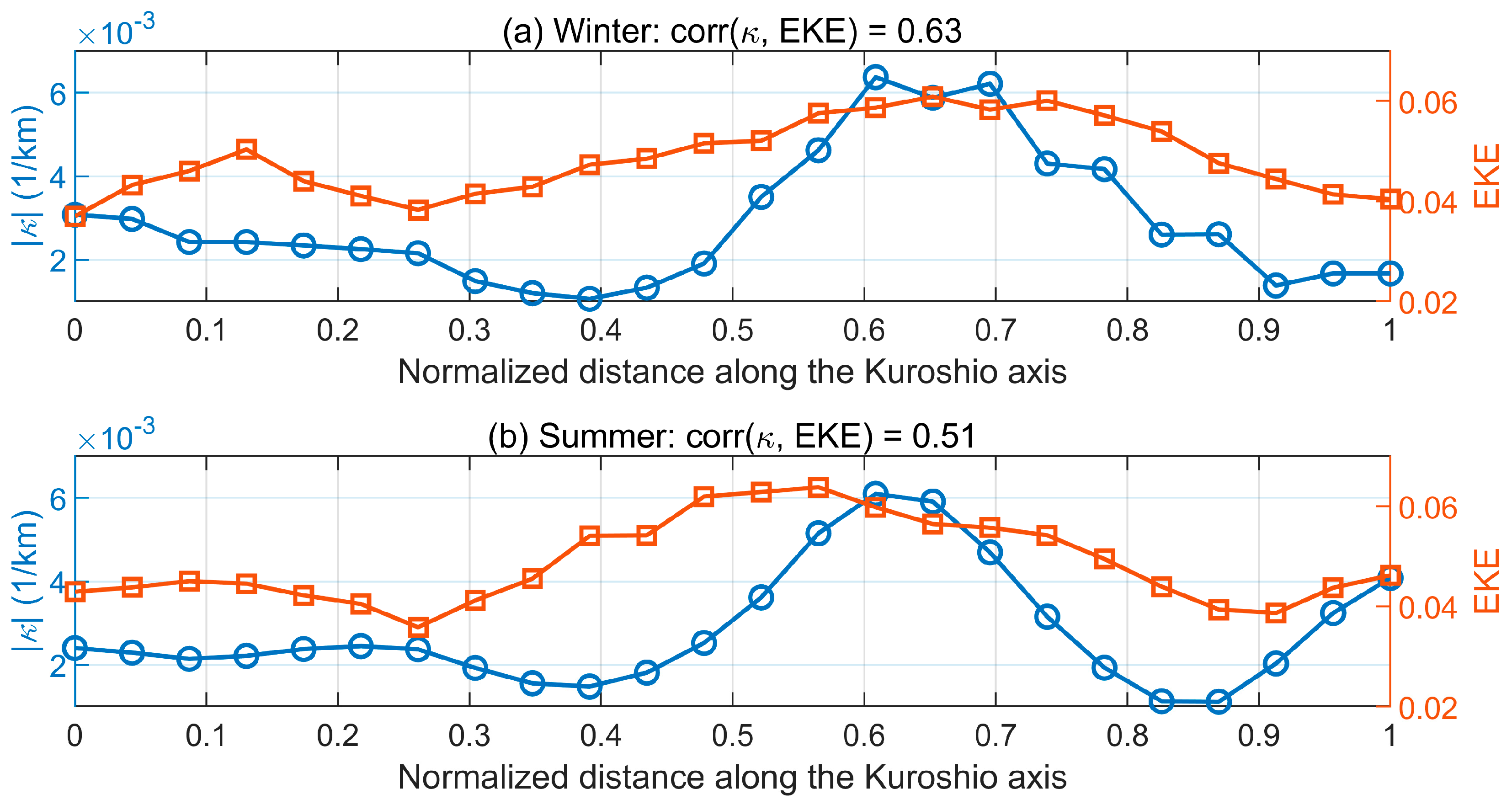
Figure 9 shows that the curvature magnitude κ exhibits a secondary local maximum followed downstream by a dominant peak. The secondary peak corresponds to the entrance-to-meander region, where the current path begins to bend and curvature intensifies, whereas the dominant peak marks the meander apex. Peak curvature reaches κ 5 × 10 3 km−1, implying a radius of R c 1 / κ about 200 km, consistent with the canonical scale of the KLM. The along-axis correlation between |κ| and SWOT submesoscale EKE is statistically significant in both seasons (Winter: r = 0.63 ; Summer: r = 0.51 ), indicating that path curvature contributes to enhanced submesoscale activity. The weaker summer correlation suggests that curvature-driven modulation may be partially masked during the typhoon season. A quantitative estimation of the respective contributions of typhoon forcing and Kuroshio path modulation to the seasonal EKE variability warrants further investigation with dedicated high-resolution simulations.
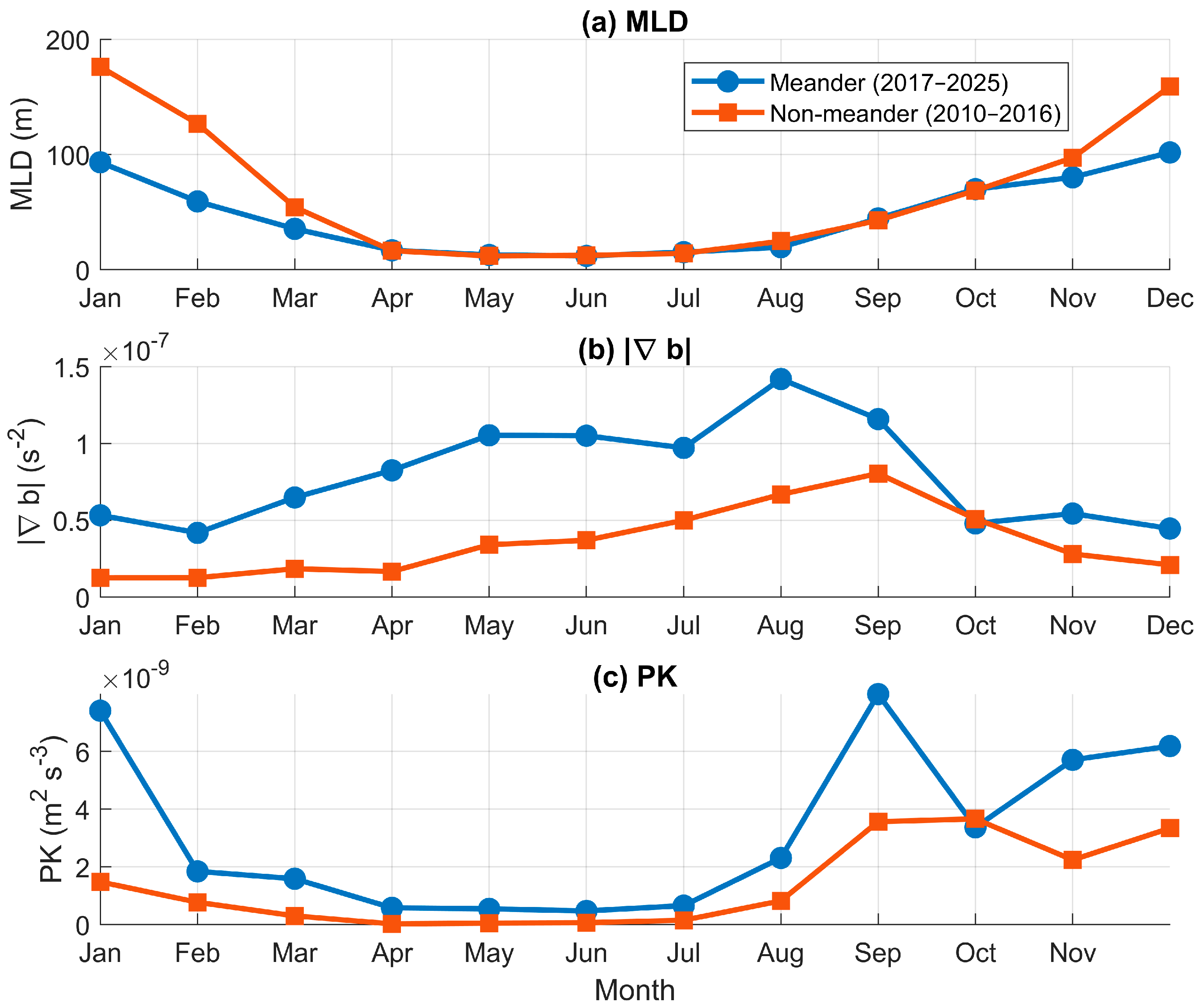
To assess how the Kuroshio path state modulates the seasonal background conditions for submesoscale activity, we compare upper-ocean properties between a representative NLM period and a large-meander period using reanalysis-based diagnostics. The seasonal cycle of the MLD (Figure 10a) is broadly similar in the two states and follows the canonical pattern, with the shallowest values of about 10–20 m in early summer, and a winter maximum of about 70–90 m in January–February. This deep winter mixed layer provides favorable conditions for the classical wintertime enhancement of submesoscale activity through mixed-layer baroclinic instabilities. The lateral buoyancy gradient magnitude |∇b| remains relatively moderate during spring and early summer and increase sharply in late summer, particularly in August–September, in both states. This behavior reflects the strong horizontal density contrast maintained by the Kuroshio as warm, saline offshore waters interact with cooler coastal waters, a contrast that typically peaks near the end of the stratified season.
As a combined consequence of the seasonal deepening of the mixed layer and the late-summer strengthening of horizontal density gradients, the PK exhibits a clear bimodal seasonal structure (Figure 10c). In both the NLM and KLM states, PK displays a dominant maximum in winter and a secondary enhancement in late summer. Notably, the magnitude of the late-summer PK peak is larger in the KLM state than in the NLM state. This contrast indicates that the large-meander configuration significantly enhances the late-summer potential for submesoscale energy generation. In KLM state, a persistent offshore cold-core eddy embedded within the meander intensified the frontal structure, thereby strengthening the lateral buoyancy gradients in the meander region. As a result, while the wintertime submesoscale peak is primarily controlled by atmospheric cooling and mixed-layer deepening in both Kuroshio states, the summertime peak is selectively amplified under the large-meander configuration.
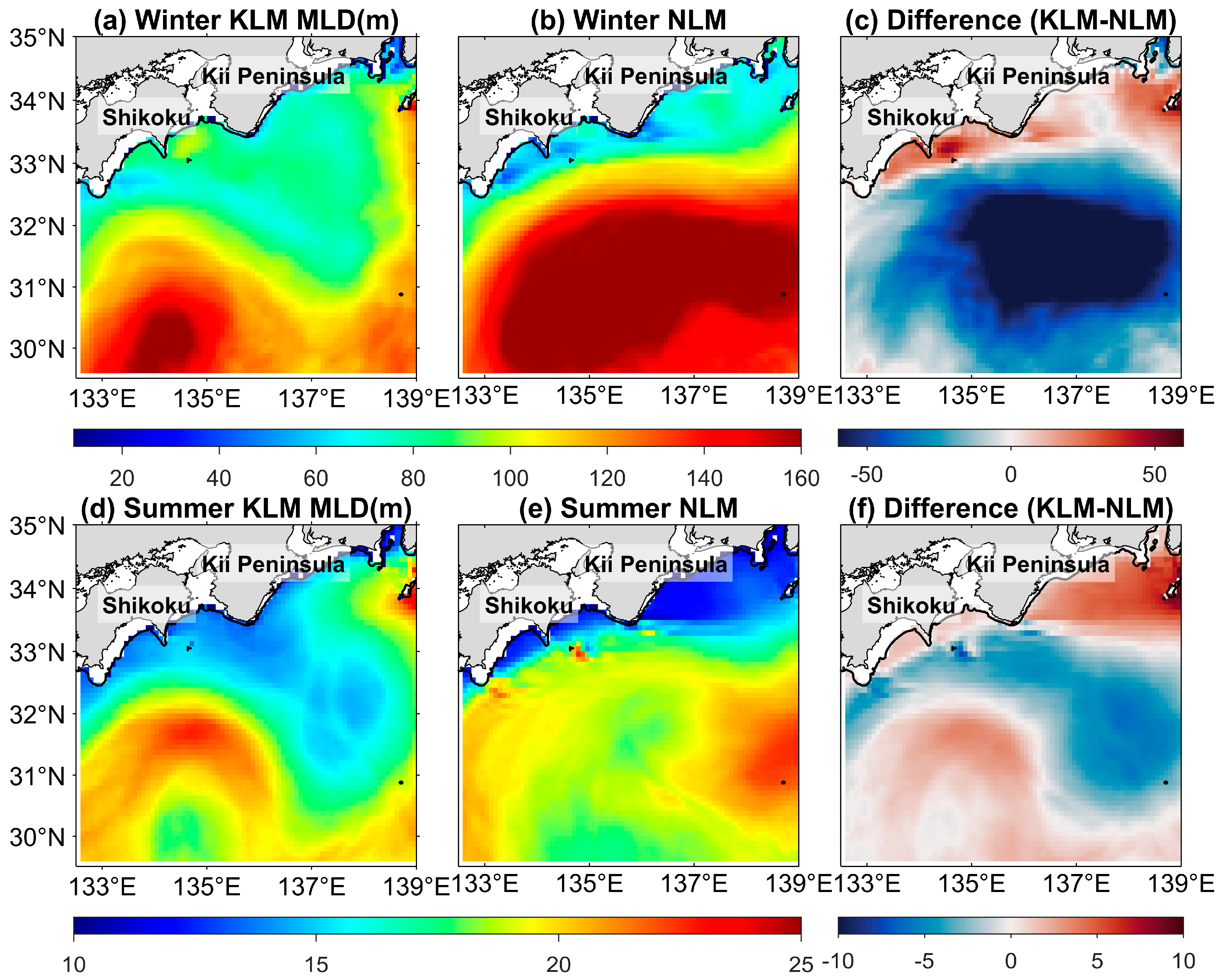
Spatial analyses of the two representative states further clarify how the Kuroshio path modulates upper-ocean conditions relevant to submesoscale activity. In winter, the mixed layer is deep over a broad region south of Japan, with typical depths of about 70–90 m (Figure 11a,b), whereas in summer it becomes uniformly shallow, generally within 10–30 m (Figure 11d,e). Within the cyclonic meander loop, upwelling and horizontal divergence are associated with a relatively shallower mixed layer than in the surrounding waters in the KLM state winter. By contrast, the winter MLD field offshore is much more spatially uniform in the NLM state. The KLM minus NLM difference maps indicate that, in winter, the presence of the large meander is associated with shallower MLD along the offshore side of the Kuroshio and relatively deeper MLD on the nearshore side compared to the NLM state. The winter and summer difference patterns indicate that the large-meander modulation of winter mixed-layer depth does not directly translate into the summer mixed-layer depth anomalies. This seasonal contrast suggests that distinct physical processes govern the mixed-layer response to the Kuroshio path in winter and in summer.
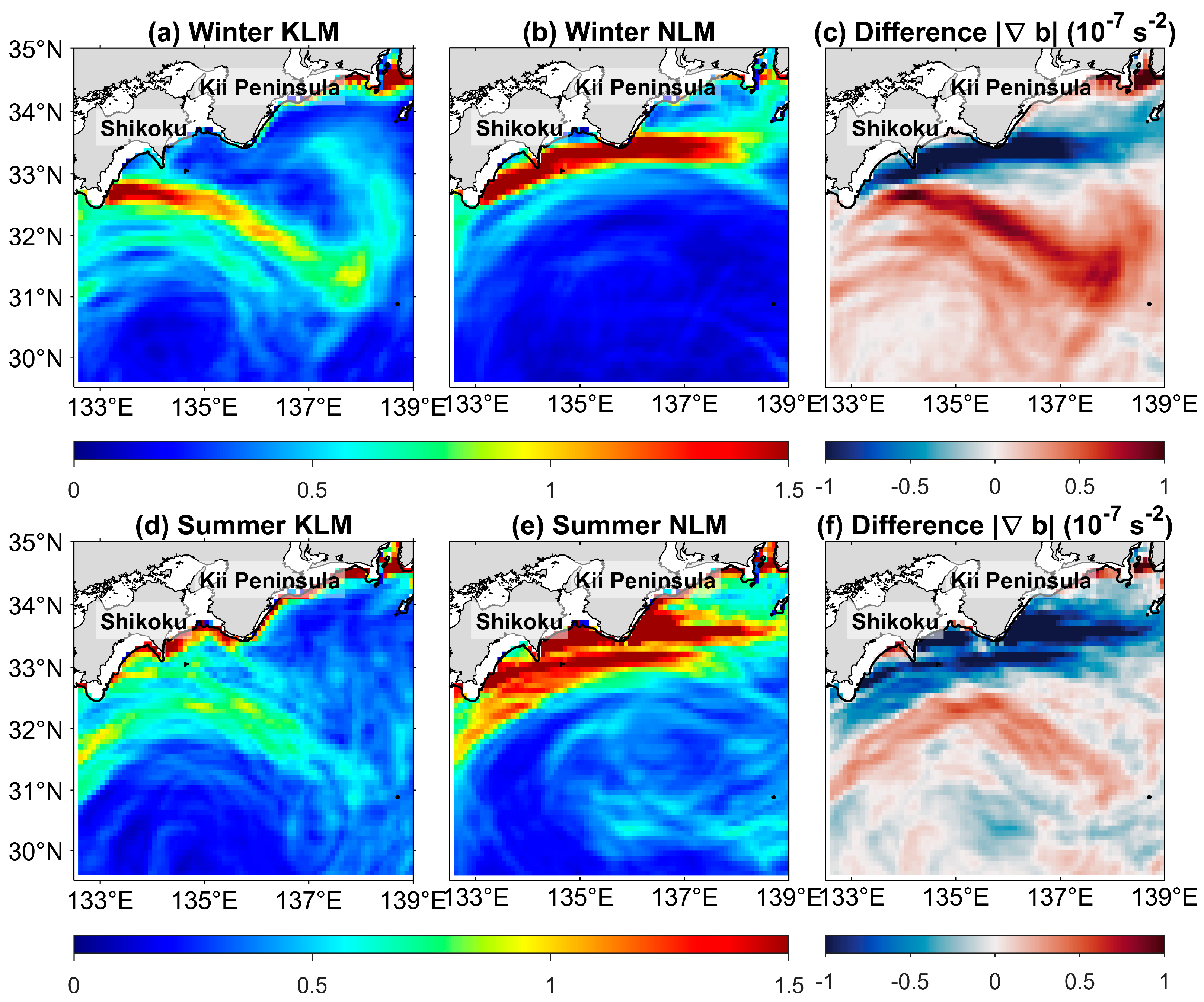
The large meander’s impact is evident in the distribution of upper-ocean frontal strength. In winter, both the KLM and NLM states exhibit broad bands of elevated |∇b| along the Kuroshio jet (Figure 12a,b), although the gradients are relatively weak and spatially diffuse in both cases. In summer, as the mixed layer shoals, sharp density fronts re-emerge (Figure 12d,e). During the KLM summer, an intense and continuous band of strong buoyancy gradients wraps around the meander crest and extends south of Japan. By contrast, during the NLM summer, the strongest gradients are concentrated along the nearshore Kuroshio path and around the Shikoku and Kii Peninsula, where the jet interacts more directly with coastal topography. The KLM minus NLM difference maps further highlight this contrast (Figure 12c,f). In both seasons, positive offshore anomalies indicate stronger buoyancy gradients under the large-meander configuration, whereas negative anomalies near the coast indicate weaker offshore fronts when the current follows a straight, nearshore path. These results demonstrate that the large meander preferentially enhances frontal strength in the offshore region, while the NLM state concentrates frontal intensity closer to the coast and islands. Such differences in frontal structure are dynamically important for submesoscale generation, because stronger pre-existing fronts provide a greater reservoir of available potential energy for the growth of submesoscale instabilities when the mixed layer is perturbed [46].
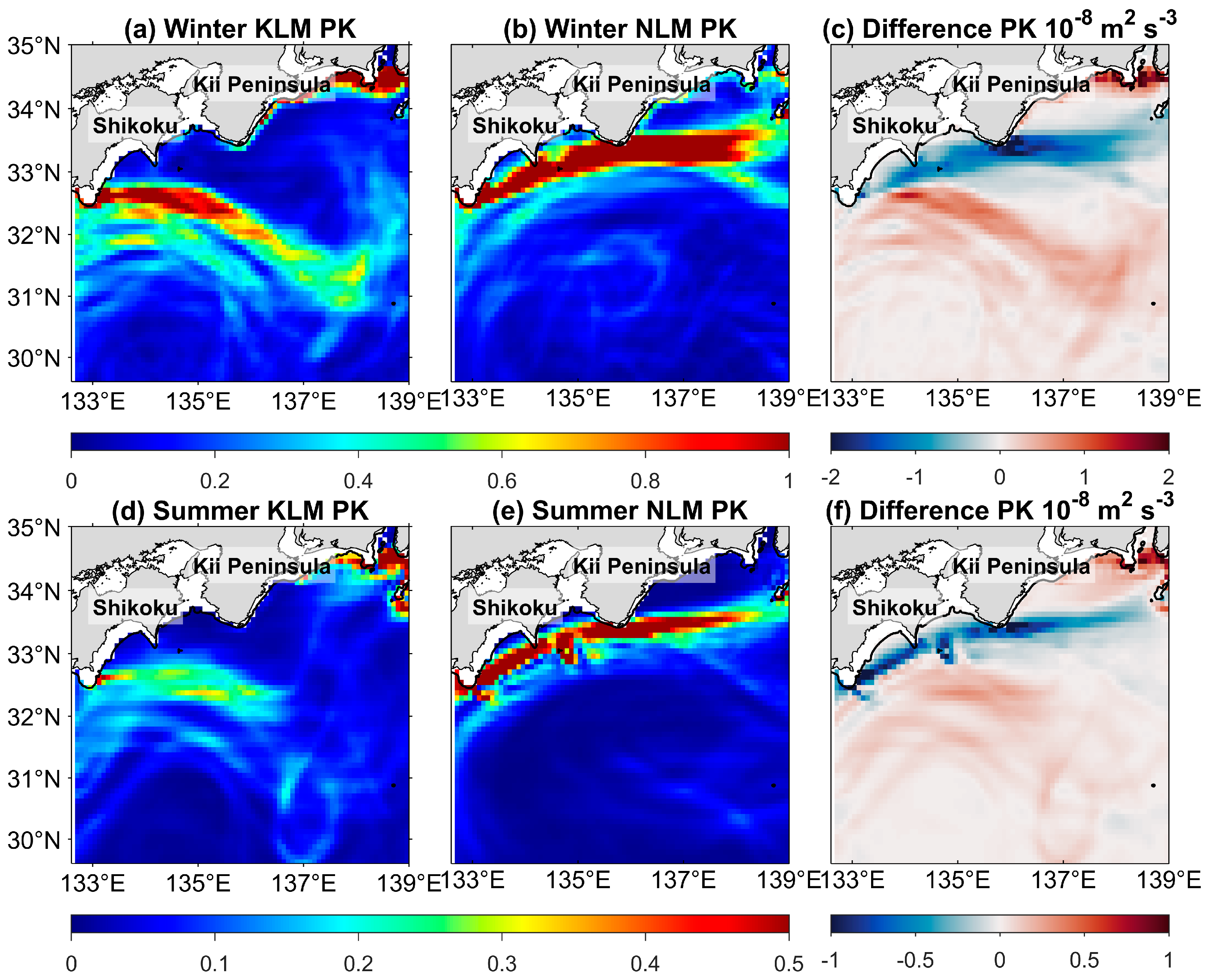
Figure 13 illustrates the combined influence of mixed-layer depth and frontal strength on the mixed-layer baroclinic conversion potential PK for the KLM and NLM states in winter and summer. In winter, both the states exhibit broad regions of elevated conversion potential along the Kuroshio and its downstream eddy field (Figure 13a,b). This reflects the coexistence of deep mixed layers and strong fronts in both path states. In summer, the contrast between the two states becomes pronounced (Figure 13d,e). Under the NLM state, conversion potential remains weak over most of the domain, consistent with shallow, strongly stratified mixed layers. Under the large-meander configuration, distinct offshore patches of high conversion potential emerge within the meander loop and the cyclonic recirculation south of Japan, with magnitudes approaching those of winter. The summer difference map clearly highlights this offshore enhancement under the large-meander state (Figure 13f), whereas the winter differences are smaller and spatially mixed (Figure 13c). The spatial pattern of elevated summer conversion potential closely matches the offshore anomalies of submesoscale EKE. This correspondence indicates that the large meander preconditions the offshore region for vigorous summertime submesoscale growth by jointly strengthening frontal gradients.
Previous studies across the Kuroshio regions generally suggest that submesoscale activity is tightly regulated by seasonal variations in upper-ocean stratification and frontal strength. In the Kuroshio Extension, high-resolution numerical simulations show that submesoscale turbulence intensifies in winter and weakens markedly in summer under strongly stratified conditions [47]. Similar winter-dominated behavior has been documented upstream, where mixed-layer baroclinic instability efficiently energizes submesoscale processes during winter [48]. By contrast, in regions strongly influenced by topography, submesoscale energetics exhibit weak or localized seasonality and are primarily maintained by persistent current–topography interactions rather than atmospheric forcing [49,50]. Within this broader context, the bimodal seasonal cycle identified in the KLM region is distinctive, with a pronounced late-summer enhancement linked to typhoon-induced mixed-layer deepening.

4.2. SWOT Constraints in Capturing Storm-Induced Submesoscale Variability

The advent of wide-swath altimetry by the SWOT satellite opens a new window on submesoscale dynamics at a global scale [32,35]. In this study, SWOT observations in the KLM region reveal a distinct late-summer intensification of submesoscale kinetic energy following typhoon passages, demonstrating that SWOT can capture transient, storm-driven fine-scale ocean responses previously unresolvable by nadir-only altimeters. While similar storm-induced submesoscale signals have been inferred previously from numerical simulations and limited in situ observations, SWOT enables their direct observation in two dimensions. When combined with concurrent high-resolution satellite products such as sea surface temperature, surface winds, and significant wave height, SWOT contributes to a multi-sensor system for examining the coupled evolution of surface circulation, thermal fronts, and air–sea interaction at submesoscale scale [33,51].
At the same time, several limitations should be acknowledged. The temporal sampling of SWOT, particularly during the 21-day repeat orbit phase, constrains its ability to continuously resolve rapidly evolving submesoscale processes, and residual measurement noise may still affect the weakest submesoscale signals. In addition, the present analysis focuses on surface manifestations and relies on reanalysis products to infer subsurface processes, which introduces additional uncertainty. Although the LLC4320 outputs and the SWOT observations cover different time periods, the simulation captures the essential physical processes by which typhoon forcing excites submesoscale activity. Despite these limitations, the two-dimensional submesoscale information provided by SWOT offers valuable supplementary constraints for satellite data assimilation and for improving the representation of storm-related upper-ocean variability in operational forecasting systems. The analysis framework developed here is potentially applicable to other energetic western boundary current regions in future studies, such as the Gulf Stream.

5. Conclusions

Using high-resolution SSH measurements from the SWOT mission, this study reveals an atypical bimodal seasonal cycle of submesoscale activity in the KLM region south of Japan. Within the large-meander region, SWOT-derived submesoscale EKE exhibits two distinct seasonal peaks, a primary winter maximum (December–January) and a secondary late-summer maximum (August–September) during the Northwest Pacific typhoon season. In contrast, in the upstream Kuroshio, submesoscale EKE follows the canonical midlatitude pattern, with a single winter maximum and weak summer values. Spatially, enhanced submesoscale EKE is concentrated along the Kuroshio front in winter, whereas in late summer it remains elevated within the meander core. SWOT-based eddy statistics confirm this picture, with strongly nonlinear submesoscale eddies clustering along the Kuroshio flanks, with an increase in both occurrence and intensity in winter and again in late summer.
MITgcm LLC4320 outputs demonstrate that tropical cyclones are the primary driver of the late-summer submesoscale enhancement. Prior to storm passage, the late-summer mixed layer is shallow, frontogenesis and the conversion rate PK are weak, and submesoscale EKE is low. As a typhoon crosses the region, strong wind forcing rapidly deepens the mixed layer by tens of meters, sharpens horizontal buoyancy gradients, and produces large, transient increases in frontogenesis and PK, followed by a lagged rise in submesoscale EKE. The mixed layer remains anomalously deep across the region, and PK elevated for several days after the storm. These results show that tropical cyclones intermittently inject energy into the stratified late-summer ocean and can generate submesoscale bursts strong enough to explain the secondary EKE peak observed by SWOT.
The Kuroshio path state modulates this storm-driven response. SWOT observations during the 2023–2025 transition from KLM to NLM conditions reveal a pronounced offshore concentration of submesoscale EKE during KLM summers, which shifts landward after the transition. GLORYS12V1 reanalysis shows that this contrast is associated with path-dependent differences in MLD and lateral buoyancy gradients, yielding a bimodal seasonal cycle in PK for both states but with a substantially stronger late-summer peak during the KLM phase. A persistent offshore cold-core eddy embedded within the meander systematically sharpens lateral density fronts. This large-meander configuration therefore maintains an elevated reservoir of mixed-layer available potential energy that can be efficiently tapped by passing tropical cyclones to amplify the late-summer submesoscale response. Our findings demonstrate that in western boundary currents, the traditional winter-dominated submesoscale paradigm can be modified by the combined effects of storm forcing and current-path variability, with important implications for upper-ocean mixing and air–sea coupling.

Author Contributions

Conceptualization, X.Z.; methodology, X.Z.; software, X.Z.; validation, X.Z.; investigation, X.Z. and Y.L.; writing—original draft preparation, X.Z.; writing—review and editing, X.Z. and Y.L.; visualization, X.Z. All authors have read and agreed to the published version of the manuscript.

Funding

This research was funded by the National Natural Science Foundation of China (Grants Nos. 42030405 and 42288101), and the National Key Research and Development Program of China (2024YFC3109200).

Data Availability Statement

The original data presented in this study are openly available from AVISO (SWOT Level-3 SSH, https://doi.org/10.24400/527896/A01-2023.018). High-resolution sea surface temperature (HRSST) data were obtained from NOAA at https://doi.org/10.25921/3rew-g964. The GLORYS12V1 ocean reanalysis is distributed through the Copernicus Marine Environment Monitoring Service (CMEMS) and can be accessed at https://doi.org/10.48670/moi-00021.

Acknowledgments

We would like to express our gratitude to Guihua Wang for his helpful suggestions.

Conflicts of Interest

The authors declare no conflicts of interest.

References

  1. McWilliams, J.C. Submesoscale currents in the ocean. Proc. Math. Phys. Eng. Sci. 2016, 472, 20160117. [Google Scholar] [CrossRef]
  2. Mahadevan, A. The Impact of Submesoscale Physics on Primary Productivity of Plankton. Ann. Rev. Mar. Sci. 2016, 8, 161–184. [Google Scholar] [CrossRef]
  3. Lévy, M.; Ferrari, R.; Franks, P.J.S.; Martin, A.P.; Rivière, P. Bringing physics to life at the submesoscale. Geophys. Res. Lett. 2012, 39, L14602. [Google Scholar] [CrossRef]
  4. Rocha, C.B.; Gille, S.T.; Chereskin, T.K.; Menemenlis, D. Seasonality of submesoscale dynamics in the Kuroshio Extension. Geophys. Res. Lett. 2016, 43, 11304–11311. [Google Scholar] [CrossRef]
  5. Callies, J.; Ferrari, R.; Klymak, J.M.; Gula, J. Seasonality in submesoscale turbulence. Nat. Commun. 2015, 6, 6862. [Google Scholar] [CrossRef] [PubMed]
  6. Taylor, J.R.; Thompson, A.F. Submesoscale Dynamics in the Upper Ocean. Annu. Rev. Fluid Mech. 2023, 55, 103–127. [Google Scholar] [CrossRef]
  7. Yu, X.; Barkan, R.; Naveira Garabato, A.C. Intensification of submesoscale frontogenesis and forward energy cascade driven by upper-ocean convergent flows. Nat. Commun. 2024, 15, 9214. [Google Scholar] [CrossRef] [PubMed]
  8. Su, Z.; Wang, J.; Klein, P.; Thompson, A.F.; Menemenlis, D. Ocean submesoscales as a key component of the global heat budget. Nat. Commun. 2018, 9, 775. [Google Scholar] [CrossRef]
  9. Dewar, W.K.; McWilliams, J.C.; Molemaker, M.J. Centrifugal Instability and Mixing in the California Undercurrent. J. Phys. Oceanogr. 2015, 45, 1224–1241. [Google Scholar] [CrossRef]
  10. Thomas, L.N.; Taylor, J.R.; Ferrari, R.; Joyce, T.M. Symmetric instability in the Gulf Stream. Deep Sea Res. Part. II Top. Stud. Oceanogr. 2013, 91, 96–110. [Google Scholar] [CrossRef]
  11. Wu, R.; Tong, C.; Liu, Y. A Study of the Vortex Filament Pool Left by a Super Typhoon. J. Geophys. Res. Oceans 2024, 129, e2024JC021198. [Google Scholar] [CrossRef]
  12. Yi, Z.; Qiu, C.; Wang, D.; Cai, Z.; Yu, J.; Shi, J. Submesoscale Kinetic Energy Induced by Vertical Buoyancy Fluxes During the Tropical Cyclone Haitang. J. Geophys. Res. Oceans 2024, 129, e2023JC020494. [Google Scholar] [CrossRef]
  13. Tang, H.; Wang, D.; Shu, Y.; Yu, X.; Shang, X.; Qiu, C.; Yu, J.; Chen, J. Vigorous Forced Submesoscale Instability Within an Anticyclonic Eddy During Tropical Cyclone “Haitang” From Glider Array Observations. J. Geophys. Res. Oceans 2025, 130, e2024JC021396. [Google Scholar] [CrossRef]
  14. D’Asaro, E.A.; Sanford, T.B.; Niiler, P.P.; Terrill, E.J. Cold wake of Hurricane Frances. Geophys. Res. Lett. 2007, 34, L15609. [Google Scholar] [CrossRef]
  15. Jacob, S.D.; Shay, L.K.; Mariano, A.J.; Black, P.G. The 3D Oceanic Mixed Layer Response to Hurricane Gilbert. J. Phys. Oceanogr. 2000, 30, 1407–1429. [Google Scholar] [CrossRef]
  16. Sun, L.; Yang, Y.-J.; Fu, Y.-F. Impacts of Typhoons on the Kuroshio Large Meander: Observation Evidences. Atmos. Ocean. Sci. Lett. 2015, 2, 45–50. [Google Scholar] [CrossRef]
  17. Wang, H.; Zhang, Z. Submesoscale Processes Triggered by Tropical Cyclones and Their Role in Temperature Recovery of Cold Wakes. Geophys. Res. Lett. 2025, 52, e2025GL116241. [Google Scholar] [CrossRef]
  18. Zhang, L.; Li, Z.; Ma, W. Response of the Kuroshio large meander path to typhoons: A case study from a high-resolution ocean model. Ocean Dyn. 2025, 75, 78. [Google Scholar] [CrossRef]
  19. Qiu, B.; Nakano, T.; Chen, S.; Klein, P. Submesoscale transition from geostrophic flows to internal waves in the northwestern Pacific upper ocean. Nat. Commun. 2017, 8, 14055. [Google Scholar] [CrossRef]
  20. Sasaki, H.; Klein, P.; Qiu, B.; Sasai, Y. Impact of oceanic-scale interactions on the seasonal modulation of ocean dynamics by the atmosphere. Nat. Commun. 2014, 5, 5636. [Google Scholar] [CrossRef]
  21. Zhang, Z.; Liu, Y.; Qiu, B.; Luo, Y.; Cai, W.; Yuan, Q.; Liu, Y.; Zhang, H.; Liu, H.; Miao, M.; et al. Submesoscale inverse energy cascade enhances Southern Ocean eddy heat transport. Nat. Commun. 2023, 14, 1335. [Google Scholar] [CrossRef]
  22. Kawabe, M. Variations of Current Path, Velocity, and Volume Transport of the Kuroshio in Relation with the Large Meander. J. Phys. Oceanogr. 1995, 25, 3103–3117. [Google Scholar] [CrossRef]
  23. Usui, N.; Tsujino, H.; Fujii, Y.; Kamachi, M. Generation of a trigger meander for the 2004 Kuroshio large meander. J. Geophys. Res. Oceans 2008, 113, C01012. [Google Scholar] [CrossRef]
  24. Hirata, H.; Nishikawa, H.; Usui, N.; Miyama, T.; Sugimoto, S.; Kusaka, A.; Seto, T. The Kuroshio large meander and its various impacts: A review. J. Oceanogr. 2025, 81, 165–185. [Google Scholar] [CrossRef]
  25. Qiu, B.; Chen, S. Revisit of the Occurrence of the Kuroshio Large Meander South of Japan. J. Phys. Oceanogr. 2021, 51, 3679–3694. [Google Scholar] [CrossRef]
  26. Hanawa, K.; Sugimoto, S. Influence of Kuroshio Path Variation South of Japan on Formation of Subtropical Mode Water. J. Phys. Oceanogr. 2014, 44, 1065–1077. [Google Scholar] [CrossRef]
  27. Sugimoto, S.; Qiu, B.; Schneider, N. Local Atmospheric Response to the Kuroshio Large Meander Path in Summer and Its Remote Influence on the Climate of Japan. J. Clim. 2021, 34, 3571–3589. [Google Scholar] [CrossRef]
  28. Sasaki, Y.N.; Ito, R. Impact of the Kuroshio large meander on local atmospheric circulation and precipitation in winter. Prog. Earth Planet. Sci. 2024, 11, 15. [Google Scholar] [CrossRef]
  29. Lizarbe Barreto, D.A.; Chevarria Saravia, R.; Nagai, T.; Hirata, T. Phytoplankton Increase Along the Kuroshio Due to the Large Meander. Front. Mar. Sci. 2021, 8, 677632. [Google Scholar] [CrossRef]
  30. Peng, Z.; Zhang, S. Seasonal Variation of Submesoscale Ageostrophic Motion and Geostrophic Energy Cascade in the Kuroshio. J. Mar. Sci. Eng. 2024, 12, 1121. [Google Scholar] [CrossRef]
  31. Hayashida, H.; Kiss, A.E.; Miyama, T.; Miyazawa, Y.; Yasunaka, S. Anomalous Nutricline Drives Marked Biogeochemical Contrasts During the Kuroshio Large Meander. J. Geophys. Res. Oceans 2023, 128, e2023JC019697. [Google Scholar] [CrossRef]
  32. Archer, M.; Wang, J.; Klein, P.; Dibarboure, G.; Fu, L.-L. Wide-swath satellite altimetry unveils global submesoscale ocean dynamics. Nature 2025, 640, 691–696. [Google Scholar] [CrossRef]
  33. Fu, L.L.; Pavelsky, T.; Cretaux, J.F.; Morrow, R.; Farrar, J.T.; Vaze, P.; Sengenes, P.; Vinogradova-Shiffer, N.; Sylvestre-Baron, A.; Picot, N.; et al. The Surface Water and Ocean Topography Mission: A Breakthrough in Radar Remote Sensing of the Ocean and Land Surface Water. Geophys. Res. Lett. 2024, 51, e2023GL107652. [Google Scholar] [CrossRef]
  34. Zhang, Z.; Miao, M.; Qiu, B.; Tian, J.; Jing, Z.; Chen, G.; Chen, Z.; Zhao, W. Submesoscale Eddies Detected by SWOT and Moored Observations in the Northwestern Pacific. Geophys. Res. Lett. 2024, 51, e2024GL110000. [Google Scholar] [CrossRef]
  35. Dibarboure, G.; Anadon, C.; Briol, F.; Cadier, E.; Chevrier, R.; Delepoulle, A.; Faugère, Y.; Laloue, A.; Morrow, R.; Picot, N.; et al. Blending 2D topography images from the Surface Water and Ocean Topography (SWOT) mission into the altimeter constellation with the Level-3 multi-mission Data Unification and Altimeter Combination System (DUACS). Ocean Sci. 2025, 21, 283–323. [Google Scholar] [CrossRef]
  36. Tréboutte, A.; Carli, E.; Ballarotta, M.; Carpentier, B.; Faugère, Y.; Dibarboure, G. KaRIn Noise Reduction Using a Convolutional Neural Network for the SWOT Ocean Products. Remote Sens. 2023, 15, 2183. [Google Scholar] [CrossRef]
  37. Chelton, D.B.; deSzoeke, R.A.; Schlax, M.G.; El Naggar, K.; Siwertz, N. Geographical Variability of the First Baroclinic Rossby Radius of Deformation. J. Phys. Oceanogr. 1998, 28, 433–460. [Google Scholar] [CrossRef]
  38. Du, T.; Jing, Z. Fine-Scale Eddies Detected by SWOT in the Kuroshio Extension. Remote Sens. 2024, 16, 3488. [Google Scholar] [CrossRef]
  39. de Boyer Montégut, C.; Madec, G.; Fischer, A.S.; Lazar, A.; Iudicone, D. Mixed layer depth over the global ocean: An examination of profile data and a profile-based climatology. J. Geophys. Res. Oceans 2004, 109, C12003. [Google Scholar] [CrossRef]
  40. Fox-Kemper, B.; Ferrari, R.; Hallberg, R. Parameterization of Mixed Layer Eddies. Part. I: Theory Diagnosis. J. Phys. Oceanogr. 2008, 38, 1145–1165. [Google Scholar] [CrossRef]
  41. Capet, X.; Campos, E.J.; Paiva, A.M. Submesoscale activity over the Argentinian shelf. Geophys. Res. Lett. 2008, 35, L15605. [Google Scholar] [CrossRef]
  42. Toda, T. Movement of the surface front induced by Kuroshio frontal eddy. J. Geophys. Res. Oceans 1993, 98, 16331–16339. [Google Scholar] [CrossRef]
  43. Wada, A.; Uehara, T.; Ishizaki, S. Typhoon-induced sea surface cooling during the 2011 and 2012 typhoon seasons: Observational evidence and numerical investigations of the sea surface cooling effect using typhoon simulations. Prog. Earth Planet. Sci. 2014, 1, 11. [Google Scholar] [CrossRef]
  44. Mahadevan, A.; Tandon, A.; Ferrari, R. Rapid changes in mixed layer stratification driven by submesoscale instabilities and winds. J. Geophys. Res. Oceans 2010, 115, C03017. [Google Scholar] [CrossRef]
  45. Gula, J.; Molemaker, M.J.; McWilliams, J.C. Submesoscale Dynamics of a Gulf Stream Frontal Eddy in the South Atlantic Bight. J. Phys. Oceanogr. 2016, 46, 305–325. [Google Scholar] [CrossRef]
  46. Brannigan, L.; Marshall, D.P.; Naveira-Garabato, A.; George Nurser, A.J. The seasonal cycle of submesoscale flows. Ocean Model. 2015, 92, 69–84. [Google Scholar] [CrossRef]
  47. Dong, J.; Fox-Kemper, B.; Zhang, H.; Dong, C. The Seasonality of Submesoscale Energy Production, Content, and Cascade. Geophys. Res. Lett. 2020, 47, e2020GL087388. [Google Scholar] [CrossRef]
  48. Chen, J.; Zhu, X.-H.; Zheng, H.; Wang, M. Submesoscale dynamics accompanying the Kuroshio in the East China Sea. Front. Mar. Sci. 2023, 9, 1124457. [Google Scholar] [CrossRef]
  49. Fei, Y.; Zhang, S.; Wang, K.; Yu, Y.; Gao, Y.; Cui, T. Spatial and Seasonal Characteristics of the Submesoscale Energetics in the Northwest Pacific Subtropical Ocean. J. Mar. Sci. Eng. 2025, 13, 1691. [Google Scholar] [CrossRef]
  50. Shen, Z.; Yang, Y.; Hu, J.; Zhang, S. Impact of Topography on Submesoscale Ageostrophic Kinetic Energy in the Kuroshio South of Japan. J. Geophys. Res. Oceans 2025, 130, e2025JC022880. [Google Scholar] [CrossRef]
  51. Seo, H.; O’Neill, L.W.; Bourassa, M.A.; Czaja, A.; Drushka, K.; Edson, J.B.; Fox-Kemper, B.; Frenger, I.; Gille, S.T.; Kirtman, B.P.; et al. Ocean Mesoscale and Frontal-Scale Ocean–Atmosphere Interactions and Influence on Large-Scale Climate: A Review. J. Clim. 2023, 36, 1981–2013. [Google Scholar] [CrossRef]
Figure 1. (a) Mean surface current speed (shading; m s−1) and velocity vectors illustrating the Kuroshio path in the northwest Pacific, averaged over 2024. The blue box denotes the study area south of Japan. (b) Schematic comparison of the Kuroshio paths during the Kuroshio Large Meander (KLM; red, 2023–2024) and Non-Large Meander (NLM; black, August–September 2025) states. Shading indicates regional bathymetry (m).
Remotesensing 18 00384 g001
Figure 2. Submesoscale EKE in the KLM region derived from SWOT observations. (a) Monthly mean EKE averaged over the two black dashed boxes in (e). (bd) Annual, winter, and summer mean submesoscale EKE. (e) Difference between winter and summer EKE. The blue box highlights negative EKE anomalies in the meander-core region, while the red 1.1 m SSH contour delineates positive EKE anomalies along the Kuroshio path. The black dashed boxes mark the upstream and meander sectors. Regions shallower than 200 m are masked.
Remotesensing 18 00384 g002
Figure 3. SWOT-detected submesoscale eddies in the KLM region. (a) Distribution of eddies, with anticyclones (red) and cyclones (blue); the black curve marks the Kuroshio axis, and R1 and R2 denote the offshore and onshore sectors. (b) Rossby number distributions in R1 and R2. (c) Monthly eddy occurrence number. (d) Monthly mean |Ro| of the strongest eddy quartile in R1.
Remotesensing 18 00384 g003
Figure 4. SWOT and Himawari-9 observations of the KLM. (a) SWOT SSH in August 2023 following Typhoon Lan. (b) SWOT SSH in March 2024. (c) Himawari-9 SST on 21 August 2023 with Lan’s track. (d) Himawari-9 SST on 16 March 2024. Red circles indicate submesoscale eddies.
Remotesensing 18 00384 g004
Figure 5. Mixed layer depth (MLD, (ac)) and submesoscale EKE (df) in the KLM region (a) before, (b) during, and (c) after the typhoon. The typhoon passage substantially deepens the mixed layer and enhances submesoscale EKE. Submesoscale EKE is band-pass filtered to 5–30 km.
Remotesensing 18 00384 g005
Figure 6. The spatial distributions of (ac) the mixed-layer available potential energy conversion (PK) and (df) the amplitude of frontogenesis function ( F s ) for the same pre-typhoon, during-typhoon, and post-typhoon dates as Figure 5.
Remotesensing 18 00384 g006
Figure 7. Time series of domain-averaged (a) submesoscale EKE, (b) MLD, (c) F s , and (d) PK in the KLM region during the passage of Typhoon Roke. The shaded gray interval denotes the period when the typhoon directly influenced the study region. All variables are averaged over the same KLM domain as in Figure 5 and Figure 6.
Remotesensing 18 00384 g007
Figure 8. (a) Time-colored Kuroshio paths south of Japan from August 2023 to September 2025. (b) Summer-mean submesoscale EKE during the KLM state. (c) Same as (b), but for August–September 2025 during the NLM state. (d) Difference in summer-mean submesoscale EKE between the NLM and KLM states. The red and blue boxes indicate positive and negative submesoscale EKE anomalies.
Remotesensing 18 00384 g008
Figure 9. Along-axis relationship between Kuroshio path curvature and submesoscale EKE under (a) winter and (b) summer conditions. Both curvature magnitude |κ| (left axis) and EKE (right axis) are shown as functions of the nondimensional distance along the Kuroshio axis.
Remotesensing 18 00384 g009
Figure 10. Monthly evolution of (a) MLD, (b) mean lateral buoyancy gradient magnitude b , and (c) the mixed-layer available potential energy conversion PK, south of Japan. Blue circles denote the KLM period (2017–2025), and red squares denote the NLM period (2010–2016).
Remotesensing 18 00384 g010
Figure 11. Spatial distribution of MLD south of Japan during (a) winter and (d) summer in the KLM period. (b,e) show the corresponding winter and summer MLD fields for the NLM state. Panels (c,f) display the KLM minus NLM differences for winter and summer, respectively.
Remotesensing 18 00384 g011
Figure 12. Spatial distribution of the horizontal buoyancy gradient magnitude b at 60 m depth under the same conditions as in Figure 11. (a,b) show the winter fields for the KLM and NLM period, respectively, and (c) shows the corresponding KLM minus NLM difference. (d,e) show the summer fields for the KLM and NLM period, respectively, and (f) shows the summer KLM minus NLM difference.
Remotesensing 18 00384 g012
Figure 13. Spatial distribution of the mixed-layer available potential energy conversion PK under the same conditions as in Figure 12. (a,b) show the winter fields for the KLM and NLM period, respectively, and (c) shows the corresponding KLM minus NLM difference. (d,e) show the summer fields for the KLM and NLM period, respectively, and (f) shows the summer KLM minus NLM difference.
Remotesensing 18 00384 g013
Disclaimer/Publisher’s Note: The statements, opinions and data contained in all publications are solely those of the individual author(s) and contributor(s) and not of MDPI and/or the editor(s). MDPI and/or the editor(s) disclaim responsibility for any injury to people or property resulting from any ideas, methods, instructions or products referred to in the content.