

Moho Fold Structure Beneath the East China Sea and Its Tectonic Implications


Highlights
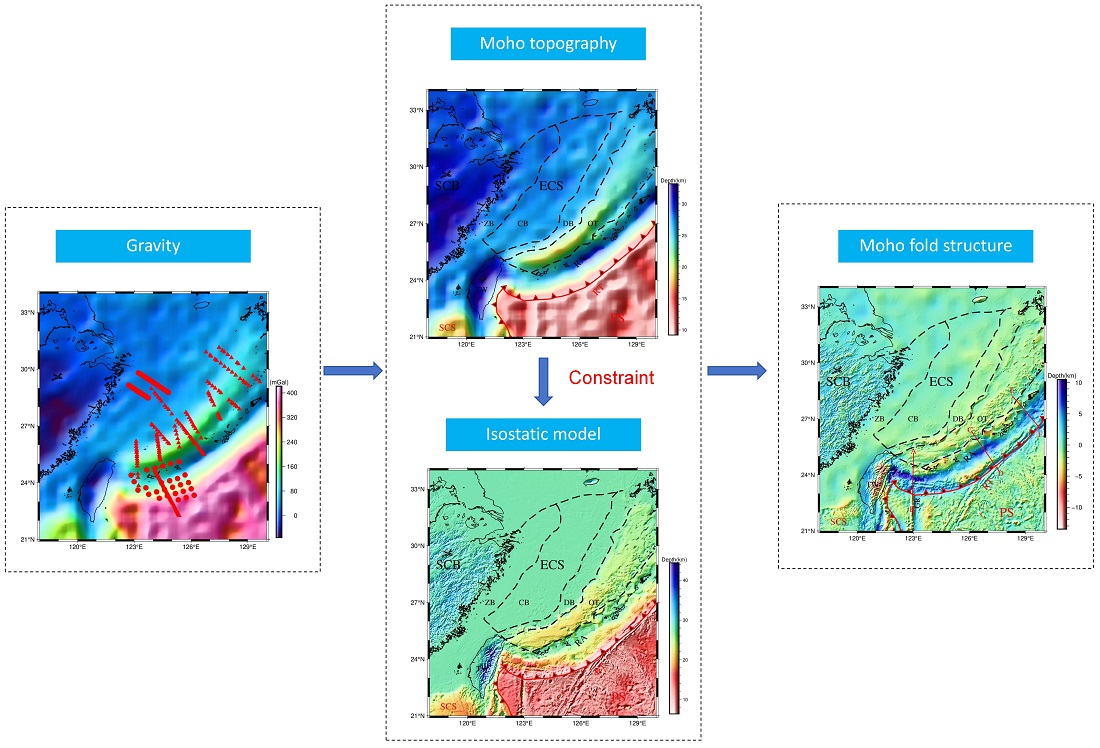
- According to the Moho fold structure, the South China Block has undergone vertical stress that has forced the mantle to subduct.
- The dominant force within the Ryukyu Arc is different in various regions. In the northeastern and central parts of the Ryukyu Arc, vertical subduction forces are dominant. In the southwestern part of the Ryukyu Arc, vertical subduction forces are in balance with another force associated with mantle upwelling.
- Combined with previous studies, it has been confirmed that the ancient subduction zone was situated roughly along the eastern coastline of the South China Block.
- The differing dynamical control mechanisms across distinct regions of the Ryukyu Arc have been revealed. In the northeast and central regions, the primary influence stems from the subduction system. In the southwest, the predominant effect arises from back-arc mantle activity impacting shallow tectonics.
Abstract
1. Introduction
2. Study Area and Data
3. Methods
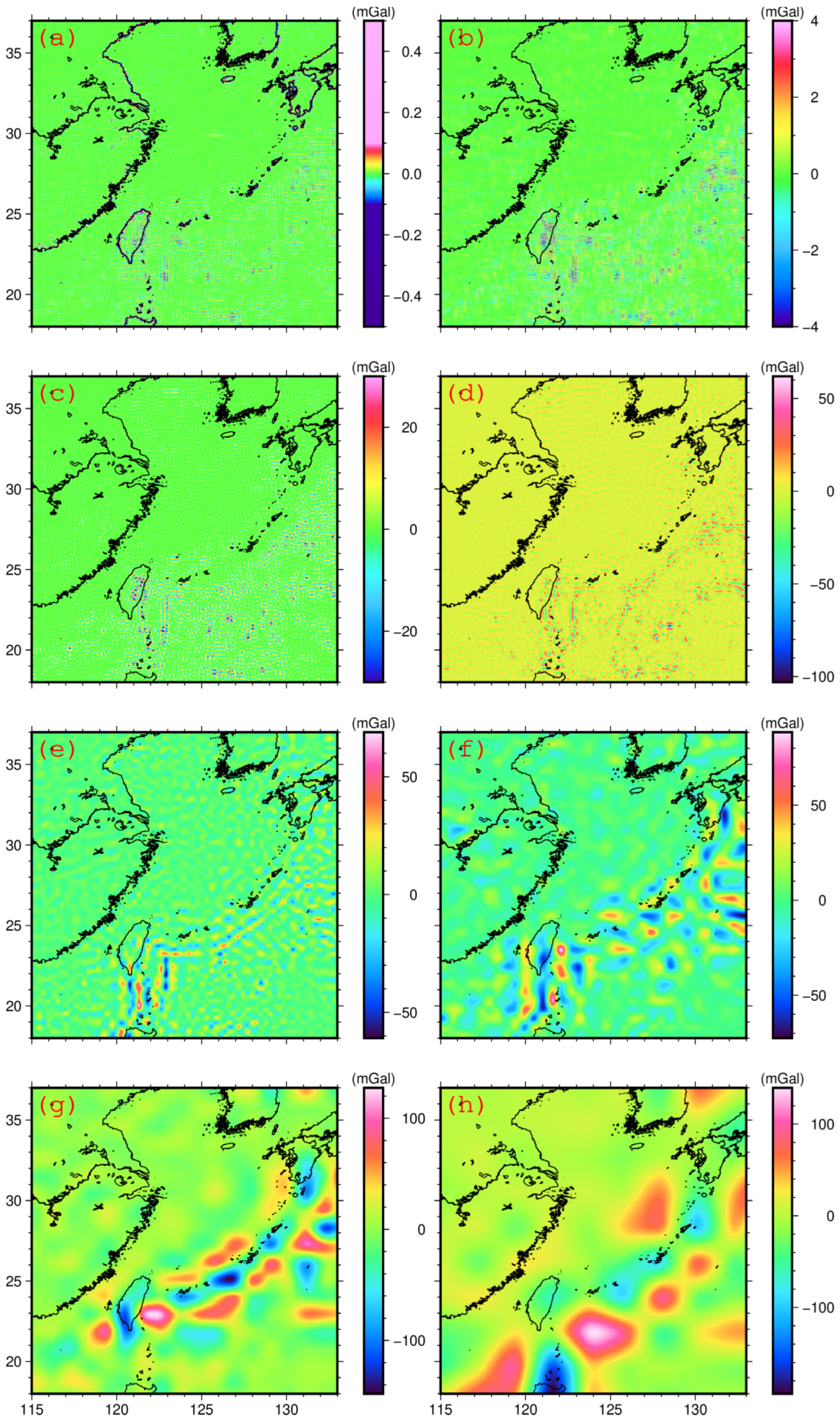
3.1. Wavelet Multi-Scale Analysis
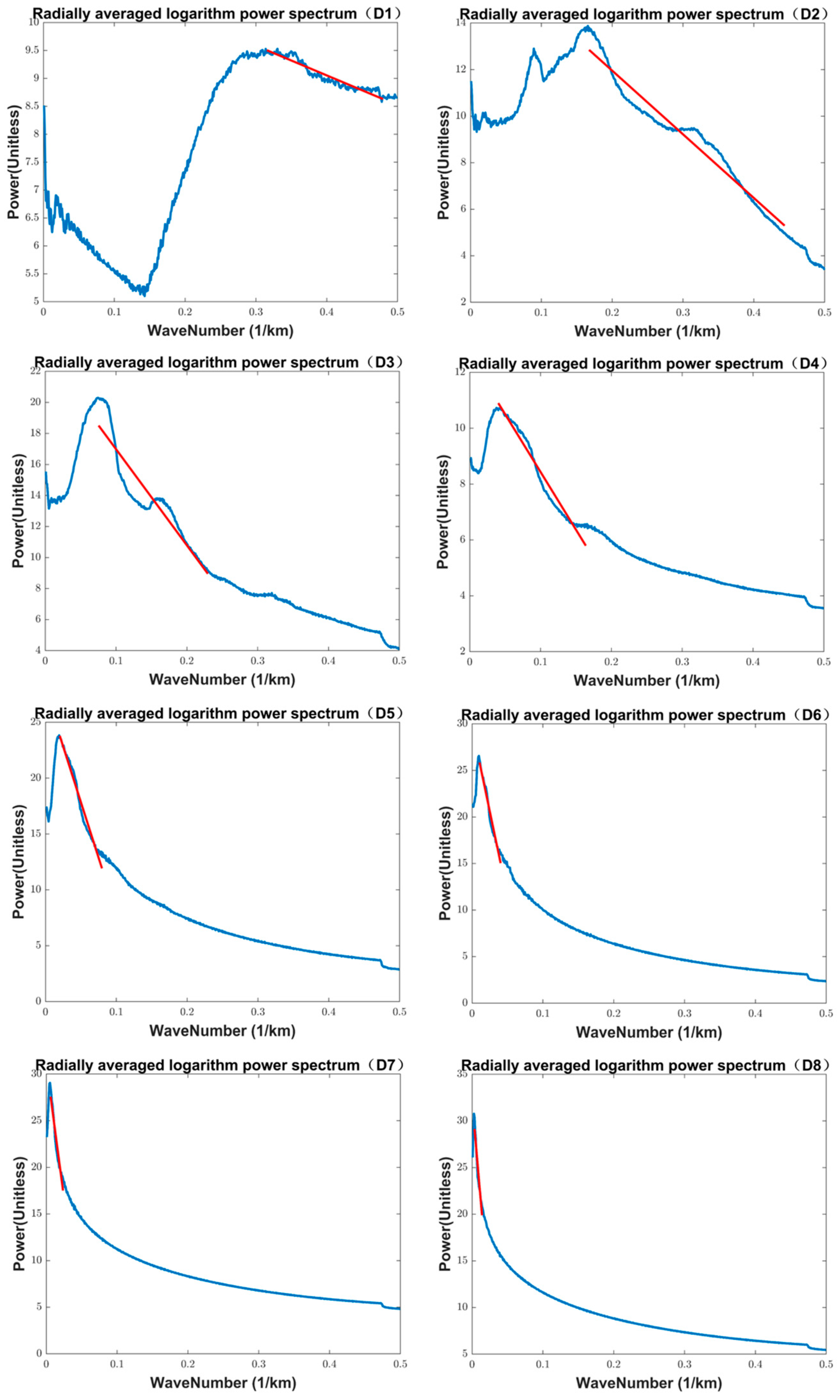
3.2. Radial Power Spectrum Method
3.3. Improved Bott’s Method
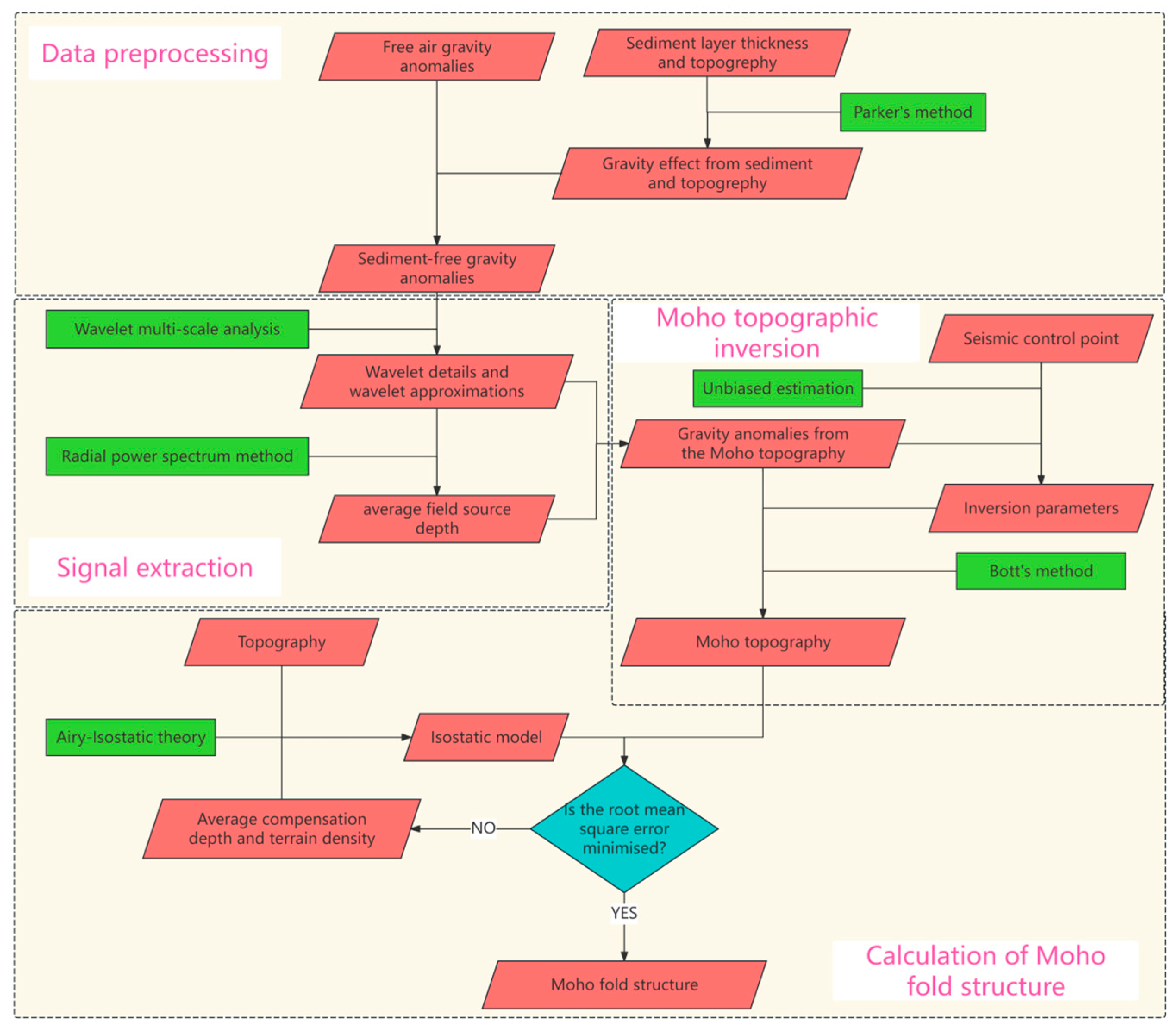
3.4. An Iterative Method for Moho Fold Structure
4. Results
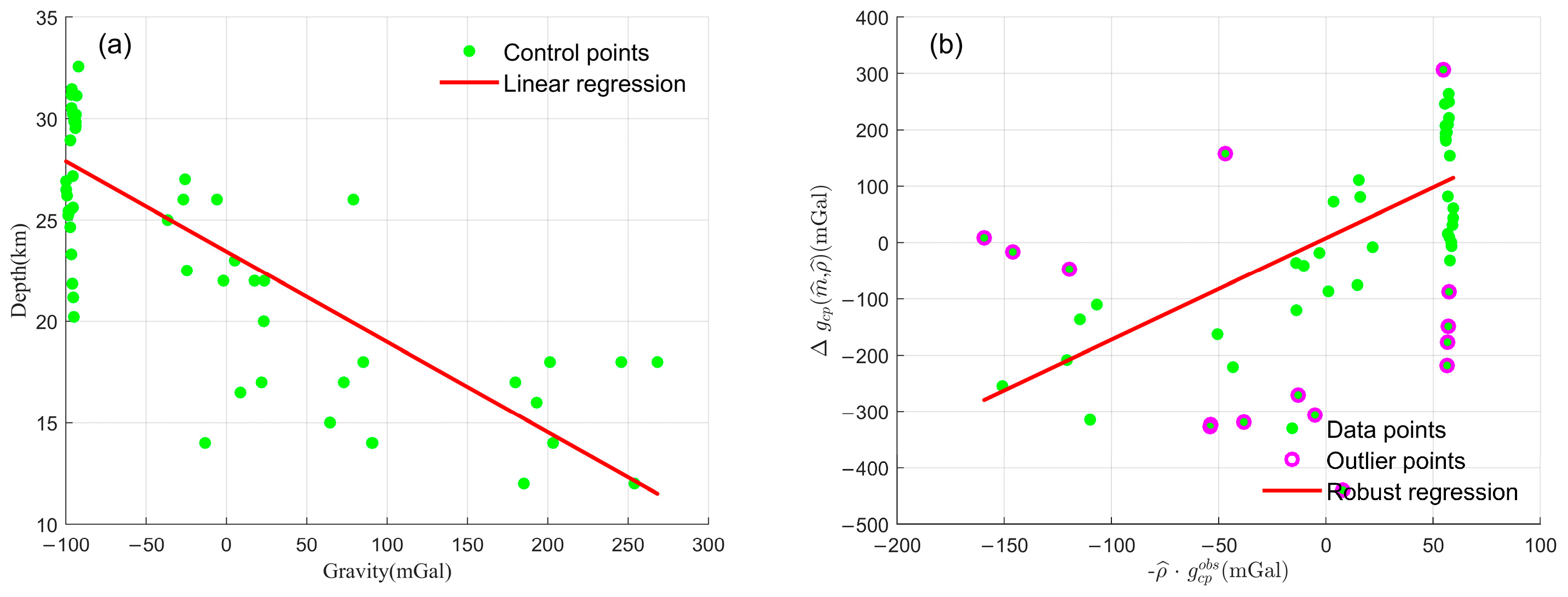
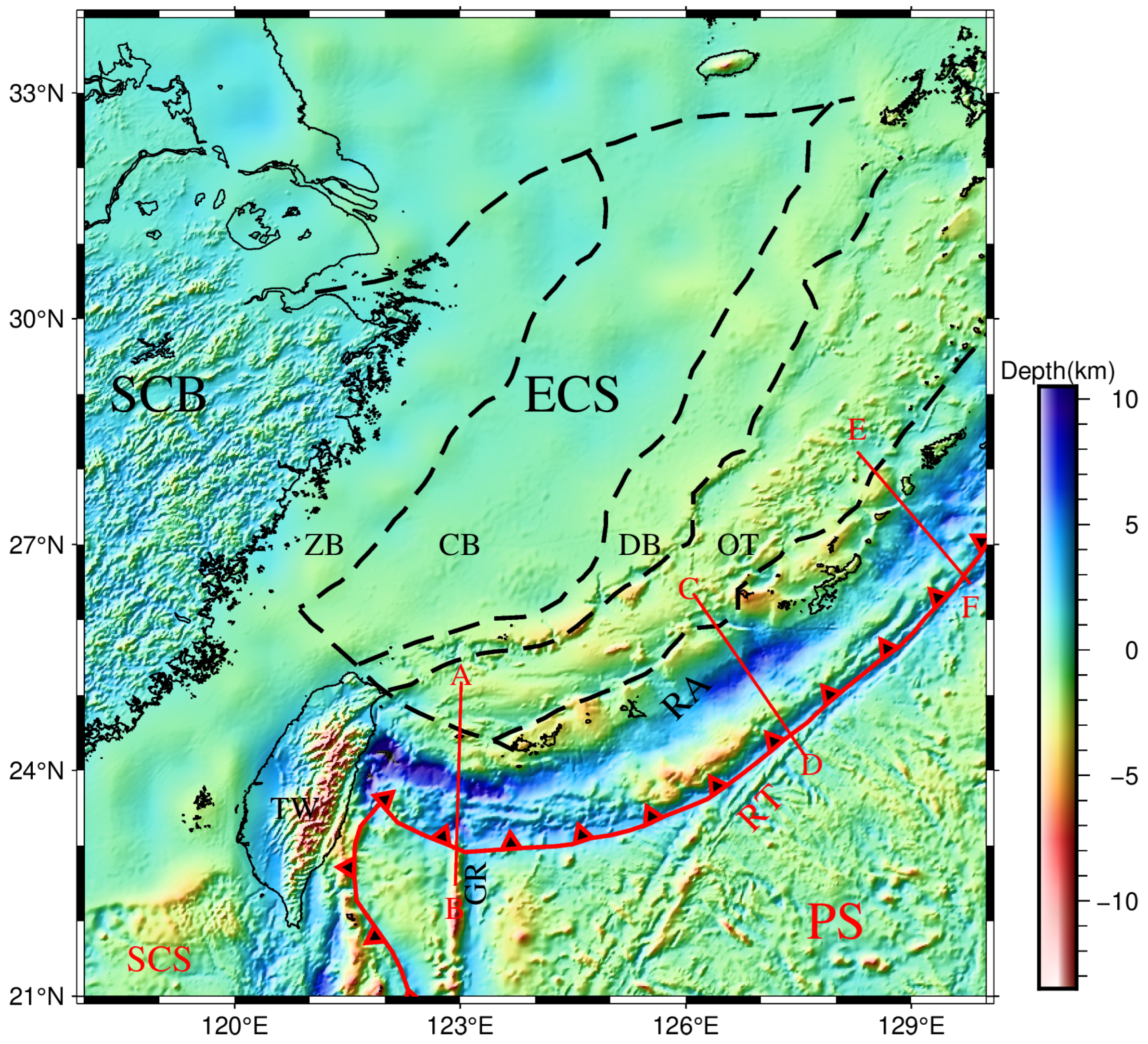
4.1. The Airy Isostatic Model
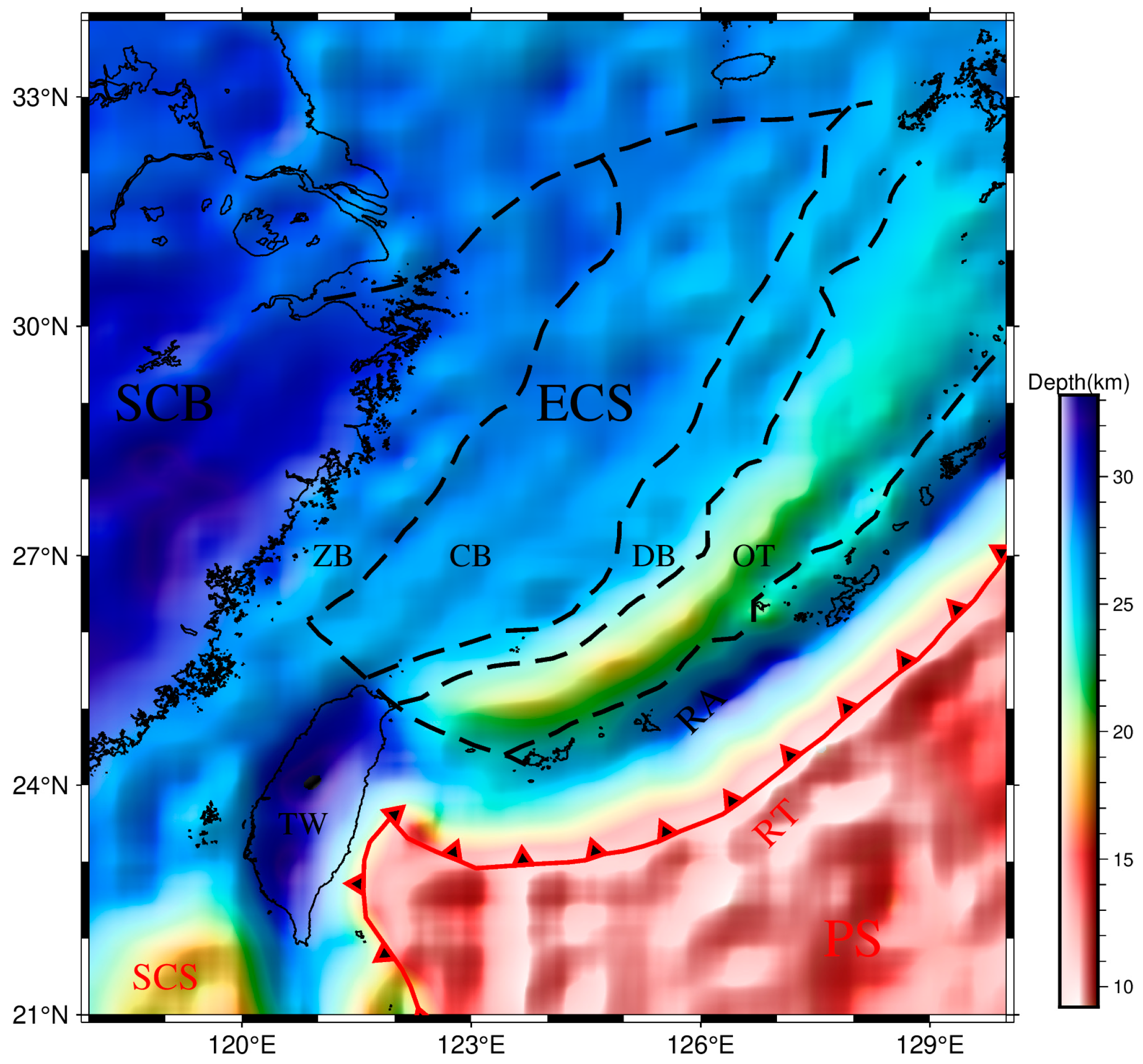
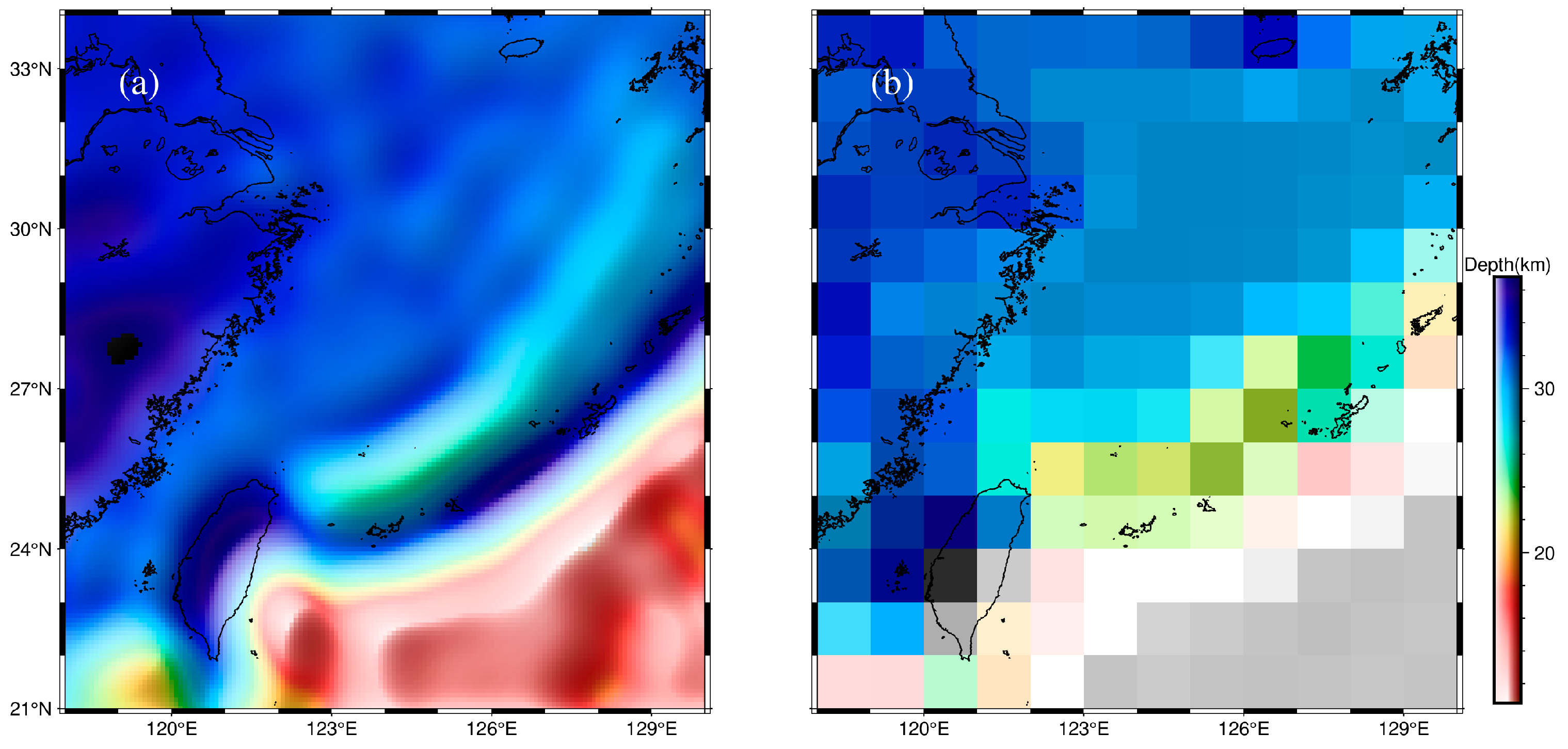
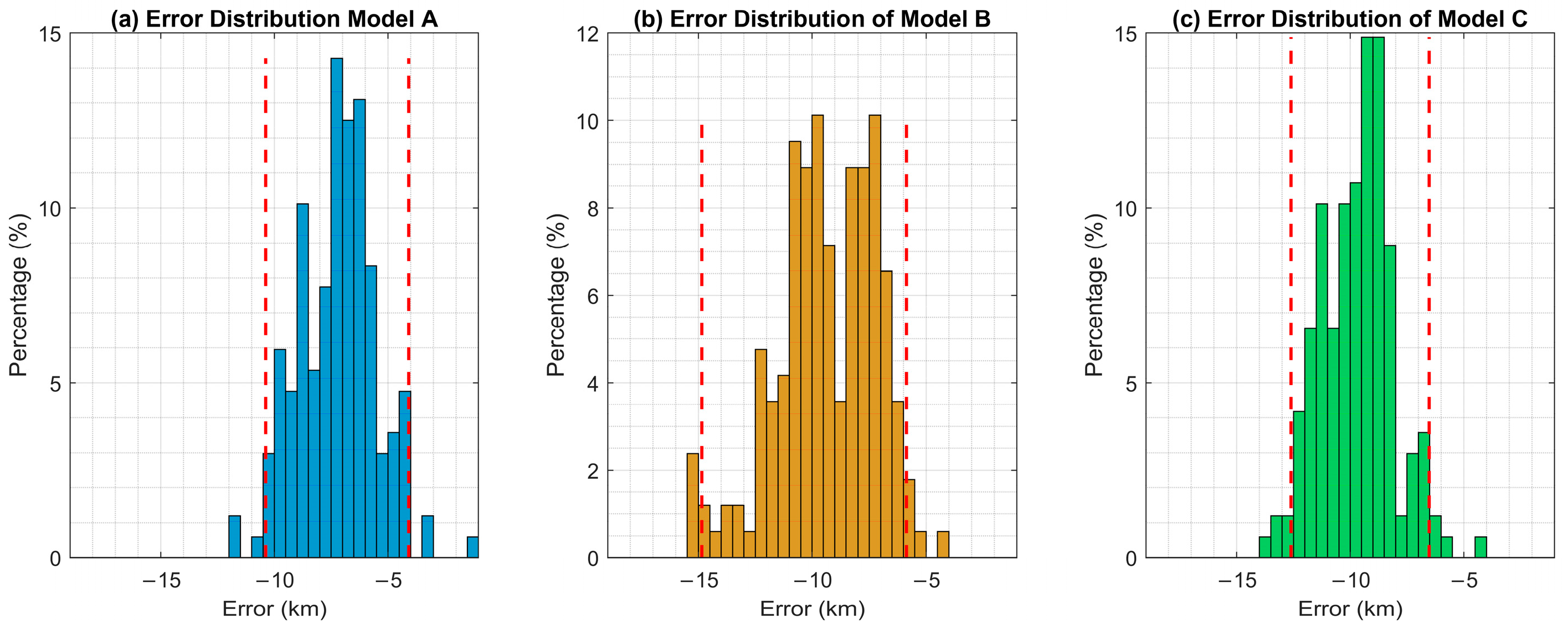
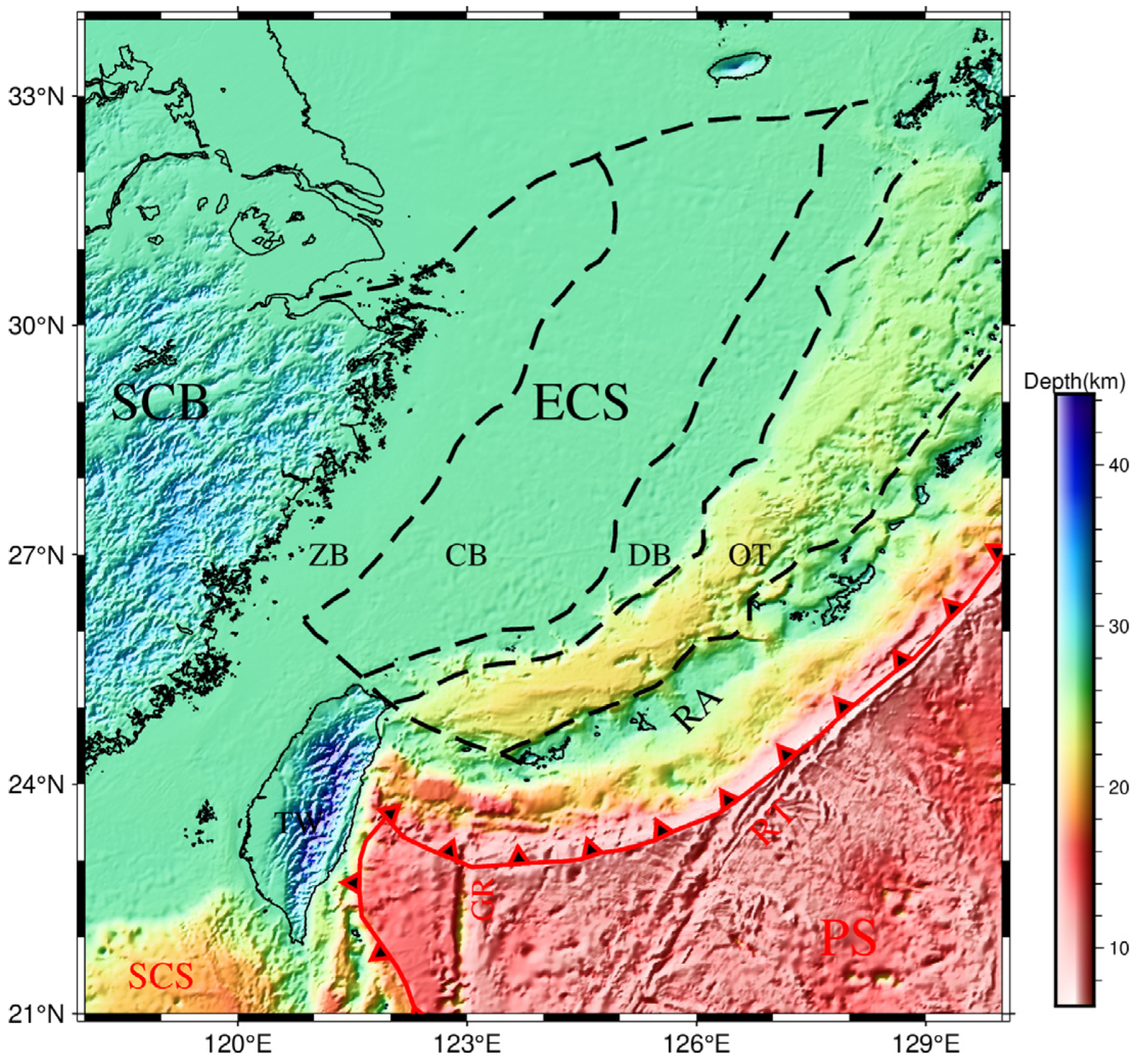
4.2. The Moho Topography of ECS
4.3. Moho Fold Structure in the ECS
5. Discussion
5.1. Influential Factors in Algorithms
5.2. Primary Stresses Within Different Regions
5.3. Profilic Structure of the Ryukyu Arc
6. Conclusions
- (1)
- There are traces of downward stress inside the South China Block, which is very consistent with the subduction of the palaeo-Pacific to the Eurasian Plate. The distribution of the Moho fold structure shows that the location of the palaeo-subduction zone is in the eastern coastal zone of the South China Block.
- (2)
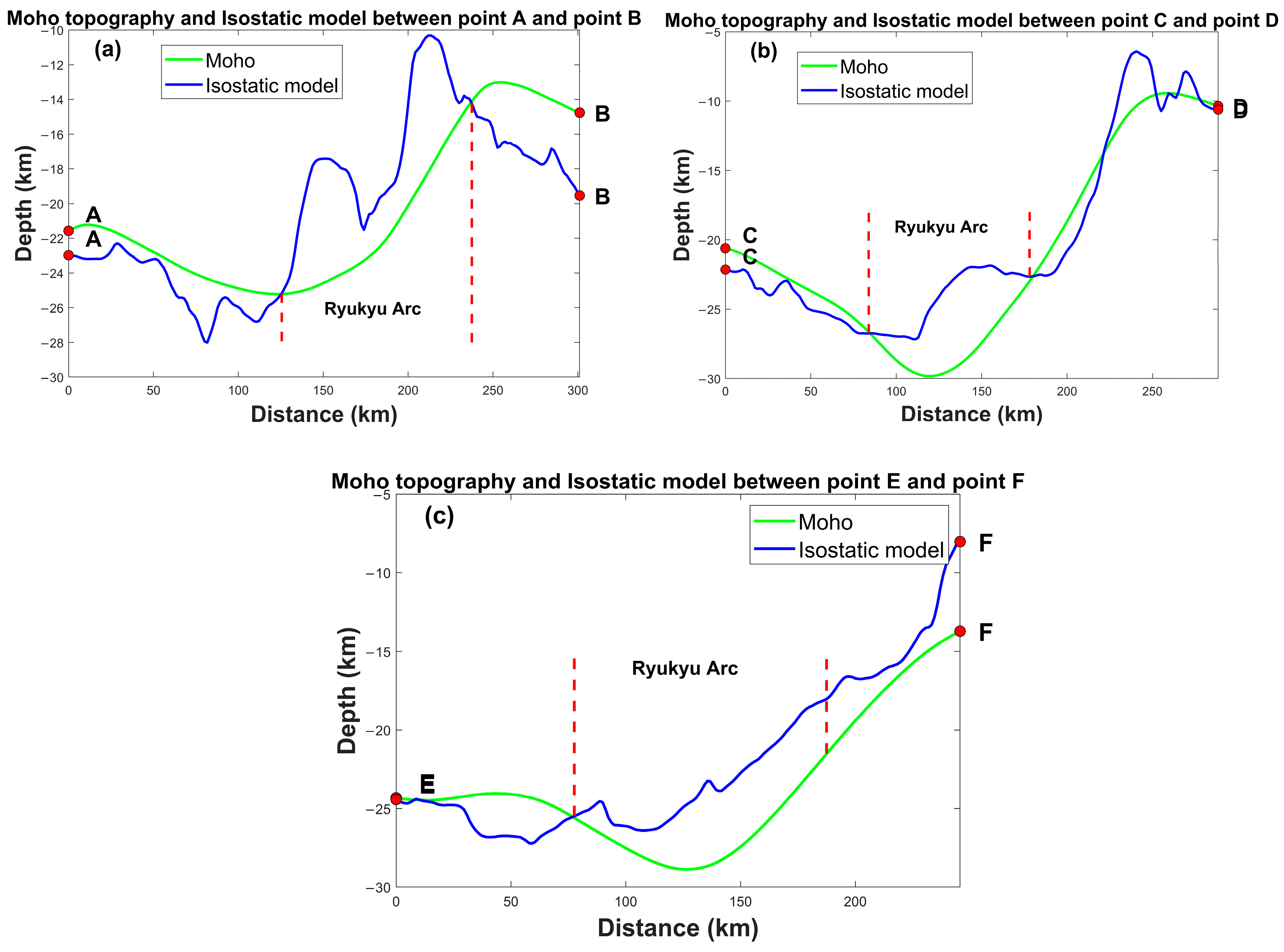
- In different regions of the Ryukyu Arc, the internal structures are subjected to different subduction vertical forces. The most exceptional of these is the southwestern part of the Ryukyu Arc (near Taiwan Island). Here, the Moho fold structure is the thickest, approaching 10 km. However, compared to other areas of the Ryukyu Arc, the crust here is the thinnest, with a Moho depth of about 25 km. In other words, the subduction vertical force is not dominant here, and therefore does not cause significant crustal thickening.
- (3)
- As a back-arc basin, the Moho topography of the Okinawa Trough is elevated, with depths ranging from 18 to 25 km. However, the Moho fold structure is almost non-existent here. This confirms the point that, in the absence of interplate stresses, it may be upwelling flow in the mantle that contributes to crustal thinning.
Author Contributions
Funding
Data Availability Statement
Acknowledgments
Conflicts of Interest
References
- Hilde, T.W.C.; Uyeda, S.; Kroenke, L. Evolution of the Western Pacific and Its Margin. Tectonophysics 1977, 38, 145–165. [Google Scholar] [CrossRef]
- Niu, Y.; Liu, Y.; Xue, Q.; Shao, F.; Chen, S.; Duan, M.; Guo, P.; Gong, H.; Hu, Y.; Hu, Z.; et al. Exotic Origin of the Chinese Continental Shelf: New Insights into the Tectonic Evolution of the Western Pacific and Eastern China since the Mesozoic. Sci. Bull. 2015, 60, 1598–1616. [Google Scholar] [CrossRef]
- Arai, R.; Kodaira, S.; Yuka, K.; Takahashi, T.; Miura, S.; Kaneda, Y. Crustal Structure of the Southern Okinawa Trough: Symmetrical Rifting, Submarine Volcano, and Potential Mantle Accretion in the Continental Back-Arc Basin. J. Geophys. Res. Solid Earth 2017, 122, 622–641. [Google Scholar] [CrossRef]
- Arai, R.; Takahashi, T.; Kodaira, S.; Kaiho, Y.; Nakanishi, A.; Fujie, G.; Nakamura, Y.; Yamamoto, Y.; Ishihara, Y.; Miura, S.; et al. Structure of the Tsunamigenic Plate Boundary and Low-Frequency Earthquakes in the Southern Ryukyu Trench. Nat. Commun. 2016, 7, 12255. [Google Scholar] [CrossRef] [PubMed]
- Wei, X.; Ding, W.; Christeson, G.L.; Li, J.; Ruan, A.; Niu, X.; Zhang, J.; Zhang, Y.; Tan, P.; Wu, Z.; et al. Mesozoic Suture Zone in the East China Sea: Evidence from Wide-Angle Seismic Profiles. Tectonophysics 2021, 820, 229116. [Google Scholar] [CrossRef]
- Nishizawa, A.; Kaneda, K.; Oikawa, M.; Horiuchi, D.; Fujioka, Y.; Okada, C. Seismic Structure of Rifting in the Okinawa Trough, an Active Backarc Basin of the Ryukyu (Nansei-Shoto) Island Arc–Trench System. Earth Planets Space 2019, 71, 21. [Google Scholar] [CrossRef]
- Xuan, S.; Jin, S.; Chen, Y. Determination of the Isostatic and Gravity Moho in the East China Sea and Its Implications. J. Asian Earth Sci. 2020, 187, 104098. [Google Scholar] [CrossRef]
- Parker, R.L. The Rapid Calculation of Potential Anomalies. Geophys. J. Int. 1973, 31, 447–455. [Google Scholar] [CrossRef]
- Oldenburg, D.W. The inversion and interpretation of gravity anomalies. Geophysics 1974, 39, 526–536. [Google Scholar] [CrossRef]
- Chen, Z.; Xu, G.; Kubeka, Z.O. The Crustal Structure Inferred from Gravity Data and Seismic Profiles beneath the Okinawa Trough in the Western Pacific. J. Asian Earth Sci. 2022, 238, 105375. [Google Scholar] [CrossRef]
- Xue, Z.; Guo, D.; Fang, J.; Cui, R. Constrained Gravity Inversion Unravels the Moho Depth and Tectonic Patterns in China and Its Adjacent Areas. Earth Planet. Phys. 2025, 9, 799–816. [Google Scholar] [CrossRef]
- Jin, Y.; McNutt, M.K.; Zhu, Y. Evidence from Gravity and Topography Data for Folding of Tibet. Nature 1994, 371, 669–674. [Google Scholar] [CrossRef]
- Shin, Y.H.; Shum, C.-K.; Braitenberg, C.; Lee, S.M.; Xu, H.; Choi, K.S.; Baek, J.H.; Park, J.U. Three-Dimensional Fold Structure of the Tibetan Moho from GRACE Gravity Data. Geophys. Res. Lett. 2009, 36, L01302. [Google Scholar] [CrossRef]
- Gao, S.-H.; She, Y.-W.; Fu, G.-Y. A New Method for Computing the Vertical Tectonic Stress of the Crust by Use of Hybrid Gravity and GPS Data. Chin. J. Geophys. 2016, 59, 2006–2013. [Google Scholar]
- Zingerle, P.; Pail, R.; Gruber, T.; Oikonomidou, X. The Combined Global Gravity Field Model XGM2019e. J. Geod. 2020, 94, 66. [Google Scholar] [CrossRef]
- Amante, C.; Eakins, B.W. ETOPO1 1 Arc-Minute Global Relief Model: Procedures, Data Sources and Analysis. US Department of Commerce, National Oceanic and Atmospheric Administration, National Environmental Satellite, Data, and Information Service, National Geophysical Data Center. Mar. Geol. Geophys. Div. 2009, 19. [Google Scholar]
- Straume, E.O.; Gaina, C.; Medvedev, S.; Hochmuth, K.; Gohl, K.; Whittaker, J.M.; Fattah, R.A.; Doornenbal, J.C.; Hopper, J.R. GlobSed: Updated Total Sediment Thickness in the World’s Oceans. Geochem. Geophys. Geosystems 2019, 20, 1756–1772. [Google Scholar] [CrossRef]
- Mallat, S.G. A Theory for Multiresolution Signal Decomposition: The Wavelet Representation. IEEE Trans. Pattern Anal. Mach. Intell. 1989, 11, 674–693. [Google Scholar] [CrossRef]
- Jiang, W.; Zhang, J.; Tian, T.; Wang, X. Crustal Structure of Chuan-Dian Region Derived from Gravity Data and Its Tectonic Implications. Phys. Earth Planet. Inter. 2012, 212, 76–87. [Google Scholar] [CrossRef]
- Xu, C.; Liu, Z.; Luo, Z.; Wu, Y.; Wang, H. Moho Topography of the Tibetan Plateau Using Multi-Scale Gravity Analysis and Its Tectonic Implications. J. Asian Earth Sci. 2017, 138, 378–386. [Google Scholar] [CrossRef]
- Yu, H.; Wen, M.; Xu, C. Inversion of Moho topography in Taiwan using improved Parker-Oldenburg method. Front. Earth Sci. 2025, 13, 1592768. [Google Scholar] [CrossRef]
- Spector, A.; Grant, F.S. Statistical models for interpreting aeromagnetic data. Geophysics 1970, 35, 293–302. [Google Scholar] [CrossRef]
- Syberg, F.J.R. A Fourier method for the regional-residual problem of potential fields. Geophys. Prospect. 1972, 20, 47–75. [Google Scholar] [CrossRef]
- Cianciara, B.; Marcak, H. Interpretation of gravitv anomalies by means of local power spectra. Geophys. Prospect. 1976, 24, 273–286. [Google Scholar] [CrossRef]
- Xu, C.; Luo, Z.; Sun, R.; Zhou, H.; Wu, Y. Multilayer densities using a wavelet-based gravity method and their tectonic implications beneath the Tibetan Plateau. Geophys. J. Int. 2018, 213, 2085–2095. [Google Scholar] [CrossRef]
- Laske, G.; Masters, G.; Ma, Z.; Pasyanos, M. Update on CRUST1. 0—A 1-Degree Global Model of Earth’s Crust. In Proceedings of the Geophysical Research Abstracts; Copernicus GmbH: Göttingen, Germany, 2013; Volume 15, p. 2658. [Google Scholar]
- Li, J.; Xu, C.; Chen, H. An Improved Method to Moho Depth Recovery From Gravity Disturbance and Its Application in the South China Sea. J. Geophys. Res. Solid Earth 2022, 127, e2022JB024536. [Google Scholar] [CrossRef]
- Holland, P.W.; Welsch, R.E. Robust Regression Using Iteratively Reweighted Least-Squares. Commun. Stat. Theory Methods 1977, 6, 813–827. [Google Scholar] [CrossRef]
- Bott, M.H.P. The Use of Rapid Digital Computing Methods for Direct Gravity Interpretation of Sedimentary Basins. Geophys. J. Int. 1960, 3, 63–67. [Google Scholar] [CrossRef]
- Cordell, L.; Henderson, R.G. Iterative three-dimensional solution of gravity anomaly data using a digital computer. Geophysics 1968, 33, 596–601. [Google Scholar] [CrossRef]
- Yang, T.; Cao, D.; Du, N.; Cui, R.; Nan, F.; Xu, Y.; Liang, C. Prediction of Shear-Wave Velocity Using Receiver Functions Based on the Deep Learning Method. Chin. J. Geophys. 2022, 65, 214–226. [Google Scholar]
- Qi, J.; Zhang, X.; Wu, Z.; Meng, X.; Shang, L.; Li, Y.; Guo, X.; Hou, F.; He, E.; Wang, Q. Characteristics of crustal variation and extensional break-up in the Western Pacific back-arc region based on a wide-angle seismic profile. Geosci. Front. 2021, 12, 101082. [Google Scholar] [CrossRef]
- Li, J.; Xu, C.; He, H.; Zhu, F.; Li, Y.; Sun, H. Modified Bott-Parker method for gravimetric Moho modeling. Geophysics 2025, 90, G59–G72. [Google Scholar] [CrossRef]
- Shin, Y.H.; Shum, C.K.; Braitenberg, C.; Lee, S.M.; Na, S.; Choi, K.S.; Hsu, H.; Park, Y.; Lim, M. Moho topography, ranges and folds of Tibet by analysis of global gravity models and GOCE data. Sci. Rep. 2015, 5, 11681. [Google Scholar] [CrossRef] [PubMed]



| Layer | Average Depth (km) | Range of Depth (km) |
|---|---|---|
| D1 | 0.42 | 0.0~0.84 |
| D2 | 2.18 | 0.84~3.52 |
| D3 | 4.93 | 3.52~6.34 |
| D4 | 8.22 | 6.34~10.1 |
| D5 | 15.84 | 10.1~21.58 |
| D6 | 28.88 | 21.58~36.18 |
| D7 | 45.72 | 36.18~55.26 |
| D8 | 70.08 | 55.26~84.9 |
| Moho Models | Compare Objects | 95% Confidence Interval (km) | STD (km) | RMS (km) |
|---|---|---|---|---|
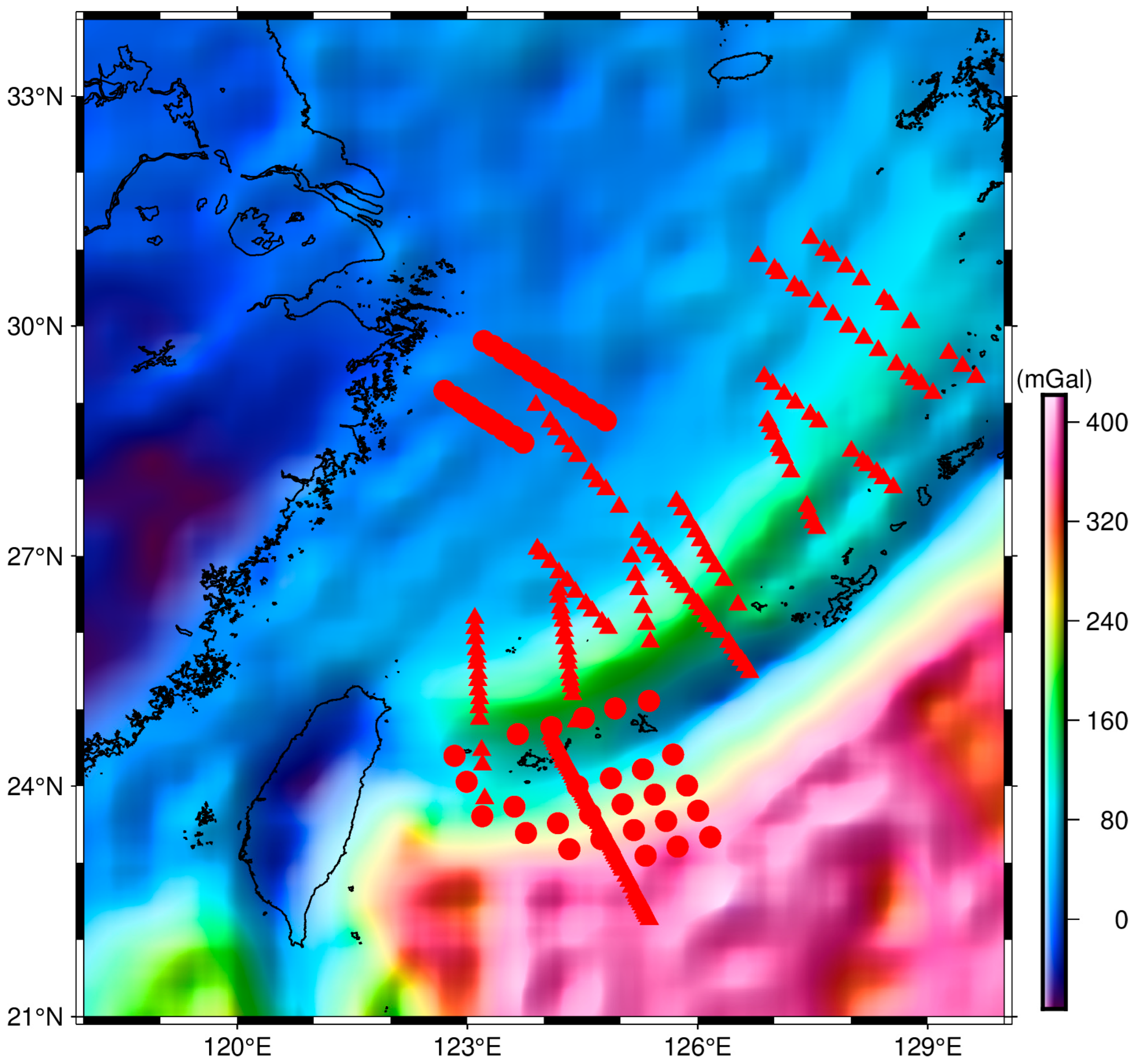
| CRUST 1.0 | All seismic points | [−9.71, 8.27] | 4.45 | 4.62 |
| Xuan et al. [7] | [−0.77, 11.83] | 3.49 | 6.59 | |
| This paper | [−5.22, 6.95] | 3.21 | 3.26 |
Disclaimer/Publisher’s Note: The statements, opinions and data contained in all publications are solely those of the individual author(s) and contributor(s) and not of MDPI and/or the editor(s). MDPI and/or the editor(s) disclaim responsibility for any injury to people or property resulting from any ideas, methods, instructions or products referred to in the content. |
© 2026 by the authors. Licensee MDPI, Basel, Switzerland. This article is an open access article distributed under the terms and conditions of the Creative Commons Attribution (CC BY) license.
Share and Cite
Yu, H.; Xu, C.; Wen, M.; Wu, C. Moho Fold Structure Beneath the East China Sea and Its Tectonic Implications. Remote Sens. 2026, 18, 385. https://doi.org/10.3390/rs18030385
Yu H, Xu C, Wen M, Wu C. Moho Fold Structure Beneath the East China Sea and Its Tectonic Implications. Remote Sensing. 2026; 18(3):385. https://doi.org/10.3390/rs18030385
Chicago/Turabian StyleYu, Hangtao, Chuang Xu, Mingming Wen, and Chunhong Wu. 2026. "Moho Fold Structure Beneath the East China Sea and Its Tectonic Implications" Remote Sensing 18, no. 3: 385. https://doi.org/10.3390/rs18030385
APA StyleYu, H., Xu, C., Wen, M., & Wu, C. (2026). Moho Fold Structure Beneath the East China Sea and Its Tectonic Implications. Remote Sensing, 18(3), 385. https://doi.org/10.3390/rs18030385