Long-Term Dynamics and Transitions of Surface Water Extent in the Dryland Wetlands of Central Asia Using a Hybrid Ensemble–Occurrence Approach


Highlights
- First seasonally explicit, multi-decadal (2000–2024) mapping of Ile River Delta (IRD) wetlands
- Multi-index ensemble with dynamic thresholds improves water classification accuracy
- Periodic and ephemeral surface water extent (SWE) dominates; stable SWE covers only 12% of IRD
- Significant summer–fall declines driven by reservoir regulation and warming
- Findings support transboundary water cooperation that explicitly includes environmental flow allocations to protect downstream wetland extent, connectivity, and biodiversity.
- Evidence indicates reservoir and irrigation management should be coordinated basin-wide to better mimic natural seasonal flow regimes and reduce summer to fall wetland contraction.
- Results highlight urgent need for Conservation and Transboundary Cooperation in Arid Central Asia (ACA)
Abstract
1. Introduction
2. Materials and Methods
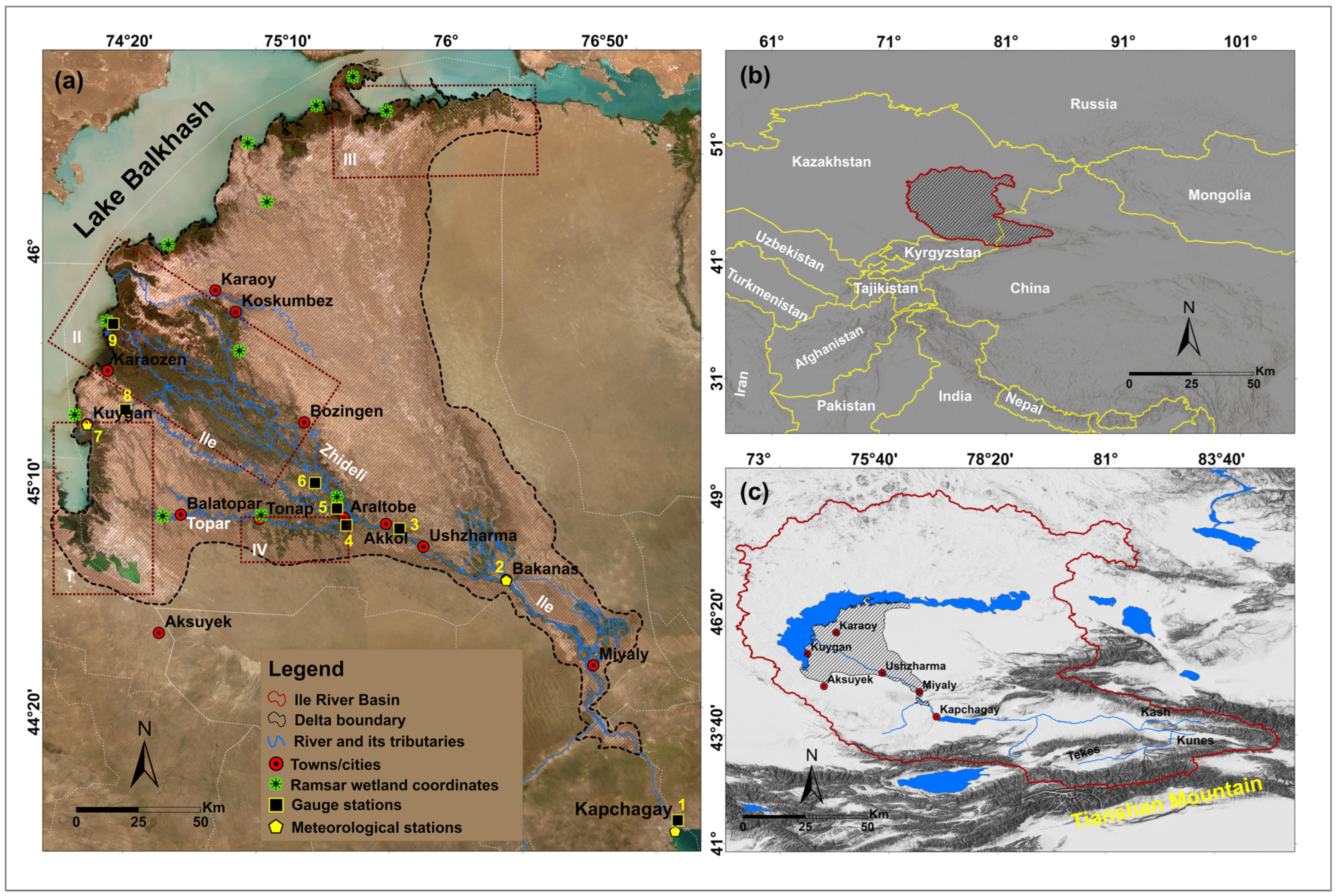
2.1. Study Area
2.2. Datasets
2.2.1. Satellite Imagery
2.2.2. Hydrological Datasets
2.2.3. Meteorological Datasets
2.3. Methods
2.3.1. Rationale for Data Selection and Temporal Window
2.3.2. Index-Wise Water Mapping with Dynamic Otsu Thresholding
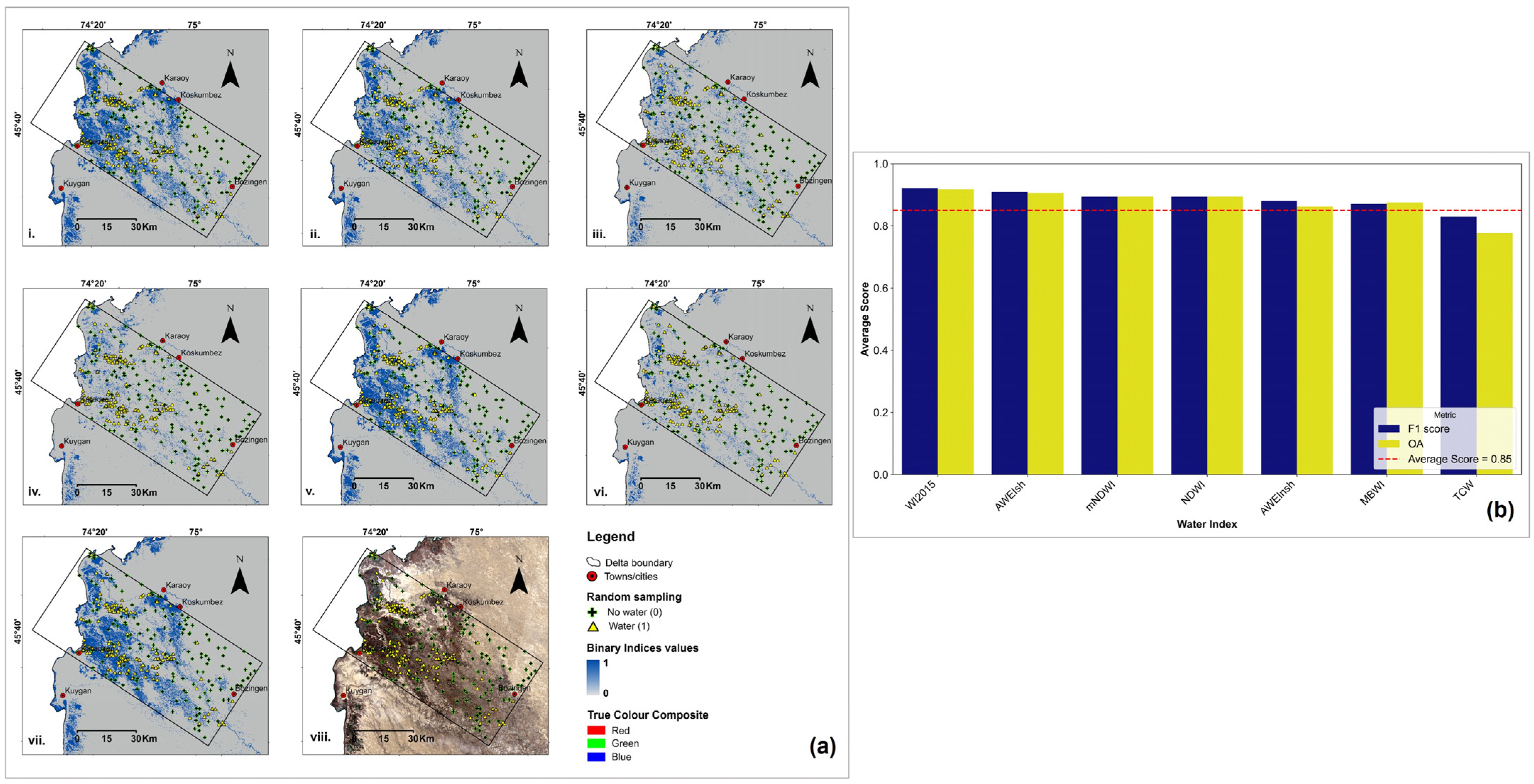
2.3.3. Accuracy Assessment of Selected Spectral Water Indices
2.3.4. Ensemble Agreement Logic for Present-Day SWE Mapping
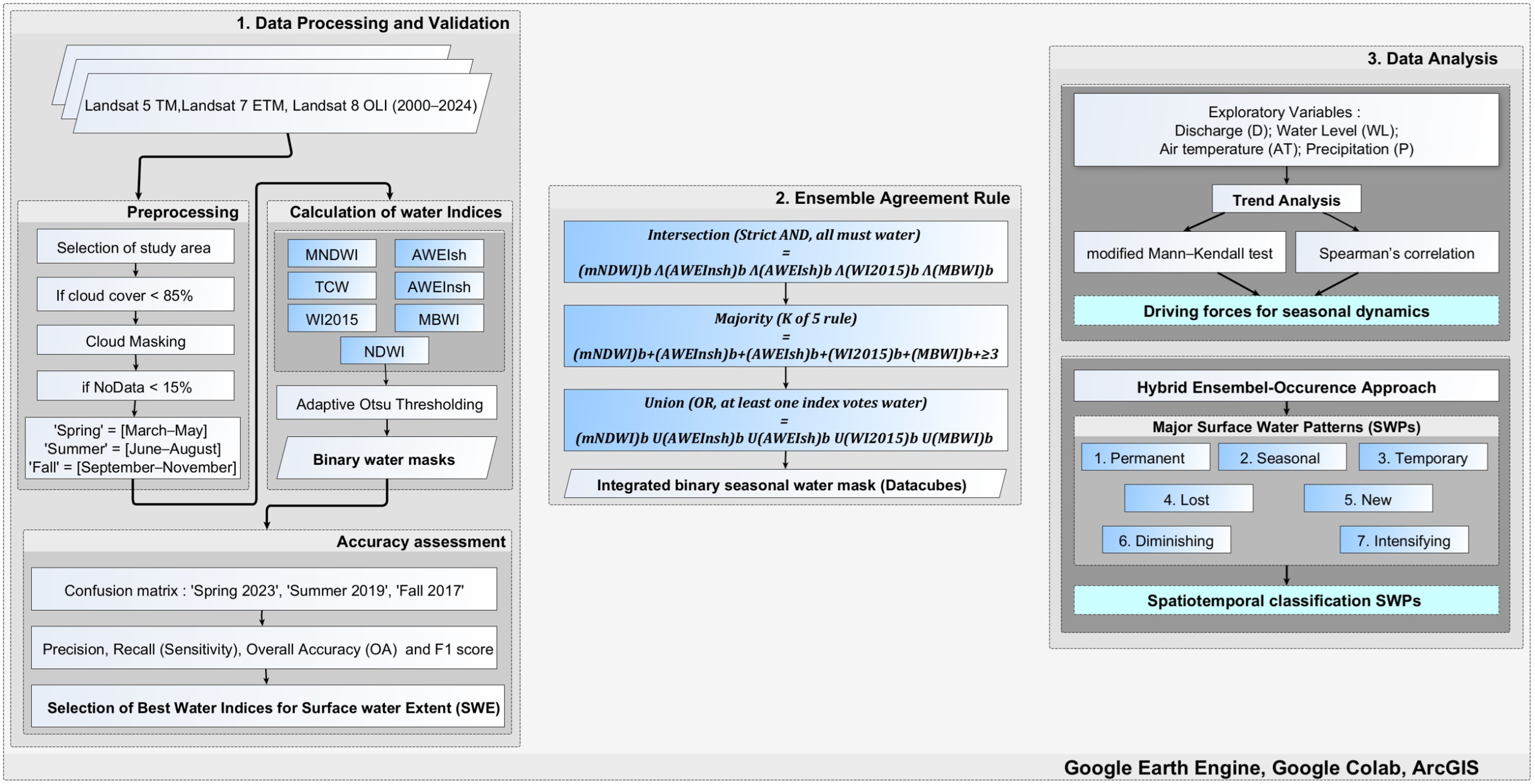
- Intersection (AND) rule
- 2.
- Majority voting (t-of-5, t = 3) rule
- 3.
- Union (OR) rule
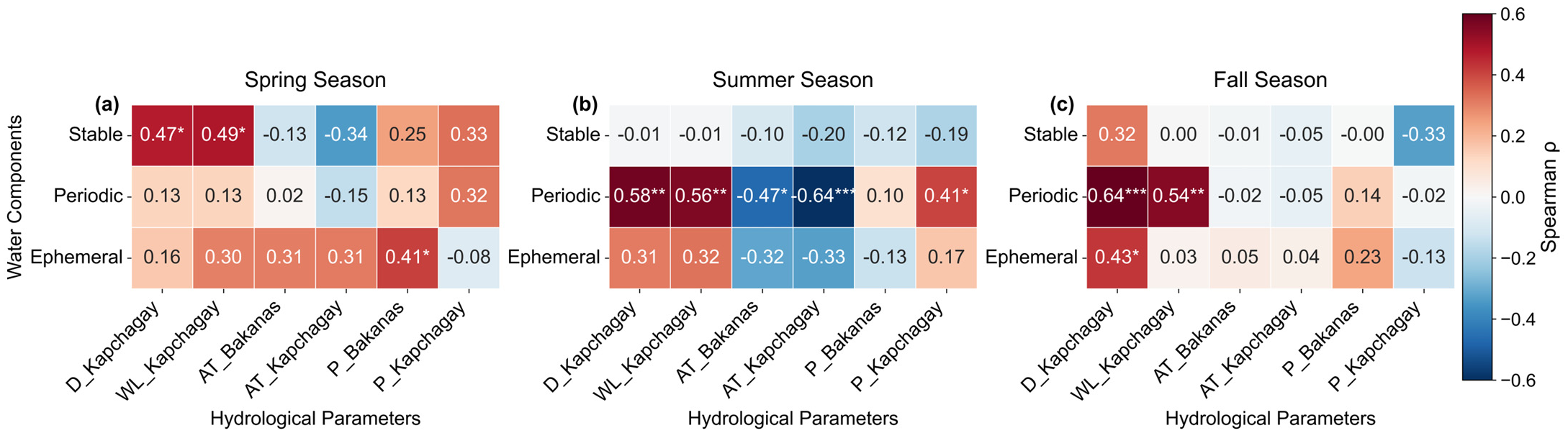
- Stable SWE (): pixels that belong to the intersection ensemble (Wint), i.e., classified as water by all selected indices in a given season. These represent the most persistent and spectrally robust surface water areas.
- Periodic SWE (): pixels that occur in the majority ensemble (Wmaj) but not in the intersection (Wint). They are mapped as water by the majority of indices, indicating regularly inundated zones with higher spectral variability (e.g., partly vegetated or shallow water).
- Ephemeral SWE (): pixels that occur only in the union ensemble (Wuni) and not in the majority (Wmaj), i.e., detected as water by at least one index but not by most. These correspond to occasional or short-lived inundation, or spectrally ambiguous fringe waters.
2.3.5. SWE Seasonal Trends and Correlation with Hydroclimatic Parameters
2.3.6. Hybrid Ensemble–Occurrence Analysis of SWE Transitions
3. Results
3.1. Accuracy Assessment of Seasonal Indices
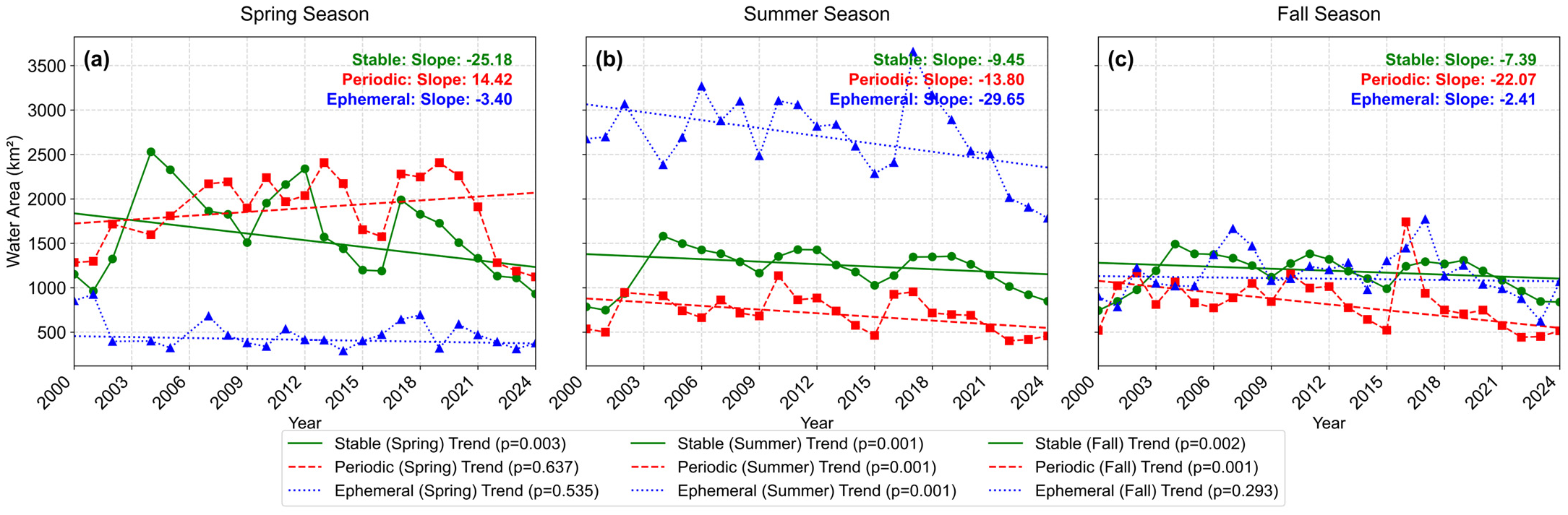
3.2. Temporal Dynamics and Long-Term Trends of Seasonal SWEs (2000–2024)
3.3. Correlation Between Seasonal SWE and Hydroclimatic Drivers
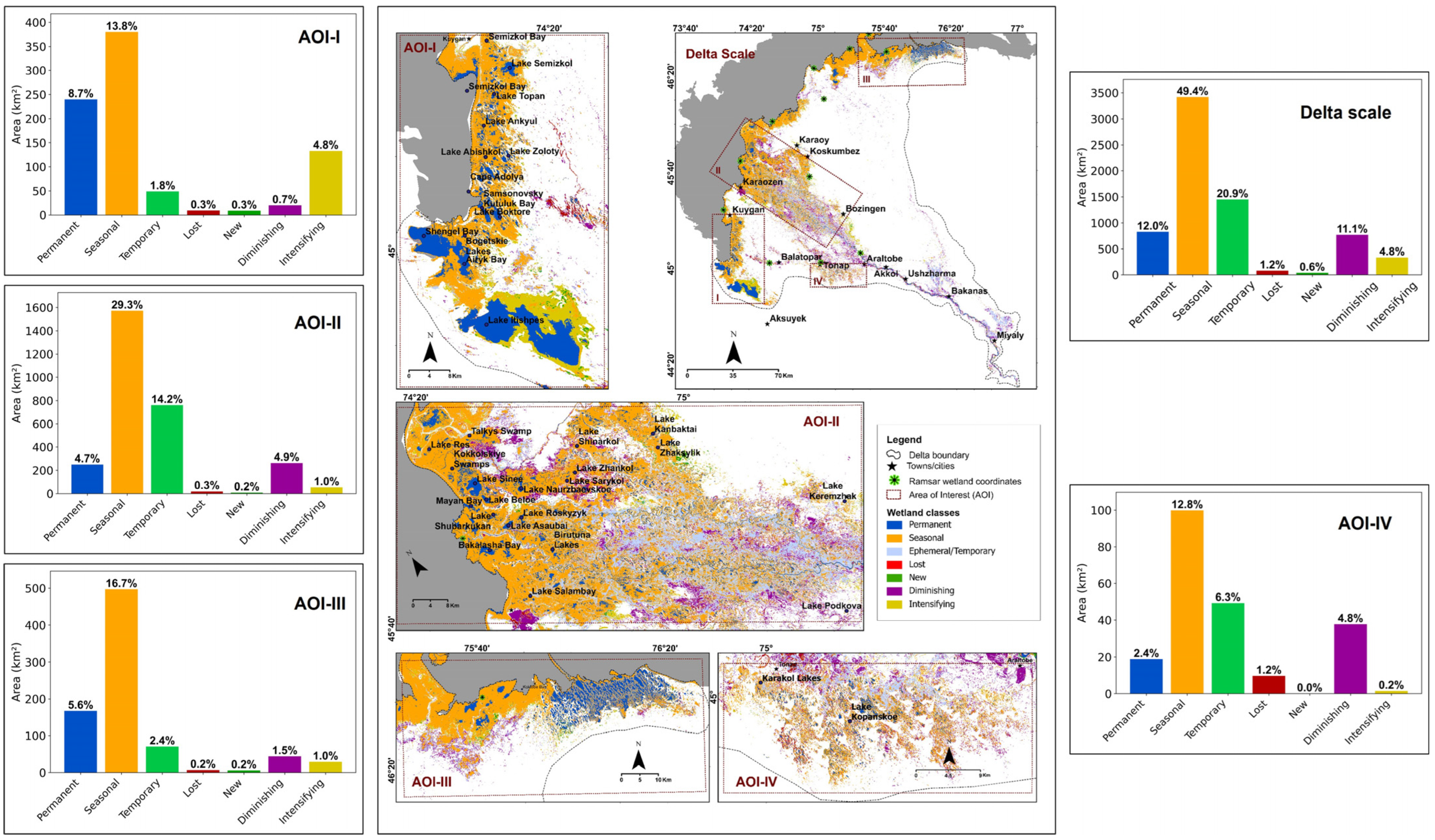
3.4. Spatial Patterns of Wetlands and Their Main Hydrological Controls
4. Discussion
4.1. Progress and Challenges in Spatio-Temporal Monitoring
4.2. Multi-Scale Factors and Controls of SWE Dynamics
4.3. Implications for the Management and Restoration of the Wetlands
5. Conclusions
Supplementary Materials
Author Contributions
Funding
Data Availability Statement
Acknowledgments
Conflicts of Interest
Abbreviations
| ACA | Arid Central Asia |
| IRD | Ile River Delta |
| SWE | Surface Water Extent |
| WL | Water Level |
| AT | Air Temperature |
| D | Discharge |
| P | Precipitation |
| AOI | Area of Interest |
| NDWI | Normalized Difference Water Index |
| TCW | Tasselled Cap Wetness Index |
| AWEI | Automated Water Extraction Index |
| MBWI | Multi-Band Water Index |
References
- Burrell, A.L.; Evans, J.P.; De Kauwe, M.G. Anthropogenic climate change has driven over 5 million km2 of drylands towards desertification. Nat. Commun. 2020, 11, 3853. [Google Scholar] [CrossRef] [PubMed]
- Karthe, D. Environmental Changes in Central and East Asian Drylands and their Effects on Major River-Lake Systems. Quat. Int. 2018, 475, 91–100. [Google Scholar] [CrossRef]
- Stringer, L.C.; Mirzabaev, A.; Benjaminsen, T.A.; Harris, R.M.B.; Jafari, M.; Lissner, T.K.; Stevens, N.; Tirado-von der Pahlen, C. Climate change impacts on water security in global drylands. One Earth 2021, 4, 851–864. [Google Scholar] [CrossRef]
- Chen, J.; Ouyang, Z.; John, R.; Henebry, G.M.; Groisman, P.Y.; Karnieli, A.; Pueppke, S.; Kussainova, M.; Amartuvshin, A.; Tulobaev, A.; et al. Social-Ecological Systems Across the Asian Drylands Belt (ADB). In Landscape Dynamics of Drylands Across Greater Central Asia: People, Societies and Ecosystems; Springer: Cham, Switzerland, 2020; pp. 191–225. [Google Scholar]
- Tooth, S.; Grenfell, M.C.; Thomas, A.; Ellery, W. Wetlands in Drylands: ‘Hotspots’ of Ecosystem Services in Marginal Environments; GSDR 2015 Science Brief; United Nations: New York, NY, USA, 2015; pp. 1–4. Available online: https://sdgs.un.org/documents/brief-gsdr-2015-wetlands-drylands-ahot-20750 (accessed on 15 January 2026).
- Imentai, A.; Thevs, N.; Schmidt, S.; Nurtazin, S.; Salmurzauli, R. Vegetation, fauna, and biodiversity of the Ile Delta and southern Lake Balkhash—A review. J. Great Lakes Res. 2015, 41, 688–696. [Google Scholar] [CrossRef]
- Thevs, N.; Beckmann, V.; Nurtazin, S.; Salmuzauli, R.; Baibaysov, A.; Akimalieva, A.; Baranoeski, E.A.A.; Schäpe, T.L.; Röttgers, H.; Tychkov, N. Ecosystem service assessment of the Ili Delta, Kazakhstan. Environ. Earth Sci. 2017, 7, 14–25. [Google Scholar]
- IPCC. Climate Change 2023: Synthesis Report. Contribution of Working Groups I, II and III to the Sixth Assessment Report of the Intergovernmental Panel on Climate Change; Lee , H., Romero, J., Eds.; IPCC: Geneva, Switzerland, 2023; p. 184. Available online: https://www.ipcc.ch/report/ar6/syr/ (accessed on 15 January 2026). [CrossRef]
- Kovács, G.M.; Horion, S.; Fensholt, R. Characterizing ecosystem change in wetlands using dense earth observation time series. Remote Sens. Environ. 2022, 281, 113267. [Google Scholar] [CrossRef]
- Bishop-Taylor, R.; Tulbure, M.G.; Broich, M. Impact of hydroclimatic variability on regional-scale landscape connectivity across a dynamic dryland region. Ecol. Indic. 2018, 94, 142–150. [Google Scholar] [CrossRef]
- Gaines, M.D.; Tulbure, M.G.; Perin, V. Effects of Climate and Anthropogenic Drivers on Surface Water Area in the Southeastern United States. Water Resour. Res. 2022, 58, e2021WR031484. [Google Scholar] [CrossRef]
- Halabisky, M.; Moskal, L.M.; Gillespie, A.; Hannam, M. Reconstructing semi-arid wetland surface water dynamics through spectral mixture analysis of a time series of Landsat satellite images (1984–2011). Remote Sens. Environ. 2016, 177, 171–183. [Google Scholar] [CrossRef]
- Cao, Y.; Ma, Y.; Liu, T.; Li, J.; Zhong, R.; Wang, Z.; Zan, C. Analysis of Spatial–Temporal Variations and Driving Factors of Typical Tail-Reach Wetlands in the Ili-Balkhash Basin, Central Asia. Remote Sens. 2022, 14, 3986. [Google Scholar] [CrossRef]
- Tulbure, M.G.; Broich, M.; Stehman, S.V. Spatiotemporal dynamics of Surface water extent from three decades of seasonally continuous Landsat time series at subcontinental scale. Int. Arch. Photogramm. Remote Sens. Spat. Inf. Sci.-ISPRS Arch. 2016, 41, 403–404. [Google Scholar] [CrossRef]
- Huang, C.; Chen, Y.; Wu, J. Mapping spatio-temporal flood inundation dynamics at large riverbasin scale using time-series flow data and MODIS imagery. Int. J. Appl. Earth Obs. Geoinf. 2014, 26, 350–362. [Google Scholar] [CrossRef]
- Huang, C.; Chen, Y.; Zhang, S.; Wu, J. Detecting, Extracting, and Monitoring Surface Water From Space Using Optical Sensors: A Review. Rev. Geophys. 2018, 56, 333–360. [Google Scholar] [CrossRef]
- Davranche, A.; Poulin, B.; Lefebvre, G. Mapping flooding regimes in Camargue wetlands using seasonal multispectral data. Remote Sens. Environ. 2013, 138, 165–171. [Google Scholar] [CrossRef]
- Rapinel, S.; Fabre, E.; Dufour, S.; Arvor, D.; Mony, C.; Hubert-Moy, L. Mapping potential, existing and efficient wetlands using free remote sensing data. J. Environ. Manag. 2019, 247, 829–839. [Google Scholar] [CrossRef]
- McFeeters, S.K. The use of the Normalized Difference Water Index (NDWI) in the delineation of open water features. Int. J. Remote Sens. 1996, 17, 1425–1432. [Google Scholar] [CrossRef]
- Xu, H. Modification of normalised difference water index (NDWI) to enhance open water features in remotely sensed imagery. Int. J. Remote Sens. 2006, 27, 3025–3033. [Google Scholar] [CrossRef]
- Ouma, Y.O.; Tateishi, R. A water index for rapid mapping of shoreline changes of five East African Rift Valley lakes: An empirical analysis using Landsat TM and ETM+ data. Int. J. Remote Sens. 2006, 27, 3153–3181. [Google Scholar] [CrossRef]
- Jiang, H.; Feng, M.; Zhu, Y.; Lu, N.; Huang, J.; Xiao, T. An automated method for extracting rivers and lakes from Landsat imagery. Remote Sens. 2014, 6, 5067–5089. [Google Scholar] [CrossRef]
- Guerschman, J.P.; Warren, G.; Byrne, G.; Lymburner, L.; Mueller, N.; Van Dijk, A.I.J.M. MODIS-Based Standing Water Detection for Flood and Large Reservoir Mapping: Algorithm Development and Applications for the Australian Continent; CSIRO: Canberra, Australia, 2011; Volume 86. [CrossRef]
- Acharya, T.D.; Subedi, A.; Lee, D.H. Evaluation of water indices for surface water extraction in a landsat 8 scene of Nepal. Sensors 2018, 18, 2580. [Google Scholar] [CrossRef]
- Hemati, M.; Mahdianpari, M.; Shiri, H.; Mohammadimanesh, F. Comprehensive Landsat-Based Analysis of Long-Term Surface Water Dynamics over Wetlands and Waterbodies in North America. Can. J. Remote Sens. 2023, 50, 2293058. [Google Scholar] [CrossRef]
- Zan, C.; Liu, T.; Huang, Y.; Bao, A.; Yan, Y.; Ling, Y.; Wang, Z.; Duan, Y. Spatial and temporal variation and driving factors of wetland in the Amu Darya River Delta, Central Asia. Ecol. Indic. 2022, 139, 108898. [Google Scholar] [CrossRef]
- Chen, J.; Kang, T.; Yang, S.; Bu, J.; Cao, K.; Gao, Y. Open-surface water bodies dynamics analysis in the tarim river basin (North-western china), based on google earth engine cloud platform. Water 2020, 12, 2822. [Google Scholar] [CrossRef]
- Wen, Z.; Zhang, C.; Shao, G.; Wu, S.; Atkinson, P.M. Ensembles of multiple spectral water indices for improving surface water classification. Int. J. Appl. Earth Obs. Geoinf. 2021, 96, 102278. [Google Scholar] [CrossRef]
- Pueppke, S.G.; Zhang, Q.; Nurtazin, S.T. Irrigation in the Ili River basin of central Asia: From ditches to dams and diversion. Water 2018, 10, 1650. [Google Scholar] [CrossRef]
- Abdrahimov, R.; Amirgaliyeva, A.; Tastambek, K.; Zhumalipov, A.; Polyakova, S. Annual river runoff of the ile-balkash basin and prospects of its assessment due to climatic changes and water economy activities. Int. J. GEOMATE 2020, 18, 230–239. [Google Scholar] [CrossRef]
- Isupova, M.V. The Effects of the Ili River Runoff and Water Regulation Function of the Delta on the Changing Water Level of Balkhash Lake Depending on the Delta Forest Coverage. Water Resour. 2019, 46, S29–S42. [Google Scholar] [CrossRef]
- Mukhitdinov, A.; Nurtazin, S.; Alimova, S.; Ablaikhanova, N.; Yessimsiitova, Z.; Salmurzauly, R.; Margulan, I.; Mirasbek, Y. The transformation of ecosystems of the ili river delta (Kazakhstan) under the flow regulation and climate change. Appl. Ecol. Environ. Res. 2020, 18, 2483–2498. [Google Scholar] [CrossRef]
- Tesch, N.; Thevs, N. Wetland Distribution Trends in Central Asia. Cent. Asian J. Water Res. 2020, 6, 39–54. [Google Scholar] [CrossRef]
- Khairbek, M.; Bragin, Y. Information Sheet on Ramsar Wetlands (RIS), 2009-2012 version: Ili River Delta and South Lake Balkhash; Ramsar Sites Information Service (RSIS), Convention on Wetlands Secretariat: Gland, Switzerland, 2012; pp. 1–21. Available online: http://www.ramsar.org/sites/default/files/documents/library/key_ris_e.pdf (accessed on 15 January 2026).
- Propastin, P. Patterns of lake balkhash water level changes and their climatic correlates during 1992-2010 period. Lakes Reserv. Sci. Policy Manag. Sustain. Use 2012, 17, 161–169. [Google Scholar] [CrossRef]
- Nurtazin, S.; Thevs, N.; Iklasov, M.; Graham, N.; Salmurzauli, R.; Pueppke, S. Challenges to the sustainable use of water resources in the Ili River basin of Central Asia. E3S Web Conf. 2019, 81, 01009. [Google Scholar] [CrossRef]
- Dostay, Z.; Alimkulov, S.; Tursunova, A.; Myrzakhmetov, A. Modern hydrological status of the estuary of Ili River. Appl. Water Sci. 2012, 2, 227–233. [Google Scholar] [CrossRef]
- Myrzakhmetov, A.; Dostay, Z.; Alimkulov, S.; Tursunova, A.; Sarsenova, I. Level regime of Balkhash Lake as the indicator of the state of the environmental ecosystems of the region. Paddy Water Environ. 2022, 20, 315–323. [Google Scholar] [CrossRef]
- Zhu, Z. Change detection using landsat time series: A review of frequencies, preprocessing, algorithms, and applications. ISPRS J. Photogramm. Remote Sens. 2017, 130, 370–384. [Google Scholar] [CrossRef]
- Donchyts, G.; Schellekens, J.; Winsemius, H.; Eisemann, E.; van de Giesen, N. A 30 m resolution surfacewater mask including estimation of positional and thematic differences using landsat 8, SRTM and OPenStreetMap: A case study in the Murray-Darling basin, Australia. Remote Sens. 2016, 8, 386. [Google Scholar] [CrossRef]
- Deng, Y.; Jiang, W.; Tang, Z.; Ling, Z.; Wu, Z. Long-term changes of open-surfacewater bodies in the Yangtze River Basin based on the google earth engine cloud platform. Remote Sens. 2019, 11, 2213. [Google Scholar] [CrossRef]
- Feyisa, G.L.; Meilby, H.; Fensholt, R.; Proud, S.R. Automated Water Extraction Index: A new technique for surface water mapping using Landsat imagery. Remote Sens. Environ. 2014, 140, 23–35. [Google Scholar] [CrossRef]
- Dunn, B.; Ai, E.; Alger, M.J.; Fanson, B.; Fickas, K.C.; Krause, C.E.; Lymburner, L.; Nanson, R.; Papas, P.; Ronan, M.; et al. Wetlands Insight Tool: Characterising the Surface Water and Vegetation Cover Dynamics of Individual Wetlands Using Multidecadal Landsat Satellite Data. Wetlands 2023, 43, 37. [Google Scholar] [CrossRef]
- Fisher, A.; Flood, N.; Danaher, T. Comparing Landsat water index methods for automated water classification in eastern Australia. Remote Sens. Environ. 2016, 175, 167–182. [Google Scholar] [CrossRef]
- Liu, H.; Jezek, K.C. Automated extraction of coastline from satellite imagery by integrating Canny edge detection and locally adaptive thresholding methods. Int. J. Remote Sens. 2004, 25, 937–958. [Google Scholar] [CrossRef]
- Markert, K.N.; Markert, A.M.; Mayer, T.; Nauman, C.; Haag, A.; Poortinga, A.; Bhandari, B.; Thwal, N.S.; Kunlamai, T.; Chishtie, F.; et al. Comparing Sentinel-1 surface water mapping algorithms and radiometric terrain correction processing in southeast Asia utilizing Google Earth Engine. Remote Sens. 2020, 12, 2469. [Google Scholar] [CrossRef]
- Farhadpour, S.; Warner, T.A.; Maxwell, A.E. Selecting and Interpreting Multiclass Loss and Accuracy Assessment Metrics for Classifications with Class Imbalance: Guidance and Best Practices. Remote Sens. 2024, 16, 533. [Google Scholar] [CrossRef]
- Zhao, C.; Wei, H.; Feyisa, G.L.; de Castro Tayer, T.; Ma, G.; Wu, H.; Pan, Y. Evaluating spectral indices for water extraction: Limitations and contextual usage recommendations. Int. J. Appl. Earth Obs. Geoinf. 2025, 139, 104510. [Google Scholar] [CrossRef]
- Hamed, K.H. Trend detection in hydrologic data: The Mann-Kendall trend test under the scaling hypothesis. J. Hydrol. 2008, 349, 350–363. [Google Scholar] [CrossRef]
- Yue, S.; Wang, C.Y. Applicability of prewhitening to eliminate the influence of serial correlation on the Mann-Kendall test. Water Resour. Res. 2002, 38, 4-1–4-7. [Google Scholar] [CrossRef]
- Yue, S.; Pilon, P.; Cavadias, G. Power of the Mann-Kendall and Spearman’s rho tests for detecting monotonic trends in hydrological series. J. Hydrol. 2002, 259, 254–271. [Google Scholar] [CrossRef]
- Mukaka, M.M. Statistics Corner: A guide to appropriate use of Correlation coefficient in medical research. Malawi Med. J. 2012, 24, 69–71. [Google Scholar]
- Cohen, J. Statistical Power Analysis for the Behavioral Sciences, 2nd ed.; Routledge, Ed.; Routledge: London, UK, 1988; ISBN 0805802835. [Google Scholar]
- Helsel, D.R.; Hirsch, R.M.; Ryberg, K.R.; Archfield, S.A.; Gilroy, E.J. Statistical Methods in Water Resources. U.S. Geological Survey Techniques and Methods 4-A3. USGS Tech Methods; USGS: Reston, WV, USA, 2020; p. 458. Available online: https://pubs.usgs.gov/publication/tm4A3 (accessed on 15 January 2026).
- Hamada, Y.; O’Connor, B.L.; Orr, A.B.; Wuthrich, K.K. Mapping ephemeral stream networks in desert environments using very-high-spatial-resolution multispectral remote sensing. J. Arid Environ. 2016, 130, 40–48. [Google Scholar] [CrossRef]
- Duan, W.; Zou, S.; Chen, Y.; Nover, D.; Fang, G.; Wang, Y. Sustainable water management for cross-border resources: The Balkhash Lake Basin of Central Asia, 1931–2015. J. Clean. Prod. 2020, 263, 121614. [Google Scholar] [CrossRef]
- Grenfell, S.; Grenfell, M.; Tooth, S.; Mehl, A.; O’Gorman, E.; Ralph, T.; Ellery, W. Wetlands in drylands: Diverse perspectives for dynamic landscapes. Wetl. Ecol. Manag. 2022, 30, 607–622. [Google Scholar] [CrossRef] [PubMed]
- Pekel, J.F.; Cottam, A.; Gorelick, N.; Belward, A.S. High-resolution mapping of global surface water and its long-term changes. Nature 2016, 540, 418–422. [Google Scholar] [CrossRef]
- Bishop-Taylor, R.; Tulbure, M.G.; Broich, M. Evaluating static and dynamic landscape connectivity modelling using a 25-year remote sensing time series. Landsc. Ecol. 2018, 33, 625–640. [Google Scholar] [CrossRef]
- Zhu, Z.; Woodcock, C.E. Continuous change detection and classification of land cover using all available Landsat data. Remote Sens. Environ. 2014, 144, 152–171. [Google Scholar] [CrossRef]
- Pastor, A.V.; Tzoraki, O.; Bruno, D.; Kaletová, T.; Mendoza-Lera, C.; Alamanos, A.; Brummer, M.; Datry, T.; De Girolamo, A.M.; Jakubínský, J.; et al. Rethinking ecosystem service indicators for their application to intermittent rivers. Ecol. Indic. 2022, 137, 108693. [Google Scholar] [CrossRef]
- Datry, T.; Boulton, A.J.; Bonada, N.; Fritz, K.; Leigh, C.; Sauquet, E.; Tockner, K.; Hugueny, B.; Dahm, C.N. Flow intermittence and ecosystem services in rivers of the Anthropocene. J. Appl. Ecol. 2018, 55, 353–364. [Google Scholar] [CrossRef] [PubMed]
- Klein, I.; Dietz, A.J.; Gessner, U.; Galayeva, A.; Myrzakhmetov, A.; Kuenzer, C. Evaluation of seasonal water body extents in Central Asia over thepast 27 years derived from medium-resolution remote sensing data. Int. J. Appl. Earth Obs. Geoinf. 2014, 26, 335–349. [Google Scholar] [CrossRef]
- Wulder, M.A.; Masek, J.G.; Cohen, W.B.; Loveland, T.R.; Woodcock, C.E. Opening the archive: How free data has enabled the science and monitoring promise of Landsat. Remote Sens. Environ. 2012, 122, 2–10. [Google Scholar] [CrossRef]
- Wang, C.; Jia, M.; Chen, N.; Wang, W. Long-term surface water dynamics analysis based on landsat imagery and the Google Earth Engine Platform: A case study in the middle Yangtze River Basin. Remote Sens. 2018, 10, 1635. [Google Scholar] [CrossRef]
- Huang, C.; Chen, Y.; Zhang, S.; Li, L.; Shi, K.; Liu, R. Surface water mapping from suomi NPP-VIIRS imagery at 30 m resolution via blending with landsat data. Remote Sens. 2016, 8, 631. [Google Scholar] [CrossRef]
- Ji, L.; Zhang, L.; Wylie, B. Analysis of Dynamic Thresholds for the Normalized Difference Water Index. Photogramm. Eng. Remote Sens. 2009, 75, 1307–1317. [Google Scholar] [CrossRef]
- Azad, M.; Nehal, T.H.; Moshkov, M. A novel ensemble learning method using majority based voting of multiple selective decision trees. Computing 2025, 107, 42. [Google Scholar] [CrossRef]
- Bishop-Taylor, R.; Tulbure, M.G.; Broich, M. Surface-water dynamics and land use influence landscape connectivity across a major dryland region. Ecol. Appl. 2017, 27, 1124–1137. [Google Scholar] [CrossRef]
- Tulbure, M.G.; Broich, M. Spatiotemporal dynamic of surface water bodies using Landsat time-series data from 1999 to 2011. ISPRS J. Photogramm. Remote Sens. 2013, 79, 44–52. [Google Scholar] [CrossRef]
- Mishra, K.; Choudhary, B.; Fitzsimmons, K.E. Predicting and evaluating seasonal water turbidity in Lake Balkhash, Kazakhstan, using remote sensing and GIS. Front. Environ. Sci. 2024, 12, 1371759. [Google Scholar] [CrossRef]
- Sorg, A.; Huss, M.; Rohrer, M.; Stoffel, M. The days of plenty might soon be over in glacierized Central Asian catchments. Environ. Res. Lett. 2014, 9, 104018. [Google Scholar] [CrossRef]
- Dubovyk, O.; Ghazaryan, G.; González, J.; Graw, V.; Löw, F.; Schreier, J. Drought hazard in Kazakhstan in 2000–2016: A remote sensing perspective. Environ. Monit. Assess. 2019, 191, 510. [Google Scholar] [CrossRef] [PubMed]
- Skidmore, A.K.; Pettorelli, N.; Coops, N.C.; Geller, G.N.; Hansen, M.; Lucas, R.; Mücher, C.A.; O’Connor, B.; Paganini, M.; Pereira, H.M.; et al. Environmental science: Agree on biodiversity metrics to track from space. Nature 2015, 523, 403–405. [Google Scholar] [CrossRef]
- Yegizbayeva, A.; Koshim, A.G.; Bekmuhamedov, N.; Aliaskarov, D.T.; Alimzhanova, N.; Aitekeyeva, N. Satellite-based drought assessment in the endorheic basin of Lake Balkhash. Front. Environ. Sci. 2023, 11, 1291993. [Google Scholar] [CrossRef]
- Huang, F.; Ochoa, C.G.; Jarvis, W.T.; Zhong, R.; Guo, L. Evolution of landscape pattern and the association with ecosystem services in the Ili-Balkhash Basin. Environ. Monit. Assess. 2022, 194, 171. [Google Scholar] [CrossRef] [PubMed]
- Landis, J.R.; Koch, G.G. The measurement of observer agreement for categorical data. Biometrics 1977, 33, 159–174. [Google Scholar] [CrossRef]
- Hamed, K.H.; Ramachandra Rao, A. A modified Mann-Kendall trend test for autocorrelated data. J. Hydrol. 1998, 204, 182–196. [Google Scholar] [CrossRef]
- Sen, P.K. Estimates of the regression coefficient based on Kendall’s tau. J. Am. Stat. Assoc. 1968, 63, 1379–1389. [Google Scholar] [CrossRef]
- von Storch, H. Misuses of statistical analysis in climate research. In Analysis of Climate Variability: Applications of Statistical Techniques; von Storch, H., Navarra, A., Eds.; Springer: Berlin, Germany, 1995; pp. 11–26. [Google Scholar] [CrossRef]
- Crist, E.P. A TM Tasseled Cap equivalent transformation for reflectance factor data. Remote Sens. Environ. 1985, 17, 301–306. [Google Scholar] [CrossRef]
- Baig, M.H.A.; Zhang, L.; Shuai, T.; Tong, Q. Derivation of a tasselled cap transformation based on Landsat 8 at-satellite reflectance. Remote Sens. Lett. 2014, 5, 423–431. [Google Scholar] [CrossRef]
- Wang, X.; Xie, S.; Zhang, X.; Chen, C.; Guo, H.; Du, J.; Duan, Z. A robust Multi-Band Water Index (MBWI) for automated extraction of surface water from Landsat 8 OLI imagery. Int. J. Appl. Earth Obs. Geoinf. 2018, 68, 73–91. [Google Scholar] [CrossRef]





| Code | Surface Water Patterns | Definition | Remarks |
|---|---|---|---|
| 0 | No Water | Outside AOI or <50% valid timesteps, or fails all criteria below | Unclassified as water over the analysis window |
| 1 | Permanent | OccI ≥ 75% | Represents the most hydrologically stable regions of the wetland, providing reliable water sources and habitat even during dry spells |
| 2 | Seasonal | Not Permanent and (OccM − OccI) ≥ 10% | Reflects predictable intra-annual variability such as floodplain inundation or seasonally filled lakes. |
| 3 | Temporary | Neither 1 nor 2 and (OccU − OccM) > 10% | Captures irregular, short-lived water bodies such as ephemeral streams, ponds, or depressions triggered by rainfall or short hydrological events. |
| 4 | Lost | OccU, early ≥ 50% and OccU, late ≤ 12.5% | Indicates a shift toward drier regimes and contraction of long-term water bodies. |
| 5 | New | OccU, early ≤ 12.5% and OccU, late ≥ 50% | Represents expansion or reactivation of wetlands, reflecting wetter local hydrological conditions. |
| 6 | Diminishing | Remaining pixels over the entire time series with trend slope ≤ −0.10 (OccU) | Indicates progressive wetland degradation and contraction of water bodies, often linked to reduced inflows, climate stress, or anthropogenic water extraction |
| 7 | Intensifying | Remaining pixels over the entire time series with trend slope ≥ +0.10 (OccU) | Reflects gradual recovery or expansion of water presence, potentially due to improved inflows, localized restoration, or wetter climatic phases. |
| Index | TP | TN | FP | FN | Precision | Recall | F1-Score | OA | κ | N |
|---|---|---|---|---|---|---|---|---|---|---|
| Spring (2023) | ||||||||||
| AWEInsh | 148 | 123 | 12 | 16 | 0.925 | 0.902 | 0.914 | 0.906 | 0.811 | 299 |
| AWEIsh | 141 | 128 | 7 | 23 | 0.953 | 0.860 | 0.904 | 0.900 | 0.800 | 299 |
| MBWI | 124 | 135 | 0 | 40 | 1.000 | 0.756 | 0.861 | 0.866 | 0.737 | 299 |
| NDWI | 128 | 132 | 3 | 36 | 0.977 | 0.780 | 0.868 | 0.870 | 0.742 | 299 |
| TCW | 151 | 121 | 14 | 13 | 0.915 | 0.921 | 0.918 | 0.910 | 0.818 | 299 |
| WI2015 | 149 | 125 | 10 | 15 | 0.937 | 0.909 | 0.923 | 0.916 | 0.832 | 299 |
| mNDWI | 128 | 132 | 3 | 36 | 0.977 | 0.780 | 0.868 | 0.870 | 0.742 | 299 |
| Summer (2019) | ||||||||||
| AWEInsh | 163 | 88 | 40 | 8 | 0.803 | 0.953 | 0.872 | 0.839 | 0.662 | 299 |
| AWEIsh | 137 | 126 | 2 | 34 | 0.986 | 0.801 | 0.884 | 0.880 | 0.762 | 299 |
| MBWI | 125 | 128 | 0 | 46 | 1.000 | 0.731 | 0.845 | 0.846 | 0.699 | 299 |
| NDWI | 134 | 127 | 1 | 37 | 0.993 | 0.784 | 0.876 | 0.873 | 0.749 | 299 |
| TCW | 168 | 58 | 70 | 3 | 0.706 | 0.982 | 0.822 | 0.756 | 0.466 | 299 |
| WI2015 | 144 | 125 | 3 | 27 | 0.980 | 0.842 | 0.906 | 0.900 | 0.800 | 299 |
| mNDWI | 134 | 127 | 1 | 37 | 0.993 | 0.784 | 0.876 | 0.873 | 0.749 | 299 |
| Fall (2017) | ||||||||||
| AWEInsh | 145 | 106 | 43 | 5 | 0.771 | 0.967 | 0.858 | 0.839 | 0.679 | 299 |
| AWEIsh | 138 | 143 | 6 | 12 | 0.958 | 0.920 | 0.939 | 0.940 | 0.880 | 299 |
| MBWI | 126 | 147 | 2 | 24 | 0.984 | 0.840 | 0.906 | 0.913 | 0.826 | 299 |
| NDWI | 135 | 146 | 3 | 15 | 0.978 | 0.900 | 0.938 | 0.940 | 0.880 | 299 |
| TCW | 149 | 50 | 99 | 1 | 0.601 | 0.993 | 0.749 | 0.666 | 0.330 | 299 |
| WI2015 | 142 | 138 | 11 | 8 | 0.928 | 0.947 | 0.937 | 0.936 | 0.873 | 299 |
| mNDWI | 135 | 146 | 3 | 15 | 0.978 | 0.900 | 0.938 | 0.940 | 0.880 | 299 |
| Component | Z | ρ | Sen’s Slope (β) | Status |
|---|---|---|---|---|
| Spring | ||||
| Stable | −3.001 | 0.003 | −25.175 | Pre-whitened (rho = 0.523) |
| Periodic | −0.471 | 0.637 | 14.421 | Pre-whitened (rho = 0.602) |
| Ephemeral | −0.620 | 0.535 | −3.402 | Pre-whitened (rho = 0.230) |
| Summer | ||||
| Stable | −3.200 | 0.001 | −9.451 | Pre-whitened (rho = 0.640) |
| Periodic | −3.246 | 0.001 | −13.803 | Pre-whitened (rho = 0.342) |
| Ephemeral | −3.433 | 0.001 | −29.651 | Pre-whitened (rho = 0.356) |
| Fall | ||||
| Stable | −3.060 | 0.002 | −7.387 | Pre-whitened (rho = 0.601) |
| Periodic | −3.340 | 0.001 | −22.068 | Pre-whitened (rho = 0.085) |
| Ephemeral | −1.051 | 0.293 | −2.408 | Pre-whitened (rho = 0.429) |
| No of Obs. | SWE Cores | Hydro Variables | Spring | Summer | Fall | |||
|---|---|---|---|---|---|---|---|---|
| Spearman’s (r) | ρ Value | Spearman’s (r) | ρ Value | Spearman’s (r) | ρ Value | |||
| 25 | Stable | D (Kapchagay) | 0.472 | 0.020 | −0.012 | 0.955 | 0.317 | 0.123 |
| 25 | WL (Kapchagay) | 0.487 | 0.016 | −0.010 | 0.961 | 0.004 | 0.984 | |
| 25 | AT (Bakanas) | −0.125 | 0.560 | −0.101 | 0.630 | −0.014 | 0.946 | |
| 25 | AT (Kapchagay) | −0.340 | 0.104 | −0.196 | 0.348 | −0.048 | 0.818 | |
| 25 | P (Bakanas) | 0.247 | 0.245 | −0.122 | 0.561 | −0.002 | 0.991 | |
| 25 | P (Kapchagay) | 0.328 | 0.117 | −0.185 | 0.375 | −0.329 | 0.108 | |
| 25 | Periodic | D (Kapchagay) | 0.131 | 0.541 | 0.577 | 0.003 | 0.639 | 0.001 |
| 25 | WL (Kapchagay) | 0.132 | 0.538 | 0.562 | 0.003 | 0.545 | 0.005 | |
| 25 | AT (Bakanas) | 0.018 | 0.932 | −0.468 | 0.018 | −0.020 | 0.926 | |
| 25 | AT (Kapchagay) | −0.150 | 0.485 | −0.640 | 0.001 | −0.048 | 0.821 | |
| 25 | P (Bakanas) | 0.126 | 0.557 | 0.095 | 0.651 | 0.144 | 0.493 | |
| 25 | P (Kapchagay) | 0.320 | 0.128 | 0.406 | 0.044 | −0.017 | 0.935 | |
| 25 | Ephemeral | D (Kapchagay) | 0.161 | 0.451 | 0.312 | 0.129 | 0.430 | 0.032 |
| 25 | WL (Kapchagay) | 0.304 | 0.149 | 0.325 | 0.113 | 0.027 | 0.900 | |
| 25 | AT (Bakanas) | 0.308 | 0.143 | −0.317 | 0.122 | 0.050 | 0.811 | |
| 25 | AT (Kapchagay) | 0.313 | 0.136 | −0.328 | 0.109 | 0.036 | 0.864 | |
| 25 | P (Bakanas) | 0.411 | 0.046 | −0.133 | 0.527 | 0.235 | 0.259 | |
| 25 | P (Kapchagay) | −0.075 | 0.727 | 0.169 | 0.421 | −0.130 | 0.537 | |
| Area of Interest (AOI)/Area (km2) | Polygon Area | Total Area | Degradation and Transitions Classes | ||||||
|---|---|---|---|---|---|---|---|---|---|
| Permanent | Seasonal | Temporary | Lost | New | Diminishing | Intensifying | |||
| At the delta scale | 27,791.37 | 6921.00 | 828.55 [11.97] | 3411.45 [49.29] | 1435.70 [20.74] | 98.46 [1.42] | 49.56 [0.72] | 768.68 [11.11] | 328.59 [4.75] |
| AOI-I | 2749.57 | 839.32 | 239.85 [28.58] | 379.98 [45.15] | 48.33 [5.76] | 9.94 [1.18] | 12.97 [1.55] | 19.78 [2.36] | 129.46 [15.42] |
| AOI-II | 5357.18 | 2925.23 | 250.07 [8.55] | 1568.74 [53.68] | 756.41 [25.86] | 25.11 [0.86] | 10.89 [0.37] | 262.04 [8.96] | 51.96 [1.78] |
| AOI-III | 778.24 | 819.62 | 167.29 [20.41] | 496.64 [60.59] | 68.60 [8.37] | 8.53 [1.04] | 6.92 [0.84] | 43.55 [5.31] | 28.68 [3.43] |
| AOI-IV | 1441.60 | 217.01 | 18.82 [2.41] | 99.21 [12.72] | 48.28 [6.19] | 11.47 [1.47] | 0.06 [0.01] | 37.73 [4.84] | 1.45 [0.19] |
Disclaimer/Publisher’s Note: The statements, opinions and data contained in all publications are solely those of the individual author(s) and contributor(s) and not of MDPI and/or the editor(s). MDPI and/or the editor(s) disclaim responsibility for any injury to people or property resulting from any ideas, methods, instructions or products referred to in the content. |
© 2026 by the authors. Licensee MDPI, Basel, Switzerland. This article is an open access article distributed under the terms and conditions of the Creative Commons Attribution (CC BY) license.
Share and Cite
Mishra, K.; Piégay, H.; Fitzsimmons, K.E.; Weber, P. Long-Term Dynamics and Transitions of Surface Water Extent in the Dryland Wetlands of Central Asia Using a Hybrid Ensemble–Occurrence Approach. Remote Sens. 2026, 18, 383. https://doi.org/10.3390/rs18030383
Mishra K, Piégay H, Fitzsimmons KE, Weber P. Long-Term Dynamics and Transitions of Surface Water Extent in the Dryland Wetlands of Central Asia Using a Hybrid Ensemble–Occurrence Approach. Remote Sensing. 2026; 18(3):383. https://doi.org/10.3390/rs18030383
Chicago/Turabian StyleMishra, Kanchan, Hervé Piégay, Kathryn E. Fitzsimmons, and Philip Weber. 2026. "Long-Term Dynamics and Transitions of Surface Water Extent in the Dryland Wetlands of Central Asia Using a Hybrid Ensemble–Occurrence Approach" Remote Sensing 18, no. 3: 383. https://doi.org/10.3390/rs18030383
APA StyleMishra, K., Piégay, H., Fitzsimmons, K. E., & Weber, P. (2026). Long-Term Dynamics and Transitions of Surface Water Extent in the Dryland Wetlands of Central Asia Using a Hybrid Ensemble–Occurrence Approach. Remote Sensing, 18(3), 383. https://doi.org/10.3390/rs18030383