Assessing Radiance Contributions Above Near-Space over the Ocean Using Radiative Transfer Simulation
Highlights
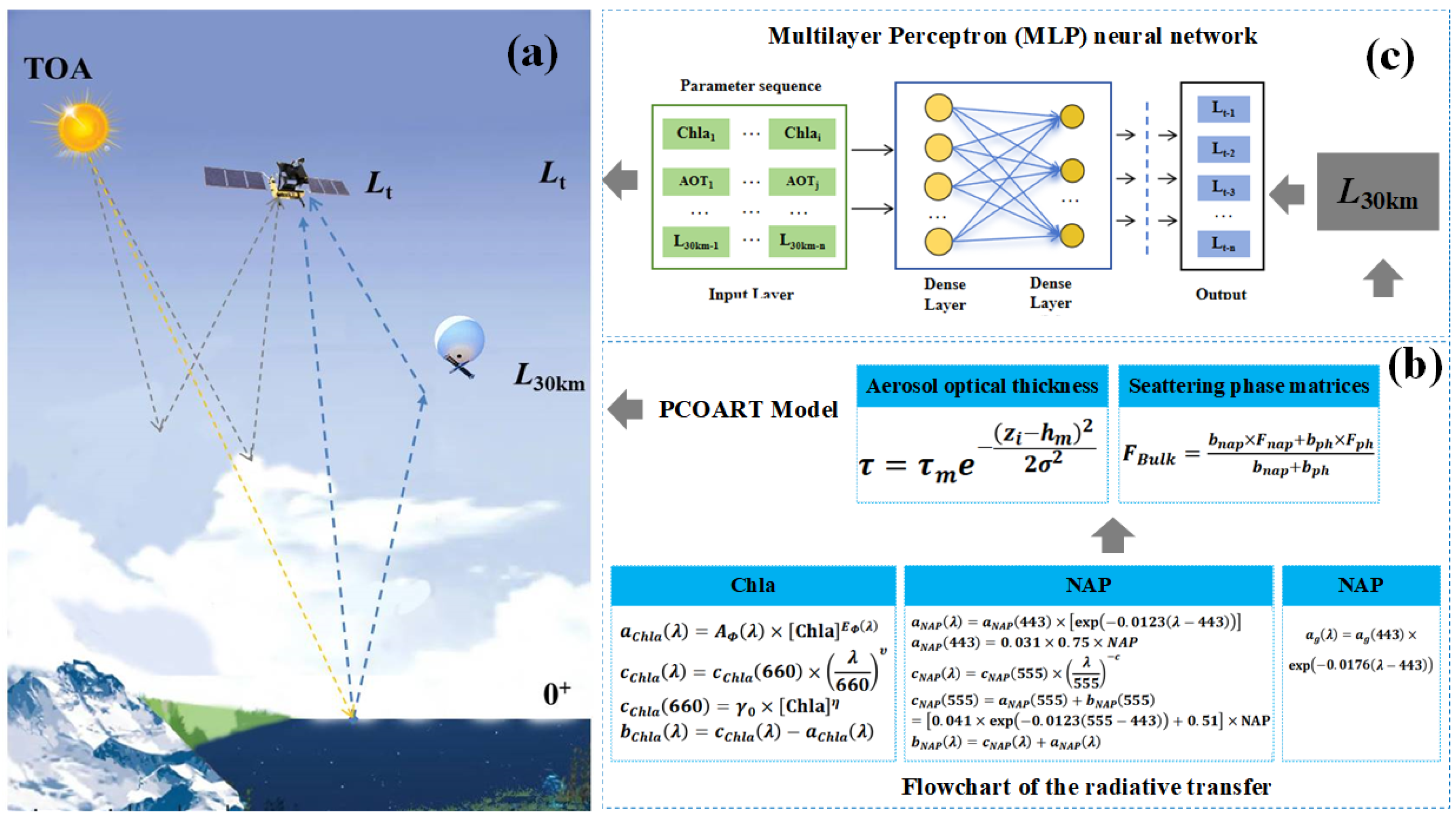
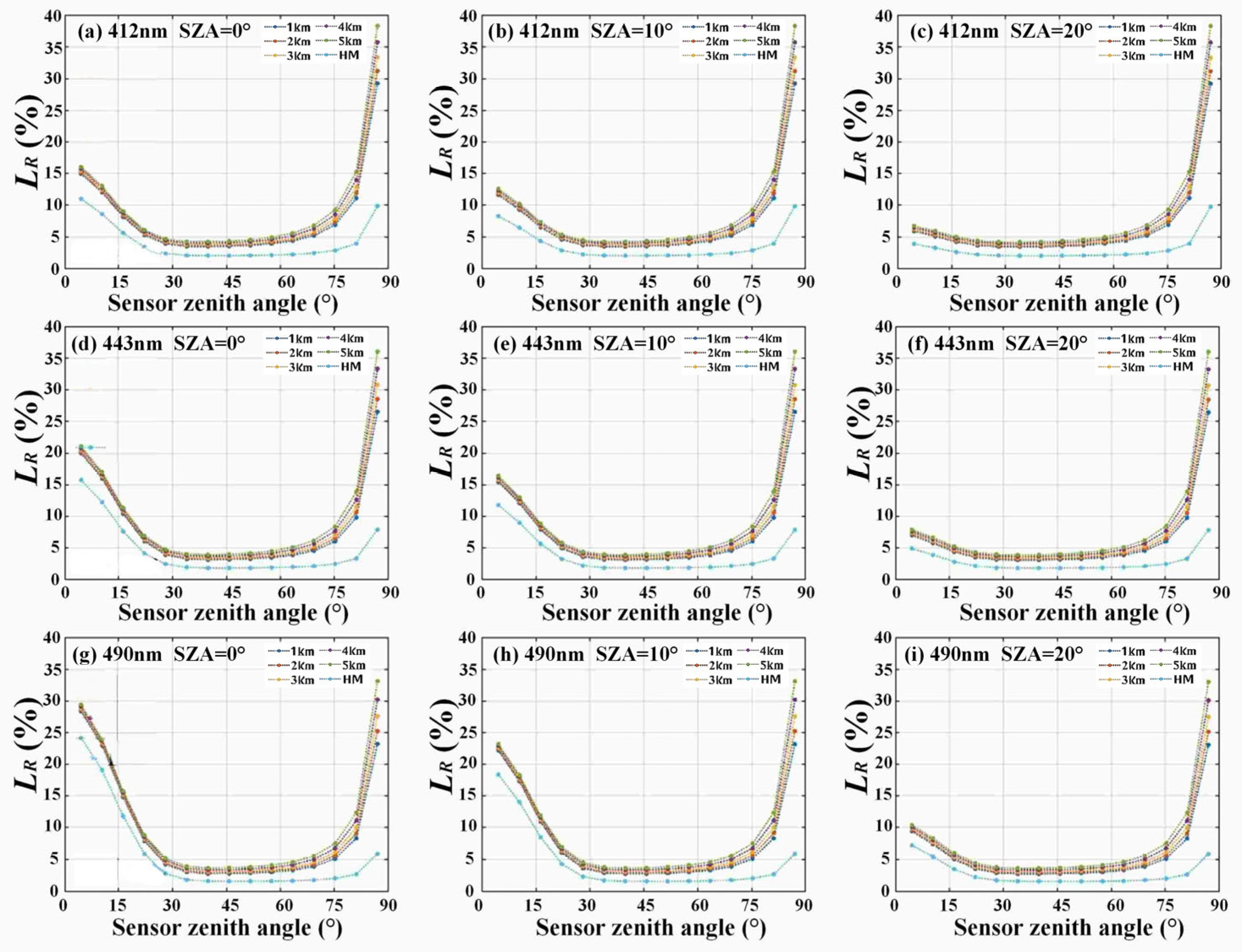
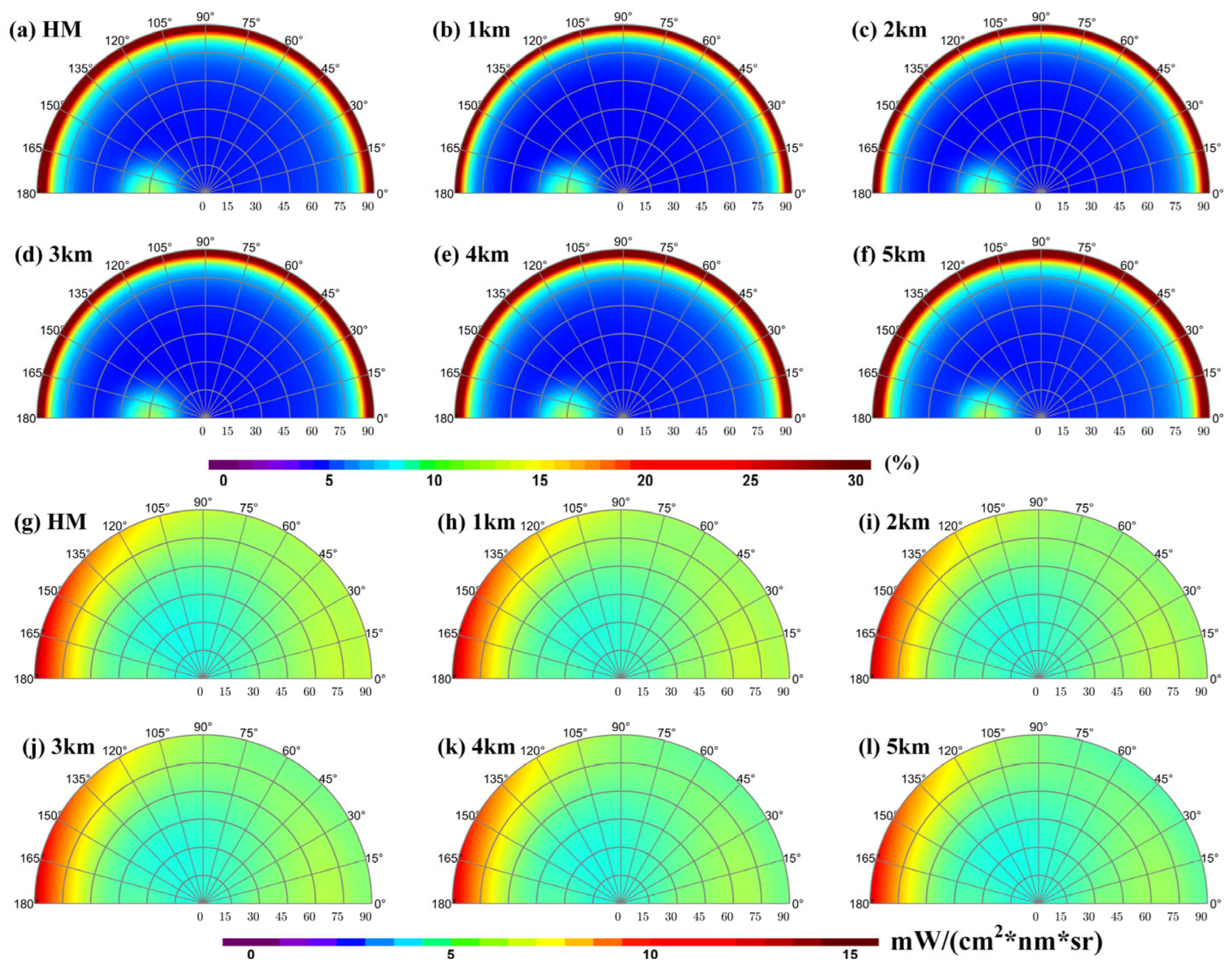
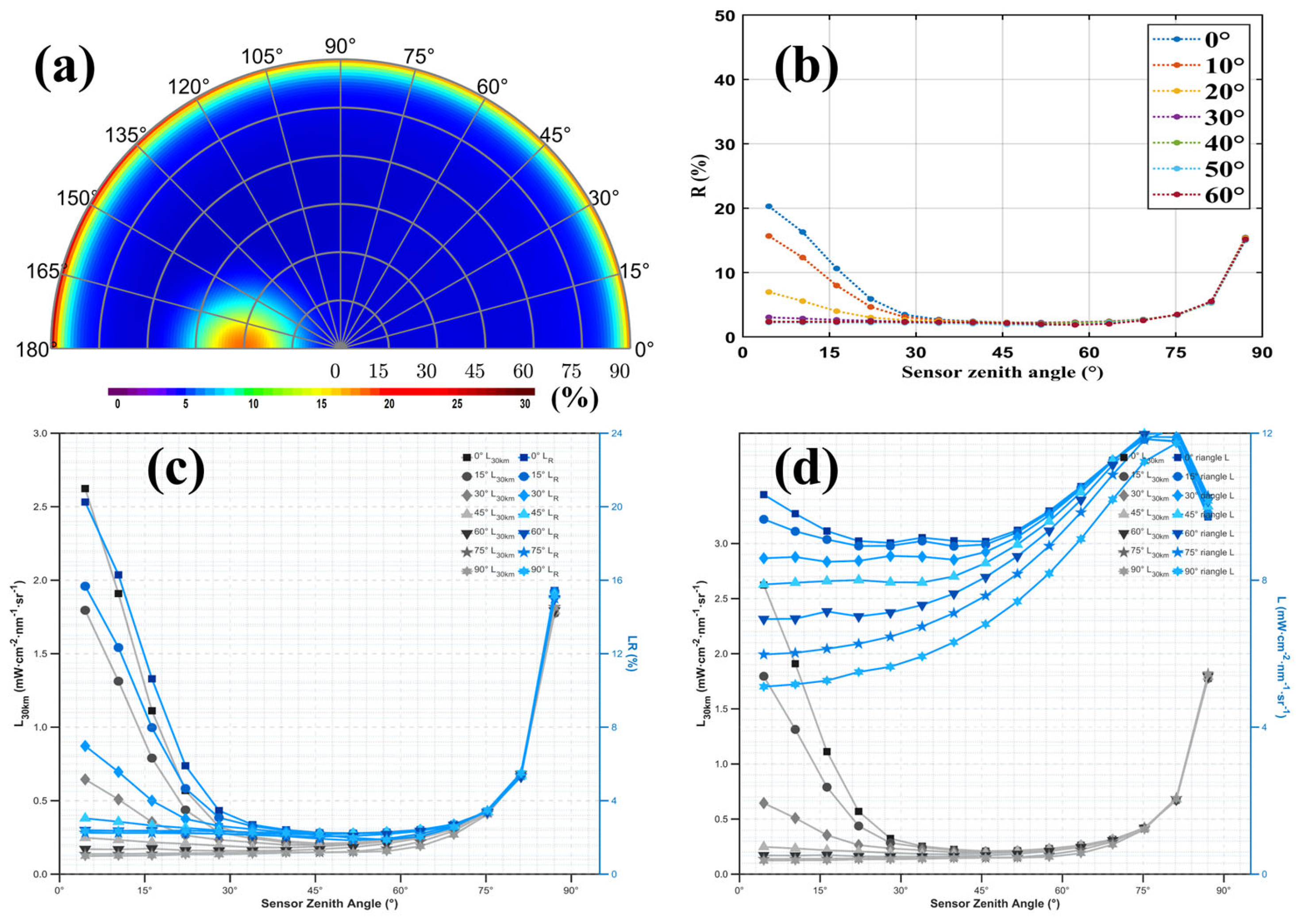
- Radiative transfer simulations revealed that in most non-glint contaminated observation areas, the contribution of atmospheric upwelling radiance above scientific balloon platforms to the total radiance (Lt) at the TOA exceeded 2%, demonstrating that this path radiance cannot be neglected in near-space radiometric calibration.
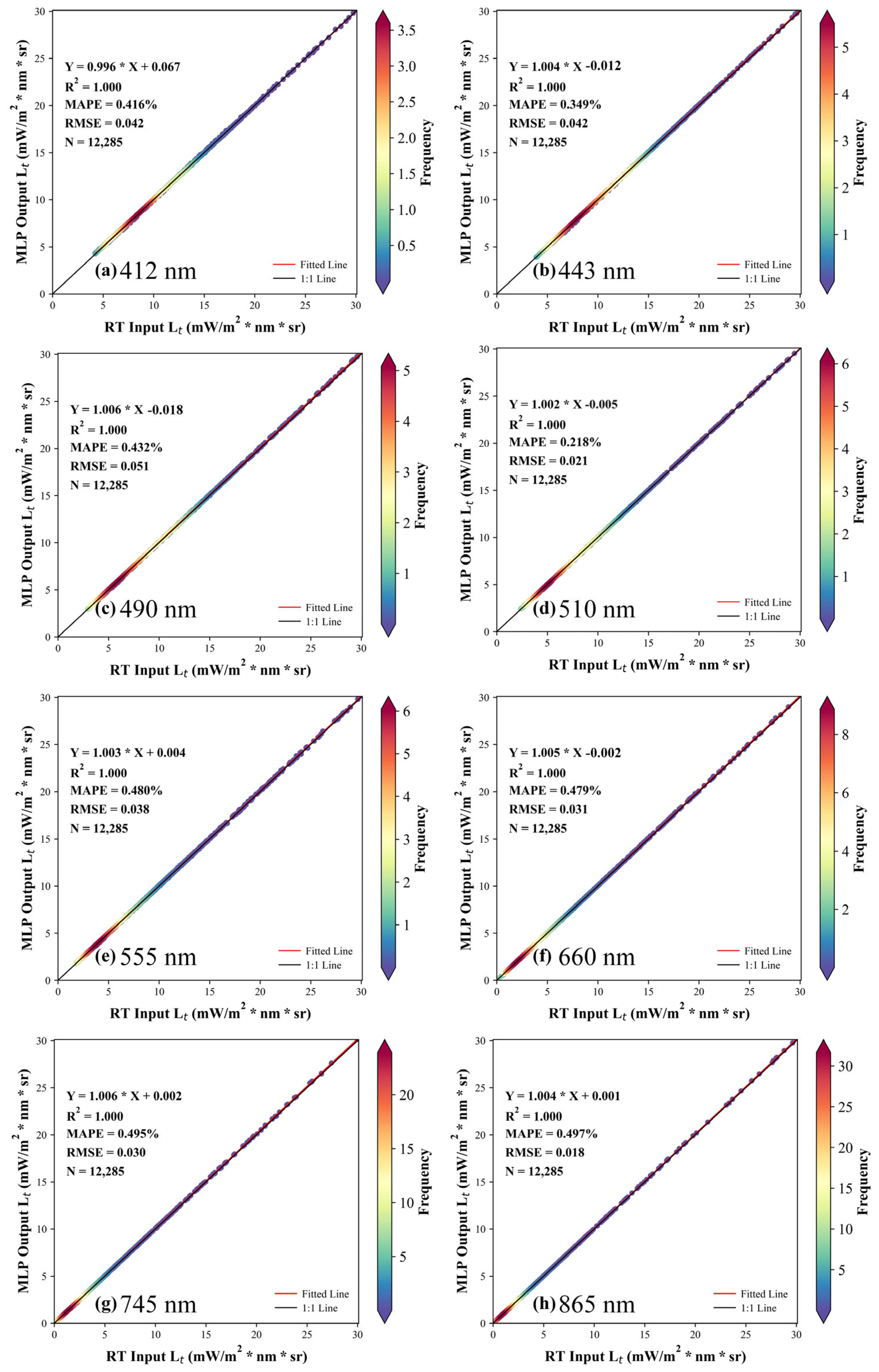
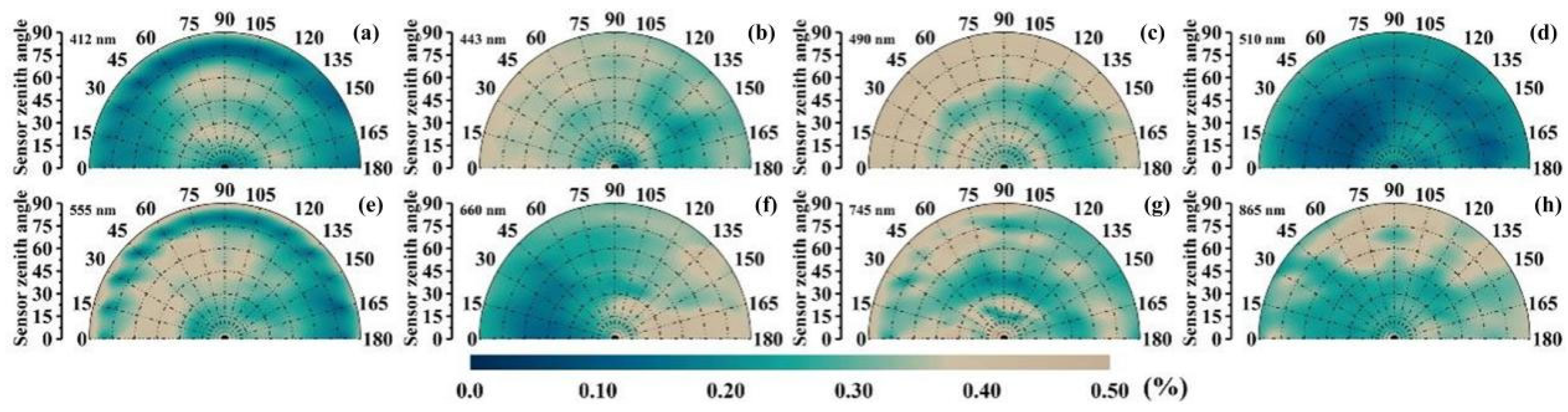
- The study established a transformability from near-space radiance to Lt using a multilayer perceptron model, achieving a mean absolute percentage deviation not exceeding 0.5%, which verifies the feasibility and high accuracy of near-space radiometric calibration.
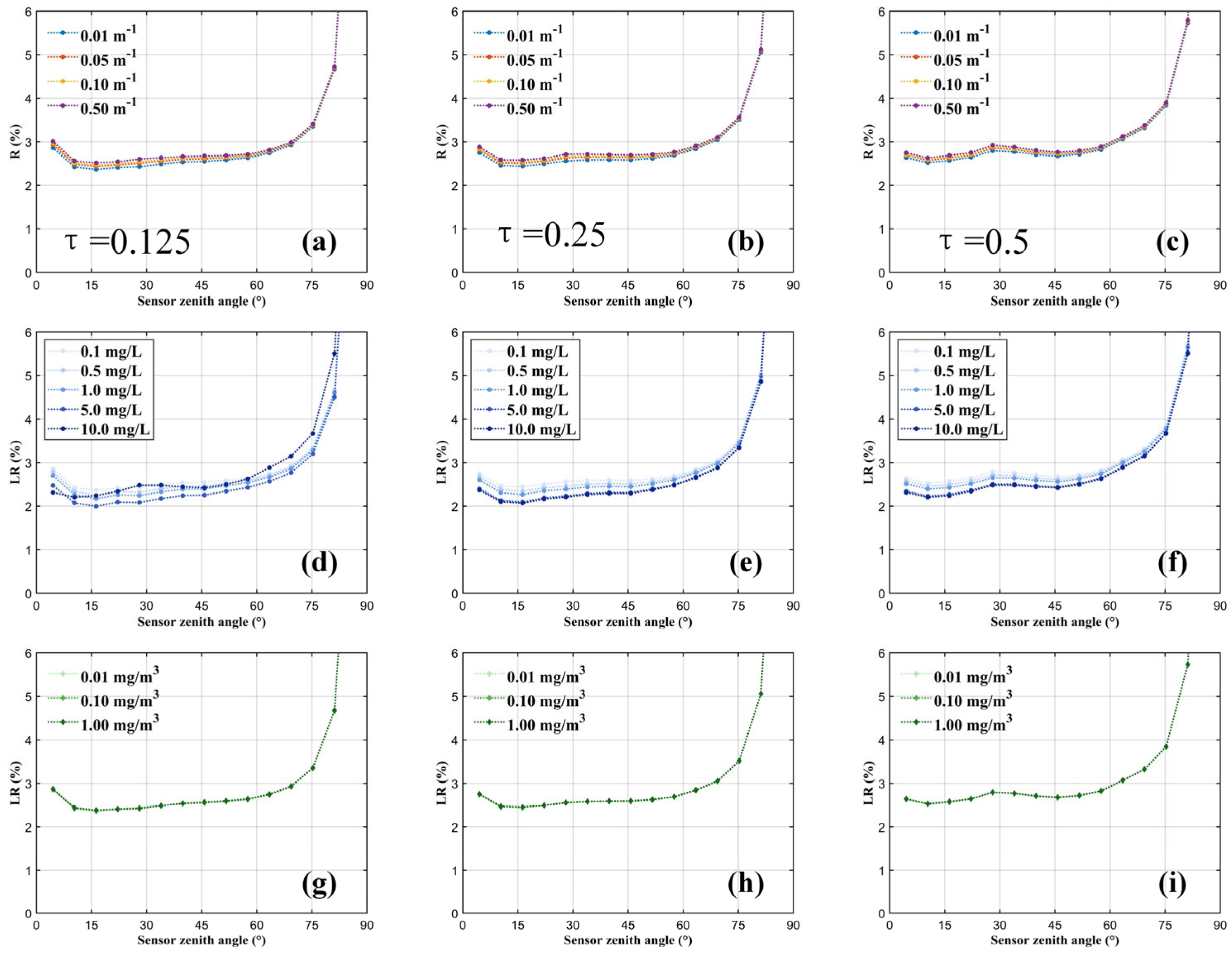
- This research confirms that near-space radiometric calibration platforms offer greater flexibility and lower sensitivity to variations in inherent optical properties compared to traditional vicarious calibration, making them a significant complementary approach for calibrating satellite ocean color sensors, especially in waters with low chlorophyll or dominated by non-algal particles.
- The near-space radiometric calibration highlights its sensitivity to aerosol vertical distribution and demonstrates the potential to reduce error propagation from the platform to the satellite under high aerosol conditions, providing a theoretical basis for developing more robust calibration schemes that are less affected by the lower atmosphere.
Abstract
1. Introduction
2. Materials and Methods
2.1. RT Simulation and Data
2.2. MLP Neural Network for Vicarious Calibration
2.3. Statistical Assessment
3. Results
3.1. Water Optical Properties Parameters
3.1.1. Variability of LR with Observation Geometry
3.1.2. Variability of LR with Spectral
3.2. Impact of Oceanic Constituents on LR
3.3. Effect of Aerosols Optical Properties on LR
3.3.1. Overall Impact of AOTs on LR
3.3.2. Sensitivity of the LR to Aerosol Vertical Distribution
3.4. The Transformability from Near-Space Radiance to TOA Radiance
4. Discussion
5. Conclusions
Author Contributions
Funding
Data Availability Statement
Acknowledgments
Conflicts of Interest
References
- Werdell, P.J.; McKinna, L.I.W.; Boss, E.; Ackleson, S.G.; Craig, S.E.; Gregg, W.W.; Lee, Z.; Maritorena, S.; Roesler, C.S.; Rousseaux, C.S.; et al. An overview of approaches and challenges for retrieving marine inherent optical properties from ocean color remote sensing. Prog. Oceanogr. 2018, 160, 186–212. [Google Scholar] [CrossRef]
- Gordon, H.R.; Wang, M. Remote sensing of ocean color: Assessment of the water-leaving radiance contribution to the top-of-atmosphere signal. Appl. Opt. 1994, 33, 2364–2371. [Google Scholar] [CrossRef]
- Hooker, S.B.; McClain, C.R. The calibration and validation of SeaWiFS data. Prog. Oceanogr. 2000, 45, 427–465. [Google Scholar] [CrossRef]
- Chen, J.; He, X.; Liu, Z.; Xu, N.; Ma, L.; Xing, Q.; Hu, X.; Pan, D. An approach to cross-calibrating multi-mission satellite data for the open ocean. Remote Sens. Environ. 2020, 246, 111895. [Google Scholar] [CrossRef]
- Franz, B.A.; Bailey, S.W.; Werdell, P.J.; McClain, C.R. Sensor-independent approach to the vicarious calibration of satellite ocean color radiometry. Appl Opt. 2007, 46, 5068–5082. [Google Scholar] [CrossRef] [PubMed]
- Xiong, X.; Barnes, W. An overview of MODIS radiometric calibration and characterization. Adv. Atmos. Sci. 2006, 23, 69–79. [Google Scholar] [CrossRef]
- Li, S.; Chen, S.; Ma, C.; Wang, J.; Hu, L. Evaluation of absolute radiometric calibration of different ocean color satellite sensors. IEEE Trans. Geosci. Remote Sens. 2025, 63, 5504816. [Google Scholar] [CrossRef]
- Slater, P.N.; Biggar, S.F. Suggestions for Radiometric Calibration Coefficient Generation. J. Atmos. Ocean. Technol. 1996, 13, 376–382. [Google Scholar] [CrossRef]
- Zhou, G.Q.; Li, C.Y.; Yue, T.; Jiang, L.J.; Liu, N.; Sun, Y.; Li, M.Y. An overview of in-orbit radiometric calibration of typical satellite sensors. Int. Arch. Photogramm. Remote Sens. Spat. Inf. Sci. 2015, 40, 235–240. [Google Scholar] [CrossRef]
- Wu, A.; Mu, Q.; Angal, A.; Xiong, X. Assessment of MODIS and VIIRS calibration consistency for reflective solar bands calibration using vicarious approaches. In Proceedings of the Sensors, Systems, and Next-Generation Satellites XXIV, 1153018, Online, 21–25 September 2020. [Google Scholar] [CrossRef]
- Clark, D.K.; Yarbrough, M.A.; Feinholz, M.; Flora, S.; Broenkow, W.; Kim, Y.S.; Johnson, B.C.; Brown, S.W.; Yuen, M.; Mueller, J.L. MOBY, A Radiometric Buoy for Performance Monitoring and Vicarious Calibration of Satellite Ocean Color Sensors: Measurement and Data Analysis Protocols. In Ocean Optics Protocols for Satellite Ocean Color Sensor Validation; National Aeronautics and Space Administration: Greenbelt, MD, USA, 2003; Chapter 2. [Google Scholar]
- Pinkerton, M.H.; Aiken, J. Calibration and Validation of Remotely Sensed Observations of Ocean Color from a Moored Data Buoy. J. Atmos. Ocean. Technol. 1999, 16, 915–923. [Google Scholar] [CrossRef]
- Chen, S.; Song, Q.; Ma, C.; Lin, M.; Liu, J.; Hu, L.; Li, S.; Xue, C. Evaluation of regions suitable for vicarious calibration of ocean color satellite sensors in the South China Sea. Opt. Express 2021, 29, 11712–11727. [Google Scholar] [CrossRef] [PubMed]
- Zibordi, G.; Mélin, F.; Berthon, J.F.; Holben, B.; Slutsker, I.; Giles, D.; D’Alimonte, D.; Vandemark, D.; Feng, H.; Schuster, G.; et al. AERONET-OC: A Network for the Validation of Ocean Color Primary Products. J. Atmos. Ocean. Technol. 2009, 26, 1634–1651. [Google Scholar] [CrossRef]
- Wang, M.; Shi, W. The NIR-SWIR combined atmospheric correction approach for MODIS ocean color data processing. Opt. Express 2007, 15, 15722–15733. [Google Scholar] [CrossRef] [PubMed]
- He, X.; Pan, T.; Bai, Y.; Shanmugam, P.; Wang, D.; Li, T.; Gong, F. Intelligent Atmospheric Correction Algorithm for Polarization Ocean Color Satellite Measurements Over the Open Ocean. IEEE Trans. Geosci. Remote Sens. 2024, 62, 4201322. [Google Scholar] [CrossRef]
- Li, Q.; Jiang, L.; Chen, Y.; Wang, L.; Wang, L. Evaluation of seven atmospheric correction algorithms for OLCI images over the coastal waters of Qinhuangdao in Bohai Sea. Reg. Stud. Mar. Sci. 2022, 56, 102711. [Google Scholar] [CrossRef]
- Wang, Y.; Liu, H.; Zhang, Z.; Wang, Y.; Zhao, D.; Zhang, Y.; Li, Q.; Wu, G. Ocean Colour Atmospheric Correction for Optically Complex Waters under High Solar Zenith Angles: Facilitating Frequent Diurnal Monitoring and Management. Remote Sens. 2024, 16, 183. [Google Scholar] [CrossRef]
- Mueller, J.L.; Pietras, C.; Hooker, S.B.; Clark, D.K.; Frouin, A.M.R.; Mitchell, B.G.; Bidigare, R.R.; Trees, C.; Werdell, J.; Fargion, G.S.; et al. Ocean Optics Protocols for Satellite Ocean Color Sensor Validation; National Aeronautics and Space Administration: Greenbelt, MD, USA, 2003. [Google Scholar]
- Tilstone, G.H.; Jordan, T.M.; Aurin, D.; Białek, A.; Deru, A.; Ramsay, A.; Hieronymi, M.; Dall’oLmo, G.; Ligi, M.; Kovach, C.; et al. Radiometric field inter-comparison of fiducial reference measurements using an open source community processor. Opt. Express 2025, 33, 15756–15781. [Google Scholar] [CrossRef] [PubMed]
- Liu, J.; Jia, X.; He, X.; Wang, Y.; Zhu, Q.; Li, H.; Pan, D. A New Method for Direct Measurement of Polarization Characteristics of Water-Leaving Radiation. IEEE Trans. Geosci. Remote Sens. 2022, 60, 4204614. [Google Scholar] [CrossRef]
- Wang, J.; Chen, S.; Hu, S.; Deng, L.; Ma, C.; Peng, H.; Song, Q. System vicarious calibration and ocean color retrieval from the HY-1C UVI. Int. J. Appl. Earth Obs. Geoinf. 2025, 136, 104417. [Google Scholar] [CrossRef]
- Mélin, F.; Sclep, G.; Jackson, T.; Sathyendranath, S. Uncertainty estimates of remote sensing reflectance derived from comparison of ocean color satellite data sets. Remote Sens. Environ. 2016, 177, 107–124. [Google Scholar] [CrossRef]
- Fan, L.; Jiang, Z.; Yu, S.; Liu, Y.; Wang, D.; Chen, M. A General On-Orbit Absolute Radiometric Calibration Method Compatible with Multiple Imaging Conditions. Remote Sens. 2024, 16, 3503. [Google Scholar] [CrossRef]
- Fox, N.; Aiken, J.; Barnett, J.J.; Briottet, X.; Carvell, R.; Frohlich, C.; Groom, S.B.; Hagolle, O.; Haigh, J.D.; Kieffer, H.H.; et al. Traceable radiometry underpinning terrestrial- and helio-studies (TRUTHS). Adv. Space Res. 2003, 32, 2253–2261. [Google Scholar] [CrossRef]
- Wielicki, B.A.; Young, D.F.; Mlynczak, M.G.; Thome, K.J.; Leroy, S.; Corliss, J.; Anderson, J.G.; Ao, C.O.; Bantges, R.; Best, F.; et al. Achieving climate change absolute accuracy in orbit. Bull. Am. Meteorol. Soc. 2013, 94, 1519–1539. [Google Scholar] [CrossRef]
- Zhang, P.; Lu, N.M.; Li, C.R.; Ding, L.; Zheng, X.B.; Zhang, X.J.; Hu, X.Q.; Ye, X.; Ma, L.L.; Xu, N.; et al. Development of the Chinese space-based radiometric benchmark mission LIBRA. Remote Sens. 2020, 12, 2179. [Google Scholar] [CrossRef]
- Smith, P.; Drake, G.; Espejo, J.; Heuerman, K.; Kopp, G. A Solar Irradiance Cross-Calibration Method Enabling Climate Studies Requiring 0.2% Radiometric Accuracies. In Proceedings of the ESTF 2011, Pasadena, CA, USA, 21–23 June 2011. [Google Scholar]
- Fox, N.; Green, P. Traceable Radiometry Underpinning Terrestrial- and Helio-Studies (TRUTHS): An Element of a Space-Based Climate and Calibration Observatory. Remote Sens. 2020, 12, 2400. [Google Scholar] [CrossRef]
- Ye, X.; Yi, X.; Lin, C.; Fang, W.; Wang, K.; Xia, Z.; Ji, Z.; Zheng, Y.; Sun, D.; Quan, J. Instrument Development: Chinese Radiometric Benchmark of Reflected Solar Band Based on Space Cryogenic Absolute Radiometer. Remote Sens. 2020, 12, 2856. [Google Scholar] [CrossRef]
- Wang, N.; Ma, L.L.; Liu, Q.; Zhao, Y.G.; Teng, G.E.; Liu, Y.K.; Gao, C.X.; Liu, E.C.; Zhang, D.H.; Li, J.M.; et al. The near space altitude experiment for satellite radiometric calibration and the first results. Natl. Remote Sens. Bull. 2023, 27, 1177–1193. [Google Scholar] [CrossRef]
- Takahashi, S.; Aoki, S. GRAINE project, prospects for scientific balloon-borne experiments. Adv. Space Res. 2018, 62, 2945–2953. [Google Scholar] [CrossRef]
- He, X.; Bai, Y.; Zhu, Q.; Gong, F. A vector radiative transfer model of coupled ocean–atmosphere system using matrix-operator method for rough sea-surface. J. Quant. Spectrosc. Radiat. Transf. 2010, 111, 1426–1448. [Google Scholar] [CrossRef]
- He, X.; Stamnes, K.; Bai, Y.; Li, W.; Wang, D. Effects of Earth curvature on atmospheric correction for ocean color remote sensing. Remote Sens. Environ. 2018, 209, 118–133. [Google Scholar] [CrossRef]
- Song, Z.; He, X.; Bai, Y.; Wang, D.; Hao, Z.; Gong, F.; Zhu, Q. Changes and Predictions of Vertical Distributions of Global Light-Absorbing Aerosols Based on CALIPSO Observation. Remote Sens. 2020, 12, 3014. [Google Scholar] [CrossRef]
- Young, A.T. Revised depolarization corrections for atmospheric extinction. Appl. Opt. 1980, 19, 3427–3428. [Google Scholar] [CrossRef]
- Shettle, E.P.; Fenn, R.W. Models for the Aerosols of the Lower Atmosphere and the Effects of Humidity Variations on Their Optical Properties; Environmental Research Paper; Air Force Geophysics Laboratory: Bedford, MA, USA, 1979. [Google Scholar]
- Wu, Y.; de Graaf, M.; Menenti, M. The impact of aerosol vertical distribution on aerosol optical depth retrieval using CALIPSO and MODIS data: Case study over dust and smoke regions. J. Geophys. Res. Atmos. 2017, 122, 8801–8815. [Google Scholar] [CrossRef]
- Song, Z.; He, X.; Bai, Y.; Wang, D.; Gong, F.; Zhu, Q. Effect of the vertical distribution of absorbing aerosols on the atmospheric correction for satellite ocean color remote sensing. IEEE Trans. Geosci. Remote Sens. 2022, 60, 4206212. [Google Scholar] [CrossRef]
- Pope, E.S.; Fry, E.S. Absorption spectrum (380–700 nm) of pure water. II. Integrating cavity measurements. Appl. Opt. 1997, 36, 8710–8723. [Google Scholar] [CrossRef]
- Bricaud, A.; Morel, A.; Babin, M.; Allali, K.; Claustre, H. Variations of light absorption by suspended particles with chlorophyll a concentration in oceanic (case 1) waters: Analysis and implications or bio-optical models. J. Geophys. Res. Ocean. 1998, 103, 31033–31044. [Google Scholar] [CrossRef]
- Morel, A.; Prieur, L. Analysis of variations in ocean color. Limnol. Oceanogr. 1977, 22, 709–722. [Google Scholar] [CrossRef]
- Loisel, H.; Duforet, L.; Dessailly, D.; Chami, M.; Dubuisson, P. Investigation of the variations in the water leaving polarized reflectance from the POLDER satellite data over two biogeochemical contrasted oceanic areas. Opt. Express 2008, 16, 12905–12918. [Google Scholar] [CrossRef]
- Babin, M.; Stramski, D.; Ferrari, G.M.; Claustre, H.; Bricaud, A.; Obolensky, G.; Hoepffner, N. Variations in the light absorption coefficients of phytoplankton, nonalgal particles and dissolved organic matter in coastal waters around Europe. J. Geophys. Res. 2003, 108, 3211. [Google Scholar] [CrossRef]
- Babin, M.; Morel, A.; Fournier-Sicre, V.; Fell, F. Stramski Light scattering properties of marine particles in coastal and open ocean waters as related to the particle mass concentration. Limnol. Oceanogr. 2003, 48, 843–859. [Google Scholar] [CrossRef]
- Mobley, C.D. The Oceanic Optics Book; International Ocean Colour Coordinating Group (IOCCG): Dartmouth, NS, Canada, 2022. [Google Scholar] [CrossRef]
- Thuillier, G.; Hersé, M.; Labs, D.; Foujols, T.; Peetermans, W.; Gillotay, D.; Mandel, H. The Solar Spectral Irradiance from 200 to 2400 nm as Measured by the SOLSPEC Spectrometer from the Atlas and Eureca Missions. Sol. Phys. 2003, 214, 1–22. [Google Scholar] [CrossRef]
- Schiller, H.; Doerffer, R. Improved determination of coastal water constituent concentrations from MERIS data. IEEE Trans. Geosci. Remote Sens. 2005, 43, 1585–1591. [Google Scholar] [CrossRef]
- Schiller, H.; Doerffer, R. Neural network for emulation of an inverse model-operational derivation of case II water properties from MERIS data. Int. J. Remote Sens. 1999, 20, 1735–1746. [Google Scholar] [CrossRef]
- Li, H.; He, X.; Bai, Y.; Shanmugam, P.; Park, Y.-J.; Liu, J.; Zhu, Q.; Gong, F.; Wang, D.; Huang, H. Atmospheric correction of geostationary satellite ocean color data under high solar zenith angles in open oceans. Remote Sens. Environ. 2020, 249, 112022. [Google Scholar] [CrossRef]
- Zhao, Y.; He, X.; Bai, Y.; Xu, F.; Jin, X.; Li, T.; Wang, D.; Gong, F. Adjacency effect on Rayleigh scattering radiance for satellite remote sensing of river waters. IEEE Trans. Geosci. Remote Sens. 2024, 62, 4212120. [Google Scholar] [CrossRef]
- Yamanouchi, T.; Tanaka, M. Absorption properties of the near-infrared water vapor bands. J. Quant. Spectrosc. Radiat. Transf. 1985, 34, 463–472. [Google Scholar] [CrossRef]
- Dubovik, O.; Sinyuk, A.; Lapyonok, T.; Holben, B.N.; Mishchenko, M.; Yang, P.; Eck, T.F.; Volten, H.; Muñoz, O.; Veihelmann, B.; et al. Application of spheroid models to account for aerosol particle nonsphericity in remote sensing of desert dust. J. Geophys. Res. Atmos. 2006, 111, D11208. [Google Scholar] [CrossRef]
- He, X.; Bai, Y.; Pan, D.; Tang, J.; Wang, D. Atmospheric correction of satellite ocean color imagery using the ultraviolet wavelength for highly turbid waters. Opt. Express 2012, 20, 20754–20770. [Google Scholar] [CrossRef]
- Mabit, R.; Araujo, C.; Singh, R.; Bélanger, S. Empirical Remote Sensing Algorithms to Retrieve SPM and CDOM in Québec Coastal Waters. Front. Remote Sens. 2022, 3, 834908. [Google Scholar] [CrossRef]
- Gordon, H.R.; Du, T.; Zhang, T. Remote sensing of ocean color and aerosol properties: Resolving the issue of aerosol absorption. Appl. Opt. 1997, 36, 8670–8684. [Google Scholar] [CrossRef]
- Duforêt, L.; Frouin, R.; Dubuisson, P. Importance and estimation of aerosol vertical structure in satellite ocean-color remote sensing. Appl. Opt. 2007, 46, 1107–1119. [Google Scholar] [CrossRef] [PubMed]
- Kouyama, T.; Yokota, Y.; Ishihara, Y.; Nakamura, R.; Yamamoto, S.; Matsunaga, T. Development of an application scheme for the SELENE/SP lunar reflectance model for radiometric calibration of hyperspectral and multispectral sensors. Planet. Space Sci. 2016, 124, 76–83. [Google Scholar] [CrossRef]
- Colas, J.; Dumont-Dayot, N.; Marchand, J.F.; Massol, N.; Perrodo, P.; Wingerter-Seez, I.; de La Taille, C.; Imbert, P.; Richer, J.P.; Seguin Moreau, N.; et al. Electronics calibration board for the ATLAS liquid argon calorimeters. Nucl. Instrum. Methods Phys. Res. Sec. A 2008, 593, 269–291. [Google Scholar] [CrossRef]
- Hübert, T.; Tiebe, C.; Detjens, M.; Majewski, J. On-site calibration system for trace humidity sensors. Measurement 2016, 91, 251–257. [Google Scholar] [CrossRef]
- Wang, M.; Franz, B.A. Comparing the ocean color measurements between MOS and SeaWiFS: A vicarious intercalibration approach for MOS. IEEE Trans. Geosci. Remote Sens. 2000, 38, 184–197. [Google Scholar] [CrossRef]
- Sousa, D.; Small, C. Global cross-calibration of Landsat spectral mixture models. Remote Sens. Environ. 2017, 192, 139–149. [Google Scholar] [CrossRef]
- IOCCG. In-Flight Calibration of Satellite Ocean-Colour Sensors; Frouin, R., Ed.; Reports of the International Ocean-Colour Coordinating Group, No. 14; IOCCG: Dartmouth, NS, Canada, 2013. [Google Scholar]
- Bailey, S.W.; Werdell, P.J. A multi-sensor approach for the on-orbit validation of ocean color satellite data products. Remote Sens. Environ. 2006, 102, 12–23. [Google Scholar] [CrossRef]
- He, X.; Bai, Y.; Pan, D.; Huang, N.; Dong, X.; Chen, J.; Chen, C.-T.A.; Cui, Q. Using geostationary satellite ocean color data to map the diurnal dynamics of suspended particulate matter in coastal waters. Remote Sens. Environ. 2013, 133, 225–239. [Google Scholar] [CrossRef]








| Variable | Constrainer | |
|---|---|---|
| Ocean | Chla | 0.01–1 mg/m3 |
| NAP | 0.1–10 mg/L | |
| ag(443) | 0.01, 0.05, 0.1, 0.5 m−1 | |
| Atmosphere | AOTs | 0.02–0.7 |
| Aerosols | M90, U50 | |
| hm | 1–5 km | |
| Angular | Solar zenith angles | 0–60° |
| Viewing zenith angle | 0–90° | |
| Sensor azimuth angle | 0–180° | |
| Others | Bands (nm) | 412, 443, 490, 510, 555, 660, 745, 865 |
| SAA | SZA | 412 nm | 443 nm | 490 nm | 510 nm | 555 nm | 660 nm | 745 nm | 865 nm |
|---|---|---|---|---|---|---|---|---|---|
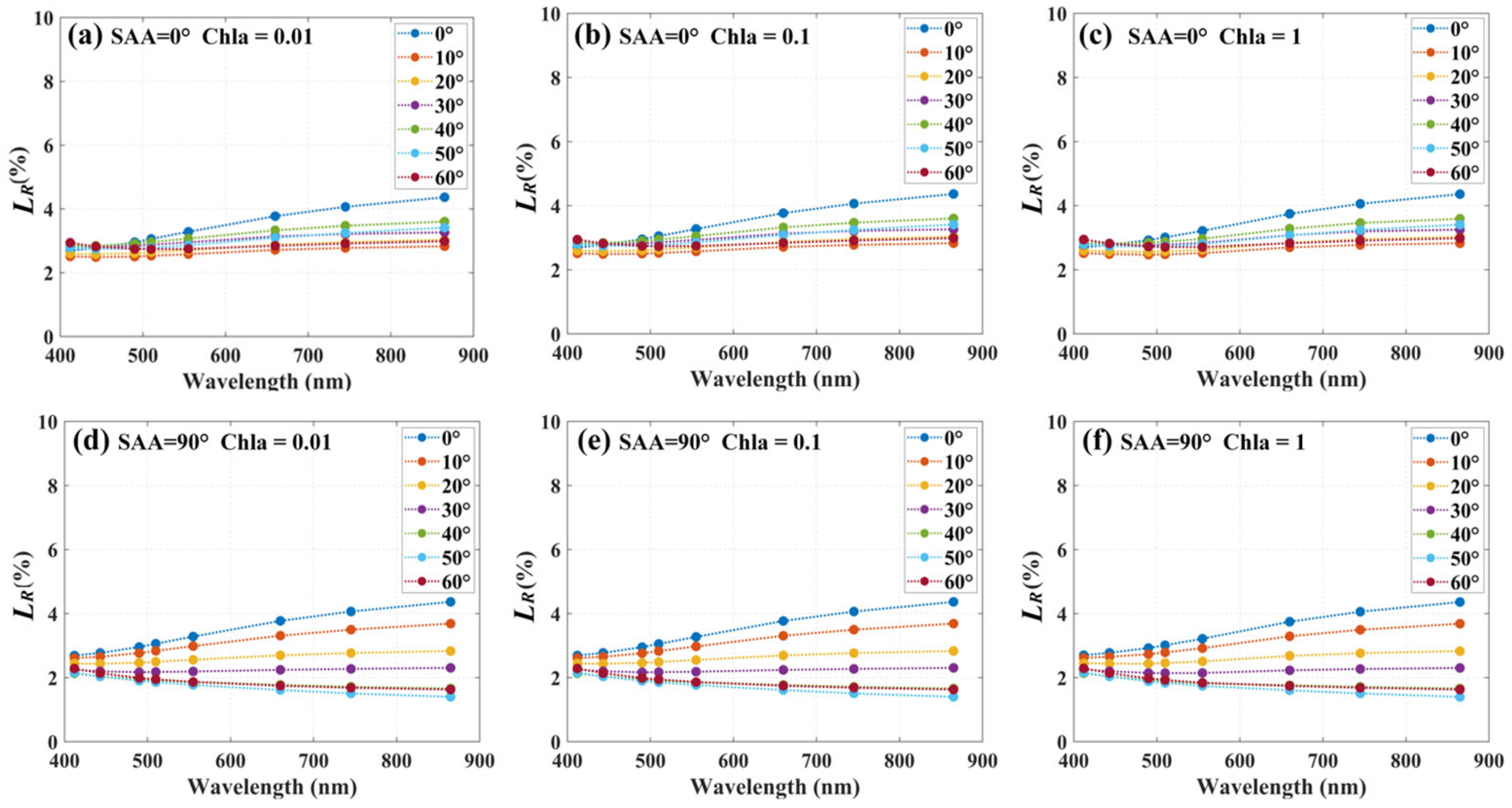
| 0° | 0° | 2.86 | 3.06 | 3.44 | 3.65 | 4.15 | 5.54 | 6.49 | 7.49 |
| 10° | 2.45 | 2.43 | 2.41 | 2.43 | 2.48 | 2.75 | 2.88 | 2.99 | |
| 20° | 2.49 | 2.46 | 2.43 | 2.44 | 2.48 | 2.75 | 2.90 | 3.00 | |
| 30° | 2.60 | 2.57 | 2.55 | 2.57 | 2.64 | 2.99 | 3.24 | 3.41 | |
| 40° | 2.71 | 2.71 | 2.77 | 2.82 | 2.98 | 3.59 | 4.03 | 4.45 | |
| 50° | 2.74 | 2.72 | 2.77 | 2.82 | 2.98 | 3.59 | 4.04 | 4.53 | |
| 60° | 2.80 | 2.69 | 2.62 | 2.62 | 2.66 | 2.92 | 3.12 | 3.35 | |
| 90° | 0° | 2.86 | 3.06 | 3.44 | 3.65 | 4.15 | 5.54 | 6.49 | 7.49 |
| 10° | 2.67 | 2.78 | 3.00 | 3.12 | 3.44 | 4.36 | 4.97 | 5.61 | |
| 20° | 2.43 | 2.43 | 2.46 | 2.50 | 2.59 | 2.93 | 3.13 | 3.32 | |
| 30° | 2.28 | 2.24 | 2.18 | 2.18 | 2.19 | 2.30 | 2.35 | 2.38 | |
| 40° | 2.17 | 2.06 | 1.90 | 1.84 | 1.72 | 1.47 | 1.23 | 0.92 | |
| 50° | 2.17 | 2.03 | 1.82 | 1.74 | 1.56 | 1.16 | 0.79 | 0.31 | |
| 60° | 2.32 | 2.18 | 2.01 | 1.96 | 1.86 | 1.71 | 1.57 | 1.40 |
| Name | Variable | Constrainer |
|---|---|---|
| SZA | θs | ≥19° |
| SAA | φv | 0–120° |
| VZA | θv | 30–60° |
| Band (nm) | 0° | 10° | 20° | 30° | 40° | 50° | 60° |
|---|---|---|---|---|---|---|---|
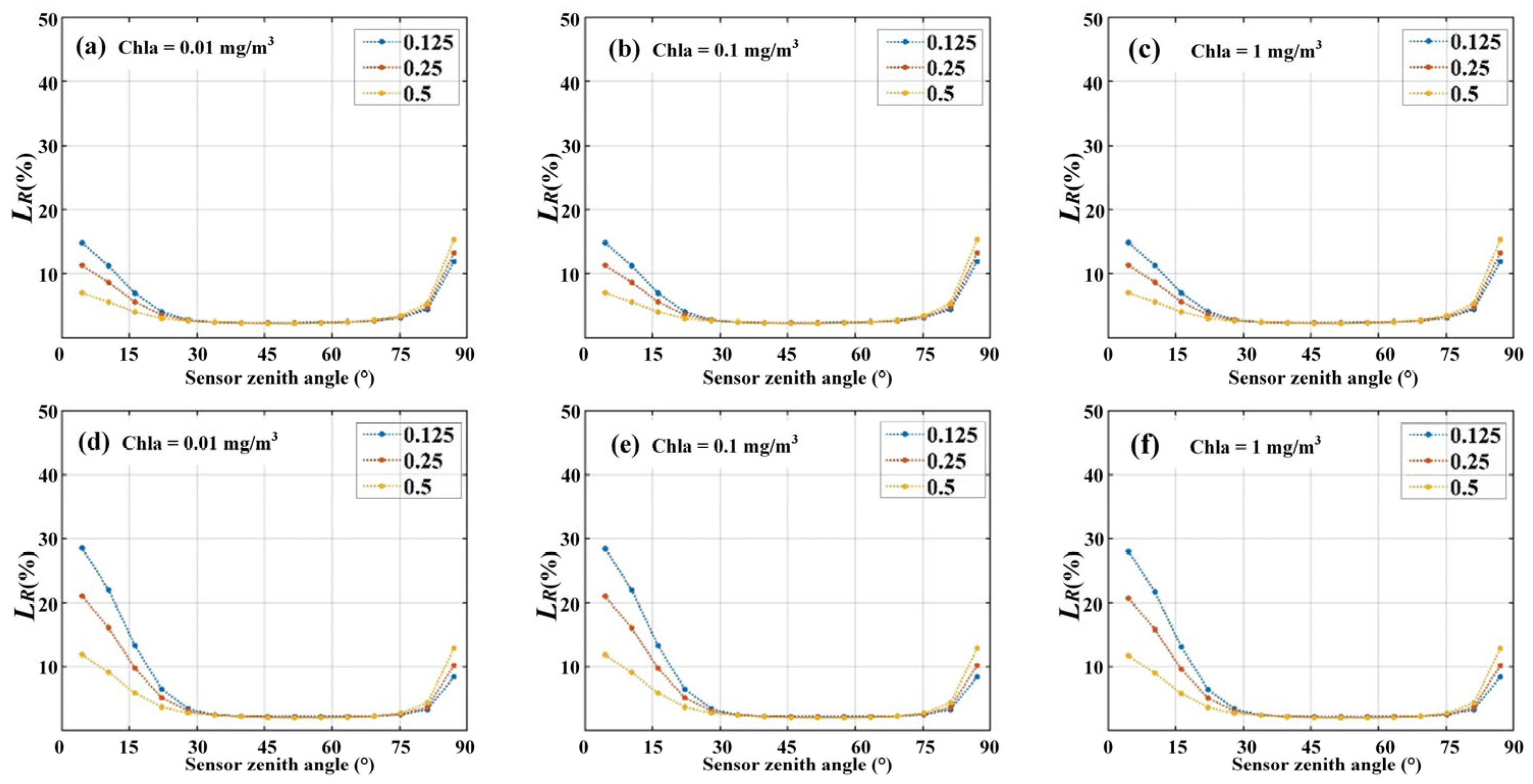
| 412 | 20.29 | 15.68 | 6.97 | 3.04 | 2.39 | 2.25 | 2.35 |
| 443 | 25.47 | 20.02 | 8.85 | 3.28 | 2.38 | 2.18 | 2.23 |
| 490 | 32.21 | 26.01 | 11.88 | 3.75 | 2.40 | 2.12 | 2.12 |
| 510 | 34.72 | 28.32 | 13.21 | 3.99 | 2.43 | 2.11 | 2.09 |
| 555 | 39.29 | 32.63 | 15.95 | 4.49 | 2.49 | 2.10 | 2.05 |
| 660 | 46.16 | 39.35 | 20.96 | 5.57 | 2.63 | 2.12 | 2.00 |
| 745 | 49.48 | 42.58 | 23.69 | 6.23 | 2.70 | 2.14 | 1.98 |
| 865 | 52.59 | 45.53 | 26.27 | 6.91 | 2.78 | 2.16 | 1.97 |
| Bands (nm) | AOTs | 0° | 10° | 20° | 30° | 40° | 50° | 60° |
|---|---|---|---|---|---|---|---|---|
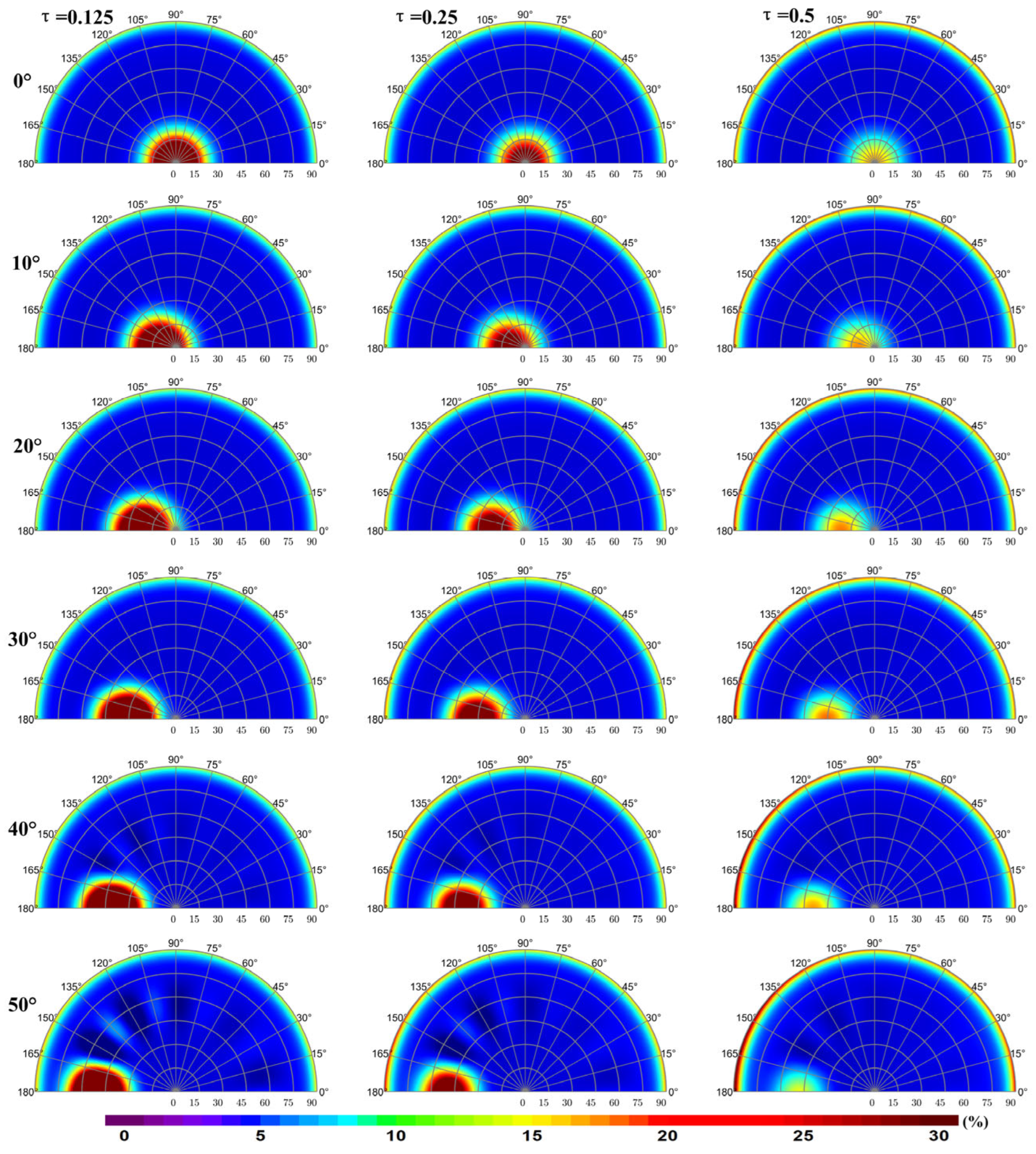
| 412 | 0.125 | 41.96 | 26.38 | 8.58 | 2.88 | 2.41 | 2.36 | 2.44 |
| 0.25 | 33.05 | 20.12 | 6.78 | 2.76 | 2.46 | 2.35 | 2.42 | |
| 0.5 | 20.29 | 12.05 | 4.65 | 2.65 | 2.55 | 2.32 | 2.41 | |
| 490 | 0.125 | 61.85 | 45.08 | 16.75 | 3.70 | 2.42 | 2.29 | 2.29 |
| 0.25 | 50.24 | 34.51 | 12.29 | 3.30 | 2.47 | 2.26 | 2.24 | |
| 0.5 | 32.21 | 20.29 | 7.23 | 2.87 | 2.55 | 2.20 | 2.19 |
| LR (%) | 1 km | 2 km | 3 km | 4 km | 5 km |
|---|---|---|---|---|---|
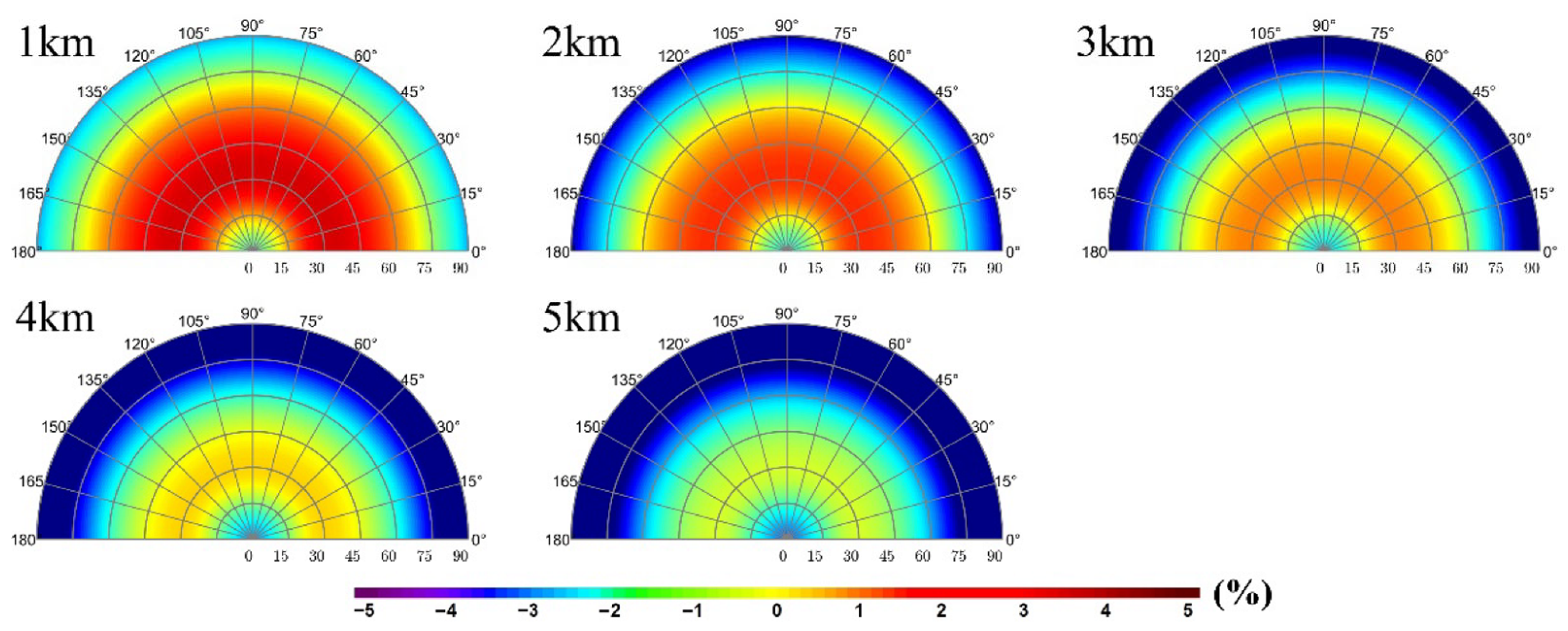
| 0° | 2.34 | 2.09 | 2.10 | 2.35 | 2.81 |
| 10° | 2.46 | 2.17 | 2.15 | 2.36 | 2.81 |
| 20° | 2.59 | 2.31 | 2.29 | 2.46 | 2.87 |
| 30° | 2.58 | 2.33 | 2.33 | 2.54 | 2.99 |
| 40° | 2.40 | 2.19 | 2.24 | 2.53 | 3.09 |
| 50° | 2.06 | 1.89 | 2.06 | 2.54 | 3.46 |
| 60° | 1.52 | 1.53 | 2.06 | 3.23 | 4.54 |
Disclaimer/Publisher’s Note: The statements, opinions and data contained in all publications are solely those of the individual author(s) and contributor(s) and not of MDPI and/or the editor(s). MDPI and/or the editor(s) disclaim responsibility for any injury to people or property resulting from any ideas, methods, instructions or products referred to in the content. |
© 2026 by the authors. Licensee MDPI, Basel, Switzerland. This article is an open access article distributed under the terms and conditions of the Creative Commons Attribution (CC BY) license.
Share and Cite
Li, C.; Liu, J.; He, Q.; Xu, M.; Li, M. Assessing Radiance Contributions Above Near-Space over the Ocean Using Radiative Transfer Simulation. Remote Sens. 2026, 18, 337. https://doi.org/10.3390/rs18020337
Li C, Liu J, He Q, Xu M, Li M. Assessing Radiance Contributions Above Near-Space over the Ocean Using Radiative Transfer Simulation. Remote Sensing. 2026; 18(2):337. https://doi.org/10.3390/rs18020337
Chicago/Turabian StyleLi, Chunxia, Jia Liu, Qingying He, Ming Xu, and Mengqi Li. 2026. "Assessing Radiance Contributions Above Near-Space over the Ocean Using Radiative Transfer Simulation" Remote Sensing 18, no. 2: 337. https://doi.org/10.3390/rs18020337
APA StyleLi, C., Liu, J., He, Q., Xu, M., & Li, M. (2026). Assessing Radiance Contributions Above Near-Space over the Ocean Using Radiative Transfer Simulation. Remote Sensing, 18(2), 337. https://doi.org/10.3390/rs18020337