
A Sparse Aperture ISAR Imaging Based on a Single-Layer Network Framework


Highlights
- A fixed-point sparse-aperture ISAR imaging framework (ADnDEQ) is developed by integrating ADMM unfolding, DnCNN denoising, and the deep equilibrium model.
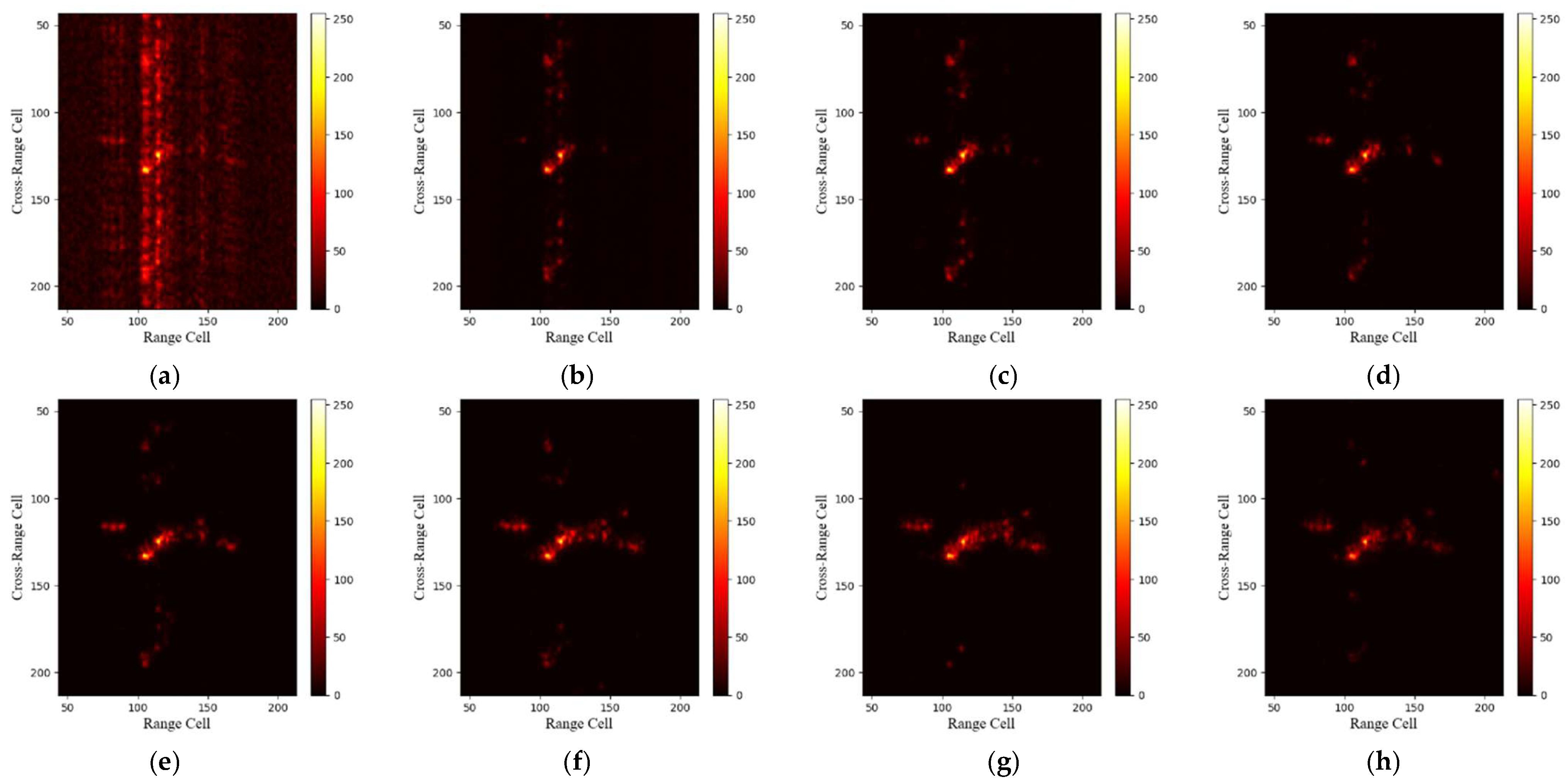
- ADnDEQ achieves superior reconstruction quality under extreme sparsity (10% sampling) and low SNR (0 dB), outperforming existing CS-based and deep learning methods.
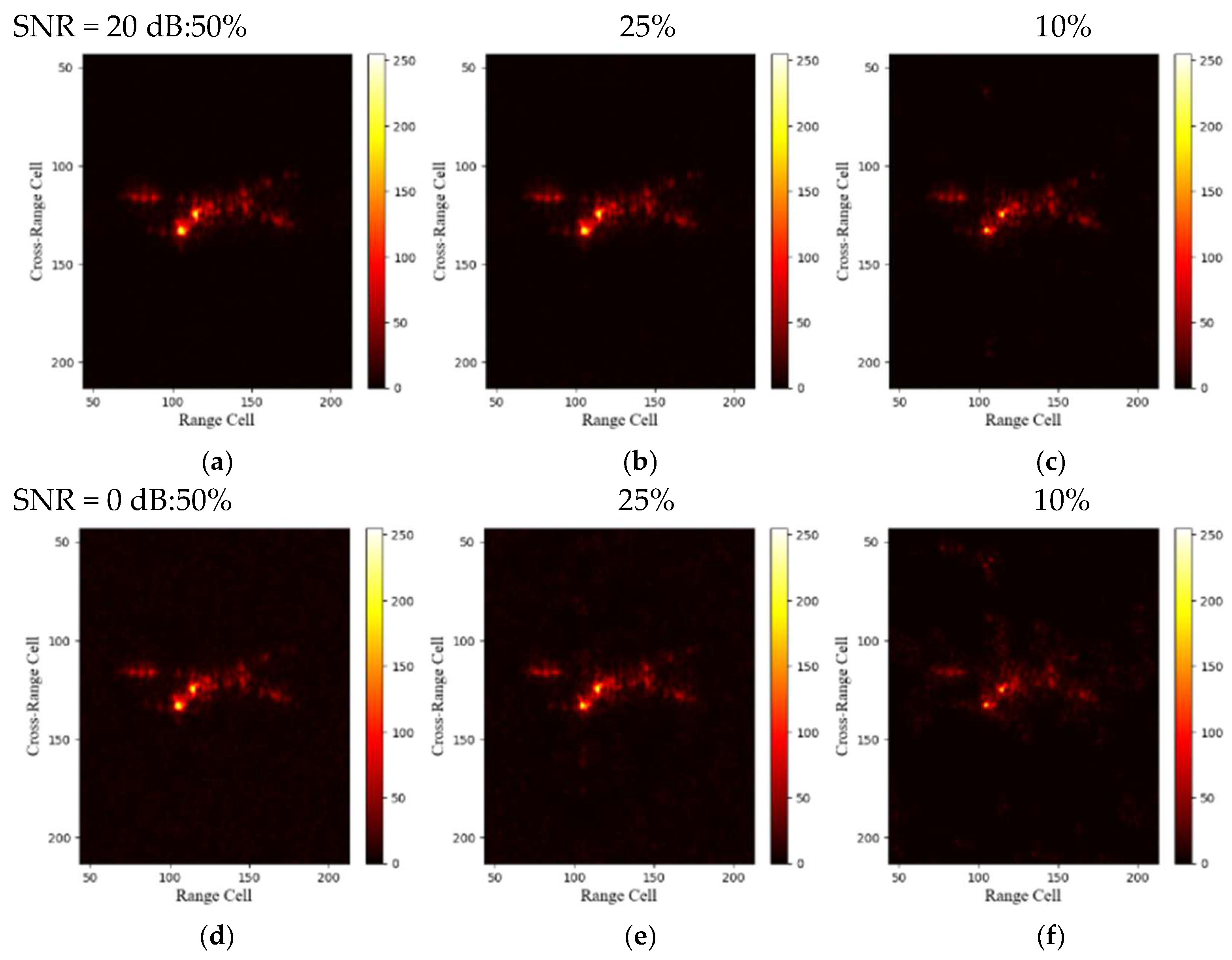
- A single trained ADnDEQ model generalizes well across different sampling ratios and noise conditions, avoiding retraining under mismatched sensing configurations.
- The DEQ-based formulation offers an interpretable and memory-efficient alternative to deep stacked networks, enabling flexible and resource-friendly deployment in practical radar systems.
Abstract
1. Introduction
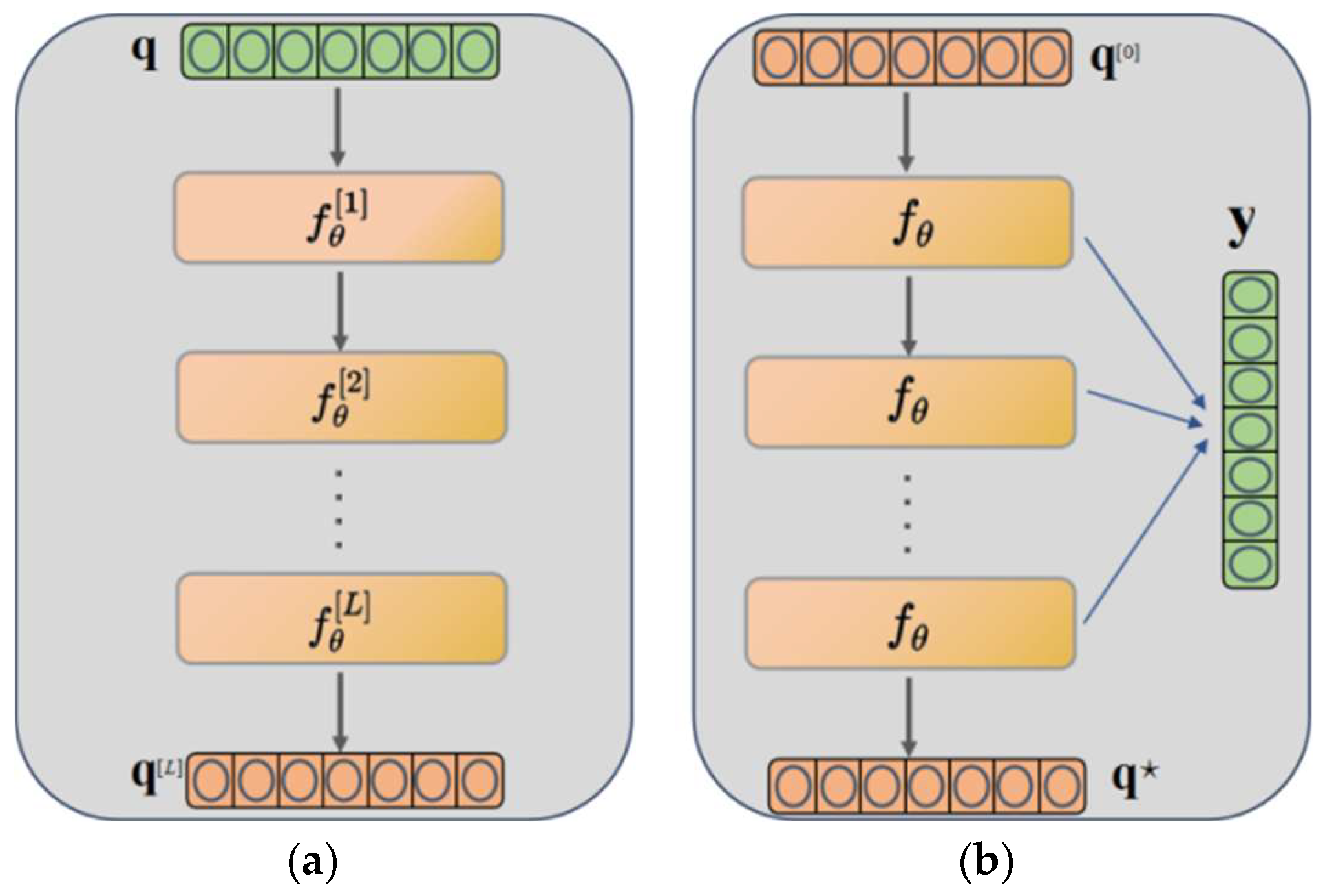
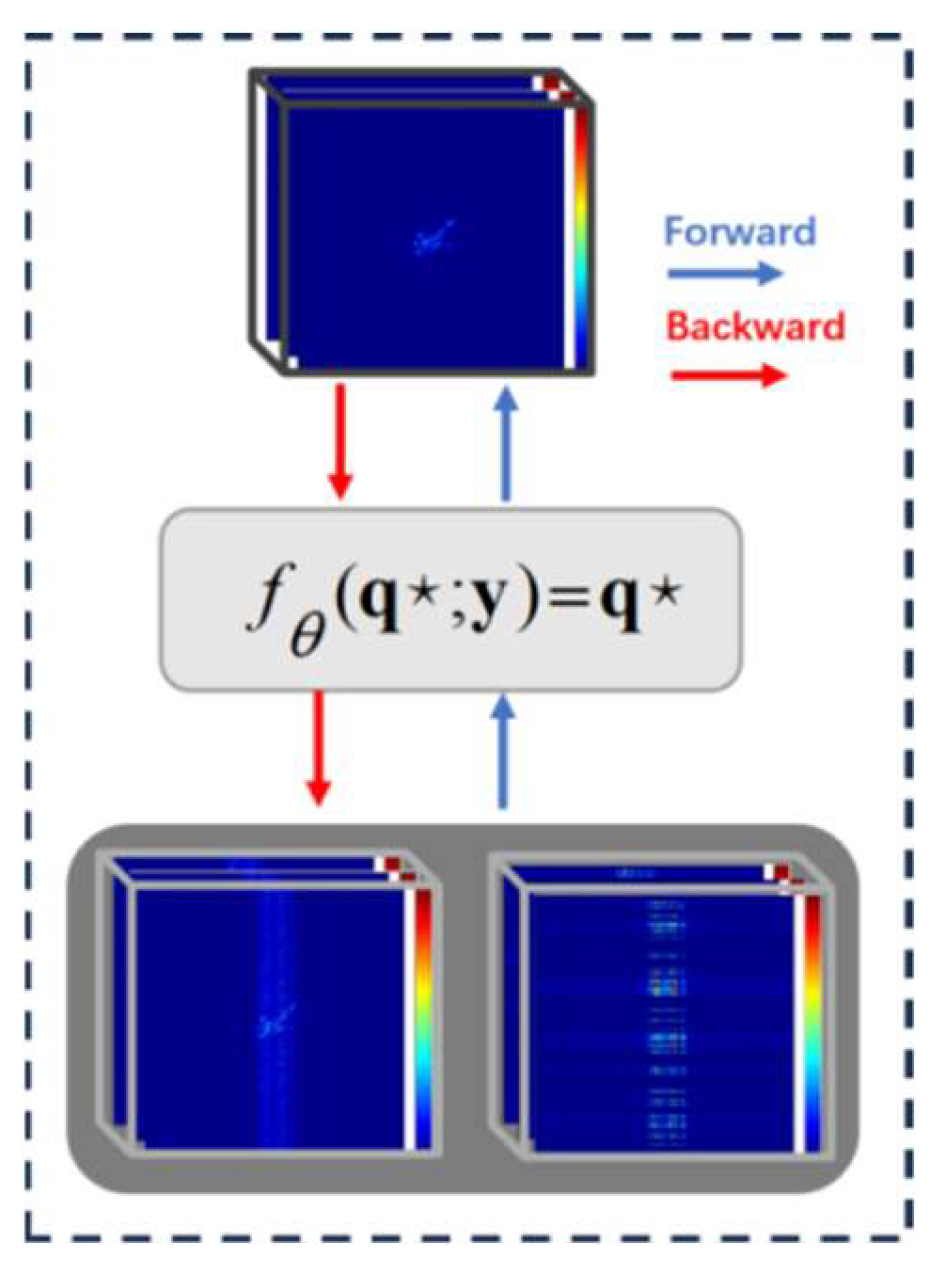
- We propose an ADnDEQ framework for sparse-aperture ISAR imaging, which reformulates an ADMM-based unfolding network as an implicit equilibrium problem. This design avoids explicit layer stacking and enables constant-memory inference with a single-layer equilibrium representation.
- By embedding a learned denoising proximal operator within the ADMM-based equilibrium structure, the proposed framework provides a principled way to integrate data-driven priors into a physically interpretable optimization process, rather than relying on purely black-box architectures. The proposed ADnDEQ model exhibits remarkable robustness under extreme conditions, such as very low sampling ratios (10%) and harsh noise environments (e.g., 0 dB SNR), maintaining stable and accurate image reconstruction performance.
- Owing to the equilibrium formulation and parameter-sharing mechanism, the proposed framework naturally decouples network structure from specific sampling ratios, enabling a single trained model to be flexibly applied across different sampling rates and noise levels without retraining.
2. Related Work
2.1. Traditional ADMM
2.2. DnADMM-Net
| Algorithm 1 DnADMM-Net |
| 1: Initialized: |
| 2: for: k= 1, 2, … |
| 3: |
| 4: |
| 5: |
| 6. End while |
2.3. Deep Equilibrium Framework
3. Methodology
3.1. Deep Equilibrium ADMM
3.2. ADnDEQ Model
| Algorithm 2 ADnDEQ Method |
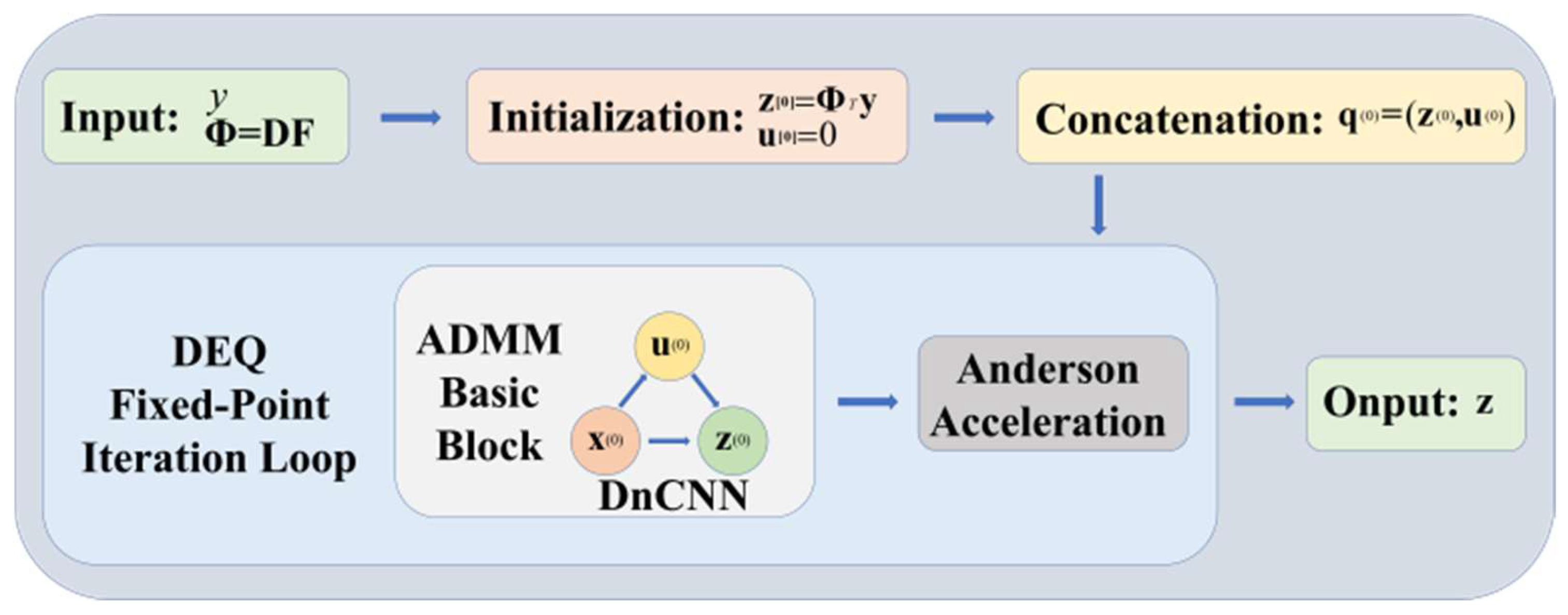
| 1: Input: observed data ; transformation matrix ; auxiliary variable set to zero; initial value , fixed-point iteration equation , storage size m = 5, minimum relative error 0.01, calculated from |
| 2: Initialization: Concatenate and into a single vector . |
| 3: DEQ Fixed-Point Iteration: Begin the iterative process to find the fixed point of the DEQ-inspired system. |
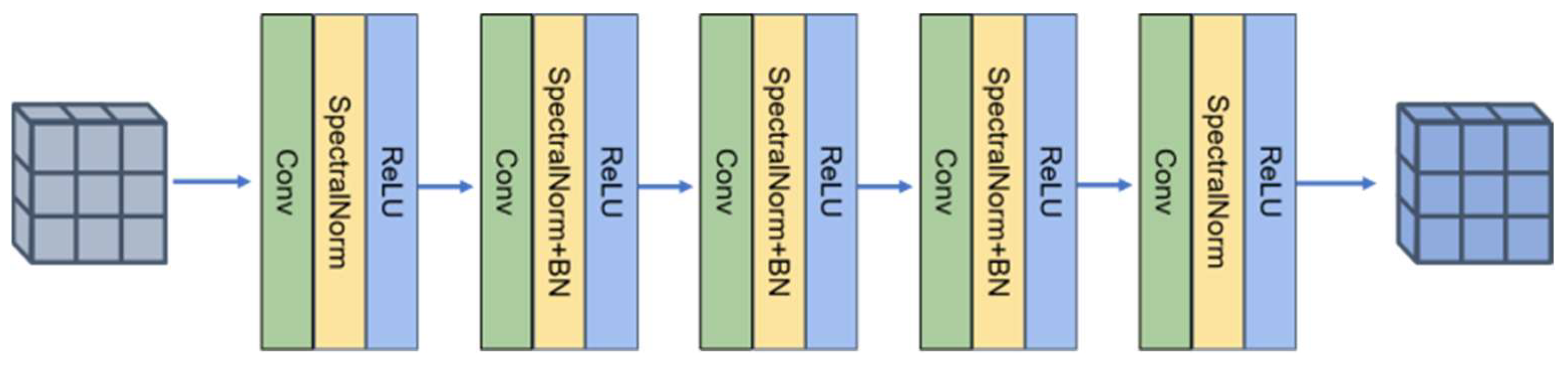
| 4: Within Each Iteration: ADMM Basic Block: x-update: Compute the updated value of based on the current estimates of and . z-update: Compute the updated value of using a DnCNN denoiser. u-update: Update the auxiliary variable . Anderson Acceleration: Apply Anderson Acceleration to accelerate convergence by minimizing the residual error in the fixed-point iteration. Formulate and solve the least squares problem to find optimal coefficients such that . Update using the weighted average of previous iterates and function evaluations: . |
| 5: Convergence Detection: After each iteration, check the relative error and the number of iterations against the predefined convergence criteria. |
| 6: End: If the convergence criteria are met, terminate the iteration and output the final recovered signal or image . If not, continue to the next iteration until the maximum number of iterations is reached or convergence is achieved. |
4. Experiments
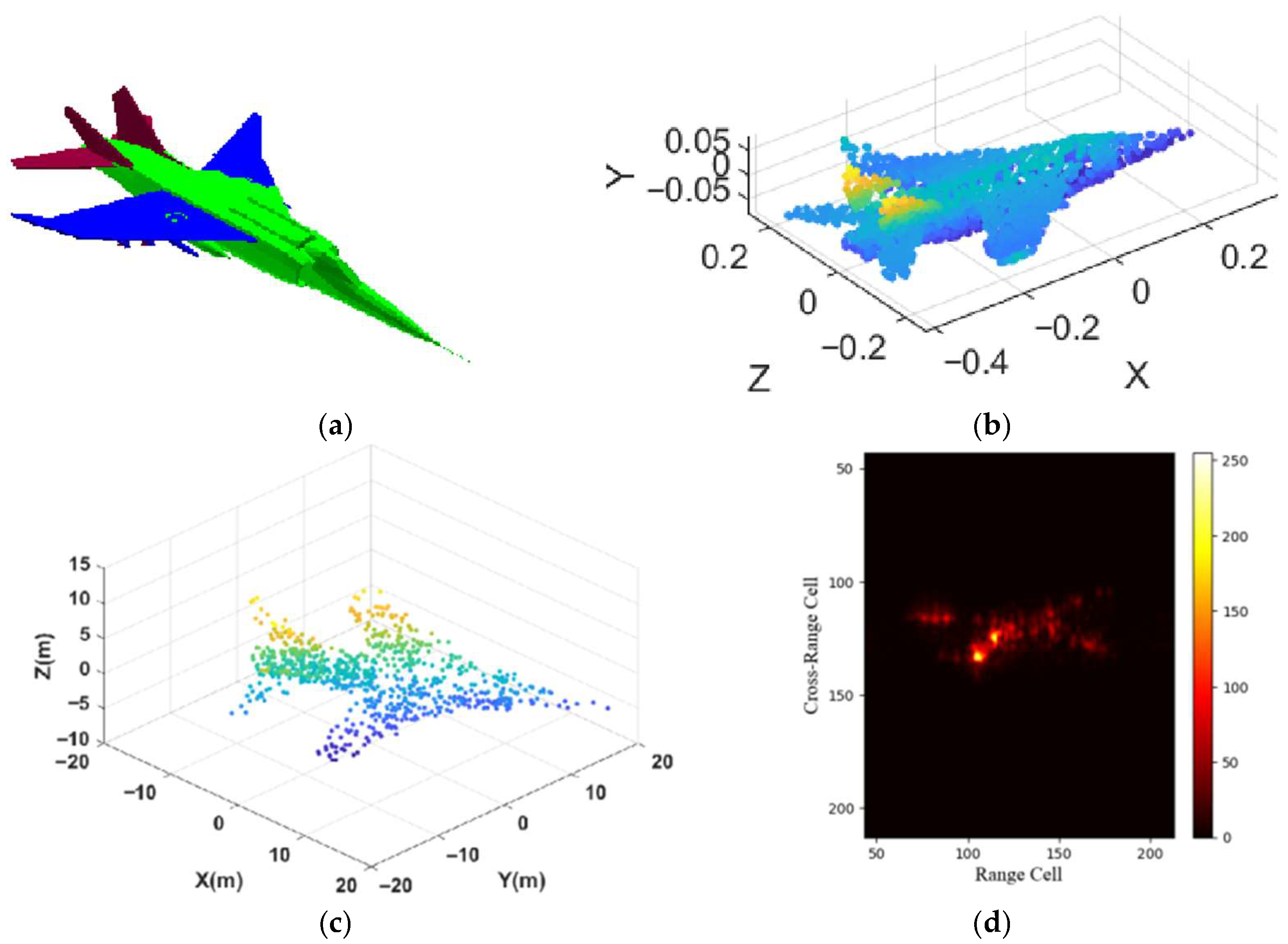
4.1. Simulation Data Generation
4.2. Experimental Details
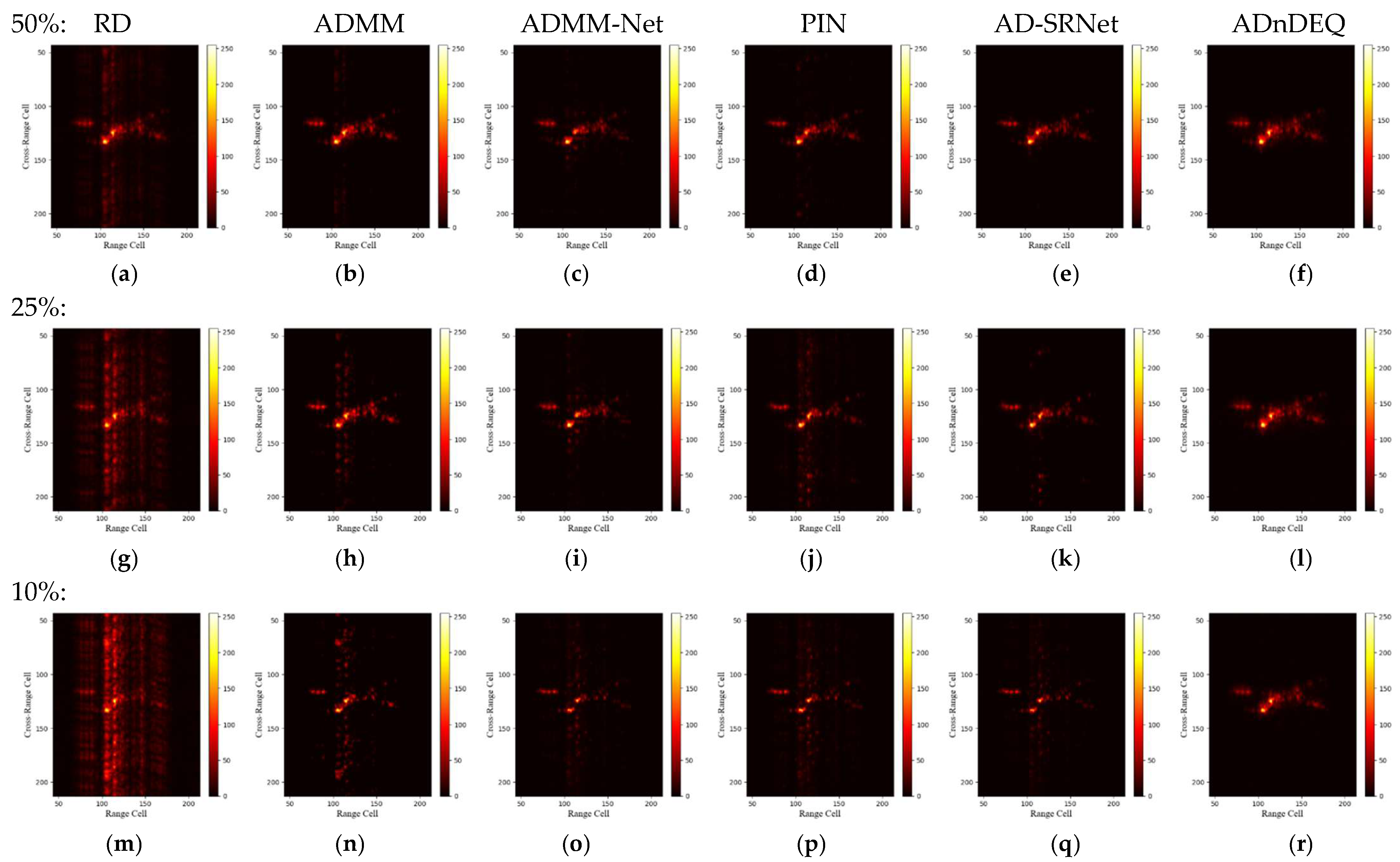
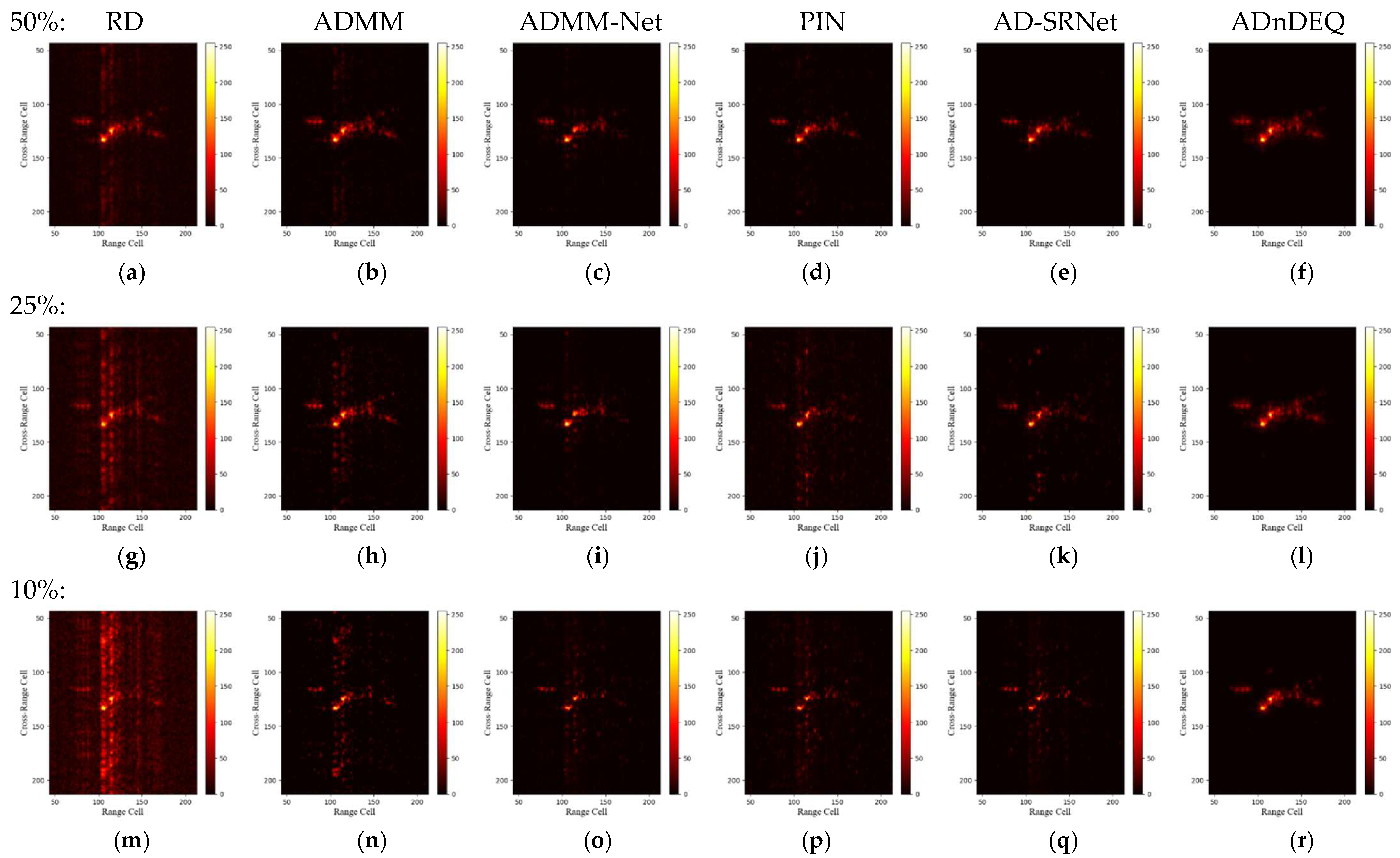
4.3. Comparison of Imaging Results
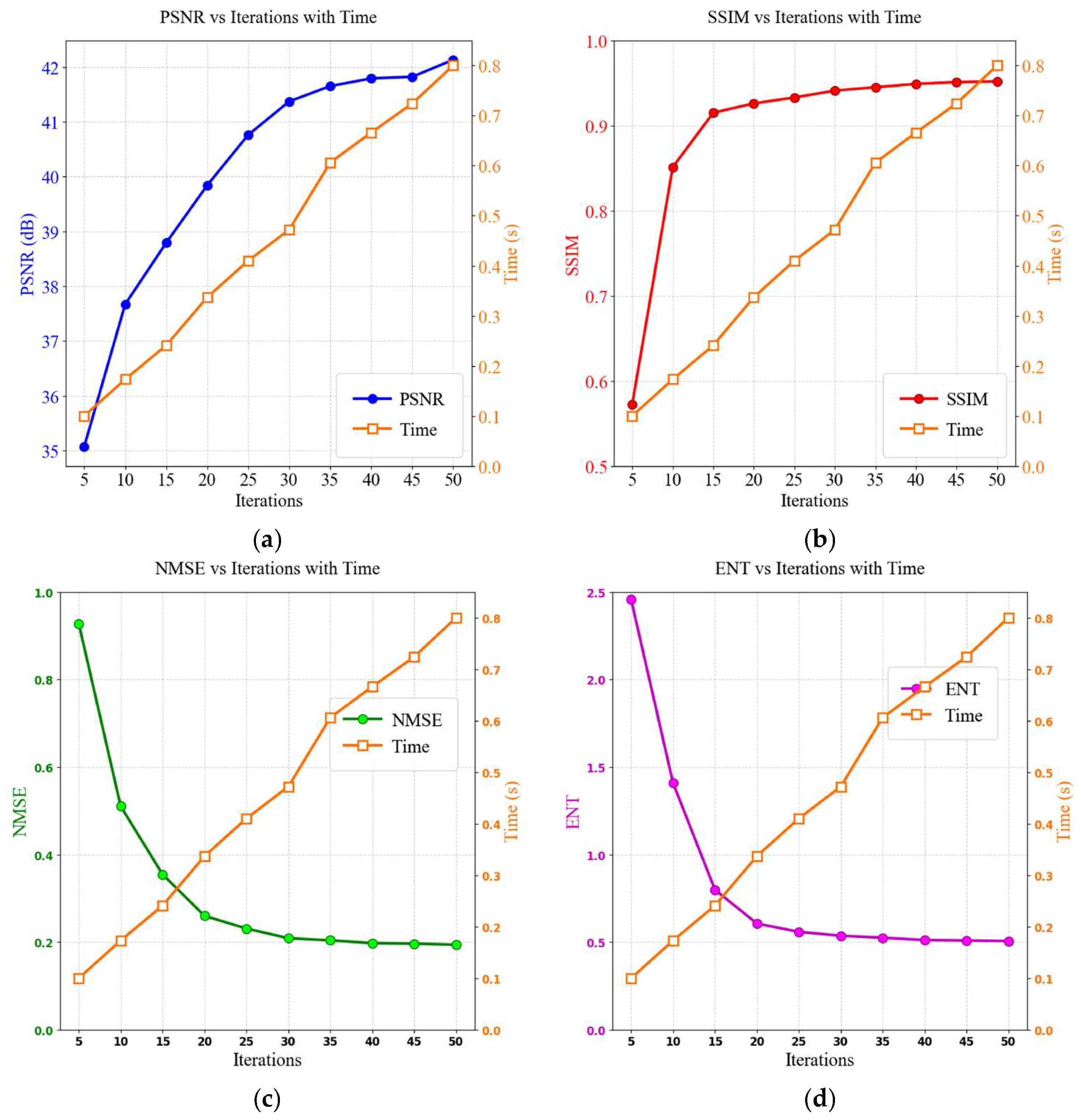
4.4. Balance Between Efficiency and Performance
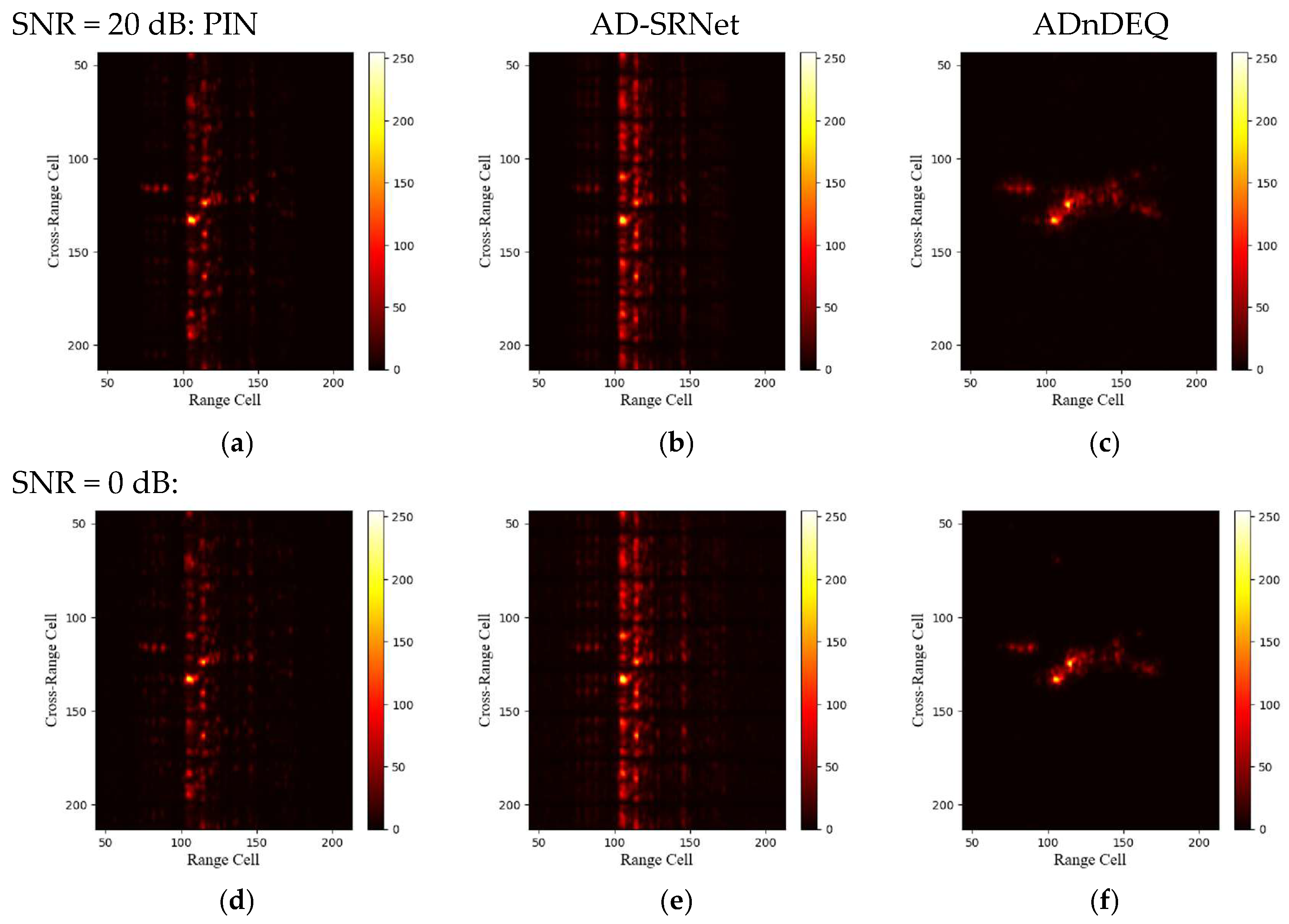
4.5. The Flexibility and Robustness
5. Conclusions
Author Contributions
Funding
Data Availability Statement
Conflicts of Interest
References
- Chen, V.C.; Martorella, M. Inverse Synthetic Aperture Radar; SciTech Publishing: Raleigh, NC, USA, 2014. [Google Scholar]
- Chen, C.-C.; Andrews, H. Target-motion-induced radar imaging. IEEE Trans. Aerosp. Electron. Syst. 1980, 16, 2–14. [Google Scholar] [CrossRef]
- Kang, M.-S.; Lee, S.-J.; Lee, S.-H.; Kim, K.-T. ISAR imaging of high-speed maneuvering target using gapped stepped-frequency waveform and compressive sensing. IEEE Trans. Image Process. 2017, 26, 5043–5056. [Google Scholar] [CrossRef] [PubMed]
- Lacomme, P. Inverse synthetic aperture radar (ISAR). In Air and Spaceborne Radar Systems; Lacomme, P., Ed.; William Andrew: Norwich, NY, USA, 2001; pp. 329–335. [Google Scholar]
- Zheng, J.B.; Liu, H.W.; Liao, G.S.; Su, T.; Liu, Z.; Liu, Q.H. ISAR imaging of targets with complex motions based on a noise-resistant parameter estimation algorithm without nonuniform axis. IEEE Sens. J. 2016, 16, 2509–2518. [Google Scholar] [CrossRef]
- Zheng, J.; Su, T.; Zhu, W.; Liu, Q.H. ISAR imaging of targets with complex motions based on the keystone time-chirp rate distribution. IEEE Geosci. Remote Sens. Lett. 2014, 11, 1275–1279. [Google Scholar] [CrossRef]
- Donoho, D.L. Compressed sensing. IEEE Trans. Inf. Theory 2006, 52, 1289–1306. [Google Scholar] [CrossRef]
- Wang, M.; Wei, S.; Shi, J.; Wu, Y.; Qu, Q.; Zhou, Y.; Zeng, X.; Tian, B. CSR-Net: A novel complex-valued network for fast and precise 3-D microwave sparse reconstruction. IEEE J. Sel. Top. Appl. Earth Obs. Remote Sens. 2020, 13, 4476–4492. [Google Scholar] [CrossRef]
- Xu, G.; Xia, X.-G.; Hong, W. Nonambiguous SAR image formation of maritime targets using weighted sparse approach. IEEE Trans. Geosci. Remote Sens. 2018, 56, 1454–1465. [Google Scholar] [CrossRef]
- Zhang, L.; Xing, M.; Qiu, C.-W.; Li, J.; Bao, Z. Achieving higher resolution ISAR imaging with limited pulses via compressed sampling. IEEE Geosci. Remote Sens. Lett. 2009, 6, 567–571. [Google Scholar] [CrossRef]
- Zhang, S.; Liu, Y.; Li, X.; Bi, G. Joint sparse aperture ISAR autofocusing and scaling via modified Newton method-based variational Bayesian inference. IEEE Trans. Geosci. Remote Sens. 2019, 57, 4857–4869. [Google Scholar] [CrossRef]
- Cai, T.T.; Wang, L. Orthogonal matching pursuit for sparse signal recovery with noise. IEEE Trans. Inf. Theory 2011, 57, 4680–4688. [Google Scholar] [CrossRef]
- Dakovic, M.; Stankovic, L.; Stankovic, S. Gradient algorithm based ISAR image reconstruction from the incomplete dataset. In Proceedings of the 2015 3rd International Workshop on Compressed Sensing Theory and its Applications to Radar, Sonar and Remote Sensing (CoSeRa), Pisa, Italy, 17–19 June 2015; pp. 6–10. [Google Scholar]
- Wang, L.; Loffeld, O.; Ma, K.; Qian, Y. Sparse ISAR imaging using a greedy Kalman filtering approach. Signal Process. 2017, 138, 1–10. [Google Scholar] [CrossRef]
- Gregor, K.; LeCun, Y. Learning fast approximations of sparse coding. In Proceedings of the 27th International Conference on International Conference on Machine Learning (ICML), Haifa, Israel, 21–24 June 2010; Omnipress: Madison, WI, USA, 2010; pp. 399–406. [Google Scholar]
- Boyd, S.; Parikh, N.; Chu, E.; Peleato, B.; Eckstein, J. Distributed optimization and statistical learning via the alternating direction method of multipliers. Found. Trends Mach. Learn. 2010, 3, 1–122. [Google Scholar] [CrossRef]
- Donoho, D.L.; Maleki, A.; Montanari, A. Message-passing algorithms for compressed sensing. Proc. Natl. Acad. Sci. USA 2009, 106, 18914–18919. [Google Scholar] [CrossRef] [PubMed]
- Tibshirani, R. Regression shrinkage and selection via the lasso. J. R. Stat. Soc. Ser. B 1996, 58, 267–288. [Google Scholar] [CrossRef]
- Xu, G.; Yang, L.; Bi, G.; Xing, M. Enhanced ISAR imaging and motion estimation with parametric and dynamic sparse Bayesian learning. IEEE Trans. Comput. Imaging 2017, 3, 940–952. [Google Scholar] [CrossRef]
- Zhang, Y.; Bai, X.; Liu, S.; Zhou, F. Joint translational motion compensation and high-resolution ISAR imaging based on sparse Bayesian learning. IEEE Trans. Comput. Imaging 2024, 11, 1115–1127. [Google Scholar] [CrossRef]
- Li, X.; Bai, X.; Zhang, Y.; Zhou, F. High-resolution ISAR imaging based on plug-and-play 2D ADMM-Net. Remote Sens. 2022, 14, 901. [Google Scholar] [CrossRef]
- Xiao, C.; Gao, X.; Zhang, C. U-ADMMNet: A model-based deep learning method for sparse aperture ISAR imaging. In Proceedings of the 2021 14th International Congress on Image and Signal Processing, BioMedical Engineering and Informatics (CISP-BMEI), Shanghai, China, 23–25 October 2021; pp. 1–7. [Google Scholar]
- Li, H.; Xu, J.; Song, H.; Wang, Y. Deep unfolding for sparse aperture ISAR imaging via compressed sensing: CIST+. IET Conf. Proc. 2024, 2023, 3483–3488. [Google Scholar] [CrossRef]
- Li, H.; Xu, J.; Song, H.; Wang, Y. PIN: Sparse aperture ISAR imaging via self-supervised learning. IEEE Geosci. Remote Sens. Lett. 2024, 21, 3502905. [Google Scholar] [CrossRef]
- Hu, C.; Wang, L.; Li, Z.; Zhu, D. Inverse synthetic aperture radar imaging using a fully convolutional neural network. IEEE Geosci. Remote Sens. Lett. 2020, 17, 1203–1207. [Google Scholar] [CrossRef]
- Hu, C.; Wang, L.; Zhu, D.; Zhang, G.; Loffeld, O. FCNN-based ISAR sparse imaging exploiting gate units and transfer learning. IEEE Geosci. Remote Sens. Lett. 2022, 19, 1–5. [Google Scholar] [CrossRef]
- Wang, J.; Li, S.; Cheng, D.; Zhou, L.; Chen, C.; Chen, W. CVAE: An efficient and flexible approach for sparse aperture ISAR imaging. IEEE Geosci. Remote Sens. Lett. 2023, 20, 4000805. [Google Scholar] [CrossRef]
- Du, C.; Xie, P.; Zhang, L.; Ma, Y.; Tian, L. Conditional prior probabilistic generative model with similarity measurement for ISAR imaging. IEEE Geosci. Remote Sens. Lett. 2022, 19, 4013205. [Google Scholar] [CrossRef]
- Qin, D.; Gao, X. Enhancing ISAR resolution by a generative adversarial network. IEEE Geosci. Remote Sens. Lett. 2021, 18, 127–131. [Google Scholar] [CrossRef]
- Chen, M.; Xia, J.-Y.; Liu, T.; Liu, L. An integrated network for SA-ISAR image processing with adaptive denoising and super-resolution modules. IEEE Geosci. Remote Sens. Lett. 2024, 21, 3500605. [Google Scholar] [CrossRef]
- Wei, S.J.; Liang, J.; Wang, M.; Zeng, X.; Shi, J.; Zhang, X. CIST: An improved ISAR imaging method using convolution neural network. Remote Sens. 2020, 12, 2641. [Google Scholar] [CrossRef]
- Wang, L.Z.; Wang, L.; Heredia-Conde, M. A fast total-variation driven network for sparse aperture ISAR imaging. Digit. Signal Process. 2024, 151, 104515. [Google Scholar] [CrossRef]
- Li, R.Z.; Zhang, S.H.; Zhang, C.; Liu, Y.; Li, X. A computational efficient 2-D block-sparse ISAR imaging method based on PCSBL-GAMP-Net. IEEE Trans. Geosci. Remote Sens. 2021, 60, 5214814. [Google Scholar] [CrossRef]
- Wang, L.Z.; Wang, L.; Heredia-Conde, M. A composite network for CS-ISAR integrating deep adaptive sampling and imaging. IEEE J. Sel. Top. Appl. Earth Obs. Remote Sens. 2025, 18, 11599–11609. [Google Scholar] [CrossRef]
- Li, R.Z.; Zhang, S.H.; Zhang, C.; Liu, Y.; Li, X. Deep learning approach for sparse aperture ISAR imaging and autofocusing based on complex-valued ADMM-net. IEEE Sens. J. 2020, 21, 3437–3451. [Google Scholar] [CrossRef]
- Bai, S.; Kolter, J.Z.; Koltun, V. Deep equilibrium models. arXiv 2019, arXiv:1909.01377. [Google Scholar] [CrossRef]
- Gilton, G.; Ongie, G.; Willett, R. Deep equilibrium architectures for inverse problems in imaging. arXiv 2021, arXiv:2102.07944. [Google Scholar] [CrossRef]
- Yao, H.; Dai, F.; Zhang, S.; Zhang, Y.; Tian, Q.; Xu, C. DR2-Net: Deep residual reconstruction network for image compressive sensing. Neurocomputing 2019, 359, 483–493. [Google Scholar] [CrossRef]
- Walker, H.F.; Ni, P. Anderson acceleration for fixed-point iterations. SIAM J. Numer. Anal. 2011, 49, 1715–1735. [Google Scholar] [CrossRef]



| CS Ratio | Image Method | PSNR/ dB | SSIM | NMSE | ENT |
|---|---|---|---|---|---|
| 50% | RD | 35.1567 | 0.7514 | 0.9107 | 2.4335 |
| ADMM | 42.6714 | 0.8261 | 0.5123 | 1.9436 | |
| ADMM-Net | 53.7163 | 0.9002 | 0.1261 | 1.0381 | |
| PIN | 53.3367 | 0.9127 | 0.0644 | 0.9467 | |
| AD-SRNet | 54.1265 | 0.9141 | 0.0902 | 0.8701 | |
| ADnDEQ | 56.7429 | 0.9883 | 0.0013 | 0.5153 | |
| 25% | RD | 30.3020 | 0.6480 | 2.7842 | 3.0700 |
| ADMM | 37.5128 | 0.7866 | 1.7850 | 2.3670 | |
| ADMM-Net | 42.8362 | 0.8899 | 0.8423 | 1.9987 | |
| PIN | 41.3004 | 0.8743 | 0.9881 | 1.5127 | |
| AD-SRNet | 43.6712 | 0.8632 | 0.7563 | 1.3536 | |
| ADnDEQ | 49.0503 | 0.9754 | 0.0370 | 0.6221 | |
| 10% | RD | 26.4564 | 0.5389 | 6.7540 | 3.5672 |
| ADMM | 32.4877 | 0.7466 | 4.3601 | 2.8102 | |
| ADMM-Net | 37.5044 | 0.8210 | 3.0089 | 2.2344 | |
| PIN | 38.7963 | 0.8611 | 3.1307 | 1.3910 | |
| AD-SRNet | 39.1931 | 0.8554 | 3.0119 | 1.4101 | |
| ADnDEQ | 45.7846 | 0.9471 | 0.3883 | 0.8404 |
| CS Ratio | Image Method | PSNR/ dB | SSIM | NMSE | ENT |
| 50% | RD | 30.3687 | 0.1789 | 2.2729 | 3.9083 |
| ADMM | 37.1845 | 0.5424 | 1.5463 | 2.3889 | |
| ADMM-Net | 44.9324 | 0.8727 | 0.2298 | 1.6560 | |
| PIN | 45.6258 | 0.9034 | 0.1002 | 1.1165 | |
| AD-SRNet | 46.5982 | 0.9100 | 0.1133 | 1.0006 | |
| ADnDEQ | 49.4561 | 0.9705 | 0.0039 | 0.5777 | |
| 25% | RD | 26.3670 | 0.0913 | 6.8764 | 4.5233 |
| ADMM | 33.6012 | 0.5583 | 3.0276 | 3.0133 | |
| ADMM-Net | 39.9050 | 0.7733 | 1.0006 | 2.3914 | |
| PIN | 40.5130 | 0.7941 | 1.2145 | 1.7345 | |
| AD-SRNet | 42.8292 | 0.7391 | 0.9171 | 1.5207 | |
| ADnDEQ | 46.8851 | 0.9499 | 0.0611 | 0.7533 | |
| 10% | RD | 22.6111 | 0.0439 | 16.3187 | 5.1021 |
| ADMM | 29.3047 | 0.3341 | 10.7100 | 3.6519 | |
| ADMM-Net | 33.4061 | 0.7214 | 4.0423 | 2.8140 | |
| PIN | 33.3951 | 0.6993 | 5.5312 | 1.7948 | |
| AD-SRNet | 34.0194 | 0.7140 | 3.1467 | 1.7882 | |
| ADnDEQ | 42.1329 | 0.9270 | 0.4827 | 0.9349 |
| SNR/ dB | CS Ratio | PSNR/ dB | SSIM | NMSE | ENT |
|---|---|---|---|---|---|
| 20 | 50% | 46.9636 | 0.8314 | 0.0943 | 1.1674 |
| 25% | 44.8517 | 0.8272 | 0.0969 | 1.2646 | |
| 10% | 41.3957 | 0.8084 | 0.2164 | 1.4574 | |
| 0 | 50% | 39.3967 | 0.7510 | 0.5690 | 2.1900 |
| 25% | 36.8105 | 0.6678 | 0.6217 | 2.3699 | |
| 10% | 34.8514 | 0.6136 | 0.9759 | 2.7153 |
Disclaimer/Publisher’s Note: The statements, opinions and data contained in all publications are solely those of the individual author(s) and contributor(s) and not of MDPI and/or the editor(s). MDPI and/or the editor(s) disclaim responsibility for any injury to people or property resulting from any ideas, methods, instructions or products referred to in the content. |
© 2026 by the authors. Licensee MDPI, Basel, Switzerland. This article is an open access article distributed under the terms and conditions of the Creative Commons Attribution (CC BY) license.
Share and Cite
Song, H.; Zhang, X.; Wu, T.; Xu, J.; Wang, Y.; Li, H. A Sparse Aperture ISAR Imaging Based on a Single-Layer Network Framework. Remote Sens. 2026, 18, 335. https://doi.org/10.3390/rs18020335
Song H, Zhang X, Wu T, Xu J, Wang Y, Li H. A Sparse Aperture ISAR Imaging Based on a Single-Layer Network Framework. Remote Sensing. 2026; 18(2):335. https://doi.org/10.3390/rs18020335
Chicago/Turabian StyleSong, Haoxuan, Xin Zhang, Taonan Wu, Jialiang Xu, Yong Wang, and Hongzhi Li. 2026. "A Sparse Aperture ISAR Imaging Based on a Single-Layer Network Framework" Remote Sensing 18, no. 2: 335. https://doi.org/10.3390/rs18020335
APA StyleSong, H., Zhang, X., Wu, T., Xu, J., Wang, Y., & Li, H. (2026). A Sparse Aperture ISAR Imaging Based on a Single-Layer Network Framework. Remote Sensing, 18(2), 335. https://doi.org/10.3390/rs18020335