All-Weather Flood Mapping Using a Synergistic Multi-Sensor Downscaling Framework: Case Study for Brisbane, Australia
 ,
,  , ,
, ,  and
and
Highlights
- High temporal resolution, low spatial resolution space-based remote sensors can provide valuable insights during densely clouded flood events.
- Data sources of disparate spatial resolutions can be harmonized and integrated using topography.
- By successfully harmonizing free, public sensor data in a multi-sensor framework, this method offers a viable, cost-effective alternative for rapid flood mapping in resource-constrained scenarios.
Abstract
1. Introduction
2. Materials and Methods
2.1. Data
2.2. Floodwater Fraction Derivation
2.3. Downscaling Mechanism
2.3.1. Flood Susceptibility
2.3.2. Physical Downscaling
2.4. Final Flood Mapping
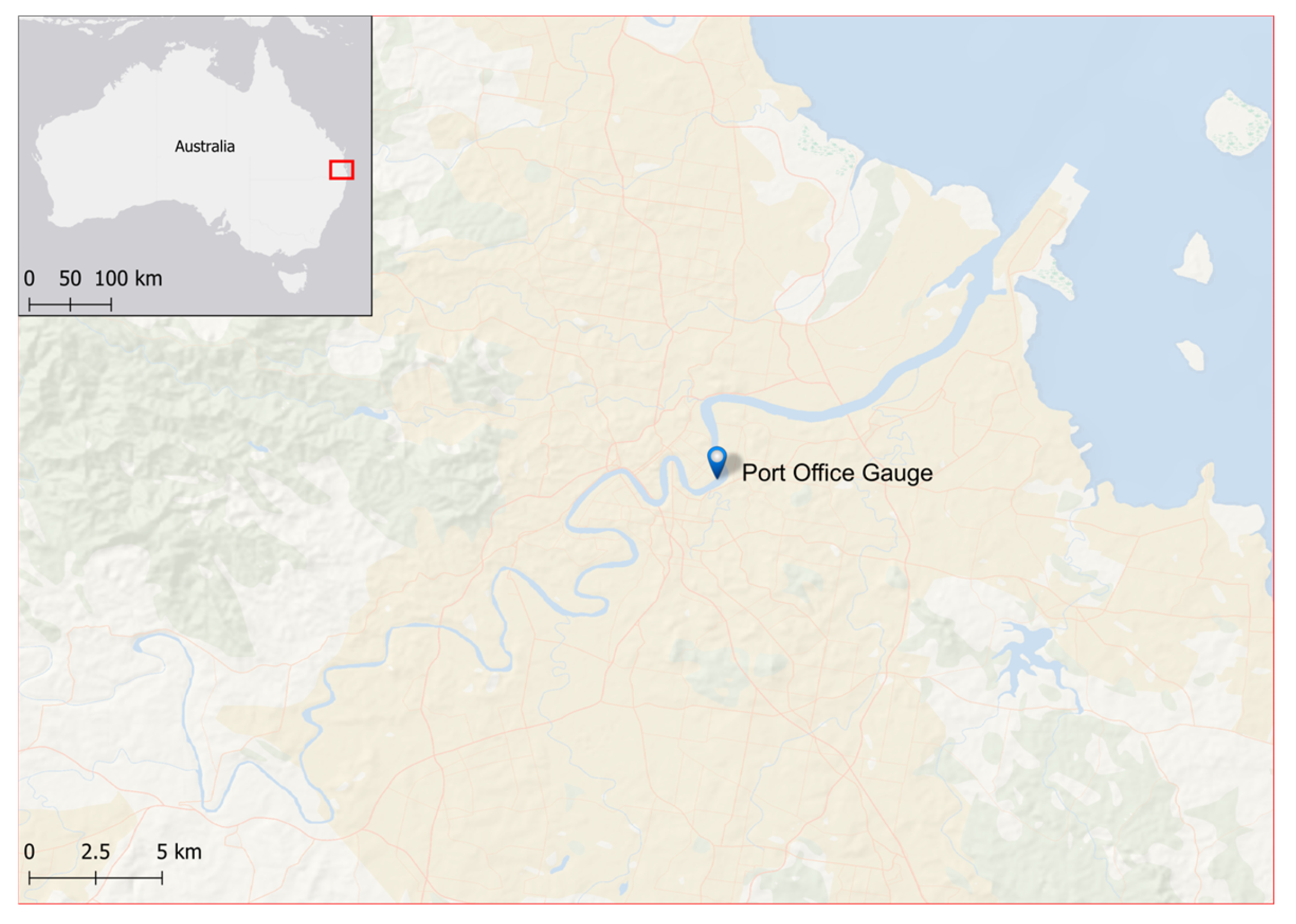
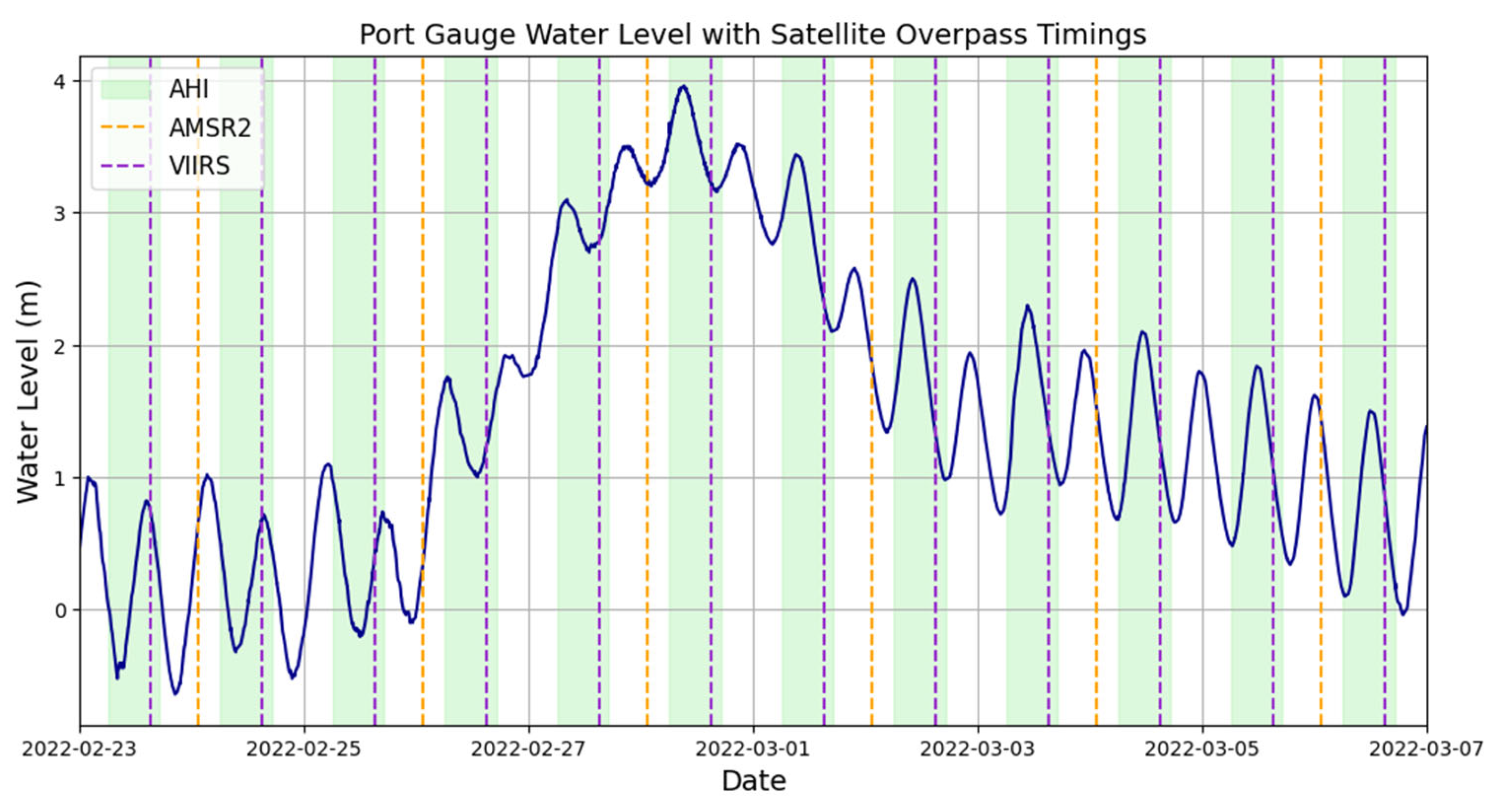
2.5. Case Study
2.6. Comparison and Validation Procedure
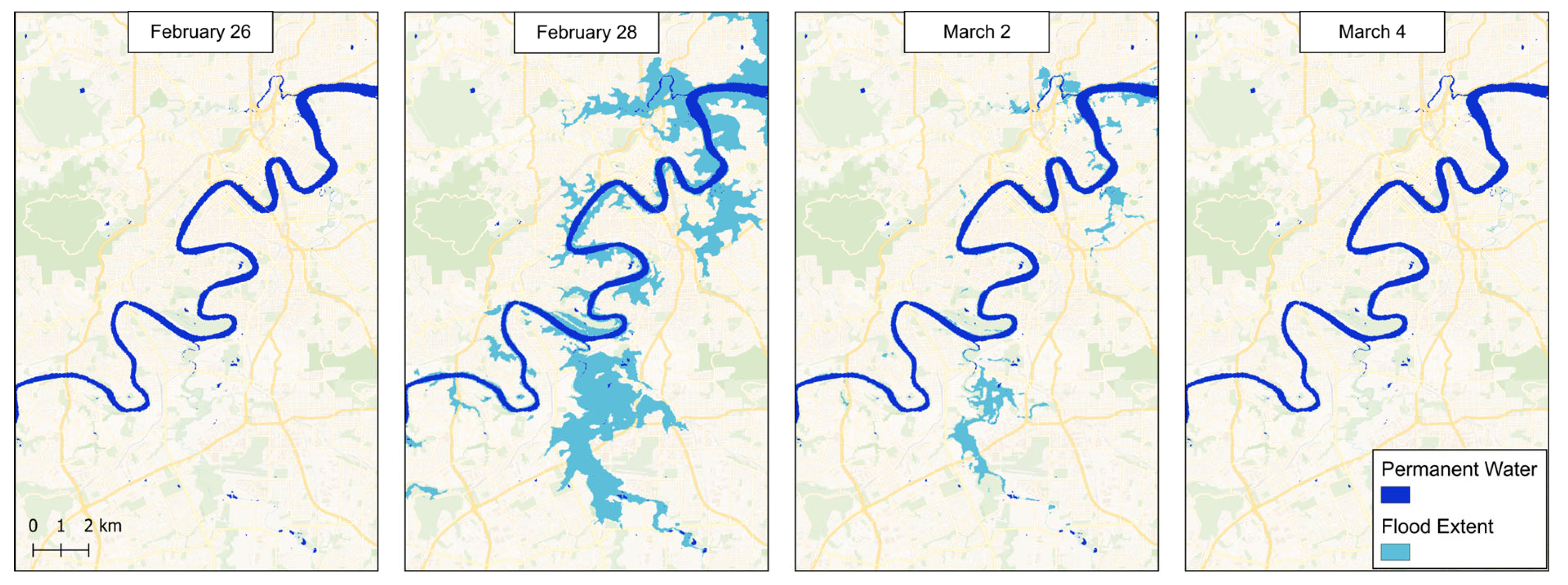
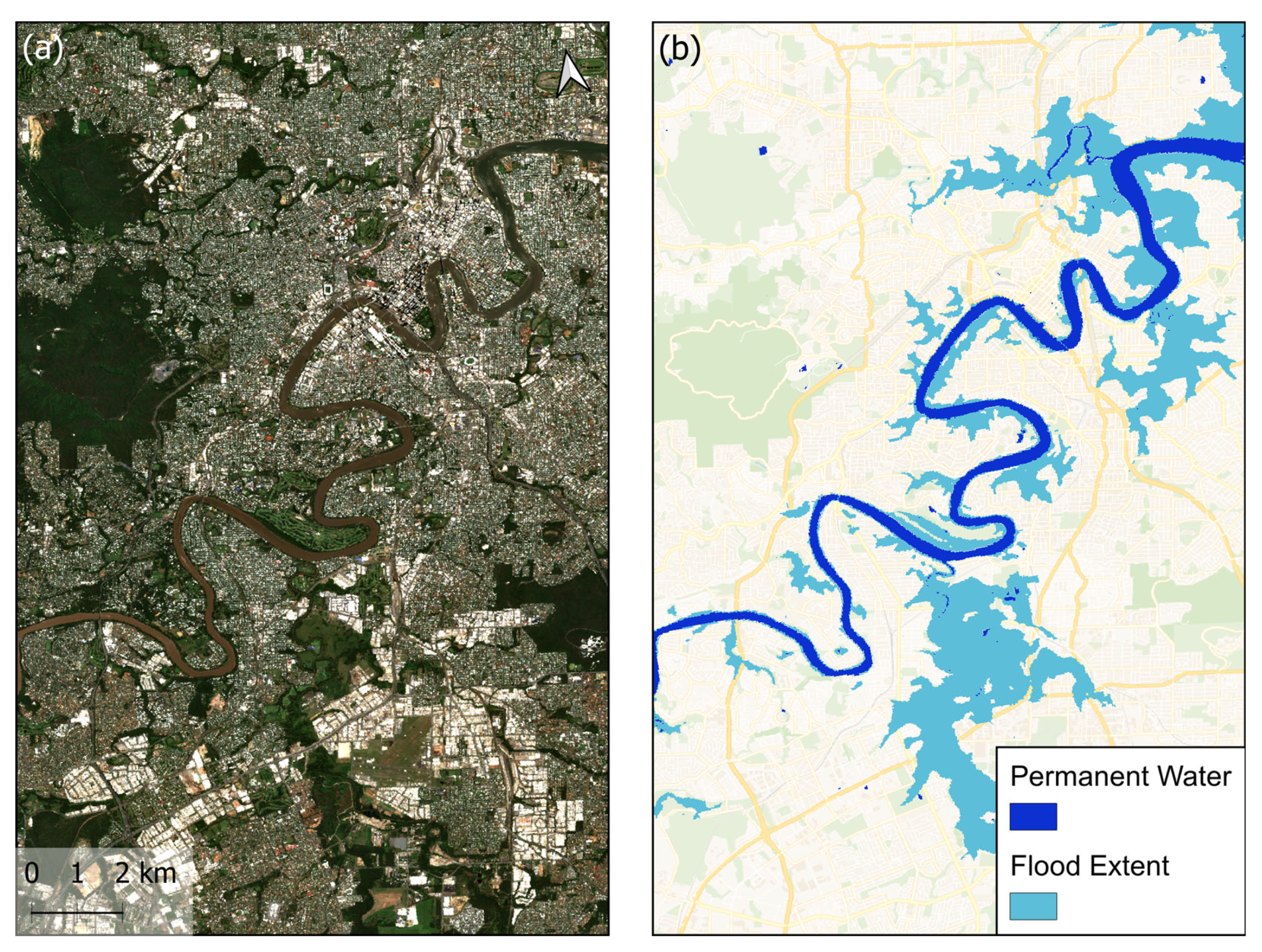
3. Results
4. Discussion
4.1. Enhanced Spatiotemporal Flood Monitoring
4.2. Utility for Diverse Applications
4.3. Limitations
5. Conclusions
Author Contributions
Funding
Data Availability Statement
Acknowledgments
Conflicts of Interest
References
- Najibi, N.; Devineni, N. Recent trends in the frequency and duration of global floods. Earth Syst. Dyn. 2018, 9, 757–783. [Google Scholar] [CrossRef]
- Tellman, B.; Sullivan, J.A.; Kuhn, C.; Kettner, A.J.; Doyle, C.S.; Brakenridge, G.R.; Erickson, T.A.; Slayback, D.A. Satellite imaging reveals increased proportion of population exposed to floods. Nature 2021, 596, 80–86. [Google Scholar] [CrossRef] [PubMed]
- Schumann, G.; Brakenridge, G.; Kettner, A.; Kashif, R.; Niebuhr, E. Assisting Flood Disaster Response with Earth Observation Data and Products: A Critical Assessment. Remote Sens. 2018, 10, 1230. [Google Scholar] [CrossRef]
- Munasinghe, D.; Frasson, R.P.D.M.; David, C.H.; Bonnema, M.; Schumann, G.; Brakenridge, G.R. A multi-sensor approach for increased measurements of floods and their societal impacts from space. Commun. Earth Environ. 2023, 4, 462. [Google Scholar] [CrossRef]
- Li, Z.; Xu, S.; Weng, Q. Beyond clouds: Seamless flood mapping using Harmonized Landsat and Sentinel-2 time series imagery and water occurrence data. ISPRS J. Photogramm. Remote Sens. 2024, 216, 185–199. [Google Scholar] [CrossRef]
- Liu, Z.; Zhu, D.; Wang, L.; Li, D. Enhancing surface water mapping and monthly dynamics monitoring with a stepwise gap-filling method. Int. J. Digit. Earth 2024, 17, 2413882. [Google Scholar] [CrossRef]
- Brakenridge, R.; Anderson, E. MODIS-Based Flood Detection, Mapping and Measurement: The Potential for Operational Hydrological Applications. In Transboundary Floods: Reducing Risks Through Flood Management; Marsalek, J., Stancalie, G., Balint, G., Eds.; Nato Science Series: IV: Earth and Environmental Sciences; Kluwer Academic Publishers: Dordrecht, The Netherlands, 2006; Volume 72, pp. 1–12. [Google Scholar] [CrossRef]
- Li, S.; Sun, D.; Goldberg, M.D.; Sjoberg, B.; Santek, D.; Hoffman, J.; DeWeese, M.; Restrepo, P.; Lindsey, S.; Holloway, E. Automatic near real-time flood detection using Suomi-NPP/VIIRS data. Remote Sens. Environ. 2018, 204, 672–689. [Google Scholar] [CrossRef]
- Li, S.; Sun, D.; Goldberg, M.D.; Lindsey, D. Automatic Near-Real-Time Flood Mapping from Geostationary Low Earth Orbiting Satellite Observations. In Global Drought and Flood; Geophysical Monograph Series; American Geophysical Union (AGU): Washington, DC, USA, 2021; pp. 61–97. [Google Scholar] [CrossRef]
- Giddings, L.; Choudhury, B.J. Observation of hydrological features with Nimbus-7 37 GHz data, applied to South America. Int. J. Remote Sens. 1989, 10, 1673–1686. [Google Scholar] [CrossRef]
- Du, J.; Kimball, J.S.; Sheffield, J.; Pan, M.; Fisher, C.K.; Beck, H.E.; Wood, E.F. Satellite Flood Inundation Assessment and Forecast Using SMAP and Landsat. IEEE J. Sel. Top. Appl. Earth Obs. Remote Sens. 2021, 14, 6707–6715. [Google Scholar] [CrossRef]
- Colosio, P.; Tedesco, M.; Tellman, E. Flood Monitoring Using Enhanced Resolution Passive Microwave Data: A Test Case over Bangladesh. Remote Sens. 2022, 14, 1180. [Google Scholar] [CrossRef]
- Zeng, Z.; Gan, Y.; Kettner, A.J.; Yang, Q.; Zeng, C.; Brakenridge, G.R.; Hong, Y. Towards high resolution flood monitoring: An integrated methodology using passive microwave brightness temperatures and Sentinel synthetic aperture radar imagery. J. Hydrol. 2020, 582, 124377. [Google Scholar] [CrossRef]
- Gao, F.; Masek, J.; Schwaller, M.; Hall, F. On the blending of the landsat and MODIS surface reflectance: Predicting daily landsat surface reflectance. IEEE Trans. Geosci. Remote Sens. 2006, 44, 2207–2218. [Google Scholar] [CrossRef]
- Zhu, X.; Helmer, E.H.; Gao, F.; Liu, D.; Chen, J.; Lefsky, M.A. A flexible spatiotemporal method for fusing satellite images with different resolutions. Remote Sens. Environ. 2016, 172, 165–177. [Google Scholar] [CrossRef]
- Bai, B.; Tan, Y.; Donchyts, G.; Haag, A.; Weerts, A. A Simple Spatio–Temporal Data Fusion Method Based on Linear Regression Coefficient Compensation. Remote Sens. 2020, 12, 3900. [Google Scholar] [CrossRef]
- Bai, B.; Tan, Y.; Zhou, K.; Donchyts, G.; Haag, A.; Weerts, A.H. Time-series surface water gap filling based on spatiotemporal neighbourhood similarity. Int. J. Appl. Earth Obs. Geoinf. 2022, 112, 102882. [Google Scholar] [CrossRef]
- Ulloa, N.I.; Yun, S.-H.; Chiang, S.-H.; Furuta, R. Sentinel-1 Spatiotemporal Simulation Using Convolutional LSTM for Flood Mapping. Remote Sens. 2022, 14, 246. [Google Scholar] [CrossRef]
- Wu, Z.; Stothoff, S.; Pensado, O.; Alford, J.; Larson, E.C. Exploring Convolutional Neural Networks for Predicting Sentinel-C Backscatter Between Image Acquisitions. IEEE Trans. Geosci. Remote Sens. 2023, 61, 5209916. [Google Scholar] [CrossRef]
- Markert, K.N.; Williams, G.P.; Nelson, E.J.; Ames, D.P.; Lee, H.; Griffin, R.E. Dense Time Series Generation of Surface Water Extents through Optical–SAR Sensor Fusion and Gap Filling. Remote Sens. 2024, 16, 1262. [Google Scholar] [CrossRef]
- Lan, L.; Wang, X. Large-scale flood mapping using Sentinel-1 and Sentinel-2 imagery: Spatio-temporal analysis of the 23·7 Haihe basin-wide extreme flood. J. Hydrol. 2025, 653, 132777. [Google Scholar] [CrossRef]
- Seydi, S.T.; Saeidi, V.; Kalantar, B.; Ueda, N.; van Genderen, J.L.; Maskouni, F.H.; Aria, F.A. Fusion of the Multisource Datasets for Flood Extent Mapping Based on Ensemble Convolutional Neural Network (CNN) Model. J. Sens. 2022, 2022, 2887502. [Google Scholar] [CrossRef]
- Lacava, T.; Brocca, L.; Coviello, I.; Faruolo, M.; Pergola, N.; Tramutoli, V. Integration of Optical and Passive Microwave Satellite Data for Flooded Area Detection and Monitoring. In Engineering Geology for Society and Territory; Lollino, G., Arattano, M., Rinaldi, M., Giustolisi, O., Marechal, J.-C., Grant, G.E., Eds.; Springer International Publishing: Cham, Switzerland, 2015; Volume 3, pp. 631–635. [Google Scholar] [CrossRef]
- Takbiri, Z.; Ebtehaj, A.M.; Foufoula-Georgiou, E. A multi-sensor data-driven methodology for all-sky passive microwave inundation retrieval. Hydrol. Earth Syst. Sci. 2017, 21, 2685–2700. [Google Scholar] [CrossRef]
- Khachatrian, E.; Dierking, W.; Chlaily, S.; Eltoft, T.; Dinessen, F.; Hughes, N.; Marinoni, A. SAR and Passive Microwave Fusion Scheme: A Test Case on Sentinel-1/AMSR-2 for Sea Ice Classification. Geophys. Res. Lett. 2023, 50, e2022GL102083. [Google Scholar] [CrossRef]
- Mao, H.; Kathuria, D.; Duffield, N.; Mohanty, B.P. Gap Filling of High-Resolution Soil Moisture for SMAP/Sentinel-1: A Two-Layer Machine Learning-Based Framework. Water Resour. Res. 2019, 55, 6986–7009. [Google Scholar] [CrossRef]
- Mauerman, M.; Tellman, E.; Lall, U.; Tedesco, M.; Colosio, P.; Thomas, M.; Osgood, D.; Bhuyan, A. High-Quality Historical Flood Data Reconstruction in Bangladesh Using Hidden Markov Models. In Water Management: A View from Multidisciplinary Perspectives; Tarekul Islam, G.M., Shampa, S., Chowdhury, A.I.A., Eds.; Springer International Publishing: Cham, Switzerland, 2022; pp. 191–210. [Google Scholar] [CrossRef]
- Salvia, M.; Grings, F.; Ferrazzoli, P.; Barraza, V.; Douna, V.; Perna, P.; Bruscantini, C.; Karszenbaum, H. Estimating flooded area and mean water level using active and passive microwaves: The example of Paraná River Delta floodplain. Hydrol. Earth Syst. Sci. 2011, 15, 2679–2692. [Google Scholar] [CrossRef]
- Higuchi, A. Toward More Integrated Utilizations of Geostationary Satellite Data for Disaster Management and Risk Mitigation. Remote Sens. 2021, 13, 1553. [Google Scholar] [CrossRef]
- Li, S.; Helfrich, S.; Kalluri, S.; Lindsey, D.; Goldberg, M.; Sun, D. Data Fusion from Multiple-source Flood Mapping Datasets through downscaling process. AGU Fall Meet. Abstr. 2023, 2023, H33D-01. [Google Scholar]
- Aires, F.; Prigent, C.; Fluet-Chouinard, E.; Yamazaki, D.; Papa, F.; Lehner, B. Comparison of visible and multi-satellite global inundation datasets at high-spatial resolution. Remote Sens. Environ. 2018, 216, 427–441. [Google Scholar] [CrossRef]
- Wu, G.; Chen, C.; Liu, Y.; Fan, X.; Niu, H.; Liu, Y. Developing a High-Resolution Seamless Surface Water Extent Time-Series over Lake Victoria by Integrating MODIS and Landsat Data. Remote Sens. 2023, 15, 3500. [Google Scholar] [CrossRef]
- Galantowicz, J.F.; Picton, J. Flood extent depiction by physical downscaling of flooded fraction estimates from microwave remote sensing. In Proceedings of the 2014 IEEE Geoscience and Remote Sensing Symposium, Quebec City, QC, Canada, 13–18 July 2014; pp. 3854–3857. [Google Scholar] [CrossRef]
- Nguyen, T.-H.; Aires, F. A New Surface Waters Downscaling Approach Applicable at Global Scale. Remote Sens. 2024, 16, 4664. [Google Scholar] [CrossRef]
- Li, S.; Sun, D.; Goldberg, M.; Stefanidis, A. Derivation of 30-m-resolution water maps from TERRA/MODIS and SRTM. Remote Sens. Environ. 2013, 134, 417–430. [Google Scholar] [CrossRef]
- Japanese Aerospace Exploration Agency (JAXA). GCOM-W/AMSR2 Level 3 Gridded Brightness Temperature (Daily); Japanese Aerospace Exploration Agency: Tokyo, Japan, 2013. [Google Scholar]
- Hawker, L.; Uhe, P.; Paulo, L.; Sosa, J.; Savage, J.; Sampson, C.; Neal, J. A 30 m global map of elevation with forests and buildings removed. Environ. Res. Lett. 2022, 17, 024016. [Google Scholar] [CrossRef]
- Pekel, J.-F.; Cottam, A.; Gorelick, N.; Belward, A.S. High-resolution mapping of global surface water and its long-term changes. Nature 2016, 540, 418–422. [Google Scholar] [CrossRef] [PubMed]
- Lehner, B.; Grill, G. Global river hydrography and network routing: Baseline data and new approaches to study the world’s large river systems. Hydrol. Process. 2013, 27, 2171–2186. [Google Scholar] [CrossRef]
- Prakash, S.; Norouzi, H.; Azarderakhsh, M.; Blake, R.; Prigent, C.; Khanbilvardi, R. Estimation of Consistent Global Microwave Land Surface Emissivity from AMSR-E and AMSR2 Observations. J. Appl. Meteorol. Climatol. 2018, 57, 907–919. [Google Scholar] [CrossRef]
- Grody, N.C. Classification of snow cover and precipitation using the special sensor microwave imager. J. Geophys. Res. Atmos. 1991, 96, 7423–7435. [Google Scholar] [CrossRef]
- Du, J.; Kimball, J.S.; Jones, L.A. Satellite Microwave Retrieval of Total Precipitable Water Vapor and Surface Air Temperature Over Land From AMSR2. IEEE Trans. Geosci. Remote Sens. 2015, 53, 2520–2531. [Google Scholar] [CrossRef]
- Galantowicz, J.; Picton, J.; Root, B. ARC Flood Extend Depiction Algorithm Description Document; Atmospheric and Environmental Research: Lexington, MA, USA, 2018. [Google Scholar]
- Bartos, M. Pysheds: Simple and Fast Watershed Delineation in Python. 2020. Available online: https://github.com/mdbartos/pysheds (accessed on 1 July 2025).
- Ticehurst, C.; Karim, F. Towards developing comparable optical and SAR remote sensing inundation mapping with hydrodynamic modelling. Int. J. Remote Sens. 2023, 44, 2912–2935. [Google Scholar] [CrossRef]
- Cabi, N.S.; Thomson, T.; Gascoigne, J.; Ali, H. Chapter 8–How Earth Observation Informs the Activities of the Re/Insurance Industry on Managing Flood Risk. In Earth Observation for Flood Applications; Schumann, G.J.-P., Ed.; Elsevier: Amsterdam, The Netherlands, 2021; pp. 165–193. [Google Scholar] [CrossRef]
- Blyth, K. Floodnet: A telenetwork for acquisition, processing and dissemination of earth observation data for monitoring and emergency management of floods. Hydrol. Process. 1997, 11, 1359–1375. [Google Scholar] [CrossRef]
- De Leeuw, J.; Vrieling, A.; Shee, A.; Atzberger, C.; Hadgu, K.M.; Biradar, C.M.; Keah, H.; Turvey, C. The Potential and Uptake of Remote Sensing in Insurance: A Review. Remote Sens. 2014, 6, 10888–10912. [Google Scholar] [CrossRef]
- Australian Bureau of Meteorology. Weekly Rainfall Update; Australian Bureau of Meteorology: Melbourne, Australia, 2022. [Google Scholar]
- Deloitte. The Social; Financial, and Economic Costs of the 2022 South East Queensland Rainfall and Flooding Event; Deloitte Access Economics: Sydney, Australia, 2022. [Google Scholar]
- Brisbane City Council. Flood—Awareness—Historic—Brisbane River and Creek Floods—Feb-2022. Available online: https://data.brisbane.qld.gov.au/explore/dataset/flood-awareness-historic-brisbane-river-and-creek-floods-feb-2022/information/ (accessed on 20 December 2024).
- Levin, N.; Phinn, S. Assessing the 2022 Flood Impacts in Queensland Combining Daytime and Nighttime Optical and Imaging Radar Data. Remote Sens. 2022, 14, 5009. [Google Scholar] [CrossRef]
- Li, W.; Guo, Q. A New Accuracy Assessment Method for One-Class Remote Sensing Classification. IEEE Trans. Geosci. Remote Sens. 2014, 52, 4621–4632. [Google Scholar] [CrossRef]
- Wilks, D. Statistical Methods in the Atmospheric Sciences, 3rd ed.; Elsevier: Oxford, UK, 2011. [Google Scholar]
- Wing, O.E.J.; Bates, P.D.; Sampson, C.C.; Smith, A.M.; Johnson, K.A.; Erickson, T.A. Validation of a 30 m resolution flood hazard model of the conterminous United States. Water Resour. Res. 2017, 53, 7968–7986. [Google Scholar] [CrossRef]
- Copernicus Emergency Management Service. EMSR567: Floods in Queensland-Australia, Brisbane Delineation Product [Data Set]. European Commission. 2022. Available online: https://mapping.emergency.copernicus.eu/activations/EMSR567/ (accessed on 1 July 2025).
- Tarpanelli, A.; Mondini, A.C.; Camici, S. Effectiveness of Sentinel-1 and Sentinel-2 for flood detection assessment in Europe. Nat. Hazards Earth Syst. Sci. 2022, 22, 2473–2489. [Google Scholar] [CrossRef]
- Rentschler, J.; Salhab, M.; Jafino, B.A. Flood exposure and poverty in 188 countries. Nat. Commun. 2022, 13, 3527. [Google Scholar] [CrossRef]
- Schumann, G.J.-P. (Ed.) Chapter 14—The Full Potential of EO for Flood Applications: Managing Expectations. In Earth Observation for Flood Applications; Elsevier: Amsterdam, The Netherlands, 2021; pp. 305–320. [Google Scholar] [CrossRef]
- Habtezion, N.; Nasab, M.T.; Chu, X. How does DEM resolution affect microtopographic characteristics, hydrologic connectivity, and modelling of hydrologic processes? Hydrol. Process. 2016, 30, 4870–4892. [Google Scholar] [CrossRef]
- Mueller, N.; Lewis, A.; Roberts, D.; Ring, S.; Melrose, R.; Sixsmith, J.; Lymburner, L.; McIntyre, A.; Tan, P.; Curnow, S.; et al. Water observations from space: Mapping surface water from 25 years of Landsat imagery across Australia. Remote Sens. Environ. 2016, 174, 341–352. [Google Scholar] [CrossRef]
- Choudhury, B.J. Monitoring global land surface using Nimbus-7 37 GHz data Theory and examples. Int. J. Remote Sens. 1989, 10, 1579–1605. [Google Scholar] [CrossRef]
- Galantowicz, J.F.; Picton, J. Chapter 3—Flood Mapping with Passive Microwave Remote Sensing: Current Capabilities and Directions for Future Development. In Earth Observation for Flood Applications; Schumann, G.J.-P., Ed.; Elsevier: Amsterdam, The Netherlands, 2021; pp. 39–60. [Google Scholar] [CrossRef]
- Zhao, J.; Roth, F.; Bauer-Marschallinger, B.; Wagner, W.; Chini, M.; Zhu, X.X. A Preliminary Comparison of Two Exclusion Maps for Large-Scale Flood Mapping Using Sentinel-1 Data. ISPRS Ann. Photogramm. Remote Sens. Spat. Inf. Sci. 2023, 10, 911–918. [Google Scholar] [CrossRef]



| Dataset | Spatial Resolution | Revisit Time | Source |
|---|---|---|---|
| VIIRS floodwater fraction product | 375 m | 12 h | Li et al. [8] |
| AHI floodwater fraction product | 1 km | 5–15 min | Li et al. [9] |
| AMSR2 Level 3 Brightness Temperature (18.7, 23.8, 36.5 and 89.0 channels) | 10 km | 2 days | JAXA [36] |
| FABDEM 30 m DEM | 30 m | - | Hawker et al. [37] |
| JRC Surface Water Occurrence | 30 m | - | Pekel et al. [38] |
| HydroBASINS | - | - | Lehner & Grill [39] |
| Metric | Equation |
|---|---|
| Overall Accuracy (OA) | |
| True Positive Rate (TPR) | |
| False Alarm Rate (FAR) | |
| Critical Success Index (CSI) | |
| F1 Score |
| Method Tested | Benchmark | OA (%) | CSI (%) | TPR (%) | FAR (%) | F1 Score (%) |
|---|---|---|---|---|---|---|
| CEMS | Brisbane City Council | 86.23 | 33.56 | 35.02 | 11.05 | 50.26 |
| Proposed Method | CEMS | 87.37 | 34.66 | 84.48 | 63.21 | 51.26 |
| Proposed Method | Brisbane City Council | 90.40 | 59.49 | 71.30 | 21.78 | 74.60 |
Disclaimer/Publisher’s Note: The statements, opinions and data contained in all publications are solely those of the individual author(s) and contributor(s) and not of MDPI and/or the editor(s). MDPI and/or the editor(s) disclaim responsibility for any injury to people or property resulting from any ideas, methods, instructions or products referred to in the content. |
© 2026 by the authors. Licensee MDPI, Basel, Switzerland. This article is an open access article distributed under the terms and conditions of the Creative Commons Attribution (CC BY) license.
Share and Cite
Campo, C.; Tamagnone, P.; Choy, S.; Tran, T.D.; Schumann, G.J.-P.; Kuleshov, Y. All-Weather Flood Mapping Using a Synergistic Multi-Sensor Downscaling Framework: Case Study for Brisbane, Australia. Remote Sens. 2026, 18, 303. https://doi.org/10.3390/rs18020303
Campo C, Tamagnone P, Choy S, Tran TD, Schumann GJ-P, Kuleshov Y. All-Weather Flood Mapping Using a Synergistic Multi-Sensor Downscaling Framework: Case Study for Brisbane, Australia. Remote Sensing. 2026; 18(2):303. https://doi.org/10.3390/rs18020303
Chicago/Turabian StyleCampo, Chloe, Paolo Tamagnone, Suelynn Choy, Trinh Duc Tran, Guy J.-P. Schumann, and Yuriy Kuleshov. 2026. "All-Weather Flood Mapping Using a Synergistic Multi-Sensor Downscaling Framework: Case Study for Brisbane, Australia" Remote Sensing 18, no. 2: 303. https://doi.org/10.3390/rs18020303
APA StyleCampo, C., Tamagnone, P., Choy, S., Tran, T. D., Schumann, G. J.-P., & Kuleshov, Y. (2026). All-Weather Flood Mapping Using a Synergistic Multi-Sensor Downscaling Framework: Case Study for Brisbane, Australia. Remote Sensing, 18(2), 303. https://doi.org/10.3390/rs18020303