Time Series Analysis of Fucheng-1 Interferometric SAR for Potential Landslide Monitoring and Synergistic Evaluation with Sentinel-1 and ALOS-2


 , ,
, , 
Highlights
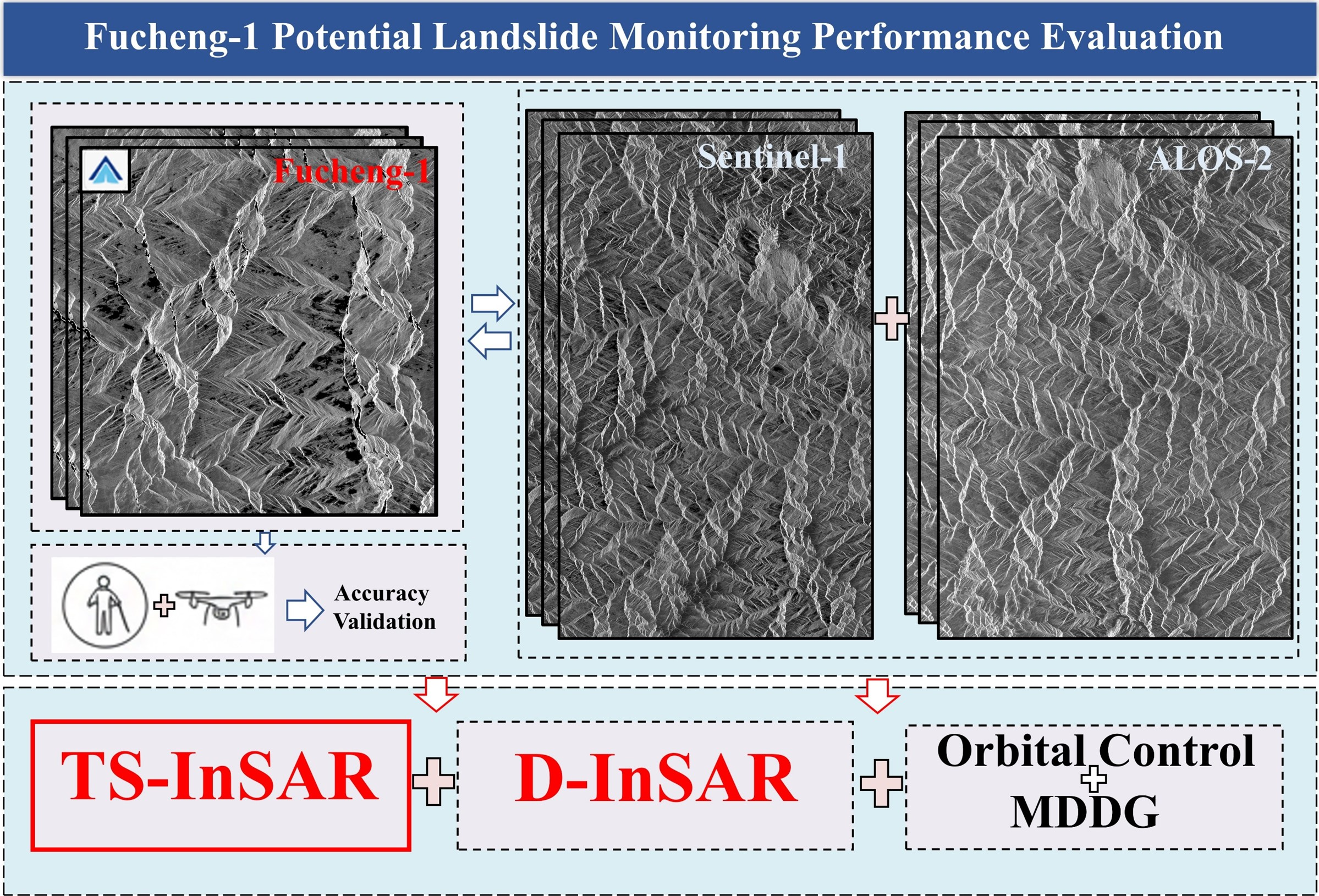
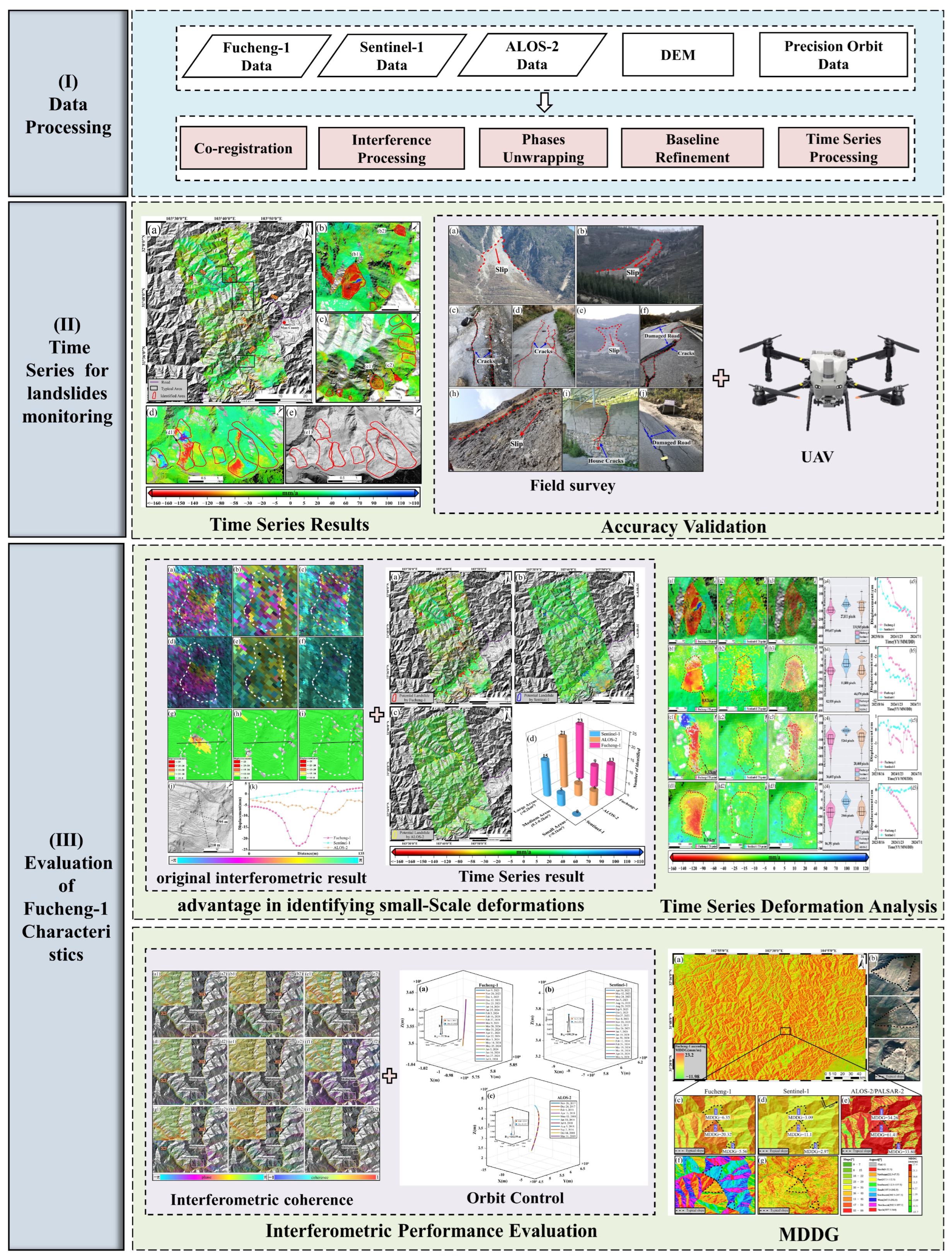
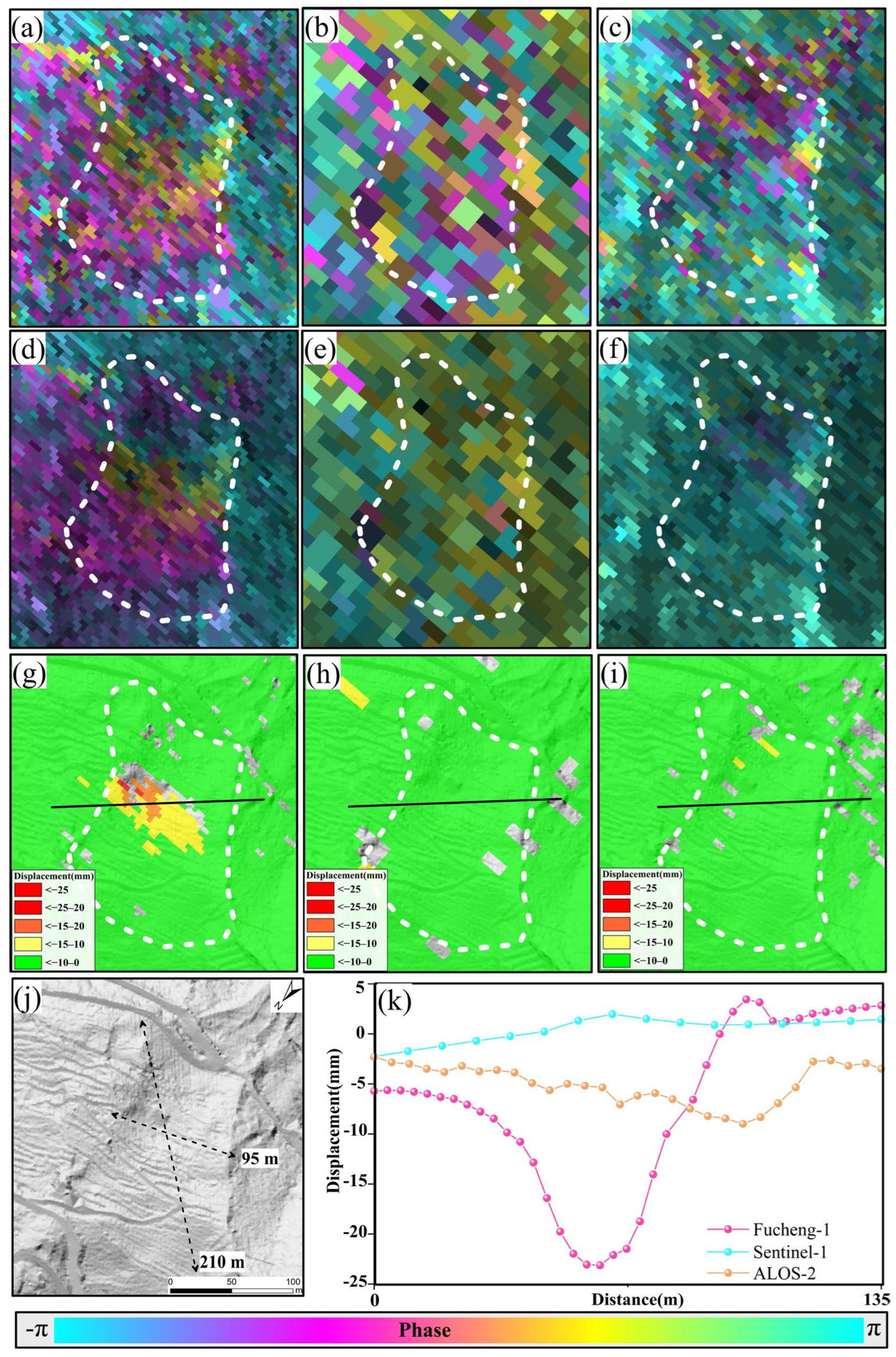
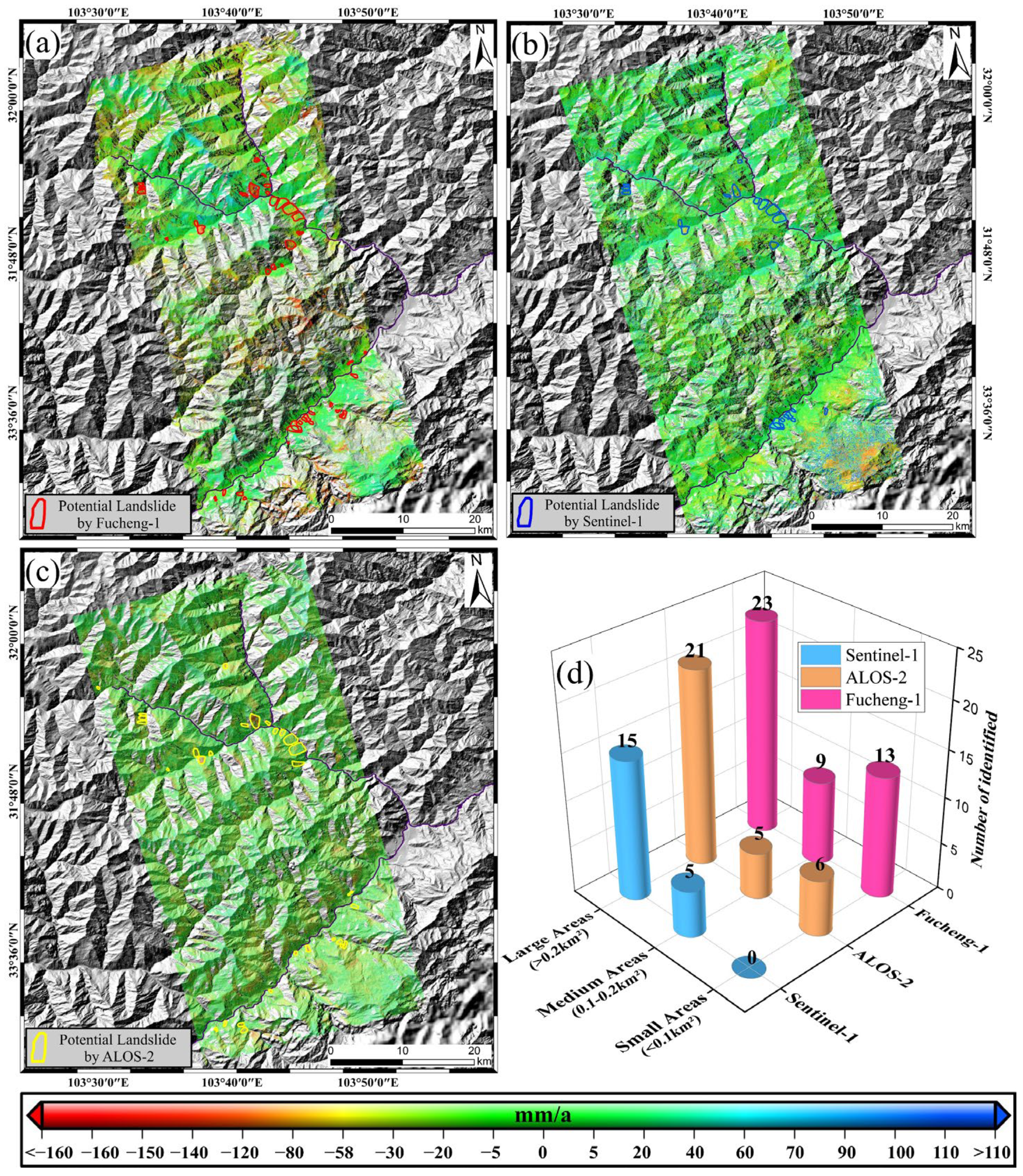
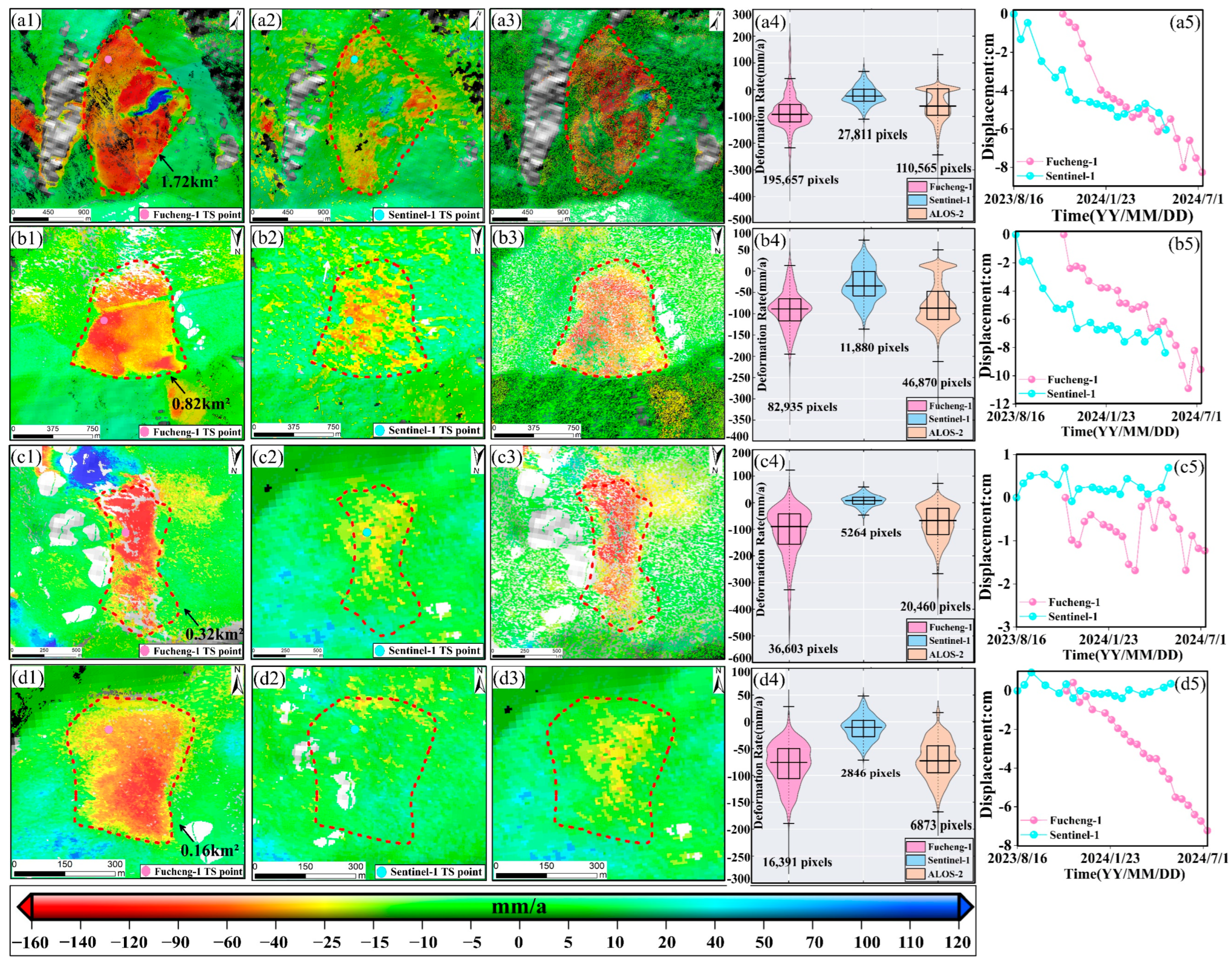
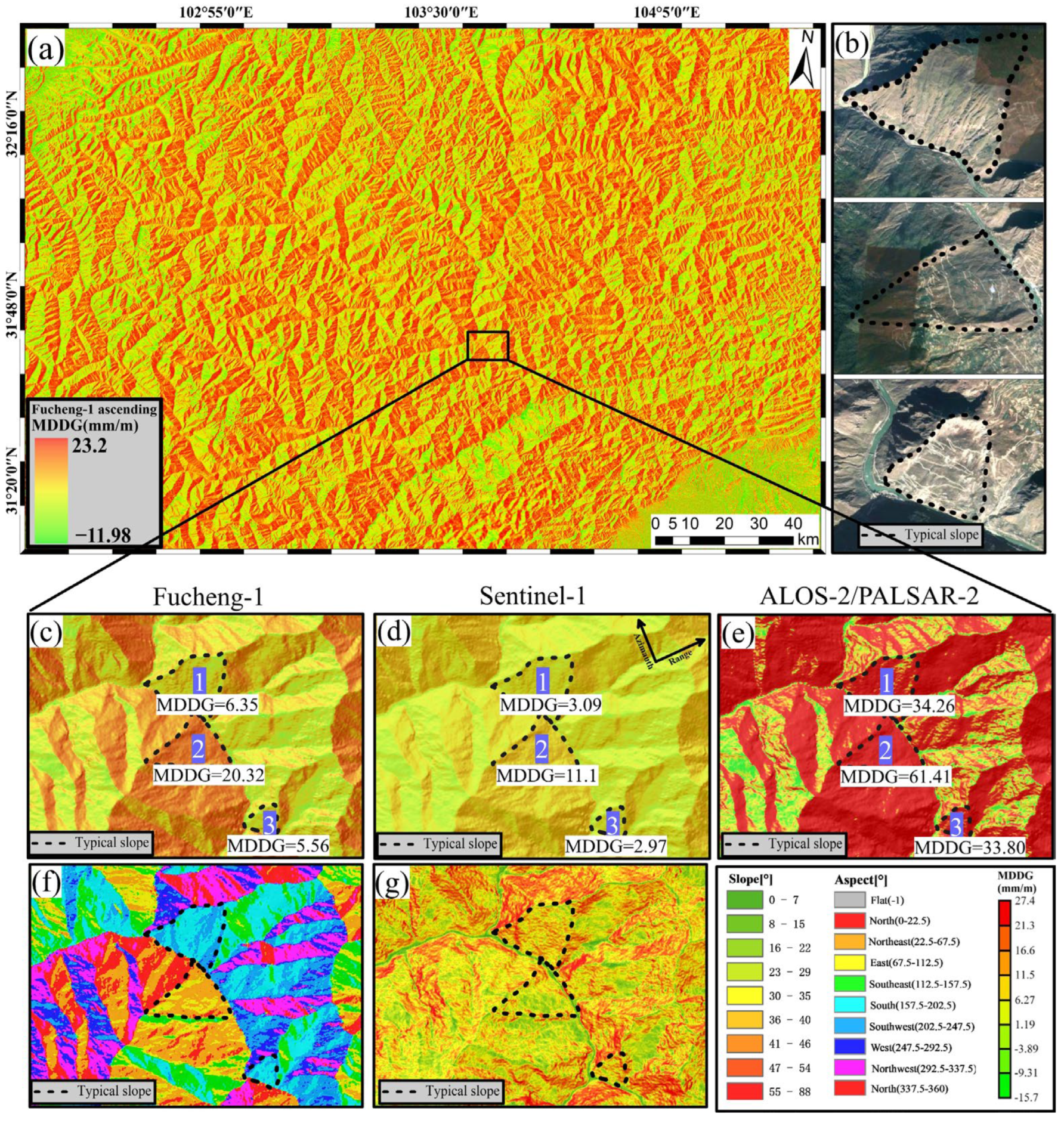
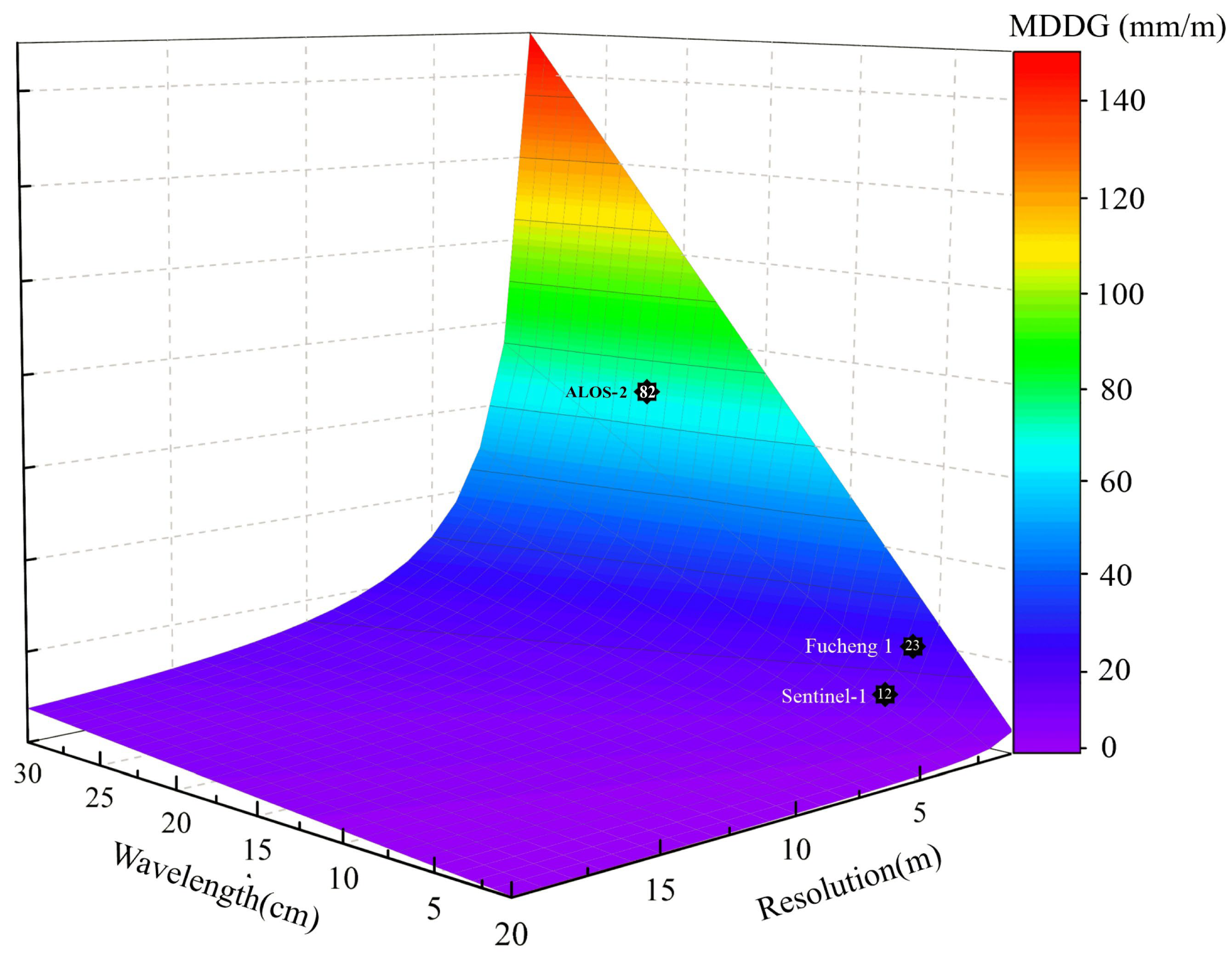
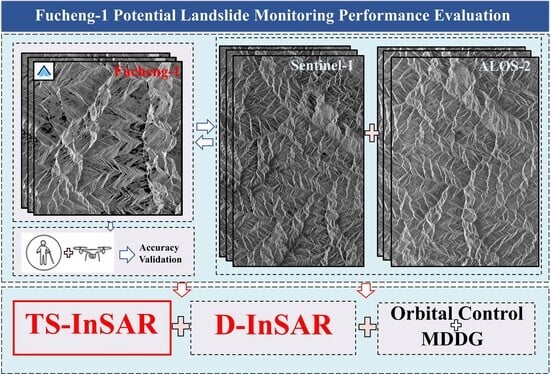
- Time-series InSAR advantages: Fucheng-1 identified 13 small-scale potential landslides, whereas Sentinel-1 identified none, and achieved ~2.17× more identifications than ALOS-2. It also retrieved larger cumulative subsidence than Sentinel-1, driven by finer spatial sampling (higher spatial resolution) and a higher maximum detectable deformation gradient; this advantage becomes more evident as landslide size decreases.
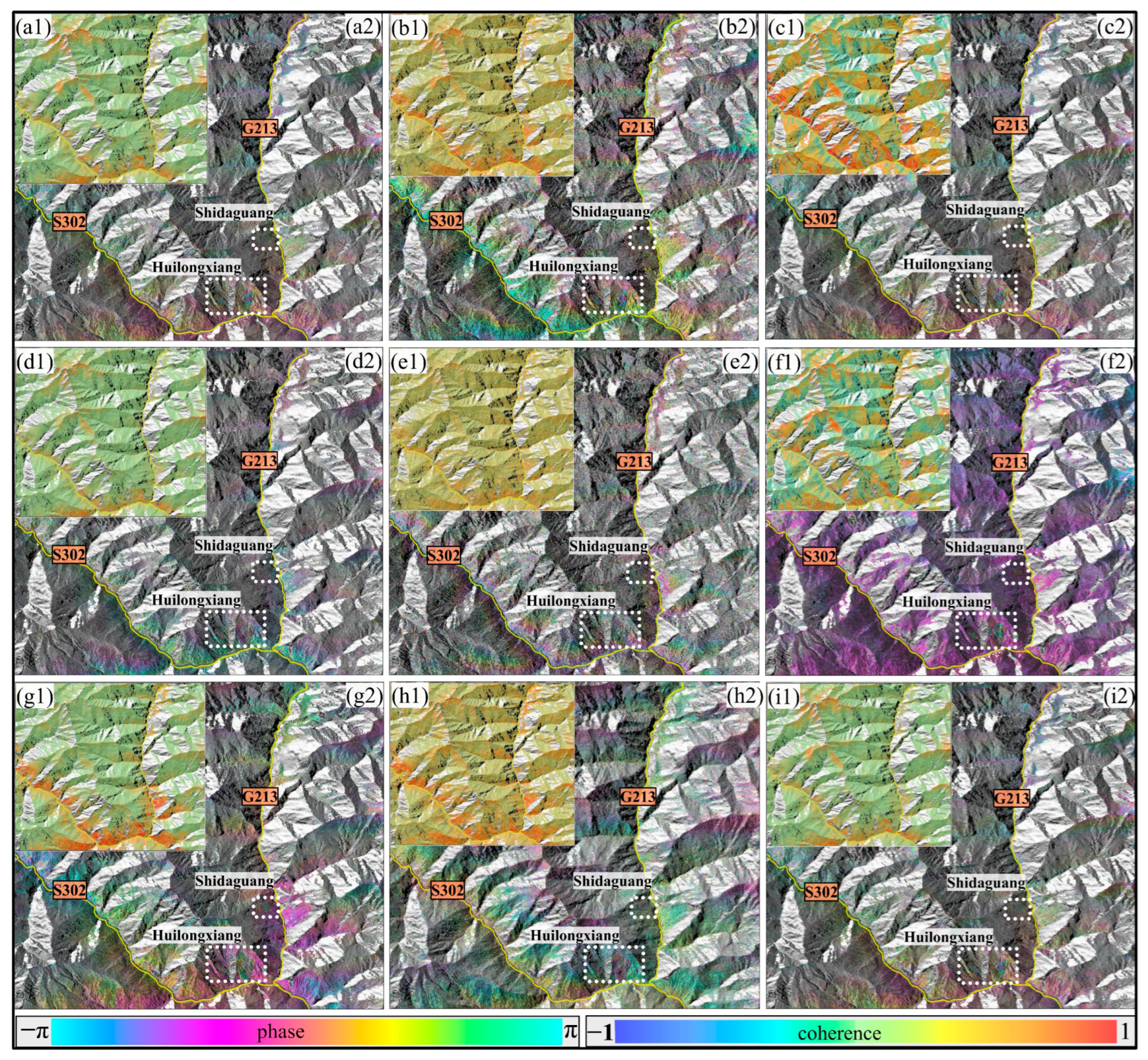
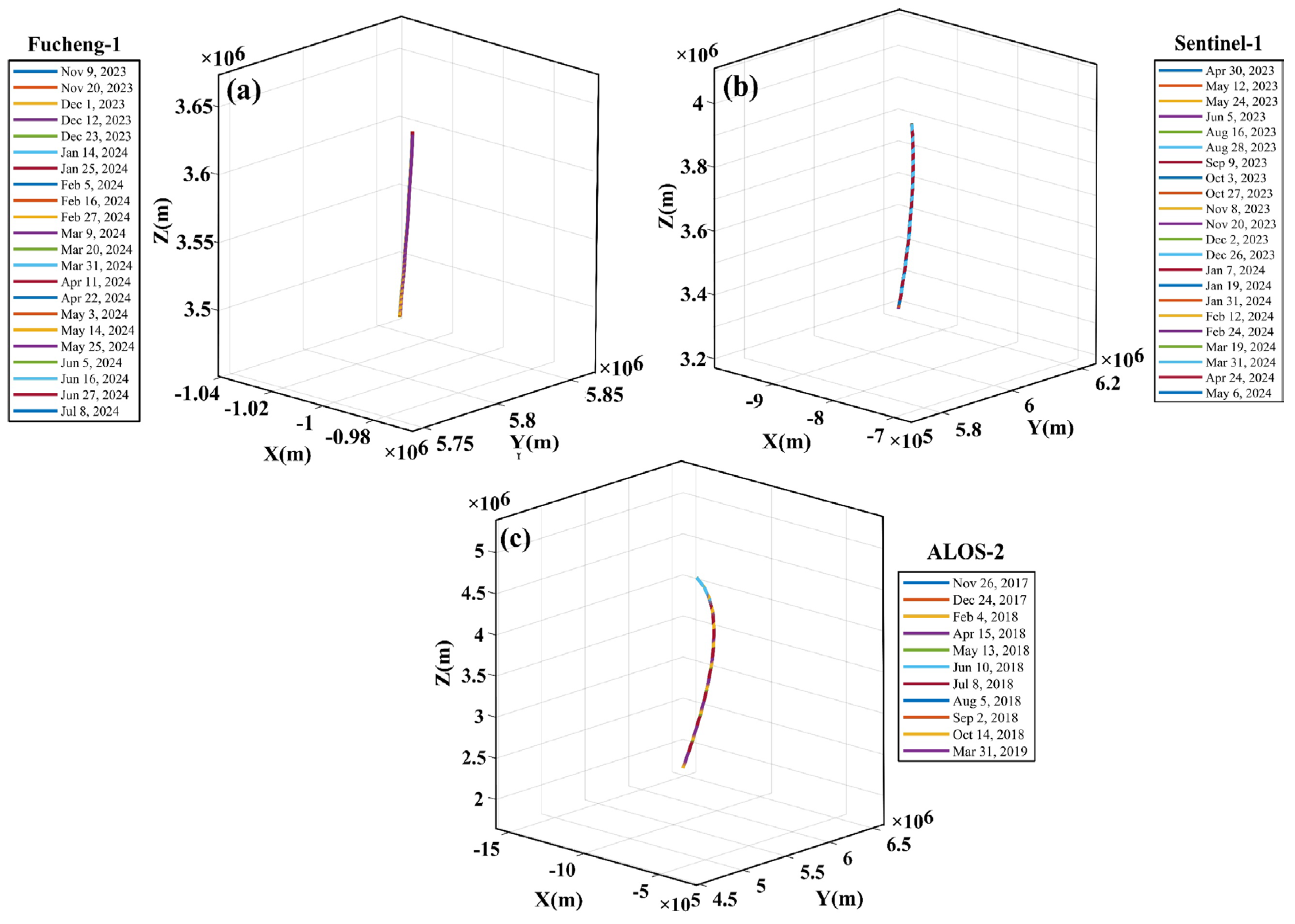
- Interferometric performance and stability: Fucheng-1 provides 7–8× more high-coherence pixels than co-temporal Sentinel-1 and 1.1–1.4× more than ALOS-2, strengthening time-series inversion and enabling more spatially continuous deformation fields. Its orbital stability is comparable to Sentinel-1, and its maximum detectable deformation gradient in mountainous terrain is ~2× higher.
- Fucheng-1’s high deformation-identification sensitivity and high pixel density indicate its strong potential for landslide identification and hazard monitoring in complex terrain.
- Its stable interferometric quality and enhanced gradient detectability support its role as a valuable complement to existing SAR missions for regional and high-resolution deformation monitoring.
Abstract
1. Introduction
2. Study Area and Datasets
2.1. Study Area
2.2. Datasets
3. Methodology
3.1. SBAS-InSAR Method
3.2. Index for Interferometric Performance Evaluation
4. Results
4.1. Time Series Result of Fucheng-11 for Landslide Monitoring
4.2. Field Verification
5. Discussion
5.1. Small-Scale Deformation Detection Capability
5.2. Time Series Deformation Analysis
5.3. Interferometric Analysis over Steep Mountainous Regions
5.4. Maximum Detectable Deformation Gradient in Mountainous Areas
6. Conclusions
Author Contributions
Funding
Data Availability Statement
Acknowledgments
Conflicts of Interest
References
- Villano, M.; Marquez-Martinez, J.; Moller, D.; Younis, M. Overview of Newspace Synthetic Aperture Radar Instrument Activities. In Proceedings of the 2021 IEEE International Geoscience and Remote Sensing Symposium, Kuala Lumpur, Malaysia, 17–22 July 2022; IEEE: Piscataway, NJ, USA; pp. 4130–4132. [CrossRef]
- Fan, W.; Wang, T.; Barbot, S.; Fang, D.; Ran, J.; Luo, H. Weak asthenosphere beneath the Eurasian interior inferred from Aral Sea desiccation. Nat. Geosci. 2025, 18, 351–357. [Google Scholar] [CrossRef]
- Ren, C.; Wang, Z.; Taymaz, T.; Hu, N.; Luo, H.; Zhao, Z.; Yue, H.; Song, X.; Shen, Z.; Xu, H.; et al. Supershear triggering and cascading fault ruptures of the 2023 Kahramanmaraş, Türkiye, earthquake doublet. Science 2024, 383, 305–311. [Google Scholar] [CrossRef]
- Liu, Z.; Wang, T. High-Resolution Interseismic Strain Mapping from InSAR Phase-Gradient Stacking. Geophys. Res. Lett. 2023, 50, e2023GL104168. [Google Scholar] [CrossRef]
- Yu, W.; Cheng, X.; Jiang, M. Exploitation of ARIMA and Annual Variations Model for SAR Interferometry Over Permafrost Scenarios. IEEE J. Sel. Top. Appl. Earth Observ. Remote Sens. 2025, 18, 8938–8952. [Google Scholar] [CrossRef]
- Liu, G.; Wang, B.; Sun, Q.; Hu, J.; Liu, L.-L.; Zheng, W.; Zou, L. New Insights into the Reservoir Landslide Deformation Mechanism from InSAR and Numerical Simulation Technology. IEEE J. Sel. Top. Appl. Earth Observ. Remote Sens. 2025, 18, 2908–2927. [Google Scholar] [CrossRef]
- Tang, G.; Dai, K.; Deng, J.; Liu, X.; Liu, C.; Liu, T.; Guo, C.; Fan, X. An enhanced neighborhood differential method for potential landslide identification from stacking-InSAR results. Measurement 2025, 242, 115921. [Google Scholar] [CrossRef]
- Davidian, K. Definition of New Space. New Space 2020, 8, 53–55. [Google Scholar] [CrossRef]
- Kulu, E. Satellite Constellations–2021 Industry Survey and Trends. Available online: https://digitalcommons.usu.edu/smallsat/2021/all2021/218/ (accessed on 4 November 2025).
- Castelletti, D.; Farquharson, G.; Brown, J.; De, S.; Yague-Martinez, N.; Stringham, C.; Yalla, G.; Villarreal, A. Capella Space VHR SAR Constellation: Advanced Tasking Patterns and Future Capabilities. In Proceedings of the IGARSS 2022—IEEE International Geoscience and Remote Sensing Symposium, Kuala Lumpur, Malaysia, 17–22 July 2022; IEEE: Piscataway, NJ, USA; pp. 4137–4140.
- Ignatenko, V.; Nottingham, M.; Radius, A.; Lamentowski, L.; Muff, D. ICEYE Microsatellite SAR Constellation Status Update: Long Dwell Spotlight and Wide Swath Imaging Modes. In Proceedings of the 2021 IEEE International Geoscience and Remote Sensing Symposium (IGARSS), Brussels, Belgium, 11–16 July 2021; IEEE: Piscataway, NJ, USA; pp. 1493–1496.
- Cohen, M.; Larkins, A.; Semedo, P.L.; Burbidge, G. NovaSAR-S Low Cost Spaceborne SAR Payload Design, Development and Deployment of a New Benchmark in Spaceborne Radar. In Proceedings of the 2017 IEEE Radar Conference (RadarConf), Seattle, WA, USA, 8–12 May 2017; IEEE: Piscataway, NJ, USA; pp. 903–907.
- Li, Z.; Zhu, W.; Yu, C.; Zhang, Q.; Zhnag, C.; Liu, Z.; Zhang, X.; Chen, G.; Du, J.; Song, C.; et al. Interferometric Synthetic Aperture Radar for Deformation Mapping: Opportunities, Challenges and the Outlook. Acta Geod. Cartogr. Sin. 2022, 51, 1485–1519. (In Chinese) [Google Scholar]
- Shen, Y.; Wang, X.; Dai, K.; Guo, H.; Yi, X.; Wang, X.; Ai, H.; Zhuo, G. Inference of Creep Landslide Slip Surface by InSAR Technology and Improved Particle Swarm Optimization. Landslides 2025, 22, 1665–1676. [Google Scholar] [CrossRef]
- Chen, Y.; Dai, K.; Jin, D.; Guanchen, Z.; Xiujun, D.; Liu, X.; Yu, S. The Pre-Processing InSAR Feasibility Assessment Method for Wide-Area Slope Displacement Monitoring. Int. J. Appl. Earth Obs. Geoinf. 2025, 136, 104336. [Google Scholar] [CrossRef]
- Khan, F.H.; Stewart, D.; de Silva, A.; Palinkas, A.; Dusek, G.; Davis, J.; Pang, A. RipScout: Realtime ML-Assisted Rip Current Detection and Automated Data Collection Using UAVs. IEEE J. Sel. Top. Appl. Earth Observ. Remote Sens. 2025, 18, 7742–7755. [Google Scholar] [CrossRef]
- Kadı, F.; Yılmaz, O.S. Determination of Alternative Forest Road Routes Using Produced Landslide Susceptibility Maps: A Case Study of Tonya (Trabzon), Türkiye. Int. J. Eng. Geosci. 2024, 9, 147–164. [Google Scholar] [CrossRef]
- Polat, A.; Balık Şanlı, F.; Akçay, Ö. Analyzing Rice Farming Between Sowing and Harvest Time with Sentinel-1 SAR Data. Adv. Remote Sens. J. (ARSEJ) 2022, 2, 34–39. [Google Scholar]
- Xiao, R.; Wang, X.; Sun, J.; Li, T.; Tian, X.; He, X. Comparisons of Differential Interferometry of Chinese SAR Satellites in Ground Deformation Monitoring; Geomatics and Information Science of Wuhan University: Wuhan, China, 2025. [Google Scholar]
- Feng, S.; Dai, K.; Sun, T.; Deng, J.; Tang, G.; Han, Y.; Ren, W.; Sang, X.; Zhang, C.; Wang, H. Mini-Satellite Fucheng 1 SAR: Interferometry to Monitor Mining-Induced Subsidence and Comparative Analysis with Sentinel-1. Remote Sens. 2024, 16, 3457. [Google Scholar] [CrossRef]
- Chen, B.; Song, C.; Li, Z.; Li, Y.; Liu, H.; Yu, C.; Li, S.; Liu, M.; Chen, Y.; Zhang, L.; et al. Pre-Failure Deformation Mechanism and Geomorphological Change of the Jinpingcun Landslide, Junlian, Sichuan; Geomatics and Information Science of Wuhan University: Wuhan, China, 2025; in press. [Google Scholar]
- Han, Y.; Dai, K.; Deng, J.; Wen, N.; Ren, W.; Chen, X.; Du, J.; Wang, H. Fucheng-1, High-Resolution Chinese Interferometric SAR: First DInSAR Result for Landslides Monitoring. Measurement 2025, 247, 116876. [Google Scholar] [CrossRef]
- Dai, K.; Xu, Q.; Li, Z.; Tomás, R.; Fan, X.; Dong, X.; Li, W.; Zhou, Z.; Gou, J.; Ran, P. Post-Disaster Assessment of 2017 Catastrophic Xinmo Landslide (China) by Spaceborne SAR Interferometry. Landslides 2019, 16, 1189–1199. [Google Scholar] [CrossRef]
- Zhao, G.-H.; Yin, K.; Zhong, W.-X.; Xiao, T.; Wei, Q.-K.; Cui, Y.; Liu, G.-Z.; Xu, C.; Wang, H.-F. Epidemiological Investigation of Asymptomatic Dogs with Leishmania Infection in Southwestern China Where Visceral Leishmaniasis Is Intractable. Korean J. Parasitol. 2016, 54, 797–804. [Google Scholar] [CrossRef]
- Wen, N.; Dai, K.; Tomás, R.; Wu, M.; Chen, C.; Deng, J.; Shi, X.; Feng, W. Revealing the Time Lag Between Slope Stability and Reservoir Water Fluctuation from InSAR Observations and Wavelet Tools—A Case Study in Maoergai Reservoir (China). GIScience Remote Sens. 2023, 60, 2170125. [Google Scholar] [CrossRef]
- Xu, Q.; Li, W.-L.; Dong, X.-J.; Xiao, X.; Fan, X.M.; Pei, X. The Xinmocun Landslide on June 24, 2017 in Maoxian, Sichuan: Characteristics and Failure Mechanism. Chin. J. Rock Mech. Eng. 2017, 36, 2612–2628. [Google Scholar]
- Wang, Q.; Guo, Y.; Li, W.; He, J.; Wu, Z. Predictive Modeling of Landslide Hazards in Wen County, Northwestern China Based on Information Value, Weights-of-Evidence, and Certainty Factor. Geomat. Nat. Hazards Risk 2019, 10, 820–835. [Google Scholar] [CrossRef]
- Dai, K.; Li, Z.; Xu, Q.; Bürgmann, R.; Milledge, D.G.; Tomás, R.; Fan, X.; Zhao, C.; Liu, X.; Peng, J.; et al. Entering the Era of Earth Observation-Based Landslide Warning Systems: A Novel and Exciting Framework. IEEE Geosci. Remote Sens. Mag. 2020, 8, 136–153. [Google Scholar] [CrossRef]
- Varugu, B.K.; Jones, C.E.; Wang, K.; Chen, J.; Osborne, R.L.; Voyiadjis, G.Z. Optimized GNSS Cal/Val Site Selection for Expanding InSAR Viability in Areas with Low Phase Coherence: A Case Study for Southern Louisiana. IEEE J. Sel. Top. Appl. Earth Observ. Remote Sens. 2024, 17, 4875–4889. [Google Scholar] [CrossRef]
- Zhou, H.; Dai, K.; Pirasteh, S.; Li, R.; Xiang, J.; Li, Z. InSAR Spatial-Heterogeneity Tropospheric Delay Correction in Steep Mountainous Areas Based on Deep Learning for Landslides Monitoring. IEEE Trans. Geosci. Remote Sens. 2023, 61, 1–14. [Google Scholar] [CrossRef]
- Hadmoko, D.S.; Wibowo, S.B.; Sianipar, D.S.J.; Daryono, D.; Fathoni, M.N.; Pratiwi, R.S.; Haryono, E.; Lavigne, F. Co-seismic deformation and related hazards associated with the 2022 Mw 5.6 Cianjur earthquake in West Java, Indonesia: Insights from combined seismological analysis, DInSAR, and geomorphological investigations. Geoenviron. Disasters 2024, 11, 15. [Google Scholar] [CrossRef]
- Zheng, X.; Lu, W.; Jiang, R.; Li, J.; Zhang, L. Analysis of landslide on Meizhou–Dapu expressway based on satellite remote sensing. Geoenviron. Disasters 2025, 12, 25. [Google Scholar] [CrossRef]
- Deng, J.; Dai, K.; Liang, R.; Chen, L.; Wen, N.; Zheng, G.; Xu, H. Interferometric Synthetic Aperture Radar Applicability Analysis for Potential Landslide Identification in Steep Mountainous Areas With C/L Band Data. Remote Sens. 2023, 15, 4538. [Google Scholar] [CrossRef]
- Liu, X.; Zhao, C.; Zhang, Q.; Lu, Z.; Li, Z.; Yang, C.; Zhu, W.; Liu-Zeng, J.; Chen, L.; Liu, C. Integration of Sentinel-1 and ALOS/PALSAR-2 SAR Datasets for Mapping Active Landslides Along the Jinsha River Corridor, China. Eng. Geol. 2021, 284, 106033. [Google Scholar] [CrossRef]
- Yan, M.; Zhao, C.; Li, B.; Li, G.; Lou, J.; Liu, X. Three-Dimensional Deformation Inversion of Pre-Sliding Baige Landslide by Multiple Adaptive SAR Offset Tracking Method, in press. Landslides 2025, 22, 2715–2728. [Google Scholar] [CrossRef]
- Farr, T.G.; Rosen, P.A.; Caro, E.; Crippen, R.; Duren, R.; Hensley, S.; Kobrick, M.; Paller, M.; Rodriguez, E.; Roth, L.; et al. The Shuttle Radar Topography Mission. Rev. Geophys. 2007, 45, RG2004. [Google Scholar] [CrossRef]
- Bonano, M.; Striano, P.; Yasir, M.; Buonanno, S.; Casu, F.; De Luca, C.; Fusco, A.; Roa, Y.L.B.; Zinno, I.; Virelli, M.; et al. New Advances of the P-SBAS Approach for an Efficient Parallel Processing of Large Volumes of Full-Resolution Multitemporal DInSAR Interferograms. IEEE J. Sel. Top. Appl. Earth Observ. Remote Sens. 2025, 18, 2317–2341. [Google Scholar] [CrossRef]
- De Luca, C.; Roa, Y.L.B.; Bonano, M.; Casu, F.; Euillades, P.; Euillades, L.; Franzese, M.; Manunta, M.; Yasir, M.; Onorato, G.; et al. SAOCOM-1 L-Band DInSAR Time Series Generation Through the P-SBAS Approach: Algorithm Extension and Products Analysis. IEEE J. Sel. Top. Appl. Earth Observ. Remote Sens. 2025, 18, 2680–2703. [Google Scholar] [CrossRef]
- Onorato, G.; De Luca, C.; Casu, F.; Manunta, M.; Yasir, M.; Noli, P.; Striano, P.; Lanari, R. Identification and Correction of Phase Unwrapping Errors in Multitemporal Small Baseline DInSAR Interferograms: A Three-Step Cascade Algorithm. IEEE J. Sel. Top. Appl. Earth Observ. Remote Sens. 2025, 18, 8602–8616. [Google Scholar] [CrossRef]
- Berardino, P.; Fornaro, G.; Lanari, R.; Sansosti, E. A New Algorithm for Surface Deformation Monitoring Based on Small Baseline Differential SAR Interferograms. IEEE Trans. Geosci. Remote Sens. 2003, 40, 2375–2383. [Google Scholar] [CrossRef]
- Ferretti, A.; Fumagalli, A.; Novali, F.; Prati, C.; Rocca, F.; Rucci, A. A New Algorithm for Processing Interferometric Data-Stacks: SqueeSAR. IEEE Trans. Geosci. Remote Sens. 2011, 49, 3460–3470. [Google Scholar] [CrossRef]
- Ferretti, A.; Prati, C.; Rocca, F. Permanent Scatterers in SAR Interferometry. IEEE Trans. Geosci. Remote Sens. 2002, 39, 8–20. [Google Scholar] [CrossRef]
- Hooper, A. A Multi-Temporal InSAR Method Incorporating Both Persistent Scatterer and Small Baseline Approaches. Geophys. Res. Lett. 2008, 35. [Google Scholar] [CrossRef]
- Sansosti, E.; Berardino, P.; Manunta, M.; Serafino, F.; Fornaro, G. Geometrical SAR Image Registration. IEEE Trans. Geosci. Remote Sens. 2006, 44, 2861–2870. [Google Scholar] [CrossRef]
- Goldstein, R.M.; Werner, C.L. Radar Interferogram Filtering for Geophysical Applications. Geophys. Res. Lett. 1998, 25, 4035–4038. [Google Scholar] [CrossRef]
- Costantini, M. A Novel Phase Unwrapping Method Based on Network Programming. IEEE Trans. Geosci. Remote Sens. 2002, 36, 813–821. [Google Scholar] [CrossRef]
- Hanssen, R.F. Radar Interferometry: Data Interpretation and Error Analysis; Springer: Dordrecht, The Netherlands, 2001. [Google Scholar]
- Foroughnia, F.; Nemati, S.; Maghsoudi, Y.; Perissin, D. An Iterative PS-InSAR Method for the Analysis of Large Spatio-Temporal Baseline Data Stacks for Land Subsidence Estimation. Int. J. Appl. Earth Obs. Geoinf. 2019, 74, 248–258. [Google Scholar] [CrossRef]
- Dai, K.; Chen, Y.; Xu, Q.; Hancock, C.; Jiang, M.; Deng, J.; Zhuo, G. A Functional Model for Determining Maximum Detectable Deformation Gradients of InSAR Considering the Topography in Mountainous Areas. IEEE Trans. Geosci. Remote Sens. 2023, 61, 1–11. [Google Scholar] [CrossRef]



| Parameter | Fucheng-1 | Sentinel-1 | ALOS-2 |
|---|---|---|---|
| Spacing resolution (azimuth × range) | 1.88 m × 1.25 m | 13.95 m × 2.33 m | 1.43 m × 2.12 m |
| Band | C | C | L |
| Wavelength(cm) | 5.6 | 5.6 | 23.6 |
| Orbit direction | Ascending | Ascending | Ascending |
| Acquisition period | Strip | TOPS | Strip |
| Acquisition period | 9 November 2023–8 July 2024 | 16 August 2023–6 May 2024 | 26 November 2017–31 Mar 2019 |
| Number of images | 22 | 18 | 11 |
| Parameter | Fucheng-1 | Sentinel-1 | ALOS-2 |
|---|---|---|---|
| Date of acquisition | 25 January 2024–9 March 2024 | 31 January 2024–19 March 2024 | 26 November 2017–24 December 2017 |
| Perpendicular baseline(m) | −37.94 m | −31.45 m | −212.99 m |
| Time baseline(days) | 44 | 48 | 42 |
| Spacing resolution (azimuth × range) | 1.88 m × 1.25 m | 13.95 m × 2.33 m | 1.43 m × 2.12 m |
| Parameter | Fucheng-1 | Sentinel-1 | ALOS-2 |
|---|---|---|---|
| Date of acquisition | 20231120–20231201/ 20231201–20231223/ 20240114–20240216 | 20231120–20231202/ 20231202–20231226/ 20240107–20240212 | 20171126–20171224/ 20171224–20180204/ 20171126–20180204 |
| NESZ(SNR−1,db) | <−22 | −21.3 | <−29 |
| Coherence | 0.3/0.29/0.3 | 0.4/0.39/0.41 | 0.43/0.39/0.4 |
| Pixels with coherence > 0.5 | 29.2 million/ 27.9 million/ 30.6 million | 3.7 million/ 3.6 million/ 3.8 million | 21.9 million/ 18.1 million/ 29.2 million |
| Perpendicular baseline(m) | 81/−77/−31 | 47/199/−37 | 0.54/−212/−212 |
| Time baseline(days) | 11/22/32 | 12/24/36 | 28/42/70 |
| Wavelength(cm) | 5.56 | 5.55 | 12.6 |
| Spacing resolution (azimuth × range) | 1.88 m × 1.25 m | 13.95 m × 2.33 m | 1.43 m × 2.12 m |
Disclaimer/Publisher’s Note: The statements, opinions and data contained in all publications are solely those of the individual author(s) and contributor(s) and not of MDPI and/or the editor(s). MDPI and/or the editor(s) disclaim responsibility for any injury to people or property resulting from any ideas, methods, instructions or products referred to in the content. |
© 2026 by the authors. Licensee MDPI, Basel, Switzerland. This article is an open access article distributed under the terms and conditions of the Creative Commons Attribution (CC BY) license.
Share and Cite
Tang, G.; Dai, K.; Yang, F.; Ren, W.; Han, Y.; Guo, C.; Liu, T.; Feng, S.; Liu, C.; Wang, H.; et al. Time Series Analysis of Fucheng-1 Interferometric SAR for Potential Landslide Monitoring and Synergistic Evaluation with Sentinel-1 and ALOS-2. Remote Sens. 2026, 18, 304. https://doi.org/10.3390/rs18020304
Tang G, Dai K, Yang F, Ren W, Han Y, Guo C, Liu T, Feng S, Liu C, Wang H, et al. Time Series Analysis of Fucheng-1 Interferometric SAR for Potential Landslide Monitoring and Synergistic Evaluation with Sentinel-1 and ALOS-2. Remote Sensing. 2026; 18(2):304. https://doi.org/10.3390/rs18020304
Chicago/Turabian StyleTang, Guangmin, Keren Dai, Feng Yang, Weijia Ren, Yakun Han, Chenwen Guo, Tianxiang Liu, Shumin Feng, Chen Liu, Hao Wang, and et al. 2026. "Time Series Analysis of Fucheng-1 Interferometric SAR for Potential Landslide Monitoring and Synergistic Evaluation with Sentinel-1 and ALOS-2" Remote Sensing 18, no. 2: 304. https://doi.org/10.3390/rs18020304
APA StyleTang, G., Dai, K., Yang, F., Ren, W., Han, Y., Guo, C., Liu, T., Feng, S., Liu, C., Wang, H., Zhang, C., & Zhang, R. (2026). Time Series Analysis of Fucheng-1 Interferometric SAR for Potential Landslide Monitoring and Synergistic Evaluation with Sentinel-1 and ALOS-2. Remote Sensing, 18(2), 304. https://doi.org/10.3390/rs18020304