1. Introduction
Change detection (CD) aims to identify changed pixels or regions by comparing multi-temporal remote sensing observations of the same geographic area. It is a fundamental task in remote sensing image interpretation and has been widely used for land-use monitoring, urban expansion analysis, disaster assessment, and ecological–environmental observation [
1,
2]. Among different CD targets, building change detection is particularly important because buildings directly reflect human settlement dynamics, infrastructure development, rural reconstruction, post-disaster relocation, and urban–rural land transformation [
3,
4,
5]. In many practical scenarios, especially in rural, remote, and disaster-prone mountainous regions, buildings and settlement patterns may change rapidly due to landslides, debris flows, flash floods, reconstruction projects, or relocation programs. Field surveys in such regions are often costly, time consuming, and sometimes inaccessible immediately after disasters. Therefore, rapid and large-scale building change detection from multi-temporal remote sensing imagery is valuable for emergency response, reconstruction planning, and long-term settlement monitoring.
With the rapid growth of high-resolution remote sensing imagery and public CD benchmarks, deep learning has become the dominant paradigm for building change detection. Existing methods have continuously improved in-domain performance by designing stronger Siamese architectures, multi-scale feature fusion modules, attention mechanisms, Transformer encoders, and boundary refinement strategies [
6,
7,
8,
9,
10]. Representative models such as SNUNet-CD [
7], HANet [
8], ChangeFormer [
9], and BIT [
10] have demonstrated strong performance when training and testing data follow similar distributions. More recent methods, including DMINet, ACABFNet, BiFA, and AANet, further enhance feature interaction, difference modeling, and multi-level fusion for high-resolution CD [
11,
12,
13,
14]. However, these advances are still largely driven by matched in-domain evaluation protocols. In real deployment, CD models are often trained on one available source dataset and then applied to unseen target regions with different sensors, spatial resolutions, imaging geometries, illumination conditions, geographic contexts, and scene compositions. This raises a critical question: can models optimized for in-domain benchmarks maintain reliable performance under source-only cross-dataset deployment?
This question is especially important for building change detection. Buildings vary greatly across regions in roof material, density, scale, shape, background context, and spatial arrangement. A model trained on one city or sensor may encounter different urban layouts, rural settlements, off-nadir imaging conditions, vegetation-rich backgrounds, terrain-induced shadows, or heterogeneous land-cover changes in another target domain. Such domain shifts can easily lead to false positives caused by pseudo-changes, such as shadows, roads, vegetation edges, or illumination differences, as well as false negatives for small, sparse, or fragmented buildings. As a result, strong in-domain performance may be a poor indicator of operational reliability. This limitation is particularly problematic in newly monitored or emergency-response regions where target-domain annotations are unavailable before deployment, and there may be insufficient time to collect labels or perform target-specific adaptation.
To mitigate cross-domain degradation, many studies have explored unsupervised domain adaptation, semi-supervised learning, and few-shot adaptation for remote sensing CD [
15,
16,
17,
18]. These methods can be effective when unlabeled or sparsely labeled target-domain imagery is accessible during training or adaptation. However, this assumption does not always hold in practical deployment. In some scenarios, target-domain data may be unavailable before deployment due to data-access restrictions, transmission constraints, privacy concerns, or emergency-response time limits. Even when target imagery can be obtained, performing target-specific adaptation for each new region increases operational complexity and reduces reproducibility. Therefore, a stricter but practically meaningful setting is source-only cross-dataset building change detection, where a model is trained only on source-domain data and directly evaluated on unseen target datasets without using target-domain images, labels, validation sets, threshold calibration, or adaptation procedures.
Vision foundation models provide a promising direction for this setting. Large-scale self-supervised visual models, such as DINO-series models, learn representations from diverse visual data and have shown strong transferability for downstream dense prediction tasks [
19,
20,
21,
22]. Recent studies have also emphasized sample-efficient learning for remote sensing change detection, aiming to reduce the amount of task-specific training data while maintaining reliable detection performance [
23]. Compared with end-to-end CD models trained from scratch on a single labeled source dataset, frozen foundation encoders may preserve more general and domain-stable representations, thereby reducing source-domain overfitting and improving cross-dataset robustness. The frozen-encoder paradigm also allows only task-specific components to be trained, improving reproducibility and reducing the number of trainable parameters. However, several questions remain unresolved for building CD: whether frozen self-supervised ViT representations can support strict source-only transfer, how hierarchical features from different transformer layers should be used for bi-temporal difference modeling, and whether recent task-specific CD networks remain reliable when directly transferred across different datasets.
To address these questions, we present a systematic study of frozen DINOv3 for source-only cross-dataset building change detection. We propose DLV-CD, a frozen-DINOv3-based framework that trains only task-specific change detection components while keeping the foundation encoder fixed. DLV-CD contains a DINOv3-LiteFuse decoder for multi-level difference fusion and an intra-model hierarchical evidence fusion strategy based on selected prediction heads.
We evaluate DLV-CD under a strict target-free protocol on six cross-dataset transfer directions involving LEVIR-CD, WHU-CD, S2Looking, and DSIFN-CD. LEVIR-CD and WHU-CD serve as standard high-resolution building-change benchmarks from different geographic and imaging domains. S2Looking introduces more complex rural scenes and off-nadir imaging conditions, while DSIFN-CD is used as a broader and more heterogeneous binary change-detection stress test. To provide reproducible evidence beyond literature-reported comparisons, we reproduce seven representative CD baselines under the same source-only tiled-inference protocol, including two widely used classic models, SNUNet and BIT, four recent supervised CD models, BiFA, DMINet, ACABFNet, and AANet, and a SAM-based foundation-model baseline, SAM-CD.
The main contributions of this study are summarized as follows:
We formulate source-only cross-dataset building change detection as a practical deployment setting, where models are trained only on source-domain data and directly evaluated on unseen target domains without using target-domain images, labels, validation data, threshold calibration, or adaptation procedures.
We propose DLV-CD, a frozen-DINOv3-based building CD framework that preserves pretrained foundation representations and trains only task-specific components, including a trainable-parameter-efficient multi-level difference fusion decoder and a hierarchical evidence fusion strategy for robust cross-dataset prediction.
We conduct a six-direction evaluation across LEVIR-CD, WHU-CD, S2Looking, and DSIFN-CD, reproducing seven representative CD baselines under a unified source-only protocol.
3. Methodology
3.1. Freezing the DINOv3 Encoder
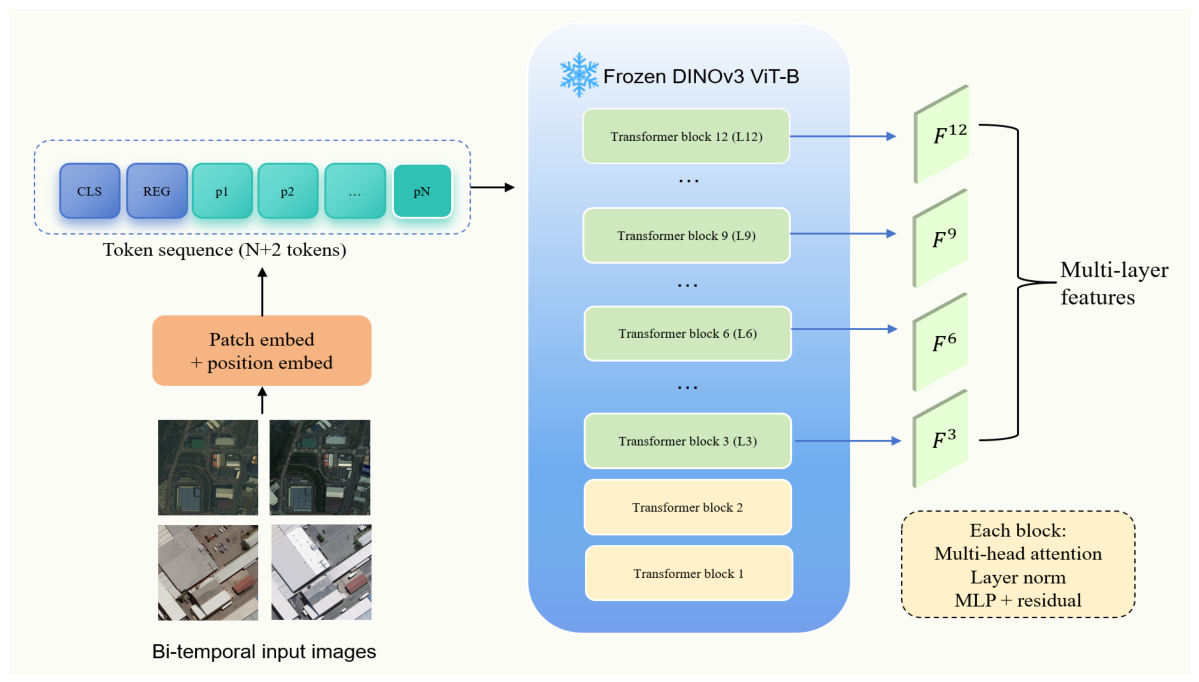
We use DINOv3 ViT-B as a frozen encoder and optimize only the task-specific change detection components, as illustrated in
Figure 1. This design aims to preserve transferable pretrained representations and reduce source-domain overfitting.
For a bi-temporal image pair
and
, we extract hierarchical features from selected transformer layers:
where
represents the output of the frozen DINOv3 at layer l. By default, we use four layers:
These layers were selected to cover different representation levels. Intermediate layers tend to retain more spatial structure and boundary information, while deeper layers provide stronger semantic abstraction. Such complementarity is useful for building change detection, where the model needs to preserve building boundaries while suppressing pseudo-changes caused by shadows, vegetation, roads, and background texture differences.
Because features from different transformer layers may have different channel dimensions, we apply a lightweight adapter to each selected layer for channel alignment and dimensionality reduction:
where
denotes the layer-specific adapter. We then construct a layer-wise temporal difference representation by combining the absolute difference and a symmetric temporal context term:
where [·,·] denotes channel-wise concatenation, and
(·) denotes a layer-specific lightweight convolutional fusion block.
The resulting set of multi-level difference features is then passed to the subsequent fusion decoder and hierarchical evidence fusion module. Rather than relying on a single layer, DLV-CD uses these hierarchical features to balance spatial detail and semantic robustness under source-only cross-dataset transfer. In this way, building boundaries and change responses are inferred from hierarchical DINOv3 features and layer-wise bi-temporal difference representations, which helps the model handle variations in illumination, image contrast, viewing geometry, and background appearance across datasets.
3.2. DINOv3-LiteFuse Decoder (DLF)
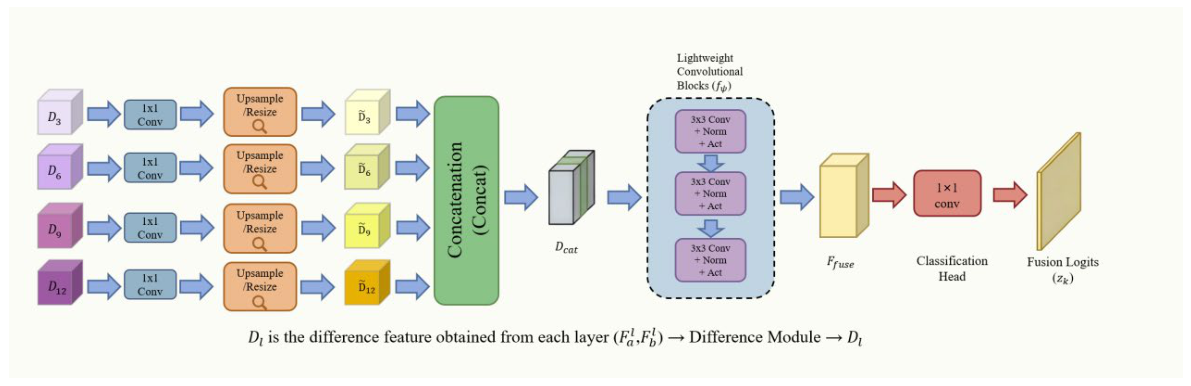
To aggregate the multi-level difference features extracted from the frozen DINOv3 encoder, we design a lightweight fusion decoder, termed DINOv3-LiteFuse (DLF), as illustrated in
Figure 2. The decoder aims to combine spatial details from intermediate layers and semantic cues from deeper layers without introducing heavy attention modules:
where
denotes a
projection layer, and
denote the target spatial resolution used by the decoder.
The concatenated feature is further refined by lightweight convolutional blocks:
where
denotes the fusion decoder. Finally, a
classification head produces the fused change logit:
DLF provides the primary change prediction by integrating complementary hierarchical features. Since it only uses channel projection, resizing, concatenation, and convolutional refinement, the additional trainable cost remains limited compared with fully fine-tuning the foundation encoder.
3.3. Hierarchical Evidence Fusion (HEF)
The fused decoder provides the primary change prediction by aggregating multi-level difference features. However, different transformer layers may still contain complementary evidence for building change detection. Intermediate layers tend to preserve structural and boundary cues, while deeper layers provide stronger semantic abstraction. To exploit this complementarity, we attach lightweight prediction heads to selected layer-wise difference features and combine them with the fused prediction through hierarchical evidence fusion.
For the
-th prediction head, let
denote its output logit and
denote the corresponding change probability:
where
is the sigmoid function. During inference, we aggregate a selected subset
of prediction heads in logit space:
where S denotes the selected set of prediction heads, |S| is the number of selected heads,
is the logit produced by the k-th prediction head,
is the fused logit obtained by hierarchical evidence fusion, and τ is the decision threshold. In all source-only evaluations, τ is fixed to 0.5 without target-domain calibration. Logit-space fusion combines hierarchical prediction evidence before probability saturation and avoids relying on a single prediction head that may be sensitive to domain-specific appearance variations.
3.4. Overall Framework
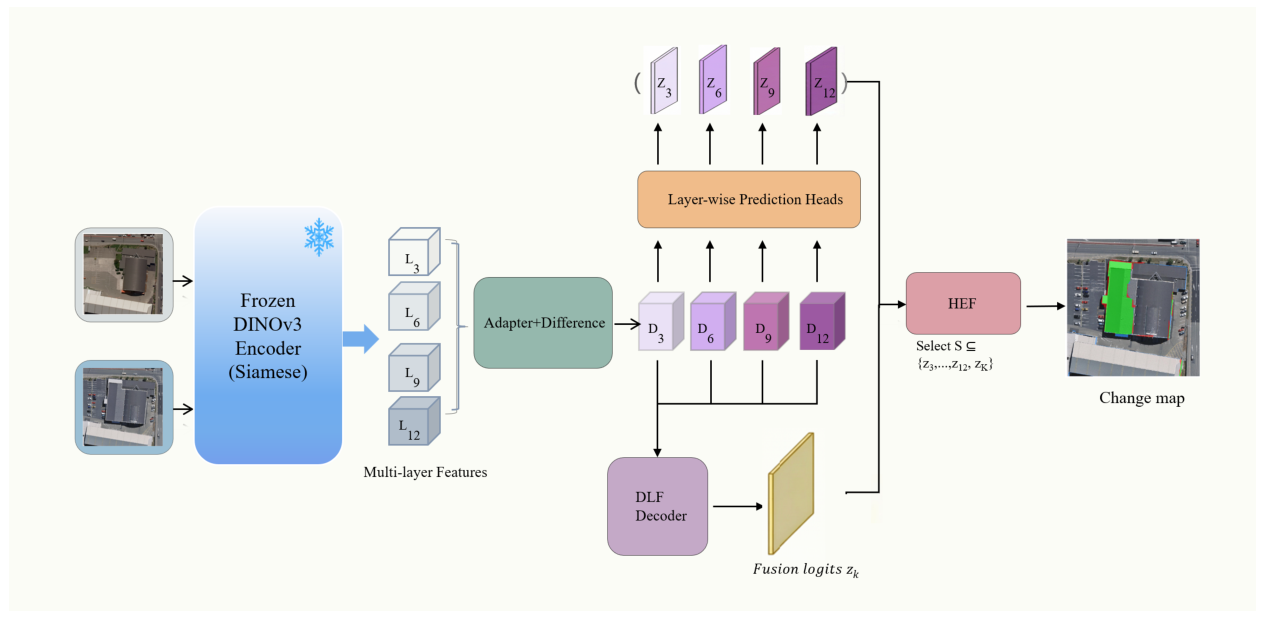
DLV-CD consists of three main components: a frozen DINOv3 encoder, the DINOv3-LiteFuse decoder (DLF), and the hierarchical evidence fusion module (HEF), as illustrated in
Figure 3. Given a bi-temporal image pair
, the frozen DINOv3 encoder extracts multi-level features from selected transformer layers. These features are converted into layer-wise temporal difference representations
, as described in
Section 3.1.
The resulting difference features are then used in two complementary ways. First, they are fed into DLF, where multi-level difference features are channel-aligned, resized, concatenated, and refined to produce the fused prediction logit . Second, selected layer-wise difference features are passed to lightweight auxiliary prediction heads, producing layer-specific logits. During inference, HEF aggregates the fused logit and selected auxiliary logits in logit space to obtain the final change prediction.
This design keeps the DINOv3 encoder frozen and trains only task-specific change detection components. The frozen encoder preserves general visual representations learned during large-scale pretraining, while DLF and HEF adapt hierarchical features to binary building change detection. Compared with fully fine-tuning a large foundation model, DLV-CD reduces the number of trainable parameters and aims to improve source-only cross-dataset robustness.
3.5. Loss Function
Since changed pixels are sparse in building CD, all prediction heads are supervised with a BCE–Dice composite loss to alleviate class imbalance.
Let
denote the bi-temporal input and
denote the binary ground-truth change mask. The fused decoder produces the primary logit
, with probability:
where
denotes the sigmoid function. The primary loss is defined as:
For auxiliary supervision, let
denote the set of layer-wise auxiliary heads. The
-th head outputs logit
and probability
, and the auxiliary loss is defined as:
The final training objective is as follows:
where
controls the contribution of auxiliary supervision. During inference, auxiliary heads are not treated as independent models; instead, selected logits are fused with the fused-branch logit through HEF, as described in
Section 3.3.
4. Experiment and Results Analysis
4.1. Experiment Settings
4.1.1. Datasets
We evaluated the proposed method on four remote sensing change detection datasets: LEVIR-CD, WHU-CD, S2Looking, and DSIFN-CD. These datasets differ in geographic region, imaging platform, spatial resolution, viewing condition, scene composition, and change definition, making them suitable for evaluating source-only cross-dataset transfer. The main characteristics and roles of the four datasets are summarized in
Table 1.
LEVIR-CD and WHU-CD are used as standard high-resolution building change detection benchmarks from different geographic and imaging domains. S2Looking is included as a challenging source domain because it contains side-looking imagery, rural scenes, off-nadir viewing effects, and larger appearance variations. DSIFN-CD is used as a broader binary change detection source domain to test whether models trained on heterogeneous change patterns can transfer to building-change target datasets.
4.1.2. Source-Only Cross-Dataset Protocol
We adopted a strict source-only cross-dataset evaluation protocol. In each experiment, the model was trained only on the source dataset and directly evaluated on an unseen target dataset. No target-domain images, labels, validation samples, or pseudo-labels were used during training, model selection, hyper-parameter tuning, threshold selection, or post hoc calibration.
We evaluated six transfer directions:
The bidirectional transfer between LEVIR-CD and WHU-CD was used as the main building-change benchmark. The S2Looking-based and DSIFN-based transfer settings further test the effect of complex source domains, off-nadir imagery, rural scenes, and broader binary change patterns. This protocol is designed to evaluate genuine target-free transfer ability rather than adaptation-dependent performance.
4.1.3. Evaluation Metrics
We evaluated source-only cross-dataset performance using Precision, Recall, F1-score, and change-class IoU. Precision reflects the reliability of predicted changed pixels, while Recall measures the completeness of detected changes. F1-score is used as the primary metric because changed pixels are sparse in building change detection and the balance between false positives and false negatives is critical. Change-class IoU further measures the spatial overlap between predicted and ground-truth changed regions.
All metrics were computed on the target-domain test set under a fixed threshold of 0.5. No target-domain validation data were used for threshold selection or calibration.
4.1.4. Experiment Setup
For a fair source-only comparison, all methods were trained only on the source-domain training split and evaluated on the target-domain test split under the same data splits, evaluation metrics, and fixed-threshold setting. No target-domain images, labels, validation data, pseudo-labels, adaptation, model selection, or threshold calibration were used. Unless otherwise specified, the prediction threshold was fixed to 0.5 for all quantitative evaluations.
All experiments were implemented in PyTorch 2.10.0 with CUDA 12.6. For DLV-CD, we trained only the task-specific components for 50 epochs with a batch size of 8, while keeping the DINOv3 ViT-B encoder frozen. We used the AdamW optimizer with an initial learning rate of 5 × 10⁻⁴, a weight decay of 10−2, and a cosine learning rate schedule with warmup. During training, 256 × 256 patches were randomly cropped from source-domain images, and standard data augmentation, including random horizontal flipping, vertical flipping, and 90° rotation, was applied.
For the reproduced comparison methods, we followed their released implementations and recommended training settings as closely as possible, while keeping the same source-only data protocol and evaluation pipeline. Checkpoints were selected using the source-domain validation split when applicable, and all reported target-domain results were obtained without target-domain calibration or adaptation. All experiments were conducted on an NVIDIA RTX 4060 Laptop GPU (NVIDIA Corporation, Santa Clara, CA, USA). Inference speed was measured on the same GPU using 256 × 256 bi-temporal image patches after model warm-up.
4.1.5. Compared Methods
We compared DLV-CD with seven reproduced baselines covering classic CNN/Transformer architectures (SNUNet-CD [
7] and BIT [
10]), recent supervised CD networks (DMINet [
11], ACABFNet [
12], BiFA [
13], and AANet [
14]), and a foundation-model-based method (SAM-CD [
34]). All methods were evaluated under the same source-only protocol. For contextual comparison, we also report previously published domain-adaptation results, including ColourMapGAN, CGDA-CD, and SGDA [
15]. Because these methods use target-domain imagery during adaptation, they are reported only as references rather than as the main fair comparison. The model size and inference-efficiency comparison is summarized in
Table 2.
4.2. Experiment Results
Table 3 reports the source-only cross-dataset F1-score comparison across six transfer directions. In addition to four recent supervised CD networks, we reproduce BIT and SNUNet as representative classic Transformer- and CNN-based baselines, and further include SAM-CD as a representative SAM-based foundation-model change detection baseline. DLV-CD achieves the best performance in all transfer settings, with an average F1-score of 65.38%. Compared with the strongest reproduced baseline, SAM-CD, DLV-CD improves the average F1-score from 32.99% to 65.38%, corresponding to an absolute improvement of 32.39 percentage points. This improvement is consistent across different source and target combinations rather than being limited to a single favorable transfer direction.
The reproduced baselines show severe degradation under the strict source-only protocol. Although these models are effective under supervised in-domain settings or benefit from strong segmentation priors, their cross-dataset F1-scores remain much lower than that of DLV-CD, with average F1-scores ranging from 15.82% to 32.99%. Among the reproduced baselines, SAM-CD achieves the highest average F1-score and performs competitively in several transfer directions, such as LEVIR → WHU and S2Looking → WHU. However, it still shows unstable transfer behavior across different source–target pairs. In particular, WHU → LEVIR and S2Looking → LEVIR remain challenging, indicating that source-only transfer is difficult when imaging conditions, scene composition, viewing geometry, and domain-specific appearance statistics change. In contrast, DLV-CD maintains F1-scores above 60% in five of the six directions and remains clearly superior even in the more heterogeneous DSIFN → LEVIR setting.
Table 3 and
Table 4 reveal that strong change detection architectures and foundation-model-based segmentation priors do not necessarily guarantee reliable source-only transfer. Under the strict target-free protocol, the reproduced baselines, including classic CD models, recent supervised CD networks, and the SAM-based foundation-model baseline SAM-CD, all suffer from varying degrees of cross-dataset degradation. Their average F1-scores remain between 15.82% and 32.99%, whereas DLV-CD achieves the best F1-score in all six transfer directions and improves the average F1-score to 65.38%, outperforming the strongest reproduced baseline, SAM-CD, by 32.39 percentage points. This consistent advantage indicates that the improvement is not caused by a single favorable source–target pair but reflects stronger transfer stability across different datasets and scene conditions.
More importantly, the detailed Precision–Recall results show different failure modes among the reproduced baselines. BIT, SNUNet, BiFA, and DMINet often suffer from under-detection under large domain shifts. For example, in the WHU → LEVIR setting, SNUNet, BiFA, and DMINet obtain only 6.16%, 3.99%, and 9.43% Recall, respectively, leading to very low F1-scores. ACABFNet and AANet tend to over-detect changes in several directions. For instance, under DSIFN → WHU, AANet reaches 91.92% Recall but only 8.78% Precision, indicating a large number of false positives. The added SAM-CD baseline achieves the strongest average F1-score among the reproduced baselines, showing that SAM-based segmentation priors can improve source-only transfer compared with many supervised CD networks. However, SAM-CD still exhibits unstable Precision–Recall behavior across different transfer directions. For example, it obtains relatively competitive F1-scores on LEVIR → WHU and S2Looking → WHU, but its Recall drops to 10.00% on WHU → LEVIR. These results suggest that source-only transfer is not merely a matter of model family, threshold selection, or model capacity; different models may either miss true building changes or overreact to pseudo-changes caused by roads, vegetation, shadows, and background texture shifts.
Compared with these baselines, DLV-CD maintains a more balanced Precision–Recall trade-off across transfer directions. For instance, it achieves 71.78% Precision and 72.76% Recall on WHU → LEVIR, 68.11% Precision and 64.12% Recall on S2Looking → WHU, and 60.12% Precision and 63.20% Recall on DSIFN → WHU. This balance is important for operational building change detection: excessive missed detections reduce situational awareness, while excessive false alarms increase manual verification cost. The consistent performance across six source-only transfer directions suggests that frozen DINOv3 representations, combined with multi-level difference fusion and hierarchical evidence fusion, provide stronger robustness to cross-dataset shifts than reproduced CD baselines, including both supervised CD networks and the SAM-based foundation-model baseline.
Table 5 provides a contextual comparison with previously reported target-access domain adaptation methods on the bidirectional LEVIR-CD ↔ WHU-CD benchmark. Since these methods use unlabeled target-domain images during adaptation, the comparison is intended as contextual rather than strictly fair. Without target-domain data, DLV-CD achieves 69.93% F1 and 53.77% IoU on LEVIR → WHU and 72.27% F1 and 56.58% IoU on WHU → LEVIR, outperforming the strongest DA baselines by 6.56 and 2.78 percentage points in F1, respectively. These results show that DLV-CD remains competitive with target-access adaptation while retaining direct source-only deployability.
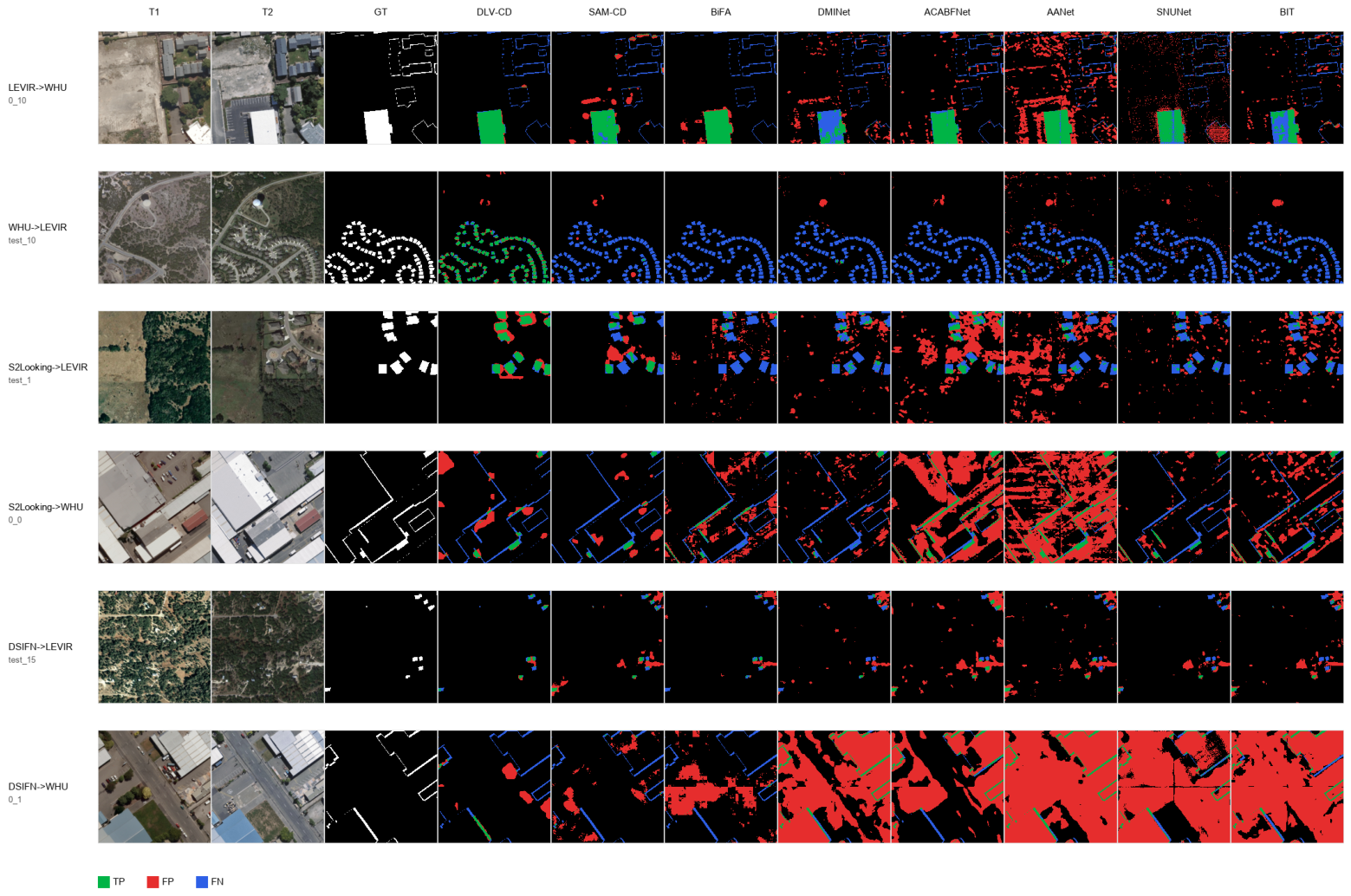
Figure 4 presents qualitative comparisons under six source-only cross-dataset transfer directions. The prediction maps are visualized as TP/FP/FN overlays, where green, red, and blue denote true positives, false positives, and false negatives, respectively. Overall, the reproduced baselines, including the SAM-based foundation-model baseline SAM-CD and the supervised CD networks, show unstable behavior under domain shift, while DLV-CD consistently produces more balanced predictions with fewer missed changes and fewer pseudo-change responses.
In the standard building-domain transfer settings (LEVIR → WHU and WHU → LEVIR), DLV-CD yields more complete building regions and cleaner boundaries. In LEVIR → WHU, SAM-CD and several supervised baselines can recover part of the main changed building, but they also introduce fragmented responses or additional false positives around building edges and surrounding textures. By contrast, DLV-CD recovers the main changed building with more coherent spatial coverage. In the more challenging WHU → LEVIR case, the dominant failure mode of most reproduced baselines is severe under-detection, with large blue FN regions around changed buildings. DLV-CD preserves substantially more true changed structures, which is consistent with its higher Recall and F1-score in
Table 4.
The S2Looking-based transfer cases further highlight the difficulty of transferring from a complex source domain with rural scenes and off-nadir imaging effects. In S2Looking → LEVIR, where the target scene contains sparse small buildings embedded in a rural background, several baselines suffer from both false alarms and missed detections, whereas DLV-CD better preserves the building targets and produces cleaner predictions. In S2Looking → WHU, many baselines overreact to roof textures, shadows, and road-aligned structures, producing extensive red false positives. This behavior is especially evident for ACABFNet and AANet, whose predictions spread over large non-change regions. DLV-CD suppresses most of these pseudo-change responses while still retaining the dominant true building changes.
The DSIFN-based transfer cases reveal another characteristic failure mode: semantic mismatch between a more heterogeneous source domain and a building-change target domain. In DSIFN → WHU, several methods produce large-area over-detection, indicating strong sensitivity to non-building appearance variations. SAM-CD also shows visible false-positive responses in this setting, suggesting that SAM-based segmentation priors do not automatically guarantee robust target-free building change discrimination. In DSIFN → LEVIR, several reproduced methods still miss changed structures or respond to surrounding background patterns, while DLV-CD remains comparatively more focused on the true changed buildings. These visual results agree well with the quantitative findings in
Table 3 and
Table 4 and suggest that frozen DINOv3 representations, together with multi-level difference fusion and hierarchical evidence fusion, improve robustness to cross-dataset shifts by reducing both recall collapse and pseudo-change over-detection.
4.3. Ablation Study
Table 6 evaluates the effect of hierarchical layer selection and evidence fusion across the six source-only transfer directions. The fused decoder alone already provides strong performance, achieving an average F1-score of 63.22%. Adding hierarchical evidence fusion improves the average F1-score, but the gain depends on which layer-wise heads are selected. The best result is obtained by fusing Layer3, Layer4, and the fused decoder output, reaching an average F1-score of 65.38%.
Notably, aggregating all heads does not lead to better performance. Its average F1-score drops to 63.13%, lower than both the selected Layer3,4 + fused setting and the fused-only setting. This indicates that HEF is not effective simply because more predictions are averaged. Instead, selective fusion is important: shallower heads may introduce texture-sensitive or source-specific responses under domain shift, while deeper hierarchical heads provide more stable semantic evidence. Therefore, DLV-CD adopts selective logit-space fusion rather than indiscriminate all-head aggregation. This observation is important under source-only transfer because prediction heads from different DINOv3 layers do not contribute equally to cross-dataset robustness. Shallow or intermediate heads can preserve local structures, but they may also respond to dataset-specific textures, shadows, roads, and background patterns. Deeper heads provide stronger semantic abstraction but may lose some spatial details. Therefore, the best-performing Layer3, Layer4, and fused-head combination suggests that DLV-CD benefits from selecting complementary hierarchical evidence rather than simply increasing the number of prediction heads.
Table 7 compares different encoder adaptation strategies on the bidirectional LEVIR-CD ↔ WHU-CD setting. Source-domain F1 is included only as a diagnostic indicator to examine whether stronger source fitting leads to better source-only transfer. The results show that fine-tuning the DINOv3 encoder does not consistently improve target-domain performance. For example, deep-layer fine-tuning achieves the highest LEVIR source-domain F1-score of 83.86%, but its LEVIR → WHU F1-score remains lower than the frozen setting. Similarly, when training on WHU, the frozen encoder obtains the best WHU → LEVIR F1-score despite not having the highest source-domain F1.
These results suggest that adapting the foundation encoder to source-domain labels may strengthen source-specific representations without necessarily improving transfer to unseen target domains. In contrast, freezing the encoder preserves the pretrained visual representations and yields the best average target-domain F1-score. Therefore, DLV-CD adopts a frozen DINOv3 encoder and trains only task-specific change detection components. This also avoids additional source-specific tuning of the foundation encoder, which is important under the strict target-free deployment setting.
This result also provides empirical support for the frozen-encoder design choice. In source-only deployment, stronger source-domain fitting is not necessarily desirable if it reduces the generality of pretrained representations. The comparison between fine-tuning and freezing indicates that preserving the pretrained DINOv3 feature space can be more beneficial for unseen target domains than adapting the encoder toward a single labeled source domain.
6. Conclusions
This paper studied source-only cross-dataset building change detection, where a model is trained on a source dataset and directly deployed to unseen target datasets without using target-domain images, labels, validation data, adaptation, or threshold calibration. This setting is stricter than conventional in-domain evaluation and better reflects deployment scenarios in which target-domain data are unavailable before model application.
To address this problem, we proposed DLV-CD, a frozen-DINOv3-based change detection framework. DLV-CD freezes the DINOv3 encoder and trains only task-specific components, including layer-wise adapters, a multi-level difference fusion decoder, and a hierarchical evidence fusion module. Across six transfer directions built from LEVIR-CD, WHU-CD, S2Looking, and DSIFN-CD, DLV-CD achieved the best F1-score among reproduced CD baselines in all directions and reached an average F1-score of 65.38%. Detailed precision–recall analysis and qualitative comparisons further showed that DLV-CD reduces both missed building changes and pseudo-change false alarms under domain shift.
The results suggest that preserving frozen foundation representations is a promising strategy for source-only cross-dataset building change detection. Ablation studies further show that selective hierarchical evidence fusion is more effective than indiscriminate all-head aggregation, and that source-domain fine-tuning of the foundation encoder does not necessarily improve target-domain transfer. Overall, this research highlights the importance of evaluating change detection models beyond in-domain benchmarks and provides a strong frozen-foundation-model baseline for target-free cross-dataset deployment.