Article

OrbitGS: High-Fidelity 3D Reconstruction of On-Orbit Non-Cooperative Targets via Physically Decoupled Gaussian Splatting

1
Remote Sensing Technology Institute, College of Information Science and Technology, Beijing University of Chemical Technology, Beijing 100029, China
2
Shanghai Key Laboratory of Aerospace Intelligent Control Technology, Shanghai Aerospace Control Technology Institute, Shanghai 201109, China
*
Author to whom correspondence should be addressed.
Remote Sens. 2026, 18(15), 2489; https://doi.org/10.3390/rs18152489
Submission received: 8 May 2026 / Revised: 20 June 2026 / Accepted: 29 June 2026 / Published: 31 July 2026

Abstract

High-precision 3D reconstruction of on-orbit non-cooperative targets is essential for space situational awareness. However, extreme space environments induce severe imaging degradations, including high-dynamic-range (HDR) illumination, rapid motion blur, and platform jitter. Traditional 3D Gaussian Splatting (3DGS) conflates these optical distortions with geometric optimization, leading to pathological structural inflation and the loss of thin appendages like solar panels. To overcome this, we propose OrbitGS, a physically decoupled 3DGS framework. OrbitGS integrates physical imaging priors via a Kinematics-Driven Degradation Synthesizer (KDDS) to deterministically extract view-specific degradation kernels. Furthermore, a blur-decoupled rendering strategy with intensity-aware weighting mitigates HDR variations, while a semantic-aware densification scheme mathematically penalizes abnormal primitive expansion. Evaluations on the SPE3R dataset demonstrate that OrbitGS effectively disentangles optical degradations from the geometric representation. Quantitatively, evaluated across seven space targets under moderate (200-view) and extreme sparse (50-view) settings, our framework achieves state-of-the-art robustness against extreme degradations. Notably, it avoids the catastrophic structural blow-ups observed in baseline methods, yielding an average geometric F1-score of 0.80 and a Chamfer Distance of 0.818, alongside a rendering Structural Similarity Index (SSIM) of 0.82 and a Learned Perceptual Image Patch Similarity (LPIPS) of 0.16. By preserving delicate structures under severe degradation, OrbitGS provides a robust, high-fidelity 3D reconstruction solution for complex orbital environments.

1. Introduction

The rapid commercialization of space and the large-scale deployment of satellite constellations have led to increasingly congested Low Earth Orbit (LEO) environments. The continuous accumulation of defunct satellites, spent rocket bodies, and orbital debris poses severe collision risks, threatening the sustainable utilization of space resources [1,2,3]. Consequently, advanced Space Situational Awareness (SSA) and on-orbit servicing rely critically on high-precision state estimation and the perception of non-cooperative targets. To mitigate the risks of cascading collision effects and ensure the safety of operational spacecraft, establishing robust and accurate mechanisms for identifying and modeling complex space objects has become an urgent priority in the aerospace domain.
Space-based visual observation provides an essential, autonomous modality for acquiring the geometric structure, attitude, and relative motion of target spacecraft without relying on ground control systems [4,5]. Compared to traditional point-target tracking, 3D reconstruction yields comprehensive geometric models that significantly enhance the reliability of collision warning and robotic manipulation tasks [6,7]. Recently, 3D Gaussian Splatting (3DGS) [8] has emerged as a transformative paradigm in computer vision. By utilizing an explicit point cloud representation and continuous differentiable rendering, 3DGS achieves exceptional reconstruction quality and highly efficient training speeds. Introducing 3DGS into space-based observation holds tremendous potential for accurately modeling the structural and photometric properties of non-cooperative satellites.
Despite its theoretical potential, applying standard 3DGS to space observation encounters severe physical and environmental constraints. First, the vacuum of space lacks the diffusing effect of atmospheric scattering, resulting in extreme High Dynamic Range (HDR) illumination characterized by intensely overexposed surfaces and pitch-black shadows. This extreme contrast undermines both traditional local-gradient feature matching [9] and modern deep registration frameworks [10]. Second, complex relative kinematics between the observing and target satellites, combined with the shallow depth of field (DoF) inherent to telephoto lenses and spacecraft micro-vibrations, introduce severe imaging degradation. Such degradation manifests as motion blur, defocus, and platform jitter. Traditional 3DGS inherently conflates these optical distortions with geometric optimization. When applied to degraded space imagery, the optimization process attempts to replicate blur and shadows by erroneously inflating Gaussian primitives. This results in pathological structural expansion, the loss of thin appendages (e.g., solar panels), and the proliferation of “floater” artifacts, which fundamentally degrades the fidelity required for downstream SSA tasks [11].
These limitations indicate that directly fitting implicit radiance fields or raw Gaussian parameters to degraded observations is insufficient for reliable space applications. Addressing this challenge requires moving beyond blind data-fitting or black-box deblurring priors and instead explicitly incorporating the physical imaging process into the optimization framework. Motivated by this gap, we propose OrbitGS, a high-fidelity 3DGS reconstruction framework tailored for the extreme physical degradations of space environments. OrbitGS constructs a physically decoupled inverse rendering pipeline that actively models relative kinematics and optical degradation in 3D space. By strictly separating the camera-induced distortion from the latent 3D representation, OrbitGS reconstructs pristine, physically accurate geometries even from severely noisy and blurred inputs.
The main contributions of this paper are summarized as follows:
  • We propose OrbitGS, a physically decoupled, forward-modeling 3DGS framework that explicitly separates complex environmental and camera-induced degradation from the fundamental 3D geometric representation of space targets.
  • We design a Kinematics-Driven Degradation Synthesizer (KDDS). By coupling inherent platform jitter with a continuous angular encoding scheme, the KDDS deterministically extracts view-specific degradation kernels driven by orbital kinematics, providing a reliable physical prior for 3D optimization.
  • We develop a blur-decoupled forward rendering strategy equipped with an Intensity-Aware Weighting ( W I A ) mechanism. This enables the framework to accurately model the degradation process while maintaining high robustness against the extreme HDR variations and shadow noise inherent to vacuum illumination.
  • We introduce a semantic-aware Gaussian densification and pruning scheme designed to preserve critical thin structures, such as solar panels. Through gradient-memory densification and spatial-bounded silhouette pruning, OrbitGS mathematically penalizes abnormal primitive expansion, significantly suppressing floater artifacts to reconstruct a highly consistent 3D geometry.

2. Related Work

2.1. Geometry-Driven Target Modeling

Early visual perception and state estimation of on-orbit non-cooperative targets primarily relied on explicit geometry-driven paradigms [5]. These approaches typically attempt to solve the problem of target tracking and pose estimation under constrained computational budgets by abstracting the target into simplified primitives (e.g., polyhedra, cylinders) or sparse contour feature sets.
While computationally frugal and robust under low-resolution, narrow-field-of-view conditions, these methods suffer from severe modeling limitations. The restricted expressive capacity of pre-defined geometric templates fails to accurately capture the complex 3D morphology of modern spacecraft equipped with delicate appendages like solar arrays and antennas [6]. Furthermore, they exhibit significant data limitations; space-based observations frequently feature textureless surfaces and drastic illumination shifts, which severely degrade the local gradients required for reliable feature extraction [12]. Consequently, multi-view geometry (MVG) pipelines relying on epipolar constraints exhibit poor generalization when applied to non-cooperative space targets, frequently resulting in catastrophic tracking failures. These purely geometric paradigms inherently fail because they treat spatial structure and optical appearance as isolated entities, highlighting the critical need for a framework that tightly couples 3D topology with physical imaging processes.

2.2. Data-Driven Radiance Field Representation

To circumvent the representational bottlenecks of explicit geometric templates, recent literature has shifted toward data-driven radiance fields, which solve the problem of high-fidelity view synthesis by learning continuous mappings from spatial coordinates to radiance responses.
Implicit Radiance Fields: Neural Radiance Fields (NeRF) [13] and its variants [14,15,16] implicitly model volume density using Multi-Layer Perceptrons (MLPs). While approaches like Sat-NeRF [17] have successfully applied these fields to Earth photogrammetry from orbit, rendering non-cooperative resident space objects presents distinct challenges. Recent efforts, such as the work by Caruso et al. [18], utilize Instant-NGP and D-NeRF to accelerate the 3D reconstruction of these space targets. However, highly successful under controlled conditions, they face severe computational constraints; the dense volumetric ray-marching required for optimization and rendering is prohibitive for real-time on-orbit operations. More critically, they possess a fundamental modeling limitation: they are strictly predicated on the assumption of photometric consistency. When exposed to LEO environments—specifically, severe motion blur and deep shadow noise—the network erroneously alters the underlying density field [19].
Explicit Gaussian Representations: 3D Gaussian Splatting (3DGS) [8] solves the computational bottleneck of NeRFs by utilizing anisotropic Gaussian point clouds and differentiable rasterization. Recent works have increasingly adapted 3DGS for space applications. Nguyen et al. [20] utilized accelerated 3DGS to characterize satellite geometry, while Barad et al. [21] extended it to track dynamic unknown objects. Furthermore, extensions for scale consistency [22], sparse views [23,24], and static space environments [25] have been proposed. However, standard 3DGS introduces a distinct modeling flaw under dynamically degraded conditions. Because the optimization objective is anchored solely in 2D image-space reconstruction errors, the unconstrained spatial covariance pathologically inflates to “cover” smeared pixels or noisy shadows. This prevents reliable extraction of pristine 3D geometry from degraded telemetry data.

2.3. Physics-Driven Degradation Modeling

Recognizing the fallacy of the “ideal imaging assumption” in data-driven models, recent frameworks attempt to solve image degradation by incorporating physical or semi-physical priors into the optimization loop.
For extreme illumination, methods like RawNeRF [26], HDR-NeRF [27], and HDR-GS [28] integrate differentiable Image Signal Processing (ISP). colorred In the specific context of on-orbit observations, recent studies have begun addressing space-specific illumination anomalies. For instance, Zhao et al. [29] improved 3DGS for non-cooperative targets under poor lighting, and Park et al. [30] successfully incorporated space environment illumination knowledge to refine spacecraft structures and handle HDR variations.
While these works significantly mitigate photometric inconsistencies and suppress certain “floater” artifacts caused by lighting, their modeling limitations lie in their primary focus on static tone mapping and exposure adjustment. Crucially, they do not simultaneously address the geometric instability induced by highly coupled kinetic degradations—specifically, high-frequency platform jitter intertwined with rapid motion blur. When exposed to the complex, coupled degradations (HDR mixed with kinetic smearing) inherent to realistic LEO telemetry, these uncoupled approaches still suffer from structural inflation. This highlights the critical need for a framework that inherently disentangles both optical lighting and kinematic blur simultaneously.

3. Method

3.1. Overview of the Framework

Our objective is to reconstruct the high-fidelity, explicit 3D geometry of non-cooperative space targets from multi-view images that are severely corrupted by relative motion blur, platform jitter, defocus blur, and extreme lighting variations. Traditional reconstruction pipelines that attempt to perform 2D image deblurring prior to 3D optimization often hallucinate structural artifacts, which severely compromises the geometric integrity of the resulting 3D Gaussian Splatting (3DGS) models.
To address this, we propose OrbitGS, a physically decoupled, forward-modeling framework. As illustrated in Figure 1, our novel approach is driven by three core components: (1) A Kinematics-Driven Degradation Synthesizer (KDDS) that deterministically extracts view-specific physical degradation kernels (Section 3.2); (2) A blur-decoupled forward rendering strategy, equipped with an intensity-aware weighting mechanism, to reconstruct the latent sharp radiance field (Section 3.3); and (3) A semantic-aware Gaussian densification and pruning scheme explicitly designed to recover and preserve thin appendages, such as solar panels (Section 3.4).

3.2. KDDS: Kinematics-Driven Degradation Synthesizer

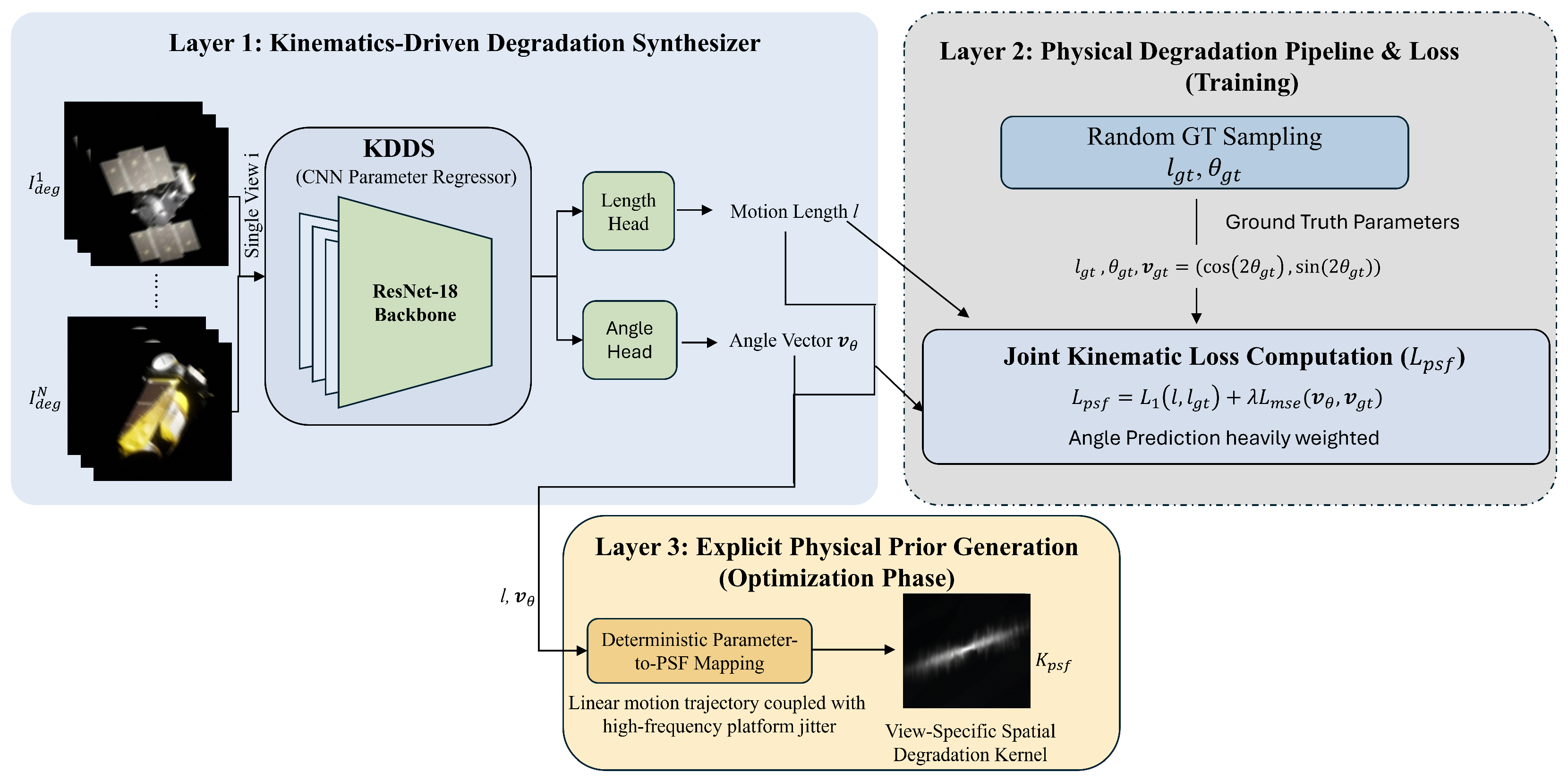
Rather than blindly mapping blurred pixels to a sharp domain via black-box end-to-end networks, we introduce a lightweight Convolutional Neural Network (CNN) based on a modified ResNet-18 backbone [31], termed the Kinematics-Driven Degradation Synthesizer (KDDS). The KDDS functions as an explicit physical parameter regressor (see Figure 2).
During the KDDS pre-training phase, we implement an on-the-fly physical degradation pipeline. This data augmentation strategy dynamically synthesizes degraded training samples by applying random relative motion extents ( l [ 1 , 7 ] pixels) and motion angles ( θ [ 0 , 180 ) ) to clear spacecraft imagery. Crucially, to accurately simulate the inherent high-frequency micro-vibrations of the spacecraft platform, we introduce a coupling mechanism that applies Gaussian spatial filtering (with a randomly sampled σ [ 0.5 , 1.5 ] ) over the linear motion trajectory. This forces the CNN to robustly isolate the primary motion vector while maintaining invariance to jitter noise.
For each degraded input view I d e g i , the fully connected layers of the KDDS are split into two decoupled network heads to predict the latent kinematic parameters. Directly regressing the angle θ introduces severe periodic discontinuity and 180 symmetry conflicts. To circumvent this, our angle head regresses a continuous, L 2 -normalized 2D directional vector v θ . Correspondingly, the ground truth angle is mathematically embedded into a continuous Euclidean space as v g t = ( cos ( 2 θ ) , sin ( 2 θ ) ) , strictly guaranteeing smooth gradient flow. Concurrently, the motion length head regresses l, bounded by a scaled Sigmoid activation to ensure physical plausibility.
The KDDS is supervised by a joint kinematic loss function:
L p s f = L 1 ( l , l g t ) + λ L m s e ( v θ , v g t ) ,
where L 1 and L m s e denote the absolute error and mean squared error, respectively. The hyperparameter λ (empirically set to 10.0 ) heavily weights the angle prediction to compensate for the optimization complexity of the directional vector.
During the primary 3DGS optimization phase, the pre-trained KDDS remains frozen. The predicted parameters for each view are deterministically mapped to a view-specific spatial degradation kernel K p s f i R K × K (where K = 2 l m a x + 1 ). This explicit kernel generation inherently guarantees that the estimated degradation strictly complies with the physical laws of orbital dynamics, thereby providing a robust prior for 3D geometric reconstruction.

3.3. Blur-Decoupled Forward Rendering

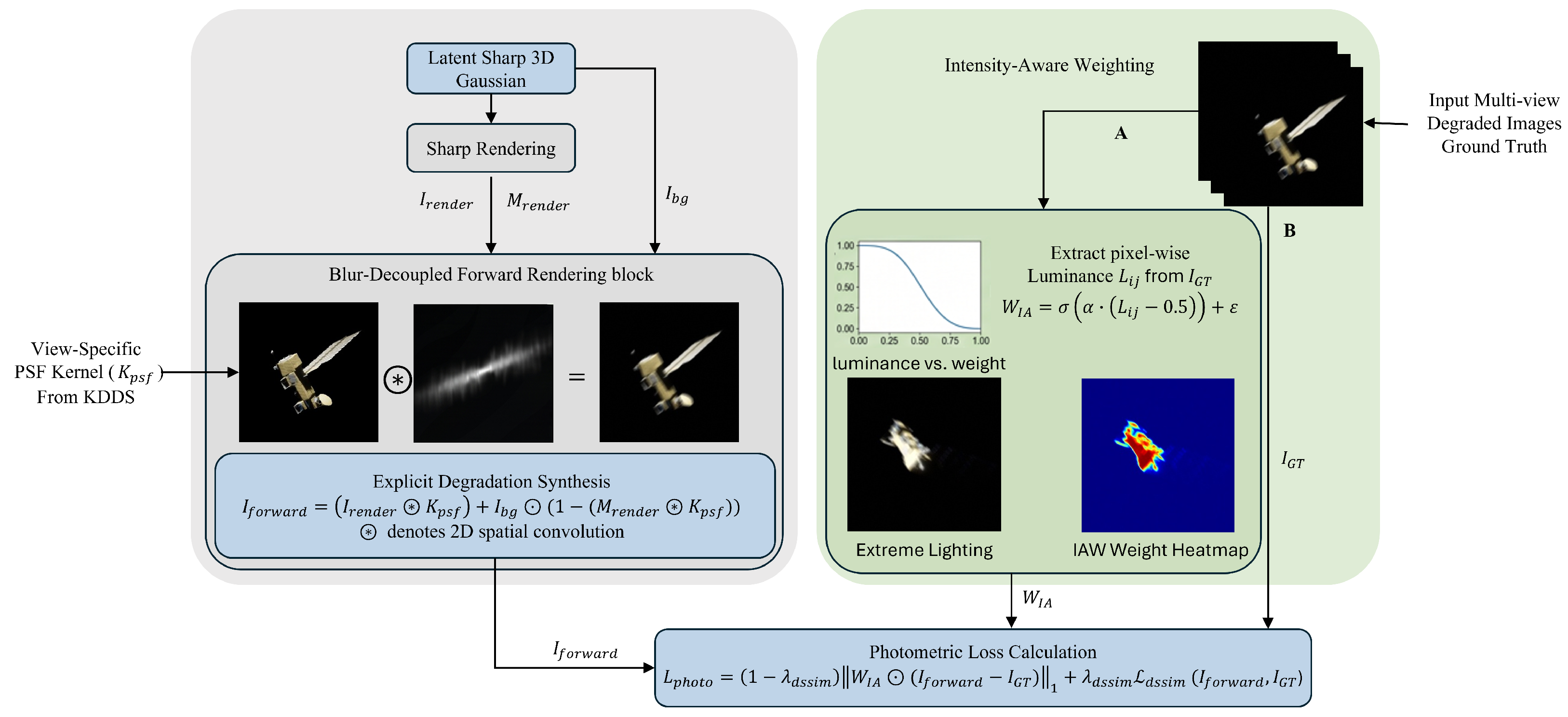
The core philosophy of OrbitGS is to decouple the physical camera blur from the 3D target representation via an analysis-by-synthesis pipeline. We maintain a set of 3D Gaussians that explicitly represents the latent sharp space object. During the forward pass, we first render the sharp image I r e n d e r and the sharp silhouette mask M r e n d e r onto a zero-radiance (pure black) background to prevent environmental light contamination.
As visualized in Figure 3, before computing the photometric loss against the degraded ground truth observation I G T , we explicitly apply the view-specific PSF K p s f to the rendered outputs via spatial convolution:
I f o r w a r d = ( I r e n d e r K p s f ) + I b g 1 clip ( M r e n d e r K p s f , 0 , 1 ) ,
where ⊛ denotes the 2D convolution operation, I b g is the target background color, and ⊙ denotes element-wise multiplication. Notably, as mathematically detailed in Equation (2) (and simplified in Figure 3 for visualization), clamping the convolved mask between [ 0 , 1 ] ensures soft boundary gradients, which is essential for stable differentiable optimization.
To address the extreme High Dynamic Range (HDR) lighting variations—such as harsh overexposures and pitch-black shadows—inherent to vacuum space environments, we introduce a novel Intensity-Aware Weighting ( W I A ) mechanism. We compute the pixel-wise luminance L i j [ 0 , 1 ] of the ground truth image and define the dynamic weight as:
W I A = σ α · ( L i j 0.5 ) + ϵ ,
where σ ( · ) is the sigmoid activation function, α (set to 10.0 ) controls the sharpness of the weighting transition, and ϵ (set to 0.05 ) ensures non-zero gradient propagation in deep dark areas.
The final photometric loss is a weighted combination of the L 1 and Structural Similarity (SSIM) losses, heavily penalizing structural disparities while remaining robust to shadow noise:
L p h o t o = ( 1 λ d s s i m ) W I A ( I f o r w a r d I G T ) 1 + λ d s s i m L d s s i m ( I f o r w a r d , I G T ) .

3.4. Semantic-Aware Densification and Pruning

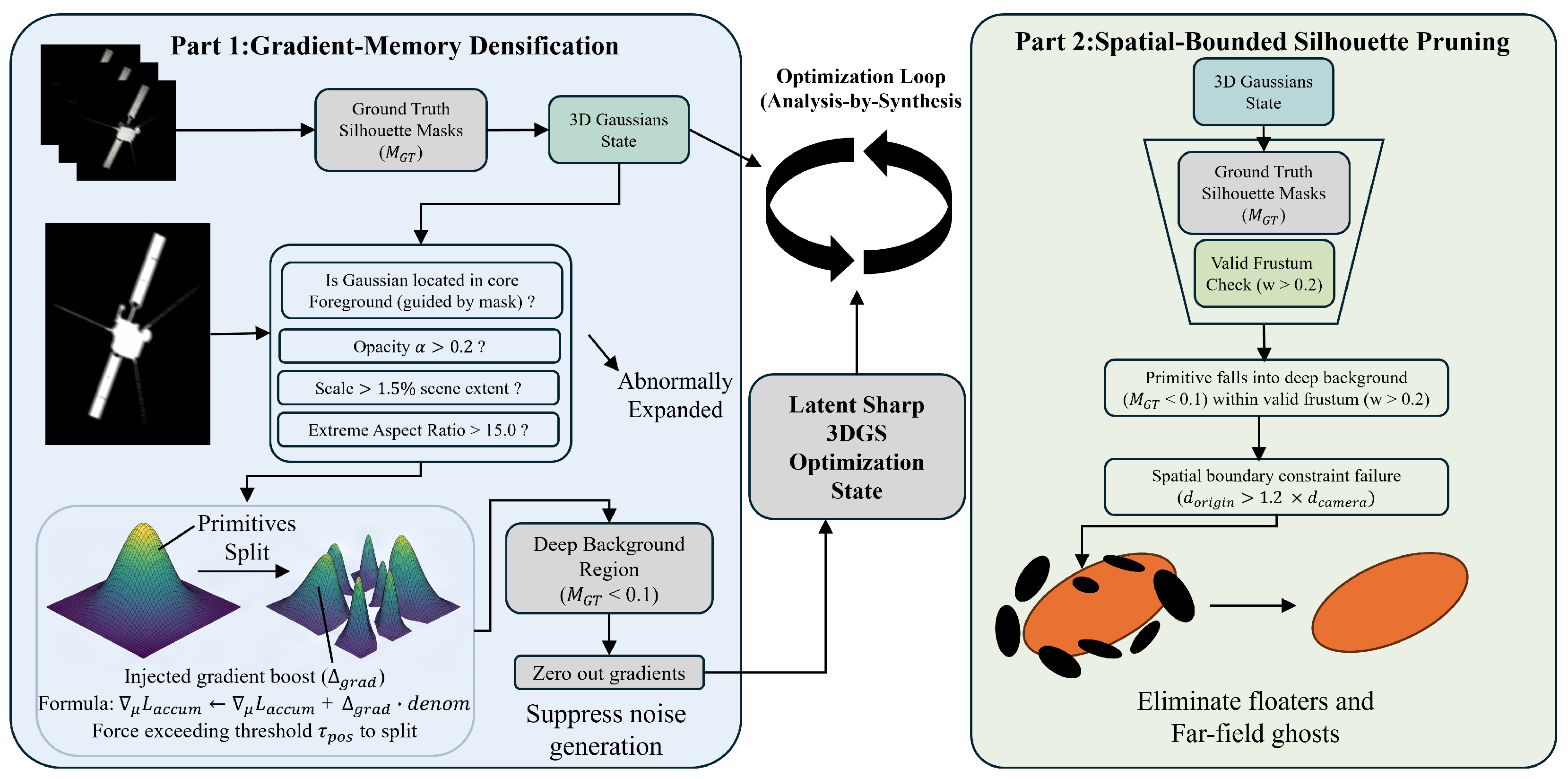
Optical blurs force standard 3DGS optimization to erroneously expand the covariance scale of Gaussians to cover smeared pixels. This results in pathologically inflated, flat primitives that destroy thin structures, such as solar panels and antennas. To counter this, we introduce a semantic-aware geometry regularization scheme.
Gradient-Memory Densification: As shown in Figure 4, during the periodic densification phase, we identify pathologically inflated Gaussians by analyzing their spatial extents and aspect ratios. A Gaussian is flagged for correction if it meets the following criteria: (1) it is located in the core foreground (guided by M G T ), (2) exhibits high opacity ( α o p a c i t y > 0.2 ), (3) possesses a spatial scale exceeding 1.5 % of the bounding scene extent, and (4) presents an extreme aspect ratio (ratio > 15.0 ). These conditions strongly indicate a corrupted primitive spanning across a blurred boundary. For such Gaussians, we artificially inject a scaled gradient boost ( Δ g r a d = 0.0002 ) into their positional gradient accumulator:
μ L a c c u m μ L a c c u m + Δ g r a d · N v i e w s ,
where N v i e w s represents the view occurrence count (denominator) for that specific Gaussian. This forces the inflated primitives to exceed the standard densification threshold ( τ p o s ) and subsequently split into finer, sharper components. Concurrently, we forcefully zero out gradients in the deep background to suppress noise generation.
Spatial-Bounded Silhouette Pruning: To eliminate “floater” artifacts and far-field ghosts caused by extreme view sparsity, we execute a rigorous pruning step before densification terminates (at iteration 12,000). Gaussians are projected into the camera clip space. Any primitive that falls into the deep background region ( M G T < 0.1 ) within the valid frustum (homogeneous depth w > 0.2 ), or exceeds a predefined spatial boundary constraint ( d o r i g i n > 1.2 × d c a m e r a ), is permanently pruned. This mathematically rigorous spatial-bounded strategy heavily penalizes the generation of floaters, thereby promoting a cleaner and more physically plausible 3D geometric representation.

4. Experiments

4.1. Dataset and Space Degradation Simulation

We evaluate the proposed OrbitGS framework using a subset of the SPE3R dataset [7]. The selected targets—ACRIMSAT, Aqua, CloudSat (v19), Herschel, Kepler, Solar Orbiter, and TDRS—feature diverse morphologies including expansive solar arrays, communication antennas, and polyhedral main bodies. The SPE3R dataset inherently incorporates native High Dynamic Range (HDR) conditions, providing imagery with sensor saturation on sun-facing surfaces and severe information loss in shadows, closely mirroring the vacuum environment of space.
To replicate the complex optical and kinematic degradations of actual space-based observations, we apply a physical degradation engine to the native HDR renderings, injecting three coupled blurs:
  • Motion Blur ( K m o t i o n ): Induced by relative orbital kinematics. The blur length is dynamically determined by the quaternion difference Δ q between consecutive frames, where L m o t i o n arccos ( Δ q ) .
  • Jitter Blur ( K j i t t e r ): Simulating high-frequency platform micro-vibrations, modeled using a 2D Gaussian point spread function (PSF) with variance σ j i t t e r .
  • Defocus Blur ( K d e f o c u s ): Simulating depth-of-field (DoF) limitations via a pillbox filter.
The final coupled degradation PSF is computed via system cascade convolution: K t o t a l = K m o t i o n K j i t t e r K d e f o c u s .
Cross-Degradation Evaluation Setup: To demonstrate that our Kinematics-Driven Degradation Synthesizer (KDDS) learns intrinsic blur features rather than merely overfitting to its own forward synthetic engine, we introduce an additional out-of-distribution (OoD) evaluation. In this cross-degradation setting, we generate degraded images using standard, generic image processing libraries (e.g., applying standard OpenCV-based linear motion blur and Gaussian blur) completely independent of our physical degradation engine. This allows us to rigorously evaluate the generalizability of OrbitGS against unseen degradation models.

4.2. Implementation Details and Baselines

Experimental Setup: OrbitGS is implemented in Python (v3.10.6) and accelerated by CUDA 11.8. All training and evaluations are conducted on a workstation equipped with an Intel Core i7-12700KF CPU, 64 GB of RAM, and a single NVIDIA GeForce RTX 3090 GPU (24 GB VRAM).
Baselines: We compare OrbitGS against five state-of-the-art (SOTA) approaches: (1) 3DGS [8]; (2) 2DGS [32]; (3) PGSR [33]; (4) SPACE 3DGS [25]; and (5) Deblurring-GS [34]. Baselines are executed using official implementations and default hyperparameter configurations. For Deblurring-GS, both motion blur and defocus blur modeling modules are activated.
Mesh Extraction Protocol: To evaluate explicit 3D geometry (Chamfer Distance and F1-Score), we utilize the official mesh extraction pipelines for 2DGS and PGSR to maximize their surface regularization benefits. For OrbitGS, 3DGS, SPACE 3DGS, and Deblurring-GS, we employ the standard SuGaR [35] marching cubes algorithm without the joint fine-tuning stage.
Evaluation Strategy: The evaluation is decoupled into two scenarios: (1) Extreme Sparsity (50 views): Focusing on 2D Novel View Synthesis (NVS) to assess texture recovery under ill-posed conditions. (2) Moderate Conditions (200 views): Focusing on explicit 3D geometry extraction to assess structural accuracy.

4.3. 2D Rendering Robustness Under Extreme Sparsity (50 Views)

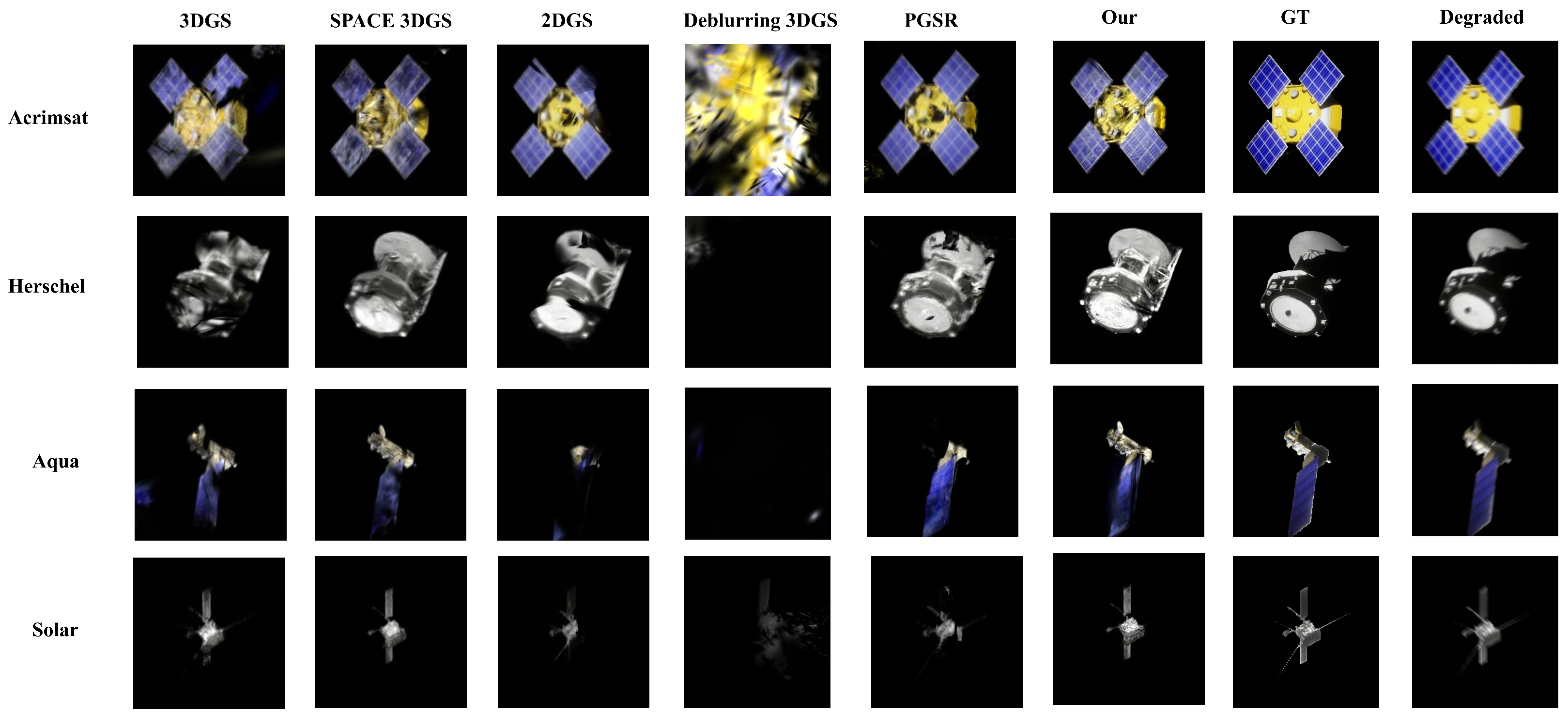
Table 1 presents the quantitative Novel View Synthesis results under the 50-view setting. OrbitGS achieves the highest average Structural Similarity Index (SSIM: 0.82) and Learned Perceptual Image Patch Similarity (LPIPS) [36] (0.16), while SPACE 3DGS yields a marginally higher average PSNR (17.98 dB vs. 17.93 dB), OrbitGS consistently outperforms other surface-aligned baselines (PGSR SSIM: 0.77; 2DGS SSIM: 0.76) and generic deblurring methods (Deblurring-GS SSIM: 0.47).
As qualitatively illustrated in Figure 5, traditional baselines display ghosting artifacts and unresolved textures under these constraints. Deblurring-GS exhibits severe optimization divergence, yielding blurred visual outputs. In contrast, OrbitGS resolves high-frequency details, such as the grid patterns on the solar panels of CloudSat and TDRS.

4.4. 3D Geometry Fidelity Under Moderate Conditions (200 Views)

Table 2 details the quantitative geometry evaluation under the 200-view setting. OrbitGS achieves the lowest average Chamfer Distance (CD: 0.818) and the highest average F1-Score (0.80). PGSR reports a competitive average CD of 0.884 (including 0.199 on TDRS) but records an average F1-Score of 0.18. SPACE 3DGS achieves an average F1-Score of 0.70.
As observed in Table 2, while SPACE 3DGS achieves lower CD values on specific simple targets (e.g., ACRIMSAT, Aqua, and Kepler), it suffers from catastrophic optimization blow-ups under severe simulated orbital degradation, leading to extreme geometric distortion on CloudSat (4.519) and TDRS (5.257).
In contrast, rather than claiming absolute superiority on every single target, the core advantage of OrbitGS lies in its state-of-the-art robustness. A critical phenomenon is observed when analyzing the per-target metrics, particularly on targets with complex appendages like CloudSat. For instance, baseline methods like 2DGS achieve an ostensibly low Chamfer Distance (0.641) on CloudSat but an abysmal F1-Score (0.05). This discrepancy occurs because unconstrained baselines absorb extreme blur by pathologically inflating Gaussians, generating a bloated, “cloud-like” geometry. This inflated volume artificially minimizes the average spatial distance (CD) but fundamentally destroys topological precision (F1-Score).
OrbitGS, equipped with aggressive semantic-aware densification and pruning, actively destroys these inflated, false geometries to preserve sharp surfaces. Under extreme degradation, if an appendage is completely obliterated by pitch-black shadows or severe motion blur, OrbitGS conservatively prunes it rather than hallucinating a bloated artifact, while the absence of a large appendage significantly penalizes the CD metric (resulting in a higher CD of 3.678 on CloudSat), the remaining reconstructed topology is pristine and strictly surface-aligned, yielding the highest F1-Score (0.64) among all baseline methods. Therefore, OrbitGS trades a “safe but bloated” spatial volume for a strictly physical and precise geometry, ensuring consistent robustness across all orbital environments without suffering from arbitrary structural blow-ups.
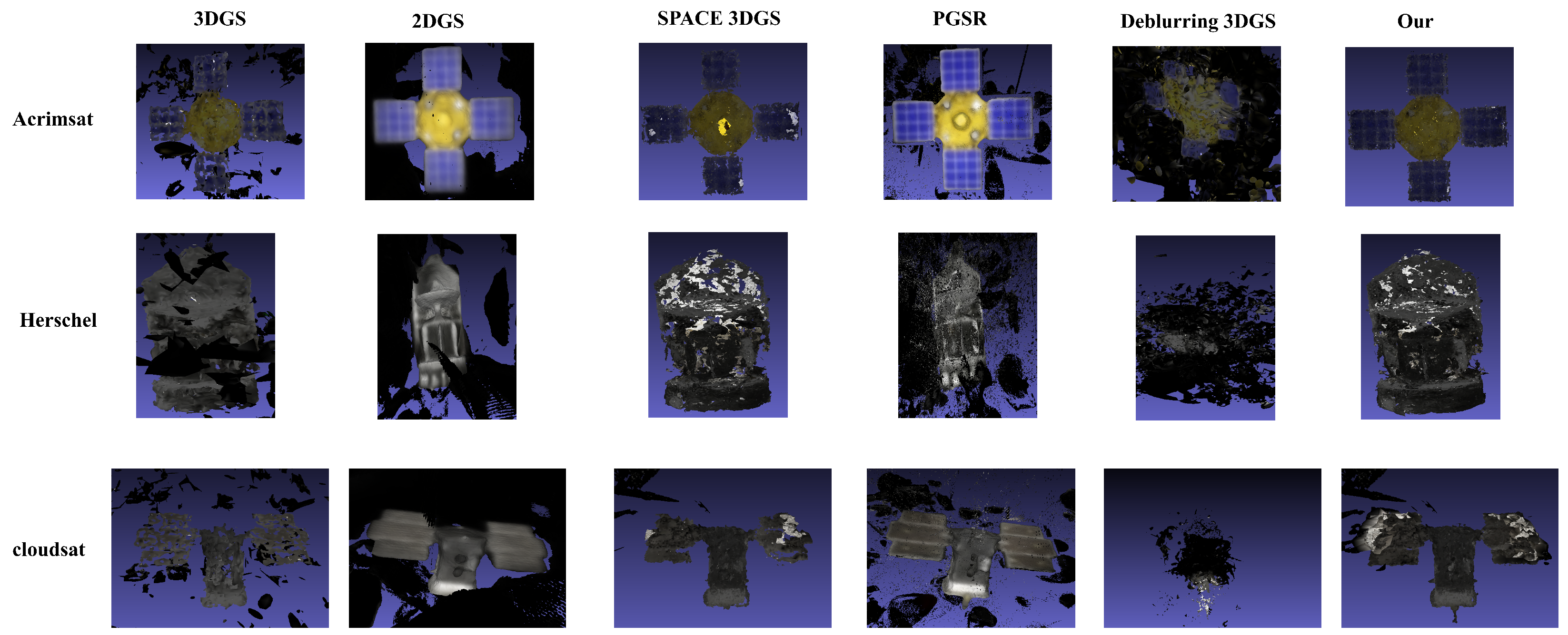
Figure 6 displays the extracted 3D geometries. Three-dimensionalGS-based methods exhibit inflated Gaussian primitives and surface melting. Deblurring-GS produces scattered floaters in the surrounding space. OrbitGS extracts continuous surfaces while preserving thin structures, such as the parabolic antennas and extended support struts on TDRS and Solar Orbiter.

4.5. Generalization Analysis via Cross-Degradation Validation

A critical concern in physically decoupled rendering is whether the degradation synthesizer simply memorizes the inverse of its own training pipeline. To rigorously validate the generalization capability of OrbitGS, we conducted a cross-degradation test focusing on three morphologically representative space targets: ACRIMSAT, CloudSat, and TDRS. Instead of employing the complex, coupled physical engine described in Section 4.1, we applied generic, out-of-distribution (OoD) blurs using standard image processing libraries (i.e., uniform linear motion blur combined with generic Gaussian blur).
The pre-trained KDDS module was directly applied to these unseen degraded images without any fine-tuning. As quantitatively reported in Table 3, OrbitGS successfully decouples the unseen blurring effects, maintaining highly competitive Novel View Synthesis performance (measured by PSNR, SSIM, and LPIPS). It consistently outperforms the standard 3DGS baseline across all targets, which suffers severe performance drops when encountering OoD degradation.
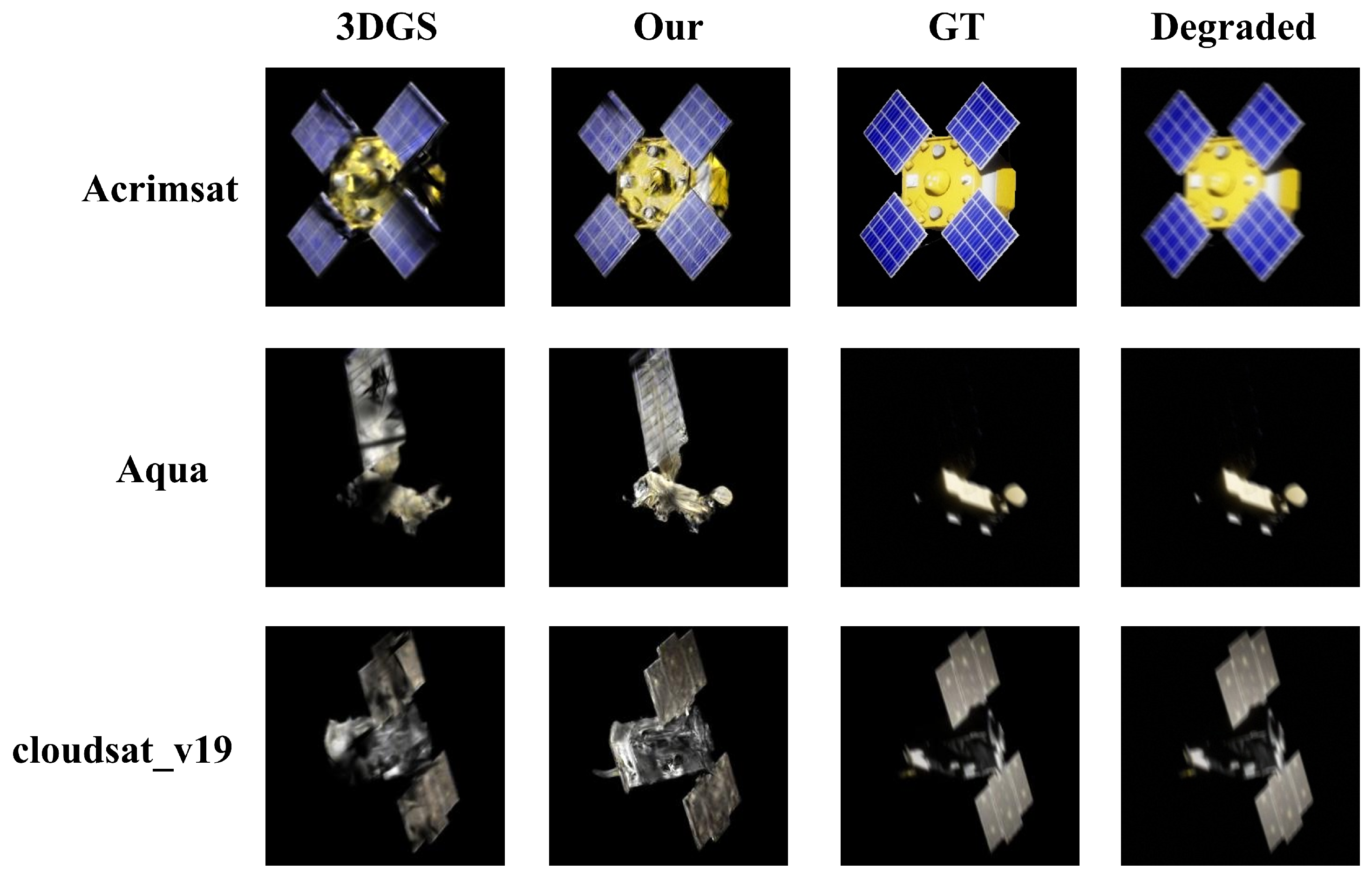
Qualitatively, as illustrated in Figure 7, standard reconstruction frameworks hallucinate structural artifacts and fail to resolve textures when faced with unmodeled blur distributions. In contrast, OrbitGS robustly extracts the latent sharp geometry and preserves high-frequency details. This fundamentally confirms that KDDS effectively extracts intrinsic kinematic blur features rather than overfitting to synthetic priors, proving its potential for real-world orbital applications.

4.6. Ablation Studies

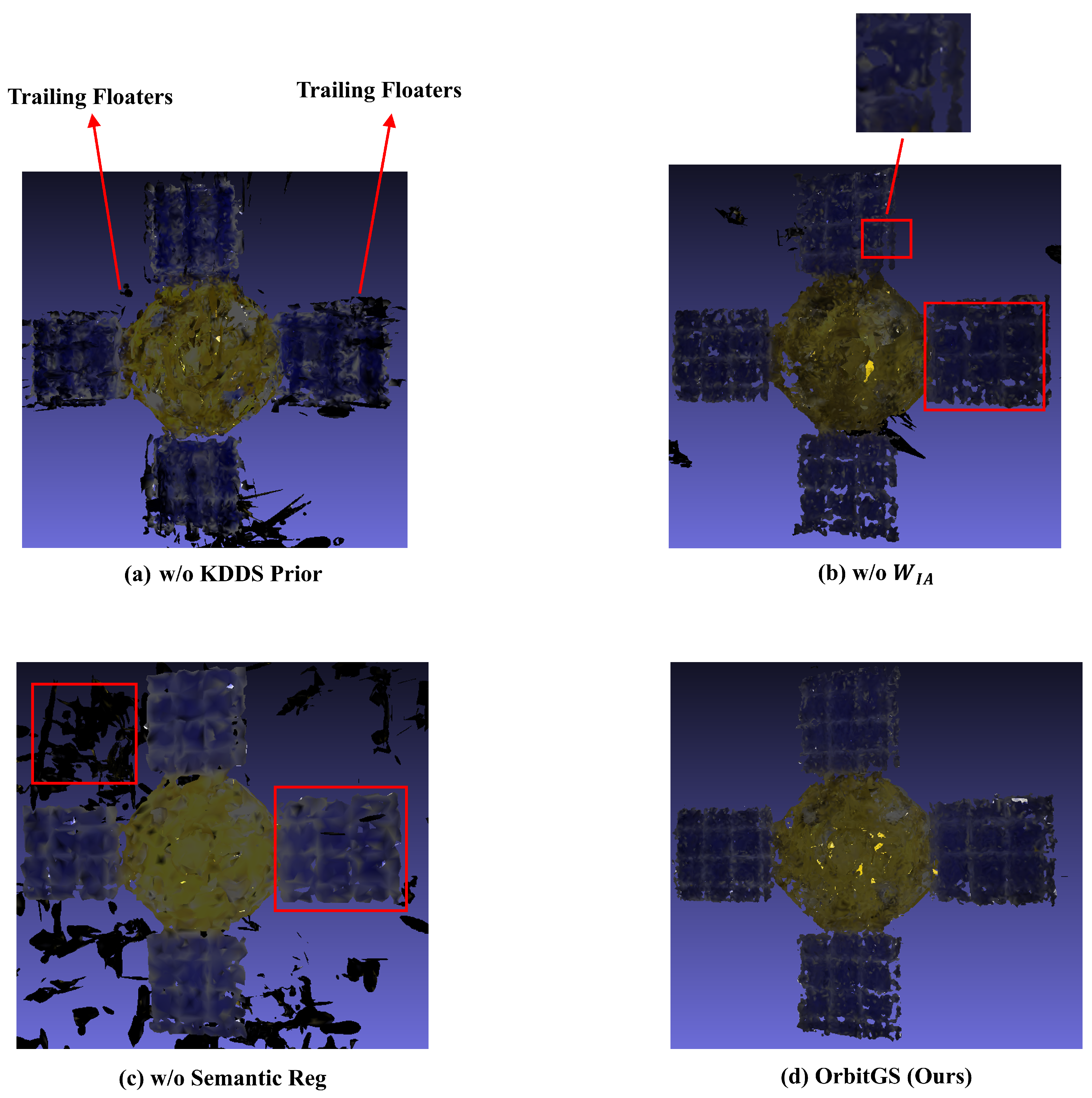
To rigorously evaluate the individual contributions of the core algorithmic components in OrbitGS, we conduct both quantitative and qualitative ablation studies. The evaluations focus on explicit 3D geometric fidelity under the moderate 200-view setting. The quantitative results, averaged across all seven space targets, are summarized in Table 4, and the corresponding visual comparisons are presented in Figure 8.
As demonstrated in Table 4 and Figure 8, each module is vital for maintaining the physical and structural integrity of the reconstruction:
  • w/o KDDS Prior: Substituting the deterministic Kinematics-Driven Degradation Synthesizer with a purely learnable 2D blur kernel fails to constrain kinematic ambiguity. Quantitatively, this leads to a significant drop in the average F1-score (from 0.80 to 0.21) and worsens the CD to 0.881. Visually, it results in directional ghosting and trailing floaters along the motion path (Figure 8a).
  • w/o Intensity-Aware Weighting W I A : Removing the dynamic weighting mechanism during photometric loss calculation makes the optimization highly susceptible to extreme illumination variations. An interesting physical phenomenon occurs here: without IAW, the unconstrained Gaussians pathologically inflate to absorb the dense surface noise in deep shadowed and drastically overexposed areas. This artificial geometric “bloating” accidentally decreases the average spatial distance (CD drops to 0.398), but it fundamentally destroys the accurate topological boundaries, plunging the F1-score to an abysmal 0.28 (Figure 8b).
  • w/o Semantic Densification & Pruning: Disabling the geometry regularization scheme triggers the most severe overall performance degradation. Unconstrained Gaussians undergo extreme structural bloat to absorb blurred boundaries, generating dense, cloud-like floaters and entirely obscuring thin mechanical features. This leads to the worst F1-score (0.04) and the highest CD error (1.044) across the configurations (Figure 8c).
Ultimately, the full OrbitGS model (Figure 8d) demonstrates the synergistic effect of these components, yielding a clean, continuous, and highly accurate 3D topology free from the aforementioned artifacts.

4.7. Computational Cost Analysis

Motivated by the potential requirement for on-orbit deployment, we present a quantitative cost analysis of our framework compared to baseline methods. All evaluations were conducted on the same hardware setup (a single RTX 3090 GPU) using the 200-view setting. We report the average Training Time, rendering inference speed (Frames Per Second, FPS), and Peak VRAM usage.
As shown in Table 5, while standard geometry-aligned methods (such as vanilla 3DGS and 2DGS) provide the lowest memory footprints and baseline speed, they fundamentally fail to reconstruct coherent geometry under severe space degradations (as discussed in Section 3.4). OrbitGS introduces explicit spatial convolution ( I K ) during the forward rendering pass to mathematically decouple degradation from the geometric representation. Remarkably, rather than severely bottlenecking performance, our framework proves to be highly efficient. OrbitGS averages just 5.06 min for training, renders at an exceptional 310 FPS, and consumes only 0.42 GB of VRAM. It significantly outperforms optimization-heavy deblurring and regularization baselines like Deblurring-GS (8.14 min, 33 FPS) and PGSR (13.05 min) across all efficiency metrics, while being highly competitive with SPACE 3DGS. This strict physical modeling inherently incurs slightly higher computational latency and VRAM usage compared to standard 3DGS. However, for critical Space Situational Awareness (SSA) and collision avoidance tasks, prioritizing geometric fidelity and topological accuracy over extreme real-time rendering speed is a necessary and highly beneficial trade-off. Preliminary strategies to mitigate this latency for resource-constrained onboard platforms are discussed in Section 5.

5. Discussion

5.1. Mechanisms of Geometric Preservation and Disentanglement

Experimental results validate that OrbitGS successfully shifts the paradigm of degraded space observation from post hoc image restoration to deterministic, forward-modeling physical disentanglement.
Existing data-driven frameworks fail under extreme orbital conditions because their optimization is anchored strictly to 2D photometric loss. When confronted with motion blur, these methods pathologically inflate Gaussian spatial covariance to absorb optical smearing, causing severe structural bloat. Conversely, black-box deblurring networks suffer from kinematic ambiguity; they cannot reliably distinguish whether a smeared pixel originates from camera translation, platform vibration, or elongated physical geometry.
OrbitGS overcomes these failure modes by enforcing a strict mathematical boundary between latent 3D geometry and 2D optical projection. By explicitly integrating a deterministic degradation prior before loss computation, the framework forces the physical blur kernel to absorb the optical distortion. Consequently, backpropagated gradients update the 3D Gaussians based purely on genuine structural discrepancies rather than environmental smearing. Coupled with a semantic-aware densification strategy that actively penalizes and shatters inflated primitives, this dual-layered constraint preserves delicate, millimeter-scale appendages that traditional methods obliterate.

5.2. Limitations and Constraints

Despite its robust structural preservation, the current architecture of OrbitGS introduces specific operational limitations:
  • Linear Kinematic Assumption: The KDDS module currently approximates motion degradation as linear translation coupled with jitter, while valid for stable rendezvous operations, this parameterization may not accurately model the motion degradation that includes rapid and complex non-linear tumbling typically exhibited by uncharacterized space debris.
  • Irrecoverable Radiometric Clipping: While our framework effectively suppresses noise in deep shadows, it cannot recover geometry in areas of absolute radiometric saturation. When latent radiance information is physically destroyed by sensor clipping, inverse rendering becomes an ill-posed problem that cannot be resolved through algorithms alone.
  • Lack of Real On-Orbit Multi-View Data: The current quantitative evaluations are strictly based on the high-fidelity SPE3R dataset and cross-degradation simulations. Validating 3DGS-based models on real, uncooperative on-orbit imagery remains a fundamental challenge due to the extreme scarcity of publicly available, high-resolution multi-view telemetry datasets with accurate ground-truth camera poses and ground-truth 3D CAD models, while our cross-degradation tests demonstrate algorithmic generalization, transitioning this framework to actual space operations requires future validation on real orbital servicing mission data.

5.3. Future Directions

To transition this framework from a ground-based computational model to an operational on-orbit perception system, future research will focus on three advanced trajectories:
  • Neuromorphic Sensor Integration: Fusing traditional optical imagery with Event Cameras (Dynamic Vision Sensors) could provide continuous, microsecond-level kinematic priors. This would resolve non-linear tumbling ambiguities and recover structural gradients even under extreme illumination clipping.
  • Hardware-Aware Optimization for Onboard Platforms: As demonstrated in our cost analysis, while highly efficient compared to baselines, explicit decoupling convolutions still introduce minor computational latency. For deployment on extreme computing-resource-constrained onboard platforms (e.g., space-grade FPGAs or edge TPUs), future efforts will focus on hardware-aware algorithm co-design. Preliminary optimization ideas include: (1) Attribute Quantization: Storing Gaussian attributes (covariance and position) in FP16 or INT8 formats rather than FP32. (2) Spherical Harmonics (SH) Reduction: Since many spacecraft surfaces (excluding solar panels) exhibit highly diffuse reflections, limiting the SH degree to zero or one can drastically reduce memory bandwidth without significantly compromising geometric accuracy. (3) Custom IP Cores: Developing customized hardware intellectual property (IP) cores to parallelize the specific 2D degradation convolutions ( I K ), thereby recovering real-time inference speeds under strict power constraints.
  • 4D Articulated Modeling: Extending the rigid explicit representation into a 4D spatiotemporal radiance field will enable the tracking of dynamic operations, such as robotic arm manipulation and solar panel deployment, further advancing comprehensive space situational awareness.

6. Conclusions

This paper presents OrbitGS, a physically decoupled 3D Gaussian Splatting framework that achieves high-fidelity 3D reconstruction of non-cooperative space targets under extreme orbital degradation. Unlike existing data-driven methods that implicitly conflate optical distortions with spatial geometry, OrbitGS explicitly disentangles camera kinematics and environmental blur from the latent 3D representation. By integrating deterministic physical degradation priors with a semantic-aware densification scheme, the framework mathematically mitigates the pathological structural inflation and “floater” artifacts that severely compromise traditional radiance fields.
Extensive evaluations demonstrate that OrbitGS delivers state-of-the-art robustness in geometric accuracy and novel view synthesis. The framework exhibits exceptional robustness in preserving delicate topological features—such as thin solar panels and antennas—even under severe motion blur, extreme high-dynamic-range (HDR) illumination, and sparse-view constraints.
Ultimately, OrbitGS provides a highly reliable, physics-grounded solution essential for advanced Space Situational Awareness (SSA) and autonomous on-orbit proximity operations. Future research will focus on integrating neuromorphic event sensors to handle highly non-linear kinematics and developing hardware-aware algorithmic optimizations to facilitate real-time, on-board 3D perception for dynamic space missions.

Author Contributions

Conceptualization, L.L.; methodology, L.L. and Z.Q.; software, Z.Q.; validation, Z.Q.; formal analysis, L.L. and F.Z.; investigation, Z.Q. and Y.L. (Yang Li); data curation, Z.Q. and W.Z.; writing—original draft preparation, L.L. and Z.Q.; writing—review and editing, L.L., F.Z., and Y.L. (Yi Li); visualization, L.L.; supervision, F.Z., W.Z., and Y.L. (Yi Li); project administration, L.L.; funding acquisition, L.L. All authors have read and agreed to the published version of the manuscript.

Funding

This research was supported by the Fundamental Research Funds for the Central Universities, grant number buctrc202601.

Data Availability Statement

The datasets generated and analyzed during the current study are available from the corresponding author on reasonable request.

Conflicts of Interest

The authors declare no conflicts of interest.

References

  1. Kessler, D.J.; Cour-Palais, B.G. Collision frequency of artificial satellites: The creation of a debris belt. J. Geophys. Res. Space Phys. 1978, 83, 2637–2646. [Google Scholar] [CrossRef] [Scilit]
  2. Liou, J.C.; Johnson, N.L. Risks in Space from Orbiting Debris. Science 2006, 311, 340–341. [Google Scholar] [CrossRef] [Scilit] [PubMed]
  3. Shan, M.; Guo, J.; Gill, E. Review and comparison of active space debris capturing and removal methods. Prog. Aerosp. Sci. 2016, 80, 18–32. [Google Scholar] [CrossRef] [Scilit]
  4. Flores-Abad, A.; Ma, O.; Pham, K.; Ulrich, S. A review of space robotics technologies for on-orbit servicing. Prog. Aerosp. Sci. 2014, 68, 1–26. [Google Scholar] [CrossRef] [Scilit]
  5. Opromolla, R.; Fasano, G.; Rufino, G.; Grassi, M. A review of cooperative and uncooperative spacecraft pose determination techniques for close-proximity operations. Prog. Aerosp. Sci. 2017, 93, 53–72. [Google Scholar] [CrossRef] [Scilit]
  6. Kisantal, M.; Sharma, S.; Park, T.H.; Izzo, D.; Märtens, M.; D’Amico, S. Satellite Pose Estimation Challenge: Dataset, Competition Design and Results. IEEE Trans. Aerosp. Electron. Syst. 2020, 56, 4083–4098. [Google Scholar] [CrossRef] [Scilit]
  7. Park, T.H.; D’Amico, S. Rapid Abstraction of Spacecraft 3D Structure from Single 2D Image. In Proceedings of the AIAA SCITECH 2024 Forum; American Institute of Aeronautics and Astronautics: Reston, VA, USA, 2024. [Google Scholar] [CrossRef] [Scilit]
  8. Kerbl, B.; Kopanas, G.; Leimkühler, T.; Drettakis, G. 3D Gaussian Splatting for Real-Time Radiance Field Rendering. arXiv 2023, arXiv:2308.04079. [Google Scholar] [CrossRef] [Scilit]
  9. Lowe, D.G. Distinctive Image Features from Scale-Invariant Keypoints. Int. J. Comput. Vis. 2004, 60, 91–110. [Google Scholar] [CrossRef] [Scilit]
  10. Greer, H.; Tian, L.; Vialard, F.X.; Kwitt, R.; Estepar, R.S.J.; Niethammer, M. CARL: A Framework for Equivariant Image Registration. arXiv 2025, arXiv:2405.16738. [Google Scholar] [CrossRef] [Scilit]
  11. Wang, Z.; Bovik, A.; Sheikh, H.; Simoncelli, E. Image quality assessment: From error visibility to structural similarity. IEEE Trans. Image Process. 2004, 13, 600–612. [Google Scholar] [CrossRef] [Scilit] [PubMed]
  12. Schonberger, J.L.; Frahm, J.M. Structure-from-Motion Revisited. In Proceedings of the 2016 IEEE Conference on Computer Vision and Pattern Recognition (CVPR); IEEE: Piscataway, NJ, USA, 2016; pp. 4104–4113. [Google Scholar] [CrossRef] [Scilit]
  13. Mildenhall, B.; Srinivasan, P.P.; Tancik, M.; Barron, J.T.; Ramamoorthi, R.; Ng, R. NeRF: Representing Scenes as Neural Radiance Fields for View Synthesis. arXiv 2020, arXiv:2003.08934. [Google Scholar] [CrossRef] [Scilit]
  14. Barron, J.T.; Mildenhall, B.; Tancik, M.; Hedman, P.; Martin-Brualla, R.; Srinivasan, P.P. Mip-NeRF: A Multiscale Representation for Anti-Aliasing Neural Radiance Fields. In Proceedings of the 2021 IEEE/CVF International Conference on Computer Vision (ICCV); IEEE: Piscataway, NJ, USA, 2021; pp. 5835–5844. [Google Scholar] [CrossRef] [Scilit]
  15. Müller, T.; Evans, A.; Schied, C.; Keller, A. Instant Neural Graphics Primitives with a Multiresolution Hash Encoding. Acm Trans. Graph. 2022, 41, 1–15. [Google Scholar] [CrossRef] [Scilit]
  16. Li, Z.; Müller, T.; Evans, A.; Taylor, R.H.; Unberath, M.; Liu, M.Y.; Lin, C.H. Neuralangelo: High-Fidelity Neural Surface Reconstruction. arXiv 2023, arXiv:2306.03092. [Google Scholar] [CrossRef] [Scilit]
  17. Mari, R.; Facciolo, G.; Ehret, T. Sat-NeRF: Learning Multi-View Satellite Photogrammetry with Transient Objects and Shadow Modeling Using RPC Cameras. In Proceedings of the 2022 IEEE/CVF Conference on Computer Vision and Pattern Recognition Workshops (CVPRW); IEEE: Piscataway, NJ, USA, 2022; pp. 1310–1320. [Google Scholar] [CrossRef] [Scilit]
  18. Caruso, B.; Mahendrakar, T.; Nguyen, V.M.; White, R.T.; Steffen, T. 3D Reconstruction of Non-Cooperative Resident Space Objects using Instant NGP-accelerated NeRF and D-NeRF. arXiv 2023, arXiv:2301.09060. [Google Scholar]
  19. Niemeyer, M.; Barron, J.T.; Mildenhall, B.; Sajjadi, M.S.M.; Geiger, A.; Radwan, N. RegNeRF: Regularizing Neural Radiance Fields for View Synthesis from Sparse Inputs. arXiv 2021, arXiv:2112.00724. [Google Scholar] [CrossRef] [Scilit]
  20. Nguyen, V.M.; Sandidge, E.; Mahendrakar, T.; White, R.T. Characterizing Satellite Geometry via Accelerated 3D Gaussian Splatting. Aerospace 2024, 11, 183. [Google Scholar] [CrossRef] [Scilit]
  21. Barad, K.R.; Richard, A.; Dentler, J.; Olivares-Mendez, M.; Martinez, C. Object-centric Reconstruction and Tracking of Dynamic Unknown Objects Using 3D Gaussian Splatting. In Proceedings of the 2024 International Conference on Space Robotics (iSpaRo); IEEE: Piscataway, NJ, USA, 2024. [Google Scholar]
  22. Yu, Z.; Chen, A.; Huang, B.; Sattler, T.; Geiger, A. Mip-Splatting: Alias-free 3D Gaussian Splatting. In Proceedings of the IEEE/CVF Conference on Computer Vision and Pattern Recognition (CVPR), Seattle, WA, USA, 16–22 June 2024; pp. 19447–19456. [Google Scholar]
  23. Xiong, H.; Muttukuru, S.; Upadhyay, R.; Chari, P.; Kadambi, A. SparseGS: Real-Time 360° Sparse View Synthesis using Gaussian Splatting. arXiv 2025, arXiv:2312.00206. [Google Scholar] [CrossRef] [Scilit]
  24. Zhu, Z.; Fan, Z.; Jiang, Y.; Wang, Z. FSGS: Real-Time Few-Shot View Synthesis Using Gaussian Splatting. In Computer Vision—ECCV 2024; Springer Nature: Cham, Switzerland, 2025; Volume 15097, pp. 145–163. [Google Scholar] [CrossRef] [Scilit]
  25. Huang, J.; Zhi, S.; Xia, J.; Jiang, W. Space 3DGS: 3D Reconstruction for Realistic and Complex Space Environments. In Proceedings of the IGARSS 2025—2025 IEEE International Geoscience and Remote Sensing Symposium; IEEE: Piscataway, NJ, USA, 2025; pp. 6098–6102. [Google Scholar] [CrossRef] [Scilit]
  26. Mildenhall, B.; Hedman, P.; Martin-Brualla, R.; Srinivasan, P.; Barron, J.T. NeRF in the Dark: High Dynamic Range View Synthesis from Noisy Raw Images. arXiv 2021, arXiv:2111.13679. [Google Scholar] [CrossRef] [Scilit]
  27. Huang, X.; Zhang, Q.; Feng, Y.; Li, H.; Wang, X.; Wang, Q. HDR-NeRF: High Dynamic Range Neural Radiance Fields. arXiv 2023, arXiv:2111.14451. [Google Scholar] [CrossRef] [Scilit]
  28. Cai, Y.; Xiao, Z.; Liang, Y.; Qin, M.; Zhang, Y.; Yang, X.; Liu, Y.; Yuille, A. HDR-GS: Efficient High Dynamic Range Novel View Synthesis at 1000x Speed via Gaussian Splatting. arXiv 2024, arXiv:2405.15125. [Google Scholar] [CrossRef] [Scilit]
  29. Zhao, Y.; Yi, J.; Pan, Y.; Chen, L. 3D reconstruction of non-cooperative space targets of poor lighting based on 3D Gaussian Splatting. Signal Image Video Process. 2025, 19, 509. [Google Scholar] [CrossRef] [Scilit]
  30. Park, T.H.; D’Amico, S. Improved 3D Gaussian Splatting of Unknown Spacecraft Structure Using Space Environment Illumination Knowledge. In Proceedings of the 2025 International Conference on Space Robotics (iSpaRo); IEEE: Piscataway, NJ, USA, 2025. [Google Scholar]
  31. He, K.; Zhang, X.; Ren, S.; Sun, J. Deep Residual Learning for Image Recognition. arXiv 2015, arXiv:1512.03385. [Google Scholar] [CrossRef] [Scilit]
  32. Huang, B.; Yu, Z.; Chen, A.; Geiger, A.; Gao, S. 2D Gaussian Splatting for Geometrically Accurate Radiance Fields. In Proceedings of the Special Interest Group on Computer Graphics and Interactive Techniques Conference Conference Papers; ACM: New York, NY, USA, 2024; pp. 1–11. [Google Scholar] [CrossRef] [Scilit]
  33. Chen, D.; Li, H.; Ye, W.; Wang, Y.; Xie, W.; Zhai, S.; Wang, N.; Liu, H.; Bao, H.; Zhang, G. PGSR: Planar-based Gaussian Splatting for Efficient and High-Fidelity Surface Reconstruction. IEEE Trans. Vis. Comput. Graph. 2025, 31, 6100–6111. [Google Scholar] [CrossRef] [Scilit] [PubMed]
  34. Lee, B.; Lee, H.; Sun, X.; Ali, U.; Park, E. Deblurring 3D Gaussian Splatting. In Proceedings of the IEEE/CVF Conference on Computer Vision and Pattern Recognition (CVPR), Seattle, WA, USA, 16–22 June 2024; pp. 19662–19671. [Google Scholar]
  35. Guédon, A.; Lepetit, V. SuGaR: Surface-Aligned Gaussian Splatting for Efficient 3D Mesh Reconstruction and High-Quality Mesh Rendering. In Proceedings of the IEEE/CVF Conference on Computer Vision and Pattern Recognition (CVPR), Seattle, WA, USA, 16–22 June 2024; pp. 5354–5363. [Google Scholar]
  36. Zhang, R.; Isola, P.; Efros, A.A.; Shechtman, E.; Wang, O. The Unreasonable Effectiveness of Deep Features as a Perceptual Metric. arXiv 2018, arXiv:1801.03924. [Google Scholar] [CrossRef] [Scilit]
Figure 1. Overview of the proposed OrbitGS framework, employing an analysis-by-synthesis paradigm. A Kinematics-Driven Degradation Synthesizer (KDDS) extracts view-specific kinematic priors to generate strict physical Point Spread Functions (PSFs). These PSFs are explicitly applied to the rendered latent sharp images during the forward pass, decoupling camera and environmental blur from the 3D target representation.
Remotesensing 18 02489 g001
Figure 2. Detailed architecture of the Kinematics-Driven Degradation Synthesizer (KDDS). During pre-training, the network regresses continuous directional vectors ( v θ ) and motion lengths (l) supervised by synthesized parameters. During 3D optimization, these parameters deterministically generate physically accurate PSFs, coupled with high-frequency platform jitter.
Remotesensing 18 02489 g002
Figure 3. Visualization of the Blur-Decoupled Forward Rendering and Intensity-Aware Weighting (IAW). The explicit spatial convolution (⊛) bridges the latent sharp synthesis world and the degraded observations. Concurrently, the IAW module evaluates the pixel-wise luminance of the extreme HDR ground truth to generate a dynamic weight heatmap, robustly filtering out shadow noise and overexposures.
Remotesensing 18 02489 g003
Figure 4. Illustration of the semantic-aware geometry regularization scheme. Red bounding boxes highlight pathological inflation in Gaussians, while yellow/green markers denote valid pruning and densification thresholds. (Left) Gradient-Memory Densification identifies pathologically inflated Gaussians caused by blurred boundaries and injects a gradient boost ( Δ g r a d ) to force primitives to split into sharper components. (Right) Spatial-Bounded Silhouette Pruning utilizes valid frustum checks and mask constraints to permanently eliminate background floaters and far-field ghosts.
Remotesensing 18 02489 g004
Figure 5. Qualitative comparison of 2D Novel View Synthesis under the extreme 50-view setting. Red bounding boxes highlight specific local structural details for comparison. OrbitGS resolves structural details that appear as ghosting artifacts or blurred textures in baseline methods.
Remotesensing 18 02489 g005
Figure 6. Qualitative comparison of extracted 3D explicit geometries (Meshes) under the 200-view setting. Red bounding boxes highlight the reconstruction quality of thin appendages and fine topological structures. OrbitGS extracts defined structures with fewer background floaters compared to baseline methods.
Remotesensing 18 02489 g006
Figure 7. Qualitative comparison under the Cross-Degradation setting. Red bounding boxes indicate regions where baseline methods hallucinate artifacts. Even when facing unmodeled, generic blurs generated by standard image processing libraries, OrbitGS reconstructs pristine textures and shapes without the ghosting artifacts observed in the baseline.
Remotesensing 18 02489 g007
Figure 8. Visual ablation study evaluating 3D geometric fidelity. Red bounding boxes highlight the artifacts generated when specific modules are missing. (a) w/o KDDS prior shows trailing floaters; (b) w/o W I A shows HDR-induced surface noise; (c) w/o semantic densification shows severe structural bloat; (d) the full OrbitGS model effectively preserves the pristine 3D topology.
Remotesensing 18 02489 g008
Table 1. Quantitative Novel View Synthesis (NVS) results across 7 space targets, evaluated under the extreme 50-view setting. Best results are highlighted as 1st and 2nd. Abbreviations: PSNR (Peak Signal-to-Noise Ratio); SSIM (Structural Similarity Index); LPIPS (Learned Perceptual Image Patch Similarity). Bold text in the first column denotes the evaluation metrics, and the arrows (↑/↓) indicate that higher/lower values correspond to better performance.
MetricMethodACRIMSATAquaCloudSatHerschelKeplerSolar OrbiterTDRSAverage
PSNR ↑3DGS15.2118.6216.8213.7615.5823.0419.5217.50
2DGS13.8918.0114.7213.0415.7822.1017.0216.36
Deblurring-GS10.0014.5311.6410.108.75114.6911.2211.56
PGSR14.0218.3115.3913.3715.8623.0718.8516.98
SPACE 3DGS15.7219.2917.1113.9016.3023.5020.0217.98
Ours15.8018.9116.3913.8316.2823.8720.4417.93
SSIM ↑3DGS0.650.800.730.660.690.840.800.73
2DGS0.690.840.760.670.740.890.780.76
Deblurring-GS0.330.600.450.390.230.690.630.47
PGSR0.660.850.740.670.730.890.860.77
SPACE 3DGS0.730.870.790.720.760.920.890.81
Ours0.750.880.800.720.760.920.900.82
LPIPS ↓3DGS0.270.170.210.270.240.150.160.21
2DGS0.270.160.220.280.230.160.190.21
Deblurring-GS0.560.340.450.480.600.320.310.43
PGSR0.300.150.240.290.240.140.150.21
SPACE 3DGS0.230.130.190.240.200.120.120.17
Ours0.220.120.180.230.200.120.110.16
Table 2. Quantitative 3D Geometry Reconstruction results (Chamfer Distance and F1-Score) across 7 space targets, evaluated under the moderate 200-view setting. Best results are highlighted as 1st and 2nd. Bold text in the first column denotes the evaluation metrics, and the arrows (↓/↑) indicate that lower/higher values correspond to better performance.
MetricMethodACRIMSATAquaCloudSatHerschelKeplerSolar OrbiterTDRSAverage
CD ↓3DGS2.1250.6542.0651.4961.1372.0101.5581.578
2DGS1.2910.5060.6410.7261.0131.7444.6271.506
Deblurring-GS1.8831.3091.6543.6532.1991.0633.9642.246
PGSR0.6390.4871.7961.4441.2200.4090.1990.884
SPACE 3DGS0.3060.0024.5190.0020.0070.0105.2571.443
Ours1.0700.0033.6780.0010.5580.0060.4150.818
F1 ↑3DGS0.140.140.100.270.210.080.060.14
2DGS0.030.020.050.050.060.010.010.03
Deblurring-GS0.030.020.010.010.030.040.010.02
PGSR0.310.080.180.040.230.210.220.18
SPACE 3DGS0.840.860.460.850.770.820.330.70
Ours0.800.850.640.880.730.780.940.80
Table 3. Quantitative 2D Novel View Synthesis results under the Cross-Degradation setting. OrbitGS maintains high robustness against out-of-distribution blurs compared to the baseline. Bold text indicates the best performance, and the arrows (↑/↓) in the first column indicate that higher/lower values correspond to better results.
MetricMethodACRIMSATCloudSatTDRSAverage
PSNR ↑3DGS Baseline14.1618.4815.9416.20
OrbitGS15.0719.1916.7617.00
SSIM ↑3DGS Baseline0.710.860.780.78
OrbitGS0.740.870.800.80
LPIPS ↓3DGS Baseline0.250.140.190.19
OrbitGS0.210.120.170.16
Table 4. Quantitative ablation study of the core components evaluated under the 200-view setting. Results report the average metrics across all 7 space targets. Bold text indicates the best performance, and the arrows (↓/↑) in the header indicate that lower/higher values correspond to better results.
ConfigurationAverage CD ↓Average F1 ↑
w/o KDDS Prior0.8810.21
w/o Intensity-Aware Weighting ( W I A )0.3980.28
w/o Semantic Densification & Pruning1.0440.04
OrbitGS (Full Model)0.8180.80
Table 5. Quantitative comparison of computational costs. Evaluation is performed at a rendering resolution of 256 × 256 . Note: The metrics reported below represent the average across all targets. Best results are highlighted as 1st and 2nd. The arrows (↓/↑) in the header indicate that lower/higher values correspond to better performance.
MethodTraining Time (min) ↓Inference (FPS) ↑Peak VRAM (GB) ↓
3DGS [8]4.094060.31
2DGS [32]5.232770.17
Deblurring-GS [34]8.14330.33
PGSR [33]13.051851.00
SPACE 3DGS [25]5.193090.37
Ours5.063100.42
Disclaimer/Publisher’s Note: The statements, opinions and data contained in all publications are solely those of the individual author(s) and contributor(s) and not of MDPI and/or the editor(s). MDPI and/or the editor(s) disclaim responsibility for any injury to people or property resulting from any ideas, methods, instructions or products referred to in the content.