Review

Evolution and State-of-the-Art Technologies for Landslide Geospatial Monitoring: Classification, Method Suitability, and Monitoring Design Framework


1
Interdisciplinary Research Center for Aviation and Space Exploration, King Fahd University of Petroleum and Minerals, Dhahran 31261, Saudi Arabia
2
Geomatics Innovation Center, Satbayev University, Almaty 050013, Kazakhstan
3
Department of Electrical and Electronic Engineering, Pabna University of Science and Technology, Pabna 66000, Bangladesh
*
Author to whom correspondence should be addressed.
Remote Sens. 2026, 18(13), 2127; https://doi.org/10.3390/rs18132127
Submission received: 8 May 2026 / Revised: 22 June 2026 / Accepted: 23 June 2026 / Published: 1 July 2026
(This article belongs to the Special Issue Reviews in Environmental Remote Sensing)

Highlights

What are the main findings?
  • A classification of geospatial landslide monitoring methods is proposed.
  • Monitoring methods are systematized by landslide velocity classes.
  • The relationship between observation accuracy, temporal resolution, and method suitability is analyzed.
  • A unified workflow for landslide monitoring is proposed.
What are the implications of the main findings?
  • The suggested systematization supports the selection of observation methods and monitoring schemes.
  • A reliable study of landslide deformation requires integrated multi-sensor monitoring.
  • The proposed workflow provides a structured framework for monitoring design, data integration, displacement analysis, and forecasting.

Abstract

Geospatial monitoring is crucial for landslide research and hazard mitigation. This paper provides a comprehensive overview of contemporary landslide monitoring methods and lays the groundwork for a unified monitoring framework. An in-depth bibliometric analysis and critical review of state-of-the-art approaches developed over the past decade are presented. The study proposes a new classification and systematization of geospatial monitoring methods based on dimensionality (1D, 2D, and 3D) and referencing approach (absolute or relative). The reviewed methods include geodetic techniques, photogrammetry, laser scanning, global satellite navigation systems, UAVs, radar interferometry, and various sensors. The operational characteristics, advantages, and limitations of the existing methods are analyzed with respect to monitoring accuracy, spatial coverage, temporal resolution, and applicability to different deformation conditions. A comparative analysis and systematization of monitoring methods according to landslide velocity classes are presented. This framework links achievable observation accuracy and monitoring frequency to landslide dynamics. Based on the analysis, a refined workflow for geospatial landslide monitoring is proposed. The workflow integrates monitoring design, observation network configuration, data integration, statistical analysis, and forecasting stages. The analysis indicates that effective landslide monitoring requires integrated multi-sensor systems. Future developments are expected to focus on geospatial and non-geospatial data integration, monitoring automation, and next-generation monitoring system design.

1. Introduction

Landslide monitoring is among the most challenging tasks in landslide hazard assessment and has attracted significant research attention from geologists, geodesists, and civil engineers. Various scientific disciplines have developed monitoring equipment and measurement strategies. Landslide detection techniques are not the focus of the presented study. These techniques are based on detailed investigations of potentially unstable regions [1,2,3]. Landslide detection aims to identify new landslides and their emergence, while monitoring supports the analysis, forecasting, and early warning of ongoing landslide processes. The primary aim of geospatial monitoring is to determine and track changes in the geometric parameters that describe landslide movement. Therefore, geospatial monitoring deals with quantities measured in linear (meters, millimeters) or angular (degrees, minutes, or seconds) units. Geospatial monitoring has received considerable attention, especially in recent decades, due to advancements in various geospatial technologies [4]. Remote sensing technologies play a central role in modern geospatial monitoring thanks to their ability to observe extremely large landslides, enable near-continuous observations, and provide fine time resolution. Geospatial landslide monitoring has evolved from conventional geodetic observations toward satellite positioning, radar interferometry, laser scanning, UAV photogrammetry, and integrated multi-sensor monitoring systems. This technological evolution has expanded both the spatial and temporal capabilities of monitoring and has created the need for systematic classification of monitoring methods, suitability assessment, and integrated monitoring design frameworks.
Recent advances in geospatial monitoring have renewed interest in geodetic methods and technologies, the fundamental measurement principles of which have remained largely unchanged over the past century. In the past twenty years, practical applications of global satellite navigation systems (GNSS) [5,6], digital photogrammetry (CRP) [7], unmanned aerial systems (UAVs) or drones [8,9], aerial laser scanning (ALS) [10,11], and terrestrial laser scanning (TLS) [10,12] have advanced rapidly, as have terrestrial interferometric radars (GB-InSAR) [5] and space-based interferometric radars (InSAR) [13]. Significant progress has been made in geotechnical sensor development, including tilt meters, crack meters, and 2D and 3D inclinometers [14,15]. Consistent with the concept of geospatial monitoring, we consider geotechnical sensors that determine geometric parameters, such as displacements and inclinations, referenced to local or global spatial coordinate systems. A critical review and systematization of these methods is one of the primary goals of this paper. Consequently, purely geotechnical or geophysical techniques that do not provide deformation parameters, such as seismic tomography or resistivity investigations, are outside the scope of the review. This review examines landslide monitoring technologies, moving beyond simple summaries toward a unified conceptual framework for geospatial monitoring design.
A growing body of literature recognizes the importance of methods and technologies for geospatial monitoring. The first comprehensive review of remote sensing technologies for landslide geospatial monitoring in this century was presented in [16]. Despite its detailed analysis, the study is outdated and covers only remote sensing technologies. The capabilities of ALS and TLS for landslide monitoring were examined in [17]. The authors provided a detailed overview of the principles of laser scanning and highlighted the advantages and disadvantages of this technology. However, this study does not consider all possible monitoring technologies. A more comprehensive review is provided by [18]. The authors considered TLS, digital photogrammetry, GB-InSAR, and space InSAR. The shortcoming of this research is its focus on landslide identification. Moreover, less attention has been paid to GNSS and standard geodetic methods, while the application of geotechnical sensors has not been addressed at all. The work [19] presented one of the earliest reviews and discussions of UAV applications for landslide monitoring. However, it focuses primarily on drone usage without considering other geospatial technologies. A thorough analysis and discussion of the monitoring technologies was presented in [20,21], focusing on inclinometers, TLS, ALS, and space InSAR [22], which focused on landslide early warning systems. The analysis provided in [23] is relatively close to our aim; it generalizes experience from the long-term geospatial monitoring of a large landslide over the years, reflecting the progress in geospatial technologies applied during various monitoring stages. The analysis is comprehensive but focuses on one specific landslide and does not explore different monitoring conditions. Considering monitoring tasks as Big Data problems, ref. [24] extensively analyzed various monitoring techniques, developing a taxonomy that links monitoring technologies with areas of interest and landslide characteristics. The paper’s classification of monitoring technologies invites discussion but lacks bibliometric analysis and analysis of UAV capabilities for monitoring. It is also important to note the analysis by Casagli [25] and his team, who are leading scientists in landslide monitoring. In 2023, they published a comparative review of InSAR, GB-InSAR, TLS, and ALS, also considering remote sensing data and Doppler measurements. This study is robust, though it does not encompass the full range of measurement technologies. In general, the analyzed studies have focused on specific methods and technologies or on case-based comparisons. Unlike previous reviews, the presented study integrates historical evolution, bibliometric evidence, and technical performance analysis of the considered technologies. The paper introduces a classification of monitoring methods based on displacement dimensionality and referencing mode. The adopted landslide velocity classes impose constraints on measurement accuracy and temporal sampling. Among recent research proposing monitoring flowcharts, ref. [26] is noteworthy. The authors developed and implemented a methodological approach for processing different data, e.g., GNSS, total station, TLS, and inclinometers, but without specifications for monitoring design. Similar research is presented in [27], where UAVs are combined with GNSS and terrestrial observations by a total station. The paper does not address the preliminary requirements for observation design and analysis methods. The study in [28] outlined the flowchart for robotic total stations and close-range photogrammetry. The study in [29] demonstrates a well-developed flowchart that includes geomorphological maps, remote sensing data, and infrared thermography. However, the proposed flowchart is designed for data processing rather than for monitoring design. Unfortunately, the current flowcharts are intended for a single observation method. The analysis shows that landslide monitoring primarily relies on ground- and space-based InSAR and UAV photogrammetry. Consequently, most publications focus on flowcharts for these methods, refs. [30,31] for InSAR, and refs. [32,33,34,35] for UAV monitoring.
Table 1 summarizes the scope and focus of previous reviews on landslide geospatial monitoring and highlights the features of the present review. Unlike earlier reviews, the present study integrates methodological classification, bibliometric analysis, velocity-based suitability assessment, and monitoring workflow design into a unified framework.
Overall, these studies clearly indicate the importance of monitoring flowcharts, especially for design purposes. However, the review shows that previous studies have not proposed a generalized monitoring flowchart for design and data analysis. The analyzed studies highlight the need to develop a monitoring flowchart. The main contributions of the paper are summarized as follows:
Systematic classification of geospatial landslide monitoring methods by displacement dimensionality (1D, 2D, and 3D) and by reference approach (absolute and relative).
Comparative systematization of monitoring technologies by landslide velocity classes, linking achievable measurement accuracy and observation frequency to the dynamic behavior of landslides.
Development of a generalized workflow for geospatial landslide monitoring, integrating stages for monitoring design, observation network configuration, data integration, statistical analysis, and forecasting.
These contributions provide a structured framework for understanding the capabilities of modern monitoring technologies and support the selection of appropriate monitoring strategies to assess and mitigate landslide hazards.
The paper is organized into six main sections. Section 2 classifies modern observation methods. The following section presents a comprehensive bibliometric analysis of landslide observation technologies. This research analyzes publications by country, monitoring technology, and publication sources. The bibliometric discussion precedes the analysis of monitoring technologies. Using the developed classification and bibliometric information, we explored all monitoring technologies, assessed their progress, and considered their pros and cons. This part summarizes the overall comparison of technologies based on achievable accuracy, observation frequency, data type, and working distance. The completed analysis supports a new generalized monitoring flowchart, primarily intended for monitoring design, regardless of the monitoring technology. The remainder of this paper addresses future challenges in monitoring technologies and offers brief conclusions. By synthesizing technological capabilities with monitoring objectives, this review reframes landslide geospatial monitoring as a systems engineering problem and outlines directions for integrated, automated, and intelligent monitoring strategies.

2. Classification of Contemporary Methods and Technologies Used for Landslide Geospatial Monitoring

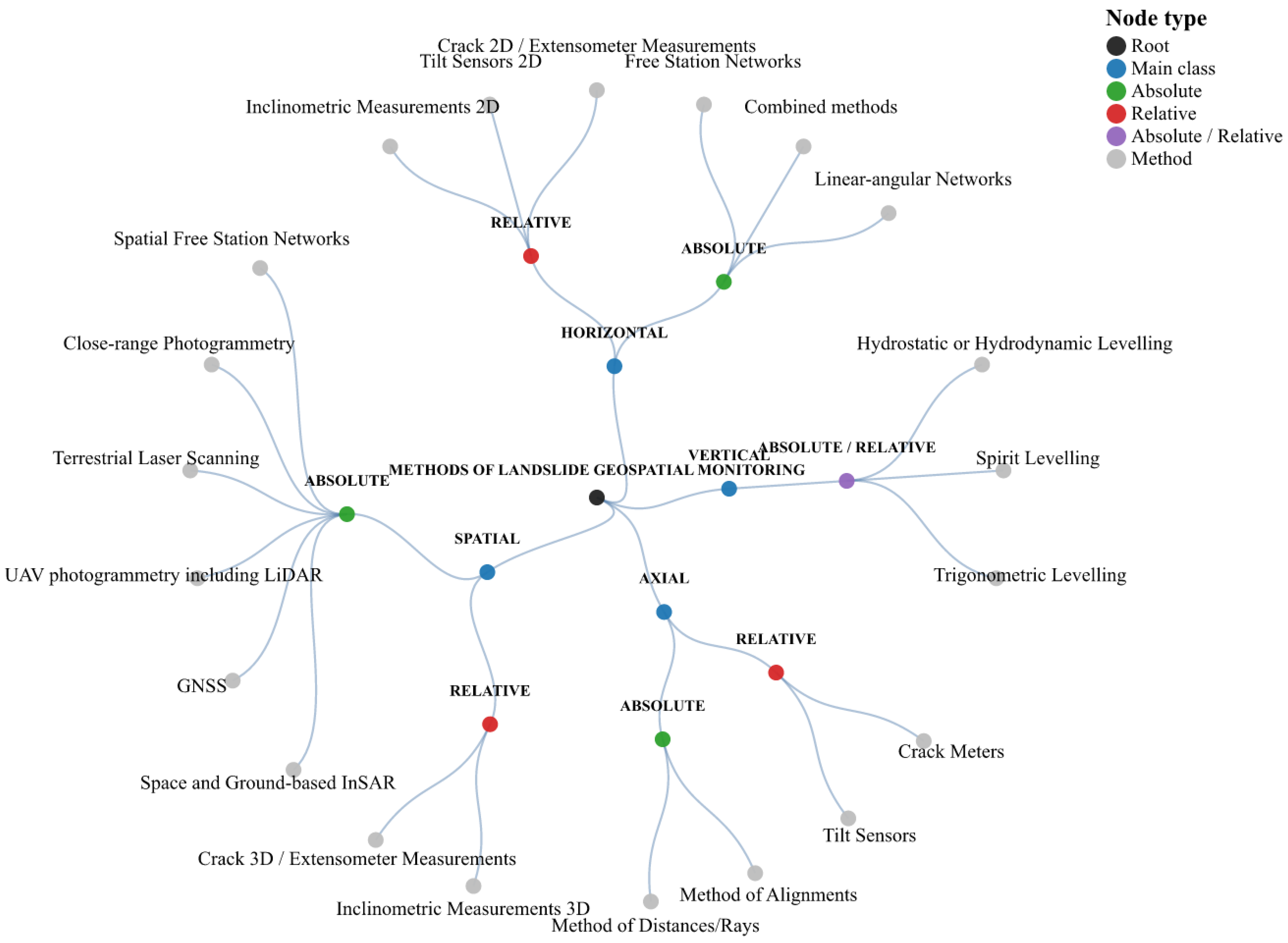
There are various ways to classify geospatial monitoring methods and technologies. Some existing classifications are based on measurement accuracy. However, this approach is controversial because many methods deliver high accuracy while also being time- and cost-intensive. Conversely, 3D observations are prevalent among monitoring methods. For spatial observations, accuracy can differ between horizontal and vertical measurements, as in GNSS or space InSAR. Thus, we propose classifying monitoring methods by displacement reference (absolute or relative), and by displacement dimensions (1D, 2D, and 3D). Figure 1 illustrates this classification of modern monitoring methods.
The methods and technologies illustrated in Figure 1 can be classified as follows. Based on the type and cause of landslide displacement, as well as its direction and speed, these methods are grouped into four categories:
Axial horizontal (1D) methods determine point displacements along a specified line or axis.
Vertical (1D) methods determine point displacements along a vertical coordinate.
Horizontal (2D) methods determine point displacements along two coordinates in a horizontal plane.
Spatial (3D) methods determine point displacements in space to find the total point displacement along three coordinates.
Absolute methods generally enable the determination of landslide displacements relative to the reference coordinate system. Consequently, we can observe the landslide movement as a cohesive unit. Relative methods identify the mutual displacements between points on the landslide. However, the effective recovery of relative deformation patterns also depends on observation density, network geometry, the spatial distribution of targets, and monitoring-system design. Therefore, displacements can also be categorized as absolute or relative. Absolute methods enable the detection of both absolute and relative displacements, whereas relative methods require an external reference coordinate system. Axial methods are used for observations when the direction of the displacement is known. These methods include:
The method of distances consists of distance measurements along a line connecting the benchmarks installed outside the landslide.
The alignment method is similar to the distance method, but the measurements are carried out in a direction perpendicular to the line joining the benchmarks.
The method of rays is based on small-angle (directional) measurements between the displaced points and the reference benchmarks.
Vertical displacements are primarily measured using differential and trigonometric leveling. In exceptional cases, hydrostatic or hydrodynamic leveling may be used. These methods are rarely used for landslide monitoring. The most common method is trigonometric leveling, which is always accompanied by spatial monitoring.
The only horizontal method option is the use of linear-angular networks. This method relies on total stations, including robotic total stations. Linear-angular networks involve measuring directions, angles, and distances.
Close-range photogrammetry, UAV photogrammetry, aerial and terrestrial laser scanning, spatial linear-angular networks, GNSS, and space- and ground-based radar interferometry determine the spatial displacements of landslides. These methods will be the primary focus of further analysis.
Relative methods detect angular and linear displacements. They offer superior accuracy and enable precise deformation measurements on the landslide surface and within the landslide body. Inclinometers, tiltmeters, and inverted plumblines can measure inclination in one, two, or three directions. Extensometers and crack meters can accurately measure linear deformations. The following analysis also focuses on relative methods, because they provide essential complementary information for absolute methods.
The proposed taxonomy in Figure 1 is a generalized conceptual framework based on a synthesis of published monitoring practices. The selected displacement dimensionality and referencing scheme are chosen because they directly influence deformation interpretation, monitoring network design, displacement characterization, and integration with multi-sensor monitoring systems. The framework offers practical interpretability across a variety of monitoring strategies, and additional benchmarking and reproducibility assessment through recorded case studies could be a valuable avenue for future research. Other classification criteria, such as monitoring cost, level of automation, deployment complexity, or operational effort, are also important. However, these criteria are strongly dependent on project conditions, infrastructure, environmental constraints, and monitoring objectives. By contrast, the most fundamental features are displacement dimensionality and referencing mode, which provide a more generalized basis for methodological systematization.
In the next part, we conducted a detailed bibliometric analysis using the classification to clarify the role of each monitoring method.

3. Bibliometric Analysis

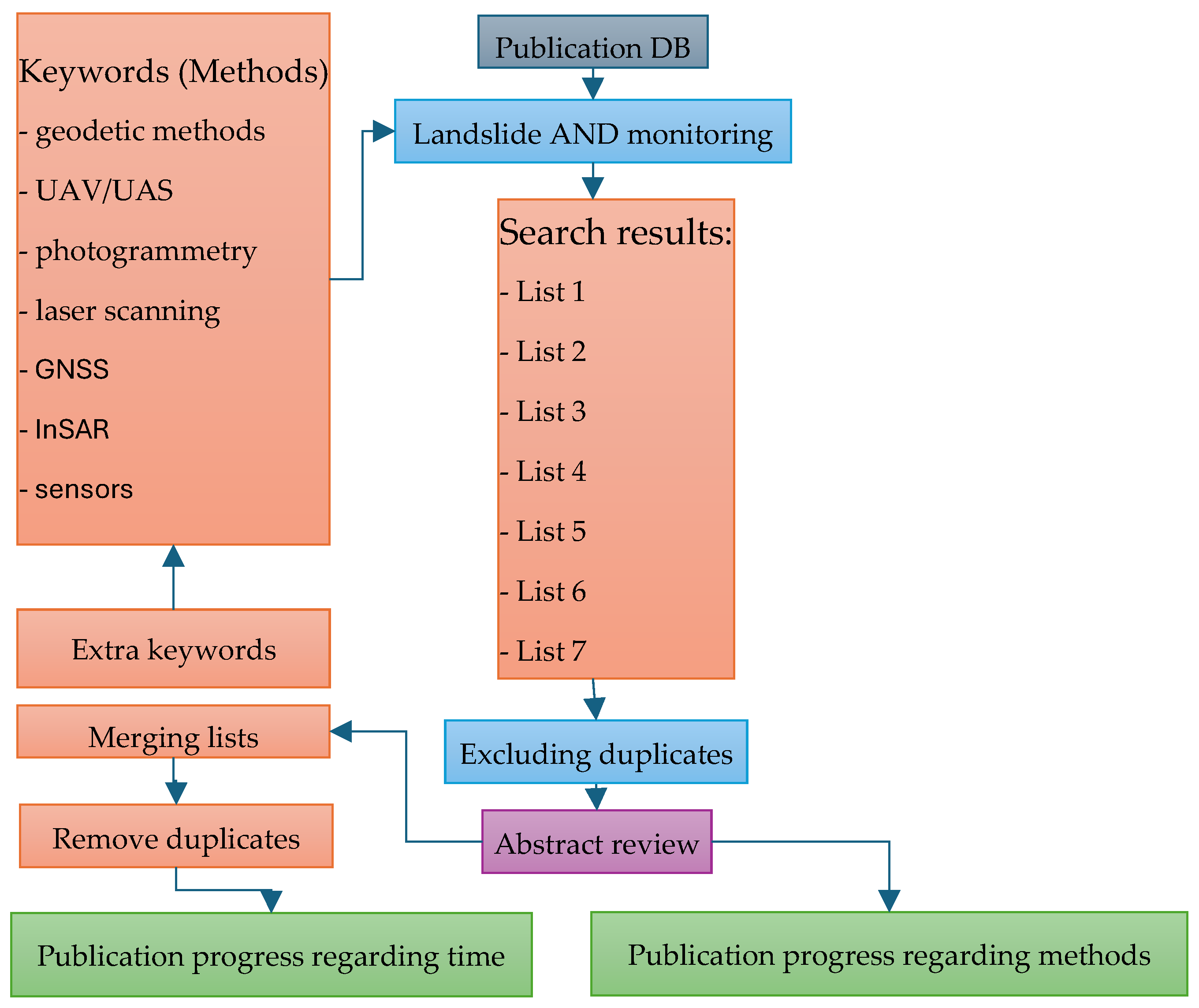
The bibliometric analysis aims to demonstrate progress in publication activity on landslide geospatial monitoring over the last ten years. Bibliometric indicators are not direct measures of technological superiority, monitoring performance, or the universal applicability of specific methods, but they are complementary analytical tools for assessing the evolution and diffusion of monitoring technologies. The analysis identifies research trends, methodological emphasis, and the evolution of scientific interest in modern landslide-monitoring technologies. The analysis period was selected to exclude methods and technologies that have become obsolete. Additionally, the past decade has seen technologies reach full maturity since their first application to landslide monitoring, such as ground- and space-based InSAR or UAV. The analysis presented significant challenges because identifying publications on landslide geospatial monitoring is difficult. Generally, landslide monitoring is a blend of various methods, including geospatial, geophysical, meteorological, geomorphological, and even social studies. Therefore, we searched the Scopus and Dimensions databases using keyword criteria each time, varying the geospatial monitoring method. To compile an accurate list of observation methods, we categorized them into seven groups: geodetic methods, unmanned aerial vehicles (UAV/UAS), close-range photogrammetry, laser scanning, global satellite navigation systems (GNSS), radar interferometry (InSAR), and sensors. We used the following search query scheme for successful retrieval: ‘landslide’ AND ‘monitoring’ AND ‘observation method’ along with additional keywords that specify each method. For instance, the search request for ‘sensors’ included the following additional keywords: inclinometer, tilt meter, crack meter, extensometer, and inverted plumb line. The resulting lists were aggregated, and all duplicates were removed. In this manner, we generated seven distinct lists. However, each list required additional processing because the titles and abstracts might contain keywords, while the paper content could be unrelated to the geospatial monitoring issue. After the initial stage, the second stage required careful review of the abstracts. The review results enabled the creation of lists of papers pertaining to landslide geospatial monitoring tasks. All separate lists were merged into a general list, excluding duplicates. Figure 2 illustrates the search strategy.
The search included journal articles, conference papers, and book chapters. The final Scopus search yielded the following figures: 3122 publications; 109 contributing countries; 56 countries with at least 10 publications; and 29 contributing countries with at least 20 publications. The Dimensions database has fewer indexed publications, totaling 2113, with a similar distribution. Consequently, the analysis below is based on the Scopus database. The study had three objectives. First, it analyzes keyword distribution to identify the most relevant monitoring methods. Second, it examines the distribution of publications by country and explores a possible relationship between the geography of landslide activity and publication counts. Third, it identifies the leading scientists and the professional journals where they publish their research results. A brief summary of the search parameters is provided in Table 2.
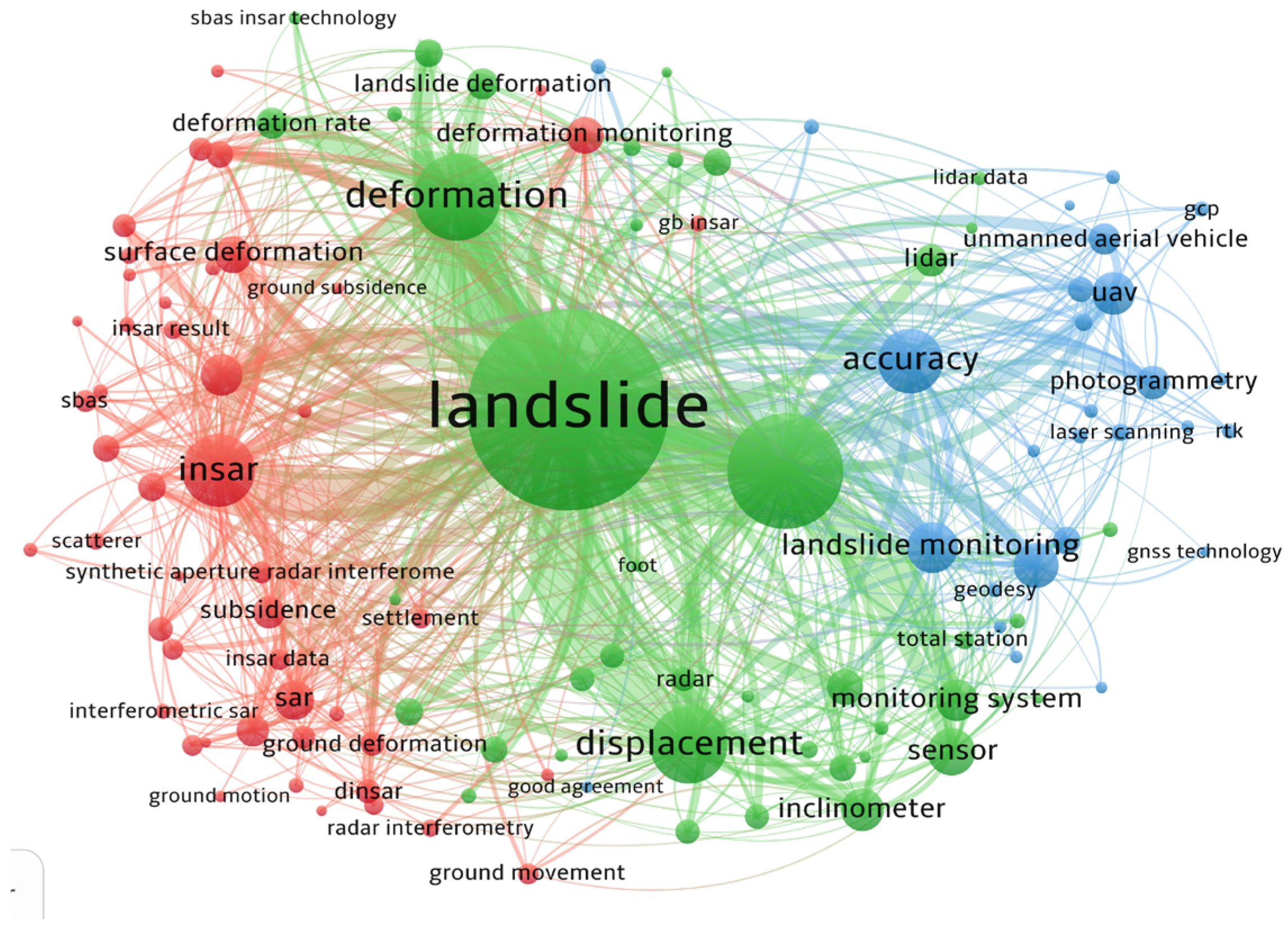
The keyword distribution analysis was based on 3122 publications. The keyword search was conducted across publication titles, abstracts, and keywords. Simple keyword statistics reveal that the most frequently used terms associated with ‘landslide monitoring’ include deformation, displacement, accuracy, sensor, InSAR, inclinometer, UAV, monitoring system, and deformation monitoring. This pattern is clearly illustrated in Figure 3. Figure 3, Figure 4 and Figure 5 were generated with VOSviewer software [44].
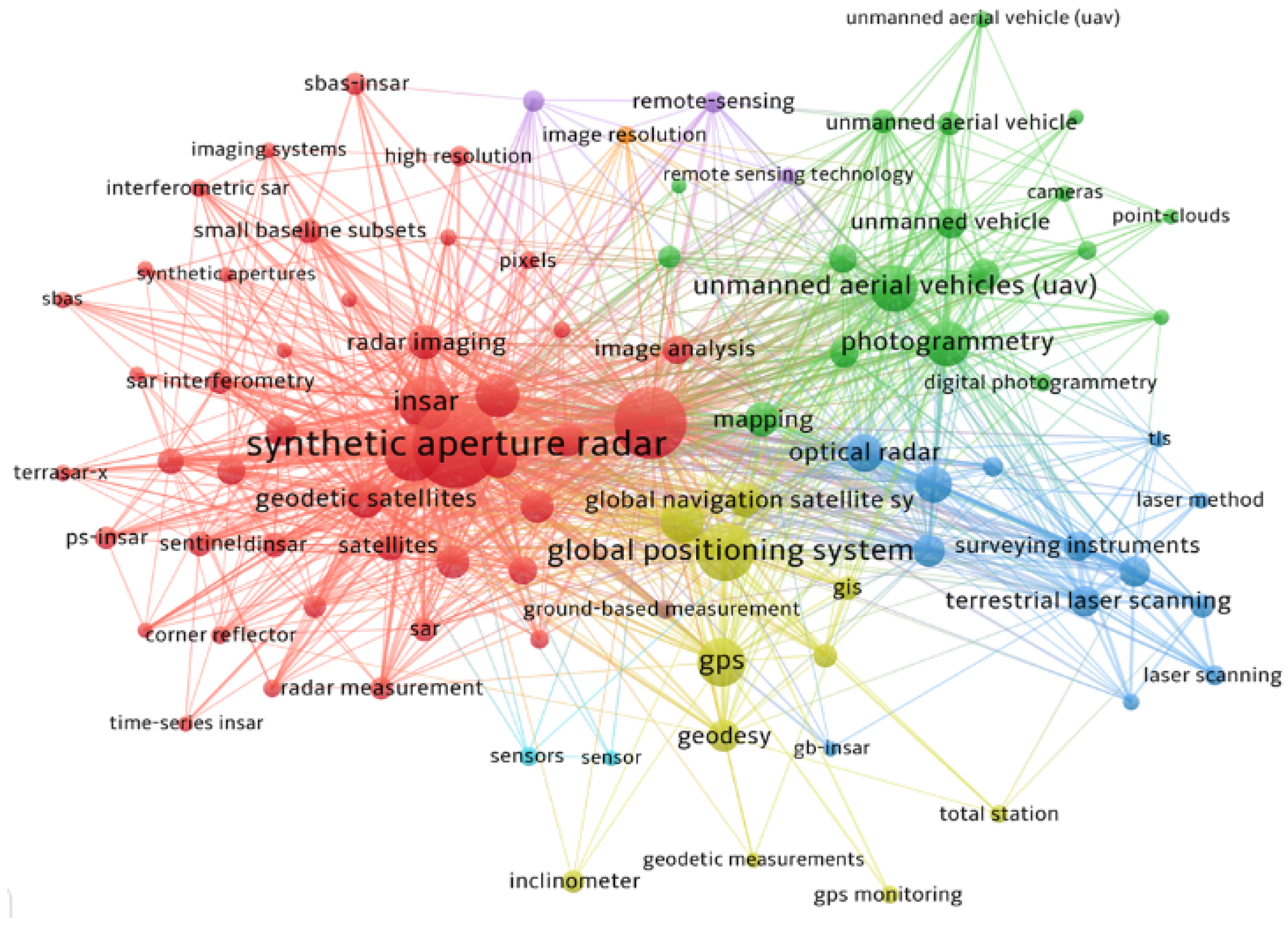
We repeated the keyword distribution analysis and excluded all words unrelated to observation methods. Using these results, we conducted the keyword cluster analysis. The preliminary condition for the cluster analysis was the minimum number of publications in which the selected keyword appeared. This threshold was set to twenty publications to ensure adequate representativeness while avoiding excessive fragmentation of clusters caused by countries with occasional or isolated publication activity. The chart shows the frequency of observation methods and highlights the most influential methods according to the clustering procedure (Figure 4).
All methods are grouped into eight clusters. Without loss of generality, we can identify four primary clusters and two minor clusters. The classification results confirm the premises presented in the introduction. The primary focus of today’s research is spatial monitoring. The first cluster focuses on synthetic aperture radar methods and technologies. Space- and ground-based InSAR are derivatives of this technology and form the most significant cluster. The second cluster includes UAV photogrammetry and related technologies. The third cluster pertains to GNSS and encompasses terrestrial geodetic measurements. Finally, the fourth cluster concerns laser scanning technology. The minor clusters consist of sensors related to geodetic methods and remote sensing. In this context, remote sensing complements various satellite technologies, including InSAR.
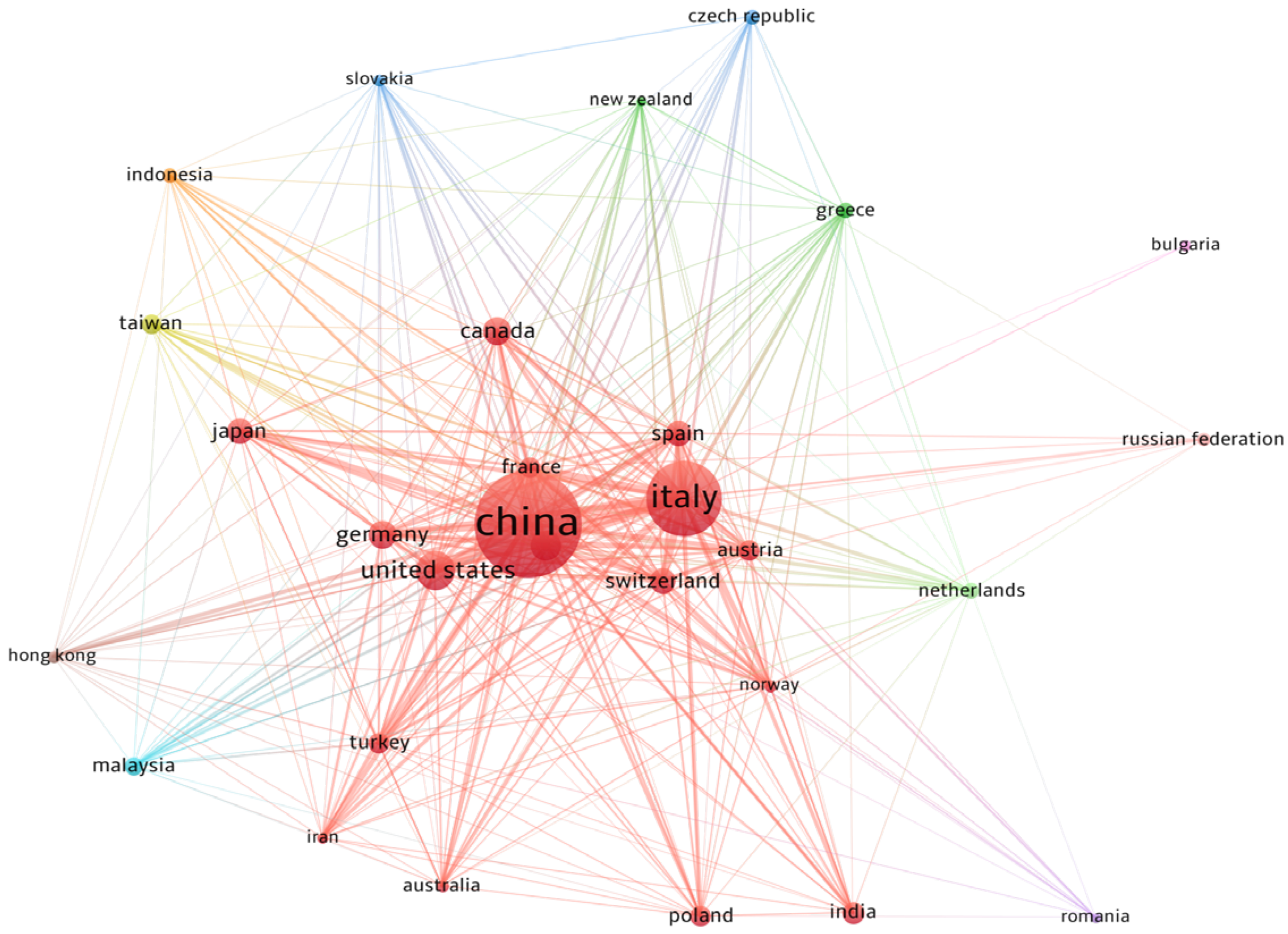
The second goal was to determine the distribution of publications by country. To achieve this, we filtered the list of authors by affiliation and selected those with at least twenty publications issued during the chosen period. The selected countries were then clustered. Figure 5 shows the clustering results. Seven clusters were identified. The first cluster is the largest, with contributions from scientists in China and Italy to landslide monitoring. Additionally, this cluster includes the United States, Germany, Austria, Switzerland, Spain, France, Canada, Japan, Turkey, the Russian Federation, Iran, Australia, India, Poland, China (Hong Kong), and Bulgaria.
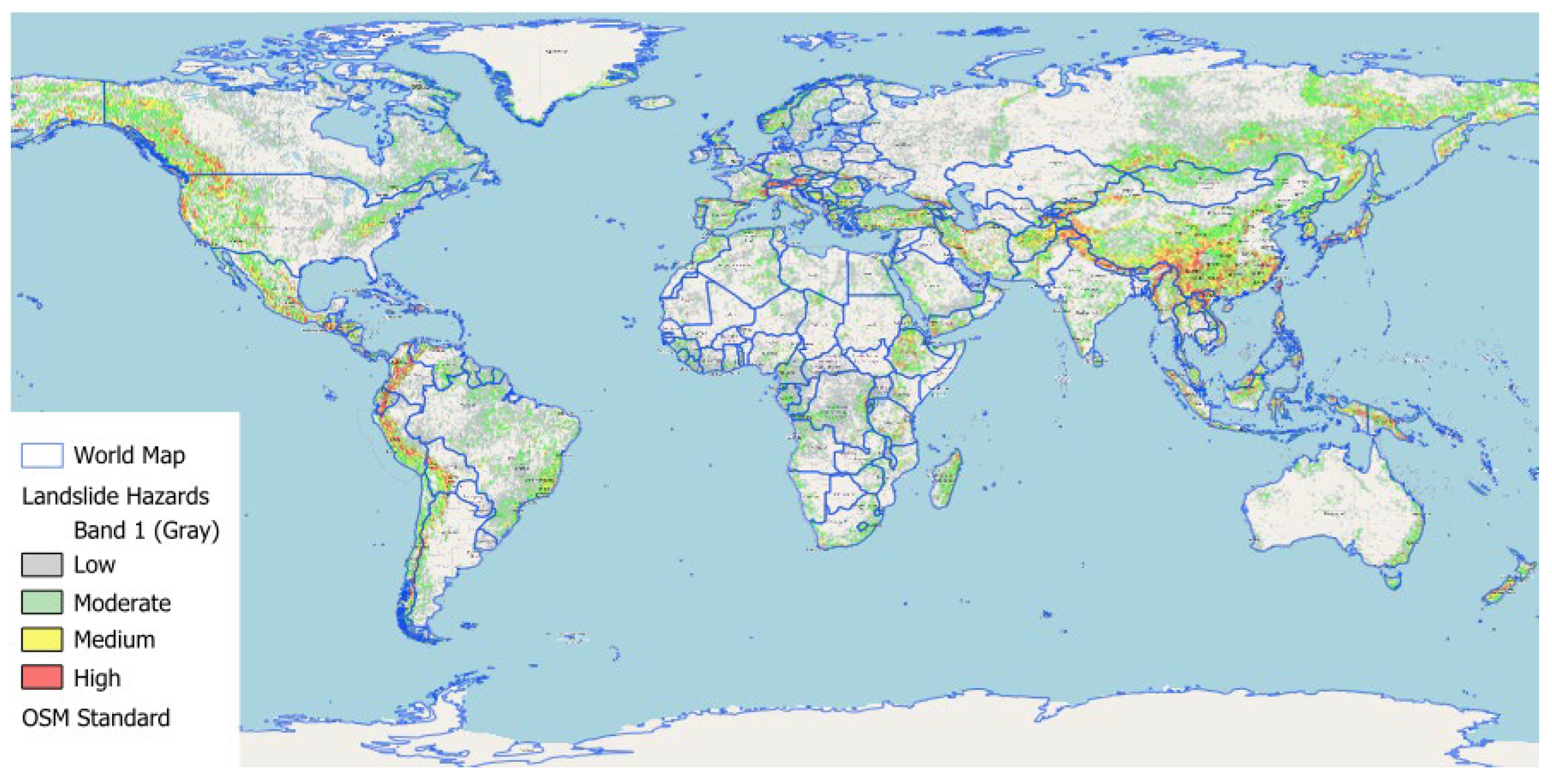
A global map of landslide activity is used to explore the possible relationship between the geography of landslide occurrences and the number of publications. Figure 6 presents a map of the distribution of landslide activity, classified into four threat levels.
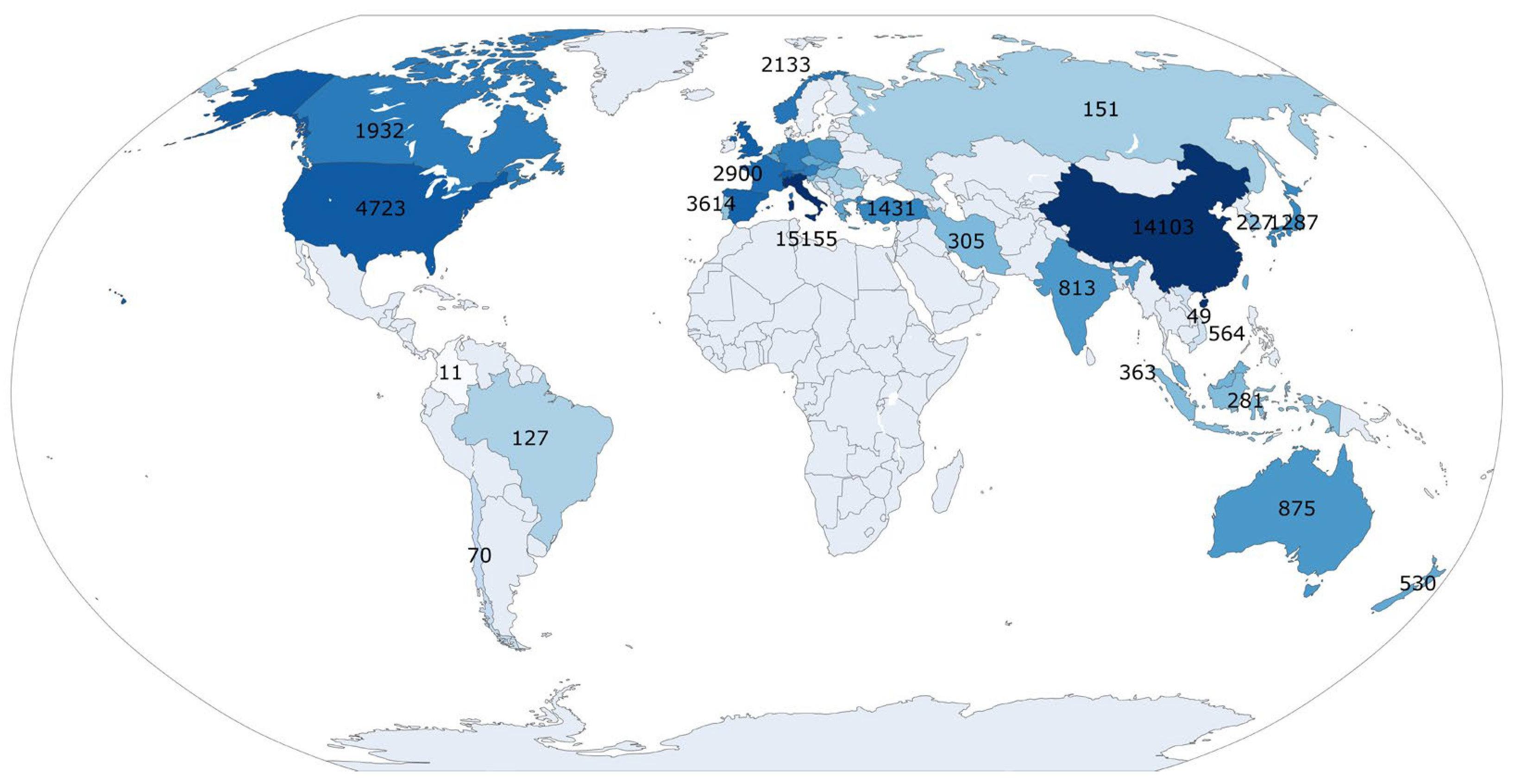
By comparing the chart in Figure 5 and the map in Figure 6, one may conclude that the highest landslide activity is concentrated along the west coasts of South and North America, in the Alpine region of Europe (Switzerland, Austria, Italy), and in Asia, particularly in Turkey, Yemen, the Caucasus Mountains, Iran, Afghanistan, Southern Kazakhstan, Northern India, China, and Southern Asia. In Africa, landslides are primarily concentrated in Ethiopia. There is a lack of research publications in regions such as the west coast of South America, Yemen, the Caucasus Mountains, Afghanistan, Southern Kazakhstan, and Ethiopia. A choropleth map was prepared to illustrate the publication distribution by country (Figure 7).
The choropleth map should be interpreted with caution, as publication activity may reflect not only differences in scientific infrastructure, database coverage, language accessibility, funding availability, and reporting practices, but also the actual distribution of landslide hazards or monitoring activity.
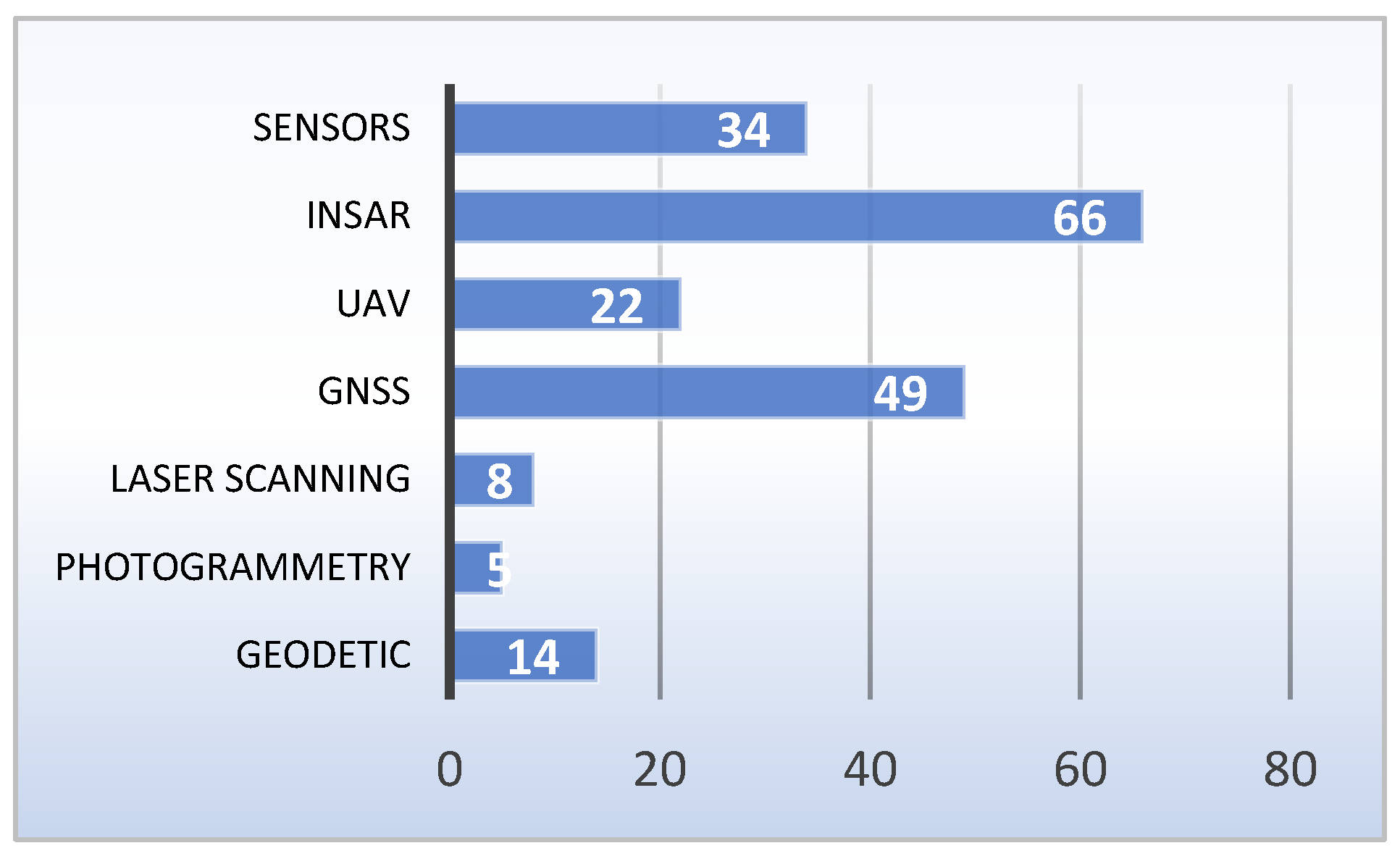
Since the publications have already been grouped by monitoring methods, the numerical analysis of publication counts for each method allowed the calculation of the average number of publications per method (Figure 8).
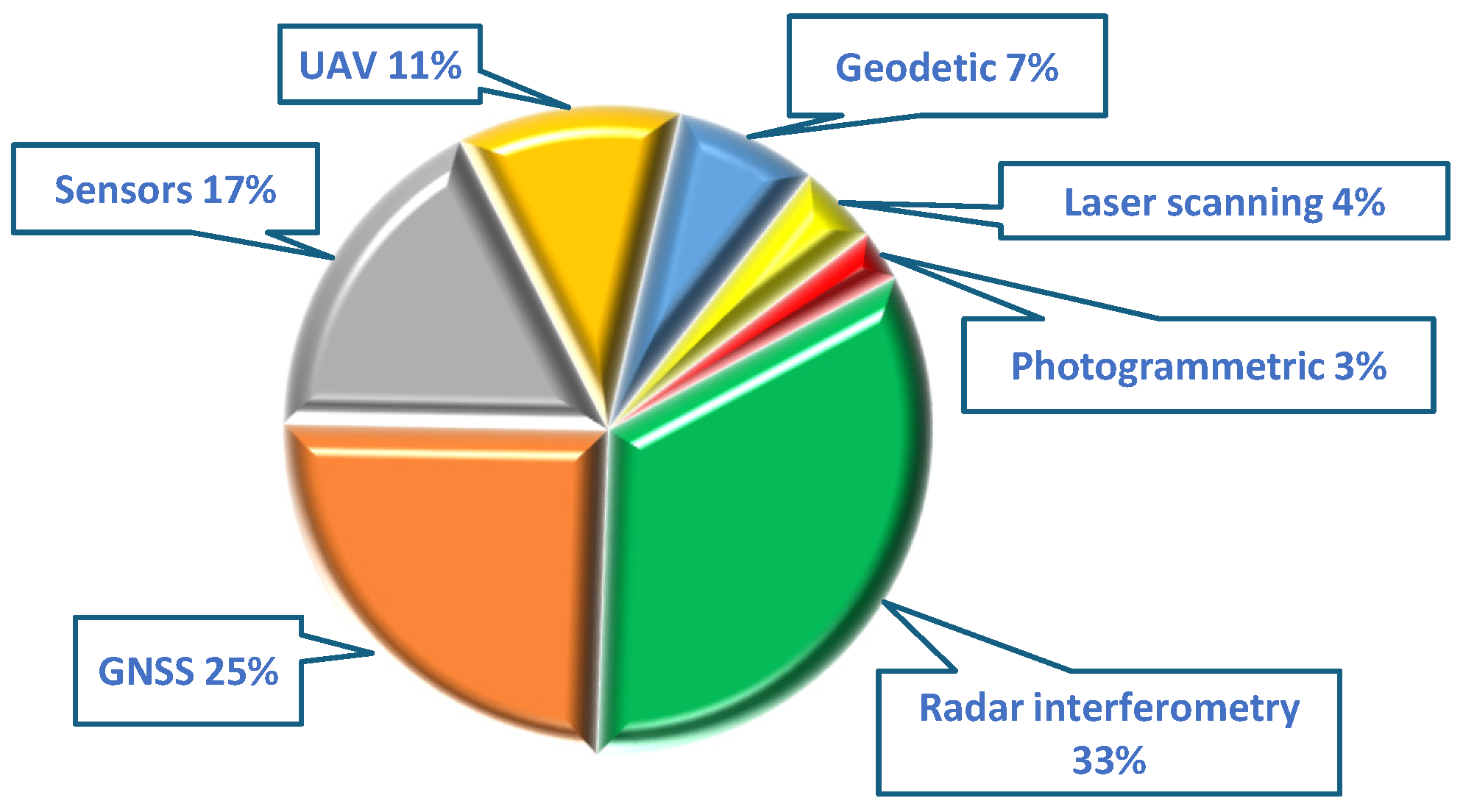
The findings in this section will help guide the correct method review using the appropriate publication sources. According to the bibliometric analysis flowchart (Figure 2), all methods were categorized into seven categories: geodetic, photogrammetric, laser scanning, GNSS, UAV, InSAR, and sensors. We generated an overall pie chart illustrating the average percentage of publications related to monitoring methods (Figure 9).
What stands out in these charts is the dominance of radar interferometry over other techniques. Radar interferometry, GNSS, and sensors are more widely represented than the remaining methods. Taken together, these results suggest that the relative importance of traditional geodetic methods, close-range photogrammetry, and laser scanning may decline in large-scale monitoring applications. However, the importance of terrestrial observations related to geospatial sensors will remain constant. To further examine this interpretation, a comprehensive analysis of all methods will be carried out in the next section. It should be emphasized that bibliometric analysis reflects research activity in the reviewed literature rather than serving as a direct indicator of technical superiority or universal applicability of specific monitoring methods. For example, sensors remain an indispensable source of information on landslides, despite their lower representation in the literature.
The third declared purpose is to identify the leading scientists and the professional journals where they publish their research results. Because leading roles are held by scientists from several countries, we analyzed authors by publication counts. This analysis enables us to identify the authors who published the most articles and have the highest citation levels. For our analysis, we focused on authors with at least ten publications. Among 9310 authors, 71 meet the specified criterion. These authors were grouped into 18 clusters. As anticipated, the three most significant clusters correspond to Italian and Chinese authors. However, the analysis shows that the level of mutual citation is relatively low despite the large number of publications. This finding highlights a critical drawback, indicating that authors may overlook each other’s essential achievements.
Finally, we determined the most popular and influential scientific journals for publishing landslide monitoring papers. There are 799 journals in total. We selected those who published at least twenty articles. Only 24 sources met this threshold. These publication sources were grouped into seven clusters. Scientists prefer to publish the results of their studies in three major journals: Remote Sensing, Landslides, and Engineering Geology. The findings in this section will help guide the correct method review using the appropriate publication sources.

4. Observation Method Analysis

Modern geospatial monitoring is based on three fundamental principles: simultaneous determination of spatial displacements, measurement automation, and the use of complex data integration, processing, and simulation models. GNSS, photogrammetry, laser scanning, total stations, and InSAR monitor absolute spatial displacements. In contrast to absolute measurements, relative spatial displacements can be measured using multi-axial sensors. The current trend is the development and application of automated monitoring systems, which can include any measurement method. We reviewed geospatial monitoring technologies grouped into seven observation groups. The seven groups of monitoring methods selected are not an exhaustive classification of all possible approaches to landslide investigation, but rather the main geospatial monitoring categories identified by the joint bibliometric, methodological, and practical analysis carried out in this study.

4.1. Geodetic Methods

Geodetic methods are among the most established approaches for monitoring landslide deformation and continue to provide reliable reference measurements in many monitoring projects. Modern implementations rely primarily on total stations, robotic total stations, and digital leveling, enabling precise determination of point displacements and network stability over time. The work [45] provides a relatively new general overview of leveling methods using digital levels for landslide monitoring. Publication [46] detailed the practical results of traditional leveling. Santos et al. [47] reported the outcomes of trigonometric leveling for landslide monitoring. The advantage of trigonometric leveling is its ability to determine displacements of points with significant height differences. Vertical refraction limits the precision of trigonometric leveling for distances greater than 100 m. Horizontal and spatial displacement observation methods encompass various linear and angular measurements. These methods use precise total stations as the primary measuring equipment. A network of observation stations can be established using traverses, GNSS [48,49,50], and their combinations [11]. This approach has proven especially effective when combined with the free station method. The workflow for horizontal and spatial monitoring methods involves similar steps: monitoring design, fieldwork, and observations of deformation targets. After each epoch, the observation results are adjusted with quality control. Coordinates from different observation epochs allow calculation of both relative and absolute displacements [26,27,51,52,53,54,55,56,57,58,59,60,61]. These displacements contribute to the proposed prediction model. The resulting time series provides essential input for assessing deformation trends and evaluating slope stability [62]. One advantage of total station observations is their ability to monitor crack evolution [63]. The current trend is the application of robotic total stations [28,64,65,66,67]. The use of robotic total stations has significantly increased the frequency of observations and temporal resolution. The key strength of geodetic methods is their suitability for monitoring infrastructure deformation under strict accuracy requirements, and across different temporal resolutions. However, geodetic methods require mutual visibility between points on the ground, which limits spatial coverage, especially in densely vegetated areas. Equipment installation effort increases significantly in remote or unstable terrain. For this reason, geodetic methods are increasingly used as part of integrated monitoring systems rather than as standalone solutions. When combined with GNSS, InSAR, and geotechnical sensors, geodetic measurements provide a stable geometric framework that enhances the interpretation of deformation processes and supports engineering decision-making. It should also be noted that geodetic monitoring can differ when the purpose is high-precision monitoring of engineering structures affected by landslides. For structural monitoring, millimeter-level accuracy, local stability analysis, and dense observation networks are often prioritized, whereas regional landslide monitoring emphasizes spatial coverage, surface deformation characterization, operational flexibility, and integration with remote sensing methods.

4.2. Photogrammetry

Close-range photogrammetry enables the accurate determination of 3D displacements. Recent advances in digital image processing, computer vision, the development of digital cameras, and computational capabilities have transformed the methods of close-range photogrammetry that have been used for years. Publications on photogrammetry for landslide monitoring can be divided into two groups: photogrammetry for landslide simulation using test models [14,18,68] and real photogrammetry applications for landslide monitoring [68,69,70,71]. State-of-the-art landslide monitoring strategies are characterized by the application of automated measurement methods based on Structure from Motion, digital image correlation and orthorectification algorithms [7,28,72,73,74]; the use of low-cost photogrammetry based on low-cost digital cameras, including smartphones [75,76,77]; and the development of photogrammetric automated systems integrated with other measuring devices, including stereo vision and the Internet of Things [78,79,80,81] with declared accuracy around 2–4 cm. Several studies have proposed using video photogrammetry for landslide monitoring [82], photogrammetry for measuring cracks on landslides [83], and photogrammetric monitoring from mobile platforms [84]. Besides digital cameras, Image Assistant Total Stations (IATS) made geospatial monitoring possible. IATSs have the same capabilities as ordinary total stations with integrated digital cameras. Due to the technical construction of a total station, the integrated cameras have lower resolution than semi-metric digital cameras. Recent studies [62,85] have shown that IATS achieves high efficiency, with accuracy around 0.1 mm at distances over 20 m. Photogrammetric methods are well studied, and thanks to recent technological advances, they use low-cost equipment. However, analyzing photogrammetric results requires highly skilled workers. Weather and daylight conditions also limit the use of photogrammetric methods. Therefore, this technology is suitable for small- or mid-scale projects. Machine learning and GeoAI technologies enable the integration of photogrammetric data with other methods [76,86]. AI helps integrate various data and improve the object detection algorithms. It is expected that in the upcoming years, GeoAI will open new capabilities of close-range photogrammetry applications.

4.3. Laser Scanning (Aerial and Terrestrial)

Laser scanning can be carried out from tripods (static TLS), mobile mapping systems (MMS scanning), aircraft ALS [10,17,87,88], and UAVs, which are typically integrated with photographic cameras. A broad range of laser scanners enables work from 5 m to 2 km, with accuracy ranging from 0.4 mm to 20 mm and an impressive scanning speed of up to 100,000 points per second. Unlike previously considered methods, laser scanning provides all-weather, all-day monitoring. For landslide monitoring, most recent studies have utilized TLS and UAV-based scanning. Most of the literature focuses on TLS for landslide monitoring [12,26,41,49,51,55,59]. The main challenge lies in the simulation step, which is critical for comparing multitemporal data across different monitoring epochs [65]. The work [89] examined the technology of remotely operated TLS. This approach may help address one of the disadvantages of TLS for equipment installation and operation in permanent observations—permanent laser scanning (PLS) [90]. Choi et al. [91] compared UAV-based laser scanning and UAV photogrammetry. To date, several studies have evaluated the potential of fusing terrestrial, aerial laser scanning data, and space-based InSAR [42,92,93,94,95]. From a geometric perspective, data integration contributes little but enhances interpretation, such as crack detection and blunder correction. Data processing is the primary challenge for laser scanning data. Comparing data across different epochs requires sophisticated software algorithms, e.g., physics-informed deep learning, and skilled engineers [96,97,98,99]. A direct line-of-sight between the terrestrial scanner station and the observation point or surface is still needed. This creates another issue for landslides covered by vegetation (forest).

4.4. Global Satellite Navigation Systems

GNSS offers several undeniable advantages as a geospatial tool: high accuracy, high-frequency data collection, ease of use, and operation in all weather conditions. One of the primary strengths of GNSS is its ability to provide absolute displacement measurements without requiring intervisibility between monitoring points. This capability is particularly valuable in complex terrain, where traditional geodetic observations may be difficult to implement. GNSS observations are widely used to quantify displacement rates, establish stable reference frameworks [48,100,101,102,103], and validate results obtained from other monitoring techniques. Their flexibility allows deployment in both periodic survey campaigns and continuous monitoring configurations, supporting analysis of both long-term deformation trends and short-term variations. However, installing continuously operating stations on landslides poses significant challenges, including restricted sky view, security concerns, power supply issues, equipment threats, and limited accessibility. Thus, static GNSS observations are limited to favorable conditions [104]. A relatively new overview of GNSS applications for landslide monitoring can be found in [105]. Examples of GNSS landslide monitoring are presented in [6,26,27,48,52,55,57,58,106,107,108]. Continuous GNSS observations are crucial for achieving the highest accuracy and data reliability. A significant enhancement in measurement accuracy has supported the application of single-frequency observations [109]. Single-frequency measurements can achieve the necessary accuracy (approximately several centimeters) while considerably reducing equipment costs. The introduction of Real-Time Kinematic (RTK) technology has significantly reduced observation times, making the monitoring process faster and more adaptable. Studies [110,111] have demonstrated RTK’s high efficiency in determining the sizes of detected displacements. Results indicate that spatial displacement accuracy can reach 20 mm with 15 s observation epochs. Another vital application of RTK is its support for UAV surveying. Additional progress in GNSS technologies has been achieved through the development of Virtual Reference Station (VRS) GNSS. Currently, most countries maintain continuously operating reference station networks (CORS), allowing VRS to effectively minimize observation errors and enhance RTK solutions for landslide monitoring [112]. The need for a stable CORS connection remains a critical drawback of VRS technology. Precise Point Positioning (PPP) offers a practical alternative in areas lacking dense reference station networks, though it typically provides lower accuracy and requires longer convergence times [113]. Study [110] introduced PPP technology for near-real-time continuous monitoring of slow landslide movements, reporting that it achieves spatial accuracy of about 5–10 cm with observation times ranging from 10 to 30 min.
According to the proposed suitability framework, static GNSS observations are generally preferred for long-term monitoring of slow and moderate landslides that require high stability and millimeter-level displacement analysis. RTK and VRS approaches are better suited for higher temporal resolution and near-real-time observations, especially in active landslide zones. PPP techniques may be useful in remote areas without local reference infrastructure. However, their applicability to very dynamic deformation processes may be limited by achievable accuracy.
All analyzed approaches have demonstrated the high efficiency of GNSS for landslide monitoring. However, a key constraint is the need to move surveyors with equipment across the landslide surface to coordinate points or deformation targets. CORS may be vulnerable to unauthorized impacts, damage, power loss, or theft. This limitation makes GNSS nearly inapplicable for monitoring large, vegetated landslides [104], particularly when such monitoring pertains to landslides in active or unstable conditions. For these reasons, GNSS is most effective when combined with spatial monitoring techniques such as InSAR or laser scanning. In the context of landslide monitoring, GNSS can be effectively employed in combination with geodetic methods, such as total stations [48,114], various sensors, including accelerometers [115] and inclinometers [116], along with space- and ground-based InSAR [5,106], and to provide real-time coordinates for UAV surveying [117]. Overall, GNSS remains one of the most versatile and reliable tools for landslide monitoring. Its primary value lies in providing accurate, continuous positioning information that complements spatial observation techniques and supports engineering decision-making. When integrated into multi-sensor monitoring strategies, GNSS contributes significantly to understanding landslide dynamics and improving risk management.

4.5. UAV Photogrammetry (Including Aircraft)

In recent decades, a portion of photogrammetric monitoring has been taken over by drones (UAV photogrammetry). Although UAV photogrammetry uses aerial platforms, surveying is often conducted at very short distances. Therefore, we can consider UAV photogrammetry a form of aerial close-range photogrammetry. Since the start of the century, UAVs, unmanned aerial systems (UASs), or simply drones, have emerged as one of the leading surveying technologies. Their development has paralleled advancements in GNSS, inertial navigation systems (INS), and digital photography. Recent studies have revealed the high efficiency of UAV monitoring for objects such as landslides, pipelines, dams, towers, and more. The capabilities of UAVs address tasks related to monitoring landslide volume and runoff. Importantly, due to their flexibility and low cost, UAV photogrammetry has largely replaced traditional aerial surveying in recent landslide-monitoring projects. We have identified a few instances in which aircraft were used for landslide monitoring, and these are primarily associated with archival aerial surveys. Typically, such studies utilize aerial images for long-term landslide investigations [106,118,119,120]. Archived aerial images can also be integrated with other datasets. For example, ref. [105] conducted a study integrating archival aerial photogrammetry from 1975 to 2010 with continuous GNSS observations from 2004 to 2018 and multi-temporal InSAR data from 2015 to 2019. However, the main conclusion is that aerial photogrammetry has not been used for landslide monitoring in recent decades. Therefore, our review primarily focuses on UAV photogrammetry. The list of recent publications on UAV landslide monitoring is impressive [9,27,32,33,35,52,55,56,87,117,121,122,123,124,125,126,127,128,129,130,131,132,133,134,135,136]. The mobility of UAVs enables multifaceted landslide studies using vertical and oblique images [137]. The monitoring workflow is well-standardized and includes survey planning, which is often the most challenging aspect of UAV application. Surveying and post-processing require little time, thanks to the reliable navigation support of modern UAVs and automated image processing in contemporary software. For instance, refs. [42,138] demonstrated UAV-based landslide monitoring results using an embedded RTK module with on-the-fly accuracy of 0.15 m in the plane and 0.20 m in height. Study [125] provides a comprehensive overview of the potential of UAVs for landslide monitoring. Furthermore, UAV data can be integrated with other information from traditional leveling [46], terrestrial laser scanning [42,94], close-range photogrammetry, and aerial laser scanning [91], as well as aerial/terrestrial laser scanning [139]. Modern UAVs equipped with high-resolution digital cameras enable crack detection and monitoring of their expansion [140,141,142]. Finally, UAV technology ensures operator safety and makes the monitoring procedure very flexible. The crucial limitation for UAV photogrammetry is weather and daylight conditions.

4.6. Radar Interferometry (Space and Ground-Based)

Radar interferometry has become one of the most influential technologies for landslide monitoring due to its ability to detect surface deformation over large areas with high sensitivity and without direct site access. Both space-based and ground-based interferometric synthetic aperture radar (InSAR) systems provide valuable information on displacement patterns, enabling identification of active zones, assessment of deformation rates, and long-term monitoring of slope behavior. The role of space InSAR in landslide monitoring has been extensively studied in recent years [143,144,145,146,147,148,149,150,151,152,153,154,155,156,157,158,159,160,161,162]. Space InSAR time series analysis facilitates the exploration of landslide development over time, and InSAR time series stacks enhance monitoring accuracy [163,164,165]. InSAR time series analysis methods can be categorized into point target InSAR and distributed target InSAR. Point target InSAR is based on point-like scatterers and is known as Persistent Scatterer InSAR (PSI), which is associated with stable man-made objects [166,167,168,169]. This characteristic limits its application to cases involving artificial objects on a landslide. Typically, the density of point-like scatterers is low, which reduces the number of usable points. Artificial corner reflectors can be employed to enhance PS-InSAR performance. These highly stable reflectors can be determined using GNSS or precise terrestrial geodetic measurements. In contrast, distributed target InSAR leverages distributed targets from natural environments. However, deformation measurements on distributed targets often yield lower quality results and require spatial filtering. This method is effective for landslide monitoring because it does not necessitate fieldwork. The most popular distributed target InSAR method is the Short Baseline Subset (SBAS) [170,171,172,173]. The terrestrial equivalent of space-based radar is Ground-Based InSAR (GB-InSAR) [5,38,51]. GB-InSAR operates similarly to space-based radar, emitting and receiving microwaves as the sensor moves along a rail track. GB-InSAR data can be acquired using continuous (CGB-InSAR) and discontinuous (DGB-InSAR) methods. C-GBSAR provides near-real-time monitoring, while DGBSAR is suitable for monitoring slow slope movements. Different types of radar measurements can be integrated, such as space InSAR and GB-InSAR [5], along with GNSS and aerial surveying [106], or deployed on UAVs [174]. Radar interferometry generally offers versatile approaches that accommodate nearly any observation conditions. As a result, this monitoring method enjoys the greatest popularity among scientists worldwide, as illustrated in Figure 7 and Figure 8.

4.7. Geospatial Sensors

The review of landslide monitoring methods would be incomplete without sensors. According to the observation method classification, geospatial sensors determine relative displacements. These sensors supplement other geospatial methods and technologies, ensuring informative monitoring results. Inclinometers are primarily used for landslide monitoring to detect inclination in a particular direction, or 3-D inclinometers that determine spatial rotation [42,52,53,175,176,177,178,179,180,181,182,183,184,185,186]. Connecting inclinometers to the system substantially improves monitoring results [187]. This approach is efficient and productive for web-based monitoring systems [188]. The main drawback of inclinometers is that they provide relative measurements. To address this issue, they may be integrated with absolute methods, such as space InSAR [170,189], GNSS [116,190], and space InSAR with GNSS [191,192]. The integrated solution offers both absolute spatial reference and high accuracy. For landslide monitoring, relevant sensors include tilt meters [193,194] and inverted plumblines [15] to measure plane inclination, crack meters to measure crack width extension [195,196,197], and extensometers to measure displacements in a particular direction with superior accuracy [43,198,199,200,201,202]. Additionally, inclinometers can be connected to the aforementioned relative sensors to obtain linear and angular displacements simultaneously, such as inclinometers fused with crack meters [60], smart extenso-inclinometer [199], and inclinometers coupled with wire or bar extensometers [203]. Regardless of the combination of these sensors used, they provide superior accuracy. Still, the main drawback is the need to organize the sensors into one system and to reference this system to an external coordinate system, as any sensor provides relative displacements.

4.8. Method Summary and Suitability Analysis

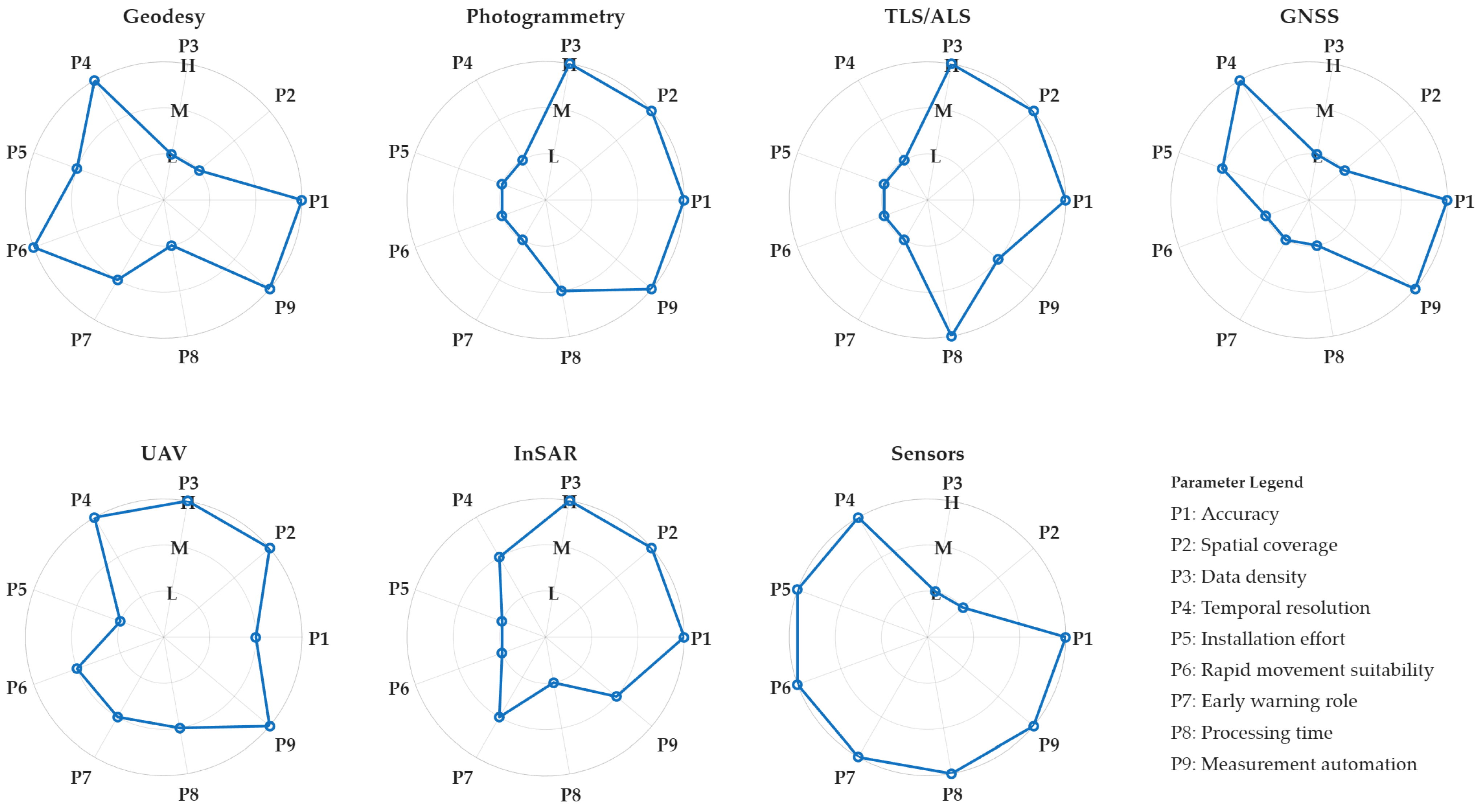
Figure 10 summarizes the key operational characteristics of the reviewed monitoring methods, including accuracy, spatial coverage, temporal resolution, automation level, and suitability across deformation regimes. The comparison clearly shows that no single technology meets all performance criteria. Geodetic methods and GNSS provide high accuracy and temporal flexibility but are limited in spatial coverage and require the installation of ground control infrastructure. In contrast, photogrammetry, UAV-based surveys, laser scanning, and InSAR offer extensive spatial coverage and high data density, though often at the cost of reduced temporal resolution or increased processing complexity. Radar interferometry stands out for its combination of extensive spatial coverage and high sensitivity to slow deformation, making it particularly effective for regional-scale monitoring of slow and moderate landslides. However, its performance decreases during rapid movements and in areas affected by decorrelation. Geospatial sensors provide superior temporal resolution and are particularly suitable for detecting rapid or localized deformation. Their main limitations are the relative nature of measurements and restricted spatial representativeness, which necessitate integration with absolute positioning techniques.
Figure 10 presents diagrams summarizing the key operational features of the reviewed monitoring methods and offers a qualitative comparison of their performance. The comparison highlights critical trade-offs among spatial coverage, temporal resolution, installation requirements, and anticipated accuracy. Geodetic techniques and GNSS deliver highly accurate displacement measurements and flexible observation intervals, but the need for ground stations and limited spatial coverage limits their applicability. Conversely, remote sensing methods such as UAV photogrammetry, laser scanning, and space radar interferometry provide detailed spatial information and wide-area coverage. However, they often require more complex data processing and typically have lower temporal resolution. Radar interferometry is particularly effective for detecting slow and moderate deformation over large areas, which is why it plays a dominant role in modern landslide monitoring. Geospatial sensors, including inclinometers, tiltmeters, extensometers, and crack meters, have very high temporal resolution and are ideal for detecting rapid or localized deformation. However, to fully understand landslide behavior, it is necessary to combine these sensors, which measure relative displacements, with absolute positioning techniques. Therefore, Figure 10 indicates that the choice of a method depends on landslide velocity, scale, required accuracy, and operational constraints. The comparison underscores the significance of integrated monitoring systems, which combine the strengths of various methods to counterbalance their individual limitations.
Returning to the primary goal of this study, outlined at the beginning of this paper, it is now necessary to analyze the potential applications of the monitoring methods considered. Such an analysis must weigh the methods’ pros and cons and their measurement capabilities. We organized the monitoring methods using the previously suggested classification by achievable accuracy, temporal resolution, data type, distance limit, and method utility for the landslide velocity class. The last parameter was introduced to link the considered monitoring methods with the well-known landslide velocity classification provided in [204]. To do so, let us consider the straightforward velocity equation:
v = S t ,
where v is the landslide velocity, S is the displacement, and ∆t is the required temporal resolution for the landslide that moves with a particular velocity. The required temporal resolution or observation epoch is determined based on the classification [204]. This inference assumes that there is no point in performing observations more often than the specified landslide movement time. Equation (1) is turned into inequality (2) by applying the error propagation law after differentiating and squaring each term:
δ v 2 v 2 δ S 2 S 2 + δ t m 2 t 2 ,
where δ v is the allowable error of velocity determination, δ S is the measurement error depending on the method and δ t m is the temporal resolution of the method or the time between two successive observations.
A probabilistic approach was proposed to determine the elements in inequality (2). Landslide velocity v is given in classification [204]. The classification determines the required temporal resolution t . Therefore, we can calculate the detectable displacement for the selected method and landslide velocity as S = v t . Since we deal with large samples, treating the errors as normally distributed is reasonable. Under this premise, a 99.7% probability with an appropriate critical value z α were assigned. The adopted probability level corresponds to the classical ±3σ confidence interval commonly used in engineering practice and deformation analysis. This value ensures a conservative interpretation of displacement and monitoring reliability.
This allows calculation of the allowable error δ v , which is equal δ v = v / z α . Therefore, the inequality (2) can be written down:
δ v v 2 δ S 2 S 2 + δ t m 2 t 2 .
If inequality (3) holds, the selected monitoring method detects the minimum permissible changes in velocity. Thus, it is feasible to adjust the table presented in [204]. According to this classification, landslides are categorized into seven groups. The allowable error in velocity determination is also included in the classification (Table 3).
Figures from Table 3 were used to systematize the geospatial method. The required parameters, such as achievable accuracy and temporal resolution, were obtained from the literature review above. Inequality (3) and the method’s temporal resolution determine its utility for the velocity class. Table 4 presents the results of the systematization based on the literature review.
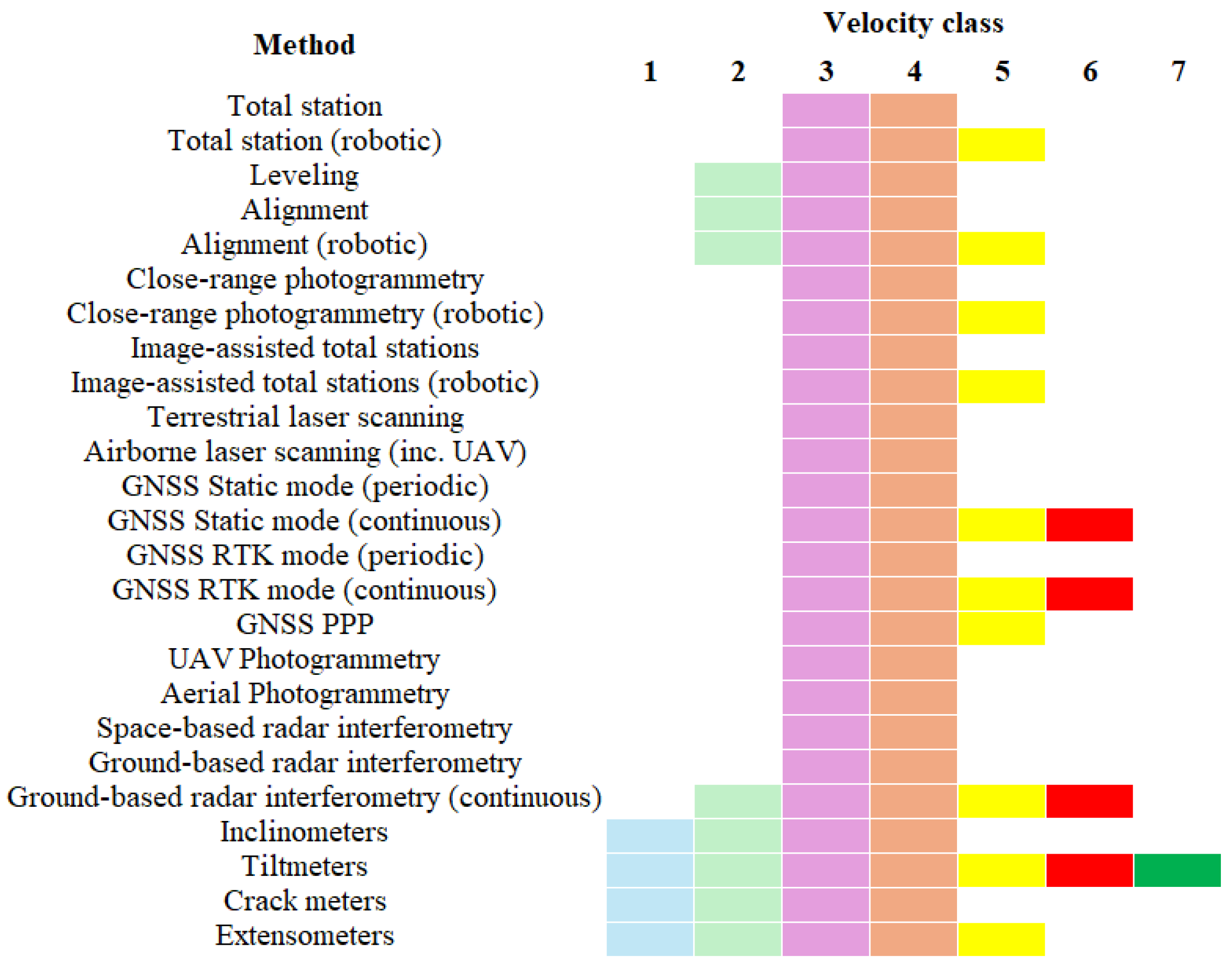
Table 4 highlights several important patterns. The data indicate that no method covers the entire range of observed landslide velocities. The graphical presentation (Figure 11) makes this clear.
As shown in Figure 11, the primary velocity classes for monitoring methods are third and fourth. Therefore, geospatial monitoring methods are suitable for moderate- and slow-moving landslides. Additionally, geospatial methods operating in robotic or continuous mode must be employed to monitor rapid landslides. Inequality (3) shows that as velocity decreases, the method’s accuracy becomes more crucial than its temporal resolution. Conversely, for extremely rapid landslides, the key factor is temporal resolution. The proposed systematization based on velocity should be viewed as a generalized framework derived from the literature. The framework is based on a comparative synthesis of published monitoring applications and operational constraints rather than a deterministic optimization procedure. Documented monitoring practice shows that slow and moderate landslides are commonly monitored using geospatial observation techniques such as InSAR, GNSS, and TLS, whereas rapid landslides require integrated sensor-based monitoring systems. Drawing on monitoring practices analyzed in Section 4.1, Section 4.2, Section 4.3, Section 4.4, Section 4.5, Section 4.6 and Section 4.7, the following literature-supported assessment of the proposed velocity-class systematization can be presented (Table 5).
The analysis underscores the need for method integration. The fusion of various methods that determine relative and absolute displacements across different velocity classes will provide a detailed picture of landslide movement.
This section has thoroughly summarized the literature on landslide monitoring methods and identified their advantages and disadvantages. Overall, the findings will help achieve the second goal stated in the introduction. The suitability analysis presented should be viewed as a comparative, semi-quantitative synthesis based on published results, reported monitoring performance, and expert interpretation of contemporary monitoring technologies. The framework aims to support a generalized assessment of monitoring applicability across different landslide dynamics, rather than providing a deterministic ranking of monitoring technologies.

5. Suggested Monitoring Workflow and Flowchart

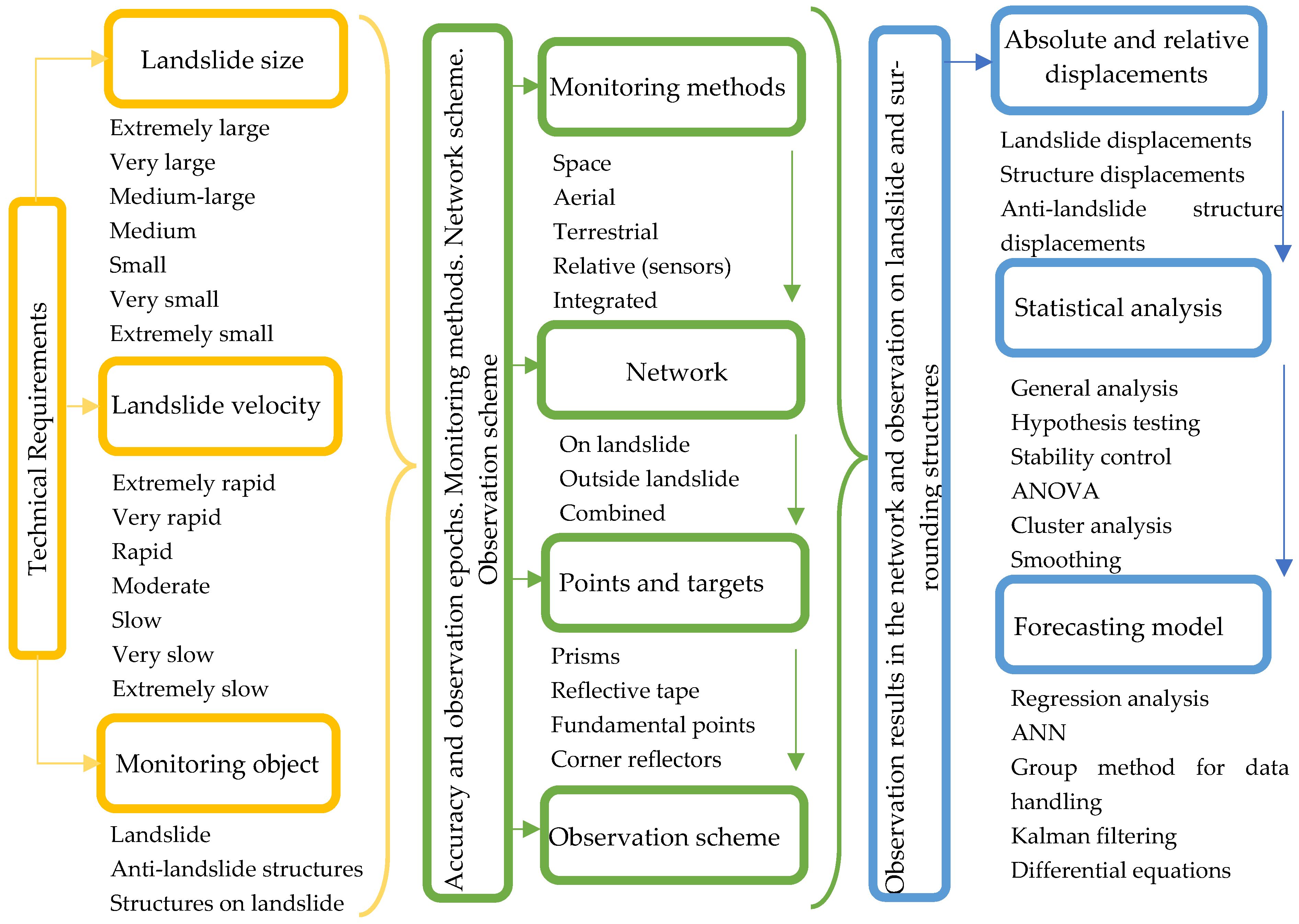
Landslide monitoring workflows and flowcharts streamline the observation process, enabling accurate and reliable results. However, landslide monitoring is a complex and challenging task influenced by various factors. The difficulty arises from the different monitoring subjects, including landslides, structures affected by landslides, and anti-landslide structures. Additionally, landslides vary in size, velocity, soil properties, and non-uniformity. Under these conditions, employing standard monitoring projects and schemes is impractical. Existing flowcharts are mainly method-specific, application-oriented, or focused on individual technologies. A modern flowchart for geospatial monitoring of landslides and surrounding structures must account for the nature of landslide processes, their development laws, size, displacement velocity, and the ability to integrate different observation methods. The completed analysis allows us to propose a new flowchart for geospatial monitoring of landslides and surrounding structures. This flowchart addresses the aforementioned features and enables optimization of the monitoring process, starting from technical requirements to mathematical post-processing of observation data. The proposed flowchart is presented in Figure 12.
Let us describe the suggested landslide monitoring workflow, with the primary stages shown in the flowchart (Figure 12). The organization of the monitoring project begins with a technical specification that should provide detailed information on the geological structure of the landslide (geological survey materials), including the expected velocity and size of the landslide, as well as information about structures on the landslide and anti-landslide measures. This information will allow us to
calculate the accuracy and observation epochs;
choose the monitoring method;
develop an observation network scheme;
develop an observation scheme.
The choice of the monitoring method is one of the most critical stages. The choice of the measurement method will depend on:
displacement dimensions (one-, two- or three-dimensional);
velocity, size, and structure of the landslide;
observation types (landslide, anti-slide structures, and structures on the landslide).
At the same time, monitoring methods may require synchronization and reference to other measuring instruments (geotechnical, meteorological, etc.). We noted that it is impossible to ensure effective monitoring using only one method for very rapid and extremely rapid landslides. The appropriate monitoring solution is an integrated monitoring system that combines, for example, GNSS, total stations, inclinometers, and tiltmeters.
After choosing a method, the design and creation of a geodetic network must be addressed. When observing landslides, one of the most challenging tasks is selecting monitoring stations, as establishing stability zones around the landslide requires detailed research. At this stage, information about the landslide structure and geological survey materials is used again. The geodetic network typically consists of both an external network and an internal network, which includes deformation targets installed within the landslide body, anti-slide structures, and structures situated on the landslide. To monitor the structures on the landslide, the internal network is designed to provide maximum visibility between points. The network must ensure the reliability of displacement determination results, enabling localization and, ideally, the elimination of errors through measurement adjustment and statistical analysis. The third critical stage involves processing and analyzing the measurement results concerning the landslide and surrounding structures. This stage begins with a preliminary analysis of the measurement results and the calculation of displacements. Absolute and relative displacements, along with their derivatives (such as slope, velocity, and average velocity), are calculated for points on the landslide, structures, and anti-slide structures. The resulting displacements must be carefully analyzed to prepare the data for further modeling and for the development of forecasting models. Such analysis is recommended to be carried out in the following sequence: general analysis (to calculate the main statistical characteristics), analysis of the time series autocorrelation function, statistical hypothesis testing (to establish distribution and identify systematic and gross errors), network stability control (to confirm the stability of the network between observation epochs), variance analysis (to identify factors significantly impacting the deformation process and subsequently use these factors as arguments for building forecasting models), and cluster analysis (to pinpoint zones or structures that exhibit similar displacements). It is advisable to perform a smoothing procedure to obtain preliminary results regarding the deformation process. The smoothed results also help to establish the general trend of the deformation process and thus enable the accurate selection of the forecasting model. Additionally, the smoothed results are utilized during continuous monitoring to instantly assess landslide movements and the warning system. The final step is the development of a forecasting model. To illustrate the practical interpretation of the proposed workflow, an example of a conceptual monitoring-design scenario can be considered (Table 6).
The example does not represent a site-specific engineering project but rather demonstrates how the proposed framework may support the selection and integration of monitoring technologies across varying deformation and operational conditions.

6. Conclusions and Perspectives

6.1. General Conclusions

This review offers a thorough examination of the evolution and current capabilities of geospatial methods and technologies for landslide monitoring, with a focus on their practical relevance for engineering applications. The analysis shows that monitoring approaches have progressed from single-dimensional measurements to integrated systems capable of assessing landslide stability, infrastructure, and risk management. Advances in methods, technology fusion, robotization, and data processing have greatly enhanced the ability to detect and quantify displacements. The primary result of this study is a proposed classification of monitoring methods based on their advantages and disadvantages, displacement dimensionality, referencing approach, and temporal resolution. This framework enables a comparison of technologies and provides engineers with a structured basis for choosing suitable monitoring solutions according to landslide characteristics. By linking monitoring performance to landslide velocity classes, the review emphasizes the importance of matching measurement accuracy and observation frequency to the movement dynamics of slopes, which is vital for accurately interpreting monitoring results.
The comparative analysis indicates that no single monitoring technique can capture all aspects of landslide behavior. Space-based radar interferometry is a leading technology and is especially effective for detecting moderate- to large-scale deformation. Conversely, GNSS and geodetic methods provide high accuracy and stable control. With sufficient ground control, UAV photogrammetry has the potential to become a primary technology, while UAV laser scanning offers detailed surface characterization. Geotechnical sensors enable continuous monitoring of surface and subsurface processes. Therefore, integrating these methods is essential to developing robust monitoring systems that support engineering analysis and early warning.
The generalized workflow presented in this review highlights that effective monitoring should be treated as an engineering process. It begins by establishing clear technical objectives, including accuracy standards, monitoring intervals, and acceptable risk levels. Proper network design, selection of appropriate monitoring techniques, and thorough data analysis are essential for producing reliable, actionable results. The workflow also emphasizes the need for iterative assessment, enabling monitoring strategies to be adjusted as new insights into landslide behavior emerge.
The framework proposed here enables the interpretation of landslide geospatial monitoring as an integrated systems-engineering problem that encompasses the design of the monitoring, sensor integration, temporal resolution, reference-frame consistency, data processing, and decision-support requirements. In this context, the choice of monitoring technologies depends on landslide dynamics, operational constraints, the level of automation, interoperability, and the ability to integrate into a multi-sensor monitoring environment. The proposed framework thus emphasizes the architecture of the integrated monitoring system and deformation analysis strategies rather than stand-alone monitoring methods. The framework should be interpreted as a generalized synthesis derived from published monitoring practice, bibliometric assessment, and comparative methodological analysis.
This study’s findings highlight several important considerations. First, monitoring systems should be designed to account for uncertainty in both measurements and geological conditions. Second, continuous observations are crucial for landslides undergoing rapid, accelerated deformation. The rapid growth of remote sensing and automated monitoring technologies is shifting the role of monitoring from periodic assessment to continuous risk management. Third, combining geospatial data with geotechnical investigations and additional numerical modeling improves understanding of landslide failure mechanisms and helps develop effective mitigation strategies.
In conclusion, geospatial monitoring has become a vital part of modern landslide risk management, providing key information for assessing stability and protecting infrastructure. The framework and synthesis presented in this study offer practical guidance for selecting and integrating monitoring technologies and emphasize the need for ongoing methodological development that links measurement systems to engineering analysis.

6.2. Future Challenges of Landslide Geospatial Monitoring

We addressed the advantages and disadvantages of geospatial monitoring methods and identified their application areas. However, further studies are needed to better understand the challenges associated with landslide geospatial monitoring. The analysis has revealed three main directions that will be the focus in the next decade. First, despite the excellent characteristics of radar interferometry, GNSS, and UAV photogrammetry, their full capabilities for geospatial monitoring have not been fully explored. Questions regarding flexibility, accuracy, reliability, automation, and refinement of measurement technology for landslide monitoring remain pertinent.
Second, automated monitoring systems require substantially deeper investigation. Modern geospatial monitoring relies on heterogeneous multi-sensor environments that integrate GNSS, total stations, laser scanning, radar interferometry, geotechnical sensors, hydrodynamic leveling systems, and various environmental observations. Many automated systems today provide operational data-processing pipelines, but the internal logic of data integration, uncertainty propagation, quality control, temporal synchronization, and reference frame remains insufficiently understood or standardized. The certification and quantification of accuracy, reliability, and interoperability in integrated monitoring systems remain open research questions. One of the key open problems in modern landslide-monitoring practice is the fusion of geospatial and non-geospatial observations, such as displacement, temperature, ground humidity, pore pressure, and stress measurements.
Third, developing adequate mathematical models for predicting landslide movement remains challenging. To date, there is no single approach to determining which cases and models to apply: static, kinematic, or dynamic. The right choice depends on the types of loads, the landslide structure, the range of measured displacements, and the change in velocity. Even with correct initial data and precise, reliable measurements, the question remains about which model will better describe the system’s changes: parametric (systems of ordinary or partial differential equations, finite element method) or nonparametric (neural networks, regression models).
State-of-the-art software comprises powerful tools for monitoring and analysis. In parallel, scientists have been developing and studying increasingly sophisticated mathematical algorithms that depend on relatively recent advances in mathematical thought. Future studies should examine and evaluate these algorithms and software.
The findings of this study have several practical implications. Classifying and systematizing monitoring methods, along with a suggested landslide monitoring flowchart, will facilitate the organization of future monitoring projects. This review reveals that state-of-the-art geospatial monitoring methods have various shortcomings. To address these challenges and find the optimal solution, future theoretical and practical studies must be conducted to enhance the capabilities of monitoring methods.

Supplementary Materials

The following supporting information can be downloaded at: https://www.mdpi.com/article/10.3390/rs18132127/s1, Table S1: Scopus_Landslide_Monitoring.

Author Contributions

Conceptualization, R.S. and E.O.; software, R.S., S.B., A.K. and F.I.; validation, R.S., E.O. and M.U.; formal analysis, R.S., M.M.R. and M.U.; data curation, S.B., A.K. and F.I.; writing—original draft preparation, M.M.R. and M.U.; writing—review and editing, R.S. and E.O.; visualization, A.K.; supervision, R.S.; project administration, E.O.; funding acquisition, E.O. All authors have read and agreed to the published version of the manuscript.

Funding

This study was funded by the Science Committee of the Ministry of Science and Higher Education of the Republic of Kazakhstan under Grant No. AP23489830 «Development of Integrated Remote Sensing and Machine Learning Technologies for Landslide Monitoring and Assessment».

Data Availability Statement

The bibliometric dataset is provided as Supplementary Materials. Additional information is available from the corresponding author upon reasonable request.

Conflicts of Interest

The authors declare no conflicts of interest.

References

  1. Stumpf, A.; Malet, J.-P.; Delacourt, C. Correlation of satellite image time-series for the detection and monitoring of slow-moving landslides. Remote Sens. Environ. 2017, 189, 40–55. [Google Scholar] [CrossRef]
  2. Lissak, C.; Bartsch, A.; De Michele, M.; Gomez, C.; Maquaire, O.; Raucoules, D.; Roulland, T. Remote sensing for assessing landslides and associated hazards. Surv. Geophys. 2020, 41, 1391–1435. [Google Scholar] [CrossRef]
  3. Festa, D.; Bonano, M.; Casagli, N.; Confuorto, P.; De Luca, C.; Del Soldato, M.; Lanari, R.; Lu, P.; Manunta, M.; Manzo, M.; et al. Nation-wide mapping and classification of ground deformation phenomena through the spatial clustering of P-SBAS InSAR measurements: Italy case study. ISPRS J. Photogramm. Remote Sens. 2022, 189, 1–22. [Google Scholar] [CrossRef]
  4. Tomás, R.; Li, Z. Earth observations for geohazards: Present and future challenges. Remote Sens. 2017, 9, 194. [Google Scholar] [CrossRef]
  5. Carlà, T.; Tofani, V.; Lombardi, L.; Raspini, F.; Bianchini, S.; Bertolo, D.; Thuegaz, P.; Casagli, N. Combination of GNSS, satellite InSAR, and GBInSAR remote sensing monitoring to improve the understanding of a large landslide in high alpine environment. Geomorphology 2019, 335, 62–75. [Google Scholar] [CrossRef]
  6. Rodriguez, J.; Deane, E.; Hendry, M.T.; Macciotta, R.; Evans, T.; Gräpel, C.; Skirrow, R. Practical evaluation of single-frequency dGNSS for monitoring slow-moving landslides. Landslides 2021, 18, 3671–3684. [Google Scholar] [CrossRef]
  7. Parente, L. Development of a Low-Cost Photogrammetric Monitoring System for Timely Detection of Slope Instability. Ph.D. Thesis, Loughborough University, Loughborough, UK, 2020. [Google Scholar]
  8. Rossi, G.; Tanteri, L.; Tofani, V.; Vannocci, P.; Moretti, S.; Casagli, N. Multitemporal UAV surveys for landslide mapping and characterization. Landslides 2018, 15, 1045–1052. [Google Scholar] [CrossRef]
  9. Șandric, I.; Irimia, R.; Ilinca, V.; Chițu, Z.; Gheuca, I. Using UAV time series to estimate landslides’ kinematics uncertainties, case study: Chirlești Earthflow, Romania. Remote Sens. 2023, 15, 2161. [Google Scholar] [CrossRef]
  10. Fey, C.; Rutzinger, M.; Wichmann, V.; Prager, C.; Bremer, M.; Zangerl, C. Deriving 3D displacement vectors from multi-temporal airborne laser scanning data for landslide activity analyses. Gisci. Remote Sens. 2015, 52, 437–461. [Google Scholar] [CrossRef]
  11. Kovanič, Ľ.; Peťovský, P.; Topitzer, B.; Blišťan, P. Complex Methodology for Spatial Documentation of Geomorphological Changes and Geohazards in the Alpine Environment. Land 2024, 13, 112. [Google Scholar] [CrossRef]
  12. Kenner, R.; Gischig, V.; Gojcic, Z.; Quéau, Y.; Kienholz, C.; Figi, D.; Thöny, R.; Bonanomi, Y. The potential of point clouds for the analysis of rock kinematics in large slope instabilities: Examples from the Swiss Alps: Brinzauls, Pizzo Cengalo and Spitze Stei. Landslides 2022, 19, 1357–1377. [Google Scholar] [CrossRef]
  13. Miele, P.; Di Napoli, M.; Novellino, A.; Calcaterra, D.; Mallorqui, J.J.; Di Martire, D. SAR data and field surveys combination to update rainfall-induced shallow landslide inventory. Remote Sens. Appl. Soc. Environ. 2022, 26, 100755. [Google Scholar] [CrossRef]
  14. Lu, P.; Wu, H.; Qiao, G.; Li, W.; Scaioni, M.; Feng, T.; Liu, S.; Chen, W.; Li, N.; Liu, C.; et al. Model test study on monitoring dynamic process of slope failure through spatial sensor network. Environ. Earth Sci. 2015, 74, 3315–3332. [Google Scholar] [CrossRef]
  15. Yang, Z.; Zhang, Y.; Li, J. Application of Inverted Vertical Line Method in Landslide Monitoring. IOP Conf. Ser. Earth Environ. Sci. 2020, 570, 022017. [Google Scholar] [CrossRef]
  16. Delacourt, C.; Allemand, P.; Berthier, E.; Raucoules, D.; Casson, B.; Grandjean, P.; Pambrun, C.; Varel, E. Remote-sensing techniques for analysing landslide kinematics: A review. Bull. Soc. Geol. Fr. 2007, 178, 89–100. [Google Scholar] [CrossRef]
  17. Jaboyedoff, M.; Oppikofer, T.; Abellán, A.; Derron, M.-H.; Loye, A.; Metzger, R.; Pedrazzini, A. Use of LIDAR in landslide investigations: A review. Nat. Hazards 2012, 61, 5–28. [Google Scholar] [CrossRef]
  18. Scaioni, M.; Longoni, L.; Melillo, V.; Papini, M. Remote Sensing for Landslide Investigations: An Overview of Recent Achievements and Perspectives. Remote Sens. 2014, 6, 9600–9652. [Google Scholar] [CrossRef]
  19. Nex, F.; Remondino, F. UAV for 3D mapping applications: A review. Appl. Geomat. 2014, 6, 1–15. [Google Scholar] [CrossRef]
  20. Spilotro, G.; Pellicani, R.; Canora, F.; Allasia, P.; Giordan, D.; Lollino, G. Evolution of techniques for monitoring unstable slopes. Ital. J. Eng. Geol. Environ. 2017, 17, 5–17. [Google Scholar] [CrossRef]
  21. Wasowski, J. New Tools and Techniques of Remote Sensing for Geologic Hazard Assessment. In Recent Advances in Geo-Environmental Engineering, Geomechanics and Geotechnics, and Geohazards (CAJG 2018); Advances in Science, Technology & Innovation; Kallel, A., Erguler, Z.A., Cui, Z.-D., Karrech, A.L., Karakus, M., Kulatilake, P., Shukla, S.K., Eds.; Springer: Cham, Switzerland, 2019. [Google Scholar] [CrossRef]
  22. Pecoraro, G.; Calvello, M.; Piciullo, L. Monitoring strategies for local landslide early warning systems. Landslides 2019, 16, 213–231. [Google Scholar] [CrossRef]
  23. Gili, J.A.; Moya, J.; Corominas, J.; Crosetto, M.; Monserrat, O. Past, Present and Future Monitoring at the Vallcebre Landslide (Eastern Pyrenees, Spain). Appl. Sci. 2021, 11, 571. [Google Scholar] [CrossRef]
  24. Thirugnanam, H.; Uhlemann, S.; Reghunadh, R.; Ramesh, M.V.; Rangan, V.P. Review of Landslide Monitoring Techniques with IoT Integration Opportunities. IEEE J. Sel. Top. Appl. Earth Obs. Remote Sens. 2022, 15, 5317–5338. [Google Scholar] [CrossRef]
  25. Casagli, N.; Intrieri, E.; Tofani, V.; Gigli, C.; Raspini, F. Landslide detection, monitoring and prediction with remote sensing techniques. Nat. Rev. Earth Environ. 2023, 4, 51–64. [Google Scholar] [CrossRef]
  26. Stumvoll, M.J.; Canli, E.; Engels, A.; Thiebes, B.; Groiss, B.; Glade, T.; Schweigl, J.; Bertagnoli, M. The “Salcher” landslide observatory—Experimental long-term monitoring in the Flysch Zone of Lower Austria. Bull. Eng. Geol. Environ. 2020, 79, 1831–1848. [Google Scholar] [CrossRef]
  27. Sestras, P.; Bilașco, Ș.; Roșca, S.; Veres, I.; Ilies, N.; Hysa, A.; Spalević, V.; Cîmpeanu, S.M. Multi-Instrumental Approach to Slope Failure Monitoring in a Landslide Susceptible Newly Built-Up Area: Topo-Geodetic Survey, UAV 3D Modelling and Ground-Penetrating Radar. Remote Sens. 2022, 14, 5822. [Google Scholar] [CrossRef]
  28. Dematteis, N.; Wrzesniak, A.; Allasia, P.; Bertolo, D.; Giordan, D. Integration of robotic total station and digital image correlation to assess the three-dimensional surface kinematics of a landslide. Eng. Geol. 2022, 303, 106655. [Google Scholar] [CrossRef]
  29. Vivaldi, V.; Bordoni, M.; Mineo, S.; Crozi, M.; Pappalardo, G.; Meisina, C. Airborne combined photogrammetry—Infrared thermography applied to landslide remote monitoring. Landslides 2023, 20, 297–313. [Google Scholar] [CrossRef]
  30. Cai, J.; Jia, H.; Liu, G.; Zhang, B.; Liu, Q.; Fu, Y.; Wang, X.; Zhang, R. An Accurate Geocoding Method for GB-SAR Images Based on Solution Space Search and Its Application in Landslide Monitoring. Remote Sens. 2021, 13, 832. [Google Scholar] [CrossRef]
  31. Zhang, X.; Chen, L.; Zhou, C. Deformation monitoring and trend analysis of reservoir bank landslides by combining time-series InSAR and Hurst Index. Remote Sens. 2023, 15, 619. [Google Scholar] [CrossRef]
  32. Xu, Q.; Li, W.L.; Ju, Y.Z.; Dong, X.-J.; Peng, D.-L. Multitemporal UAV-based photogrammetry for landslide detection and monitoring in a large area: A case study in the Heifangtai terrace in the Loess Plateau of China. J. Mt. Sci. 2020, 17, 1826–1839. [Google Scholar] [CrossRef]
  33. Jakopec, I.; Marendić, A.; Grgac, I. Accuracy Analysis of a New Data Processing Method for Landslide Monitoring Based on Unmanned Aerial System Photogrammetry. Sensors 2023, 23, 3097. [Google Scholar] [CrossRef] [PubMed]
  34. Ciccarese, G.; Tondo, M.; Mulas, M.; Bertolini, G.; Corsini, A. Rapid Assessment of Landslide Dynamics by UAV-RTK Repeated Surveys Using Ground Targets: The Ca’ Lita Landslide (Northern Apennines, Italy). Remote Sens. 2024, 16, 1032. [Google Scholar] [CrossRef]
  35. Pasternak, G.; Pasternak, K.; Koda, E.; Ogrodnik, P. Unmanned Aerial Vehicle Photogrammetry for Monitoring the Geometric Changes of Reclaimed Landfills. Sensors 2024, 24, 7247. [Google Scholar] [CrossRef] [PubMed]
  36. Wasowski, J.; Bovenga, F. Remote Sensing of Landslide Motion with Emphasis on Satellite Multitemporal Interferometry Applications. An Overview. In Landslide Hazards, Risks and Disasters; Shroder, J., Davies, T., Eds.; Elsevier: Amsterdam, The Netherlands, 2014; pp. 345–403. [Google Scholar] [CrossRef]
  37. Uhlemann, S.; Smith, A.; Chambers, J.; Dixon, N.; Dijkstra, T.; Haslam, E.; Meldrum, P.; Merritt, A.; Gunn, D.; Mackay, J. Assessment of ground-based monitoring techniques applied to landslide investigations. Geomorphology 2016, 253, 438–451. [Google Scholar] [CrossRef]
  38. Smethurst, J.A.; Smith, A.; Uhlemann, S.; Wooff, C.; Chambers, J.; Hughes, P.; Lenart, S.; Saroglou, H.; Springman, S.M.; Löfroth, H.; et al. Current and future role of instrumentation and monitoring in the performance of transport infrastructure slopes. Q. J. Eng. Geol. Hydrogeol. 2017, 50, 271–286. [Google Scholar] [CrossRef]
  39. Garnica-Peña, R.J.; Alcántara-Ayala, I. The use of UAVs for landslide disaster risk research and disaster risk management: A literature review. J. Mt. Sci. 2021, 18, 482–498. [Google Scholar] [CrossRef]
  40. Li, S.; Xu, W.; Li, Z. Review of the SBAS InSAR Time-series algorithms, applications, and challenges. Geod. Geodyn. 2022, 13, 114–126. [Google Scholar] [CrossRef]
  41. Guo, Y.; Li, X.; Ju, S.; Lyu, Q.; Liu, T. Utilization of 3D Laser Scanning for Stability Evaluation and Deformation Monitoring of Landslides. J. Environ. Public Health 2022, 2022, 8225322. [Google Scholar] [CrossRef] [PubMed]
  42. Zhou, J.; Jiang, N.; Li, C.; Li, H. A landslide monitoring method using data from unmanned aerial vehicle and terrestrial laser scanning with insufficient and inaccurate ground control points. J. Rock. Mech. Geotech. Eng. 2024, 16, 4125–4140. [Google Scholar] [CrossRef]
  43. Alam, M.J.B.; Manzano, L.S.; Debnath, R.; Ahmed, A.A. Monitoring Slope Movement and Soil Hydrologic Behavior Using IoT and AI Technologies: A Systematic Review. Hydrology 2024, 11, 111. [Google Scholar] [CrossRef]
  44. Van Eck, N.J.; Waltman, L. Software survey: VOSviewer, a computer program for bibliometric mapping. Scientometrics 2010, 84, 523–538. [Google Scholar] [PubMed]
  45. Pirti, A.; Hosbas, R.G. Evaluation of some levelling techniques in surveying application. Geod. Cartogr. 2019, 68, 361–373. [Google Scholar] [CrossRef]
  46. Gerea, A.G.; Mihai, A.E. Rapid terrain analysis in landslide zones: GPR and airborne photogrammetry as a complement for the levelling data. Case study near Poiana Ruscă dam, Romania. Geo-Eco-Marina 2024, 30, 149–162. [Google Scholar] [CrossRef]
  47. Santos, D.P.D.; Faggion, P.L.; Veiga, L.A.K. Camapuã Hill altitude determination from leap-frog trigonometric leveling method. Bol. Ciênc. Geod. 2011, 17, 295–316. [Google Scholar] [CrossRef]
  48. Tiwari, A.; Narayan, A.B.; Dwivedi, R.; Swadeshi, A.; Pasari, S.; Dikshit, O. Geodetic investigation of landslides and land subsidence: Case study of the Bhurkunda coal mines and the Sirobagarh landslide. Surv. Rev. 2020, 52, 134–149. [Google Scholar] [CrossRef]
  49. Holst, C.; Janßen, J.; Schmitz, B.; Blome, M.; Dercks, M.; Schoch-Baumann, A.; Blöthe, J.; Schrott, L.; Kuhlmann, H.; Medic, T. Increasing Spatio-Temporal Resolution for Monitoring Alpine Solifluction Using Terrestrial Laser Scanners and 3D Vector Fields. Remote Sens. 2021, 13, 1192. [Google Scholar] [CrossRef]
  50. Shults, R. Analysis of neural network models for predicting the movements of landslide restraint structures. In Proceedings of the 1st Conference on Geohazards Assessment and Risk Mitigation 2025, Near Surface Geoscience Conference and Exhibition, NSG 2025, Naples, Italy, 9–14 September 2025. [Google Scholar] [CrossRef]
  51. Mazza, D.; Cosentino, A.; Romeo, S.; Mazzanti, P.; Guadagno, F.M.; Revellino, P. Remote Sensing Monitoring of the Pietrafitta Earth Flows in Southern Italy: An Integrated Approach Based on Multi-Sensor Data. Remote Sens. 2023, 15, 1138. [Google Scholar] [CrossRef]
  52. Peternel, T.; Janža, M.; Šegina, E.; Bezak, N.; Maček, M. Recognition of Landslide Triggering Mechanisms and Dynamics Using GNSS, UAV Photogrammetry and In Situ Monitoring Data. Remote Sens. 2022, 14, 3277. [Google Scholar] [CrossRef]
  53. Marques, F.; Moniz, L.; Amaral, P.; Malheiro, A.; Santos, A. Monitoring System Implemented to Evaluate the Kinematics of an Instability Zone at Flores Island. In Advances in Natural Hazards and Volcanic Risks: Shaping a Sustainable Future, NATHAZ 2022; Advances in Science, Technology and Innovation; Springer: Cham, Switzerland, 2022; pp. 167–172. [Google Scholar] [CrossRef]
  54. Glueer, F.; Loew, S.; Seifert, R.; Aaron, J.; Grämiger, L.; Conzett, S.; Limpach, P.; Wieser, A.; Manconi, A. Robotic Total Station Monitoring in High Alpine Paraglacial Environments: Challenges and Solutions from the Great Aletsch Region (Valais, Switzerland). Geosciences 2021, 11, 471. [Google Scholar] [CrossRef]
  55. Yermolaev, O.; Usmanov, B.; Gafurov, A.; Poesen, J.; Vedeneeva, E.; Lisetskii, F.; Nicu, I.C. Assessment of Shoreline Transformation Rates and Landslide Monitoring on the Bank of Kuibyshev Reservoir (Russia) Using Multi-Source Data. Remote Sens. 2021, 13, 4214. [Google Scholar] [CrossRef]
  56. Sestras, P.; Bilașco, Ș.; Roșca, S.; Dudic, B.; Hysa, A.; Spalević, V. Geodetic and UAV Monitoring in the Sustainable Management of Shallow Landslides and Erosion of a Susceptible Urban Environment. Remote Sens. 2021, 13, 385. [Google Scholar] [CrossRef]
  57. Chotchaev, K.O.; Melkov, D.A. Active dynamics of technogenic landslide on the left board of the Khanikomdon river (North Ossetia). Sustain. Dev. Mt. Territ. 2021, 13, 66–76. [Google Scholar] [CrossRef]
  58. Ospanov, N.S.; Krivchenko, A.A. Description of a 2-Year, High-Resolution Geodetic Monitoring of the Khoko Landslide, Enguri Reservoir, Georgia. In Building Knowledge for Geohazard Assessment and Management in the Caucasus and other Orogenic Regions; Bonali, F.L., Pasquaré Mariotto, F., Tsereteli, N., Eds.; NATO Science for Peace and Security Series C: Environmental Security; Springer: Dordrecht, The Netherlands, 2021. [Google Scholar] [CrossRef]
  59. Tiwari, A.; Narayan, A.B.; Dwivedi, R.; Dikshit, O.; Nagarajan, B. Monitoring of landslide activity at the Sirobagarh landslide, Uttarakhand, India, using LiDAR, SAR interferometry and geodetic surveys. Geocarto Int. 2020, 35, 535–558. [Google Scholar] [CrossRef]
  60. Lanciano, C.; Salvini, R. Monitoring of Strain and Temperature in an Open Pit Using Brillouin Distributed Optical Fiber Sensors. Sensors 2020, 20, 1924. [Google Scholar] [CrossRef] [PubMed]
  61. Amaral, P.; Malheiro, A.; Marques, F.; Moniz, L.; Furtado, S.; Loura, N. The use of total station for monitoring mass movements: Application to Fajãzinha landslide at flores island (azores archipelago). In Advances in Natural Hazards and Hydrological Risks: Meeting the Challenge; Advances in Science, Technology and Innovation; Springer: Cham, Switzerland, 2020; pp. 59–62. [Google Scholar] [CrossRef]
  62. Wang, Z.; Butt, J.A.; Huang, S.; Medić, T.; Wieser, A. Dense 3D displacement estimation for landslide monitoring via fusion of TLS point clouds and embedded RGB images. Int. J. Appl. Earth Obs. Geoinf. 2026, 146, 105093. [Google Scholar] [CrossRef]
  63. Chuo, K.; Yabuki, N.; Kawasaki, S.; Nishi, N. Development of crack measurement method combining total station and digital imaging. In Japan Society of Civil Engineers Proceedings F3 (Civil Engineering Informatics); Japan Society of Civil Engineers: Tokyo, Japan, 2017; Volume 73. [Google Scholar] [CrossRef] [PubMed]
  64. Zhang, S.S.; Guo, S.F.; Qi, S.W.; Tang, F.-J.; Hu, J.-S.; Zhao, X.-P.; Ran, C.-Y.; Wang, X.; Zou, Y.; Huang, X.-L.; et al. Investigation on long-term progressive deformation of engineering slope based on comprehensive monitoring. J. Mt. Sci. 2022, 19, 1576–1587. [Google Scholar] [CrossRef]
  65. Zieher, T.; Pfeiffer, J.; van Natijne, A.; Lindenbergh, R. Integrated monitoring of a slowly moving landslide based on total station measurements, multi-temporal terrestrial laser scanning and space-borne interferometric synthetic aperture radar. In Proceedings of the 2021 IEEE International Geoscience and Remote Sensing Symposium (IGARSS); IEEE: Piscataway, NJ, USA, 2021; Volume 2021, pp. 942–945. [Google Scholar] [CrossRef]
  66. Pattela, T.V.; Disperati, L.; D’Addario, E.; Rappuoli, D. Multi-temporal, GNSS, RTS, and InSAR for very slow-moving landslide displacement analysis. J. Appl. Geod. 2025, 19, 431–441. [Google Scholar] [CrossRef]
  67. Shults, R.; Roshchyn, O. Preliminary determination of spatial geodetic monitoring accuracy for free station method. Geod. List 2016, 70, 355–370. [Google Scholar]
  68. Lu, T.; Han, P.; Gong, W.; Li, S.; Mo, S.; Hu, K.; Zhang, Y.; Mo, C.; Li, Y.; An, N.; et al. Slope Surface Deformation Monitoring Based on Close-Range Photogrammetry: Laboratory Insights and Field Applications. Remote Sens. 2024, 16, 4380. [Google Scholar] [CrossRef]
  69. Lucks, L.; Hirt, P.-R.; Hoegner, L.; Stilla, U. Photogrammetric monitoring of gravitational mass movements in alpine regions by markerless 3D motion capture. Int. Arch. Photogramm. Remote Sens. Spat. Inf. Sci. 2022, 43, 1063–1069. [Google Scholar] [CrossRef]
  70. Brezzi, L.; Gabrieli, F.; Cola, S.; Lorenzetti, G.; Spiezia, N.; Bisson, A.; Allegrini, M. Digital Terrestrial Stereo-Photogrammetry for Monitoring Landslide Displacements: A Case Study in Recoaro Terme (VI). In National Conference of the Researchers of Geotechnical Engineering; Lecture Notes in Civil Engineering; Springer: Cham, Switzerland, 2020; Volume 40, pp. 155–163. [Google Scholar] [CrossRef]
  71. Brezzi, L.; Vallisari, D.; Carraro, E.; Teza, G.; Pol, A.; Liang, Z.; Zhou, K.; Gabrieli, F.; Cola, S.; Galgaro, A. Digital terrestrial photogrammetry for a dense monitoring of the surficial displacements of a landslide. In Proceedings of the IOP Conference Series: Earth and Environmental Science, Mechanics and Rock Engineering, from Theory to Practice, Turin, Italy, 20–25 September 2021; IOP Publishing: Bristol, UK, 2021; Volume 833. [Google Scholar] [CrossRef]
  72. Kromer, R.; Walton, G.; Gray, B.; Lato, M.; Group, R. Development and Optimization of an Automated Fixed-Location Time Lapse Photogrammetric Rock Slope Monitoring System. Remote Sens. 2019, 11, 1890. [Google Scholar] [CrossRef]
  73. Wang, P.; Liu, Q.; Ren, Y.; Zhang, Y.; Cai, M. Multi-scales analysis of fracture evolution and failure identification of rocks based on digital image correlation. Eng. Fract. Mech. 2026, 332, 111775. [Google Scholar] [CrossRef]
  74. Sevil-Aguareles, J.; Gutiérrez, F.; Benito-Calvo, A. Comparing terrestrial laser scanner and ground-based structure from motion photogrammetry for urban sinkhole characterization and monitoring in Zaragoza, Spain. Earth Surf. Process. Landf. 2025, 50, e70108. [Google Scholar] [CrossRef]
  75. Brezzi, L.; Gabrieli, F.; Vallisari, D.; Carraro, E.; Pol, A.; Galgaro, A.; Cola, S. DIPHORM: An Innovative DIgital PHOtogrammetRic Monitoring Technique for Detecting Surficial Displacements of Landslides. Remote Sens. 2024, 16, 3199. [Google Scholar] [CrossRef]
  76. Hendrickx, H.; Elias, M.; Blanch, X.; Delaloye, R.; Eltner, A. AI-based tracking of fast-moving alpine landforms using high-frequency monoscopic time-lapse imagery. Earth Surf. Dyn. 2025, 13, 705–721. [Google Scholar] [CrossRef]
  77. Fang, K.; Dong, A.; Tang, H.; An, P.; Zhang, B.; Miao, M.; Ding, B.; Hu, X. Comprehensive assessment of the performance of a multismartphone measurement system for landslide model test. Landslides 2023, 20, 845–864. [Google Scholar] [CrossRef]
  78. Liu, Y.; Li, C.; Zhang, J. Research of automatic monitoring and early warning technology based on real-time image recognition in landslide monitoring. In ECPDC ’24: Proceedings of the 2024 International Academic Conference on Edge Computing, Parallel and Distributed Computing; Association for Computing Machinery: New York, NY, USA, 2024; pp. 220–225. [Google Scholar] [CrossRef]
  79. Blanch, X.; Guinau, M.; Eltner, A.; Abellan, A. Fixed photogrammetric systems for natural hazard monitoring with high spatio-temporal resolution. Nat. Hazards Earth Syst. Sci. 2023, 23, 3285–3303. [Google Scholar] [CrossRef]
  80. Jaud, M.; Le Dantec, N.; Parker, K.; Lemon, K.; Lendre, S.; Delacourt, C.; Gomes, R.C. How to Include Crowd-Sourced Photogrammetry in a Geohazard Observatory—Case Study of the Giant’s Causeway Coastal Cliffs. Remote Sens. 2022, 14, 3243. [Google Scholar] [CrossRef]
  81. Romeo, S.; Cosentino, A.; Giani, F.; Mastrantoni, G.; Mazzanti, P. Combining Ground Based Remote Sensing Tools for Rockfalls Assessment and Monitoring: The Poggio Baldi Landslide Natural Laboratory. Sensors 2021, 21, 2632. [Google Scholar] [CrossRef] [PubMed]
  82. Li, Y.; Li, J.; Pei, J.; Chen, W.; Luo, G.; Xia, G. Application of non-contact video quantitative measurement method in reservoir bank landslide monitoring. Front. Earth Sci. 2024, 12, 1378046. [Google Scholar] [CrossRef]
  83. Majidi, S.; Omidalizarandi, M.; Sharifi, M.A. Intelligent 3D crack reconstruction using close-range photogrammetry imagery. In ISPRS Annals of the Photogrammetry, Remote Sensing and Spatial Information Sciences, Tehran, Iran, 19–22 February 2023; Copernicus Publications: Göttingen, Germany, 2023; Volume X-4/W1-2022, pp. 443–450. [Google Scholar] [CrossRef]
  84. Di Stefano, F.; Cabrelles, M.; García-Asenjo, L.; Lerma, J.L.; Malinverni, E.S.; Baselga, S.; Garrigues, P.; Pierdicca, R. Evaluation of Long-Range Mobile Mapping System (MMS) and Close-Range Photogrammetry for Deformation Monitoring. A Case Study of Cortes de Pallás in Valencia (Spain). Appl. Sci. 2020, 10, 6831. [Google Scholar] [CrossRef]
  85. Mugnai, F.; Caporossi, P.; Mazzanti, P. Exploiting Image Assisted Total Station in Digital Image Correlation (DIC) displacement measurements: Insights from laboratory experiments. Eur. J. Remote Sens. 2022, 55, 115–128. [Google Scholar] [CrossRef]
  86. Lucks, L.; Holst, C. Feature-based multi-epoch rock slope monitoring using images and terrestrial laser scans. ISPRS Open J. Photogramm. Remote Sens. 2026, 19, 100120. [Google Scholar] [CrossRef]
  87. Sestras, P.; Badea, G.; Badea, A.C.; Salagean, T.; Oniga, V.-E.; Roșca, S.; Bilașco, Ș.; Bruma, S.; Spalević, V.; Kader, S.; et al. A novel method for landslide deformation monitoring by fusing UAV photogrammetry and LiDAR data based on each sensor’s mapping advantage in regards to terrain feature. Eng. Geol. 2025, 346, 107890. [Google Scholar] [CrossRef]
  88. Fernández, T.; Pérez-García, J.L.; Gómez-López, J.M.; Cardenal, J.; Moya, F.; Delgado, J. Multitemporal Landslide Inventory and Activity Analysis by Means of Aerial Photogrammetry and LiDAR Techniques in an Area of Southern Spain. Remote Sens. 2021, 13, 2110. [Google Scholar] [CrossRef]
  89. Czerwonka-Schröder, D.; Gaisecker, T. The permanent three-dimensional data acquisition of geotechnical structures by means of a web-based application of terrestrial LiDAR sensors. Geomech. Tunnelbau 2022, 15, 596–604. [Google Scholar] [CrossRef]
  90. Tabernig, R.; Albert, W.; Weiser, H.; Fritzmann, P.; Anders, K.; Rutzinger, M.; Höfle, B. Temporal aggregation of point clouds improves permanent laser scanning of landslides in forested areas. Sci. Remote Sens. 2025, 12, 100254. [Google Scholar] [CrossRef]
  91. Choi, S.K.; Ramirez, R.A.; Lim, H.H.; Kwon, T.-H. Multi-source remote sensing-based landslide investigation: The case of the August 7, 2020, Gokseong landslide in South Korea. Sci. Rep. 2024, 14, 12048. [Google Scholar] [CrossRef] [PubMed]
  92. Jiang, N.; Li, H.-B.; Li, C.-J.; Xiao, H.-X.; Zhou, J.-W. A Fusion Method Using Terrestrial Laser Scanning and Unmanned Aerial Vehicle Photogrammetry for Landslide Deformation Monitoring Under Complex Terrain Conditions. IEEE Trans. Geosci. Remote Sens. 2022, 60, 4707214. [Google Scholar] [CrossRef]
  93. Deligiannakis, G.; Pallikarakis, A.; Papanikolaou, I.; Alexiou, S.; Reicherter, K. Detecting and Monitoring Early Post-Fire Sliding Phenomena Using UAV–SfM Photogrammetry and t-LiDAR-Derived Point Clouds. Fire 2021, 4, 87. [Google Scholar] [CrossRef]
  94. Jiang, N.; Li, H.; Hu, Y.; Zhang, J.; Dai, W.; Li, C.; Zhou, J.-W. A Monitoring Method Integrating Terrestrial Laser Scanning and Unmanned Aerial Vehicles for Different Landslide Deformation Patterns. IEEE J. Sel. Top. Appl. Earth Obs. Remote Sens. 2021, 14, 10242–10255. [Google Scholar] [CrossRef]
  95. Feng, S.; Dai, K.; Li, Z.; Zeng, P.; Tian, W.; Wang, X.; Kang, Y.; Xu, H.; Chen, L. Decadal evolution and dynamics of the Longxigou landslide’s composite deforming surface revealed by space-air-ground investigation strategy. Landslides 2026. [Google Scholar] [CrossRef]
  96. Ge, Y.; Liu, C.; Tang, H.; Chen, J. Landslide monitoring from point cloud sequence using stereo feature matching. Earth Surf. Process. Landf. 2025, 50, e70073. [Google Scholar] [CrossRef]
  97. He, R.J.; Jiang, N.; Luo, X.L.; Li, H.B.; Zhou, J.W. Three-dimensional deformation field construction method for landslides using ICP algorithm and physics-informed deep learning. Acta Geotech. 2026. [Google Scholar] [CrossRef]
  98. Hosseini, K.; Zubareva, S.; Hummelsberger, J.; Holst, C. Improved 4D feature-based deformation tracking for high-resolution real-time landslide and slope deformation monitoring based on terrestrial laser scanning. Nat. Hazards 2026, 122, 178. [Google Scholar] [CrossRef]
  99. Xian, Z.; Zhou, J.-W.; Li, Z.-Y.; Xu, Y.-M.; Jiang, N. A Block-Wise ICP Method for Retrieving 3D Landslide Displacement Vectors Based on Terrestrial Laser Scanning Point Clouds. Remote Sens. 2026, 18, 923. [Google Scholar] [CrossRef]
  100. Jia, D.; Zhou, Y.; He, X.; Xu, N.; Yang, Z.; Song, M. Vertical and horizontal displacements of a reservoir slope due to slope aging effect, rainfall, and reservoir water. Geod. Geodyn. 2021, 12, 266–278. [Google Scholar] [CrossRef]
  101. Tseng, C.-H.; Rau, R.-J.; Jeng, C.-J. Deformation pattern of a creeping slope revealed by continuous GNSS monitoring in northern Taiwan. Eng. Geol. 2026, 361, 108491. [Google Scholar] [CrossRef]
  102. Liu, G.; Xiao, S.; Zhang, K.; Li, H. Analysis of Deformation Laws and Trends of Open-pit Coal Mine Slopes Based on GNSS Technology. Indian Geotech. J. 2026. [Google Scholar] [CrossRef]
  103. Vázquez-Jiménez, R.; Bravo, J.A.; Ramos-Bernal, R.N.; Tizapa, S.S.; Romero-Rojas, W.; Arrogante-Funes, P.; Bruzón, A.G. Spatial assessment of landslide risk using GNSS-based displacement analysis and a resident vulnerability index in northwestern Chilpancingo, Guerrero, Mexico. Landslides 2025, 22, 4045–4059. [Google Scholar] [CrossRef]
  104. Orynbassarova, E.; Yerzhankyzy, A.; Shults, R.; Roberts, K.; Togaibekov, A. Strategies of GNSS Processing and Measuring Under Various Operational Conditions; Naukovyi Visnyk Natsionalnoho Hirnychoho Universytetu: Dnipro, Ukraine, 2022; pp. 146–150. [Google Scholar] [CrossRef]
  105. Maciuk, K. GNSS monitoring natural and anthropogenic phenomena. In GPS and GNSS Technology in Geosciences; Elsevier: Amsterdam, The Netherlands, 2021; pp. 177–197. [Google Scholar] [CrossRef]
  106. Cenni, N.; Fiaschi, S.; Fabris, M. Integrated use of archival aerial photogrammetry, GNSS, and InSAR data for the monitoring of the Patigno landslide (Northern Apennines, Italy). Landslides 2021, 18, 2247–2263. [Google Scholar] [CrossRef]
  107. Pham, C.K.; Tran, D.T.; Nguyen, V.H. GNSS/CORS-based technology for real-time monitoring of landslides on waste dump—A case study at the Deo Nai South Dump, Vietnam. Inz. Miner. 2020, 1, 181–191. [Google Scholar] [CrossRef]
  108. Buša, J.; Rusnák, M.; Kušnirák, D.; Greif, V.; Bednarik, M.; Putiška, R.; Dostál, I.; Sládek, J.; Rusnáková, D. Urban landslide monitoring by combined use of multiple methodologies—A case study on Sv. Anton town, Slovakia. Phys. Geogr. 2019, 41, 169–194. [Google Scholar] [CrossRef]
  109. Qiu, D.; Wang, L.; Luo, D.; Huang, H.; Ye, Q.; Zhang, Y. Landslide monitoring analysis of single-frequency BDS/GPS combined positioning with constraints on deformation characteristics. Surv. Rev. 2019, 51, 364–372. [Google Scholar] [CrossRef]
  110. Hamza, V.; Stopar, B.; Sterle, O.; Pavlovčič-Prešeren, P. A Cost-Effective GNSS Solution for Continuous Monitoring of Landslides. Remote Sens. 2023, 15, 2287. [Google Scholar] [CrossRef]
  111. Huntley, D.; Bobrowsky, P.; Macleod, R.; Cocking, R.; Joseph, J.; Rotheram-Clarke, D. Field testing innovative differential geospatial and photogrammetric monitoring technologies in mountainous terrain near Ashcroft, British Columbia, Canada. J. Mt. Sci. 2021, 18, 1–20. [Google Scholar] [CrossRef] [PubMed]
  112. Iontchev, E.; Miletiev, R. Landslide monitoring methods based on RTK navigation. In Proceedings of the 2022 57th International Scientific Conference on Information, Communication and Energy Systems and Technologies (ICEST), Ohrid, North Macedonia, 16–18 June 2022; pp. 1–4. [Google Scholar] [CrossRef]
  113. Elsheikh, M.; Iqbal, U.; Noureldin, A.; Korenberg, M. The Implementation of Precise Point Positioning (PPP): A Comprehensive Review. Sensors 2023, 23, 8874. [Google Scholar] [CrossRef] [PubMed]
  114. Marino, L.; Sellers, C.A.; Bausilio, G.; Calcaterra, D.; Di Maio, R.; Faicán, G.; Ramondini, M.; Rodas, R.A.; Vicari, A.; Di Martire, D. Combined Satellite Monitoring of a Slow Landslide in the City of Cuenca (Ecuador). Remote Sens. 2026, 18, 1017. [Google Scholar] [CrossRef]
  115. Lau, Y.M.; Wang, K.L.; Wang, Y.H.; Yiu, W.H.; Ooi, G.H.; Tan, P.S.; Wu, J.; Leung, M.L.; Lui, H.L.; Chen, C.W. Monitoring of rainfall-induced landslides at Songmao and Lushan, Taiwan, using IoT and big data-based monitoring system. Landslides 2023, 20, 271–296. [Google Scholar] [CrossRef]
  116. Vassallo, R.; Calcaterra, S.; D’Agostino, N.; De Rosa, J.; Di Maio, C.; Gambino, P. Long-Term Displacement Monitoring of Slow Earthflows by Inclinometers and, GPS.; and Wide Area Surveillance by COSMO-SkyMed Data. Geosciences 2020, 10, 171. [Google Scholar] [CrossRef]
  117. Quiroz, W.; Villegas-Lanza, J.; Moroccoire, K.; Balladares, O.; Berduzco, M. Assessment of the kinematics of the Cuenca landslide in the central Peruvian Andes using photogrammetry and geodetic techniques. Rev. Teledetec. 2024, 64, 33–48. [Google Scholar] [CrossRef]
  118. Parenti, C.; Rossi, P.; Mancini, F.; Scorpio, V.; Grassi, F.; Ciccarese, G.; Lugli, F.; Soldati, M. Multitemporal Analysis of Slow-Moving Landslides and Channel Dynamics through Integrated Remote Sensing and In Situ Techniques. Remote Sens. 2023, 15, 3563. [Google Scholar] [CrossRef]
  119. Deane, E.; Macciotta, R.; Hendry, M.T.; Gräpel, C.; Skirrow, R. Leveraging historical aerial photographs and digital photogrammetry techniques for landslide investigation—A practical perspective. Landslides 2020, 17, 1989–1996. [Google Scholar] [CrossRef]
  120. Achilli, V.; Carrubba, P.; Fabris, M.; Menin, A.; Pavanello, P. An archival geomatics approach in the study of a landslide. Appl. Geomat. 2015, 7, 263–273. [Google Scholar] [CrossRef][Green Version]
  121. Mukhlisin, M.; Astuti, H.W.; Wardihani, E.D.; Kusumawardani, R.; Supriyo, B. Validation of Unmanned Aerial Vehicle Photogrammetry for Landslide Mapping. Int. J. Adv. Sci. Eng. Inf. Technol. 2024, 14, 65–72. [Google Scholar] [CrossRef]
  122. Li, Z.-H.; Jiang, N.; Shi, A.-C.; Zhao, L.-Y.; Xian, Z.; Luo, X.-L.; Li, H.-B.; Zhou, J.-W. Reservoir landslide monitoring and mechanism analysis based on UAV photogrammetry and sub-pixel offset tracking: A case study of Wulipo landslide. Front. Earth Sci. 2024, 11, 1333815. [Google Scholar] [CrossRef]
  123. Pattanaik, R.K.; Singh, Y.K. Study on characteristics and impact of Kalikhola landslide, Manipur, NE India, using UAV photogrammetry. Nat. Hazards 2024, 120, 6417–6435. [Google Scholar] [CrossRef]
  124. Zhong, L.; Lai, J.; Lai, G.; Ji, X.; Zhang, Y.; Jiang, F.; Huang, Y.; Lin, J. Erosion Monitoring in Benggang Based on Control-Free Images and Nap-of-the-Object Photogrammetry Techniques. Appl. Sci. 2024, 14, 2112. [Google Scholar] [CrossRef]
  125. Sun, J.; Yuan, G.; Song, L.; Zhang, H. Unmanned Aerial Vehicles (UAVs) in Landslide Investigation and Monitoring: A Review. Drones 2024, 8, 30. [Google Scholar] [CrossRef]
  126. He, H.; Ming, Z.; Zhang, J.; Wang, L.; Yang, R.; Chen, T.; Zhou, F. Robust Estimation of Landslide Displacement from Multitemporal UAV Photogrammetry-Derived Point Clouds. IEEE J. Sel. Top. Appl. Earth Obs. Remote Sens. 2024, 17, 6627–6641. [Google Scholar] [CrossRef]
  127. Qin, Y.; Duan, Y. A method for measuring large-scale deformation of landslide bodies based on nap-of-the-object photogrammetry. Int. Arch. Photogramm. Remote Sens. Spat. Inf. Sci. 2023, 48, 29–35. [Google Scholar] [CrossRef]
  128. Kovanič, Ľ.; Štroner, M.; Urban, R.; Blišťan, P. Methodology and Results of Staged UAS Photogrammetric Rockslide Monitoring in the Alpine Terrain in High Tatras, Slovakia, After the Hydrological Event in 2022. Land 2023, 12, 977. [Google Scholar] [CrossRef]
  129. Teo, T.-A.; Fu, Y.-J.; Li, K.-W.; Weng, M.-C.; Yang, C.-M. Comparison between image- and surface-derived displacement fields for landslide monitoring using an unmanned aerial vehicle. Int. J. Appl. Earth Obs. Geoinf. 2023, 116, 103164. [Google Scholar] [CrossRef]
  130. Mugnai, F.; Masiero, A.; Angelini, R.; Cortesi, I. High-resolution monitoring of landslides with UAS photogrammetry and digital image correlation. Eur. J. Remote Sens. 2023, 56, 2216361. [Google Scholar] [CrossRef]
  131. Ilinca, V.; Șandric, I.; Chițu, Z.; Irimia, R.; Gheuca, I. UAV applications to assess short-term dynamics of slow-moving landslides under dense forest cover. Landslides 2022, 19, 1717–1734. [Google Scholar] [CrossRef]
  132. Cheng, Z.; Gong, W.; Tang, H.; Juang, C.H.; Deng, Q.; Chen, J.; Ye, X. UAV photogrammetry-based remote sensing and preliminary assessment of the behavior of a landslide in Guizhou, China. Eng. Geol. 2021, 289, 106172. [Google Scholar] [CrossRef]
  133. Fedele, A.; Somma, R.; Troise, C.; Holmberg, K.; De Natale, G.; Matano, F. Time-Lapse Landform Monitoring in the Pisciarelli (Campi Flegrei-Italy) Fumarole Field Using UAV Photogrammetry. Remote Sens. 2021, 13, 118. [Google Scholar] [CrossRef]
  134. Wang, Z.; Huang, T.; Bao, X.; Ma, S.; Sun, C.; Liu, G. Study on Extraction of Landslide Information Based on UAV Survey. In Proceedings of the IOP Conference Series: Earth and Environmental Science, 3rd International Forum on Geoscience and Geodesy, IFGG 2020, Shenyang, China, 13–15 November 2020; IOP Publishing: Bristol, UK, 2021; Volume 658, p. 0120422020. [Google Scholar] [CrossRef]
  135. Lindner, G.; Schraml, K.; Mansberger, R.; Hübl, J. UAV monitoring and documentation of a large landslide. Appl. Geomat. 2016, 8, 1–11. [Google Scholar] [CrossRef]
  136. Turner, D.; Lucieer, A.; De Jong, S.M. Time series analysis of landslide dynamics using an unmanned aerial vehicle (UAV). Remote Sens. 2015, 7, 1736–1757. [Google Scholar] [CrossRef]
  137. Ge, X. Application of 3D model of UAV tilt photography in landslide geological disaster monitoring. In Proceedings of the SPIE 13223, Fifth International Conference on Geology, Mapping and Remote Sensing (ICGMRS 2024), Wuhan, China, 12–14 April 2024; p. 132230B. [Google Scholar] [CrossRef]
  138. Bentley, M.J.; Jonathan, M.; Foster, J.M.; Potvin, J.J.; Bevan, G.; Sharp, J.; Woeller, D.J.; Take, W.A. Surface displacement expression of progressive failure in a sensitive clay landslide observed with long-term UAV monitoring. Landslides 2023, 20, 531–546. [Google Scholar] [CrossRef]
  139. Kovanič, L.; Blistan, P.; Urban, R.; Štroner, M.; Blišťanová, M.; Bartoš, K.; Pukanská, K. Analysis of the Suitability of High-Resolution DEM Obtained Using ALS and UAS (SfM) for the Identification of Changes and Monitoring the Development of Selected Geohazards in the Alpine Environment—A Case Study in High Tatras, Slovakia. Remote Sens. 2020, 12, 3901. [Google Scholar] [CrossRef]
  140. Sandric, I.; Chitu, Z.; Ilinca, V.; Irimia, R. Using high-resolution UAV imagery and artificial intelligence to detect and map landslide cracks automatically. Landslides 2024, 21, 2535–2543. [Google Scholar] [CrossRef]
  141. Koutalakis, P.D.; Tzoraki, O.A.; Prazioutis, G.I.; Gkiatas, G.T.; Zaimes, G.N. Can Drones Map Earth Cracks? Landslide Measurements in North Greece Using UAV Photogrammetry for Nature-Based Solutions. Sustainability 2021, 13, 4697. [Google Scholar] [CrossRef]
  142. Al-Rawabdeh, A.; He, F.; Moussa, A.; El-Sheimy, N.; Habib, A. Using an unmanned aerial vehicle-based digital imaging system to derive a 3D point cloud for landslide scarp recognition. Remote Sens. 2016, 8, 95. [Google Scholar] [CrossRef]
  143. Yu, Y.; Yang, M.; Li, M.; Huang, C.; Zhao, Z. InSAR-based deformation monitoring of high-fill engineered landslides: A case study at Panzhihua Airport, Southwest China. Nat. Hazards 2026, 122, 226. [Google Scholar] [CrossRef]
  144. Sui, B.; Fang, Y.; Li, D.; Zhang, Z.; Chen, L.; Du, D.; Wang, T. Quantitative Stability Assessment of Landslides Following the 2024 Zixing Rainstorm Using Time-Series InSAR. Remote Sens. 2026, 18, 929. [Google Scholar] [CrossRef]
  145. Chen, Y.; Hu, J.; Mallorqui, J.J.; Fu, H.; Zheng, W.; Guo, A. A near-real-time multi-temporal polarimetric InSAR method for landslides monitoring in rapid-decorrelation scenarios. ISPRS J. Photogramm. Remote Sens. 2026, 233, 556–574. [Google Scholar]
  146. Zhang, J.; Zuo, X.; Li, Y.; Shi, M.; Shi, C.; Huang, C.; Tang, X. Detection and assessment of potential landslides in the Xiaojiang River Basin using SBAS-InSAR. Sci. Rep. 2025, 15, 16082. [Google Scholar] [CrossRef] [PubMed]
  147. Li, B.; Li, Y.; Niu, R.; Xue, T.; Duan, H. Early warning of landslides based on statistical analysis of landslide motion characteristics and AI Earth Cloud InSAR processing system: A case study of the Zhenxiong landslide in Yunnan Province, China. Landslides 2024, 21, 3137–3148. [Google Scholar] [CrossRef]
  148. Manconi, A.; Jones, N.; Loew, S.; Strozzi, T.; Caduff, R.; Wegmueller, U. Monitoring surface deformation with spaceborne radar interferometry in landslide complexes: Insights from the Brienz/Brinzauls slope instability, Swiss Alps. Landslides 2024, 21, 2519–2533. [Google Scholar] [CrossRef]
  149. Manconi, A. How phase aliasing limits systematic space-borne DInSAR monitoring and failure forecast of alpine landslides. Eng. Geol. 2021, 287, 106094. [Google Scholar] [CrossRef]
  150. Manconi, A.; Bühler, Y.; Stoffel, A.; Gaume, J.; Zhang, Q.; Tolpekin, V. Brief communication: Monitoring impending slope failure with very high-resolution spaceborne synthetic aperture radar. Nat. Hazards Earth Syst. Sci. 2024, 24, 3833–3839. [Google Scholar] [CrossRef]
  151. Gao, Y.; Li, J.; Liu, X.; Wu, W.; Zhang, H.; Liu, P. Deformation Monitoring and Dynamic Analysis of Long-Runout Bedding Landslide Based on InSAR and Particle Flow Code. Remote Sens. 2023, 15, 5105. [Google Scholar] [CrossRef]
  152. Morelli, S.; Bonì, R.; De Donatis, M.; Marino, L.; Pappafico, G.F.; Francioni, M. A Low-Cost and Fast Operational Procedure to Identify Potential Slope Instabilities in Cultural Heritage Sites. Remote Sens. 2023, 15, 5574. [Google Scholar] [CrossRef]
  153. Jiao, Q.; Jiang, W.; Qian, H.; Li, Q. Research on characteristics and failure mechanism of Guizhou Shuicheng landslide based on InSAR and UAV data. Nat. Hazards Res. 2022, 2, 17–24. [Google Scholar] [CrossRef]
  154. Peng, M.; Lu, Z.; Zhao, C.; Motagh, M.; Bai, L.; Conway, B.D.; Chen, H. Mapping land subsidence and aquifer system properties of the Willcox Basin, Arizona, from InSAR observations and independent component analysis. Remote Sens. Environ. 2022, 271, 112894. [Google Scholar] [CrossRef]
  155. Cai, J.; Liu, G.; Jia, H.; Zhang, B.; Wu, R.; Fu, Y.; Xiang, W.; Mao, W.; Wang, X.; Zhang, R. A new algorithm for landslide dynamic monitoring with high temporal resolution by Kalman filter integration of multiplatform time-series InSAR processing. Int. J. Appl. Earth Obs. Geoinf. 2022, 110, 102812. [Google Scholar] [CrossRef]
  156. Liu, X.; Zhao, C.; Zhang, Q.; Lu, Z.; Li, Z.; Yang, C.; Zhu, W.; Liu-Zeng, J.; Chen, L.; Liu, C. Integration of Sentinel-1 and ALOS/PALSAR-2 SAR datasets for mapping active landslides along the Jinsha River corridor. China Eng. Geol. 2021, 284, 106033. [Google Scholar] [CrossRef]
  157. Liu, Y.; Yang, H.; Wang, S.; Xu, L.; Peng, J. Monitoring and stability analysis of the deformation in the Woda landslide area in Tibet, China by the Ds-InSAR method. Remote Sens. 2022, 14, 532. [Google Scholar] [CrossRef]
  158. Li, Y.; Zuo, X.; Zhu, D.; Wu, W.; Yang, X.; Guo, S.; Shi, C.; Huang, C.; Li, F.; Liu, X. Identification and analysis of landslides in the Ahai Reservoir area of the Jinsha River Basin using a combination of Ds-InSAR, optical images, and field surveys. Remote Sens. 2022, 14, 6274. [Google Scholar] [CrossRef]
  159. Yao, J.; Yao, X.; Liu, X. Landslide detection and mapping based on SBAS-InSAR and Ps-InSAR: A case study in Gongjue County, Tibet. China Remote Sens. 2022, 14, 4728. [Google Scholar] [CrossRef]
  160. Shults, R.; Adem, E.; Rahman, M.M. InSAR-based landslide movement models: A case study of Jizan province, Saudi Arabia. In Proceedings of the 2024 IEEE India Geoscience and Remote Sensing Symposium (InGARSS 2024), Goa, India, 2–5 December 2024. [Google Scholar] [CrossRef]
  161. Meng, Q.; Li, W.; Raspini, F.; Xu, Q.; Peng, Y.; Ju, Y.; Zheng, Y.; Casagli, N. Time-series analysis of the evolution of large-scale loess landslides using InSAR and UAV photogrammetry techniques: A case study in Hongheyan, Gansu province, northwest China. Landslides 2021, 18, 251–265. [Google Scholar] [CrossRef]
  162. Samsonov, S.; Dille, A.; Dewitte, O.; Kervyn, F.; d’Oreye, N. Satellite interferometry for mapping surface deformation time series in one, two and three dimensions: A new method illustrated on a slow-moving landslide. Eng. Geol. 2020, 266, 105471. [Google Scholar] [CrossRef]
  163. Osmanoğlu, B.; Sunar, F.; Wdowinski, S.; Cabral-Cano, E. Time series analysis of InSAR data: Methods and trends. ISPRS J. Photogr. Remote Sens. 2015, 115, 90–102. [Google Scholar] [CrossRef]
  164. Gong, W.; Meyer, F.J.; Lee, C.W.; Lu, Z.; Freymueller, J. Measurement and interpretation of subtle deformation signals at Unimak Island from 2003 to 2010 using weather model-assisted time series InSAR. J. Geophys. Res. Solid Earth 2014, 120, 1175–1194. [Google Scholar] [CrossRef]
  165. Hooper, A.; Bekaert, D.; Spaans, K.; Arıkan, M. Recent advances in SAR interferometry time series analysis for measuring crustal deformation. Tectonophysics 2012, 514–517, 1–13. [Google Scholar] [CrossRef]
  166. Meyer, F.J. Spaceborne Synthetic Aperture Radar–Principles, Data Access, and Basic Processing Techniques. In SAR Handbook: Comprehensive Methodologies for Forest Monitoring and Biomass; NASA: Washington, DC, USA, 2019; Available online: https://gis1.servirglobal.net/TrainingMaterials/SAR/SARHB_FullRes.pdf (accessed on 1 March 2025).
  167. Dong, J.; Zhang, L.; Tang, M.; Liao, M.; Xu, Q.; Gong, J.; Ao, M. Mapping landslide surface displacements with time series SAR interferometry by combining persistent and distributed scatterers: A case study of Jiaju landslide in Danba, China. Remote Sens. Environ. 2018, 205, 180–198. [Google Scholar] [CrossRef]
  168. Crosetto, M.; Monserrat, O.; Cuevas-González, M.; Devanthéry, N.; Crippa, B. Persistent scatterer interferometry: A review. ISPRS J. Photogramm. Remote Sens. 2016, 115, 78–89. [Google Scholar] [CrossRef]
  169. Hooper, A.; Segall, P.; Zebker, H. Persistent scatterer interferometric synthetic aperture radar for crustal deformation analysis, with application to Volcán Alcedo, Galápagos. J. Geophys. Res. 2007, 112, B07407. [Google Scholar] [CrossRef]
  170. Medhat, N.I.; Yamamoto, M.-Y.; Ichihashi, Y. Inclinometer and Improved SBAS Methods with a Random Forest for Monitoring Landslides and Anchor Degradation in Otoyo Town, Japan. Remote Sens. 2023, 15, 441. [Google Scholar] [CrossRef]
  171. Cigna, F.; Tapete, D. Sentinel-1 big data processing with p-SBAS InSAR in the geohazards exploitation platform: An experiment on coastal land subsidence and landslides in Italy. Remote Sens. 2021, 13, 885. [Google Scholar] [CrossRef]
  172. Martins, B.H.; Suzuki, M.; Yastika, P.E.; Shimizu, N. Ground Surface Deformation Detection in Complex Landslide Area—Bobonaro, Timor-Leste—Using SBAS DInSAR, UAV Photogrammetry, and Field Observations. Geosciences 2020, 10, 245. [Google Scholar] [CrossRef]
  173. Gong, W.; Thiele, A.; Hinz, S.; Meyer, F.J.; Hooper, A.; Agram, P.S. Comparison of Small Baseline Interferometric SAR Processors for Estimating Ground Deformation. Remote Sens. 2016, 8, 330. [Google Scholar] [CrossRef]
  174. Delbridge, B.G.; Bürgmann, R.; Fielding, E.; Hensley, S.; Schulz, W.H. Three-dimensional surface deformation derived from airborne interferometric UAVSAR application to the Slumgullion Landslide. J. Geophys. Res. Solid Earth 2016, 121, 3951–3977. [Google Scholar] [CrossRef]
  175. Abramento, M.; Leite, R.B. Fourteen-year slow moving landslide monitoring and benchmark velocity parameters of natural slopes at ‘Serra do Mar’, Brazil. Nat. Hazards 2025, 121, 599–622. [Google Scholar] [CrossRef]
  176. Anh, D.T.; Danh, L.V.Q.; Ngon, N.C. Design of an IoT-Based System for Prefailure Deformation Monitoring of Riverbank Landslides in Mekong Delta. In Advances in Microelectronics, Embedded Systems and IoT, ICMEET 2023; Chakravarthy, S., Bhateja, V., Anguera, J., Urooj, S., Ghosh, A., Eds.; Lecture Notes in Electrical Engineering; Springer: Singapore, 2024; Volume 1156. [Google Scholar] [CrossRef]
  177. Damiano, E.; De Cristofaro, M.; Molitierno, E.; Olivares, L. DFOS-based inclinometers: Challenges and potentialities in monitoring slow landslides. Procedia Struct. Integr. 2024, 64, 1628–1635. [Google Scholar] [CrossRef]
  178. Alemdag, S.; Yalvaç, S.; Bjelotomić Oršulić, O.; Kara, O.; Zeybek, H.İ.; Bostanci, H.T.; Markovinović, D. Monitoring Surface Deformations in a Fossil Landslide Zone and Identifying Potential Failure Mechanisms: A Case Study of Gümüşhane State Hospital. Sensors 2024, 24, 4995. [Google Scholar] [CrossRef] [PubMed]
  179. Allasia, P.; Godone, D.; Giordan, D.; Guenzi, D.; Lollino, G. Advances on Measuring Deep-Seated Ground Deformations Using Robotized Inclinometer System. Sensors 2020, 20, 3769. [Google Scholar] [CrossRef] [PubMed]
  180. Chen, H.W.; Chen, C.Y.; Lu, Y.J.; Lin, T.-J. Using multispectral images and field inclinometer data to analyze topographic changes related to and the reactivation mechanism of a large-scale landslide at Caoling in Taiwan. Environ. Earth Sci. 2024, 83, 519. [Google Scholar] [CrossRef]
  181. Bordoni, M.; Vivaldi, V.; Bonì, R.; Spanò, S.; Tararbra, M.; Lanteri, L.; Parnigoni, M.; Grossi, A.; Figini, S.; Meisina, C. A methodology for the analysis of continuous time-series of automatic inclinometers for slow-moving landslides monitoring in Piemonte region, northern Italy. Nat. Hazards 2023, 115, 1115–1142. [Google Scholar] [CrossRef]
  182. Pepe, G.; Musante, B.; Rizzi, G.; Viola, G.; Vigo, A.; Ghirotto, A.; Armadillo, E.; Cevasco, A. A Study on the Factors Controlling the Kinematics of a Reactivated and Slow-Moving Landslide in the Eastern Liguria Region (NW Italy) through the Integration of Automatic Geotechnical Sensors. Appl. Sci. 2024, 14, 6880. [Google Scholar] [CrossRef]
  183. Yoshida, S.; Xiong, X.; Nakai, T.; Fukada, S. Study on Real-Time Monitoring of an Actual Slope and Slope Stability Management Criteria. In Proceedings of the 5th International Conference on Geotechnics for Sustainable Infrastructure Development, GEOTEC 2023; Duc Long, P., Dung, N.T., Eds.; Lecture Notes in Civil Engineering; Springer: Singapore, 2024; Volume 395. [Google Scholar] [CrossRef]
  184. Fiolleau, S.; Uhlemann, S.; Wielandt, S.; Dafflon, B. Understanding slow-moving landslide triggering processes using low-cost passive seismic and inclinometer monitoring. J. Appl. Geophys. 2023, 215, 105090. [Google Scholar] [CrossRef]
  185. Zhang, T.; Wu, J.; Sun, Q. The Deformation and Instability Characteristics of Fractured Landslides during Typhoon-Triggered Rainstorms: Observations from an In Situ Field Experiment. Water 2023, 15, 1499. [Google Scholar] [CrossRef]
  186. Freddi, F.; Mingazzi, L.; Pozzi, E.; Aresi, N. Laboratory Assessment of an In-Place Inclinometer Chain for Structural and Geotechnical Monitoring. Sensors 2023, 23, 8379. [Google Scholar] [CrossRef] [PubMed]
  187. Li, Y.; Li, Z.; Guo, Q.; Liu, Y.; Zhang, D. Research and application of a flexible measuring array for deep displacement of landslides. Geosci. Instrum. Methods Data Syst. 2024, 13, 97–105. [Google Scholar] [CrossRef]
  188. Catelan, F.T.; Bossi, G.; Schenato, L.; Tondo, M.; Critelli, V.; Mulas, M.; Ciccarese, G.; Corsini, A.; Tonidandel, D.; Mair, V.; et al. Long-term monitoring of active large-scale landslides for non-structural risk mitigation—Integrated sensors and web-based platform. J. Mt. Sci. 2025, 22, 1–15. [Google Scholar] [CrossRef]
  189. Bonasera, M.; Taboni, B.; Caselle, C.; Acquaotta, F.; Fubelli, G.; Masciocco, L.; Bonetto, S.M.R.; Ferrero, A.M.; Umili, G. Instrumental Monitoring of a Slow-Moving Landslide in Piedmont (Northwest Italy) for the Definition of Rainfall Thresholds. Sensors 2024, 24, 3327. [Google Scholar] [CrossRef] [PubMed]
  190. Hu, M.; Ren, Y.; Xiao, L.; Liu, X.; Tan, Q.; Han, H.; Guo, J. Landslide monitoring based on GNSS and automated inclinometer systems and dynamic modeling using SPH: A case study in Qinghai, China. Environ. Earth Sci. 2024, 83, 170. [Google Scholar] [CrossRef]
  191. Godone, D.; Allasia, P.; Notti, D.; Baldo, M.; Poggi, F.; Faccini, F. Coexistence of a Marginal Mountain Community with Large-Scale and Low Kinematic Landslide: The Intensive Monitoring Approach. Remote Sens. 2023, 15, 3238. [Google Scholar] [CrossRef]
  192. Guo, C.; Ma, G.; Xiao, H.; Zhou, W.; Chen, H.; Zhou, Z.; Cheng, X. Displacement Back Analysis of Reservoir Landslide Based on Multi-Source Monitoring Data: A Case Study of the Cheyiping Landslide in the Lancang River Basin, China. Remote Sens. 2022, 14, 2683. [Google Scholar] [CrossRef]
  193. Jotisankasa, A.; Praphatsorn, W.; Janthong, I.; Sawangsuriya, A.; Jitareekul, P. Development of IoT Slope Monitoring System and its Applications for Kratu-Patong Road Landslide in Phuket, Thailand. Geotech. Eng. J. SEAGS AGSSEA 2024, 55, 74–83. [Google Scholar] [CrossRef]
  194. Pagano, N.; Sonnessa, A.; Cotecchia, F.; Tarantino, E. Integrated Use of Geomatic Methodologies for Monitoring an Instability Phenomenon. In Proceedings of the 23rd International Conference on Computational Science and Its Applications, ICCSA 2023; Lecture Notes in Computer Science (Including Subseries Lecture Notes in Artificial Intelligence and Lecture Notes in Bioinformatics); Springer: Cham, Switzerland, 2023; Volume 14107, pp. 217–233. [Google Scholar] [CrossRef]
  195. Chen, Y.-C.; Chen, I.-H.; Chen, J.-Y.; Su, M.-B. Optical Crackmeter for Retaining Wall in a Landslide Area Using Computer Vision Technology. Sens. Mater. 2021, 33, 995–1008. [Google Scholar] [CrossRef]
  196. Neuman, D.; Yang, E.; Sombathy, E. Possibility of Monitoring of Movement on Cracks for Solid Rocks. IOP Conf. Ser. Earth Environ. Sci. 2021, 906, 012025. [Google Scholar] [CrossRef]
  197. Zhu, X.; Xi, H.; He, Z.; Yang, L. An Intelligent Wireless Displacement Sensor for Landslide Monitoring and Early Warning. IOP Conf. Ser. Earth Environ. Sci. 2021, 861, 072038. [Google Scholar] [CrossRef]
  198. Cifaldi, D.; Mazza, D.; Guadagno, F.M.; Revellino, P. A new IoT low-cost bi-directional wire extensometer for landslide monitoring. Front. Earth Sci. 2025, 12, 1494067. [Google Scholar] [CrossRef]
  199. Damiano, E.; Battipaglia, M.; de Cristofaro, M.; Ferlisi, S.; Guida, D.; Molitierno, E.; Netti, N.; Valiante, M.; Olivares, L. Innovative extenso-inclinometer for slow-moving deep-seated landslide monitoring in an early warning perspective. J. Rock. Mech. Geotech. Eng. 2025, 17, 5359–5371. [Google Scholar] [CrossRef]
  200. Nelfyenny, N.; Sebastian, R.; Suryadi; Bayuwati, D.; Mulyanto, I.; Qomaruddin, Q.; Widiyatmoko, B.; Setiono, A. Laser-Powered Extensometer for Soil Displacement Monitoring. In Proceedings of the 2024 International Conference on Radar, Antenna, Microwave, Electronics, and Telecommunications (ICRAMET), Bandung, Indonesia, 12–13 November 2024; pp. 148–152. [Google Scholar]
  201. Setiono, A.; Qomaruddin; Afandi, M.I.; Adinanta, H.; Rofianingrum, M.Y.; Suryadi; Mulyanto, I.; Bayuwati, D.; Anwar, A.; Widiyatmoko, B. Wire Extensometer Based on Optical Encoder for Translational Landslide Measurement. Int. J. Adv. Sci. Eng. Inf. Technol. 2023, 13, 17–23. [Google Scholar] [CrossRef]
  202. Matuszková, B.; Qu, J.; Neuman, D. Using of the Tape Extensometer for Possibilities of Landslide Monitoring or another purposes. IOP Conf. Ser. Earth Environ. Sci. 2021, 906, 012026. [Google Scholar] [CrossRef]
  203. Ciampalini, A.; Farina, P.; Lombardi, L.; Nocentini, M.; Taurino, V.; Guidi, R.; della Pina, F.; Tavarini, D. Integration of Satellite InSAR with a Wireless Network of Geotechnical Sensors for Slope Monitoring in Urban Areas: The Pariana Landslide Case (Massa, Italy). Remote Sens. 2021, 13, 2534. [Google Scholar] [CrossRef]
  204. Hungr, O.; Leroueil, S.; Picarelli, L. The Varnes classification of landslide types, an update. Landslides 2014, 11, 167–194. [Google Scholar] [CrossRef]
Figure 1. Classification of monitoring methods.
Remotesensing 18 02127 g001
Figure 2. Bibliometric analysis flowchart.
Remotesensing 18 02127 g002
Figure 3. Keyword diagram for landslide monitoring criterion.
Remotesensing 18 02127 g003
Figure 4. Keyword frequency for observation methods.
Remotesensing 18 02127 g004
Figure 5. Publication distribution by countries.
Remotesensing 18 02127 g005
Figure 6. World map of landslide activity.
Remotesensing 18 02127 g006
Figure 7. Choropleth map of publication numbers by countries.
Remotesensing 18 02127 g007
Figure 8. Bar chart of average publication number per method for the last decade.
Remotesensing 18 02127 g008
Figure 9. Percentage contribution of landslide monitoring methods.
Remotesensing 18 02127 g009
Figure 10. Diagrams for operational comparison of geospatial landslide monitoring methods.
Remotesensing 18 02127 g010
Figure 11. Systematization of methods according to different velocity classes.
Remotesensing 18 02127 g011
Figure 12. Flowchart of the landslide monitoring project.
Remotesensing 18 02127 g012
Table 1. Comparison of previous review studies and the present review.
ReviewConsidered TechnologiesBibliometric AnalysisMethod
Classification
Velocity SuitabilityWorkflow
Delacourt et al. (2007), [16]Remote sensingNoNoNoNo
Jaboyedoff et al. (2012), [17]ALS/TLSNoNoNoPartial
Scaioni et al. (2014), [18]TLS/CRP/InSAR/GNSSNoNoNoPartial
Nex et al. (2014), [19]UAVNoPartialNoPartial
Wasowski et al. (2014), [36]InSARNoNoNoNo
Uhlemann et al. (2016), [37]GNSS/SensorsNoPartialNoNo
Smethurst et al. (2017), [38]ALS/TLS/CRP/SensorsNoNoNoPartial
Spilotro et al. (2017), [20]ALS/TLS/InSARNoNoNoPartial
Wasowski (2019), [21] ALS/UAV/InSARNoNoNoNo
Pecoraro et al. (2019), [22]ALS/UAV/GNSS/InSAR/SensorsPartialPartialNoPartial
Gili et al. (2021), [23]Geodetic/CRP/GNSS/InSAR/SensorsNoNoPartialNo
Garnica-Peña et al. (2021), [39]UAVPartialNoNoNo
Li et al. (2022), [40]InSARPartialNoNoNo
Thirugnanam et al. (2022), [24] Geodetic/ALS/TLS/GNSS/InSAR/SensorsNoPartialPartialNo
Guo et al. (2022), [41]TLS/GNSS/InSAR/SensorsNoNoNoNo
Zhou et al. (2024), [42]TLS/UAV/GNSS/InSAR/SensorsNoNoNoX
Alam et al. (2024), [43]ALS/UAV/GNSS/InSAR/SensorsNoNoNoNo
Casagli (2023), [25]ALS/TLS/InSARNoPartialPartialNo
This studyGeodetic/CRP/ALS/TLS/UAV/GNSS/InSAR/SensorsYesYesYesYes
Table 2. Summary of search parameters.
ParameterDescription
DatabasesScopus, Dimensions
Search period2016–2026
Search dateJanuary–February 2026
Search fieldsTitle, abstract, keywords
Document typesArticles, conference papers, book chapters
LanguageEnglish
ScreeningAbstract relevance review
Duplicate removalMerged by title/DOI
Table 3. Modified landslide classification, including velocity error.
Velocity ClassDescriptionVelocity (mm/s)Typical Velocity, v Velocity Error, δ v
7Extremely rapid5 × 1035 m/s1.7 m/s
6Very rapid5 × 1013 m/min1 m/min
5Rapid5 × 10−11.8 m/h0.6 m/h
4Moderate5 × 10−313 m/month4.3 m/month
3Slow5 × 10−51.6 m/year0.53 m/year
2Very slow5 × 10−716 mm/year0.005 mm/year
1Extremely slow<5 × 10⁻⁷>16 mm/year>0.005 mm/year
Table 4. Monitoring method systematization.
MethodAchievable Accuracy, δ S , mmMethod Temporal Resolution, δ t m Method Utility for the Velocity ClassMeasurement LimitData Type
HorizontalVertical
Geodetic
Total station0.5–50.5–5days (manual); min/hour (robotic)3–4
3–5
1–2 km3D coordinates
Leveling-0.1–3days (manual)2–4No restrictions1D coordinate
Alignment0.2–3-days (manual); min/hour (robotic)2–4
2–5
1 km2D coordinates
Photogrammetry
Close-range photogrammetry (cameras)5–505–50days (manual); hours (robotic)3–4
3–5
0.3 km3D coordinates/point cloud
Image-assisted total stations5–505–50days (manual); hours (robotic)3–4
3–5
0.2 km3D coordinates/point cloud
Laser scanning
Terrestrial5–505–50day3–41 kmPoint cloud
Airborne (inc. UAV)20–3050–100day/week/month3–40.1–0.5 kmPoint cloud
Global satellite navigation systems
Static3–53–10days (periodic);
min (continuous)
3–4
3–6
No restrictions3D coordinates
RTK5–1010–20days (periodic);
min (continuous)
3–4
3–6
10–30 km3D coordinates
PPP50–10030–50hours (periodic)3–510–30 km3D coordinates
UAV Photogrammetry10–5030–70day/week3–40.1–0.3 km3D coordinates/point cloud
Aerial survey50–8070–100week3–40.5–2.0 km 3D coordinates/point cloud
Radar interferometry
Space-based3–53–5weeks3–4No restrictions3D displacements
Ground-based1–51–5days
min (continuous)
3–4
1–6
1–2 km3D displacements
Geospatial sensors
Inclinometers-2–5 per 30 mContinuous1–4±30° of vertical2D/3D displacements
Tiltmeters-1 per 100 mContinuous1–7±90° in each axis1D/2D inclinations
Crack meters0.1 per 0.2 m0.1 per 0.2 mContinuous1–40.0002 km2D/3D displacements
Extensometers0.01–0.0050.01–0.005Continuous1–50.02–0.03 km1D/2D displacements
Table 5. Examples of monitoring methods used under different landslide-velocity conditions.
Landslide Velocity ClassTechnology Application
Extremely rapidIntegrated systemsEmergency monitoring
RapidSensors/Robotic systemsNear-real-time warning
ModerateUAV/TLS/TS/InSARActive landslide monitoring
SlowInSAR/GNSS/TLSDeep-seated landslides
Extremely slowGNSS/SensorsRegional monitoring
Table 6. Illustrative example of the workflow-based monitoring design.
ParameterCharacteristicDescription
ObjectLandslideDefined by monitoring objectives
Landslide typeDeep-seated slow movingFrom geologic studies
Area LargeRegional-scale monitoring area (km2)
VelocitySlowFrom geologic studies and previous observations
Accuracycm-mmAccording to Table 3 and Table 4
MethodGNSS + InSARAccording to Table 4
ValidationTLS/UAVAccording to Table 4 and Figure 12
FrequencyMonthly–weeklyAccording to Table 3 and Table 4
ProcessingStatistical and forecasting analysisAccording to Figure 12
Disclaimer/Publisher’s Note: The statements, opinions and data contained in all publications are solely those of the individual author(s) and contributor(s) and not of MDPI and/or the editor(s). MDPI and/or the editor(s) disclaim responsibility for any injury to people or property resulting from any ideas, methods, instructions or products referred to in the content.