


Highlights
What are the main findings?
- Aboveground carbon stocks increased more than threefold over the past 33 years, with interannual variability driven by coastal reclamation, engineering activities, and ecological restoration.
- Reconstructed long-term species dynamics revealed that native mangroves were less affected by extreme cold than the introduced Sonneratia apetala.
What are the implications of the main findings?
- Sustaining long-term aboveground carbon sequestration and ecosystem stability require prioritizing native species in restoration.
- Species information provides a critical link between biodiversity change and long-term aboveground carbon dynamics.
Abstract
Urban mangroves are increasingly recognized for their important blue-carbon functions, yet their long-term aboveground carbon dynamics under climate extremes and human disturbances remain poorly understood. Here, we developed an integrated framework that combines multi-source satellite observations, field survey and LiDAR-constrained modeling to reconstruct annual species composition, canopy structure, and aboveground carbon dynamics from 1990 to 2022 in Shenzhen Bay, which is the only mangrove ecosystem within a megacity in China. Total aboveground carbon increased from 1820 (95% CI: 1386–2199) Mg C in 1990 to 6006 (95% CI: 5280–6618) Mg C in 2022, with habitat expansion accounting for most of the increase. Aboveground carbon accumulation was affected by coastal reclamation, estuarine engineering, and management-driven removal of introduced stands. Species composition emerged as a key determinant of ecosystem response to disturbance and long-term carbon dynamics. Native mangroves remained dominant and exhibited relatively stable canopy greenness during the 2008 extreme cold event. But the introduced Sonneratia apetala experienced a 42.9% drop in greenness and then took about five years to return to the level before the disturbance. By linking long-term changes in species composition, canopy structure, and aboveground carbon storage, this study provides a transferable foundation for monitoring urban blue-carbon ecosystems and evaluating the long-term consequences of disturbance, restoration, and management under accelerating urbanization and climate change.
1. Introduction
Mangroves are one of the most carbon-rich ecosystems on Earth and play disproportionate roles in regulating the climate, protecting coasts, conserving biodiversity, and stabilizing sediment [1]. Although they cover only a relatively small area globally, mangroves store large amounts of carbon in plants and soils. Mangroves absorb approximately 210 Tg of carbon annually [2], and their protection and restoration have now become an important part of nature-based blue carbon initiatives and climate action [3]. However, mangrove ecosystems are undergoing rapid change under the combined pressures of climate extremes and human disturbance. From 2000 to 2012, global mangrove carbon stocks declined by about 2%, corresponding to nearly 300 million tons of CO2 emissions [4]. Human activities (e.g., coastal reclamation, hydrological modification, pollution, and infrastructure expansion) continue to erode mangrove extent and alter ecosystem functioning, with the strongest pressures concentrated along densely populated urban coastlines [5,6,7,8]. Concurrently, intensifying climate variability, manifested through ENSO events, heatwaves, droughts and tropical cyclones, further constrains canopy condition and productivity [9]. Understanding how mangrove carbon footprints respond to these interacting pressures is essential for assessing long-term ecosystem stability.
Long-term field monitoring of mangrove carbon dynamics remains inherently challenging because mangroves occur in highly dynamic intertidal environments shaped by tidal inundation and complex hydrology [10]. Repeated field surveys in such settings are often labor-intensive, logistically demanding, and hard to sustain over long periods. Remote sensing therefore offers a valuable alternative, providing spatially explicit observations across large areas and over multiple decades. Over the past decades, satellite data have greatly advanced mangrove extent mapping [11,12,13,14]. In particular, tidal metrics and seasonal phenological signals have become important for distinguishing mangroves from surrounding land-cover types and for improving detection in intertidal zones [14]. Beyond extent mapping, recent advances in spatial and spectral resolution have enabled increasingly accurate species-level discrimination [15,16,17], especially when UAV imagery and other very-high-resolution data are used to capture fine-scale canopy traits and structural differences. In parallel, combining LiDAR, radar, and optical imagery has markedly improved regional and global estimates of aboveground biomass and carbon stocks. At the global scale, Simard et al. integrated spaceborne LiDAR measurements with topographic information to produce the first wall-to-wall global mangrove aboveground biomass map, revealing pronounced climatic and biogeographic controls on carbon storage [18]. At regional scales, field-calibrated allometric or statistical models combined with optical and radar imagery have been widely used to upscale aboveground biomass and carbon estimates [19,20,21,22]. Nevertheless, most existing studies rely on static snapshots or short-term comparisons between only a few dates, limiting the ability to detect nonlinear change, legacy effects of disturbance, or repeated resets caused by management actions and climate extremes. Furthermore, species composition is likely to be a major but underappreciated regulator of long-term mangrove aboveground carbon dynamics. Mangrove species differ markedly in growth rate, canopy architecture, environmental tolerance, and responses to disturbance. As a result, ecosystems with similar areal extent may follow contrasting aboveground carbon trajectories depending on their community composition. Incorporating species turnover into aboveground carbon assessments is particularly important in urban mangroves, where restoration plantings, biological invasions, habitat fragmentation, and engineering interventions can rapidly reshape community structure.
Here, we develop an integrated framework that combines multi-source satellite observations, annual canopy-function dynamics, species reconstruction, and LiDAR-constrained biomass modeling to quantify long-term aboveground carbon dynamics related to urban mangroves. Applied to Shenzhen Bay, China’s only major mangrove ecosystem embedded within a megacity, this framework captures a system in which rapid urbanization, coastal reclamation, hydrological engineering, species introductions, ecological restoration, and climate extremes have jointly reshaped ecosystem trajectories over recent decades. These intersecting pressures make Shenzhen Bay an ideal site for examining how species composition shapes long-term aboveground carbon pathways, how different mangrove species respond to interacting disturbances, and how urban blue-carbon ecosystems may be managed to sustain aboveground carbon and promote ecological resilience.
2. Materials and Methods
2.1. Study Area
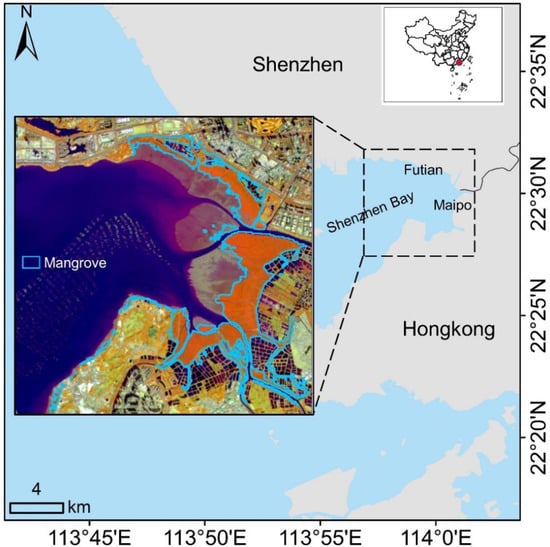
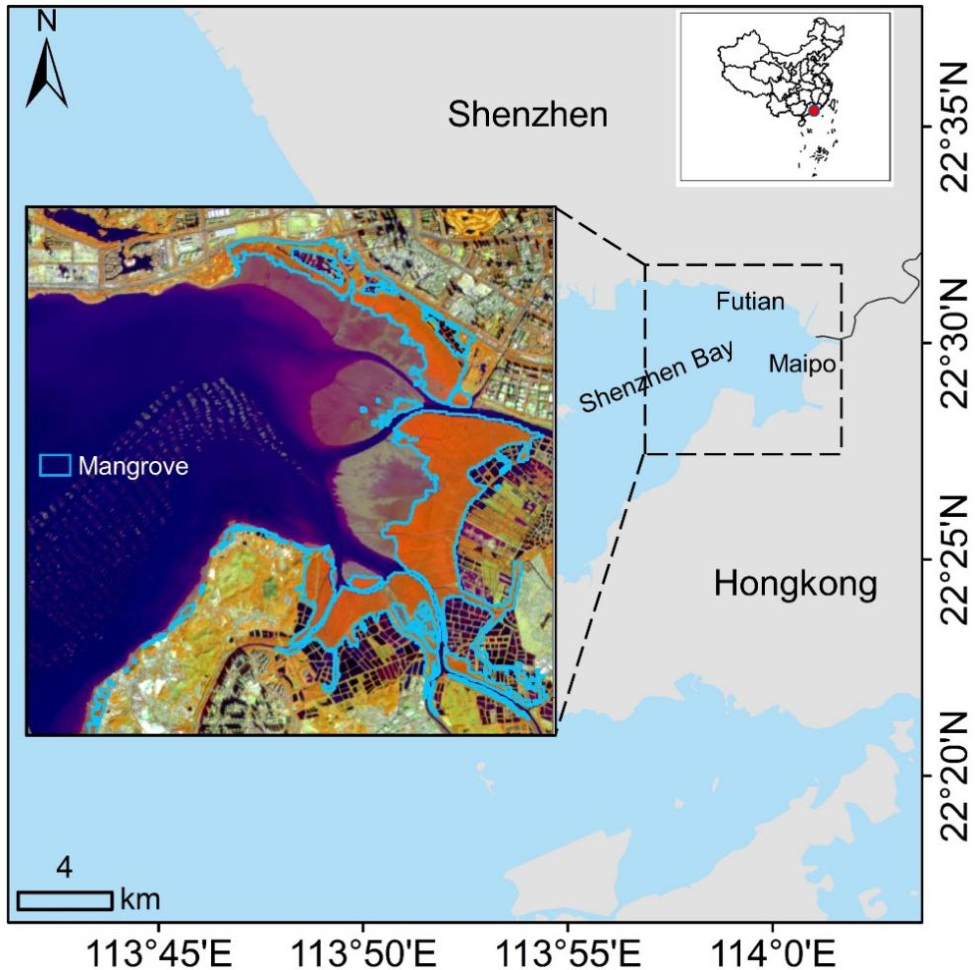
The study was conducted in the Shenzhen Bay mangrove ecosystem, located on the northern coast of the Lingdingyang estuary in the Pearl River Delta, South China (Figure 1). The region has a typical subtropical monsoon climate, with an average annual temperature of approximately 23.0 °C and annual precipitation ranging from 1700 to 1900 mm. Mangroves grow mainly in two nearby protected areas: the Shenzhen Futian National Nature Reserve on the mainland and the Mai Po Marshes Nature Reserve in Hong Kong.
Figure 1.
Map of the study area.
Shenzhen Bay has experienced severe human disturbance over the past few decades. Large coastal reclamation in 1997 resulted in substantial habitat loss and altered sediment patterns. River control and estuary engineering also changed freshwater input and water movement. In addition, management actions also changed the ecosystem. In 2018 and 2022, stands of the introduced species Sonneratia apetala were removed to help restore native biodiversity and habitat quality.
2.2. Data Sources
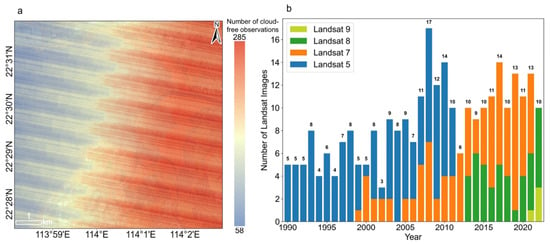
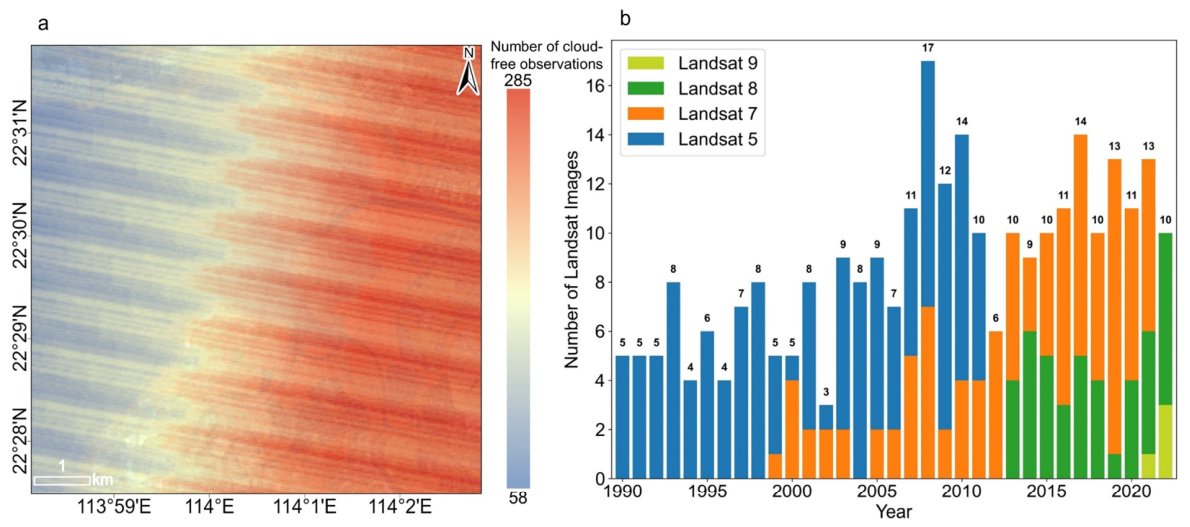
To reconstruct long-term mangrove dynamics, we integrated multiple remote sensing datasets within a consistent analytical framework. Annual Landsat imagery from the TM, ETM+, and OLI/TIRS sensors (1990–2022; Figure 2) was used to track changes in mangrove extent, vegetation greenness, and stand age. To capture finer-scale spectral and structural characteristics, we incorporated high-resolution Sentinel-2 multispectral imagery together with Sentinel-1 C-band Synthetic Aperture Radar (SAR) data (10 m; 2020), which supported species classification and canopy height estimation. In addition, Global Ecosystem Dynamics Investigation (GEDI) Level 2A LiDAR footprints (2019–2020) served as reference data for calibrating canopy height models.
Figure 2.
The number of cloud-free Landsat observations from 1990 to 2022 in Shenzhen Bay. (a) The spatial distribution of total cloud-free Landsat observations from 1990 to 2022, showing the number of valid observations per pixel available for assessment. (b) Number of Landsat images for each year.
2.3. Methods
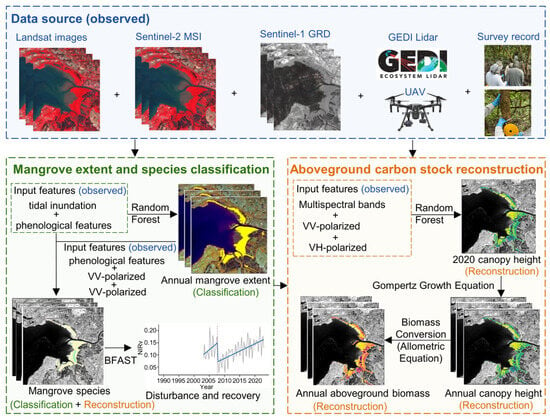
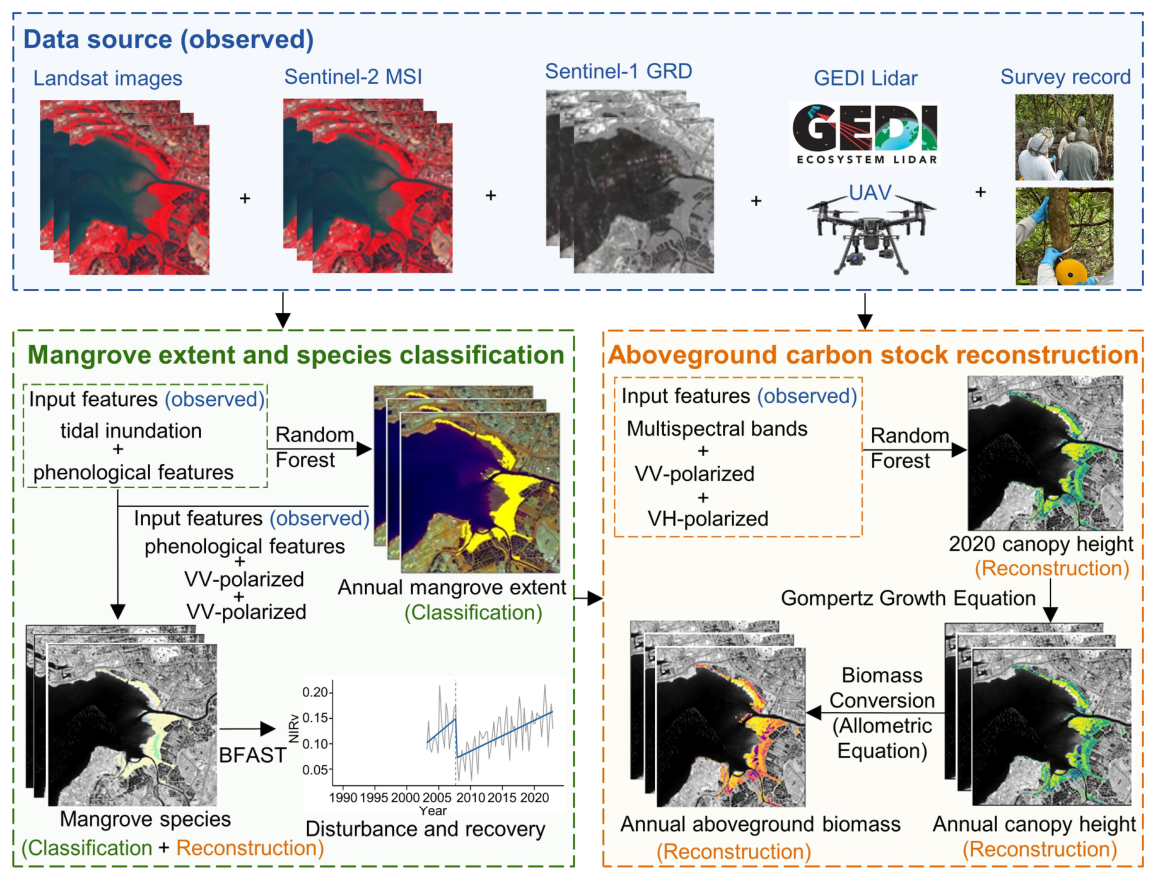
We developed an integrated framework linking species mapping, ecosystem function, and biomass reconstruction to quantify long-term aboveground carbon dynamics in Shenzhen Bay (Figure 3). First, mangrove species were mapped using Sentinel imagery and a Random Forest classifier. Second, annual canopy functioning was characterized using Landsat-derived NIRv time series, and abrupt changes were identified using BFAST. Third, annual mangrove extent maps were used to derive stand age, which was combined with species-specific Gompertz growth models to reconstruct canopy height trajectories. Reconstructed canopy height was then converted to aboveground biomass and carbon stock using an established allometric relationship.
Figure 3.
Methodological workflow of the study.
2.3.1. Long-Term Mangrove Extent Mapping
We mapped annual mangrove extent from 1990 to 2022 on Google Earth Engine using a supervised classification framework based on Landsat surface reflectance imagery. For each year, all available observations were composited into annual feature stacks, and each 30 m pixel was classified as either mangrove or non-mangrove. Mangrove training samples came from areas where existing mangrove datasets overlapped, such as Giri’s global mangrove map and Global Mangrove Watch version 3.0 [23,24]. Restricting training data to temporally stable pixels reduced label drift and improved interannual consistency. Non-mangrove samples were stratified across five stable subclasses: inland forest, cropland, open water, tidal flat, and impervious surface.
To capture the spectral and environmental characteristics of intertidal vegetation, we derived a suite of features from the annual Landsat archive, including the normalized difference vegetation index (NDVI), enhanced vegetation index (EVI), mangrove vegetation index (MVI), land surface water index (LSWI), and normalized difference water index (NDWI). We also summarized annual image composites using multiple quantiles (10th, 25th, 50th, 75th, and 90th percentiles), thereby retaining information on seasonal dynamics and fluctuations in water levels [25]. Classification was performed using a Random Forest model with 200 trees [26,27]. To reduce error propagation in long-term annual products [28], we further applied a temporal consistency filter based on spectral-angle trajectories of MVI. Stand age was subsequently reconstructed by tracking the first year of mangrove detection for each pixel.
2.3.2. Classification of Mangrove Species
We implemented a supervised classification framework using Sentinel-2 multispectral and Sentinel-1 Synthetic Aperture Radar (SAR) imagery to map mangrove species in 2020. Species identification was based on the idea that dominant mangrove taxa differ in canopy structure, tidal response, and seasonal physiological behavior, and that these differences can be detected by integrating optical and radar observations. In intertidal environments, tidal inundation can strongly influence background reflectance, making it harder to distinguish low-stature vegetation types [29]. This is particularly evident for species such as Avicennia marina, whose shorter canopies are more affected by water-level changes and sub-canopy reflectance during high tide. In contrast, taller species such as Sonneratia apetala tend to show more stable spectral signals because their crowns remain above the flooded surface. To capture these contrasting patterns, we included imagery collected under both high- and low-tide conditions in the classification workflow. Seasonal variation provided an additional source of ecological information. In subtropical China, mangrove species respond differently to winter cold stress, leading to measurable differences in canopy greenness and spectral behavior through the year [16]. We therefore assembled a multi-temporal Sentinel-2 dataset covering four seasonal windows to capture these phenological contrasts. Sentinel-1 SAR imagery was also incorporated because radar backscatter is sensitive to canopy height, vertical structure, and canopy volume, providing complementary structural information to optical reflectance data [30]. We trained a Random Forest classifier with 200 trees using 301 reference samples collected from field surveys, DJI Phantom 4 Pro UAV imagery, and historical vegetation maps [16,31] (Figure S1). The resulting 10 m species map provided the baseline distribution of four dominant taxa: Kandelia obovata, Avicennia marina, Aegiceras corniculatum, and Sonneratia apetala.
To extend species information beyond the 2020 baseline, we reconstructed annual species maps from 1990 to 2022 using a rule-based framework that combined backcasting and forward updating. This framework integrated the 2020 species map with annual mangrove extent maps, planting and removal records, species-specific habitat preferences, and ecologically realistic transition rules. For native mangroves that remained stable throughout the Landsat record, we inferred historical distributions from current composition and long-term habitat suitability. Sheltered inner estuaries and higher intertidal zones were mainly assigned to Kandelia obovata, whereas more seaward or saline-exposed areas were assigned to Avicennia marina or Aegiceras corniculatum. The introduced species Sonneratia apetala was only allowed to appear after its documented planting period. We inferred its later spread or decline from canopy development patterns and records of management removal. Direct year-to-year conversion among established native species was not allowed unless supported by evidence of habitat loss, restoration, or management intervention. Our method helped reduce unrealistic fluctuations between years and improved the ecological credibility of the reconstructed trajectories. The resulting annual species maps were then used for species-specific growth modeling and long-term analyses of aboveground carbon.
2.3.3. Long-Term NIRv Analysis
To assess long-term changes in canopy functioning, we calculated annual near-infrared vegetation reflectance (NIRv) from Landsat imagery. NIRv has been shown to correlate strongly with canopy photosynthetic activity and gross primary productivity (GPP) [32,33]. Compared with conventional vegetation indices, NIRv is less sensitive to background effects and therefore provides a useful proxy for vegetation functioning in intertidal environments. The index is defined as:
where and represent the surface reflectance in the near-infrared and red bands, respectively.
Temporal changes in NIRv were analyzed using the Breaks for Additive Season and Trend (BFAST) algorithm, which decomposes time series into trend, seasonal, and residual components while identifying abrupt structural changes. Breakpoints were used to detect disturbance events and evaluate post-disturbance recovery trajectories, which have been widely used in ecological studies [34,35,36]. The analysis was based on quarterly NIRv observations (frequency = 4) spanning 1990–2022. Seasonal variation was represented using a dummy seasonal model (season = “dummy”), while the minimum segment size was constrained by setting hfrac = 0.1, requiring each segment to contain at least 10% of the total observations. Structural changes were identified using a breakpoint significance threshold of 0.05. All analyses were performed on the raw NIRv time series without prior smoothing.
2.3.4. Canopy Height Modeling
Baseline canopy height for 2020 was estimated at 10 m resolution by integrating GEDI LiDAR footprints with Sentinel-1 SAR and Sentinel-2 optical imagery. High-quality training and validation samples were derived from GEDI Level 2A footprint data (version 2) acquired over Shenzhen Bay spanning from 2019 to 2020. GEDI observations capture the vertical distribution of canopy structure [37,38,39]. We used the 95th percentile of waveform energy return height relative to the ground (RH95) as a proxy for canopy top height, as RH95 has been widely adopted for canopy height estimation and has demonstrated strong agreement with independent canopy height measurements [40]. To ensure data quality, only GEDI observations acquired in power-beam mode, during nighttime conditions, and with beam sensitivity ≥0.9 were retained, following previous studies aimed at minimizing uncertainties associated with weak laser returns and solar background noise [41]. After quality filtering, a total of 1234 GEDI footprints were retained for model development and validation.
Predictor variables for the canopy height inversion were derived from Sentinel-1 and Sentinel-2 observations, enabling the characterization of both structural and spectral properties of mangrove canopies. For Sentinel-1, we produced multi-tidal composites from C-band SAR data (VV and VH polarization) to account for the influence of water levels on radar backscatter. Observations collected under high- and low-tide conditions were separated and averaged, thereby better representing canopy–substrate interactions and increasing sensitivity to height differences across the intertidal zone. For Sentinel-2, an annual median multispectral composite was generated in Google Earth Engine for 2020 to provide a stable spectral representation of mangrove vegetation.
A Random Forest model was then developed to relate GEDI-derived canopy heights (RH95) to the fused Sentinel-1 and Sentinel-2 predictor variables. The dataset was randomly partitioned into training (70%) and validation (30%) subsets. Model performance was evaluated using independent validation samples and yielded an R2 of 0.78, a root mean square error (RMSE) of 1.19 m, and a mean absolute error (MAE) of 0.79 m (Figure S2), indicating good agreement between GEDI-observed and model-predicted canopy heights. The resulting 10 m canopy height product provided a spatially continuous structural baseline for reconstructing annual mangrove biomass and aboveground carbon dynamics from 1990 to 2022.
2.3.5. Long-Term Reconstruction of Aboveground Biomass and Carbon
We reconstructed long-term aboveground carbon dynamics by linking stand age, species identity, canopy growth, and biomass accumulation. For each mangrove pixel, stand age was derived from annual mangrove extent maps. Pixels already present in 1990 were assigned an initial stand age of 10 years in the main analysis, whereas newly established pixels were assigned an initial age of 1 year. Because the age structure of mangroves present before the beginning of the Landsat record is uncertain, we conducted a sensitivity analysis using alternative initial ages of 1, 5, 10, 15, and 20 years for all mangrove pixels existing in 1990 (Figure S3). Annual canopy height, aboveground biomass, and aboveground carbon stock were recalculated under each scenario to evaluate the influence of this assumption on the reconstructed long-term aboveground carbon dynamics. The sensitivity analysis showed that differences among initial-age scenarios were largest at the beginning of the reconstruction period but rapidly diminished over time, with all scenarios converging to similar aboveground carbon trajectories after the early 2000s (Figure S3).
Annual canopy height was estimated using species-specific Gompertz growth equation parameterized from published field observations [42,43,44]. We compiled and harmonized long-term height records for the dominant mangrove species in Shenzhen Bay and estimated species-specific growth coefficients from these empirical datasets [45,46] (Table S1). The resulting parameters were assigned annually according to the reconstructed species maps.
where represents canopy height at age , is the asymptotic maximum height representing the species’ potential growth ceiling under local environmental conditions; is a displacement parameter associated with the initial growth state at ; and is the growth rate coefficient that determines the intensity and steepness of the growth curve. The fitted models showed good agreement with the observed age–height relationships, with R2 values of 0.96, 0.86, 0.89, and 0.96, RMSE values of 0.53, 0.34, 0.21, and 0.19 m, and MAE values of 0.50, 0.30, 0.19, and 0.17 m for Sonneratia apetala, Kandelia obovata, Avicennia marina, and Aegiceras corniculatum, respectively. Furthermore, an independent validation against field-measured canopy heights demonstrated strong agreement between predicted and observed values (R2 = 0.91, RMSE = 0.93 m, and MAE = 0.70 m; Figure S4), providing confidence in the reliability of the canopy-height reconstruction and its subsequent application in aboveground biomass and carbon estimation.
To preserve observed spatial heterogeneity in forest structure, the 2020 canopy height model (CHM; Section 2.3.4) was used as a spatial constraint. Specifically, the relative spatial pattern of the CHM was used to calibrate pixel-level growth trajectories simulated by the Gompertz growth equation, ensuring that reconstructed heights were both temporally coherent and spatially realistic, generating annual canopy-height maps for 1990–2022.
Annual canopy height was converted to aboveground biomass using the Global Hmax power allometric equation proposed by Simard et al. [18]:
where AGB is aboveground biomass (Mg ha−1) and is canopy height (m). This model was developed using field observations from mangrove forests across multiple biogeographic regions worldwide and is applicable to global-scale mangrove biomass estimation [18]. Aboveground carbon stock was then calculated by multiplying AGB by a biomass-to-carbon conversion factor of 0.48.
2.3.6. Accuracy Assessment
The classification accuracy of the mangrove species map was evaluated using a stratified random sampling design. The number of validation samples per class was determined according to Stehman and Foody [47]:
where z = 1.96 for a 95% confidence interval, d is the half-width of the desired confidence interval (d = 0.025 in this study), and p is the anticipated overall accuracy. The resulting samples were then allocated equally among all classes.
The accuracy of the baseline species classification map (2020) was evaluated using 452 independent validation samples. Validation samples were selected independently from the training dataset, and no training sample was reused for accuracy assessment. Each validation point was interpreted and assigned to one of the four dominant mangrove species (Kandelia obovata, Avicennia marina, Aegiceras corniculatum, Sonneratia apetala) or Other using contemporaneous field survey records, UAV observations, and high-resolution Google Earth imagery to ensure temporal consistency with the 2020 classification imagery.
To further evaluate the reliability of the reconstructed annual species maps, independent accuracy assessments were conducted for five additional representative years (1990, 1997, 2015, 2018, and 2022), corresponding to major phases of mangrove expansion, species introduction, disturbance, restoration, and management intervention in Shenzhen Bay. Reference information for these historical assessments was compiled from multiple independent sources, including historical high-resolution Google Earth imagery, published mangrove species maps [31], and documented vegetation survey records. Confusion matrices were generated for each selected year, and classification performance was quantified using Overall Accuracy (OA), Producer’s Accuracy (PA), User’s Accuracy (UA), and the F1-score.
2.3.7. Uncertainty Analysis
The major sources of uncertainty associated with the aboveground carbon reconstruction include species classification, canopy-height estimation, species-specific growth modeling, and biomass-to-carbon conversion. To quantify how these uncertainties propagate through the reconstruction workflow, we implemented a Monte Carlo simulation framework that propagates errors from species classification, canopy height reconstruction, growth modeling, and biomass-to-carbon conversion. For each target year, spatially explicit raster layers of mangrove extent, species, canopy height, and canopy age were harmonized to generate a valid mangrove mask. Species classification uncertainty from 1990 to 2022 was incorporated using the species map’s confusion matrix at each time point: for each pixel, the original species label was probabilistically reassigned based on the normalized class-specific error probabilities. Species-specific canopy height growth was then reconstructed using Gompertz growth equation fitted from field observations for each dominant mangrove species. In each Monte Carlo iteration, Gompertz parameters were randomly sampled from their fitted multivariate normal distributions, thereby accounting for uncertainty in growth-curve parameterization. Canopy height uncertainty was introduced by perturbing the baseline height raster with normally distributed errors based on the validation RMSE of the GEDI-based Random Forest height inversion model, followed by application of a randomly sampled growth factor to represent interannual height development. The simulated species, age, and height layers were then combined to estimate pixel-level aboveground biomass using the allometric relationship between canopy height and biomass density. Biomass was converted to carbon stock using a randomly sampled carbon conversion factor, and pixel-level carbon stocks were summed over the valid mangrove area to obtain total annual aboveground carbon storage. The same procedure was repeated 1000 times, producing a distribution of annual aboveground carbon stock estimates. The mean and 2.5th–97.5th percentiles of the simulated distributions were reported as the annual aboveground carbon stock estimate and its associated 95% confidence interval. The Monte Carlo outputs were further used to quantify uncertainty in species-specific aboveground carbon stocks and in the relative contributions of habitat expansion and changes in aboveground carbon density to long-term aboveground carbon accumulation.
3. Results
3.1. Mangrove Expansion and Species Reassembly
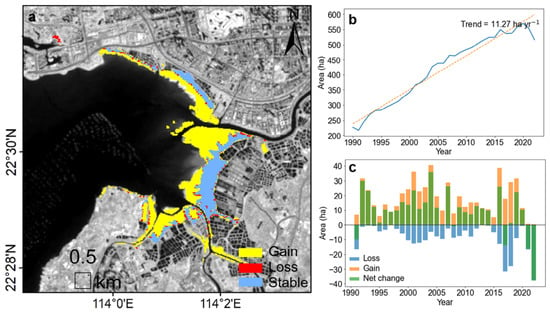
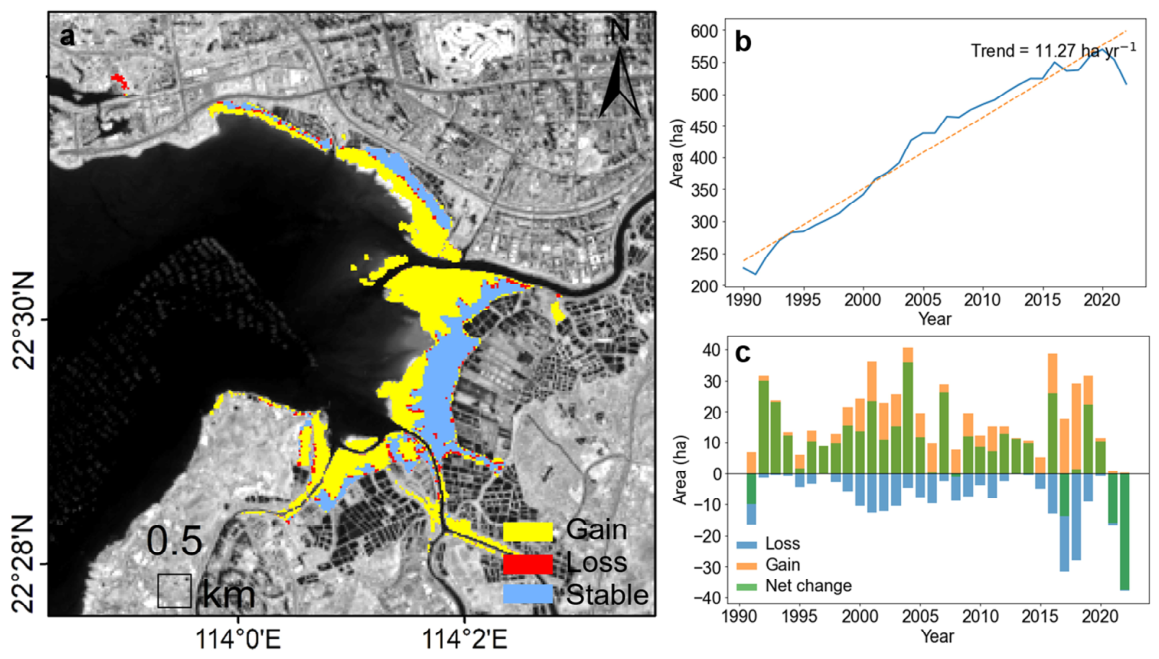
Mangrove area in Shenzhen Bay expanded markedly from 197 ha in 1990 to 483 ha in 2022, indicating substantial net habitat gain over the past three decades (Figure 4). This expansion was accompanied by pronounced community reassembly among the three dominant native species: Kandelia obovata, Avicennia marina, Aegiceras corniculatum, and the introduced Sonneratia apetala (Figure 4 and Figure 5). Overall accuracies exceeded 90%, while producer’s and user’s accuracies remained consistently high for all mangrove species, demonstrating the robustness of the species classification and providing a reliable basis for subsequent carbon stock estimation (Table 1 and Tables S2–S6).
Figure 4.
Spatiotemporal changes in mangroves of Shenzhen Bay from 1990 to 2022 at 30 m spatial resolution. Annual mangrove extent was classified from Landsat surface reflectance imagery using a Random Forest framework and temporal consistency filtering. (a) Spatial patterns of mangrove gain, loss, persistence, and transition from 1990 to 2022. (b) Temporal changes in mangrove area from 1990 to 2022, with long-term trends estimated using the Theil-Sen slope. (c) Annual mangrove gain, loss, and net change derived from the classified annual extent maps.
Figure 5.
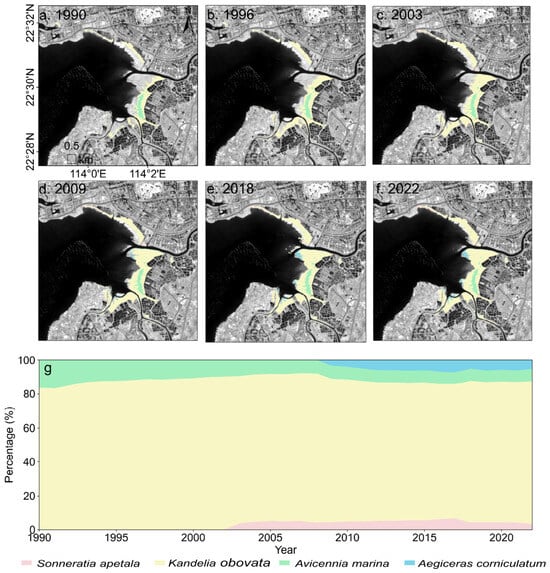
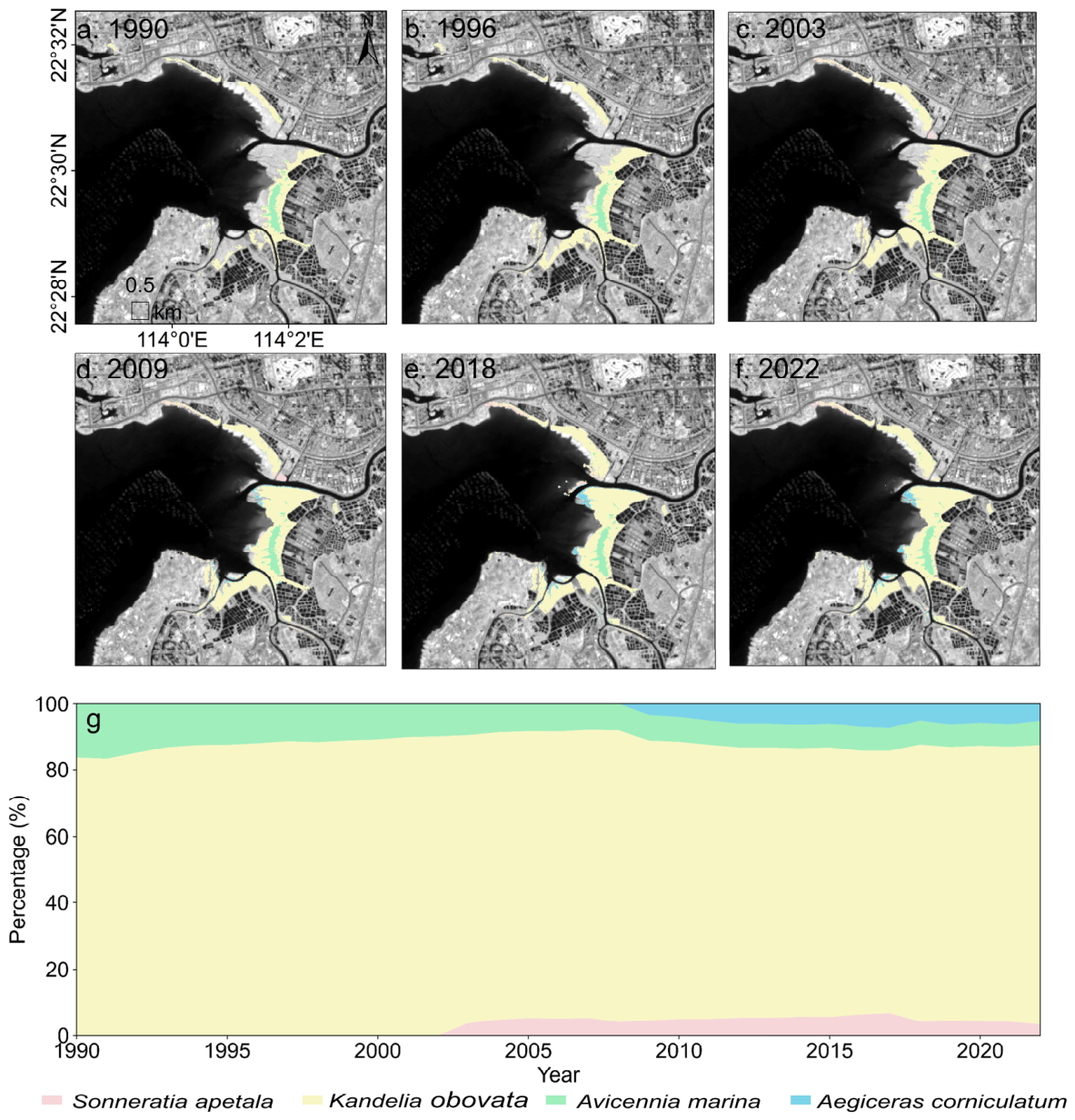
Mangrove species dynamics in Shenzhen Bay from 1990 to 2022 at 30 m spatial resolution. The 2020 species map was classified using Sentinel-1 SAR and Sentinel-2 multispectral imagery with a Random Forest classifier, while historical species distributions were reconstructed using annual mangrove extent maps, planting/removal records, habitat constraints, and transition rules. (a–f) Spatial distribution of mangrove species in representative years. (g) Annual relative proportion of area occupied by each species based on the reconstructed annual species maps.
Table 1.
Error matrix of the mangrove species map in 2020.
In the early 1990s, mangrove vegetation in Shenzhen Bay was dominated by two native species, Kandelia obovata and Avicennia marina (Figure 5a). Their subsequent trajectories diverged: Avicennia marina remained comparatively stable throughout the study period, with most stands concentrated in the Mai Po Nature Reserve. By contrast, Kandelia obovata expanded rapidly along newly accreted intertidal flats, particularly across the seaward margins of the estuary.
A major phase of community reorganization began after the introduction of Sonneratia apetala around 2000. The species became detectable in satellite imagery by 2003 and expanded rapidly thereafter. This trend was later reversed by management interventions, with removal beginning in 2018 and intensifying in 2022, leading to a marked contraction of Sonneratia apetala stands.
Throughout the study period, Kandelia obovata remained the ecological backbone of Shenzhen Bay, consistently accounting for more than 80% of the total mangrove area. In contrast, the proportional cover of Avicennia marina declined from 16.32% in 1990 to 7.36% in 2022. The introduced Sonneratia apetala expanded rapidly at first, reaching a peak of 6.74% in 2017, before falling back to 3.34% by 2022 (Figure 5g). Aegiceras corniculatum increased during the late 2000s and occupied 5.14% of the total mangrove area in 2022.
3.2. Species-Specific Functional Response to Disturbance
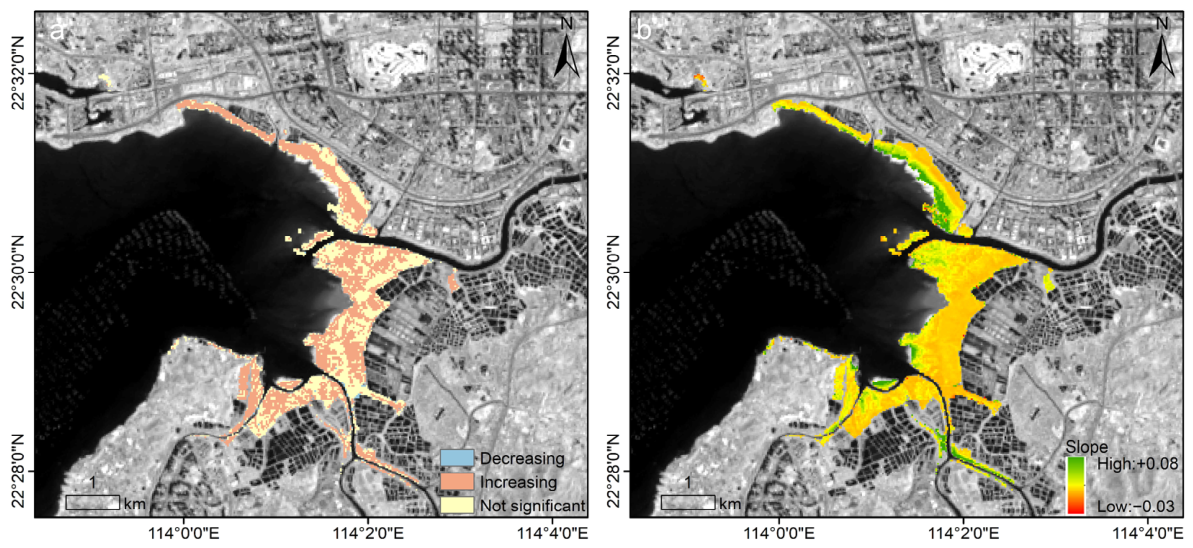
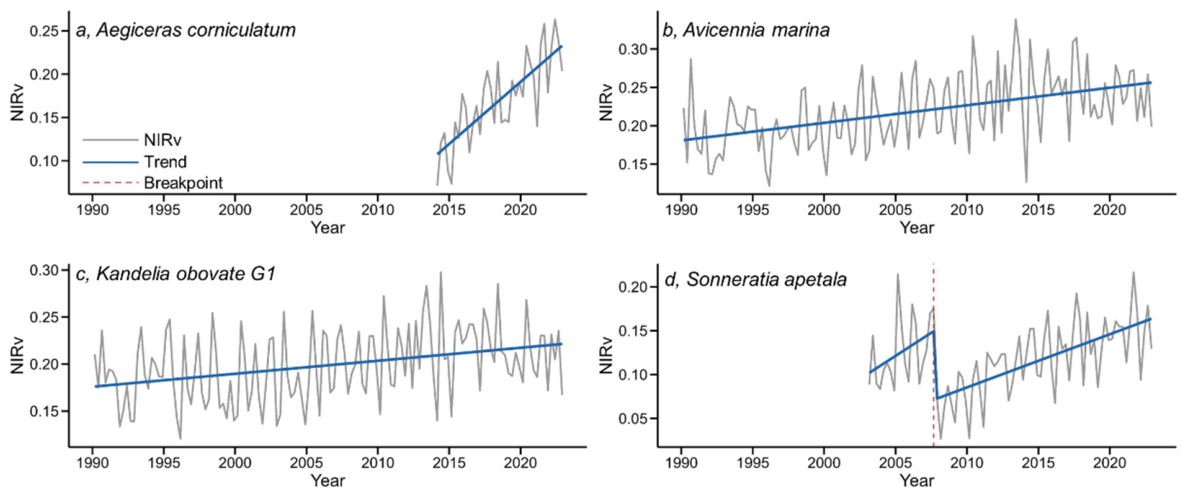
Long-term greening was evident across much of the Shenzhen Bay mangrove ecosystem. Pixel-wise Mann–Kendall analysis showed that 55% of pixels had a significant increase in NIRv (p < 0.05) (Figure 6), suggesting a broad increase in canopy greenness and photosynthetic functioning over the past three decades. However, this overall greening trend masked clear differences among species in their responses to disturbance (Figure 7). Native species, including Kandelia obovata and Avicennia marina, generally showed stable or gradually increasing NIRv trajectories, with low year-to-year variability and no clear structural breakpoints. In contrast, the introduced species Sonneratia apetala followed a much more dynamic trajectory marked by disturbance and recovery. After rapid greening during its expansion in the late 1990s, BFAST analysis detected a significant breakpoint around 2008 (Figure 7d). Following this shift, greenness declined by 42.86% and then recovered only slowly. It took about five years for NIRv to return to 95% of its pre-disturbance level. The prolonged recovery period and reduced post-disturbance growth rate indicate a stronger and more persistent response to the disturbance than observed for native species. These contrasting trajectories suggest that species composition can strongly influence ecosystem responses to climatic extremes.
Figure 6.
Pixel-level Mann–Kendall trend analysis of mangrove greenness. (a) Spatial distribution of Mann–Kendall trend categories for the NIRv time series, classified as significant increase, significant decrease, or no significant change (p < 0.05). (b) Spatial distribution of Sen’s slope, indicating the magnitude and direction of long-term greenness change.
Figure 7.
Long-term canopy greenness dynamics and BFAST breakpoint analysis from 1990 to 2022. NIRv values (30 m spatial resolution) were calculated from Landsat surface reflectance imagery and analyzed using the BFAST algorithm to identify trend changes and disturbance breakpoints. Species-specific trajectories were derived from the reconstructed annual species maps.
3.3. Long-Term Dynamics of Mangrove Aboveground Carbon Storage
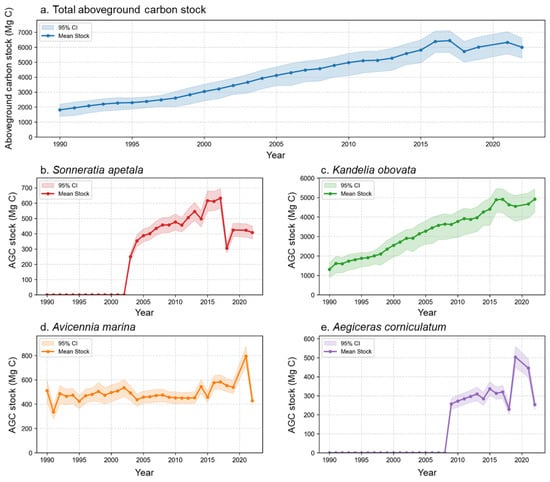
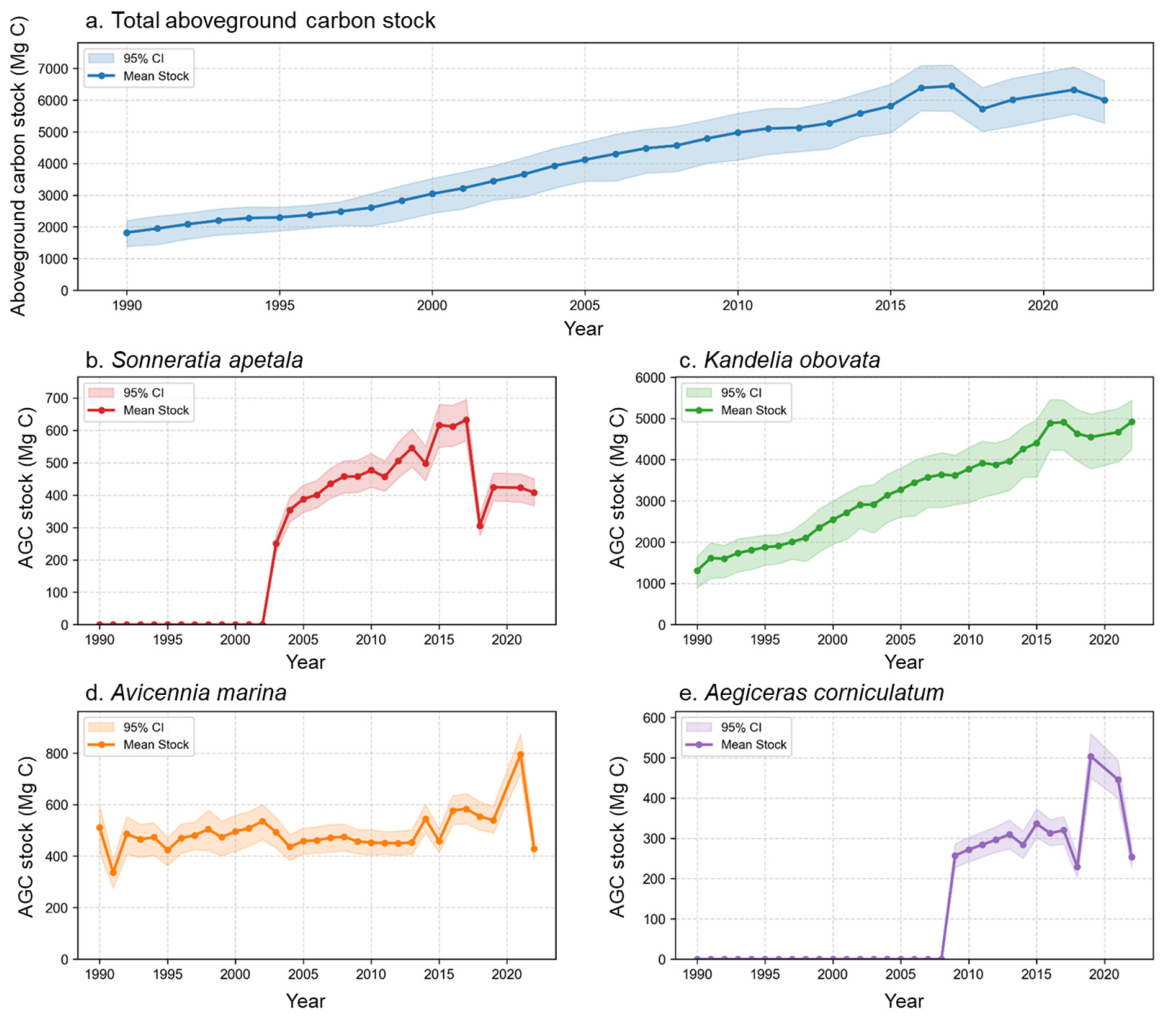
Species-informed reconstruction showed that aboveground carbon storage in Shenzhen Bay mangroves increased steadily from 1990 to 2022. Total aboveground carbon rose from 1820 (95% CI: 1386–2199) Mg C to 6006 (95% CI: 5280–6618) Mg C, representing a more than threefold rise over the study period. Decomposition analysis indicated that most of this gain (75%, 95% CI: 60–93%) came from habitat expansion, while increases in aboveground carbon density contributed the remaining 25% (95% CI: 7–40%).
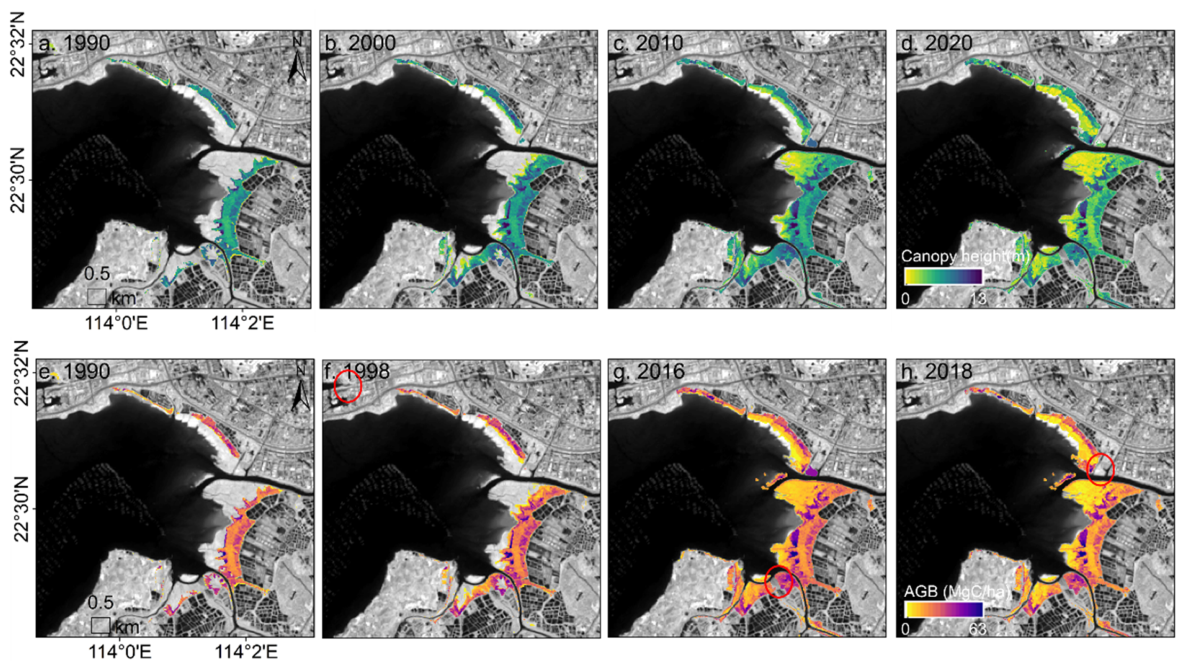
Despite the long-term upward trend, aboveground carbon dynamics were affected by disturbance events (Figure 8). Annual aboveground carbon change showed clear downturns during periods of land reclamation, estuarine engineering, and species removal (Figure 8). For example, reclamation along Binhai Avenue in 1997 reduced aboveground carbon stock in affected areas by approximately 29 (95% CI: 24–33) Mg C. The 2015 renovation of the Shan Pui River estuary caused a further loss of 49 (95% CI: 42–55) Mg C. These impacts were largely local, and continued growth in surrounding mangroves helped compensate for the damaged areas, allowing net aboveground carbon storage to keep rising at the ecosystem scale. The most pronounced short-term declines occurred in 2018 and 2022 (Figure 9a), when aboveground carbon stock decreased by approximately 726 (636–715) Mg C and 324 (286–430) Mg C, respectively.
Figure 8.
Long-term reconstructed aboveground carbon dynamics of mangroves in Shenzhen Bay from 1990 to 2022. Annual canopy height, aboveground biomass, and aboveground carbon stock were reconstructed at 30 m spatial resolution. (a–d) Spatial distribution of reconstructed canopy height in representative years. (e–h) Spatial distribution of reconstructed aboveground biomass, with red circles indicating major areas affected by anthropogenic disturbance.
Figure 9.
Spatiotemporal dynamics of mangrove aboveground carbon stocks in Shenzhen Bay (1990–2022). (a) Total aboveground carbon (AGC) stock for the entire study area; (b–e) Species-specific aboveground carbon stock trajectories for the exotic Sonneratia apetala and native species Kandelia obovata, Avicennia marina, and Aegiceras corniculatum. The solid lines and markers represent the mean aboveground carbon stock estimates derived from 1000 Monte Carlo simulations, while the shaded areas indicate the 95% confidence intervals (CIs), accounting for uncertainties in classification, canopy height modeling, and biomass-to-carbon conversion factors.
Native mangrove species maintained consistently important contributions to the ecosystem’s aboveground carbon pool throughout the study period (Figure 9). Among all species, Kandelia obovata remained the dominant aboveground carbon reservoir, with its aboveground carbon stock increasing from 1309 (95% CI: 898–1654) Mg C in 1990 to 4915 (95% CI: 4246–5439) Mg C in 2022 (Figure 9c). In contrast, Sonneratia apetala contributed little before its introduction but accumulated aboveground carbon rapidly following establishment, reaching a peak of 632 (95% CI: 568–695) Mg C in 2017 before declining after management-driven removal. Avicennia marina exhibited relatively stable yet variable aboveground carbon stocks over time, reaching a maximum of 794 (95% CI: 721–875) Mg C in 2021. Aegiceras corniculatum showed a pronounced increase after 2009 and reached its highest aboveground carbon stock of 897 (95% CI: 807–988) Mg C in 2020 (Figure 9d,e).
4. Discussion
4.1. Improved Mapping Reveals Long-Term Species and Aboveground Carbon Dynamics in Urban Mangroves
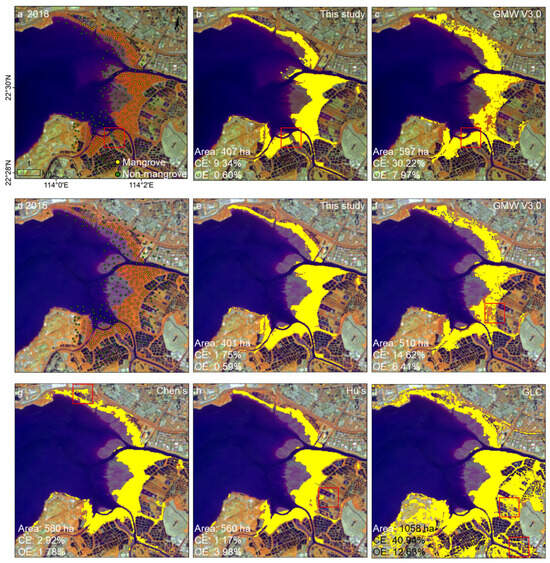
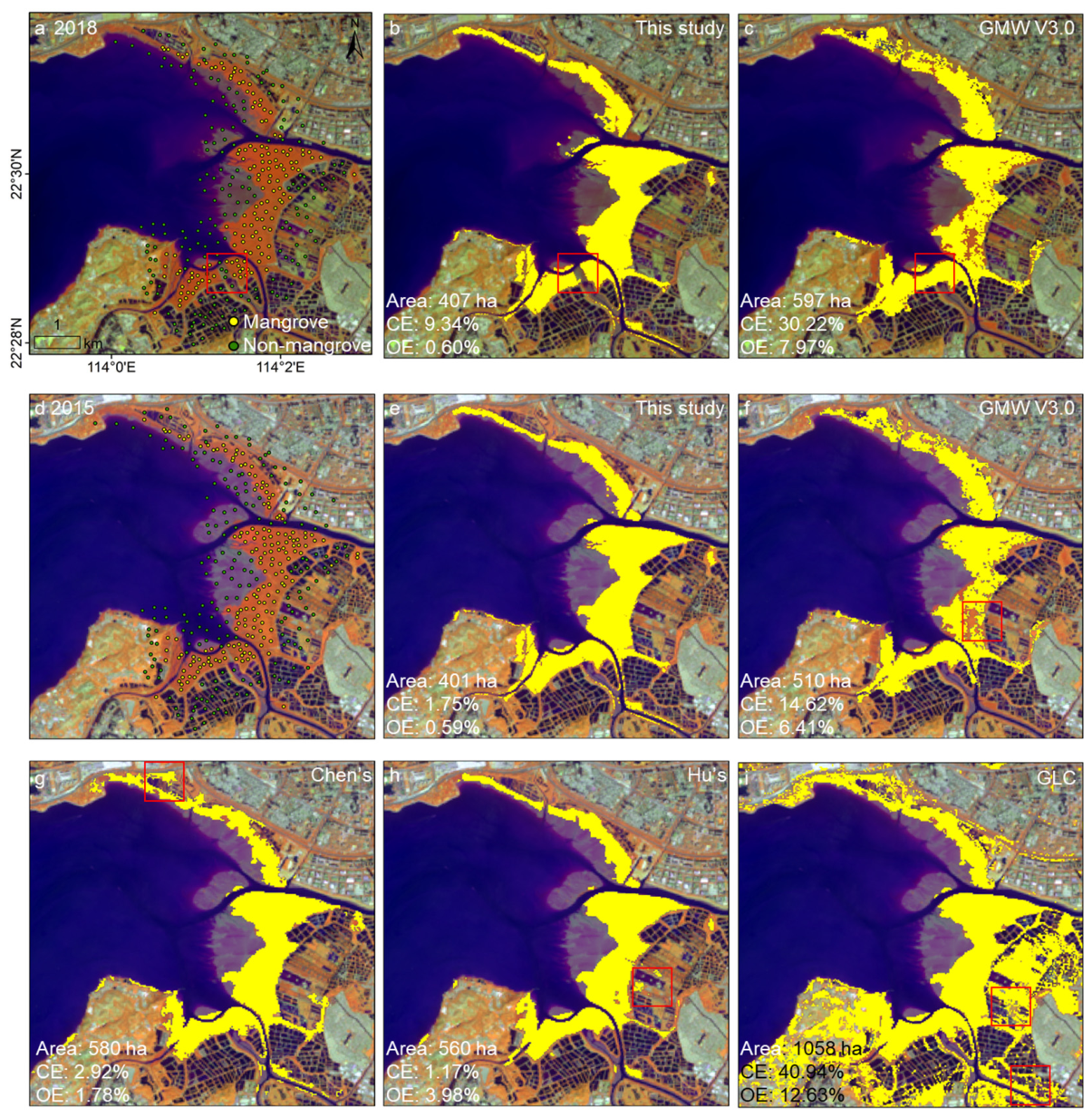
Compared with existing mangrove products, our framework substantially improved mapping accuracy and spatial detail in Shenzhen Bay, particularly in delineating narrow shoreline belts, fragmented patches, and rapidly changing mangrove boundaries (Figure 10). Relative to Global Mangrove Watch v3.0, our framework produced lower commission and omission errors in both 2015 and 2018. Regional studies reproduced the major expansion fronts but tended to overlook fragmented or newly established patches [48,49]. In contrast, the Global Land Cover product substantially overestimated mangrove extent and exhibited the highest classification errors, reflecting confusion between mangroves and adjacent coastal vegetation, mudflats, aquaculture ponds, and urban green spaces.
Figure 10.
Comparison with existing products. (a,d) Landsat false-color composite image (NIR, SWIR1, RED). Panels (b,e) show the mangrove maps produced in this study, while panels (c,f) are from Global Mangrove Watch (GMW). Panels (g–i) is from Chen’s [48], Hu’s [49], and global land cover (GLC) dataset. Yellow polygons in panels (b,c,e–i) are classification results of mangroves. Red boxes indicate areas with obvious classification differences among products.
Beyond mapping long-term changes in mangrove extent, this study extends previous work in several important ways by reconstructing annual species composition and linking species change to long-term aboveground carbon dynamics. A key advantage of our framework is the integration of multiple optical and SAR composites that capture both phenological and tidal variability. Rather than relying on a single image, we incorporated Sentinel-2 composites representing contrasting tidal conditions and seasonal periods. These composites captured differences in canopy greenness, inundation state, and background water conditions that are particularly important for species discrimination. In addition, Sentinel-1 SAR observations provided complementary structural information. Variations in VV and VH backscatter under different tidal conditions helped characterize canopy structure, vegetation volume, and canopy–substrate interactions, thereby improving the separability of species with contrasting growth forms and inundation responses. The integration of phenological, tidal, spectral, and structural information therefore enhanced species-level discrimination in the fragmented and highly urbanized estuarine landscape of Shenzhen Bay.
The framework further extends mangrove inventories by integrating species mapping with canopy-height, biomass, and aboveground carbon reconstruction. Independent structural evidence also supports the plausibility of the reconstructed canopy-height and carbon patterns. Field measurements from Shenzhen Bay reported clear interspecific differences in canopy stature, with average canopy heights of 6.57 m for Kandelia obovata, 5.18 m for Avicennia marina, and 3.36 m for Aegiceras corniculatum [50], consistent with the relative height rankings reconstructed in this study. Furthermore, the estimated aboveground carbon density (10–13 Mg C ha−1) falls within the reported range for mangroves in China, although near its lower bound, reflecting the relatively young age structure and fragmented nature of Shenzhen Bay mangroves compared with mature natural forests elsewhere [51,52].
By reconstructing annual species composition, canopy structure, and aboveground carbon storage over more than three decades, our framework moves beyond conventional snapshot-based mangrove inventories and reveals how species change shapes long-term carbon dynamics. Integrating multi-source satellite observations, field measurements, species-specific growth trajectories, and LiDAR-constrained structural information, the framework enables reconstruction of annual aboveground carbon trajectories in urban mangroves. This study provides a transferable approach for quantifying how ecological succession, species introductions, climatic disturbances, restoration activities, and management interventions jointly influence ecosystem aboveground carbon accumulation through time.
4.2. Disturbance Reshapes Urban Mangroves Through Climatic and Human Pathways
Our results suggest that natural disturbances and human activities influence urban mangroves in very different ways. Climatic extremes mainly caused short-term functional shocks, while human disturbances tended to leave longer-lasting changes in habitat structure, species composition, and aboveground carbon storage.
The 2008 extreme cold event provides a clear example of how episodic climate stress can affect mangrove ecosystems. We identified a pronounced breakpoint in the NIRv trajectory of Sonneratia apetala around 2008. Local meteorological observations from Shenzhen showed that the winter of 2008 experienced the strongest negative thermal anomaly and the longest duration of persistent low-temperature conditions during 1990–2022 after removing seasonal variability and long-term climatic trends (Figure S5). Independent field investigations conducted after the event further documented widespread mangrove damage across coastal South China, including canopy dieback, defoliation, and branch injury, with Sonneratia apetala exhibiting particularly high sensitivity to cold stress [53]. Similar responses have been observed in other climatic transition zones, such as Florida and the Gulf of Mexico, where rare cold events strongly regulate species performance and distribution limits [54,55]. Our results further indicate that the impacts of this cold event depended strongly on species composition. In Shenzhen Bay, the introduced Sonneratia apetala exhibited a much sharper decline in greenness and a longer recovery period than native species. This agrees with earlier field studies that found Sonneratia plantations to be especially vulnerable to freeze stress [56]. The close match between the remotely sensed trajectories and independent field observations highlights the value of remote sensing method for large-scale assessments of climate extremes in mangrove systems, where repeated field monitoring is often difficult and costly.
By contrast, anthropogenic disturbances produced more persistent structural consequences. Coastal reclamation in 1997 permanently removed mangrove habitat by replacing vegetated wetlands with urban surfaces, while hydrological engineering altered estuarine processes that shape seedling recruitment and vegetation development. Management interventions involving species introduction created an additional layer of complexity. Although the fast-growing introduced mangrove Sonneratia apetala can rapidly increase aboveground biomass during early restoration, monocultures often store less aboveground carbon in the long run than mature native forests. They may also increase methane emissions, alter nutrient cycling, and change contaminant dynamics in sediments [57,58]. In addition, Sonneratia apetala often lacks the structural diversity, habitat complexity, or food resources found in native mangrove communities, especially for macrobenthic organisms and other fauna that depend on diverse root systems and detritus-based food webs [59,60,61]. Consequently, the short-term decline in aboveground carbon storage associated with the removal of Sonneratia apetala should not be interpreted as evidence that the intervention was ecologically detrimental. The primary objective of these management actions was to restore native mangrove communities and enhance biodiversity conservation. Our analysis quantifies changes in aboveground carbon storage only and does not evaluate broader ecological outcomes, such as species diversity, habitat quality, or ecosystem resilience.
4.3. Divergent Management Paradigms Between Shenzhen and Hong Kong and Implications for Other Urban Mangroves
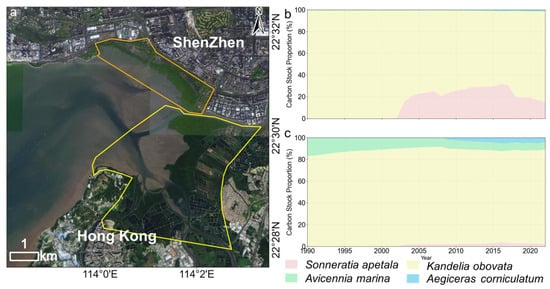
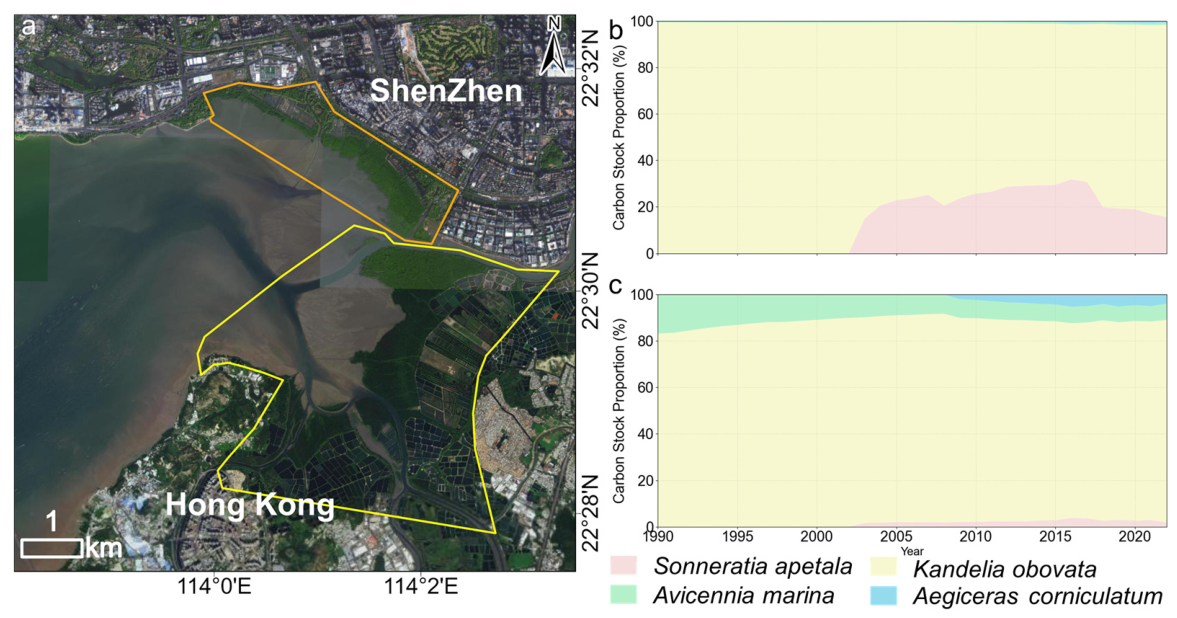
Shenzhen Bay offers a useful natural experiment for understanding how similar environmental conditions can lead to very different ecological outcomes under different governance priorities (Figure 11). Although Shenzhen and Hong Kong share the same estuarine system, their management goals have not always been the same. Over time, priorities have ranged from rapid vegetation establishment and carbon gains to biodiversity conservation and habitat complexity.
Figure 11.
Comparison between Shenzhen and Hong Kong. (a) Spatial distribution of protected areas in Shenzhen and Hong Kong. (b,c) Proportional aboveground carbon stocks of four species within the Futian Reserve in Shenzhen (b) and the Mai Po Reserve in Hong Kong (c).
In Shenzhen, early restoration efforts prioritized fast-growing exotic species, such as Sonneratia apetala, to rapidly stabilize coastlines and enhance urban green infrastructure. Such strategies can accelerate short-term canopy expansion and aboveground carbon accumulation, but they may also entail trade-offs with biodiversity conservation and long-term resilience to disturbance [62]. In contrast, management in the Mai Po-Inner Deep Bay region has placed greater emphasis on habitat diversity, wetland conservation, and migratory bird protection [63]. Mosaics of mangroves, mudflats, reedbeds, and managed wetlands have been maintained to support migratory birds and broader ecological interactions. This approach underscores the value of preserving ecosystem complexity and functional diversity within coastal wetlands.
These contrasting pathways reflect a broader tension between optimizing specific ecosystem services and conserving biodiversity. Recently, the establishment of the International Mangrove Center in Shenzhen has created a new platform for cross-boundary collaboration, with opportunities to combine Shenzhen’s blue-carbon initiatives with Hong Kong’s biodiversity-oriented management and to strengthen the long-term resilience of the Shenzhen Bay ecosystem.
More broadly, Shenzhen Bay reflects a common challenge faced by urban mangroves worldwide. In rapidly urbanizing coastal regions, mangroves are increasingly expected to deliver shoreline protection, biodiversity conservation, aboveground carbon sequestration, and recreational value simultaneously. Yet urban expansion, hydrological alteration, pollution, and climate extremes continue to threaten their long-term stability. Our findings suggest that resilient urban mangrove management must move beyond single-objective restoration. Integrating native biodiversity, hydrological connectivity, disturbance preparedness, and long-term aboveground carbon persistence will be essential for sustaining coastal ecosystem services under future climate and urbanization pressures.
The integrated framework developed in this study provides a scalable and transferable approach for assessing urban blue-carbon ecosystems worldwide. By quantifying aboveground carbon change, disturbance sensitivity, and recovery trajectories, this framework can support ecosystem monitoring, restoration assessment, and climate-adaptive management in rapidly urbanized coastal wetlands and estuarine systems. As cities increasingly incorporate nature-based solutions into climate adaptation strategies [64], reconciling aboveground carbon sequestration with biodiversity conservation, ecological resilience, and financeable climate benefits will become a central challenge for future coastal sustainability governance.
5. Conclusions
We developed an integrated framework that combines multi-source satellite observations, species reconstruction, canopy-function dynamics, and LiDAR-constrained biomass modeling to reconstruct annual species-specific aboveground carbon dynamics. This framework explicitly links long-term changes in species composition, canopy structure, and aboveground carbon accumulation over more than three decades. Applied to Shenzhen Bay, this study generated an annual, multi-decadal record of species composition and aboveground carbon storage for China’s only major urban mangrove ecosystem, providing a mechanistic understanding of how ecological succession, species introductions, climatic disturbances, and management interventions jointly shape carbon trajectories through time. Our results reveal substantial long-term aboveground carbon gains driven primarily by habitat expansion, and show that these trajectories were altered by reclamation, hydrological engineering, species introductions, and management interventions. Species composition strongly shaped ecosystem responses to disturbance: native mangroves remained comparatively stable under climatic disturbance, whereas the introduced Sonneratia apetala showed pronounced decline and delayed recovery following extreme cold. The framework and datasets developed here offer scalable tools for ecological monitoring, restoration planning, and adaptive governance of rapidly urbanizing coastlines worldwide.
Supplementary Materials
The following supporting information can be downloaded at: https://www.mdpi.com/article/10.3390/rs18122047/s1. References [45,46,65,66,67] are cited in the Supplementary Materials.
Author Contributions
Conceptualization, Q.Z., L.W. and Y.L.; methodology, Q.Z., L.W. and Y.L.; validation, L.W.; formal analysis, Q.Z. and L.W.; investigation, L.W.; writing—Q.Z.; writing—review and editing, Q.Z., L.W. and Y.L.; funding acquisition, Y.L. All authors have read and agreed to the published version of the manuscript.
Funding
This research was supported by the National Natural Science Foundation of China (NSFC) Grant (No. 42276232), MEL Internal Program (No. MELRI2501), and the Ph.D. Fellowship of the State Key Laboratory of Marine Environmental Science at Xiamen University.
Data Availability Statement
The raw data supporting the conclusions of this article will be made available by the authors on request due to site-specific management and security restrictions related to the study area, which is located in the military management zone.
Acknowledgments
The authors would like to thank all the anonymous reviewers and the editor for their constructive comments and suggestions on this manuscript.
Conflicts of Interest
The authors declare no conflicts of interest.
References
- Lovelock, C.E.; Reef, R. Variable impacts of climate change on blue carbon. One Earth 2020, 3, 195–211. [Google Scholar] [CrossRef] [Scilit]
- Alongi, D.M. Carbon cycling and storage in mangrove forests. Ann. Rev. Mar. Sci. 2014, 6, 195–219. [Google Scholar] [CrossRef] [Scilit] [PubMed]
- Wang, F.; Liu, J.; Qin, G.; Zhang, J.; Zhou, J.; Wu, J.; Zhang, L.; Thapa, P.; Sanders, C.J.; Santos, I.R.; et al. Coastal blue carbon in China as a nature-based solution toward carbon neutrality. Innovation 2023, 4, 100481. [Google Scholar] [CrossRef] [Scilit] [PubMed]
- Hamilton, S.E.; Friess, D.A. Global carbon stocks and potential emissions due to mangrove deforestation from 2000 to 2012. Nat. Clim. Change 2018, 8, 240–244. [Google Scholar] [CrossRef] [Scilit]
- Friess, D.A.; Rogers, K.; Lovelock, C.E.; Krauss, K.W.; Hamilton, S.E.; Lee, S.Y.; Lucas, R.; Primavera, J.; Rajkaran, A.; Shi, S. The state of the world’s mangrove forests: Past, present, and future. Annu. Rev. Environ. Resour. 2019, 44, 89–115. [Google Scholar] [CrossRef] [Scilit]
- Goldberg, L.; Lagomasino, D.; Thomas, N.; Fatoyinbo, T. Global declines in human-driven mangrove loss. Glob. Chang. Biol. 2020, 26, 5844–5855. [Google Scholar] [CrossRef] [Scilit] [PubMed]
- Liu, C.; Liu, D.; Li, P.; Li, X.; Liu, Z.; Zhao, Y. Assessment of occupation of natural habitat by urban expansion and its impact on crucial ecosystem services in China’s coastal zone. Ecol. Indic. 2023, 154, 110682. [Google Scholar] [CrossRef] [Scilit]
- Wei, S.; Zhang, H.; Xu, Z.; Lin, G.; Lin, Y.; Liang, X.; Ling, J.; Wee, A.K.S.; Lin, H.; Zhou, Y.; et al. Coastal urbanization may indirectly positively impact growth of mangrove forests. Commun. Earth Environ. 2024, 5, 608. [Google Scholar] [CrossRef] [Scilit]
- Osland, M.J.; Feher, L.C.; Griffith, K.T.; Cavanaugh, K.C.; Enwright, N.M.; Day, R.H.; Stagg, C.L.; Krauss, K.W.; Howard, R.J.; Grace, J.B.; et al. Climatic controls on the global distribution, abundance, and species richness of mangrove forests. Ecol. Monogr. 2017, 87, 341–359. [Google Scholar] [CrossRef] [Scilit]
- Taddeo, S.; Dronova, I.; Depsky, N. Spectral vegetation indices of wetland greenness: Responses to vegetation structure, composition, and spatial distribution. Remote Sens. Environ. 2019, 234, 111467. [Google Scholar] [CrossRef] [Scilit]
- Lu, Y.; Wang, L. How to automate timely large-scale mangrove mapping with remote sensing. Remote Sens. Environ. 2021, 264, 112584. [Google Scholar] [CrossRef] [Scilit]
- Lymburner, L.; Bunting, P.; Lucas, R.; Scarth, P.; Alam, I.; Phillips, C.; Ticehurst, C.; Held, A. Mapping the multi-decadal mangrove dynamics of the Australian coastline. Remote Sens. Environ. 2020, 238, 111185. [Google Scholar] [CrossRef] [Scilit]
- Wang, X.; Xiao, X.; Xu, X.; Zou, Z.; Chen, B.; Qin, Y.; Zhang, X.; Dong, J.; Liu, D.; Pan, L.; et al. Rebound in China’s coastal wetlands following conservation and restoration. Nat. Sustain. 2021, 4, 1076–1083. [Google Scholar] [CrossRef] [Scilit]
- Zhang, Z.; Xu, N.; Li, Y.F.; Li, Y. Sub-continental-scale mapping of tidal wetland composition for East Asia: A novel algorithm integrating satellite tide-level and phenological features. Remote Sens. Environ. 2022, 269, 112799. [Google Scholar] [CrossRef] [Scilit]
- Sun, J.; Jiang, W.; Ling, Z.; Fu, B.; Zhang, Z.; Xiao, Z.; Mu, X. Synergistic construction of an annual 2 m mangrove species dataset from 2016 to 2023 using structural features and hybrid stacked deep learning models—Beibu Gulf, Guangxi, China. ISPRS J. Photogramm. Remote Sens. 2025, 230, 754–778. [Google Scholar] [CrossRef] [Scilit]
- Zhao, C.; Jia, M.; Zhang, R.; Wang, Z.; Ren, C.; Mao, D.; Wang, Y. Mangrove species mapping in coastal China using synthesized Sentinel-2 high-separability images. Remote Sens. Environ. 2024, 307, 114151. [Google Scholar] [CrossRef] [Scilit]
- Zhen, J.; Mao, D.; Shen, Z.; Zhao, D.; Xu, Y.; Wang, J.; Jia, M.; Wang, Z.; Ren, C. Performance of XGBoost ensemble learning algorithm for mangrove species classification with multisource spaceborne remote sensing data. J. Remote Sens. 2024, 4, 0146. [Google Scholar] [CrossRef] [Scilit]
- Simard, M.; Fatoyinbo, L.; Smetanka, C.; Rivera-Monroy, V.H.; Castañeda-Moya, E.; Thomas, N.; Van der Stocken, T. Mangrove canopy height globally related to precipitation, temperature and cyclone frequency. Nat. Geosci. 2018, 12, 40–45. [Google Scholar] [CrossRef] [Scilit]
- Basyuni, M.; Mubaraq, A.; Amelia, R.; Wirasatriya, A.; Iryanthony, S.B.; Slamet, B.; Al Mustaniroh, S.S.; Pradisty, N.A.; Sidik, F.; Hanintyo, R.; et al. Mangrove aboveground biomass estimation using UAV imagery and a constructed height model in Budeng–Perancak, Bali, Indonesia. Ecol. Inform. 2025, 86, 103037. [Google Scholar] [CrossRef] [Scilit]
- Pham, L.T.H.; Brabyn, L. Monitoring mangrove biomass change in Vietnam using SPOT images and an object-based approach combined with machine learning algorithms. ISPRS J. Photogramm. Remote Sens. 2017, 128, 86–97. [Google Scholar] [CrossRef] [Scilit]
- Wicaksono, P.; Danoedoro, P.; Hartono Nehren, U. Mangrove biomass carbon stock mapping of the Karimunjawa Islands using multispectral remote sensing. Int. J. Remote Sens. 2016, 37, 26–52. [Google Scholar] [CrossRef] [Scilit]
- Zhu, Y.; Liu, K.; Liu, L.; Wang, S.; Liu, H. Retrieval of mangrove aboveground biomass at the individual species level with WorldView-2 images. Remote Sens. 2015, 7, 12192–12214. [Google Scholar] [CrossRef] [Scilit]
- Bunting, P.; Rosenqvist, A.; Hilarides, L.; Lucas, R.M.; Thomas, N.; Tadono, T.; Worthington, T.A.; Spalding, M.; Murray, N.J.; Rebelo, L.M. Global mangrove extent change 1996–2020: Global Mangrove Watch Version 3.0. Remote Sens. 2022, 14, 3657. [Google Scholar] [CrossRef] [Scilit]
- Giri, C.; Ochieng, E.; Tieszen, L.L.; Zhu, Z.; Singh, A.; Loveland, T.; Masek, J.; Duke, N. Status and distribution of mangrove forests of the world using earth observation satellite data. Glob. Ecol. Biogeogr. 2011, 20, 154–159. [Google Scholar]
- Zhang, Z.; Ahmed, M.R.; Zhang, Q.; Li, Y.; Li, Y.F. Monitoring of 35-year mangrove wetland change dynamics and agents in the Sundarbans using temporal consistency checking. Remote Sens. 2023, 15, 625. [Google Scholar] [CrossRef] [Scilit]
- Belgiu, M.; Drăgu, L. Random forest in remote sensing: A review of applications and future directions. ISPRS J. Photogramm. Remote Sens. 2016, 114, 24–31. [Google Scholar] [CrossRef] [Scilit]
- Valderrama-Landeros, L.; Flores-Verdugo, F.; Rodríguez-Sobreyra, R.; Kovacs, J.M.; Flores-de-Santiago, F. Extrapolating canopy phenology information using Sentinel-2 data and the Google Earth Engine platform to identify the optimal dates for remotely sensed image acquisition of semiarid mangroves. J. Environ. Manag. 2021, 279, 111617. [Google Scholar] [CrossRef] [Scilit] [PubMed]
- Zhu, Z. Change detection using landsat time series: A review of frequencies, preprocessing, algorithms, and applications. ISPRS J. Photogramm. Remote Sens. 2017, 130, 370–384. [Google Scholar] [CrossRef] [Scilit]
- Zhang, X.; Treitz, P.M.; Chen, D.; Quan, C.; Shi, L.; Li, X. Mapping mangrove forests using multi-tidal remotely-sensed data and a decision-tree-based procedure. Int. J. Appl. Earth Obs. Geoinf. 2017, 62, 201–214. [Google Scholar] [CrossRef] [Scilit]
- Lucas, R.; Van De Kerchove, R.; Otero, V.; Lagomasino, D.; Fatoyinbo, L.; Omar, H.; Satyanarayana, B.; Dahdouh-Guebas, F. Structural characterisation of mangrove forests achieved through combining multiple sources of remote sensing data. Remote Sens. Environ. 2020, 237, 111543. [Google Scholar] [CrossRef] [Scilit]
- Wang, T.; Zhang, H.; Lin, H.; Fang, C.; Giri, C.; Roy, P.S.; Thenkabail, P.S. Textural–spectral feature-based species classification of mangroves in Mai Po Nature Reserve from Worldview-3 Imagery. Remote Sens. 2015, 8, 24. [Google Scholar] [CrossRef] [Scilit]
- Badgley, G.; Field, C.B.; Berry, J.A. Canopy near-infrared reflectance and terrestrial photosynthesis. Sci. Adv. 2017, 3, e1602244. [Google Scholar] [CrossRef] [Scilit] [PubMed]
- Zhang, Z.; Luo, X.; Friess, D.A.; Wang, S.; Li, Y.; Li, Y. Stronger increases but greater variability in global mangrove productivity compared to that of adjacent terrestrial forests. Nat. Ecol. Evol. 2024, 8, 239–250. [Google Scholar] [CrossRef] [Scilit] [PubMed]
- Li, J.; Li, Z.L.; Wu, H.; You, N. Trend, seasonality, and abrupt change detection method for land surface temperature time-series analysis: Evaluation and improvement. Remote Sens. Environ. 2022, 280, 113222. [Google Scholar] [CrossRef] [Scilit]
- von Keyserlingk, J.; de Hoop, M.; Mayor, A.G.; Dekker, S.C.; Rietkerk, M.; Foerster, S. Resilience of vegetation to drought: Studying the effect of grazing in a Mediterranean rangeland using satellite time series. Remote Sens. Environ. 2021, 255, 112270. [Google Scholar] [CrossRef] [Scilit]
- You, C.; Chen, S.; Tu, Z.; Bian, C.; Cui, E.; Huang, K.; Wan, F.; Ping, J.; Wei, N.; Xia, J. Decadal trends in global grassland growth peaks and their drivers since the 1980s. Nat. Commun. 2025, 16, 9501. [Google Scholar] [CrossRef] [Scilit] [PubMed]
- de Conto, T.; Armston, J.; Dubayah, R. Characterizing the structural complexity of the Earth’s forests with spaceborne lidar. Nat. Commun. 2024, 15, 8116. [Google Scholar] [CrossRef] [Scilit] [PubMed]
- Feyen, J.; Wortel, V.; Calders, K.; Armston, J.; Vancoillie, F. Characterizing mangrove forest succession in Suriname using GEDI waveform metrics. Remote Sens. Environ. 2026, 334, 115244. [Google Scholar] [CrossRef] [Scilit]
- Lang, N.; Jetz, W.; Schindler, K.; Wegner, J.D. A high-resolution canopy height model of the Earth. Nat. Ecol. Evol. 2023, 7, 1778–1789. [Google Scholar] [CrossRef] [Scilit] [PubMed]
- Chen, A.; Cheng, K.; Chen, Y.; Qi, Z.; Yang, H.; Ren, Y.; Yang, Z.; Chen, M.; Xu, J.; Zhang, Y.; et al. Validating recent global canopy height maps over China’s forests based on UAV lidar data. Remote Sens. Environ. 2025, 329, 114957. [Google Scholar] [CrossRef] [Scilit]
- Potapov, P.; Li, X.; Hernandez-Serna, A.; Tyukavina, A.; Hansen, M.C.; Kommareddy, A.; Pickens, A.; Turubanova, S.; Tang, H.; Silva, C.; et al. Mapping global forest canopy height through integration of GEDI and Landsat data. Remote Sens. Environ. 2021, 253, 112165. [Google Scholar] [CrossRef] [Scilit]
- Asilo, H.A.M.; Yap-Dejeto, L.G. Understanding blue carbon management strategies: Quantitative assessment of blue carbon stock among three mangrove stands in Eastern Visayas, Philippines, W. Pacific Border. Carbon Res. 2025, 414, 63. [Google Scholar]
- Jiang, Y.; Zhang, Z.; Friess, D.A.; Li, Y.; Zhang, Z.; Xin, R.; Li, J.; Zhang, Q.; Li, Y. Restoring mangroves lost by aquaculture offers large blue carbon benefits. One Earth 2025, 8, 101149. [Google Scholar] [CrossRef] [Scilit]
- Rovai, A.S.; Twilley, R.R.; Castañeda-Moya, E.; Midway, S.R.; Friess, D.A.; Trettin, C.C.; Bukoski, J.J.; Stovall, A.E.L.; Pagliosa, P.R.; Fonseca, A.L.; et al. Macroecological patterns of forest structure and allometric scaling in mangrove forests. Glob. Ecol. Biogeogr. 2021, 30, 1000–1013. [Google Scholar] [CrossRef] [Scilit]
- Ren, H.; Chen, H.; Li, Z.A.; Han, W. Biomass accumulation and carbon storage of four different aged Sonneratia apetala plantations in Southern China. Plant Soil 2009, 327, 279–291. [Google Scholar] [CrossRef] [Scilit]
- Zheng, J.; Sun, L.; Zhong, L.; Yuan, Y.; Wang, X.; Wu, Y.; Lu, C.; Xue, S.; Song, Y. Allometric growth and carbon sequestration of Young Kandelia obovata plantations in a constructed urban coastal wetland in Haicang Bay, Southeast China. Forests 2025, 16, 1126. [Google Scholar] [CrossRef] [Scilit]
- Stehman, S.V.; Foody, G.M. Key issues in rigorous accuracy assessment of land cover products. Remote Sens. Environ. 2019, 231, 111199. [Google Scholar] [CrossRef] [Scilit]
- Chen, B.; Xiao, X.; Li, X.; Pan, L.; Doughty, R.; Ma, J.; Dong, J.; Qin, Y.; Zhao, B.; Wu, Z.; et al. A mangrove forest map of China in 2015: Analysis of time series Landsat 7/8 and Sentinel-1A imagery in Google Earth Engine cloud computing platform. ISPRS J. Photogramm. Remote Sens. 2017, 131, 104–120. [Google Scholar] [CrossRef] [Scilit]
- Hu, L.; Li, W.; Xu, B. Monitoring mangrove forest change in China from 1990 to 2015 using Landsat-derived spectral-temporal variability metrics. Int. J. Appl. Earth Obs. Geoinf. 2018, 73, 88–98. [Google Scholar] [CrossRef] [Scilit]
- Li, Q.; Wong, F.K.K.; Fung, T. Classification of mangrove species using combined WordView-3 and LiDAR Data in Mai Po Nature Reserve, Hong Kong. Remote Sens. 2019, 11, 2114. [Google Scholar] [CrossRef] [Scilit]
- Maung, W.S.; Tsuyuki, S.; Hiroshima, T.; Htay, S.S. Assessing above ground biomass of Wunbaik Mangrove Forest in Myanmar using machine learning and remote sensing data. Discov. Conserv. 2025, 2, 8. [Google Scholar] [CrossRef] [Scilit]
- Meng, Y.; Bai, J.; Gou, R.; Cui, X.; Feng, J.; Dai, Z.; Diao, X.; Zhu, X.; Lin, G. Relationships between above- and below-ground carbon stocks in mangrove forests facilitate better estimation of total mangrove blue carbon. Carbon Balanc. Manag. 2021, 16, 8. [Google Scholar] [CrossRef] [Scilit] [PubMed]
- Liu, K.; Liu, L.; Liu, H.; Li, X.; Wang, S. Exploring the effects of biophysical parameters on the spatial pattern of rare cold damage to mangrove forests. Remote Sens. Environ. 2014, 150, 20–33. [Google Scholar] [CrossRef] [Scilit]
- Cavanaugh, K.C.; Kellner, J.R.; Forde, A.J.; Gruner, D.S.; Parker, J.D.; Rodriguez, W.; Feller, I.C. Poleward expansion of mangroves is a threshold response to decreased frequency of extreme cold events. Proc. Natl. Acad. Sci. USA 2014, 111, 723–727. [Google Scholar] [CrossRef] [Scilit] [PubMed]
- Kang, Y.; Kaplan, D.A.; Osland, M.J. Mangrove freeze resistance and resilience across a tropical-temperate transitional zone. J. Ecol. 2025, 113, 94–111. [Google Scholar]
- Chen, L.Z.; Wang, W.Q.; Zhang, Y.H.; Huang, L.; Zhao, C.L.; Yang, S.C.; Yang, Z.W.; Chen, Y.C.; Xu, H.L.; Zhong, C.R.; et al. Damage to mangroves from extreme cold in early 2008 in southern China. Chin. J. Plant Ecol. 2010, 34, 186–194. [Google Scholar]
- Ren, J.; Chen, J.; Xu, C.L.; van de Koppel, J.; Thomsen, M.S.; Qiu, S.; Cheng, F.; Song, W.; Liu, Q.X.; Xu Chi Bai, J.; et al. An invasive species erodes the performance of coastal wetland protected areas. Sci. Adv. 2021, 7, eabi8943. [Google Scholar] [CrossRef] [Scilit] [PubMed]
- Yu, X.; Yang, X.; Wu, Y.; Peng, Y.; Yang, T.; Xiao, F.; Zhong, Q.; Xu, K.; Shu, L.; He, Q.; et al. Sonneratia apetala introduction alters methane cycling microbial communities and increases methane emissions in mangrove ecosystems. Soil Biol. Biochem. 2020, 144, 107775. [Google Scholar] [CrossRef] [Scilit]
- He, Z.; Peng, Y.; Guan, D.; Hu, Z.; Chen, Y.; Lee, S.Y. Appearance can be deceptive: Shrubby native mangrove species contributes more to soil carbon sequestration than fast-growing exotic species. Plant Soil. 2018, 432, 425–436. [Google Scholar] [CrossRef] [Scilit]
- Miao, S.Y.; Long, L.D.; Tao, W.Q.; Zeng, Q.C.; Chen, J.H.; Huang, J.L.; Wu, Q.H.; Tang, Y.J. Composition of stable carbon and nitrogen isotopes in five wetland plants and sediments from the Pearl River estuary, South China. Chem. Ecol. 2016, 32, 609–623. [Google Scholar] [CrossRef] [Scilit]
- Wang, Y.; Zhang, Z.; He, K.; Qin, Z.; Xie, L.; Liu, Y.; Lin, Y.; Wei, J.; Wang, F. Differed adaptive strategies to nutrient status between native and exotic mangrove species. Forests 2022, 13, 804. [Google Scholar] [CrossRef] [Scilit]
- Peng, D.; Zhou, H.; Pennings, S.C.; Zhang, Y. Trait–environment interactions mediate the encroachment of an exotic tree in coastal wetland transition zones. J. Plant Ecol. 2026, 19, rtaf179. [Google Scholar]
- WWF Hong Kong. Mai Po Nature Reserve Management Plan: 2024–2029. 2024. Available online: https://wwfhk.awsassets.panda.org/downloads/mpmp-2024-2029-external-version-june-7.pdf (accessed on 25 May 2026).
- Goodwin, S.; Olazabal, M.; Castro, A.J.; Pascual, U. Global mapping of urban nature-based solutions for climate change adaptation. Nat. Sustain. 2023, 6, 458–469. [Google Scholar] [CrossRef] [Scilit]
- AboEl-Nil, M.M. Growth and establishment of mangrove (Avicennia marina) on the coastlines of Kuwait. Wetl. Ecol. Manag. 2001, 9, 421–428. [Google Scholar] [CrossRef] [Scilit]
- Li, M.; Guan, W.; Jiang, Z.M.; Liao, B.W.; Chen, Y.J. Dynamics of plant community structure and soil properties in artificial mangrove areas of Nansha Wetland, Guangzhou. Wetl. Sci. 2023, 21, 716–722. (In Chinese) [Google Scholar]
- Chen, Y.J.; Liao, B.W.; Zheng, S.F.; Li, M.; Song, X.Y. Community dynamics and species diversity of artificial mangrove forests of Sonneratia apetala, Sonneratia caseolaris and Kandelia obovata. Chin. J. Appl. Ecol. 2004, 15, 924–928. (In Chinese) [Google Scholar] [CrossRef] [Scilit]

Disclaimer/Publisher’s Note: The statements, opinions and data contained in all publications are solely those of the individual author(s) and contributor(s) and not of MDPI and/or the editor(s). MDPI and/or the editor(s) disclaim responsibility for any injury to people or property resulting from any ideas, methods, instructions or products referred to in the content. |
© 2026 by the authors. Licensee MDPI, Basel, Switzerland. This article is an open access article distributed under the terms and conditions of the Creative Commons Attribution (CC BY) license.