


Highlights
What are the main findings?
- A 22-year Landsat-based assessment revealed that spectral recovery pathways characterized only 41.8% of mine-affected pixels, with the remaining area stabilizing as non-vegetated surfaces or persisting under active disturbance.
- Mean benchmark-relative spectral recovery (RSRI) in the vegetated-recovery group reached only 0.309, far below the local stable-vegetation reference, indicating that greening does not imply spectral convergence.
What are the implications of the main findings?
- Vegetation greenness trends alone overestimate spectral convergence toward stable reference conditions, highlighting the need for benchmark-relative metrics in post-mining rehabilitation assessment.
- The RSRI framework, requiring no pre-mining baseline data, offers a transferable complement to conventional greening indices for retrospective mine monitoring using open-access Landsat archives.
Abstract
Single-index greening trends can misrepresent post-mining recovery because they do not show whether disturbed surfaces are converging toward the spectral conditions of nearby stable vegetation. Here, we present a 22-year (2003–2024) Landsat-based assessment of the Nannihu molybdenum mine (Henan, China) by combining LandTrendr-based disturbance and recovery timing from annual NBR series with a benchmark-relative spectral recovery index (RSRI) and five-epoch random forest land-surface classification used as contextual support. The classifier was trained on 2024 samples and transferred to earlier epochs without independent validation at each epoch. Historical class labels should therefore be treated as approximate contextual support. A five-type recovery pathway typology showed that only 41.8% of mine-affected pixels followed vegetated recovery pathways, while 28.2% stabilized as non-vegetated surfaces and 25.0% remained under persistent disturbance. Even the combined vegetation recovery type had a mean RSRI of only 0.309 (SD = 0.143), suggesting that greening alone does not imply close benchmark-relative spectral proximity to the local stable-vegetation reference. Disturbance magnitude was the feature most strongly associated with RSRI variation (XGBoost SHAP mean, |SHAP| = 0.075). The RSRI quantifies benchmark-relative spectral proximity using local stable-vegetation benchmarks, and it does not measure species composition, biomass, or ecosystem function. This site-specific case study indicates that benchmark-relative spectral assessment can complement conventional greening metrics in retrospective mine monitoring using open-access Landsat archives, with field validation the natural next step toward linking these spectral findings to ecological or functional recovery.
1. Introduction
Mining activities represent one of the most intensive forms of land-surface disturbance globally, with open-pit operations altering topography, soil structure, hydrological regimes, and vegetation cover [1,2]. Post-mining vegetation recovery is critical for restoring ecosystem services, including carbon sequestration, erosion control, and biodiversity support [3,4]. However, the transition from bare excavated surfaces to more stable vegetated cover is often slow, nonlinear, and path-dependent, frequently spanning decades rather than years [5,6]. This timescale requires long-term (>10 years) monitoring frameworks capable of capturing the full recovery process, yet such assessments remain rare in the mine remote sensing literature [7].
Satellite remote sensing has become the primary tool for large-scale mine-recovery monitoring, with the Landsat archive (1984–present) providing the temporal depth essential for multi-decadal assessments [8,9]. Early mine remote sensing studies relied predominantly on single-image classification of land-cover types [10], while more recent work has adopted time-series approaches that track vegetation index trajectories over time [11,12]. The LandTrendr algorithm [13], originally developed for forest disturbance and recovery mapping, applies temporal segmentation to annual Landsat series to identify breakpoints associated with disturbance onset, disturbance magnitude, and subsequent recovery trends. Although LandTrendr has been extensively validated in forest ecosystems [14,15], its application to mine landscapes—characterized by abrupt, sustained surface removal rather than gradual canopy change—remains limited [16,17,18].
An unresolved limitation in current mine-recovery assessment is the frequent reliance on a single vegetation index, most commonly the Normalized Difference Vegetation Index (NDVI). While NDVI effectively captures photosynthetically active vegetation greenness, it is relatively insensitive to changes in non-photosynthetic vegetation, bare soil exposure, and surface moisture—all of which are relevant surface signals in mine landscapes undergoing structural surface transitions [19,20]. Existing studies therefore often infer recovery from increasing greenness alone. Yet in mine landscapes, greening may occur without spectral convergence toward stable-vegetation reference conditions. Post-mining surfaces can become greener while remaining spectrally distinct from nearby stable vegetation because of differences in substrate, surface moisture, or vegetation structure. The Normalized Burn Ratio (NBR), which incorporates the shortwave infrared band sensitive to soil and non-photosynthetic vegetation, has demonstrated superior sensitivity to mining-induced surface changes [21,22]. A benchmark-relative measure of spectral proximity addresses this limitation by quantifying how closely a recovering pixel approaches the spectral signature of local stable vegetation, yet it remains underexplored in mine rehabilitation studies [23,24].
A further limitation of existing mine-recovery studies is that they rarely examine three complementary aspects of recovery together: disturbance timing and magnitude, land-surface state transitions, and benchmark-relative spectral proximity to local stable-vegetation conditions. A more interpretable mine-recovery assessment would integrate disturbance history, approximate land-surface transitions as contextual information, and benchmark-relative spectral status. Most studies address only one or two of these aspects [25], leaving recovery pathways harder to interpret jointly. In addition, terrain attributes and interannual climate variability have received limited systematic attention as contextual factors in mine remote sensing studies [26].
To address these gaps, we conducted a 22-year (2003–2024) retrospective remote sensing assessment of the Nannihu molybdenum mine in Henan Province, China. The analysis examined how disturbance timing, land-surface state transitions, and benchmark-relative spectral proximity jointly describe long-term recovery patterns, what pathway types emerge from these patterns, and how terrain attributes and interannual climate variability are associated with observed recovery outcomes. Methodologically, the study uses an operationalized benchmark-relative spectral recovery index (RSRI) within a reproducible framework that combines LandTrendr temporal segmentation with contextual five-epoch land-surface classification. A site-specific recovery pathway typology summarizes the heterogeneous recovery trajectories observed across the mine landscape. Within this case study, the results indicate that increasing vegetation greenness does not necessarily correspond to high benchmark-relative spectral similarity to local stable-vegetation conditions. Throughout this paper, “recovery” refers to spectral behavior relative to the stable-vegetation reference unless it is explicitly qualified as ecological recovery.
2. Materials and Methods
2.1. Study Area and Data Sources
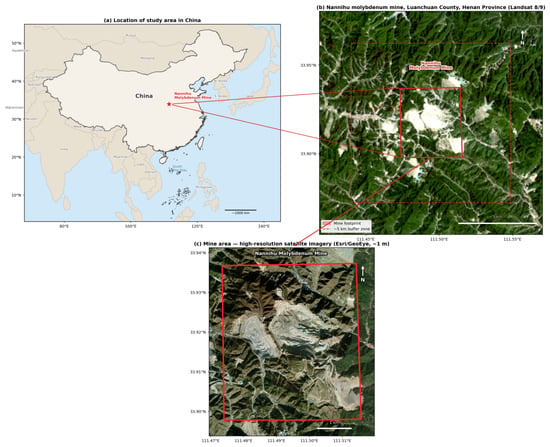
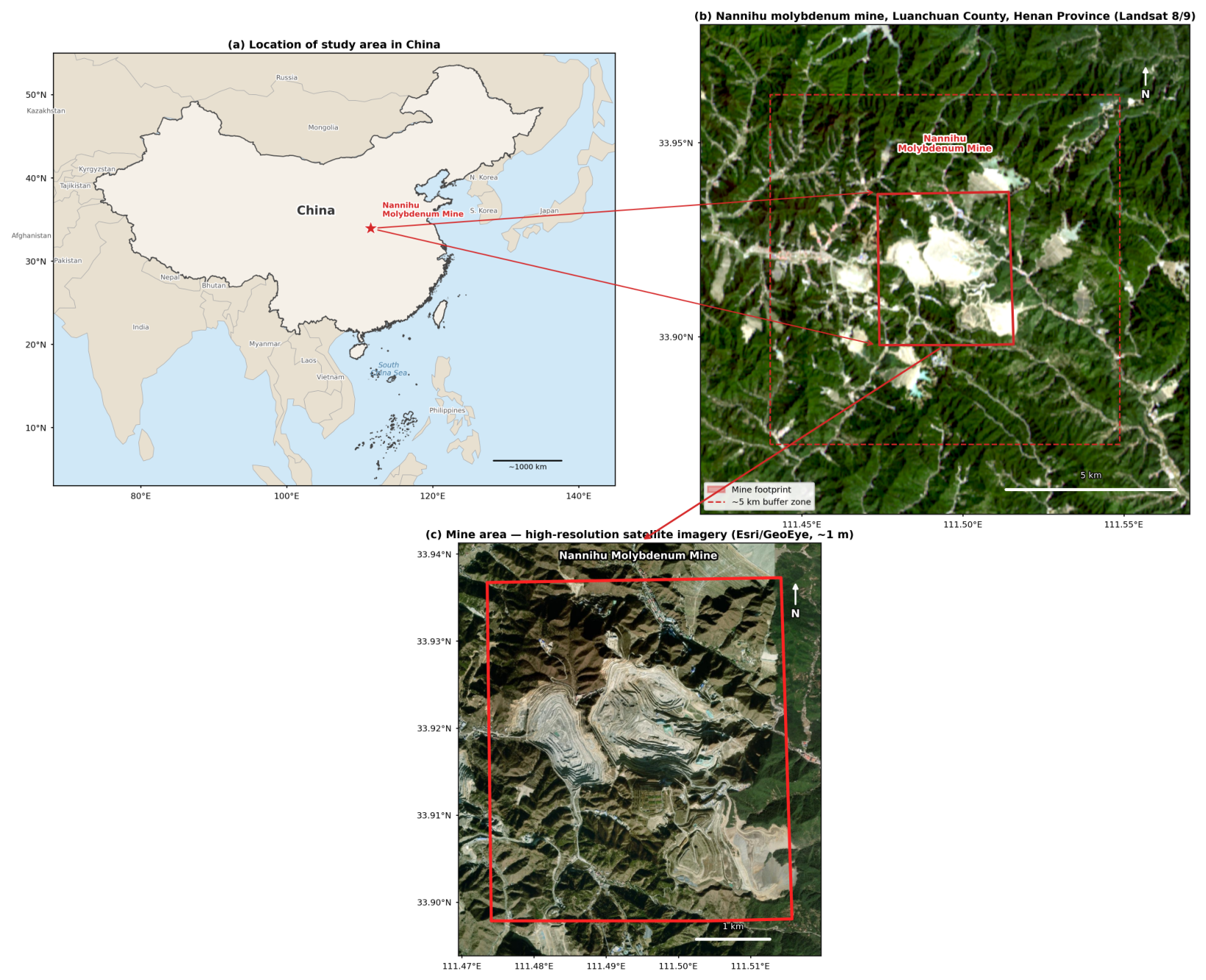
The Nannihu molybdenum mine (33.89°–33.94°N, 111.47°–111.52°E) is located in Luanchuan County, western Henan Province, China (Figure 1). The mine footprint covers approximately 3.98 km2, with active open-pit extraction operations since the 1970s and phased rehabilitation efforts targeting waste dumps and decommissioned pits. While the coordinates above delineate the core mine footprint, the analytical domain of the present study extends substantially beyond this boundary, encompassing a buffer extending approximately 5 km beyond the mine perimeter (Figure 1b). This expanded spatial extent was deliberately adopted to (1) characterize the cascading ecological effects of open-pit extraction on the surrounding montane vegetation, including disturbance gradients propagating beyond the immediate excavation boundary; and (2) provide a spatially extensive pool of undisturbed, spectrally stable reference pixels, required for normalization within the relative spectral recovery index (RSRI) framework. The region experiences a temperate continental monsoon climate, with a mean annual temperature of approximately 12 °C and mean annual precipitation of approximately 700 mm, concentrated in the summer growing season (May–September). The terrain is predominantly mountainous, with elevations ranging from approximately 800 to 2200 m above sea level.
Figure 1.
Study area map of the Nannihu molybdenum mine, Luanchuan County, Henan Province, China. (a) Regional location within China, with the mine marked by a star symbol; (b) Landsat true-color composite showing the mine footprint boundary (red outline) and the approximately 5 km buffer zone (dashed line) used for stable-vegetation reference pixel selection; (c) high-resolution satellite imagery (Esri WorldImagery, ∼1 m) of the mine area.
The satellite data used consisted of Landsat Collection 2 Level-2 surface reflectance products (Thematic Mapper, Enhanced Thematic Mapper Plus, and Operational Land Imager) for the period 2003–2024 at 30 m spatial resolution, acquired through the Google Earth Engine (GEE) platform [27,28]. Ancillary datasets included the Shuttle Radar Topography Mission (SRTM) 30 m digital elevation model, ERA5-Land monthly temperature reanalysis [29], and CHIRPS v2.0 daily precipitation estimates [30]. Growing season (May–September) potential evapotranspiration (PET) was computed from ERA5-Land temperature and radiation components using the Hargreaves method [31].
2.2. Data Preprocessing and Spectral Index Computation
Annual growing season median composites [32] were generated after applying CFMask-based cloud and cloud-shadow masking [33], retaining only pixels with at least three valid observations per growing season. Sensor harmonization between Landsat TM, ETM+, and OLI was performed using the Chastain et al. coefficients [34] to reduce inter-sensor systematic differences. Topographic correction was applied using the Sun-Canopy-Sensor + C (SCS+C) method [35] with the SRTM DEM to minimize illumination effects in mountainous terrain.
Six spectral indices were computed from the harmonized, topographically corrected composites: (1) Normalized Difference Vegetation Index (NDVI) [36], (2) Normalized Burn Ratio (NBR) [37], (3) Enhanced Vegetation Index (EVI) [38], (4) Soil-Adjusted Vegetation Index (SAVI) [39], (5) Normalized Difference Moisture Index (NDMI) [40], and (6) Bare Soil Index (BSI). The NBR served as the primary index for LandTrendr temporal segmentation, while the benchmark-relative recovery index (RSRI) uses NDVI relative to a local stable-vegetation target, and all six indices contributed to land-surface classification.
2.3. Integrated Analysis Framework
2.3.1. Disturbance and Recovery Timing via LandTrendr
LandTrendr temporal segmentation [13,41] was applied to the annual NBR time series (2003–2024) for all mine-footprint pixels. Key parameter settings included the following: maximum segments = 4, spike threshold = 0.9, vertex count overshoot = 3, recovery threshold = 0.25, best-model proportion = 0.75, and p-value threshold = 0.1 (Table 1). For each pixel, the algorithm identified the year and magnitude (ΔNBR) of the most significant disturbance and, where applicable, the post-disturbance NBR linear trend slope (proxy for recovery rate) and recovery duration (interval from disturbance breakpoint to onset of the post-disturbance recovery segment, in years). Representative trajectory fits were manually inspected for quality assurance (Table 2).
Table 1.
LandTrendr parameter settings and sensitivity analysis.
Table 2.
LandTrendr trajectory fit quality metrics (representative sample, n = 100 pixels).
2.3.2. Five-Epoch Land-Surface Classification (Contextual Support)
Random forest (RF) classification [42,43] was performed at five epochs (2003, 2008, 2013, 2018, 2024), using all six spectral indices plus three terrain variables (elevation, slope, aspect) as feature inputs. The primary reporting uses a coarse four-class scheme aggregated from an original six-class fine classification: (C1) Active/Bare Mining, (C2) Vegetated Surface (merging Vegetated Dump and Stable Vegetation), (C3) Water/Tailings, and (C4) Other Non-Forest. The original six-class fine scheme (Active Excavation, Vegetated Dump, Barren Dump/Stabilized, Stable Vegetation, Tailings/Water, Other Non-Forest), with honest F1-score reporting, is retained as an exploratory six-class breakdown only, with its summary accuracy reported in the footnote to Table 3. Training samples for the 2024 epoch (n = 150–200 per class) were selected via stratified random sampling and manually labeled using high-resolution Google Earth imagery. The classifier trained on 2024 data was then applied to all five epochs under the assumption that spectral–structural class signatures are temporally transferable. The 2024 epoch was chosen for training because it is the only epoch with co-temporal sub-meter reference imagery (Esri WorldImagery) supporting confident manual labeling. Assigning pixel-scale historical labels for 2003–2018 would itself require an unavailable high-resolution reference. Accordingly, the five-epoch classifications are used strictly as a qualitative illustration of land-surface context, and no quantitative inference (area change, transition rate, or recovery proportion) is drawn from the historical class labels or transition counts. To bound this uncertainty, we cross-checked the transferred 2018 classification against finer-resolution Sentinel-2 (10 m) imagery at 130 stratified points (broad-class agreement of 76.2%), and a five-epoch temporal-consistency filter flagged isolated single-epoch class flips in 16.7% of mine-pixel epochs (3–6% in the interior epochs 2008–2018). Comparable independent high-resolution imagery was not available for 2008.
Table 3.
Classification accuracy for the 2024 epoch (5-fold stratified cross-validation).
2.3.3. Relative Spectral Recovery Index (RSRI)
The RSRI quantifies pixel-level benchmark-relative spectral recovery as a gap-closure fraction that captures how far a pixel’s 2024 greenness has advanced from its post-disturbance minimum toward a local stable-vegetation reference:
where is the pixel’s minimum annual NDVI over 2003–2024 (its post-disturbance trough) and is the local stable-vegetation target, taken as the median multi-year mean NDVI of reference pixels computed within elevation–aspect strata to control for the topographic background. NBR is retained for LandTrendr disturbance detection, whereas the benchmark-relative recovery measure uses NDVI. RSRI values approaching 1 indicate spectral proximity to reference conditions, whereas values ≪ 1 indicate persistent divergence. RSRI measures benchmark-relative spectral proximity to the local stable-vegetation envelope, and it does not capture species composition, biomass, habitat quality, or ecosystem function. We benchmark this gap-closure scaling against simple percentile and z-score normalizations in Section 3.3, and report its sensitivity to the reference target and benchmark pixels in Table 4.
Table 4.
RSRI sensitivity to the choice of reference target and to benchmark-pixel selection.
2.3.4. Recovery Pathway Typology
K-means clustering () was applied to three pixel-level variables: (1) LandTrendr-detected disturbance year, (2) disturbance magnitude (ΔNBR), and (3) post-disturbance NBR linear trend slope. The choice of was guided by interpretability, capturing the major pathway shapes (closed recovery, partial recovery, stabilized non-vegetated surface, persistent disturbance, non-forest/water) without over-fragmenting the sample. This typology is presented as a heuristic descriptive tool rather than a uniquely optimal partition. The resulting five types were: type I (Closed Recovery), type II (Partial Recovery), type III (Stabilized Surface), type IV (Persistent Disturbance), and type V (Non-Forest/Water). Given the small sample size of type I (n = 55 pixels) and the substantive similarity of types I and II as vegetation-oriented spectral recovery pathways, these two types were merged into “Combined Vegetation Recovery” (n = 4493 pixels) for primary analysis. The full statistics of the five types are reported in Section 3.3.
2.3.5. Terrain and Climate Contextual Analyses
Pixel-level associations between RSRI and terrain attributes (elevation, slope, aspect–northness, and aspect–eastness) were quantified using Pearson correlation. As a supplementary check, the relative importance of these terrain variables for RSRI was additionally summarised with a random forest regressor [42]. Distance from each pixel centroid to the mine center was included as an additional spatial predictor in the XGBoost SHAP feature importance analysis [44,45,46] (full feature list in Table A1, Appendix A). These associations are reported as exploratory only. Because the RSRI reference target is computed within elevation–aspect strata, topographic background is already partly controlled in the index. Residual RSRI–terrain associations are therefore expected to be weak and are not interpreted as topographic controls. Interannual growing season (May–September) climate variables—precipitation, mean temperature, and potential evapotranspiration (PET)—were computed for the mine region and correlated (Pearson r) with annual mean NBR and BSI. The climate analysis was explicitly framed as contextual background to interpret interannual variability, and no causal attribution was attempted.
2.4. Three-Dimensional Integration Visualization
A three-dimensional scatter plot jointly visualizes three analytical dimensions: disturbance timing (X-axis, LandTrendr disturbance year), final land-surface state (color, 2024 epoch classification), and RSRI value (bubble size). This visualization reveals how recovery outcomes co-vary with when disturbance occurred and what surface class resulted, providing an integrative perspective that no single dimension captures.
3. Results
3.1. Long-Term Spectral Trajectories and Disturbance Timing
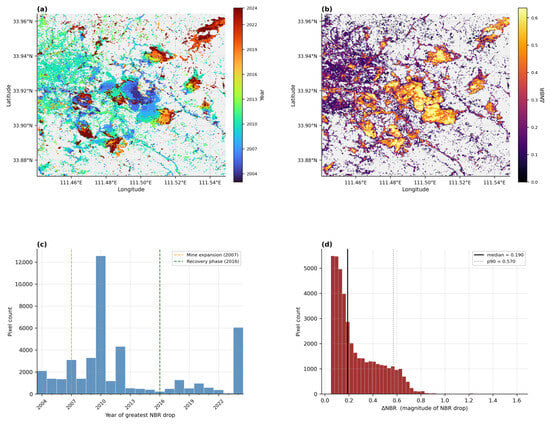
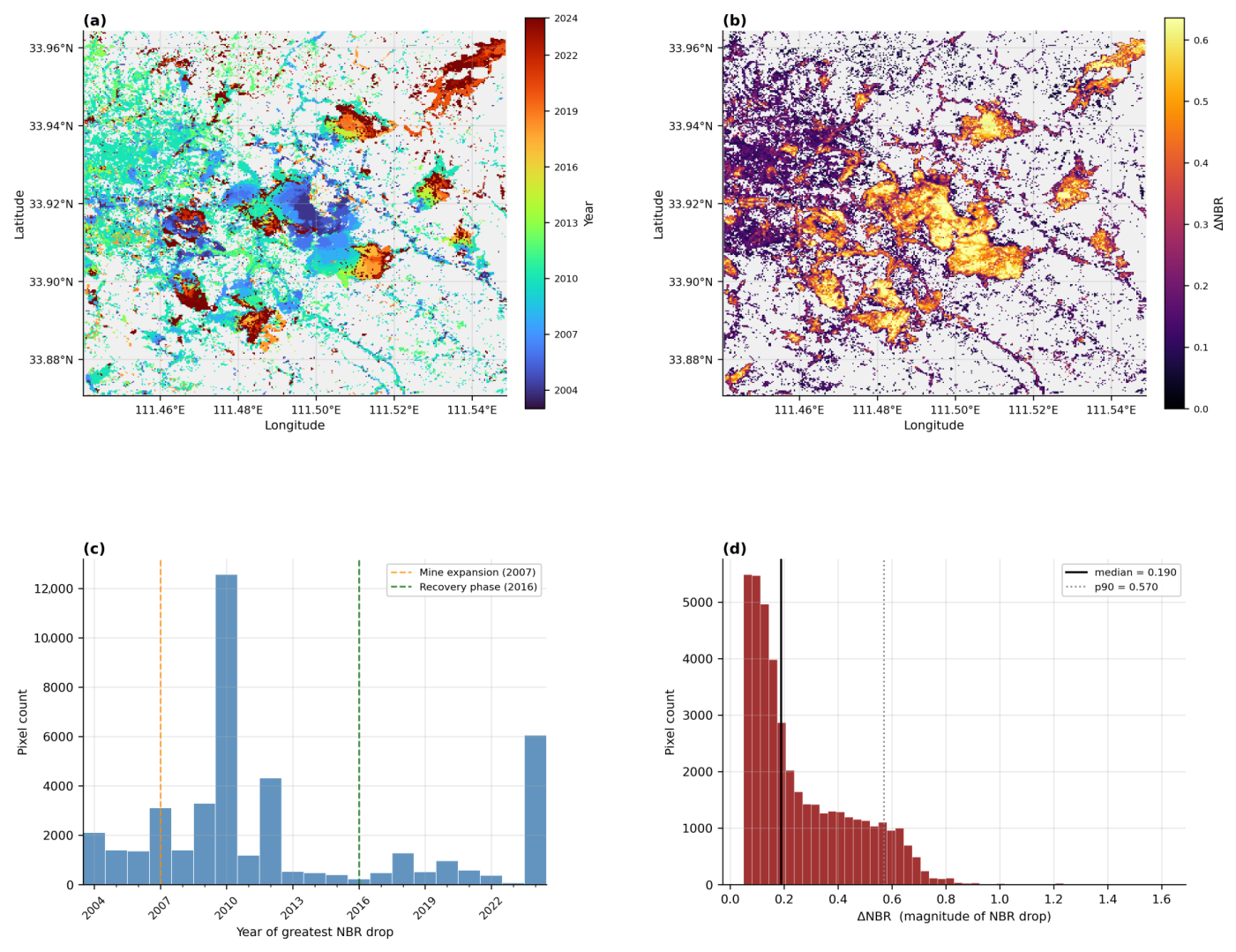
LandTrendr temporal segmentation of the annual NBR time series (2003–2024) identified a significant disturbance for 9942 of the 10,756 mine-footprint pixels analyzed. The remaining 814 pixels, which lacked a detected disturbance of sufficient magnitude (predominantly stable, sparsely vegetated, or water surfaces), were assigned to recovery types using the class- and spectral-based fallback rule described in Section 2.3.2. The spatial distribution of LandTrendr-detected disturbance years reveals three major disturbance phases: an early phase centered around 2005–2008, corresponding to mine expansion; a peak disturbance period during 2011–2015, coinciding with intensified extraction; and a declining disturbance frequency after 2016 (Figure 2). The mean disturbance magnitude across all disturbed pixels was ΔNBR = −0.237 (SD = 0.146), with impact magnitudes ranging from −0.024 to −0.682. Disturbance timing and magnitude alone, however, do not reveal whether disturbed surfaces have achieved spectral convergence toward reference conditions. That question is addressed in Section 3.3 through the benchmark-relative RSRI.
Figure 2.
LandTrendr disturbance detection for the Nannihu molybdenum mine (2003–2024). (a) Spatial distribution of disturbance years; (b) spatial distribution of disturbance magnitude (ΔNBR); (c) histogram of disturbance years; (d) histogram of disturbance magnitude distribution.
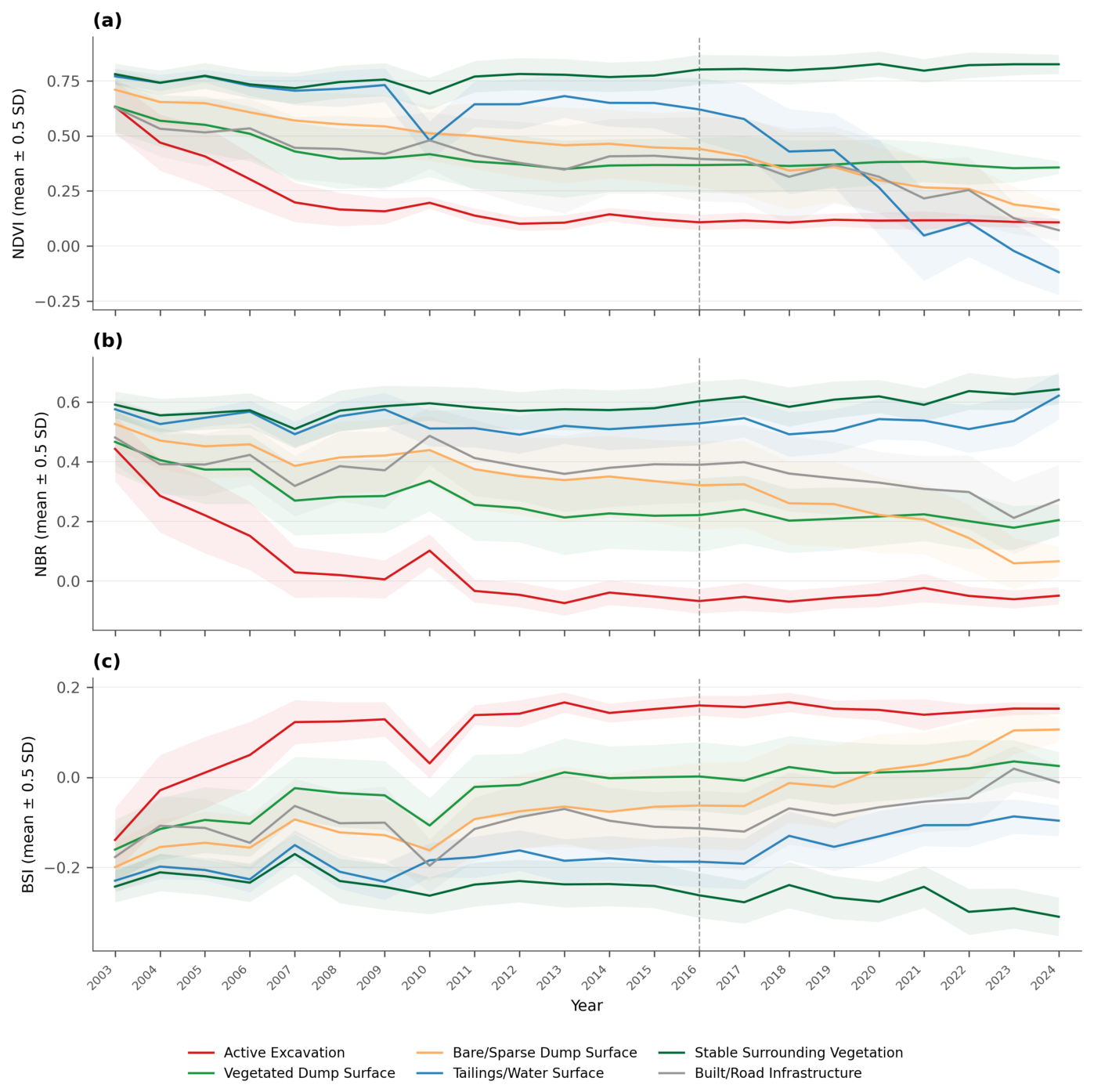
Class-level spectral trajectories reveal substantial heterogeneity in recovery patterns across land-surface classes (Figure 3). Pixels classified as Active Excavation in 2024 displayed persistently low NBR values (mean = −0.04, SD = 0.08) throughout the study period, with no discernible recovery trend. Pixels classified as Vegetated Dump showed a characteristic trajectory, with an initial decline during the disturbance phase (mean −0.15 ΔNBR), followed by a partial upward recovery in the post-disturbance segment (median post-disturbance NBR slope yr−1, positive in 86% of these pixels). Over the full 2003–2024 series, however, the net Theil–Sen trend remained negative (NBR −0.009 yr−1, p < 0.001), and 2024 NBR values stayed below pre-disturbance levels for 87% of these pixels. Stable-Vegetation reference pixels maintained high NBR values (mean = 0.59, SD = 0.03) with minimal interannual fluctuation. The estimated recovery duration—defined as the interval between the LandTrendr disturbance breakpoint and the onset of the fitted post-disturbance recovery segment—ranged from 5 to 17 years (median 11 years), confirming the slow, multi-decadal nature of mine recovery.
Figure 3.
Annual mean (a) NDVI, (b) NBR, and (c) BSI by land-surface class at the Nannihu molybdenum mine (2003–2024). Lines are class means; shaded ribbons show ±0.5 SD. The dashed line at 2016 marks the active-mining/post-2016 phase boundary (LandTrendr). Stable surrounding vegetation serves as the spectral reference for RSRI.
3.2. Five-Epoch Land-Surface Composition and Transitions (Contextual Support)
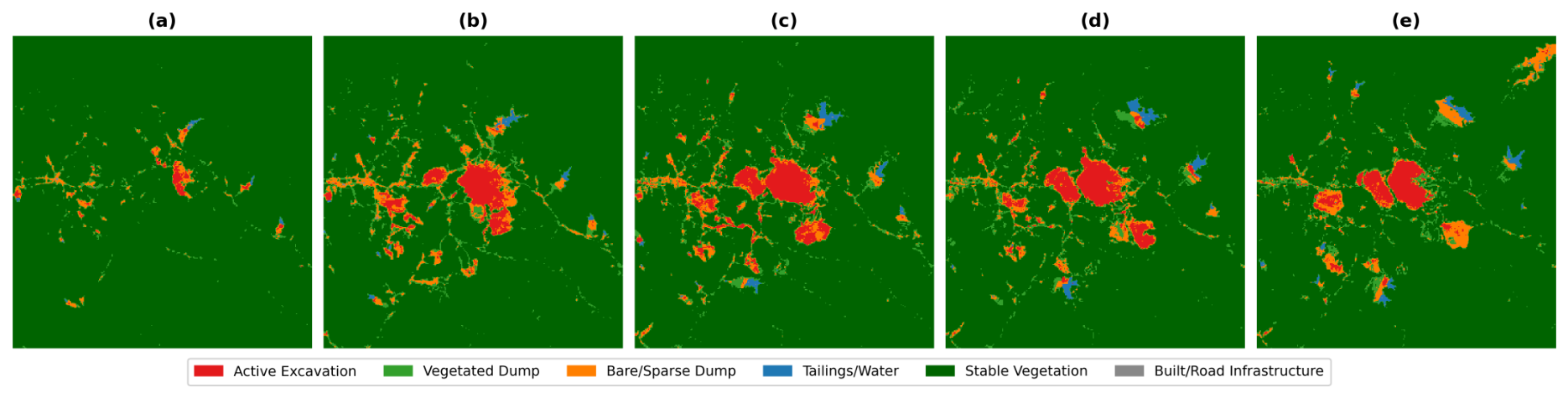
Five-epoch land-surface classification revealed progressive structural changes in the mine landscape composition, serving as contextual support only for interpreting the RSRI spatial patterns. The primary inferential evidence comes from LandTrendr-derived disturbance history and the benchmark-relative RSRI (Figure 4). The Active/Bare Mining class (C1) expanded from 0.81 km2 (2003) to 1.45 km2 (2013), before declining to 0.92 km2 (2024). Conversely, the Vegetated Surface class (C2) contracted from 2.47 km2 (2003) to 1.78 km2 (2013), then partially recovered to 2.14 km2 (2024). The Water/Tailings class (C3) remained relatively stable (0.22–0.31 km2), while Other Non-Forest (C4) fluctuated between 0.43 and 0.61 km2. As noted in Section 2.3.2, all epoch-specific class areas are approximate contextualizations derived from a 2024-trained classifier and should not be interpreted as independently validated per-epoch reconstructions.
Figure 4.
Five-epoch land-surface classification maps (four-class scheme) for the Nannihu molybdenum mine. (a) 2003; (b) 2008; (c) 2013; (d) 2018; (e) 2024. C1: Active/Bare Mining; C2: Vegetated Surface; C3: Water/Tailings; C4: Other Non-Forest. Historical classifications are based on a model trained on 2024 samples and transferred to earlier epochs without independent validation at each epoch; these maps should therefore be interpreted as approximate contextual support rather than validated historical reconstructions.
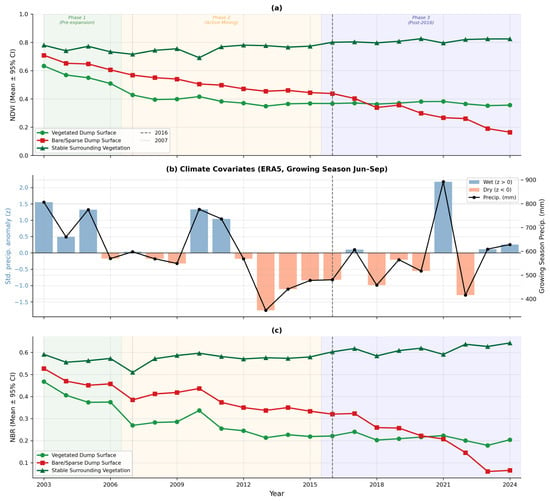
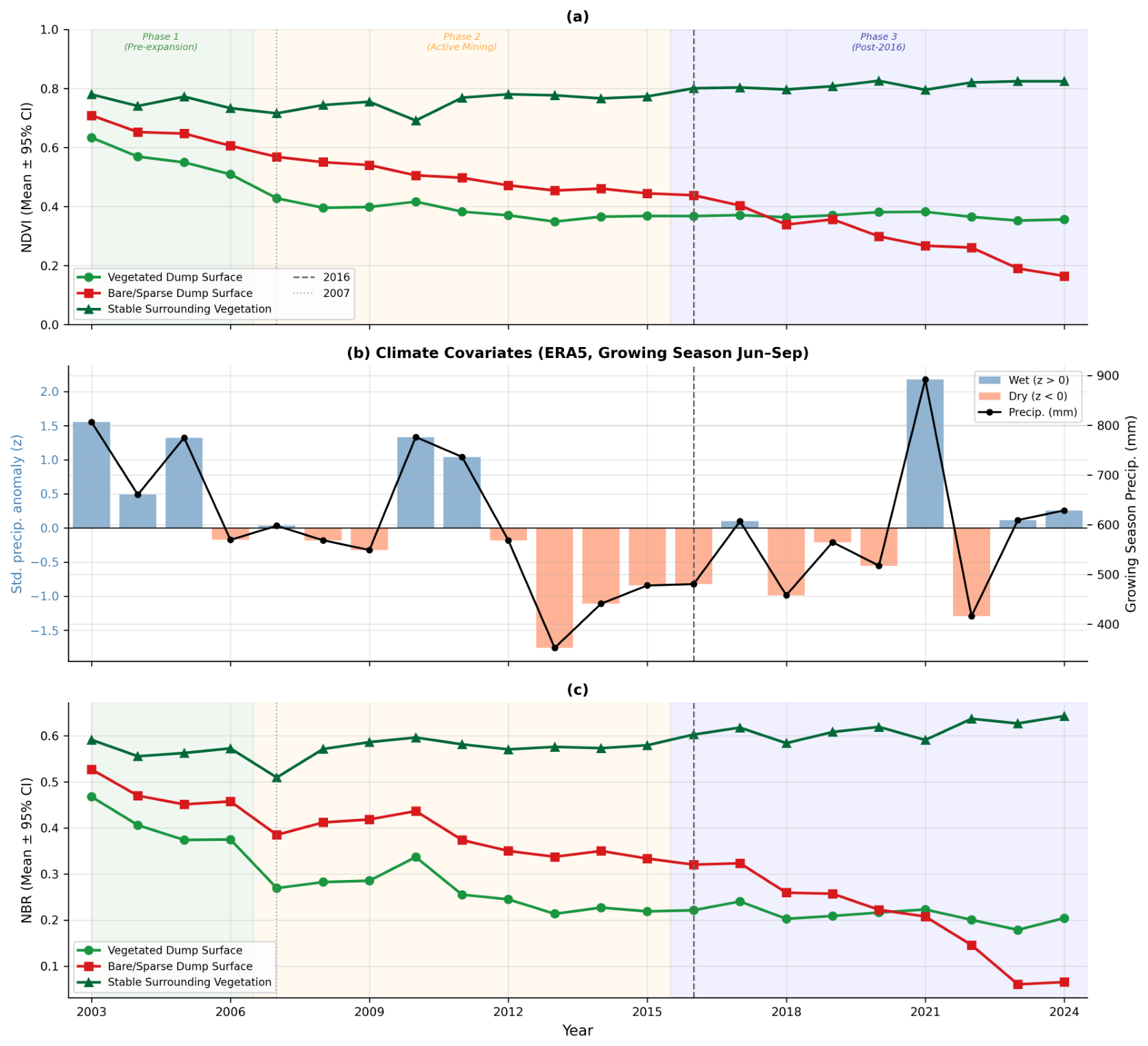
The five-epoch transition matrix (Table 5) identifies the top-10 land-surface transitions, accounting for approximately 87% of all pixel-level class changes. The most frequently labeled transitions, reported here for qualitative illustration only and not as validated counts, were Active/Bare Mining to Vegetated Surface (C1 → C2) and the reverse C2 → C1, broadly consistent with alternating revegetation and mine-expansion phases, together with stabilization of barren dump into vegetated dump within the C2 class. Zone-level annual spectral trajectories (Figure 5) show how NDVI and NBR evolved for the three main surface zones relative to growing season climate conditions. Because the classifier was trained on 2024 data and transferred to earlier epochs, these transitions represent the best approximation of surface-state evolution consistent with the 2024 signature space rather than independently validated per-epoch changes.
Table 5.
Top-10 five-epoch land-surface transitions by pixel count (four-class scheme). Counts are approximate and are provided as qualitative context only, because the historical classifications were not independently validated per epoch.
Figure 5.
Zone-level annual spectral trajectories (2003–2024) with growing season climate covariates for the Nannihu molybdenum mine. (a) Annual mean NDVI; (b) standardized growing-season precipitation anomaly (z-score) and growing-season precipitation (ERA5); (c) annual mean NBR. In all panels, lines show the zone-level mean and shaded ribbons the 95% confidence interval. Three surface zones are shown: Vegetated Dump Surface (revegetation treatment), Bare/Sparse Dump Surface (bare control), and Stable Surrounding Vegetation (reference). Phase 1 (pre-expansion), Phase 2 (active mining), and Phase 3 (post-2016) shading correspond to the periods identified by LandTrendr; dashed and dotted vertical lines mark 2016 and 2007, respectively.
To quantify classification consistency across epochs, the 2024-trained classifier was applied to all five historical epochs and evaluated against the 2024 training labels. The 2024 epoch achieved the highest 5-fold cross-validated overall accuracy (OA = 69.3%, six-class scheme), and the transfer-based signature-space agreement declined to 61.2% by 2003, without independent per-epoch validation (Table 6). These values are internal consistency metrics—not independent historical ground-truth validation—reflecting spectral–structural match relative to the 2024 training domain rather than true historical classification performance.
Table 6.
Per-epoch internal consistency of the 2024-trained classifier (agreement with the 2024 signature space; not historical classification accuracy).
3.3. Benchmark-Relative Spectral Recovery Status: The Core Finding
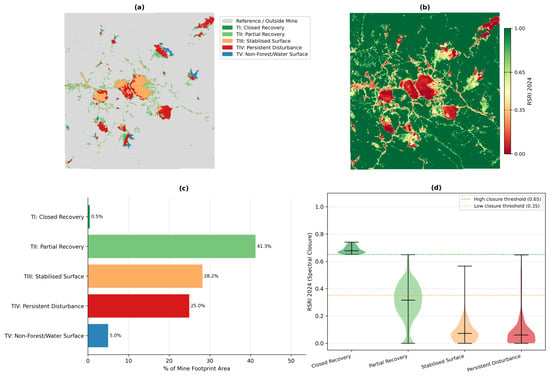
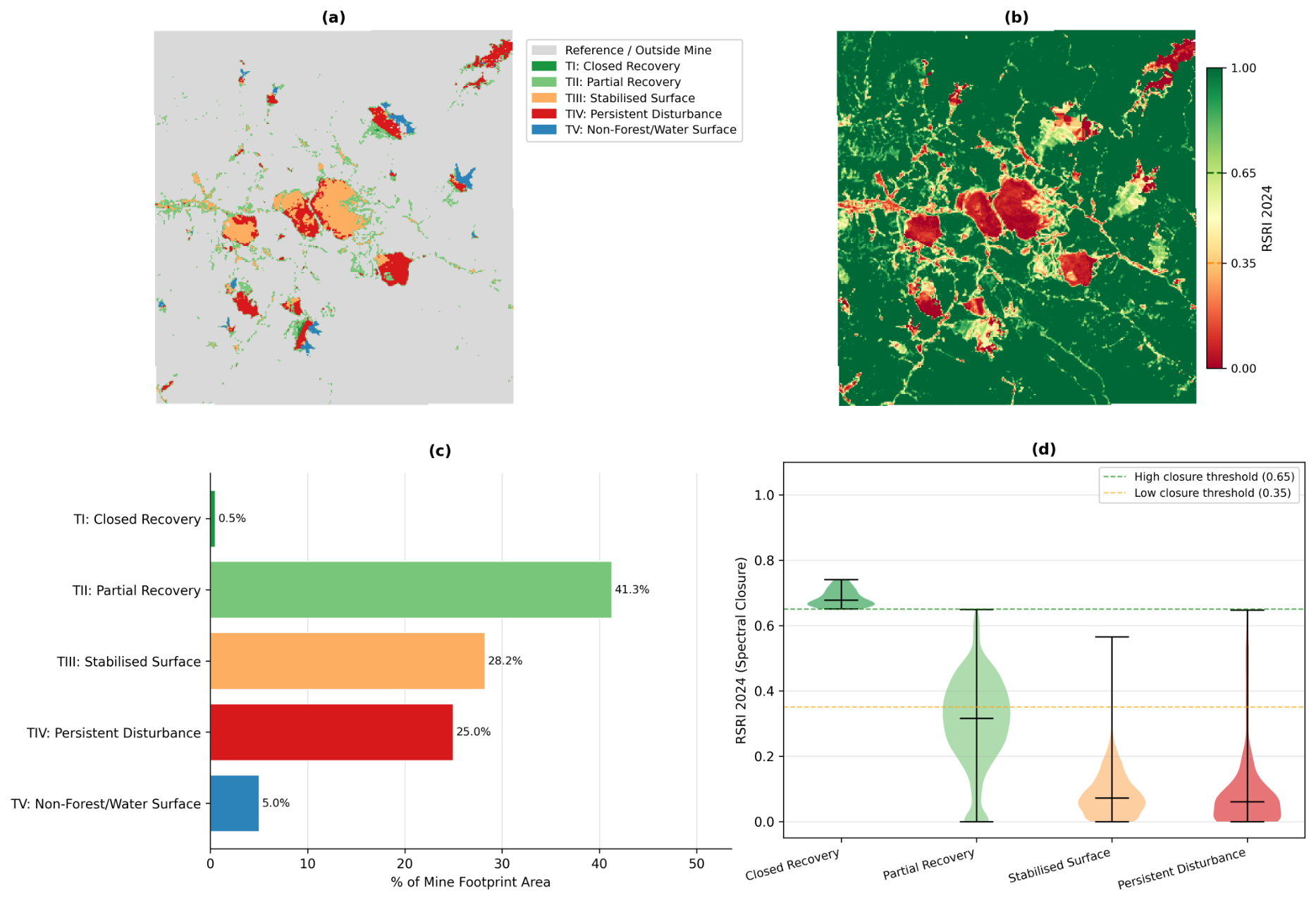
The RSRI spatial distribution for 2024 shows the central empirical result of this study, namely, that surface greening does not imply close benchmark-relative spectral proximity to the local stable-vegetation reference (Figure 6). Across all mine-affected pixels, the mean RSRI was 0.178 (SD = 0.156), with values ranging from 0.001 to 0.740. Only 55 pixels (0.51% of mine-affected area) achieved RSRI ≥ 0.65, concentrated in older disturbance zones on vegetated dumps.
Figure 6.
Recovery pathway typology and RSRI spatial patterns for the Nannihu molybdenum mine (2024). (a) Recovery pathway typology map (types I–V); (b) RSRI 2024 spatial distribution; (c) proportional area share by recovery type; (d) RSRI violin plots by merged typology. Dashed horizontal lines denote RSRI class breaks (0.35 and 0.65).
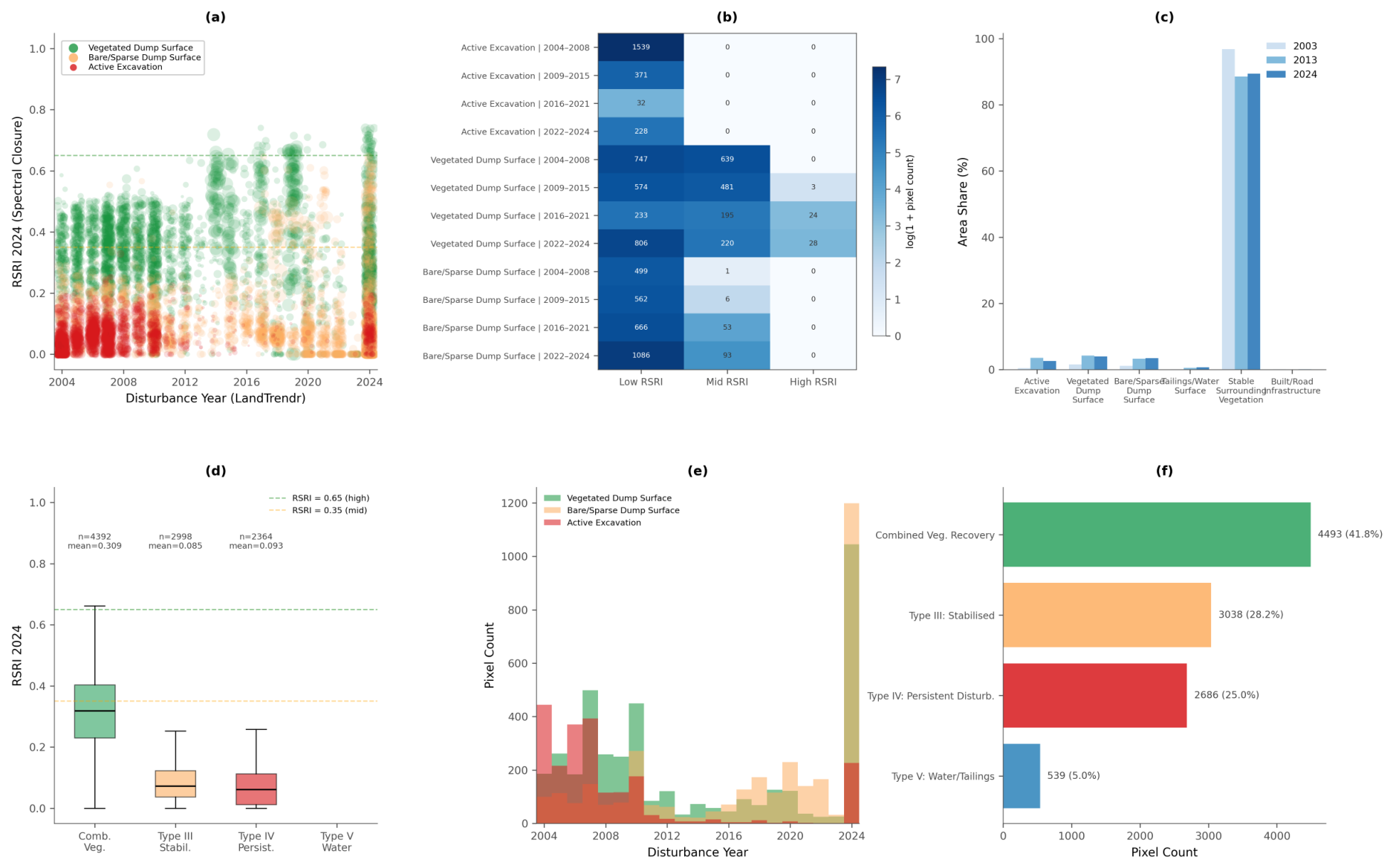
Merged-typology RSRI statistics show substantial differences across pathway types (Table 7). The Combined Vegetation Recovery type (types I+II, 4493 pixels) achieved a mean RSRI of 0.309 (SD = 0.143). Type III (Stabilized Surface, 3038 pixels) had a mean RSRI of 0.085 (SD = 0.067), while type IV (Persistent Disturbance, 2686 pixels) showed a mean RSRI of 0.093 (SD = 0.119). The small type I subset within Combined Vegetation Recovery (n = 55) achieved a mean RSRI of 0.684 (SD = 0.026), approaching but not reaching reference conditions (full statistics of five types given in Table 7).
Table 7.
RSRI statistics by merged recovery typology (2024).
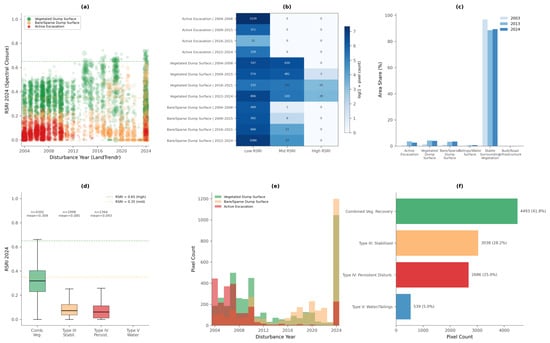
The three-dimensional integration visualization (Figure 7) reveals that pixels disturbed earlier (pre-2010) and classified as Vegetated Surface in 2024 tend to exhibit higher RSRI values, but even these older, vegetated pixels rarely achieve RSRI > 0.5. Pixels disturbed after 2015 and classified as Active/Bare Mining in 2024 cluster near RSRI values below 0.10, consistent with ongoing surface disturbance.
Figure 7.
Integration of disturbance timing, land-surface state, and RSRI for the Nannihu molybdenum mine. (a) Scatter plot: disturbance year (X-axis) × RSRI (Y-axis), colored by land-surface class, showing how earlier disturbance associates with higher RSRI values; (b) contingency heatmap of land-surface class and disturbance era versus RSRI category (low/mid/high); (c) area share (%) of each land-surface class in 2003, 2013 and 2024; bars are coloured by year (light-to-dark blue); (d) RSRI boxplots by merged recovery typology, showing the distribution of benchmark-relative spectral proximity within each pathway type; (e) disturbance year frequency histogram by land-surface class; (f) pixel count and proportional area summary by merged typology.
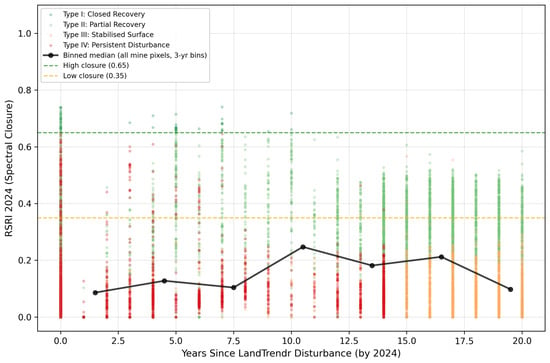
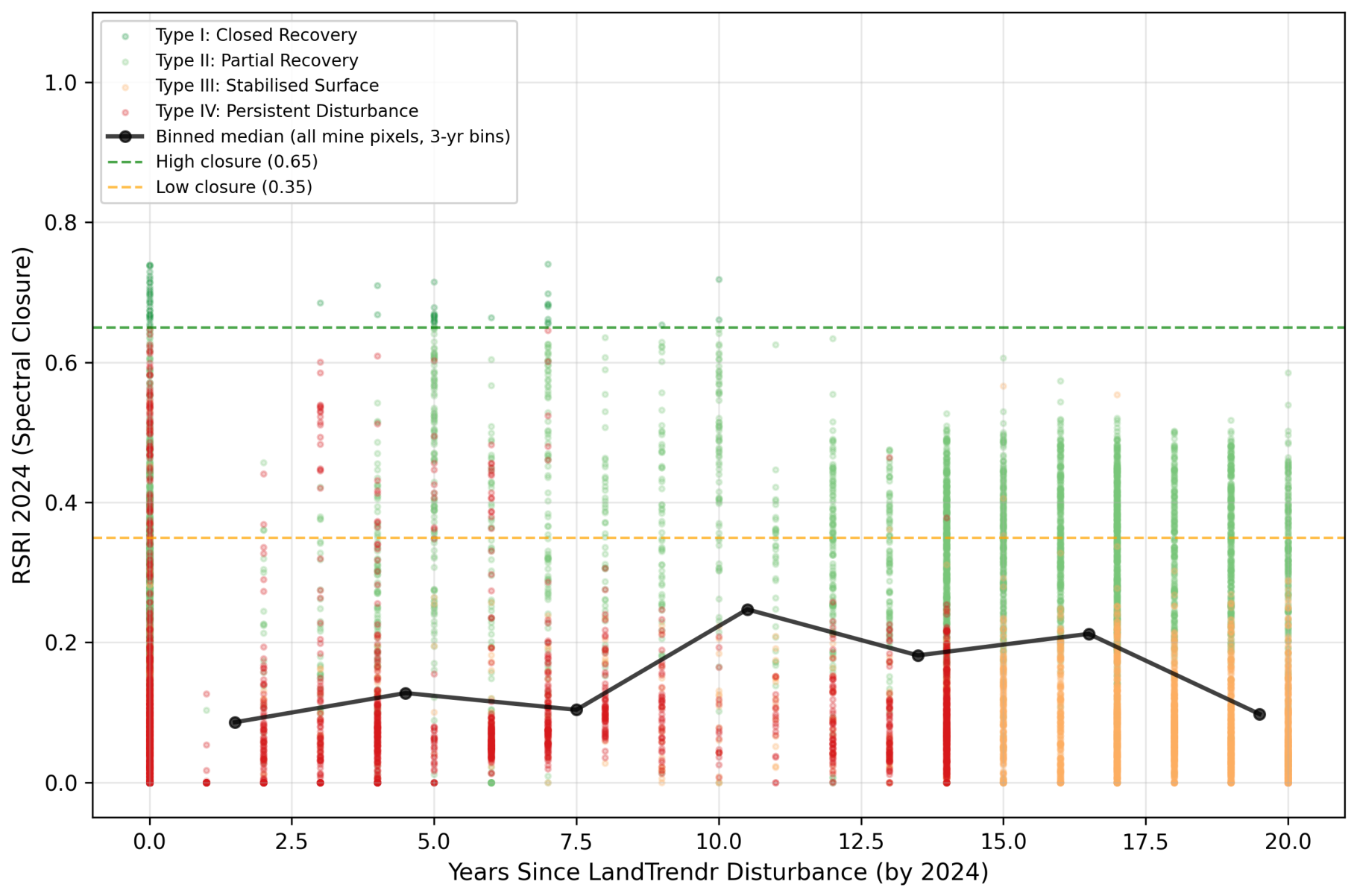
Figure 8 illustrates the positive association between disturbance timing and RSRI, with pixels disturbed in earlier phases (pre-2010) clustering at higher RSRI values than more recently disturbed pixels. The recovery pathway type nonetheless modulates this relationship substantially, indicating that disturbance timing alone does not determine the spectral recovery outcome. The RSRI framework was also robust to the choice of reference target and benchmark pixels (Table 4). Alternative reference targets (global median, mean, and 75th percentile) yielded Pearson correlations of r ≥ 0.998 with the adopted index, and bootstrapping the reference pool (500 resamples, 50% each) gave pixel-level correlations with a median r of 0.998. These results confirm that RSRI rankings and spatial patterns are stable across reasonable benchmark choices.
Figure 8.
Disturbance year versus RSRI 2024 scatter plot, colored by recovery pathway typology. Pixels with earlier disturbance tend to exhibit higher RSRI values, but pathway type substantially modulates this relationship, indicating that disturbance timing alone does not determine spectral recovery outcome.
The stable-vegetation reference set comprises N ≈ 88,900 pixels. Independently of the classification labels, these pixels are spectrally stable across 2003–2024 (pixel-wise temporal coefficient of variation, median ≈ 0.10; a small Theil–Sen trend of +0.004 yr−1, i.e., mild background greening with no abrupt change). Their terrain envelope is an elevation of 960–1670 m (mean: 1365 m) and mean slope ≈ 25°. Spatially, they are distributed across the stable-vegetation areas of the approximately 5 km buffer surrounding the mine footprint (Figure 1b). Because the reference is anchored to this spectrally stable set, the RSRI denominator does not depend on any single-epoch classification.
To benchmark the gap-closure scaling, we compared the adopted index against a simple percentile normalization, , and a z-score, , computed from the same reference set. Because the reference distribution is strongly left-skewed (skewness ≈ −2.9) and mine surfaces lie far below it, the percentile normalization saturates essentially all mine pixels at zero (no discrimination) and the z-score places essentially all of them outside [0, 1] (unbounded, non-comparable across sites). The adopted gap-closure formulation is bounded to [0, 1] and retains full discrimination among recovery types (Table 8).
Table 8.
Comparison of normalization schemes for the recovery index.
3.4. Terrain and Climate Associations (Contextual Analysis)
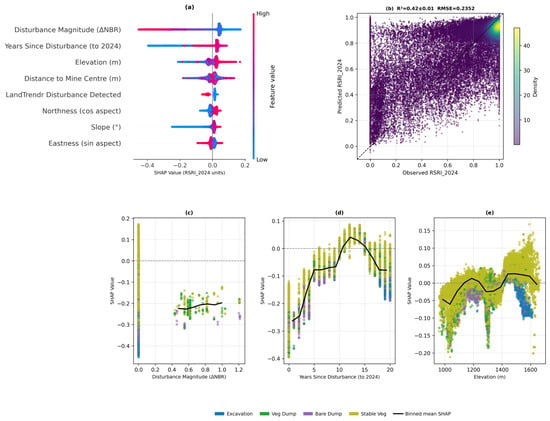
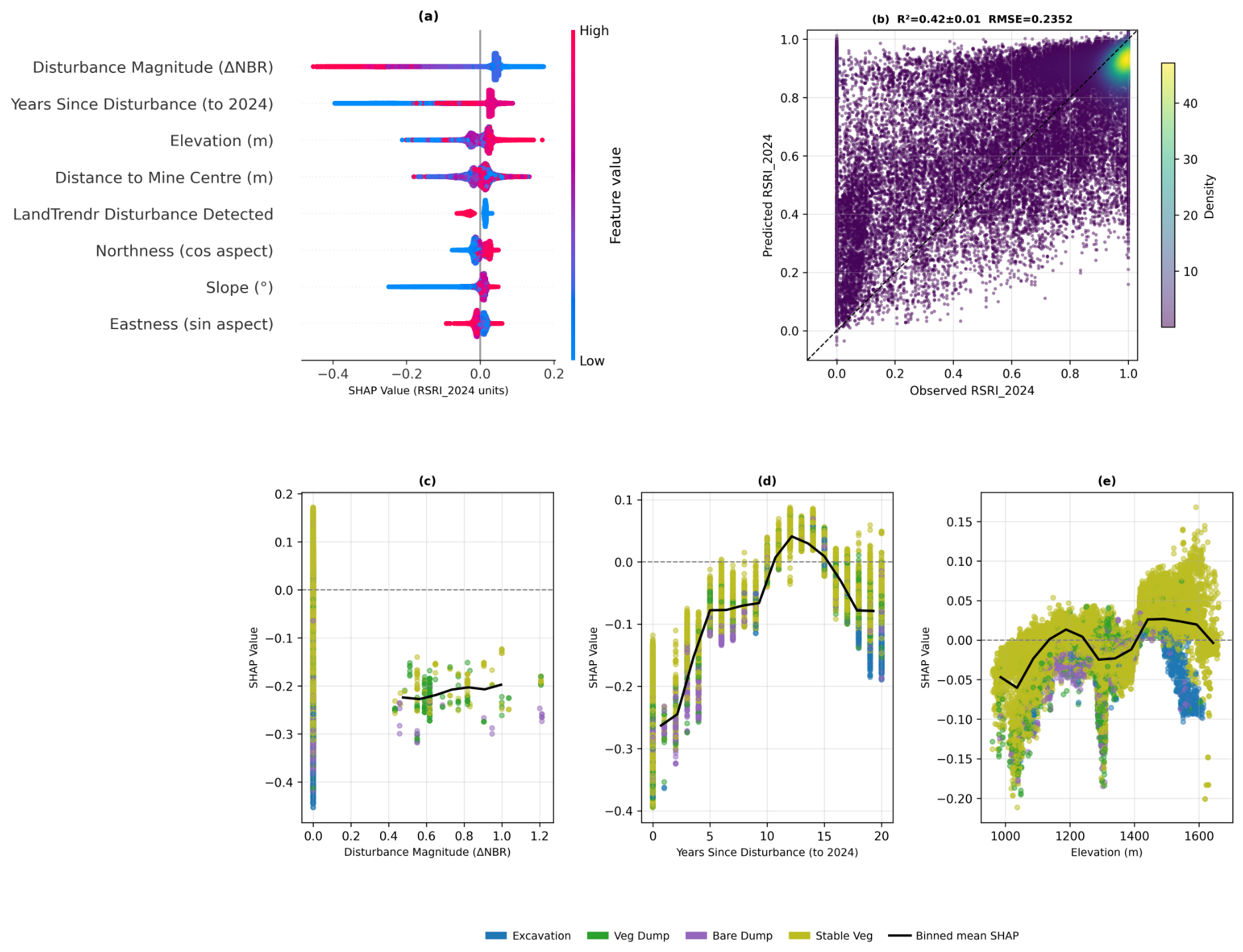
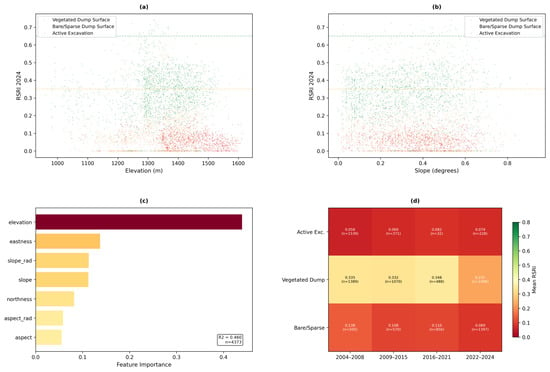
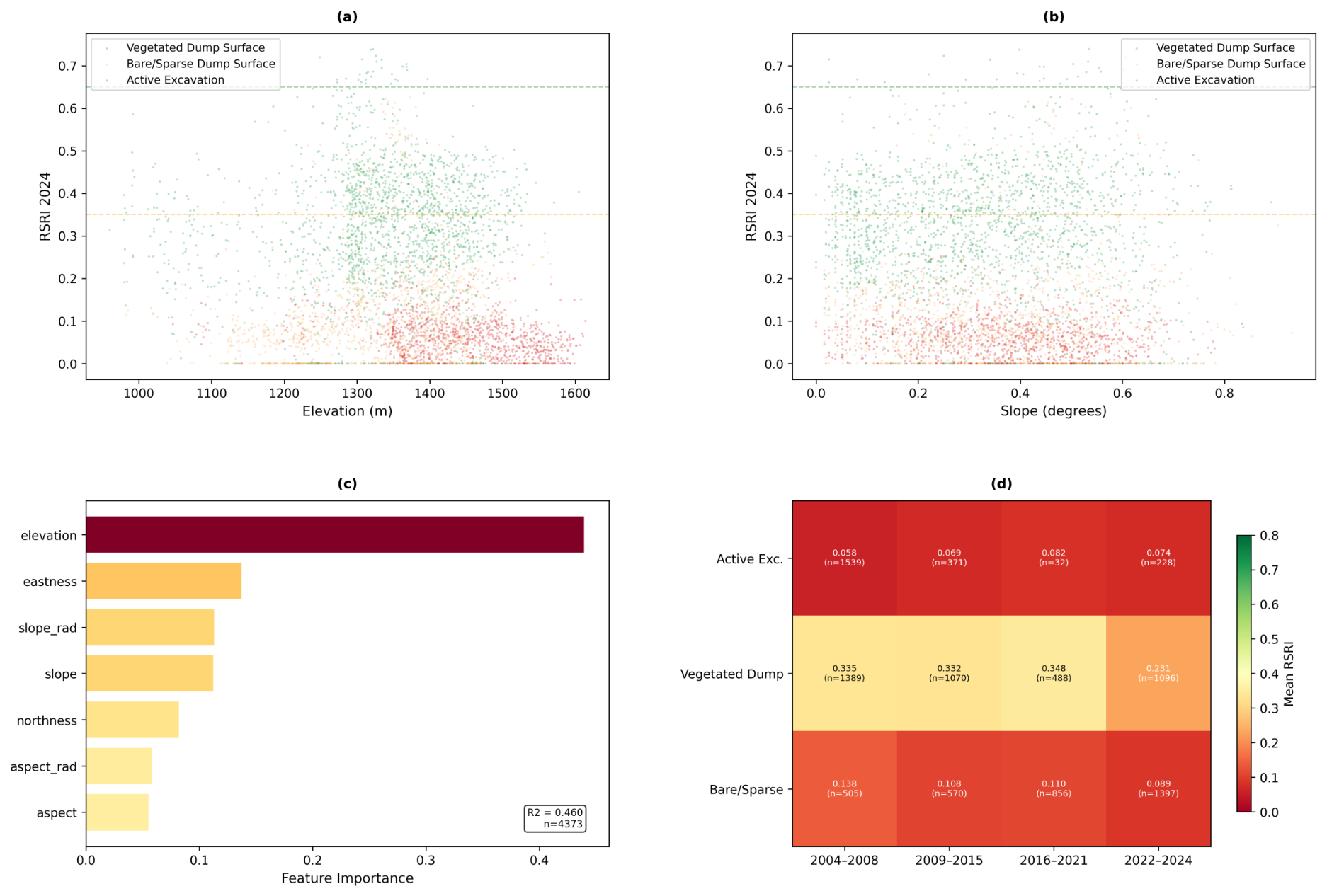
The RSRI reference target is computed within strata defined by elevation and aspect, so topographic background is already partly controlled in the index, and any residual associations between RSRI and terrain are weak by design. Pearson correlations between RSRI and terrain attributes were consistently weak: RSRI–elevation: r = −0.118 (p < 0.001), RSRI–slope: r = −0.079 (p < 0.001); and RSRI–northness (cosine of aspect): r = 0.031 (p = 0.047). The XGBoost SHAP analysis (Figure 9) identified disturbance magnitude (ΔNBR, mean |SHAP| = 0.075) and years since disturbance (mean |SHAP| = 0.046) as the two dominant features associated with RSRI variation, collectively accounting for approximately 53% of total SHAP importance. A spatial proximity feature, distance to mine center (rank 4, mean |SHAP| = 0.023, 10.1%), ranked among the top-5 predictors (see Table A1, Appendix A), suggesting that spatial position within the mine was associated with RSRI variation beyond what terrain attributes alone captured. Terrain features ranked lower, with elevation (mean |SHAP| = 0.023, rank 3), northness (mean |SHAP| = 0.014, rank 6), slope (mean |SHAP| = 0.014, rank 7), and eastness (mean |SHAP| = 0.011, rank 8) collectively contributing approximately 27.7% of total SHAP importance (full ranked values in Table A1, Appendix A). The weak RSRI–elevation correlation (Figure 10) indicates that RSRI captures mine-disturbance signals rather than natural vegetation gradients. Because disturbance magnitude and the recovery index share a spectral lineage, the SHAP associations are interpreted descriptively rather than as independent mechanistic effects.
Figure 9.
XGBoost SHAP analysis for RSRI prediction. (a) SHAP beeswarm summary plot for the top-8 features, showing the magnitude and direction of each feature’s association with RSRI; (b) spatial block cross-validation performance (observed versus predicted RSRI, 5-fold out-of-fold, density-colored); (c–e) SHAP dependence plots for the three most important features: disturbance magnitude (ΔNBR), years since disturbance, and elevation. Points are colored by land-surface class (Excavation, Veg Dump, Bare Dump, Stable Veg; shared legend); in (e) the solid black line denotes the binned mean SHAP value across feature bins.
Figure 10.
Terrain associations with RSRI (contextual analysis). (a) RSRI versus elevation, colored by land-surface class; (b) RSRI versus slope, colored by land-surface class; (c) Random Forest feature importance for RSRI prediction using terrain variables; (d) mean RSRI by surface class and disturbance era, showing heterogeneity in spectral recovery across terrain-class combinations. Dashed horizontal lines in (a,b) denote the RSRI class breaks (0.35 and 0.65). Correlations were consistently weak (|r| < 0.12), indicating that RSRI captures mine-disturbance signals rather than natural topographic vegetation gradients.
Interannual climate covariation analysis (growing season climate context in Figure 5b) was included as exploratory background context rather than as a test of climatic control. Growing season PET showed a strong positive correlation with annual mean NBR (r = 0.703, p < 0.001), while the precipitation (r = 0.137, p = 0.348) and temperature (r = −0.152, p = 0.283) correlations were weak and non-significant. The PET–BSI correlation was negative and moderate (r = −0.669, p < 0.001). These interannual associations do not adjust for serial autocorrelation, legacy disturbance effects, or management interventions, and are presented strictly as descriptive temporal context.
4. Discussion
4.1. Multi-Pathway Spectral Recovery and the Limits of Greening
The recovery pathway typology reveals that post-mining vegetation recovery at Nannihu is not a single monotonic trajectory but a branching process. The Combined Vegetation Recovery type (41.8%) represents pixels where some level of spectral recovery is observable, the Stabilized type (28.2%) represents pixels that have ceased active disturbance but show minimal vegetation colonization, and the Persistent Disturbance type (25.0%) represents areas of ongoing surface alteration.
The central finding of this study is the substantial discrepancy between NDVI-based greening signals and benchmark-relative spectral proximity to the stable-vegetation reference, which is the key distinction motivating the RSRI framework. While the post-disturbance recovery segments of the Vegetated Dump class show a gradual upward slope (median ≈ +0.008 yr−1 in NBR and +0.011 in NDVI), the multi-decadal series trend is net-negative (NBR: −0.009, NDVI: −0.005 yr−1). Nevertheless, the mean RSRI for the Combined Vegetation Recovery type remained at only 0.309, far from the reference condition (RSRI = 1.0). Here, NDVI serves as the conventional greening comparator, the recovery trajectory analyses report both NDVI and NBR, and RSRI itself is computed as an NDVI gap-closure relative to the stable-vegetation reference. For this class, both indices register gradual improvement within the post-disturbance segment, while the full-series trends are net-negative. This discrepancy arises because NDVI is primarily sensitive to chlorophyll absorption in the red band and near-infrared reflectance, whereas NBR additionally captures shortwave infrared reflectance that is sensitive to bare soil exposure, non-photosynthetic vegetation, and surface moisture [16,37]. Pixels that appear as “greening” in NDVI may still exhibit substantial soil background influence in NBR, indicating that the surface has not achieved the spectral structure of mature, stable vegetation [23]. In restoration ecology, this phenomenon parallels the “green desert” concept, where vegetation establishment does not restore ecosystem structure or function [47,48]. In particular, pixels that green in NDVI yet retain a low RSRI are consistent with early-successional, sparse, or structurally atypical (and possibly non-native) cover that remains spectrally distinct from the mature reference. Confirming species identity, however, requires field data. The RSRI framework captures this distinction by contextualizing pixel-level spectral condition against local stable-vegetation benchmarks rather than against absolute threshold values.
Land-surface transitions provide contextual illustration of how surface states shifted over time, complementing the continuous RSRI time series. The transition C1 → C2 (1847 pixels) is consistent with a gradual revegetation process, but because the classifier was trained on 2024 samples and transferred without per-epoch validation, these counts are approximations rather than validated reconstructions. The exploratory six-class breakdown (not a primary validated product; see Table 3 footnote) is consistent with the interpretation that much of the C1 → C2 transition flows into Vegetated Dump rather than Stable Vegetation, reinforcing the interpretation of partial rather than full structural recovery [25,49]. The primary evidentiary weight therefore rests on the LandTrendr disturbance timing and benchmark-relative RSRI. Transition matrices offer qualitative contextual support only.
4.2. Disturbance History Dominates Recovery Variation; Terrain and Climate Are Contextual
The XGBoost SHAP analysis identifies disturbance magnitude (ΔNBR) and years since disturbance as the features most strongly associated with RSRI variation, with these two features alone accounting for approximately 53% of total SHAP importance. Including the binary LandTrendr-detection feature at rank 5, all three disturbance-related features collectively contribute 62.3% (see Table A1, Appendix A). This finding aligns with the conceptual model that the initial severity of surface alteration sets an upper bound on subsequent spectral recovery [50,51]. Terrain features contributed comparatively little to the SHAP importance. This weak contribution is expected by design, as the RSRI reference target is computed within strata defined by elevation and aspect, leaving much of the topographic background already controlled in the index. The residual associations between RSRI and terrain are correspondingly weak (all ) and do not represent definitive topographic controls. Because disturbance magnitude and the recovery index share a spectral lineage, the SHAP associations are interpreted descriptively rather than as independent mechanistic effects.
The strong interannual PET–NBR correlation (r = 0.703) indicates that annual spectral conditions covaried with evaporative demand at the site scale. This association was stronger than the precipitation–NBR (r = 0.137) or temperature–NBR (r = −0.152) correlations. This exploratory relationship does not establish climatic control over recovery trajectories and is reported only as interannual context alongside the dominant mining-disturbance signal [26,52,53].
4.3. Interpretive Limits and Transferability of the Framework
The main methodological addition of this study is an RSRI that provides a benchmark-relative alternative to absolute NDVI-based recovery thresholds by quantifying spectral proximity to local stable-vegetation reference distributions—without requiring pre-mining baseline data, which is rarely available for older mines. The integrated timing–proximity workflow, with contextual land-surface transition support, represents a transferable descriptive approach applicable to other mine sites using open-access Landsat archives. Empirically, to our knowledge, this study represents one of the longer Landsat-based retrospective assessments reported for a metal-mine case [17,18,54].
Several limitations warrant explicit acknowledgment. This is a single-site case study (N = 1 mine). The observed recovery patterns are site-specific and cannot be generalized without multi-site comparative validation. The 30 m Landsat spatial resolution introduces sub-pixel mixing effects at boundaries between surface classes. Classification uncertainty means pixel-level transitions may reflect classification error rather than genuine surface change, and the 2024 5-fold CV accuracy was 69.3% for the six-class scheme and approximately 76% for the four-class scheme. Most importantly, this study did not include field ecological measurements, and spectral recovery (RSRI) does not directly equate to species composition, biodiversity, biomass, or soil function recovery [3,4]. Field-based ecological ground-truthing is essential for translating spectral indicators into ecological meaning. Ground-based studies at comparable coal mines show that soil properties, plant diversity, and soil-biodiversity-driven multifunctionality are decisive indicators of ecological recovery that spectral indices do not capture [55,56]. For management use, RSRI is best treated as a screening and triage indicator rather than a restoration certificate. Low-to-moderate values can prioritize sites for field assessment, high values warrant but do not replace field confirmation of ecological function, and RSRI should not serve alone as a sign-off criterion for completed restoration. Future work should extend the analysis to additional mine types and climatic settings to test framework transferability [1,7], integrate field ecological data to ground-truth RSRI against vegetation structure, soil properties, and biodiversity metrics, and apply higher-resolution imagery (e.g., PlanetScope 3 m or WorldView 0.5 m) to resolve within-dump heterogeneity masked by Landsat’s 30 m pixel.
5. Conclusions
This 22-year (2003–2024) retrospective remote sensing assessment of the Nannihu molybdenum mine indicates that post-mining recovery followed multiple spectral pathways rather than a single uniform trajectory, with persistent divergence from stable-vegetation reference conditions across the majority of mine-affected pixels. The primary evidentiary pillars are LandTrendr-derived disturbance timing and the benchmark-relative RSRI. Five-epoch land-surface classification and transition matrices provide contextual support, but were derived from a classifier trained on 2024 samples and transferred to earlier epochs without independent per-epoch validation. Consequently, historical class labels and transition counts should be interpreted as approximations consistent with the 2024 spectral–structural signature space rather than independently validated surface-state reconstructions.
The key descriptive findings are as follows. First, spectral recovery pathway typing indicates that 41.8% of mine-affected pixels fall into the combined vegetation-recovery group, whereas 28.2% follow predominantly non-vegetated stabilization pathways, 25.0% remain in persistent-disturbance pathways, and 5.0% are grouped as type V (Non-Forest/Water and atypical surfaces). These pathway labels should be interpreted in light of the study’s contextual classification constraints. Second, vegetation greenness recovery did not imply close benchmark-relative spectral proximity in this case study, with the combined vegetation-recovery group showing a mean RSRI of 0.309 and only 55 pixels (0.51%) reaching RSRI ≥ 0.65. Third, disturbance magnitude had the largest association with spectral recovery variation, with terrain attributes showing weaker associations and climate correlations that were exploratory and non-causal.
The RSRI framework quantifies benchmark-relative spectral proximity using local stable-vegetation benchmarks, and it does not measure species composition, biomass, biodiversity, or ecosystem function. The stable-vegetation benchmark represents a local spectral comparator rather than a prescribed ecological restoration target, and RSRI values indicate proximity to local spectral conditions, not fulfillment of ecological restoration standards. It provides a benchmark-relative alternative to absolute recovery thresholds and has the practical advantage of not requiring pre-mining baseline data. However, this study is explicitly a descriptive, site-specific remote sensing assessment, and field ecological validation remains essential for translating spectral indicators into ecological meaning. More broadly, the results show that post-mining greening should not be interpreted as recovery unless disturbed surfaces are also evaluated for convergence toward local stable-vegetation spectral conditions. The workflow is transferable as a descriptive remote sensing approach, but ecological interpretation still requires field validation and broader multi-site testing. Accordingly, RSRI is most useful for prioritizing sites for field assessment rather than for certifying that restoration is complete.
Author Contributions
Conceptualization, J.L.; methodology, J.W. and J.L.; software, J.W. and Y.R.; validation, J.W., Y.R. and H.G.; formal analysis, J.W.; investigation, J.W. and Y.R.; resources, J.L.; data curation, J.L. and Y.R.; writing—original draft preparation, J.W. and J.L.; writing—review and editing, J.W., J.L., Y.R., H.G. and Y.Y.; visualization, J.W. and Y.R.; supervision, J.L.; project administration, J.L.; funding acquisition, J.L. All authors have read and agreed to the published version of the manuscript.
Funding
This research was funded by Henan Yudi Technology Group Co., Ltd. 2025 Annual Science and Technology Project, grant number HNDKYY-2026-015.
Data Availability Statement
The Landsat Collection 2 surface reflectance data are publicly available through the USGS EarthExplorer (https://earthexplorer.usgs.gov/, accessed on 7 June 2026) and Google Earth Engine. SRTM DEM data are available from NASA JPL. ERA5-Land reanalysis data are available from the Copernicus Climate Data Store (https://cds.climate.copernicus.eu/, accessed on 7 June 2026). CHIRPS precipitation data are available from the Climate Hazards Center (https://www.chc.ucsb.edu/data/chirps, accessed on 7 June 2026). Processed data and analysis scripts are available from the corresponding author upon reasonable request.
Acknowledgments
The authors acknowledge the USGS for providing Landsat Collection 2 data, the Copernicus Climate Change Service for ERA5-Land data, and the Climate Hazards Center for CHIRPS precipitation data.
Conflicts of Interest
Author Jianguang Wang was employed by the company Henan No. 1 Geological Exploration Institute Co., Ltd. The authors declare that this study received funding from Henan Yudi Technology Group Co., Ltd. The funder was not involved in the study design, collection, analysis, interpretation of data, the writing of this article or the decision to submit it for publication.
Abbreviations
The following abbreviations are used in this manuscript:
| BSI | Bare Soil Index |
| CHIRPS | Climate Hazards Group InfraRed Precipitation with Station Data |
| DEM | Digital elevation model |
| ETM+ | Enhanced Thematic Mapper Plus |
| EVI | Enhanced Vegetation Index |
| GEE | Google Earth Engine |
| NBR | Normalized Burn Ratio |
| NDMI | Normalized Difference Moisture Index |
| NDVI | Normalized Difference Vegetation Index |
| OLI | Operational Land Imager |
| PET | Potential evapotranspiration |
| RF | Random forest |
| RSRI | Benchmark-relative spectral recovery index |
| SAVI | Soil-Adjusted Vegetation Index |
| SCS+C | Sun-Canopy-Sensor + C topographic correction |
| SRTM | Shuttle Radar Topography Mission |
| TM | Thematic Mapper |
Appendix A. XGBoost SHAP Feature Importance
Table A1.
XGBoost SHAP full feature importance (all 8 features, ordered by mean |SHAP|).
References
- Sonter, L.J.; Dade, M.C.; Watson, J.E.M.; Valenta, R.K. Renewable energy production will exacerbate mining threats to biodiversity. Nat. Commun. 2020, 11, 4174. [Google Scholar] [CrossRef] [Scilit]
- Maus, V.; Giljum, S.; da Silva, D.M.; Gutschlhofer, J.; da Rosa, R.P.; Luckeneder, S.; Gass, S.L.B.; Lieber, M.; McCallum, I. An update on global mining land use. Sci. Data 2022, 9, 433. [Google Scholar] [CrossRef] [Scilit] [PubMed]
- Cooke, J.A.; Johnson, M.S. Ecological restoration of land with particular reference to the mining of metals and industrial minerals: A review of theory and practice. Environ. Rev. 2002, 10, 41–71. [Google Scholar] [CrossRef] [Scilit]
- Gastauer, M.; Silva, J.R.; Caldeira, C.F., Jr.; Ramos, S.J.; Souza Filho, P.W.M.; Furtini Neto, A.E.; Siqueira, J.O. Mine Land Rehabilitation: Modern Ecological Approaches for More Sustainable Mining. J. Clean. Prod. 2018, 172, 1409–1422. [Google Scholar] [CrossRef] [Scilit]
- Li, S.; Wang, J.; Zhang, M.; Tang, Q. Characterizing and Attributing the Vegetation Coverage Changes in North Shanxi Coal Base of China from 1987 to 2020. Resour. Policy 2021, 74, 102331. [Google Scholar] [CrossRef] [Scilit]
- Karan, S.K.; Samadder, S.R.; Maiti, S.K. Assessment of the Capability of Remote Sensing and GIS Techniques for Monitoring Reclamation Success in Coal Mine Degraded Lands. J. Environ. Manag. 2016, 182, 272–283. [Google Scholar] [CrossRef] [Scilit]
- Werner, T.T.; Mudd, G.M.; Schipper, A.M.; Huijbregts, M.A.J.; Taneja, L.; Northey, S.A. Global-scale remote sensing of mine areas and analysis of factors explaining their extent. Glob. Environ. Change 2020, 60, 102007. [Google Scholar] [CrossRef] [Scilit]
- Wulder, M.A.; Roy, D.P.; Radeloff, V.C.; Loveland, T.R.; Anderson, M.C.; Johnson, D.M.; Healey, S.; Zhu, Z.; Scambos, T.A.; Pahlevan, N.; et al. Fifty Years of Landsat Science and Impacts. Remote Sens. Environ. 2022, 280, 113195. [Google Scholar] [CrossRef] [Scilit]
- Xiao, W.; Deng, X.; He, T.; Guo, J. Using POI and time series Landsat data to identify and rebuilt surface mining, vegetation disturbance and land reclamation process based on Google Earth Engine. J. Environ. Manag. 2023, 327, 116920. [Google Scholar] [CrossRef] [Scilit]
- Orimoloye, I.R.; Ololade, O.O. Spatial evaluation of land-use dynamics in gold mining area using remote sensing and GIS technology. Int. J. Environ. Sci. Technol. 2020, 17, 4465–4480. [Google Scholar] [CrossRef] [Scilit]
- Wang, W.; Liu, R.; Gan, F.; Zhou, P.; Zhang, X.; Ding, L. Monitoring and evaluating restoration vegetation status in mine region using remote sensing data: Case study in Inner Mongolia, China. Remote Sens. 2021, 13, 1350. [Google Scholar] [CrossRef] [Scilit]
- Song, D.; Hu, Z.; Yu, Y.; Zhang, F.; Sun, H. Assessing Ecological Impacts and Recovery in Coal Mining Areas: A Remote Sensing and Field Data Analysis in Northwest China. Remote Sens. 2024, 16, 2236. [Google Scholar] [CrossRef] [Scilit]
- Kennedy, R.E.; Yang, Z.; Cohen, W.B. Detecting Trends in Forest Disturbance and Recovery Using Yearly Landsat Time Series: 1. LandTrendr—Temporal Segmentation Algorithms. Remote Sens. Environ. 2010, 114, 2897–2910. [Google Scholar] [CrossRef] [Scilit]
- Cohen, W.B.; Yang, Z.; Healey, S.P.; Kennedy, R.E.; Gorelick, N. A LandTrendr multispectral ensemble for forest disturbance detection. Remote Sens. Environ. 2018, 205, 131–140. [Google Scholar] [CrossRef] [Scilit]
- Kennedy, R.E.; Yang, Z.; Cohen, W.B.; Pfaff, E.; Braaten, J.; Nelson, P. Spatial and Temporal Patterns of Forest Disturbance and Regrowth Within the Area of the Northwest Forest Plan. Remote Sens. Environ. 2012, 122, 117–133. [Google Scholar] [CrossRef] [Scilit]
- Han, Y.; Ke, Y.; Zhu, L.; Feng, H.; Zhang, Q.; Sun, Z.; Zhu, L. Tracking Vegetation Degradation and Recovery in Multiple Mining Areas in Beijing, China, Based on Time-Series Landsat Imagery. GISci. Remote Sens. 2021, 58, 1477–1496. [Google Scholar] [CrossRef] [Scilit]
- Xu, Y.; Yang, G.; Zhang, Y.; Guo, J.; Zhang, C. Mapping and interpreting spatio-temporal trends in vegetation restoration following mining disturbances in large-scale surface coal mining areas. Front. Environ. Sci. 2025, 13, 1531424. [Google Scholar] [CrossRef] [Scilit]
- Guo, J.; He, T.; Xiao, W.; Lei, K. Time series procession for monitoring land disturbance caused by surface coal mining in China. J. Clean. Prod. 2024, 448, 141585. [Google Scholar] [CrossRef] [Scilit]
- He, T.; Jiang, S.; Xiao, W.; Zhang, M.; Tang, T.; Zhang, H. A Non-Grain Production on Cropland Spatiotemporal Change Detection Method Based on Landsat Time-Series Data. Land Degrad. Dev. 2024, 35, 3031–3047. [Google Scholar] [CrossRef] [Scilit]
- Xiao, W.; Guo, J.; He, T.; Lei, K.; Deng, X. Assessing the Ecological Impacts of Opencast Coal Mining in Qinghai-Tibet Plateau-a Case Study in Muli Coal Field, China. Ecol. Indic. 2023, 153, 110454. [Google Scholar] [CrossRef] [Scilit]
- Qi, J.; Zhang, Y.; Zhang, J.; Wu, C.; Chen, Y.; Cheng, Z. Study on the Restoration of Ecological Environments in Mining Area Based on GIS Technology. Sustainability 2023, 15, 6128. [Google Scholar] [CrossRef] [Scilit]
- Montero, P.; Bustos, E.; Padró, J.C.; Carabassa, V. Monitoring of Open-Pit Mining Areas Using Landsat Series Imagery (1984–2023) and Cloud Processing. Land 2024, 13, 1301. [Google Scholar] [CrossRef] [Scilit]
- He, T.; Guo, J.; Xiao, W.; Xu, S.; Chen, H. A Novel Method for Identification of Disturbance from Surface Coal Mining Using All Available Landsat Data in the GEE Platform. ISPRS J. Photogramm. Remote Sens. 2023, 205, 17–33. [Google Scholar] [CrossRef] [Scilit]
- Wang, Y.; Zhao, S.; Zuo, H.; Hu, X.; Guo, Y.; Han, D.; Chang, Y. Tracking the Vegetation Change Trajectory over Large-Surface Coal Mines in the Jungar Coalfield Using Landsat Time-Series Data. Remote Sens. 2023, 15, 5667. [Google Scholar] [CrossRef] [Scilit]
- McKenna, P.B.; Lechner, A.M.; Phinn, S.; Erskine, P.D. Remote Sensing of Mine Site Rehabilitation for Ecological Outcomes: A Global Systematic Review. Remote Sens. 2020, 12, 3535. [Google Scholar] [CrossRef] [Scilit]
- Ibukun, J.A.; Olubaju, A.E.; Thomas, S.F.; Sodipo, E.O.; Akinbiola, S.A.; Rebouh, N.Y.; Said, Y.; Tariq, A. Assessing Vegetation Degradation and Thermal Effects of Artisanal Small-Scale Mining Using Remote Sensing Time Series Data. Land Degrad. Dev. 2026, 37, 2267–2289. [Google Scholar] [CrossRef] [Scilit]
- Gorelick, N.; Hancher, M.; Dixon, M.; Ilyushchenko, S.; Thau, D.; Moore, R. Google Earth Engine: Planetary-scale geospatial analysis for everyone. Remote Sens. Environ. 2017, 202, 18–27. [Google Scholar] [CrossRef] [Scilit]
- Tamiminia, H.; Salehi, B.; Mahdianpari, M.; Quackenbush, L.; Adeli, S.; Brisco, B. Google Earth Engine for geo-big data applications: A meta-analysis and systematic review. ISPRS J. Photogramm. Remote Sens. 2020, 164, 152–170. [Google Scholar] [CrossRef] [Scilit]
- Muñoz-Sabater, J.; Dutra, E.; Agustí-Panareda, A.; Albergel, C.; Arduini, G.; Balsamo, G.; Boussetta, S.; Choulga, M.; Harrigan, S.; Hersbach, H.; et al. ERA5-Land: A State-of-the-Art Global Reanalysis Dataset for Land Applications. Earth Syst. Sci. Data 2021, 13, 4349–4383. [Google Scholar] [CrossRef] [Scilit]
- Funk, C.; Peterson, P.; Landsfeld, M.; Pedreros, D.; Verdin, J.; Shukla, S.; Husak, G.; Rowland, J.; Harrison, L.; Hoell, A.; et al. The Climate Hazards Infrared Precipitation with Stations—A New Environmental Record for Monitoring Extremes. Sci. Data 2015, 2, 150066. [Google Scholar] [CrossRef] [Scilit] [PubMed]
- Hargreaves, G.H.; Samani, Z.A. Reference crop evapotranspiration from temperature. Appl. Eng. Agric. 1985, 1, 96–99. [Google Scholar] [CrossRef] [Scilit]
- White, J.C.; Wulder, M.A.; Hobart, G.W.; Luther, J.E.; Hermosilla, T.; Griffiths, P.; Coops, N.C.; Hall, R.J.; Hostert, P.; Dyk, A.; et al. Pixel-Based Image Compositing for Large-Area Dense Time Series Applications and Science. Can. J. Remote Sens. 2014, 40, 192–212. [Google Scholar] [CrossRef] [Scilit]
- Foga, S.; Scaramuzza, P.L.; Guo, S.; Zhu, Z.; Dilley, R.D.; Beckmann, T.; Schmidt, G.L.; Dwyer, J.L.; Joseph Hughes, M.; Laue, B. Cloud Detection Algorithm Comparison and Validation for Operational Landsat Data Products. Remote Sens. Environ. 2017, 194, 379–390. [Google Scholar] [CrossRef] [Scilit]
- Chastain, R.; Housman, I.; Goldstein, J.; Finco, M.; Tenneson, K. Empirical cross sensor comparison of Sentinel-2A and 2B MSI, Landsat-8 OLI, and Landsat-7 ETM+ top of atmosphere spectral characteristics over the conterminous United States. Remote Sens. Environ. 2019, 221, 274–285. [Google Scholar] [CrossRef] [Scilit]
- Soenen, S.A.; Peddle, D.R.; Coburn, C.A. SCS+C: A Modified Sun-Canopy-Sensor Topographic Correction in Forested Terrain. IEEE Trans. Geosci. Remote Sens. 2005, 43, 2148–2159. [Google Scholar] [CrossRef] [Scilit]
- Rouse, J.W.; Haas, R.H.; Schell, J.A.; Deering, D.W. Monitoring Vegetation Systems in the Great Plains with ERTS. NASA Spec. Publ. 1974, 351, 309–317. [Google Scholar]
- Key, C.H.; Benson, N.C. Landscape assessment: Ground measure of severity, the Composite Burn Index; and remote sensing of severity, the Normalized Burn Ratio. In FIREMON: Fire Effects Monitoring and Inventory System; Lutes, D.C., Keane, R.E., Caratti, J.F., Key, C.H., Benson, N.C., Sutherland, S., Gangi, L.J., Eds.; Gen. Tech. Rep. RMRS-GTR-164-CD; USDA Forest Service, Rocky Mountain Research Station: Fort Collins, CO, USA, 2006; pp. LA-1–LA-51. [Google Scholar]
- Huete, A.; Didan, K.; Miura, T.; Rodriguez, E.P.; Gao, X.; Ferreira, L.G. Overview of the Radiometric and Biophysical Performance of the MODIS Vegetation Indices. Remote Sens. Environ. 2002, 83, 195–213. [Google Scholar] [CrossRef] [Scilit]
- Huete, A.R. A soil-adjusted vegetation index (SAVI). Remote Sens. Environ. 1988, 25, 295–309. [Google Scholar] [CrossRef] [Scilit]
- Gao, B.C. NDWI—A normalized difference water index for remote sensing of vegetation liquid water from space. Remote Sens. Environ. 1996, 58, 257–266. [Google Scholar] [CrossRef] [Scilit]
- Kennedy, R.E.; Yang, Z.; Gorelick, N.; Braaten, J.; Cavalcante, L.; Cohen, W.B.; Healey, S. Implementation of the LandTrendr algorithm on Google Earth Engine. Remote Sens. 2018, 10, 691. [Google Scholar] [CrossRef] [Scilit]
- Breiman, L. Random forests. Mach. Learn. 2001, 45, 5–32. [Google Scholar] [CrossRef] [Scilit]
- Belgiu, M.; Drăguţ, L. Random forest in remote sensing: A review of applications and future directions. ISPRS J. Photogramm. Remote Sens. 2016, 114, 24–31. [Google Scholar] [CrossRef] [Scilit]
- Chen, T.; Guestrin, C. XGBoost: A scalable tree boosting system. In Proceedings of the 22nd ACM SIGKDD International Conference on Knowledge Discovery and Data Mining; ACM: New York, NY, USA, 2016; pp. 785–794. [Google Scholar] [CrossRef] [Scilit]
- Lundberg, S.M.; Lee, S.-I. A unified approach to interpreting model predictions. Adv. Neural Inf. Process. Syst. 2017, 30, 4765–4774. [Google Scholar]
- Lundberg, S.M.; Erion, G.; Chen, H.; DeGrave, A.; Prutkin, J.M.; Nair, B.; Katz, R.; Himmelfarb, J.; Bansal, N.; Lee, S.-I. From Local Explanations to Global Understanding with Explainable AI for Trees. Nat. Mach. Intell. 2020, 2, 56–67. [Google Scholar] [CrossRef] [Scilit]
- Ren, H.; Zhao, Y.; He, T. Remote sensing in mining-related eco-environmental monitoring and assessment. Remote Sens. 2026, 18, 103. [Google Scholar] [CrossRef] [Scilit]
- Hua, F.; Bruijnzeel, L.A.; Meli, P.; Martin, P.A.; Zhang, J.; Nakagawa, S.; Miao, X.; Wang, W.; McEvoy, C.; Peña-Arancibia, J.L.; et al. The Biodiversity and Ecosystem Service Contributions and Trade-Offs of Forest Restoration Approaches. Science 2022, 376, 839–844. [Google Scholar] [CrossRef] [Scilit]
- He, T.; Zhang, M.; Guo, A.; Zhai, G.; Wu, C.; Xiao, W. A novel index combining temperature and vegetation conditions for monitoring surface mining disturbance using Landsat time series. Catena 2023, 229, 107235. [Google Scholar] [CrossRef] [Scilit]
- Whisenant, S.G. Repairing Damaged Wildlands: A Process-Oriented, Landscape-Scale Approach; Cambridge University Press: Cambridge, UK, 1999. [Google Scholar]
- Doley, D.; Audet, P. Adopting Novel Ecosystems as Suitable Rehabilitation Alternatives for Former Mine Sites. Ecol. Process. 2013, 2, 22. [Google Scholar] [CrossRef] [Scilit]
- Vicente-Serrano, S.M.; Gouveia, C.; Camarero, J.J.; Beguería, S.; Trigo, R.; López-Moreno, J.I.; Azorín-Molina, C.; Pasho, E.; Lorenzo-Lacruz, J.; Revuelto, J.; et al. Response of Vegetation to Drought Time-Scales across Global Land Biomes. Proc. Natl. Acad. Sci. USA 2013, 110, 52–57. [Google Scholar] [CrossRef] [Scilit]
- Beguería, S.; Vicente-Serrano, S.M.; Reig, F.; Latorre, B. Standardized Precipitation Evapotranspiration Index (SPEI) Revisited: Parameter Fitting, Evapotranspiration Models, Tools, Datasets and Drought Monitoring. Int. J. Climatol. 2014, 34, 3001–3023. [Google Scholar] [CrossRef] [Scilit]
- Hu, J.; Ye, B.; Bai, Z.; Feng, Y. Remote sensing monitoring of vegetation reclamation in the Antaibao open-pit mine. Remote Sens. 2022, 14, 5634. [Google Scholar] [CrossRef] [Scilit]
- Li, H.; Chen, W.; Li, J.; Zhang, C.; Liang, H. Coupling relationship between soil properties and plant diversity under different ecological restoration patterns in the abandoned coal mine area of Southern China. Ecol. Evol. 2024, 14, e70686. [Google Scholar] [CrossRef] [Scilit]
- Xu, C.; Liu, Y.; Li, J.; Wang, B.; Zhang, H. Soil biodiversity and network complexity jointly drive soil multifunctionality in an open cast coal mine. Front. Microbiol. 2025, 16, 1668494. [Google Scholar] [CrossRef] [Scilit]

Disclaimer/Publisher’s Note: The statements, opinions and data contained in all publications are solely those of the individual author(s) and contributor(s) and not of MDPI and/or the editor(s). MDPI and/or the editor(s) disclaim responsibility for any injury to people or property resulting from any ideas, methods, instructions or products referred to in the content. |
© 2026 by the authors. Licensee MDPI, Basel, Switzerland. This article is an open access article distributed under the terms and conditions of the Creative Commons Attribution (CC BY) license.