Article

A Satellite–UAV–USV Collaborative Monitoring Framework for Cross-Scale Assessment of River Restoration Effectiveness: A Case Study of the Nihe River Basin, China

1
School of Resources and Environmental Engineering, Hefei University of Technology, Hefei 230009, China
2
The Fourth Surveying and Mapping Institute of Anhui Province, Hefei 230031, China
*
Author to whom correspondence should be addressed.
Remote Sens. 2026, 18(12), 1934; https://doi.org/10.3390/rs18121934
Submission received: 13 May 2026 / Revised: 8 June 2026 / Accepted: 9 June 2026 / Published: 11 June 2026

Highlights

What are the main findings?
  • A collaborative satellite–UAV–USV framework enables cross-scale assessment of river restoration effectiveness, linking watershed dynamics with unit-scale responses.
  • During restoration, the river ecosystem continuously improved (water area expanded, eutrophication risk decreased, riparian vegetation increased, wetland spatially reorganized), while watershed soil-water conservation capacity declined due to climatic factors.
What are the implications of the main findings?
  • Satellite–UAV–USV integration provides a cross-scale evidence chain for monitoring surface water dynamics, water quality, and riparian/wetland changes, enabling systematic assessment of river restoration effectiveness.
  • Multi-source, multi-scale remote sensing captures divergent trends between local ecosystem improvement and regional background decline, supporting adaptive management and highlighting the need for integrated watershed-scale restoration.

Abstract

River ecological restoration in lowland plain basins is often constrained by fragmented river networks, degraded riparian zones, eutrophication risk, and intensive human disturbance. Conventional monitoring approaches rarely connect watershed-scale dynamics with responses from typical restoration units, limiting quantitative evaluation and the separation of direct project outcomes from broader environmental variability. To address this gap, this study developed a collaborative satellite–unmanned aerial vehicle (UAV)–unmanned surface vehicle (USV) monitoring framework and applied it to the Nihe River Basin, China, a lowland plain river undergoing systematic restoration under the Shan-shui Initiative. The framework combines Sentinel-2 time-series imagery, high-resolution Gaofen-1, Gaofen-2, and Jilin-1 imagery, UAV orthophotos, USV observations, and auxiliary environmental datasets. Unlike single-scale monitoring approaches, it links watershed-scale indicators, including water-body dynamics, chlorophyll-related eutrophication risk, riparian ecological background, and soil-water conservation capacity, with unit-scale diagnosis of riparian buffer and riverine wetland restoration. Results showed that river water-body area increased from 37.78 km2 to 40.59 km2 during 2021–2024, while normalized difference chlorophyll index (NDCI)-based eutrophication risk improved in 9.12% of the monitored river area and degraded in only 0.47%. Riparian vegetation cover remained high, whereas regional soil-water conservation capacity declined due to climatic factors, revealing asynchronous responses between local recovery and regional background conditions. At the unit scale, riparian buffer restoration enhanced buffer continuity and near-bank water quality, as reflected by decreased chemical oxygen demand (COD), increased dissolved oxygen (DO), and limited ammonia nitrogen (NH3-N) improvement. Riverine wetland restoration promoted land-use adjustment and ecological spatial reorganization. This cross-scale evidence chain supports adaptive management of inland river and wetland restoration projects.

1. Introduction

Inland river and wetland ecosystems play a critical role in maintaining biodiversity, regional ecological security, and multiple ecosystem services, including water retention, flood regulation, biogeochemical cycling, and carbon sequestration [1]. However, under the combined pressures of climate change and intensive human activities, many river–wetland systems have experienced substantial degradation in ecological structure and function [2,3]. River ecological restoration has therefore become an important pathway for improving water quality, rebuilding ecosystem resilience, and enhancing regional ecological security [4,5]. Previous studies have highlighted that ecological restoration is not merely a linear engineering process; rather, its effectiveness is strongly constrained by watershed-scale hydrological processes and their responses to land-use change [6]. Consequently, continuously identifying ecological responses, evaluating restoration trajectories, and assessing overall effectiveness have become critical scientific issues in river restoration research and practice [6,7].
In China, rapid urbanization, industrial development, and intensive land-use transformation have increasingly reshaped watershed hydrological processes by altering runoff generation, flow concentration, sediment and nutrient transport, and river-network connectivity [8]. As a result, river degradation is no longer merely a local problem of channel condition or water quality, but is closely linked to watershed-scale hydrological and ecological changes. Against this background, holistic and systematic watershed-scale integrated management is increasingly replacing traditional management paradigms that focus on single elements or isolated spatial units [9]. Specifically, China’s Shan-shui Initiative, an integrated ecological conservation and restoration program for mountains, rivers, forests, farmlands, lakes, grasslands, and deserts, emphasizes the systematic and synergistic restoration of river channels, riparian zones, and surrounding terrestrial areas based on the concept of a “community of life” and holistic ecosystem integrity [10,11]. Previous evidence has shown that large-scale investments in natural capital in China can improve multiple ecosystem services, providing important empirical support for the ecological benefits of integrated restoration practices [12]. This governance practice significantly broadens the spatial scope and assessment targets of river restoration. Consequently, restoration effectiveness is no longer confined to the improvement of localized river segments or individual environmental factors, but should be understood as the combined outcome of watershed-scale hydrological and ecological changes and restoration-unit-scale responses [13]. Correspondingly, traditional assessment methods based on cross-sectional surveys, point-based monitoring, or single-scale remote sensing detection are inadequate for comprehensively capturing the effectiveness of river restoration under the framework of the Shan-shui Initiative [14,15]. Therefore, restoration assessment needs to move beyond isolated site-based evaluation toward a multi-scale framework that connects watershed-scale environmental changes with local restoration-unit responses [15].
In recent years, remote sensing technology, with its advantages of broad spatial coverage, long time-series, and strong spatiotemporal comparability, has become a crucial tool for monitoring the water ecological environment of watersheds [16,17]. Existing studies have increasingly used multispectral satellite imagery, such as Landsat and Sentinel-2, to monitor river water-body dynamics and water-quality-related optical signals at watershed and regional scales [17,18,19], while high-spatial-resolution imagery and vegetation indices have also been applied to characterize riparian ecological conditions [20,21]. These studies provide important support for long-term and large-scale river monitoring. However, river restoration effectiveness is not determined by a single environmental variable, but by the coupled recovery of hydrological processes, channel morphology, water environmental conditions, riparian ecological structure, and watershed-scale ecological functions [6,7,13,15]. Therefore, restoration assessment requires a comprehensive monitoring framework that can link watershed-scale environmental trajectories with local restoration-unit responses. In this study, the specific indicators corresponding to these assessment dimensions, including hydrological, morphological, water-quality-related, vegetation, and ecological-function indicators, are further defined and justified in the methodological framework.
Nevertheless, satellite-based river monitoring still has several limitations when applied to restored river reaches and small-to-medium river networks [22,23,24]. River restoration areas are often characterized by narrow channels, fragmented riparian zones, complex water–land boundaries, high habitat heterogeneity, and variable optical properties of inland waters [20,21,24]. Although high-resolution satellite imagery possesses distinct advantages in expressing spatial details, its revisit cycle and acquisition costs often limit its capacity for the high-frequency dynamic monitoring of riverine ecohydrological processes [20,25]. Moreover, optical remote sensing mainly captures surface spectral information and cannot directly provide in situ physicochemical parameters, which are essential for diagnosing water environmental responses in specific restoration units [17,25].
To overcome these limitations, the integration of satellite, unmanned aerial vehicle (UAV), and unmanned surface vehicle (USV) observations provides a promising pathway for cross-scale river restoration monitoring [25,26]. These platforms provide complementary information across different spatial scales and observation dimensions. Satellite imagery supports long-term and watershed-scale monitoring of river network dynamics, riparian vegetation recovery, and ecological function changes [16,17]. UAV-derived orthophotos can provide sub-meter spatial information for delineating water–land boundaries, identifying riparian spatial structures, and characterizing local habitat features in restoration units [20,21,27]. USVs further complement satellite and UAV observations by collecting high-density in situ water-quality measurements along river reaches and near-bank zones, including physicochemical and chlorophyll-related parameters that are difficult to directly obtain from optical images alone [28,29,30,31,32]. In particular, low-cost USV platforms have been demonstrated to support in situ water-quality monitoring, and UAV–USV integrated observations have been used to assess chlorophyll-a-related conditions in stream environments [29,30]. Therefore, the combined use of satellite, UAV, and USV observations can establish a cross-scale evidence chain linking watershed-scale restoration trajectories, local spatial restructuring, and in situ water environmental responses.
However, although satellite, UAV, and USV observations have been increasingly applied in river monitoring, their integration into a coherent cross-scale framework for assessing river restoration effectiveness remains insufficiently explored [15,25,33]. Previous studies have commonly focused on individual monitoring platforms, single environmental indicators, or specific spatial scales. Satellite-based studies are effective for detecting watershed-scale trends but often lack near-surface validation and local diagnostic information [17,22]. UAV-based studies can provide fine-scale spatial information on riparian structure and habitat reconstruction, while USV-based studies can obtain high-density in situ water-quality observations; however, these approaches usually have limited spatial coverage and are less able to reveal long-term watershed-scale restoration trajectories [27,28,29,30,31,32]. In the context of the Shan-shui Initiative, which emphasizes systematic governance, watershed integrity, and multi-scale coordination, this limitation becomes more evident [10,11,15]. A key research gap is therefore how to integrate satellite-based temporal monitoring, UAV-based fine-scale spatial characterization, and USV-based in situ water-quality measurements into a unified framework for evaluating river restoration effectiveness across the watershed and restoration unit scales [15,33].
Based on these considerations, this study develops a multi-source and multi-scale monitoring framework that integrates multispectral satellite imagery, high-resolution satellite imagery, UAV observations, and USV in situ measurements to assess river ecological restoration effectiveness. The Nihe River Basin in Panji District, Huainan City, was selected as a representative case of a small-to-medium river basin undergoing systematic ecological restoration under the Shan-shui Initiative. This case provides an opportunity to examine whether a satellite–UAV–USV framework can link watershed-scale environmental trajectories with restoration-unit-scale ecological and water-quality responses.
The specific objectives of this study are as follows:
  • To establish a satellite–UAV–USV integrated cross-scale monitoring framework for river ecological restoration assessment;
  • To quantify watershed-scale variations in river water-body dynamics, chlorophyll-related eutrophication risk, riparian vegetation conditions, and watershed ecological support capacity using time-series satellite imagery;
  • To analyze restoration-unit-scale responses of riparian buffers and riverine wetlands by integrating high-resolution satellite imagery, UAV imagery, and USV in situ water-quality observations.
Methodologically, this study advances river ecological restoration monitoring from single-platform and single-scale assessment toward a cross-scale evidence chain linking watershed environmental trajectories, local spatial restructuring, and in situ water-quality responses. It also provides a transferable technical approach for evaluating restoration effectiveness in similar watersheds under integrated ecological restoration programs.

2. Study Area and Data

2.1. Study Area

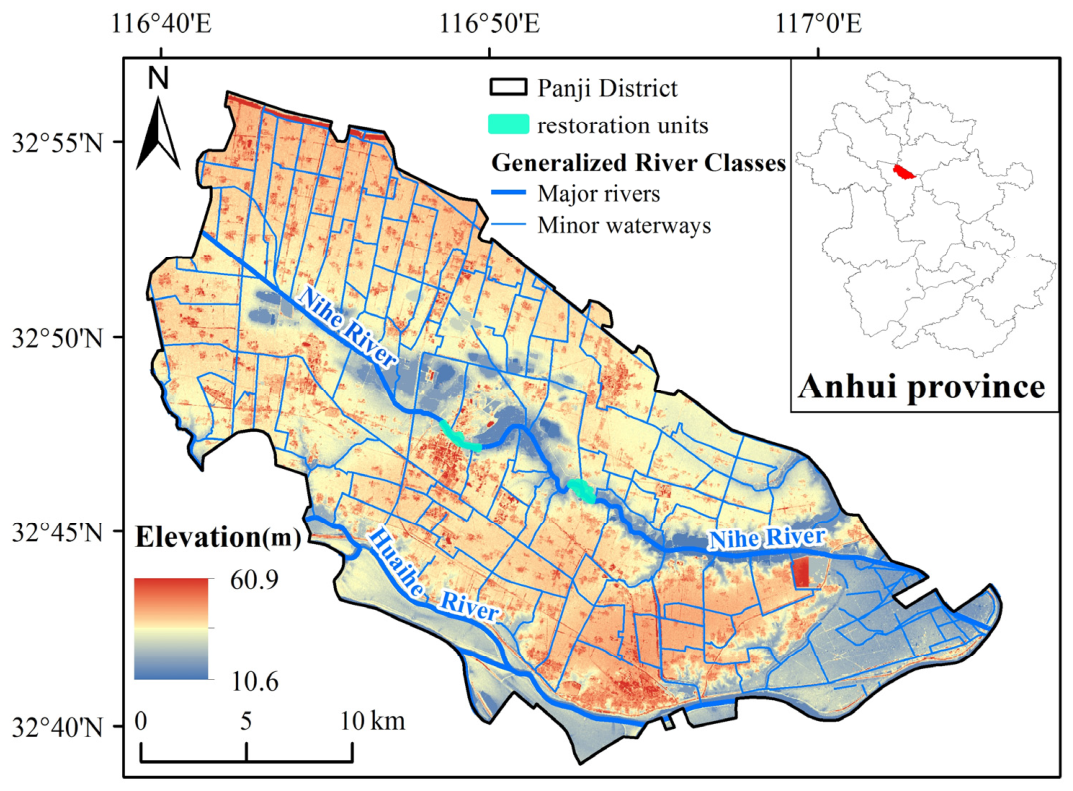
The study area is located in Panji District, Huainan City, Anhui Province, China (116°42′E–117°01′E, 32°43′N–32°55′N), and the administrative boundary of Panji District was adopted as the study-area boundary. The Nihe River is a first-order tributary of the Huaihe River, flowing from northwest to southeast before ultimately joining the Huaihe River. The main channel of the Nihe River has a total length of 55.65 km, of which 39.4 km lies within Panji District and serves as the core river reach analyzed in this study. Given that the Nihe River ecological protection and restoration project is implemented within Panji District, the district was used as the spatial extent for monitoring and assessment, with two representative restoration units along the Nihe River corridor selected as typical sites for evaluating restoration effectiveness (Figure 1).
The study area is a typical lowland plain river region, characterized by gentle terrain gradients, small elevation differences, and a dense river network. The lower reach is characterized by low-lying floodplain terrain, and the riverbed elevation generally decreases from approximately 22.0 m in the upstream area to approximately 15.0 m in the downstream area before the river joins the Huaihe River. These low-gradient geomorphological conditions weaken sediment transport capacity and make local sediment deposition and flow stagnation more likely. The Nihe River Basin in Panji District has long been affected by coal mining, urban expansion, agricultural activities, and other intensive human disturbances, resulting in river-network fragmentation, riparian ecological degradation, channel siltation, and eutrophication risk [34,35]. Previous remote sensing studies also showed that, from 1987 to 2017, coal mining substantially changed land use and landscape patterns in the Nihe small watershed, especially through the expansion of subsidence water bodies and construction land and the reduction in cultivated land [36].
In recent years, systematic ecological restoration measures have been implemented in the study area under the Shan-shui Initiative, including river dredging, riparian ecological reconstruction, and artificial wetland restoration [37]. To support subsequent multi-scale monitoring and spatial analysis, the hydrographic network was classified into major rivers and minor waterways. Major rivers include the Nihe River main channel and larger connected tributaries, which form the primary drainage framework. Minor waterways include narrower or shorter streams, ditches, and agricultural irrigation channels widely distributed across the plain river network. These small water bodies are closely associated with local agricultural production and water regulation. Consequently, the overall runoff regime and surface-water distribution of the Nihe River Basin are strongly affected by anthropogenic water withdrawal for farmland irrigation, drainage processes, and artificial water retention in ditches and impoundments. Based on this classification, hierarchical river-corridor buffers were constructed to constrain river water-body extraction and improve the reliability of spatial analysis. The coexistence of long-term anthropogenic disturbance and systematic restoration practices makes the Panji District section of the Nihe River Basin an ideal case for evaluating river restoration effectiveness using multi-source and multi-scale observations, and provides a transferable technical framework for similar lowland plain river restoration assessments.

2.2. Data Sources and Preprocessing

To support the multi-source and multi-scale assessment of river ecological restoration effectiveness, this study used satellite remote sensing imagery, UAV orthophotos, USV-based underway monitoring data, and auxiliary datasets covering key time points before and after restoration implementation (Table 1).

2.2.1. Satellite Remote Sensing Imagery

Satellite remote sensing imagery served as the primary data source for watershed-scale monitoring in this study, including Sentinel-2 multispectral imagery, Gaofen satellite imagery from GF-1C/D and GF-2, and Jilin-1 satellite imagery from JL1KF01A.
The Sentinel-2 data were obtained from the Level-2A surface reflectance products released by the European Space Agency and acquired by the Multispectral Instrument (MSI) [38]. These products had undergone radiometric calibration and atmospheric correction. In this study, resampling, multiband composition, and study-area clipping were conducted using ESA SNAP 9.0.0 and ENVI 5.6.
Owing to its high temporal continuity and open accessibility, Sentinel-2 was selected as the core data source for dynamic, watershed-scale monitoring during the study period. It was primarily used to detect and analyze river water-body dynamics, chlorophyll-related eutrophication risk, and changes in riparian ecological conditions. The Nihe River Basin, located within the Huaihe River Basin, is strongly influenced by a monsoon climate, with rainfall and streamflow exhibiting pronounced seasonal variability [39]. To minimize the effects of flood-season water-level fluctuations and rainfall-induced turbidity, cloud-free or low-cloud Sentinel-2 images acquired around mid-November were preferentially selected for annual water-body extraction and NDCI calculation, corresponding to the post-flood autumn period.
High-resolution GF-1C/D, GF-2, and JL1KF01A imagery was used to supplement the interpretation of local spatial structures, including river-channel boundaries, riparian land-cover differences, vegetation distribution, and typical restoration-unit patterns [40,41,42]. These images were processed through image fusion where applicable, orthorectification, geometric registration, and study-area clipping to ensure spatial consistency with Sentinel-2 imagery.

2.2.2. UAV and USV Observation Data

UAV orthophoto imagery had a spatial resolution of 0.037–0.075 m, enabling a relatively clear representation of detailed spatial information, such as riverbank boundaries, buffer zone width, local land-use patterns, and spatial continuity. Therefore, it was mainly used for fine-scale local identification of riparian buffer zone units and riverine wetland units [43]. Before use, the UAV orthophotos were processed through image mosaicking, orthorectification, geometric registration, and study-area clipping to improve the accuracy of local spatial interpretation.
The USV-based underway monitoring data were collected as in situ observation points along local river reaches and were mainly used to supplement near-bank water environmental information and support the local diagnosis of riparian buffer zone units. Compared with remote sensing imagery, which primarily characterizes surface conditions and spatial patterns, USV observations can directly obtain local water environmental parameters [28]. To ensure comparability among different datasets, the underway monitoring data were processed through outlier removal, trajectory organization, and spatial matching before use, and were then analyzed in correspondence with remote sensing results from the relevant time phases.

2.2.3. Other Auxiliary Data

Auxiliary datasets were used to support terrain analysis, river-corridor delineation, climatic interpretation, land-cover characterization, soil-related ecological assessment, and restoration-measure identification. ASTER GDEM was used to characterize the topographic background of the study area and support watershed spatial analysis [44]. Hydrographic vector data were used to classify the river network into major rivers and minor waterways and to construct hierarchical river-corridor buffers. Monthly ERA5-Land meteorological data were used to assist in interpreting interannual fluctuations in selected indicators during the study period [45]. ESA WorldCover 2021 data provided land-cover background information [46]. CSDLv2 data served primarily to extract the soil erodibility factor (K), facilitating the spatial quantitative evaluation of the regional soil and water conservation service capacity index [47]. The Nihe Shan-shui project implementation plan and supporting materials included the project implementation plan, pre-restoration water-quality monitoring reports, CAD construction drawings, and related project documents. These materials were used to identify the main ecological and water-quality problems before restoration, the types and spatial layout of restoration measures, and the spatial extent of typical restoration units, thereby enhancing the targeted interpretation of monitoring results.
To ensure the synergistic application of multi-source data, all spatial datasets were uniformly projected using the WGS 84 coordinate system and UTM projection, Zone 50N. Unified registration and spatial clipping were then performed to ensure that the spatial matching accuracy among multi-source datasets was controlled within one pixel.

3. Methods

3.1. Multi-Scale Monitoring and Assessment Framework for River Ecological Restoration Effectiveness

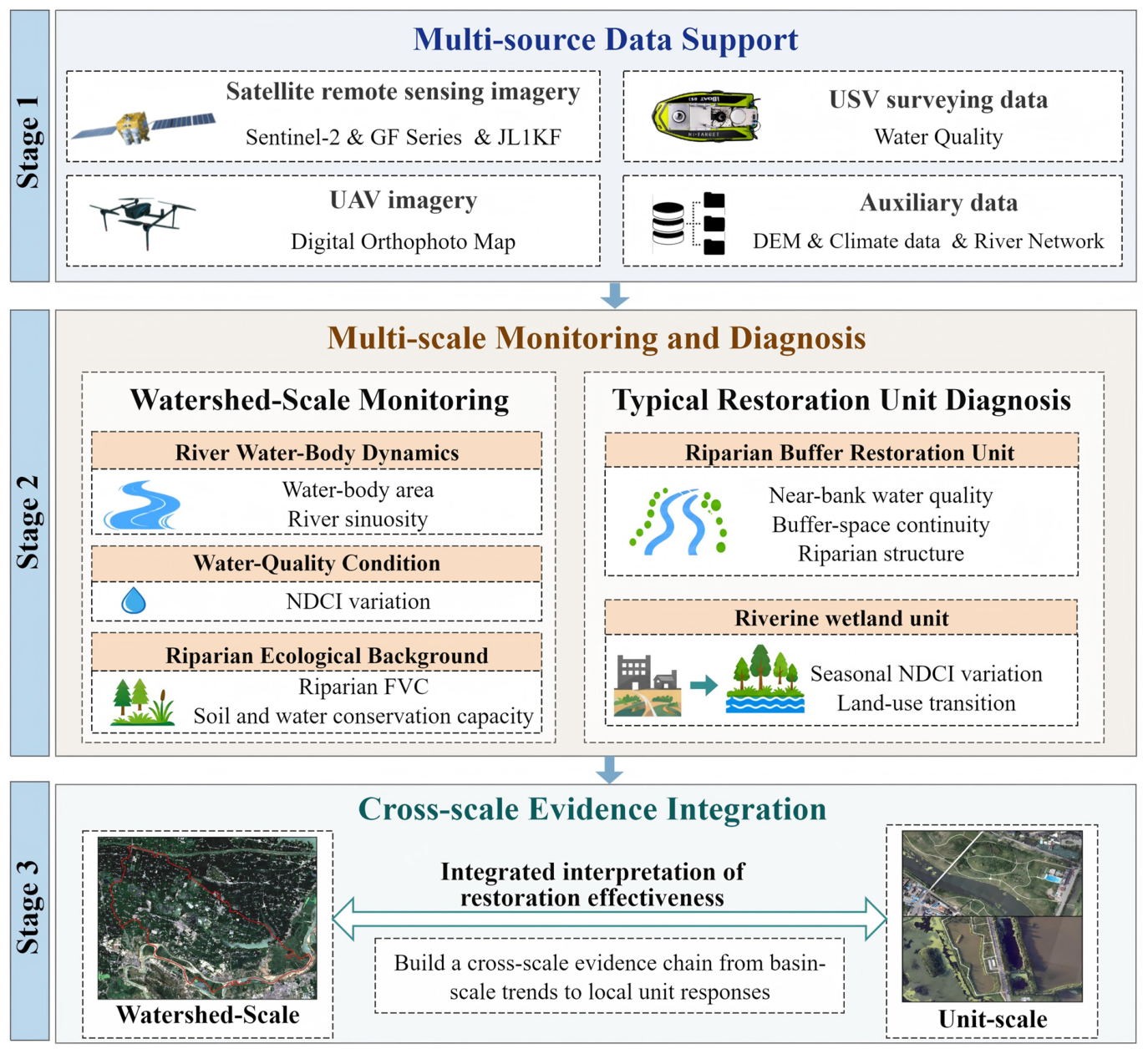
River ecological restoration is a multi-scale ecological process in which restoration effects are jointly shaped by watershed-scale hydrological and ecological changes and local restoration-unit responses [6,15]. From the perspective of integrated watershed management and river-corridor restoration, restoration effectiveness cannot be fully evaluated using a single indicator or a single spatial scale [6,9]. Instead, it should be understood through the coupled responses of river water-body dynamics, water environmental conditions, riparian ecological structure, and regional ecological support capacity [17,20]. Watershed-scale monitoring can reveal overall environmental trajectories and spatial heterogeneity, whereas restoration-unit-scale diagnosis can identify local ecological responses and remaining constraints associated with specific restoration measures. Therefore, a multi-source and multi-scale framework (Figure 2) is required to connect basin-wide restoration trends with local diagnostic evidence from typical restoration units.
Based on this theoretical understanding, this study constructed a collaborative satellite–UAV–USV monitoring framework (Figure 2) that integrates satellite-based dynamic monitoring, UAV-based fine-scale spatial interpretation, and USV-based in situ water-quality observation for cross-scale assessment of river ecological restoration effectiveness [25,28,29,30,48]. The framework consists of three linked components: multi-source data support, hierarchical monitoring and diagnosis, and integrated interpretation of restoration effectiveness.
First, multi-source datasets were integrated to provide complementary information across spatial and temporal scales. Sentinel-2 MSI time-series imagery was used for continuous watershed-scale monitoring of river water-body dynamics, chlorophyll-related eutrophication risk, and riparian ecological background. GF-1C/D and GF-2 imagery, JL1KF01A imagery, and UAV orthophoto imagery were used to support fine-scale interpretation of local restoration-unit boundaries, spatial structures, and land-use changes. USV-based underway monitoring data supplemented near-bank water environmental information, while DEM, climate data, and river-system data supported terrain, environmental, and spatial analyses [49].
Second, hierarchical monitoring and diagnosis were conducted at two spatial scales. At the watershed scale, three indicator groups were constructed to characterize overall river restoration trends: river water-body dynamics, chlorophyll-related eutrophication risk, and riparian ecological background. River water-body dynamics were represented by water-body area and river sinuosity; chlorophyll-related eutrophication risk was represented by NDCI variation; and riparian ecological background was represented by riparian fractional vegetation cover and soil and water conservation capacity. At the restoration unit scale, two representative unit types were selected for local diagnostic analysis: riparian buffer restoration units and riverine wetland restoration units. The former focused on near-bank water quality, buffer-space continuity, and riparian structure, whereas the latter focused on seasonal NDCI variation and land-use transition.
To clarify the correspondence among monitored objects, indicators, and datasets, Table 2 summarizes the analytical structure of the proposed framework. This table also explains which datasets were used for different target regions and monitoring objectives, thereby improving the transparency and reproducibility of the multi-scale analysis.
Third, watershed-scale monitoring results and unit-scale diagnostic results were integrated to build a cross-scale evidence chain. Watershed-scale indicators were used to identify overall restoration trends, while restoration-unit diagnosis was used to explain local ecological responses and spatial restructuring processes. In this framework, watershed-scale monitoring answered what changed across the basin, whereas restoration-unit diagnosis explained how different restoration types responded locally. This integration supported interpretation of restoration effectiveness from both basin-scale trends and local unit responses.

3.2. Watershed-Scale Monitoring Indicator Extraction and Assessment Methods

Watershed-scale monitoring was conducted to identify the overall trajectory of river ecological restoration in the Nihe River Basin. Following the framework shown in Figure 2, Sentinel-2 time-series imagery and auxiliary datasets were used to derive three indicator groups: river water-body dynamics, chlorophyll-related eutrophication risk, and riparian ecological background. These indicators jointly characterized physical river-space recovery, water-environment response, and ecological background support.

3.2.1. River Water-Body Dynamic Monitoring Method

River water-body dynamics provide direct spatial information for characterizing the effectiveness of river ecological restoration. For lowland plain rivers, changes in water-body extent, river continuity, and local water-surface expansion after restoration can indicate whether the physical river space has been restored.
Based on Sentinel-2 multispectral time-series imagery, river water bodies in the Nihe River Basin were extracted during the study period. Considering that newly formed water surfaces caused by coal-mining subsidence frequently occur in plain mining areas, these non-target water bodies may interfere with the identification of river-related water bodies. Therefore, this study adopted a river-corridor constraint method. Differential spatial constraint buffers were constructed along the river network to limit water-body extraction to the river corridor, and GF-1C/D imagery was further used to assist in the interpretation of local river boundaries. This constraint strategy reduced interference from non-river water bodies and improved the specificity and accuracy of river water-body dynamic monitoring.
Annual changes in river water-body area were quantified using a year-by-year comparison method. To improve the accuracy of water-surface detection and delineation from Sentinel-2 imagery, the Triangle Water Index (TWI), which was proposed for accurate detection and delineation of water surfaces in Sentinel-2 data, was used for threshold-based water extraction [50]. The formula is as follows:
T W I = 2.84 × ( B 5 B 6 ) ( B 3 + B 12 ) + ( 1.25 × ( B 3 B 2 ) ( B 8 B 2 ) ) ( B 8 + 1.25 × B 3 0.25 × B 2 )
where B2, B3, B5, B6, B8 and B12 represent the blue, green, red-edge 1, red-edge 2, near-infrared, and short-wave infrared 2 bands of Sentinel-2, respectively. In the original TWI study, the Otsu automatic thresholding algorithm was used to determine image-specific optimal thresholds for water extraction. In this study, considering the need for consistent interannual comparison of river water-body dynamics, a unified threshold of 0 was adopted for all Sentinel-2 images. This fixed threshold was not intended to replace the image-specific optimization strategy of the original TWI method, but to maintain a consistent water/non-water classification criterion across different years. The threshold was selected based on the sign structure of TWI values and the observed annual TWI distributions in the study area, and its applicability was further supported by independent validation using UAV orthophotos and corresponding Sentinel-2 images. Specifically, pixels with TWI > 0 were classified as water bodies, whereas pixels with TWI ≤ 0 were classified as non-water bodies.
The accuracy of water-body extraction was assessed using validation points generated by equalized stratified random sampling. A total of 398 validation points, including both water and non-water samples, were selected, and their reference labels were determined by visual interpretation using UAV orthophotos together with the corresponding Sentinel-2 images. The reference labels were compared with the classification results to construct a confusion matrix. Overall accuracy, the Kappa coefficient, producer’s accuracy, and user’s accuracy were then calculated to evaluate the classification performance.
In addition to water-body area changes, river sinuosity was introduced as an auxiliary indicator to characterize changes in the morphology of the main river channel, as sinuosity has been widely used to describe river planform and morphometric changes in geospatial river studies [51]. The formula is as follows:
S = L a c t u a l L s t r a i g h t
where S is river sinuosity, Lactual is the actual river-channel length, and Lstraight is the straight-line distance between the start and end points of the river reach.
Considering that the morphology of the main river channel usually changes only slightly over a short restoration period and that river sinuosity is sensitive to the accuracy of river-boundary extraction, this indicator was used as an explanatory indicator rather than a core indicator for watershed-scale dynamic monitoring. It was mainly used to assist in determining whether obvious engineering-induced adjustments had occurred in the spatial form of the main river channel.

3.2.2. Monitoring Method for Chlorophyll-Related Eutrophication Risk

Chlorophyll-related eutrophication risk is a critical indicator of water environmental change during river ecological restoration. Compared with traditional point-based monitoring, remote sensing methods can identify the spatial differentiation and interannual variation in water-body conditions at the watershed scale, making them suitable for time-series monitoring under systematic restoration contexts [52].
In this study, the normalized difference chlorophyll index (NDCI) was calculated using the red and red-edge bands of Sentinel-2 imagery to characterize changes in chlorophyll-related water conditions and their associated eutrophication risk. NDCI was originally proposed for estimating chlorophyll-a concentration in turbid productive waters and has been widely adapted for inland water chlorophyll monitoring using multispectral satellite data [18,53]. The formula is as follows:
N D C I = B 5 B 4 B 5 + B 4
where B4 and B5 represent the red band and red-edge band reflectance of Sentinel-2, respectively. The Sentinel-2 red-edge band has been shown to improve chlorophyll-a detection because of its sensitivity to the reflectance peak near 700 nm associated with phytoplankton biomass [54].
Specifically, the spatial change in NDCI was calculated at the pixel scale as:
ΔNDCI = NDCI2024 − NDCI2021
A threshold of ±0.1 was applied to the ΔNDCI map to distinguish evident positive or negative changes from relatively stable conditions. From the spectral perspective, NDCI can be expressed in terms of the red-edge/red reflectance ratio as:
B 5 B 4 = 1 + N D C I 1 N D C I
Around the neutral NDCI range, a change of 0.1 corresponds to an approximately 18–22% variation in the red-edge/red reflectance ratio, indicating a relatively pronounced shift in chlorophyll-related optical signals. Considering the optical complexity of water bodies in the Panji mining area [55], which may be affected by phytoplankton, suspended particles, CDOM, water-level variation, river connectivity, and mixed pixels [56], the ±0.1 interval was used to reduce the over-interpretation of minor spectral fluctuations.
Accordingly, pixels with ΔNDCI < −0.1 were defined as improved, indicating a decrease in chlorophyll-related eutrophication risk; pixels with −0.1 ≤ ΔNDCI ≤ 0.1 were defined as unchanged; and pixels with ΔNDCI > 0.1 were defined as degraded, indicating a potential increase in chlorophyll-related eutrophication risk.
Through the combined analysis of interannual NDCI patterns and spatially explicit NDCI differences, this study evaluated changes in chlorophyll-related eutrophication risk in the Nihe River Basin from 2021 to 2024. The results were further used to identify the potential effects of systematic restoration projects on watershed-scale water environmental improvement and to reveal spatial heterogeneity in restoration responses among different river reaches.

3.2.3. Extraction Method for Riparian Ecological Background Indicators

The effectiveness of river ecological restoration is reflected not only in changes in river water-body space and water environmental conditions, but also in the ecological background along river corridors. In lowland plain areas, rivers, riparian zones, and surrounding terrestrial areas are closely connected. Therefore, this study selected two complementary indicators to characterize riparian ecological background: riparian fractional vegetation cover (FVC), which reflects vegetation conditions within the river-corridor buffer zones, and the soil and water conservation service capacity index ( S p r o ), which represents broader regional ecological support conditions.
Riparian FVC was used to reflect the ecological recovery status of riparian buffer zones [57]. To quantify near-bank vegetation dynamics, hierarchical riparian buffer zones were constructed outward from the annually extracted river water-body boundaries according to river grades in the hydrographic vector data. A buffer width of 100 m was applied to first- and second-order rivers, while a buffer width of 50 m was applied to other river reaches. The use of annually updated water-body boundaries allowed the buffer zones to follow interannual changes in river water extent, while the grade-based buffer widths accounted for differences in river size and corridor scale. Within these buffers, water pixels were first identified using the annual water-body extraction results and treated as a separate class. The remaining terrestrial pixels were then used for FVC estimation and classified into different vegetation-cover levels.
FVC was estimated using the pixel dichotomy model based on the Normalized Difference Vegetation Index (NDVI) [58]. The formula is as follows:
F V C = N D V I N D V I s o i l N D V I v e g N D V I s o i l  
where FVC is fractional vegetation cover, N D V I is the N D V I value of a given pixel, N D V I s o i l   is the N D V I value of bare soil, and N D V I v e g   is the N D V I value of full vegetation cover.
In addition to local riparian vegetation conditions, this study further constructed the soil and water conservation service capacity index ( S p r o ) to characterize broader regional ecological support conditions. Soil and water conservation capacity is important for maintaining soil stability, reducing erosion, and supporting watershed-scale ecological regulation. For river ecosystems, stronger soil and water conservation capacity can help reduce sediment input, maintain bank stability, and provide a more favorable ecological background for river restoration, following the common understanding that soil and water conservation capacity is jointly influenced by vegetation productivity, soil erodibility, and terrain conditions [47,59]. S p r o was calculated as follows:
S p r o = N P P m e a n × ( 1 K ) × ( 1 F s l o )
where N P P m e a n is the annual mean net primary productivity, K is the normalized soil erodibility factor, and F s l o is the normalized slope factor. In this formulation, higher N P P m e a n , lower soil erodibility, and gentler terrain correspond to stronger potential soil and water conservation capacity.
Annual NPP from 2021 to 2024 was estimated using the Carnegie–Ames–Stanford Approach (CASA) model with NDVI and ERA5-Land meteorological variables as inputs [60]. Annual NPP from 2021 to 2024 was estimated using the CASA model with NDVI and ERA5-Land meteorological variables as inputs [53]. Following the CASA model, NPP was calculated as the product of absorbed photosynthetically active radiation (APAR) and the actual light-use efficiency (ε):
NPP(x,t) = APAR(x,t) × ε(x,t)
where APAR is derived from solar radiation and the fraction of absorbed photosynthetically active radiation estimated from NDVI, and ε is determined by temperature and moisture stress coefficients. In this formulation, temperature, precipitation, and solar radiation constrain vegetation growth, while NDVI reflects vegetation greenness. Therefore, the calculated NPP captures the combined effects of vegetation condition, water availability, thermal conditions, and solar radiation on regional vegetation productivity.
The soil erodibility factor was derived from the CSDLv2 soil dataset and calculated based on soil texture and organic carbon properties using the EPIC model:
K e p i c = 0.2 + 0.3 e x p 0.0256 S d 1 S i 100 × S i C l + S i 0.3 × 1 0.25 C C + e x p ( 3.72 2.95 C ) × 1 0.7 1 S d 100 1 S d 100 + e x p 5.51 + 22.9 1 S d 100
K = 0.01383 + 0.51575 K e p i c × 0.1317
where K e p i c is the soil erodibility factor calculated by the EPIC model; Sd, Si, and Cl represent the sand, silt, and clay contents, respectively; and C represents the soil organic carbon content. The calculated soil erodibility factor was then normalized to obtain K . The slope factor F s l o was derived from the topographic slope extracted from the ASTER GDEM and normalized to the range of 0–1. Because higher soil erodibility and steeper slopes generally indicate weaker soil and water conservation capacity, K and F s l o were converted into positive contribution terms using (1 − K ) and (1 − F s l o ), respectively.
Based on these procedures, annual S p r o values from 2021 to 2024 were generated to characterize interannual changes in regional soil and water conservation service capacity. It should be noted that S p r o was used as a broader regional ecological background indicator rather than as a direct measure of short-term local restoration effectiveness. Therefore, its interannual fluctuation was interpreted together with riparian FVC and meteorological variability to distinguish local river-corridor responses from broader regional background changes.

3.3. Diagnostic Method for Typical Restoration Units

While watershed-scale monitoring identifies overall restoration trends and spatial heterogeneity, unit-scale diagnosis explains how different restoration projects generate local ecological responses. In this study, two representative restoration unit types were selected: riparian buffer restoration units and riverine wetland restoration units. The former mainly address near-bank pollutant input, insufficient buffer space, and fragmented riparian transition zones, whereas the latter mainly address wetland occupation, aquaculture disturbance, water-body fragmentation, sedimentation, and habitat degradation.
The unit-scale diagnosis was not designed as an independent assessment system, but was linked to watershed-scale monitoring through cross-source evidence. Sentinel-2 time-series imagery provided comparable watershed-scale indicators, high-resolution satellite imagery and UAV orthophotos supported fine-scale interpretation of restoration-unit boundaries and spatial structures, and USV observations supplied in situ near-bank water-quality information. Based on the ecological objectives of each restoration unit, differentiated indicator combinations were used to interpret local restoration responses and explain the spatial heterogeneity observed in watershed-scale monitoring results.

3.3.1. Diagnostic Method for Riparian Buffer Restoration Units

The riparian buffer restoration unit corresponds to the engineering project locally referred to as the riparian interception belt. Although the term “riparian interception belt” emphasizes the engineering function of intercepting near-bank pollutant inputs, it was interpreted in this study as a riparian buffer restoration unit from an ecological perspective [61]. The primary ecological objectives of this unit type were to reduce near-bank pollutant inputs, restore buffer-space continuity, and improve the structure of the aquatic–terrestrial transition zone.
Accordingly, the diagnosis of riparian buffer restoration units focused on three aspects: near-bank water-quality response, buffer-space continuity, and riparian structural recovery.
Near-bank water-quality response was evaluated using USV-based underway monitoring data and drainage-outlet sampling records. The discrete USV monitoring points were spatially interpolated using the Inverse Distance Weighting (IDW) method to generate continuous distribution surfaces for COD, DO, and NH3-N, thereby visualizing spatial concentration gradients and identifying potential water-quality hotspots along the riparian interface. In addition, water-quality samples collected near drainage outlets before and after outlet restoration were compared to assess local changes in pollutant concentrations and dissolved oxygen conditions.
Buffer-space continuity and riparian structural recovery were interpreted using high-resolution satellite imagery and UAV orthophotos. Changes in buffer width, bank continuity, local river-channel space, riparian transition-zone integrity, vegetation recovery, waterfront-space restructuring [43], and hardened bank surfaces were analyzed to evaluate whether the riparian buffer zone became more continuous and whether the riparian ecological structure was optimized toward a more natural aquatic–terrestrial transition pattern.
By integrating USV-based water-quality monitoring, drainage-outlet before–after comparison, and high-resolution spatial interpretation, this diagnostic method was used to evaluate the local ecological response of riparian buffer restoration units.

3.3.2. Diagnostic Method for Riverine Wetland Units

Riverine wetland restoration units are mainly located in suburban or low-lying river reaches where wetland occupation, aquaculture disturbance, water-body fragmentation, sedimentation, and habitat degradation are common. The restoration objectives of this unit type are to restore natural water space, improve hydrological connectivity, and promote ecological spatial reorganization.
Considering the strong seasonal variability and phased recovery process of wetland ecosystems, this study adopted a dual-season time-series monitoring strategy for riverine wetland restoration units. Sentinel-2 imagery and other optical remote sensing data have been widely used for wetland mapping, seasonal monitoring, and land-cover change analysis [62,63]. In this study, the diagnosis of riverine wetland units was conducted from two aspects: water-body condition change and land-use pattern transformation.
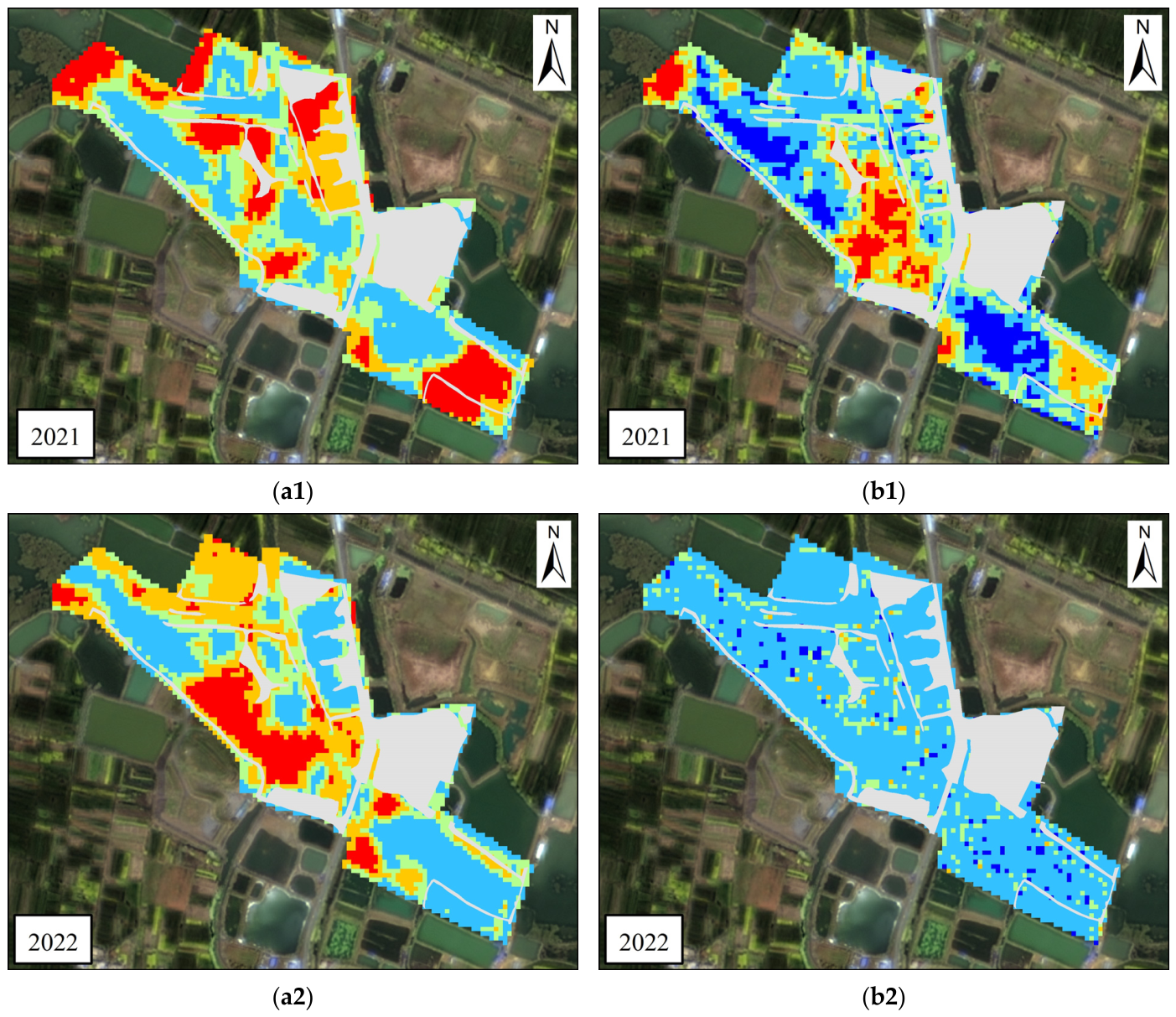
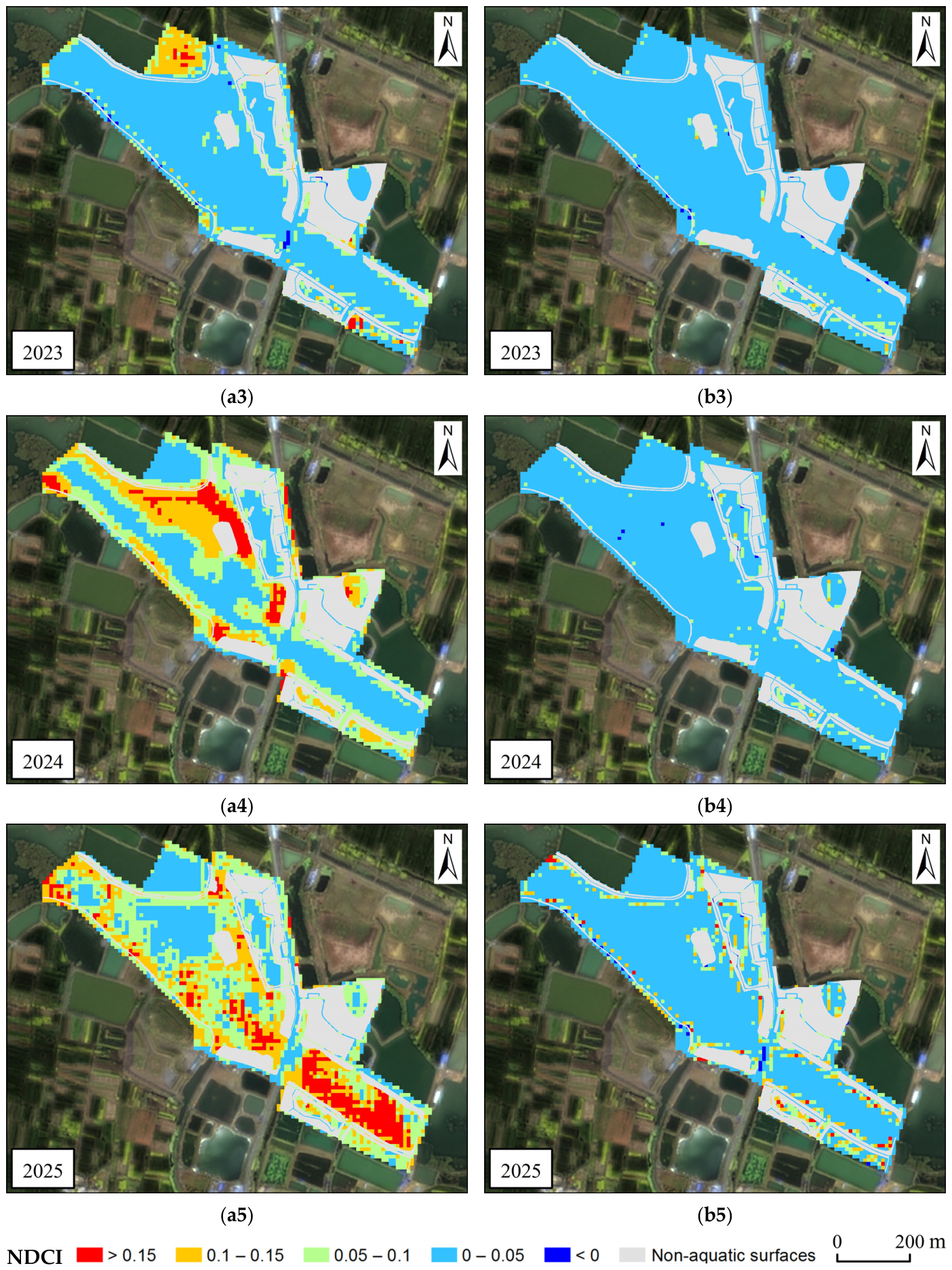
Water-body condition change was characterized by seasonal and interannual variations in chlorophyll-related eutrophication risk. Sentinel-2 time-series imagery was used to compare summer and winter NDCI patterns from 2021 to 2025, thereby identifying seasonal differences and interannual changes in wetland water conditions before and after restoration. This analysis was used to distinguish relatively stable baseline improvement from seasonal algal fluctuations.
Land-use pattern transformation was used to identify the reorganization of local ecological space during the post-restoration recovery process. High-resolution satellite imagery and UAV orthophotos were used to support land-cover interpretation and spatial structure analysis. Land-cover types, including natural water bodies, artificial water bodies, vegetation, wetland complex habitats, bare land, and buildings and impervious surfaces, were interpreted and reclassified according to their ecological implications. Land-use transition analysis was then used to identify the conversion pathways among these habitat types and to explain changes in wetland water-space patterns, water–vegetation interface restructuring, and ecological background transformation. Together with the seasonal water-condition analysis, this approach was used to evaluate the ecological response of riverine wetland restoration units in terms of chlorophyll-related eutrophication risk and local ecological spatial reorganization.

4. Results

4.1. Watershed-Scale Monitoring Results of River Ecological Restoration Effectiveness

4.1.1. River Water-Body Dynamics

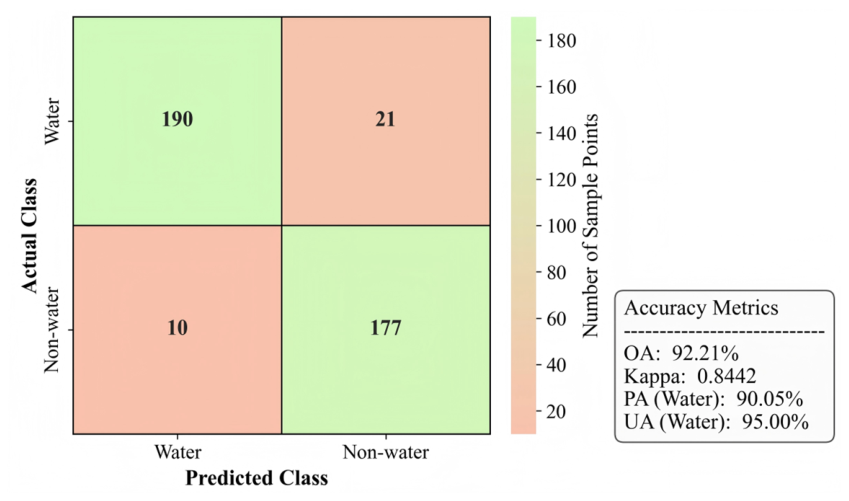
The accuracy assessment of river water-body extraction was first conducted using validation points interpreted from UAV orthophotos and corresponding Sentinel-2 images. As shown in Figure 3, a total of 398 validation points were used to construct the confusion matrix. Among them, 190 water samples and 177 non-water samples were correctly classified. The overall accuracy reached 92.21%, and the Kappa coefficient was 0.8442. For the water class, the producer’s accuracy was 90.05%, and the user’s accuracy was 95.00%. Misclassified points were mainly distributed near water boundaries, narrow channels, fragmented water surfaces, and complex land–water transition zones.
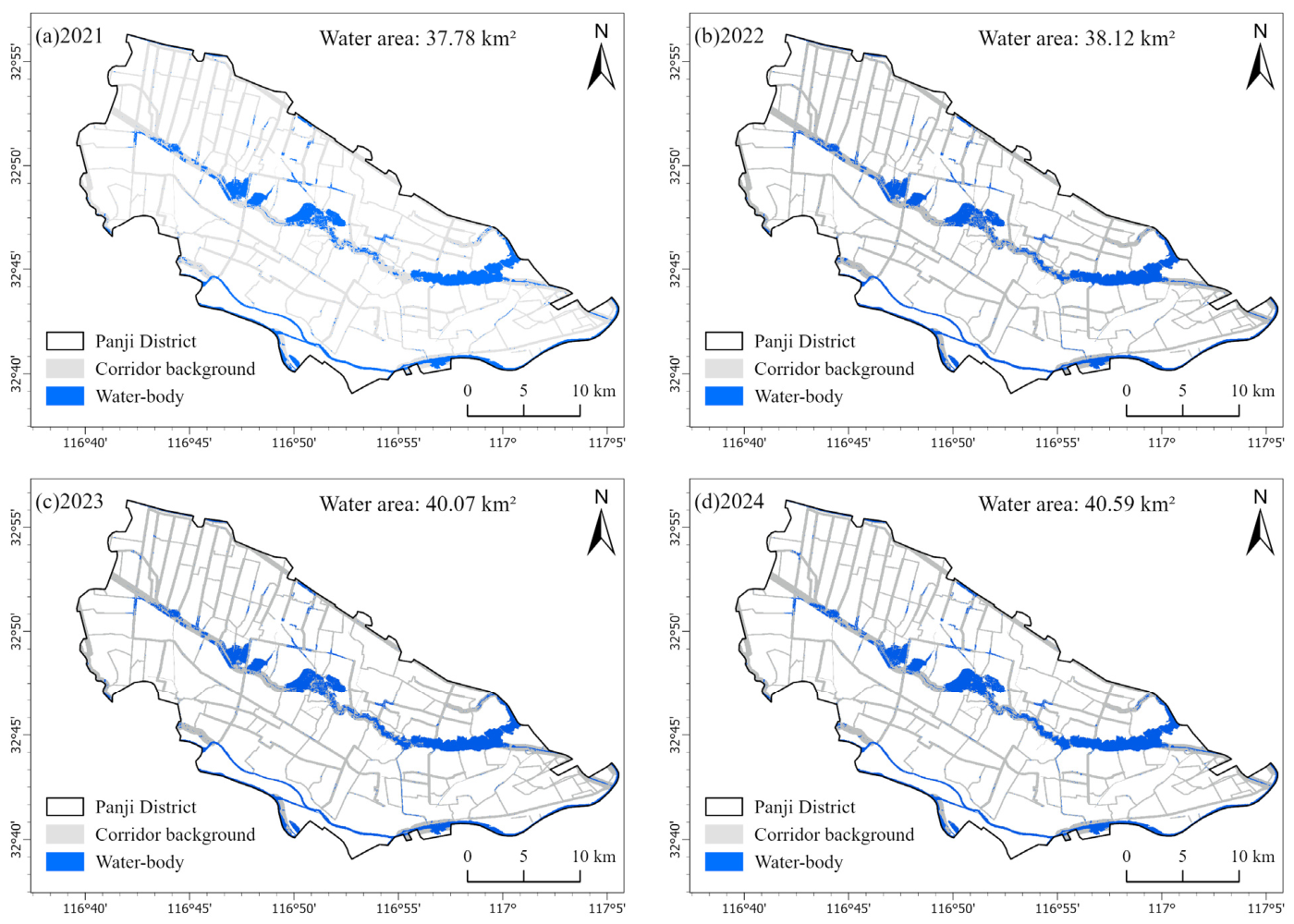
Based on the validated extraction results, the area of the main river water bodies in the Nihe River Basin showed an increasing trend from 2021 to 2024. As shown in Figure 4, the river water-body area increased from 37.78 km2 in 2021 to 40.59 km2 in 2024, representing a net increase of 2.81 km2 and a growth rate of approximately 7.44%. In terms of interannual variation, the water-body area increased by 0.34 km2 from 2021 to 2022, by 1.95 km2 from 2022 to 2023, and by 0.52 km2 from 2023 to 2024. The largest increase occurred during 2022–2023.
Spatially, the extracted river water bodies showed a more continuous distribution along the constrained river corridor over time. In addition to the main channel, several tributary-connected and localized riverine water patches also showed expansion during the study period. This expansion is consistent with the lowland plain setting of the Nihe River Basin, where dredging, river-course rehabilitation, and water-surface reconnection can directly improve river continuity and enlarge riverine water surfaces within the constrained corridor.
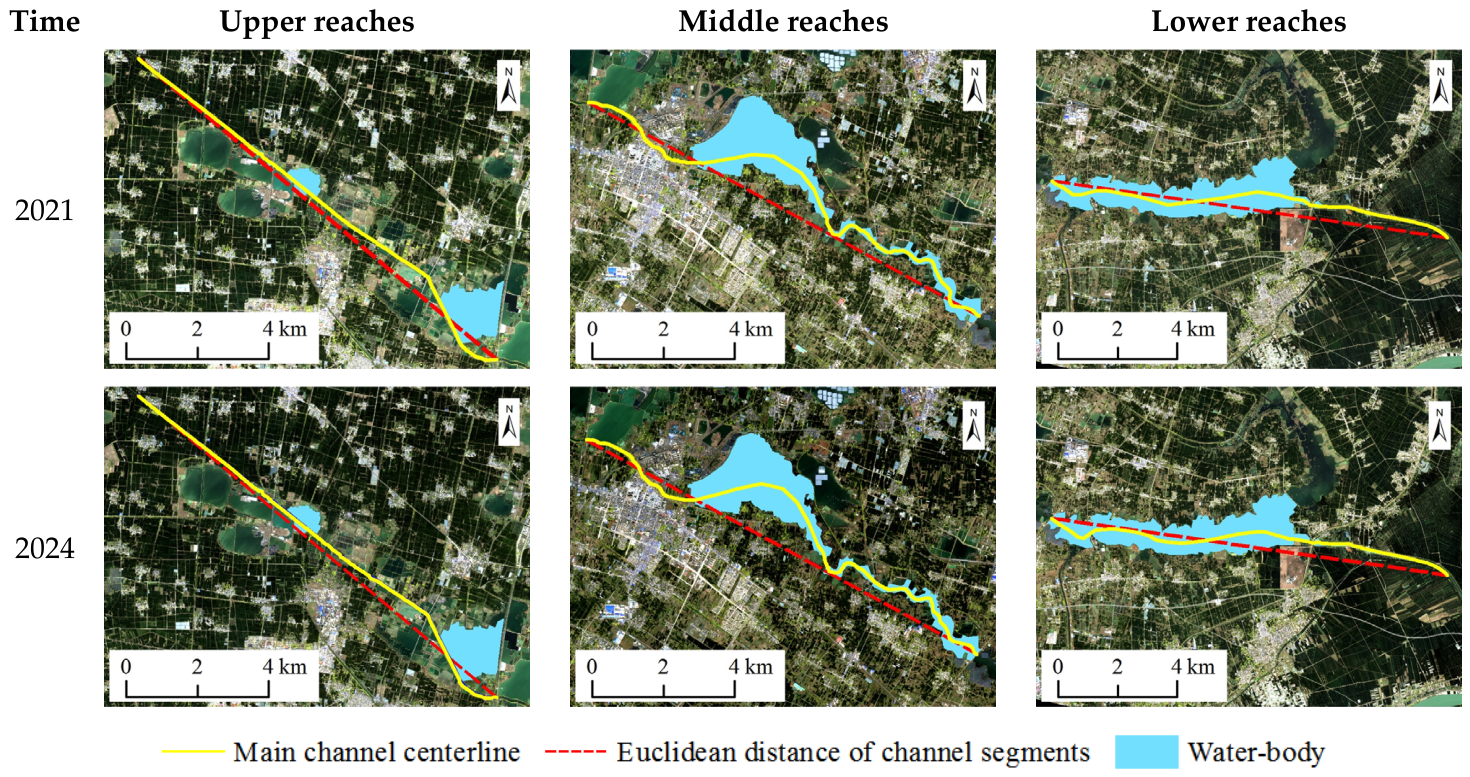
In addition to water-body area, river sinuosity was calculated for the upper, middle, and lower reaches of the main channel of the Nihe River, as well as for the whole main channel (Figure 5). The overall sinuosity of the main channel increased from 1.10 in 2021 to 1.11 in 2024, with a change rate of 0.89%. In the upper reach, the straight-line distance was 13.19 km, and the actual river length increased from 13.53 km to 13.58 km. The sinuosity remained approximately 1.03, with a change rate of 0.01%. In the middle reach, the straight-line distance was 12.53 km, and the actual river length increased from 13.94 km to 14.67 km. The sinuosity increased from 1.11 to 1.17, with a change rate of 5.49%. In the lower reach, the straight-line distance was 13.50 km, and the actual river length decreased from 14.47 km to 14.06 km. The sinuosity decreased from 1.07 to 1.04, with a change rate of −2.68%. Given the low-gradient, floodplain-dominated geomorphology of the Nihe River, such short-term, localized increases in sinuosity and water-body area are likely attributable to restoration measures, including river dredging, channel rehabilitation, and water-surface reconnection, rather than natural geomorphic evolution.
Overall, the watershed-scale water-body results showed an increase in river water-body area from 2021 to 2024, while the overall sinuosity of the main channel changed only slightly. Among the different reaches, the middle reach showed the most evident increase in sinuosity.

4.1.2. Changes in Chlorophyll-Related Eutrophication Risk

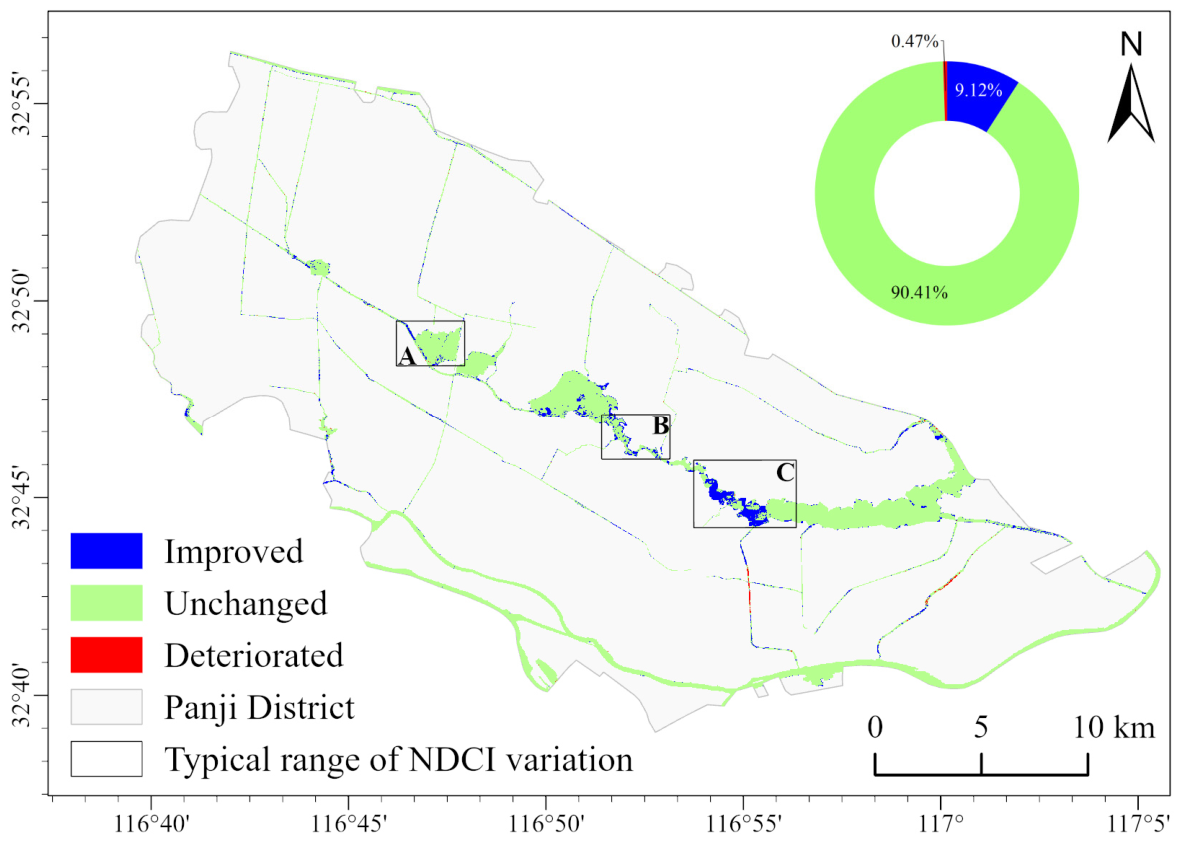
The NDCI-based monitoring results indicated that chlorophyll-related eutrophication risk in the main river water bodies of the Nihe River Basin remained generally stable from 2021 to 2024, with localized improvement observed in some reaches (Figure 6). Based on the NDCI difference between 2024 and 2021, unchanged areas accounted for 90.41% of the monitored river area, while improved and degraded areas accounted for 9.12% and 0.47%, respectively.
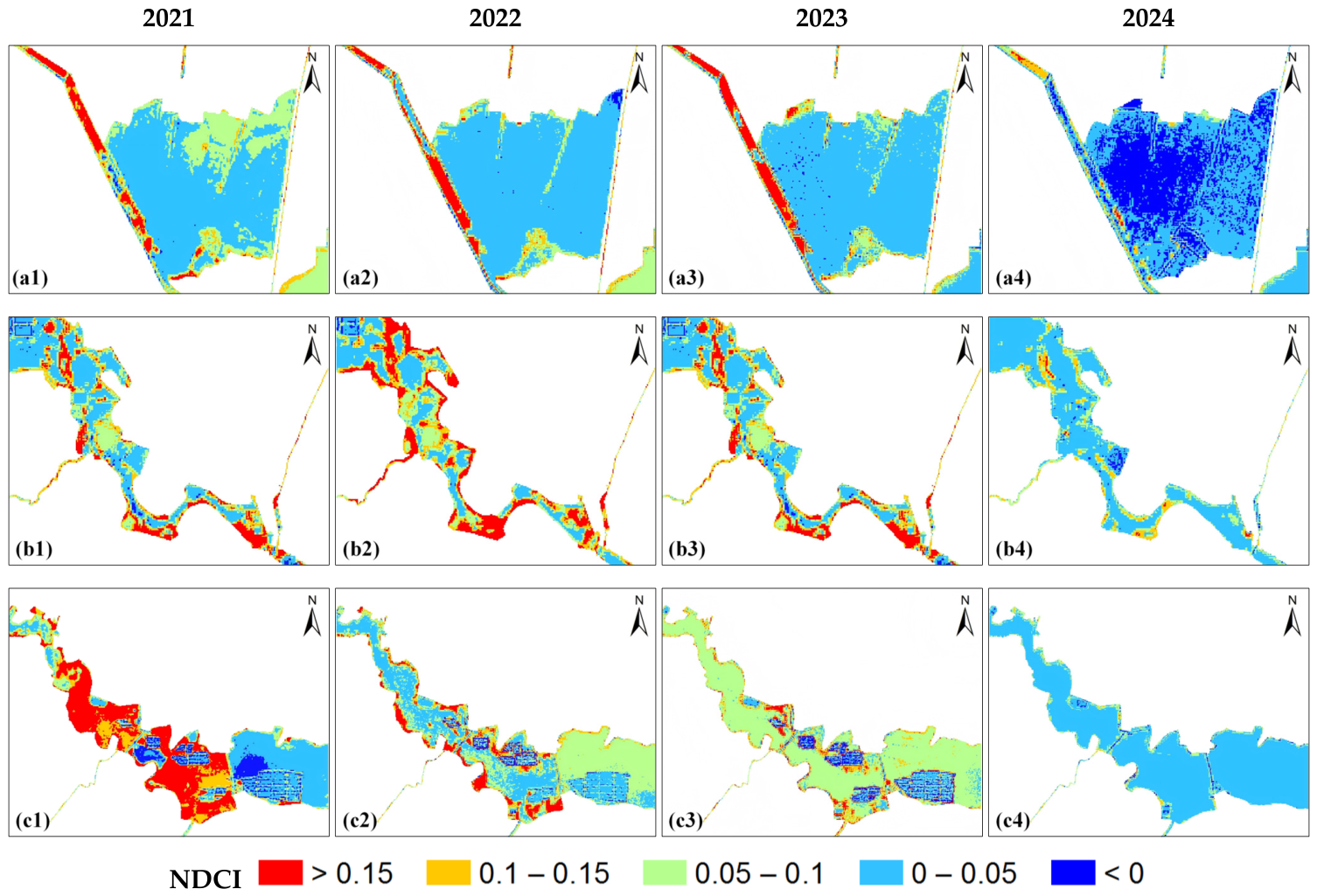
Spatially, the improved areas were not evenly distributed across the entire river network. As shown in Figure 6, NDCI improvement was mainly concentrated in several local reaches. To clarify the spatial relationship between the basin-scale NDCI change map and the local temporal comparison, Typical Regions A, B, and C were selected from the areas with relatively evident NDCI improvement shown in Figure 6. These three regions represent local reaches with typical improvement characteristics and have been marked in Figure 7.
In the three typical regions, high-NDCI patches generally became smaller or less continuous during the study period, while medium- and low-NDCI areas became more dominant. The annual comparison in Figure 7 shows that the changes differed among the three regions, indicating local variation in NDCI dynamics.
Within several local river reaches, the decrease in the NDCI was more evident in the central flow area of the main channel, whereas near-bank water zones showed weaker changes. Some relatively high-NDCI patches remained along riparian margins, river bends, or shallow near-bank areas.
Overall, the NDCI results showed that most monitored river water areas remained stable between 2021 and 2024, while improved areas were larger than degraded areas. The spatial distribution of improvement showed clear local clustering rather than uniform basin-wide change.

4.1.3. Changes in Riparian Ecological Background

Changes in riparian ecological background were characterized using riparian fractional vegetation cover (FVC) and the soil and water conservation service capacity index ( S p r o ). Riparian FVC was calculated within the grade-based dynamic riparian buffer zones, while S p r o was calculated for the broader study area.
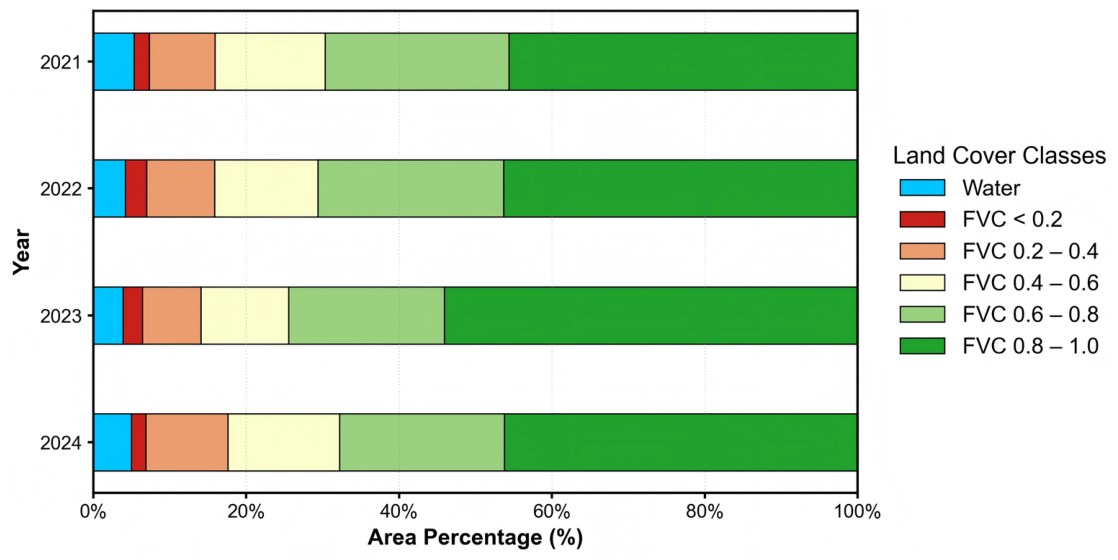
After excluding fragmented water pixels within the riparian buffer zones, the area percentages of terrestrial FVC classes showed that medium–high and high vegetation-cover classes dominated the riparian terrestrial surface from 2021 to 2024 (Figure 8).
The highest vegetation-cover class, FVC 0.8–1.0, accounted for the largest proportion in each year, ranging from 45.65% to 54.07%. The medium–high class, FVC 0.6–0.8, ranked second, accounting for 20.37–24.31%. Together, these two classes represented the majority of the terrestrial riparian area throughout the study period.
In terms of interannual variation, the proportion of the FVC 0.8–1.0 class increased before 2023 and then decreased in 2024. It reached the highest value of 54.07% in 2023 and decreased to 46.24% in 2024. The proportions of low vegetation-cover classes remained relatively limited during the study period.
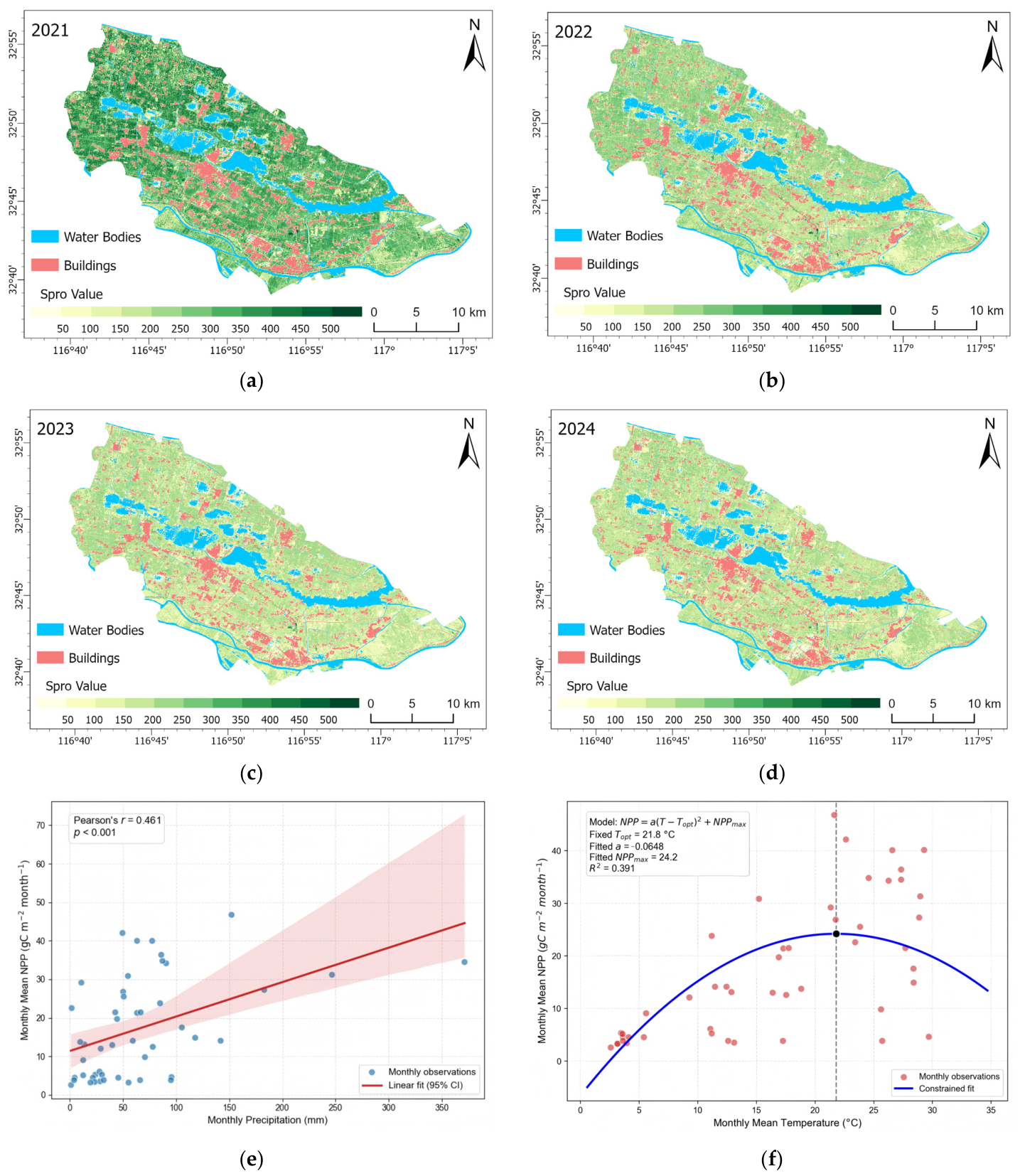
The spatial distribution of S p r o from 2021 to 2024 is shown in Figure 9. In 2021, medium–high and high-value areas were relatively extensive. In 2022, high-value areas contracted, and the overall level declined. In 2023, the study area was mainly dominated by medium-level values. By 2024, the index increased slightly compared with 2023, but the overall level remained lower than that in 2021.
Because soil erodibility and topographic conditions were relatively stable over the short study period, the interannual variation in S p r o was mainly influenced by fluctuations in vegetation productivity. To further explain this variation, monthly NPP from 2021 to 2024 was fitted with synchronous precipitation and temperature data.
The results showed a significant positive correlation between monthly precipitation and monthly mean NPP (Pearson’s r = 0.461, p < 0.001). This indicates that precipitation was an important meteorological factor affecting vegetation productivity fluctuations in the study area. Specifically, precipitation influenced vegetation growth by regulating water availability. In contrast, the effect of temperature on NPP showed an obvious nonlinear pattern. Based on a physiologically constrained quadratic fit, the optimum temperature for NPP in the study area was approximately 21.8 °C. When temperature approached this range, NPP remained at a relatively high level. However, when temperature further increased into the high-temperature range, NPP did not continue to increase but instead showed a decreasing trend. The fitted equation is as follows:
N P P = 0.0648 ( T 21.8 ) 2 + 24.2
The coefficient of determination was R2 = 0.391, suggesting that temperature explained part of the variation in NPP, although other environmental factors may also have contributed to vegetation productivity fluctuations. These results indicate that the decline or fluctuation in regional S p r o during the study period did not necessarily imply degradation of the ecological background along the restored river corridors. Instead, it may more strongly reflect the response of regional vegetation productivity to meteorological variability, especially changes in precipitation and temperature.
Overall, riparian vegetation cover remained relatively high and showed signs of phased improvement during the study period, whereas the regional S p r o showed greater interannual fluctuation and remained generally lower than the 2021 level. This contrast suggests that regional S p r o was more sensitive to short-term meteorological variability than to a simple monotonic change in the ecological background of the restored river corridors.

4.2. Diagnostic Results for the Riparian Buffer Restoration Unit

The riparian buffer restoration unit analyzed in this study corresponds to a local riparian interception belt project initiated in early 2021. The project aimed to restore near-bank buffer space and enhance the interception of agricultural non-point-source pollution and domestic pollutant inputs. Therefore, this study utilized 2020 imagery as the pre-restoration baseline and 2024 imagery, together with monitoring results, to represent the post-restoration stage, analyzing changes in near-bank buffer space, riparian ecological structure, and water environmental conditions. Since the near-bank water-quality monitoring data primarily covered 2021 and 2024, the water environmental results were used mainly to characterize the phased responses during project implementation.

4.2.1. Changes in Near-Bank Water Environmental Conditions

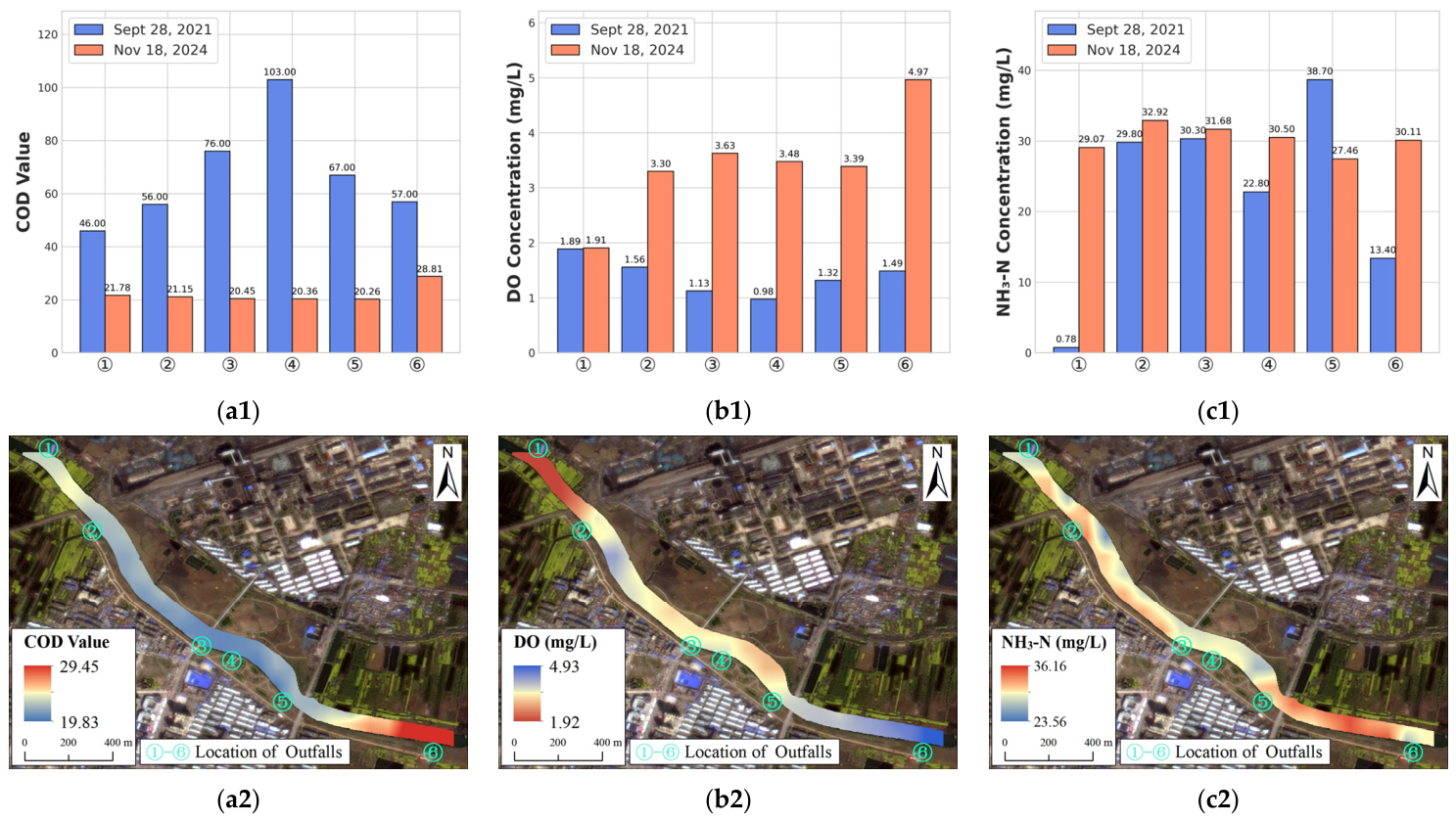
Fixed-point monitoring results from six discharge outfalls in 2021 and 2024, together with USV spatial interpolation results, showed that the near-bank water environment exhibited differentiated responses during the implementation of riparian buffer restoration (Figure 10). Overall, COD decreased markedly and DO generally increased, whereas NH3-N showed only limited improvement. The spatial extent shown in Figure 10 corresponds to the typical riparian buffer restoration unit illustrated in Figure 1. This ensures that the near-bank water environmental analysis is directly linked to the selected representative restoration unit, clarifying the spatial coverage of the monitoring and interpolation results.
COD decreased significantly across all discharge outfalls, dropping from 46.00–103.00 mg/L in 2021 to 20.26–28.81 mg/L in 2024, with the most substantial reductions observed at outfalls ③ and ④. The USV interpolation results indicated that COD in 2024 was primarily distributed within the range of 19.83–29.45 mg/L, with only a localized high-value area remaining near the downstream confluence. This indicates that the near-bank organic pollution load was substantially reduced.
DO levels increased from 0.98–1.89 mg/L in 2021 to 1.91–4.97 mg/L in 2024, suggesting improved reoxygenation conditions within the studied reach. Spatially, DO generally exhibited an increasing trend from upstream to downstream. In contrast, NH3-N remained at a relatively high level in 2024, ranging from 27.46 to 32.92 mg/L, with only outfall ⑤ showing a noticeable decrease. The USV interpolation maps highlighted distinct high-value NH3-N zones near outfalls ② and ⑤, with an overall spatial range of 23.57–36.16 mg/L.
Overall, following the implementation of riparian buffer restoration, the near-bank water environment of the studied reach exhibited a phased response characterized by reduced organic pollution, enhanced dissolved oxygen, and limited improvement in ammonia nitrogen. Among the monitored indicators, NH3-N showed the weakest improvement and remained at relatively high levels in 2024.

4.2.2. Changes in Near-Bank Buffer Space and Riparian Spatial Continuity

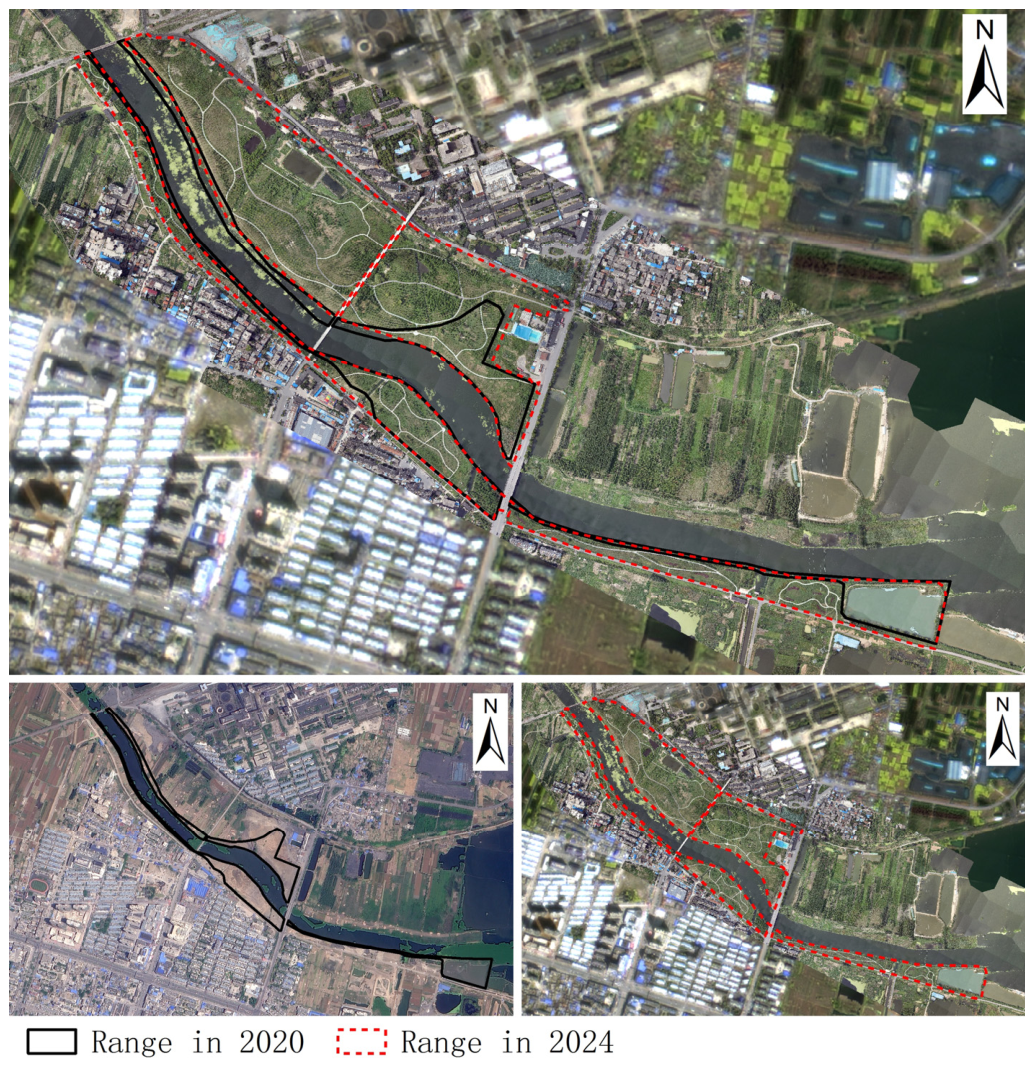
A comparison of JL1KF01A imagery (2020) and UAV orthophotos (2024) revealed a marked post-restoration expansion of the near-bank buffer space (Figure 11). Relative to the pre-restoration baseline, the riparian boundaries became more distinct, belt-like structures, achieved greater completeness, and previously compressed or discontinuous buffer spaces were effectively restored. Consequently, the spatial continuity of the riverine ecological space was significantly enhanced.
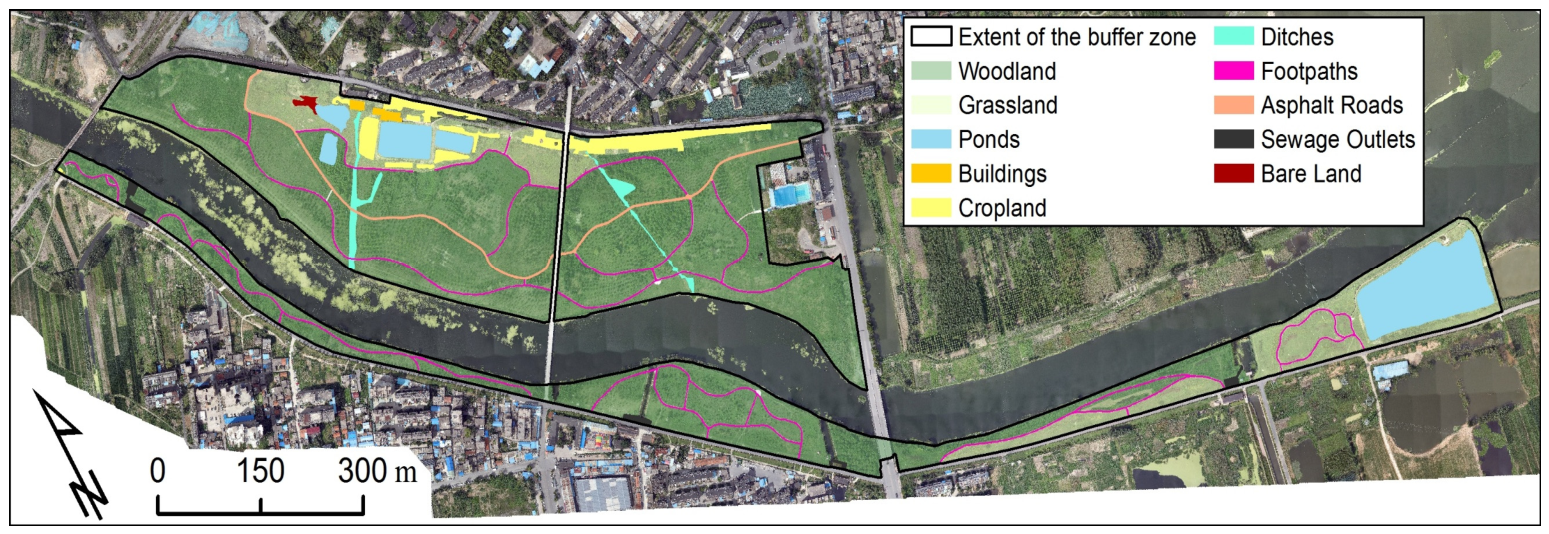
In terms of spatial patterns, the near-bank zone in 2020 was predominantly characterized by narrow or locally missing buffer spaces; the river channel was directly adjacent to surrounding artificial surfaces, lacking a continuous ecological transition between water and land. By 2024, relatively continuous buffer zones had formed along both sides of the river. Several previously interrupted riparian sections were reconnected, shifting the near-bank space from a scattered and fragmented local distribution toward a more continuous belt-like structure. This change indicates that the near-bank buffer space became more continuous and spatially organized after restoration.

4.2.3. Post-Restoration Riparian Ecological Structure

The 2024 land-use classification results of the ecological buffer zone are shown in Figure 12. The classified land-use pattern indicates that the post-restoration riparian zone was mainly composed of vegetation, water bodies, and waterfront ecological spaces. Vegetation was distributed continuously along both sides of the river in most sections, forming a belt-like riparian structure. Water bodies and vegetated areas were spatially connected, and the transition between the river channel and the adjacent riparian zone was clearly represented in the classification result.
Within the ecological buffer zone, vegetation occupied a dominant position in the near-bank space, while water bodies formed the central linear structure of the restored reach. Other land-cover types, such as bare land or artificial surfaces, were more limited and mainly appeared in localized areas. This land-use composition shows that the 2024 riparian buffer zone had a relatively clear spatial organization among water bodies, riparian vegetation, and adjacent waterfront spaces.
Although the land-use classification was conducted for 2024, its spatial pattern can be interpreted together with the pre- and post-restoration buffer-space comparison shown in Figure 11. The comparison in Figure 11 shows that the near-bank buffer space became more continuous after restoration, while Figure 12 further describes the internal land-use composition of the restored buffer zone. Together, these results indicate that the post-restoration riparian zone was characterized by a relatively continuous vegetation-dominated ecological structure along the river. Therefore, the post-restoration riparian ecological structure was not evaluated solely from land-use composition, but from the combined evidence of expanded buffer space, improved spatial continuity, and vegetation-dominated internal structure.

4.3. Diagnostic Results for the Riverine Wetland Restoration Unit

The engineering restoration of the Manshuiqiao riverine wetland unit was substantially completed in 2023. In this study, summer and winter Sentinel-2 time-series images from 2021 to 2025 were used to identify seasonal differences and interannual variations in wetland water conditions. High-resolution satellite imagery and UAV orthophotos were further integrated to compare the pre- and post-restoration stages around 2023.

4.3.1. Changes in Water-Body Conditions

The dual-season NDCI monitoring results showed seasonal differences in chlorophyll-related water conditions in the Manshuiqiao Wetland from 2021 to 2025 (Figure 13).
In summer, relatively high NDCI values were widely distributed in 2021 and 2022. In 2023, high-NDCI areas contracted markedly, and more wetland water bodies shifted toward lower NDCI levels. In 2024 and 2025, localized high-NDCI patches reappeared in some river bends, marginal water zones, and slow-flowing reaches.
In winter, relatively high NDCI signals were observed locally in 2021 and 2022. From 2023 to 2025, low-NDCI areas became dominant, and the spatial distribution of the NDCI became more uniform. Compared with the summer results, the winter results showed a more consistent reduction in high-NDCI areas after 2023.
Overall, the NDCI results showed that the Manshuiqiao Wetland experienced a decrease in high-NDCI areas after restoration completion, with clearer and more stable low-NDCI patterns in winter than in summer. Summer NDCI patterns showed localized fluctuation after 2023, especially in river bends and marginal water zones.

4.3.2. Land-Use Change and Ecological Background Transformation

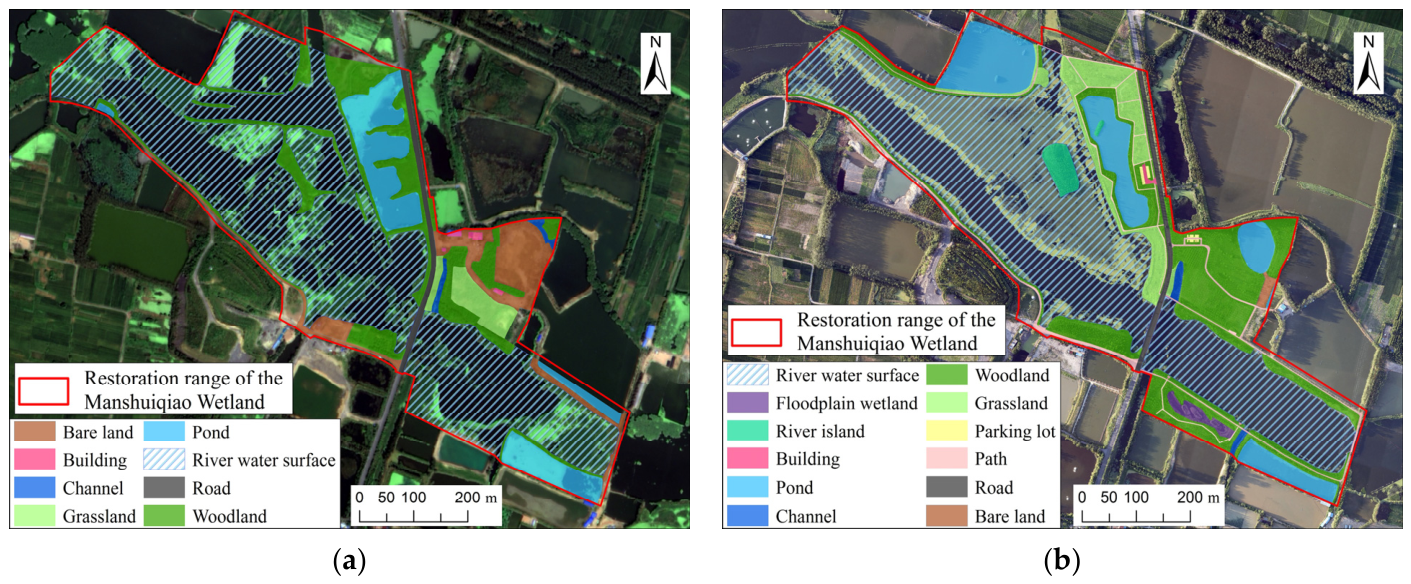
Interpretation results from high-resolution satellite imagery and UAV orthophotos showed that the land-use pattern of the Manshuiqiao Wetland changed markedly from 2021 to 2024 during the restoration and natural recovery process (Figure 14). In 2021, the study area was dominated by the river water surface, which accounted for 65.49% of the total area. Woodland accounted for 12.99%, ponds accounted for 9.49%, and bare land accounted for 7.31%. Other land-use types, including grassland, roads, channel, and buildings, occupied relatively small proportions. This indicates that the pre-completion land-use pattern was mainly composed of river water surface, woodland, ponds, and bare land.
By 2024, river water surface remained the largest land-use type, but its proportion decreased to 55.63%. Woodland increased to 19.17%, and grassland increased to 5.52%. Pond area also increased to 11.83%. In contrast, bare land decreased sharply from 7.31% to 0.33%, representing the most evident reduction among all detailed land-use types. In addition, river island and floodplain wetland appeared in the 2024 classification, accounting for 1.33% and 0.83%, respectively. Paths also increased markedly and accounted for 3.10% in 2024.
The comparison of detailed land-use subclasses shows that the most pronounced changes from 2021 to 2024 were the decrease in river water surface and bare land, the increase in woodland, grassland, and pond areas, and the emergence of river island and floodplain wetland. Spatially, Figure 14 shows that the 2021 wetland unit was mainly structured by large river water surfaces, with woodland, ponds, and bare land distributed around the water bodies. By 2024, vegetation patches became more extensive, wetland-related landforms appeared, and bare land was greatly reduced. The detailed classification results therefore indicate a clear redistribution of water surfaces, vegetated land, artificial water bodies, and wetland-related patches within the restoration unit.
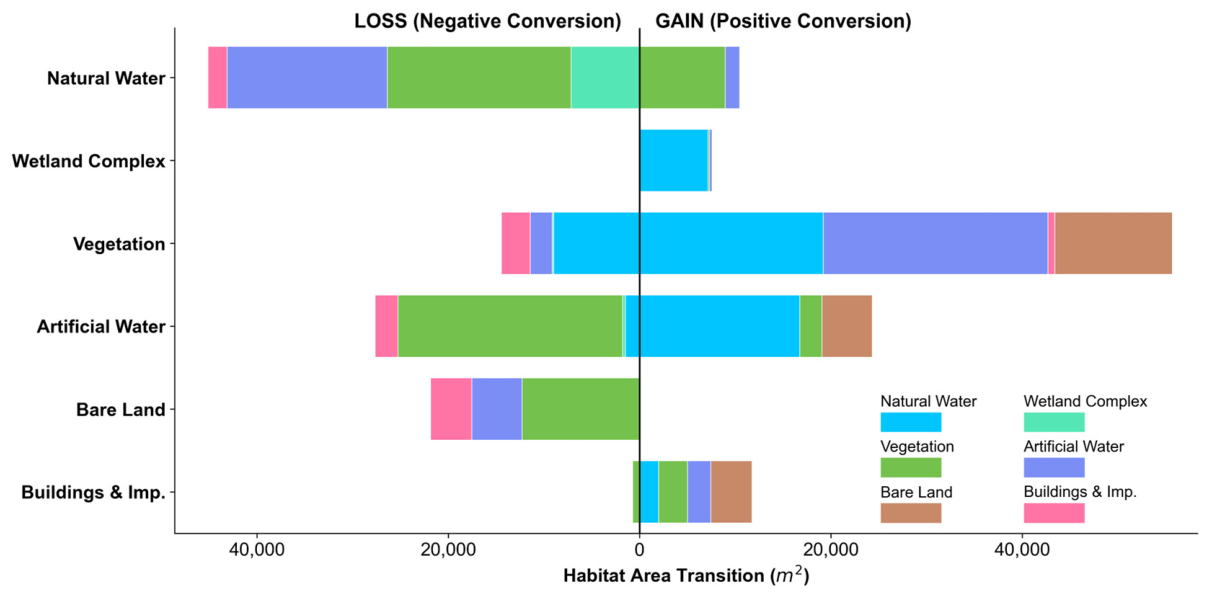
To further interpret these land-use changes in terms of ecological function, the detailed land-cover subclasses were grouped into six reclassified habitat types: natural water bodies, wetland complex habitat, vegetation, artificial water bodies, buildings and impervious surfaces, and bare land (Table 3). Based on this reclassification, the gain–loss contributions of habitat transitions from 2021 to 2024 were calculated using the land-use transition matrix (Figure 15). The loss results showed that natural water bodies, vegetation, artificial water bodies, and bare land were the main sources of habitat conversion. Natural water bodies mainly converted to vegetation, artificial water bodies, and wetland complex habitat, with loss contributions of 19,203.75 m2, 16,756.55 m2, and 7168.72 m2, respectively. Artificial water bodies mainly converted to vegetation, with a loss contribution of 23,479.33 m2. Bare land mainly converted to vegetation, artificial water bodies, and buildings and impervious surfaces, with loss contributions of 12,281.90 m2, 5254.49 m2, and 4304.98 m2, respectively. Vegetation also showed conversions to natural water bodies, buildings and impervious surfaces, and artificial water bodies, but these changes were smaller than the major transitions described above.
The gain results showed that vegetation received the largest area from other habitat types. It gained 23,479.33 m2 from artificial water bodies, 19,203.75 m2 from natural water bodies, and 12,281.90 m2 from bare land. Artificial water bodies gained mainly from natural water bodies and bare land, with contributions of 16,756.55 m2 and 5254.49 m2, respectively. Natural water bodies gained mainly from vegetation and artificial water bodies, with contributions of 8968.15 m2 and 1495.15 m2, respectively. Wetland complex habitat was newly formed mainly from natural water bodies, with a gain contribution of 7168.72 m2. Buildings and impervious surfaces gained mainly from bare land, vegetation, artificial water bodies, and natural water bodies.
This land-use transition matrix indicates that the Manshuiqiao Wetland experienced active exchanges among natural water bodies, vegetation, artificial water bodies, bare land, and wetland complex habitat from 2021 to 2024. The most evident transition pathways included conversion from natural water bodies and artificial water bodies to vegetation, conversion from bare land to vegetation and artificial water bodies, and formation of wetland complex habitat mainly from natural water bodies. These results show that the post-restoration land-use pattern was characterized by vegetation expansion, bare land reduction, water-surface redistribution, and the emergence of wetland transitional habitats, rather than a simple one-way expansion of natural water bodies.

5. Discussion

5.1. Value of Linking Watershed-Scale Monitoring with Restoration-Unit-Scale Diagnosis

River restoration effectiveness is difficult to evaluate using either watershed-scale monitoring or local diagnosis alone. Watershed-scale indicators can reveal the overall direction of ecological change, whereas restoration-unit-scale diagnosis is needed to explain how different restoration measures translate into local ecological responses. The main value of the satellite–UAV–USV framework proposed in this study is therefore its ability to connect these two levels of evidence within a coherent assessment pathway.
In the Nihe River Basin, watershed-scale monitoring showed an overall positive restoration trajectory. River water-body area increased from 37.78 km2 in 2021 to 40.59 km2 in 2024, indicating the expansion and recovery of river-related water surfaces. The NDCI-based results also showed that chlorophyll-related conditions were generally stable or improved, with the improved area being much larger than the degraded area. These basin-scale patterns suggest that restoration was associated with water-space recovery and localized reduction in chlorophyll-related eutrophication risk.
However, watershed-scale trends alone cannot fully explain the ecological mechanisms behind these changes. The unit-scale results showed that different restoration types generated different response pathways. In the riparian buffer restoration unit, the response was mainly reflected in near-bank water-quality improvement, enhanced buffer-space continuity, and riparian structural recovery. In the riverine wetland restoration unit, the response was expressed through seasonal NDCI variation, vegetation expansion, bare land reduction, water-surface redistribution, and the formation of complex wetland habitats. These results indicate that restoration effectiveness was not a uniform basin-wide process, but a combination of multiple local responses shaped by restoration type, spatial structure, and hydrological setting.
This cross-scale linkage improves the interpretability of river restoration assessment. Satellite imagery provides temporal continuity and basin-wide comparability; high-resolution satellite imagery and UAV orthophotos refine the interpretation of local spatial structure; and USV observations provide in situ evidence of near-bank water-quality conditions. The contribution of the framework does not lie merely in using multiple platforms, but in organizing these datasets into an evidence chain that links “what changed” at the watershed scale with “how it changed” in specific restoration units. This structure is particularly useful for integrated restoration projects that include river-channel improvement, riparian buffer reconstruction, and wetland restoration within the same basin.
Compared with assessment approaches that focus on a single platform, single indicator, or single spatial scale, the framework provides a more diagnostic understanding of restoration outcomes. It helps distinguish broad environmental trends from local restoration responses, and it reduces the risk of interpreting basin-scale changes without considering the specific restoration context. In this sense, the study provides a transferable methodological reference for cross-scale assessment of river restoration effectiveness in small- and medium-sized river basins undergoing integrated ecological restoration.

5.2. Differentiated Responses Among Indicators and Restoration Unit Types

The results show that restoration responses in the Nihe River Basin were differentiated among indicators and restoration unit types. This differentiation is expected because each indicator reflects a different ecological process, spatial scale, and response time. Rather than suggesting inconsistency, the asynchronous responses provide a more detailed picture of how river restoration effects emerge across the basin.
River water-body area was the most direct indicator of physical river-space recovery. Its increase during 2021–2024 suggests that restoration measures contributed to the expansion, reconnection, or stabilization of river-related water surfaces. By contrast, river sinuosity changed only slightly, increasing from 1.10 to 1.11. This limited change indicates that the short-term restoration process did not substantially reshape the planform morphology of the main river channel. For this type of lowland plain river, sinuosity is therefore more suitable as an auxiliary indicator for identifying morphological adjustment than as a sensitive core indicator for short-term restoration effectiveness.
The NDCI captured spatial heterogeneity in chlorophyll-related water-condition responses. At the watershed scale, the overall NDCI pattern indicated improvement or stability in most river areas. Nevertheless, relatively high NDCI values remained in some near-bank zones. These areas may be influenced by shallow water, weak hydrodynamic exchange, sediment resuspension, aquatic vegetation, riparian inputs, or mixed water–land pixels. Therefore, the NDCI can effectively identify chlorophyll-related optical variation, but it should not be interpreted as a complete measure of water quality or eutrophication. Its ecological meaning becomes clearer when combined with hydrodynamic context, local geomorphology, and in situ water-quality observations.
The contrast between riparian FVC and the regional soil and water conservation service capacity index further demonstrates the need for scale-dependent interpretation. Riparian FVC remained dominated by medium–high and high vegetation-cover classes, suggesting that vegetation conditions within the river corridor were relatively stable. In contrast, the regional soil and water conservation service capacity index declined during the study period. This decline was more closely associated with climatic fluctuation and regional vegetation productivity than with local river restoration measures alone. The coexistence of local riparian stability and regional ecological background decline indicates that restoration assessment should distinguish direct restoration responses from broader environmental variability.
The two typical restoration units showed clearly different response pathways. In the riparian buffer restoration unit, the restoration effect was mainly expressed through near-bank water-quality improvement, buffer continuity enhancement, and riparian structural recovery. The decrease in COD and increase in DO indicate that local water environmental conditions improved after restoration. However, NH3-N showed only limited improvement, suggesting that nitrogen-related pressure remained a key constraint. This may be related to external nutrient inputs, drainage outlets, sediment release, or insufficient hydrological exchange. The buffer restoration unit therefore reflects a pathway in which spatial reconstruction and local water-quality improvement occurred, but nutrient control still requires further management.
The riverine wetland restoration unit followed another pathway. Its post-restoration response was not a simple expansion of natural water surfaces, but a process of spatial reorganization among water bodies, vegetation, artificial water spaces, bare land, and transitional wetland habitats. Vegetation expansion and bare land reduction suggest that wetland restoration promoted habitat stabilization and ecological succession. At the same time, seasonal NDCI variation indicates that wetland water conditions remained sensitive to algal growth, vegetation phenology, hydrological residence time, and slow-flowing marginal zones. The wetland unit therefore represents a restoration pathway dominated by habitat mosaic formation and seasonal water-condition dynamics.
These differentiated responses suggest that river restoration effectiveness should be interpreted according to both indicator type and restoration unit type. For riparian buffer restoration, near-bank water quality, buffer-space continuity, and riparian structure are the most relevant diagnostic dimensions. For riverine wetland restoration, seasonal water-condition variation, land-use transition, and habitat mosaic formation are more informative. A uniform interpretation of all indicators across all restoration units may obscure the specific ecological processes through which restoration effects are generated.

5.3. Practical Implications for Engineering Management and Adaptive Restoration

The proposed framework has practical value for engineering management because it translates multi-source monitoring results into diagnostic information for restoration decision-making. In large or spatially dispersed restoration projects, managers often need to understand not only whether the overall ecological condition has improved, but also which restoration units are responding effectively and where follow-up intervention is still required. The cross-scale framework developed in this study provides a practical workflow for addressing this need.
Watershed-scale satellite monitoring can be used as a screening tool to identify general trends, spatial hotspots, and areas requiring further attention. Once these areas are identified, UAV and USV observations can be deployed in representative restoration units to examine local spatial structure and near-bank water-quality conditions. This workflow is suitable for restoration projects that cover relatively large areas but require precise diagnosis at specific engineering units. It also allows monitoring resources to be allocated more efficiently, with intensive field-based observations concentrated in locations where they are most informative.
The results also show that the framework can help separate direct restoration effects from background environmental influences. The increase in river water-body area, improvement in local NDCI conditions, and recovery of buffer and wetland structures are more closely linked to restoration implementation. By contrast, the decline in regional soil and water conservation service capacity reflects broader climatic and vegetation background changes. Distinguishing these two types of signals is important for engineering evaluation because it prevents local restoration outcomes from being overestimated or underestimated due to regional environmental variability.
The diagnostic results provide clear implications for adaptive management. In the riparian buffer restoration unit, the persistence of NH3-N pressure suggests that spatial reconstruction alone is insufficient to fully control nitrogen-related water-quality problems. Future management should strengthen source control, drainage interception, sediment management, and hydrological exchange. In the riverine wetland restoration unit, seasonal NDCI variation indicates that summer algal risk, slow-flowing marginal waters, and wetland hydrological connectivity should remain key management concerns. These findings show that the framework can identify both restoration achievements and unresolved ecological constraints.
The framework also supports phased monitoring across the restoration cycle. During the early stage after engineering implementation, monitoring should focus on water-space recovery, river-corridor reconstruction, buffer continuity, and rapid land-cover change. As the restoration system develops, the monitoring focus should gradually shift toward ecological stability, habitat quality, nutrient cycling, biological communities, and long-term ecosystem functions. Such phased monitoring can improve the relevance of restoration assessment and provide stronger support for adaptive management.
Overall, the management value of the framework lies in its ability to connect monitoring results with practical restoration decisions. It can help managers evaluate engineering effectiveness, compare different restoration units, locate remaining problems, and design targeted follow-up measures. For integrated river restoration projects, this diagnostic capacity is more useful than a simple overall judgment of success or failure.

5.4. Applicability and Transferability Boundaries of the Framework

The satellite–UAV–USV framework has potential transferability, but its application should be adjusted according to the river type, terrain, climate, data availability, and restoration objectives. The Nihe River Basin is a lowland plain river system characterized by gentle terrain, slow flow, a dense river network, fragmented riparian zones, and riverine wetland restoration units. Under these conditions, indicators such as water-body area, the NDCI, riparian FVC, near-bank water quality, buffer continuity, and wetland land-use transition are appropriate because restoration effects are mainly expressed through water-surface recovery, riparian reconstruction, water-quality response, and habitat reorganization.
For other small and medium-sized lowland rivers, urban rivers, mining-disturbed river corridors, and river–wetland complexes, the framework can be applied with relatively minor modifications. In these settings, satellite imagery can provide continuous basin-scale information, whereas UAV and USV observations can support local diagnosis of riparian spatial structure and near-bank water-quality conditions. However, specific precautions are still required. In lowland plain rivers, dense artificial channels, irrigation withdrawal, drainage return flow, local water retention, and non-target ponds or ditches may interfere with the interpretation of water-body dynamics. Therefore, river-corridor constraints, hierarchical buffer zones, and ancillary hydrographic information should be used to distinguish restoration-related changes from artificial or non-target water-surface variations. In urban rivers, narrow channels, hardened banks, bridges, building shadows, culverts, mixed pixels, short-term discharge pulses, and strong artificial regulation may increase uncertainty. Therefore, higher-resolution imagery, UAV-based visual interpretation, and USV-based in situ monitoring should be emphasized [64,65,66].
For mountainous or high-gradient rivers, satellite-based water extraction and NDCI monitoring may be constrained by terrain shadows, narrow channels, canopy cover, rapid water-level fluctuation, high sediment loads, and complex channel morphology. Additional indicators related to channel morphology, sediment transport, bank erosion, longitudinal connectivity, and habitat fragmentation may therefore be required. In arid or semi-arid regions, the framework should place greater emphasis on water permanence, flow duration, groundwater–surface water interaction, salinity, and riparian vegetation stress. In humid monsoon regions, image selection and interannual comparison should carefully consider rainfall variability, flood-season turbidity, water-level fluctuation, vegetation phenology, and cloud contamination [67,68].
Therefore, the proposed framework should be regarded as a flexible assessment structure rather than a fixed indicator set. It is most suitable for lowland river–wetland systems and integrated restoration projects with multiple restoration-unit types. In areas with persistent cloud cover, dense canopy shading, extremely narrow channels, high flow velocity, or limited field accessibility, additional data sources such as synthetic aperture radar (SAR) imagery, automatic water-quality stations, hydrological surveys, ecological field sampling, or hydraulic modeling may be needed to complement the framework [69].

5.5. Limitations and Future Perspectives

Several limitations should be acknowledged. The NDCI can indicate chlorophyll-related optical variation and eutrophication risk, but it cannot fully represent water quality or eutrophication processes. A more comprehensive assessment should include nutrients, suspended matter, transparency, hydrodynamic conditions, phytoplankton community structure, and biological indicators. In addition, the temporal coverage of USV and fixed-point water-quality monitoring was limited. Although USV observations provided valuable in situ evidence for local diagnosis, they mainly represented specific survey periods and could not fully capture long-term water-quality dynamics or seasonal variability.
Uncertainty also arises from remote sensing data and multi-platform integration. The image acquisition date, water level, atmospheric conditions, phenological stage, cloud contamination, and short-term hydrological fluctuation may affect interannual comparisons. Meanwhile, satellite, UAV, and USV datasets differ in spatial resolution, temporal frequency, observation geometry, and measured variables, making geometric registration, temporal matching, and standardized field protocols essential. When the framework is applied to larger basins, a hierarchical sampling strategy is recommended, in which satellite imagery is used to identify basin-scale patterns and monitoring hotspots, while UAV and USV surveys are concentrated in representative restoration units.
Future studies should extend the monitoring period and incorporate higher-frequency in situ observations, hydrological data, habitat quality indicators, biological communities, and ecosystem service indicators. UAV hyperspectral imagery, machine-learning classification, water-quality inversion models, and hydrological or ecological process models could further improve fine-scale diagnosis and causal interpretation [70]. These improvements would strengthen the framework’s capacity to support adaptive management and long-term evaluation of river restoration projects.

6. Conclusions

This study developed a collaborative satellite–UAV–USV monitoring framework for cross-scale assessment of river restoration effectiveness and applied it to the Nihe River Basin under China’s Shan-shui Initiative. By integrating Sentinel-2 time-series imagery, high-resolution satellite imagery, UAV orthophotos, USV observations, and auxiliary environmental datasets, the framework links watershed-scale dynamic monitoring with restoration-unit-scale diagnosis. This structure directly addresses the main question of how to evaluate river restoration effectiveness across both basin-wide ecological trajectories and local restoration responses.
At the watershed scale, the monitoring results showed generally positive restoration responses during 2021–2024. River water-body area increased from 37.78 km2 to 40.59 km2, and NDCI-based eutrophication risk improved in 9.12% of the monitored river area, compared with degradation in only 0.47%. Riparian vegetation conditions remained high or improved locally. However, the regional soil and water conservation service capacity index declined due to climatic variability, indicating that broader ecological background conditions may respond differently from local river-corridor restoration indicators. These results show that water-related and riparian indicators can reflect direct restoration responses, whereas regional background indicators should be interpreted together with external environmental factors.
At the restoration unit scale, different restoration types showed distinct ecological response pathways. Riparian buffer restoration improved buffer continuity and near-bank water quality, as reflected by reduced COD and increased DO, although NH3-N remained a limiting factor. Riverine wetland restoration promoted land-use adjustment and ecological spatial reorganization. These contrasting responses indicate that different restoration measures generate different ecological effects, and that unit-scale diagnosis is necessary for evaluating the effectiveness of specific restoration actions, which cannot be fully achieved through watershed-scale monitoring alone.
Overall, the findings confirm that river restoration effectiveness cannot be sufficiently assessed using a single scale or a single indicator system. The proposed framework provides a cross-scale evidence chain by integrating watershed-scale monitoring with unit-scale diagnosis, thereby improving the consistency between monitoring evidence, ecological interpretation, and restoration management needs. It supports adaptive management, indicator optimization, and long-term evaluation of restoration outcomes, and further highlights the need for integrated watershed-scale restoration beyond water-focused measures in lowland plain river basins.

Author Contributions

Conceptualization, G.C. and Y.Z.; methodology, G.C., Y.Z. and L.Q.; software, Y.Z. and Y.F.; validation, S.L. and Y.Z.; formal analysis, G.C., Y.Z. and L.Q.; investigation, G.C., S.L. and L.Q.; resources, L.Q. and J.Z.; data curation, Y.Z., S.L. and Y.F.; writing—original draft preparation, G.C., Y.Z., S.L. and Y.F.; writing—review and editing, G.C., Y.Z., S.L. and Y.F.; visualization, S.L. and Y.Z.; supervision, G.C. and L.Q.; project administration, G.C. and J.Z.; funding acquisition, G.C. and J.Z. All authors have read and agreed to the published version of the manuscript.

Funding

This research was supported by the National Natural Science Foundation of China (Grant No. 41972304) and the Natural Resources Remote Sensing Monitoring Project of the Anhui Provincial Bureau of Surveying and Mapping, China (Grant Nos. 2023BFAFN00941 and 2024BFAFN00727).

Data Availability Statement

The datasets used or generated during this study are available from the corresponding author upon reasonable request.

Conflicts of Interest

The authors declare no conflicts of interest.

Abbreviations

The following abbreviations are used in this manuscript:
UAVUnmanned Aerial Vehicle
USVUnmanned Surface Vehicle
TWITriangle Water Index
NDCINormalized Difference Chlorophyll Index
NDVINormalized Difference Vegetation Index
FVCFractional Vegetation Cover
NPPNet Primary Productivity
S pro Soil and Water Conservation Service Capacity Index
CODChemical Oxygen Demand
DODissolved Oxygen
NH3-NAmmonia Nitrogen

References

  1. Dudgeon, D.; Arthington, A.; Gessner, M.; Kawabata, Z.; Knowler, D.; Lévéque, C.; Naiman, R.; Prieur-Richard, A.; Soto, D.; Stiassny, M.; et al. Freshwater biodiversity: Importance, threats, status and conservation challenges. Biol. Rev. 2006, 81, 163–182. [Google Scholar] [CrossRef]
  2. Vörösmarty, C.; McIntyre, P.; Gessner, M.; Dudgeon, D.; Prusevich, A.; Green, P.; Glidden, S.; Bunn, S.; Sullivan, C.; Liermann, C.; et al. Global threats to human water security and river biodiversity. Nature 2010, 467, 555–561. [Google Scholar] [CrossRef]
  3. Best, J. Anthropogenic stresses on the world’s big rivers. Nat. Geosci. 2019, 12, 7–21. [Google Scholar] [CrossRef]
  4. Palmer, M.A.; Hondula, K.L.; Koch, B.J. Ecological Restoration of Streams and Rivers: Shifting Strategies and Shifting Goals. Annu. Rev. Ecol. Evol. Syst. 2014, 45, 247–269. [Google Scholar] [CrossRef]
  5. Xia, J.; Shi, W. Perspective on water security issue of changing environment in China. J. Hydraul. Eng. 2016, 47, 292–301. (In Chinese) [Google Scholar] [CrossRef]
  6. Palmer, M.; Bernhardt, E.; Allan, J.; Lake, P.; Alexander, G.; Brooks, S.; Carr, J.; Clayton, S.; Dahm, C.; Shah, J.; et al. Standards for ecologically successful river restoration. J. Appl. Ecol. 2005, 42, 208–217. [Google Scholar] [CrossRef]
  7. Seddon, N.; Chausson, A.; Berry, P.; Girardin, C.A.J.; Smith, A.; Turner, B. Understanding the value and limits of nature-based solutions to climate change and other global challenges. Philos. Trans. R. Soc. Lond. B 2020, 375, 20190120. [Google Scholar] [CrossRef]
  8. Liu, Y.; Xu, Y.; Shi, Y. Hydrological Effects of Urbanization in the Qinhuai River Basin, China. Procedia Eng. 2012, 28, 767–771. [Google Scholar] [CrossRef][Green Version]
  9. Gurnell, A.M.; Rinaldi, M.; Belletti, B.; Bizzi, S.; Blamauer, B.; Braca, G.; Buijse, A.D.; Bussettini, M.; Camenen, B.; Comiti, F.; et al. A multi-scale hierarchical framework for developing understanding of river behaviour to support river management. Aquat. Sci. 2016, 78, 1–16. [Google Scholar] [CrossRef]
  10. Gao, M.; Hu, Y.; Bai, Y. Construction of ecological security pattern in national land space from the perspective of the community of life in mountain, water, forest, field, lake and grass: A case study in Guangxi Hechi, China. Ecol. Indic. 2022, 139, 108867. [Google Scholar] [CrossRef]
  11. Liu, X.; Wang, C.; Wang, Y.; Zou, C.; Hou, P. Evaluation on the implementation effect of ecological protection and restoration project of Mountain-Water-Forest-Cropland-Lake-Grass system in Qilian mountains, Qinghai Province. Acta Ecol. Sin. 2024, 44, 5960–5973. (In Chinese) [Google Scholar] [CrossRef]
  12. Ouyang, Z.; Zheng, H.; Xiao, Y.; Polasky, S.; Liu, J.; Xu, W.; Wang, Q.; Zhang, L.; Xiao, Y.; Rao, E.; et al. Improvements in ecosystem services from investments in natural capital. Science 2016, 352, 1455–1459. [Google Scholar] [CrossRef]
  13. Jiang, B.; Bai, Y.; Wong, C.; Xu, X.; Alatalo, J. China’s ecological civilization program-Implementing ecological redline policy. Land Use Policy 2019, 81, 111–114. [Google Scholar] [CrossRef]
  14. Hao, Z.; Xiang, N.; Cai, X.; Zhong, M.; Jin, J.; Du, Y.; Ling, F. Remote Sensing of River Discharge From Medium-Resolution Satellite Imagery Based on Deep Learning. Water Resour. Res. 2024, 60, e2023WR036880. [Google Scholar] [CrossRef]
  15. Glassic, H.; Mcgwire, K.; Macfarlane, W.; Rasmussen, C.; Bouwes, N.; Wheaton, J.; Al-Chokhachy, R. From pixels to riverscapes: How remote sensing and geospatial tools can prioritize riverscape restoration at multiple scales. WIREs Water 2024, 11, e1716. [Google Scholar] [CrossRef]
  16. McCabe, M.; Rodell, M.; Alsdorf, D.; Miralles, D.; Uijlenhoet, R.; Wagner, W.; Lucieer, A.; Houborg, R.; Verhoest, N.; Franz, T.; et al. The future of Earth observation in hydrology. Hydrol. Earth Syst. Sci. 2017, 21, 3879–3914. [Google Scholar] [CrossRef]
  17. Topp, S.; Pavelsky, T.; Jensen, D.; Simard, M.; Ross, M. Research Trends in the Use of Remote Sensing for Inland Water Quality Science: Moving Towards Multidisciplinary Applications. Water 2020, 12, 169. [Google Scholar] [CrossRef]
  18. Mishra, S.; Mishra, D.R. Normalized difference chlorophyll index: A novel model for remote estimation of chlorophyll-a concentration in turbid productive waters. Remote Sens. Environ. 2012, 117, 394–406. [Google Scholar] [CrossRef]
  19. Pahlevan, N.; Smith, B.; Schalles, J.; Binding, C.; Cao, Z.; Ma, R.; Alikas, K.; Kangro, K.; Gurlin, D.; Hà, N.; et al. Seamless retrievals of chlorophyll-a from Sentinel-2 (MSI) and Sentinel-3 (OLCI) in inland and coastal waters: A machine-learning approach. Remote Sens. Environ. 2020, 240, 116004. [Google Scholar] [CrossRef]
  20. Johansen, K.; Coops, N.; Gergel, S.; Stange, Y. Application of high spatial resolution satellite imagery for riparian and forest ecosystem classification. Remote Sens. Environ. 2007, 110, 29–44. [Google Scholar] [CrossRef]
  21. Okada, S.; Khanal, R.; Yoshimura, C.; Saavedra, O.; Ryo, M. Monitoring land cover change of a river-floodplain system using high-resolution satellite images. Landsc. Ecol. Eng. 2019, 15, 63–74. [Google Scholar] [CrossRef]
  22. Lai, L.; Zhang, Y.; Jing, Y.; Liu, Z. Research progress on remote sensing monitoring of phytoplankton in eutrophic water. J. Lake Sci. 2021, 33, 1299–1314. [Google Scholar] [CrossRef]
  23. Huangfu, K.; Li, J.; Zhang, X.; Zhang, J.; Cui, H.; Sun, Q. Remote Estimation of Water Quality Parameters of Medium- and Small-Sized Inland Rivers Using Sentinel-2 Imagery. Water 2020, 12, 3124. [Google Scholar] [CrossRef]
  24. Hugue, F.; Lapointe, M.; Eaton, B.; Lepoutre, A. Satellite-based remote sensing of running water habitats at large riverscape scales: Tools to analyze habitat heterogeneity for river ecosystem management. Geomorphology 2016, 253, 353–369. [Google Scholar] [CrossRef]
  25. Wasehun, E.T.; Hashemi Beni, L.; Di Vittorio, C.A. UAV and satellite remote sensing for inland water quality assessments: A literature review. Environ. Monit. Assess. 2024, 196, 277. [Google Scholar] [CrossRef]
  26. Lewicka, O.; Specht, M.; Stateczny, A.; Specht, C.; Dardanelli, G.; Brcic, D.; Szostak, B.; Halicki, A.; Stateczny, M.; Widzgowski, S. Integration Data Model of the Bathymetric Monitoring System for Shallow Waterbodies Using UAV and USV Platforms. Remote Sens. 2022, 14, 4075. [Google Scholar] [CrossRef]
  27. Clasing, R.; Muñoz, E.; Arumí, J.; Caamaño, D.; Alcayaga, H.; Medina, Y. Remote Sensing with UAVs for Modeling Floods: An Exploratory Approach Based on Three Chilean Rivers. Water 2023, 15, 1502. [Google Scholar] [CrossRef]
  28. Griffiths, N.A.; Levi, P.S.; Riggs, J.S.; DeRolph, C.R.; Fortner, A.M.; Richards, J.K. Sensor-Equipped Unmanned Surface Vehicle for High-Resolution Mapping of Water Quality in Low- to Mid-Order Streams. ACS ES&T Water 2022, 2, 425–435. [Google Scholar] [CrossRef]
  29. Jo, W.; Hoashi, Y.; Paredes Aguilar, L.L.; Postigo-Malaga, M.; Garcia-Bravo, J.M.; Min, B.-C. A low-cost and small USV platform for water quality monitoring. HardwareX 2019, 6, e00076. [Google Scholar] [CrossRef]
  30. Kim, E.-J.; Nam, S.-H.; Koo, J.-W.; Hwang, T.-M. Hybrid Approach of Unmanned Aerial Vehicle and Unmanned Surface Vehicle for Assessment of Chlorophyll-a Imagery Using Spectral Indices in Stream, South Korea. Water 2021, 13, 1930. [Google Scholar] [CrossRef]
  31. Lou, H.; Feng, D.; Yang, S.; Yin, W.; Wang, X.; Ding, J.; Qin, X.; Tian, Y. Analysis of the Role of Small Unmanned Ships in Remote Sensing Runoff Monitoring. Remote Sens. Technol. Appl. 2025, 40, 1575–1586. (In Chinese). Available online: http://www.rsta.ac.cn/CN/10.11873/j.issn.1004-0323.2025.6.1575 (accessed on 18 April 2026).
  32. Ye, W.; Xu, L.; Zhang, K.; Song, C.; Zhang, C.; Niu, Y.; Li, K.; Wang, W. Study on water resources monitoring in subsided water areas based on unmanned surface vehicle and GIS. Coal Sci. Technol. 2020, 48, 227–235. (In Chinese). Available online: https://www.mtkxjs.com.cn/cn/article/id/2d59888b-9e10-4393-925d-60f7ffe598e0 (accessed on 24 April 2026).
  33. Zhang, X. River Ecological Protection and Restoration Using Multi-source Remote Sensing Data. Mob. Netw. Appl. 2023, 28, 2118–2129. [Google Scholar] [CrossRef]
  34. Yi, Q.; Wang, X.; Wang, T.; Qu, X.; Xie, K. Eutrophication and nutrient limitation in the aquatic zones around Huainan coal mine subsidence areas, Anhui, China. Water Sci. Technol. 2014, 70, 878–887. [Google Scholar] [CrossRef]
  35. Chen, J.; Dong, S.; Yin, H.; Ren, Y.; Yao, S. Health risk assessment of water environment of coal mining subsidence area in Panyi coal mine of Huainan. Coal Geol. Explor. 2017, 45, 118–125. (In Chinese) [Google Scholar] [CrossRef]
  36. Wang, H.; Feng, Q.; Diao, X.; Meng, L. Effects of coal exploitation on land use and landscape pattern of the Nihe watershed. Bull. Surv. Mapp. 2019, 9, 27–33. (In Chinese) [Google Scholar] [CrossRef]
  37. Liu, S.; Dong, Y.; McConkey, K.R.; Tran, L.-S.P.; Wang, F.; Liu, H.; Wu, G. Scientific concept and practices of life community of mountains, rivers, forests, farmlands, lakes, grasslands, and deserts in China. Ambio 2023, 52, 1939–1951. [Google Scholar] [CrossRef] [PubMed]
  38. Drusch, M.; Del Bello, U.; Carlier, S.; Colin, O.; Fernandez, V.; Gascon, F.; Hoersch, B.; Isola, C.; Laberinti, P.; Martimort, P.; et al. Sentinel-2: ESA’s Optical High-Resolution Mission for GMES Operational Services. Remote Sens. Environ. 2012, 120, 25–36. [Google Scholar] [CrossRef]
  39. Chen, X.; Hao, Z.; Devineni, N.; Lall, U. Climate information based streamflow and rainfall forecasts for Huai River basin using hierarchical Bayesian modeling. Hydrol. Earth Syst. Sci. 2014, 18, 1539–1548. [Google Scholar] [CrossRef]
  40. Zhao, L.; Fu, X. Evaluation and Analysis of Geometric Performances of the Gaofen-1 B/C/D Satellite. In Proceedings of the Proceedings of the 6th China High Resolution Earth Observation Conference (CHREOC 2019); Springer: Singapore, 2020; Volume 657, pp. 125–139. [Google Scholar] [CrossRef]
  41. Shi, S.; Zhong, Y.; Liu, Y.; Wang, J.; Wan, Y.; Zhao, J.; Lv, P.; Zhang, L.; Li, D. Multi-temporal urban semantic understanding based on GF-2 remote sensing imagery: From tri-temporal datasets to multi-task mapping. Int. J. Digit. Earth 2023, 16, 3321–3347. [Google Scholar] [CrossRef]
  42. European Space Agency. Technical Note on Quality Assessment for Jilin-1 KF01 (Earth Scanner). Available online: https://earth.esa.int/eogateway/documents/20142/37627/Technical-Note-on-Quality-Assessment-for-Jilin-1-KF01.pdf (accessed on 19 April 2026).
  43. Song, F.; Zhang, W.; Yuan, T.; Ji, Z.; Cao, Z.; Xu, B.; Lu, L.; Zou, S. UAV Quantitative Remote Sensing of Riparian Zone Vegetation for River and Lake Health Assessment: A Review. Remote Sens. 2024, 16, 3560. [Google Scholar] [CrossRef]
  44. Abrams, M.; Crippen, R.; Fujisada, H. ASTER Global Digital Elevation Model (GDEM) and ASTER Global Water Body Dataset (ASTWBD). Remote Sens. 2020, 12, 1156. [Google Scholar] [CrossRef]
  45. Muñoz-Sabater, J.; Dutra, E.; Agustí-Panareda, A.; Albergel, C.; Arduini, G.; Balsamo, G.; Boussetta, S.; Choulga, M.; Harrigan, S.; Hersbach, H.; et al. ERA5-Land: A state-of-the-art global reanalysis dataset for land applications. Earth Syst. Sci. Data 2021, 13, 4349–4383. [Google Scholar] [CrossRef]
  46. Zanaga, D.; Van De Kerchove, R.; Daems, D.; De Keersmaecker, W.; Brockmann, C.; Kirches, G.; Wevers, J.; Cartus, O.; Santoro, M.; Fritz, S.; et al. ESA WorldCover 10 m 2021 v200; Zenodo: Geneva, Switzerland, 2022. [Google Scholar] [CrossRef]
  47. Shi, G.; Shangguan, W. A China Dataset of Soil Properties for Land Surface Modeling (Version 2, CSDLv2); National Tibetan Plateau Data Center: Beijing, China, 2024. [Google Scholar] [CrossRef]
  48. Wang, L.; Huang, N.; Niu, Z.; Luo, M.; Chen, Y.; Guo, Y.; Lei, Y.; Fu, Q.; Ying, L. Remote sensing technology for monitoring and auxiliary performance evaluation of ecological protection and restoration projects for mountains, rivers, forests, farmlands, lakes, and grasslands. Natl. Remote Sens. Bull. 2022, 26, 1547–1561. [Google Scholar] [CrossRef]
  49. Chen, C.-H.; Shang, Y.-J.; Wu, Y.-C.; Lin, Y.-C. Development of Autonomous Electric USV for Water Quality Detection. Sensors 2025, 25, 3747. [Google Scholar] [CrossRef] [PubMed]
  50. Niu, L.F.; Kaufmann, H.; Xu, G.C.; Zhang, G.Z.; Ji, C.N.; He, Y.F.; Sun, M.F. Triangle Water Index (TWI): An Advanced Approach for More Accurate Detection and Delineation of Water Surfaces in Sentinel-2 Data. Remote Sens. 2022, 14, 5289. [Google Scholar] [CrossRef]
  51. Suresh, A.; Chanda, A.; Rahaman, Z.A.; Kafy, A.A.; Rahaman, S.N.; Hossain, M.I.; Rahman, M.T.; Yadav, G. A geospatial approach in modelling the morphometric characteristics and course of Brahmaputra river using sinuosity index. Environ. Sustain. Indic. 2022, 15, 100196. [Google Scholar] [CrossRef]
  52. Shi, X.; Gu, L.; Jiang, T.; Zheng, X.; Dong, W.; Tao, Z. Retrieval of Chlorophyll-a Concentrations Using Sentinel-2 MSI Imagery in Lake Chagan Based on Assessments with Machine Learning Models. Remote Sens. 2022, 14, 4924. [Google Scholar] [CrossRef]
  53. Salls, W.B.; Schaeffer, B.A.; Pahlevan, N.; Coffer, M.M.; Seegers, B.N.; Werdell, P.J.; Ferriby, H.; Stumpf, R.P.; Binding, C.E.; Keith, D.J. Expanding the Application of Sentinel-2 Chlorophyll Monitoring across United States Lakes. Remote Sens. 2024, 16, 1977. [Google Scholar] [CrossRef] [PubMed]
  54. Bramich, J.; Bolch, C.J.S.; Fischer, A.M. Improved red-edge chlorophyll-a detection for Sentinel-2. Ecol. Indic. 2021, 120, 106876. [Google Scholar] [CrossRef]
  55. Pei, W.M. Eco-Environment Dynamic Monitoring and Prewarning Study in Panxie Coal Mining Area, Huainan. Ph.D. Thesis, Nanjing University, Nanjing, China, 2016. (In Chinese) [Google Scholar]
  56. Xiao, Y.; Chen, J.; Yue, X.; Xu, Y.; Guo, S.; Nie, X.; Guo, Y.; Li, X.; Hao, F.; Fu, Y.H. Monitoring of chlorophyll-a and suspended sediment concentrations in optically complex inland rivers using multisource remote sensing measurements. Ecol. Indic. 2023, 155, 111041. [Google Scholar] [CrossRef]
  57. Rusnák, M.; Goga, T.; Michaleje, L.; Šulc Michalková, M.; Máčka, Z.; Bertalan, L.; Kidová, A. Remote Sensing of Riparian Ecosystems. Remote Sens. 2022, 14, 2645. [Google Scholar] [CrossRef]
  58. Carlson, T.N.; Ripley, D.A. On the relation between NDVI, fractional vegetation cover, and leaf area index. Remote Sens. Environ. 1997, 62, 241–252. [Google Scholar] [CrossRef]
  59. Yang, J.; Xie, B.; Wang, T.; Mak-Mensah, E. Identification and optimization strategy of ecological security pattern in Maiji District of Gansu, China. Ecol. Indic. 2023, 157, 111309. [Google Scholar] [CrossRef]
  60. Zhu, W.; Pan, Y.; Zhang, J. Estimation of net primary productivity of Chinese terrestrial vegetation based on remote sensing. Chin. J. Plant Ecol. 2007, 31, 413–424. [Google Scholar] [CrossRef]
  61. Wu, S.; Bashir, M.A.; Raza, Q.-U.-A.; Rehim, A.; Geng, Y.; Cao, L. Application of riparian buffer zone in agricultural non-point source pollution control—A review. Front. Sustain. Food Syst. 2023, 7, 985870. [Google Scholar] [CrossRef]
  62. Kaplan, G.; Avdan, U. Mapping and Monitoring Wetlands Using Sentinel-2 Satellite Imagery. ISPRS Ann. Photogramm. Remote Sens. Spatial Inf. Sci. 2017, IV-4/W4, 271–277. [Google Scholar] [CrossRef]
  63. Victor, K. Remote Sensing of Wetlands: Case Studies Comparing Practical Techniques. J. Coast. Res. 2011, 27, 418–427. [Google Scholar] [CrossRef]
  64. Xiao, Y.; Guo, Y.; Yin, G.; Zhang, X.; Shi, Y.; Hao, F.; Fu, Y. UAV Multispectral Image-Based Urban River Water Quality Monitoring Using Stacked Ensemble Machine Learning Algorithms—A Case Study of the Zhanghe River, China. Remote Sens. 2022, 14, 3272. [Google Scholar] [CrossRef]
  65. Lei, X.; Jiang, J.; Deng, Z.; Wu, D.; Wang, F.; Lai, C.; Wang, Z.; Chen, X. An Ensemble Machine Learning Model to Estimate Urban Water Quality Parameters Using Unmanned Aerial Vehicle Multispectral Imagery. Remote Sens. 2024, 16, 2246. [Google Scholar] [CrossRef]
  66. Long, C.; Zhang, J.; Xia, X.; Liu, D.; Chen, L.; Yan, X. High-Resolution Water Quality Monitoring of Small Reservoirs Using UAV-Based Multispectral Imaging. Water 2025, 17, 1566. [Google Scholar] [CrossRef]
  67. Li, J.; Ma, R.; Cao, Z.; Xue, K.; Xiong, J.; Hu, M.; Feng, X. Satellite Detection of Surface Water Extent: A Review of Methodology. Water 2022, 14, 1148. [Google Scholar] [CrossRef]
  68. Huang, C.; Chen, Y.; Zhang, S.; Wu, J. Detecting, Extracting, and Monitoring Surface Water From Space Using Optical Sensors: A Review. Rev. Geophys. 2018, 56, 333–360. [Google Scholar] [CrossRef]
  69. Sogno, P.; Klein, I.; Kuenzer, C. Remote Sensing of Surface Water Dynamics in the Context of Global Change—A Review. Remote Sens. 2022, 14, 2475. [Google Scholar] [CrossRef]
  70. Li, H.; Wang, N.; Du, Z.; Huang, D.; Shi, M.; Zhong, Z.; Yuan, D. Multi-Parameter Water Quality Inversion in Heterogeneous Inland Waters Using UAV-Based Hyperspectral Data and Deep Learning Methods. Remote Sens. 2025, 17, 2191. [Google Scholar] [CrossRef]
Figure 1. Location of the study area and distribution of selected restoration units in the Panji District section of the Nihe River Basin.
Remotesensing 18 01934 g001
Figure 2. Multi-source and multi-scale monitoring framework for assessing river ecological restoration effectiveness.
Remotesensing 18 01934 g002
Figure 3. Confusion matrix of water-body extraction results based on Sentinel-2 imagery validated by UAV data.
Remotesensing 18 01934 g003
Figure 4. Extracted river water bodies within the constrained river corridor of the Nihe River Basin from 2021 to 2024.
Remotesensing 18 01934 g004
Figure 5. Comparison of main-channel sinuosity in the Nihe River between 2021 and 2024.
Remotesensing 18 01934 g005
Figure 6. Overall spatial changes in chlorophyll-related eutrophication risk indicated by NDCI in the Nihe River Basin, with the locations of Typical Regions A, B, and C highlighted.
Remotesensing 18 01934 g006
Figure 7. Annual dynamic changes in NDCI in typical local reaches from 2021 to 2024: panels (a1a4) show the annual status of Typical Region A from 2021 to 2024, respectively; panels (b1b4) show the annual status of Typical Region B from 2021 to 2024, respectively; panels (c1c4) show the annual status of Typical Region C from 2021 to 2024, respectively.
Remotesensing 18 01934 g007
Figure 8. Annual area percentages of different terrestrial FVC classes from 2021 to 2024.
Remotesensing 18 01934 g008
Figure 9. Spatial distribution of S p r o in Panji District from 2021 to 2024 and its relationship with meteorological factors. Panels (ad) show the spatial distribution of S p r o from 2021 to 2024, respectively; panel (e) shows the relationship between monthly precipitation and monthly mean NPP, with the red shaded area indicating the 95% confidence interval; panel (f) shows the physiologically constrained quadratic relationship between monthly mean temperature and monthly mean NPP, with the dashed line representing the optimum temperature for NPP.
Remotesensing 18 01934 g009
Figure 10. Spatial distribution and concentration changes in water quality indicators in the restored reach: (a1,a2) concentration and spatial distribution of DO; (b1,b2) concentration and spatial distribution of NH3-N; (c1,c2) value and spatial distribution of COD.
Remotesensing 18 01934 g010
Figure 11. Comparison of near-bank buffer space and riparian spatial continuity before and after restoration.
Remotesensing 18 01934 g011
Figure 12. Land use of the ecological buffer zone.
Remotesensing 18 01934 g012
Figure 13. Seasonal and interannual variations in chlorophyll-related eutrophication risk indicated by NDCI in the Manshuiqiao Wetland from 2021 to 2025: (a1a5) summer spatial distributions; (b1b5) winter spatial distributions.
Remotesensing 18 01934 g013aRemotesensing 18 01934 g013b
Figure 14. Land-use classification maps of the Manshuiqiao Wetland. Panels (a,b) represent 2021 and 2024, respectively.
Remotesensing 18 01934 g014
Figure 15. Gain–loss contributions of habitat area transitions in the Manshuiqiao Wetland from 2021 to 2024. The positive axis indicates the area gained by each habitat type from other land-cover categories, whereas the negative axis indicates the area lost from each original habitat type and converted into other categories.
Remotesensing 18 01934 g015
Table 1. Multi-source datasets used for river ecological restoration monitoring and assessment.
Data CategoryDatasetData SourceSpatial ResolutionTime Range
Satellite Remote Sensing ImagerySentinel-2 imageryESA Copernicus Open Access Hub10 m2021–2025, 16 scenes
GF-1C/D imageryAnhui Satellite Application Center (ASAC)Panchromatic: 2 m; multispectral: 8 m.2021 and 2024, 2 scenes
GF-2 imageryASACPanchromatic: 0.8 m; multispectral: 3.2 m.2021 and 2024, 2 scenes
JL1KF01A imageryChang Guang Satellite
Technology Co., Ltd., Changchun, Jilin, China
0.65 m2020 and 2022, 2 scenes
UAV and USV Observation DataUAV orthophotosThe Fourth Surveying and Mapping Institute of Anhui Province0.037–0.075 m2024, 4 scenes
USV-based underway monitoring data/2024
Auxiliary DataASTER GDEMGeospatial Data Cloud30 m2021
Hydrographic vector dataNational Geomatics Center of China /2019
ERA5-LandEuropean Centre for Medium-Range Weather Forecasts9 km2021–2024
WorldCover 2021ESA WorldCover consortium10 m2021
CSDLv2National Tibetan Plateau Data Center 90 m2021
Nihe Shan-shui project implementation documents and supporting materialsThe Fourth Surveying and Mapping Institute of Anhui Province/Before restoration and during implementation
Table 2. Correspondence between monitored objects, indicators, and data sources in the multi-scale monitoring framework.
ScaleMonitoring ObjectIndicatorDataset
Restoration
unit scale
Riparian buffer restoration unitNear-bank water quality and riparian ecological structureUAV orthophotos, USV observations, and JL1 imagery
Riverine wetland restoration unitSeasonal water condition and land-use transitionSentinel-2, GF-2, and UAV imagery
Watershed scaleMain river channelRiver sinuosityGF-1 imagery
River-network water bodiesRiver water-body areaSentinel-2 imagery and hydrographic vector data
River water conditionChlorophyll-related eutrophication riskSentinel-2 imagery
Riparian corridorRiparian vegetation coverSentinel-2 imagery
Regional ecological backgroundSoil and water conservation capacitySentinel-2, ERA5-Land, CSDLv2, and DEM data
Table 3. Reclassified habitat types and their ecological implications in the Manshuiqiao Wetland.
Reclassified Habitat TypeCorresponding Land-Use SubclassesEcological Implication
Natural water bodiesRiver water surfaceCore restored water habitat reflecting water-body recovery and hydrological connectivity.
Wetland complex habitatFloodplain wetland; river islandWater–land transitional habitat supporting wetland connectivity.
VegetationWoodland; grasslandVegetated ecological barrier supporting habitat stability and buffering external disturbance.
Artificial water bodiesPond; channelResidual artificial or production-oriented water space targeted for ecological transformation.
Bare landBare landDisturbed or poorly vegetated surfaces with potential degradation or erosion risk.
Buildings and impervious surfacesBuilding; parking lot; path; roadBuilt-up or hardened surfaces indicating anthropogenic disturbance.
Disclaimer/Publisher’s Note: The statements, opinions and data contained in all publications are solely those of the individual author(s) and contributor(s) and not of MDPI and/or the editor(s). MDPI and/or the editor(s) disclaim responsibility for any injury to people or property resulting from any ideas, methods, instructions or products referred to in the content.