Article

Improved Estimation of Leaf Nitrogen Content in Ginkgo Saplings and Trees Using Deep Gaussian Processes Models with Feature Selection Strategies

Co-Innovation Center for Sustainable Forestry in Southern China, Nanjing Forestry University, Nanjing 210037, China
*
Author to whom correspondence should be addressed.
These authors contributed equally to this work.
Remote Sens. 2026, 18(12), 1935; https://doi.org/10.3390/rs18121935
Submission received: 17 April 2026 / Revised: 29 May 2026 / Accepted: 9 June 2026 / Published: 11 June 2026

Highlights

What are the main findings?
  • MSC preprocessing and sequential CARS-SPA wavelength screening gave the lowest measured-test error within this Ginkgo leaf hyperspectral dataset.
  • DGP combined with CARS-SPA selected bands yielded the lowest measured-only test error within the main evaluation design (R2 = 0.82; RMSE = 2.07 mg g−1)
What are the implications of the main findings?
  • Ginkgo LNC estimation depends strongly on the combined choice of spectral preprocessing, wavelength selection order, and regression model structure.
  • PROSPECT-PRO assisted spectra can support training set augmentation, but the present results should still be interpreted as a method comparison and candidate band reference rather than an operational monitoring model.

Abstract

Leaf nitrogen concentration (LNC) is an important indicator of Ginkgo nutritional status, but its hyperspectral estimation remains challenging because leaf spectra are high dimensional, strongly collinear, and affected by overlapping structural and biochemical signals. This study examined how spectral preprocessing, wavelength selection sequence, and regression model choice influence leaf scale Ginkgo LNC estimation, while separating simulation-assisted model development from measured sample-based prediction assessment. We assembled 717 field measured Ginkgo leaf spectra with corresponding laboratory measured LNC values and used PROSPECT-PRO simulated spectra only for wavelength screening or calibration augmentation, not as independent validation data. Three evaluation schemes were compared: measured-only analysis, simulated spectra-assisted wavelength selection followed by measured data calibration and testing, and simulated spectra-assisted wavelength selection and calibration followed by measured-only testing. The third scheme was used as the main inference framework because it retained an independent measured sample test boundary. Within this framework, multiple preprocessing methods, two wavelength selection sequences, and four regression models (PLSR, GPR, 1D-CNN, and DGP) were evaluated. MSC showed comparatively low error in the preprocessing comparison, and CARS-SPA identified a compact set of informative wavelengths concentrated mainly in the shortwave infrared region. Under the simulation-assisted calibration framework, the combination of MSC preprocessing, CARS-SPA wavelength selection, and DGP regression produced the lowest test error on the measured sample set (R2 = 0.82; RMSE = 2.07 mg g−1). These results indicate that Ginkgo LNC estimation depends on the combined choice of preprocessing method, wavelength selection strategy, and regression model, and provide a methodological reference for simulation-assisted hyperspectral modeling.

1. Introduction

Leaf nitrogen concentration (LNC, mg g−1) is closely related to leaf function, growth, and resource use, making it a useful indicator of plant nutritional status in both cultivation and ecological monitoring. In Ginkgo production, timely LNC assessment can support nutritional diagnosis and fertilization evaluation under field conditions. Conventional chemical analysis provides accurate measurements, but it is destructive, labor-intensive, and poorly suited to repeated or large-scale monitoring [1]. Hyperspectral reflectance spectroscopy offers a non-destructive alternative because leaf spectra respond to biochemical and structural variation; however, these spectral responses are indirect and overlapping rather than uniquely controlled by nitrogen alone [2,3].
Previous studies have used hyperspectral data to estimate leaf or canopy nitrogen content in crops, forests, and ecosystem applications through spectral preprocessing, vegetation indices, wavelength screening, and different regression algorithms [4,5,6,7,8]. Over the past several decades, foliar chemistry spectroscopy has progressed from early band-based interpretation of visible-SWIR absorption features to multivariate regression and machine learning workflows [9,10,11]. This broader literature, together with best practice syntheses for leaf level spectroscopy [12], shows that nitrogen related information can be extracted from reflectance data, but performance still depends strongly on species, sampling conditions, wavelength redundancy, and validation design. Evidence for woody species remains more limited than for annual crops, and studies focused specifically on Ginkgo are still scarce [13,14,15]. As a result, no single preprocessing or modeling strategy has yet emerged as a stable choice for this species.
Several technical bottlenecks remain unresolved. First, the spectral signal of LNC is indirect: visible and red edge regions are strongly influenced by chlorophyll, whereas SWIR regions respond jointly to proteins, other nitrogen containing compounds, water, and dry matter constituents [16]. Second, transferability across species, growth stages, and instruments is often weak [12]. Third, hyperspectral predictors are highly collinear, so limited sample size can lead to unstable band importance and overfitting. Fourth, physics based simulated spectra can broaden training variability, but they cannot substitute for measured validation [17]. For Ginkgo, this is especially relevant because leaf structure, specular reflection, water, and other chemical constituents can interfere with LNC retrieval [15].
This uncertainty matters because Ginkgo is an evolutionarily distinctive and widely cultivated tree used for medicinal, ornamental, and urban greening purposes, so non-destructive LNC assessment is useful for both nursery management and mature tree diagnosis [18]. Hyperspectral spectroscopy is suitable for this problem because it spans the visible to SWIR range and can simultaneously capture chlorophyll-related, structure-related, water-related, and dry-matter-related variation. For Ginkgo specifically, previous optical inversion studies have shown that leaf structure, specular reflection, water, and other chemical constituents can interfere with LNC retrieval. PROSPECT-PRO is also relevant because it separates protein-related effects from other dry matter effects [19], but its outputs should be interpreted as mechanism guided augmentation rather than external validation. Deep Gaussian Processes (DGPs) are of particular interest because they extend Gaussian processes to hierarchical nonlinear mappings, although any practical advantage for Ginkgo LNC estimation should be demonstrated empirically rather than assumed [20].
Against this background, this study aims to establish a controlled methodological comparison for leaf-scale Ginkgo LNC estimation from hyperspectral reflectance. To separate model development from prediction assessment, we compare three workflows: measured-only analysis; simulated-spectra-assisted wavelength selection followed by measured-data calibration and testing; and simulated-spectra-assisted wavelength selection followed by calibration on combined measured and simulated data, with testing on measured data only. This framework is designed to clarify the methodological roles of preprocessing, wavelength selection, model choice, and simulation-assisted augmentation in Ginkgo LNC estimation, while retaining validation based on measured samples. Specifically, we address three questions: (1) how spectral preprocessing affects LNC estimation; (2) whether the order of wavelength selection influences the selected spectral information; and (3) how different regression models perform when evaluated on the same measured sample datasets.

2. Materials and Methods

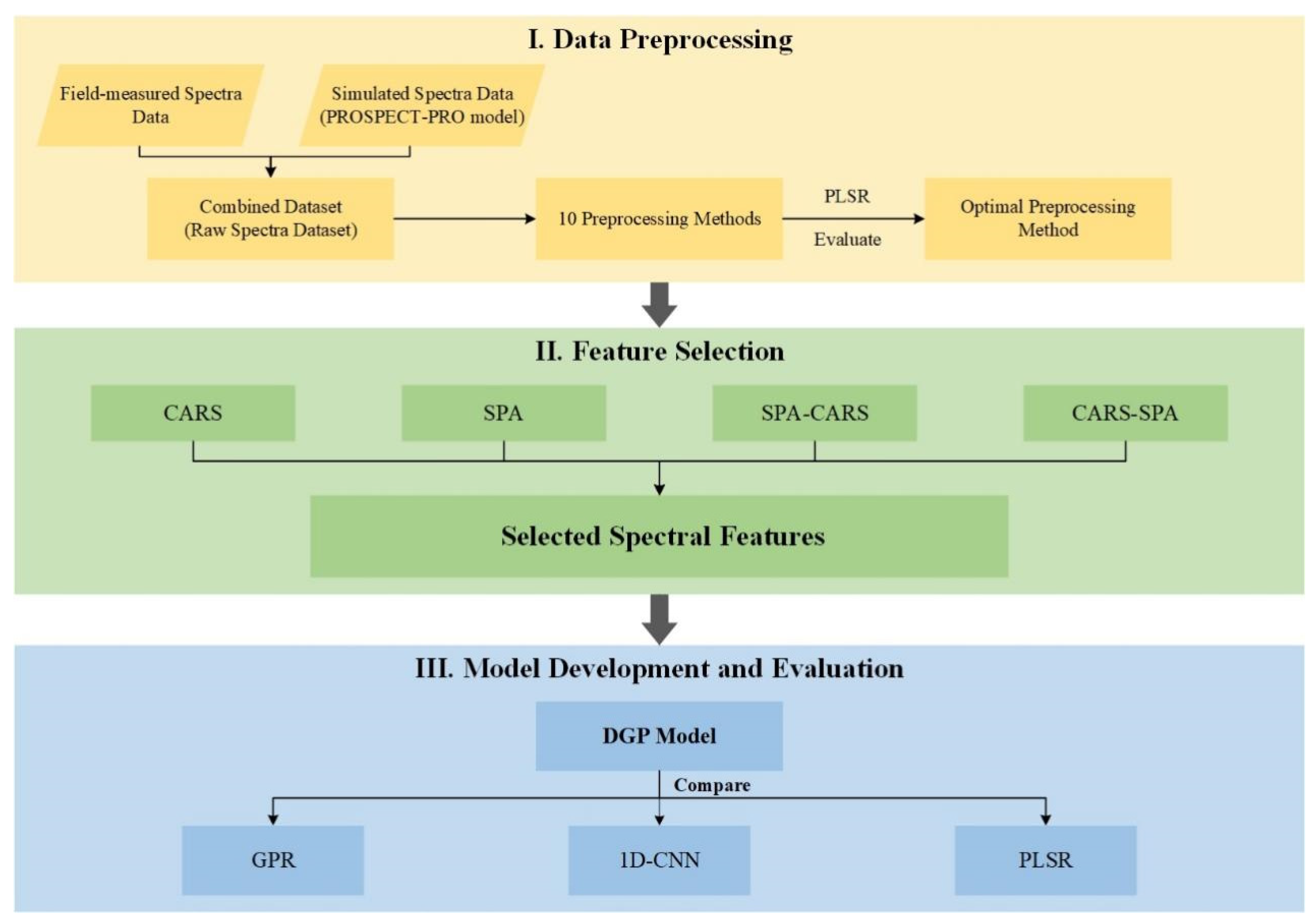
Figure 1 illustrates the workflow for estimating LNC in Ginkgo from leaf level hyperspectral reflectance measurements. The workflow comprised three stages: (I) assembly of measured and simulated datasets, (II) preprocessing and wavelength selection within the relevant training data, and (III) model development and comparative evaluation under three analytical settings. Simulated spectra were used only for augmentation or wavelength screening and were never included in the final measured-only test set. Setting 1 used measured spectra only throughout. Setting 2 used simulated spectra for wavelength screening, whereas model training and testing relied on measured spectra. Setting 3 used measured and simulated spectra jointly for wavelength screening and model training, while the final test set remained measured-only. The measured dataset was partitioned once into 573 training samples and 144 independent test samples, and this same measured split was retained across all three settings for fair comparison. In Setting 3, the training set therefore contained 1433 samples, comprising 860 simulated spectra, 527 measured sapling spectra, and 46 measured mature tree spectra. Preprocessing comparison, wavelength selection, and model development were carried out using only the training data defined for each setting, and the 144-sample measured test set remained untouched until final evaluation. PLSR was first used to compare preprocessing methods and identify the preferred preprocessing scheme (Section 2.3.2). After preprocessing had been fixed, SPA and CARS, alone or in sequence, were used for wavelength screening, and four regression models—PLSR, GPR, 1D-CNN, and DGP—were compared.

2.1. Overview of the Study Area

The study was conducted at two distinct sites in Jiangsu Province, China: a mature forest stand for observational sampling and a sapling nursery for a controlled nitrogen fertilization experiment. These two sites were selected to represent complementary sampling contexts: mature field grown Ginkgo stands and young saplings under controlled nitrogen treatments. The first site, the Dongtai Forest Farm (32°52′N, 120°49′E), is a 2239 hectare subtropical plantation on the Jiangsu coast. It is characterized by a temperate maritime monsoon climate, with a mean annual temperature of 14.6 °C and annual precipitation of 1050 mm. The second site was situated in Baima Town, Lishui District, Nanjing City (31°37′N, 119°10′E). This region has a transitional monsoon climate between the northern and central subtropics, with a mean annual temperature of 15.4 °C, 2240 h of annual sunshine, and 1106.5 mm of annual rainfall [15].

2.2. Raw Data Collection and Processing Methods

2.2.1. Experimental Design and Field Data Collection

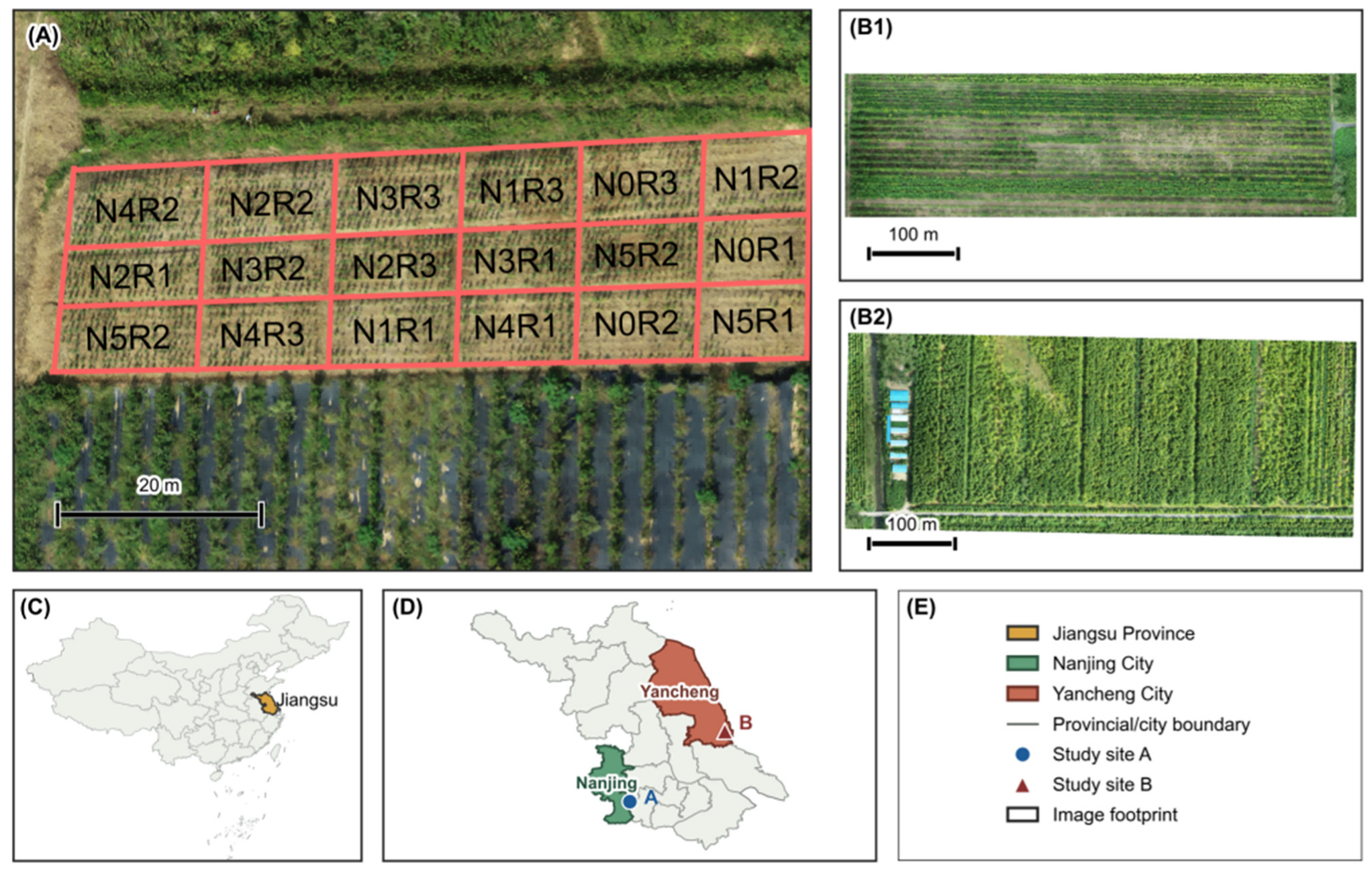
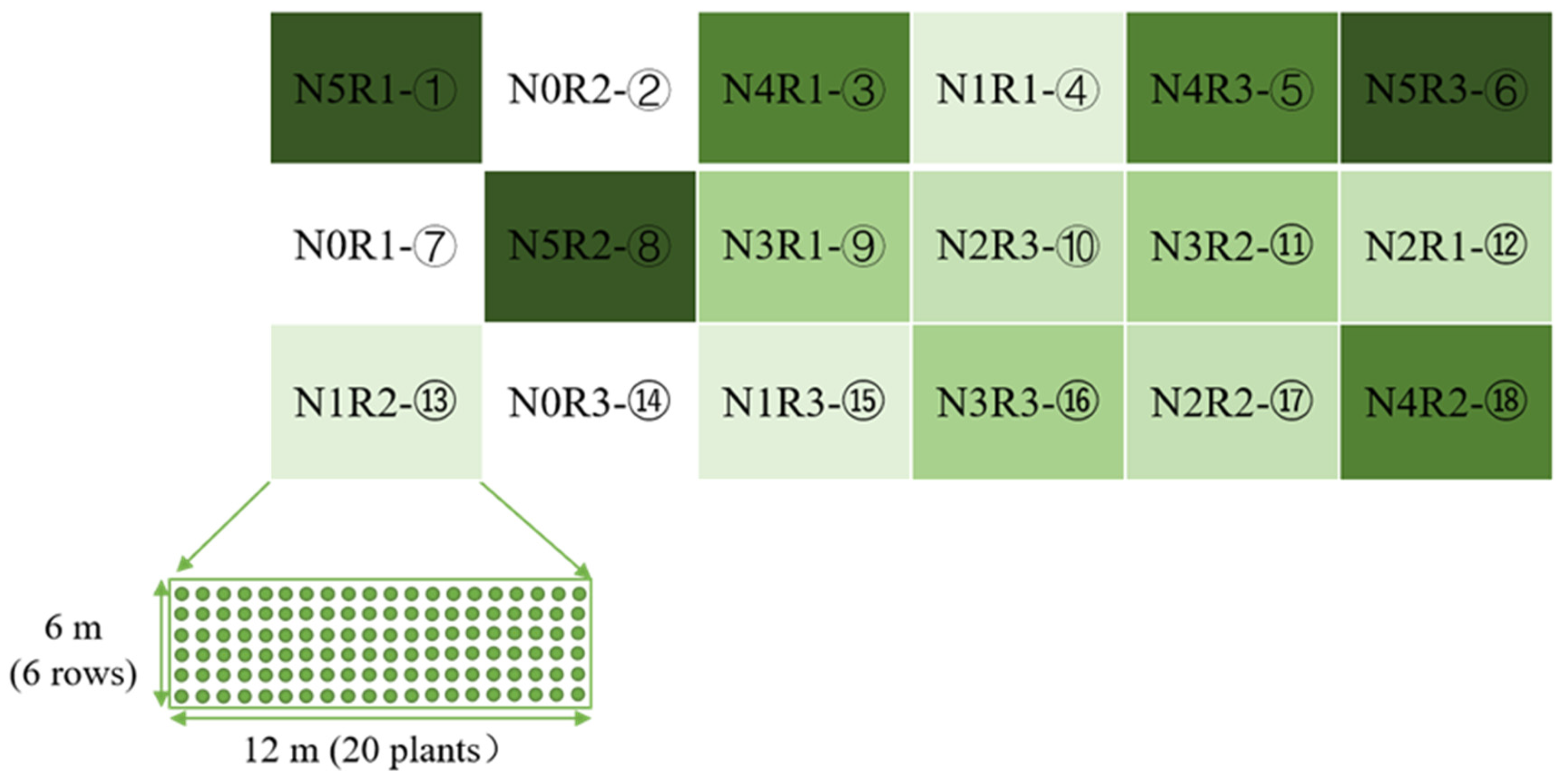
Two study sites were used. At the first site, Ginkgo plantations were sampled in Dongtai Forest. At the second site, Ginkgo saplings were planted in Baima Town, Nanjing, Jiangsu Province in Figure 2. In Dongtai Forest, leaf samples were collected from two mature Ginkgo stands. The first was a 23-year-old pure stand of Ginkgo biloba ‘Taixing Dafozhi’, a cultivar grown for leaf production, planted at a 4 m × 4 m spacing. The second was a 14-year-old stand within an agroforestry system, where Ginkgo was intercropped with Euonymus alatus at a 2 m × 8 m spacing. In the experimental area of Ginkgo saplings, a controlled nitrogen fertilization trial was established in 2020 within a 0.17 ha plot containing 2-year-old Ginkgo saplings. This area was divided into 18 plots (72 m2 each), arranged in a 3 × 6 grid and separated by 0.5 m-wide isolation belts (Figure 3).
The experiment employed a randomized complete block design with six nitrogen application levels (N0–N5), each with three replicates: 0, 225, 450, 675, 900, and 1125 kg hm−2. The nutrient sources were urea (46% N), calcium superphosphate (12% P2O5), and potassium chloride (60% K2O). Nitrogen was applied in three splits throughout the growing season: a basal dressing (40% of the total) in March, a first top dressing (40%) in May, and a second top dressing (20%) in July. Phosphorus (6 kg plot−1) and potassium (1.68 kg plot−1) were applied once as a basal fertilizer dressing in March. Across the mature tree and seedling measurements, the final measured dataset used for LNC modeling contained 717 LNC labeled leaf spectra.

2.2.2. Measured Data Collection and LNC Determination

Leaf samples and spectral data were collected from both mature Ginkgo biloba trees and seedlings for this study. Sampling of mature trees occurred on 23 August 2020, near the end of the leaf maturation stage. A total of 57 trees exhibiting typical conical crowns were sampled, comprising two age groups: 28 trees aged 23 years and 29 trees aged 14 years. Using pole pruners, ten healthy leaves were collected from the upper, southern facing branches of each sampled tree. Seedling sampling targeted key post fertilization growth periods before senescence onset. Specifically, 3-year-old seedlings were sampled on 7 July 2021 (end of spring rapid growth) and 19 September 2021. Four-year-old seedlings were sampled on 5 August 2022 and 26 September 2022. These sampling times corresponded to the rapid growth and maturation phases. From each experimental plot, three representative seedlings were selected. Twelve leaves were collected from the upper southern canopy of each selected 3-year-old seedling, while for 4-year-old seedlings, 12 southern facing leaves were collected from both the upper and lower canopy layers.
Immediately after collection, all leaf samples were placed in labeled, sealed bags and stored in ice-cooled containers until spectral analysis. Leaf spectral reflectance was measured using a FieldSpec 4 HR NG spectrometer (ASD FieldSpec 4 HR NG, Analytical Spectral Devices, Boulder, CO, USA) equipped with a leaf clip assembly (ASD Plant Probe, Analytical Spectral Devices, Boulder, CO, USA) that provided its own internal halogen light source at a 12° zenith angle, eliminating ambient illumination effects. The spectral resolution was 3 nm in the VNIR (350–1000 nm) and 8 nm in the SWIR (1000–2500 nm). The spectra were resampled to 1 nm intervals, and wavelengths outside 400–2500 nm were removed to reduce edge noise, leaving 2101 bands for analysis. Before each measurement session, a Spectralon white reference panel (>99% reflectance) was scanned under the same leaf clip geometry to obtain a dark current corrected radiance reference. The white reference was updated every 15 min or whenever instrument drift was visually detected. For each leaf, the adaxial surface was placed against the measurement window, and 10 successive scans (100 ms integration time per scan) were averaged to reduce random noise. Measurements were taken on the central lamina, avoiding the midrib and margins. The per leaf reflectance spectrum was calculated as sample radiance divided by white reference radiance at each wavelength.
Following spectral measurements, the samples were dried to a constant weight in an oven maintained at 80 °C for 48 h. The dried leaf material was then ground into a fine powder. Finally, LNC was determined using the Kjeldahl method [21]. Quality control for the measured dataset was performed within the measured source only: spectra with LNC values outside the source specific interquartile range (IQR) criterion were removed before any train test partition. After this source specific filtering, the measured dataset used for comparative modeling contained 717 LNC labeled leaf spectra. These measured samples were then divided once into 573 training samples and 144 independent test samples using a stratified random split that preserved the mature tree versus sapling composition. The resulting measured training subset contained 527 sapling samples and 46 mature tree samples, whereas the measured test subset contained 133 sapling samples and 11 mature tree samples.

2.2.3. PROSPECT-PRO Simulated Data Generation

The simulated dataset was generated using PROSPECT-PRO, a physics based leaf radiative transfer model in the PROSPECT family that simulates leaf optical properties across 400–2500 nm as a function of leaf structure and biochemical composition [22]. PROSPECT-PRO represents the leaf as a scattering-absorbing medium characterized by a structural parameter ( N struct ) and predicts leaf spectral behavior by coupling multiple scattering with wavelength dependent absorption by key constituents. A key distinction of PROSPECT-PRO relative to earlier PROSPECT variants is that it separates nitrogen containing proteins from other dry matter constituents. Specifically, leaf dry matter ( L M A ) is partitioned into two parts (i.e., protein content ( C p ) and carbon-based content ( C B C )), allowing protein related and other carbon-based dry matter effects to be represented separately from models that treat dry matter as a single bulk term, while still relying on a simplified description of real leaf structure and composition [19,23].
In this study, the simulated spectra were used as a physics informed augmentation source for wavelength screening and model training rather than as an independent validation source. Following the parameterization reported for Ginkgo leaves by Yin et al. [24] (for trees) and Su et al. [25] (for saplings), the leaf structure parameter was fixed at N struct = 1.4, and the adjustable biochemical parameters listed in Table 1 were sampled independently from continuous uniform distributions over the prescribed ranges. The anthocyanin and brown pigment terms were fixed at zero, while the specular reflection factor B spec was sampled uniformly from 0 to 0.3 and incorporated into the simulated reflectance. Given PROSPECT-PRO expresses leaf nitrogen optically through protein absorption rather than total N directly, leaf nitrogen can be related to protein content as C p = 4.43 × L N C a r e a , using the nitrogen to crude protein conversion factor recommended by Yeoh and Wee [26] and adopted in PROSPECT-PRO studies [15]. In the present study, the supervised target for each simulated spectrum was then computed as mass-based LNC (i.e., LNCmass) through the following deterministic conversion:
L N C a r e a = C p 4.43 ( mg   cm 2 )
L M A = C p + C B C ( mg   cm 2 )
L N C m a s s = 1000 × L N C a r e a L M A = 1000 × C p 4.43 C p + C B C ( mg   g 1 )
where L N C m a s s denotes the simulated label used in model training/evaluation, and its unit is identical to that of measured Kjeldahl LNC (mg g−1) [21]. This simulated LNC label was not a measured observation. It was a deterministic training label derived from the sampled C p and CBC values through Equations (1)–(3), so the simulated samples were used only for augmentation and were not treated as measured validation data.
To assess how well these prior ranges correspond to the actual sample population, we compared the simulated LNC output distribution with the measured LNC distribution. Using Equations (1)–(3), the prescribed C p range (0–3 mg cm−2) and CBC range (0–10 mg cm−2) yield a theoretical mass-based LNC range of approximately 0–170 mg g−1 before IQR filtering, which was narrowed to 5.5–65.2 mg g−1 in the retained 860 simulated spectra. The measured LNC values ranged from 7.22 to 61.06 mg g−1 (mean 23.21 mg g−1). Thus, the filtered simulated LNC distribution largely covered the measured range, although the simulated set included some extreme combinations that have no direct empirical counterpart in our samples. For chlorophyll ( C a b = 10–100 μg cm−2), the range encompasses values reported for broadleaf deciduous species including Ginkgo during the active growing season. The equivalent water thickness range ( C w = 1–40 mg cm−2) is intentionally broad to accommodate the variability between thin sapling leaves and thicker mature tree leaves observed in this study. Given the fact that the leaf structure parameter, carotenoid content, protein content, and CBC were not independently measured on each field sample, a leaf-by-leaf validation of these ranges is not possible; the ranges therefore represent literature-constrained sensitivity priors rather than species specific calibration values. This limitation is partially mitigated by the fact that model evaluation relied exclusively on measured samples with laboratory determined LNC.
Using these parameters, we first generated 1000 candidate leaf reflectance spectra across 400–2500 nm, including the sampled specular reflection factor. To reduce the mismatch between perfectly smooth forward simulations and instrument observations, wavelength wise Gaussian noise was then added with a standard deviation σ λ = 0.003 R λ , where R λ is the simulated reflectance at wavelength λ . This step was intended to mimic small instrument and measurement fluctuations and to avoid using unrealistically noise free spectra as augmentation samples; it was not used to create an independent validation source. Quality control for the simulated dataset was then performed within the simulated source only by applying the IQR criterion to the model derived LNC labels. After this source specific filtering, 860 simulated spectra were retained for the augmentation analyses. These simulated spectra were used only for wavelength screening and model calibration and were never included in the final 144 sample measured-only test set.

2.3. Data Analysis Methods

2.3.1. Analytical Designs and Data Partitioning

To distinguish methodological comparison from practical prediction assessment, three model calibration strategies were all evaluated on the same retained 144-sample measured data partition. No simulated sample entered the final validation subsets in any strategy. In terms of the first strategy (i.e., measured-only strategy), preprocessing, wavelength selection, model calibration, and validation were all performed based on the measured dataset only. Therefore, the sample counts were 573 measured calibration samples and 144 measured validation samples. In terms of the second strategy (i.e., the simulation-informed wavelength selection strategy), simulated spectra were used only for wavelength screening, after which model calibration and validation were still performed on the above same 573 measured calibration samples and 144 measured validation samples. In terms of the third strategy (i.e., simulation-augmented calibration strategy), measured and simulated spectra were jointly used for wavelength screening and model calibration. This yielded 1433 sample calibration sets consisting of 860 simulated spectra and 573 measured spectra, while the final validation sets kept the same 144 retained measured samples. The simulation-augmented calibration strategy was treated as the main inference framework because it retained a measured-only test boundary, while allowing augmentation during model development. Across all strategies, preprocessing parameters, selected wavelengths, and model hyperparameters were estimated from calibration datasets only, while no information from the 144-sample measured validation sets was used before final evaluation.

2.3.2. Spectral Preprocessing

For each analytical design, ten preprocessing methods were evaluated using only the relevant training data to mitigate baseline drift, scattering effects, and noise, thereby enhancing spectral feature resolution and comparability. These methods comprised Standard Normal Variate (SNV) [27], first and second derivatives (D1 and D2) [28], Min-Max Scaling (MMS) [29], Multiplicative Scatter Correction (MSC) [30], Savitzky–Golay (SG) smoothing filter [31], Vector Normalization (VN) [32], Wavelet Transform (WT) [33], Moving Average filtering (MA) [34], and Standardization (S) [29]. For the final selected preprocessing scheme, MSC was fitted on the training subset by regressing each training spectrum against the training subset mean spectrum and applying the standard correction ( x b / a ); the resulting transformation was then transferred unchanged to the corresponding validation or test samples.

2.3.3. Screening of LNC Informative Spectral Bands

Employing the full spectrum for modeling can introduce data redundancy and potentially diminish model accuracy. To mitigate these issues, this study used the Successive Projections Algorithm (SPA) and Competitive Adaptive Reweighted Sampling (CARS) to select informative wavelength bands from the preprocessed spectra. SPA was used to reduce collinearity among spectral variables, whereas CARS iteratively retained wavelengths with stronger predictive contributions based on regression coefficient weighting and cross validation [35,36]. We evaluated four selection strategies: SPA, CARS, SPA followed by CARS (SPA-CARS), and CARS followed by SPA (CARS-SPA). These analyses were conducted in Python 3.8 (Python Software Foundation, Wilmington, DE, USA) [37] and MATLAB 2024a (The MathWorks Inc., Natick, MA, USA) [38].
For the measured-only analysis, SPA, CARS, and their sequential combinations were executed on the 573 sample measured calibration subset only. For the simulation-informed wavelength selection analysis, wavelength screening was conducted using the 860 simulated spectra only, and the resulting wavelength subsets were then transferred to the 573 measured calibration samples and 144 measured test samples for downstream modeling. For the simulation-augmented calibration analysis, wavelength screening was conducted on the combined calibration set, and the resulting wavelength subsets were used for model fitting on that same calibration pool and final evaluation on the 144 measured test samples.

2.4. Evaluation Methods for Prediction Accuracy

A standardized 5-fold cross validation procedure was used during model development for all models. Within the calibration data of each analytical design, cross validation was used for model selection and tuning, whereas final model performance was assessed on the fixed 144 sample measured-only test subset. Consequently, the reported test metrics describe prediction accuracy on real measured leaves, whereas differences among the three analytical designs should be interpreted as methodological comparisons regarding how simulated spectra were used during wavelength screening and model calibration. The root mean square error (RMSE) and the coefficient of determination (R2) were chosen as metrics for assessing predictive accuracy. These metrics were calculated using the following formulas:
R M S E = 1 n i = 1 n y i y i ^ 2
R 2 = 1 i = 1 n y i y i ^ 2 i = 1 n y i y ¯ 2
In the formulas, y i represents the actual observed value for the i-th observation, y i ^ is the predicted value for the i-th observation, and y ¯ is the mean of all actual observed values. The variable n denotes the total number of observations. A smaller R M S E value and an R 2 value closer to 1 indicate better agreement between the predicted and observed values within the evaluated dataset partition.

2.5. Modeling Methods

2.5.1. Partial Least Squares Regression

Partial Least Squares Regression (PLSR) was employed in this study for two primary purposes. First, PLSR models were developed to compare the influence of different preprocessing techniques on predictive performance within the training data. As a statistical method particularly suitable for high dimensional datasets typical of hyperspectral data, PLSR constructs predictive models by identifying latent variables that maximize the covariance between predictor and response variables [39].
In the implemented workflow, PLSR models used standardized predictors and response values together with 5-fold cross validation within the relevant calibration data to choose the number of latent components. Depending on the analytical design, the calibration data consisted of measured spectra only or measured plus simulated spectra. The resulting PLSR model also served as a benchmark for evaluating the performance of the alternative machine learning and deep learning models.

2.5.2. Gaussian Process Regression

Gaussian Process Regression (GPR) was used as a nonlinear probabilistic regression benchmark for mapping selected spectral bands to LNC [40]. For a dataset D = x i , y i i = 1 n , the target function f x is assumed to follow a Gaussian process (GP):
f x ~ G P m x , k x , x
where m x represents the mean function, and k x , x is the covariance function, or kernel function. Given training inputs X , observed LNC values Y , and a test input x , GPR predicts a posterior distribution:
p f X , y , x = N m , cov f
μ x = k x , X K + σ n 2 I 1 Y
σ 2 x = k x , x k x , X K + σ n 2 I 1 k X , x
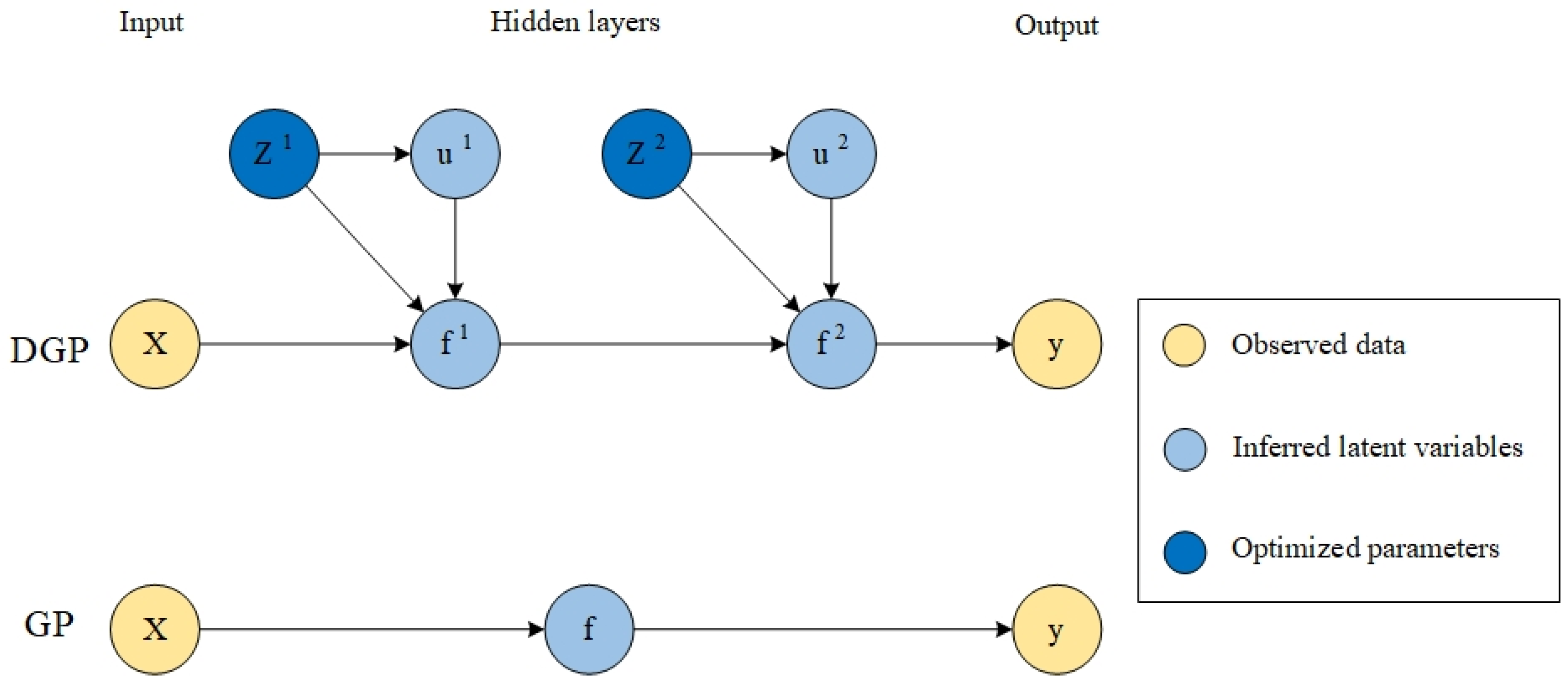
where K is the covariance matrix computed using the kernel function k x , x across all training point pairs, σ n 2 indicates the noise variance, and I represents the identity matrix. The predicted mean μ x was used as the LNC estimate, and σ 2 x represented predictive variance. In the implemented workflow, GPR used standardized predictors and response values, 5-fold cross validation within the relevant training data, and an RBF + WhiteKernel covariance structure with five optimizer restarts. The fundamental structure of the model is schematized in the bottom panel of Figure 4.

2.5.3. One-Dimensional Convolutional Neural Network (1D-CNN)

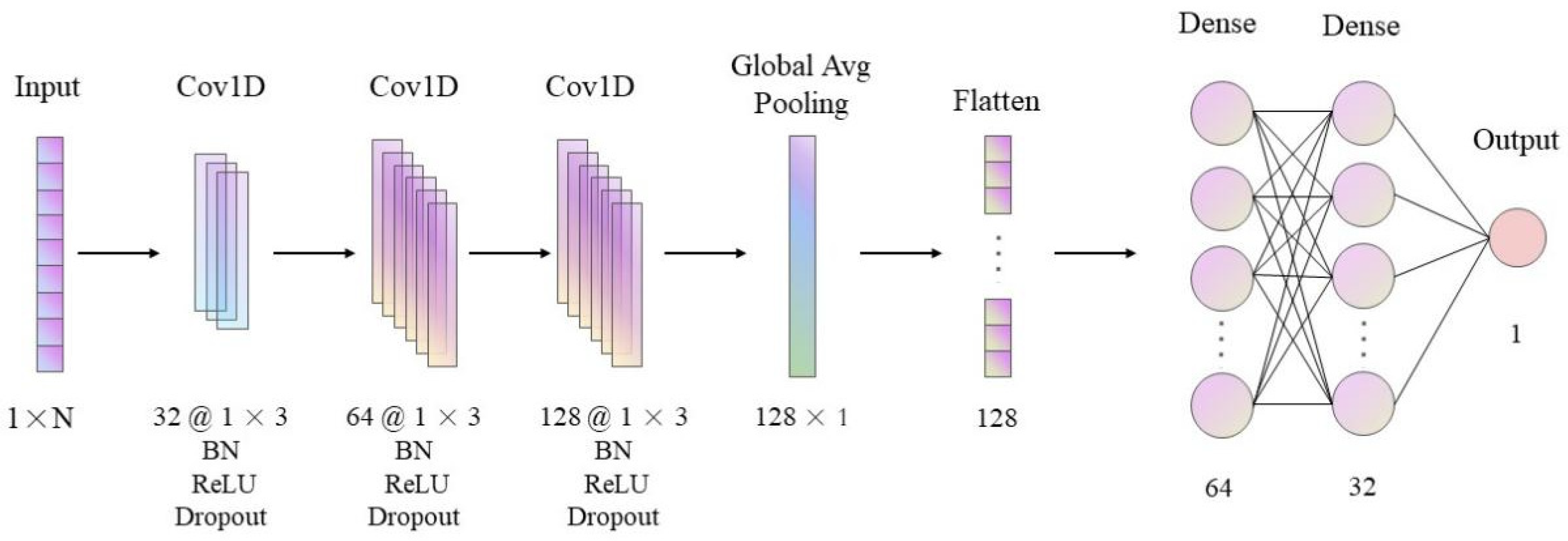
A one-dimensional convolutional neural network (1D-CNN) model was developed for this study using the PyTorch framework 3.8. The specific architecture of this model is illustrated in Figure 5. The implemented network contained three convolutional blocks with kernel size 3, ReLU activation, batch normalization, max pooling in the first two blocks, adaptive average pooling in the third block, and dropout (0.3) throughout the feature extractor and fully connected layers. The number of convolutional channels increased from 32 to 64 to 128, followed by fully connected layers of 128, 64, 32, and 1 output unit. Standardized predictors and response values were used. The CNN workflow employed 5-fold cross validation within the relevant training data of each analytical design; the trained model used Adam optimization (learning rate 0.01, weight decay ( 10 5 ) ), MSE loss, batch size 32, and 1000 epochs with validation-based model selection. Final evaluation was performed on the same 144 sample measured-only test subset. The 1D-CNN served as a deep learning benchmark and used the selected wavelength bands as inputs. The convolutional layers extracted local spectral patterns, the pooling layers reduced dimensionality, and the fully connected layers mapped the learned features to the predicted LNC.

2.5.4. Deep Gaussian Processes

Deep Gaussian Processes (DGP) extend single layer GP regression by stacking multiple GP layers into a hierarchy, enabling richer nonlinear representations while retaining probabilistic outputs [41,42]. Sparse variational inference with inducing points makes the multi-layer structure computationally tractable [43]. The architectural difference between a standard GP and a two layer DGP is illustrated in Figure 4. In the implemented model, standardized predictors and response values were used together with 5-fold cross validation conducted within the relevant calibration data. The key hyperparameters were: two GP layers with hidden dimensionality 10, Gaussian likelihood, 512 inducing points per layer, Scale Kernel × RBF kernel with ARD, five likelihood samples, Adam optimization (learning rate 0.007), batch size 1024, and 1000 training epochs. In the measured-only and simulation-informed wavelength selection analyses, DGP was calibrated on measured spectra only; in the simulation-augmented calibration analysis, it was calibrated on the combined 1433 sample calibration set and then evaluated on the same 144 sample measured-only test subset.

3. Results

3.1. Spectral Characteristics of Ginkgo Leaves

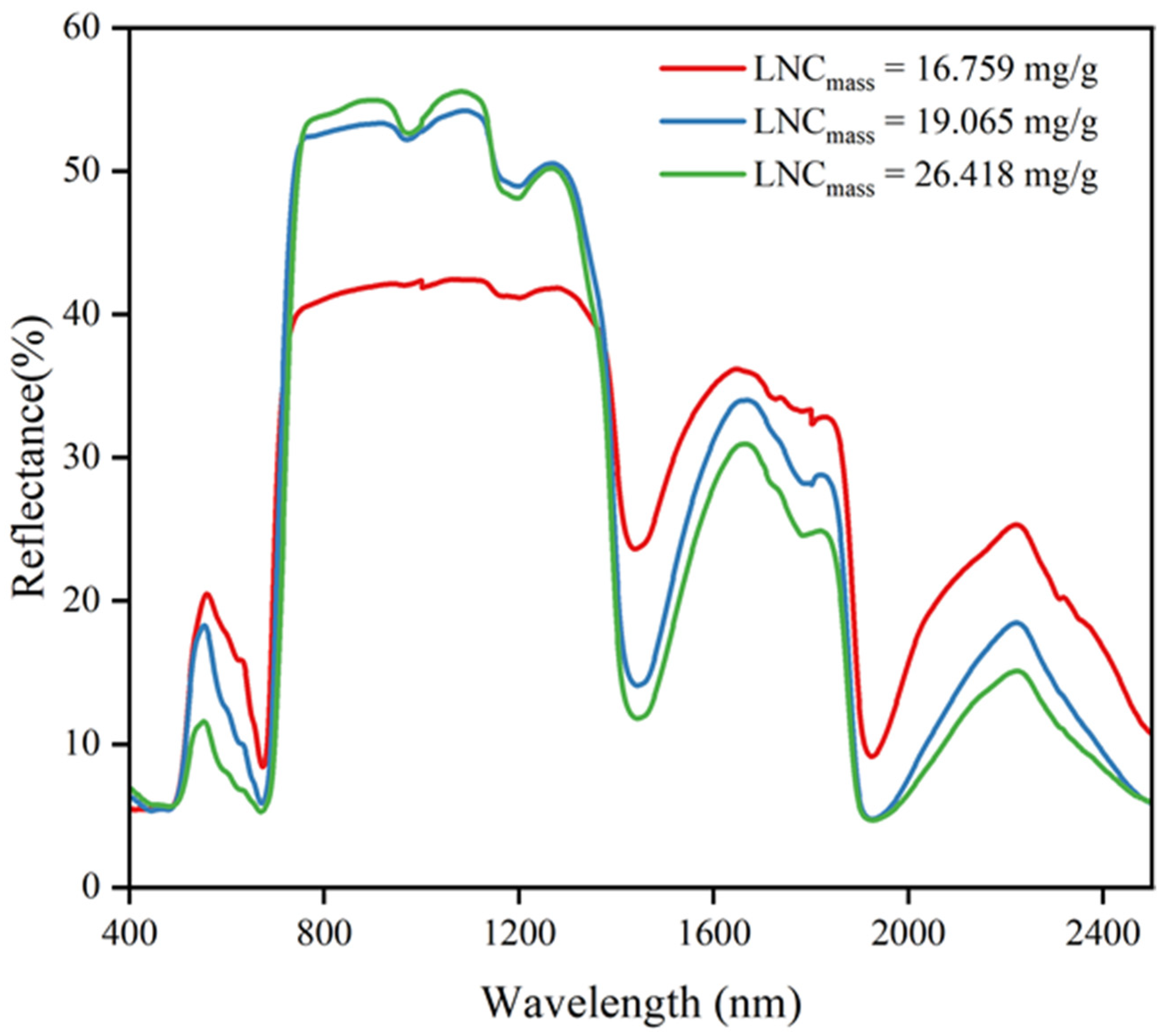
The spectral reflectance curves in Figure 6 show systematic differences among LNC groups across the visible, red edge, and shortwave infrared (SWIR) regions. In the visible range, leaves with higher LNC generally showed lower reflectance, whereas separation among groups remained evident around the red edge transition. In the SWIR region, low LNC samples tended to show higher reflectance than medium and high LNC samples across much of the spectrum. These patterns indicate that both red edge and SWIR wavelengths contain information associated with LNC variation in this dataset.

3.2. Preprocessing of Raw Spectral Dataset

Preprocessing significantly affected predictive performance in this study (Table 2). The effectiveness of the candidate preprocessing methods was evaluated by comparing PLSR models developed for Ginkgo LNC prediction. Most preprocessing methods improved model performance relative to the raw spectral dataset, although D2, WT, and MMS did not. Among the tested methods, MSC yielded the best PLSR performance in this comparison (RMSE = 2.03 mg g−1, R2 = 0.81).

3.3. Selection of Informative Wavelengths

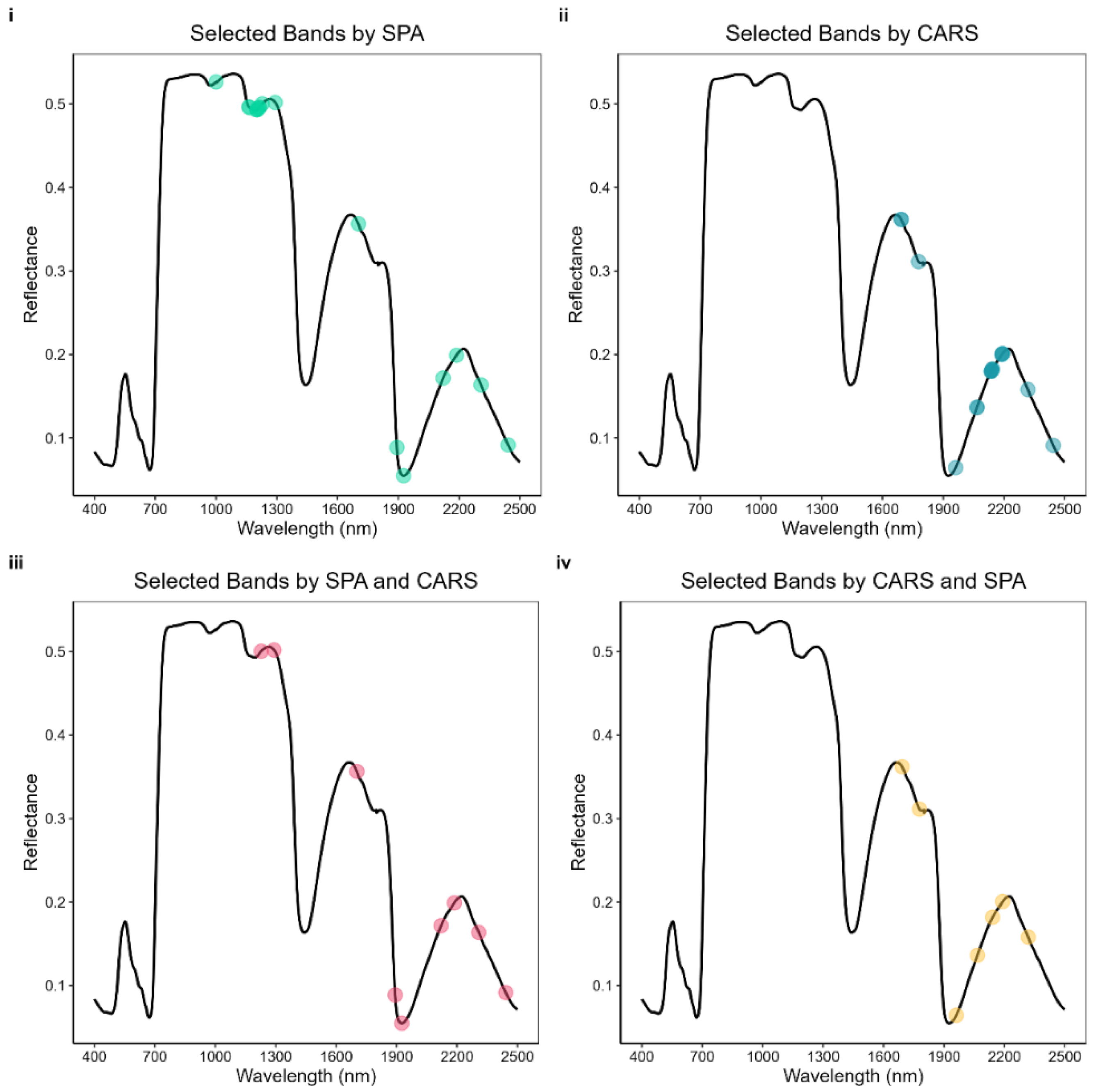
Following MSC preprocessing within the training subset, informative wavelengths were identified using a combination of wavelength selection algorithms, including SPA and CARS, and the integrated methods SPA-CARS and CARS-SPA. The outcomes of these selection methods are presented in Figure 7 and Table 3.
The selected wavelengths showed different distributions across the four methods. SPA identified 17 wavelengths, mainly in the near infrared (NIR) and SWIR regions, whereas CARS selected 19 wavelengths across the visible to SWIR range. Several wavelengths between 1700–2200 nm and 2300–2400 nm were repeatedly selected. The SPA-CARS sequence retained nine wavelengths mainly between 1200 nm and 2500 nm, whereas CARS-SPA retained a smaller seven-wavelength subset between 1600 nm and 2300 nm.

3.4. Implementation Specific Held out Performance of Ginkgo LNC Prediction Models

To address the source of the test data explicitly, all three analytical designs were evaluated using the same fixed 144 sample measured validation sets. The simulation-augmented calibration strategy provided the lowest overall error and was therefore treated as the main analysis strategy. Regarding this strategy, the calibration sets contained both simulated and measured spectra, whereas the final validation sets contained measured samples only. The measured-only and simulation-informed wavelength selection strategies are reported as sensitivity analyses in Table A1 and Table A2. In these sensitivity analyses, the lowest validation error using the measured-only strategy was obtained by DGP-SPA (RMSE = 3.19 mg g−1, R2 = 0.77), whereas the lowest validation error based on the simulation-informed wavelength selection was obtained by PLSR-CARS (RMSE = 2.57 mg g−1, R2 = 0.72). Neither sensitivity analysis exceeded the main simulation-augmented calibration result, indicating that measured test performance depended on how simulated spectra were used during wavelength screening and model calibration.
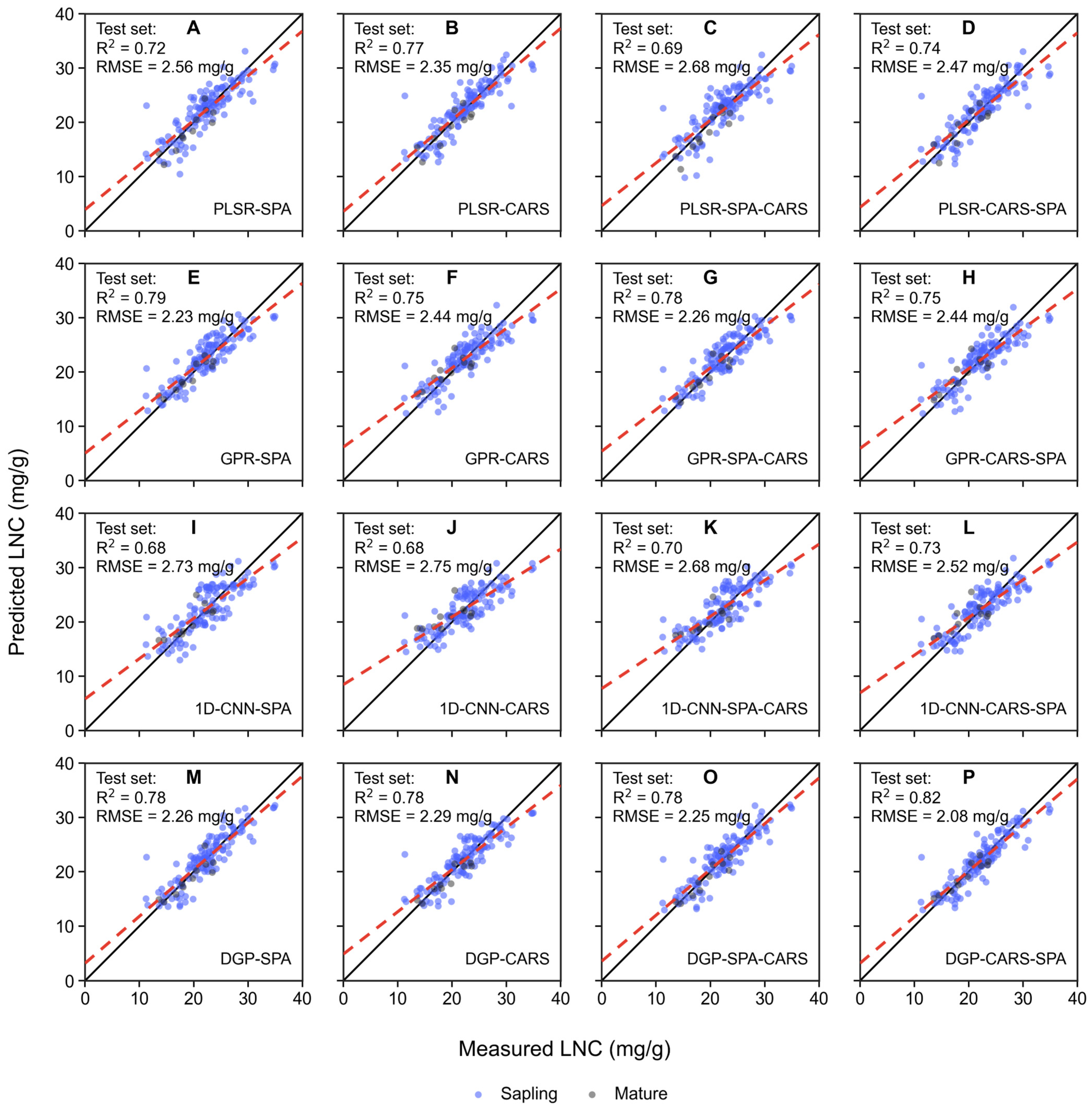
Therefore, Table 4 focuses on the simulation-augmented calibration strategies. Four regression models were coupled with four wavelength selection strategies: SPA, CARS, SPA-CARS, and CARS-SPA. Table 4 summarizes the measured-only validation performance obtained under this workflow, and Figure 8 shows the corresponding predicted and observed relationships. The conventional machine learning models, PLSR and GPR, showed moderate predictive capability. For the PLSR models, CARS produced the lowest measured test error in this model group (RMSE = 2.35 mg g−1, R2 = 0.77). For the GPR models, SPA and SPA-CARS produced the lowest errors in this model group (RMSE = 2.23 and 2.26 mg g−1, respectively), but neither exceeded the lowest error DGP result.
Across the measured sample test set, DGP gave the strongest overall prediction performance among the tested models. The best result was obtained by DGP-CARS-SPA, with a test RMSE of 2.07 mg g−1 and an R2 of 0.82. Other DGP feature selection variants also performed consistently well, including DGP-CARS (RMSE = 2.29 mg g−1, R2 = 0.78), DGP-SPA (RMSE = 2.26 mg g−1, R2 = 0.78), and DGP-SPA-CARS (RMSE = 2.25 mg g−1, R2 = 0.78).
The 1D-CNN models did not outperform the other model groups on the measured test set. Among the 1D-CNN feature selection variants, 1D-CNN-CARS-SPA performed best, with a test RMSE of 2.51 mg g−1 and an R2 of 0.73. The remaining 1D-CNN variants showed weaker test performance, with RMSE values of 2.68–2.75 mg g−1 and R2 values of 0.68–0.70.
Overall, DGP-CARS-SPA produced the lowest test error, followed by GPR-SPA and DGP-SPA-CARS. The plots in Figure 8 were consistent with these numerical results, with DGP-CARS-SPA showing the closest agreement with the 1:1 line. Because the test set consisted of measured samples rather than simulated data, these results indicate measured-only prediction performance under the same evaluation protocol. Broader use across other sample sources should still be verified with independent measured datasets. The source structure and source specific residual patterns in the measured test set are therefore examined separately in Figure 9.

3.5. Source Heterogeneity

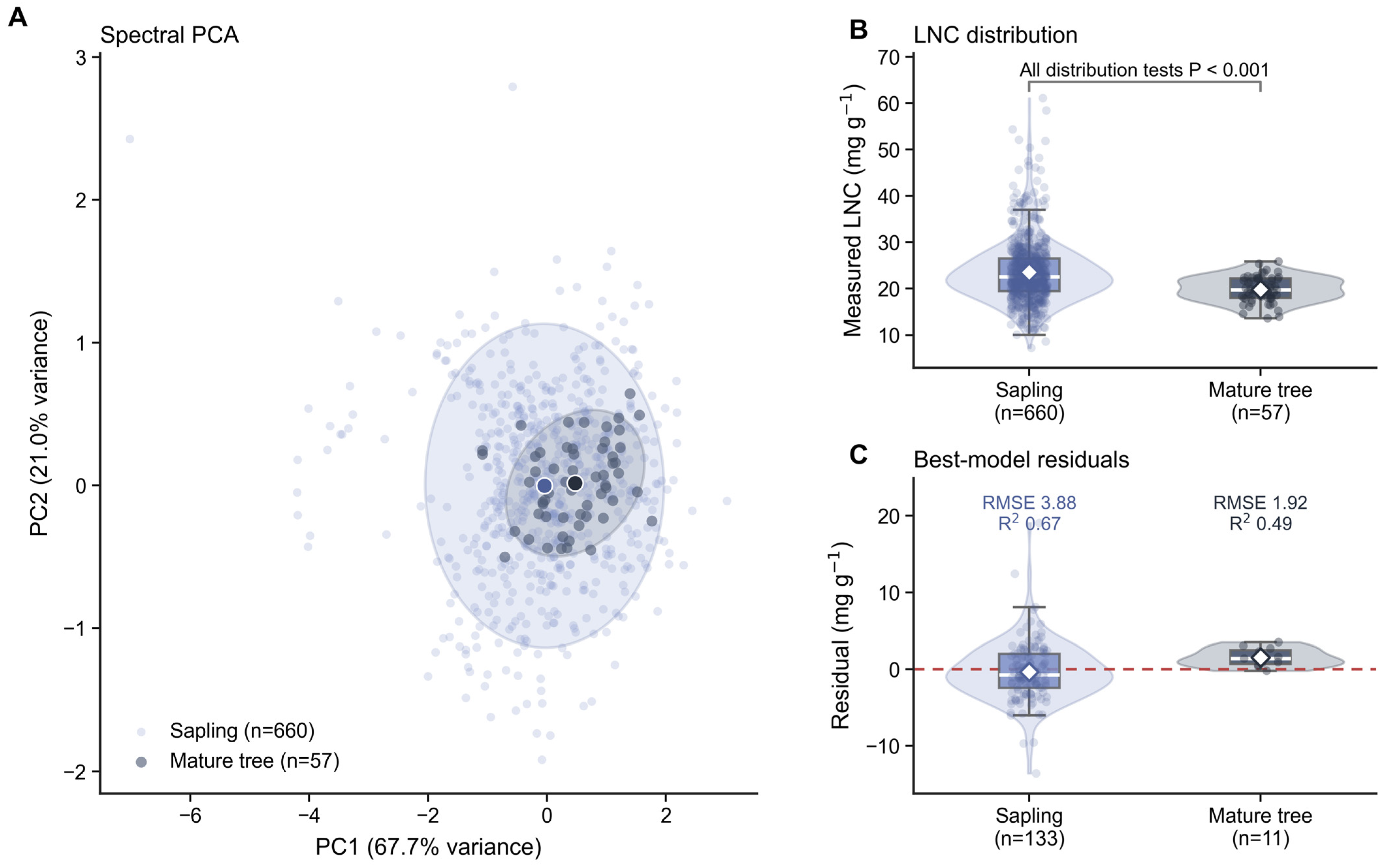
After identifying DGP-CARS-SPA as the best performing model, we further examined whether source heterogeneity affected the interpretation of its measured-only test performance (Figure 9). This analysis used PCA of the 717 measured raw spectra, LNC distribution tests, and source specific residual analysis for the best model. The PCA plot showed broad overlap between the two source groups, but the mature tree samples occupied a narrower region that was shifted slightly toward positive PC1 values. This pattern indicates that the two measured source groups were not spectrally identical, even though they were not cleanly separated in low dimensional PCA space. The first two principal components explained 67.7% and 21.0% of the total spectral variance, respectively.
As shown in Figure 9B, the sapling source group had a higher mean LNC and a much wider range than the mature tree source group. The sapling samples had a mean LNC of 23.57 ± 6.84 mg g−1 and ranged from 7.22 to 61.06 mg g−1, whereas the mature tree samples had a mean LNC of 19.84 ± 2.79 mg g−1 and ranged from 13.60 to 25.85 mg g−1. The two sample Kolmogorov–Smirnov test indicated significant differences between the two LNC distributions (p < 0.001), supporting the presence of source heterogeneity in the measured dataset.
Residual analysis of the best performing model (DGP-CARS-SPA) on the 144 measured test samples indicated source dependent error patterns (Figure 9C). For sapling samples (n = 133), residuals were more dispersed and the mean residual was slightly negative, suggesting mild overprediction. In contrast, mature tree samples (n = 11) showed a narrower residual distribution but a positive mean residual, indicating a tendency toward underprediction. Given the small number of mature tree samples in the test set, these source specific patterns should be interpreted as preliminary evidence of data source effects rather than definitive proof of stable model behavior.

4. Discussion

This study compared preprocessing strategies, wavelength selection methods, and regression models for hyperspectral estimation of Ginkgo LNC. Across the tested combinations, MSC preprocessing, CARS-SPA wavelength selection, and the DGP model together produced the strongest within-study performance. The measured-only and simulation-informed wavelength selection analyses are therefore interpreted as sensitivity analyses rather than as competing main conclusions. The discussion below focuses on what can be supported by this validation structure while keeping the role of simulated spectra explicit.

4.1. Reflectance Differences Across LNC Groups

The spectral comparisons indicate that LNC was associated with systematic reflectance differences across the visible, red edge, near infrared, and shortwave infrared regions. Leaves with higher LNC generally showed lower reflectance in much of the visible and SWIR ranges, while group separation remained evident around the red edge transition. This pattern is broadly consistent with previous reports that leaf optical signals are influenced by multiple interacting biochemical and structural properties rather than by uniquely identifiable signatures of a single constituent [9,44]. These results therefore support the use of both red edge and SWIR information for modeling, but they should be interpreted as spectral associations within this dataset rather than as direct proof of a specific physiological mechanism.

4.2. Comparison of Modeling Effects with Different Spectral Preprocessing Methods

Hyperspectral measurements are affected by noise, baseline drift, and scattering effects, so preprocessing can strongly influence Downstream model performance. In this study, MSC produced the best results among the evaluated preprocessing methods, indicating that reducing scattering related variation was important for this dataset. This result is consistent with the general role of MSC in improving spectral comparability before regression [45]. The comparison also reinforces a practical point: preprocessing was not a minor preparatory step here, but one of the decisions that materially affected final model accuracy.

4.3. Sensitive Wavelength Selection for LNC Estimation

Wavelength selection was important because the full spectrum contains substantial redundancy. Both SPA and CARS identified informative bands, and many selected wavelengths were concentrated in the SWIR region, especially between 1700 and 2400 nm. This pattern is consistent with studies showing that SWIR reflectance is sensitive to protein, water, dry matter constituents, and leaf structural variation, all of which may covary with nitrogen status [19,46]. It is also partly consistent with the Ginkgo specific inversion study of Zhou et al. [15], which highlighted major LNC-relevant domains across the mid- and long-wave SWIR. Therefore, the selected SWIR bands should not be interpreted as direct or unique nitrogen absorption features. Instead, they are more cautiously viewed as spectral regions where nitrogen related variation may be expressed through overlapping effects of proteins, other nitrogen containing compounds, water, and carbon dry matter. In this study, the main value of wavelength selection was therefore methodological: it reduced dimensionality and improved the stability of subsequent regression.
The results further show that sequential feature selection affected model performance, but this effect should be interpreted cautiously because the two sequences retained different numbers of wavelengths. Under the final measured sample test, CARS-SPA produced the lowest error when combined with MSC preprocessing and DGP. This outcome suggests that adaptive wavelength screening followed by collinearity reduction was effective for this dataset. However, the comparison does not isolate selection order from subset size or from model specific responses to the selected bands. The present results therefore support CARS-SPA as the strongest empirical option in this analysis, rather than a general rule about the optimal sequence of feature selection.

4.4. Comparison of Different Regression Models

Among the tested models, DGP achieved the strongest reported performance, especially when combined with CARS-SPA. This result suggests that the DGP framework was able to use the reduced spectral feature sets under the standardized evaluation workflow. A plausible reason is that DGP can capture hierarchical non-linearity while still retaining a probabilistic structure, whereas PLSR is more restrictive and the 1D-CNN may be more sensitive to limited training data and redundant inputs.
The comparison also shows that better performance did not simply depend on retaining more wavelengths. The best model, DGP-CARS-SPA, used only seven bands and still outperformed versions using larger feature sets. This indicates that feature quality and redundancy reduction were more important than retaining as many wavelengths as possible. For this reason, the main contribution of the study is not simply that one advanced model produced the lowest error, but that model performance depended strongly on the interaction between preprocessing, feature selection order, and regression structure.
The simulation-augmented calibration design may have helped model training by broadening the range of spectra available to the regressors, particularly for flexible models. PROSPECT-PRO provides a physically based but simplified representation of leaf optical behavior, and the simulated spectra were generated from the same modeling framework used for augmentation rather than from independent field observations [19]. Combining radiative transfer simulation with flexible regression can therefore provide two complementary advantages. The radiative transfer model introduces prior knowledge about leaf absorption and scattering, while the data driven model can adjust these idealized patterns to measured spectra affected by instrument noise, leaf heterogeneity, and field sampling conditions [47]. This combination may reduce the amount of labeled field data needed for model development and may improve robustness relative to using either synthetic spectra or measured spectra alone. In the final evaluation, simulated spectra were excluded from the test set, which was restricted to measured samples. The reported results therefore indicate measured sample test performance after simulation-augmented calibration, not validation by simulated data. Importantly, because simulated spectra outnumbered measured spectra in the combined calibration set, there is a legitimate concern that models could be dominated by the idealized physics based patterns rather than real leaf variability. However, the fact that final evaluation was restricted to 144 measured samples means that any model that merely fit simulated patterns without capturing real spectral LNC relationships would perform poorly on the measured test set. In this comparison, simulation-augmented calibration gave the best measured test result, with DGP-CARS-SPA as the strongest combination. Nevertheless, the degree to which simulated spectra benefit calibration is likely dataset dependent, and broader generalization should be confirmed with independent field data.

4.5. Limitations and Future Potentials

Several limitations should be acknowledged. First, the empirical dataset was restricted to one species and a limited set of sites and sampling periods, so the results should not be interpreted as evidence of broad temporal or spatial generalization. Second, although simulated spectra helped enlarge the calibration set, the input parameter ranges of PROSPECT-PRO were mostly based on the literature-derived priors rather than direct measurements from the sampled leaves. Consequently, the simulated spectra may not fully capture the actual biochemical parameter distribution of this Ginkgo population. Because the final test set consisted exclusively of measured samples, this mismatch affects calibration diversity rather than test integrity. Nonetheless, the simulated augmentation cannot substitute for independent field validation under new conditions. Third, Section 3.5 showed that the measured dataset exhibited clear source heterogeneity between sapling nursery samples and mature tree field samples. Nevertheless, the present analysis still relied on only these two settings and a relatively small test subset of mature trees, which should be taken into account when interpreting the results. The reported source specific residual patterns should therefore be interpreted cautiously and should not be treated as evidence of stable cross site generalization. Future work should therefore test the framework with independent multi-site and multi-season datasets, evaluate tree age and site effects more explicitly, and examine uncertainty behavior under tree-wise, plot-wise, year-wise, and site-wise validation protocols.

5. Conclusions

This study performed a protocol-controlled comparison of preprocessing methods, wavelength selection strategies, and regression models for hyperspectral LNC estimation in Ginkgo using a mixed measured simulated dataset. The main findings were that (1) MSC was the most effective preprocessing method for this dataset, (2) CARS-SPA provided the strongest wavelength selection result under the final measured sample test, and (3) DGP-CARS-SPA achieved the strongest predictive performance under the simulation-augmented calibration framework (R2 = 0.82, RMSE = 2.07 mg g−1).
Overall, the results show that model performance in this study depended strongly on the interaction between preprocessing, wavelength refinement, and model structure. Because the final test subset contained only measured samples, these findings provide stronger empirical support than a mixed source test would allow. Nevertheless, they should not be interpreted as proof of reliable operational prediction across broader environments; instead, they provide a comparative methodological reference for simulation-augmented calibration with measured sample testing. Broader applicability and transferability should be evaluated with independent measured-only datasets across sites, seasons, and instruments in future work.

Author Contributions

X.Z.: Writing—original draft, Visualization, Software, Methodology, Investigation, Formal analysis, Data curation. J.L.: Writing—original draft, Methodology, Investigation, Formal analysis. J.P.: Writing—original draft, Methodology, Investigation, Formal analysis. K.Z.: Writing—review & editing, Conceptualization, Methodology, Funding acquisition, Supervision. All authors have read and agreed to the published version of the manuscript.

Funding

This work was funded by National Natural Science Foundation of China (32101521), the Jiangsu Agriculture Science and Technology Innovation Fund (CX(23)1027).

Data Availability Statement

The data and code that support the findings of this work are available from the corresponding author upon reasonable request.

Acknowledgments

We would like to thank the graduate students from the department of forest management at Nanjing Forestry University for helping in the data collection and providing suggestions for improving this study. We are also very grateful to Guibin Wang and Lin Cao (Nanjing Forestry University) for their supporting in the design of experiments and field investigation.

Conflicts of Interest

The authors declare no conflicts of interest.

Abbreviations

The following abbreviations are used in this manuscript:
1D-CNNone-dimensional convolutional neural network
ARDautomatic relevance determination
CARScompetitive adaptive reweighted sampling
CBCcarbon-based constituents
CNNconvolutional neural network
DGPdeep Gaussian process
GPRGaussian process regression
IQRinterquartile range
LMAleaf mass per area
LNCleaf nitrogen concentration
MAmoving average
MAEmean absolute error
MMSmin-max scaling
MSCmultiplicative scatter correction
NIRnear-infrared
PCAprincipal component analysis
PLSRpartial least squares regression
PROSPECT-PROPROSPECT model variant for proteins and carbon-based constituents
R2coefficient of determination
RBFradial basis function
RMSEroot mean square error
SGSavitzky–Golay
SNVstandard normal variate
SPAsuccessive projections algorithm
SWIRshortwave infrared
VNvector normalization
VNIRvisible and near-infrared
WTwavelet transform

Appendix A

This analysis used measured spectra for wavelength selection, model calibration, and testing. The measured dataset was split once into 573 calibration samples and 144 independent measured-only test samples. No simulated spectra were used in this analysis. All RMSE values are reported in the original LNC unit of mg g−1. Notably, cross-validation metrics were used only for model selection within the calibration data and should not be interpreted as independent prediction performance. In contrast, the fixed 144 sample measured test set provides the main performance estimate.
The measured-only analysis and the simulation-augmented calibration analysis are expected to produce different results because they use different calibration pools and wavelength selection inputs. In the measured-only analysis, both wavelength screening and model calibration relied only on the 573 measured calibration samples, whereas Setting 3 used 860 simulated spectra together with the 573 measured calibration samples during wavelength screening and model calibration. The simulated spectra therefore changed the calibration distribution, selected wavelength subsets, and model fitting process. With the revised sensitivity-analysis values, the best measured-only result was obtained by DGP-SPA (test RMSE = 3.19 mg g−1, test R2 = 0.77), whereas the best simulation-informed wavelength selection result was obtained by PLSR-CARS (test RMSE = 2.57 mg g−1, test R2 = 0.72). These results remain lower than the main simulation-augmented calibration result reported in the manuscript.
Cross-validation metrics were used only for model selection within the calibration data and should not be interpreted as independent prediction performance; the fixed 144 sample measured test set provides the main performance estimate. Because this test set still contains only the original sapling and mature-tree sources and includes few mature-tree test samples, these analyses do not demonstrate generalization across tree ages, sites, seasons, or instruments.
Table A1. Measured-only sensitivity analysis.
ModelWavelength SelectionCV RMSE
(mg g−1)
CV R2Test RMSE
(mg g−1)
Test R2
1D-CNNCARS6.190.943.920.64
1D-CNNCARS-SPA6.780.934.030.62
1D-CNNSPA8.490.904.750.48
1D-CNNSPA-CARS9.530.874.880.45
DGPCARS5.460.963.210.76
DGPCARS-SPA6.470.943.770.67
DGPSPA5.240.963.190.77
DGPSPA-CARS4.960.963.840.66
GPRCARS4.940.963.880.65
GPRCARS-SPA5.930.953.330.74
GPRSPA6.520.943.380.74
GPRSPA-CARS6.340.943.510.72
PLSRCARS9.980.863.490.71
PLSRCARS-SPA10.890.833.820.65
PLSRSPA15.200.673.670.66
PLSRSPA-CARS15.230.673.500.71
Table A2. Simulation-informed wavelength selection sensitivity analysis.
ModelWavelength SelectionInput BandsCV RMSE (mg g−1)CV R2Test RMSE (mg g−1)Test R2
1D-CNNCARS202.590.702.950.63
1D-CNNCARS-SPA162.660.683.150.58
1D-CNNSPA122.710.672.870.65
1D-CNNSPA-CARS102.750.662.730.68
DGPCARS202.610.702.840.66
DGPCARS-SPA162.710.672.900.64
DGPSPA122.700.672.690.69
DGPSPA-CARS102.640.692.600.71
GPRCARS202.480.722.780.67
GPRCARS-SPA162.650.692.960.63
GPRSPA122.600.702.640.70
GPRSPA-CARS102.670.682.690.69
PLSRCARS202.640.692.570.72
PLSRCARS-SPA162.710.672.670.70
PLSRSPA123.340.503.110.59
PLSRSPA-CARS103.430.473.100.59

References

  1. Panda, S.S.; Hoogenboom, G.; Paz, J.O. Remote Sensing and Geospatial Technological Applications for Site-Specific Management of Fruit and Nut Crops: A Review. Remote Sens. 2010, 2, 1973–1997. [Google Scholar] [CrossRef]
  2. Dash, J.; Curran, P.J. The MERIS Terrestrial Chlorophyll Index. Int. J. Remote Sens. 2004, 25, 5403–5413. [Google Scholar] [CrossRef]
  3. Zayani, H.; Fouad, Y.; Michot, D.; Kassouk, Z.; Baghdadi, N.; Vaudour, E.; Lili-Chabaane, Z.; Walter, C. Using Machine-Learning Algorithms to Predict Soil Organic Carbon Content from Combined Remote Sensing Imagery and Laboratory Vis-NIR Spectral Datasets. Remote Sens. 2023, 15, 4264. [Google Scholar] [CrossRef]
  4. Li, D.; Wang, X.; Zheng, H.; Zhou, K.; Yao, X.; Tian, Y.; Zhu, Y.; Cao, W.; Cheng, T. Estimation of Area- and Mass-Based Leaf Nitrogen Contents of Wheat and Rice Crops from Water-Removed Spectra Using Continuous Wavelet Analysis. Plant Methods 2018, 14, 76. [Google Scholar] [CrossRef] [PubMed]
  5. Osco, L.P.; Marques Ramos, A.P.; Saito Moriya, É.A.; de Souza, M.; Marcato Junior, J.; Matsubara, E.T.; Imai, N.N.; Creste, J.E. Improvement of Leaf Nitrogen Content Inference in Valencia-Orange Trees Applying Spectral Analysis Algorithms in UAV Mounted-Sensor Images. Int. J. Appl. Earth Obs. Geoinf. 2019, 83, 101907. [Google Scholar] [CrossRef]
  6. López-Calderón, M.J.; Estrada-Ávalos, J.; Rodríguez-Moreno, V.M.; Mauricio-Ruvalcaba, J.E.; Martínez-Sifuentes, A.R.; Delgado-Ramírez, G.; Miguel-Valle, E. Estimation of Total Nitrogen Content in Forage Maize (Zea mays L.) Using Spectral Indices: Analysis by Random Forest. Agriculture 2020, 10, 451. [Google Scholar] [CrossRef]
  7. Li, C.; Li, X.; Meng, X.; Xiao, Z.; Wu, X.; Wang, X.; Ren, L.; Li, Y.; Zhao, C.; Yang, C. Hyperspectral Estimation of Nitrogen Content in Wheat Based on Fractional Difference and Continuous Wavelet Transform. Agriculture 2023, 13, 1017. [Google Scholar] [CrossRef]
  8. Flynn, K.C.; Baath, G.; Lee, T.O.; Gowda, P.; Northup, B. Hyperspectral Reflectance and Machine Learning to Monitor Legume Biomass and Nitrogen Accumulation. Comput. Electron. Agric. 2023, 211, 107991. [Google Scholar] [CrossRef]
  9. Curran, P.J. Remote Sensing of Foliar Chemistry. Remote Sens. Environ. 1989, 30, 271–278. [Google Scholar] [CrossRef]
  10. Kokaly, R.F.; Clark, R.N. Spectroscopic Determination of Leaf Biochemistry Using Band-Depth Analysis of Absorption Features and Stepwise Multiple Linear Regression. Remote Sens. Environ. 1999, 67, 267–287. [Google Scholar] [CrossRef]
  11. Burnett, A.C.; Anderson, J.; Davidson, K.J.; Ely, K.S.; Lamour, J.; Li, Q.; Morrison, B.D.; Yang, D.; Rogers, A.; Serbin, S.P. A Best-Practice Guide to Predicting Plant Traits from Leaf-Level Hyperspectral Data Using Partial Least Squares Regression. J. Exp. Bot. 2021, 72, 6175–6189. [Google Scholar] [CrossRef]
  12. Wan, L.; Zhou, W.; He, Y.; Wanger, T.C.; Cen, H. Combining Transfer Learning and Hyperspectral Reflectance Analysis to Assess Leaf Nitrogen Concentration across Different Plant Species Datasets. Remote Sens. Environ. 2022, 269, 112826. [Google Scholar] [CrossRef]
  13. Liu, Y.; Lyu, Q.; He, S.; Yi, S.; Liu, X.; Xie, R.; Zheng, Y.; Deng, L. Prediction of Nitrogen and Phosphorus Contents in Citrus Leaves Based on Hyperspectral Imaging. Int. J. Agric. Biol. Eng. 2015, 8, 80–88. [Google Scholar] [CrossRef]
  14. Guo, J.; Huang, H.; He, X.; Cai, J.; Zeng, Z.; Ma, C.; Lü, E.; Shen, Q.; Liu, Y. Improving the Detection Accuracy of the Nitrogen Content of Fresh Tea Leaves by Combining FT-NIR with Moisture Removal Method. Food Chem. 2023, 405, 134905. [Google Scholar] [CrossRef]
  15. Zhou, K.; Qiu, S.; Cao, F.; Wang, G.; Cao, L. Coupling PROSPECT with Prior Estimation of Leaf Structure to Improve the Retrieval of Leaf Nitrogen Content in Ginkgo from Bidirectional Reflectance Factor Spectra. Plant Phenomics 2024, 6, 282. [Google Scholar] [CrossRef]
  16. Wang, S.; Guan, K.; Wang, Z.; Ainsworth, E.A.; Zheng, T.; Townsend, P.A.; Li, K.; Moller, C.; Wu, G.; Jiang, C. Unique Contributions of Chlorophyll and Nitrogen to Predict Crop Photosynthetic Capacity from Leaf Spectroscopy. J. Exp. Bot. 2021, 72, 341–354. [Google Scholar] [CrossRef]
  17. Mederer, D.; Feilhauer, H.; Cherif, E.; Berger, K.; Hank, T.B.; Kovach, K.R.; Dao, P.D.; Lu, B.; Townsend, P.A.; Kattenborn, T. Plant Trait Retrieval from Hyperspectral Data: Collective Efforts in Scientific Data Curation Outperform Simulated Data Derived from the PROSAIL Model. ISPRS Open J. Photogramm. Remote Sens. 2025, 15, 100080. [Google Scholar] [CrossRef]
  18. Kisvarga, S.; Hamar-Farkas, D.; Horotán, K.; Gyuricza, C.; Ražná, K.; Kučka, M.; Harenčár, Ľ.; Neményi, A.; Lantos, C.; Pauk, J.; et al. Investigation of a Perspective Urban Tree Species, Ginkgo biloba L., by Scientific Analysis of Historical Old Specimens. Plants 2024, 13, 1470. [Google Scholar] [CrossRef]
  19. Féret, J.-B.; Berger, K.; De Boissieu, F.; Malenovský, Z. PROSPECT-PRO for Estimating Content of Nitrogen-Containing Leaf Proteins and Other Carbon-Based Constituents. Remote Sens. Environ. 2021, 252, 112173. [Google Scholar] [CrossRef]
  20. Fortuin, V. Priors in Bayesian Deep Learning: A Review. Int. Stat. Rev. 2022, 90, 563–591. [Google Scholar] [CrossRef]
  21. Lowry, O.; Rosebrough, N.; Farr, A.L.; Randall, R.J. Protein Measurement with the Folin Phenol Reagent. J. Biol. Chem. 1951, 193, 265–275. [Google Scholar] [CrossRef]
  22. Féret, J.-B.; François, C.; Gitelson, A.; Asner, G.P.; Barry, K.M.; Panigada, C.; Richardson, A.D.; Jacquemoud, S. Optimizing Spectral Indices and Chemometric Analysis of Leaf Chemical Properties Using Radiative Transfer Modeling. Remote Sens. Environ. 2011, 115, 2742–2750. [Google Scholar] [CrossRef]
  23. Jacquemoud, S.; Ustin, S.L.; Verdebout, J.; Schmuck, G.; Andreoli, G.; Hosgood, B. Estimating Leaf Biochemistry Using the PROSPECT Leaf Optical Properties Model. Remote Sens. Environ. 1996, 56, 194–202. [Google Scholar] [CrossRef]
  24. Yin, S.; Zhou, K.; Cao, L.; Shen, X. Estimating the Horizontal and Vertical Distributions of Pigments in Canopies of Ginkgo Plantation Based on UAV-Borne LiDAR, Hyperspectral Data by Coupling PROSAIL Model. Remote Sens. 2022, 14, 715. [Google Scholar] [CrossRef]
  25. Su, L.; Zhou, K.; Coops, N.C.; Morgenroth, J.; Irwin, L.A.K.; White, D.; Han, J.; Shen, X.; Cao, L. Individual Sapling-Level Leaf Chlorophyll Content Estimation in Ginkgo Biloba with Weed Background: A Novel Deep-Learning Approach Coupling APUNet-YOLO with PROSAIL-DNN. Int. J. Appl. Earth Obs. Geoinf. 2026, 147, 105194. [Google Scholar] [CrossRef]
  26. Yeoh, H.-H.; Wee, Y.-C. Leaf Protein Contents and Nitrogen-to-Protein Conversion Factors for 90 Plant Species. Food Chem. 1994, 49, 245–250. [Google Scholar] [CrossRef]
  27. Barnes, R.J.; Dhanoa, M.S.; Lister, S.J. Standard Normal Variate Transformation and De-Trending of near-Infrared Diffuse Reflectance Spectra. Appl. Spectrosc. 1989, 43, 772–777. [Google Scholar] [CrossRef]
  28. O’Haver, T.C.; Fell, A.F.; Smith, G.; Gans, P.; Sneddon, J.; Bezur, L.; Michel, R.G.; Ottaway, J.M.; Miller, J.N.; Ahmad, T.A.; et al. Derivative Spectroscopy and Its Applications in Analysis. Anal. Proc. 1982, 19, 22–46. [Google Scholar] [CrossRef]
  29. Alshdaifat, E.; Alshdaifat, D.; Alsarhan, A.; Hussein, F.; El-Salhi, S.M.F.S. The Effect of Preprocessing Techniques, Applied to Numeric Features, on Classification Algorithms’ Performance. Data 2021, 6, 11. [Google Scholar] [CrossRef]
  30. Helland, I.S.; Næs, T.; Isaksson, T. Related Versions of the Multiplicative Scatter Correction Method for Preprocessing Spectroscopic Data. Chemom. Intell. Lab. Syst. 1995, 29, 233–241. [Google Scholar] [CrossRef]
  31. Candan, Ç.; Inan, H. A Unified Framework for Derivation and Implementation of Savitzky–Golay Filters. Signal Process. 2014, 104, 203–211. [Google Scholar] [CrossRef]
  32. Sinsomboonthong, S. Performance Comparison of New Adjusted Min-Max with Decimal Scaling and Statistical Column Normalization Methods for Artificial Neural Network Classification. Int. J. Math. Math. Sci. 2022, 2022, 3584406. [Google Scholar] [CrossRef]
  33. Pu, R.; Gong, P. Wavelet Transform Applied to EO-1 Hyperspectral Data for Forest LAI and Crown Closure Mapping. Remote Sens. Environ. 2004, 91, 212–224. [Google Scholar] [CrossRef]
  34. Gu, G.-F.; Zhou, W.-X. Detrending Moving Average Algorithm for Multifractals. Phys. Rev. E 2010, 82, 011136. [Google Scholar] [CrossRef] [PubMed]
  35. Araújo, M.C.U.; Saldanha, T.C.B.; Galvão, R.K.H.; Yoneyama, T.; Chame, H.C.; Visani, V. The Successive Projections Algorithm for Variable Selection in Spectroscopic Multicomponent Analysis. Chemom. Intell. Lab. Syst. 2001, 57, 65–73. [Google Scholar] [CrossRef]
  36. Li, H.; Liang, Y.; Xu, Q.; Cao, D. Key Wavelengths Screening Using Competitive Adaptive Reweighted Sampling Method for Multivariate Calibration. Anal. Chim. Acta 2009, 648, 77–84. [Google Scholar] [CrossRef]
  37. van Rossum, G. Python Tutorial; Centrum voor Wiskunde en Informatica (CWI): Amsterdam, The Netherlands, 1995. [Google Scholar]
  38. The MathWorks Inc. MATLAB, Version: 24.1 (R2024a); The MathWorks Inc.: Natick, MA, USA, 2024.
  39. Geladi, P.; Kowalski, B.R. Partial Least-Squares Regression: A Tutorial. Anal. Chim. Acta 1986, 185, 1–17. [Google Scholar] [CrossRef]
  40. Rasmussen, C.E.; Williams, C.K.I. Gaussian Processes for Machine Learning; Adaptive Computation and Machine Learning; MIT Press: Cambridge, MA, USA, 2006; ISBN 978-0-262-18253-9. [Google Scholar]
  41. Salimbeni, H.; Deisenroth, M. Doubly Stochastic Variational Inference for Deep Gaussian Processes. In Proceedings of the Advances in Neural Information Processing Systems; Guyon, I., Luxburg, U.V., Bengio, S., Wallach, H., Fergus, R., Vishwanathan, S., Garnett, R., Eds.; Curran Associates, Inc.: Red Hook, NY, USA, 2017; Volume 30. [Google Scholar]
  42. Damianou, A.; Lawrence, N.D. Deep Gaussian Processes. In Proceedings of the Sixteenth International Conference on Artificial Intelligence and Statistics; Carvalho, C.M., Ravikumar, P., Eds.; PMLR: Scottsdale, AZ, USA, 2013; Volume 31, pp. 207–215. [Google Scholar]
  43. Gardner, J.; Pleiss, G.; Weinberger, K.Q.; Bindel, D.; Wilson, A.G. GPyTorch: Blackbox Matrix-Matrix Gaussian Process Inference with GPU Acceleration. In Proceedings of the Advances in Neural Information Processing Systems; Curran Associates, Inc.: Red Hook, NY, USA, 2018; Volume 31. [Google Scholar]
  44. Berger, K.; Verrelst, J.; Féret, J.-B.; Wang, Z.; Wocher, M.; Strathmann, M.; Danner, M.; Mauser, W.; Hank, T. Crop Nitrogen Monitoring: Recent Progress and Principal Developments in the Context of Imaging Spectroscopy Missions. Remote Sens. Environ. 2020, 242, 111758. [Google Scholar] [CrossRef]
  45. Lasch, P. Spectral Pre-Processing for Biomedical Vibrational Spectroscopy and Microspectroscopic Imaging. Chemom. Intell. Lab. Syst. 2012, 117, 101–114. [Google Scholar] [CrossRef]
  46. Sexton, T.; Sankaran, S.; Cousins, A.B. Predicting Photosynthetic Capacity in Tobacco Using Shortwave Infrared Spectral Reflectance. J. Exp. Bot. 2021, 72, 4373–4383. [Google Scholar] [CrossRef] [PubMed]
  47. Bhadra, S.; Sagan, V.; Sarkar, S.; Braud, M.; Mockler, T.C.; Eveland, A.L. PROSAIL-Net: A Transfer Learning-Based Dual Stream Neural Network to Estimate Leaf Chlorophyll and Leaf Angle of Crops from UAV Hyperspectral Images. ISPRS J. Photogramm. Remote Sens. 2024, 210, 1–24. [Google Scholar] [CrossRef]
Figure 1. Schematic of the analytical workflow for Ginkgo LNC estimation. The workflow comprises three main stages: (I) Preprocessing of field measured and simulated spectra; (II) Feature Selection using SPA, CARS, and their combinations; and (III) Model Development and Comparison involving PLSR, 1D-CNN, GPR, and DGP. Arrows indicate the workflow sequence and data/modeling flow, with downward arrows showing the progression between the main stages and horizontal arrows showing the process within each stage.
Remotesensing 18 01935 g001
Figure 2. Study sites and sampling layouts in Jiangsu Province, China. The study included two complementary sampling contexts: a controlled nitrogen fertilization experiment with young Ginkgo biloba saplings in Baima Town, Nanjing City, and mature field grown Ginkgo plantations at Dongtai Forest Farm, Yancheng City. UAV images were acquired using a Phantom 4 RTK unmanned aerial vehicle (SZ DJI Technology Co., Ltd., Shenzhen, China) (A) shows the UAV orthomosaic of the Baima nursery experiment, where 18 plots were arranged in a 3 × 6 grid and labeled by nitrogen treatment level (N0–N5) and replicate (R1–R3). (B1,B2) show UAV image footprints of the two mature Dongtai stands. (C,D) indicate the location of Jiangsu Province within China and the positions of the two study regions within Jiangsu Province, with site A representing Baima Town, Nanjing, and site B representing Dongtai Forest Farm, Yancheng; (E) provides the legend for administrative boundaries, study site symbols, and image footprints. Scale bars are shown in the corresponding UAV panels.
Remotesensing 18 01935 g002
Figure 3. Schematic showing the arrangement of nitrogen treatments for Ginkgo saplings. The six nitrogen levels were N0–N5 = 0, 225, 450, 675, 900, and 1125 kg hm−2, each with three replicate groups (R1–R3), giving 18 experimental units in total. Colors indicate the six nitrogen treatment levels (N0–N5), with darker green indicating higher nitrogen application rates.
Remotesensing 18 01935 g003
Figure 4. The illustration of the architectural difference between a conventional GP and a two layer DGP. The standard GP (bottom) provides a direct non-linear mapping from inputs X to outputs y via a single stochastic function f. The DGP (top) extends this by building a hierarchy of functions, allowing the model to learn more complex and flexible data representations. The introduction of inducing points (z1, z2) and their corresponding values (u1, u2) makes the DGP computationally tractable through a sparse approximation. The node colors correspond to the types defined in the legend: observed data, inferred latent variables, and optimized parameters. Arrows indicate the direction of model mappings and dependencies among the input, latent variables, inducing points, functions, and output.
Remotesensing 18 01935 g004
Figure 5. The architecture of the proposed 1D-CNN for spectral data regression. The model consists of a feature extractor and a regression head. The feature extractor comprises three 1D convolutional (Cov1D) blocks with 32, 64, and 128 filters respectively, each followed by Batch Normalization (BN), a ReLU activation, and a Dropout layer. A global average pooling layer then creates a fixed size feature vector, which is processed by a Multi-Layer Perceptron (MLP) with three hidden layers (128, 64, and 32 neurons) to produce a single output value. Arrows indicate the direction of data flow through the 1D-CNN model architecture.
Remotesensing 18 01935 g005
Figure 6. Spectral reflectance characteristics of Ginkgo leaf.
Remotesensing 18 01935 g006
Figure 7. Spectral feature positions selected through SPA (i), CARS (ii), SPA-CARS (iii), and CARS-SPA (iv).
Remotesensing 18 01935 g007
Figure 8. Performance comparison of Ginkgo leaf nitrogen content estimation models across four feature band selection methods. (A) PLSR-SPA; (B) PLSR-CARS; (C) PLSR-SPA-CARS; (D) PLSR-CARS-SPA; (E) GPR-SPA; (F) GPR-CARS; (G) GPR-SPA-CARS; (H) GPR-CARS-SPA; (I) 1D-CNN-SPA; (J) 1D-CNN-CARS; (K) 1D-CNN-SPA-CARS; (L) 1D-CNN-CARS-SPA; (M) DGP-SPA; (N) DGP-CARS; (O) DGP-SPA-CARS; (P) DGP-CARS-SPA. Blue points represent sapling samples, and gray points represent mature-tree samples. The black solid line indicates the 1:1 line, and the red dashed line indicates the fitted regression line.
Remotesensing 18 01935 g008
Figure 9. Source heterogeneity and source specific residual patterns in the measured dataset. (A) shows PCA of the 717 measured raw spectra, with shaded ellipses indicating the main distribution envelope of each source group and large points marking group centroids. (B) shows violin box distributions of measured LNC for sapling nursery and mature tree field samples; all three distribution tests indicated significant source group differences (p < 0.001). (C) shows residual distributions of the selected DGP-CARS-SPA model for the 144 measured test samples, where residual = measured − predicted; diamonds mark group means, the dashed horizontal line marks zero residual, and text annotations report source specific RMSE and R2.
Remotesensing 18 01935 g009
Table 1. PROSPECT-PRO input parameters and settings used for forward simulation.
ParameterDescriptionSetting
N struct Leaf structure parameterFixed at 1.4
C a b Chlorophyll contentRandomly sampled from 10–100 μg cm−2
C a r Carotenoid contentRandomly sampled from 0.5–20 μg cm−2
C a n t h Anthocyanin contentFixed at 0
C b r o w n Brown pigment contentFixed at 0
C w Equivalent water thicknessRandomly sampled from 1–40 mg cm−2
C p Protein contentRandomly sampled from 0–3 mg cm−2
C B C Carbon-based constituentsRandomly sampled from 0–10 mg cm−2
B spec Specular reflection factorRandomly sampled from 0–0.3
Table 2. Performance of PLSR models after different preprocessing methods.
Preprocessing MethodsRMSE (mg g−1)R2
Raw Spectral Dataset2.080.80
SNV2.800.80
D12.220.77
D22.800.64
MMS2.110.79
MSC2.030.81
SG2.080.80
VN2.060.80
WT2.090.80
MA2.060.80
Standardization2.090.80
Note: Bold values indicate the best performance among the preprocessing methods.
Table 3. The selected wavebands using four selection methods.
Selection MethodsBand QuantitySelected Wavebands
SPA171000,1162,1165,1201,1202,1207,1212,1214,1228,1292,1703,1893,1926,2121,2187,2308,2442
CARS191692,1693,1778,1961,2066,2067,2136,2137,2138,2139,2140,2141,2143,2189,2191,2192,2193,2318,2443
SPA-CARS91228,1292,1703,1893,1926,2121,2187,2308,2442
CARS-SPA71692,1778,1961,2066,2141,2191,2318
Table 4. Assessment of model accuracies for different regression methods combined with various optimal waveband selection methods.
ModelBand Selection MethodsTraining SetTest Set
RMSE (mg g−1)R2RMSE (mg g−1)R2
PLSRSPA2.530.712.550.72
CARS1.810.852.340.76
SPA-CARS2.650.682.680.69
CARS-SPA1.960.822.340.77
GPRSPA1.840.842.230.79
CARS2.270.772.440.74
SPA-CARS1.850.842.220.79
CARS-SPA2.360.752.440.75
1D-CNNSPA2.130.802.730.68
CARS2.400.742.750.68
SPA-CARS2.120.802.670.69
CARS-SPA2.190.782.510.73
DGPSPA2.020.822.250.78
CARS2.220.772.290.78
SPA-CARS2.000.822.250.78
CARS-SPA1.870.842.070.82
Note: The best performance for each column is displayed in bold.
Disclaimer/Publisher’s Note: The statements, opinions and data contained in all publications are solely those of the individual author(s) and contributor(s) and not of MDPI and/or the editor(s). MDPI and/or the editor(s) disclaim responsibility for any injury to people or property resulting from any ideas, methods, instructions or products referred to in the content.