Spatiotemporal Variations and Driving Factors of Evapotranspiration in Subtropical China from 2001 to 2020

Highlights
- Two 500 m, 8-day ET products with matching spatiotemporal resolution, MOD16 and PML-V2, were intercompared, and PML-V2 showed better agreement with ChinaFLUX observations for subtropical China.
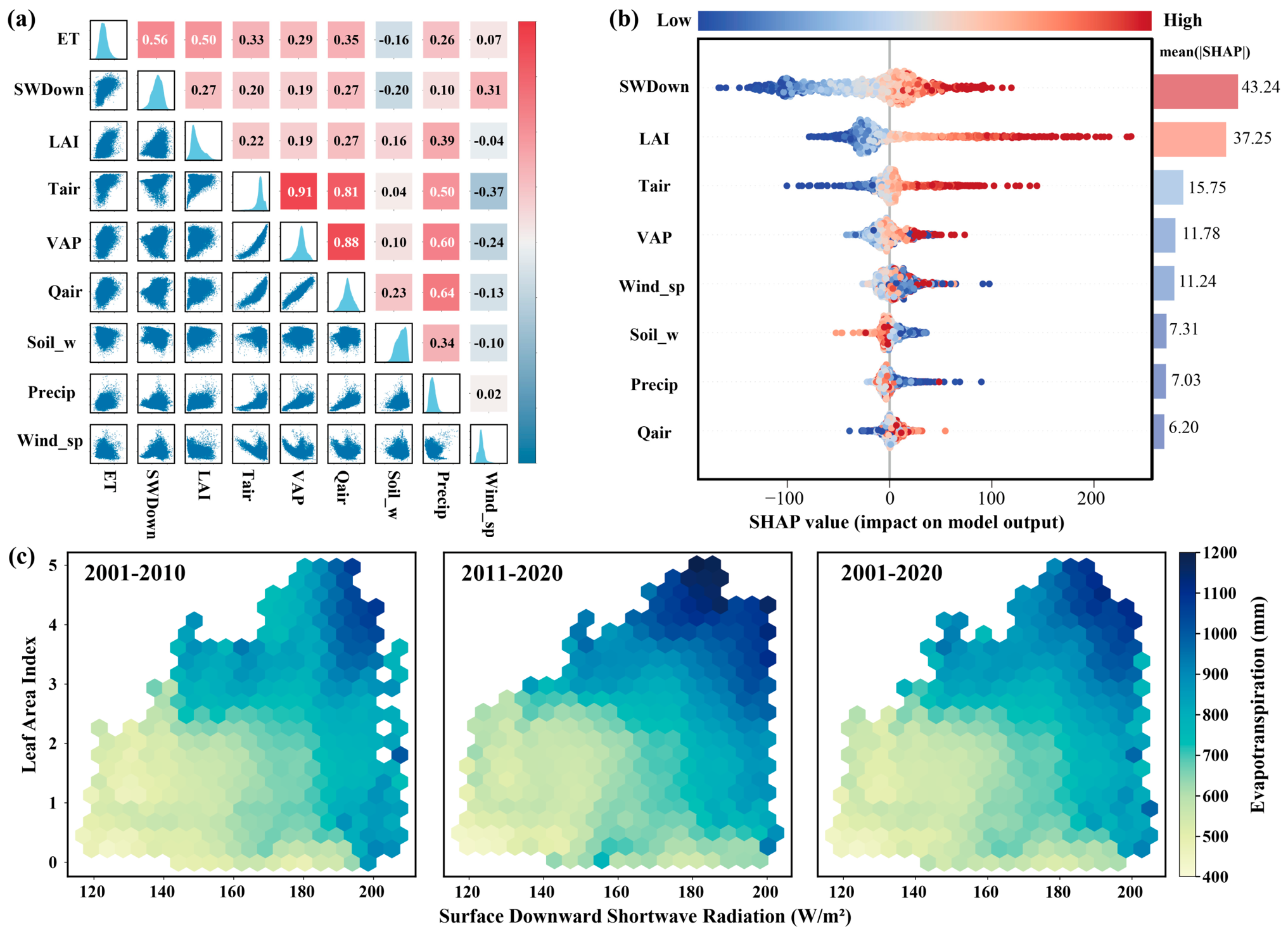
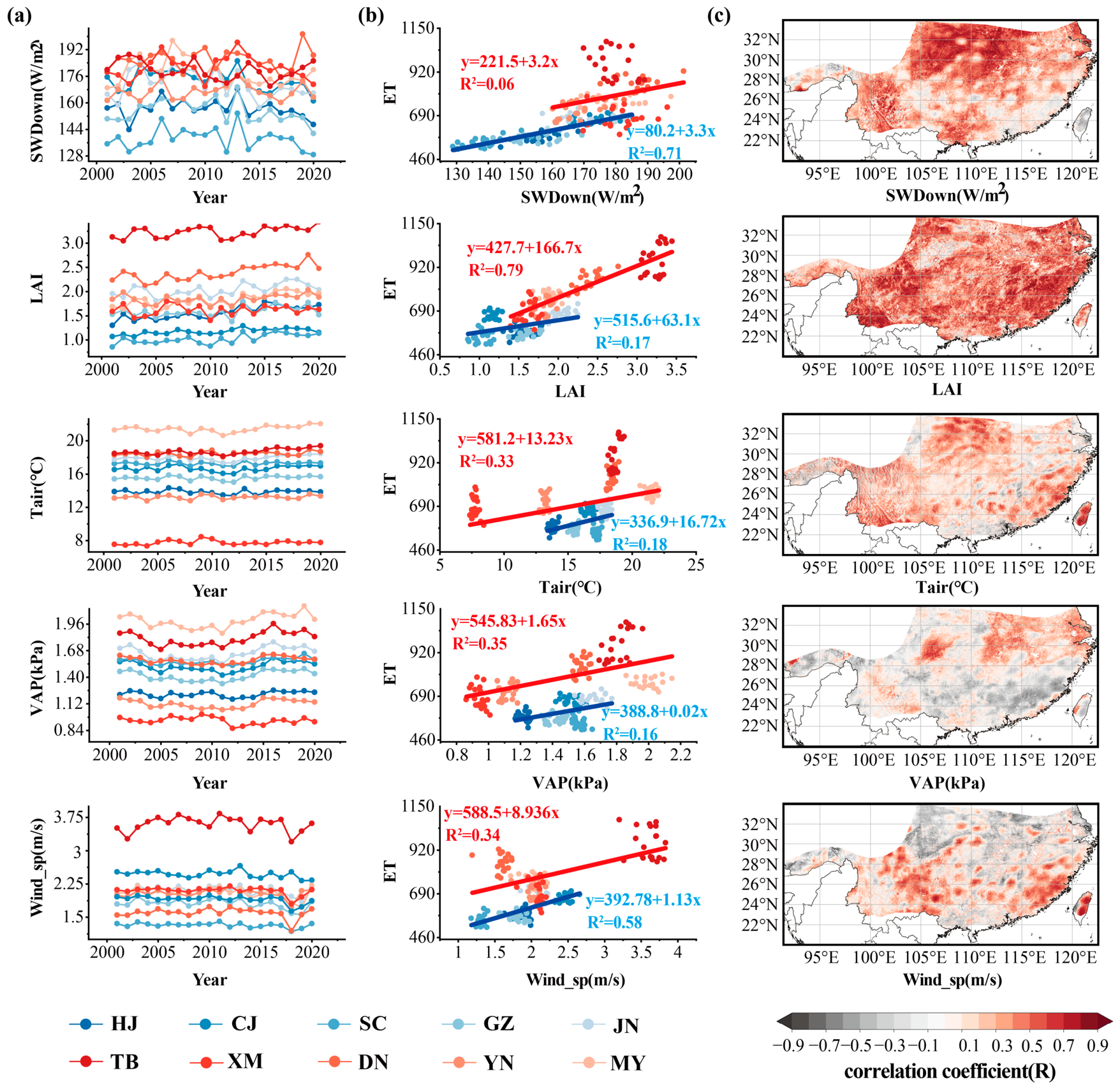
- Annual ET in subtropical China increased significantly during 2001–2020, with clear south–north and coast–inland gradients; SWDown and LAI were the dominant controls, with northern subregions mainly energy-limited and southern subregions jointly regulated by vegetation and temperature.
- The dominant factors for ET changes can vary from south to north in subtropical China, suggesting the significance of weighing different variables in modelling ET and managing water resources in this region.
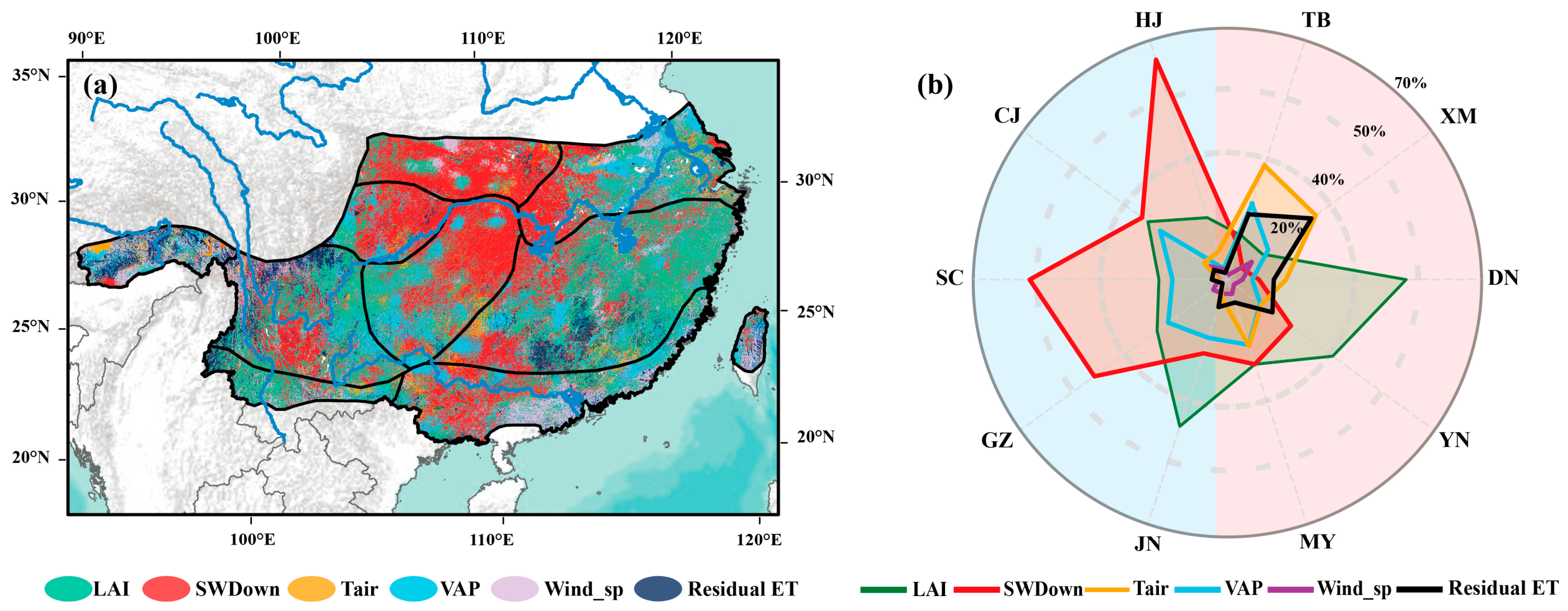
- Residual ET concentrated in urban and cropland areas may partly reflect anthropogenic influence, whereas in regions such as karst landscapes or complex terrain, it likely reflects unmodeled natural processes.
Abstract
1. Introduction
2. Materials and Methods
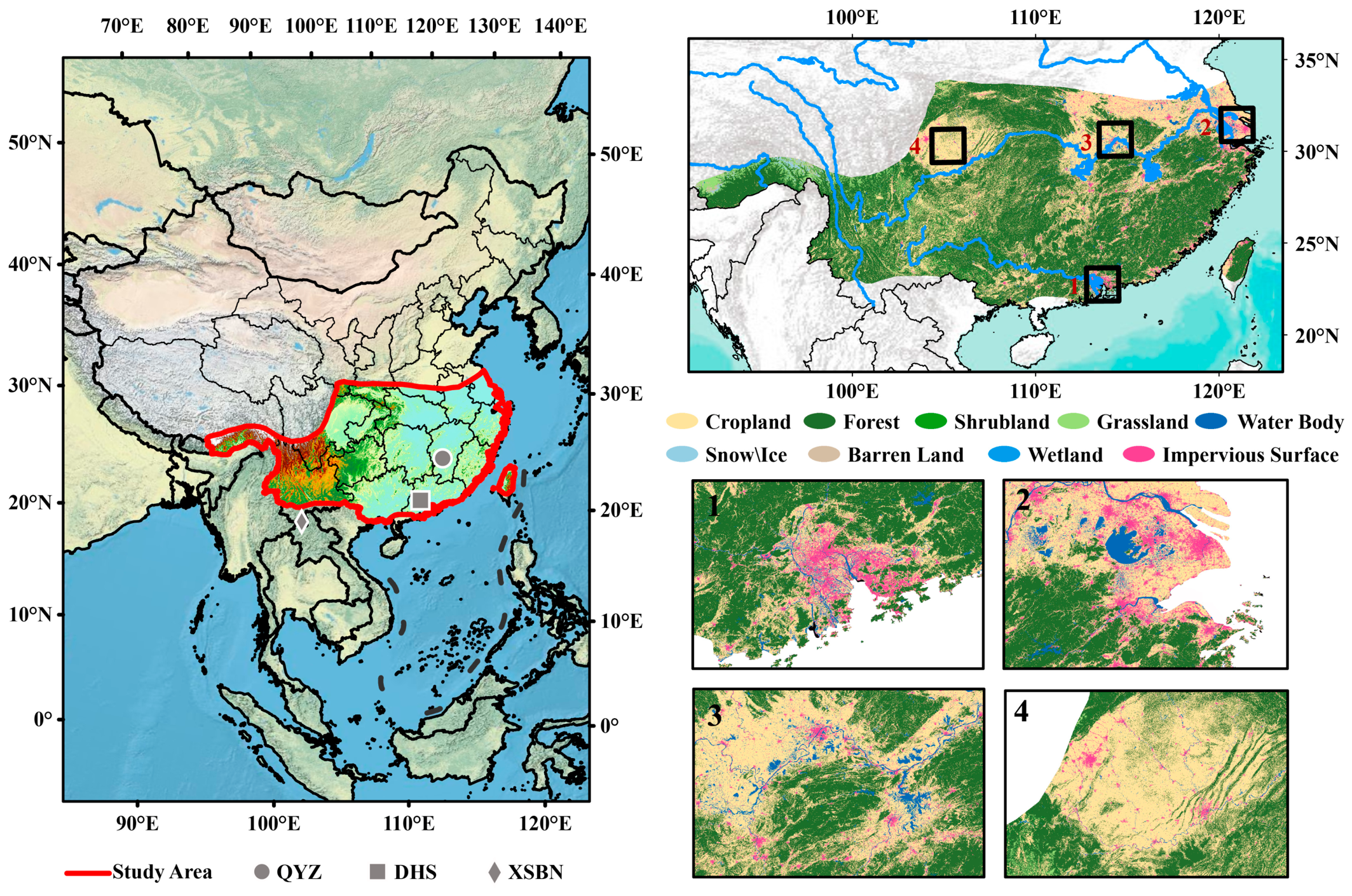
2.1. Study Area
2.2. Data Sources
2.3. Methodology
2.3.1. Theil–Sen Median Trend Analysis and Mann–Kendall Significance Test
2.3.2. Hurst Index and R/S Analysis
2.3.3. XGBoost–SHAP Framework for Identifying ET Drivers
2.3.4. Multiple Linear Regression and Residual Analysis for ET Attribution
3. Results
3.1. Spatiotemporal Characteristics and Future Trends of ET
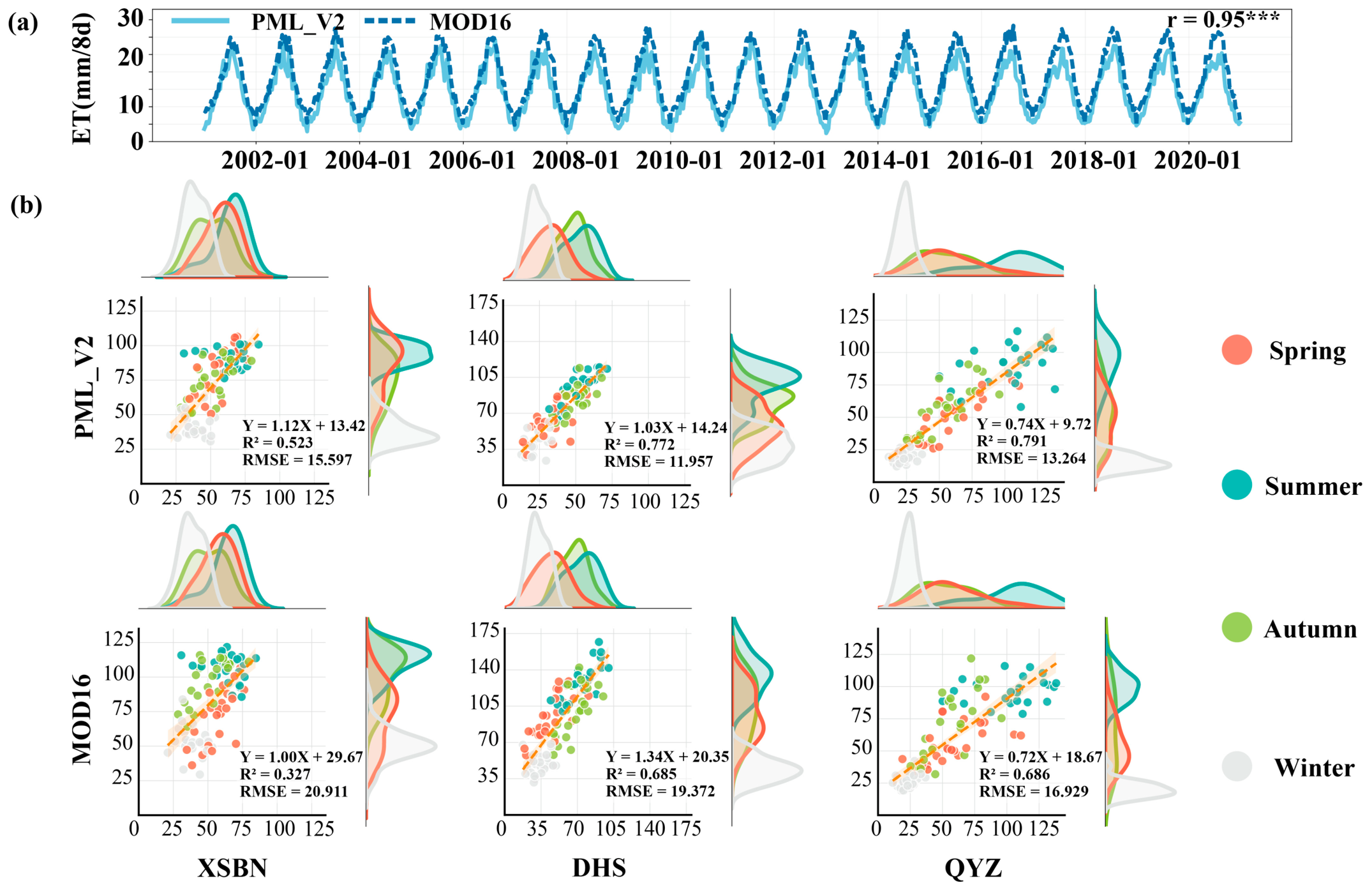
3.1.1. Evaluation of Flux-Tower Observations and Gridded ET Datasets
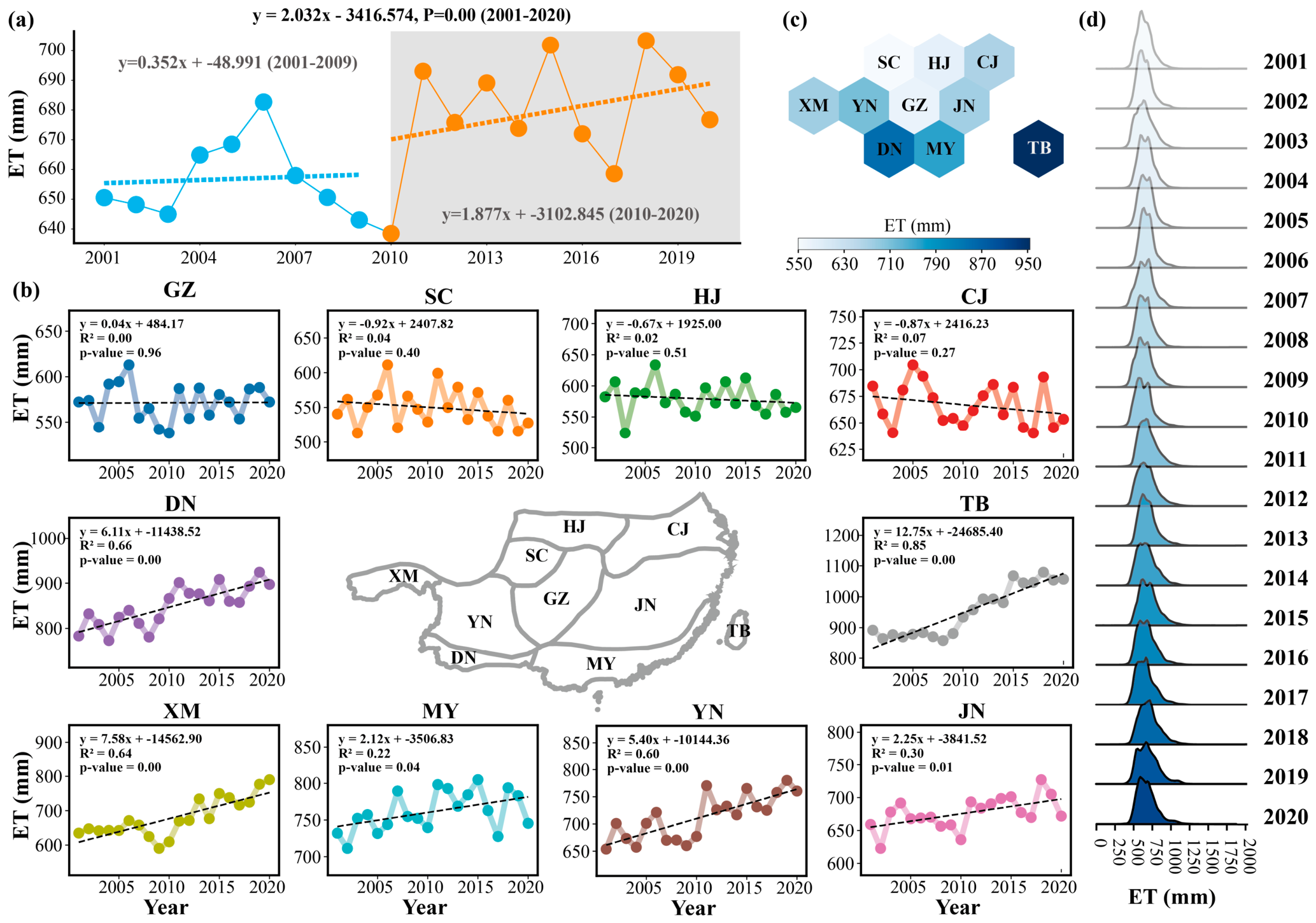
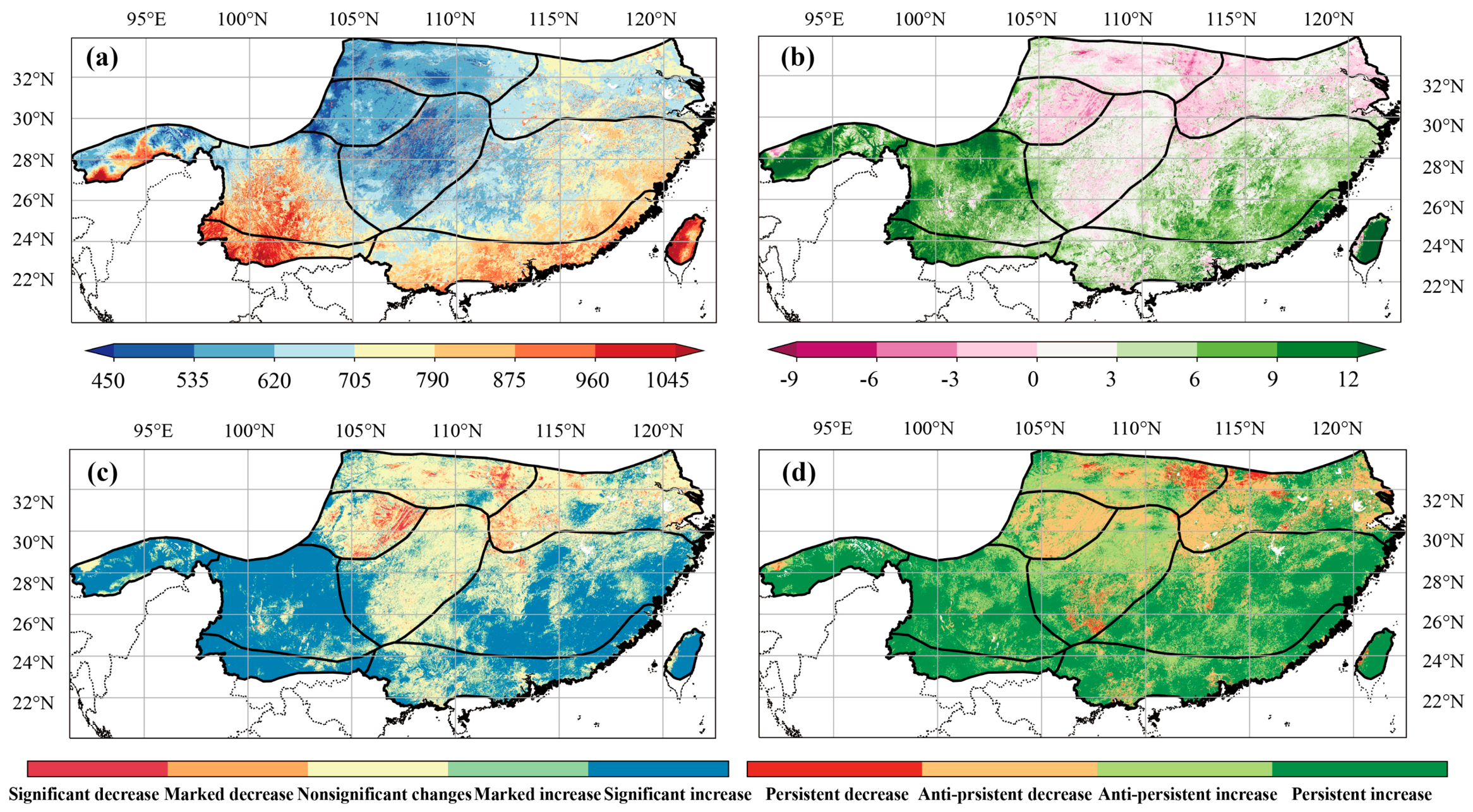
3.1.2. Spatiotemporal Patterns and Future Trends of ET
3.2. Impacts of Climate Change and Human Activities on ET
3.2.1. Characterising the Feature Importance of Driving Factors
3.2.2. Spatiotemporal Variations in the Key Drivers
3.2.3. Spatial Distribution of Dominant Drivers of ET Changes
4. Discussion
4.1. Accuracy Assessment of ET Datasets
4.2. Spatiotemporal Variability and Persistence of ET
4.3. Attribution of ET Changes
4.4. Limitations and Future Perspective
5. Conclusions
- (1)
- Over the past two decades, annual total ET in subtropical China has shown a significant increasing trend (p < 0.01), with a marked acceleration occurring after 2010. The multi-year mean annual ET exhibits a clear south–north and coast–inland gradient, with higher values in the south and along the southeastern coast and lower values in the north and inland regions. Although the area where ET is likely to decrease in the future (53.33%) is slightly larger than the area where ET is likely to increase (46.67%), the mean rate of change in the decreasing regions (−2.51 mm yr−1) is much smaller in magnitude than that in the increasing regions (4.43 mm yr−1). Overall, total ET in subtropical China tends to increase under the assumption of stationary climate and land-use conditions.
- (2)
- SWDown and LAI are identified as the key controls on ET variability in subtropical China, with strong dominance and explanatory power in the models. The strong correlations among Tair, VAP and Qair (r > 0.80) indicate that these variables jointly represent the background climatic conditions that underpin regional evaporative demand.
- (3)
- ET changes in the northern group of subregions are mainly dominated by SWDown, whereas in the southern group they are jointly controlled by LAI and Tair. The mean contribution of SWDown is higher in the northern group (43.67%) and exhibits larger spatial variability, but is lower (14.25%) and less variable in the southern group. In contrast, the contribution of LAI is relatively stable across both groups.
- (4)
- Pixels classified as “Residual ET” show strong spatial overlap with built-up land, cropland and related land-use types, indicating that ET in these areas is strongly affected by human activities, particularly land-use changes associated with urbanisation. While the residual ET component provides insight into additional non-climatic influences, its interpretation must account for the limitations of unmodeled natural processes in different subregions.
Author Contributions
Funding
Data Availability Statement
Acknowledgments
Conflicts of Interest
References
- Yang, Y.T.; Roderick, M.L.; Guo, H.; Miralles, D.G.; Zhang, L.; Fatichi, S.; Luo, X.; Zhang, Y.; McVicar, T.R.; Tu, Z.; et al. Evapotranspiration on a Greening Earth. Nat. Rev. Earth Environ. 2023, 4, 626–641. [Google Scholar] [CrossRef]
- Good, S.P.; Noone, D.; Bowen, G. Hydrologic Connectivity Constrains Partitioning of Global Terrestrial Water Fluxes. Science 2015, 349, 175–177. [Google Scholar] [CrossRef]
- Katul, G.G.; Oren, R.; Manzoni, S.; Higgins, C.; Parlange, M.B. Evapotranspiration: A Process Driving Mass Transport and Energy Exchange in the Soil-Plant-Atmosphere-Climate System. Rev. Geophys. 2012, 50, RG3002. [Google Scholar] [CrossRef]
- Maxwell, R.M.; Condon, L.E. Connections between Groundwater Flow and Transpiration Partitioning. Science 2016, 353, 377–380. [Google Scholar] [CrossRef] [PubMed]
- Pan, S.; Pan, N.; Tian, H.; Friedlingstein, P.; Sitch, S.; Shi, H.; Arora, V.K.; Haverd, V.; Jain, A.K.; Kato, E.; et al. Evaluation of Global Terrestrial Evapotranspiration Using State-of-the-Art Approaches in Remote Sensing, Machine Learning and Land Surface Modeling. Hydrol. Earth Syst. Sci. 2020, 24, 1485–1509. [Google Scholar] [CrossRef]
- Roderick, M.L.; Sun, F.; Lim, W.H.; Farquhar, G.D. A General Framework for Understanding the Response of the Water Cycle to Global Warming over Land and Ocean. Hydrol. Earth Syst. Sci. 2014, 18, 1575–1589. [Google Scholar] [CrossRef]
- Zhang, Y.Q.; Kong, D.D.; Gan, R.; Chiew, F.H.S.; McVicar, T.R.; Zhang, Q.; Yang, Y.T. Coupled Estimation of 500 m and 8-Day Resolution Global Evapotranspiration and Gross Primary Production in 2002–2017. Remote Sens. Environ. 2019, 222, 165–182. [Google Scholar] [CrossRef]
- Fisher, J.B.; Melton, F.; Middleton, E.; Hain, C.; Anderson, M.; Allen, R.; McCabe, M.F.; Hook, S.; Baldocchi, D.; Townsend, P.A.; et al. The Future of Evapotranspiration: Global Requirements for Ecosystem Functioning, Carbon and Climate Feedbacks, Agricultural Management, and Water Resources. Water Resour. Res. 2017, 53, 2618–2626. [Google Scholar] [CrossRef]
- Fu, J.; Gong, Y.Q.; Zheng, W.W.; Zou, J.; Zhang, M.; Zhang, Z.; Qin, J.; Liu, J.; Quan, B. Spatial-Temporal Variations of Terrestrial Evapotranspiration across China from 2000 to 2019. Sci. Total Environ. 2022, 825, 153951. [Google Scholar] [CrossRef] [PubMed]
- Su, B.; Huang, J.L.; Fischer, T.; Wang, Y.J.; Kundzewicz, Z.W.; Zhai, J.; Sun, H.; Wang, A.; Zeng, X.; Wang, G.; et al. Drought Losses in China Might Double between the 1.5 °C and 2.0 °C Warming. Proc. Natl. Acad. Sci. USA 2018, 115, 10600–10605. [Google Scholar] [CrossRef]
- Vautard, R.; Yiou, P.; D’Andrea, F.; de Noblet, N.; Viovy, N.; Cassou, C.; Polcher, J.; Ciais, P.; Kageyama, M.; Fan, Y. Summertime European Heat and Drought Waves Induced by Wintertime Mediterranean Rainfall Deficit. Geophys. Res. Lett. 2007, 34, L01703. [Google Scholar] [CrossRef]
- Greve, P.; Orlowsky, B.; Mueller, B.; Sheffield, J.; Reichstein, M.; Seneviratne, S.I. Global Assessment of Trends in Wetting and Drying over Land. Nat. Geosci. 2014, 7, 716–721. [Google Scholar] [CrossRef]
- Allan, R.P.; Barlow, M.; Byrne, M.P.; Cherchi, A.; Douville, H.; Fowler, H.J.; Gan, T.Y.; Pendergrass, A.G.; Rosenfeld, D.; Swann, A.L.S.; et al. Advances in Understanding Large-Scale Responses of the Water Cycle to Climate Change. Ann. N. Y. Acad. Sci. 2020, 1472, 49–75. [Google Scholar] [CrossRef]
- Wentz, F.J.; Ricciardulli, L.; Hilburn, K.; Mears, C. How Much More Rain Will Global Warming Bring? Science 2007, 317, 233–235. [Google Scholar] [CrossRef]
- Zhang, Y.Q.; Peña-Arancibia, J.L.; McVicar, T.R.; Chiew, F.H.S.; Vaze, J.; Liu, C.; Lu, X.; Zheng, H.; Wang, Y.; Liu, Y.Y.; et al. Multi-Decadal Trends in Global Terrestrial Evapotranspiration and Its Components. Sci. Rep. 2016, 6, 19124. [Google Scholar] [CrossRef]
- Jung, M.; Reichstein, M.; Ciais, P.; Seneviratne, S.I.; Sheffield, J.; Goulden, M.L.; Bonan, G.; Cescatti, A.; Chen, J.; De Jeu, R.; et al. Recent Decline in the Global Land Evapotranspiration Trend Due to Limited Moisture Supply. Nature 2010, 467, 951–954. [Google Scholar] [CrossRef]
- Zhu, Z.; Piao, S.; Myneni, R.B.; Huang, M.; Zeng, Z.; Canadell, J.G.; Ciais, P.; Sitch, S.; Friedlingstein, P.; Arneth, A.; et al. Greening of the Earth and Its Drivers. Nat. Clim. Change 2016, 6, 791–795. [Google Scholar] [CrossRef]
- Liu, J.; You, Y.; Li, J.; Sitch, S.; Gu, X.; Nabel, J.E.M.S.; Lombardozzi, D.; Luo, M.; Feng, X.; Arneth, A.; et al. Response of Global Land Evapotranspiration to Climate Change, Elevated CO2, and Land Use Change. Agric. For. Meteorol. 2021, 311, 108663. [Google Scholar] [CrossRef]
- Masson-Delmotte, V.; Zhai, P.; Pirani, A.; Connors, S.L.; Péan, C.; Berger, S.; Caud, N.; Chen, Y.; Goldfarb, L.; Gomis, M.I.; et al. Water Cycle Changes. In Climate Change 2021: The Physical Science Basis; Masson-Delmotte, V., Zhai, P., Pirani, A., Connors, S.L., Péan, C., Berger, S., Caud, N., Chen, Y., Goldfarb, L., Gomis, M.I., et al., Eds.; Cambridge University Press: Cambridge, UK, 2023; pp. 1055–1210. [Google Scholar]
- Fan, Y.; Im, E.-S.; Lan, C.-W.; Lo, M.-H. An Increase in Precipitation Driven by Irrigation over the North China Plain Based on RegCM and WRF Simulations. J. Hydrometeorol. 2023, 24, 1155–1173. [Google Scholar] [CrossRef]
- Song, Y.; Wei, J.; Cheng, H.; Zan, B. Irrigation in the North China Plain Regulates the Diurnal Cycle of Precipitation and Regional Water Cycle. Clim. Dyn. 2024, 62, 6329–6346. [Google Scholar] [CrossRef]
- Cai, Y.; Xu, Q.; Bai, F.; Cao, X.; Wei, Z.; Lu, X.; Wei, N.; Yuan, H.; Zhang, S.; Liu, S.; et al. Reconciling Global Terrestrial Evapotranspiration Estimates from Multi-Product Intercomparison and Evaluation. Water Resour. Res. 2024, 60, e2024WR037608. [Google Scholar] [CrossRef]
- Zheng, H.; Miao, C.; Li, X.; Kong, D.; Gou, J.; Wu, J.; Zhang, S. Effects of Vegetation Changes and Multiple Environmental Factors on Evapotranspiration Across China over the Past 34 Years. Earth’s Future 2022, 10, e2021EF002564. [Google Scholar] [CrossRef]
- Jin, Z.; Liang, W.; Yang, Y.; Zhang, W.; Yan, J.; Chen, X.; Li, S.; Mo, X. Separating Vegetation Greening and Climate Change Controls on Evapotranspiration Trend over the Loess Plateau. Sci. Rep. 2017, 7, 8191. [Google Scholar] [CrossRef]
- Liang, W.; Zhang, W.; Jin, Z.; Yan, J.; Lü, Y.; Li, S.; Yu, Q. Rapid Urbanization and Agricultural Intensification Increase Regional Evaporative Water Consumption of the Loess Plateau. J. Geophys. Res. Atmos. 2020, 125, e2020JD033380. [Google Scholar] [CrossRef]
- Amani, S.; Shafizadeh-Moghadam, H. A Review of Machine Learning Models and Influential Factors for Estimating Evapotranspiration Using Remote Sensing and Ground-Based Data. Agric. Water Manag. 2023, 284, 108324. [Google Scholar] [CrossRef]
- Khosravi, Y.; Homayouni, S.; St-Hilaire, A. An Integrated Dryness Index Based on Geographically Weighted Regression and Satellite Earth Observations. Sci. Total Environ. 2024, 911, 168807. [Google Scholar] [CrossRef]
- Ersi, C.; Bayaer, T.; Bao, Y.H.; Bao, Y.L.; Yong, M.; Zhang, X. Temporal and Spatial Changes in Evapotranspiration and Its Potential Driving Factors in Mongolia over the Past 20 Years. Remote Sens. 2022, 14, 1856. [Google Scholar] [CrossRef]
- Li, Y.; Tian, H.F.; Zhang, J.F.; Lu, S.Q.; Xie, Z.X.; Shen, W.; Zheng, Z.; Li, M.; Rong, P.; Qin, Y. Detection of Spatiotemporal Changes in Ecological Quality in the Chinese Mainland: Trends and Attributes. Sci. Total Environ. 2023, 884, 163791. [Google Scholar] [CrossRef] [PubMed]
- Li, G.; Zhang, F.M.; Jing, Y.S.; Liu, Y.B.; Sun, G. Response of Evapotranspiration to Changes in Land Use and Land Cover and Climate in China during 2001–2013. Sci. Total Environ. 2017, 596–597, 256–265. [Google Scholar] [CrossRef] [PubMed]
- Peng, S.; Ding, Y.; Liu, W.; Li, Z. 1km Monthly Temperature and Precipitation Dataset for China from 1901 to 2017. Earth Syst. Sci. Data 2019, 11, 1931–1946. [Google Scholar] [CrossRef]
- Rodell, M.; Houser, P.R.; Jambor, U.; Gottschalck, J.; Mitchell, K.; Meng, C.-J.; Arsenault, K.; Cosgrove, B.; Radakovich, J.; Bosilovich, M.; et al. The Global Land Data Assimilation System. Bull. Am. Meteorol. Soc. 2004, 85, 381–394. [Google Scholar] [CrossRef]
- Abatzoglou, J.T.; Dobrowski, S.Z.; Parks, S.A.; Hegewisch, K.C. TerraClimate, a High-Resolution Global Dataset of Monthly Climate and Climatic Water Balance from 1958–2015. Sci. Data 2018, 5, 170191. [Google Scholar] [CrossRef]
- Muñoz-Sabater, J.; Dutra, E.; Agustí-Panareda, A.; Albergel, C.; Arduini, G.; Balsamo, G.; Boussetta, S.; Choulga, M.; Harrigan, S.; Hersbach, H.; et al. ERA5-Land: A State-of-the-Art Global Reanalysis Dataset for Land Applications. Earth Syst. Sci. Data 2021, 13, 4349–4383. [Google Scholar] [CrossRef]
- Yu, G.-R.; Wen, X.-F.; Sun, X.-M.; Tanner, B.D.; Lee, X.; Chen, J.-Y. Overview of ChinaFLUX and Evaluation of Its Eddy Covariance Measurement. Agric. For. Meteorol. 2006, 137, 125–137. [Google Scholar] [CrossRef]
- Sen, P.K. Estimates of the Regression Coefficient Based on Kendall’s Tau. J. Am. Stat. Assoc. 1968, 63, 1379–1389. [Google Scholar] [CrossRef]
- Theil, H. A Rank-Invariant Method of Linear and Polynomial Regression Analysis. In Henri Theil’s Contributions to Economics and Econometrics: Econometric Theory and Methodology; Raj, B., Koerts, J., Eds.; Springer: Dordrecht, The Netherlands, 1992; pp. 345–381. [Google Scholar]
- Mann, H.B. Nonparametric Tests Against Trend. Econometrica 1945, 13, 245–259. [Google Scholar] [CrossRef]
- Almazroui, M.; Şen, Z. Trend Analyses Methodologies in Hydro-Meteorological Records. Earth Syst. Environ. 2020, 4, 713–738. [Google Scholar] [CrossRef]
- Hurst, H.E. Long-Term Storage Capacity of Reservoirs. Trans. Am. Soc. Civ. Eng. 1951, 116, 770–799. [Google Scholar] [CrossRef]
- Zhong, X.; Li, J.; Wang, J.; Zhang, J.; Liu, L.; Ma, J. Linear and Nonlinear Characteristics of Long-Term NDVI Using Trend Analysis: A Case Study of Lancang-Mekong River Basin. Remote Sens. 2022, 14, 6271. [Google Scholar] [CrossRef]
- Michael, Y.; Helman, D.; Glickman, O.; Gabay, D.; Brenner, S.; Lensky, I.M. Forecasting Fire Risk with Machine Learning and Dynamic Information Derived from Satellite Vegetation Index Time-Series. Sci. Total Environ. 2021, 764, 142844. [Google Scholar] [CrossRef]
- Zhou, X.Z.; Wen, H.J.; Li, Z.W.; Zhang, H.; Zhang, W.G. An Interpretable Model for the Susceptibility of Rainfall-Induced Shallow Landslides Based on SHAP and XGBoost. Geocarto Int. 2022, 37, 13419–13450. [Google Scholar] [CrossRef]
- Lundberg, S.M.; Erion, G.G.; Chen, H.; DeGrave, A.J.; Prutkin, J.M.; Nair, B.; Katz, R.; Himmelfarb, J.; Bansal, N.; Lee, S.I. From Local Explanations to Global Understanding with Explainable AI for Trees. Nat. Mach. Intell. 2020, 2, 56–67. [Google Scholar] [CrossRef] [PubMed]
- Zhu, W.; Tian, S.; Wei, J.; Jia, S.; Song, Z. Multi-Scale Evaluation of Global Evapotranspiration Products Derived from Remote Sensing Images: Accuracy and Uncertainty. J. Hydrol. 2022, 611, 127982. [Google Scholar] [CrossRef]
- Mu, Q.; Zhao, M.; Running, S.W. Improvements to a MODIS Global Terrestrial Evapotranspiration Algorithm. Remote Sens. Environ. 2011, 115, 1781–1800. [Google Scholar] [CrossRef]
- Gan, R.; Zhang, Y.; Shi, H.; Yang, Y.; Eamus, D.; Cheng, L.; Chiew, F.H.S.; Yu, Q. Use of Satellite Leaf Area Index Estimating Evapotranspiration and Gross Assimilation for Australian Ecosystems. Ecohydrology 2018, 11, e1974. [Google Scholar] [CrossRef]
- He, S.; Zhang, Y.; Ma, N.; Tian, J.; Kong, D.; Liu, C. A Daily and 500 m Coupled Evapotranspiration and Gross Primary Production Product across China during 2000–2020. Earth Syst. Sci. Data 2022, 14, 5463–5488. [Google Scholar] [CrossRef]
- Shi, X.; She, D.; Xia, J.; Liu, R.; Wang, T. The Intercomparison of Six 0.1°×0.1° Spatial Resolution Evapotranspiration Products across Mainland China. J. Hydrol. 2024, 633, 130949. [Google Scholar] [CrossRef]
- Pan, S.; Xu, Y.-P.; Gu, H.; Yu, B.; Xuan, W. Evaluation of Remote Sensing-Based Evapotranspiration Datasets for Improving Hydrological Model Simulation in Humid Region of East China. Remote Sens. 2022, 14, 4546. [Google Scholar] [CrossRef]
- Chen, H.; Gnanamoorthy, P.; Chen, Y.; Mansaray, L.R.; Song, Q.; Liao, K.; Shi, A.; Feng, G.; Sun, C. Assessment and Inter-Comparison of Multi-Source High Spatial Resolution Evapotranspiration Products over Lancang–Mekong River Basin, Southeast Asia. Remote Sens. 2022, 14, 479. [Google Scholar] [CrossRef]
- Xu, M.; Ma, Q.; Li, S.; Yang, F.; Zhang, T.; Xu, F.; Yang, B.; Zhang, H.; Zhang, S.; Wang, Q.; et al. The Estimation and Partitioning of Evapotranspiration in a Coniferous Plantation in Subtropical China. Front. Plant Sci. 2023, 14, 1120202. [Google Scholar] [CrossRef]
- Zhu, X.-J.; Yu, G.-R.; Hu, Z.-M.; Wang, Q.-F.; He, H.-L.; Yan, J.-H.; Wang, H.-M.; Zhang, J.-H. Spatiotemporal Variations of T/ET (the Ratio of Transpiration to Evapotranspiration) in Three Forests of Eastern China. Ecol. Indic. 2015, 52, 411–421. [Google Scholar] [CrossRef]
- Xu, M.; Wen, X.; Wang, H.; Zhang, W.; Dai, X.; Song, J.; Wang, Y.; Fu, X.; Liu, Y.; Sun, X.; et al. Effects of Climatic Factors and Ecosystem Responses on the Inter-Annual Variability of Evapotranspiration in a Coniferous Plantation in Subtropical China. PLoS ONE 2014, 9, e85593. [Google Scholar] [CrossRef] [PubMed]
- Li, Z.; Zhang, Y.; Wang, S.; Yuan, G.; Yang, Y.; Cao, M. Evapotranspiration of a tropical rain forest in Xishuangbanna, southwest China. Hydrol. Process. 2010, 24, 2405–2416. [Google Scholar] [CrossRef]
- Zhang, W.; Scholten, T.; Seitz, S.; Zhang, Q.; Chu, G.; Wang, L.; Xiong, X.; Liu, J. Rainfall Redistribution in Subtropical Chinese Forests Changes over 22 Years. Hydrol. Earth Syst. Sci. 2024, 28, 3837–3854. [Google Scholar] [CrossRef]
- Cheng, M.; Jiao, X.; Jin, X.; Li, B.; Liu, K.; Shi, L. Satellite Time Series Data Reveal Interannual and Seasonal Spatiotemporal Evapotranspiration Patterns in China in Response to Effect Factors. Agric. Water Manag. 2021, 255, 107046. [Google Scholar] [CrossRef]
- Li, X.; He, Y.; Zeng, Z.; Lian, X.; Wang, X.; Du, M.; Jia, G.; Li, Y.; Ma, Y.; Tang, Y.; et al. Spatiotemporal Pattern of Terrestrial Evapotranspiration in China during the Past Thirty Years. Agric. For. Meteorol. 2018, 259, 131–140. [Google Scholar] [CrossRef]
- Zhang, J.; Zhou, X.; Yang, S.; Ao, Y. Spatiotemporal Variations in Evapotranspiration and Their Driving Factors in Southwest China between 2003 and 2020. Remote Sens. 2023, 15, 4418. [Google Scholar] [CrossRef]
- Ji, Y.; Tang, Q.; Yan, L.; Wu, S.; Yan, L.; Tan, D.; Chen, J.; Chen, Q. Spatiotemporal Variations and Influencing Factors of Terrestrial Evapotranspiration and Its Components during Different Impoundment Periods in the Three Gorges Reservoir Area. Water 2021, 13, 2111. [Google Scholar] [CrossRef]
- Wang, M.; Li, M.; An, Q.; Zhang, Z.; Lu, J. Investigating the Seasonal Effect of Climatic Factors on Evapotranspiration in the Monsoon Climate Zone: A Case Study of the Yangtze River Basin. Atmosphere 2023, 14, 1282. [Google Scholar] [CrossRef]
- Chen, C.; Park, T.; Wang, X.; Piao, S.; Xu, B.; Chaturvedi, R.K.; Fuchs, R.; Brovkin, V.; Ciais, P.; Fensholt, R.; et al. China and India Lead in Greening of the World through Land-Use Management. Nat. Sustain. 2019, 2, 122–129. [Google Scholar] [CrossRef] [PubMed]
- Yang, S.; Wang, X.L.; Wild, M. Causes of Dimming and Brightening in China Inferred from Homogenized Daily Clear-Sky and All-Sky in Situ Surface Solar Radiation Records (1958–2016). J. Clim. 2019, 32, 5901–5913. [Google Scholar] [CrossRef]
- Shi, H.; Zhang, J.; Zhao, B.; Xia, X.; Hu, B.; Chen, H.; Wei, J.; Liu, M.; Bian, Y.; Fu, D.; et al. Surface Brightening in Eastern and Central China Since the Implementation of the Clean Air Action in 2013: Causes and Implications. Geophys. Res. Lett. 2021, 48, e2020GL091105. [Google Scholar] [CrossRef]
- Yang, J.; Gong, D.; Wang, W.; Hu, M.; Mao, R. Extreme Drought Event of 2009/2010 over Southwestern China. Meteorol. Atmos. Phys. 2012, 115, 173–184. [Google Scholar] [CrossRef]
- Zhang, W.; Jin, F.-F.; Zhao, J.-X.; Qi, L.; Ren, H.-L. The Possible Influence of a Nonconventional El Niño on the Severe Autumn Drought of 2009 in Southwest China. J. Clim. 2013, 26, 8392–8405. [Google Scholar] [CrossRef]
- Jaafar, H.H.; Sujud, L.H. High-Resolution Satellite Imagery Reveals a Recent Accelerating Rate of Increase in Land Evapotranspiration. Remote Sens. Environ. 2024, 315, 114489. [Google Scholar] [CrossRef]
- Zeng, Z.; Piao, S.; Li, L.Z.X.; Wang, T.; Ciais, P.; Lian, X.; Yang, Y.; Mao, J.; Shi, X.; Myneni, R.B. Impact of Earth Greening on the Terrestrial Water Cycle. J. Clim. 2018, 31, 2633–2650. [Google Scholar] [CrossRef]
- Ouyang, Z.; Zheng, H.; Xiao, Y.; Polasky, S.; Liu, J.; Xu, W.; Wang, Q.; Zhang, L.; Xiao, Y.; Rao, E.; et al. Improvements in Ecosystem Services from Investments in Natural Capital. Science 2016, 352, 1455–1459. [Google Scholar] [CrossRef] [PubMed]
- Tong, X.; Brandt, M.; Yue, Y.; Ciais, P.; Jepsen, M.R.; Peñuelas, J.; Wigneron, J.-P.; Xiao, X.; Song, X.-P.; Horion, S.; et al. Forest management in southern China generates short term extensive carbon sequestration. Nat. Commun. 2020, 11, 129. [Google Scholar] [CrossRef]
- Hu, X.; Li, Z.; Chen, J.; Nie, X.; Liu, J.; Wang, L.; Ning, K. Carbon Sequestration Benefits of the Grain for Green Program in the Hilly Red Soil Region of Southern China. Int. Soil Water Conserv. Res. 2021, 9, 271–278. [Google Scholar] [CrossRef]
- Jiang, Z.; Lian, Y.; Qin, X. Rocky Desertification in Southwest China: Impacts, Causes, and Restoration. Earth-Sci. Rev. 2014, 132, 1–12. [Google Scholar] [CrossRef]
- Jin, K.; Qin, M.; Tang, R.; Huang, X.; Hao, L.; Sun, G. Urban–Rural Interface Dominates the Effects of Urbanization on Watershed Energy and Water Balances in Southern China. Landsc. Ecol. 2023, 38, 3869–3887. [Google Scholar] [CrossRef]
- Mukhtar, H.; Yang, Y.; Xu, M.; Wu, J.; Abbas, S.; Wei, D.; Zhao, W. Elevation-Dependent Vegetation Greening and Its Responses to Climate Changes in the South Slope of the Himalayas. Geophys. Res. Lett. 2025, 52, e2024GL113276. [Google Scholar] [CrossRef]
- Wang, H.-C.; Chang, C.-T. The Dynamic of Vegetation Growth with Regular Climate and Climatic Fluctuations in a Subtropical Mountainous Island, Taiwan. Remote Sens. 2021, 13, 3298. [Google Scholar] [CrossRef]
- Hung, C.; Shih, M.-F. Air Quality Changes in Taiwan over the Past Decades and during the COVID-19 Crisis. Terr. Atmos. Ocean. Sci. 2023, 34, 5. [Google Scholar] [CrossRef]
- Cheng, F.-Y.; Hsu, C.-H. Long-Term Variations in PM2.5 Concentrations under Changing Meteorological Conditions in Taiwan. Sci. Rep. 2019, 9, 6635. [Google Scholar] [CrossRef]
- Chen, S.; Xie, Z.; Xie, J.; Liu, B.; Jia, B.; Qin, P.; Wang, L.; Wang, Y.; Li, R. Impact of Urbanization on the Thermal Environment of the Chengdu–Chongqing Urban Agglomeration under Complex Terrain. Earth Syst. Dyn. 2022, 13, 341–356. [Google Scholar] [CrossRef]
- Li, C.; Adu, B.; Li, H.; Yang, D. Spatial and Temporal Variations of Drought in Sichuan Province from 2001 to 2020 Based on Modified Temperature Vegetation Dryness Index (TVDI). Ecol. Indic. 2022, 141, 109106. [Google Scholar] [CrossRef]
- Wang, L.; Wang, S.; Zhou, Y.; Zhu, J.; Zhang, J.; Hou, Y.; Liu, W. Landscape Pattern Variation, Protection Measures, and Land Use/Land Cover Changes in Drinking Water Source Protection Areas: A Case Study in Danjiangkou Reservoir, China. Glob. Ecol. Conserv. 2020, 21, e00827. [Google Scholar] [CrossRef]
- Mo, X.; Liu, S.; Lin, Z.; Wang, S.; Hu, S. Trends in Land Surface Evapotranspiration across China with Remotely Sensed NDVI and Climatological Data for 1981–2010. Hydrol. Sci. J. 2015, 60, 2163–2177. [Google Scholar] [CrossRef]
- Zeng, J.; Zhang, Q.; Zhang, Y.; Yue, P.; Yang, Z.; Wang, S.; Zhang, L.; Li, H. Enhanced Impact of Vegetation on Evapotranspiration in the Northern Drought-Prone Belt of China. Remote Sens. 2022, 15, 221. [Google Scholar] [CrossRef]
- Kramer, R.J.; Bounoua, L.; Zhang, P.; Wolfe, R.E.; Huntington, T.G.; Imhoff, M.L.; Thome, K.; Noyce, G.L. Evapotranspiration Trends over the Eastern United States During the 20th Century. Hydrology 2015, 2, 93–111. [Google Scholar] [CrossRef]
- Sun, S.L.; Liu, Y.B.; Chen, H.S.; Ju, W.M.; Xu, C.-Y.; Liu, Y.; Zhou, B.; Zhou, Y.; Zhou, Y.; Yu, M. Causes for the Increases in Both Evapotranspiration and Water Yield over Vegetated Mainland China during the Last Two Decades. Agric. For. Meteorol. 2022, 324, 109118. [Google Scholar] [CrossRef]
- Komatsu, H.; Maita, E.; Otsuki, K. A Model to Estimate Annual Forest Evapotranspiration in Japan from Mean Annual Temperature. J. Hydrol. 2008, 348, 330–340. [Google Scholar] [CrossRef]
- Wang, H.; Zheng, J. Assessing the Effects of Surface Conditions on Potential Evapotranspiration in a Humid Subtropical Region of China. Front. Clim. 2022, 4, 813787. [Google Scholar] [CrossRef]
- Jiang, H.; Lu, N.; Qin, J.; Yao, L. Hourly 5-Km Surface Total and Diffuse Solar Radiation in China, 2007–2018. Sci. Data 2020, 7, 311. [Google Scholar] [CrossRef]
- Denissen, J.M.C.; Teuling, A.J.; Pitman, A.J.; Koirala, S.; Migliavacca, M.; Li, W.; Reichstein, M.; Winkler, A.J.; Zhan, C.; Orth, R. Widespread Shift from Ecosystem Energy to Water Limitation with Climate Change. Nat. Clim. Change 2022, 12, 677–684. [Google Scholar] [CrossRef]
- Ngwira, S.; Damazio, C. Quantification of the Effects of Climatic Factors and Anthropogenic Activities on Streamflow: A Systematic Review. Discov. Water 2025, 5, 31. [Google Scholar] [CrossRef]
- Tran, B.N.; van der Kwast, J.; Seyoum, S.; Uijlenhoet, R.; Jewitt, G.; Mul, M. Uncertainty Assessment of Satellite Remote-Sensing-Based Evapotranspiration Estimates: A Systematic Review of Methods and Gaps. Hydrol. Earth Syst. Sci. 2023, 27, 4505–4528. [Google Scholar] [CrossRef]



| Dominant Drivers | Northern Subregions | Southern Subregions | ||||||||
|---|---|---|---|---|---|---|---|---|---|---|
| CJ | HJ | SC | GZ | JN | YN | XM | MY | TB | DN | |
| LAI | 27.66% | 18.32% | 19.27% | 24.47% | 43.37% | 36.61% | 12.16% | 25.03% | 12.96% | 50.29% |
| SWDown | 29.67% | 65.00% | 55.63% | 46.27% | 21.80% | 22.11% | 5.24% | 25.01% | 10.01% | 8.89% |
| VAP | 23.39% | 3.28% | 15.46% | 20.62% | 17.24% | 11.40% | 14.17% | 19.27% | 22.45% | 6.97% |
| Wind_sp | 6.47% | 3.13% | 2.52% | 4.93% | 4.16% | 2.32% | 8.47% | 4.22% | 1.51% | 4.29% |
| Tair | 8.15% | 8.27% | 2.72% | 1.99% | 5.31% | 11.90% | 30.72% | 19.68% | 33.75% | 16.50% |
| Residual ET | 4.66% | 2.00% | 4.40% | 1.72% | 8.12% | 15.66% | 29.24% | 6.79% | 19.33% | 13.06% |
| Data Type | MOD16 (ET) | PML-V2 (Ec, Es, Ei) |
|---|---|---|
| Meteorological Data | GMAO-MERRA (1° × 1.25°) | GLDAS_2.1 (0.25° × 0.25°) |
| Land Cover Product | MOD12Q1-UMD (1 km/a) | MCD12Q1-IGBP (500 m/a) |
| LAI | MOD15A2 (1 km/8 d) | MCD15A3H (500 m/8 d) |
| Albedo Data | MOD43C1 (0.05°/16 d) | MCD43A3 (500 m/8 d) |
| Surface Emissivity | - | MOD11A2 (500 m/8 d) |
| CO2 Concentration Data | - | NOAA-GAMS/MMD (~1°) |
| Variable | Northern Subregions | Southern Subregions | ||||||||
|---|---|---|---|---|---|---|---|---|---|---|
| CJ | HJ | SC | GZ | JN | YN | XM | MY | TB | DN | |
| LAI | 1.17 | 1.57 | 1.02 | 1.59 | 2.04 | 1.85 | 1.62 | 1.83 | 3.23 | 2.39 |
| SWDown | 173.67 | 156.57 | 138.30 | 154.92 | 171.31 | 166.72 | 181.39 | 178.51 | 179.67 | 186.06 |
| VAP | 1.52 | 1.22 | 1.57 | 1.42 | 1.65 | 1.12 | 0.94 | 2.00 | 1.81 | 1.58 |
| Wind_sp | 2.47 | 1.90 | 1.32 | 1.81 | 2.10 | 2.04 | 2.10 | 2.05 | 3.60 | 1.60 |
| Tair | 16.67 | 13.85 | 17.28 | 15.53 | 17.94 | 13.21 | 7.75 | 21.43 | 18.70 | 18.45 |
Disclaimer/Publisher’s Note: The statements, opinions and data contained in all publications are solely those of the individual author(s) and contributor(s) and not of MDPI and/or the editor(s). MDPI and/or the editor(s) disclaim responsibility for any injury to people or property resulting from any ideas, methods, instructions or products referred to in the content. |
© 2026 by the authors. Licensee MDPI, Basel, Switzerland. This article is an open access article distributed under the terms and conditions of the Creative Commons Attribution (CC BY) license.
Share and Cite
Li, Y.; Xue, B.; Chen, H.; Li, X.; Du, J.; Tang, G. Spatiotemporal Variations and Driving Factors of Evapotranspiration in Subtropical China from 2001 to 2020. Remote Sens. 2026, 18, 1866. https://doi.org/10.3390/rs18111866
Li Y, Xue B, Chen H, Li X, Du J, Tang G. Spatiotemporal Variations and Driving Factors of Evapotranspiration in Subtropical China from 2001 to 2020. Remote Sensing. 2026; 18(11):1866. https://doi.org/10.3390/rs18111866
Chicago/Turabian StyleLi, Yuqi, Bing Xue, Houbing Chen, Xiaobin Li, Jingzhi Du, and Guoping Tang. 2026. "Spatiotemporal Variations and Driving Factors of Evapotranspiration in Subtropical China from 2001 to 2020" Remote Sensing 18, no. 11: 1866. https://doi.org/10.3390/rs18111866
APA StyleLi, Y., Xue, B., Chen, H., Li, X., Du, J., & Tang, G. (2026). Spatiotemporal Variations and Driving Factors of Evapotranspiration in Subtropical China from 2001 to 2020. Remote Sensing, 18(11), 1866. https://doi.org/10.3390/rs18111866