Article

A Spatial Framework for Assessing Irrigation Water Use in Overexploited Mediterranean Aquifers

by
Esther López-Pérez
1,*,
Juan Manzano-Juarez
2,
Miguel Angel Jiménez-Bello
1,
Alberto García-Prats
1,
Carles Sanchis-Ibor
2,
Adrià Rubio-Martín
1,
Fatima Zahrae Boubekri
3,
Abdellah Kajji
4,
Paolo Tufoni
5,
Luís Miguel Nunes
5 and
Manuel Pulido-Velazquez
1
1
Research Institute of Water and Environmental Engineering (IIAMA), Universitat Politècnica de València, 46022 Valencia, Spain
2
Valencian Centre of Irrigation Studies (CVER), Universitat Politècnica de València, 46022 València, Spain
3
AgroParisTech, Paris, 22 Place de l’Agronomique, 91120 Palaiseau, France
4
Regional Agricultural Research Center, Meknes 50000, Morocco
5
Faculdade de Ciências e Tecnologia, Univeridade do Algarve, CERIS, Campus de Gambelas, 8005-139 Faro, Portugal
*
Author to whom correspondence should be addressed.
Remote Sens. 2025, 17(24), 4019; https://doi.org/10.3390/rs17244019
Submission received: 20 October 2025 / Revised: 5 December 2025 / Accepted: 10 December 2025 / Published: 12 December 2025

Highlights

What are the main findings?
  • Crop water requirements (CWR) varied markedly among perennial crops—citrus (591.3 mm) > apple (215.5 mm) > grapevine (160.9 mm)—revealing clear differences in water demand across Mediterranean aquifer-dependent systems.
  • The Spatial Irrigation Adequacy Index (SIAI) identified distinct irrigation performance patterns: near-optimal irrigation in vineyards, generalized over-irrigation in apple orchards, and widespread under-irrigation in citrus groves.
What is the implication of the main finding?
  • Integrating remote sensing–derived evapotranspiration with the FAO-56 CWR approach enables plot-level diagnosis of irrigation efficiency and supports adaptive water management in groundwater-dependent agriculture.
  • The SIAI provides a practical, spatially explicit tool to guide site-specific irrigation management and promote sustainable groundwater use in water-scarce Mediterranean regions.

Abstract

Irrigated agriculture in Mediterranean semi-arid regions is increasingly constrained by aquifer depletion and climate change. Enhancing water use efficiency in the irrigation of perennial crops is essential for long-term agricultural sustainability. This study introduces a Spatial Irrigation Adequacy Index (SIAI), a normalized index expressing the deviation between actual evapotranspiration (ETa) and Crop Water Requirements (CWR). The framework was applied to assess irrigation performance in grapevine (Vitis vinifera), apple orchards (Malus domestica) and citrus tress (Citrus sinensis) across three groundwater-dependent systems: Requena-Utiel (Spain), Ain Timguenai (Morocco), and Campina de Faro (Portugal). ETa was estimated using Landsat 8 and 9 imageries processed with the SSEBop model, while crop water demand was calculated with the FAO-56 dual crop coefficient method incorporating site-specific agroclimatic data. Results revealed distinct crop-specific irrigation patterns: grapevines achieved near-optimal water use, apple orchards were generally over-irrigated, and citrus groves experienced persistent deficits. The framework enables scalable, transferable assessments of irrigation performance, supporting sustainable water management and adaptive irrigation under climate variability, with potential applications in digital farm management systems, water authority decision-making, and corporate ESG reporting frameworks.

1. Introduction

Agricultural water use is becoming increasingly constrained across the Mediterranean basin, a region typified by semi-arid climates and significant hydrological stress [1]. The chronic overexploitation of groundwater resources has led to the progressive degradation of aquifer systems, highlighting the urgent need for more efficient and sustainable water management practices [2,3]. Projections indicate that irrigation water demand in Mediterranean agriculture is expected to rise by 7–18% by the end of the 21st century due to climate change [1,4]. In this context, implementing precise irrigation management strategies is essential to sustain agricultural productivity while safeguarding long-term water availability and ensuring food security [5].
Thanks to advancements in modern irrigation systems, it is now possible to supply crops with the precise amount of water needed for optimal development, thereby minimizing losses and promoting sustainability [6]. Accurate estimation of CWR is crucial for effective water allocation, particularly in groundwater-dependent irrigation systems that face overexploitation. Research has emphasized the importance of incorporating crop water needs into allocation decisions, considering factors such as crop growth stages, water scarcity, and irrigation scheduling [6,7,8,9]. However, significant uncertainties persist regarding the use of water in the field.
The quantification of the actual volume of water applied in irrigation is complex due to multiple sources of uncertainty: partial coverage and variable calibration of flow meters, spatial and temporal heterogeneity of flow in pipes and emitters, unrecorded losses (from leaks or evaporation during distribution), and biases introduced by farmers’ self-reporting [10,11,12]. Direct verification through field inspections requires substantial logistical and financial resources, especially when assessing large-scale agricultural areas that rely on groundwater extraction [13].
Although some advisory systems integrate agroclimatic data with periodic irrigation recommendations, the quantification of actual irrigation water use remains largely insufficient. In several countries, water use estimates rely on a fragmented combination of volumetric extraction licenses, flow meter readings, and self-reported data—approaches that often lack standardization, spatial resolution, and temporal continuity [11]. In others, irrigation decisions are predominantly guided by empirical practices and manual monitoring tools, without the support of centralized platforms for tracking field-scale abstraction.
In response to this challenge, there is a growing need to incorporate tools capable of providing accurate, large-scale assessments of irrigation water use. Satellite remote sensing offers an effective solution, as it enables the estimation of water consumption through the analysis of vegetation spectral responses, providing continuous spatial and temporal information [14,15,16,17]. Numerous studies have investigated the integration of satellite imagery into the estimation of CWR [18,19,20,21,22,23]. Particular attention has been devoted to irrigated crops, with several studies applying the FAO-56 dual crop coefficient approach in combination with remote sensing to develop user-friendly tools for determining crop water demands [24,25,26,27,28,29,30,31].
While zonal irrigation strategies have shown promising results—achieving additional water savings of 5–15% by minimizing over-irrigation in wetter subzones and securing sufficient supply in drier areas [31]—accurate quantification of water use at the farm scale remains a persistent challenge. This is largely due to gaps in field instrumentation, spatial and temporal variability in flow rates, and reliance on self-reported data, which can introduce significant biases. These complexities underscore the need for robust, scalable methods to assess irrigation performance.
In this context, water use efficiency emerges as a multidimensional concept, interpreted differently depending on the disciplinary perspective and scale of analysis. From a crop physiology standpoint, Water Use Efficiency (WUE) is defined as the maximization of carbon assimilation per unit of water transpired, placing emphasis on intrinsic plant traits such as stomatal conductance and photosynthetic capacity [32,33,34]. In contrast, irrigation scientists evaluate efficiency based on the proportion of applied water that is beneficially used by the crop, employing metrics such as application or distribution efficiency [35]. Agronomic approaches typically assess WUE as the ratio of crop yield to irrigation water applied, integrating both biological response and management practices. Meanwhile, agricultural economists focus on maximizing net economic returns per unit of irrigation input, linking biophysical performance to socioeconomic outcomes [36]. These varying perspectives reflect the complexity of agricultural water management and underscore the need for interdisciplinary frameworks [37].
In recent years, a growing body of research has focused on spatially explicit assessments of irrigation efficiency, enabled by remote sensing technologies. These approaches integrate satellite-derived ETa with modeled CWR to derive performance indicators at the field or landscape scale. For instance, ref. [38] Karimi et al. (2013) applied a basin-wide remote sensing approach to estimate spatially distributed water productivity using MODIS-derived ETa and crop yield data, as part of a water accounting framework for the Indus Basin. The Surface Energy Balance Algorithm for Land (SEBAL) has been employed to estimate ETa and evaluate irrigation performance in large irrigated areas [39,40]. Garrido-Rubio et al. (2020) [41] utilized Landsat imagery in conjunction with the FAO-56 dual crop coefficient approach to assess irrigation efficiency in Mediterranean cropping systems. Additional studies have explored simplified proxies such as ETa/ETc or NDVI/ETa to estimate spatial variability in water use efficiency [42]. Collectively, these approaches highlight the growing importance of remote sensing in developing scalable, data-driven tools for irrigation monitoring and management.
To quantify irrigation performance, this study develops the Spatial Irrigation Adequacy Index (SIAI), which expresses the relative difference between satellite-derived ETa and CWR, both estimated from Satellite imagery, thereby capturing the degree of alignment between theoretical demand and observed water use. A key innovation of this approach lies in its ability to infer spatial patterns of irrigation water use from remote sensing data, without relying on flow meters or field instrumentation. While the method does not directly quantify groundwater abstraction volumes, it identifies over-irrigation or deficit patterns that reflect the consistency between crop water consumption and expected demand. This makes the method especially valuable for regions with limited monitoring infrastructure. Its implementation across three Mediterranean aquifer systems, characterized by contrasting climatic, edaphic, and institutional conditions, highlights both the scalability and robustness of the SIAI.
Although this study focuses on southern Mediterranean conditions, the methodology is transferable to cloud-prone regions, as gaps in optical imagery may be partially mitigated through temporal interpolation or complementary information from Sentinel-1 SAR, which, although unable to derive ETa or Kcb directly, can detect irrigation events and soil moisture dynamics. In the medium term, forthcoming thermal missions such as ESA LSTM, NASA SBG, and CNES–ISRO TRISHNA will substantially improve the temporal consistency of ET-based irrigation monitoring. The workflow could also be containerized or deployed as a cloud-based service, facilitating operational scalability and adoption by water authorities, agri-food stakeholders, and digital farm management platforms.

2. Materials and Methods

2.1. Study Area

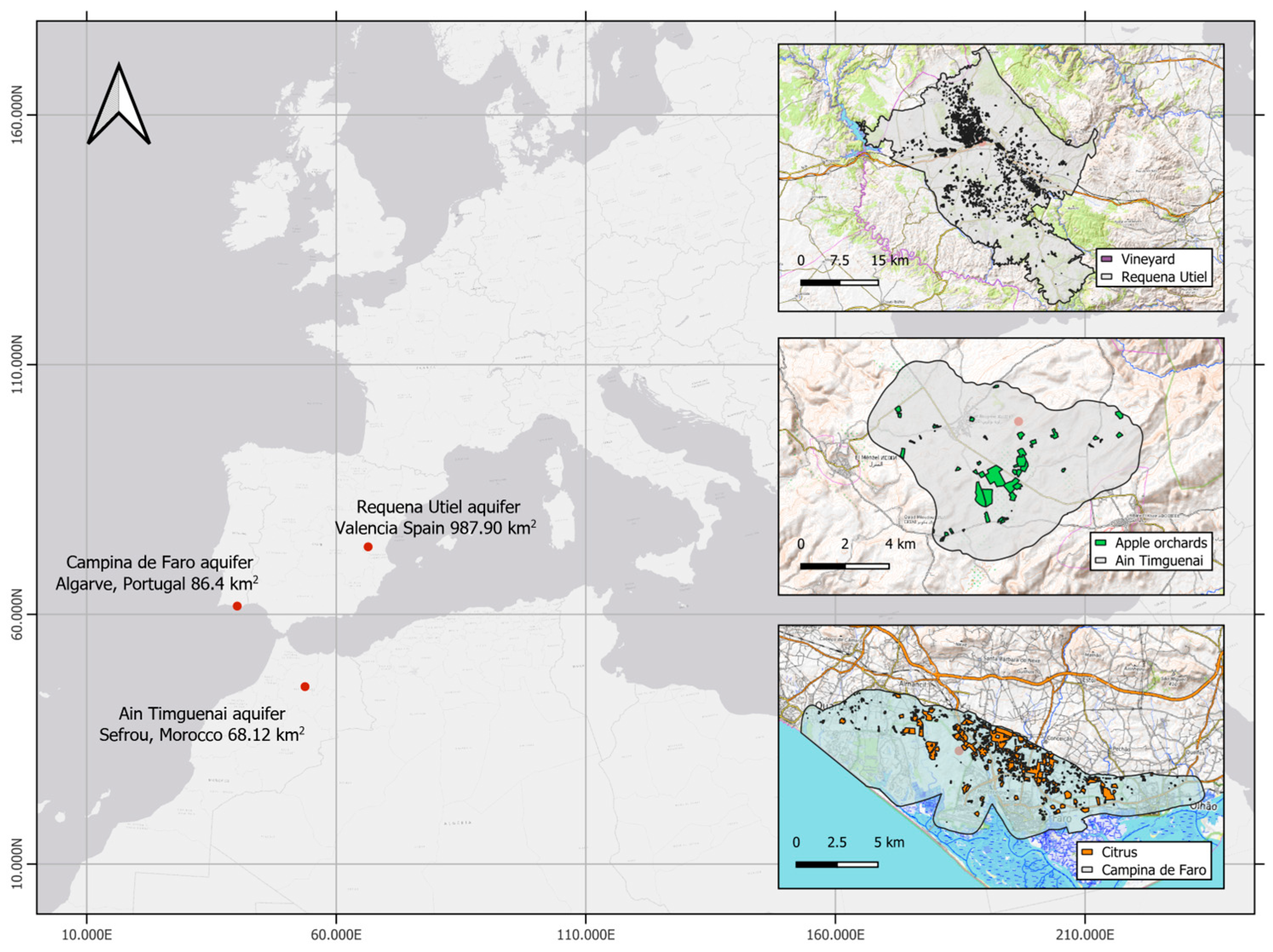
This research was carried out in three groundwater dependent agricultural systems located in distinct regions of the Mediterranean: eastern Spain (Requena-Utiel Aquifer), northeastern Morocco (Ain Timguenay Aquifer), and southern Portugal (Campina do Faro) (Figure 1). These sites encompass diverse agro-hydrogeological conditions and crop types, offering a comparative framework for evaluating irrigation efficiency under varying scenarios of water availability and climatic pressure.
In Spain, the Requena-Utiel Aquifer (RqU), located in the central sector of the Jucar River Basin District (Valencia province), spans approximately 987.9 km2 and is predominantly composed of medium-permeability lithologies, with localized areas of higher hydraulic conductivity. The aquifer supports intensive agricultural activity, with grapevine (Vitis vinifera) as the dominant irrigated crop, covering an estimated 16,000 hectares. Sustained groundwater abstraction for irrigation purposes has led to a progressive decline in the aquifer’s quantitative status, prompting regulatory interventions by regional water authorities [43]. In dry years, such as 2023, annual irrigation allocations are determined based on accumulated precipitation prior to the growing season, resulting in irrigation restrictions that confine water application to periods of peak evapotranspiration, typically from June to August.
To support water management, Spain’s Regional Offices for Water Management operate the Agroclimatic Information System for Irrigation (SIAR), an open-access platform (https://servicio.mapa.gob.es/websiar/, accessed on 9 December 2025) that provides real-time agro-meteorological data, including air temperature, precipitation, reference evapotranspiration (ETo), and soil moisture. These data are processed by local research centers, which generate weekly crop-specific irrigation recommendations. The implementation of this system has been associated with 10–13% reductions in irrigation water use without yield losses, by improving the precision of irrigation timing and dosage [44]. However, the quantification of actual irrigation volumes remains partially constrained by a reliance on a fragmented monitoring system, combining volumetric abstraction licenses, compulsory flow meters on high-capacity pumps, and periodic self-reporting through official digital platforms [45].
In Morocco, the Ain Timguenay Aquifer (AinT) is located within the mountainous region of Sefrou Province in the northeastern part of the country, encompassing an estimated area of 68.12 km2, although the delineation of its hydrogeological boundaries remains under refinement. The aquifer supports predominantly apple orchards (Malus domestica), which have historically been the principal irrigated crop in the area. However, the extent of apple cultivation has declined in recent years, primarily due to reduced winter chill accumulation affecting flowering and fruit set. As of 2022, the cultivated area has decreased to approximately 292 hectares due to climate change. Farmers prefer to substitute apple trees for plum trees because this species is adapted to current environmental conditions. In this case study, the irrigation season for apple orchards typically extends from April to September, coinciding with the peak evaporative demand of the crop.
Unlike more institutionalized systems found in other countries, Morocco lacks a formal irrigation advisory service. Farmers typically rely on low-flow drip irrigation systems and schedule water applications based on manual soil moisture assessment tools and experiential agronomic knowledge. Occasional guidance from local agronomists complements these practices but does not ensure uniformity in irrigation strategies. Moreover, no centralized platform exists to systematically monitor water abstractions or integrate spatial information on crop water stress, limiting the potential for data-driven irrigation management at the regional scale [45].
In Portugal, the Campina de Faro Aquifer System (CdF), located in the Algarve region, spans an area of approximately 86.4 km2. It is hydrologically bounded by low-permeability Cretaceous formations to the north and flanked by the Quelfes and Quarteira aquifer systems to the east and west, respectively. The region receives an average annual precipitation of about 550 mm, yet groundwater abstraction significantly exceeds natural recharge. In the eastern sector, groundwater use is mainly agricultural, while in the western sector it supports both agriculture and golf course irrigation. Citrus orchards (predominantly sweet orange, Citrus sinensis) constitute the dominant irrigated crop, covering approximately 10,185 hectares. Citrus cultivation requires year-round irrigation, with peak water demand in April and October, driven by crop phenology and seasonal climatic conditions [45].
Despite the implementation of volumetric extraction licenses and mandatory flow meters on high-capacity pumps (exceeding 5 CV), the region lacks a structured, crop specific irrigation advisory system. As a result, irrigation scheduling and water application practices largely depend on farmers’ empirical knowledge and sporadic technical support, without the benefit of real-time, telemetry-based decision-making platforms. This gap in systematic, spatially resolved water management limits the capacity for optimizing irrigation efficiency and exacerbates concerns regarding the long-term sustainability of the aquifer.

2.2. Spatial Adequacy Index Method Based on Vegetation Reflectance Data

Irrigation efficiency was quantified using the Spatial Irrigation Adequacy Index (SIAI), which compares the estimated CWR with the ETa derived from satellite remote sensing. The CWR was computed following the dual crop coefficient approach outlined in FAO-56 [46], incorporating the Penman-Monteith equation to estimate reference evapotranspiration (ETo), with the formulation provided in Section 2.3. This integrative approach combines high-resolution satellite imagery, ground-based meteorological observations, soil properties, and land use classifications, enabling spatially explicit assessments of irrigation performance across heterogeneous agricultural landscapes.
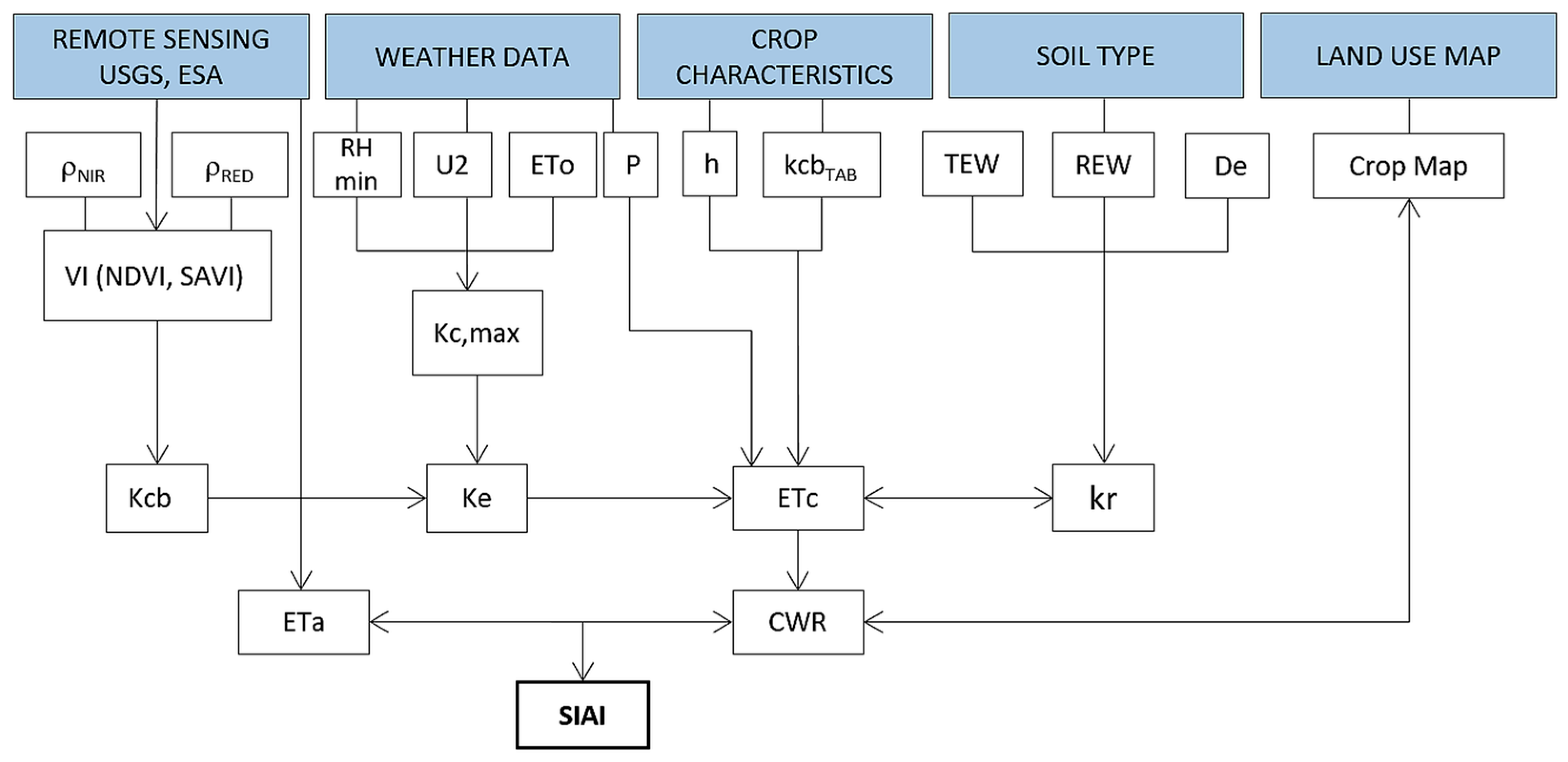
The methodological workflow integrates several interconnected components to estimate the SIAI (Figure 2). Vegetation indices derived from Landsat 8/9 and Sentinel-2 imagery (NDVI, SAVI) were used to estimate the basal crop coefficient (Kcb) using empirically calibrated relationships. These missions were selected to ensure methodological consistency with the algorithms applied in this study: Landsat imagery was used to derive ETa through the SSEBop model, originally developed with Landsat data, while Sentinel-2 provides 10–20 m multispectral bands suitable for generating dynamic Kcb profiles. Their complementary spatial and temporal resolutions (10–30 m; 5–16 days) improve temporal coverage and reduce cloud-related data gaps during the irrigation season. Official Land use datasets and crop-type maps were employed to assign crop parameters and delineate agricultural fields [47], whereas, for the Ain Timguenay and Campina de Faro aquifers, crop maps were specifically generated by the research team through orthophoto interpretation complemented with field interviews, due to the absence of official land-use mapping, custom crop maps generated for each aquifer are provided as Supplementary Figures S1–S3. Meteorological variables (RHmin, U2, ETo) and crop parameters (a constant canopy height appropriate for perennial crops) were used to compute Kc,max, following FAO-56 guidelines.
To represent soil evaporation, soil hydraulic properties (TEW, REW, De) were integrated to derive the evaporation reduction coefficient (Kr) and the soil evaporation coefficient (Ke). The ETa was obtained through the Landsat-based SSEBop model.
Finally, the Spatial Irrigation Adequacy Index (SIAI) was calculated as the relative difference between ETa and CWR using the SIAI equation. This indicator enables the spatial classification of irrigation performance across agricultural plots.

2.3. Remote Sensing–Based Data Acquisition for Estimating CWR

CWR were estimated using the FAO-56 dual kc approach which disaggregates Crop Evapotranspiration (ETc) into three components: the basal crop coefficient (Kcb), the crop stress coefficient (Ks) and the soil evaporation coefficient (Ke), capturing evaporation from the soil surface. These coefficients are multiplied by the reference evapotranspiration (ETo), which quantities the atmospheric evaporative demand:
E T c = k s k c b +   k e ×   E T o
Reference evapotranspiration (ETo) was calculated using the FAO Penman-Monteith equation, assuming a well-watered grass surface. Tabulated Kcb values were initially obtained from FAO-56 for sub-humid climates with moderate wind speeds (e.g., RHmin ≈ 45%, u2 ≈ 2 m·s−1) and subsequently adjusted where local agroclimatic conditions differed significantly [46]. In this study, ETc was calculated assuming standard, non-limiting water availability, thus the water stress coefficient (Ks) was set to throughout the growing season. In this study, ETc was calculated assuming standard, non-limiting water availability. Therefore, the water stress coefficient (Ks) was set to 1 throughout the growing season, following FAO-56 recommendations for well-irrigated or moderately irrigated perennial crops and given the absence of in situ plant stress measurements.
To enhance spatial and temporal resolution in areas with limited meteorological coverage, dynamic Kcb values were estimated using satellite—derived vegetation indices (VI). Specifically, the Normalized Difference Vegetation Index (NDVI) [48] and Soil-Adjusted Vegetation Index (SAVI) [48] were computed from the red and near-infrared (NIR) spectral bands obtained from Sentinel-2 and Landsat 8 imagery. Empirical Kcb–VI relationships specific to each crop (Table 1) were used to derive dynamic Kcb from the corresponding vegetation indices. These relationships, previously developed and validated for vinification grapes, apple orchards, and citrus trees, were applied directly without recalibration in this study. The resulting Kcb values were computed for each available satellite acquisition and used to generate continuous time series at the plot scale. On dates without valid imagery due to cloud cover or acquisition gaps, linear interpolation was applied between consecutive observations to reconstruct daily Kcb profiles.
The soil evaporation coefficient (Ke) is computed as
K e = K r × ( K c , m a x K c b )
Maximum crop coefficient (Kc,max):
K c , m a x = 1.2 + 0.04   × u 2 2 0.004   × R H m i n 45 × ( h / 3 ) 0.3
where K(c,max) represents the maximum Kc value following an irrigation or precipitation event and depend of wind speed (u2, m·s−1), minimum relative humidity (RHmin, %), and crop height (h, m).
Soil evaporation reduction coefficient (Kr):
K r = ( T E W D e ) / ( T E W R E W )
where K r is a dimensionless parameter that requires a daily water-balance computation for the surface soil layer. TEW is the total evaporable water (mm), REW is readily evaporable water (mm), and De is the daily soil depletion.
The parameters used for soil water balance computations for grapes, apples, and citrus are provided in Table 2. The soil parameters used in the estimation of TEW, REW, and surface depletion were obtained from the characterization of soil samples collected at multiple locations within the study areas. Based on the measured textural classes and organic matter content, we derived the hydraulic properties using the pedotransfer functions of Saxton and Rawls (2006) [51], as implemented in the USDA soil database and in the AquaCrop soil water balance module. Additionally, for the Requena–Utiel and Ain Timguenay aquifers, these parameters were validated using soil-moisture probes installed in representative agricultural plots where the samples had been collected.
In Mediterranean climates with extended dry seasons, irrigation is essential to meet CWR due to insufficient rainfall relative to evapotranspiration demand. Despite its limitations, rainfall still contributes to crop water supply and must be considered in irrigation planning. CWR is thus calculated by subtracting effective precipitation (Pe) from crop evapotranspiration (ETc). Pe accounts for the portion of rainfall available in the root zone after losses from evaporation, runoff, or deep percolation. This integrated approach allows for a more accurate estimation of irrigation needs, improving water allocation and scheduling decisions in water-scarce agricultural systems [52].

2.4. Remote Sensing-Based Data Acquisition for Estimating Evapotranspiration

The ETa represents the total volume of water consumed by crops through the combined soil evaporation and plant transpiration. ETa is considered a robust and direct indicator of water use efficiency, especially under varying irrigation conditions [46,47].
In this study, ETa was estimated using the Landsat Provisional Actual Evapotranspiration product, developed by the U.S. Geological Survey (USGS). This dataset is based on the Operational Simplified Surface Energy Balance (SSEBop) model [53], which extends the principles of the original Simplified Surface Energy Balance (SSEB) approach [54,55] by integrating thermal indices and pixel-specific hot/dry and cold/wet anchor points, inherited from SEBAL [14] and METRIC [15]. This operational methodology enables consistent, large-scale estimation of ETa without reliance on in situ measurements.
Although no local eddy covariance towers or instruments such as lysimeters were available for direct calibration of ETa estimate, the use of the SSEBop model—integrated within the Landsat Provisional ETa product—relies on robust physical principles and has undergone extensive validation across diverse agroecological contexts. Previous studies have demonstrated the model’s strong agreement with flux tower measurements in both annual and perennial crops [56,57,58]. Therefore, while site-specific calibration could further reduce uncertainty, the selected approach offers a scientifically reliable and operationally scalable solution, particularly in data-scarce regions such as the Mediterranean aquifer systems evaluated in this study.
To enhance the temporal resolution of ETa estimates, imagery from both Landsat 8 and Landsat 9 was used for the 2023 irrigation season. This season was selected because it corresponded to the most recent year for which complete field observations and satellite datasets were collected within the framework of the eGROUNDWATER project and therefore represented the latest fully documented irrigation period across the three aquifer systems. The synergistic orbital configuration of these two satellites allows for image acquisition approximately every eight days, which is essential for capturing intra-seasonal variability in crop water use within irrigated systems [59]. This increased revisit frequency supports a more detailed temporal reconstruction of evapotranspiration dynamics, enabling robust water use assessments at the plot level.
To ensure data quality, only scenes with less than 20% cloud cover were retained after applying a rigorous quality filtering procedure. Due to the absence of daily observations, linear interpolation was applied between consecutive valid acquisitions to generate continuous daily ETa time series for the entire growing season [60,61]. This approach facilitated the characterization of both spatial and temporal patterns of water use, thereby enhancing the accuracy of irrigation performance assessments at fine spatial resolution [62,63].

2.5. Spatial Adequacy Index Calculation

Irrigation efficiency in the three crops was quantified using the spatial adequacy index for irrigation (SIAI), calculated as follows:
S I A I = C W R E T a C W R × 100
The SIAI expresses the normalized relative difference in ETa and the crop water requirement, expressed as a percentage [53]. Positive SIAI values indicate water deficit (ETa < CWR), whereas negative values suggest over-irrigation (ETa > CWR), whereby water application exceeds crop demand (Table 3).
This classification was derived from a normalization of SIAI values across the three study sites, allowing the definition of unified and comparable categories among aquifers with different climatic, crop, and irrigation conditions. The thresholds therefore reflect the distribution of normalized SIAI values rather than a predefined external standard.
Incorporating SIAI as an irrigation-performance indicator enables the spatial identification of agricultural plots exhibiting suboptimal irrigation efficiency—either due to deficit irrigation or excessive water application. Such spatially explicit assessments support targeted improvements in water-use efficiency, helping water managers identify critical areas, optimize irrigation strategies, and promote sustainable groundwater use in overexploited aquifer systems.

3. Results

3.1. Estimation of CWR from Remote Sensing Data

This study estimated the CWR during the 2023 irrigation season for three woody perennial crops—grapevine (Vitis vinifera), apple (Malus domestica), and citrus (Citrus sinensi)—cultivated in contrasting groundwater-dependent agricultural systems across the Mediterranean basin. Accurate quantification of CWR is critical for designing efficient irrigation schedules and guiding sustainable water resource planning, particularly in water-scarce and climate-vulnerable regions.
For grapevines, the estimated CWR was 160.9 mm over the irrigation period. This relatively low value aligns with the species’ known, as Bobal (grape variety native to the Utiel-Requena region of Spain), drought-tolerant characteristics and physiological adaptations to semi-arid Mediterranean environments. Grapevines possess deep root systems and effective stomatal control, enabling them to maintain productivity under limited water conditions. Local agronomic guidelines indicate that seasonal CWR for grapevines typically range between 120 and 256 mm, depending on the cultivar and whether the production objective prioritizes yield quantity or fruit quality [63].
Apple orchards exhibited a substantially higher estimated CWR of 215.52 mm. This reflects the greater sensitivity of apples to water stress, as well as their higher evapotranspiration rates during the growing season. Apple trees require consistent irrigation to sustain vegetative growth, fruit development, and to prevent physiological disorders related to water deficit. Stem water potential measurements, which are influenced by crop load and precipitation, are commonly used to assess irrigation needs [64]. Studies conducted in comparable agroclimatic zones, such as, have reported seasonal CWR values ranging from 277 mm (wet year) to 465 mm (dry year) [65]. These variations emphasize the importance of integrating seasonal climatic variability into irrigation planning frameworks.
Citrus crops demonstrated the highest CWR among the studied species, with an estimated value of 591.3 mm. This elevated requirement is consistent with the physiological attributes of citrus trees, including shallow root systems and high transpiration rates, especially during periods of elevated evaporative demand. To sustain yields and avoid detrimental water stress, citrus orchards require efficient irrigation strategies such as regulated deficit irrigation and micro-irrigation systems [46,66]. In some Mediterranean regions, citrus orchards may require winter irrigation for frost protection. However, this practice is not commonly implemented in the Campina de Faro region, nor in the other two study sites, and therefore frost-related water applications were not included in the analysis.
The findings reveal a clear gradient in water demand across crops: citrus > apple > grapevine. This hierarchy has direct implications for irrigation scheduling and groundwater resource management in Mediterranean regions, where water scarcity and over-abstraction from aquifers pose major challenges. By enabling crop-specific water demand quantification, CWR estimation contributes to the formulation of targeted irrigation strategies and promotes the rational use of limited water resources.
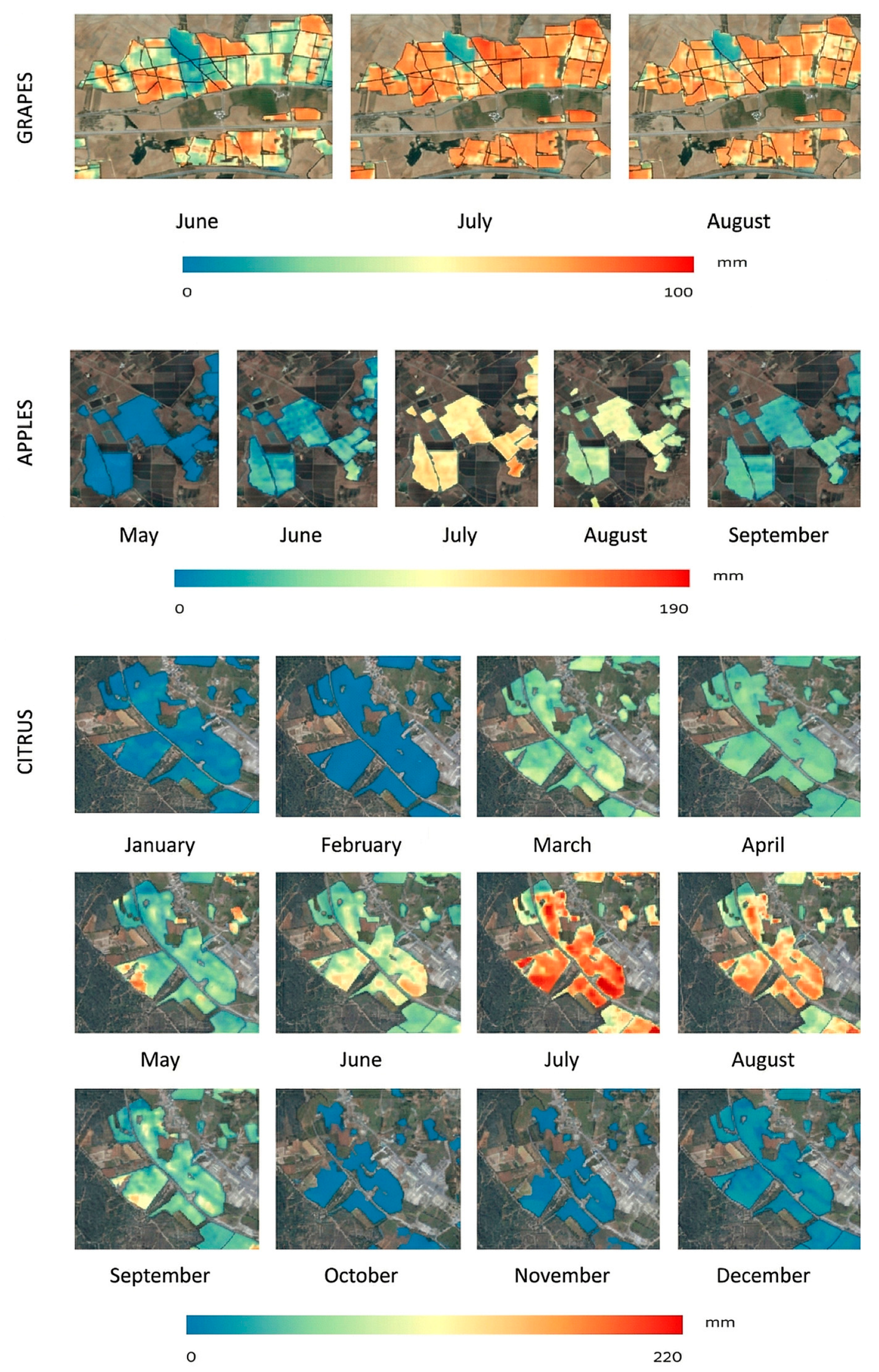
High-resolution CWR estimates were generated by integrating remote sensing and meteorological data, enabling their visualization through interactive digital platforms (Figure 3). These tools combine spatial layers—such as crop type, soil properties, and aquifer conditions—to deliver site-specific irrigation recommendations via mobile or web interfaces.
By identifying spatial and temporal variability in crop water demand, the approach offers decision-support for both farmers and water managers. Their integration with weather forecasts and groundwater data enables dynamic irrigation scheduling, contributing to long-term aquifer sustainability through informed monitoring and policy planning [39].

3.2. Assessment of Irrigation Performance Using the Spatial Adequacy Index

Irrigation performance was evaluated through a spatially explicit comparison between ETa, derived from satellite remote sensing, and CWR, estimated using the FAO-56 dual Kc approach. This methodological integration enabled the identification of spatial patterns of irrigation adequacy across the three perennial crop types analysed—grapevine, apple, and citrus—facilitating a detailed assessment of water use efficiency at the plot scale.
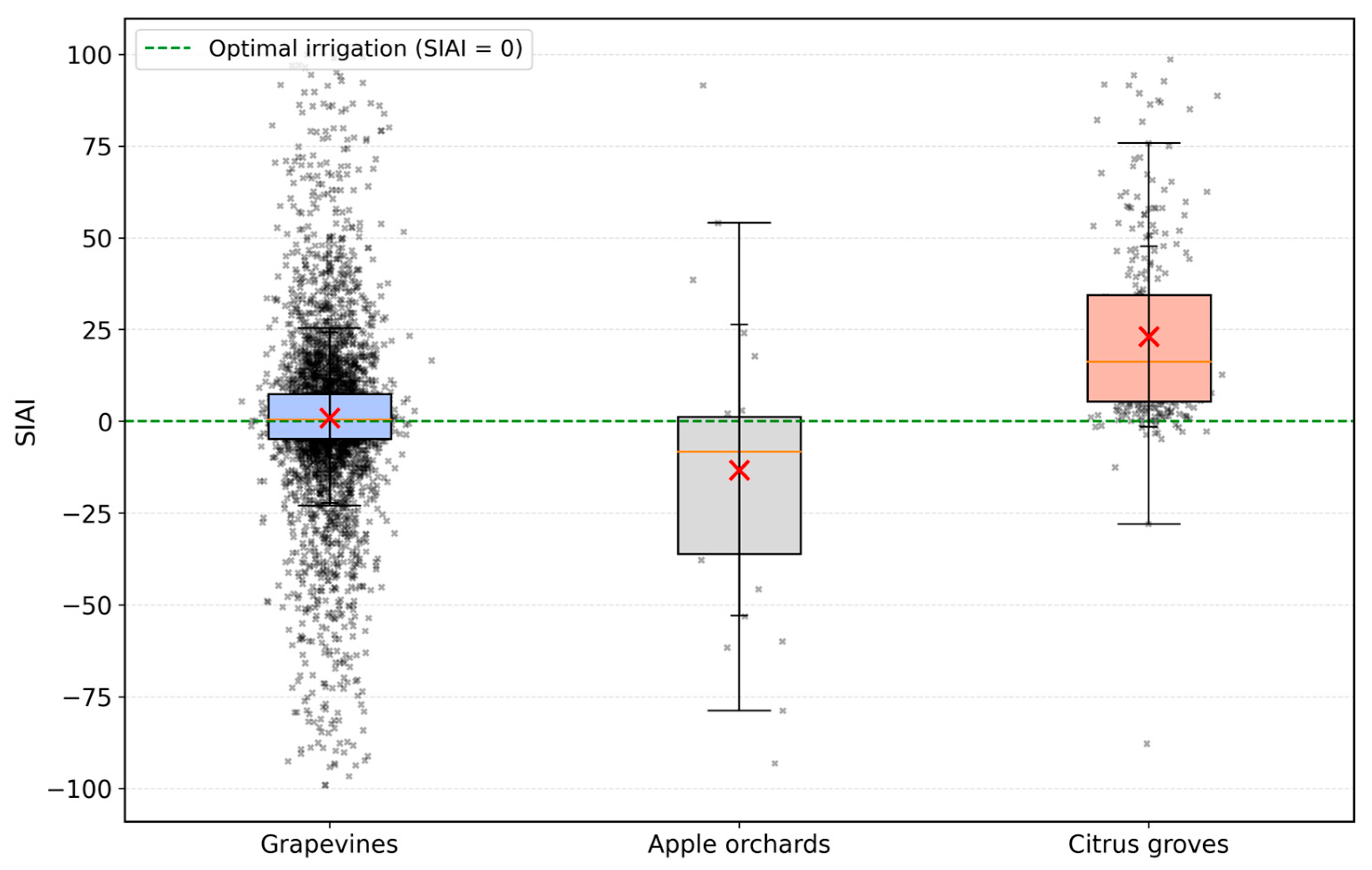
Figure 4 displays the distribution of the average Spatial Irrigation Adequacy Index (SIAI) at the plot scale for grapevines (Vitis vinifera), apple orchards (Malus domestica), and citrus groves (Citrus sinensis). Deviations from this threshold reflect inefficiencies due to under- or over-irrigation. In addition to boxplots, jittered points are included to visualize the full distribution of plot-level SIAI values. The jitter technique offsets individual observations slightly along the x-axis, preventing overlap among thousands of points and thereby revealing the density, variability, and presence of clustered extreme values within each crop.
In grapevine plots, the mean SIAI ( X ¯ = 0.99, σ = 23.5) is close to zero, suggesting that, on average, irrigation is well aligned with CWR (−5% ≤ SIAI ≤ 10%). However, the relatively high standard deviation indicates heterogeneity in irrigation practices across parcels, with a significant number of plots experiencing either suboptimal deficits or excesses.
In apple orchards, a markedly negative mean SIAI ( X ¯ = −13.24, σ = 40.3) indicates a generalized tendency toward over-irrigation. Over 60% of the plots fall below the −20% threshold, placing them within the extreme over-irrigation category. This situation raises concerns regarding inefficient water use, potential nutrient leaching, and negative impacts on groundwater sustainability. The large dispersion of SIAI values suggests inconsistent irrigation scheduling among farmers, with some plots applying substantially more water than needed.
By contrast, citrus groves exhibited a positive mean SIAI ( X ¯ = 23.14, σ = 24.5), indicating widespread under-irrigation relative to ETc. A significant proportion of parcels fall into the moderate (10% < SIAI ≤ 25%) and severe (SIAI > 25%) deficit categories. Despite this general trend, some plots were irrigated optimally or even excessively, underscoring the spatial variability of water management practices within this crop system.
These findings reveal distinct irrigation performance patterns among crops: grapevines demonstrate relatively efficient water use, apples are largely over-irrigated, and citrus groves face persistent deficits. The SIAI serves as a valuable diagnostic tool to detect inefficiencies at the field level and to guide the development of site-specific, crop-appropriate irrigation strategies, ultimately supporting sustainable groundwater management.
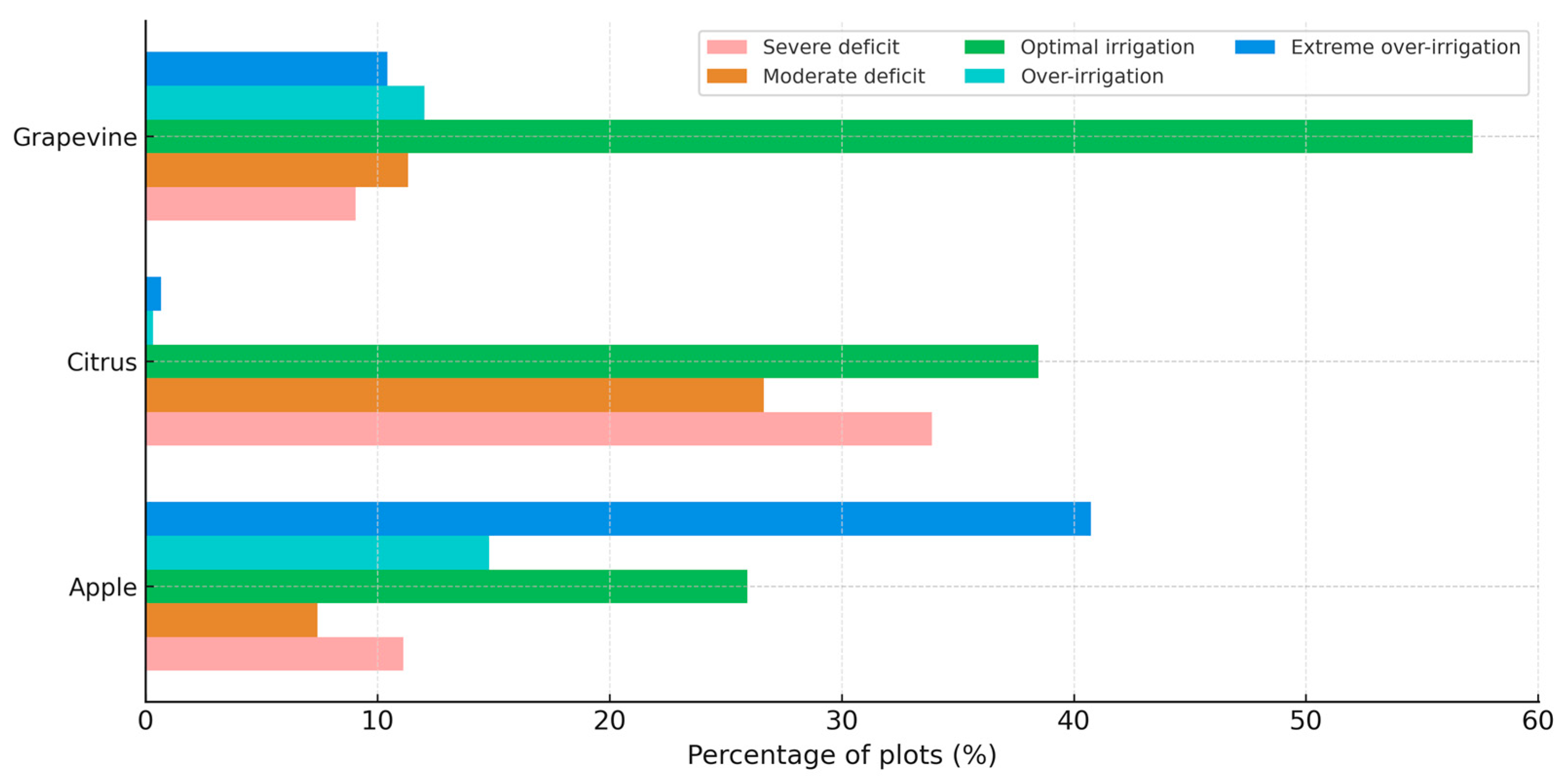
Figure 5 presents the proportional distribution of plots according to SIAI categories. The predominance of extreme over-irrigation in apple orchards confirms the quantitative analysis, while citrus plots show that nearly half of the fields experience severe water deficits. Grapevine plots display a more balanced distribution, though over half of the parcels still fall into the moderate over-irrigation category.

4. Discussion

4.1. Crop-Specific Irrigation Performance and Comparison with Previous Studies

The irrigation performance patterns observed across the three aquifers are consistent with previous findings in Mediterranean irrigated systems. In vineyards (Vitis vinifera), the near-optimal irrigation levels align with studies demonstrating that regulated deficit irrigation strategies can maintain yields while improving water-use efficiency in semi-arid climates [65,66]. In contrast, the over-irrigation detected in apple orchards agrees with research showing that apple trees are highly sensitive to irrigation mismanagement, particularly under drip irrigation in Mediterranean environments [62]. The irrigation deficits identified in citrus plots also mirror findings from Mediterranean orchards, where high evaporative demand can induce pronounced water stress [67]. Overall, these concordances highlight the value of ET-based indicators for diagnosing irrigation adequacy across diverse perennial crop systems.

4.2. Role of Governance and Irrigation Practices in Shaping Irrigation Adequacy

Institutional and governance frameworks differ substantially across the three case studies and likely contribute to the variability in irrigation adequacy. Spain and Portugal rely on volumetric abstraction licenses, flow meters and digital monitoring systems, which help constrain excessive water use. Conversely, Morocco lacks a formal irrigation advisory service, and groundwater governance remains largely informal, potentially explaining the greater heterogeneity detected in irrigation performance at Ain Timguenai [45].
Beyond the scientific findings, the proposed framework also has strong operational potential. The irrigation adequacy indicators could support Digital Farm Management Systems, contribute to corporate ESG water-use reporting, and assist water authorities and irrigation communities in monitoring groundwater pressure and abstraction compliance. The agri-food sector and sustainability certification schemes may likewise benefit from standardized indicators of irrigation performance. These applications highlight the broader utility and transferability of the method.

4.3. Methodological Considerations, Limitations, and Implications

Although the lack of in situ validation data (e.g., eddy covariance fluxes or lysimeter measurements) represents a limitation of the present study, future work will incorporate local ground observations to further validate both ETa and crop water requirements (CWR) estimates. Nevertheless, the two components of the SIAI framework are grounded in well-established and widely validated approaches that have demonstrated strong performance across diverse climates, irrigation systems and cropping conditions, supporting the robustness of the results presented here.
The linear interpolation of ETa between satellite overpasses constitutes another methodological constraint, as it may smooth short-term irrigation pulses or rainfall events. Plot-level delineation accuracy is also critical, as classification errors can propagate into SIAI estimates. Cases in which ETa exceeds CWR may reflect shallow groundwater contributions, microclimatic variability, uncertainties in ETc estimation, or limitations of the SSEBop model. Despite these constraints, the spatially explicit evaluation of irrigation adequacy provides valuable insights for improving irrigation scheduling, enhancing on-farm water-use efficiency and supporting sustainable groundwater management. Future developments should incorporate higher-temporal-resolution ET products, improved crop mapping and socioeconomic data to increase the operational utility of irrigation adequacy indicators.
Finally, although the present study focuses on ET-based irrigation adequacy metrics, the proposed spatial framework offers clear potential for integration with additional indicators. Ongoing work is exploring the comparison of the presented irrigation adequacy index with complementary metrics such as irrigation water-use efficiency, groundwater exploitation indices and environmental or CO2-related indicators. Incorporating these metrics will enable more comprehensive assessments of irrigation performance and its hydrological and environmental impacts in overexploited aquifers.

5. Conclusions

This study provides a spatially explicit assessment of irrigation adequacy across three Mediterranean aquifers using the Spatial Irrigation Adequacy Index (SIAI). The results show that vineyards generally operated near optimal irrigation levels, apple orchards exhibited persistent over-irrigation, and citrus groves experienced recurrent water deficits. These patterns underscore the need for crop-specific irrigation strategies and the importance of considering both climatic and institutional contexts in irrigation management.
The findings confirm the value of SIAI as a diagnostic tool for identifying inefficiencies at the plot scale and supporting targeted measures to improve water-use efficiency while reducing pressure on overexploited aquifers. Beyond its plot-level applicability, the indicator also shows strong potential for operational use by irrigation communities and for integration into regional-scale water-management frameworks, enabling collective decision-making and more equitable allocation of groundwater resources. The contrast between regulated governance frameworks (Spain and Portugal) and informal groundwater abstraction (Morocco) further highlights the critical role of monitoring and advisory structures in achieving sustainable irrigation outcomes.
Future work should incorporate higher-temporal-resolution ET products, improved irrigated-area mapping, and socioeconomic information to enhance the operational applicability of irrigation adequacy indicators and support adaptive, data-driven irrigation scheduling in groundwater-dependent agricultural regions.

Supplementary Materials

The following supporting information can be downloaded at: https://www.mdpi.com/article/10.3390/rs17244019/s1, Figure S1: Crop Map of the Requena–Utiel Aquifer, Figure S2: Crop Map of the Ain Timguenai Aquifer, Figure S3: Crop Map of the Campina de Faro Aquifer.

Author Contributions

Conceptualization, E.L.-P., J.M.-J., M.A.J.-B. and A.G.-P.; resources, E.L.-P., A.R.-M., F.Z.B., A.K. and P.T., methodology, E.L.-P., J.M.-J. and M.A.J.-B.; validation, J.M.-J., A.K. and L.M.N.; investigation, E.L.-P., writing—review and editing, E.L.-P., J.M.-J., M.A.J.-B., C.S.-I., L.M.N. and M.P.-V.; project ad-ministration, M.P.-V.; funding acquisition, M.P.-V. All authors have read and agreed to the published version of the manuscript.

Funding

This research was funded by the eGROUNDWATER Project under the PRIMA programme, supported by the European Union’s Horizon 2020 Research and Innovation Programme (GA No. 1921).

Data Availability Statement

The data presented in this study are available from the author by request (estloppe@upv.es).

Acknowledgments

The authors express their sincere gratitude to the San Antonio Irrigation Community (Spain) for providing the irrigation and management data used in this study, as well as to all stakeholders and field managers who contributed to data collection efforts in Portugal and Morocco. Their collaboration and technical assistance were essential to the successful completion of this research.

Conflicts of Interest

The authors declare no conflicts of interest.

References

  1. Iglesias, A.; Garrote, L. Adaptation strategies for agricultural water management under climate change in Europe. Agric. Water Manag. 2015, 155, 113–124. [Google Scholar] [CrossRef]
  2. Custodio, E. Aquifer overexploitation: What does it mean? Hydrogeol. J. 2002, 10, 254–277. [Google Scholar] [CrossRef]
  3. Foster, S.S.D.; Chilton, P.J. Groundwater: The processes and global significance of aquifer degradation. Philos. Trans. R. Soc. B Biol. Sci. 2003, 358, 1957–1972. [Google Scholar] [CrossRef]
  4. Fischer, G.; Tubiello, F.N.; van Velthuizen, H.; Wiberg, D.A. Climate change impacts on irrigation water requirements: Effects of mitigation, 1990–2080. Clim. Change 2007, 74, 1083–1107. [Google Scholar] [CrossRef]
  5. Food and Agriculture Organization of the United Nations. The Future of Food and Agriculture: Trends and Challenges; FAO: Rome, Italy, 2017. [Google Scholar]
  6. Fereres, E.; Soriano, M.A. Deficit irrigation for reducing agricultural water use. J. Exp. Bot. 2007, 58, 147–159. [Google Scholar] [CrossRef]
  7. Rowshon, M.K.; Iqbal, M.; Mojid, M.A.; Amin, M.S.M.; Lai, S.H. Optimization of equitable irrigation water delivery for a large-scale rice irrigation scheme. Int. J. Agric. Biol. Eng. 2018, 11, 160–166. [Google Scholar] [CrossRef]
  8. Howell, T.A. Enhancing water use efficiency in irrigated agriculture. Agron. J. 2001, 93, 281–289. [Google Scholar] [CrossRef]
  9. Perry, C.J.; Rock, M.; Seckler, D. Water as an Economic Good: A Solution or a Problem? International Irrigation Management Institute: Colombo, Sri Lanka, 1997. [Google Scholar]
  10. Monteiro, M.A.; Bahta, Y.T.; Jordaan, H. A systematic review on drivers of water-use behaviour among agricultural water users. Water 2024, 16, 1899. [Google Scholar] [CrossRef]
  11. Foster, T.; Mieno, T.; Brozović, N. Satellite-based monitoring of irrigation water use: Assessing measurement errors and their implications for agricultural water management policy. Water Resour. Res. 2020, 56, e2020WR028378. [Google Scholar] [CrossRef]
  12. Ghoochani, O.M.; Eskandari Damaneh, H.; Ghanian, M.; Cotton, M. Why do farmers over-extract groundwater resources? Assessing (un)sustainable behaviors using an integrated agent-centered framework. Environments 2023, 10, 216. [Google Scholar] [CrossRef]
  13. Ursitti, A.; Giannoccaro, G.; Prosperi, M.; De Meo, E.; De Gennaro, B.C. The magnitude and cost of groundwater metering and control in agriculture. Water 2018, 10, 344. [Google Scholar] [CrossRef]
  14. Bastiaanssen, W.G.M.; Menenti, M.; Feddes, R.A.; Holtslag, A.A.M. A remote sensing surface energy balance algorithm for land (SEBAL). J. Hydrol. 1998, 212–213, 198–212. [Google Scholar] [CrossRef]
  15. Allen, R.G.; Tasumi, M.; Morse, A.; Trezza, R.; Wright, J.L.; Bastiaanssen, W.; Kramber, W.; Lorite, I.; Robison, C.W. Satellite-based energy balance for mapping evapotranspiration with internalized calibration (METRIC)—Applications. J. Irrig. Drain. Eng. 2007, 133, 395–406. [Google Scholar] [CrossRef]
  16. Ibrahim, G.R.F.; Rasul, A.; Abdullah, H. Assessing how irrigation practices and soil moisture affect crop growth through monitoring Sentinel-1 and Sentinel-2 data. Environ. Monit. Assess. 2023, 195, 1262. [Google Scholar] [CrossRef]
  17. Zhang, Q.; Kong, J.; Wang, L.; Zhong, Y. Estimating evapotranspiration using an improved two-source energy balance model coupled with soil moisture in arid and semi-arid regions. J. Hydrol. 2025, 659, 133283. [Google Scholar] [CrossRef]
  18. Huda, M.W.N.; Mawandha, H.G.; Ag, M.R.; Ngadisih, N. The utilization of Sentinel-1 soil moisture satellite imagery for crop’s water requirement analysis in dryland agriculture. In Proceedings of the International Conference on Sustainable Environment, Agriculture and Tourism (ICOSEAT 2022), Bangka Island, Indonesia, 21–23 July 2022; Volume 26, pp. 484–491. [Google Scholar] [CrossRef]
  19. Cancela, J.J.; González, X.P.; Vilanova, M.; Mirás-Avalos, J.M. Water management using drones and satellites. Water 2019, 11, 874. [Google Scholar] [CrossRef]
  20. Bellvert, J.; Mata, M.; Vallverdú, X.; Paris, C.; Marsal, J. Optimizing precision irrigation of a vineyard to improve water use efficiency and profitability by using a decision-oriented vine water consumption model. Precis. Agric. 2021, 22, 319–341. [Google Scholar] [CrossRef]
  21. Calera, A.; Garrido-Rubio, J.; Belmonte, M.; Arellano, I.; Fraile, L.; Campos, I.; Osann, A. Remote sensing-based water accounting to support governance for groundwater management for irrigation in the La Mancha Oriental aquifer, Spain. WIT Trans. Ecol. Environ. 2017, 220, 119–126. [Google Scholar] [CrossRef]
  22. Garrido-Rubio, J.; Calera, A.; Arellano, I.; Belmonte, M.; Fraile, L.; Ortega, T.; Bravo, R.; González-Piqueras, J. Evaluation of remote sensing-based irrigation water accounting at river basin district management scale. Remote Sens. 2020, 12, 3187. [Google Scholar] [CrossRef]
  23. Ôças, I.; Calera, A.; Campos, I.; Cunha, M. Remote sensing for estimating and mapping single and basal crop coefficientes: A review on spectral vegetation indices approaches. Agric. Water Manag. 2020, 233, 106081. [Google Scholar] [CrossRef]
  24. Paço, T.A.; Pôças, I.; Cunha, M.; Silvestre, J.C.; Santos, F.L.; Paredes, P.; Pereira, L.S. Evapotranspiration and crop coefficients for a super intensive olive orchard: Aapplication of SIMDualKc and METRIC using ground and satellite observations. J. Hydrol. 2014, 519, 2067–2080. [Google Scholar] [CrossRef]
  25. Campos, I.; Neale, C.M.U.; Calera, A.; Balbontín, C.; González-Piqueras, J. Assessing satellite-based basal crop coefficients for irrigated grapes (Vitis vinifera L.). Agric. Water Manag. 2010, 98, 45–54. [Google Scholar] [CrossRef]
  26. Pereira, L.S.; Paredes, P.; Melton, F.; Johnson, L.; Wang, T.; López-Urrea, R.; Cancela, J.J.; Allen, R.G. Prediction of crop coefficients from fraction of ground cover and height. Background and validation using ground and remote sensing data. Agric. Water Manag. 2020, 241, 106197. [Google Scholar] [CrossRef]
  27. Ippolito, M.; De Caro, D.; Ciraolo, G.; Minacapilli, M.; Provenzano, G. Estimating crop coefficients and actual evapotranspiration in citrus orchards with sporadic cover weeds based on ground and remote sensing data. Irrig. Sci. 2023, 41, 5–22. [Google Scholar] [CrossRef]
  28. Ramírez-Cuesta, J.M.; Allen, R.G.; Zarco-Tejada, P.J.; Kilic, A.; Santos, C.; Lorite, I.J. Impact of the spatial resolution on the energy balance components on an open-canopy olive orchard. Int. J. Appl. Earth Obs. Geoinf. 2019, 74, 88–102. [Google Scholar] [CrossRef]
  29. Er-Raki, S.; Chehbouni, A.; Boulet, G.; Williams, D.G. Using the dual approach of FAO-56 for partitioning ET into soil and plant components for olive orchards in a semi-arid region. Agric. Water Manag. 2010, 97, 1769–1778. [Google Scholar] [CrossRef]
  30. Bellvert, J.; Adeline, K.; Baram, S.; Pierce, L.; Sanden, B.L.; Smart, D.R. Monitoring crop evapotranspiration and crop coefficients over an almond and pistachio orchard through remote sensing. Remote Sens. 2018, 10, 2001. [Google Scholar] [CrossRef]
  31. Perelli, C.; Branca, G.; Corbari, C.; Mancini, M. Physical and economic water productivity in agriculture between traditional and water-saving irrigation systems: A case study in Southern Italy. Sustainability 2024, 16, 4971. [Google Scholar] [CrossRef]
  32. Condon, A.G.; Richards, R.A.; Rebetzke, G.J.; Farquhar, G.D. Improving intrinsic water-use efficiency and crop yield. Crop Sci. 2002, 42, 122. [Google Scholar] [CrossRef] [PubMed]
  33. Sinclair, T.R.; Tanner, C.B.; Bennett, J.M. Water-use efficiency crop production. BioScience 1984, 34, 36–40. [Google Scholar] [CrossRef]
  34. Wallace, J.S. Increasing agricultural water use efficiency to meet future food production. Agric. Ecosyst. Environ. 2000, 82, 105–119. [Google Scholar] [CrossRef]
  35. Howell, T.A. Irrigation efficiency. In Encyclopedia of Soil Science, 2nd ed.; Springer: Berlin/Heidelberg, Germany, 2003. [Google Scholar]
  36. Rogers, D.; Lamm, F.; Alam, M.; Trooien, T.; Barnes, G.C.P.; Mankin, K. Efficiencies and Water Losses of Irrigation Systems; Irrigation Management Series; Kansas State University: Manhattan, KS, USA, 1997. [Google Scholar]
  37. Nair, S.; Johnson, J.; Wang, C. Efficiency of irrigation water use: A review from the perspectives of multiple disciplines. Agron. J. 2013, 105, 351–363. [Google Scholar] [CrossRef]
  38. Karimi, P.; Bastiaanssen, W.G.M.; Molden, D.; Cheema, M.J.M. Basin-wide water accounting based on remote sensing data: An application for the Indus Basin. Hydrol. Earth Syst. Sci. 2013, 17, 2473–2486. [Google Scholar] [CrossRef]
  39. Bastiaanssen, W.G.; Molden, D.J.; Makin, I.W. Remote sensing for irrigated agriculture: Examples from research and possible applications. Agric. Water Manag. 2000, 46, 137–155. [Google Scholar] [CrossRef]
  40. Jimenez-Bello, M.A.; Castel, J.R.; Testi, L.; Intrigliolo, D.S. Assessment of a remote sensing energy balance methodology (SEBAL) using different interpolation methods to determine evapotranspiration in a citrus orchard. IEEE J. Sel. Top. Appl. Earth Obs. Remote Sens. 2015, 8, 1465–1477. [Google Scholar] [CrossRef]
  41. Garrido-Rubio, J.; González-Piqueras, J.; Campos, I.; Osann, A.; González-Gómez, L.; Calera, A. Remote sensing–based soil water balance for irrigation water accounting at plot and water user association management scale. Agric. Water Manag. 2020, 238, 106236. [Google Scholar] [CrossRef]
  42. Becker-Reshef, I.; Justice, C.; Sullivan, M.; Vermote, E.; Tucker, C.; Anyamba, A.; Small, J.; Pak, E.; Masuoka, E.; Schmaltz, J.; et al. Monitoring global croplands with coarse resolution Earth observations: The Global Agriculture Monitoring (GLAM) project. Remote Sens. 2010, 2, 1589–1609. [Google Scholar] [CrossRef]
  43. Sanchis-Ibor, C.; López-Pérez, E.; García-Mollá, M.; López-Gunn, E.; Rubio-Martín, A.; Pulido-Velazquez, M.; Segura-Calero, S. Advancing co-governance through framing processes: Insights from action-research in the Requena-Utiel aquifer (Eastern Spain). Int. J. Commons 2023, 17, 347–362. [Google Scholar] [CrossRef]
  44. Mirás-Avalos, J.M.; Rubio-Asensio, J.S.; Ramírez-Cuesta, J.M.; Maestre-Valero, J.F.; Intrigliolo, D. Irrigation-Advisor—A decision support system for irrigation of vegetable crops. Water 2018, 15, 2245. [Google Scholar] [CrossRef]
  45. Sanchis-Ibor, C.; Bouzidi, Z.; Varanda, M.P.; López-Pérez, E.; Rinaudo, J.D.; Nieto-Romero, M.; García-Mollá, M.; Faysse, N.; Rubio-Martín, A.; Kchikech, Z.; et al. Can enhanced information systems and citizen science improve groundwater governance? Lessons from Morocco, Portugal and Spain. Water 2024, 16, 2800. [Google Scholar] [CrossRef]
  46. Allen, R.G.; Pereira, L.S.; Raes, D.; Smith, M. Crop Evapotranspiration: Guidelines for Computing Crop Water Requirements; FAO Irrigation and Drainage Paper 56; FAO: Rome, Italy, 1998. [Google Scholar]
  47. López-Pérez, E.; Sanchis-Ibor, C.; Jiménez-Bello, M.Á.; Pulido-Velazquez, M. Mapping of irrigated vineyard areas through the use of machine learning techniques and remote sensing. Agric. Water Manag. 2024, 302, 108988. [Google Scholar] [CrossRef]
  48. Rouse, J.W.; Haas, R.W.; Schell, J.A.; Deering, D.W.; Harlan, J.C. Monitoring the Vernal Advancement and Retrogradation of Natural Vegetation; NASA/GSFC: Greenbelt, MD, USA, 1974; pp. 1–8.
  49. Qi, J.; Chehbouni, A.; Huete, A.R.; Kerr, Y.H.; Sorooshian, S. A modified soil adjusted vegetation index. Remote Sens. Environ. 1994, 48, 119–126. [Google Scholar] [CrossRef]
  50. Odi-Lara, M.; Campos, I.; Neale, C.M.U.; Ortega-Farías, S.; Poblete-Echeverría, C.; Balbontín, C.; Calera, A. Estimating evapotranspiration of an apple orchard using a remote sensing-based soil water balance. Remote Sens. 2016, 8, 253. [Google Scholar] [CrossRef]
  51. Sawant, S.A.; Chakraborty, M.; Suradhaniwar, S.; Adinarayana, J.; Durbha, S.S. Time series analysis of remote sensing observations for citrus crop growth stage and evapotranspiration estimation. Int. Arch. Photogramm. Remote Sens. Spat. Inf. Sci.-ISPRS Arch. 2016, 41, 1037–1042. [Google Scholar] [CrossRef]
  52. Brouwer, C.; Heibloem, M. Irrigation Water Needs: Irrigation Water Management; Training Manual No. 3; FAO: Rome, Italy, 1986. [Google Scholar]
  53. Senay, G.B. Satellite psychrometric formulation of the operational simplified surface energy balance (SSEBop) model for. Appl. Eng. Agric. 2018, 34, 555–566. [Google Scholar] [CrossRef]
  54. Senay, G.B.; Budde, M.E.; Verdin, J.P. Enhancing the Simplified Surface Energy Balance (SSEB) approach for estimating landscape ET: Validation with the METRIC model. Agric. Water Manag. 2011, 98, 606–618. [Google Scholar] [CrossRef]
  55. Senay, G.B.; Budde, M.; Verdin, J.P.; Melesse, A.M. A coupled remote sensing and simplified surface energy balance approach to estimate actual evapotranspiration from irrigated fields. Sensors 2007, 7, 979–1000. [Google Scholar] [CrossRef]
  56. Senay, G.B.; Friedrichs, M.; Morton, C.; Parrish, G.E.L.; Schauer, M.; Khand, K.; Kagone, S.; Boiko, O.; Huntington, J. Mapping actual evapotranspiration using Landsat for the conterminous United States: Google Earth Engine implementation and assessment of the SSEBop model. Remote Sens. Environ. 2022, 275, 113011. [Google Scholar] [CrossRef]
  57. Knipper, K.; Anderson, M.; Bambach, N.; Melton, F.; Ellis, Z.; Yang, Y.; Volk, J.; McElrone, A.J.; Kustas, W.; Roby, M.; et al. A comparative analysis of OpenET for evaluating evapotranspiration in California almond orchards. Agric. For. Meteorol. 2024, 355, 110146. [Google Scholar] [CrossRef]
  58. El Hazdour, I.; Le Page, M.; Hanich, L.; Chakir, A.; Lopez, O.; Jarlan, L. A GEE TSEB workflow for daily high-resolution fully remote sensing evapotranspiration: Validation over four crops in semi-arid conditions and comparison with the SSEBop experimental product. Environ. Model. Softw. 2025, 187, 106365. [Google Scholar] [CrossRef]
  59. Pocock, M.J.O.; Chapman, D.S.; Sheppard, L.J.; Roy, H.E. Choosing and Using Citizen Science; Centre for Ecology & Hydrology: Lancaster, UK, 2014. [Google Scholar]
  60. Er-raki, S.; Chehbouni, A.; Guemouria, N.; Duchemin, B.; Ezzahar, J.; Hadria, R. Combining FAO-56 model and ground-based remote sensing to estimate water consumptions of wheat crops in a semi-arid region. Agric. Water Manag. 2007, 87, 41–54. [Google Scholar] [CrossRef]
  61. Senay, G.B.; Bohms, S.; Singh, R.K.; Gowda, P.H.; Velpuri, N.M.; Alemu, H.; Verdin, J.P. Operational evapotranspiration mapping using remote sensing and weather datasets: A new parameterization for the SSEB approach. J. Am. Water Resour. Assoc. 2013, 49, 577–591. [Google Scholar] [CrossRef]
  62. Anderson, M.C.; Allen, R.G.; Morse, A.; Kustas, W.P. Use of Landsat thermal imagery in monitoring evapotranspiration and managing water resources. Remote Sens. Environ. 2012, 122, 50–65. [Google Scholar] [CrossRef]
  63. Buesa, I.; Sanz, F.; Pérez, D.; Yeves, A.; Martínez, A.; Chirivella, C.; Luis, B.; Diego, I. Manejo del Agua y la Vegetación en el Viñedo Mediterráneo; Informe Técnico; Conselleria de Sanitat: Valencia, Spain, 2017. [Google Scholar]
  64. Girona, J.; del Campo, J.; Mata, M.; Lopez, G.; Marsal, J. A comparative study of apple and pear tree water consumption measured with two weighing lysimeters. Irrig. Sci. 2011, 29, 55–63. [Google Scholar] [CrossRef]
  65. Ucar, Y.; Kocięcka, J.; Liberacki, D.; Rolbiecki, R. Analysis of crop water requirements for apple using dependable rainfall. Atmosphere 2023, 14, 99. [Google Scholar] [CrossRef]
  66. Food and Agriculture Organization of the United Nations. Evapotranspiración del Cultivo en Condiciones Estándar: Introducción a la Evapotranspiración del Cultivo (ETc); Food and Agriculture Organization of the United Nations: Rome, Italy, 2018; Available online: http://www.fao.org/3/x0490s/x0490s00.htm (accessed on 3 March 2024).
  67. Gonzalez-Dugo, V.; Zarco-Tejada, P.; Nicolás, E.; Nortes, P.A.; Alarcón, J.J.; Intrigliolo, D.S.; Fereres, E.J.P.A. Using high resolution UAV thermal imagery to assess the variability in the water status of five fruit tree species within a commercial orchard. Acta Hortic. 2013, 14, 660–678. [Google Scholar] [CrossRef]
Figure 1. Location of the three Mediterranean aquifer systems—Requena Utiel (Spain), Ain Timguenai (Morocco), Campina de Faro (Portugal), and their associated dominant irrigated crops (vineyard, apple orchards and citrus, respectively).
Remotesensing 17 04019 g001
Figure 2. Methodological framework for estimating the Spatial Irrigation Adequacy Index (SIAI) in Mediterranean aquifer dependent agricultural systems.
Remotesensing 17 04019 g002
Figure 3. CWR by plot for grapes, apples, and citrus in Mediterranean ground systems for the 2023 irrigation period in a selected group of fields.
Remotesensing 17 04019 g003
Figure 4. Distribution of the Spatial Irrigation Adequacy Index (SIAI) for grapevines, apple orchards, and citrus groves in 2023. SIAI < 0 indicates over-irrigation, SIAI = 0 optimal irrigation, and SIAI > 0 water deficit. Red symbols show mean values, while jittered black points represent individual plots. The dashed green line marks the optimal irrigation threshold.
Remotesensing 17 04019 g004
Figure 5. Proportional distribution of plots by spatial irrigation adequacy index category.
Remotesensing 17 04019 g005
Table 1. Empirical Kcb–VI relationships used for the different crops in this study.
CropEmpirical RelationReference
Vinification grapes
(Vitis vitifera)
k c b = 1.79   ×   S A V I 0.08 [25]
Apples orchards
(Malus domestica)
k c b = 1.82   ± 0.19   ×   S A V I 0.07 ± 0.06 [49]
Citrus trees
(Citrus sinensis)
k c b = 1.187   ×   N D V I + 0.05 [50]
Table 2. Value and units for the parameters used in the soil water balance based on the FAO56 methodology.
ParameterFAO-56
Symbol
Value and Unit
(Grapes)
Value and Unit
(Apples)
Value and Unit
(Citrus)
Soil water content at field capacity (m3 m−3)θFC0.44 0.320.35
Soil water content at wilting point (m3 m−3)ΘWP0.230.200.23
Soil water balance parameters at soil surface
Depth of soil surface evaporation layer (m)Ze0.10 0.10 0.10
Total evaporable layer (mm)TEW32.5 22 23.5
Readily evaporable water (mm)REW10 8 8
Fraction of soil surface wetted by irrigationfw0.30.30.70
Fraction of soil surface wetted and sun exposedfew0.170.120.50
Soil water balance parameters at root zone
Soil depletion fraction without stressp0.650.50.5
Maximum effective root deep (m)Zr max 1.50.81
Effective root depth during initial growth stage (m)Zr min 1.50.81
Table 3. Irrigation performance assessment through spatial irrigation water uses categories.
SIAI RangeClassification
SIAI < −20Extreme over-irrigation
−20 ≤ SIAI < −5Over-irrigation
−5 ≤ SIAI ≤ 10Optimal irrigation
10 ≤ SIAI ≤ 25Moderate deficit
SIAI > 25Severe deficit
Disclaimer/Publisher’s Note: The statements, opinions and data contained in all publications are solely those of the individual author(s) and contributor(s) and not of MDPI and/or the editor(s). MDPI and/or the editor(s) disclaim responsibility for any injury to people or property resulting from any ideas, methods, instructions or products referred to in the content.