Performance of Global Land Use Land Cover Products for Southwest China Karst
 , ,
, ,  , and
, and
Highlights
- The ESA WorldCover 2021 product outperformed ESRI Land Cover and Dynamic World (annual mode composite) in mapping accuracy for the karst region of Southwest China, better preserving fragmented features (e.g., roads and small fields) than its competitors;
- All three products showed major limitations in separating spectrally similar vegetation (shrub, grass, and crops) and were strongly affected by topographic shadows and haze. Accuracy dropped sharply at patch boundaries (where over half of errors occurred).
- ESA WorldCover 2021 offers the best balance of spatial detail and accuracy among 10 m global products. Regional validation remains essential because global products can underperform in complex terrain;
- The poor distinction between shrub, crops, and grass classes constrains these datasets’ value for monitoring vegetation recovery. Future improvements in karst areas should integrate multi-source (optical + synthetic aperture radar) and multi-temporal data with topographic correction.
Abstract
1. Introduction
2. Literature Review
2.1. Evolution of Global LULC Products
2.2. Challenges in Heterogeneous Landscape
2.3. Karst Landscapes as a Critical Test Case
2.4. The Need for Regional Validation
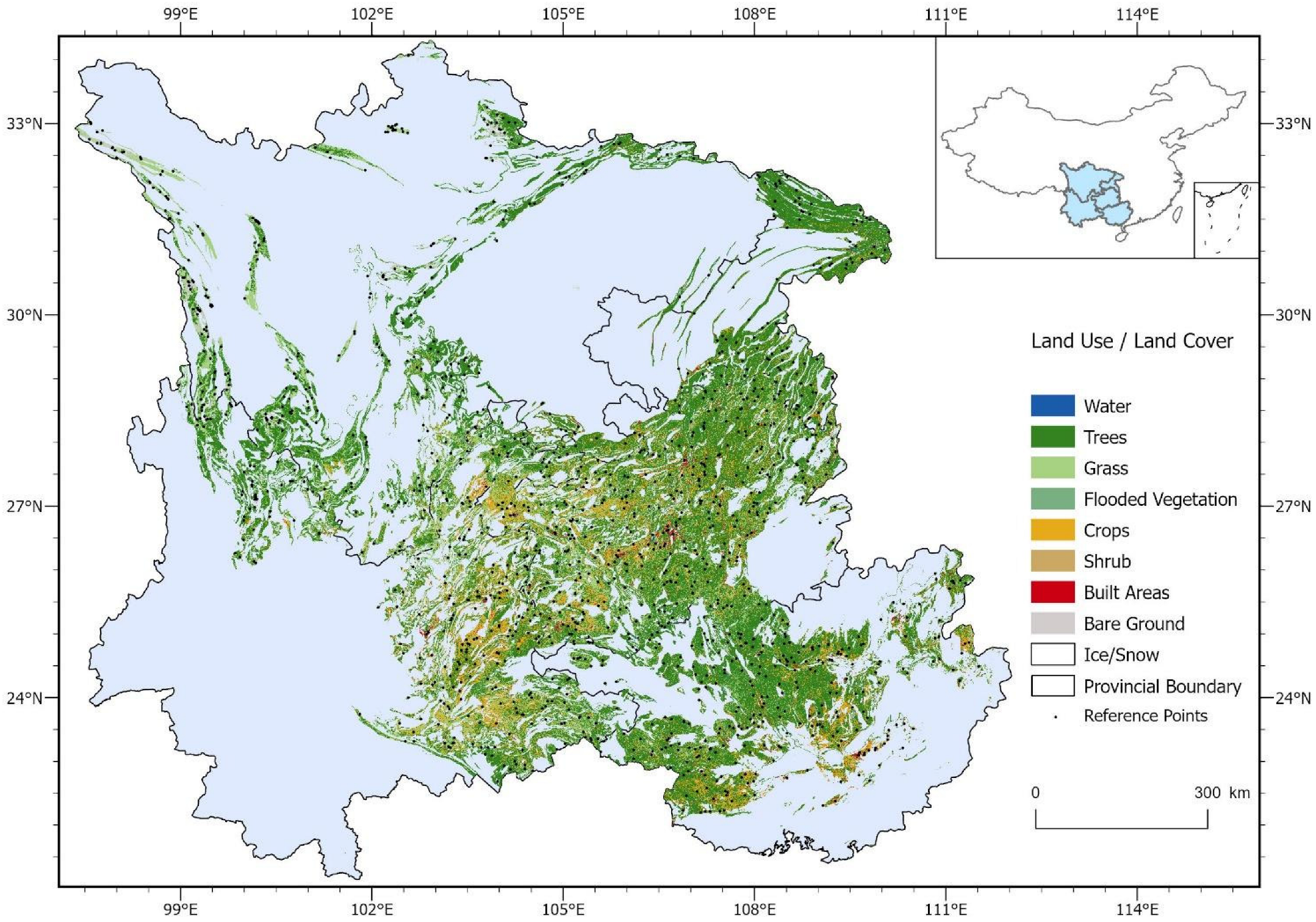
3. Study Area
4. Methodology
4.1. Data Acquisition and Preprocessing
4.2. Harmonization of LULC Classification Systems
4.3. Spatial Correspondence Assessment
4.4. Accuracy Assessment
4.5. Terrain and Landscape Heterogeneity Analyses
5. Results
5.1. Spatial Consistency Among Global Products
5.1.1. Area Distribution by LULC Type
5.1.2. Pixel-Level Agreement Patterns
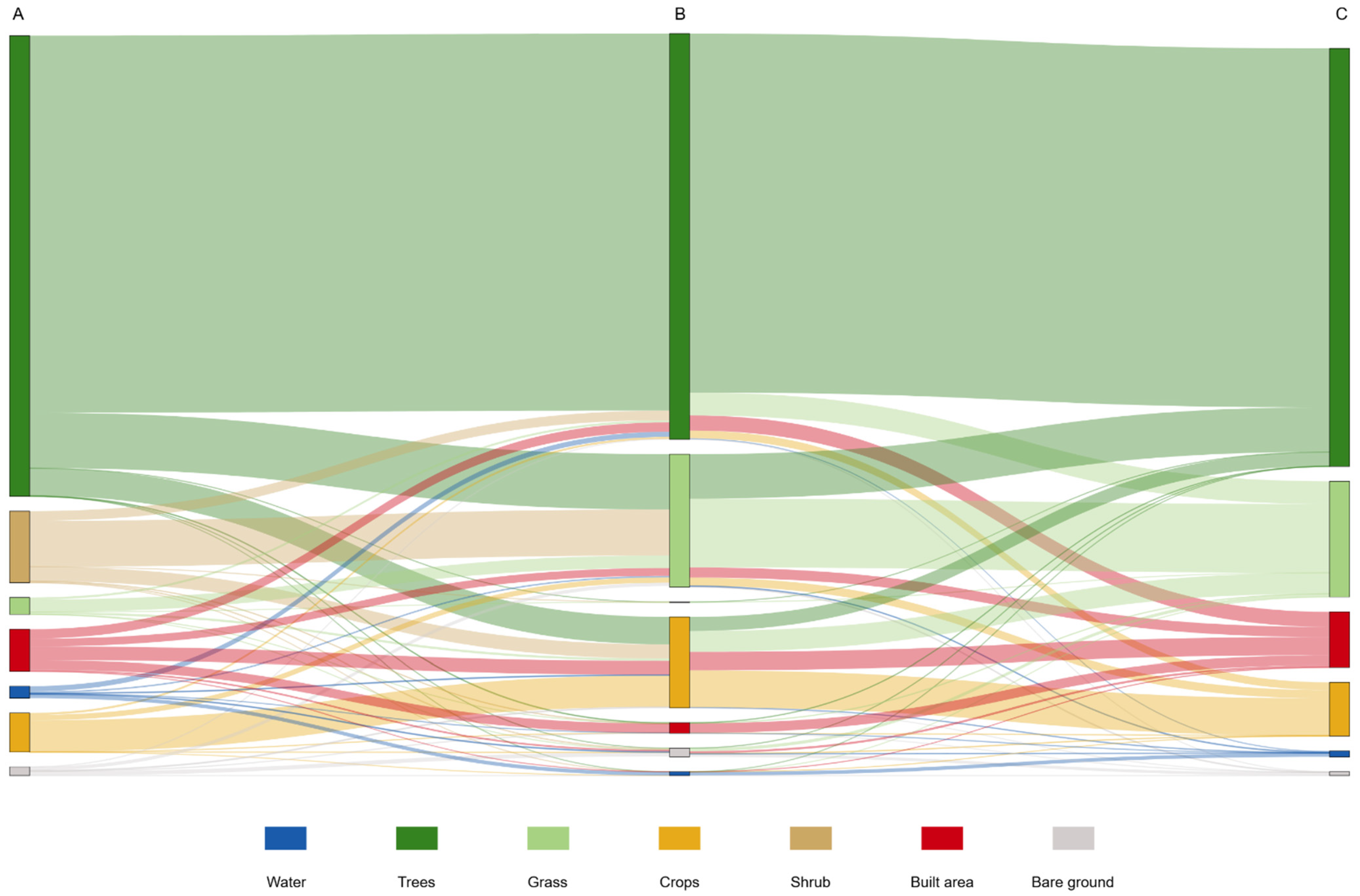
5.1.3. Cross-Product Classification Transitions
5.2. Comparative Accuracy Assessment
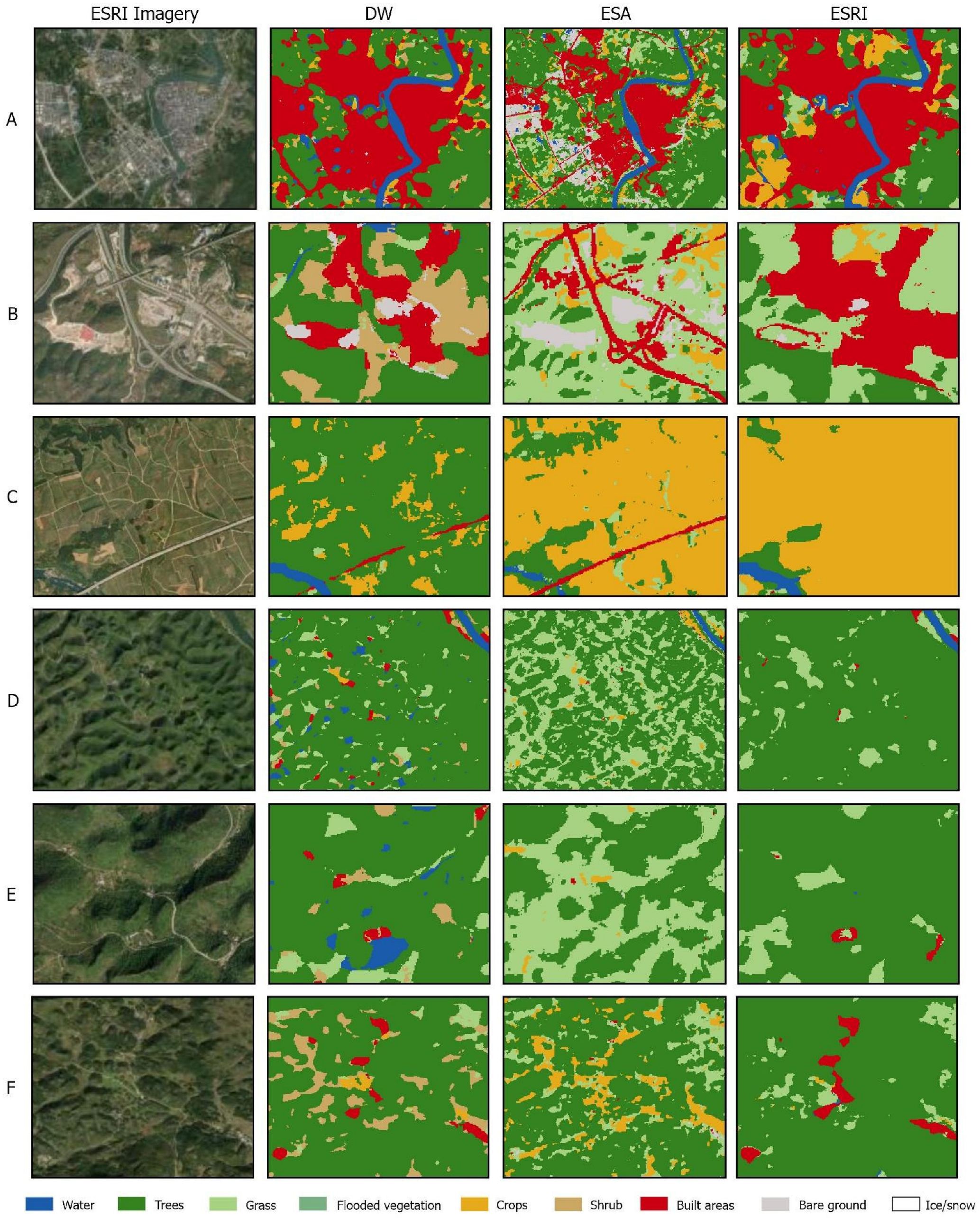
5.3. Spatial Detail and Feature Preservation
5.3.1. Built Areas Classification
5.3.2. Agricultural Land Classification
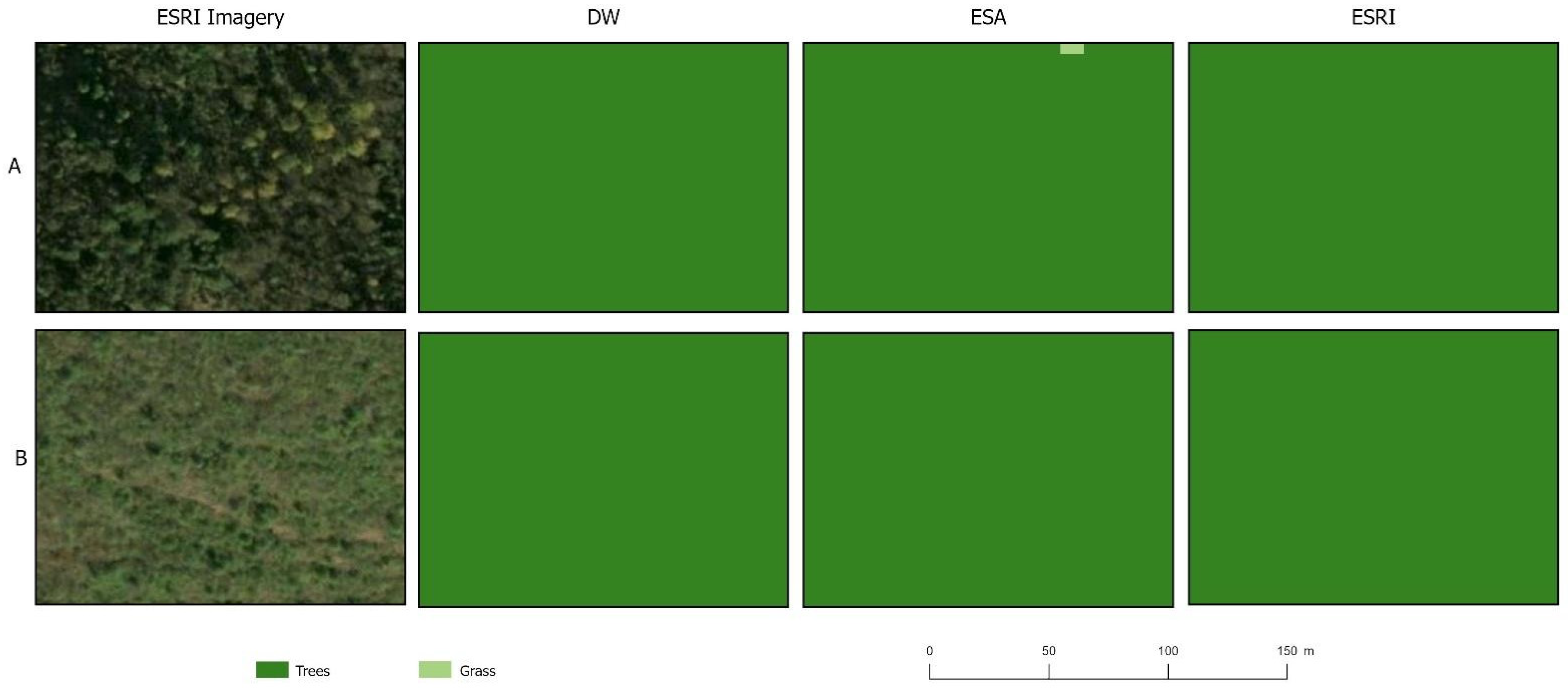
5.3.3. Peak-Cluster Depression Landscapes
6. Discussions
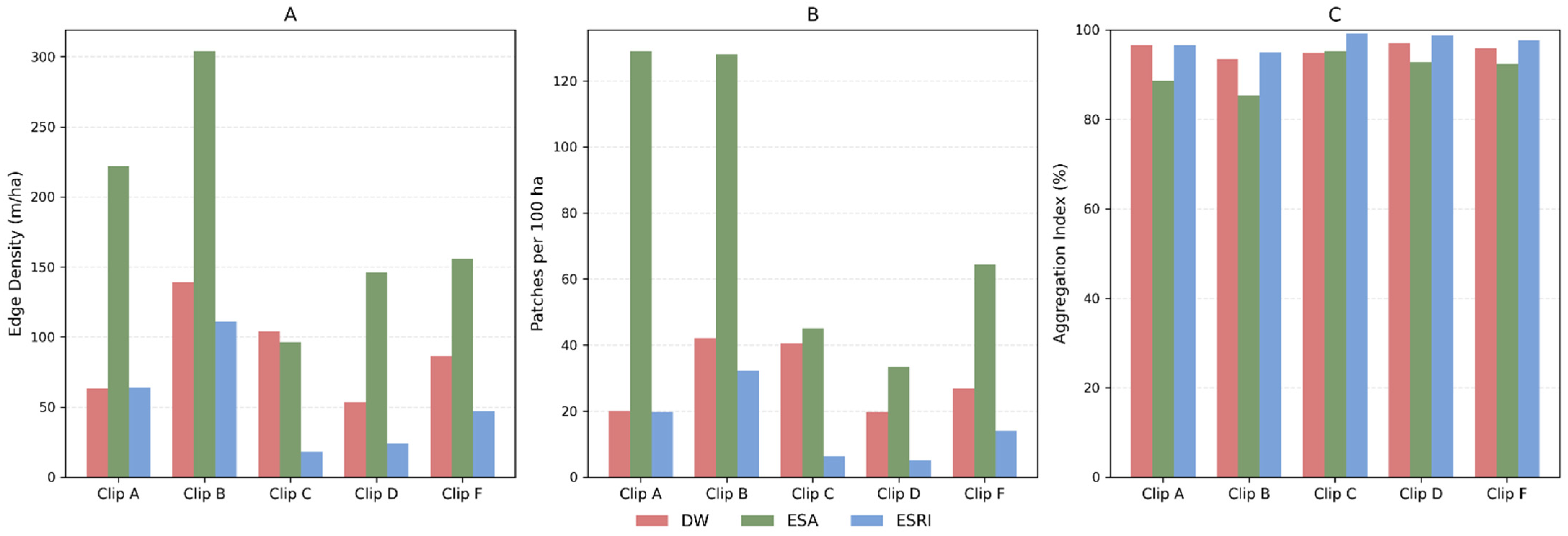
6.1. Edge Effects, Landscape Heterogeneity, and Classification Accuracy
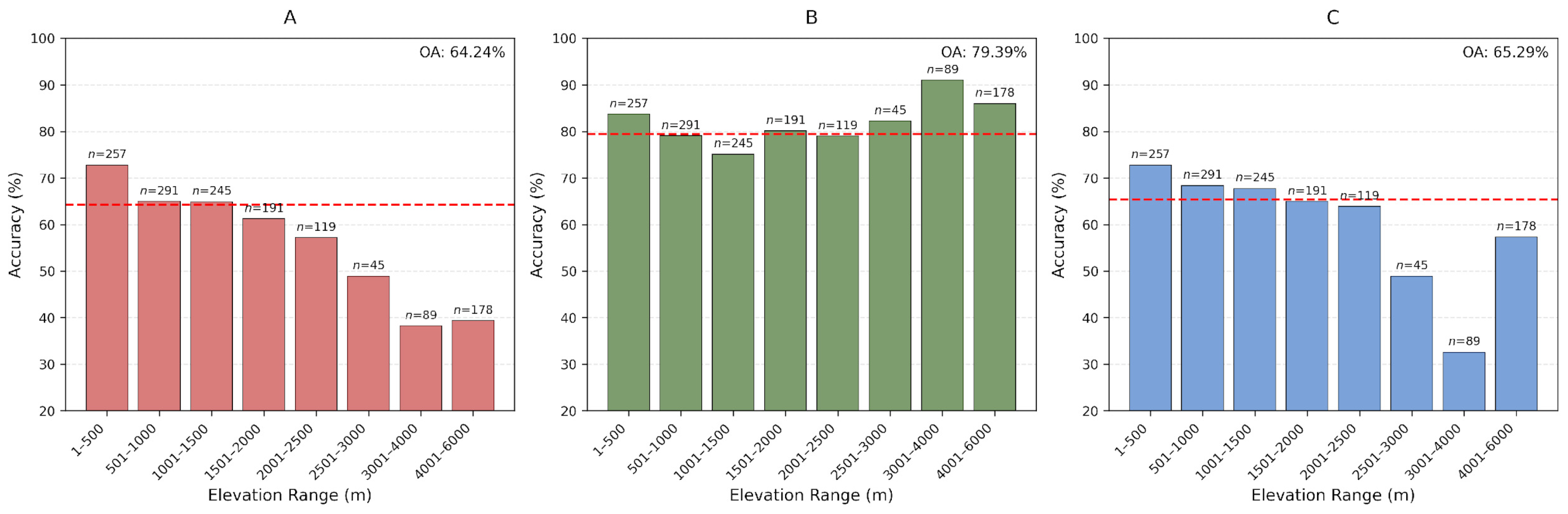
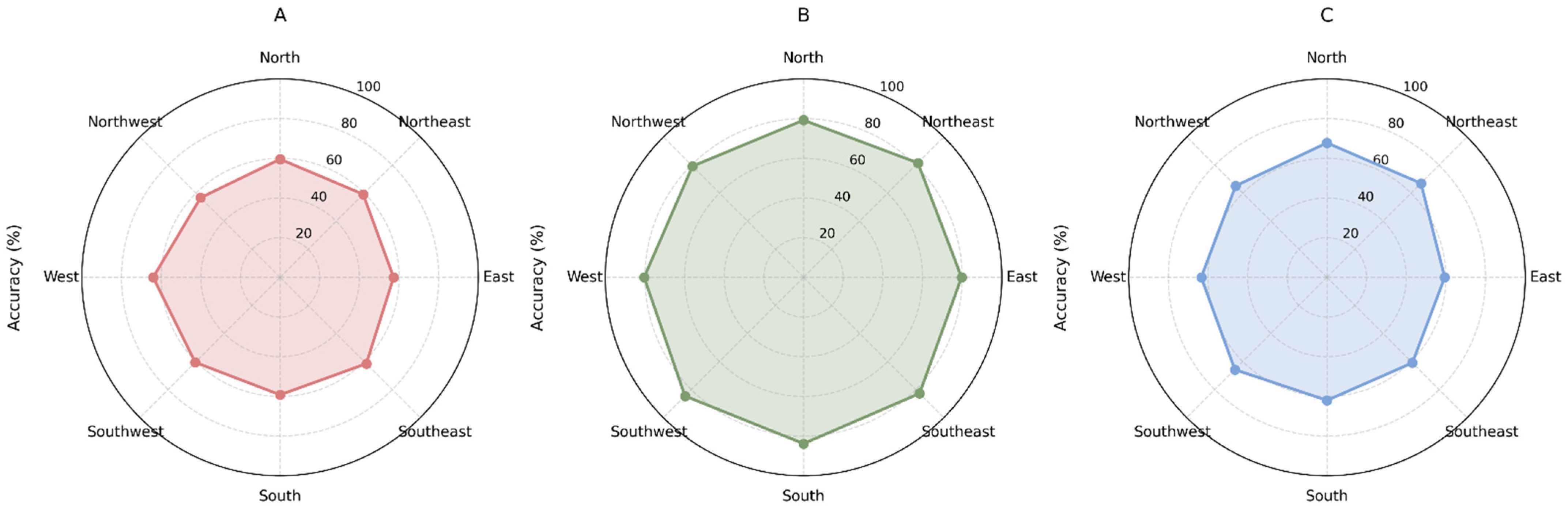
6.2. Elevation, Slope and Classification Accuracy
6.3. Challenges in Discriminating Spectrally Similar Vegetation Classes
6.4. Technical Factors Affecting Classification Performance
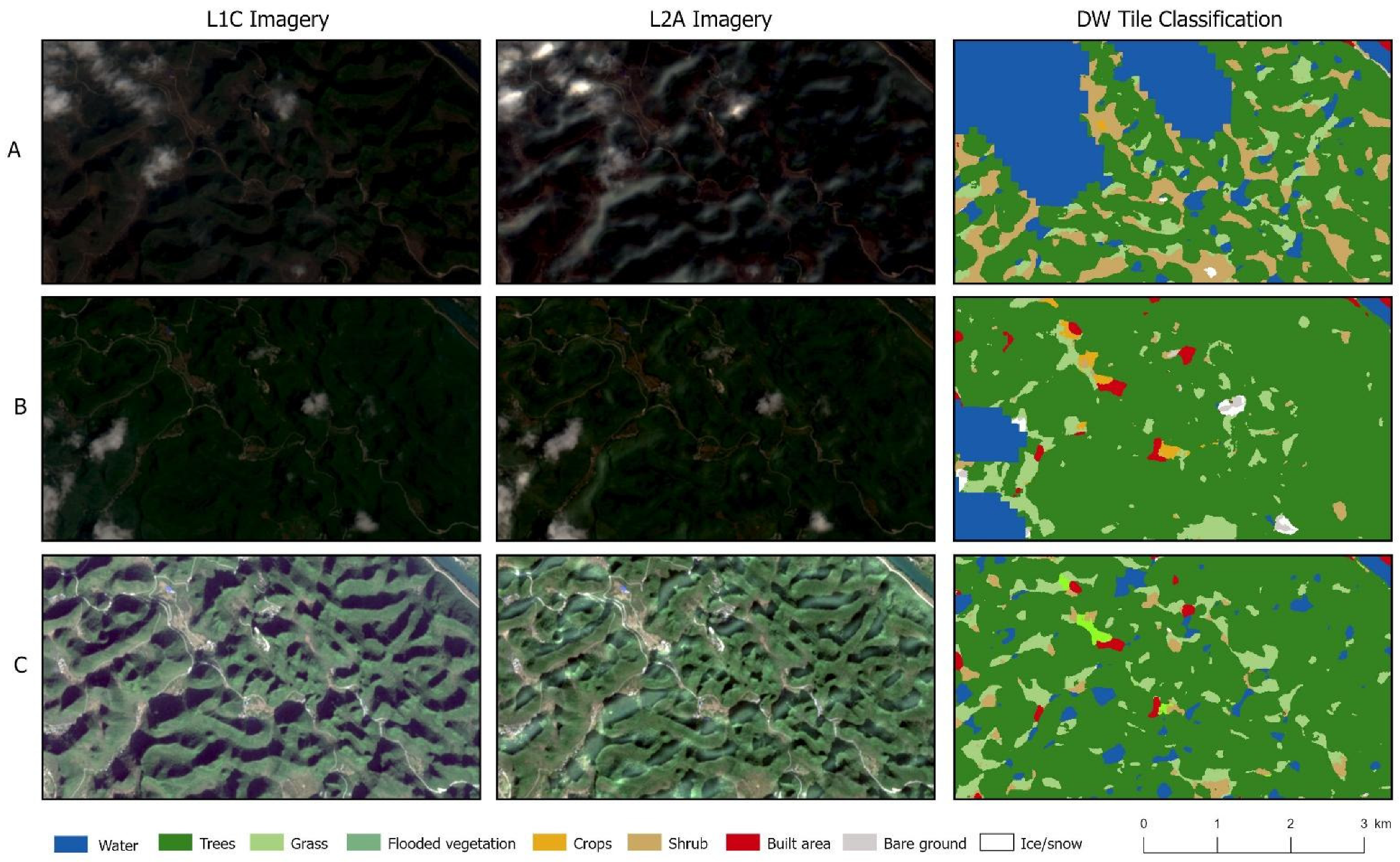
6.4.1. Atmospheric Correction and Topographic Shadow Effects
6.4.2. Classification Algorithms and Methodological Differences
6.4.3. Classification Scheme Inconsistencies
6.4.4. Reference Data Uncertainty and Temporal Misalignment
6.5. Limitations and Future Improvements
6.5.1. Limitations
6.5.2. Pathways for Improvement
6.5.3. Recommendations for Regional Applications
7. Conclusions
Author Contributions
Funding
Data Availability Statement
Acknowledgments
Conflicts of Interest
References
- Brown, C.F.; Brumby, S.P.; Guzder-Williams, B.; Birch, T.; Hyde, S.B.; Mazzariello, J.; Tait, A.M. Dynamic World, Near Real-Time Global 10 m Land Use Land Cover Mapping. Sci. Data 2022, 9, 251. [Google Scholar] [CrossRef]
- Karra, K.; Kontgis, C.; Statman-Weil, Z.; Mazzariello, J.C.; Mathis, M.; Brumby, S.P. Global Land Use/Land Cover with Sentinel-2 and Deep Learning. In Proceedings of the 2021 IEEE International Geoscience and Remote Sensing Symposium (IGARSS), Brussels, Belgium, 11–16 July 2021; pp. 4704–4707. [Google Scholar]
- Zanaga, D.; Van De Kerchove, R.; Daems, D.; De Keersmaecker, W.; Brockmann, C.; Kirches, G.; Arino, O. ESA WorldCover 10 m 2021 v200. 2022. Available online: https://esa-worldcover.org (accessed on 10 December 2025).
- Zhang, C.; Qi, X.; Wang, K.; Zhang, M.; Yue, Y. The Application of Geospatial Techniques in Monitoring Karst Vegetation Recovery in Southwest China: A Review. Prog. Phys. Geogr. 2017, 41, 450–477. [Google Scholar] [CrossRef]
- Chaaban, F.; El Khattabi, J.; Darwishe, H. Accuracy Assessment of ESA WorldCover 2020 and ESRI 2020 Land Cover Maps for a Region in Syria. J. Geovis. Spat. Anal. 2022, 6, 31. [Google Scholar] [CrossRef]
- Kang, J.; Yang, X.; Wang, Z.; Cheng, H.; Wang, J.; Tang, H.; Bai, Z. Comparison of Three Ten-Meter Land Cover Products in a Drought Region: A Case Study in Northwestern China. Land 2022, 11, 427. [Google Scholar] [CrossRef]
- Hao, X.; Qiu, Y.; Jia, G.; Menenti, M.; Ma, J.; Jiang, Z. Evaluation of Global Land Use–Land Cover Data Products in Guangxi, China. Remote Sens. 2023, 15, 1291. [Google Scholar] [CrossRef]
- Lillesand, T.; Kiefer, R.W.; Chipman, J. Remote Sensing and Image Interpretation, 7th ed.; John Wiley & Sons: New York, NY, USA, 2015. [Google Scholar]
- Tuanmu, M.N.; Jetz, W. A Global 1-km Consensus Land-Cover Product for Biodiversity and Ecosystem Modelling. Glob. Ecol. Biogeogr. 2014, 23, 1031–1045. [Google Scholar] [CrossRef]
- Potapov, P.; Hansen, M.C.; Pickens, A.; Hernandez-Serna, A.; Tyukavina, A.; Turubanova, S.; Kommareddy, A. The Global 2000–2020 Land Cover and Land Use Change Dataset Derived from the Landsat Archive: First Results. Front. Remote Sens. 2022, 3, 856903. [Google Scholar] [CrossRef]
- Chen, J.; Chen, J.; Liao, A.; Cao, X.; Chen, L.; Chen, X.; Mills, J. Global Land Cover Mapping at 30 m Resolution: A POK-Based Operational Approach. ISPRS J. Photogramm. Remote Sens. 2015, 103, 7–27. [Google Scholar] [CrossRef]
- Xu, P.; Tsendbazar, N.E.; Herold, M.; de Bruin, S.; Koopmans, M.; Birch, T.; Zanaga, D. Comparative Validation of Recent 10 m-Resolution Global Land Cover Maps. Remote Sens. Environ. 2024, 311, 114316. [Google Scholar] [CrossRef]
- Sertel, E.; Robock, A.; Ormeci, C. Impacts of Land Cover Data Quality on Regional Climate Simulations. Int. J. Climatol. 2010, 30, 1942–1953. [Google Scholar] [CrossRef]
- Kusi, K.K.; Khattabi, A.; Mhammdi, N. Analyzing the Impact of Land Use Change on Ecosystem Service Value in the Main Watersheds of Morocco. Environ. Dev. Sustain. 2023, 25, 2688–2715. [Google Scholar] [CrossRef]
- Ge, J.; Qi, J.; Lofgren, B.M.; Moore, N.; Torbick, N.; Olson, J.M. Impacts of Land Use/Cover Classification Accuracy on Regional Climate Simulations. J. Geophys. Res. Atmos. 2007, 112, D05113. [Google Scholar] [CrossRef]
- Huang, Z.; Du, H.; Mao, F.; Li, X.; Zhou, G.; Sun, J.; Song, M. Assessing the Impact of Land Use and Cover Change on Above-Ground Carbon Storage in Subtropical Forests: A Case Study of Zhejiang Province, China. Geo-Spat. Inf. Sci. 2025, 28, 2781–2807. [Google Scholar] [CrossRef]
- Yuan, D. Karst of China; Geological Publishing House: Beijing, China, 1991. (In Chinese) [Google Scholar]
- Ford, D.; Williams, P.D. Karst Hydrogeology and Geomorphology; Wiley: New York, NY, USA, 2013. [Google Scholar]
- Clements, R.; Sodhi, N.S.; Schilthuizen, M.; Ng, P.K. Limestone Karsts of Southeast Asia: Imperiled Arks of Biodiversity. BioScience 2006, 56, 733–742. [Google Scholar] [CrossRef]
- UNESCO. South China Karst. Available online: http://whc.unesco.org/en/list/1248 (accessed on 10 December 2025).
- Zhou, G. Karst Peak Cluster-Depression System—Land Use, Population and Settlement Distribution. Carsologica Sin. 1995, 14, 194–198, (In Chinese with English abstract). [Google Scholar]
- Xiao, H.; Weng, Q. The Impact of Land Use and Land Cover Changes on Land Surface Temperature in a Karst Area of China. J. Environ. Manag. 2007, 85, 245–257. [Google Scholar] [CrossRef]
- Kheir, R.B.; Abdallah, C.; Khawlie, M. Assessing Soil Erosion in Mediterranean Karst Landscapes of Lebanon Using Remote Sensing and GIS. Eng. Geol. 2008, 99, 239–254. [Google Scholar] [CrossRef]
- Tian, Y.; Wang, S.; Bai, X.; Luo, G.; Xu, Y. Trade-Offs among Ecosystem Services in a Typical Karst Watershed, SW China. Sci. Total Environ. 2016, 566, 1297–1308. [Google Scholar] [CrossRef] [PubMed]
- Venter, Z.S.; Barton, D.N.; Chakraborty, T.; Simensen, T.; Singh, G. Global 10 m Land Use Land Cover Datasets: A Comparison of Dynamic World, World Cover and ESRI Land Cover. Remote Sens. 2022, 14, 4101. [Google Scholar] [CrossRef]
- Wang, K.; Zhang, C.; Chen, H.; Yue, Y.; Zhang, W.; Zhang, M.; Qi, X.; Fu, Z. Karst Landscapes of China: Pattern, Ecosystem Processes, and Ecosystem Services. Landsc. Ecol. 2019, 34, 2743–2763. [Google Scholar] [CrossRef]
- Fan, F.; Wang, K.; Xiong, Y.; Xuan, Y.; Zhang, W.; Yue, Y. Assessment and Spatial Distribution of Water and Soil Loss in Karst Regions, Southwest China. Acta Ecol. Sin. 2011, 31, 6353–6362. [Google Scholar]
- Ju, J.; Dai, C.; Kuang, S. Monitoring Karst Rocky Desertification Using Remotely Sensed Data; Geological Publishing House: Beijing, China, 2006. (In Chinese) [Google Scholar]
- Qi, X.; Li, Q.; Yue, Y.; Liao, C.; Zhai, L.; Zhang, X.; Wang, K.; Zhang, C.; Zhang, M.; Xiong, Y. Rural–Urban Migration and Conservation Drive the Ecosystem Services Improvement in China Karst: A Case Study of HuanJiang County, Guangxi. Remote Sens. 2021, 13, 566. [Google Scholar] [CrossRef]
- Chang, J.; Yue, Y.; Tong, X.; Brandt, M.; Zhang, C.; Zhang, X.; Qi, X.; Wang, K. Rural Outmigration Generates a Carbon Sink in South China Karst. Prog. Phys. Geogr. Earth Environ. 2023, 47, 655–667. [Google Scholar] [CrossRef]
- Chang, J.; Li, Q.; Zhai, L.; Liao, C.; Qi, X.; Zhang, Y.; Wang, K. Comprehensive Assessment of Rocky Desertification Treatment in Southwest China Karst. Land Degrad. Dev. 2024, 35, 3461–3476. [Google Scholar] [CrossRef]
- Tong, X.; Brandt, M.; Yue, Y.; Ciais, P.; Jepsen, M.R.; Penuelas, J.; Fensholt, R. Forest Management in Southern China Generates Short-Term Extensive Carbon Sequestration. Nat. Commun. 2020, 11, 129. [Google Scholar] [CrossRef]
- Guo, K.; Liu, C.; Dong, M. Ecological Adaptation of Plants and Control of Rocky-Desertification on Karst Region of Southwest China. Chin. J. Plant Ecol. 2011, 35, 991–999, (In Chinese with English abstract). [Google Scholar] [CrossRef]
- Chen, J.; Zhang, L.; Cai, X.; Luo, W.; Lyu, Y.; Cheng, A.; Wang, S. The Impact of Natural Vegetation Restoration on Surface Soil Moisture of Secondary Forests and Shrubs in the Karst Region of Southwest China. Hydrol. Process. 2024, 38, e15161. [Google Scholar] [CrossRef]
- Yang, L.; Yang, H.; Liu, L.; Yang, S.; Wen, D.; Li, X.; Zhu, T. Vegetation Restoration Significantly Increased Soil Organic Nitrogen Mineralization and Nitrification Rates in Karst Regions of China. Forests 2025, 16, 1006. [Google Scholar] [CrossRef]
- Cuba, N. Research Note: Sankey Diagrams for Visualizing Land Cover Dynamics. Landsc. Urban Plan. 2015, 139, 163–167. [Google Scholar] [CrossRef]
- Olofsson, P.; Foody, G.M.; Herold, M.; Stehman, S.V.; Woodcock, C.E.; Wulder, M.A. Good Practices for Estimating Area and Assessing Accuracy of Land Change. Remote Sens. Environ. 2014, 148, 42–57. [Google Scholar] [CrossRef]
- Smith, J.H.; Wickham, J.D.; Stehman, S.V.; Yang, L. Impacts of Patch Size and Land-Cover Heterogeneity on Thematic Image Classification Accuracy. Photogramm. Eng. Remote Sens. 2002, 68, 65–70. [Google Scholar]
- Sullivan, G.M.; Feinn, R. Using Effect Size—Or Why the P Value Is Not Enough. J. Grad. Med. Educ. 2012, 4, 279–282. [Google Scholar] [CrossRef]
- Abdel-Rahman, E.M.; Ahmed, F.B. The Application of Remote Sensing Techniques to Sugarcane (Saccharum spp. hybrid) Production: A Review of the Literature. Int. J. Remote Sens. 2008, 29, 3753–3767. [Google Scholar] [CrossRef]
- Wang, J.; Xiao, X.; Liu, L.; Wu, X.; Qin, Y.; Steiner, J.L.; Dong, J. Mapping Sugarcane Plantation Dynamics in Guangxi, China, by Time Series Sentinel-1, Sentinel-2 and Landsat Images. Remote Sens. Environ. 2020, 247, 111951. [Google Scholar] [CrossRef]
- Smith, J.H.; Stehman, S.V.; Wickham, J.D.; Yang, L. Effects of Landscape Characteristics on Land-Cover Class Accuracy. Remote Sens. Environ. 2003, 84, 342–349. [Google Scholar] [CrossRef]
- Main-Knorn, M.; Pflug, B.; Louis, J.; Debaecker, V.; Müller-Wilm, U.; Gascon, F. Sen2Cor for Sentinel-2. Proc. SPIE 2017, 10427, 37–48. [Google Scholar]
- Tarrio, K.; Tang, X.; Masek, J.G.; Claverie, M.; Ju, J.; Qiu, S.; Woodcock, C.E. Comparison of Cloud Detection Algorithms for Sentinel-2 Imagery. Sci. Remote Sens. 2020, 2, 100010. [Google Scholar] [CrossRef]
- Fu, L.; Shu, Q.; Yang, Z.; Xia, C.; Zhang, X.; Zhang, Y.; Li, S. Accuracy Assessment of Topography and Forest Canopy Height in Complex Terrain Conditions of Southern China Using ICESat-2 and GEDI Data. Front. Plant Sci. 2025, 16, 1547688. [Google Scholar] [CrossRef] [PubMed]
- Lang, N.; Jetz, W.; Schindler, K.; Wegner, J.D. A High-Resolution Canopy Height Model of the Earth. Nat. Ecol. Evol. 2023, 7, 1778–1789. [Google Scholar] [CrossRef]
- Hunter, M.O.; Parente, L.; Ho, Y.F.; Bonannella, C.; Ferreira, L.G.; Morton, D.; Sloat, L. Global 30-m Annual Median Vegetation Height Maps (2000–2022) Based on ICESat-2 Data and Machine Learning. Sci. Data 2025, 12, 1470. [Google Scholar] [CrossRef]
- Mostafa, Y. A Review on Various Shadow Detection and Compensation Techniques in Remote Sensing Images. Can. J. Remote Sens. 2017, 43, 545–562. [Google Scholar] [CrossRef]
- Rajah, P.; Odindi, J.; Mutanga, O. Feature Level Image Fusion of Optical Imagery and Synthetic Aperture Radar (SAR) for Invasive Alien Plant Species Detection and Mapping. Remote Sens. Appl. Soc. Environ. 2018, 10, 198–208. [Google Scholar] [CrossRef]





| LULC Class | Mapped Area (ESA, %) | Initial Allocation | Final Sample Size | Sampling Rationale |
|---|---|---|---|---|
| Water | 0.59 | 75 | 82 | Minimum threshold—rare class |
| Trees | 62.11 | Proportional | 584 | Area-proportional allocation |
| Grass | 20.37 | Proportional | 112 | Area-proportional allocation |
| Flooded vegetation | 0 | 75 | 32 | Minimum threshold—rare class; reduced to preserve design integrity |
| Crops | 13.88 | Proportional | 203 | Area-proportional allocation |
| Shrub | 0.02 | Proportional | 147 | Area-proportional allocation |
| Built areas | 1.62 | 75 | 105 | Minimum threshold—rare class |
| Bare ground | 1.4 | 75 | 86 | Minimum threshold—rare class |
| Ice/snow | 0.01 | 75 | 65 | Minimum threshold—rare class |
| Total | 100.00 | 1450 | 1416 |
| Water | Trees | Grass | Flooded Vegetation | Crops | Shrub | Built Areas | Bare Ground | Ice/Snow | |
|---|---|---|---|---|---|---|---|---|---|
| DW | 1.83% | 70.51% | 2.58% | 0.02% | 5.98% | 10.95% | 6.41% | 1.33% | 0.38% |
| ESRI | 0.92% | 63.98% | 17.72% | 0.01% | 8.23% | - | 8.47% | 0.60% | 0.07% |
| ESA | 0.59% | 62.11% | 20.37% | 0.00% | 13.88% | 0.02% | 1.62% | 1.40% | 0.01% |
| LULC Type | Total Consistent Pixels | % of Overall |
|---|---|---|
| Trees | 15,020,696,000 | 65.61 |
| Built areas | 1,444,298,207 | 6.31 |
| Grass | 2,506,978,001 | 10.95 |
| Crops | 1,791,415,245 | 7.82 |
| Water | 194,191,353 | 0.85 |
| Bare ground | 168,207,967 | 0.73 |
| Ice/snow | 9,709,566 | 0.04 |
| Shrub | 2,427,391 | 0.01 |
| Source Class | DW → ESA | ESA → ESRI |
|---|---|---|
| Trees | 81.85% Trees | 88.45% Trees |
| Grass | 73.40% Grass 13.53% Crops | 51.59% Grass 33.44% Trees |
| Crops | 80.58% Crops | 41.00% Crops 22.99% Grass |
| Shrub | 64.30% Grass 19.77% Crops 13.45% Trees | 62.48% Grass 36.07% Trees |
| Built areas | 22.11% Built areas | 92.59% Built areas |
| Bare ground | 46.11% Bare ground | 32.13% Bare ground |
| Water | 31.08% Water | 95.88% Water |
| DW | ESA | ESRI | ||||
|---|---|---|---|---|---|---|
| PA (%) | UA (%) | PA (%) | UA (%) | PA (%) | UA (%) | |
| Water | 89.54 ± 12.26 | 69.03 ± 8.56 | 82.73 ± 23.45 | 96.00 ± 4.46 | 69.17 ± 18.79 | 85.56 ± 7.30 |
| Trees | 96.58 ± 1.14 | 71.21 ± 3.20 | 97.08 ± 1.30 | 87.87 ± 2.53 | 93.46 ± 1.57 | 76.37 ± 3.16 |
| Grass | 8.19 ± 4.80 | 25.00 ± 15.24 | 89.37 ± 5.68 | 44.55 ± 6.72 | 52.31 ± 8.80 | 24.30 ± 5.00 |
| Flooded vegetation | 0.74 ± 0.77 | 66.67 ± 65.33 | 100.00 ± 0.00 | 66.67 ± 13.48 | 0.00 ± 0.00 | NA |
| Crops | 30.41 ± 4.19 | 78.87 ± 9.56 | 67.61 ± 5.17 | 90.97 ± 4.70 | 41.57 ± 5.00 | 74.77 ± 8.27 |
| Shrub | 21.58 ± 5.45 | 23.08 ± 6.14 | 0.23 ± 0.05 | 88.00 ± 7.40 | NA | NA |
| Built areas | 67.63 ± 9.38 | 60.77 ± 8.43 | 34.10 ± 8.04 | 88.00 ± 7.40 | 74.22 ± 8.61 | 56.46 ± 8.04 |
| Bare ground | 24.51 ± 7.29 | 56.36 ± 13.23 | 43.49 ± 12.50 | 78.38 ± 9.44 | 9.59 ± 3.09 | 56.60 ± 13.47 |
| Ice/snow | 23.45 ± 7.57 | 59.18 ± 13.90 | 19.00 ± 21.22 | 88.73 ± 7.41 | 9.94 ± 4.52 | 90.24 ± 9.20 |
| OA | 64.24 ± 2.52 | 79.39 ± 2.19 | 65.29 ± 2.41 | |||
| Window Size | Heterogeneity | Sample Size | % of Total | Accuracy (%) | Median Patch Size (Pixel Count) |
|---|---|---|---|---|---|
| 3 × 3 | 1 | 996 | 70.34 | 86.75 | 103,282 |
| 3 × 3 | 2 | 342 | 24.15 | 67.54 | 754 |
| 3 × 3 | 3 | 75 | 5.3 | 68 | 10 |
| 3 × 3 | 4 | 3 | 0.21 | 33.33 | 552 |
| 5 × 5 | 1 | 772 | 54.52 | 90.16 | 127,281 |
| 5 × 5 | 2 | 457 | 32.27 | 71.99 | 4326 |
| 5 × 5 | 3 | 161 | 11.37 | 66.46 | 103 |
| 5 × 5 | 4 | 20 | 1.41 | 65 | 365 |
| 5 × 5 | 5 | 6 | 0.42 | 33.33 | 718 |
| 7 × 7 | 1 | 621 | 43.86 | 92.59 | 143,099 |
| 7 × 7 | 2 | 498 | 35.17 | 75.5 | 14,950 |
| 7 × 7 | 3 | 238 | 16.81 | 67.23 | 457 |
| 7 × 7 | 4 | 48 | 3.39 | 66.67 | 242 |
| 7 × 7 | 5 | 11 | 0.78 | 36.36 | 552 |
| # of Neighbours | Moran’s I | p |
|---|---|---|
| 10 | 0.037 | 0.001 |
| 20 | 0.018 | 0.019 |
| 30 | 0.012 | 0.053 |
Disclaimer/Publisher’s Note: The statements, opinions and data contained in all publications are solely those of the individual author(s) and contributor(s) and not of MDPI and/or the editor(s). MDPI and/or the editor(s) disclaim responsibility for any injury to people or property resulting from any ideas, methods, instructions or products referred to in the content. |
© 2026 by the authors. Licensee MDPI, Basel, Switzerland. This article is an open access article distributed under the terms and conditions of the Creative Commons Attribution (CC BY) license.
Share and Cite
Zhang, C.; Qi, X.; Cheung, H.S.; Zhang, M.; Yue, Y.; Wang, K. Performance of Global Land Use Land Cover Products for Southwest China Karst. Remote Sens. 2026, 18, 1573. https://doi.org/10.3390/rs18101573
Zhang C, Qi X, Cheung HS, Zhang M, Yue Y, Wang K. Performance of Global Land Use Land Cover Products for Southwest China Karst. Remote Sensing. 2026; 18(10):1573. https://doi.org/10.3390/rs18101573
Chicago/Turabian StyleZhang, Chunhua, Xiangkun Qi, Hoi Shan Cheung, Mingyang Zhang, Yuemin Yue, and Kelin Wang. 2026. "Performance of Global Land Use Land Cover Products for Southwest China Karst" Remote Sensing 18, no. 10: 1573. https://doi.org/10.3390/rs18101573
APA StyleZhang, C., Qi, X., Cheung, H. S., Zhang, M., Yue, Y., & Wang, K. (2026). Performance of Global Land Use Land Cover Products for Southwest China Karst. Remote Sensing, 18(10), 1573. https://doi.org/10.3390/rs18101573