1. Introduction
Glaciers are significant indicators of climate change, often referred to as ‘water towers’ [
1]. Reports from the Intergovernmental Panel on Climate Change (IPCC) [
2,
3] and recent assessments by the World Glacier Monitoring Service network (WGMS) [
4] have shown that glaciers have been in constant decline. Since the mid-19th century, following their maximum extent during the final phase of the Little Ice Age, they have been retreating, leading to increased exposure to natural hazards and sea-level rise [
5,
6]. Furthermore, changes in the amount and distribution of runoff affect entire territories, impacting water resources, power production, agricultural productivity, and tourism. Projection models from the IPCC predict a decline in snow cover and glacial volume over the century. According to the RCP8.5 scenario, glaciers in the European Alps could lose over 80% of their current mass by 2100, with many potentially disappearing entirely.
The evolution and survival of the glacial mass are governed by two fundamental factors: the amount of snowfall during the winter months and summer temperatures. The former shape the extent of the ‘accumulation basin’, characterised by snow persistence and volume increase, while the latter drives the ‘ablation basin’, characterised by ice exposure and volume reduction with the consequent retreat of the front. The two distinctive regions are divided by the imaginary line called the equilibrium line altitude (ELA), which, in its variations in altitude, symbolises a genuine equilibrium between inflows from snow accumulation through direct deposition, wind transport and avalanches, and outflows from melting [
7,
8]. Due to climate change, a continuous rise in ELA has been observed, resulting constant glacier ablation [
9].
Glaciological studies began in Italy at the end of the 19th century and continued at the beginning of the 20th century with periodic monitoring of Italian glaciers by the Italian Glaciological Committee [
10]. Thanks to their location in densely populated and accessible areas, Alpine glaciers have been the subject of research studies by the WGMS since the late 1800s. Following the Scandinavian example, a programme to estimate mass balances in the Alps was launched in the 1940s, which was systematised into a glacier inventory around the 1970s. Aerial photography and early satellite imagery were the first tools used to map the characteristics of Alpine glaciers, until the early 21st century when modern technologies such as Light Detection and Ranging (LiDAR), drones and high-resolution satellites became commonly used for monitoring mountainous areas in the Alps [
11].
Nowadays, high resolution remote sensing sensors from different platforms are mainly used to monitor thickness, volume, flow rates and changes in snow and ice. The data acquired through these sensors are essential for estimating geodetic mass balance and assessing subsequent environmental impacts. Remote sensing tools are powerful methods to monitor cryosphere combining different sensors [
12] or using a single one over time [
13].
For all these reasons, alpine glaciers are under constant observation by various Italian institutions and research bodies. Specifically, the multidisciplinary GlacierLAB at Politecnico di Torino [
14] employs innovative technologies in collaboration with the Valle d’Aosta Environmental Protection Agency (ARPA) to monitor key glaciers in the Western Alps, situated between the Piedmont and Valle d’Aosta regions.
Despite the growing use of geodetic methods for glacier monitoring, the integration of co-registration assessment, Difference of Digital Surface models analysis, Limit of Detection estimation, and spatially explicit uncertainty propagation into a consistent and operational workflow remains limited. While several studies have addressed these components individually (e.g., [
15,
16]), a gap persists in providing a unified pipeline that is both statistically rigorous and applicable to high-resolution photogrammetric products.
The present study aims to develop and apply a coherent multi-temporal framework for the quantification of glacier volume change and its associated uncertainty using photogrammetric Digital Surface Models (DSMs). The novelty of this work does not lie in the development of new individual methods, but in the integration of established approaches into a unified rigorous workflow that ensures methodological consistency and reproducibility. The proposed framework is applied to the Rutor Glacier based on geomatic techniques, highlighting the potential of high-resolution digital surface models for investigating glacier evolution. Although the framework is developed and tested on an Alpine glacier, its methodological structure is general and can be extended to other glaciated regions, including large and heterogeneous mountain systems such as High Mountain Asia (HMA). However, the applicability of the approach is also influenced by the operational constraints of the acquisition platforms, which may limit data acquisition in high-altitude environments and impose trade-offs between spatial resolution and coverage. The analysis framework supports the assessment of surface elevation changes and their uncertainties and provides a basis for glaciological applications such as the interpretation of equilibrium-line altitude variability, mass balance evolution (conducted by ARPA Valle d’Aosta), and volumetric changes.
3. Methods
This section outlines the methodological framework adopted to process the photogrammetric data, validate the derived products, perform multi-temporal comparisons, and quantify glacier elevation changes, associated uncertainties, and mass balance.
3.1. Aerial Photogrammetric Processing
The aerial photogrammetric data from each year were processed using Agisoft Metashape Professional version 2.2.1 software, following a consistent and standardized workflow.
Firstly, the acquired images are analysed to assess whether any of them need to be excluded from the processing (e.g., due to excessive cloud cover).
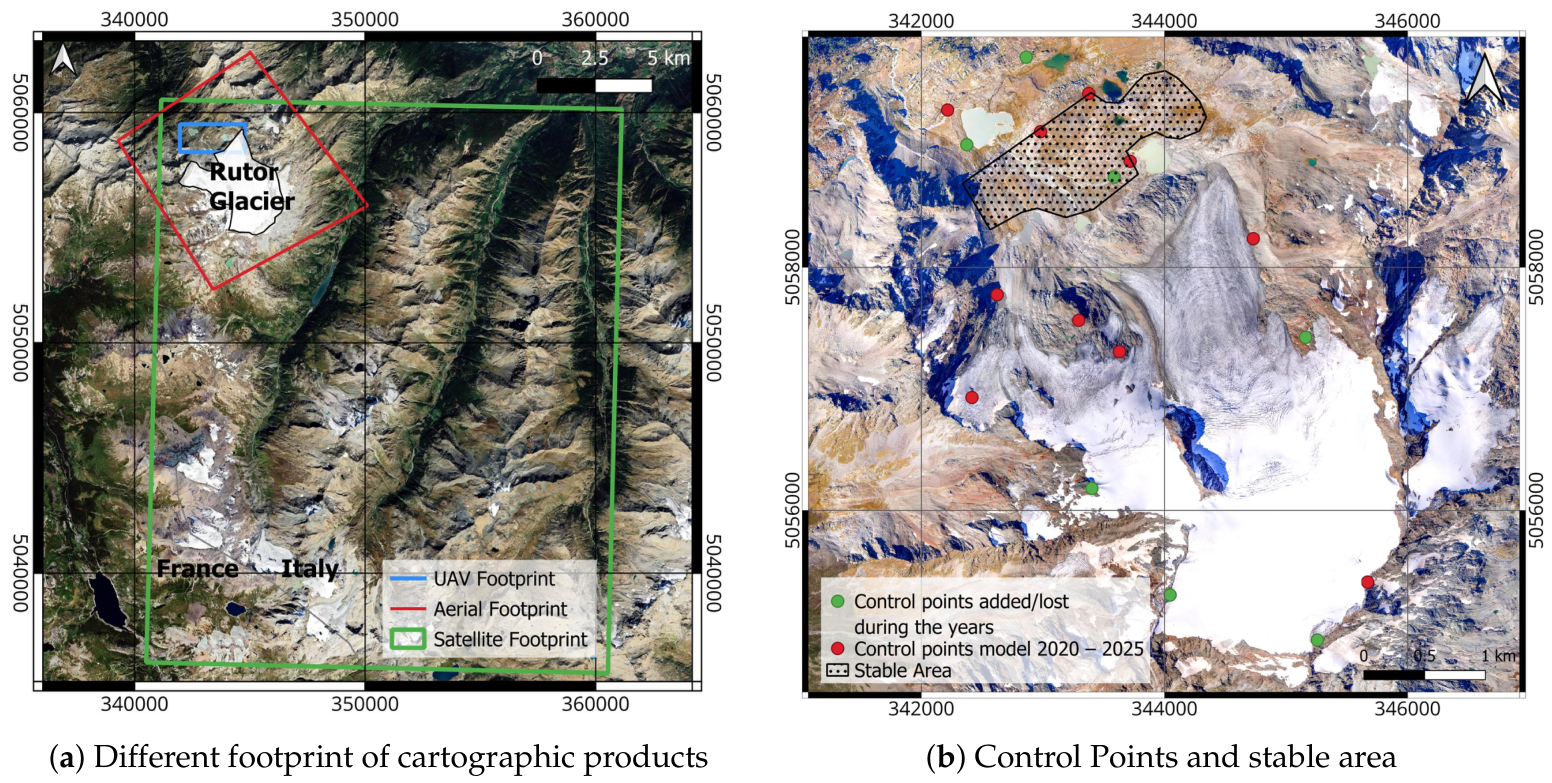
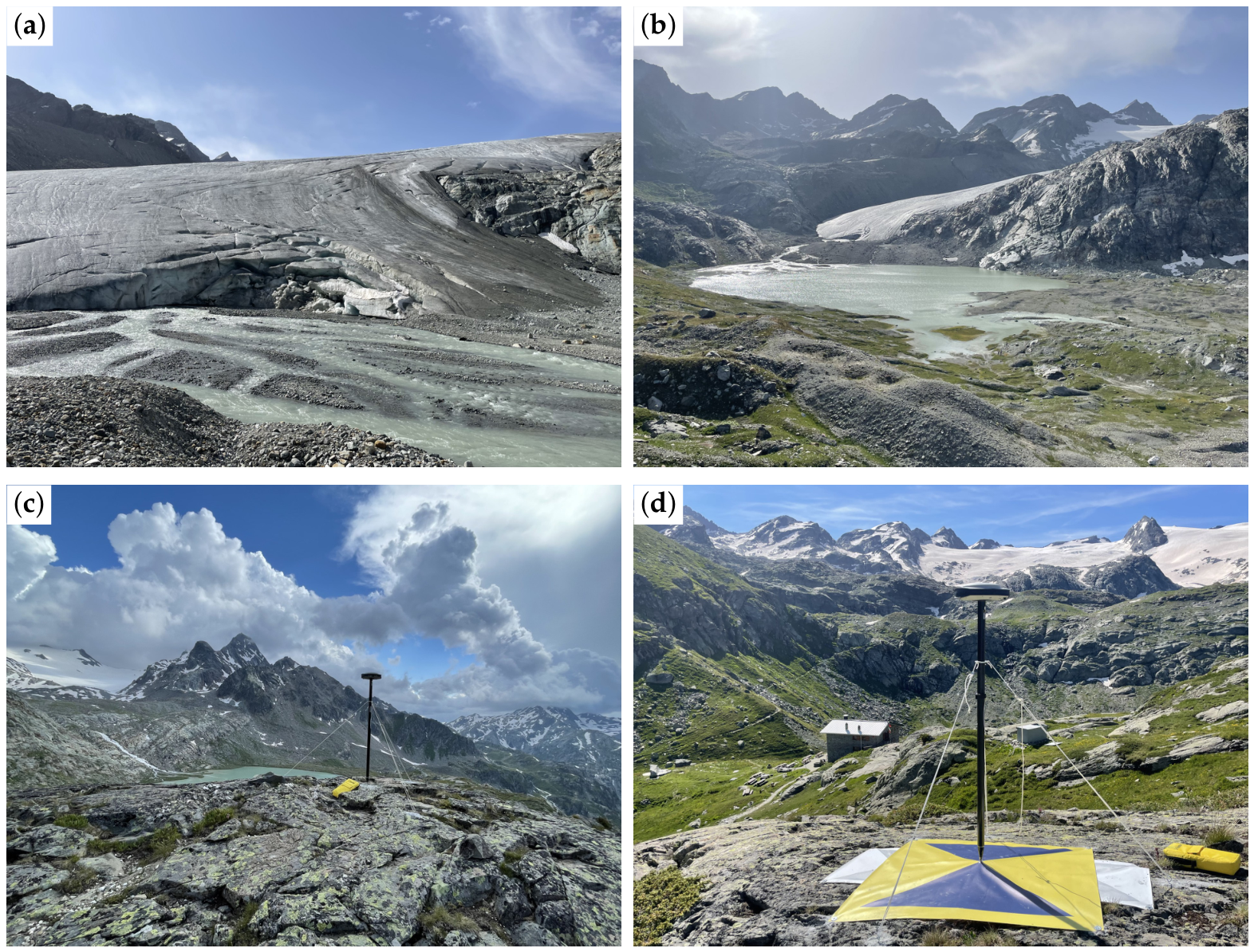
For the internal and relative orientation the images, the software identifies common geometries between images, i.e., it extracts feature points from which homologous points are detected through feature matching. Using the Structure from Motion (SfM) process, the position and orientation of the camera are determined, and the self-calibration parameters are estimated. The tie-point cloud is then generated. Given the large number of images, this step can take a considerable amount of time (up to 15 h processing with Intel(R) Core(TM) i9-9900X CPU @ 3.50 GHz, 8 GB VRAM NVIDIA QUADRO RTX4000, Santa Clara, CA, USA). Targets with known coordinates are searched for and manually collimated on the images to carry out the external orientation, i.e., georeferencing the model, and optimise the internal camera parameters. The markers placed during field activities were used both as GCPs to assess the precision of the point cloud and as ICPs to estimate the positional accuracy. The spatial configuration along the glacier of control points over the years is shown in
Figure 3b. The 3D models were all referenced in the ETRF2000/UTM32N coordinate system. Ellipsoidal elevations were converted to orthometric heights required for operational applications using the Italian geoid model ITALGEO05 with ConveRgo desktop software (Coordinate conversions for Regions) ensuring a conversion accuracy on the order of a few centimetres. After manually checking and refining the tie point cloud, a dense, colourful, high-resolution point cloud is generated using multi-view stereo matching (MVS) algorithms. At this point, cartographic products such as orthophotos and DSMs are generated and extracted.
The cartographic products obtained were evaluated and compared with each other for different purposes. First, the accuracy of the various products was examined in order to understand the common characteristics to assess their quality in terms of accuracy and precision.
Subsequently, multi-temporal comparisons were performed to quantify annual glacier ablation and cumulative changes over the entire 2020–2025 period. These derived products provided the basis for estimating the annual mass balance and monitoring the retreat of the glacial tongues.
3.2. DSMs: Validation, Difference of DSMs and Limit of Detection
Digital Surface Models derived from photogrammetric and remote sensing techniques are essential for quantifying changes in glacier surface elevation and volume. However, they inherently contain measurement errors related to image acquisition geometry, control point quality, and surface characteristics (such as snow cover, debris, and low-texture areas) that affect image matching performance. For this reason, a rigorous statistical assessment is required before DSMs can be reliably used for quantitative change detection and mass balance estimation.
To this end, we performed a multi-step validation to assess individual DSM accuracy, define the Limit of Detection (LoD) of their differences, and quantify the uncertainty associated with volumetric change estimates.
The adopted methodology follows a sequential approach:
Internal Validation: first, the accuracy of individual DSMs is evaluated using GCPs and ICPs;
Spatially Explicit Uncertainty: second, spatially distributed uncertainties are analysed through Differences of DSMs (DoDs) computed over stable areas;
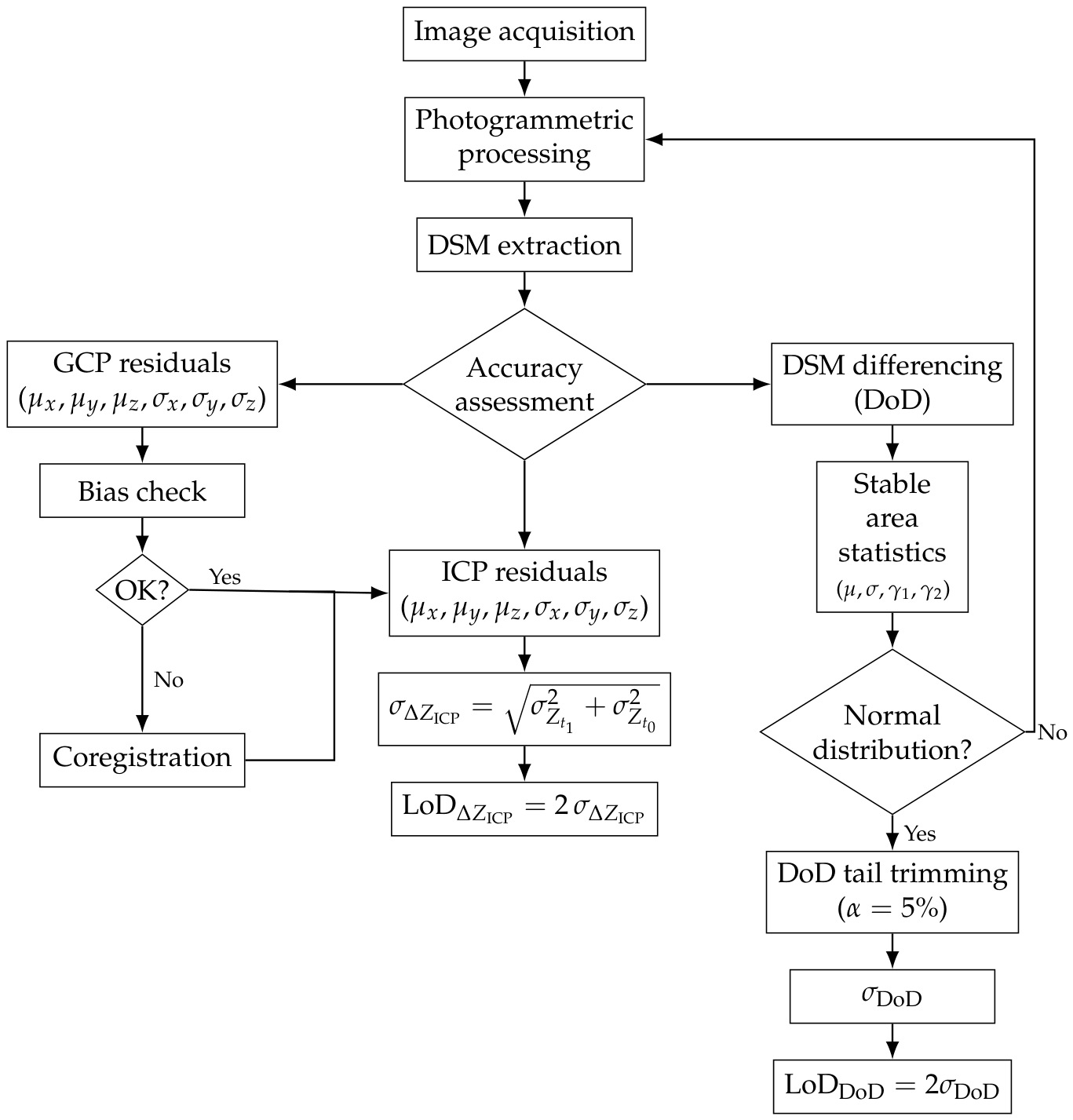
LoD Determination: finally, these results are combined to derive the LoD at a defined confidence level. The entire methodological framework is schematically represented in
Figure 4.
3.2.1. ICP Analysis
The first level of accuracy assessment focuses on the evaluation of single DSMs using ICPs. These are ground-surveyed points not included in the photogrammetric orientation or bundle adjustment. By computing the residuals between measured and modelled coordinates at ICP locations, the absolute accuracy of each DSM can be independently assessed.
In challenging glaciers and periglacial environments, the materialisation and spatial distribution of ICPs is particularly demanding, requiring significant logistical effort, specialised personnel, and extensive fieldwork. Moreover, identifying points that remain invariant over time is often difficult. Nevertheless, even with a limited number of ICPs, it is possible to statistically evaluate DSM accuracy by computing the mean residual , which indicates potential systematic vertical biases, and the standard deviation , which quantifies the random component of vertical uncertainty. The same statistical indicators are also computed for the horizontal residuals x and y, as significant planimetric biases would indirectly affect vertical precision.
From a methodological perspective, the detection of significant planimetric biases would require corrective actions prior to any vertical change analysis. Systematic horizontal offsets or rotations can propagate into elevation differences, particularly in steep terrain, and should therefore be addressed through model re-orientation or co-registration procedures.
When the mean residuals are negligible compared to the standard deviation, particularly for the z component, which isex pected to be centred around zero, it indicates the absence of significant systematic vertical bias. While these points are suitable for internal validation of individual models, they are not sufficient on their own to robustly assess interannual DSM consistency and change detection. Any detected bias should be corrected prior to the estimation of the LoD; the procedure is described in
Section 3.2.3.
3.2.2. DoD Analysis
As a second validation method, DSMs from consecutive years are compared through DoDs, focusing exclusively on areas assumed to be stable over time. In a glacial context, stable areas typically correspond to rocky areas, consolidated moraines far from the active glacier front, and other surfaces not affected by glacial or nival processes during the observation period. Due to the limited availability of surfaces that can be confidently considered stable, the extent of such areas is necessarily restricted and cannot be expanded without introducing potential bias.
Unlike the ICP-based approach, which relies on a limited number of point measurements, the DoD analysis exploits millions of elevation differences distributed over the study area, providing a more statistically robust assessment of uncertainty, though not strictly independent from the original measurements. This allows for the identification of residual biases, noise levels, and potential artefacts affecting the elevation change estimates.
The normality of the distribution, required for bias analysis, is evaluated using Fisher’s skewness (
) and kurtosis (
) indices. For a theoretical Gaussian distribution, both indices are expected to approach zero. These are calculated as:
where
,
, and
are the second, third, and fourth central moments of the distribution, respectively, defined as
, with
denoting the sample mean and
n the number of observations. To assess the proximity to zero, the
z-values (normalized against their standard errors) can be tested under the null hypothesis that
and
are equal to zero:
To improve statistical robustness and mitigate the influence of gross outliers, often stemming from matching failures in photogrammetric processing, the distribution tails are trimmed by excluding the upper and lower 5% of the values. This threshold aligns with established practices in robust statistics [
23] and common cartographic quality control, representing a practical compromise to remove gross errors without compromising the dataset’s integrity.
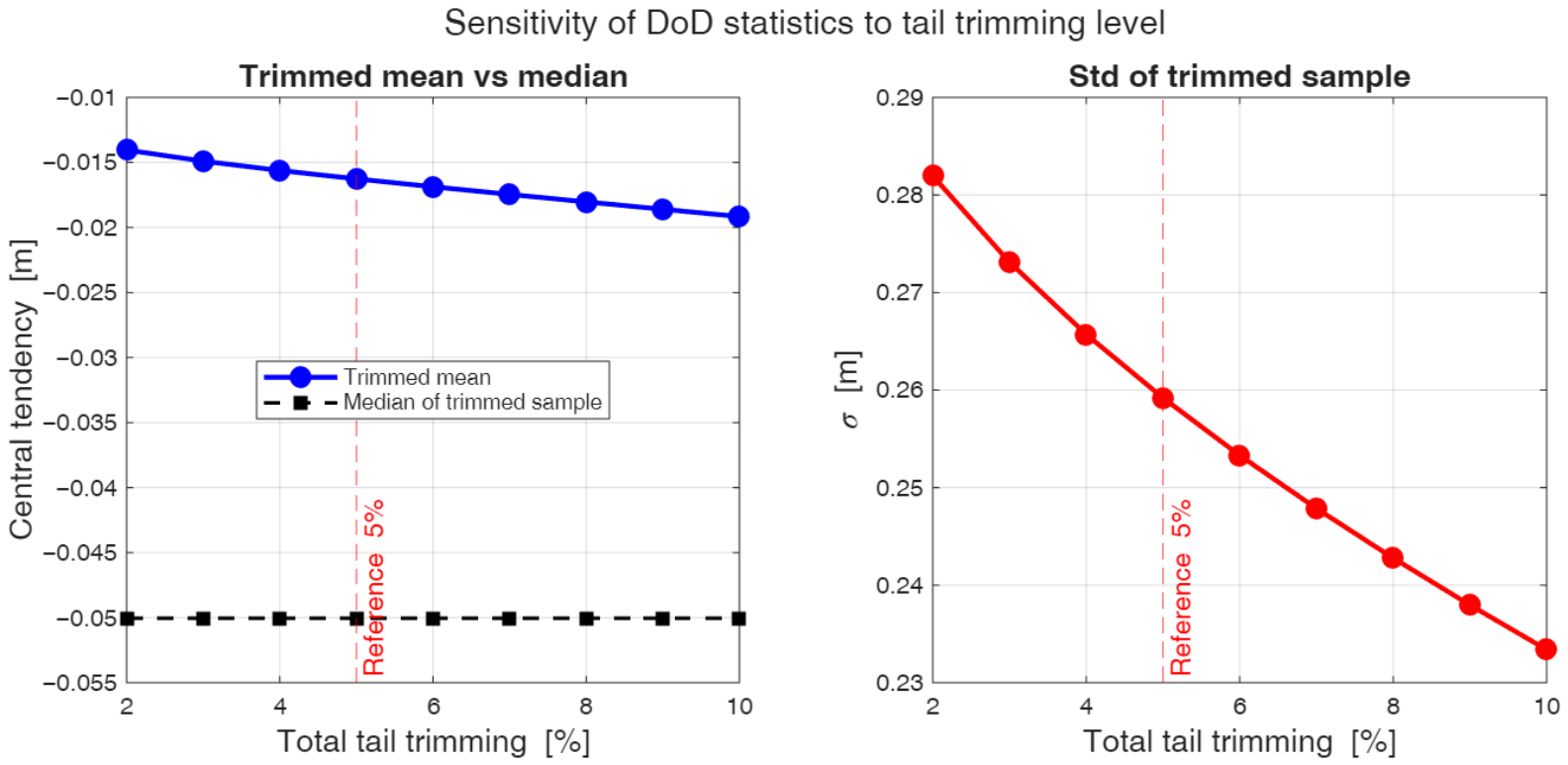
A sensitivity analysis was performed to explicitly test the robustness of the adopted assumptions and evaluate the impact of different trimming levels (2% to 10%). The results show that the central tendency (trimmed mean and median) remains stable, while the standard deviation decreases progressively as noise is reduced. The adoption of a 5% trimming is thus a balanced and conservative choice. This analysis was carried out on the largest dataset (2020–2025), which includes approximately points, ensuring statistical robustness.
These tests allow evaluating whether the adopted 5% trimming and Gaussian assumption represent robust methodological choices or if the results are influenced by these parameters.
3.2.3. LoD Analysis
The LoD defines the minimum elevation change that can be confidently distinguished from measurement noise when comparing DSMs acquired at different epochs. Assuming normally distributed errors, the LoD at the 95% confidence level is commonly defined as twice the standard deviation of the elevation differences [
24,
25,
26,
27].
For both processes (ICP and DoD) under the assumption of normal distribution, considering two epoch
and
and the coordinate K = {
}:
Similarly, for the DoD-based approach, the LoD is derived from the propagated uncertainty of the DSMs involved:
Elevation changes smaller than the LoD are considered statistically insignificant and are excluded from further interpretation. This filtering prevents noise-induced fluctuations from being misinterpreted as real surface changes and ensures that only statistically meaningful elevation differences contribute to volume and mass balance calculations.
The sequential application of ICP-based validation, DoD statistical analysis over stable terrain, and LoD estimation establishes a consistent framework for uncertainty quantification in multi-temporal DSM analyses. After tail trimming, DoD values computed over stable areas exhibit near-Gaussian behaviour, with mean values close to zero and limited dispersion. This supports the statistical validity of the adopted methodology and provides a solid basis for defining the LoD and propagating elevation uncertainties into volumetric change estimates for the Rutor Glacier. Such a robust approach is fundamental for enhancing the reliability of glacier elevation and volume change assessments in long-term monitoring and climate change impact studies.
3.3. Glacier Mass Balance
The mass balance (
) of a glacier is defined as the net change in its mass over a given period, resulting from the difference between the accumulation of snow deposited during the winter season through solid precipitation and ablation due to snowmelt, sublimation and avalanches:
where
P is precipitation and
M is the melted snow;
According to the WGMS, the direct historical method uses field measurements to first measure the accumulation at the end of winter. This is typically done through surveys and measurements of snow density, which allow the conversion of snow depth into water equivalent (w.e.). Then, by measuring ablation using ablation gauges inserted into the ice, the amount of ice that has melted is measured and converted using the density of ice. The local balance is then calculated and integrated on the glacier according to altitude [
28].
Alternatively, the geodetic mass balance is derived from the volumetric variation between two epochs using multi-temporal DSMs:
where
is the height difference between the two epochs and
is the DSM pixel. The total volume difference is calculated:
where
is the volume difference and
A is the area of the glacier considered. Then the volume is converted into snow mass
where
is the snow/ice density [
26,
29].
3.4. Impact of Altimetric Accuracy on Volumetric Estimation
Since glacier mass balance relies on converting volume change into mass change, any altimetric error propagates into uncertainty in the mass estimate. Furthermore, inaccuracies in glacier delineation can affect the estimated area and, consequently, the integrated volume change. As mentioned, the geodetic volume change was computed from the DoD as:
where
is the elevation difference at pixel
i,
is the pixel area, and
N is the number of valid pixels.
A first-order estimate assuming spatially uncorrelated elevation errors (e.g., [
29]) would lead to unrealistically low uncertainties due to the large number of pixels involved. However, elevation errors in photogrammetric DSMs are typically spatially autocorrelated. To account for this, an effective number of independent observations,
, was introduced following the conceptual framework of [
16]. To be conservative, the correlation area
was approximated as a square with
side:
where
L is the characteristic correlation length of elevation errors.
To estimate
L, the spatial structure of elevation errors was analysed over stable terrain DoD using the empirical variogram of the elevation differences. The empirical variogram was fitted using a spherical model:
where
is the nugget variance,
C is the structured variance (sill minus nugget);
is the sill,
h is the lag distance between pairs of points (two pixels) and
a is the variogram range here adopted as the correlation length
L.
The effective number of independent samples is then estimated as
where
A is the glacier area. The uncertainty of the volume change is finally computed as:
where
is the standard deviation of the DoD computed over the glacier area between the two epochs.
The spatially correlated elevation uncertainties described in glacier and geomorphological applications are computed following the approach of previous studies [
16,
26,
27].
In order to explicitly link uncertainties to the final mass-balance estimates, the propagation of errors was considered, starting from the geodetic formulation (
11). According to the variance propagation law, the total uncertainty
is estimated as:
where
is the uncertainty in volume change derived from the DoD analysis and spatial correlation, and
is the uncertainty associated with the density conversion factor. (typically ranging from 60 to 100 kg/m
3).
4. Results
4.1. Orthophotos and DSMs
Cartographic products for each year were extracted from the relevant models processed using the method described in
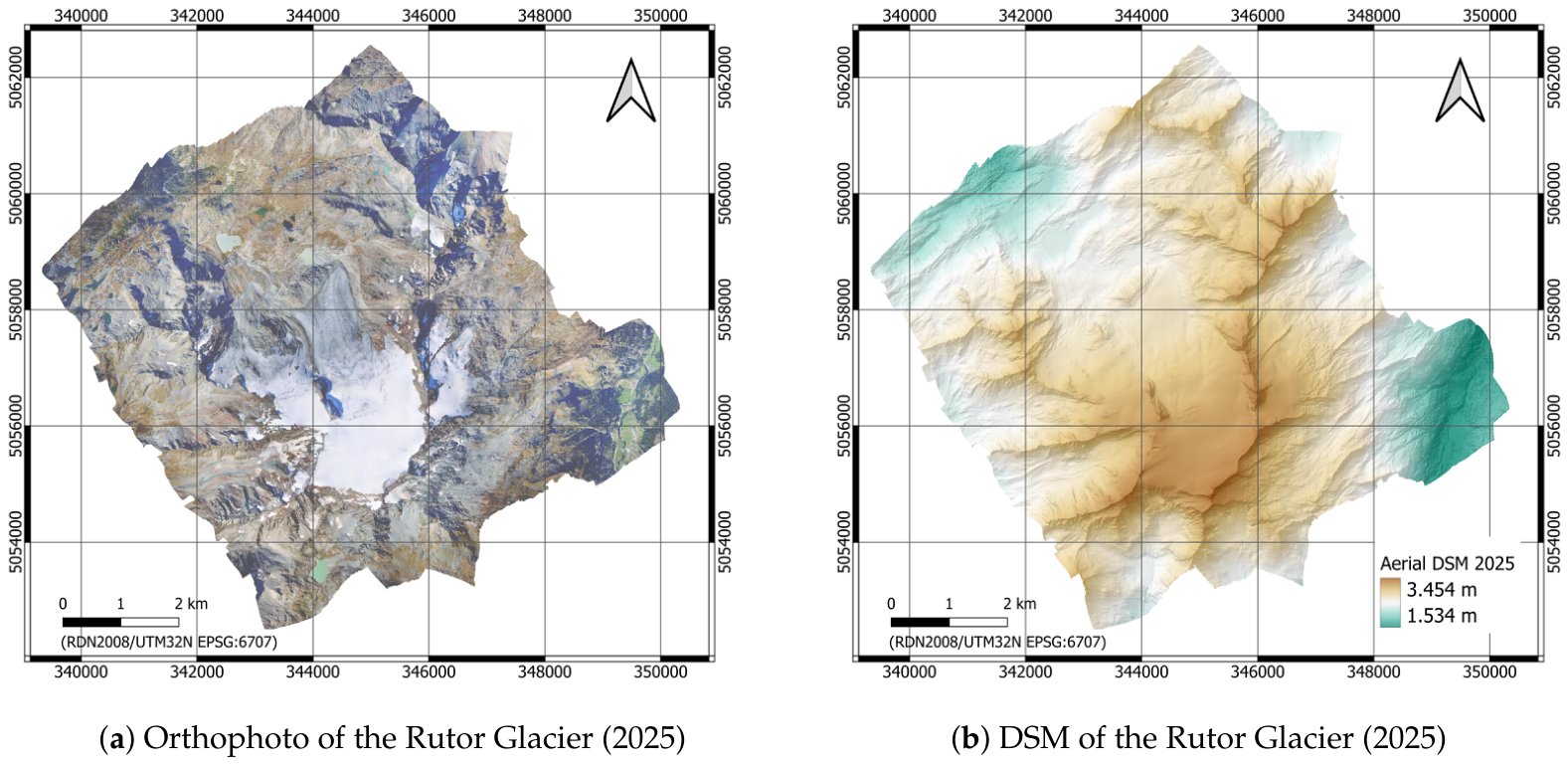
Section 3.1. All annual datasets between 2020 and 2025 were exported as rasters with a GSD of 0.5 m to facilitate management and multi-temporal comparison (
Figure 5a,b).
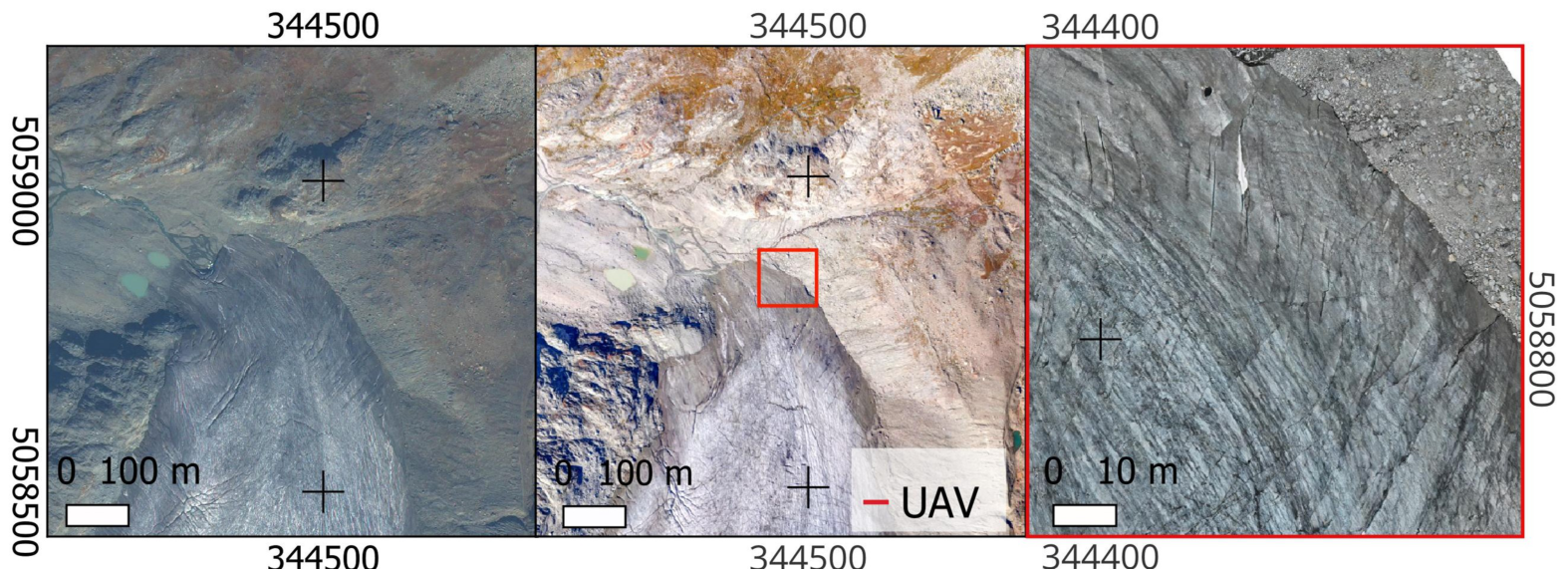
Figure 6 illustrates the relative level of detail provided by satellite, aerial, and UAV orthophotos, highlighting the superior resolution achieved through the platforms.
The accuracy of each model was evaluated by analysing the residual errors at both GCPs and ICPs, as summarised in
Table 5.
The residuals calculated on the GCPs show mean values very close to zero along all spatial components (, , ), with average deviations generally within a few millimetres. Standard deviations are low, particularly for the planimetric components, indicating a high precision in the range of 0.10 m with 0.00 m min and 0.21 m max values. As expected in photogrammetric processes, the vertical component exhibits slightly higher dispersion; however, the values remain consistent with the GSD of the data and with the expected survey accuracy.
Residuals computed on the ICPs show greater dispersion than those on the GCPs, especially along the vertical component. Nevertheless, mean residuals on ICPs remain close to zero, indicating the absence of significant systematic biases in the reconstructed models. Planimetric residuals are generally on the order of the pixel size, while vertical residuals are approximately twice the image resolution, which is consistent with typical photogrammetric accuracy ratios.
A noticeable decrease in the number of both GCPs and ICPs is observed for the 2025 model, mainly due to the deterioration or loss of several markers, which became missing or unusable as reference points. Over time, the spatial distribution of markers has changed: some have degraded, faded, or been physically removed, while others have been replaced or restored where possible. This aspect highlights the intrinsic difficulty of maintaining stable reference points in high-mountain environments. Despite these variations, the overall results in
Table 5 indicate that the photogrammetric models maintain stable accuracy over time, providing a reliable foundation for multi-temporal analysis.
4.2. Statistical Analysis of Stable Areas and DoD Uncertainty
To implement the second validation approach, DoDs were generated for all possible year pairs over the Rutor Glacier. In order to estimate the accuracy of the DoDs, it was first necessary to identify areas that could be considered stable over time. To this purpose,
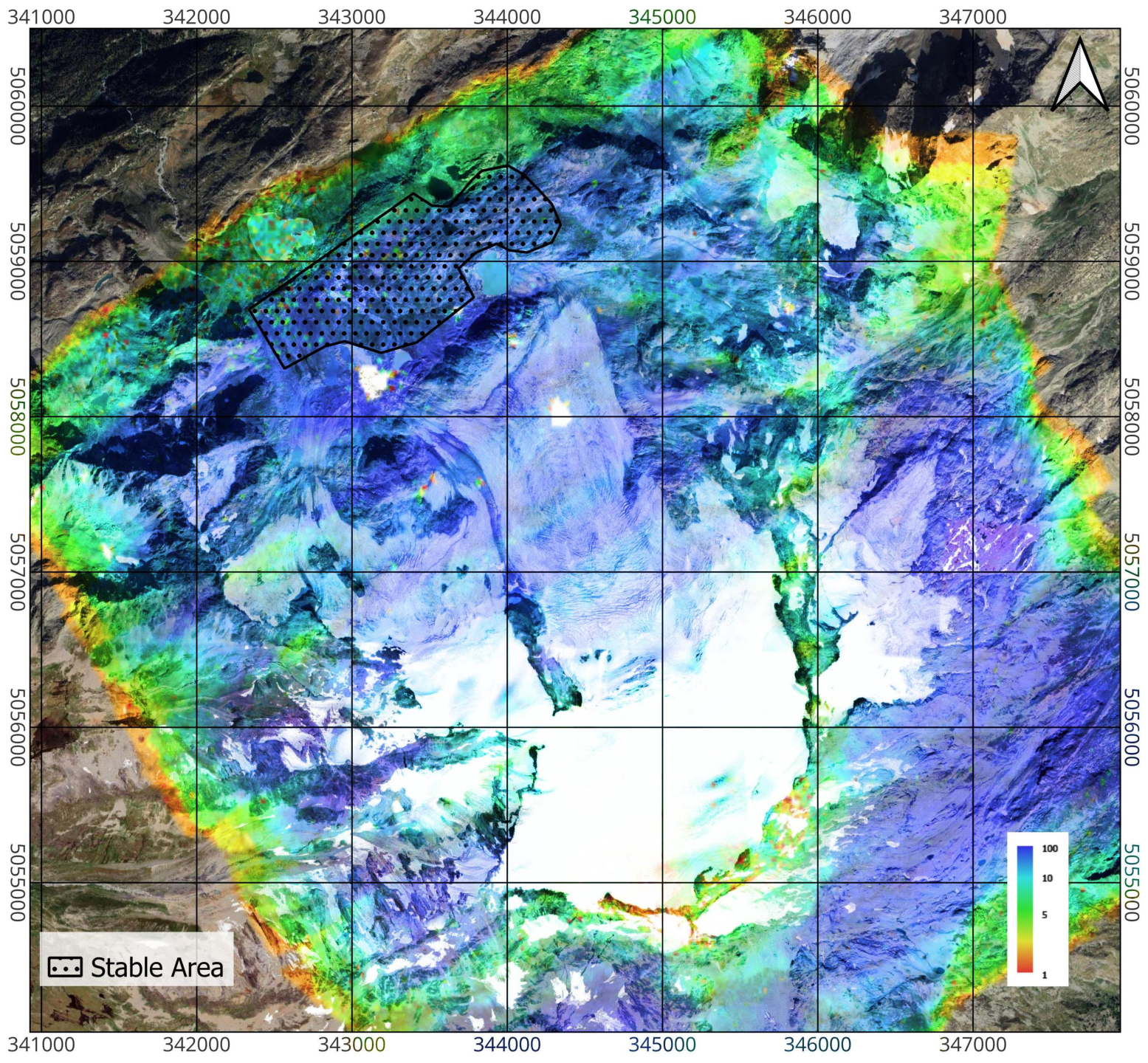
Figure 7 shows the confidence map generated by Agisoft Metashape, highlighting a spatially variable reliability of the reconstructed points. Lower confidence values are mainly observed in the upper part of the glacier and along its margins, where image matching is affected by steep slopes, shadowing effects and unfavourable acquisition geometry. In addition, due to the complex orography of the area, surrounding ridges and lateral slopes and zones located above the glacier cannot be assumed to be invariant over time, as they may be affected by gravitational processes, rockfalls, and seasonal instabilities.
For these reasons, only the periglacial areas surrounding the glacier were selected as stable reference surfaces for the subsequent analyses. These zones provide more reliable and temporally consistent conditions and therefore represent the most suitable areas for the assessment of elevation differences and for the estimation of the uncertainty associated with the Difference of DSMs.
The statistical analysis on DoD described and applied on the stable area (4,754,665 points) of the
Figure 7 is reported in the
Table 6.
The statistical analysis performed on these stable areas (comprising approximately
points) is reported in
Table 6. The skewness (
) and excess kurtosis (
) values indicate that the error distributions are approximately Gaussian, supporting the assumption that residual elevation differences are dominated by random noise rather than systematic shifts. For the 2020–2025 period, the raw distribution showed slight asymmetry (
) and a flatter-than-normal shape (
). To evaluate the robustness of our statistical assumptions, a sensitivity analysis was performed.
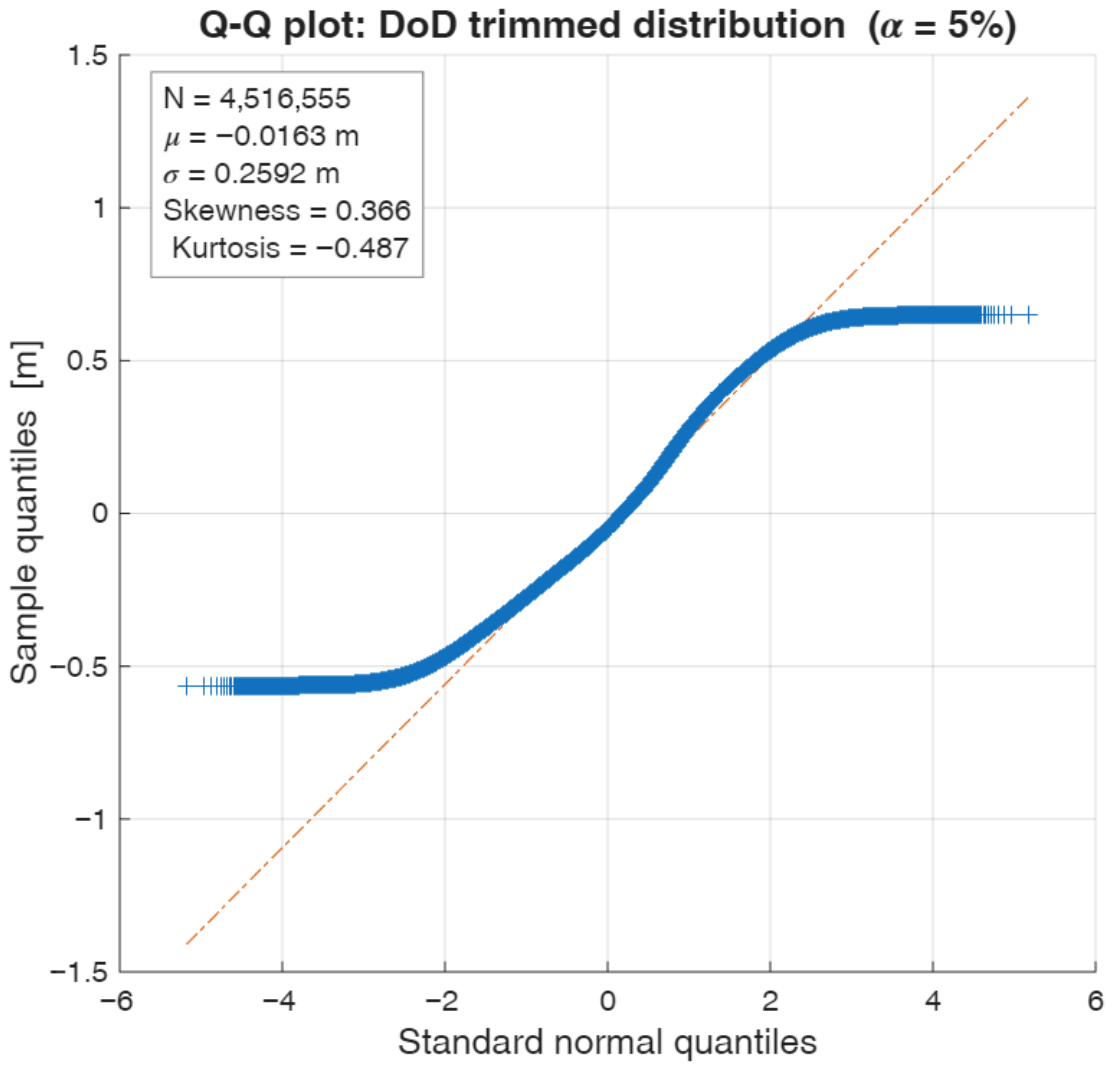
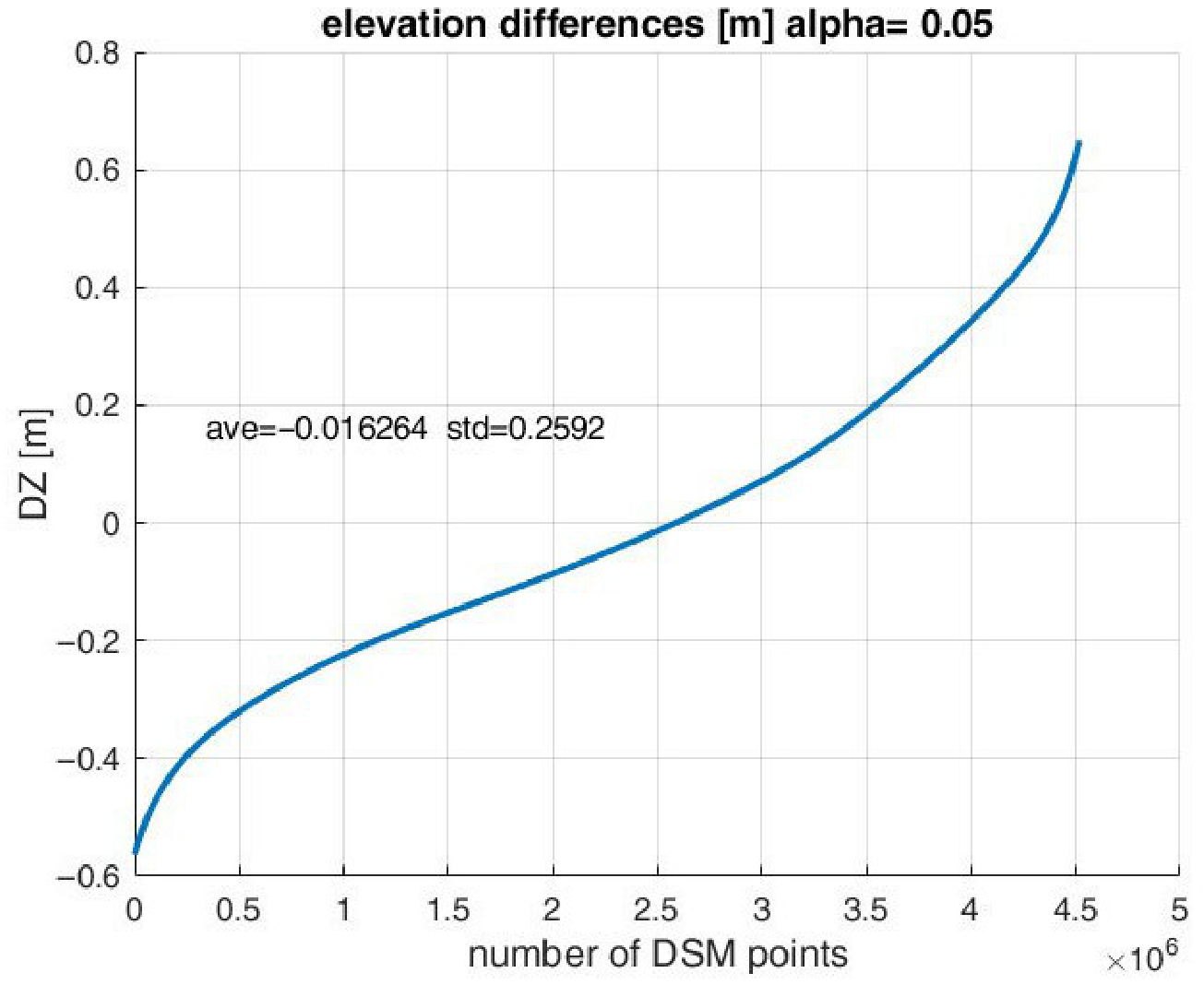
Figure 8 presents the Q–Q plot after a 5% tail trimming, showing that the central portion of the distribution closely follows the theoretical normal line. Deviations are restricted to the extreme quantiles, likely due to residual outliers and correlation mismatches. This confirms that, after trimming, the residuals can be reasonably approximated as Gaussian, a practice widely accepted in geodetic glacier studies [
16,
29].
The robustness of the trimming threshold was further assessed by varying the level between 2% and 10% (
Figure 9). The trimmed mean and median remained nearly invariant (within a few millimeters), while the standard deviation decreased as expected with the removal of noise. Thus, the 5% trimming represents an optimal compromise between reducing outlier influence and preserving the dataset’s statistical representativeness.
The comparison between the mean and standard deviation values computed before and after trimming shows that the DoD distributions are consistently centred around zero for all temporal pairs. This indicates the absence of significant systematic biases between the DSMs. Small variations in standard deviation among different years reflect changes in acquisition conditions, surface characteristics, and photogrammetric performance, but remain within a narrow and consistent range.
4.3. Comparison of LoD Approaches
Table 7 reports the LoD values calculated for each DoD between subsequent epochs using two independent approaches. The second column shows the LoD derived from the ICPs, calculated using the
values reported in
Table 5 and following the methodology described in
Section 3.2.3. The third column reports the LoD computed directly from the DoD statistics, obtained as twice the
values reported in
Table 6.
A clear difference emerges between the two approaches. The LoD derived from ICPs is systematically higher and, in most cases, approximately twice that obtained from the DoD analysis. This difference reflects the limitations of point-based assessments in complex terrains, where a small number of ICPs may be more sensitive to local conditions or positioning errors. Conversely, the DoD-based approach leverages a massive set of spatially distributed observations, capturing the actual noise characteristics of the elevation differences more effectively. Consequently, the DoD-based LoD is considered more appropriate for defining statistically significant elevation changes and was adopted for the subsequent volumetric calculations.
4.4. Glacier Surface Elevation Changes
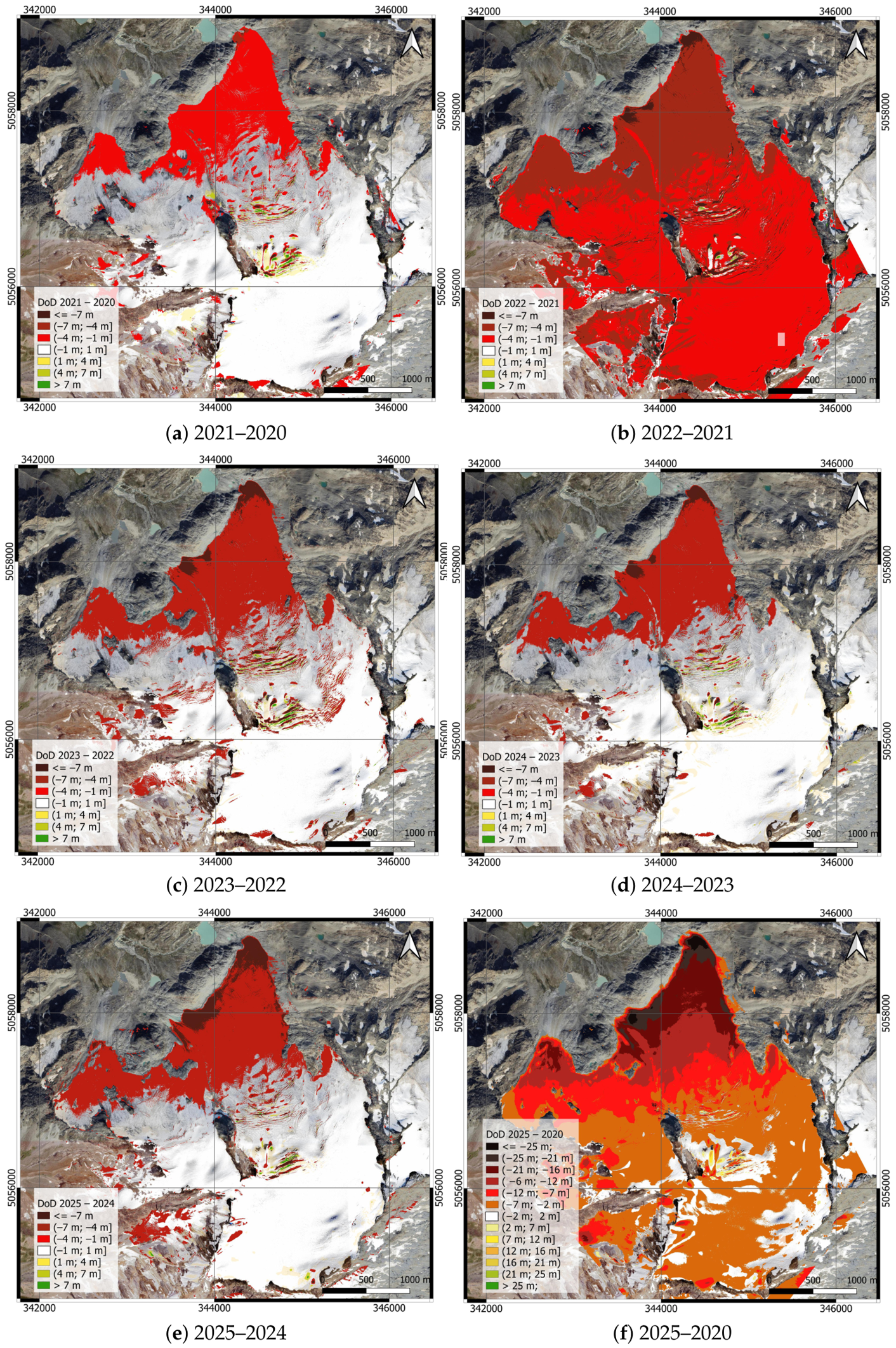
Figure 10 shows the spatial distribution and interannual evolution of glacier surface lowering. Each panel represents the annual DoD between consecutive surveys, while the last map shows the cumulative elevation change over the 2020–2025 period, providing an integrated view of the glacier thinning. To enhance the visual interpretation of glacier melting patterns, different legend scales were adopted. In particular, the colour scale of the cumulative DoD (2020–2025) was intentionally amplified to better highlight long-term elevation changes. In order to standardise the visualisation and to adopt a conservative approach consistent with the uncertainty analysis, elevation differences within the uncertainty range of ±1 m were rendered transparent in the annual DoD maps. This threshold corresponds to the order of magnitude of the Limit of Detection derived from the DoD statistics for all years and prevents the visual interpretation of changes that are not statistically significant.
For the cumulative DoD over the entire period, the transparency threshold was increased to ±2 m for graphical purposes only, reflecting the accumulation of interannual uncertainties and allowing a clearer representation of the long-term elevation changes. This approach ensures a consistent and conservative visualisation of glacier thinning while preserving the comparability between annual and multi-annual DoD products.
As shown in
Figure 11, the elevation differences on stable areas are consistently centered around zero, with average deviations limited to a few centimeters. The standard deviations range between 0.13 m and 0.26 m, representing roughly one-third of the GSD. This high level of alignment across the multi-temporal dataset ensures that the observed changes on the Rutor Glacier are physically meaningful and reflect actual ice loss rather than georeferencing artifacts.
5. Operational Applications
Glacier monitoring is essential for assessing the impacts of climate change on alpine environments, as well as for evaluating water resources and related natural hazards. In recent decades, geomatic surveys have become central to glacier research due to their ability to provide quantitative, repeatable, and high-resolution spatial information. Techniques such as aerial and satellite photogrammetry, optical remote sensing, and DSM processing enable detailed analyses of glacier extent, surface elevation, and volumetric changes across multiple spatial and temporal scales.
The integration of multi-sensor datasets acquired at different times allows glacier geometry and dynamics to be analysed within a consistent framework, supporting mass balance estimation and the interpretation of surface processes. Specifically, multi-temporal analysis based on the Difference of DSMs (DoD) [
31] allows for the quantification of altimetric variations and glacial volume fluctuations [
32]. This approach is widely used in glaciological studies as it enables the integration of spatially continuous observations with more precise field measurements. At the same time, high-resolution orthophotos enable the precise mapping of changes in glacier area, retreating fronts [
33], the evolution of moraines and the appearance of debris surfaces or proglacial lakes [
34]. The integration of DoDs and orthophotos within a coherent geomatic [
35] framework is therefore an effective and well-established method for glacier monitoring, allowing for the synergistic analysis of planimetric and volumetric changes and supporting climatic, hydrological, and risk assessment studies in the Alpine environment. The following sections illustrate the application of these methodologies to the Rutor Glacier.
5.1. Multitemporal Glacier Monitoring
The repeated surveys conducted yearly, in addition to the historical products enable to estimate the reduction in thickness and the retreat of the lower part of the Rutor glacier. The eastern tongue is the part of the glacier most impacted, retreating and lowering each year significantly, mainly due to high summer temperatures. Although winter precipitation increases the albedo of the glacier and helps preserve it during winter, prolonged periods of high summer temperatures significantly impact glacial melting, despite the glacier’s high altitude. The lower part of the glacier, like the three tongues, has been characterised by noticeable thinning of around 4 metres per year (
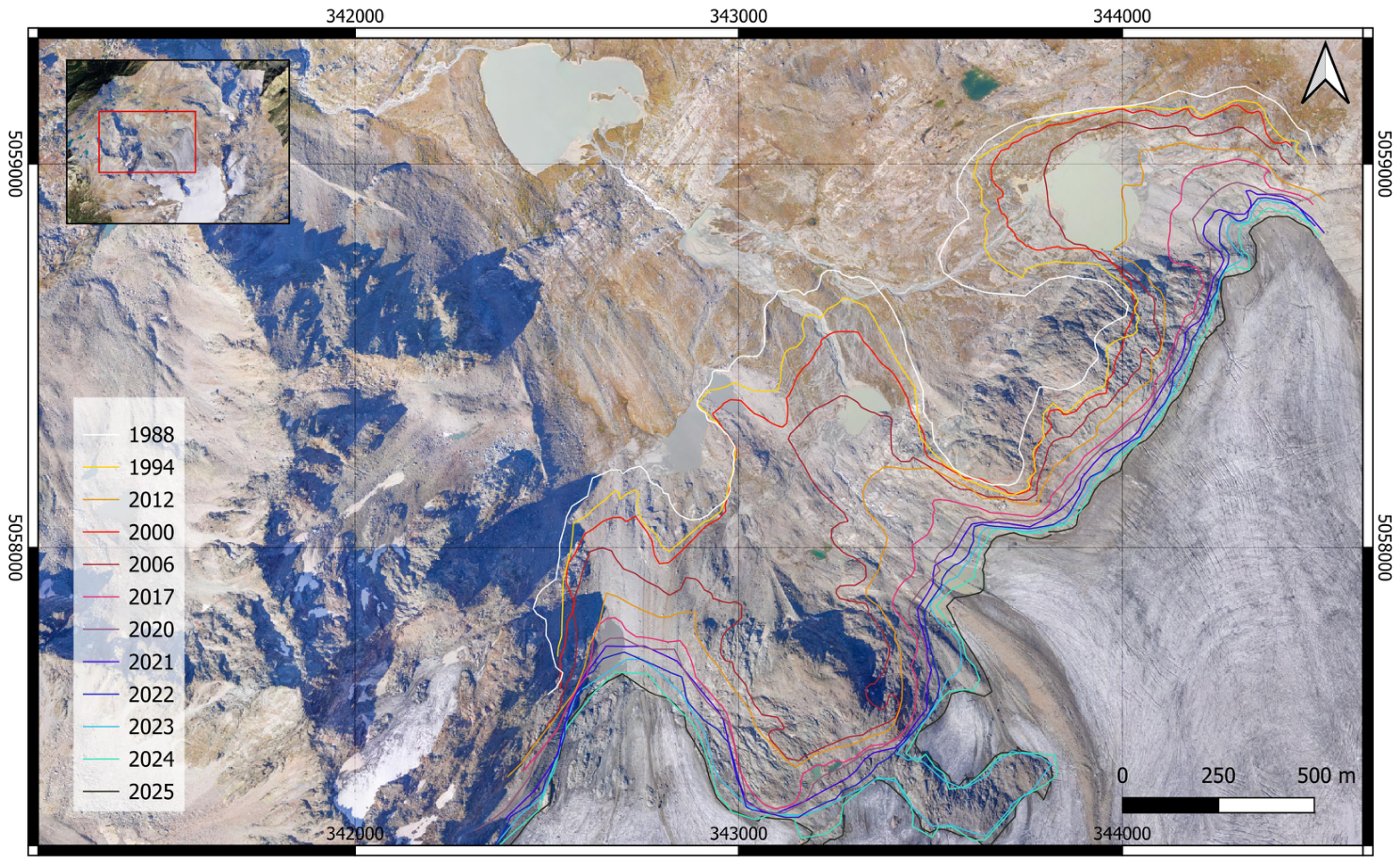
Figure 10) during the monitoring period. Peculiar condition were observed in 2022–2023, when a snowless winter combined with an exceptionally hot summer led to a significantly higher-than-average ablation rates, pushing the ELA to very high altitude. Moreover, by means of visual interpretation of the orthophotos (including data retrieved from historical archives) it was also possible to monitor the tongue outline evolution to estimate the average planimetric retreat of the glacier (
Figure 12).
5.2. Rutor Mass Balance Between 2020 and 2025
Regarding the Rutor glacier mass balance, the second approach described in
Section 3.3 was used by Aosta Valley ARPA on the cartographic products obtained from the photogrammetric process. To convert volume changes into mass changes, a density value of
kg m
−3 was adopted, following the recommendation of [
37] for Alpine glaciers where both ice and firn melting contribute to volume loss.
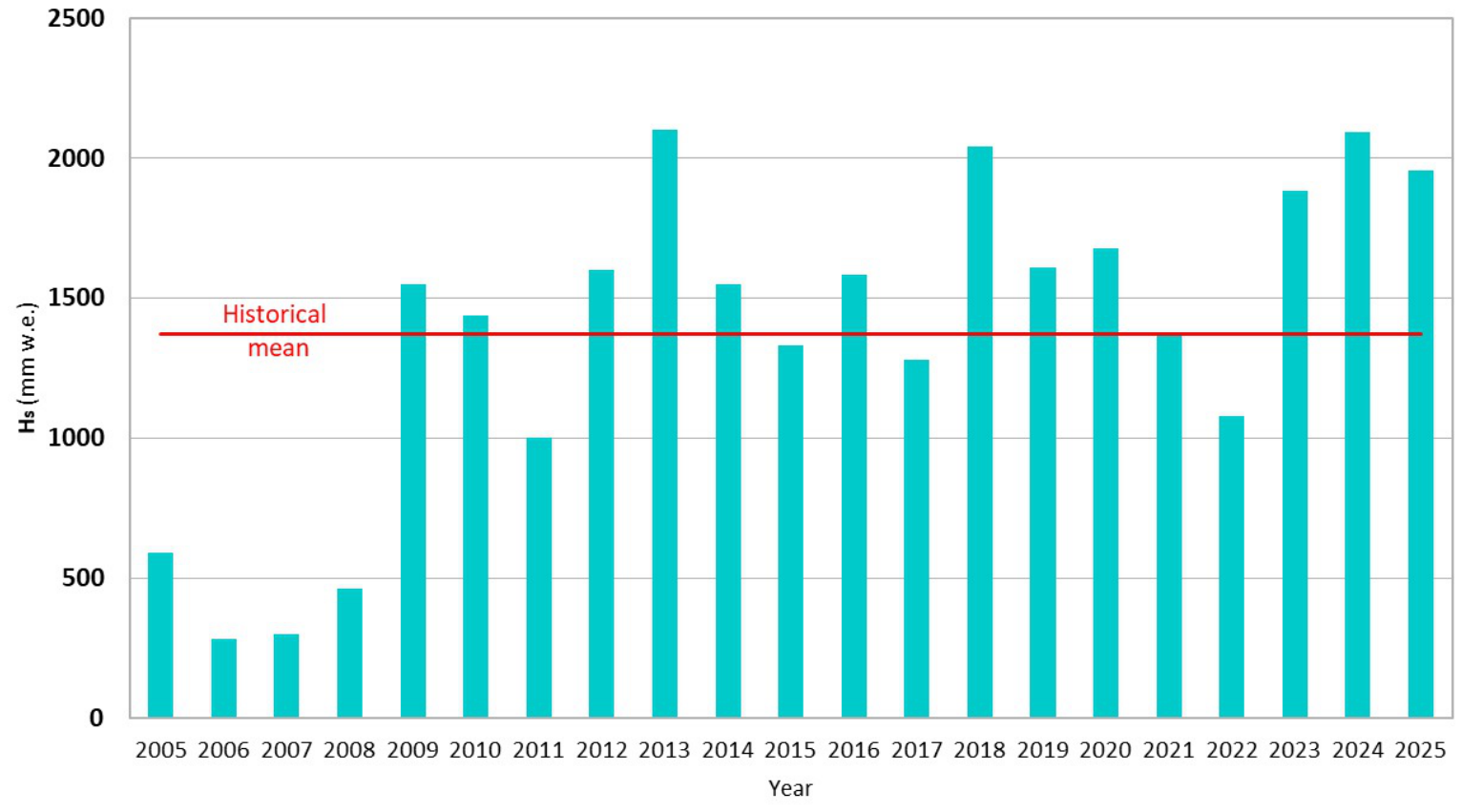
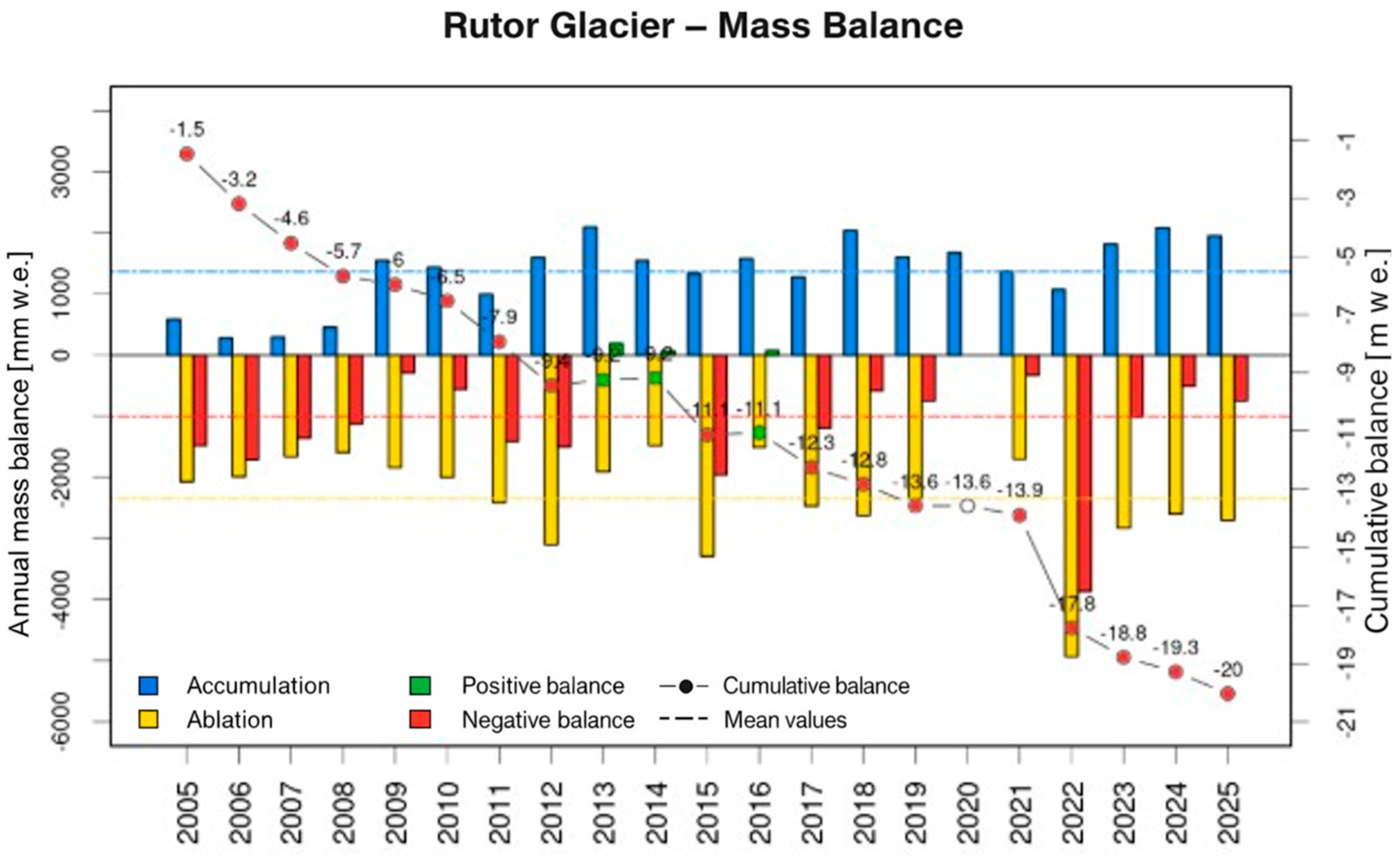
Comparing the 2025 mass balance with those of recent years (2024: −506 mm w.e.; 2023: −1.010 mm w.e.; 2022: −3.867 mm w.e.) shows that, although all three years recorded negative values, the losses in 2025 were substantially less severe than in 2022. The 2025 and 2024 balances are comparable and considerably less negative than that of 2023, which reflects the impact of higher-than-average summer temperatures that enhanced melting. Overall, the measurements yield a net mass balance of −746 mm w.e. for the Rutor Glacier. Snow accumulation measurements carried out on the Rutor Glacier in May 2025 indicated values slightly above the 24-year average, though still lower than those recorded during the 2023–24 winter. By the end of the accumulation period, the mean snow depth across the glacier was 396 cm, equivalent to 1.955 mm of water, well above the 20-year mean (2005–2025) of 1.370 mm (
Figure 13). On the right front (mean elevation 2635 m a.s.l.), the glacier surface thinned by an average of 4.5 m and retreated by approximately 25 m. On the plateau and central front (mean elevation 2725 m a.s.l.), the average surface lowering was 3.6 m, with a retreat of around 15 m. Finally, the left front (mean elevation 2720 m a.s.l.) showed an average thinning of 2.6 m and a retreat of around 12 m [
38], (
Figure 14).
5.3. Impact of Altimetric Accuracy on Volumetric Estimation on Rutor Glacier
The methodology described in
Section 3.4 is applied to each epoch pair.
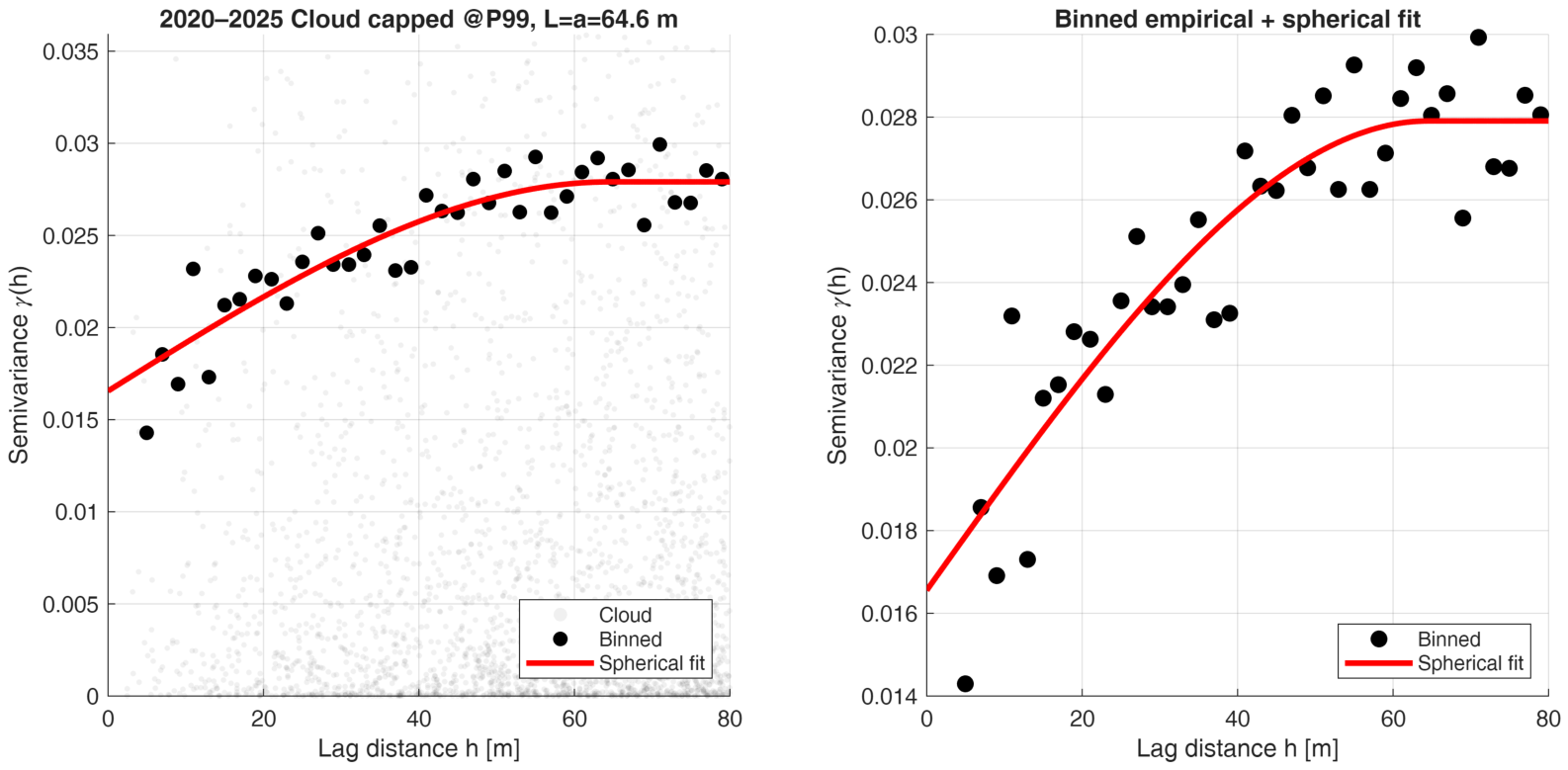
Figure 15 shows the empirical variogram for the period 2020–2025, according to the spherical model, computed on the stable area considered.
The parameters estimated from the spherical variogram applied to stable-terrain DoDs are reported in
Table 8. The spatial correlation length of elevation error (
L) varies between 64 and 76 m, indicating a stable spatial autocorrelation pattern across survey campaigns. Moderate interannual variations of the nugget component (
) and the structured variance (
C) likely reflect differences in acquisition conditions, such as imaging geometry. The sill (
) values are comparable among epochs, implying a similar magnitude of elevation uncertainty.
The derived correlation lengths directly influence the effective sample size (
), thereby controlling the magnitude of the volumetric uncertainty (
). As shown in
Table 9, annual volume uncertainties range from approximately 0.06 to 0.18 Mm
3. For the cumulative 2020–2025 period, the correlation length of 64.56 m results in a total volume uncertainty of 3.35 Mm
3. These values provide a rigorous and realistic uncertainty bound, accounting for the spatial dependencies typical of photogrammetric products.
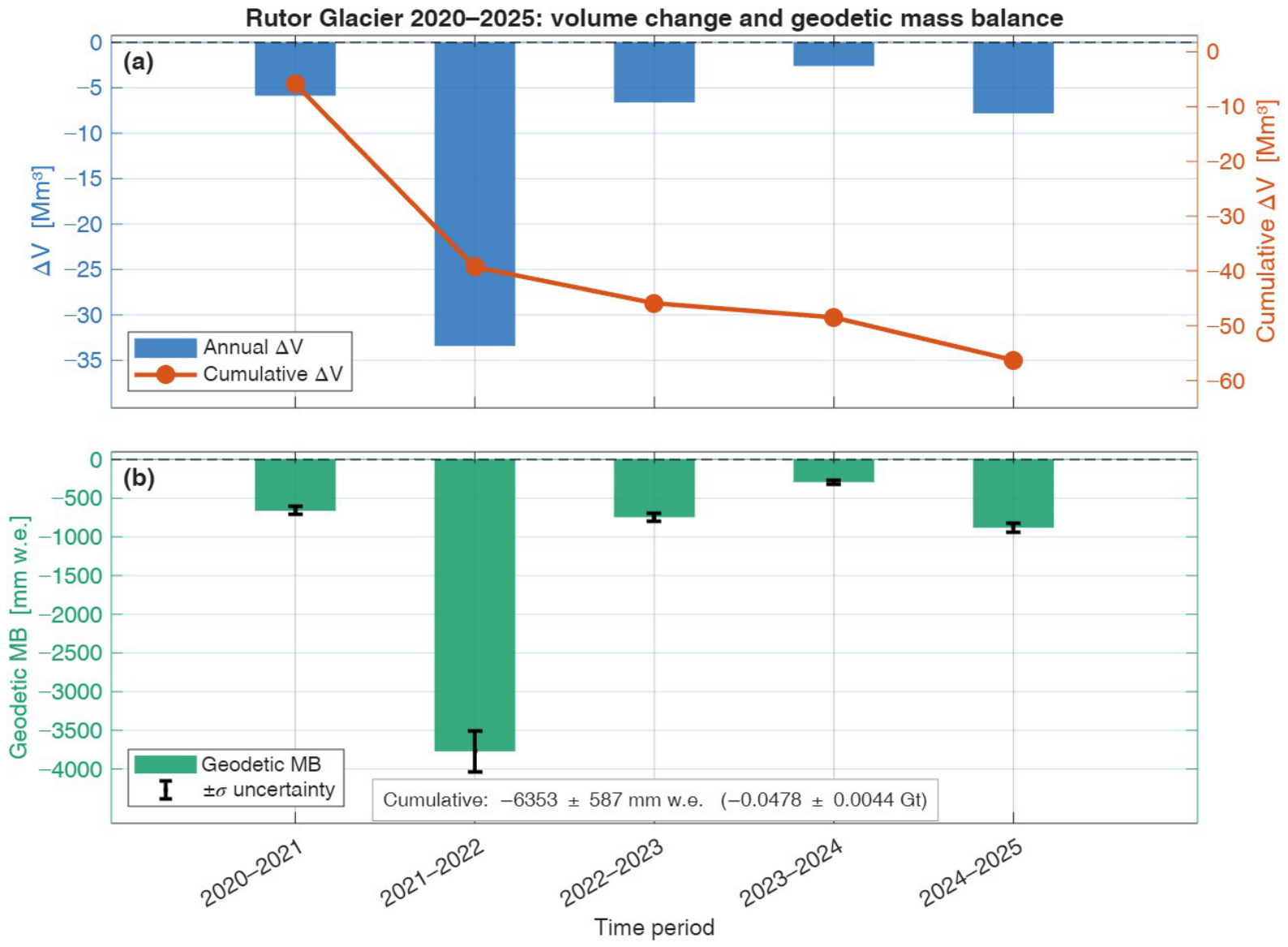
The Rutor Glacier exhibits persistent negative volume changes, with annual losses generally ranging between 3 and 8 Mm
3. The 2021–2022 hydrological year was exceptionally critical due to a dry winter followed by a prolonged, warm summer, resulting in substantially greater ablation than in subsequent years (
Figure 16a). While the 2022–2023 and 2023–2024 periods show a relative reduction in loss, the trend remains negative, indicating continued glacier thinning. The cumulative volume loss over the 2020–2025 period, obtained by summing interannual changes, amounts to 56.29 Mm
3 (
Figure 16a). This trend is dominated by the 2021–2022 extreme event, suggesting that single years of enhanced ablation can exert long-term control over multiannual glacier evolution. Relative uncertainties in annual volume change range from 0.2% to 5%, while the cumulative uncertainty is approximately 6%, confirming that the observed signal is consistently distinguishable from noise.
To evaluate the geodetic mass balance, these volume changes were converted using the adopted density factor. The resulting annual mass balances (
Figure 16b) confirm a robust negative signal. Uncertainties range between
and
mm w.e., remaining consistently below 10% of the observed losses. Even for the extreme 2021–2022 loss (
mm w.e.), the signal-to-noise ratio remains high, ensuring that the detected changes are physically meaningful. The cumulative 2020–2025 mass balance of
mm w.e. provides a clear, quantitative measure of the ongoing rapid deglaciation of the Rutor massif, well-constrained beyond the limits of photogrammetric noise.
6. Discussion and Conclusions
This study demonstrates that multi-temporal aerial photogrammetry, when implemented through a consistent geomatic workflow, provides a robust basis for monitoring Alpine glaciers and deriving geodetic mass-balance estimates. The main contribution of this work does not lie in the introduction of new individual techniques, but in the integration of established approaches into a coherent and reproducible framework including standardized photogrammetric processing, ICP-based validation, DoD analysis over stable periglacial areas, LoD definition, and spatially correlated uncertainty propagation. In this sense, the proposed workflow extends previous applications of photogrammetric glacier monitoring and geodetic mass-balance assessment [
15,
39] by explicitly linking product validation, change detection, and uncertainty quantification within a single operational sequence.
The Rutor Glacier represents a particularly demanding case study because of its large extent, complex topography, steep slopes, variable illumination conditions, and limited accessibility, all of which constrain both field operations and image acquisition geometry. In this context, the analysis of the photogrammetric confidence map proved essential for identifying sectors affected by shadowing, steep terrain, and unfavourable image geometry, and therefore for guiding the selection of stable periglacial areas used in the uncertainty assessment. Restricting the DoD statistics to these areas reduced the influence of poorly constrained sectors and improved the robustness of the derived detection limits and volume-change estimates.
The results also clarify the different roles of ICP-based and DoD-based validation. ICPs remain useful for the internal validation of individual DSMs and for detecting potential systematic biases, but their limited number and uneven spatial distribution make them insufficient, on their own, for robust multi-temporal comparison over large and heterogeneous alpine terrain. Conversely, the DoD-based approach, relying on spatially distributed stable areas, provides a more representative estimate of elevation-change uncertainty. This is particularly important when spatial autocorrelation is explicitly considered, as recommended in geodetic glacier studies [
16]. The adoption of a spatially correlated uncertainty model allowed the propagated errors on volume and mass balance to remain realistic and prevented the severe underestimation that would arise from assuming pixel-wise independence.
From the results perspective, the Rutor Glacier exhibits persistent and spatially coherent thinning throughout the 2020–2025 period, despite marked interannual variability. All analysed intervals are characterised by predominantly negative elevation changes, while the 2021–2022 hydrological year stands out as the most critical phase, owing to substantially enhanced ablation. Although the magnitude and spatial distribution of annual losses vary from year to year, the cumulative DoD provides the clearest representation of glacier evolution and reveals a robust long-term negative signal. This behaviour is coherent with glacier retreat and mass-loss trends reported for the Italian Alps [
40]. Over the full 2020–2025 period, the glacier lost 56.281 Mm
3 of ice volume, corresponding to a geodetic mass balance of
mm w.e., thus providing a well-constrained quantitative measure of ongoing rapid deglaciation.
Importantly, the uncertainty analysis strengthens rather than weakens the interpretation of these results. Stable-area DoDs remain centred close to zero, annual and cumulative changes exceed the corresponding detection limits, and the explicit treatment of spatial autocorrelation yields realistic uncertainty bounds for both volumetric and geodetic mass-balance estimates. The observed signal therefore remains clearly distinguishable from photogrammetric noise, even when conservative assumptions are adopted.
An additional source of uncertainty is related to glacier boundary delineation, particularly in debris-covered areas at the glacier terminus, where the distinction between ice and surrounding terrain relies on geomorphological interpretation of orthophotos and DSMs. While such uncertainty may locally affect volume estimates, its overall impact is limited by the relatively small spatial extent of these sectors compared to the entire glacier.
Beyond the specific case study, the operational value of the proposed approach lies in its ability to transform repeated geomatic surveys into uncertainty-aware products for environmental monitoring. The integration of orthophotos, DoDs, volumetric estimates, and geodetic mass-balance products provides a spatially continuous and reproducible basis for assessing glacier evolution, hydrological implications, and related mountain hazards. In the present case, these geomatic products were also used by ARPA Valle d’Aosta to derive snow water equivalent and mass-balance indicators, showing the practical relevance of the proposed workflow for institutional monitoring activities.
Repeated annual surveys are essential not only for describing long-term trends, but also for capturing extreme years that can disproportionately control multiannual glacier evolution. Future developments should therefore focus on translating uncertainty-aware geomatic products into standardized operational outputs, such as annual indicators of glacier change, DoD maps explicitly filtered by detection limits, and cumulative time series of volume change and geodetic mass balance with associated uncertainty bounds. Such products would improve the comparability of multi-temporal surveys, facilitate communication with environmental agencies and decision makers, and strengthen the operational use of photogrammetric glacier monitoring for climate-impact assessment and glacier-risk management. Although the framework is demonstrated here on an Alpine glacier, its methodological structure is general and can be extended to other glaciated regions where repeated DSMs are available.




 ,
,