Article

Enhanced Marine Radar Oil Spill Detection via Feature Guidance and BBO-SA Hybrid Optimization
1
Naval Architecture and Shipping College, Guangdong Ocean University, Zhanjiang 524091, China
2
Technical Research Center for Ship Intelligence and Safety Engineering of Guangdong Province, Zhanjiang 524088, China
3
Guangdong Provincial Key Laboratory of Intelligent Equipment for South China Sea Marine Ranching, Guangdong Ocean University, Zhanjiang 524088, China
4
Navigation College, Dalian Maritime University, Dalian 116026, China
*
Author to whom correspondence should be addressed.
Remote Sens. 2026, 18(10), 1551; https://doi.org/10.3390/rs18101551
Submission received: 16 April 2026 / Revised: 6 May 2026 / Accepted: 12 May 2026 / Published: 13 May 2026

Highlights

What are the main findings?
  • The unsupervised region-of-interest extraction mechanism proposed in this study combines DBSCAN clustering with three types of features to effectively distinguish between sea clutter and oil film regions under unlabeled conditions.
  • To address the poor adaptability of traditional threshold-based segmentation, an improved BBO-SA hybrid optimization algorithm is introduced. By combining this with an adaptive temperature update strategy based on stagnation detection and suboptimal solution acceptance rates, the algorithm achieves synergistic optimization that balances global search and local exploration.
What are the implications of the main findings?
  • This method provides a technical solution for emergency oil spill monitoring in nearshore waters that requires no large number of labeled samples and can operate automatically, effectively reducing reliance on manual feature design and expert experience while enhancing the robustness and practicality of oil slick detection.
  • By projecting the detection results onto a polar coordinate sector display format, this method enables the integration and fusion of data with electronic nautical charts, the Automatic Identification System (AIS), and other information, thereby providing a reference for oil spill emergency decision-making.

Abstract

X-band marine radar offers unique advantages for monitoring nearshore oil spills. However, oil films and sea clutter exhibit high pixel intensity overlap in radar images. Traditional threshold segmentation and machine learning methods have certain limitations in terms of feature extraction, Region of Interest (ROI) guidance, threshold optimization adaptability, and unsupervised capabilities. To address these issues, a method of oil film detection for ship radar based on multi-dimensional feature-guided extraction and hybrid optimization search is proposed. By combining Density-Based Spatial Clustering of Applications with Noise (DBSCAN) clustering with multidimensional features, this method automatically extracts ROIs under unlabeled conditions, effectively suppressing sea clutter interference. Subsequently, an improved Beaver Behavior Optimizer (BBO) and simulated annealing (SA) hybrid algorithm (BBO-SA) is introduced within the ROIs, along with a designed adaptive temperature update strategy, to achieve coordinated optimization of global and local searches. The experimental results demonstrate that the method described in this paper performs exceptionally well across all evaluation metrics, confirming its accuracy and robustness in oil film detection. It provides a viable technical approach for emergency monitoring of nearshore oil spills.

1. Introduction

The oil spill that occurred in the Gulf of Mexico in early 2026 laid bare the inadequacies of existing oil spill monitoring capabilities. A large number of fishermen in the affected coastal areas lost their livelihoods due to the oil contamination on the sea surface [1]. Once an oil spill occurs, the resulting damage to marine ecosystems, the severe impact on coastal industrial chains, and the potential health threats to coastal communities are often irreversible [2,3]. Therefore, the development of rapid and accurate oil spill monitoring technologies has become a critical priority in the field of marine environmental monitoring [4].
Currently, oil spill monitoring technologies utilizing satellite remote sensing have performed well in large-scale monitoring of oil pollution in the open ocean. However, their application in port areas and other nearshore waters has certain limitations [5]. Marine X-band radar, with its all-weather, long-range, and high spatio-temporal resolution capabilities, can be flexibly deployed in coastal and port areas [6]. It has demonstrated unique potential in oil spill monitoring. However, the raw data collected by radar is contaminated with systematic noise, co-channel interference, and sea speckle noise, resulting in blurred oil film boundaries and the masking of target features. In particular, under the influence of co-channel interference, regular banding artifacts appear in the images. Meanwhile, speckle noise is especially prominent in the near-field region, severely affecting the distinguishability between oil films and sea clutter. In addition, oil films typically appear as dark patches in radar images [7]. However, under certain incident angles or sea conditions, sea clutter may exhibit a similar intensity distribution. The high degree of overlap in pixel intensity between the two further complicates detection [8].
Researchers have conducted extensive studies on oil film detection. For example, the Otsu thresholding method has been applied to separate oil films from the background by maximizing inter-class variance, while the maximum entropy method determines optimal thresholds based on information-theoretic criteria [9]. Nevertheless, these methods are limited in effectiveness. To enhance discrimination capabilities, some scholars have introduced texture features. The Gray-Level Co-occurrence Matrix (GLCM) proposed by Haralick et al. has been widely used to describe the textural differences between oil films and background [10]. Wavelet transforms and multiscale analysis have also been employed to capture the edge and structural features of oil films [11].
With the application of machine learning methods in this field, classifiers such as Support Vector Machine (SVM) and Random Forest (RF) have been employed for oil film detection tasks [12,13]. Nonetheless, these methods rely on a large number of labeled samples, and the difficulty in obtaining real oil spill data limits their generalization ability. Within a supervised learning framework, Li et al. utilized X-band shipborne radar images to extract texture features via the GLCM. They combined this with an SVM to identify effective wave monitoring regions and employed Fuzzy C-Means (FCM) clustering to classify oil films and waves, achieving relatively stable oil film recognition results [14]. Xu et al. proposed an oil spill detection method combining Histogram of Oriented Gradients (HOG) features, an RF classifier, and a Particle Swarm Optimization (PSO) algorithm [15]. To reduce reliance on labeled samples, some studies have shifted toward unsupervised or weakly supervised methods. Some scholars improved the feature description method by replacing traditional HOG with Gradient Location Orientation Histogram (GLOH) features. Combining K-means clustering and iterative adaptive threshold segmentation, they proposed a fully automated oil spill recognition method that enhances segmentation integrity and adaptability in low-contrast scenes [16]. Jia et al. proposed an oil film detection method based on a Growing Hierarchical Neural Network (GHNG) and multi-scale adaptive threshold segmentation by adopting an unsupervised learning approach. Without the need for labeled samples, this method effectively distinguishes oil film regions from background noise and achieves precise extraction of oil film targets by fusing local thresholds across different scales and neighborhoods [17].
Among existing marine radar-based oil slick detection methods, supervised learning approaches rely on large amounts of labeled data, resulting in limited generalization capabilities. Meanwhile, the black-box nature of deep learning methods and their stringent data requirements limit their practical application in maritime scenarios. To address this, this paper proposes an unsupervised learning method for detecting oil spills using marine radar, which combines multidimensional features with hybrid optimization search. The contributions of this study can be categorized into the following four aspects. (1) Construction of a multidimensional radar scattering statistical feature system: Based on the radar scattering mechanism of oil films, three highly interpretable statistical features were designed to characterize the differences between oil films and sea clutter from different dimensions, including the backscatter uniformity index, gradient orientation coherence, and intensity distribution asymmetry. (2) Unsupervised ROI extraction mechanism: By combining DBSCAN clustering with the multidimensional features, this method can automatically identify regions of interest (ROIs) for oil films under unlabeled conditions, effectively suppressing sea clutter interference and reducing the computational complexity of subsequent segmentation. (3) BBO-SA hybrid optimization threshold segmentation: By introducing an improved Beaver Behavior Optimizer (BBO) and simulated annealing (SA) hybrid algorithm within the ROIs, this approach achieves synergistic optimization of global and local searches, thereby enhancing the accuracy and robustness of threshold optimization. (4) Adaptive temperature update strategy: To address the limitation of fixed cooling rates in traditional simulated annealing, a dynamic temperature control mechanism based on stagnation detection and suboptimal solution acceptance rate is designed to balance global exploration and local exploitation within an unsupervised framework.
The experimental results demonstrate that the method proposed here outperforms the comparison methods in terms of detection performance. The subsequent sections are organized as follows: Section 2 describes the materials and methods, and provides a detailed description of the proposed method. Section 3 presents the experimental results. Section 4 provides a discussion of the findings, and Section 5 concludes the paper.

2. Materials and Methods

2.1. Data

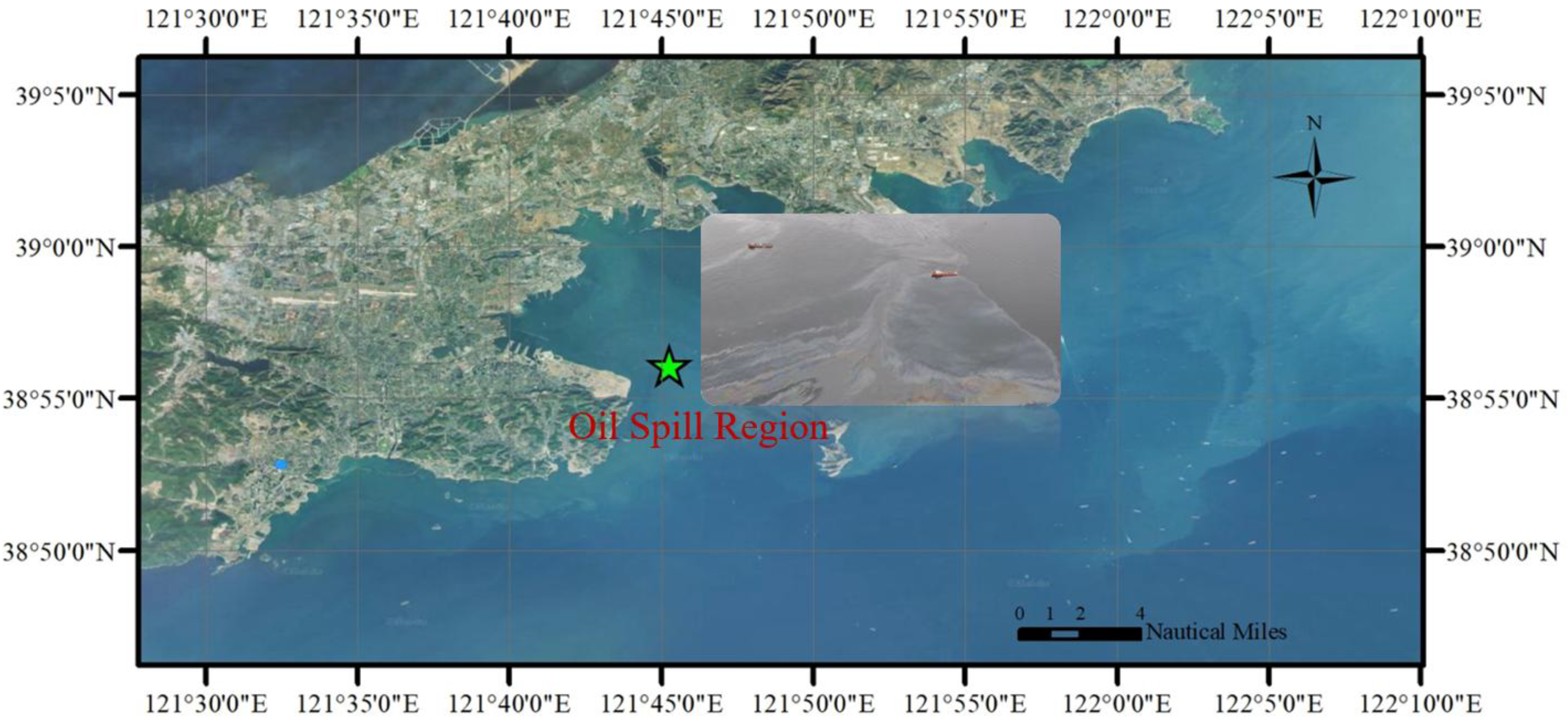
The data was collected by a Sperry Marine B.V. X-band marine radar installed on the Yukun vessel of Dalian Maritime University. During the oil spill cleanup following the 7.16 Dalian oil pipeline explosion, this radar successfully captured images of the crude oil contamination zone formed by leaks from storage tanks and oil tankers. The accident site is shown in Figure 1, and the radar’s main technical parameters are listed in Table 1.
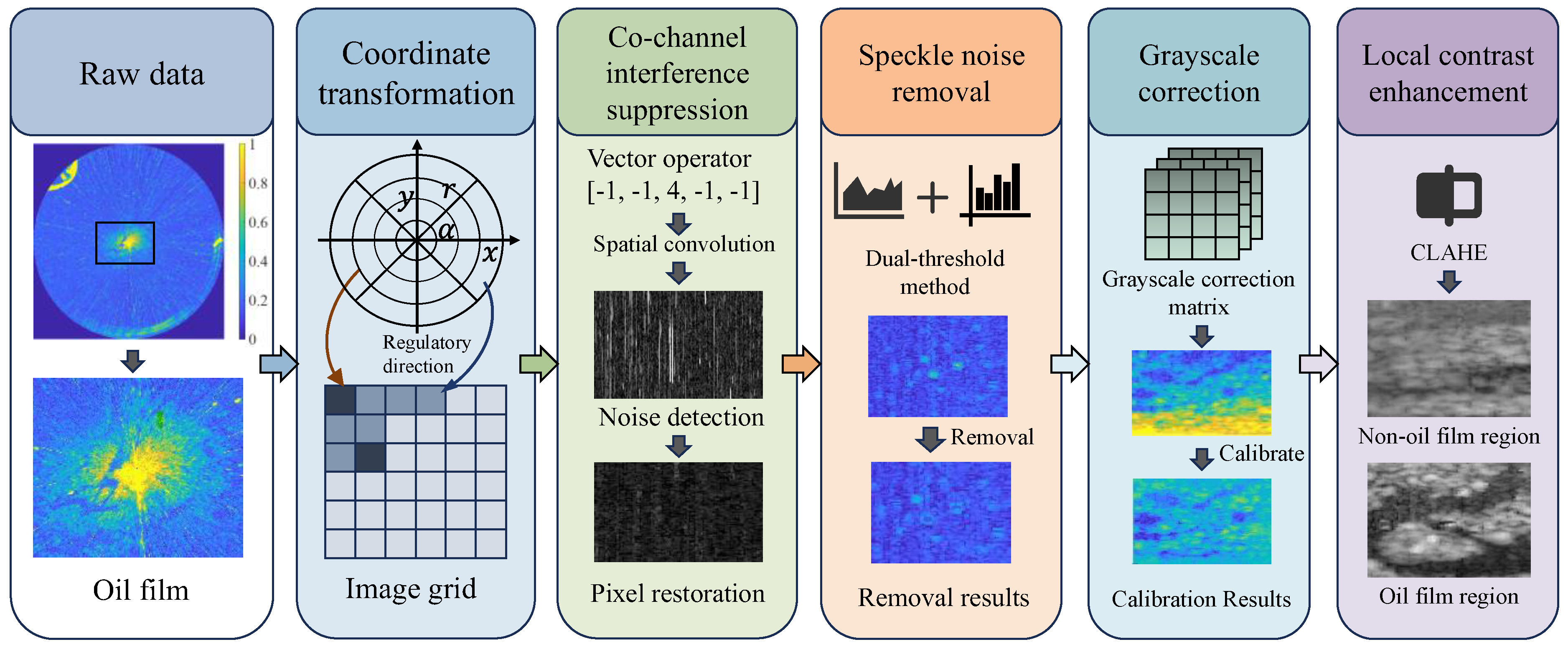
The raw data contains systematic noise and random interference, which requires preprocessing to enhance the Signal-to-Noise Ratio (SNR) and separability of target features. First, the raw radar data is transformed from polar coordinates to Cartesian coordinates and mapped onto a standard image grid. Second, spatial convolution is performed with the row vector operator [−1, −1, 4, −1, −1] to detect and suppress co-channel interference based on adjacent non-noisy pixels. Then, a dual-thresholding method combining gray-level and area thresholds is applied to the lower two-thirds of the image to identify large-area speckle noise. The residual noise is removed via median filtering within local windows. Subsequently, a gray-level adjustment matrix is used to systematically correct the intensity of all pixels. Finally, Contrast-Limited Adaptive Histogram Equalization (CLAHE) is employed to enhance the local contrast of the oil film regions. The preprocessing process is shown in Figure 2.

2.2. Method

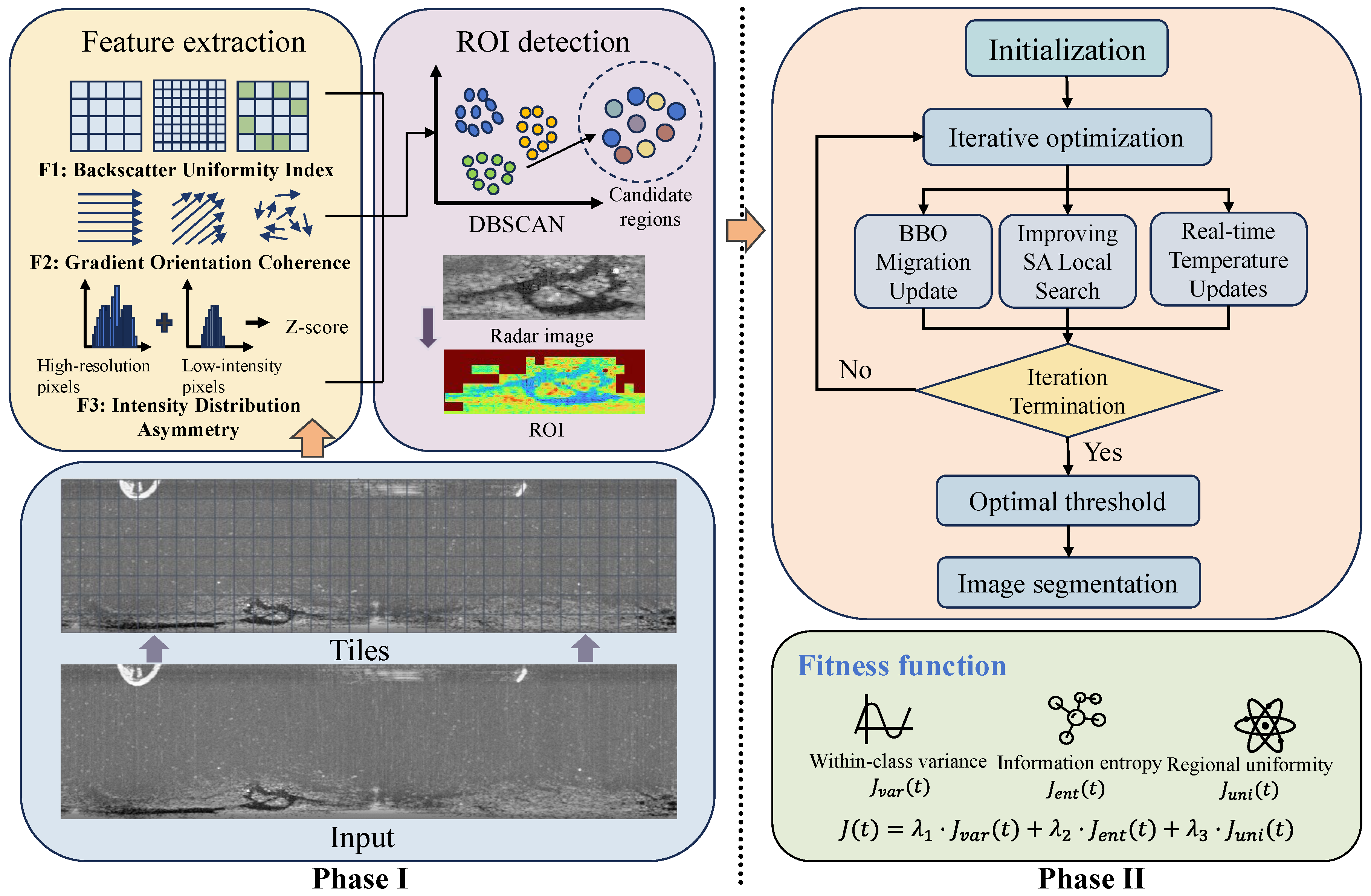
To address the challenges of distinguishing oil films from sea clutter in marine radar images and the limited adaptability of traditional threshold-based segmentation, this paper proposes a detection method that combines physical property-guided segmentation with hybrid optimization search. The technical framework of this method (Figure 3) consists of two stages. The first stage uses multidimensional physical properties to extract ROI through an unsupervised approach. The second stage employs a hybrid optimization algorithm within the ROIs to achieve precise detection of oil films. The key variables and main hyperparameters involved in this method are defined in Appendix A.

2.2.1. Phase 1: ROI Extraction

The first stage is primarily designed to rapidly identify suspicious targets against a background of marine clutter, thereby improving the efficiency of subsequent oil film detection. Specifically, the input image is divided into non-overlapping image blocks, and three physical characteristics are calculated. DBSCAN clustering is then used to classify the image blocks, and the cluster with the poorest backscatter uniformity is selected as the candidate oil film region to generate the ROI [18,19,20].
(1)
Image Tile and Feature Extraction
The input is the oil spill image collected by the radar, denoted as matrix I R H × W , where H represents the image height (number of pixels) and W represents the image width (number of pixels). Divide image I into Nb non-overlapping image blocks of size P × P, where P represents the block size. The number of complete blocks that can be accommodated in the height Hp and width Wp directions of the image is
H p = H P W p = W P
The total number of blocks is N b = H p × W p . The k-th image block is denoted as B k R P × P , where k = 1, 2, …, Nb.
For each image block B k , calculate its statistics: the pixel intensities μ k and variance σ k 2 . Then, a three-dimensional feature vector F k = F 1 , F 2 , F 3 T is constructed.
Feature 1: Backscatter Uniformity Index F1:
An oil film dampens short gravity–capillary waves on the sea surface, resulting in smoother backscattering characteristics compared to the surrounding rough sea clutter. Consequently, oil films typically appear as dark, more uniform regions in radar images. This feature quantifies the regional uniformity of backscattering intensity:
F 1 = 1 σ k 2 μ k + ϵ
where ϵ is a small constant that prevents division by zero. A larger value of F 1 indicates more uniform backscattering (lower variance relative to mean), which is characteristic of oil film regions. Conversely, a smaller value suggests greater heterogeneity, typical of rough sea clutter. This is consistent with the physical principle that oil slicks suppress surface waves, reducing radar backscatter variability.
Feature 2: Gradient Orientation Coherence F2:
While oil film interiors are relatively uniform with weak and randomly oriented gradients, the boundaries between an oil slick and the surrounding seawater typically exhibit consistent gradient directions due to the sharp transition in backscatter intensity. This feature quantifies the degree of gradient orientation coherence within a patch, which is particularly sensitive to boundary regions. First, the gradient matrices Gk(x) and Gk(y) are computed for block B k in the horizontal direction x and the vertical direction y, respectively. Then, the normalized gradient direction vector V k ( x ) and V k ( y ) are computed as
V k ( x ) ( i , j ) = G k ( x ) ( i , j ) G k ( x ) ( i , j ) 2 + G k ( y ) ( i , j ) 2 + ϵ V k ( y ) ( i , j ) = G k ( y ) ( i , j ) G k ( x ) ( i , j ) 2 + G k ( y ) ( i , j ) 2 + ϵ
Compute the mean vectors v ¯ x and v ¯ y of this vector field, and calculate their magnitudes as features:
v ¯ x = 1 P 2 i = 1 P   j = 1 P   V k ( x ) ( i , j ) v ¯ y = 1 P 2 i = 1 P   j = 1 P   V k ( y ) ( i , j )
The gradient direction consistency F2 is
F 2 = v ¯ x 2 + v ¯ y 2
where a higher F 2 value indicates that gradient directions are highly consistent across the patch, which typically occurs at oil film boundaries or edges of other distinct features. A lower F 2 value suggests random gradient orientations, characteristic of uniform oil film interiors or homogeneous sea clutter. Thus, F 2 complements F 1 by providing boundary-specific information.
Feature 3: Intensity Distribution Asymmetry F3:
Oil films typically appear as dark patches (low backscatter) due to wave damping, while occasionally bright patches may arise from specular reflection at specific incidence angles. This feature captures the asymmetry in the distribution of high- and low-intensity pixels within a block.
First, empirical thresholds T k h i g h and T k l o w are calculated based on intra-block statistics:
T k h i g h = μ k + 0.5 σ k T k l o w = μ k 0.5 σ k
Then, the pixel intensity distribution is calculated, N k h i g h represents the count of high-intensity pixels and N k l o w represents the count of low-intensity pixels:
N k h i g h = ( i , j ) B k ( i , j ) > T k h i g h N k l o w = ( i , j ) B k ( i , j ) < T k l o w
After that, calculate the features F3:
F 3 = N k h i g h N k l o w P 2
where a positive value for F3 indicates that high-intensity pixels dominate, a negative value indicates that low-intensity pixels dominate, and a value close to zero indicates a balanced distribution.
Finally, construct a feature matrix from all the extracted feature vectors. Perform Z-score normalization on each column of the matrix.
(2)
DBSCAN Clustering and ROI Extraction
The DBSCAN clustering algorithm is applied to the normalized feature matrix, with parameters set to a neighborhood radius of ε = 0.3 and a minimum number of samples of Nmin = 5. After clustering, category labels L k { 1,0 , 1,2 , } are obtained, L k = 1 indicates a noise point and L k 0 indicates a cluster label.
For each valid cluster c, compute the mean f ¯ c ( 1 ) of all its blocks with respect to the original feature F1:
f ¯ c ( 1 ) = 1 { k L k = c } k : L k = c   F 1
Sort the clusters in ascending order of f ¯ c ( 1 ) . Select the cluster with the smallest value of f ¯ c ( 1 ) as a candidate oil film cluster, and label it as coil.
Create a binary mask matrix M R O I { 0,1 } H × W of the same size as the original image, and initialize all elements to 0. For all blocks satisfying Lk = coil, set all pixel values in the corresponding region of the mask to 1. Then, perform morphological post-processing to obtain the final ROI mask.
(3)
The Pseudocode of the ROI Extraction Algorithm is Presented in Algorithm 1
Algorithm 1: ROI Extraction
Input: Radar image I, patch size P, DBSCAN (ε, Nmin)
Output: ROI mask M R O I
1. Divide I into P × P patches B k
2. for each patch B k do
3.    Compute mean μ k and variance σ k 2
4.    Extract three features: F1, F2, F3
5. end for
6. Normalize the feature matrix and perform DBSCAN clustering
7. Select the cluster with the smallest mean F1 as the oil candidate
8. Generate ROI mask M_ROI via morphological post-processing

2.2.2. Phase 2: Oil Film Detection

In the second stage, the improved BBO-SA hybrid optimization algorithm will be applied to ROI. The optimal threshold will be determined through automatic optimization to achieve accurate detection of oil film [21,22,23].
(1)
ROI Effective Pixels Extraction and Threshold Optimization Modeling
Based on the ROI mask M R O I , the intensity values of all pixels marked as regions of interest are extracted from the original image to form the set G . Let g m i n = m i n ( G ) and g m a x = m a x ( G ) . The optimization objective is to find the optimal threshold t* ∈ [ g m i n , g m a x ] that maximizes the composite fitness function J(t).
G = I ( x , y ) M R O I ( x , y ) = 1
(2)
Fitness Function
For a candidate threshold t g m i n , g m a x , partition the set G into two subsets. Foreground (suspected oil film) set, Background (sea surface) set. Compute the weights ω 1 ( t ) , ω 2 ( t ) , the means μ 1 ( t ) , μ 2 ( t ) , and the variances σ 1 2 ( t ) , σ 2 2 ( t ) . Define the composite fitness function J ( t ) :
J ( t ) = λ 1 J v a r ( t ) + λ 2 J e n t ( t ) + λ 3 J u n i ( t )
where λ 1 , λ 2 and λ 3 are predefined non-negative weighting coefficients that satisfy λ 1 + λ 2 + λ 3 = 1 . Empirically, these weights are set to λ 1 = 0.5 , λ 2 = 0.3 and λ 3 = 0.2 prioritizing between-class variance while incorporating entropy and uniformity as complementary terms. The three sub-functions are distributed as follows:
Within-class variance J v a r :
J v a r ( t ) = ω 1 ( t ) ω 2 ( t ) μ 1 ( t ) μ 2 ( t ) 2
Information Entropy J e n t :
J e n t ( t ) = ω 1 ( t ) l n ( ω 1 ( t ) + ϵ ) ω 2 ( t ) l n ( ω 2 ( t ) + ϵ )
Regional uniformity J u n i :
J u n i ( t ) = 1 1 + σ 1 2 ( t ) + σ 2 2 ( t )
(3)
BBO-SA Hybrid Optimization Framework
(a) Initialization
Set the population size Spop to 20, the maximum number of iterations Imax to 50, the initial temperature T0 to 100, the temperature coefficient α to 0.95, and the number of internal SA iterations Isa to 10. Generate the initial population randomly. Calculate the initial fitness, determine the current optimal threshold tbest, and its fitness Jbest.
(b) Iterative optimization
BBO Migration Phase: For the i-th individual in the population (threshold ti), a random individual t j (ji) is selected. If ( t j ) > J ( t i ) , migration occurs. A random step size δ 1,0,1 is generated, and a new solution is then produced t i ( n e w ) :
t i ( n e w ) = t i + δ ( t j t i )
Then, process the boundaries:
t i ( n e w ) = m i n m a x t i ( n e w ) , g m i n , g m a x
If J t i ( n e w ) > J t i , then replace t i with t i ( n e w ) .
Improved SA Phase: Using the current global optimal solution t b e s t as the initial solution, perform I s a iterations of the SA search. The specific process is as follows. Set the current solution t c u r = t b e s t and the current fitness Jcur = Jbest. During the inner loop of SA, generate a new solution t n e w based on t c u r using adaptive perturbation. Determine whether to accept the new solution according to the Metropolis criterion. If accepted, update t c u r to t n e w and J c u r to J ( t n e w ) . Upon completion of the SA inner loop, if J c u r > J b e s t , update the global optimal solution t b e s t to t c u r and J b e s t to J c u r .
Calculate the perturbation range R :
R = m a x ( 1 , T / 10 )
where T represents the current temperature.
Generate a new solution t n e w , and restrict the solution to the range g m i n , g m a x .
t n e w = t c u r + Δ , Δ Uniform R , R
where Δ denotes the SA perturbation step size.
Calculate the change in fitness Δ J :
Δ J = J ( t n e w ) J c u r
If Δ J > 0 or the random number r Uniform ( 0,1 ) < e x p ( Δ J / T ) , then accept the new solution. If J c u r > J b e s t , then set t b e s t = t c u r and J b e s t = J c u r .
(c) Adaptive Temperature Update Strategy
An adaptive temperature update strategy based on search state awareness for the simulated annealing phase of the hybrid optimization algorithm was proposed. By monitoring the algorithm’s operational state, this strategy dynamically switches between three temperature update modes, effectively balancing global exploration and local exploitation capabilities.
  • State monitoring variables
Stagnation counter S stag records the number of consecutive iterations in which no better solution has been found.
Acceptance counter Acount records the number of times a suboptimal solution (resulting in a decrease in fitness) has been accepted during the current SA inner loop.
  • Multi-mode temperature update (executed in order of priority)
Heating mode (escape from local optima): When S stag S t h ( S t h is the stagnation threshold), get the new temperature T new :
T new = T current × β inc , β inc > 1
where T current is the current temperature, β i n c is the heating coefficient, and the Sstag is reset to 0.
Accelerated cooling mode (to promote convergence): If the heating mechanism has not been triggered, calculate the acceptance rate for suboptimal solutions R a c c :
R a c c = A c o u n t / I s a
where R t h is the acceptance rate threshold.
When R a c c > R t h , perform the following:
T new = T current × β d e c , 0 < β d e c < 1
where β d e c is the accelerated cooling coefficient.
Standard nonlinear cooling mode (equilibrium search): If none of the above conditions are met, the following is used:
T new = T 0 l n ( 2 + i t e r ) α i t e r
where T 0 is the initial temperature, i t e r is the current iteration number, and α is the decay coefficient.
  • State variable updates
In each main iteration, if the global optimum remains unchanged, the stagnation counter S stag increments by 1. Otherwise, it resets to 0. Concurrently, before each SA inner loop, the acceptance counter A count resets to zero, and it increments whenever a suboptimal solution is accepted.
This strategy overcomes the limitation of fixed cooling rates in traditional simulated annealing algorithms. Through a dual feedback mechanism combining stagnation-aware and temperature-jump with acceptance-rate-aware and dynamic cooling, it achieves adaptive adjustment of search behavior. This effectively improves convergence speed and solution accuracy while ensuring global search capability.
(d) After the iteration is complete, output the global optimal threshold t * .
(4)
The Pseudocode of the BBO-SA Threshold Optimization Algorithm is Presented in Algorithm 2
Algorithm 2: BBO-SA Threshold Optimization
Input: ROI mask M R O I , BBO-SA parameters
Output: ROI mask M R O I Binary oil film mask
1. Extract pixel set G = I ( x , y ) M R O I ( x , y ) = 1 , N R O I = | G |
2. Initialize beaver population t i u n i f o r m l y i n [ m i n ( G ) , m a x ( G ) ]
3. Compute fitness for each t i using Equation (11)
4. Initialize temperature T = T 0
5. for i t e r = 1 to I m a x do
6.    //BBO migration
7.    for each beaver i do
8.     t n e w = t i + r a n d ( 1,1 ) · ( t j t i )
9.    if f i t n e s s ( t n e w ) > f i t n e s s ( t i ) then t i = t n e w
10.    end for
11.    //SA local search
12.    for step = 1 to S i t e r do
13.    t c a n d = t c u r + r a n d δ , δ with δ T
14.   if f i t n e s s ( t c a n d ) > f i t n e s s ( t c u r ) or r a n d < e x p ( Δ E / T ) then
15.     t c u r = t c a n d
16.   end if
17.    end for
18.    //Adaptive temperature update
19. Update T using stagnation detection and suboptimal acceptance rate
20. end for
21. Segment using optimal threshold t* within ROI

2.3. Evaluation Indicators

The following quantitative evaluation metrics are employed in this study: Accuracy, Recall, Precision, F1 score, and Mean Intersection over Union (mIoU). These metrics, which are defined as follows, capture the detection performance of the model from different perspectives [24,25].
A c c u r a c y = T P + T N T P + F P + F N + T N
Recall = T P T P + F N
P r e c i s i o n = T P T P + F P
F 1 = 2 Precision × Recall Precision + Recall
m I o U = 1 K k = 1 K   T P k T P k + F P k + F N k
where TP (True Positive) is the number of oil film pixels correctly identified, FP (False Positive) is the number of non-oil film pixels incorrectly classified as oil film, TN (True Negative) is the number of non-oil film pixels correctly identified, and FN (False Negative) is the number of oil film pixels that were not detected.

3. Results

The experimental environment used in this study is as follows: The hardware platform consists of an NVIDIA GeForce GTX 3050 graphics card (NVIDIA Corporation, Santa Clara, CA, USA), an Intel Core i5-12490F processor (Intel Corporation, Santa Clara, CA, USA) with base frequency 3.0 GHz and maximum Turbo Boost 4.60 GHz. The software platform is MATLAB R2024b.

3.1. Data Preprocessing Results

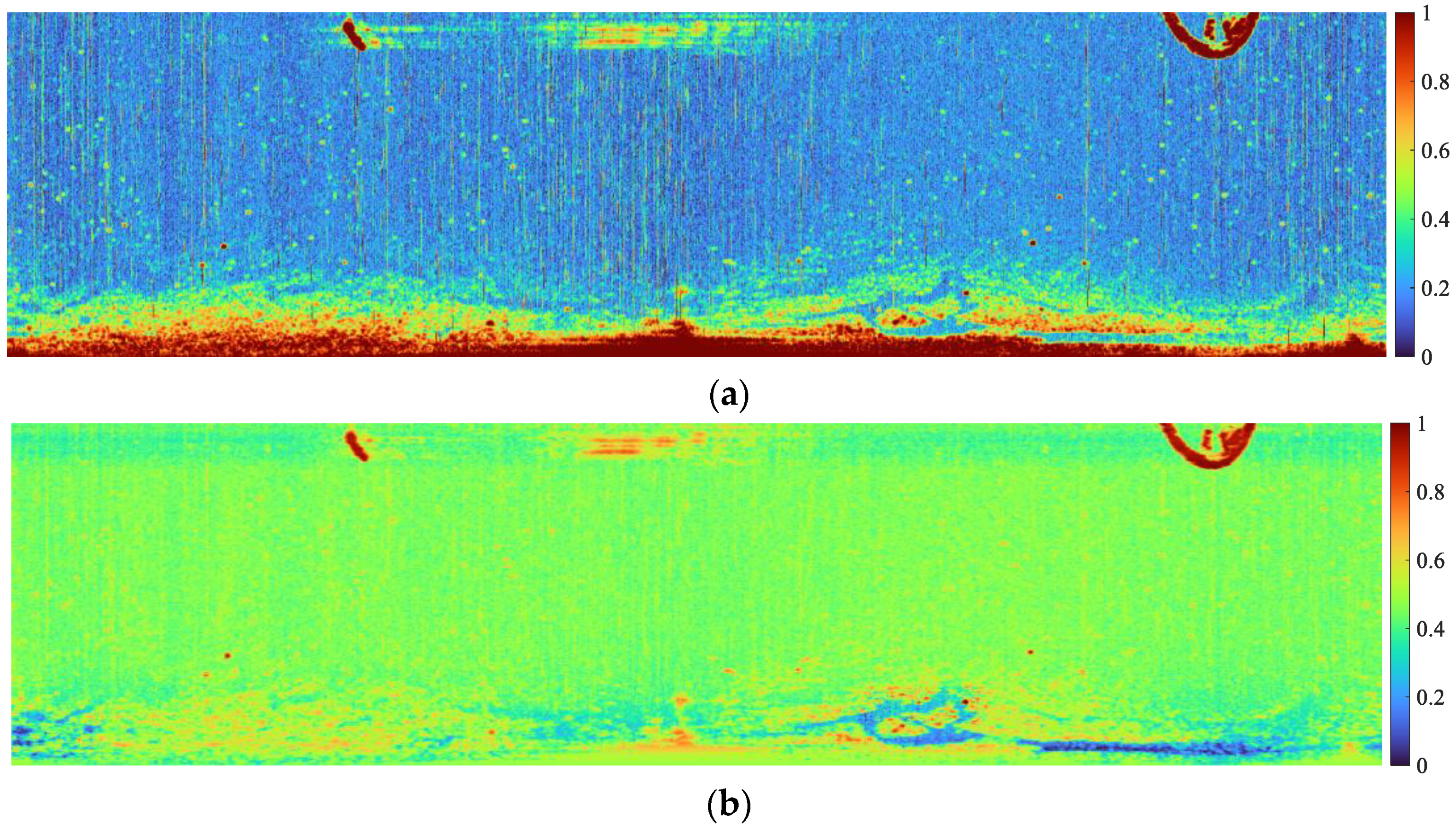
Data samples before and after preprocessing are shown in Figure 4. After preprocessing, background noise in the data images is significantly suppressed, and target features become clearer and more distinguishable. The raw radar data is transformed from polar coordinates to Cartesian coordinates and mapped onto a standard image grid. This operation eliminates the geometric distortion inherent in the polar coordinate format, ensuring that the spatial distribution of the oil film corresponds precisely to its actual geographic location. At the same time, this provides a unified data format for subsequent image processing operations such as spatial convolution, median filtering, and CLAHE. The results show that co-channel noise has been greatly suppressed. After spatial convolution processing, the co-channel interference artifacts have largely disappeared. The background is more uniform, and the oil film-sea clutter distinction is significantly improved. The combined application of dual-thresholding and median filtering substantially reduces speckle noise in the image, resulting in more continuous and distinct oil film edges. CLAHE further enhances the local contrast between the oil film and seawater, revealing the texture details of the oil film within low-contrast regions of the original image. Overall, the noise level in the preprocessed image is significantly reduced, and the oil film features are clearly highlighted.

3.2. The Result of ROI

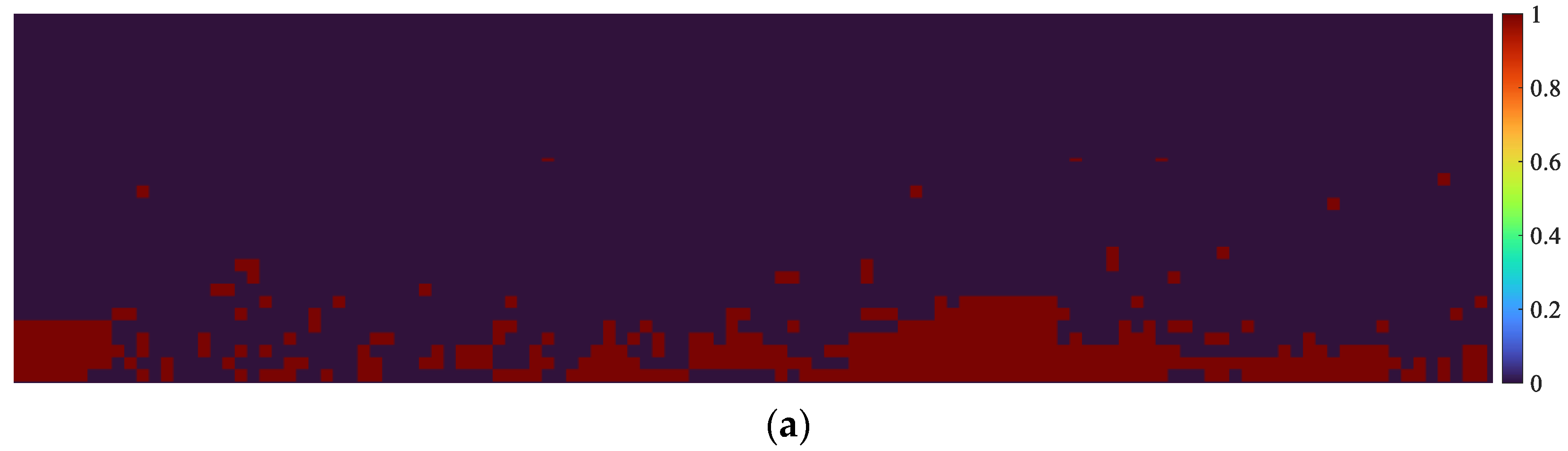
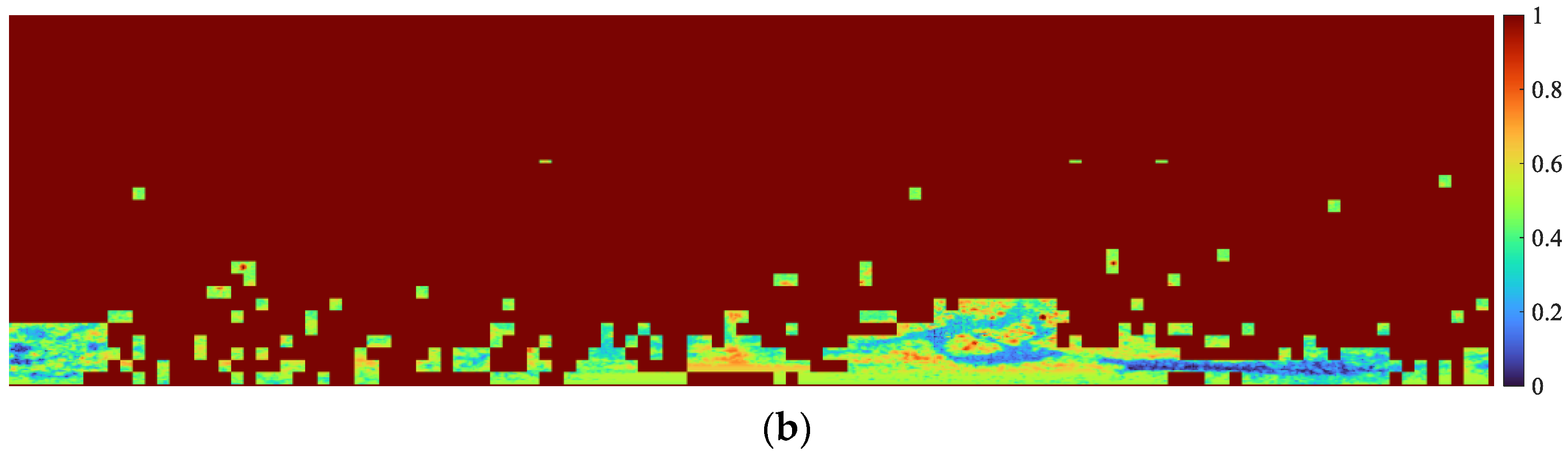
ROI extraction was performed on the preprocessed radar images, with the results shown in Figure 5. First, the image was divided into P × P non-overlapping image patches. Calculate the three physical properties for each block, construct a feature matrix, and perform Z-score normalization. Then, the DBSCAN clustering algorithm is applied to the normalized feature matrix to partition the image blocks into several clusters and noise points. The clusters are sorted in ascending order based on their mean backscatter uniformity index, and the cluster with the poorest uniformity is selected as the candidate region for the oil film. The image blocks corresponding to the candidate cluster are mapped back to the original image to generate a binary mask. Subsequently, morphological post-processing is applied to connect adjacent discrete blocks and smooth the boundaries, ultimately yielding the ROI mask.
The results demonstrate that the proposed method can effectively identify the primary distribution areas of oil films, reliably separating oil film targets from other strong interfering targets while eliminating most sea clutter interference. The generated ROI mask provides an accurate and compact search space for subsequent threshold segmentation. Although the method described in this paper performs well in extracting the main oil film regions, there remains an issue of insufficient recognition for thin oil films in certain areas where the backscatter signal is weak.

3.3. Oil Film Detection Results

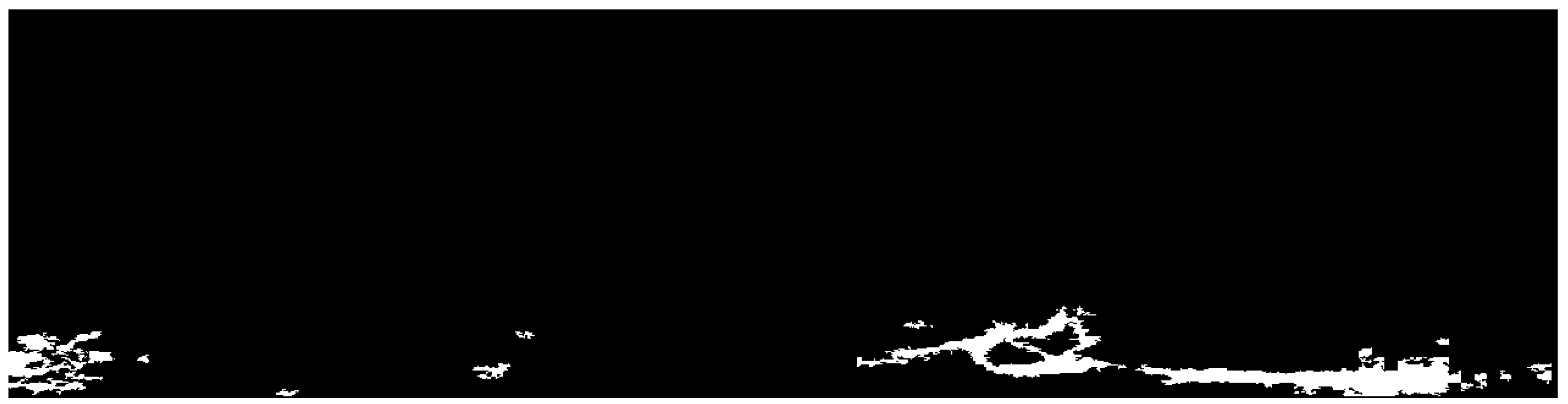
The oil film detection results are shown in Figure 6. Using the BBO-SA hybrid optimization algorithm to find the optimal threshold t * , binary segmentation of the image is performed within the search area defined by the ROI mask. Regions with pixel intensities below the threshold are identified as oil films, generating a binary oil film mask. Subsequently, morphological post-processing is performed on the segmentation results to eliminate the influence of ship wake areas and isolated noise.
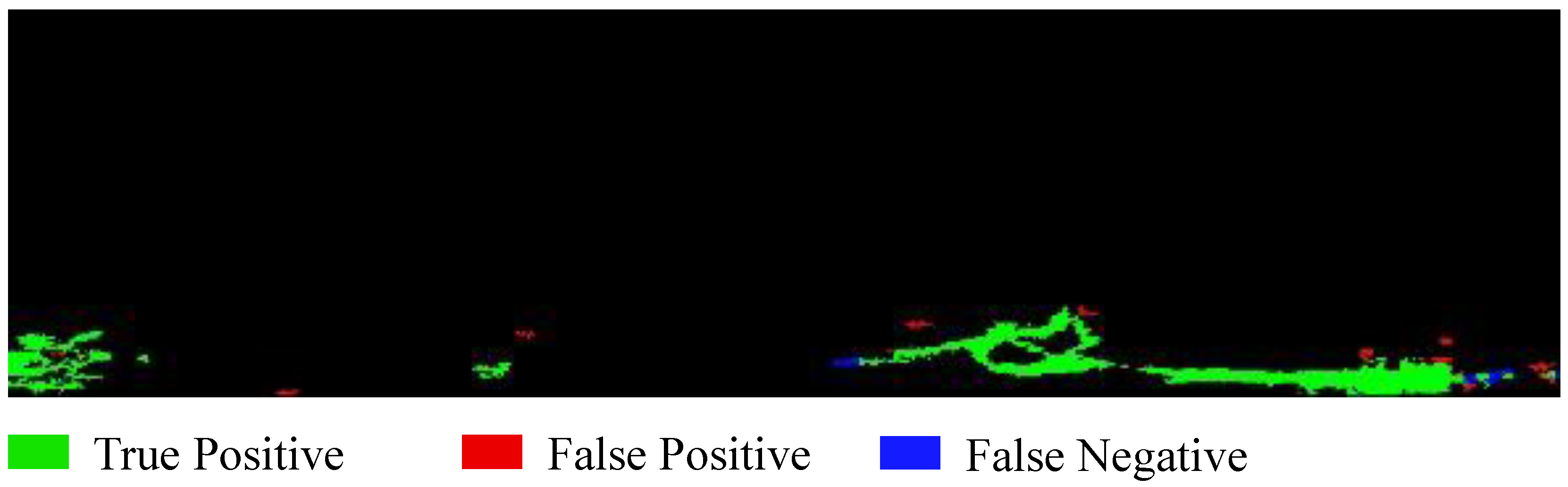
The difference between labels and results is shown in Figure 7. The results demonstrate that the method proposed here can effectively identify the distribution of oil films in radar images. The main contours of the oil film are intact and well-defined, forming a striking visual contrast with the sea clutter background, and the geometric shape of the oil film area is accurately reconstructed. Compared with the original image and the image that underwent only preprocessing, false positive targets are effectively suppressed in the final detection results. Localized strong scattering points caused by broken sea waves, as well as oil film-like artifacts generated by some floating debris on the sea surface, are effectively excluded in the segmentation results of our method. At the same time, the detection integrity of the main oil film area is not significantly affected. Missed detections are primarily concentrated in the gradual transition zones at the periphery of the oil film and in areas with extremely thin oil films, which have a limited impact on the overall assessment of the pollution extent. In a ship wake, propeller disturbance often produces low-backscatter streaks resembling oil films, which conventional threshold segmentation easily misidentifies as oil spills. This method significantly reduces interference in this area. However, some ship wake regions with shapes highly similar to oil films still exhibit a certain degree of false positives, and the recognition capability in this regard requires further improvement.
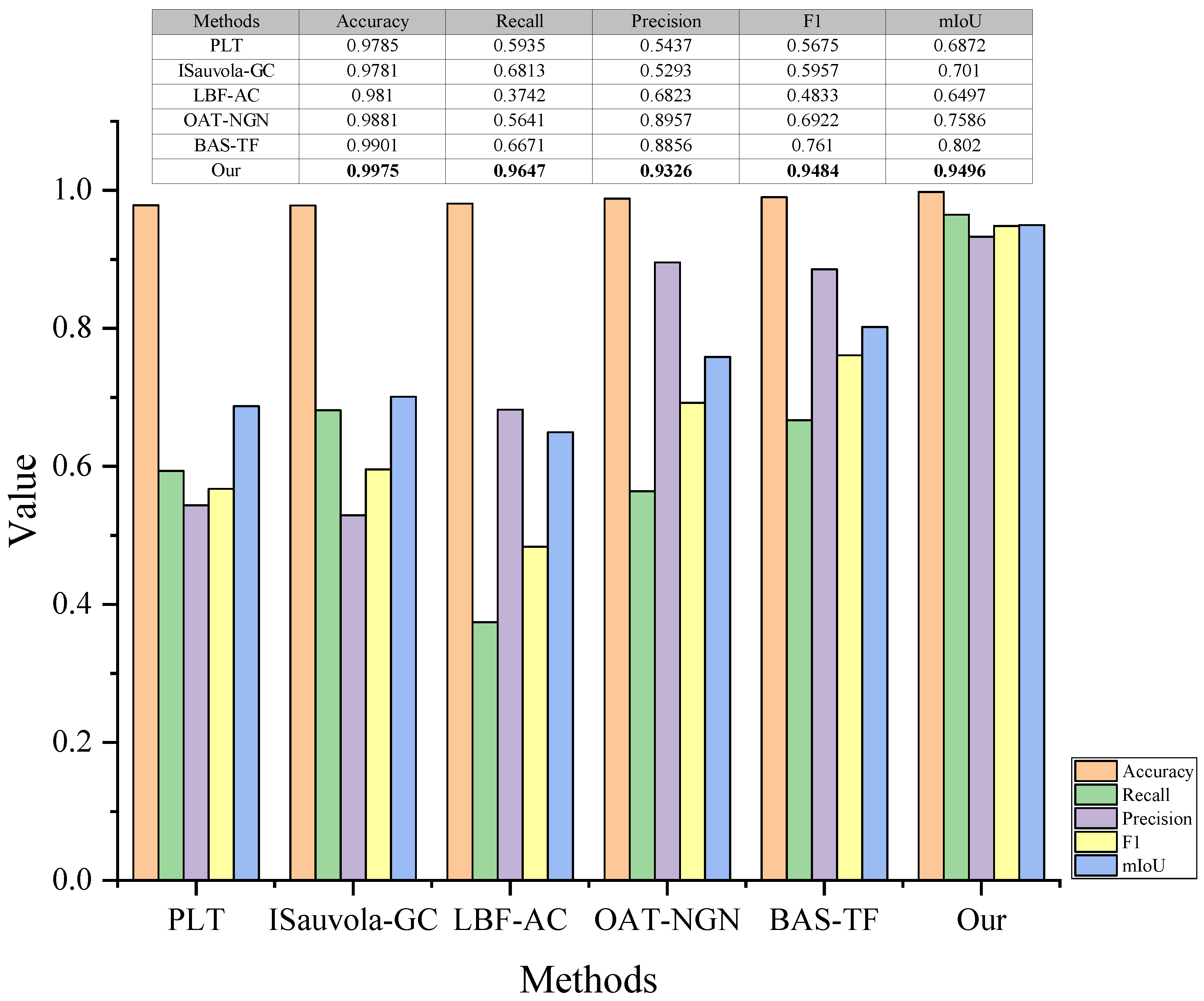
The quantitative evaluation results are shown in Table 2, which further confirms the above observations. The overall accuracy of the method described reaches 0.9975, indicating that the model achieves a high overall classification accuracy for oil films and background pixels. Specifically, the recall rate is 0.9647, indicating that approximately 96.47% of actual oil film pixels were successfully detected, with a false negative rate of 3.53%. This high recall is primarily attributed to the accurate ROI guidance provided by the DBSCAN-based extraction mechanism, which effectively preserves the main oil film area while suppressing background clutter. This result is highly consistent with visual observations of complete detection of the main oil film area. The precision is 0.9326, meaning that approximately 6.74% of the pixels detected as oil films are false positives. These false positives originate mainly from ship wakes, which produce low-backscatter streak patterns that closely resemble oil films in appearance, consistent with the previous analysis. The F1 score is 0.9484, which balances recall and precision. This indicates that the method achieves a reasonable balance between minimizing false negatives and suppressing false positives. Furthermore, the mIoU reaches 0.9496, further validating the overall accuracy of this method in the oil film and background segmentation task.

3.4. Calculation Efficiency Evaluation

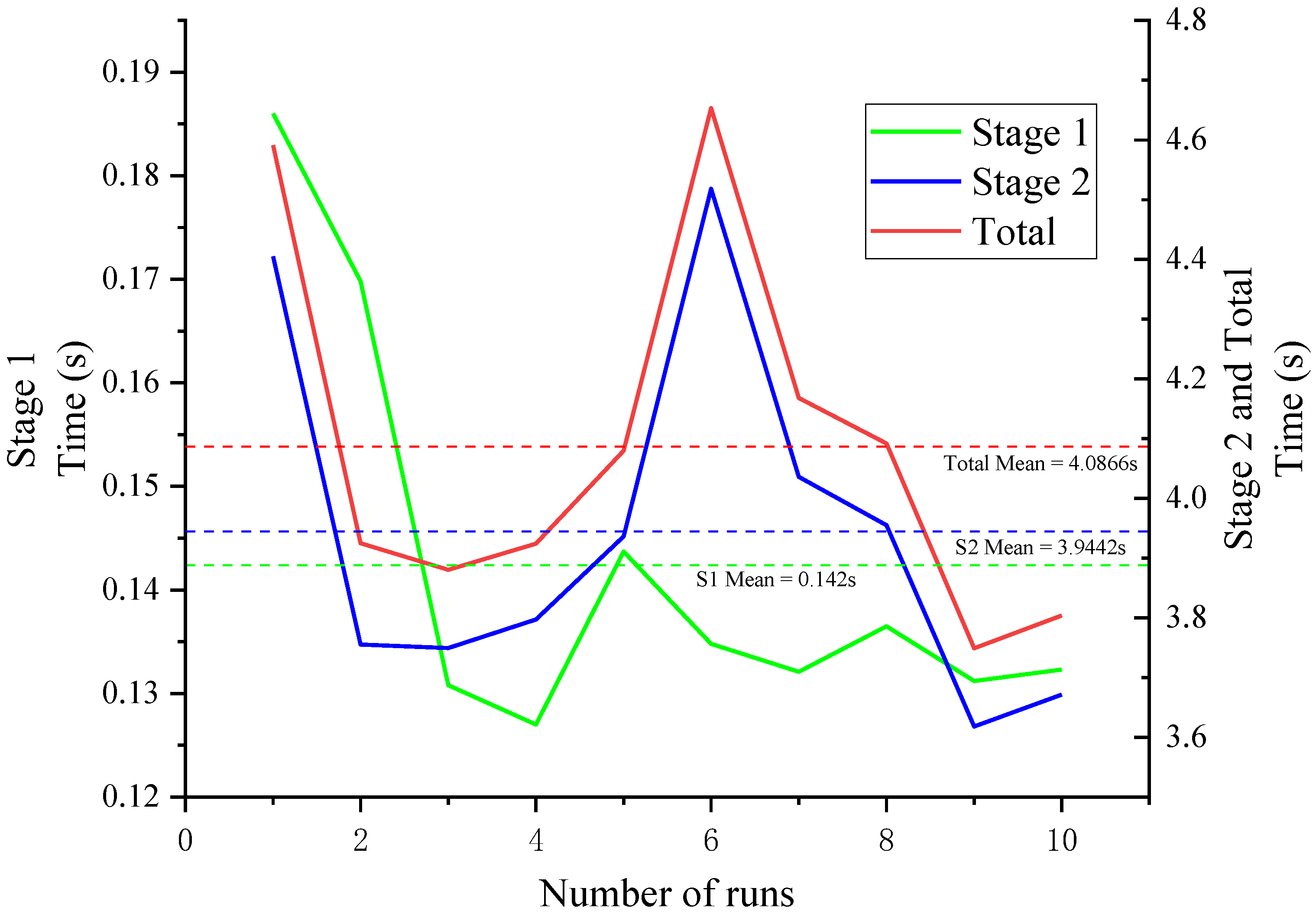
Based on the experimental environment described at the beginning of this section, 10 independent runs were conducted on oil spill images, and the processing times for each stage are shown in Figure 8. The average total processing time for a single frame using the method described in this paper is 4.0866 ± 0.3111 s. Among these, ROI extraction in Stage 1 takes 0.1424 ± 0.0196 s, accounting for about 3.5% of the total time, indicating that the unsupervised ROI extraction mechanism is highly computationally efficient. The BBO-SA optimization in Stage 2 took 3.9442 ± 0.3031 s, constituting the primary computational bottleneck. The small standard deviation across the 10 runs indicates stable computational performance. Considering that the spread of oil spills on the sea surface is a slow process (on the order of hours to days), a processing delay of approximately 4 s can meet the requirements for near-real-time emergency monitoring.

3.5. Result Mapping

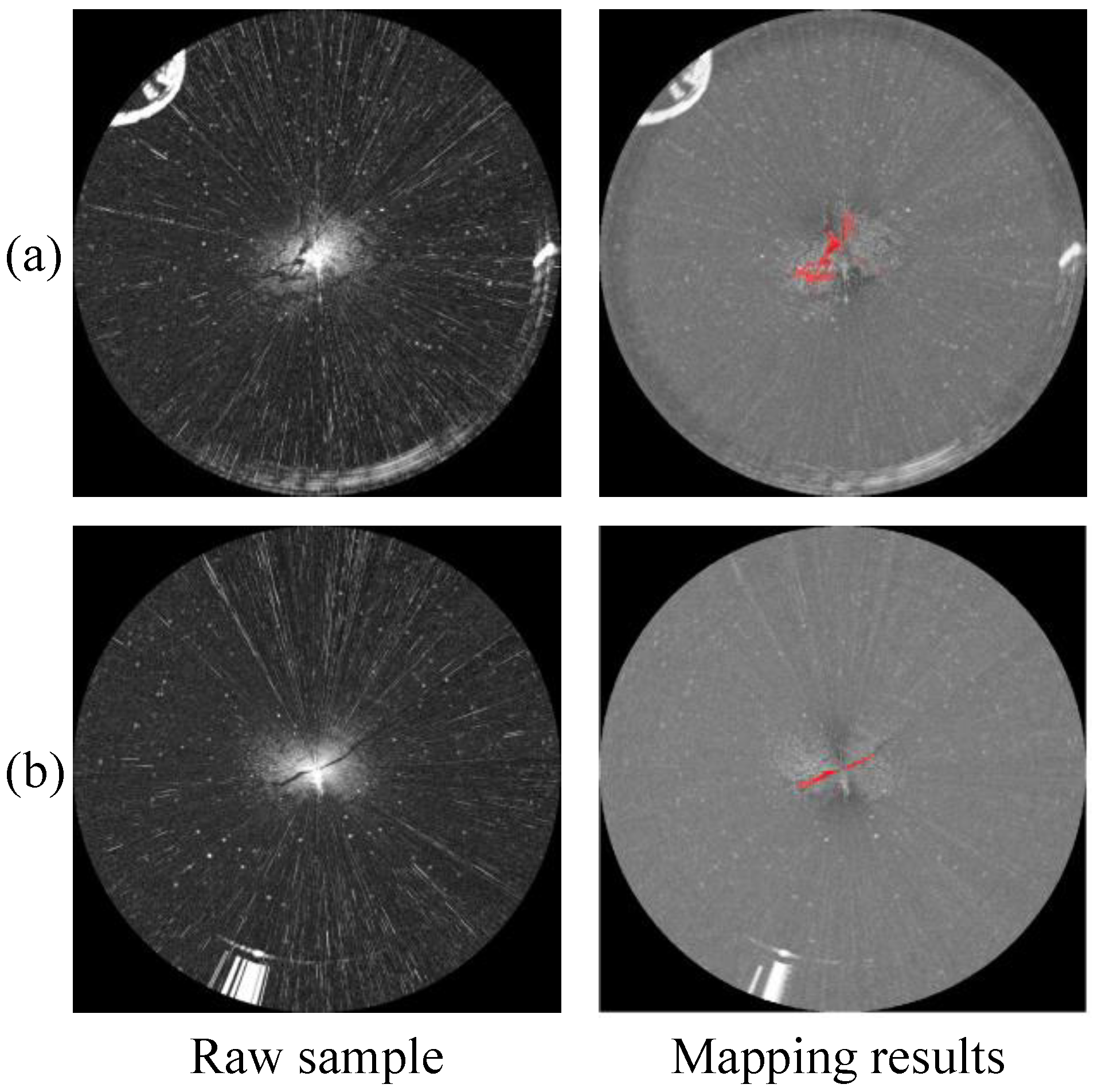
To verify the effectiveness of this method in oil spill monitoring and emergency response, another dataset was processed using the same steps, and the results confirmed that the method is equally applicable. To facilitate practical application and interpretation of the results, the final binary mask of the oil slick was transformed from the Cartesian coordinate system to the polar coordinate system, and the image was reconstructed using bilinear interpolation. The results are shown in Figure 9. The display in this coordinate system aligns with the visual habits of marine radar operators, intuitively reflecting the azimuth and distance distribution of the oil slick relative to the vessel. This facilitates overlaying with navigation information such as electronic charts and the Automatic Identification System (AIS), providing a reference for oil spill emergency decision-making. Subsequent discussions will be based on the data shown in Figure 9a.

4. Discussion

4.1. Computational Complexity Analysis

The computational complexity of this method consists of two stages.
(1)
Stage 1
Assuming the input image size is H × W, the block size is P × P, and the number of blocks is N b = H W / P 2 . The complexity of feature extraction is O H W . The complexity of DBSCAN clustering is O ( N b l o g N b ) = O ( H W l o g H W ) . The complexity of morphological post-processing is O H W . Therefore, the overall complexity of Phase One is O H W l o g H W .
(2)
Stage 2
Set the number of pixels in the ROI to N ROI , the population size to P size , the maximum number of iterations to I m a x . The fitness evaluation for a single threshold requires O N ROI operations. In each generation, the BBO update step has a complexity of O P size N ROI , and the SA local search step has a complexity of O S iter N ROI . Therefore, the overall complexity of Phase 2 is O I m a x P size + S iter N ROI .
In actual parameter settings, I m a x = 50 , P size = 20 and S iter = 10 . Therefore, O ( Stage   2 ) = O 50 × 30 × N ROI = O 1500 N ROI . Due to the fact that the ROI area N ROI is much smaller than the full image area HW (typically 10–20% of the image), the computational complexity of stage two is significantly lower than that of the mixed optimization of full image search.

4.2. Sensitivity Analysis of DBSCAN Parameters

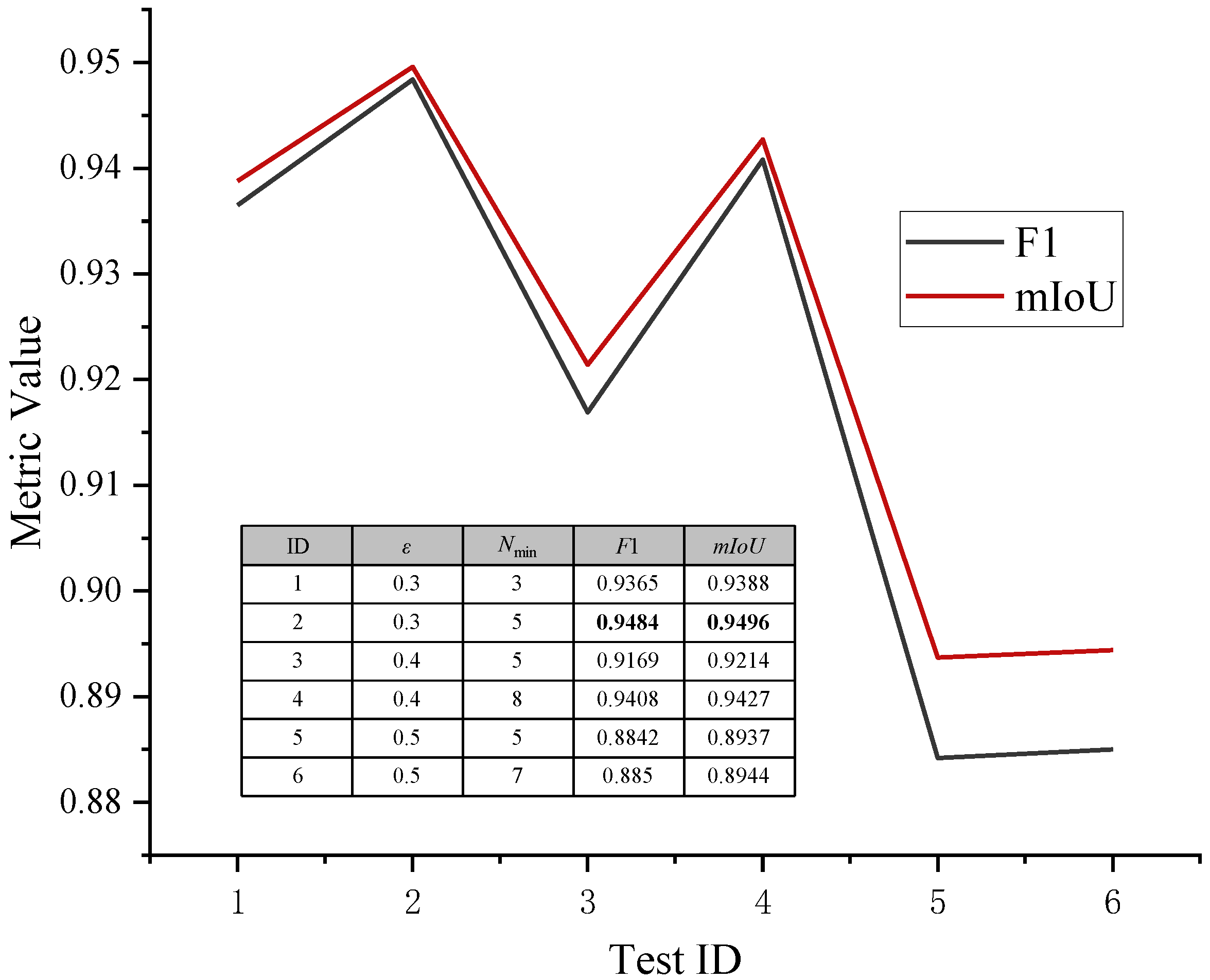
The DBSCAN clustering algorithm is relatively sensitive to the selection of the neighborhood radius ε and the minimum number of samples Nmin. In this study, the default parameters were set to ε = 0.3 and Nmin = 5. To evaluate the robustness of this parameter configuration, six combinations were further tested, with ε set to 0.3, 0.4, and 0.5, and Nmin set to 3, 5, 7, and 8. The impact of the ROI extracted under each combination on the quantitative results of the final oil film recognition is shown in Figure 10.
As shown in Figure 10, the default parameters (ε = 0.3, Nmin = 5) achieved the best performance, with an F1 score of 0.9484 and an mIoU of 0.9496. When ε is increased to 0.5, detection performance drops significantly (F1 decreases to 0.88–0.89), indicating that an excessively large neighborhood radius leads to the inclusion of excessive noise in the clusters, thereby reducing the quality of ROI extraction. In contrast, when ε ≤ 0.4 and Nmin = 3–8, F1 consistently exceeds 0.91, demonstrating that the proposed method exhibits good robustness to DBSCAN parameters within a reasonable range.

4.3. Compared to Other Methods

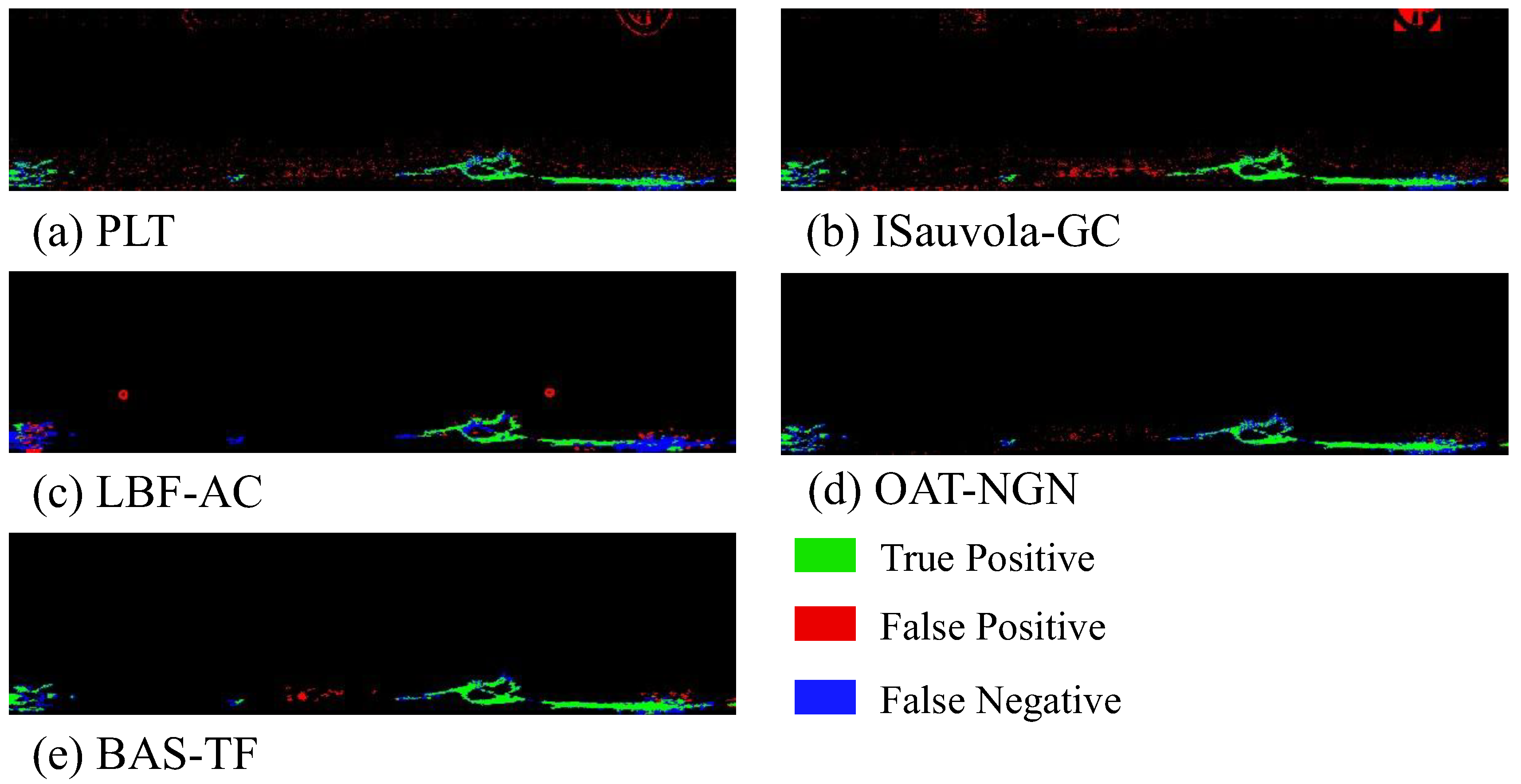
To validate the effectiveness of the proposed oil film detection method, five representative methods were selected for comparative testing. These methods include: Phansalkar’s Local Thresholding (PLT) [26], a classic local adaptive thresholding method. The improved Sauvola method based on GICM-CLAHE (ISauvola-GC), which enhances oil film segmentation performance through GICM grayscale correction and CLAHE enhancement [27]. The LBF active contour and post-processing method (LBF-AC), which combines the LBF active contour model with pixel area thresholding [28]. The OAT-NGN is a hybrid optimization framework that integrates neural gas networks with the OAT optimization algorithm [29]. The texture-feature-based improved beetle-antenna search algorithm (BAS-TF) improves segmentation accuracy by integrating texture features, information entropy filtering, and feature fusion strategies [30].
A comparison of the segmentation results with the ground truth is shown in Figure 11. PLT exhibits insufficient adaptability to complex background variations, resulting in a high number of false positive and false negative regions and overall low segmentation accuracy. When encountering areas of strong interference at the top of the image, this method tends to misidentify them as oil films. Additionally, it struggles to effectively distinguish suspected oil films from ship wake regions, leading to incorrect labeling of such areas. ISauvola-GC combines GICM grayscale correction with CLAHE enhancement, resulting in improved detection accuracy. However, in oil film regions with complex textures and significant lighting variations, its detection accuracy remains limited, with false positives and false negatives still prominent. The issues of misidentification in the highly noisy region at the top of the image and the ship’s wake region have not been effectively resolved. LBF-AC achieves relatively accurate segmentation of oil film boundaries through boundary detection and post-processing of pixel regions, thereby reducing false positives and false negatives. However, there are still many missed detections in low-contrast, weak-texture regions. Furthermore, this method is highly sensitive to strong interference from broken wave regions, often misidentifying them as oil films, which further compromises the reliability of the segmentation results. In contrast, the OAT-NGN segmentation framework performs superiorly under complex background conditions, with a significant increase in the areas where the segmentation results align with the actual oil film, and detection accuracy surpassing that of the first three methods. However, this algorithm’s excessive suppression of weak response signals leads to insufficient identification of oil films in low-signal regions. BAS-TF effectively improves the segmentation accuracy of oil films with complex textures through information entropy filtering and feature fusion. It exhibits relatively few false positives and false negatives, demonstrating strong robustness and accuracy. However, this method still has shortcomings in low-signal regions; its ability to identify the edges of thin oil films with weak backscattered signals is limited, and missed detections are quite noticeable, indicating a need for further improvement. Qualitative comparisons demonstrate that the method proposed in this paper outperforms other compared methods in terms of segmentation accuracy and robustness. This method not only effectively reduces false negatives and false positives but also achieves accurate identification of oil film boundaries in complex backgrounds and low-contrast scenes.
As shown in the quantitative evaluation results (Figure 12), the proposed method outperforms the other five comparison methods across all evaluation metrics. In terms of accuracy, our method achieved the highest value, indicating that it possesses the strongest overall classification capability for distinguishing oil films from the seawater background and can accurately differentiate oil film targets from non-oil film areas even under extensive marine clutter interference. The recall is significantly higher than that of the other comparison methods, with a false negative rate of only 3.53%, indicating that this method can effectively detect the main body of the oil film and its fine branches, while maintaining high detection sensitivity even at the edges of thin oil films where backscatter signals are weak. Precision also performs exceptionally well, with a false alarm rate of only 6.74%, significantly outperforming PLT and ISauvola-GC, and slightly outperforming OAT-NGN and BAS-TF. It demonstrates a clear advantage in suppressing oil film-like interference, such as ship wakes and broken sea waves, effectively reducing false positives. The F1 score and mIoU, as comprehensive metrics for evaluating segmentation performance, are both significantly higher than those of the comparison methods, further validating that this method achieves a balance between false negative control and false positive suppression.
It should be noted that the aforementioned comparison methods perform poorly on certain metrics, which may be attributed to data preprocessing strategies, parameter tuning approaches, or the methods’ inherent sensitivity to different datasets. Different methods are designed with their own underlying assumptions and conditions for applicability, and the experimental data used in this paper may not have fully met the optimal operating conditions for each comparison method.

4.4. Limitations and Future Work

Although the method proposed in this paper achieves overall detection performance superior to that of the comparison methods, issues of missed detections or false positives still exist in two typical scenarios.
(1)
Missed detections in areas with thin oil films
The proposed method exhibits a certain degree of false negatives in the gradient transition zone at the edge of the oil slick and in thin oil films where backscatter signals are extremely weak. The primary reason is that the difference in radar echo intensity between the thin oil film and seawater is minimal, resulting in reduced separability in the feature space. Consequently, during the threshold segmentation process, some pixels are classified as sea clutter by the clustering algorithm or assigned to the background. Furthermore, DBSCAN clustering exhibits low sensitivity to regions with weak signals, making it difficult to reliably extract these areas.
(2)
False positives in ship wake detection
Some ship wake areas that are similar in shape to oil films are still misclassified as oil films. The fundamental reason is that the low backscatter fringes generated by propeller turbulence in the ship’s wake overlap with the actual oil film height in terms of image features, and the existing features are not sufficient to effectively distinguish between the two.
Future research will focus on two areas. First, we will optimize feature extraction and clustering strategies for regions with weak signals to improve the detection sensitivity of thin oil films. Second, we will explore the use of lightweight deep learning models as post-processing classifiers to enhance the ability to distinguish between oil films and ship wakes. In recent years, architectures such as ConvNeXt [31], Faster R-CNN [32], YOLO [33], and Mask R-CNN [34] have demonstrated outstanding performance in image classification, object detection, and instance segmentation tasks. By leveraging the strengths of these models in feature extraction and object localization, a lightweight network can be developed to perform secondary classification of suspicious areas. This approach would further improve the accuracy and robustness of oil slick detection while maintaining the overall efficiency of the algorithm.

5. Conclusions

Effectively distinguishing oil films from sea clutter in shipborne X-band radar images remains challenging due to the limited adaptability of traditional segmentation methods. To address this issue, this paper proposes an oil film detection method that integrates multi-dimensional feature guidance with a hybrid optimization search strategy. First, by combining DBSCAN clustering with multi-dimensional feature metrics, the proposed method automatically extracts ROI under unlabeled conditions, effectively reducing sea clutter interference and computational burden. During the detection phase, an improved BBO-SA algorithm is introduced within the ROI to achieve collaborative global and local search optimization. Additionally, an adaptive temperature control strategy based on stagnation detection is designed, overcoming the fixed cooling rate limitation of traditional simulated annealing and significantly improving threshold optimization accuracy and robustness. Qualitative and quantitative evaluations on real-world marine radar data demonstrate the superior detection performance of the proposed method. The detection results can be back-mapped to a polar-coordinate sector display format, facilitating integration with electronic nautical charts and AIS data to provide an intuitive spatial reference for oil spill emergency response.
Nevertheless, the method has two limitations: insufficient sensitivity to thin oil films with extremely weak backscatter signals, and potential false positives from ship wakes that resemble oil films. Future work will optimize feature extraction and clustering strategies for weak-signal regions and explore lightweight deep learning models as post-classifiers to improve thin oil film detection and distinguish oil films from wakes.

Author Contributions

Conceptualization, B.J., J.X., and Z.G.; methodology, B.J., Z.G., and J.X.; software, Z.G. and L.C.; validation, Z.G., L.C., and Z.L.; formal analysis, B.J., J.X., and X.D.; investigation, Z.G. and H.W.; resources, J.X. and H.W.; data curation, Z.G. and L.C.; writing—original draft preparation, B.J., Z.G., and J.X.; writing—review and editing, B.J., J.X., Z.G., and H.W.; visualization, Z.G., X.D.; supervision, J.X. and B.J.; project administration, J.X. and B.J.; funding acquisition, B.J., J.X. All authors have read and agreed to the published version of the manuscript.

Funding

This research was supported by the Guangdong Basic and Applied Basic Research Foundation, grant numbers 2024A1515110096 and 2025A1515010886, the National Natural Science Foundation of China, grant number 52271359, the Special Projects in Key Fields of Ordinary Universities in Guangdong Province, grant number 2022ZDZX3005, the Postgraduate Education Innovation Project of Guangdong Ocean University, grant numbers 202421, 202539, and 202551, the Guangdong Provincial Key Laboratory of Intelligent Equipment for South China Sea Marine Ranching, grant number 080508132401, and the Zhanjiang Non-Funded Science and Technology Research Project, grant number 2024B01049.

Data Availability Statement

The data collection department did not agree to share the analysis data.

Conflicts of Interest

The authors declare no conflicts of interest.

Appendix A

This appendix provides a concise summary of the main symbols and hyperparameters used in the proposed method.
Table A1. Key variable definitions.
SymbolDescriptionReference
F 1 Backscatter uniformity indexEquation (2)
F 2 Gradient orientation coherenceEquation (5)
F 3 Intensity distribution asymmetryEquation (8)
G Set of pixel intensities within ROIEquation (10)
J ( t ) Composite fitness functionEquation (11)
λ 1 , λ 2 , λ 3 Weights of the fitness functionEquation (11)
J v a r ( t ) Between-class varianceEquation (12)
J e n t ( t ) EntropyEquation (13)
J u n i ( t ) Region uniformityEquation (14)
Table A2. Main hyperparameters.
ParameterDescriptionValue
PImage patch size17
εNeighborhood radius for DBSCAN0.3
NminMinimum number of samples for DBSCAN5
SpopPopulation size of BBO20
ImaxMaximum number of iterations50
T0Initial temperature of SA100
αCooling rate of SA0.95
I s a Number of SA iterations per temperature step10
β inc Temperature increase factor (heating)1.1
β d e c Temperature decreases factor (accelerated cooling)0.9
S t h Stagnation threshold (iterations without improvement)5
R t h Acceptance ratio threshold for suboptimal solutions0.1

References

  1. Gulf of Mexico Oil Spill Spread Hundreds of Miles and Polluted Nature Reserves|AP News. Available online: https://apnews.com/article/mexico-oil-spill-veracruz-17d98fc79f37987932ebddde9909a630 (accessed on 12 April 2026).
  2. Huang, X.; Zhang, B.; Perrie, W. A Two-Stage Deep Learning Method for Marine Oil Spill Localization and Segmentation From Synthetic Aperture Radar Images. IEEE J. Sel. Top. Appl. Earth Obs. Remote Sens. 2025, 18, 12315–12327. [Google Scholar] [CrossRef]
  3. Ji, H.; Zhang, X.; Wang, T.; Yang, K.; Jiang, J.; Xing, Z. Oil Spill Area Prediction Model of Submarine Pipeline Based on BP Neural Network and Convolutional Neural Network. Process Saf. Environ. Prot. 2025, 199, 107264. [Google Scholar] [CrossRef]
  4. Prajapati, K.; Bhavsar, M.; Mahajan, A. GSCAT-UNET: Enhanced U-Net Model with Spatial-Channel Attention Gate and Three-Level Attention for Oil Spill Detection Using SAR Data. Mar. Pollut. Bull. 2025, 212, 117583. [Google Scholar] [CrossRef] [PubMed]
  5. Guo, S.; Li, Y.; Shang, J.; Cheng, L. GSSNet: Gated Selective Scan Network for Port Oil Spill Pollution Detection. Measurement 2025, 256, 118086. [Google Scholar] [CrossRef]
  6. Coro, G.; Bove, P.; Ellenbroek, A. Detecting Fishing Areas from Navigation Radar Detector Data. Int. J. Digit. Earth 2026, 19, 2617004. [Google Scholar] [CrossRef]
  7. Liu, P.; Shao, P.; Zhao, X.; Wang, X.; Chen, P.; Zhu, X.; Li, Y.; Xu, J.; Liu, B. Noise Reduction Based on the Characteristics of X-Band Marine Radar Images for Oil Spill Detection. Remote Sens. Lett. 2026, 17, 190–197. [Google Scholar] [CrossRef]
  8. Liu, P.; Zhao, Y.; Liu, B.; Li, Y.; Chen, P. Oil Spill Extraction from X-Band Marine Radar Images by Power Fitting of Radar Echoes. Remote Sens. Lett. 2021, 12, 345–352. [Google Scholar] [CrossRef]
  9. Jiang, L.; Hu, J.; Ma, J.; Wu, Z.; Zhang, C.; Chen, Z. Deep Learning-Guided High-Completeness Building Segmentation Sample Selection via Otsu Thresholding. IEEE Geosci. Remote Sens. Lett. 2025, 22, 6013605. [Google Scholar] [CrossRef]
  10. Haralick, R.M.; Dinstein, I.; Shanmugam, K. Textural Features for Image Classification. IEEE Trans. Syst. Man Cybern. 1973, SMC-3, 610–621. [Google Scholar] [CrossRef]
  11. Chen, R.; Jia, B.; Ma, L.; Xu, J.; Li, B.; Wang, H. Marine Radar Oil Spill Extraction Based on Texture Features and BP Neural Network. J. Mar. Sci. Eng. 2022, 10, 1904. [Google Scholar] [CrossRef]
  12. Song, D.; Huang, Q.; Gao, H.; Wang, B.; Zhang, J.; Chen, W. Adaptive Oil Spill Detection Network for Scene-Based PolSAR Data Using Dynamic Convolution and Boundary Constraints. Int. J. Appl. Earth Obs. Geoinf. 2024, 130, 103914. [Google Scholar] [CrossRef]
  13. Li, K.; Yu, H.; Xu, Y.; Luo, X. Detection of Marine Oil Spills Based on HOG Feature and SVM Classifier. J. Sens. 2022, 2022, 3296495. [Google Scholar] [CrossRef]
  14. Li, B.; Xu, J.; Pan, X.; Ma, L.; Zhao, Z.; Chen, R.; Liu, Q.; Wang, H. Marine Oil Spill Detection with X-Band Shipborne Radar Using GLCM, SVM and FCM. Remote Sens. 2022, 14, 3715. [Google Scholar] [CrossRef]
  15. Xu, J.; Cheng, M.; Li, B.; Chu, L.; Dong, H.; Yang, Y.; Qian, S.; Huang, Y.; Yuan, J. Oil Slick Identification in Marine Radar Image Using HOG, Random Forest, and PSO. IEEE Geosci. Remote Sens. Lett. 2024, 21, 1504305. [Google Scholar] [CrossRef]
  16. Xu, J.; Cheng, M.; Mou, X.; Guo, Z.; Huang, Y.; Li, B.; Qian, S.; Liu, B.; Liu, P. Marine Oil Film Identification Based on GLOH, K-Means and Adaptive Threshold. Mar. Environ. Res. 2026, 215, 107788. [Google Scholar] [CrossRef]
  17. Jia, B.; Guo, Z.; Xu, J.; Li, B.; Huang, Y.; Cheng, M.; Xu, B.; Yao, B.; Liu, P. Marine Oil Film Detection Method Based on Growing Hierarchical Neural Gas Network and Multi-Scale Threshold Segmentation. Mar. Pollut. Bull. 2026, 226, 119337. [Google Scholar] [CrossRef]
  18. Shen, J.; Hao, X.; Liang, Z.; Liu, Y.; Wang, W.; Shao, L. Real-Time Superpixel Segmentation by DBSCAN Clustering Algorithm. IEEE Trans. Image Process. 2016, 25, 5933–5942. [Google Scholar] [CrossRef] [PubMed]
  19. Hajihosseinlou, M.; Maghsoudi, A.; Ghezelbash, R. Intelligent Mapping of Geochemical Anomalies: Adaptation of DBSCAN and Mean-Shift Clustering Approaches. J. Geochem. Explor. 2024, 258, 107393. [Google Scholar] [CrossRef]
  20. Bíró, P.; Bálint, B.B.; Novák, T.; Erdélyi, M. Cluster Parameter-Based DBSCAN Maps for Image Characterization. Comput. Struct. Biotechnol. J. 2025, 27, 920–927. [Google Scholar] [CrossRef] [PubMed]
  21. Zhu, X.; Cai, H.; Li, S.; Peng, W. EBBO: A Biomimetically Enhanced Optimization Algorithm with Multi-Stage Cooperation for Complex Engineering Applications. Biomimetics 2026, 11, 110. [Google Scholar] [CrossRef]
  22. Ouyang, K.; Wei, D.; Sha, X.; Yu, J.; Zhao, Y.; Qiu, M.; Fu, S.; Heidari, A.A.; Chen, H. Beaver Behavior Optimizer: A Novel Metaheuristic Algorithm for Solar PV Parameter Identification and Engineering Problems. J. Adv. Res. 2025; in press. [CrossRef] [PubMed]
  23. Metropolis, N.; Rosenbluth, A.W.; Rosenbluth, M.N.; Teller, A.H.; Teller, E. Equation of State Calculations by Fast Computing Machines. J. Chem. Phys. 1953, 21, 1087–1092. [Google Scholar] [CrossRef]
  24. Cai, Y.; Chen, L.; Zhuang, X.; Zhang, B. Automated Marine Oil Spill Detection Algorithm Based on Single-Image Generative Adversarial Network and YOLO-v8 under Small Samples. Mar. Pollut. Bull. 2024, 203, 116475. [Google Scholar] [CrossRef]
  25. Zakzouk, M.; Abdulaziz, A.M.; El-Magd, I.A.; Dahab, A.S.; Ali, E.M. Automated Oil Spill Detection Using Deep Learning and SAR Satellite Data for the Northern Entrance of the Suez Canal. Sci. Rep. 2025, 15, 20107. [Google Scholar] [CrossRef]
  26. Phansalkar, N.; More, S.; Sabale, A.; Joshi, M. Adaptive local thresholding for detection of nuclei in diversity stained cytology images. In Proceedings of the 2011 International Conference on Communication, Computing & Security (ICCCS 2011), Odisha, India, 12–14 February 2011; ACM: New York, NY, USA, 2011; pp. 215–220. [Google Scholar]
  27. Xu, J.; Cui, C.; Feng, H.; You, D.; Wang, H.; Li, B. Marine Radar Oil-Spill Monitoring through Local Adaptive Thresholding. Environ. Forensics 2019, 20, 196–209. [Google Scholar] [CrossRef]
  28. Xu, J.; Wang, H.; Cui, C.; Liu, P.; Zhao, Y.; Li, B. Oil Spill Segmentation in Ship-Borne Radar Images with an Improved Active Contour Model. Remote Sens. 2019, 11, 1698. [Google Scholar] [CrossRef]
  29. Jia, B.; Guo, Z.; Xu, J.; Liu, P.; Liu, B. Neural Gas Network Optimization Using Improved OAT Algorithm for Oil Spill Detection in Marine Radar Imagery. Remote Sens. 2025, 17, 2793. [Google Scholar] [CrossRef]
  30. Xu, J.; Xu, B.; Dong, H.; Liu, Q.; Qian, L.; Yao, B.; Guo, Z.; Liu, P. Novel Hybrid Feature Engineering with Optimized BAS Algorithm for Shipborne Radar Marine Oil Spill Detection. J. Mar. Sci. Eng. 2026, 14, 312. [Google Scholar] [CrossRef]
  31. Ilham, W.; Ahmad, A. A Comprehensive Review of ConvNeXt Architecture in Image Classification: Performance, Applications, and Prospects. IJACI Int. J. Adv. Comput. Inform. 2026, 2, 108–114. [Google Scholar] [CrossRef]
  32. Ricki, R.S.; Dicky, D.H.; Apriyansyah, B. Fast Region-Based Convolutional Neural Network in Object Detection: A Review. IJACI Int. J. Adv. Comput. Inform. 2026, 2, 34–40. [Google Scholar] [CrossRef]
  33. Afifah, V.; Erniwati, S. YOLOv8 for Object Detection: A Comprehensive Review of Advances, Techniques, and Applications. IJACI Int. J. Adv. Comput. Inform. 2026, 2, 53–61. [Google Scholar] [CrossRef]
  34. Erniwati, S.; Afifah, V.; Imran, B. Mask Region-Based Convolutional Neural Network in Object Detection: A Review. IJACI Int. J. Adv. Comput. Inform. 2025, 1, 106–117. [Google Scholar] [CrossRef]
Figure 1. Accident scene.
Remotesensing 18 01551 g001
Figure 2. Preprocessing flowchart.
Remotesensing 18 01551 g002
Figure 3. Technology framework.
Remotesensing 18 01551 g003
Figure 4. Data preprocessing process. (a) Raw data sample in the Cartesian coordinate system; (b) Processed data sample.
Remotesensing 18 01551 g004
Figure 5. ROI extraction. (a) ROI mask; (b) Oil film region.
Remotesensing 18 01551 g005aRemotesensing 18 01551 g005b
Figure 6. Oil film segmentation results.
Remotesensing 18 01551 g006
Figure 7. Comparison of results and labels.
Remotesensing 18 01551 g007
Figure 8. Processing time of the proposed method.
Remotesensing 18 01551 g008
Figure 9. Result mapping. (a) The result image obtained from the current data. (b) The result obtained from processing another set of data using the same method.
Remotesensing 18 01551 g009
Figure 10. Detection performance under different DBSCAN parameter combinations.
Remotesensing 18 01551 g010
Figure 11. Comparison of segmentation results and label differences. (a) PLT detection results; (b) ISauvola-GC detection results; (c) LBF-AC detection results; (d) OAT-NGN detection results; (e) BAS-TF detection results.
Remotesensing 18 01551 g011
Figure 12. Quantitative evaluation results.
Remotesensing 18 01551 g012
Table 1. Main technical specifications of the marine X-band radar.
Parameter CategoryTechnical Specification
Antenna Length8 feet
Pulse Duration50 ns/250 ns/750 ns
Surveillance Range0.5–12 n mile
Pulse Repetition Frequency3000 Hz/1800 Hz/785 Hz
PolarizationHorizontal
Azimuthal Coverage360°
Rotational Velocity28–45 RPM
Image Size1024 × 1024 Pixel
Table 2. Quantitative results.
Evaluation IndicatorsValue
Accuracy0.9975
Recall0.9647
Precision0.9326
F10.9484
mIoU0.9496
Disclaimer/Publisher’s Note: The statements, opinions and data contained in all publications are solely those of the individual author(s) and contributor(s) and not of MDPI and/or the editor(s). MDPI and/or the editor(s) disclaim responsibility for any injury to people or property resulting from any ideas, methods, instructions or products referred to in the content.