Article

Deep Learning-Based Diffraction Identification and Uncertainty-Aware Adaptive Weighting for GNSS Positioning in Occluded Environments


1
Center for Hydrogeology and Environmental Geology Survey, China Geological Survey, Tianjin 300309, China
2
School of Automation Engineering, University of Electronic Science and Technology of China, Chengdu 611731, China
3
GNSS Research Center, Wuhan University, Wuhan 430079, China
4
Shenzhen Key Laboratory of Spatial Smart Sensing and Services, College of Civil Engineering, Shenzhen University, Shenzhen 518060, China
5
Key Laboratory for Geo-Environment Monitoring of Coastal Zone of the National Administration of Surveying, Mapping and GeoInformation, Shenzhen University, Shenzhen 518060, China
6
School of Intelligent Transportation, Engineering Research Center of Transportation Information and Safety, Wuhan University of Technology, Wuhan 430070, China
*
Author to whom correspondence should be addressed.
Remote Sens. 2026, 18(1), 158; https://doi.org/10.3390/rs18010158
Submission received: 5 December 2025 / Revised: 27 December 2025 / Accepted: 30 December 2025 / Published: 3 January 2026

Highlights

What are the main findings?
  • A deep learning-based diffraction identification method using LSTM is proposed, where the multi-feature fusion of “SNR + Elevation + Azimuth” achieves optimal recognition accuracy (84.28%).
  • An uncertainty-aware adaptive weighting strategy is developed by introducing information entropy, which effectively suppresses diffraction errors while retaining ambiguous signals with conservative weights.
What are the implications of the main findings?
  • The proposed framework significantly improves GNSS positioning reliability in high-occlusion environments, increasing the AFR to 99.9% and enhancing the positioning accuracy in the horizontal and vertical directions by 80.1% and 76.4%.
  • This study provides a robust solution for deformation monitoring in complex terrains by replacing rigid thresholding with intelligent, continuous weight adjustment.

Abstract

In natural canyons and urban occluded environments, signal anomalies induced by the satellite diffraction effect are a critical error source affecting the positioning accuracy of deformation monitoring. This paper proposes a deep learning-based method for diffraction signal identification and mitigation. The method utilizes a LSTM network to deeply mine the time-series characteristics of GNSS observation data. We systematically analyze the impact of azimuth, elevation, SNR, and multi-feature combinations on model recognition performance, demonstrating that single features suffer from incomplete information or poor discrimination. Experimental results show that the multi-dimensional feature scheme of “SNR + Elevation + Azimuth” effectively characterizes both signal strength and spatial geometric information, achieving complementary feature advantages. The overall recognition accuracy of the proposed method reaches 84.2%, with an accuracy of 88.0% for anomalous satellites that severely impact positioning precision. Furthermore, we propose an Adaptive Weighting Method for Diffraction Mitigation Based on Uncertainty Quantification. This method constructs a variance inflation model using the probability vector output from the LSTM Softmax layer and introduces Information Entropy to quantify prediction uncertainty, ensuring that the weighting model possesses protection capability when the model fails or is uncertain. In processing a set of GNSS data collected in a highly-occluded environment, the proposed method significantly outperforms traditional cut-off elevation and SNR mask strategies, improving the AFR to 99.9%, and enhancing the positioning accuracy in the horizontal and vertical directions by an average of 80.1% and 76.4%, respectively, thereby effectively boosting the positioning accuracy and reliability in occluded environments.

1. Introduction

Currently, GNSS positioning technology can achieve centimeter or even millimeter-level monitoring accuracy [1,2,3]. With the advantages of all-weather, all-time, and high-precision availability, it has played an important role in high-precision applications such as geodesy, infrastructure safety monitoring, and geological disaster monitoring [4,5,6].
However, in occlusion environments such as natural valleys and urban canyons, satellite signals are subject to severe interference, inducing problems such as multipath effects, NLOS reception, and signal diffraction [7,8,9]. Among these, the significant diffraction error caused by the diffraction effect is difficult to parameterize and eliminate through traditional differential techniques or general modeling methods. It has become a key error source leading to a decline in the AFR, degradation of positioning accuracy, and frequent gross errors in observation data [10,11]. Meanwhile, many deformation monitoring stations for bridges, dams, landslides, and slopes are located in urban areas or natural valleys [12,13]. With the acceleration of urbanization and the growth of forest vegetation, the occlusion caused by dense buildings and vegetation introduces large multipath and diffraction errors. This leads to the frequent appearance of outliers and significant noise interference in observation data, greatly restricting the positioning accuracy and reliability of GNSS in high-precision deformation monitoring applications [10,14].
At present, the integration of multi-constellation and multi-frequency GNSS can effectively solve the problem of insufficient visible satellites in complex occlusion environments. Regarding GNSS multipath error mitigation, SF is a widely used classic method. Based on the repeatability of multipath effects in static observation scenarios, this method filters observation data across different sidereal periods to effectively weaken multipath interference [14,15,16,17]. Additionally, for NLOS signals, some scholars fuse the real-time position of the GNSS receiver with 3D city models to predict blocked or reflected satellite signals, thereby achieving precise identification of NLOS signals [18,19]. Integrating GNSS receivers with other sensors can also effectively detect NLOS signals, such as fisheye cameras [20], laser scanners [21,22], and antenna arrays [23].
In high-occlusion environments, in addition to multipath effects and NLOS signals, satellite signals may bend at the edges of obstructions, a phenomenon known as signal diffraction. This enables GNSS antennas in the “shadow area” formed by obstructions to receive diffracted satellite signals. Compared with direct signals, the propagation path length of the diffracted signal from the diffraction point to the receiving antenna is significantly increased; this extra path length constitutes the diffraction error [24,25]. Its magnitude can reach the decimeter level, which is one of the main causes of outliers in carrier-phase dynamic and static positioning, and its propagation mechanism is complex and difficult to model. Through deep mining of slope deformation monitoring datasets, Xi et al. found that the maximum value of diffraction error far exceeds the theoretical maximum of carrier-phase multipath error [26]. They further derived the theoretical formula for diffraction error and established a numerical model, proving that the error model can be applied in SF; experiments showed that after correction, the ambiguity resolution fixing rate improved to 98.87% [27].
Dai et al. proposed a combined Total Station and GNSS observation scheme [24]. By constructing a high-precision 3D model of the local environment to precisely identify terrain edges where diffraction occurs, they implemented weighting or elimination of affected satellite observations, effectively removing most gross errors in dynamic deformation monitoring. Han et al. proposed an elevation mask modeling method based on azimuth rounding [28]. This method can establish an azimuth-dependent elevation mask using single-day observation data, effectively eliminating low-elevation angle diffraction signals and significantly improving sequence stability in building deformation monitoring. Ren et al. further proposed a MHM model with geographic cut-off elevation constraints, masking poor-quality signals by combining signal quality with terrain features; experimental results showed that this method increased the AFR to 99.95%, and the RMS values of positioning errors in the horizontal and vertical directions were reduced by approximately 65.9% and 63.4%, respectively [29]. Xi et al. analyzed the time-series characteristics of posterior residuals and SNR and proposed the Obstruction Adaptive Elevation Masks (OAEMs) method [26]. In harsh observation environments, this method not only eliminated large fluctuations caused by diffraction but also improved vertical positioning accuracy by more than 40%.
In recent years, with the evolution of artificial intelligence technology, Machine Learning (ML) has been widely applied in GNSS signal classification and error mitigation due to its advantages in processing nonlinear features. Xu et al. systematically classified ML-based multipath/NLOS mitigation methods according to input features, algorithm architecture, and output targets [30]. Classic machine learning algorithms, including SVM [31] and Random Forest [32,33], have been proven effective in identifying anomalous signal features.
The introduction of Deep Learning (DL) models has further mined the deep spatio-temporal correlations in observation data. PositionNet, proposed by Xu et al. [34], utilizes CNN to process SD Residual Maps highly correlated with user position. In dense urban area experiments, this method successfully controlled the positioning error of 84% of observation epochs within 5 m. Li et al. utilized DNN for GNSS NLOS signal identification by extracting representative features from raw GNSS observations [35]. Li et al. combined CNN with LSTM networks to propose a NLOS detection method based on Spatio-Temporal Learning [36]. This model can simultaneously extract the spatial correlation and temporal dependency of observations, achieving recognition accuracies of 99.4% and 95.3% in static and dynamic tests, respectively. Other scholars have proposed a Multivariate Time Series Learning method based on Transformer, utilizing the Self-Attention mechanism to deeply mine the nonlinear dynamic characteristics in GNSS observation sequences, achieving an NLOS detection accuracy of over 96% [37].
Although the aforementioned methods have achieved significant results in specific scenarios, non-negligible limitations remain. On one hand, the geographic elevation mask method usually relies on relatively fixed observation environments or requires expensive external auxiliary equipment; when the surrounding environment changes dynamically (e.g., vehicle movement, construction), pre-established models often fail to adapt, leading to correction failure. On the other hand, existing machine learning methods mostly focus on the identification and mitigation of multipath effects and NLOS signals, while there is relatively less research on the refined identification of diffraction signals as a specific error source. To improve the reliability and positioning accuracy of deformation monitoring in complex environments, precise processing of diffraction signals is necessary. Therefore, this paper proposes a diffraction signal identification method based on LSTM networks, adopting an uncertainty quantification-based adaptive weighting strategy against diffraction. By deeply mining the temporal characteristics of observation sequences, it effectively identifies and suppresses satellite observations affected by diffraction effects, thereby enhancing positioning accuracy. We provide the extraction method for diffraction error and introduce the LSTM-based diffraction error identification method in Section 2, followed by the uncertainty quantification-based adaptive weighting method. In Section 3, we comparatively analyze the impact of different features on diffraction signal identification and perform comparative experiments with other diffraction error elimination methods.
The main contribution of this paper is the proposal of a deep learning-based method for GNSS diffraction signal identification and suppression. By systematically analyzing the contribution of different input features through feature engineering, we shifted from fixed a priori thresholds to identifying diffraction signals via observation time series. We propose an Adaptive Weighting Method for Diffraction Mitigation Based on Uncertainty Quantification, introducing Information Entropy to quantify prediction uncertainty, ensuring that the weighting model possesses protection capability when the model fails or hesitates. Finally, based on a set of GNSS data collected in a high-occlusion environment, we evaluated and compared the performance of diffraction error elimination methods.

2. Materials and Methods

2.1. Diffraction Error Extraction

To isolate diffraction errors from complex observation noise, this study constructed a post-processing solution strategy based on DD carrier phase. The DD model utilizes the strong correlation between stations and satellites over short baselines to effectively eliminate or significantly weaken common-mode errors such as satellite orbit errors, clock errors, tropospheric delay, and ionospheric delay. Assuming the reference station is p, the monitoring station is q, and the synchronously observed satellites are i (reference satellite) and j. The DD carrier phase observation equation Δ ϕ at frequency m can be expressed as:
λ m Δ φ m , p q i j = Δ ρ p q i j + λ m Δ N m , p q i j + Δ ε m , p q i j
where m represents the frequency m; λ represents the carrier wavelength; Δ is the DD operator; ρ denotes the geometric distance from the satellite to the receiver antenna phase center; N is the integer ambiguity parameter; and ε is the unmodeled residual term, which contains not only measurement noise but also mainly multipath effects and the diffraction error focused on in this study.
Precise ambiguity fixing is a prerequisite for obtaining reliable residuals. Given that multipath and diffraction effects in occlusion environments may severely interfere with real-time ambiguity resolution, this study first performs strict cycle slip detection to define continuous observation arcs. As shown in Equation (2), the HMW [38,39,40] and GF combinations [38] are applied to construct a joint detection operator:
φ HMW = φ 1 φ 2 f 1 f 2 f 1 + f 2 P 1 + P 2 φ GF = φ 1 φ 2 f 2 f 1
where f 1 , f 2 are the carrier frequencies, and P 1 , P 2 are the code observations. The detection criteria are set as follows: if the HMW combination difference between adjacent epochs exceeds 0.5 cycles or the GF combination difference exceeds 0.25 cycles, a cycle slip is determined to have occurred. The system performs independent detection for each satellite at the SD level between reference station p and monitoring station q. Once a cycle slip is detected, the current arc is terminated, and new ambiguity parameters are initialized. After completing the arc segmentation, a standard KF is used for state estimation. For each observation epoch, the linearized DD observation equation can be constructed in the following matrix form:
v = A x a + B x b l
where the receiver coordinate parameters are denoted as x a , and ambiguity parameters as x b ; A and B represent the coefficient matrices for coordinate and ambiguity parameters, respectively. v is the noise vector; l is the OMC residual vector. We organize the state vector x and coefficient matrix H uniformly to facilitate filter iteration:
x = x a x b T , H = A B
During the filtering process, ambiguities within the same continuous arc are estimated as constant parameters. The filter outputs the coordinate float solution, float ambiguity, and their variance-covariance matrix for each epoch. Subsequently, the Integer Rounding estimator is employed for ambiguity fixing. It is worth noting that traditional ambiguity fixing strategies usually set strict thresholds to reject abnormal solutions. However, diffraction signals are often accompanied by large phase biases. To avoid rejecting these signals containing diffraction characteristics as outliers, this study adopts a forced fixing strategy, where all estimated ambiguities passing the variance test are fixed. Once the ambiguity N is successfully fixed, it is fed back into the KF as a strong constraint to update the state estimate and obtain the fixed solution x ˇ . Subsequently, to further improve solution precision and smooth noise, Forward-Backward Smoothing is applied to process the full-arc data. Finally, by subtracting the geometric distance and fixed ambiguity from the smoothed DD observations, the DD residual sequence is extracted:
Δ ε m , pq ij = λ m Δ φ m , pq ij Δ ρ ˜ pq ij λ m Δ N ˜ m , pq ij
The DD residual time series mainly contains unmodeled multipath errors, diffraction errors, and measurement noise. According to GNSS signal propagation theory, the theoretical upper limit of carrier-phase multipath error is 1/4 wavelength (approximately 4.8 cm for the GPS L1 frequency band) [41]. However, studies by Xi et al. [26] indicate that diffraction errors often exhibit systematic bias with magnitudes reaching the decimeter level, far exceeding the theoretical limit of ordinary multipath errors. Therefore, in the data preprocessing and label generation stage of this study, satellite signals with DD residuals greater than 5 cm (approximately 0.25 cycles) are determined to be signals severely polluted by diffraction. On the other hand, considering that the carrier phase observation noise of geodetic receivers is typically at the millimeter level, the nominal noise level ( 1 σ ) after DD linear combination is approximately 4–6 mm. According to the 3 σ statistical criterion, normal satellite signal residuals should be distributed within a range of ±1.5 cm, while satellite signals with residuals between 1.5 cm and 5.0 cm are regarded as Ambiguous Satellites. The introduction of ‘Ambiguous Satellites’ as a third category provides several benefits for model training and stability. Physically, GNSS signal quality degrades continuously in occluded environments. Forcing a binary classification (Normal vs. Abnormal) creates sharp discontinuities in the label space, which can lead to training oscillations for borderline signals. By defining an intermediate state, the LSTM model can learn more robust decision boundaries.

2.2. Machine Learning Methods

To mitigate the sequence classification problem associated with identifying diffraction errors in time-series GNSS observations, we developed a LSTM based deep learning model. Traditional RNNs often suffer from the “vanishing gradient” and “exploding gradient” problems when processing long sequences, making it difficult to capture long-term dependencies in signal fluctuations. LSTM addresses this by introducing a unique “gate” mechanism and a memory cell structure, making it particularly suitable for processing GNSS observation sequences that contain complex temporal characteristics and noise interference.
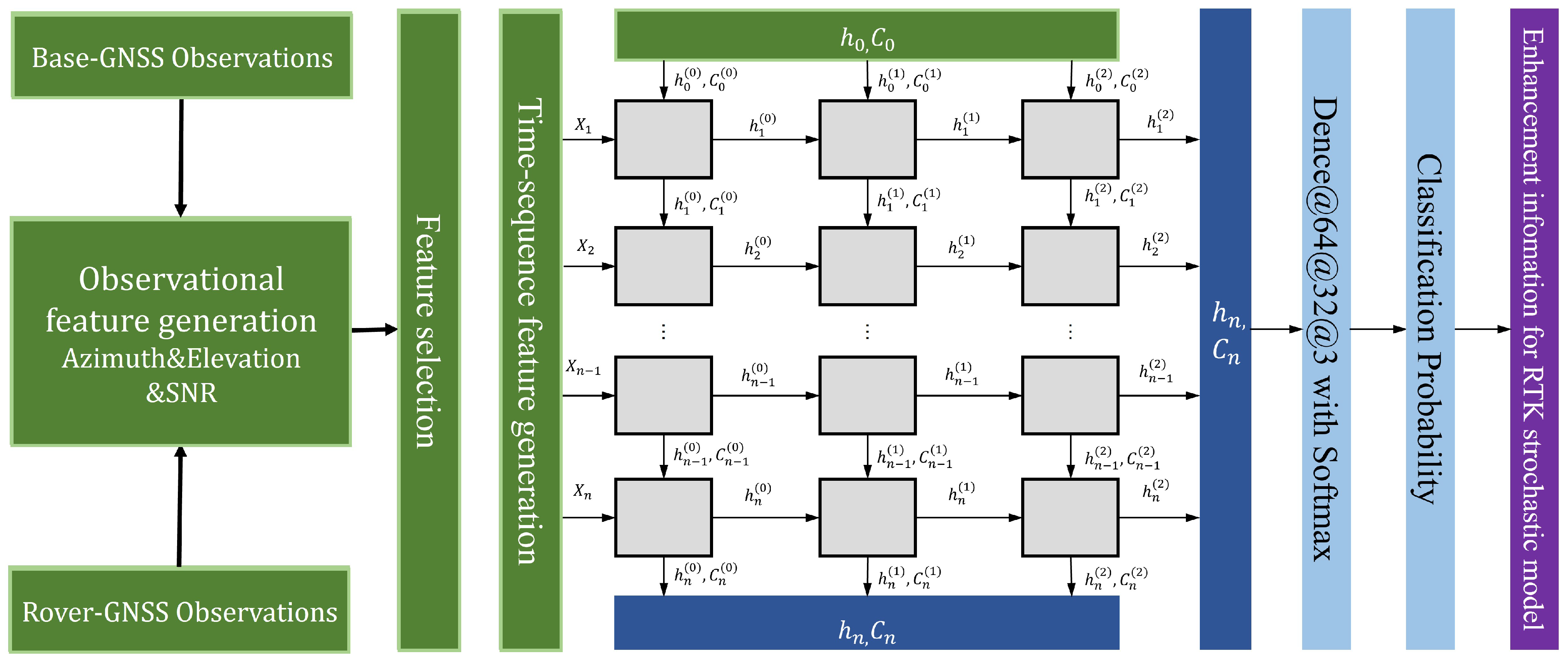
The core component of the LSTM is the memory cell, which runs through the entire chain like a conveyor belt, maintaining the cell state C t with minimal linear interactions. This structure allows information to flow unchanged along the sequence, enabling the network to retain critical features of diffraction patterns over varying time intervals. As illustrated in Figure 1, the information flow within an LSTM unit is regulated by three key gates: the Forget Gate, the Input Gate, and the Output Gate.The schematic overview of the proposed model is shown in Figure 2.
The first step in the LSTM is to decide what information is discarded from the cell state. This decision is made by the “Forget Gate” layer ( F t ). It takes the output of the previous moment h t 1 and the current GNSS observation input X t (including SNR, elevation, and azimuth) as inputs, and outputs a value between 0 and 1 via the sigmoid function σ :
F t = σ ( X t W x f + h t 1 W h f + b f )
In the context of this study, the forget gate plays a crucial role in denoising. Since GNSS signals are continuously affected by high-frequency random noise, not all historical fluctuations are indicative of diffraction. The forget gate effectively learns to “forget” random noise or normal trend information from previous epochs that is irrelevant to the current anomaly detection, retaining only the trend information pertinent to the diffraction event.The next step is to update the cell state with new information. This consists of two parts: the “Input Gate” layer ( I t ) which decides which values need updating, and a tanh layer which creates a vector of new candidate values C ˜ t .
I t = σ ( X t W x i + h t 1 W h i + b i )
C ˜ t = tanh ( X t W x c + h t 1 W h c + b c )
For diffraction identification, the input gate focuses on capturing sudden changes in the current observation X t . For instance, when a satellite signal undergoes diffraction, the SNR typically exhibits a rapid drop or oscillation. The input gate identifies these significant instantaneous features and integrates them into the memory cell, updating the model’s understanding of the current signal quality.The old cell state C t 1 is then updated to the new state C t :
C t = F t · C t 1 + I t · C ˜ t
Finally, the output gate ( O t ) determines the hidden state output h t based on the current cell state. This output contains the high-level features extracted from the time series.
O t = σ ( X t W x o + h t 1 W h o + b o )
h t = O t · tanh ( C t )
To transform the high-level temporal features h t extracted by the LSTM layers into interpretable classification results, we employ a Fully Connected (Dense) layer followed by a Softmax activation function. This process maps the feature space to a probability distribution over the target classes.First, the dense layer performs a linear transformation to project the hidden state h t into a logic vector z t corresponding to the three categories: Normal, Ambiguous, and Abnormal. Subsequently, the Softmax function normalizes these logits into probabilities:
P ( y t = k | X ) = e z t , k j = 1 K e z t , j
where K = 3 represents the number of classes. The final output is a probability vector p t s = [ P n o r m , P a m b , P a n o m ] for satellite s at epoch t, satisfying the condition p t s = 1 . This probability vector serves two purposes: it determines the final classification label (based on the maximum probability) and, more importantly, provides a quantitative measure of the model’s confidence. This confidence information is a critical input for the “Uncertainty-Aware Adaptive Weighting” method proposed in Section 2.3.

2.3. Adaptive Weighting Method for Diffraction Mitigation Based on Uncertainty Quantification

Traditional robust methods often directly reject suspected diffraction satellites based on classification results. Although this can effectively block gross errors, it easily leads to the deterioration of the satellite geometric configuration, thereby affecting positioning accuracy. Therefore, this paper proposes an adaptive weighting strategy against diffraction that considers model prediction uncertainty. It utilizes the probability vector output from the Softmax layer of the LSTM network to construct a variance inflation model. Furthermore, to reduce the risk of model misclassification, we introduce Information Entropy to quantify prediction uncertainty, establishing an adaptive weighting mechanism. For the satellite at each epoch, the probability vector output by the model is:
p t s = [ P n o r m , P a m b , P a n o m ]
where P n o r m , P a m b , and P a n o m represent the predicted probabilities of the satellite signal status being normal, ambiguous (suspected), and anomalous diffraction, respectively, satisfying P n o r m + P a m b + P a n o m = 1 . A higher P a n o m implies a greater likelihood of signal distortion; thus, a larger variance should be assigned in the stochastic model [42].
However, deep learning models may exhibit Epistemic Uncertainty when processing signals in transition states at the decision boundary. Relying solely on the predicted probability P a n o m may lead to erroneous penalization of benign observations. To address this, we introduce Shannon Entropy [43,44]:
H t s = k { n o r m , a m b , a n o m } p k log 2 ( p k )
Information Entropy serves as a quantitative measure of the deep learning model’s prediction uncertainty. Unlike classification probability, which indicates the specific category to which a signal belongs, a higher entropy value H t s indicates that the model finds it difficult to distinguish signal features, resulting in low classification confidence. Our objective is to ensure that when the model is confident (low entropy), the observation variance is adjusted directly based on the predicted anomaly probability. Conversely, when the model is uncertain (high entropy), a conservative weighting strategy is adopted to prevent the erroneous down-weighting of usable satellites due to potential misclassification. To facilitate model stability, we normalize the entropy:
H ˜ t s = H t s H m a x
where H m a x 1.585 is the maximum entropy value for a three-class system. Finally, a weighting function is constructed based on the elevation-dependent a priori variance σ b a s e 2 :
σ 2 = σ b a s e 2 · exp μ · P a n o m 1 + γ · H ˜ t s
Correspondingly, the observation weight w is:
w = 1 σ 2
The formula contains two key hyperparameters: the penalty factor μ and the uncertainty damping factor γ . μ controls the intensity of down-weighting for high-risk satellites. In this study, it is set to 5.0 , meaning that when the model is confident that the signal is anomalous ( P a n o m 1 ), the observation noise variance will be inflated by approximately 150 times. This effectively suppresses the influence of the observation through significant down-weighting while avoiding the divergence of positioning solutions caused by brute-force rejection of satellites. γ controls the degree of protection provided by uncertainty to the weights and is set to 1.0 ; when the model prediction is highly uncertain (entropy approaches maximum, H ˜ t s 1 ), the denominator increases, and the exponential term significantly decreases, causing the observation weight to regress to a level close to the physical a priori model. This ensures that the weighting model possesses certain protection capabilities when the model fails or “hesitates”.

3. Results and Discussion

3.1. Data Description

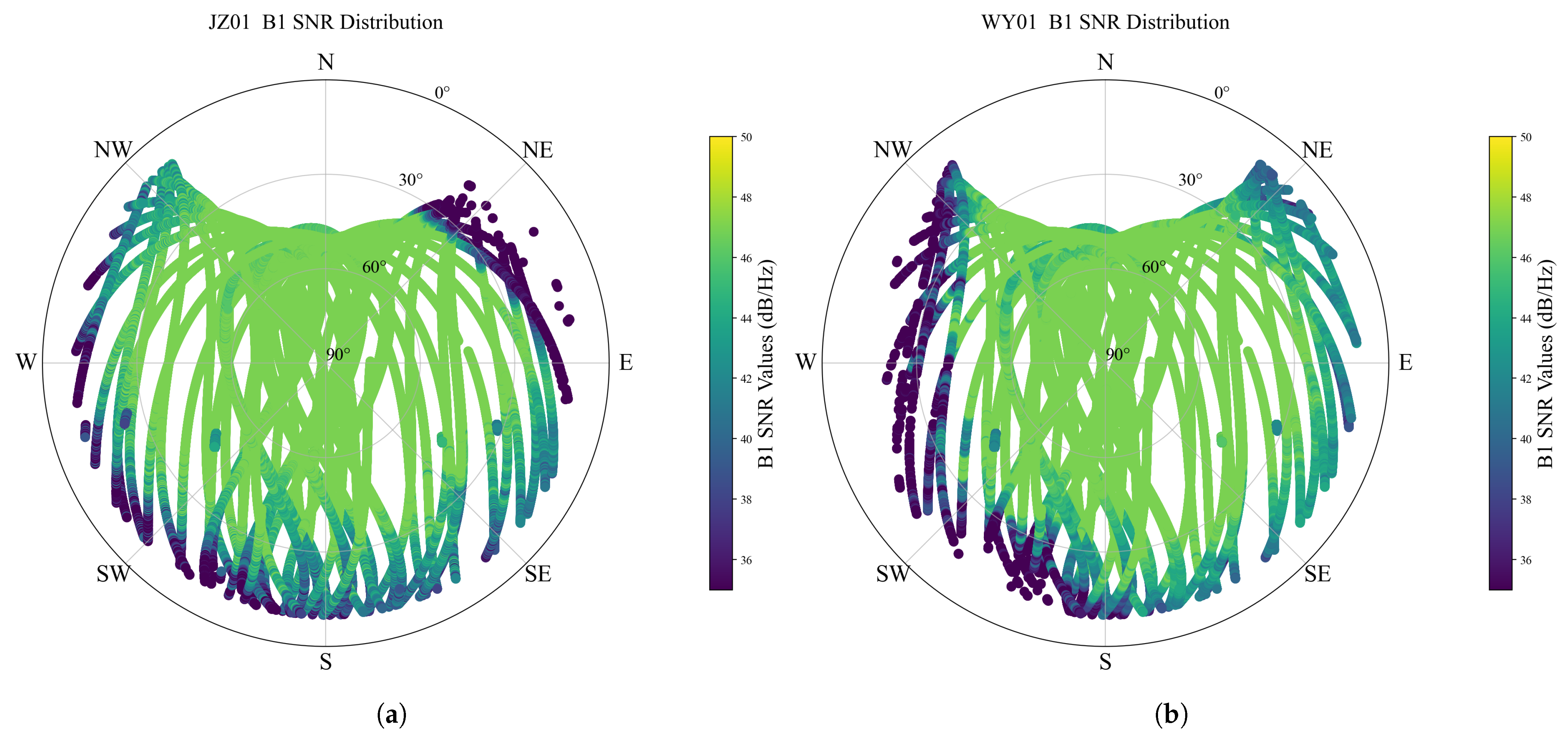
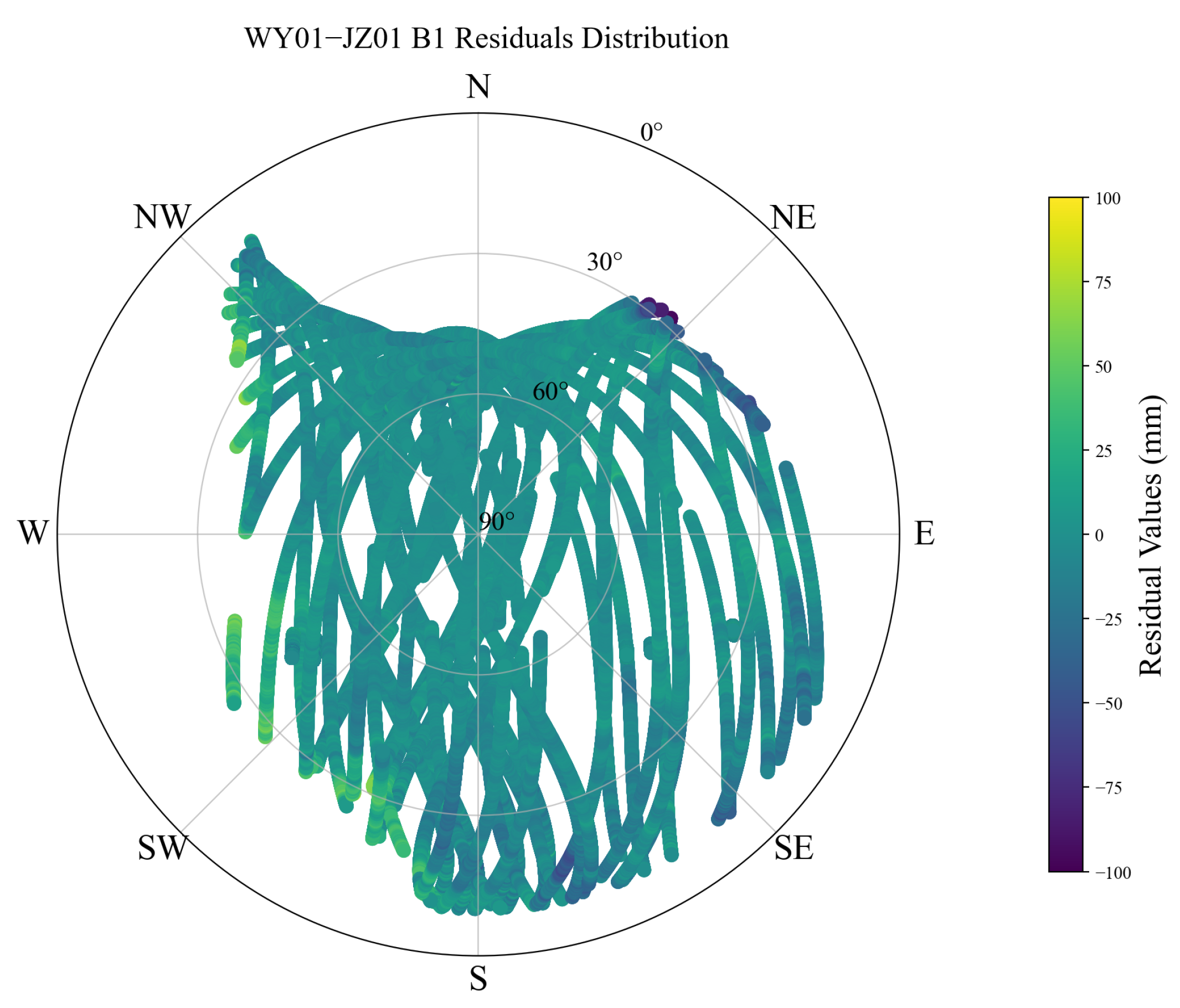
To verify the effectiveness and robustness of the method proposed in this paper, experimental data were collected from a slope deformation monitoring system in an open-pit quarry in Guangdong Province, China. The terrain and landforms in this area are complex, featuring not only typical high-steep slope characteristics but also dense vegetation and mining facilities. Figure 3 plots the SNR skyplots for the B1 frequency at two stations. It can be observed that in unobstructed airspace, the SNR typically increases with elevation angle; however, in specific azimuth intervals (such as the west side of WY01 and the northeast side of JZ01), the SNR shows significant attenuation and presents an irregular low-value distribution. Further analysis of the DD residual skyplot for the baseline WY01-JZ01 at frequency B1, as shown in Figure 4, reveals significant spatial overlap between residual anomaly regions and SNR attenuation regions, particularly with frequent large-amplitude diffraction errors appearing in the observational data on the northeast side.
The experimental data were collected at a sampling interval of 5 s. To ensure the continuity and integrity of the observation sequences, cycle slip detection was performed using the GF and HMW combinations. For each identified continuous, cycle-slip-free satellite arc, the time series was split chronologically: the first 70% was allocated to the training set, while the remaining 30% was reserved for the test set. This partitioning strategy enables the LSTM model to learn historical signal diffraction patterns from established sequences and rigorously validates its predictive stability for “future” observations.

3.2. Diffraction Error Elimination Based on Deep Learning

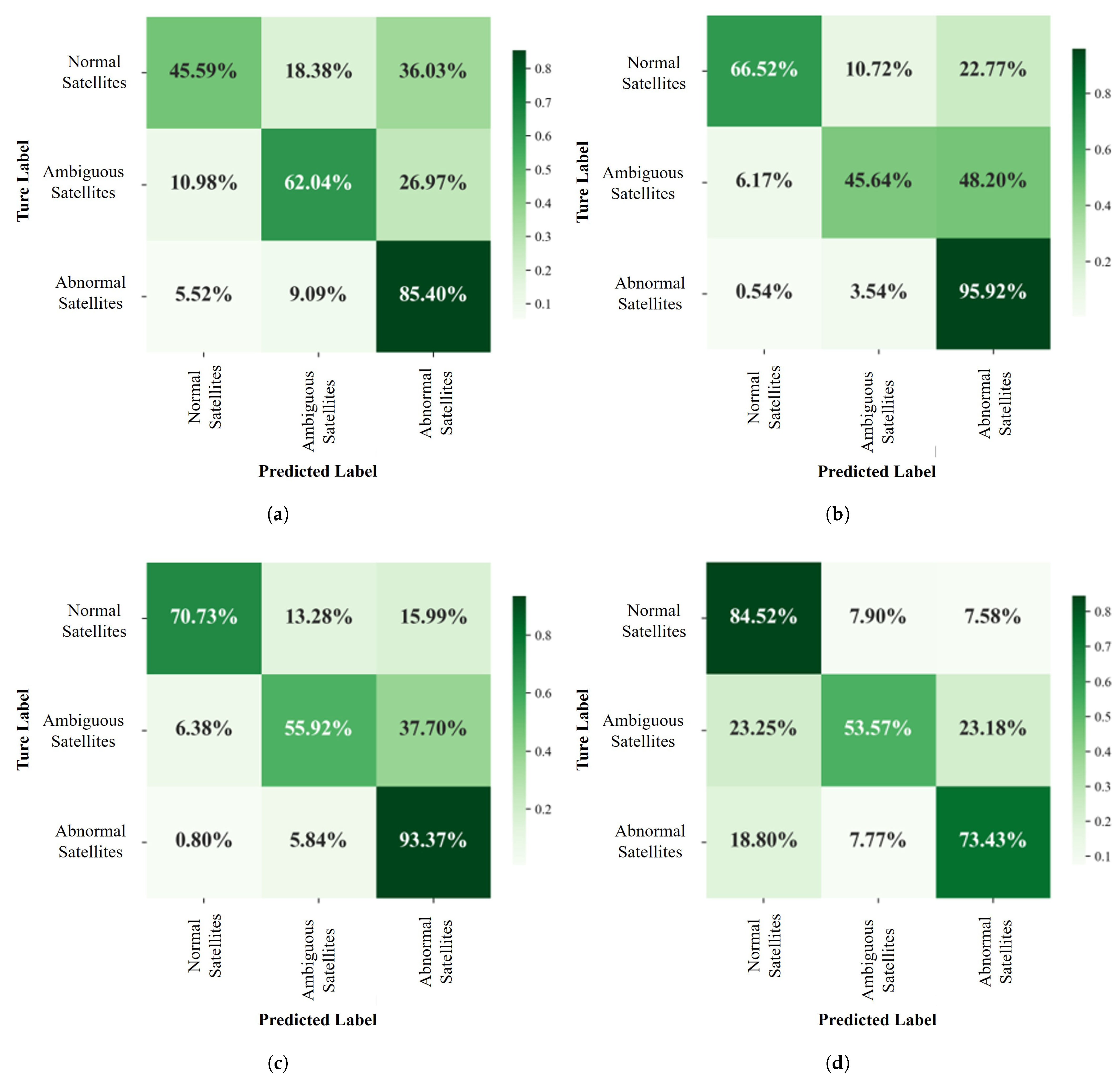
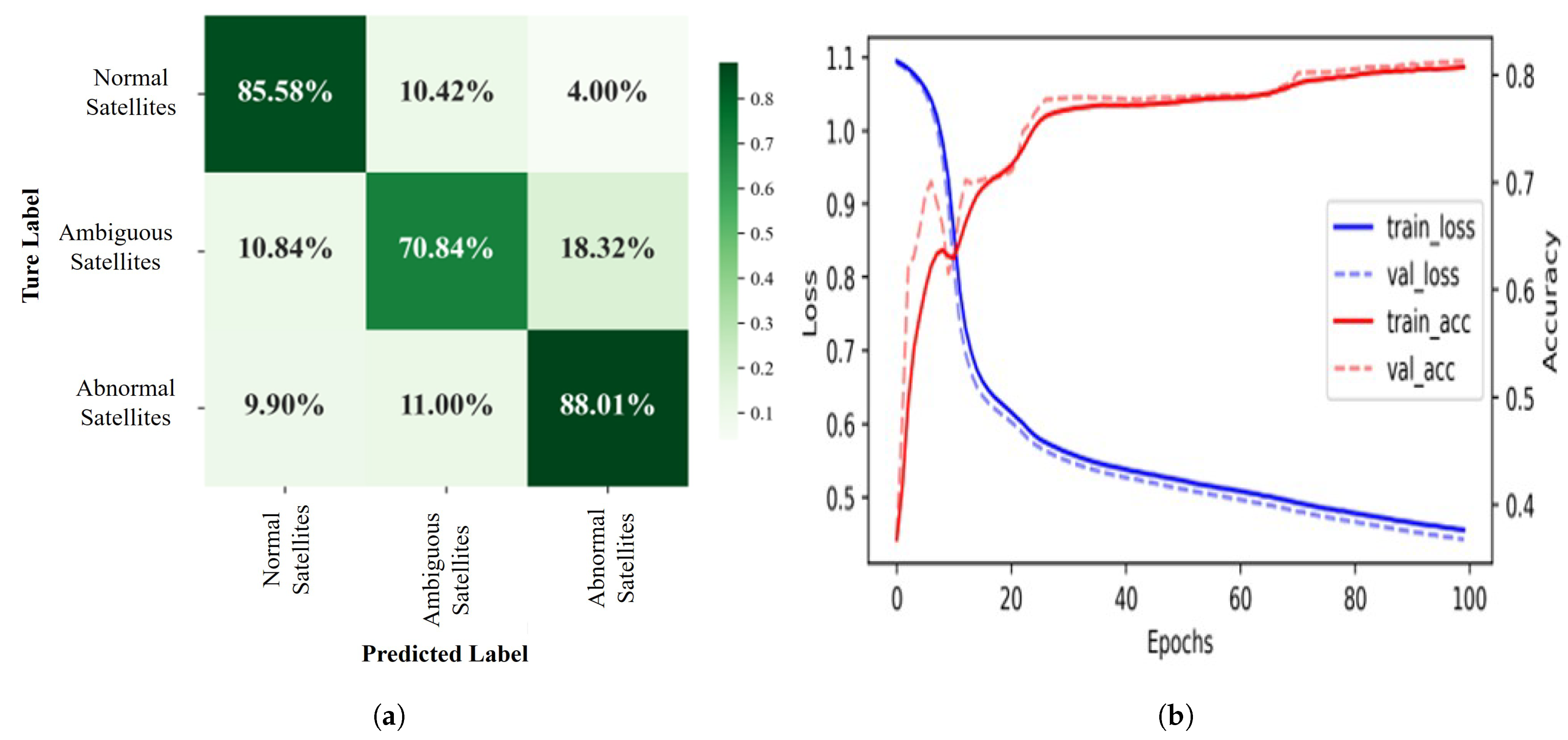
To construct a diffraction anomaly satellite identification model with high accuracy and strong interpretability, the core of this section is to systematically investigate the contribution of input features through feature engineering. We selected three key features affecting GNSS signal quality and spatial geometric configuration: Azimuth, Elevation, and SNR, and quantitatively evaluated the performance differences of various feature combinations based on the Deep Learning LSTM network, as shown in Figure 5 and Figure 6.
Analysis of the azimuth feature alone shows that this feature has a weak correlation with GNSS diffraction error classification. From the confusion matrix, it can be seen that its recognition accuracy for the normal satellite category is only 45.59%, and for suspected anomalous satellites, it is only 62.04%. Although the recognition accuracy for anomalous satellites reaches 85.40%, there is a clear tendency to misclassify normal and suspected anomalous samples. This result is reasonable because there is obvious occlusion in the northeast direction of the monitoring and reference stations. The azimuth feature can effectively identify anomalous satellites within the occlusion range but is insensitive to anomalous satellites in other directions.
Elevation is the angle between the line of sight and the horizontal plane in the vertical plane. Signals from high-elevation satellites have shorter propagation paths and smaller atmospheric delay errors. Furthermore, when the monitoring station is occluded, signals from low-elevation satellites are likely to be blocked or reflected. From the confusion matrix results, the recognition accuracy of the elevation feature for normal satellites is 66.52%, for suspected anomalous satellites is only 45.64%, while for anomalous satellites it is as high as 95.92%. This indicates a strong correlation between the elevation feature and the diffraction effect, with an overall precision on the test set of 66.45%. Since elevation only reflects the spatial height information of the satellite, although low elevation is associated with satellite occlusion, elevation alone cannot fully describe the surrounding environmental information. When combining the two geometric features, the model constructs a complete satellite skyplot. Analysis of the confusion matrix results shows that the spatial combination of elevation and azimuth features demonstrates superior recognition performance compared to single features. The recognition accuracy of the spatial combination feature for normal satellites improves to 70.73%, for suspected anomalous satellites to 55.92%, and for anomalous satellites to 93.37%, with an overall test set precision of 70.72%. Compared with single-feature results, the misclassification rate for normal samples is significantly reduced, and the misclassification rate for suspected anomalous samples is also optimized. This indicates that LSTM can learn the nonlinear relationship between spatial geometric position and occlusion distribution. Although the spatial combination feature can more completely describe the spatial azimuth-elevation distribution of satellites and reveal the outline of the occlusion environment around the station, enabling the model to autonomously identify the status of occluded satellites at the rover, it still lacks a direct description of satellite signal strength. Therefore, its ability to distinguish ambiguous satellites and anomalous satellites is limited, necessitating the fusion of SNR, which directly reflects signal strength.
SNR reflects the ratio of received signal strength to noise and is an intuitive indicator of signal quality. Direct signals (Normal) usually have high SNR, while SNR attenuates due to path loss when diffraction occurs. However, since some direct signals with long propagation paths also exhibit SNR attenuation, the ability to distinguish between ambiguous and anomalous samples may be weak. The final classification results are basically consistent with theoretical analysis. From the confusion matrix, the recognition accuracy of the SNR feature for normal satellites is as high as 84.52%, for suspected anomalous satellites is only 53.57%, and for anomalous satellites is 73.43%. From the perspective of model input features, the SNR observations output by the receiver lack floating-point precision (this test dataset contains only 15 discrete values), resulting in overly coarse feature data granularity and high information singularity in the model input. Therefore, despite its excellent recognition accuracy for normal samples, its ability to distinguish suspected anomalous samples in the transition zone and relatively scattered anomalous samples is significantly insufficient. It needs to be fused with spatial features such as elevation and azimuth to supplement environmental information and enhance feature dimensionality.
The multi-feature fusion scheme of SNR, Elevation, and Azimuth can effectively characterize the dual-dimensional information of satellite signal spatial position and strength, and the LSTM model also achieved the best comprehensive performance. From the confusion matrix results, the recognition accuracy of this feature combination for normal satellites improved to 85.58%, for suspected anomalous satellites to 70.84%, and for anomalous satellites to 88.01%. The overall accuracy on the test set was 84.28%. Moreover, on the most difficult-to-distinguish Ambiguous satellite category, compared to using only SNR (53.57%) or only geometric features (55.92%), full feature fusion significantly increased its recognition rate to 70.84%. This improvement stems from the complementary mechanism between features: SNR directly quantifies signal strength, effectively distinguishing normal satellites; elevation and azimuth completely depict the spatial azimuth-elevation distribution of satellites, precisely revealing the occlusion environment outline around the station. The fusion of the three solves the problem of insufficient dimension in the single SNR feature and compensates for the lack of direct signal strength description in the Elevation + Azimuth combination, enabling the model to perform multi-modal modeling of satellite anomaly status from both environmental occlusion and signal attenuation dimensions. The training graphs also indicate that the model exhibits good convergence and excellent performance when “SNR + Elevation + Azimuth” is used as the feature input, validating the effectiveness of this feature combination for satellite anomaly identification tasks. Although the “SNR + Elevation + Azimuth” feature combination has significantly improved recognition performance, the model still struggles to achieve extremely high accuracy. The core limitation lies in the scope of feature coverage: the current input features can only characterize the satellite signal strength and spatial distribution at the rover station, failing to capture the interference from the diffraction effect at the reference station, which significantly restricts the model’s ability to discriminate these types of anomalies. It is worth noting that while introducing homologous features from the reference station could theoretically expand the feature space, we deliberately utilize only rover-side observations. This design choice aims to decouple the interference identification module from the differential data link. In practical engineering scenarios, the communication link is susceptible to instability caused by adverse weather or network outages, leading to potential loss or delay of reference data [45]. By relying exclusively on rover-station features, the proposed method ensures robust operation and continuous anomaly detection even when the reference station data is unavailable.
To verify the practical feasibility of the proposed method for real-time applications, we evaluated its computational efficiency on a workstation equipped with an Intel(R) Core(TM) Ultra 7 155H CPU at 3.80 GHz. The training process, involving a dataset of 437,433 samples with a batch size of 1024, required approximately 46 s. During the inference stage, the model processed a test set of 187,471 samples in a total of 10 s, achieving an average processing speed of 0.55 ms per sample. In a typical scenario with 30 visible satellites, the total inference time per observation epoch is approximately 16 ms. Given that high-precision GNSS systems typically operate at 1 Hz, the computational latency of our framework is negligible, confirming its suitability for real-time, high-frequency positioning tasks.

3.3. Performance of Diffraction Error Elimination

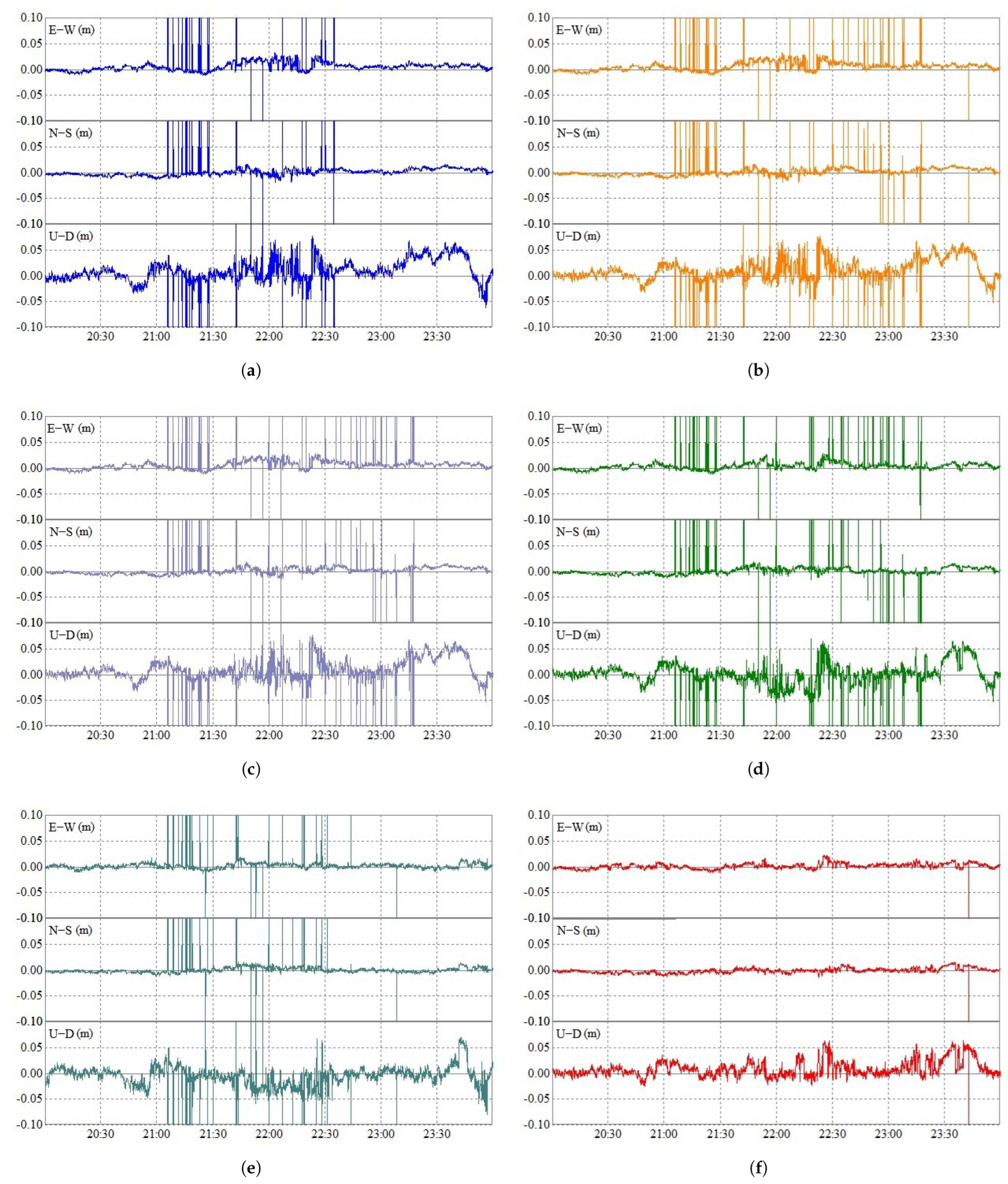
To quantitatively evaluate the performance of the proposed method in actual positioning solutions, this section selected a 4-h segment of GNSS observation data containing significant diffraction errors for comparative experiments. We systematically compared the exclusion strategy based on deep learning identification proposed in this paper with the traditional Cut-off Elevation strategy, SNR Weighing strategy, and SNR Mask strategies with different thresholds. Figure 7 displays the positioning error sequences under different strategies, and Table 1 summarizes the AFR and positioning RMS error for each strategy.
Table 1 summarizes the AFR and positioning RMS error for each strategy. From the statistical results, it is evident that the proposed method significantly outperforms traditional strategies in all indicators. Specifically, the traditional Cut-off Elevation strategy yields significantly larger errors, particularly in the vertical (Up) direction, with an RMS reaching 1.1932 m. The root cause is that low-elevation satellites contribute highly to the geometric configuration in the vertical direction. Although a strict cut-off elevation removes some diffracted signals, it also directly eliminates usable low-elevation satellites, destroying the spatial geometric strength (increasing the VDOP and thereby exacerbating the Up-component positioning error). Regarding the SNR Mask strategies, as the SNR threshold increases from 35 dB-Hz to 45 dB-Hz, the number of effective satellites participating in the solution gradually decreases. However, the AFR and positioning accuracy do not show a monotonic improvement, and performance even degrades at 40 dB-Hz (RMS_U = 1.3270 m). This counter-intuitive phenomenon indicates that low SNR is not entirely equivalent to large diffraction error. In complex environments, some low-SNR signals may only suffer from slight attenuation rather than severe diffraction distortion. Brute-force elimination based on fixed SNR thresholds results in the loss of redundant observations, which reduces the reliability of the ambiguity search space. In contrast, the Proposed Method improves the AFR to 99.9%, achieving a near-continuous fixed solution. In terms of positioning accuracy, the RMS values in the horizontal components (North and East) are reduced to 2.65 cm and 7.87 cm, respectively, while the vertical (Up) RMS is substantially optimized to 0.2920 m. Compared with the cut-off elevation strategy (1.1932 m) and the best SNR mask strategy (1.1706 m), the vertical accuracy is improved by approximately 75.5% and 75.0%, respectively.
To visually demonstrate the impact of diffraction on the dynamic stability of the monitoring system, Figure 7 plots the positioning error time series for different strategies. As shown in Figure 7, the error curves of the comparative methods exhibit frequent, high-amplitude fluctuations, with maximum instantaneous errors exceeding 10 cm in the horizontal direction and 20 cm in the vertical direction. These spikes typically correspond to epochs where satellites enter the diffraction zone. Due to the inability of traditional stochastic models to correctly assign low weights to these anomalous observations, the KF is contaminated by the biased phase measurements, leading to coordinate drifts. In deformation monitoring applications, these false jumps caused by diffraction are often indistinguishable from real structural displacements, potentially triggering false alarms.Conversely, the error sequence of the Proposed Method in Figure 7f is remarkably smooth and stable. Even during time periods where other strategies fail, our method maintains the error within a small bounded range. This stability of the proposed method is not only due to accurate identification of LSTM but also stems from the novel Uncertainty-Aware Adaptive Weighting mechanism. Traditional “Hard Threshold” methods (like Cut-off Elevation and SNR Mask) adopt a binary decision logic: satellites are either fully trusted or completely discarded. This binary approach is risky in occluded environments where visible satellites are scarce. Discarding a satellite that is only slightly affected by diffraction might render the positioning equation rank-deficient or drastically worsen the PDOP. Our method adopts a adaptive Weighting strategy. By mapping the classification probability and information entropy to the variance of the observations (as detailed in Equation (16)), we achieve a continuous adjustment of observation weights. For severe diffraction: The variance is inflated significantly (by the penalty factor μ ), effectively shielding the parameter estimation from the error. For ambiguous/uncertain signals: The entropy term γ · H ˜ t s prevents over-penalization, allowing the filter to utilize the information in these signals with a conservative weight. This method successfully retains the geometric contribution of satellites while suppressing their error, providing a robust solution for GNSS positioning in harsh diffraction environments.

4. Conclusions

In high-occlusion environments such as natural valleys and urban canyons, the diffraction effect has become a critical error source severely restricting the reliability and accuracy of GNSS position. This paper focused on diffraction signal identification and mitigation.
First, the contribution of input features was systematically investigated via feature engineering. Experimental results indicate that the azimuth feature shows a weak correlation with diffraction errors, yielding the lowest identification capability. Conversely, the elevation angle feature demonstrates the strongest capability in identifying abnormal satellites with severe diffraction errors, while the SNR feature is effective in identifying normal satellites. The multi-feature fusion scheme (SNR + Elevation + Azimuth) effectively characterizes the dual-dimensional information of signal strength and spatial position, achieving feature complementarity and synergy, which significantly enhances the model’s distinguishability of anomalies.
Secondly, the effectiveness of the proposed method was verified experimentally. The overall identification accuracy of the multi-feature fusion model reached 84.28%. Specifically, the identification accuracy was 85.58% for normal satellites, 70.84% for ambiguous satellites, and 88.01% for abnormal satellites.
Finally, in solution experiments using real-world deformation monitoring data, the proposed method exhibited superior error suppression capabilities compared to traditional cut-off elevation angle and SNR masking strategies. The method successfully increased the AFR to 99.9%, with average accuracy improvements of 80.1% in the horizontal direction and 76.4% in the vertical direction.

Author Contributions

Conceptualization and methodology were proposed by C.W. and Y.L.; software development and validation were carried out by C.W. and H.S.; formal analysis and investigation were conducted by C.W. and Q.M.; resources and data curation were managed by Y.L. and C.W.; writing—original draft preparation was performed by C.W.; writing—review and editing were completed by Y.L., H.S., C.Q. and Q.M.; visualization was created by C.W. and C.Q.; supervision, project administration, and funding acquisition were led by Y.L. and Q.M. All authors have read and agreed to the published version of the manuscript.

Funding

This work was supported part of by the Geological Survey Projects of China Geological Survey [No. DD20230442 and No. DD20230600303] part of by the National Natural Science Foundation of China under Grant 42301506 and part of by Deep Earth Probe and Mineral Resources Exploration—National Science and Technology Major Project [No. 2025ZD1011304].

Data Availability Statement

The datasets generated during the current study areavailable from authors upon reasonable request (2017301610@whu.edu.cn).

Conflicts of Interest

The authors declare no conflicts of interest.

Abbreviations

AFRAmbiguity Fixing Rate
CNNConvolutional Neural Networks
DDDouble-Difference
DNNDeep Neural Networks
GFGeometry-Free
GNSSGlobal Navigation Satellite Systems
GPSGlobal Positioning System
HMWHatch-Melbourne-Wübbena
KFKalman Filter
LSTMLong Short-Term Memory
MHMMultipath Hemispherical Map
NLOSNon-Line-of-Sight
OMCObserved-minus-Computed
PDOPPosition Dilution of Precision
RMSRoot Mean Square
RNNRecurrent Neural Networks
RTKReal-Time Kinematic
SDSingle-Difference
SFSidereal Filtering
SNRSignal-to-Noise Ratio
SVMSupport Vector Machines
VDOPVertical Dilution of Precision

References

  1. Duong, T.T.; Long, N.Q.; Van Duc, B. Hybrid-Precision GNSS Positioning Strategies for Landslide Monitoring. Int. J. Environ. Sci. 2025, 11, 11–22. [Google Scholar] [CrossRef]
  2. Zhang, H.; Qian, C.; Li, W.; Li, B.; Liu, H. Tightly coupled integration of vector HD map, LiDAR, GNSS, and INS for precise vehicle navigation in GNSS-challenging environment. Geo-Spat. Inf. Sci. 2025, 28, 1341–1358. [Google Scholar] [CrossRef]
  3. Zhang, H.; Qian, C.; Li, W.; Li, B.; Liu, H. A LiDAR–INS-aided geometry-based cycle slip resolution for intelligent vehicle in urban environment with long-term satellite signal loss. GPS Solut. 2024, 28, 61. [Google Scholar] [CrossRef]
  4. El-Sheimy, N.; Lari, Z. GNSS Applications in Surveying and Mobile Mapping. In Position, Navigation, and Timing Technologies in the 21st Century: Integrated Satellite Navigation, Sensor Systems, and Civil Applications; Wiley: Hoboken, NJ, USA, 2020; Volume 2, pp. 1711–1733. [Google Scholar] [CrossRef]
  5. Wang, X.; Zhao, Q.; Xi, R.; Li, C.; Li, G.; Li, L. Review of bridge structural health monitoring based on GNSS: From displacement monitoring to dynamic characteristic identification. IEEE Access 2021, 9, 80043–80065. [Google Scholar] [CrossRef]
  6. Wang, L.; Xu, H.; Shu, B.; Li, X.; Tian, Y. Research progress and prospects of GNSS deformation monitoring technology for landslide hazards. Navig. Position. Timing 2023, 10, 12–26. [Google Scholar] [CrossRef]
  7. Li, M.; Xu, T.; Guan, M.; Gao, F.; Jiang, N. LEO-constellation-augmented multi-GNSS real-time PPP for rapid re-convergence in harsh environments. GPS Solut. 2022, 26, 29. [Google Scholar] [CrossRef]
  8. Li, J.; Hwang, S.H. Improved GNSS Positioning Schemes in Urban Canyon Environments. IEEE Access 2025, 13, 112354–112367. [Google Scholar] [CrossRef]
  9. Xie, P.; Petovello, M.G. Measuring GNSS multipath distributions in urban canyon environments. IEEE Trans. Instrum. Meas. 2014, 64, 366–377. [Google Scholar] [CrossRef]
  10. Han, L.; Xi, R.; Chen, Q.; Xiao, Y.; Wang, K.; Xu, D.; Jiang, W. Analysis and elimination of GNSS carrier phase diffraction error in high occlusion environments. Measurement 2025, 253, 117809. [Google Scholar] [CrossRef]
  11. Sheng, C.; Gan, X.; Yu, B.; Zhang, J. Precise point positioning algorithm for pseudolite combined with GNSS in a constrained observation environment. Sensors 2020, 20, 1120. [Google Scholar] [CrossRef] [PubMed]
  12. Zhang, Z.; Li, Y.; He, X.; Chen, W.; Li, B. A composite stochastic model considering the terrain topography for real-time GNSS monitoring in canyon environments. J. Geod. 2022, 96, 10. [Google Scholar] [CrossRef]
  13. Huang, G.; Du, S.; Wang, D. GNSS techniques for real-time monitoring of landslides: A review. Satell. Navig. 2023, 4, 5. [Google Scholar] [CrossRef]
  14. Liu, X.; Du, Y.; Huang, G.; Wang, D.; Zhang, Q. Mitigating GNSS multipath in landslide areas: A novel approach considering mutation points at different stages. Landslides 2023, 20, 2497–2510. [Google Scholar] [CrossRef]
  15. Zhou, H.; Wang, X.; Zhong, S. A satellite orbit maneuver detection and robust multipath mitigation method for GPS coordinate time series. Adv. Space Res. 2024, 74, 2784–2800. [Google Scholar] [CrossRef]
  16. Lu, R.; Chen, W.; Dong, D.; Wang, Z.; Zhang, C.; Peng, Y.; Yu, C. Multipath mitigation in GNSS precise point positioning based on trend-surface analysis and multipath hemispherical map. GPS Solut. 2021, 25, 119. [Google Scholar] [CrossRef]
  17. Wang, Z.; Chen, W.; Dong, D.; Wang, M.; Cai, M.; Yu, C.; Zheng, Z.; Liu, M. Multipath mitigation based on trend surface analysis applied to dual-antenna receiver with common clock. GPS Solut. 2019, 23, 104. [Google Scholar] [CrossRef]
  18. Hsu, L.-T.; Gu, Y.; Kamijo, S. NLOS correction/exclusion for GNSS measurement using RAIM and city building models. Sensors 2015, 15, 17329–17349. [Google Scholar] [CrossRef] [PubMed]
  19. Gu, M.; Li, T.; Liu, G.; Liu, Z.; Xiong, C.; Wang, C.; Duan, R.; Meng, F.; Xiang, Y.; Pei, L. SVA: A Street-View-Aided GNSS Positioning Framework with 2DSDM and Likelihood Road for NLOS/Multipath Mitigation. IEEE Robot. Autom. Lett. 2025, 10, 8131–8138. [Google Scholar] [CrossRef]
  20. Marais, J.; Berbineau, M.; Heddebaut, M. Land mobile GNSS availability and multipath evaluation tool. IEEE Trans. Veh. Technol. 2005, 54, 1697–1704. [Google Scholar] [CrossRef]
  21. Maier, D.; Kleiner, A. Improved GPS sensor model for mobile robots in urban terrain. In Proceedings of the 2010 IEEE International Conference on Robotics and Automation, Anchorage, AK, USA, 3–7 May 2010; pp. 4385–4390. [Google Scholar] [CrossRef]
  22. Zimmermann, F.; Eling, C.; Kuhlmann, H. Empirical assessment of obstruction adaptive elevation masks to mitigate site-dependent effects. GPS Solut. 2017, 21, 1695–1706. [Google Scholar] [CrossRef]
  23. Suzuki, T.; Matsuo, K.; Amano, Y. Rotating GNSS antennas: Simultaneous LOS and NLOS multipath mitigation. GPS Solut. 2020, 24, 86. [Google Scholar] [CrossRef]
  24. Dai, W.; Ding, X.; Zhu, J. Single reflected or diffracted signal error elimination method in GPS dynamic deformation monitoring. J. Geotech. Invest. Surv. 2006, 34, 45–49. [Google Scholar]
  25. Xiong, Y.L.; Ding, X. Mitigation of GPS signal diffraction effect for deformation applications based on environment modelling. Acta Geod. Cartogr. Sin. 2005, 34, 283–287. [Google Scholar]
  26. Xi, R.; Xu, D.; Jiang, W.; He, Q.; Zhou, X.; Chen, Q.; Fan, X. Elimination of GNSS carrier phase diffraction error using an obstruction adaptive elevation masks determination method in a harsh observing environment. GPS Solut. 2023, 27, 139. [Google Scholar] [CrossRef]
  27. Xi, R.; Han, L.; Chen, Q.; Jiang, W.; Meng, X.; An, X.; Xuan, W. Numerical modeling and analysis of GNSS carrier-phase diffraction error in occlusion environments. J. Geod. 2025, 99, 32. [Google Scholar] [CrossRef]
  28. Han, J.; Tu, R.; Lu, X.; Xia, X.; Zhang, R.; Fan, L.; Zhang, P.; Wang, S. An elevation mask modeling method based on azimuth rounding for monitoring building deformation. Acta Geod. Geophys. 2023, 58, 273–283. [Google Scholar] [CrossRef]
  29. Ren, H.; Li, G.; Geng, J.; Wang, F.; Li, P. Multipath hemispherical map model with geographic cut-off elevation constraints for real-time GNSS monitoring in complex environments. GPS Solut. 2023, 27, 188. [Google Scholar] [CrossRef]
  30. Xu, P.; Zhang, G.; Yang, B.; Hsu, L.-T. Machine learning in GNSS multipath/NLOS mitigation: Review and benchmark. IEEE Aerosp. Electron. Syst. Mag. 2024, 39, 26–44. [Google Scholar] [CrossRef]
  31. Sun, J.; Ma, S.; Zhou, H.; Du, C.; Li, S. Measurement and statistical analysis of distinguishable multipaths in underground tunnels. Int. J. Antennas Propag. 2020, 2020, 2501832. [Google Scholar] [CrossRef]
  32. Li, L.; Xu, Z.; Jia, Z.; Lai, L.; Shen, Y. An efficient GNSS NLOS signal identification and processing method using random forest and factor analysis with visual labels. GPS Solut. 2024, 28, 77. [Google Scholar] [CrossRef]
  33. Baldini, G.; Susi, M.; Fortuny-Guasch, J.; Bonavitacola, F. An experimental analysis of GNSS signals to characterize the propagation environment by means of machine learning processing. In Proceedings of the 2021 IEEE International Conference on Information and Telecommunication Technologies and Radio Electronics (UkrMiCo), Odesa, Ukraine, 29 November–3 December 2021; pp. 176–181. [Google Scholar] [CrossRef]
  34. Xu, P.; Zhang, G.; Yang, B.; Hsu, L.-T. PositionNet: CNN-based GNSS positioning in urban areas with residual maps. Appl. Soft Comput. 2023, 148, 110882. [Google Scholar] [CrossRef]
  35. Li, F.; Dai, Z.; Li, T.; Zhu, X. GNSS NLOS signals identification based on deep neural networks. In Proceedings of the 4th International Conference on Information Science, Electrical, and Automation Engineering (ISEAE 2022), Hangzhou, China, 25–27 March 2022; Volume 12257, pp. 160–169. [Google Scholar] [CrossRef]
  36. Li, F.; Zhai, C.; Xie, T.; Dai, Z.; Zhu, X. GNSS positioning enhancement based on NLOS signal detection using spatio-temporal learning in urban canyons. GPS Solut. 2024, 28, 209. [Google Scholar] [CrossRef]
  37. Li, Z.; Chen, J.; Zeng, K.; Yuan, R.; Xie, S.; Niyato, D. Multivariate Time Series Learning for GNSS NLOS Intelligent Detection. IEEE Sens. J. 2025, 25, 25001–25018. [Google Scholar] [CrossRef]
  38. Hatch, R. The synergism of GPS code and carrier measurements. Int. Geod. Symp. Satell. Doppler Position. 1983, 2, 1213–1231. [Google Scholar]
  39. Melbourne, W.G. The case for ranging in GPS-based geodetic systems. In Proceedings of the First International Symposium on Precise Positioning with the Global Positioning System, Rockville, MD, USA, 15–19 April 1985; pp. 373–386. [Google Scholar]
  40. Wübbena, G. Software developments for geodetic positioning with GPS using TI4100 code and carrier measurements. In Proceedings of the 1st International Symposium on Precise Positioning with the Global Positioning System, Rockville, MD, USA, 15–19 April 1985. [Google Scholar]
  41. Zhang, Q.; Zhang, L.; Sun, A.; Meng, X.; Zhao, D.; Hancock, C. GNSS carrier-phase multipath modeling and correction: A review and prospect of data processing methods. Remote Sens. 2024, 16, 189. [Google Scholar] [CrossRef]
  42. Zhang, L.; Zhang, Y.; Li, Y.; El-Sheimy, N. Machine learning based GNSS signal classification and weighting scheme design in the built environment: A comparative experiment. Measurement 2021, 182, 109696. [Google Scholar] [CrossRef]
  43. Shannon, C.E. A mathematical theory of communication. Bell Syst. Tech. J. 1948, 27, 379–423. [Google Scholar] [CrossRef]
  44. Gal, Y.; Ghahramani, Z. Dropout as a bayesian approximation: Representing model uncertainty in deep learning. In Proceedings of the 33rd International Conference on Machine Learning, New York, NY, USA, 20–22 June 2016; Volume 48, pp. 1050–1059. [Google Scholar]
  45. Du, Y.; Huang, G.; Zhang, Q.; Gao, Y.; Gao, Y. A new asynchronous RTK method to mitigate base station observation outages. Sensors 2019, 19, 3376. [Google Scholar] [CrossRef]
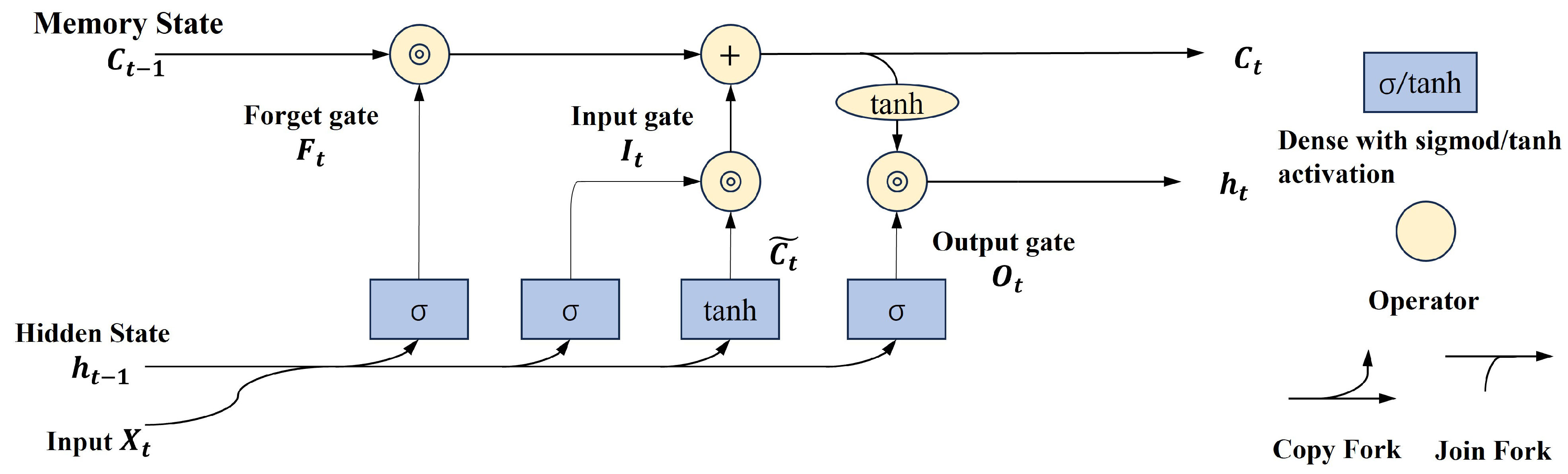
Figure 1. The structure of LSTM cell, including the input gate, forget gate, output gate and the candidate memory cell. The LSTM cell is used to determine whether information is useful.
Remotesensing 18 00158 g001
Figure 2. The structure of LSTM network and the full structure of our single channel recognition model. The blue blocks in this figure represent the LSTM cells metioned in Figure 1.
Remotesensing 18 00158 g002
Figure 3. (a) SNR sky-plots of JZ01. (b) SNR sky-plots of WY01.
Remotesensing 18 00158 g003
Figure 4. Residual sky-plots of baseline WY01-JZ01.
Remotesensing 18 00158 g004
Figure 5. (a) Confusion Matrix for Satellite Anomaly State Identification Based on Azimuth. (b) Confusion Matrix for Satellite Anomaly State Identification Based on Elevation. (c) Confusion Matrix for Satellite Anomaly Identification Based on Elevation-Azimuth. (d) Confusion Matrix for Satellite Anomaly State Identification Based on SNR.
Remotesensing 18 00158 g005
Figure 6. (a) Confusion Matrix for Satellite Anomaly Identification Based on SNR-Elevation-Azimuth Fusion Feature. (b) Training Process Curve of SNR + Elevation + Azimuth Fusion Feature.
Remotesensing 18 00158 g006
Figure 7. (a) Position error of Cut-off Elevation strategy. (b) Position error of SNR Weighing strategy. (c) Position error of SNR Mask 35 dB-Hz. (d) Position error of SNR Mask 40 dB-Hz. (e) Position error of SNR Mask 45 dB-Hz. (f) Position error of Our Method.
Remotesensing 18 00158 g007
Table 1. Performance comparison of different strategies.
StrategyAFR (%)RMS (m)
NEU
Cut-off Elevation98.50.29540.23191.1932
SNR Weighing98.00.33450.30951.1991
SNR Mask 35 dB-Hz98.00.33430.29891.1706
SNR Mask 40 dB-Hz97.70.35110.29121.3270
SNR Mask 45 dB-Hz98.50.25220.24431.2913
Our Method99.90.02650.07870.2920
Disclaimer/Publisher’s Note: The statements, opinions and data contained in all publications are solely those of the individual author(s) and contributor(s) and not of MDPI and/or the editor(s). MDPI and/or the editor(s) disclaim responsibility for any injury to people or property resulting from any ideas, methods, instructions or products referred to in the content.