
Article

Remote Sensing Standardized Soil Moisture Index for Drought Monitoring: A Case Study in the Ebro Basin

by
Guillem Sánchez Alcalde
* and
Maria José Escorihuela
isardSAT, Doctor Trueta, 113, 1r, 08005 Barcelona, Spain
*
Author to whom correspondence should be addressed.
Remote Sens. 2025, 17(23), 3916; https://doi.org/10.3390/rs17233916
Submission received: 21 October 2025 / Revised: 27 November 2025 / Accepted: 1 December 2025 / Published: 3 December 2025

Highlights

What are the main findings?
  • The satellite-derived Standardized Soil Moisture Index (SSI) is a versatile drought indicator capable of monitoring across different scales, including long-term hydrological deficits.
  • The 1 km disaggregated SSI provides enhanced spatial detail and granularity, surpassing the spatial representation of state-of-the-art indices.
What are the implications of the main findings?
  • The SSI’s reliance only on satellite data (not site-calibrated) establishes it as potentially globally applicable and a high-resolution drought monitoring tool.
  • This approach paves the way for accurate, high-resolution drought assessment in data-scarce regions.

Abstract

The occurrence and duration of droughts have increased in recent years, reinforcing their role as a major climate risk. This study evaluates a remote sensing soil moisture-based drought index, the Standardized Soil Moisture Index (SSI), as a tool to monitor different types of drought, from meteorological, agricultural to hydrological. The satellite-derived SSI at different integration times (from SSI-1 up to SSI-24) was compared with the Standardized Precipitation Index (SPI), calculated using precipitation data from 239 meteorological stations in the Ebro Basin. A good correlation ( R > 0.6 ) was found between the indices at all integration times. Our results suggest that, independently of the time scale, SSI tends to relate better to the SPI with an additional month for its integration time, reflecting soil moisture’s inertia. Comparison with a gridded SPI product further confirmed that SSI captures basin-wide drought variability, also suggesting that it can observe hydrological processes such as snowmelt and irrigation. These findings demonstrate that remote-sensed SSI is a robust and versatile drought index, capable of monitoring multiple drought types without relying on in situ measurements. Provided the existence of quality soil moisture data, satellite-derived SSI stands as a drought indicator with high coverage and enhanced spatial detail. Hence, this methodology paves the way for accurate drought monitoring in data-scarce regions.

1. Introduction

The consequences of climate change are already visible and the urge to counteract its effects motivates the development of different techniques to minimize its impact. Among the natural systems most affected is the hydrological cycle, which experiences more frequent extreme events such as floods and droughts. In particular, the frequency and duration of droughts have increased in recent decades, amplifying droughts as a major climate risk [1] and increasing the need for robust, spatially explicit monitoring tools.
Depending on their severity and duration, droughts can be classified as meteorological, agricultural, hydrological, or socioeconomic [2]. Meteorological droughts are associated with a precipitation deficiency period, which can also be accompanied by high temperatures or low relative humidity. Agricultural droughts are characterized by soil moisture and evapotranspiration deficiencies, resulting in a reduction in crop population and yield. Hydrological droughts are defined on a river basin scale, with shortages on surface and subsurface water supplies (i.e., streamflow, reservoir, groundwater). It is important to note that hydrological droughts are usually out of phase with meteorological and agricultural droughts [3]. It takes longer for precipitation deficiencies to show up in components of the hydrological system, such as soil moisture or groundwater. Finally, socioeconomic droughts arise when the demand for an economic good exceeds the supply as a result of a weather-related shortfall in water supply.
The Standardized Precipitation Index (SPI) is a widely used precipitation-based drought index that quantifies precipitation anomalies over multiple time scales [4]. For example, an SPI computed for a three-month accumulation period (i.e., SPI-3) characterizes short-term conditions, while long-term hydrological effects arise for an SPI with twelve-month accumulation period (i.e., SPI-12) and above. Because SPI is standardized, it is commonly used as a reference for drought monitoring when long precipitation time series are available (more than 30 years of data). Positive SPI values arise when the total accumulated precipitation during a given period exceeds historical records, whereas negative SPI values are the result of a rainfall shortage during a period compared with historical data.
Due to the mathematical formalism of the SPI, the index can be applied to any region, regardless of the climate and season. Consequently, the values resulting from the SPI are not bounded to a given amount of precipitation poured during a certain period. For instance, a humid region could have positive SPI values due to the presence of anomalous heavy rains, while an arid region could have the same SPI values just with a short-lasting rainfall. Hence, the SPI values indicate the intensity of abnormal climatic events for a given climate.
The SPI uses precipitation deficits as a proxy to monitor the different types of drought [4,5]. On monthly timescales, SPI-3 and below are typically tied to meteorological droughts, reflecting short-term moisture conditions. The use of these short-term SPIs can be misleading if the respective climate of the area of study is not taken into account. Regions with few rain episodes during the same integration time used for the SPI tend to have large negative/positive values of the SPI even for small deviations from the mean precipitation record [4]. To monitor agricultural droughts, from SPI-6 to SPI-9 are normally used, indicating medium-term trends in precipitation and streamflow anomalies. Finally, SPI-12 and above indicate long-term precipitation patterns, serving as good indicators for hydrological droughts, tied to reservoir and groundwater levels. However, the longer the timescale of the SPI, its value tends to be less extreme unless a distinctive wet/dry event trend takes place. This phenomenon occurs because the long timescale is the cumulative result of shorter periods that are above and below the mean reference value.
Depending on the complexity and extension of the region, the relations between SPI’s scale and drought type can differ. For example, an SPI-9 could reflect the hydrological drought that affects a small river basin, while a more complex one would require a longer integration time to grasp the scarcity of groundwater levels in the basin. Hence, to properly monitor a drought event, it is important to compare the SPI at different timescales.
Despite SPI’s simplicity, being capable of monitoring drought through precipitation data alone has granted its current popularity. However, SPI requires dense and long meteorological station records, or gridded precipitation products, which can be sparse or uncertain. Although precipitation data at a global scale can be obtained via satellite, its spatial resolution is rather coarse. Furthermore, the values obtained are accompanied by high uncertainties [6,7]. Hence, the SPI or any other precipitation-based index is strongly tied to in situ measurements, tending to rely on physical models to cover land expanses by interpolating precipitation between meteorological stations.
Consequently, a plethora of drought indices have been developed relying on other remote sensed physical variables. For example, vegetation-based indices work with satellite observations of vegetation conditions to assess drought impacts [8]. One of the most widely used vegetation-based indices is the Normalized Difference Vegetation Index (NDVI), which quantifies vegetation greenness and is useful in understanding vegetation density and assessing changes in plant health [9]. Despite its global coverage and capture of the overall vegetation’s response to water stress, the NDVI shows difficulties distinguishing between water stress and other environmental factors affecting vegetation, such as pests or land-use changes. Moreover, it presents applicability limitations in arid and semi-arid regions [10,11], as well as saturation problems in dense vegetation canopies [12,13].
To cope with some of the prior limitations, the Vegetation Condition Index (VCI) normalizes NDVI values over a specific region and time to highlight relative vegetation stress. Therefore, the VCI resembles more the SPI, as it enables drought detection in relation to historical records, suitable for monitoring vegetation stress across different ecosystems and climatic regions. Basically, the VCI minimizes short-term signals and amplifies the long-term trend [14]. However, the VCI is sensitive to seasonal vegetation dynamics, which may not always be related to drought. Vegetation-based indices capture ecosystem’s response to water stress, but their effectiveness is limited when monitoring meteorological and hydrological droughts [15,16]. These indices do not directly measure precipitation or soil moisture, making them less suitable for assessing water deficits in river basins, groundwater systems, and reservoirs.
Given these limitations, soil moisture is a more direct hydrological state variable for drought monitoring. Remote sensing microwave retrievals, although relatively new, provide continuous, spatially extensive and near real-time surface soil moisture products with higher resolution and accuracy than remotely-sensed precipitation [17,18]. Due to its appeal for drought characterization, satellite-based soil moisture has recently been used for short-term drought monitoring [19,20,21]. Previous studies have proven the suitability of remotely-sensed soil moisture for agronomic droughts [22,23] and their propagation [24].
The Standardized Soil Moisture Index (SSI), which adopts the SPI standardization approach but uses soil moisture as input, offers a potentially direct method for drought monitoring. Previous studies have demonstrated the suitability of using SSI derived from model-based soil moisture for short-term drought monitoring [25,26]. Model-based SSI typically relies on Land Surface Models (LSMs) that require extensive meteorological and in situ observation networks to retrieve soil moisture readings, in addition to auxiliary variables (e.g., vegetation, land cover, among others) for model initialization and forcing. This dependency often makes its application viable only for regions with a sufficiently dense station array and a considerable historical record.
Satellite-derived SSI has also been recently used in the literature [22,25], showing positive results for short-term drought monitoring. However, to the best of our knowledge, the use of satellite-derived soil moisture to characterize hydrological droughts has not yet been tested. Since hydrological drought is defined by sustained deficiencies in the hydrological system, studies focusing on soil moisture anomalies over only short periods (such as those in [23]) cannot adequately grasp the status of long-term hydrological deficiencies.
In this context, this paper proposes a satellite-derived soil moisture-based SSI to monitor droughts across multiple timescales with high spatial resolution. A key novelty of this study is the application of the satellite-derived SSI as a compelling index for characterizing hydrological droughts, thus extending its utility beyond short-term applications. Furthermore, since the proposed SSI solely requires satellite observations and is not site-calibrated, it can potentially be applied to other regions without the need for extensive auxiliary or in situ data, making it a promising drought indicator for data-scarce regions.
In addition, given the distinct physical behavior between precipitation and soil moisture data, the temporal relationship between the remote sensing-derived SSI and the SPI across different integration timescales will also be thoroughly analyzed.
Therefore, in this paper we will construct the SSI over the Ebro basin (Spain) using satellite soil moisture data at 1 km resolution. To validate the SSI, the SPI will be computed using the different meteorological stations installed across the region. We will compare the indices at multiple timescales and lags to quantify their temporal agreement, correlation, and soil moisture memory. Furthermore, an operational gridded SPI dataset will be used to evaluate spatial correlation and assess SSI’s ability to capture hydrological processes.
The paper is organized as follows. Section 2 describes the study area of the Ebro basin. Section 3 presents the data acquisition and treatment of satellite soil moisture, develops the SSI formulation, and details the SPI datasets for validation. Section 4 presents the validation results and demonstrates SSI’s suitability for hydrological droughts. Finally, Section 5 discusses the findings and concludes.

2. Study Area

Located in the northeastern region of the Iberian Peninsula, the Ebro basin is the focus of our investigation. This area, uniquely situated between the influences of the Atlantic and Mediterranean climates, is distinguished by its intricate hydrological dynamics and interannual variability.
Spanning across an extensive area of more than 85,000 km2, the Ebro basin reveals a diverse topography given by both geological forces and climatic nuances. The basin’s southwestern and northeastern borders are dominated by the Iberian and Pyrenees mountain ranges, respectively, accentuating the geomorphological complexity of the region. The Cantabrian coastline, in the northern expanse, bestows a cool and humid climate due to its proximity to the Atlantic. Conversely, the southeastern borders are marked by the warm and arid climate of the Mediterranean. Such mixture of climatic influences translates into a plethora of microclimates, with the oceanic influence being quite restricted at the center of the basin.
The interaction of semi-arid climatic conditions and unfavorable soil types for vegetation development, such as gypsum and limestone substrates, gives rise to a distinct regime characterized by extreme climatic events. The distribution of rainfall, soil moisture levels, and evapotranspiration rates, which are inherently inclined toward drought, emerge as significant aspects that define the hydrological nature of the Ebro basin. The densely inhabited landscape of the basin assumes the responsibility of fulfilling diverse water demands. Namely, agriculture and energy production are the main sectors that consume the available water resources. The extensive network of irrigated zones, concentrated in the arid central depression, remains particularly exposed to hydrological drought episodes [24].
In view of the increasing evidence for both the frequency of drought incidents [27] and the duration of consecutive arid periods [28], we can expect long-term consequences for the environmental and hydrological equilibrium of the basin. Furthermore, the semi-arid climatic domain facilitates the evaporation of rainfall [29]. Thus, the Ebro basin is a great example of the importance between natural water demands and available supply.

3. Materials and Methods

The temporal extension of our study is from June 2010 until May 2023.

3.1. Remote Sensing Soil Moisture

In November 2009, the European Space Agency (ESA) launched the SMOS (Soil Moisture and Ocean Salinity) satellite. Equipped with an L-band radiometer, SMOS has been producing surface soil moisture maps since 2010 (depth up to ∼5 cm), with a spatial resolution of 40 km. The use of remote sensing technology to derive soil moisture data represents a powerful tool due to its spatial coverage. Furthermore, SMOS offers a 1–3 day revisit period, which provides the capability to capture changes in soil moisture content with global coverage at high temporal resolution.
Nevertheless, one of the main drawbacks of soil moisture data derived from passive microwave remote sensing lies in its rather coarse spatial resolution. The 40 km resolution of SMOS provides observations at a broad scale. Although sufficient for meteorological applications, such resolutions may obscure key insights about soil moisture dynamics within larger pixels.
In our study, we employ the disaggregation algorithm called DISPATCh (DISaggregation based on Physical And Theoretical scale Change) to derive a 1 km soil moisture product. This algorithm distributes high-resolution soil moisture around the observed low-resolution mean value by using the relation between optical-derived soil evaporative efficiency (SEE) and surface soil moisture [30].
For DISPATCh, we utilize MODIS (MODerature resolution Imaging Spectroradiometer, from NASA) 1 km products MOD11A1, MYD11A1, and MOD13A2, which correspond to Terra Land Surface Temperature (LST), Aqua LST, and Terra Normalized Difference Vegetation Index (NDVI), respectively. While LST products are acquired daily due to temperature variability, NDVI is updated every 16 days as vegetation changes at a slower rate. Raw soil moisture data is obtained from the SMOS level-2 soil moisture product (version 700).
To avoid the presence of clouds and low quality data, the prior datasets are preprocessed before entering as inputs for DISPATCh. MODIS’ LSTs are masked using the correspondent quality control (QC) flag. Only LST pixels with QC values equal to zero are considered, as they are the ones with the best quality and without nuances. For SMOS soil moisture data, an RFI (Radio Frequency Interference) filter is applied. Pixels with RFI values greater than 0.02 are deprecated to avoid contamination from other sources that emit at SMOS’s frequency. Therefore, only the values that satisfy these conditions are used to derive soil moisture at 1 km.
For this paper, a linear version of DISPATCh is used [31], with an extension for vegetation cover [32]. The DISPATCh downscaling equation relies on high resolution ( H R ) optical-derived soil moisture ( S M ) to disaggregate low resolution ( L R ) S M at H R :
S M H R = S M L R + S M m o d S E E S E E H R = S E E L R × ( S E E H R S E E L R )
where S M H R is the disaggregated S M at H R , S M L R is the S M at L R observed by SMOS, S E E H R is the SEE at H R derived from MODIS, S E E L R serves as the aggregated H R   S E E at L R and S M m o d S E E S E E H R = S E E L R is the partial derivative of S M with respect to S E E at L R . The S E E at H R can be obtained through:
S E E H R = T s , m a x T s , H R T s , m a x T s , m i n
where T s , H R is the soil surface temperature at H R , and T s , m a x and T s , m i n are the soil temperature in full dry ( S E E = 0 ) and water-saturated ( S E E = 1 ) conditions, respectively. The temperature extremes are estimated from the maximum and minimum values of the observed LST within the LST- f v g feature space obtained with MODIS data. The soil temperature in Equation (2) is obtained from the linear decomposition of LST into soil and vegetation temperature using the trapezoid method [33]:
T s , H R = L S T H R f v g , H R × T v , H R 1 f v g , H R
where, L S T H R is the H R LST derived from MODIS data, f v g , H R is the H R fractional vegetation cover derived from MODIS and T v , H R is the H R vegetation temperature bounded by its maximum ( T v , m a x ) and minimum ( T v , m i n ) value.
The 1 km soil moisture product derived from DISPATCh has been validated at different study sites under different climatic conditions, such as Catalonia (Spain) [30], Australia [33], and Morocco [34], among others. While the methodology is theoretically applicable across various regions, its practical implementation is contingent upon the availability of accurate optical/thermal and soil moisture observations. Consequently, regions characterized by persistent cloud coverage will encounter difficulties in soil moisture downscaling, as the necessary input data will typically contain spatial and temporal gaps due to cloud presence. Nevertheless, for Mediterranean climates, DISPATCh has demonstrated robust performance, producing soil moisture data at an enhanced 1 km spatial resolution [35].
To test the robustness and consistency of the remotely-sensed SSI, an additional soil moisture dataset was produced. This dataset employed the same DISPATCh methodology but substituted the SMOS satellite soil moisture with the NASA Soil Moisture Active Passive (SMAP) Level 3 product (SPL3SMAP, 9 km spatial resolution). The SSI results obtained using this SMAP-based dataset were highly comparable to those derived from the SMOS-based SSI, though they exhibited slightly inferior performance metrics when compared against SPI. Given that the SMOS mission provides a longer historical record, yields better results, and to avoid redundancy in the presentation of results, we decided to focus solely on the analysis and findings derived from the SSI generated using the SMOS and MODIS data inputs.

3.2. SPI from Meteorological Stations

The Ebro basin benefits from the SAIH Ebro (Sistema Automático de Información Hidrológica del Ebro), an advanced hydrological monitoring and data management system that operates throughout the basin. Its primary goal is to provide real-time information on water resources, including water levels, flows, rainfall, and reservoir capacities, allowing better decision-making in water management.
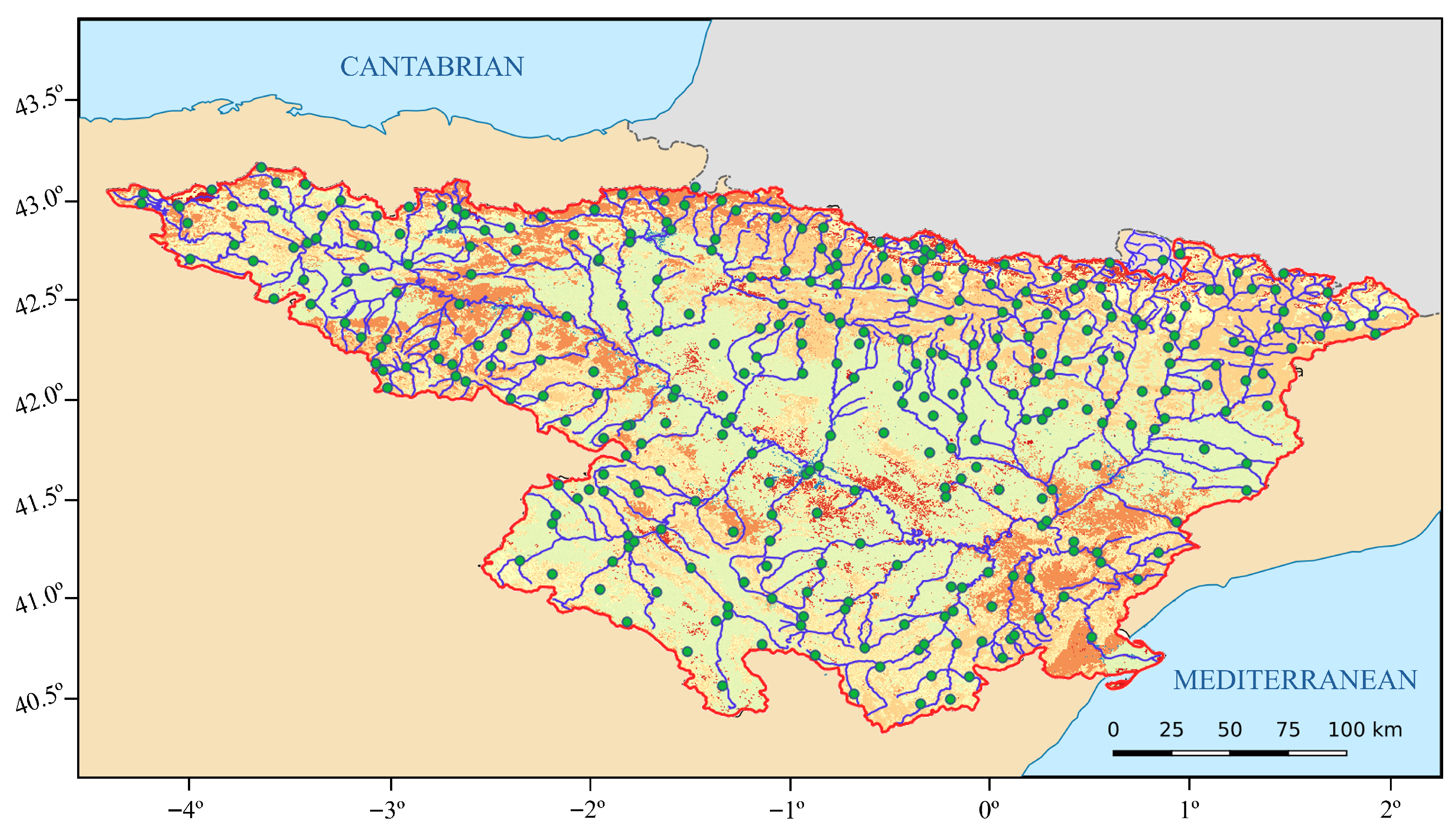
The dots in Figure 1 are all the available meteorological stations from SAIH Ebro. From the original 328 stations, we have retrieved monthly precipitation data from stations located in natural environments where soil moisture is meaningful (not urban or water masses; filtering 17 stations) that have records from the period 2010/06–2023/05 without gaps (filtering 72 stations). Consequently, a total of 239 stations satisfy our conditions.
To determine the land cover associated with each meteorological station, we have used the ECOCLIMAP Second Generation map [36]. With a spatial resolution of 300 m, the ECOCLIMAP product classifies each pixel as a pure land cover type (e.g., water, vegetation, urban). The shaded colors in Figure 1 correspond to the land cover. Shaded green areas are croplands, light orange are shrubs and sparse trees, intense orange are forests, and shaded red regions (i.e., in the center of the Ebro basin) are for bare land.

3.3. Gridded SPI

The LCSC (Laboratorio de Climatología y Servicios Climáticos) is a collaboration between the CSIC (Consejo Superior de Investigaciones Científicas) and the University of Zaragoza, with the objective of conducting research in the fields of climatology and global change, focusing on the development of analysis tools and climate services.
Among the suite of services offered by the LCSC, we focused on utilizing their gridded SPI dataset at different timescales. This historical dataset covers the entire region of Spain, with a spatial resolution of 1.1 km and a weekly frequency (4 time-steps per month). In situ measurements from meteorological stations operated by AEMET (Agencia Estatal de Meteorología) and SIAR (Sistema de Información Agroclimática para el Regadío) are used to compute the SPI. To calibrate the index, available data spanning from 1961 to 2014 is used. These SPI maps do not have missing data, as the authors use a gap-filling process based on weighted averages of measurements made at nearby stations to fill their weekly series. For more information on the acquisition and processing of the data from this product, see [37].
To match the specifications of our remote sensing-derived soil moisture, the weekly SPI data were aggregated and averaged to monthly values. The resulting monthly maps were reprojected to match the grid of our 1 km soil moisture product and resampled performing a cubic convolution. With this method, the values of each pixel are based on fitting a smooth curve through the sixteen nearest input cell centers. This approach aims to validate the utility of the SSI for hydrological assessments on a global scale and demonstrate its correlation with this widely used drought index.

3.4. Methodology

In this study, we introduce the Standardized Soil Moisture Index (SSI) as a comprehensive approach to characterizing drought events from the perspective of soil moisture deficits. The foundation of the Standardized Precipitation Index (SPI) rests on the premise that precipitation anomalies conform to a gamma distribution function. Such assumption allows the transformation of accumulated precipitation data from its original distribution to a standardized normal distribution with a mean ( μ ) of 0 and a standard deviation ( σ ) of 1. This transformative process imbues the SPI with a remarkable level of flexibility, enabling its application across diverse geographical regions and temporal scales. Through this transformation, the SPI translates the deviations of the anticipated values into a language of standard deviations.
To compute the SPI from the SAIH precipitation data (Section 3.2), we use the original SPI methodology. The frequency distribution of precipitation is fitted by a two-parameter gamma probability density function:
g ( x ) = 1 β α Γ ( α ) x α 1 e x β
where x is the accumulated precipitation, Γ ( α ) is the gamma function, and α and β are the shape and scale parameters of the gamma distribution. α and β are estimated using the maximum likelihood approach [38]. Therefore, by assuming t = x β , the cumulative probability G ( x ) reads as follows:
G ( x ) = 1 Γ ( α ) 0 x t α 1 e t d t
Since Equation (5) is not valid for x = 0 (i.e., zero precipitation), we need to use the complete cumulative probability distribution:
H ( x ) = q + ( 1 q ) G ( x )
where q is the probability of zero precipitation. Then, H ( x ) is transformed to the standard normal distribution using
μ = Φ 1 ( H ( x ) )
where Φ 1 is the inverse of the standard normal cumulative distribution function. Finally, to calculate the SPI, we use the following formula:
S P I = μ μ ¯ σ
where μ is the mean of the transformed values over the desired time period, μ ¯ the historical mean of the transformed values of the desired period throughout the entire dataset, and σ is the standard deviation of the transformed values over the same period as μ ¯ .
Just as the SPI revolutionized drought assessment by adopting a gamma distribution function to quantify precipitation anomalies, we shall adapt this concept to soil moisture for the SSI. In the literature, it can be found that soil moisture is generally fitted to beta or Weibull distributions, among others [39,40,41].
In our context, we performed a preliminary study to determine the best distribution for each grid cell in our area of interest. We chose among four different distributions to fit the dataset: gamma, beta, lognormal, and Weibull. A Kolmogorov–Smirnov (KS) test was performed for each pixel, showing that the beta distribution is the best fit for more than 60 % of the whole grid in the Ebro basin, with KS-values 0.03 . An additional analysis was conducted in which three SSI datasets were generated for the Ebro basin, each computed using a different parametric fit for soil moisture: beta, gamma, and lognormal distributions. Our results showed minimal differences among the three datasets, indicating that the choice of distribution has only a minor influence on the final index values. Consequently, as the beta distribution function has the highest spatial representation according to the KS-test performed, it was chosen as the best fit for our monthly soil moisture data. Therefore, the beta distribution function was chosen as the underlying statistical model for our monthly soil moisture data. Furthermore, this choice is motivated by the beta distribution’s intrinsic characteristics that resonate well with soil moisture data, whose values are inherently bounded between 0 and 1.
The beta probability distribution is given by
f ( x ; α , β ) = x α 1 ( 1 x ) β 1 B ( α , β )
where x is the soil moisture value, α and β are the distribution shape parameters, and B ( α , β ) is the beta function that ensures a proper normalization, defined by
B ( α , β ) = Γ ( α ) Γ ( β ) Γ ( α + β )
being Γ the gamma function.
To calculate the SSI, we need to transform the soil moisture values to a standard normal distribution, as in the SPI. This process involves obtaining the cumulative distribution function (CDF) of the beta distribution. Afterwards, we need to transform it to the standard normal distribution, using the inverse of the standard normal CDF.
For a desired time period (e.g., weekly, monthly), the shape parameters α and β are estimated by fitting the beta distribution to the soil moisture data. Once the values of α and β are known, we calculate the CDF of the estimated beta distribution using the following:
F ( x ; α , β ) = 0 x f ( t ; α , β ) d t
where F ( x ; α , β ) is the probability of obtaining the value x in such time period. As in Equation (7), this value is converted to the standard normal distribution using
μ = Φ 1 ( F ( x ; α , β ) )
obtaining μ , the mean of the transformed values over the desired period. Finally, the SSI values are obtained following the same formula as in Equation (8).
Although the SSI methodology shares limitations with the SPI, it is important to acknowledge that the assumption of monthly soil moisture following a beta distribution might not hold across the whole study area. This assumption could potentially impact the accuracy of SSI values in certain regions where the behavior of soil moisture is not adequately captured.
Recognizing these statistical incompatibilities, various studies have proposed alternative drought indices [38,42]. They advocate for the use of empirical probabilities to derive non-parametric standardized indices. In this approach, parametric probabilities are obtained by calculating the marginal probability of the input variable (such as precipitation or soil moisture) using the empirical Gringorten plotting position formula [43]:
p ( x i ) = i 0.44 n + 0.12
where n is the sample size, i represents the rank of non-zero data from the smallest, and p ( x i ) corresponds to the empirical probability associated with the specific value xi.
However, while non-parametric drought indices hold appeal, implementing them in our study context would yield misleading results. These indices necessitate extensive historical datasets to function effectively. Their extreme values, indicating wet and dry periods, are closely tied to the dataset’s historical length. Unfortunately, due to the absence of a comprehensive historical soil moisture dataset derived from remote sensing, adopting a non-parametric drought index would result in a loss of vital information regarding the impact of droughts—a core objective of our study. For this reason, we decided to stick to the SSI formulation.
Despite the close formalism among the SSI and SPI, the nature of soil moisture and precipitation is distinct. Hence, our first task to command is to demonstrate the validity of the satellite-derived SSI while checking the correspondence between the indices. Namely, the dynamics of soil moisture may introduce a delay in the SSI behavior. For example, SSI-12 might not complement the information retrieved from SPI-12 but from SPI-13. Additionally, soil moisture’s inertia could also translate into a monthly lag in the SSI’s value with respect to the SPI.
For this reason, we performed a statistical analysis to check the similarity of these two indices. Specifically, we studied the correlation, root mean square difference (RMSD), bias, and slope to determine the correspondence of the SSI with the SPI. The relationship between these indices at small integration times has already been tested in other studies, using model-derived soil moisture data for the SSI [26,44]. Therefore, in addition to demonstrating that remote sensing-derived SSI is a robust drought index, this paper will also remark its suitability on longer timescales.
To analyze the differences between the indices, we have used the SPI derived from precipitation data (Section 3.2). To retrieve the best correspondence between SSI and SPI across timescales, we computed the correlation between the SSI at a fixed integration time with the SPI using an integration time of ±3 months with respect to the SSI, when possible. Moreover, the impact of monthly time lags is also addressed by applying statistical analysis to SPIi & SSIi+δ, where i corresponds to the month of SPI computation and δ the monthly time lag. In our case, we study the scenarios for δ [ 1 , 2 ] .
Finally, the gridded SPI dataset (Section 3.3) served to study the spatial variability of the SSI. Having 2-dimensional maps of the SPI and SSI allows us to better highlight under which conditions the indices are most different from each other, manifesting the advantages of the remotely-sensed SSI.

4. Results and Discussions

4.1. Temporal Evolution

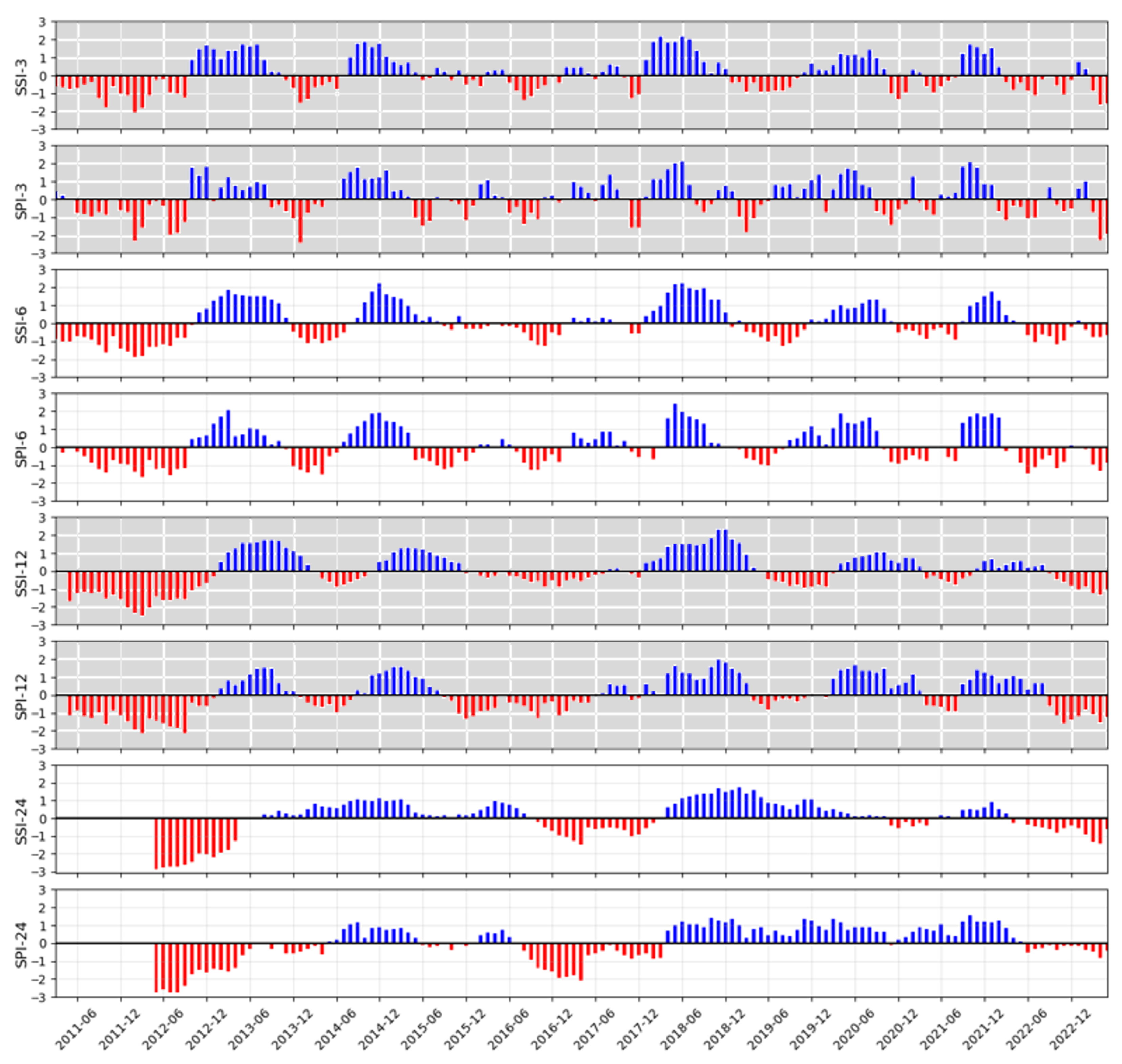
Figure 2 shows the temporal evolution of the SSI and SPI at 3, 6, 12, and 24 months of integration at the arbitrarily chosen station located in Caparroso, northern Spain. The alignment of the indices along all time scales confirms that precipitation is a primary driver of soil moisture variability. This relationship is evident as periods of below average precipitation correspond to lower soil moisture and vice versa. However, differences in timing, magnitude, and response dynamics highlight the unique characteristics of each index and their sensitivity to temporal scales.
At shorter integration times (3 and 6 months), both SSI and SPI are highly variable, capturing short-term precipitation anomalies. The indices exhibit frequent oscillations between wet and dry periods, reflecting seasonal and interannual variability. For example, during mid-2019, sharp positive peaks in SPI-3 and SPI-6 indicate wet conditions, mirrored by SSI-3 and SSI-6 with a slight delay. Similarly, during the rapid onset of drought in early 2022, SPI transitions into negative phases earlier than SSI. These lags illustrate the response of soil moisture to precipitation changes. The amplitude of variations is also more pronounced in SPI compared to SSI. SPI tends to be spikier with fast transitions between positive/negative phases, while SSI has a milder and smoother evolution, because soil moisture integrates and dampens the impact of precipitation. This dampening effect arises from the soil’s limited capacity to store water and the influence of hydrological processes, such as infiltration and evapotranspiration.
Longer integration times (12 and 24 months) smooth out short-term fluctuations, emphasizing prolonged climatic trends. At the 12-month scale, the indices show strong alignment, but with a slightly more visible lag in the wet/dry transitions, underscoring soil moisture’s slower response to cumulative precipitation deficits or surpluses. At the 24-month scale, the alignment among the indices weakens and more differences arise. For instance, during the period 2013–2014, SSI-24 shows positive values while SPI-24 remains slightly negative, suggesting a divergence in the way soil moisture and precipitation anomalies are integrated over extended periods. However, this behavior could partially be due to the relatively short historical record (13 years) used to calculate the indices. Since the time window involves integrating over two years, the limited data may reduce the robustness of the indices. In addition, because the same period was used for the computation of the SSI and the historical records, the results are not as extreme.
Event-specific discrepancies between the indices are evident. Wet periods often exhibit reduced SSI amplitudes compared to SPI, while drought periods show a tighter correspondence. These differences emphasize the complementary roles of SSI and SPI in drought monitoring. SPI provides an immediate measure of precipitation anomalies, while the SSI offers a slightly lagged integrated perspective that accounts for the buffering and storage effects of soil processes.
Each temporal scale provides unique information on the relationship between precipitation and soil moisture. At shorter scales (3 and 6 months), the indices capture seasonal and interannual variability with high sensitivity to short-term precipitation anomalies, although differences in timing and magnitude are more pronounced. The 12-month scale strikes a balance by effectively highlighting longer-term trends while maintaining strong correspondence between SSI and SPI. At the 24-month scale, the indices capture sustained climatic trends but exhibit reduced alignment, likely due to the relatively short historical record and the integration of anomalies over extended periods.

4.2. Integration Time

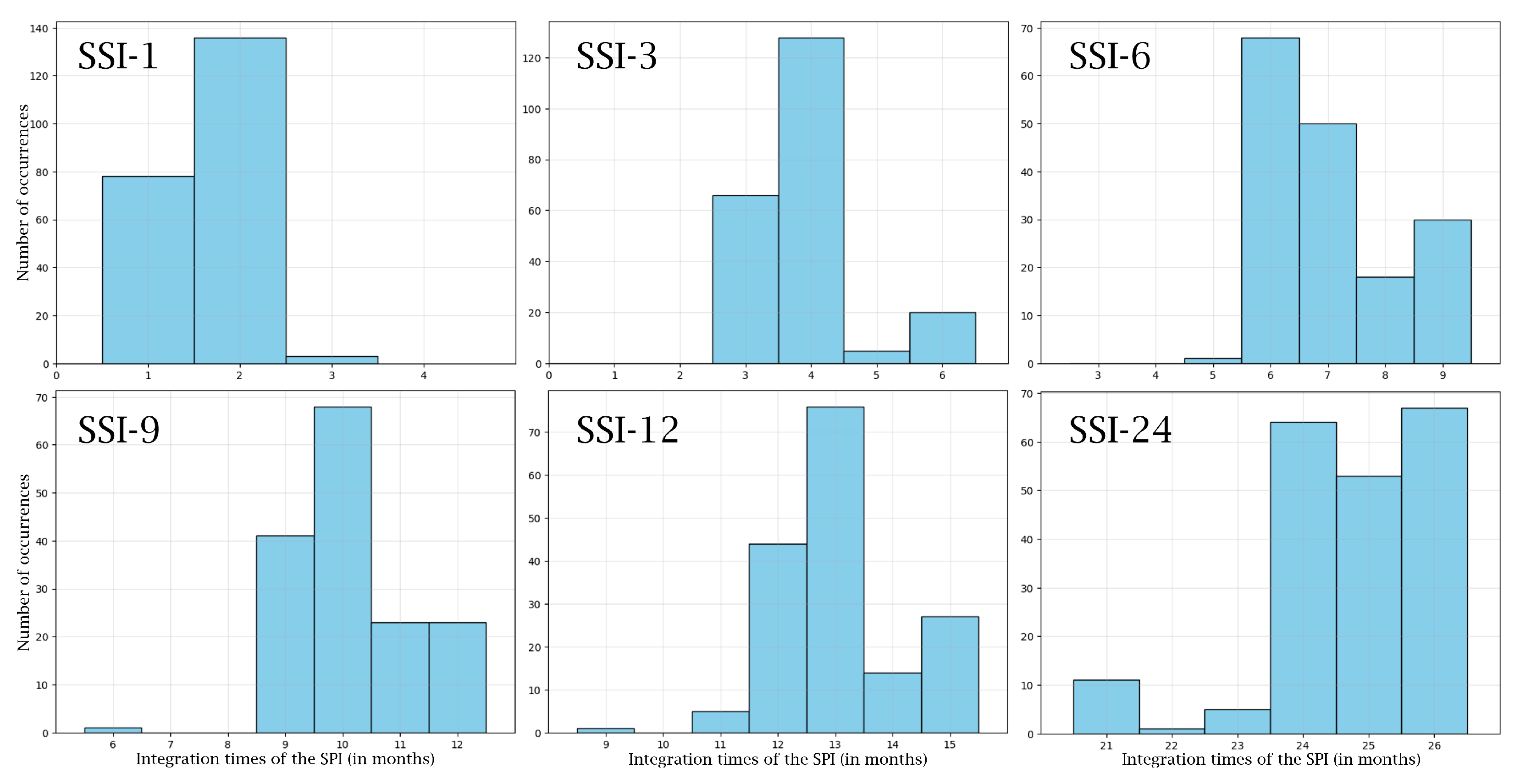
Motivated by the time delays found in the previous section, we studied the correspondence between SSI and SPI at non-coincidental timescales. By locking the integration time for the SSI, we have computed the correlation with the SPI at nearby integration times, selecting the one with the highest value. Such results are shown in Figure 3, where the histograms illustrate the integration times of the SPI (x-axis) with the highest correlation to the SSI at a fixed timescale (1, 3, 6, 8, 12, and 24 months) for 239 different meteorological stations.
Except for SSI-6, where the maximum correlation occurs with SPI-6, all other SSI indices exhibit a lagged relationship with the SPI. The integration time of the SPI with the highest frequency is consistently one month longer than the one for the SSI, suggesting that soil moisture reflects not only recent precipitation but also the cumulative effects of past anomalies. The exception at SSI-6 might indicate that this specific temporal scale captures the optimal balance where soil moisture and precipitation variability align most directly without significant delay.
A special case arises for SSI-24, where the highest frequency of maximum correlation is observed with SPI-26, rather than SPI-25. However, the frequency of SPI-26 is only marginally higher than that of SPI-24. This slight deviation could indicate a unique behavior at long integration times, likely related to the nature of the indices and the relatively short historical record used for their computation. Furthermore, at such large integration times, the averaging process inherent in the calculation may attenuate smaller variations, effectively dampening anomalies and driving both indices closer to their long-term average values. This normalization might result in artificially inflated correlations at long SPI scales, even if the indices do not align perfectly in the capture of wet or dry phases. SPI-26 showing a higher correlation than SPI-24 could therefore be attributed to the compounded effect of this attenuation, where the correlation increases not due to improved similarity but due to the reduced variability of both indices. Despite the light frequency difference between SPI-24 and SPI-26, from Table 1 we can observe that the correlation values are almost identical between them when considering no time lag.

4.3. Time Lag

Once the correspondence between SSI and SPI with mismatching windows was assessed, we explored the impact of monthly time lags. Namely, for a given month i in which the SPI is computed, we check its correlation with the corresponding SSI at month i + δ , with δ [ 1 , 2 ] . For example, the SPI of March 2023 is compared with the SSI of February 2023 for δ = 1 and with April 2023 for δ = 1 .
Table 1 summarizes the correlations between SSI and SPI at various integration times, introducing a monthly time lag between the indices. The displayed values are the average of the correlations obtained by performing the analysis at the selected stations.
It is essential to recognize that both in Table 1 and Table 2, we are comparing the performance of two distinct standardized indices (SSI vs. SPI) derived from inherently different variables (soil moisture vs. precipitation). Consequently, we anticipate achieving moderate-to-good correlation values. To establish an internal performance benchmark, we also computed the statistical comparison between the gridded-SPI (LCSC) and the in situ SPI (SAIH) in Table 2. This comparison, using the same index calculated from two independent precipitation station networks, serves to define the maximum expected correlation under optimal conditions. Despite comparing the same index, the correlations between the LCSC and SAIH SPIs are consistently below 0.8 and only slightly higher than the correlations observed between the SSI and the in situ SPI. The modest correlation values obtained for the SPI-to-SPI comparison highlight the significant uncertainty in measurement and the spatial heterogeneity inherent in precipitation data and station sampling. Therefore, the observed differences between the satellite-derived SSI and the in situ SPI are likely more attributable to the scale mismatch in comparing a point-based precipitation measurement with the area-averaged soil moisture reading of a 1 km2 pixel.
Returning to Table 1, at short time scales the best correlations are consistently observed for δ = 0 , indicating that soil moisture responds with minimal delay between indices. At medium integration times (6 and 9 months), the correlations begin to shift. While δ = 0 still provides strong correlations, introducing a lag of δ = 1 slightly improves the correlation from 9 months onward.
Nevertheless, independently of the timescale, Table 1 reflects that the integration period of the SPI plays a stronger role in aligning the indices than introducing a monthly time lag between the indices. By increasing the SPI integration period by one month, the index effectively captures longer-term precipitation trends that better align with soil moisture. Soil moisture integrates precipitation over time, and prolonging the SPI’s integration period mimics this process. In contrast, introducing a lag merely shifts the time series without accounting for the gradual accumulation of moisture in the soil.
The fact that SPI with an extended integration period outperforms lagged SPI implies that soil moisture dynamics are more influenced by the integration of precipitation over time than by short-term delays in response. This reflects the slower hydrological processes of soil moisture, such as infiltration, runoff, and evapotranspiration, which integrate precipitation signals over a broader temporal window. Although a lag analysis is valuable for identifying the temporal offset in responses and useful in case of data scarcity, it does not adjust for the physical differences in how soil moisture and precipitation signals are aggregated.
As a last study, Table 2 shows the statistical results obtained from SSI and SPI at different integration times. This final comparison provides insight into how well these indices align on various metrics.
The correlation between SSI and SPI strengthens as the integration time increases, being highest at the scale of 9–13 months. The correlation decreases at the 24-month window, not only when comparing the SSI with the in situ SPI, but also when comparing it with the LCSC SPI. The relative decrease from the latter might indicate a saturation effect in the SPI due to extensive temporal integration. A similar behavior is observed for the RMSD, where it generally decreases with increasing integration times for both datasets, up to reaching intermediate scales. The gradual improvement in correlation and RMSD with increasing time suggests that soil moisture integrates precipitation over extended periods, making it more comparable to SPI at longer scales. As previously seen, the indices at the 24-month scale show a decrease in the statistics, which might reflect a dampening effect from the indices, reducing their representativeness. The differences observed between the correlation and the RMSD remain constant throughout timescales, with window lags having a great impact.
The bias is negligible for SSI and SPI across all integration times, generally within ±0.01. Such consistency suggests that there is no systematic overestimation or underestimation of the SSI relative to the SPI on all temporal scales. On average, both indices provide comparable drought severity values, further supporting their complementary use for drought monitoring. Finally, the slope values are generally consistent with the correlations and evolve in the same way. The increasing slope value towards 1 suggests that the linear relationship between SSI and SPI improves over intermediate periods, highlighting the potential of these indices to converge in their representation of drought severity over extended periods. However, slopes are consistently below 1, indicating that SSI does not increase as rapidly as SPI for high SPI values. These results reflect the slower response of soil moisture compared to precipitation.
The p-values associated with the correlations in Table 2 show that the correlations are statistically significant and consistently exhibit a small increase when the SPI uses one additional month for its aggregation. To formally evaluate whether the optimal SPI window tends to be one month longer than the SSI window, we performed several station-level paired comparison tests, but the associated p-values indicate that this improvement is typically not statistically significant at the station level.
Thus, although we almost uniformly observe slightly higher correlations when comparing SSI-(n) with SPI-(n + 1), the magnitude of the improvement is small and only a minority of stations show statistically significant differences. This suggests that, while the tendency for an optimal window offset of plus one month is robust in direction, its statistical significance varies spatially and may not generalize uniformly to other regions or climatological settings. Further work is needed to evaluate whether this relationship holds among different climates and regions.
Since the presence and amount of vegetation have a direct impact on soil moisture dynamics, we performed the prior SSI and SPI analysis by splitting the data based on their associated MODIS NDVI value. The dataset has been classified into three categories, one for bare to scarce vegetation ( 0.2 < NDVI 0.4 ), another for medium vegetation ( 0.4 < NDVI 0.6 ), and the final one for high vegetation ( 0.6 < NDVI 0.8 ). The mean correlation between the indices across the different categories is the following:
R = 0.68 ± 0.01 if 0.2 < NDVI 0.4 , 0.63 ± 0.02 if 0.4 < NDVI 0.6 , 0.58 ± 0.03 if 0.6 < NDVI 0.8 .
These values were obtained by averaging the correlations acquired at the integration times of 1, 3, 6, 9, 12, and 24 months. The best correlation is found at smaller NDVI values. This outcome should not come as a surprise, since soil moisture for low vegetation is largely driven by precipitation. Moreover, the correlation decreases at high NDVI, as dense vegetation introduces more complexity to the soil moisture dynamics. Despite this slight difference, during the study carried out in this paper we have not found major impacts of vegetation to the SSI and SPI analysis.
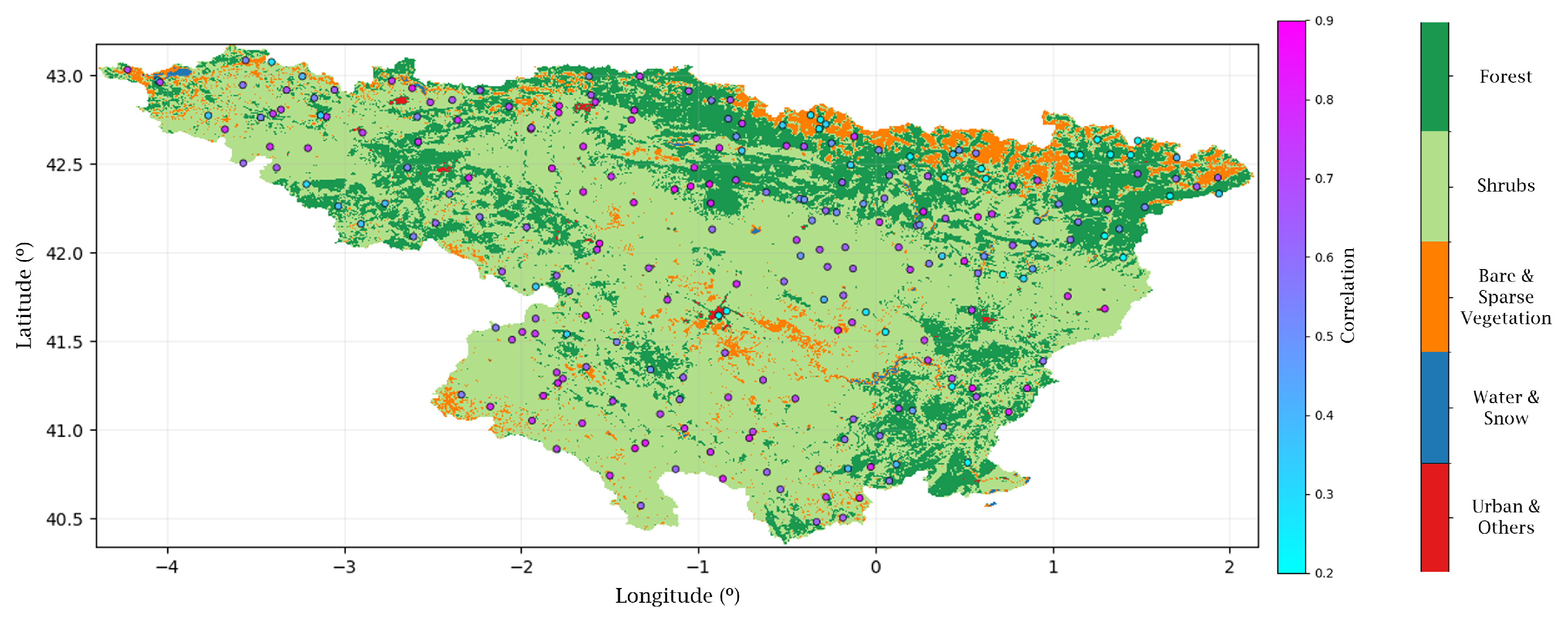
In addition, a similar analysis was conducted by splitting the data according to the classification of land cover provided by [36]. From the original 33 types of land cover, we have grouped them in the following classifications: bare and sparse vegetation, shrubs, forest, water and snow, and urban and others. In Figure 4, we can observe the correlation between SSI-12 and SPI-12 at each of the 239 selected meteorological stations, where the background colors represent the type of land cover. As several stations are located near urbanized or water-influenced areas, a 1 km radius criterion was applied to assign such classifications to capture potential local influences on correlations.
As before, the reported values represent the average correlation across all integration windows (1 to 24 months). The highest correlations are obtained at stations classified as shrubs ( R = 0.62 ± 0.17 , N = 123 ), followed by bare & sparse vegetation ( R = 0.54 ± 0.24 , N = 43 ) and forest ( R = 0.54 ± 0.21 , N = 61 ). Stations located in water & snow classes ( R = 0.51 ± 0.25 , N = 8 ) and urban & other areas ( R = 0.46 ± 0.32 , N = 4 ) show the lowest correlations, although sample sizes are small.
When analyzing the preferred delay, all land cover classes consistently showed higher correlations when comparing SSI-(n) with SPI-( n + 1 ) rather than the synchronous SPI-(n). Unlike the basin-wide aggregated analysis made in Table 2, where this improvement was not always statistically significant, the land cover specific 95% Confidence Intervals (CI) confirm that this improvement is statistically significant for nearly all integration times and vegetation types (e.g., for shrubs at 1-month integration, the CI improvement is [ 0.003 , 0.021 ] ).
Regarding the index behavior, the slope and bias metrics remained stable and favorable for short-to-medium integration times (1 to 12 months) across all classes. However, consistent with the general results, a degradation is observed at the 24-month scale. Overall, the land cover grouping reveals moderate variability among classes, but does not indicate a dominant or systematic vegetation-type control on the SSI to SPI correlations, consistent with the NDVI-based analysis. A more robust study of the impact of vegetation can be further explored in future studies.
Another important factor to consider when studying the results from Table 2 is the difference in spatial resolution and its extension. The SPI is derived from the precipitation measured at each meteorological station. Due to the typical extension of rainfall events in the study area, we consider the SPI to be representative enough for 1 km2 around the meteorological station. On the other hand, the SSI data has a spatial resolution of 1 km. Hence, the vegetation content and the heterogeneity of the soil within the 1 km pixel have a great impact on the value of soil moisture retrieved to compute the SSI. Thereby, two nearby meteorological stations may have measured similar precipitation values, while the soil moisture retrieved by satellite at 1 km can be significantly different, especially its evolution during the days after a rainfall event.
Finally, Figure 4 illustrates the spatial distribution and representativeness of the meteorological stations along with their associated correlation values between SSI-12 and SPI-12. The station density exhibits a relatively uniform spatial distribution across the Ebro basin, which effectively mitigates the risk of both over-sampling and under-sampling any specific subregion. Despite the presence of diverse stations in relatively close proximity (e.g., within the Pyrenees), the correlation values exhibit moderate spatial variability. The observed differences between the satellite-derived SSI and the in situ SPI could be attributable to scale mismatch. Specifically, we are comparing the soil moisture of a 1 km2 pixel with a point-based precipitation measurement, which may not fully represent the average hydrological conditions of its surroundings. Therefore, the spatial variability observed in the SSI and SPI correlations might be driven by this scale difference rather than by effects related to an inadequate station density or an uneven distribution of measurement points.

4.4. SSI vs. Gridded SPI

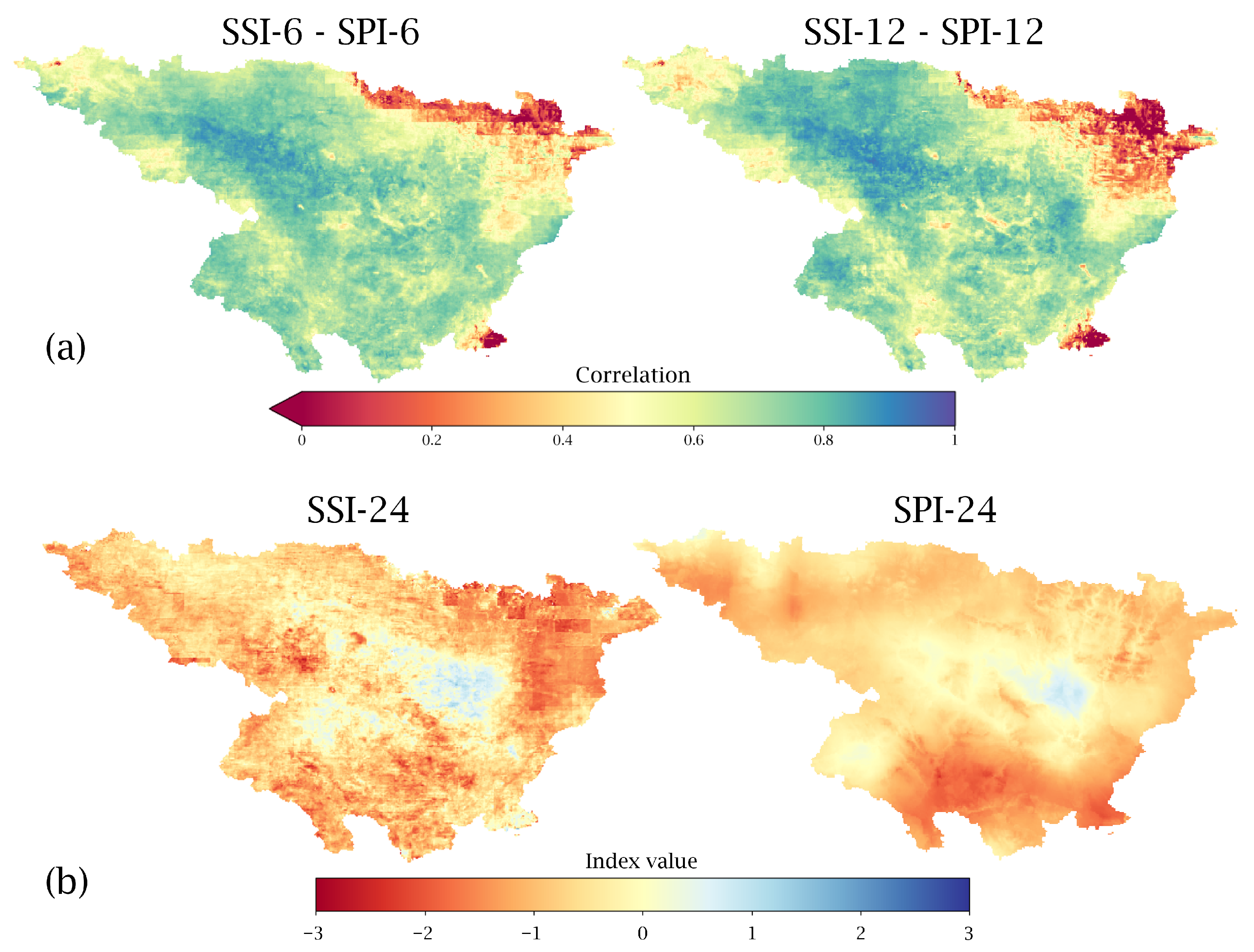
Having proved the relation of the remotely-sensed SSI with the SPI derived from meteorological stations, let us compare it with the 2-dimensional SPI from LCSC. Figure 5a presents the correlation map between the indices at 6 and 12 months of integration, highlighting the spatial variability through the Ebro basin. Namely, the figure manifests the correlation among the SSI and SPI at each 1 km pixel. As the integration time increases, the correlation values become more extreme, increasing in highly correlated areas and decreasing where the correlation was already low.
Both maps show generally positive correlations throughout most of the basin, indicating that the SSI is aligned in their seasonal and long-term variations with the SPI. Hence, a vast extension of the basin’s soil moisture is mainly driven by precipitation. However, the most relevant information from Figure 5a comes from pointing out the regions where the SSI does not match the gridded SPI, principally, the southeast and northeast areas, where the correlation reaches negative values. Other regions also show moderate to low correlations (e.g., the northwest and central part of the basin), where local surface characteristics influence the soil moisture signal independently of precipitation. Areas covered by dense forests or urban surfaces tend to retain moisture for longer periods after rainfall, leading to a temporal desynchronization between SSI and SPI. Similarly, the presence of lakes or other water bodies produces persistently high soil moisture retrievals that are not directly related to rainfall events. These effects on surface and land cover explain part of the observed localized divergences between SSI and SPI.
In the southeastern part of the basin, we find the Ebro Delta, a unique agricultural area with extensive rice paddies. These fields are often flooded for rice production, creating persistently high soil moisture levels that are independent of natural precipitation. Therefore, in this area, soil moisture is driven by irrigation practices rather than climatic conditions, causing a discrepancy between SSI and SPI. In fact, other papers have already demonstrated that agricultural practices in this area can be seen by SMOS [35].
The Pyrenees, located in the northeast part of the basin, are characterized by dense forests and mountainous terrain, often covered in snow during winter. While the amount of snow is probably taken into account at meteorological stations, SMOS does not provide soil moisture values in its presence. However, satellite images see the effects of snow when it melts into water, thus increasing soil moisture readings. Hence, during snowmelt we observe high values of soil moisture regardless of precipitation. For this reason, we attribute the low correlation to the desynchronization between the indices, since they take into account the contribution of snow at different times.
From Figure 5b we can compare the 2-dimensional SSI-24 and SPI-24 maps for November 2017. This month corresponds to the driest moment of the 2017–2018 hydrological drought observed in SPI-24’s behavior in Figure 6. Both maps show a similar spatial distribution of the drought, which affected all of the basin regardless of a small region located at the center. Despite observing other minor differences between the indices, the SSI resolution reveals more granular details about soil moisture variability within smaller areas. The gridded map does not highlight variations that result from local soil properties, vegetation cover, and land use, which can affect soil moisture retention and drainage. Thus, Figure 5b and Figure 6 not only demonstrate that our remote sensing-derived SSI is a robust index capable of monitoring drought at different scales, but also has an improved spatial resolution than state-of-the-art SPIs.
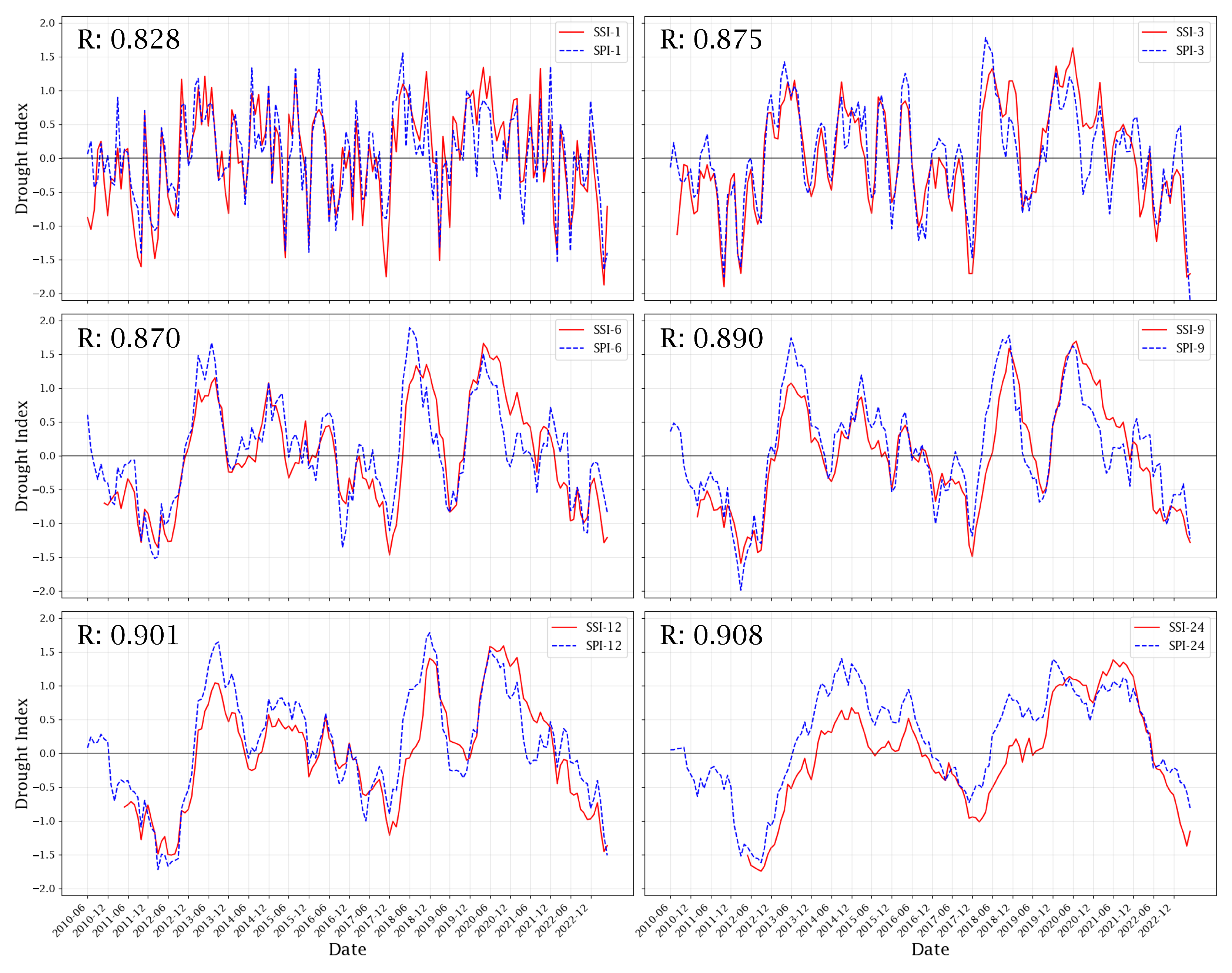
By spatial averaging the indices’ values across the Ebro basin, we ensure that we represent regional-scale drought conditions rather than localized anomalies. Although this aggregation smooths out spatial variability, it highlights the complementary nature of SPI and SSI for basin-wide drought monitoring. To perform the spatial SPI average, we have used the LCSC dataset. Figure 6 shows the time series of the spatially averaged SSI and gridded SPI at different integration times. The results demonstrate high correlations between the spatially averaged indices, slightly increasing with the integration time. These findings underscore the suitability of the SSI drought monitoring and water resource planning at the basin scale, particularly at hydrological scales.
SSI and SPI at 12 and 24 months from Figure 6 show that 3 hydrological droughts have affected the Ebro basin since 2010. The graphics identify the registered dry periods that occurred during 2011–2012 and 2017–2018. Furthermore, the indices also demonstrate that another hydrological drought started in 2022.
As a final remark following the discussion of Figure 5a and Figure 6, the applicability of the satellite-derived SSI across different temporal scales is demonstrated to be analogous to the SPI. At short integration times (SSI-1 to SSI-6), the index captures rapid changes in near-surface conditions, making it directly suitable for monitoring meteorological and agricultural droughts. Conversely, at long integration times (SSI-12 to SSI-24), the index acts as a proxy for deep soil and groundwater storage through the temporal accumulation of anomalies. Although SSI and SPI generally converge at these longer scales (Figure 6), the SSI provides unique value by capturing land-surface processes that precipitation indices inherently miss. Specifically, discrepancies between long-term SSI and SPI might suggest regions influenced by snowmelt dynamics or anthropogenic activities (e.g., irrigation practices), where the effective soil wetness diverges from the meteorological input. Therefore, long-term SSI is recommended for hydrological monitoring, particularly in complex basins where surface conditions are decoupled from direct precipitation forcing.

5. Conclusions

The Standardized Soil Moisture Index (SSI) was derived using a 13-year record of 1 km SMOS-based soil moisture data. By applying the beta distribution to fit the soil moisture data, we calculated the SSI at various integration times (SSI-1, SSI-3, SSI-6, SSI-9, SSI-12, and SSI-24) to assess its utility and versatility.
The satellite-derived SSI was validated against the SPI calculated using precipitation data from 239 meteorological stations of the SAIH network across the Ebro basin. Given the inherent inertia of soil moisture, the relationship between the indices was studied using mismatched integration times and introducing monthly temporal lags. A key finding is that the SSI consistently achieves the highest correlation when compared to the SPI integrated over an additional month (i.e., SSI-(n) versus SPI-( n + 1 )). This scenario also outperformed simple monthly lags, underscoring that soil moisture dynamics is more sensitive to the cumulative integration of precipitation over time than to short-term temporal delays. While the SSI-(n) to SPI-(n + 1) comparison yields better correlations, the results are typically not statistically significant, suggesting that this finding may not generalize uniformly to other regions or climatological settings.
The correlations between SSI and the monthly-extended SPI across the 1- to 24-month integration windows ranged from 0.618 to 0.667. These are satisfactory values considering that we are comparing different indices derived from inherently different variables (soil moisture versus precipitation). The lowest performance metrics were consistently observed at the 24-month scale. This decline is attributed to the temporal limitations of the dataset, where using the same record for both historical fitting and index computation results in the attenuation of extreme values at long integration windows. Analysis of bias and slope revealed negligible bias across all integration times (generally within ±0.01), and positive slope values ranging from 0.613 to 0.666. The slope values confirm that SSI does not increase as rapidly as SPI for high values, which is a reasonable behavior considering that the impact of precipitation on soil moisture is also driven by soil properties, vegetation, and evapotranspiration.
These statistical results demonstrate that the remotely-sensed SSI is capable of monitoring different drought types, similar to the SPI, but provides physically distinct information. While SPI is based on the total amount of precipitation received, SSI measures the effective soil wetness within the top layers (0–5 cm), implicitly integrating the effects of infiltration, runoff, and evapotranspiration.
A brief analysis of vegetation’s influence on the correlation of SSI and SPI was conducted by stratifying the results based on the NDVI values at each location. Observing no dependence on the integration time, we averaged the correlations across all temporal scales. Slight differences were observed, with the best correlation found in bare soils ( R = 0.68 ± 0.01 , for 0.2 < NDVI 0.4 ) and the worst in dense vegetation ( R = 0.58 ± 0.03 , for 0.6 < NDVI 0.8 ). Furthermore, a land-cover-based analysis showed no dominant or systematic vegetation-type control on the correlation values. These findings provide initial information on the role of vegetation, although further investigation is required to draw more definitive conclusions.
Our SSI was also compared with a 2-dimensional gridded SPI product to assess its spatial variability. This analysis revealed generally positive correlations throughout most of the basin, suggesting that the SSI captures additional hydrological dynamics, such as snowmelt and irrigation effects. Furthermore, SSI demonstrated superior spatial resolution, providing more granular insight into soil moisture variability compared to the gridded product, although sharing the same pixel resolution. This enhanced spatial detail establishes the SSI as a state-of-the-art drought index for the region.
This study underscores the versatility and efficacy of the remote sensing soil moisture-derived SSI. While previous studies focused primarily on short-term droughts, our findings confirm its suitability to evaluate long-term dry spells. Therefore, remote sensing-derived SSI emerges as a powerful and comprehensive drought monitoring tool. If provided with accurate satellite-derived soil moisture data, SSI can surpass existing indices in both spatial resolution and coverage. Given SSI’s mathematical formulation and the global coverage of satellite data, SSI stands as a robust index, potentially applicable worldwide. Hence, the remote sensing-derived SSI paves the way for accurate drought monitoring in areas with scarce in situ measurements.
In conclusion, this research demonstrates that remote sensing soil moisture-derived SSI is a robust climate index capable of monitoring all types of drought at high spatial resolution and with global applicability.

Author Contributions

G.S.A. and M.J.E. Conceptualization; G.S.A. Data curation; G.S.A. and M.J.E. Formal analysis, Methodology and Validation; G.S.A. Visualization; G.S.A. and M.J.E. Writing. All authors have read and agreed to the published version of the manuscript.

Funding

This work was partially supported by the European Union’s Next Generation EU program through an Investigo grant (2021-C23.I01.P03.S0020-0000007) awarded to Guillem Sánchez.

Data Availability Statement

SMOS soil moisture data are publicly available from the European Space Agency (ESA), and MODIS products are available from NASA’s Earthdata portal. The processed data and derived Standardized Soil Moisture Index (SSI) time series used in this study are not publicly archived but can be obtained from the corresponding author upon reasonable request.

Conflicts of Interest

Authors Guillem Sánchez Alcalde and Maria José Escorihuela were employed by the company isardSAT. All authors declare that the research was conducted in the absence of any commercial or financial relationships that could be construed as a potential conflict of interest.

References

  1. Chen, L.; Brun, P.; Buri, P.; Fatichi, S.; Gessler, A.; McCarthy, M.J.; Pellicciotti, F.; Stocker, B.; Karger, D.N. Global increase in the occurrence and impact of multiyear droughts. Science 2025, 387, 278–284. [Google Scholar] [CrossRef]
  2. Wilhite, D.A.; Glantz, M.H. Understanding: The drought phenomenon: The role of definitions. Water Int. 1985, 10, 111–120. [Google Scholar] [CrossRef]
  3. Policy Statement. Bull. Am. Meteorol. Soc. 1997, 78, 847–852. [CrossRef]
  4. Svoboda, M.; Hayes, M.; Wood, D. Standardized Precipitation Index: User Guide; World Meteorological Organization: Geneva, Switzerland, 2012. [Google Scholar]
  5. McKee, T.B.; Doesken, N.J.; Kleist, J. The relationship of drought frequency and duration to time scales. In Proceedings of the 8th Conference on Applied Climatology, Boston, CA, USA, 17–22 January 1993; pp. 179–183. [Google Scholar]
  6. Pellarin, T.; Louvet, S.; Gruhier, C.; Quantin, G.; Legout, C. A simple and effective method for correcting soil moisture and precipitation estimates using AMSR-E measurements. Remote Sens. Environ. 2013, 136, 28–36. [Google Scholar] [CrossRef]
  7. Crow, W.T.; Huffman, G.J.; Bindlish, R.; Jackson, T.J. Improving satellite-based rainfall accumulation estimates using spaceborne surface soil moisture retrievals. J. Hydrometeorol. 2009, 10, 199–212. [Google Scholar] [CrossRef]
  8. Ramoelo, A.; Dzikiti, S.; Van Deventer, H.; Maherry, A.; Cho, M.A.; Gush, M. Potential to monitor plant stress using remote sensing tools. J. Arid Environ. 2015, 113, 134–144. [Google Scholar] [CrossRef]
  9. Bannari, A.; Morin, D.; Bonn, F.; Huete, A. A review of vegetation indices. Remote Sens. Rev. 1995, 13, 95–120. [Google Scholar] [CrossRef]
  10. Huete, A.R. A soil-adjusted vegetation index (SAVI). Remote Sens. Environ. 1988, 25, 295–309. [Google Scholar] [CrossRef]
  11. Jasinski, M.F. Sensitivity of the normalized difference vegetation index to subpixel canopy cover, soil albedo, and pixel scale. Remote Sens. Environ. 1990, 32, 169–187. [Google Scholar] [CrossRef]
  12. Mutanga, O.; Adam, E.; Cho, M.A. High density biomass estimation for wetland vegetation using WorldView-2 imagery and random forest regression algorithm. Int. J. Appl. Earth Obs. Geoinf. 2012, 18, 399–406. [Google Scholar] [CrossRef]
  13. Galidaki, G.; Zianis, D.; Gitas, I.; Radoglou, K.; Karathanassi, V.; Tsakiri-Strati, M.; Woodhouse, I.; Mallinis, G. Vegetation biomass estimation with remote sensing: Focus on forest and other wooded land over the Mediterranean ecosystem. Int. J. Remote Sens. 2017, 38, 1940–1966. [Google Scholar] [CrossRef]
  14. Anyamba, A.; Tucker, C.J. Historical perspective of AVHRR NDVI and vegetation drought monitoring. Remote Sens. Drought Innov. Monit. Approaches 2012, 23, 20. [Google Scholar]
  15. Jiao, W.; Zhang, L.; Chang, Q.; Fu, D.; Cen, Y.; Tong, Q. Evaluating an enhanced vegetation condition index (VCI) based on VIUPD for drought monitoring in the continental United States. Remote Sens. 2016, 8, 224. [Google Scholar] [CrossRef]
  16. Winkler, K.; Gessner, U.; Hochschild, V. Identifying droughts affecting agriculture in Africa based on remote sensing time series between 2000–2016: Rainfall anomalies and vegetation condition in the context of ENSO. Remote Sens. 2017, 9, 831. [Google Scholar] [CrossRef]
  17. Colliander, A.; Jackson, T.J.; Bindlish, R.; Chan, S.; Das, N.; Kim, S.; Cosh, M.; Dunbar, R.; Dang, L.; Pashaian, L.; et al. Validation of SMAP surface soil moisture products with core validation sites. Remote Sens. Environ. 2017, 191, 215–231. [Google Scholar] [CrossRef]
  18. Jackson, T.J.; Bindlish, R.; Cosh, M.H.; Zhao, T.; Starks, P.J.; Bosch, D.D.; Seyfried, M.; Moran, M.S.; Goodrich, D.C.; Kerr, Y.H.; et al. Validation of Soil Moisture and Ocean Salinity (SMOS) soil moisture over watershed networks in the US. IEEE Trans. Geosci. Remote Sens. 2011, 50, 1530–1543. [Google Scholar] [CrossRef]
  19. Samaniego, L.; Kumar, R.; Zink, M. Implications of parameter uncertainty on soil moisture drought analysis in Germany. J. Hydrometeorol. 2013, 14, 47–68. [Google Scholar] [CrossRef]
  20. Carrão, H.; Russo, S.; Sepulcre-Canto, G.; Barbosa, P. An empirical standardized soil moisture index for agricultural drought assessment from remotely sensed data. Int. J. Appl. Earth Obs. Geoinf. 2016, 48, 74–84. [Google Scholar] [CrossRef]
  21. Sheffield, J.; Wood, E.F. Global trends and variability in soil moisture and drought characteristics, 1950–2000, from observation-driven simulations of the terrestrial hydrologic cycle. J. Clim. 2008, 21, 432–458. [Google Scholar] [CrossRef]
  22. Xu, Y.; Wang, L.; Ross, K.W.; Liu, C.; Berry, K. Standardized soil moisture index for drought monitoring based on soil moisture active passive observations and 36 years of north American land data assimilation system data: A case study in the southeast United States. Remote Sens. 2018, 10, 301. [Google Scholar] [CrossRef]
  23. Khlif, M.; Escorihuela, M.J.; Chahbi Bellakanji, A.; Paolini, G.; Lili Chabaane, Z. Remotely Sensed Agriculture Drought Indices for Assessing the Impact on Cereal Yield. Remote Sens. 2023, 15, 4298. [Google Scholar] [CrossRef]
  24. Gaona, J.; Quintana-Seguí, P.; Escorihuela, M.J.; Boone, A.; Llasat, M.C. Interactions between precipitation, evapotranspiration and soil-moisture-based indices to characterize drought with high-resolution remote sensing and land-surface model data. Nat. Hazards Earth Syst. Sci. 2022, 22, 3461–3485. [Google Scholar] [CrossRef]
  25. AghaKouchak, A. A baseline probabilistic drought forecasting framework using standardized soil moisture index: Application to the 2012 United States drought. Hydrol. Earth Syst. Sci. 2014, 18, 2485–2492. [Google Scholar] [CrossRef]
  26. Zeri, M.; Williams, K.; Cunha, A.P.M.; Cunha-Zeri, G.; Vianna, M.S.; Blyth, E.M.; Marthews, T.R.; Hayman, G.D.; Costa, J.M.; Marengo, J.A.; et al. Importance of including soil moisture in drought monitoring over the Brazilian semiarid region: An evaluation using the JULES model, in situ observations, and remote sensing. Clim. Resil. Sustain. 2022, 1, e7. [Google Scholar] [CrossRef]
  27. Sousa, P.M.; Trigo, R.M.; Aizpurua, P.; Nieto, R.; Gimeno, L.; Garcia-Herrera, R. Trends and extremes of drought indices throughout the 20th century in the Mediterranean. Nat. Hazards Earth Syst. Sci. 2011, 11, 33–51. [Google Scholar] [CrossRef]
  28. Turco, M.; Llasat, M.C. Trends in indices of daily precipitation extremes in Catalonia (NE Spain), 1951–2003. Nat. Hazards Earth Syst. Sci. 2011, 11, 3213–3226. [Google Scholar] [CrossRef]
  29. MMA: Libro Blanco del Agua en España, Spanish Ministry of Environment (MMA), 2000. Available online: http://www.cedex.es/CEDEX/LANG_CASTELLANO/ORGANISMO/CENTYLAB/CEH/Documentos_Descargas/LB_LibroBlancoAgua.htm (accessed on 18 October 2022).
  30. Merlin, O.; Escorihuela, M.J.; Mayoral, M.A.; Hagolle, O.; Al Bitar, A.; Kerr, Y. Self-calibrated evaporation-based disaggregation of SMOS soil moisture: An evaluation study at 3 km and 100 m resolution in Catalunya, Spain. Remote Sens. Environ. 2013, 130, 25–38. [Google Scholar] [CrossRef]
  31. Molero, B.; Merlin, O.; Malbéteau, Y.; Al Bitar, A.; Cabot, F.; Stefan, V.; Kerr, Y.; Bacon, S.; Cosh, M.; Bindlish, R.; et al. SMOS disaggregated soil moisture product at 1 km resolution: Processor overview and first validation results. Remote Sens. Environ. 2016, 180, 361–376. [Google Scholar] [CrossRef]
  32. Ojha, N.; Merlin, O.; Suere, C.; Escorihuela, M.J. Extending the spatio-temporal applicability of DISPATCH soil moisture downscaling algorithm: A study case using SMAP, MODIS and Sentinel-3 data. Front. Environ. Sci. 2021, 9, 555216. [Google Scholar] [CrossRef]
  33. Merlin, O.; Rudiger, C.; Al Bitar, A.; Richaume, P.; Walker, J.P.; Kerr, Y.H. Disaggregation of SMOS soil moisture in Southeastern Australia. IEEE Trans. Geosci. Remote Sens. 2012, 50, 1556–1571. [Google Scholar] [CrossRef]
  34. Stefan, V.G.; Merlin, O.; Escorihuela, M.J.; Molero, B.; Chihrane, J.; Villar, J.M.; Er-Raki, S. Temporal calibration of an evaporation-based spatial disaggregation method of SMOS soil moisture data. Remote Sens. 2020, 12, 1671. [Google Scholar] [CrossRef]
  35. Escorihuela, M.J.; Quintana-Seguí, P. Comparison of remote sensing and simulated soil moisture datasets in Mediterranean landscapes. Remote Sens. Environ. 2016, 180, 99–114. [Google Scholar] [CrossRef]
  36. Faroux, S.; Kaptué Tchuenté, A.; Roujean, J.L.; Masson, V.; Martin, E.; Le Moigne, P. ECOCLIMAP-II/Europe: A twofold database of ecosystems and surface parameters at 1 km resolution based on satellite information for use in land surface, meteorological and climate models. Geosci. Model Dev. 2013, 6, 563–582. [Google Scholar] [CrossRef]
  37. Vicente-Serrano, S.M.; Tomas-Burguera, M.; Beguería, S.; Reig, F.; Latorre, B.; Peña-Gallardo, M.; Luna, M.Y.; Morata, A.; González-Hidalgo, J.C. A high resolution dataset of drought indices for Spain. Data 2017, 2, 22. [Google Scholar] [CrossRef]
  38. Farahmand, A.; AghaKouchak, A. A generalized framework for deriving nonparametric standardized drought indicators. Adv. Water Resour. 2015, 76, 140–145. [Google Scholar] [CrossRef]
  39. Sheffield, J.; Goteti, G.; Wen, F.; Wood, E.F. A simulated soil moisture based drought analysis for the United States. J. Geophys. Res. Atmos. 2004, 109, D2410. [Google Scholar] [CrossRef]
  40. Sheffield, J.; Wood, E.F. Characteristics of global and regional drought, 1950–2000: Analysis of soil moisture data from off-line simulation of the terrestrial hydrologic cycle. J. Geophys. Res. Atmos. 2007, 112, D17115. [Google Scholar] [CrossRef]
  41. Shukla, S.; Steinemann, A.C.; Lettenmaier, D.P. Drought monitoring for Washington State: Indicators and applications. J. Hydrometeorol. 2011, 12, 66–83. [Google Scholar] [CrossRef]
  42. Hao, Z.; AghaKouchak, A. A nonparametric multivariate multi-index drought monitoring framework. J. Hydrometeorol. 2014, 15, 89–101. [Google Scholar] [CrossRef]
  43. Gringorten, I.I. A plotting rule for extreme probability paper. J. Geophys. Res. 1963, 68, 813–814. [Google Scholar] [CrossRef]
  44. Hao, Z.; AghaKouchak, A.; Nakhjiri, N.; Farahmand, A. Global integrated drought monitoring and prediction system. Sci. Data 2014, 1, 140001. [Google Scholar] [CrossRef]
Figure 1. Map with the main rivers and reservoirs of the Ebro basin region. The dots correspond to a network of 328 meteorological stations from SAIH Ebro. The shaded background colors correspond to the land cover from the ECOCLIMAP Second Generation map [36].
Remotesensing 17 03916 g001
Figure 2. Temporal evolution of the Standardized Soil Moisture Index (SSI) and Standardized Precipitation Index (SPI) at 3, 6, 12, and 24 months of integration at the station of Caparroso, Navarre. Positive and negative values are colored differently to easen periods identification: wet (blue) and dry (red).
Remotesensing 17 03916 g002
Figure 3. Frequencies of the SPIs with maximum correlation for SSI-1, SSI-3, SSI-6, SSI-9, SSI-12, and SSI-24. A total of 239 meteorological stations have been used.
Remotesensing 17 03916 g003
Figure 4. Correlations between SSI-12 & SPI-12 at each of the 239 selected meteorological stations. Background colors represent the type of land cover.
Remotesensing 17 03916 g004
Figure 5. (a) Spatial distribution of the correlation between the SSI and the gridded-SPI at 6 and 12 months of integration time. (b) SSI-24 and gridded SPI-24 of the Ebro basin for November 2017.
Remotesensing 17 03916 g005
Figure 6. Time evolution of the SSI and gridded-SPI spatially averaged across the Ebro basin at different integration times.
Remotesensing 17 03916 g006
Table 1. Correlation between Standardized Soil Moisture Index (SSI) and Standardized Precipitation Index (SPI) for different time lags. For each case, the best result is in bold.
Case δ = 1 δ = 0 δ = 1 δ = 2
SSI-1 & SPI-10.0790.5970.3010.058
SSI-1 & SPI-20.4480.6270.2530.107
SSI-3 & SPI-30.4030.6490.6070.396
SSI-3 & SPI-40.5520.6630.5590.363
SSI-6 & SPI-60.5070.6320.6280.556
SSI-9 & SPI-90.5270.6270.6370.597
SSI-9 & SPI-100.5810.6430.6310.583
SSI-12 & SPI-120.5380.6240.6290.590
SSI-12 & SPI-130.5840.6370.6210.580
SSI-24 & SPI-240.5630.6040.6100.600
SSI-24 & SPI-250.5840.6110.6090.597
SSI-24 & SPI-260.5880.6070.6030.587
Table 2. Statistical results of the comparison between SSI and in situ SPI (SAIH). A comparison between gridded-SPI (LCSC) with in situ SPI is also performed as an internal performance benchmark.
SSI and SAIH
CaseCorrelation (p-Value)RMSDBiasSlope
SSI-1 & SPI-10.603 (0.000)0.8900.0030.601
SSI-1 & SPI-20.628 (0.000)0.8610.0040.627
SSI-3 & SPI-30.653 (0.000)0.833−0.0020.653
SSI-3 & SPI-40.667 (0.000)0.8150.0070.666
SSI-6 & SPI-60.651 (0.003)0.8350.0000.652
SSI-9 & SPI-90.651 (0.013)0.8350.0010.651
SSI-9 & SPI-100.664 (0.012)0.8190.0060.664
SSI-12 & SPI-120.648 (0.023)0.8390.0000.480
SSI-12 & SPI-130.659 (0.020)0.8250.0050.659
SSI-24 & SPI-240.616 (0.028)0.876−0.0010.615
SSI-24 & SPI-250.618 (0.030)0.8710.0110.613
SSI-24 & SPI-260.610 (0.032)0.8770.0240.600
LCSC and SAIH
CaseCorrelation (p-Value)RMSDBiasSlope
SPI-1 & SPI-10.612 (0.000)0.8120.0350.482
SPI-3 & SPI-30.736 (0.000)0.6930.0370.646
SPI-6 & SPI-60.750 (0.000)0.6850.0620.684
SPI-9 & SPI-90.769 (0.001)0.6750.0850.743
SPI-12 & SPI-120.771 (0.003)0.6820.1210.757
SPI-24 & SPI-240.704 (0.008)0.8070.3070.657
Disclaimer/Publisher’s Note: The statements, opinions and data contained in all publications are solely those of the individual author(s) and contributor(s) and not of MDPI and/or the editor(s). MDPI and/or the editor(s) disclaim responsibility for any injury to people or property resulting from any ideas, methods, instructions or products referred to in the content.