Optimising Deep Learning-Based Segmentation of Crop and Soil Marks with Spectral Enhancements on Sentinel-2 Data


Highlights
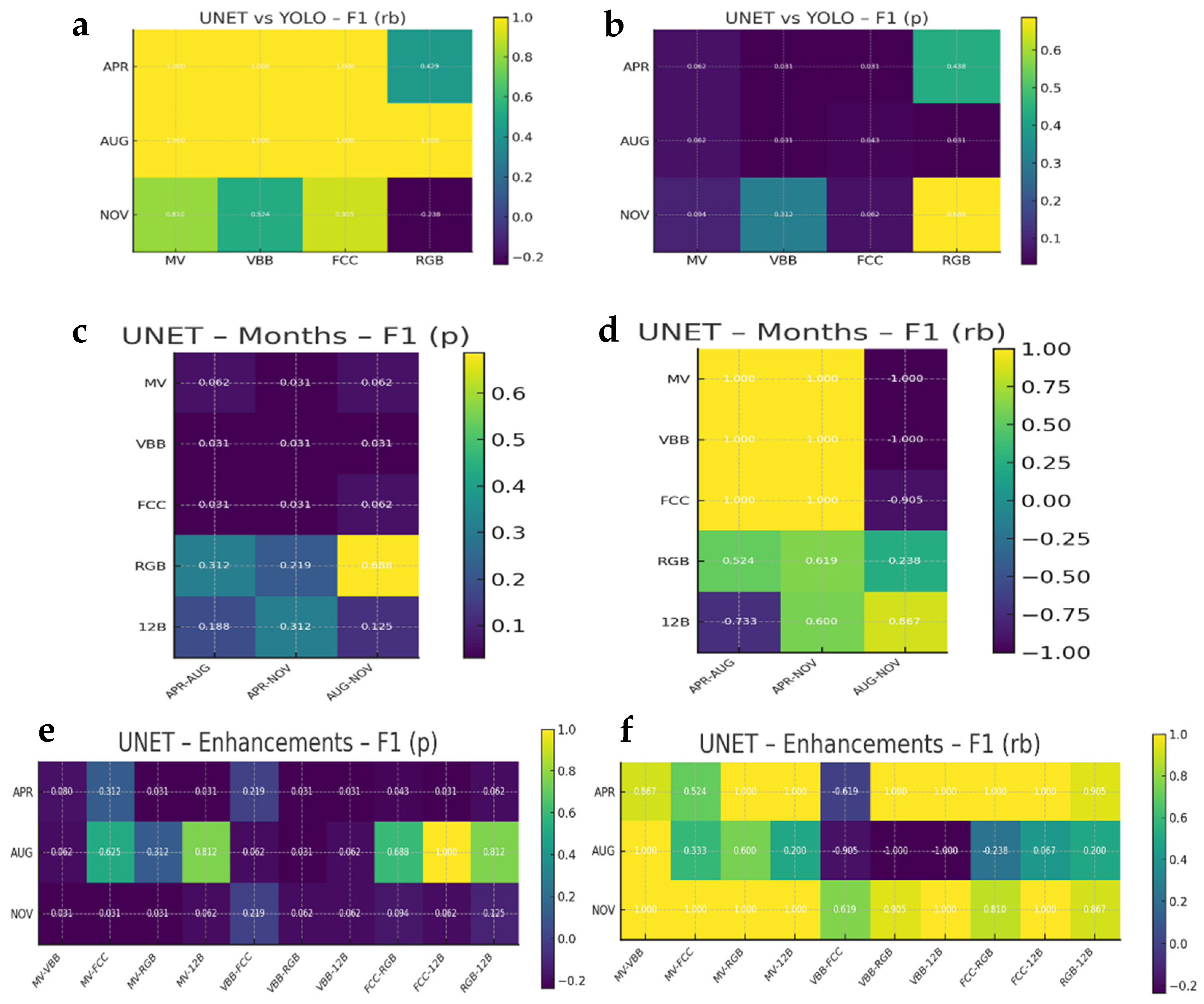
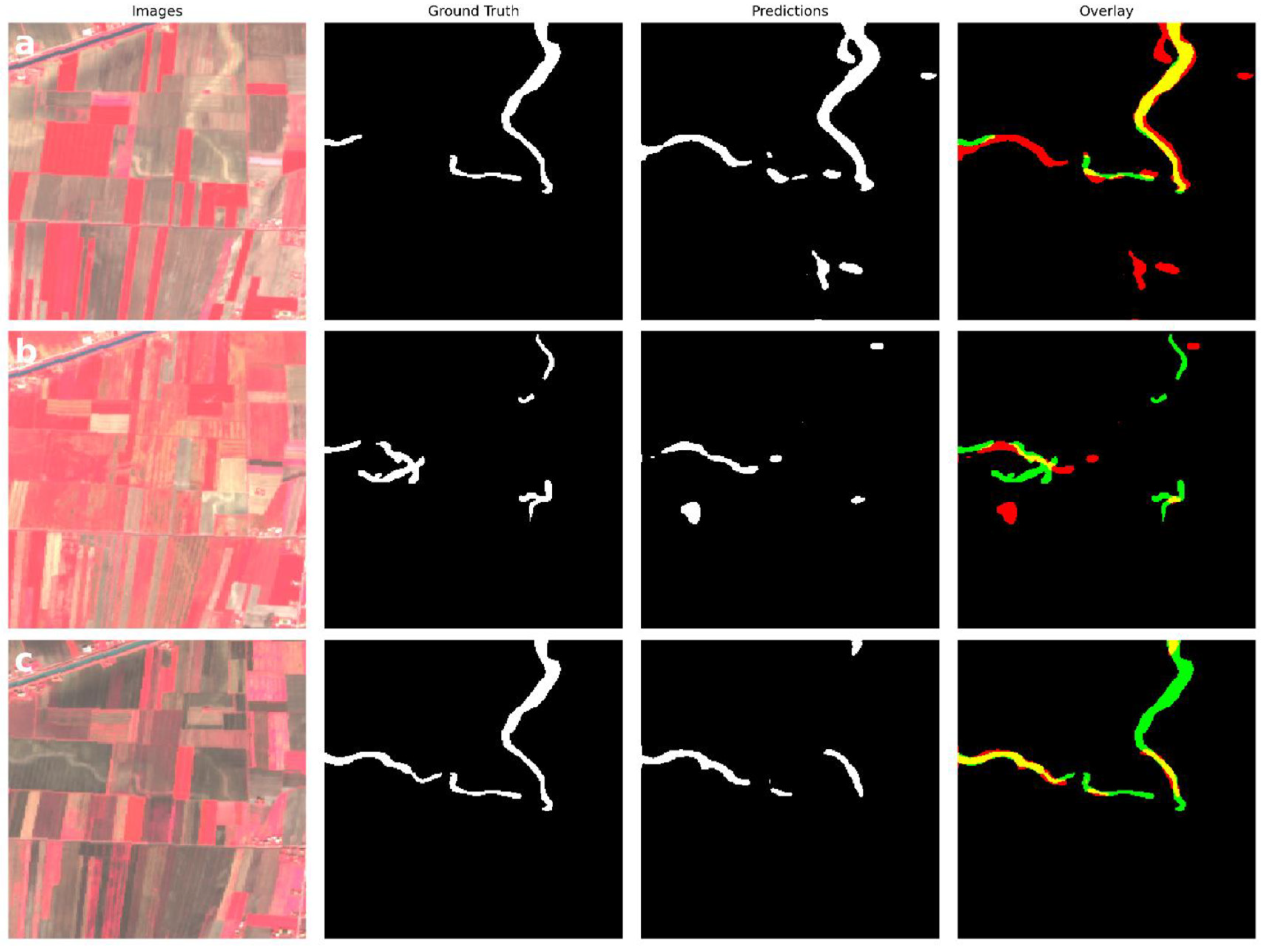
- The study presents the first systematic evaluation of how spectral enhancement techniques applied to Sentinel-2 imagery influence deep learning models for detecting palaeochannel-related soil and crop marks. Among the tested approaches, the multi-temporal composite (MV) consistently achieved the highest segmentation accuracy.
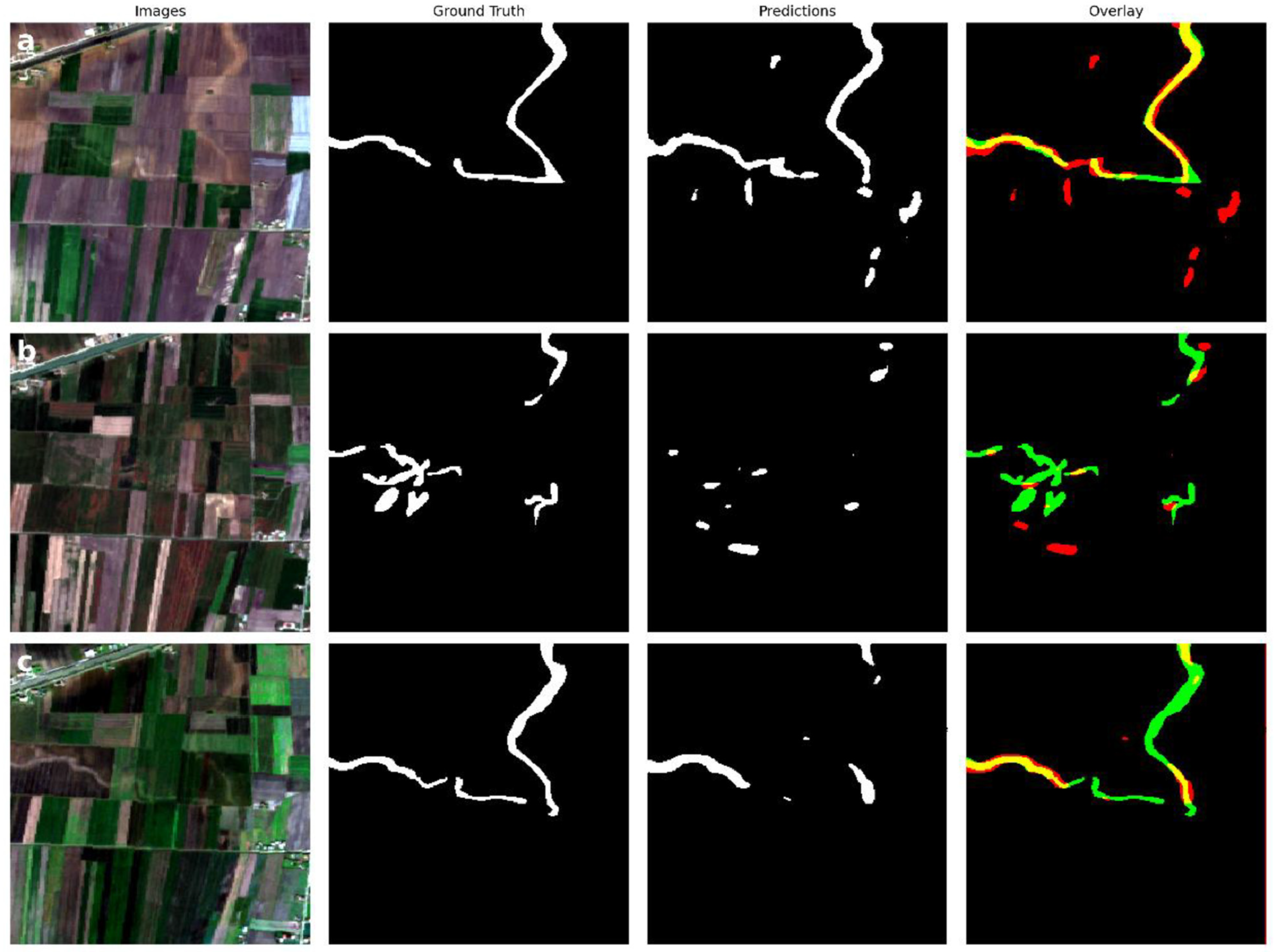
- Seasonal variability strongly affects detection performance: early growth and post-harvest periods provide the most favourable conditions, while peak vegetation severely reduces visibility and segmentation accuracy across all enhancement techniques.
- The results demonstrate that incorporating spectral enhancement techniques and seasonally tailored preprocessing strategies significantly improve the robustness and precision of deep learning-based palaeochannel detection workflows.
- By highlighting the interplay between spectral transformations, seasonal conditions, and model behaviour, this study establishes a new benchmark for integrating enhancement methods into AI-driven prospection pipelines, supporting more accurate, scalable, and season-adaptive applications in archaeological and environmental remote sensing.
Abstract
1. Introduction
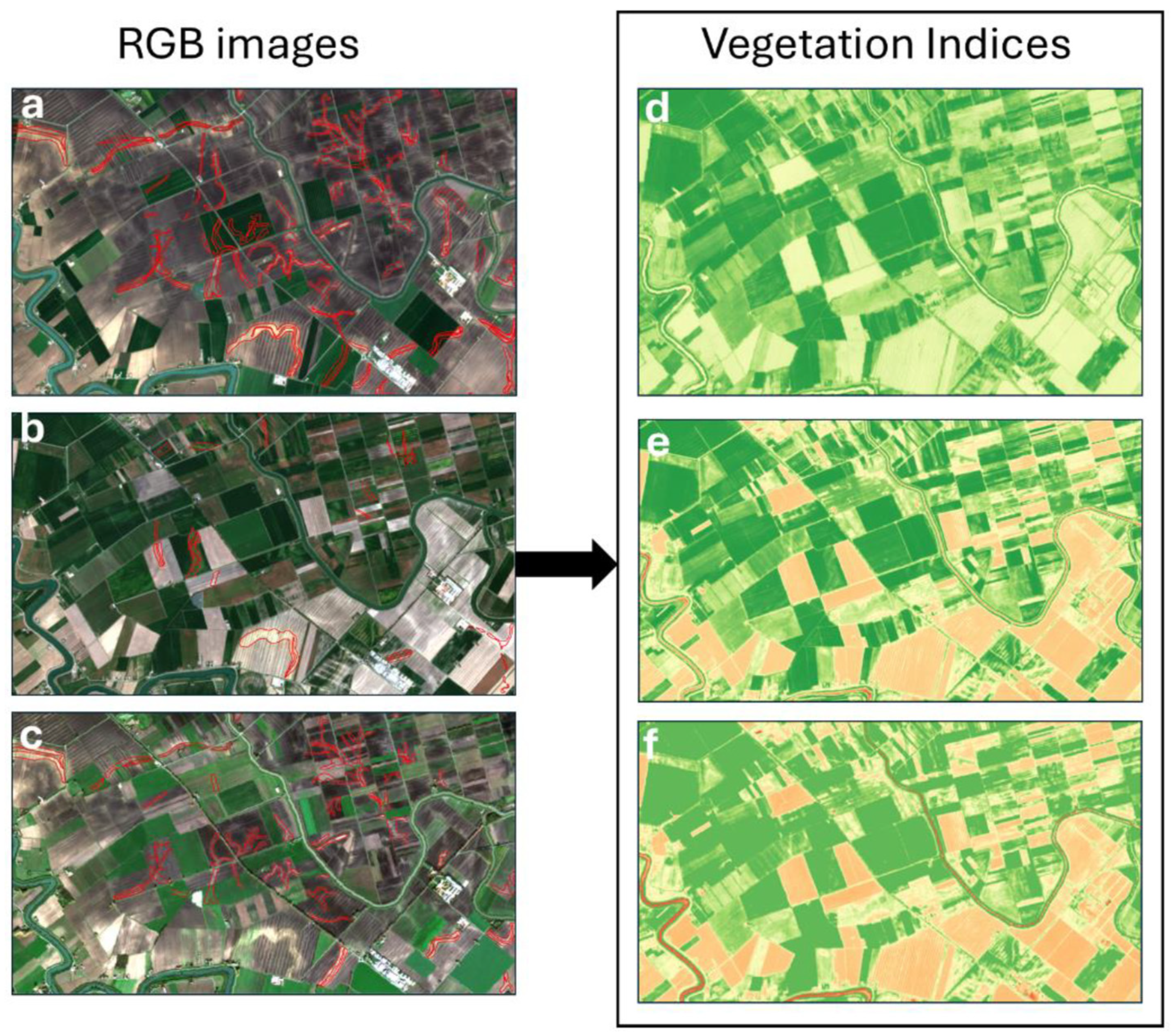
- Evaluate the impact of spectral enhancement techniques on deep learning segmentation performance in multispectral imagery, quantifying whether and how preprocessing improves the detectability of subtle soil and crop marks from subsurface features.
- Assess the temporal robustness of enhancement techniques, determining how seasonal variability, vegetation phenology, and soil conditions affect model performance and whether certain preprocessing strategies are stable across environmental conditions.
- Establish a benchmark framework for systematically comparing spectral preprocessing methods within deep learning workflows, providing a reproducible and generalisable foundation for future studies.
2. Materials and Methods
2.1. Study Area
2.2. Methodology
2.2.1. Imagery Acquisition
2.2.2. Spectral Enhancements
2.2.3. Palaeochannels Dataset
2.2.4. Experimental Setting
2.2.5. Semantic Segmentation Models
2.2.6. Metrics and Evaluation
3. Results
4. Discussion
4.1. Impact of Spectral Enhancement Techniques on Semantic Segmentation Models
4.2. Role of Seasonal Variations in Palaeochannel Detection
4.3. Post Hoc Evaluation
4.4. General Remarks on the Challenging of the Detection Task
5. Conclusions
Supplementary Materials
Author Contributions
Funding
Data Availability Statement
Acknowledgments
Conflicts of Interest
References
- Evans, R.; Jones, R.J.A. Crop Marks and Soils at Two Archaeological Sites in Britain. J. Archaeol. Sci. 1977, 4, 63–76. [Google Scholar] [CrossRef] [Scilit]
- Musson, C. Flights into the Past. In Flights into the Past Aerial Photography, Photo Interpretation and Mapping for Archaeology; Musson, C., Palmer, R., Campana, S., Eds.; Aerial Archaeology Research Group: Swindon, UK, 2013; pp. 11–119. [Google Scholar]
- Verhoeven, G.J. Near-Infrared Aerial Crop Mark Archaeology: From Its Historical Use to Current Digital Implementations. J. Archaeol. Method Theory 2012, 19, 132–160. [Google Scholar] [CrossRef] [Scilit]
- Radoux, J.; Chomé, G.; Jacques, D.; Waldner, F.; Bellemans, N.; Matton, N.; Lamarche, C.; D’Andrimont, R.; Defourny, P. Sentinel-2′s Potential for Sub-Pixel Landscape Feature Detection. Remote Sens. 2016, 8, 488. [Google Scholar] [CrossRef] [Scilit]
- Abate, N.; Lasaponara, R. Preventive Archaeology Based on Open Remote Sensing Data and Tools: The Cases of Sant’Arsenio (SA) and Foggia (FG), Italy. Sustainability 2019, 11, 4145. [Google Scholar] [CrossRef] [Scilit]
- Agapiou, A.; Hadjimitsis, D.G.; Sarris, A.; Georgopoulos, A.; Alexakis, D.D. Optimum Temporal and Spectral Window for Monitoring Crop Marks over Archaeological Remains in the Mediterranean Region. J. Archaeol. Sci. 2013, 40, 1479–1492. [Google Scholar] [CrossRef] [Scilit]
- Elfadaly, A.; Abate, N.; Masini, N.; Lasaponara, R. SAR Sentinel 1 Imaging and Detection of Palaeo-Landscape Features in the Mediterranean Area. Remote Sens. 2020, 12, 2611. [Google Scholar] [CrossRef] [Scilit]
- Orengo, H.A.; Conesa, F.C.; Garcia-Molsosa, A.; Lobo, A.; Green, A.S.; Madella, M.; Petrie, C.A. Automated Detection of Archaeological Mounds Using Machine-Learning Classification of Multisensor and Multitemporal Satellite Data. Proc. Natl. Acad. Sci. USA 2020, 117, 18240–18250. [Google Scholar] [CrossRef] [Scilit]
- Yang, H.; Hu, Q.; Zou, Q.; Ai, M.; Zhao, P.; Wang, S. Predicting Ancient City Sites Using GEE Coupled with Geographic Element Features and Temporal Spectral Features: A Case Study of the Neolithic and Bronze Age of the Jianghan Region, China. npj Herit. Sci. 2025, 13, 11. [Google Scholar] [CrossRef] [Scilit]
- Zhu, X.X.; Tuia, D.; Mou, L.; Xia, G.-S.; Zhang, L.; Xu, F.; Fraundorfer, F. Deep Learning in Remote Sensing: A Comprehensive Review and List of Resources. IEEE Geosci. Remote Sens. Mag. 2017, 5, 8–36. [Google Scholar] [CrossRef] [Scilit]
- Alrabayah, O.; Caus, D.; Watson, R.A.; Schulten, H.Z.; Weigel, T.; Rüpke, L.; Al-Halbouni, D. Deep-Learning-Based Automatic Sinkhole Recognition: Application to the Eastern Dead Sea. Remote Sens. 2024, 16, 2264. [Google Scholar] [CrossRef] [Scilit]
- Chowdhury, M.; Martínez-Sansigre, A.; Mole, M.; Alonso-Peleato, E.; Basos, N.; Blanco, J.M.; Ramirez-Nicolas, M.; Caballero, I.; de la Calle, I. AI-Driven Remote Sensing Enhances Mediterranean Seagrass Monitoring and Conservation to Combat Climate Change and Anthropogenic Impacts. Sci. Rep. 2024, 14, 8360. [Google Scholar] [CrossRef] [Scilit]
- Fiorucci, M.; Naylor, P.; Yamada, M. Optimal Transport for Change Detection on Lidar Point Clouds. In Proceedings of the IGARSS 2023 IEEE International Geoscience and Remote Sensing Symposium, Pasadena, CA, USA, 16–21 July 2023; IEEE: New York, NY, USA, 2023; pp. 982–985. [Google Scholar]
- Kokalj, Ž.; Džeroski, S.; Šprajc, I.; Štajdohar, J.; Draksler, A.; Somrak, M. Machine Learning-Ready Remote Sensing Data for Maya Archaeology. Sci. Data 2023, 10, 558. [Google Scholar] [CrossRef] [Scilit]
- Naylor, P.; Di Carlo, D.; Traviglia, A.; Yamada, M.; Fiorucci, M. Implicit Neural Representation for Change Detection. In Proceedings of the 2024 IEEE/CVF Winter Conference on Applications of Computer Vision (WACV), Waikoloa, HI, USA, 3–8 January 2024. [Google Scholar]
- Verschoof-van der Vaart, W.B.; Lambers, K.; Kowalczyk, W.; Bourgeois, Q.P.J. Combining Deep Learning and Location-Based Ranking for Large-Scale Archaeological Prospection of LiDAR Data from The Netherlands. ISPRS Int. J. Geo-Inf. 2020, 9, 293. [Google Scholar] [CrossRef] [Scilit]
- Paoletti, M.E.; Haut, J.M.; Plaza, J.; Plaza, A. Deep&Dense Convolutional Neural Network for Hyperspectral Image Classification. Remote Sens. 2018, 10, 1454. [Google Scholar] [CrossRef] [Scilit]
- Audebert, N.; Le Saux, B.; Lefevre, S. Deep Learning for Classification of Hyperspectral Data: A Comparative Review. IEEE Geosci. Remote Sens. Mag. 2019, 7, 159–173. [Google Scholar] [CrossRef] [Scilit]
- Zeynali, R.; Mandanici, E.; Bitelli, G. A Technical Note on AI-Driven Archaeological Object Detection in Airborne LiDAR Derivative Data, with CNN as the Leading Technique. Remote Sens. 2025, 17, 2733. [Google Scholar] [CrossRef] [Scilit]
- Character, L.; Beach, T.; Inomata, T.; Garrison, T.G.; Luzzadder-Beach, S.; Baldwin, J.D.; Cambranes, R.; Pinzón, F.; Ranchos, J.L. Broadscale Deep Learning Model for Archaeological Feature Detection across the Maya Area. J. Archaeol. Sci. 2024, 169, 106022. [Google Scholar] [CrossRef] [Scilit]
- Kadhim, I.; Abed, F.M. A Critical Review of Remote Sensing Approaches and Deep Learning Techniques in Archaeology. Sensors 2023, 23, 2918. [Google Scholar] [CrossRef] [Scilit]
- Guyot, A.; Lennon, M.; Hubert-Moy, L. Objective Comparison of Relief Visualization Techniques with Deep CNN for Archaeology. J. Archaeol. Sci. Rep. 2021, 38, 103027. [Google Scholar] [CrossRef] [Scilit]
- Jaturapitpornchai, R.; Poggi, G.; Sech, G.; Kokalj, Ž.; Fiorucci, M.; Traviglia, A. Impact of LiDAR Visualisations on Semantic Segmentation of Archaeological Objects. In Proceedings of the IGARSS 2024 IEEE International Geoscience and Remote Sensing Symposium, Athens, Greece, 7–12 July 2024; IEEE: New York, NY, USA, 2024; pp. 3361–3365. [Google Scholar]
- Somrak, M.; Džeroski, S.; Kokalj, Ž. Learning to Classify Structures in ALS-Derived Visualizations of Ancient Maya Settlements with CNN. Remote Sens. 2020, 12, 2215. [Google Scholar] [CrossRef] [Scilit]
- Aqdus, S.A.; Hanson, W.S.; Drummond, J. The Potential of Hyperspectral and Multi-Spectral Imagery to Enhance Archaeological Cropmark Detection: A Comparative Study. J. Archaeol. Sci. 2012, 39, 1915–1924. [Google Scholar] [CrossRef] [Scilit]
- Bini, M.; Isola, I.; Zanchetta, G.; Ribolini, A.; Ciampalini, A.; Baneschi, I.; Mele, D.; D’Agata, A.L. Identification of Leveled Archeological Mounds (Höyük) in the Alluvial Plain of the Ceyhan River (Southern Turkey) by Satellite Remote-Sensing Analyses. Remote Sens. 2018, 10, 241. [Google Scholar] [CrossRef] [Scilit]
- McGrath, C.N.; Cowley, D.C.; Hood, S.; Clarke, S.; Macdonald, M. An Assessment of High Temporal Frequency Satellite Data for Historic Environment Applications. A Case Study from Scotland. Archaeol. Prospect. 2023, 30, 267–282. [Google Scholar] [CrossRef] [Scilit]
- Moriarty, C.; Cowley, D.C.; Wade, T.; Nichol, C.J. Deploying Multispectral Remote Sensing for Multi-temporal Analysis of Archaeological Crop Stress at Ravenshall, Fife, Scotland. Archaeol. Prospect. 2019, 26, 33–46. [Google Scholar] [CrossRef] [Scilit]
- Orengo, H.A.; Petrie, C.A. Large-Scale, Multi-Temporal Remote Sensing of Palaeo-River Networks: A Case Study from Northwest India and Its Implications for the Indus Civilisation. Remote Sens. 2017, 9, 735. [Google Scholar] [CrossRef] [Scilit]
- Estanqueiro, M.; Šalamon, A.; Lewis, H.; Molloy, B.; Jovanović, D. Sentinel-2 Imagery Analyses for Archaeological Site Detection: An Application to Late Bronze Age Settlements in Serbian Banat, Southern Carpathian Basin. J. Archaeol. Sci. Rep. 2023, 51, 104188. [Google Scholar] [CrossRef] [Scilit]
- Hill, A.C.; Laugier, E.J.; Casana, J. Archaeological Remote Sensing Using Multi-Temporal, Drone-Acquired Thermal and Near Infrared (NIR) Imagery: A Case Study at the Enfield Shaker Village, New Hampshire. Remote Sens. 2020, 12, 690. [Google Scholar] [CrossRef] [Scilit]
- Peña-Villasenín, S.; Gil-Docampo, M.; Ortiz-Sanz, J. Hidden Archaeological Remains in Heterogeneous Vegetation: A Crop Marks Study in Fortified Settlements of Northwestern Iberian Peninsula. Remote Sens. 2024, 16, 3923. [Google Scholar] [CrossRef] [Scilit]
- Agapiou, A.; Hegyi, A.; Stavilă, A. Observations of Archaeological Proxies through Phenological Analysis over the Megafort of Csanádpalota-Juhász, T. Tanya in Hungary Using Sentinel-2 Images. Remote Sens. 2023, 15, 464. [Google Scholar] [CrossRef] [Scilit]
- Cerra, D.; Agapiou, A.; Cavalli, R.; Sarris, A. An Objective Assessment of Hyperspectral Indicators for the Detection of Buried Archaeological Relics. Remote Sens. 2018, 10, 500. [Google Scholar] [CrossRef] [Scilit]
- Kalayci, T.; Lasaponara, R.; Wainwright, J.; Masini, N. Multispectral Contrast of Archaeological Features: A Quantitative Evaluation. Remote Sens. 2019, 11, 913. [Google Scholar] [CrossRef] [Scilit]
- Lasaponara, R.; Abate, N.; Masini, N. On the Use of Google Earth Engine and Sentinel Data to Detect “Lost” Sections of Ancient Roads. The Case of Via Appia. IEEE Geosci. Remote Sens. Lett. 2022, 19, 3001605. [Google Scholar] [CrossRef] [Scilit]
- Masini, N.; Marzo, C.; Manzari, P.; Belmonte, A.; Sabia, C.; Lasaponara, R. On the Characterization of Temporal and Spatial Patterns of Archaeological Crop-Marks. J. Cult. Herit. 2018, 32, 124–132. [Google Scholar] [CrossRef] [Scilit]
- Crabb, N.; Carey, C.; Howard, A.J.; Jackson, R.; Burnside, N.; Brolly, M. Modelling Geoarchaeological Resources in Temperate Alluvial Environments: The Capability of Higher Resolution Satellite Remote Sensing Techniques. J. Archaeol. Sci. 2022, 141, 105576. [Google Scholar] [CrossRef] [Scilit]
- Vervoort, R.W.; Annen, Y.L. Palæochannels in Northern New South Wales: Inversion of Electromagnetic Induction Data to Infer Hydrologically Relevant Stratigraphy. Soil Res. 2006, 44, 35. [Google Scholar] [CrossRef] [Scilit]
- Brandolini, F.; Domingo-Ribas, G.; Zerboni, A.; Turner, S. A Google Earth Engine-Enabled Python Approach to Improve Identification of Anthropogenic Palaeo-Landscape Features. Open Res. Eur. 2021, 1, 22. [Google Scholar] [CrossRef] [Scilit] [PubMed]
- Piovan, S.; Mozzi, P.; Zecchin, M. The Interplay between Adjacent Adige and Po Alluvial Systems and Deltas in the Late Holocene (Northern Italy). Geomorphol. Process. Environ. 2012, 18, 427–440. [Google Scholar] [CrossRef] [Scilit]
- Ninfo, A.; Mozzi, P.; Abbà, T. Integration of LiDAR and Cropmark Remote Sensing for the Study of Fluvial and Anthropogenic Landforms in the Brenta–Bacchiglione Alluvial Plain (NE Italy). Geomorphology 2016, 260, 64–78. [Google Scholar] [CrossRef] [Scilit]
- Corrò, E.; Mozzi, P. Water Matters. Geoarchaeology of the City of Adria and Palaeohydrographic Variations (Po Delta, Northern Italy). J. Archaeol. Sci. Rep. 2017, 15, 482–491. [Google Scholar] [CrossRef] [Scilit]
- Fontana, A.; Frassine, M.; Ronchi, L. Geomorphological and Geoarchaeological Evidence of the Medieval Deluge in the Tagliamento River (NE Italy). In Earth and Environmental Science; Springer: Cham, Switzerland, 2019; pp. 97–116. [Google Scholar]
- Mozzi, P.; Piovan, S.; Corrò, E. Long-Term Drivers and Impacts of Abrupt River Changes in Managed Lowlands of the Adige River and Northern Po Delta (Northern Italy). Quat. Int. 2020, 538, 80–93. [Google Scholar] [CrossRef] [Scilit]
- Susini, D.; Vignola, C.; Goffredo, R.; Totten, D.M.; Masi, A.; Smedile, A.; De Martini, P.M.; Cinti, F.R.; Sadori, L.; Forti, L.; et al. Holocene Palaeoenvironmental and Human Settlement Evolution in the Southern Margin of the Salpi Lagoon, Tavoliere Coastal Plain (Apulia, Southern Italy). Quat. Int. 2023, 655, 37–54. [Google Scholar] [CrossRef] [Scilit]
- Stein, S.; Malone, S.; Knight, D.; Howard, A.J.; Carey, C. New Approaches to Mapping and Managing Palaeochannel Resources in the Light of Future Environmental Change: A Case Study from the Trent Valley, UK. Hist. Environ. Policy Pract. 2017, 8, 113–124. [Google Scholar] [CrossRef] [Scilit]
- Gorelick, N.; Hancher, M.; Dixon, M.; Ilyushchenko, S.; Thau, D.; Moore, R. Google Earth Engine: Planetary-Scale Geospatial Analysis for Everyone. Remote Sens. Environ. 2017, 202, 18–27. [Google Scholar] [CrossRef] [Scilit]
- Poggi, G.; Yaseen, A.; Jaturapitpornchai, R.; Ferro, S.; Sech, G.; Naylor, P.; Salvi, M.C.; Vascon, S.; Saux, B.L.; Fiorucci, M.; et al. Multitemporal Multispectral Dataset for Palaeochannels Segmentation (MAPS). IEEE Access 2025, 13, 203113–203124. [Google Scholar] [CrossRef] [Scilit]
- Agapiou, A.; Lysandrou, V.; Lasaponara, R.; Masini, N.; Hadjimitsis, D. Study of the Variations of Archaeological Marks at Neolithic Site of Lucera, Italy Using High-Resolution Multispectral Datasets. Remote Sens. 2016, 8, 723. [Google Scholar] [CrossRef] [Scilit]
- Hamuda, E.; Mc Ginley, B.; Glavin, M.; Jones, E. Automatic Crop Detection under Field Conditions Using the HSV Colour Space and Morphological Operations. Comput. Electron. Agric. 2017, 133, 97–107. [Google Scholar] [CrossRef] [Scilit]
- Chen, C.; Chen, H.; Liang, J.; Huang, W.; Xu, W.; Li, B.; Wang, J. Extraction of Water Body Information from Remote Sensing Imagery While Considering Greenness and Wetness Based on Tasseled Cap Transformation. Remote Sens. 2022, 14, 3001. [Google Scholar] [CrossRef] [Scilit]
- Macintyre, P.; van Niekerk, A.; Mucina, L. Efficacy of Multi-Season Sentinel-2 Imagery for Compositional Vegetation Classification. Int. J. Appl. Earth Obs. Geoinf. 2020, 85, 101980. [Google Scholar] [CrossRef] [Scilit]
- Shi, T.; Xu, H. Derivation of Tasseled Cap Transformation Coefficients for Sentinel-2 MSI At-Sensor Reflectance Data. IEEE J. Sel. Top. Appl. Earth Obs. Remote Sens. 2019, 12, 4038–4048. [Google Scholar] [CrossRef] [Scilit]
- Lasaponara, R.; Masini, N. Image Enhancement, Feature Extraction and Geospatial Analysis in an Archaeological Perspective. In Satellite Remote Sensing; Springer: Dordrecht, The Netherlands, 2012; pp. 17–63. [Google Scholar]
- Vélez, S.; Martínez-Peña, R.; Castrillo, D. Beyond Vegetation: A Review Unveiling Additional Insights into Agriculture and Forestry through the Application of Vegetation Indices. J 2023, 6, 421–436. [Google Scholar] [CrossRef] [Scilit]
- Kearney, S.P.; Porensky, L.M.; Augustine, D.J.; Gaffney, R.; Derner, J.D. Monitoring Standing Herbaceous Biomass and Thresholds in Semiarid Rangelands from Harmonized Landsat 8 and Sentinel-2 Imagery to Support within-Season Adaptive Management. Remote Sens. Environ. 2022, 271, 112907. [Google Scholar] [CrossRef] [Scilit]
- Ronneberger, O.; Fischer, P.; Brox, T. U-Net: Convolutional Networks for Biomedical Image Segmentation; Springer: Cham, Switzerland, 2015; pp. 234–241. [Google Scholar]
- Redmon, J.; Divvala, S.; Girshick, R.; Farhadi, A. You Only Look Once: Unified, Real-Time Object Detection. In Proceedings of the IEEE Conference on Computer Vision and Pattern Recognition, Las Vegas, NV, USA, 27–30 June 2016; pp. 779–788. [Google Scholar]
- Li, J.; Cai, Y.; Li, Q.; Kou, M.; Zhang, T. A Review of Remote Sensing Image Segmentation by Deep Learning Methods. Int. J. Digit. Earth 2024, 17, 2328827. [Google Scholar] [CrossRef] [Scilit]
- Yue, X.; Qi, K.; Na, X.; Zhang, Y.; Liu, Y.; Liu, C. Improved YOLOv8-Seg Network for Instance Segmentation of Healthy and Diseased Tomato Plants in the Growth Stage. Agriculture 2023, 13, 1643. [Google Scholar] [CrossRef] [Scilit]
- Lin, T.-Y.; Maire, M.; Belongie, S.; Hays, J.; Perona, P.; Ramanan, D.; Dollár, P.; Zitnick, C.L. Microsoft COCO: Common Objects in Context. In Proceedings of the 13th European Conference on Computer Vision (ECCV 2014), Zurich, Switzerland, 6–12 September 2014; Springer: Cham, Switzerland, 2014; pp. 740–755. [Google Scholar]
- Xie, E.; Wang, W.; Yu, Z.; Anandkumar, A.; Alvarez, J.M.; Luo, P. SegFormer: Simple and Efficient Design for Semantic Segmentation with Transformers. In Advances in Neural Information Processing Systems, Proceedings of the Thirty-Fifth Conference on Neural Information Processing Systems, Online, 6–14 December 2021; Curran Associates, Inc.: New York, NY, USA, 2021; pp. 12077–12090. [Google Scholar]
- Hu, J.; Shen, L.; Albanie, S.; Sun, G.; Wu, E. Squeeze-and-Excitation Networks. In Proceedings of the 2018 IEEE/CVF Conference on Computer Vision and Pattern Recognition, Salt Lake City, UT, USA, 18–22 June 2018; pp. 7132–7141. [Google Scholar]
- Milletari, F.; Navab, N.; Ahmadi, S.-A. V-Net: Fully Convolutional Neural Networks for Volumetric Medical Image Segmentation. In Proceedings of the 2016 Fourth International Conference on 3D Vision (3DV), Stanford, CA, USA, 25–28 October 2016; IEEE: New York, NY, USA; pp. 565–571. [Google Scholar]
- Abraham, N.; Khan, N.M. A Novel Focal Tversky Loss Function With Improved Attention U-Net for Lesion Segmentation. In Proceedings of the 2019 IEEE 16th International Symposium on Biomedical Imaging (ISBI 2019), Venice, Italy, 8–11 April 2019; IEEE: New York, NY, USA; pp. 683–687. [Google Scholar]
- Dong, R.; Bai, L.; Li, F. SiameseDenseU-Net-Based Semantic Segmentation of Urban Remote Sensing Images. Math. Probl. Eng. 2020, 2020, 1515630. [Google Scholar] [CrossRef] [Scilit]
- Pokkuluri, K.S.; S.S.N, U.D.N.; Margala, M.; Chakrabarti, P. Enhancing Image Segmentation Accuracy Using Deep Learning Techniques. J. Adv. Res. Appl. Sci. Eng. Technol. 2024, 49, 139–148. [Google Scholar] [CrossRef] [Scilit]
- Xia, F.; Chu, S.; Liu, X.; Li, G. Hyperspectral Remote Sensing Image Dimensionality Reduction Method Based on Adaptive Filtering. J. Comput. Methods Sci. Eng. 2023, 23, 1705–1717. [Google Scholar] [CrossRef] [Scilit]
- Mu, L.; Zhang, C.; Chi, P.; Liu, L. A Band Selection Method of Hyperspectral Remote Sensing Based on Particle Frog Leaping Algorithm. Optoelectron. Lett. 2018, 14, 316–319. [Google Scholar] [CrossRef] [Scilit]
- Wang, Y.; Huang, S.; Liu, D.; Wang, B. Research Advance on Band Selection-Based Dimension Reduction of Hyperspectral Remote Sensing Images. In Proceedings of the 2012 2nd International Conference on Remote Sensing, Environment and Transportation Engineering, Nanjing, China, 1–3 June 2012; IEEE: New York, NY, USA, 2012; pp. 1–4. [Google Scholar]
- Bennett, R.; Welham, K.; HilF, R.A. Airborne Spectral Imagery for Archaeological Prospection in Grassland Environments-An Evaluation of Performance. Antiquity 2013, 87, 220–236. [Google Scholar] [CrossRef] [Scilit]
- Bennett, R.; Welham, K.; Hill, R.A.; Ford, A.L.J. The Application of Vegetation Indices for the Prospection of Archaeological Features in Grass-dominated Environments. Archaeol. Prospect. 2012, 19, 209–218. [Google Scholar] [CrossRef] [Scilit]
- Kaimaris, D.; Patias, P.; Tsakiri, M. Best Period for High Spatial Resolution Satellite Images for the Detection of Marks of Buried Structures. Egypt. J. Remote Sens. Space Sci. 2012, 15, 9–18. [Google Scholar] [CrossRef] [Scilit]



| Month | Visualisation | N° of Instances | Area of Instances (Number of Pixels) | Tiles w/Event (% of Total Tiles) | Event Coverage (% of Total Pixels) |
|---|---|---|---|---|---|
| April | RGB | 2474 | 125 [73, 247] | 59.0 | 1.10 |
| FCC | 2011 | 131 [66, 264] | 60.9 | 1.17 | |
| VBB | 2285 | 125 [61, 248] | 58.8 | 1.10 | |
| MV | 2581 | 128 [67, 244] | 67.0 | 1.30 | |
| (RGB + FCC) | 2432 | 136 [70, 265] | 61.5 | 1.25 | |
| August | RGB | 1699 | 94 [46, 185] | 60.9 | 0.86 |
| FCC | 1701 | 91 [45, 181] | 61.8 | 0.87 | |
| VBB | 1588 | 92 [47, 181] | 57.9 | 0.76 | |
| MV | 1608 | 93 [47, 181] | 58.2 | 0.76 | |
| (RGB + FCC) | 1667 | 98 [48, 194] | 62.1 | 0.91 | |
| November | RGB | 1977 | 135 [72, 247] | 58.9 | 1.22 |
| FCC | 1956 | 131 [72, 233] | 68.8 | 1.19 | |
| VBB | 1977 | 140 [77, 257] | 68.8 | 1.23 | |
| MV | 2061 | 132 [72, 236] | 69.9 | 1.27 | |
| (RGB + FCC) | 1791 | 137 [76, 255] | 69.9 | 1.27 |
| APRIL | AUGUST | NOVEMBER | ||||||||||
|---|---|---|---|---|---|---|---|---|---|---|---|---|
| Enhancements | IoU | Pre | Rec | F1 | IoU | Pre | Rec | F1 | IoU | Pre | Rec | F1 |
| MV | 0.22 ± 0.02 | 0.51 ± 0.11 | 0.31 ± 0.08 | 0.36 ± 0.02 | 0.07 ± 0.03 | 0.32 ± 0.13 | 0.10 ± 0.05 | 0.14 ± 0.05 | 0.19 ± 0.03 | 0.50 ± 0.11 | 0.26 ± 0.11 | 0.32 ± 0.05 |
| RGB | 0.09 ± 0.4 | 0.61 ± 0.9 | 0.11 ± 0.7 | 0.17 ± 0.08 | 0.07 ± 0.02 | 0.30 ± 0.1 | 0.09 ± 0.04 | 0.13 ± 0.03 | 0.06 ± 0.04 | 0.52 ± 0.27 | 0.07 ± 0.06 | 0.11 ± 0.07 |
| FCC | 0.21 ± 0.02 | 0.47 ± 0.05 | 0.29 ± 0.04 | 0.35 ± 0.03 | 0.06 ± 0.01 | 0.27 ± 0.05 | 0.07 ± 0.02 | 0.12 ± 0.03 | 0.08 ± 0.02 | 0.61 ± 0.15 | 0.09 ± 0.03 | 0.15 ± 0.04 |
| VBB | 0.18 ± 0.03 | 0.05 ± 0.11 | 0.26 ± 0.11 | 0.32 ± 0.05 | 0.03 ± 0.01 | 0.43 ± 0.23 | 0.03 ± 0.03 | 0.04 ± 0.03 | 0.09 ± 0.02 | 0.58 ± 0.22 | 0.10 ± 0.04 | 0.16 ± 0.05 |
| 12Band | 0.04 ± 0.03 | 0.09 ± 0.05 | 0.10 ± 0.05 | 0.09 ± 0.06 | 0.02 ± 0.01 | 0.19 ± 0.06 | 0.04 ± 0.05 | 0.10 ± 0.03 | 0.03 ± 0.02 | 0.15 ± 0.07 | 0.03 ± 0.03 | 0.05 ± 0.4 |
| NDVI | 0.05 ± 0.01 | 0.32 ± 0.12 | 0.08 ± 0.04 | 0.13 ± 0.05 | 0.03 ± 0.01 | 0.25 ± 0.10 | 0.05 ± 0.03 | 0.08 ± 0.03 | 0.04 ± 0.01 | 0.30 ± 0.11 | 0.07 ± 0.03 | 0.11 ± 0.04 |
| APRIL | AUGUST | NOVEMBER | ||||||||||
|---|---|---|---|---|---|---|---|---|---|---|---|---|
| Enhancements | IoU | Pre | Rec | F1 | IoU | Pre | Rec | F1 | IoU | Pre | Rec | F1 |
| MV | 0.09 ± 0.02 | 0.42 ± 0.07 | 0.17 ± 0.04 | 0.18 ± 0.05 | 0.03 ± 0.02 | 0.18 ± 0.13 | 0.05 ± 0.03 | 0.07 ± 0.04 | 0.06 ± 0.03 | 0.51 ± 0.09 | 0.07 ± 0.04 | 0.11 ± 0.05 |
| RGB | 0.06 ± 0.05 | 0.26 ± 0.07 | 0.09 ± 0.07 | 0.12 ± 0.08 | 0.04 ± 0.01 | 0.24 ± 0.15 | 0.05 ± 0.04 | 0.07 ± 0.03 | 0.06 ± 0.02 | 0.44 ± 0.07 | 0.08 ± 0.05 | 0.01 ± 0.05 |
| FCC | 0.07 ± 0.02 | 0.54 ± 0.10 | 0.08 ± 0.02 | 0.14 ± 0.05 | 0.02 ± 0.01 | 0.46 ± 0.21 | 0.03 ± 0.03 | 0.05 ± 0.03 | 0.04 ± 0.02 | 0.47 ± 0.09 | 0.05 ± 0.04 | 0.08 ± 0.05 |
| VBB | 0.06 ± 0.03 | 0.32 ± 0.09 | 0.07 ± 0.03 | 0.12 ± 0.05 | 0.006 ± 0.004 | 0.02 ± 0.01 | 0.01 ± 0.009 | 0.01 ± 0.009 | 0.07 ± 0.02 | 0.45 ± 0.10 | 0.08 ± 0.03 | 0.13 ± 0.03 |
| Months | Enhancement | F1 Score | F1_Obj Score |
|---|---|---|---|
| April | RGB ‡ | 0.27 | 0.24 ± 0.08 |
| FCC * | 0.39 | 0.39 ± 0.11 | |
| VBB * | 0.37 | 0.43 ± 0.11 | |
| MV * | 0.39 | 0.45 ± 0.10 | |
| August | RGB * | 0.18 | 0.20 ± 0.06 |
| FCC * | 0.16 | 0.18 ± 0.07 | |
| VBB * | 0.05 | 0.07 ± 0.01 | |
| MV * | 0.18 | 0.24 ± 0.07 | |
| November | RGB * | 0.13 | 0.16 ± 0.04 |
| FCC * | 0.21 | 0.26 ± 0.06 | |
| VBB * | 0.22 | 0.21 ± 0.08 | |
| MV * | 0.31 | 0.25 ± 0.05 |
Disclaimer/Publisher’s Note: The statements, opinions and data contained in all publications are solely those of the individual author(s) and contributor(s) and not of MDPI and/or the editor(s). MDPI and/or the editor(s) disclaim responsibility for any injury to people or property resulting from any ideas, methods, instructions or products referred to in the content. |
© 2025 by the authors. Licensee MDPI, Basel, Switzerland. This article is an open access article distributed under the terms and conditions of the Creative Commons Attribution (CC BY) license (https://creativecommons.org/licenses/by/4.0/).
Share and Cite
Yaseen, A.; Poggi, G.; Vascon, S.; Traviglia, A. Optimising Deep Learning-Based Segmentation of Crop and Soil Marks with Spectral Enhancements on Sentinel-2 Data. Remote Sens. 2025, 17, 4014. https://doi.org/10.3390/rs17244014
Yaseen A, Poggi G, Vascon S, Traviglia A. Optimising Deep Learning-Based Segmentation of Crop and Soil Marks with Spectral Enhancements on Sentinel-2 Data. Remote Sensing. 2025; 17(24):4014. https://doi.org/10.3390/rs17244014
Chicago/Turabian StyleYaseen, Andaleeb, Giulio Poggi, Sebastiano Vascon, and Arianna Traviglia. 2025. "Optimising Deep Learning-Based Segmentation of Crop and Soil Marks with Spectral Enhancements on Sentinel-2 Data" Remote Sensing 17, no. 24: 4014. https://doi.org/10.3390/rs17244014
APA StyleYaseen, A., Poggi, G., Vascon, S., & Traviglia, A. (2025). Optimising Deep Learning-Based Segmentation of Crop and Soil Marks with Spectral Enhancements on Sentinel-2 Data. Remote Sensing, 17(24), 4014. https://doi.org/10.3390/rs17244014