Article

Remote Sensing Applied to Dynamic Landscape: Seventy Years of Change Along the Southern Adriatic Coast


by
Federica Pontieri
1,
Michele Innangi
1,*,
Mirko Di Febbraro
1 and
Maria Laura Carranza
1,2
1
EnviXLab, Department of Biosciences and Territory DiBT, Molise University, Contrada Fonte Lappone, snc, 86090 Pesche, Italy
2
National Biodiversity Future Center (NBFC), 90133 Palermo, Italy
*
Author to whom correspondence should be addressed.
Remote Sens. 2025, 17(24), 3961; https://doi.org/10.3390/rs17243961
Submission received: 29 October 2025 / Revised: 1 December 2025 / Accepted: 4 December 2025 / Published: 8 December 2025
(This article belongs to the Special Issue Emerging Remote Sensing Technologies in Coastal Observation)

Highlights

  • Long-term landscape changes within and outside Long-Term Ecological Research sites;
  • Combining multi-temporal maps with a transition matrix and machine learning analysis;
  • Highly dynamic landscape between 1954 and 1986 and static from 1986 to 2022;
  • Dynamic processes vary between LTER sites and the external landscape;
  • Valuable support to track changes aiding conservation efforts.

Abstract

Coastal landscapes are complex socio-ecological systems that undergo rapid transformations driven by both natural dynamics and human pressures. Their sustainable management depends on robust, cost-effective remote sensing methodologies for long-term monitoring and quantitative assessment of spatiotemporal change. In this study, we developed an integrated remote-sensing-based framework that combines historical aerial photograph interpretation, transition matrix analysis, and machine learning to assess coastal dune landscape dynamics over a seventy-year period. Georeferenced orthorectified and preprocessed aerial imagery freely available from the Italian Ministry of the Environment for the years 1954, 1986, and Google Satellite Images for 2022 were used to generate detailed land-cover maps, enabling the analysis of two temporal intervals (1954–1986 and 1986–2022). Transition matrices quantified land-cover conversions and identified sixteen dynamic processes, while a Random Forest (RF) classifier, optimized through parameter tuning and cross-validation, modeled and compared landscape dynamics within protected Long-Term Ecological Research (LTER) sites and adjacent unprotected areas. Model performance was evaluated using Balanced Accuracy (BA) to ensure robustness and to interpret the relative importance of change-driving variables. The RF model achieved high accuracy in distinguishing change processes inside and outside LTER sites, effectively capturing subtle yet ecologically relevant transitions. Results reveal non-random, contrasting landscape trajectories between management regimes: protected sites tend toward naturalization, whereas unprotected sites exhibit persistent urban influence. Overall, this research demonstrates the potential of integrating multi-temporal remote sensing, spatial statistics, and machine learning as a scalable and transferable framework for long-term coastal landscape monitoring and conservation planning.

1. Introduction

Coastal dune ecosystems are transitional environments between land and sea. Due to their transient nature, they represent important yet fragile biodiversity hotspots [1]. Coastal dunes are highly dynamic and provide a wide range of crucial ecosystem services, including seawater filtration, nutrient recycling, and recreational opportunities such as tourism [2,3,4]. Moreover, dunes act as natural barriers, playing a key role in coastal defense by reducing the impact of wave energy and erosion on inland areas.
Despite their high biodiversity value and the numerous benefits they provide, coastal dunes are among the most threatened ecosystems worldwide [5,6] and within the Mediterranean region [1]. Human activities in the modern era place coastal ecosystems under severe threat from multiple pressures. Urbanization leads to habitat loss and fragmentation [6,7], while climate change entails sea-level rise and more frequent storm events [8]. Additionally, the spread of invasive non-native species [9,10,11], and pollution [12,13] disrupts native communities and biodiversity. Intensive tourism further exacerbates erosion and disturbs wildlife [14]. To prevent additional degradation of these endangered habitats, the European Union has designated most plant communities within dune landscapes as habitats of European conservation concern (Annex I of the EU Habitats Directive; [15]). These habitats require specific protection measures due to their fragility and ongoing degradation [16], and European countries are legally committed to their conservation and continuous monitoring. Previous research has shown that protection measures under the Habitats Directive can maintain high levels of biodiversity, preserve habitat functionality and ecosystem services [3], and significantly enhance the resilience of coastal dune systems, thereby mitigating erosion and promoting long-term landscape stability [2].
Although the need for coastal ecosystem monitoring is evident, data collection remains challenging due to their inherent dynamism and temporal variability [17,18]. Constantly shifting sands and changing dune vegetation patterns make it difficult to establish long-term monitoring sites [17]. Consequently, assessing the conservation status of coastal dune ecosystems requires collecting large amounts of data over time [19]. Accessibility issues also arise from the need to protect sensitive habitats, which limits researchers’ ability to conduct fieldwork without causing disturbance [20,21]. In this context, landscape-scale studies, such as remote sensing and spatial analysis, offer valuable insights into broader ecological patterns without direct interference [22,23]. Remote sensing data provides cost-effective, repeatable, and broad-scale coverage, enabling the monitoring of both natural and anthropogenic changes in dynamic environments such as dunes [21,24]. Moreover, applying landscape ecology principles to remotely sensed data allows for the assessment of spatial heterogeneity and temporal changes over large areas [22]. These approaches enhance our understanding of coastal dune dynamics and support effective conservation strategies [25]. In addition, remote sensing data not only provide a snapshot of current conditions but also enable the quantification of past changes and the prediction of future developments [26,27].
Investigating landscape change dynamics in dune systems is essential to deepen our understanding of the processes that shape the Mediterranean sandy coast [16,28]. Although numerous studies have examined landscape changes in coastal dune systems using various cartographic and remote sensing approaches (e.g., [26,29,30]), further efforts are needed to incorporate statistical rigor in assessing these changes over time. Traditional methods, such as visual interpretation and manual mapping, provide valuable insights into land-cover dynamics and focus primarily on percentage change but often lack the quantitative metrics necessary for robust assessment and scalability [31]. The dynamic nature of landscape systems requires a robust statistical approach, as small-scale shifts in vegetation and morphology can indicate broader ecological trends or responses to anthropogenic pressures [32]. Recent advances in remote sensing and geospatial analysis have introduced statistical frameworks that enable change detection by quantifying uncertainty and improving our understanding of landscape dynamics in these sensitive areas [33,34,35]. The integration of machine learning algorithms into landscape change analyses provides a robust foundation for reliable and objective long-term assessments compared with traditional approaches [36,37]. Although machine learning algorithms have been applied to change detection on inland landscapes (e.g., [38]), their use in coastal systems remains limited. In particular, the application of these techniques to compare landscapes under different management regimes remains underdeveloped. An effective descriptor of coastal dune dynamics should capture both the landscape condition at a specific point in time and its trends over time. Multitemporal ecological data from the Long-Term Ecological Research (LTER) Network (https://elter-ri.eu/) provide valuable support for defining and testing such descriptors. The presence of two LTER sites along the Adriatic coast, also protected under the Habitats Directive and included in the Natura 2000 network, offers an ideal opportunity to develop new methods for studying and forecasting landscape changes in coastal dune ecosystems over time [19,21]. Evaluating the effects of establishing protected areas or implementing long-term monitoring programs on the health and dynamics of ecologically relevant landscapes is crucial for developing effective conservation strategies [39,40,41].
Building on these advances, this study presents an integrated and reproducible methodological framework that combines historical aerial photograph interpretation, transition matrix analysis, and Random Forest (RF) modeling to quantitatively assess coastal landscape dynamics, evaluate management effectiveness, and enhance understanding of long-term spatiotemporal evolution in support of sustainable conservation planning. Specifically, the study aims to (1) assess the effectiveness of machine learning techniques in identifying temporal processes that differentiate protected Long-Term Ecological Research (LTER) sites from adjacent unprotected areas, and (2) quantify and compare multi-decadal landscape changes that have occurred differentially over the last seventy years along various tracts of the southern Adriatic coast. To achieve these goals, we integrate multitemporal land-cover maps derived from traditional cartographic methods, such as photointerpretation and transition matrix analysis, with a Random Forest algorithm to systematically examine and compare landscape dynamics within and outside LTER sites. We hypothesize that differing protection and management regimes have led to distinct trajectories of landscape change, reflecting the impact of long-term conservation policies on coastal dune ecosystems.

2. Materials and Methods

2.1. Study Area

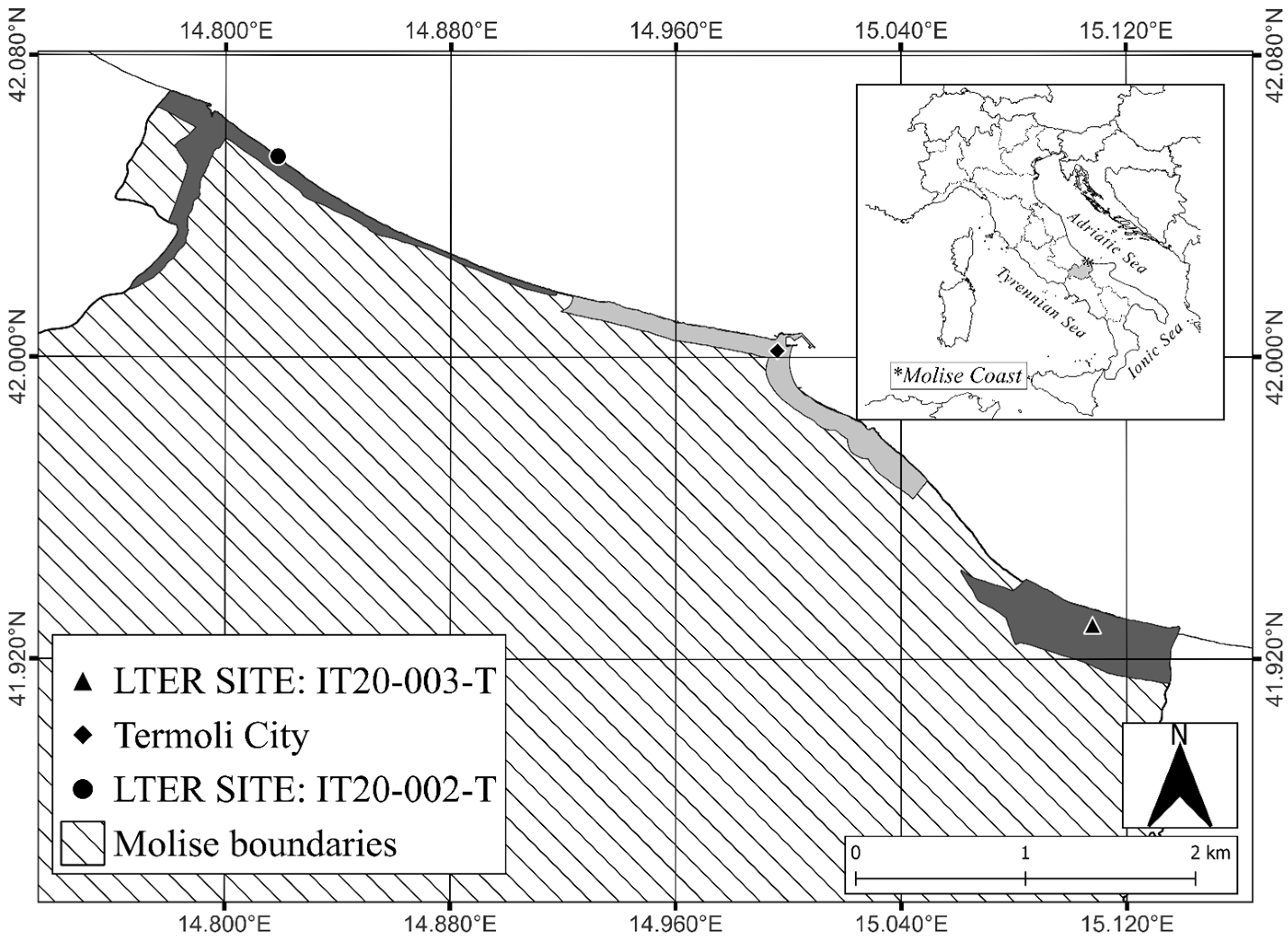
The study was conducted along the Adriatic coast of southern Italy (Molise Region; Figure 1), which extends for approximately 30 km and consists mainly of sandy beaches [42]. The area is characterized by relatively shallow, recent dunes (Holocene in age) that are less than 10 m high and primarily consist of a single dune ridge [43,44]. The Molise coastal stretch belongs to a single physiographic unit (Punta Penna–Punta Pietre Nere) with quite a uniform geological setting [45]. The area faces widespread coastal erosion, driven mainly by a regional decline in river sediment supply and by dominant north–south coastal sea currents [42,45]. Additionally, the area mainly consists of recent coastal dune geomorphology in a meso-Mediterranean dry climate [44]. In natural conditions, ecosystems exhibit a typical zonation pattern across the entire physiographic unit, ranging from pioneer annual plant communities on the beach to Mediterranean maquis on the stabilized inland dunes [23,26,44].
We focused on the Molise coastal dunes, including tracts within the Long-Term Ecological Research (LTER) Network and an adjacent unprotected area of comparable size, to assess and compare their landscape evolution over the past seventy years. Established along already well-developed dunes to preserve natural habitats and fauna [19,40], these LTER sites have experienced comparatively low levels of anthropogenic disturbance since the 1950s [26], unlike the more intensively transformed adjacent landscapes [7,19]. The LTER sites (IT20-003-T: Foce Saccione–Bonifica Ramitelli, https://deims.org/088fe3af-c5bb-4cc8-b479-fe1ea6d5be80 accessed on 1 February 2024; and IT20-002-T: Foce Trigno–Marina di Petacciato, https://deims.org/1835cda2-b56d-400a-b413-ab5c74086dc5 accessed on 1 February 2024) are included in the Natura 2000 network (IT7222217: Foce Saccione–Bonifica Ramitelli and IT7228221: Foce Trigno–Marina di Petacciato), established under the Habitats Directive 92/43/EEC, ensuring the legal protection of threatened habitats and species [15]. These sites are under strict protection, including regulated beach access to safeguard dune formations and bans on mechanical beach cleaning. Instead, manual cleaning is used to preserve organic debris and pioneer vegetation. In fact, Priority Habitats (sensu Directive 92/43/EEC, Annex I, 2250*: Coastal dunes with Juniperus spp. and 2270*: Wooded dunes with Pinus pinea and/or Pinus pinaster) are found in both LTER sites [46]. In addition to their legal protection, choosing LTER sites is strategically important because they have functioned as centers for long-term ecological monitoring [40]. This long-term scientific focus ensures the availability of extensive background ecological data, allowing us to contextualize our landscape-level findings within a broader ecological framework and facilitating robust comparisons with other nodes in the international LTER network [47].
Variations in abiotic factors along the sea–inland ecotone have led to the formation of distinct habitat and eco-functional zones across the dune profile [7,43] and support highly specialized fauna [48,49,50]. In this well-preserved setting, the zonation reflects the ecological gradient from the coast to inland areas, transitioning from pioneer annual plant communities on the beach to Mediterranean maquis on the stabilized dunes further inland [19,40]. The area outside the LTER sites was determined through a multi-step process. First, we calculated the total surface area of the two LTER sites (7.78 km2). Then, within a 500 m coastal strip outside the LTER boundaries, we generated 100 seed points. For each seed point, we delineated a symmetrically expanding area, ensuring that none of these areas overlapped with the LTER sites. Finally, we selected the area whose surface (6.92 km2) most closely matched that of the LTER sites (spatial boundaries for all of the study area are provided in Supplementary Materials). These spatial operations and analyses were performed using the terra 1.7-71 [51] and sf 1.0-16 [52] packages in R 4.4.2 [53].

2.2. Land Cover Maps

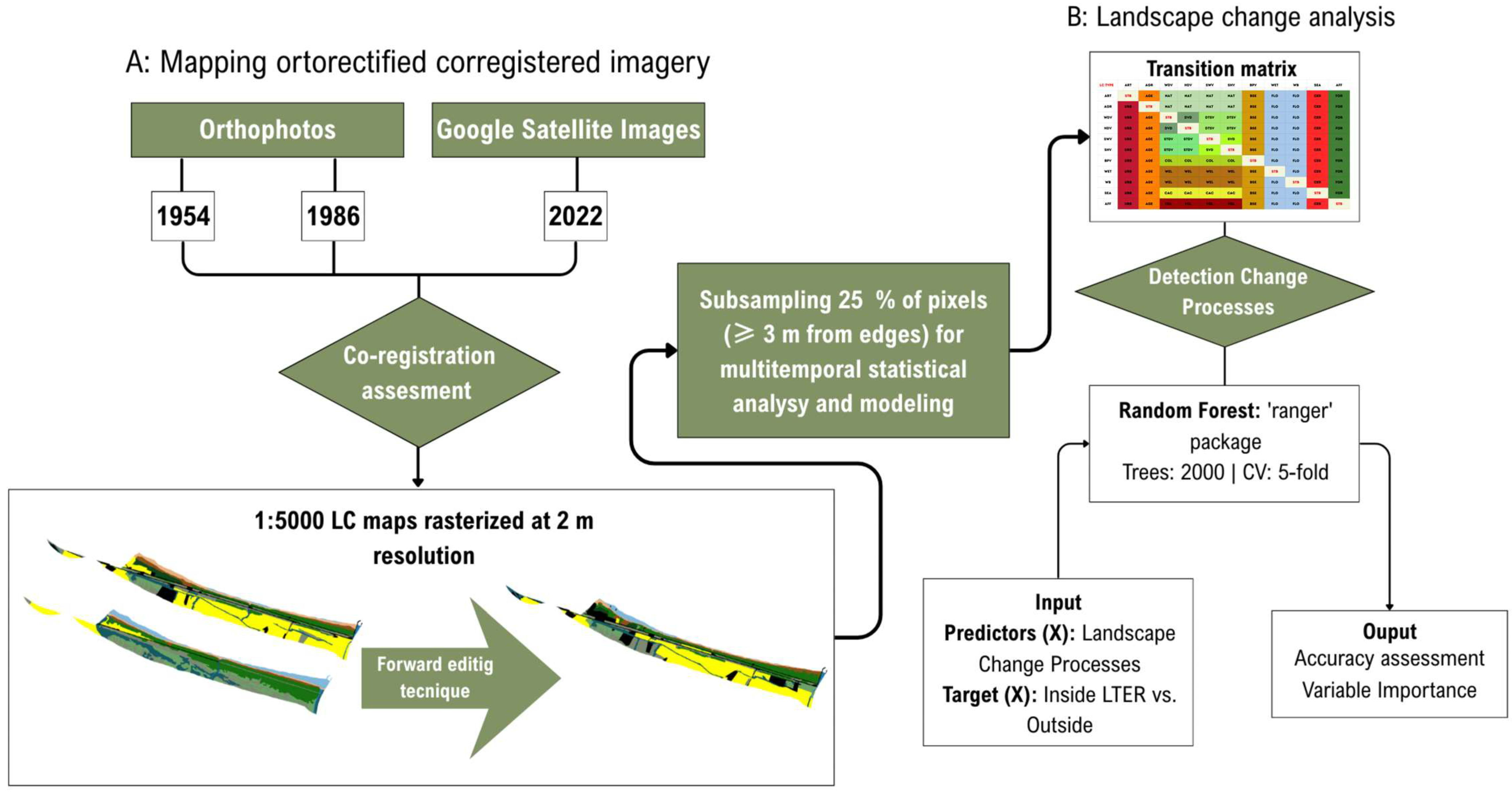
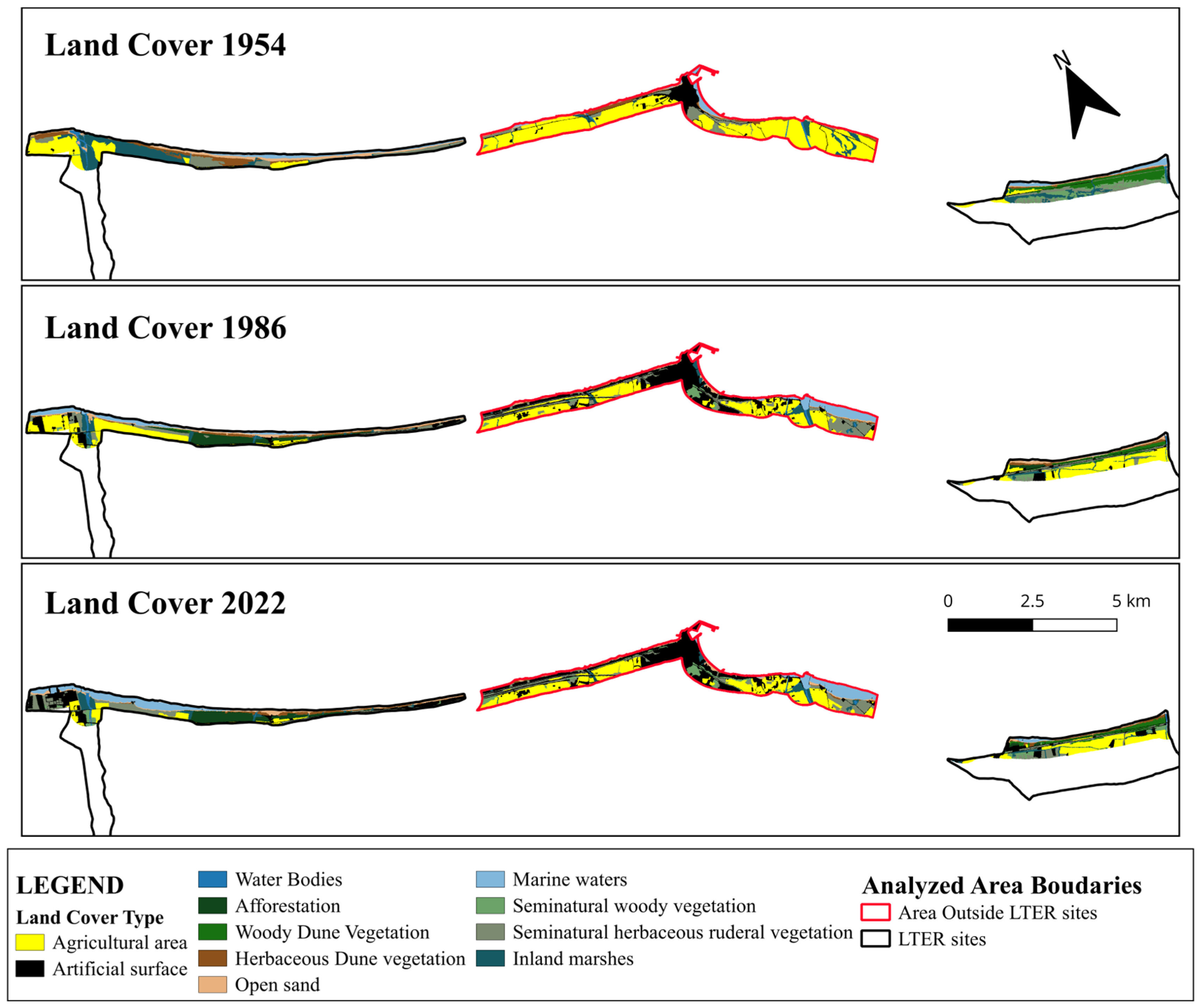
The overall methodological framework adopted in this study is summarized in Figure 2. To conduct our analysis, we used three high-resolution (1:5000) Land Cover Maps (LCMs) from 1954, 1986, and 2022 (see Figure A1 for the Land Cover Maps of the three years). We used the existing LCMs produced by [26] for 1954 and by [29] for 1986, both derived from orthorectified and preprocessed aerial orthophotos with a 1 m spatial resolution, freely available as WMS from the Italian National Geoportal of the Ministero per l’Ambiente e la Sicurezza Energetica (MASE, Italian Ministry of the Environment and Energy Security) (https://gn.mase.gov.it/portale/servizio-di-consultazione-wms, accessed on 1 February 2024). We selected aerial imagery because satellite image collections from those earlier decades were limited in availability. Moreover, satellite images from later missions, such as those launched in the 1970s and 1980s (e.g., Landsat), have insufficient spatial resolution to capture the fine-scale processes characteristic of coastal dunes [26,30,54].
The 2022 LCM was newly created through visual photo-interpretation of Google Satellite Images in QGIS 3.36.0 [55] and was validated through detailed field verification. We adopted this imagery source because no recent orthophotos are available for the study area. To ensure maximum comparability between maps derived from recent satellite imagery and those produced from historical aerial orthophotos, all digitization was carried out at a fixed scale of 1:5000. This approach maintained a consistent minimum mapping unit and level of detail across all time periods, preventing the inclusion of very small objects that are only visible in the most recent, higher-resolution images. This procedure aligns with standard cartographic practices that define a minimum mapping unit (MMU) to ensure consistency across datasets with differing native resolutions [56,57,58].
We adopted the CORINE Land Cover legend at the fourth level of detail for natural and semi-natural areas [26], consistent with that used for the photointerpretation of the 1954 and 1986 imagery, identifying 11 land-cover classes (Table 1). Particular emphasis was placed on natural dune cover types, which, following [29], were categorized into three classes corresponding to six EU Habitats defined under the Habitats Directive (Table 1).
To enhance comparability among maps and minimize user-induced errors, we applied a forward-editing approach. Using the existing 1986 map [26], which served as the baseline geometry. The 2022 map was derived by modifying the 1986 boundaries exclusively where actual land cover transitions were observed, thereby avoiding spurious differences caused by independent delineation. To address potential co-registration inconsistencies among the base imagery and ensure comparable spatial alignment, we randomly selected 30 control points located on stable landscape features (e.g., road crossings, railway stations, buildings; [59]). For each control point, we calculated the mean Euclidean distance between its projections across the three base maps (1954, 1986, and 2022), yielding an average positional offset of 1.87 m.

2.3. Landscape Change Analysis

For the landscape change analysis, we rasterized the land-cover shapefiles at a 2 m resolution using the terra 1.7-71 R 4.4.2 package [51], a spatial scale appropriate for analyzing coastal dune landscapes [16]. To minimize sampling errors caused by co-registration uncertainties and potential discrepancies along polygon edges, for each analyzed year, we excluded all pixels within a 3 m buffer zone surrounding land cover boundaries. This threshold was selected to exceed the calculated mean positional error (1.87 m), thereby ensuring that analyzed changes reflect genuine landscape dynamics rather than geometric artifacts along polygon edges. To manage the high dimensionality of the dataset, we randomly selected 25% of the pixels for multitemporal statistical analysis and modeling. By comparing multitemporal land-cover layers, we generated transition matrices for the entire period (1954–2022) and for individual intervals (T1: 1954–1986; T2: 1986–2022). These transition matrices summarize the proportions of each land-cover type that either changed to another category or remained stable and were classified into distinct change processes (Table 2) following a stepwise procedure designed to provide an overview of landscape transformations. First, all stable pixels were classified and excluded from further analysis. Next, the remaining pixels were grouped into two categories: those that transitioned from any land-cover (LC) class to Artificial Area (Urbanization) and those that underwent other types of change. From the latter, we extracted pixels that transitioned from any LC class to Agricultural Areas, a process referred to as Agriculture Expansion. The same systematic, cascading procedure was applied until each changing pixel was assigned to a specific process (see Table 2 for a detailed description).
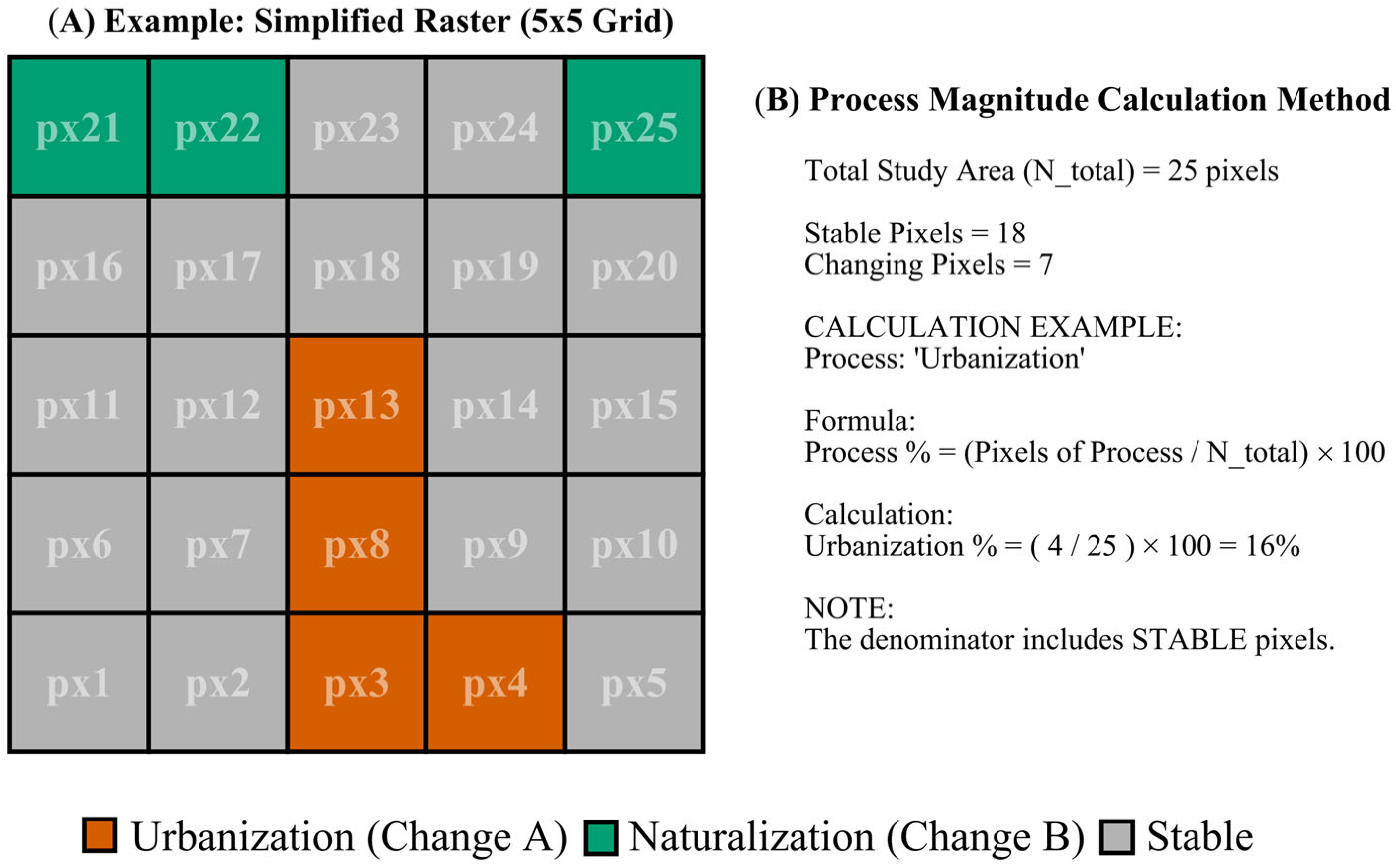
Once all pixels were classified, the magnitude of each change process was quantified. Specifically, the prevalence of each process was calculated as the percentage of pixels assigned to that class relative to the total number of sampled pixels, which includes both changing and stable areas. This approach ensures that the reported percentages reflect the landscape-level extent of each dynamic (see Figure A6 for a schematic representation of the classification and calculation method).

2.4. Comparing Change Processes Inside and Outside LTER Sites

Based on the pixels classified into change classes (Table 2), we identified the key processes distinctly shaping coastal landscapes within and outside the LTER sites using a Random Forest (RF) classification approach. The RF algorithm is a machine learning technique for data classification that builds a large number of decision trees, each trained on a random subset of the data. At each node within the trees, only a random subset of variables is considered [60]. This approach helps to reduce spatial autocorrelation, as the algorithm does not depend on a single variable [36,61]. In our analysis, we used the ranger 0.17.0 implementation of RF, as provided in the caret 6.0-94 R 4.4.2 package [62], with a 5-fold cross-validation scheme and 2000 uncorrelated decision trees [61,62]. To evaluate the classification accuracy of the RF model, we calculated the Balanced Accuracy (BA), a metric ranging from 0 to 1, determined by averaging sensitivity (true positive rate) and specificity (true negative rate) [10]. A BA value below 0.5 indicates random prediction. We selected BA because it is particularly effective for assessing model reliability in unbalanced datasets [63].
To test the sensitivity of our results to the initial pixel assignments among landscape change classes, we performed a sensitivity analysis by repeating the RF procedure after randomly reassigning the land-cover type of each pixel. To evaluate whether the observed difference in classification performance was statistically significant, we computed a Z-test comparing the mean balanced accuracy (BA) from the observed and randomized models, using their respective standard deviations to derive the Z-score and associated p-value. Randomization was expected to yield a classification with BA ≤ 0.5. Finally, we assessed the importance of each change process in distinguishing coastal landscapes (inside vs. outside LTER) by using the Gini Impurity index from the RF model. These importance scores were then rescaled to percentages to illustrate each variable’s relative impact on the model’s classification performance.

3. Results

3.1. Model Performance and Statistical Validation

The change processes shaping dune landscapes differ between areas within and outside the LTER sites, as indicated by the RF classification (BA = 0.651, SD = 0.0005). Comparing the balanced accuracy values from the RF model calibrated on mapped data with those from the RF model using randomly assigned pixels (BA = 0.500, SD = 0.0003) yielded a highly significant Z-score of 250.39 (p < 0.001), demonstrating that the observed trends strongly diverge from a random pattern (see Table A1 for the confusion matrix and Table A2 for the full accuracy assessment).

3.2. Overall Changes and Dynamics Within LTER Sites

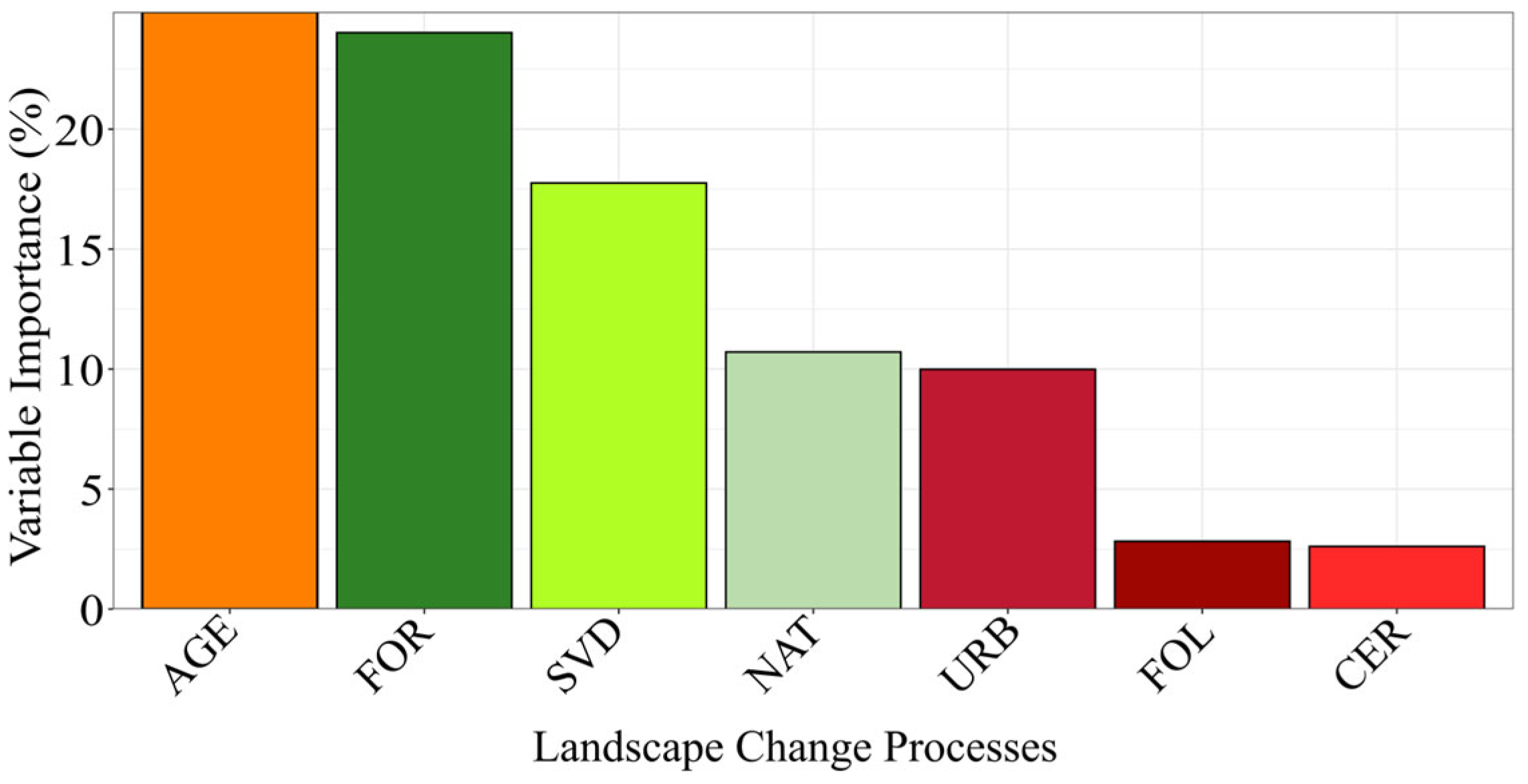
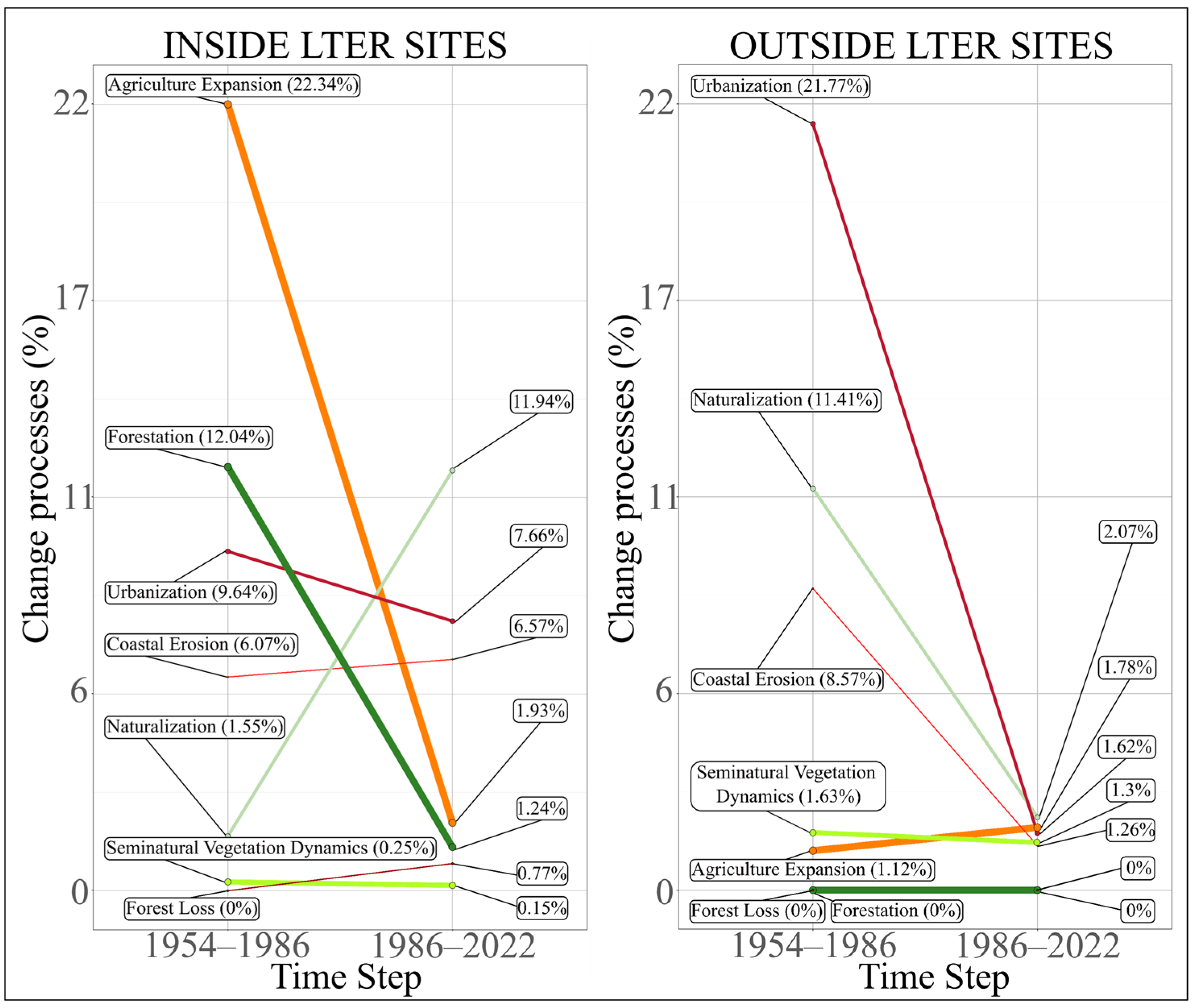
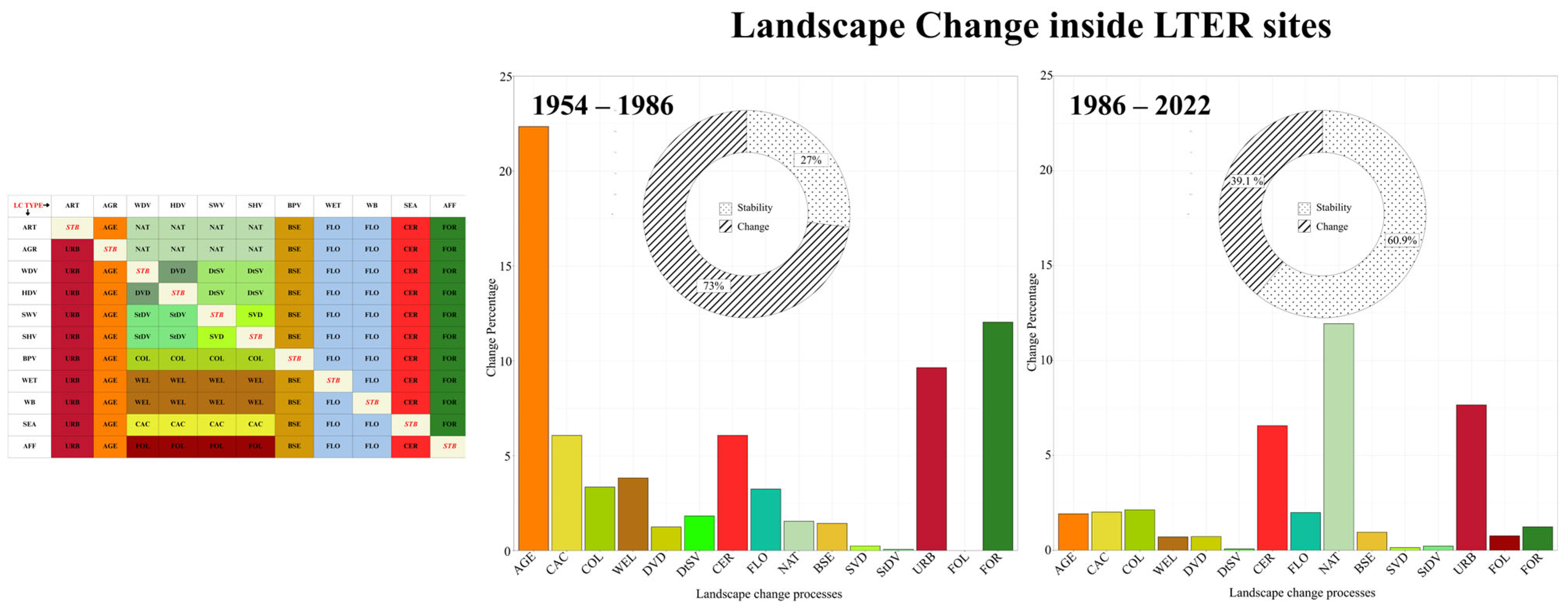
Random Forest (RF) results highlighted a variety of processes that distinctly shape landscapes within and outside LTER sites, ranging from major transformations such as Agriculture Expansion and Forestation to less common ones like Seminatural Vegetation Dynamics (Figure 3, Figure 4 and Figure A2). The change analysis conducted along the entire coastline (Figure A3) revealed that landscape changes were more consistent during the first time period (1954–1986) than during the second (1986–2022). Between 1954 and 1986, the dominant dynamic processes within LTER sites were Agriculture Expansion (22.34%), Forestation (12.04%), and Urbanization (9.64%) (Figure A4). However, these processes slowed markedly, and in some cases ceased altogether, during the second time period (Figure A4). In contrast, Naturalization, which was only an incipient process in the first period (1.55%), increased sharply to 11.94% in recent decades.

3.3. Dynamics Outside LTER Sites

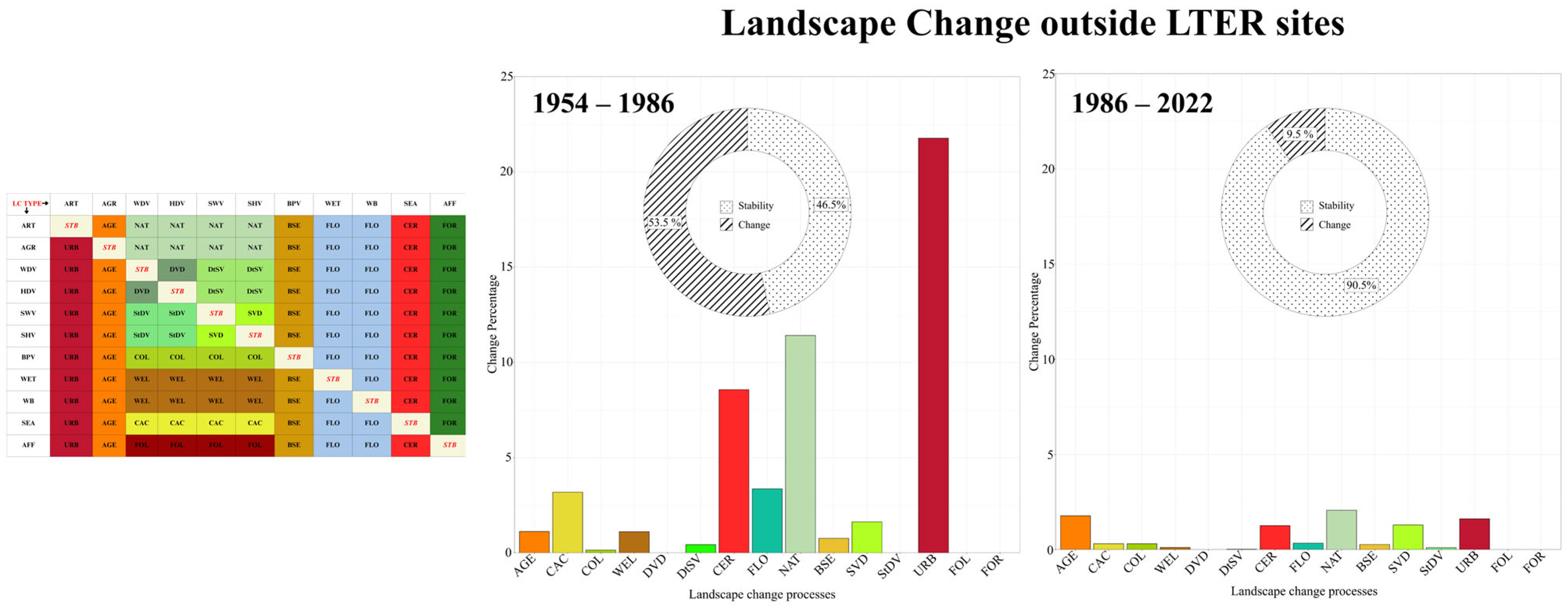
Outside the LTER sites, the coastal landscape during the first time period (Figure A5) was primarily transformed by Urbanization (21.77%), followed by Naturalization (11.41%) and Coastal Erosion (8.57%). These processes also declined during the second time period (Figure A5). Agriculture Expansion and Forestation were rare outside the LTER areas: Agriculture Expansion slightly increased from 1.12% to 1.78%, while Forestation was absent in both time periods (0%).

3.4. Divergent Dynamics in Coastal Processes

Coastal Erosion exhibited contrasting temporal trends: within LTER areas it increased slightly from 6.07% to 6.57%, whereas outside it decreased from 8.57% in the first period to 1.3% in the second.
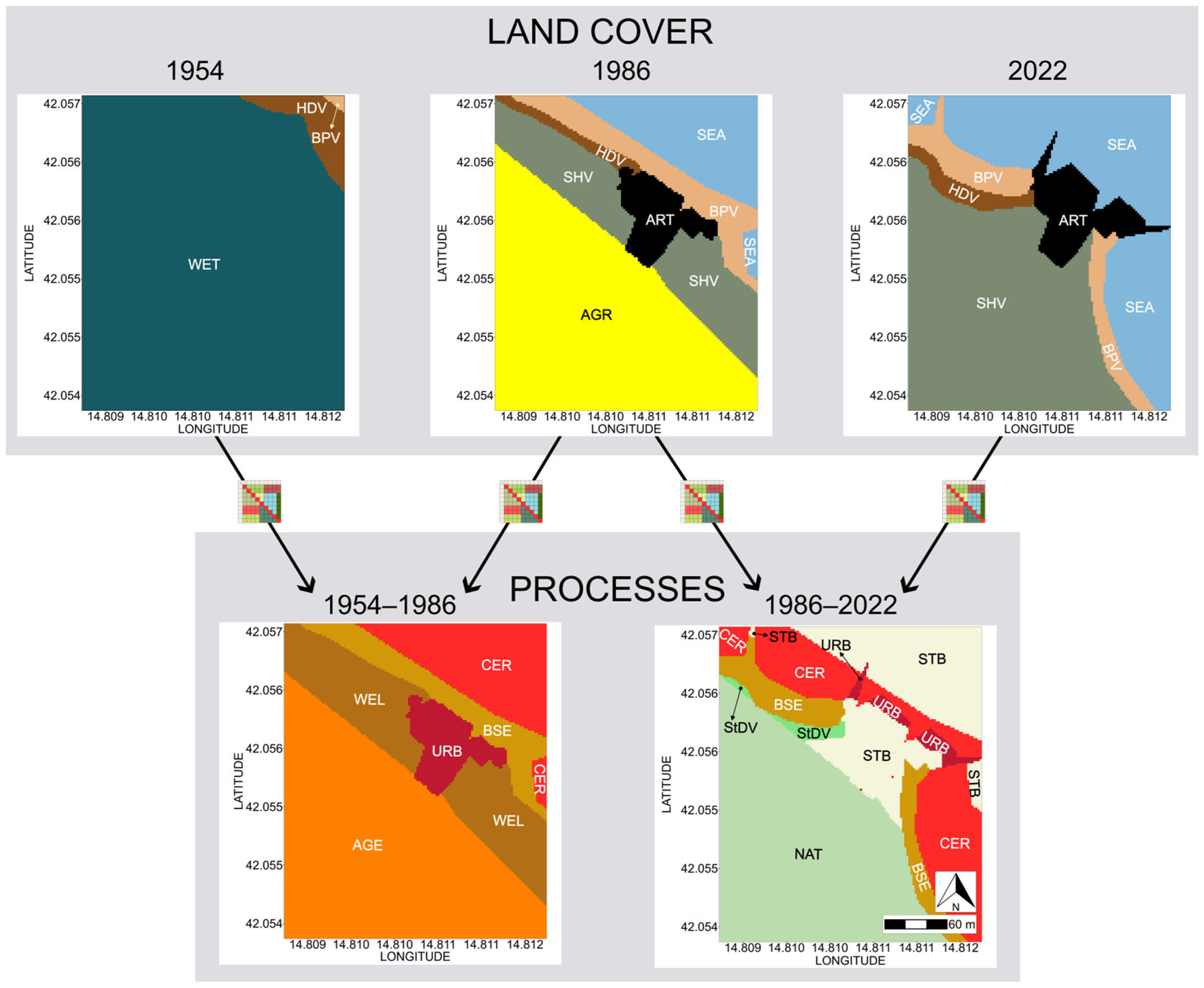
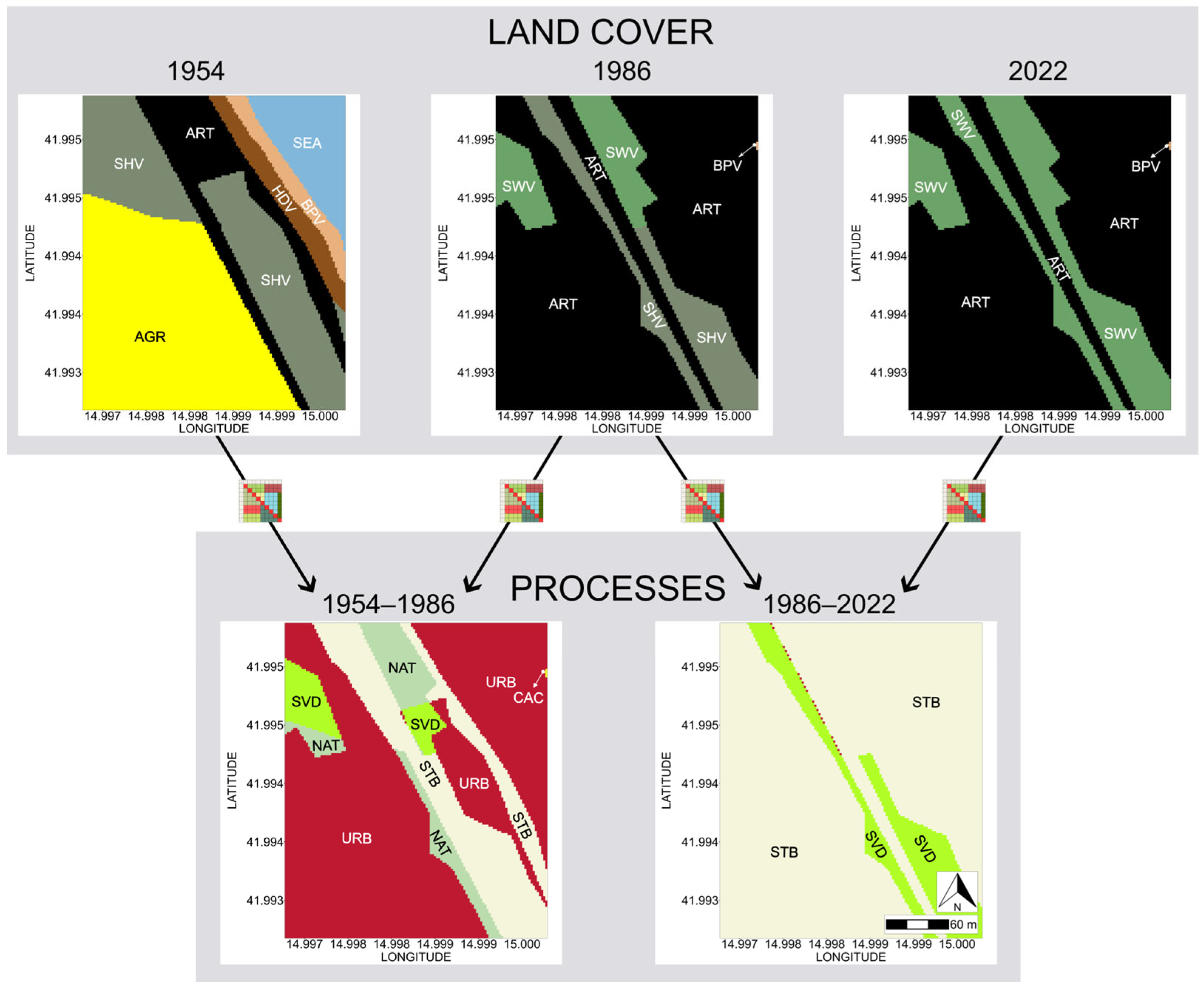
The Seminatural Vegetation Dynamics process, although important for distinguishing LTER from non-LTER areas, was infrequent overall. Within LTER areas, its occurrence was minimal in both the first (0.25%) and second time periods (0.15%). In non-LTER areas, it was slightly more frequent, decreasing from 1.63% to 1.26% over time. Representative cartographic examples illustrating these changes within and outside the LTER sites for both periods (1954–1986 and 1986–2022) are shown in Figure 5 and Figure 6.

4. Discussion

4.1. General Drivers of Coastal Transformation

Throughout the analyzed period, human activities have profoundly transformed the coastal landscape. From the post-war years to the present, land reclamation for agriculture, the spread of afforestation, and the expansion of artificial areas have been key drivers of change, together with the dynamics of coastal processes. Each of these drivers has shaped the coastal environment at distinct rates and with specific spatial characteristics, both inside and outside LTER sites.
Agricultural and afforestation activities, as reported for other Mediterranean coasts [64,65], are concentrated in the inner coastal areas, with agriculture affecting fixed dunes with Mediterranean maquis and afforestation occurring mainly on foredune plains and wetlands. These patterns emphasize the environmental gradient that influences both natural ecosystems and human land uses. In contrast, urban expansion, consistent with observations from other coastal regions worldwide [5], affects the entire landscape, including agricultural areas, without a clear preference for particular land cover types or coastal sectors.

4.2. Temporal Patterns

Most land cover changes, both within and outside LTER network landscapes, occurred during the first time period (1954–1986), driven primarily by post-war land drainage and reclamation efforts, urban expansion, and increased land consumption [7,26,64]. These processes reflected broader socio-economic developments of the post-war era and led to extensive transformations in land use across the country. The second period (1986–2022) was characterized by reduced dynamism, likely because most available land had already been exploited, particularly given the narrow width of the Adriatic coastal plain [44,66]. Increasing environmental awareness and the implementation of stricter land-use regulations may also have contributed to this slowdown [67]. Furthermore, the presence of conservation restrictions along many coastal stretches included in the Natura 2000 network likely limited development activities and reduced land-use change [3,39]. Overall, the dynamic processes and temporal trends identified in this study are consistent with those reported for other Mediterranean coastal systems [32,65].

4.3. Landscape Evolution Within LTER Sites

Within LTER landscapes, Agriculture Expansion was the dominant process during the first time period, indicating that these areas have historically been, and largely remain, agricultural. Land reclamation activities were particularly concentrated in these zones after the war [26,64]. Extensive drainage and irrigation efforts transformed wetlands into arable land, substantially increasing agricultural productivity.
The prominence of the Forestation process is likely associated with agricultural expansion, as pine plantations were established along the coasts of LTER sites to dry the soil and facilitate the extension of cultivated areas, often at the expense of marine marshes and wetlands [19,68]. This practice not only reshaped the landscape but also affected local ecosystems by reducing habitats available for wetland species [69].
Urbanization also influenced coastal areas, likely driven by the economic, social, and environmental transformations that followed World War II [64]. The post-war economic boom fostered infrastructure development and the expansion of tourism along the coast, further contributing to land-use change [70].
During the second time period within the LTER sites, the previously dominant processes such as Agriculture Expansion and Forestation slowed markedly, while Naturalization became the prevailing process. This shift may be attributed to the increased exposure of agricultural areas to saline conditions caused by coastal erosion [71], particularly evident along the Molise coast [41,42]. Elevated soil salinity reduces agricultural productivity, often leading to land abandonment and facilitating natural vegetation succession [72].
The reduction in Agriculture Expansion during this period was likely influenced by the inclusion of LTER sites in the Natura 2000 network (Directive 92/43/EEC). The network enforces conservation measures that restrict land-use changes, thereby limiting agricultural expansion in these areas. This slowdown may also reflect a broader global trend of agricultural land abandonment in environmentally marginal areas due to unfavorable conditions. In contrast, the increase in Naturalization within LTER-protected landscapes reflects the effectiveness of conservation policies implemented through the Habitats Directive [19], as well as recent socio-economic shifts such as urbanization and changes in agricultural policy, which have led to the abandonment of marginal lands and promoted ecosystem recovery [73].

4.4. Urbanization and Dynamics Outside LTER Sites

Outside the LTER network, Urbanization was the dominant landscape process during the first time period. By 1954, established urban settlements such as Termoli and Campomarino were already present, and, driven by post-war economic, social, and landscape changes, urban areas expanded rapidly in subsequent decades [23,26]. This pattern was characteristic of post-war Italy, fueled by industrial growth and internal migration from rural to urban areas [74]. Naturalization was also a frequent process outside the LTER areas, possibly linked to the early stages of rural depopulation, as people left small rural settlements in favor of larger urban centers [75]. This depopulation led to the abandonment of agricultural land, particularly in environmentally challenging zones, which subsequently underwent natural succession, enhancing biodiversity and ecosystem services [76].

4.5. Divergent Landscape Trajectories

The key processes identified by the RF model shaping landscapes within LTER sites, namely Agriculture Expansion, Forestation, Seminatural Vegetation Dynamics, Naturalization, Urbanization, and Forest Loss, exhibit contrasting trends compared to those outside the LTER network. These contrasts include divergent patterns in Forestation, Agriculture Expansion, and Naturalization; marked differences in the extent of transformed landscape, for example, Urbanization, Coastal Erosion, and Forestation; and similar processes with differing relative importance, such as Seminatural Vegetation Dynamics.
These findings support our hypothesis that the dynamic processes shaping LTER landscapes differ substantially from those in surrounding areas. Consistent with previous research in other European contexts, where landscape analysis evidence divergent trajectories inside and outside areas with different management regimes [77]. Our data revealed differences in land-cover change (e.g., artificial surfaces, forests, and semi-natural areas), suggesting the effectiveness of European environmental conservation systems and underscoring how governance frameworks shape long-term landscape evolution [41,78].
The different patterns of landscape change may be due to regulations in protected areas, leading to continued high development pressure on unprotected lands adjacent to conservation zones [79,80]. Therefore, in line with recent global evaluations, the success of these protected areas primarily depends on limiting built-up land expansion while enabling traditional land uses to continue or evolve naturally [79,81].
One of the key variables of protected landscapes is the prominence of Seminatural Vegetation Dynamics. Even if this process influences smaller surfaces than agriculture, its high importance in the model indicates it is an ecological hallmark of protected zones. Within LTER sites, the lack of mechanical disturbance permits vegetation to undergo ‘passive rewilding’ toward its Potential Natural Vegetation (PNV) [44]. This process contrasts with non-LTER areas, where succession is often hindered by fragmentation and human activity, highlighting the Random Forest model’s ability to identify nonlinear signals of vegetation recovery driven by reduced human impact [82,83].
Although Coastal Erosion was not identified as a significant predictor by the RF model, it displays contrasting trends between LTER and non-LTER areas, enriching our understanding of the processes shaping the overall landscape. These diverging trends highlight the influence of human interventions on coastal dynamics. For example, along the Termoli city coastline, a major tourist destination, the presence of a harbor and erosion mitigation structures such as groins and breakwaters has slowed erosion and promoted local coastal progradation [42,84]. These structures stabilize the shoreline by interrupting sediment transport and enhancing deposition, thereby counteracting natural erosion processes. Conversely, in nearby LTER areas, erosion has slightly increased, likely because the construction of piers and other coastal infrastructure can intensify erosion in adjacent sectors by reflecting wave energy or altering sediment transport dynamics [42,84].

4.6. Scalability and Transferability

In addition to confirming the dynamic processes and trends detected through traditional land cover change analysis, our research introduces innovative machine learning–based methods to evaluate the relative importance of each process in shaping landscapes under contrasting management regimes. Coastal areas within the LTER-protected site and the surrounding landscape were used as a test case. This study expands the applicability of machine learning approaches to coastal systems and provides a versatile quantitative framework for investigating the processes that distinguish areas with different management strategies [85]. By employing advanced machine learning techniques, we have demonstrated the value of focusing on individual dynamic processes, which can yield deeper insights into landscape evolution and the mechanisms driving change [86]. Although our study did not explicitly model inter-process relationships, it opens promising avenues for future research. Subsequent studies could apply multivariate statistical analyses or network models to reveal interactions among processes [87], with particular attention to identifying the drivers underlying each process and their interconnections. This line of research could also refine methodologies for investigating fine-scale landscape ecology, with potential applications across diverse landscape types and geographic contexts.
The scalability of the proposed methodological framework, which combines the precision of visual interpretation with the power of Machine Learning, depends on the availability of specific data and landscape conditions.
A key constraint is the reliance on historical data, as in areas with limited, low-quality, or no historical datasets, such as before the satellite era, the forward-editing timeline would be shorter, reducing the ability to analyze long-term changes. Second, the effectiveness of this approach depends on the landscape’s geomorphological complexity. As shown in earlier research, coastal dunes typically exhibit standardized zonation patterns [4,23,26,88]. Conversely, mountainous and hilly terrains display greater geomorphological and topographical diversity, complicating the definition of uniform landscape units based solely on spectral analysis [89,90]. In these intricate 3D environments, shadows and slope effects often influence spectral responses, increasing uncertainty in analyzing spatial change processes [91,92]. While our method performs well in linear coastal regions, applying it to fragmented inland ecosystems might necessitate higher-resolution topographic predictors. With due attention to these data requirements, extending this approach would advance data-driven landscape management and biodiversity conservation worldwide [93].

5. Conclusions

This study developed an integrated and reproducible methodological framework that combines historical aerial photograph interpretation, transition matrix analysis, and Random Forest (RF) modeling to quantitatively assess coastal landscape dynamics and management effectiveness. Applied to the southern Adriatic coast, the framework revealed distinct dynamic processes within protected LTER sites and adjacent unprotected areas over the past 70 years. The results suggest that conservation policies implemented within LTER sites have effectively mitigated human impacts, promoting Naturalization and ecosystem recovery, while surrounding landscapes remain more strongly affected by Urbanization and land-use intensification, particularly Agriculture Expansion and Forestation.
The RF-based analysis confirmed that, since the 1950s, human activities have profoundly reshaped the Molise coastal landscape. However, protection and management measures have reduced anthropogenic pressures and supported ecosystem resilience. Integrating traditional cartographic methods and transition matrix analysis with a Random Forest classification approach proved highly effective for identifying and quantifying individual land change processes. This multi-temporal framework successfully captured both rapid and gradual dynamics, minimizing biases inherent in traditional analyses and providing statistically robust insights that can inform coastal management and conservation strategies.
Moreover, the proposed framework offers a scalable and transferable tool for detecting non-random, process-based landscape patterns and can be applied to other ecosystems and management contexts. Future research should build on these findings to investigate the interactions among dynamic processes, refine ecosystem conservation strategies, and advance the integration of remote sensing and machine learning in sustainable landscape management.

Supplementary Materials

The following supporting information can be downloaded at: https://www.mdpi.com/article/10.3390/rs17243961/s1, File S1: kml files of the study area.

Author Contributions

Conceptualization, F.P. and M.L.C.; methodology, F.P., M.I. and M.D.F.; validation, F.P., M.I. and M.D.F.; formal analysis, F.P.; investigation, F.P.; resources, M.L.C.; data curation, F.P.; writing—original draft preparation, F.P. and M.L.C.; writing—review and editing, F.P., M.I., M.D.F. and M.L.C.; visualization, F.P., M.I. and M.D.F.; supervision, M.I. and M.L.C.; project administration, M.L.C.; funding acquisition, M.L.C. All authors have read and agreed to the published version of the manuscript.

Funding

Financial support received by M.I. from the Italian Ministry for University and Research (D.M. n. 1062 del 10/08/2021-PON R&I 2014-2020 (Green research) Grant number H55F21001490001 and by F.P. from PNRR PhD Program DM 118/2023 (Digital and environmental Transition) Grant number H43C23000210001. The research was also supported by LTER network infrastructure and by LILY (ImpLementation of multI-leveL ecosystems observatorY and development of new processing pipelines and services) departmental project Grant number: 20232028.

Data Availability Statement

Data will be made available from the corresponding author upon reasonable request.

Acknowledgments

We sincerely thank the Associate Editor and the three anonymous reviewers for their valuable feedback and insightful comments, which substantially enhanced the quality of this manuscript.

Conflicts of Interest

The authors declare no conflicts of interest.

Appendix A

Figure A1. Land Cover maps for the three time steps analyzed.
Remotesensing 17 03961 g0a1

Appendix B

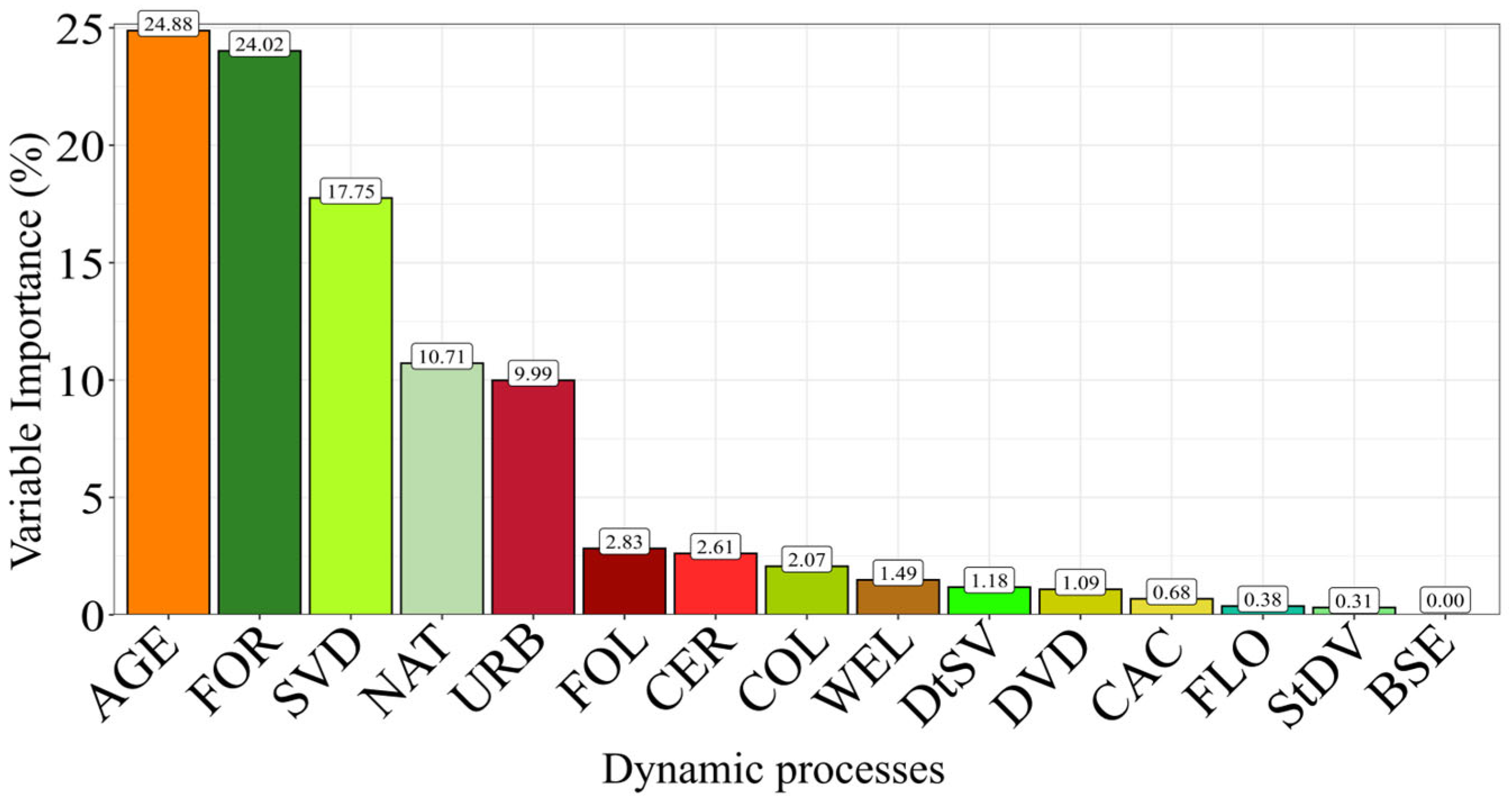
Figure A2. Change processes differentiating coastal landscapes within and outside LTER sites over the entire period (1954–2022), ranked using Random Forest (RF). URB: Urbanization, AGE: Agriculture Expansion, CER: Coastal Erosion, FLO: Flooding, BSE: Bare Sand Expansion, FOR: Forestation, NAT: Naturalization, WEL: Wetland loss, CAC: Coastal Accretion, FOL: Forest loss, COL: Colonization, DVD: Dune Vegetation Dynamics, SVD: Seminatural Vegetation Dynamics, StDV: Seminatural to Dune Vegetation, DtSV: Dune to Seminatural Vegetation.
Remotesensing 17 03961 g0a2
Table A1. Full Confusion Matrix derived from Random Forest analysis.
1954–1986 LTER Sites1986–2022 LTER Sites1954–1986 Outside Sites1986–2022 Outside Sites
1954–1986 LTER sites218,88327,94127,12110,409
1986–2022 LTER sites57,928105,22094,69716,681
1954–1986 Outside sites61,07046,367116,4339096
R1986_R2022. Outside_sites8419636110,9527875
Table A2. Accuracy assessment for each transition period and area.
SensitivitySpecificityPos Pred ValueNeg Pred ValuePrecisionRecallF1PrevalenceDetection RateDetection PrevalenceBalanced Accuracy
1954–1986 LTER sites0.6320.8630.7700.7650.7700.6320.6940.4200.2650.3440.748
1986–2022 LTER sites0.5660.7350.3830.8540.3830.5660.4570.2250.1270.3330.651
1954–1986 Outside sites0.4670.7980.5000.7760.5000.4670.4830.3020.1410.2820.632
1986–2022 Outside sites0.1790.9670.2340.9540.2340.1790.2030.0530.0100.0410.573

Appendix C

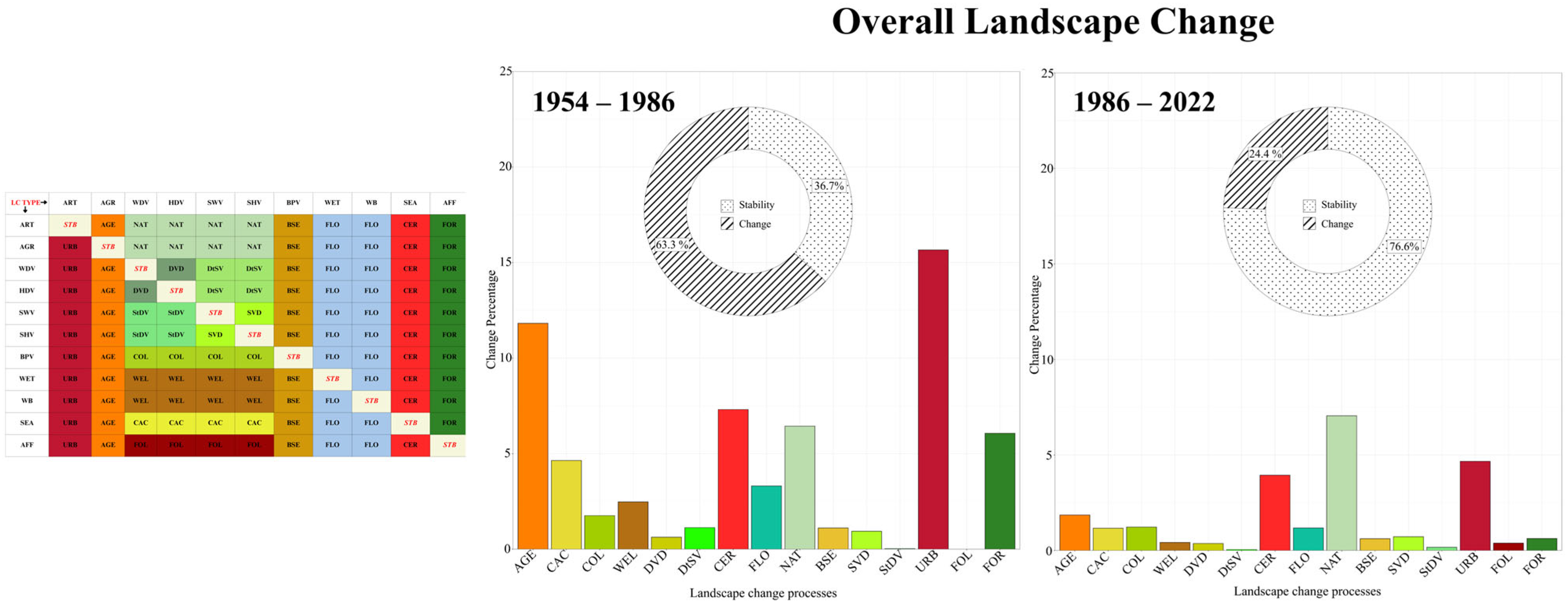
Figure A3. Land Cover change across the entire landscape during the first (1954–1998) and the second (1986–2022) time step. The transition matrix scheme uses different colors and acronyms to represent various land cover change processes. The proportion of each process is shown as a percentage in histograms, while pie charts illustrate the relative stability and change. URB: Urbanization, AGE: Agriculture Expansion, CER: Coastal Erosion, FLO: Flooding, BSE: Bare Sand Expansion, FOR: Forestation, NAT: Naturalization, WEL: Wetland loss, CAC: Coastal Accretion, FOL: Forest loss, COL: Colonization, DVD: Dune Vegetation Dynamics, SVD: Seminatural Vegetation Dynamics, StDV: Seminatural to Dune Vegetation, DtSV: Dune to Seminatural Vegetation.
Remotesensing 17 03961 g0a3
Figure A4. Land Cover change within LTER sites during the first (1954–1998) and second (1986–2022) time steps. The transition matrix scheme uses different colors and acronyms to represent various land cover change processes. The proportion of each process is shown as a percentage in histograms, while pie charts illustrate the relative stability and change. URB: Urbanization, AGE: Agriculture Expansion, CER: Coastal Erosion, FLO: Flooding, BSE: Bare Sand Expansion, FOR: Forestation, NAT: Naturalization, WEL: Wetland loss, CAC: Coastal Accretion, FOL: Forest loss, COL: Colonization, DVD: Dune Vegetation Dynamics, SVD: Seminatural Vegetation Dynamics, StDV: Seminatural to Dune Vegetation, DtSV: Dune to Seminatural Vegetation.
Remotesensing 17 03961 g0a4
Figure A5. Land Cover change outside LTER sites during the first (1954–1998) and second (1986–2022) time steps. The transition matrix scheme uses different colors and acronyms to represent various land cover change processes. The proportion of each process is shown as a percentage in histograms, while pie charts illustrate the relative stability and change. URB: Urbanization, AGE: Agriculture Expansion, CER: Coastal Erosion, FLO: Flooding, BSE: Bare Sand Expansion, FOR: Forestation, NAT: Naturalization, WEL: Wetland loss, CAC: Coastal Accretion, FOL: Forest loss, COL: Colonization, DVD: Dune Vegetation Dynamics, SVD: Seminatural Vegetation Dynamics, StDV: Seminatural to Dune Vegetation, DtSV: Dune to Seminatural Vegetation.
Remotesensing 17 03961 g0a5

Appendix D

Figure A6. Schematic representation of the calculation method for “Change Process%”. (A) A simplified 5 × 5 pixel raster representing a subset of the study area, containing both stable (gray) and changing (colored) pixels. (B) The step-by-step calculation shows that the percentage of a specific process (e.g., urbanization) is normalized against the total number of sampled pixels, ensuring that stable areas are included in the denominator.
Remotesensing 17 03961 g0a6

References

  1. Sperandii, M.G.; Barták, V.; Carboni, M.; Acosta, A.T.R. Getting the Measure of the Biodiversity Crisis in Mediterranean Coastal Habitats. J. Ecol. 2021, 109, 1224–1235. [Google Scholar] [CrossRef]
  2. Doody, J.P. Sand Dune Conservation, Management and Restoration; Coastal Research Library; Springer: Dordrecht, The Netherlands, 2012; Volume 4, ISBN 978-94-007-4730-2. [Google Scholar]
  3. Drius, M.; Jones, L.; Marzialetti, F.; de Francesco, M.C.; Stanisci, A.; Carranza, M.L. Not Just a Sandy Beach. The Multi-Service Value of Mediterranean Coastal Dunes. Sci. Total Environ. 2019, 668, 1139–1155. [Google Scholar] [CrossRef]
  4. Massarelli, C.; Campanale, C.; Uricchio, V.F. Monitoring of Coastal Dunes and Lagoons: Important Ecosystems to Safeguard. Environments 2023, 10, 211. [Google Scholar] [CrossRef]
  5. Schlacher, T.A.; Dugan, J.; Schoeman, D.S.; Lastra, M.; Jones, A.; Scapini, F.; McLachlan, A.; Defeo, O. Sandy Beaches at the Brink. Divers. Distrib. 2007, 13, 556–560. [Google Scholar] [CrossRef]
  6. Defeo, O.; McLachlan, A.; Schoeman, D.S.; Schlacher, T.A.; Dugan, J.; Jones, A.; Lastra, M.; Scapini, F. Threats to Sandy Beach Ecosystems: A Review. Estuar. Coast. Shelf Sci. 2009, 81, 1–12. [Google Scholar] [CrossRef]
  7. Carranza, M.L.; Drius, M.; Marzialetti, F.; Malavasi, M.; de Francesco, M.C.; Acosta, A.T.R.; Stanisci, A. Urban Expansion Depletes Cultural Ecosystem Services: An Insight into a Mediterranean Coastline. Rend. Lincei 2019, 31, 103–111. [Google Scholar] [CrossRef]
  8. Vousdoukas, M.I.; Ranasinghe, R.; Mentaschi, L.; Plomaritis, T.A.; Athanasiou, P.; Luijendijk, A.; Feyen, L. Sandy Coastlines under Threat of Erosion. Nat. Clim. Change 2020, 10, 260–263. [Google Scholar] [CrossRef]
  9. Giulio, S.; Acosta, A.T.R.; Carboni, M.; Campos, J.A.; Chytrý, M.; Loidi, J.; Pergl, J.; Pyšek, P.; Isermann, M.; Janssen, J.A.M.; et al. Alien Flora across European Coastal Dunes. Appl. Veg. Sci. 2020, 23, 317–327. [Google Scholar] [CrossRef]
  10. Innangi, M.; Marzialetti, F.; Di Febbraro, M.; Acosta, A.T.R.; De Simone, W.; Frate, L.; Finizio, M.; Villalobos Perna, P.; Carranza, M.L. Coastal Dune Invaders: Integrative Mapping of Carpobrotus Sp. Pl. (Aizoaceae) Using UAVs. Remote Sens. 2023, 15, 503. [Google Scholar] [CrossRef]
  11. Marzialetti, F.; Lozano, V.; Große-Stoltenberg, A.; Carranza, M.L.; Innangi, M.; La Bella, G.; Bagella, S.; Rivieccio, G.; Bacchetta, G.; Podda, L.; et al. Assessing Eco-Physiological Patterns of Ailanthus Altissima (Mill.) Swingle and Differences with Native Vegetation Using Copernicus Satellite Data on a Mediterranean Island. Ecol. Inform. 2025, 87, 103080. [Google Scholar] [CrossRef]
  12. Di Febbraro, M.; Frate, L.; de Francesco, M.C.; Stanisci, A.; Tozzi, F.P.; Varricchione, M.; Carranza, M.L. Modelling Beach Litter Accumulation on Mediterranean Coastal Landscapes: An Integrative Framework Using Species Distribution Models. Land 2021, 10, 54. [Google Scholar] [CrossRef]
  13. De Francesco, M.C.; Carranza, M.L.; Stanisci, A. Beach Litter in Mediterranean Coastal Dunes: An Insight on the Adriatic Coast (Central Italy). Rend. Fis. Acc. Lincei 2018, 29, 825–830. [Google Scholar] [CrossRef]
  14. Calvão, T.; Pessoa, M.F.; Cebola Lidon, F. Impact of Human Activities on Coastal Vegetation—A Review. Emir. J. Food Agric. 2013, 25, 926. [Google Scholar] [CrossRef]
  15. European Council. Directive Council Directive 92/43/EEC on the Conservation of Natural Habitats and of Wild Fauna and Flora 1992; European Council: Brussels, Belgium, 1992. [Google Scholar]
  16. Bazzichetto, M.; Malavasi, M.; Acosta, A.T.R.; Carranza, M.L. How Does Dune Morphology Shape Coastal EC Habitats Occurrence? A Remote Sensing Approach Using Airborne LiDAR on the Mediterranean Coast. Ecol. Indic. 2016, 71, 618–626. [Google Scholar] [CrossRef]
  17. Askhat, N.; Zhu, K.; Bekzat, R.; Tursunay, V.; Nurzikhan, S.; Daniyar, D.; Yersultan, S.; Kurmanbek, Z.; Issakov, Y.; Antal, S.; et al. Exploring the Complexities of Sand Dune Transformation: The Role of Anthropogenic Degradation and Climatic Conditions. Front. Earth Sci. 2023, 11, 1271127. [Google Scholar] [CrossRef]
  18. Compagnone, F.; Varricchione, M.; Innangi, M.; Di Febbraro, M.; Loy, A.; Stanisci, A.; de Francesco, M.C.; Matteucci, G.; Carranza, M.L. Coastal Biodiversity Assessment Aided by Citizen Science Volunteers: A Look at the Italian Central Adriatic. Land 2023, 12, 2023. [Google Scholar] [CrossRef]
  19. Drius, M.; Malavasi, M.; Acosta, A.T.R.; Ricotta, C.; Carranza, M.L. Boundary-Based Analysis for the Assessment of Coastal Dune Landscape Integrity over Time. Appl. Geogr. 2013, 45, 41–48. [Google Scholar] [CrossRef]
  20. Liddle, M. Recreation Ecology: The Ecological Impact of Outdoor Recreation and Ecotourism; Chapman & Hall: London, UK, 1997. [Google Scholar]
  21. Marzialetti, F.; Di Febbraro, M.; Malavasi, M.; Giulio, S.; Rosario Acosta, A.T.; Carranza, M.L. Mapping Coastal Dune Landscape through Spectral Rao’s Q Temporal Diversity. Remote Sens. 2020, 12, 2315. [Google Scholar] [CrossRef]
  22. Charbonneau, B.R.; Duarte, A.; Swannack, T.M.; Johnson, B.D.; Piercy, C.D. DOONIES: A Process-Based Ecogeomorphological Functional Community Model for Coastal Dune Vegetation and Landscape Dynamics. Geomorphology 2022, 398, 108037. [Google Scholar] [CrossRef]
  23. Marzialetti, F.; Giulio, S.; Malavasi, M.; Sperandii, M.G.; Acosta, A.T.R.; Carranza, M.L. Capturing Coastal Dune Natural Vegetation Types Using a Phenology-Based Mapping Approach: The Potential of Sentinel-2. Remote Sens. 2019, 11, 1506. [Google Scholar] [CrossRef]
  24. Coppin, P.; Jonckheere, I.; Nackaerts, K.; Muys, B.; Lambin, E. Digital Change Detection Methods in Ecosystem Monitoring: A Review. Int. J. Remote Sens. 2004, 25, 1565–1596. [Google Scholar] [CrossRef]
  25. Pettorelli, N.; Laurance, W.F.; O’Brien, T.G.; Wegmann, M.; Nagendra, H.; Turner, W. Satellite Remote Sensing for Applied Ecologists: Opportunities and Challenges. J. Appl. Ecol. 2014, 51, 839–848. [Google Scholar] [CrossRef]
  26. Malavasi, M.; Santoro, R.; Cutini, M.; Acosta, A.T.R.; Carranza, M.L. What Has Happened to Coastal Dunes in the Last Half Century? A Multitemporal Coastal Landscape Analysis in Central Italy. Landsc. Urban Plan. 2013, 119, 54–63. [Google Scholar] [CrossRef]
  27. Villalobos Perna, P.; Finizio, M.; Carranza, M.L.; Innangi, M.; Bongiovanni, S.B.; Andino, N.; Di Febbraro, M. Anthropogenic and Climate Change-Driven Coastline Dynamics Will Erode Future Nesting Habitats of the Kentish Plover on the Central Adriatic Coast. Sci. Rep. 2024, 14, 23306. [Google Scholar] [CrossRef] [PubMed]
  28. Molina, R.; Anfuso, G.; González-Aguilar, B.; Manno, G.; Cooper, J.A.G. Evolution of the Beach–Dune Systems in Mediterranean Andalusia (Spain) Using Two Different Proxies. Land 2024, 13, 1185. [Google Scholar] [CrossRef]
  29. Acosta, A.; Carranza, M.L.; Izzi, C.F. Combining Land Cover Mapping of Coastal Dunes with Vegetation Analysis. Appl. Veg. Sci. 2005, 8, 133–138. [Google Scholar] [CrossRef]
  30. Belcore, E.; Latella, M.; Piras, M.; Camporeale, C. Enhancing Precision in Coastal Dunes Vegetation Mapping: Ultra-High Resolution Hierarchical Classification at the Individual Plant Level. Int. J. Remote Sens. 2024, 45, 4527–4552. [Google Scholar] [CrossRef]
  31. Gu, Z.; Zeng, M. The Use of Artificial Intelligence and Satellite Remote Sensing in Land Cover Change Detection: Review and Perspectives. Sustainability 2023, 16, 274. [Google Scholar] [CrossRef]
  32. El-Masry, E.A.; Magdy, A.; El-Gamal, A.; Mahmoud, B.; El-Sayed, M.K. Multi-Decadal Coastal Change Detection Using Remote Sensing: The Mediterranean Coast of Egypt between El-Dabaa and Ras El-Hekma. Environ. Monit. Assess. 2024, 196. [Google Scholar] [CrossRef] [PubMed]
  33. Hermosilla, T.; Wulder, M.A.; White, J.C.; Coops, N.C.; Hobart, G.W. Disturbance-Informed Annual Land Cover Classification Maps of Canada’s Forested Ecosystems for a 29-Year Landsat Time Series. Can. J. Remote Sens. 2018, 44, 67–87. [Google Scholar] [CrossRef]
  34. Richardson, G.; Knudby, A.; Crowley, M.A.; Sawada, M.; Chen, W. Machine Learning Approaches to Landsat Change Detection Analysis. Can. J. Remote Sens. 2025, 51, 2448169. [Google Scholar] [CrossRef]
  35. Pushpalatha, V.; Mallikarjuna, P.B.; Mahendra, H.N.; Rama Subramoniam, S.; Mallikarjunaswamy, S. Land Use and Land Cover Classification for Change Detection Studies Using Convolutional Neural Network. Appl. Comput. Geosci. 2025, 25, 100227. [Google Scholar] [CrossRef]
  36. Belgiu, M.; Drăguţ, L. Random Forest in Remote Sensing: A Review of Applications and Future Directions. ISPRS J. Photogramm. Remote Sens. 2016, 114, 24–31. [Google Scholar] [CrossRef]
  37. Peng, D.; Liu, X.; Zhang, Y.; Guan, H.; Li, Y.; Bruzzone, L. Deep Learning Change Detection Techniques for Optical Remote Sensing Imagery: Status, Perspectives and Challenges. Int. J. Appl. Earth Obs. Geoinf. 2025, 136, 104282. [Google Scholar] [CrossRef]
  38. Lemenkova, P. Machine Learning Algorithms of Remote Sensing Data Processing for Mapping Changes in Land Cover Types over Central Apennines, Italy. J. Imaging 2025, 11, 153. [Google Scholar] [CrossRef]
  39. Hermoso, V.; Morán-Ordóñez, A.; Canessa, S.; Brotons, L. Realising the Potential of Natura 2000 to Achieve EU Conservation Goals as 2020 Approaches. Sci. Rep. 2019, 9, 16087. [Google Scholar] [CrossRef]
  40. Stanisci, A.; Acosta, A.T.R.; Carranza, M.L.; De Chiro, M.; Del Vecchio, S.; Di Martino, L.; Frattaroli, A.R.; Fusco, S.; Izzi, C.F.; Pirone, G.; et al. EU Habitats Monitoring along the Coastal Dunes of the LTER Sites of Abruzzo and Molise (Italy). Plant Sociol. 2014, 51, 51–56. [Google Scholar] [CrossRef]
  41. Tozzi, F.P.; Varricchione, M.; de Francesco, M.C.; Carranza, M.L.; Stanisci, A. Vegetation Dynamics on a Restored Salt Marsh Mosaic: A Re-Visitation Study in a Coastal Wetland in Central Italy. Wetlands 2022, 42, 101. [Google Scholar] [CrossRef]
  42. Di Paola, G.; Minervino Amodio, A.; Dilauro, G.; Rodriguez, G.; Rosskopf, C.M. Shoreline Evolution and Erosion Vulnerability Assessment along the Central Adriatic Coast with the Contribution of UAV Beach Monitoring. Geosciences 2022, 12, 353. [Google Scholar] [CrossRef]
  43. Acosta, A.; Carranza, M.L.; Izzi, C.F. Are There Habitats That Contribute Best to Plant Species Diversity in Coastal Dunes? Biodivers. Conserv. 2009, 18, 1087–1098. [Google Scholar] [CrossRef]
  44. Carranza, M.L.; Acosta, A.T.R.; Stanisci, A.; Pirone, G.; Ciaschetti, G. Ecosystem Classification for EU Habitat Distribution Assessment in Sandy Coastal Environments: An Application in Central Italy. Environ. Monit. Assess. 2008, 140, 99–107. [Google Scholar] [CrossRef]
  45. Di Paola, G.; Valente, E.; Caporizzo, C.; Cozzolino, M.; Rosskopf, C.M. Holocene to Near-Future Evolution of the Southern Molise Coast (Central Adriatic, Italy) under the Influence of Natural and Anthropogenic Controls. J. Maps 2023, 19. [Google Scholar] [CrossRef]
  46. Here the correct reference: Stanisci, A.; Acosta, A.; Carranza, M.L.; Feola, S.; Giuliano, M. Gli habitat di interesse comunitario sul litorale molisano e il loro valore naturalistico su base floristica/The habitats of European concern of Molise coastal dunes and their naturalistic value based on flora. Fitosociologia 2007, 44, 171–175. [Google Scholar]
  47. Pugnetti, A.; Acri, F.; Bernardi Aubry, F.; Camatti, E.; Cecere, E.; Facca, C.; Franzoi, P.; Keppel, E.; Lugliè, A.; Mistri, M.; et al. The Italian Long-Term Ecosystem Research (LTER-Italy) Network: Results, Opportunities, and Challenges for Coastal Transitional Ecosystems. Transitional Waters Bull. 2013, 7, 43–63. [Google Scholar]
  48. Villalobos Perna, P.; Di Febbraro, M.; Carranza, M.L.; Marzialetti, F.; Innangi, M. Remote Sensing and Invasive Plants in Coastal Ecosystems: What We Know So Far and Future Prospects. Land 2023, 12, 341. [Google Scholar] [CrossRef]
  49. Rasino, M.D.V.; Fattorini, S.; Sciarretta, A.; Colacci, M.; Stanisci, A.; Carranza, M.L. Cross-Taxon Analysis in the Highly Threatened Mediterranean Dunes Reveals Consistent Diversity Patterns in Butterfly and Plant Communities. Biodivers. Conserv. 2024, 33, 3643–3661. [Google Scholar] [CrossRef]
  50. Rasino, M.D.V.; Innangi, M.; Di Febbraro, M.; Fattorini, S.; Sciarretta, A.; Stanisci, A.; Carranza, M.L. Linking Taxonomic Diversity and Ecological Traits of Geometrid Moths and Plants in Coastal Dunes: Insights from a Mediterranean LTER Site. Ecol. Indic. 2025, 178, 113975. [Google Scholar] [CrossRef]
  51. Hijmans, R.J.; Bivand, R.; Pebesma, E.; Sumner, M.D. Spatial Data Analysis; R Foundation for Statistical Computing: Vienna, Austria, 2024. [Google Scholar]
  52. Pebesma, E.; Bivand, R. Spatial Data Science: With Applications in R, 1st ed.; Chapman and Hall/CRC: New York, NY, USA, 2023; ISBN 978-0-429-45901-6. [Google Scholar]
  53. R Core Team. R: A Language and Environment for Statistical Computing; R Core Team: Vienna, Austria, 2024. [Google Scholar]
  54. Boyle, S.A.; Kennedy, C.M.; Torres, J.; Colman, K.; Pérez-Estigarribia, P.E.; De La Sancha, N.U. High-Resolution Satellite Imagery Is an Important yet Underutilized Resource in Conservation Biology. PLoS ONE 2014, 9, e86908. [Google Scholar] [CrossRef] [PubMed]
  55. QGIS Development Team. QGIS Geographic Information System. 2024. Available online: https://www.qgis.org (accessed on 12 December 2024).
  56. Orusa, T.; Cammareri, D.; Borgogno Mondino, E. A Scalable Earth Observation Service to Map Land Cover in Geomorphological Complex Areas beyond the Dynamic World: An Application in Aosta Valley (NW Italy). Appl. Sci. 2022, 13, 390. [Google Scholar] [CrossRef]
  57. García Álvarez, D. Cartographic Scale and Minimum Mapping Unit Influence on LULC Modelling. In Proceedings of the 3rd International Conference on Geographical Information Systems Theory, Applications and Management, Porto, Portugal, 27–28 April 2017; SCITEPRESS—Science and Technology Publications: Porto, Portugal, 2017; pp. 327–334. [Google Scholar]
  58. Efthimiou, N.; Psomiadis, E.; Papanikolaou, I.; Soulis, K.X.; Borrelli, P.; Panagos, P. Developing a High-Resolution Land Use/Land Cover Map by Upgrading CORINE’s Agricultural Components Using Detailed National and Pan-European Datasets. Geocarto Int. 2022, 37, 10871–10906. [Google Scholar] [CrossRef]
  59. Coulter, L.L.; Stow, D.A. Assessment of the Spatial Co-Registration of Multitemporal Imagery from Large Format Digital Cameras in the Context of Detailed Change Detection. Sensors 2008, 8, 2161–2173. [Google Scholar] [CrossRef] [PubMed]
  60. Breiman, L. Random Forests. Mach. Learn. 2001, 45, 5–32. [Google Scholar] [CrossRef]
  61. Hengl, T.; Nussbaum, M.; Wright, M.N.; Heuvelink, G.B.M.; Gräler, B. Random Forest as a Generic Framework for Predictive Modeling of Spatial and Spatio-Temporal Variables. PeerJ 2018, 6, e5518. [Google Scholar] [CrossRef]
  62. Kuhn, M. Building Predictive Models in R Using the Caret Package. J. Stat. Softw. 2008, 28, 1–26. [Google Scholar] [CrossRef]
  63. Brodersen, K.H.; Ong, C.S.; Stephan, K.E.; Buhmann, J.M. The Balanced Accuracy and Its Posterior Distribution. In Proceedings of the International Conference on Pattern Recognition, Istanbul, Turkey, 23–26 August 2010; pp. 3121–3124. [Google Scholar]
  64. Falco, E. Protection of Coastal Areas in Italy: Where Do National Landscape and Urban Planning Legislation Fail? Land Use Policy 2017, 66, 80–89. [Google Scholar] [CrossRef]
  65. Šilc, U.; Stešević, D.; Luković, M.; Caković, D. Changes of a Sand Dune System and Vegetation between 1950 and 2015 on Velika Plaža (Montenegro, E Mediterranean). Reg. Stud. Mar. Sci. 2020, 35, 101139. [Google Scholar] [CrossRef]
  66. Zullo, F.; Montaldi, C.; Di Pietro, G.; Cattani, C. Land Use Changes and Ecosystem Services: The Case Study of the Abruzzo Region Coastal Strip. ISPRS Int. J. Geo-Inf. 2022, 11, 588. [Google Scholar] [CrossRef]
  67. Kallimanis, A.S.; Touloumis, K.; Tzanopoulos, J.; Mazaris, A.D.; Apostolopoulou, E.; Stefanidou, S.; Scott, A.V.; Potts, S.G.; Pantis, J.D. Vegetation Coverage Change in the EU: Patterns inside and Outside Natura 2000 Protected Areas. Biodivers. Conserv. 2015, 24, 579–591. [Google Scholar] [CrossRef]
  68. Smiraglia, D.; Cavalli, A.; Giuliani, C.; Assennato, F. The Increasing Coastal Urbanization in the Mediterranean Environment: The State of the Art in Italy. Land 2023, 12, 1017. [Google Scholar] [CrossRef]
  69. Lopes, A.I. Fighting Drift Sands with Pine Trees: Reforestation of Coastal Areas of NW Portugal at the End of Eighteenth Century. J. Coast. Conserv. 2023, 27. [Google Scholar] [CrossRef]
  70. Bayoumi, T. The Postwar Economic Achievement. Financ. Dev. 1995, 32, 48. [Google Scholar]
  71. Shrivastava, P.; Kumar, R. Soil Salinity: A Serious Environmental Issue and Plant Growth Promoting Bacteria as One of the Tools for Its Alleviation. Saudi J. Biol. Sci. 2015, 22, 123–131. [Google Scholar] [CrossRef]
  72. Zörb, C.; Geilfus, C.M.; Dietz, K.J. Salinity and Crop Yield. Plant Biol. 2019, 21, 31–38. [Google Scholar] [CrossRef]
  73. van der Zanden, E.H.; Verburg, P.H.; Schulp, C.J.E.; Verkerk, P.J. Trade-Offs of European Agricultural Abandonment. Land Use Policy 2017, 62, 290–301. [Google Scholar] [CrossRef]
  74. Ginsborg, P. A History of Contemporary Italy: 1943–80; Penguin: London, UK, 1990. [Google Scholar]
  75. Bonifazi, C.; Heins, F.; Licari, F.; Tucci, E. The Regional Dynamics of Internal Migration Intensities in Italy. Popul. Space Place 2021, 27, e2331. [Google Scholar] [CrossRef]
  76. Rey Benayas, J.M.; Martins, A.; Nicolau, J.M.; Schulz, J.J. Abandonment of Agricultural Land: An Overview of Drivers and Consequences; CABI Reviews: London, UK, 2007. [Google Scholar]
  77. Kubacka, M.; Smaga, Ł. Effectiveness of Natura 2000 Areas for Environmental Protection in 21 European Countries. Reg. Environ. Chang. 2019, 19, 2079–2088. [Google Scholar] [CrossRef]
  78. Prisco, I.; Acosta, A.T.R.; Stanisci, A. A Bridge between Tourism and Nature Conservation: Boardwalks Effects on Coastal Dune Vegetation. J. Coast. Conserv. 2021, 25, 14. [Google Scholar] [CrossRef]
  79. Li, G.; Fang, C.; Watson, J.E.M.; Sun, S.; Qi, W.; Wang, Z.; Liu, J. Mixed Effectiveness of Global Protected Areas in Resisting Habitat Loss. Nat. Commun. 2024, 15, 8389. [Google Scholar] [CrossRef]
  80. Fuente, B.D.L.; Bertzky, B.; Delli, G.; Mandrici, A.; Conti, M.; Florczyk, A.J.; Freire, S.; Schiavina, M.; Bastin, L.; Dubois, G. Built-up Areas within and around Protected Areas: Global Patterns and 40-Year Trends. Glob. Ecol. Conserv. 2020, 24, e01291. [Google Scholar] [CrossRef]
  81. Tesfaw, A.T.; Pfaff, A.; Golden Kroner, R.E.; Qin, S.; Medeiros, R.; Mascia, M.B. Land-Use and Land-Cover Change Shape the Sustainability and Impacts of Protected Areas. Proc. Natl. Acad. Sci. USA 2018, 115, 2084–2089. [Google Scholar] [CrossRef]
  82. Gonçalves-Souza, D.; Vilela, B.; Phalan, B.; Dobrovolski, R. The Role of Protected Areas in Maintaining Natural Vegetation in Brazil. Sci. Adv. 2021, 7, eabh2932. [Google Scholar] [CrossRef]
  83. Wang, Y.; Chen, X.; Gao, M.; Dong, J. The Use of Random Forest to Identify Climate and Human Interference on Vegetation Coverage Changes in Southwest China. Ecol. Indic. 2022, 144, 109463. [Google Scholar] [CrossRef]
  84. Tsoukala, V.K.; Katsardi, V.; Hadjibiros, K.; Moutzouris, C.I. Beach Erosion and Consequential Impacts Due to the Presence of Harbours in Sandy Beaches in Greece and Cyprus. Environ. Process. 2015, 2, 55–71. [Google Scholar] [CrossRef]
  85. Zhang, P.; Dong, Y.; Ren, Z.; Wang, G.; Guo, Y.; Wang, C.; Ma, Z. Rapid Urbanization and Meteorological Changes Are Reshaping the Urban Vegetation Pattern in Urban Core Area: A National 315-City Study in China. Sci. Total Environ. 2023, 904, 167269. [Google Scholar] [CrossRef]
  86. Turner, M.G. Landscape Ecology: What Is the State of the Science? Annu. Rev. Ecol. Evol. Syst. 2005, 36, 319–344. [Google Scholar] [CrossRef]
  87. Dormann, C.F.; Fründ, J.; Fründ, F.; Schaefer, H.M. Identifying Causes of Patterns in Ecological Networks: Opportunities and Limitations. Annu. Rev. 2017, 48, 559–584. [Google Scholar] [CrossRef]
  88. De Montis, A.; Martín, B.; Ortega, E.; Ledda, A.; Serra, V. Landscape Fragmentation in Mediterranean Europe: A Comparative Approach. Land Use Policy 2017, 64, 83–94. [Google Scholar] [CrossRef]
  89. Suleymanov, A.; Bogdan, E.; Gaysin, I.; Volkov, A.; Tuktarova, I.; Belan, L.; Shagaliev, R. Spatial High-Resolution Modelling and Uncertainty Assessment of Forest Growing Stock Volume Based on Remote Sensing and Environmental Covariates. For. Ecol. Manag. 2024, 554, 121676. [Google Scholar] [CrossRef]
  90. Vanonckelen, S.; Lhermitte, S.; Van Rompaey, A. The Effect of Atmospheric and Topographic Correction Methods on Land Cover Classification Accuracy. Int. J. Appl. Earth Obs. Geoinf. 2013, 24, 9–21. [Google Scholar] [CrossRef]
  91. Chu, Q.; Yan, G.; Qi, J.; Mu, X.; Li, L.; Tong, Y.; Zhou, Y.; Liu, Y.; Xie, D.; Wild, M. Quantitative Analysis of Terrain Reflected Solar Radiation in Snow-Covered Mountains: A Case Study in Southeastern Tibetan Plateau. JGR Atmos. 2021, 126, e2020JD034294. [Google Scholar] [CrossRef]
  92. Zhang, Y.; Li, X.; Chang, X.; Luo, D.; Wang, X.; Cheng, G. Impacts of Topographic Shadows Cast by Surrounding Terrain on the Solar Irradiance on Glaciers’ Surface in High Mountain Asia (HMA). Atmos. Res. 2024, 307, 107511. [Google Scholar] [CrossRef]
  93. Wu, J. Landscape Sustainability Science: Ecosystem Services and Human Well-Being in Changing Landscapes. Landsc. Ecol. 2013, 28, 999–1023. [Google Scholar] [CrossRef]
Figure 1. Study area inside (darker gray) and outside (lighter gray) the LTER sites on the southern Adriatic coast (IT20-003-T: Foce Saccione-Bonifica Ramitelli, IT20-002T: Foce Trigno–Marina di Petacciato).
Remotesensing 17 03961 g001
Figure 2. Methodological workflow. (A) Data preparation and processing, employing a forward-editing technique and interdependent interpretation to ensure spatiotemporal consistency, (B) Landscape change analysis, where landscape change processes serve as predictors to classify pixels according to their location (Inside LTER vs. Outside).
Remotesensing 17 03961 g002
Figure 3. Key change processes differentiating coastal landscapes within and outside LTER sites over the entire period (1954–2022), identified and ranked using Random Forest (RF). AGE: Agriculture Expansion, FOR: Forestation, SVD: Seminatural Vegetation Dynamics, NAT: Naturalization, URB: Urbanization, FOL: Forest loss, CER: Coastal Erosion. (see Appendix A for importance scores of all 16 processes).
Remotesensing 17 03961 g003
Figure 4. The Diagram illustrates the seven key processes that distinctly shape coastal landscapes within and outside LTER sites, along with their relative magnitude of change (% in the white boxes) for the first (1954–1986) and second (1986–2022) time steps. Thicker lines indicate higher importance of a dynamic process in differentiating landscape changes inside versus outside LTER sites, based on their variable importance in RF (See Figure 2, the colors of the processes are the same as those of Figure 2).
Remotesensing 17 03961 g004
Figure 5. Representative examples of multi-temporal land cover maps (1954, 1986, and 2022) within LTER sites, along with dynamic change processes derived from transition matrices. The zoomed-in window reports a 7.5-ha area located south of the Trigno River mouth. Here the represented land cover: Inland marshes (WET), Herbaceous Dune Vegetation (HDV), Open Sand (BPV), Marine waters (SEA), Seminatural herbaceous ruderal vegetation (SHV), Artificial surface (ART), Agricultural area (AGR). Here are the represented processes: Stable (STB), Costal Erosion (CER), Bare Sand Expansion (BSE), Urbanization (URB), Wetland Loss (WEL), Agriculture Expansion (AGE), Naturalization (NAT). For the complete list of LC classes see Table 1, and for processes, Table 2.
Remotesensing 17 03961 g005
Figure 6. Representative examples of multi-temporal land cover maps (1954, 1986, and 2022) outside LTER sites, along with dynamic change processes derived from transition matrices. The zoomed-in window reports a 7.5-ha area located south of Termoli. Here the represented land cover: Herbaceous Dune Vegetation (HDV), Open Sand (BPV), Marine waters (SEA), Seminatural herbaceous ruderal vegetation (SHV), Artificial surface (ART), Agricultural area (AGR), Seminatural woody vegetation (SWV). Here are the represented processes: Stable (STB), Urbanization (URB), Naturalization (NAT), Seminatural Vegetation Dynamics (SVD). For the complete list of LC classes see Table 1, and for processes, Table 2.
Remotesensing 17 03961 g006
Table 1. Mapped CORINE land cover classes, expanded to a fourth level of detail for natural and seminatural cover types (as evidenced by [26] and [29]). Priority habitats (sensu Habitats Directive) are marked with an “*”.
CORINE CodeCORINE
Description
Description
1.Artificial surface
(ART)
Artificial areas, including urbanized residential, industrial, and infrastructural commercial areas; mines, construction sites, landfills and artificial and abandoned land; and non-agricultural artificial green areas.
2.Agricultural area
(AGR)
Agricultural land, including used agricultural areas, arable land, permanent crops, permanent meadows, and permanent agricultural areas.
3.1.2.1.Afforestation
(AFF)
Mediterranean pine forests. Reforestations on coastal dunes mainly with Pinus. Includes EU Habitat: 2270* Wooded dunes with Pinus pinea and/or Pinus pinaster.
3.2.3.1.Woody Dune Vegetation
(WDV)
Mediterranean maquis growing on the fixed dune. Mediterranean scrub. Woody psammophilous vegetation on back dunes. Includes EU Habitat: 2250* Coastal dunes with Juniperus spp.; 2260 Cisto-Lavanduletalia dune sclerophyllous scrubs.
3.2.4.1.Seminatural woody vegetation
(SWV)
Seminatural woody vegetation: areas with evolving bushy vegetation and scattered trees.
3.2.4.2.Seminatural herbaceous ruderal vegetation
(SHV)
Seminatural herbaceous vegetation: abandoned pastures and meadows with varying degrees of degradation or recolonization.
3.3.1.1.Open sand
(BPV)
Beach with Pioneer annual Vegetation. Includes EU Habitat: 1210 Annual vegetation of drift lines.
3.3.1.2.Herbaceous Dune vegetation
(HDV)
Herbaceous Dune Vegetation growing on fore dune: partially and densely vegetated dunes. Non-woody psammophilous vegetation on shifting dunes. Includes EU Habitat: 2110 Embryonic shifting dunes; 2120 Shifting dunes along the shoreline with Ammophila arenaria (white dunes); 2210 Crucianellion maritime fixed beach dunes; 2230 Malcolmietalia dune grasslands.
4.1.1.Inland marshes
(WET)
Inland wetlands and marshes. Includes interdune and back dune wetlands characterized by a mosaic of habitats typical of salty soils. It includes EU Habitats: 1310 Salicornia and other annuals colonizing mud and sand; 1410 Mediterranean salt meadows; 1420 Mediterranean and thermo-Atlantic halophilous scrubs; 1510* Mediterranean salt steppes; 2190 Humid dune slacks; 3170* Mediterranean temporary ponds, affected by the outcrop of the marine stratum.
5.Water Bodies
(WB)
Continental waters. Mouths and courses of rivers and canals, reservoirs and aquifers.
5.2.Marine waters
(SEA)
Adriatic Sea water.
Table 2. Landscape change processes in the analyzed area, as evidenced by the transition matrices.
ProcessesDescription
Stable (STB)No Change: the same Land Cover class on compared years
Urbanization (URB)Change to Artificial Areas
Agriculture Expansion (AGE)Change to Agriculture areas
Coastal Erosion (CER)Change to Sea
Flooding (FLO)Change to Inland Marshes or Water Bodies
Bare Sand Expansion (BSE)Change to Open sand
Forestation (FOR)Change to Afforestation.
Naturalization (NAT)Change from Artificial Areas or Agriculture to dune or seminatural vegetation
Wetland loss (WEL)Change from Water Bodies and Inland Marshes to any category
Coastal Accretion (CAC)Change from Sea to any category
Forest loss (FOL)Change from Afforestation to any category
Colonization (COL)Change from Open sand to any category
Dune Vegetation Dynamics (DVD)Changes between Mediterranean maquis and Herbaceous Dune Vegetation
Seminatural Vegetation Dynamics (SVD)Changes between Seminatural Woody Vegetation and Seminatural Herbaceous Vegetation
Seminatural to Dune Vegetation (StDV)Change from Seminatural Vegetation to Dune vegetation.
Dune to Seminatural Vegetation (DtSV)Change from Dune Vegetation to Seminatural Vegetation.
Disclaimer/Publisher’s Note: The statements, opinions and data contained in all publications are solely those of the individual author(s) and contributor(s) and not of MDPI and/or the editor(s). MDPI and/or the editor(s) disclaim responsibility for any injury to people or property resulting from any ideas, methods, instructions or products referred to in the content.