Article

Assessing Wildfire Impacts from the Perspectives of Social and Ecological Remote Sensing
College of Geography and Planning, Chengdu University of Technology, 1 East Third Road, Chengdu 610059, China
*
Author to whom correspondence should be addressed.
Remote Sens. 2025, 17(23), 3851; https://doi.org/10.3390/rs17233851
Submission received: 14 October 2025 / Revised: 22 November 2025 / Accepted: 25 November 2025 / Published: 27 November 2025

Highlights

What are the main findings?
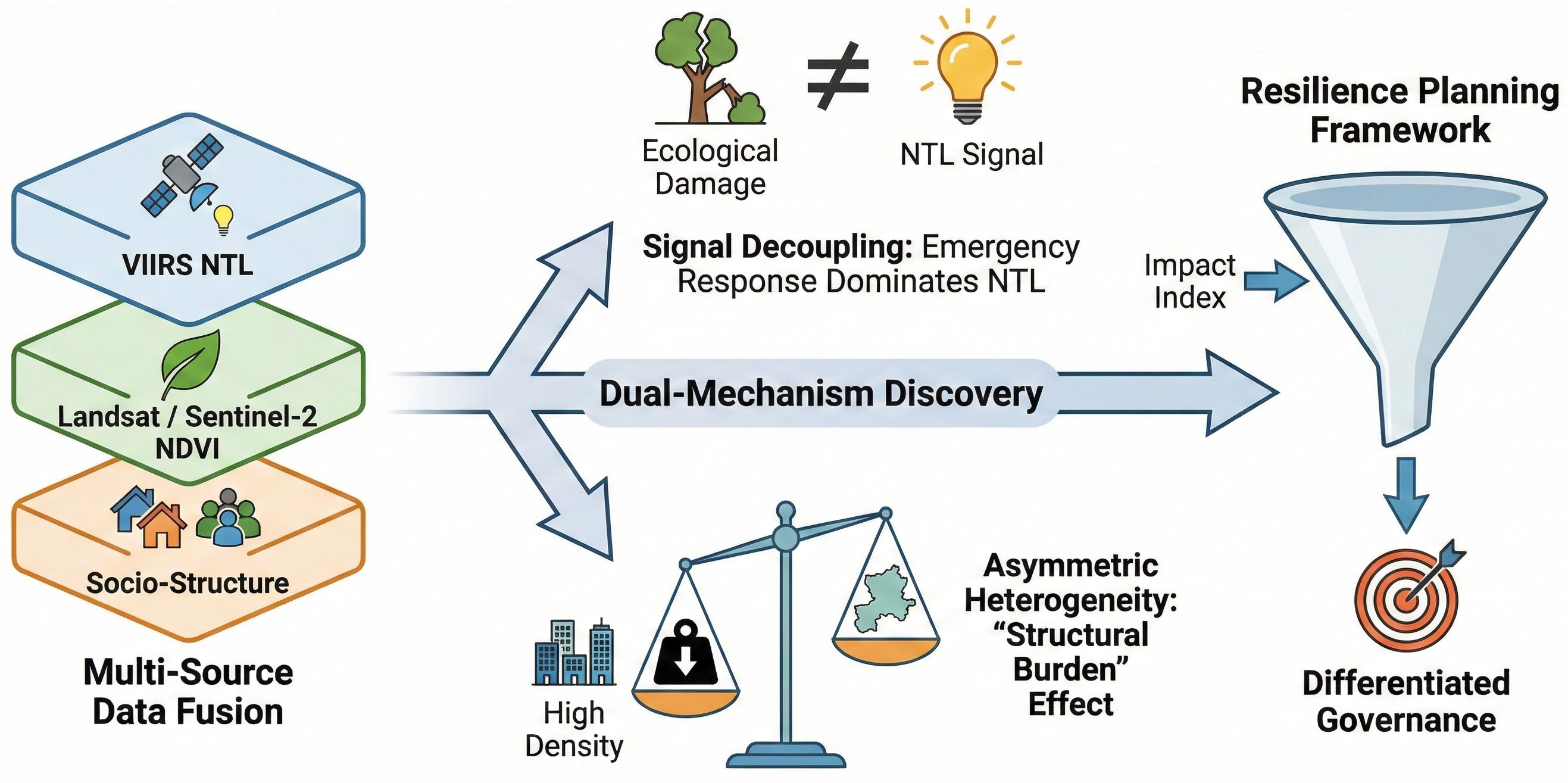
  • Socio-ecological recovery from wildfire is asynchronous; social functions (indicated by nighttime light) may rebound even as ecological damage (indicated by NDVI) deepens.
  • The influence of social structure on recovery capacity is spatially heterogeneous, challenging the conventional wisdom that stronger social structure always leads to faster recovery. In densely populated areas, it can become a “Structural Burden”.
What are the implications of the main findings?
  • Nighttime light data in disaster contexts is a complex signal, reflecting not just social disruption but also the intensity of emergency response activities, especially in populated areas.
  • Wildfire risk assessment and post-disaster management in WUI regions require differentiated strategies tailored to the specific socio-ecological context, rather than a one-size-fits-all approach.

Abstract
Wildfires in the Wildland–Urban Interface (WUI) pose escalating threats to socio-ecological systems, challenging regional resilience and sustainable recovery. Understanding the compound impacts of such fires requires an integrated, data-driven assessment of both ecological disturbance and social response. This study develops a multi-dimensional framework combining multisource remote sensing data (Landsat/Sentinel-2 NDVI and VIIRS nighttime light) with socio-structural indicators. A Composite Disturbance Index (ImpactIndex) was constructed to quantify ecological, population, and socioeconomic disruption across six fire clusters in the January 2025 Southern California wildfires. Mechanism analysis was conducted using Fixed-Effects OLS (M2) and Geographically Weighted Regression (GWR, M3) models. The ImpactIndex revealed that Eaton and Palisades experienced the most severe compound disturbances, while Border 2 showed purely ecological impacts. During-disaster CNLI signals were statistically decoupled from ecological disturbance (ΔNDVI) and dominated by site-specific effects (p < 0.001). GWR results (Adj. R2 = 0.354) confirmed asymmetric spatial heterogeneity: high-density clusters (Palisades, Kenneth) exhibited a significant “Structural Burden” effect, whereas low-density areas showed weak, nonsignificant recovery trends. This “Index-to-Mechanism” framework redefines the interpretation of nighttime light in disaster contexts and provides a robust, spatially explicit tool for targeted WUI resilience planning and post-fire recovery management.

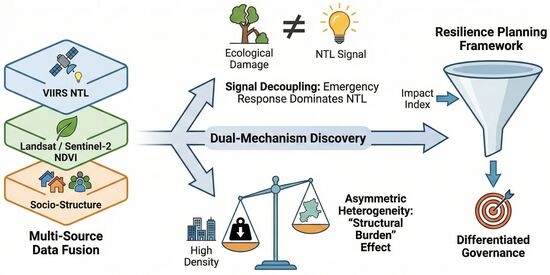
Graphical Abstract

1. Introduction

In recent years, driven by the combined effects of global climate change and the expansion of human activities, the frequency, intensity, and scope of wildfires have exhibited a marked global increase, posing a primary threat to the sustainability of global Social–Ecological Systems (SES). For instance, during the 2023–2024 fire season, the total global burned area reached 3.9 million square kilometers [1]. This critical trend manifests globally in various extreme forms, ranging from widespread ecological disasters with profound impacts on global ecosystems and the carbon cycle, such as the record-breaking large-scale fires in Canada’s boreal forests, to the increasingly frequent Wildland–Urban Interface (WUI) fires at the fringes of densely populated areas that directly threaten life and property [1]. This study focuses on the latter. As of 2020, the global WUI area had reached nearly 6.62 million square kilometers, a 12.56% increase compared to 1985, with over 4.47 million people directly exposed to high-risk fire zones [2]. In these regions, wildfires not only cause severe ecosystem degradation but also have a profound impact on socioeconomic systems, damaging critical infrastructure, affecting air quality and public health, and compelling community evacuations [3]. Consequently, the issue of wildfire has transitioned from a purely natural phenomenon to a complex, shared socio-ecological risk that must be examined from the perspective of coupled human–environment systems [4].
In response to the escalating wildfire challenge, the scientific community has devoted considerable attention to the vulnerability and resilience of Social–Ecological Systems (SES) [5,6,7]. Existing research indicates that incorporating the SES perspective into disaster analysis facilitates a better understanding of the interaction mechanisms between human society and natural ecosystems [8]. For instance, the SES framework proposed by Ostrom (2009) explicitly emphasizes the complex linkages among resources, governance systems, and users, which influence the sustainability of the system [9]. Folke et al. (2010) also noted that the adaptive and transformative capacities of a system determine its ability to maintain stability in the face of significant disturbances, such as disasters [10]. In the context of extreme events such as wildfires, floods, and earthquakes, it is crucial to simultaneously consider the feedback effects from both social and ecological domains to clarify the true impact pathways of disasters.
The rapid development of remote sensing technology has enabled the large-scale and long-term continuous observation of the states of social and ecological systems. Monitoring ecological disturbance and recovery based on indices such as the Normalized Difference Vegetation Index (NDVI) has become a standard practice, effectively tracking post-fire vegetation trajectories across gradients of climate and burn severity. Refs. [11,12,13] and even identifying early warning signals as ecosystems approach a “recovery tipping point” [14,15,16]. Concurrently, high-resolution nighttime light (NTL) remote sensing data, represented by VIIRS, has been widely applied to assess disaster-induced power outages, population displacement, and the recovery process of post-disaster economic activities, due to its ability to effectively reflect the intensity of human activity and economic vitality [17]. Recent advances even provide a globally consistent annual VIIRS-like NTL dataset from 1992 to 2023, greatly expanding the temporal window for such analyses [18]. Scholars have quantified disaster impacts by developing indices, such as the Compounded Nighttime Light Index (CNLI), and have found that trends in NTL intensity show a high degree of consistency with social indicators, including post-disaster population return and employment recovery [19,20].
Although existing research has achieved substantial results in assessing impacts on either the ecological or social dimension alone, challenges persist in integrating the multidimensional impacts and analyzing the coupling mechanisms of fires in WUI regions [6]. Most studies discuss the responses of ecological and social systems separately, lacking a quantitative assessment of their interactions and the asynchrony of recovery. Simultaneously, the social functional states reflected by NTL remote sensing in disaster contexts can be influenced by multiple confounding factors, such as the dimming of lights due to suppressed social activities versus the enhancement of illumination from emergency responses; existing research has not fully explored these dynamics [21]. Furthermore, while frameworks such as the Social Vulnerability Index (SoVI) are commonly applied in disaster assessment [22], social factors including population density, economic level, and urbanization may affect disaster impacts in complex, non-linear, and spatially variable ways. These dynamics remain insufficiently understood and require further study [23,24,25,26].
The state of California in the United States, as one of the world’s most prominent regions for WUI issues, is characterized by particularly severe wildfires and significant socioeconomic losses. For example, a study by Higuera et al. (2023) noted that between 1999 and 2020, building losses in California alone accounted for 77% of the total losses for the entire Western United States [4]. In response to the increasingly severe, multidimensional impacts of WUI fires, this study utilizes the January 2025 Southern California wildfire event as a case study, innovatively establishing a multidimensional assessment framework that integrates multisource remote sensing observations with social structural data. Several representative fire events within Southern California were selected for detailed analysis, as illustrated later in Section 2.2. The primary objectives include: (1) to systematically quantify the spatiotemporal characteristics of ecosystem degradation and socioeconomic disruption caused by the fire; (2) to reveal the spatial heterogeneity in the recovery trajectories of the ecological and social systems; and (3) to investigate the interaction pathways between social structure and the disturbance and recovery processes through mechanistic modeling. By achieving these objectives, this study aims to provide new assessment perspectives and a scientific basis for current academic topics of interest, such as the characterization of socio-ecological fire risk [4] and adaptive reconstruction [27]. Furthermore, it seeks to explore viable pathways for enhancing risk assessment and building resilience in WUI regions.

2. Materials and Methods

2.1. Study Area

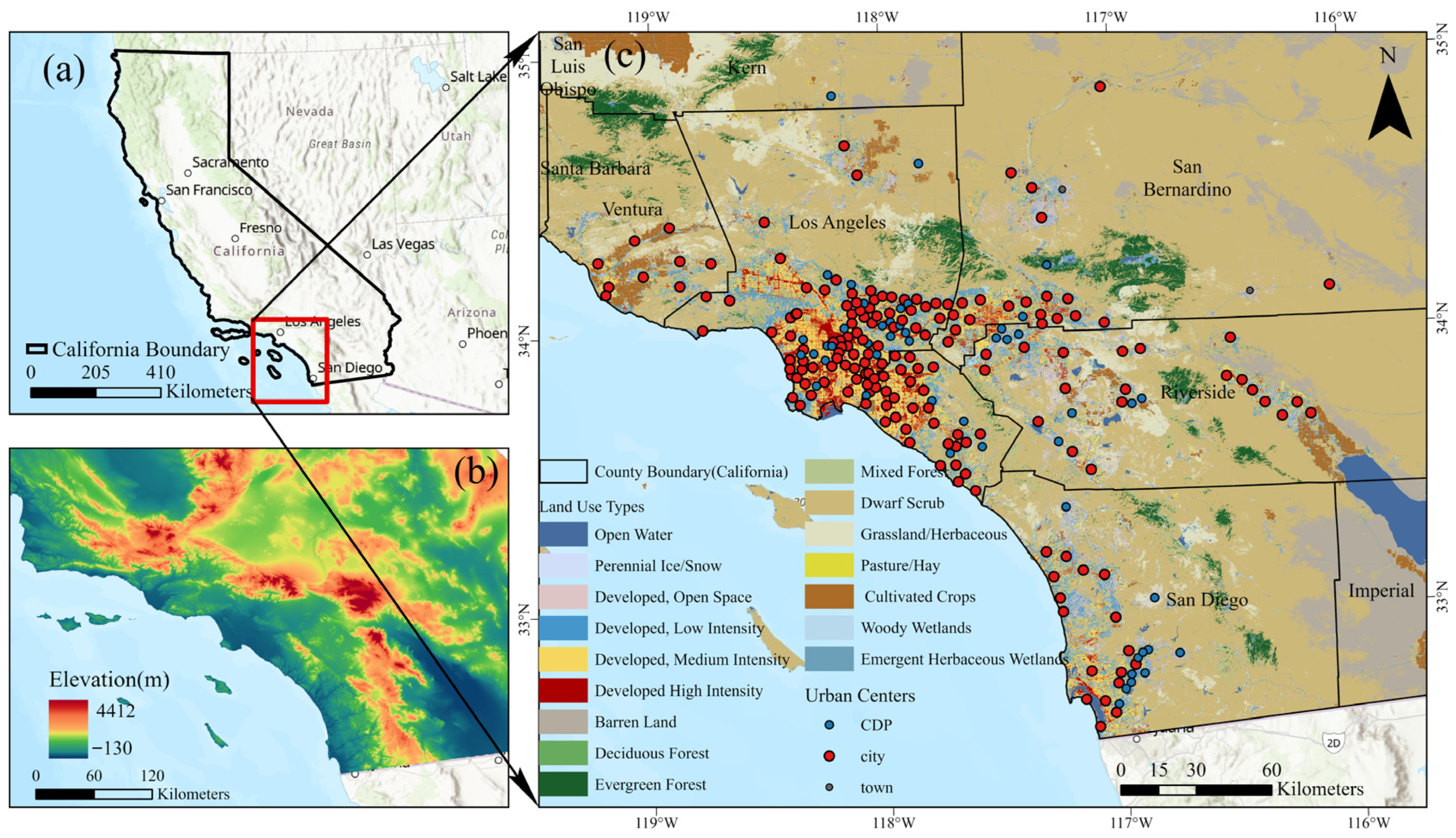
The study area for this research is located in Southern California, USA, encompassing several core cities and counties, including Los Angeles, San Diego, Riverside, and San Bernardino. This region is one of the world’s archetypal WUI zones [28,29,30]. The area is characterized by an interspersed distribution of mountains and coastal plains, resulting in significant topographical variation (Figure 1b). Its land cover is diverse, comprising natural ecosystems such as grasslands, shrublands, and mixed forests, as well as human-developed lands of varying densities, such as low-intensity developed areas and high-intensity urban built-up areas (Figure 1c).
The region features a typical Mediterranean climate, characterized by distinct wet and dry seasons. The summers and autumns are arid with minimal rainfall, while the winters are windy. These conditions, compounded by extreme weather events such as the Santa Ana winds, make the area a high-risk zone for wildfires [31]. Historical records indicate a continuous upward trend in both the frequency and severity of wildfires in this area [32], and the threat posed by these fires to the population and property within WUI areas has been escalating [33,34].
This study focuses on a series of severe wildfire events that occurred in the region between 7 January and 31 January 2025. Driven by strong Santa Ana winds, these fires were characterized by concurrent outbreaks at multiple locations, rapid propagation, and extensive impact. They severely impacted the critical infrastructure, socioeconomic activities, and ecological environment of numerous WUI communities, drawing significant public attention.
This series of fire events, with its complex characteristics, provides an archetypal and representative scenario for this study to conduct an in-depth investigation into the multidimensional socio-ecological disturbance and recovery mechanisms within WUI regions under a real-world disaster context.

2.2. Data Sources

To conduct a multidimensional assessment of this wildfire event, this study integrated multisource remote sensing and socioeconomic data (Table 1), which can be categorized into four main types: fire-specific, ecological, socio-structural, and meteorological data. To define the fire’s impact area, official WFIGS Fire Perimeters were used for authoritative boundary delineation. Concurrently, daily active fire detections from NASA’s Fire Information for Resource Management System (FIRMS) were employed to identify fire cores and select the specific case study sites for detailed analysis.
For the ecological impact assessment, the NDVI was calculated using a harmonized time series of optical imagery from Landsat 8/9 (USGS) and Sentinel-2 (ESA), with spatial resolutions of 30 m and 10 m, respectively.
The socioeconomic dimension was analyzed using multiple datasets. Social activity and recovery were primarily tracked using daily NASA VIIRS “Black Marble” nighttime light products (VNP46A2). Population exposure was quantified using the 90 m resolution LandScan USA dataset. Furthermore, contextual variables such as the WUI and urbanization rates were derived from the 2023 National Land Cover Database (NLCD).
Finally, the pre-fire environmental and meteorological background, including drought conditions, was analyzed using hourly data from the ERA5-Land Reanalysis dataset.
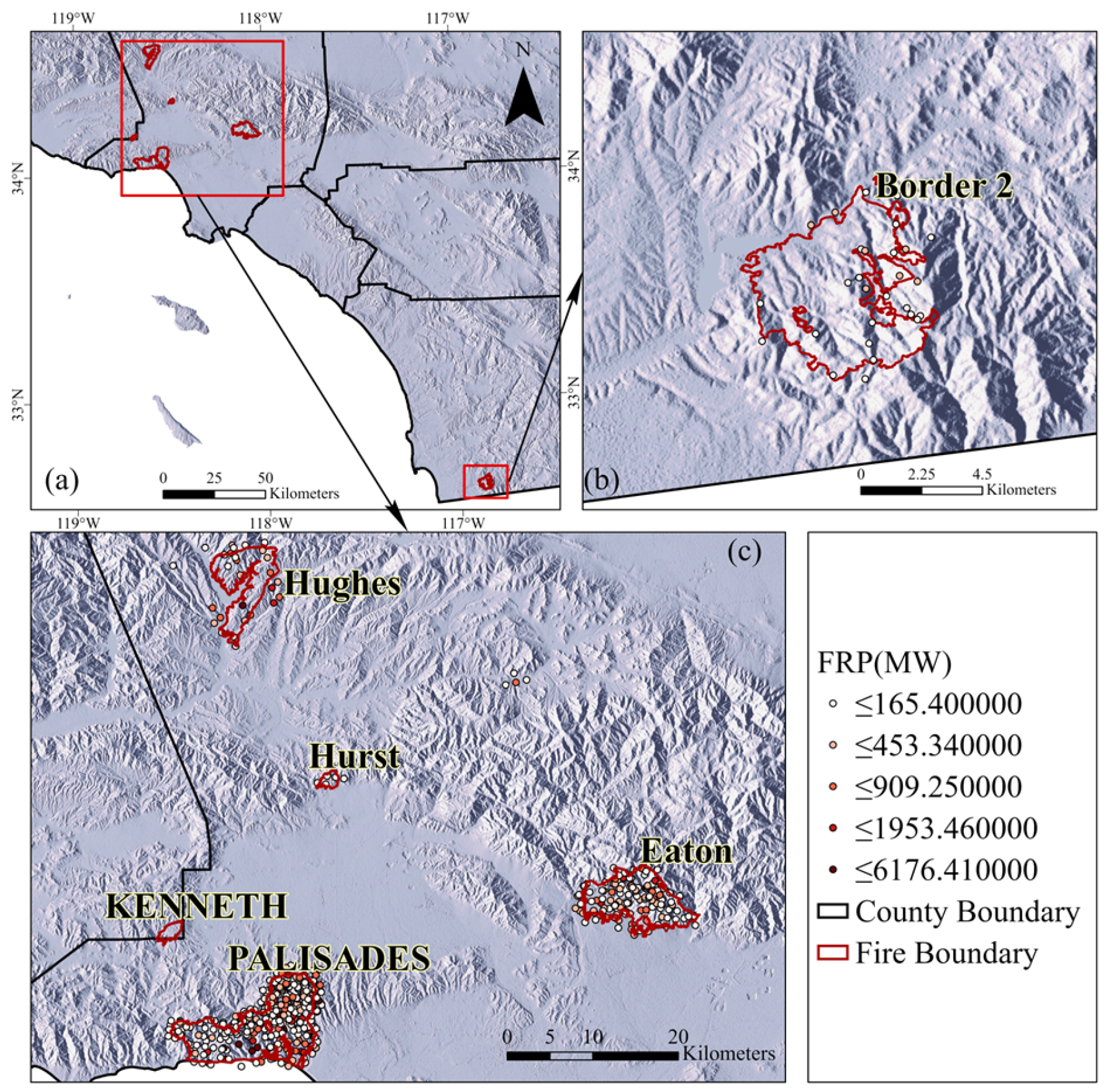
Based on officially released fire perimeter data and satellite thermal anomaly data (NASA FIRMS), we selected six representative fire sites (Palisades, Eaton, Hurst, Kenneth, Hughes, and Border 2) from this large-scale wildfire event as the core subjects for our analysis. These sites encompass a range of fire scales, geographical environments, and levels of social exposure, providing a foundation for subsequent comparative studies and mechanistic investigations. Their spatial distribution is shown in Figure 2.

3. Methods

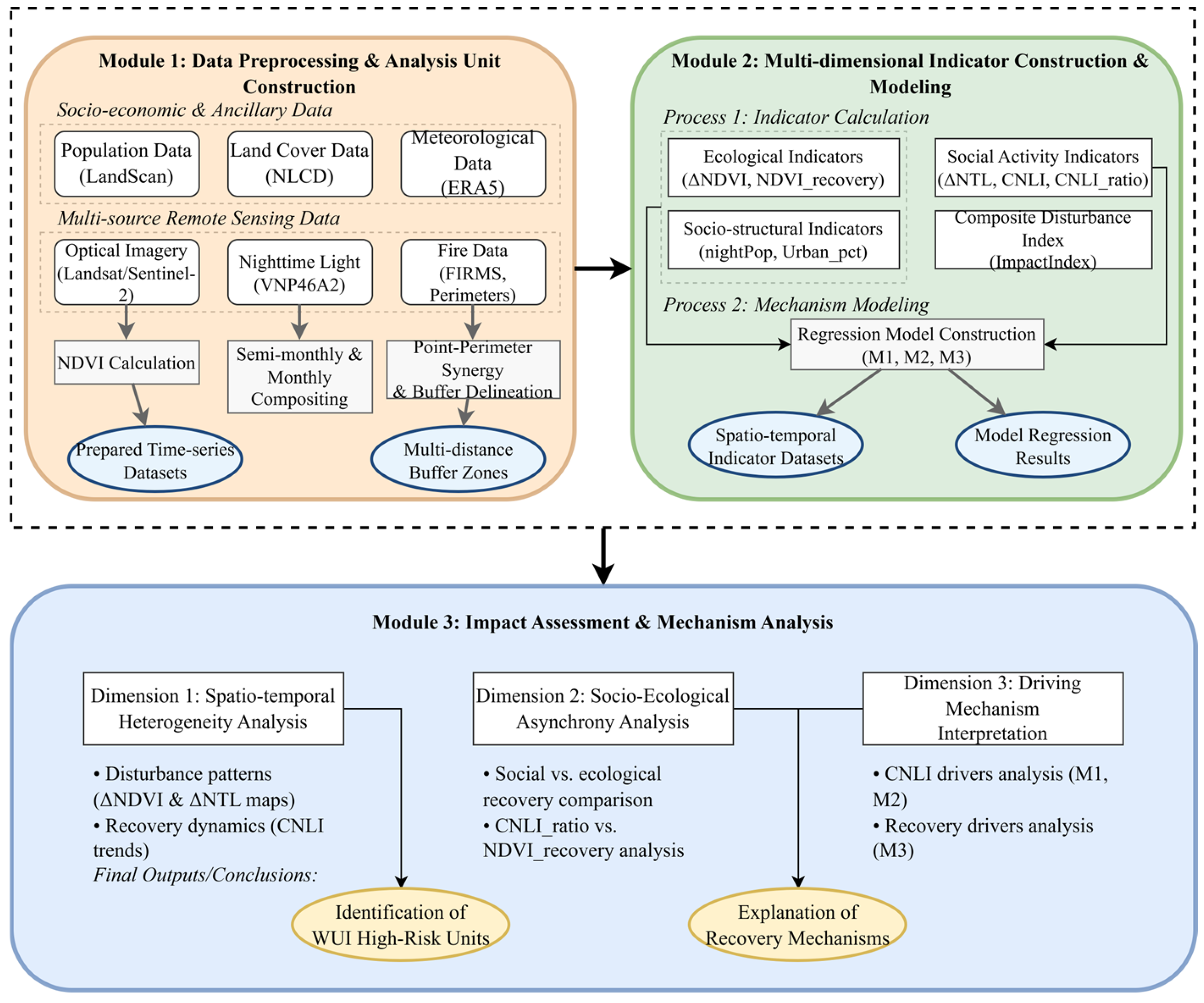
The overall methodological framework of this study, as illustrated in Figure 3, primarily comprises three core stages: data preprocessing and the construction of spatial analysis units, development of a multidimensional indicator system, and the modeling of driving mechanisms.

3.1. Data Preprocessing and Spatial Unit Delineation

The data preprocessing workflow in this study included systematic geometric correction, radiometric calibration, and atmospheric correction of the remote sensing imagery, as well as the masking of undesirable pixels such as clouds, snow, and water bodies. Landsat 8/9 Collection 2 Level-2 surface reflectance and Sentinel-2 surface reflectance (COPERNICUS/S2_SR_HARMONIZED) imagery were jointly used to construct a unified NDVI time series [36]. All scenes within the study period were co-registered, resampled to 30 m, and screened using QA bands (QA_PIXEL for Landsat; QA60 and SCL for Sentinel-2) to remove clouds, cirrus, and shadows. NDVI was then calculated from the near-infrared and red bands and composited monthly (November 2024–March 2025) using the Maximum Value Composite (MVC) technique, which selects the highest valid NDVI value per pixel to minimize residual atmospheric noise and represent the most reliable vegetation signal [37]. For the nighttime light data, to ensure consistency of the data source, all NTL analyses were based on the NASA VNP46A2 daily product. Based on the requirements of different analytical phases, we performed both semi-monthly mean composites (Days 1–15 and 16–end of month, to capture impacts during the disturbance period) and monthly mean composites (to assess trends during the recovery period). This multi-day composite strategy helps enhance the spatial integrity and stability of the NTL time-series data [38]. To ensure the highest data fidelity, only pixels that met the ‘High-Quality’ standard (Mandatory_Quality_Flag == 0) were used in these composites, thereby filtering out pixels contaminated by clouds, moonlight, or stray light.
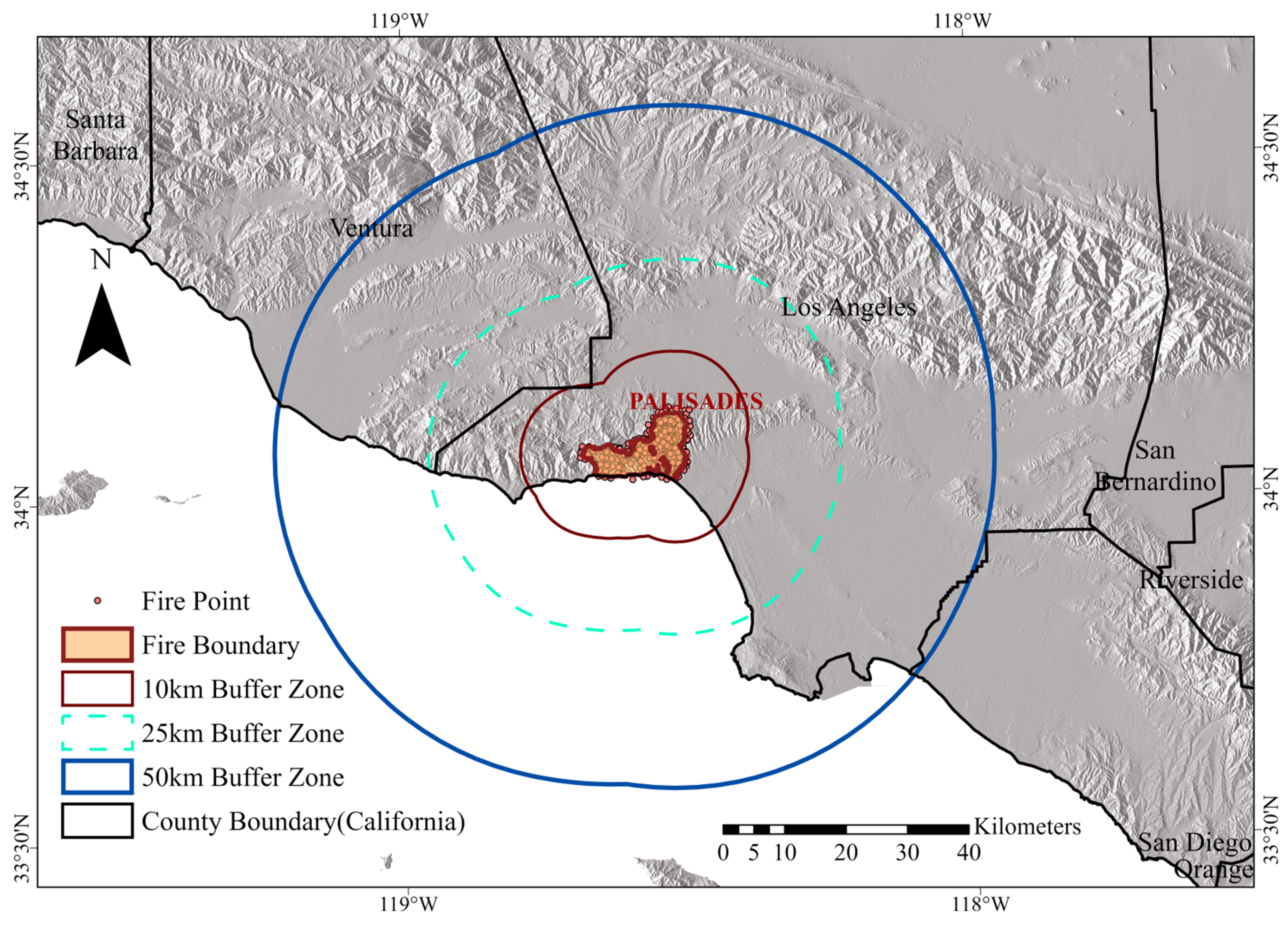
For the construction of spatial analysis units, this study adopted a point-area collaborative strategy. Initially, NASA FIRMS data were used to identify fire cores, which were then combined with the officially released WFIGS fire perimeter vector data to delineate the actual impact zones precisely. This approach is informed by existing studies that combine satellite thermal anomaly data with vector boundary data for fire perimeter extraction and dynamic evolution analysis [39,40]. Subsequently, we constructed ten concentric buffers (5–50 km, 5 km increments) around each fire site as part of a multi-scale gradient analysis. The 5 km starting scale is supported by Guo et al. (2024) [41], who identify this radius as a critical near-field zone for WUI wildfire threat. Extending the analysis to 50 km allows for the characterization of distance–decay patterns and robustness checks across scales, providing a more comprehensive representation of disturbance gradients [42]. Figure 4 visually illustrates the buffer construction method using the PALISADES fire site as an example.

3.2. Key Indicator System Construction

To assess the multidimensional impacts of the fire, this study constructed an indicator system based on the principles of scientific validity, systematicity, comprehensiveness, and operability [43]. This system encompasses ecological, social activity, and composite disturbance indicators.
For ecological disturbance and recovery, this study primarily employed the NDVI for quantification. By calculating the difference between the post-fire NDVI (February 2025) and a pre-fire baseline value (December 2024), the change in the vegetation index (ΔNDVI) was obtained to measure the extent of vegetation loss caused by the fire. To assess the recovery status, the vegetation recovery ratio (NDVIratio) was subsequently calculated. Their core formulas are as follows:
Δ N D V I = N D V I F e b 2025 N D V I D e c 2024
N D V I r a t i o = N D V I M a r c h 2025 N D V I D e c 2024
The temporal baselines were selected to ensure accurate representation of pre-, during-, and post-fire vegetation conditions. December 2024 was used as the pre-fire baseline (NDVI_pre) because it provided stable, low-cloud observations immediately before the early January 2025 fires. February 2025 served as the post-disturbance phase (NDVI_post), avoiding the mixed signals of January while capturing the NDVI nadir after smoke dissipation and fire containment. March 2025 represented the early recovery stage (NDVI_recovery), marking the first full regrowth cycle following the disturbance peak.
Regarding social activity disturbance and recovery, the analysis was based on the composite results of NASA VNP46A2 nighttime light (NTL) data at various temporal scales. To precisely characterize the immediate impact of the fire, this study distinguished between two different dimensions of NTL change:
(1)
Peak Disturbance Period NTL Change (ΔNTLpeak)
This indicator aims to capture the most significant and extreme impact of the fire on the NTL system by comparing the darkest light conditions during the entire month of the disaster (a minimum value composite of daily NTL from 1 to 31 January 2025) with the average NTL of the stable pre-fire period (16–31 December 2024). It effectively highlights the most severe instances of light reduction resulting from power outages, large-scale evacuations, or adverse environmental conditions (e.g., dense smoke).
(2)
Period-Specific NTL Change (ΔNTLperiod)
This indicator, in contrast, is used to analyze the general state of NTL disturbance and its spatial gradient characteristics across different areas after the disaster has progressed to a specific stage. It is calculated by comparing the average NTL within a particular window of observation during the disaster (e.g., the second half of January 2025) with that of the stable pre-fire period.
Differentiating between these two indicators allows for a more comprehensive understanding of the complex impacts of the fire on social activities from the dual perspectives of “extreme shock” and “phased status”.
To assess the stable trends during the recovery period, we constructed the Compounded Nighttime Light Index (CNLI) and the Nighttime Light Recovery Ratio (CNLIratio) based on monthly composite data. The calculation of CNLI integrates the regional Average Nighttime Light Index (ANLI) and the proportion of lit area (Sbright) [44]. It should be noted that the interpretation of CNLI during the disaster phase requires caution, as it may conflate the dual signals of suppressed social functions and emergency response activities [21]. This aspect will be a key consideration in the mechanistic modeling portion of this study. The formulas for the indicators mentioned above are as follows:
T N L I = i = 1 n N i
A N L I = T N L I N m a x
S b r i g h t = A B
C N L I = A N L I × S b r i g h t
C N L I r a t i o = C N L I p o s t C N L I p r e
where TNLI (Total Nighttime Light Index) is the total nighttime light intensity index, Ni is the NTL brightness value of the i-th pixel, n is the total number of lit pixels within the region, Nmax is the maximum pixel value within the lit area, A and B represent the area of the lit region and the total area of the study region, respectively, CNLIpost and CNLIpre refer to the CNLI for March 2025 and December 2024.
For a composite disturbance assessment, this study also constructed a composite disturbance index (ImpactIndex). Drawing on the integrated application of NDVI and nighttime light data by Ma et al. (2018) [45], the normalization of multisource disturbance variables in carbon emission modeling by Meng et al. (2017) [46], and the standardization and weighted integration strategy for urban identification proposed by Li et al. (2021) [47], this index integrates three Min-Max scaled indicators via an equal-weight averaging method—ecological damage (−ΔNDVI), NTL decline (−ΔNTL), and population exposure (nightPop)—to synergistically characterize the multidimensional disturbance intensity. Its calculation formula is as follows:
I m p a c t I n d e x = N D V I + N T L + P o p 3
where NDVI′, NTL′, and Pop′ are the numerical representations of the normalized ecological damage, nighttime light decrease, and population exposure, respectively, with values ranging from 0 to 1.

3.3. Mechanism Modeling

To conduct an in-depth investigation into the driving mechanisms of the socio-ecological system’s response under fire impact and to address the core research objectives outlined in the introduction, this study constructed three sets of multiple linear regression models. These models are designed to quantitatively analyze the pathways through which ecological disturbance and social structural factors contribute to the formation of disturbance during the disaster and the differentiation in post-disaster recovery capacity. To enhance the comparability of the explanatory variables within the models, all continuous modeling variables were standardized using a Z-score transformation before modeling.
To investigate the driving mechanisms of the during-disaster CNLI, this study constructed models M1 and M2. Model M1 is designed to analyze the impact of nighttime population (nightPop) and the proportion of urban land (Urban_pct) on the absolute level of the during-disaster CNLI from a social structure perspective. This aims to reveal how the region’s inherent socioeconomic foundation modulates NTL performance during a wildfire. Its specific form is as follows:
C N L I i = β 0 + β 1 n i g h t P o p i + β 2 U r b a n _ p c t i + ϵ i
where CNLIi represents the during-disaster CNLI value for the i-th spatial unit (buffer), nightpopi and Urban_pcti are the corresponding nighttime population and proportion of urban land, respectively, β0 is the intercept term, β1 and β2 are the regression coefficients to be estimated, and ϵi is the error term.
Model M2, in contrast, aims to examine the direct driving effect of ecological disturbance intensity (ΔNDVI) on the during-disaster CNLI from an ecological dimension. Considering that the during-disaster CNLI signal may be influenced by the superimposed and opposing effects of suppressed social functions (leading to light reduction) and enhanced emergency responses (leading to light increase), the design of this model specifically incorporates spatiotemporal fixed effects for both month and fire site. By controlling for these time-invariant confounding factors, which arise from regional specificities (such as varying intensities of emergency response), this model aims to more accurately assess the independent net effect of ecological disturbance on social activities. The specific form of M2 is as follows:
C N L I i t = γ 0 + γ 1 Δ N D V I i t + μ i + λ t + ϵ i t
where CNLIit represents the CNLI value for fire site i in month t, ΔNDVIit is the corresponding change in NDVI, μ i represents the fire site fixed effects, which is used to control for time-invariant regional specificities (e.g., infrastructure levels, emergency response capabilities), λ t describes the month fixed effects, used to control for temporal trends common to all regions, and ϵit is the error term.
To assess the impact of social structural conditions on recovery capacity (measured by CNLIratio), this study employs a two-stage modeling strategy to systematically examine the spatial heterogeneity of these effects, as conceptually outlined Section 1.
Stage 1: Global OLS Baseline Model. First, a global OLS model (M3-Global) is constructed as a statistical baseline to test if nightPop and Urban_pct have a simple, “one-size-fits-all” global effect. Its form is identical to M1, but with CNLIratio as the dependent variable:
C N L I r a t i o , i = δ 0 + δ 1 n i g h t P o p i + δ 2 U r b a n _ p c t i + ϵ i
where CNLIratio,i represents the CNLI recovery ratio for the i-th spatial unit, and the other parameters are defined as above.
Stage 2: Geographically Weighted Regression (GWR) Model. Second, to explicitly test for the spatial non-stationarity hypothesized in our research, we employ a Geographically Weighted Regression (GWR) model. GWR is a local regression technique that allows coefficients to vary by geographic location, as shown in its formula:
C N L I r a t i o , i = β 0 ( u i , v i ) + β 1 ( u i , v i ) n i g h t P o p i + β 2 ( u i , v i ) U r b a n _ p c t i + ϵ i
where (ui, vi) are the geographic coordinates of unit i, and βk (ui, vi) is the local regression coefficient for each variable k at each location i. We will compare the diagnostic metrics (e.g., Adj. R2 and AICc) of the OLS and GWR models to statistically determine if the local model (i.e., spatial heterogeneity) provides a superior explanation.
Finally, to ensure the validity of all conclusions, all OLS and GWR models will undergo rigorous diagnostic testing. This includes: (1) Variance Inflation Factor (VIF) analysis to test for multicollinearity; and (2) Moran’s I analysis to test for spatial autocorrelation in the model residuals. These diagnostic results will be presented alongside the model results in Section 4.4.

4. Results

4.1. Contextual Characteristics and Disturbance Patterns

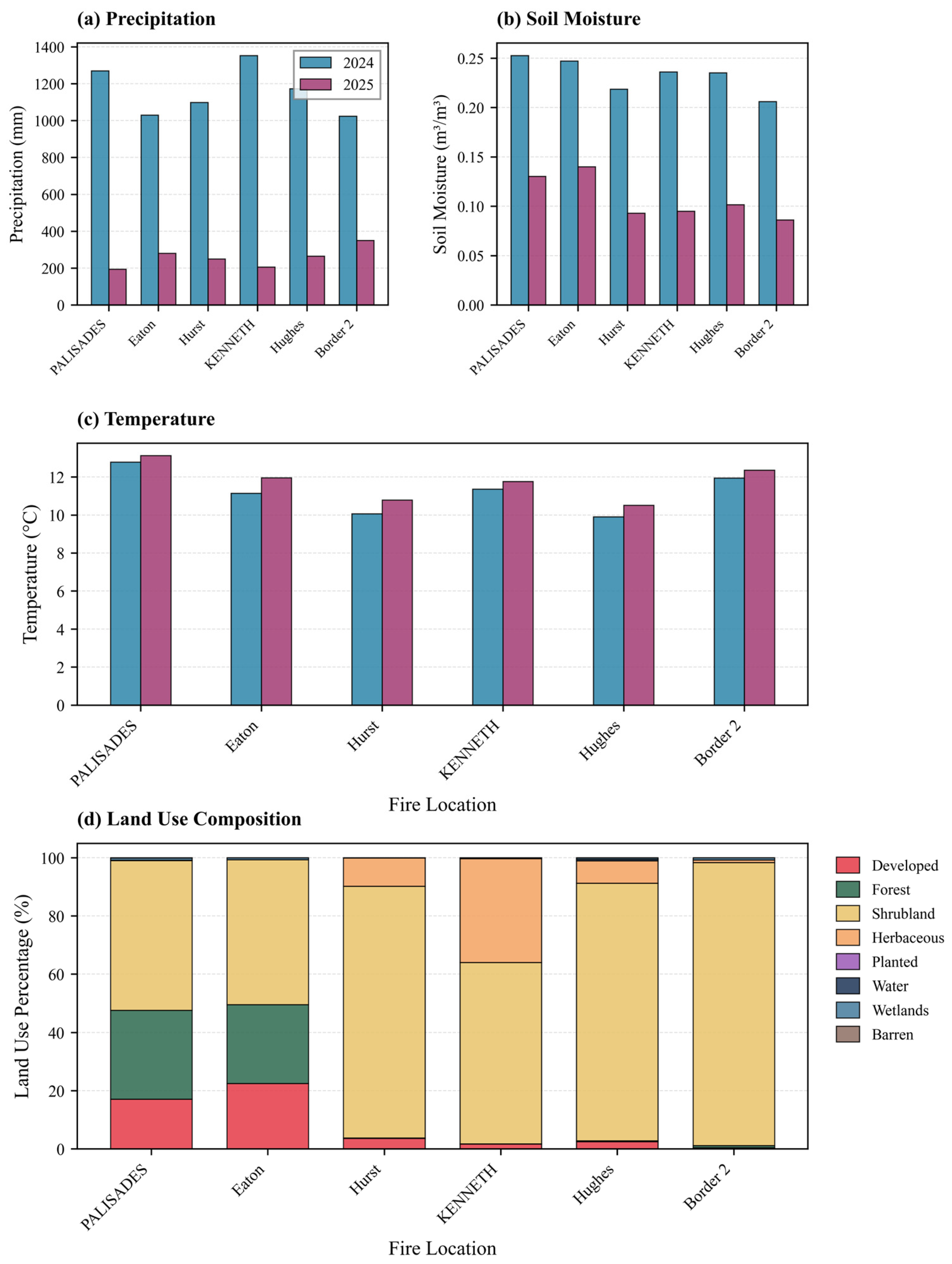
The land use composition and pre-fire climatic background of each fire site are fundamental to understanding the differences in their subsequent responses. Figure 5 clearly illustrates the significant differences in land use structure among the six fire sites, as well as the warm and dry climatic anomaly that they all generally experienced during the winter of 2025. From a meteorological perspective (Figure 5a–c), compared to the same period in the previous year (2024), all sites in the 2025 winter experienced a slight increase in temperature (Figure 5c) while cumulative precipitation decreased sharply (Figure 5a). Against this backdrop of significantly reduced precipitation, shallow soil moisture was rapidly depleted (Figure 5b), intensifying surface dryness and leading to severe drought stress. In terms of land use (Figure 5d), the Palisades and Eaton areas show a significantly higher proportion of urban (Developed) land, whereas the Border 2 and KENNETH sites are predominantly composed of grassland/shrubland (Herbaceous and Shrubland).
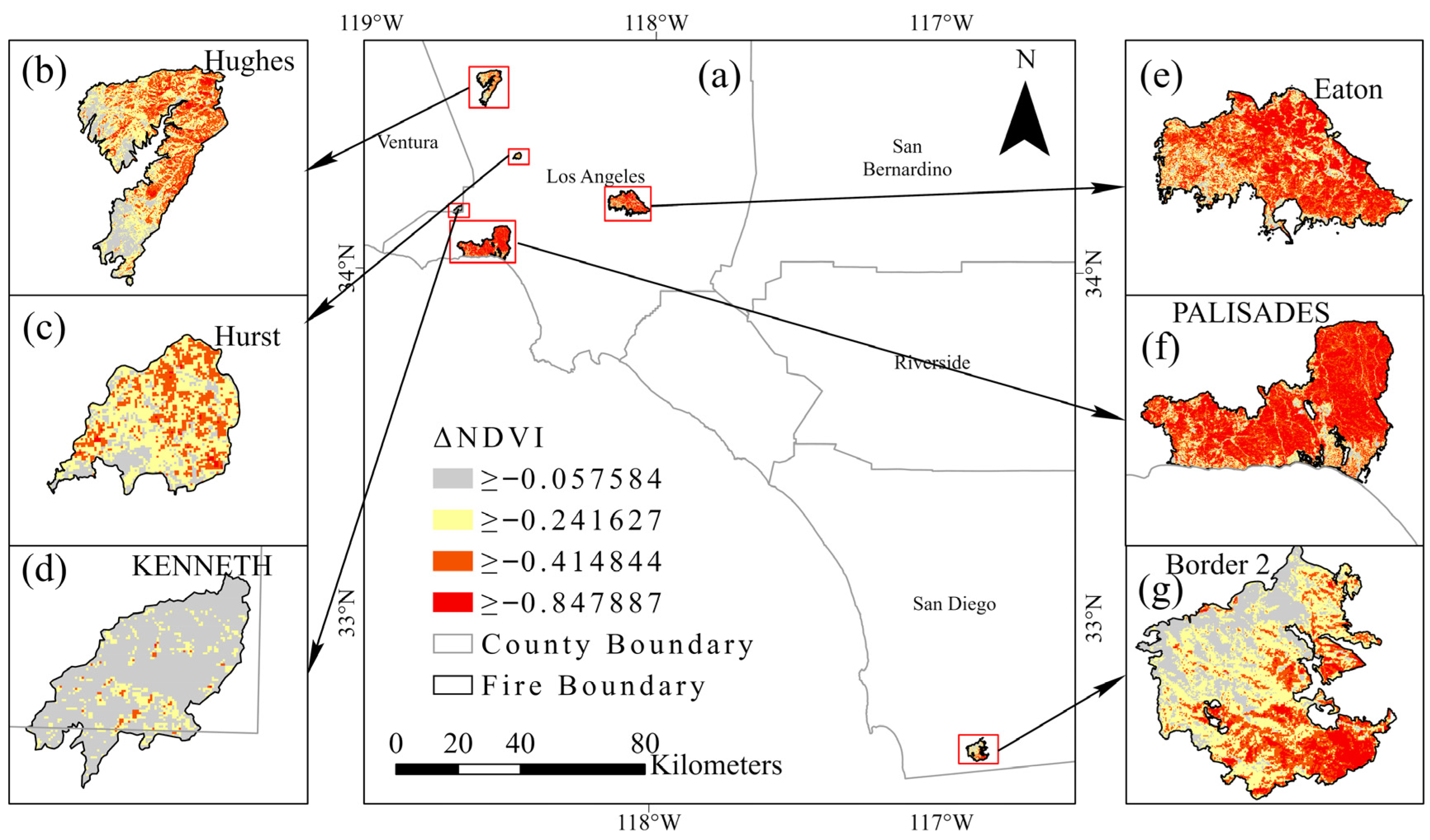
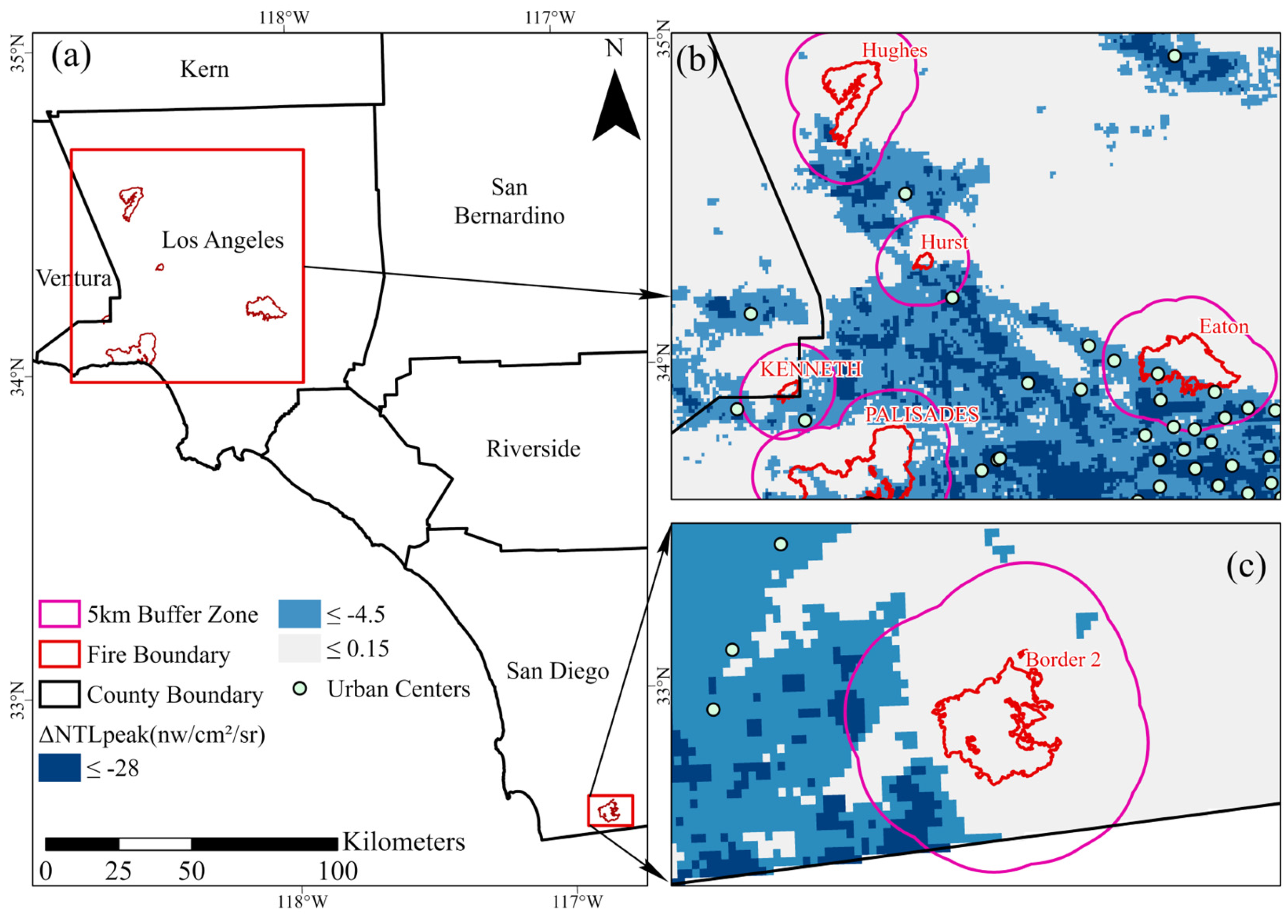
Against this backdrop, the wildfires caused significant and spatially heterogeneous disturbances to both the ecosystem and socioeconomic activities. Figure 6 and Figure 7 visually reveal this multidimensional impact by comparing the spatial distributions of the change in vegetation index (ΔNDVI) and the peak change in nighttime light (ΔNTLpeak).
First, regarding ecosystem disturbance, Figure 6 visually reveals the direct destruction of vegetation cover by calculating the difference in NDVI (ΔNDVI) between the post-fire period (February 2025) and the pre-fire period (December 2024). As shown in the figure, vegetation damage was most severe in the Palisades and Eaton areas, with their core zones exhibiting large areas of severe degradation (−1.5 ≤ ΔNDVI < −0.4). The other fire sites also displayed varying degrees of vegetation loss. Notably, the Kenneth site did not exhibit highly significant changes in NDVI, with the area being predominantly depicted in gray (−0.2 ≤ ΔNDVI < −0.05). This spatial pattern reflects the considerable differences in the intensity of fire disturbance.
Second, regarding socioeconomic activity disturbance, Figure 7 displays the spatial distribution of the change in peak nighttime light disturbance period (ΔNTLpeak). Areas with a higher concentration of urban points exhibit a marked decrease in brightness. This indicates that the direct impact of the fire on socioeconomic activities is most severe in WUI areas with dense populations and infrastructure. In contrast, the NTL disturbance surrounding sites with fewer urban points (such as Border 2 and Hughes) is relatively limited. These findings collectively demonstrate that while the impact of wildfires on social activities is widespread, their severity is highly dependent on the region’s intrinsic level of socioeconomic exposure.
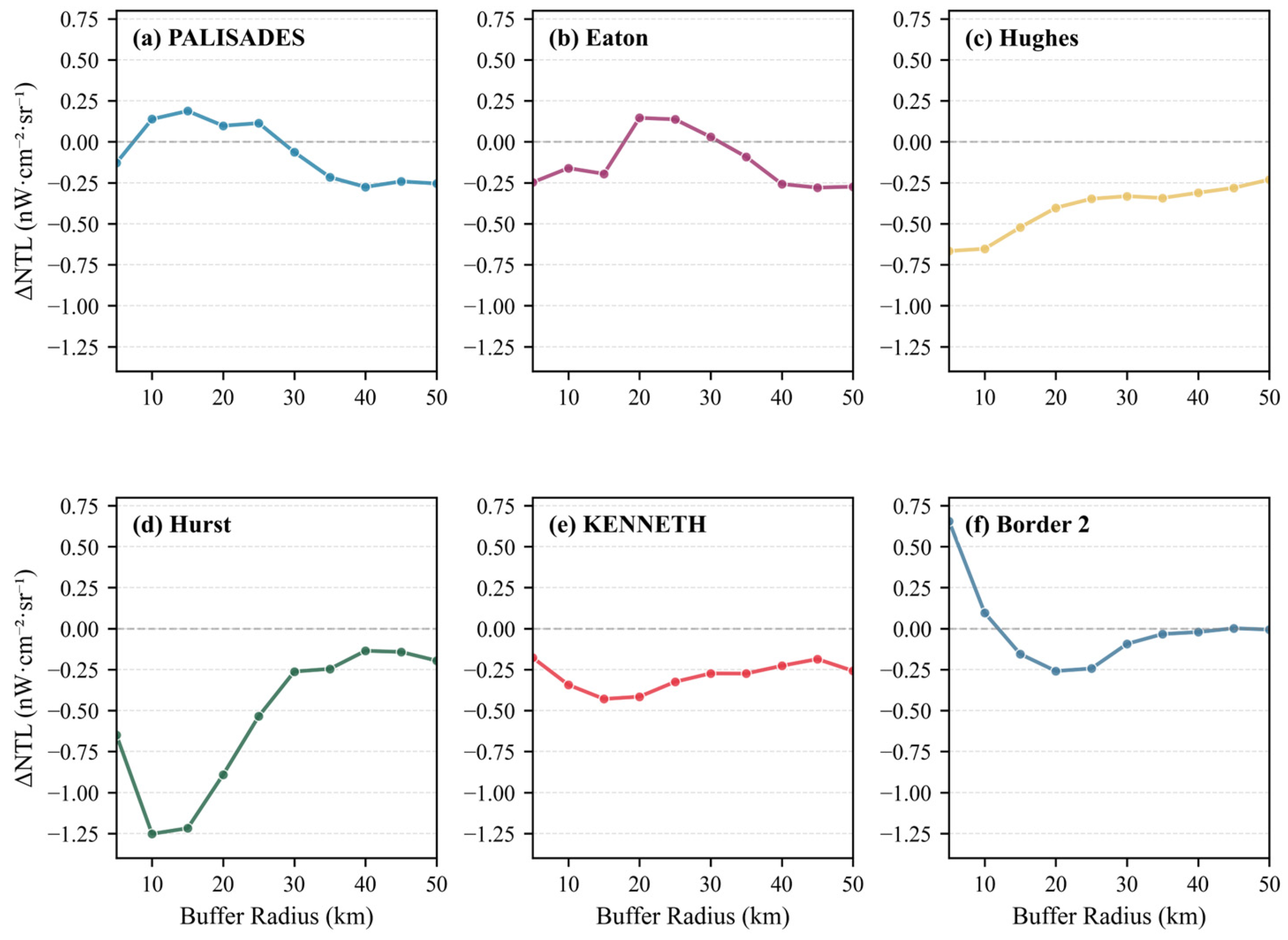
After establishing an overall understanding of the spatial pattern of peak disturbance, we further quantified the spatial gradient of the phased social disturbance. Figure 8 illustrates the period-specific change in nighttime light (ΔNTLperiod) for each fire site across different buffer scales, comparing late January 2025 with late December 2024.
The figure shows that within the core buffer zones of 5 to 15 km, the ΔNTLperiod values are generally negative, indicating that the suppressive effect of the fire on nighttime light remains significant. As the buffer radius increases, these values gradually approach zero, reflecting a clear boundary to the disturbance’s area of influence.

4.2. Heterogeneity and Asynchrony in Socio-Ecological Recovery

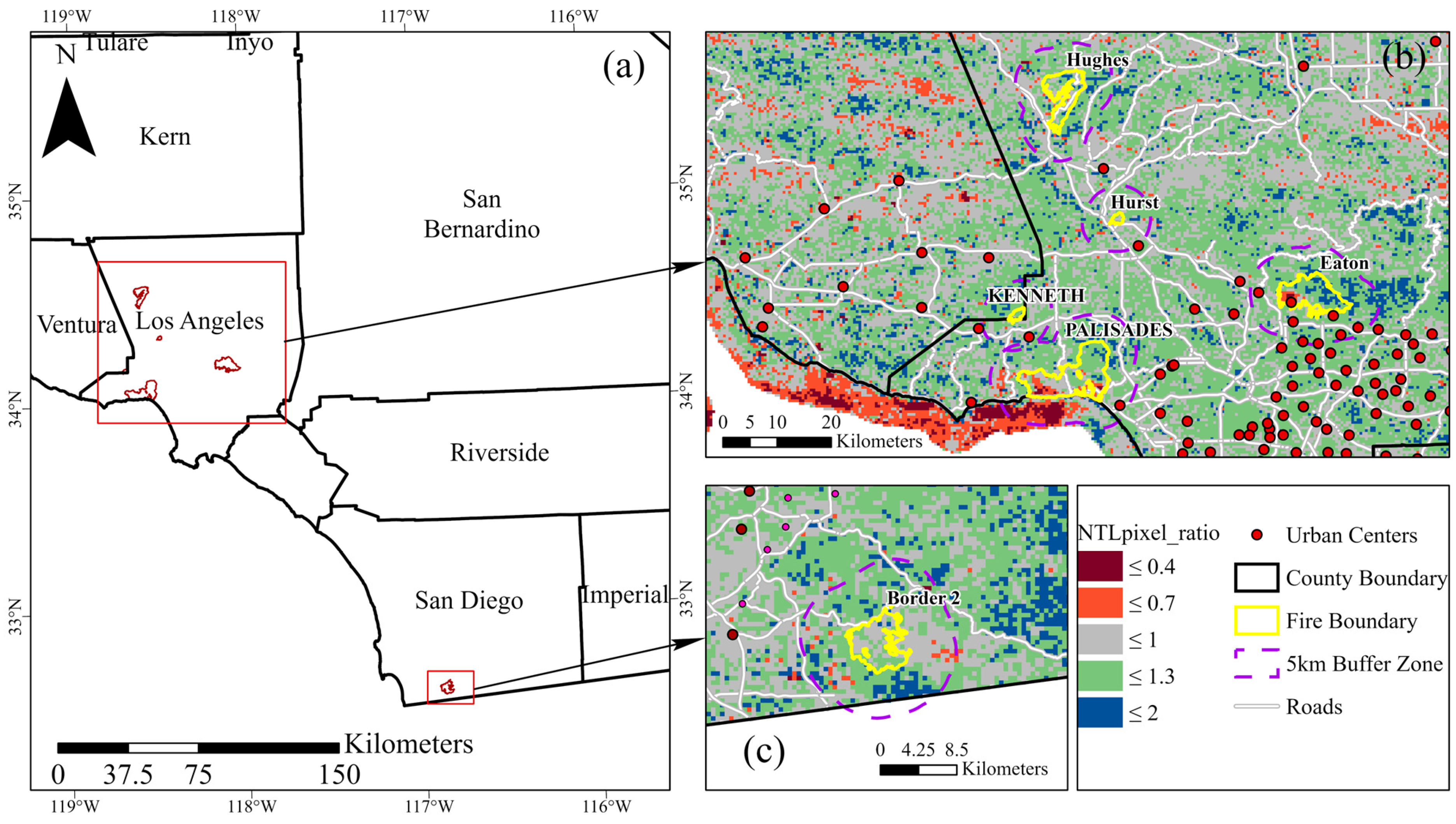
First, to visually reveal the spatial pattern of the post-disaster recovery of the social system’s nighttime light intensity at the pixel scale, Figure 9 displays the spatial distribution of the recovery ratio of the monthly nighttime light radiance for March 2025 relative to the pre-fire period of December 2024 (denoted as NTLpixel_ratio). The figure clearly shows that the overall nighttime light recovery across the region exhibits significant spatial heterogeneity. Most areas surrounding urban points and along major transportation routes display a higher recovery ratio (NTLpixel_ratio > 1.3). In contrast, some core fire-impacted zones, such as in the southern and central portions of the Palisades site and the southeastern portion of the Eaton site, exhibit a comparatively delayed recovery (NTLpixel_ratio < 1).
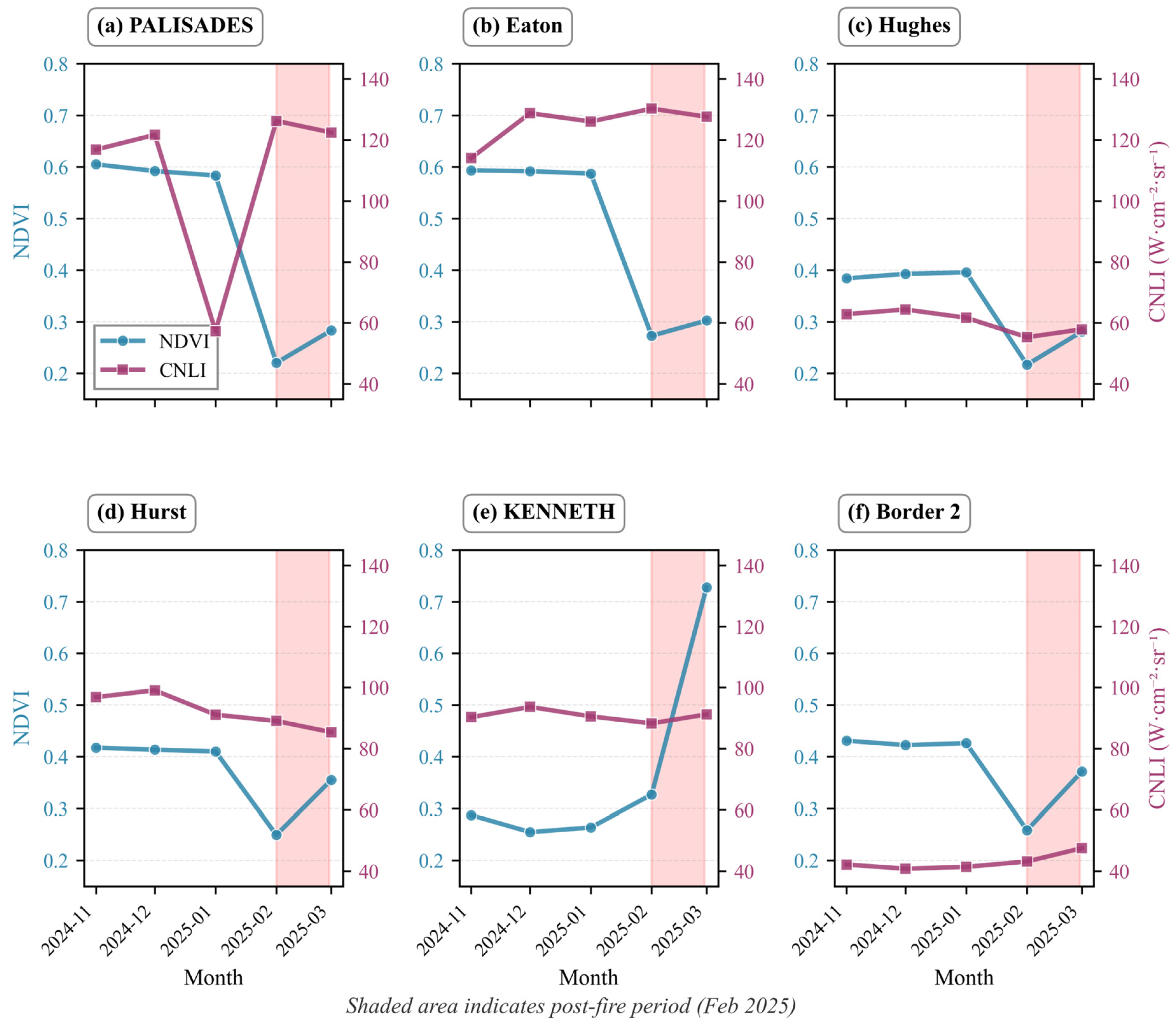
After obtaining a macroscopic understanding of the spatial recovery patterns, Figure 10 further provides a comparative analysis of the temporal recovery trajectories between ecological and socioeconomic systems.
This composite figure juxtaposes the time-series variations of NDVI within each fire’s core area and the corresponding monthly CNLI within its 5 km buffer zone.
As shown, the two trajectories exhibit an evident temporal asynchrony: while NDVI generally continued to decline and reached its lowest level in February 2025, the socioeconomic indicator CNLI had already demonstrated a “bright light rebound” at several sites.
Moreover, the recovery process reveals strong spatial heterogeneity. For example, the Palisades site experienced the most pronounced CNLI decline, coinciding with substantial vegetation loss, whereas the Kenneth site exhibited an “anomalous” pattern—its NDVI steadily increased after the fire and even surpassed pre-fire levels by March 2025. This clear divergence in recovery pathways validates our selection of December 2024 and March 2025 as reference points for the subsequent ratio-based analysis in Figure 11. The unique trajectory of the Kenneth site will be analyzed in detail in the subsequent Section 5.
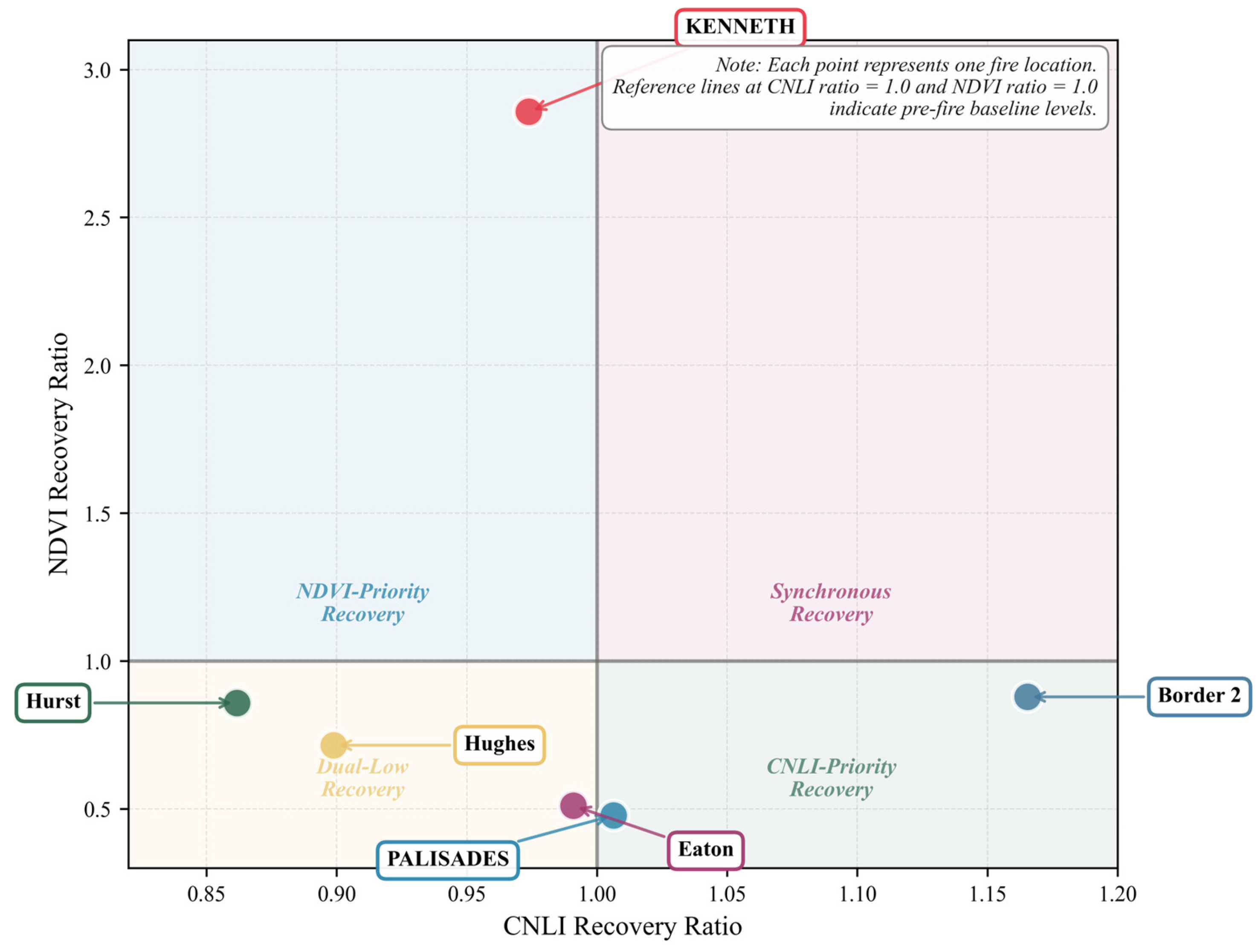
To further quantify this recovery asynchrony, Figure 11 plots the post-disaster social recovery level (CNLIratio) on the x-axis against the ecological recovery level (NDVIratio). The recovery pathways of the fire sites vary significantly, allowing them to be classified into several distinct recovery patterns: Kenneth and Border 2 are classified as the ‘ecological-priority’ and ‘social-priority’ recovery types, respectively; Eaton and Palisades represent the ‘ecologically stalled’ type; and Hughes and Hurst are categorized as the ‘dual-lag’ type.

4.3. Multidimensional Composite Disturbance Assessment

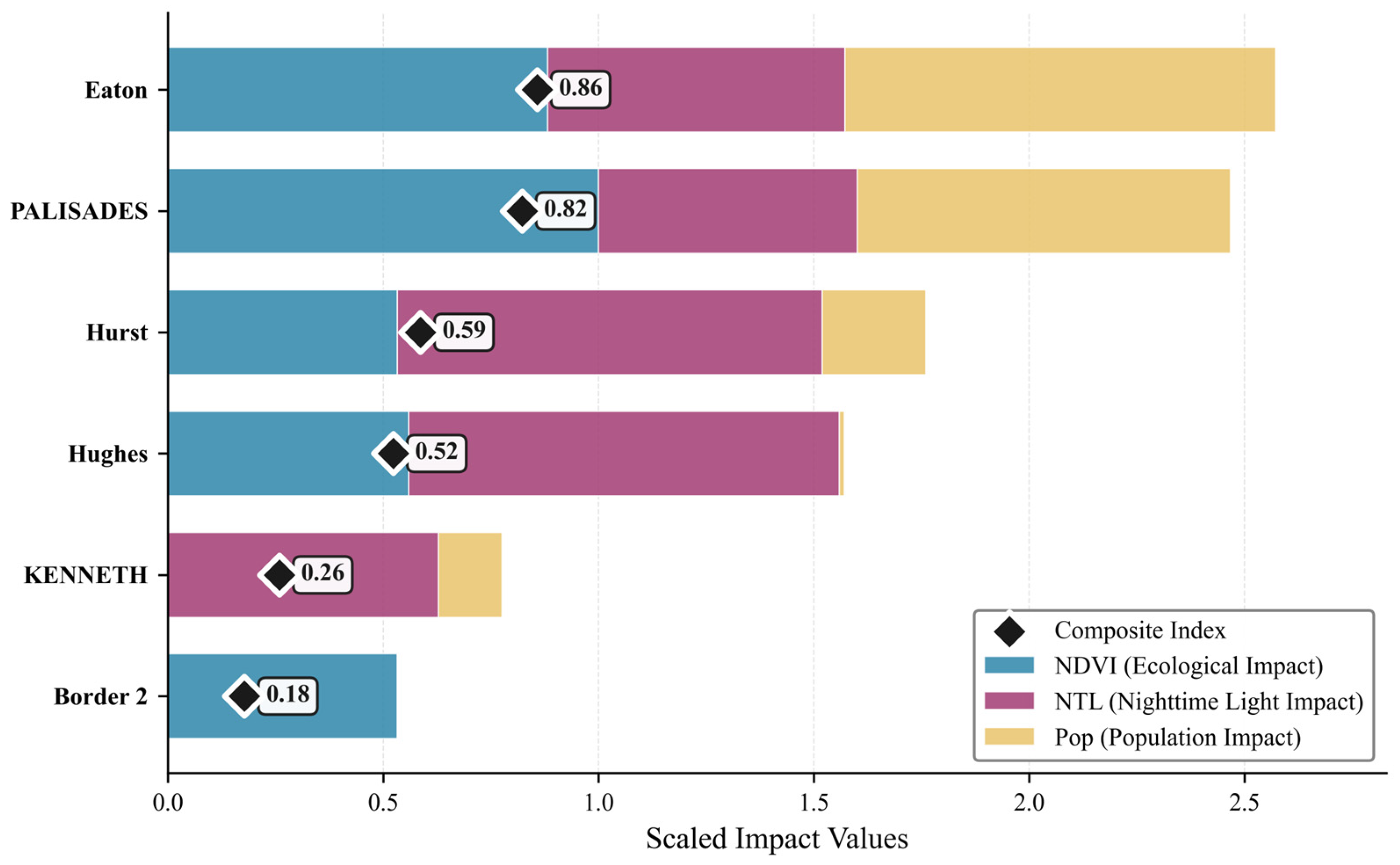
To achieve a comprehensive quantitative assessment of multidimensional disturbance, this study constructed the Composite Disturbance Index (ImpactIndex), which combines information on ecological damage (−ΔNDVI), nighttime light decrease (−ΔNTL), and population exposure (nightPop). As shown in Figure 12, the ImpactIndex does not merely rank the fire sites; it reveals three structurally distinct socio-ecological disturbance typologies within the WUI—patterns that would remain obscured under single-variable analyses.
Eaton and Palisades fall into the category of systemic dual-risk zones, which show jointly high NDVI′ loss and population exposure, producing the highest ImpactIndex values. This pattern reflects fires occurring near dense WUI areas with substantial vegetation fuel beds, where both ecological degradation and direct human-system exposure reinforce overall disturbance intensity. In contrast, Hurst and Hughes represent infrastructure-dominant shock zones. Although their overall ImpactIndex values are moderate, these sites show a pronounced imbalance dominated by extreme nighttime light decline (NTL′) despite low population exposure. This pattern indicates shocks concentrated in critical infrastructure nodes rather than residential communities—an impact mode that would be underestimated if evaluated only through ecological or demographic indicators. It underscores that even sparsely populated WUI fringes can exhibit high social-system fragility when key infrastructure is affected. Finally, Border 2 illustrates an ecological-specific stress zone, where disturbance mode is driven almost exclusively by ecological damage (NDVI′), while social impacts remain minimal. This decoupled pattern suggests a pure ecological stress regime, where management priorities should emphasize ecological restoration and fuel recovery rather than broad social relief or infrastructure repair.
In summary, the ImpactIndex deconstructs the complexity of WUI wildfire disturbance and demonstrates that risk is not spatially uniform but structurally differentiated. This typology forms a direct analytical bridge to the differentiated management and recovery strategies discussed in the Conclusion.

4.4. Driving Mechanism Analysis (Modeling Results)

To reveal the driving mechanisms behind the aforementioned disturbance and recovery phenomena, this study constructed three sets of regression models. To ensure statistical robustness, all OLS and GWR models were subjected to diagnostic tests, including Variance Inflation Factor (VIF) analysis for multicollinearity and Moran’s I analysis for spatial autocorrelation in the residuals.
As shown in Table 2, the Model M1 (Global OLS) residuals exhibited significant spatial autocorrelation (Moran’s I = 0.510, p = 0.001). This indicates that the simple OLS model failed the diagnostic test for spatial dependence, suggesting its results (e.g., nightPop p < 0.001) are statistically unstable. This limitation is discussed further in Section 5.4.
In contrast, Model M2, which employed a fixed-effects design, demonstrated high statistical robustness. As detailed in Table 2, the M2 model passed the VIF test (VIF = 4.55 for ΔNDVI) and its residuals showed no significant spatial autocorrelation (Moran’s I p = 0.372), satisfying the OLS assumptions.
The robust results from M2 (Adj. R2 = 0.806) confirm a core finding: after controlling for spatiotemporal fixed effects, the direct impact of ecological disturbance (ΔNDVI) on CNLI was not statistically significant (p = 0.322). Conversely, the fire site fixed effects (e.g., Eaton, Palisades) were highly significant (p < 0.001).
Table 3 compares the global OLS and GWR models for the M3 recovery mechanism. The global OLS model (M3-Global) was found to be statistically robust (Moran’s I p = 0.143) but possessed almost no explanatory power (Adj. R2 = 0.031).
To test the spatial heterogeneity hypothesis (Section 3.3), we applied a GWR model. Compared with the global OLS (Adj. R2 = 0.031; AICc = 175.0), the GWR achieved markedly better performance (Adj. R2 = 0.354; AICc = 157.3) and showed no residual spatial autocorrelation (Moran’s I p = 0.455), confirming that recovery patterns cannot be captured by a single global relationship.
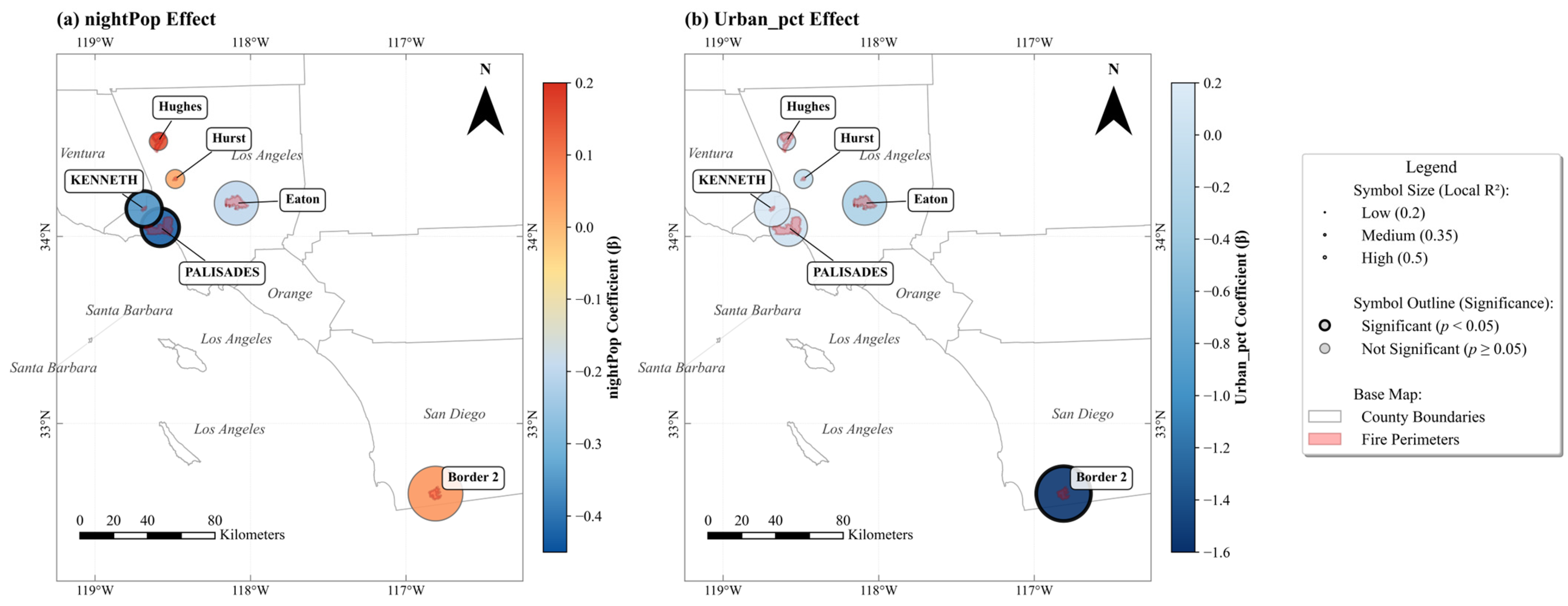
Due to the close spacing of buffer centroids (<310 m), within-cluster variation in local parameters is minimal; therefore, Figure 13 and Table 4 report a representative (25 km) buffer for each fire cluster.
The results show clear spatial divergence:
(1) nightPop Effect—Directional Reversal.
nightPop shows a strongly negative and statistically significant effect in high-density clusters such as Palisades, Eaton, and KENNETH (e.g., Mean Coef = −0.427 in Palisades). In contrast, the Hughes cluster exhibits a positive but statistically insignificant effect (Mean Coef = +0.153), indicating a directional reversal across contexts.
(2) Urban_pct Effect—Localized Influence.
Urban_pct is generally insignificant except in the Border 2 cluster, where it shows a strong negative association (Mean Coef = −1.567, p < 0.01), suggesting isolated pockets of urban-related constraints.
(3) Model Performance (Local R2).
The GWR model achieves higher explanatory power in the Border 2, Palisades, and Eaton clusters, indicating substantial spatial variation in model fit.
Overall, the GWR estimates reveal pronounced between-cluster differences in the determinants of post-fire recovery. These heterogeneous mechanisms are further interpreted in Section 5.3.

5. Discussion

5.1. Interpreting Heterogeneous Recovery Paths: The Case of the Anomalous NDVI Rebound

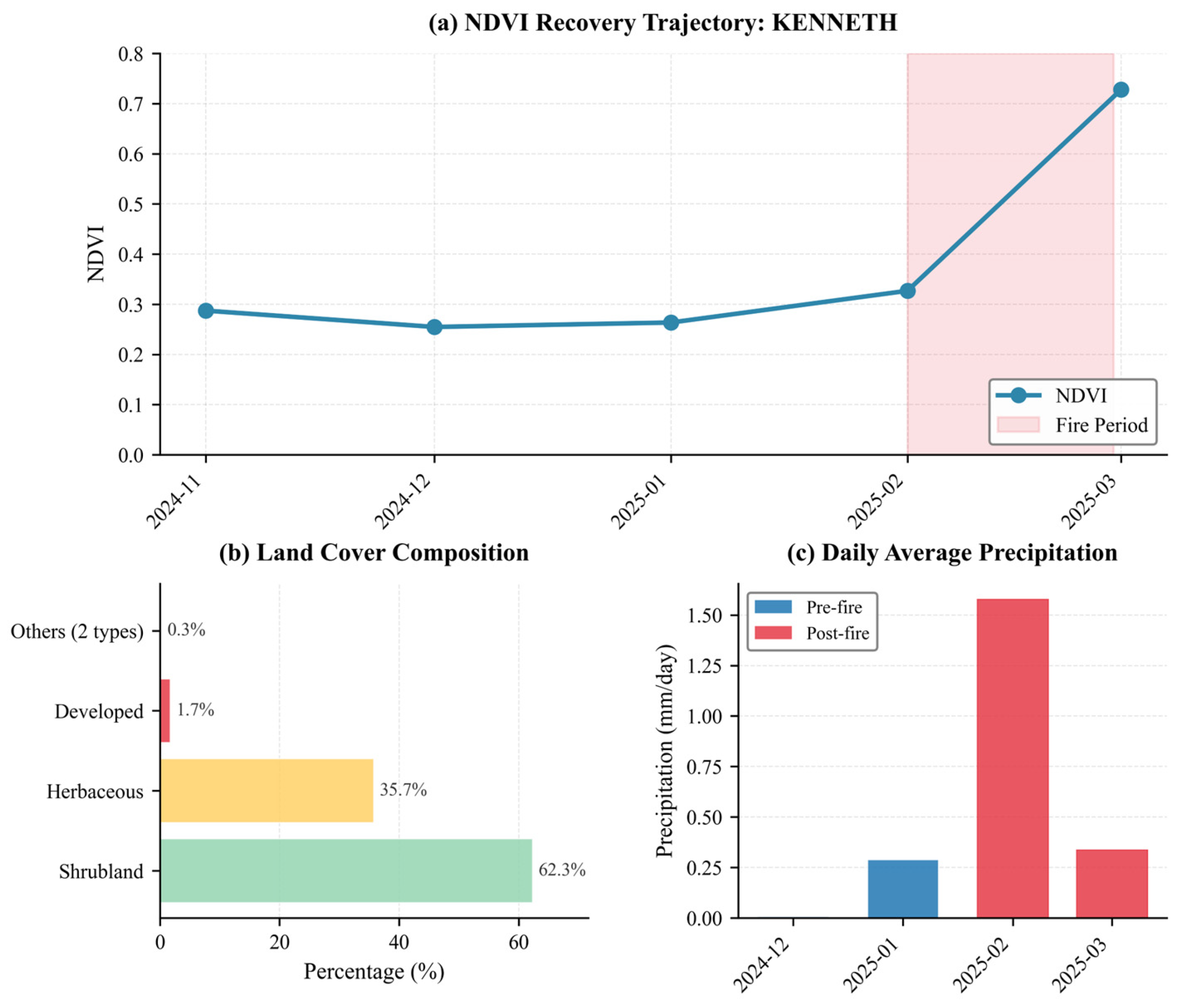
A significant finding of this study is the notable heterogeneity in the post-fire recovery pathways among the different fire sites, with the “anomalous” and robust rebound in ecological recovery at the Kenneth site being particularly prominent. As shown in Figure 14a, its NDVI not only recovered rapidly post-fire but also significantly surpassed pre-fire levels by March, a phenomenon that warrants in-depth discussion. Figure 14b,c offer a systematic perspective for explaining this phenomenon by integrating multi-faceted evidence.
We posit that this exceptional ecological recovery capacity is not coincidental, but rather the result of the combined effects of its unique ecological baseline, the relatively low intensity of the fire disturbance, and favorable post-fire climatic conditions.
First, in terms of its land use structure, over 90% of the Kenneth site consists of grassland and shrubland (Figure 14b). Unlike forest ecosystems, which require a prolonged period to recover after being damaged, this type of vegetation possesses a strong capacity for rapid post-fire germination and growth, characterized by a short life cycle and a swift response to favorable conditions.
Second, as we pointed out in the analysis in Section 4, the fire disturbance intensity in this area was relatively low and likely did not cause deep, devastating damage to the soil and root systems, thereby preserving the critical “ecological foundation” for a swift recovery.
Most critically, after the extreme drought in January, the study area received abundant precipitation during the critical recovery period (February to March). As shown in Figure 14c, these rain events provided the necessary moisture for the herbaceous-dominated ecosystem to green up rapidly. However, this recovery was not a result of normal seasonal conditions. As demonstrated in our results (Section 4.1, Figure 5a,b), the 2025 winter was an abnormally warm and dry year, with significantly lower overall precipitation and soil moisture compared to the 2024 baseline. Therefore, the anomalous NDVI rebound at KENNETH was not driven by a seasonally wet year; rather, it demonstrates the high resilience of an herbaceous ecosystem responding rapidly to short-term precipitation pulses despite the severe overall seasonal drought. Previous ecological studies have similarly noted that low-intensity fires can temporarily enhance soil nutrient availability and promote short-term vegetation growth, resulting in a “post-fire greening” phenomenon where NDVI briefly exceeds pre-fire levels [48,49,50].
Taken together, it is ecologically logical for a grassland-dominated ecosystem with high recovery potential to exhibit a rapid and exceptional rebound in its NDVI (Figure 14b) after experiencing a low-intensity surface fire and receiving timely post-fire precipitation. This finding also profoundly underscores the importance of moving beyond single disturbance indicators when assessing the ecological impacts of WUI fires and comprehensively considering the heterogeneity of multiple factors, including regional vegetation type, fire severity, and post-fire climatic conditions.

5.2. The Complex Nature of Nighttime Light Signals in Disaster Contexts

The statistical evidence from the panel model provides an important insight into the behavior of nighttime light signals during the wildfire period. Although ΔNDVI reflects the intensity of ecological disturbance, it did not exhibit a significant association with the during-disaster CNLI. This indicates that variation in CNLI cannot be attributed to ecological damage alone.
A more plausible explanation is that nighttime light during the fire reflects a mixture of processes. Ecological disturbance typically suppresses normal socioeconomic activity through power outages, evacuations, and business interruptions, which would be expected to reduce light emissions. At the same time, areas experiencing severe damage often become centers of intensive emergency activity. Large-scale rescue operations, temporary facilities, repair work, and the use of mobile lighting equipment introduce additional illumination that can offset—or even exceed—the reduction in routine lighting. This dual-signal mechanism provides a coherent interpretation of why ΔNDVI does not predict CNLI during the disaster.
The temporal patterns observed in the CNLI time series (Figure 10) support this interpretation. Brightness increased noticeably during the early recovery period (February 2025), particularly in the Eaton and Palisades clusters, suggesting that short-term illumination was influenced more by concentrated emergency operations than by routine socioeconomic recovery.
The fixed-effects estimates further reinforce this explanation. While ΔNDVI remained insignificant, the fire-site fixed effects were highly significant, indicating substantial cross-site heterogeneity that persists after controlling for ecological disturbance. These site-specific effects likely capture underlying characteristics such as baseline socioeconomic structure, infrastructure conditions, and the scale of emergency response. Similar observations have been reported by Li et al. (2025) in post-earthquake analyses, where emergency operations produced short-term surges in nighttime illumination that were not directly related to routine economic activity [21].
Taken together, these results highlight the importance of distinguishing between routine economic lighting and emergency-response lighting when interpreting nighttime light data during extreme events. Without this separation, CNLI may not accurately reflect socioeconomic disruption, particularly in locations where emergency response behaviors dominate the signal.

5.3. Spatial Heterogeneity in the Drivers of Social Recovery

The modeling results in Section 4.4 definitively confirmed that the social structure’s impact on recovery is spatially heterogeneous. The statistical superiority of the GWR model over the global OLS baseline (demonstrated by the tenfold increase in R2 and elimination of spatial autocorrelation) provides the empirical foundation for examining these localized mechanisms. Instead of a uniform driver, we identify three distinct context-dependent recovery modes:
(1) The “Structural Burden” Effect in High-Density WUI. Our GWR analysis revealed a statistically significant negative coupling between nighttime population and recovery rates in the Palisades and KENNETH clusters. This finding empirically supports the “Structural Burden” hypothesis [51,52]. In these densely populated and highly urbanized WUI zones, the pre-fire complexity of infrastructure and social systems appears to transform from an asset into a liability during the immediate recovery phase. The sheer scale of demand for limited recovery resources (e.g., grid repairs, supply chain logistics) and the friction of coordinating large-scale reconstruction likely create a “bottleneck effect,” slowing the restoration of socioeconomic vitality (CNLI) despite high baseline development levels.
(2) The Absence of Significant “Recovery Vitality” in Low-Density Areas. In contrast to the high-density zones, the Hughes cluster (a remote, sparsely populated area) exhibited a positive relationship between population and recovery. However, crucially, this trend was not statistically significant. This suggests an asymmetric mechanism: while high population density can significantly hinder recovery (burden), lower population density does not automatically guarantee a significantly faster recovery (vitality). This nuance challenges the simplistic “social capital” assumption, suggesting that in rural WUI fringes, recovery may be driven more by external factors (e.g., fire severity or topography) than by endogenous social structural forces.
(3) Context-Specific Constraints of Urban Form. The strong negative impact of urbanization (Urban_pct) observed specifically in the Border 2 cluster further reinforces the context-dependency. In this border region, specific urban development patterns—likely interacting with its unique geography—posed distinct challenges to recovery that were not present in other clusters.
Overall, these results support the perspective of social vulnerability theory, which posits that some social-structural indicators can exert both positive and negative influences depending on context [22,25,53]. Our results suggest that the influence of social structure on recovery capacity is not a simple linear process, but rather highly context-dependent. Whether a region’s social structure acts as an “engine” or a “brake” for recovery likely depends on the complex interplay among the actual extent of disaster damage, the region’s infrastructural carrying capacity, and its post-disaster governance model.

5.4. Limitations and Future Research Directions

Although this study provides a new perspective for the multidimensional impact assessment of fires in WUI regions, it still has several limitations.
First, at the data level, several challenges must be acknowledged. The VIIRS nighttime light product (VNP46A2) used in this study was first screened using its quality assurance flag to retain only high-quality observations (quality flag = 0). Although this filtering procedure effectively reduces atmospheric and stray-light interference, minor uncertainties may still remain due to residual effects from clouds, aerosols, and moonlight that can influence NTL observations [54]. Moreover, while the product is atmospherically corrected, residual signals from non-social light sources—such as wildfires or emergency illumination—may still occur during disaster periods. Furthermore, as discussed in Section 5.2, the signal in a disaster context is complex and easily contaminated by atypical sources such as emergency lighting [21,55]. The NDVI compositing process, which combined harmonized Landsat 8/9 and Sentinel-2 surface reflectance data, substantially improved temporal continuity but may still be influenced by minor spectral and radiometric inconsistencies between sensors. The NDVI metric also has known sensitivity limitations in areas with low or sparse vegetation coverage [56], which may partly explain the anomalous ‘post-fire greening’ effect observed in the KENNETH cluster and warrants caution when interpreting ecological recovery in semi-arid regions. Finally, the annually updated LandScan population data cannot capture real-time exposure dynamics [57].
Second, at the methodological level, our diagnostic tests revealed the significant limitations of a simple global OLS model. As reported in Table 2, the Model M1 residuals failed diagnostics for both spatial autocorrelation (Moran’s I p = 0.001) and normality (Jarque–Bera p = 0.005). This violation of OLS assumptions statistically confirms that a simple global model is insufficient for capturing the complex spatial processes of a disaster. This finding, however, underscores the necessity of the more robust models used in our main analysis: the M2 (Fixed Effects) model (which passed all diagnostics, Moran’s I p = 0.372) and the M3 (GWR) model (which also passed, Moran’s I p = 0.455).
Finally, the conclusions of this study are based on a specific case in Southern California, and their generalizability to other geographical environments or disaster types requires further validation.
To address these challenges, future research should advance both data integration and methodological innovation.
On the data side, future studies could attempt to combine manual masking methods, thermal anomaly data, and field investigations to extract more accurate nighttime light (NTL) data in disaster scenarios, thereby mitigating the interference from non-social light sources.
Furthermore, incorporating higher-resolution and multi-sensor fusion approaches could improve precision. For instance, active sensors such as LiDAR and radar can complement optical NDVI observations, helping to mitigate spectral inconsistencies and residual atmospheric noise. Extending the temporal coverage of satellite and socioeconomic datasets to form longer, multi-year time series would also allow for more robust trend detection and post-disturbance recovery trajectory analysis.
In parallel, integrating near–real-time demographic and mobility datasets (e.g., mobile signaling or social media data) would overcome the temporal limitations of annual population grids, enabling a more dynamic depiction of exposure and recovery processes [58,59].
On the methodological front, future work should build upon the identified limitations of the global OLS model (M1) and the success of the GWR model (M3) by exploring Multiscale Geographically Weighted Regression (MGWR) and Geographically and Temporally Weighted Regression (GTWR) to capture scale-dependent and dynamic processes. Additionally, applying Spatial Lag/Error Models (SLM/SEM) or Structural Equation Models (SEM) [60], could help formally untangle complex causal pathways and spatial dependencies. Expanding the analytical framework to encompass broader geographic contexts and diverse disaster types, while complementing quantitative modeling with qualitative approaches such as field surveys or interviews, would also help reveal more generalizable and context-specific recovery mechanisms. Ultimately, constructing more comprehensive socio-ecological feedback coupling models and promoting the translation of research findings into practical risk governance will be important future directions for the field.

6. Conclusions

This study developed a multidimensional assessment framework integrating multi-source remote sensing data with socio-structural information to analyze the January 2025 Southern California wildfires. By employing Fixed-Effects and Geographically Weighted Regression (GWR) models, we systematically revealed the driving mechanisms of socio-ecological disturbance and recovery. Three major insights emerge:
First, we redefine the interpretation of nighttime light (NTL) signals in disaster contexts. Our analysis statistically confirms that during-disaster NTL is decoupled from ecological damage and is instead dominated by site-specific factors. This challenges the conventional assumption that NTL purely reflects social functionality, suggesting it is a composite signal heavily shaped by emergency response intensity.
Second, we confirm an “asymmetric spatial heterogeneity” in post-fire recovery. The GWR model significantly outperformed the global baseline, revealing that social structure does not influence recovery uniformly. We identified a distinct “Structural Burden” effect in high-density WUI areas, where dense populations and complex infrastructure significantly inhibit recovery rates. In contrast, low-density areas did not exhibit a statistically significant “social capital” advantage, indicating that recovery mechanisms are highly context-dependent.
Based on these findings, we propose a two-stage “Assessment–Decision” framework for resilience governance. The ImpactIndex can be used to rapidly diagnose high-risk zones, while the GWR results provide evidence for differentiated interventions. Specifically, it is recommended that local authorities should not assume self-recovery in high-density WUI zones (e.g., Palisades); instead, these areas require prioritized external resource allocation and coordinated governance to overcome their inherent structural burdens.
By integrating a Composite Disturbance Index with spatial regression modeling, this study decouples the complex signals of wildfire impacts and reveals the non-uniform role of social structure. These insights advance the understanding of asymmetric resilience and provide a theoretical foundation and practical tool for spatially adaptive planning in fire-prone WUI regions globally.

Author Contributions

Conceptualization, X.W. and S.L.; methodology, X.W. and S.L.; software, X.W.; validation, X.W. and S.L.; formal analysis, X.W.; investigation, X.W.; resources, S.L.; data curation, X.W.; writing—original draft preparation, X.W.; writing—review and editing, S.L.; visualization, X.W.; supervision, S.L.; project administration, X.W.; funding acquisition, S.L. All authors have read and agreed to the published version of the manuscript.

Funding

This work was supported by the National Natural Science Foundation of China (grant no. 42501451).

Data Availability Statement

The remote sensing and ancillary data used in this study are all publicly available. Landsat 8/9 and Sentinel-2 imagery were accessed through the U.S. Geological Survey (USGS) and the European Space Agency (ESA) portals, respectively. The VIIRS “Black Marble” nighttime light products (VNP46A2) were obtained from the NASA LAADS DAAC. The LandScan USA population data is available from the Oak Ridge National Laboratory (ORNL). The National Land Cover Database (NLCD) is provided by the USGS. The ERA5-Land Reanalysis data were sourced from the European Centre for Medium-Range Weather Forecasts (ECMWF). Fire perimeter and active fire point data are available from the Wildland Fire Interagency Geospatial Services (WFIGS) and NASA’s Fire Information for Resource Management System (FIRMS), respectively.

Acknowledgments

We thank the U.S. National Aeronautics and Space Administration (NASA), the U.S. Geological Survey (USGS), and the European Space Agency (ESA) for making the remote sensing data used in this study publicly available. The authors appreciate the constructive reviews by the anonymous reviewers and the editors, which noticeably improved our paper quality.

Conflicts of Interest

The authors declare no conflicts of interest.

Abbreviations

The following abbreviations are used in this manuscript:
ANLIAverage Nighttime Light Index
CNLICompounded Nighttime Light Index
ECMWFEuropean Center for Medium-Range Weather Forecasts
ESAEuropean Space Agency
FIRMSFire Information for Resource Management System
GWRGeographically Weighted Regression
MVCMonthly Value Composite
NASANational Aeronautics and Space Administration
NLCDNational Land Cover Database
NDVINormalized Difference Vegetation Index
NTLNighttime Light
SESSocial–Ecological Systems
SoVISocial Vulnerability Index
TNLITotal Nighttime Light Index
USGSU.S. Geological Survey
WFIGSWildland Fire Interagency Geospatial Services
WUIWildland–Urban Interface

References

  1. Jones, M.W.; Kelley, D.I.; Burton, C.A.; Di Giuseppe, F.; Barbosa, M.L.F.; Brambleby, E.; Hartley, A.J.; Lombardi, A.; Mataveli, G.; McNorton, J.R.; et al. State of Wildfires 2023–2024. Earth Syst. Sci. Data 2024, 16, 3601–3685. [Google Scholar] [CrossRef]
  2. Chen, B.; Wu, S.; Jin, Y.; Song, Y.; Wu, C.; Venevsky, S.; Xu, B.; Webster, C.; Gong, P. Wildfire risk for global wildland–urban interface areas. Nat. Sustain. 2024, 7, 474–484. [Google Scholar] [CrossRef]
  3. Tang, W.; Emmons, L.K.; Wiedinmyer, C.; Partha, D.B.; Huang, Y.; He, C.; Zhang, J.; Barsanti, K.C.; Gaubert, B.; Jo, D.S.; et al. Disproportionately large impacts of wildland-urban interface fire emissions on global air quality and human health. Sci. Adv. 2025, 11, eadr2616. [Google Scholar] [CrossRef]
  4. Higuera, P.E.; Cook, M.C.; Balch, J.K.; Stavros, E.N.; Mahood, A.L.; Denis, L.A.S. Shifting social-ecological fire regimes explain increasing structure loss from Western wildfires. PNAS Nexus 2023, 2, pgad005. [Google Scholar] [CrossRef]
  5. Cheney, A.; Jones, K.W.; Stevens-Rumann, C.S.; Salerno, J. Perceived changes in social-ecological resilience in fire-prone ecosystems in Colorado. Ecol. Soc. 2024, 29, 5. [Google Scholar] [CrossRef]
  6. Sandoval-Díaz, J.; Navarrete-Valladares, C.; Vega-Ortega, J.; Suazo-Muñoz, C.; Gallegos Riquelme, J.P.; Sandoval-Obando, E.; Valenzuela, C.R. Community resilience to wildfires: A systematic review of impacts, coping strategies, indicators, and governance challenges. Prog. Disaster Sci. 2025, 27, 100447. [Google Scholar] [CrossRef]
  7. Sloan, E.E.; Hajjar, R.; Davis, E.J. Equity in resilience: A case study of community resilience to wildfire in southwestern Oregon, United States. Ecol. Soc. 2025, 30, 20. [Google Scholar] [CrossRef]
  8. Vigna, I.; Besana, A.; Comino, E.; Pezzoli, A. Application of the Socio-Ecological System Framework to Forest Fire Risk Management: A Systematic Literature Review. Sustainability 2021, 13, 2121. [Google Scholar] [CrossRef]
  9. Ostrom, E. A General Framework for Analyzing Sustainability of Social-Ecological Systems. Science 2009, 325, 419–422. [Google Scholar] [CrossRef] [PubMed]
  10. Folke, C.; Carpenter, S.; Walker, B.; Scheffer, M.; Rockström, J. Resilience Thinking: Integrating Resilience, Adaptability and Transformability. Ecol. Soc. 2010, 15, 20. [Google Scholar] [CrossRef]
  11. Alegria, C. Vegetation Monitoring and Post-Fire Recovery: A Case Study in the Centre Inland of Portugal. Sustainability 2022, 14, 12698. [Google Scholar] [CrossRef]
  12. Hernández-Duarte, A.; Saavedra, F.; González, E.; Miranda, A.; Francois, J.-P.; Somos-Valenzuela, M.; Sibold, J. Effects of Drought and Fire Severity Interaction on Short-Term Post-Fire Recovery of the Mediterranean Forest of South America. Fire 2024, 7, 428. [Google Scholar] [CrossRef]
  13. Gülci, S.; Wing, M.G. Evaluating forest fire severity and vegetative recovery using Sentinel imagery and spectral indices in a cloud-based environment. Adv. Space Res. 2025, 76, 4092–4105. [Google Scholar] [CrossRef]
  14. Runge, K.; Tucker, M.; Crowther, T.W.; Fournier de Laurière, C.; Guirado, E.; Bialic-Murphy, L.; Berdugo, M. Monitoring Terrestrial Ecosystem Resilience Using Earth Observation Data: Identifying Consensus and Limitations Across Metrics. Glob. Change Biol. 2025, 31, e70115. [Google Scholar] [CrossRef]
  15. Scheffer, M.; Bascompte, J.; Brock, W.; Brovkin, V.; Carpenter, S.; Dakos, V.; Held, H.; Nes, E.; Rietkerk, M.; Sugihara, G. Early-Warning Signals for Critical Transitions. Nature 2009, 461, 53–59. [Google Scholar] [CrossRef] [PubMed]
  16. Bathiany, S.; Bastiaansen, R.; Bastos, A.; Blaschke, L.; Lever, J.; Loriani, S.; De Keersmaecker, W.; Dorigo, W.; Milenković, M.; Senf, C.; et al. Ecosystem Resilience Monitoring and Early Warning Using Earth Observation Data: Challenges and Outlook. Surv. Geophys. 2025, 46, 265–301. [Google Scholar] [CrossRef]
  17. Liu, Y.; Liu, W.; Zhang, X.; Lin, Y.; Zheng, G.; Zhao, Z.; Cheng, H.; Gross, L.; Li, X.; Wei, B.; et al. Nighttime light perspective in urban resilience assessment and spatiotemporal impact of COVID-19 from January to June 2022 in mainland China. Urban Clim. 2023, 50, 101591. [Google Scholar] [CrossRef]
  18. Chen, X.; Wang, Z.; Zhang, F.; Shen, G.; Chen, Q. A global annual simulated VIIRS nighttime light dataset from 1992 to 2023. Sci. Data 2024, 11, 1380. [Google Scholar] [CrossRef] [PubMed]
  19. Schippers, V.; Botzen, W. Uncovering the veil of night light changes in times of catastrophe. Nat. Hazards Earth Syst. Sci. 2023, 23, 179–204. [Google Scholar] [CrossRef]
  20. Dong, B.; Zhang, R.; Li, S.; Ye, Y.; Huang, C. A meta-analysis for the nighttime light remote sensing data applied in urban research: Key topics, hotspot study areas and new trends. Sci. Remote Sens. 2025, 11, 100186. [Google Scholar] [CrossRef]
  21. Li, F.; Liao, S.; Fu, X.; Liu, T. NPP-VIIRS Nighttime Lights Illustrate the Post-Earthquake Damage and Subsequent Economic Recovery in Hatay Province, Turkey. ISPRS Int. J. Geo-Inf. 2025, 14, 149. [Google Scholar] [CrossRef]
  22. Cutter, S.L. The origin and diffusion of the social vulnerability index (SoVI). Int. J. Disaster Risk Reduct. 2024, 109, 104576. [Google Scholar] [CrossRef]
  23. Hai-feng, Y.; Guo-fang, Z. Spatial assessment and driving mechanism of urban safety from the perspective of disaster risk: Acase study of Chuzhou central city. J. Nat. Resour. 2021, 36, 2368–2381. [Google Scholar]
  24. Contreras, D.; Chamorro, A.; Wilkinson, S. Review article: The spatial dimension in the assessment of urban socio-economic vulnerability related to geohazards. Nat. Hazards Earth Syst. Sci. 2020, 20, 1663–1687. [Google Scholar] [CrossRef]
  25. Martínez-Fernández, J.; Chuvieco, E.; Koutsias, N. Modelling long-term fire occurrence factors in Spain by accounting for local variations with geographically weighted regression. Nat. Hazards Earth Syst. Sci. 2013, 13, 311–327. [Google Scholar] [CrossRef]
  26. Pahlavani, P.; Raei, A.; Bigdeli, B.; Ghorbanzadeh, O. Identifying Influential Spatial Drivers of Forest Fires through Geographically and Temporally Weighted Regression Coupled with a Continuous Invasive Weed Optimization Algorithm. Fire 2024, 7, 33. [Google Scholar] [CrossRef]
  27. Mockrin, M.; Fishler, H.; Kramer, H.; Radeloff, V.; Stewart, S. A Tale of Two Fires: Retreat and Rebound a Decade After Wildfires in California and South Carolina. Soc. Nat. Resour. 2022, 35, 875–895. [Google Scholar] [CrossRef]
  28. Syphard, A.D.; Radeloff, V.C.; Keeley, J.E.; Hawbaker, T.J.; Clayton, M.K.; Stewart, S.I.; Hammer, R.B. Human Influence on California Fire Regimes. Ecol. Appl. 2007, 17, 1388–1402. [Google Scholar] [CrossRef]
  29. Radeloff, V.C.; Hammer, R.B.; Stewart, S.I.; Fried, J.S.; Holcomb, S.S.; McKeefry, J.F. The Wildland–Urban Interface in The United States. Ecol. Appl. 2005, 15, 799–805. [Google Scholar] [CrossRef]
  30. Radeloff, V.C.; Helmers, D.P.; Kramer, H.A.; Mockrin, M.H.; Alexandre, P.M.; Bar-Massada, A.; Butsic, V.; Hawbaker, T.J.; Martinuzzi, S.; Syphard, A.D.; et al. Rapid growth of the US wildland-urban interface raises wildfire risk. Proc. Natl. Acad. Sci. USA 2018, 115, 3314–3319. [Google Scholar] [CrossRef]
  31. Rolinski, T.; Capps, S.B.; Fovell, R.G.; Cao, Y.; D’Agostino, B.J.; Vanderburg, S. The Santa Ana Wildfire Threat Index: Methodology and Operational Implementation. Weather Forecast. 2016, 31, 1881–1897. [Google Scholar] [CrossRef]
  32. Keeley, J.E.; Syphard, A.D. Twenty-first century California, USA, wildfires: Fuel-dominated vs. wind-dominated fires. Fire Ecol. 2019, 15, 24. [Google Scholar] [CrossRef]
  33. Qiu, M.; Chen, D.; Kelp, M.; Li, J.; Huang, G.; Yazdi, M.D. The rising threats of wildland-urban interface fires in the era of climate change: The Los Angeles 2025 fires. Innovation 2025, 6, 100835. [Google Scholar] [CrossRef] [PubMed]
  34. Westerling, A.L. Increasing western US forest wildfire activity: Sensitivity to changes in the timing of spring. Philos. Trans. R. Soc. B Biol. Sci. 2016, 371, 20150178. [Google Scholar] [CrossRef]
  35. Weber, E.; Moehl, J.; Weston, S.; Rose, A.; Brelsford, C.; Hauser, T. LandScan USA 2021. 2022. Available online: https://landscan.ornl.gov/ (accessed on 6 May 2025).
  36. Tran, K.H.; Zhang, X.; Ye, Y.; Shen, Y.; Gao, S.; Liu, Y.; Richardson, A. HP-LSP: A reference of land surface phenology from fused Harmonized Landsat and Sentinel-2 with PhenoCam data. Sci. Data 2023, 10, 691. [Google Scholar] [CrossRef]
  37. Seaquist, J.; Chappell, A.; Eklundh, L. Exploring and improving NOAA AVHRR NDVI image quality for African drylands. In Proceedings of the IEEE International Geoscience and Remote Sensing Symposium, Toronto, ON, Canada, 24–28 June 2002; Volume 4, pp. 2006–2008. [Google Scholar]
  38. Zheng, Q.; Weng, Q.; Zhou, Y.; Dong, B. Impact of temporal compositing on nighttime light data and its applications. Remote Sens. Environ. 2022, 274, 113016. [Google Scholar] [CrossRef]
  39. McClure, C.D.; Pavlovic, N.R.; Huang, S.; Chaveste, M.; Wang, N. Consistent, high-accuracy mapping of daily and sub-daily wildfire growth with satellite observations. Int. J. Wildland Fire 2023, 32, 694–708. [Google Scholar] [CrossRef]
  40. Chen, Y.; Hantson, S.; Andela, N.; Coffield, S.R.; Graff, C.A.; Morton, D.C.; Ott, L.E.; Foufoula-Georgiou, E.; Smyth, P.; Goulden, M.L.; et al. California wildfire spread derived using VIIRS satellite observations and an object-based tracking system. Sci. Data 2022, 9, 249. [Google Scholar] [CrossRef]
  41. Guo, Y.; Wang, J.; Ge, Y.; Zhou, C. Global expansion of wildland-urban interface intensifies human exposure to wildfire risk in the 21st century. Sci. Adv. 2024, 10, eado9587. [Google Scholar] [CrossRef] [PubMed]
  42. Caceres, C. Using GIS in Hotspots Analysis and for Forest Fire Risk Zones Mapping in the Yeguare Region, Southeastern Honduras. Pap. Resour. Anal. 2011, 13, 1–14. [Google Scholar]
  43. Haslem, A.; Radford, J.Q.; Bennett, A.F.; Watson, S.J.; Chick, M.P.; Huang, J.; Berry, L.E.; Clarke, M.F. Measuring the ecological outcomes of fire: Metrics to guide fire management. Fire Ecol. 2024, 20, 99. [Google Scholar] [CrossRef]
  44. Wenyi, L.; Yaohui, L.; Zhenchang, G.; Yun, S.; Jie, Z.; Benyong, W.; Xiwei, F.; Xiaoli, L. Dynamic monitoring of recovery after the 2017 Jiuzhaigou earthquake based on NPP—VIIRS night light data. Beijing Surv. Mapp. 2022, 36, 1739–1746. [Google Scholar] [CrossRef]
  45. Ma, T.; Xu, T.; Huang, L.; Zhou, A. A Human Settlement Composite Index (HSCI) Derived from Nighttime Luminosity Associated with Imperviousness and Vegetation Indexes. Remote Sens. 2018, 10, 455. [Google Scholar] [CrossRef]
  46. Meng, X.; Han, J.; Huang, C. An Improved Vegetation Adjusted Nighttime Light Urban Index and Its Application in Quantifying Spatiotemporal Dynamics of Carbon Emissions in China. Remote Sens. 2017, 9, 829. [Google Scholar] [CrossRef]
  47. Li, F.; Liu, X.; Liao, S.; Jia, P. The Modified Normalized Urban Area Composite Index: A Satelliate-Derived High-Resolution Index for Extracting Urban Areas. Remote Sens. 2021, 13, 2350. [Google Scholar] [CrossRef]
  48. Liu, L.; Zhu, T. Low-intensity fire stimulates soil inorganic N supply and adjusts plant N utilization strategy to alleviate plant N limitation in rocky desertification area. In Proceedings of the EGU GA 2025, Vienna, Austria, 27 April–2 May 2025. [Google Scholar]
  49. Pereira, P.; Cerda, A.; Martin, D.; Úbeda, X.; Depellegrin, D.; Novara, A.; Martínez-Murillo, J.F.; Brevik, E.C.; Menshov, O.; Comino, J.R.; et al. Short-term low-severity spring grassland fire impacts on soil extractable elements and soil ratios in Lithuania. Sci. Total Environ. 2017, 578, 469–475. [Google Scholar] [CrossRef] [PubMed]
  50. Quintero-Gradilla, S.D.; García-Oliva, F.; Cuevas-Guzmán, R.; Jardel-Peláez, E.J.; Martínez-Yrizar, A. Soil Carbon and Nutrient Recovery after High-Severity Wildfire in Mexico. Fire Ecol. 2015, 11, 45–61. [Google Scholar] [CrossRef]
  51. Morgan, G.R.; Kemp, E.M.; Habets, M.; Daniels-Baessler, K.; Waddington, G.; Adamo, S.; Hultquist, C.; Cutter, S.L. Defining Disadvantaged Places: Social Burdens of Wildfire Exposure in the Eastern United States, 2000–2020. Fire 2024, 7, 124. [Google Scholar] [CrossRef]
  52. Zheng, Q.; Yiwen, Z.; Zhou, Y.; Wang, Z.; Mu, T. Nighttime lights reveal substantial spatial heterogeneity and inequality in post-hurricane recovery. Remote Sens. Environ. 2025, 319, 114645. [Google Scholar] [CrossRef]
  53. Modaresi Rad, A.; Abatzoglou, J.T.; Fleishman, E.; Mockrin, M.H.; Radeloff, V.C.; Pourmohamad, Y.; Cattau, M.; Johnson, J.M.; Higuera, P.; Nauslar, N.J.; et al. Social vulnerability of the people exposed to wildfires in U.S. West Coast states. Sci. Adv. 2023, 9, eadh4615. [Google Scholar] [CrossRef]
  54. Levin, N. Challenges in remote sensing of night lights—A research agenda for the next decade. Remote Sens. Environ. 2025, 328, 114869. [Google Scholar] [CrossRef]
  55. Li, X.; Zhou, Y. Urban mapping using DMSP/OLS stable night-time light: A review. Int. J. Remote Sens. 2017, 38, 6030–6046. [Google Scholar] [CrossRef]
  56. Chu, D.; Shen, H.; Guan, X.; Chen, J.M.; Li, X.; Li, J.; Zhang, L. Long time-series NDVI reconstruction in cloud-prone regions via spatio-temporal tensor completion. Remote Sens. Environ. 2021, 264, 112632. [Google Scholar] [CrossRef]
  57. Qiang, Y. Disparities of population exposed to flood hazards in the United States. J. Environ. Manag. 2019, 232, 295–304. [Google Scholar] [CrossRef]
  58. Torres, Y.; Arranz, J.J.; Gaspar-Escribano, J.M.; Haghi, A.; Martínez-Cuevas, S.; Benito, B.; Ojeda, J.C.G. Integration of LiDAR and multispectral images for rapid exposure and earthquake vulnerability estimation. Application in Lorca, Spain. Int. J. Appl. Earth Obs. Geoinf. 2018, 81, 161–175. [Google Scholar] [CrossRef]
  59. Xu, Z.; Li, J.; Cheng, S.; Rui, X.; Zhao, Y.; He, H.; Guan, H.; Sharma, A.; Erxleben, M.; Chang, R.; et al. Deep learning for wildfire risk prediction: Integrating remote sensing and environmental data. ISPRS J. Photogramm. Remote Sens. 2025, 227, 632–677. [Google Scholar] [CrossRef]
  60. Boonnuk, T.; Poomphakwaen, K.; Kumyoung, N. Application for simulating public health problems during floods around the Loei River in Thailand: The implementation of a geographic information system and structural equation model. BMC Public Health 2022, 22, 1651. [Google Scholar] [CrossRef] [PubMed]
Figure 1. Overview of the study area in Southern California, including location (a), elevation (b), land use types, and distribution of urban centers (c).
Remotesensing 17 03851 g001
Figure 2. Spatial distribution and Fire Radiative Power (FRP) of the six selected wildfire events in Southern California. (a) Regional overview with inset extents outlined in red; (b) Southern fire cluster (Border 2); (c) Northern fire clusters (Palisades, Eaton, Hurst, KENNETH, Hughes). Higher FRP values indicate greater fire intensity.
Remotesensing 17 03851 g002
Figure 3. Research Framework.
Remotesensing 17 03851 g003
Figure 4. Illustration of the point-perimeter synergy strategy and multi-distance buffer construction, using the PALISADES fire point as an example.
Remotesensing 17 03851 g004
Figure 5. Pre-fire meteorological conditions and land use composition across the six wildfire sites.
Remotesensing 17 03851 g005
Figure 6. Spatial distribution of ecological disturbance, measured by the change in NDVI (ΔNDVI) between the pre-fire baseline (December 2024) and the post-fire peak disturbance (February 2025). (a) Overview map of the Southern California study area, with red boxes and arrows indicating the locations of the six fire clusters. (bg) Detailed inset maps for each cluster, spatially clipped to the Fire Boundary to visualize disturbance within the perimeter.
Remotesensing 17 03851 g006
Figure 7. Spatial distribution of social disturbance, indicated by peak nighttime light change (ΔNTLpeak). (a) Overview of the study area in Southern California, with inset extents shown in red. (b) Inset map showing the northern fire clusters (e.g., Hughes, Hurst, Palisades, Eaton). (c) Inset map showing the southern fire cluster (Border 2). Blue/Red values indicate NTL loss/gain relative to the pre-fire baseline.
Remotesensing 17 03851 g007
Figure 8. Multi-scale spatial gradient analysis of social disturbance (ΔNTLperiod). The plot compares the change in nighttime light ΔNTL between the disturbance period (late January 2025) and the baseline (late December 2024) across increasing buffer radius (km), with (af) each showing the unique spatial gradient for one of the six fire clusters.
Remotesensing 17 03851 g008
Figure 9. Spatial distribution of pixel-level nighttime light recovery (NTLpixel_ratio). (a) Overview of the study area in Southern California, with inset extents shown in red; (b) Inset map showing the northern fire clusters; (c) Inset map showing the southern fire cluster. The ratio represents the comparison of post-fire (March 2025) to pre-fire (December 2024) NTL values.
Remotesensing 17 03851 g009
Figure 10. Asynchrony in socio-ecological recovery, showing monthly trends. Each subplot uses a dual Y-axis to compare the mean NDVI (blue line, left axis) with the mean CNLI (purple, right axis). The shaded area indicates the post-fire period (February–March 2025).
Remotesensing 17 03851 g010
Figure 11. Asynchrony in Socio-Ecological Recovery.
Remotesensing 17 03851 g011
Figure 12. Multidimensional disturbance characteristics of the six fire points.
Remotesensing 17 03851 g012
Figure 13. Spatial distribution of GWR local coefficients for socio-environmental drivers of CNLI during wildfire disturbances. (a) nightPop Effect—Local coefficients (β) of nighttime population density; (b) Urban_pct Effect—Local coefficients (β) of urban area proportion.
Remotesensing 17 03851 g013
Figure 14. Explanatory factors for the anomalous NDVI recovery at the KENNETH fire point.
Remotesensing 17 03851 g014
Table 1. Main Data Sources and Their Core Parameters.
CategoryData NameCharacteristics/ResolutionMain Purpose of This StudyData Source & Access
Fire-related DataWFIGS Fire PerimetersPolygon/Real-timeFire perimeter delineationNIFC WFIGS—https://data-nifc.opendata.arcgis.com, accessed on 22 April 2025
FIRMS Active Fire PointsPoint/DailyFire intensity and feature analysisNASA FIRMS—https://firms.modaps.eosdis.nasa.gov, accessed on 25 April 25 2025
Environmental DataLandsat 8/9 Collection 2 L230 m/16-dayNDVI-based disturbance and recoveryUSGS—DOI: https://doi.org/10.5066/P9OGBGM6
Sentinel-2 SR Harmonized10 m/5-dayNDVI-based ecological trackingESA/GEE—https://developers.google.com/earth-engine/datasets/catalog/COPERNICUS_S2_SR_HARMONIZED, accessed on 2 May 2025
ERA5-Land~9 km/HourlyFire weather and environmentECMWF/GEE—DOI: https://doi.org/10.24381/cds.e2161bac
Social & Structural DataVIIRS VNP46A2500 m/DailyΔNTL, CNLI, CNLIratio analysisNASA LAADS/GEE—DOI: https://doi.org/10.5067/VIIRS/VNP46A2.002
LandScan USA 202190 m/AnnualPopulation exposure (nightPop)ORNL [35]—DOI: https://doi.org/10.48690/1527701
NLCD 202330 m/CategoricalWUI mapping, urbanization (Urban_pct)USGS NLCD—https://www.mrlc.gov/data, accessed on 6 May 2025
Table 2. Regression Results for During-Disaster Mechanisms (M1 & M2).
ModelDependent Var.Independent Var.Coefficientp-Value aAdj. R2VIFMoran’s I (p-Value) b
M1 (Global OLS) (60 obs.)CNLI(Intercept)1.18 × 10−161.0000.698 0.001 (***)
nightPop0.8630.000 *** 1.24
Urban_pct−0.0510.522 1.24
M2 (Fixed Effects) (24 obs.) cCNLI(Intercept)−1.2510.000 ***0.8069.020.372
ΔNDVI d−0.2010.322 4.55
C(FirePoint)[Varies]<0.001 *** [<2.2]
Notes: a Significance levels: *** p < 0.01; b The residual Moran’s I for Model M1 is significant (p < 0.01), indicating spatial autocorrelation and a violation of OLS independence assumptions. c In contrast, Model M2 shows a non-significant Moran’s I, confirming the statistical robustness of the fixed-effects specification. d ΔNDVI represents vegetation disturbance during the fire period, and C(FirePoint) denotes the fire-site fixed-effect dummies.
Table 3. M3 Recovery Mechanism: Global OLS vs. GWR Model Diagnostics.
Model TypeModel FormulaAdj. R2AICcMoran’s I (p-Value)
M3-Global (OLS)CNLIratio ~ nightPop + Urban_pct0.031175.00.143 (Not Sig.)
M3-Local (GWR)CNLIratio ~ nightPop + Urban_pct0.354157.30.455 (Not Sig.)
Notes: The GWR model’s superior Adj. R2 and a lower AICc score statistically confirm that a local model (i.e., spatial heterogeneity) is necessary and provides a better fit. Both models passed the residual spatial autocorrelation test.
Table 4. M3 (GWR) Local Parameter Aggregated Summary (By Fire Point Cluster).
FirePointNightPop Mean βNightPop Mean pUrban_pct Mean βUrban_pct Mean pLocal R2 Mean
Palisades−0.4260.012 (<0.05)0.0430.872 (ns)0.327
Hughes+0.1530.476 (ns)0.0340.818 (ns)0.184
Eaton−0.1990.200 (ns)−0.2640.373 (ns)0.391
Hurst+0.0250.897 (ns)−0.0340.815 (ns)0.187
Kenneth−0.3510.033 (<0.05)0.1510.316 (ns)0.306
Border 2+0.0540.867 (ns)−1.5670.000 (<0.01)0.526
Note: This table summarizes the GWR results aggregated by six fire clusters, showing the mean local coefficients, corresponding p-values, and local R2. The variation in coefficient signs and significance (e.g., Palisades vs. Hughes) highlights the spatial heterogeneity of postfire recovery mechanisms. “ns” indicates not significant (p ≥ 0.05).
Disclaimer/Publisher’s Note: The statements, opinions and data contained in all publications are solely those of the individual author(s) and contributor(s) and not of MDPI and/or the editor(s). MDPI and/or the editor(s) disclaim responsibility for any injury to people or property resulting from any ideas, methods, instructions or products referred to in the content.