Review

A Review of Artificial Intelligence and Remote Sensing for Marine Oil Spill Detection, Classification, and Thickness Estimation

1
Chongqing Engineering Research Center of Spatial Big Data Intelligent Technology, Chongqing University of Posts and Telecommunications, Chongqing 400065, China
2
School of Computer Science and Technology, Chongqing University of Posts and Telecommunications, Chongqing 400065, China
3
School of Artificial Intelligence, Chongqing University of Posts and Telecommunications, Chongqing 400065, China
4
Pearl River Water Resources Research Institute, Pearl River Water Resources Commission, Guangzhou 510610, China
*
Author to whom correspondence should be addressed.
Remote Sens. 2025, 17(22), 3681; https://doi.org/10.3390/rs17223681
Submission received: 12 September 2025 / Revised: 1 November 2025 / Accepted: 6 November 2025 / Published: 10 November 2025
(This article belongs to the Special Issue Remote Sensing Applications in Ocean Observation (Third Edition))

Abstract

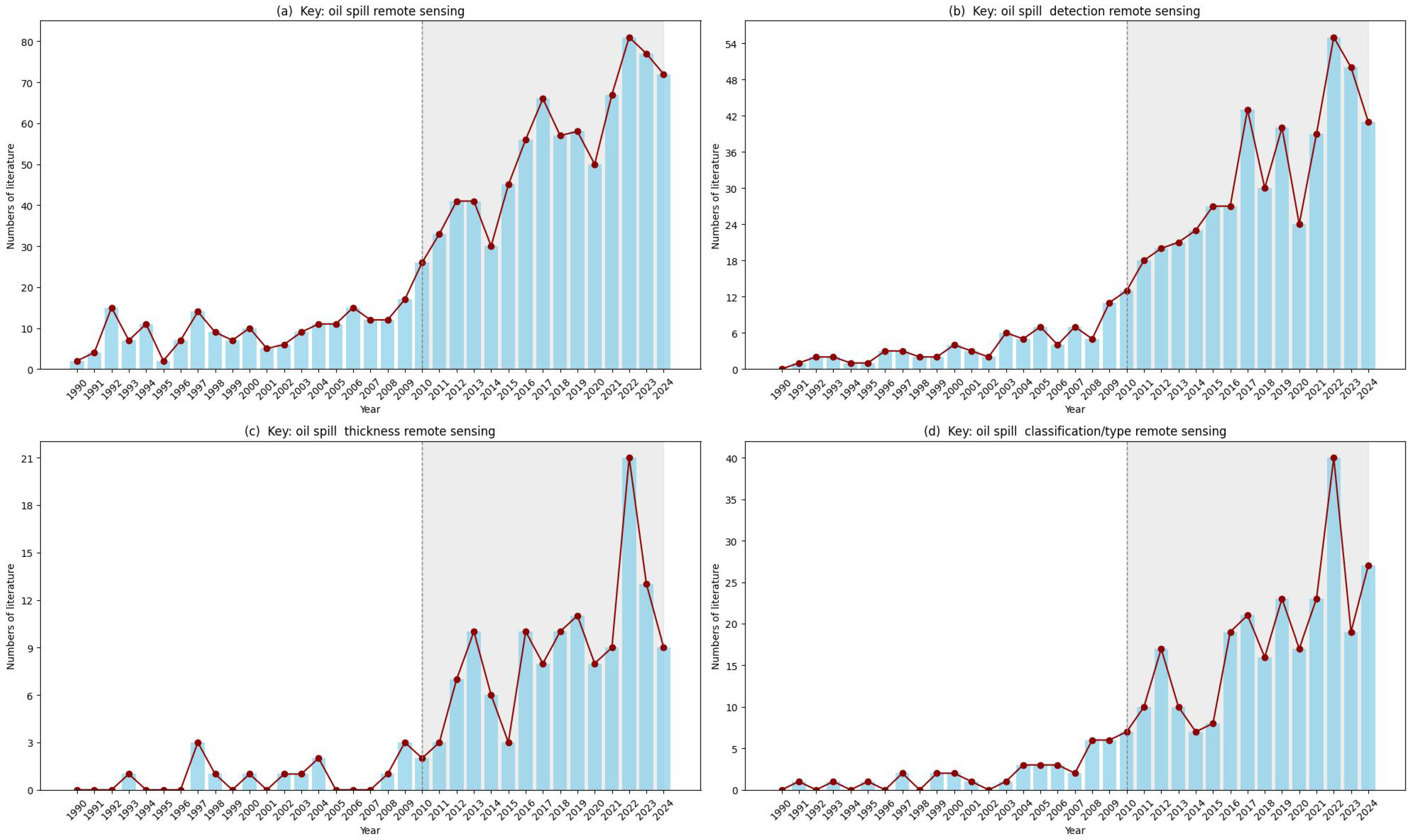
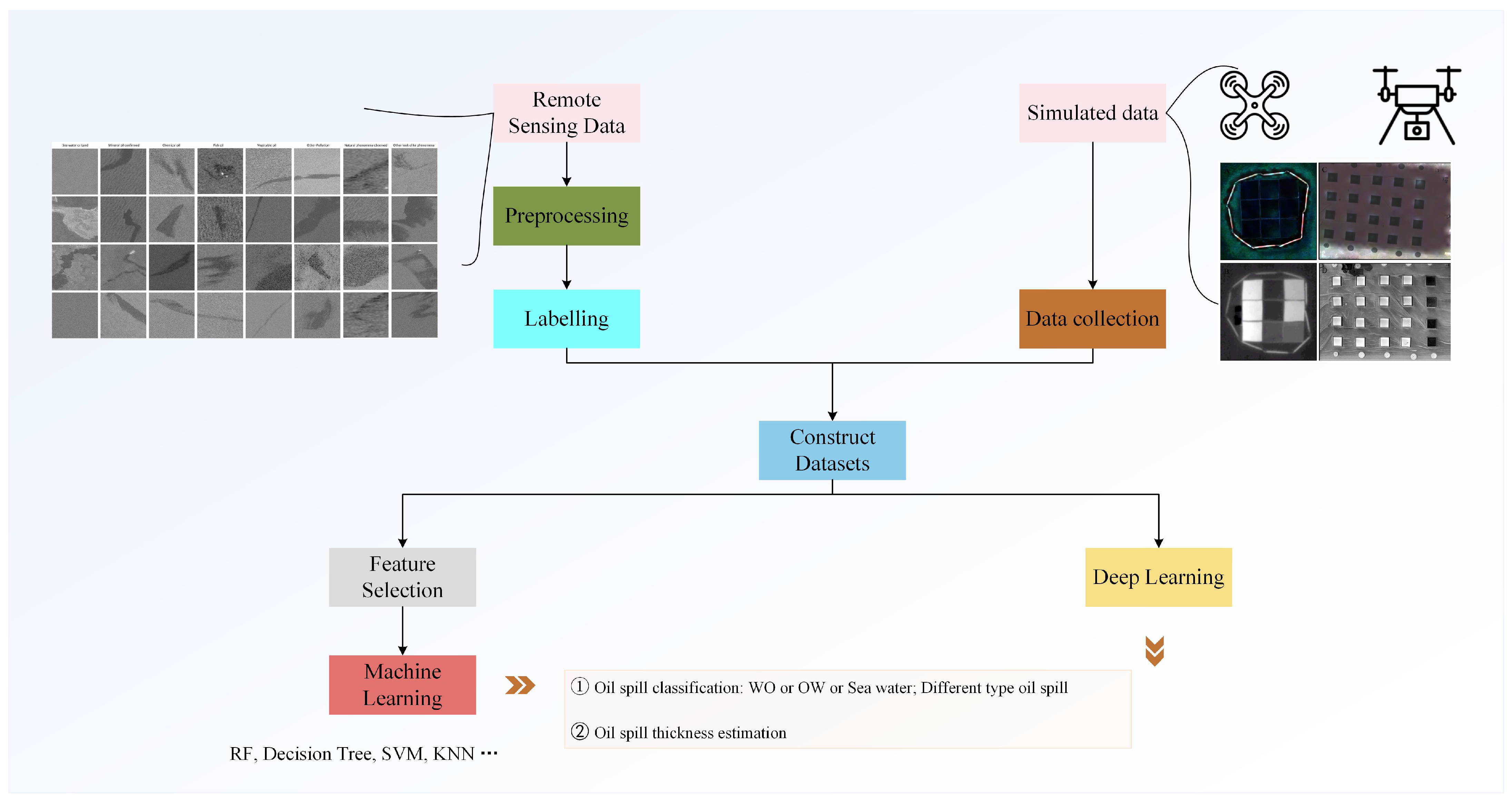
Marine oil spill incidents are one of the major global marine pollution issues, which pose significant threats to ocean ecosystems. However, traditional monitoring methods often suffer from time delays, high costs, and limited real-time capability, making them inadequate for timely and large-scale oil spill detection. With the development of remote sensing (RS) technology and artificial intelligence (AI) methods, as well as the increasing frequency of marine oil spill accidents, plenty of AI-based methods using RS imagery have been proposed for more efficient and accurate oil spill monitoring. This review presents a comprehensive and systematic overview of recent progress in marine oil spill analysis using RS imagery, emphasizing the integration of AI methods across three key tasks: detection, classification, and thickness estimation. Specifically, we first introduce the main types of RS data and discuss the significance of publicly available datasets, which can facilitate method validation and model comparison. Second, we briefly review the application of RS imagery from different sensors in oil spill detection, highlighting the strengths of various spectral and polarimetric methods. Third, we summarize advances in oil spill classification, including AI-based methods that enable differentiation between mineral oil, biogenic films, and various emulsified oils. Fourth, we discuss emerging techniques for oil spill thickness estimation. Finally, we analyze the challenges of existing methods and future directions, including the need for real-time monitoring, the integration of multi-source RS data, and the development of robust models that can generalize across different environmental conditions. This review adopts a comprehensive perspective from both AI methods and RS technology, provides a systematic overview of recent advancements, identifies critical gaps in current methodologies, and serves as a valuable reference for researchers and practitioners working on oil spill monitoring.
Keywords: marine pollution; oil spill detection; oil spill type classification; remote sensing; synthetic aperture radar; thickness estimation marine pollution; oil spill detection; oil spill type classification; remote sensing; synthetic aperture radar; thickness estimation